<?xml version="1.0" encoding="ISO-8859-1"?><article xmlns:mml="http://www.w3.org/1998/Math/MathML" xmlns:xlink="http://www.w3.org/1999/xlink" xmlns:xsi="http://www.w3.org/2001/XMLSchema-instance">
<front>
<journal-meta>
<journal-id>0034-7744</journal-id>
<journal-title><![CDATA[Revista de Biología Tropical]]></journal-title>
<abbrev-journal-title><![CDATA[Rev. biol. trop]]></abbrev-journal-title>
<issn>0034-7744</issn>
<publisher>
<publisher-name><![CDATA[Universidad de Costa Rica]]></publisher-name>
</publisher>
</journal-meta>
<article-meta>
<article-id>S0034-77442010000400026</article-id>
<title-group>
<article-title xml:lang="en"><![CDATA[Urban vegetation change after a hundred years in a tropical city (San José de Costa Rica)]]></article-title>
</title-group>
<contrib-group>
<contrib contrib-type="author">
<name>
<surname><![CDATA[Monge-Nájera]]></surname>
<given-names><![CDATA[Julián]]></given-names>
</name>
<xref ref-type="aff" rid="A01"/>
</contrib>
<contrib contrib-type="author">
<name>
<surname><![CDATA[Pérez-Gómez]]></surname>
<given-names><![CDATA[Gabriela]]></given-names>
</name>
<xref ref-type="aff" rid="A01"/>
</contrib>
</contrib-group>
<aff id="A01">
<institution><![CDATA[,Universidad Estatal a Distancia Viserrectoría de Investigación Laboratorio de Ecología Urbana]]></institution>
<addr-line><![CDATA[San José ]]></addr-line>
<country>Costa Rica</country>
</aff>
<pub-date pub-type="pub">
<day>00</day>
<month>12</month>
<year>2010</year>
</pub-date>
<pub-date pub-type="epub">
<day>00</day>
<month>12</month>
<year>2010</year>
</pub-date>
<volume>58</volume>
<numero>4</numero>
<fpage>1367</fpage>
<lpage>1386</lpage>
<copyright-statement/>
<copyright-year/>
<self-uri xlink:href="http://www.scielo.sa.cr/scielo.php?script=sci_arttext&amp;pid=S0034-77442010000400026&amp;lng=en&amp;nrm=iso"></self-uri><self-uri xlink:href="http://www.scielo.sa.cr/scielo.php?script=sci_abstract&amp;pid=S0034-77442010000400026&amp;lng=en&amp;nrm=iso"></self-uri><self-uri xlink:href="http://www.scielo.sa.cr/scielo.php?script=sci_pdf&amp;pid=S0034-77442010000400026&amp;lng=en&amp;nrm=iso"></self-uri><abstract abstract-type="short" xml:lang="en"><p><![CDATA[Urban vegetation is of key importance because a large proportion of the human population lives in cities. Nevertheless, urban vegetation is understudied outside central Europe and particularly, little is known about the flora of tropical Asian, African and Latin American cities. We present an estimate of how the vegetation has changed in the city of San José, Costa Rica, after about one century, with the repeat photography technique (based on a collection of 19th and early 20th century photographs by José Fidel Tristán and others) and with data from the Costa Rican National Herbarium. We found little vegetation change in the landscape of San José during the 20th century, where a total of 95 families and 458 species were collected in the late 19th and early 20th century. The families with most species were Asteraceae, Fabaceae, Poaceae, Lamiaceae, Euphorbiaceae, Solanaceae, Cyperaceae, Acanthaceae, Malvaceae, Piperaceae and Verbenaceae. Similar results have been found in Europe, where the number of plant species often is stable for long periods even when the individual species vary. Rev. Biol. Trop. 58 (4): 1367-1386. Epub 2010 December 01.]]></p></abstract>
<abstract abstract-type="short" xml:lang="es"><p><![CDATA[La vegetación urbana es de vital importancia ya que una proporción importante de la población humana vive en ciudades. Sin embargo, esta vegetación es poco estudiada fuera del centro de Europa y se sabe particularmente poco sobre la flora urbana de las ciudades tropicales de Asia, África y América Latina. Aquí presentamos una estimación de cómo ha cambiado la vegetación en la ciudad de San José, Costa Rica, durante un siglo, con la técnica de la fotografía repetida (sobre la base de una colección de fotografías del siglo XIX y principios del siglo XX hechas por José Fidel Tristán y otros) y con los datos del Herbario Nacional de Costa Rica. Encontramos pocos cambios en el paisaje de San José durante el siglo XX. En la ciudad se recolectaron 95 familias y 458 especies entre finales del siglo XIX y principios del XX. Las familias con más especies fueron Asteraceae, Fabaceae, Poaceae, Lamiaceae, Euphorbiaceae, Solanaceae, Cyperaceae, Acanthaceae, Malvaceae, Piperaceae y Verbenaceae. Los resultados son similares a los de Europa, donde el número de especies de plantas a menudo es estable durante largos períodos, aunque las especies individuales varíen.]]></p></abstract>
<kwd-group>
<kwd lng="en"><![CDATA[Urban flora]]></kwd>
<kwd lng="en"><![CDATA[effects of urbanization]]></kwd>
<kwd lng="en"><![CDATA[city landscape]]></kwd>
<kwd lng="en"><![CDATA[photographic comparison]]></kwd>
<kwd lng="en"><![CDATA[species list]]></kwd>
<kwd lng="es"><![CDATA[Flora urbana]]></kwd>
<kwd lng="es"><![CDATA[efectos de la urbanización]]></kwd>
<kwd lng="es"><![CDATA[paisaje de ciudad]]></kwd>
<kwd lng="es"><![CDATA[comparación fotográfica]]></kwd>
<kwd lng="es"><![CDATA[lista de especies]]></kwd>
</kwd-group>
</article-meta>
</front><body><![CDATA[  <b><font face="Verdana" size="4">     <p align="center">Urban vegetation change after a hundred years in a tropical city (San Jos&eacute; de Costa Rica)</p> </font><font size="2"> </font></b><font face="Verdana" size="2">     <p style="font-weight: bold;">Juli&aacute;n Monge-N&aacute;jera &amp; Gabriela P&eacute;rez-G&oacute;mez</p>     <p>Laboratorio de Ecolog&iacute;a Urbana, Vicerrector&iacute;a de Investigaci&oacute;n, Universidad Estatal a Distancia, 474-2050 San Pedro de Montes de Oca, San Jos&eacute;, Costa Rica; <a href="mailto:julianmonge@gmail.com">julianmonge@gmail.com</a>, <a href="mailto:gabytta1985@gmail.com">gabytta1985@gmail.com</a>    <br> </p>     <p><a href="#Correspondencia">Direcci&oacute;n para correspondencia</a>    <br> </p> </font><b><font face="Verdana" size="3"> </font></b> <hr style="width: 100%; height: 2px;"><b><font face="Verdana" size="3">     <p>Abstract</p> </font></b><font size="2"> </font><font face="Verdana" size="2"></font>     <div style="text-align: justify;"><font face="Verdana" size="2">     <p>Urban vegetation is of key importance because a large proportion of the human population lives in cities. Nevertheless, urban vegetation is understudied outside central Europe and particularly, little is known about the flora of tropical Asian, African and Latin American cities. We present an estimate of how the vegetation has changed in the city of San Jos&eacute;, Costa Rica, after about one century, with the repeat photography technique (based on a collection of 19th and early 20th century photographs by Jos&eacute; Fidel Trist&aacute;n and others) and with data from the Costa Rican National Herbarium. We found little vegetation change in the landscape of San Jos&eacute; during the 20th century, where a total of 95 families and 458 species were collected in the late 19<sup>th</sup> and early 20<sup>th</sup> century. The families with most species were Asteraceae, Fabaceae, Poaceae, Lamiaceae, Euphorbiaceae, Solanaceae, Cyperaceae, Acanthaceae, Malvaceae, Piperaceae and Verbenaceae. Similar results have been found in Europe, where the number of plant species often is stable for long periods even when the individual species vary. Rev. Biol. Trop. 58 (4): 1367-1386. Epub 2010 December 01.</p> </font></div> <font face="Verdana" size="2"></font><b><font size="2"> </font></b>     ]]></body>
<body><![CDATA[<p><b><font face="Verdana" size="2">Key words: </font></b><font  face="Verdana" size="2">Urban flora, effects of urbanization, city landscape, photographic comparison, species list.</font></p> <font size="2"> </font><b><font face="Verdana" size="3">     <p>Resumen</p> </font></b><font size="2"> </font><font face="Verdana" size="2"></font>     <div style="text-align: justify;"><font face="Verdana" size="2">     <p>La vegetaci&oacute;n urbana es de vital importancia ya que una proporci&oacute;n importante de la poblaci&oacute;n humana vive en ciudades. Sin embargo, esta vegetaci&oacute;n es poco estudiada fuera del centro de Europa y se sabe particularmente poco sobre la flora urbana de las ciudades tropicales de Asia, &Aacute;frica y Am&eacute;rica Latina. Aqu&iacute; presentamos una estimaci&oacute;n de c&oacute;mo ha cambiado la vegetaci&oacute;n en la ciudad de San Jos&eacute;, Costa Rica, durante un siglo, con la t&eacute;cnica de la fotograf&iacute;a repetida (sobre la base de una colecci&oacute;n de fotograf&iacute;as del siglo XIX y principios del siglo XX hechas por Jos&eacute; Fidel Trist&aacute;n y otros) y con los datos del Herbario Nacional de Costa Rica. Encontramos pocos cambios en el paisaje de San Jos&eacute; durante el siglo XX. En la ciudad se recolectaron 95 familias y 458 especies entre finales del siglo XIX y principios del XX. Las familias con m&aacute;s especies fueron Asteraceae, Fabaceae, Poaceae, Lamiaceae, Euphorbiaceae, Solanaceae, Cyperaceae, Acanthaceae, Malvaceae, Piperaceae y Verbenaceae. Los resultados son similares a los de Europa, donde el n&uacute;mero de especies de plantas a menudo es estable durante largos per&iacute;odos, aunque las especies individuales var&iacute;en.</p> </font></div> <font face="Verdana" size="2"></font><b><font size="2"> </font></b>     <p><b><font face="Verdana" size="2">Palabras clave: </font></b><font  face="Verdana" size="2">Flora urbana, efectos de la urbanizaci&oacute;n, paisaje de ciudad, comparaci&oacute;n fotogr&aacute;fica, lista de especies.</font></p> <font size="2"> </font> <hr style="width: 100%; height: 2px;"><font size="2"></font>     <div style="text-align: justify;"><font size="2">     <p><font face="Verdana" size="2">Urban vegetation has mostly been studied in central Europe, where about 50% of species are alien, half of them introduced before the 15th century. Despite the heavy traffic among European cities, five centuries have not been enough to homogenize their flora: the communities of species introduced after the year 1500 are characteristic of each city (Frank <i>et al. </i>2008).</font></p> </font> </div>     <p style="text-align: justify;"><font face="Verdana" size="2">For animals, which particular species occur in cities is predicted by the "environmental filtering model" that in turn is based on plants. The model states that (1) there is natural selection of species living in urban ecosystems, (2) plants define key habitat characteristics and (3) habitats define which animals can live in the city (Williams <i>et al. </i>2009). Generally, moderate urbanization produces some increase in plant biodiversity but is deleterious for invertebrates and mammals. A high level of urbanization is correlated with fewer species of plants, invertebrates, amphibians, reptiles, birds and mammals, possibly because humans willingly introduce plant species, but not animals, to their gardens (McKinney 2008).</font></p>     <div style="text-align: justify;"></div>     <p style="text-align: justify;"><font face="Verdana" size="2">Outside central Europe, urban vegetation is understudied but there are some recent data from Plymouth, England, where alien species increase with urbanization (Kent <i>et al</i>. 2001). Also in England, gardens in Sheffield have a total of 1 166 plant species (70% alien) and twice the garden size means 25% more species. In these gardens there are 63% biennials/perennials, 18% shrubs, 10% annuals and 8% trees (Smith <i>et al. </i>2006).</font></p>     ]]></body>
<body><![CDATA[<div style="text-align: justify;"></div>     <p style="text-align: justify;"><font face="Verdana" size="2">In Anglosaxon and French North America, there is a surprising scarcity of recent studies on urban biotas, but some work has been done. In the city of Halifax (Nova Scotia, Canada), soil moisture and light determine which species are present. Taxa adapted naturally to rock, grassland and flooded habitat find an analog habitat in the city and thrive (Lundholm &amp; Marlin 2006).</font></p>     <div style="text-align: justify;"></div>     <p style="text-align: justify;"><font face="Verdana" size="2">The New York metropolitan region has 556 woody species and non-native invasive species are becoming more common (Clemants &amp; Moore 2004). In the Pelham Bay Park, New York City, native species went from 72% to 60% and 26% of natives disappeared in 50 years (especially herbaceous and meadow-type plants, DeCandido 2004).</font></p>     <div style="text-align: justify;"></div>     <p style="text-align: justify;"><font face="Verdana" size="2">Even though recent studies are scarce, a meta-analysis found 79 studies of species richness with geographic data for New York City; of these, 17 studies found a decrease in species richness, six an increase and three found no change. However, all studies reported an increasing number of exotic species (Puth &amp; Burns 2008).</font></p>     <div style="text-align: justify;"></div>     <p style="text-align: justify;"><font face="Verdana" size="2">Tropical cities are in areas of high biodiversity but little is known about Asian and especially African cities regarding urban flora. In Latin America the situation is better but worldwide no floral lists exist for the 50 most populated cities (Clemants 2002). In Jinan City, China, a methodological comparison found that gradient analysis from the urban center to the fringe gives better estimates of the urban flora than the traditional block-area analysis (Kong &amp; Nakagoshi 2005). In Taipei, green areas have 164 tree species (few shared among sites) and large evergreen native species dominate. Larger parks have higher richness, more landscape fidelity to the original vegetation, and more rare and endemic species (Jim &amp; Chen 2007). In Africa, the urban areas of the Nile Delta (Egypt) have vegetation that is mainly correlated with moisture, pH, fertility and texture gradients, but plants always occupy sites similar to their natural habitats (Shaltout &amp; El-Sheikh 2002).</font></p>     <p><font face="Verdana" size="2">Latin America has a long history of scientific study of urban biota, particularly the plants and there are several recent studies from M&eacute;xico, Peru, Brazil, Chile and Argentina.</font></p>     <p style="text-align: justify;"><font face="Verdana" size="2">In the city of Ensenada, Mexico, there are 161 species, 61% non-native (Garcill&aacute;n <i>et al. </i>2009). In Mexico City, trees are stressed from dry wind and unfavorable water flow caused by the pavement (Barradas 2000).</font></p>     ]]></body>
<body><![CDATA[<div style="text-align: justify;"></div>     <p style="text-align: justify;"><font face="Verdana" size="2">Brazil has the largest urban forest in world (Tijuca: 3 300 hectares) but it is being stressed by roads because roads are surrounded by invasive species that burn easily. The fires in turn open adjacent areas to more invasive vegetation and the damage spreads (Matos <i>et al. </i>2002). There are very few studies of plants that grow on walls but in Jundiai, Brazilian, walls have a biodiversity of 28 species (dos Reis <i>et al. </i>2006).</font></p>     <div style="text-align: justify;"></div>     <p style="text-align: justify;"><font face="Verdana" size="2">Normally, satellites are not used to study urban vegetation but in Arequipa, Peru, satellite images show that desert vegetation is being lost because of urban expansion (Polk <i>et al. </i>2005). However, only ground work can reliably identify species and this kind of work has shown that temperate South America is not different from North America and Europe: at least half of the plant species in the Argentinean cities of Mendoza and Rosario are introduced. In Luj&aacute;n de Cuyo, Mendoza, 61 species were identified: 69% introduced (M&eacute;ndez 2005). The vacant lots of Rosario each have one dominant species, a few abundant species and many rare species. Therophytes predominate and the proportions of indigenous and introduced species are similar (Franceschi 1996).</font></p>     <div style="text-align: justify;"></div>     <p style="text-align: justify;"><font face="Verdana" size="2">Chile is the Latin American country with the largest number of recent studies. Synanthropic communities in an urban footpath of Valdivia represents six associations and two communities (Finot &amp; Ram&iacute;rez 1998). In Concepci&oacute;n, green areas are dominated by nonnative ornamental species (Paucharda <i>et al</i>. 2006). The distribution of urban vegetation reflects social inequalities. In Santiago, poor areas can have ten times less plant cover than rich neighbourhoods (Hern&aacute;ndez 2008), similar to other countries (Pedlowski <i>et al</i>. 2002). However, workshops in poor areas of cities can result in an improvement of their vegetation (Garz&oacute;n <i>et al. </i>2004).</font></p>     <div style="text-align: justify;"></div>     <p style="text-align: justify;"><font face="Verdana" size="2">In Costa Rica, there is a long history of study of urban plants that began with the National Museum&#8217;s collection efforts in the late 19<sup>th</sup> century, but little has been published. M&eacute;ndez &amp; Fournier (1980) and Monge-N&aacute;jera <i>et al</i>. (2002a,b) studied the lichens and their relationship with air pollution. The use of European lichens proved succesful when they were transplanted to this Tropical city (Gr&uuml;ninger &amp; Monge-N&aacute;jera 1988). Francisco Fallas made checklists and abundance estimates of urban herbs in the late 1970&#8217;s but to our knowledge he did not publish them. The program "Costa Rica: Jard&iacute;n Bot&aacute;nico de Am&eacute;rica Tropical" produces manuals and labels for urban vegetation (www.hjimenez.org) and there is a program to provide urban parks with butterflies and their host plants (http://www.lrsarts.com/plas/index.html).</font></p>     <p style="text-align: justify;"><font face="Verdana" size="2">The biodiversity in patches of urban vegetation can be surprinsingly high, at least in Costa Rica. For example, after 50 years, in only one hectare of urban vegetation in San Jos&eacute;, there are 432 plant species (Di St&eacute;fano <i>et al. </i>1995, Nishida <i>et al. </i>2009), a full new lichen family with a novel symbiotic lifestyle (<i>Eremithallus costaricensis</i>; L&uuml;cking <i>et al. </i>2008), 200 butterfly species (Nishida <i>et al</i>. 2009) and a new species of Hymenoptera, <i>Meteorus oviedo </i>(Shaw &amp; Nishida 2005).</font></p>     <div style="text-align: justify;"></div>     ]]></body>
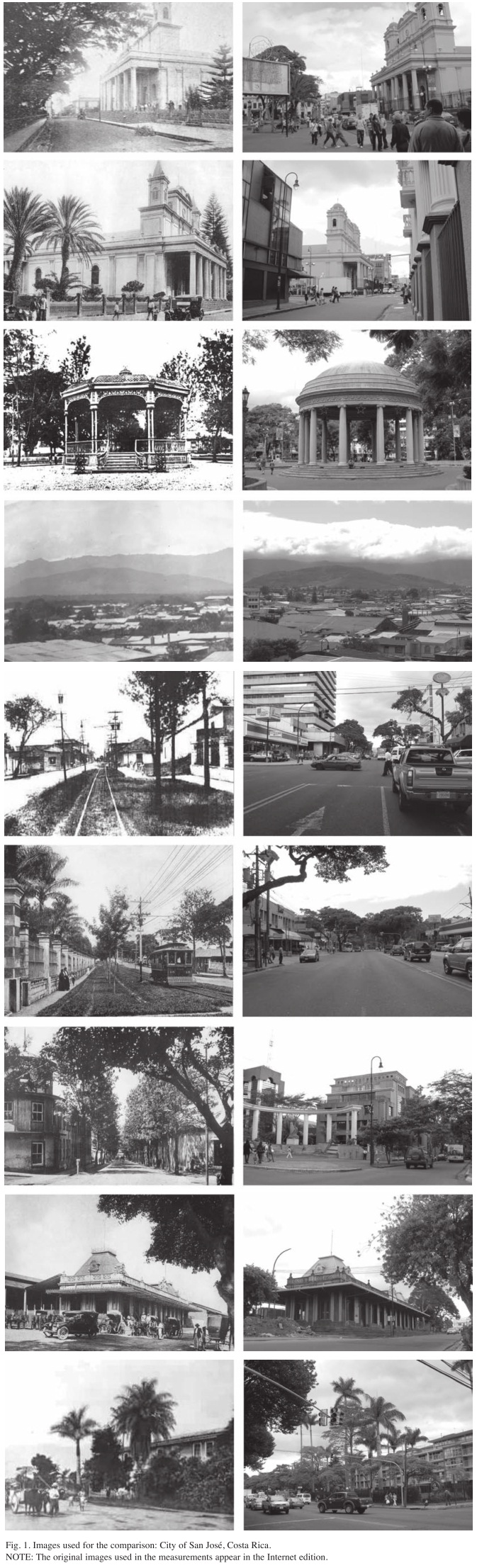
<body><![CDATA[<p style="text-align: justify;"><font face="Verdana" size="2">We present an estimate of how the vegetation has changed in the city of San Jos&eacute;, Costa Rica, after about one century, with a technique called repeat photography. We do not know of repeat photography studies on urban Costa Rican vegetation of San Jos&eacute;, but the technique was used in Costa Rica by Horn (1989) to assess changes in the p&aacute;ramo habitat.</font></p>     <div style="text-align: justify;"><b><font face="Verdana" size="3">     <p>Materials and methods</p> </font></b><font size="2"> </font></div>     <p style="text-align: justify;"><font face="Verdana" size="2">We used a collection of photographs taken in the late 19<sup>th</sup> and early 20<sup>th </sup>centuries from the Jos&eacute; Fidel Trist&aacute;n Fern&aacute;ndez Collection in the Archivo Nacional de Costa Rica and others reproduced by Leiva (2004). The sites were re-photographed on December 11, 2008 with a Nikon Coolpix 8800 camera (8 megapixels; <a  href="/img/revistas/rbt/v58n4/a26i1.jpg">Fig. 1</a>). The repeat photography technique, developed in 1880 (Webb <i>et al. </i>2010) is good for detailed analysis (Hendrick &amp; Copenheaver 2009) and is cost- effective (Robert <i>et al. </i>2010). We used digital repeat photography, which is fast, detailed and reliable; can be stored for future corroboration and comparison; includes rich data that may become useful in the future; and can classify and measure information automatically (Crimmins &amp; Crimmins 2008).</font></p>     <div></div>     <p style="text-align: justify;"><font face="Verdana" size="2">We re-photographed nine sites (exact year of original photograph included when known): Site 1 Catedral Metropolitana Street: 0 Avenues: 2-4 (1896); Site 2<b> </b>Catedral Metropolitana St. 0 Av. 0-2 (<i>c. </i>1910); Site 3<b> </b>Kiosco Parque Moraz&aacute;n St. 5-7 Av. 3 (1914); Site 4<b> </b>Colegio de Se&ntilde;oritas St. 3-5 Av. 4-6 (1914); Site 5<b> </b>Paseo Col&oacute;n St. 36 Av. 0, looking east (1899); Site 6 Paseo Col&oacute;n St. 36 Av. 0 looking west; Site 7<b> </b>Antigua Casa Presidencial St. 15 Av. 7; Site 8<b> </b>Estaci&oacute;n del Ferrocarril al Atl&aacute;ntico St. 21-23 Av. 3; Site 9<b> </b>Hospital de Ni&ntilde;os St. 20 Av. 0.</font></p>     <p style="text-align: justify;"><font face="Verdana" size="2">We calculated % cover by clipping and weighing sections from photographs printed on standard bond paper; for example, if the clippings from buildings represented 20 % of the total weight of the photograph, we recorded that buildings represented 20% of the image. This technique is compared with others by Monge N&aacute;jera <i>et al. </i>(2002b).</font></p>     <p><font face="Verdana" size="2">We also present an analysis of plants collected in cant&oacute;n de San Jos&eacute; from 1885 through 1945 by the Museo Nacional staff (Base de Datos, Herbario Nacional, updated to April 13, 2009).</font></p> <b><font face="Verdana" size="3">     <p>Results</p> </font></b><font size="2"> </font><font face="Verdana" size="2"></font>     <div style="text-align: justify;"><font face="Verdana" size="2">     ]]></body>
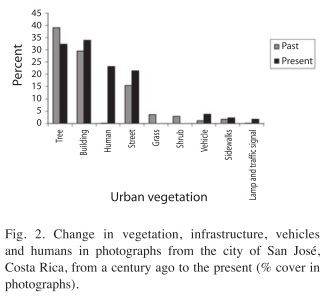
<body><![CDATA[<p>After about a century, the main change in San Jos&eacute; city photographs is the much larger number of people. The reduction in vegetation affects grasses, shrubs and trees, but is small; the increase in buildings, streets, vehicles, sidewalks, lamps and signs is also small (<a href="#fig2">Fig. 2</a>).</p> </font>    <br> <font face="Verdana" size="2">     <p></p> </font></div> <font face="Verdana" size="2">     <p>    <br>     <br> </p> </font>     <div style="text-align: center;"><a name="fig2"></a><img  src="/img/revistas/rbt/v58n4/a26i2.jpg" title="" alt=""  style="width: 328px; height: 298px;">    <br>     <br> </div> <font face="Verdana" size="2">     <p>A total of 95 families and 458 species were collected in the late 19th and early 20th century. </p> </font><font size="2"> </font><font face="Verdana" size="2"></font>     ]]></body>
<body><![CDATA[<p style="text-align: justify;"><font face="Verdana" size="2">The families with most species were Asteraceae, Fabaceae, Poaceae, Lamiaceae, Euphorbiaceae, Solanaceae, Cyperaceae, Acanthaceae, Malvaceae, Piperaceae and Verbenaceae (<a href="/img/revistas/rbt/v58n4/a26t1a.gif">Appendix 1</a>).</font></p> <b><font face="Verdana" size="3">     <p>Discussion</p> </font></b><font size="2"> </font>     <p style="text-align: justify;"><font face="Verdana" size="2">Repeat photography was used in Costa Rica by Horn (1989) to assess changes in the paramo habitat (she found very little change) but we were unable to find a similar study of urban vegetation. Nevertheless, studies about plant biodiversity after long periods suggest that our results are not unusual. For example, after 50 years, Brussels has the same total number of plant species that it had in 1940, albeit the individual species change and the same applies to other areas in much longer time spans (Chocholou&#353;kov&aacute;a &amp; Py&#353;ek 2003). We cannot make a comparison of species from <i>circa </i>1900 to <i>circa </i>2000 in San Jos&eacute; because urban vegetation has rarely been collected in recent decades.</font></p>     <div style="text-align: justify;"></div>     <p style="text-align: justify;"><font face="Verdana" size="2">The increase in human presence in the city landscape is explained by the population growth of downtown San Jos&eacute; or <i>Cant&oacute;n Central </i>(from about 30 000 when the first photographs used in this study were taken <i>circa </i>1900 to 356 000 when the sites were rephotographed in 2009; see: Centro Centroamericano de Poblaci&oacute;n and Instituto Nacional de Estad&iacute;stica y Censos 2002). The small increase in the number of vehicles is an underestimation: the 2008 photographs were purposefully taken in low traffic periods to obtain a better view of the scenes.</font></p>     <div style="text-align: justify;"></div>     <p style="text-align: justify;"><font face="Verdana" size="2">Central European cities have a mean of 646 plant species/city and larger cities have more species (Pysek 1998), thus, considering that San Jos&eacute; was and is a small city, the total of 458 species recorded is within the expected range.</font></p>     <div></div>     <p style="text-align: justify;"><font face="Verdana" size="2">Successful urban plants tend to belong to species adapted to natural habitats with strong sunlight, abundant nitrogen and low water levels (Shaltout &amp; El-Sheikh 2002, Chocholou&#353;kov&aacute;a &amp; Py&#353;ek 2003, Lundholm &amp; Marlin 2006), so the presence of many Asteraceae, Fabaceae, Poaceae, Lamiaceae, Euphorbiaceae, Solanaceae, Cyperaceae, Acanthaceae, Malvaceae, Piperaceae and Verbenaceae is not surprising. Many of the plant species in Costa Rica are introduced (Chac&oacute;n &amp; Sabor&iacute;o 2005) and here again the situation is similar to that in other countries.</font></p>     <div style="text-align: justify;"></div>     ]]></body>
<body><![CDATA[<p style="text-align: justify;"><font face="Verdana" size="2">Urban trees mitigate global warming (Abdollahi <i>et al</i>. 2000, McPherson <i>et al</i>. 2008), significantly reduce urban heat islands (Huang <i>et al</i>. 2009) and can sequester about 100kg of air pollutants per hectare of urban forest (Vilela-Lozano 2004). Furthermore, urban vegetation protects many species in the five kingdoms (Dana <i>et al</i>. 2002, Smith <i>et al. </i>2006), including valuable rare species (Maurer <i>et al. </i>2000, Williams <i>et al</i>. 2009). For these and other reasons, the study and management of urban vegetation is of great importance.</font></p>     <div style="text-align: justify;"></div>     <p style="text-align: justify;"><font face="Verdana" size="2">Genetic diversity is low in urban plants and they are less prepared to cope with environmental change (Knapp <i>et al. </i>2009), so periodic monitoring is needed to conserve original species as well as any others in need of protection (Godefroid 2001). Citizens can learn to effectively take advantage of urban vegetation (Garz&oacute;n <i>et al. </i>2004) and to recognize historical changes in the city scene (e.g. the repeat photography groups in www.flickr.com), not only for cultural reasons, but also to influence the administration of the urban flora by local governments.</font></p>     <p><font face="Verdana" size="2">Future studies of urban vegetation in San Jos&eacute; could investigate these hypotheses:</font></p>     <div style="text-align: justify;"><font face="Verdana" size="2">- Floristic composition results from the interaction of human density, water availability, temperature, altitude and soil (Dana <i>et al. </i>2002, Chocholou&#353;kov&aacute;a &amp; Py&#353;ek 2003, Fanelli &amp; Tescarollo 2006, Altobelli <i>et al.</i>2007).</font>    <br> </div>     <p><font face="Verdana" size="2">- Ecological succession starts with ruderal annual plants, followed by perennials (Prach <i>et al</i>. 2001).    <br> - Alien species benefit more from human activity (Niggermann 2009).    <br> - With global warming, species adapted to colder climate will become less common and vice versa. </font></p> <b><font face="Verdana" size="3">     <p>Acknowledgments</p> </font></b><font size="2"> </font><font face="Verdana" size="2"></font>     ]]></body>
<body><![CDATA[<div style="text-align: justify;"><font face="Verdana" size="2">     <p>We thank Hubert Blanco (Archivos Nacionales), Colegio Superior de Se&ntilde;oritas, Mar&iacute;a Jos&eacute; Guerra Araus (Herbario Nacional), Sergio Aguilar, Sergio Quesada, Karla Vega, Andrea S&aacute;nchez and Mar&iacute;a Acu&ntilde;a for their assistance. We specially thank Sally P. Horn (University of Tennessee, Knoxville) for suggestions to improve the manuscript and for advice on repeat photography.</p> </font></div> <font face="Verdana" size="2"></font><font size="2"> </font><b></b> <hr style="width: 100%; height: 2px;"><b><font face="Verdana" size="3">     <p>References</p> </font></b><font size="2"> </font>     <!-- ref --><p><font face="Verdana" size="2">Abdollahi, K., Z. Ning &amp; A. Appeaning. 2000. Global climate change and the urban forest. Franklin, California, USA.    &nbsp;&nbsp;&nbsp;&nbsp;&nbsp;&nbsp;&nbsp;&nbsp;[&#160;<a href="javascript:void(0);" onclick="javascript: window.open('/scielo.php?script=sci_nlinks&ref=1406586&pid=S0034-7744201000040002600001&lng=','','width=640,height=500,resizable=yes,scrollbars=1,menubar=yes,');">Links</a>&#160;]<!-- end-ref --></font></p>     <!-- ref --><p><font face="Verdana" size="2">Altobelli, A., E. Bressan, E. Feoli, P. Ganis &amp; F. Martini. 2007. Improving knowledge of urban vegetation by applying GIS technology to existing databases. Appl. Veget. Sci. 10: 203-210.    &nbsp;&nbsp;&nbsp;&nbsp;&nbsp;&nbsp;&nbsp;&nbsp;[&#160;<a href="javascript:void(0);" onclick="javascript: window.open('/scielo.php?script=sci_nlinks&ref=1406588&pid=S0034-7744201000040002600002&lng=','','width=640,height=500,resizable=yes,scrollbars=1,menubar=yes,');">Links</a>&#160;]<!-- end-ref --></font></p>     <!-- ref --><p><font face="Verdana" size="2">Aparecida dos Reis, V., J.A Lombardi &amp; R.A. Figueiredo. 2006. Diversity of vascular plants growing on walls of a Brazilian city. Urban Ecosyst. 9: 39-43.    &nbsp;&nbsp;&nbsp;&nbsp;&nbsp;&nbsp;&nbsp;&nbsp;[&#160;<a href="javascript:void(0);" onclick="javascript: window.open('/scielo.php?script=sci_nlinks&ref=1406590&pid=S0034-7744201000040002600003&lng=','','width=640,height=500,resizable=yes,scrollbars=1,menubar=yes,');">Links</a>&#160;]<!-- end-ref --></font></p>     <!-- ref --><p><font face="Verdana" size="2">Barradas, V. 2000. Energy balance and transpiration in an urban tree hedgerow in Mexico City. Urban Ecosyst. 4: 55-67.    &nbsp;&nbsp;&nbsp;&nbsp;&nbsp;&nbsp;&nbsp;&nbsp;[&#160;<a href="javascript:void(0);" onclick="javascript: window.open('/scielo.php?script=sci_nlinks&ref=1406592&pid=S0034-7744201000040002600004&lng=','','width=640,height=500,resizable=yes,scrollbars=1,menubar=yes,');">Links</a>&#160;]<!-- end-ref --></font></p>     <!-- ref --><p><font face="Verdana" size="2">Chac&oacute;n, E. &amp; G. Sabor&iacute;o. 2005. Sistema de Informaci&oacute;n de las Especies Invasoras en Costa Rica. Propuesta ante la OEA. Organizaci&oacute;n de Estados Americano (OEA), Washington, D.C. (www.oas.org/dsd/IABIN/Component2/CostaRica. Downloaded June 1, 2010).    &nbsp;&nbsp;&nbsp;&nbsp;&nbsp;&nbsp;&nbsp;&nbsp;[&#160;<a href="javascript:void(0);" onclick="javascript: window.open('/scielo.php?script=sci_nlinks&ref=1406594&pid=S0034-7744201000040002600005&lng=','','width=640,height=500,resizable=yes,scrollbars=1,menubar=yes,');">Links</a>&#160;]<!-- end-ref --></font></p>     <!-- ref --><p><font face="Verdana" size="2">Chocholou&#353;kov&aacute;, Z. &amp; P. Py&#353;ek. 2003. Changes in composition and structure of urban flora over 120 years: a case study of the city of Plze</font><font face="Verdana"  size="2">&#328;. Flora- Morphology,</font><font face="Verdana" size="2"> Distribution. Functional Ecol. Plants 198: 366-376.    &nbsp;&nbsp;&nbsp;&nbsp;&nbsp;&nbsp;&nbsp;&nbsp;[&#160;<a href="javascript:void(0);" onclick="javascript: window.open('/scielo.php?script=sci_nlinks&ref=1406596&pid=S0034-7744201000040002600006&lng=','','width=640,height=500,resizable=yes,scrollbars=1,menubar=yes,');">Links</a>&#160;]<!-- end-ref --></font></p>     <!-- ref --><p><font face="Verdana" size="2">Centro Centroamericano de Poblaci&oacute;n &amp; Instituto Nacional de Estad&iacute;stica y Censos. 2002. Costa Rica: estimaciones y proyecciones de poblaci&oacute;n 1970-2100 actualizadas al a&ntilde;o 2000 y evaluaci&oacute;n del Censo 2000 y otras fuentes de informaci&oacute;n. Centro Centroamericano de Poblaci&oacute;n &amp; Instituto Nacional de Estad&iacute;stica y Censos, San Jos&eacute;, Costa Rica.    &nbsp;&nbsp;&nbsp;&nbsp;&nbsp;&nbsp;&nbsp;&nbsp;[&#160;<a href="javascript:void(0);" onclick="javascript: window.open('/scielo.php?script=sci_nlinks&ref=1406598&pid=S0034-7744201000040002600007&lng=','','width=640,height=500,resizable=yes,scrollbars=1,menubar=yes,');">Links</a>&#160;]<!-- end-ref --></font></p>     <!-- ref --><p><font face="Verdana" size="2">Clemants, S. 2002. A Short Bibliography of Urban Floras. Urban habitats 1: 1541-7115.    &nbsp;&nbsp;&nbsp;&nbsp;&nbsp;&nbsp;&nbsp;&nbsp;[&#160;<a href="javascript:void(0);" onclick="javascript: window.open('/scielo.php?script=sci_nlinks&ref=1406600&pid=S0034-7744201000040002600008&lng=','','width=640,height=500,resizable=yes,scrollbars=1,menubar=yes,');">Links</a>&#160;]<!-- end-ref --></font></p>     <!-- ref --><p><font face="Verdana" size="2">Clemants, S. &amp; G. Moore 2004. The Changing Flora of the New York Metropolitan Region. Urban Habitats 3: 192-210.    &nbsp;&nbsp;&nbsp;&nbsp;&nbsp;&nbsp;&nbsp;&nbsp;[&#160;<a href="javascript:void(0);" onclick="javascript: window.open('/scielo.php?script=sci_nlinks&ref=1406602&pid=S0034-7744201000040002600009&lng=','','width=640,height=500,resizable=yes,scrollbars=1,menubar=yes,');">Links</a>&#160;]<!-- end-ref --></font></p>     <!-- ref --><p><font face="Verdana" size="2">Crimmins, M. &amp; T. Crimmins. 2008. Monitoring Plant Phenology Using Digital Repeat Photography. Environ. Manage. 41: 1432-1009.    &nbsp;&nbsp;&nbsp;&nbsp;&nbsp;&nbsp;&nbsp;&nbsp;[&#160;<a href="javascript:void(0);" onclick="javascript: window.open('/scielo.php?script=sci_nlinks&ref=1406604&pid=S0034-7744201000040002600010&lng=','','width=640,height=500,resizable=yes,scrollbars=1,menubar=yes,');">Links</a>&#160;]<!-- end-ref --></font></p>     <!-- ref --><p><font face="Verdana" size="2">Dana, E.D, S. Vivas &amp; J.F. Mota. 2002. Urban vegetation of Almer&iacute;a City - a contribution to urban ecology in Spain. Landscape Urban Plann: 203-216.    &nbsp;&nbsp;&nbsp;&nbsp;&nbsp;&nbsp;&nbsp;&nbsp;[&#160;<a href="javascript:void(0);" onclick="javascript: window.open('/scielo.php?script=sci_nlinks&ref=1406606&pid=S0034-7744201000040002600011&lng=','','width=640,height=500,resizable=yes,scrollbars=1,menubar=yes,');">Links</a>&#160;]<!-- end-ref --></font></p>     <!-- ref --><p><font face="Verdana" size="2">De Candido, R. 2004. Recent changes in plan species diversity in urban Pelham Bay Park, 1997-1998. Biol. Conserv. 120: 129-136.    &nbsp;&nbsp;&nbsp;&nbsp;&nbsp;&nbsp;&nbsp;&nbsp;[&#160;<a href="javascript:void(0);" onclick="javascript: window.open('/scielo.php?script=sci_nlinks&ref=1406608&pid=S0034-7744201000040002600012&lng=','','width=640,height=500,resizable=yes,scrollbars=1,menubar=yes,');">Links</a>&#160;]<!-- end-ref --></font></p>     <!-- ref --><p><font face="Verdana" size="2">Di St&eacute;fano, J.F., V. Nielsen, J. Hoomans &amp; L.A. Fournier. 1995. Regeneraci&oacute;n de la vegetaci&oacute;n arb&oacute;rea en una peque&ntilde;a reserva forestal urbana del premontano h&uacute;medo, Costa Rica. Rev. Biol. Trop. 41:7-21.    &nbsp;&nbsp;&nbsp;&nbsp;&nbsp;&nbsp;&nbsp;&nbsp;[&#160;<a href="javascript:void(0);" onclick="javascript: window.open('/scielo.php?script=sci_nlinks&ref=1406610&pid=S0034-7744201000040002600013&lng=','','width=640,height=500,resizable=yes,scrollbars=1,menubar=yes,');">Links</a>&#160;]<!-- end-ref --></font></p>     <!-- ref --><p><font face="Verdana" size="2">Fanelli, P. &amp; A.Tescarollo. 2006. Ecological indicator applied to urban and suburban floras. Ecol. Indic. 6: 444-457.    &nbsp;&nbsp;&nbsp;&nbsp;&nbsp;&nbsp;&nbsp;&nbsp;[&#160;<a href="javascript:void(0);" onclick="javascript: window.open('/scielo.php?script=sci_nlinks&ref=1406612&pid=S0034-7744201000040002600014&lng=','','width=640,height=500,resizable=yes,scrollbars=1,menubar=yes,');">Links</a>&#160;]<!-- end-ref --></font></p>     <!-- ref --><p><font face="Verdana" size="2">Finot, V. &amp; C. Ram&iacute;rez. 1998. Fitosociolog&iacute;a de la vegetaci&oacute;n ruderal de la ciudad de Valdivia (X Regi&oacute;n-Chile). Studia Bot. 17: 69-86.    &nbsp;&nbsp;&nbsp;&nbsp;&nbsp;&nbsp;&nbsp;&nbsp;[&#160;<a href="javascript:void(0);" onclick="javascript: window.open('/scielo.php?script=sci_nlinks&ref=1406614&pid=S0034-7744201000040002600015&lng=','','width=640,height=500,resizable=yes,scrollbars=1,menubar=yes,');">Links</a>&#160;]<!-- end-ref --></font></p>     <!-- ref --><p><font face="Verdana" size="2">Franceschi, E.A. 1996. The ruderal vegetation of Rosario City, Argentina. Landscape Urban Plann. 34: 11-18.    &nbsp;&nbsp;&nbsp;&nbsp;&nbsp;&nbsp;&nbsp;&nbsp;[&#160;<a href="javascript:void(0);" onclick="javascript: window.open('/scielo.php?script=sci_nlinks&ref=1406616&pid=S0034-7744201000040002600016&lng=','','width=640,height=500,resizable=yes,scrollbars=1,menubar=yes,');">Links</a>&#160;]<!-- end-ref --></font></p>     <!-- ref --><p><font face="Verdana" size="2">Frank, A., M. La Sorte, P. McKinney, S. Klotz, G. Rapson, L. Celesti-Grapow &amp; K. Thompson. 2008. Distance decay of similarity among European urban floras: the impact of anthropogenic activities on Biodiversity. Global Ecol. Biogeogr. 17: 363-371.    &nbsp;&nbsp;&nbsp;&nbsp;&nbsp;&nbsp;&nbsp;&nbsp;[&#160;<a href="javascript:void(0);" onclick="javascript: window.open('/scielo.php?script=sci_nlinks&ref=1406618&pid=S0034-7744201000040002600017&lng=','','width=640,height=500,resizable=yes,scrollbars=1,menubar=yes,');">Links</a>&#160;]<!-- end-ref --></font></p>     <!-- ref --><p><font face="Verdana" size="2">Garcill&aacute;n, P.P., J. Rebman &amp; F. Casillas. 2008. Analysis of the non-native flora of Ensenada, a fast growing city in north western Baja California. Urban Ecosyst. 12: 449-463.    &nbsp;&nbsp;&nbsp;&nbsp;&nbsp;&nbsp;&nbsp;&nbsp;[&#160;<a href="javascript:void(0);" onclick="javascript: window.open('/scielo.php?script=sci_nlinks&ref=1406620&pid=S0034-7744201000040002600018&lng=','','width=640,height=500,resizable=yes,scrollbars=1,menubar=yes,');">Links</a>&#160;]<!-- end-ref --></font></p>     <!-- ref --><p><font face="Verdana" size="2">Garz&oacute;n, B., N. Bra&ntilde;es, M. Alb&eacute;s &amp; A. Anuad. 2004. Vegetaci&oacute;n tropical y habitat popular: el caso de San Miguel de Tucum&aacute;n. Bol. Inst. Vivienda 18: 21-42.    &nbsp;&nbsp;&nbsp;&nbsp;&nbsp;&nbsp;&nbsp;&nbsp;[&#160;<a href="javascript:void(0);" onclick="javascript: window.open('/scielo.php?script=sci_nlinks&ref=1406622&pid=S0034-7744201000040002600019&lng=','','width=640,height=500,resizable=yes,scrollbars=1,menubar=yes,');">Links</a>&#160;]<!-- end-ref --></font></p>     <!-- ref --><p><font face="Verdana" size="2">Godefroid, S. 2001. Temporal analysis of the Brussels flora as indicator for changing environmental quality. Landscape Urban Plann. 52: 203-224.    &nbsp;&nbsp;&nbsp;&nbsp;&nbsp;&nbsp;&nbsp;&nbsp;[&#160;<a href="javascript:void(0);" onclick="javascript: window.open('/scielo.php?script=sci_nlinks&ref=1406624&pid=S0034-7744201000040002600020&lng=','','width=640,height=500,resizable=yes,scrollbars=1,menubar=yes,');">Links</a>&#160;]<!-- end-ref --></font></p>     <!-- ref --><p><font face="Verdana" size="2">Gr&uuml;ninger, W. &amp; J. Monge-N&aacute;jera. 1988. Use of the temperate lichen <i>Hypogymnia physodes </i>(Parmeliaceae) to valuate air pollution in the Tropics. Rev. Biol. Trop. 36: 545-547.    &nbsp;&nbsp;&nbsp;&nbsp;&nbsp;&nbsp;&nbsp;&nbsp;[&#160;<a href="javascript:void(0);" onclick="javascript: window.open('/scielo.php?script=sci_nlinks&ref=1406626&pid=S0034-7744201000040002600021&lng=','','width=640,height=500,resizable=yes,scrollbars=1,menubar=yes,');">Links</a>&#160;]<!-- end-ref --></font></p>     <!-- ref --><p><font face="Verdana" size="2">Hendrick , L. &amp; C. Copenheaver. 2009. Using Repeat Landscape Photography to Assess Vegetation Changes in Rural Communities of the Southern Appalachian Mountains in Virginia, USA. Mountain Res. Devel. 29: 21-29.    &nbsp;&nbsp;&nbsp;&nbsp;&nbsp;&nbsp;&nbsp;&nbsp;[&#160;<a href="javascript:void(0);" onclick="javascript: window.open('/scielo.php?script=sci_nlinks&ref=1406628&pid=S0034-7744201000040002600022&lng=','','width=640,height=500,resizable=yes,scrollbars=1,menubar=yes,');">Links</a>&#160;]<!-- end-ref --></font></p>     <!-- ref --><p><font face="Verdana" size="2">Hern&aacute;ndez P.H.J. 2008. La situaci&oacute;n del arbolado urbano en Santiago. Revista de Urbanismo (Chile) (http://revistaurbanismo.uchile.cl. Downloaded June 7, 2010).    &nbsp;&nbsp;&nbsp;&nbsp;&nbsp;&nbsp;&nbsp;&nbsp;[&#160;<a href="javascript:void(0);" onclick="javascript: window.open('/scielo.php?script=sci_nlinks&ref=1406630&pid=S0034-7744201000040002600023&lng=','','width=640,height=500,resizable=yes,scrollbars=1,menubar=yes,');">Links</a>&#160;]<!-- end-ref --></font></p>     <!-- ref --><p><font face="Verdana" size="2">Horn, S. 1989. The Inter-American highway and human disturbance of p&aacute;ramo vegetation in Costa Rica. Yearbook of the Conference of Latin Americanist Geographers 15: 13-22.    &nbsp;&nbsp;&nbsp;&nbsp;&nbsp;&nbsp;&nbsp;&nbsp;[&#160;<a href="javascript:void(0);" onclick="javascript: window.open('/scielo.php?script=sci_nlinks&ref=1406632&pid=S0034-7744201000040002600024&lng=','','width=640,height=500,resizable=yes,scrollbars=1,menubar=yes,');">Links</a>&#160;]<!-- end-ref --></font></p>     <!-- ref --><p><font face="Verdana" size="2">Huang, J., R. Wang, F. Li, W. Yang, C. Zhou, J. Jin &amp; Y. Shi. 2009. Simulation of thermal effects due to different amounts of urban vegetation within the built-up area of Beijing, China. Int. J. Sustainable Dev. World Ecol. 16: 67-76.    &nbsp;&nbsp;&nbsp;&nbsp;&nbsp;&nbsp;&nbsp;&nbsp;[&#160;<a href="javascript:void(0);" onclick="javascript: window.open('/scielo.php?script=sci_nlinks&ref=1406634&pid=S0034-7744201000040002600025&lng=','','width=640,height=500,resizable=yes,scrollbars=1,menubar=yes,');">Links</a>&#160;]<!-- end-ref --></font></p>     <!-- ref --><p><font face="Verdana" size="2">Jim, C.Y. &amp; W. Chen. 2008. Pattern and divergence of tree communities in Taipei&#8217;s main urban green spaces. Landscape Urban Plann. 84: 312-323.    &nbsp;&nbsp;&nbsp;&nbsp;&nbsp;&nbsp;&nbsp;&nbsp;[&#160;<a href="javascript:void(0);" onclick="javascript: window.open('/scielo.php?script=sci_nlinks&ref=1406636&pid=S0034-7744201000040002600026&lng=','','width=640,height=500,resizable=yes,scrollbars=1,menubar=yes,');">Links</a>&#160;]<!-- end-ref --></font></p>     <!-- ref --><p><font face="Verdana" size="2">Jim&eacute;nez, H. 2010. Programa "Costa Rica: Jard&iacute;n Bot&aacute;nico de Am&eacute;rica Tropical" (www.hjimenez.org. Downloaded June 7, 2010).    &nbsp;&nbsp;&nbsp;&nbsp;&nbsp;&nbsp;&nbsp;&nbsp;[&#160;<a href="javascript:void(0);" onclick="javascript: window.open('/scielo.php?script=sci_nlinks&ref=1406638&pid=S0034-7744201000040002600027&lng=','','width=640,height=500,resizable=yes,scrollbars=1,menubar=yes,');">Links</a>&#160;]<!-- end-ref --></font></p>     <p><font face="Verdana" size="2">Kent, M., R.A. Stevens &amp; L. Zhang. 1999. Urban plant ecology patterns and processes: a case study of the flora of the City of Plymouth, Devon, U.K. J. Biogeogr. 26: 1281-1298.</font></p> <font size="2"> </font><font face="Verdana" size="2">     <!-- ref --><p>Knapp, S., I. K&uuml;hn, J. Stolle &amp; S. Klotz. 2009. Changes in the functional composition of a Central European urban flora over three centuries. Perspectives in Plant Ecology, Evolution and Systematics. In Press (DOI: 10.1016/j.ppees.2009.11.001).    &nbsp;&nbsp;&nbsp;&nbsp;&nbsp;&nbsp;&nbsp;&nbsp;[&#160;<a href="javascript:void(0);" onclick="javascript: window.open('/scielo.php?script=sci_nlinks&ref=1406641&pid=S0034-7744201000040002600029&lng=','','width=640,height=500,resizable=yes,scrollbars=1,menubar=yes,');">Links</a>&#160;]<!-- end-ref --></p>     ]]></body>
<body><![CDATA[<!-- ref --><p>Kong, F. &amp; N. Nakagoshi. 2005. Spatial-temporal gradient of urban green spaces in Jinan, China. Landscape Urban Plann. 78: 147-164.    &nbsp;&nbsp;&nbsp;&nbsp;&nbsp;&nbsp;&nbsp;&nbsp;[&#160;<a href="javascript:void(0);" onclick="javascript: window.open('/scielo.php?script=sci_nlinks&ref=1406643&pid=S0034-7744201000040002600030&lng=','','width=640,height=500,resizable=yes,scrollbars=1,menubar=yes,');">Links</a>&#160;]<!-- end-ref --></p>     <!-- ref --><p>Leiva C.A. (comp.). 2004. Costa Rica en fotograf&iacute;as antiguas. Jadine, San Jos&eacute;, Costa Rica.    &nbsp;&nbsp;&nbsp;&nbsp;&nbsp;&nbsp;&nbsp;&nbsp;[&#160;<a href="javascript:void(0);" onclick="javascript: window.open('/scielo.php?script=sci_nlinks&ref=1406645&pid=S0034-7744201000040002600031&lng=','','width=640,height=500,resizable=yes,scrollbars=1,menubar=yes,');">Links</a>&#160;]<!-- end-ref --></p>     <!-- ref --><p>L&uuml;cking, R., T. Lumbsch, J. Di Stefano-Gandolfi, D. Lizano, J. Carranza-Vel&aacute;zquez, A. Bernecker-L&uuml;cking, J. Chaves-Chaves &amp; L. Uma&ntilde;a-Tenorio. 2008. <i>Eremithallus costaricensis </i>(Ascomycota: Lichinomycetes: Eremothallales), a new fungal lineage with a novel lichen symbiotic lifestyle discovered in an urban relict forest in Costa Rica. Symbiosis 46: 161-170.    &nbsp;&nbsp;&nbsp;&nbsp;&nbsp;&nbsp;&nbsp;&nbsp;[&#160;<a href="javascript:void(0);" onclick="javascript: window.open('/scielo.php?script=sci_nlinks&ref=1406647&pid=S0034-7744201000040002600032&lng=','','width=640,height=500,resizable=yes,scrollbars=1,menubar=yes,');">Links</a>&#160;]<!-- end-ref --></p>     <!-- ref --><p>Lundholm, J.T &amp; A. Marlin. 2006. Habitat origins and microhabitat preferences of urban plant species. Urban Ecosyst. 9:139-159.    &nbsp;&nbsp;&nbsp;&nbsp;&nbsp;&nbsp;&nbsp;&nbsp;[&#160;<a href="javascript:void(0);" onclick="javascript: window.open('/scielo.php?script=sci_nlinks&ref=1406649&pid=S0034-7744201000040002600033&lng=','','width=640,height=500,resizable=yes,scrollbars=1,menubar=yes,');">Links</a>&#160;]<!-- end-ref --></p>     <!-- ref --><p>McKinney, M. 2008. Effects of urbanization on species richness: A review of plants and animals. Urban Ecosyst. 11:161-176.    &nbsp;&nbsp;&nbsp;&nbsp;&nbsp;&nbsp;&nbsp;&nbsp;[&#160;<a href="javascript:void(0);" onclick="javascript: window.open('/scielo.php?script=sci_nlinks&ref=1406651&pid=S0034-7744201000040002600034&lng=','','width=640,height=500,resizable=yes,scrollbars=1,menubar=yes,');">Links</a>&#160;]<!-- end-ref --></p>     ]]></body>
<body><![CDATA[<!-- ref --><p>McPherson, E., J. Simpson, P. Peper &amp; E. Aguaron. 2008. Urban Forestry and Climate Change. USDA Forest Service, Albany, California.    &nbsp;&nbsp;&nbsp;&nbsp;&nbsp;&nbsp;&nbsp;&nbsp;[&#160;<a href="javascript:void(0);" onclick="javascript: window.open('/scielo.php?script=sci_nlinks&ref=1406653&pid=S0034-7744201000040002600035&lng=','','width=640,height=500,resizable=yes,scrollbars=1,menubar=yes,');">Links</a>&#160;]<!-- end-ref --></p> </font><font size="2"> </font>     <!-- ref --><p><font face="Verdana" size="2">Matos, S., C. Santos &amp; D. Chevalier. 2002. Fire and restoration of the largest urban forest of the world in Rio de Janeiro City, Brazil. Urban Ecosys. 6:151-161.    &nbsp;&nbsp;&nbsp;&nbsp;&nbsp;&nbsp;&nbsp;&nbsp;[&#160;<a href="javascript:void(0);" onclick="javascript: window.open('/scielo.php?script=sci_nlinks&ref=1406655&pid=S0034-7744201000040002600036&lng=','','width=640,height=500,resizable=yes,scrollbars=1,menubar=yes,');">Links</a>&#160;]<!-- end-ref --> </font></p>     <!-- ref --><p><font face="Verdana" size="2">Maurer, U., T. Peschel &amp; S. Schmitz. 2000. The flora of selected urban land-use types in Berlin and Postdam with regard to nature conservation in cities. Landscape Urban Plann. 46: 209-215.    &nbsp;&nbsp;&nbsp;&nbsp;&nbsp;&nbsp;&nbsp;&nbsp;[&#160;<a href="javascript:void(0);" onclick="javascript: window.open('/scielo.php?script=sci_nlinks&ref=1406657&pid=S0034-7744201000040002600037&lng=','','width=640,height=500,resizable=yes,scrollbars=1,menubar=yes,');">Links</a>&#160;]<!-- end-ref --></font></p>     <!-- ref --><p><font face="Verdana" size="2">M&eacute;ndez, O. &amp; L.A. Fournier. 1980. Los l&iacute;quenes como indicadores de la contaminaci&oacute;n atmosf&eacute;rica en el &aacute;rea metropolitana de San Jos&eacute;, Costa Rica. Rev. Biol. Trop. 28: 31-39.    &nbsp;&nbsp;&nbsp;&nbsp;&nbsp;&nbsp;&nbsp;&nbsp;[&#160;<a href="javascript:void(0);" onclick="javascript: window.open('/scielo.php?script=sci_nlinks&ref=1406659&pid=S0034-7744201000040002600038&lng=','','width=640,height=500,resizable=yes,scrollbars=1,menubar=yes,');">Links</a>&#160;]<!-- end-ref --></font></p>     <!-- ref --><p><font face="Verdana" size="2">M&eacute;ndez, E. 2005. Flora y vegetaci&oacute;n del centro urbano de Luj&aacute;n de Cuyo. Rev. FCA UNCuyo 37: 67-74.    &nbsp;&nbsp;&nbsp;&nbsp;&nbsp;&nbsp;&nbsp;&nbsp;[&#160;<a href="javascript:void(0);" onclick="javascript: window.open('/scielo.php?script=sci_nlinks&ref=1406661&pid=S0034-7744201000040002600039&lng=','','width=640,height=500,resizable=yes,scrollbars=1,menubar=yes,');">Links</a>&#160;]<!-- end-ref --></font></p>     ]]></body>
<body><![CDATA[<!-- ref --><p><font face="Verdana" size="2">Monge-N&aacute;jera, J., M.I. Gonz&aacute;lez, M. Rivas &amp; V.H. M&eacute;ndez- Estrada. 2002a. Twenty years of lichen cover change in a tropical habitat (Costa Rica) and its relation with air pollution. Rev. Biol. Trop. 50: 309-319.    &nbsp;&nbsp;&nbsp;&nbsp;&nbsp;&nbsp;&nbsp;&nbsp;[&#160;<a href="javascript:void(0);" onclick="javascript: window.open('/scielo.php?script=sci_nlinks&ref=1406663&pid=S0034-7744201000040002600040&lng=','','width=640,height=500,resizable=yes,scrollbars=1,menubar=yes,');">Links</a>&#160;]<!-- end-ref --></font></p>     <!-- ref --><p><font face="Verdana" size="2">Monge-N&aacute;jera, J., M.I. Gonz&aacute;lez, M. Rivas&amp; V.H. M&eacute;ndez- Estrada. 2002b. A new method to assess air pollution using lichens as bioindicators. Rev. Biol. Trop. 50: 321-325.    &nbsp;&nbsp;&nbsp;&nbsp;&nbsp;&nbsp;&nbsp;&nbsp;[&#160;<a href="javascript:void(0);" onclick="javascript: window.open('/scielo.php?script=sci_nlinks&ref=1406665&pid=S0034-7744201000040002600041&lng=','','width=640,height=500,resizable=yes,scrollbars=1,menubar=yes,');">Links</a>&#160;]<!-- end-ref --></font></p>     <!-- ref --><p><font face="Verdana" size="2">Niggemann, M., J. Jetzkowitz, S. Brunzel, M. Wichmann &amp; R. Bialozyt. 2009. Distribution patterns of plants explained by human movement behavior. Ecological Model. 220: 1339-1346.    &nbsp;&nbsp;&nbsp;&nbsp;&nbsp;&nbsp;&nbsp;&nbsp;[&#160;<a href="javascript:void(0);" onclick="javascript: window.open('/scielo.php?script=sci_nlinks&ref=1406667&pid=S0034-7744201000040002600042&lng=','','width=640,height=500,resizable=yes,scrollbars=1,menubar=yes,');">Links</a>&#160;]<!-- end-ref --></font></p>     <!-- ref --><p><font face="Verdana" size="2">Nishida, K., I. Nakamura &amp; C.O. Morales. 2009. Plants and butterflies of a small urban preserve in the Central Valley of Costa Rica. Rev. Biol. Trop. 57: 31-67.    &nbsp;&nbsp;&nbsp;&nbsp;&nbsp;&nbsp;&nbsp;&nbsp;[&#160;<a href="javascript:void(0);" onclick="javascript: window.open('/scielo.php?script=sci_nlinks&ref=1406669&pid=S0034-7744201000040002600043&lng=','','width=640,height=500,resizable=yes,scrollbars=1,menubar=yes,');">Links</a>&#160;]<!-- end-ref --></font></p>     <!-- ref --><p><font face="Verdana" size="2">Paucharda, A., M. Aguayo, R. Pe&ntilde;a &amp; R. Urrutia. 2006. Multiple effects of urbanization on the biodiversity of developing countries: The case of a fast-growing metropolitan area (Concepci&oacute;n,Chile). Biol. Conser. 127: 272-281.    &nbsp;&nbsp;&nbsp;&nbsp;&nbsp;&nbsp;&nbsp;&nbsp;[&#160;<a href="javascript:void(0);" onclick="javascript: window.open('/scielo.php?script=sci_nlinks&ref=1406671&pid=S0034-7744201000040002600044&lng=','','width=640,height=500,resizable=yes,scrollbars=1,menubar=yes,');">Links</a>&#160;]<!-- end-ref --></font></p>     ]]></body>
<body><![CDATA[<!-- ref --><p><font face="Verdana" size="2">Pedlowski, M., J. Corabi &amp; N. Heynen. 2002. Urban forest and environmental inequality in Campos dos Goytacazes, Rio de Janeiro, Brazil. Urban Ecosyst. 6: 9-20.    &nbsp;&nbsp;&nbsp;&nbsp;&nbsp;&nbsp;&nbsp;&nbsp;[&#160;<a href="javascript:void(0);" onclick="javascript: window.open('/scielo.php?script=sci_nlinks&ref=1406673&pid=S0034-7744201000040002600045&lng=','','width=640,height=500,resizable=yes,scrollbars=1,menubar=yes,');">Links</a>&#160;]<!-- end-ref --></font></p>     <!-- ref --><p><font face="Verdana" size="2">Polk, M., K. Young &amp; K. Crews-Meyer. 2005. Biodiversity conservation implications of landscape change in an urbanizing desert of South western. Urban Ecosyst. 8: 313-334.    &nbsp;&nbsp;&nbsp;&nbsp;&nbsp;&nbsp;&nbsp;&nbsp;[&#160;<a href="javascript:void(0);" onclick="javascript: window.open('/scielo.php?script=sci_nlinks&ref=1406675&pid=S0034-7744201000040002600046&lng=','','width=640,height=500,resizable=yes,scrollbars=1,menubar=yes,');">Links</a>&#160;]<!-- end-ref --></font></p>     <!-- ref --><p><font face="Verdana" size="2">Prach, K., P. Py&#353;ek &amp; M. Bastl. 2001. Spontaneous vegetation succession in human-disturbed habitats: A pattern across seres. Appl. Veg. Sci. 4: 83-88.    &nbsp;&nbsp;&nbsp;&nbsp;&nbsp;&nbsp;&nbsp;&nbsp;[&#160;<a href="javascript:void(0);" onclick="javascript: window.open('/scielo.php?script=sci_nlinks&ref=1406677&pid=S0034-7744201000040002600047&lng=','','width=640,height=500,resizable=yes,scrollbars=1,menubar=yes,');">Links</a>&#160;]<!-- end-ref --></font></p>     <!-- ref --><p><font face="Verdana" size="2">Puth, L. &amp; C. Burns. 2008. New York&#8217;s nature: a review of the status and trends in species richness across the metropolitan region. Diver. Distr. 15: 12-21.    &nbsp;&nbsp;&nbsp;&nbsp;&nbsp;&nbsp;&nbsp;&nbsp;[&#160;<a href="javascript:void(0);" onclick="javascript: window.open('/scielo.php?script=sci_nlinks&ref=1406679&pid=S0034-7744201000040002600048&lng=','','width=640,height=500,resizable=yes,scrollbars=1,menubar=yes,');">Links</a>&#160;]<!-- end-ref --></font></p>     <!-- ref --><p><font face="Verdana" size="2">Pysek, P. 1998. Alien and Native Species in Central European Urban Floras: A Quantitative Comparison. J. Biogeogr. 25: 155-163.    &nbsp;&nbsp;&nbsp;&nbsp;&nbsp;&nbsp;&nbsp;&nbsp;[&#160;<a href="javascript:void(0);" onclick="javascript: window.open('/scielo.php?script=sci_nlinks&ref=1406681&pid=S0034-7744201000040002600049&lng=','','width=640,height=500,resizable=yes,scrollbars=1,menubar=yes,');">Links</a>&#160;]<!-- end-ref --></font></p>     ]]></body>
<body><![CDATA[<!-- ref --><p><font face="Verdana" size="2">Shaltout, K.H. &amp; M. El-Sheikh. 2002. Vegetation of the urban habitats in the Nile Delta region, Egypt. Urban Ecosyst. 6: 205-221.    &nbsp;&nbsp;&nbsp;&nbsp;&nbsp;&nbsp;&nbsp;&nbsp;[&#160;<a href="javascript:void(0);" onclick="javascript: window.open('/scielo.php?script=sci_nlinks&ref=1406683&pid=S0034-7744201000040002600050&lng=','','width=640,height=500,resizable=yes,scrollbars=1,menubar=yes,');">Links</a>&#160;]<!-- end-ref --></font></p>     <!-- ref --><p><font face="Verdana" size="2">Shaw, S. &amp; K. Nishida. 2005. A new species of gregarious Meteorus (Hymenoptera: Braconidae) reared from caterpillars of <i>Venadicodia caneti </i>(Lepidoptera: Limacodidae) in Costa Rica. Zootaxa 1028: 49-60.    &nbsp;&nbsp;&nbsp;&nbsp;&nbsp;&nbsp;&nbsp;&nbsp;[&#160;<a href="javascript:void(0);" onclick="javascript: window.open('/scielo.php?script=sci_nlinks&ref=1406685&pid=S0034-7744201000040002600051&lng=','','width=640,height=500,resizable=yes,scrollbars=1,menubar=yes,');">Links</a>&#160;]<!-- end-ref --></font></p> <font size="2"> </font><font face="Verdana" size="2">     <!-- ref --><p>Smith, R., K. Thompson, J.G. Hodgson &amp; P. Warren. 2006. Urban domestic gardens (IX): composition and richness of the vascular plant flora, and implications for native biodiversity. Biol. Conser. 129: 312-322.    &nbsp;&nbsp;&nbsp;&nbsp;&nbsp;&nbsp;&nbsp;&nbsp;[&#160;<a href="javascript:void(0);" onclick="javascript: window.open('/scielo.php?script=sci_nlinks&ref=1406687&pid=S0034-7744201000040002600052&lng=','','width=640,height=500,resizable=yes,scrollbars=1,menubar=yes,');">Links</a>&#160;]<!-- end-ref --></p>     <!-- ref --><p>Vilela, J. 2004. Distribuci&oacute;n del arbolado urbano en la ciudad de Fuenlabrada y su contribuci&oacute;n a la calidad del aire. Estudios Territoriales 36: 419-427.    &nbsp;&nbsp;&nbsp;&nbsp;&nbsp;&nbsp;&nbsp;&nbsp;[&#160;<a href="javascript:void(0);" onclick="javascript: window.open('/scielo.php?script=sci_nlinks&ref=1406689&pid=S0034-7744201000040002600053&lng=','','width=640,height=500,resizable=yes,scrollbars=1,menubar=yes,');">Links</a>&#160;]<!-- end-ref --></p>     <!-- ref --><p>Webb, R., D. Boyer &amp; R. Turner. 2010. Repeat Photography: Methods and Applications in the Natural Sciences. Island, Washington, USA.    &nbsp;&nbsp;&nbsp;&nbsp;&nbsp;&nbsp;&nbsp;&nbsp;[&#160;<a href="javascript:void(0);" onclick="javascript: window.open('/scielo.php?script=sci_nlinks&ref=1406691&pid=S0034-7744201000040002600054&lng=','','width=640,height=500,resizable=yes,scrollbars=1,menubar=yes,');">Links</a>&#160;]<!-- end-ref --></p>     ]]></body>
<body><![CDATA[<!-- ref --><p>Williams, N., M. Schwartz, P. Vesk, M. McCarthy, A. Hahs, S. Clemants, R. Corlett, R. Duncan, B. Norton, K. Norton &amp; M. McDonnell. 2009. A conceptual framework for predicting the effects of urban environments on flora. J. Ecol. 97: 4-9.    &nbsp;&nbsp;&nbsp;&nbsp;&nbsp;&nbsp;&nbsp;&nbsp;[&#160;<a href="javascript:void(0);" onclick="javascript: window.open('/scielo.php?script=sci_nlinks&ref=1406693&pid=S0034-7744201000040002600055&lng=','','width=640,height=500,resizable=yes,scrollbars=1,menubar=yes,');">Links</a>&#160;]<!-- end-ref --><br> </p>     <p>    <br> <a name="Correspondencia"></a>Correspondencia a: <font><font  face="Verdana" size="2">Juli&aacute;n Monge-N&aacute;jera &amp; Gabriela P&eacute;rez-G&oacute;mez. </font></font><font><font face="Verdana"  size="2">Laboratorio de Ecolog&iacute;a Urbana, Vicerrector&iacute;a de Investigaci&oacute;n, Universidad Estatal a Distancia, 474-2050 San Pedro de Montes de Oca, San Jos&eacute;, Costa Rica; <a href="mailto:julianmonge@gmail.com">julianmonge@gmail.com</a>, <a href="mailto:gabytta1985@gmail.com">gabytta1985@gmail.com</a>.</font></font></p> </font><font size="2"> </font> <hr style="width: 100%; height: 2px;"><font size="2"></font><font  face="Verdana" size="2">     <p align="center">Received 01-VI-2010. Corrected 28-VII-2010. Accepted 06-VIII-2010.</p> </font>      ]]></body><back>
<ref-list>
<ref id="B1">
<nlm-citation citation-type="">
<person-group person-group-type="author">
<name>
<surname><![CDATA[Abdollahi]]></surname>
<given-names><![CDATA[K]]></given-names>
</name>
<name>
<surname><![CDATA[Ning]]></surname>
<given-names><![CDATA[Z]]></given-names>
</name>
<name>
<surname><![CDATA[Appeaning]]></surname>
<given-names><![CDATA[A]]></given-names>
</name>
</person-group>
<source><![CDATA[Global climate change and the urban forest]]></source>
<year>2000</year>
<publisher-loc><![CDATA[Franklin^eCalifornia California]]></publisher-loc>
</nlm-citation>
</ref>
<ref id="B2">
<nlm-citation citation-type="journal">
<person-group person-group-type="author">
<name>
<surname><![CDATA[Altobelli]]></surname>
<given-names><![CDATA[A]]></given-names>
</name>
<name>
<surname><![CDATA[Bressan]]></surname>
<given-names><![CDATA[E]]></given-names>
</name>
<name>
<surname><![CDATA[Feoli]]></surname>
<given-names><![CDATA[E]]></given-names>
</name>
<name>
<surname><![CDATA[Ganis]]></surname>
<given-names><![CDATA[P]]></given-names>
</name>
<name>
<surname><![CDATA[Martini]]></surname>
<given-names><![CDATA[F]]></given-names>
</name>
</person-group>
<article-title xml:lang="en"><![CDATA[Improving knowledge of urban vegetation by applying GIS technology to existing databases]]></article-title>
<source><![CDATA[Appl. Veget. Sci]]></source>
<year>2007</year>
<volume>10</volume>
<page-range>203-210</page-range></nlm-citation>
</ref>
<ref id="B3">
<nlm-citation citation-type="journal">
<person-group person-group-type="author">
<name>
<surname><![CDATA[Aparecida dos Reis]]></surname>
<given-names><![CDATA[V]]></given-names>
</name>
<name>
<surname><![CDATA[Lombardi]]></surname>
<given-names><![CDATA[J.A]]></given-names>
</name>
<name>
<surname><![CDATA[Figueiredo]]></surname>
<given-names><![CDATA[R.A]]></given-names>
</name>
</person-group>
<article-title xml:lang="en"><![CDATA[Diversity of vascular plants growing on walls of a Brazilian city]]></article-title>
<source><![CDATA[Urban Ecosyst]]></source>
<year>2006</year>
<volume>9</volume>
<page-range>39-43</page-range></nlm-citation>
</ref>
<ref id="B4">
<nlm-citation citation-type="journal">
<person-group person-group-type="author">
<name>
<surname><![CDATA[Barradas]]></surname>
<given-names><![CDATA[V]]></given-names>
</name>
</person-group>
<article-title xml:lang="en"><![CDATA[Energy balance and transpiration in an urban tree hedgerow in Mexico City]]></article-title>
<source><![CDATA[Urban Ecosyst]]></source>
<year>2000</year>
<volume>4</volume>
<page-range>55-67</page-range></nlm-citation>
</ref>
<ref id="B5">
<nlm-citation citation-type="book">
<person-group person-group-type="author">
<name>
<surname><![CDATA[Chacón]]></surname>
<given-names><![CDATA[E]]></given-names>
</name>
<name>
<surname><![CDATA[Saborío]]></surname>
<given-names><![CDATA[G]]></given-names>
</name>
</person-group>
<source><![CDATA[Sistema de Información de las Especies Invasoras en Costa Rica: Propuesta ante la OEA]]></source>
<year>2005</year>
<publisher-loc><![CDATA[^eWashington, D.C Washington, D.C]]></publisher-loc>
<publisher-name><![CDATA[Organización de Estados Americano (OEA)]]></publisher-name>
</nlm-citation>
</ref>
<ref id="B6">
<nlm-citation citation-type="journal">
<person-group person-group-type="author">
<name>
<surname><![CDATA[Chocholoušková]]></surname>
<given-names><![CDATA[Z]]></given-names>
</name>
<name>
<surname><![CDATA[Pyšek]]></surname>
<given-names><![CDATA[P]]></given-names>
</name>
</person-group>
<article-title xml:lang="en"><![CDATA[Changes in composition and structure of urban flora over 120 years: a case study of the city of Plze&#328;. Flora- Morphology, Distribution]]></article-title>
<source><![CDATA[Functional Ecol. Plants]]></source>
<year>2003</year>
<volume>198</volume>
<page-range>366-376</page-range></nlm-citation>
</ref>
<ref id="B7">
<nlm-citation citation-type="book">
<collab>Centro Centroamericano de Población & Instituto Nacional de Estadística y Censos</collab>
<source><![CDATA[Costa Rica: estimaciones y proyecciones de población 1970-2100 actualizadas al año 2000 y evaluación del Censo 2000 y otras fuentes de información]]></source>
<year>2002</year>
<publisher-loc><![CDATA[San José ]]></publisher-loc>
<publisher-name><![CDATA[Centro Centroamericano de Población & Instituto Nacional de Estadística y Censos]]></publisher-name>
</nlm-citation>
</ref>
<ref id="B8">
<nlm-citation citation-type="journal">
<person-group person-group-type="author">
<name>
<surname><![CDATA[Clemants]]></surname>
<given-names><![CDATA[S]]></given-names>
</name>
</person-group>
<article-title xml:lang="en"><![CDATA[A Short Bibliography of Urban Floras]]></article-title>
<source><![CDATA[Urban habitats]]></source>
<year>2002</year>
<volume>1</volume>
<page-range>1541-7115</page-range></nlm-citation>
</ref>
<ref id="B9">
<nlm-citation citation-type="journal">
<person-group person-group-type="author">
<name>
<surname><![CDATA[Clemants]]></surname>
<given-names><![CDATA[S]]></given-names>
</name>
<name>
<surname><![CDATA[Moore]]></surname>
<given-names><![CDATA[G]]></given-names>
</name>
</person-group>
<article-title xml:lang="en"><![CDATA[The Changing Flora of the New York Metropolitan Region]]></article-title>
<source><![CDATA[Urban Habitats]]></source>
<year>2004</year>
<volume>3</volume>
<page-range>192-210</page-range></nlm-citation>
</ref>
<ref id="B10">
<nlm-citation citation-type="journal">
<person-group person-group-type="author">
<name>
<surname><![CDATA[Crimmins]]></surname>
<given-names><![CDATA[M]]></given-names>
</name>
<name>
<surname><![CDATA[Crimmins]]></surname>
<given-names><![CDATA[T]]></given-names>
</name>
</person-group>
<article-title xml:lang="en"><![CDATA[Monitoring Plant Phenology Using Digital Repeat Photography]]></article-title>
<source><![CDATA[Environ. Manage]]></source>
<year>2008</year>
<volume>41</volume>
<page-range>1432-1009</page-range></nlm-citation>
</ref>
<ref id="B11">
<nlm-citation citation-type="journal">
<person-group person-group-type="author">
<name>
<surname><![CDATA[Dana]]></surname>
<given-names><![CDATA[E.D]]></given-names>
</name>
<name>
<surname><![CDATA[Vivas]]></surname>
<given-names><![CDATA[S]]></given-names>
</name>
<name>
<surname><![CDATA[Mota]]></surname>
<given-names><![CDATA[J.F]]></given-names>
</name>
</person-group>
<article-title xml:lang="en"><![CDATA[Urban vegetation of Almería City - a contribution to urban ecology in Spain]]></article-title>
<source><![CDATA[Landscape Urban Plann]]></source>
<year>2002</year>
<page-range>203-216</page-range></nlm-citation>
</ref>
<ref id="B12">
<nlm-citation citation-type="journal">
<person-group person-group-type="author">
<name>
<surname><![CDATA[De Candido]]></surname>
<given-names><![CDATA[R]]></given-names>
</name>
</person-group>
<article-title xml:lang="en"><![CDATA[Recent changes in plan species diversity in urban Pelham Bay Park, 1997-1998]]></article-title>
<source><![CDATA[Biol. Conserv]]></source>
<year>2004</year>
<volume>120</volume>
<page-range>129-136</page-range></nlm-citation>
</ref>
<ref id="B13">
<nlm-citation citation-type="journal">
<person-group person-group-type="author">
<name>
<surname><![CDATA[Di Stéfano]]></surname>
<given-names><![CDATA[J.F]]></given-names>
</name>
<name>
<surname><![CDATA[Nielsen]]></surname>
<given-names><![CDATA[V]]></given-names>
</name>
<name>
<surname><![CDATA[Hoomans]]></surname>
<given-names><![CDATA[J]]></given-names>
</name>
<name>
<surname><![CDATA[Fournier]]></surname>
<given-names><![CDATA[L.A]]></given-names>
</name>
</person-group>
<article-title xml:lang="es"><![CDATA[Regeneración de la vegetación arbórea en una pequeña reserva forestal urbana del premontano húmedo, Costa Rica]]></article-title>
<source><![CDATA[Rev. Biol. Trop]]></source>
<year>1995</year>
<volume>41</volume>
<page-range>7-21</page-range></nlm-citation>
</ref>
<ref id="B14">
<nlm-citation citation-type="journal">
<person-group person-group-type="author">
<name>
<surname><![CDATA[Fanelli]]></surname>
<given-names><![CDATA[P]]></given-names>
</name>
<name>
<surname><![CDATA[Tescarollo]]></surname>
<given-names><![CDATA[A]]></given-names>
</name>
</person-group>
<article-title xml:lang="en"><![CDATA[Ecological indicator applied to urban and suburban floras]]></article-title>
<source><![CDATA[Ecol. Indic]]></source>
<year>2006</year>
<volume>6</volume>
<page-range>444-457</page-range></nlm-citation>
</ref>
<ref id="B15">
<nlm-citation citation-type="journal">
<person-group person-group-type="author">
<name>
<surname><![CDATA[Finot]]></surname>
<given-names><![CDATA[V]]></given-names>
</name>
<name>
<surname><![CDATA[Ramírez]]></surname>
<given-names><![CDATA[C]]></given-names>
</name>
</person-group>
<article-title xml:lang="es"><![CDATA[Fitosociología de la vegetación ruderal de la ciudad de Valdivia (X Región-Chile)]]></article-title>
<source><![CDATA[Studia Bot]]></source>
<year>1998</year>
<volume>17</volume>
<page-range>69-86</page-range></nlm-citation>
</ref>
<ref id="B16">
<nlm-citation citation-type="journal">
<person-group person-group-type="author">
<name>
<surname><![CDATA[Franceschi]]></surname>
<given-names><![CDATA[E.A]]></given-names>
</name>
</person-group>
<article-title xml:lang="en"><![CDATA[The ruderal vegetation of Rosario City, Argentina]]></article-title>
<source><![CDATA[Landscape Urban Plann]]></source>
<year>1996</year>
<volume>34</volume>
<page-range>11-18</page-range></nlm-citation>
</ref>
<ref id="B17">
<nlm-citation citation-type="journal">
<person-group person-group-type="author">
<name>
<surname><![CDATA[Frank]]></surname>
<given-names><![CDATA[A]]></given-names>
</name>
<name>
<surname><![CDATA[La Sorte]]></surname>
<given-names><![CDATA[M]]></given-names>
</name>
<name>
<surname><![CDATA[McKinney]]></surname>
<given-names><![CDATA[P]]></given-names>
</name>
<name>
<surname><![CDATA[Klotz]]></surname>
<given-names><![CDATA[S]]></given-names>
</name>
<name>
<surname><![CDATA[Rapson]]></surname>
<given-names><![CDATA[G]]></given-names>
</name>
<name>
<surname><![CDATA[Celesti-Grapow]]></surname>
<given-names><![CDATA[L]]></given-names>
</name>
<name>
<surname><![CDATA[Thompson]]></surname>
<given-names><![CDATA[K]]></given-names>
</name>
</person-group>
<article-title xml:lang="en"><![CDATA[Distance decay of similarity among European urban floras: the impact of anthropogenic activities on Biodiversity]]></article-title>
<source><![CDATA[Global Ecol. Biogeogr]]></source>
<year>2008</year>
<volume>17</volume>
<page-range>363-371</page-range></nlm-citation>
</ref>
<ref id="B18">
<nlm-citation citation-type="journal">
<person-group person-group-type="author">
<name>
<surname><![CDATA[Garcillán]]></surname>
<given-names><![CDATA[P.P]]></given-names>
</name>
<name>
<surname><![CDATA[Rebman]]></surname>
<given-names><![CDATA[J]]></given-names>
</name>
<name>
<surname><![CDATA[Casillas]]></surname>
<given-names><![CDATA[F]]></given-names>
</name>
</person-group>
<article-title xml:lang="en"><![CDATA[Analysis of the non-native flora of Ensenada, a fast growing city in north western Baja California]]></article-title>
<source><![CDATA[Urban Ecosyst]]></source>
<year>2008</year>
<volume>12</volume>
<page-range>449-463</page-range></nlm-citation>
</ref>
<ref id="B19">
<nlm-citation citation-type="journal">
<person-group person-group-type="author">
<name>
<surname><![CDATA[Garzón]]></surname>
<given-names><![CDATA[B]]></given-names>
</name>
<name>
<surname><![CDATA[Brañes]]></surname>
<given-names><![CDATA[N]]></given-names>
</name>
<name>
<surname><![CDATA[Albés]]></surname>
<given-names><![CDATA[M]]></given-names>
</name>
<name>
<surname><![CDATA[Anuad]]></surname>
<given-names><![CDATA[A]]></given-names>
</name>
</person-group>
<article-title xml:lang="es"><![CDATA[Vegetación tropical y habitat popular: el caso de San Miguel de Tucumán]]></article-title>
<source><![CDATA[Bol. Inst. Vivienda]]></source>
<year>2004</year>
<volume>18</volume>
<page-range>21-42</page-range></nlm-citation>
</ref>
<ref id="B20">
<nlm-citation citation-type="journal">
<person-group person-group-type="author">
<name>
<surname><![CDATA[Godefroid]]></surname>
<given-names><![CDATA[S]]></given-names>
</name>
</person-group>
<article-title xml:lang="en"><![CDATA[Temporal analysis of the Brussels flora as indicator for changing environmental quality]]></article-title>
<source><![CDATA[Landscape Urban Plann]]></source>
<year>2001</year>
<volume>52</volume>
<page-range>203-224</page-range></nlm-citation>
</ref>
<ref id="B21">
<nlm-citation citation-type="journal">
<person-group person-group-type="author">
<name>
<surname><![CDATA[Grüninger]]></surname>
<given-names><![CDATA[W]]></given-names>
</name>
<name>
<surname><![CDATA[Monge-Nájera]]></surname>
<given-names><![CDATA[J]]></given-names>
</name>
</person-group>
<article-title xml:lang="en"><![CDATA[Use of the temperate lichen Hypogymnia physodes (Parmeliaceae) to valuate air pollution in the Tropics]]></article-title>
<source><![CDATA[Rev. Biol. Trop]]></source>
<year>1988</year>
<volume>36</volume>
<page-range>545-547</page-range></nlm-citation>
</ref>
<ref id="B22">
<nlm-citation citation-type="journal">
<person-group person-group-type="author">
<name>
<surname><![CDATA[Hendrick]]></surname>
<given-names><![CDATA[L]]></given-names>
</name>
<name>
<surname><![CDATA[Copenheaver]]></surname>
<given-names><![CDATA[C]]></given-names>
</name>
</person-group>
<article-title xml:lang="en"><![CDATA[Using Repeat Landscape Photography to Assess Vegetation Changes in Rural Communities of the Southern Appalachian Mountains in Virginia, USA]]></article-title>
<source><![CDATA[Mountain Res. Devel]]></source>
<year>2009</year>
<volume>29</volume>
<page-range>21-29</page-range></nlm-citation>
</ref>
<ref id="B23">
<nlm-citation citation-type="journal">
<person-group person-group-type="author">
<name>
<surname><![CDATA[Hernández]]></surname>
<given-names><![CDATA[P.H.J]]></given-names>
</name>
</person-group>
<article-title xml:lang="es"><![CDATA[La situación del arbolado urbano en Santiago]]></article-title>
<source><![CDATA[Revista de Urbanismo]]></source>
<year>2008</year>
</nlm-citation>
</ref>
<ref id="B24">
<nlm-citation citation-type="journal">
<person-group person-group-type="author">
<name>
<surname><![CDATA[Horn]]></surname>
<given-names><![CDATA[S]]></given-names>
</name>
</person-group>
<article-title xml:lang="en"><![CDATA[The Inter-American highway and human disturbance of páramo vegetation in Costa Rica]]></article-title>
<source><![CDATA[Yearbook of the Conference of Latin Americanist Geographers]]></source>
<year>1989</year>
<volume>15</volume>
<page-range>13-22</page-range></nlm-citation>
</ref>
<ref id="B25">
<nlm-citation citation-type="journal">
<person-group person-group-type="author">
<name>
<surname><![CDATA[Huang]]></surname>
<given-names><![CDATA[J]]></given-names>
</name>
<name>
<surname><![CDATA[Wang]]></surname>
<given-names><![CDATA[R]]></given-names>
</name>
<name>
<surname><![CDATA[Li]]></surname>
<given-names><![CDATA[F]]></given-names>
</name>
<name>
<surname><![CDATA[Yang]]></surname>
<given-names><![CDATA[W]]></given-names>
</name>
<name>
<surname><![CDATA[Zhou]]></surname>
<given-names><![CDATA[C]]></given-names>
</name>
<name>
<surname><![CDATA[Jin]]></surname>
<given-names><![CDATA[J]]></given-names>
</name>
<name>
<surname><![CDATA[Shi]]></surname>
<given-names><![CDATA[Y]]></given-names>
</name>
</person-group>
<article-title xml:lang="en"><![CDATA[Simulation of thermal effects due to different amounts of urban vegetation within the built-up area of Beijing, China]]></article-title>
<source><![CDATA[Int. J. Sustainable Dev. World Ecol]]></source>
<year>2009</year>
<volume>16</volume>
<page-range>67-76</page-range></nlm-citation>
</ref>
<ref id="B26">
<nlm-citation citation-type="journal">
<person-group person-group-type="author">
<name>
<surname><![CDATA[Jim]]></surname>
<given-names><![CDATA[C.Y]]></given-names>
</name>
<name>
<surname><![CDATA[Chen]]></surname>
<given-names><![CDATA[W]]></given-names>
</name>
</person-group>
<article-title xml:lang="en"><![CDATA[Pattern and divergence of tree communities in Taipei’s main urban green spaces]]></article-title>
<source><![CDATA[Landscape Urban Plann]]></source>
<year>2008</year>
<volume>84</volume>
<page-range>312-323</page-range></nlm-citation>
</ref>
<ref id="B27">
<nlm-citation citation-type="">
<person-group person-group-type="author">
<name>
<surname><![CDATA[Jiménez]]></surname>
<given-names><![CDATA[H]]></given-names>
</name>
</person-group>
<source><![CDATA[Programa "Costa Rica: Jardín Botánico de América Tropical"]]></source>
<year>2010</year>
</nlm-citation>
</ref>
<ref id="B28">
<nlm-citation citation-type="journal">
<person-group person-group-type="author">
<name>
<surname><![CDATA[Kent]]></surname>
<given-names><![CDATA[M]]></given-names>
</name>
<name>
<surname><![CDATA[Stevens]]></surname>
<given-names><![CDATA[R.A]]></given-names>
</name>
<name>
<surname><![CDATA[Zhang]]></surname>
<given-names><![CDATA[L]]></given-names>
</name>
</person-group>
<article-title xml:lang="en"><![CDATA[Urban plant ecology patterns and processes: a case study of the flora of the City of Plymouth, Devon, U.K]]></article-title>
<source><![CDATA[Mountain Res. Devel]]></source>
<year>1999</year>
<volume>26</volume>
<page-range>1281-1298</page-range></nlm-citation>
</ref>
<ref id="B29">
<nlm-citation citation-type="">
<person-group person-group-type="author">
<name>
<surname><![CDATA[Knapp]]></surname>
<given-names><![CDATA[S]]></given-names>
</name>
<name>
<surname><![CDATA[Kühn]]></surname>
<given-names><![CDATA[I]]></given-names>
</name>
<name>
<surname><![CDATA[Stolle]]></surname>
<given-names><![CDATA[J]]></given-names>
</name>
<name>
<surname><![CDATA[Klotz]]></surname>
<given-names><![CDATA[S]]></given-names>
</name>
</person-group>
<source><![CDATA[Changes in the functional composition of a Central European urban flora over three centuries: Perspectives in Plant Ecology, Evolution and Systematics]]></source>
<year>2009</year>
</nlm-citation>
</ref>
<ref id="B30">
<nlm-citation citation-type="journal">
<person-group person-group-type="author">
<name>
<surname><![CDATA[Kong]]></surname>
<given-names><![CDATA[F]]></given-names>
</name>
<name>
<surname><![CDATA[Nakagoshi]]></surname>
<given-names><![CDATA[N]]></given-names>
</name>
</person-group>
<article-title xml:lang="en"><![CDATA[Spatial-temporal gradient of urban green spaces in Jinan, China]]></article-title>
<source><![CDATA[Landscape Urban Plann]]></source>
<year>2005</year>
<volume>78</volume>
<page-range>147-164</page-range></nlm-citation>
</ref>
<ref id="B31">
<nlm-citation citation-type="book">
<person-group person-group-type="author">
<name>
<surname><![CDATA[Leiva]]></surname>
<given-names><![CDATA[C.A]]></given-names>
</name>
</person-group>
<source><![CDATA[Costa Rica en fotografías antiguas]]></source>
<year>2004</year>
<publisher-loc><![CDATA[San José ]]></publisher-loc>
<publisher-name><![CDATA[Jadine]]></publisher-name>
</nlm-citation>
</ref>
<ref id="B32">
<nlm-citation citation-type="journal">
<person-group person-group-type="author">
<name>
<surname><![CDATA[Lücking]]></surname>
<given-names><![CDATA[R]]></given-names>
</name>
<name>
<surname><![CDATA[Lumbsch]]></surname>
<given-names><![CDATA[T]]></given-names>
</name>
<name>
<surname><![CDATA[Di Stefano-Gandolfi]]></surname>
<given-names><![CDATA[J]]></given-names>
</name>
<name>
<surname><![CDATA[Lizano]]></surname>
<given-names><![CDATA[D]]></given-names>
</name>
<name>
<surname><![CDATA[Carranza-Velázquez]]></surname>
<given-names><![CDATA[J]]></given-names>
</name>
<name>
<surname><![CDATA[Bernecker-Lücking]]></surname>
<given-names><![CDATA[A]]></given-names>
</name>
<name>
<surname><![CDATA[Chaves-Chaves]]></surname>
<given-names><![CDATA[J]]></given-names>
</name>
<name>
<surname><![CDATA[Umaña-Tenorio]]></surname>
<given-names><![CDATA[L]]></given-names>
</name>
</person-group>
<article-title xml:lang="en"><![CDATA[Eremithallus costaricensis (Ascomycota: Lichinomycetes: Eremothallales), a new fungal lineage with a novel lichen symbiotic lifestyle discovered in an urban relict forest in Costa Rica]]></article-title>
<source><![CDATA[Symbiosis]]></source>
<year>2008</year>
<volume>46</volume>
<page-range>161-170</page-range></nlm-citation>
</ref>
<ref id="B33">
<nlm-citation citation-type="journal">
<person-group person-group-type="author">
<name>
<surname><![CDATA[Lundholm]]></surname>
<given-names><![CDATA[J.T]]></given-names>
</name>
<name>
<surname><![CDATA[Marlin]]></surname>
<given-names><![CDATA[A]]></given-names>
</name>
</person-group>
<article-title xml:lang="en"><![CDATA[Habitat origins and microhabitat preferences of urban plant species]]></article-title>
<source><![CDATA[Urban Ecosyst]]></source>
<year>2006</year>
<volume>9</volume>
<page-range>139-159</page-range></nlm-citation>
</ref>
<ref id="B34">
<nlm-citation citation-type="journal">
<person-group person-group-type="author">
<name>
<surname><![CDATA[McKinney]]></surname>
<given-names><![CDATA[M]]></given-names>
</name>
</person-group>
<article-title xml:lang="en"><![CDATA[Effects of urbanization on species richness: A review of plants and animals]]></article-title>
<source><![CDATA[Urban Ecosyst]]></source>
<year>2008</year>
<volume>11</volume>
<page-range>161-176</page-range></nlm-citation>
</ref>
<ref id="B35">
<nlm-citation citation-type="book">
<person-group person-group-type="author">
<name>
<surname><![CDATA[McPherson]]></surname>
<given-names><![CDATA[E]]></given-names>
</name>
<name>
<surname><![CDATA[Simpson]]></surname>
<given-names><![CDATA[J]]></given-names>
</name>
<name>
<surname><![CDATA[Peper]]></surname>
<given-names><![CDATA[P]]></given-names>
</name>
<name>
<surname><![CDATA[Aguaron]]></surname>
<given-names><![CDATA[E]]></given-names>
</name>
</person-group>
<source><![CDATA[Urban Forestry and Climate Change]]></source>
<year>2008</year>
<publisher-loc><![CDATA[Albany^eCalifornia California]]></publisher-loc>
<publisher-name><![CDATA[USDA Forest Service]]></publisher-name>
</nlm-citation>
</ref>
<ref id="B36">
<nlm-citation citation-type="journal">
<person-group person-group-type="author">
<name>
<surname><![CDATA[Matos]]></surname>
<given-names><![CDATA[S]]></given-names>
</name>
<name>
<surname><![CDATA[Santos]]></surname>
<given-names><![CDATA[C]]></given-names>
</name>
<name>
<surname><![CDATA[Chevalier]]></surname>
<given-names><![CDATA[D]]></given-names>
</name>
</person-group>
<article-title xml:lang="en"><![CDATA[Fire and restoration of the largest urban forest of the world in Rio de Janeiro City, Brazil]]></article-title>
<source><![CDATA[Urban Ecosys]]></source>
<year>2002</year>
<volume>6</volume>
<page-range>151-161</page-range></nlm-citation>
</ref>
<ref id="B37">
<nlm-citation citation-type="journal">
<person-group person-group-type="author">
<name>
<surname><![CDATA[Maurer]]></surname>
<given-names><![CDATA[U]]></given-names>
</name>
<name>
<surname><![CDATA[Peschel]]></surname>
<given-names><![CDATA[T]]></given-names>
</name>
<name>
<surname><![CDATA[Schmitz]]></surname>
<given-names><![CDATA[S]]></given-names>
</name>
</person-group>
<article-title xml:lang="en"><![CDATA[The flora of selected urban land-use types in Berlin and Postdam with regard to nature conservation in cities]]></article-title>
<source><![CDATA[Landscape Urban Plann]]></source>
<year>2000</year>
<volume>46</volume>
<page-range>209-215</page-range></nlm-citation>
</ref>
<ref id="B38">
<nlm-citation citation-type="journal">
<person-group person-group-type="author">
<name>
<surname><![CDATA[Méndez]]></surname>
<given-names><![CDATA[O]]></given-names>
</name>
<name>
<surname><![CDATA[Fournier]]></surname>
<given-names><![CDATA[L.A]]></given-names>
</name>
</person-group>
<article-title xml:lang="es"><![CDATA[Los líquenes como indicadores de la contaminación atmosférica en el área metropolitana de San José, Costa Rica]]></article-title>
<source><![CDATA[Rev. Biol. Trop]]></source>
<year>1980</year>
<volume>28</volume>
<page-range>31-39</page-range></nlm-citation>
</ref>
<ref id="B39">
<nlm-citation citation-type="journal">
<person-group person-group-type="author">
<name>
<surname><![CDATA[Méndez]]></surname>
<given-names><![CDATA[E]]></given-names>
</name>
</person-group>
<article-title xml:lang="es"><![CDATA[Flora y vegetación del centro urbano de Luján de Cuyo]]></article-title>
<source><![CDATA[Rev. FCA UNCuyo]]></source>
<year>2005</year>
<volume>37</volume>
<page-range>67-74</page-range></nlm-citation>
</ref>
<ref id="B40">
<nlm-citation citation-type="journal">
<person-group person-group-type="author">
<name>
<surname><![CDATA[Monge-Nájera]]></surname>
<given-names><![CDATA[J]]></given-names>
</name>
<name>
<surname><![CDATA[González]]></surname>
<given-names><![CDATA[M.I]]></given-names>
</name>
<name>
<surname><![CDATA[Rivas]]></surname>
<given-names><![CDATA[M]]></given-names>
</name>
<name>
<surname><![CDATA[Méndez- Estrada]]></surname>
<given-names><![CDATA[V.H]]></given-names>
</name>
</person-group>
<article-title xml:lang="en"><![CDATA[Twenty years of lichen cover change in a tropical habitat (Costa Rica) and its relation with air pollution]]></article-title>
<source><![CDATA[Rev. Biol. Trop]]></source>
<year>2002</year>
<volume>50</volume>
<page-range>309-319</page-range></nlm-citation>
</ref>
<ref id="B41">
<nlm-citation citation-type="journal">
<person-group person-group-type="author">
<name>
<surname><![CDATA[Monge-Nájera]]></surname>
<given-names><![CDATA[J]]></given-names>
</name>
<name>
<surname><![CDATA[González]]></surname>
<given-names><![CDATA[M.I]]></given-names>
</name>
<name>
<surname><![CDATA[Rivas]]></surname>
<given-names><![CDATA[M]]></given-names>
</name>
<name>
<surname><![CDATA[Méndez- Estrada]]></surname>
<given-names><![CDATA[V.H]]></given-names>
</name>
</person-group>
<article-title xml:lang="en"><![CDATA[A new method to assess air pollution using lichens as bioindicators]]></article-title>
<source><![CDATA[Rev. Biol. Trop]]></source>
<year>2002</year>
<volume>50</volume>
<page-range>321-325</page-range></nlm-citation>
</ref>
<ref id="B42">
<nlm-citation citation-type="journal">
<person-group person-group-type="author">
<name>
<surname><![CDATA[Niggemann]]></surname>
<given-names><![CDATA[M]]></given-names>
</name>
<name>
<surname><![CDATA[Jetzkowitz]]></surname>
<given-names><![CDATA[J]]></given-names>
</name>
<name>
<surname><![CDATA[Brunzel]]></surname>
<given-names><![CDATA[S]]></given-names>
</name>
<name>
<surname><![CDATA[Wichmann]]></surname>
<given-names><![CDATA[M]]></given-names>
</name>
<name>
<surname><![CDATA[Bialozyt]]></surname>
<given-names><![CDATA[R]]></given-names>
</name>
</person-group>
<article-title xml:lang="en"><![CDATA[Distribution patterns of plants explained by human movement behavior]]></article-title>
<source><![CDATA[Ecological Model]]></source>
<year>2009</year>
<volume>220</volume>
<page-range>1339-1346</page-range></nlm-citation>
</ref>
<ref id="B43">
<nlm-citation citation-type="journal">
<person-group person-group-type="author">
<name>
<surname><![CDATA[Nishida]]></surname>
<given-names><![CDATA[K]]></given-names>
</name>
<name>
<surname><![CDATA[Nakamura]]></surname>
<given-names><![CDATA[I]]></given-names>
</name>
<name>
<surname><![CDATA[Morales]]></surname>
<given-names><![CDATA[C.O]]></given-names>
</name>
</person-group>
<article-title xml:lang="en"><![CDATA[Plants and butterflies of a small urban preserve in the Central Valley of Costa Rica]]></article-title>
<source><![CDATA[Rev. Biol. Trop]]></source>
<year>2009</year>
<volume>57</volume>
<page-range>31-67</page-range></nlm-citation>
</ref>
<ref id="B44">
<nlm-citation citation-type="journal">
<person-group person-group-type="author">
<name>
<surname><![CDATA[Paucharda]]></surname>
<given-names><![CDATA[A]]></given-names>
</name>
<name>
<surname><![CDATA[Aguayo]]></surname>
<given-names><![CDATA[M]]></given-names>
</name>
<name>
<surname><![CDATA[Peña]]></surname>
<given-names><![CDATA[R]]></given-names>
</name>
<name>
<surname><![CDATA[Urrutia]]></surname>
<given-names><![CDATA[R]]></given-names>
</name>
</person-group>
<article-title xml:lang="en"><![CDATA[Multiple effects of urbanization on the biodiversity of developing countries: The case of a fast-growing metropolitan area (Concepción,Chile)]]></article-title>
<source><![CDATA[Biol. Conser]]></source>
<year>2006</year>
<volume>127</volume>
<page-range>272-281</page-range></nlm-citation>
</ref>
<ref id="B45">
<nlm-citation citation-type="journal">
<person-group person-group-type="author">
<name>
<surname><![CDATA[Pedlowski]]></surname>
<given-names><![CDATA[M]]></given-names>
</name>
<name>
<surname><![CDATA[Corabi]]></surname>
<given-names><![CDATA[J]]></given-names>
</name>
<name>
<surname><![CDATA[Heynen]]></surname>
<given-names><![CDATA[N]]></given-names>
</name>
</person-group>
<article-title xml:lang="en"><![CDATA[Urban forest and environmental inequality in Campos dos Goytacazes, Rio de Janeiro, Brazil]]></article-title>
<source><![CDATA[Urban Ecosyst]]></source>
<year>2002</year>
<volume>6</volume>
<page-range>9-20</page-range></nlm-citation>
</ref>
<ref id="B46">
<nlm-citation citation-type="journal">
<person-group person-group-type="author">
<name>
<surname><![CDATA[Polk]]></surname>
<given-names><![CDATA[M]]></given-names>
</name>
<name>
<surname><![CDATA[Young]]></surname>
<given-names><![CDATA[K]]></given-names>
</name>
<name>
<surname><![CDATA[Crews-Meyer]]></surname>
<given-names><![CDATA[K]]></given-names>
</name>
</person-group>
<article-title xml:lang="en"><![CDATA[Biodiversity conservation implications of landscape change in an urbanizing desert of South western]]></article-title>
<source><![CDATA[Urban Ecosyst]]></source>
<year>2005</year>
<volume>8</volume>
<page-range>313-334</page-range></nlm-citation>
</ref>
<ref id="B47">
<nlm-citation citation-type="journal">
<person-group person-group-type="author">
<name>
<surname><![CDATA[Prach]]></surname>
<given-names><![CDATA[K]]></given-names>
</name>
<name>
<surname><![CDATA[Pyšek]]></surname>
<given-names><![CDATA[P]]></given-names>
</name>
<name>
<surname><![CDATA[Bastl]]></surname>
<given-names><![CDATA[M]]></given-names>
</name>
</person-group>
<article-title xml:lang="en"><![CDATA[Spontaneous vegetation succession in human-disturbed habitats: A pattern across seres]]></article-title>
<source><![CDATA[Appl. Veg. Sci]]></source>
<year>2001</year>
<volume>4</volume>
<page-range>83-88</page-range></nlm-citation>
</ref>
<ref id="B48">
<nlm-citation citation-type="journal">
<person-group person-group-type="author">
<name>
<surname><![CDATA[Puth]]></surname>
<given-names><![CDATA[L]]></given-names>
</name>
<name>
<surname><![CDATA[Burns]]></surname>
<given-names><![CDATA[C]]></given-names>
</name>
</person-group>
<article-title xml:lang="en"><![CDATA[New York’s nature: a review of the status and trends in species richness across the metropolitan region]]></article-title>
<source><![CDATA[Diver. Distr]]></source>
<year>2008</year>
<volume>15</volume>
<page-range>12-21</page-range></nlm-citation>
</ref>
<ref id="B49">
<nlm-citation citation-type="journal">
<person-group person-group-type="author">
<name>
<surname><![CDATA[Pysek]]></surname>
<given-names><![CDATA[P]]></given-names>
</name>
</person-group>
<article-title xml:lang="en"><![CDATA[Alien and Native Species in Central European Urban Floras: A Quantitative Comparison]]></article-title>
<source><![CDATA[J. Biogeogr]]></source>
<year>1998</year>
<volume>25</volume>
<page-range>155-163</page-range></nlm-citation>
</ref>
<ref id="B50">
<nlm-citation citation-type="journal">
<person-group person-group-type="author">
<name>
<surname><![CDATA[Shaltout]]></surname>
<given-names><![CDATA[K.H]]></given-names>
</name>
<name>
<surname><![CDATA[El-Sheikh]]></surname>
<given-names><![CDATA[M]]></given-names>
</name>
</person-group>
<article-title xml:lang="en"><![CDATA[Vegetation of the urban habitats in the Nile Delta region, Egypt]]></article-title>
<source><![CDATA[Urban Ecosyst]]></source>
<year>2002</year>
<volume>6</volume>
<page-range>205-221</page-range></nlm-citation>
</ref>
<ref id="B51">
<nlm-citation citation-type="journal">
<person-group person-group-type="author">
<name>
<surname><![CDATA[Shaw]]></surname>
<given-names><![CDATA[S]]></given-names>
</name>
<name>
<surname><![CDATA[Nishida]]></surname>
<given-names><![CDATA[K]]></given-names>
</name>
</person-group>
<article-title xml:lang="en"><![CDATA[A new species of gregarious Meteorus (Hymenoptera: Braconidae) reared from caterpillars of Venadicodia caneti (Lepidoptera: Limacodidae) in Costa Rica]]></article-title>
<source><![CDATA[Zootaxa]]></source>
<year>2005</year>
<volume>1028</volume>
<page-range>49-60</page-range></nlm-citation>
</ref>
<ref id="B52">
<nlm-citation citation-type="journal">
<person-group person-group-type="author">
<name>
<surname><![CDATA[Smith]]></surname>
<given-names><![CDATA[R]]></given-names>
</name>
<name>
<surname><![CDATA[Thompson]]></surname>
<given-names><![CDATA[K]]></given-names>
</name>
<name>
<surname><![CDATA[Hodgson]]></surname>
<given-names><![CDATA[J.G]]></given-names>
</name>
<name>
<surname><![CDATA[Warren]]></surname>
<given-names><![CDATA[P]]></given-names>
</name>
</person-group>
<article-title xml:lang="en"><![CDATA[Urban domestic gardens (IX): composition and richness of the vascular plant flora, and implications for native biodiversity]]></article-title>
<source><![CDATA[Biol. Conser]]></source>
<year>2006</year>
<volume>129</volume>
<page-range>312-322</page-range></nlm-citation>
</ref>
<ref id="B53">
<nlm-citation citation-type="journal">
<person-group person-group-type="author">
<name>
<surname><![CDATA[Vilela]]></surname>
<given-names><![CDATA[J]]></given-names>
</name>
</person-group>
<article-title xml:lang="es"><![CDATA[Distribución del arbolado urbano en la ciudad de Fuenlabrada y su contribución a la calidad del aire]]></article-title>
<source><![CDATA[Estudios Territoriales]]></source>
<year>2004</year>
<volume>36</volume>
<page-range>419-427</page-range></nlm-citation>
</ref>
<ref id="B54">
<nlm-citation citation-type="">
<person-group person-group-type="author">
<name>
<surname><![CDATA[Webb]]></surname>
<given-names><![CDATA[R]]></given-names>
</name>
<name>
<surname><![CDATA[Boyer]]></surname>
<given-names><![CDATA[D]]></given-names>
</name>
<name>
<surname><![CDATA[Turner]]></surname>
<given-names><![CDATA[R]]></given-names>
</name>
</person-group>
<source><![CDATA[Repeat Photography: Methods and Applications in the Natural Sciences]]></source>
<year>2010</year>
<publisher-loc><![CDATA[Island^eWashington Washington]]></publisher-loc>
</nlm-citation>
</ref>
<ref id="B55">
<nlm-citation citation-type="journal">
<person-group person-group-type="author">
<name>
<surname><![CDATA[Williams]]></surname>
<given-names><![CDATA[N]]></given-names>
</name>
<name>
<surname><![CDATA[Schwartz]]></surname>
<given-names><![CDATA[M]]></given-names>
</name>
<name>
<surname><![CDATA[Vesk]]></surname>
<given-names><![CDATA[P]]></given-names>
</name>
<name>
<surname><![CDATA[McCarthy]]></surname>
<given-names><![CDATA[M]]></given-names>
</name>
<name>
<surname><![CDATA[Hahs]]></surname>
<given-names><![CDATA[A]]></given-names>
</name>
<name>
<surname><![CDATA[Clemants]]></surname>
<given-names><![CDATA[S]]></given-names>
</name>
<name>
<surname><![CDATA[Corlett]]></surname>
<given-names><![CDATA[R]]></given-names>
</name>
<name>
<surname><![CDATA[Duncan]]></surname>
<given-names><![CDATA[R]]></given-names>
</name>
<name>
<surname><![CDATA[Norton]]></surname>
<given-names><![CDATA[B]]></given-names>
</name>
<name>
<surname><![CDATA[Norton]]></surname>
<given-names><![CDATA[K]]></given-names>
</name>
<name>
<surname><![CDATA[McDonnell]]></surname>
<given-names><![CDATA[M]]></given-names>
</name>
</person-group>
<article-title xml:lang="en"><![CDATA[A conceptual framework for predicting the effects of urban environments on flora]]></article-title>
<source><![CDATA[J. Ecol]]></source>
<year>2009</year>
<volume>97</volume>
<page-range>4-9</page-range></nlm-citation>
</ref>
</ref-list>
</back>
</article>
