<?xml version="1.0" encoding="ISO-8859-1"?><article xmlns:mml="http://www.w3.org/1998/Math/MathML" xmlns:xlink="http://www.w3.org/1999/xlink" xmlns:xsi="http://www.w3.org/2001/XMLSchema-instance">
<front>
<journal-meta>
<journal-id>0034-7744</journal-id>
<journal-title><![CDATA[Revista de Biología Tropical]]></journal-title>
<abbrev-journal-title><![CDATA[Rev. biol. trop]]></abbrev-journal-title>
<issn>0034-7744</issn>
<publisher>
<publisher-name><![CDATA[Universidad de Costa Rica]]></publisher-name>
</publisher>
</journal-meta>
<article-meta>
<article-id>S0034-77442010000400022</article-id>
<title-group>
<article-title xml:lang="en"><![CDATA[Bats (Mammalia: Chiroptera) in native and reforested areas in Rancho Alegre, Paraná, Brazil]]></article-title>
</title-group>
<contrib-group>
<contrib contrib-type="author">
<name>
<surname><![CDATA[Gallo]]></surname>
<given-names><![CDATA[Patrícia Helena]]></given-names>
</name>
<xref ref-type="aff" rid="A01"/>
</contrib>
<contrib contrib-type="author">
<name>
<surname><![CDATA[Roberto dos Reis]]></surname>
<given-names><![CDATA[Nelio]]></given-names>
</name>
<xref ref-type="aff" rid="A02"/>
</contrib>
<contrib contrib-type="author">
<name>
<surname><![CDATA[Rodrigo Andrade]]></surname>
<given-names><![CDATA[Fabio]]></given-names>
</name>
<xref ref-type="aff" rid="A01"/>
</contrib>
<contrib contrib-type="author">
<name>
<surname><![CDATA[Guion de Almeida]]></surname>
<given-names><![CDATA[Inaê]]></given-names>
</name>
<xref ref-type="aff" rid="A01"/>
</contrib>
</contrib-group>
<aff id="A01">
<institution><![CDATA[,State University Londrina Department of Animal and Vegetal Biology Laboratory of Mammal Ecology]]></institution>
<addr-line><![CDATA[Londrina Paraná State]]></addr-line>
<country>Brazil</country>
</aff>
<aff id="A02">
<institution><![CDATA[,State University Londrina Department of Animal and Vegetal Biology ]]></institution>
<addr-line><![CDATA[Londrina Paraná State]]></addr-line>
<country>Brazil</country>
</aff>
<pub-date pub-type="pub">
<day>00</day>
<month>12</month>
<year>2010</year>
</pub-date>
<pub-date pub-type="epub">
<day>00</day>
<month>12</month>
<year>2010</year>
</pub-date>
<volume>58</volume>
<numero>4</numero>
<fpage>1311</fpage>
<lpage>1322</lpage>
<copyright-statement/>
<copyright-year/>
<self-uri xlink:href="http://www.scielo.sa.cr/scielo.php?script=sci_arttext&amp;pid=S0034-77442010000400022&amp;lng=en&amp;nrm=iso"></self-uri><self-uri xlink:href="http://www.scielo.sa.cr/scielo.php?script=sci_abstract&amp;pid=S0034-77442010000400022&amp;lng=en&amp;nrm=iso"></self-uri><self-uri xlink:href="http://www.scielo.sa.cr/scielo.php?script=sci_pdf&amp;pid=S0034-77442010000400022&amp;lng=en&amp;nrm=iso"></self-uri><abstract abstract-type="short" xml:lang="en"><p><![CDATA[Generally, natural environments have been transformed into small forest remnants, with the consequent habitat loss and species extinction. The North Paraná State is not an exception, since only 2 to 4% of the original ecosystem occurs in small fragments of Stational Semidecidual Forest. We studied the species richness and abundance of bats in two forest fragments from the Fazenda Congonhas, in Rancho Alegre city, Paraná State, Brazil. Four samplings were undertaken in a legally protected native area (107.8ha) and in a reforested area (11.8ha) between April 2007 and March 2008. Samplings began at nightfall and lasted six hours, during two consecutive nights in each location. The individuals were captured using eight mist nets, with the same capture effort in both environments. A total of 397 individuals, 14 species and 10 genera were captured in the native area; while in the reforested area, 105 individuals, six species and four genera. Artibeus lituratus was the most common species in both fragments (n=328, 65.3%), followed by Artibeus fimbriatus (n=44, 8.8%) and Artibeus jamaicensis (n=30, 6.0%). Other species including Platyrrhinus lineatus, Carollia perspicillata, Sturnira lilium, Chrotopterus auritus, Desmodus rotundus, Michronycteris megalotis, Phyllostomus hastatus, Phyllostomus discolor, Myoti levis, Myotis nigricans and Lasiurus blossevillii, accounted for 19.9% of the captures. The native area presented higher values of species richness (S=14) and diversity (H’=1.4802) in comparison to the reforested area (S=6, H’=0.57015). The t-test evidenced a significant difference between diversity among the sites (t=7.1075). Chao 1 index indicated that the sampling effort recorded approximately 78% from the total species richness for the native area and 75% for the reforested area. Therefore, the preservation of the forest fragment is essential since it provides habitat for a diverse community of bats. Forest management and reforestation actions may prevent drastic changes in the microclimate of neighboring areas within the forest fragment, and could allow the occupation of available niches in the area, by opportunistic and generalist species. Rev. Biol. Trop. 58 (4): 1311-1322. Epub 2010 December 01.]]></p></abstract>
<abstract abstract-type="short" xml:lang="es"><p><![CDATA[Por lo general, los entornos naturales se han transformado en pequeños remanentes de bosque, con la consecuente pérdida de hábitat y la extinción de especies. El Norte del Estado de Paraná no es una excepción, ya que sólo 2 a 4% del ecosistema original se presenta en pequeños fragmentos de bosque estacional semideciduo. En este estudio observamos la riqueza de especies y abundancia de murciélagos en dos fragmentos de bosque de Fazenda Congonhas, en Rancho Alegre, de Paraná, Brasil. Se realizaron cuatro muestreos en cada área, una nativa legalmente protegida (107.8ha) y una reforestada (11.8ha) entre abril 2007 y marzo 2008. Al caer la noche en cada sitio se colocaron ocho redes de niebla por seis horas durante dos noches consecutivas. Se capturaron 397 individuos, 14 especies y 10 géneros en la zona nativa y 105 individuos, seis especies y cuatro géneros en la reforestada. Artibeus lituratus fue la especie más común en ambos fragmentos (n=328, 65.3%), seguido por Artibeus fimbriatus (n=44, 8.8%) y Artibeus jamaicensis (n=30, 6.0%). Otras especies incluyendo Platyrrhinus lineatus, Carollia perspicillata, Sturnira lilium, Chrotopterus auritus, Desmodus rotundus, Michronycteris megalotis, Phyllostomus hastatus, Phyllostomus discolor, Myoti levis, Myotis nigricans and Lasiurus blossevillii, constituyeron el 19.9% de las capturas. El área nativa presentó mayores valores de riqueza de especies (S=14) y diversidad (H’=1.4802) en comparación con la reforestada (S=6, H’=0.57015). El t-test evidenció una diferencia significativa en la diversidad de los sitios (t=7.1075). El índice Chao 1 indicó que el esfuerzo de muestreo registró el 78% de la riqueza total de especies en la zona nativa y 75% en la reforestada. Por lo tanto, la preservación del fragmento de bosque es esencial, ya que proporciona un hábitat para una diversa comunidad de murciélagos. Las acciones de manejo forestal y la reforestación pueden evitar cambios drásticos en el microclima de las áreas vecinas al fragmento de bosque y podría permitir la ocupación de nichos disponibles en la zona, por especies generalistas y oportunistas.]]></p></abstract>
<kwd-group>
<kwd lng="en"><![CDATA[chiropterans]]></kwd>
<kwd lng="en"><![CDATA[forest fragments]]></kwd>
<kwd lng="en"><![CDATA[diversity]]></kwd>
<kwd lng="en"><![CDATA[conservation]]></kwd>
<kwd lng="en"><![CDATA[Atlantic forest]]></kwd>
<kwd lng="es"><![CDATA[Quirópteros]]></kwd>
<kwd lng="es"><![CDATA[fragmentos de bosque]]></kwd>
<kwd lng="es"><![CDATA[diversidad]]></kwd>
<kwd lng="es"><![CDATA[conservación]]></kwd>
<kwd lng="es"><![CDATA[bosque del Atlántico]]></kwd>
</kwd-group>
</article-meta>
</front><body><![CDATA[  <b><font face="Verdana" size="4">     <p align="center">Bats (Mammalia: Chiroptera) in native and reforested areas in Rancho Alegre, Paran&aacute;, Brazil</p> </font><font size="2"> </font></b><font face="Verdana" size="2">     <p style="font-weight: bold;">Patr&iacute;cia Helena Gallo<sup><a  href="#autor1">1</a>,<a href="#autor3">3</a></sup>, Nelio Roberto dos Reis<sup><a href="#autor1">1</a>,<a href="#autor2">2</a></sup>, Fabio Rodrigo Andrade<a href="#autor1"><sup>1</sup></a> &amp; Ina&ecirc; Guion de Almeida<a href="#autor1"><sup>1</sup></a></p>     <p><a name="autor1"></a>1. Laboratory of Mammal Ecology, Department of Animal and Vegetal Biology, State University Londrina, 6001, 86051-970, Londrina, Paran&aacute; State, Brazil;<a href="mailto:patygallohc@yahoo.com.br">patygallohc@yahoo.com.br</a>    <br> <a name="autor2"></a>2. Department of Animal and Vegetal Biology, State University Londrina, 6001, 86051-970, Londrina, Paran&aacute; State, Brazil; <a  href="mailto:nrreis@uel.br">nrreis@uel.br</a>    <br> <a name="autor3"></a>3. P&oacute;s-graduation in Ecologia de Ambientes Aqu&aacute;ticos Continentais - PEA, State University Maring&aacute;, 87020-900, Maring&aacute;, Paran&aacute; State, Brazil.    <br> </p>     <p><a href="#Correspondencia">Direcci&oacute;n para correspondencia</a>    <br> </p> </font><b><font face="Verdana" size="3"> </font></b> <hr style="width: 100%; height: 2px;"><b><font face="Verdana" size="3">     <p>Abstract</p> </font><font size="2"> </font></b><font face="Verdana" size="2"></font>     ]]></body>
<body><![CDATA[<div style="text-align: justify;"><font face="Verdana" size="2">     <p>Generally, natural environments have been transformed into small forest remnants, with the consequent habitat loss and species extinction. The North Paran&aacute; State is not an exception, since only 2 to 4% of the original ecosystem occurs in small fragments of Stational Semidecidual Forest. We studied the species richness and abundance of bats in two forest fragments from the Fazenda Congonhas, in Rancho Alegre city, Paran&aacute; State, Brazil. Four samplings were undertaken in a legally protected native area (107.8ha) and in a reforested area (11.8ha) between April 2007 and March 2008. Samplings began at nightfall and lasted six hours, during two consecutive nights in each location. The individuals were captured using eight mist nets, with the same capture effort in both environments. A total of 397 individuals, 14 species and 10 genera were captured in the native area; while in the reforested area, 105 individuals, six species and four genera. <i>Artibeus lituratus </i>was the most common species in both fragments (n=328, 65.3%), followed by <i>Artibeus fimbriatus </i>(n=44, 8.8%) and <i>Artibeus jamaicensis </i>(n=30, 6.0%). Other species including <i>Platyrrhinus lineatus</i>, <i>Carollia perspicillata</i>, <i>Sturnira lilium</i>, <i>Chrotopterus auritus</i>, <i>Desmodus rotundus</i>, <i>Michronycteris megalotis</i>, <i>Phyllostomus hastatus</i>, <i>Phyllostomus discolor</i>, <i>Myoti levis</i>, <i>Myotis nigricans </i>and <i>Lasiurus blossevillii</i>, accounted for 19.9% of the captures. The native area presented higher values of species richness (S=14) and diversity (H&#8217;=1.4802) in comparison to the reforested area (S=6, H&#8217;=0.57015). The t-test evidenced a significant difference between diversity among the sites (t=7.1075). Chao 1 index indicated that the sampling effort recorded approximately 78% from the total species richness for the native area and 75% for the reforested area. Therefore, the preservation of the forest fragment is essential since it provides habitat for a diverse community of bats. Forest management and reforestation actions may prevent drastic changes in the microclimate of neighboring areas within the forest fragment, and could allow the occupation of available niches in the area, by opportunistic and generalist species. Rev. Biol. Trop. 58 (4): 1311-1322. Epub 2010 December 01.</p> </font></div> <font face="Verdana" size="2"></font><b><font size="2"> </font></b>     <p><b><font face="Verdana" size="2">Key words: </font></b><font  face="Verdana" size="2">chiropterans, forest fragments, diversity, conservation, Atlantic forest.</font></p> <font size="2"> </font><b><font face="Verdana" size="3">     <p>Resumen</p> </font></b><font size="2"> </font>     <p style="text-align: justify;"><font face="Verdana" size="2">Por lo general, los entornos naturales se han transformado en peque&ntilde;os remanentes de bosque, con la consecuente p&eacute;rdida de h&aacute;bitat y la extinci&oacute;n de especies. El Norte del Estado de Paran&aacute; no es una excepci&oacute;n, ya que s&oacute;lo 2 a 4% del ecosistema original se presenta en peque&ntilde;os fragmentos de bosque estacional semideciduo. En este estudio observamos la riqueza de especies y abundancia de murci&eacute;lagos en dos fragmentos de bosque de Fazenda Congonhas, en Rancho Alegre, de Paran&aacute;, Brasil. Se realizaron cuatro muestreos en cada &aacute;rea, una nativa legalmente protegida (107.8ha) y una reforestada (11.8ha) entre abril 2007 y marzo 2008. Al caer la noche en cada sitio se colocaron ocho redes de niebla por seis horas durante dos noches consecutivas. Se capturaron 397 individuos, 14 especies y 10 g&eacute;neros en la zona nativa y 105 individuos, seis especies y cuatro g&eacute;neros en la reforestada. <i>Artibeus lituratus </i>fue la especie m&aacute;s com&uacute;n en ambos fragmentos (n=328, 65.3%), seguido por <i>Artibeus fimbriatus </i>(n=44, 8.8%) y <i>Artibeus jamaicensis </i>(n=30, 6.0%). Otras especies incluyendo <i>Platyrrhinus lineatus</i>, <i>Carollia perspicillata</i>, <i>Sturnira lilium</i>, <i>Chrotopterus auritus</i>, <i>Desmodus rotundus</i>, <i>Michronycteris megalotis</i>, <i>Phyllostomus hastatus</i>, <i>Phyllostomus discolor</i>, <i>Myoti levis</i>, <i>Myotis nigricans </i>and <i>Lasiurus blossevillii</i>, constituyeron el 19.9% de las capturas. El &aacute;rea nativa present&oacute; mayores valores de riqueza de especies (S=14) y diversidad (H&#8217;=1.4802) en comparaci&oacute;n con la reforestada (S=6, H&#8217;=0.57015). El t-test evidenci&oacute; una diferencia significativa en la diversidad de los sitios (t=7.1075). El &iacute;ndice Chao 1 indic&oacute; que el esfuerzo de muestreo registr&oacute; el 78% de la riqueza total de especies en la zona nativa y 75% en la reforestada. Por lo tanto, la preservaci&oacute;n del fragmento de bosque es esencial, ya que proporciona un h&aacute;bitat para una diversa comunidad de murci&eacute;lagos. Las acciones de manejo forestal y la reforestaci&oacute;n pueden evitar cambios dr&aacute;sticos en el microclima de las &aacute;reas vecinas al fragmento de bosque y podr&iacute;a permitir la ocupaci&oacute;n de nichos disponibles en la zona, por especies generalistas y oportunistas.</font></p> <b><font size="2"> </font></b>     <p><b><font face="Verdana" size="2">Palabras Clave: </font></b><font  face="Verdana" size="2">Quir&oacute;pteros, fragmentos de bosque, diversidad, conservaci&oacute;n, bosque del Atl&aacute;ntico.</font></p> <font size="2"> </font> <hr style="width: 100%; height: 2px;">     <p style="text-align: justify;"><font face="Verdana" size="2">Several forests have been reduced to small remnants isolated from the others (Pires <i>et al</i>. 2006). The loss of habitat is one of the most common causes of species extinction (Hero &amp; Ridgway 2006), and may cause the extinction of some species with restricted distributions and impair other mammal species to maintain genetically viable populations within forest fragments (Marini-Filho &amp; Martins 2000, Pires <i>et al</i>. 2006).</font></p>     <div style="text-align: justify;"></div>     <p style="text-align: justify;"><font face="Verdana" size="2">Human activities represent a threat to habitats and species. This situation can be observed in the Northern region of Paran&aacute; State, where the agriculture and cattle-breeding are highly intensive due to the fertile soil. Approximately 2 to 4% of this region represents primary forest, which occurs in small remnant fragments of stational semidecidual forest. These fragments constitute islands of forest surrounded by areas of intensive agriculture and grazing (Torezan 2002, Reis <i>et al</i>. 2006a).</font></p>     <div style="text-align: justify;"></div>     ]]></body>
<body><![CDATA[<p style="text-align: justify;"><font face="Verdana" size="2">Some of the forest remnants in the region of Londrina County (Northern region of the Paran&aacute; State), such as the Mata dos Godoy State Park (680ha) and Arthur Thomas Municipal Park (85.47ha), have been transformed into preservation areas. Other cities from the Paran&aacute; State also present protected areas, such as Irati Floresta Nacional (3.5ha) in the cities of Fernandes Pinheiro and Teixeira Soares, and the State Park Mata S&atilde;o Francisco, with 832.57ha, in the cities of Corn&eacute;lio Proc&oacute;pio and Santa Mariana. Private areas have also been transformed into preservation areas, such as the Klabin Biological Reserve Forest (11.196ha) in the city of Tel&ecirc;maco Borba (Reis <i>et al</i>. 2000). However, most forest remnants are unprotected even though they are the last biodiversity repositories in the region.</font></p>     <p style="text-align: justify;"><font face="Verdana" size="2">Within the context of the destruction and reduction of the forests, the original habitat can be limited to the center of the remnant, or it may totally disappear in small remnants. The micro-environment of the forest edge is different from that found in the interior of the fragment, in function of the increase in the temperature, penetration of sun radiation, decrease in humidity and direct exposure to winds (Murcia 1995). These effects can modify the diversity and abundance of the fauna, which occurs more quickly in small fragments than in larger ones (Cosson <i>et al</i>. 1999).</font></p>     <div style="text-align: justify;"></div>     <p style="text-align: justify;"><font face="Verdana" size="2">Restoration of ecosystems, such as reforestation, allows the beginning or the continuity of the succession process (Cusack &amp; Montagnini 2004). When the existence of a minimal forest structure is assured, the colonization by new species and the development of the succession depends on the process of seed dispersal from neighboring sources, especially by biotic agents, such as birds and bats (Holl <i>et al</i>. 2000). Nevertheless, the occurrence of seed dispersal animals in restoration sites depends on the vegetation structure and resources availability (Cavalheiro <i>et al</i>. 2002).</font></p>     <div style="text-align: justify;"></div>     <p style="text-align: justify;"><font face="Verdana" size="2">According to Hutson <i>et al</i>. (2001), the deforestation process, caused by agriculture, cattle-breeding and mining is the largest threat to the bats in Neotropical region. Vegetal diversity, size of forest remnants and quality of the area are important for the distribution and abundance of bats (Reis <i>et al</i>. 2000).</font></p>     <div style="text-align: justify;"></div>     <p style="text-align: justify;"><font face="Verdana" size="2">Bats provide an interesting opportunity for studies due to their great diversity, wide distribution and flight capacity, being able to move between forest fragments and explore habitats in a complex way (Marini-Filho &amp; Martins 2000), beyond being good indicators of environmental quality (Medell&iacute;n <i>et al</i>. 2000). In addition, they are extremely important for forest maintenance due to their roles in seed dispersal and the effects on the consequent regeneration of degraded environments (Miretzki 2003, Bianconi <i>et al</i>. 2006).</font></p>     <div style="text-align: justify;"></div>     <p style="text-align: justify;"><font face="Verdana" size="2">About 25% of known mammals species in Brazil are bats, comprising 167 described species, with 60 species reported for Paran&aacute; State (Peracchi <i>et al</i>. 2006, Reis <i>et al</i>. 2008). According to Reis <i>et al</i>. (2008), 27 species of Phyllostomidae, 15 species of Vespertilionidae, 15 species of Molossidae, 2 species of Noctilionidae and 1 species of Emballonuridae were reported in the State. A recent report added <i>Nyctinomops aurispinosus </i>Peale, 1848, increasing the total to 61 species (Bianconi <i>et al</i>. 2008).</font></p>     ]]></body>
<body><![CDATA[<p style="text-align: justify;"><font face="Verdana" size="2">Data about the effects of habitat fragmentation on bat fauna diversity and community structure in Brazil are scarce, both in micro and macro-regional level (Pedro 1998). Researches focusing the patterns of relative abundance in continuous forests and in human-modified areas compound the first step to understand the potential of the conservation of fragmented landscapes and their dynamics (Schulze <i>et al</i>. 2000).</font></p>     <div style="text-align: justify;"></div>     <p style="text-align: justify;"><font face="Verdana" size="2">Studies reporting the species richness and fauna of chiropterans in forest fragments were undertaken in the Paran&aacute; State by Reis &amp; Muller (1995), Reis <i>et al</i>. (1998, 1999, 2000, 2003, 2006a) and Filho &amp; Reis (2009).</font></p>     <div style="text-align: justify;"></div>     <p style="text-align: justify;"><font face="Verdana" size="2">In this way, the present study analyzed the species richness and abundance of bat species, captured using mist nets at ground level, during one year, in a forest fragment and in a neighboring reforested area in Rancho Alegre County, Paran&aacute; State, Brazil.</font></p> <font style="font-weight: bold;" face="Verdana" size="3">     <p>Materials and methods</p> </font><font size="2"> </font><font face="Verdana" size="2"></font>     <div style="text-align: justify;"><font face="Verdana" size="2">     <p><span style="font-weight: bold;">Study area:</span> The study was undertaken in Fazenda Congonhas, Rancho Alegre County, Paran&aacute; State, Southern Brazil (23o02&#8217;19&#8217;&#8217; S-50o56&#8217;04&#8217;&#8217; W), located at 336-340 meters above sea level. It presents a Cfa-type climate, subtropical humid (K&ouml;ppen 1948), defined as warm, with dry winters and uncommon frosts. The forest region of the Fazenda Congonhas includes a remnant native area and a reforested area, besides the existence of small shrubby areas, <i>Eucalyptus </i>sp. plantation and other reforestations.</p>     <p>Native area (107.8ha) comprises stational semidecidual sub-mountain vegetation with species such as guaxupita (<i>Esenbeckia febrifuga</i>), pau-d&#8217;alho (<i>Gallesia integrifolia</i>), pau-jacar&eacute; (<i>Piptadenia gonoacantha</i>), alecrim (<i>Holocalyx balansae</i>), peroba-rosa (<i>Aspidosperma polyneuron</i>) (Torezan 2002). The area is surrounded by cultivation of corn, soy and wheat. A selective timber extraction occurred about twenty years ago despite the fact that it is a legal reserve area of the Fazenda Congonhas. Eutrophic red latisol (eutrophic nitosoil) is predominant (Torezan 2002).</p>     <p>The reforestation (11.8ha) was implanted in 2002, by the Laboratory of Biodiversity and Ecosystem Restoration (LABRE) of the State University of Londrina, and included native species of the seasonal forest: mutambo (<i>Guazuma ulmifolia</i>, Sterculiaceae), aroeirinha (<i>Schinus terebinthifolius</i>, Anarcadiaceae), jangadeiro (<i>Heliocarpus americanus</i>, Tiliaceae), emba&uacute;ba branca or emba&uacute;ba do brejo (<i>Cecropia pachystachya</i>, Cecropiaceae), crindi&uacute;va (<i>Trema micrantha</i>, Ulmaceae) and 20 other species. This patch is adjacent to the native area and the Tibagi River.</p> </font><font size="2"> </font></div>     ]]></body>
<body><![CDATA[<p style="text-align: justify;"><font face="Verdana" size="2"><span  style="font-weight: bold;">Samplings:</span> </font><font face="Verdana" size="2">Four monthly samplings were performed between April 2007 and March 2008, with the April-May-June 2007 months representing the autumn; July-August-September 2007, winter; October-November-December 2007, summer and January-February-March 2008, the spring. The samplings started at nightfall and lasted 6 hours, with two consecutive nights in each sampling station.</font></p>     <div style="text-align: justify;"></div>     <p style="text-align: justify;"><font face="Verdana" size="2">Bats were captured with eight mist nets: 20m (1), 12m (2), 10m (4) and 8m (1) in length by 2.5m of height, totaling 230m&sup2; of net per night. The capture effort was the same in each area, totaling 2.76.103 h/m&sup2; (Straube &amp; Bianconi 2002).</font></p>     <div style="text-align: justify;"></div>     <p style="text-align: justify;"><font face="Verdana" size="2">The capture technique was based on Greenhall &amp; Paradiso (1968), with some modifications. Nets were set in the interior of the sampling stations, between 0.5-2.5m above the ground and inspected every 15 minutes (Magnini &amp; Nicola 2006). The samplings were not carried out during the nights with intense rainfall (Esb&eacute;rard 2007).</font></p>     <div style="text-align: justify;"></div>     <p style="text-align: justify;"><font face="Verdana" size="2">After the capture, the measure of the forearm was taken to assist the species identification, according to literature. Two specimens of each species were euthanized and fixed in formaldehyde 10%; afterwards, they were preserved in alcohol 70% for later confirmation. All other bats were released. Collected animals were deposited in the Zoological Museum of the State University of Londrina (MZUEL).</font></p>     <div style="text-align: justify;"></div>     <p style="text-align: justify;"><font face="Verdana" size="2">Data analysis was performed employing the following indices: absolute species richness (S); relative abundance of species (A) and Shannon-Wiener diversity (H&#8217;) (Magurran 1988), using the PAST software version 1.12 (Hammer <i>et al</i>. 2001). We used a t-test to evaluate the statistical significance of differences between the sampling sites.</font></p>     <div style="text-align: justify;"></div>     ]]></body>
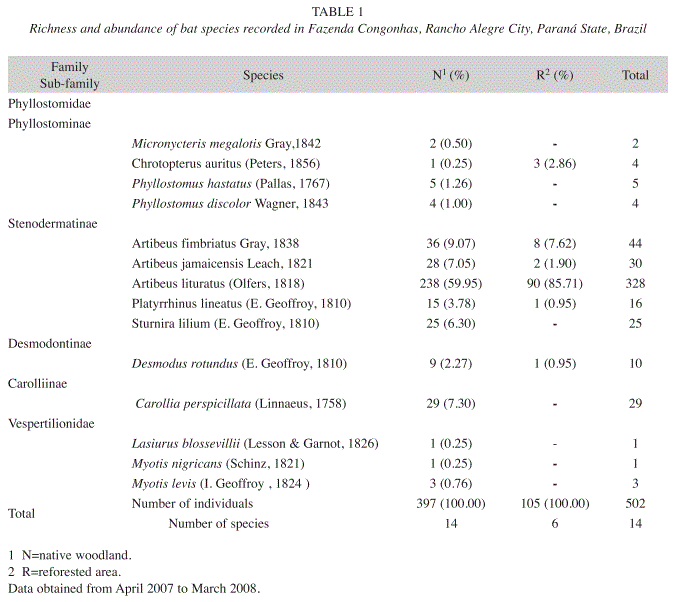
<body><![CDATA[<p style="text-align: justify;"><font face="Verdana" size="2">A species accumulation curve (collector curve) was built to visualize the accumulation of different collected species, in proportion to the sampling effort (Santos 2006). This type of graphical analysis illustrates the accumulation of different collected species in relation to the increase in sampling effort. According to Santos (2006), these curves represent a suitable procedure to evaluate how much an inventory approaches to the capture of the totality of the species in the studied location.</font></p>     <p style="text-align: justify;"><font face="Verdana" size="2">Chao I Index was also applied to estimate expected species richness in both environments using SPADE Software (Species Prediction and Diversity Estimation) (Chao &amp; Shen 2003). The estimate of richness from Chao I Index is equal to the observed richness, added to the square of the number of species (represented by only one individual in the samples "singletons", divided by the double of the number of species with only two individuals "doubletons" (Santos 2006).</font></p> <font style="font-weight: bold;" face="Verdana" size="3">     <p>Results</p> </font><font size="2"> </font><font face="Verdana" size="2"></font>     <div style="text-align: justify;"><font face="Verdana" size="2">     <p>In total, we captured 502 bats, representing 14 different species, 10 genera and 2 families (Phyllostomidae and Vespertilionidae). All 14 species were captured in the native area and only 6 in the reforested one. We captured 397 and 105 individuals in the native and in the reforested areas, respectively (<a  href="/img/revistas/rbt/v58n4/a22t1.gif">Table 1</a>).</p>     <p>Phyllostomidae family was the most dominant representing 99% from the captures. Vespertilionidae represented only 1% of all bats captured. Individuals from four Phyllostomidae sub-families were collected, with highest frequency of captures recorded for Stenodermatinae (89.13%), followed by Carollinae (5.83%), Phyllostominae (3.02%) and Desmodontinae (2.01%). <i>Artibeus lituratus </i>(Olfers, 1818) was the most common species in both habitats, representing 65.34% of individuals collected in both fragments.</p> </font><i><font size="2"> </font></i></div>     <p style="text-align: justify;"><i><font face="Verdana" size="2">Artibeus fimbriatus </font></i><font face="Verdana" size="2">(Gray, 1838) was the second most captured species in the native area, followed by <i>Carollia perspicillata </i>(Linnaeus, 1758), both representing 16.37% of captures in the forest remnant (<a  href="/img/revistas/rbt/v58n4/a22t1.gif">Table 1</a>). <i>Artibeus jamaicensis </i>(Leach, 1821), <i>Sturnira lilium </i>(E. Geoffroy, 1810), <i>Platyrrhinus lineatus </i>(Olfers, 1818), <i>Desmodus rotundus </i>(E. Geoffroy, 1810), <i>Phyllostomus hastatus </i>(Pallas, 1767), <i>Phyllostomus discolor </i>(Wagner, 1843), <i>Myotis levis </i>(I. Geoffroy, 1824), <i>Micronycteris megalotis </i>(Gray, 1842), <i>Chrotopterus auritus </i>(Peters, 1856), <i>Myotis nigricans </i>(Schinz, 1821) and <i>Lasiurus blossevillii </i>(Lesson &amp; Garnot, 1826) were also verified in the native area, totaling 23.67%. </font></p>     <div style="text-align: justify;"></div>     <p style="text-align: justify;"><font face="Verdana" size="2">Besides <i>A</i>. <i>lituratus</i>, specimens of <i>A</i>. <i>fimbriatus</i>, <i>A</i>. <i>jamaicensis</i>, <i>C</i>. <i>auritus</i>, <i>P</i>. <i>lineatus </i>and <i>D</i>. <i>rotundus </i>were also captured in the reforested area (<a  href="/img/revistas/rbt/v58n4/a22t1.gif">Table 1</a>). The second most abundant species in this environment was <i>C. auritus</i>, a carnivorous bat. Individuals from Vespertilionidae family were not recorded in this area.</font></p>     <div style="text-align: justify;"></div>     ]]></body>
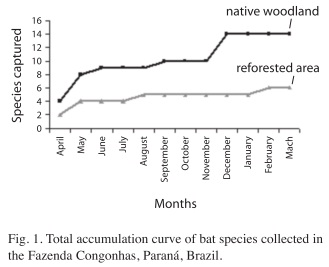
<body><![CDATA[<p style="text-align: justify;"><font face="Verdana" size="2">The Shannon-Wiener Index revealed a significantly greater diversity in the native area (H&#8217;=1.4802) than in the reforested one (H&#8217;=0.57015) (t-test=7.1075, p&lt;0.05). Chao 1 index indicated that the number of estimated species (within the methodology used), with 95% reliability, amounted to 18 species for the native area (SE=2.6, CI=14.1- 29.1). This result suggests that our sampling effort recorded approximately 78% of the total species richness. On the other hand, Chao I estimated 8 species for the reforested area (SE=3.7, CI=6.2-28.1), indicating that the sampling in this habitat reported 75% of total richness.</font></p>     <p style="text-align: justify;"><font face="Verdana" size="2">A higher species accumulation in the first samplings occurred during April, May and June 2007. Nine species, representing 64.3% of total captures in the forest remnant, were reported during this period in the native area. Approximately 71% from the total number of species had been reported by the end of the first study period (September). The number increased to 14 species during the following months (<a href="#fig1">Fig. 1</a>).    <br> </font></p>     <p><font face="Verdana" size="2">    <br> </font></p>     <div style="text-align: center;"><a name="fig1"></a><img  src="/img/revistas/rbt/v58n4/a22i1.jpg" title="" alt=""  style="width: 329px; height: 267px;">    <br>     <br> </div> <font size="2"> </font>     <p style="text-align: justify;"><font face="Verdana" size="2">Sampling in the first three months in the reforested area represented 66.7% of total captures in this environment. During the first half of the study period (April to September 2007) 83.4% of species were captured and the number of species remained constant until December. A species was added at the end of sampling, with a total of six species found in the reforested area (<a href="#fig1">Fig. 1</a>).</font></p> <font style="font-weight: bold;" face="Verdana" size="3">     <p>Discussion</p> </font><font size="2"> </font><font face="Verdana" size="2"></font>     ]]></body>
<body><![CDATA[<div style="text-align: justify;"><font face="Verdana" size="2">     <p>The Phyllostomidae family was dominant regarding the number of individuals and species in the present study. This can be explained by the fact that 90 (53.89%) from the total of 167 species found in Brazil (Reis <i>et al</i>. 2007) belong to this family (Wilson &amp; Reeder 2005). This is corroborated by the fact that the 27 Phyllostomidae species found in the Paran&aacute; State represent the half of all bat species in the State (61 species), according to Reis <i>et al</i>. (2008) and Bianconi <i>et al</i>. (2008). Moreover, the family dominance may be related to the method used: nets assembled at 0.5 and 3m above the ground, i.e., at the height of most fruit trees that compound the food resource for these animals (Sipinski &amp; Reis 1995, Pedro 1998). In general, Phyllostomids are frugivorous and do not present a great ability to detect nets (Sekiama 2003).</p> </font><font size="2"> </font></div>     <p style="text-align: justify;"><font face="Verdana" size="2">Species of insectivorous families, such as the Molossids, are not frequently captured in nets at ground level since they typically forage for food above the canopy (Sekiama 2003). They are commonly observed above the canopy and have previously been captured in regions next to the analyzed area (Reis <i>et al</i>. 2002, 2006a, Miretzki 2003). Individuals from the Vespertilionidae family frequently use echolocation system to feed. They can easily detect nets (Handley 1967) and this may explain the low number of captures of these bats in the present study.</font></p>     <div style="text-align: justify;"></div>     <p style="text-align: justify;"><font face="Verdana" size="2">In areas of primary forest, a higher number of species was found in other studies (Reis <i>et al</i>. 2000, 2006a). Consequently the diversity values (Shannon-Wiener index) from the present study were also inferior to those observed in other surveys carried out in forest fragments from Paran&aacute; State; for instance the study made by Reis <i>et al</i>. (2000) that found H&#8217;=1.66 in the lower Tibagi area (Fazenda Doralice). However, the value found in the native area is similar to that found in a previous study performed in the middle Tibagi area (Klabin Biological Reserve), where the diversity was H&#8217;=1.58. Our results evidence the occurrence of a single dominant species. According to Odum (1988), a relatively low percentage is dominant within the total number of species in a community -represented by several specimens- and a high percentage is "rare" (scarcely sampled), with few specimens. This pattern is characteristic of the tropics with defined rainy and dry seasons. </font></p>     <p style="text-align: justify;"><font face="Verdana" size="2">A greater variety of resources and, consequently, a higher number of niches are available to be exploited in areas with upper plant heterogeneity, as in native areas (Pianka 1982, Townsend <i>et al</i>. 2006). Samplings were undertaken in a pre-existing trail bordered by secondary vegetation (including Piperaceae and Myrtaceae). This vegetation tends to attract frugivorous bats (<i>A</i>. <i>lituratus</i>, <i>A</i>. <i>fimbriatus</i>, <i>A</i>. <i>jamaicensis</i>, <i>C</i>. <i>perspicillata</i>, <i>S</i>. <i>lilium</i>, <i>P</i>. <i>lineatus</i>) which spread seeds and thus contribute for the succession of these communities (Van Der Pijl 1957, Galindo-Gonz&aacute;lez <i>et al</i>. 2000, Muscarella &amp; Fleming 2007). This fact can also explain the greater number of frugivorous recorded in this site.</font></p>     <div style="text-align: justify;"></div>     <p style="text-align: justify;"><font face="Verdana" size="2">Less than the half of the species captured in the native area (14) was found in the reforested area (6), and these species were the most common (presented greater relative abundance). This result may be associated to the habitat age (only five years) and size (ten times smaller than the area of native forest). Moreover, it is a very narrow fragment, influenced by edge effects, such as an increase in temperature, solar radiation and direct exposure to winds (Murcia 1995). The area presents a lower number of niches and less variety of habitats, being a more homogeneous environment. In fact, it is composed of vegetation characterized by the initial stages of succession, with a lower availability of resources.</font></p>     <div style="text-align: justify;"></div>     <p style="text-align: justify;"><font face="Verdana" size="2">Species richness may be associated to the fragment size (Estrada &amp; Coates-Estrada 2001). According to Ricklefs (1993), more species occur in larger areas than in smaller ones. This fact may be verified in forest fragments with different sizes in the northern region of Paran&aacute; State. For example Mata dos Godoy State Park (680ha), in Londrina County, presents 42 bat species (Reis <i>et al</i>. 2008). On the other hand, only 14 species were found in Fazenda Congonhas (107.8ha). Plant diversity and area quality, besides forest size, are important factors influencing the distribution and abundance of organisms (Reis <i>et al</i>. 2000). A small area with better quality resources may be a better habitat for a greater number of species than a larger area and may influence significantly the species richness (Tamsitt 1967, Zimmerman &amp; Bierregaard 1986). Besides that, in the Northern region of Paran&aacute; State, larger forest fragments are also those with the greatest availability of food resource and shelter (Reis <i>et al</i>. 2003) accordingly these environments support a greater richness of bat species.</font></p>     ]]></body>
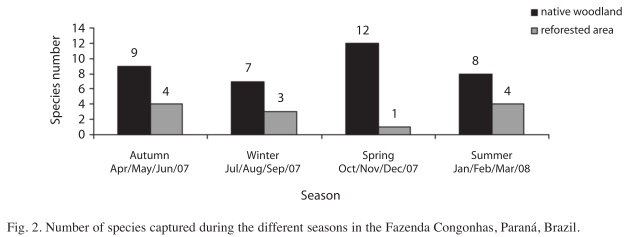
<body><![CDATA[<p style="text-align: justify;"><font face="Verdana" size="2">The dominance of <i>A</i>. <i>lituratus </i>in both environments may be explained by its higher ability to survive in modified environments than the other species. A comparable rate of captures of <i>A</i>. <i>lituratus </i>has also been reported in other studies in the Northern region of the Paran&aacute; State (Reis &amp; Muller 1995, Sekiama 2003, Zanon &amp; Reis 2007).</font></p>     <div style="text-align: justify;"></div>     <p style="text-align: justify;"><font face="Verdana" size="2">The presence of <i>C</i>. <i>perspicillata, S</i>. <i>lilium </i>and <i>P</i>. <i>lineatus </i>in disturbed areas may be related to the capacity to exploit several vegetal strata, taking advantage from the diverse opportunities in environments highly impacted by human activity (Estrada &amp; Coates-Estrada 2002). Some authors state that these species are indicative of disturbed areas (Medell&iacute;n <i>et al</i>. 2000, Reis <i>et al</i>. 2003). According to Aguiar (1994), the abundance of <i>C</i>. <i>perspicillata </i>may decrease in degraded habitats since it is closely related to food preferences (mainly Piperaceae, followed by Solanaceae and Moraceae, respectively) (Uieda &amp; Vasconcellos-Neto 1985, Muller &amp; Reis 1992, Mello <i>et al</i>. 2004). This may explain the absence of <i>C</i>. <i>perspicillata </i>and <i>S</i>. <i>lilium </i>in the reforested area where there is no occurrence of vegetation from the Piperacea family, the main food resource for <i>Carollia </i>and Solanacea family, main resource for <i>Sturnira </i>(Lima &amp; Reis 2004, Mello 2007).</font></p>     <div style="text-align: justify;"></div>     <p style="text-align: justify;"><font face="Verdana" size="2">The capture of the hematophagous <i>Desmodus rotundus </i>may be explained by the presence of cattle-breeding farms close to the study area. This species uses the forests as shelter and stepping stones for the pastureland where they find its food resource (Estrada &amp; Coates-Estrada 2002). The low percentage reported may be the effect of frequent campaigns of rabies prevention undertaken for the population control of hematophagous bats (Bredt <i>et al</i>. 1996), even though these have not occurred in the area.</font></p>     <div style="text-align: justify;"></div>     <p style="text-align: justify;"><font face="Verdana" size="2">The occurrence of <i>C</i>. <i>auritus </i>is more related with the food availability (Lazo 2004). The low percentage is due to the carnivorous diet, since this species is a top predator in the food chain. Furthermore, these predators are large animals feeding on large preys, therefore they need an extensive territory to exploit and survive. <i>Micronycteris megalotis </i>is considered a more sensitive species, only found in well preserved areas (Medell&iacute;n <i>et al</i>. 2000), being restricted to the continuous forests or less disturbed areas (Fenton <i>et al</i>. 1992, Reis &amp; Muller 1995, Cosson <i>et al</i>. 1999, Schulze <i>et al</i>. 2000, Stoner &amp; Lobo 2002, Gorresen &amp; Willig 2004). This pattern may be found mainly in the Phyllostominae sub-family, which is more sensitive to environmental degradation and may be an indicator of degraded areas (Fenton <i>et al</i>. 1992, Medell&iacute;n <i>et al</i>. 2000, Falc&atilde;o <i>et al</i>. 2003). The omnivorous species <i>P</i>. <i>hastatus </i>and <i>P</i>. <i>discolor </i>(1%), with a varied diet, are also found in highly altered environments (Nogueira <i>et al</i>. 2007).</font></p>     <div style="text-align: justify;"></div>     <p style="text-align: justify;"><font face="Verdana" size="2">A higher number of bats were registered during the dry season (April to September), although other studies verified greater abundance of frugivorous (including <i>A</i>. <i>lituratus </i>and <i>A</i>. <i>fimbriatus</i>) during the rainy season (Pedro &amp; Taddei 2002, Falc&atilde;o <i>et al</i>. 2003, Aguiar &amp; Marinho-Filho 2004). Several individuals were observed feeding on the fruits of <i>Ficus </i>sp during the dry season. Due to its intraspecific asynchronic pattern of fructification with fruits (<a href="#fig1">Figs. 1</a> and <a  href="/img/revistas/rbt/v58n4/a22i2.jpg">2</a>) that are produced throughout the whole year (Pereira <i>et al</i>. 2007), the <i>Ficus </i>native area may have provided food to the bats during the period with low availability of food, resulting in more captures of individuals during the dry period. According to Terborgh (1986), some vegetal species are "key resources" for frugivorous animals.</font></p>     <div style="text-align: justify;"></div>     ]]></body>
<body><![CDATA[<p style="text-align: justify;"><font face="Verdana" size="2">Esb&eacute;rard (2007) points that the capture efficiency decreases gradually when the samplings are undertaken during non-consecutive nights (intervals of approximately 29 days), without any change in net positions. Fact possibly associated to the learning of the bats (Simmons &amp; Voss 1998), which memorize the nets positions and avoid flying where they had been assembled or use frequently the echolocation, being able to deviate from the nets and fly to other areas.</font></p>     <p style="text-align: justify;"><font face="Verdana" size="2">The total number of species was higher in the spring &#8211;October to December&#8211; (<a  href="/img/revistas/rbt/v58n4/a22i2.jpg">Fig. 2</a>) influenced by an increase in food resources (Fleming <i>et al</i>. 1972), including fruits and insects. In fact, insectivorous bats (<i>Myotis levis</i>, <i>Myotis nigricans </i>and <i>Lasiurus blossevillii</i>) were found only during this period. Pedro <i>et al</i>. (2001) observed that, in the case of insectivorous bats, there is a direct relationship between the number of species and the size of the forest fragment. This fact may explain the capture of these species only in the native area.</font></p>     <div style="text-align: justify;"></div>     <p style="text-align: justify;"><font face="Verdana" size="2">According to Townsend <i>et al</i>. (2006), the most frequent captured species may be found in the first samplings and the non-frequent ones, which may also be rarer, are added to the list according to the increase in the number of samplings. In the context of capture effort, Chao 1 Index pointed out that there may be 18 species in the native area and 8 species in the reforested one, with greater number of samplings and periods.</font></p>     <div style="text-align: justify;"></div>     <p style="text-align: justify;"><font face="Verdana" size="2">Native areas provide habitat for a more diverse community of bats by furnishing a greater variety of habitats. Meanwhile, the reforestation is essential since it decreases the edge effects and prevents radical changes in the micro-climate within the neighboring areas of the fragment. The species without such protection may be more susceptible to predators (Reis <i>et al</i>. 2006b). Reforestation, as a continuity of the forest remnant, benefits opportunist and generalist species in their occupation of new available niches surrounding the forest. It also decreases the loss of shelter contributing for the survival of bat species, and to a possible increase of the area for these species, as well as an increase of the population; therefore reducing the possible endocrossing in these areas.</font></p>     <div style="text-align: justify;"></div>     <p style="text-align: justify;"><font face="Verdana" size="2">The strategies for bat conservation should consider that these animals exploit a set of food sources (fruits, insects, small vertebrates, etc.) and roosting structures for protection (crevices in rocks, cracks in trees and even under leaves). Besides preserving specific environments, it is also necessary to preserve other types of habitats used as food resources or as flight routes to avoid possible predators. Furthermore, the reforestation around native areas is essential since they play the role of matrix environment which sustains some species found in the original primary forest. Conservation and implementation of management plans in forest remnants is highly important to lessen the deleterious effects caused by the destruction and modification of natural environments.</font></p>     <div style="text-align: justify;"><font style="font-weight: bold;"  face="Verdana" size="3">     <p>Acknowledgments</p> </font><font size="2"> </font><font face="Verdana" size="2">     ]]></body>
<body><![CDATA[<p>We would like to thank the Post-graduate Program from the State University of Londrina; LABRE for technical and logistic support; the administration of the Fazenda Congonhas that allowed the accomplishment of this study; Ed for his inestimable help in field work; to everyone that contributed with this research: Isaac, Cibele, Renata, C&aacute;ssius; Carolina Cheida and Gisele Doratti, for reviewing the manuscript; CAPES for funding research.</p> </font></div> <font face="Verdana" size="2"></font><font size="2"> </font> <hr style="width: 100%; height: 2px;"><font style="font-weight: bold;"  face="Verdana" size="3">     <p>References</p> </font><font size="2"> </font>     <!-- ref --><p><font face="Verdana" size="2">Aguiar, L.M.S. 1994. Comunidades de Chiroptera em tr&ecirc;s &aacute;reas de Mata Atl&acirc;ntica em diferentes est&aacute;gios de sucess&atilde;o, Esta&ccedil;&atilde;o Biol&oacute;gica de Caratinga, Minas gerais. Master Thesis, Minas Gerais State University, Belo Horizonte, Minas Gerais, Brazil.    &nbsp;&nbsp;&nbsp;&nbsp;&nbsp;&nbsp;&nbsp;&nbsp;[&#160;<a href="javascript:void(0);" onclick="javascript: window.open('/scielo.php?script=sci_nlinks&ref=1398239&pid=S0034-7744201000040002200001&lng=','','width=640,height=500,resizable=yes,scrollbars=1,menubar=yes,');">Links</a>&#160;]<!-- end-ref --></font></p>     <!-- ref --><p><font face="Verdana" size="2">Aguiar, L.M.S. &amp; J. Marinho-Filho. 2004. Activity patterns of nine phyllostomid bat species in a fragment of the Atlantic Forest in southeastern Brazil. Rev. Bras. Zool. 21: 385-390.    &nbsp;&nbsp;&nbsp;&nbsp;&nbsp;&nbsp;&nbsp;&nbsp;[&#160;<a href="javascript:void(0);" onclick="javascript: window.open('/scielo.php?script=sci_nlinks&ref=1398241&pid=S0034-7744201000040002200002&lng=','','width=640,height=500,resizable=yes,scrollbars=1,menubar=yes,');">Links</a>&#160;]<!-- end-ref --></font></p>     <!-- ref --><p><font face="Verdana" size="2">Bianconi, G.V., S.B. Mikich &amp; W.A. Pedro. 2006. Movement of bats (Mammalia, Chiroptera) in Atlantic Forest remnants in southern Brazil. Rev. Bras. Zool. 23: 1199-1206.    &nbsp;&nbsp;&nbsp;&nbsp;&nbsp;&nbsp;&nbsp;&nbsp;[&#160;<a href="javascript:void(0);" onclick="javascript: window.open('/scielo.php?script=sci_nlinks&ref=1398243&pid=S0034-7744201000040002200003&lng=','','width=640,height=500,resizable=yes,scrollbars=1,menubar=yes,');">Links</a>&#160;]<!-- end-ref --></font></p>     <!-- ref --><p><font face="Verdana" size="2">Bianconi, G.V., U.M.S. Suckow, D.C. Carneiro, L.C. Parolin &amp; R. Gregorin. 2008. Primeiro registro de <i>Eumops perotis </i>e <i>Nyctinomops aurispinosus </i>para o estado do Paran&aacute;, sul do Brasil. Abstracts-IV Brazilian Mammalogical Congress, S&atilde;o Louren&ccedil;o, Minas Gerais, Brazil.    &nbsp;&nbsp;&nbsp;&nbsp;&nbsp;&nbsp;&nbsp;&nbsp;[&#160;<a href="javascript:void(0);" onclick="javascript: window.open('/scielo.php?script=sci_nlinks&ref=1398245&pid=S0034-7744201000040002200004&lng=','','width=640,height=500,resizable=yes,scrollbars=1,menubar=yes,');">Links</a>&#160;]<!-- end-ref --></font></p>     ]]></body>
<body><![CDATA[<!-- ref --><p><font face="Verdana" size="2">Bredt, A.I., F.A.A. Ara&uacute;jo, J. Caetano-J&uacute;nior, M.G.R. Rodrigues, M. Yoshizawa, M. M.S. Silva, N.M.S. Harmani, P.N.T. Massunaga, S.P. Burer, V.A.R. Potro &amp; W. Uieda. 1996. Morcegos em &aacute;reas urbanas e rurais: manual de manejo e controle. Funda&ccedil;&atilde;o Nacional de Sa&uacute;de, Minist&eacute;rio da Sa&uacute;de, Brazil.    &nbsp;&nbsp;&nbsp;&nbsp;&nbsp;&nbsp;&nbsp;&nbsp;[&#160;<a href="javascript:void(0);" onclick="javascript: window.open('/scielo.php?script=sci_nlinks&ref=1398247&pid=S0034-7744201000040002200005&lng=','','width=640,height=500,resizable=yes,scrollbars=1,menubar=yes,');">Links</a>&#160;]<!-- end-ref --></font></p>     <!-- ref --><p><font face="Verdana" size="2">Cavalheiro, A.L., J.M.D. Torezan &amp; E.L. Fadelli. 2002. Recupera&ccedil;&atilde;o de &aacute;reas degradadas: procurando por diversidade e funcionamento dos ecossistemas, p. 213-224. <i>In </i>M.E. Medrim, E. Bianchini, O.A. Shibatta &amp; J.A. Pimenta (eds.). A bacia do rio Tibagi. Londrina, Paran&aacute;, Brazil.    &nbsp;&nbsp;&nbsp;&nbsp;&nbsp;&nbsp;&nbsp;&nbsp;[&#160;<a href="javascript:void(0);" onclick="javascript: window.open('/scielo.php?script=sci_nlinks&ref=1398249&pid=S0034-7744201000040002200006&lng=','','width=640,height=500,resizable=yes,scrollbars=1,menubar=yes,');">Links</a>&#160;]<!-- end-ref --></font></p>     <!-- ref --><p><font face="Verdana" size="2">Chao, A. &amp; T.J. Shen. 2003. Program SPADE (Species Prediction and Diversity Estimation). (Downloaded: August 10, 2007, www.chao.stat.nthu.edu.tw).    &nbsp;&nbsp;&nbsp;&nbsp;&nbsp;&nbsp;&nbsp;&nbsp;[&#160;<a href="javascript:void(0);" onclick="javascript: window.open('/scielo.php?script=sci_nlinks&ref=1398251&pid=S0034-7744201000040002200007&lng=','','width=640,height=500,resizable=yes,scrollbars=1,menubar=yes,');">Links</a>&#160;]<!-- end-ref --> </font></p>     <!-- ref --><p><font face="Verdana" size="2">Cosson, J.F., J.M. Pons &amp; D. Masson. 1999. Effects of forest fragmentation on frugivorous and nectarivorous bats in French Guiana. J. Trop. Ecol. 15: 515-534.    &nbsp;&nbsp;&nbsp;&nbsp;&nbsp;&nbsp;&nbsp;&nbsp;[&#160;<a href="javascript:void(0);" onclick="javascript: window.open('/scielo.php?script=sci_nlinks&ref=1398253&pid=S0034-7744201000040002200008&lng=','','width=640,height=500,resizable=yes,scrollbars=1,menubar=yes,');">Links</a>&#160;]<!-- end-ref --></font></p>     <!-- ref --><p><font face="Verdana" size="2">Cusack, D. &amp; F. Montagnini. 2004. The role of native species plantations in recovery of understory woody diversity in degraded pasturelands of Costa Rica. Forest Ecol. Manag. 188: 1-15.    &nbsp;&nbsp;&nbsp;&nbsp;&nbsp;&nbsp;&nbsp;&nbsp;[&#160;<a href="javascript:void(0);" onclick="javascript: window.open('/scielo.php?script=sci_nlinks&ref=1398255&pid=S0034-7744201000040002200009&lng=','','width=640,height=500,resizable=yes,scrollbars=1,menubar=yes,');">Links</a>&#160;]<!-- end-ref --></font></p>     ]]></body>
<body><![CDATA[<!-- ref --><p><font face="Verdana" size="2">Esb&eacute;rard, C.E.L. 2007. Influ&ecirc;ncia do ciclo lunar na captura de morcegos Phyllostomidae. Iheringia Ser. Zool. 97: 81-85.    &nbsp;&nbsp;&nbsp;&nbsp;&nbsp;&nbsp;&nbsp;&nbsp;[&#160;<a href="javascript:void(0);" onclick="javascript: window.open('/scielo.php?script=sci_nlinks&ref=1398257&pid=S0034-7744201000040002200010&lng=','','width=640,height=500,resizable=yes,scrollbars=1,menubar=yes,');">Links</a>&#160;]<!-- end-ref --></font></p>     <!-- ref --><p><font face="Verdana" size="2">Estrada, A. &amp; R. Coates-Estrada. 2001. Bat species richness in live and in corridors of residual rain forest vegetation at los Tuxtlas, Mexico. Ecography 24: 94-102.    &nbsp;&nbsp;&nbsp;&nbsp;&nbsp;&nbsp;&nbsp;&nbsp;[&#160;<a href="javascript:void(0);" onclick="javascript: window.open('/scielo.php?script=sci_nlinks&ref=1398259&pid=S0034-7744201000040002200011&lng=','','width=640,height=500,resizable=yes,scrollbars=1,menubar=yes,');">Links</a>&#160;]<!-- end-ref --></font></p>     <!-- ref --><p><font face="Verdana" size="2">Estrada, A. &amp; R. Coates-Estrada. 2002. Bats in continuous forest, forest fragments and in a agricultural mosaic habitat-island at Los Tuxtlas, Mexico. Biol. Conserv. 103: 237-245.    &nbsp;&nbsp;&nbsp;&nbsp;&nbsp;&nbsp;&nbsp;&nbsp;[&#160;<a href="javascript:void(0);" onclick="javascript: window.open('/scielo.php?script=sci_nlinks&ref=1398261&pid=S0034-7744201000040002200012&lng=','','width=640,height=500,resizable=yes,scrollbars=1,menubar=yes,');">Links</a>&#160;]<!-- end-ref --></font></p>     <!-- ref --><p><font face="Verdana" size="2">Falc&atilde;o, F.C., V.F. Reb&ecirc;lo &amp; S.A. Talamoni. 2003. Structure of a bat assemblage (Mammalia, Chiroptera) in Serra do Cara&ccedil;a Reserve, South-east Brazil. Rev. Bras. Zool. 20: 347-350.    &nbsp;&nbsp;&nbsp;&nbsp;&nbsp;&nbsp;&nbsp;&nbsp;[&#160;<a href="javascript:void(0);" onclick="javascript: window.open('/scielo.php?script=sci_nlinks&ref=1398263&pid=S0034-7744201000040002200013&lng=','','width=640,height=500,resizable=yes,scrollbars=1,menubar=yes,');">Links</a>&#160;]<!-- end-ref --></font></p>     <!-- ref --><p><font face="Verdana" size="2">Fenton, M.B., L. Acharya, D. Audet, M.B.C. Hickey, C. Merriman, M.K. Obrist, D.M. Syme &amp; B. Adkins. 1992. Phyllostomid Bats (Chiroptera: Phyllostomidae) as indicators of habitat disruption in the Neotropics. Biotropica 24: 440-446.    &nbsp;&nbsp;&nbsp;&nbsp;&nbsp;&nbsp;&nbsp;&nbsp;[&#160;<a href="javascript:void(0);" onclick="javascript: window.open('/scielo.php?script=sci_nlinks&ref=1398265&pid=S0034-7744201000040002200014&lng=','','width=640,height=500,resizable=yes,scrollbars=1,menubar=yes,');">Links</a>&#160;]<!-- end-ref --></font></p>     ]]></body>
<body><![CDATA[<!-- ref --><p><font face="Verdana" size="2">Filho, H.O. &amp; N.R. Reis. 2009. Species richness and abundance of bats in fragments of the stational semidecidual forest, Upper Paran&aacute; River, southern Brazil. Braz. J. Biol. 69: 727-734.    &nbsp;&nbsp;&nbsp;&nbsp;&nbsp;&nbsp;&nbsp;&nbsp;[&#160;<a href="javascript:void(0);" onclick="javascript: window.open('/scielo.php?script=sci_nlinks&ref=1398267&pid=S0034-7744201000040002200015&lng=','','width=640,height=500,resizable=yes,scrollbars=1,menubar=yes,');">Links</a>&#160;]<!-- end-ref --></font></p>     <!-- ref --><p><font face="Verdana" size="2">Fleming, T.H., E.T. Hooper &amp; D.E. Wilson. 1972. Three Central American bats communities: structure, reproductive cycles, and movement patterns. Ecology 53: 555-569.    &nbsp;&nbsp;&nbsp;&nbsp;&nbsp;&nbsp;&nbsp;&nbsp;[&#160;<a href="javascript:void(0);" onclick="javascript: window.open('/scielo.php?script=sci_nlinks&ref=1398269&pid=S0034-7744201000040002200016&lng=','','width=640,height=500,resizable=yes,scrollbars=1,menubar=yes,');">Links</a>&#160;]<!-- end-ref --></font></p>     <!-- ref --><p><font face="Verdana" size="2">Galindo-Gonz&aacute;lez, J., S. Guevara &amp; V.J. Sosa. 2000. Batand Bird- Generated Seed Rains at Isolated Trees in Pastures in a Tropical Rainforest. Conserv. Biol. 85: 1693-1703.    &nbsp;&nbsp;&nbsp;&nbsp;&nbsp;&nbsp;&nbsp;&nbsp;[&#160;<a href="javascript:void(0);" onclick="javascript: window.open('/scielo.php?script=sci_nlinks&ref=1398271&pid=S0034-7744201000040002200017&lng=','','width=640,height=500,resizable=yes,scrollbars=1,menubar=yes,');">Links</a>&#160;]<!-- end-ref --></font></p>     <!-- ref --><p><font face="Verdana" size="2">Gorresen, P.M. &amp; M. Willig. 2004. Landscape Responses of Bats to Habitat Fragmentation in Atlantic Forest of Paraguay. J. Mammal. 85: 688-687.    &nbsp;&nbsp;&nbsp;&nbsp;&nbsp;&nbsp;&nbsp;&nbsp;[&#160;<a href="javascript:void(0);" onclick="javascript: window.open('/scielo.php?script=sci_nlinks&ref=1398273&pid=S0034-7744201000040002200018&lng=','','width=640,height=500,resizable=yes,scrollbars=1,menubar=yes,');">Links</a>&#160;]<!-- end-ref --></font></p>     <!-- ref --><p><font face="Verdana" size="2">Greenhall, A.M. &amp; J.L. Paradiso. 1968. Bats and bat banding. Bureau of Sport Fisheries and Wildllife Resource Publication 72: 1-47.    &nbsp;&nbsp;&nbsp;&nbsp;&nbsp;&nbsp;&nbsp;&nbsp;[&#160;<a href="javascript:void(0);" onclick="javascript: window.open('/scielo.php?script=sci_nlinks&ref=1398275&pid=S0034-7744201000040002200019&lng=','','width=640,height=500,resizable=yes,scrollbars=1,menubar=yes,');">Links</a>&#160;]<!-- end-ref --></font></p>     ]]></body>
<body><![CDATA[<!-- ref --><p><font face="Verdana" size="2">Hammer, O., D.A.T. Harper &amp; P.D. Ryan. 2001. PAST Palaeontological Statistics.    &nbsp;&nbsp;&nbsp;&nbsp;&nbsp;&nbsp;&nbsp;&nbsp;[&#160;<a href="javascript:void(0);" onclick="javascript: window.open('/scielo.php?script=sci_nlinks&ref=1398277&pid=S0034-7744201000040002200020&lng=','','width=640,height=500,resizable=yes,scrollbars=1,menubar=yes,');">Links</a>&#160;]<!-- end-ref --></font></p>     <!-- ref --><p><font face="Verdana" size="2">Handley Jr., C.O. 1967. Bats of the canopy of an Amazonian Forest. Actas of the symposium on the Amazonian Biota (Zoology) 5: 211-215.    &nbsp;&nbsp;&nbsp;&nbsp;&nbsp;&nbsp;&nbsp;&nbsp;[&#160;<a href="javascript:void(0);" onclick="javascript: window.open('/scielo.php?script=sci_nlinks&ref=1398279&pid=S0034-7744201000040002200021&lng=','','width=640,height=500,resizable=yes,scrollbars=1,menubar=yes,');">Links</a>&#160;]<!-- end-ref --></font></p>     <!-- ref --><p><font face="Verdana" size="2">Hero, J.M. &amp; T. Ridgway. 2006. Decl&iacute;nio Global de Esp&eacute;cies, p. 53-90. <i>In </i>C.F.D. Rocha, H.G. Bergallo, M.V. Sluys &amp; M.A.S. Alves (eds.). Biologia da Conserva&ccedil;&atilde;o: Ess&ecirc;ncias. S&atilde;o Carlos, S&atilde;o Paulo, Brazil.    &nbsp;&nbsp;&nbsp;&nbsp;&nbsp;&nbsp;&nbsp;&nbsp;[&#160;<a href="javascript:void(0);" onclick="javascript: window.open('/scielo.php?script=sci_nlinks&ref=1398281&pid=S0034-7744201000040002200022&lng=','','width=640,height=500,resizable=yes,scrollbars=1,menubar=yes,');">Links</a>&#160;]<!-- end-ref --></font></p> <font size="2"> </font><font face="Verdana" size="2"></font>     <!-- ref --><p><font face="Verdana" size="2">Holl, K.D., M.E. Loik, E.H.V. Lin &amp; I.A. Samuels. 2000. Tropical montane forest restoration in Costa Rica: overcoming barriers to dispersal and establishment. Restor. Ecol. 8: 339-349.    &nbsp;&nbsp;&nbsp;&nbsp;&nbsp;&nbsp;&nbsp;&nbsp;[&#160;<a href="javascript:void(0);" onclick="javascript: window.open('/scielo.php?script=sci_nlinks&ref=1398283&pid=S0034-7744201000040002200023&lng=','','width=640,height=500,resizable=yes,scrollbars=1,menubar=yes,');">Links</a>&#160;]<!-- end-ref --></font></p>     <!-- ref --><p><font face="Verdana" size="2">Hutson, A.M., S.P. Mickleburgh &amp; P.A. Racey. 2001. Microchiropteran bats: global status survey and conservation action plan. IUCN/SSC Chiroptera Specialist Group. IUCN Gland, Switzerland and Cambridge, England.    &nbsp;&nbsp;&nbsp;&nbsp;&nbsp;&nbsp;&nbsp;&nbsp;[&#160;<a href="javascript:void(0);" onclick="javascript: window.open('/scielo.php?script=sci_nlinks&ref=1398285&pid=S0034-7744201000040002200024&lng=','','width=640,height=500,resizable=yes,scrollbars=1,menubar=yes,');">Links</a>&#160;]<!-- end-ref --></font></p>     ]]></body>
<body><![CDATA[<!-- ref --><p><font face="Verdana" size="2">K&ouml;ppen, W. 1948. Climatologia. Fondo de Cultura Econ&oacute;mica, Mexico City, Mexico.    &nbsp;&nbsp;&nbsp;&nbsp;&nbsp;&nbsp;&nbsp;&nbsp;[&#160;<a href="javascript:void(0);" onclick="javascript: window.open('/scielo.php?script=sci_nlinks&ref=1398287&pid=S0034-7744201000040002200025&lng=','','width=640,height=500,resizable=yes,scrollbars=1,menubar=yes,');">Links</a>&#160;]<!-- end-ref --></font></p>     <!-- ref --><p><font face="Verdana" size="2">Lazo, L.J. 2004. A mastofauna da Fazenda Figueira em uma &aacute;rea do Baixo Tibagi, Munic&iacute;pio de Londrina, Paran&aacute;. Master Thesis, S&atilde;o Paulo University, Piracicaba, S&atilde;o Paulo, Brazil.    &nbsp;&nbsp;&nbsp;&nbsp;&nbsp;&nbsp;&nbsp;&nbsp;[&#160;<a href="javascript:void(0);" onclick="javascript: window.open('/scielo.php?script=sci_nlinks&ref=1398289&pid=S0034-7744201000040002200026&lng=','','width=640,height=500,resizable=yes,scrollbars=1,menubar=yes,');">Links</a>&#160;]<!-- end-ref --></font></p>     <!-- ref --><p><font face="Verdana" size="2">Lima, I.P. &amp; N.R. Reis. 2004. The availability of piperaceae and the search for this resource by <i>Carollia perspicillata </i>(Linnaeus) (Chiroptera, Phyllostomidae, Carollinae) in Parque Municipal Arthur Thomas, Londrina, Paran&aacute;, Brazil. Rev. Bras. Zool. 21: 371- 377.    &nbsp;&nbsp;&nbsp;&nbsp;&nbsp;&nbsp;&nbsp;&nbsp;[&#160;<a href="javascript:void(0);" onclick="javascript: window.open('/scielo.php?script=sci_nlinks&ref=1398291&pid=S0034-7744201000040002200027&lng=','','width=640,height=500,resizable=yes,scrollbars=1,menubar=yes,');">Links</a>&#160;]<!-- end-ref --></font></p>     <!-- ref --><p><font face="Verdana" size="2">Magnini, P.R. &amp; P.A. Nicola. 2006. Captura e marca&ccedil;&atilde;o de animais silvestres, p. 91-151. <i>In </i>L. Cullen Jr., R. Rudran &amp; C. Valladares-Padua (eds.). M&eacute;todos de estudos em biologia da conserva&ccedil;&atilde;o &amp; manejo da vida silvestre. Curitiba, Paran&aacute;, Brazil.    &nbsp;&nbsp;&nbsp;&nbsp;&nbsp;&nbsp;&nbsp;&nbsp;[&#160;<a href="javascript:void(0);" onclick="javascript: window.open('/scielo.php?script=sci_nlinks&ref=1398293&pid=S0034-7744201000040002200028&lng=','','width=640,height=500,resizable=yes,scrollbars=1,menubar=yes,');">Links</a>&#160;]<!-- end-ref --></font></p> <font size="2"> </font>     <!-- ref --><p><font face="Verdana" size="2">Magurran, A.E. 1988. Ecological diversity and its measurement. Cambridge University, London, England.    &nbsp;&nbsp;&nbsp;&nbsp;&nbsp;&nbsp;&nbsp;&nbsp;[&#160;<a href="javascript:void(0);" onclick="javascript: window.open('/scielo.php?script=sci_nlinks&ref=1398295&pid=S0034-7744201000040002200029&lng=','','width=640,height=500,resizable=yes,scrollbars=1,menubar=yes,');">Links</a>&#160;]<!-- end-ref --></font></p>     ]]></body>
<body><![CDATA[<!-- ref --><p><font face="Verdana" size="2">Marini-Filho, O.J. &amp; R.P. Martins. 2000. Teoria de metapopula&ccedil;&otilde;es. Novos princ&iacute;pios na biologia da conserva&ccedil;&atilde;o. Ci&ecirc;ncia Hoje 27: 23-29.    &nbsp;&nbsp;&nbsp;&nbsp;&nbsp;&nbsp;&nbsp;&nbsp;[&#160;<a href="javascript:void(0);" onclick="javascript: window.open('/scielo.php?script=sci_nlinks&ref=1398297&pid=S0034-7744201000040002200030&lng=','','width=640,height=500,resizable=yes,scrollbars=1,menubar=yes,');">Links</a>&#160;]<!-- end-ref --></font></p>     <!-- ref --><p><font face="Verdana" size="2">Medell&iacute;n, R.A., M. Equiiiua &amp; M.A. Amin. 2000. Bat diversity and abundance as indicators of disturbance in neotropical rainforests. Conserv. Biol. 14: 1666- 167.    &nbsp;&nbsp;&nbsp;&nbsp;&nbsp;&nbsp;&nbsp;&nbsp;[&#160;<a href="javascript:void(0);" onclick="javascript: window.open('/scielo.php?script=sci_nlinks&ref=1398299&pid=S0034-7744201000040002200031&lng=','','width=640,height=500,resizable=yes,scrollbars=1,menubar=yes,');">Links</a>&#160;]<!-- end-ref --></font></p>     <!-- ref --><p><font face="Verdana" size="2">Mello, M.A.R. 2007. Intera&ccedil;&otilde;es entre o morcego <i>Sturnira lilium </i>(Chiroptera: Phyllostomidae) e plantas da fam&iacute;lia Solanaceae. Biota Neotropica. (Downloaded: September 05, 2008, http://www.biotaneotropica.org.br/v7n1/es/fullpaper? bn02807012007+pt).    &nbsp;&nbsp;&nbsp;&nbsp;&nbsp;&nbsp;&nbsp;&nbsp;[&#160;<a href="javascript:void(0);" onclick="javascript: window.open('/scielo.php?script=sci_nlinks&ref=1398301&pid=S0034-7744201000040002200032&lng=','','width=640,height=500,resizable=yes,scrollbars=1,menubar=yes,');">Links</a>&#160;]<!-- end-ref --></font></p>     <!-- ref --><p><font face="Verdana" size="2">Mello, M.A.R., G.M. Schittini, P. Selig &amp; H.G. Bergallo. 2004. A test of climate and fruiting of <i>Piper </i>species (Piperaceae) on reproductive patterns of the bat <i>Carollia perspicillata </i>(Phyllostomidae). Acta Chiropterol. 6: 309-318.    &nbsp;&nbsp;&nbsp;&nbsp;&nbsp;&nbsp;&nbsp;&nbsp;[&#160;<a href="javascript:void(0);" onclick="javascript: window.open('/scielo.php?script=sci_nlinks&ref=1398303&pid=S0034-7744201000040002200033&lng=','','width=640,height=500,resizable=yes,scrollbars=1,menubar=yes,');">Links</a>&#160;]<!-- end-ref --></font></p>     <!-- ref --><p><font face="Verdana" size="2">Miretzki, M. 2003. Morcegos do estado do Paran&aacute;, Brasil (Mammalia, Chiroptera): riqueza de esp&eacute;cies, distribui&ccedil;&atilde;o e s&iacute;ntese do conhecimento atual. Pap&eacute;is Avulsos de Zoologia 43: 101-138.    &nbsp;&nbsp;&nbsp;&nbsp;&nbsp;&nbsp;&nbsp;&nbsp;[&#160;<a href="javascript:void(0);" onclick="javascript: window.open('/scielo.php?script=sci_nlinks&ref=1398305&pid=S0034-7744201000040002200034&lng=','','width=640,height=500,resizable=yes,scrollbars=1,menubar=yes,');">Links</a>&#160;]<!-- end-ref --></font></p>     ]]></body>
<body><![CDATA[<!-- ref --><p><font face="Verdana" size="2">Muller, M.F. &amp; N.R. Reis. 1992. Parti&ccedil;&atilde;o de recursos alimentares entre quatro esp&eacute;cies de morcegos frug&iacute;voros (Chiroptera, Phyllostomidae). Rev. Bras. Zool. 9: 345-355.    &nbsp;&nbsp;&nbsp;&nbsp;&nbsp;&nbsp;&nbsp;&nbsp;[&#160;<a href="javascript:void(0);" onclick="javascript: window.open('/scielo.php?script=sci_nlinks&ref=1398307&pid=S0034-7744201000040002200035&lng=','','width=640,height=500,resizable=yes,scrollbars=1,menubar=yes,');">Links</a>&#160;]<!-- end-ref --></font></p>     <!-- ref --><p><font face="Verdana" size="2">Murcia, C. 1995. Edge effects in fragmented forests: implications for conservation. Tree 10: 58-62.    &nbsp;&nbsp;&nbsp;&nbsp;&nbsp;&nbsp;&nbsp;&nbsp;[&#160;<a href="javascript:void(0);" onclick="javascript: window.open('/scielo.php?script=sci_nlinks&ref=1398309&pid=S0034-7744201000040002200036&lng=','','width=640,height=500,resizable=yes,scrollbars=1,menubar=yes,');">Links</a>&#160;]<!-- end-ref --></font></p>     <!-- ref --><p><font face="Verdana" size="2">Muscarella, R. &amp; T.H. Fleming. 2007. The role of frugivorous bats in tropical forest succession. Biol. Rev. 82: 573-590.    &nbsp;&nbsp;&nbsp;&nbsp;&nbsp;&nbsp;&nbsp;&nbsp;[&#160;<a href="javascript:void(0);" onclick="javascript: window.open('/scielo.php?script=sci_nlinks&ref=1398311&pid=S0034-7744201000040002200037&lng=','','width=640,height=500,resizable=yes,scrollbars=1,menubar=yes,');">Links</a>&#160;]<!-- end-ref --></font></p>     <!-- ref --><p><font face="Verdana" size="2">Nogueira, M.R., A.L. Peracchi &amp; R. Moratelli. 2007. Subfam&iacute;lia Phyllostominae, p. 61-97. <i>In </i>N.R. Reis, A.L. Peracchi, W.A. Pedro &amp; I.P. Lima (eds.). Morcegos do Brasil. Londrina, Paran&aacute;, Brazil.    &nbsp;&nbsp;&nbsp;&nbsp;&nbsp;&nbsp;&nbsp;&nbsp;[&#160;<a href="javascript:void(0);" onclick="javascript: window.open('/scielo.php?script=sci_nlinks&ref=1398313&pid=S0034-7744201000040002200038&lng=','','width=640,height=500,resizable=yes,scrollbars=1,menubar=yes,');">Links</a>&#160;]<!-- end-ref --></font></p>     <!-- ref --><p><font face="Verdana" size="2">Odum, E.P. 1988. Ecologia. Thomson, Rio de Janeiro, Rio de Janeiro, Brazil.    &nbsp;&nbsp;&nbsp;&nbsp;&nbsp;&nbsp;&nbsp;&nbsp;[&#160;<a href="javascript:void(0);" onclick="javascript: window.open('/scielo.php?script=sci_nlinks&ref=1398315&pid=S0034-7744201000040002200039&lng=','','width=640,height=500,resizable=yes,scrollbars=1,menubar=yes,');">Links</a>&#160;]<!-- end-ref --></font></p>     ]]></body>
<body><![CDATA[<!-- ref --><p><font face="Verdana" size="2">Pedro, W.A. 1998. Diversidade de morcegos em h&aacute;bitats florestais fragmentados do Brasil (Chiroptera, Mammalia). Ph.D. Thesis, Federal University S&atilde;o Carlos, S&atilde;o Carlos, S&atilde;o Paulo, Brazil.    &nbsp;&nbsp;&nbsp;&nbsp;&nbsp;&nbsp;&nbsp;&nbsp;[&#160;<a href="javascript:void(0);" onclick="javascript: window.open('/scielo.php?script=sci_nlinks&ref=1398317&pid=S0034-7744201000040002200040&lng=','','width=640,height=500,resizable=yes,scrollbars=1,menubar=yes,');">Links</a>&#160;]<!-- end-ref --></font></p>     <!-- ref --><p><font face="Verdana" size="2">Pedro, W.A., F. Passos &amp; B.K. Lim. 2001. Morcegos (Chiroptera; Mammalia) da Esta&ccedil;&atilde;o Ecol&oacute;gica dos Caetetus, estado de S&atilde;o Paulo. Chiroptera Neotropical 7: 136-140.    &nbsp;&nbsp;&nbsp;&nbsp;&nbsp;&nbsp;&nbsp;&nbsp;[&#160;<a href="javascript:void(0);" onclick="javascript: window.open('/scielo.php?script=sci_nlinks&ref=1398319&pid=S0034-7744201000040002200041&lng=','','width=640,height=500,resizable=yes,scrollbars=1,menubar=yes,');">Links</a>&#160;]<!-- end-ref --></font></p>     <!-- ref --><p><font face="Verdana" size="2">Pedro, W.A. &amp; V.A. Taddei. 2002. Temporal distribution of five bats species (Chiroptera, Phyllostomidae) from Panga Reserve, south-eastern Brazil. Rev. Bras. Zool. 19: 951-954.    &nbsp;&nbsp;&nbsp;&nbsp;&nbsp;&nbsp;&nbsp;&nbsp;[&#160;<a href="javascript:void(0);" onclick="javascript: window.open('/scielo.php?script=sci_nlinks&ref=1398321&pid=S0034-7744201000040002200042&lng=','','width=640,height=500,resizable=yes,scrollbars=1,menubar=yes,');">Links</a>&#160;]<!-- end-ref --></font></p>     <!-- ref --><p><font face="Verdana" size="2">Peracchi, A.L., I.P. Lima, N.R. Reis, M.R. Nogueira &amp; H. Ort&ecirc;ncio-Filho. 2006. Ordem Chiroptera, p. 153- 230. <i>In </i>N.R. Reis, A.L. Peracchi, W.A. Pedro &amp; I.P. Lima (eds.). Mam&iacute;feros do Brasil. Londrina, Paran&aacute;, Brazil.    &nbsp;&nbsp;&nbsp;&nbsp;&nbsp;&nbsp;&nbsp;&nbsp;[&#160;<a href="javascript:void(0);" onclick="javascript: window.open('/scielo.php?script=sci_nlinks&ref=1398323&pid=S0034-7744201000040002200043&lng=','','width=640,height=500,resizable=yes,scrollbars=1,menubar=yes,');">Links</a>&#160;]<!-- end-ref --></font></p>     <!-- ref --><p><font face="Verdana" size="2">Pereira, R.A.S., E. Rodrigues &amp; A.O. Menezes Jr. 2007. Phenological patterns of <i>Ficus citrifolia </i>(Moraceae) in a seasonal humid-subtropical region in Southern Brazil. Plant Ecol. 188: 265-275.    &nbsp;&nbsp;&nbsp;&nbsp;&nbsp;&nbsp;&nbsp;&nbsp;[&#160;<a href="javascript:void(0);" onclick="javascript: window.open('/scielo.php?script=sci_nlinks&ref=1398325&pid=S0034-7744201000040002200044&lng=','','width=640,height=500,resizable=yes,scrollbars=1,menubar=yes,');">Links</a>&#160;]<!-- end-ref --></font></p>     ]]></body>
<body><![CDATA[<!-- ref --><p><font face="Verdana" size="2">Pianka, E.R. 1982. Ecologia evolutiva. Omega, Barcelona, Spain.    &nbsp;&nbsp;&nbsp;&nbsp;&nbsp;&nbsp;&nbsp;&nbsp;[&#160;<a href="javascript:void(0);" onclick="javascript: window.open('/scielo.php?script=sci_nlinks&ref=1398327&pid=S0034-7744201000040002200045&lng=','','width=640,height=500,resizable=yes,scrollbars=1,menubar=yes,');">Links</a>&#160;]<!-- end-ref --></font></p>     <!-- ref --><p><font face="Verdana" size="2">Pires, A.S., F.A.S. Fernandez &amp; C.S. Barros. 2006. Vivendo em um Mundo em Peda&ccedil;os: Efeitos da fragmenta&ccedil;&atilde;o Florestal sobre Comunidades e Popula&ccedil;&otilde;es Animais, p. 231-260. <i>In </i>C.F.D. Rocha, H.G. Bergallo, M.V. Sluys &amp; M.A.S. Alves (eds.). Biologia da Conserva&ccedil;&atilde;o: Ess&ecirc;ncias. S&atilde;o Carlos, S&atilde;o Paulo, Brazil.    &nbsp;&nbsp;&nbsp;&nbsp;&nbsp;&nbsp;&nbsp;&nbsp;[&#160;<a href="javascript:void(0);" onclick="javascript: window.open('/scielo.php?script=sci_nlinks&ref=1398329&pid=S0034-7744201000040002200046&lng=','','width=640,height=500,resizable=yes,scrollbars=1,menubar=yes,');">Links</a>&#160;]<!-- end-ref --></font></p> <font size="2"> </font>     <!-- ref --><p><font face="Verdana" size="2">Reis, N.R. &amp; M.F. Muller. 1995. Bat diversity of forests and open areas in a subtropical region of south Brazil. Ecologia Austral. 5: 31-36.    &nbsp;&nbsp;&nbsp;&nbsp;&nbsp;&nbsp;&nbsp;&nbsp;[&#160;<a href="javascript:void(0);" onclick="javascript: window.open('/scielo.php?script=sci_nlinks&ref=1398331&pid=S0034-7744201000040002200047&lng=','','width=640,height=500,resizable=yes,scrollbars=1,menubar=yes,');">Links</a>&#160;]<!-- end-ref --></font></p>     <!-- ref --><p><font face="Verdana" size="2">Reis, N.R., A.L. Peracchi, I.P. Lima, M.L. Sekiama &amp; V.J. Rocha. 1998. Updated list of the chiropterians of the city of Londrina, Paran&aacute;, Brazil. Chiroptera Neotropical 4: 96-98.    &nbsp;&nbsp;&nbsp;&nbsp;&nbsp;&nbsp;&nbsp;&nbsp;[&#160;<a href="javascript:void(0);" onclick="javascript: window.open('/scielo.php?script=sci_nlinks&ref=1398333&pid=S0034-7744201000040002200048&lng=','','width=640,height=500,resizable=yes,scrollbars=1,menubar=yes,');">Links</a>&#160;]<!-- end-ref --></font></p>     <!-- ref --><p><font face="Verdana" size="2">Reis, N.R., A.L. Peracchi &amp; M.L. Sekiama. 1999. Morcegos da Fazenda Monte Alegre, Tel&ecirc;maco Borba, Paran&aacute; (Mammalia, Chiroptera). Rev. Bras. Zool. 16: 501-505.    &nbsp;&nbsp;&nbsp;&nbsp;&nbsp;&nbsp;&nbsp;&nbsp;[&#160;<a href="javascript:void(0);" onclick="javascript: window.open('/scielo.php?script=sci_nlinks&ref=1398335&pid=S0034-7744201000040002200049&lng=','','width=640,height=500,resizable=yes,scrollbars=1,menubar=yes,');">Links</a>&#160;]<!-- end-ref --></font></p>     ]]></body>
<body><![CDATA[<!-- ref --><p><font face="Verdana" size="2">Reis, N.R., A.L. Peracchi, M.L. Sekiama &amp; I.P. Lima. 2000. Diversidade de morcegos (Chiroptera, Mammalia) em fragmentos florestais do estado do Paran&aacute;, Brasil. Rev. Bras. Zool. 17: 697-704.    &nbsp;&nbsp;&nbsp;&nbsp;&nbsp;&nbsp;&nbsp;&nbsp;[&#160;<a href="javascript:void(0);" onclick="javascript: window.open('/scielo.php?script=sci_nlinks&ref=1398337&pid=S0034-7744201000040002200050&lng=','','width=640,height=500,resizable=yes,scrollbars=1,menubar=yes,');">Links</a>&#160;]<!-- end-ref --></font></p>     <!-- ref --><p><font face="Verdana" size="2">Reis, N.R., A.L. Peracchi &amp; I.P. Lima. 2002. Morcegos da bacia do rio Tibagi, p. 251-270. <i>In </i>M.E. Medri, E. Bianchini, O.A. Shibatta &amp; J.A. Pimenta (eds.). A bacia do rio Tibagi. Londrina, Paran&aacute;, Brazil.    &nbsp;&nbsp;&nbsp;&nbsp;&nbsp;&nbsp;&nbsp;&nbsp;[&#160;<a href="javascript:void(0);" onclick="javascript: window.open('/scielo.php?script=sci_nlinks&ref=1398339&pid=S0034-7744201000040002200051&lng=','','width=640,height=500,resizable=yes,scrollbars=1,menubar=yes,');">Links</a>&#160;]<!-- end-ref --></font></p>     <!-- ref --><p><font face="Verdana" size="2">Reis, N.R., M.L.S. Barbieri, I.P. Lima &amp; A.L. Peracchi. 2003. O que &eacute; melhor para manter a riqueza de esp&eacute;cies de morcegos (Mammalia, Chiroptera): um fragmento florestal grande ou v&aacute;rios fragmentos de pequeno tamanho? Rev. Bras. Zool. 20: 225-230.    &nbsp;&nbsp;&nbsp;&nbsp;&nbsp;&nbsp;&nbsp;&nbsp;[&#160;<a href="javascript:void(0);" onclick="javascript: window.open('/scielo.php?script=sci_nlinks&ref=1398341&pid=S0034-7744201000040002200052&lng=','','width=640,height=500,resizable=yes,scrollbars=1,menubar=yes,');">Links</a>&#160;]<!-- end-ref --></font></p>     <!-- ref --><p><font face="Verdana" size="2">Reis, N.R., A.L. Peracchi, I.P. Lima &amp; W.A. Pedro. 2006a. Riqueza de esp&eacute;cie de morcegos (Mammalia, Chiroptera) em dois diferentes habitats, na regi&atilde;o centro-sul do Paran&aacute;, sul do Brasil. Rev. Bras. Zool. 23: 813-816.    &nbsp;&nbsp;&nbsp;&nbsp;&nbsp;&nbsp;&nbsp;&nbsp;[&#160;<a href="javascript:void(0);" onclick="javascript: window.open('/scielo.php?script=sci_nlinks&ref=1398343&pid=S0034-7744201000040002200053&lng=','','width=640,height=500,resizable=yes,scrollbars=1,menubar=yes,');">Links</a>&#160;]<!-- end-ref --></font></p>     <!-- ref --><p><font face="Verdana" size="2">Reis, N.R., I.P. Lima &amp; A.L. Peracchi. 2006b. Morcegos (Chiroptera) da &aacute;rea urbana de Londrina, Paran&aacute;, Brasil. Rev. Bras. Zool. 19: 739-746.    &nbsp;&nbsp;&nbsp;&nbsp;&nbsp;&nbsp;&nbsp;&nbsp;[&#160;<a href="javascript:void(0);" onclick="javascript: window.open('/scielo.php?script=sci_nlinks&ref=1398345&pid=S0034-7744201000040002200054&lng=','','width=640,height=500,resizable=yes,scrollbars=1,menubar=yes,');">Links</a>&#160;]<!-- end-ref --></font></p>     ]]></body>
<body><![CDATA[<!-- ref --><p><font face="Verdana" size="2">Reis, N.R., O.S. Shibatta, A.L. Peracchi, W.A. Pedro &amp; I.P. Lima. 2007. Sobre os morcegos brasileiros, p. 17-25. <i>In </i>N.R. Reis, A.L. Peracchi, W.A. Pedro &amp; I.P. Lima (eds). Morcegos do Brasil. Londrina, Paran&aacute;, Brazil.    &nbsp;&nbsp;&nbsp;&nbsp;&nbsp;&nbsp;&nbsp;&nbsp;[&#160;<a href="javascript:void(0);" onclick="javascript: window.open('/scielo.php?script=sci_nlinks&ref=1398347&pid=S0034-7744201000040002200055&lng=','','width=640,height=500,resizable=yes,scrollbars=1,menubar=yes,');">Links</a>&#160;]<!-- end-ref --></font></p>     <!-- ref --><p><font face="Verdana" size="2">Reis, N.R., I.P. Lima &amp; M. Miretzki. 2008. Morcegos do Paran&aacute;, p. 143-148. <i>In </i>N.R. Reis, A.L. Peracchi &amp; G.A.S.D. Santos (eds.). Ecologia de Morcegos. Londrina, Paran&aacute;, Brazil.    &nbsp;&nbsp;&nbsp;&nbsp;&nbsp;&nbsp;&nbsp;&nbsp;[&#160;<a href="javascript:void(0);" onclick="javascript: window.open('/scielo.php?script=sci_nlinks&ref=1398349&pid=S0034-7744201000040002200056&lng=','','width=640,height=500,resizable=yes,scrollbars=1,menubar=yes,');">Links</a>&#160;]<!-- end-ref --></font></p>     <!-- ref --><p><font face="Verdana" size="2">Ricklefs, R.E. 1993. A Economia da Natureza. Guanabara Koogan, Rio de Janeiro, Rio de Janeiro, Brazil.    &nbsp;&nbsp;&nbsp;&nbsp;&nbsp;&nbsp;&nbsp;&nbsp;[&#160;<a href="javascript:void(0);" onclick="javascript: window.open('/scielo.php?script=sci_nlinks&ref=1398351&pid=S0034-7744201000040002200057&lng=','','width=640,height=500,resizable=yes,scrollbars=1,menubar=yes,');">Links</a>&#160;]<!-- end-ref --></font></p>     <!-- ref --><p><font face="Verdana" size="2">Santos, A.J. 2006. Estimativas de riqueza em esp&eacute;cies, p. 19-41. <i>In </i>L. Cullen Jr., R. Pudran &amp; C. Valladares- Padua (eds.). M&eacute;todos de estudos em biologia da conserva&ccedil;&atilde;o &amp; manejo da vida silvestre. Universidado Federal do Paran&aacute;, Curitiba, Paran&aacute;, Brazil.    &nbsp;&nbsp;&nbsp;&nbsp;&nbsp;&nbsp;&nbsp;&nbsp;[&#160;<a href="javascript:void(0);" onclick="javascript: window.open('/scielo.php?script=sci_nlinks&ref=1398353&pid=S0034-7744201000040002200058&lng=','','width=640,height=500,resizable=yes,scrollbars=1,menubar=yes,');">Links</a>&#160;]<!-- end-ref --></font></p>     <!-- ref --><p><font face="Verdana" size="2">Sekiama, M.L. 2003. Um estudo sobre quir&oacute;pteros (Chiroptera: Mammalia) abordando ocorr&ecirc;ncia e capturas, aspectos reprodutivos, dieta e dispers&atilde;o de sementes no Parque Nacional do Igua&ccedil;u, PR, Brasil. Ph.D. Thesis, Federal University Parana, Curitiba, Parana, Brazil.    &nbsp;&nbsp;&nbsp;&nbsp;&nbsp;&nbsp;&nbsp;&nbsp;[&#160;<a href="javascript:void(0);" onclick="javascript: window.open('/scielo.php?script=sci_nlinks&ref=1398355&pid=S0034-7744201000040002200059&lng=','','width=640,height=500,resizable=yes,scrollbars=1,menubar=yes,');">Links</a>&#160;]<!-- end-ref --></font></p>     ]]></body>
<body><![CDATA[<!-- ref --><p><font face="Verdana" size="2">Schulze, M.D., N.E. Seavy &amp; D. Witacre. 2000. A comparison of the Phyllostomid bat assemblages in undisturbed neotropical forest and in forest fragments of a slash-and-burn farming mosaic in Pet&eacute;n, Guatemala. Biotropica 32: 174-184.    &nbsp;&nbsp;&nbsp;&nbsp;&nbsp;&nbsp;&nbsp;&nbsp;[&#160;<a href="javascript:void(0);" onclick="javascript: window.open('/scielo.php?script=sci_nlinks&ref=1398357&pid=S0034-7744201000040002200060&lng=','','width=640,height=500,resizable=yes,scrollbars=1,menubar=yes,');">Links</a>&#160;]<!-- end-ref --></font></p> <font size="2"> </font><font face="Verdana" size="2">     <!-- ref --><p>Simmons, N.B. &amp; R.S. Voss. 1998. The mammals of Paracou, French Guiana: a neotropical lowland rainforest fauna part 1. Bats. B. Am. Mus. Nat. Hist. 237: 1-219.    &nbsp;&nbsp;&nbsp;&nbsp;&nbsp;&nbsp;&nbsp;&nbsp;[&#160;<a href="javascript:void(0);" onclick="javascript: window.open('/scielo.php?script=sci_nlinks&ref=1398359&pid=S0034-7744201000040002200061&lng=','','width=640,height=500,resizable=yes,scrollbars=1,menubar=yes,');">Links</a>&#160;]<!-- end-ref --></p>     <!-- ref --><p>Sipinski, E.A.B. &amp; N.R. Reis. 1995. Dados ecol&oacute;gicos dos quir&oacute;pteros da Reserva Volta Velha, Itapo&aacute;, Santa Catarina, Brasil. Rev. Bras. Zool. 12: 519-528.    &nbsp;&nbsp;&nbsp;&nbsp;&nbsp;&nbsp;&nbsp;&nbsp;[&#160;<a href="javascript:void(0);" onclick="javascript: window.open('/scielo.php?script=sci_nlinks&ref=1398361&pid=S0034-7744201000040002200062&lng=','','width=640,height=500,resizable=yes,scrollbars=1,menubar=yes,');">Links</a>&#160;]<!-- end-ref --></p> </font><font size="2"> </font><font face="Verdana" size="2">     <!-- ref --><p>Stoner, Q. &amp; R.G. Lobo. 2002. Effects of forest fragmentation on the Colima Long-nosed bat (<i>Musonycteris harrisoni</i>) foraging in tropical dry forest of Jalisco, Mexico. Biotropica 34: 462-467.    &nbsp;&nbsp;&nbsp;&nbsp;&nbsp;&nbsp;&nbsp;&nbsp;[&#160;<a href="javascript:void(0);" onclick="javascript: window.open('/scielo.php?script=sci_nlinks&ref=1398363&pid=S0034-7744201000040002200063&lng=','','width=640,height=500,resizable=yes,scrollbars=1,menubar=yes,');">Links</a>&#160;]<!-- end-ref --></p>     <!-- ref --><p>Straube, F.C. &amp; G.V. Bianconi. 2002. Sobre a grandeza e a unidade utilizada para estimar esfor&ccedil;o de captura com utiliza&ccedil;&atilde;o de redes-de-neblina. Chiroptera Neotropical 8: 150-152.    &nbsp;&nbsp;&nbsp;&nbsp;&nbsp;&nbsp;&nbsp;&nbsp;[&#160;<a href="javascript:void(0);" onclick="javascript: window.open('/scielo.php?script=sci_nlinks&ref=1398365&pid=S0034-7744201000040002200064&lng=','','width=640,height=500,resizable=yes,scrollbars=1,menubar=yes,');">Links</a>&#160;]<!-- end-ref --></p>     ]]></body>
<body><![CDATA[<!-- ref --><p>Tamsitt, J.R. 1967. Niche and species diversity in neotropical bats. Nature 213: 784-786.    &nbsp;&nbsp;&nbsp;&nbsp;&nbsp;&nbsp;&nbsp;&nbsp;[&#160;<a href="javascript:void(0);" onclick="javascript: window.open('/scielo.php?script=sci_nlinks&ref=1398367&pid=S0034-7744201000040002200065&lng=','','width=640,height=500,resizable=yes,scrollbars=1,menubar=yes,');">Links</a>&#160;]<!-- end-ref --></p>     <!-- ref --><p>Terborgh, J. 1986. Keystone plant resources in the tropical forest, p. 330-344. <i>In </i>M.E Saule (ed.). Conservation biology: the science of scarcity and diversity. Sinauer, Sunderland, Mass., USA.    &nbsp;&nbsp;&nbsp;&nbsp;&nbsp;&nbsp;&nbsp;&nbsp;[&#160;<a href="javascript:void(0);" onclick="javascript: window.open('/scielo.php?script=sci_nlinks&ref=1398369&pid=S0034-7744201000040002200066&lng=','','width=640,height=500,resizable=yes,scrollbars=1,menubar=yes,');">Links</a>&#160;]<!-- end-ref --></p>     <!-- ref --><p>Torezan, J.M.D. 2002. Nota sobre a vegeta&ccedil;&atilde;o da bacia do rio Tibagi, p. 103-107. <i>In </i>M.E. Medri, E. Bianchini, O.A. Shibatta &amp; J.A. Pimenta (eds.). A bacia do rio Tibagi. Londrina, Paran&aacute;, Brazil.    &nbsp;&nbsp;&nbsp;&nbsp;&nbsp;&nbsp;&nbsp;&nbsp;[&#160;<a href="javascript:void(0);" onclick="javascript: window.open('/scielo.php?script=sci_nlinks&ref=1398371&pid=S0034-7744201000040002200067&lng=','','width=640,height=500,resizable=yes,scrollbars=1,menubar=yes,');">Links</a>&#160;]<!-- end-ref --></p> </font><font size="2"> </font>     <!-- ref --><p><font face="Verdana" size="2">Townsend, C.R., M. Begon &amp; J.L. Harper. 2006. Fundamentos em ecologia. Artmed, Porto Alegre, Rio Grande do Sul, Brazil.    &nbsp;&nbsp;&nbsp;&nbsp;&nbsp;&nbsp;&nbsp;&nbsp;[&#160;<a href="javascript:void(0);" onclick="javascript: window.open('/scielo.php?script=sci_nlinks&ref=1398373&pid=S0034-7744201000040002200068&lng=','','width=640,height=500,resizable=yes,scrollbars=1,menubar=yes,');">Links</a>&#160;]<!-- end-ref --></font></p>     <!-- ref --><p><font face="Verdana" size="2">Uieda, W. &amp; J. Vasconcellos-Neto. 1985. Dispers&atilde;o de <i>Solanum </i>spp. (Solanaceae) por morcegos na regi&atilde;o de Manaus, AM, Brasil. Rev. Bras. Zool. 2: 449-458.    &nbsp;&nbsp;&nbsp;&nbsp;&nbsp;&nbsp;&nbsp;&nbsp;[&#160;<a href="javascript:void(0);" onclick="javascript: window.open('/scielo.php?script=sci_nlinks&ref=1398375&pid=S0034-7744201000040002200069&lng=','','width=640,height=500,resizable=yes,scrollbars=1,menubar=yes,');">Links</a>&#160;]<!-- end-ref --></font></p>     ]]></body>
<body><![CDATA[<!-- ref --><p><font face="Verdana" size="2">Van Der Pijl, L. 1957. The dispersal of plants by bats (Chiropterocory). Acta Bot. Neerl. 6: 291-315.    &nbsp;&nbsp;&nbsp;&nbsp;&nbsp;&nbsp;&nbsp;&nbsp;[&#160;<a href="javascript:void(0);" onclick="javascript: window.open('/scielo.php?script=sci_nlinks&ref=1398377&pid=S0034-7744201000040002200070&lng=','','width=640,height=500,resizable=yes,scrollbars=1,menubar=yes,');">Links</a>&#160;]<!-- end-ref --></font></p>     <!-- ref --><p><font face="Verdana" size="2">Wilson, D.E. &amp; D.M<i>. </i>Reeder. 2005. Mammal species of the world: a taxonomic and geographic reference. Johns Hopkins University,Washington D.C., USA.    &nbsp;&nbsp;&nbsp;&nbsp;&nbsp;&nbsp;&nbsp;&nbsp;[&#160;<a href="javascript:void(0);" onclick="javascript: window.open('/scielo.php?script=sci_nlinks&ref=1398379&pid=S0034-7744201000040002200071&lng=','','width=640,height=500,resizable=yes,scrollbars=1,menubar=yes,');">Links</a>&#160;]<!-- end-ref --></font></p>     <!-- ref --><p><font face="Verdana" size="2">Zanon, C.M.V. &amp; N.R. Reis. 2007. Bats (Mammalia, Chiroptera) in the Ponta Grossa region, Campos Gerais, Parana, Brazil. Rev. Bras. Zool. 24: 327-332.    &nbsp;&nbsp;&nbsp;&nbsp;&nbsp;&nbsp;&nbsp;&nbsp;[&#160;<a href="javascript:void(0);" onclick="javascript: window.open('/scielo.php?script=sci_nlinks&ref=1398381&pid=S0034-7744201000040002200072&lng=','','width=640,height=500,resizable=yes,scrollbars=1,menubar=yes,');">Links</a>&#160;]<!-- end-ref --></font></p>     <!-- ref --><p><font face="Verdana" size="2">Zimmerman, B.L. &amp;. R.O. Bierregaard Jr. 1986. Relevance of the equilibrium theory of island biogeographic with an example from Amaz&ocirc;nia. J. Biogeogr. 13: 133-143.    &nbsp;&nbsp;&nbsp;&nbsp;&nbsp;&nbsp;&nbsp;&nbsp;[&#160;<a href="javascript:void(0);" onclick="javascript: window.open('/scielo.php?script=sci_nlinks&ref=1398383&pid=S0034-7744201000040002200073&lng=','','width=640,height=500,resizable=yes,scrollbars=1,menubar=yes,');">Links</a>&#160;]<!-- end-ref --><br> </font></p>     <p><font face="Verdana" size="2">    <br> <a name="Correspondencia"></a>Correspondencia a:</font><font><font  face="Verdana" size="2"> Patr&iacute;cia Helena Gallo. </font></font><font><font  face="Verdana" size="2">Laboratory of Mammal Ecology, Department of Animal and Vegetal Biology, State University Londrina, 6001, 86051-970, Londrina, Paran&aacute; State, Brazil;<a href="mailto:patygallohc@yahoo.com.br">patygallohc@yahoo.com.br</a> / </font></font><font><font face="Verdana" size="2">P&oacute;s-graduation in Ecologia de Ambientes Aqu&aacute;ticos Continentais - PEA, State University Maring&aacute;, 87020-900, Maring&aacute;, Paran&aacute; State, Brazil.    ]]></body>
<body><![CDATA[<br> </font></font><font><font face="Verdana" size="2">Nelio Roberto dos Reis. </font></font><font><font face="Verdana" size="2">Laboratory of Mammal Ecology, Department of Animal and Vegetal Biology, State University Londrina, 6001, 86051-970, Londrina, Paran&aacute; State, Brazil / </font></font><font><font face="Verdana" size="2">Department of Animal and Vegetal Biology, State University Londrina, 6001, 86051-970, Londrina, Paran&aacute; State, Brazil; <a  href="mailto:nrreis@uel.br">nrreis@uel.br</a>.    <br> </font></font><font><font face="Verdana" size="2">Fabio Rodrigo Andrade </font></font><font><font face="Verdana" size="2">&amp; Ina&ecirc; Guion de Almeida</font></font><font><font face="Verdana" size="2">. </font></font><font><font  face="Verdana" size="2">Laboratory of Mammal Ecology, Department of Animal and Vegetal Biology, State University Londrina, 6001, 86051-970, Londrina, Paran&aacute; State, Brazil.</font></font><font><font face="Verdana" size="2">    <br> </font></font></p> <font size="2"></font> <hr style="width: 100%; height: 2px;"><font size="2"></font><font  face="Verdana" size="2">     <p align="center">Received 31-VIII-2009. Corrected 23-IV-2010. Accepted 25-V-2010.</p> </font>      ]]></body><back>
<ref-list>
<ref id="B1">
<nlm-citation citation-type="">
<person-group person-group-type="author">
<name>
<surname><![CDATA[Aguiar]]></surname>
<given-names><![CDATA[L.M.S]]></given-names>
</name>
</person-group>
<source><![CDATA[Comunidades de Chiroptera em três áreas de Mata Atlântica em diferentes estágios de sucessão, Estação Biológica de Caratinga, Minas gerais]]></source>
<year>1994</year>
</nlm-citation>
</ref>
<ref id="B2">
<nlm-citation citation-type="journal">
<person-group person-group-type="author">
<name>
<surname><![CDATA[Aguiar]]></surname>
<given-names><![CDATA[L.M.S]]></given-names>
</name>
<name>
<surname><![CDATA[Marinho-Filho]]></surname>
<given-names><![CDATA[J]]></given-names>
</name>
</person-group>
<article-title xml:lang="en"><![CDATA[Activity patterns of nine phyllostomid bat species in a fragment of the Atlantic Forest in southeastern Brazil]]></article-title>
<source><![CDATA[Rev. Bras. Zool]]></source>
<year>2004</year>
<volume>21</volume>
<page-range>385-390</page-range></nlm-citation>
</ref>
<ref id="B3">
<nlm-citation citation-type="journal">
<person-group person-group-type="author">
<name>
<surname><![CDATA[Bianconi]]></surname>
<given-names><![CDATA[G.V]]></given-names>
</name>
<name>
<surname><![CDATA[Mikich]]></surname>
<given-names><![CDATA[S.B]]></given-names>
</name>
<name>
<surname><![CDATA[Pedro]]></surname>
<given-names><![CDATA[W.A]]></given-names>
</name>
</person-group>
<article-title xml:lang="en"><![CDATA[Movement of bats (Mammalia, Chiroptera) in Atlantic Forest remnants in southern Brazil]]></article-title>
<source><![CDATA[Rev. Bras. Zool]]></source>
<year>2006</year>
<volume>23</volume>
<page-range>1199-1206</page-range></nlm-citation>
</ref>
<ref id="B4">
<nlm-citation citation-type="confpro">
<person-group person-group-type="author">
<name>
<surname><![CDATA[Bianconi]]></surname>
<given-names><![CDATA[G.V]]></given-names>
</name>
<name>
<surname><![CDATA[Suckow]]></surname>
<given-names><![CDATA[U.M.S]]></given-names>
</name>
<name>
<surname><![CDATA[Carneiro]]></surname>
<given-names><![CDATA[D.C]]></given-names>
</name>
<name>
<surname><![CDATA[Parolin]]></surname>
<given-names><![CDATA[L.C]]></given-names>
</name>
<name>
<surname><![CDATA[Gregorin]]></surname>
<given-names><![CDATA[R]]></given-names>
</name>
</person-group>
<source><![CDATA[Primeiro registro de Eumops perotis e Nyctinomops aurispinosus para o estado do Paraná, sul do Brasil]]></source>
<year>2008</year>
<conf-name><![CDATA[ Brazilian Mammalogical Congress]]></conf-name>
<conf-loc>São Lourenço Minas Gerais</conf-loc>
</nlm-citation>
</ref>
<ref id="B5">
<nlm-citation citation-type="book">
<person-group person-group-type="author">
<name>
<surname><![CDATA[Bredt]]></surname>
<given-names><![CDATA[A.I]]></given-names>
</name>
<name>
<surname><![CDATA[Araújo]]></surname>
<given-names><![CDATA[F.A.A]]></given-names>
</name>
<name>
<surname><![CDATA[Caetano-Júnior]]></surname>
<given-names><![CDATA[J]]></given-names>
</name>
<name>
<surname><![CDATA[Rodrigues]]></surname>
<given-names><![CDATA[M.G.R]]></given-names>
</name>
<name>
<surname><![CDATA[Yoshizawa]]></surname>
<given-names><![CDATA[M]]></given-names>
</name>
<name>
<surname><![CDATA[Silva]]></surname>
<given-names><![CDATA[M. M.S]]></given-names>
</name>
<name>
<surname><![CDATA[Harmani]]></surname>
<given-names><![CDATA[N.M.S]]></given-names>
</name>
<name>
<surname><![CDATA[Massunag]]></surname>
<given-names><![CDATA[P.N.T]]></given-names>
</name>
<name>
<surname><![CDATA[Burer]]></surname>
<given-names><![CDATA[S.P]]></given-names>
</name>
<name>
<surname><![CDATA[Potro]]></surname>
<given-names><![CDATA[V.A.R]]></given-names>
</name>
<name>
<surname><![CDATA[Uieda]]></surname>
<given-names><![CDATA[W]]></given-names>
</name>
</person-group>
<source><![CDATA[Morcegos em áreas urbanas e rurais: manual de manejo e controle]]></source>
<year>1996</year>
<publisher-name><![CDATA[Fundação Nacional de Saúde, Ministério da Saúde]]></publisher-name>
</nlm-citation>
</ref>
<ref id="B6">
<nlm-citation citation-type="">
<person-group person-group-type="author">
<name>
<surname><![CDATA[Cavalheiro]]></surname>
<given-names><![CDATA[A.L]]></given-names>
</name>
<name>
<surname><![CDATA[Torezan]]></surname>
<given-names><![CDATA[J.M.D]]></given-names>
</name>
<name>
<surname><![CDATA[Fadelli]]></surname>
<given-names><![CDATA[E.L]]></given-names>
</name>
</person-group>
<article-title xml:lang="pt"><![CDATA[Recuperação de áreas degradadas: procurando por diversidade e funcionamento dos ecossistemas]]></article-title>
<person-group person-group-type="editor">
<name>
<surname><![CDATA[Medrim]]></surname>
<given-names><![CDATA[M.E]]></given-names>
</name>
<name>
<surname><![CDATA[Bianchini]]></surname>
<given-names><![CDATA[E]]></given-names>
</name>
<name>
<surname><![CDATA[Shibatta]]></surname>
<given-names><![CDATA[O.A]]></given-names>
</name>
<name>
<surname><![CDATA[Pimenta]]></surname>
<given-names><![CDATA[J.A]]></given-names>
</name>
</person-group>
<source><![CDATA[A bacia do rio Tibagi]]></source>
<year>2002</year>
<page-range>213-224</page-range><publisher-loc><![CDATA[Londrina^eParaná Paraná]]></publisher-loc>
</nlm-citation>
</ref>
<ref id="B7">
<nlm-citation citation-type="">
<person-group person-group-type="author">
<name>
<surname><![CDATA[Chao]]></surname>
<given-names><![CDATA[A]]></given-names>
</name>
<name>
<surname><![CDATA[Shen]]></surname>
<given-names><![CDATA[T.J]]></given-names>
</name>
</person-group>
<source><![CDATA[Program SPADE (Species Prediction and Diversity Estimation)]]></source>
<year>2003</year>
</nlm-citation>
</ref>
<ref id="B8">
<nlm-citation citation-type="journal">
<person-group person-group-type="author">
<name>
<surname><![CDATA[Cosson]]></surname>
<given-names><![CDATA[J.F]]></given-names>
</name>
<name>
<surname><![CDATA[Pons]]></surname>
<given-names><![CDATA[J.M]]></given-names>
</name>
<name>
<surname><![CDATA[Masson]]></surname>
<given-names><![CDATA[D]]></given-names>
</name>
</person-group>
<article-title xml:lang="en"><![CDATA[Effects of forest fragmentation on frugivorous and nectarivorous bats in French Guiana]]></article-title>
<source><![CDATA[J. Trop. Ecol]]></source>
<year>1999</year>
<volume>15</volume>
<page-range>515-534</page-range></nlm-citation>
</ref>
<ref id="B9">
<nlm-citation citation-type="journal">
<person-group person-group-type="author">
<name>
<surname><![CDATA[Cusack]]></surname>
<given-names><![CDATA[D]]></given-names>
</name>
<name>
<surname><![CDATA[Montagnini]]></surname>
<given-names><![CDATA[F]]></given-names>
</name>
</person-group>
<article-title xml:lang="en"><![CDATA[The role of native species plantations in recovery of understory woody diversity in degraded pasturelands of Costa Rica]]></article-title>
<source><![CDATA[Forest Ecol. Manag]]></source>
<year>2004</year>
<volume>188</volume>
<page-range>1-15</page-range></nlm-citation>
</ref>
<ref id="B10">
<nlm-citation citation-type="journal">
<person-group person-group-type="author">
<name>
<surname><![CDATA[Esbérard]]></surname>
<given-names><![CDATA[C.E.L]]></given-names>
</name>
</person-group>
<article-title xml:lang="pt"><![CDATA[Influência do ciclo lunar na captura de morcegos Phyllostomidae]]></article-title>
<source><![CDATA[Iheringia Ser. Zool]]></source>
<year>2007</year>
<volume>97</volume>
<page-range>81-85</page-range></nlm-citation>
</ref>
<ref id="B11">
<nlm-citation citation-type="journal">
<person-group person-group-type="author">
<name>
<surname><![CDATA[Estrada]]></surname>
<given-names><![CDATA[A]]></given-names>
</name>
<name>
<surname><![CDATA[Coates-Estrada]]></surname>
<given-names><![CDATA[R]]></given-names>
</name>
</person-group>
<article-title xml:lang="en"><![CDATA[Bat species richness in live and in corridors of residual rain forest vegetation at los Tuxtlas, Mexico]]></article-title>
<source><![CDATA[Ecography]]></source>
<year>2001</year>
<volume>24</volume>
<page-range>94-102</page-range></nlm-citation>
</ref>
<ref id="B12">
<nlm-citation citation-type="journal">
<person-group person-group-type="author">
<name>
<surname><![CDATA[Estrada]]></surname>
<given-names><![CDATA[A]]></given-names>
</name>
<name>
<surname><![CDATA[Coates-Estrada]]></surname>
<given-names><![CDATA[R]]></given-names>
</name>
</person-group>
<article-title xml:lang="en"><![CDATA[Bats in continuous forest, forest fragments and in a agricultural mosaic habitat-island at Los Tuxtlas, Mexico]]></article-title>
<source><![CDATA[Biol. Conserv]]></source>
<year>2002</year>
<volume>103</volume>
<page-range>237-245</page-range></nlm-citation>
</ref>
<ref id="B13">
<nlm-citation citation-type="journal">
<person-group person-group-type="author">
<name>
<surname><![CDATA[Falcão]]></surname>
<given-names><![CDATA[F.C]]></given-names>
</name>
<name>
<surname><![CDATA[Rebêlo]]></surname>
<given-names><![CDATA[V.F]]></given-names>
</name>
<name>
<surname><![CDATA[Talamoni]]></surname>
<given-names><![CDATA[S.A]]></given-names>
</name>
</person-group>
<article-title xml:lang="en"><![CDATA[Structure of a bat assemblage (Mammalia, Chiroptera) in Serra do Caraça Reserve, South-east Brazil]]></article-title>
<source><![CDATA[Rev. Bras. Zool]]></source>
<year>2003</year>
<volume>20</volume>
<page-range>347-350</page-range></nlm-citation>
</ref>
<ref id="B14">
<nlm-citation citation-type="journal">
<person-group person-group-type="author">
<name>
<surname><![CDATA[Fenton]]></surname>
<given-names><![CDATA[M.B]]></given-names>
</name>
<name>
<surname><![CDATA[Acharya]]></surname>
<given-names><![CDATA[L]]></given-names>
</name>
<name>
<surname><![CDATA[Audet]]></surname>
<given-names><![CDATA[D]]></given-names>
</name>
<name>
<surname><![CDATA[Hickey]]></surname>
<given-names><![CDATA[M.B.C]]></given-names>
</name>
<name>
<surname><![CDATA[Merriman]]></surname>
<given-names><![CDATA[C]]></given-names>
</name>
<name>
<surname><![CDATA[Obrist]]></surname>
<given-names><![CDATA[M.K]]></given-names>
</name>
<name>
<surname><![CDATA[Syme]]></surname>
<given-names><![CDATA[D.M]]></given-names>
</name>
<name>
<surname><![CDATA[Adkins]]></surname>
<given-names><![CDATA[B]]></given-names>
</name>
</person-group>
<article-title xml:lang="en"><![CDATA[Phyllostomid Bats (Chiroptera: Phyllostomidae) as indicators of habitat disruption in the Neotropics]]></article-title>
<source><![CDATA[Biotropica]]></source>
<year>1992</year>
<volume>24</volume>
<page-range>440-446</page-range></nlm-citation>
</ref>
<ref id="B15">
<nlm-citation citation-type="journal">
<person-group person-group-type="author">
<name>
<surname><![CDATA[Filho]]></surname>
<given-names><![CDATA[H.O]]></given-names>
</name>
<name>
<surname><![CDATA[Reis]]></surname>
<given-names><![CDATA[N.R]]></given-names>
</name>
</person-group>
<article-title xml:lang="en"><![CDATA[Species richness and abundance of bats in fragments of the stational semidecidual forest, Upper Paraná River, southern Brazil]]></article-title>
<source><![CDATA[Braz. J. Biol]]></source>
<year>2009</year>
<volume>69</volume>
<page-range>727-734</page-range></nlm-citation>
</ref>
<ref id="B16">
<nlm-citation citation-type="journal">
<person-group person-group-type="author">
<name>
<surname><![CDATA[Fleming]]></surname>
<given-names><![CDATA[T.H]]></given-names>
</name>
<name>
<surname><![CDATA[Hooper]]></surname>
<given-names><![CDATA[E.T]]></given-names>
</name>
<name>
<surname><![CDATA[Wilson]]></surname>
<given-names><![CDATA[D.E]]></given-names>
</name>
</person-group>
<article-title xml:lang="en"><![CDATA[Three Central American bats communities: structure, reproductive cycles, and movement patterns]]></article-title>
<source><![CDATA[Ecology]]></source>
<year>1972</year>
<volume>53</volume>
<page-range>555-569</page-range></nlm-citation>
</ref>
<ref id="B17">
<nlm-citation citation-type="journal">
<person-group person-group-type="author">
<name>
<surname><![CDATA[Galindo-González]]></surname>
<given-names><![CDATA[J]]></given-names>
</name>
<name>
<surname><![CDATA[Guevara]]></surname>
<given-names><![CDATA[S]]></given-names>
</name>
<name>
<surname><![CDATA[Sosa]]></surname>
<given-names><![CDATA[V.J]]></given-names>
</name>
</person-group>
<article-title xml:lang="en"><![CDATA[Batand Bird- Generated Seed Rains at Isolated Trees in Pastures in a Tropical Rainforest]]></article-title>
<source><![CDATA[Conserv. Biol]]></source>
<year>2000</year>
<volume>85</volume>
<page-range>1693-1703</page-range></nlm-citation>
</ref>
<ref id="B18">
<nlm-citation citation-type="journal">
<person-group person-group-type="author">
<name>
<surname><![CDATA[Gorresen]]></surname>
<given-names><![CDATA[P.M]]></given-names>
</name>
<name>
<surname><![CDATA[Willig]]></surname>
<given-names><![CDATA[M]]></given-names>
</name>
</person-group>
<article-title xml:lang="en"><![CDATA[Landscape Responses of Bats to Habitat Fragmentation in Atlantic Forest of Paraguay]]></article-title>
<source><![CDATA[J. Mammal]]></source>
<year>2004</year>
<volume>85</volume>
<page-range>688-687</page-range></nlm-citation>
</ref>
<ref id="B19">
<nlm-citation citation-type="journal">
<person-group person-group-type="author">
<name>
<surname><![CDATA[Greenhall]]></surname>
<given-names><![CDATA[A.M]]></given-names>
</name>
<name>
<surname><![CDATA[Paradiso]]></surname>
<given-names><![CDATA[J.L]]></given-names>
</name>
</person-group>
<article-title xml:lang="en"><![CDATA[Bats and bat banding]]></article-title>
<source><![CDATA[Bureau of Sport Fisheries and Wildllife Resource Publication]]></source>
<year>1968</year>
<volume>72</volume>
<page-range>1-47</page-range></nlm-citation>
</ref>
<ref id="B20">
<nlm-citation citation-type="">
<person-group person-group-type="author">
<name>
<surname><![CDATA[Hammer]]></surname>
<given-names><![CDATA[O]]></given-names>
</name>
<name>
<surname><![CDATA[Harper]]></surname>
<given-names><![CDATA[D.A.T]]></given-names>
</name>
<name>
<surname><![CDATA[Ryan]]></surname>
<given-names><![CDATA[P.D]]></given-names>
</name>
</person-group>
<source><![CDATA[PASTPalaeontological Statistics]]></source>
<year>2001</year>
</nlm-citation>
</ref>
<ref id="B21">
<nlm-citation citation-type="">
<person-group person-group-type="author">
<name>
<surname><![CDATA[Handley]]></surname>
<given-names><![CDATA[., C.O]]></given-names>
</name>
</person-group>
<source><![CDATA[Bats of the canopy of an Amazonian Forest]]></source>
<year>1967</year>
<volume>5</volume>
<page-range>211-215</page-range></nlm-citation>
</ref>
<ref id="B22">
<nlm-citation citation-type="">
<person-group person-group-type="author">
<name>
<surname><![CDATA[Hero]]></surname>
<given-names><![CDATA[J.M]]></given-names>
</name>
<name>
<surname><![CDATA[Ridgway]]></surname>
<given-names><![CDATA[T]]></given-names>
</name>
</person-group>
<article-title xml:lang="es"><![CDATA[Declínio Global de Espécies]]></article-title>
<person-group person-group-type="editor">
<name>
<surname><![CDATA[Rocha]]></surname>
<given-names><![CDATA[C.F.D]]></given-names>
</name>
<name>
<surname><![CDATA[Bergallo]]></surname>
<given-names><![CDATA[H.G]]></given-names>
</name>
<name>
<surname><![CDATA[Sluys]]></surname>
<given-names><![CDATA[M.V]]></given-names>
</name>
<name>
<surname><![CDATA[Alves]]></surname>
<given-names><![CDATA[M.A.S]]></given-names>
</name>
</person-group>
<source><![CDATA[Biologia da Conservação: Essências]]></source>
<year>2006</year>
<page-range>53-90</page-range><publisher-loc><![CDATA[São Carlos^eSão Paulo São Paulo]]></publisher-loc>
</nlm-citation>
</ref>
<ref id="B23">
<nlm-citation citation-type="journal">
<person-group person-group-type="author">
<name>
<surname><![CDATA[Holl]]></surname>
<given-names><![CDATA[K.D]]></given-names>
</name>
<name>
<surname><![CDATA[Loik]]></surname>
<given-names><![CDATA[M.E]]></given-names>
</name>
<name>
<surname><![CDATA[Lin]]></surname>
<given-names><![CDATA[E.H.V]]></given-names>
</name>
<name>
<surname><![CDATA[Samuels]]></surname>
<given-names><![CDATA[I.A]]></given-names>
</name>
</person-group>
<article-title xml:lang="en"><![CDATA[Tropical montane forest restoration in Costa Rica: overcoming barriers to dispersal and establishment]]></article-title>
<source><![CDATA[Restor. Ecol]]></source>
<year>2000</year>
<volume>8</volume>
<page-range>339-349</page-range></nlm-citation>
</ref>
<ref id="B24">
<nlm-citation citation-type="book">
<person-group person-group-type="author">
<name>
<surname><![CDATA[Hutson]]></surname>
<given-names><![CDATA[A.M]]></given-names>
</name>
<name>
<surname><![CDATA[Mickleburgh]]></surname>
<given-names><![CDATA[S.P]]></given-names>
</name>
<name>
<surname><![CDATA[Racey]]></surname>
<given-names><![CDATA[P.A]]></given-names>
</name>
</person-group>
<source><![CDATA[Microchiropteran bats: global status survey and conservation action plan]]></source>
<year>2001</year>
<publisher-loc><![CDATA[Switzerland and Cambridge ]]></publisher-loc>
<publisher-name><![CDATA[IUCN/SSC Chiroptera Specialist Group. IUCN Gland]]></publisher-name>
</nlm-citation>
</ref>
<ref id="B25">
<nlm-citation citation-type="book">
<person-group person-group-type="author">
<name>
<surname><![CDATA[Köppen]]></surname>
<given-names><![CDATA[W]]></given-names>
</name>
</person-group>
<source><![CDATA[Climatologia]]></source>
<year>1948</year>
<publisher-loc><![CDATA[^eMexico City Mexico City]]></publisher-loc>
<publisher-name><![CDATA[Fondo de Cultura Económica]]></publisher-name>
</nlm-citation>
</ref>
<ref id="B26">
<nlm-citation citation-type="">
<person-group person-group-type="author">
<name>
<surname><![CDATA[Lazo]]></surname>
<given-names><![CDATA[L.J]]></given-names>
</name>
</person-group>
<source><![CDATA[A mastofauna da Fazenda Figueira em uma área do Baixo Tibagi, Município de Londrina, Paraná]]></source>
<year>2004</year>
</nlm-citation>
</ref>
<ref id="B27">
<nlm-citation citation-type="journal">
<person-group person-group-type="author">
<name>
<surname><![CDATA[Lima]]></surname>
<given-names><![CDATA[I.P]]></given-names>
</name>
<name>
<surname><![CDATA[Reis]]></surname>
<given-names><![CDATA[N.R]]></given-names>
</name>
</person-group>
<article-title xml:lang="en"><![CDATA[The availability of piperaceae and the search for this resource by Carollia perspicillata (Linnaeus) (Chiroptera, Phyllostomidae, Carollinae) in Parque Municipal Arthur Thomas, Londrina, Paraná, Brazil]]></article-title>
<source><![CDATA[Rev. Bras. Zool]]></source>
<year>2004</year>
<volume>21</volume>
<page-range>371- 377</page-range></nlm-citation>
</ref>
<ref id="B28">
<nlm-citation citation-type="">
<person-group person-group-type="author">
<name>
<surname><![CDATA[Magnini]]></surname>
<given-names><![CDATA[P.R]]></given-names>
</name>
<name>
<surname><![CDATA[Nicola]]></surname>
<given-names><![CDATA[P.A]]></given-names>
</name>
</person-group>
<article-title xml:lang="pt"><![CDATA[Captura e marcação de animais silvestres]]></article-title>
<person-group person-group-type="editor">
<name>
<surname><![CDATA[Cullen Jr]]></surname>
<given-names><![CDATA[L]]></given-names>
</name>
<name>
<surname><![CDATA[Rudran]]></surname>
<given-names><![CDATA[R]]></given-names>
</name>
<name>
<surname><![CDATA[Valladares-Padua]]></surname>
<given-names><![CDATA[C]]></given-names>
</name>
</person-group>
<source><![CDATA[Métodos de estudos em biologia da conservação & manejo da vida silvestre]]></source>
<year>2006</year>
<page-range>91-151</page-range><publisher-loc><![CDATA[Curitiba^eParaná Paraná]]></publisher-loc>
</nlm-citation>
</ref>
<ref id="B29">
<nlm-citation citation-type="book">
<person-group person-group-type="author">
<name>
<surname><![CDATA[Magurran]]></surname>
<given-names><![CDATA[A.E]]></given-names>
</name>
</person-group>
<source><![CDATA[Ecological diversity and its measurement]]></source>
<year>1988</year>
<publisher-loc><![CDATA[London ]]></publisher-loc>
<publisher-name><![CDATA[Cambridge University]]></publisher-name>
</nlm-citation>
</ref>
<ref id="B30">
<nlm-citation citation-type="journal">
<person-group person-group-type="author">
<name>
<surname><![CDATA[Marini-Filho]]></surname>
<given-names><![CDATA[O.J]]></given-names>
</name>
<name>
<surname><![CDATA[Martins]]></surname>
<given-names><![CDATA[R.P]]></given-names>
</name>
</person-group>
<article-title xml:lang="pt"><![CDATA[Teoria de metapopulações: Novos princípios na biologia da conservação]]></article-title>
<source><![CDATA[Ciência Hoje]]></source>
<year>2000</year>
<volume>27</volume>
<page-range>23-29</page-range></nlm-citation>
</ref>
<ref id="B31">
<nlm-citation citation-type="journal">
<person-group person-group-type="author">
<name>
<surname><![CDATA[Medellín]]></surname>
<given-names><![CDATA[R.A]]></given-names>
</name>
<name>
<surname><![CDATA[Equiiiua]]></surname>
<given-names><![CDATA[M]]></given-names>
</name>
<name>
<surname><![CDATA[Amin]]></surname>
<given-names><![CDATA[M.A]]></given-names>
</name>
</person-group>
<article-title xml:lang="en"><![CDATA[Bat diversity and abundance as indicators of disturbance in neotropical rainforests]]></article-title>
<source><![CDATA[Conserv. Biol]]></source>
<year>2000</year>
<volume>14</volume>
<page-range>1666- 167</page-range></nlm-citation>
</ref>
<ref id="B32">
<nlm-citation citation-type="journal">
<person-group person-group-type="author">
<name>
<surname><![CDATA[Mello]]></surname>
<given-names><![CDATA[M.A.R]]></given-names>
</name>
</person-group>
<article-title xml:lang="pt"><![CDATA[Interações entre o morcego Sturnira lilium (Chiroptera: Phyllostomidae) e plantas da família Solanaceae]]></article-title>
<source><![CDATA[Biota Neotropica]]></source>
<year>2007</year>
</nlm-citation>
</ref>
<ref id="B33">
<nlm-citation citation-type="journal">
<person-group person-group-type="author">
<name>
<surname><![CDATA[Mello]]></surname>
<given-names><![CDATA[M.A.R]]></given-names>
</name>
<name>
<surname><![CDATA[Schittini]]></surname>
<given-names><![CDATA[G.M]]></given-names>
</name>
<name>
<surname><![CDATA[Selig]]></surname>
<given-names><![CDATA[P]]></given-names>
</name>
<name>
<surname><![CDATA[Bergallo]]></surname>
<given-names><![CDATA[H.G]]></given-names>
</name>
</person-group>
<article-title xml:lang="en"><![CDATA[A test of climate and fruiting of Piper species (Piperaceae) on reproductive patterns of the bat Carollia perspicillata (Phyllostomidae)]]></article-title>
<source><![CDATA[Acta Chiropterol]]></source>
<year>2004</year>
<volume>6</volume>
<page-range>309-318</page-range></nlm-citation>
</ref>
<ref id="B34">
<nlm-citation citation-type="journal">
<person-group person-group-type="author">
<name>
<surname><![CDATA[Miretzki]]></surname>
<given-names><![CDATA[M]]></given-names>
</name>
</person-group>
<article-title xml:lang="pt"><![CDATA[Morcegos do estado do Paraná, Brasil (Mammalia, Chiroptera): riqueza de espécies, distribuição e síntese do conhecimento atual]]></article-title>
<source><![CDATA[Papéis Avulsos de Zoologia]]></source>
<year>2003</year>
<volume>43</volume>
<page-range>101-138</page-range></nlm-citation>
</ref>
<ref id="B35">
<nlm-citation citation-type="journal">
<person-group person-group-type="author">
<name>
<surname><![CDATA[Muller]]></surname>
<given-names><![CDATA[M.F]]></given-names>
</name>
<name>
<surname><![CDATA[Reis]]></surname>
<given-names><![CDATA[N.R]]></given-names>
</name>
</person-group>
<article-title xml:lang="pt"><![CDATA[Partição de recursos alimentares entre quatro espécies de morcegos frugívoros (Chiroptera, Phyllostomidae)]]></article-title>
<source><![CDATA[Rev. Bras. Zool]]></source>
<year>1992</year>
<volume>9</volume>
<page-range>345-355</page-range></nlm-citation>
</ref>
<ref id="B36">
<nlm-citation citation-type="journal">
<person-group person-group-type="author">
<name>
<surname><![CDATA[Murcia]]></surname>
<given-names><![CDATA[C]]></given-names>
</name>
</person-group>
<article-title xml:lang="en"><![CDATA[Edge effects in fragmented forests: implications for conservation]]></article-title>
<source><![CDATA[Tree]]></source>
<year>1995</year>
<volume>10</volume>
<page-range>58-62</page-range></nlm-citation>
</ref>
<ref id="B37">
<nlm-citation citation-type="journal">
<person-group person-group-type="author">
<name>
<surname><![CDATA[Muscarella]]></surname>
<given-names><![CDATA[R]]></given-names>
</name>
<name>
<surname><![CDATA[Fleming]]></surname>
<given-names><![CDATA[T.H]]></given-names>
</name>
</person-group>
<article-title xml:lang="en"><![CDATA[The role of frugivorous bats in tropical forest succession]]></article-title>
<source><![CDATA[Biol. Rev]]></source>
<year>2007</year>
<volume>82</volume>
<page-range>573-590</page-range></nlm-citation>
</ref>
<ref id="B38">
<nlm-citation citation-type="">
<person-group person-group-type="author">
<name>
<surname><![CDATA[Nogueira]]></surname>
<given-names><![CDATA[M.R]]></given-names>
</name>
<name>
<surname><![CDATA[Peracchi]]></surname>
<given-names><![CDATA[A.L]]></given-names>
</name>
<name>
<surname><![CDATA[Moratelli]]></surname>
<given-names><![CDATA[R]]></given-names>
</name>
</person-group>
<article-title xml:lang="es"><![CDATA[Subfamília Phyllostominae]]></article-title>
<person-group person-group-type="editor">
<name>
<surname><![CDATA[Reis]]></surname>
<given-names><![CDATA[N.R]]></given-names>
</name>
<name>
<surname><![CDATA[Peracchi]]></surname>
<given-names><![CDATA[A.L]]></given-names>
</name>
<name>
<surname><![CDATA[Pedro]]></surname>
<given-names><![CDATA[W.A]]></given-names>
</name>
<name>
<surname><![CDATA[Lima]]></surname>
<given-names><![CDATA[I.P]]></given-names>
</name>
</person-group>
<source><![CDATA[Morcegos do Brasil]]></source>
<year>2007</year>
<page-range>61-97</page-range><publisher-loc><![CDATA[Londrina^eParaná Paraná]]></publisher-loc>
</nlm-citation>
</ref>
<ref id="B39">
<nlm-citation citation-type="book">
<person-group person-group-type="author">
<name>
<surname><![CDATA[Odum]]></surname>
<given-names><![CDATA[E.P]]></given-names>
</name>
</person-group>
<source><![CDATA[Ecologia]]></source>
<year>1988</year>
<publisher-loc><![CDATA[^eRio de Janeiro Rio de Janeiro]]></publisher-loc>
<publisher-name><![CDATA[Thomson]]></publisher-name>
</nlm-citation>
</ref>
<ref id="B40">
<nlm-citation citation-type="">
<person-group person-group-type="author">
<name>
<surname><![CDATA[Pedro]]></surname>
<given-names><![CDATA[W.A]]></given-names>
</name>
</person-group>
<source><![CDATA[Diversidade de morcegos em hábitats florestais fragmentados do Brasil (Chiroptera, Mammalia)]]></source>
<year>1998</year>
</nlm-citation>
</ref>
<ref id="B41">
<nlm-citation citation-type="journal">
<person-group person-group-type="author">
<name>
<surname><![CDATA[Pedro]]></surname>
<given-names><![CDATA[W.A]]></given-names>
</name>
<name>
<surname><![CDATA[Passos]]></surname>
<given-names><![CDATA[F]]></given-names>
</name>
<name>
<surname><![CDATA[Lim]]></surname>
<given-names><![CDATA[B.K]]></given-names>
</name>
</person-group>
<article-title xml:lang="pt"><![CDATA[Morcegos (Chiroptera; Mammalia) da Estação Ecológica dos Caetetus, estado de São Paulo]]></article-title>
<source><![CDATA[Chiroptera Neotropical]]></source>
<year>2001</year>
<volume>7</volume>
<page-range>136-140</page-range></nlm-citation>
</ref>
<ref id="B42">
<nlm-citation citation-type="journal">
<person-group person-group-type="author">
<name>
<surname><![CDATA[Pedro]]></surname>
<given-names><![CDATA[W.A]]></given-names>
</name>
<name>
<surname><![CDATA[Taddei]]></surname>
<given-names><![CDATA[V.A]]></given-names>
</name>
</person-group>
<article-title xml:lang="en"><![CDATA[Temporal distribution of five bats species (Chiroptera, Phyllostomidae) from Panga Reserve, south-eastern Brazil]]></article-title>
<source><![CDATA[Rev. Bras. Zool]]></source>
<year>2002</year>
<volume>19</volume>
<page-range>951-954</page-range></nlm-citation>
</ref>
<ref id="B43">
<nlm-citation citation-type="">
<person-group person-group-type="author">
<name>
<surname><![CDATA[Peracchi]]></surname>
<given-names><![CDATA[A.L]]></given-names>
</name>
<name>
<surname><![CDATA[Lima]]></surname>
<given-names><![CDATA[I.P]]></given-names>
</name>
<name>
<surname><![CDATA[Reis]]></surname>
<given-names><![CDATA[N.R]]></given-names>
</name>
<name>
<surname><![CDATA[Nogueira]]></surname>
<given-names><![CDATA[M.R]]></given-names>
</name>
<name>
<surname><![CDATA[Ortêncio-Filho]]></surname>
<given-names><![CDATA[H]]></given-names>
</name>
</person-group>
<article-title xml:lang="en"><![CDATA[Ordem Chiroptera]]></article-title>
<person-group person-group-type="editor">
<name>
<surname><![CDATA[Reis]]></surname>
<given-names><![CDATA[N.R]]></given-names>
</name>
<name>
<surname><![CDATA[Peracchi]]></surname>
<given-names><![CDATA[A.L]]></given-names>
</name>
<name>
<surname><![CDATA[Pedro]]></surname>
<given-names><![CDATA[W.A]]></given-names>
</name>
<name>
<surname><![CDATA[Lima]]></surname>
<given-names><![CDATA[I.P]]></given-names>
</name>
</person-group>
<source><![CDATA[Mamíferos do Brasil]]></source>
<year>2006</year>
<page-range>153- 230</page-range><publisher-loc><![CDATA[Londrina^eParaná Paraná]]></publisher-loc>
</nlm-citation>
</ref>
<ref id="B44">
<nlm-citation citation-type="journal">
<person-group person-group-type="author">
<name>
<surname><![CDATA[Pereira]]></surname>
<given-names><![CDATA[R.A.S]]></given-names>
</name>
<name>
<surname><![CDATA[Rodrigues]]></surname>
<given-names><![CDATA[E]]></given-names>
</name>
<name>
<surname><![CDATA[Menezes Jr]]></surname>
<given-names><![CDATA[A.O]]></given-names>
</name>
</person-group>
<article-title xml:lang="en"><![CDATA[Phenological patterns of Ficus citrifolia (Moraceae) in a seasonal humid-subtropical region in Southern Brazil]]></article-title>
<source><![CDATA[Plant Ecol]]></source>
<year>2007</year>
<volume>188</volume>
<page-range>265-275</page-range></nlm-citation>
</ref>
<ref id="B45">
<nlm-citation citation-type="book">
<person-group person-group-type="author">
<name>
<surname><![CDATA[Pianka]]></surname>
<given-names><![CDATA[E.R]]></given-names>
</name>
</person-group>
<source><![CDATA[Ecologia evolutiva]]></source>
<year>1982</year>
<publisher-loc><![CDATA[Barcelona ]]></publisher-loc>
<publisher-name><![CDATA[Omega]]></publisher-name>
</nlm-citation>
</ref>
<ref id="B46">
<nlm-citation citation-type="">
<person-group person-group-type="author">
<name>
<surname><![CDATA[Pires]]></surname>
<given-names><![CDATA[A.S]]></given-names>
</name>
<name>
<surname><![CDATA[Fernandez]]></surname>
<given-names><![CDATA[F.A.S]]></given-names>
</name>
<name>
<surname><![CDATA[Barros]]></surname>
<given-names><![CDATA[C.S]]></given-names>
</name>
</person-group>
<article-title xml:lang="pt"><![CDATA[Vivendo em um Mundo em Pedaços: Efeitos da fragmentação Florestal sobre Comunidades e Populações Animais]]></article-title>
<person-group person-group-type="editor">
<name>
<surname><![CDATA[Rocha]]></surname>
<given-names><![CDATA[C.F.D]]></given-names>
</name>
<name>
<surname><![CDATA[Bergallo]]></surname>
<given-names><![CDATA[H.G]]></given-names>
</name>
<name>
<surname><![CDATA[Sluys]]></surname>
<given-names><![CDATA[M.V]]></given-names>
</name>
<name>
<surname><![CDATA[Alves]]></surname>
<given-names><![CDATA[M.A.S]]></given-names>
</name>
</person-group>
<source><![CDATA[Biologia da Conservação: Essências]]></source>
<year>2006</year>
<page-range>231-260</page-range><publisher-loc><![CDATA[São Carlos^eSão Paulo São Paulo]]></publisher-loc>
</nlm-citation>
</ref>
<ref id="B47">
<nlm-citation citation-type="journal">
<person-group person-group-type="author">
<name>
<surname><![CDATA[Reis]]></surname>
<given-names><![CDATA[N.R]]></given-names>
</name>
<name>
<surname><![CDATA[Muller]]></surname>
<given-names><![CDATA[M.F]]></given-names>
</name>
</person-group>
<article-title xml:lang="en"><![CDATA[Bat diversity of forests and open areas in a subtropical region of south Brazil]]></article-title>
<source><![CDATA[Ecologia Austral]]></source>
<year>1995</year>
<volume>5</volume>
<page-range>31-36</page-range></nlm-citation>
</ref>
<ref id="B48">
<nlm-citation citation-type="journal">
<person-group person-group-type="author">
<name>
<surname><![CDATA[Reis]]></surname>
<given-names><![CDATA[N.R]]></given-names>
</name>
<name>
<surname><![CDATA[Peracchi]]></surname>
<given-names><![CDATA[A.L]]></given-names>
</name>
<name>
<surname><![CDATA[Lima]]></surname>
<given-names><![CDATA[I.P]]></given-names>
</name>
<name>
<surname><![CDATA[Sekiama]]></surname>
<given-names><![CDATA[M.L]]></given-names>
</name>
<name>
<surname><![CDATA[Rocha]]></surname>
<given-names><![CDATA[V.J]]></given-names>
</name>
</person-group>
<article-title xml:lang="en"><![CDATA[Updated list of the chiropterians of the city of Londrina, Paraná, Brazil]]></article-title>
<source><![CDATA[Chiroptera Neotropical]]></source>
<year>1998</year>
<volume>4</volume>
<page-range>96-98</page-range></nlm-citation>
</ref>
<ref id="B49">
<nlm-citation citation-type="journal">
<person-group person-group-type="author">
<name>
<surname><![CDATA[Reis]]></surname>
<given-names><![CDATA[N.R]]></given-names>
</name>
<name>
<surname><![CDATA[Peracchi]]></surname>
<given-names><![CDATA[A.L]]></given-names>
</name>
<name>
<surname><![CDATA[Sekiama]]></surname>
<given-names><![CDATA[M.L]]></given-names>
</name>
</person-group>
<article-title xml:lang="pt"><![CDATA[Morcegos da Fazenda Monte Alegre, Telêmaco Borba, Paraná (Mammalia, Chiroptera)]]></article-title>
<source><![CDATA[Rev. Bras. Zool]]></source>
<year>1999</year>
<volume>16</volume>
<page-range>501-505</page-range></nlm-citation>
</ref>
<ref id="B50">
<nlm-citation citation-type="journal">
<person-group person-group-type="author">
<name>
<surname><![CDATA[Reis]]></surname>
<given-names><![CDATA[N.R]]></given-names>
</name>
<name>
<surname><![CDATA[Peracchi]]></surname>
<given-names><![CDATA[A.L]]></given-names>
</name>
<name>
<surname><![CDATA[Sekiama]]></surname>
<given-names><![CDATA[M.L]]></given-names>
</name>
<name>
<surname><![CDATA[Lima]]></surname>
<given-names><![CDATA[I.P]]></given-names>
</name>
</person-group>
<article-title xml:lang="pt"><![CDATA[Diversidade de morcegos (Chiroptera, Mammalia) em fragmentos florestais do estado do Paraná, Brasil]]></article-title>
<source><![CDATA[Rev. Bras. Zool]]></source>
<year>2000</year>
<volume>17</volume>
<page-range>697-704</page-range></nlm-citation>
</ref>
<ref id="B51">
<nlm-citation citation-type="">
<person-group person-group-type="author">
<name>
<surname><![CDATA[Reis]]></surname>
<given-names><![CDATA[N.R]]></given-names>
</name>
<name>
<surname><![CDATA[Peracchi]]></surname>
<given-names><![CDATA[A.L]]></given-names>
</name>
<name>
<surname><![CDATA[Lima]]></surname>
<given-names><![CDATA[I.P]]></given-names>
</name>
</person-group>
<article-title xml:lang="pt"><![CDATA[Morcegos da bacia do rio Tibagi]]></article-title>
<person-group person-group-type="editor">
<name>
<surname><![CDATA[Medri]]></surname>
<given-names><![CDATA[M.E]]></given-names>
</name>
<name>
<surname><![CDATA[Bianchini]]></surname>
<given-names><![CDATA[E]]></given-names>
</name>
<name>
<surname><![CDATA[Shibatta]]></surname>
<given-names><![CDATA[O.A]]></given-names>
</name>
<name>
<surname><![CDATA[Pimenta]]></surname>
<given-names><![CDATA[J.A]]></given-names>
</name>
</person-group>
<source><![CDATA[A bacia do rio Tibagi]]></source>
<year>2002</year>
<page-range>251-270</page-range><publisher-loc><![CDATA[Londrina^eParaná Paraná]]></publisher-loc>
</nlm-citation>
</ref>
<ref id="B52">
<nlm-citation citation-type="journal">
<person-group person-group-type="author">
<name>
<surname><![CDATA[Reis]]></surname>
<given-names><![CDATA[N.R]]></given-names>
</name>
<name>
<surname><![CDATA[Barbieri]]></surname>
<given-names><![CDATA[M.L.S]]></given-names>
</name>
<name>
<surname><![CDATA[Lima]]></surname>
<given-names><![CDATA[I.P]]></given-names>
</name>
<name>
<surname><![CDATA[Peracchi]]></surname>
<given-names><![CDATA[A.L]]></given-names>
</name>
</person-group>
<article-title xml:lang="pt"><![CDATA[O que é melhor para manter a riqueza de espécies de morcegos (Mammalia, Chiroptera): um fragmento florestal grande ou vários fragmentos de pequeno tamanho]]></article-title>
<source><![CDATA[Rev. Bras. Zool]]></source>
<year>2003</year>
<volume>20</volume>
<page-range>225-230</page-range></nlm-citation>
</ref>
<ref id="B53">
<nlm-citation citation-type="journal">
<person-group person-group-type="author">
<name>
<surname><![CDATA[Reis]]></surname>
<given-names><![CDATA[N.R]]></given-names>
</name>
<name>
<surname><![CDATA[Peracchi]]></surname>
<given-names><![CDATA[A.L]]></given-names>
</name>
<name>
<surname><![CDATA[Lima]]></surname>
<given-names><![CDATA[I.P]]></given-names>
</name>
<name>
<surname><![CDATA[Pedro]]></surname>
<given-names><![CDATA[W.A]]></given-names>
</name>
</person-group>
<article-title xml:lang="pt"><![CDATA[Riqueza de espécie de morcegos (Mammalia, Chiroptera) em dois diferentes habitats, na região centro-sul do Paraná, sul do Brasil]]></article-title>
<source><![CDATA[Rev. Bras. Zool]]></source>
<year>2006</year>
<volume>23</volume>
<page-range>813-816</page-range></nlm-citation>
</ref>
<ref id="B54">
<nlm-citation citation-type="journal">
<person-group person-group-type="author">
<name>
<surname><![CDATA[Reis]]></surname>
<given-names><![CDATA[N.R]]></given-names>
</name>
<name>
<surname><![CDATA[Lima]]></surname>
<given-names><![CDATA[I.P]]></given-names>
</name>
<name>
<surname><![CDATA[Peracchi]]></surname>
<given-names><![CDATA[A.L]]></given-names>
</name>
</person-group>
<article-title xml:lang="pt"><![CDATA[Morcegos (Chiroptera) da área urbana de Londrina, Paraná, Brasil]]></article-title>
<source><![CDATA[Rev. Bras. Zool]]></source>
<year>2006</year>
<volume>19</volume>
<page-range>739-746</page-range></nlm-citation>
</ref>
<ref id="B55">
<nlm-citation citation-type="">
<person-group person-group-type="author">
<name>
<surname><![CDATA[Reis]]></surname>
<given-names><![CDATA[N.R]]></given-names>
</name>
<name>
<surname><![CDATA[Shibatta]]></surname>
<given-names><![CDATA[O.S]]></given-names>
</name>
<name>
<surname><![CDATA[Peracchi]]></surname>
<given-names><![CDATA[A.L]]></given-names>
</name>
<name>
<surname><![CDATA[Pedro]]></surname>
<given-names><![CDATA[W.A]]></given-names>
</name>
<name>
<surname><![CDATA[Lima]]></surname>
<given-names><![CDATA[I.P]]></given-names>
</name>
</person-group>
<article-title xml:lang="pt"><![CDATA[Sobre os morcegos brasileiros]]></article-title>
<person-group person-group-type="editor">
<name>
<surname><![CDATA[Reis]]></surname>
<given-names><![CDATA[N.R]]></given-names>
</name>
<name>
<surname><![CDATA[Peracchi]]></surname>
<given-names><![CDATA[A.L]]></given-names>
</name>
<name>
<surname><![CDATA[Pedro]]></surname>
<given-names><![CDATA[W.A]]></given-names>
</name>
<name>
<surname><![CDATA[Lima]]></surname>
<given-names><![CDATA[I.P]]></given-names>
</name>
</person-group>
<source><![CDATA[Morcegos do Brasil]]></source>
<year>2007</year>
<page-range>17-25</page-range><publisher-loc><![CDATA[Londrina^eParaná Paraná]]></publisher-loc>
</nlm-citation>
</ref>
<ref id="B56">
<nlm-citation citation-type="">
<person-group person-group-type="author">
<name>
<surname><![CDATA[Reis]]></surname>
<given-names><![CDATA[N.R]]></given-names>
</name>
<name>
<surname><![CDATA[Lima]]></surname>
<given-names><![CDATA[I.P]]></given-names>
</name>
<name>
<surname><![CDATA[Miretzki]]></surname>
<given-names><![CDATA[M]]></given-names>
</name>
</person-group>
<article-title xml:lang="pt"><![CDATA[Morcegos do Paraná]]></article-title>
<person-group person-group-type="editor">
<name>
<surname><![CDATA[Reis]]></surname>
<given-names><![CDATA[N.R]]></given-names>
</name>
<name>
<surname><![CDATA[Peracchi]]></surname>
<given-names><![CDATA[A.L]]></given-names>
</name>
<name>
<surname><![CDATA[Santos]]></surname>
<given-names><![CDATA[G.A.S.D]]></given-names>
</name>
</person-group>
<source><![CDATA[Ecologia de Morcegos]]></source>
<year>2008</year>
<page-range>143-148</page-range><publisher-loc><![CDATA[Londrina^eParaná Paraná]]></publisher-loc>
</nlm-citation>
</ref>
<ref id="B57">
<nlm-citation citation-type="book">
<person-group person-group-type="author">
<name>
<surname><![CDATA[Ricklefs]]></surname>
<given-names><![CDATA[R.E]]></given-names>
</name>
</person-group>
<source><![CDATA[A Economia da Natureza]]></source>
<year>1993</year>
<publisher-loc><![CDATA[^eRio de Janeiro Rio de Janeiro]]></publisher-loc>
<publisher-name><![CDATA[Guanabara Koogan]]></publisher-name>
</nlm-citation>
</ref>
<ref id="B58">
<nlm-citation citation-type="book">
<person-group person-group-type="author">
<name>
<surname><![CDATA[Santos]]></surname>
<given-names><![CDATA[A.J]]></given-names>
</name>
</person-group>
<article-title xml:lang="pt"><![CDATA[Estimativas de riqueza em espécies]]></article-title>
<person-group person-group-type="editor">
<name>
<surname><![CDATA[Cullen Jr]]></surname>
<given-names><![CDATA[L]]></given-names>
</name>
<name>
<surname><![CDATA[Pudran]]></surname>
<given-names><![CDATA[R]]></given-names>
</name>
<name>
<surname><![CDATA[Valladares- Padua]]></surname>
<given-names><![CDATA[C]]></given-names>
</name>
</person-group>
<source><![CDATA[Métodos de estudos em biologia da conservação & manejo da vida silvestre]]></source>
<year>2006</year>
<page-range>19-41</page-range><publisher-loc><![CDATA[Curitiba^eParaná Paraná]]></publisher-loc>
<publisher-name><![CDATA[Universidado Federal do Paraná]]></publisher-name>
</nlm-citation>
</ref>
<ref id="B59">
<nlm-citation citation-type="">
<person-group person-group-type="author">
<name>
<surname><![CDATA[Sekiama]]></surname>
<given-names><![CDATA[M.L]]></given-names>
</name>
</person-group>
<source><![CDATA[Um estudo sobre quirópteros (Chiroptera: Mammalia) abordando ocorrência e capturas, aspectos reprodutivos, dieta e dispersão de sementes no Parque Nacional do Iguaçu, PR, Brasil]]></source>
<year>2003</year>
</nlm-citation>
</ref>
<ref id="B60">
<nlm-citation citation-type="journal">
<person-group person-group-type="author">
<name>
<surname><![CDATA[Schulze]]></surname>
<given-names><![CDATA[M.D]]></given-names>
</name>
<name>
<surname><![CDATA[Seavy]]></surname>
<given-names><![CDATA[N.E]]></given-names>
</name>
<name>
<surname><![CDATA[Witacre]]></surname>
<given-names><![CDATA[D]]></given-names>
</name>
</person-group>
<article-title xml:lang="en"><![CDATA[A comparison of the Phyllostomid bat assemblages in undisturbed neotropical forest and in forest fragments of a slash-and-burn farming mosaic in Petén, Guatemala]]></article-title>
<source><![CDATA[Biotropica]]></source>
<year>2000</year>
<volume>32</volume>
<page-range>174-184</page-range></nlm-citation>
</ref>
<ref id="B61">
<nlm-citation citation-type="journal">
<person-group person-group-type="author">
<name>
<surname><![CDATA[Simmons]]></surname>
<given-names><![CDATA[N.B]]></given-names>
</name>
<name>
<surname><![CDATA[Voss]]></surname>
<given-names><![CDATA[R.S]]></given-names>
</name>
</person-group>
<article-title xml:lang="en"><![CDATA[The mammals of Paracou, French Guiana: a neotropical lowland rainforest fauna part 1. Bats]]></article-title>
<source><![CDATA[B. Am. Mus. Nat. Hist]]></source>
<year>1998</year>
<volume>237</volume>
<page-range>1-219</page-range></nlm-citation>
</ref>
<ref id="B62">
<nlm-citation citation-type="journal">
<person-group person-group-type="author">
<name>
<surname><![CDATA[Sipinski]]></surname>
<given-names><![CDATA[E.A.B]]></given-names>
</name>
<name>
<surname><![CDATA[Reis]]></surname>
<given-names><![CDATA[N.R]]></given-names>
</name>
</person-group>
<article-title xml:lang="pt"><![CDATA[Dados ecológicos dos quirópteros da Reserva Volta Velha, Itapoá, Santa Catarina, Brasil]]></article-title>
<source><![CDATA[Rev. Bras. Zool]]></source>
<year>1995</year>
<volume>12</volume>
<page-range>519-528</page-range></nlm-citation>
</ref>
<ref id="B63">
<nlm-citation citation-type="journal">
<person-group person-group-type="author">
<name>
<surname><![CDATA[Stoner]]></surname>
<given-names><![CDATA[Q]]></given-names>
</name>
<name>
<surname><![CDATA[Lobo]]></surname>
<given-names><![CDATA[R.G]]></given-names>
</name>
</person-group>
<article-title xml:lang="en"><![CDATA[Effects of forest fragmentation on the Colima Long-nosed bat (Musonycteris harrisoni) foraging in tropical dry forest of Jalisco, Mexico]]></article-title>
<source><![CDATA[Biotropica]]></source>
<year>2002</year>
<volume>34</volume>
<page-range>462-467</page-range></nlm-citation>
</ref>
<ref id="B64">
<nlm-citation citation-type="journal">
<person-group person-group-type="author">
<name>
<surname><![CDATA[Straube]]></surname>
<given-names><![CDATA[F.C]]></given-names>
</name>
<name>
<surname><![CDATA[Bianconi]]></surname>
<given-names><![CDATA[G.V]]></given-names>
</name>
</person-group>
<article-title xml:lang="pt"><![CDATA[Sobre a grandeza e a unidade utilizada para estimar esforço de captura com utilização de redes-de-neblina]]></article-title>
<source><![CDATA[Chiroptera Neotropical]]></source>
<year>2002</year>
<volume>8</volume>
<page-range>150-152</page-range></nlm-citation>
</ref>
<ref id="B65">
<nlm-citation citation-type="journal">
<person-group person-group-type="author">
<name>
<surname><![CDATA[Tamsitt]]></surname>
<given-names><![CDATA[J.R]]></given-names>
</name>
</person-group>
<article-title xml:lang="en"><![CDATA[Niche and species diversity in neotropical bats]]></article-title>
<source><![CDATA[Nature]]></source>
<year>1967</year>
<volume>213</volume>
<page-range>784-786</page-range></nlm-citation>
</ref>
<ref id="B66">
<nlm-citation citation-type="book">
<person-group person-group-type="author">
<name>
<surname><![CDATA[Terborgh]]></surname>
<given-names><![CDATA[J]]></given-names>
</name>
</person-group>
<article-title xml:lang="en"><![CDATA[Keystone plant resources in the tropical forest]]></article-title>
<person-group person-group-type="editor">
<name>
<surname><![CDATA[Saule]]></surname>
<given-names><![CDATA[M.E]]></given-names>
</name>
</person-group>
<source><![CDATA[Conservation biology: the science of scarcity and diversity]]></source>
<year>1986</year>
<page-range>330-344</page-range><publisher-loc><![CDATA[Sunderland^eMass Mass]]></publisher-loc>
<publisher-name><![CDATA[Sinauer]]></publisher-name>
</nlm-citation>
</ref>
<ref id="B67">
<nlm-citation citation-type="">
<person-group person-group-type="author">
<name>
<surname><![CDATA[Torezan]]></surname>
<given-names><![CDATA[J.M.D]]></given-names>
</name>
</person-group>
<article-title xml:lang="es"><![CDATA[Nota sobre a vegetação da bacia do rio Tibagi]]></article-title>
<person-group person-group-type="editor">
<name>
<surname><![CDATA[Medri]]></surname>
<given-names><![CDATA[M.E]]></given-names>
</name>
<name>
<surname><![CDATA[Bianchini]]></surname>
<given-names><![CDATA[E]]></given-names>
</name>
<name>
<surname><![CDATA[Shibatta]]></surname>
<given-names><![CDATA[O.A]]></given-names>
</name>
<name>
<surname><![CDATA[Pimenta]]></surname>
<given-names><![CDATA[J.A]]></given-names>
</name>
</person-group>
<source><![CDATA[A bacia do rio Tibagi]]></source>
<year>2002</year>
<page-range>103-107</page-range><publisher-loc><![CDATA[Londrina^eParaná Paraná]]></publisher-loc>
</nlm-citation>
</ref>
<ref id="B68">
<nlm-citation citation-type="">
<person-group person-group-type="author">
<name>
<surname><![CDATA[Townsend]]></surname>
<given-names><![CDATA[C.R]]></given-names>
</name>
<name>
<surname><![CDATA[Begon]]></surname>
<given-names><![CDATA[M]]></given-names>
</name>
<name>
<surname><![CDATA[Harper]]></surname>
<given-names><![CDATA[J.L]]></given-names>
</name>
</person-group>
<source><![CDATA[Fundamentos em ecologia]]></source>
<year>2006</year>
<publisher-loc><![CDATA[Artmed^eRio Grande do SulPorto Alegre Rio Grande do Sul]]></publisher-loc>
</nlm-citation>
</ref>
<ref id="B69">
<nlm-citation citation-type="journal">
<person-group person-group-type="author">
<name>
<surname><![CDATA[Uieda]]></surname>
<given-names><![CDATA[W]]></given-names>
</name>
<name>
<surname><![CDATA[Vasconcellos-Neto]]></surname>
<given-names><![CDATA[J]]></given-names>
</name>
</person-group>
<article-title xml:lang="pt"><![CDATA[Dispersão de Solanum spp. (Solanaceae) por morcegos na região de Manaus, AM, Brasil]]></article-title>
<source><![CDATA[Rev. Bras. Zool]]></source>
<year>1985</year>
<volume>2</volume>
<page-range>449-458</page-range></nlm-citation>
</ref>
<ref id="B70">
<nlm-citation citation-type="journal">
<person-group person-group-type="author">
<name>
<surname><![CDATA[Van Der Pijl]]></surname>
<given-names><![CDATA[L]]></given-names>
</name>
</person-group>
<article-title xml:lang="en"><![CDATA[The dispersal of plants by bats (Chiropterocory)]]></article-title>
<source><![CDATA[Acta Bot. Neerl]]></source>
<year>1957</year>
<volume>6</volume>
<page-range>291-315</page-range></nlm-citation>
</ref>
<ref id="B71">
<nlm-citation citation-type="book">
<person-group person-group-type="author">
<name>
<surname><![CDATA[Wilson]]></surname>
<given-names><![CDATA[D.E]]></given-names>
</name>
<name>
<surname><![CDATA[Reeder]]></surname>
<given-names><![CDATA[D.M]]></given-names>
</name>
</person-group>
<source><![CDATA[Mammal species of the world: a taxonomic and geographic reference]]></source>
<year>2005</year>
<publisher-loc><![CDATA[^eWashington D.C Washington D.C]]></publisher-loc>
<publisher-name><![CDATA[Johns Hopkins University]]></publisher-name>
</nlm-citation>
</ref>
<ref id="B72">
<nlm-citation citation-type="journal">
<person-group person-group-type="author">
<name>
<surname><![CDATA[Zanon]]></surname>
<given-names><![CDATA[C.M.V]]></given-names>
</name>
<name>
<surname><![CDATA[Reis]]></surname>
<given-names><![CDATA[N.R]]></given-names>
</name>
</person-group>
<article-title xml:lang="en"><![CDATA[Bats (Mammalia, Chiroptera) in the Ponta Grossa region, Campos Gerais, Parana, Brazil]]></article-title>
<source><![CDATA[Rev. Bras. Zool]]></source>
<year>2007</year>
<volume>24</volume>
<page-range>327-332</page-range></nlm-citation>
</ref>
<ref id="B73">
<nlm-citation citation-type="journal">
<person-group person-group-type="author">
<name>
<surname><![CDATA[Zimmerman]]></surname>
<given-names><![CDATA[B.L]]></given-names>
</name>
<name>
<surname><![CDATA[Bierregaard Jr]]></surname>
<given-names><![CDATA[R.O]]></given-names>
</name>
</person-group>
<article-title xml:lang="en"><![CDATA[Relevance of the equilibrium theory of island biogeographic with an example from Amazônia]]></article-title>
<source><![CDATA[J. Biogeogr]]></source>
<year>1986</year>
<volume>13</volume>
<page-range>133-143</page-range></nlm-citation>
</ref>
</ref-list>
</back>
</article>