<?xml version="1.0" encoding="ISO-8859-1"?><article xmlns:mml="http://www.w3.org/1998/Math/MathML" xmlns:xlink="http://www.w3.org/1999/xlink" xmlns:xsi="http://www.w3.org/2001/XMLSchema-instance">
<front>
<journal-meta>
<journal-id>0034-7744</journal-id>
<journal-title><![CDATA[Revista de Biología Tropical]]></journal-title>
<abbrev-journal-title><![CDATA[Rev. biol. trop]]></abbrev-journal-title>
<issn>0034-7744</issn>
<publisher>
<publisher-name><![CDATA[Universidad de Costa Rica]]></publisher-name>
</publisher>
</journal-meta>
<article-meta>
<article-id>S0034-77442010000400020</article-id>
<title-group>
<article-title xml:lang="en"><![CDATA[Growth and mortality patterns in a thinning canopy of post-hurricane regenerating rain forest in eastern Nicaragua (1990-2005)]]></article-title>
</title-group>
<contrib-group>
<contrib contrib-type="author">
<name>
<surname><![CDATA[Ruiz]]></surname>
<given-names><![CDATA[Javier]]></given-names>
</name>
<xref ref-type="aff" rid="A02"/>
</contrib>
<contrib contrib-type="author">
<name>
<surname><![CDATA[Vandermeer]]></surname>
<given-names><![CDATA[John]]></given-names>
</name>
<xref ref-type="aff" rid="A01"/>
</contrib>
<contrib contrib-type="author">
<name>
<surname><![CDATA[Granzow de la Cerda]]></surname>
<given-names><![CDATA[Iñigo]]></given-names>
</name>
<xref ref-type="aff" rid="A03"/>
</contrib>
</contrib-group>
<aff id="A01">
<institution><![CDATA[,University of Michigan Department of Ecology and Evolutionary Biology ]]></institution>
<addr-line><![CDATA[ Michigan]]></addr-line>
<country>USA</country>
</aff>
<aff id="A02">
<institution><![CDATA[,Programa Científico Complementario  ]]></institution>
<addr-line><![CDATA[Managua ]]></addr-line>
<country>Nicaragua</country>
</aff>
<aff id="A03">
<institution><![CDATA[,Univerity of Michigan Herbarium ]]></institution>
<addr-line><![CDATA[ Michigan]]></addr-line>
<country>USA</country>
</aff>
<pub-date pub-type="pub">
<day>00</day>
<month>12</month>
<year>2010</year>
</pub-date>
<pub-date pub-type="epub">
<day>00</day>
<month>12</month>
<year>2010</year>
</pub-date>
<volume>58</volume>
<numero>4</numero>
<fpage>1283</fpage>
<lpage>1297</lpage>
<copyright-statement/>
<copyright-year/>
<self-uri xlink:href="http://www.scielo.sa.cr/scielo.php?script=sci_arttext&amp;pid=S0034-77442010000400020&amp;lng=en&amp;nrm=iso"></self-uri><self-uri xlink:href="http://www.scielo.sa.cr/scielo.php?script=sci_abstract&amp;pid=S0034-77442010000400020&amp;lng=en&amp;nrm=iso"></self-uri><self-uri xlink:href="http://www.scielo.sa.cr/scielo.php?script=sci_pdf&amp;pid=S0034-77442010000400020&amp;lng=en&amp;nrm=iso"></self-uri><abstract abstract-type="short" xml:lang="en"><p><![CDATA[One of the strongest hypothesis about the maintenance of tree species diversity in tropical areas is disturbance. In order to assess this, the effect of intensive natural disturbances on forest growth and mortality in a thinning canopy was studied after the landfall of hurricane Joan in 1988. We evaluated the growth and mortality rates of the 26 most common tree species of that forest in eastern Nicaragua. Permanent plots were established at two study sites within the damaged area. Growth and mortality rates of all individual trees &#8805;3.18cm diameter at breast height were assessed annually from 1990 to 2005. During this period the forest underwent two phases: the building phase (marked by increased number of individuals of tree species present after the hurricane) and the canopy thinning phase (marked by increased competition and mortality). Our results from the thinning phase show that tree survival was independent of species identity and was positively related to the increase in growth rates. The analysis of mortality presented here aims to test the null hypothesis that individual trees die independently of their species identity. These findings were influenced by the mortality observed during the late thinning phase (2003-2005) and provide evidence in favor of a non-niche hypothesis at the thinning phase of forest regeneration. Rev. Biol. Trop. 58 (4): 1283-1297. Epub 2010 December 01.]]></p></abstract>
<abstract abstract-type="short" xml:lang="es"><p><![CDATA[Estudiamos el efecto de los fenómenos naturales sobre la dinámica de bosques húmedos tropicales del este de Nicaragua después del paso del huracán Juana en 1988. Evaluamos las tasas de crecimiento y mortalidad de las 26 especies más comunes en ese bosque posterior al huracán. El estudio se llevó a cabo en dos localidades del área afectada por el huracán. Establecimos parcelas permanentes en dos sitios afectados por el huracán, en las cuales medimos variables demográficas poblacionales a todos los individuos con un diámetro a la altura del pecho &#8805;3.18cm. El estudio se realizó durante dos fases, la fase de construcción de dosel (caracterizada por el aumento en el número de individuos de las especies que resistieron el huracán) la fase de raleo del dosel (caracterizado por el aumento de la competencia y mortalidad). El análisis de la mortalidad en la etapa de raleo del dosel trata de probar la hipótesis que la mortalidad de los árboles no esta ligada a la identidad de especies de árboles y que la sobrevivencia se encuentra directamente relacionada con el crecimiento de los árboles. Asimismo, estos resultados confirman la hipótesis de independencia con respecto a posibles nichos ecológicos.]]></p></abstract>
<kwd-group>
<kwd lng="en"><![CDATA[hurricane regenerating forest]]></kwd>
<kwd lng="en"><![CDATA[relative growth rate]]></kwd>
<kwd lng="en"><![CDATA[tree mortality]]></kwd>
<kwd lng="en"><![CDATA[non-niche hypothesis]]></kwd>
<kwd lng="es"><![CDATA[regeneración de bosques por huracanes]]></kwd>
<kwd lng="es"><![CDATA[tasa de crecimiento relativo]]></kwd>
<kwd lng="es"><![CDATA[mortalidad]]></kwd>
<kwd lng="es"><![CDATA[hipótesis de independencia de nichos]]></kwd>
</kwd-group>
</article-meta>
</front><body><![CDATA[  <b><font face="Verdana" size="4">     <p align="center">Growth and mortality patterns in a thinning canopy of post-hurricane regenerating rain forest in eastern Nicaragua (1990-2005)</p> </font><font size="2"> </font></b><font face="Verdana" size="2">     <p style="font-weight: bold;">Javier Ruiz<sup><a href="#autor1">1</a>,<a  href="#autor2">2*</a></sup>, John Vandermeer<a href="#autor1"><sup>1</sup></a> &amp; I&ntilde;igo Granzow de la Cerda<sup><a href="#autor1">1</a>,<a href="#autor3">3</a></sup></p>     <p><a name="autor1"></a>1. Department of Ecology and Evolutionary Biology, University of Michigan, Ann Arbor, Michigan, USA.    <br> <a name="autor2"></a>2. Programa Cientifico Complementario. Managua, Nicaragua. <a href="mailto:www.javierruizperez.blogspot.com">www.javierruizperez.blogspot.com</a>; <a href="mailto:javierruizphd@gmail.com">javierruizphd@gmail.com</a><font><font><font  face="Verdana" size="2"><font face="Verdana" size="2"> * Corresponding author    <br> </font></font></font></font><a name="autor3"></a>3. Herbarium, University of Michigan, Ann Arbor, Michigan. USA.     <br> </p>     <p><a href="#Correspondencia">Direcci&oacute;n para correspondencia</a>    <br> </p> </font> <hr style="width: 100%; height: 2px;"><b><font face="Verdana" size="3">     <p>Abstract</p> </font><font size="2"> </font></b><font face="Verdana" size="2"></font>     ]]></body>
<body><![CDATA[<div style="text-align: justify;"><font face="Verdana" size="2">     <p>One of the strongest hypothesis about the maintenance of tree species diversity in tropical areas is disturbance. In order to assess this, the effect of intensive natural disturbances on forest growth and mortality in a thinning canopy was studied after the landfall of hurricane Joan in 1988. We evaluated the growth and mortality rates of the 26 most common tree species of that forest in eastern Nicaragua. Permanent plots were established at two study sites within the damaged area. Growth and mortality rates of all individual trees &#8805;3.18cm diameter at breast height were assessed annually from 1990 to 2005. During this period the forest underwent two phases: the building phase (marked by increased number of individuals of tree species present after the hurricane) and the canopy thinning phase (marked by increased competition and mortality). Our results from the thinning phase show that tree survival was independent of species identity and was positively related to the increase in growth rates. The analysis of mortality presented here aims to test the null hypothesis that individual trees die independently of their species identity. These findings were influenced by the mortality observed during the late thinning phase (2003-2005) and provide evidence in favor of a non-niche hypothesis at the thinning phase of forest regeneration. Rev. Biol. Trop. 58 (4): 1283-1297. Epub 2010 December 01.</p> </font></div> <font face="Verdana" size="2"></font><b><font size="2"> </font></b>     <p><b><font face="Verdana" size="2">Key words: </font></b><font  face="Verdana" size="2">hurricane regenerating forest, relative growth rate, tree mortality, non-niche hypothesis.</font></p> <b><font face="Verdana" size="3">     <p>Resumen</p> </font></b><font size="2"> </font>     <p style="text-align: justify;"><font face="Verdana" size="2">Estudiamos el efecto de los fen&oacute;menos naturales sobre la din&aacute;mica de bosques h&uacute;medos tropicales del este de Nicaragua despu&eacute;s del paso del hurac&aacute;n Juana en 1988. Evaluamos las tasas de crecimiento y mortalidad de las 26 especies m&aacute;s comunes en ese bosque posterior al hurac&aacute;n. El estudio se llev&oacute; a cabo en dos localidades del &aacute;rea afectada por el hurac&aacute;n. Establecimos parcelas permanentes en dos sitios afectados por el hurac&aacute;n, en las cuales medimos variables demogr&aacute;ficas poblacionales a todos los individuos con un di&aacute;metro a la altura del pecho &#8805;3.18cm. El estudio se realiz&oacute; durante dos fases, la fase de construcci&oacute;n de dosel (caracterizada por el aumento en el n&uacute;mero de individuos de las especies que resistieron el hurac&aacute;n) la fase de raleo del dosel (caracterizado por el aumento de la competencia y mortalidad). El an&aacute;lisis de la mortalidad en la etapa de raleo del dosel trata de probar la hip&oacute;tesis que la mortalidad de los &aacute;rboles no esta ligada a la identidad de especies de &aacute;rboles y que la sobrevivencia se encuentra directamente relacionada con el crecimiento de los &aacute;rboles. Asimismo, estos resultados confirman la hip&oacute;tesis de independencia con respecto a posibles nichos ecol&oacute;gicos.</font></p> <b><font size="2"> </font></b>     <p><b><font face="Verdana" size="2">Palabras clave: </font></b><font  face="Verdana" size="2">regeneraci&oacute;n de bosques por huracanes, tasa de crecimiento relativo, mortalidad, hip&oacute;tesis de independencia de nichos.</font></p> <font size="2"> </font> <hr style="width: 100%; height: 2px;"><font size="2"></font>     <div style="text-align: justify;"><font size="2">     <p><font face="Verdana" size="2">A central concern in community ecology is how some communities contain a large number of species while others only a few. A fundamental question derives from the paradox that while some organisms appear to have similar niches, and thus should succumb to the competitive exclusion principle, they seem to coexist over time (Hutchinson 1961). Tree communities in tropical rain forests are examples that contain hundreds of trees species coexisting in a given area, while in temperate rain forests, such an area would contain only 10 to 20 (Stevens 1992). This question has become the focus of much research seeking to detect and understand the mechanisms responsible for such high diversity co-occurrence (Connell 1978, Hubbell &amp; Foster 1986, Tilman 1994, Hurtt &amp; Pacala 1995, Hubbell <i>et al. </i>1999, Gilbert <i>et al. </i>2001, Chave <i>et al. </i>2002).</font></p> </font> </div>     <p style="text-align: justify;"><font face="Verdana" size="2">Among the many factors thought to be responsible for the maintenance of tree species diversity is disturbance. The role of periodic disturbances as the force that organizes ecosystems has long been recognized (Connell 1978, Mooney &amp; Gordon 1983, Pickett &amp; White 1985). The fundamental idea is known as the intermediate disturbance hypothesis (Connell 1978, Huston 1979). Its rationale is that while species with similar niches may be expected to exclude each other, if some regular disturbance event repeatedly resets populations to initial densities,&nbsp; then the competition process will not lead species to competitively exclude one another. Disturbances in tropical rain forests may range from a light-gap resulting from tree falls in a closed canopy (Brokaw 1985), to massive damage by tropical storms (Yih <i>et al. </i>1991). Because hurricanes, typhoons and cyclones occur with regular frequency in tropical areas, their influence on forest composition and structure can be of particular importance (Lawrence <i>et al. </i>1991, Vandermeer <i>et al. </i>2001). Given that the time frame of tropical rain forest tree lifespan is hundreds or thousand of years, even rare hurricanes can be considered as common events from a tree demography standpoint.</font></p>     <div style="text-align: justify;"></div>     ]]></body>
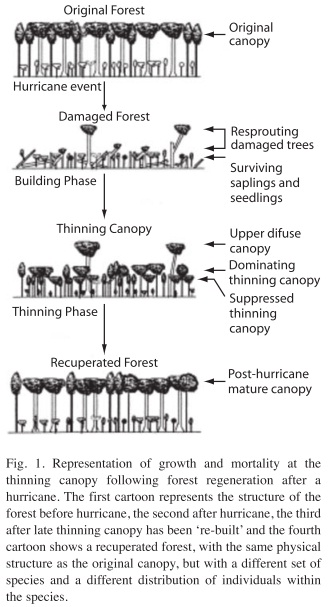
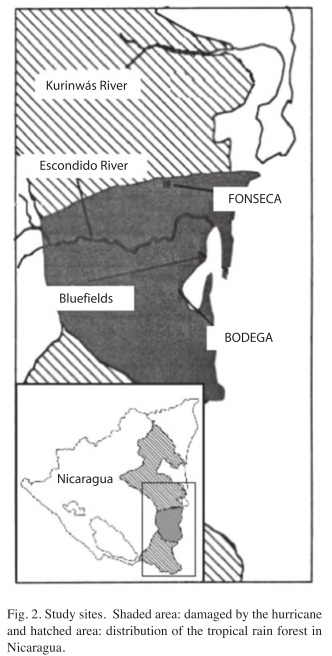
<body><![CDATA[<p style="text-align: justify;"><font face="Verdana" size="2">This study incorporates the relation between tree species growth and mortality at the thinning canopy of the regenerating forest, thus adding a new research line to our previous work focusing on understanding of forest patterns succession after hurricane Joan in eastern Nicaragua (Vandermeer <i>et al. </i>1990, Vandermeer <i>et al. </i>2001, Yih <i>et al. </i>1991, Boucher <i>et al. </i>1994). We propose that post-storm forest succession can be thought of as a two-stage process (Granzow <i>et al. </i>1997) (<a  href="#fig1">Fig. 1</a>, <a href="#fig2">2</a>), involving the direct regeneration from resprouting and seedlings growth into a low stature but very dense canopy, followed by thinning (mortality) of its members through competition (Vandermeer <i>et al. </i>1990, Vandermeer 1996, Vandermeer <i>et al. </i>2001). Tree position in the early thinning canopy (Vandermeer <i>et al. </i>2001) and development of the thinning canopy show that tree mortality is independent of species identity, as analyzed earlier by Zagt &amp; Werner (1998). As the thinning canopy develops, some individual trees will become dominant due to their high growth rate while others become suppressed due to competition. It is in this thinning canopy where competition will eventually reduce the population to some density approximately equal to the original density (Vandermeer &amp; Granzow-de-la-Cerda 2004). As thinning progresses, it would also be possible to identify two canopies, one made of individuals that are beginning to dominate the competition process and another made of those being suppressed (Vandermeer &amp; Granzow-de-la-Cerda 2004). The present study seeks to query the niche (equilibrium) versus non-niche (nonequilibrium) explanation of species diversity in the thinning canopy, following the framework of Zagt &amp; Werger (1998). Non-niche explanations propose that tree growth and mortality is independent of their species identity (Hubbell &amp; Foster 1986, Hubbell 2001), thus implying that all tree species in tropical rain forests are in competition to fill-in regeneration places as grow forest and development. Zagt &amp; Werner also reviewed evidence about tree dispersal and germination of seedlings, followed by the establishment of advanced regeneration.    <br> </font></p>     <p><font face="Verdana" size="2">    <br> </font></p>     <div style="text-align: center;"><a name="fig1"></a><img  src="/img/revistas/rbt/v58n4/a20i1.jpg" title="" alt=""  style="width: 331px; height: 607px;">    <br>     <br>     <br>     <br> <a name="fig2"></a><img src="/img/revistas/rbt/v58n4/a20i2.jpg" title=""  alt="" style="width: 332px; height: 656px;">    <br>     ]]></body>
<body><![CDATA[<br>     <br> </div>     <p><font face="Verdana" size="2"> </font></p>     <p style="text-align: justify;"><font face="Verdana" size="2">In this paper we aim to further our understanding of the effect of intense disturbances on forest regeneration dynamics and tree diversity. Specifically, we ask the following question: Does growth and survival of individual trees depend on the specific identity of the tree during the thinning phase of forest recuperation? </font></p>     <div style="text-align: justify;"><b><font face="Verdana" size="3">     <p>Materials and methods</p> </font><font size="2"> </font></b></div>     <p style="text-align: justify;"><b><font face="Verdana" size="2">Study sites: </font></b><font face="Verdana" size="2">The study area is located within a 50km<sup>2 </sup>swath that was severely damaged by hurricane Joan in 1998 (<a href="#fig2">Fig. 2</a>). This region&#8217;s climate is characterized by a high rainfall season with a dry period from mid- January through April. The vegetation is mostly evergreen lowland forest, similar to that which prevails throughout the Caribbean Coast of Mesoamerica. Soil maps and casual observations show its soils to be predominantly Ultisols. Two research sites were chosen within the hurricane disturbed forest area: one, named "Fonseca" 28km north of the trajectory of the hurricane&#8217;s eye suffered less intense winds; and the other, "Bodega" 14km south of the trajectory, thus suffering more intense winds and located near the center of the disturbed area.</font></p>     <div style="text-align: justify;"><b><font size="2"> </font></b></div>     <p style="text-align: justify;"><b><font face="Verdana" size="2">Disturbance history: </font></b><font face="Verdana" size="2">La Bodega was the more damaged site from hurricane Joan. Most tree species regenerated from seedlings or resprouted from snapped off or fallen trunks. At Fonseca site, the forest canopy, although snapped off, resisted the hurricane. Our field observation strongly showed that the most damage sites presented the higher species accumulation curve (Vandermeer <i>et al. </i>2000). The forest at Fonseca was subsequently damaged by Hurricane Cesar in 1996. Hurricane Cesar was a category two hurricane that snapped off branches of large trees thus forming several light-gaps in one of the transects (Ruiz 1996). Transects at Fonseca site had to be abandoned two years after their destruction by fire following the 1998 ENSO event. The initial damage variability allowed us to evaluate forest regeneration after the massive hurricane Joan, milder hurricane Cesar and the low intensity forest fires associated with the 1998 ENSO event.</font></p>     <div style="text-align: justify;"><b><font size="2"> </font></b></div>     ]]></body>
<body><![CDATA[<p style="text-align: justify;"><b><font face="Verdana" size="2">Circumference and height measurement: </font></b><font face="Verdana" size="2">Three 100x10m strip plots were established in 1989 and 1990 at each site with two additional 50x30m rectangular plots at Bodega in 2000 and 2001. One of transects at Bodega became repeatedly damaged by brush fires starting in 1994 and thus was eliminated from the analyses. &#8211; the total research area is 1.1ha. All trees &#8805;10cm in circumference at breast height (3.18cm in diameter) were located and numbered with an aluminum tag affixed with an aluminum nail. All those individuals were measured annually at the same height on the bole.</font></p>     <div style="text-align: justify;"></div>     <p style="text-align: justify;"><font face="Verdana" size="2">Only species with more than five individuals &#8805;10cm in circumference (3.18cm dbh) were included in the study. Trees were identified in the field and vouchers deposited at the National Herbarium of Nicaragua (HNMN) and the University of Michigan Herbarium (MICH). Earlier vouchers were deposited at Instituto Nacional de la Biodiversidad (INBIO) in Santo Domingo, Costa Rica.</font></p> <b><font size="2"> </font></b>     <p><b><font face="Verdana" size="2">Relative growth rates: </font></b><font  face="Verdana" size="2">Yearly growth in circumference was measured as the change in circumference; where relative growth rate (RGR) is calculate by the formula:    <br> </font></p>     <div style="text-align: center;"><img  src="/img/revistas/rbt/v58n4/a20ia.jpg" title="" alt=""  style="width: 187px; height: 25px;">    <br> </div> <i><font size="2"> </font></i><font face="Verdana" size="2"></font>     <div style="text-align: justify;"><font face="Verdana" size="2">     <p>where <i>ln(X(t)) </i>is the natural logarithm of the circumference at breast height at time <i>t </i>and <i>ln</i>(<i>X(t+1)) </i>at time <i>t + 1</i>. RGR represents the rate at which the circumference is growing or diminishing.</p>     <p>Because growth rates depend on the size of the individual during forest regeneration phases, we corrected the relative growth rate estimate for size. Weighted RGR* was categorized into five size classes; 10-24, 25-40, 41-60, 61-120 and over 120cm. Weighted relative growth rate is calculated as follow:</p> </font>    ]]></body>

<body><![CDATA[<br> <font face="Verdana" size="2">     <p></p> </font></div> <font face="Verdana" size="2"></font>     <div style="text-align: center;"><font face="Verdana" size="2">     <p><img src="/img/revistas/rbt/v58n4/a20ib.jpg" title="" alt=""  style="width: 560px; height: 42px;">    <br> </p> </font></div> <font face="Verdana" size="2"> </font>     <div style="text-align: justify;"><font face="Verdana" size="2">     <p>where n<sub>1</sub> and n<sub>5</sub> is the number of trees in the first and fifth size stage. N is the total sample size. <i>ln</i>(<i>X<sub>1</sub>(t)) </i>is the natural logarithm of the circumference at breast height for the first stage at time <i>t </i>and <i>ln</i>(<i>X<sub>1</sub>(t+1)) </i>at time <i>t+</i>1, respectively<i>. </i>In general, smaller trees experience faster growth rates early in the building phase, but during the canopy thinning phase all individual tree have lower growth rates because they have either reached their maximum size or are experiencing intense competition.</p> </font><b><font size="2"> </font></b></div>     <p style="text-align: justify;"><b><font face="Verdana" size="2">Tree mortality patterns in the thinning canopy: </font></b><font face="Verdana" size="2">Individuals were classified as dead when the crown lacked green leaves and the stem was dry. Individuals regarded as dead for the first time were not excluded until their status as dead was confirmed in the following 1-2 years, as some reverted to living status the following year. For individuals not found, their aluminum tag was searched for on the ground. Not until this was found lying or attached to a fallen stem, was a missing tree reported as dead.</font></p>     <div style="text-align: justify;"></div>     <p style="text-align: justify;"><font face="Verdana" size="2">All trees that died each year between 1990 and 2000 at Fonseca and between 1990 and 2005 at Bodega were recorded. Overall probability of mortality was calculated as the total mortality count (all mortality records of all species per period) divided by the total number of individuals of all species per year. The probability of mortality for each species was calculated as follows: the total mortality multiplied by the number of dead individuals per species. Thus the result is the expected number of individuals that died per species. For species where estimated mortalities were less than five death counts, the estimation of the number of dead trees were lumped until at least five deaths were counted. We used a </font><i><font  face="Verdana" size="2">&#967;</font></i><font face="Verdana" size="2"><sup>2</sup>-test with a Bates correction in order to test whether there were statistical significant differences between the observed and the expected tree mortality. Degrees of freedom were reduced by one because the mortality rate was estimated from the data (Sokal &amp; Rohlf 1981).</font></p>     ]]></body>
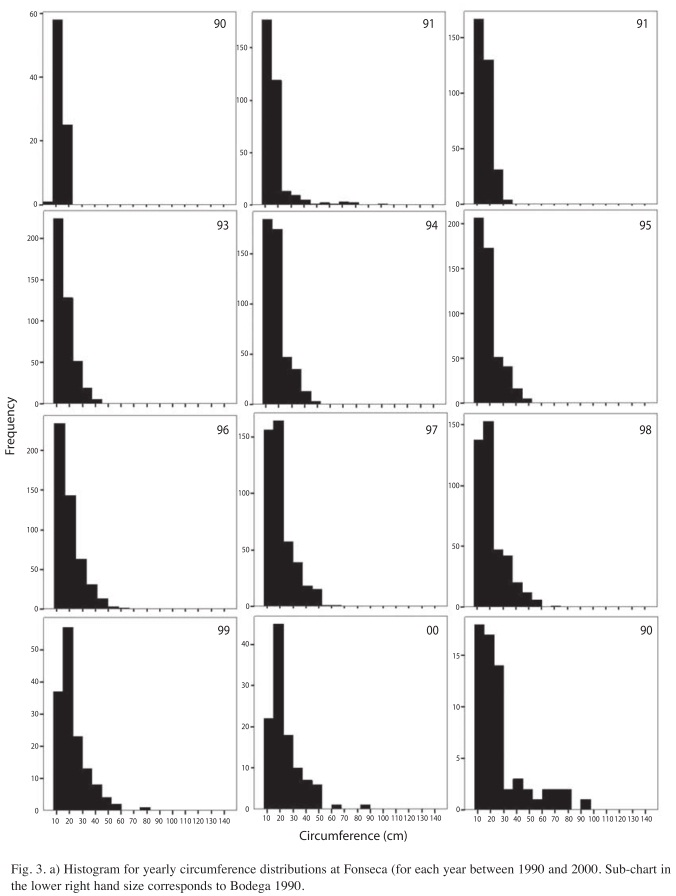
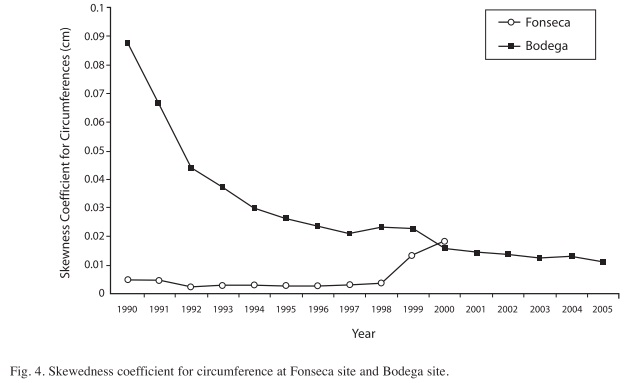
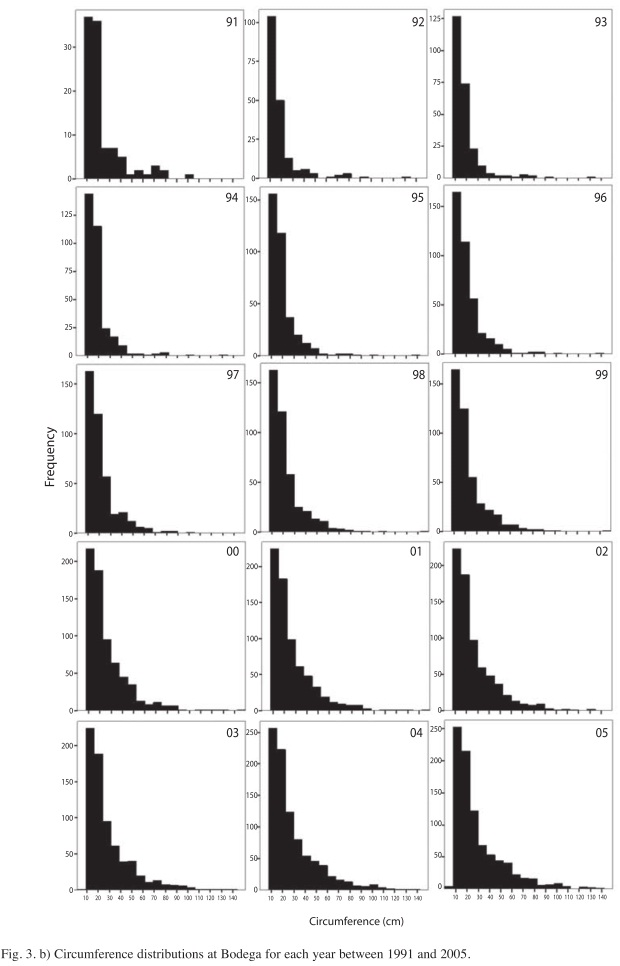
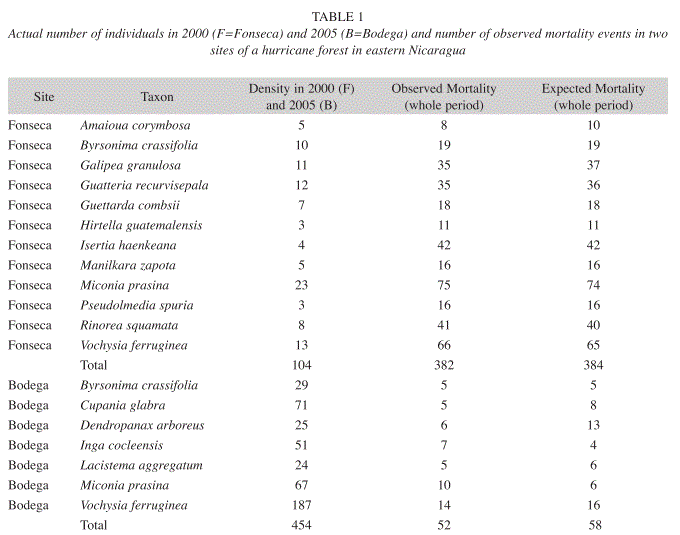
<body><![CDATA[<div style="text-align: justify;"><b><font size="2"> </font></b><font face="Verdana" size="2">     <p>Tree growth and fate in the thinning canopy: RGRs were compared between individual trees that survived versus individuals that died during a given period (<i>t</i>, <i>t+1</i>). We used tree condition (alive or death) as the independent variable and tree growth was used as the dependent variable in each site. RGRs between dead and live individuals were analyzed with a <i>t </i>test for independent samples in order to verify the null hypothesis that surviving trees have on average faster RGR than dead ones in the previous year. </p> </font></div> <font face="Verdana" size="2"></font><font style="font-weight: bold;"  face="Verdana" size="3">     <p>Results</p> </font><font size="2"> </font>     <p style="text-align: justify;"><font style="font-weight: bold;"  face="Verdana" size="2">Circumferences and height distributions in two regenerating forests: </font><font face="Verdana"  size="2">The platykurtic circumference distribution of <a href="/img/revistas/rbt/v58n4/a20i3a.jpg">Figure 3a</a>, is skewed toward smaller individuals because of their greater abundance in the regenerating hurricane forest. Patterns in circumference are consistent between both sites, but some particularities exist. In 1996, circumference distributions were centered at around 20cm at Fonseca, mainly because much of the regeneration is from seedlings and re-sprouts from fallen trunks into the forest canopy (<a href="/img/revistas/rbt/v58n4/a20i3a.jpg">Fig. 3a</a>). In <a href="/img/revistas/rbt/v58n4/a20i4.jpg">figure 4</a>, the skewedness coefficient with respect to the mean circumference distribution is very low from 1990 to 1997. For example, the circumference distribution is more homogeneous during the first years at Fonseca than at Bodega (<a  href="/img/revistas/rbt/v58n4/a20i4.jpg">Fig. 4</a>), which is perhaps due to the fact that La Bodega site was more heavily damaged by hurricane Joan (Vandermeer &amp; Granzow-de la Cerda 2004). However, due to the light-gaps formation by hurricane Cesar at Fonseca site, the skewedness index increased following the transition from smaller to larger circumference sizes after this hurricane at Fonseca.</font></p>     <div style="text-align: justify;"></div>     <p style="text-align: justify;"><font face="Verdana" size="2">At Bodega site circumference distributions were biased toward smaller-size classes since the beginning of the study. Later, during the thinning phase, circumference distributions were centered on 30cm (<a href="/img/revistas/rbt/v58n4/a20i3b.jpg">Fig. 3b</a>). This pattern is due, to a large extent, to the fast growing species, <i>Vochysia ferruginea</i>, a species that has become the most dominant, since the earliest post-hurricane regeneration stages at Bodega site (Boucher <i>et al. </i>1994). The right-hand tail of the circumference distributions is due to the presence of emergent trees that are forming a diffuse upper canopy (~30m). In this diffuse canopy <i>Dipteryx oleifera </i>and <i>Hieronyma alchorneoides </i>are the most common species. The skewedness coefficient of circumferences decreases in part due to the growth of small trees, thus leading to a circumference distribution centered on individuals present at the thinning canopy in recent years (<a  href="/img/revistas/rbt/v58n4/a20i4.jpg">Fig. 4</a>).</font></p>     <div style="text-align: justify;"></div>     <p style="text-align: justify;"><font face="Verdana" size="2">The analysis of the circumferences during the thinning phase shows the unsurprising fact that larger trees grew more than smaller ones. In <a  href="/img/revistas/rbt/v58n4/a20i5.jpg">Figure 5</a> we present the growth pattern of tree circumference at the early thinning canopy for Fonseca site (<a href="/img/revistas/rbt/v58n4/a20i5.jpg">Fig. 5a</a>) and the growth pattern of tree circumference during the thinning canopy for Bodega (<a href="/img/revistas/rbt/v58n4/a20i5.jpg">Fig. 5b</a>). The points near the origin correspond to small trees that were present in the lower canopy stories. In general, small trees were suppressed due to low light conditions created by the compact thinning canopy above and the low number of light gaps subsequent to the </font><i><font size="2">&#8216;</font><font face="Verdana" size="2">building phase&#8217; </font></i><font face="Verdana" size="2">(Vandermeer <i>et al. </i>2001). There is a tendency to continue growing once a tree reaches the early thinning canopy, those trees are approximately &gt;20cms in circumference. Points below the 45 degrees line represent trees that diminished in circumference due to competition. This could reflect a thinning process, as the death rate was concentrated among these small sized individual trees.</font></p>     <div style="text-align: justify;"><font size="2"> </font></div>     <p style="text-align: justify;"><font face="Verdana" size="2"><span  style="font-weight: bold;">Mortality patterns in the thinning canopy:</span> </font><font face="Verdana" size="2">The results show that there were species with mortality consistent with the mortality expectation and others that were above or below the expected mortality (<a href="/img/revistas/rbt/v58n4/a20t1.gif">Table 1</a>). The direction of the bias of the observed mortality with respect to the expected mortality in each species is very similar in both sites &#8211; that is, there was only one species with a minimal reverse bias under the expectation of neutral mortality in one site with respect to the other site. This exception being <i>V. ferruginea</i>, with a mortality expectation slightly larger than the neutral mortality expectation at Bodega site, where it is the most abundant tree (Boucher &amp; Granzow de la Cerda 2008). Survival of <i>V. ferruginea </i>was higher than for most tree species in the thinning canopy. At Fonseca site the observed mortality for this species is slightly lower than the neutral mortality expectation (<a href="/img/revistas/rbt/v58n4/a20t1.gif">Table 1</a>). Before hurricane Cesar, <i>V. ferruginea </i>was the second most abundant species, and subsequently to hurricane Cesar increased in abundance.</font></p>     ]]></body>
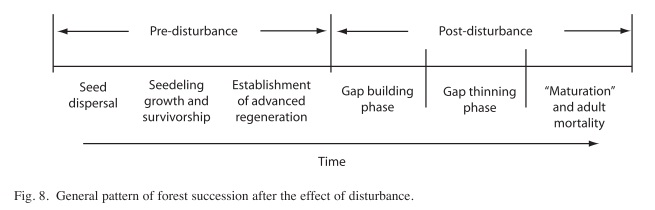
<body><![CDATA[<p style="text-align: justify;"><font face="Verdana" size="2">Observed mortalities and expected neutral mortalities are remarkably similar at Fonseca (</font><i><font  face="Verdana" size="2">&#967;</font></i><font face="Verdana" size="2"><sup>2</sup>=0.3135, df=12, p=0.9999, <a href="/img/revistas/rbt/v58n4/a20t1.gif">Table 1</a>). Because, tree demography data were binned across time for each site, the results show that the occurrence of low intensity forest fires at Fonseca affected trees independent of their species identity and demography. We think that tree mortality at Fonseca is mainly due to the kind of forest fire damage to the forest understory, not due to the process of thinning since the thinning canopy was not constructed until later. Forest fires burned small trees, while larger trees were damaged at their base but sufficiently so to lead to high mortality during the following year (Ruiz <i>et al. </i>2001). Consequently, the site was abandoned after the yearly census in 2000.</font></p>     <div style="text-align: justify;"></div>     <p style="text-align: justify;"><font face="Verdana" size="2">Observed tree species mortalities do not differ from a neutral expectation at Bodega site from 1990 to 2005. An apparent, but not statistically significant, exception is <i>Dendropanax arboreus</i>, with an expected morality of 13 individuals and only 6 individuals actually dying (</font><i><font face="Verdana" size="2">&#967;</font></i><font  face="Verdana" size="2"><sup>2</sup>=3.053, df=6, p=0.8022, <a  href="/img/revistas/rbt/v58n4/a20t1.gif">Table 1</a>). The species is a fast growing canopy tree species and produces a large number of seedlings each year at Bodega (<i>personal observation</i>). Its abundance appears to be the result of the success of its advanced regeneration in reaching the thinning canopy. In recent years the species seems to be among those filling small light-gaps. When the species is removed form the analysis the observations still do not differ from a neutral mortality expectation (</font><i><font  face="Verdana" size="2">&#967;</font></i><font face="Verdana" size="2"><sup>2</sup>=1.312, df=5, p=0.9336). From 2000 to 2005 (the thinning phase), the results also support the idea that tree mortality is a random process with respect to species identity at Bodega site (<i>X<sup>2</sup></i>=5.001, df=6, p=0.5436).</font></p>     <div style="text-align: justify;"><font size="2"> </font><font face="Verdana" size="2">     <p>Tree growth and survival in the thinning canopy: The trend of species relative growth rates decreases as forest recovery proceeds. Initially, trees grew very fast, taking advantage of the post-hurricane light conditions, followed by a reduction in growth rates as the thinning phase of forest regeneration progresses (r<sup>2</sup>=0.1940&plusmn;SE=0.051, slope=-0.44, p=0.000; <a href="/img/revistas/rbt/v58n4/a20i6.jpg">Fig. 6</a>). The variation in RGRs with respect to the linear regression is due to several exceptions to the general pattern (<a href="/img/revistas/rbt/v58n4/a20i7.jpg">Fig. 7</a>). For example, <i>V. ferruginea</i>, which had higher growth rates than all other species. However, the growth pattern of <i>V. ferruginea </i>is consistent with the overall growth dynamics in the post-hurricane forest. The canopy emergent trees that resisted the hurricane had growth rates very close to zero (<i>i.e. Dipteryx oleifera</i>, <i>Hieronyma alchorneoides</i>), because they were at or near their maximum sizes. Others, like <i>Amaioua corimbosa</i>, also had growth rates very close to zero throughout the research period, because understory species reached maximum size during the building phase of the recovering phase, first five years after hurricane Joan.</p>     <p>The examination of relative growth rates between survivor and dead trees showed the unsurprising fact that tree survival is positively related to fast growth rates in both research sites. In <a  href="/img/revistas/rbt/v58n4/a20t2.gif">Table 2</a>, tree mortality is significantly and positively related to slower RGR in thethinning canopy. In sum, these findings support the fundamental proposition of a random mortality with respect to species identity at the thinning canopy, where survival is positively related to faster growth rates.</p> </font></div> <font face="Verdana" size="2"></font><font style="font-weight: bold;"  face="Verdana" size="3">     <p>Discussion</p> </font><font size="2"> </font>     <p style="text-align: justify;"><font face="Verdana" size="2">The present study seeks to query the niche (equilibrium) versus non-niche (nonequilibrium) explanation of tree species diversity, following the framework of Zagt &amp; Werger (1998). To do so, we have divided the postdisturbance forest succession process into two main phases, the building phase and the thinning phase. Zagt &amp; Werger (1998), reviewed evidence about these two phases, effectively recognizing a wider range of phenomena in their analysis. Their analysis begins before the occurrence of the disturbance, with seed dispersal and germination of seedlings, followed by the establishment of the advanced regeneration or, what would be equivalent in our case, the seedlings and sapling recruitment dynamics before and after the hurricane Joan. Our work here begins at a later point in the process of forest recovery, evaluating the pattern of tree recruitment, growth and mortality in the thinning canopy. We use <a href="/img/revistas/rbt/v58n4/a20i8.jpg">Figure 8</a> to summarize what we think to be the overall pattern, from the seedling arrival at a point in forest floor to the recruitment of an adult tree at that point in the forest canopy, in the same context that was analyzed earlier by Vandermeer <i>et al. </i>(2001). In their communication Zagt &amp; Werger (1998) emphasized both ends of this spectrum, suggesting that seedlings might exhibit different community assemblage properties from adults. As suggested by Zagt &amp; Werger (1998), most studies emphasize either the early phases of the overall process (the left hand side of <a  href="/img/revistas/rbt/v58n4/a20i8.jpg">Fig. 8</a>) or the late phases (right hand side of <a href="/img/revistas/rbt/v58n4/a20i8.jpg">Fig. 8</a>).</font></p>     <div style="text-align: justify;"></div>     <p style="text-align: justify;"><font face="Verdana" size="2">Our work focuses on the late thinning stage of forest regeneration dynamics following disturbance by Hurricane Joan of 1988. Earlier fieldwork focused on recruitment into the building canopy and the early thinning canopy, strongly supporting the non-niche framework for the building phase of post disturbance succession (Vandermeer <i>et al. </i>1996). Similar to the findings of a field study at Barro Colorado Island in Panama by Hubbell (1999) and Hubbell <i>et al. </i>(1999), which found evidence in favor of a non-niche model in terms of mortality of adult trees in the mature phase of forest succession (Wills <i>et al. </i>1997). Here we analyze the late thinning process &#8211;</font><i><font size="2">&#8216;</font><font face="Verdana"  size="2">gap thinning phase&#8217; </font></i><font face="Verdana" size="2">the right hand side of the graphic in <a  href="/img/revistas/rbt/v58n4/a20i8.jpg">Figure 8</a> &#8211; and find evidence for a non-niche interpretation during late thinning phase. The results reported herein are in contrast to the general niche interpretation presented earlier (Vandermeer <i>et al. </i>2001). This early work was acknowledged as preliminary and was accomplished before the number of mortality events was sufficiently large. The results reported here contradict those early findings. In addition, here we evaluate the growth versus survival tradeoff during the process of forest regeneration. The results strongly support a non-niche interpretation based on tree species growth performance into the late phase of the thinning canopy.</font></p>     ]]></body>
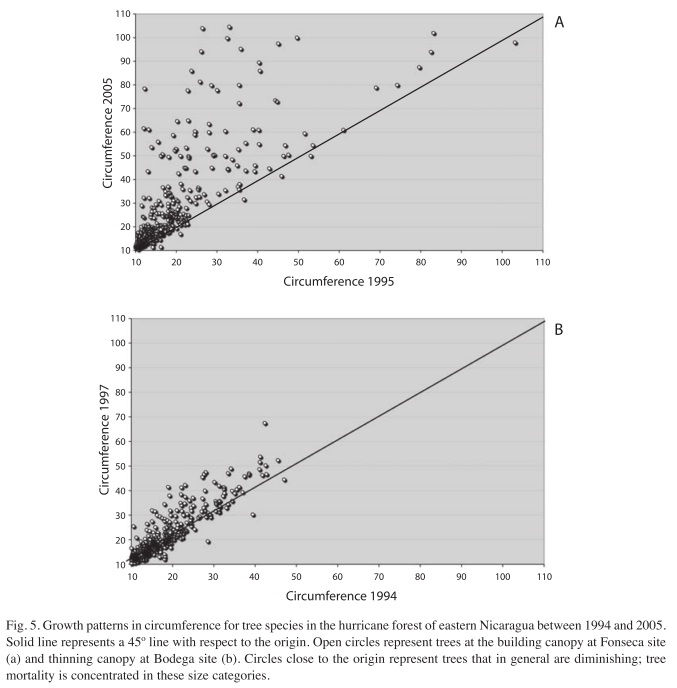
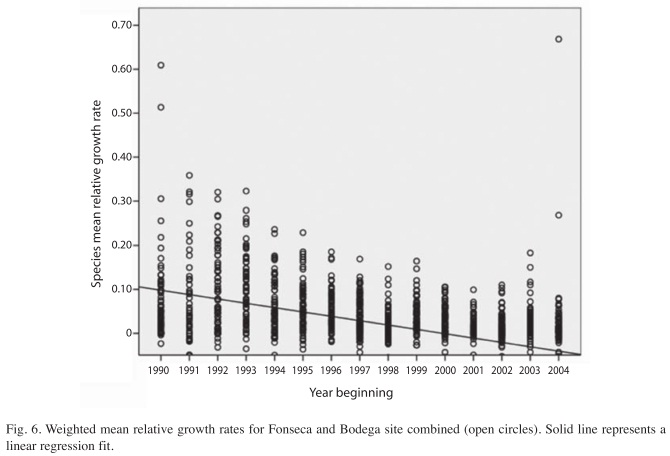
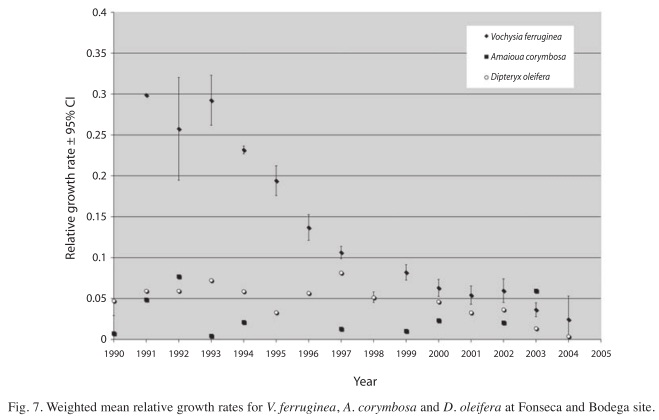
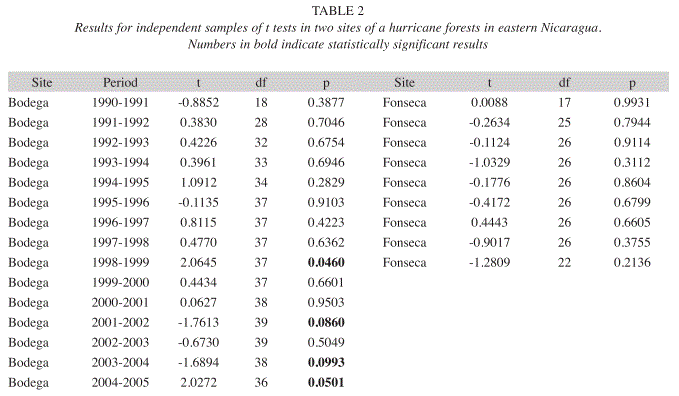
<body><![CDATA[<div style="text-align: justify;"></div>     <p style="text-align: justify;"><font face="Verdana" size="2">In summary, we present evidence in favor of the growing literature that rejects a strict niche interpretation of tropical rain forest organization (Clark &amp; Clark 1985, Alvarez-Buylla &amp; Martinez-Ramos 1991, 1992, Clark &amp; Clark 1992, Hubbell 1999, Hubbell <i>et al. </i>1999, Ruiz <i>et al. </i>2009). Although, data clearly show that tree species are randomly experiencing mortality during the thinning phase of forest regeneration, this observation is not a consequence of Swain &amp; Whittmore&#8217;s (1988) provisional rough-cut of the pioneer versus primary forest dynamic, since pioneers have been excluded from the mortality analysis because the marked dichotomy in growth and survival rates between pioneer tree species and other tree species (Vandermeer <i>et al. </i>2001). Rather, as suggested by Alvarez-Buylla &amp; Mart&iacute;nez-Ramos (1991) and by Hubbell (1995), these two categories may represent extremes on a <i>continuum of tree life histories</i>. Our data support the idea that there are no species-specific niches during either the building phase or the thinning phase of forest regeneration. This result corroborates the prediction about a random pattern of tree mortality in the thinning canopy (Vandermeer &amp; Granzow-de-la-Cerda 2004). The results here, in combination with the results obtained by Vandermeer <i>et al. </i>(2001), strongly support the ideas of Zagt &amp; Werger (1998), that a nonniche (non-equilibrium) interpretation applies to the building and thinning phase, yet leaves open the possibility that a niche (equilibrium) based assembly might ultimately take please during the mature forest stage &#8211; the core of future field research.</font></p> <font size="2"> </font><font style="font-weight: bold;" face="Verdana" size="3">     <p>Acknowledgments</p> </font><font size="2"> </font><font face="Verdana" size="2"></font>     <div style="text-align: justify;"><font face="Verdana" size="2">     <p>This work was supported by the National Science Foundation grants (BSR-8917688, DEB 9524061, and DEB 0235761) to John Vandermeer. We wish to thank to the members of Proyecto Biodiversidad de las Universidades de las Regiones Aut&oacute;nomas de la Costa Caribe&ntilde;a Nicarag&uuml;ense (URACCAN), Centro de Investigaci&oacute;n y Documentaci&oacute;n de la Costa Atl&aacute;ntica (CIDCA) and Bluefields Indian and Caribbean University (BICU) for logistic support and collaboration in many ways.</p> </font></div> <font face="Verdana" size="2"></font><font size="2"> </font> <hr style="width: 100%; height: 2px;"><font style="font-weight: bold;"  face="Verdana" size="3">     <p>References</p> </font><font size="2"> </font>     <!-- ref --><p><font face="Verdana" size="2">Alvarez-Buylla, E.R. &amp; M. Martinez-Ramos. 1991. Seed and forest dynamics: a theoretical framework and an example from the neotropics. Am. Nat. 142: 137- 154.    &nbsp;&nbsp;&nbsp;&nbsp;&nbsp;&nbsp;&nbsp;&nbsp;[&#160;<a href="javascript:void(0);" onclick="javascript: window.open('/scielo.php?script=sci_nlinks&ref=1397742&pid=S0034-7744201000040002000001&lng=','','width=640,height=500,resizable=yes,scrollbars=1,menubar=yes,');">Links</a>&#160;]<!-- end-ref --></font></p>     <!-- ref --><p><font face="Verdana" size="2">Alvarez-Buylla, E.R. &amp; M. Martinez-Ramos. 1992. Demography and allometry of <i>Cecropia obtusifolia</i>, a neotropical pioneer tree - evaluation of the climax pioneer paradigm for tropical rain forests. J. Ecol. 80: 275-290.    &nbsp;&nbsp;&nbsp;&nbsp;&nbsp;&nbsp;&nbsp;&nbsp;[&#160;<a href="javascript:void(0);" onclick="javascript: window.open('/scielo.php?script=sci_nlinks&ref=1397744&pid=S0034-7744201000040002000002&lng=','','width=640,height=500,resizable=yes,scrollbars=1,menubar=yes,');">Links</a>&#160;]<!-- end-ref --></font></p>     ]]></body>
<body><![CDATA[<!-- ref --><p><font face="Verdana" size="2">Boucher, H.D. &amp; I. Granzow de la Cerda. 2008. Recuperaci&oacute;n del dosel del bosque huracanado de La Bodega, r&iacute;o Kukra, R.A.A.S., a los diecis&eacute;is a&ntilde;os de hurac&aacute;n Juana. Wani 52: 17-21.    &nbsp;&nbsp;&nbsp;&nbsp;&nbsp;&nbsp;&nbsp;&nbsp;[&#160;<a href="javascript:void(0);" onclick="javascript: window.open('/scielo.php?script=sci_nlinks&ref=1397746&pid=S0034-7744201000040002000003&lng=','','width=640,height=500,resizable=yes,scrollbars=1,menubar=yes,');">Links</a>&#160;]<!-- end-ref --></font></p>     <!-- ref --><p><font face="Verdana" size="2">Boucher, H.D., J. Vandermeer, M.A. Mallona, N. Zamora &amp; I. Perfecto. 1994. Resistence and resilience in a directly regenerating rain forest. Nicaraguan trees of the Vochysiaceae after hurricane Joan. J. Forest Ecol.68: 127-136.    &nbsp;&nbsp;&nbsp;&nbsp;&nbsp;&nbsp;&nbsp;&nbsp;[&#160;<a href="javascript:void(0);" onclick="javascript: window.open('/scielo.php?script=sci_nlinks&ref=1397748&pid=S0034-7744201000040002000004&lng=','','width=640,height=500,resizable=yes,scrollbars=1,menubar=yes,');">Links</a>&#160;]<!-- end-ref --></font></p>     <!-- ref --><p><font face="Verdana" size="2">Brokaw, N.V.L. 1985. Gap-Phase Regeneration in a Tropical Forest. Ecology 66: 682-687.    &nbsp;&nbsp;&nbsp;&nbsp;&nbsp;&nbsp;&nbsp;&nbsp;[&#160;<a href="javascript:void(0);" onclick="javascript: window.open('/scielo.php?script=sci_nlinks&ref=1397750&pid=S0034-7744201000040002000005&lng=','','width=640,height=500,resizable=yes,scrollbars=1,menubar=yes,');">Links</a>&#160;]<!-- end-ref --></font></p>     <!-- ref --><p><font face="Verdana" size="2">Chave, J., H.C. Muller-Landau &amp; S.A. Levin. 2002. Comparing classical community models: theoretical consequences for patterns of diversity. Am. Nat. 159: 1-23.    &nbsp;&nbsp;&nbsp;&nbsp;&nbsp;&nbsp;&nbsp;&nbsp;[&#160;<a href="javascript:void(0);" onclick="javascript: window.open('/scielo.php?script=sci_nlinks&ref=1397752&pid=S0034-7744201000040002000006&lng=','','width=640,height=500,resizable=yes,scrollbars=1,menubar=yes,');">Links</a>&#160;]<!-- end-ref --></font></p>     <!-- ref --><p><font face="Verdana" size="2">Clark, D.A. &amp; D.B. Clark. 1992. Life history diversity of canopy and emergent trees in a neotropical rain forest. Ecol. Monogr. 62: 315-344.    &nbsp;&nbsp;&nbsp;&nbsp;&nbsp;&nbsp;&nbsp;&nbsp;[&#160;<a href="javascript:void(0);" onclick="javascript: window.open('/scielo.php?script=sci_nlinks&ref=1397754&pid=S0034-7744201000040002000007&lng=','','width=640,height=500,resizable=yes,scrollbars=1,menubar=yes,');">Links</a>&#160;]<!-- end-ref --></font></p>     ]]></body>
<body><![CDATA[<!-- ref --><p><font face="Verdana" size="2">Clark, D.B. &amp; D.A. Clark. 1985. Seedling dynamics of a tropical tree: impacts of herbivory and meristem damage. Ecology 66: 1884-1892.    &nbsp;&nbsp;&nbsp;&nbsp;&nbsp;&nbsp;&nbsp;&nbsp;[&#160;<a href="javascript:void(0);" onclick="javascript: window.open('/scielo.php?script=sci_nlinks&ref=1397756&pid=S0034-7744201000040002000008&lng=','','width=640,height=500,resizable=yes,scrollbars=1,menubar=yes,');">Links</a>&#160;]<!-- end-ref --></font></p>     <!-- ref --><p><font face="Verdana" size="2">Connell, J.H. 1978. Diversity in tropical rain forest and coral reefs. Science 199: 1302-1310.    &nbsp;&nbsp;&nbsp;&nbsp;&nbsp;&nbsp;&nbsp;&nbsp;[&#160;<a href="javascript:void(0);" onclick="javascript: window.open('/scielo.php?script=sci_nlinks&ref=1397758&pid=S0034-7744201000040002000009&lng=','','width=640,height=500,resizable=yes,scrollbars=1,menubar=yes,');">Links</a>&#160;]<!-- end-ref --></font></p>     <!-- ref --><p><font face="Verdana" size="2">Gilbert, G.S., K.E. Harms, D.N. Hamill &amp; S.P. Hubbell. 2001. Effects of seedling size, El Ni&ntilde;o drought, seedling density, and distance to nearest conspecific adult on 6-year survival of Ocotea whitei seedlings in Panam&aacute;. Oecologia 127: 509-516.    &nbsp;&nbsp;&nbsp;&nbsp;&nbsp;&nbsp;&nbsp;&nbsp;[&#160;<a href="javascript:void(0);" onclick="javascript: window.open('/scielo.php?script=sci_nlinks&ref=1397760&pid=S0034-7744201000040002000010&lng=','','width=640,height=500,resizable=yes,scrollbars=1,menubar=yes,');">Links</a>&#160;]<!-- end-ref --></font></p>     <!-- ref --><p><font face="Verdana" size="2">Granzow-de-la-Cerda, I., N. Zamora, J.H. Vandermeer &amp; D.H. Boucher. 1997. Biodiversidad de especies arb&oacute;reas en el bosque tropical h&uacute;medo del Caribe Nicarag&uuml;ense siete a&ntilde;os despu&eacute;s del hurac&aacute;n Juana. Rev. Biol. Trop. 45: 1409-1419.    &nbsp;&nbsp;&nbsp;&nbsp;&nbsp;&nbsp;&nbsp;&nbsp;[&#160;<a href="javascript:void(0);" onclick="javascript: window.open('/scielo.php?script=sci_nlinks&ref=1397762&pid=S0034-7744201000040002000011&lng=','','width=640,height=500,resizable=yes,scrollbars=1,menubar=yes,');">Links</a>&#160;]<!-- end-ref --></font></p>     <!-- ref --><p><font face="Verdana" size="2">Hubbell, S.P. 1995. Towards a theory of biodiversity and biogeography on continuous landscapes, p. 171-199. <i>In </i>G.R. Carmichael, G.E. Folk &amp; J.L. Schnoor (eds.). Preparing for Global Change: A Midwestern Perspective. Academic, Amsterdam, Netherlands.    &nbsp;&nbsp;&nbsp;&nbsp;&nbsp;&nbsp;&nbsp;&nbsp;[&#160;<a href="javascript:void(0);" onclick="javascript: window.open('/scielo.php?script=sci_nlinks&ref=1397764&pid=S0034-7744201000040002000012&lng=','','width=640,height=500,resizable=yes,scrollbars=1,menubar=yes,');">Links</a>&#160;]<!-- end-ref --></font></p>     ]]></body>
<body><![CDATA[<!-- ref --><p><font face="Verdana" size="2">Hubbell, S.P. 1999. Tropical tree richness and resourcebased niches. Science 285: 1459a.    &nbsp;&nbsp;&nbsp;&nbsp;&nbsp;&nbsp;&nbsp;&nbsp;[&#160;<a href="javascript:void(0);" onclick="javascript: window.open('/scielo.php?script=sci_nlinks&ref=1397766&pid=S0034-7744201000040002000013&lng=','','width=640,height=500,resizable=yes,scrollbars=1,menubar=yes,');">Links</a>&#160;]<!-- end-ref --></font></p>     <!-- ref --><p><font face="Verdana" size="2">Hubbell, S.P. &amp; R.B. Foster. 1986. Biology, chance and history and the structure of tropical forest tree communities, p. 314-329. <i>In </i>J. Diamond &amp; T.J. Case (eds.). Community Ecology. Harper &amp; Row, New York, USA.    &nbsp;&nbsp;&nbsp;&nbsp;&nbsp;&nbsp;&nbsp;&nbsp;[&#160;<a href="javascript:void(0);" onclick="javascript: window.open('/scielo.php?script=sci_nlinks&ref=1397768&pid=S0034-7744201000040002000014&lng=','','width=640,height=500,resizable=yes,scrollbars=1,menubar=yes,');">Links</a>&#160;]<!-- end-ref --></font></p>     <!-- ref --><p><font face="Verdana" size="2">Hubbell, S.P., R.B. Foster, S.T. O&#8217;Brien, K.E. Harms, R. Condit, B. Wachsler, S.J. Wright &amp; S. Loo de Lao. 1999. Light-gap disturbances, recruitment limitation, and tree diversity in a neotropical forest. Science 283: 554-557.    &nbsp;&nbsp;&nbsp;&nbsp;&nbsp;&nbsp;&nbsp;&nbsp;[&#160;<a href="javascript:void(0);" onclick="javascript: window.open('/scielo.php?script=sci_nlinks&ref=1397770&pid=S0034-7744201000040002000015&lng=','','width=640,height=500,resizable=yes,scrollbars=1,menubar=yes,');">Links</a>&#160;]<!-- end-ref --></font></p>     <!-- ref --><p><font face="Verdana" size="2">Hubbell, S.P. 2001. The Unified Neutral Theory of Biodiversity and Biogeography. Princeton University, Princeton, USA.    &nbsp;&nbsp;&nbsp;&nbsp;&nbsp;&nbsp;&nbsp;&nbsp;[&#160;<a href="javascript:void(0);" onclick="javascript: window.open('/scielo.php?script=sci_nlinks&ref=1397772&pid=S0034-7744201000040002000016&lng=','','width=640,height=500,resizable=yes,scrollbars=1,menubar=yes,');">Links</a>&#160;]<!-- end-ref --></font></p>     <!-- ref --><p><font face="Verdana" size="2">Hurtt, G.C. &amp; S.W. Pacala. 1995. The consequences of recruitment limitation: reconciling chance, history and competitive differences between plants. J. Theor. Biol. 176: 1-12.    &nbsp;&nbsp;&nbsp;&nbsp;&nbsp;&nbsp;&nbsp;&nbsp;[&#160;<a href="javascript:void(0);" onclick="javascript: window.open('/scielo.php?script=sci_nlinks&ref=1397774&pid=S0034-7744201000040002000017&lng=','','width=640,height=500,resizable=yes,scrollbars=1,menubar=yes,');">Links</a>&#160;]<!-- end-ref --> </font></p>     ]]></body>
<body><![CDATA[<!-- ref --><p><font face="Verdana" size="2">Huston, M. 1979. A general hypothesis of species diversity. Am. Nat. 113: 137-145.    &nbsp;&nbsp;&nbsp;&nbsp;&nbsp;&nbsp;&nbsp;&nbsp;[&#160;<a href="javascript:void(0);" onclick="javascript: window.open('/scielo.php?script=sci_nlinks&ref=1397776&pid=S0034-7744201000040002000018&lng=','','width=640,height=500,resizable=yes,scrollbars=1,menubar=yes,');">Links</a>&#160;]<!-- end-ref --></font></p>     <!-- ref --><p><font face="Verdana" size="2">Hutchinson, G.E. 1961. The paradox of the plankton. Am. Nat. 95: 137-145.    &nbsp;&nbsp;&nbsp;&nbsp;&nbsp;&nbsp;&nbsp;&nbsp;[&#160;<a href="javascript:void(0);" onclick="javascript: window.open('/scielo.php?script=sci_nlinks&ref=1397778&pid=S0034-7744201000040002000019&lng=','','width=640,height=500,resizable=yes,scrollbars=1,menubar=yes,');">Links</a>&#160;]<!-- end-ref --></font></p>     <!-- ref --><p><font face="Verdana" size="2">Lawrence, R.W., D.J. Lodge &amp; R.B. Waide. 1991. An introduction to hurricanes in the Caribbean. Biotropica 23: 313-316.    &nbsp;&nbsp;&nbsp;&nbsp;&nbsp;&nbsp;&nbsp;&nbsp;[&#160;<a href="javascript:void(0);" onclick="javascript: window.open('/scielo.php?script=sci_nlinks&ref=1397780&pid=S0034-7744201000040002000020&lng=','','width=640,height=500,resizable=yes,scrollbars=1,menubar=yes,');">Links</a>&#160;]<!-- end-ref --></font></p>     <!-- ref --><p><font face="Verdana" size="2">Mooney, H.A. &amp; M. Gordon. 1983. Disturbance and ecosystem. Springer, Berlin, Germany.    &nbsp;&nbsp;&nbsp;&nbsp;&nbsp;&nbsp;&nbsp;&nbsp;[&#160;<a href="javascript:void(0);" onclick="javascript: window.open('/scielo.php?script=sci_nlinks&ref=1397782&pid=S0034-7744201000040002000021&lng=','','width=640,height=500,resizable=yes,scrollbars=1,menubar=yes,');">Links</a>&#160;]<!-- end-ref --></font></p>     <!-- ref --><p><font face="Verdana" size="2">Pickett, S.T.A. &amp; P.S. White. 1985. Natural disturbance and patchy dynamics. Academic, New York, USA.    &nbsp;&nbsp;&nbsp;&nbsp;&nbsp;&nbsp;&nbsp;&nbsp;[&#160;<a href="javascript:void(0);" onclick="javascript: window.open('/scielo.php?script=sci_nlinks&ref=1397784&pid=S0034-7744201000040002000022&lng=','','width=640,height=500,resizable=yes,scrollbars=1,menubar=yes,');">Links</a>&#160;]<!-- end-ref --></font></p>     ]]></body>
<body><![CDATA[<!-- ref --><p><font face="Verdana" size="2">Ruiz, J., D.H. Boucher, D. Ruiz-Moreno &amp; C. Ingram- Flores. 2009. Recruitment Dynamics of the Tropical Rainforest tree <i>Dipteryx oleifera </i>(Fabaceae) in eastern Nicaragua. Rev. Biol. Trop. 51: 321-338.    &nbsp;&nbsp;&nbsp;&nbsp;&nbsp;&nbsp;&nbsp;&nbsp;[&#160;<a href="javascript:void(0);" onclick="javascript: window.open('/scielo.php?script=sci_nlinks&ref=1397786&pid=S0034-7744201000040002000023&lng=','','width=640,height=500,resizable=yes,scrollbars=1,menubar=yes,');">Links</a>&#160;]<!-- end-ref --></font></p>     <!-- ref --><p><font face="Verdana" size="2">Ruiz, J., D.H. Boucher, J.H. Vandermeer, I. Granzow de la Cerda, I. Perfecto &amp; V. Mart&iacute;nez. 2001. Recuperaci&oacute;n Inicial de un Bosque Incendiado y Previamente Afectado por el Hurac&aacute;n Juana en Nicaragua. Revista Encuentro 58: 66-75.    &nbsp;&nbsp;&nbsp;&nbsp;&nbsp;&nbsp;&nbsp;&nbsp;[&#160;<a href="javascript:void(0);" onclick="javascript: window.open('/scielo.php?script=sci_nlinks&ref=1397788&pid=S0034-7744201000040002000024&lng=','','width=640,height=500,resizable=yes,scrollbars=1,menubar=yes,');">Links</a>&#160;]<!-- end-ref --></font></p>     <!-- ref --><p><font face="Verdana" size="2">Ruiz, J. 1996. ... En la costa, Un hurac&aacute;n cada siglo? Gu&iacute;a Ambientalista (Managua, Nicaragua), Octubre 1996.    &nbsp;&nbsp;&nbsp;&nbsp;&nbsp;&nbsp;&nbsp;&nbsp;[&#160;<a href="javascript:void(0);" onclick="javascript: window.open('/scielo.php?script=sci_nlinks&ref=1397790&pid=S0034-7744201000040002000025&lng=','','width=640,height=500,resizable=yes,scrollbars=1,menubar=yes,');">Links</a>&#160;]<!-- end-ref --> </font></p>     <!-- ref --><p><font face="Verdana" size="2">Sokal, R.R. &amp; F.J. Rohlf. 1981. Biometry. Freeman, New York, USA.    &nbsp;&nbsp;&nbsp;&nbsp;&nbsp;&nbsp;&nbsp;&nbsp;[&#160;<a href="javascript:void(0);" onclick="javascript: window.open('/scielo.php?script=sci_nlinks&ref=1397792&pid=S0034-7744201000040002000026&lng=','','width=640,height=500,resizable=yes,scrollbars=1,menubar=yes,');">Links</a>&#160;]<!-- end-ref --></font></p>     <!-- ref --><p><font face="Verdana" size="2">Stevens, G.C. 1992. The elevation gradient in altitudinal range: an extention of rapoport&#8217;s latitudinal rule to altitude. Am. Nat. 140: 893-911.    &nbsp;&nbsp;&nbsp;&nbsp;&nbsp;&nbsp;&nbsp;&nbsp;[&#160;<a href="javascript:void(0);" onclick="javascript: window.open('/scielo.php?script=sci_nlinks&ref=1397794&pid=S0034-7744201000040002000027&lng=','','width=640,height=500,resizable=yes,scrollbars=1,menubar=yes,');">Links</a>&#160;]<!-- end-ref --></font></p>     ]]></body>
<body><![CDATA[<!-- ref --><p><font face="Verdana" size="2">Swain, M.D. &amp; T.C. Whitmore. 1988. On the definition of ecological species groups in tropical rain forests. Vegetatio 75: 81-86.    &nbsp;&nbsp;&nbsp;&nbsp;&nbsp;&nbsp;&nbsp;&nbsp;[&#160;<a href="javascript:void(0);" onclick="javascript: window.open('/scielo.php?script=sci_nlinks&ref=1397796&pid=S0034-7744201000040002000028&lng=','','width=640,height=500,resizable=yes,scrollbars=1,menubar=yes,');">Links</a>&#160;]<!-- end-ref --></font></p>     <!-- ref --><p><font face="Verdana" size="2">Tilman, D. 1994. Competition and biodiversity in spatially structured habitats. Ecology 75: 2-16.    &nbsp;&nbsp;&nbsp;&nbsp;&nbsp;&nbsp;&nbsp;&nbsp;[&#160;<a href="javascript:void(0);" onclick="javascript: window.open('/scielo.php?script=sci_nlinks&ref=1397798&pid=S0034-7744201000040002000029&lng=','','width=640,height=500,resizable=yes,scrollbars=1,menubar=yes,');">Links</a>&#160;]<!-- end-ref --></font></p>     <!-- ref --><p><font face="Verdana" size="2">Vandermeer, J. 1996. Disturbance and neutral competition theory in rain forest dynamics. Ecol. Model. 85: 99-111.    &nbsp;&nbsp;&nbsp;&nbsp;&nbsp;&nbsp;&nbsp;&nbsp;[&#160;<a href="javascript:void(0);" onclick="javascript: window.open('/scielo.php?script=sci_nlinks&ref=1397800&pid=S0034-7744201000040002000030&lng=','','width=640,height=500,resizable=yes,scrollbars=1,menubar=yes,');">Links</a>&#160;]<!-- end-ref --></font></p>     <!-- ref --><p><font face="Verdana" size="2">Vandermeer, J., H.D. Boucher, I. Perfecto &amp; I. Granzowde- la-Cerda. 1996. A theory of disturbance and species diversity: Evidence from Nicaragua after Hurricane Joan. Biotropica 28: 600-613.    &nbsp;&nbsp;&nbsp;&nbsp;&nbsp;&nbsp;&nbsp;&nbsp;[&#160;<a href="javascript:void(0);" onclick="javascript: window.open('/scielo.php?script=sci_nlinks&ref=1397802&pid=S0034-7744201000040002000031&lng=','','width=640,height=500,resizable=yes,scrollbars=1,menubar=yes,');">Links</a>&#160;]<!-- end-ref --></font></p>     <!-- ref --><p><font face="Verdana" size="2">Vandermeer, J. &amp; I. Granzow-de-la-Cerda. 2004. Height dynamics of the thinning canopy of a tropical rain forest: 14 years of succession in a post-hurricane forest in Nicaragua. Forest Ecol. Manag. 99: 125- 135.    &nbsp;&nbsp;&nbsp;&nbsp;&nbsp;&nbsp;&nbsp;&nbsp;[&#160;<a href="javascript:void(0);" onclick="javascript: window.open('/scielo.php?script=sci_nlinks&ref=1397804&pid=S0034-7744201000040002000032&lng=','','width=640,height=500,resizable=yes,scrollbars=1,menubar=yes,');">Links</a>&#160;]<!-- end-ref --></font></p>     ]]></body>
<body><![CDATA[<!-- ref --><p><font face="Verdana" size="2">Vandermeer, J.H., D.H. Boucher, I. Granzow-de-la-Cerda &amp; I. Perfecto. 2001. Growth and development of the thinning canopy in a post-hurricane tropical rain forest in Nicaragua. Forest Ecol. Manag. 148: 221-242.    &nbsp;&nbsp;&nbsp;&nbsp;&nbsp;&nbsp;&nbsp;&nbsp;[&#160;<a href="javascript:void(0);" onclick="javascript: window.open('/scielo.php?script=sci_nlinks&ref=1397806&pid=S0034-7744201000040002000033&lng=','','width=640,height=500,resizable=yes,scrollbars=1,menubar=yes,');">Links</a>&#160;]<!-- end-ref --></font></p>     <!-- ref --><p><font face="Verdana" size="2">Vandermeer, J.H., I. Granzow-de-la-Cerda, D.H. Boucher, I. Perfecto &amp; J. Ruiz. 2000. Hurricane disturbance and tropical tree species diversity. Science 290: 788-791.    &nbsp;&nbsp;&nbsp;&nbsp;&nbsp;&nbsp;&nbsp;&nbsp;[&#160;<a href="javascript:void(0);" onclick="javascript: window.open('/scielo.php?script=sci_nlinks&ref=1397808&pid=S0034-7744201000040002000034&lng=','','width=640,height=500,resizable=yes,scrollbars=1,menubar=yes,');">Links</a>&#160;]<!-- end-ref --></font></p>     <!-- ref --><p><font face="Verdana" size="2">Vandermeer, J.H., N. Zamora, K. Yih &amp; D.H. Boucher. 1990. Regeneraci&oacute;n inicial en una selva tropical en la Costa Caribe&ntilde;a de Nicaragua despu&eacute;s del hurac&aacute;n Juana. Rev. Biol. Trop. 38: 347-359.    &nbsp;&nbsp;&nbsp;&nbsp;&nbsp;&nbsp;&nbsp;&nbsp;[&#160;<a href="javascript:void(0);" onclick="javascript: window.open('/scielo.php?script=sci_nlinks&ref=1397810&pid=S0034-7744201000040002000035&lng=','','width=640,height=500,resizable=yes,scrollbars=1,menubar=yes,');">Links</a>&#160;]<!-- end-ref --></font></p>     <!-- ref --><p><font face="Verdana" size="2">Wills, C., R. Cordit, R.B. Foster &amp; S.P. Hubbell. 1997. Strong density- and diversity- related effects help to maintain tree species diversity in a neotropical forest. Ecology 94: 1252-1257.    &nbsp;&nbsp;&nbsp;&nbsp;&nbsp;&nbsp;&nbsp;&nbsp;[&#160;<a href="javascript:void(0);" onclick="javascript: window.open('/scielo.php?script=sci_nlinks&ref=1397812&pid=S0034-7744201000040002000036&lng=','','width=640,height=500,resizable=yes,scrollbars=1,menubar=yes,');">Links</a>&#160;]<!-- end-ref --></font></p>     <!-- ref --><p><font face="Verdana" size="2">Yih, K., D.H. Boucher, J.H. Vandermeer &amp; N. Zamora. 1991. Recovery of the rainforest of southeastern Nicaragua after destruction by hurricane Joan. Biotropica 23: 106-113.    &nbsp;&nbsp;&nbsp;&nbsp;&nbsp;&nbsp;&nbsp;&nbsp;[&#160;<a href="javascript:void(0);" onclick="javascript: window.open('/scielo.php?script=sci_nlinks&ref=1397814&pid=S0034-7744201000040002000037&lng=','','width=640,height=500,resizable=yes,scrollbars=1,menubar=yes,');">Links</a>&#160;]<!-- end-ref --></font></p>     ]]></body>
<body><![CDATA[<!-- ref --><p><font face="Verdana" size="2">Zagt, R.J. &amp; M.J.A. Werner. 1998. Community structure and the demography of primary species in tropical rain forest, p. 193-219. <i>In </i>D.M. Newbery, H.H.T. Pins &amp; N.D. Brown (eds.). Dynamics of tropical communities. Blackwell Science, Oxford, England.    &nbsp;&nbsp;&nbsp;&nbsp;&nbsp;&nbsp;&nbsp;&nbsp;[&#160;<a href="javascript:void(0);" onclick="javascript: window.open('/scielo.php?script=sci_nlinks&ref=1397816&pid=S0034-7744201000040002000038&lng=','','width=640,height=500,resizable=yes,scrollbars=1,menubar=yes,');">Links</a>&#160;]<!-- end-ref --><br> </font></p>     <p><font face="Verdana" size="2">    <br> <a name="Correspondencia"></a>Correspondencia a: </font><font><font  face="Verdana" size="2">Javier Ruiz. </font></font><font><font  face="Verdana" size="2">Department of Ecology and Evolutionary Biology, University of Michigan, Ann Arbor, Michigan, USA / </font></font><font><font  face="Verdana" size="2">Programa Cientifico Complementario. Managua, Nicaragua. <a href="mailto:www.javierruizperez.blogspot.com">www.javierruizperez.blogspot.com</a>; <a href="mailto:javierruizphd@gmail.com">javierruizphd@gmail.com.</a>    <br> </font></font><font><font face="Verdana" size="2">John Vandermeer. </font></font><font><font  face="Verdana" size="2">Department of Ecology and Evolutionary Biology, University of Michigan, Ann Arbor, Michigan, USA.    <br> </font></font><font><font face="Verdana" size="2">I&ntilde;igo Granzow de la Cerda. </font></font><font><font face="Verdana" size="2">Herbarium, University of Michigan, Ann Arbor, Michigan. USA.</font></font></p> <font size="2"> </font> <hr style="width: 100%; height: 2px;"><font face="Verdana" size="2">     <p align="center">Received 17-VIII-2009. Corrected 20-III-2010. Accepted 30-IV-2010.</p> </font>      ]]></body><back>
<ref-list>
<ref id="B1">
<nlm-citation citation-type="journal">
<person-group person-group-type="author">
<name>
<surname><![CDATA[Alvarez-Buylla]]></surname>
<given-names><![CDATA[E.R]]></given-names>
</name>
<name>
<surname><![CDATA[Martinez-Ramos]]></surname>
<given-names><![CDATA[M]]></given-names>
</name>
</person-group>
<article-title xml:lang="en"><![CDATA[Seed and forest dynamics: a theoretical framework and an example from the neotropics]]></article-title>
<source><![CDATA[Am. Nat]]></source>
<year>1991</year>
<volume>142</volume>
<page-range>137- 154</page-range></nlm-citation>
</ref>
<ref id="B2">
<nlm-citation citation-type="journal">
<person-group person-group-type="author">
<name>
<surname><![CDATA[Alvarez-Buylla]]></surname>
<given-names><![CDATA[E.R]]></given-names>
</name>
<name>
<surname><![CDATA[Martinez-Ramos]]></surname>
<given-names><![CDATA[M]]></given-names>
</name>
</person-group>
<article-title xml:lang="en"><![CDATA[Demography and allometry of Cecropia obtusifolia, a neotropical pioneer tree - evaluation of the climax pioneer paradigm for tropical rain forests]]></article-title>
<source><![CDATA[J. Ecol]]></source>
<year>1992</year>
<volume>80</volume>
<page-range>275-290</page-range></nlm-citation>
</ref>
<ref id="B3">
<nlm-citation citation-type="journal">
<person-group person-group-type="author">
<name>
<surname><![CDATA[Boucher]]></surname>
<given-names><![CDATA[H.D]]></given-names>
</name>
<name>
<surname><![CDATA[Granzow de la Cerda]]></surname>
<given-names><![CDATA[I]]></given-names>
</name>
</person-group>
<article-title xml:lang="es"><![CDATA[Recuperación del dosel del bosque huracanado de La Bodega, río Kukra, R.A.A.S., a los dieciséis años de huracán Juana]]></article-title>
<source><![CDATA[Wani]]></source>
<year>2008</year>
<volume>52</volume>
<page-range>17-21</page-range></nlm-citation>
</ref>
<ref id="B4">
<nlm-citation citation-type="journal">
<person-group person-group-type="author">
<name>
<surname><![CDATA[Boucher]]></surname>
<given-names><![CDATA[H.D]]></given-names>
</name>
<name>
<surname><![CDATA[Vandermeer]]></surname>
<given-names><![CDATA[J]]></given-names>
</name>
<name>
<surname><![CDATA[Mallona]]></surname>
<given-names><![CDATA[M.A]]></given-names>
</name>
<name>
<surname><![CDATA[Zamora]]></surname>
<given-names><![CDATA[N]]></given-names>
</name>
<name>
<surname><![CDATA[Perfecto]]></surname>
<given-names><![CDATA[I]]></given-names>
</name>
</person-group>
<article-title xml:lang="en"><![CDATA[Resistence and resilience in a directly regenerating rain forest: Nicaraguan trees of the Vochysiaceae after hurricane Joan]]></article-title>
<source><![CDATA[J. Forest Ecol]]></source>
<year>1994</year>
<volume>68</volume>
<page-range>127-136</page-range></nlm-citation>
</ref>
<ref id="B5">
<nlm-citation citation-type="journal">
<person-group person-group-type="author">
<name>
<surname><![CDATA[Brokaw]]></surname>
<given-names><![CDATA[N.V.L]]></given-names>
</name>
</person-group>
<article-title xml:lang="en"><![CDATA[Gap-Phase Regeneration in a Tropical Forest]]></article-title>
<source><![CDATA[Ecology]]></source>
<year>1985</year>
<volume>66</volume>
<page-range>682-687</page-range></nlm-citation>
</ref>
<ref id="B6">
<nlm-citation citation-type="journal">
<person-group person-group-type="author">
<name>
<surname><![CDATA[Chave]]></surname>
<given-names><![CDATA[J]]></given-names>
</name>
<name>
<surname><![CDATA[Muller-Landau]]></surname>
<given-names><![CDATA[H.C]]></given-names>
</name>
<name>
<surname><![CDATA[Levin]]></surname>
<given-names><![CDATA[S.A]]></given-names>
</name>
</person-group>
<article-title xml:lang="en"><![CDATA[Comparing classical community models: theoretical consequences for patterns of diversity]]></article-title>
<source><![CDATA[Am. Nat]]></source>
<year>2002</year>
<volume>159</volume>
<page-range>1-23</page-range></nlm-citation>
</ref>
<ref id="B7">
<nlm-citation citation-type="journal">
<person-group person-group-type="author">
<name>
<surname><![CDATA[Clark]]></surname>
<given-names><![CDATA[D.A]]></given-names>
</name>
<name>
<surname><![CDATA[Clark]]></surname>
<given-names><![CDATA[D.B]]></given-names>
</name>
</person-group>
<article-title xml:lang="en"><![CDATA[Life history diversity of canopy and emergent trees in a neotropical rain forest]]></article-title>
<source><![CDATA[Ecol. Monogr]]></source>
<year>1992</year>
<volume>62</volume>
<page-range>315-344</page-range></nlm-citation>
</ref>
<ref id="B8">
<nlm-citation citation-type="journal">
<person-group person-group-type="author">
<name>
<surname><![CDATA[Clark]]></surname>
<given-names><![CDATA[D.B]]></given-names>
</name>
<name>
<surname><![CDATA[Clark]]></surname>
<given-names><![CDATA[D.A]]></given-names>
</name>
</person-group>
<article-title xml:lang="en"><![CDATA[Seedling dynamics of a tropical tree: impacts of herbivory and meristem damage]]></article-title>
<source><![CDATA[Ecology]]></source>
<year>1985</year>
<volume>66</volume>
<page-range>1884-1892</page-range></nlm-citation>
</ref>
<ref id="B9">
<nlm-citation citation-type="journal">
<person-group person-group-type="author">
<name>
<surname><![CDATA[Connell]]></surname>
<given-names><![CDATA[J.H]]></given-names>
</name>
</person-group>
<article-title xml:lang="en"><![CDATA[Diversity in tropical rain forest and coral reefs]]></article-title>
<source><![CDATA[Science]]></source>
<year>1978</year>
<volume>199</volume>
<page-range>1302-1310</page-range></nlm-citation>
</ref>
<ref id="B10">
<nlm-citation citation-type="journal">
<person-group person-group-type="author">
<name>
<surname><![CDATA[Gilbert]]></surname>
<given-names><![CDATA[G.S]]></given-names>
</name>
<name>
<surname><![CDATA[Harms]]></surname>
<given-names><![CDATA[K.E]]></given-names>
</name>
<name>
<surname><![CDATA[Hamill]]></surname>
<given-names><![CDATA[D.N]]></given-names>
</name>
<name>
<surname><![CDATA[Hubbell]]></surname>
<given-names><![CDATA[S.P]]></given-names>
</name>
</person-group>
<article-title xml:lang="en"><![CDATA[Effects of seedling size, El Niño drought, seedling density, and distance to nearest conspecific adult on 6-year survival of Ocotea whitei seedlings in Panamá]]></article-title>
<source><![CDATA[Oecologia]]></source>
<year>2001</year>
<volume>127</volume>
<page-range>509-516</page-range></nlm-citation>
</ref>
<ref id="B11">
<nlm-citation citation-type="journal">
<person-group person-group-type="author">
<name>
<surname><![CDATA[Granzow-de-la-Cerda]]></surname>
<given-names><![CDATA[I]]></given-names>
</name>
<name>
<surname><![CDATA[Zamora]]></surname>
<given-names><![CDATA[N]]></given-names>
</name>
<name>
<surname><![CDATA[Vandermeer]]></surname>
<given-names><![CDATA[J.H]]></given-names>
</name>
<name>
<surname><![CDATA[Boucher]]></surname>
<given-names><![CDATA[D.H]]></given-names>
</name>
</person-group>
<article-title xml:lang="es"><![CDATA[Biodiversidad de especies arbóreas en el bosque tropical húmedo del Caribe Nicaragüense siete años después del huracán Juana]]></article-title>
<source><![CDATA[Rev. Biol. Trop]]></source>
<year>1997</year>
<volume>45</volume>
<page-range>1409-1419</page-range></nlm-citation>
</ref>
<ref id="B12">
<nlm-citation citation-type="book">
<person-group person-group-type="author">
<name>
<surname><![CDATA[Hubbell]]></surname>
<given-names><![CDATA[S.P]]></given-names>
</name>
</person-group>
<article-title xml:lang="en"><![CDATA[Towards a theory of biodiversity and biogeography on continuous landscapes]]></article-title>
<person-group person-group-type="editor">
<name>
<surname><![CDATA[Carmichael]]></surname>
<given-names><![CDATA[G.R]]></given-names>
</name>
<name>
<surname><![CDATA[Folk]]></surname>
<given-names><![CDATA[G.E]]></given-names>
</name>
<name>
<surname><![CDATA[Schnoor]]></surname>
<given-names><![CDATA[J.L]]></given-names>
</name>
</person-group>
<source><![CDATA[Preparing for Global Change: A Midwestern Perspective]]></source>
<year>1995</year>
<page-range>171-199</page-range><publisher-loc><![CDATA[Amsterdam ]]></publisher-loc>
<publisher-name><![CDATA[Academic]]></publisher-name>
</nlm-citation>
</ref>
<ref id="B13">
<nlm-citation citation-type="journal">
<person-group person-group-type="author">
<name>
<surname><![CDATA[Hubbell]]></surname>
<given-names><![CDATA[S.P]]></given-names>
</name>
</person-group>
<article-title xml:lang="en"><![CDATA[Tropical tree richness and resourcebased niches]]></article-title>
<source><![CDATA[Science]]></source>
<year>1999</year>
<volume>285</volume>
<page-range>1459</page-range></nlm-citation>
</ref>
<ref id="B14">
<nlm-citation citation-type="book">
<person-group person-group-type="author">
<name>
<surname><![CDATA[Hubbell]]></surname>
<given-names><![CDATA[S.P]]></given-names>
</name>
<name>
<surname><![CDATA[Foster]]></surname>
<given-names><![CDATA[R.B]]></given-names>
</name>
</person-group>
<article-title xml:lang="en"><![CDATA[Biology, chance and history and the structure of tropical forest tree communities]]></article-title>
<person-group person-group-type="editor">
<name>
<surname><![CDATA[Diamond]]></surname>
<given-names><![CDATA[J]]></given-names>
</name>
<name>
<surname><![CDATA[Case]]></surname>
<given-names><![CDATA[T.J]]></given-names>
</name>
</person-group>
<source><![CDATA[Community Ecology]]></source>
<year>1986</year>
<page-range>314-329</page-range><publisher-loc><![CDATA[^eNew York New York]]></publisher-loc>
<publisher-name><![CDATA[Harper & Row]]></publisher-name>
</nlm-citation>
</ref>
<ref id="B15">
<nlm-citation citation-type="journal">
<person-group person-group-type="author">
<name>
<surname><![CDATA[Hubbell]]></surname>
<given-names><![CDATA[S.P]]></given-names>
</name>
<name>
<surname><![CDATA[Foster]]></surname>
<given-names><![CDATA[R.B]]></given-names>
</name>
<name>
<surname><![CDATA[O’Brien]]></surname>
<given-names><![CDATA[S.T]]></given-names>
</name>
<name>
<surname><![CDATA[Harms]]></surname>
<given-names><![CDATA[K.E]]></given-names>
</name>
<name>
<surname><![CDATA[Condit]]></surname>
<given-names><![CDATA[R]]></given-names>
</name>
<name>
<surname><![CDATA[Wachsler]]></surname>
<given-names><![CDATA[B]]></given-names>
</name>
<name>
<surname><![CDATA[Wright]]></surname>
<given-names><![CDATA[S.J]]></given-names>
</name>
<name>
<surname><![CDATA[Loo de Lao]]></surname>
<given-names><![CDATA[S]]></given-names>
</name>
</person-group>
<article-title xml:lang="en"><![CDATA[Light-gap disturbances, recruitment limitation, and tree diversity in a neotropical forest]]></article-title>
<source><![CDATA[Science]]></source>
<year>1999</year>
<volume>283</volume>
<page-range>554-557</page-range></nlm-citation>
</ref>
<ref id="B16">
<nlm-citation citation-type="book">
<person-group person-group-type="author">
<name>
<surname><![CDATA[Hubbell]]></surname>
<given-names><![CDATA[S.P]]></given-names>
</name>
</person-group>
<source><![CDATA[The Unified Neutral Theory of Biodiversity and Biogeography]]></source>
<year>2001</year>
<publisher-loc><![CDATA[Princeton ]]></publisher-loc>
<publisher-name><![CDATA[Princeton University]]></publisher-name>
</nlm-citation>
</ref>
<ref id="B17">
<nlm-citation citation-type="journal">
<person-group person-group-type="author">
<name>
<surname><![CDATA[Hurtt]]></surname>
<given-names><![CDATA[G.C]]></given-names>
</name>
<name>
<surname><![CDATA[Pacala]]></surname>
<given-names><![CDATA[S.W]]></given-names>
</name>
</person-group>
<article-title xml:lang="en"><![CDATA[The consequences of recruitment limitation: reconciling chance, history and competitive differences between plants]]></article-title>
<source><![CDATA[J. Theor. Biol]]></source>
<year>1995</year>
<volume>176</volume>
<page-range>1-12</page-range></nlm-citation>
</ref>
<ref id="B18">
<nlm-citation citation-type="journal">
<person-group person-group-type="author">
<name>
<surname><![CDATA[Huston]]></surname>
<given-names><![CDATA[M]]></given-names>
</name>
</person-group>
<article-title xml:lang="en"><![CDATA[A general hypothesis of species diversity]]></article-title>
<source><![CDATA[Am. Nat]]></source>
<year>1979</year>
<volume>113</volume>
<page-range>137-145</page-range></nlm-citation>
</ref>
<ref id="B19">
<nlm-citation citation-type="journal">
<person-group person-group-type="author">
<name>
<surname><![CDATA[Hutchinson]]></surname>
<given-names><![CDATA[G.E]]></given-names>
</name>
</person-group>
<article-title xml:lang="en"><![CDATA[The paradox of the plankton]]></article-title>
<source><![CDATA[Am. Nat]]></source>
<year>1961</year>
<volume>95</volume>
<page-range>137-145</page-range></nlm-citation>
</ref>
<ref id="B20">
<nlm-citation citation-type="journal">
<person-group person-group-type="author">
<name>
<surname><![CDATA[Lawrence]]></surname>
<given-names><![CDATA[R.W]]></given-names>
</name>
<name>
<surname><![CDATA[Lodge]]></surname>
<given-names><![CDATA[D.J]]></given-names>
</name>
<name>
<surname><![CDATA[Waide]]></surname>
<given-names><![CDATA[R.B]]></given-names>
</name>
</person-group>
<article-title xml:lang="en"><![CDATA[An introduction to hurricanes in the Caribbean]]></article-title>
<source><![CDATA[Biotropica]]></source>
<year>1991</year>
<volume>23</volume>
<page-range>313-316</page-range></nlm-citation>
</ref>
<ref id="B21">
<nlm-citation citation-type="book">
<person-group person-group-type="author">
<name>
<surname><![CDATA[Mooney]]></surname>
<given-names><![CDATA[H.A]]></given-names>
</name>
<name>
<surname><![CDATA[Gordon]]></surname>
<given-names><![CDATA[M]]></given-names>
</name>
</person-group>
<source><![CDATA[Disturbance and ecosystem]]></source>
<year>1983</year>
<publisher-loc><![CDATA[Berlin ]]></publisher-loc>
<publisher-name><![CDATA[Springer]]></publisher-name>
</nlm-citation>
</ref>
<ref id="B22">
<nlm-citation citation-type="book">
<person-group person-group-type="author">
<name>
<surname><![CDATA[Pickett]]></surname>
<given-names><![CDATA[S.T.A]]></given-names>
</name>
<name>
<surname><![CDATA[White]]></surname>
<given-names><![CDATA[P.S]]></given-names>
</name>
</person-group>
<source><![CDATA[Natural disturbance and patchy dynamics]]></source>
<year>1985</year>
<publisher-loc><![CDATA[^eNew York New York]]></publisher-loc>
<publisher-name><![CDATA[Academic]]></publisher-name>
</nlm-citation>
</ref>
<ref id="B23">
<nlm-citation citation-type="journal">
<person-group person-group-type="author">
<name>
<surname><![CDATA[Ruiz]]></surname>
<given-names><![CDATA[J]]></given-names>
</name>
<name>
<surname><![CDATA[Boucher]]></surname>
<given-names><![CDATA[D.H]]></given-names>
</name>
<name>
<surname><![CDATA[Ruiz-Moreno]]></surname>
<given-names><![CDATA[D]]></given-names>
</name>
<name>
<surname><![CDATA[Ingram- Flores]]></surname>
<given-names><![CDATA[C]]></given-names>
</name>
</person-group>
<article-title xml:lang="en"><![CDATA[Recruitment Dynamics of the Tropical Rainforest tree Dipteryx oleifera (Fabaceae) in eastern Nicaragua]]></article-title>
<source><![CDATA[Rev. Biol. Trop]]></source>
<year>2009</year>
<volume>51</volume>
<page-range>321-338</page-range></nlm-citation>
</ref>
<ref id="B24">
<nlm-citation citation-type="journal">
<person-group person-group-type="author">
<name>
<surname><![CDATA[Ruiz]]></surname>
<given-names><![CDATA[J]]></given-names>
</name>
<name>
<surname><![CDATA[Boucher]]></surname>
<given-names><![CDATA[D.H]]></given-names>
</name>
<name>
<surname><![CDATA[Vandermeer]]></surname>
<given-names><![CDATA[J.H]]></given-names>
</name>
<name>
<surname><![CDATA[Granzow de la Cerda]]></surname>
<given-names><![CDATA[I]]></given-names>
</name>
<name>
<surname><![CDATA[Perfecto]]></surname>
<given-names><![CDATA[I]]></given-names>
</name>
<name>
<surname><![CDATA[Martínez]]></surname>
<given-names><![CDATA[V]]></given-names>
</name>
</person-group>
<article-title xml:lang="es"><![CDATA[Recuperación Inicial de un Bosque Incendiado y Previamente Afectado por el Huracán Juana en Nicaragua]]></article-title>
<source><![CDATA[Revista Encuentro]]></source>
<year>2001</year>
<volume>58</volume>
<page-range>66-75</page-range></nlm-citation>
</ref>
<ref id="B25">
<nlm-citation citation-type="">
<person-group person-group-type="author">
<name>
<surname><![CDATA[Ruiz]]></surname>
<given-names><![CDATA[J]]></given-names>
</name>
</person-group>
<source><![CDATA[En la costa, Un huracán cada siglo: Guía Ambientalista]]></source>
<year>1996</year>
<publisher-loc><![CDATA[Managua ]]></publisher-loc>
</nlm-citation>
</ref>
<ref id="B26">
<nlm-citation citation-type="book">
<person-group person-group-type="author">
<name>
<surname><![CDATA[Sokal]]></surname>
<given-names><![CDATA[R.R]]></given-names>
</name>
<name>
<surname><![CDATA[Rohlf]]></surname>
<given-names><![CDATA[F.J]]></given-names>
</name>
</person-group>
<source><![CDATA[Biometry]]></source>
<year>1981</year>
<publisher-loc><![CDATA[^eNew York New York]]></publisher-loc>
<publisher-name><![CDATA[Freeman]]></publisher-name>
</nlm-citation>
</ref>
<ref id="B27">
<nlm-citation citation-type="journal">
<person-group person-group-type="author">
<name>
<surname><![CDATA[Stevens]]></surname>
<given-names><![CDATA[G.C]]></given-names>
</name>
</person-group>
<article-title xml:lang="en"><![CDATA[The elevation gradient in altitudinal range: an extention of rapoport’s latitudinal rule to altitude]]></article-title>
<source><![CDATA[Am. Nat]]></source>
<year>1992</year>
<volume>140</volume>
<page-range>893-911</page-range></nlm-citation>
</ref>
<ref id="B28">
<nlm-citation citation-type="journal">
<person-group person-group-type="author">
<name>
<surname><![CDATA[Swain]]></surname>
<given-names><![CDATA[M.D]]></given-names>
</name>
<name>
<surname><![CDATA[Whitmore]]></surname>
<given-names><![CDATA[T.C]]></given-names>
</name>
</person-group>
<article-title xml:lang="en"><![CDATA[On the definition of ecological species groups in tropical rain forests]]></article-title>
<source><![CDATA[Vegetatio]]></source>
<year>1988</year>
<volume>75</volume>
<page-range>81-86</page-range></nlm-citation>
</ref>
<ref id="B29">
<nlm-citation citation-type="journal">
<person-group person-group-type="author">
<name>
<surname><![CDATA[Tilman]]></surname>
<given-names><![CDATA[D]]></given-names>
</name>
</person-group>
<article-title xml:lang="en"><![CDATA[Competition and biodiversity in spatially structured habitats]]></article-title>
<source><![CDATA[Ecology]]></source>
<year>1994</year>
<volume>75</volume>
<page-range>2-16</page-range></nlm-citation>
</ref>
<ref id="B30">
<nlm-citation citation-type="journal">
<person-group person-group-type="author">
<name>
<surname><![CDATA[Vandermeer]]></surname>
<given-names><![CDATA[J]]></given-names>
</name>
</person-group>
<article-title xml:lang="en"><![CDATA[Disturbance and neutral competition theory in rain forest dynamics]]></article-title>
<source><![CDATA[Ecol. Model]]></source>
<year>1996</year>
<volume>85</volume>
<page-range>99-111</page-range></nlm-citation>
</ref>
<ref id="B31">
<nlm-citation citation-type="journal">
<person-group person-group-type="author">
<name>
<surname><![CDATA[Vandermeer]]></surname>
<given-names><![CDATA[J]]></given-names>
</name>
<name>
<surname><![CDATA[Boucher]]></surname>
<given-names><![CDATA[H.D]]></given-names>
</name>
<name>
<surname><![CDATA[Perfecto]]></surname>
<given-names><![CDATA[I]]></given-names>
</name>
<name>
<surname><![CDATA[Granzowde- la-Cerda]]></surname>
<given-names><![CDATA[I]]></given-names>
</name>
</person-group>
<article-title xml:lang="en"><![CDATA[A theory of disturbance and species diversity: Evidence from Nicaragua after Hurricane Joan]]></article-title>
<source><![CDATA[Biotropica]]></source>
<year>1996</year>
<volume>28</volume>
<page-range>600-613</page-range></nlm-citation>
</ref>
<ref id="B32">
<nlm-citation citation-type="journal">
<person-group person-group-type="author">
<name>
<surname><![CDATA[Vandermeer]]></surname>
<given-names><![CDATA[J]]></given-names>
</name>
<name>
<surname><![CDATA[Granzow-de-la-Cerda]]></surname>
<given-names><![CDATA[I]]></given-names>
</name>
</person-group>
<article-title xml:lang="en"><![CDATA[Height dynamics of the thinning canopy of a tropical rain forest: 14 years of succession in a post-hurricane forest in Nicaragua]]></article-title>
<source><![CDATA[Forest Ecol. Manag]]></source>
<year>2004</year>
<volume>99</volume>
<page-range>125- 135</page-range></nlm-citation>
</ref>
<ref id="B33">
<nlm-citation citation-type="journal">
<person-group person-group-type="author">
<name>
<surname><![CDATA[Vandermeer]]></surname>
<given-names><![CDATA[J.H]]></given-names>
</name>
<name>
<surname><![CDATA[Boucher]]></surname>
<given-names><![CDATA[D.H]]></given-names>
</name>
<name>
<surname><![CDATA[Granzow-de-la-Cerda]]></surname>
<given-names><![CDATA[I]]></given-names>
</name>
<name>
<surname><![CDATA[Perfecto]]></surname>
<given-names><![CDATA[I]]></given-names>
</name>
</person-group>
<article-title xml:lang="en"><![CDATA[Growth and development of the thinning canopy in a post-hurricane tropical rain forest in Nicaragua]]></article-title>
<source><![CDATA[Forest Ecol. Manag]]></source>
<year>2001</year>
<volume>148</volume>
<page-range>221-242</page-range></nlm-citation>
</ref>
<ref id="B34">
<nlm-citation citation-type="journal">
<person-group person-group-type="author">
<name>
<surname><![CDATA[Vandermeer]]></surname>
<given-names><![CDATA[J.H]]></given-names>
</name>
<name>
<surname><![CDATA[Granzow-de-la-Cerda]]></surname>
<given-names><![CDATA[I]]></given-names>
</name>
<name>
<surname><![CDATA[Boucher]]></surname>
<given-names><![CDATA[D.H]]></given-names>
</name>
<name>
<surname><![CDATA[Perfecto]]></surname>
<given-names><![CDATA[I]]></given-names>
</name>
<name>
<surname><![CDATA[Ruiz]]></surname>
<given-names><![CDATA[J]]></given-names>
</name>
</person-group>
<article-title xml:lang="en"><![CDATA[Hurricane disturbance and tropical tree species diversity]]></article-title>
<source><![CDATA[Science]]></source>
<year>2000</year>
<volume>290</volume>
<page-range>788-791</page-range></nlm-citation>
</ref>
<ref id="B35">
<nlm-citation citation-type="journal">
<person-group person-group-type="author">
<name>
<surname><![CDATA[Vandermeer]]></surname>
<given-names><![CDATA[J.H]]></given-names>
</name>
<name>
<surname><![CDATA[Zamora]]></surname>
<given-names><![CDATA[N]]></given-names>
</name>
<name>
<surname><![CDATA[Yih]]></surname>
<given-names><![CDATA[K]]></given-names>
</name>
<name>
<surname><![CDATA[Boucher]]></surname>
<given-names><![CDATA[D.H]]></given-names>
</name>
</person-group>
<article-title xml:lang="es"><![CDATA[Regeneración inicial en una selva tropical en la Costa Caribeña de Nicaragua después del huracán Juana]]></article-title>
<source><![CDATA[Rev. Biol. Trop]]></source>
<year>1990</year>
<volume>38</volume>
<page-range>347-359</page-range></nlm-citation>
</ref>
<ref id="B36">
<nlm-citation citation-type="journal">
<person-group person-group-type="author">
<name>
<surname><![CDATA[Wills]]></surname>
<given-names><![CDATA[C]]></given-names>
</name>
<name>
<surname><![CDATA[Cordit]]></surname>
<given-names><![CDATA[R]]></given-names>
</name>
<name>
<surname><![CDATA[Foster]]></surname>
<given-names><![CDATA[R.B]]></given-names>
</name>
<name>
<surname><![CDATA[Hubbell]]></surname>
<given-names><![CDATA[S.P]]></given-names>
</name>
</person-group>
<article-title xml:lang="en"><![CDATA[Strong density- and diversity- related effects help to maintain tree species diversity in a neotropical forest]]></article-title>
<source><![CDATA[Ecology]]></source>
<year>1997</year>
<volume>94</volume>
<page-range>1252-1257</page-range></nlm-citation>
</ref>
<ref id="B37">
<nlm-citation citation-type="journal">
<person-group person-group-type="author">
<name>
<surname><![CDATA[Yih]]></surname>
<given-names><![CDATA[K]]></given-names>
</name>
<name>
<surname><![CDATA[Boucher]]></surname>
<given-names><![CDATA[D.H]]></given-names>
</name>
<name>
<surname><![CDATA[Vandermeer]]></surname>
<given-names><![CDATA[J.H]]></given-names>
</name>
<name>
<surname><![CDATA[Zamora]]></surname>
<given-names><![CDATA[N]]></given-names>
</name>
</person-group>
<article-title xml:lang="en"><![CDATA[Recovery of the rainforest of southeastern Nicaragua after destruction by hurricane Joan]]></article-title>
<source><![CDATA[Biotropica]]></source>
<year>1991</year>
<volume>23</volume>
<page-range>106-113</page-range></nlm-citation>
</ref>
<ref id="B38">
<nlm-citation citation-type="book">
<person-group person-group-type="author">
<name>
<surname><![CDATA[Zagt]]></surname>
<given-names><![CDATA[R.J]]></given-names>
</name>
<name>
<surname><![CDATA[Werner]]></surname>
<given-names><![CDATA[M.J.A]]></given-names>
</name>
</person-group>
<article-title xml:lang="en"><![CDATA[Community structure and the demography of primary species in tropical rain forest]]></article-title>
<person-group person-group-type="editor">
<name>
<surname><![CDATA[Newbery]]></surname>
<given-names><![CDATA[D.M]]></given-names>
</name>
<name>
<surname><![CDATA[Pins]]></surname>
<given-names><![CDATA[H.H.T]]></given-names>
</name>
<name>
<surname><![CDATA[Brown]]></surname>
<given-names><![CDATA[N.D]]></given-names>
</name>
</person-group>
<source><![CDATA[Dynamics of tropical communities]]></source>
<year>1998</year>
<page-range>193-219</page-range><publisher-loc><![CDATA[Oxford ]]></publisher-loc>
<publisher-name><![CDATA[Blackwell Science]]></publisher-name>
</nlm-citation>
</ref>
</ref-list>
</back>
</article>