<?xml version="1.0" encoding="ISO-8859-1"?><article xmlns:mml="http://www.w3.org/1998/Math/MathML" xmlns:xlink="http://www.w3.org/1999/xlink" xmlns:xsi="http://www.w3.org/2001/XMLSchema-instance">
<front>
<journal-meta>
<journal-id>0034-7744</journal-id>
<journal-title><![CDATA[Revista de Biología Tropical]]></journal-title>
<abbrev-journal-title><![CDATA[Rev. biol. trop]]></abbrev-journal-title>
<issn>0034-7744</issn>
<publisher>
<publisher-name><![CDATA[Universidad de Costa Rica]]></publisher-name>
</publisher>
</journal-meta>
<article-meta>
<article-id>S0034-77442010000400011</article-id>
<title-group>
<article-title xml:lang="en"><![CDATA[Nesting biology of four species of Trypoxylon (Trypargilum) (Hymenoptera: Crabronidae) in Chaco Serrano woodland, Central Argentina]]></article-title>
</title-group>
<contrib-group>
<contrib contrib-type="author">
<name>
<surname><![CDATA[Musicante]]></surname>
<given-names><![CDATA[Mariana L]]></given-names>
</name>
<xref ref-type="aff" rid="A01"/>
</contrib>
<contrib contrib-type="author">
<name>
<surname><![CDATA[Salvo]]></surname>
<given-names><![CDATA[Adriana]]></given-names>
</name>
<xref ref-type="aff" rid="A01"/>
</contrib>
</contrib-group>
<aff id="A01">
<institution><![CDATA[,Instituto Multidisciplinario de Biología Vegetal Centro de Investigaciones Entomológicas de Córdoba ]]></institution>
<addr-line><![CDATA[Córdoba ]]></addr-line>
<country>Argentina</country>
</aff>
<pub-date pub-type="pub">
<day>00</day>
<month>12</month>
<year>2010</year>
</pub-date>
<pub-date pub-type="epub">
<day>00</day>
<month>12</month>
<year>2010</year>
</pub-date>
<volume>58</volume>
<numero>4</numero>
<fpage>1177</fpage>
<lpage>1188</lpage>
<copyright-statement/>
<copyright-year/>
<self-uri xlink:href="http://www.scielo.sa.cr/scielo.php?script=sci_arttext&amp;pid=S0034-77442010000400011&amp;lng=en&amp;nrm=iso"></self-uri><self-uri xlink:href="http://www.scielo.sa.cr/scielo.php?script=sci_abstract&amp;pid=S0034-77442010000400011&amp;lng=en&amp;nrm=iso"></self-uri><self-uri xlink:href="http://www.scielo.sa.cr/scielo.php?script=sci_pdf&amp;pid=S0034-77442010000400011&amp;lng=en&amp;nrm=iso"></self-uri><abstract abstract-type="short" xml:lang="en"><p><![CDATA[Trypoxylon (Trypargilum) (Crabronidae) wasps are solitary spider predators that can build their nests in artificial trap-nests, which enables study of their nesting architecture and biology. Twenty traps (each containing 15-30 internodes of cane) were placed in each of nine sites of Chaco Serrano Woodland in Central Argentina (Córdoba) in October 2005, and were recovered in June 2006. We obtained 91 nests of four species of Trypoxylon (Trypargilum). In the laboratory, each Trypoxylon nest was sectioned longitudinally to study its architecture. The number of brood cells was counted, and the occurrence and length of vestibular and intercalary cells and the pre-closing plug space were recorded. We measured the diameter of the cane entrance, total length of the nest, length of each brood cell, maximum thickness of mud partitions and closing plug thickness. We also recorded the cell contents: the wasps, their natural enemies and the prey spiders. Mortality was assessed and the sex ratio calculated for each species. Finally, the nests were examined to help clarify the function of the vestibular cell. The nest architecture was similar in the four species, with linear brood cells located one after the other separated by mud partitions, as in other species of the subgenus Trypargilum. Forty-eight percent of the nests had vestibular cells, but only two had intercalary cells. The thickness of the mud partitions and the length of the brood cells differed among species and were related to the size of the emerged wasp. The diameter of the nest entrance was directly related to the average length of the fore-tibia. Sex ratios of all species did not deviate from 0.5. Mortality due to parasitoids (Eulophidae; Melittobia sp.) was similar among species, while the mortality due to cuckoo wasps (Chrysididae) in T. lactitarse was higher than in the other species. The presence of vestibular cells was not related either to the mortality due to natural enemies or to the orientation of the trap in the field. Spiders in the family Araneidae were the most frequently collected prey. Rev. Biol. Trop. 58 (4): 1177-1188. Epub 2010 December 01.]]></p></abstract>
<abstract abstract-type="short" xml:lang="es"><p><![CDATA[En este trabajo se estudia la biología de la nidificación de cuatro especies de Trypoxylon (Trypargilum) recolectadas a partir de 91 nidos-trampa en el Bosque Chaqueño Serrano de Córdoba, Argentina. La arquitectura de los nidos fue similar para las cuatro especies: celdas de cría ubicadas linealmente, una detrás de la otra separadas por tabiques de barro, como es habitual en otras especies del subgénero Trypargilum. El 48% de los nidos presentó celda vestibular, mientras que sólo dos nidos presentaron celdas intercalares. El ancho de los tabiques y el largo de las celdas de cría difirió entre las especies y estuvo relacionado con el tamaño de las avispas que emergieron. Así mismo, el diámetro del nido-trampa estuvo directamente relacionado con el tamaño corporal promedio de las especies de mayor y menor tamaño. La mortalidad debida a parasitoides (Eulophidae; Melittobia sp.) fue similar para las cuatro especies, mientras que la causada por cleptoparásitos (Chrysididae) fue mayor en T. lactitarse. No fue posible relacionar la presencia de celda vestibular con la mortalidad debida a enemigos naturales para ninguna de las especies. La familia de arañas más frecuentemente utilizada como presa fue Araneidae.]]></p></abstract>
<kwd-group>
<kwd lng="en"><![CDATA[vestibular cell]]></kwd>
<kwd lng="en"><![CDATA[sex ratio]]></kwd>
<kwd lng="en"><![CDATA[natural enemies]]></kwd>
<kwd lng="en"><![CDATA[prey spider]]></kwd>
<kwd lng="en"><![CDATA[nest architecture]]></kwd>
<kwd lng="en"><![CDATA[trap-nests]]></kwd>
<kwd lng="en"><![CDATA[Chrysididae]]></kwd>
<kwd lng="en"><![CDATA[Eulophidae]]></kwd>
</kwd-group>
</article-meta>
</front><body><![CDATA[ <p align="center"><b><font face="Verdana" size="4">Nesting biology of four species of </font></b><font face="Verdana" size="4"><i>Trypoxylon </i><b>(</b><i>Trypargilum</i><b>) (Hymenoptera: Crabronidae) in Chaco Serrano woodland, Central Argentina</b></font></p> <b><font size="2"> </font></b><font face="Verdana" size="2">     <p style="font-weight: bold;">Mariana L. Musicante &amp; Adriana Salvo</p>     <p>Centro de Investigaciones Entomol&oacute;gicas de C&oacute;rdoba-Instituto Multidisciplinario de Biolog&iacute;a Vegetal, F.C.E.F. y N. Universidad Nacional de C&oacute;rdoba, Av. V&eacute;lez Sarsfield 1611-(X5016GCA)-C&oacute;rdoba, Argentina; <a href="mailto:marymusicante@yahoo.com.ar">marymusicante@yahoo.com.ar</a>, <a href="mailto:asalvo@com.uncor.edu">asalvo@com.uncor.edu</a>    <br> </p>     <p><a href="#Correspondencia">Direcci&oacute;n para correspondencia</a>    <br> </p> </font> <hr style="width: 100%; height: 2px;"><b><font face="Verdana" size="3">     <p>Abstract</p> </font><font size="2"> </font></b>     <p style="text-align: justify;"><i><font face="Verdana" size="2">Trypoxylon </font></i><font face="Verdana" size="2">(<i>Trypargilum</i>) (Crabronidae) wasps are solitary spider predators that can build their nests in artificial trap-nests, which enables study of their nesting architecture and biology. Twenty traps (each containing 15-30 internodes of cane) were placed in each of nine sites of Chaco Serrano Woodland in Central Argentina (C&oacute;rdoba) in October 2005, and were recovered in June 2006. We obtained 91 nests of four species of <i>Trypoxylon </i>(<i>Trypargilum</i>). In the laboratory, each <i>Trypoxylon </i>nest was sectioned longitudinally to study its architecture. The number of brood cells was counted, and the occurrence and length of vestibular and intercalary cells and the pre-closing plug space were recorded. We measured the diameter of the cane entrance, total length of the nest, length of each brood cell, maximum thickness of mud partitions and closing plug thickness. We also recorded the cell contents: the wasps, their natural enemies and the prey spiders. Mortality was assessed and the sex ratio calculated for each species. Finally, the nests were examined to help clarify the function of the vestibular cell. The nest architecture was similar in the four species, with linear brood cells located one after the other separated by mud partitions, as in other species of the subgenus <i>Trypargilum</i>. Forty-eight percent of the nests had vestibular cells, but only two had intercalary cells. The thickness of the mud partitions and the length of the brood cells differed among species and were related to the size of the emerged wasp. The diameter of the nest entrance was directly related to the average length of the fore-tibia. Sex ratios of all species did not deviate from 0.5. Mortality due to parasitoids (Eulophidae; <i>Melittobia </i>sp.) was similar among species, while the mortality due to cuckoo wasps (Chrysididae) in <i>T. lactitarse </i>was higher than in the other species<i>. </i>The presence of vestibular cells was not related either to the mortality due to natural enemies or to the orientation of the trap in the field. Spiders in the family Araneidae were the most frequently collected prey. Rev. Biol. Trop. 58 (4): 1177-1188. Epub 2010 December 01.</font></p>     <p><font face="Verdana" size="2"><b>Key words: </b>vestibular cell, sex ratio, natural enemies, prey spider, nest architecture, trap-nests, Chrysididae, Eulophidae.</font></p> <b><font face="Verdana" size="3">     <p>Resumen</p> </font></b><font size="2"> </font><font face="Verdana" size="2"></font>     ]]></body>
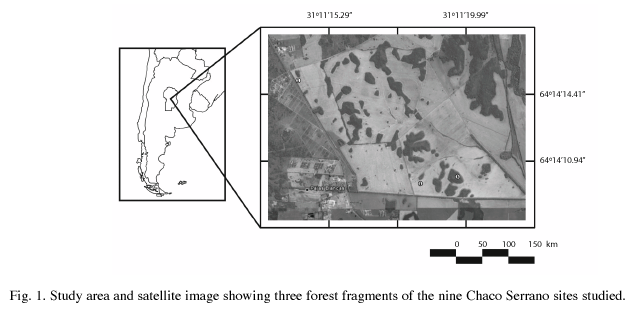
<body><![CDATA[<p style="text-align: justify;"><font face="Verdana" size="2">En este trabajo se estudia la biolog&iacute;a de la nidificaci&oacute;n de cuatro especies de <i>Trypoxylon </i>(<i>Trypargilum</i>) recolectadas a partir de 91 nidos-trampa en el Bosque Chaque&ntilde;o Serrano de C&oacute;rdoba, Argentina. La arquitectura de los nidos fue similar para las cuatro especies: celdas de cr&iacute;a ubicadas linealmente, una detr&aacute;s de la otra separadas por tabiques de barro, como es habitual en otras especies del subg&eacute;nero <i>Trypargilum</i>. El 48% de los nidos present&oacute; celda vestibular, mientras que s&oacute;lo dos nidos presentaron celdas intercalares. El ancho de los tabiques y el largo de las celdas de cr&iacute;a difiri&oacute; entre las especies y estuvo relacionado con el tama&ntilde;o de las avispas que emergieron. As&iacute; mismo, el di&aacute;metro del nido-trampa estuvo directamente relacionado con el tama&ntilde;o corporal promedio de las especies de mayor y menor tama&ntilde;o. La mortalidad debida a parasitoides (Eulophidae; <i>Melittobia </i>sp.) fue similar para las cuatro especies, mientras que la causada por cleptopar&aacute;sitos (Chrysididae) fue mayor en <i>T. lactitarse</i>. No fue posible relacionar la presencia de celda vestibular con la mortalidad debida a enemigos naturales para ninguna de las especies. La familia de ara&ntilde;as m&aacute;s frecuentemente utilizada como presa fue Araneidae.</font></p> <hr style="width: 100%; height: 2px;"><font face="Verdana" size="2"> </font>     <p style="text-align: justify;"><font face="Verdana" size="2">Crabronidae wasps are cosmopolitan solitary predators which use insects and spiders as provisions for their nests. Their nesting habits vary within the family: from nests dug into the soil or built in pre-existing cavities, to free nests made of mud or vegetable materials attached to different substrates (Bohart &amp; Menke 1976, Menke &amp; Fern&aacute;ndez 1996). The genus <i>Trypoxylon </i>Latreille, 1796 includes 660 species worldwide (Hanson &amp; Menke 1995), with the highest number occurring in the Western hemisphere, particularly in South and Central America. The species of the subgenus <i>Trypargilum </i>Richards, 1934 are restricted to the New World (Bohart &amp; Menke 1976, Coville 1982). Some species of this subgenus constructs mud nests; others utilize pre-existing tubular cavities that are divided into a linear series of cells by mud partitions. Females provide each cell with several paralyzed spiders, and then lays an egg on one of the last prey stored (Coville 1982). Meanwhile, a male usually guards the nest, chasing away ants, parasitic flies and cuckoo wasps, and defending the nest against conspecific males (Brockmann &amp; Grafen 1989, Brockmann 1992). </font></p>     <div style="text-align: justify;"></div>     <p style="text-align: justify;"><font face="Verdana" size="2">The cavity adopted by the wasp may be a tube in the hollowed pith of a twig, an old insect borehole in rotten wood, or many other kinds of holes. This opportunistic nesting habit allows researchers to use trap-nests in order to study many aspects of the biology of these wasps (Krombein 1967). In a pre-existing tubular cavity, the female constructs a linear series of cells, with bi-concave, smooth mud partitions between them. Some nests have an empty space at or near the outer end of the boring, called a "vestibular cell" (VC), and may also have a variable number of so-called "empty intercalary cells", which are non-provisioned cells between two store cells (Krombein 1967), but their function is still unclear (As&iacute;s <i>et al. </i>2007). To finish the nest, the female builds a closing plug, with a smooth, concave inner surface and a rough, flat outer surface. The dimensions and the number of nest elements vary among <i>Trypoxylon </i>species (Krombein 1967, Genaro 1996), and nests also differ in the quantity and proportion of prey spiders stored (Krombein 1967, Camillo <i>et al. </i>1993, Camillo <i>et al. </i>1994, Jim&eacute;nez &amp; Tejas 1994).</font></p>     <p style="text-align: justify;"><font face="Verdana" size="2">Although many studies of the biology of <i>Trypoxylon </i>(<i>Trypargilum</i>) have been performed using trap-nests in Brazil (Camillo <i>et al</i>. 1993, Camillo <i>et al</i>. 1994, Morato &amp; Campos 1994, Assis &amp; Camillo 1997, Camillo &amp; Brescovit 1999a, b, 2000, Buschini &amp; Wolff 2006, Buschini <i>et al. </i>2006, Buschini <i>et al. </i>2008), Costa Rica (Coville &amp; Coville 1980, Coville 1981, Coville <i>et al</i>. 2000) and Cuba (Genaro <i>et al. </i>1989, Genaro 1996), there are no reports on this genus in Argentina. The aim of this study was to present comparative information about the nesting biology of four species of <i>Trypoxylon </i>(<i>Trypargilum</i>), using trap-nests in Chaco Serrano woodland in C&oacute;rdoba, Argentina and to analyze <i>Trypoxylon </i>nests to help clarify the function of the outermost empty chamber of the nest, the vestibular cell (VC). </font></p> <font size="2"> </font><b><font face="Verdana" size="3">     <p>Materials and methods</p> </font><font size="2"> </font></b>     <p style="text-align: justify;"><b><font face="Verdana" size="2">Study area: </font></b><font face="Verdana" size="2">The study area was in central Argentina (31&ordm;10&#8217; S to 31&ordm;30&#8217; S and 64&ordm;00&#8217; W to 64&ordm;30&#8217; W) with an elevation of about 700m. Annual rainfall is 750mm concentrated mostly in the warm season (October-April), with a mean maximum temperature of 26&ordm;C and minimum of 10&ordm;C (Luti <i>et al. </i>1979). The area was originally covered by Chaco Serrano vegetation of low and open woodland (Luti <i>et al</i>. 1979), with an open tree stratum up to 15m high, 1 to 3m high shrubs covering 10-80% of the ground, a herbaceous layer (up to 95% cover), and many vines and epiphytes (Cabido <i>et al</i>. 1991). Native vegetation is currently restricted to isolated patches within an intensely managed agricultural matrix (Zak <i>et al</i>. 2004).</font></p>     <div style="text-align: justify;"></div>     <p style="text-align: justify;"><font face="Verdana" size="2">Nine forest fragments, ranging from 0.4ha to more than 15 000ha, embedded in an agricultural matrix largely dominated by wheat in winter and soy or maize in summer, were chosen as sample sites (Site 1: 0.57ha, 31&deg;12&#8217;53.1&#8217;&#8217; S-64&deg;15&#8217;36.2&#8217;&#8217; W; site 2: 1.14ha, 31&deg;11&#8217;44.4&#8217;&#8217; S-64&deg;17&#8217;07.8&#8217;&#8217; W; site 3: 3.58ha, 31&deg;31&#8217;26.1&#8217;&#8217; S-64&deg;27&#8217;30.9&#8217;&#8217; W; site 4: 10.07ha, 31&deg;12&#8217;59.7&#8217;&#8217; S-64&deg;15&#8217;15.1&#8217;&#8217; W; site 5: 13.77ha, 31&deg;34&#8217;54.8&#8217;&#8217; S-64&deg;26&#8217;29.9&#8217;&#8217; W; site 6: 29.53ha, 31&deg;17&#8217;4.8&#8217;&#8217; S-64&deg;14&#8217;0&#8217;&#8217; W; site 7: + 1 000ha, 31&deg;09&#8217;12.0&#8217;&#8217; S-64&deg;20&#8217;31.8&#8217;&#8217; W; site 8: +1 000ha, 31&deg;11&#8217;01.8&#8217;&#8217; S-64&deg;15&#8217;29.7&#8217;&#8217; W; site 9 +1 000ha, 31&deg;27&#8217;12.4&#8217;&#8217; S- 64&deg;25&#8217;17.3&#8217;&#8217; W) (<a  href="/img/revistas/rbt/v58n4/a11i1.jpg">Fig. 1</a>).</font></p>     <div style="text-align: justify;"></div>     ]]></body>
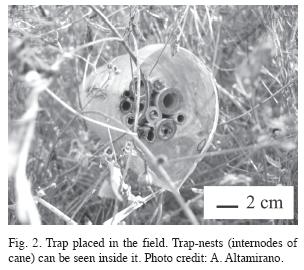
<body><![CDATA[<p style="text-align: justify;"><b><font face="Verdana" size="2">Trap-nests: </font></b><font face="Verdana" size="2">The <i>Trypoxylon </i>species nests were obtained using traps made of plastic tubes (15cm in diameter and 20cm long), each containing 15-30 internodes of <i>Phyllostachys aurea </i>Carr. Ex A. &amp; C. Rivi&egrave;re (Poaceae) (<a href="#fig2">Fig. 2</a>). A range of cane diameters from 0.2 to 2cm were used (Tscharntke <i>et al</i>. 1998).    <br> </font></p>     <p><font face="Verdana" size="2">    <br> </font></p>     <div style="text-align: center;"><a name="fig2"></a><img  src="/img/revistas/rbt/v58n4/a11i2.jpg" title="" alt=""  style="width: 304px; height: 270px;">    <br>     <br> </div>     <p><font face="Verdana" size="2"> </font></p>     <p style="text-align: justify;"><font face="Verdana" size="2">Twenty traps per site were placed on trees, 1 to 1.5m above ground, each trap separated from the others by at least 10m. The traps were set up in the field in spring (October 2005) and recovered in autumn (June 2006). In the laboratory, each individual cane was placed in bags of voile, properly identified and maintained at ambient temperature until emergence of adults (founders or parasites) had ceased. After that, canes were sectioned longitudinally to study the architecture of the nest and cell contents. Given that our aim was to compare species&#8217; nest biology, only those nests from which adults were recovered were used to gather data, and thus our results are restricted to the diapause generation.</font></p>     <div style="text-align: justify;"></div>     ]]></body>
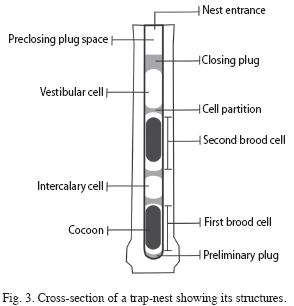
<body><![CDATA[<p style="text-align: justify;"><font face="Verdana" size="2">The identification of insects and their prey, as well as the measurements, were conducted during the first six months of 2007. Species were determined by one of the authors (MLM) through the use of the North American identification key of <i>Trypoxylon </i>species (Coville 1982) and by comparison with the reference collection of the Instituto Miguel Lillo (Tucum&aacute;n, Argentina). Voucher specimens were deposited in the collection of Centro de Investigaciones Entomol&oacute;gicas, Facultad de Ciencias Exactas, F&iacute;sicas y Naturales (Universidad Nacional de C&oacute;rdoba, Argentina).</font></p>     <div style="text-align: justify;"></div>     <p style="text-align: justify;"><font face="Verdana" size="2">The principal data gathered were diameter of cane entrance, total nest length, number of brood cells and contents, occurrence of preliminary plug, vestibular (VC) and intercalary cells, and pre-closing plug space (PCPS: an empty space of varying length occurring between the entrance hole and the closing plug). Brood cells were numbered from the interior to the exterior (chronologically the innermost cell was the one constructed first) (<a href="#fig3">Fig. 3</a>). The length of the VC, PCPS and brood cells, maximum thickness of mud partitions and closing plug thickness were recorded. The measurements were taken with digital callipers. The differences in nest architecture (length of nests, number of brood cells, VC, PCPS and brood cell lengths, cell partition thickness, and closing plug thickness) among species, as well as the differences among structures, were compared using ANOVA. Some variables were log transformed to normalize when necessary, and the Kruskall-Wallis non-parametric test was used when assumptions for the ANOVA were not satisfied. The lengths of the closing plugs and the mud partitions were compared using the t-Test. To analyze the relationship between nest structure length and total cane length and nest diameter, linear regressions were performed. The chi-square test was used to compare the number of brood cells in nests with and without VC, and Pearson&#8217;s correlation to analyze the relationship between brood celllength and cell partition thickness with their order of construction.    <br> </font></p>     <p><font face="Verdana" size="2">    <br> </font></p>     <div style="text-align: center;"><a name="fig3"></a><img  src="/img/revistas/rbt/v58n4/a11i3.jpg" title="" alt=""  style="width: 294px; height: 306px;">    <br>     <br> </div>     <p style="text-align: justify;"><font face="Verdana" size="2">As an estimation of body size, fore-tibia lengths of 10 adult wasps of each species were measured using a micrometric eye-piece attached to a microscope at 50X magnification. The relation between fore-tibia length and nest entrance diameter was analyzed using linear regressions. Male vs. female tibia lengths were compared using ANOVA.</font></p>     ]]></body>
<body><![CDATA[<div style="text-align: justify;"></div>     <p style="text-align: justify;"><font face="Verdana" size="2">The sex ratio was calculated as the number of males over the number of adults (males plus females) reared. The chi-square test was used to test sex ratio deviation from 0.5, and to compare the sex ratio obtained for each species. The relationship between sex ratios obtained by nest and measurements of the nest (diameter and length) were evaluated by linear regression, after log transformation of the variables. ANOVA was employed to compare the diameter of the nests from which only males emerged and those from which only females emerged.</font></p>     <div style="text-align: justify;"></div>     <p style="text-align: justify;"><font face="Verdana" size="2">To analyze the relationship between the nest orientation (S, N, E, W, SE, SW, NW and NE) and the presence or absence of VC and PCPS, the chi-square test was employed.</font></p>     <div style="text-align: justify;"></div>     <p style="text-align: justify;"><font face="Verdana" size="2">Mortality due to unknown causes was calculated for the egg stage (the possible absence of oviposition was included here), as well as for larval and pupal stages. Mortality due to natural enemies was calculated for each species as the percentage of brood cells damaged by parasitoids or kleptoparasites. Chi-square tests were employed to analyze the influence of the presence or absence of VC and PCPS on the mortality rates (parasitism, kleptoparasitism and other unknown causes).</font></p>     <div style="text-align: justify;"></div>     <p style="text-align: justify;"><font face="Verdana" size="2">Spiders (prey) obtained from cells in which no wasp larva had developed were preserved in alcohol (70%) and identified to the family level with the help of a specialist (see acknowledgements).</font></p>     <div style="text-align: justify;"><b><font face="Verdana" size="3">     <p>Results</p> </font><font size="2"> </font></b></div>     ]]></body>
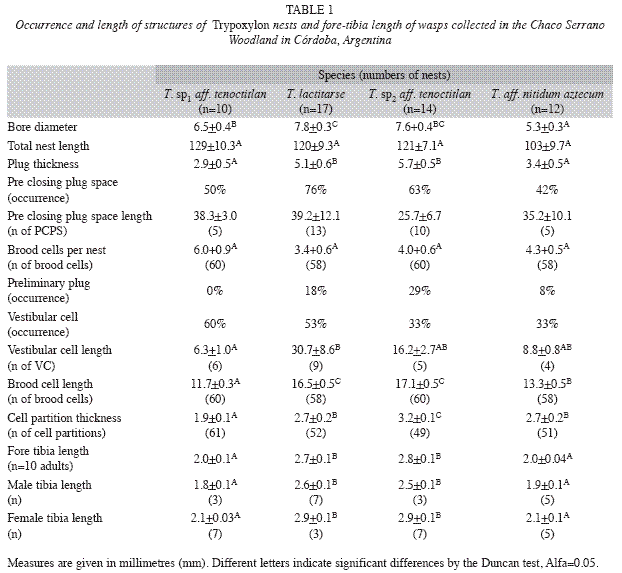
<body><![CDATA[<p style="text-align: justify;"><b><font face="Verdana" size="2">Nest architecture: </font></b><font face="Verdana" size="2">A total of 91 nests of four species of <i>Trypoxylon </i>were collected and adults were obtained from 58.2% of these, which were nests in which the wasps spent the winter as immature and emerged the following spring. Sixteen percent of all nests presented a preliminary plug, 48% a VC and 60% a PCPS, whereas intercalary cells occurred in just two nests of <i>T. aff. nitidum aztecum </i>(<a  href="#fig3">Fig. 3</a>). The occurrence of these structures varied among species (<a  href="/img/revistas/rbt/v58n4/a11t1.gif">Table 1</a>).</font></p>     <div style="text-align: justify;"></div>     <p style="text-align: justify;"><font face="Verdana" size="2">VC length ranged from 30.7mm to 0.82mm, with the longest found in nests of <i>T. lactitarse </i>and the shortest in the nests of <i>T. aff. nitidum aztecum </i>but average length was similar in all species (F<sub>VC</sub>=2.85<i>, </i>p=0.06, d.f.=3). Nests of the species showed no significant differences in PCPS length (ranging from 39mm in a <i>T. lactitarse </i>nest to 6.7mm in a <i>T. </i>sp<sub>2</sub> <i>aff. tenoctitlan </i>nest) (F<sub>PCPS</sub>=1.37, p=0.28, d.f.=3, <a href="/img/revistas/rbt/v58n4/a11t1.gif">Table 1</a>). Neither VC length nor PCPS length were related to total cane length (VC length R<sup>2</sup></font><font face="Verdana"  size="2"><i> <sub>T. </sub></i><sub>sp1 <i>aff. tenoctitlan</i></sub>=0.0001, p=0.9777, R<sup>2</sup> <sub><i>T. </i>sp2 <i>aff. tenoctitlan</i></sub>=0.225, p=0.0739, R<sup>2</sup> <sub><i>T. lactitarse</i></sub>=0.0067, p=0.7548, R<sup>2</sup> <sub><i>T. aff. nitidum aztecum</i></sub>=0.0447, p=0.5090) (PCPS length R<sup>2</sup> <sub><i>T. </i>sp1 <i>aff. tenoctitlan</i></sub>=0.19, p=0.2046, R<sup>2</sup> <sub><i>T. </i>sp2 <i>aff. tenoctitlan</i></sub>=0.03, p=0.5252, R<sup>2</sup> <sub><i>T. lactitarse</i></sub>=0.06, p=0.3605, R<sup>2</sup> <sub><i>T. aff. nitidum aztecum</i></sub>=0.0024, p=0.8794); nor were VC and PCPS lengths related (Pearson&#8217;s correlation, r<sub><i>T. </i>sp1 <i>aff. tenoctitlan</i></sub>=-0.39, p=0.27, r<sub><i>T. </i>sp2 <i>aff. tenoctitlan</i></sub>=0.12, p=0.67, r<sub><i>T. lactitarse</i></sub>=-0.16, p=0.54, r<sub><i>T. aff. nitidum aztecum</i></sub>=0.05, p=0.88).</font></p>     <p style="text-align: justify;"><font face="Verdana" size="2">Nest orientation was not related to the presence of VC or PCPS for any species (<i>T. </i>sp<sub>1</sub> <i>aff. tenoctitlan: </i></font><font face="Verdana" size="2">&#967;</font><font  face="Verdana" size="2"><sup>2</sup> VC=0.28, p=0.8703, d.f.=2, </font><font  face="Verdana" size="2">&#967;</font><font face="Verdana" size="2"><sup>2</sup> <sub>PCPS</sub>=0.67, p=0.7165, d.f.=2, n=10 nests, <i>T. </i>sp2 <i>aff. tenoctitlan: </i></font><font face="Verdana" size="2">&#967;</font><font  face="Verdana" size="2"><sup>2</sup> <sub>VC</sub>=0.92, p=0.8203, d.f.=3, </font><font face="Verdana" size="2">&#967;</font><font  face="Verdana" size="2"><sup>2</sup> <sub>PCPS</sub>=1.89, p=0.5965, d.f.=3, n=15 nests, <i>T. aff. nitidum aztecum: </i></font><font face="Verdana" size="2">&#967;</font><font  face="Verdana" size="2"><sup>2</sup> <sub>VC</sub>=3, p=0.5578, d.f.=4, &#967;</font><font face="Verdana" size="2"><sup>2</sup> <sub>PCPS</sub>=6.51, p=0.1639, d.f.=4, n=12 nests; and <i>T. lactitarse: </i></font><b><font  face="Verdana" size="2">&#967;</font><font face="Verdana" size="2"><sup>2</sup> <sub>VC</sub></font></b><font face="Verdana" size="2">=12.32, p=0.0553, d.f.=6, </font><font face="Verdana" size="2">&#967;</font><font  face="Verdana" size="2"><sup>2</sup> <sub>PCPS</sub>=9.78, p=0.1345, d.f.=6, n=17 nests).</font></p>     <div style="text-align: justify;"></div>     <p style="text-align: justify;"><font face="Verdana" size="2">The canes used by <i>T. aff. nitidum aztecum </i>had the lowest diameter, while <i>T. lactitarse </i>seemed to prefer the widest cane diameters (F=10.86, p&lt;0.0001, d.f.=3). Differences in cane diameters used by other species were not significant. The average length of nests constructed by each species varied between 10.3 and 12.9cm with no significant differences among them (F=1.25, p=0.30, d.f.=3).</font></p>     <div style="text-align: justify;"></div>     <p style="text-align: justify;"><font face="Verdana" size="2">The average number of cells per nest ranged from 3.4 to 6.0 with no significant differences among species (F=2.63, p=0.06, d.f.=3).</font></p>     <div style="text-align: justify;"></div>     <p style="text-align: justify;"><font face="Verdana" size="2">Brood cell lengths, cell partition thickness and closing plug thickness differed among species (Kruskall Wallis test <sub>cells</sub>=89.1, p&lt;0.0001, F<sub>cell partitions</sub>=25.1, p&lt;0.0001, d.f.=3.0, F<sub>closing plugs</sub>=5.76, p=0.0018, d.f.=3). <i>Trypoxylon </i>sp<sub>2</sub> <i>aff. tenoctitlan </i>built the longest brood cells and the thickest partitions and closing plugs. The shortest brood cells and the thinnest partitions and plugs were built by <i>T. </i>sp<sub>1</sub> <i>aff. tenoctitlan </i>(<a href="/img/revistas/rbt/v58n4/a11t1.gif">Table 1</a>).</font></p>     ]]></body>
<body><![CDATA[<div style="text-align: justify;"></div>     <p style="text-align: justify;"><font face="Verdana" size="2">The closing plugs were thicker than the mud partitions for <i>T. </i>sp<sub>1</sub> <i>aff. tenoctitlan</i>, <i>T. </i>sp<sub>2</sub> <i>aff. tenoctitlan </i>and <i>T. lactitarse </i>but not for <i>T. aff. nitidum aztecum </i>(t-test<sub><i>T. </i>sp1 <i>aff. tenoctitlan</i></sub>=- 2.82, p=0.0168, t-test<sub><i>T. </i>sp2 <i>aff. tenoctitlan</i></sub>=-4.44, p=0.0004, t-test<sub><i>T. lactitarse</i></sub>=-2.87, p=0.0082, t-test<sub><i>T. aff. nitidum aztecum</i></sub>=-1.37, p=0.1891).</font></p>     <div style="text-align: justify;"></div>     <p style="text-align: justify;"><font face="Verdana" size="2">The brood cell lengths of the nests were inversely correlated with their order of construction for the nests of <i>T. aff. nitidum aztecum</i>, <i>T. </i>sp<sub>1</sub> <i>aff. tenoctitlan </i>and <i>T. </i>sp<sub>2</sub> <i>aff. tenoctitlan </i>but not of <i>T. lactitarse</i>. (r<sub><i>T. aff. nitidum aztecum</i></sub>=-0.31, p=0.02, r<sub><i>T. </i>sp1 <i>aff. tenoctitlan</i></sub>=-0.33, p=0.01, r<sub><i>T. </i>sp2 <i>aff. tenoctitlan</i></sub>=-0.541, p&lt;0.0001, r<sub><i>T. lactitarse</i></sub>=-0.13, p=0.32); the first brood cells (built by the wasp at the bottom of the nest) were the longest ones and the last cells the shortest. Cell partition thickness was positively correlated with the order of construction for <i>T. aff. nitidum aztecum </i>and <i>T. </i>sp<sub>2</sub> <i>aff. tenoctitlan </i>but not for <i>T. </i>sp<sub>1</sub> <i>aff. tenoctitlan </i>and <i>T. lactitarse </i>(r<sub><i>T. aff. nitidum aztecum</i></sub>=0.26, p=0.05, r<sub><i>T. </i>sp2 <i>aff. tenoctitlan</i></sub>=0.43, p<i>&lt;</i>0.0001, r<sub><i>T. </i>sp1 <i>aff. tenoctitlan</i></sub>=0.21, p=0.09, r<sub><i>T. lactitarse</i></sub>=0.06, p<i>=</i>0.66).</font></p>     <p style="text-align: justify;"><font face="Verdana" size="2">In the nests of <i>T. aff. nitidum aztecum </i>and <i>T. </i>sp1 <i>aff. tenoctitlan, </i>VC were shorter than brood cells and than PCPS (Kruskall Wallis test<sub><i>T</i>. <i>aff. nitidum aztecum</i></sub>=8.29, p=0.0159, H<sub><i>T. </i>sp1 <i>aff. tenoctitlan</i></sub>= 8.05, p=0.0178). In <i>T. </i>sp<sub>2</sub> <i>aff. Tenoctitlan </i>and <i>T. lactitarse </i>nests, the length of VC, PCPS and brood cells was similar (Kruskall Wallis test<sub><i>T. </i>sp2 <i>aff. tenoctitlan</i></sub>=0.24, p=0.887, H <sub><i>T</i>. <i>lactitarse</i></sub>= 3.62, p=0.1636) (<a href="/img/revistas/rbt/v58n4/a11t1.gif">Table 1</a>).</font></p>     <div style="text-align: justify;"></div>     <p style="text-align: justify;"><font face="Verdana" size="2">The number of brood cells per cane was positively correlated with the length of the cane in nests of <i>T. lactitarse </i>and <i>T. </i>sp<sub>2</sub> <i>aff. tenoctitlan </i>(R<i><sup>2</sup> <sub>T. lactitarse</sub></i>=0.26, p=0.0374, n=17, R<sup>2</sup><sub><i>T. </i>sp2 <i>aff. tenoctitlan</i></sub>=0.31, p=0.0302, n=15). There was no relationship between the number of brood cells and nest diameter for any of the species studied. In the nests of <i>T. </i>sp<sub>1</sub> <i>aff. tenoctitlan </i>the number of brood cells per nest with vestibular cell (7<span  style="text-decoration: underline;">+</span>1.03, n=6 nests) was greater than that of nests without vestibular cell (4.5<span  style="text-decoration: underline;">+</span>1.5, n=4 nests) (</font><font face="Verdana" size="2">&#967;</font><font  face="Verdana" size="2"><sup>2</sup>=9.6, d.f.=1, p=0.0019).</font></p>     <div style="text-align: justify;"></div>     <p style="text-align: justify;"><font face="Verdana" size="2">The diameter of the nest entrance explained 49% of the variation found in fore-tibia length for <i>T. aff. nitidum aztecum </i>and 45% for <i>T. </i>sp<sub>2</sub> <i>aff. tenoctitlan </i>(R<sup>2</sup>=0.49, p=0.02, n=10 and R<sup>2</sup>=0.45, p=0.03, n=10 respectively). No such relationships were found for other species (R<sup><span  style="font-style: italic;">2</span></sup><sub><i>T. </i>sp1 <i>aff. tenoctitlan</i></sub>=0.07, p=0.4525, n=10 and R<sup>2</sup><sub><i>T. lactitarse</i></sub>=0.22, p=0.1668, n=10).</font></p>     <div style="text-align: justify;"></div>     ]]></body>
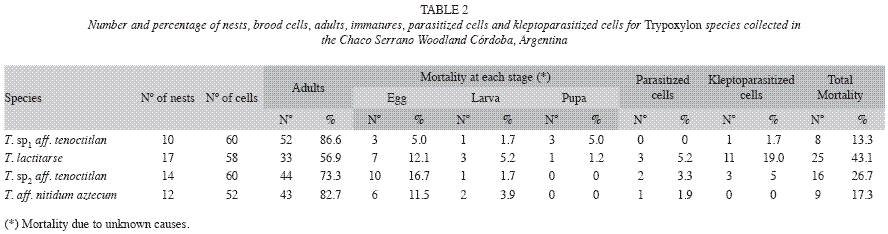
<body><![CDATA[<p style="text-align: justify;"><font face="Verdana" size="2">Male fore-tibia lengths were smaller than females (F<sub><i>T. </i>sp2 <i>aff. tenoctitlan</i></sub>=10.27, p=0.01, n=10, F<sub><i>T. lactitarse</i></sub>=5.88, p=0.04, n=10, F<sub><i>T. </i>sp1 <i>aff. tenoctitlan</i></sub>= 12.03, p=0.008, n=10, F<sub><i>T. aff. nitidum aztecum</i></sub>= 2.77, p=0.1349, n=10, <a href="/img/revistas/rbt/v58n4/a11t1.gif">Table 1</a>).</font></p>     <div style="text-align: justify;"><b><font size="2"> </font></b></div>     <p style="text-align: justify;"><b><font face="Verdana" size="2">Sex ratios: </font></b><font face="Verdana" size="2">The sex ratios obtained were similar in the species studied (<i>T. </i>sp<sub>1</sub> <i>aff. tenoctitlan</i>= 0.43, <i>T. lactitarse=</i>0.46, <i>T. </i>sp<sub>2</sub> <i>aff. tenoctitlan</i>=0.44 and <i>T. aff. nitidum aztecum</i>= 0.69, </font><font face="Verdana" size="2">&#967;</font><font  face="Verdana" size="2"><sup>2</sup> <sub>among species</sub>=3.24, d.f.=3, p=0.36), and did not depart significantly from a sex ratio of 0.5 (</font><font  face="Verdana" size="2">&#967;</font><font face="Verdana" size="2"><sup>2</sup>=1.80E-04, d.f.=1, p=0.99).</font></p>     <div style="text-align: justify;"></div>     <p style="text-align: justify;"><font face="Verdana" size="2">The diameter of the nest entrance of <i>T. </i>sp1 <i>aff. tenoctitlan </i>was smaller in those nests from which only males emerged (4.83<span style="text-decoration: underline;">+</span>0.12mm) than in those from which only females emerged (7.00<span style="text-decoration: underline;">+</span>0.44mm) (F=69.26, p=0.0011, n=6). Male and female nest diameters were similar for <i>T. </i>sp<sub>2</sub> <i>aff. tenoctitlan</i>, <i>T. aff. nitidum aztecum </i>and <i>T. lactitarse </i>(F<sub><i>T. </i>sp2 <i>aff. tenoctitlan</i></sub>=1.6, p=0.2376, n=11, F<sub><i>T. aff. nitidum aztecum</i></sub>=0.67, p=0.4494, n=7, F<sub><i>T. lactitarse</i></sub>=0.01, p=0.9327, n=14). The proportion of males per nest of <i>T. </i>sp1 <i>aff. Tenoctitlan </i>was inversely related to the diameter of the nest entrance (R<sup>2</sup>=0.92, p=0.0007). Such relationships were not found for the other species (R<sup>2</sup><sub><i>T. </i>sp2 <i>aff. tenoctitlan</i></sub>=0.19, p=0.1374, n=13, R<sup>2</sup><sub><i>T. lactitarse</i></sub>=0.0004, p=0.6908, n=12, R<sup>2</sup><sub><i>T. aff. nitidum aztecum</i></sub>= 0.15, p=0.3017, n=9).</font></p>     <p style="text-align: justify;"><b><font face="Verdana" size="2">Mortality and natural enemies: </font></b><font face="Verdana" size="2">The most important mortality factor was the death of immature forms, which was observed in 37 cells (16%), occurring in pupae (2%), larvae (3%) or egg stages (11%). Natural enemies accounted for 9% of the pre-adult mortality, and 6% of this mortality was due to two genera of kleptoparasites in the family Chrysididae (Hymenoptera), <i>Neochrysis </i>sp. Linsenmaier on <i>T. lactitarse </i>and <i>T. </i>sp<sub>2</sub> <i>aff. tenoctitlan, </i>and <i>Pleurochrysis </i>sp. Bohart on <i>T. </i>sp<sub>1</sub> <i>aff. Tenoctitlan. </i>The parasitoid <i>Melittobia </i>sp. Westwood (Eulophidae) caused 3% of the mortality due to natural enemies on <i>T. lactitarse</i>, <i>T. </i>sp<sub>2</sub> <i>aff. Tenoctitlan </i>and <i>T. aff. nitidum aztecum </i>(<a  href="/img/revistas/rbt/v58n4/a11t2.gif">Table 2</a>).</font></p>     <div style="text-align: justify;"></div>     <p style="text-align: justify;"><font face="Verdana" size="2">The presence of VC had no significant influence on mortality due to parasitoids or kleptoparasitoids in the nests of <i>T. aff. nitidum aztecum</i>, <i>T. </i>sp<sub>2</sub> <i>aff. tenoctitlan </i>or <i>T. </i>sp<sub>1</sub> <i>aff. tenoctitlan </i>(</font><font  face="Verdana" size="2">&#967;</font><font face="Verdana" size="2"><sup>2</sup> <sub><i>T. aff. nitidum aztecum</i></sub>=0, d.f.=0, p=sd, </font><font  face="Verdana" size="2">&#967;</font><font face="Verdana" size="2"><sup>2</sup> <sub><i>T. </i>sp2 <i>aff. tenoctitlan</i></sub>=0.14, d.f.=1, p=0.7094, </font><font  face="Verdana" size="2">&#967;</font><font face="Verdana" size="2"><sup>2</sup> <sub><i>T. </i>sp1 <i>aff. tenoctitlan</i></sub>=0, d.f.=0, p=sd). Mortality due to parasitoids in nests of <i>T. lactitarse </i>without a VC was higher than expected by chance and mortality in nests with VC was lower than expected. Exactly the opposite pattern was observed with mortality due to kleptoparasites, which was higher in nests with VC and lower in nests without VC (</font><font face="Verdana" size="2">&#967;</font><font  face="Verdana" size="2"><sup>2</sup>=5.094, d.f.=1, p=0.0241).</font></p>     <div style="text-align: justify;"></div>     <p style="text-align: justify;"><font face="Verdana" size="2">The nests of three out of four species studied (<i>T. lactitarse</i>, <i>T. </i>sp<sub>2</sub> <i>aff. tenoctitlan </i>and <i>T. </i>sp<sub>1</sub> <i>aff. tenoctitlan</i>) suffered mortality levels directly related to the number of brood cells in the nest (R<sup>2</sup><sub><i>T. lactitarse</i></sub>=0.26, p=0.04, n=17, R<sup>2</sup><sub><i>T. </i>sp2 <i>aff. tenoctitlan</i></sub>=0.25, p=0.05, n=15, R<sup>2</sup><sub><i>T. </i>sp1 <i>aff. tenoctitlan</i></sub>=0.38, p=0.05, n=10). Mortality due to kleptoparasites was higher in the first constructed cells in nests of <i>T. lactitarse </i>(R<sup>2</sup>=0.85, p=0.0002, n=10) and <i>T. </i>sp<sub>2</sub> <i>aff. tenoctitlan </i>(R<sup>2</sup>=0.37, p=0.06, n=10).</font></p>     ]]></body>
<body><![CDATA[<div style="text-align: justify;"><b><font size="2"> </font></b><font face="Verdana" size="2">     <p style="font-weight: normal;"><span style="font-weight: bold;">Collected prey:</span> A total of 500 spiders, used by female wasps to supply the cells, were recovered from 77 brood cells of 39 nests. The spiders belonged to seven families: Araneidae (85%), Thomisidae (10%), Theridiidae (2%), Heteropodidae (1%), Salticidae (1%), Anyphaenidae (0.6%) and Lycosidae (0.2%).</p>     <p style="font-weight: normal;">Spiders hunted by <i>T. lactitarse </i>(n=8 nests) and <i>T. </i>sp<sub>2</sub> <i>aff. tenoctitlan </i>(n=7 nests) belong mostly to the family Araneidae, while <i>T. aff. nitidum aztecum </i>(n=5 nests) and <i>T. </i>sp<sub>1</sub> <i>aff. tenoctitlan </i>(n=3 nests) had a more diverse range of prey including Araneidae, Heteropodidae, Salticidae, Theridiidae and Anyphaenidae found in nests of <i>T. aff. nitidum aztecum</i>; Araneidae, Thomisidae, Salticidae and Lycosidae in nests of <i>T. </i>sp1 <i>aff. tenoctitlan </i>16 nests could not be assigned to a <i>Trypoxylon </i>species.</p> </font></div> <font face="Verdana" size="2"></font><b><font face="Verdana" size="2"><span  style="font-weight: normal;"> </span></font></b><b><b><font face="Verdana" size="3">     <p>Discussion</p> </font></b><font size="2"> </font></b><font face="Verdana" size="2"></font>     <p style="text-align: justify;"><font face="Verdana" size="2">The structure of <i>Trypoxylon </i>nests analyzed in this study was similar among the different species and also to the features of nests constructed by females of the subgenus <i>Trypargilum </i>previously described (Coville 1982). At least one generation of all the species recorded in the Chaco Serrano Woodland passed the winter as immatures, as has been observed for many other species of <i>Trypoxylon </i>(e.g. Coville 1982, Brockmann &amp; Grafen 1991, Camillo <i>et al</i>. 1993, Peruquetti &amp; Del Lama 2003, Jenkins &amp; Matthews 2004, Boesi <i>et al. </i>2005, Buschini &amp; Wolff 2006, Buschini <i>et al. </i>2006, Buschini 2007). The low temperatures in C&oacute;rdoba during the winter could be a factor favoring diapauses in these insects.</font></p>     <div style="text-align: justify;"></div>     <p style="text-align: justify;"><font face="Verdana" size="2">Preliminary plug, vestibular cell and empty intercalary cells were frequent but not constant structures of the nests studied. Although Krombein (1967) mentioned that a preliminary plug is a constant feature of subgenus <i>Trypargilum </i>nests, we found that more than 80% of the nests lacked such structure. This disparity may be attributed to differences in the trap nests used in both studies, which were holes made in wood with a twist drill in the first case and canes in the second. Probably the rougher, more pointed inner end of a drilled boring was perceived by the female wasps as not smooth and so needing to be closed off by a preliminary plug, whereas the natural cavities in canes are quite smooth so that a preliminary plug would be less frequently necessary.</font></p>     <div style="text-align: justify;"></div>     <p style="text-align: justify;"><font face="Verdana" size="2">The role of the vestibular cell has been widely discussed. Krombein (1967) proposed that it discourages penetration to the provisioned cells by predators, parasites and nest destroyers; whereas Seidelmann (1999) suggested that it serves as a buffer space to reduce the progeny&#8217;s mortality from adverse environmental conditions. As&iacute;s <i>et al. </i>(2007) proposed that a VC is a completion structure made to fill the remainder space of the chosen burrow, after the nest was finished. In other words, it would be present when the chosen cavity is longer than required to construct the optimum number of cells for the species. According to this hypothesis, a vestibular cell would avoid the possibility of other individuals constructing a nest in the remaining space of the burrow ("supersedure"), increasing the mortality of individuals reared in the innermost cells at the moment of emergence.</font></p>     <div style="text-align: justify;"></div>     ]]></body>
<body><![CDATA[<p style="text-align: justify;"><font face="Verdana" size="2">Our results did not support any of these hypotheses. We did not find evidence, for any of the species studied, that there is a relationship between natural enemy incidence and VC occurrence, which agrees with several studies analyzing this hypothesis (Garc&iacute;a &amp; Adis 1995, Weaving 1995, Seidelmann 1999). Also, we did not find a relationship between VC occurrence and trap nest orientation in the field, so we cannot support the hypothesis that this structure is constructed as a buffer space against harsh environmental conditions at the nest (Seidelmann 1999) (sun exposure, wind or precipitation incidence). Lastly, our results showed that vestibular cell length was not long enough to construct an additional brood cell, which supports the hypothesis of VC being a completion structure (As&iacute;s <i>et al</i>. 2007). However, our data also constitute evidence against this hypothesis, since 30% of the nests presented, besides a vestibular cell, a pre-closing plug space. This empty space might be used by females of other species to breed and thus, in such cases, supersedure would not have been avoided. The availability of these empty spaces in a high proportion of nests (60%) suggests that females do not compete for nesting cavities in this study area. It should be remarked that the pre-closing plug space (PCPS) is a structure not previously considered in studies on <i>Trypoxylon </i>nesting, even when the space is observed in nest illustrations (Buschini <i>et al</i>. 2006).</font></p>     <p style="text-align: justify;"><font face="Verdana" size="2">As regards empty intercalary cells, it has been suggested that wasp females may construct these to avoid damage in the newly constructed cells, isolating them from those parasitized or fungus-contaminated (Krombein 1967). It was reported that empty cells are rather common in <i>T. lactitarse </i>nests in Southern Brazil (Camillo <i>et al. </i>1993, Assis &amp; Camillo 1997). We observed intercalary cells only in two nests of <i>T. aff. nitidum aztecum </i>and these were not related with symptoms of parasitism or contamination.</font></p>     <div style="text-align: justify;"></div>     <p style="text-align: justify;"><font face="Verdana" size="2">Cavities preferred by <i>T. lactitarse </i>in this study were of similar diameter to those mentioned in the literature (Camillo <i>et al</i>. 1993, Assis &amp; Camillo 1997, Buschini <i>et al</i>. 2006, Buschini &amp; Wolff 2006). It has been demonstrated that preference for a particular diameter of pre-existing tubular cavities may change due to inter- and intra-specific competition for available spaces (Krombein 1967, Coville 1982). At least for two of the species studied, trap-nest diameter was related to the fore-tibia size of emerged wasps, as previously described for other Crabronidae species (Krombein 1961, Fricke 1991, Garc&iacute;a &amp; Adis 1995, Assis &amp; Camillo 1997).</font></p>     <div style="text-align: justify;"></div>     <p style="text-align: justify;"><font face="Verdana" size="2">According to Coville (1982), smaller diameter borings produce mostly males in some species, as observed here for <i>T. </i>sp1 <i>aff. tenoctitlan</i>. If female Hymenoptera fertilize the eggs they lay, then they have daughters. If the eggs are not fertilized, then sons are produced (Brockmann &amp; Grafen 1991). Thus, a possible explanation for a greater production of males in smaller diameter nests could be that the lack of space in those nests makes copulation difficult, so that females lay an unfertilized egg (Buschini 2007).</font></p>     <div style="text-align: justify;"></div>     <p style="text-align: justify;"><font face="Verdana" size="2">The number of brood cells depends upon nest dimensions, is related to the body size of the wasp, and it is possible that each species has an inherent maximum number (Coville 1982). A relationship between number of brood cells and cavity diameter has been found in nests of several species: <i>T. lactitarse </i>(Krombein 1967, Coville 1981, Assis &amp; Camillo 1997), <i>T. tenoctitlan </i>(Coville &amp; Coville 1980) and <i>T. rogenhoferi </i>(Assis &amp; Camillo 1997); but this relationship was not found for any species studied here. The average number of brood cells observed for <i>T. lactitarse </i>by Camillo and Brescovit (1999a) (4 brood cells in nests with diameter of 10mm) was also the most frequent value obtained here. In our data we also observed a relationship between nest length and number of brood cells. </font></p>     <div style="text-align: justify;"><font size="2"> </font><font face="Verdana" size="2">     <p><span style="font-weight: bold;">Sex ratios:</span> As previously observed for <i>T. lactitarse </i>(Buschini <i>et al</i>. 2006), <i>T. anttenatum </i>and <i>T. beaumonti </i>(Tormos <i>et al. </i>2005), the sex ratio of all species studied here did not differ significantly from 0.5. Given that males are smaller than females, this fact conflicts with the theory of parental investment (Fisher 1999), which sustains that large randomly breeding population selection will result in equal investment in sons and daughters (Tormos <i>et al. </i>2005). However, caution should be taken in drawing conclusions about sex ratios when little data is available (Oku &amp; Nishida 2001).</p> </font></div> <font face="Verdana" size="2"></font><font size="2"> </font>     ]]></body>
<body><![CDATA[<p style="text-align: justify;"><font face="Verdana" size="2"><span  style="font-weight: bold;">Mortality and natural enemies:</span> </font><font face="Verdana" size="2">Sources of mortality observed in this study were similar to those mentioned by other authors: development failures (unknown causes), parasitoids and kleptoparasites. Development failures have been documented as important causes of mortality: Camillo <i>et al. </i>(1993) observed a mortality rate of 7.7% for <i>T. lactitarse </i>in south-eastern Brazil, while higher values have been reported for the same species in southern Brazil, fluctuating from 23% to 47% and depending on the length of the nest (Buschini <i>et al</i>. 2006).</font></p>     <div style="text-align: justify;"></div>     <p style="text-align: justify;"><font face="Verdana" size="2"><i>Trypoxylon lactitarse </i>nests in southern Brazil have been attacked by Chrysididae, Eulophidae, Ichneumonidae (Hymenoptera), Sarcophagidae and Phoridae (Diptera) (Buschini &amp; Wolff 2006). We found a lower diversity of natural enemies, including only the first two above-mentioned hymenopteran families. Mortality rates due to natural enemies ranging between 24% and 41% have been reported for <i>T. lactitarse </i>(Camillo <i>et al. </i>1993, Buschini &amp; Wolff 2006) and we too found mortality rates in the lower limit of this range. Other <i>Trypoxylon </i>species here showed even lower values of parasitoidism, similar to those observed for two species in different localities in Spain (2.4%) (Tormos <i>et al</i>. 2005).</font></p>     <div style="text-align: justify;"><font size="2"> </font><font face="Verdana" size="2">     <p><span style="font-weight: bold;">Collected prey:</span> <i>Trypoxylon </i>sp<sub>2</sub> <i>aff. Tenoctitlan </i>and <i>T. lactitarse </i>showed a strong preference for Araneidae species to supply their nests. Similar data were obtained for the latter species in Southern Brazil (Camillo <i>et al</i>. 1993, Camillo &amp; Brescovit 1999a, Gonzaga &amp; Vasconcellos-Neto 2005, Buschini <i>et al. </i>2008) and also in Costa Rica (Coville 1979, 1981, Coville <i>et al</i>. 2000). The preference of some <i>Trypoxylon </i>species for Araneidae has been previously mentioned (Rehnberg 1987, Camillo &amp; Brescovit 1999a). <i>Trypoxylon aff. nitidum aztecum </i>was the more generalist species according to our data, including five of the seven spider families recorded in the nests.</p>     <p>We believe that further work is required on the <i>Trypoxylon </i>species in the Southern Neotropics region, centering on their life history, mainly phenology and seasonality, female investment in progeny and sex-allocation patterns.</p> </font></div> <font face="Verdana" size="2"></font><font size="2"> </font><font style="font-weight: bold;" face="Verdana" size="3">     <p>Acknowledgments</p> </font><font size="2"> </font><font face="Verdana" size="2"></font>     <p style="text-align: justify;"><font face="Verdana" size="2">We thank Iliana Martinez and Ann Zillikens for valuable suggestions that improved previous versions of the manuscript. We also thank Mat&iacute;as Izquierdo for helping in spider identification, Rodolfo Foglia, Carlos Buasso, Julia Astegiano and Mariana Jausoro for field assistance and Lidwina Bertrand and Evangelina Minuzzi-Fahn for laboratory assistance. Special thanks to Joss Heywood for reviewing the manuscript translation. This research was supported by CONICET, FONCYT and Ministerio de Ciencia y Tecnolog&iacute;a de la Provincia de C&oacute;rdoba and by a grant from CONICET (M.L.M.). A.S. is a CONICET research fellow. </font></p> <hr style="width: 100%; height: 2px;"><font style="font-weight: bold;"  face="Verdana" size="3">     <p>References</p> </font><font size="2"> </font><font face="Verdana" size="2">     <!-- ref --><p>As&iacute;s, J.D., A. Ben&eacute;itez, J. Tormos, S.F. Gayubo &amp; M.A. Mart&iacute;n-Tom&eacute;. 2007. The significance of the vestibular cell in trap nesting wasps (Hymenoptera: Crabronidae): Does its presence reduce mortality? J. Insect Behav. 20: 289-305.    &nbsp;&nbsp;&nbsp;&nbsp;&nbsp;&nbsp;&nbsp;&nbsp;[&#160;<a href="javascript:void(0);" onclick="javascript: window.open('/scielo.php?script=sci_nlinks&ref=1394391&pid=S0034-7744201000040001100001&lng=','','width=640,height=500,resizable=yes,scrollbars=1,menubar=yes,');">Links</a>&#160;]<!-- end-ref --></p>     <!-- ref --><p>Assis, J.M.F. &amp; E. Camillo 1997. Diversidade, sazonalidade e aspectos biol&oacute;gicos de vespas solitarias (Hymenoptera: Sphecidae: Vespidae) em ninhos armadilhas na regi&atilde;o de Ituitaba, MG. An. Soc. Entomol. Brasil 26: 335-347.    &nbsp;&nbsp;&nbsp;&nbsp;&nbsp;&nbsp;&nbsp;&nbsp;[&#160;<a href="javascript:void(0);" onclick="javascript: window.open('/scielo.php?script=sci_nlinks&ref=1394393&pid=S0034-7744201000040001100002&lng=','','width=640,height=500,resizable=yes,scrollbars=1,menubar=yes,');">Links</a>&#160;]<!-- end-ref --></p>     <!-- ref --><p>Boesi, R., C. Polidori, J. Tormos, S. Benacqua, J.D. As&iacute;s &amp; F. Andrietti. 2005. Trap-Nesting <i>Ancistrocerus sikhimensis </i>(Hymenoptera: Eumenidae) in Nepal: nest structure and associates (Hymenoptera: Chrysididae; Acarina: Saproglyphidae). Fla. Entomol. 88: 135-140.    &nbsp;&nbsp;&nbsp;&nbsp;&nbsp;&nbsp;&nbsp;&nbsp;[&#160;<a href="javascript:void(0);" onclick="javascript: window.open('/scielo.php?script=sci_nlinks&ref=1394395&pid=S0034-7744201000040001100003&lng=','','width=640,height=500,resizable=yes,scrollbars=1,menubar=yes,');">Links</a>&#160;]<!-- end-ref --></p> </font><font size="2"> </font><font face="Verdana" size="2"></font>     <!-- ref --><p><font face="Verdana" size="2">Bohart, R.M. &amp; A.S. Menke. 1976. Sphecid wasps of the world, a generic revision. University of California Press, Berkeley, USA.    &nbsp;&nbsp;&nbsp;&nbsp;&nbsp;&nbsp;&nbsp;&nbsp;[&#160;<a href="javascript:void(0);" onclick="javascript: window.open('/scielo.php?script=sci_nlinks&ref=1394397&pid=S0034-7744201000040001100004&lng=','','width=640,height=500,resizable=yes,scrollbars=1,menubar=yes,');">Links</a>&#160;]<!-- end-ref --></font></p>     <!-- ref --><p><font face="Verdana" size="2">Brockmann, H.J. &amp; A. Grafen. 1989. Mate conflict and male behaviour in a solitary wasp, <i>Trypoxylon </i>(<i>Trypargilum</i>) <i>politum </i>(Hymenoptera: Sphecidae). Anim. Behav. 37: 232-255.    &nbsp;&nbsp;&nbsp;&nbsp;&nbsp;&nbsp;&nbsp;&nbsp;[&#160;<a href="javascript:void(0);" onclick="javascript: window.open('/scielo.php?script=sci_nlinks&ref=1394399&pid=S0034-7744201000040001100005&lng=','','width=640,height=500,resizable=yes,scrollbars=1,menubar=yes,');">Links</a>&#160;]<!-- end-ref --></font></p>     <!-- ref --><p><font face="Verdana" size="2">Brockmann, H.J. &amp; A. Grafen. 1991. Sex ratios and life-history patterns of a solitary wasp, <i>Trypoxylon </i>(<i>Trypargilum</i>) <i>politum </i>(Hymenoptera: Sphecidae). Behav. Ecol. Sociobiol. 30: 7-27.    &nbsp;&nbsp;&nbsp;&nbsp;&nbsp;&nbsp;&nbsp;&nbsp;[&#160;<a href="javascript:void(0);" onclick="javascript: window.open('/scielo.php?script=sci_nlinks&ref=1394401&pid=S0034-7744201000040001100006&lng=','','width=640,height=500,resizable=yes,scrollbars=1,menubar=yes,');">Links</a>&#160;]<!-- end-ref --></font></p>     <!-- ref --><p><font face="Verdana" size="2">Brockmann, H.J. 1992. Male behavior, courtship and nesting in <i>Trypoxylon </i>(<i>Trypargilum</i>) <i>monteverdeae </i>(Hymenoptera: Sphecidae). J. Kans. Entomol. Soc. 65: 66-84.    &nbsp;&nbsp;&nbsp;&nbsp;&nbsp;&nbsp;&nbsp;&nbsp;[&#160;<a href="javascript:void(0);" onclick="javascript: window.open('/scielo.php?script=sci_nlinks&ref=1394403&pid=S0034-7744201000040001100007&lng=','','width=640,height=500,resizable=yes,scrollbars=1,menubar=yes,');">Links</a>&#160;]<!-- end-ref --></font></p>     <!-- ref --><p><font face="Verdana" size="2">Buschini, M.L.T. &amp; L.L. Wolff. 2006. Notes on the biology of <i>Trypoxylon </i>(<i>Trypargilum</i>) <i>opacum </i>Br&egrave;thes (Hymenoptera; Crabronidae) in Southern Brazil. Braz. J. Biol. 66: 907-917.    &nbsp;&nbsp;&nbsp;&nbsp;&nbsp;&nbsp;&nbsp;&nbsp;[&#160;<a href="javascript:void(0);" onclick="javascript: window.open('/scielo.php?script=sci_nlinks&ref=1394405&pid=S0034-7744201000040001100008&lng=','','width=640,height=500,resizable=yes,scrollbars=1,menubar=yes,');">Links</a>&#160;]<!-- end-ref --></font></p>     <!-- ref --><p><font face="Verdana" size="2">Buschini, M.L.T., F. Niesing &amp; L.L. Wolff. 2006. Nesting biology of <i>Trypoxylon </i>(<i>Trypargilum</i>) <i>lactitarse </i>Saussure (Hymenoptera, Crabronidae) in trap-nests in Southern Brazil. Braz. J. Biol. 66: 919-929.    &nbsp;&nbsp;&nbsp;&nbsp;&nbsp;&nbsp;&nbsp;&nbsp;[&#160;<a href="javascript:void(0);" onclick="javascript: window.open('/scielo.php?script=sci_nlinks&ref=1394407&pid=S0034-7744201000040001100009&lng=','','width=640,height=500,resizable=yes,scrollbars=1,menubar=yes,');">Links</a>&#160;]<!-- end-ref --></font></p>     <!-- ref --><p><font face="Verdana" size="2">Buschini, M.L.T. 2007. Life-hystory and sex allocation in <i>Trypoxylon </i>(syn. <i>Trypargilum</i>) <i>lactitarse </i>(Hymenoptera; Crabronidae). J. Zool. Syst. Evol. Res. 45: 206-213.    &nbsp;&nbsp;&nbsp;&nbsp;&nbsp;&nbsp;&nbsp;&nbsp;[&#160;<a href="javascript:void(0);" onclick="javascript: window.open('/scielo.php?script=sci_nlinks&ref=1394409&pid=S0034-7744201000040001100010&lng=','','width=640,height=500,resizable=yes,scrollbars=1,menubar=yes,');">Links</a>&#160;]<!-- end-ref --></font></p>     <!-- ref --><p><font face="Verdana" size="2">Buschini, M.L.T., N.A. Borba &amp; A.D. Brescovit. 2008. Patterns of prey selection of <i>Trypoxylon </i>(<i>Trypargilum</i>) <i>lactitarse </i>Saussure (Hymenoptera: Crabronidae) in Southern Brazil. Braz. J. Biol. 68: 519-528.    &nbsp;&nbsp;&nbsp;&nbsp;&nbsp;&nbsp;&nbsp;&nbsp;[&#160;<a href="javascript:void(0);" onclick="javascript: window.open('/scielo.php?script=sci_nlinks&ref=1394411&pid=S0034-7744201000040001100011&lng=','','width=640,height=500,resizable=yes,scrollbars=1,menubar=yes,');">Links</a>&#160;]<!-- end-ref --></font></p>     <!-- ref --><p><font face="Verdana" size="2">Cabido, M., M.L. Carranza, A. Acosta &amp; S. P&aacute;ez. 1991. Contribuci&oacute;n al conocimiento fitosociol&oacute;gico del Bosque Chaque&ntilde;o Serrano en la provincia de C&oacute;rdoba, Argentina. Phytocoenolog&iacute;a 19: 547-566.    &nbsp;&nbsp;&nbsp;&nbsp;&nbsp;&nbsp;&nbsp;&nbsp;[&#160;<a href="javascript:void(0);" onclick="javascript: window.open('/scielo.php?script=sci_nlinks&ref=1394413&pid=S0034-7744201000040001100012&lng=','','width=640,height=500,resizable=yes,scrollbars=1,menubar=yes,');">Links</a>&#160;]<!-- end-ref --></font></p>     <!-- ref --><p><font face="Verdana" size="2">Camillo, E., C.A. Garofalo, G. Muchillo &amp; J.C. Serrano. 1993. Biological observations on <i>Trypoxylon </i>(<i>Trypargilum</i>) <i>lactitarse </i>Saussure in Southeastern Brazil (Hymenoptera: Sphecidae). Rev. Bras. Entomol. 37: 769-27.    &nbsp;&nbsp;&nbsp;&nbsp;&nbsp;&nbsp;&nbsp;&nbsp;[&#160;<a href="javascript:void(0);" onclick="javascript: window.open('/scielo.php?script=sci_nlinks&ref=1394415&pid=S0034-7744201000040001100013&lng=','','width=640,height=500,resizable=yes,scrollbars=1,menubar=yes,');">Links</a>&#160;]<!-- end-ref --></font></p>     <!-- ref --><p><font face="Verdana" size="2">Camillo, E., C.A. Garofalo &amp; J.C. Serrano. 1994. Biological observation of <i>Trypoxylon </i>(<i>Trypargilum</i>) <i>rogenhoferi </i>Kohl (Hymenoptera: Sphecidae). An. Soc. Entomol. Brasil 23: 299-310.    &nbsp;&nbsp;&nbsp;&nbsp;&nbsp;&nbsp;&nbsp;&nbsp;[&#160;<a href="javascript:void(0);" onclick="javascript: window.open('/scielo.php?script=sci_nlinks&ref=1394417&pid=S0034-7744201000040001100014&lng=','','width=640,height=500,resizable=yes,scrollbars=1,menubar=yes,');">Links</a>&#160;]<!-- end-ref --></font></p>     <!-- ref --><p><font face="Verdana" size="2">Camillo, E. &amp; A.D. Brescovit. 1999a. Spiders (Araneae) captured by <i>Trypoxylon </i>(<i>Trypargilum</i>) <i>lactitarse </i>(Hymenoptera: Sphecidae) in Southeastern Brazil. Rev. Biol. Trop. 47: 149-160.    &nbsp;&nbsp;&nbsp;&nbsp;&nbsp;&nbsp;&nbsp;&nbsp;[&#160;<a href="javascript:void(0);" onclick="javascript: window.open('/scielo.php?script=sci_nlinks&ref=1394419&pid=S0034-7744201000040001100015&lng=','','width=640,height=500,resizable=yes,scrollbars=1,menubar=yes,');">Links</a>&#160;]<!-- end-ref --></font></p>     <!-- ref --><p><font face="Verdana" size="2">Camillo, E. &amp; A.D. Brescovit. 1999b. Aspectos biol&oacute;gicos de <i>Trypoxylon </i>(<i>Trypargilum</i>) <i>lactitarse </i>Saussure e <i>Trypoxylon </i>(<i>Trypargilum</i>) <i>rogenhoferi </i>Kohl (Hymenoptera: Sphecidae) em ninhos-armadilhas, com especial referencia a suas presas. An. Soc. Entomol. Bras. 28: 251-262.    &nbsp;&nbsp;&nbsp;&nbsp;&nbsp;&nbsp;&nbsp;&nbsp;[&#160;<a href="javascript:void(0);" onclick="javascript: window.open('/scielo.php?script=sci_nlinks&ref=1394421&pid=S0034-7744201000040001100016&lng=','','width=640,height=500,resizable=yes,scrollbars=1,menubar=yes,');">Links</a>&#160;]<!-- end-ref --></font></p>     <!-- ref --><p><font face="Verdana" size="2">Camillo, E. &amp; A.D. Brescovit. 2000. Spider prey (Araneae) of <i>Trypoxylon </i>(<i>Trypargilum</i>) <i>rogenhoferi </i>(Hymenoptera: Sphecidae) in Southeastern Brazil. Rev. Biol. Trop. 48: 647-656.    &nbsp;&nbsp;&nbsp;&nbsp;&nbsp;&nbsp;&nbsp;&nbsp;[&#160;<a href="javascript:void(0);" onclick="javascript: window.open('/scielo.php?script=sci_nlinks&ref=1394423&pid=S0034-7744201000040001100017&lng=','','width=640,height=500,resizable=yes,scrollbars=1,menubar=yes,');">Links</a>&#160;]<!-- end-ref --></font></p>     <!-- ref --><p><font face="Verdana" size="2">Coville, R.E. 1979. Biological observations on <i>Trypoxylon </i>(<i>Trypargilum</i>) <i>arizonense </i>in Arizona (Hymenoptera: Sphecidae). J. Kans. Entomol. Soc. 52: 613-620.    &nbsp;&nbsp;&nbsp;&nbsp;&nbsp;&nbsp;&nbsp;&nbsp;[&#160;<a href="javascript:void(0);" onclick="javascript: window.open('/scielo.php?script=sci_nlinks&ref=1394425&pid=S0034-7744201000040001100018&lng=','','width=640,height=500,resizable=yes,scrollbars=1,menubar=yes,');">Links</a>&#160;]<!-- end-ref --></font></p>     <!-- ref --><p><font face="Verdana" size="2">Coville, R.E. &amp; P.L. Coville. 1980. Nesting biology and male behavior of <i>Trypoxylon </i>(<i>Trypargilum</i>) <i>tenoctitlan </i>in Costa Rica (Hymenoptera: Sphecidae). Ann. Entomol. Soc. Am. 73: 110-119.    &nbsp;&nbsp;&nbsp;&nbsp;&nbsp;&nbsp;&nbsp;&nbsp;[&#160;<a href="javascript:void(0);" onclick="javascript: window.open('/scielo.php?script=sci_nlinks&ref=1394427&pid=S0034-7744201000040001100019&lng=','','width=640,height=500,resizable=yes,scrollbars=1,menubar=yes,');">Links</a>&#160;]<!-- end-ref --></font></p>     <!-- ref --><p><font face="Verdana" size="2">Coville, R.E. 1981. Biological observations on three <i>Trypoxylon </i>wasps in the subgenus <i>Trypargilum </i>from Costa Rica: <i>T. nitidiu schultesi, T. saussurei </i>and <i>T</i>. <i>lactitarse </i>(Hymenoptera: sphecidae). Pan-Pacif. Ent. 57: 332-340.    &nbsp;&nbsp;&nbsp;&nbsp;&nbsp;&nbsp;&nbsp;&nbsp;[&#160;<a href="javascript:void(0);" onclick="javascript: window.open('/scielo.php?script=sci_nlinks&ref=1394429&pid=S0034-7744201000040001100020&lng=','','width=640,height=500,resizable=yes,scrollbars=1,menubar=yes,');">Links</a>&#160;]<!-- end-ref --></font></p>     <!-- ref --><p><font face="Verdana" size="2">Coville, R.E. 1982. Wasps of the genus <i>Trypoxylon </i>subgenus <i>Trypargilum </i>in North America (Hymenoptera: Sphecidae). University of California, Publications in Entomology, Berkeley, California, USA.    &nbsp;&nbsp;&nbsp;&nbsp;&nbsp;&nbsp;&nbsp;&nbsp;[&#160;<a href="javascript:void(0);" onclick="javascript: window.open('/scielo.php?script=sci_nlinks&ref=1394431&pid=S0034-7744201000040001100021&lng=','','width=640,height=500,resizable=yes,scrollbars=1,menubar=yes,');">Links</a>&#160;]<!-- end-ref --></font></p>     <!-- ref --><p><font face="Verdana" size="2">Coville, R.E., C.E. Griswold &amp; P.L. Coville. 2000. Observations on the nesting biology and behavior of <i>Trypoxylon </i>(<i>Trypargilum</i>) <i>vagumm </i>(Hymenoptera: Sphecidae) in Costa Rica. Pan-Pacif. Ent. 76: 28-48.    &nbsp;&nbsp;&nbsp;&nbsp;&nbsp;&nbsp;&nbsp;&nbsp;[&#160;<a href="javascript:void(0);" onclick="javascript: window.open('/scielo.php?script=sci_nlinks&ref=1394433&pid=S0034-7744201000040001100022&lng=','','width=640,height=500,resizable=yes,scrollbars=1,menubar=yes,');">Links</a>&#160;]<!-- end-ref --></font></p>     <!-- ref --><p><font face="Verdana" size="2">Fisher, R.A. 1999. The genetical theory of natural selection. A Complete Variorum Edition. Oxford University Press, Oxford, England.    &nbsp;&nbsp;&nbsp;&nbsp;&nbsp;&nbsp;&nbsp;&nbsp;[&#160;<a href="javascript:void(0);" onclick="javascript: window.open('/scielo.php?script=sci_nlinks&ref=1394435&pid=S0034-7744201000040001100023&lng=','','width=640,height=500,resizable=yes,scrollbars=1,menubar=yes,');">Links</a>&#160;]<!-- end-ref --></font></p>     <!-- ref --><p><font face="Verdana" size="2">Fricke, J.M. 1991. Trap-nest bore diameter preferences among sympatric <i>Passaloecus </i>spp. (Hymenoptera, Sphecidae). Great Lakes Entomol. 24: 123-125.    &nbsp;&nbsp;&nbsp;&nbsp;&nbsp;&nbsp;&nbsp;&nbsp;[&#160;<a href="javascript:void(0);" onclick="javascript: window.open('/scielo.php?script=sci_nlinks&ref=1394437&pid=S0034-7744201000040001100024&lng=','','width=640,height=500,resizable=yes,scrollbars=1,menubar=yes,');">Links</a>&#160;]<!-- end-ref --></font></p>     <!-- ref --><p><font face="Verdana" size="2">Garcia, M.V.B. &amp; J. Adis. 1995. Comportamento de nidifica&ccedil;&atilde;o de <i>Trypoxylon </i>(<i>Trypargilum</i>) <i>rogenhoferi </i>Kohl (Hymenoptera: Sphecidae) em una floresta inund&aacute;vel de v&aacute;rzea na Amaz&ocirc;nia Central. Amazoniana 18: 259-288.    &nbsp;&nbsp;&nbsp;&nbsp;&nbsp;&nbsp;&nbsp;&nbsp;[&#160;<a href="javascript:void(0);" onclick="javascript: window.open('/scielo.php?script=sci_nlinks&ref=1394439&pid=S0034-7744201000040001100025&lng=','','width=640,height=500,resizable=yes,scrollbars=1,menubar=yes,');">Links</a>&#160;]<!-- end-ref --></font></p>     <!-- ref --><p><font face="Verdana" size="2">Genaro, J.A., C.S. S&aacute;nchez &amp; G. Alayon Garc&iacute;a. 1989. Notas sobre la conducta de nidificaci&oacute;n de <i>Trypoxylon </i>(<i>Trypargilum</i>) <i>subimpressum </i>Smith (Hymenoptera: Sphecidae). Caribb. J. Sci. 25: 228-229.    &nbsp;&nbsp;&nbsp;&nbsp;&nbsp;&nbsp;&nbsp;&nbsp;[&#160;<a href="javascript:void(0);" onclick="javascript: window.open('/scielo.php?script=sci_nlinks&ref=1394441&pid=S0034-7744201000040001100026&lng=','','width=640,height=500,resizable=yes,scrollbars=1,menubar=yes,');">Links</a>&#160;]<!-- end-ref --></font></p>     <!-- ref --><p><font face="Verdana" size="2">Genaro, J.A. 1996. Estructura del nido y capullo de <i>Trypoxylon </i>(<i>Trypargilum</i>) <i>subimpressum </i>(Hymenoptera: Sphecidae). Caribb. J. Sci. 32: 243-244.    &nbsp;&nbsp;&nbsp;&nbsp;&nbsp;&nbsp;&nbsp;&nbsp;[&#160;<a href="javascript:void(0);" onclick="javascript: window.open('/scielo.php?script=sci_nlinks&ref=1394443&pid=S0034-7744201000040001100027&lng=','','width=640,height=500,resizable=yes,scrollbars=1,menubar=yes,');">Links</a>&#160;]<!-- end-ref --></font></p>     <!-- ref --><p><font face="Verdana" size="2">Gonzaga, M.O. &amp; J. Vasconcellos-Neto. 2005. Orb-web spiders (Araneae: Araneomorphae; Orbiculariae) captured by hunting-wasps (Hymenoptera: Sphecidae) in an area of Atlantic Forest in south-eastern Brazil. J. Nat. Hist. 39: 2913-2933.    &nbsp;&nbsp;&nbsp;&nbsp;&nbsp;&nbsp;&nbsp;&nbsp;[&#160;<a href="javascript:void(0);" onclick="javascript: window.open('/scielo.php?script=sci_nlinks&ref=1394445&pid=S0034-7744201000040001100028&lng=','','width=640,height=500,resizable=yes,scrollbars=1,menubar=yes,');">Links</a>&#160;]<!-- end-ref --></font></p>     <!-- ref --><p><font face="Verdana" size="2">Hanson, P.E. &amp; A.S. Menke. 1995. The sphecid wasps (Sphecidae), p. 621-649. <i>In </i>P.E. Hanson &amp; I.D. Gauld (eds.). The Hymenoptera of Costa Rica, Oxford University Press, New York.    &nbsp;&nbsp;&nbsp;&nbsp;&nbsp;&nbsp;&nbsp;&nbsp;[&#160;<a href="javascript:void(0);" onclick="javascript: window.open('/scielo.php?script=sci_nlinks&ref=1394447&pid=S0034-7744201000040001100029&lng=','','width=640,height=500,resizable=yes,scrollbars=1,menubar=yes,');">Links</a>&#160;]<!-- end-ref --></font></p>     <!-- ref --><p><font face="Verdana" size="2">Jenkins, D.A. &amp; R.W. Matthews. 2004. Cavity-nesting Hymenoptera in disturbed habitats of Georgia and South Carolina: nest architecture and seasonal occurrence. J. Kansas Entomol. Soc. 77: 203-214.    &nbsp;&nbsp;&nbsp;&nbsp;&nbsp;&nbsp;&nbsp;&nbsp;[&#160;<a href="javascript:void(0);" onclick="javascript: window.open('/scielo.php?script=sci_nlinks&ref=1394449&pid=S0034-7744201000040001100030&lng=','','width=640,height=500,resizable=yes,scrollbars=1,menubar=yes,');">Links</a>&#160;]<!-- end-ref --></font></p>     <!-- ref --><p><font face="Verdana" size="2">Jim&eacute;nez, M.L. &amp; A. Tejas. 1994. Las ara&ntilde;as presa de la avispa lodera <i>Trypoxylon </i>(<i>Trypargilum</i>) <i>tridentatum tridentatum </i>en Baja California Sur, M&eacute;xico. Southwest Entomol. 19: 173-180.    &nbsp;&nbsp;&nbsp;&nbsp;&nbsp;&nbsp;&nbsp;&nbsp;[&#160;<a href="javascript:void(0);" onclick="javascript: window.open('/scielo.php?script=sci_nlinks&ref=1394451&pid=S0034-7744201000040001100031&lng=','','width=640,height=500,resizable=yes,scrollbars=1,menubar=yes,');">Links</a>&#160;]<!-- end-ref --></font></p>     <!-- ref --><p><font face="Verdana" size="2">Krombein, K.V. 1961. Some symbiotic relations between saprogyphid mites and solitary vespid wasps. J. Washington Acad. Sci. 51: 89-93.    &nbsp;&nbsp;&nbsp;&nbsp;&nbsp;&nbsp;&nbsp;&nbsp;[&#160;<a href="javascript:void(0);" onclick="javascript: window.open('/scielo.php?script=sci_nlinks&ref=1394453&pid=S0034-7744201000040001100032&lng=','','width=640,height=500,resizable=yes,scrollbars=1,menubar=yes,');">Links</a>&#160;]<!-- end-ref --></font></p>     <!-- ref --><p><font face="Verdana" size="2">Krombein, K.V. 1967. Trap-nesting wasps and bees: life histories, nests, and associates. Smithsonian, Washington, D.C., USA.    &nbsp;&nbsp;&nbsp;&nbsp;&nbsp;&nbsp;&nbsp;&nbsp;[&#160;<a href="javascript:void(0);" onclick="javascript: window.open('/scielo.php?script=sci_nlinks&ref=1394455&pid=S0034-7744201000040001100033&lng=','','width=640,height=500,resizable=yes,scrollbars=1,menubar=yes,');">Links</a>&#160;]<!-- end-ref --></font></p>     <!-- ref --><p><font face="Verdana" size="2">Luti, R., M. Bertr&aacute;n, M. Galera, N. Muller, M. Berzal, M. Nores, M. Herrera &amp; J.C. Barrera. 1979. Vegetaci&oacute;n, p. 297-268. <i>In </i>Geograf&iacute;a F&iacute;sica de la Provincia de C&oacute;rdoba. Boldt, Buenos Aires, Argentina.    &nbsp;&nbsp;&nbsp;&nbsp;&nbsp;&nbsp;&nbsp;&nbsp;[&#160;<a href="javascript:void(0);" onclick="javascript: window.open('/scielo.php?script=sci_nlinks&ref=1394457&pid=S0034-7744201000040001100034&lng=','','width=640,height=500,resizable=yes,scrollbars=1,menubar=yes,');">Links</a>&#160;]<!-- end-ref --></font></p>     <!-- ref --><p><font face="Verdana" size="2">Menke, A.S. &amp; F. Fern&aacute;ndez. 1996. Claves ilustradas para las subfamilias, tribus y g&eacute;neros de esf&eacute;cidos neotropicales (Apoidea: Sphecidae). Rev. Biol. Trop. 44: 1-68.    &nbsp;&nbsp;&nbsp;&nbsp;&nbsp;&nbsp;&nbsp;&nbsp;[&#160;<a href="javascript:void(0);" onclick="javascript: window.open('/scielo.php?script=sci_nlinks&ref=1394459&pid=S0034-7744201000040001100035&lng=','','width=640,height=500,resizable=yes,scrollbars=1,menubar=yes,');">Links</a>&#160;]<!-- end-ref --></font></p>     <!-- ref --><p><font face="Verdana" size="2">Morato, E.F. &amp; L.A. Campos de O. 1994. Aspectos da biolog&iacute;a de <i>Pisoxylon xanthosoma </i>na amaz&ocirc;nia central (Hymenoptera, Sphecidae, Larrinae, Trypoxylonini). Rev. Bras. Entomol. 38: 585-594.    &nbsp;&nbsp;&nbsp;&nbsp;&nbsp;&nbsp;&nbsp;&nbsp;[&#160;<a href="javascript:void(0);" onclick="javascript: window.open('/scielo.php?script=sci_nlinks&ref=1394461&pid=S0034-7744201000040001100036&lng=','','width=640,height=500,resizable=yes,scrollbars=1,menubar=yes,');">Links</a>&#160;]<!-- end-ref --></font></p>     <!-- ref --><p><font face="Verdana" size="2">Oku, S. &amp; T. Nishida. 2001. Presence of single-sex broods under local mate competition in <i>Trypoxylon malaisei </i>(Hymenoptera: Sphecidae): adaptation or maladaptation? Ann. Entomol. Soc. America 94: 550-554.    &nbsp;&nbsp;&nbsp;&nbsp;&nbsp;&nbsp;&nbsp;&nbsp;[&#160;<a href="javascript:void(0);" onclick="javascript: window.open('/scielo.php?script=sci_nlinks&ref=1394463&pid=S0034-7744201000040001100037&lng=','','width=640,height=500,resizable=yes,scrollbars=1,menubar=yes,');">Links</a>&#160;]<!-- end-ref --></font></p>     <!-- ref --><p><font face="Verdana" size="2">Peruquetti, R.C. &amp; M.A. Del Lama. 2003. Notas sobre a socialidade e a biologia de nidifica&ccedil;&atilde;o de <i>Trypoxylon </i>(<i>Trypoxylon</i>) <i>asuncicola </i>Strand, 1910 (Hymenoptera, Sphecidae). Rev. Bras. Entomol. 47: 297-301</font>&nbsp;&nbsp;&nbsp;&nbsp;&nbsp;&nbsp;&nbsp;&nbsp;[&#160;<a href="javascript:void(0);" onclick="javascript: window.open('/scielo.php?script=sci_nlinks&ref=1394465&pid=S0034-7744201000040001100038&lng=','','width=640,height=500,resizable=yes,scrollbars=1,menubar=yes,');">Links</a>&#160;]<!-- end-ref --><!-- ref --><p><font face="Verdana" size="2">Rehnberg, B.G. 1987. Selection of spider prey by <i>Trypoxylon politum </i>(Say) (Hymenoptera: Sphecidae). Can. Net. 119: 189-194.    &nbsp;&nbsp;&nbsp;&nbsp;&nbsp;&nbsp;&nbsp;&nbsp;[&#160;<a href="javascript:void(0);" onclick="javascript: window.open('/scielo.php?script=sci_nlinks&ref=1394466&pid=S0034-7744201000040001100039&lng=','','width=640,height=500,resizable=yes,scrollbars=1,menubar=yes,');">Links</a>&#160;]<!-- end-ref --></font></p>     <!-- ref --><p><font face="Verdana" size="2">Seidelmann, K. 1999. The function of the vestibulum in nests of a solitary stem-nesting bee, <i>Osmia rufa </i>(L:). Apidologie 30: 19-29.    &nbsp;&nbsp;&nbsp;&nbsp;&nbsp;&nbsp;&nbsp;&nbsp;[&#160;<a href="javascript:void(0);" onclick="javascript: window.open('/scielo.php?script=sci_nlinks&ref=1394468&pid=S0034-7744201000040001100040&lng=','','width=640,height=500,resizable=yes,scrollbars=1,menubar=yes,');">Links</a>&#160;]<!-- end-ref --></font></p>     <!-- ref --><p><font face="Verdana" size="2">Tormos, J., J.D. As&iacute;s, S.F. Gayubo, J. Calvo &amp; M.A. Mart&iacute;n. 2005. Ecology of crabronid wasps found in trap nests from Spain (Hymenoptera: Spheciformes). Fla. Entomol. 88: 278-284.    &nbsp;&nbsp;&nbsp;&nbsp;&nbsp;&nbsp;&nbsp;&nbsp;[&#160;<a href="javascript:void(0);" onclick="javascript: window.open('/scielo.php?script=sci_nlinks&ref=1394470&pid=S0034-7744201000040001100041&lng=','','width=640,height=500,resizable=yes,scrollbars=1,menubar=yes,');">Links</a>&#160;]<!-- end-ref --></font></p>     ]]></body>
<body><![CDATA[<!-- ref --><p><font face="Verdana" size="2">Tscharntke, T., A. Gathmann &amp; I. Steffan-Dewenter. 1998. Bioindication using trap-nesting bees and wasps and their natural enemies: community structure and interactions. J. Appl. Ecol. 35: 708-719.    &nbsp;&nbsp;&nbsp;&nbsp;&nbsp;&nbsp;&nbsp;&nbsp;[&#160;<a href="javascript:void(0);" onclick="javascript: window.open('/scielo.php?script=sci_nlinks&ref=1394472&pid=S0034-7744201000040001100042&lng=','','width=640,height=500,resizable=yes,scrollbars=1,menubar=yes,');">Links</a>&#160;]<!-- end-ref --></font></p>     <!-- ref --><p><font face="Verdana" size="2">Weaving, A.J.S. 1995. A comparison of nesting success and nesting habits in some Afrotropical aculeate wasps, with particular reference to nest parasites. Ann. Cape Prov. Mus. Nat. Hist. 19: 181-224.    &nbsp;&nbsp;&nbsp;&nbsp;&nbsp;&nbsp;&nbsp;&nbsp;[&#160;<a href="javascript:void(0);" onclick="javascript: window.open('/scielo.php?script=sci_nlinks&ref=1394474&pid=S0034-7744201000040001100043&lng=','','width=640,height=500,resizable=yes,scrollbars=1,menubar=yes,');">Links</a>&#160;]<!-- end-ref --></font></p>     <!-- ref --><p><font face="Verdana" size="2">Zak, M.R., M. Cabido &amp; J.G. Hodgson. 2004. Do subtropical seasonal forests in the Gran Chaco, Argentina, have a future? Biol. Conserv. 120: 589-598.    &nbsp;&nbsp;&nbsp;&nbsp;&nbsp;&nbsp;&nbsp;&nbsp;[&#160;<a href="javascript:void(0);" onclick="javascript: window.open('/scielo.php?script=sci_nlinks&ref=1394476&pid=S0034-7744201000040001100044&lng=','','width=640,height=500,resizable=yes,scrollbars=1,menubar=yes,');">Links</a>&#160;]<!-- end-ref --><br> </font></p>     <p><font face="Verdana" size="2">    <br> <a name="Correspondencia"></a>Correspondencia a: </font><font><font  face="Verdana" size="2">Mariana L. Musicante </font></font><font><font  face="Verdana" size="2">&amp; Adriana Salvo. </font></font><font><font  face="Verdana" size="2">Centro de Investigaciones Entomol&oacute;gicas de C&oacute;rdoba-Instituto Multidisciplinario de Biolog&iacute;a Vegetal, F.C.E.F. y N. Universidad Nacional de C&oacute;rdoba, Av. V&eacute;lez Sarsfield 1611-(X5016GCA)-C&oacute;rdoba, Argentina</font></font><font><font face="Verdana" size="2">; <a  href="mailto:marymusicante@yahoo.com.ar">marymusicante@yahoo.com.ar</a>, <a href="mailto:asalvo@com.uncor.edu">asalvo@com.uncor.edu</a></font></font><font><font  face="Verdana" size="2">.     <br> </font></font></p> <hr style="width: 100%; height: 2px;"><font face="Verdana" size="2">     <p align="center">Received 25-VIII-2009. Corrected 30-IV-2010. Accepted 31-V-2010.</p> </font><b><b><b><font size="2"> </font></b></b></b>     ]]></body>
<body><![CDATA[ ]]></body><back>
<ref-list>
<ref id="B1">
<nlm-citation citation-type="journal">
<person-group person-group-type="author">
<name>
<surname><![CDATA[Asís]]></surname>
<given-names><![CDATA[J.D]]></given-names>
</name>
<name>
<surname><![CDATA[Benéitez]]></surname>
<given-names><![CDATA[A]]></given-names>
</name>
<name>
<surname><![CDATA[Tormos]]></surname>
<given-names><![CDATA[J]]></given-names>
</name>
<name>
<surname><![CDATA[Gayubo]]></surname>
<given-names><![CDATA[S.F]]></given-names>
</name>
<name>
<surname><![CDATA[Martín-Tomé]]></surname>
<given-names><![CDATA[M.A]]></given-names>
</name>
</person-group>
<article-title xml:lang="en"><![CDATA[The significance of the vestibular cell in trap nesting wasps (Hymenoptera: Crabronidae): Does its presence reduce mortality]]></article-title>
<source><![CDATA[J. Insect Behav]]></source>
<year>2007</year>
<volume>20</volume>
<page-range>289-305</page-range></nlm-citation>
</ref>
<ref id="B2">
<nlm-citation citation-type="journal">
<person-group person-group-type="author">
<name>
<surname><![CDATA[Assis]]></surname>
<given-names><![CDATA[J.M.F]]></given-names>
</name>
<name>
<surname><![CDATA[Camillo]]></surname>
<given-names><![CDATA[E]]></given-names>
</name>
</person-group>
<article-title xml:lang="pt"><![CDATA[Diversidade, sazonalidade e aspectos biológicos de vespas solitarias (Hymenoptera: Sphecidae: Vespidae) em ninhos armadilhas na região de Ituitaba, MG]]></article-title>
<source><![CDATA[An. Soc. Entomol]]></source>
<year>1997</year>
<volume>26</volume>
<page-range>335-347</page-range></nlm-citation>
</ref>
<ref id="B3">
<nlm-citation citation-type="journal">
<person-group person-group-type="author">
<name>
<surname><![CDATA[Boesi]]></surname>
<given-names><![CDATA[R]]></given-names>
</name>
<name>
<surname><![CDATA[Polidori]]></surname>
<given-names><![CDATA[C]]></given-names>
</name>
<name>
<surname><![CDATA[Tormos]]></surname>
<given-names><![CDATA[J]]></given-names>
</name>
<name>
<surname><![CDATA[Benacqua]]></surname>
<given-names><![CDATA[S]]></given-names>
</name>
<name>
<surname><![CDATA[Asís]]></surname>
<given-names><![CDATA[J.D]]></given-names>
</name>
<name>
<surname><![CDATA[Andrietti]]></surname>
<given-names><![CDATA[F]]></given-names>
</name>
</person-group>
<article-title xml:lang="en"><![CDATA[Trap-Nesting Ancistrocerus sikhimensis (Hymenoptera: Eumenidae) in Nepal: nest structure and associates (Hymenoptera: Chrysididae; Acarina: Saproglyphidae)]]></article-title>
<source><![CDATA[Fla. Entomol]]></source>
<year>2005</year>
<volume>88</volume>
<page-range>135-140</page-range></nlm-citation>
</ref>
<ref id="B4">
<nlm-citation citation-type="book">
<person-group person-group-type="author">
<name>
<surname><![CDATA[Bohart]]></surname>
<given-names><![CDATA[R.M]]></given-names>
</name>
<name>
<surname><![CDATA[Menke]]></surname>
<given-names><![CDATA[A.S]]></given-names>
</name>
</person-group>
<source><![CDATA[Sphecid wasps of the world, a generic revision]]></source>
<year>1976</year>
<publisher-loc><![CDATA[Berkeley ]]></publisher-loc>
<publisher-name><![CDATA[University of California Press]]></publisher-name>
</nlm-citation>
</ref>
<ref id="B5">
<nlm-citation citation-type="journal">
<person-group person-group-type="author">
<name>
<surname><![CDATA[Brockmann]]></surname>
<given-names><![CDATA[H.J]]></given-names>
</name>
<name>
<surname><![CDATA[Grafen]]></surname>
<given-names><![CDATA[A]]></given-names>
</name>
</person-group>
<article-title xml:lang="en"><![CDATA[Mate conflict and male behaviour in a solitary wasp, Trypoxylon (Trypargilum) politum (Hymenoptera: Sphecidae)]]></article-title>
<source><![CDATA[Anim. Behav]]></source>
<year>1989</year>
<volume>37</volume>
<page-range>232-255</page-range></nlm-citation>
</ref>
<ref id="B6">
<nlm-citation citation-type="journal">
<person-group person-group-type="author">
<name>
<surname><![CDATA[Brockmann]]></surname>
<given-names><![CDATA[H.J]]></given-names>
</name>
<name>
<surname><![CDATA[Grafen]]></surname>
<given-names><![CDATA[A]]></given-names>
</name>
</person-group>
<article-title xml:lang="en"><![CDATA[Sex ratios and life-history patterns of a solitary wasp, Trypoxylon (Trypargilum) politum (Hymenoptera: Sphecidae)]]></article-title>
<source><![CDATA[Behav. Ecol. Sociobiol]]></source>
<year>1991</year>
<volume>30</volume>
<page-range>7-27</page-range></nlm-citation>
</ref>
<ref id="B7">
<nlm-citation citation-type="journal">
<person-group person-group-type="author">
<name>
<surname><![CDATA[Brockmann]]></surname>
<given-names><![CDATA[H.J]]></given-names>
</name>
</person-group>
<article-title xml:lang="en"><![CDATA[Male behavior, courtship and nesting in Trypoxylon (Trypargilum) monteverdeae (Hymenoptera: Sphecidae)]]></article-title>
<source><![CDATA[J. Kans. Entomol. Soc]]></source>
<year>1992</year>
<volume>65</volume>
<page-range>66-84</page-range></nlm-citation>
</ref>
<ref id="B8">
<nlm-citation citation-type="journal">
<person-group person-group-type="author">
<name>
<surname><![CDATA[Buschini]]></surname>
<given-names><![CDATA[M.L.T]]></given-names>
</name>
<name>
<surname><![CDATA[Wolff]]></surname>
<given-names><![CDATA[L.L]]></given-names>
</name>
</person-group>
<article-title xml:lang="en"><![CDATA[Notes on the biology of Trypoxylon (Trypargilum) opacum Brèthes (Hymenoptera; Crabronidae) in Southern Brazil]]></article-title>
<source><![CDATA[Braz. J. Biol]]></source>
<year>2006</year>
<volume>66</volume>
<page-range>907-917</page-range></nlm-citation>
</ref>
<ref id="B9">
<nlm-citation citation-type="journal">
<person-group person-group-type="author">
<name>
<surname><![CDATA[Buschini]]></surname>
<given-names><![CDATA[M.L.T]]></given-names>
</name>
<name>
<surname><![CDATA[Niesing]]></surname>
<given-names><![CDATA[F]]></given-names>
</name>
<name>
<surname><![CDATA[Wolff]]></surname>
<given-names><![CDATA[L.L]]></given-names>
</name>
</person-group>
<article-title xml:lang="en"><![CDATA[Nesting biology of Trypoxylon (Trypargilum) lactitarse Saussure (Hymenoptera, Crabronidae) in trap-nests in Southern Brazil]]></article-title>
<source><![CDATA[Braz. J. Biol]]></source>
<year>2006</year>
<volume>66</volume>
<page-range>919-929</page-range></nlm-citation>
</ref>
<ref id="B10">
<nlm-citation citation-type="journal">
<person-group person-group-type="author">
<name>
<surname><![CDATA[Buschini]]></surname>
<given-names><![CDATA[M.L.T]]></given-names>
</name>
</person-group>
<article-title xml:lang="en"><![CDATA[Life-hystory and sex allocation in Trypoxylon (syn. Trypargilum) lactitarse (Hymenoptera; Crabronidae)]]></article-title>
<source><![CDATA[J. Zool. Syst. Evol. Res]]></source>
<year>2007</year>
<volume>45</volume>
<page-range>206-213</page-range></nlm-citation>
</ref>
<ref id="B11">
<nlm-citation citation-type="journal">
<person-group person-group-type="author">
<name>
<surname><![CDATA[Buschini]]></surname>
<given-names><![CDATA[M.L.T]]></given-names>
</name>
<name>
<surname><![CDATA[Borba]]></surname>
<given-names><![CDATA[N.A]]></given-names>
</name>
<name>
<surname><![CDATA[Brescovit]]></surname>
<given-names><![CDATA[A.D]]></given-names>
</name>
</person-group>
<article-title xml:lang="en"><![CDATA[Patterns of prey selection of Trypoxylon (Trypargilum) lactitarse Saussure (Hymenoptera: Crabronidae) in Southern Brazil]]></article-title>
<source><![CDATA[Braz. J. Biol]]></source>
<year>2008</year>
<volume>68</volume>
<page-range>519-528</page-range></nlm-citation>
</ref>
<ref id="B12">
<nlm-citation citation-type="journal">
<person-group person-group-type="author">
<name>
<surname><![CDATA[Cabido]]></surname>
<given-names><![CDATA[M]]></given-names>
</name>
<name>
<surname><![CDATA[Carranza]]></surname>
<given-names><![CDATA[M.L]]></given-names>
</name>
<name>
<surname><![CDATA[Acosta]]></surname>
<given-names><![CDATA[A]]></given-names>
</name>
<name>
<surname><![CDATA[Páez]]></surname>
<given-names><![CDATA[S]]></given-names>
</name>
</person-group>
<article-title xml:lang="es"><![CDATA[Contribución al conocimiento fitosociológico del Bosque Chaqueño Serrano en la provincia de Córdoba, Argentina]]></article-title>
<source><![CDATA[Phytocoenología]]></source>
<year>1991</year>
<volume>19</volume>
<page-range>547-566</page-range></nlm-citation>
</ref>
<ref id="B13">
<nlm-citation citation-type="journal">
<person-group person-group-type="author">
<name>
<surname><![CDATA[Camillo]]></surname>
<given-names><![CDATA[E]]></given-names>
</name>
<name>
<surname><![CDATA[Garofalo]]></surname>
<given-names><![CDATA[C.A]]></given-names>
</name>
<name>
<surname><![CDATA[Muchillo]]></surname>
<given-names><![CDATA[G]]></given-names>
</name>
<name>
<surname><![CDATA[Serrano]]></surname>
<given-names><![CDATA[J.C]]></given-names>
</name>
</person-group>
<article-title xml:lang="en"><![CDATA[Biological observations on Trypoxylon (Trypargilum) lactitarse Saussure in Southeastern Brazil (Hymenoptera: Sphecidae)]]></article-title>
<source><![CDATA[Rev. Bras. Entomol]]></source>
<year>1993</year>
<volume>37</volume>
<page-range>769-27</page-range></nlm-citation>
</ref>
<ref id="B14">
<nlm-citation citation-type="journal">
<person-group person-group-type="author">
<name>
<surname><![CDATA[Camillo]]></surname>
<given-names><![CDATA[E]]></given-names>
</name>
<name>
<surname><![CDATA[Garofalo]]></surname>
<given-names><![CDATA[C.A]]></given-names>
</name>
<name>
<surname><![CDATA[Serrano]]></surname>
<given-names><![CDATA[J.C]]></given-names>
</name>
</person-group>
<article-title xml:lang="en"><![CDATA[Biological observation of Trypoxylon (Trypargilum) rogenhoferi Kohl (Hymenoptera: Sphecidae)]]></article-title>
<source><![CDATA[An. Soc. Entomol]]></source>
<year>1994</year>
<volume>23</volume>
<page-range>299-310</page-range></nlm-citation>
</ref>
<ref id="B15">
<nlm-citation citation-type="journal">
<person-group person-group-type="author">
<name>
<surname><![CDATA[Camillo]]></surname>
<given-names><![CDATA[E]]></given-names>
</name>
<name>
<surname><![CDATA[Brescovit]]></surname>
<given-names><![CDATA[A.D]]></given-names>
</name>
</person-group>
<article-title xml:lang="en"><![CDATA[Spiders (Araneae) captured by Trypoxylon (Trypargilum) lactitarse (Hymenoptera: Sphecidae) in Southeastern Brazil]]></article-title>
<source><![CDATA[Rev. Biol. Trop]]></source>
<year>1999</year>
<volume>47</volume>
<page-range>149-160</page-range></nlm-citation>
</ref>
<ref id="B16">
<nlm-citation citation-type="journal">
<person-group person-group-type="author">
<name>
<surname><![CDATA[Camillo]]></surname>
<given-names><![CDATA[E]]></given-names>
</name>
<name>
<surname><![CDATA[Brescovit]]></surname>
<given-names><![CDATA[A.D]]></given-names>
</name>
</person-group>
<article-title xml:lang="pt"><![CDATA[Aspectos biológicos de Trypoxylon (Trypargilum) lactitarse Saussure e Trypoxylon (Trypargilum) rogenhoferi Kohl (Hymenoptera: Sphecidae) em ninhos-armadilhas, com especial referencia a suas presas]]></article-title>
<source><![CDATA[An. Soc. Entomol. Bras]]></source>
<year>1999</year>
<volume>28</volume>
<page-range>251-262</page-range></nlm-citation>
</ref>
<ref id="B17">
<nlm-citation citation-type="journal">
<person-group person-group-type="author">
<name>
<surname><![CDATA[Camillo]]></surname>
<given-names><![CDATA[E]]></given-names>
</name>
<name>
<surname><![CDATA[Brescovit]]></surname>
<given-names><![CDATA[A.D]]></given-names>
</name>
</person-group>
<article-title xml:lang="en"><![CDATA[Spider prey (Araneae) of Trypoxylon (Trypargilum) rogenhoferi (Hymenoptera: Sphecidae) in Southeastern Brazil]]></article-title>
<source><![CDATA[Rev. Biol. Trop]]></source>
<year>2000</year>
<volume>48</volume>
<page-range>647-656</page-range></nlm-citation>
</ref>
<ref id="B18">
<nlm-citation citation-type="journal">
<person-group person-group-type="author">
<name>
<surname><![CDATA[Coville]]></surname>
<given-names><![CDATA[R.E]]></given-names>
</name>
</person-group>
<article-title xml:lang="en"><![CDATA[Biological observations on Trypoxylon (Trypargilum) arizonense in Arizona (Hymenoptera: Sphecidae)]]></article-title>
<source><![CDATA[J. Kans. Entomol. Soc]]></source>
<year>1979</year>
<volume>52</volume>
<page-range>613-620</page-range></nlm-citation>
</ref>
<ref id="B19">
<nlm-citation citation-type="journal">
<person-group person-group-type="author">
<name>
<surname><![CDATA[Coville]]></surname>
<given-names><![CDATA[R.E]]></given-names>
</name>
<name>
<surname><![CDATA[Coville]]></surname>
<given-names><![CDATA[P.L]]></given-names>
</name>
</person-group>
<article-title xml:lang="en"><![CDATA[Nesting biology and male behavior of Trypoxylon (Trypargilum) tenoctitlan in Costa Rica (Hymenoptera: Sphecidae)]]></article-title>
<source><![CDATA[Ann. Entomol. Soc. Am]]></source>
<year>1980</year>
<volume>73</volume>
<page-range>110-119</page-range></nlm-citation>
</ref>
<ref id="B20">
<nlm-citation citation-type="journal">
<person-group person-group-type="author">
<name>
<surname><![CDATA[Coville]]></surname>
<given-names><![CDATA[R.E]]></given-names>
</name>
</person-group>
<article-title xml:lang="en"><![CDATA[Biological observations on three Trypoxylon wasps in the subgenus Trypargilum from Costa Rica: T. nitidiu schultesi, T. saussurei and T. lactitarse (Hymenoptera: sphecidae)]]></article-title>
<source><![CDATA[Pan-Pacif. Ent]]></source>
<year>1981</year>
<volume>57</volume>
<page-range>332-340</page-range></nlm-citation>
</ref>
<ref id="B21">
<nlm-citation citation-type="book">
<person-group person-group-type="author">
<name>
<surname><![CDATA[Coville]]></surname>
<given-names><![CDATA[R.E]]></given-names>
</name>
</person-group>
<source><![CDATA[Wasps of the genus Trypoxylon subgenus Trypargilum in North America (Hymenoptera: Sphecidae)]]></source>
<year>1982</year>
<publisher-loc><![CDATA[Berkeley^eCalifornia California]]></publisher-loc>
<publisher-name><![CDATA[University of California]]></publisher-name>
</nlm-citation>
</ref>
<ref id="B22">
<nlm-citation citation-type="journal">
<person-group person-group-type="author">
<name>
<surname><![CDATA[Coville]]></surname>
<given-names><![CDATA[R.E]]></given-names>
</name>
<name>
<surname><![CDATA[Griswold]]></surname>
<given-names><![CDATA[C.E]]></given-names>
</name>
<name>
<surname><![CDATA[Coville]]></surname>
<given-names><![CDATA[P.L]]></given-names>
</name>
</person-group>
<article-title xml:lang="en"><![CDATA[Observations on the nesting biology and behavior of Trypoxylon (Trypargilum) vagumm (Hymenoptera: Sphecidae) in Costa Rica]]></article-title>
<source><![CDATA[Pan-Pacif. Ent]]></source>
<year>2000</year>
<volume>76</volume>
<page-range>28-48</page-range></nlm-citation>
</ref>
<ref id="B23">
<nlm-citation citation-type="book">
<person-group person-group-type="author">
<name>
<surname><![CDATA[Fisher]]></surname>
<given-names><![CDATA[R.A]]></given-names>
</name>
</person-group>
<source><![CDATA[The genetical theory of natural selection: A Complete Variorum Edition]]></source>
<year>1999</year>
<publisher-loc><![CDATA[Oxford ]]></publisher-loc>
<publisher-name><![CDATA[Oxford University Press]]></publisher-name>
</nlm-citation>
</ref>
<ref id="B24">
<nlm-citation citation-type="journal">
<person-group person-group-type="author">
<name>
<surname><![CDATA[Fricke]]></surname>
<given-names><![CDATA[J.M]]></given-names>
</name>
</person-group>
<article-title xml:lang="en"><![CDATA[Trap-nest bore diameter preferences among sympatric Passaloecus spp. (Hymenoptera, Sphecidae)]]></article-title>
<source><![CDATA[Great Lakes Entomol]]></source>
<year>1991</year>
<volume>24</volume>
<page-range>123-125</page-range></nlm-citation>
</ref>
<ref id="B25">
<nlm-citation citation-type="journal">
<person-group person-group-type="author">
<name>
<surname><![CDATA[Garcia]]></surname>
<given-names><![CDATA[M.V.B]]></given-names>
</name>
<name>
<surname><![CDATA[Adis]]></surname>
<given-names><![CDATA[J]]></given-names>
</name>
</person-group>
<article-title xml:lang="pt"><![CDATA[Comportamento de nidificação de Trypoxylon (Trypargilum) rogenhoferi Kohl (Hymenoptera: Sphecidae) em una floresta inundável de várzea na Amazônia Central]]></article-title>
<source><![CDATA[Amazoniana]]></source>
<year>1995</year>
<volume>18</volume>
<page-range>259-288</page-range></nlm-citation>
</ref>
<ref id="B26">
<nlm-citation citation-type="journal">
<person-group person-group-type="author">
<name>
<surname><![CDATA[Genaro]]></surname>
<given-names><![CDATA[J.A]]></given-names>
</name>
<name>
<surname><![CDATA[Sánchez]]></surname>
<given-names><![CDATA[C.S]]></given-names>
</name>
<name>
<surname><![CDATA[Alayon García]]></surname>
<given-names><![CDATA[G]]></given-names>
</name>
</person-group>
<article-title xml:lang="es"><![CDATA[Notas sobre la conducta de nidificación de Trypoxylon (Trypargilum) subimpressum Smith (Hymenoptera: Sphecidae)]]></article-title>
<source><![CDATA[Caribb. J. Sci]]></source>
<year>1989</year>
<volume>25</volume>
<page-range>228-229</page-range></nlm-citation>
</ref>
<ref id="B27">
<nlm-citation citation-type="journal">
<person-group person-group-type="author">
<name>
<surname><![CDATA[Genaro]]></surname>
<given-names><![CDATA[J.A]]></given-names>
</name>
</person-group>
<article-title xml:lang="es"><![CDATA[Estructura del nido y capullo de Trypoxylon (Trypargilum) subimpressum (Hymenoptera: Sphecidae)]]></article-title>
<source><![CDATA[Caribb. J. Sci]]></source>
<year>1996</year>
<volume>32</volume>
<page-range>243-244</page-range></nlm-citation>
</ref>
<ref id="B28">
<nlm-citation citation-type="journal">
<person-group person-group-type="author">
<name>
<surname><![CDATA[Gonzaga]]></surname>
<given-names><![CDATA[M.O]]></given-names>
</name>
<name>
<surname><![CDATA[Vasconcellos-Neto]]></surname>
<given-names><![CDATA[J]]></given-names>
</name>
</person-group>
<article-title xml:lang="en"><![CDATA[Orb-web spiders (Araneae: Araneomorphae; Orbiculariae) captured by hunting-wasps (Hymenoptera: Sphecidae) in an area of Atlantic Forest in south-eastern Brazil]]></article-title>
<source><![CDATA[J. Nat. Hist]]></source>
<year>2005</year>
<volume>39</volume>
<page-range>2913-2933</page-range></nlm-citation>
</ref>
<ref id="B29">
<nlm-citation citation-type="book">
<person-group person-group-type="author">
<name>
<surname><![CDATA[Hanson]]></surname>
<given-names><![CDATA[P.E]]></given-names>
</name>
<name>
<surname><![CDATA[Menke]]></surname>
<given-names><![CDATA[A.S]]></given-names>
</name>
</person-group>
<article-title xml:lang="en"><![CDATA[The sphecid wasps (Sphecidae)]]></article-title>
<person-group person-group-type="editor">
<name>
<surname><![CDATA[Hanson]]></surname>
<given-names><![CDATA[P.E]]></given-names>
</name>
<name>
<surname><![CDATA[Gauld]]></surname>
<given-names><![CDATA[I.D]]></given-names>
</name>
</person-group>
<source><![CDATA[The Hymenoptera of Costa Rica]]></source>
<year>1995</year>
<page-range>621-649</page-range><publisher-loc><![CDATA[^eNew York New York]]></publisher-loc>
<publisher-name><![CDATA[Oxford University Press]]></publisher-name>
</nlm-citation>
</ref>
<ref id="B30">
<nlm-citation citation-type="journal">
<person-group person-group-type="author">
<name>
<surname><![CDATA[Jenkins]]></surname>
<given-names><![CDATA[D.A]]></given-names>
</name>
<name>
<surname><![CDATA[Matthews]]></surname>
<given-names><![CDATA[R.W]]></given-names>
</name>
</person-group>
<article-title xml:lang="en"><![CDATA[Cavity-nesting Hymenoptera in disturbed habitats of Georgia and South Carolina: nest architecture and seasonal occurrence]]></article-title>
<source><![CDATA[J. Kansas Entomol. Soc]]></source>
<year>2004</year>
<volume>77</volume>
<page-range>203-214</page-range></nlm-citation>
</ref>
<ref id="B31">
<nlm-citation citation-type="journal">
<person-group person-group-type="author">
<name>
<surname><![CDATA[Jiménez]]></surname>
<given-names><![CDATA[M.L]]></given-names>
</name>
<name>
<surname><![CDATA[Tejas]]></surname>
<given-names><![CDATA[A]]></given-names>
</name>
</person-group>
<article-title xml:lang="es"><![CDATA[Las arañas presa de la avispa lodera Trypoxylon (Trypargilum) tridentatum tridentatum en Baja California Sur, México]]></article-title>
<source><![CDATA[Southwest Entomol]]></source>
<year>1994</year>
<volume>19</volume>
<page-range>173-180</page-range></nlm-citation>
</ref>
<ref id="B32">
<nlm-citation citation-type="journal">
<person-group person-group-type="author">
<name>
<surname><![CDATA[Krombein]]></surname>
<given-names><![CDATA[K.V]]></given-names>
</name>
</person-group>
<article-title xml:lang="en"><![CDATA[Some symbiotic relations between saprogyphid mites and solitary vespid wasps]]></article-title>
<source><![CDATA[J. Washington Acad. Sci]]></source>
<year>1961</year>
<volume>51</volume>
<page-range>89-93</page-range></nlm-citation>
</ref>
<ref id="B33">
<nlm-citation citation-type="book">
<person-group person-group-type="author">
<name>
<surname><![CDATA[Krombein]]></surname>
<given-names><![CDATA[K.V]]></given-names>
</name>
</person-group>
<source><![CDATA[Trap-nesting wasps and bees: life histories, nests, and associates]]></source>
<year>1967</year>
<publisher-loc><![CDATA[^eWashington, D.C Washington, D.C]]></publisher-loc>
<publisher-name><![CDATA[Smithsonian]]></publisher-name>
</nlm-citation>
</ref>
<ref id="B34">
<nlm-citation citation-type="book">
<person-group person-group-type="author">
<name>
<surname><![CDATA[Luti]]></surname>
<given-names><![CDATA[R]]></given-names>
</name>
<name>
<surname><![CDATA[Bertrán]]></surname>
<given-names><![CDATA[M]]></given-names>
</name>
<name>
<surname><![CDATA[Galera]]></surname>
<given-names><![CDATA[M]]></given-names>
</name>
<name>
<surname><![CDATA[Muller]]></surname>
<given-names><![CDATA[N]]></given-names>
</name>
<name>
<surname><![CDATA[Berzal]]></surname>
<given-names><![CDATA[M]]></given-names>
</name>
<name>
<surname><![CDATA[Nores]]></surname>
<given-names><![CDATA[M]]></given-names>
</name>
<name>
<surname><![CDATA[Herrera]]></surname>
<given-names><![CDATA[M]]></given-names>
</name>
<name>
<surname><![CDATA[Barrera]]></surname>
<given-names><![CDATA[J.C]]></given-names>
</name>
</person-group>
<article-title xml:lang="es"><![CDATA[Vegetación]]></article-title>
<source><![CDATA[Geografía Física de la Provincia de Córdoba]]></source>
<year>1979</year>
<page-range>297-268</page-range><publisher-loc><![CDATA[Buenos Aires ]]></publisher-loc>
<publisher-name><![CDATA[Boldt]]></publisher-name>
</nlm-citation>
</ref>
<ref id="B35">
<nlm-citation citation-type="journal">
<person-group person-group-type="author">
<name>
<surname><![CDATA[Menke]]></surname>
<given-names><![CDATA[A.S]]></given-names>
</name>
<name>
<surname><![CDATA[Fernández]]></surname>
<given-names><![CDATA[F]]></given-names>
</name>
</person-group>
<article-title xml:lang="es"><![CDATA[Claves ilustradas para las subfamilias, tribus y géneros de esfécidos neotropicales (Apoidea: Sphecidae)]]></article-title>
<source><![CDATA[Rev. Biol. Trop]]></source>
<year>1996</year>
<volume>44</volume>
<page-range>1-68</page-range></nlm-citation>
</ref>
<ref id="B36">
<nlm-citation citation-type="journal">
<person-group person-group-type="author">
<name>
<surname><![CDATA[Morato]]></surname>
<given-names><![CDATA[E.F]]></given-names>
</name>
<name>
<surname><![CDATA[Campos de O]]></surname>
<given-names><![CDATA[L.A]]></given-names>
</name>
</person-group>
<article-title xml:lang="pt"><![CDATA[Aspectos da biología de Pisoxylon xanthosoma na amazônia central (Hymenoptera, Sphecidae, Larrinae, Trypoxylonini)]]></article-title>
<source><![CDATA[Rev. Bras. Entomol]]></source>
<year>1994</year>
<volume>38</volume>
<page-range>585-594</page-range></nlm-citation>
</ref>
<ref id="B37">
<nlm-citation citation-type="journal">
<person-group person-group-type="author">
<name>
<surname><![CDATA[Oku]]></surname>
<given-names><![CDATA[S]]></given-names>
</name>
<name>
<surname><![CDATA[Nishida]]></surname>
<given-names><![CDATA[T]]></given-names>
</name>
</person-group>
<article-title xml:lang="en"><![CDATA[Presence of single-sex broods under local mate competition in Trypoxylon malaisei (Hymenoptera: Sphecidae): adaptation or maladaptation]]></article-title>
<source><![CDATA[Ann. Entomol. Soc. America]]></source>
<year>2001</year>
<volume>94</volume>
<page-range>550-554</page-range></nlm-citation>
</ref>
<ref id="B38">
<nlm-citation citation-type="journal">
<person-group person-group-type="author">
<name>
<surname><![CDATA[Peruquetti]]></surname>
<given-names><![CDATA[R.C]]></given-names>
</name>
<name>
<surname><![CDATA[Del Lama]]></surname>
<given-names><![CDATA[M.A]]></given-names>
</name>
</person-group>
<article-title xml:lang="pt"><![CDATA[Notas sobre a socialidade e a biologia de nidificação de Trypoxylon (Trypoxylon) asuncicola Strand, 1910 (Hymenoptera, Sphecidae)]]></article-title>
<source><![CDATA[Rev. Bras. Entomol]]></source>
<year>2003</year>
<volume>47</volume>
<page-range>297-301</page-range></nlm-citation>
</ref>
<ref id="B39">
<nlm-citation citation-type="journal">
<person-group person-group-type="author">
<name>
<surname><![CDATA[Rehnberg]]></surname>
<given-names><![CDATA[B.G]]></given-names>
</name>
</person-group>
<article-title xml:lang="en"><![CDATA[Selection of spider prey by Trypoxylon politum (Say) (Hymenoptera: Sphecidae)]]></article-title>
<source><![CDATA[Can. Net]]></source>
<year>1987</year>
<volume>119</volume>
<page-range>189-194</page-range></nlm-citation>
</ref>
<ref id="B40">
<nlm-citation citation-type="journal">
<person-group person-group-type="author">
<name>
<surname><![CDATA[Seidelmann]]></surname>
<given-names><![CDATA[K]]></given-names>
</name>
</person-group>
<article-title xml:lang="en"><![CDATA[The function of the vestibulum in nests of a solitary stem-nesting bee, Osmia rufa (L:)]]></article-title>
<source><![CDATA[Apidologie]]></source>
<year>1999</year>
<volume>30</volume>
<page-range>19-29</page-range></nlm-citation>
</ref>
<ref id="B41">
<nlm-citation citation-type="journal">
<person-group person-group-type="author">
<name>
<surname><![CDATA[Tormos]]></surname>
<given-names><![CDATA[J]]></given-names>
</name>
<name>
<surname><![CDATA[Asís]]></surname>
<given-names><![CDATA[J.D]]></given-names>
</name>
<name>
<surname><![CDATA[Gayubo]]></surname>
<given-names><![CDATA[S.F]]></given-names>
</name>
<name>
<surname><![CDATA[Calvo]]></surname>
<given-names><![CDATA[J]]></given-names>
</name>
<name>
<surname><![CDATA[Martín]]></surname>
<given-names><![CDATA[M.A]]></given-names>
</name>
</person-group>
<article-title xml:lang="en"><![CDATA[Ecology of crabronid wasps found in trap nests from Spain (Hymenoptera: Spheciformes)]]></article-title>
<source><![CDATA[Fla. Entomol]]></source>
<year>2005</year>
<volume>88</volume>
<page-range>278-284</page-range></nlm-citation>
</ref>
<ref id="B42">
<nlm-citation citation-type="journal">
<person-group person-group-type="author">
<name>
<surname><![CDATA[Tscharntke]]></surname>
<given-names><![CDATA[T]]></given-names>
</name>
<name>
<surname><![CDATA[Gathmann]]></surname>
<given-names><![CDATA[A]]></given-names>
</name>
<name>
<surname><![CDATA[Dewenter]]></surname>
<given-names><![CDATA[I]]></given-names>
</name>
</person-group>
<article-title xml:lang="en"><![CDATA[Bioindication using trap-nesting bees and wasps and their natural enemies: community structure and interactions]]></article-title>
<source><![CDATA[J. Appl. Ecol]]></source>
<year>1998</year>
<volume>35</volume>
<page-range>708-719</page-range></nlm-citation>
</ref>
<ref id="B43">
<nlm-citation citation-type="journal">
<person-group person-group-type="author">
<name>
<surname><![CDATA[Weaving]]></surname>
<given-names><![CDATA[A.J.S]]></given-names>
</name>
</person-group>
<article-title xml:lang="en"><![CDATA[A comparison of nesting success and nesting habits in some Afrotropical aculeate wasps, with particular reference to nest parasites]]></article-title>
<source><![CDATA[Ann. Cape Prov. Mus. Nat. Hist]]></source>
<year>1995</year>
<volume>19</volume>
<page-range>181-224</page-range></nlm-citation>
</ref>
<ref id="B44">
<nlm-citation citation-type="journal">
<person-group person-group-type="author">
<name>
<surname><![CDATA[Zak]]></surname>
<given-names><![CDATA[M.R]]></given-names>
</name>
<name>
<surname><![CDATA[Cabido]]></surname>
<given-names><![CDATA[M]]></given-names>
</name>
<name>
<surname><![CDATA[Hodgson]]></surname>
<given-names><![CDATA[J.G]]></given-names>
</name>
</person-group>
<article-title xml:lang="en"><![CDATA[Do subtropical seasonal forests in the Gran Chaco, Argentina, have a future]]></article-title>
<source><![CDATA[Biol. Conserv]]></source>
<year>2004</year>
<volume>120</volume>
<page-range>589-598</page-range></nlm-citation>
</ref>
</ref-list>
</back>
</article>