<?xml version="1.0" encoding="ISO-8859-1"?><article xmlns:mml="http://www.w3.org/1998/Math/MathML" xmlns:xlink="http://www.w3.org/1999/xlink" xmlns:xsi="http://www.w3.org/2001/XMLSchema-instance">
<front>
<journal-meta>
<journal-id>0034-7744</journal-id>
<journal-title><![CDATA[Revista de Biología Tropical]]></journal-title>
<abbrev-journal-title><![CDATA[Rev. biol. trop]]></abbrev-journal-title>
<issn>0034-7744</issn>
<publisher>
<publisher-name><![CDATA[Universidad de Costa Rica]]></publisher-name>
</publisher>
</journal-meta>
<article-meta>
<article-id>S0034-77442010000400006</article-id>
<title-group>
<article-title xml:lang="en"><![CDATA[A new giant species of placented worm and the mechanism by which onychophorans weave their nets (Onychophora: Peripatidae)]]></article-title>
</title-group>
<contrib-group>
<contrib contrib-type="author">
<name>
<surname><![CDATA[Morera-Brenes]]></surname>
<given-names><![CDATA[Bernal]]></given-names>
</name>
<xref ref-type="aff" rid="A01"/>
</contrib>
<contrib contrib-type="author">
<name>
<surname><![CDATA[Monge-Nájera]]></surname>
<given-names><![CDATA[Julián]]></given-names>
</name>
<xref ref-type="aff" rid="A03"/>
</contrib>
</contrib-group>
<aff id="A01">
<institution><![CDATA[,Universidad Nacional de Heredia Escuela de Ciencias Biológicas Laboratorio de Genética Evolutiva]]></institution>
<addr-line><![CDATA[Heredia ]]></addr-line>
<country>Costa Rica</country>
</aff>
<aff id="A03">
<institution><![CDATA[,Universidad Estatal a Distancia Viserrectoría de Investigación ]]></institution>
<addr-line><![CDATA[San José ]]></addr-line>
<country>Costa Rica</country>
</aff>
<pub-date pub-type="pub">
<day>00</day>
<month>12</month>
<year>2010</year>
</pub-date>
<pub-date pub-type="epub">
<day>00</day>
<month>12</month>
<year>2010</year>
</pub-date>
<volume>58</volume>
<numero>4</numero>
<fpage>1127</fpage>
<lpage>1142</lpage>
<copyright-statement/>
<copyright-year/>
<self-uri xlink:href="http://www.scielo.sa.cr/scielo.php?script=sci_arttext&amp;pid=S0034-77442010000400006&amp;lng=en&amp;nrm=iso"></self-uri><self-uri xlink:href="http://www.scielo.sa.cr/scielo.php?script=sci_abstract&amp;pid=S0034-77442010000400006&amp;lng=en&amp;nrm=iso"></self-uri><self-uri xlink:href="http://www.scielo.sa.cr/scielo.php?script=sci_pdf&amp;pid=S0034-77442010000400006&amp;lng=en&amp;nrm=iso"></self-uri><abstract abstract-type="short" xml:lang="en"><p><![CDATA[Onychophorans, or velvet worms, are poorly known and rare animals. Here we report the discovery of a new species that is also the largest onychophoran found so far, a 22cm long female from the Caribbean coastal forest of Costa Rica. Specimens were examined with Scanning Electron Microscopy; Peripatus solorzanoi sp. nov., is diagnosed as follows: primary papillae convex and conical with rounded bases, with more than 18 scale ranks. Apical section large, spherical, with a basal diameter of at least 20 ranks. Apical piece with 6-7 scale ranks. Outer blade 1 principal tooth, 1 accessory tooth, 1 vestigial accessory tooth (formula: 1/1/1); inner blade 1 principal tooth, 1 accessory tooth, 1 rudimentary accessory tooth, 9 to 10 denticles (formula: 1/1/1/9-10). Accessory tooth blunt in both blades. Four pads in the fourth and fifth oncopods; 4th. pad arched. The previously unknown mechanism by which onychophorans weave their adhesive is simple: muscular action produces a swinging movement of the adhesive-spelling organs; as a result, the streams cross in mid air, weaving the net. Like all onychophorans, P. solorzanoi is a rare species: active protection of the habitat of the largest onychophoran ever described, is considered urgent. Rev. Biol. Trop. 58 (4): 1127-1142. Epub 2010 December 01.]]></p></abstract>
<abstract abstract-type="short" xml:lang="es"><p><![CDATA[Los onicóforos o "peripatos" son animales escasos y poco conocidos. Aquí informamos el descubrimiento del onicóforo más grandes conocido, una hembra de 22cm de longitud del bosque costero caribeño de Costa Rica. Analizamos los especímenes con microscopia electrónica de barrido. La nueva especie, Peripatus solorzanoi, sp. nov. se caracteriza así: papilas primarias convexas y cónicas, con bases redondeadas y más de 18 filas de escamas de alto. Sección apical grande y esférica, con diámetro basal de al menos 20 filas. Parte apical con 6-7 filas de escamas de alto. Fórmula de lámina mandibular externa 1/1/1, lámina interna: 1/1/1/9-10. Diente accesorio romo en ambas láminas. Cuatro almohadillas en cuarto y quinto oncopodios; cuarta almohadilla arqueada. Describimos el mecanismo, previamente desconocido, mediante el cual tejen su red los onicóforos, usando fotografías para mostrar que es de naturaleza muscular. Como todos los demás onicóforos, P. solorzanoi es una especie escasa: consideramos urgente la protección del hábitat del onicóforo más grande del mundo.]]></p></abstract>
<kwd-group>
<kwd lng="en"><![CDATA[new species]]></kwd>
<kwd lng="en"><![CDATA[net weaving mechanism]]></kwd>
<kwd lng="en"><![CDATA[largest onychophoran]]></kwd>
<kwd lng="en"><![CDATA[fossil and extant velvet worms]]></kwd>
<kwd lng="en"><![CDATA[Peripatidae]]></kwd>
<kwd lng="en"><![CDATA[taxonomy]]></kwd>
<kwd lng="en"><![CDATA[Costa Rica]]></kwd>
<kwd lng="en"><![CDATA[Peripatus]]></kwd>
<kwd lng="es"><![CDATA[especie nueva]]></kwd>
<kwd lng="es"><![CDATA[mecanismo de tejido de red]]></kwd>
<kwd lng="es"><![CDATA[onicóforo más grande]]></kwd>
<kwd lng="es"><![CDATA[onicóforos fósiles y vivientes]]></kwd>
</kwd-group>
</article-meta>
</front><body><![CDATA[  <b><font face="Verdana" size="4">     <p align="center">A new giant species of placented worm and the mechanism by which onychophorans weave their nets (Onychophora: Peripatidae)</p> </font><font size="2"> </font></b><font face="Verdana" size="2">     <p style="font-weight: bold;">Bernal Morera-Brenes<sup><a href="#autor1">1</a>,<a  href="#autor2">2</a></sup> &amp; Juli&aacute;n Monge-N&aacute;jera<a href="#autor3"><sup>3</sup></a></p>     <p><a name="autor1"></a>1. Laboratorio de Gen&eacute;tica Evolutiva, Escuela de Ciencias Biol&oacute;gicas, Universidad Nacional, Heredia, Costa Rica; <a href="mailto:bernal.morera@gmail.com">bernal.morera@gmail.com</a>    <br> <a name="autor2"></a>2. Centro de Investigaciones en Estructuras Microsc&oacute;picas (CIEMIC), Universidad de Costa Rica, 2060 San Jos&eacute;, Costa Rica.    <br> <a name="autor3"></a>3. Vicerrector&iacute;a de Investigaci&oacute;n, Universidad Estatal a Distancia, San Jos&eacute;, Costa Rica; <a href="mailto:julian.monge@ucr.ac.cr">julian.monge@ucr.ac.cr</a>, <a href="mailto:julianmonge@%20gmail.com">julianmonge@ gmail.com</a>    <br> </p>     <p><a href="#Correspondencia">Direcci&oacute;n para correspondencia</a>    <br> </p> </font><b><font size="2"> </font></b> <hr style="width: 100%; height: 2px;"><b><font face="Verdana" size="3">     <p>Abstract</p> </font><font size="2"> </font></b><font face="Verdana" size="2"></font>     ]]></body>
<body><![CDATA[<div style="text-align: justify;"><font face="Verdana" size="2">     <p>Onychophorans, or velvet worms, are poorly known and rare animals. Here we report the discovery of a new species that is also the largest onychophoran found so far, a 22cm long female from the Caribbean coastal forest of Costa Rica. Specimens were examined with Scanning Electron Microscopy; <i>Peripatus solorzanoi </i><b>sp. nov.</b>, is diagnosed as follows: primary papillae convex and conical with rounded bases, with more than 18 scale ranks. Apical section large, spherical, with a basal diameter of at least 20 ranks. Apical piece with 6-7 scale ranks. Outer blade 1 principal tooth, 1 accessory tooth, 1 vestigial accessory tooth (formula: 1/1/1); inner blade 1 principal tooth, 1 accessory tooth, 1 rudimentary accessory tooth, 9 to 10 denticles (formula: 1/1/1/9-10). Accessory tooth blunt in both blades. Four pads in the fourth and fifth oncopods; 4th. pad arched. The previously unknown mechanism by which onychophorans weave their adhesive is simple: muscular action produces a swinging movement of the adhesive-spelling organs; as a result, the streams cross in mid air, weaving the net. Like all onychophorans, <i>P. solorzanoi </i>is a rare species: active protection of the habitat of the largest onychophoran ever described, is considered urgent. Rev. Biol. Trop. 58 (4): 1127-1142. Epub 2010 December 01.</p> </font></div> <font face="Verdana" size="2"></font><b><font size="2"> </font></b>     <p><b><font face="Verdana" size="2">Key words: </font></b><font  face="Verdana" size="2">new species, net weaving mechanism, largest onychophoran, fossil and extant velvet worms, Peripatidae, taxonomy, Costa Rica, <i>Peripatus.</i></font></p> <font size="2"> </font><b><font face="Verdana" size="3">     <p>Resumen</p> </font></b><font size="2"> </font>     <p style="text-align: justify;"><font face="Verdana" size="2">Los onic&oacute;foros o "peripatos" son animales escasos y poco conocidos. Aqu&iacute; informamos el descubrimiento del onic&oacute;foro m&aacute;s grandes conocido, una hembra de 22cm de longitud del bosque costero caribe&ntilde;o de Costa Rica. Analizamos los espec&iacute;menes con microscopia electr&oacute;nica de barrido. La nueva especie, <i>Peripatus solorzanoi</i>, sp. nov.<b> </b>se caracteriza as&iacute;: papilas primarias convexas y c&oacute;nicas, con bases redondeadas y m&aacute;s de 18 filas de escamas de alto. Secci&oacute;n apical grande y esf&eacute;rica, con di&aacute;metro basal de al menos 20 filas. Parte apical con 6-7 filas de escamas de alto. F&oacute;rmula de l&aacute;mina mandibular externa 1/1/1, l&aacute;mina interna: 1/1/1/9-10. Diente accesorio romo en ambas l&aacute;minas. Cuatro almohadillas en cuarto y quinto oncopodios; cuarta almohadilla arqueada. Describimos el mecanismo, previamente desconocido, mediante el cual tejen su red los onic&oacute;foros, usando fotograf&iacute;as para mostrar que es de naturaleza muscular. Como todos los dem&aacute;s onic&oacute;foros, <i>P. solorzanoi </i>es una especie escasa: consideramos urgente la protecci&oacute;n del h&aacute;bitat del onic&oacute;foro m&aacute;s grande del mundo.</font></p>     <div style="text-align: justify;"><b><font size="2"> </font></b></div>     <p style="text-align: justify;"><b><font face="Verdana" size="2">Palabras clave: </font></b><font face="Verdana" size="2">especie nueva, mecanismo de tejido de red, onic&oacute;foro m&aacute;s grande, onic&oacute;foros f&oacute;siles y vivientes.</font></p>     <div style="text-align: justify;"></div> <hr  style="width: 100%; height: 2px; margin-left: 0px; margin-right: 0px;">     <div style="text-align: justify;"></div>     <p style="text-align: justify;"><font face="Verdana" size="2">Onychophorans, or velvet worms, are small invertebrates that most biologists study in theory but due to their rarity, never see in the real life (Bouvier 1905, 1907, New 1995). There are two living families: the egg-laying Peripatopsidae occuring in Chile, South Africa and Oceania, and the Peripatidae that bears live young and occurs in the Neotropics, and in isolated tropical areas of Africa and Asia (Bouvier 1905, 1907, Ruhberg 1985).</font></p>     ]]></body>
<body><![CDATA[<div style="text-align: justify;"></div>     <p style="text-align: justify;"><font face="Verdana" size="2">Onychophorans are predators that hunt for small invertebrate prey that they capture with an adhesive net mainly composed of water and protein (Bouvier 1905, Read &amp; Hughes 1987, Mora <i>et al. </i>1996a, b). The phylum has been considered a landmark of the evolutionary process, sharing important features with both the annelids and the arthropods (Bouvier 1905, Ballard <i>et al</i>. 1992). In addition, the onychophorans are an ancient group that is known in fossil records from the mid Cambrian (Dzik &amp; Krumbiegel 1989, Hou &amp; Bergstrom 1995) and are regarded as the first animals that could raise their bodies from the substrate and walk (Monge-N&aacute;jera &amp; Hou 2000). They originally were a marine taxon with varied body shapes, often protected by spiculae and armor, but the nearly 180 named extant species (Reid 1996, Trewick 1998, 2000) are all terrestrial, showing no spiculae or armor and presenting the same simple body plan (Monge-N&aacute;jera &amp; Hou 2000).</font></p>     <div style="text-align: justify;"></div>     <p style="text-align: justify;"><font face="Verdana" size="2">Previously known onychophorans range in body length from 10mm through 15cm (Read 1988a, b; Ruhberg 1985) and it has been suggested that growth is limited by their tracheal respiratory system and by their lack of a hard skeleton (Monge-N&aacute;jera &amp; Louren&ccedil;o 1995). No formal studies were made, so far, dealing with size constraints caused by the hydraulic skeleton of Onychophora.</font></p>     <div style="text-align: justify;"></div>     <p style="text-align: justify;"><font face="Verdana" size="2">The scientific information about most species is limited to the species description and minimal collection data; mating behavior in the wild has not been properly documented(Ruhberg 1985, Tait &amp; Briscoe 1995) and there are many taxonomical problems (Read 1988a, 1988b and Reid 1996). Here we describe the uncommonly sized <i>Peripatus solorzanoi </i>sp. nov.<b> </b>from the Caribbean coastal forest of Costa Rica, and provide additional information regarding its taxonomy, behaviour and conservation.</font></p> <b><font face="Verdana" size="3">     <p>Materials and methods</p> </font><font size="2"> </font></b>     <p><b><font face="Verdana" size="2">Scanning Electron Microscopy: </font></b><font  face="Verdana" size="2">Specimens were prepared for SEM according to standard procedures (Morera-Brenes &amp; Monge- N&aacute;jera 1990).</font></p> <b><font size="2"> </font></b>     <p style="text-align: justify;"><b><font face="Verdana" size="2">DNA isolation and sequencing: </font></b><font face="Verdana" size="2">DNA was extracted from tissue samples using the Wizard genomic DNA purification kit (Promega) according to the manufacturer&#8217;s instructions. DNA concentration in aqueous solutions was measured spectrophotometrically and adjusted to 50ng/</font><font  face="Verdana" size="2">&#956;</font><font face="Verdana" size="2">l with TE. Polymerase chain reaction (PCR) amplification and sequencing conditions were previously described by Podsiadlowski <i>et al</i>. (2008). A 658 bp fragment (region) of the cytochrome c oxidase subunit I (COX1/ COI) gene was amplified using the primer pair LCO1490/HCO2198 (Folmer <i>et al</i>. 1994). Sequences were obtained from two specimens and confirmed by double-check.</font></p>     <div style="text-align: justify;"></div>     ]]></body>
<body><![CDATA[<p style="text-align: justify;"><font face="Verdana" size="2">BLAST searches at GenBank provide useful mitochondrial cytochrome oxidase I (COI) gene sequences. Relevant species from every Onychophoran region were included at DNA analysis, including the few Peripatidae available: accession Ns.: <i>Epiperipatus biolleyi</i>, NC_009082-DQ666064 (Podsiadlowski <i>et al</i>. 2008), <i>Oroperipatus corradoi</i>, U62429 (Gleeson <i>et al</i>. 1998), and Peripatopsidae: <i>Metaperipatus inae</i>, NC_010961-EF624055 (Braband <i>et al</i>. 2010).</font></p>     <div style="text-align: justify;"></div>     <p style="text-align: justify;"><font face="Verdana" size="2">Sequences were analyzed using Geneious software (Biomatters). Default parameters settings for DNA global alignment with free end gaps (Blosum 62 cost matrix, gap opening 12, extension penalties 3) were used.</font></p>     <div style="text-align: justify;"></div>     <p style="text-align: justify;"><font face="Verdana" size="2">The protein-coding sequence of <i>P. solorzanoi </i>n.sp. was inferred by translation <i>in silico </i>using the invertebrate mitochondrial Genetic Code. The COI protein was compared to relevant taxa from the America&#8217;s: Peripatidae: <i>Epiperipatus biolleyi </i>(ACCESSION ABF93293, Podsiadlowski <i>et al</i>. 2008), <i>Oroperipatus corradoi </i>(ACCESSION AAC95414, Gleeson <i>et al</i>. 1998), and Peripatopsidae: <i>Metaperipatus inae </i>(Mayer 2007; ACCESSION ABQ95564, Braband <i>et al</i>. 2010).</font></p>     <div style="text-align: justify;"><b><font size="2"> </font></b></div>     <p style="text-align: justify;"><b><font face="Verdana" size="2">Phylogenetic analysis: </font></b><font face="Verdana" size="2">This analysis was performed with Geneious Tree Builder. A genetic distance matrix was constructed using the Jukes-Cantor model, and the tree build method was based on the Neighbor Joining Algorithm (Biomatters 2009). A tree was drawn using the Tree View program (Page 1998).</font></p>     <p><font face="Verdana" size="2">Following Ruhberg (1985) we call the legs "oncopods". Whenever we use a term that is not used by all authors, we include the equivalent.</font></p> <b><font face="Verdana" size="3">     <p>Species description </p> </font><font size="2"> </font></b>     <p><b><font face="Verdana" size="2">Species account: </font></b><font  face="Verdana" size="2"><i>Peripatus solorzanoi</i>, n. sp.</font></p>     ]]></body>
<body><![CDATA[<p style="text-align: justify;"><b><font face="Verdana" size="2">Holotype: </font></b><font face="Verdana" size="2">Female. Guayac&aacute;n de Siquirres (Costa Rica, Lim&oacute;n Province, 10&ordm;02&#8217;58" N, 83&ordm;32&#8217;31" W, 400-500m.a.s.l.), 19 February 1996, Alejandro Sol&oacute;rzano. Museo de Zoolog&iacute;a, Universidad de Costa Rica, San Jos&eacute; (UCRMZ-59-01).</font></p>     <div style="text-align: justify;"></div>     <p style="text-align: justify;"><b><font face="Verdana" size="2">Paratypes: </font></b><font face="Verdana" size="2">Four young that were born to holotype shortly after capture and other collected by Miguel Solano, Norberto Solano and Alejandro Sol&oacute;rzano, 13 August 2000. Museo de Zoolog&iacute;a, Universidad de Costa Rica, San Jos&eacute; (UCRMZ-60-01).</font></p>     <div style="text-align: justify;"></div>     <p style="text-align: justify;"><font face="Verdana" size="2"><b> </b></font></p>     <div style="text-align: justify;"></div>     <p style="text-align: justify;"><font face="Verdana" size="2"><b>Distribution: </b>Guayac&aacute;n and Liverpool de Siquirres and Barbilla National Park, Lim&oacute;n Province, Costa Rica.&nbsp;    <br> </font></p>     <div style="text-align: justify;"><b><font size="2"> </font></b></div>     <p style="text-align: justify;"><b><font face="Verdana" size="2">Etymology: </font></b><font face="Verdana" size="2"><i>Peripatus solorzanoi </i><b>sp. nov. </b>is dedicated to Costa Rican herpetologist Alejandro Sol&oacute;rzano, who discovered the species, in consideration of his extensive work on the Central American herpetofauna and for his frequent contribution of onychophoran specimens to the University of Costa Rica.</font></p>     ]]></body>
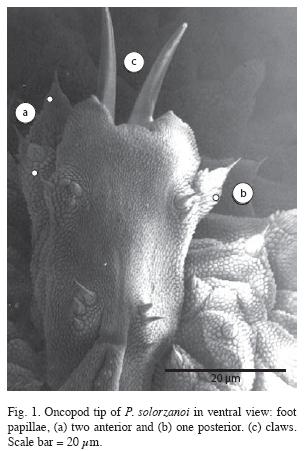
<body><![CDATA[<div style="text-align: justify;"></div>     <p style="text-align: justify;"><b><font face="Verdana" size="2">Diagnosis: </font></b><font face="Verdana" size="2">The following combination of characters: <i>Dorsal primary papillae</i>: Convex and conical with rounded bases; more than 18 scale ranks. Basal piece separated from apical piece by a sligh constriction. Apical section dilated, spherical and symmetric, with a basal diameter of 20 ranks; 6 or 7 scale ranks on apical pieces. Sensory bristle central, thorn-shaped, straight or slightly curved with ornamented basis. Outer blade 1 tooth, 1 accessory tooth, 1 vestigial accessory tooth (formula: 1/1/1); inner blade 1 tooth, 1 accessory tooth, 1 rudimentary accessory tooth, 9 to 10 denticles (formula: 1/1/1/9-10). Accessory tooth blunt in both blades. Four pads in the fourth and fifth oncopods (oncopods="legs"). Nephridial tubercle free from third and fourth pads, in lateral posterior position. The 4th. pad is arched.</font></p> <b><font size="2"> </font></b>     <p><b><font face="Verdana" size="2">Oncopods: </font></b><font  face="Verdana" size="2">Males with 34 leg pairs (n=2) and females with 39-41 leg pairs (39, n=1; 40, n=2; 41, n=11). Total observed animals n=16.</font></p>     <p><font face="Verdana" size="2"><b> </b></font></p>     <p><font face="Verdana" size="2"><b>Foot papillae: </b>Three foot papillae, two anterior and one posterior (<a href="#fig1">Fig. 1</a>).    <br> </font></p>     <p><font face="Verdana" size="2">    <br> </font></p>     <div style="text-align: center;"><a name="fig1"></a><img  src="/img/revistas/rbt/v58n4/a06i1.jpg" title="" alt=""  style="width: 305px; height: 451px;">    <br>     ]]></body>
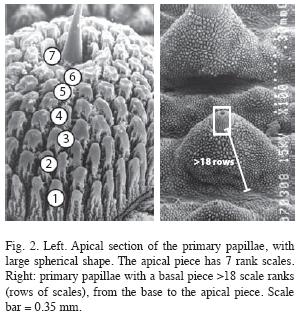
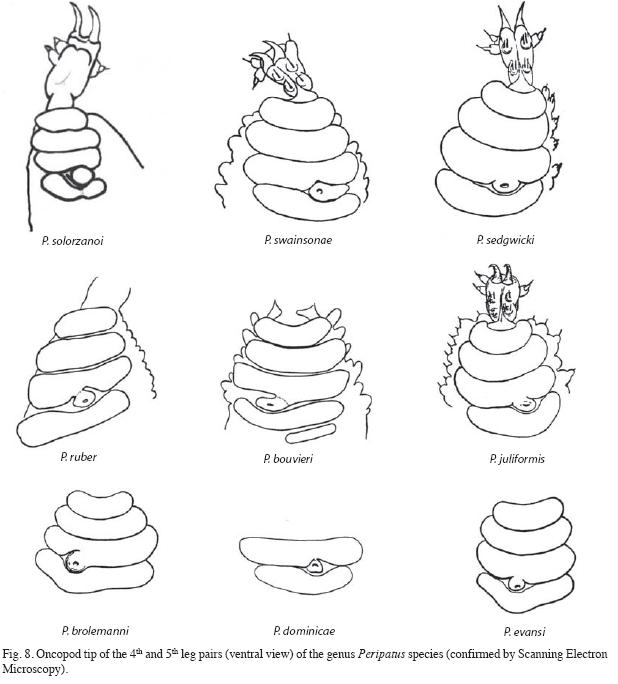
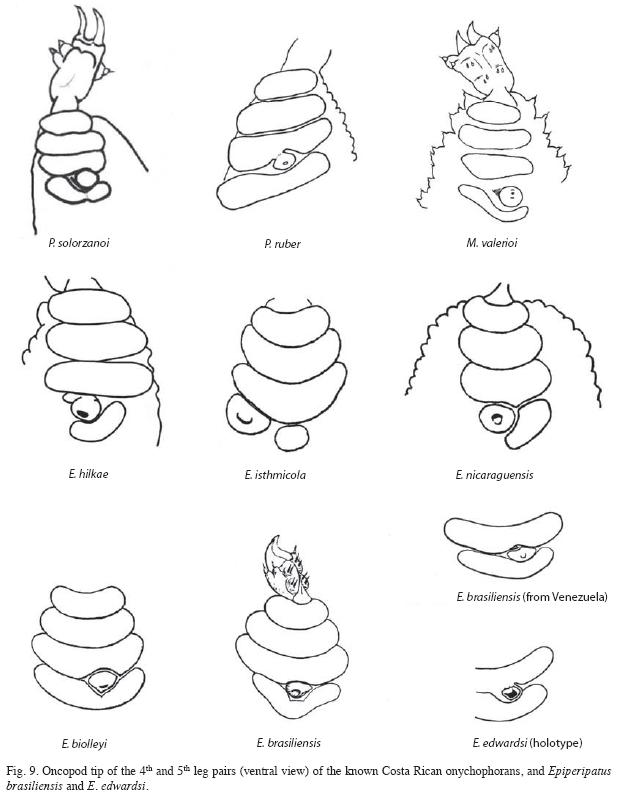
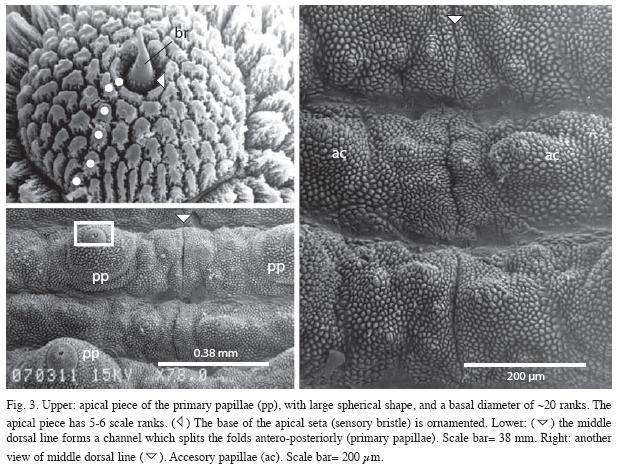
<body><![CDATA[<br> </div> <b><font size="2"> </font></b>     <p><b><font face="Verdana" size="2">Soles on foot (also known as <i>creeping pads</i>): </font></b><font face="Verdana" size="2">Four complete creeping pads, without presence of the vestigal fifth one in all oncopods.</font></p> <b><font size="2"> </font></b>     <p style="text-align: justify;"><b><font face="Verdana" size="2">Nephridial tubercle: </font></b><font face="Verdana" size="2">Present in the 4<sup>th</sup> and 5th oncopod pairs, anteriorly displaced and opening between the 3<sup>rd</sup> and 4<sup>th</sup> creeping pads, free from the 3rd and indenting the proximal margin of 4<sup>th</sup> pad, which is crescent-shaped around it. Fourth creeping pad not divided by the nephridial tubercle (<a  href="/img/revistas/rbt/v58n4/a06i8.jpg">Figs. 8</a>, <a  href="/img/revistas/rbt/v58n4/a06i9.jpg">9</a>).    <br> </font></p>     <p><font face="Verdana" size="2">    <br> </font></p>     <div style="text-align: center;"><a name="fig2"></a><img  src="/img/revistas/rbt/v58n4/a06i2.jpg" title="" alt=""  style="width: 305px; height: 320px;">    <br>     <br> </div>     <p style="text-align: justify;"><b><font face="Verdana" size="2">Integument: </font></b><font face="Verdana" size="2"><i>Structure of papillae</i>. Dorsal primary papillae convex and conical with rounded bases; without grooves parallel to the main body axis between them. Primary papillae of dorsal surface all of one type, conical, usually 5 to 12 accessory papillae between two of the larger ones. Basal pieces height of &gt;18 scale ranks (<a href="#fig2">Fig. 2</a>). Accessory papillae oriented both to ridge and borders of each fold (<a href="/img/revistas/rbt/v58n4/a06i3.jpg">Fig. 3</a>).</font></p>     ]]></body>
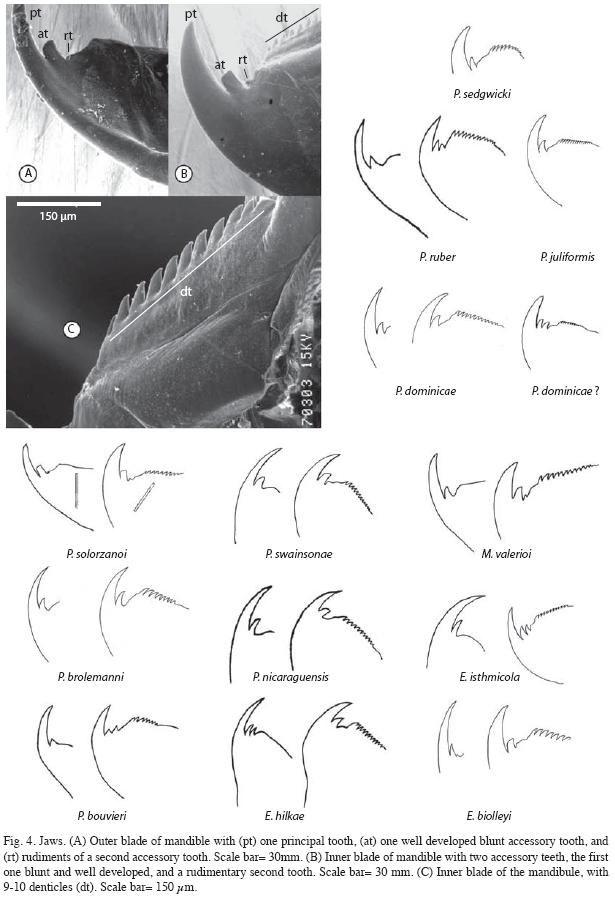
<body><![CDATA[<p style="text-align: justify;"><font face="Verdana" size="2">Apical pieces symmetric, globular-shaped and dilated, with a basal diameter of about 20 ranks, and 6 to 7 scale ranks tall (<a href="#fig2">Fig. 2</a>, <a  href="/img/revistas/rbt/v58n4/a06i3.jpg">3</a>).</font></p>     <div style="text-align: justify;"><i><font size="2"> </font></i></div>     <p style="text-align: justify;"><i><font face="Verdana" size="2">Sensory bristles</font></i><font face="Verdana" size="2">. Thorn-shaped bristle, little developed, straight or slightly curved. Sensory bristles placed centrally on the apical pieces and bearing an ornamented basis (<a href="#fig2">Fig. 2</a>).</font></p>     <div style="text-align: justify;"></div>     <p style="text-align: justify;"><i><font face="Verdana" size="2">Plicae</font></i><font  face="Verdana" size="2">. Dorsal integument with 12 plicae per segment, arranged in rings separated by straight grooves perpendicular to the main body axis. Seven plicae pass to the ventral side between oncopods.</font></p>     <div style="text-align: justify;"></div>     <p style="text-align: justify;"><i><font face="Verdana" size="2">Mid-line </font></i><font face="Verdana" size="2">(also known as dorsomedian furrow): The dorsomedian furrow is conspicuous, forming a channel which splits the folds anteroposteriorly (<a href="/img/revistas/rbt/v58n4/a06i3.jpg">Fig. 3</a>). Hyaline organs absent along the dorsomedian furrow.</font></p>     <div style="text-align: justify;"></div>     <p style="text-align: justify;"><b><font face="Verdana" size="2">Jaw: </font></b><font  face="Verdana" size="2">Outer jaw blade with one principal and one well developed accessory blunt tooth; presence of a vestigial second accessory tooth (<a href="/img/revistas/rbt/v58n4/a06i4.jpg">Fig. 4A</a>). Inner jaw blade with one principal and two accessory teeth, the first one well developed and blunt and the second less developed or vestigial (<a href="/img/revistas/rbt/v58n4/a06i4.jpg">Fig. 4B</a>), 9 to 10 denticles (<a href="/img/revistas/rbt/v58n4/a06i4.jpg">Fig. 4C</a>).</font></p>     <div style="text-align: justify;"><b><font size="2"> </font></b></div>     ]]></body>
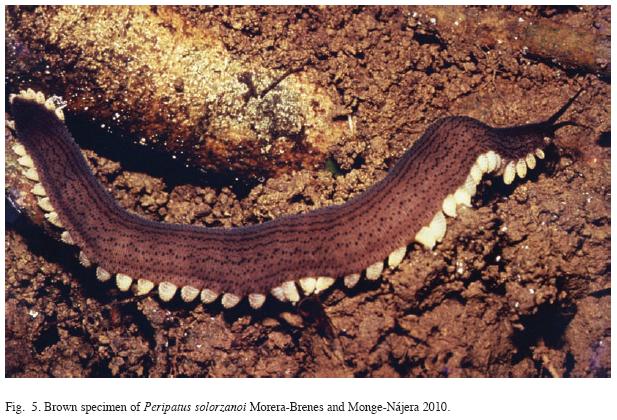
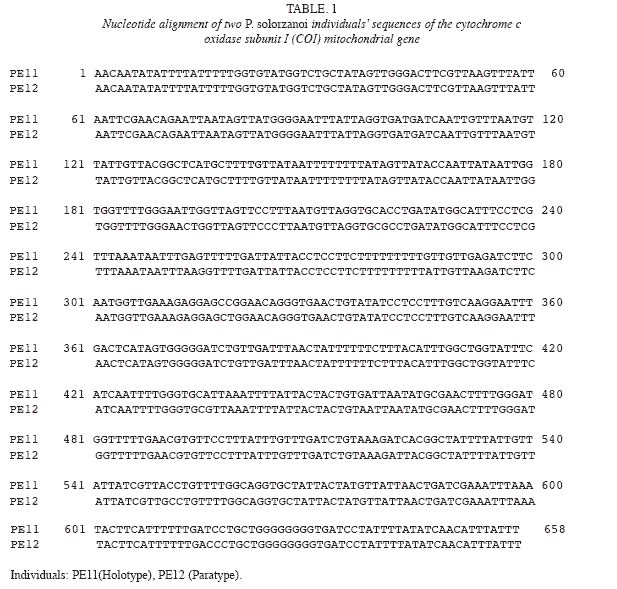
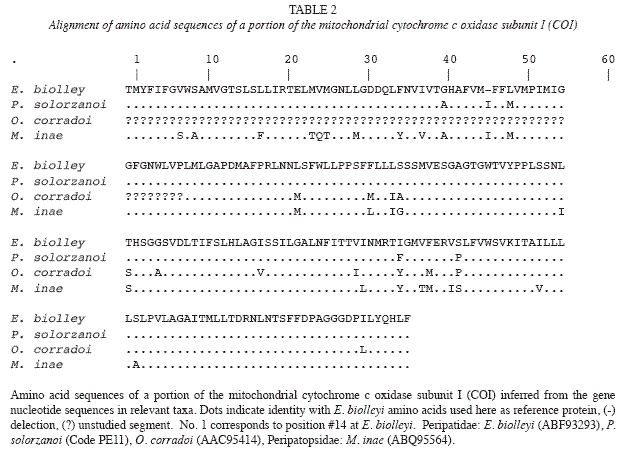
<body><![CDATA[<p style="text-align: justify;"><b><font face="Verdana" size="2">Body size: </font></b><font face="Verdana" size="2">In life, holotype body length was 22cm including antennae (reduced to 13cm after preservation in 70% alcohol). Other specimens: adults 7.1-11.7cm, young 2.2-4.0cm (in 70% alcohol).</font></p>     <div style="text-align: justify;"></div>     <p style="text-align: justify;"><b><font face="Verdana" size="2">Color in life: </font></b><font face="Verdana" size="2">No dorsal ornamentation but greater dorsal primary papillae may look like dark dots. Oncopods pale or light yellow, contrasting with the darker body. Holotype was light brown (<a href="/img/revistas/rbt/v58n4/a06i5.jpg">Fig. 5</a>), her newborns were red. Apparently there are two color morphotypes present: light brown or red wine color. We also observed deep brown onychophorans in the area but they might represent a different species.</font></p> <b><font size="2"> </font></b>     <p style="text-align: justify;"><b><font face="Verdana" size="2">Molecular analysis</font></b><font face="Verdana" size="2">: The COI DNA sequences of the two <i>P. solorzanoi</i></font><font size="2">&#8217;</font><font face="Verdana"  size="2">s specimens differ in 15 bases (2.13%) (<a  href="/img/revistas/rbt/v58n4/a06t1.gif">Table 1</a>). Identity= 644/658 (97%), gaps=0.     <br> </font></p>     <div style="text-align: justify;"></div>     <p style="text-align: justify;"><font face="Verdana" size="2">Nevertheless, all the differing bases at DNA level do not affect amino acid coding, so the translated aminoacid sequences of 219 length show identical COI proteins in both <i>P. solorzanoi</i></font><font size="2">&#8217;</font><font face="Verdana"  size="2">s individuals (<a href="/img/revistas/rbt/v58n4/a06t2.gif">Table 2</a>). Such length comparison show a pairwise identity of 97.7% (214 identical sites) between <i>P. solorzanoi </i>and <i>E. biolleyi</i>, both from the same family, but just 89.5% (196 identical sites) between <i>P. solorzanoi </i>and <i>M. inae</i>, species from different families. Coherently <i>E. biolleyi </i>and <i>M. inae </i>show a pairwise identity of 88.6% (194 identical sites).</font></p>     <div style="text-align: justify;"></div>     <p style="text-align: justify;"><font face="Verdana" size="2">Note that <i>E. biolleyi </i>presents a deletion of 1 amino acid (at shown position no. 50) with respect to the other studied species. Unfortunately the comparison between <i>P. solorzanoi </i>and <i>O. corradoi </i>is possible just in a length of 151 amino acids, because the studied sequenced fragment is shorter in the last species. They show a pairwise identity of 92.7% (140 identical sites).</font></p>     <div style="text-align: justify;"></div>     ]]></body>
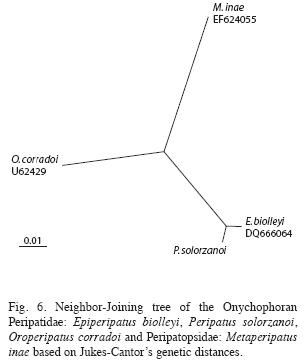
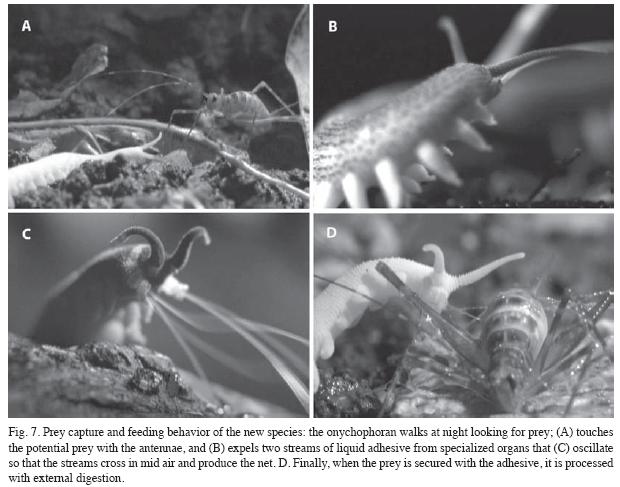
<body><![CDATA[<p style="text-align: justify;"><b><font face="Verdana" size="2">Phylogenetic analysis: </font></b><font face="Verdana" size="2">The available information on the COI protein sequence of the species: <i>P. solorzanoi</i>, <i>E. biolleyi</i>, <i>O. corradoi </i>and <i>M. inae </i>was used to estimate the genetic distances between such taxa. Genetic distance matrix (substitutions per site) is shown at <a href="/img/revistas/rbt/v58n4/a06t3.gif">Table 3</a>.</font></p>     <div style="text-align: justify;"></div>     <p style="text-align: justify;"><font face="Verdana" size="2">The phylogenetic analysis at the full comparison 151 amino acids COI fragment is shown at <a href="#fig6">Fig. 6</a>. The Caribbean Peripatidae species <i>Peripatus </i>and <i>Epiperipatus </i>are close to each other in a node. The Peripatopsidae <i>M. inae </i>was used as outgroup.    <br> </font></p>     <p><font face="Verdana" size="2">    <br> </font></p>     <div style="text-align: center;"><a name="fig6"></a><img  src="/img/revistas/rbt/v58n4/a06i6.jpg" title="" alt=""  style="width: 306px; height: 363px;">    <br>     <br> </div>     <p style="text-align: justify;"><b><font face="Verdana" size="2">Behavior and net weaving: </font></b><font face="Verdana" size="2">Individuals of this new species actively forage for prey at night in rivulet banks. They expel adhesive when touched; the amount of adhesive is larger than in other Costa Rican species. They move away from a common flashlight beam. Some individuals were born in captivity, probably prematurely as a result of the mother&#8217;s postcollecting stress. A high speed film (<a  href="/img/revistas/rbt/v58n4/a06i7.jpg">Fig. 7</a>) shows the animal touching prey with the antennae before expelling two streams of liquid adhesive. Muscular action produces a swinging movement of the adhesive-spelling organs; as a result, the streams cross in mid air, weaving the net.</font></p>     ]]></body>
<body><![CDATA[<div style="text-align: justify;"><b><font face="Verdana" size="3">     <p>Discussion</p> </font><font size="2"> </font></b></div>     <p style="text-align: justify;"><b><font face="Verdana" size="2">Placement in the Caribbean Group, genus <i>Peripatus</i>: </font></b><font face="Verdana" size="2">The new species, <i>P. solorzanoi </i>belongs to the Caribbean group, <i>sensu </i>Bouvier 1905, by presenting three foot papillae arranged laterally, two anterior and one posterior (<a href="#fig1">Figs. 1</a>, <a  href="/img/revistas/rbt/v58n4/a06i8.jpg">8</a>) and four complete creeping pads with nephridial tubercle opening between the 3<sup>rd</sup> and 4<sup>th</sup> pad (<a href="/img/revistas/rbt/v58n4/a06i8.jpg">Figs. 8</a>, <a  href="/img/revistas/rbt/v58n4/a06i9.jpg">9</a>). These features are shared currently by five neotropical genera: <i>Peripatus </i>Guilding 1826, <i>Epiperipatus </i>(Clark 1913), <i>Macroperipatus </i>(Clark 1913), <i>Plicatoperipatus </i>(Clark 1913) and <i>Speleoperipatus </i>(Peck 1975).</font></p>     <div style="text-align: justify;"></div>     <p style="text-align: justify;"><font face="Verdana" size="2">The presence of eyes and only twelve plicae per body segment exclude the possibility of such species being to <i>Speleoperipatus </i>or <i>Plicatoperipatus, </i>respectively. The rounded bases of dorsal primary papillae exclude also <i>Macroperipatus, </i>that bears papillae with quadrangular basis.</font></p>     <div style="text-align: justify;"></div>     <p style="text-align: justify;"><font face="Verdana" size="2">The distribution of dorsal papillae in the new species does not fit the old definition of <i>Peripatus </i>and <i>Epiperipatus </i>made by Peck (1975), but the type is similar to <i>Epiperipatus </i>(all of one type, Peck 1975). The new species is unique in having 5 to 12 accessory papillae between two of the larger ones. This is somehow similar to <i>Peripatus </i>(the primary papillary tubercles separated by rather broad intervals where the accessory papillae occur, Peck 1975). Read (1988a) believed that the distinction between <i>Peripatus </i>and <i>Epiperipatus </i>was invalid. According to Read&#8217;s classification (1988a), the number of scale ranks at apical piece in this new species classifies it in the genus <i>Peripatus </i>(<i>sensu strictu</i>).</font></p>     <div style="text-align: justify;"></div>     <p style="text-align: justify;"><b><font face="Verdana" size="2">DNA diversity and phylogenetics: </font></b><font face="Verdana" size="2">The observed DNA sequence diversity (2.13%) in <i>P. solorzanoi </i>is a normal value for intraspecific variation, often sister species differ by &gt;8%, while intraspecific variation is up to 5%. In contrast to the DNA variation, the inferred amino acid sequence is conserved in <i>P. solorzanoi</i>, suggesting that the majority of amino acid positions are constrained within this region of the COI gene.</font></p>     <div style="text-align: justify;"></div>     ]]></body>
<body><![CDATA[<p style="text-align: justify;"><font face="Verdana" size="2">The phylogenetic analysis at the COI protein showed that the Central American Caribbean Peripatidae species <i>P. solorzanoi </i>and <i>E. biolleyi </i>are close to each other, far from the Andean South American <i>O. corradoi</i>. The South American Peripatopsidae <i>M. inae </i>was used as appropriate outgroup.</font></p>     <p style="text-align: justify;"><b><font face="Verdana" size="2">Differences with similar species: </font></b><font face="Verdana" size="2">As an aid to identification, we present here some information on how to distinguish the new species from others that occur in the same region. Some of these characteristics may be highly variable within the family, but are reliable within the geographic region considered.</font></p>     <div style="text-align: justify;"></div>     <p style="text-align: justify;"><font face="Verdana" size="2">The position of the nephridial tubercle on the fourth and fifth foot distinguishes <i>P. solorzanoi </i>from <i>P. ruber </i>and <i>P. bouvieri </i>because they have "the tubercle largely fused with the third arc" as stated by Bouvier (1905, 1907). Additionally, <i>P. solorzanoi </i>does not have the fifth pad that <i>P. bouvieri </i>has.</font></p>     <div style="text-align: justify;"></div>     <p style="text-align: justify;"><font face="Verdana" size="2">The other species recorded from Costa Rica also differ from <i>P. solorzanoi</i>. The new species differs from <i>E. isthmicola</i>, <i>E. hilkae </i>and <i>E. nicaraguensis </i>because its fourth arc is complete. It also differs from <i>M. valerioi </i></font><font size="2">"</font><font face="Verdana"  size="2">where the fourth creeping pad is thin and twists around the urinary tubercle, which is completely free and outerly bound" (Morera- Brenes &amp; Le&oacute;n 1986). If the size is not considered, the new species resembles <i>Epiperipatus biolleyi </i>(<a  href="/img/revistas/rbt/v58n4/a06i9.jpg">Fig. 9</a>), but it can be separated because the third pad is not indented in <i>P. solorzanoi.</i></font></p>     <div style="text-align: justify;"><font size="2"> </font></div>     <p style="text-align: justify;"><font face="Verdana" size="2">The mandible&#8217;s outer blade formula in <i>P. solorzanoi </i>(1.1.1) is different from all confirmed and unconfirmed species of <i>Peripatus </i>(as detailed by Read 1988a, b); and it is also different from the other Costa Rican onychophorans (Morera-Brenes &amp; Le&oacute;n 1986). Only <i>Plicatoperipatus </i>from Jamaica has a similar outer blade formula. The outer blade shape resembles that of <i>Macroperipatus torquatus </i>from Trinidad, except that the accessory teeth have a more pointing shape in <i>M. torquatus </i>(Read 1988a, b).</font></p>     <div style="text-align: justify;"></div>     <p style="text-align: justify;"><font face="Verdana" size="2">The inner blade formula of <i>P. solorzanoi </i>(1/1/1(9-10) is similar to that of <i>Macroperipatus valerioi</i>: (1/1/1/11) (Morera-Brenes &amp; Le&oacute;n 1986). The shape of the inner blade also resembles that of <i>M. valerioi</i>, except that in <i>M. valerioi </i>has more denticles and the accessory tooth is more acute (Morera-Brenes &amp; Le&oacute;n 1986). It distantly resembles the accessory tooth in the inner blade of "<i>E. brasiliensis</i></font><font  face="Verdana" size="2">" from Venezuela (in quotation marks because we believe this is a misidentification). However, both <i>M. valerioi </i>and "<i>E. brasiliensis</i></font><font size="2">"</font><font  face="Verdana" size="2"> have a well developed&nbsp; second accessory tooth that is lacking in the new species. The bilobular shape of the inner blade diastema resembles those of <i>P. sedgwicki </i>from Venezuela and <i>P. swainsonae </i>from Jamaica. </font></p>     ]]></body>
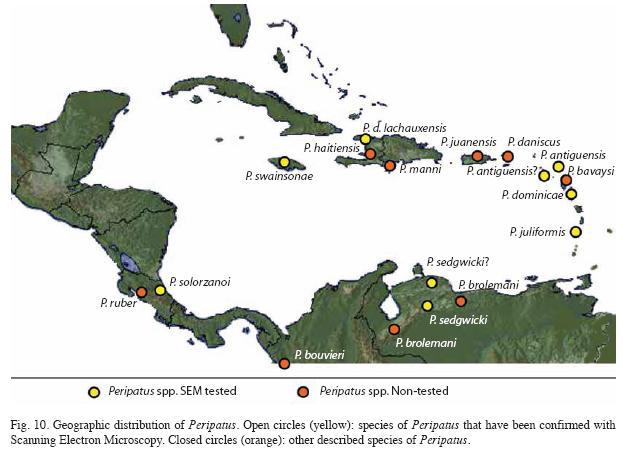
<body><![CDATA[<div style="text-align: justify;"></div>     <p style="text-align: justify;"><font face="Verdana" size="2">Both males and females of the new species have more oncopods than other Neotropical <i>Peripatus </i>(<i>sensu stricto</i>) and other Costa Rican onychophorans (<i>Epiperipatus </i>and <i>Macroperipatus</i>).</font></p>     <div style="text-align: justify;"></div>     <p style="text-align: justify;"><b><font face="Verdana" size="2">Geographic distribution: </font></b><font face="Verdana" size="2">These are the species of <i>Peripatus </i>that have been corroborated with SEM: <i>P. juliformis </i>Guilding from St. Vincent, <i>P. d. dominicae </i>Pollard from Dominica, <i>P. antiguensis </i>Bouv. from Antigua and <i>P. antiguensis </i>from Montserrat, <i>P. d. lachauxensis </i>Brues from Haiti, <i>P. swainsonae </i>Cockerel from Jamaica, <i>P. sedgwicki </i>Bouv. from Venezuela, and the new <i>P. solorzanoi </i>from Costa Rica (<a  href="/img/revistas/rbt/v58n4/a06i10.jpg">Fig. 10</a>). When only these species are considered, <i>Peripatus </i>has a circum-Caribbean distribution, reaching northward from South America into the Central American bridge and Antillean arc. All the Antillean species occur on continental islands, so we hypothesize that the genus colonized the current islands in times of a lower sea level, as suggested by Monge-N&aacute;jera (1996). The exception to this hypothesis was Barbados, an oceanic island reported to have a <i>Peripatus </i>species, but Read (1988a, b) concluded that it was misidentified and relocated the species in another genus (as <i>Epiperipatus barbadensis</i>).</font></p>     <p style="text-align: justify;"><font face="Verdana" size="2">The unconfirmed continental species of <i>Peripatus </i>(<i>P. ruber </i>from Costa Rica, <i>P. bouvieri </i>from Colombia, <i>P. brolemani </i>from Venezuela, <i>P. torrealbai </i>from Venezuela (Scorza 1953), <i>P. bavaysi </i>from Guadalupe, <i>P. daniscus </i>from St. Tomas, <i>P. daniscus juanensis </i>from Porto Rico, <i>P. manni </i>from Haiti and <i>P. haitienisis </i>Brues from Haiti) fit our hypothesis. If they were removed from <i>Peripatus </i>in the future, it would not affect our hypothesis.</font></p>     <div style="text-align: justify;"></div>     <p style="text-align: justify;"><font face="Verdana" size="2">In contrast with <i>Peripatus</i>, the genus <i>Epiperipatus </i>seems to be more widely distributed in South America. Nevertheless, both genera have the same circum-Caribbean distribution, suggesting they originated from a common ancestor before their parallel expansion (Monge- N&aacute;jera 1995). We must note, however, that maybe <i>Peripatus </i>is not a monophyletic genus.</font></p>     <div style="text-align: justify;"></div>     <p style="text-align: justify;"><b><font face="Verdana" size="2">Body size: </font></b><font face="Verdana" size="2">The body size has been regarded as of little taxonomic use due to the contraction capacity of Onychophora. Thus, it is difficult to obtain a precise measurement of body length, mainly after fixation, when several degrees of contraction may occur (Read 1988a). Despite Read&#8217;s statement (1988a), the body size of <i>P. solorzanoi </i>is quite uncommon among extant and also extinct onychophorans and should be regarded as a diagnostic feature in addition with other morphological characters. The size has been already used to help the diagnosis of <i>Metaperipatus inae </i>Mayer 2007 and is very useful to characterize adults of <i>P. solorzanoi.</i></font></p>     <div style="text-align: justify;"><font size="2"> </font><font face="Verdana" size="2">     ]]></body>
<body><![CDATA[<p>Read (1988a) has previously commented: "The largest onychophorans include the large species of <i>Oroperipatus </i>(section 1 of Peripates Andicoles in Bouvier 1905), and <i>Macroperipatus torquatus</i>. Certain <i>Epiperipatus</i>, including <i>E. lewisi</i>, reach a large size (Arnett 1961)". Of these, <i>Macroperipatus torquatus </i>was, so far, the largest living species with a total length of 15cm (Read 1985). The new species, <i>P. solorzanoi</i>, is even longer with 22cm and its size can be only compared with extinct taxa, namely as the fossil <i>Xenusion </i>Pompeckj, 1927 from the Baltic, with 20cm (Dzik &amp; Krumbiegel 1989) and the not fully identified fossil <i>Jianshanopodia decora </i>that may reach an equal size if confirmed as being an onychophoran (Liu <i>et al</i>. 2006).</p>     <p>Based on a morphometric analysis, Monge- N&aacute;jera &amp; Morera (1994) suggested that the number of oncopods is simply a function of the animal&#8217;s length, but the correlation has important exceptions.</p> </font><font size="2"> </font><font face="Verdana" size="2">     <p>The Onychophora&#8217;s ancestors were a few millimeters long, lived under water and had few but long oncopods (Monge-N&aacute;jera 1994, 1995), so we suspect that at the extreme size of 22cm, <i>P. solorzanoi </i>is close to the practical limit for a functional onychophoran because they lack a hard skeleton and cannot excavate their own burrows (Monge-N&aacute;jera <i>et al. </i>1993).</p> </font><b><font size="2"> </font></b><font face="Verdana" size="2">     <p><span style="font-weight: bold;">Conservation:</span> The Onychophora&#8217;s conservation has been previously discussed (Mesibov 1990, New 1995) and as all other species of Onychophora, <i>P. solorzanoi </i>is rare. Despite additional effort to find the species during fieldwork in the Caribbean of Costa Rica, it has never been found outside the limited area where the type was collected. Furthermore, much of the original tropical rainforest in that area has been deforested for farming and housing development. So far, the only known population is limited to a few kilometers of riparian vegetation. So the species is at least under the <i>Vulnerable </i>IUCN category (IUCN 2000). Under these circumstances, we believe that active protection of the habitat of the largest onychophoran ever described, is urgent.</p> </font></div> <font face="Verdana" size="2"></font><font style="font-weight: bold;"  face="Verdana" size="3">     <p>Acknowledgments</p> </font><font size="2"> </font>     <p style="text-align: justify;"><font face="Verdana" size="2">We appreciate the assistance and support of Alejandro Sol&oacute;rzano, who brought the new species to our attention and provided the photograph in <a href="/img/revistas/rbt/v58n4/a06i5.jpg">Fig. 5-B</a>, Jos&eacute; A. Vargas Z. for the photograph in <a  href="/img/revistas/rbt/v58n4/a06i5.jpg">Fig. 5-A</a>, and the British Broadcasting Corporation, through Tim Haynes, for allowing us to reproduce frames from the high speed video of <i>P. solorzanoi </i>(<a  href="/img/revistas/rbt/v58n4/a06i7.jpg">Fig. 7</a>). We are indebted to Lars Podsiadlowski for his great support with DNA sequencing and critical reading of the paper. Francisco Hern&aacute;ndez helped greatly with the SEM. We also thank Hilke Ruhberg, Randall Rub&iacute; Chac&oacute;n, Robert Mesibov, V.M.S.J. Read and three anonymous reviewers for suggestions to improve an earlier draft, as well as Sergio Aguilar for preparing the final version of figures.</font></p> <hr style="width: 100%; height: 2px;"><font style="font-weight: bold;"  face="Verdana" size="3">     <p>References</p> </font><font size="2"> </font><font face="Verdana" size="2">     <!-- ref --><p>Ballard, J.W.O., O. Ballard, G.J. Olsen, D.P. Faith, W.A. Odgers, D.M. Rowell &amp; P. Atkinson. 1992. Evidence from 12S ribosomal RNA sequences that onychophorans are modified arthropods. Science 258: 1345-1348.    &nbsp;&nbsp;&nbsp;&nbsp;&nbsp;&nbsp;&nbsp;&nbsp;[&#160;<a href="javascript:void(0);" onclick="javascript: window.open('/scielo.php?script=sci_nlinks&ref=1393522&pid=S0034-7744201000040000600001&lng=','','width=640,height=500,resizable=yes,scrollbars=1,menubar=yes,');">Links</a>&#160;]<!-- end-ref --></p>     <!-- ref --><p>Biomatters. 2009. Geneious Basic 4.7.6. software. Biomatters Ltd. (Downloaded: October 11, 2009, www.geneious.com).    &nbsp;&nbsp;&nbsp;&nbsp;&nbsp;&nbsp;&nbsp;&nbsp;[&#160;<a href="javascript:void(0);" onclick="javascript: window.open('/scielo.php?script=sci_nlinks&ref=1393524&pid=S0034-7744201000040000600002&lng=','','width=640,height=500,resizable=yes,scrollbars=1,menubar=yes,');">Links</a>&#160;]<!-- end-ref --></p>     <!-- ref --><p>Bouvier, E.L. 1905. Monographie des Onychophores. I. Ann. Sci. Nat. Zool. 9: 1-283; Pl. I-XIII.    &nbsp;&nbsp;&nbsp;&nbsp;&nbsp;&nbsp;&nbsp;&nbsp;[&#160;<a href="javascript:void(0);" onclick="javascript: window.open('/scielo.php?script=sci_nlinks&ref=1393526&pid=S0034-7744201000040000600003&lng=','','width=640,height=500,resizable=yes,scrollbars=1,menubar=yes,');">Links</a>&#160;]<!-- end-ref --></p>     <!-- ref --><p>Bouvier, E.L. 1907. Monographie des Onychophores. II. Ann. Sci. Nat. Zool. 9: 61-318.    &nbsp;&nbsp;&nbsp;&nbsp;&nbsp;&nbsp;&nbsp;&nbsp;[&#160;<a href="javascript:void(0);" onclick="javascript: window.open('/scielo.php?script=sci_nlinks&ref=1393528&pid=S0034-7744201000040000600004&lng=','','width=640,height=500,resizable=yes,scrollbars=1,menubar=yes,');">Links</a>&#160;]<!-- end-ref --></p>     <!-- ref --><p>Braband, A., L. Podsiadlowski, S.L. Cameron, S. Daniels &amp; G. Mayer. 2010. Extensive duplication events account for multiple control regions and pseudogenes in the mitochondrial genome of the velvet worm <i>Metaperipatus inae </i>(Onychophora, Peripatopsidae). Mol. Phylogenet. Evol. (in press). Available online 25 May 2010.    &nbsp;&nbsp;&nbsp;&nbsp;&nbsp;&nbsp;&nbsp;&nbsp;[&#160;<a href="javascript:void(0);" onclick="javascript: window.open('/scielo.php?script=sci_nlinks&ref=1393530&pid=S0034-7744201000040000600005&lng=','','width=640,height=500,resizable=yes,scrollbars=1,menubar=yes,');">Links</a>&#160;]<!-- end-ref --></p> </font><font size="2"> </font>     <!-- ref --><p><font face="Verdana" size="2">Dzik, J. &amp; G. Krumbiegel. 1989. The oldest onychophoran, <i>Xenusion </i>- a link connecting phyla. Lethaia 22: 169-181.    &nbsp;&nbsp;&nbsp;&nbsp;&nbsp;&nbsp;&nbsp;&nbsp;[&#160;<a href="javascript:void(0);" onclick="javascript: window.open('/scielo.php?script=sci_nlinks&ref=1393532&pid=S0034-7744201000040000600006&lng=','','width=640,height=500,resizable=yes,scrollbars=1,menubar=yes,');">Links</a>&#160;]<!-- end-ref --></font></p>     <!-- ref --><p><font face="Verdana" size="2">Folmer O, M. Black, W. Hoeh, R. Lutz &amp; R. Vreijenhoek 1994. DNA primers for amplification of mitochondrial Cytochrome C oxidase subunit I from diverse metazoan invertebrates. Mol. Mar. Biol. Biotechn. 3: 294-299.    &nbsp;&nbsp;&nbsp;&nbsp;&nbsp;&nbsp;&nbsp;&nbsp;[&#160;<a href="javascript:void(0);" onclick="javascript: window.open('/scielo.php?script=sci_nlinks&ref=1393534&pid=S0034-7744201000040000600007&lng=','','width=640,height=500,resizable=yes,scrollbars=1,menubar=yes,');">Links</a>&#160;]<!-- end-ref --></font></p>     <!-- ref --><p><font face="Verdana" size="2">Gleeson, D.M., D.M. Rowell, N.N. Tait, D.A. Briscoe &amp; A.V. Higgins. 1998. Phylogenetic relationships among onychophora from Australasia inferred from the mitochondrial Cytochrome oxidase subunit I gene. Mol. Phylogenet. Evol. 10: 237-248.    &nbsp;&nbsp;&nbsp;&nbsp;&nbsp;&nbsp;&nbsp;&nbsp;[&#160;<a href="javascript:void(0);" onclick="javascript: window.open('/scielo.php?script=sci_nlinks&ref=1393536&pid=S0034-7744201000040000600008&lng=','','width=640,height=500,resizable=yes,scrollbars=1,menubar=yes,');">Links</a>&#160;]<!-- end-ref --></font></p>     <!-- ref --><p><font face="Verdana" size="2">Hou, X.G. &amp; J. Bergstrom. 1995. Cambrian lobopodians - ancestors of extant onychophorans? Zool. J. Linn. Soc-Lond. 114: 3-19.    &nbsp;&nbsp;&nbsp;&nbsp;&nbsp;&nbsp;&nbsp;&nbsp;[&#160;<a href="javascript:void(0);" onclick="javascript: window.open('/scielo.php?script=sci_nlinks&ref=1393538&pid=S0034-7744201000040000600009&lng=','','width=640,height=500,resizable=yes,scrollbars=1,menubar=yes,');">Links</a>&#160;]<!-- end-ref --></font></p>     <!-- ref --><p><font face="Verdana" size="2">IUCN. 2000. IUCN Red List. Categories and Criteria. Version 3.1. IUCN, Gland, Switzerland.    &nbsp;&nbsp;&nbsp;&nbsp;&nbsp;&nbsp;&nbsp;&nbsp;[&#160;<a href="javascript:void(0);" onclick="javascript: window.open('/scielo.php?script=sci_nlinks&ref=1393540&pid=S0034-7744201000040000600010&lng=','','width=640,height=500,resizable=yes,scrollbars=1,menubar=yes,');">Links</a>&#160;]<!-- end-ref --></font></p>     <!-- ref --><p><font face="Verdana" size="2">Liu, J., D. Shu, J. Han, Z. Zhang &amp; X. Zhang. 2006. A large xenusiid lobopod with complex appendages from the Lower Cambrian Chengjiang Lagerstatte. Acta Palaeontol. Polon. 51: 215-222.    &nbsp;&nbsp;&nbsp;&nbsp;&nbsp;&nbsp;&nbsp;&nbsp;[&#160;<a href="javascript:void(0);" onclick="javascript: window.open('/scielo.php?script=sci_nlinks&ref=1393542&pid=S0034-7744201000040000600011&lng=','','width=640,height=500,resizable=yes,scrollbars=1,menubar=yes,');">Links</a>&#160;]<!-- end-ref --></font></p>     <!-- ref --><p><font face="Verdana" size="2">Mayer, G. 2007. <i>Metaperipatus inae </i>sp. nov. (Onychophora: Peripatopsidae) from Chile with a novel ovarian type and dermal insemination. Zootaxa 1440: 21-37.    &nbsp;&nbsp;&nbsp;&nbsp;&nbsp;&nbsp;&nbsp;&nbsp;[&#160;<a href="javascript:void(0);" onclick="javascript: window.open('/scielo.php?script=sci_nlinks&ref=1393544&pid=S0034-7744201000040000600012&lng=','','width=640,height=500,resizable=yes,scrollbars=1,menubar=yes,');">Links</a>&#160;]<!-- end-ref --></font></p>     <!-- ref --><p><font face="Verdana" size="2">Mesibov, R. 1990. Velvet worms: a special case of invertebrate fauna conservation. Tasforests 2: 53-56.    &nbsp;&nbsp;&nbsp;&nbsp;&nbsp;&nbsp;&nbsp;&nbsp;[&#160;<a href="javascript:void(0);" onclick="javascript: window.open('/scielo.php?script=sci_nlinks&ref=1393546&pid=S0034-7744201000040000600013&lng=','','width=640,height=500,resizable=yes,scrollbars=1,menubar=yes,');">Links</a>&#160;]<!-- end-ref --></font></p>     <!-- ref --><p><font face="Verdana" size="2">Monge-N&aacute;jera, J., Z. Barrientos &amp; F. Aguilar. 1993. Behavior of <i>Epiperipatus biolleyi </i>(Onychophora: Peripatidae) under laboratory conditions. Rev. Biol. Trop. 41: 689-696.    &nbsp;&nbsp;&nbsp;&nbsp;&nbsp;&nbsp;&nbsp;&nbsp;[&#160;<a href="javascript:void(0);" onclick="javascript: window.open('/scielo.php?script=sci_nlinks&ref=1393548&pid=S0034-7744201000040000600014&lng=','','width=640,height=500,resizable=yes,scrollbars=1,menubar=yes,');">Links</a>&#160;]<!-- end-ref --></font></p>     <!-- ref --><p><font face="Verdana" size="2">Monge-N&aacute;jera, J. 1994. Reproductive trends, habitat type and body characteristics in velvet worms (Onychophora). Rev. Biol. Trop. 42: 611-622.    &nbsp;&nbsp;&nbsp;&nbsp;&nbsp;&nbsp;&nbsp;&nbsp;[&#160;<a href="javascript:void(0);" onclick="javascript: window.open('/scielo.php?script=sci_nlinks&ref=1393550&pid=S0034-7744201000040000600015&lng=','','width=640,height=500,resizable=yes,scrollbars=1,menubar=yes,');">Links</a>&#160;]<!-- end-ref --></font></p>     <!-- ref --><p><font face="Verdana" size="2">Monge-N&aacute;jera, J. &amp; B. Morera. 1994. Morphological and physiological characteristics of two species of <i>Epiperipatus </i>from Costa Rica (Onychophora: Peripatidae). Rev. Biol. Trop. 42: 181-188.    &nbsp;&nbsp;&nbsp;&nbsp;&nbsp;&nbsp;&nbsp;&nbsp;[&#160;<a href="javascript:void(0);" onclick="javascript: window.open('/scielo.php?script=sci_nlinks&ref=1393552&pid=S0034-7744201000040000600016&lng=','','width=640,height=500,resizable=yes,scrollbars=1,menubar=yes,');">Links</a>&#160;]<!-- end-ref --></font></p>     <!-- ref --><p><font face="Verdana" size="2">Monge-N&aacute;jera, J. 1995. Phylogeny, biogeography and reproductive trends in the Onychophora. Zool. J. Linn. Soc. Lond. 114: 21-60.    &nbsp;&nbsp;&nbsp;&nbsp;&nbsp;&nbsp;&nbsp;&nbsp;[&#160;<a href="javascript:void(0);" onclick="javascript: window.open('/scielo.php?script=sci_nlinks&ref=1393554&pid=S0034-7744201000040000600017&lng=','','width=640,height=500,resizable=yes,scrollbars=1,menubar=yes,');">Links</a>&#160;]<!-- end-ref --></font></p>     <!-- ref --><p><font face="Verdana" size="2">Monge-N&aacute;jera, J. &amp; W.R. Louren&ccedil;o. 1995. Biogeographic implications and evolutionary trends in onychophorans and scorpions. Biogeographica 71: 179-185.    &nbsp;&nbsp;&nbsp;&nbsp;&nbsp;&nbsp;&nbsp;&nbsp;[&#160;<a href="javascript:void(0);" onclick="javascript: window.open('/scielo.php?script=sci_nlinks&ref=1393556&pid=S0034-7744201000040000600018&lng=','','width=640,height=500,resizable=yes,scrollbars=1,menubar=yes,');">Links</a>&#160;]<!-- end-ref --></font></p>     <!-- ref --><p><font face="Verdana" size="2">Monge-N&aacute;jera, J. 1996. Jurassic-Pliocene biogeography: Testing a model with velvet worm (Onychophora) vicariance. Rev. Biol. Trop. 44: 159-175.    &nbsp;&nbsp;&nbsp;&nbsp;&nbsp;&nbsp;&nbsp;&nbsp;[&#160;<a href="javascript:void(0);" onclick="javascript: window.open('/scielo.php?script=sci_nlinks&ref=1393558&pid=S0034-7744201000040000600019&lng=','','width=640,height=500,resizable=yes,scrollbars=1,menubar=yes,');">Links</a>&#160;]<!-- end-ref --></font></p>     <!-- ref --><p><font face="Verdana" size="2">Monge-N&aacute;jera, J. &amp; X.G. Hou. 2000. Disparity, decimation and the Cambrian "explosion": comparison of early Cambrian and present faunal communities with emphasis on velvet worms (Onychophora). Rev. Biol. Trop. 48: 333-351.    &nbsp;&nbsp;&nbsp;&nbsp;&nbsp;&nbsp;&nbsp;&nbsp;[&#160;<a href="javascript:void(0);" onclick="javascript: window.open('/scielo.php?script=sci_nlinks&ref=1393560&pid=S0034-7744201000040000600020&lng=','','width=640,height=500,resizable=yes,scrollbars=1,menubar=yes,');">Links</a>&#160;]<!-- end-ref --></font></p>     <!-- ref --><p><font face="Verdana" size="2">Mora, M., A. Herrera &amp; P. Le&oacute;n. 1996a. Electrophoretic analysis of adhesive secretions in onychophorans of the genus <i>Epiperipatus </i>(Onychophora: Peripatidae). Rev. Biol. Trop. 44: 147-152.    &nbsp;&nbsp;&nbsp;&nbsp;&nbsp;&nbsp;&nbsp;&nbsp;[&#160;<a href="javascript:void(0);" onclick="javascript: window.open('/scielo.php?script=sci_nlinks&ref=1393562&pid=S0034-7744201000040000600021&lng=','','width=640,height=500,resizable=yes,scrollbars=1,menubar=yes,');">Links</a>&#160;]<!-- end-ref --></font></p>     <!-- ref --><p><font face="Verdana" size="2">Mora, M., A. Herrera &amp; P. Le&oacute;n. 1996b. The genome of <i>Epiperipatus biolleyi </i>(Peripatidae), a Costa Rican onychophoran. Rev. Biol. Trop. 44: 153-157.    &nbsp;&nbsp;&nbsp;&nbsp;&nbsp;&nbsp;&nbsp;&nbsp;[&#160;<a href="javascript:void(0);" onclick="javascript: window.open('/scielo.php?script=sci_nlinks&ref=1393564&pid=S0034-7744201000040000600022&lng=','','width=640,height=500,resizable=yes,scrollbars=1,menubar=yes,');">Links</a>&#160;]<!-- end-ref --></font></p>     <!-- ref --><p><font face="Verdana" size="2">Morera-Brenes, B. &amp; M.D. Le&oacute;n. 1986. Description of <i>Macroperipatus valerioi </i>n. sp. from Costa Rica, and comments on the genus <i>Macroperipatus </i>(Onychophora: Peripatidae). Rev. Biol. Trop. 34: 277-282.    &nbsp;&nbsp;&nbsp;&nbsp;&nbsp;&nbsp;&nbsp;&nbsp;[&#160;<a href="javascript:void(0);" onclick="javascript: window.open('/scielo.php?script=sci_nlinks&ref=1393566&pid=S0034-7744201000040000600023&lng=','','width=640,height=500,resizable=yes,scrollbars=1,menubar=yes,');">Links</a>&#160;]<!-- end-ref --></font></p>     <!-- ref --><p><font face="Verdana" size="2">Morera-Brenes, B. &amp; J. Monge-N&aacute;jera. 1990. <i>Epiperipatus hilkae </i>n.sp. from Costa Rica (Onychopora: Peripatidae). Rev. Biol. Trop. 38: 449-455.    &nbsp;&nbsp;&nbsp;&nbsp;&nbsp;&nbsp;&nbsp;&nbsp;[&#160;<a href="javascript:void(0);" onclick="javascript: window.open('/scielo.php?script=sci_nlinks&ref=1393568&pid=S0034-7744201000040000600024&lng=','','width=640,height=500,resizable=yes,scrollbars=1,menubar=yes,');">Links</a>&#160;]<!-- end-ref --> </font></p>     <!-- ref --><p><font face="Verdana" size="2">New, T.R. 1995. Onychophora in invertebrate conservation - priorities, practice and prospects. Zool. J. Linn. Soc- Lond. 114: 77-89.    &nbsp;&nbsp;&nbsp;&nbsp;&nbsp;&nbsp;&nbsp;&nbsp;[&#160;<a href="javascript:void(0);" onclick="javascript: window.open('/scielo.php?script=sci_nlinks&ref=1393570&pid=S0034-7744201000040000600025&lng=','','width=640,height=500,resizable=yes,scrollbars=1,menubar=yes,');">Links</a>&#160;]<!-- end-ref --></font></p>     <!-- ref --><p><font face="Verdana" size="2">Page, R.D.M. 1998. Tree View (Win 32) 1.5.2. (Downloaded: September 2, 2001. http://taxonomy.zoology.gla.ac.uk/rod.html).    &nbsp;&nbsp;&nbsp;&nbsp;&nbsp;&nbsp;&nbsp;&nbsp;[&#160;<a href="javascript:void(0);" onclick="javascript: window.open('/scielo.php?script=sci_nlinks&ref=1393572&pid=S0034-7744201000040000600026&lng=','','width=640,height=500,resizable=yes,scrollbars=1,menubar=yes,');">Links</a>&#160;]<!-- end-ref --></font></p>     <!-- ref --><p><font face="Verdana" size="2">Podsiadlowski, L., A. Braband &amp; G. Mayer. 2008. The Complete Mitochondrial Genome of the Onychophoran <i>Epiperipatus biolleyi </i>Reveals a Unique Transfer RNA Set and Provides Further Support for the Ecdysozoa Hypothesis. Mol. Biol. Evol. 25: 42-51.    &nbsp;&nbsp;&nbsp;&nbsp;&nbsp;&nbsp;&nbsp;&nbsp;[&#160;<a href="javascript:void(0);" onclick="javascript: window.open('/scielo.php?script=sci_nlinks&ref=1393574&pid=S0034-7744201000040000600027&lng=','','width=640,height=500,resizable=yes,scrollbars=1,menubar=yes,');">Links</a>&#160;]<!-- end-ref --></font></p>     <!-- ref --><p><font face="Verdana" size="2">Read, V.M. St. J. 1985. The ecology of <i>Macroperipatus torquatus </i>(Kennel), with special reference to feeding and a taxonomic review. Ph.D. Thesis, University of Wales, Bangor, Wales, United Kingdom.    &nbsp;&nbsp;&nbsp;&nbsp;&nbsp;&nbsp;&nbsp;&nbsp;[&#160;<a href="javascript:void(0);" onclick="javascript: window.open('/scielo.php?script=sci_nlinks&ref=1393576&pid=S0034-7744201000040000600028&lng=','','width=640,height=500,resizable=yes,scrollbars=1,menubar=yes,');">Links</a>&#160;]<!-- end-ref --></font></p>     <!-- ref --><p><font face="Verdana" size="2">Read, V.M. St. J. 1988a. The application of scanning electron microscopy to the systematics of the neotropical Peripatidae (Onychophora). Zool. J. Linn. Soc-Lond. 93: 187-223.    &nbsp;&nbsp;&nbsp;&nbsp;&nbsp;&nbsp;&nbsp;&nbsp;[&#160;<a href="javascript:void(0);" onclick="javascript: window.open('/scielo.php?script=sci_nlinks&ref=1393578&pid=S0034-7744201000040000600029&lng=','','width=640,height=500,resizable=yes,scrollbars=1,menubar=yes,');">Links</a>&#160;]<!-- end-ref --></font></p>     <!-- ref --><p><font face="Verdana" size="2">Read, V.M. St. J. 1988b. The Onychophora of Trinidad, Tobago and the Lesser Antilles. Zool. J. Linn. Soc. Lond. 93: 187-223.    &nbsp;&nbsp;&nbsp;&nbsp;&nbsp;&nbsp;&nbsp;&nbsp;[&#160;<a href="javascript:void(0);" onclick="javascript: window.open('/scielo.php?script=sci_nlinks&ref=1393580&pid=S0034-7744201000040000600030&lng=','','width=640,height=500,resizable=yes,scrollbars=1,menubar=yes,');">Links</a>&#160;]<!-- end-ref --></font></p>     <!-- ref --><p><font face="Verdana" size="2">Read, V.M. St. J. &amp; R.N. Hughes. 1987. Feeding behavior and prey choice in <i>Macroperipatus torquatus </i>(Onychophora). P. Roy. Soc. Lond. B. Bio. 230: 483-506.    &nbsp;&nbsp;&nbsp;&nbsp;&nbsp;&nbsp;&nbsp;&nbsp;[&#160;<a href="javascript:void(0);" onclick="javascript: window.open('/scielo.php?script=sci_nlinks&ref=1393582&pid=S0034-7744201000040000600031&lng=','','width=640,height=500,resizable=yes,scrollbars=1,menubar=yes,');">Links</a>&#160;]<!-- end-ref --></font></p>     <!-- ref --><p><font face="Verdana" size="2">Reid, A.L. 1996. Review of the Peripatopsidae (Onychophora) in Australia, with Comments on Peripatopsid Relationships. Invert. Taxon. 10: 663-936.    &nbsp;&nbsp;&nbsp;&nbsp;&nbsp;&nbsp;&nbsp;&nbsp;[&#160;<a href="javascript:void(0);" onclick="javascript: window.open('/scielo.php?script=sci_nlinks&ref=1393584&pid=S0034-7744201000040000600032&lng=','','width=640,height=500,resizable=yes,scrollbars=1,menubar=yes,');">Links</a>&#160;]<!-- end-ref --></font></p>     <!-- ref --><p><font face="Verdana" size="2">Ruhberg, H. 1985. Die Peripatopsidae (Onychophora). Systematik, &Ouml;kologie, Chorologie und phylogenetische Aspekte. Zoologica 137: 1-183.    &nbsp;&nbsp;&nbsp;&nbsp;&nbsp;&nbsp;&nbsp;&nbsp;[&#160;<a href="javascript:void(0);" onclick="javascript: window.open('/scielo.php?script=sci_nlinks&ref=1393586&pid=S0034-7744201000040000600033&lng=','','width=640,height=500,resizable=yes,scrollbars=1,menubar=yes,');">Links</a>&#160;]<!-- end-ref --></font></p>     <!-- ref --><p><font face="Verdana" size="2">Scorza, J.V. 1953. Contribuci&oacute;n al estudio de los peripatus caribes (<i>Epiperipatus</i>) de Venezuela, con adici&oacute;n de una nueva especie. Rev. Sanid. Asist. Soc. 18: 783-788.    &nbsp;&nbsp;&nbsp;&nbsp;&nbsp;&nbsp;&nbsp;&nbsp;[&#160;<a href="javascript:void(0);" onclick="javascript: window.open('/scielo.php?script=sci_nlinks&ref=1393588&pid=S0034-7744201000040000600034&lng=','','width=640,height=500,resizable=yes,scrollbars=1,menubar=yes,');">Links</a>&#160;]<!-- end-ref --></font></p> <font size="2"> </font><font face="Verdana" size="2">     <!-- ref --><p>Tait, N.N. &amp; D.A. Briscoe. 1995. Sexual head structures in the Onychophora - unique modifications for sperm transfer. J. Nat. Hist. 24: 1517-1527.    &nbsp;&nbsp;&nbsp;&nbsp;&nbsp;&nbsp;&nbsp;&nbsp;[&#160;<a href="javascript:void(0);" onclick="javascript: window.open('/scielo.php?script=sci_nlinks&ref=1393590&pid=S0034-7744201000040000600035&lng=','','width=640,height=500,resizable=yes,scrollbars=1,menubar=yes,');">Links</a>&#160;]<!-- end-ref --></p>     <!-- ref --><p>Trewick, S.A. 1998. Sympatric cryptic species in New Zealand Onychophora. Biol. J. Linn. Soc. 63: 307-329.    &nbsp;&nbsp;&nbsp;&nbsp;&nbsp;&nbsp;&nbsp;&nbsp;[&#160;<a href="javascript:void(0);" onclick="javascript: window.open('/scielo.php?script=sci_nlinks&ref=1393592&pid=S0034-7744201000040000600036&lng=','','width=640,height=500,resizable=yes,scrollbars=1,menubar=yes,');">Links</a>&#160;]<!-- end-ref --></p>     <!-- ref --><p>Trewick, S.A. 2000. Mitochondrial DNA sequences support allozyme evidence for cryptic radiation of New Zealand Peripatoides (Onychophora). Mol. Ecol. 9: 269-281.    &nbsp;&nbsp;&nbsp;&nbsp;&nbsp;&nbsp;&nbsp;&nbsp;[&#160;<a href="javascript:void(0);" onclick="javascript: window.open('/scielo.php?script=sci_nlinks&ref=1393594&pid=S0034-7744201000040000600037&lng=','','width=640,height=500,resizable=yes,scrollbars=1,menubar=yes,');">Links</a>&#160;]<!-- end-ref --><br> </p>     <p>    <br> <a name="Correspondencia"></a>Correspondencia a: <font face="Verdana"  size="2">Bernal Morera-Brenes. </font><font><font face="Verdana"  size="2">Laboratorio de Gen&eacute;tica Evolutiva, Escuela de Ciencias Biol&oacute;gicas, Universidad Nacional, Heredia, Costa Rica</font></font><font><font  face="Verdana" size="2">; <a href="mailto:bernal.morera@gmail.com">bernal.morera@gmail.com</a></font></font><font><font  face="Verdana" size="2"> / </font></font><font><font face="Verdana"  size="2">Centro de Investigaciones en Estructuras Microsc&oacute;picas (CIEMIC), Universidad de Costa Rica, 2060 San Jos&eacute;, Costa Rica.    <br> </font></font><font><font face="Verdana" size="2">Juli&aacute;n Monge-N&aacute;jera. </font></font><font><font face="Verdana" size="2">Vicerrector&iacute;a de Investigaci&oacute;n, Universidad Estatal a Distancia, San Jos&eacute;, Costa Rica</font></font><font><font face="Verdana" size="2">; <a href="mailto:julian.monge@ucr.ac.cr">julian.monge@ucr.ac.cr</a>, <a href="mailto:julianmonge@%20gmail.com">julianmonge@ gmail.com</a></font></font><font><font  face="Verdana" size="2">.</font></font><font><font face="Verdana"  size="2">    <br> </font></font></p> </font><font size="2"> </font> <hr style="width: 100%; height: 2px;"><font face="Verdana" size="2">     <p align="center">Received 17-II-2010. Corrected 20-VI-2010. Accepted 22-VII-2010.</p> </font>      ]]></body><back>
<ref-list>
<ref id="B1">
<nlm-citation citation-type="journal">
<person-group person-group-type="author">
<name>
<surname><![CDATA[Ballard]]></surname>
<given-names><![CDATA[J.W.O]]></given-names>
</name>
<name>
<surname><![CDATA[Ballard]]></surname>
<given-names><![CDATA[O]]></given-names>
</name>
<name>
<surname><![CDATA[Olsen]]></surname>
<given-names><![CDATA[G.J]]></given-names>
</name>
<name>
<surname><![CDATA[Faith]]></surname>
<given-names><![CDATA[D.P]]></given-names>
</name>
<name>
<surname><![CDATA[Odgers]]></surname>
<given-names><![CDATA[W.A]]></given-names>
</name>
<name>
<surname><![CDATA[Rowell]]></surname>
<given-names><![CDATA[D.M]]></given-names>
</name>
<name>
<surname><![CDATA[Atkinson]]></surname>
<given-names><![CDATA[P]]></given-names>
</name>
</person-group>
<article-title xml:lang="en"><![CDATA[Evidence from 12S ribosomal RNA sequences that onychophorans are modified arthropods]]></article-title>
<source><![CDATA[Science]]></source>
<year>1992</year>
<volume>258</volume>
<page-range>1345-1348</page-range></nlm-citation>
</ref>
<ref id="B2">
<nlm-citation citation-type="book">
<collab>Biomatters</collab>
<source><![CDATA[Geneious Basic 4.7.6. software]]></source>
<year>2009</year>
<publisher-name><![CDATA[Biomatters Ltd]]></publisher-name>
</nlm-citation>
</ref>
<ref id="B3">
<nlm-citation citation-type="journal">
<person-group person-group-type="author">
<name>
<surname><![CDATA[Bouvier]]></surname>
<given-names><![CDATA[E.L]]></given-names>
</name>
</person-group>
<article-title xml:lang="en"><![CDATA[Monographie des Onychophores]]></article-title>
<source><![CDATA[I. Ann. Sci. Nat. Zool]]></source>
<year>1905</year>
<volume>9</volume>
<page-range>1-283</page-range></nlm-citation>
</ref>
<ref id="B4">
<nlm-citation citation-type="journal">
<person-group person-group-type="author">
<name>
<surname><![CDATA[Bouvier]]></surname>
<given-names><![CDATA[E.L]]></given-names>
</name>
</person-group>
<article-title xml:lang="fr"><![CDATA[Monographie des Onychophores. II]]></article-title>
<source><![CDATA[Ann. Sci. Nat. Zool]]></source>
<year>1907</year>
<volume>9</volume>
<page-range>61-318</page-range></nlm-citation>
</ref>
<ref id="B5">
<nlm-citation citation-type="journal">
<person-group person-group-type="author">
<name>
<surname><![CDATA[Braband]]></surname>
<given-names><![CDATA[A]]></given-names>
</name>
<name>
<surname><![CDATA[Podsiadlowski]]></surname>
<given-names><![CDATA[L]]></given-names>
</name>
<name>
<surname><![CDATA[Cameron]]></surname>
<given-names><![CDATA[S.L]]></given-names>
</name>
<name>
<surname><![CDATA[Daniels]]></surname>
<given-names><![CDATA[S]]></given-names>
</name>
<name>
<surname><![CDATA[Mayer]]></surname>
<given-names><![CDATA[G]]></given-names>
</name>
</person-group>
<article-title xml:lang="en"><![CDATA[Extensive duplication events account for multiple control regions and pseudogenes in the mitochondrial genome of the velvet worm Metaperipatus inae (Onychophora, Peripatopsidae)]]></article-title>
<source><![CDATA[Mol. Phylogenet. Evol]]></source>
<year>2010</year>
</nlm-citation>
</ref>
<ref id="B6">
<nlm-citation citation-type="journal">
<person-group person-group-type="author">
<name>
<surname><![CDATA[Dzik]]></surname>
<given-names><![CDATA[J]]></given-names>
</name>
<name>
<surname><![CDATA[Krumbiegel]]></surname>
<given-names><![CDATA[G]]></given-names>
</name>
</person-group>
<article-title xml:lang="en"><![CDATA[The oldest onychophoran, Xenusion - a link connecting phyla]]></article-title>
<source><![CDATA[Lethaia]]></source>
<year>1989</year>
<volume>22</volume>
<page-range>169-181</page-range></nlm-citation>
</ref>
<ref id="B7">
<nlm-citation citation-type="journal">
<person-group person-group-type="author">
<name>
<surname><![CDATA[Folmer]]></surname>
<given-names><![CDATA[O]]></given-names>
</name>
<name>
<surname><![CDATA[Black]]></surname>
<given-names><![CDATA[M]]></given-names>
</name>
<name>
<surname><![CDATA[Hoeh]]></surname>
<given-names><![CDATA[W]]></given-names>
</name>
<name>
<surname><![CDATA[Lutz]]></surname>
<given-names><![CDATA[R]]></given-names>
</name>
<name>
<surname><![CDATA[Vreijenhoek]]></surname>
<given-names><![CDATA[R]]></given-names>
</name>
</person-group>
<article-title xml:lang="en"><![CDATA[DNA primers for amplification of mitochondrial Cytochrome C oxidase subunit I from diverse metazoan invertebrates]]></article-title>
<source><![CDATA[Mol. Mar. Biol. Biotechn]]></source>
<year>1994</year>
<volume>3</volume>
<page-range>294-299</page-range></nlm-citation>
</ref>
<ref id="B8">
<nlm-citation citation-type="journal">
<person-group person-group-type="author">
<name>
<surname><![CDATA[Gleeson]]></surname>
<given-names><![CDATA[D.M]]></given-names>
</name>
<name>
<surname><![CDATA[Rowell]]></surname>
<given-names><![CDATA[D.M]]></given-names>
</name>
<name>
<surname><![CDATA[Tait]]></surname>
<given-names><![CDATA[N.N]]></given-names>
</name>
<name>
<surname><![CDATA[Briscoe]]></surname>
<given-names><![CDATA[D.A]]></given-names>
</name>
<name>
<surname><![CDATA[Higgins]]></surname>
<given-names><![CDATA[A.V]]></given-names>
</name>
</person-group>
<article-title xml:lang="en"><![CDATA[Phylogenetic relationships among onychophora from Australasia inferred from the mitochondrial Cytochrome oxidase subunit I gene]]></article-title>
<source><![CDATA[Mol. Phylogenet. Evol]]></source>
<year>1998</year>
<volume>10</volume>
<page-range>237-248</page-range></nlm-citation>
</ref>
<ref id="B9">
<nlm-citation citation-type="journal">
<person-group person-group-type="author">
<name>
<surname><![CDATA[Hou]]></surname>
<given-names><![CDATA[X.G]]></given-names>
</name>
<name>
<surname><![CDATA[Bergstrom]]></surname>
<given-names><![CDATA[J]]></given-names>
</name>
</person-group>
<article-title xml:lang="en"><![CDATA[Cambrian lobopodians - ancestors of extant onychophorans]]></article-title>
<source><![CDATA[Zool. J. Linn. Soc-Lond]]></source>
<year>1995</year>
<volume>114</volume>
<page-range>3-19</page-range></nlm-citation>
</ref>
<ref id="B10">
<nlm-citation citation-type="book">
<collab>IUCN</collab>
<source><![CDATA[IUCN Red List: Categories and Criteria. Version 3.1]]></source>
<year>2000</year>
<publisher-loc><![CDATA[Gland ]]></publisher-loc>
<publisher-name><![CDATA[IUCN]]></publisher-name>
</nlm-citation>
</ref>
<ref id="B11">
<nlm-citation citation-type="journal">
<person-group person-group-type="author">
<name>
<surname><![CDATA[Liu]]></surname>
<given-names><![CDATA[J]]></given-names>
</name>
<name>
<surname><![CDATA[Shu]]></surname>
<given-names><![CDATA[D]]></given-names>
</name>
<name>
<surname><![CDATA[Han]]></surname>
<given-names><![CDATA[J]]></given-names>
</name>
<name>
<surname><![CDATA[Zhang]]></surname>
<given-names><![CDATA[Z]]></given-names>
</name>
<name>
<surname><![CDATA[Zhang]]></surname>
<given-names><![CDATA[X]]></given-names>
</name>
</person-group>
<article-title xml:lang="en"><![CDATA[A large xenusiid lobopod with complex appendages from the Lower Cambrian Chengjiang Lagerstatte]]></article-title>
<source><![CDATA[Acta Palaeontol. Polon]]></source>
<year>2006</year>
<volume>51</volume>
<page-range>215-222</page-range></nlm-citation>
</ref>
<ref id="B12">
<nlm-citation citation-type="journal">
<person-group person-group-type="author">
<name>
<surname><![CDATA[Mayer]]></surname>
<given-names><![CDATA[G]]></given-names>
</name>
</person-group>
<article-title xml:lang="en"><![CDATA[Metaperipatus inae sp. nov. (Onychophora: Peripatopsidae) from Chile with a novel ovarian type and dermal insemination]]></article-title>
<source><![CDATA[Zootaxa]]></source>
<year>2007</year>
<volume>1440</volume>
<page-range>21-37</page-range></nlm-citation>
</ref>
<ref id="B13">
<nlm-citation citation-type="journal">
<person-group person-group-type="author">
<name>
<surname><![CDATA[Mesibov]]></surname>
<given-names><![CDATA[R]]></given-names>
</name>
</person-group>
<article-title xml:lang="en"><![CDATA[Velvet worms: a special case of invertebrate fauna conservation]]></article-title>
<source><![CDATA[Tasforests]]></source>
<year>1990</year>
<volume>2</volume>
<page-range>53-56</page-range></nlm-citation>
</ref>
<ref id="B14">
<nlm-citation citation-type="journal">
<person-group person-group-type="author">
<name>
<surname><![CDATA[Monge-Nájera]]></surname>
<given-names><![CDATA[J]]></given-names>
</name>
<name>
<surname><![CDATA[Barrientos]]></surname>
<given-names><![CDATA[Z]]></given-names>
</name>
<name>
<surname><![CDATA[Aguilar]]></surname>
<given-names><![CDATA[F]]></given-names>
</name>
</person-group>
<article-title xml:lang="en"><![CDATA[Behavior of Epiperipatus biolleyi (Onychophora: Peripatidae) under laboratory conditions]]></article-title>
<source><![CDATA[Rev. Biol. Trop]]></source>
<year>1993</year>
<volume>41</volume>
<page-range>689-696</page-range></nlm-citation>
</ref>
<ref id="B15">
<nlm-citation citation-type="journal">
<person-group person-group-type="author">
<name>
<surname><![CDATA[Monge-Nájera]]></surname>
<given-names><![CDATA[J]]></given-names>
</name>
</person-group>
<article-title xml:lang="en"><![CDATA[Reproductive trends, habitat type and body characteristics in velvet worms (Onychophora)]]></article-title>
<source><![CDATA[Rev. Biol. Trop]]></source>
<year>1994</year>
<volume>42</volume>
<page-range>611-622</page-range></nlm-citation>
</ref>
<ref id="B16">
<nlm-citation citation-type="journal">
<person-group person-group-type="author">
<name>
<surname><![CDATA[Monge-Nájera]]></surname>
<given-names><![CDATA[J]]></given-names>
</name>
<name>
<surname><![CDATA[Morera]]></surname>
<given-names><![CDATA[B]]></given-names>
</name>
</person-group>
<article-title xml:lang="en"><![CDATA[Morphological and physiological characteristics of two species of Epiperipatus from Costa Rica (Onychophora: Peripatidae)]]></article-title>
<source><![CDATA[Rev. Biol. Trop]]></source>
<year>1994</year>
<volume>42</volume>
<page-range>181-188</page-range></nlm-citation>
</ref>
<ref id="B17">
<nlm-citation citation-type="journal">
<person-group person-group-type="author">
<name>
<surname><![CDATA[Monge-Nájera]]></surname>
<given-names><![CDATA[J]]></given-names>
</name>
</person-group>
<article-title xml:lang="en"><![CDATA[Phylogeny, biogeography and reproductive trends in the Onychophora]]></article-title>
<source><![CDATA[Zool. J. Linn. Soc. Lond]]></source>
<year>1995</year>
<volume>114</volume>
<page-range>21-60</page-range></nlm-citation>
</ref>
<ref id="B18">
<nlm-citation citation-type="journal">
<person-group person-group-type="author">
<name>
<surname><![CDATA[Monge-Nájera]]></surname>
<given-names><![CDATA[J]]></given-names>
</name>
<name>
<surname><![CDATA[Lourenço]]></surname>
<given-names><![CDATA[W.R]]></given-names>
</name>
</person-group>
<article-title xml:lang="en"><![CDATA[Biogeographic implications and evolutionary trends in onychophorans and scorpions]]></article-title>
<source><![CDATA[Biogeographica]]></source>
<year>1995</year>
<volume>71</volume>
<page-range>179-185</page-range></nlm-citation>
</ref>
<ref id="B19">
<nlm-citation citation-type="journal">
<person-group person-group-type="author">
<name>
<surname><![CDATA[Monge-Nájera]]></surname>
<given-names><![CDATA[J]]></given-names>
</name>
</person-group>
<article-title xml:lang="en"><![CDATA[Jurassic-Pliocene biogeography: Testing a model with velvet worm (Onychophora) vicariance]]></article-title>
<source><![CDATA[Rev. Biol. Trop]]></source>
<year>1996</year>
<volume>44</volume>
<page-range>159-175</page-range></nlm-citation>
</ref>
<ref id="B20">
<nlm-citation citation-type="journal">
<person-group person-group-type="author">
<name>
<surname><![CDATA[Monge-Nájera]]></surname>
<given-names><![CDATA[J]]></given-names>
</name>
<name>
<surname><![CDATA[Hou]]></surname>
<given-names><![CDATA[X.G]]></given-names>
</name>
</person-group>
<article-title xml:lang="en"><![CDATA[Disparity, decimation and the Cambrian "explosion": comparison of early Cambrian and present faunal communities with emphasis on velvet worms (Onychophora)]]></article-title>
<source><![CDATA[Rev. Biol. Trop]]></source>
<year>2000</year>
<volume>48</volume>
<page-range>333-351</page-range></nlm-citation>
</ref>
<ref id="B21">
<nlm-citation citation-type="journal">
<person-group person-group-type="author">
<name>
<surname><![CDATA[Mora]]></surname>
<given-names><![CDATA[M]]></given-names>
</name>
<name>
<surname><![CDATA[Herrera]]></surname>
<given-names><![CDATA[A]]></given-names>
</name>
<name>
<surname><![CDATA[León]]></surname>
<given-names><![CDATA[P]]></given-names>
</name>
</person-group>
<article-title xml:lang="en"><![CDATA[Electrophoretic analysis of adhesive secretions in onychophorans of the genus Epiperipatus (Onychophora: Peripatidae)]]></article-title>
<source><![CDATA[Rev. Biol. Trop]]></source>
<year>1996</year>
<volume>44</volume>
<page-range>147-152</page-range></nlm-citation>
</ref>
<ref id="B22">
<nlm-citation citation-type="journal">
<person-group person-group-type="author">
<name>
<surname><![CDATA[Mora]]></surname>
<given-names><![CDATA[M]]></given-names>
</name>
<name>
<surname><![CDATA[Herrera]]></surname>
<given-names><![CDATA[A]]></given-names>
</name>
<name>
<surname><![CDATA[León]]></surname>
<given-names><![CDATA[P]]></given-names>
</name>
</person-group>
<article-title xml:lang="en"><![CDATA[The genome of Epiperipatus biolleyi (Peripatidae), a Costa Rican onychophoran]]></article-title>
<source><![CDATA[Rev. Biol. Trop]]></source>
<year>1996</year>
<volume>44</volume>
<page-range>153-157</page-range></nlm-citation>
</ref>
<ref id="B23">
<nlm-citation citation-type="journal">
<person-group person-group-type="author">
<name>
<surname><![CDATA[Morera-Brenes]]></surname>
<given-names><![CDATA[B]]></given-names>
</name>
<name>
<surname><![CDATA[León]]></surname>
<given-names><![CDATA[M.D]]></given-names>
</name>
</person-group>
<article-title xml:lang="en"><![CDATA[Description of Macroperipatus valerioi n. sp. from Costa Rica, and comments on the genus Macroperipatus (Onychophora: Peripatidae)]]></article-title>
<source><![CDATA[Rev. Biol. Trop]]></source>
<year>1986</year>
<volume>34</volume>
<page-range>277-282</page-range></nlm-citation>
</ref>
<ref id="B24">
<nlm-citation citation-type="journal">
<person-group person-group-type="author">
<name>
<surname><![CDATA[Morera-Brenes]]></surname>
<given-names><![CDATA[B]]></given-names>
</name>
<name>
<surname><![CDATA[Monge-Nájera]]></surname>
<given-names><![CDATA[J]]></given-names>
</name>
</person-group>
<article-title xml:lang="en"><![CDATA[Epiperipatus hilkae n.sp. from Costa Rica (Onychopora: Peripatidae)]]></article-title>
<source><![CDATA[Rev. Biol. Trop]]></source>
<year>1990</year>
<volume>38</volume>
<page-range>449-455</page-range></nlm-citation>
</ref>
<ref id="B25">
<nlm-citation citation-type="journal">
<person-group person-group-type="author">
<name>
<surname><![CDATA[New]]></surname>
<given-names><![CDATA[T.R]]></given-names>
</name>
</person-group>
<article-title xml:lang="en"><![CDATA[Onychophora in invertebrate conservation - priorities, practice and prospects]]></article-title>
<source><![CDATA[Zool. J. Linn. Soc- Lond]]></source>
<year>1995</year>
<volume>114</volume>
<page-range>77-89</page-range></nlm-citation>
</ref>
<ref id="B26">
<nlm-citation citation-type="">
<person-group person-group-type="author">
<name>
<surname><![CDATA[Page]]></surname>
<given-names><![CDATA[R.D.M]]></given-names>
</name>
</person-group>
<source><![CDATA[Tree View (Win 32) 1.5.2]]></source>
<year>1998</year>
</nlm-citation>
</ref>
<ref id="B27">
<nlm-citation citation-type="journal">
<person-group person-group-type="author">
<name>
<surname><![CDATA[Podsiadlowski]]></surname>
<given-names><![CDATA[L]]></given-names>
</name>
<name>
<surname><![CDATA[Braband]]></surname>
<given-names><![CDATA[A]]></given-names>
</name>
<name>
<surname><![CDATA[Mayer]]></surname>
<given-names><![CDATA[G]]></given-names>
</name>
</person-group>
<article-title xml:lang="en"><![CDATA[The Complete Mitochondrial Genome of the Onychophoran Epiperipatus biolleyi Reveals a Unique Transfer RNA Set and Provides Further Support for the Ecdysozoa Hypothesis]]></article-title>
<source><![CDATA[Mol. Biol. Evol]]></source>
<year>2008</year>
<volume>25</volume>
<page-range>42-51</page-range></nlm-citation>
</ref>
<ref id="B28">
<nlm-citation citation-type="">
<person-group person-group-type="author">
<name>
<surname><![CDATA[Read]]></surname>
<given-names><![CDATA[V.M]]></given-names>
</name>
<name>
<surname><![CDATA[St]]></surname>
<given-names><![CDATA[J]]></given-names>
</name>
</person-group>
<source><![CDATA[The ecology of Macroperipatus torquatus (Kennel), with special reference to feeding and a taxonomic review]]></source>
<year>1985</year>
</nlm-citation>
</ref>
<ref id="B29">
<nlm-citation citation-type="journal">
<person-group person-group-type="author">
<name>
<surname><![CDATA[Read]]></surname>
<given-names><![CDATA[V.M]]></given-names>
</name>
<name>
<surname><![CDATA[St]]></surname>
<given-names><![CDATA[J]]></given-names>
</name>
</person-group>
<article-title xml:lang="en"><![CDATA[The application of scanning electron microscopy to the systematics of the neotropical Peripatidae (Onychophora)]]></article-title>
<source><![CDATA[Zool. J. Linn. Soc-Lond]]></source>
<year>1988</year>
<volume>93</volume>
<page-range>187-223</page-range></nlm-citation>
</ref>
<ref id="B30">
<nlm-citation citation-type="journal">
<person-group person-group-type="author">
<name>
<surname><![CDATA[Read]]></surname>
<given-names><![CDATA[V.M]]></given-names>
</name>
<name>
<surname><![CDATA[St]]></surname>
<given-names><![CDATA[J]]></given-names>
</name>
</person-group>
<article-title xml:lang="en"><![CDATA[The Onychophora of Trinidad, Tobago and the Lesser Antilles]]></article-title>
<source><![CDATA[Zool. J. Linn. Soc. Lond]]></source>
<year>1988</year>
<volume>93</volume>
<page-range>187-223</page-range></nlm-citation>
</ref>
<ref id="B31">
<nlm-citation citation-type="journal">
<person-group person-group-type="author">
<name>
<surname><![CDATA[Read]]></surname>
<given-names><![CDATA[V.M]]></given-names>
</name>
<name>
<surname><![CDATA[St]]></surname>
<given-names><![CDATA[J]]></given-names>
</name>
<name>
<surname><![CDATA[Hughes]]></surname>
<given-names><![CDATA[R.N]]></given-names>
</name>
</person-group>
<article-title xml:lang="en"><![CDATA[Feeding behavior and prey choice in Macroperipatus torquatus (Onychophora)]]></article-title>
<source><![CDATA[P. Roy. Soc. Lond. B. Bio]]></source>
<year>1987</year>
<volume>230</volume>
<page-range>483-506</page-range></nlm-citation>
</ref>
<ref id="B32">
<nlm-citation citation-type="journal">
<person-group person-group-type="author">
<name>
<surname><![CDATA[Reid]]></surname>
<given-names><![CDATA[A.L]]></given-names>
</name>
</person-group>
<article-title xml:lang="en"><![CDATA[Review of the Peripatopsidae (Onychophora) in Australia, with Comments on Peripatopsid Relationships]]></article-title>
<source><![CDATA[Invert. Taxon]]></source>
<year>1996</year>
<volume>10</volume>
<page-range>663-936</page-range></nlm-citation>
</ref>
<ref id="B33">
<nlm-citation citation-type="journal">
<person-group person-group-type="author">
<name>
<surname><![CDATA[Ruhberg]]></surname>
<given-names><![CDATA[H]]></given-names>
</name>
</person-group>
<article-title xml:lang="af"><![CDATA[Die Peripatopsidae (Onychophora): Systematik, Ökologie, Chorologie und phylogenetische Aspekte]]></article-title>
<source><![CDATA[Zoologica]]></source>
<year>1985</year>
<volume>137</volume>
<page-range>1-183</page-range></nlm-citation>
</ref>
<ref id="B34">
<nlm-citation citation-type="journal">
<person-group person-group-type="author">
<name>
<surname><![CDATA[Scorza]]></surname>
<given-names><![CDATA[J.V]]></given-names>
</name>
</person-group>
<article-title xml:lang="es"><![CDATA[Contribución al estudio de los peripatus caribes (Epiperipatus) de Venezuela, con adición de una nueva especie]]></article-title>
<source><![CDATA[Rev. Sanid. Asist. Soc]]></source>
<year>1953</year>
<volume>18</volume>
<page-range>783-788</page-range></nlm-citation>
</ref>
<ref id="B35">
<nlm-citation citation-type="journal">
<person-group person-group-type="author">
<name>
<surname><![CDATA[Tait]]></surname>
<given-names><![CDATA[N.N]]></given-names>
</name>
<name>
<surname><![CDATA[Briscoe]]></surname>
<given-names><![CDATA[D.A]]></given-names>
</name>
</person-group>
<article-title xml:lang="en"><![CDATA[Sexual head structures in the Onychophora - unique modifications for sperm transfer]]></article-title>
<source><![CDATA[J. Nat. Hist]]></source>
<year>1995</year>
<volume>24</volume>
<page-range>1517-1527</page-range></nlm-citation>
</ref>
<ref id="B36">
<nlm-citation citation-type="journal">
<person-group person-group-type="author">
<name>
<surname><![CDATA[Trewick]]></surname>
<given-names><![CDATA[S.A]]></given-names>
</name>
</person-group>
<article-title xml:lang="en"><![CDATA[Sympatric cryptic species in New Zealand Onychophora]]></article-title>
<source><![CDATA[Biol. J. Linn. Soc]]></source>
<year>1998</year>
<volume>63</volume>
<page-range>307-329</page-range></nlm-citation>
</ref>
<ref id="B37">
<nlm-citation citation-type="journal">
<person-group person-group-type="author">
<name>
<surname><![CDATA[Trewick]]></surname>
<given-names><![CDATA[S.A]]></given-names>
</name>
</person-group>
<article-title xml:lang="en"><![CDATA[Mitochondrial DNA sequences support allozyme evidence for cryptic radiation of New Zealand Peripatoides (Onychophora)]]></article-title>
<source><![CDATA[Mol. Ecol]]></source>
<year>2000</year>
<volume>9</volume>
<page-range>269-281</page-range></nlm-citation>
</ref>
</ref-list>
</back>
</article>