<?xml version="1.0" encoding="ISO-8859-1"?><article xmlns:mml="http://www.w3.org/1998/Math/MathML" xmlns:xlink="http://www.w3.org/1999/xlink" xmlns:xsi="http://www.w3.org/2001/XMLSchema-instance">
<front>
<journal-meta>
<journal-id>0034-7744</journal-id>
<journal-title><![CDATA[Revista de Biología Tropical]]></journal-title>
<abbrev-journal-title><![CDATA[Rev. biol. trop]]></abbrev-journal-title>
<issn>0034-7744</issn>
<publisher>
<publisher-name><![CDATA[Universidad de Costa Rica]]></publisher-name>
</publisher>
</journal-meta>
<article-meta>
<article-id>S0034-77442010000300009</article-id>
<title-group>
<article-title xml:lang="en"><![CDATA[The invasion of five alien species in the Delta do Parnaíba Environmental Protection Area, Northeastern Brazil]]></article-title>
</title-group>
<contrib-group>
<contrib contrib-type="author">
<name>
<surname><![CDATA[Loebmann]]></surname>
<given-names><![CDATA[Daniel]]></given-names>
</name>
<xref ref-type="aff" rid="A01"/>
</contrib>
<contrib contrib-type="author">
<name>
<surname><![CDATA[Mai]]></surname>
<given-names><![CDATA[Ana Cecília G]]></given-names>
</name>
<xref ref-type="aff" rid="A02"/>
</contrib>
<contrib contrib-type="author">
<name>
<surname><![CDATA[Lee]]></surname>
<given-names><![CDATA[James T]]></given-names>
</name>
<xref ref-type="aff" rid="A03"/>
</contrib>
</contrib-group>
<aff id="A01">
<institution><![CDATA[,Universidade Estadual Paulista Instituto de Biociências Programa de Pós-Graduacao em Ciências Biológicas]]></institution>
<addr-line><![CDATA[SP ]]></addr-line>
<country>Brazil</country>
</aff>
<aff id="A02">
<institution><![CDATA[,Laboratorio de Recursos Aquáticos  ]]></institution>
<addr-line><![CDATA[Parnaíba ]]></addr-line>
<country>Brazil</country>
</aff>
<aff id="A03">
<institution><![CDATA[,Universidade Federal do Pará Laboratorio de Biologia Pesquera e Manejo de Recursos Aquáticos ]]></institution>
<addr-line><![CDATA[Belém ]]></addr-line>
<country>Brazil</country>
</aff>
<pub-date pub-type="pub">
<day>00</day>
<month>09</month>
<year>2010</year>
</pub-date>
<pub-date pub-type="epub">
<day>00</day>
<month>09</month>
<year>2010</year>
</pub-date>
<volume>58</volume>
<numero>3</numero>
<fpage>909</fpage>
<lpage>923</lpage>
<copyright-statement/>
<copyright-year/>
<self-uri xlink:href="http://www.scielo.sa.cr/scielo.php?script=sci_arttext&amp;pid=S0034-77442010000300009&amp;lng=en&amp;nrm=iso"></self-uri><self-uri xlink:href="http://www.scielo.sa.cr/scielo.php?script=sci_abstract&amp;pid=S0034-77442010000300009&amp;lng=en&amp;nrm=iso"></self-uri><self-uri xlink:href="http://www.scielo.sa.cr/scielo.php?script=sci_pdf&amp;pid=S0034-77442010000300009&amp;lng=en&amp;nrm=iso"></self-uri><abstract abstract-type="short" xml:lang="en"><p><![CDATA[Marine biological invasions have been regarded as one of the major causes of native biodiversity loss, with shipping and aquaculture being the leading contributors for the introductions of alien species in aquatic ecosystems. In the present study, five aquatic alien species (one mollusk, three crustaceans and one fish species) were detected during dives, shore searches and from the fisheries on the coast of the Delta do Parnaíba Environmental Protection Area, in the States of Piauí and Maranhão, Northeastern Brazil. The species were the bicolor purse-oyster Isognomon bicolor, the whiteleg shrimp Litopenaeus vannamei, the giant river prawn Macrobrachium rosenbergii, the Indo-Pacific swimming crab Charybdis hellerii and, the muzzled blenny Omobranchus punctatus. Ballast water (I. bicolor, C. hellerii, and O. punctatus) and aquaculture activities (L. vannamei and M. rosenbergii) in adjacent areas are the most likely vectors of introduction. All exotic species found have potential impact risks to the environment because they are able to compete against native species for resources (food and habitat). Isognomon bicolor share the same habitat and food items with the native bivalve species of mussels and barnacles. Litopenaeus vannamei share the same habitat and food items with the native penaeids such as the pinkspot shrimp Farfantepenaeus brasiliensis, the Southern brown shrimp Farfantepenaeus subtilis, and the Southern white shrimp Litopenaeus schmitti, and in the past few years L. vannamei was responsible for a viral epidemics in the cultivation tanks that could be transmitted to native penaeid shrimps. Charybdis hellerii is also able to cause impacts on the local fisheries as the species can decrease the populations of native portunid crabs which are commercialized in the studied region. Macrobrachium rosenbergii may be sharing natural resources with the Amazon River prawn Macrobrachium amazonicum. Omobranchus punctatus shares habit with the native redlip blenny Ophioblennius atlanticus and other fishes, such as the frillfin goby Bathigobius soporator. Some immediate remedial measures to prevent further introductions from ballast water and shrimp farm ponds should be: (i) to prevent the release of ballast water by ship/vessels in the region; (ii) to reroute all effluent waters from shrimp rearing facilities through an underground or above-ground dry well; (iii) to install adequate sand and gravel filter which will allow passage of water but not livestock; (iv) outdoor shrimp pounds located on floodable land should be diked, and; (v) to promote environmental awareness of those directly involved with ballast water (crews of ship/vessels) and shrimp farms in the region. Rev. Biol. Trop. 58 (3): 909-923. Epub 2010 September 01.]]></p></abstract>
<abstract abstract-type="short" xml:lang="es"><p><![CDATA[En el Área de Protección Ambiental del Delta Del Río Parnaíba, noreste de Brasil fueron detectadas cinco especies acuáticas invasoras (un molusco, tres crustáceos y un pez): la ostra de dos colores Isognomon bicolor, el camarón patiblanco Litopenaeus vannamei, el camarón gigante de río Macrobrachium rosenbergii, el cangrejo nadador del Indo-Pacifico Charybdis hellerii y el blenio hocicudo Omobranchus punctatus. El agua de lastre (I. bicolor, C. hellerii, y O. punctatus) y la acuicultura (L. vannamei y M. rosenbergii) en áreas adyacentes son los vectores de introducción más probables. Todas las especies exóticas encontradas son potencialmente riesgosas para el ambiente ya que son aptas para competir con las nativas por recursos como alimento y hábitat. Charybdis hellerii también podría causar impacto en el recurso pesquero local, al reducir las poblaciones de cangrejos portúnidos nativos, comercializados en el área de estudio.]]></p></abstract>
<kwd-group>
<kwd lng="en"><![CDATA[exotic species]]></kwd>
<kwd lng="en"><![CDATA[ballast water]]></kwd>
<kwd lng="en"><![CDATA[aquaculture]]></kwd>
<kwd lng="en"><![CDATA[Mollusca]]></kwd>
<kwd lng="en"><![CDATA[Decapoda]]></kwd>
<kwd lng="en"><![CDATA[Blenniidae]]></kwd>
<kwd lng="es"><![CDATA[especies exóticas]]></kwd>
<kwd lng="es"><![CDATA[agua de lastre]]></kwd>
<kwd lng="es"><![CDATA[acuicultura]]></kwd>
<kwd lng="es"><![CDATA[Mollusca]]></kwd>
<kwd lng="es"><![CDATA[Decapoda]]></kwd>
<kwd lng="es"><![CDATA[Blenniidae]]></kwd>
</kwd-group>
</article-meta>
</front><body><![CDATA[  <b><font face="Verdana" size="4">     <p align="center">The invasion of five alien species in the Delta do Parna&iacute;ba Environmental Protection Area, Northeastern Brazil</p> </font><font face="Verdana" size="2"> </font></b>     <p><font face="Verdana" size="2">    <br> <span style="font-weight: bold;">Daniel Loebmann</span><a  style="font-weight: bold;" href="#autor1"><sup>1</sup></a><span  style="font-weight: bold;">, Ana Cec&iacute;lia G. Mai</span><a style="font-weight: bold;" href="#autor2"><sup>2</sup></a><span  style="font-weight: bold;"> &amp; James T. Lee</span><a style="font-weight: bold;" href="#autor3"><sup>3</sup></a></font></p>     <p><font face="Verdana" size="2"><a name="autor1"></a>1. Laborat&oacute;rio de Herpetologia, Programa de P&oacute;s-Gradua&ccedil;&atilde;o em Ci&ecirc;ncias Biol&oacute;gicas (Zoologia), Instituto de Bioci&ecirc;ncias, Universidade Estadual Paulista, Av. 24 A, 1515, Bairro Bela Vista, CEP 13506-900, Rio Claro, SP, Brazil; <a href="mailto:contato@danielloebmann.com">contato@danielloebmann.com</a>    <br> <a name="autor2"></a>2. Embrapa Meio-Norte, Laborat&oacute;rio de Recursos Aqu&aacute;ticos, BR 343, km 35, CEP 64200-970, Parna&iacute;ba, PI, Brazil; <a  href="mailto:anacecilia_mai@yahoo.com.br">anacecilia_mai@yahoo.com.br</a>    <br> <a name="autor3"></a>3. Laborat&oacute;rio de Biologia Pesqueira e Manejo de Recursos Aqu&aacute;ticos, Universidade Federal do Par&aacute;, Av. Perimetral, 2651. CEP 66077-830, Bel&eacute;m, PA, Brazil; <a href="mailto:james.jtlee@gmail.com">james.jtlee@gmail.com</a></font></p> <font face="Verdana" size="2"><b> </b></font> <hr style="width: 100%; height: 2px;">     <p style="text-align: justify;"><font face="Verdana" size="2"><b><!-- big -->Abstract:<!-- /big --> </b>Marine biological invasions have been regarded as one of the major causes of native biodiversity loss, with shipping and aquaculture being the leading contributors for the introductions of alien species in aquatic ecosystems. In the present study, five aquatic alien species (one mollusk, three crustaceans and one fish species) were detected during dives, shore searches and from the fisheries on the coast of the Delta do Parna&iacute;ba Environmental Protection Area, in the States of Piau&iacute; and Maranh&atilde;o, Northeastern Brazil. The species were the bicolor purse-oyster <i>Isognomon bicolor</i>, the whiteleg shrimp <i>Litopenaeus vannamei</i>, the giant river prawn <i>Macrobrachium rosenbergii</i>, the Indo-Pacific swimming crab <i>Charybdis hellerii </i>and, the muzzled blenny <i>Omobranchus punctatus</i>. Ballast water (<i>I. bicolor</i>, <i>C. hellerii</i>, and <i>O. punctatus</i>) and aquaculture activities (<i>L. vannamei </i>and <i>M. rosenbergii</i>) in adjacent areas are the most likely vectors of introduction. All exotic species found have potential impact risks to the environment because they are able to compete against native species for resources (food and habitat). <i>Isognomon bicolor </i>share the same habitat and food items with the native bivalve species of mussels and barnacles. <i>Litopenaeus vannamei </i>share the same habitat and food items with the native penaeids such as the pinkspot shrimp <i>Farfantepenaeus brasiliensis</i>, the Southern brown shrimp <i>Farfantepenaeus subtilis</i>, and the Southern white shrimp <i>Litopenaeus schmitti</i>, and in the past few years <i>L. vannamei </i>was responsible for a viral epidemics in the cultivation tanks that could be transmitted to native penaeid shrimps. <i>Charybdis hellerii </i>is also able to cause impacts on the local fisheries as the species can decrease the populations of native portunid crabs which are commercialized in the studied region. <i>Macrobrachium rosenbergii </i>may be sharing natural resources with the Amazon River prawn <i>Macrobrachium amazonicum. Omobranchus punctatus </i>shares habit with the native redlip blenny <i>Ophioblennius atlanticus </i>and other fishes, such as the frillfin goby <i>Bathigobius soporator. </i>Some immediate remedial measures to prevent further introductions from ballast water and shrimp farm ponds should be: (i) to prevent the release of ballast water by ship/vessels in the region; (ii) to reroute all effluent waters from shrimp rearing facilities through an underground or above-ground dry well; (iii) to install adequate sand and gravel filter which will allow passage of water but not livestock; (iv) outdoor shrimp pounds located on floodable land should be diked, and; (v) to promote environmental awareness of those directly involved with ballast water (crews of ship/vessels) and shrimp farms in the region. Rev. Biol. Trop. 58 (3): 909-923. Epub 2010 September 01.</font></p> <font face="Verdana" size="2"><b> </b></font>     <p><font face="Verdana" size="2"><b>Key words: </b>exotic species, ballast water, aquaculture, Mollusca, Decapoda, Blenniidae.</font></p> <hr style="width: 100%; height: 2px;">     <p style="text-align: justify;"><font face="Verdana" size="2">Numerous factors have been appointed to explain the disappearance of wild species from their natural habitats. Among them, biological invasions are a leading cause of species extinctions and biotic homogenization in terrestrial and freshwater systems worldwide (Sala <i>et al. </i>2000, Lockwood &amp; McKinney 2001, but see Gurevitch &amp; Padilla 2004 for marine habitats), ranking second only, to habitat loss as the major threat to biodiversity (Wilson 1992, Wilcove <i>et al. </i>1998).</font></p>     ]]></body>
<body><![CDATA[<div style="text-align: justify;"></div>     <p style="text-align: justify;"><font face="Verdana" size="2">The magnitude of the problem is extensive, and invasions frequently interact with other factors such as habitat loss, pollution and climate change compromising the integrity of marine ecosystems. Despite the severity of the implications, studies demonstrating the impacts of introduced species in the marine environment are rare, and most introductions probably go unnoticed (Rilov &amp; Crooks 2009). Other factors have also been suggested as facilitators of the establishment of invasive species, including high reproductive rates, facilitated dispersal, low levels of competition among resident species, tolerance to a wide range of environmental conditions, often, and lacking predators in their new environment (Crawley 1986, Kolar &amp; Lodge 2001, Sakai <i>et al. </i>2001).</font></p>     <div style="text-align: justify;"></div>     <p style="text-align: justify;"><font face="Verdana" size="2">Several studies have summarized the impacts of invasive species on native species, and their community structure (Williamson 1996, Wilcove <i>et al. </i>1998, Parker <i>et al. </i>1999, Sala <i>et al. </i>2000, Stein <i>et al. </i>2000). These studies attributed the main impacts on native biota to the spread of exotic pathogens and parasites, biological competition for space and food, predation upon native species, and alteration of the genetic makeup in closely related species. Moreover, many species listed as threatened or endangered are considered to be at risk primarily because of competition with and predation by non-indigenous species (Wilcove <i>et al. </i>1998).</font></p>     <div style="text-align: justify;"></div>     <p style="text-align: justify;"><font face="Verdana" size="2">Marine and freshwater ecosystems are particularly vulnerable to invasions of alien species as the dispersion of propagules in water occurs easier than in terrestrial environments. Minchin <i>et al. </i>(2009) provide a wide review of the vectors that contribute to the invasions of aquatic alien species and point out eight main pathways for a non-native organism to arrive in a new location. Among these vectors, shipping and aquaculture have been considered as the most critical pathways for marine invasions globally (Molnar <i>et al</i>. 2008). Burke <i>et al. </i>(2000) estimated that the marine ecosystems in the Mediterranean contain 480 invasive species, the Baltic 89, and Australian waters 124. Considering that the number of invasive species is increasing quickly and that undisturbed natural areas are declining, biological impacts by alien species may become the leading factor of ecological disintegration (Crooks &amp; Soul&eacute; 1996).</font></p>     <div style="text-align: justify;"></div>     <p style="text-align: justify;"><font face="Verdana" size="2">In Brazil, despite the researchers efforts to try to understand the patterns of dispersion, causes and consequences of bioinvasions, the surveys are very limited. According to Ferreira <i>et al. </i>(2009) there is a clear trend of increasing bioinvasion events in regional coastal ecosystems, but whether invasion rates are actually increasing or are a result of more intensive research efforts in recent years is still an open question. Therefore, to understand and to track the expansion of the bioinvasions in the Brazilian coast, we present new records of occurrence of five aquatic alien species in the Environmental Protection Area and propose guidelines to circumvent further introductions to the coastal zone of the States of Piau&iacute; and Maranh&atilde;o (Northeast Brazil), an ecological sanctuary which supports a rich diversity of aquatic fauna, including commercial and threatened species.</font></p> <b><font face="Verdana" size="3">     <p>Material and methods</p> </font><font face="Verdana" size="2"> </font></b>     <p style="text-align: justify;"><b><font face="Verdana" size="2">Site characteristics: </font></b><font face="Verdana" size="2">Established on August 28<sup>th</sup> 1996, the Delta do Parna&iacute;ba Environmental Protection Area (Delta do Parna&iacute;ba, EPA) is located among the pairs of geographical coordinates 02&deg;37&#8217;-03&deg;05&#8217; S and 42&deg;29&#8217;- 41&deg;09&#8217; W. The area covers 3 138km<sup>2</sup>, which comprises the entire littoral of the State of Piau&iacute; and parts of the littorals of the States of Cear&aacute; and Maranh&atilde;o. The tidal variation in the area is classified as mesotidal (Davies 1964), with a maximum range of 3.3m. Water temperature is homogenous throughout the area and averages 28.5&plusmn;0.9oC (mean&plusmn;SD). According to K&ouml;ppen&acute;s climate classification updated (Kottek <i>et al. </i>2006), the area is classified as Aw (Equatorial climate with dry winter). Temperatures are warm throughout the year ranging from 22 to 33&ordm;C with a marked dry period, when precipitation is lower than 100mm between June and December, and a rainy period in the first months of the year (January-May).</font></p>     ]]></body>
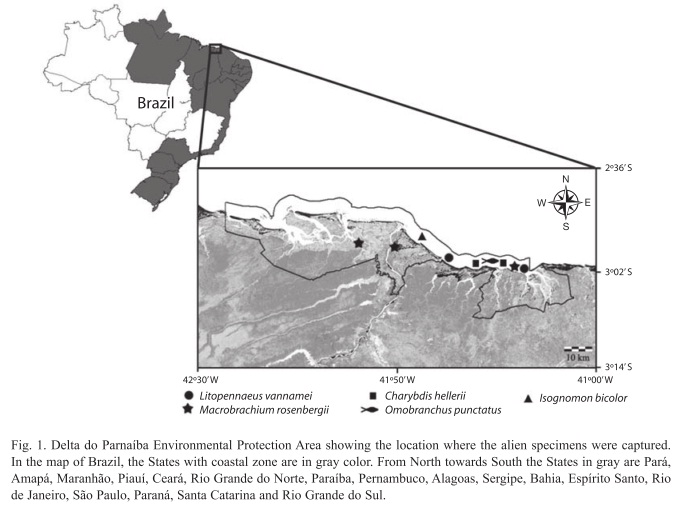
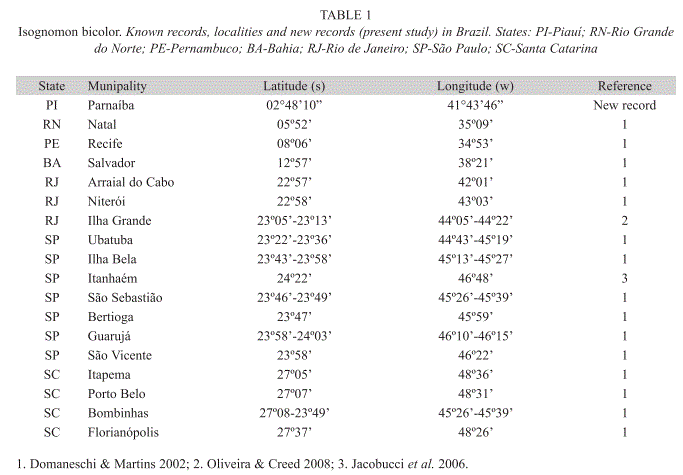
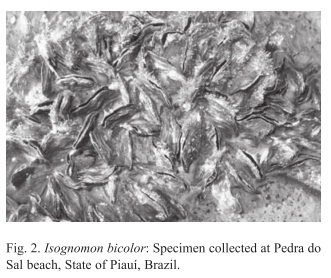
<body><![CDATA[<div style="text-align: justify;"></div>     <p style="text-align: justify;"><font face="Verdana" size="2">The coastal zone of the Delta do Parna&iacute;ba EPA is formed by a complex mosaic of several habitats such as coastal dunes, rocky shores, mangrove forests, estuaries, and sandy beaches. Three estuaries (Parna&iacute;ba River Delta, Camurupim/Cardoso and Timonha/Ubatuba) have important roles in the ecology of the coastal communities due to the release of large amounts of sediments and organic matter, especially in the rainy season. In addition, the Parna&iacute;ba River Delta is considered the third largest oceanic deltaic formation worldwide.</font></p>     <div style="text-align: justify;"><font face="Verdana" size="2"><b> </b></font></div>     <p style="text-align: justify;"><font face="Verdana" size="2"><b>Sampling methods: </b>Specimens of the non-native species were recorded from February 2005 to April 2009 in the municipalities of Parna&iacute;ba, Luis Correia, Cajueiro da Praia (State of Piau&iacute;) and Araioses (State of Maranh&atilde;o). Individuals were obtained by the following methods: (1) <i>S</i>norkeling; this method was performed sporadically on the beaches of Barra Grande (Cajueiro da Praia) and Coqueiro (Luis Correia) during the low tide (ca. 2 hours each dive); (2) Intensive search for unfamiliar individuals on rocky outcrops, which was conducted monthly on the beaches of Cajueiro da Praia and Barra Grande (Cajueiro da Praia), and Coqueiro (Luis Correia) during the low tide (ca. 3 hours each search); and (3) Monitoring the local fisheries (casting nets) during the season fishery of the white shrimp (May to July). Total length of each specimen collected was measured. Voucher specimens were fixed in 10% formalin, preserved in 70% alcohol, and deposited at the Zoological collection of the Natural History Museum of the Universidade Federal da Bahia (UFBA) and the Crustacean collection of the Funda&ccedil;&atilde;o Universidade Federal do Rio Grande (FURG). Collecting permits were authorized by the Brazilian Environmental Protection Agency, the Instituto Brasileiro do Meio Ambiente e dos Recursos Naturais Renov&aacute;veis (IBAMA) (Proc. Number 18027-2).</font></p> <b><font face="Verdana" size="3">     <p>Results</p> </font></b><font face="Verdana" size="2"> </font>     <p style="text-align: justify;"><font face="Verdana" size="2">Five aquatic alien species (one mollusk, three crustaceans and one fish) new to the study area were identified during the period of this study (<a  href="/img/revistas/rbt/v58n3/a09i1.jpg">Fig. 1</a>), i.e. the bicolor purse-oyster <i>Isognomon bicolor </i>(C. B. Adams 1845), the whiteleg shrimp <i>Litopenaeus vannamei </i>(Boone, 1931), the giant river prawn <i>Macrobrachium rosenbergii </i>(De Man, 1879), the Indo-Pacific swimming crab <i>Charybdis hellerii </i>(A. Milne-Edwards, 1867) and, the muzzled blenny <i>Omobranchus punctatus </i>(Valenciennes 1836).</font></p>     <div style="text-align: justify;"><font face="Verdana" size="2"><b> </b></font></div>     <p style="text-align: justify;"><font face="Verdana" size="2"><b>Mollusca, Bivalvia, Isognomonidae: </b><i>Isognomon bicolor. </i>In June 2008, the mats of <i>I. bicolor </i>(<a  href="#fig2">Fig. 2</a>) were identified attached on granite rock shores at the Pedra do Sal beach, municipality of Parna&iacute;ba, State of Piau&iacute; (02&ordm;48&#8217;10" S, 41&ordm;43&#8217;46" W) (<a href="/img/revistas/rbt/v58n3/a09t1.gif">Table 1</a>). Pedra do Sal is the only beach on the coast of Piau&iacute; with granitic rocks permanently exposed. In addition, the beach is typically reflective with high-energy waves acting on the outcrops. The individuals of <i>I. bicolor </i>were found on the same substrates of the native mussels (<i>Mytilus </i>sp.), in small patches (each &lt;2 m<sup>2</sup>) at the same zone of <i>Mytilus </i>sp.    <br> </font></p>     <p><font face="Verdana" size="2">    ]]></body>
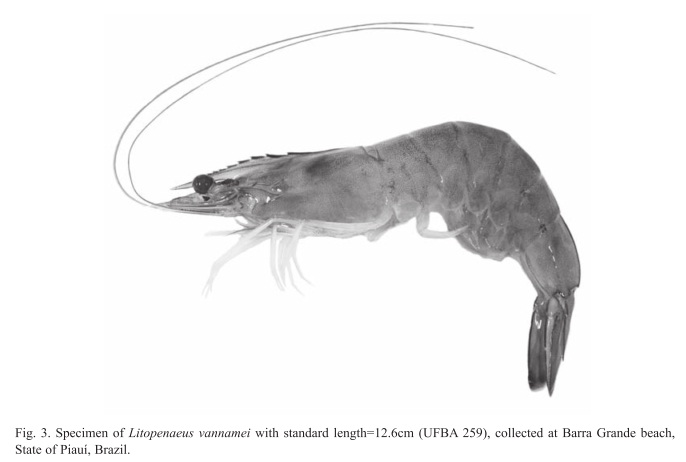
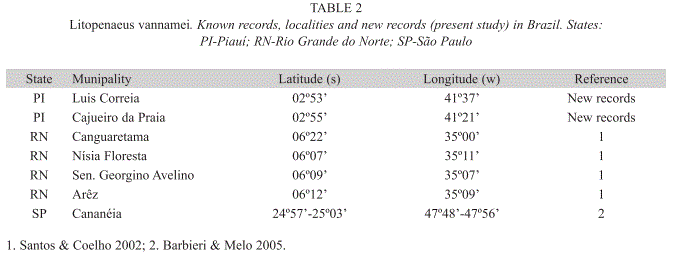
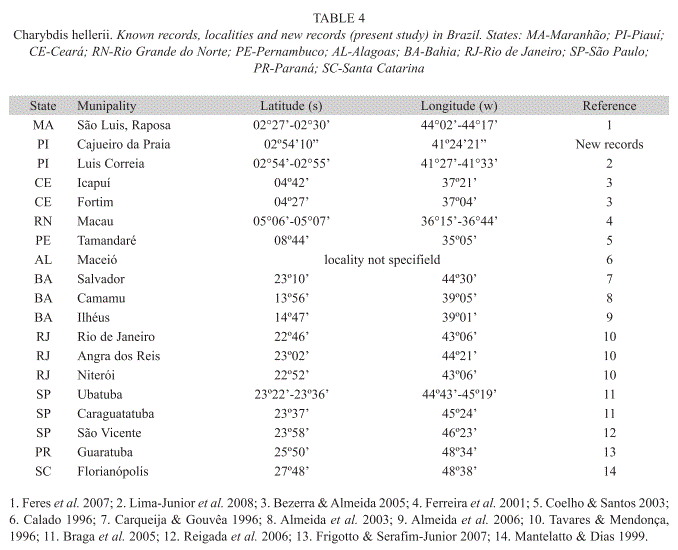
<body><![CDATA[<br> </font></p>     <div style="text-align: center;"><a name="fig2"></a><img  src="/img/revistas/rbt/v58n3/a09i2.jpg" title="" alt=""  style="width: 331px; height: 278px;">    <br>     <br> </div> <font face="Verdana" size="2"><b> </b></font>     <p style="text-align: justify;"><font face="Verdana" size="2"><b>Crustacea, Decapoda, Dendrobranchiata, Peneidae: </b><i>Litopenaeus vannamei. </i>During April and May 2009, four specimens of <i>L. vannamei </i>(<a  href="/img/revistas/rbt/v58n3/a09i3.jpg">Fig. 3</a>) were collected. The individuals were obtained from casting nets of fishermen in the municipalities of Luis Correia (02&deg;53&#8217; S, 41&deg;37&#8217; W) and Cajueiro da Praia (02&deg;55&#8217; S, 41&deg;21&#8217; W) (<a  href="/img/revistas/rbt/v58n3/a09i1.jpg">Fig. 1</a>, <a  href="/img/revistas/rbt/v58n3/a09t2.gif">Table 2</a>). The individuals of <i>L. vannamei </i>were found along with two native shrimp species, the Atlantic seabob <i>Xiphopenaeus kroyeri </i>(C. Heller, 1862) and the Southern white shrimp <i>Litopenaeus schmitti </i>(Burkenroad, 1936). Individuals collected were adults ranging from 10 to 12.6cm standard length.</font></p>     <div style="text-align: justify;"><font face="Verdana" size="2"><b> </b></font></div>     <p style="text-align: justify;"><font face="Verdana" size="2"><b>Crustacea, Decapoda, Pleocyemata, Caridae: </b><i>Macrobrachium rosenbergii. </i>In April 2009 three adult males of <i>M. rosenbergii </i>were detected in Delta do Parna&iacute;ba EPA: one specimen collected by a fisherman using a casting net at Barra Grande Beach, in the municipality of Cajueiro da Praia, State of Piau&iacute; (02&ordm;54&#8217;06" S, 41&ordm;24&#8217;25" W) (<a  href="/img/revistas/rbt/v58n3/a09i4.jpg">Fig. 4</a>) (Voucher number: UFBA 260; 26.8cm standard length), one specimen captured by fishermen in Tatus&#8217; pier harbor (02&deg;49&#8217;56" S, 41&deg;49&#8217;48" W), Ilha Grande de Santa Isabel municipality, Delta do Parna&iacute;ba estuary, and a specimen captured by fishermen in the Carnaubeiras, Araioses municipality, border between the States of Piau&iacute; and Maranh&atilde;o (02&ordm;49&#8217;38" S, 41&ordm;57&#8217;45" W) (<a href="/img/revistas/rbt/v58n3/a09i1.jpg">Fig. 1</a>, <a href="/img/revistas/rbt/v58n3/a09t3.gif">Table 3</a>).</font></p>     <div style="text-align: justify;"><font face="Verdana" size="2"><b> </b></font></div>     <p style="text-align: justify;"><font face="Verdana" size="2"><b>Crustacea, Decapoda, Pleocyemata, Portunidae: </b><i>Charybdis hellerii. </i>Three specimens (two males and one female) were collected in the municipality of Cajueiro da Praia, State of Piau&iacute; (<a  href="/img/revistas/rbt/v58n3/a09i5.jpg">Fig. 5</a>). All specimens were found occupying rock outcrops during the low water (02&ordm;54&#8217;10" S, 41&ordm;24&#8217;21" W) (<a  href="/img/revistas/rbt/v58n3/a09i1.jpg">Fig. 1</a>, <a  href="/img/revistas/rbt/v58n3/a09t4.gif">Table 4</a>). Vouchers specimens were deposited in the Crustacean collection (3208) of the Funda&ccedil;&atilde;o Universidade Federal de Rio Grande.</font></p>     <div style="text-align: justify;"><font face="Verdana" size="2"><b> </b></font></div>     ]]></body>
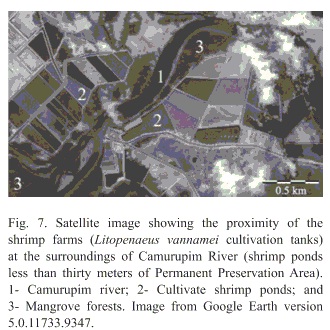
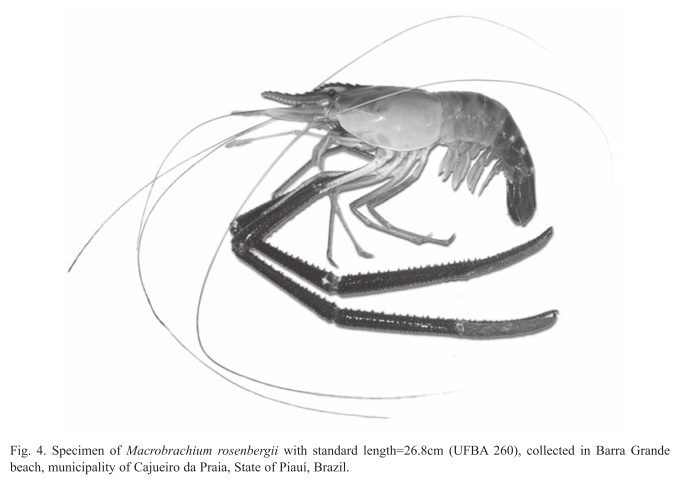
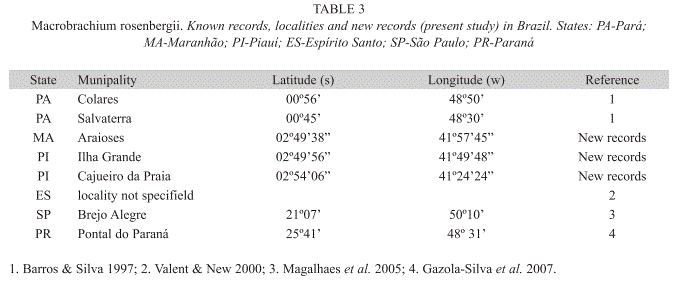
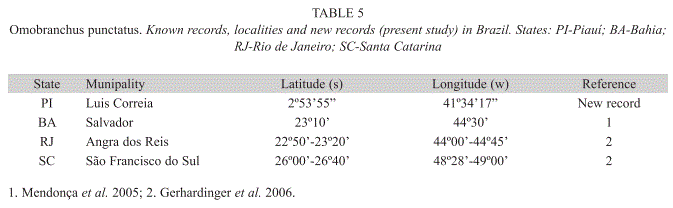
<body><![CDATA[<p style="text-align: justify;"><font face="Verdana" size="2"><b>Chordata, Osteichthyes, Blenniidae: </b><i>Omobranchus punctatus. </i>In December 2008, two specimens of <i>O. punctatus </i>were collected under the rocks in the intertidal zone at Coqueiro beach (02o53&#8217;55" S, 41o34&#8217;17" W) (<a  href="/img/revistas/rbt/v58n3/a09i6.jpg">Fig. 6</a>, <a  href="/img/revistas/rbt/v58n3/a09t5.gif">Table 5</a>), municipality of Luis Correia (<a  href="/img/revistas/rbt/v58n3/a09i1.jpg">Fig. 1</a>). These specimens were deposited in the Bahia Federal University Zoological Collection (UFBA 5268). The specimens collected measured 8.2 and 9.0cm standard length.</font></p>     <p><b><font face="Verdana" size="3">Discussion</font></b></p> <font face="Verdana" size="2"> </font>     <p style="text-align: justify;"><font face="Verdana" size="2">Early detection of invasive species is fundamental to develop management actions to avoid the establishment or to control the spreading of invasive populations. This is particularly important because at early time, measures for contention or eradication are most effective. In the present study, five new occurrences of introduced species, varying from three different phyla, gives an indication of the ecological risks the Delta do Parna&iacute;ba EPA currently faces. Accordingly, some aspects of the biology of these species and considerations about their distribution in the Delta do Parna&iacute;ba EPA are presented, which could form a baseline for monitoring the impacts of these alien species.</font></p>     <div style="text-align: justify;"><font face="Verdana" size="2"><b><i> </i></b></font></div>     <p style="text-align: justify;"><font face="Verdana" size="2"><b><i>Isognomon bicolor: </i></b>According to Ferreira <i>et al. </i>(2009) <i>I. bicolor </i>is one of the most important species introduced to the benthic realm along the Brazilian coast. Originally from the Caribbean region, <i>I. bicolor </i>has been detected in Brazilian waters since 1994 (Domaneschi &amp; Martins 2002), i.e. in the states of Rio Grande do Norte, Pernambuco, Bahia, Rio de Janeiro, S&atilde;o Paulo, and Santa Catarina (Domaneschi &amp; Martins op cit., Jacobucci <i>et al</i>. 2006, Oliveira &amp; Creed 2008) (<a href="/img/revistas/rbt/v58n3/a09t1.gif">Table 1</a>). Ballast water and fouling of commercial vessels are the suggested vectors of introduction (Rocha 2002). Another hypothesis is that <i>I. bicolor </i>could have been introduced into Brazil accidentally on oil or gas platforms from the Caribbean coast (Oliveira &amp; Creed 2008).</font></p>     <div style="text-align: justify;"></div>     <p style="text-align: justify;"><font face="Verdana" size="2">At the moment, the impact of this species on native biota in the region seems to be low. However, the species has dominated the midintertidal rocky shores along the Southeastern coast of Brazil (Magalh&atilde;es 1999, Rapagn&atilde; 2004, Breves-Ramos 2004). For example, L&oacute;pez (2003) estimated that a population of the native barnacle <i>Tetraclita stalactifera </i>reduced ca. 50% since the invasion of <i>I. bicolor </i>in Cabo Frio, State of Rio de Janeiro. Besides the competition and displacement of barnacle populations, <i>I. bicolor </i>probably competes with a commercial species of Mytilidae, <i>Perna perna</i>, a very abundant mussel found in the region (Rapagn&atilde; 2004, Breves-Ramos 2004, Ferreira <i>et al. </i>2009), which is also an exotic species from Africa that reached the Brazilian coast in the 18<sup>th</sup> and 19<sup>th</sup> centuries during the slave trade (Ferreira <i>et al. </i>op cit.).</font></p>     <div style="text-align: justify;"><font face="Verdana" size="2"><b><i> </i></b></font></div>     <p style="text-align: justify;"><font face="Verdana" size="2"><b><i>Litopenaeus vannamei: </i></b>During the rainy season the probability of shrimp escapes increases considerably because the cultivation tanks, especially those near the rivers, cannot always support the excessive rainfalls. <a href="#fig7">Fig. 7</a> shows two shrimp farms installed in the surroundings of Camurupim River where some tanks are within 30m of the river. Consequently, <i>L. vannamei </i>could be accidentally released from overflowed ponds and lakes into the marine areas.    <br> </font></p>     ]]></body>
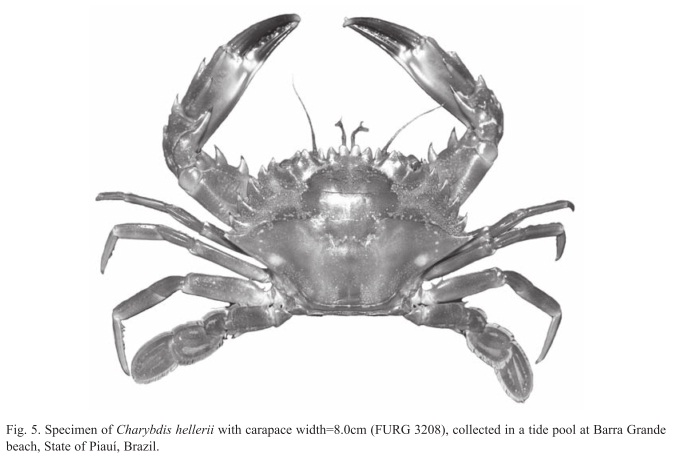
<body><![CDATA[<p><font face="Verdana" size="2">    <br> </font></p>     <div style="text-align: center;"><a name="fig7"></a><img  src="/img/revistas/rbt/v58n3/a09i7.jpg" title="" alt=""  style="width: 330px; height: 330px;">.    <br>     <br> </div>     <p style="text-align: justify;"><font face="Verdana" size="2"><i>Litopenaeus vannamei </i>was imported to Brazil in the 1970&#8217;s for aquaculture purposes. The species was considered the most viable for cultivation compared to native species due to the high adaptability to the varying hydrochemical conditions of the tropical estuaries in Northeast Brazil. At the moment, <i>L. vannamei </i>has been reported in Brazilian estuarine and coastal waters from Rio Grande do Norte (Santos &amp; Coelho 2002) to S&atilde;o Paulo (Barbieri &amp; Melo 2005) (<a  href="/img/revistas/rbt/v58n3/a09t2.gif">Table 2</a>). However, the occurrence of this species in the wild may be larger than documented as it is relatively difficult to distinguish <i>L. vannamei </i>from native penaeid species such as <i>Farfantepenaeus paulensis</i>, <i>Farfantepenaeus brasiliensis </i>and <i>Farfantepenaeus subtilis</i>. To what extent these fugitive specimens of poorly managed shrimp farms will be able to establish self-sustaining populations in the natural environment is still an open question (Ferreira <i>et al. </i>2009).</font></p>     <div style="text-align: justify;"><font face="Verdana" size="2"><b><i> </i></b></font></div>     <p style="text-align: justify;"><font face="Verdana" size="2"><b><i>Macrobrachium rosenbergii: </i></b>The giant river prawn <i>M. rosenbergii </i>is the most cultivated freshwater shrimp in the world. It is native to the Indo-Pacific region (Pakistan, Vietnam, Philippines, New Guinea and Australia) (Chan 1998). <i>Macrobrachium rosenbergii </i>was brought to Brazil in 1977 for experimental cultivation purposes by the Department of Oceanography of the Universidade Federal de Pernambuco (Cavalcanti 1998). The species disseminated quickly to the States of Maranh&atilde;o, Cear&aacute;, Pernambuco, Rio de Janeiro, S&atilde;o Paulo, and Santa Catarina (Barros &amp; Silva 1997, Cavalcanti 1998, Valenti &amp; New 2000).</font></p>     <div style="text-align: justify;"></div>     <p style="text-align: justify;"><font face="Verdana" size="2">Although <i>Macrobrachium rosenbergii </i>lives almost the entire life cycle in fresh water, it is considered an estuarine-depend species since it depends on brackish water to reproduce. According to Ling (1969), the physiological dependence of the larvae to brackish water is an important factor to contribute to the establishment of this species in natural waters. In the Brazilian coast there appears to be no well- established population of <i>M. rosenbergii</i>, however, records of occurrence in the wild has been observed for the States of Esp&iacute;rito Santo (Valenti &amp; New 2000), S&atilde;o Paulo (Magalh&atilde;es <i>et al. </i>2005), Paran&aacute; (Gazola-Silva <i>et al. </i>2007) and Par&aacute; (Barros &amp; Silva 1997) (<a  href="/img/revistas/rbt/v58n3/a09t3.gif">Table 3</a>). The rainy season of 2009 accumulated the highest levels of rain fall since 1974 in coastal zone of Piau&iacute;. Considering that this species is cultivated in aquaculture farms around the City of Teresina (05&deg;05&#8217;21" S, 43&deg;48&#8217;09" W), it is probable that the incidental introduction was made by escapees from these farms.</font></p>     ]]></body>
<body><![CDATA[<div style="text-align: justify;"><font face="Verdana" size="2"><b><i> </i></b></font></div>     <p style="text-align: justify;"><font face="Verdana" size="2"><b><i>Charybdis hellerii: </i></b>The portunid crab <i>Charybdis hellerii </i>is a voracious Indo-Pacific species. The first documented invasion of <i>C. hellerii </i>occurred in Mediterranean Sea after the opening of the Suez Channel in the late 19th century (Galil 1992, Rodriguez &amp; Su&aacute;rez 2001). In Brazil, the species has been reported since 1995 (Tavares &amp; Mendon&ccedil;a 1996) and thus far, the species has been reported from Maranh&atilde;o (North) to Santa Catarina (South) (Carqueija &amp; Gouv&ecirc;a 1996, Calado 1996, Negreiros-Fransozo 1996, Mantelato &amp; Dias 1999; Tavares &amp; Mendon&ccedil;a 1996, Carqueja 2000, Ferreira <i>et al. </i>2001, Almeida <i>et al. </i>2003, Coelho &amp; Santos 2003, Bezerra &amp; Almeida 2005; Braga <i>et al. </i>2005, Almeida <i>et al. </i>2006, Reigada <i>et al</i>. 2006, Feres <i>et al. </i>2007, Frigotto &amp; Serafim-Junior 2007, Coelho <i>et al. </i>2008, Lima-Junior <i>et al. </i>2008) (<a href="/img/revistas/rbt/v58n3/a09t4.gif">Table 4</a>). According to Ferreira <i>et al. </i>(2009) two hypotheses should be considered for the presence of <i>C. hellerii </i>in Brazilian waters. First, the possibility that the species arrived in Brazil as a result of natural dispersion from populations inhabiting the Caribbean Seas since the mid-1980s. Second, the invasion of Brazilian waters through secondary introduction with ballast water.</font></p>     <p style="text-align: justify;"><font face="Verdana" size="2">Furthermore, <i>Charybdis hellerii </i>might have economic impacts to local fisheries as this species may become a competitor of the native portunid crabs (<i>Callinectes </i>spp.) which are commercialized in the region. Although <i>C</i>. <i>hellerii </i>is similar in size with the native portunids, this exotic species has no commercial value (Lima-Junior <i>et al. </i>2008).</font></p>     <div style="text-align: justify;"><font face="Verdana" size="2"><b><i> </i></b></font></div>     <p style="text-align: justify;"><font face="Verdana" size="2"><b><i>Omobranchus punctatus: </i></b>The original distribution of the muzzled blenny <i>O. punctatus </i>was presumed to be the Indo-Pacific region, ranging from Japan and Australia to the Persian Gulf (Golani 2004). In Brazil, the first occurrences were registered in the States of Bahia, Rio de Janeiro and Santa Catarina (Mendon&ccedil;a <i>et al. </i>2005, Gerhardinger <i>et al. </i>2006) (<a href="/img/revistas/rbt/v58n3/a09t5.gif">Table 5</a>).</font></p>     <div style="text-align: justify;"></div>     <p style="text-align: justify;"><font face="Verdana" size="2"><i>Omobranchus punctatus </i>arrived into Brazilian waters by ballast or bilge water, hidden inside the fouling of ships (Gerhardinger <i>et al. </i>2006). However, records presented here may have been an effect of the species dispersion since the maritime transport in the region is restricted to small vessels with limited use of ballast water.</font></p>     <div style="text-align: justify;"><font face="Verdana" size="2"><b> </b></font></div>     <p style="text-align: justify;"><font face="Verdana" size="2"><b>Conservation implications: </b>The introduction of exotic and allochtonous species to local communities and ecosystems has been leading to relevant modifications in the food webs, steady-state populations and changes in the ecosystems functional processes (Rocha <i>et al. </i>2005).</font></p>     <div style="text-align: justify;"></div>     ]]></body>
<body><![CDATA[<p style="text-align: justify;"><font face="Verdana" size="2">Delta do Parna&iacute;ba EPA is clearly vulnerable to aquatic bioinvasions. Two probable sources, aquaculture and shipping, are responsible for the introduction of alien species in the Delta do Parna&iacute;ba EPA. <i>Litopenaeus vannamei </i>and <i>Macrobrachium rosenbergii </i>are species which likely escaped from surrounding aquaculture farms (Santos &amp; Coelho 2002, Barbieri &amp; Melo 2005) and <i>Isognomon bicolor</i>, <i>Charybdis hellerii </i>and <i>Omobranchus punctatus </i>were species likely introduced with ships (Tavares &amp; Mendon&ccedil;a 1996, Gerhardinger <i>et al. </i>2006).</font></p>     <div style="text-align: justify;"></div>     <p style="text-align: justify;"><font face="Verdana" size="2">Environmental impacts associated with the implementation of non-sustainable practices in shrimp farms have been neglected in favor to immediate socio- economic benefits. Mangrove deforestation for the establishment of cultivation tanks, outflow of highly eutrophic effluents into natural water bodies, and the potential dissemination of shrimp virus diseases to native crustacean populations are among the main impacts caused by aquaculture (Boeger <i>et al. </i>2005, Ferreira <i>et al. </i>2009).</font></p>     <div style="text-align: justify;"></div>     <p style="text-align: justify;"><font face="Verdana" size="2">Tavares &amp; Mendon&ccedil;a (2004) have reported the introduction of at least 18 species of exotic decapods in the Brazilian coastline. Five species (28%) have managed to keep reproductively active populations, <i>Charybdis hellerii</i>, <i>Rhithropanopeus harrisi </i>(Gould, 1841), <i>Pyromaia tuberculata </i>(Lockington, 1877), <i>Macrobrachium rosenbergii </i>(De Man, 1879), and <i>Procambarus clarkii </i>(Girard, 1852). Two species have probably reproduced in Brazilian waters, <i>Pilummoides perlatus </i>(Poeppig, 1836) and <i>Penaeus monodon </i>(Fabricius, 1798); and the remaining 11 species (61%) had few individuals recorded in natural environments.</font></p>     <p style="text-align: justify;"><font face="Verdana" size="2">All exotic species recorded in this study have high potential to compete for natural resources against native fauna. <i>Isognomon bicolor </i>share the same habitat and food items with the native species of mussels and barnacles (L&oacute;pez 2003, Fernandes <i>et al. </i>2004). <i>Litopenaeus vannamei </i>share the same habitat and food items with the native penaeids such as the pinkspot shrimp <i>Farfantepenaeus brasiliensis </i>(Latreille, 1817), the Southern brown shrimp <i>Farfantepenaeus subtilis </i>(P&eacute;rez Farfante, 1967), and the Southern white shrimp <i>Litopenaeus schmitti </i>(Burkenroad, 1936). <i>Charybdis hellerii </i>share resources (space and food) on rocky shores with several brachyurans such as the masked swimming crab <i>Callinectes larvatus </i>Ordway, 1863, the Rugose swimming crab <i>Callinectes exasperatus </i>(Gerstaecker, 1856), the Dana swimming crab <i>Callinectes danae</i>, the Cuban stone crab <i>Menippe nodifrons </i>(Stimpson, 1859), and the narrowback mud crab <i>Panopeus americanus </i>Saussure, 1857. <i>Macrobrachium rosenbergii </i>may be sharing natural resources with the Amazon River prawn <i>Macrobrachium amazonicum </i>(Heller, 1862). <i>Omobranchus punctatus </i>shares habit with the native redlip blenny <i>Ophioblennius atlanticus </i>(Valenciennes, 1836) and other fishes, such as the frillfin goby <i>Bathigobius soporator </i>(Valenciennes, 1837).</font></p>     <div style="text-align: justify;"></div>     <p style="text-align: justify;"><font face="Verdana" size="2"><i>Litopenaeus vannamei </i>brought other threats to native crustacean species. In the past few years, almost all farms with cultivated shrimps in the State of Piau&iacute; and adjacent states were suffering from a high incidence of viral epidemics, such as the White spot syndrome (WSS), the Taura Syndrome Virus (TSV), the Infectious Myonecrosis Virus (IMNV) and the Necrotizing Hepatopancreatitis (nhp) (Pantoja &amp; Lightner 2008). These pathogens are highly lethal to cultivated <i>Litopenaeus vannamei </i>(Briggs <i>et al. </i>2005) and could be transmitted to native penaeid shrimp populations (Overstreet <i>et al. </i>1997, Briggs <i>et al. </i>2005). Many species have been reported as susceptible hosts (<i>Penaeus merguiensis </i>De Man, 1888 and <i>Metapenaeus monoceros </i>(Fabricius, 1798), while <i>Palaemon setiferus </i>Olivier, 1811, <i>Euphausia superba </i>Dana, 1852, <i>Metapenaeus dobsoni </i>(Miers, 1878), <i>Parapenaeopsis stylifera </i>(H. Milne Edwards, 1837), <i>Solenocera indica </i>Nataraj, 1945, <i>Squilla mantis </i>L., 1758, <i>Macrobrachium rosenbergii </i>and other crustaceans can act as latent carriers (Flegel <i>et al. </i>1997, Hossain <i>et al. </i>2001).</font></p>     <div style="text-align: justify;"></div>     <p style="text-align: justify;"><font face="Verdana" size="2">The release of non-native organisms is a federal offense according to Brazilian legislation and ballast water/aquaculture in Brazil should be conducted strictly in accordance with specific regulations, control and effective inspections (Alves <i>et al. </i>2007). Some immediate remedial measures to prevent further introductions from ballast water and shrimp farm ponds should be: (i) to prevent the release of ballast water by ship/vessels in the region; (ii) to reroute all effluent waters from shrimp rearing facilities through an underground or above-ground dry well; (iii) to install adequate sand and gravel filter which will allow passage of water but not livestock; (iv) outdoor shrimp pounds located on floodable land should be diked, and; (v) to promote environmental awareness of those directly involved with ballast water (crews of ship/vessels) and shrimp farms in the region.</font></p>     ]]></body>
<body><![CDATA[<p style="text-align: justify;"><font face="Verdana" size="2">Otherwise, the bicolor purse-oyster, the whiteleg shrimp, the giant river prawn, the Indo-Pacific swimming crab, and the muzzled blenny escapes out of most to the vessels and shrimp ponds will negatively change the native diversity scenario in the future.</font></p>     <div style="text-align: justify;"></div>     <p style="text-align: justify;"><font face="Verdana" size="2">In order to understand the real impacts that alien species may cause after introduction to new environments, biological and ecological studies are still necessary. Therefore, the data presented in this study is of notable importance to environmental institutions of the government (Instituto Brasileiro do Meio Ambiente e Recursos Naturais Renov&aacute;veis and Instituto Chico Mendes de Conserva&ccedil;&atilde;o da Biodiversidade) which are the managers of the Delta do Parna&iacute;ba EPA.</font></p>     <p><b><font face="Verdana" size="3">Acknowledgments</font></b></p> <font face="Verdana" size="2"> </font>     <div style="text-align: justify;"><font face="Verdana" size="2">     <p>The authors are grateful to Silmara Erthal (Instituto Chico Mendes de Conserva&ccedil;&atilde;o da Bioversidade) for providing the shapefile of the Delta do Parna&iacute;ba EPA. Claudio Sampaio (Universidade Federal da Bahia) and Cleverson R. M. dos Santos (Museu Paraense Em&iacute;lio Goeldi) for confirming the identifications of some specimens. Maria Cristina Oddone for preparing the spanish abstract of the manuscript. Conselho Nacional de Pesquisa e Desenvolvimento (CNPq) for providing a doctoral scholarship to Daniel Loebmann (grant no. 140226/2006-0).</p> </font></div> <font face="Verdana" size="2"></font><b><font face="Verdana" size="3"> </font></b> <hr style="width: 100%; height: 2px;"><b><font face="Verdana" size="3">     <p>Resumen</p> </font></b><font face="Verdana" size="2"> </font>     <p style="text-align: justify;"><font face="Verdana" size="2">En el &Aacute;rea de Protecci&oacute;n Ambiental del Delta Del R&iacute;o Parna&iacute;ba, noreste de Brasil fueron detectadas cinco especies acu&aacute;ticas invasoras (un molusco, tres crust&aacute;ceos y un pez): la ostra de dos colores <i>Isognomon bicolor</i>, el camar&oacute;n patiblanco <i>Litopenaeus vannamei</i>, el camar&oacute;n gigante de r&iacute;o <i>Macrobrachium rosenbergii</i>, el cangrejo nadador del Indo-Pacifico <i>Charybdis hellerii </i>y el blenio hocicudo <i>Omobranchus punctatus</i>. El agua de lastre (<i>I. bicolor</i>, <i>C. hellerii</i>, y <i>O. punctatus</i>) y la acuicultura (<i>L. vannamei </i>y <i>M. rosenbergii</i>) en &aacute;reas adyacentes son los vectores de introducci&oacute;n m&aacute;s probables. Todas las especies ex&oacute;ticas encontradas son potencialmente riesgosas para el ambiente ya que son aptas para competir con las nativas por recursos como alimento y h&aacute;bitat. <i>Charybdis hellerii </i>tambi&eacute;n podr&iacute;a causar impacto en el recurso pesquero local, al reducir las poblaciones de cangrejos port&uacute;nidos nativos, comercializados en el &aacute;rea de estudio.</font></p> <font face="Verdana" size="2"><b> </b></font>     <p><font face="Verdana" size="2"><b>Palabras clave: </b>especies ex&oacute;ticas, agua de lastre, acuicultura, Mollusca, Decapoda, Blenniidae.</font></p>     <p style="text-align: center;"><font face="Verdana" size="2">Received 20-IX-2009. Corrected 26-II-2010. Accepted 25-III-2010.</font></p> <hr style="width: 100%; height: 2px;">     ]]></body>
<body><![CDATA[<p><b><font face="Verdana" size="3">References</font></b></p> <font face="Verdana" size="2"> </font>     <!-- ref --><p><font face="Verdana" size="2">Almeida, A.O., P.A. Coelho &amp; J.T.A. Santos. 2003. New records of decapod crustaceans (Dendrobranchiata and Brachyura) for the state of Bahia, Brazil. Nauplius 11: 129-133.    &nbsp;&nbsp;&nbsp;&nbsp;&nbsp;&nbsp;&nbsp;&nbsp;[&#160;<a href="javascript:void(0);" onclick="javascript: window.open('/scielo.php?script=sci_nlinks&ref=1389969&pid=S0034-7744201000030000900001&lng=','','width=640,height=500,resizable=yes,scrollbars=1,menubar=yes,');">Links</a>&#160;]<!-- end-ref --></font></p>     <!-- ref --><p><font face="Verdana" size="2">Almeida, A.O., P.A. Coelho, J.T.A. Santos &amp; N.R. Ferraz. 2006 Crust&aacute;ceos dec&aacute;podos estuarinos de Ilh&eacute;us, Bahia, Brasil. Biota Neotrop. 6: 1-24.    &nbsp;&nbsp;&nbsp;&nbsp;&nbsp;&nbsp;&nbsp;&nbsp;[&#160;<a href="javascript:void(0);" onclick="javascript: window.open('/scielo.php?script=sci_nlinks&ref=1389971&pid=S0034-7744201000030000900002&lng=','','width=640,height=500,resizable=yes,scrollbars=1,menubar=yes,');">Links</a>&#160;]<!-- end-ref --></font></p>     <!-- ref --><p><font face="Verdana" size="2">Alves, C.B.M., F. Vieira, A.L.B. Magalh&atilde;es &amp; M.F.G. Brito. 2007. Impacts of non- native fish species in Minas Gerais, Brazil: present situation and propects, p. 291- 314. <i>In </i>T.M. Bert (ed.). Ecological and genetic implications of aquaculture activities. Springer, Dordrecht, Zuid-Holland, Netherland.    &nbsp;&nbsp;&nbsp;&nbsp;&nbsp;&nbsp;&nbsp;&nbsp;[&#160;<a href="javascript:void(0);" onclick="javascript: window.open('/scielo.php?script=sci_nlinks&ref=1389973&pid=S0034-7744201000030000900003&lng=','','width=640,height=500,resizable=yes,scrollbars=1,menubar=yes,');">Links</a>&#160;]<!-- end-ref --></font></p>     <!-- ref --><p><font face="Verdana" size="2">Barbieri, E. &amp; G.A.S. Melo. 2005. Biodiversity: <i>Litopenaeus vannamei </i>(Boone, 1931) exotic species presence in Canan&eacute;ia-Iguape-Ilha Comprida lagoon estuary complex. O Mundo da Sa&uacute;de 30: 654-659.    &nbsp;&nbsp;&nbsp;&nbsp;&nbsp;&nbsp;&nbsp;&nbsp;[&#160;<a href="javascript:void(0);" onclick="javascript: window.open('/scielo.php?script=sci_nlinks&ref=1389975&pid=S0034-7744201000030000900004&lng=','','width=640,height=500,resizable=yes,scrollbars=1,menubar=yes,');">Links</a>&#160;]<!-- end-ref --></font></p>     <!-- ref --><p><font face="Verdana" size="2">Barros, M.P. &amp; L.M.A. Silva. 1997. Registro de introdu&ccedil;&atilde;o da esp&eacute;cie ex&oacute;tica <i>Macrobrachium rosenbergii </i>(De Man, 1879) (Crustacea, Decapoda, Palaemonidae), em &aacute;guas do estado do Par&aacute;, Brasil. <i>B. Mus. Pararaense Em&iacute;lio Goeldi</i>, s&eacute;rie Zoologia 13: 31-37.    &nbsp;&nbsp;&nbsp;&nbsp;&nbsp;&nbsp;&nbsp;&nbsp;[&#160;<a href="javascript:void(0);" onclick="javascript: window.open('/scielo.php?script=sci_nlinks&ref=1389977&pid=S0034-7744201000030000900005&lng=','','width=640,height=500,resizable=yes,scrollbars=1,menubar=yes,');">Links</a>&#160;]<!-- end-ref --></font></p>     <!-- ref --><p><font face="Verdana" size="2">Bezerra, L.E.A. &amp; A.O. Almeida. 2005. Primeiro registro da esp&eacute;cie Indo-Pac&iacute;fica <i>Charybdis hellerii </i>(A. Milne - Edwards, 1867) (Crustacea: Decapoda: Portunidae) para o litoral do Estado do Cear&aacute;. Trop. Oceanog. 33: 33-38.    &nbsp;&nbsp;&nbsp;&nbsp;&nbsp;&nbsp;&nbsp;&nbsp;[&#160;<a href="javascript:void(0);" onclick="javascript: window.open('/scielo.php?script=sci_nlinks&ref=1389979&pid=S0034-7744201000030000900006&lng=','','width=640,height=500,resizable=yes,scrollbars=1,menubar=yes,');">Links</a>&#160;]<!-- end-ref --></font></p>     <!-- ref --><p><font face="Verdana" size="2">Boeger, W.A., M. Pie, A. Ostrensky &amp; L.P. Azambuja. 2005. Identity of the putative agent of the lethargic crab disease (LCD), responsible by massive mortalities of the mangrove crab, <i>Ucides cordatus </i>(Brachyura, Ocypodidae), in Northeastern Brazil. Mem. Inst. Oswaldo Cruz 100: 161-167.    &nbsp;&nbsp;&nbsp;&nbsp;&nbsp;&nbsp;&nbsp;&nbsp;[&#160;<a href="javascript:void(0);" onclick="javascript: window.open('/scielo.php?script=sci_nlinks&ref=1389981&pid=S0034-7744201000030000900007&lng=','','width=640,height=500,resizable=yes,scrollbars=1,menubar=yes,');">Links</a>&#160;]<!-- end-ref --></font></p>     <!-- ref --><p><font face="Verdana" size="2">Braga, A.A., A. Fransozo, G. Bertini &amp; P.B. Fumis. 2005. Composition and abundance of the crabs (Decapoda, Brachyura) off Ubatuba and Caraguatatuba, northern coast of S&atilde;o Paulo, Brazil. Biota Neotrop. 5: 1-34.    &nbsp;&nbsp;&nbsp;&nbsp;&nbsp;&nbsp;&nbsp;&nbsp;[&#160;<a href="javascript:void(0);" onclick="javascript: window.open('/scielo.php?script=sci_nlinks&ref=1389983&pid=S0034-7744201000030000900008&lng=','','width=640,height=500,resizable=yes,scrollbars=1,menubar=yes,');">Links</a>&#160;]<!-- end-ref --></font></p>     <!-- ref --><p><font face="Verdana" size="2">Breves-Ramos A. 2004. Distribui&ccedil;&atilde;o, abund&acirc;ncia e estrutura populacional de <i>Isognomon bicolor </i>(Adams, 1845) no litoral do estado do Rio de Janeiro, Brasil. MSc. Thesis, Universidade Federal do Rio de Janeiro, Rio de Janeiro, Rio de Janeiro, Brazil.    &nbsp;&nbsp;&nbsp;&nbsp;&nbsp;&nbsp;&nbsp;&nbsp;[&#160;<a href="javascript:void(0);" onclick="javascript: window.open('/scielo.php?script=sci_nlinks&ref=1389985&pid=S0034-7744201000030000900009&lng=','','width=640,height=500,resizable=yes,scrollbars=1,menubar=yes,');">Links</a>&#160;]<!-- end-ref --></font></p>     <!-- ref --><p><font face="Verdana" size="2">Briggs, M., S. Funge-Smith, R.P. Subasinghe &amp; M. Phillips. 2005. Introductions and movement of two penaeid shrimp species in Asia and the Pacific. FAO Fisheries Technical Paper, no. 476, Food and Agriculture Organization of the United Nations, Rome, Lazio, Italy.    &nbsp;&nbsp;&nbsp;&nbsp;&nbsp;&nbsp;&nbsp;&nbsp;[&#160;<a href="javascript:void(0);" onclick="javascript: window.open('/scielo.php?script=sci_nlinks&ref=1389987&pid=S0034-7744201000030000900010&lng=','','width=640,height=500,resizable=yes,scrollbars=1,menubar=yes,');">Links</a>&#160;]<!-- end-ref --></font></p>     <!-- ref --><p><font face="Verdana" size="2">Burke, L., Y. Kura, K. Kassem, M. Spalding &amp; C. Revenga. 2000. Pilot Analysis of Global Ecosystems: Coastal Ecosystems Technical Report. World Resources Institute, Washington, Columbia, USA.    &nbsp;&nbsp;&nbsp;&nbsp;&nbsp;&nbsp;&nbsp;&nbsp;[&#160;<a href="javascript:void(0);" onclick="javascript: window.open('/scielo.php?script=sci_nlinks&ref=1389989&pid=S0034-7744201000030000900011&lng=','','width=640,height=500,resizable=yes,scrollbars=1,menubar=yes,');">Links</a>&#160;]<!-- end-ref --></font></p>     <!-- ref --><p><font face="Verdana" size="2">Calado, T.C.S. 1996. Registro de <i>Charybdis hellerii </i>(Milne Edwards, 1867) em &aacute;guas do litoral brasileiro (Decapoda: Portunidae). B. Est. Ci&ecirc;nc. Mar 9: 175-180.    &nbsp;&nbsp;&nbsp;&nbsp;&nbsp;&nbsp;&nbsp;&nbsp;[&#160;<a href="javascript:void(0);" onclick="javascript: window.open('/scielo.php?script=sci_nlinks&ref=1389991&pid=S0034-7744201000030000900012&lng=','','width=640,height=500,resizable=yes,scrollbars=1,menubar=yes,');">Links</a>&#160;]<!-- end-ref --></font></p>     <!-- ref --><p><font face="Verdana" size="2">Carqueija, C.R.G. &amp; E.P. Gouv&ecirc;a. 1996. A ocorr&ecirc;ncia, na costa brasileira, de um Portunidae (Crustacea, Decapoda), origin&aacute;rio do Indo-Pac&iacute;fico e Mediterr&acirc;neo. Nauplius 4: 105-112.    &nbsp;&nbsp;&nbsp;&nbsp;&nbsp;&nbsp;&nbsp;&nbsp;[&#160;<a href="javascript:void(0);" onclick="javascript: window.open('/scielo.php?script=sci_nlinks&ref=1389993&pid=S0034-7744201000030000900013&lng=','','width=640,height=500,resizable=yes,scrollbars=1,menubar=yes,');">Links</a>&#160;]<!-- end-ref --> </font></p>     <!-- ref --><p><font face="Verdana" size="2">Cavalcanti, L.B. 1998. Hist&oacute;rico, p. 17-20. <i>In </i>W.C. Valenti (ed.). Carcinocultura de &Aacute;gua Doce. Tecnologia para Produ&ccedil;&atilde;o de Camar&otilde;es. IBAMA/FAPESP, Bras&iacute;lia, Distrito Federal, Brazil.    &nbsp;&nbsp;&nbsp;&nbsp;&nbsp;&nbsp;&nbsp;&nbsp;[&#160;<a href="javascript:void(0);" onclick="javascript: window.open('/scielo.php?script=sci_nlinks&ref=1389995&pid=S0034-7744201000030000900014&lng=','','width=640,height=500,resizable=yes,scrollbars=1,menubar=yes,');">Links</a>&#160;]<!-- end-ref --></font></p>     <!-- ref --><p><font face="Verdana" size="2">Chan, T.Y. 1998. Shrimps and prawns, p. 851-966. <i>In </i>K.E. Carpenter &amp; V.H. Niem (eds.). FAO species identification guide for fishery purposes. The living marine resources of the Western Central Pacific. Volume 2. Cephalopods, crustaceans, holoturians and sharks. Food and Agriculture Organization of the United Nations, Rome, Lazio, Italy.    &nbsp;&nbsp;&nbsp;&nbsp;&nbsp;&nbsp;&nbsp;&nbsp;[&#160;<a href="javascript:void(0);" onclick="javascript: window.open('/scielo.php?script=sci_nlinks&ref=1389997&pid=S0034-7744201000030000900015&lng=','','width=640,height=500,resizable=yes,scrollbars=1,menubar=yes,');">Links</a>&#160;]<!-- end-ref --> </font></p>     <!-- ref --><p><font face="Verdana" size="2">Coelho, P.A., A.O. De Almeida &amp; L.E.A. Bezerra. 2008. Checklist of the marine and estuarine Brachyura (Crustacea: Decapoda) of Northern and Northeastern Brazil. Zootaxa 1956: 1-58.    &nbsp;&nbsp;&nbsp;&nbsp;&nbsp;&nbsp;&nbsp;&nbsp;[&#160;<a href="javascript:void(0);" onclick="javascript: window.open('/scielo.php?script=sci_nlinks&ref=1389999&pid=S0034-7744201000030000900016&lng=','','width=640,height=500,resizable=yes,scrollbars=1,menubar=yes,');">Links</a>&#160;]<!-- end-ref --></font></p>     <!-- ref --><p><font face="Verdana" size="2">Coelho, P.A. &amp; M.C.F. Santos. 2003. Ocorr&ecirc;ncia de <i>Charybdis hellerii </i>(Milne Edwards, 1867) (Crustacea, Decapoda, Portunidae) no litoral de Pernambuco. Bol. T&eacute;c. Cient. CEPENE 11: 167-173.    &nbsp;&nbsp;&nbsp;&nbsp;&nbsp;&nbsp;&nbsp;&nbsp;[&#160;<a href="javascript:void(0);" onclick="javascript: window.open('/scielo.php?script=sci_nlinks&ref=1390001&pid=S0034-7744201000030000900017&lng=','','width=640,height=500,resizable=yes,scrollbars=1,menubar=yes,');">Links</a>&#160;]<!-- end-ref --></font></p>     <!-- ref --><p><font face="Verdana" size="2">Crawley, M.J. 1986. The population biology of invaders. Phil. Trans. R. Soc. B. 314: 711-731.    &nbsp;&nbsp;&nbsp;&nbsp;&nbsp;&nbsp;&nbsp;&nbsp;[&#160;<a href="javascript:void(0);" onclick="javascript: window.open('/scielo.php?script=sci_nlinks&ref=1390003&pid=S0034-7744201000030000900018&lng=','','width=640,height=500,resizable=yes,scrollbars=1,menubar=yes,');">Links</a>&#160;]<!-- end-ref --></font></p>     <!-- ref --><p><font face="Verdana" size="2">Crooks, J. &amp; M.E. Soul&eacute;. 1996. Lag times in population explosions of invasive species: Causes and implications, p. 103-125. <i>In </i>O.T. Sandlund, P.J. Schei &amp; &Aring;. Viken. The Trondheim Conferences on Biodiversity. Invasive Species and Biodiversity Management. Kluwer Academic, Trondheim, S&oslash;r-Tr&oslash;ndelag, Norway.    &nbsp;&nbsp;&nbsp;&nbsp;&nbsp;&nbsp;&nbsp;&nbsp;[&#160;<a href="javascript:void(0);" onclick="javascript: window.open('/scielo.php?script=sci_nlinks&ref=1390005&pid=S0034-7744201000030000900019&lng=','','width=640,height=500,resizable=yes,scrollbars=1,menubar=yes,');">Links</a>&#160;]<!-- end-ref --></font></p>     <!-- ref --><p><font face="Verdana" size="2">Davies, J.L. 1964. A morphogenic approach to world&#8217;s shorelines. <i>Zeits Fur </i>Geomorph. 8: 127-142.    &nbsp;&nbsp;&nbsp;&nbsp;&nbsp;&nbsp;&nbsp;&nbsp;[&#160;<a href="javascript:void(0);" onclick="javascript: window.open('/scielo.php?script=sci_nlinks&ref=1390007&pid=S0034-7744201000030000900020&lng=','','width=640,height=500,resizable=yes,scrollbars=1,menubar=yes,');">Links</a>&#160;]<!-- end-ref --></font></p>     <!-- ref --><p><font face="Verdana" size="2">Domaneschi, C. &amp; C.M. Martins. 2002. <i>Isognomon bicolor </i>(C.B. Adams) (Bivalvia, Isognomonidae): primeiro registro para o Brasil, redescri&ccedil;&atilde;o da esp&eacute;cie e considera&ccedil;&otilde;es sobre a ocorr&ecirc;ncia e distribui&ccedil;&atilde;o de <i>Isognomon </i>na costa brasileira. Rev. Bras. Zool. 19: 601-610.    &nbsp;&nbsp;&nbsp;&nbsp;&nbsp;&nbsp;&nbsp;&nbsp;[&#160;<a href="javascript:void(0);" onclick="javascript: window.open('/scielo.php?script=sci_nlinks&ref=1390009&pid=S0034-7744201000030000900021&lng=','','width=640,height=500,resizable=yes,scrollbars=1,menubar=yes,');">Links</a>&#160;]<!-- end-ref --></font></p>     <!-- ref --><p><font face="Verdana" size="2">Feres, S.J.C., A.T.L. Lopes &amp; L.A. Santos. 2007. Primeiro registro de <i>Charybdis hellerii </i>(Milne Edwards, 1867) para o litoral Maranhense-Brasil (Crustacea, Decapoda, Portunidae). Bol. Lab. Hidrobiol. 20: 77-82.    &nbsp;&nbsp;&nbsp;&nbsp;&nbsp;&nbsp;&nbsp;&nbsp;[&#160;<a href="javascript:void(0);" onclick="javascript: window.open('/scielo.php?script=sci_nlinks&ref=1390011&pid=S0034-7744201000030000900022&lng=','','width=640,height=500,resizable=yes,scrollbars=1,menubar=yes,');">Links</a>&#160;]<!-- end-ref --></font></p>     <!-- ref --><p><font face="Verdana" size="2">Fernandes, F.C., L.C. Rapagan&atilde; &amp; G.B.D. Bueno. 2004. Estudo da popula&ccedil;&atilde;o do bivalve ex&oacute;tico <i>Isognomon bicolor </i>(C. B. Adams 1845) (Bivalvia, Isonomonidae) na Ponta da Fortaleza em Arraial do Cabo-RJ, p. 134-141. <i>In </i>J. Silva &amp; R. Souza (eds.). &Aacute;gua de Lastro e Bioinvas&atilde;o. Interci&ecirc;ncia, Rio de Janeiro, Brazil.    &nbsp;&nbsp;&nbsp;&nbsp;&nbsp;&nbsp;&nbsp;&nbsp;[&#160;<a href="javascript:void(0);" onclick="javascript: window.open('/scielo.php?script=sci_nlinks&ref=1390013&pid=S0034-7744201000030000900023&lng=','','width=640,height=500,resizable=yes,scrollbars=1,menubar=yes,');">Links</a>&#160;]<!-- end-ref --></font></p>     <!-- ref --><p><font face="Verdana" size="2">Ferreira, C.E.L., A.O.R. Junqueira, M.C. Villac &amp; R.M. Lopes. 2009. Marine Bioinvasions in the Brazilian Coast: brief report on history of events, vectors, ecology, impacts and management of non indigenous species, p. 459-478. <i>In </i>G. Rilov &amp; J.A. Crooks. Biological invasions of marine ecosystems: ecological, management, and geographic perspectives. Springer- Verlag, Berlin, Brandenburg, Germany.    &nbsp;&nbsp;&nbsp;&nbsp;&nbsp;&nbsp;&nbsp;&nbsp;[&#160;<a href="javascript:void(0);" onclick="javascript: window.open('/scielo.php?script=sci_nlinks&ref=1390015&pid=S0034-7744201000030000900024&lng=','','width=640,height=500,resizable=yes,scrollbars=1,menubar=yes,');">Links</a>&#160;]<!-- end-ref --></font></p>     <!-- ref --><p><font face="Verdana" size="2">Ferreira, A.C., C. Sankarankutty, I.M.C. Cunha &amp; F.T. Duarte. 2001 Yet another record of <i>Charybdis helleri </i>(A.Milne Edwards) (Crustacea, Decapoda) from the Northeast of Brazil. Rev. Bras. de Zool. 18: 357- 358.    &nbsp;&nbsp;&nbsp;&nbsp;&nbsp;&nbsp;&nbsp;&nbsp;[&#160;<a href="javascript:void(0);" onclick="javascript: window.open('/scielo.php?script=sci_nlinks&ref=1390017&pid=S0034-7744201000030000900025&lng=','','width=640,height=500,resizable=yes,scrollbars=1,menubar=yes,');">Links</a>&#160;]<!-- end-ref --></font></p>     <!-- ref --><p><font face="Verdana" size="2">Flegel, T.W., S. Boonyaratpalin &amp; B. Withyachumnarnkul. 1997. Progress in research on yellow-head virus and white-spot virus in Thailand, p. 285-295. <i>In </i>T.W. Flegel &amp; I.H. MacRae (eds.). Diseases in Asian Aquaculture III. Fish Health Section. Asian Fisheries Society, Manila, Metro Manila, Philippines.    &nbsp;&nbsp;&nbsp;&nbsp;&nbsp;&nbsp;&nbsp;&nbsp;[&#160;<a href="javascript:void(0);" onclick="javascript: window.open('/scielo.php?script=sci_nlinks&ref=1390019&pid=S0034-7744201000030000900026&lng=','','width=640,height=500,resizable=yes,scrollbars=1,menubar=yes,');">Links</a>&#160;]<!-- end-ref --></font></p>     <!-- ref --><p><font face="Verdana" size="2">Frigotto, S.F. &amp; M. Serafim-Junior. 2007. Primeiro registro de <i>Charybdis hellerii </i>(Milne Edwards, 1867) (Crustacea) no litoral do estado do Paran&aacute;. Est. Biol. 29: 227-230.    &nbsp;&nbsp;&nbsp;&nbsp;&nbsp;&nbsp;&nbsp;&nbsp;[&#160;<a href="javascript:void(0);" onclick="javascript: window.open('/scielo.php?script=sci_nlinks&ref=1390021&pid=S0034-7744201000030000900027&lng=','','width=640,height=500,resizable=yes,scrollbars=1,menubar=yes,');">Links</a>&#160;]<!-- end-ref --></font></p>     <!-- ref --><p><font face="Verdana" size="2">Galil, B. 1992. Eritrean decapods in the Levant. Biogeography in motion. B. l&#8217;Instit. Oc&eacute;anogr. 9: 115-123.    &nbsp;&nbsp;&nbsp;&nbsp;&nbsp;&nbsp;&nbsp;&nbsp;[&#160;<a href="javascript:void(0);" onclick="javascript: window.open('/scielo.php?script=sci_nlinks&ref=1390023&pid=S0034-7744201000030000900028&lng=','','width=640,height=500,resizable=yes,scrollbars=1,menubar=yes,');">Links</a>&#160;]<!-- end-ref --></font></p>     <!-- ref --><p><font face="Verdana" size="2">Gazola-Silva, F.F., S.G. Melo &amp; J.R.S. Vitule. 2007. <i>Macrobrachium rosenbergii </i>(Decapoda: Palaemonidae): possible introduction in a costal river of Paran&aacute; (Brazil). Acta Biol. Parana 36: 83-90.    &nbsp;&nbsp;&nbsp;&nbsp;&nbsp;&nbsp;&nbsp;&nbsp;[&#160;<a href="javascript:void(0);" onclick="javascript: window.open('/scielo.php?script=sci_nlinks&ref=1390025&pid=S0034-7744201000030000900029&lng=','','width=640,height=500,resizable=yes,scrollbars=1,menubar=yes,');">Links</a>&#160;]<!-- end-ref --></font></p>     <!-- ref --><p><font face="Verdana" size="2">Gerhardinger, L.C., M.O. Freitas, A.B. Andrade &amp; C.A. Rangel. 2006. <i>Omobranchus punctatus </i>(Teleostei: Blenniidae), an exotic blenny in the Southwestern Atlantic. Biol. Inv. 8: 941-946.    &nbsp;&nbsp;&nbsp;&nbsp;&nbsp;&nbsp;&nbsp;&nbsp;[&#160;<a href="javascript:void(0);" onclick="javascript: window.open('/scielo.php?script=sci_nlinks&ref=1390027&pid=S0034-7744201000030000900030&lng=','','width=640,height=500,resizable=yes,scrollbars=1,menubar=yes,');">Links</a>&#160;]<!-- end-ref --></font></p>     <!-- ref --><p><font face="Verdana" size="2">Golani, D. 2004. First record of the muzzled blenny (Osteichthyes: Blenniidae: <i>Omobranchus punctatus</i>) from the Mediterranean, with remarks on ship-mediated fish introduction. J. Mar. Biol. Ass. U.K. 84: 851- 852.    &nbsp;&nbsp;&nbsp;&nbsp;&nbsp;&nbsp;&nbsp;&nbsp;[&#160;<a href="javascript:void(0);" onclick="javascript: window.open('/scielo.php?script=sci_nlinks&ref=1390029&pid=S0034-7744201000030000900031&lng=','','width=640,height=500,resizable=yes,scrollbars=1,menubar=yes,');">Links</a>&#160;]<!-- end-ref --></font></p>     <!-- ref --><p><font face="Verdana" size="2">Gurevitch, J. &amp; D.K. Padilla. 2004. Are invasive species a major cause of extinctions? Trend. Ecol. Evol. 19: 470-474.    &nbsp;&nbsp;&nbsp;&nbsp;&nbsp;&nbsp;&nbsp;&nbsp;[&#160;<a href="javascript:void(0);" onclick="javascript: window.open('/scielo.php?script=sci_nlinks&ref=1390031&pid=S0034-7744201000030000900032&lng=','','width=640,height=500,resizable=yes,scrollbars=1,menubar=yes,');">Links</a>&#160;]<!-- end-ref --></font></p>     <!-- ref --><p><font face="Verdana" size="2">Hossain, M.D.S., A. Chakraborty, B. Joseph, S.K. Otta &amp; I. Karunasagar. 2001. Detection of new hosts for white spot syndrome virus using nested polymerase chain reaction. Aquaculture 198: 1-11.    &nbsp;&nbsp;&nbsp;&nbsp;&nbsp;&nbsp;&nbsp;&nbsp;[&#160;<a href="javascript:void(0);" onclick="javascript: window.open('/scielo.php?script=sci_nlinks&ref=1390033&pid=S0034-7744201000030000900033&lng=','','width=640,height=500,resizable=yes,scrollbars=1,menubar=yes,');">Links</a>&#160;]<!-- end-ref --></font></p>     <!-- ref --><p><font face="Verdana" size="2">Jacobucci, G.B., A.Z. G&uuml;th, A. Turra, C.A. Magalh&atilde;es, M.R. Denadai, A.M.R. Chaves &amp; E.C.F. Souza. 2006. Levantamento da macrofauna associada a <i>Sargassum </i>spp. na ilha da Queimada Pequena, Esta&ccedil;&atilde;o Ecol&oacute;gica dos Tupiniquins, litoral sul do Estado de S&atilde;o Paulo, Brasil. Biota Neotrop. 6: 1-8.    &nbsp;&nbsp;&nbsp;&nbsp;&nbsp;&nbsp;&nbsp;&nbsp;[&#160;<a href="javascript:void(0);" onclick="javascript: window.open('/scielo.php?script=sci_nlinks&ref=1390035&pid=S0034-7744201000030000900034&lng=','','width=640,height=500,resizable=yes,scrollbars=1,menubar=yes,');">Links</a>&#160;]<!-- end-ref --></font></p>     <!-- ref --><p><font face="Verdana" size="2">Kolar, C.S. &amp; D.M. Lodge. 2001. Progress in invasion biology: predicting invaders. Trend. Ecol. Evol. 16: 199-204.    &nbsp;&nbsp;&nbsp;&nbsp;&nbsp;&nbsp;&nbsp;&nbsp;[&#160;<a href="javascript:void(0);" onclick="javascript: window.open('/scielo.php?script=sci_nlinks&ref=1390037&pid=S0034-7744201000030000900035&lng=','','width=640,height=500,resizable=yes,scrollbars=1,menubar=yes,');">Links</a>&#160;]<!-- end-ref --></font></p>     <!-- ref --><p><font face="Verdana" size="2">Kottek, M., J. Grieser, C. Beck, B. Rudolf &amp; F. Rubel. 2006. World Map of the K&ouml;ppen-Geiger climate classification updated. Meteorol. Z. 15: 259-263.    &nbsp;&nbsp;&nbsp;&nbsp;&nbsp;&nbsp;&nbsp;&nbsp;[&#160;<a href="javascript:void(0);" onclick="javascript: window.open('/scielo.php?script=sci_nlinks&ref=1390039&pid=S0034-7744201000030000900036&lng=','','width=640,height=500,resizable=yes,scrollbars=1,menubar=yes,');">Links</a>&#160;]<!-- end-ref --></font></p>     <!-- ref --><p><font face="Verdana" size="2">Lima-Junior, T.B., M.I.C. Arag&atilde;o, J.P. Silva, G.A.S. Melo &amp; J.R.S.A. Leite. 2008. Occurrence of two Indo- Pacific species of Brachyura on the coast of Piau&iacute;, Brazil. Bol. Lab. Hidrob. 21: 35-40.    &nbsp;&nbsp;&nbsp;&nbsp;&nbsp;&nbsp;&nbsp;&nbsp;[&#160;<a href="javascript:void(0);" onclick="javascript: window.open('/scielo.php?script=sci_nlinks&ref=1390041&pid=S0034-7744201000030000900037&lng=','','width=640,height=500,resizable=yes,scrollbars=1,menubar=yes,');">Links</a>&#160;]<!-- end-ref --></font></p>     <!-- ref --><p><font face="Verdana" size="2">Ling, S.W. 1969. The general biology and development of <i>Macrobrachium rosenbergii </i>(De Man). FAO Fish. Rep. 57: 589-606.    &nbsp;&nbsp;&nbsp;&nbsp;&nbsp;&nbsp;&nbsp;&nbsp;[&#160;<a href="javascript:void(0);" onclick="javascript: window.open('/scielo.php?script=sci_nlinks&ref=1390043&pid=S0034-7744201000030000900038&lng=','','width=640,height=500,resizable=yes,scrollbars=1,menubar=yes,');">Links</a>&#160;]<!-- end-ref --></font></p>     <!-- ref --><p><font face="Verdana" size="2">L&oacute;pez, M.S. 2003. Efecto de la potencial presa ex&oacute;tica <i>Isognomon bicolor </i>(Adams, 1845) sobre la ecolog&iacute;a tr&oacute;fica de <i>Stramonita haemastoma </i>(Kool, 1987) en el intermareal rocoso de Arraial do Cabo, RJ, Brasil. M.Sc. Thesis, Universidad Internacional de Andaluc&iacute;a, C&oacute;rdoba, Spain.    &nbsp;&nbsp;&nbsp;&nbsp;&nbsp;&nbsp;&nbsp;&nbsp;[&#160;<a href="javascript:void(0);" onclick="javascript: window.open('/scielo.php?script=sci_nlinks&ref=1390045&pid=S0034-7744201000030000900039&lng=','','width=640,height=500,resizable=yes,scrollbars=1,menubar=yes,');">Links</a>&#160;]<!-- end-ref --></font></p>     <!-- ref --><p><font face="Verdana" size="2">Lockwood, J.L. &amp; M.L. McKinney. 2001. Biotic homogenization. Kluwer, Dordrecht, Zuid-Holland, Netherland.    &nbsp;&nbsp;&nbsp;&nbsp;&nbsp;&nbsp;&nbsp;&nbsp;[&#160;<a href="javascript:void(0);" onclick="javascript: window.open('/scielo.php?script=sci_nlinks&ref=1390047&pid=S0034-7744201000030000900040&lng=','','width=640,height=500,resizable=yes,scrollbars=1,menubar=yes,');">Links</a>&#160;]<!-- end-ref --></font></p>     <!-- ref --><p><font face="Verdana" size="2">Magalh&atilde;es, C.A. 1999. Partilha de recursos em guilda de gastr&oacute;podes predadores em cost&otilde;es de S&atilde;o Sebasti&atilde;o, SP. Ph.D. Thesis, Universidade Estadual de Campinas, Campinas, S&atilde;o Paulo, Brazil.    &nbsp;&nbsp;&nbsp;&nbsp;&nbsp;&nbsp;&nbsp;&nbsp;[&#160;<a href="javascript:void(0);" onclick="javascript: window.open('/scielo.php?script=sci_nlinks&ref=1390049&pid=S0034-7744201000030000900041&lng=','','width=640,height=500,resizable=yes,scrollbars=1,menubar=yes,');">Links</a>&#160;]<!-- end-ref --></font></p>     <!-- ref --><p><font face="Verdana" size="2">Magalh&atilde;es, C., S.L.S. Bueno, G. Bond-Bunkup, W.C. Valenti, H.L.M. Silva, F. Kiyohara, E.C. Mossolin &amp; S.S. Rocha. 2005. Exotic species of freshwater decapod crustaceans in the state of S&atilde;o Paulo, Brazil: records and possible causes of their introduction. Biodiv. Conserv. 14: 1929-1945.    &nbsp;&nbsp;&nbsp;&nbsp;&nbsp;&nbsp;&nbsp;&nbsp;[&#160;<a href="javascript:void(0);" onclick="javascript: window.open('/scielo.php?script=sci_nlinks&ref=1390051&pid=S0034-7744201000030000900042&lng=','','width=640,height=500,resizable=yes,scrollbars=1,menubar=yes,');">Links</a>&#160;]<!-- end-ref --></font></p>     <!-- ref --><p><font face="Verdana" size="2">Mantelatto, F.L.M. &amp; Dias, L.L. 1999. Extension of the known distribution of <i>Charybdis hellerii </i>(A. Milne- Edwards, 1867) (Decapoda, Portunidae) along the western tropical South Atlantic. Crustaceana 72: 617-620.    &nbsp;&nbsp;&nbsp;&nbsp;&nbsp;&nbsp;&nbsp;&nbsp;[&#160;<a href="javascript:void(0);" onclick="javascript: window.open('/scielo.php?script=sci_nlinks&ref=1390053&pid=S0034-7744201000030000900043&lng=','','width=640,height=500,resizable=yes,scrollbars=1,menubar=yes,');">Links</a>&#160;]<!-- end-ref --></font></p>     <!-- ref --><p><font face="Verdana" size="2">Minchin, D., S. Gollasch, A.N. Cohen, C.L. Hewitt &amp; S. Olenin. 2009. Characterizing vectors of marine invasion, p. 109-116. <i>In </i>G. Rilov, J.A. Crooks &amp; A. Jeffrey (eds.). Biological invasions in marine ecosystems ecological, management, and Geographic perspectives. Spring-Verlag, Berlin, Brandenburg, Germany.    &nbsp;&nbsp;&nbsp;&nbsp;&nbsp;&nbsp;&nbsp;&nbsp;[&#160;<a href="javascript:void(0);" onclick="javascript: window.open('/scielo.php?script=sci_nlinks&ref=1390055&pid=S0034-7744201000030000900044&lng=','','width=640,height=500,resizable=yes,scrollbars=1,menubar=yes,');">Links</a>&#160;]<!-- end-ref --></font></p>     <!-- ref --><p><font face="Verdana" size="2">Molnar, J.L., R.L. Gamboa, C. Revenga &amp; M.D. Spalding. 2008. Assessing the global threat of invasive species to marine biodiversity. Front Ecol. Environ. 6: 485- 492.    &nbsp;&nbsp;&nbsp;&nbsp;&nbsp;&nbsp;&nbsp;&nbsp;[&#160;<a href="javascript:void(0);" onclick="javascript: window.open('/scielo.php?script=sci_nlinks&ref=1390057&pid=S0034-7744201000030000900045&lng=','','width=640,height=500,resizable=yes,scrollbars=1,menubar=yes,');">Links</a>&#160;]<!-- end-ref --></font></p>     <!-- ref --><p><font face="Verdana" size="2">Negreiros-Fran&ccedil;ozo, M.L. 1996. The zoea I of <i>Charybdis hellerii </i>(A. Milne-Edwards, 1867) (Decapoda, Portunidae) obtained in laboratory. Nauplius 4: 165-168.    &nbsp;&nbsp;&nbsp;&nbsp;&nbsp;&nbsp;&nbsp;&nbsp;[&#160;<a href="javascript:void(0);" onclick="javascript: window.open('/scielo.php?script=sci_nlinks&ref=1390059&pid=S0034-7744201000030000900046&lng=','','width=640,height=500,resizable=yes,scrollbars=1,menubar=yes,');">Links</a>&#160;]<!-- end-ref --></font></p>     <!-- ref --><p><font face="Verdana" size="2">Oliveira, A.E.S. &amp; J.C. Creed. 2008. Mollusca, Bivalvia, <i>Isognomon bicolor </i>(C. B. Adams 1845): Distribution extension. Check List 4: 386-388.    &nbsp;&nbsp;&nbsp;&nbsp;&nbsp;&nbsp;&nbsp;&nbsp;[&#160;<a href="javascript:void(0);" onclick="javascript: window.open('/scielo.php?script=sci_nlinks&ref=1390061&pid=S0034-7744201000030000900047&lng=','','width=640,height=500,resizable=yes,scrollbars=1,menubar=yes,');">Links</a>&#160;]<!-- end-ref --></font></p>     <!-- ref --><p><font face="Verdana" size="2">Overstreet, R.M., D.V. Lightner, K. Hasson, S. McIlwain &amp; J.M. Lotz. 1997. Susceptibility to Taura Syndrome Virus of some penaeid shrimp species native to the Gulf of M&eacute;xico and the Southeastern United States. J. Invert. Pathology 69: 165-176.    &nbsp;&nbsp;&nbsp;&nbsp;&nbsp;&nbsp;&nbsp;&nbsp;[&#160;<a href="javascript:void(0);" onclick="javascript: window.open('/scielo.php?script=sci_nlinks&ref=1390063&pid=S0034-7744201000030000900048&lng=','','width=640,height=500,resizable=yes,scrollbars=1,menubar=yes,');">Links</a>&#160;]<!-- end-ref --></font></p>     <!-- ref --><p><font face="Verdana" size="2">Pantoja, C.R. &amp; D.V. Lightner. 2008. Enfermedades virales, p. 55-116. <i>In </i>V.Q. Morales &amp; J. Cu&eacute;llar-Anjel (eds.). Gu&iacute;a t&eacute;cnica: Patolog&iacute;a e inmunolog&iacute;a de camarones pendidos. Programa CYTED Red II-D Vannamei, Panama City, Panama.    &nbsp;&nbsp;&nbsp;&nbsp;&nbsp;&nbsp;&nbsp;&nbsp;[&#160;<a href="javascript:void(0);" onclick="javascript: window.open('/scielo.php?script=sci_nlinks&ref=1390065&pid=S0034-7744201000030000900049&lng=','','width=640,height=500,resizable=yes,scrollbars=1,menubar=yes,');">Links</a>&#160;]<!-- end-ref --> </font></p>     <!-- ref --><p><font face="Verdana" size="2">Parker, I.M., D. Simberloff, W.M. Lonsdale, K. Goodell, M. Wonham, P.M. Kareiva, M.H. Williamson, B. Von Holle, P.B. Moyle, J.E. Byers &amp; L. Goldwasser. 1999. Impact: Toward a framework for understanding the ecological effects of invaders. Biol. Invas. 1: 3-19.    &nbsp;&nbsp;&nbsp;&nbsp;&nbsp;&nbsp;&nbsp;&nbsp;[&#160;<a href="javascript:void(0);" onclick="javascript: window.open('/scielo.php?script=sci_nlinks&ref=1390067&pid=S0034-7744201000030000900050&lng=','','width=640,height=500,resizable=yes,scrollbars=1,menubar=yes,');">Links</a>&#160;]<!-- end-ref --></font></p>     <!-- ref --><p><font face="Verdana" size="2">Reigada, A.L.D., B.S. Sant&#8217;anna, C.M. Zangrande &amp; R.C. Costa. 2006. Macrocrustaceans of non-consolidated sublittoral of the S&atilde;o Vicente Estuarine Bay Complex, S&atilde;o Paulo state, Brazil. Check List. 2: 84-88.    &nbsp;&nbsp;&nbsp;&nbsp;&nbsp;&nbsp;&nbsp;&nbsp;[&#160;<a href="javascript:void(0);" onclick="javascript: window.open('/scielo.php?script=sci_nlinks&ref=1390069&pid=S0034-7744201000030000900051&lng=','','width=640,height=500,resizable=yes,scrollbars=1,menubar=yes,');">Links</a>&#160;]<!-- end-ref --></font></p>     <!-- ref --><p><font face="Verdana" size="2">Rocha, F.M. 2002. Recrutamento e sucess&atilde;o de uma comunidade bent&ocirc;nica de mesolitoral dominada pela esp&eacute;cie invasora <i>Isognomon bicolor </i>(Bivalvia: Isognomidae) C.B. Adams, 1748 em dois cost&otilde;es rochosos submetidos a diferentes condi&ccedil;&otilde;es de batimento de ondas. MSc. Thesis, Universidade Federal do Rio de Janeiro, Rio de Janeiro, Rio de Janeiro, Brazil.    &nbsp;&nbsp;&nbsp;&nbsp;&nbsp;&nbsp;&nbsp;&nbsp;[&#160;<a href="javascript:void(0);" onclick="javascript: window.open('/scielo.php?script=sci_nlinks&ref=1390071&pid=S0034-7744201000030000900052&lng=','','width=640,height=500,resizable=yes,scrollbars=1,menubar=yes,');">Links</a>&#160;]<!-- end-ref --></font></p>     <!-- ref --><p><font face="Verdana" size="2">Rocha, O., E.L.G. Esp&iacute;ndola, N. Fenerich-Verani, J.R. Verani &amp; A.C. Rietzler. 2005. Esp&eacute;cies invasoras em &aacute;guas doces - estudos de caso e propostas de manejo. Ed. UFSCar, S&atilde;o Carlos, S&atilde;o Paulo, Brazil.    &nbsp;&nbsp;&nbsp;&nbsp;&nbsp;&nbsp;&nbsp;&nbsp;[&#160;<a href="javascript:void(0);" onclick="javascript: window.open('/scielo.php?script=sci_nlinks&ref=1390073&pid=S0034-7744201000030000900053&lng=','','width=640,height=500,resizable=yes,scrollbars=1,menubar=yes,');">Links</a>&#160;]<!-- end-ref --></font></p>     <!-- ref --><p><font face="Verdana" size="2">Rodrigues, G. &amp; H. Su&aacute;rez. 2001. Anthropogenic dispersal of decapod crustaceans in aquatic environments. Interciencia 26: 282-288.    &nbsp;&nbsp;&nbsp;&nbsp;&nbsp;&nbsp;&nbsp;&nbsp;[&#160;<a href="javascript:void(0);" onclick="javascript: window.open('/scielo.php?script=sci_nlinks&ref=1390075&pid=S0034-7744201000030000900054&lng=','','width=640,height=500,resizable=yes,scrollbars=1,menubar=yes,');">Links</a>&#160;]<!-- end-ref --></font></p>     <!-- ref --><p><font face="Verdana" size="2">Rylov, G. &amp; J.A. Crooks. 2009. Marine bioinvasions: Conservation hazards and vehicles for ecological understanding, p. 3-11. <i>In </i>G. Rilov, J.A. Crooks &amp; A. Jeffrey (eds.). Biological invasions in marine ecosystems: Ecological, management, and geographic perspectives. Spring-Verlag Berlin, Brandenburg, Germany.    &nbsp;&nbsp;&nbsp;&nbsp;&nbsp;&nbsp;&nbsp;&nbsp;[&#160;<a href="javascript:void(0);" onclick="javascript: window.open('/scielo.php?script=sci_nlinks&ref=1390077&pid=S0034-7744201000030000900055&lng=','','width=640,height=500,resizable=yes,scrollbars=1,menubar=yes,');">Links</a>&#160;]<!-- end-ref --></font></p>     <!-- ref --><p><font face="Verdana" size="2">Sakai, A.K., F.W. Allendorf, J.S. Holt, D.M. Lodge, J. Molofsky, K.A. With, S. Baughman, R.J. Cabin, J.E. Cohen, N.C. Ellstrand, D.E. McCauley, P. O&#8217;Neil, I.M. Parker, J.N. Thompson &amp; S.G. Weller. 2001. The population biology of invasive species. Ann. Rev. Ecol. Sys. 32: 305-332.    &nbsp;&nbsp;&nbsp;&nbsp;&nbsp;&nbsp;&nbsp;&nbsp;[&#160;<a href="javascript:void(0);" onclick="javascript: window.open('/scielo.php?script=sci_nlinks&ref=1390079&pid=S0034-7744201000030000900056&lng=','','width=640,height=500,resizable=yes,scrollbars=1,menubar=yes,');">Links</a>&#160;]<!-- end-ref --></font></p>     <!-- ref --><p><font face="Verdana" size="2">Sala, O.E., F.S. Chapin III, J.J. Armesto, R. Berlow, J. Bloomfield, R. Dirzo, E. Huber-Sanwald, L.F. Huenneke, R.B. Jackson, A. Kinzig, R. Leemans, D. Lodge, H.A. Mooney, M. Oesterheld, N.L. Poff, M.T. Sykes, B.H. Walker, M. Walker &amp; D.H. Wall. 2000. Global biodiversity scenarios for the year 2100. Science 287: 1770-1774.    &nbsp;&nbsp;&nbsp;&nbsp;&nbsp;&nbsp;&nbsp;&nbsp;[&#160;<a href="javascript:void(0);" onclick="javascript: window.open('/scielo.php?script=sci_nlinks&ref=1390081&pid=S0034-7744201000030000900057&lng=','','width=640,height=500,resizable=yes,scrollbars=1,menubar=yes,');">Links</a>&#160;]<!-- end-ref --></font></p>     <!-- ref --><p><font face="Verdana" size="2">Santos, M.C.F. &amp; P.A. Coelho. 2002. Esp&eacute;cies ex&oacute;ticas de camar&otilde;es Pene&iacute;deos (<i>Penaeus monodon </i>Fabricius, 1798 e <i>Litopenaeus vannamei </i>Boone, 1931) nos ambientes estuarino e marinho do nordeste do Brasil. Bol. T&eacute;cn. Cient. CEPENE 10: 209-222.    &nbsp;&nbsp;&nbsp;&nbsp;&nbsp;&nbsp;&nbsp;&nbsp;[&#160;<a href="javascript:void(0);" onclick="javascript: window.open('/scielo.php?script=sci_nlinks&ref=1390083&pid=S0034-7744201000030000900058&lng=','','width=640,height=500,resizable=yes,scrollbars=1,menubar=yes,');">Links</a>&#160;]<!-- end-ref --></font></p>     <!-- ref --><p><font face="Verdana" size="2">Stein, B., L.S. Kutner &amp; J.S. Adams. 2000. Precious Heritage: The status of biodiversity in the United States. Oxford University, Oxfordshire, United Kingdom.    &nbsp;&nbsp;&nbsp;&nbsp;&nbsp;&nbsp;&nbsp;&nbsp;[&#160;<a href="javascript:void(0);" onclick="javascript: window.open('/scielo.php?script=sci_nlinks&ref=1390085&pid=S0034-7744201000030000900059&lng=','','width=640,height=500,resizable=yes,scrollbars=1,menubar=yes,');">Links</a>&#160;]<!-- end-ref --></font></p>     <!-- ref --><p><font face="Verdana" size="2">Tavares, M. &amp; J.B. Mendon&ccedil;a Jr. 1996. <i>Charybdis hellerii </i>(A. Milne Edwards, 1867) (Brachyura: Portunidae), eight nonindigenous marine decapod recorded from Brazil. Crustacean Res. 25: 151-57.    &nbsp;&nbsp;&nbsp;&nbsp;&nbsp;&nbsp;&nbsp;&nbsp;[&#160;<a href="javascript:void(0);" onclick="javascript: window.open('/scielo.php?script=sci_nlinks&ref=1390087&pid=S0034-7744201000030000900060&lng=','','width=640,height=500,resizable=yes,scrollbars=1,menubar=yes,');">Links</a>&#160;]<!-- end-ref --></font></p>     <!-- ref --><p><font face="Verdana" size="2">Tavares, M. &amp; J.B. Mendon&ccedil;a Jr. 2004. Introdu&ccedil;&atilde;o de crust&aacute;ceo dec&aacute;podes ex&oacute;ticos no Brasil: uma roleta ecol&oacute;gica, p. 59-76. <i>In </i>J.S.V. Silva &amp; R.C.C.L. Souza (eds.). &Aacute;gua de lastro e bioinvas&atilde;o. Interci&ecirc;ncia, Rio de Janeiro, Brazil.    &nbsp;&nbsp;&nbsp;&nbsp;&nbsp;&nbsp;&nbsp;&nbsp;[&#160;<a href="javascript:void(0);" onclick="javascript: window.open('/scielo.php?script=sci_nlinks&ref=1390089&pid=S0034-7744201000030000900061&lng=','','width=640,height=500,resizable=yes,scrollbars=1,menubar=yes,');">Links</a>&#160;]<!-- end-ref --></font></p>     <!-- ref --><p><font face="Verdana" size="2">Valenti, W.C. &amp; M.B. New. 2000. Grow-out systems Monoculture, p. 157-176. <i>In </i>M.B. New &amp; W.C. Valenti (eds.). Freshwater prawn culture: The farming of <i>Macrobrachium rosenbergii</i>. Blackwell Science, Oxfordshire, United Kingdom.    &nbsp;&nbsp;&nbsp;&nbsp;&nbsp;&nbsp;&nbsp;&nbsp;[&#160;<a href="javascript:void(0);" onclick="javascript: window.open('/scielo.php?script=sci_nlinks&ref=1390091&pid=S0034-7744201000030000900062&lng=','','width=640,height=500,resizable=yes,scrollbars=1,menubar=yes,');">Links</a>&#160;]<!-- end-ref --></font></p>     <!-- ref --><p><font face="Verdana" size="2">Wilcove, D.S., D. Rothstein, J. Dubow, A. Phillips &amp; E. Losos. 1998. Quantifying threats to imperiled species in the United States. BioScience 48: 607-615.    &nbsp;&nbsp;&nbsp;&nbsp;&nbsp;&nbsp;&nbsp;&nbsp;[&#160;<a href="javascript:void(0);" onclick="javascript: window.open('/scielo.php?script=sci_nlinks&ref=1390093&pid=S0034-7744201000030000900063&lng=','','width=640,height=500,resizable=yes,scrollbars=1,menubar=yes,');">Links</a>&#160;]<!-- end-ref --></font></p>     <!-- ref --><p><font face="Verdana" size="2">Williamson, M. 1996. Biological invasions. Chapman &amp; Hall, New York, USA.    &nbsp;&nbsp;&nbsp;&nbsp;&nbsp;&nbsp;&nbsp;&nbsp;[&#160;<a href="javascript:void(0);" onclick="javascript: window.open('/scielo.php?script=sci_nlinks&ref=1390095&pid=S0034-7744201000030000900064&lng=','','width=640,height=500,resizable=yes,scrollbars=1,menubar=yes,');">Links</a>&#160;]<!-- end-ref --></font></p>     <!-- ref --><p><font face="Verdana" size="2">Wilson, E.O. 1992. The diversity of life. W.W. Norton, New York, USA.    &nbsp;&nbsp;&nbsp;&nbsp;&nbsp;&nbsp;&nbsp;&nbsp;[&#160;<a href="javascript:void(0);" onclick="javascript: window.open('/scielo.php?script=sci_nlinks&ref=1390097&pid=S0034-7744201000030000900065&lng=','','width=640,height=500,resizable=yes,scrollbars=1,menubar=yes,');">Links</a>&#160;]<!-- end-ref --></font></p>      ]]></body><back>
<ref-list>
<ref id="B1">
<nlm-citation citation-type="journal">
<person-group person-group-type="author">
<name>
<surname><![CDATA[Almeida]]></surname>
<given-names><![CDATA[A.O]]></given-names>
</name>
<name>
<surname><![CDATA[Coelho]]></surname>
<given-names><![CDATA[P.A]]></given-names>
</name>
<name>
<surname><![CDATA[Santos]]></surname>
<given-names><![CDATA[J.T.A]]></given-names>
</name>
</person-group>
<article-title xml:lang="en"><![CDATA[New records of decapod crustaceans (Dendrobranchiata and Brachyura) for the state of Bahia, Brazil]]></article-title>
<source><![CDATA[Nauplius]]></source>
<year>2003</year>
<volume>11</volume>
<page-range>129-133</page-range></nlm-citation>
</ref>
<ref id="B2">
<nlm-citation citation-type="journal">
<person-group person-group-type="author">
<name>
<surname><![CDATA[Almeida]]></surname>
<given-names><![CDATA[A.O]]></given-names>
</name>
<name>
<surname><![CDATA[Coelho]]></surname>
<given-names><![CDATA[P.A]]></given-names>
</name>
<name>
<surname><![CDATA[Santos]]></surname>
<given-names><![CDATA[J.T.A]]></given-names>
</name>
<name>
<surname><![CDATA[Ferraz]]></surname>
<given-names><![CDATA[N.R]]></given-names>
</name>
</person-group>
<article-title xml:lang="es"><![CDATA[Crustáceos decápodos estuarinos de Ilhéus, Bahia, Brasil]]></article-title>
<source><![CDATA[Biota Neotrop]]></source>
<year>2006</year>
<volume>6</volume>
<page-range>1-24</page-range></nlm-citation>
</ref>
<ref id="B3">
<nlm-citation citation-type="book">
<person-group person-group-type="author">
<name>
<surname><![CDATA[Alves]]></surname>
<given-names><![CDATA[C.B.M]]></given-names>
</name>
<name>
<surname><![CDATA[Vieira]]></surname>
<given-names><![CDATA[F]]></given-names>
</name>
<name>
<surname><![CDATA[Magalhães]]></surname>
<given-names><![CDATA[A.L.B]]></given-names>
</name>
<name>
<surname><![CDATA[Brito]]></surname>
<given-names><![CDATA[M.F.G]]></given-names>
</name>
</person-group>
<article-title xml:lang="en"><![CDATA[Impacts of non- native fish species in Minas Gerais, Brazil: present situation and propects]]></article-title>
<person-group person-group-type="editor">
<name>
<surname><![CDATA[Bert]]></surname>
<given-names><![CDATA[T.M]]></given-names>
</name>
</person-group>
<source><![CDATA[Ecological and genetic implications of aquaculture activities]]></source>
<year>2007</year>
<page-range>291- 314</page-range><publisher-loc><![CDATA[DordrechtZuid-Holland ]]></publisher-loc>
<publisher-name><![CDATA[Springer]]></publisher-name>
</nlm-citation>
</ref>
<ref id="B4">
<nlm-citation citation-type="journal">
<person-group person-group-type="author">
<name>
<surname><![CDATA[Barbieri]]></surname>
<given-names><![CDATA[E]]></given-names>
</name>
<name>
<surname><![CDATA[Melo]]></surname>
<given-names><![CDATA[G.A.S]]></given-names>
</name>
</person-group>
<article-title xml:lang="en"><![CDATA[Biodiversity: Litopenaeus vannamei (Boone, 1931) exotic species presence in Cananéia-Iguape-Ilha Comprida lagoon estuary complex]]></article-title>
<source><![CDATA[O Mundo da Saúde]]></source>
<year>2005</year>
<volume>30</volume>
<page-range>654-659</page-range></nlm-citation>
</ref>
<ref id="B5">
<nlm-citation citation-type="">
<person-group person-group-type="author">
<name>
<surname><![CDATA[Barros]]></surname>
<given-names><![CDATA[M.P]]></given-names>
</name>
<name>
<surname><![CDATA[Silva]]></surname>
<given-names><![CDATA[L.M.A]]></given-names>
</name>
</person-group>
<source><![CDATA[Registro de introdução da espécie exótica Macrobrachium rosenbergii (De Man, 1879) (Crustacea, Decapoda, Palaemonidae), em águas do estado do Pará, Brasil: B. Mus. Pararaense Emílio Goeldi]]></source>
<year>1997</year>
<volume>13</volume>
<page-range>31-37</page-range></nlm-citation>
</ref>
<ref id="B6">
<nlm-citation citation-type="journal">
<person-group person-group-type="author">
<name>
<surname><![CDATA[Bezerra]]></surname>
<given-names><![CDATA[L.E.A]]></given-names>
</name>
<name>
<surname><![CDATA[Almeida]]></surname>
<given-names><![CDATA[A.O]]></given-names>
</name>
</person-group>
<article-title xml:lang="pt"><![CDATA[Primeiro registro da espécie Indo-Pacífica Charybdis hellerii (A. Milne - Edwards, 1867) (Crustacea: Decapoda: Portunidae) para o litoral do Estado do Ceará]]></article-title>
<source><![CDATA[Trop. Oceanog]]></source>
<year>2005</year>
<volume>33</volume>
<page-range>33-38</page-range></nlm-citation>
</ref>
<ref id="B7">
<nlm-citation citation-type="journal">
<person-group person-group-type="author">
<name>
<surname><![CDATA[Boeger]]></surname>
<given-names><![CDATA[W.A]]></given-names>
</name>
<name>
<surname><![CDATA[Pie]]></surname>
<given-names><![CDATA[M]]></given-names>
</name>
<name>
<surname><![CDATA[Ostrensky]]></surname>
<given-names><![CDATA[A]]></given-names>
</name>
<name>
<surname><![CDATA[Azambuja]]></surname>
<given-names><![CDATA[L.P]]></given-names>
</name>
</person-group>
<article-title xml:lang="en"><![CDATA[Identity of the putative agent of the lethargic crab disease (LCD), responsible by massive mortalities of the mangrove crab, Ucides cordatus (Brachyura, Ocypodidae), in Northeastern Brazil]]></article-title>
<source><![CDATA[Mem. Inst. Oswaldo Cruz]]></source>
<year>2005</year>
<volume>100</volume>
<page-range>161-167</page-range></nlm-citation>
</ref>
<ref id="B8">
<nlm-citation citation-type="journal">
<person-group person-group-type="author">
<name>
<surname><![CDATA[Braga]]></surname>
<given-names><![CDATA[A.A]]></given-names>
</name>
<name>
<surname><![CDATA[Fransozo]]></surname>
<given-names><![CDATA[A]]></given-names>
</name>
<name>
<surname><![CDATA[Bertini]]></surname>
<given-names><![CDATA[G]]></given-names>
</name>
<name>
<surname><![CDATA[Fumis]]></surname>
<given-names><![CDATA[P.B]]></given-names>
</name>
</person-group>
<article-title xml:lang="en"><![CDATA[Composition and abundance of the crabs (Decapoda, Brachyura) off Ubatuba and Caraguatatuba, northern coast of São Paulo, Brazil]]></article-title>
<source><![CDATA[Biota Neotrop]]></source>
<year>2005</year>
<volume>5</volume>
<page-range>1-34</page-range></nlm-citation>
</ref>
<ref id="B9">
<nlm-citation citation-type="">
<person-group person-group-type="author">
<name>
<surname><![CDATA[Breves-Ramos]]></surname>
<given-names><![CDATA[A]]></given-names>
</name>
</person-group>
<source><![CDATA[Distribuição, abundância e estrutura populacional de Isognomon bicolor (Adams, 1845) no litoral do estado do Rio de Janeiro, Brasil]]></source>
<year>2004</year>
</nlm-citation>
</ref>
<ref id="B10">
<nlm-citation citation-type="book">
<person-group person-group-type="author">
<name>
<surname><![CDATA[Briggs]]></surname>
<given-names><![CDATA[M]]></given-names>
</name>
<name>
<surname><![CDATA[Funge-Smith]]></surname>
<given-names><![CDATA[S]]></given-names>
</name>
<name>
<surname><![CDATA[Subasinghe]]></surname>
<given-names><![CDATA[R.P]]></given-names>
</name>
<name>
<surname><![CDATA[Phillips]]></surname>
<given-names><![CDATA[M]]></given-names>
</name>
</person-group>
<source><![CDATA[Introductions and movement of two penaeid shrimp species in Asia and the Pacific]]></source>
<year>2005</year>
<volume>476</volume>
<publisher-loc><![CDATA[RomeLazio ]]></publisher-loc>
<publisher-name><![CDATA[Food and Agriculture Organization of the United Nations]]></publisher-name>
</nlm-citation>
</ref>
<ref id="B11">
<nlm-citation citation-type="book">
<person-group person-group-type="author">
<name>
<surname><![CDATA[Burke]]></surname>
<given-names><![CDATA[L]]></given-names>
</name>
<name>
<surname><![CDATA[Kura]]></surname>
<given-names><![CDATA[Y]]></given-names>
</name>
<name>
<surname><![CDATA[Kassem]]></surname>
<given-names><![CDATA[K]]></given-names>
</name>
<name>
<surname><![CDATA[Spalding]]></surname>
<given-names><![CDATA[M]]></given-names>
</name>
<name>
<surname><![CDATA[Revenga]]></surname>
<given-names><![CDATA[C]]></given-names>
</name>
</person-group>
<source><![CDATA[Pilot Analysis of Global Ecosystems: Coastal Ecosystems Technical Report]]></source>
<year>2000</year>
<publisher-loc><![CDATA[Columbia^eWashington Washington]]></publisher-loc>
<publisher-name><![CDATA[World Resources Institute]]></publisher-name>
</nlm-citation>
</ref>
<ref id="B12">
<nlm-citation citation-type="journal">
<person-group person-group-type="author">
<name>
<surname><![CDATA[Calado]]></surname>
<given-names><![CDATA[T.C.S]]></given-names>
</name>
</person-group>
<article-title xml:lang="pt"><![CDATA[Registro de Charybdis hellerii (Milne Edwards, 1867) em águas do litoral brasileiro (Decapoda: Portunidae)]]></article-title>
<source><![CDATA[B. Est. Ciênc. Mar]]></source>
<year>1996</year>
<volume>9</volume>
<page-range>175-180</page-range></nlm-citation>
</ref>
<ref id="B13">
<nlm-citation citation-type="journal">
<person-group person-group-type="author">
<name>
<surname><![CDATA[Carqueija]]></surname>
<given-names><![CDATA[C.R.G]]></given-names>
</name>
<name>
<surname><![CDATA[Gouvêa]]></surname>
<given-names><![CDATA[E.P]]></given-names>
</name>
</person-group>
<article-title xml:lang="pt"><![CDATA[A ocorrência, na costa brasileira, de um Portunidae (Crustacea, Decapoda), originário do Indo-Pacífico e Mediterrâneo]]></article-title>
<source><![CDATA[Nauplius]]></source>
<year>1996</year>
<volume>4</volume>
<page-range>105-112</page-range></nlm-citation>
</ref>
<ref id="B14">
<nlm-citation citation-type="book">
<person-group person-group-type="author">
<name>
<surname><![CDATA[Cavalcanti]]></surname>
<given-names><![CDATA[L.B]]></given-names>
</name>
</person-group>
<article-title xml:lang="es"><![CDATA[Histórico]]></article-title>
<person-group person-group-type="editor">
<name>
<surname><![CDATA[Valenti]]></surname>
<given-names><![CDATA[W.C]]></given-names>
</name>
</person-group>
<source><![CDATA[Carcinocultura de Água Doce: Tecnologia para Produção de Camarões]]></source>
<year>1998</year>
<page-range>17-20</page-range><publisher-loc><![CDATA[Brasília, Distrito Federal ]]></publisher-loc>
<publisher-name><![CDATA[IBAMA/FAPESP]]></publisher-name>
</nlm-citation>
</ref>
<ref id="B15">
<nlm-citation citation-type="book">
<person-group person-group-type="author">
<name>
<surname><![CDATA[Chan]]></surname>
<given-names><![CDATA[T.Y]]></given-names>
</name>
</person-group>
<article-title xml:lang="en"><![CDATA[Shrimps and prawns]]></article-title>
<person-group person-group-type="editor">
<name>
<surname><![CDATA[Carpenter]]></surname>
<given-names><![CDATA[K.E]]></given-names>
</name>
<name>
<surname><![CDATA[Niem]]></surname>
<given-names><![CDATA[V.H]]></given-names>
</name>
</person-group>
<source><![CDATA[FAO species identification guide for fishery purposes: The living marine resources of the Western Central Pacific]]></source>
<year>1998</year>
<volume>2</volume>
<page-range>851-966</page-range><publisher-loc><![CDATA[RomeLazio ]]></publisher-loc>
<publisher-name><![CDATA[Food and Agriculture Organization of the United Nations]]></publisher-name>
</nlm-citation>
</ref>
<ref id="B16">
<nlm-citation citation-type="journal">
<person-group person-group-type="author">
<name>
<surname><![CDATA[Coelho]]></surname>
<given-names><![CDATA[P.A]]></given-names>
</name>
<name>
<surname><![CDATA[De Almeida]]></surname>
<given-names><![CDATA[A.O]]></given-names>
</name>
<name>
<surname><![CDATA[Bezerra]]></surname>
<given-names><![CDATA[L.E.A]]></given-names>
</name>
</person-group>
<article-title xml:lang="en"><![CDATA[Checklist of the marine and estuarine Brachyura (Crustacea: Decapoda) of Northern and Northeastern Brazil]]></article-title>
<source><![CDATA[Zootaxa]]></source>
<year>2008</year>
<volume>1956</volume>
<page-range>1-58</page-range></nlm-citation>
</ref>
<ref id="B17">
<nlm-citation citation-type="journal">
<person-group person-group-type="author">
<name>
<surname><![CDATA[Coelho]]></surname>
<given-names><![CDATA[P.A]]></given-names>
</name>
<name>
<surname><![CDATA[Santos]]></surname>
<given-names><![CDATA[M.C.F]]></given-names>
</name>
</person-group>
<article-title xml:lang="pt"><![CDATA[Ocorrência de Charybdis hellerii (Milne Edwards, 1867) (Crustacea, Decapoda, Portunidae) no litoral de Pernambuco]]></article-title>
<source><![CDATA[Bol. Téc. Cient]]></source>
<year>2003</year>
<volume>11</volume>
<page-range>167-173</page-range><publisher-name><![CDATA[CEPENE]]></publisher-name>
</nlm-citation>
</ref>
<ref id="B18">
<nlm-citation citation-type="journal">
<person-group person-group-type="author">
<name>
<surname><![CDATA[Crawley]]></surname>
<given-names><![CDATA[M. J]]></given-names>
</name>
</person-group>
<article-title xml:lang="en"><![CDATA[The population biology of invaders]]></article-title>
<source><![CDATA[Phil. Trans. R. Soc. B]]></source>
<year>1986</year>
<volume>314</volume>
<page-range>711-731</page-range></nlm-citation>
</ref>
<ref id="B19">
<nlm-citation citation-type="book">
<person-group person-group-type="author">
<name>
<surname><![CDATA[Crooks]]></surname>
<given-names><![CDATA[J]]></given-names>
</name>
<name>
<surname><![CDATA[Soulé]]></surname>
<given-names><![CDATA[M.E]]></given-names>
</name>
</person-group>
<article-title xml:lang="en"><![CDATA[Lag times in population explosions of invasive species: Causes and implications]]></article-title>
<person-group person-group-type="editor">
<name>
<surname><![CDATA[Sandlund]]></surname>
<given-names><![CDATA[O.T]]></given-names>
</name>
<name>
<surname><![CDATA[Schei]]></surname>
<given-names><![CDATA[P.J]]></given-names>
</name>
<name>
<surname><![CDATA[Viken]]></surname>
<given-names><![CDATA[Å]]></given-names>
</name>
</person-group>
<source><![CDATA[The Trondheim Conferences on Biodiversity: Invasive Species and Biodiversity Management]]></source>
<year>1996</year>
<page-range>103-125</page-range><publisher-loc><![CDATA[TrondheimSør-Trøndelag ]]></publisher-loc>
<publisher-name><![CDATA[Kluwer Academic]]></publisher-name>
</nlm-citation>
</ref>
<ref id="B20">
<nlm-citation citation-type="journal">
<person-group person-group-type="author">
<name>
<surname><![CDATA[Davies]]></surname>
<given-names><![CDATA[J.L]]></given-names>
</name>
</person-group>
<article-title xml:lang="en"><![CDATA[A morphogenic approach to world’s shorelines]]></article-title>
<source><![CDATA[Zeits Fur Geomorph]]></source>
<year>1964</year>
<volume>8</volume>
<page-range>127-142</page-range></nlm-citation>
</ref>
<ref id="B21">
<nlm-citation citation-type="journal">
<person-group person-group-type="author">
<name>
<surname><![CDATA[Domaneschi]]></surname>
<given-names><![CDATA[C]]></given-names>
</name>
<name>
<surname><![CDATA[Martins]]></surname>
<given-names><![CDATA[C.M]]></given-names>
</name>
</person-group>
<article-title xml:lang="pt"><![CDATA[Isognomon bicolor (C.B. Adams) (Bivalvia, Isognomonidae): primeiro registro para o Brasil, redescrição da espécie e considerações sobre a ocorrência e distribuição de Isognomon na costa brasileira]]></article-title>
<source><![CDATA[Rev. Bras. Zool]]></source>
<year>2002</year>
<volume>19</volume>
<page-range>601-610</page-range></nlm-citation>
</ref>
<ref id="B22">
<nlm-citation citation-type="journal">
<person-group person-group-type="author">
<name>
<surname><![CDATA[Feres]]></surname>
<given-names><![CDATA[S.J.C]]></given-names>
</name>
<name>
<surname><![CDATA[Lopes]]></surname>
<given-names><![CDATA[A.T.L]]></given-names>
</name>
<name>
<surname><![CDATA[Santos]]></surname>
<given-names><![CDATA[L.A]]></given-names>
</name>
</person-group>
<article-title xml:lang="pt"><![CDATA[Primeiro registro de Charybdis hellerii (Milne Edwards, 1867) para o litoral Maranhense-Brasil (Crustacea, Decapoda, Portunidae)]]></article-title>
<source><![CDATA[Bol. Lab. Hidrobiol]]></source>
<year>2007</year>
<volume>20</volume>
<page-range>77-82</page-range></nlm-citation>
</ref>
<ref id="B23">
<nlm-citation citation-type="">
<person-group person-group-type="author">
<name>
<surname><![CDATA[Fernandes]]></surname>
<given-names><![CDATA[F.C]]></given-names>
</name>
<name>
<surname><![CDATA[Rapaganã]]></surname>
<given-names><![CDATA[L.C]]></given-names>
</name>
<name>
<surname><![CDATA[Bueno]]></surname>
<given-names><![CDATA[G.B.D]]></given-names>
</name>
</person-group>
<article-title xml:lang="pt"><![CDATA[Estudo da população do bivalve exótico Isognomon bicolor (C. B. Adams 1845) (Bivalvia, Isonomonidae) na Ponta da Fortaleza em Arraial do Cabo-RJ]]></article-title>
<person-group person-group-type="editor">
<name>
<surname><![CDATA[Silva]]></surname>
<given-names><![CDATA[J]]></given-names>
</name>
<name>
<surname><![CDATA[Souza]]></surname>
<given-names><![CDATA[R]]></given-names>
</name>
</person-group>
<source><![CDATA[Água de Lastro e Bioinvasão]]></source>
<year>2004</year>
<page-range>134-141</page-range><publisher-loc><![CDATA[Rio de Janeiro ]]></publisher-loc>
</nlm-citation>
</ref>
<ref id="B24">
<nlm-citation citation-type="book">
<person-group person-group-type="author">
<name>
<surname><![CDATA[Ferreira]]></surname>
<given-names><![CDATA[C.E.L]]></given-names>
</name>
<name>
<surname><![CDATA[Junqueira]]></surname>
<given-names><![CDATA[A.O.R]]></given-names>
</name>
<name>
<surname><![CDATA[Villac]]></surname>
<given-names><![CDATA[M.C]]></given-names>
</name>
<name>
<surname><![CDATA[Lopes]]></surname>
<given-names><![CDATA[R.M]]></given-names>
</name>
</person-group>
<article-title xml:lang="en"><![CDATA[Marine Bioinvasions in the Brazilian Coast: brief report on history of events, vectors, ecology, impacts and management of non indigenous species]]></article-title>
<person-group person-group-type="editor">
<name>
<surname><![CDATA[Rilov]]></surname>
<given-names><![CDATA[G]]></given-names>
</name>
<name>
<surname><![CDATA[Crooks]]></surname>
<given-names><![CDATA[J.A]]></given-names>
</name>
</person-group>
<source><![CDATA[Biological invasions of marine ecosystems: ecological, management, and geographic perspectives]]></source>
<year>2009</year>
<page-range>459-478</page-range><publisher-loc><![CDATA[BerlinBrandenburg ]]></publisher-loc>
<publisher-name><![CDATA[Springer- Verlag]]></publisher-name>
</nlm-citation>
</ref>
<ref id="B25">
<nlm-citation citation-type="journal">
<person-group person-group-type="author">
<name>
<surname><![CDATA[Ferreira]]></surname>
<given-names><![CDATA[A.C]]></given-names>
</name>
<name>
<surname><![CDATA[Sankarankutty]]></surname>
<given-names><![CDATA[C]]></given-names>
</name>
<name>
<surname><![CDATA[Cunha]]></surname>
<given-names><![CDATA[I.M.C]]></given-names>
</name>
<name>
<surname><![CDATA[Duarte]]></surname>
<given-names><![CDATA[F.T]]></given-names>
</name>
</person-group>
<article-title xml:lang="en"><![CDATA[Yet another record of Charybdis helleri (A.Milne Edwards) (Crustacea, Decapoda) from the Northeast of Brazil]]></article-title>
<source><![CDATA[Rev. Bras. de Zool]]></source>
<year>2001</year>
<volume>18</volume>
<page-range>357- 358</page-range></nlm-citation>
</ref>
<ref id="B26">
<nlm-citation citation-type="book">
<person-group person-group-type="author">
<name>
<surname><![CDATA[Flegel]]></surname>
<given-names><![CDATA[T.W]]></given-names>
</name>
<name>
<surname><![CDATA[Boonyaratpalin]]></surname>
<given-names><![CDATA[S]]></given-names>
</name>
<name>
<surname><![CDATA[Withyachumnarnkul]]></surname>
<given-names><![CDATA[B]]></given-names>
</name>
</person-group>
<article-title xml:lang="en"><![CDATA[Progress in research on yellow-head virus and white-spot virus in Thailand]]></article-title>
<person-group person-group-type="editor">
<name>
<surname><![CDATA[Flegel]]></surname>
<given-names><![CDATA[T.W]]></given-names>
</name>
<name>
<surname><![CDATA[MacRae]]></surname>
<given-names><![CDATA[I.H]]></given-names>
</name>
</person-group>
<source><![CDATA[Diseases in Asian Aquaculture III: Fish Health Section]]></source>
<year>1997</year>
<page-range>285-295</page-range><publisher-loc><![CDATA[ManilaMetro Manila ]]></publisher-loc>
<publisher-name><![CDATA[Asian Fisheries Society]]></publisher-name>
</nlm-citation>
</ref>
<ref id="B27">
<nlm-citation citation-type="journal">
<person-group person-group-type="author">
<name>
<surname><![CDATA[Frigotto]]></surname>
<given-names><![CDATA[S.F]]></given-names>
</name>
<name>
<surname><![CDATA[Serafim-Junior]]></surname>
<given-names><![CDATA[M]]></given-names>
</name>
</person-group>
<article-title xml:lang="pt"><![CDATA[Primeiro registro de Charybdis hellerii (Milne Edwards, 1867) (Crustacea) no litoral do estado do Paraná]]></article-title>
<source><![CDATA[Est. Biol]]></source>
<year>2007</year>
<volume>29</volume>
<page-range>227-230</page-range></nlm-citation>
</ref>
<ref id="B28">
<nlm-citation citation-type="journal">
<person-group person-group-type="author">
<name>
<surname><![CDATA[Galil]]></surname>
<given-names><![CDATA[B]]></given-names>
</name>
</person-group>
<article-title xml:lang="en"><![CDATA[Eritrean decapods in the Levant: Biogeography in motion]]></article-title>
<source><![CDATA[B. l’Instit. Océanogr]]></source>
<year>1992</year>
<volume>9</volume>
<page-range>115-123</page-range></nlm-citation>
</ref>
<ref id="B29">
<nlm-citation citation-type="journal">
<person-group person-group-type="author">
<name>
<surname><![CDATA[Gazola-Silva]]></surname>
<given-names><![CDATA[F.F]]></given-names>
</name>
<name>
<surname><![CDATA[Melo]]></surname>
<given-names><![CDATA[S.G]]></given-names>
</name>
<name>
<surname><![CDATA[Vitule]]></surname>
<given-names><![CDATA[J.R.S]]></given-names>
</name>
</person-group>
<article-title xml:lang="en"><![CDATA[Macrobrachium rosenbergii (Decapoda: Palaemonidae): possible introduction in a costal river of Paraná (Brazil)]]></article-title>
<source><![CDATA[Acta Biol. Parana]]></source>
<year>2007</year>
<volume>36</volume>
<page-range>83-90</page-range></nlm-citation>
</ref>
<ref id="B30">
<nlm-citation citation-type="journal">
<person-group person-group-type="author">
<name>
<surname><![CDATA[Gerhardinger]]></surname>
<given-names><![CDATA[L.C]]></given-names>
</name>
<name>
<surname><![CDATA[Freitas]]></surname>
<given-names><![CDATA[M.O]]></given-names>
</name>
<name>
<surname><![CDATA[Andrade]]></surname>
<given-names><![CDATA[A.B]]></given-names>
</name>
<name>
<surname><![CDATA[Rangel]]></surname>
<given-names><![CDATA[C.A]]></given-names>
</name>
</person-group>
<article-title xml:lang="en"><![CDATA[Omobranchus punctatus (Teleostei: Blenniidae), an exotic blenny in the Southwestern Atlantic]]></article-title>
<source><![CDATA[Biol. Inv]]></source>
<year>2006</year>
<volume>8</volume>
<page-range>941-946</page-range></nlm-citation>
</ref>
<ref id="B31">
<nlm-citation citation-type="journal">
<person-group person-group-type="author">
<name>
<surname><![CDATA[Golani]]></surname>
<given-names><![CDATA[D]]></given-names>
</name>
</person-group>
<article-title xml:lang="en"><![CDATA[First record of the muzzled blenny (Osteichthyes: Blenniidae: Omobranchus punctatus) from the Mediterranean, with remarks on ship-mediated fish introduction]]></article-title>
<source><![CDATA[J. Mar. Biol. Ass]]></source>
<year>2004</year>
<volume>84</volume>
<page-range>851- 852</page-range></nlm-citation>
</ref>
<ref id="B32">
<nlm-citation citation-type="journal">
<person-group person-group-type="author">
<name>
<surname><![CDATA[Gurevitch]]></surname>
<given-names><![CDATA[J]]></given-names>
</name>
<name>
<surname><![CDATA[Padilla]]></surname>
<given-names><![CDATA[D.K]]></given-names>
</name>
</person-group>
<article-title xml:lang="en"><![CDATA[Are invasive species a major cause of extinctions]]></article-title>
<source><![CDATA[Trend. Ecol. Evol]]></source>
<year>2004</year>
<volume>19</volume>
<page-range>470-474</page-range></nlm-citation>
</ref>
<ref id="B33">
<nlm-citation citation-type="journal">
<person-group person-group-type="author">
<name>
<surname><![CDATA[Hossain]]></surname>
<given-names><![CDATA[M.D.S]]></given-names>
</name>
<name>
<surname><![CDATA[Chakraborty]]></surname>
<given-names><![CDATA[A]]></given-names>
</name>
<name>
<surname><![CDATA[Joseph]]></surname>
<given-names><![CDATA[B]]></given-names>
</name>
<name>
<surname><![CDATA[Otta]]></surname>
<given-names><![CDATA[S.K]]></given-names>
</name>
<name>
<surname><![CDATA[Karunasagar]]></surname>
<given-names><![CDATA[I]]></given-names>
</name>
</person-group>
<article-title xml:lang="en"><![CDATA[Detection of new hosts for white spot syndrome virus using nested polymerase chain reaction]]></article-title>
<source><![CDATA[Aquaculture]]></source>
<year>2001</year>
<volume>198</volume>
<page-range>1-11</page-range></nlm-citation>
</ref>
<ref id="B34">
<nlm-citation citation-type="journal">
<person-group person-group-type="author">
<name>
<surname><![CDATA[Jacobucci]]></surname>
<given-names><![CDATA[G.B]]></given-names>
</name>
<name>
<surname><![CDATA[Güth]]></surname>
<given-names><![CDATA[A.Z]]></given-names>
</name>
<name>
<surname><![CDATA[Turra]]></surname>
<given-names><![CDATA[A]]></given-names>
</name>
<name>
<surname><![CDATA[Magalhães]]></surname>
<given-names><![CDATA[C.A]]></given-names>
</name>
<name>
<surname><![CDATA[Denadai]]></surname>
<given-names><![CDATA[M.R]]></given-names>
</name>
<name>
<surname><![CDATA[Chaves]]></surname>
<given-names><![CDATA[A.M.R]]></given-names>
</name>
<name>
<surname><![CDATA[Souza]]></surname>
<given-names><![CDATA[E.C.F]]></given-names>
</name>
</person-group>
<article-title xml:lang="pt"><![CDATA[Levantamento da macrofauna associada a Sargassum spp. na ilha da Queimada Pequena, Estação Ecológica dos Tupiniquins, litoral sul do Estado de São Paulo, Brasil]]></article-title>
<source><![CDATA[Biota Neotrop]]></source>
<year>2006</year>
<volume>6</volume>
<page-range>1-8</page-range></nlm-citation>
</ref>
<ref id="B35">
<nlm-citation citation-type="journal">
<person-group person-group-type="author">
<name>
<surname><![CDATA[Kolar]]></surname>
<given-names><![CDATA[C.S]]></given-names>
</name>
<name>
<surname><![CDATA[Lodge]]></surname>
<given-names><![CDATA[D.M]]></given-names>
</name>
</person-group>
<article-title xml:lang="en"><![CDATA[Progress in invasion biology: predicting invaders]]></article-title>
<source><![CDATA[Trend. Ecol. Evol]]></source>
<year>2001</year>
<volume>16</volume>
<page-range>199-204</page-range></nlm-citation>
</ref>
<ref id="B36">
<nlm-citation citation-type="journal">
<person-group person-group-type="author">
<name>
<surname><![CDATA[Kottek]]></surname>
<given-names><![CDATA[M]]></given-names>
</name>
<name>
<surname><![CDATA[Grieser]]></surname>
<given-names><![CDATA[J]]></given-names>
</name>
<name>
<surname><![CDATA[Beck]]></surname>
<given-names><![CDATA[C]]></given-names>
</name>
<name>
<surname><![CDATA[Rudolf]]></surname>
<given-names><![CDATA[B]]></given-names>
</name>
<name>
<surname><![CDATA[Rubel]]></surname>
<given-names><![CDATA[F]]></given-names>
</name>
</person-group>
<article-title xml:lang="en"><![CDATA[World Map of the Köppen-Geiger climate classification updated]]></article-title>
<source><![CDATA[Meteorol. Z]]></source>
<year>2006</year>
<volume>15</volume>
<page-range>259-263</page-range></nlm-citation>
</ref>
<ref id="B37">
<nlm-citation citation-type="journal">
<person-group person-group-type="author">
<name>
<surname><![CDATA[Lima-Junior]]></surname>
<given-names><![CDATA[T.B]]></given-names>
</name>
<name>
<surname><![CDATA[Aragão]]></surname>
<given-names><![CDATA[M.I.C]]></given-names>
</name>
<name>
<surname><![CDATA[Silva]]></surname>
<given-names><![CDATA[J.P]]></given-names>
</name>
<name>
<surname><![CDATA[Melo]]></surname>
<given-names><![CDATA[G.A.S]]></given-names>
</name>
<name>
<surname><![CDATA[Leite]]></surname>
<given-names><![CDATA[J.R.S.A]]></given-names>
</name>
</person-group>
<article-title xml:lang="en"><![CDATA[Occurrence of two Indo- Pacific species of Brachyura on the coast of Piauí, Brazil]]></article-title>
<source><![CDATA[Bol. Lab. Hidrob]]></source>
<year>2008</year>
<volume>21</volume>
<page-range>35-40</page-range></nlm-citation>
</ref>
<ref id="B38">
<nlm-citation citation-type="journal">
<person-group person-group-type="author">
<name>
<surname><![CDATA[Ling]]></surname>
<given-names><![CDATA[S.W]]></given-names>
</name>
</person-group>
<article-title xml:lang="en"><![CDATA[The general biology and development of Macrobrachium rosenbergii (De Man)]]></article-title>
<source><![CDATA[FAO Fish. Rep]]></source>
<year>1969</year>
<volume>57</volume>
<page-range>589-606</page-range></nlm-citation>
</ref>
<ref id="B39">
<nlm-citation citation-type="">
<person-group person-group-type="author">
<name>
<surname><![CDATA[López]]></surname>
<given-names><![CDATA[M.S]]></given-names>
</name>
</person-group>
<source><![CDATA[Efecto de la potencial presa exótica Isognomon bicolor (Adams, 1845) sobre la ecología trófica de Stramonita haemastoma (Kool, 1987) en el intermareal rocoso de Arraial do Cabo, RJ, Brasil]]></source>
<year>2003</year>
</nlm-citation>
</ref>
<ref id="B40">
<nlm-citation citation-type="book">
<person-group person-group-type="author">
<name>
<surname><![CDATA[Lockwood]]></surname>
<given-names><![CDATA[J.L]]></given-names>
</name>
<name>
<surname><![CDATA[McKinney]]></surname>
<given-names><![CDATA[M.L]]></given-names>
</name>
</person-group>
<source><![CDATA[Biotic homogenization]]></source>
<year>2001</year>
<publisher-loc><![CDATA[DordrechtZuid-Holland ]]></publisher-loc>
<publisher-name><![CDATA[Kluwer]]></publisher-name>
</nlm-citation>
</ref>
<ref id="B41">
<nlm-citation citation-type="">
<person-group person-group-type="author">
<name>
<surname><![CDATA[Magalhães]]></surname>
<given-names><![CDATA[C.A]]></given-names>
</name>
</person-group>
<source><![CDATA[Partilha de recursos em guilda de gastrópodes predadores em costões de São Sebastião]]></source>
<year>1999</year>
</nlm-citation>
</ref>
<ref id="B42">
<nlm-citation citation-type="journal">
<person-group person-group-type="author">
<name>
<surname><![CDATA[Magalhães]]></surname>
<given-names><![CDATA[C]]></given-names>
</name>
<name>
<surname><![CDATA[Bueno]]></surname>
<given-names><![CDATA[S.L.S]]></given-names>
</name>
<name>
<surname><![CDATA[Bond-Bunkup]]></surname>
<given-names><![CDATA[G]]></given-names>
</name>
<name>
<surname><![CDATA[Valenti]]></surname>
<given-names><![CDATA[W.C]]></given-names>
</name>
<name>
<surname><![CDATA[Silva]]></surname>
<given-names><![CDATA[H.L.M]]></given-names>
</name>
<name>
<surname><![CDATA[Kiyohara]]></surname>
<given-names><![CDATA[F]]></given-names>
</name>
<name>
<surname><![CDATA[Mossolin]]></surname>
<given-names><![CDATA[E.C]]></given-names>
</name>
<name>
<surname><![CDATA[Rocha]]></surname>
<given-names><![CDATA[S.S]]></given-names>
</name>
</person-group>
<article-title xml:lang="en"><![CDATA[Exotic species of freshwater decapod crustaceans in the state of São Paulo, Brazil: records and possible causes of their introduction]]></article-title>
<source><![CDATA[Biodiv. Conserv]]></source>
<year>2005</year>
<volume>14</volume>
<page-range>1929-1945</page-range></nlm-citation>
</ref>
<ref id="B43">
<nlm-citation citation-type="journal">
<person-group person-group-type="author">
<name>
<surname><![CDATA[Mantelatto]]></surname>
<given-names><![CDATA[F.L.M]]></given-names>
</name>
<name>
<surname><![CDATA[Dias]]></surname>
<given-names><![CDATA[L.L]]></given-names>
</name>
</person-group>
<article-title xml:lang="en"><![CDATA[Extension of the known distribution of Charybdis hellerii (A. Milne- Edwards, 1867) (Decapoda, Portunidae) along the western tropical South Atlantic]]></article-title>
<source><![CDATA[Crustaceana]]></source>
<year>1999</year>
<volume>72</volume>
<page-range>617-620</page-range></nlm-citation>
</ref>
<ref id="B44">
<nlm-citation citation-type="book">
<person-group person-group-type="author">
<name>
<surname><![CDATA[Minchin]]></surname>
<given-names><![CDATA[D]]></given-names>
</name>
<name>
<surname><![CDATA[Gollasch]]></surname>
<given-names><![CDATA[S]]></given-names>
</name>
<name>
<surname><![CDATA[Cohen]]></surname>
<given-names><![CDATA[A.N]]></given-names>
</name>
<name>
<surname><![CDATA[Hewitt]]></surname>
<given-names><![CDATA[C.L]]></given-names>
</name>
<name>
<surname><![CDATA[Olenin]]></surname>
<given-names><![CDATA[S]]></given-names>
</name>
</person-group>
<article-title xml:lang="en"><![CDATA[Characterizing vectors of marine invasion]]></article-title>
<person-group person-group-type="editor">
<name>
<surname><![CDATA[Rilov]]></surname>
<given-names><![CDATA[G]]></given-names>
</name>
<name>
<surname><![CDATA[Crooks]]></surname>
<given-names><![CDATA[J.A]]></given-names>
</name>
<name>
<surname><![CDATA[Jeffrey]]></surname>
<given-names><![CDATA[A]]></given-names>
</name>
</person-group>
<source><![CDATA[Biological invasions in marine ecosystems ecological, management, and Geographic perspectives]]></source>
<year>2009</year>
<page-range>109-116</page-range><publisher-loc><![CDATA[BerlinBrandenburg ]]></publisher-loc>
<publisher-name><![CDATA[Spring-Verlag]]></publisher-name>
</nlm-citation>
</ref>
<ref id="B45">
<nlm-citation citation-type="journal">
<person-group person-group-type="author">
<name>
<surname><![CDATA[Molnar]]></surname>
<given-names><![CDATA[J.L]]></given-names>
</name>
<name>
<surname><![CDATA[Gamboa]]></surname>
<given-names><![CDATA[R.L]]></given-names>
</name>
<name>
<surname><![CDATA[Revenga]]></surname>
<given-names><![CDATA[C]]></given-names>
</name>
<name>
<surname><![CDATA[Spalding]]></surname>
<given-names><![CDATA[M.D]]></given-names>
</name>
</person-group>
<article-title xml:lang="en"><![CDATA[Assessing the global threat of invasive species to marine biodiversity]]></article-title>
<source><![CDATA[Front Ecol. Environ]]></source>
<year>2008</year>
<volume>6</volume>
<page-range>485- 492</page-range></nlm-citation>
</ref>
<ref id="B46">
<nlm-citation citation-type="journal">
<person-group person-group-type="author">
<name>
<surname><![CDATA[Negreiros-Françozo]]></surname>
<given-names><![CDATA[M.L]]></given-names>
</name>
</person-group>
<article-title xml:lang="en"><![CDATA[The zoea I of Charybdis hellerii (A. Milne-Edwards, 1867) (Decapoda, Portunidae) obtained in laboratory]]></article-title>
<source><![CDATA[Nauplius]]></source>
<year>1996</year>
<volume>4</volume>
<page-range>165-168</page-range></nlm-citation>
</ref>
<ref id="B47">
<nlm-citation citation-type="journal">
<person-group person-group-type="author">
<name>
<surname><![CDATA[Oliveira]]></surname>
<given-names><![CDATA[A.E.S]]></given-names>
</name>
<name>
<surname><![CDATA[Creed]]></surname>
<given-names><![CDATA[J.C]]></given-names>
</name>
</person-group>
<article-title xml:lang="en"><![CDATA[Mollusca, Bivalvia, Isognomon bicolor (C. B. Adams 1845): Distribution extension]]></article-title>
<source><![CDATA[Check List]]></source>
<year>2008</year>
<volume>4</volume>
<page-range>386-388</page-range></nlm-citation>
</ref>
<ref id="B48">
<nlm-citation citation-type="journal">
<person-group person-group-type="author">
<name>
<surname><![CDATA[Overstreet]]></surname>
<given-names><![CDATA[R.M]]></given-names>
</name>
<name>
<surname><![CDATA[Lightner]]></surname>
<given-names><![CDATA[D.V]]></given-names>
</name>
<name>
<surname><![CDATA[Hasson]]></surname>
<given-names><![CDATA[K]]></given-names>
</name>
<name>
<surname><![CDATA[McIlwain]]></surname>
<given-names><![CDATA[S]]></given-names>
</name>
<name>
<surname><![CDATA[Lotz]]></surname>
<given-names><![CDATA[J.M]]></given-names>
</name>
</person-group>
<article-title xml:lang="en"><![CDATA[Susceptibility to Taura Syndrome Virus of some penaeid shrimp species native to the Gulf of México and the Southeastern United States]]></article-title>
<source><![CDATA[J. Invert. Pathology]]></source>
<year>1997</year>
<volume>69</volume>
<page-range>165-176</page-range></nlm-citation>
</ref>
<ref id="B49">
<nlm-citation citation-type="">
<person-group person-group-type="author">
<name>
<surname><![CDATA[Pantoja]]></surname>
<given-names><![CDATA[C.R]]></given-names>
</name>
<name>
<surname><![CDATA[Lightner]]></surname>
<given-names><![CDATA[D.V]]></given-names>
</name>
</person-group>
<article-title xml:lang="es"><![CDATA[Enfermedades virales]]></article-title>
<person-group person-group-type="editor">
<name>
<surname><![CDATA[Morales]]></surname>
<given-names><![CDATA[V.Q]]></given-names>
</name>
<name>
<surname><![CDATA[Cuéllar-Anjel]]></surname>
<given-names><![CDATA[J]]></given-names>
</name>
</person-group>
<source><![CDATA[Guía técnica: Patología e inmunología de camarones pendidos]]></source>
<year>2008</year>
<page-range>55-116</page-range><publisher-loc><![CDATA[Panama City ]]></publisher-loc>
</nlm-citation>
</ref>
<ref id="B50">
<nlm-citation citation-type="journal">
<person-group person-group-type="author">
<name>
<surname><![CDATA[Parker]]></surname>
<given-names><![CDATA[I.M]]></given-names>
</name>
<name>
<surname><![CDATA[Simberloff]]></surname>
<given-names><![CDATA[D]]></given-names>
</name>
<name>
<surname><![CDATA[Lonsdale]]></surname>
<given-names><![CDATA[W.M]]></given-names>
</name>
<name>
<surname><![CDATA[Goodell]]></surname>
<given-names><![CDATA[K]]></given-names>
</name>
<name>
<surname><![CDATA[Wonham]]></surname>
<given-names><![CDATA[M]]></given-names>
</name>
<name>
<surname><![CDATA[Kareiva]]></surname>
<given-names><![CDATA[P.M]]></given-names>
</name>
<name>
<surname><![CDATA[Williamson]]></surname>
<given-names><![CDATA[M.H]]></given-names>
</name>
<name>
<surname><![CDATA[Von Holle]]></surname>
<given-names><![CDATA[B]]></given-names>
</name>
<name>
<surname><![CDATA[Moyle]]></surname>
<given-names><![CDATA[P.B]]></given-names>
</name>
<name>
<surname><![CDATA[Byers]]></surname>
<given-names><![CDATA[J.E]]></given-names>
</name>
<name>
<surname><![CDATA[Goldwasser]]></surname>
<given-names><![CDATA[L]]></given-names>
</name>
</person-group>
<article-title xml:lang="en"><![CDATA[Impact: Toward a framework for understanding the ecological effects of invaders]]></article-title>
<source><![CDATA[Biol. Invas]]></source>
<year>1999</year>
<volume>1</volume>
<page-range>3-19</page-range></nlm-citation>
</ref>
<ref id="B51">
<nlm-citation citation-type="journal">
<person-group person-group-type="author">
<name>
<surname><![CDATA[Reigada]]></surname>
<given-names><![CDATA[A.L.D]]></given-names>
</name>
<name>
<surname><![CDATA[Sant’anna]]></surname>
<given-names><![CDATA[B.S]]></given-names>
</name>
<name>
<surname><![CDATA[Zangrande]]></surname>
<given-names><![CDATA[C.M]]></given-names>
</name>
<name>
<surname><![CDATA[Costa]]></surname>
<given-names><![CDATA[R.C]]></given-names>
</name>
</person-group>
<article-title xml:lang="en"><![CDATA[Macrocrustaceans of non-consolidated sublittoral of the São Vicente Estuarine Bay Complex, São Paulo state, Brazil]]></article-title>
<source><![CDATA[Check List]]></source>
<year>2006</year>
<volume>2</volume>
<page-range>84-88</page-range></nlm-citation>
</ref>
<ref id="B52">
<nlm-citation citation-type="">
<person-group person-group-type="author">
<name>
<surname><![CDATA[Rocha]]></surname>
<given-names><![CDATA[F.M]]></given-names>
</name>
</person-group>
<source><![CDATA[Recrutamento e sucessão de uma comunidade bentônica de mesolitoral dominada pela espécie invasora Isognomon bicolor (Bivalvia: Isognomidae) C.B. Adams, 1748 em dois costões rochosos submetidos a diferentes condições de batimento de ondas]]></source>
<year>2002</year>
</nlm-citation>
</ref>
<ref id="B53">
<nlm-citation citation-type="book">
<person-group person-group-type="author">
<name>
<surname><![CDATA[Rocha]]></surname>
<given-names><![CDATA[O]]></given-names>
</name>
<name>
<surname><![CDATA[Espíndola]]></surname>
<given-names><![CDATA[E.L.G]]></given-names>
</name>
<name>
<surname><![CDATA[Fenerich-Verani]]></surname>
<given-names><![CDATA[N]]></given-names>
</name>
<name>
<surname><![CDATA[Verani]]></surname>
<given-names><![CDATA[J.R]]></given-names>
</name>
<name>
<surname><![CDATA[Rietzler]]></surname>
<given-names><![CDATA[A.C]]></given-names>
</name>
</person-group>
<source><![CDATA[Espécies invasoras em águas doces - estudos de caso e propostas de manejo]]></source>
<year>2005</year>
<publisher-loc><![CDATA[São Carlos^eSão Paulo São Paulo]]></publisher-loc>
<publisher-name><![CDATA[UFSCar]]></publisher-name>
</nlm-citation>
</ref>
<ref id="B54">
<nlm-citation citation-type="journal">
<person-group person-group-type="author">
<name>
<surname><![CDATA[Rodrigues]]></surname>
<given-names><![CDATA[G]]></given-names>
</name>
<name>
<surname><![CDATA[Suárez]]></surname>
<given-names><![CDATA[H]]></given-names>
</name>
</person-group>
<article-title xml:lang="en"><![CDATA[Anthropogenic dispersal of decapod crustaceans in aquatic environments]]></article-title>
<source><![CDATA[Interciencia]]></source>
<year>2001</year>
<volume>26</volume>
<page-range>282-288</page-range></nlm-citation>
</ref>
<ref id="B55">
<nlm-citation citation-type="book">
<person-group person-group-type="author">
<name>
<surname><![CDATA[Rylov]]></surname>
<given-names><![CDATA[G]]></given-names>
</name>
<name>
<surname><![CDATA[Crooks]]></surname>
<given-names><![CDATA[J.A]]></given-names>
</name>
</person-group>
<article-title xml:lang="en"><![CDATA[Marine bioinvasions: Conservation hazards and vehicles for ecological understanding]]></article-title>
<person-group person-group-type="editor">
<name>
<surname><![CDATA[Rilov]]></surname>
<given-names><![CDATA[G]]></given-names>
</name>
<name>
<surname><![CDATA[Crooks]]></surname>
<given-names><![CDATA[J.A]]></given-names>
</name>
<name>
<surname><![CDATA[Jeffrey]]></surname>
<given-names><![CDATA[A]]></given-names>
</name>
</person-group>
<source><![CDATA[Biological invasions in marine ecosystems: Ecological, management, and geographic perspectives]]></source>
<year>2009</year>
<page-range>3-11</page-range><publisher-loc><![CDATA[BerlinBrandenburg ]]></publisher-loc>
<publisher-name><![CDATA[Spring-Verlag]]></publisher-name>
</nlm-citation>
</ref>
<ref id="B56">
<nlm-citation citation-type="journal">
<person-group person-group-type="author">
<name>
<surname><![CDATA[Sakai]]></surname>
<given-names><![CDATA[A.K]]></given-names>
</name>
<name>
<surname><![CDATA[Allendorf]]></surname>
<given-names><![CDATA[F.W]]></given-names>
</name>
<name>
<surname><![CDATA[Holt]]></surname>
<given-names><![CDATA[J.S]]></given-names>
</name>
<name>
<surname><![CDATA[Lodge]]></surname>
<given-names><![CDATA[D.M]]></given-names>
</name>
<name>
<surname><![CDATA[Molofsky]]></surname>
<given-names><![CDATA[J]]></given-names>
</name>
<name>
<surname><![CDATA[With]]></surname>
<given-names><![CDATA[K.A]]></given-names>
</name>
<name>
<surname><![CDATA[Baughman]]></surname>
<given-names><![CDATA[S]]></given-names>
</name>
<name>
<surname><![CDATA[Cabin]]></surname>
<given-names><![CDATA[R.J]]></given-names>
</name>
<name>
<surname><![CDATA[Cohen]]></surname>
<given-names><![CDATA[J.E]]></given-names>
</name>
<name>
<surname><![CDATA[Ellstrand]]></surname>
<given-names><![CDATA[N.C]]></given-names>
</name>
<name>
<surname><![CDATA[McCauley]]></surname>
<given-names><![CDATA[D.E]]></given-names>
</name>
<name>
<surname><![CDATA[O’Neil]]></surname>
<given-names><![CDATA[P]]></given-names>
</name>
<name>
<surname><![CDATA[Parker]]></surname>
<given-names><![CDATA[I.M]]></given-names>
</name>
<name>
<surname><![CDATA[Thompson]]></surname>
<given-names><![CDATA[J.N]]></given-names>
</name>
<name>
<surname><![CDATA[Weller]]></surname>
<given-names><![CDATA[S.G]]></given-names>
</name>
</person-group>
<article-title xml:lang="en"><![CDATA[The population biology of invasive species]]></article-title>
<source><![CDATA[Ann. Rev. Ecol. Sys]]></source>
<year>2001</year>
<volume>32</volume>
<page-range>305-332</page-range></nlm-citation>
</ref>
<ref id="B57">
<nlm-citation citation-type="journal">
<person-group person-group-type="author">
<name>
<surname><![CDATA[Sala]]></surname>
<given-names><![CDATA[O.E]]></given-names>
</name>
<name>
<surname><![CDATA[Chapin III]]></surname>
<given-names><![CDATA[F.S]]></given-names>
</name>
<name>
<surname><![CDATA[Armesto]]></surname>
<given-names><![CDATA[J.J]]></given-names>
</name>
<name>
<surname><![CDATA[Berlow]]></surname>
<given-names><![CDATA[R]]></given-names>
</name>
<name>
<surname><![CDATA[Bloomfield]]></surname>
<given-names><![CDATA[J]]></given-names>
</name>
<name>
<surname><![CDATA[Dirzo]]></surname>
<given-names><![CDATA[R]]></given-names>
</name>
<name>
<surname><![CDATA[Huber-Sanwald]]></surname>
<given-names><![CDATA[E]]></given-names>
</name>
<name>
<surname><![CDATA[Huenneke]]></surname>
<given-names><![CDATA[L.F]]></given-names>
</name>
<name>
<surname><![CDATA[Jackson]]></surname>
<given-names><![CDATA[R.B]]></given-names>
</name>
<name>
<surname><![CDATA[Kinzig]]></surname>
<given-names><![CDATA[A]]></given-names>
</name>
<name>
<surname><![CDATA[Leemans]]></surname>
<given-names><![CDATA[R]]></given-names>
</name>
<name>
<surname><![CDATA[Lodge]]></surname>
<given-names><![CDATA[D]]></given-names>
</name>
<name>
<surname><![CDATA[Mooney]]></surname>
<given-names><![CDATA[H.A]]></given-names>
</name>
<name>
<surname><![CDATA[Oesterheld]]></surname>
<given-names><![CDATA[M]]></given-names>
</name>
<name>
<surname><![CDATA[Poff]]></surname>
<given-names><![CDATA[N.L]]></given-names>
</name>
<name>
<surname><![CDATA[Sykes]]></surname>
<given-names><![CDATA[M.T]]></given-names>
</name>
<name>
<surname><![CDATA[Walker]]></surname>
<given-names><![CDATA[B.H]]></given-names>
</name>
<name>
<surname><![CDATA[Walker]]></surname>
<given-names><![CDATA[M]]></given-names>
</name>
<name>
<surname><![CDATA[Wall]]></surname>
<given-names><![CDATA[D.H]]></given-names>
</name>
</person-group>
<article-title xml:lang="en"><![CDATA[Global biodiversity scenarios for the year 2100]]></article-title>
<source><![CDATA[Science]]></source>
<year>2000</year>
<volume>287</volume>
<page-range>1770-1774</page-range></nlm-citation>
</ref>
<ref id="B58">
<nlm-citation citation-type="journal">
<person-group person-group-type="author">
<name>
<surname><![CDATA[Santos]]></surname>
<given-names><![CDATA[M.C.F]]></given-names>
</name>
<name>
<surname><![CDATA[Coelho]]></surname>
<given-names><![CDATA[P.A]]></given-names>
</name>
</person-group>
<article-title xml:lang="pt"><![CDATA[Espécies exóticas de camarões Peneídeos (Penaeus monodon Fabricius, 1798 e Litopenaeus vannamei Boone, 1931) nos ambientes estuarino e marinho do nordeste do Brasil]]></article-title>
<source><![CDATA[Bol. Técn. Cient]]></source>
<year>2002</year>
<volume>10</volume>
<page-range>209-222</page-range><publisher-name><![CDATA[CEPENE]]></publisher-name>
</nlm-citation>
</ref>
<ref id="B59">
<nlm-citation citation-type="book">
<person-group person-group-type="author">
<name>
<surname><![CDATA[Stein]]></surname>
<given-names><![CDATA[B]]></given-names>
</name>
<name>
<surname><![CDATA[Kutner]]></surname>
<given-names><![CDATA[L.S]]></given-names>
</name>
<name>
<surname><![CDATA[Adams]]></surname>
<given-names><![CDATA[J.S]]></given-names>
</name>
</person-group>
<source><![CDATA[Precious Heritage: The status of biodiversity in the United States]]></source>
<year>2000</year>
<publisher-loc><![CDATA[Oxfordshire ]]></publisher-loc>
<publisher-name><![CDATA[Oxford University]]></publisher-name>
</nlm-citation>
</ref>
<ref id="B60">
<nlm-citation citation-type="journal">
<person-group person-group-type="author">
<name>
<surname><![CDATA[Tavares]]></surname>
<given-names><![CDATA[M]]></given-names>
</name>
<name>
<surname><![CDATA[Mendonça Jr]]></surname>
<given-names><![CDATA[J.B]]></given-names>
</name>
</person-group>
<article-title xml:lang="en"><![CDATA[Charybdis hellerii (A. Milne Edwards, 1867) (Brachyura: Portunidae), eight nonindigenous marine decapod recorded from Brazil]]></article-title>
<source><![CDATA[Crustacean Res]]></source>
<year>1996</year>
<volume>25</volume>
<page-range>151-57</page-range></nlm-citation>
</ref>
<ref id="B61">
<nlm-citation citation-type="">
<person-group person-group-type="author">
<name>
<surname><![CDATA[Tavares]]></surname>
<given-names><![CDATA[M]]></given-names>
</name>
<name>
<surname><![CDATA[Mendonça Jr]]></surname>
<given-names><![CDATA[J.B]]></given-names>
</name>
</person-group>
<article-title xml:lang="pt"><![CDATA[Introdução de crustáceo decápodes exóticos no Brasil: uma roleta ecológica]]></article-title>
<person-group person-group-type="editor">
<name>
<surname><![CDATA[Silva]]></surname>
<given-names><![CDATA[J.S.V]]></given-names>
</name>
<name>
<surname><![CDATA[Souza]]></surname>
<given-names><![CDATA[R.C.C.L]]></given-names>
</name>
</person-group>
<source><![CDATA[Água de lastro e bioinvasão]]></source>
<year>2004</year>
<page-range>59-76</page-range><publisher-loc><![CDATA[^eRio de Janeiro Rio de Janeiro]]></publisher-loc>
</nlm-citation>
</ref>
<ref id="B62">
<nlm-citation citation-type="book">
<person-group person-group-type="author">
<name>
<surname><![CDATA[Valenti]]></surname>
<given-names><![CDATA[W.C]]></given-names>
</name>
<name>
<surname><![CDATA[New]]></surname>
<given-names><![CDATA[M.B]]></given-names>
</name>
</person-group>
<article-title xml:lang="en"><![CDATA[Grow-out systems Monoculture]]></article-title>
<person-group person-group-type="editor">
<name>
<surname><![CDATA[New]]></surname>
<given-names><![CDATA[M.B]]></given-names>
</name>
<name>
<surname><![CDATA[Valenti]]></surname>
<given-names><![CDATA[W.C]]></given-names>
</name>
</person-group>
<source><![CDATA[Freshwater prawn culture: The farming of Macrobrachium rosenbergii]]></source>
<year>2000</year>
<page-range>157-176</page-range><publisher-loc><![CDATA[Oxfordshire ]]></publisher-loc>
<publisher-name><![CDATA[Blackwell Science]]></publisher-name>
</nlm-citation>
</ref>
<ref id="B63">
<nlm-citation citation-type="journal">
<person-group person-group-type="author">
<name>
<surname><![CDATA[Wilcove]]></surname>
<given-names><![CDATA[D.S]]></given-names>
</name>
<name>
<surname><![CDATA[Rothstein]]></surname>
<given-names><![CDATA[D]]></given-names>
</name>
<name>
<surname><![CDATA[Dubow]]></surname>
<given-names><![CDATA[J]]></given-names>
</name>
<name>
<surname><![CDATA[Phillips]]></surname>
<given-names><![CDATA[A]]></given-names>
</name>
<name>
<surname><![CDATA[Losos]]></surname>
<given-names><![CDATA[E]]></given-names>
</name>
</person-group>
<article-title xml:lang="en"><![CDATA[Quantifying threats to imperiled species in the United States]]></article-title>
<source><![CDATA[BioScience]]></source>
<year>1998</year>
<volume>48</volume>
<page-range>607-615</page-range></nlm-citation>
</ref>
<ref id="B64">
<nlm-citation citation-type="book">
<person-group person-group-type="author">
<name>
<surname><![CDATA[Williamson]]></surname>
<given-names><![CDATA[M]]></given-names>
</name>
</person-group>
<source><![CDATA[Biological invasions]]></source>
<year>1996</year>
<publisher-loc><![CDATA[^eNew York New York]]></publisher-loc>
<publisher-name><![CDATA[Chapman & Hall]]></publisher-name>
</nlm-citation>
</ref>
<ref id="B65">
<nlm-citation citation-type="book">
<person-group person-group-type="author">
<name>
<surname><![CDATA[Wilson]]></surname>
<given-names><![CDATA[E.O]]></given-names>
</name>
</person-group>
<source><![CDATA[The diversity of life]]></source>
<year>1992</year>
<publisher-loc><![CDATA[^eNew York New York]]></publisher-loc>
<publisher-name><![CDATA[W.W. Norton]]></publisher-name>
</nlm-citation>
</ref>
</ref-list>
</back>
</article>