<?xml version="1.0" encoding="ISO-8859-1"?><article xmlns:mml="http://www.w3.org/1998/Math/MathML" xmlns:xlink="http://www.w3.org/1999/xlink" xmlns:xsi="http://www.w3.org/2001/XMLSchema-instance">
<front>
<journal-meta>
<journal-id>0034-7744</journal-id>
<journal-title><![CDATA[Revista de Biología Tropical]]></journal-title>
<abbrev-journal-title><![CDATA[Rev. biol. trop]]></abbrev-journal-title>
<issn>0034-7744</issn>
<publisher>
<publisher-name><![CDATA[Universidad de Costa Rica]]></publisher-name>
</publisher>
</journal-meta>
<article-meta>
<article-id>S0034-77442010000300008</article-id>
<title-group>
<article-title xml:lang="en"><![CDATA[Taxonomy and distribution of aquatic and semiaquatic Heteroptera (Insecta) from Cuba]]></article-title>
</title-group>
<contrib-group>
<contrib contrib-type="author">
<name>
<surname><![CDATA[Naranjo]]></surname>
<given-names><![CDATA[Carlos]]></given-names>
</name>
<xref ref-type="aff" rid="A01"/>
</contrib>
<contrib contrib-type="author">
<name>
<surname><![CDATA[Muñoz Riviaux]]></surname>
<given-names><![CDATA[Senén]]></given-names>
</name>
<xref ref-type="aff" rid="A02"/>
</contrib>
<contrib contrib-type="author">
<name>
<surname><![CDATA[Moreira]]></surname>
<given-names><![CDATA[Felipe F.F]]></given-names>
</name>
<xref ref-type="aff" rid="A03"/>
</contrib>
<contrib contrib-type="author">
<name>
<surname><![CDATA[Correa Court]]></surname>
<given-names><![CDATA[Ramón]]></given-names>
</name>
<xref ref-type="aff" rid="A01"/>
</contrib>
</contrib-group>
<aff id="A01">
<institution><![CDATA[,Universidad de Oriente Facultad de Ciencias Naturales Departamento de Biología]]></institution>
<addr-line><![CDATA[ ]]></addr-line>
<country>Cuba</country>
</aff>
<aff id="A02">
<institution><![CDATA[,Departamento de Cuencas Hidrográficas  ]]></institution>
<addr-line><![CDATA[Guantánamo ]]></addr-line>
<country>Cuba</country>
</aff>
<aff id="A03">
<institution><![CDATA[,Universidad Federal do Rio de Janeiro Instituto de Biología Departamento de Zoología]]></institution>
<addr-line><![CDATA[Rio de Janeiro ]]></addr-line>
<country>Brazil</country>
</aff>
<pub-date pub-type="pub">
<day>00</day>
<month>09</month>
<year>2010</year>
</pub-date>
<pub-date pub-type="epub">
<day>00</day>
<month>09</month>
<year>2010</year>
</pub-date>
<volume>58</volume>
<numero>3</numero>
<fpage>897</fpage>
<lpage>907</lpage>
<copyright-statement/>
<copyright-year/>
<self-uri xlink:href="http://www.scielo.sa.cr/scielo.php?script=sci_arttext&amp;pid=S0034-77442010000300008&amp;lng=en&amp;nrm=iso"></self-uri><self-uri xlink:href="http://www.scielo.sa.cr/scielo.php?script=sci_abstract&amp;pid=S0034-77442010000300008&amp;lng=en&amp;nrm=iso"></self-uri><self-uri xlink:href="http://www.scielo.sa.cr/scielo.php?script=sci_pdf&amp;pid=S0034-77442010000300008&amp;lng=en&amp;nrm=iso"></self-uri><abstract abstract-type="short" xml:lang="en"><p><![CDATA[Heteroptera is a worldwide distributed group of insects inhabiting both terrestrial and aquatic habitats and has an important ecological role. A survey of aquatic and semiaquatic Heteroptera from Cuba is provided based on literature reports and field collections. General data on species geographical distribution are given, along with altitude and collection season. Representatives of 86 species and morphospecies of the infraorders Dipsocoromorpha, Leptopodomorpha, Gerromorpha and Nepomorpha are listed, distributed in 35 genera and 16 families were found. Based on distributional data, a preference for habitats of stagnant water or slow current and lower altitudes is inferred. Fifteen species are distributed throughout the entire island. A higher species diversity was found in the Eastern sector, with 53 species (61.63%), 16 of which (18.60%) are confined to this area. The strongest biological similarity was found between Eastern and Western sectors (25%), and the weakest between Western and Central sectors (14%). Rev. Biol. Trop. 58 (3): 897-907. Epub 2010 September 01.]]></p></abstract>
<abstract abstract-type="short" xml:lang="es"><p><![CDATA[Heteroptera es un grupo de insectos que se distribuyen en todo el mundo, viven en ambientes terrestres y acuáticos, en los que tienen un papel ecológico muy importante. Mediante la literatura y colecciones en el campo se estudiaron los Heterópteros acuáticos y semiacuáticos de Cuba, junto con datos sobre la distribución geográfica de las especies, altitud y estaciones de colecta. Se enumeran representantes de 86 especies y morfospecies de los infraórdenes Dipsocoromorpha, Leptopodomorpha, Gerromorpha y Nepomorpha, con un total de 35 géneros y 16 familias. Los datos de distribución muestran una preferencia por los ambientes de aguas lentas o estancadas y áreas de baja altitud. Quince especies se distribuyen en toda la isla; el sector Oriental es el mejor representado, con 53 especies (61.63%), 16 de ellas (18.60%) confinadas a este sector. La similitud biológica más fuerte se encontró entre los sectores oriental y occidental (25%) y la más débil entre los sectores occidental y central (14%).]]></p></abstract>
<kwd-group>
<kwd lng="en"><![CDATA[biodiversity]]></kwd>
<kwd lng="en"><![CDATA[biogeography]]></kwd>
<kwd lng="en"><![CDATA[check list]]></kwd>
<kwd lng="en"><![CDATA[Neotropical Region]]></kwd>
<kwd lng="en"><![CDATA[water bugs]]></kwd>
<kwd lng="es"><![CDATA[chinches acuáticos]]></kwd>
<kwd lng="es"><![CDATA[biogeografía]]></kwd>
<kwd lng="es"><![CDATA[lista de especies]]></kwd>
<kwd lng="es"><![CDATA[Región Neotropical]]></kwd>
</kwd-group>
</article-meta>
</front><body><![CDATA[  <b><font face="Verdana" size="4">     <p align="center">Taxonomy and distribution of aquatic and semiaquatic Heteroptera (Insecta) from Cuba</p> </font><font face="Verdana" size="2"> </font></b>     <p><font face="Verdana" size="2">    <br> <span style="font-weight: bold;">Carlos Naranjo</span><a  style="font-weight: bold;" href="#autor1"><sup>1</sup></a><span  style="font-weight: bold;">, Sen&eacute;n Mu&ntilde;oz Riviaux</span><a style="font-weight: bold;" href="#autor2"><sup>2</sup></a><span  style="font-weight: bold;">, Felipe F.F. Moreira</span><a style="font-weight: bold;" href="#autor3"><sup>3</sup></a><span  style="font-weight: bold;"> &amp; Ram&oacute;n Correa Court</span><a style="font-weight: bold;" href="#autor1"><sup>1</sup></a></font></p>     <p><font face="Verdana" size="2"><a name="autor1"></a>1. Departamento de Biolog&iacute;a, Faculdad de Ciencias Naturales de la Universidad de Oriente, Santiago de Cuba, Patricio Lumumba s/n esq. Ave. de las Am&eacute;ricas. C. Postal 90500, Cuba; <a href="mailto:naranjo@cnt.uo.edu.cu">naranjo@cnt.uo.edu.cu</a>    <br> <a name="autor2"></a>2. Departamento de Cuencas Hidrogr&aacute;ficas (CATEDES), Ignacio Agramante N&deg; 818 e/n Aguilera y Prado, CP: 95100, Guant&aacute;namo, Cuba; <a href="mailto:senen@catedes.gtmo.inf.cu">senen@catedes.gtmo.inf.cu</a>    <br> <a name="autor3"></a>3. Universidade Federal do Rio de Janeiro, Instituto de Biologia, Departamento de Zoologia, Laborat&oacute;rio de Entomologia. Avenida Brigadeiro Trompowski, s/n, bloco A, sala 107, Ilha do Fund&atilde;o, Rio de Janeiro, RJ, Brazil. CEP 21941-971, C. Postal 68044; <a href="mailto:felipento@hotmail.com">felipento@hotmail.com</a></font></p> <a href="mailto:felipento@hotmail.com"><font face="Verdana" size="2"><b> </b></font></a> <hr style="width: 100%; height: 2px;">     <p style="text-align: justify;"><font face="Verdana" size="2"><b><!-- big -->Abstract:<!-- /big --> </b>Heteroptera is a worldwide distributed group of insects inhabiting both terrestrial and aquatic habitats and has an important ecological role. A survey of aquatic and semiaquatic Heteroptera from Cuba is provided based on literature reports and field collections. General data on species geographical distribution are given, along with altitude and collection season. Representatives of 86 species and morphospecies of the infraorders Dipsocoromorpha, Leptopodomorpha, Gerromorpha and Nepomorpha are listed, distributed in 35 genera and 16 families were found. Based on distributional data, a preference for habitats of stagnant water or slow current and lower altitudes is inferred. Fifteen species are distributed throughout the entire island. A higher species diversity was found in the Eastern sector, with 53 species (61.63%), 16 of which (18.60%) are confined to this area. The strongest biological similarity was found between Eastern and Western sectors (25%), and the weakest between Western and Central sectors (14%). Rev. Biol. Trop. 58 (3): 897-907. Epub 2010 September 01. </font></p> <font face="Verdana" size="2"><b> </b></font>     <p><font face="Verdana" size="2"><b>Key words: </b>biodiversity, biogeography, check list, Neotropical Region, water bugs.</font></p> <hr style="width: 100%; height: 2px;">     <p style="text-align: justify;"><font face="Verdana" size="2">The suborder Heteroptera comprises a very interesting group of insects with a worldwide distribution. Most of the species are terrestrial, but many are found in stagnant or running freshwater habitats, estuaries, and even in open ocean waters (Nieser &amp; Melo 1997, Andersen 1982). Generally, the aquatic and semiaquatic Heteroptera are predators with an intermediate stage in the food chains of their respective communities; some species may have economic importance as predators of mosquito larvae and adults, or as food for fish (Jenkins 1964, Menke 1979).</font></p>     ]]></body>
<body><![CDATA[<div style="text-align: justify;"></div>     <p style="text-align: justify;"><font face="Verdana" size="2">Most species of the aquatic and semiaquatic Heteroptera belong to the infraorders Leptopodomorpha, Gerromorpha and Nepomorpha, with the last two encompassing approximately 92% of the aquatic bugs diversity (Polhemus &amp; Polhemus 2008). According to Polhemus &amp; Polhemus (2007), since the 1970&#8217;s, major taxonomic activity concerning Neotropical water bugs is represented by works on Suriname, adjacent Northern South America, the Caribbean and Mexico, with the exception of the monograph of the genus <i>Rhagovelia </i>Mayr, 1865 of the Western Hemisphere (Polhemus 1997).</font></p>     <p style="text-align: justify;"><font face="Verdana" size="2">As for the Cuban island, there is a great gap of knowledge concerning this fauna, since only three significant taxonomic surveys of aquatic Heteroptera have been published up to date (Gu&eacute;rin-M&eacute;neville 1857, Alayo 1967, 1971, 1974, Nieser 1973, 1977). In this contribution, we present a review of the studies on aquatic and semiaquatic Heteroptera reported from Cuba, an updated list of species, and biogeographical and distributional data.</font></p>     <div style="text-align: justify;"><b><font face="Verdana" size="3">     <p>Materials and methods </p> </font></b><font face="Verdana" size="2">     <p>For species survey and information on their geographic distribution, a thorough bibliographic review, of published studies and recent monographs regarding aquatic insects from Universidade de Oriente, was undertaken. Also, specimens from different collections, made by researchers from the Departamento de Biolog&iacute;a de la Universidade de Oriente throughout the country, were examined. Not all surveyed species were included in biogeographical and distributional discussions, because some of them presented incomplete locality or habitat data.</p>     <p>Tables were produced linking each species to biogeographical, habitat, season, and altitude data. For biogeographic distribution analysis, Samek (1973) regionalization criterion and Tsechanovsky&#8217;s Index of Biological Similarity (BSI) (Feinsinger 2004) were applied. For habitat preference evaluation, habitats were divided into areas of flowing or stagnant water, the latter including river or stream pools, as well as ponds of any kind. For inferring altitudinal distribution, four groups were defined: species found up to 60m asl (A), up to 200m asl (B), up to 600m asl (C), and up to 750m asl (D). Seasonal distribution evaluation was based on available data from 46 species, which were grouped according to season (dry or rainy) of collection. Altitudinal distribution of Cuban aquatic bugs was inferred from data available for 39 species.</p> </font></div> <font face="Verdana" size="2"></font><b><font face="Verdana" size="3">     <p>Results</p> </font><font face="Verdana" size="2"> </font></b>     <p style="text-align: justify;"><b><font face="Verdana" size="2">Brief history of Cuban aquatic and semiaquatic Heteroptera: </font></b><font face="Verdana" size="2">In the 19th century, the classic work of Gu&eacute;rin-M&eacute;neville (1857) listed 14 species (not including synonyms and misidentified species) of aquatic and semiaquatic Heteroptera from Cuba, belonging to the families Saldidae, Gerridae, Hydrometridae, Veliidae, Belostomatidae, Corixidae, Naucoridae, Nepidae, and Notonectidae.</font></p>     <div style="text-align: justify;"></div>     ]]></body>
<body><![CDATA[<p style="text-align: justify;"><font face="Verdana" size="2">In Kirkaldy &amp; Torre-Bueno (1909), excluding synonyms and errors of identification and distribution, 25 species were mentioned for Cuba, including records for Mesoveliidae and Pleidae. It is important to mention that records for <i>Neoplea striola </i>(Fieber, 1844) from Cuba cited by Kirkaldy &amp; Torre-Bueno (1909) and previous works, actually belong to <i>Paraplea puella </i>(Barber, 1923). In addition, <i>Gelastocoris oculatus oculatus </i>(Fabricius, 1798) and <i>G. o. variegatus </i>(Gu&eacute;rin-M&eacute;neville, 1844), treated as different species instead of subspecies, were cited by various authors for different localities.</font></p>     <div style="text-align: justify;"></div>     <p style="text-align: justify;"><font face="Verdana" size="2">After the above cited works, isolated descriptions of species and studies on specific families or genera were made (Martin 1928, Anderson, 1932, Hungerford 1933, Hungerford &amp; Evans 1934, Drake 1938, Kuitert 1942, Drake &amp; Harris 1942, 1943, Hungerford 1948, Drake 1952, Truxal 1953, Hungerford 1954, Drake &amp; De Carlo 1953, Drake &amp; Hussey 1955, Lauck 1959, Menke 1963, Drake &amp; Van Doesburg 1966). Those studies added 27 species to Cuban fauna, including records for Ochteridae and Hebridae, and ensuring the occurrence of Gelastocoridae.</font></p>     <p style="text-align: justify;"><font face="Verdana" size="2">However, the first taxonomic study dealing specifically with aquatic and semiaquatic Heteroptera from Cuba was published only by Alayo (1967), who listed and keyed 14 families, 30 genera and 63 species. Additions and emendations to this study were published by Alayo (1971), and an updated version in Alayo (1974), with 14 families, 32 genera and 68 species. New country records for 10 species were presented in Alayo&#8217;s papers, including two Saldidae, three Gerridae, two Hebridae, one Mesoveliidae and two Veliidae.</font></p>     <div style="text-align: justify;"></div>     <p style="text-align: justify;"><font face="Verdana" size="2">Alayo (1974) recorded an undetermined species of <i>Laccocoris </i>St&aring;l, 1856 from Cuba. However, the occurrence of the genus in America is highly questionable, and thus the record should not be considered valid. Considering the doubtful presence of <i>Laccocoris</i>, the synonymy between <i>Trochopus </i>Carpenter, 1898 and <i>Rhagovelia </i>proposed by Polhemus (1997), the revalidation of <i>Neogerris </i>Matsumura, 1913 by Andersen (1975), and the newly described genera <i>Platyvelia </i>Polhemus &amp; Polhemus, 1993 and <i>Steinovelia </i>Polhemus &amp; Polhemus, 1993, the number of currently valid genera in Alayo (1974) remains 32.</font></p>     <div style="text-align: justify;"></div>     <p style="text-align: justify;"><font face="Verdana" size="2">Nieser (1973, 1977) enriched Alayo&#8217;s list by adding one family (Dipsocoridae), three genera (<i>Cryptostemma </i>Herrich-Sch&auml;ffer, 1835; <i>Eurygerris </i>Hungerford &amp; Matsuda, 1958; and <i>Corisella </i>Lundblad, 1928), and six species. Since then, just a few contributions to the knowledge of aquatic Heteroptera of Cuba were made, and only <i>Trepobates carri </i>Kittle, 1982, <i>Hermatobates breddini </i>Herring, 1965 and <i>Rhagovelia cubana </i>Polhemus, 1997 have been newly recorded from the country (Polhemus &amp; Herring 1979, Kittle 1982, Polhemus 1997).</font></p>     <div style="text-align: justify;"><font face="Verdana" size="2"><b> </b></font></div>     <p style="text-align: justify;"><font face="Verdana" size="2"><b>Taxonomy: </b>An updated list of Cuban aquatic and semiaquatic Heteroptera was generated, with 86 species and morphospecies, 35 genera and 16 families. <i>Eurygerris dominicus </i>(Drake &amp; Maldonado-Capriles 1956), known only from Dominican Republic up to the date, is recorded from Cuba for the first time.</font></p>     ]]></body>
<body><![CDATA[<p style="text-align: justify;"><font face="Verdana" size="2">Ten morphospecies were found, representing either possibly undescribed taxa or new records to Cuban fauna: (1) Saldidae Gen. sp 1, recorded from R&iacute;o Guant&aacute;namo, Guant&aacute;namo (&Aacute;lvarez 2007); (2) Saldidae Gen. Sp 2, from R&iacute;o Cacoyogu&iacute;n, Holgu&iacute;n (Hern&aacute;ndez &amp; Bauta 2003); (3) <i>Limnogonus </i>sp., from R&iacute;o Gibara, Holgu&iacute;n (Hern&aacute;ndez &amp; Bauta 2003); (4) <i>Metrobates </i>sp., from R&iacute;o Mayar&iacute;, Holgu&iacute;n (Aldana &amp; Fonseca 2001); (5) <i>Rheumatobates </i>sp. and (6) <i>Buenoa </i>sp., from R&iacute;o M&aacute;ximo, Camag&uuml;ey (Bello 2004); (7) <i>Trepobates </i>sp., from R&iacute;o Cacoyogu&iacute;n, Holgu&iacute;n (Hern&aacute;ndez &amp; Bauta 2003); (8) <i>Hydrometra </i>sp. from Hoyo de Fania, Pinar del R&iacute;o (Nieser 1977); and (9) <i>Microvelia </i>sp. and (10) <i>Trichocorixa </i>sp., from R&iacute;o Cauto, Granma (Hern&aacute;ndez &amp; Cala 2003). Updates on those species will be published in forthcoming papers.</font></p>     <p style="text-align: justify;"><font face="Verdana" size="2">Besides <i>Laccocoris </i>sp., records of four other species cited by Alayo (1974) were not taken in consideration in the elaboration of the checklist: (1) <i>Limnogonus hyalinus </i>(Fabricius 1803), as Alayo affirmed that he had just one unlabeled specimen doubtfully belonging to this species and no others records from Cuba were found; (2) <i>Microvelia capitata </i>Gu&eacute;rin-M&eacute;neville, 1857, based in an inaccurate description and unknown type-series, which was considered a probable junior-synonym of <i>M. pulchella </i>Westwood, 1834 by Drake &amp; Hussey (1955); (3) <i>Buenoa femoralis </i>(Fieber, 1851) and (4) <i>Lethocerus annulipes </i>(Herrich- Sch&auml;ffer 1846), included among Cuban species by Alayo based only in records from nearby Puerto Rico and Hispaniola (Menke 1963), but that does not occur on Cuba (Perez-Goodwyn 2006).</font></p>     <div style="text-align: justify;"></div>     <p style="text-align: justify;"><font face="Verdana" size="2">Some other mistaken records for the aquatic and semiaquatic Heteroptera from Cuba were found in literature. The species <i>Ochterus perbosci </i>(Gu&eacute;rin-M&eacute;neville, 1843) was cited from Cuba by Champion (1901), based on Uhler (1893, 1894). However, the species recorded in both Uhler&#8217;s articles were collected in St. Vincent and Grenada, but not in Cuba. </font></p>     <div style="text-align: justify;"></div>     <p style="text-align: justify;"><font face="Verdana" size="2">Several erroneous records were due to nomenclatural problems involving Central American Nepomorpha <i>Notonecta indica </i>Linnaeus, 1771 was mistakenly cited in literature as <i>N. americana </i>Fabricius, 1775 and <i>N. undulata </i>Say, 1832 (Hungerford 1933, Alayo 1974). <i>Trichocorixa louisianae </i>Jackzewski, 1931 was mistakenly identified as <i>T. reticulata </i>(Gu&eacute;rin- M&eacute;neville, 1857) by several authors, but is not a synonym of the latter species. The actual <i>T. reticulata </i>is a senior-synonym of <i>T. wallengreni </i>(St&aring;l, 1859), <i>T. blackburni </i>(White, 1877) and <i>T. mariae </i>(Champion, 1901).</font></p>     <div style="text-align: justify;"><font face="Verdana" size="2"><i> </i></font></div>     <p style="text-align: justify;"><font face="Verdana" size="2"><i>Belostoma apache cubaensis </i>Mayr, 1871, also cited by Alayo (1967, 1974) and Deler- Hern&aacute;ndez <i>et al</i>. (2007), is a junior-synonym of <i>B. minor </i>(Palisot de Beauvois, 1805). <i>Belostoma boscii </i>(Lepeletier &amp; Serville, 1863), cited from Cuba by Alayo and other authors, is a <i>nomen dubium</i>, and thus not considered here. Both <i>B. anurum </i>(Herrich-Sch&auml;ffer, 1848) and <i>B. elongatum </i>Montandon, 1908 were recorded from the island, but are in fact restricted to central and Southern South America (Lauck 1962- 64). The <i>Zaitha anura </i>of Champion (1901) is interpreted nowadays as a mixture of species and the Cuban specimens originally seem by him probably corresponds to <i>B. ellipticum </i>Latreille, 1833.</font></p>     <div style="text-align: justify;"></div>     <p style="text-align: justify;"><font face="Verdana" size="2">The naucorid <i>Pelocoris poeyi </i>(Gu&eacute;rin- M&eacute;neville, 1835) was considered a juniorsynonym of <i>P. femoratus </i>(Palisot de Beauvois, 1805), until Nieser (1969) revalidated that species. This erroneous synonymy lead to mistaken records of <i>P. femoratus </i>from Cuba, as may be seen in Alayo (1967, 1974), Aldana &amp; Fonseca (2001), Puerta (2002), Hern&aacute;ndez &amp; Cala (2003), Hern&aacute;ndez &amp; Bauta (2003), Deler- Hern&aacute;ndez <i>et al</i>. (2007) and Alvarez (2007). Finally, <i>Pelocoris convexus </i>Nieser, 1969 was described from the Antilles, but Nieser (1975) synonymized his <i>P. convexus </i>with <i>P. poeyi</i>.</font></p>     ]]></body>
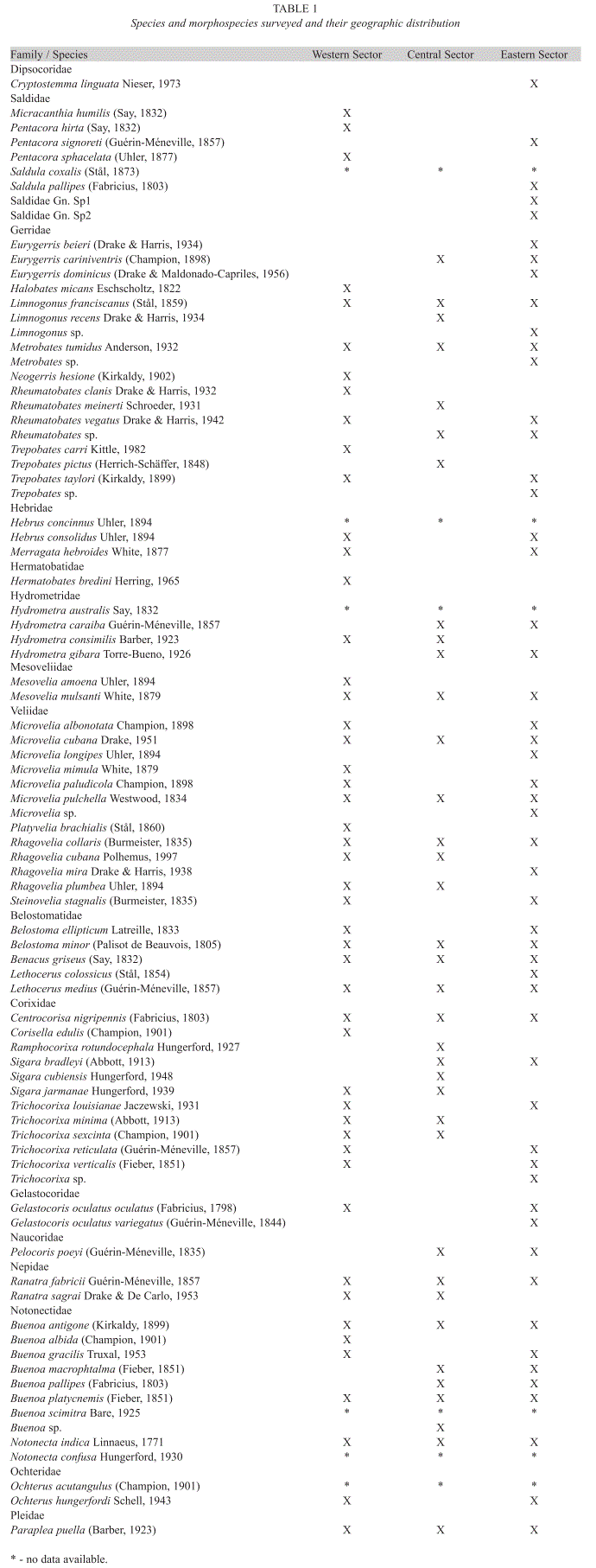
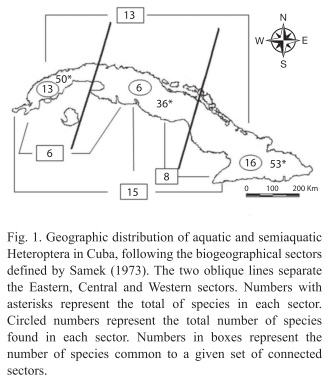
<body><![CDATA[<div style="text-align: justify;"><font face="Verdana" size="2"><b> </b></font></div>     <p style="text-align: justify;"><font face="Verdana" size="2"><b>Biogeographic analysis: </b>Six of the 86 species listed were removed due to lack of information (<a  href="/img/revistas/rbt/v58n3/a08t1.gif">Table 1</a>). According to Samek&#8217;s Biogeographic Sectors, Eastern Cuba bears a total of 53 species (61.63%), being the most representative sector, whereas Central Cuba is the poorest sector, with only 36 species (41.86%). Similar results were found for species in one of the sectors. Sixteen species were reported only for the Eastern Sector (18.60%), 14 (16.28%) are restricted to Western Sector and only six (6.98%) occur exclusively in Central Sector (<a  href="/img/revistas/rbt/v58n3/a08t1.gif">Table 1</a>, <a href="#fig1">Fig. 1</a>). There are only 15 pan-Cuban species (17.44%), whereas 13 species (15.12%) may be found in Eastern and Western Cuba, eight (9.30%) in Eastern and Central Cuba, and six (6.98%) are distributed in Central and Western Cuba (<a  href="#fig1">Fig. 1)</a>.    <br> </font></p>     <p><font face="Verdana" size="2">    <br> </font></p>     <div style="text-align: center;"><a name="fig1"></a><img  src="/img/revistas/rbt/v58n3/a08i1.jpg" title="" alt=""  style="width: 334px; height: 381px;">    <br>     <br> </div>     <p><font face="Verdana" size="2"> </font></p>     <p style="text-align: justify;"><font face="Verdana" size="2">The highest BSI (25%) was observed between Sectors East-West, whereas East- Center and West-Center similarities amounted to16% and 14%, respectively. The highest value of the East-West sectors may be due to the fact that these areas were targets of more collections in the past, and thus reported the largest number of species. It is possible that intense collections in the Central Sector could change this interpretation.</font></p>     ]]></body>
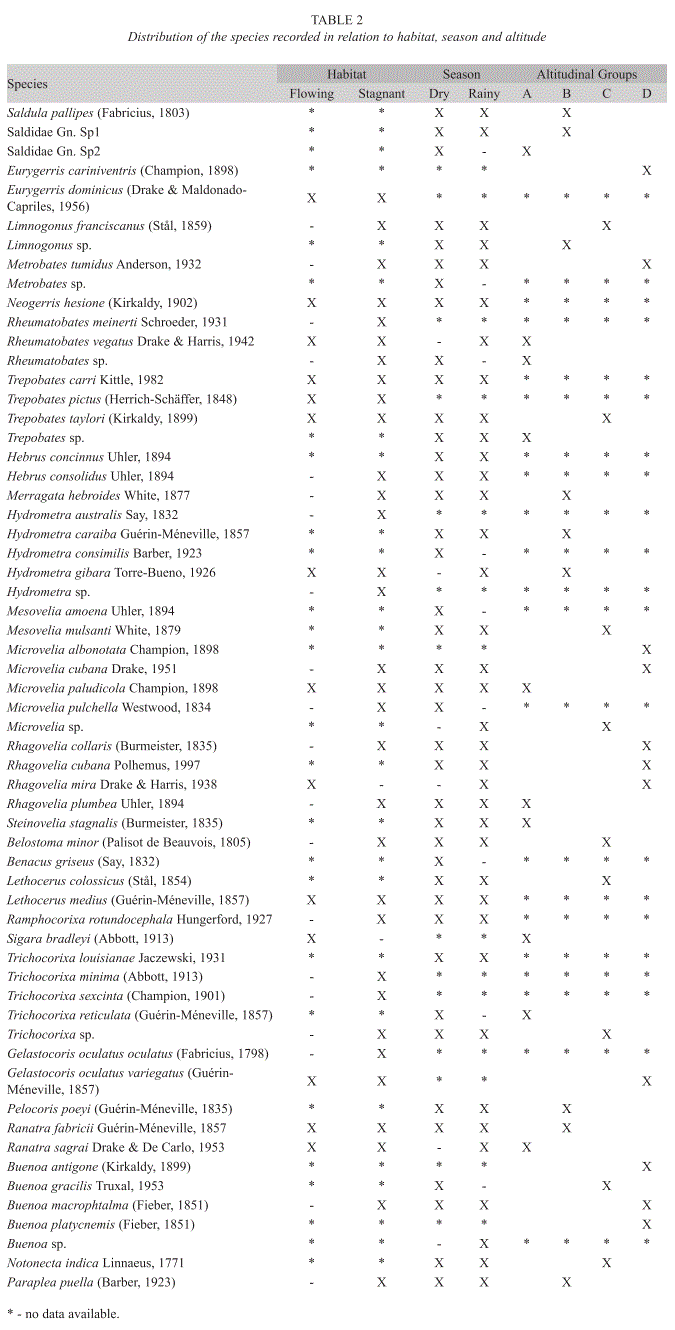
<body><![CDATA[<div style="text-align: justify;"></div>     <p style="text-align: justify;"><font face="Verdana" size="2">Finally, it was noted that families represented by few species are restricted to one or two biogeographic sectors, with the exception of Pleidae, which has only one widely distributed species on the island (<a  href="/img/revistas/rbt/v58n3/a08t1.gif">Table 1</a>).</font></p>     <div style="text-align: justify;"><font face="Verdana" size="2"><b> </b></font></div>     <p style="text-align: justify;"><font face="Verdana" size="2"><b>Distributional preferences: </b>The habitat preference evaluation was based on data from 34 species (<a  href="/img/revistas/rbt/v58n3/a08t2.gif">Table 2</a>). More than a half of the species analyzed, 20 in total (58.8%), prefer stagnant habitats. Only two species (5.8%) were restricted to flowing areas, and 12 (35.4%) were found in both habitats. The two species collected exclusively in flowing areas are <i>Rhagovelia mira </i>Drake &amp; Harris, 1938 (Veliidae) and <i>Sigara bradleyi </i>(Abbott, 1913) (Corixidae). Members of the genus <i>Rhagovelia </i>are usually found in fast running rivers, including areas of swift current. Corixids are almost always associated with stagnant waters rich in algae due to their scraping feeding habitat, and the presence of <i>S. bradleyi </i>preferably in flowing habitats is probably due to accidental collection or mislabeling. At family level, Hebridae, Notonectidae and Pleidae occurred exclusively on stagnant water, and all other families were represented in both flowing and stagnant habitats (but see note on Corixidae above).</font></p>     <div style="text-align: justify;"></div>     <p style="text-align: justify;"><font face="Verdana" size="2">Based on data available from 46 taxa, 31 species (67.4%) were found in both seasons, 6 (13%) only during rainy season, and 9 (19.6%) were collected only during dry season (<a href="/img/revistas/rbt/v58n3/a08t2.gif">Table 2</a>).</font></p>     <div style="text-align: justify;"></div>     <p style="text-align: justify;"><font face="Verdana" size="2">Altitudinal distribution of Cuban aquatic bugs was inferred from data available for 39 species (<a  href="/img/revistas/rbt/v58n3/a08t2.gif">Table 2</a>). Group A (found up to 60m asl) was represented by 10 species (25.6%), Group B (found up to 200m asl) 9 species (23%), Group C (found up to 600m asl) 9 species (23%) and Group D (found up to 750m asl) 11 species (28%). Almost half of the species studied are restricted to altitudes up to 200m above sea level. Saldidae, Hebridae, Hydrometridae, Naucoridae, Nepidae and Pleidae were found exclusively on altitudinal groups A and B, showing that most water bugs exhibit a distinct preference for lower altitudes. Considering species found at higher altitudes (Group D), there is a clear dominance of Veliidae, Gerridae and Notonectidae species, although Gelastocoridae and Belostomatidae are also represented. Gerridae and Veliidae exhibited the most diverse altitudinal preferences, with some species restricted to lower areas, such as <i>Rheumatobates </i>spp. and <i>Steinovelia stagnalis </i>(Burmeister, 1835), and others being more widely distributed, as most members of the genus <i>Rhagovelia</i>.</font></p> <b><font face="Verdana" size="3">     <p>Discussion</p> </font></b><font face="Verdana" size="2"> </font>     <p style="text-align: justify;"><font face="Verdana" size="2">For the biogeographic analysis, our results are similar to those obtained by Naranjo &amp; Ca&ntilde;izares (1999), Trapero &amp; Naranjo (2003), and Naranjo &amp; Gonz&aacute;lez (2005) in their respective studies on the orders Ephemeroptera, Odonata and Trichoptera from Cuba. Distributional patterns of these orders and that described here for Heteroptera are consistent with the fact that the main flow of species between Cuba and the American Continent took place through two fundamental means: (1) from North America and Yucat&aacute;n throughout the Western part of Cuba and (2) from South America throughout the Lesser Antilles arriving in the Eastern part of Cuba. This hypothesis explains the existence of a greater number of species in Eastern and Western Sectors in comparison to Central Sector (Iturralde-Vinent 2004). Notwithstanding that, the greatest number of species on Eastern Cuba is probably related with the presence of the largest number of hydrographic basins, and large well-preserved mountainous ecosystems in this sector.</font></p>     ]]></body>
<body><![CDATA[<div style="text-align: justify;"></div>     <p style="text-align: justify;"><font face="Verdana" size="2">Our results at the species and family level are similar to those found by Alayo (1967, 1974), and corroborate the preference of aquatic bugs for slow current or stagnant waters. The vast majority of species presented a wide seasonal distribution, whereas only few were restricted to just one season. Saulich &amp; Musolin (2007) stated that in regions where environmental conditions are constantly stable and favorable, some heteropterans may breed all year round, thus having a homodynamic type of seasonal development. In fact, this might be the case of most Cuban species.</font></p> <b><font face="Verdana" size="3">     <p>Acknowledgments</p> </font></b><font face="Verdana" size="2"> </font>     <div style="text-align: justify;"><font face="Verdana" size="2">     <p>This manuscript benefited from the useful comments of Viviani P. Alecrim, Ana L&uacute;cia Henriques Oliveira, Renner Luiz Cerqueira Baptista and Carl W. Schaefer. Part of this work was possible thanks to a grant awarded by The Smithsonian Institution at The National Museum of Natural History in Washington D.C. </p> </font></div> <font face="Verdana" size="2"></font><b><font face="Verdana" size="3"> </font></b> <hr style="width: 100%; height: 2px;"><b><font face="Verdana" size="3">     <p>Resumen</p> </font></b><font face="Verdana" size="2"> </font>     <p style="text-align: justify;"><font face="Verdana" size="2">Heteroptera es un grupo de insectos que se distribuyen en todo el mundo, viven en ambientes terrestres y acu&aacute;ticos, en los que tienen un papel ecol&oacute;gico muy importante. Mediante la literatura y colecciones en el campo se estudiaron los Heter&oacute;pteros acu&aacute;ticos y semiacu&aacute;ticos de Cuba, junto con datos sobre la distribuci&oacute;n geogr&aacute;fica de las especies, altitud y estaciones de colecta. Se enumeran representantes de 86 especies y morfospecies de los infra&oacute;rdenes Dipsocoromorpha, Leptopodomorpha, Gerromorpha y Nepomorpha, con un total de 35 g&eacute;neros y 16 familias. Los datos de distribuci&oacute;n muestran una preferencia por los ambientes de aguas lentas o estancadas y &aacute;reas de baja altitud. Quince especies se distribuyen en toda la isla; el sector Oriental es el mejor representado, con 53 especies (61.63%), 16 de ellas (18.60%) confinadas a este sector. La similitud biol&oacute;gica m&aacute;s fuerte se encontr&oacute; entre los sectores oriental y occidental (25%) y la m&aacute;s d&eacute;bil entre los sectores occidental y central (14%). </font></p> <font face="Verdana" size="2"><b> </b></font>     <p><font face="Verdana" size="2"><b>Palabras clave: </b>chinches acu&aacute;ticos, biogeograf&iacute;a, lista de especies, Regi&oacute;n Neotropical.    <br> </font></p>     <p style="text-align: center;"><font face="Verdana" size="2">Received 19-VII-2009. Corrected 08-II-2010. Accepted 05-III-2010.</font></p> <hr style="width: 100%; height: 2px;">     ]]></body>
<body><![CDATA[<p><b><font face="Verdana" size="3">References</font></b></p> <font face="Verdana" size="2"> </font>     <!-- ref --><p><font face="Verdana" size="2">Alayo, P. 1967. Cat&aacute;logo de la fauna de Cuba. 16. Los hem&iacute;pteros acu&aacute;ticos de Cuba. Museo Felipe Poey, Academia de Ciencias de Cuba, Trabajos de Divulgaci&oacute;n 38: 1-68.    &nbsp;&nbsp;&nbsp;&nbsp;&nbsp;&nbsp;&nbsp;&nbsp;[&#160;<a href="javascript:void(0);" onclick="javascript: window.open('/scielo.php?script=sci_nlinks&ref=1391111&pid=S0034-7744201000030000800001&lng=','','width=640,height=500,resizable=yes,scrollbars=1,menubar=yes,');">Links</a>&#160;]<!-- end-ref --></font></p>     <!-- ref --><p><font face="Verdana" size="2">Alayo, P. 1971. Los hem&iacute;pteros acu&aacute;ticos de Cuba. Adiciones y enmiendas. Museo Felipe Poey, Academia de Ciencias de Cuba, Trabajos de Divulgaci&oacute;n 63: 1-17.    &nbsp;&nbsp;&nbsp;&nbsp;&nbsp;&nbsp;&nbsp;&nbsp;[&#160;<a href="javascript:void(0);" onclick="javascript: window.open('/scielo.php?script=sci_nlinks&ref=1391113&pid=S0034-7744201000030000800002&lng=','','width=640,height=500,resizable=yes,scrollbars=1,menubar=yes,');">Links</a>&#160;]<!-- end-ref --></font></p>     <!-- ref --><p><font face="Verdana" size="2">Alayo, P. 1974. Los hem&iacute;pteros acu&aacute;ticos de Cuba. Torreia (nueva serie) 36: 9-64.    &nbsp;&nbsp;&nbsp;&nbsp;&nbsp;&nbsp;&nbsp;&nbsp;[&#160;<a href="javascript:void(0);" onclick="javascript: window.open('/scielo.php?script=sci_nlinks&ref=1391115&pid=S0034-7744201000030000800003&lng=','','width=640,height=500,resizable=yes,scrollbars=1,menubar=yes,');">Links</a>&#160;]<!-- end-ref --> </font></p>     <!-- ref --><p><font face="Verdana" size="2">Aldana, M. &amp; L. Fonseca. 2001. Caracterizaci&oacute;n ecol&oacute;gica de la macrofauna del R&iacute;o Mayar&iacute;. Monograph, Universidad de Oriente, Santiago de Cuba, Cuba.    &nbsp;&nbsp;&nbsp;&nbsp;&nbsp;&nbsp;&nbsp;&nbsp;[&#160;<a href="javascript:void(0);" onclick="javascript: window.open('/scielo.php?script=sci_nlinks&ref=1391117&pid=S0034-7744201000030000800004&lng=','','width=640,height=500,resizable=yes,scrollbars=1,menubar=yes,');">Links</a>&#160;]<!-- end-ref --></font></p>     <!-- ref --><p><font face="Verdana" size="2">Alvarez, G. 2007. Caracterizaci&oacute;n de la macrofauna de invertebrados y an&aacute;lisis de la calidad del agua del R&iacute;o Guant&aacute;namo: Provincia Guant&aacute;namo. Monograph, Universidad de Oriente, Santiago de Cuba, Cuba.    &nbsp;&nbsp;&nbsp;&nbsp;&nbsp;&nbsp;&nbsp;&nbsp;[&#160;<a href="javascript:void(0);" onclick="javascript: window.open('/scielo.php?script=sci_nlinks&ref=1391119&pid=S0034-7744201000030000800005&lng=','','width=640,height=500,resizable=yes,scrollbars=1,menubar=yes,');">Links</a>&#160;]<!-- end-ref --></font></p>     <!-- ref --><p><font face="Verdana" size="2">Andersen, N.M. 1975. The <i>Limnogonus </i>and <i>Neogerris </i>of the Old World with character analysis and a reclassification of the Gerrinae (Hemiptera: Gerridae). Entomol. Scand. (supplementa) 7: 7-96.    &nbsp;&nbsp;&nbsp;&nbsp;&nbsp;&nbsp;&nbsp;&nbsp;[&#160;<a href="javascript:void(0);" onclick="javascript: window.open('/scielo.php?script=sci_nlinks&ref=1391121&pid=S0034-7744201000030000800006&lng=','','width=640,height=500,resizable=yes,scrollbars=1,menubar=yes,');">Links</a>&#160;]<!-- end-ref --></font></p>     <!-- ref --><p><font face="Verdana" size="2">Andersen, N.M. 1982. The semiaquatic bugs (Heteroptera: Gerromorpha). Phylogeny, adaptations, biogeography and classification. Entomonograph 3: 1-455.    &nbsp;&nbsp;&nbsp;&nbsp;&nbsp;&nbsp;&nbsp;&nbsp;[&#160;<a href="javascript:void(0);" onclick="javascript: window.open('/scielo.php?script=sci_nlinks&ref=1391123&pid=S0034-7744201000030000800007&lng=','','width=640,height=500,resizable=yes,scrollbars=1,menubar=yes,');">Links</a>&#160;]<!-- end-ref --></font></p>     <!-- ref --><p><font face="Verdana" size="2">Anderson, L.D. 1932. A monograph of the genus <i>Metrobates </i>(Hemiptera, Gerridae). Univ. Kans. Sci. Bull. 20: 297-311.    &nbsp;&nbsp;&nbsp;&nbsp;&nbsp;&nbsp;&nbsp;&nbsp;[&#160;<a href="javascript:void(0);" onclick="javascript: window.open('/scielo.php?script=sci_nlinks&ref=1391125&pid=S0034-7744201000030000800008&lng=','','width=640,height=500,resizable=yes,scrollbars=1,menubar=yes,');">Links</a>&#160;]<!-- end-ref --></font></p>     <!-- ref --><p><font face="Verdana" size="2">Bello, O. 2004. Caracterizaci&oacute;n ecol&oacute;gica de la macrofauna del R&iacute;o M&aacute;ximo. Monograph, Universidad de Oriente, Santiago de Cuba, Cuba.    &nbsp;&nbsp;&nbsp;&nbsp;&nbsp;&nbsp;&nbsp;&nbsp;[&#160;<a href="javascript:void(0);" onclick="javascript: window.open('/scielo.php?script=sci_nlinks&ref=1391127&pid=S0034-7744201000030000800009&lng=','','width=640,height=500,resizable=yes,scrollbars=1,menubar=yes,');">Links</a>&#160;]<!-- end-ref --></font></p>     <!-- ref --><p><font face="Verdana" size="2">Champion, G.C. 1901. Hemiptera-Heteroptera. Biologia Centrali-Americana, Rhynchota 2: 1-416.    &nbsp;&nbsp;&nbsp;&nbsp;&nbsp;&nbsp;&nbsp;&nbsp;[&#160;<a href="javascript:void(0);" onclick="javascript: window.open('/scielo.php?script=sci_nlinks&ref=1391129&pid=S0034-7744201000030000800010&lng=','','width=640,height=500,resizable=yes,scrollbars=1,menubar=yes,');">Links</a>&#160;]<!-- end-ref --></font></p>     <!-- ref --><p><font face="Verdana" size="2">Deler-Hern&aacute;ndez, A., Y.S. Megna, D.D. Gonz&aacute;lez-Lazo &amp; C.N. Cracas&eacute;s-Torres. 2007. Insectos acu&aacute;ticos y &aacute;reas prioritarias para la conservaci&oacute;n en la cuenca alta del R&iacute;o Cauto (Santiago de Cuba, Cuba). Bol. Entomol. Aragonesa 40: 451-451.    &nbsp;&nbsp;&nbsp;&nbsp;&nbsp;&nbsp;&nbsp;&nbsp;[&#160;<a href="javascript:void(0);" onclick="javascript: window.open('/scielo.php?script=sci_nlinks&ref=1391131&pid=S0034-7744201000030000800011&lng=','','width=640,height=500,resizable=yes,scrollbars=1,menubar=yes,');">Links</a>&#160;]<!-- end-ref --></font></p>     <!-- ref --><p><font face="Verdana" size="2">Drake, C.J. 1938. A new <i>Rhagovelia </i>from Cuba. Pan-Pac. Entomol. 14: 152.    &nbsp;&nbsp;&nbsp;&nbsp;&nbsp;&nbsp;&nbsp;&nbsp;[&#160;<a href="javascript:void(0);" onclick="javascript: window.open('/scielo.php?script=sci_nlinks&ref=1391133&pid=S0034-7744201000030000800012&lng=','','width=640,height=500,resizable=yes,scrollbars=1,menubar=yes,');">Links</a>&#160;]<!-- end-ref --></font></p>     <!-- ref --><p><font face="Verdana" size="2">Drake, C.J. 1952. Concerning American Ochteridae (Hemiptera). Fla. Entomol. 35: 72-75.    &nbsp;&nbsp;&nbsp;&nbsp;&nbsp;&nbsp;&nbsp;&nbsp;[&#160;<a href="javascript:void(0);" onclick="javascript: window.open('/scielo.php?script=sci_nlinks&ref=1391135&pid=S0034-7744201000030000800013&lng=','','width=640,height=500,resizable=yes,scrollbars=1,menubar=yes,');">Links</a>&#160;]<!-- end-ref --></font></p>     <!-- ref --><p><font face="Verdana" size="2">Drake, C.J. &amp; J.A. De Carlo. 1953. American species of <i>Ranatra annulipes </i>St&aring;l group (Hemiptera: Ranatridae). J. Wash. Acad. Sci. 43: 109-117.    &nbsp;&nbsp;&nbsp;&nbsp;&nbsp;&nbsp;&nbsp;&nbsp;[&#160;<a href="javascript:void(0);" onclick="javascript: window.open('/scielo.php?script=sci_nlinks&ref=1391137&pid=S0034-7744201000030000800014&lng=','','width=640,height=500,resizable=yes,scrollbars=1,menubar=yes,');">Links</a>&#160;]<!-- end-ref --></font></p>     <!-- ref --><p><font face="Verdana" size="2">Drake, C.J. &amp; H.M. Harris. 1942. Notas sobre <i>Rheumatobates</i>, com descri&ccedil;&atilde;o de uma nova esp&eacute;cies (Hemiptera, Gerridae). Rev. Bras. Biol. 2: 399-402.    &nbsp;&nbsp;&nbsp;&nbsp;&nbsp;&nbsp;&nbsp;&nbsp;[&#160;<a href="javascript:void(0);" onclick="javascript: window.open('/scielo.php?script=sci_nlinks&ref=1391139&pid=S0034-7744201000030000800015&lng=','','width=640,height=500,resizable=yes,scrollbars=1,menubar=yes,');">Links</a>&#160;]<!-- end-ref --></font></p>     <!-- ref --><p><font face="Verdana" size="2">Drake, C.J. &amp; H.M. Harris. 1943. Notas sobre Hebridae del Hemisferio Occidental (Hemiptera). Notas del Museo de La Plata. Zoolog&iacute;a 8: 41-58.    &nbsp;&nbsp;&nbsp;&nbsp;&nbsp;&nbsp;&nbsp;&nbsp;[&#160;<a href="javascript:void(0);" onclick="javascript: window.open('/scielo.php?script=sci_nlinks&ref=1391141&pid=S0034-7744201000030000800016&lng=','','width=640,height=500,resizable=yes,scrollbars=1,menubar=yes,');">Links</a>&#160;]<!-- end-ref --></font></p>     <!-- ref --><p><font face="Verdana" size="2">Drake, C.J. &amp; R.F. Hussey. 1955. Concerning the genus <i>Microvelia </i>Westwood, with descriptions of two new species and a check-list of American forms (Hemiptera: Veliidae). Fla. Entomol. 38: 95-115.    &nbsp;&nbsp;&nbsp;&nbsp;&nbsp;&nbsp;&nbsp;&nbsp;[&#160;<a href="javascript:void(0);" onclick="javascript: window.open('/scielo.php?script=sci_nlinks&ref=1391143&pid=S0034-7744201000030000800017&lng=','','width=640,height=500,resizable=yes,scrollbars=1,menubar=yes,');">Links</a>&#160;]<!-- end-ref --></font></p>     <!-- ref --><p><font face="Verdana" size="2">Drake, C.J &amp; P.H. Van Doesburg. 1966. Water-striders of the American genus <i>Trochopus </i>(Hemiptera: Veliidae). Stud. Fauna Suriname Guyanas 8: 65-76.    &nbsp;&nbsp;&nbsp;&nbsp;&nbsp;&nbsp;&nbsp;&nbsp;[&#160;<a href="javascript:void(0);" onclick="javascript: window.open('/scielo.php?script=sci_nlinks&ref=1391145&pid=S0034-7744201000030000800018&lng=','','width=640,height=500,resizable=yes,scrollbars=1,menubar=yes,');">Links</a>&#160;]<!-- end-ref --></font></p>     <!-- ref --><p><font face="Verdana" size="2">Feinsinger, P. 2004. El dise&ntilde;o de estudios de campo para la conservaci&oacute;n de la biodiversidad. FAN, Santa Cruz de La Sierra, Bolivia.    &nbsp;&nbsp;&nbsp;&nbsp;&nbsp;&nbsp;&nbsp;&nbsp;[&#160;<a href="javascript:void(0);" onclick="javascript: window.open('/scielo.php?script=sci_nlinks&ref=1391147&pid=S0034-7744201000030000800019&lng=','','width=640,height=500,resizable=yes,scrollbars=1,menubar=yes,');">Links</a>&#160;]<!-- end-ref --></font></p>     <!-- ref --><p><font face="Verdana" size="2">Gu&eacute;rin-M&eacute;neville, F.E. 1857. Ordre des H&eacute;mipt&egrave;res, Latr. Premiere section. H&eacute;t&eacute;ropt&egrave;res Latr., p. 359-424. <i>In </i>R. de la Sagra (ed.). Histoire physique, politique et naturelle de l&#8217;Ile de Cuba. Arthur Bertrand, Paris, France.    &nbsp;&nbsp;&nbsp;&nbsp;&nbsp;&nbsp;&nbsp;&nbsp;[&#160;<a href="javascript:void(0);" onclick="javascript: window.open('/scielo.php?script=sci_nlinks&ref=1391149&pid=S0034-7744201000030000800020&lng=','','width=640,height=500,resizable=yes,scrollbars=1,menubar=yes,');">Links</a>&#160;]<!-- end-ref --></font></p>     <!-- ref --><p><font face="Verdana" size="2">Hern&aacute;ndez, D. &amp; Y. Bauta. 2003. Caracterizaci&oacute;n de la macrofauna dulceacu&iacute;cola de los R&iacute;os Gibara y acoyug&uuml;in (Holgu&iacute;n). Monograph, Universidad de Oriente, Santiago de Cuba, Cuba.    &nbsp;&nbsp;&nbsp;&nbsp;&nbsp;&nbsp;&nbsp;&nbsp;[&#160;<a href="javascript:void(0);" onclick="javascript: window.open('/scielo.php?script=sci_nlinks&ref=1391151&pid=S0034-7744201000030000800021&lng=','','width=640,height=500,resizable=yes,scrollbars=1,menubar=yes,');">Links</a>&#160;]<!-- end-ref --></font></p>     <!-- ref --><p><font face="Verdana" size="2">Hern&aacute;ndez, D. &amp; Y. Cala. 2003. Macrofauna dulceacu&iacute;cola de invertebrados y la calidad de las aguas del R&iacute;o Sevilla, Municipio Niquero (Granma). Monograph, Universidad de Oriente, Santiago de Cuba, Cuba.    &nbsp;&nbsp;&nbsp;&nbsp;&nbsp;&nbsp;&nbsp;&nbsp;[&#160;<a href="javascript:void(0);" onclick="javascript: window.open('/scielo.php?script=sci_nlinks&ref=1391153&pid=S0034-7744201000030000800022&lng=','','width=640,height=500,resizable=yes,scrollbars=1,menubar=yes,');">Links</a>&#160;]<!-- end-ref --></font></p>     <!-- ref --><p><font face="Verdana" size="2">Hungerford, H.B. 1933. The genus <i>Notonecta </i>of the World (Notonectidae-Hemiptera). Univ. Kans. Sci. Bull. 21: 5-195.    &nbsp;&nbsp;&nbsp;&nbsp;&nbsp;&nbsp;&nbsp;&nbsp;[&#160;<a href="javascript:void(0);" onclick="javascript: window.open('/scielo.php?script=sci_nlinks&ref=1391155&pid=S0034-7744201000030000800023&lng=','','width=640,height=500,resizable=yes,scrollbars=1,menubar=yes,');">Links</a>&#160;]<!-- end-ref --></font></p>     <!-- ref --><p><font face="Verdana" size="2">Hungerford, H.B. 1948. The Corixidae of the Western Hemisphere (Hemiptera). Univ. Kans. Sci. Bull. 32: 5-827.    &nbsp;&nbsp;&nbsp;&nbsp;&nbsp;&nbsp;&nbsp;&nbsp;[&#160;<a href="javascript:void(0);" onclick="javascript: window.open('/scielo.php?script=sci_nlinks&ref=1391157&pid=S0034-7744201000030000800024&lng=','','width=640,height=500,resizable=yes,scrollbars=1,menubar=yes,');">Links</a>&#160;]<!-- end-ref --></font></p>     <!-- ref --><p><font face="Verdana" size="2">Hungerford, H.B. 1954. The genus <i>Rheumatobates </i>Bergroth (Hemiptera-Gerridae). Univ. Kans. Sci. Bull. 36: 529-588.    &nbsp;&nbsp;&nbsp;&nbsp;&nbsp;&nbsp;&nbsp;&nbsp;[&#160;<a href="javascript:void(0);" onclick="javascript: window.open('/scielo.php?script=sci_nlinks&ref=1391159&pid=S0034-7744201000030000800025&lng=','','width=640,height=500,resizable=yes,scrollbars=1,menubar=yes,');">Links</a>&#160;]<!-- end-ref --></font></p>     <!-- ref --><p><font face="Verdana" size="2">Hungerford, H.B. &amp; N.E. Evans. 1934. The Hydrometridae of the Hungarian National Museum and other studies on the family (Hemiptera). Ann. Mus. Natl. Hungarici 28: 32-112.    &nbsp;&nbsp;&nbsp;&nbsp;&nbsp;&nbsp;&nbsp;&nbsp;[&#160;<a href="javascript:void(0);" onclick="javascript: window.open('/scielo.php?script=sci_nlinks&ref=1391161&pid=S0034-7744201000030000800026&lng=','','width=640,height=500,resizable=yes,scrollbars=1,menubar=yes,');">Links</a>&#160;]<!-- end-ref --></font></p>     <!-- ref --><p><font face="Verdana" size="2">Iturralde-Vinent, M. 2004. Origen y evoluci&oacute;n del Caribe y sus biotas marinas y terrestres. Centro Nacional de Informaci&oacute;n Geol&oacute;gica, La Habana, Cuba.    &nbsp;&nbsp;&nbsp;&nbsp;&nbsp;&nbsp;&nbsp;&nbsp;[&#160;<a href="javascript:void(0);" onclick="javascript: window.open('/scielo.php?script=sci_nlinks&ref=1391163&pid=S0034-7744201000030000800027&lng=','','width=640,height=500,resizable=yes,scrollbars=1,menubar=yes,');">Links</a>&#160;]<!-- end-ref --> </font></p>     <!-- ref --><p><font face="Verdana" size="2">Jenkins, D.W. 1964. Pathogens, parasites and predators of medically important Arthropods, annotated list and bibliography. B. World Health Organ. (supplement): 1-150.    &nbsp;&nbsp;&nbsp;&nbsp;&nbsp;&nbsp;&nbsp;&nbsp;[&#160;<a href="javascript:void(0);" onclick="javascript: window.open('/scielo.php?script=sci_nlinks&ref=1391165&pid=S0034-7744201000030000800028&lng=','','width=640,height=500,resizable=yes,scrollbars=1,menubar=yes,');">Links</a>&#160;]<!-- end-ref --></font></p>     <!-- ref --><p><font face="Verdana" size="2">Kirkaldy, G.W. &amp; J.R. de la Torre-Bueno. 1909. A catalogue of American aquatic and semiaquatic Hemiptera. Proc. Entomol. Soc. Wash. 10: 173-213.    &nbsp;&nbsp;&nbsp;&nbsp;&nbsp;&nbsp;&nbsp;&nbsp;[&#160;<a href="javascript:void(0);" onclick="javascript: window.open('/scielo.php?script=sci_nlinks&ref=1391167&pid=S0034-7744201000030000800029&lng=','','width=640,height=500,resizable=yes,scrollbars=1,menubar=yes,');">Links</a>&#160;]<!-- end-ref --></font></p>     <!-- ref --><p><font face="Verdana" size="2">Kittle, P.D. 1982. Two new species of water striders of the genus <i>Trepobates </i>Uhler (Hemiptera: Gerridae). Proc. Entomol. Soc. Wash. 84: 157-164.    &nbsp;&nbsp;&nbsp;&nbsp;&nbsp;&nbsp;&nbsp;&nbsp;[&#160;<a href="javascript:void(0);" onclick="javascript: window.open('/scielo.php?script=sci_nlinks&ref=1391169&pid=S0034-7744201000030000800030&lng=','','width=640,height=500,resizable=yes,scrollbars=1,menubar=yes,');">Links</a>&#160;]<!-- end-ref --></font></p>     <!-- ref --><p><font face="Verdana" size="2">Kuitert, L.C. 1942. Gerrinae in University of Kansas Collections. Univ. Kans. Sci. Bull. 28: 113-143.    &nbsp;&nbsp;&nbsp;&nbsp;&nbsp;&nbsp;&nbsp;&nbsp;[&#160;<a href="javascript:void(0);" onclick="javascript: window.open('/scielo.php?script=sci_nlinks&ref=1391171&pid=S0034-7744201000030000800031&lng=','','width=640,height=500,resizable=yes,scrollbars=1,menubar=yes,');">Links</a>&#160;]<!-- end-ref --></font></p>     <!-- ref --><p><font face="Verdana" size="2">Lauck, D.L. 1959. Three new species of <i>Belostoma </i>from Mexico and Central America (Hemiptera: Belostomatidae), with a list of North American species. B. Chic. Aca. Sci. 11: 1-9.    &nbsp;&nbsp;&nbsp;&nbsp;&nbsp;&nbsp;&nbsp;&nbsp;[&#160;<a href="javascript:void(0);" onclick="javascript: window.open('/scielo.php?script=sci_nlinks&ref=1391173&pid=S0034-7744201000030000800032&lng=','','width=640,height=500,resizable=yes,scrollbars=1,menubar=yes,');">Links</a>&#160;]<!-- end-ref --></font></p>     <!-- ref --><p><font face="Verdana" size="2">Lauck, D. L. 1962-64. A monograph of the genus <i>Belostoma</i>. Parts I-III. B. Chic. Aca. Sci. 11: 34-154.    &nbsp;&nbsp;&nbsp;&nbsp;&nbsp;&nbsp;&nbsp;&nbsp;[&#160;<a href="javascript:void(0);" onclick="javascript: window.open('/scielo.php?script=sci_nlinks&ref=1391175&pid=S0034-7744201000030000800033&lng=','','width=640,height=500,resizable=yes,scrollbars=1,menubar=yes,');">Links</a>&#160;]<!-- end-ref --></font></p>     <!-- ref --><p><font face="Verdana" size="2">Martin, C.H. 1928. An exploratory survey of the characters of specific value in the genus <i>Gelastocoris </i>Kirkaldy, and some new species. Univ. Kans. Sci. Bull. 18: 351-359.    &nbsp;&nbsp;&nbsp;&nbsp;&nbsp;&nbsp;&nbsp;&nbsp;[&#160;<a href="javascript:void(0);" onclick="javascript: window.open('/scielo.php?script=sci_nlinks&ref=1391177&pid=S0034-7744201000030000800034&lng=','','width=640,height=500,resizable=yes,scrollbars=1,menubar=yes,');">Links</a>&#160;]<!-- end-ref --></font></p>     <!-- ref --><p><font face="Verdana" size="2">Menke, A.S. 1963. A review of the American genus <i>Lethocerus </i>in North and Central America, including the West Indies. Ann. Entomol. Soc. Am. 56: 261-267.    &nbsp;&nbsp;&nbsp;&nbsp;&nbsp;&nbsp;&nbsp;&nbsp;[&#160;<a href="javascript:void(0);" onclick="javascript: window.open('/scielo.php?script=sci_nlinks&ref=1391179&pid=S0034-7744201000030000800035&lng=','','width=640,height=500,resizable=yes,scrollbars=1,menubar=yes,');">Links</a>&#160;]<!-- end-ref --> </font></p>     <!-- ref --><p><font face="Verdana" size="2">Menke, A.S. 1979. The semiaquatic and aquatic Hemiptera of California (Heteroptera: Hemiptera). Bull. Calif. Insect Surv. 21: 1-166.    &nbsp;&nbsp;&nbsp;&nbsp;&nbsp;&nbsp;&nbsp;&nbsp;[&#160;<a href="javascript:void(0);" onclick="javascript: window.open('/scielo.php?script=sci_nlinks&ref=1391181&pid=S0034-7744201000030000800036&lng=','','width=640,height=500,resizable=yes,scrollbars=1,menubar=yes,');">Links</a>&#160;]<!-- end-ref --></font></p>     <!-- ref --><p><font face="Verdana" size="2">Naranjo, C. &amp; M. Ca&ntilde;izares. 1999. Situaci&oacute;n actual del estudio del orden Ephemeroptera en Cuba (Insecta). Cocuyo 8: 17-19.    &nbsp;&nbsp;&nbsp;&nbsp;&nbsp;&nbsp;&nbsp;&nbsp;[&#160;<a href="javascript:void(0);" onclick="javascript: window.open('/scielo.php?script=sci_nlinks&ref=1391183&pid=S0034-7744201000030000800037&lng=','','width=640,height=500,resizable=yes,scrollbars=1,menubar=yes,');">Links</a>&#160;]<!-- end-ref --></font></p>     <!-- ref --><p><font face="Verdana" size="2">Naranjo, C. &amp; D. Gonz&aacute;lez. 2005. Situaci&oacute;n actual del estudio del orden Trichoptera en Cuba. Bol. Soc. Entomol. Aragonesa 36: 147-152.    &nbsp;&nbsp;&nbsp;&nbsp;&nbsp;&nbsp;&nbsp;&nbsp;[&#160;<a href="javascript:void(0);" onclick="javascript: window.open('/scielo.php?script=sci_nlinks&ref=1391185&pid=S0034-7744201000030000800038&lng=','','width=640,height=500,resizable=yes,scrollbars=1,menubar=yes,');">Links</a>&#160;]<!-- end-ref --></font></p>     <!-- ref --><p><font face="Verdana" size="2">Nieser, N. 1969. The Heteroptera of the Netherlands Antilles - VIII. Pleidae, Naucoridae, Ranatridae. Stud. Fauna Cura&ccedil;ao Caribb. Isl. 30: 58-71.    &nbsp;&nbsp;&nbsp;&nbsp;&nbsp;&nbsp;&nbsp;&nbsp;[&#160;<a href="javascript:void(0);" onclick="javascript: window.open('/scielo.php?script=sci_nlinks&ref=1391187&pid=S0034-7744201000030000800039&lng=','','width=640,height=500,resizable=yes,scrollbars=1,menubar=yes,');">Links</a>&#160;]<!-- end-ref --></font></p>     <!-- ref --><p><font face="Verdana" size="2">Nieser, N. 1973. Semiaquatic Heteroptera from Cuba. R&eacute;sultats des Exp&eacute;ditions Biosp&eacute;leologiques Cubano- Roumaines &agrave; Cuba 1: 347-350.    &nbsp;&nbsp;&nbsp;&nbsp;&nbsp;&nbsp;&nbsp;&nbsp;[&#160;<a href="javascript:void(0);" onclick="javascript: window.open('/scielo.php?script=sci_nlinks&ref=1391189&pid=S0034-7744201000030000800040&lng=','','width=640,height=500,resizable=yes,scrollbars=1,menubar=yes,');">Links</a>&#160;]<!-- end-ref --> </font></p>     <!-- ref --><p><font face="Verdana" size="2">Nieser, N. 1975. The water bugs (Heteroptera: Nepomorpha) of the Guyana Region. Stud. Fauna Suriname Guyanas 59: 1-303.    &nbsp;&nbsp;&nbsp;&nbsp;&nbsp;&nbsp;&nbsp;&nbsp;[&#160;<a href="javascript:void(0);" onclick="javascript: window.open('/scielo.php?script=sci_nlinks&ref=1391191&pid=S0034-7744201000030000800041&lng=','','width=640,height=500,resizable=yes,scrollbars=1,menubar=yes,');">Links</a>&#160;]<!-- end-ref --></font></p>     <!-- ref --><p><font face="Verdana" size="2">Nieser, N. 1977. Aquatic and semiaquatic Heteroptera from Cuba. R&eacute;sultats des Exp&eacute;ditions Biosp&eacute;leologiques Cubano-Roumaines &agrave; Cuba 2: 355-360.    &nbsp;&nbsp;&nbsp;&nbsp;&nbsp;&nbsp;&nbsp;&nbsp;[&#160;<a href="javascript:void(0);" onclick="javascript: window.open('/scielo.php?script=sci_nlinks&ref=1391193&pid=S0034-7744201000030000800042&lng=','','width=640,height=500,resizable=yes,scrollbars=1,menubar=yes,');">Links</a>&#160;]<!-- end-ref --></font></p>     <!-- ref --><p><font face="Verdana" size="2">Nieser, N. &amp; A.L. Melo. 1997. Os Heter&oacute;pteros aqu&aacute;ticos de Minas Gerais. Guia introdut&oacute;rio com chave de identifica&ccedil;&atilde;o para as esp&eacute;cies de Nepomorpha e Gerromorpha. Editora UFMG, Belo Horizonte, Brazil.    &nbsp;&nbsp;&nbsp;&nbsp;&nbsp;&nbsp;&nbsp;&nbsp;[&#160;<a href="javascript:void(0);" onclick="javascript: window.open('/scielo.php?script=sci_nlinks&ref=1391195&pid=S0034-7744201000030000800043&lng=','','width=640,height=500,resizable=yes,scrollbars=1,menubar=yes,');">Links</a>&#160;]<!-- end-ref --></font></p>     <!-- ref --><p><font face="Verdana" size="2">Perez-Goodwyn, P.J. 2006. Taxonomic revision of the subfamily Lethocerinae Lauck &amp; Menke (Heteroptera: Belostomatidae). Stuttgarter Beitr&auml;ge zur Naturkunde, serie A (Biologie) 695: 1-71.    &nbsp;&nbsp;&nbsp;&nbsp;&nbsp;&nbsp;&nbsp;&nbsp;[&#160;<a href="javascript:void(0);" onclick="javascript: window.open('/scielo.php?script=sci_nlinks&ref=1391197&pid=S0034-7744201000030000800044&lng=','','width=640,height=500,resizable=yes,scrollbars=1,menubar=yes,');">Links</a>&#160;]<!-- end-ref --></font></p>     <!-- ref --><p><font face="Verdana" size="2">Polhemus, D.A. 1997. Systematics of the genus <i>Rhagovelia </i>(Heteroptera: Veliidae) in the Western Hemisphere (exclusive of the <i>angustipes </i>complex). Thomas Say Monographs in Entomology, Entomological Society of America, Lanham, Maryland, USA.    &nbsp;&nbsp;&nbsp;&nbsp;&nbsp;&nbsp;&nbsp;&nbsp;[&#160;<a href="javascript:void(0);" onclick="javascript: window.open('/scielo.php?script=sci_nlinks&ref=1391199&pid=S0034-7744201000030000800045&lng=','','width=640,height=500,resizable=yes,scrollbars=1,menubar=yes,');">Links</a>&#160;]<!-- end-ref --></font></p>     <!-- ref --><p><font face="Verdana" size="2">Polhemus, J.T. &amp; J.L. Herring. 1979. A further description of <i>Hermatobates bredini </i>Herring, and a new record for Cuba (Hemiptera: Hermatobatidae). Proc. Entomol. Soc. Wash. 81: 253-254.    &nbsp;&nbsp;&nbsp;&nbsp;&nbsp;&nbsp;&nbsp;&nbsp;[&#160;<a href="javascript:void(0);" onclick="javascript: window.open('/scielo.php?script=sci_nlinks&ref=1391201&pid=S0034-7744201000030000800046&lng=','','width=640,height=500,resizable=yes,scrollbars=1,menubar=yes,');">Links</a>&#160;]<!-- end-ref --></font></p>     <!-- ref --><p><font face="Verdana" size="2">Polhemus, J.T. &amp; D.A. Polhemus. 2007. Global trends in the description of aquatic and semiaquatic Heteroptera species, 1758-2004. Tijdschrift voor Entomologie 150: 271-288.    &nbsp;&nbsp;&nbsp;&nbsp;&nbsp;&nbsp;&nbsp;&nbsp;[&#160;<a href="javascript:void(0);" onclick="javascript: window.open('/scielo.php?script=sci_nlinks&ref=1391203&pid=S0034-7744201000030000800047&lng=','','width=640,height=500,resizable=yes,scrollbars=1,menubar=yes,');">Links</a>&#160;]<!-- end-ref --></font></p>     <!-- ref --><p><font face="Verdana" size="2">Polhemus, J.T. &amp; D.A. Polhemus. 2008. Global diversity of true bugs (Heteroptera; Insecta) in freshwater. Hydrobiologia 595: 379-391.    &nbsp;&nbsp;&nbsp;&nbsp;&nbsp;&nbsp;&nbsp;&nbsp;[&#160;<a href="javascript:void(0);" onclick="javascript: window.open('/scielo.php?script=sci_nlinks&ref=1391205&pid=S0034-7744201000030000800048&lng=','','width=640,height=500,resizable=yes,scrollbars=1,menubar=yes,');">Links</a>&#160;]<!-- end-ref --></font></p>     <!-- ref --><p><font face="Verdana" size="2">Puerta, Y. 2002. Caracterizaci&oacute;n de la macrofauna dulceacu&iacute;cola del R&iacute;o T&aacute;yaba. Monograph, Universidad de Oriente, Santiago de Cuba, Cuba.    &nbsp;&nbsp;&nbsp;&nbsp;&nbsp;&nbsp;&nbsp;&nbsp;[&#160;<a href="javascript:void(0);" onclick="javascript: window.open('/scielo.php?script=sci_nlinks&ref=1391207&pid=S0034-7744201000030000800049&lng=','','width=640,height=500,resizable=yes,scrollbars=1,menubar=yes,');">Links</a>&#160;]<!-- end-ref --></font></p>     <!-- ref --><p><font face="Verdana" size="2">Samek, V. 1973. Regiones fitogeogr&aacute;ficas de Cuba. Academia de Ciencias de Cuba, Serie Florestal 15: 1-60.    &nbsp;&nbsp;&nbsp;&nbsp;&nbsp;&nbsp;&nbsp;&nbsp;[&#160;<a href="javascript:void(0);" onclick="javascript: window.open('/scielo.php?script=sci_nlinks&ref=1391209&pid=S0034-7744201000030000800050&lng=','','width=640,height=500,resizable=yes,scrollbars=1,menubar=yes,');">Links</a>&#160;]<!-- end-ref --></font></p>     <!-- ref --><p><font face="Verdana" size="2">Saulich A.H. &amp; D.L. Musolin. 2007. Seasonal development of aquatic and semiaquatic True Bugs (Heteroptera). St. Petersburg University, Saint Petersburg, Russia.    &nbsp;&nbsp;&nbsp;&nbsp;&nbsp;&nbsp;&nbsp;&nbsp;[&#160;<a href="javascript:void(0);" onclick="javascript: window.open('/scielo.php?script=sci_nlinks&ref=1391211&pid=S0034-7744201000030000800051&lng=','','width=640,height=500,resizable=yes,scrollbars=1,menubar=yes,');">Links</a>&#160;]<!-- end-ref --></font></p>     <!-- ref --><p><font face="Verdana" size="2">Trapero, A. &amp; C. Naranjo. 2003. Revision of the order Odonata in Cuba. B. Am. Odonat. 2: 23-40.    &nbsp;&nbsp;&nbsp;&nbsp;&nbsp;&nbsp;&nbsp;&nbsp;[&#160;<a href="javascript:void(0);" onclick="javascript: window.open('/scielo.php?script=sci_nlinks&ref=1391213&pid=S0034-7744201000030000800052&lng=','','width=640,height=500,resizable=yes,scrollbars=1,menubar=yes,');">Links</a>&#160;]<!-- end-ref --></font></p>     <!-- ref --><p><font face="Verdana" size="2">Truxal, F.S. 1953. A revision of the genus <i>Buenoa </i>(Hemiptera: Notonectidae). Univ. Kans. Sci. Bull. 35: 1351-1517.    &nbsp;&nbsp;&nbsp;&nbsp;&nbsp;&nbsp;&nbsp;&nbsp;[&#160;<a href="javascript:void(0);" onclick="javascript: window.open('/scielo.php?script=sci_nlinks&ref=1391215&pid=S0034-7744201000030000800053&lng=','','width=640,height=500,resizable=yes,scrollbars=1,menubar=yes,');">Links</a>&#160;]<!-- end-ref --></font></p>     <!-- ref --><p><font face="Verdana" size="2">Uhler, P.R. 1893. A list of the Hemiptera-Heteroptera collected in the Island of St. Vincent by Mr. Herbert H. Smith; with descriptions of new genera and species. Proc. Zool. Soc. Lond. 1893: 705-719.    &nbsp;&nbsp;&nbsp;&nbsp;&nbsp;&nbsp;&nbsp;&nbsp;[&#160;<a href="javascript:void(0);" onclick="javascript: window.open('/scielo.php?script=sci_nlinks&ref=1391217&pid=S0034-7744201000030000800054&lng=','','width=640,height=500,resizable=yes,scrollbars=1,menubar=yes,');">Links</a>&#160;]<!-- end-ref --></font></p>     <!-- ref --><p><font face="Verdana" size="2">Uhler, P.R. 1894. On the Hemiptera-Heteroptera of the Island of Grenada, West Indies. Proc. Zool. Soc. Lond. 1894: 167-224.    &nbsp;&nbsp;&nbsp;&nbsp;&nbsp;&nbsp;&nbsp;&nbsp;[&#160;<a href="javascript:void(0);" onclick="javascript: window.open('/scielo.php?script=sci_nlinks&ref=1391219&pid=S0034-7744201000030000800055&lng=','','width=640,height=500,resizable=yes,scrollbars=1,menubar=yes,');">Links</a>&#160;]<!-- end-ref --></font></p>      ]]></body><back>
<ref-list>
<ref id="B1">
<nlm-citation citation-type="book">
<person-group person-group-type="author">
<name>
<surname><![CDATA[Alayo]]></surname>
<given-names><![CDATA[P]]></given-names>
</name>
</person-group>
<source><![CDATA[Catálogo de la fauna de Cuba: 16. Los hemípteros acuáticos de Cuba]]></source>
<year>1967</year>
<volume>38</volume>
<page-range>1-68</page-range><publisher-name><![CDATA[Museo Felipe Poey, Academia de Ciencias de Cuba]]></publisher-name>
</nlm-citation>
</ref>
<ref id="B2">
<nlm-citation citation-type="book">
<person-group person-group-type="author">
<name>
<surname><![CDATA[Alayo]]></surname>
<given-names><![CDATA[P]]></given-names>
</name>
</person-group>
<source><![CDATA[Los hemípteros acuáticos de Cuba: Adiciones y enmiendas]]></source>
<year>1971</year>
<volume>63</volume>
<page-range>1-17</page-range><publisher-name><![CDATA[Museo Felipe Poey, Academia de Ciencias de Cuba]]></publisher-name>
</nlm-citation>
</ref>
<ref id="B3">
<nlm-citation citation-type="journal">
<person-group person-group-type="author">
<name>
<surname><![CDATA[Alayo]]></surname>
<given-names><![CDATA[P]]></given-names>
</name>
</person-group>
<article-title xml:lang="es"><![CDATA[Los hemípteros acuáticos de Cuba]]></article-title>
<source><![CDATA[Torreia]]></source>
<year>1974</year>
<volume>36</volume>
<page-range>9-64</page-range></nlm-citation>
</ref>
<ref id="B4">
<nlm-citation citation-type="book">
<person-group person-group-type="author">
<name>
<surname><![CDATA[Aldana]]></surname>
<given-names><![CDATA[M]]></given-names>
</name>
<name>
<surname><![CDATA[Fonseca]]></surname>
<given-names><![CDATA[L]]></given-names>
</name>
</person-group>
<source><![CDATA[Caracterización ecológica de la macrofauna del Río Mayarí]]></source>
<year>2001</year>
<publisher-loc><![CDATA[Santiago de Cuba ]]></publisher-loc>
<publisher-name><![CDATA[Universidad de Oriente]]></publisher-name>
</nlm-citation>
</ref>
<ref id="B5">
<nlm-citation citation-type="book">
<person-group person-group-type="author">
<name>
<surname><![CDATA[Alvarez]]></surname>
<given-names><![CDATA[G]]></given-names>
</name>
</person-group>
<source><![CDATA[Caracterización de la macrofauna de invertebrados y análisis de la calidad del agua del Río Guantánamo: Provincia Guantánamo]]></source>
<year>2007</year>
<publisher-loc><![CDATA[Santiago de Cuba ]]></publisher-loc>
<publisher-name><![CDATA[Universidad de Oriente]]></publisher-name>
</nlm-citation>
</ref>
<ref id="B6">
<nlm-citation citation-type="journal">
<person-group person-group-type="author">
<name>
<surname><![CDATA[Andersen]]></surname>
<given-names><![CDATA[N.M]]></given-names>
</name>
</person-group>
<article-title xml:lang="en"><![CDATA[The Limnogonus and Neogerris of the Old World with character analysis and a reclassification of the Gerrinae (Hemiptera: Gerridae)]]></article-title>
<source><![CDATA[Entomol. Scand]]></source>
<year>1975</year>
<numero>^s7</numero>
<issue>^s7</issue>
<supplement>7</supplement>
<page-range>7-96</page-range></nlm-citation>
</ref>
<ref id="B7">
<nlm-citation citation-type="journal">
<person-group person-group-type="author">
<name>
<surname><![CDATA[Andersen]]></surname>
<given-names><![CDATA[N.M]]></given-names>
</name>
</person-group>
<article-title xml:lang="en"><![CDATA[The semiaquatic bugs (Heteroptera: Gerromorpha): Phylogeny, adaptations, biogeography and classification]]></article-title>
<source><![CDATA[Entomonograph]]></source>
<year>1982</year>
<volume>3</volume>
<page-range>1-455</page-range></nlm-citation>
</ref>
<ref id="B8">
<nlm-citation citation-type="journal">
<person-group person-group-type="author">
<name>
<surname><![CDATA[Anderson]]></surname>
<given-names><![CDATA[L.D]]></given-names>
</name>
</person-group>
<article-title xml:lang="en"><![CDATA[A monograph of the genus Metrobates (Hemiptera, Gerridae)]]></article-title>
<source><![CDATA[Univ. Kans. Sci. Bull]]></source>
<year>1932</year>
<volume>20</volume>
<page-range>297-311</page-range></nlm-citation>
</ref>
<ref id="B9">
<nlm-citation citation-type="book">
<person-group person-group-type="author">
<name>
<surname><![CDATA[Bello]]></surname>
<given-names><![CDATA[O]]></given-names>
</name>
</person-group>
<source><![CDATA[Caracterización ecológica de la macrofauna del Río Máximo]]></source>
<year>2004</year>
<publisher-loc><![CDATA[Santiago de Cuba ]]></publisher-loc>
<publisher-name><![CDATA[Universidad de Oriente]]></publisher-name>
</nlm-citation>
</ref>
<ref id="B10">
<nlm-citation citation-type="journal">
<person-group person-group-type="author">
<name>
<surname><![CDATA[Champion]]></surname>
<given-names><![CDATA[G.C]]></given-names>
</name>
</person-group>
<article-title xml:lang="es"><![CDATA[Hemiptera-Heteroptera]]></article-title>
<source><![CDATA[Biologia Centrali-Americana, Rhynchota]]></source>
<year>1901</year>
<volume>2</volume>
<page-range>1-416</page-range></nlm-citation>
</ref>
<ref id="B11">
<nlm-citation citation-type="journal">
<person-group person-group-type="author">
<name>
<surname><![CDATA[Deler-Hernández]]></surname>
<given-names><![CDATA[A]]></given-names>
</name>
<name>
<surname><![CDATA[Megna]]></surname>
<given-names><![CDATA[Y.S]]></given-names>
</name>
<name>
<surname><![CDATA[González-Lazo]]></surname>
<given-names><![CDATA[D.D]]></given-names>
</name>
<name>
<surname><![CDATA[Cracasés-Torres]]></surname>
<given-names><![CDATA[C.N]]></given-names>
</name>
</person-group>
<article-title xml:lang="es"><![CDATA[Insectos acuáticos y áreas prioritarias para la conservación en la cuenca alta del Río Cauto (Santiago de Cuba, Cuba)]]></article-title>
<source><![CDATA[Bol. Entomol. Aragonesa]]></source>
<year>2007</year>
<volume>40</volume>
<page-range>451-451</page-range></nlm-citation>
</ref>
<ref id="B12">
<nlm-citation citation-type="journal">
<person-group person-group-type="author">
<name>
<surname><![CDATA[Drake]]></surname>
<given-names><![CDATA[C.J]]></given-names>
</name>
</person-group>
<article-title xml:lang="en"><![CDATA[A new Rhagovelia from Cuba]]></article-title>
<source><![CDATA[Pan-Pac. Entomol]]></source>
<year>1938</year>
<volume>14</volume>
<page-range>152</page-range></nlm-citation>
</ref>
<ref id="B13">
<nlm-citation citation-type="journal">
<person-group person-group-type="author">
<name>
<surname><![CDATA[Drake]]></surname>
<given-names><![CDATA[C.J]]></given-names>
</name>
</person-group>
<article-title xml:lang="en"><![CDATA[Concerning American Ochteridae (Hemiptera)]]></article-title>
<source><![CDATA[Fla. Entomol]]></source>
<year>1952</year>
<volume>35</volume>
<page-range>72-75</page-range></nlm-citation>
</ref>
<ref id="B14">
<nlm-citation citation-type="journal">
<person-group person-group-type="author">
<name>
<surname><![CDATA[Drake]]></surname>
<given-names><![CDATA[C.J]]></given-names>
</name>
<name>
<surname><![CDATA[De Carlo]]></surname>
<given-names><![CDATA[J.A]]></given-names>
</name>
</person-group>
<article-title xml:lang="en"><![CDATA[American species of Ranatra annulipes Stål group (Hemiptera: Ranatridae)]]></article-title>
<source><![CDATA[J. Wash. Acad. Sci]]></source>
<year>1953</year>
<volume>43</volume>
<page-range>109-117</page-range></nlm-citation>
</ref>
<ref id="B15">
<nlm-citation citation-type="journal">
<person-group person-group-type="author">
<name>
<surname><![CDATA[Drake]]></surname>
<given-names><![CDATA[C.J]]></given-names>
</name>
<name>
<surname><![CDATA[Harris]]></surname>
<given-names><![CDATA[H.M]]></given-names>
</name>
</person-group>
<article-title xml:lang="pt"><![CDATA[Notas sobre Rheumatobates, com descrição de uma nova espécies (Hemiptera, Gerridae)]]></article-title>
<source><![CDATA[Rev. Bras. Biol]]></source>
<year>1942</year>
<volume>2</volume>
<page-range>399-402</page-range></nlm-citation>
</ref>
<ref id="B16">
<nlm-citation citation-type="journal">
<person-group person-group-type="author">
<name>
<surname><![CDATA[Drake]]></surname>
<given-names><![CDATA[C.J]]></given-names>
</name>
<name>
<surname><![CDATA[Harris]]></surname>
<given-names><![CDATA[H.M]]></given-names>
</name>
</person-group>
<article-title xml:lang="es"><![CDATA[Notas sobre Hebridae del Hemisferio Occidental (Hemiptera)]]></article-title>
<source><![CDATA[Notas del Museo de La Plata. Zoología]]></source>
<year>1943</year>
<volume>8</volume>
<page-range>41-58</page-range></nlm-citation>
</ref>
<ref id="B17">
<nlm-citation citation-type="journal">
<person-group person-group-type="author">
<name>
<surname><![CDATA[Drake]]></surname>
<given-names><![CDATA[C.J]]></given-names>
</name>
<name>
<surname><![CDATA[Hussey]]></surname>
<given-names><![CDATA[R.F]]></given-names>
</name>
</person-group>
<article-title xml:lang="en"><![CDATA[Concerning the genus Microvelia Westwood, with descriptions of two new species and a check-list of American forms (Hemiptera: Veliidae)]]></article-title>
<source><![CDATA[Fla. Entomol]]></source>
<year>1955</year>
<volume>38</volume>
<page-range>95-115</page-range></nlm-citation>
</ref>
<ref id="B18">
<nlm-citation citation-type="journal">
<person-group person-group-type="author">
<name>
<surname><![CDATA[Drake]]></surname>
<given-names><![CDATA[C.J]]></given-names>
</name>
<name>
<surname><![CDATA[Van Doesburg]]></surname>
<given-names><![CDATA[P.H]]></given-names>
</name>
</person-group>
<article-title xml:lang="en"><![CDATA[Water-striders of the American genus Trochopus (Hemiptera: Veliidae)]]></article-title>
<source><![CDATA[Stud. Fauna Suriname Guyanas]]></source>
<year>1966</year>
<volume>8</volume>
<page-range>65-76</page-range></nlm-citation>
</ref>
<ref id="B19">
<nlm-citation citation-type="book">
<person-group person-group-type="author">
<name>
<surname><![CDATA[Feinsinger]]></surname>
<given-names><![CDATA[P]]></given-names>
</name>
</person-group>
<source><![CDATA[El diseño de estudios de campo para la conservación de la biodiversidad]]></source>
<year>2004</year>
<publisher-loc><![CDATA[Santa Cruz de La Sierra ]]></publisher-loc>
<publisher-name><![CDATA[FAN]]></publisher-name>
</nlm-citation>
</ref>
<ref id="B20">
<nlm-citation citation-type="book">
<person-group person-group-type="author">
<name>
<surname><![CDATA[Guérin-Méneville]]></surname>
<given-names><![CDATA[F.E]]></given-names>
</name>
</person-group>
<article-title xml:lang="fr"><![CDATA[Ordre des Hémiptères, Latr. Premiere section. Hétéroptères Latr]]></article-title>
<person-group person-group-type="editor">
<name>
<surname><![CDATA[de la Sagra]]></surname>
<given-names><![CDATA[R]]></given-names>
</name>
</person-group>
<source><![CDATA[Histoire physique, politique et naturelle de l’Ile de Cuba]]></source>
<year>1857</year>
<page-range>359-424</page-range><publisher-loc><![CDATA[Paris ]]></publisher-loc>
<publisher-name><![CDATA[Arthur Bertrand]]></publisher-name>
</nlm-citation>
</ref>
<ref id="B21">
<nlm-citation citation-type="book">
<person-group person-group-type="author">
<name>
<surname><![CDATA[Hernández]]></surname>
<given-names><![CDATA[D]]></given-names>
</name>
<name>
<surname><![CDATA[Bauta]]></surname>
<given-names><![CDATA[Y]]></given-names>
</name>
</person-group>
<source><![CDATA[Caracterización de la macrofauna dulceacuícola de los Ríos Gibara y acoyugüin (Holguín)]]></source>
<year>2003</year>
<publisher-loc><![CDATA[Santiago de Cuba ]]></publisher-loc>
<publisher-name><![CDATA[Universidad de Oriente]]></publisher-name>
</nlm-citation>
</ref>
<ref id="B22">
<nlm-citation citation-type="book">
<person-group person-group-type="author">
<name>
<surname><![CDATA[Hernández]]></surname>
<given-names><![CDATA[D]]></given-names>
</name>
<name>
<surname><![CDATA[Cala]]></surname>
<given-names><![CDATA[Y]]></given-names>
</name>
</person-group>
<source><![CDATA[Macrofauna dulceacuícola de invertebrados y la calidad de las aguas del Río Sevilla, Municipio Niquero (Granma)]]></source>
<year>2003</year>
<publisher-loc><![CDATA[Santiago de Cuba ]]></publisher-loc>
<publisher-name><![CDATA[Universidad de Oriente]]></publisher-name>
</nlm-citation>
</ref>
<ref id="B23">
<nlm-citation citation-type="journal">
<person-group person-group-type="author">
<name>
<surname><![CDATA[Hungerford]]></surname>
<given-names><![CDATA[H.B]]></given-names>
</name>
</person-group>
<source><![CDATA[Univ. Kans. Sci. Bull]]></source>
<year>1933</year>
<volume>21</volume>
<page-range>5-195</page-range></nlm-citation>
</ref>
<ref id="B24">
<nlm-citation citation-type="journal">
<person-group person-group-type="author">
<name>
<surname><![CDATA[Hungerford]]></surname>
<given-names><![CDATA[H.B]]></given-names>
</name>
</person-group>
<article-title xml:lang="en"><![CDATA[The Corixidae of the Western Hemisphere (Hemiptera)]]></article-title>
<source><![CDATA[Univ. Kans. Sci. Bull]]></source>
<year>1948</year>
<volume>32</volume>
<page-range>5-827</page-range></nlm-citation>
</ref>
<ref id="B25">
<nlm-citation citation-type="journal">
<person-group person-group-type="author">
<name>
<surname><![CDATA[Hungerford]]></surname>
<given-names><![CDATA[H.B]]></given-names>
</name>
</person-group>
<article-title xml:lang="en"><![CDATA[The genus Rheumatobates Bergroth (Hemiptera-Gerridae)]]></article-title>
<source><![CDATA[Univ. Kans. Sci. Bull]]></source>
<year>1954</year>
<volume>36</volume>
<page-range>529-588</page-range></nlm-citation>
</ref>
<ref id="B26">
<nlm-citation citation-type="journal">
<person-group person-group-type="author">
<name>
<surname><![CDATA[Hungerford]]></surname>
<given-names><![CDATA[H.B]]></given-names>
</name>
<name>
<surname><![CDATA[Evans]]></surname>
<given-names><![CDATA[N.E]]></given-names>
</name>
</person-group>
<article-title xml:lang="en"><![CDATA[The Hydrometridae of the Hungarian National Museum and other studies on the family (Hemiptera)]]></article-title>
<source><![CDATA[Ann. Mus. Natl. Hungarici]]></source>
<year>1934</year>
<volume>28</volume>
<page-range>32-112</page-range></nlm-citation>
</ref>
<ref id="B27">
<nlm-citation citation-type="book">
<person-group person-group-type="author">
<name>
<surname><![CDATA[Iturralde-Vinent]]></surname>
<given-names><![CDATA[M]]></given-names>
</name>
</person-group>
<source><![CDATA[Origen y evolución del Caribe y sus biotas marinas y terrestres]]></source>
<year>2004</year>
<publisher-loc><![CDATA[La Habana ]]></publisher-loc>
<publisher-name><![CDATA[Centro Nacional de Información Geológica]]></publisher-name>
</nlm-citation>
</ref>
<ref id="B28">
<nlm-citation citation-type="journal">
<person-group person-group-type="author">
<name>
<surname><![CDATA[Jenkins]]></surname>
<given-names><![CDATA[D.W]]></given-names>
</name>
</person-group>
<article-title xml:lang="en"><![CDATA[Pathogens, parasites and predators of medically important Arthropods, annotated list and bibliography]]></article-title>
<source><![CDATA[B. World Health Organ]]></source>
<year>1964</year>
<numero>^s(supplement</numero>
<issue>^s(supplement</issue>
<supplement>(supplement</supplement>
<page-range>1-150</page-range></nlm-citation>
</ref>
<ref id="B29">
<nlm-citation citation-type="journal">
<person-group person-group-type="author">
<name>
<surname><![CDATA[Kirkaldy]]></surname>
<given-names><![CDATA[G.W]]></given-names>
</name>
<name>
<surname><![CDATA[de la Torre-Bueno]]></surname>
<given-names><![CDATA[J.R]]></given-names>
</name>
</person-group>
<article-title xml:lang="en"><![CDATA[A catalogue of American aquatic and semiaquatic Hemiptera]]></article-title>
<source><![CDATA[Proc. Entomol. Soc. Wash]]></source>
<year>1909</year>
<volume>10</volume>
<page-range>173-213</page-range></nlm-citation>
</ref>
<ref id="B30">
<nlm-citation citation-type="journal">
<person-group person-group-type="author">
<name>
<surname><![CDATA[Kittle]]></surname>
<given-names><![CDATA[P.D]]></given-names>
</name>
</person-group>
<article-title xml:lang="en"><![CDATA[Two new species of water striders of the genus Trepobates Uhler (Hemiptera: Gerridae)]]></article-title>
<source><![CDATA[Proc. Entomol. Soc. Wash]]></source>
<year>1982</year>
<volume>84</volume>
<page-range>157-164</page-range></nlm-citation>
</ref>
<ref id="B31">
<nlm-citation citation-type="journal">
<person-group person-group-type="author">
<name>
<surname><![CDATA[Kuitert]]></surname>
<given-names><![CDATA[L.C]]></given-names>
</name>
</person-group>
<article-title xml:lang="en"><![CDATA[Gerrinae in University of Kansas Collections]]></article-title>
<source><![CDATA[Univ. Kans. Sci. Bull]]></source>
<year>1942</year>
<volume>28</volume>
<page-range>113-143</page-range></nlm-citation>
</ref>
<ref id="B32">
<nlm-citation citation-type="journal">
<person-group person-group-type="author">
<name>
<surname><![CDATA[Lauck]]></surname>
<given-names><![CDATA[D.L]]></given-names>
</name>
</person-group>
<article-title xml:lang="en"><![CDATA[Three new species of Belostoma from Mexico and Central America (Hemiptera: Belostomatidae), with a list of North American species]]></article-title>
<source><![CDATA[B. Chic. Aca. Sci]]></source>
<year>1959</year>
<volume>11</volume>
<page-range>1-9</page-range></nlm-citation>
</ref>
<ref id="B33">
<nlm-citation citation-type="journal">
<person-group person-group-type="author">
<name>
<surname><![CDATA[Lauck]]></surname>
<given-names><![CDATA[D. L]]></given-names>
</name>
</person-group>
<article-title xml:lang="en"><![CDATA[A monograph of the genus Belostoma: Parts I-III]]></article-title>
<source><![CDATA[B. Chic. Aca. Sci]]></source>
<year></year>
<volume>11</volume>
<page-range>1962-64</page-range><page-range>34-154</page-range></nlm-citation>
</ref>
<ref id="B34">
<nlm-citation citation-type="journal">
<person-group person-group-type="author">
<name>
<surname><![CDATA[Martin]]></surname>
<given-names><![CDATA[C.H]]></given-names>
</name>
</person-group>
<article-title xml:lang="en"><![CDATA[An exploratory survey of the characters of specific value in the genus Gelastocoris Kirkaldy, and some new species]]></article-title>
<source><![CDATA[Univ. Kans. Sci. Bull]]></source>
<year>1928</year>
<volume>18</volume>
<page-range>351-359</page-range></nlm-citation>
</ref>
<ref id="B35">
<nlm-citation citation-type="journal">
<person-group person-group-type="author">
<name>
<surname><![CDATA[Menke]]></surname>
<given-names><![CDATA[A.S]]></given-names>
</name>
</person-group>
<article-title xml:lang="en"><![CDATA[A review of the American genus Lethocerus in North and Central America, including the West Indies]]></article-title>
<source><![CDATA[Ann. Entomol. Soc. Am]]></source>
<year>1963</year>
<volume>56</volume>
<page-range>261-267</page-range></nlm-citation>
</ref>
<ref id="B36">
<nlm-citation citation-type="journal">
<person-group person-group-type="author">
<name>
<surname><![CDATA[Menke]]></surname>
<given-names><![CDATA[A.S]]></given-names>
</name>
</person-group>
<article-title xml:lang="en"><![CDATA[The semiaquatic and aquatic Hemiptera of California (Heteroptera: Hemiptera)]]></article-title>
<source><![CDATA[Bull. Calif. Insect Surv]]></source>
<year>1979</year>
<volume>21</volume>
<page-range>1-166</page-range></nlm-citation>
</ref>
<ref id="B37">
<nlm-citation citation-type="journal">
<person-group person-group-type="author">
<name>
<surname><![CDATA[Naranjo]]></surname>
<given-names><![CDATA[C]]></given-names>
</name>
<name>
<surname><![CDATA[Cañizares]]></surname>
<given-names><![CDATA[M]]></given-names>
</name>
</person-group>
<article-title xml:lang="es"><![CDATA[Situación actual del estudio del orden Ephemeroptera en Cuba (Insecta)]]></article-title>
<source><![CDATA[Cocuyo]]></source>
<year>1999</year>
<volume>8</volume>
<page-range>17-19</page-range></nlm-citation>
</ref>
<ref id="B38">
<nlm-citation citation-type="journal">
<person-group person-group-type="author">
<name>
<surname><![CDATA[Naranjo]]></surname>
<given-names><![CDATA[C]]></given-names>
</name>
<name>
<surname><![CDATA[González]]></surname>
<given-names><![CDATA[D]]></given-names>
</name>
</person-group>
<article-title xml:lang="es"><![CDATA[Situación actual del estudio del orden Trichoptera en Cuba]]></article-title>
<source><![CDATA[Bol. Soc. Entomol. Aragonesa]]></source>
<year>2005</year>
<volume>36</volume>
<page-range>147-152</page-range></nlm-citation>
</ref>
<ref id="B39">
<nlm-citation citation-type="journal">
<person-group person-group-type="author">
<name>
<surname><![CDATA[Nieser]]></surname>
<given-names><![CDATA[N]]></given-names>
</name>
</person-group>
<article-title xml:lang="en"><![CDATA[The Heteroptera of the Netherlands Antilles - VIII. Pleidae, Naucoridae, Ranatridae]]></article-title>
<source><![CDATA[Stud. Fauna Curaçao Caribb. Isl]]></source>
<year>1969</year>
<volume>30</volume>
<page-range>58-71</page-range></nlm-citation>
</ref>
<ref id="B40">
<nlm-citation citation-type="">
<person-group person-group-type="author">
<name>
<surname><![CDATA[Nieser]]></surname>
<given-names><![CDATA[N]]></given-names>
</name>
</person-group>
<source><![CDATA[Semiaquatic Heteroptera from Cuba]]></source>
<year>1973</year>
<volume>1</volume>
<page-range>347-350</page-range></nlm-citation>
</ref>
<ref id="B41">
<nlm-citation citation-type="journal">
<person-group person-group-type="author">
<name>
<surname><![CDATA[Nieser]]></surname>
<given-names><![CDATA[N]]></given-names>
</name>
</person-group>
<article-title xml:lang="en"><![CDATA[The water bugs (Heteroptera: Nepomorpha) of the Guyana Region]]></article-title>
<source><![CDATA[Stud. Fauna Suriname Guyanas]]></source>
<year>1975</year>
<volume>59</volume>
<page-range>1-303</page-range></nlm-citation>
</ref>
<ref id="B42">
<nlm-citation citation-type="">
<person-group person-group-type="author">
<name>
<surname><![CDATA[Nieser]]></surname>
<given-names><![CDATA[N]]></given-names>
</name>
</person-group>
<source><![CDATA[Aquatic and semiaquatic Heteroptera from Cuba]]></source>
<year>1977</year>
<volume>2</volume>
<page-range>355-360</page-range></nlm-citation>
</ref>
<ref id="B43">
<nlm-citation citation-type="book">
<person-group person-group-type="author">
<name>
<surname><![CDATA[Nieser]]></surname>
<given-names><![CDATA[N]]></given-names>
</name>
<name>
<surname><![CDATA[Melo]]></surname>
<given-names><![CDATA[A.L]]></given-names>
</name>
</person-group>
<source><![CDATA[Os Heterópteros aquáticos de Minas Gerais: Guia introdutório com chave de identificação para as espécies de Nepomorpha e Gerromorpha]]></source>
<year>1997</year>
<publisher-loc><![CDATA[Belo Horizonte ]]></publisher-loc>
<publisher-name><![CDATA[Editora UFMG]]></publisher-name>
</nlm-citation>
</ref>
<ref id="B44">
<nlm-citation citation-type="journal">
<person-group person-group-type="author">
<name>
<surname><![CDATA[Perez-Goodwyn]]></surname>
<given-names><![CDATA[P.J]]></given-names>
</name>
</person-group>
<article-title xml:lang="en"><![CDATA[Taxonomic revision of the subfamily Lethocerinae Lauck & Menke (Heteroptera: Belostomatidae)]]></article-title>
<source><![CDATA[Stuttgarter Beiträge zur Naturkunde]]></source>
<year>2006</year>
<volume>695</volume>
<page-range>1-71</page-range></nlm-citation>
</ref>
<ref id="B45">
<nlm-citation citation-type="book">
<person-group person-group-type="author">
<name>
<surname><![CDATA[Polhemus]]></surname>
<given-names><![CDATA[D.A]]></given-names>
</name>
</person-group>
<source><![CDATA[Systematics of the genus Rhagovelia (Heteroptera: Veliidae) in the Western Hemisphere (exclusive of the angustipes complex)]]></source>
<year>1997</year>
<publisher-loc><![CDATA[Lanham^eMaryland Maryland]]></publisher-loc>
<publisher-name><![CDATA[Entomological Society of America]]></publisher-name>
</nlm-citation>
</ref>
<ref id="B46">
<nlm-citation citation-type="journal">
<person-group person-group-type="author">
<name>
<surname><![CDATA[Polhemus]]></surname>
<given-names><![CDATA[J.T]]></given-names>
</name>
<name>
<surname><![CDATA[Herring]]></surname>
<given-names><![CDATA[J.L]]></given-names>
</name>
</person-group>
<article-title xml:lang="en"><![CDATA[A further description of Hermatobates bredini Herring, and a new record for Cuba (Hemiptera: Hermatobatidae)]]></article-title>
<source><![CDATA[Proc. Entomol. Soc. Wash]]></source>
<year>1979</year>
<volume>81</volume>
<page-range>253-254</page-range></nlm-citation>
</ref>
<ref id="B47">
<nlm-citation citation-type="journal">
<person-group person-group-type="author">
<name>
<surname><![CDATA[Polhemus]]></surname>
<given-names><![CDATA[J.T]]></given-names>
</name>
<name>
<surname><![CDATA[Polhemus]]></surname>
<given-names><![CDATA[D.A]]></given-names>
</name>
</person-group>
<article-title xml:lang="en"><![CDATA[Global trends in the description of aquatic and semiaquatic Heteroptera species, 1758-2004]]></article-title>
<source><![CDATA[Tijdschrift voor Entomologie]]></source>
<year>2007</year>
<volume>150</volume>
<page-range>271-288</page-range></nlm-citation>
</ref>
<ref id="B48">
<nlm-citation citation-type="journal">
<person-group person-group-type="author">
<name>
<surname><![CDATA[Polhemus]]></surname>
<given-names><![CDATA[J.T]]></given-names>
</name>
<name>
<surname><![CDATA[Polhemus]]></surname>
<given-names><![CDATA[D.A]]></given-names>
</name>
</person-group>
<article-title xml:lang="en"><![CDATA[Global diversity of true bugs (Heteroptera; Insecta) in freshwater]]></article-title>
<source><![CDATA[Hydrobiologia]]></source>
<year>2008</year>
<volume>595</volume>
<page-range>379-391</page-range></nlm-citation>
</ref>
<ref id="B49">
<nlm-citation citation-type="book">
<person-group person-group-type="author">
<name>
<surname><![CDATA[Puerta]]></surname>
<given-names><![CDATA[Y]]></given-names>
</name>
</person-group>
<source><![CDATA[Caracterización de la macrofauna dulceacuícola del Río Táyaba]]></source>
<year>2002</year>
<publisher-loc><![CDATA[Santiago de Cuba ]]></publisher-loc>
<publisher-name><![CDATA[Universidad de Oriente]]></publisher-name>
</nlm-citation>
</ref>
<ref id="B50">
<nlm-citation citation-type="book">
<person-group person-group-type="author">
<name>
<surname><![CDATA[Samek]]></surname>
<given-names><![CDATA[V]]></given-names>
</name>
</person-group>
<source><![CDATA[Regiones fitogeográficas de Cuba]]></source>
<year>1973</year>
<volume>15</volume>
<page-range>1-60</page-range><publisher-name><![CDATA[Academia de Ciencias de Cuba, Serie Florestal]]></publisher-name>
</nlm-citation>
</ref>
<ref id="B51">
<nlm-citation citation-type="book">
<person-group person-group-type="author">
<name>
<surname><![CDATA[Saulich]]></surname>
<given-names><![CDATA[A.H]]></given-names>
</name>
<name>
<surname><![CDATA[Musolin]]></surname>
<given-names><![CDATA[D.L]]></given-names>
</name>
</person-group>
<source><![CDATA[Seasonal development of aquatic and semiaquatic True Bugs (Heteroptera)]]></source>
<year>2007</year>
<publisher-loc><![CDATA[Saint Petersburg ]]></publisher-loc>
<publisher-name><![CDATA[St. Petersburg University]]></publisher-name>
</nlm-citation>
</ref>
<ref id="B52">
<nlm-citation citation-type="journal">
<person-group person-group-type="author">
<name>
<surname><![CDATA[Trapero]]></surname>
<given-names><![CDATA[A]]></given-names>
</name>
<name>
<surname><![CDATA[Naranjo]]></surname>
<given-names><![CDATA[C]]></given-names>
</name>
</person-group>
<article-title xml:lang="en"><![CDATA[Revision of the order Odonata in Cuba]]></article-title>
<source><![CDATA[B. Am. Odonat]]></source>
<year>2003</year>
<volume>2</volume>
<page-range>23-40</page-range></nlm-citation>
</ref>
<ref id="B53">
<nlm-citation citation-type="journal">
<person-group person-group-type="author">
<name>
<surname><![CDATA[Truxal]]></surname>
<given-names><![CDATA[F.S]]></given-names>
</name>
</person-group>
<article-title xml:lang="en"><![CDATA[A revision of the genus Buenoa (Hemiptera: Notonectidae)]]></article-title>
<source><![CDATA[Univ. Kans. Sci. Bull]]></source>
<year>1953</year>
<volume>35</volume>
<page-range>1351-1517</page-range></nlm-citation>
</ref>
<ref id="B54">
<nlm-citation citation-type="journal">
<person-group person-group-type="author">
<name>
<surname><![CDATA[Uhler]]></surname>
<given-names><![CDATA[P.R]]></given-names>
</name>
</person-group>
<article-title xml:lang="en"><![CDATA[A list of the Hemiptera-Heteroptera collected in the Island of St. Vincent by Mr. Herbert H. Smith; with descriptions of new genera and species]]></article-title>
<source><![CDATA[Proc. Zool. Soc. Lond]]></source>
<year>1893</year>
<month>18</month>
<day>93</day>
<page-range>705-719</page-range></nlm-citation>
</ref>
<ref id="B55">
<nlm-citation citation-type="journal">
<person-group person-group-type="author">
<name>
<surname><![CDATA[Uhler]]></surname>
<given-names><![CDATA[P.R]]></given-names>
</name>
</person-group>
<article-title xml:lang="en"><![CDATA[On the Hemiptera-Heteroptera of the Island of Grenada, West Indies]]></article-title>
<source><![CDATA[Proc. Zool. Soc. Lond]]></source>
<year>1894</year>
<month>18</month>
<day>94</day>
<page-range>167-224</page-range></nlm-citation>
</ref>
</ref-list>
</back>
</article>