<?xml version="1.0" encoding="ISO-8859-1"?><article xmlns:mml="http://www.w3.org/1998/Math/MathML" xmlns:xlink="http://www.w3.org/1999/xlink" xmlns:xsi="http://www.w3.org/2001/XMLSchema-instance">
<front>
<journal-meta>
<journal-id>0034-7744</journal-id>
<journal-title><![CDATA[Revista de Biología Tropical]]></journal-title>
<abbrev-journal-title><![CDATA[Rev. biol. trop]]></abbrev-journal-title>
<issn>0034-7744</issn>
<publisher>
<publisher-name><![CDATA[Universidad de Costa Rica]]></publisher-name>
</publisher>
</journal-meta>
<article-meta>
<article-id>S0034-77442010000300007</article-id>
<title-group>
<article-title xml:lang="en"><![CDATA[Extant freshwater ostracodes (Crustacea: Ostracoda) from Lago Petén Itzá, Guatemala]]></article-title>
</title-group>
<contrib-group>
<contrib contrib-type="author">
<name>
<surname><![CDATA[Pérez]]></surname>
<given-names><![CDATA[Liseth]]></given-names>
</name>
<xref ref-type="aff" rid="A01"/>
</contrib>
<contrib contrib-type="author">
<name>
<surname><![CDATA[Lorenschat]]></surname>
<given-names><![CDATA[Julia]]></given-names>
</name>
<xref ref-type="aff" rid="A01"/>
</contrib>
<contrib contrib-type="author">
<name>
<surname><![CDATA[Brenner]]></surname>
<given-names><![CDATA[Mark]]></given-names>
</name>
<xref ref-type="aff" rid="A02"/>
</contrib>
<contrib contrib-type="author">
<name>
<surname><![CDATA[Scharf]]></surname>
<given-names><![CDATA[Burkhard]]></given-names>
</name>
<xref ref-type="aff" rid="A01"/>
</contrib>
<contrib contrib-type="author">
<name>
<surname><![CDATA[Schwalb]]></surname>
<given-names><![CDATA[Antje]]></given-names>
</name>
<xref ref-type="aff" rid="A01"/>
</contrib>
</contrib-group>
<aff id="A01">
<institution><![CDATA[,University of Braunschweig Institute of Environmental Geology ]]></institution>
<addr-line><![CDATA[Braunschweig ]]></addr-line>
<country>Germany</country>
</aff>
<aff id="A02">
<institution><![CDATA[,University of Florida Department of Geological Sciences & Land Use Environmental Change Institute]]></institution>
<addr-line><![CDATA[Gainesville Florida]]></addr-line>
<country>USA</country>
</aff>
<pub-date pub-type="pub">
<day>00</day>
<month>09</month>
<year>2010</year>
</pub-date>
<pub-date pub-type="epub">
<day>00</day>
<month>09</month>
<year>2010</year>
</pub-date>
<volume>58</volume>
<numero>3</numero>
<fpage>871</fpage>
<lpage>895</lpage>
<copyright-statement/>
<copyright-year/>
<self-uri xlink:href="http://www.scielo.sa.cr/scielo.php?script=sci_arttext&amp;pid=S0034-77442010000300007&amp;lng=en&amp;nrm=iso"></self-uri><self-uri xlink:href="http://www.scielo.sa.cr/scielo.php?script=sci_abstract&amp;pid=S0034-77442010000300007&amp;lng=en&amp;nrm=iso"></self-uri><self-uri xlink:href="http://www.scielo.sa.cr/scielo.php?script=sci_pdf&amp;pid=S0034-77442010000300007&amp;lng=en&amp;nrm=iso"></self-uri><abstract abstract-type="short" xml:lang="en"><p><![CDATA[Ostracode taxonomy has been of great interest because of their possible use as indicator species in climate and ecosystem changes. In Central and South America, few studies have been carried out and this study includes a contribution to the group. Eleven ostracode species were collected in Lago Petén Itzá (~100km2), the second largest lowland lake in Guatemala, and from its inflow tributary, Río Ixlú in November 2005 and February 2008. Twenty-seven surface sediment samples were retrieved at water depths from the littoral zone to the lake’s maximum depth (>160m). Hard and soft parts of ostracodes were analyzed, and each ostracode species was described for taxonomy, size, ecology, biology and geographic distribution. Species recorded include: Candonocypris serratomarginata?, Cypretta brevisaepta?, Cypridopsis okeechobei, Cytheridella ilosvayi, Darwinula stevensoni, Heterocypris punctata, Limnocythere opesta, Physocypria globula, Pseudocandona sp., Stenocypris major and Strandesia intrepida. Most of the species have a neotropical distribution, two are distributed world-wide (D. stevensoni and S. major), and C. okeechobei and P. globula display nearctic and neotropical distributions. We present new records of C. brevisaepta?, C. serratomarginata?, S. major, and S. intrepida in Guatemala. Physocypria globula was misidentified previously in Lago Petén Itzá as Cypria petenensis, Pseudocandona sp. was misidentified as Candona sp., and C. okeechobei was identified in the past as C. vidua. Limnocythere opesta is the only endemic species of the Petén Lake District, Guatemala. The most abundant and widely distributed species in the lake are P. globula, C. okeechobei, and Pseudocandona sp. Species restricted to the littoral zones and water depths <15m are C. brevisaepta?, D. stevensoni, H. punctata, and S. intrepida. Limnocythere opesta, C. ilosvayi, C. okeechobei, and Pseudocandona sp. are distributed from the littoral zone to a depth of 40m. Species collected only in the Ixlú tributary and in a littoral zone on the west side of the lake were C. serratomarginata? and S. major. During November, live adult L. opesta and C. okeechobei were abundant, but no C. brevisaepta? or C. serratomarginata? adults were found. Adult specimens of C. ilosvayi were more abundant in February. In general, ostracodes collected were smaller than those reported in the literature. An accurate taxonomy will improve the use of ostracode fossil assemblages in long sediment cores when reconstructing past climatic and environmental changes in the northern lowland Neotropics. Rev. Biol. Trop. 58 (3): 871-895. Epub 2010 September 01.]]></p></abstract>
<abstract abstract-type="short" xml:lang="es"><p><![CDATA[La taxonomía de los ostrácodos ha sido de gran interés debido a su posible uso como especies indicadoras de cambios del clima y de los ecosistemas. En América Central y del Sur se han llevado a cabo pocos estudios. Once especies de ostrácodos fueron colectadas en el 2005 y 2008 en el Lago Petén Itzá (~100km²), el segundo lago más grande de Guatemala y en su afluente, el Río Ixlú. Veintisiete muestras de sedimentos superficiales fueron extraídas a diferentes profundidades desde la zona litoral hasta la profundidad máxima (160m) del lago. Partes duras y blandas de los ostracódos colectados fueron analizadas. Este estudio describe cada especie de ostrácodo con respecto a su taxonomía, tamaño, ecología, biología y distribución geográfica. Especies reportadas incluyen: Candonocypris serratomarginata?, Cypretta brevisaepta?, Cypridopsis okeechobei, Cytheridella ilosvayi, Darwinula stevensoni, Heterocypris punctata, Limnocythere opesta, Physocypria globula, Pseudocandona sp., Stenocypris major y Strandesia intrepida. La mayoría de las especies poseen una distribución neotropical, dos tienen una distribución mundial (D. stevensoni and S. major) y C. okeechobei y P. globula tienen una distribución neártica y neotropical. Presentamos un nuevo récord de C. brevisaepta?, C. serratomarginata?, S. major y S. intrepida para Guatemala. Physocypria globula fue identificada erróneamente en el Lago Petén Itzá como Cypria petenensis, Pseudocandona sp. había sido identificada como Candona sp. y C. okeechobei como C. vidua. Limnocythere opesta es una especie endémica de la región. Las especies más abundantes y de mayor distribución en el lago son P. globula, C. okeechobei y Pseudocandona sp. Especies restringidas a zonas litorales y aguas con una pronfundidad <15m son: D. stevensoni, H. punctata y S. intrepida. Limnocythere opesta y C. ilosvayi están distribuidas de la zona litoral a una profundidad de 40m. Especies recolectadas solamente en el afluente Ixlú y en la zona litoral oeste, fueron C. serratomarginata? y S. major. En general, los ostrácodos adultos identificados fueron más pequeños que los tamaños reportados en la literatura. Una correcta taxonomía mejorará el uso de las comunidades de ostrácodos fósiles de núcleos de sedimentos para la reconstrucción climática y ambiental de la región neotropical.]]></p></abstract>
<kwd-group>
<kwd lng="en"><![CDATA[freshwater ostracodes]]></kwd>
<kwd lng="en"><![CDATA[Lago Petén Itzá]]></kwd>
<kwd lng="es"><![CDATA[Guatemala]]></kwd>
<kwd lng="en"><![CDATA[Neotropics]]></kwd>
<kwd lng="en"><![CDATA[taxonomy]]></kwd>
<kwd lng="en"><![CDATA[Physocypria globula]]></kwd>
<kwd lng="es"><![CDATA[ostrácodos lacustres]]></kwd>
<kwd lng="es"><![CDATA[Lago Petén Itzá]]></kwd>
<kwd lng="es"><![CDATA[Guatemala]]></kwd>
<kwd lng="es"><![CDATA[Neotrópicos]]></kwd>
<kwd lng="es"><![CDATA[taxonomía]]></kwd>
<kwd lng="es"><![CDATA[Physocypria globula]]></kwd>
</kwd-group>
</article-meta>
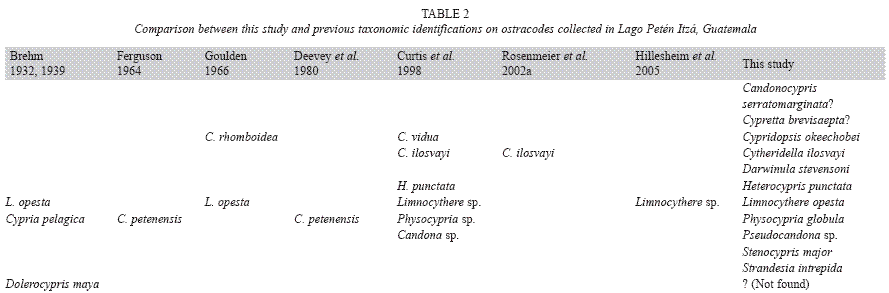
</front><body><![CDATA[  <b><font face="Verdana" size="4">     <p align="center">Extant freshwater ostracodes (Crustacea: Ostracoda) from Lago Pet&eacute;n Itz&aacute;, Guatemala</p> </font><font face="Verdana" size="2"> </font></b>     <p><font face="Verdana" size="2">    <br> <span style="font-weight: bold;">Liseth P&eacute;rez</span><a  style="font-weight: bold;" href="#autor1"><sup>1</sup></a><span  style="font-weight: bold;">, Julia Lorenschat</span><a  style="font-weight: bold;" href="#autor1"><sup>1</sup></a><span  style="font-weight: bold;">, Mark Brenner</span><a  style="font-weight: bold;" href="#autor2"><sup>2</sup></a><span  style="font-weight: bold;">, Burkhard Scharf</span><a style="font-weight: bold;" href="#autor1"><sup>1</sup></a><span  style="font-weight: bold;"> &amp; Antje Schwalb</span><a style="font-weight: bold;" href="#autor1"><sup>1</sup></a></font></p>     <p><font face="Verdana" size="2"><a name="autor1"></a>1. Institute of Environmental Geology, University of Braunschweig, Langer Kamp 19c, 38106, Braunschweig, Germany; <a href="mailto:l.perez@tu-bs.de">l.perez@tu-bs.de</a>, <a  href="mailto:j.lorenschat@tu-bs.de">j.lorenschat@tu-bs.de</a>, <a href="mailto:burkhard.w.scharf@t-online.de">burkhard.w.scharf@t-online.de</a>, <a href="mailto:antje.schwalb@tu-bs.de">antje.schwalb@tu-bs.de</a>    <br> <a name="autor2"></a>2. Department of Geological Sciences &amp; Land Use and Environmental Change Institute, University of Florida, Gainesville, Florida, FL 32611, USA; <a href="mailto:brenner@ufl.edu">brenner@ufl.edu</a></font></p> <font face="Verdana" size="2"><b> </b></font> <hr style="width: 100%; height: 2px;">     <p style="text-align: justify;"><font face="Verdana" size="2"><b><!-- big -->Abstract<!-- /big -->: </b>Ostracode taxonomy has been of great interest because of their possible use as indicator species in climate and ecosystem changes. In Central and South America, few studies have been carried out and this study includes a contribution to the group. Eleven ostracode species were collected in Lago Pet&eacute;n Itz&aacute; (~100km2), the second largest lowland lake in Guatemala, and from its inflow tributary, R&iacute;o Ixl&uacute; in November 2005 and February 2008. Twenty-seven surface sediment samples were retrieved at water depths from the littoral zone to the lake&#8217;s maximum depth (&gt;160m). Hard and soft parts of ostracodes were analyzed, and each ostracode species was described for taxonomy, size, ecology, biology and geographic distribution. Species recorded include: <i>Candonocypris serratomarginata</i>?, <i>Cypretta brevisaepta</i>?, <i>Cypridopsis okeechobei</i>, <i>Cytheridella ilosvayi</i>, <i>Darwinula stevensoni</i>, <i>Heterocypris punctata</i>, <i>Limnocythere opesta</i>, <i>Physocypria globula</i>, <i>Pseudocandona </i>sp., <i>Stenocypris major </i>and <i>Strandesia intrepida</i>. Most of the species have a neotropical distribution, two are distributed world-wide (<i>D. stevensoni </i>and <i>S. major</i>), and <i>C. okeechobei </i>and <i>P. globula </i>display nearctic and neotropical distributions. We present new records of <i>C. brevisaepta</i>?, <i>C. serratomarginata</i>?, <i>S. major</i>, and <i>S. intrepida </i>in Guatemala. <i>Physocypria globula </i>was misidentified previously in Lago Pet&eacute;n Itz&aacute; as <i>Cypria petenensis</i>, <i>Pseudocandona </i>sp. was misidentified as <i>Candona </i>sp., and <i>C. okeechobei </i>was identified in the past as <i>C. vidua</i>. <i>Limnocythere opesta </i>is the only endemic species of the Pet&eacute;n Lake District, Guatemala. The most abundant and widely distributed species in the lake are <i>P. globula</i>, <i>C. okeechobei</i>, and <i>Pseudocandona </i>sp. Species restricted to the littoral zones and water depths &lt;15m are <i>C. brevisaepta</i>?, <i>D. stevensoni</i>, <i>H. punctata</i>, and <i>S. intrepida</i>. <i>Limnocythere opesta</i>, <i>C. ilosvayi</i>, <i>C. okeechobei</i>, and <i>Pseudocandona </i>sp. are distributed from the littoral zone to a depth of 40m. Species collected only in the Ixl&uacute; tributary and in a littoral zone on the west side of the lake were <i>C. serratomarginata</i>? and <i>S. major</i>. During November, live adult <i>L. opesta </i>and <i>C. okeechobei </i>were abundant, but no <i>C. brevisaepta</i>? or <i>C. serratomarginata</i>? adults were found. Adult specimens of <i>C. ilosvayi </i>were more abundant in February. In general, ostracodes collected were smaller than those reported in the literature. An accurate taxonomy will improve the use of ostracode fossil assemblages in long sediment cores when reconstructing past climatic and environmental changes in the northern lowland Neotropics. Rev. Biol. Trop. 58 (3): 871-895. Epub 2010 September 01.</font></p> <font face="Verdana" size="2"><b> </b></font>     <p><font face="Verdana" size="2"><b>Key words: </b>freshwater ostracodes, Lago Pet&eacute;n Itz&aacute;, Guatemala, Neotropics, taxonomy, <i>Physocypria globula.</i></font></p> <hr style="width: 100%; height: 2px;">     <p style="text-align: justify;"><font face="Verdana" size="2">Ostracodes are microscopic, bivalved crustaceans, usually 0.4-3mm long, with valves of low-Mg calcite. The two valves comprise the carapace and protect the soft body parts. The valves are closed by adductor muscles that are attached to the carapace. These muscles leave scars on the valves and can be used to identify individuals to the family and superfamily levels. Other important taxonomic characters used for identification are the structure of the marginal zone of the valve, the external valve surface, pigmentation of the carapace, and differences in appendages and other soft parts (Dole-Olivier <i>et al. </i>2000, Meisch 2000, Horne. <i>et al. </i>2002). Ostracodes live in fresh, brackish, and marine waters, including streams, springs, ponds, lakes, estuaries and oceans. Some taxa are found in groundwaters, semi-terrestrial environments, or even in terrestrial plants that accumulate water, such as bromeliads. Non-marine ostracode species display diverse lifestyles. Some are benthic, living on or within the bottom substrate, while others are nektobenthic, with swimming abilities, but also live on the bottom substrate or plants. Some species can live in interstitial environments (Mezquita <i>et al. </i>2005). Ostracodes display different tolerances to water column physico-chemical variables. Eurytopic species are adapted to a wide range of environmental conditions, while stenotopic species are adapted to a narrow range of environmental conditions. Like other crustaceans, ostracodes moult, generally passing through eight stages to reach adulthood. An ostracode&#8217;s life cycle may last a few months or &gt;2 years (Horne <i>et al. </i>2002, Smith &amp; Horne 2002). Ostracodes constitute a model group in ecological and evolutionary studies, and are used as indicator species in climate and ecosystem change studies (Butlin &amp; Menozzi 2000, Griffiths &amp; Holmes 2000, Holmes &amp; Chivas 2002, Horne <i>et al. </i>2002, Smith &amp; Horne 2002, Schwalb 2003, Viehberg 2004, Martens <i>et al. </i>2008).</font></p>     <p style="text-align: justify;"><font face="Verdana" size="2">There has been great interest in the taxonomy of ostracodes from Central America and South America (Klie 1939, Ferguson <i>et al. </i>1964, Swain &amp; Gilby 1964, Goulden 1966, W&uuml;rdig 1983, Roessler 1990a, b, Cusminsky <i>et al. </i>2005), as well as their zoogeography and distribution (Kotzian 1974, Broodbakker 1984, Collado <i>et al. </i>1984, Martens 1984, Martens &amp; Behen 1994), shell geochemistry (Cross <i>et al. </i>2000), valve isotopic composition (Hodell <i>et al. </i>1995, Leyden <i>et al. </i>1996, Whitmore <i>et al. </i>1996, Curtis <i>et al. </i>1996, 1998, 1999, Brenner <i>et al. </i>2002, Rosenmeier <i>et al. </i>2002a, b, Markgraf <i>et al. </i>2003, Schwalb 2003, Hillesheim <i>et al. </i>2005, Hodell <i>et al. </i>2005), ecology (Deevey <i>et al. </i>1980, P&eacute;rez <i>et al. </i>2008, 2009, 2010), and use as hydrochemical bio-indicators (Laprida 2006). Few studies, however, have been carried out on the Yucat&aacute;n Peninsula, i.e. in the lowlands of Guatemala, M&eacute;xico and Belize.</font></p>     ]]></body>
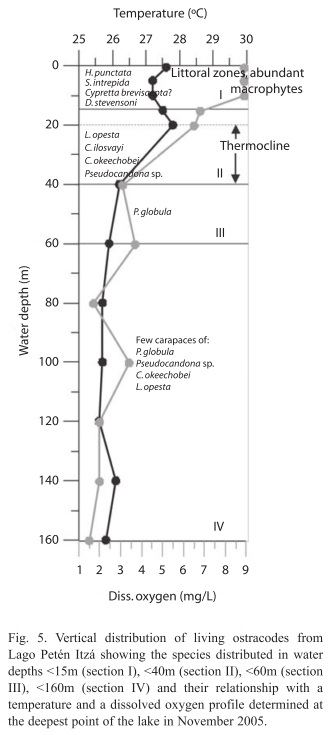
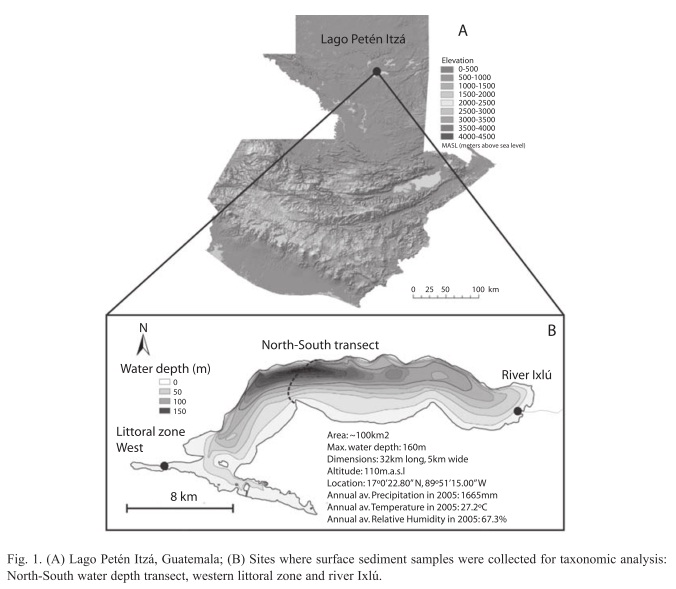
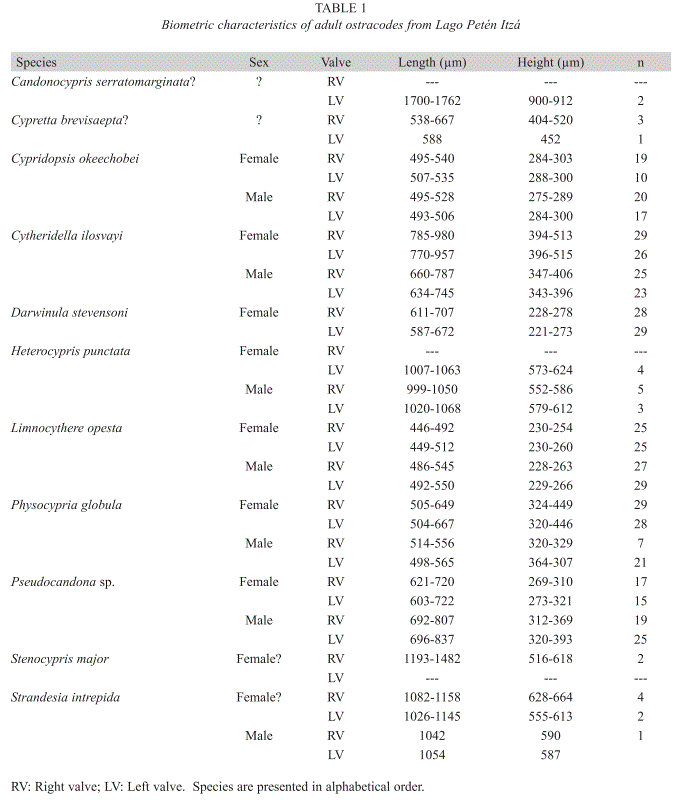
<body><![CDATA[<div style="text-align: justify;"></div>     <p style="text-align: justify;"><font face="Verdana" size="2">Most ostracode studies in the Neotropics have dealt with their taxonomy or use as paleoenvironmental indicators. Taxonomic studies of ostracodes from Lago Pet&eacute;n Itz&aacute; began in 1925 with collections by Dampf and identifications by Brehm (1939). Brehm (1932) reported the following ostracode species in an early publication on the freshwater fauna of Guatemala and M&eacute;xico: <i>Cypria pelagica</i>, <i>Dolerocypris opesta</i>, and <i>Limnocythere </i>sp. In a second publication, Brehm (1939) presented new results on the microfauna of Lago Pet&eacute;n Itz&aacute;. Studied groups included Cladocera, Rotifera and Ostracoda. Brehm reported a new ostracode species, <i>Limnocythere opesta </i>n. sp. Brehm&#8217;s identification of <i>C. pelagica </i>ultimately led to a controversy. Ferguson <i>et al. </i>(1964) identified ostracodes collected in the lake earlier by E.S. Deevey. They suggested the species name <i>Cypria pelagica </i>used by Brehm (1932) was invalid, and named the species <i>Cypria petenensis</i>. The epithet <i>pelagica </i>was first used by Klie (1933) to describe the subspecies <i>Cypria javana pelagica </i>and thus the subsequent use of this name is invalid. The species found in Guatemala was thought to be endemic to lakes in the Pet&eacute;n region of northern Guatemala, hence the species epithet <i>petenensis</i>. Confusion over the taxonomic status of this nekto-benthic ostracode species ended when Curtis <i>et al. </i>1998 collected them in lake sediments of Lago Pet&eacute;n Itz&aacute;, and used their valves for isotopic analysis. They placed the taxon in the correct genus, <i>Physocypria</i>. Differences between the two genera are described later. We propose that the correct name for the species in Lago Pet&eacute;n Itz&aacute; is <i>Physocypria globula </i>(Furtos, 1936).</font></p>     <div style="text-align: justify;"></div>     <p style="text-align: justify;"><font face="Verdana" size="2">This paper indicates that there have been some disagreements regarding identification of ostracodes from Lago Pet&eacute;n Itz&aacute;. Nevertheless, isotope measurements on their valves have been used as tools for paleoenvironmental reconstruction (Curtis <i>et al. </i>1998, Rosenmeier <i>et al. </i>2002a, Hillesheim <i>et al. </i>2005). Accurate taxonomy is crucial for paleoecological interpretation of changes in fossil species assemblages in lake sediments. With this in mind, we present a taxonomic overview of the ostracodes in Lago Pet&eacute;n Itz&aacute;, with information on their size, biology, ecology, and zoogeography.</font></p> <b><font face="Verdana" size="3">     <p>Materials and methods</p> </font><font face="Verdana" size="2"> </font></b>     <p style="text-align: justify;"><b><font face="Verdana" size="2">Study site and collection of ostracodes: </font></b><font face="Verdana" size="2">Lago Pet&eacute;n Itz&aacute; (17&deg;0&#8217;N, 89&deg;51&#8217;W) is the second largest lake in the Guatemala lowlands (<a href="/img/revistas/rbt/v58n3/a07i1.jpg">Fig. 1A</a>), with an area of ~100km<sup>2</sup> and a maximum depth of &gt;160m. Its sediment record appears to span &gt;200 000 years (M&uuml;ller 2009, pers. comm.), making it one of the few extant ancient lakes of the world. It is located in Pet&eacute;n, northern Guatemala. The lake originated from tectonism and limestone dissolution. The lake surface lies at about 110m.a.s.l. The northern basin is deep and has steep slopes. The southern basin is shallower and the areal extent of its seasonally swampy shores is related to lake level variation. The thermocline of the lake is located between 20 and 40m water depth, and the water body is thermally stratified throughout most of the year (Brezonik &amp; Fox 1974, Hillesheim <i>et al. </i>2005). Ambient air temperature ranges from 22.3&deg;C (January) to 29.8&deg;C (May). The hydrologic budget of the lake is controlled mainly by evaporation and precipitation. There is a small input stream, the R&iacute;o Ixl&uacute;, but Lago Pet&eacute;n Itz&aacute; lacks an overland outflow and is an effectively closed basin (Anselmetti <i>et al. </i>2006, MARN-AMPI 2008, M&uuml;ller <i>et al. </i>2009).</font></p>     <div style="text-align: justify;"></div>     <p style="text-align: justify;"><font face="Verdana" size="2">Twenty-seven surface sediment samples were collected in November 2005 from the littoral zone of Lago Pet&eacute;n Itz&aacute;, across a N-S transect and at water depths to a maximum of 160m. Two additional samples were collected in February 2008 from the littoral zone in the west and from the R&iacute;o Ixl&uacute; tributary in the east (<a href="/img/revistas/rbt/v58n3/a07i1.jpg">Fig. 1B</a>). Surface sediment samples were retrieved using an Ekman grab. Adult ostracodes were collected among aquatic plants in the littoral zone using a net with a mesh size of 250</font><font face="Verdana"  size="2">&#956;</font><font face="Verdana" size="2">m. We added 96% ethanol to the surface sediments to preserve soft body parts. Details of the lake water physico-chemical properties are in P&eacute;rez <i>et al. </i>(2010).</font></p>     <div style="text-align: justify;"><font face="Verdana" size="2"><b> </b></font></div>     <p style="text-align: justify;"><font face="Verdana" size="2"><b>Ostracode identification: </b>Ostracodes were selected from surface sediment samples with fine brushes. Soft parts were detached from both valves using entomological needles, dissected, and mounted with Hydro-Matrix&reg; onto cover slides. Photographs for analysis of soft and hard parts were taken using a Leica DM5000B microscope and a Leica DFC 320 digital camera. Scanning Electron Microscope (SEM) pictures of ostracode valves and carapaces were made in the Biocenter Grindel and Zoological Museum of the University of Hamburg, Germany. SEM pictures were taken with a field emission scanning electron microscope LEO 1525. Length and height of valves from each species were measured in &micro;m (<a  href="/img/revistas/rbt/v58n3/a07t1.gif">Table 1</a>). The n in the table indicates the number of valves measured. Ostracode valves and soft parts from the British Museum, London and private collections were compared with our samples. For identification and additional ecological information we used primarily the works of Brehm (1939), Furtos (1933, 1936a, b), and Deevey <i>et al. </i>(1980). Ostracode specimens are stored at the Institute of Environmental Geology, University of Braunschweig, Germany. </font></p> <b><font face="Verdana" size="3">     ]]></body>
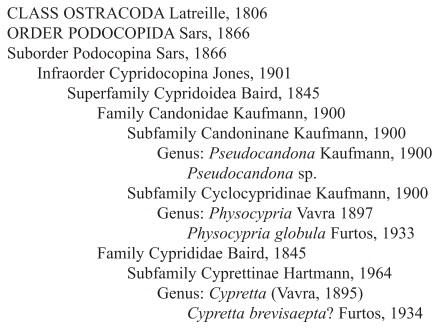
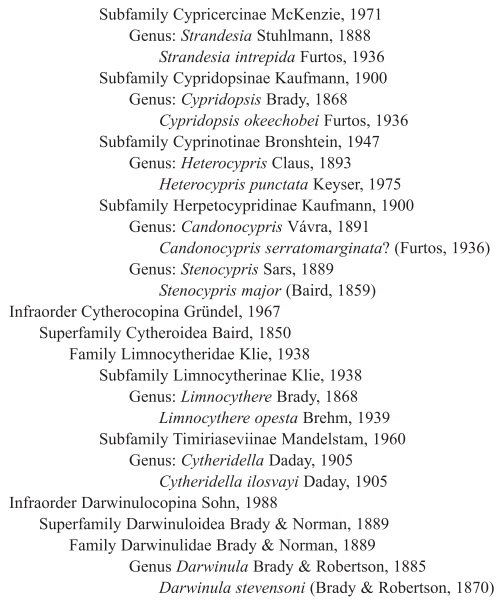
<body><![CDATA[<p>Results</p> </font><font face="Verdana" size="2"> </font></b>     <p style="text-align: justify;"><b><font face="Verdana" size="2">Taxonomy of ostracodes: </font></b><font face="Verdana" size="2">Eleven ostracode species were identified in surface sediment samples from Lago Pet&eacute;n Itz&aacute; and in a small stream tributary in the east. The species assemblage is composed of two limnocytherids (<i>Limnocythere opesta </i>(Brehm, 1939), <i>Cytheridella ilosvayi </i>(Daday, 1905), two candonids (<i>Physocypria globula</i>, <i>Pseudocandona </i>sp.), one darwinulid (<i>Darwinula stevensoni </i>(Brady &amp; Robertson, 1870)) and six cypridids (<i>Cypretta brevisaepta </i>(Furtos, 1934)?, <i>Cypridopsis okeechobei </i>(Furtos, 1936), <i>Candonocypris serratomarginata </i>(Furtos, 1936)?, <i>Heterocypris punctata </i>(Keyser, 1976), <i>Stenocypris major </i>(Brady, 1886) and <i>Strandesia intrepida </i>(Furtos, 1936). Classification of the species is as follows:    <br> </font></p>     <p style="text-align: center;"><font face="Verdana" size="2"><img  src="/img/revistas/rbt/v58n3/a07ia.jpg" title="" alt=""  style="width: 442px; height: 328px;">    <br> <img src="/img/revistas/rbt/v58n3/a07ib.jpg" title="" alt=""  style="width: 501px; height: 602px;">    <br>     <br> </font></p>     <p style="text-align: justify;"><font face="Verdana" size="2">Differences between species identified in this study and those in other published literature are presented in <a href="/img/revistas/rbt/v58n3/a07t2.gif">Table 2</a>. Species reported for the first time in Lago Pet&eacute;n Itz&aacute; are: <i>C. brevisaepta</i>?, <i>D. stevensoni</i>, <i>C. serratomarginata</i>?, <i>S. major</i>, and <i>S. intrepida</i>. <i>Cypridopsis okeechobei </i>was previously identified as <i>C. vidua </i>and <i>C. rhomboidea</i>. <i>Pseudocandona </i>sp. was misidentified in the past as <i>Candona </i>sp. <i>Cytheridella ilosvayi </i>and <i>L. opesta </i>were correctly identified in previous investigations.</font></p>     <div style="text-align: justify;"></div>     <p style="text-align: justify;"><font face="Verdana" size="2">The following section presents, in alphabetical order, species identified in this study, with a description of valves and soft parts for species that were not identified down to species level, or species for which only valves were found and for which identification thus remains uncertain (e.g. <i>Candonocypris serratomarginata</i>?, <i>Cypretta brevisaepta</i>?, and <i>Pseudocandona </i>sp.). Accompanying each taxon is an abbreviated synonymy list, as well as references for extended lists, an explanation of the type of material examined, a justification for the identification and the literature employed. Descriptions are accompanied by comments on species ecological preferences drawn from this study and observations during fieldtrips across the Yucat&aacute;n Peninsula in 2005 and 2008 (P&eacute;rez <i>et al. </i>2009, 2010).</font></p>     ]]></body>
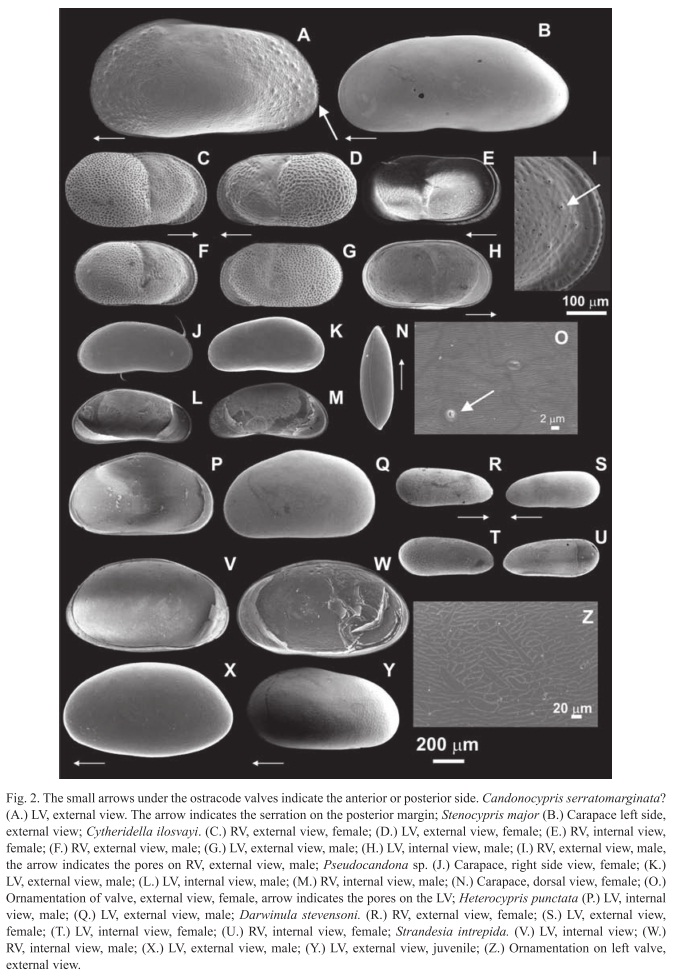
<body><![CDATA[<p><font face="Verdana" size="2"><b><i>Candonocypris serratomarginata</i>?    <br> (Furtos, 1936)</b>    <br> (<a href="/img/revistas/rbt/v58n3/a07i2.jpg">Fig. 2A</a>)</font></p>     <p><font face="Verdana" size="2">*1936a <i>Eucypris serrato-marginata </i>n. sp. Furtos - Furtos: 107-108, Figs. 107-111.    <br> 1936b <i>Candonocypris serrato-marginata </i>(Furtos) - Furtos: Text 504, 505.    <br> 1947 <i>Eucypris serrato-marginata</i>, <i>Candoncypris serrato-marginata </i>(Furtos) - Tressler: Text 703.</font></p> <font face="Verdana" size="2"><b> </b></font>     <p style="text-align: justify;"><font face="Verdana" size="2"><b>Material: </b>Only a few valves, mostly broken and all articulated, were found during our sampling campaigns. The analyzed material included surface sediment samples collected from shallow water (0.5m) in a small tributary of Lago Pet&eacute;n Itz&aacute; (River Ixl&uacute;) and from shallow water in a littoral area on the west side of the lake (<a href="/img/revistas/rbt/v58n3/a07i1.jpg">Fig. 1B</a>).</font></p>     <div style="text-align: justify;"><font face="Verdana" size="2"><b> </b></font></div>     <p style="text-align: justify;"><font face="Verdana" size="2"><b>Taxonomy: </b>According to the International Commission on Zoological Nomenclature (ICZN), the valid species name is <i>C. serratomarginata</i>, omitting the hyphen used by Furtos (1936a). Samples we found probably belong to <i>C. serratomarginata </i>because the valves are elongated and serrated (denticulated) (see arrow, <a href="/img/revistas/rbt/v58n3/a07i2.jpg">Fig. 2A</a>). According to Furtos (1936a) the anterior and the posterior margins of both valves are serrated. The valves we collected presented serration only on the posterior margin, but all the other morphological characteristics reported by Furtos (1936a) coincide with ours. We collected only one right valve from a juvenile which presented a prominent spine at the posteroventral margin. The length of the valve is slightly less than two times the height. The greatest height is reached in the anterior third of the valve. The ventral margin of the valves is slightly curved, the anterior part of the valve is broad and rounded, and the posterior is narrower. The surface of the valves is smooth and contains sparse hairs (Furtos 1936a). The valves of our specimens seem similar to the genus <i>Trajancypris </i>described by Martens (1989) and the species <i>Chlamydotheca unispinosa </i>(Baird 1862). Ostracode valves collected by us seem to be the juveniles of the very large ostracode <i>C. unispinosa </i>(Holmes 2010, pers. comm.). We need to collect more valves and carapaces with soft parts for a more accurate taxonomy. We did not find soft parts, and thus cannot provide descriptions. For detailed descriptions of <i>C. serratomarginata </i>appendages, see Furtos (1936a, b).</font></p> <font face="Verdana" size="2"><b> </b></font>     <p><font face="Verdana" size="2"><b>Identification: </b>Furtos 1936a, b.</font></p> <font face="Verdana" size="2"><b> </b></font>     ]]></body>
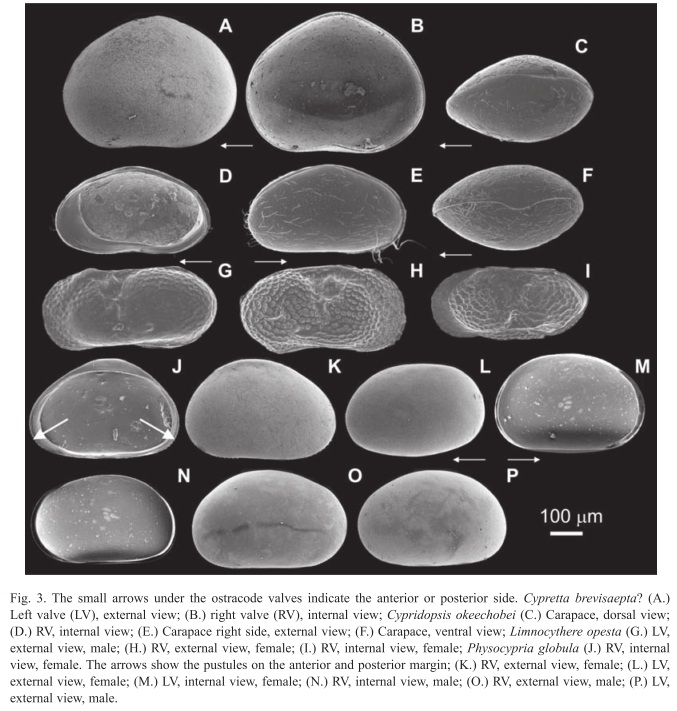
<body><![CDATA[<p style="text-align: justify;"><font face="Verdana" size="2"><b>Size: </b>The length of this species ranges from 1.71 to 2.05mm. Furtos (1936a) reported that females are 2.05mm long and 1mm high, and that no males were collected on the Yucat&aacute;n Peninsula. A single specimen collected in Florida (Furtos 1936b) was only 1.71mm long. In this study, only three specimens were collected, two left valves from an adult ostracode and one left valve from a juvenile (<a  href="/img/revistas/rbt/v58n3/a07t1.gif">Table 1</a>). Sizes reported in this study resemble those reported from Florida.</font></p> <font face="Verdana" size="2"><b> </b></font>     <p style="text-align: justify;"><font face="Verdana" size="2"><b>Biology, ecology, and geographic distribution: </b>This species was reported by Furtos (1936a) in Xix Cenote, Valladolid, M&eacute;xico. It has also been collected near Seminole City, Florida (Furtos 1936b). We also found it in a small pond in Belize, close to the coast. The species was collected in both calm and shallow running waters. Only females have been reported in the region (Furtos 1936a, b).</font></p> <font face="Verdana" size="2"><b><i> </i></b></font>     <p><font face="Verdana" size="2"><b><i>Cypretta brevisaepta</i>? Furtos, 1934</b>    <br> (<a href="/img/revistas/rbt/v58n3/a07i3.jpg">Fig. 3A</a>, <a  href="/img/revistas/rbt/v58n3/a07i3.jpg">B</a>)</font></p>     <p><font face="Verdana" size="2">*1934 <i>Cypretta brevisaepta </i>Furtos - Furtos: Text 283-284, Figs. 2a-h.</font></p>     <p><font face="Verdana" size="2">For synonymies see:    <br> - Keyser 1976: <i>Cypretta brevisaepta </i>Furtos, 1934; <i>C. brevisaepta brevisaepta </i>Furtos <i>sensu </i>Furtos, 1936; <i>C. nigra </i>Furtos, 1936.</font></p> <font face="Verdana" size="2"><b> </b></font>     <p><font face="Verdana" size="2"><b>Material: </b>Four articulated valves were recovered from sediments collected at water depths above the thermocline (~15m water depth) in Lago Pet&eacute;n Itz&aacute;.</font></p>     <p style="text-align: justify;"><font face="Verdana" size="2"><b>Taxonomy: </b>The genus is very similar to <i>Cypridopsis</i>, but the row of septa along the anterior margin of each valve in <i>Cypretta </i>makes it possible to differentiate the two genera. When viewed from the side, valves are arched. The greatest height of the valve is reached in the middle. Anterior and posterior extremities are rounded, and the anterior is slightly broader. The ventral margin of the right valve is almost straight and the ventral margin of the right valve is slightly curved. The surface of the valves is smooth. All of the previous characteristics coincide with the descriptions of Furtos (1934, 1936b). We did not collect ostracodes with well- preserved soft parts. For detailed descriptions of <i>C. brevisaepta </i>appendages see Furtos (1936a, b).</font></p> <font face="Verdana" size="2"><b> </b></font>     <p><font face="Verdana" size="2"><b>Identification: </b>Keyser 1976, Furtos 1934, 1936b.</font></p> <font face="Verdana" size="2"><b> </b></font>     ]]></body>
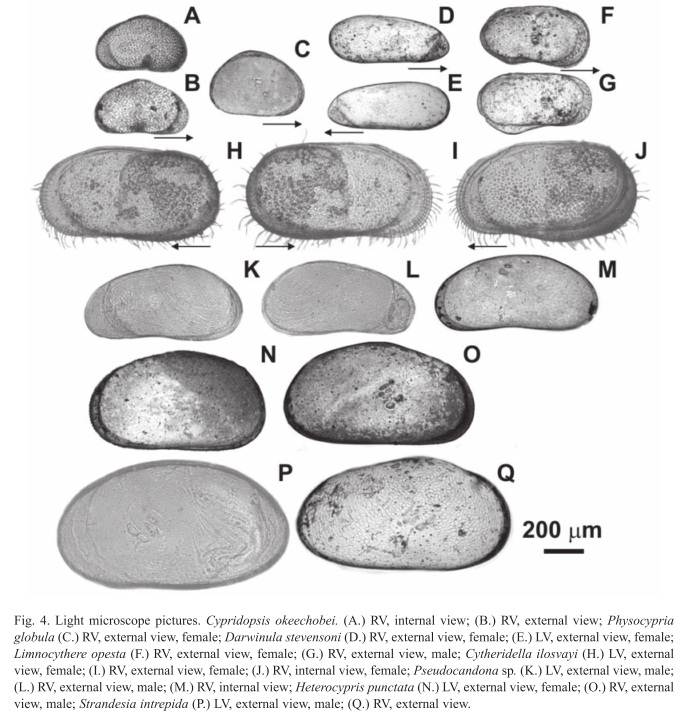
<body><![CDATA[<p style="text-align: justify;"><font face="Verdana" size="2"><b>Size: </b>Furtos (1936b) reported females 0.85mm long and 0.67mm high. Males were slightly smaller than females, with lengths of 0.82mm, and heights of 0.60mm.We found specimens much smaller than the sizes reported by Furtos (1936b) (<a  href="/img/revistas/rbt/v58n3/a07t1.gif">Table 1</a>).</font></p> <font face="Verdana" size="2"><b> </b></font>     <p style="text-align: justify;"><font face="Verdana" size="2"><b>Biology, ecology, and geographic distribution</b>: Species of this genus are known to have a nekto-benthic lifestyle. Reproduction of the genus is almost exclusively parthenogenetic, but there are exceptions (Furtos 1934). The genus is known to have a tropical and subtropical distribution, nevertheless a few species live in temperate climates (Sohn &amp; Kornicker 1972). Okubo (1973) reported the genus in Japan and Bronshtein (1947) reported it in Russia. The species <i>C. brevisaepta </i>is known from regions near the Yucat&aacute;n Peninsula, southern Florida and the West Indies (Furtos 1934, Keyser 1976) and thus we believe that these individuals belong to this species. Nevertheless, we will need to analyze well-preserved soft parts from this species for a definitive identification. We present the first record for this genus in Guatemala. We found only a few valves in Lago Pet&eacute;n Itz&aacute;, thus we suspect that this species is not very abundant or may even be absent from the lake. Two single valves were also collected in Lake Macanch&eacute;, near Pet&eacute;n Itz&aacute;. We collected abundant living specimens of this species in Lake Oquevix, Pet&eacute;n, Guatemala in February. Water temperature in Lake Oquevix was relatively high (31.4&deg;C), and conductivity was low (238</font><font face="Verdana" size="2">&#956;</font><font face="Verdana"  size="2">S/cm), showing the preference of the species for warm, low-conductivity waters.</font></p> <font face="Verdana" size="2"><b><i> </i></b></font>     <p><font face="Verdana" size="2"><b><i>Cypridopsis okeechobei </i>Furtos, 1936</b>    <br> (<a href="/img/revistas/rbt/v58n3/a07i3.jpg">Fig. 3C-F</a>; <a  href="/img/revistas/rbt/v58n3/a07i4.jpg">Fig. 4A</a>, <a  href="/img/revistas/rbt/v58n3/a07i4.jpg">B</a>)</font></p>     <p><font face="Verdana" size="2">1776 <i>Cypris vidua </i>M&uuml;ller - M&uuml;ller in Meisch 2000: 372-378, Figs. 155-156.</font></p>     <p><font face="Verdana" size="2">*1936b <i>Cypridopsis okeechobei </i>sp. nov. Furtos - Furtos: 492-493, Figs. 1a-i.    <br> <i>1966 Cypridopsis rhomboidea </i>Furtos - Goulden:Text 107, 108.    <br> <i>1998 Cypridopsis vidua </i>M&uuml;ller - Curtis <i>et al.</i>:Text 146, 152.</font></p>     <p><font face="Verdana" size="2">For synonymies of <i>C. vidua </i>see:    <br> </font></p>     ]]></body>
<body><![CDATA[<div style="text-align: justify;"><font face="Verdana" size="2">- Meisch 2000: <i>Cypris vidua </i>O. F. M&uuml;ller, 1776, <i>Cypris pincta </i>Straus, 1821, <i>Cypridopsis obesa </i>Brady &amp; Robertson, 1869, ?<i>Cypridopsis vidua concolor </i>Daday, 1900, <i>Cypridopsella helvetica </i>Kaufmann, 1900, <i>Cypridopsella tumida </i>Kaufmann, 1900, <i>Cypridopsis parva </i>M&uuml;ller, 1900, <i>Cypridopsis vidua </i>f. <i>obesa </i>G. W. M&uuml;ller, 1900, ?<i>Cypridopsis concolor </i>M&uuml;ller, 1912, ?<i>C. okeechobei </i>Furtos, 1936, <i>Cypridopsis mariae </i>Rome, 1943, <i>Cypridopsis parvoides </i>J. M. Martens, 1977.</font></div>     <div style="text-align: justify;"><font face="Verdana" size="2"><b> </b></font></div>     <p style="text-align: justify;"><font face="Verdana" size="2"><b>Material: </b>We collected hundreds of articulated valves and carapaces containing or lacking soft parts, across the north-south surface sediment transect, covering a broad range of water depths in Lago Pet&eacute;n Itz&aacute; (0.5-160m).</font></p>     <div style="text-align: justify;"><font face="Verdana" size="2"><b> </b></font></div>     <p style="text-align: justify;"><font face="Verdana" size="2"><b>Taxonomy: </b>The descriptions and drawings made by Furtos (1936b) are remarkably good, making identification easy. Further description of <i>C. okeechobei </i>appendages can be found in Furtos (1936b). This species displays similar morphological characteristics with <i>Cypridopsis vidua</i>, as both have hairy valves of similar shape, and similar appendage morphology. Meisch (2000) suggested that <i>C. okeechobei </i>could be a sexual form of <i>C. vidua</i>. Further analyses are needed to test this. This is why we included <i>C. vidua </i>in the synonymy list of <i>C. okeechobei</i>. </font></p>     <div style="text-align: justify;"><font face="Verdana" size="2"><b> </b></font></div>     <p style="text-align: justify;"><font face="Verdana" size="2"><b>Identification: </b>Furtos 1936b.</font></p>     <div style="text-align: justify;"><font face="Verdana" size="2"><b> </b></font></div>     <p style="text-align: justify;"><font face="Verdana" size="2"><b>Size: </b>The left valve is larger and encloses the right valve. Specimens collected by us are smaller than those reported by others (<a  href="/img/revistas/rbt/v58n3/a07t1.gif">Table 1</a>). Furtos (1936b) found females 0.64mm long and 0.40mm high. Males are smaller than females, or of similar size (0.58mm long and 0.37mm high).</font></p>     <div style="text-align: justify;"><font face="Verdana" size="2"><b> </b></font></div>     ]]></body>
<body><![CDATA[<p style="text-align: justify;"><font face="Verdana" size="2"><b>Biology, ecology, and geographic distribution</b>: The species name comes from the lake where it was first collected, Lake Okeechobee, Florida, USA (Furtos 1936b). Keyser (1976) collected the same species in Florida. The species was thought be distributed only in the United States, but we noted its presence in almost all lakes and <i>cenotes </i>(sinkholes) sampled during our fieldtrips in 2005 and 2008 across the Yucat&aacute;n Peninsula, including Izabal, Perdida, Macanch&eacute;, Yaxh&aacute; (Guatemala), Almond Hill, Crooked Tree, and Honey Camp Lagoons, Cenote, a small un-named pond (Belize), and Milagros, Bacalar, Nohbec, Ocom, Punta Laguna and Yalahau (M&eacute;xico). The species was also found in water with a conductivity of 5960</font><font  face="Verdana" size="2">&#956;</font><font face="Verdana" size="2">S/cm and salinity of 3.2&#8240;, showing it tolerates high dissolved ion concentrations. Keyser (1976) collected it in waters with salinity up to 4.3&#8240; and temperatures from 19 to 31&deg;C. <i>Cypridopsis okeechobei </i>is a nekto-benthic species. It is very abundant in the littoral zone of Lago Pet&eacute;n Itz&aacute;. Living ostracodes were collected in waters &lt;40m deep. Similar to <i>P. globula</i>, <i>C. okeechobei </i>shows a broad hydrochemical tolerance. Keyser (1976) indicated its preference for calm waters. <i>Cypridopsis okeechobei </i>exhibits sexual reproduction and both females and males were present. Only female specimens of <i>C. vidua </i>have been collected (Meisch 2000). If <i>C. okeechobei </i>is, in fact, a sexual form of <i>C. vidua</i>, then the species has a world-wide distribution.</font></p> <font face="Verdana" size="2"><b><i> </i></b></font>     <p><font face="Verdana" size="2"><b><i>Cytheridella ilosvayi </i>Daday, 1905</b>    <br> (<a href="/img/revistas/rbt/v58n3/a07i2.jpg">Fig. 2C-I</a>; <a  href="/img/revistas/rbt/v58n3/a07i4.jpg">Fig. 4H-J</a>)</font></p>     <p><font face="Verdana" size="2">*1905 <i>Cytheridella ilosvayi </i>n. sp. Daday - Daday: Text 262-267, Figs. 371, Plate 17, Fig. 15-28; plate 18, Fig. 1-11.</font></p>     <p><font face="Verdana" size="2">For synonymies see:    <br> </font></p>     <div style="text-align: justify;"><font face="Verdana" size="2">- Purper 1974: <i>Cythereis ilosvayi </i>(Daday) M&uuml;ller, 1912; <i>Cytheridella ilosvayi </i>Daday, Klie, 1930; <i>Onychocythere alosa </i>Tressler, 1939, <i>Metacypris</i>? sp. Bold, 1958; <i>Cytheridella </i>sp. (Bold 1958) Pinto &amp; Sanguinetti, 1962; <i>Cytheridella ilosvayi </i>Daday, Pinto &amp; Sanguinetti, 1962; <i>Metacypris ometepensis </i>Swain &amp; Gilby, 1964.</font>    <br> <font face="Verdana" size="2">- Martens &amp; Behen 1994: <i>Metacypris ometepensis </i>n. sp. Swain &amp; Gilby, 1965; <i>Cytheridella ometepensis </i>(Swain &amp; Gilby, 1965), Swain &amp; Gilby, 1970.</font></div>     <div style="text-align: justify;"><font face="Verdana" size="2"><b> </b></font></div>     <p style="text-align: justify;"><font face="Verdana" size="2"><b>Material: </b>We found several hundred articulated valves and fewer carapaces. Only a few ostracodes were found with well-preserved soft parts. Ostracodes were recovered from surface sediments collected across a north-south transect from the littoral zone to a maximum depth of 160m. We collected more valves in the northern part of the lake.</font></p>     ]]></body>
<body><![CDATA[<div style="text-align: justify;"><font face="Verdana" size="2"><b> </b></font></div>     <p style="text-align: justify;"><font face="Verdana" size="2"><b>Taxonomy: </b>The species is widely distributed throughout the American continent. It has thus been studied in great detail and there are abundant publications providing descriptions, drawings and photographs of valves, carapaces and soft parts (L&ouml;ffler 1961, Purper 1974, W&uuml;rdig 1983).</font></p>     <p><font face="Verdana" size="2"><b>Identification: </b>Daday 1905.</font></p> <font face="Verdana" size="2"><b> </b></font>     <p><font face="Verdana" size="2"><b>Size: </b>The species displays sexual dimorphism. Females are rounder and males are slightly smaller (<a href="/img/revistas/rbt/v58n3/a07t1.gif">Table 1</a>).</font></p> <font face="Verdana" size="2"><b> </b></font>     <p style="text-align: justify;"><font face="Verdana" size="2"><b>Biology, ecology and geographic distribution: </b>This species is primarily neotropical. It is distributed in South and Central America and the Caribbean islands; Brazil, Chile, Cuba, Nicaragua, Paraguay, Trinidad and Venezuela (Martens &amp; Behen 1994). We collected the species in other lakes of the Yucat&aacute;n Peninsula as well: Perdida, Macanch&eacute;, Yaxh&aacute; (Guatemala), Almond Hill and Crooked Tree Lagoons (Belize), and Milagros, Bacalar, Ocom, Chichancanab and Yalahau (M&eacute;xico). We found that <i>C. ilosvayi </i>prefers waters with conductivity &lt;5960</font><font face="Verdana" size="2">&#956;</font><font  face="Verdana" size="2">S/cm and salinity &lt;3.2&#8240;, and tolerates relatively high concentrations of sulfate, up to 2300mg/L. The species was found in waters with temperatures &gt;20&deg;C and was distributed in Lago Pet&eacute;n Itz&aacute; from the littoral zone to the base of the thermocline (~40m). Surface sediment samples collected in November 2005 from Lago Pet&eacute;n Itz&aacute; contained few carapaces of <i>C. ilosvayi </i>with soft parts. Instead, samples contained mainly valves, which were more abundant in the northern part of the lake. Samples retrieved in February and March 2008 had both carapaces and soft parts, mostly from females. It is a benthic species, and is more abundant in the lake&#8217;s northern basin. Many living adult ostracodes were found in Lago Pet&eacute;n Itz&aacute;&#8217;s R&iacute;o Ixl&uacute; tributary, a small river with aquatic plants and slow current.</font></p> <font face="Verdana" size="2"><b>     <p><span style="font-style: italic;">Darwinula stevensoni</span>    <br> (Brady &amp; Robertson, 1870)<font face="Verdana" size="2">    <br> <span style="font-weight: normal;">(<a  href="/img/revistas/rbt/v58n3/a07i2.jpg">Fig. 2R-U</a>; <a  href="/img/revistas/rbt/v58n3/a07i4.jpg">Fig. 4D</a>, <a  href="/img/revistas/rbt/v58n3/a07i4.jpg">E</a>)</span></font></p> </b></font>     <p><font face="Verdana" size="2">*1870 <i>Polycheles stevensoni </i>nov. sp. Brady &amp; Robertson - Brady &amp; Robertson: Text 25, 26, Plate 7, Figs. 1-7, Plate 10, Figs. 4-14.</font></p>     <p><font face="Verdana" size="2">For synonymies see:    ]]></body>
<body><![CDATA[<br> </font></p>     <div style="text-align: justify;"><font face="Verdana" size="2">- Furtos 1933: <i>Argilloecia aurea </i>plus <i>Polycheles stevensoni </i>Brady &amp; Robertson, 1870; <i>Darwinella stevensoni </i>Brady &amp; Robertson, 1872; <i>Darwinula improvisa </i>Turner, 1895; <i>Darwinula aurea</i>, G. W. M&uuml;ller, 1912.</font>    <br> </div>     <div style="text-align: justify;"><font face="Verdana" size="2">- Meisch 2000: <i>Polycheles stevensoni </i>Brady &amp; Robertson, 1870; <i>Darwinula stevensoni </i>nov. comb. Brady &amp; Robertson, 1885; <i>D. improvisa </i>Turner, 1895; <i>D. protracta </i>Rome, 1953; <i>D. variabilis </i>Tagliasacchi-Masala, 1968; <i>D. sphenoides </i>Rome, 1977.</font></div> <font face="Verdana" size="2"><b> </b></font>     <p style="text-align: justify;"><font face="Verdana" size="2"><b>Material: </b>Hundreds of articulated valves and carapaces were recovered from surface sediments collected across a north-south transect from the littoral zone to a maximum depth of 160m. Highest concentrations of valves and carapaces were found in samples from the littoral zone to a water depth of 15m.</font></p> <font face="Verdana" size="2"><b> </b></font>     <p><font face="Verdana" size="2"><b>Taxonomy: </b>There are many publications with good morphological descriptions of this taxon (Meisch 2000) because of the worldwide distribution of this species.</font></p> <font face="Verdana" size="2"><b> </b></font>     <p><font face="Verdana" size="2"><b>Identification: </b>Meisch 2000.</font></p> <font face="Verdana" size="2"><b> </b></font>     <p><font face="Verdana" size="2"><b>Size: </b>The right valve is larger than the left valve, and overlaps the left valve ventrally (Meisch 2000). No males were found in our samples (<a  href="/img/revistas/rbt/v58n3/a07t1.gif">Table 1</a>). </font></p> <font face="Verdana" size="2"><b> </b></font>     <p style="text-align: justify;"><font face="Verdana" size="2"><b>Biology, ecology and geographic distribution: </b><i>Darwinula stevensoni </i>is distributed on the American continent and has been collected in water bodies in Brazil, Nicaragua and the West Indies (Martens &amp; Behen 1994). We found it on the Yucat&aacute;n Peninsula as well. It has a cosmopolitan distribution (Meisch 2000). There are reports of this species from Russia (Bronshtein 1988) and South Africa (Rossetti &amp; Martens 1996). It is widely distributed in aquatic environments in west and central Europe (Meisch 2000), Turkey (Furtos 1933), Kenya, Ethiopia, Congo (Martens &amp; Behen 1994), and Japan (Smith &amp; Kamiya 2008). We found this ostracode in most of the lakes we studied, but typically, it was not very abundant. Only a few living specimens were collected. Data from our field campaign in 2005 suggest that this species lives at water depths down to 15m (Lago Pet&eacute;n Itz&aacute; and Izabal, Guatemala). It was more abundant in the shallow, southern basin of Lago Pet&eacute;n Itz&aacute;. <i>Darwinula stevensoni </i>is a benthic species that has also been reported from interstitial groundwaters (Meisch 2000). We found specimens in waters with conductivity up to 1715</font><font face="Verdana" size="2">&#956;</font><font  face="Verdana" size="2">S/cm (Almond Hill Lagoon, Belize). The species, however, apparently is tolerant of mesohaline environments (&#8804;15&#8240;) (Meisch 2000). Keyser (1976) found this species mostly in waters with salinity between 1 and 4&#8240;, along with a few specimens in salinities of ~13.5&#8240;. Typical habitats are ponds, lakes and streams with slow currents (Meisch 2000). Rossetti &amp; Martens (1996) studied the morphological variability of hard and soft parts of this species in widely dispersed populations. Size seemed to be the only characteristic that varied between populations of different geographic and climatic regions.</font></p> <font face="Verdana" size="2"><b><i> </i></b></font>     <p><font face="Verdana" size="2"><b><i>Heterocypris punctata </i>Keyser, 1975</b>    ]]></body>
<body><![CDATA[<br> (<a href="/img/revistas/rbt/v58n3/a07i2.jpg">Fig. 2P</a>, <a  href="/img/revistas/rbt/v58n3/a07i2.jpg">Q</a>; <a  href="/img/revistas/rbt/v58n3/a07i4.jpg">Fig. 4N</a>, <a  href="/img/revistas/rbt/v58n3/a07i4.jpg">O</a>)</font></p>     <p><font face="Verdana" size="2">*1975 <i>Heterocypris punctata </i>Keyser-Keyser: Text 275-277, 290, Fig. 13, Plate 12, Figs. 10-11.</font></p> <font face="Verdana" size="2"><b> </b></font>     <p style="text-align: justify;"><font face="Verdana" size="2"><b>Material: </b>Hundreds of articulated valves and carapaces without soft parts were encountered. Specimens were found only in surface sediments from the shallow (&lt;1m water depth) southern littoral zone of Lago Pet&eacute;n Itz&aacute;. No carapaces with well-preserved soft parts were collected.</font></p>     <div style="text-align: justify;"><font face="Verdana" size="2"><b> </b></font></div>     <p style="text-align: justify;"><font face="Verdana" size="2"><b>Taxonomy: </b>This species has been reported from southwest Florida. Keyser (1975) described this species and presented drawings of soft parts and valves, along with SEM photos.</font></p>     <div style="text-align: justify;"><font face="Verdana" size="2"><b> </b></font></div>     <p style="text-align: justify;"><font face="Verdana" size="2"><b>Identification: </b>Keyser 1975.</font></p>     <div style="text-align: justify;"><font face="Verdana" size="2"><b> </b></font></div>     <p style="text-align: justify;"><font face="Verdana" size="2"><b>Size: </b>The left valve is longer, and encloses the right valve. We found mostly juveniles, but also a few adults. Females are bigger than males and we found mostly males in our samples (<a href="/img/revistas/rbt/v58n3/a07t1.gif">Table 1</a>).</font></p>     <div style="text-align: justify;"><font face="Verdana" size="2"><b> </b></font></div>     ]]></body>
<body><![CDATA[<p style="text-align: justify;"><font face="Verdana" size="2"><b>Biology, ecology, and geographic distribution: </b>Before our field trip in 2005, this species was reported only from Marco Island, Florida, USA (Keyser 1975), and Lake P&aacute;tzcuaro in central M&eacute;xico (Bridgwater <i>et al. </i>1999). Living ostracodes were collected in Lago Pet&eacute;n Itz&aacute; among macrophytes, at 0.1m and 0.7m water depth in the southern basin. The substrate was composed of silty detritus. Ostracodes sampled by Keyser (1975) were also found in very shallow water, about 0.1m deep. This shows its potential as an indicator of water depth. It is a nekto-benthic species. We did not find abundant valves or carapaces with soft parts during either field campaign. <i>Heterocypris punctata </i>prefers calm waters with salinities up to 10&#8240;, and is mostly found in sediment and organic detritus (Keyser 1975).</font></p> <font face="Verdana" size="2"><b><i> </i></b></font>     <p><font face="Verdana" size="2"><b><i>Limnocythere opesta </i>Brehm, 1939</b>    <br> (<a href="/img/revistas/rbt/v58n3/a07i3.jpg">Fig. 3G-I</a>; <a  href="/img/revistas/rbt/v58n3/a07i4.jpg">Fig. 4F</a>, <a  href="/img/revistas/rbt/v58n3/a07i4.jpg">G</a>)</font></p>     <p><font face="Verdana" size="2">*1939 <i>Limnocythere opesta </i>n. sp. Brehm - Brehm: Text 178-179, Plate 35, Fig. 8; Plate 36, Fig. 9.    <br> <i>1998 Limnocythere </i>sp. - Curtis <i>et al</i>.: Text 146, 152.    <br> <i>2005 Limnocythere </i>sp. - Hillesheim <i>et al</i>.: Text 367, 369, 372.</font></p> <font face="Verdana" size="2"><b> </b></font>     <p style="text-align: justify;"><font face="Verdana" size="2"><b>Material: </b>We found several hundred articulated valves and carapaces with and without soft parts. Specimens were found from the littoral zone to a maximum water depth of 160m. Living specimens with well-preserved soft parts were collected mainly from the littoral zone to a water depth of 15m.</font></p>     <div style="text-align: justify;"><font face="Verdana" size="2"><b> </b></font></div>     <p style="text-align: justify;"><font face="Verdana" size="2"><b>Taxonomy: </b>This species was collected and identified as <i>Limnocythere </i>sp. in 1932 (Brehm 1932). In 1939, Brehm identified it as a new species and gave it the name <i>Limnocythere opesta</i>. He made a first description of this species based on a female specimen, and thus a description of the male and female copulatory organs is lacking. Sexual dimorphism is seen in this species in the valve morphology. The posterior margin of the male valve is round (<a href="/img/revistas/rbt/v58n3/a07i4.jpg">Fig. 4G</a>), while female valves possess a triangular shape (<a href="/img/revistas/rbt/v58n3/a07i4.jpg">Fig. 4F</a>). The dorsal margin in females is almost straight. The valve surface is reticulated and possesses round pits. The right and left valves of females and males possess a spine or protuberance on the posterior area. Females are smaller than males and carapaces of males are longer than those of females. Valves are elongated when seen from the lateral side. The carapace has a beak- shaped anterior end in dorsal view. The left valve overlaps the right valve at the posterior end. This species is characterized by unbranched pore canals on the anterior and posterior margins of the valves. Valves possess a dorsomedian-sulcus. Two tubercles are seen on both valves. Valves have four adductor scars arranged in a vertical row. The third walking leg is longer than the first and second. The first walking leg has two knee-setae, while the second and third walking legs have only one knee seta. The middle part of the basal segment of the three walking legs has a posterior seta. The uropod is distally tapering, and its flagellum is about the same size as the uropodal ramus.</font></p>     <p><font face="Verdana" size="2">At first glance, <i>Limnocythere floridensis </i>Keyser, 1976 is very similar to <i>L. opesta. </i>The elongated distal lobe of the penis of <i>L. opesta </i>allows distinguishing between these species.</font></p> <font face="Verdana" size="2"><b> </b></font>     ]]></body>
<body><![CDATA[<p><font face="Verdana" size="2"><b>Identification: </b>Brehm 1939.</font></p> <font face="Verdana" size="2"><b> </b></font>     <p><font face="Verdana" size="2"><b>Size: </b>Males are longer than females. The posterior part of the valve is big and round in males, and smaller in females (<a href="/img/revistas/rbt/v58n3/a07t1.gif">Table 1</a>).</font></p> <font face="Verdana" size="2"><b> </b></font>     <p style="text-align: justify;"><font face="Verdana" size="2"><b>Biology, ecology, and geographic distribution: </b><i>Limnocythere opesta </i>was first collected in Lago Pet&eacute;n Itz&aacute;, and we collected it in nearby lakes around the Yucat&aacute;n Peninsula. Goulden (1966) reported <i>L. opesta </i>in Lake Petenxil, near Lago Pet&eacute;n Itz&aacute;. We found that <i>L. opesta </i>tolerates water with conductivities &#8804;5960</font><font face="Verdana" size="2">&#956;</font><font  face="Verdana" size="2">S/cm and sulfate concentrations &#8804;2300mg/L, similar to <i>C. ilosvayi</i>. This species was collected by Dampf in 1925 (Brehm 1939), but only in shallow waters between <i>Equisetum </i>plants. In November 2005 we found abundant male and female adults with soft parts, from shallow waters to a maximum depth of ~40m, i.e. about the base of the thermocline in Lago Pet&eacute;n Itz&aacute;. This is a benthic species that is more abundant in the northern part of the lake. Valves and empty carapaces were found in water depths down to 160m, but could have been transported by currents. In February and March 2008 we found few adult ostracodes with soft parts in the River Ixl&uacute; and in the littoral zone on the west side of the lake. Samples contained primarily valves and a few empty carapaces. Abundant living specimens were collected in November 2005, at the end of the rainy season, among macrophytes in the littoral zone. Further investigations on the seasonality of this species are necessary. <i>Limnocythere opesta </i>may be endemic to the Yucat&aacute;n Peninsula. </font></p> <font face="Verdana" size="2"><b><i> </i></b></font>     <p><font face="Verdana" size="2"><b><i>Physocypria globula </i>Furtos, 1933</b>    <br> (<a href="/img/revistas/rbt/v58n3/a07i3.jpg">Fig. 3J-P</a>; <a  href="/img/revistas/rbt/v58n3/a07i4.jpg">Fig. 4C</a>)</font></p>     <p><font face="Verdana" size="2">*1933 <i>Physocypria globula </i>n. sp. Furtos - Furtos: Text 468-469, Figs. 522-523, Plate 16, Figs. 1-9.    <br> 1932 <i>Cypria pelagica</i>, n. sp. Brehm - Brehm: Text 65.    <br> 1939 <i>Cypria pelagica</i>, n. sp. Brehm - Brehm: Text 180, Plate 36, Figs. 13-15.    <br> 1964 <i>Cypria petenensis </i>n. sp. Ferguson <i>et al. </i>- Ferguson <i>et al.</i>: Text 1-4, Figs. 1-6.    <br> 1998 <i>Physocypria </i>sp. - Curtis <i>et al.</i></font></p> <font face="Verdana" size="2"><b> </b></font>     ]]></body>
<body><![CDATA[<p style="text-align: justify;"><font face="Verdana" size="2"><b>Material: </b>We retrieved several hundred articulated valves and carapaces with and without soft parts. The highest abundance of valves was found at a water depth of 50m. More living specimens were collected on the southern shore of the lake. Specimens were also collected in deep waters (50-160m).</font></p>     <div style="text-align: justify;"><font face="Verdana" size="2"><b> </b></font></div>     <p style="text-align: justify;"><font face="Verdana" size="2"><b>Taxonomy: </b>We discovered that the species was erroneously described as <i>Cypria petenensis</i>, and propose that is a member of the genus <i>Physocypria</i>. According to Meisch (2000) the principal difference between <i>Cypria </i>and <i>Physocypria </i>is that <i>Cypria </i>lacks the small pustules on the posterior and anterior margins of the right valve that <i>Physocypria </i>possesses. Male and female specimens we collected in Lago Pet&eacute;n Itz&aacute; and other regional lakes have small pustules on the posterior and anterior margins of the right valve (<a href="/img/revistas/rbt/v58n3/a07i3.jpg">Fig. 3J</a>), which are absent in the middle. We sampled intensively at different water depths along the N-S surface sediment transect and at various sites in the littoral zone of Lago Pet&eacute;n Itz&aacute;, but found no individuals belonging to the genus <i>Cypria</i>. We are therefore confident that <i>Cypria </i>does not inhabit this water body. Ferguson <i>et al. </i>(1964) might have overlooked the small pustules on the margin of the right valve. To test this, we requested five good specimens of <i>C. petenensis </i>from the Natural History Museum in London, which had been collected by Deevey in 1961 (Ferguson <i>et al. </i>1964) at Lago Pet&eacute;n Itz&aacute;. After studying the valves and soft parts under the stereoscope and microscope, it was apparent the individuals belonged to the genus <i>Physocypria</i>. Our specimens and the ones collected by Deevey possess a long distal &#8216;e&#8217; seta on the second segment of the walking leg, as well as pustules on the posterior and anterior margins of the right valve, as described for the genus <i>Physocypria </i>(Meisch 2000). <i>Physocypria globula </i>was described by Furtos in 1933, before <i>C. petenensis </i>(1964), thus the correct species name is <i>P. globula</i>. The carapace is subovate when viewed from the side. Valves are thin and not well calcified. The anterior and posterior margins are rounded and the anterior margin is narrower. The margin of the left valve is smooth, and lacks pustules. Some specimens have a dorsal "hump-like" flange on the right valve, primarily in females. Prehensile palps are unequal, and the penis is triangular, with two terminal lobes that are bent at the tip (Furtos 1933).</font></p> <font face="Verdana" size="2"><b> </b></font>     <p><font face="Verdana" size="2"><b>Identification: </b>Furtos 1933.</font></p> <font face="Verdana" size="2"><b> </b></font>     <p style="text-align: justify;"><font face="Verdana" size="2"><b>Size: </b>Females are normally bigger than males, or of similar size (Furtos 1933). The left valve is longer than the right valve (<a href="/img/revistas/rbt/v58n3/a07t1.gif">Table 1</a>). Ostracodes collected by us are smaller than those reported in the literature.</font></p>     <div style="text-align: justify;"><font face="Verdana" size="2"><b> </b></font></div>     <p style="text-align: justify;"><font face="Verdana" size="2"><b>Biology, ecology and geographic distribution: </b><i>Physocypria globula </i>was first collected in Ohio (Buckeye Lake, Bass Lake, Cleveland Lake, Snow Lake, Geauga Lake, Chardon and North Bass Island) by Furtos (1933). We collected this species in the Guatemalan highlands and lowlands. According to Furtos, this species is very common in ponds and small lakes and was mostly found from March to October. Living specimens were collected in November 2005 in Lago Pet&eacute;n Itz&aacute; from the littoral zone down to a depth of about 60m, i.e. below the thermocline. <i>Physocypria globula </i>is the most abundant species in Lago Pet&eacute;n Itz&aacute; and was found in all surface sediment samples. This ostracode is distributed in the Pet&eacute;n Lake District and other lakes of the Yucat&aacute;n Peninsula (Deevey <i>et al. </i>1980). <i>Physocypria globula </i>shows a preference for deep waters, and has a tolerance for waters with low oxygen concentration (~3mg/L). The species is known to be a nekto-benthic ostracode, and our sampling in the region showed that it displays a wide hydrochemical tolerance. In 1973 and 1974, Deevey <i>et al. </i>(1980) analyzed seasonal variations and vertical migrations of ostracode populations in Pet&eacute;n lakes. They found that in August, <i>P. globula </i>numbers are minimal. Deevey <i>et al. </i>(1980) reported that <i>P. globula </i>is one of the few freshwater planktonic species in the world. This ostracode demonstrates vertical migration. Recruitment of <i>P. globula </i>in Lake Yaxh&aacute; seems to occur in December and January. Alvarez Zarikian <i>et al. </i>(2005) and Willard <i>et al. </i>2007 indicate that <i>P. globula </i>has a broad biogeographic distribution and a high hydrochemical tolerance, but seems to prefer warm water temperatures (18-20&deg;C) and thus is very abundant in sediments deposited in the early interglacial warm periods. This species inhabits fresh to slightly saline aquatic environments (total dissolved solids &lt;10,000mg/L, Alvarez Zarikian <i>et al. </i>2005).</font></p> <font face="Verdana" size="2"><b><i> </i></b></font>     <p><font face="Verdana" size="2"><b><i>Pseudocandona </i>sp.</b>    <br> (<a href="/img/revistas/rbt/v58n3/a07i2.jpg">Fig. 2J-O</a>; <a  href="/img/revistas/rbt/v58n3/a07i4.jpg">Fig. 4K-M</a>)</font></p>     <p><font face="Verdana" size="2">1998 <i>Candona </i>sp. - Curtis <i>et al.</i>: Text 143, 146, 147, 149, 150, 152, 153.</font></p> <font face="Verdana" size="2"><b> </b></font>     ]]></body>
<body><![CDATA[<p style="text-align: justify;"><font face="Verdana" size="2"><b>Material: </b>We found hundreds of articulated valves, as well as carapaces with and without soft parts. Ostracodes were collected from surface sediment samples collected at several water depths in Lago Pet&eacute;n Itz&aacute;. The material was mainly composed of valves. The highest number of carapaces was found in the littoral zone to a water depth of 15m.</font></p>     <div style="text-align: justify;"><font face="Verdana" size="2"><b> </b></font></div>     <p style="text-align: justify;"><font face="Verdana" size="2"><b>Taxonomy: </b>We identified our specimens as <i>Pseudocandona </i>sp. because the basal segment of the cleaning leg has three setae, one of which is short and two of which are long. When seen from the ventral side, the left valve overlaps the right valve. The surface of the valve has perpendicular attached setae, but is not densely covered. The ventral margin of the valve is curved. The surface of the valve is smooth (<a  href="/img/revistas/rbt/v58n3/a07i2.jpg">Fig. 2O</a>). The externo-distal seta on the penultimate segment of the mandibular palp is smooth. The genital lobe is rounded and slightly protruding. The right clasping organ in males is bigger than the left clasping organ. The uropodal claws are long, proximally straight and distally curved. The Zenker organ presents 5+2 rings of spines. All of these characteristics coincide with those indicated by Meisch (2000) for the genus <i>Pseudocandona</i>. On first seeing the valve, the initial impression was that its shape and size were similar to <i>Candona annae </i>collected by Keyser (1976) in southwest Florida, USA. The genus <i>Candona </i>presents only two setae on the basal segment of the cleaning leg. <i>Pseudocandona </i>together with <i>Candona</i>, has a large number of described species, making it difficult to distinguish our specimens from previously described species. There is no literature reporting <i>Pseudocandona </i>sp. from the Yucat&aacute;n Peninsula, but it is possible that the present species was first identified as <i>Candona</i>. We believe the first report of this species in Lago Pet&eacute;n Itz&aacute;, and in Guatemala, was that of Curtis <i>et al. </i>(1998). In that publication they only mentioned the existence of this species in Lago Pet&eacute;n Itz&aacute;. We found only a few living specimens for soft part preparation.</font></p> <font face="Verdana" size="2"><b> </b></font>     <p><font face="Verdana" size="2"><b>Identification: </b>Meisch 2000.</font></p> <font face="Verdana" size="2"><b> </b></font>     <p><font face="Verdana" size="2"><b>Size: </b>Males are higher and longer than females. The left valve is bigger than the right valve (<a href="/img/revistas/rbt/v58n3/a07t1.gif">Table 1</a>).</font></p> <font face="Verdana" size="2"><b> </b></font>     <p style="text-align: justify;"><font face="Verdana" size="2"><b>Biology, ecology and geographic distribution: </b>This species has a wide distribution in the Yucat&aacute;n Peninsula. In 2005 we collected specimens in the following lakes: Perdida, Macanch&eacute;, Yaxh&aacute; (Guatemala), Crooked Tree and Honey Camp Lagoons and a small unnamed pond (Belize), and Milagros, Bacalar, Nohbec, Ocom, Punta Laguna and Yalahau (M&eacute;xico). It is a benthic species and we collected it mostly from sediments with high organic content. It was more abundant in shallow waters (&lt;40m). We found that <i>Pseudocandona </i>sp. tolerates conductivity up to 1715</font><font  face="Verdana" size="2">&#956;</font><font face="Verdana" size="2">S/cm. Valves of this species were found at different water depths across the N-S transect in Lago Pet&eacute;n Itz&aacute;. The genus is distributed throughout Europe, Asia, Siberia, and North America (Meisch 2000).</font></p> <font face="Verdana" size="2"><b><i> </i></b></font>     <p><font face="Verdana" size="2"><b><i>Stenocypris major </i>(Baird, 1859)</b>    <br> (<a href="/img/revistas/rbt/v58n3/a07i2.jpg">Fig. 2B</a>)</font></p>     <p><font face="Verdana" size="2">*1859 <i>Cypris cylindrica </i>Sowerby var. <i>major </i>Baird - Baird: 233, Plate 63, Fig. 4.    <br> 1886 <i>Stenocypris malcolmsoni </i>Brady - Brady: 297, Plate 18, Figs. 5-7.    ]]></body>
<body><![CDATA[<br> 1889 <i>Stenocypris malcolmsonii </i>(Brady) - Sars: 1-79, Plate 1, Figs. 7, 8, Plate 5, Figs. 1-4.    <br> 1898 <i>Stenocypris major </i>Daday - Daday: 69, Fig. 34    <br> 1947 <i>Stenocypris malcolmsoni </i>(Brady) - Tressler: 704.    <br> 2001 <i>Stenocypris major </i>Daday - Martens: 295- 308.</font></p>     <p><font face="Verdana" size="2">For synonymies see:    <br> - Martens &amp; Behen 1994: <i>Stenocypris cylindrica major </i>(Baird, 1859<i>), Stenocypris malcolmsoni </i>(Brady, 1886) Sars, 1889, <i>Cypris chittyensis </i>Baird, 1862 nov. syn.    <br> - Martens 2001: <i>Stenocypris malcolmsoni </i>(Brady, 1886).</font></p>     <p><font face="Verdana" size="2"><b>Material: </b>Two articulated valves were collected in the small tributary of Lago Pet&eacute;n Itz&aacute;, the River Ixl&uacute;.</font></p> <font face="Verdana" size="2"><b> </b></font>     <p><font face="Verdana" size="2"><b>Taxonomy: </b>This species has been studied in considerable detail (Furtos 1936a, Klie 1939, Brehm 1949, W&uuml;rdig 1983).</font></p> <font face="Verdana" size="2"><b> </b></font>     <p><font face="Verdana" size="2"><b>Identification: </b>Furtos 1936a.</font></p> <font face="Verdana" size="2"><b> </b></font>     ]]></body>
<body><![CDATA[<p style="text-align: justify;"><font face="Verdana" size="2"><b>Size: </b>Only two valves of this species were found in all collected surface sediment samples, thus we could not determine the sex of the ostracodes (<a  href="/img/revistas/rbt/v58n3/a07t1.gif">Table 1</a>). Furtos (1936a) collected only females in a study of <i>cenotes </i>in Yucat&aacute;n.</font></p>     <div style="text-align: justify;"><font face="Verdana" size="2"><b> </b></font></div>     <p style="text-align: justify;"><font face="Verdana" size="2"><b>Biology, ecology, and geographic distribution: </b>The species is widely distributed. We have also collected <i>S. major </i>in Lake Izabal (Guatemala), and in a small pond in Belize. There we found only a few specimens, including living specimens with soft parts. Because of the very low number of collected valves, it is possible that this species was transported to the lake. The species has a world-wide distribution (Furtos 1936a, Martens &amp; Behen 1994). Some sites where it has been collected include M&eacute;rida, Champot&oacute;n, and Campeche (M&eacute;xico) (Furtos 1936a), Brazil and the West Indies (Martens &amp; Behen 1994), India, Sri Lanka, Australia, East Africa (Furtos 1936a), Japan (Smith &amp; Kamiya 2006), and the Pacific Islands (Meisch <i>et al. </i>2007). It is a nekto-benthic species. Sars (1889) reported that this species is exclusively parthenogenetic. He studied its life cycle and found abundant specimens during summer to late summer.</font></p> <font face="Verdana" size="2"><b><i> </i></b></font>     <p><font face="Verdana" size="2"><b><i>Strandesia intrepida </i>Furtos, 1936</b>    <br> (<a href="/img/revistas/rbt/v58n3/a07i2.jpg">Fig. 2V-Z;</a> <a  href="/img/revistas/rbt/v58n3/a07i4.jpg">Fig. 4P</a>, <a  href="/img/revistas/rbt/v58n3/a07i4.jpg">Q</a>)</font></p>     <p><font face="Verdana" size="2">*1936a <i>Strandesia intrepida </i>n. sp. Furtos - Furtos: Text 111, 108, Figs. 112, 113; 109, Figs. 118-123.    <br> 1939 <i>Dolerocypris maya </i>n. sp. Brehm - Brehm: Text 179, Plate 36, Figs. 10-12.    <br> 1947 <i>Strandesia intrepida </i>Furtos - Tressler: Text 703.</font></p>     <p style="text-align: justify;"><font face="Verdana" size="2"><b>Material: </b>Few articulated valves and carapaces without soft parts were retrieved mainly from the littoral zone to a maximum water depth of 30m in Lago Pet&eacute;n Itz&aacute;. More specimens were found in surface sediments from the northern part of the lake.</font></p>     <div style="text-align: justify;"><font face="Verdana" size="2"><b> </b></font></div>     ]]></body>
<body><![CDATA[<p style="text-align: justify;"><font face="Verdana" size="2"><b>Taxonomy: </b><i>S. intrepida </i>was first described by Furtos (1936a), who provided a very good morphological description, accompanied by drawings of soft parts and valves.</font></p>     <div style="text-align: justify;"><font face="Verdana" size="2"><b> </b></font></div>     <p style="text-align: justify;"><font face="Verdana" size="2"><b>Identification: </b>Furtos 1936a.</font></p>     <div style="text-align: justify;"><font face="Verdana" size="2"><b> </b></font></div>     <p style="text-align: justify;"><font face="Verdana" size="2"><b>Size: </b>Only one male with soft parts was found and measured. The left valve is longer than the right valve. Only a few valves were found in surface sediments, thus we are uncertain of the sex of these measured ostracodes. They might belong to females, because valves are slightly bigger than the male we found. Furtos (1936a) collected females with a length of 1.76mm and a height of 0.98mm. Males were smaller than females, or of similar size (1.50mm high, 0.83mm long). Specimens collected by us were generally smaller (<a href="/img/revistas/rbt/v58n3/a07t1.gif">Table 1</a>).</font></p>     <div style="text-align: justify;"><font face="Verdana" size="2"><b> </b></font></div>     <p style="text-align: justify;"><font face="Verdana" size="2"><b>Biology, ecology, and geographic distribution: </b><i>Strandesia intrepida </i>was found only in shallow waters (&lt;15m) of Lago Pet&eacute;n Itz&aacute;. This is a nekto-benthic species. No valves were found in waters &gt;15m. This shows the high potential of this species in paleolimnological studies and environmental reconstructions as an indicator of shallow waters above the thermocline (&lt;40m), just like <i>H. punctata</i>. We found this species in some lakes close to Lago Pet&eacute;n Itz&aacute; and in other lakes on the Yucat&aacute;n Peninsula, including Lake Chichancanab (M&eacute;xico), which displays very high sulfate concentration (2300mg/L).</font></p>     <div style="text-align: justify;"><b><font face="Verdana" size="3">     <p>Discussion</p> </font><font face="Verdana" size="2"> </font></b></div>     <p style="text-align: justify;"><b><font face="Verdana" size="2">Ostracode zoogeography: </font></b><font face="Verdana" size="2">The ostracode community from Lago Pet&eacute;n Itz&aacute; contains mostly neotropical species, two nearctic species and two widely distributed species. <i>Darwinula stevensoni </i>and <i>Stenocypris major </i>are the only two species with a wide geographic distribution, and are known to be eurytopic species, i.e. taxa with a broad tolerance for ecological conditions. Species distributed only in the Yucat&aacute;n Peninsula (Guatemala, M&eacute;xico and Belize) are <i>Limnocythere opesta</i>, <i>Strandesia intrepida</i>, and <i>Candonocypris serratomarginata</i>?. There is still a need to collect living specimens of <i>Cypretta brevisaepta</i>? and <i>C. serratomarginata</i>? to confirm their identification. <i>Heterocypris punctata </i>is known to be distributed in Florida and M&eacute;xico and it was reported from Lago Pet&eacute;n Itz&aacute; for the first time by Curtis <i>et al. </i>(1998). <i>Cytheridella ilosvayi </i>is a typical neotropical species, distributed from South America to Central America and M&eacute;xico. <i>Cypridopsis okeechobei</i>, and <i>Physocypria globula </i>were known to be distributed primarily in North America, and here we document their presence at lower latitudes. Specimens of <i>C. okeechobei </i>were first collected by Goulden (1966) in sediments from the littoral zone of Lago Pet&eacute;n Itz&aacute;, but they were identified as <i>C. rhomboidea</i>. Studies from other Central American lakes are needed to establish if this species is also distributed in lower latitudes.</font></p> <font face="Verdana" size="2"><b> </b></font>     ]]></body>
<body><![CDATA[<p style="text-align: justify;"><font face="Verdana" size="2"><b>Ostracode taxonomy: </b>We corrected a misidentification of <i>P. globula </i>in the lowland Neotropics. Specimens collected in the lake by Deevey in 1961 were thought to be endemic to the Pet&eacute;n lake District (Ferguson <i>et al. </i>1964). We compared those specimens with ours and concluded that all specimens belong to the genus <i>Physocypria</i>. This species was first described by Furtos (1933) years before Ferguson <i>et al. </i>(1964). The valid name is thus <i>Physocypria globula</i>. Brehm (1939) described <i>L. opesta </i>as a new species for Lago Pet&eacute;n Itz&aacute;. Observations from two fieldtrips across the Yucat&aacute;n Peninsula revealed that <i>L. opesta </i>is restricted to lakes near Lago Pet&eacute;n Itz&aacute;. Brehm (1939) also reported the presence of <i>Dolerocypris maya</i>. After intensive sampling in Lago Pet&eacute;n Itz&aacute; we did not find <i>D. maya</i>, which may indicate that the species is extinct in the lake, that it was misidentified, or that we simply failed to collect it. Two short cores (~40cm long) at 10 and 40m water depth and a long (~70m) core (PI-6) retrieved by the Pet&eacute;n Itz&aacute;</font></p>     <div style="text-align: justify;"></div>     <p style="text-align: justify;"><font face="Verdana" size="2">Scientific Drilling Project from Lago Pet&eacute;n Itz&aacute; do not contain remains of this species either. Brehm (1939) included drawings and a description of only one female. His descriptions of the valve shape, furcal ramus, and the cleaning leg are very similar to descriptions of <i>S. intrepida </i>by Furtos (1936a). It is possible that one of the species is misidentified, but we must inspect the original specimens to determine who is correct.</font></p>     <div style="text-align: justify;"></div>     <p style="text-align: justify;"><font face="Verdana" size="2">We found <i>Cypridopsis vidua </i>in Lake Izabal, and <i>C. okeechobei </i>in Lago Pet&eacute;n Itz&aacute;. Valve morphology of the two taxa is very similar. <i>Cypridopsis okeechobei </i>has both males and females, while <i>C. vidua </i>is known to be parthenogenetic. It is still unclear if <i>C. okeechobei </i>is a sexual form of <i>C. vidua </i>as suggested by Meisch (2000). Genetic analyses are needed to discern the affinities of the two species. Cywinska &amp; Hebert (2002) indicated that there is a possibility that <i>C. vidua </i>may be a recent asexual species that had a sexual ancestor. However, Furtos (1936b) indicated morphological characteristics that allow one to distinguish between the species. When viewed from above, <i>C. vidua </i>seems to be more tumid than <i>C. okeechobei</i>. Furthermore, the claw of the cleaning leg in <i>C. vidua </i>is smaller, and the species lacks males. Both species belong to the same genus, but they seem to have different ecological preferences. <i>Cypridopsis vidua </i>has a world-wide distribution, and can tolerate salinities higher than 4&#8240;, while <i>C. okeechobei </i>is distributed only in North America and the Yucat&aacute;n Peninsula, is restricted to salinities &lt;4&#8240;, but has a limited temperature range, from 19 to 31&deg;C (Keyser 1976). The different ecologies of these similar taxa illustrate the importance of correct identification if these organisms are to be used as bio-indicators or in paleolimnological studies.</font></p>     <div style="text-align: justify;"></div>     <p style="text-align: justify;"><font face="Verdana" size="2">Only a few living <i>Pseudocandona </i>sp. with well-preserved soft parts were collected, insufficient numbers to identify to species level. Nevertheless, we are certain that the collected individuals belong to the genus. We believe that this is a new species, endemic to the Yucat&aacute;n Peninsula. Taxa with uncertain identification are <i>Cypretta brevisaepta</i>? and <i>Candonocypris serratomarginata</i>?, because their remains were rare and their soft parts were absent. To identify these specimens, soft parts, primarily from adults, are needed. This illustrates the need to sample other locations in the lake across different seasons.</font></p> <font face="Verdana" size="2"><b> </b></font>     <p style="text-align: justify;"><font face="Verdana" size="2"><b>Ostracode ecology and biology: </b>The ecology and spatial distribution of ostracodes from Lago Pet&eacute;n Itz&aacute; are discussed in more detail in P&eacute;rez <i>et al. </i>(2010). The depth distribution of living ostracodes, from the littoral zone to 160m water depth is shown along with the vertical temperature and dissolved oxygen profiles measured at the deepest point in the lake in November 2005 (<a href="#fig5">Fig. 5</a>).    <br> </font></p>     <p><font face="Verdana" size="2">    ]]></body>
<body><![CDATA[<br> </font></p>     <p style="text-align: center;"><font face="Verdana" size="2"><a  name="fig5"></a><img src="/img/revistas/rbt/v58n3/a07i5.jpg" title=""  alt="" style="width: 329px; height: 735px;">    <br>     <br> </font></p>     <p style="text-align: justify;"><font face="Verdana" size="2">Living adult ostracodes were primarily found in the littoral zone, which provides shelter, protection against predation, and high food availability. <i>Heterocypris punctata </i>and <i>S. intrepida </i>are species restricted to the littoral zone and live among abundant macrophytes. Valves were not found deeper than 15m, which indicates their restricted distribution in the lake, and limited transport by currents. They are associated with warm water temperatures and high dissolved oxygen concentrations. This makes both species good indicators of the littoral zone. <i>Darwinula stevensoni </i>prefers calm waters &lt;15m deep, and was thus more abundant in the southern part of the lake. The southern basin of Lago Pet&eacute;n Itz&aacute; is shallower than the northern basin, and offers larger macrophyte cover and calmer waters. <i>Cypretta brevisaepta</i>? was also collected only in water &lt;15m deep (Section I, <a href="#fig5">Fig. 5</a>). Live specimens of <i>L. opesta, C. ilosvayi, Pseudocandona </i>sp.<i>, </i>and <i>C. okeechobei </i>were collected at water depths &lt;40m (Section II, <a href="#fig5">Fig. 5</a>). <i>Cytheridella ilosvayi </i>and <i>L. opesta </i>were more abundant in the deep and steep-sloped northern basin at water depths to 40m, marking the base of the thermocline. Valves of <i>Pseudocandona </i>sp., <i>P. globula </i>and <i>C. okeechobei </i>were collected at different water depths in the northern and southern part of the lake. <i>Physocypria globula </i>has a tolerance for waters with low dissolved oxygen (this study). Live specimens were collected from the littoral zone down to a water depth of 60m (Section III, <a href="#fig5">Fig. 5</a>). Few to no carapaces with soft parts were collected at water depths &gt;60m (Section IV, <a href="#fig5">Fig. 5</a>), and were probably transported by currents. <i>P. globula </i>seems to be more abundant in warm waters and is thus more abundant in the Guatemalan lowlands than in the highlands. <i>Stenocypris major </i>and <i>C. serratomarginata</i>? prefer shallow, running waters, and thus were collected only in the R&iacute;o Ixl&uacute; tributary and the western littoral zone of the lake. We cannot provide further information about the ecological preferences of <i>Cypretta brevisaepta</i>? and <i>C. serratomarginata</i>? because only single valveswere collected and no living specimens were encountered. Sometimes we were unable to find both males and females with well- preserved soft parts, but information was compiled from the literature. The ostracode species display mainly sexual reproduction, with only one being parthenogenetic (<i>D. stevensoni</i>). In most cases, the ostracodes collected in this study were smaller than those described in the literature. This may be a consequence of the short life cycle of individuals in tropical environments, and hence, smaller size. Ostracodes have been collected, identified and studied in Lago Pet&eacute;n Itz&aacute; since 1925, yet there remained inconsistencies regarding their taxonomy. This lake is of great interest for paleolimnologists, due to the fact that it possesses a sediment record extending back in time &gt;200 000 years, perhaps the longest lake record from the lowland Neotropics. Lake Pet&eacute;n Itz&aacute; displays seasonal variability in the geochemistry of its waters, as well as dramatic lake level changes over longer timescales (Hillesheim <i>et al. </i>2005). This could be one reason why this large lake does not possess many ostracode species. Considering that the lake has existed continuously for more than 200 000 years, diversity might be expected to be high, as in other ancient lakes of the world (e.g. Lake Ohrid) (Albrecht &amp; Wilke 2008). Ostracodes are abundant in the sediments from Lago Pet&eacute;n Itz&aacute; and will be used to study past climate and environmental changes in the region. This study will contribute to accurate identification of ostracode remains, thereby enabling better paleoenvironmental inferences derived from fossil ostracode assemblages.</font></p> <b><font face="Verdana" size="3">     <p>Acknowledgments</p> </font></b><font face="Verdana" size="2"> </font>     <div style="text-align: justify;"><font face="Verdana" size="2">     <p>We thank Dietmar Keyser (Zoological Museum, Hamburg, Germany) for taking the SEM pictures, Ra&uacute;l Calder&oacute;n for his assistance making the maps, Evgenia Vinogradova , Wolfgang Riss and Rita Bugja for their help during the field campaigns of 2005 and 2008, Margarita Palmieri, Margaret Dix, Roberto Moreno and Eleonor de Tott (Universidad del Valle de Guatemala, Guatemala), David Hodell (University of Cambridge, UK), and the Deutsche Forschungsgemeinschaft (DFG), which kindly provided funding (Grant Schw 671/3). We are grateful for the comments of Claudia Wrozyna, Peter Frenzel and Douglas Schnurrenberger, who helped to improve the manuscript.</p> </font></div> <font face="Verdana" size="2"></font> <hr style="width: 100%; height: 2px;"><b><font face="Verdana" size="3">     <p>Resumen</p> </font></b><font face="Verdana" size="2"> </font>     <p style="text-align: justify;"><font face="Verdana" size="2">La taxonom&iacute;a de los ostr&aacute;codos ha sido de gran inter&eacute;s debido a su posible uso como especies indicadoras de cambios del clima y de los ecosistemas. En Am&eacute;rica Central y del Sur se han llevado a cabo pocos estudios. Once especies de ostr&aacute;codos fueron colectadas en el 2005 y 2008 en el Lago Pet&eacute;n Itz&aacute; (~100km<sup>2</sup>), el segundo lago m&aacute;s grande de Guatemala y en su afluente, el R&iacute;o Ixl&uacute;. Veintisiete muestras de sedimentos superficiales fueron extra&iacute;das a diferentes profundidades desde la zona litoral hasta la profundidad m&aacute;xima (160m) del lago. Partes duras y blandas de los ostrac&oacute;dos colectados fueron analizadas. Este estudio describe cada especie de ostr&aacute;codo con respecto a su taxonom&iacute;a, tama&ntilde;o, ecolog&iacute;a, biolog&iacute;a y distribuci&oacute;n geogr&aacute;fica. Especies reportadas incluyen: <i>Candonocypris serratomarginata</i>?, <i>Cypretta brevisaepta</i>?, <i>Cypridopsis okeechobei</i>, <i>Cytheridella ilosvayi</i>, <i>Darwinula stevensoni</i>, <i>Heterocypris punctata</i>, <i>Limnocythere opesta</i>, <i>Physocypria globula</i>, <i>Pseudocandona </i>sp., <i>Stenocypris major </i>y <i>Strandesia intrepida</i>. La mayor&iacute;a de las especies poseen una distribuci&oacute;n neotropical, dos tienen una distribuci&oacute;n mundial (<i>D. stevensoni </i>and <i>S. major</i>) y <i>C. okeechobei </i>y <i>P. globula </i>tienen una distribuci&oacute;n ne&aacute;rtica y neotropical. Presentamos un nuevo r&eacute;cord de <i>C. brevisaepta</i>?, <i>C. serratomarginata</i>?, <i>S. major </i>y <i>S. intrepida </i>para Guatemala. <i>Physocypria globula </i>fue identificada err&oacute;neamente en el Lago Pet&eacute;n Itz&aacute; como <i>Cypria petenensis</i>, <i>Pseudocandona </i>sp. hab&iacute;a sido identificada como <i>Candona </i>sp. y <i>C. okeechobei </i>como <i>C. vidua</i>. <i>Limnocythere opesta </i>es una especie end&eacute;mica de la regi&oacute;n. Las especies m&aacute;s abundantes y de mayor distribuci&oacute;n en el lago son <i>P. globula</i>, <i>C. okeechobei </i>y <i>Pseudocandona </i>sp. Especies restringidas a zonas litorales y aguas con una pronfundidad &lt;15m son: <i>D. stevensoni</i>, <i>H. punctata </i>y <i>S. intrepida</i>. <i>Limnocythere opesta </i>y <i>C. ilosvayi </i>est&aacute;n distribuidas de la zona litoral a una profundidad de 40m. Especies recolectadas solamente en el afluente Ixl&uacute; y en la zona litoral oeste, fueron <i>C. serratomarginata</i>? y <i>S. major</i>. En general, los ostr&aacute;codos adultos identificados fueron m&aacute;s peque&ntilde;os que los tama&ntilde;os reportados en la literatura. Una correcta taxonom&iacute;a mejorar&aacute; el uso de las comunidades de ostr&aacute;codos f&oacute;siles de n&uacute;cleos de sedimentos para la reconstrucci&oacute;n clim&aacute;tica y ambiental de la regi&oacute;n neotropical. </font></p> <font face="Verdana" size="2"><b> </b></font>     ]]></body>
<body><![CDATA[<p><font face="Verdana" size="2"><b>Palabras clave: </b>ostr&aacute;codos lacustres, Lago Pet&eacute;n Itz&aacute;, Guatemala, Neotr&oacute;picos, taxonom&iacute;a, <i>Physocypria globula.    <br> </i></font></p>     <p style="text-align: center;"><font face="Verdana" size="2">Received 09-VII-2009. Corrected 04-II-2010. Accepted 02-III-2010.</font></p> <hr style="width: 100%; height: 2px;"><b><font face="Verdana" size="3">     <p>References</p> </font></b><font face="Verdana" size="2"> </font>     <!-- ref --><p><font face="Verdana" size="2">Albrecht, C. &amp; T. Wilke. 2008. Ancient Lake Ohrid: biodiversity and evolution. Hydrobiologia 615: 103-140.    &nbsp;&nbsp;&nbsp;&nbsp;&nbsp;&nbsp;&nbsp;&nbsp;[&#160;<a href="javascript:void(0);" onclick="javascript: window.open('/scielo.php?script=sci_nlinks&ref=1397135&pid=S0034-7744201000030000700001&lng=','','width=640,height=500,resizable=yes,scrollbars=1,menubar=yes,');">Links</a>&#160;]<!-- end-ref --></font></p>     <!-- ref --><p><font face="Verdana" size="2">Alvarez Zarikian, C.A., P.K. Swart, J.A. Gifford &amp; P.L. Blackwelder. 2005. Holocene paleohydrology of Little Salt Spring, Florida, based on ostracod assemblages and stable isotopes. Palaeogeogr. Palaeoclimateol. Palaeoecol. 225: 134-156.    &nbsp;&nbsp;&nbsp;&nbsp;&nbsp;&nbsp;&nbsp;&nbsp;[&#160;<a href="javascript:void(0);" onclick="javascript: window.open('/scielo.php?script=sci_nlinks&ref=1397137&pid=S0034-7744201000030000700002&lng=','','width=640,height=500,resizable=yes,scrollbars=1,menubar=yes,');">Links</a>&#160;]<!-- end-ref --></font></p>     <!-- ref --><p><font face="Verdana" size="2">Anselmetti, F.S., D. Ariztegui, D.A. Hodell, M.B. Hillesheim, M. Brenner, A. Gilli, J.A. McKenzie &amp; A.D. Mueller. 2006. Late Quaternary climate-induced lake level variations in Lake Pet&eacute;n Itz&aacute;, Guatemala, inferred from seismic stratigraphic analysis. Palaeogeogr. Palaeoclimateol. Palaeoecol. 230: 52-69.    &nbsp;&nbsp;&nbsp;&nbsp;&nbsp;&nbsp;&nbsp;&nbsp;[&#160;<a href="javascript:void(0);" onclick="javascript: window.open('/scielo.php?script=sci_nlinks&ref=1397139&pid=S0034-7744201000030000700003&lng=','','width=640,height=500,resizable=yes,scrollbars=1,menubar=yes,');">Links</a>&#160;]<!-- end-ref --></font></p>     ]]></body>
<body><![CDATA[<!-- ref --><p><font face="Verdana" size="2">Baird, W. 1859. Description of some new recent Entomostraca from Nagpur, collected by the Rev. S. Hislop. Proc. Zool. Soc. Lond. 27: 231-234.    &nbsp;&nbsp;&nbsp;&nbsp;&nbsp;&nbsp;&nbsp;&nbsp;[&#160;<a href="javascript:void(0);" onclick="javascript: window.open('/scielo.php?script=sci_nlinks&ref=1397141&pid=S0034-7744201000030000700004&lng=','','width=640,height=500,resizable=yes,scrollbars=1,menubar=yes,');">Links</a>&#160;]<!-- end-ref --></font></p>     <!-- ref --><p><font face="Verdana" size="2">Brady, G.S. &amp; D. Robertson. 1870. The Ostracoda and Foraminifera of tidal rivers. <i>Ann. </i>Mag. Nat. Hist. 6: 1-33.    &nbsp;&nbsp;&nbsp;&nbsp;&nbsp;&nbsp;&nbsp;&nbsp;[&#160;<a href="javascript:void(0);" onclick="javascript: window.open('/scielo.php?script=sci_nlinks&ref=1397143&pid=S0034-7744201000030000700005&lng=','','width=640,height=500,resizable=yes,scrollbars=1,menubar=yes,');">Links</a>&#160;]<!-- end-ref --></font></p>     <!-- ref --><p><font face="Verdana" size="2">Brady, G.S. 1886. Notes on Entomostraca collected by Mr. A. Haly in Ceylon. J. Linn. Soc. Lond. Zool. 19: 293-317.    &nbsp;&nbsp;&nbsp;&nbsp;&nbsp;&nbsp;&nbsp;&nbsp;[&#160;<a href="javascript:void(0);" onclick="javascript: window.open('/scielo.php?script=sci_nlinks&ref=1397145&pid=S0034-7744201000030000700006&lng=','','width=640,height=500,resizable=yes,scrollbars=1,menubar=yes,');">Links</a>&#160;]<!-- end-ref --></font></p>     <!-- ref --><p><font face="Verdana" size="2">Brehm, V. 1932. Notizen zur S&uuml;&szlig;wasserfauna Guatemalas und Mexikos. Zool. Anz. 91: 63-66.    &nbsp;&nbsp;&nbsp;&nbsp;&nbsp;&nbsp;&nbsp;&nbsp;[&#160;<a href="javascript:void(0);" onclick="javascript: window.open('/scielo.php?script=sci_nlinks&ref=1397147&pid=S0034-7744201000030000700007&lng=','','width=640,height=500,resizable=yes,scrollbars=1,menubar=yes,');">Links</a>&#160;]<!-- end-ref --> </font></p>     <!-- ref --><p><font face="Verdana" size="2">Brehm, V. 1939. La fauna microsc&oacute;pica del Lago Pet&eacute;n, Guatemala. An. Esc. Nac. Cienc. Biol. 1: 173-204.    &nbsp;&nbsp;&nbsp;&nbsp;&nbsp;&nbsp;&nbsp;&nbsp;[&#160;<a href="javascript:void(0);" onclick="javascript: window.open('/scielo.php?script=sci_nlinks&ref=1397149&pid=S0034-7744201000030000700008&lng=','','width=640,height=500,resizable=yes,scrollbars=1,menubar=yes,');">Links</a>&#160;]<!-- end-ref --> </font></p>     ]]></body>
<body><![CDATA[<!-- ref --><p><font face="Verdana" size="2">Brehm, V. 1949. Datos para la fauna de agua dulce de Cuba. Publ. Inst. Biol. Apl. 5: 95-112.    &nbsp;&nbsp;&nbsp;&nbsp;&nbsp;&nbsp;&nbsp;&nbsp;[&#160;<a href="javascript:void(0);" onclick="javascript: window.open('/scielo.php?script=sci_nlinks&ref=1397151&pid=S0034-7744201000030000700009&lng=','','width=640,height=500,resizable=yes,scrollbars=1,menubar=yes,');">Links</a>&#160;]<!-- end-ref --></font></p>     <!-- ref --><p><font face="Verdana" size="2">Brenner, M., M. Rosenmeier, D.A. Hodell, J.H. Curtis, F. Anselmetti &amp; D. Ariztegui. 2002. Limnolog&iacute;a y paleolimnolog&iacute;a de Pet&eacute;n, Guatemala. Rev. Univ. Valle de Guatemala. 12: 2-9.    &nbsp;&nbsp;&nbsp;&nbsp;&nbsp;&nbsp;&nbsp;&nbsp;[&#160;<a href="javascript:void(0);" onclick="javascript: window.open('/scielo.php?script=sci_nlinks&ref=1397153&pid=S0034-7744201000030000700010&lng=','','width=640,height=500,resizable=yes,scrollbars=1,menubar=yes,');">Links</a>&#160;]<!-- end-ref --></font></p>     <!-- ref --><p><font face="Verdana" size="2">Brezonik, P.L. &amp; J.L. Fox. 1974. The limnology of selected Guatemalan lakes. Hydrobiologia 45: 467-487.    &nbsp;&nbsp;&nbsp;&nbsp;&nbsp;&nbsp;&nbsp;&nbsp;[&#160;<a href="javascript:void(0);" onclick="javascript: window.open('/scielo.php?script=sci_nlinks&ref=1397155&pid=S0034-7744201000030000700011&lng=','','width=640,height=500,resizable=yes,scrollbars=1,menubar=yes,');">Links</a>&#160;]<!-- end-ref --></font></p>     <!-- ref --><p><font face="Verdana" size="2">Bridgwater, N.D., T.H.E. Heaton &amp; S.L. O&#8217;Hara. 1999. A late Holocene paleolimnological record from central Mexico, based on faunal and stable-isotope analysis of ostracod shells. J. Paleolimnol. 22: 383-397.    &nbsp;&nbsp;&nbsp;&nbsp;&nbsp;&nbsp;&nbsp;&nbsp;[&#160;<a href="javascript:void(0);" onclick="javascript: window.open('/scielo.php?script=sci_nlinks&ref=1397157&pid=S0034-7744201000030000700012&lng=','','width=640,height=500,resizable=yes,scrollbars=1,menubar=yes,');">Links</a>&#160;]<!-- end-ref --> </font></p>     <!-- ref --><p><font face="Verdana" size="2">Broodbakker, N. 1984. The distribution and zoogeography of freshwater Ostracoda (Crustacea) in the West Indies, with emphasis on species inhabiting wells. Bijdragen tot de Dierkunde 54: 25-50.    &nbsp;&nbsp;&nbsp;&nbsp;&nbsp;&nbsp;&nbsp;&nbsp;[&#160;<a href="javascript:void(0);" onclick="javascript: window.open('/scielo.php?script=sci_nlinks&ref=1397159&pid=S0034-7744201000030000700013&lng=','','width=640,height=500,resizable=yes,scrollbars=1,menubar=yes,');">Links</a>&#160;]<!-- end-ref --></font></p>     ]]></body>
<body><![CDATA[<!-- ref --><p><font face="Verdana" size="2">Bronshtein, Z.S. 1947. Fresh-water Ostracoda. Fauna of the USSR, Crustaceans. Vol. 2 (1). Academy of Sciences of the USSR and Zoological Institute. Amerind, New Delhi, Calcutta, India.    &nbsp;&nbsp;&nbsp;&nbsp;&nbsp;&nbsp;&nbsp;&nbsp;[&#160;<a href="javascript:void(0);" onclick="javascript: window.open('/scielo.php?script=sci_nlinks&ref=1397161&pid=S0034-7744201000030000700014&lng=','','width=640,height=500,resizable=yes,scrollbars=1,menubar=yes,');">Links</a>&#160;]<!-- end-ref --></font></p>     <!-- ref --><p><font face="Verdana" size="2">Butlin, R.K. &amp; P. Menozzi. 2000. Open questions in evolutionary ecology: do ostracods have the answers? Hydrobiologia 419: 1-14.    &nbsp;&nbsp;&nbsp;&nbsp;&nbsp;&nbsp;&nbsp;&nbsp;[&#160;<a href="javascript:void(0);" onclick="javascript: window.open('/scielo.php?script=sci_nlinks&ref=1397163&pid=S0034-7744201000030000700015&lng=','','width=640,height=500,resizable=yes,scrollbars=1,menubar=yes,');">Links</a>&#160;]<!-- end-ref --> </font></p>     <!-- ref --><p><font face="Verdana" size="2">Collado, C., C.H. Fernando &amp; D. Sephton. 1984. The freshwater zooplankton of Central America and the Caribbean. Hydrobiologia 113: 105-119.    &nbsp;&nbsp;&nbsp;&nbsp;&nbsp;&nbsp;&nbsp;&nbsp;[&#160;<a href="javascript:void(0);" onclick="javascript: window.open('/scielo.php?script=sci_nlinks&ref=1397165&pid=S0034-7744201000030000700016&lng=','','width=640,height=500,resizable=yes,scrollbars=1,menubar=yes,');">Links</a>&#160;]<!-- end-ref --></font></p>     <!-- ref --><p><font face="Verdana" size="2">Cross, S.L., P.A. Baker, G.O. Seltzer, S.C. Fritz &amp; R.B. Dunbar. 2000. A new estimate of the Holocene lowstand level of Lake Titicaca, central Andes, and implications for tropical palaeohydrology. Holocene 10: 21-32.    &nbsp;&nbsp;&nbsp;&nbsp;&nbsp;&nbsp;&nbsp;&nbsp;[&#160;<a href="javascript:void(0);" onclick="javascript: window.open('/scielo.php?script=sci_nlinks&ref=1397167&pid=S0034-7744201000030000700017&lng=','','width=640,height=500,resizable=yes,scrollbars=1,menubar=yes,');">Links</a>&#160;]<!-- end-ref --></font></p>     <!-- ref --><p><font face="Verdana" size="2">Curtis, J., D. Hodell &amp; M. Brenner. 1996. Climate variability on the Yucatan Peninsula (Mexico) during the Past 3500 years, and implications for Maya cultural evolution. Quaternary Res. 46: 37-47.    &nbsp;&nbsp;&nbsp;&nbsp;&nbsp;&nbsp;&nbsp;&nbsp;[&#160;<a href="javascript:void(0);" onclick="javascript: window.open('/scielo.php?script=sci_nlinks&ref=1397169&pid=S0034-7744201000030000700018&lng=','','width=640,height=500,resizable=yes,scrollbars=1,menubar=yes,');">Links</a>&#160;]<!-- end-ref --></font></p>     ]]></body>
<body><![CDATA[<!-- ref --><p><font face="Verdana" size="2">Curtis, J.H., M. Brenner, D.A. Hodell, R.A. Balser, G.A. Islebe &amp; H. Hooghiemstra. 1998. A multi-proxy study of Holocene environmental change in the Maya Lowlands of Peten, Guatemala. J. Paleolimnol. 19: 139-159.    &nbsp;&nbsp;&nbsp;&nbsp;&nbsp;&nbsp;&nbsp;&nbsp;[&#160;<a href="javascript:void(0);" onclick="javascript: window.open('/scielo.php?script=sci_nlinks&ref=1397171&pid=S0034-7744201000030000700019&lng=','','width=640,height=500,resizable=yes,scrollbars=1,menubar=yes,');">Links</a>&#160;]<!-- end-ref --></font></p>     <!-- ref --><p><font face="Verdana" size="2">Curtis, J., M. Brenner &amp; D. Hodell. 1999. Climate change in the Lake Valencia Basin, Venezuela, ~12600 yr BP to present. Holocene 9: 609-619.    &nbsp;&nbsp;&nbsp;&nbsp;&nbsp;&nbsp;&nbsp;&nbsp;[&#160;<a href="javascript:void(0);" onclick="javascript: window.open('/scielo.php?script=sci_nlinks&ref=1397173&pid=S0034-7744201000030000700020&lng=','','width=640,height=500,resizable=yes,scrollbars=1,menubar=yes,');">Links</a>&#160;]<!-- end-ref --></font></p>     <!-- ref --><p><font face="Verdana" size="2">Cusminsky, G.C., P.A. P&eacute;rez, A. Schwalb &amp; R. Whatley. 2005. Recent lacustrine ostracods from Patagonia, Argentina. Rev. Esp. Micropaleontol. 37: 431-450.    &nbsp;&nbsp;&nbsp;&nbsp;&nbsp;&nbsp;&nbsp;&nbsp;[&#160;<a href="javascript:void(0);" onclick="javascript: window.open('/scielo.php?script=sci_nlinks&ref=1397175&pid=S0034-7744201000030000700021&lng=','','width=640,height=500,resizable=yes,scrollbars=1,menubar=yes,');">Links</a>&#160;]<!-- end-ref --></font></p>     <!-- ref --><p><font face="Verdana" size="2">Cywinska, A. &amp; P.D.N. Hebert. 2002. Origins of clonal diversity in the hypervariable asexual ostracode <i>Cypridopsis vidua</i>. J. Evol. Biol. 15: 134-145.    &nbsp;&nbsp;&nbsp;&nbsp;&nbsp;&nbsp;&nbsp;&nbsp;[&#160;<a href="javascript:void(0);" onclick="javascript: window.open('/scielo.php?script=sci_nlinks&ref=1397177&pid=S0034-7744201000030000700022&lng=','','width=640,height=500,resizable=yes,scrollbars=1,menubar=yes,');">Links</a>&#160;]<!-- end-ref --></font></p>     <!-- ref --><p><font face="Verdana" size="2">Daday, E. von. 1898. Mikroskopische s&uuml;&szlig;wasserthiere aus Ceylon. Term&eacute;szetrajzi F&uuml;zetek 21: 1-123.    &nbsp;&nbsp;&nbsp;&nbsp;&nbsp;&nbsp;&nbsp;&nbsp;[&#160;<a href="javascript:void(0);" onclick="javascript: window.open('/scielo.php?script=sci_nlinks&ref=1397179&pid=S0034-7744201000030000700023&lng=','','width=640,height=500,resizable=yes,scrollbars=1,menubar=yes,');">Links</a>&#160;]<!-- end-ref --></font></p>     ]]></body>
<body><![CDATA[<!-- ref --><p><font face="Verdana" size="2">Daday, E. von. 1905. Untersuchungen &uuml;ber die S&uuml;&szlig;wasser- Microfauna Paraguays. Zoologica: Original-Abhandlungen aus dem Gesamtgebiete der Zoologie 18: 1-374.    &nbsp;&nbsp;&nbsp;&nbsp;&nbsp;&nbsp;&nbsp;&nbsp;[&#160;<a href="javascript:void(0);" onclick="javascript: window.open('/scielo.php?script=sci_nlinks&ref=1397181&pid=S0034-7744201000030000700024&lng=','','width=640,height=500,resizable=yes,scrollbars=1,menubar=yes,');">Links</a>&#160;]<!-- end-ref --></font></p>     <!-- ref --><p><font face="Verdana" size="2">Deevey, E.S., G.B. Deevey &amp; M. Brenner. 1980. Structure of zooplankton communities in the Peten Lake District, Guatemala, p. 669-678. <i>In </i>W.C. Kerfoot (ed.). The evolution and ecology of zooplankton communities. New England, Hanover, New Hampshire, USA.    &nbsp;&nbsp;&nbsp;&nbsp;&nbsp;&nbsp;&nbsp;&nbsp;[&#160;<a href="javascript:void(0);" onclick="javascript: window.open('/scielo.php?script=sci_nlinks&ref=1397183&pid=S0034-7744201000030000700025&lng=','','width=640,height=500,resizable=yes,scrollbars=1,menubar=yes,');">Links</a>&#160;]<!-- end-ref --></font></p>     <!-- ref --><p><font face="Verdana" size="2">Dole-Olivier, M.J., D.M.P. Galassi, P. Marmonier &amp; M.C.D. Chatelliers. 2000. The biology and ecology of lotic microcrustaceans. Freshwat. Biol. 44: 63-91.    &nbsp;&nbsp;&nbsp;&nbsp;&nbsp;&nbsp;&nbsp;&nbsp;[&#160;<a href="javascript:void(0);" onclick="javascript: window.open('/scielo.php?script=sci_nlinks&ref=1397185&pid=S0034-7744201000030000700026&lng=','','width=640,height=500,resizable=yes,scrollbars=1,menubar=yes,');">Links</a>&#160;]<!-- end-ref --></font></p>     <!-- ref --><p><font face="Verdana" size="2">Ferguson, E.G., G.E. Hutchinson &amp; C.E. Goulden. 1964<i>. Cypria petenensis, </i>a new name for the ostracod <i>Cypria pelagica </i>Brehm 1932. Postilla 80: 1-4.    &nbsp;&nbsp;&nbsp;&nbsp;&nbsp;&nbsp;&nbsp;&nbsp;[&#160;<a href="javascript:void(0);" onclick="javascript: window.open('/scielo.php?script=sci_nlinks&ref=1397187&pid=S0034-7744201000030000700027&lng=','','width=640,height=500,resizable=yes,scrollbars=1,menubar=yes,');">Links</a>&#160;]<!-- end-ref --></font></p>     <!-- ref --><p><font face="Verdana" size="2">Furtos, N. 1933. The Ostracoda of Ohio. Bull. Ohio Biol. Surv. 29: 411-524.    &nbsp;&nbsp;&nbsp;&nbsp;&nbsp;&nbsp;&nbsp;&nbsp;[&#160;<a href="javascript:void(0);" onclick="javascript: window.open('/scielo.php?script=sci_nlinks&ref=1397189&pid=S0034-7744201000030000700028&lng=','','width=640,height=500,resizable=yes,scrollbars=1,menubar=yes,');">Links</a>&#160;]<!-- end-ref --> </font></p>     ]]></body>
<body><![CDATA[<!-- ref --><p><font face="Verdana" size="2">Furtos, N. 1934. Two new species of <i>Cypretta </i>(Ostracoda) from the Marquesas Islands and Florida with notes on the distribution of the genus. Pacific Entomol. Surv. Pub. 7: 279-286.    &nbsp;&nbsp;&nbsp;&nbsp;&nbsp;&nbsp;&nbsp;&nbsp;[&#160;<a href="javascript:void(0);" onclick="javascript: window.open('/scielo.php?script=sci_nlinks&ref=1397191&pid=S0034-7744201000030000700029&lng=','','width=640,height=500,resizable=yes,scrollbars=1,menubar=yes,');">Links</a>&#160;]<!-- end-ref --></font></p>     <!-- ref --><p><font face="Verdana" size="2">Furtos, N. 1936a. On the Ostracoda from the cenotes of Yucat&aacute;n and vicinity. Carnegie Institution of Washington, Washington, p. 89-115.    &nbsp;&nbsp;&nbsp;&nbsp;&nbsp;&nbsp;&nbsp;&nbsp;[&#160;<a href="javascript:void(0);" onclick="javascript: window.open('/scielo.php?script=sci_nlinks&ref=1397193&pid=S0034-7744201000030000700030&lng=','','width=640,height=500,resizable=yes,scrollbars=1,menubar=yes,');">Links</a>&#160;]<!-- end-ref --> </font></p>     <!-- ref --><p><font face="Verdana" size="2">Furtos, N. 1936b. Fresh-water Ostracoda from Florida and North Carolina. Am. Midl. Nat. 17: 491-522.    &nbsp;&nbsp;&nbsp;&nbsp;&nbsp;&nbsp;&nbsp;&nbsp;[&#160;<a href="javascript:void(0);" onclick="javascript: window.open('/scielo.php?script=sci_nlinks&ref=1397195&pid=S0034-7744201000030000700031&lng=','','width=640,height=500,resizable=yes,scrollbars=1,menubar=yes,');">Links</a>&#160;]<!-- end-ref --></font></p>     <!-- ref --><p><font face="Verdana" size="2">Griffiths, H.I. &amp; J.A. Holmes. 2000. Non-marine ostracods and Quaternary palaeoenvironments. QRA Technical Guide No. 8. Quaternary Research Association, London, England.    &nbsp;&nbsp;&nbsp;&nbsp;&nbsp;&nbsp;&nbsp;&nbsp;[&#160;<a href="javascript:void(0);" onclick="javascript: window.open('/scielo.php?script=sci_nlinks&ref=1397197&pid=S0034-7744201000030000700032&lng=','','width=640,height=500,resizable=yes,scrollbars=1,menubar=yes,');">Links</a>&#160;]<!-- end-ref --></font></p>     <!-- ref --><p><font face="Verdana" size="2">Goulden, C.E. 1966. The history of Laguna de Petenxil: The animal microfossils. Am. Acad. Arts Sci. Mem. 17: 84-120.    &nbsp;&nbsp;&nbsp;&nbsp;&nbsp;&nbsp;&nbsp;&nbsp;[&#160;<a href="javascript:void(0);" onclick="javascript: window.open('/scielo.php?script=sci_nlinks&ref=1397199&pid=S0034-7744201000030000700033&lng=','','width=640,height=500,resizable=yes,scrollbars=1,menubar=yes,');">Links</a>&#160;]<!-- end-ref --></font></p>     ]]></body>
<body><![CDATA[<!-- ref --><p><font face="Verdana" size="2">Hillesheim, M., D.A. Hodell, B.W. Leyden, M. Brenner, J.H. Curtis, F.S. Anselmetti, D. Ariztegui, D.G. Buck, T.P. Guilderson, M.F. Rosenmeier &amp; D.W. Schnurrenberger. 2005. Climate change in lowland Central America during the late deglacial and early Holocene. J. Quaternary Sci. 20: 363-376.    &nbsp;&nbsp;&nbsp;&nbsp;&nbsp;&nbsp;&nbsp;&nbsp;[&#160;<a href="javascript:void(0);" onclick="javascript: window.open('/scielo.php?script=sci_nlinks&ref=1397201&pid=S0034-7744201000030000700034&lng=','','width=640,height=500,resizable=yes,scrollbars=1,menubar=yes,');">Links</a>&#160;]<!-- end-ref --></font></p>     <!-- ref --><p><font face="Verdana" size="2">Hodell, D.A., J.H. Curtis &amp; M. Brenner. 1995. Possible role of climate in the collapse of classic Maya civilization. Nature 375: 391-394.    &nbsp;&nbsp;&nbsp;&nbsp;&nbsp;&nbsp;&nbsp;&nbsp;[&#160;<a href="javascript:void(0);" onclick="javascript: window.open('/scielo.php?script=sci_nlinks&ref=1397203&pid=S0034-7744201000030000700035&lng=','','width=640,height=500,resizable=yes,scrollbars=1,menubar=yes,');">Links</a>&#160;]<!-- end-ref --></font></p>     <!-- ref --><p><font face="Verdana" size="2">Hodell, D.A., M. Brenner, J.H. Curtis, R. Medina-Gonz&aacute;lez, E. Ildefonso-Chan Can, A. Albornaz-Pat &amp; T.P. Guilderson. 2005. Climate change on the Yucatan Peninsula during the Little Ice Age. Quaternary Res. 63: 109-121.    &nbsp;&nbsp;&nbsp;&nbsp;&nbsp;&nbsp;&nbsp;&nbsp;[&#160;<a href="javascript:void(0);" onclick="javascript: window.open('/scielo.php?script=sci_nlinks&ref=1397205&pid=S0034-7744201000030000700036&lng=','','width=640,height=500,resizable=yes,scrollbars=1,menubar=yes,');">Links</a>&#160;]<!-- end-ref --></font></p>     <!-- ref --><p><font face="Verdana" size="2">Holmes, J.A. &amp; A.R. Chivas. 2002. The Ostracoda: applications in quaternary research introduction, p. 1-4. <i>In </i>J.A. Holmes &amp; A.R. Chivas (eds.). The Ostracoda: Applications in Quaternary Research. Geophysical Monograph Series 131. American Geophysical Union, Washington D.C., USA.    &nbsp;&nbsp;&nbsp;&nbsp;&nbsp;&nbsp;&nbsp;&nbsp;[&#160;<a href="javascript:void(0);" onclick="javascript: window.open('/scielo.php?script=sci_nlinks&ref=1397207&pid=S0034-7744201000030000700037&lng=','','width=640,height=500,resizable=yes,scrollbars=1,menubar=yes,');">Links</a>&#160;]<!-- end-ref --></font></p>     <!-- ref --><p><font face="Verdana" size="2">Horne, D.J., A. Cohen &amp; K. Martens. 2002. Taxonomy, morphology and biology of quaternary and living Ostracoda. p. 5-36. <i>In </i>J.A. Holmes &amp; A.R. Chivas (eds.). The Ostracoda: Applications in Quaternary Research, Geophysical Monograph 131. American Geophysical Union, Washington D.C., USA.    &nbsp;&nbsp;&nbsp;&nbsp;&nbsp;&nbsp;&nbsp;&nbsp;[&#160;<a href="javascript:void(0);" onclick="javascript: window.open('/scielo.php?script=sci_nlinks&ref=1397209&pid=S0034-7744201000030000700038&lng=','','width=640,height=500,resizable=yes,scrollbars=1,menubar=yes,');">Links</a>&#160;]<!-- end-ref --></font></p>     ]]></body>
<body><![CDATA[<!-- ref --><p><font face="Verdana" size="2">Keyser, D. 1975. Ostracoden aus den Mangrovegebieten S&uuml;dwest-Florida (Crustacea: Ostracoda, Podocopa). Abh. Verh. Naturwiss. Ver. Hamburg 18/19: 255- 290.    &nbsp;&nbsp;&nbsp;&nbsp;&nbsp;&nbsp;&nbsp;&nbsp;[&#160;<a href="javascript:void(0);" onclick="javascript: window.open('/scielo.php?script=sci_nlinks&ref=1397211&pid=S0034-7744201000030000700039&lng=','','width=640,height=500,resizable=yes,scrollbars=1,menubar=yes,');">Links</a>&#160;]<!-- end-ref --></font></p>     <!-- ref --><p><font face="Verdana" size="2">Keyser, D. 1976. Zur Kenntnis der brackigen mangrovebewachsenen Weichb&ouml;den S&uuml;dwest-Floridas unter besonderer Ber&uuml;cksitchtigung ihrer Ostracodenfauna. Ph.D. Thesis, Universit&auml;t Hamburg, Hamburg, Germany.    &nbsp;&nbsp;&nbsp;&nbsp;&nbsp;&nbsp;&nbsp;&nbsp;[&#160;<a href="javascript:void(0);" onclick="javascript: window.open('/scielo.php?script=sci_nlinks&ref=1397213&pid=S0034-7744201000030000700040&lng=','','width=640,height=500,resizable=yes,scrollbars=1,menubar=yes,');">Links</a>&#160;]<!-- end-ref --></font></p>     <!-- ref --><p><font face="Verdana" size="2">Klie, W. 1933. Die Ostracoden der Deutschen Limnologischen Sunda-Expedition. Arch. Hydrobiologia 11: 447-502.    &nbsp;&nbsp;&nbsp;&nbsp;&nbsp;&nbsp;&nbsp;&nbsp;[&#160;<a href="javascript:void(0);" onclick="javascript: window.open('/scielo.php?script=sci_nlinks&ref=1397215&pid=S0034-7744201000030000700041&lng=','','width=640,height=500,resizable=yes,scrollbars=1,menubar=yes,');">Links</a>&#160;]<!-- end-ref --></font></p>     <!-- ref --><p><font face="Verdana" size="2">Klie, W. 1939. S&uuml;&szlig;wasserostracoden aus Nordbrasilien. III. Die Gattungen <i>Stenocypris </i>und <i>Dolerocypris</i>. Zool. Anz. 128: 316-320.    &nbsp;&nbsp;&nbsp;&nbsp;&nbsp;&nbsp;&nbsp;&nbsp;[&#160;<a href="javascript:void(0);" onclick="javascript: window.open('/scielo.php?script=sci_nlinks&ref=1397217&pid=S0034-7744201000030000700042&lng=','','width=640,height=500,resizable=yes,scrollbars=1,menubar=yes,');">Links</a>&#160;]<!-- end-ref --></font></p>     <!-- ref --><p><font face="Verdana" size="2">Kotzian, C.B. 1974. New fresh-water Ostracodes of the genus <i>Chlamydotheca </i>from Brazil. Ecology, geographic distribution and stratigraphical position. An. Acad. Brasil Cienc. 46: 423-467.    &nbsp;&nbsp;&nbsp;&nbsp;&nbsp;&nbsp;&nbsp;&nbsp;[&#160;<a href="javascript:void(0);" onclick="javascript: window.open('/scielo.php?script=sci_nlinks&ref=1397219&pid=S0034-7744201000030000700043&lng=','','width=640,height=500,resizable=yes,scrollbars=1,menubar=yes,');">Links</a>&#160;]<!-- end-ref --></font></p>     ]]></body>
<body><![CDATA[<p><font face="Verdana" size="2"> </font></p>     <!-- ref --><p><font face="Verdana" size="2">Laprida, C. 2006. Ostr&aacute;codos recientes de la llanura pampeana, Buenos Aires, Argentina: ecolog&iacute;a e implicaciones paleolimnol&oacute;gicas. Ameghiniana 43: 181-204.    &nbsp;&nbsp;&nbsp;&nbsp;&nbsp;&nbsp;&nbsp;&nbsp;[&#160;<a href="javascript:void(0);" onclick="javascript: window.open('/scielo.php?script=sci_nlinks&ref=1397222&pid=S0034-7744201000030000700044&lng=','','width=640,height=500,resizable=yes,scrollbars=1,menubar=yes,');">Links</a>&#160;]<!-- end-ref --></font></p>     <!-- ref --><p><font face="Verdana" size="2">Leyden, B., M. Brenner, T. Whitmore, J. Curtis, D. Piperno &amp; B. Dahlin. 1996. A record of long-and short term climatic variation from northwest Yucat&aacute;n: Cenote San Jos&eacute; Chulchac&aacute;, p. 30-50. <i>In </i>S.L. Fedick (ed.). The Managed Mosaic: Ancient Maya Agriculture and Resource Use. University of Utah, Salt Lake City, USA.    &nbsp;&nbsp;&nbsp;&nbsp;&nbsp;&nbsp;&nbsp;&nbsp;[&#160;<a href="javascript:void(0);" onclick="javascript: window.open('/scielo.php?script=sci_nlinks&ref=1397224&pid=S0034-7744201000030000700045&lng=','','width=640,height=500,resizable=yes,scrollbars=1,menubar=yes,');">Links</a>&#160;]<!-- end-ref --></font></p>     <!-- ref --><p><font face="Verdana" size="2">L&ouml;ffler, H. 1961. Zur Systematik und &Ouml;kologie der chilenischen S&uuml;&szlig;wasserentomostraken. Beitr. Neotrop. Fauna 2: 143-222.    &nbsp;&nbsp;&nbsp;&nbsp;&nbsp;&nbsp;&nbsp;&nbsp;[&#160;<a href="javascript:void(0);" onclick="javascript: window.open('/scielo.php?script=sci_nlinks&ref=1397226&pid=S0034-7744201000030000700046&lng=','','width=640,height=500,resizable=yes,scrollbars=1,menubar=yes,');">Links</a>&#160;]<!-- end-ref --></font></p>     <!-- ref --><p><font face="Verdana" size="2">MARN-AMPI. 2008. L&iacute;nea de Base Territorial para la Cuenca. Proyecto GU-T1021. Informe final. Ministerio de Medio Ambiente, Guatemala, Guatemala.    &nbsp;&nbsp;&nbsp;&nbsp;&nbsp;&nbsp;&nbsp;&nbsp;[&#160;<a href="javascript:void(0);" onclick="javascript: window.open('/scielo.php?script=sci_nlinks&ref=1397228&pid=S0034-7744201000030000700047&lng=','','width=640,height=500,resizable=yes,scrollbars=1,menubar=yes,');">Links</a>&#160;]<!-- end-ref --></font></p>     <!-- ref --><p><font face="Verdana" size="2">Markgraf, V., J.P. Bradbury, A. Schwalb, S.J. Burns, C. Stern, D. Ariztegui, A. Gilli, F.S. Anselmetti, S. Siten &amp; N. Maidana. 2003. Holocene paleoclimates of southern Patagonia: limnological history of Lago Cardiel, Argentina. Holocene 13: 581-591.    &nbsp;&nbsp;&nbsp;&nbsp;&nbsp;&nbsp;&nbsp;&nbsp;[&#160;<a href="javascript:void(0);" onclick="javascript: window.open('/scielo.php?script=sci_nlinks&ref=1397230&pid=S0034-7744201000030000700048&lng=','','width=640,height=500,resizable=yes,scrollbars=1,menubar=yes,');">Links</a>&#160;]<!-- end-ref --></font></p>     <!-- ref --><p><font face="Verdana" size="2">Martens, K. 1984. Annotated Checklist of Non-Marine Ostracods (Crustacea, Ostracoda) from African Inland Waters, Institute of Zoology, Belgium. Mus&eacute;e royal del&#8217;Afrique Centrale Tervuren, Documentation zoologique 20: 1-51.    &nbsp;&nbsp;&nbsp;&nbsp;&nbsp;&nbsp;&nbsp;&nbsp;[&#160;<a href="javascript:void(0);" onclick="javascript: window.open('/scielo.php?script=sci_nlinks&ref=1397232&pid=S0034-7744201000030000700049&lng=','','width=640,height=500,resizable=yes,scrollbars=1,menubar=yes,');">Links</a>&#160;]<!-- end-ref --></font></p>     <!-- ref --><p><font face="Verdana" size="2">Martens, K. 1989. On the systematic position of the <i>Eucypris clavata</i>-group, with a description of <i>Trajancypris </i>gen. nov. (Crustacea, Ostracoda). Arch. Hydrobiol. 83: 227-251.    &nbsp;&nbsp;&nbsp;&nbsp;&nbsp;&nbsp;&nbsp;&nbsp;[&#160;<a href="javascript:void(0);" onclick="javascript: window.open('/scielo.php?script=sci_nlinks&ref=1397234&pid=S0034-7744201000030000700050&lng=','','width=640,height=500,resizable=yes,scrollbars=1,menubar=yes,');">Links</a>&#160;]<!-- end-ref --></font></p>     <!-- ref --><p><font face="Verdana" size="2">Martens, K. &amp; F. Behen. 1994. A checklist of the recent non-marine ostracods (Crustacea, Ostracoda) from the inland waters of South America and adjacent islands. Travaux scientifiques du musee national d&#8217;histoire naturelle de Luxembourg 22: 1-84.    &nbsp;&nbsp;&nbsp;&nbsp;&nbsp;&nbsp;&nbsp;&nbsp;[&#160;<a href="javascript:void(0);" onclick="javascript: window.open('/scielo.php?script=sci_nlinks&ref=1397236&pid=S0034-7744201000030000700051&lng=','','width=640,height=500,resizable=yes,scrollbars=1,menubar=yes,');">Links</a>&#160;]<!-- end-ref --></font></p>     <!-- ref --><p><font face="Verdana" size="2">Martens, K. 2001. Taxonomy of the Herpetocypridinae (Ostracoda, Cyprididae). Crustaceana 74 : 295-308.    &nbsp;&nbsp;&nbsp;&nbsp;&nbsp;&nbsp;&nbsp;&nbsp;[&#160;<a href="javascript:void(0);" onclick="javascript: window.open('/scielo.php?script=sci_nlinks&ref=1397238&pid=S0034-7744201000030000700052&lng=','','width=640,height=500,resizable=yes,scrollbars=1,menubar=yes,');">Links</a>&#160;]<!-- end-ref --></font></p>     <!-- ref --><p><font face="Verdana" size="2">Martens, K., I. Sch&ouml;n, C. Meisch &amp; D.J. Horne. 2008. Global diversity of ostracods (Ostracoda, Crustacea) in freshwater. Hydrobiologia 595: 185-193.    &nbsp;&nbsp;&nbsp;&nbsp;&nbsp;&nbsp;&nbsp;&nbsp;[&#160;<a href="javascript:void(0);" onclick="javascript: window.open('/scielo.php?script=sci_nlinks&ref=1397240&pid=S0034-7744201000030000700053&lng=','','width=640,height=500,resizable=yes,scrollbars=1,menubar=yes,');">Links</a>&#160;]<!-- end-ref --></font></p>     <!-- ref --><p><font face="Verdana" size="2">Meisch, C. 2000. Freshwater Ostracoda of Western and Central Europe. S&uuml;&szlig;wasserfauna von Mitteleuropa. Spektrum Akademischer Verlag GmbH, Heidelberg, Berlin, Germany.    &nbsp;&nbsp;&nbsp;&nbsp;&nbsp;&nbsp;&nbsp;&nbsp;[&#160;<a href="javascript:void(0);" onclick="javascript: window.open('/scielo.php?script=sci_nlinks&ref=1397242&pid=S0034-7744201000030000700054&lng=','','width=640,height=500,resizable=yes,scrollbars=1,menubar=yes,');">Links</a>&#160;]<!-- end-ref --></font></p>     <!-- ref --><p><font face="Verdana" size="2">Meisch, C., N. Mary-Sasal, J.P. Colin &amp; K. Wouters. 2007. Freshwater Ostracoda (Crustacea) collected from the islands of Futuna and Wallis, Pacific Ocean, with a check-list of the non-marine Ostracoda of the Pacific Islands. Bull. Soc. Nat. Luxemb. 108: 89-103.    &nbsp;&nbsp;&nbsp;&nbsp;&nbsp;&nbsp;&nbsp;&nbsp;[&#160;<a href="javascript:void(0);" onclick="javascript: window.open('/scielo.php?script=sci_nlinks&ref=1397244&pid=S0034-7744201000030000700055&lng=','','width=640,height=500,resizable=yes,scrollbars=1,menubar=yes,');">Links</a>&#160;]<!-- end-ref --></font></p>     <!-- ref --><p><font face="Verdana" size="2">Mezquita, F., J.R. Roca, J.M. Reed &amp; G. Wansard. 2005. Quantifying species- environment relationships in non-marine Ostracoda for ecological and paleoecological studies: Examples using Iberian data. Palaeogeogr. Palaeoclimateol. Palaeoecol. 225: 93-117.    &nbsp;&nbsp;&nbsp;&nbsp;&nbsp;&nbsp;&nbsp;&nbsp;[&#160;<a href="javascript:void(0);" onclick="javascript: window.open('/scielo.php?script=sci_nlinks&ref=1397246&pid=S0034-7744201000030000700056&lng=','','width=640,height=500,resizable=yes,scrollbars=1,menubar=yes,');">Links</a>&#160;]<!-- end-ref --></font></p>     <!-- ref --><p><font face="Verdana" size="2">M&uuml;ller, A., G.A. Islebe, M.B. Hillesheim, D.A. Grzesik, F.S. Anselmetti, D. Ariztegui, M. Brenner, J.H. Curtis, D.A. Hodell &amp; K.A. Venz. 2009. Climate drying and associated forest decline in the lowlands of northern Guatemala during the late Holocene. Quaternary Res. 71: 133-141.    &nbsp;&nbsp;&nbsp;&nbsp;&nbsp;&nbsp;&nbsp;&nbsp;[&#160;<a href="javascript:void(0);" onclick="javascript: window.open('/scielo.php?script=sci_nlinks&ref=1397248&pid=S0034-7744201000030000700057&lng=','','width=640,height=500,resizable=yes,scrollbars=1,menubar=yes,');">Links</a>&#160;]<!-- end-ref --></font></p>     <!-- ref --><p><font face="Verdana" size="2">Okubo, I. 1973. <i>Cypretta seurati </i>Gauthier, 1929, from Japan (Ostracoda, Cyprididae). Proc. Jap. Soc. Sist. Zool. 9: 1-6.    &nbsp;&nbsp;&nbsp;&nbsp;&nbsp;&nbsp;&nbsp;&nbsp;[&#160;<a href="javascript:void(0);" onclick="javascript: window.open('/scielo.php?script=sci_nlinks&ref=1397250&pid=S0034-7744201000030000700058&lng=','','width=640,height=500,resizable=yes,scrollbars=1,menubar=yes,');">Links</a>&#160;]<!-- end-ref --></font></p>     <!-- ref --><p><font face="Verdana" size="2">P&eacute;rez, L., G. Alfaro, M. Palmieri, M. Dix, M. Maldonado, G. Islebe, B. Scharf &amp; A. Schwalb. 2008. Paleoclima y paleoecolog&iacute;a de las tierras bajas del norte de los neotr&oacute;picos: investigaci&oacute;n limnol&oacute;gica y extracci&oacute;n de sedimentos del lago Pet&eacute;n Itz&aacute; (Guatemala). Rev. Univ. Valle de Guatemala 18: 65-83.    &nbsp;&nbsp;&nbsp;&nbsp;&nbsp;&nbsp;&nbsp;&nbsp;[&#160;<a href="javascript:void(0);" onclick="javascript: window.open('/scielo.php?script=sci_nlinks&ref=1397252&pid=S0034-7744201000030000700059&lng=','','width=640,height=500,resizable=yes,scrollbars=1,menubar=yes,');">Links</a>&#160;]<!-- end-ref --></font></p>     <!-- ref --><p><font face="Verdana" size="2">P&eacute;rez, L., B. Scharf &amp; A. Schwalb. 2009. Living and fossil ostracode species assemblages from the Yucat&aacute;n Peninsula as indicators of environmental change, a contribution to the Lago Pet&eacute;n Itz&aacute; Drilling Project. IODP/ICDP Kolloquium 16- 18.03, Postdam, Germany: 119-121.    &nbsp;&nbsp;&nbsp;&nbsp;&nbsp;&nbsp;&nbsp;&nbsp;[&#160;<a href="javascript:void(0);" onclick="javascript: window.open('/scielo.php?script=sci_nlinks&ref=1397254&pid=S0034-7744201000030000700060&lng=','','width=640,height=500,resizable=yes,scrollbars=1,menubar=yes,');">Links</a>&#160;]<!-- end-ref --></font></p>     <!-- ref --><p><font face="Verdana" size="2">P&eacute;rez, L., J. Lorenschat, R. Bugja, M. Brenner, B. Scharf &amp; A. Schwalb. 2010. Distribution, diversity and ecology of modern freshwater ostracodes (Crustacea), and hydrochemical characteristics of Lago Pet&eacute;n Itz&aacute;, Guatemala. J. Limnol. 69: 146-159.    &nbsp;&nbsp;&nbsp;&nbsp;&nbsp;&nbsp;&nbsp;&nbsp;[&#160;<a href="javascript:void(0);" onclick="javascript: window.open('/scielo.php?script=sci_nlinks&ref=1397256&pid=S0034-7744201000030000700061&lng=','','width=640,height=500,resizable=yes,scrollbars=1,menubar=yes,');">Links</a>&#160;]<!-- end-ref --></font></p>     <!-- ref --><p><font face="Verdana" size="2">Purper, I. 1974. <i>Cytheridella boldii </i>Purper sp. nov. (Ostracoda) from Venezuela and a revision of the genus Cytheridella Daday, 1905. An. Acad. Bras. Cienc. 46: 635-662.    &nbsp;&nbsp;&nbsp;&nbsp;&nbsp;&nbsp;&nbsp;&nbsp;[&#160;<a href="javascript:void(0);" onclick="javascript: window.open('/scielo.php?script=sci_nlinks&ref=1397258&pid=S0034-7744201000030000700062&lng=','','width=640,height=500,resizable=yes,scrollbars=1,menubar=yes,');">Links</a>&#160;]<!-- end-ref --></font></p>     <!-- ref --><p><font face="Verdana" size="2">Roessler, E.W. 1990a. Estudios sobre los ostr&aacute;codos de agua dulce en Colombia. VI-IV. Estudio taxon&oacute;mico del grupo "<i>Strandesia psittacea psittacea </i>(Sars, 1901)". Caldasia 16: 215-230.    &nbsp;&nbsp;&nbsp;&nbsp;&nbsp;&nbsp;&nbsp;&nbsp;[&#160;<a href="javascript:void(0);" onclick="javascript: window.open('/scielo.php?script=sci_nlinks&ref=1397260&pid=S0034-7744201000030000700063&lng=','','width=640,height=500,resizable=yes,scrollbars=1,menubar=yes,');">Links</a>&#160;]<!-- end-ref --></font></p>     <!-- ref --><p><font face="Verdana" size="2">Roessler, E.W. 1990b. Estudios taxon&oacute;micos, ontogen&eacute;ticos, ecol&oacute;gicos y etol&oacute;gicos sobre los ostr&aacute;codos de agua dulce en Colombia (Ostracoda, Podocopida, Cyprididae). VI. Estudio taxon&oacute;mico del g&eacute;nero <i>Strandesia </i>Stuhlmann 1888-Parte III. El grupo "<i>Strandesia elliptica </i>(Sars 1901)". Rev. Acad. Colomb. Cienc. Exactas Fis. Nat. 16: 795-804.    &nbsp;&nbsp;&nbsp;&nbsp;&nbsp;&nbsp;&nbsp;&nbsp;[&#160;<a href="javascript:void(0);" onclick="javascript: window.open('/scielo.php?script=sci_nlinks&ref=1397262&pid=S0034-7744201000030000700064&lng=','','width=640,height=500,resizable=yes,scrollbars=1,menubar=yes,');">Links</a>&#160;]<!-- end-ref --></font></p>     <!-- ref --><p><font face="Verdana" size="2">Rosenmeier, M., D. Hodell, M. Brenner, J. Curtis, J. Martin, F. Anselmetti, D. Ariztegui &amp; T. Guilderson. 2002a. Influence of vegetation change on watershed hydrology: implications for paleoclimatic interpretation of lacustrine </font>&#417;<font  face="Verdana" size="2"><sup>18</sup>O records. J. Paleolimnol. 27: 117-131.    &nbsp;&nbsp;&nbsp;&nbsp;&nbsp;&nbsp;&nbsp;&nbsp;[&#160;<a href="javascript:void(0);" onclick="javascript: window.open('/scielo.php?script=sci_nlinks&ref=1397264&pid=S0034-7744201000030000700065&lng=','','width=640,height=500,resizable=yes,scrollbars=1,menubar=yes,');">Links</a>&#160;]<!-- end-ref --></font></p>     <!-- ref --><p><font face="Verdana" size="2">Rosenmeier, M., D. Hodell, M. Brenner &amp; J. Curtis. 2002b. A 4000-year lacustrine record of environmental change in the southern Maya Lowlands, Pet&eacute;n, Guatemala. Quaternary Res. 57: 183-190.    &nbsp;&nbsp;&nbsp;&nbsp;&nbsp;&nbsp;&nbsp;&nbsp;[&#160;<a href="javascript:void(0);" onclick="javascript: window.open('/scielo.php?script=sci_nlinks&ref=1397266&pid=S0034-7744201000030000700066&lng=','','width=640,height=500,resizable=yes,scrollbars=1,menubar=yes,');">Links</a>&#160;]<!-- end-ref --></font></p>     <!-- ref --><p><font face="Verdana" size="2">Rossetti, G. &amp; K. Martens. 1996. Redescription and morphological variability of <i>Darwinula stevensoni </i>(Brady and Robertson, 1870) (Crustacea, Ostracoda). Bull. Inst. R. Sci. Nat. Belgique Biol. 66: 73-92.    &nbsp;&nbsp;&nbsp;&nbsp;&nbsp;&nbsp;&nbsp;&nbsp;[&#160;<a href="javascript:void(0);" onclick="javascript: window.open('/scielo.php?script=sci_nlinks&ref=1397268&pid=S0034-7744201000030000700067&lng=','','width=640,height=500,resizable=yes,scrollbars=1,menubar=yes,');">Links</a>&#160;]<!-- end-ref --></font></p>     <!-- ref --><p><font face="Verdana" size="2">Sars, G. 1889. On some freshwater Ostracoda and Copepoda, raised from dried Australian mud. Christ. Vidensk. Selsk. Forhandl. 8: 1-79.    &nbsp;&nbsp;&nbsp;&nbsp;&nbsp;&nbsp;&nbsp;&nbsp;[&#160;<a href="javascript:void(0);" onclick="javascript: window.open('/scielo.php?script=sci_nlinks&ref=1397270&pid=S0034-7744201000030000700068&lng=','','width=640,height=500,resizable=yes,scrollbars=1,menubar=yes,');">Links</a>&#160;]<!-- end-ref --></font></p>     <!-- ref --><p><font face="Verdana" size="2">Schwalb, A. 2003. Lacustrine ostracodes as stable isotope recorders of late-glacial and holocene environmental dynamics and climate. J. Paleolimnol. 29: 256-351.    &nbsp;&nbsp;&nbsp;&nbsp;&nbsp;&nbsp;&nbsp;&nbsp;[&#160;<a href="javascript:void(0);" onclick="javascript: window.open('/scielo.php?script=sci_nlinks&ref=1397272&pid=S0034-7744201000030000700069&lng=','','width=640,height=500,resizable=yes,scrollbars=1,menubar=yes,');">Links</a>&#160;]<!-- end-ref --></font></p>     <!-- ref --><p><font face="Verdana" size="2">Smith, A.J. &amp; D.J. Horne. 2002. Ecology of marine, marginal marine and nonmarine Ostracodes, p. 37-64. <i>In </i>J.A. Holmes &amp; A.R. Chivas (eds.). The Ostracoda: Applications in Quaternary Research, Geophysical Monograph 131. American Geophysical Union, Washington D.C., USA.    &nbsp;&nbsp;&nbsp;&nbsp;&nbsp;&nbsp;&nbsp;&nbsp;[&#160;<a href="javascript:void(0);" onclick="javascript: window.open('/scielo.php?script=sci_nlinks&ref=1397274&pid=S0034-7744201000030000700070&lng=','','width=640,height=500,resizable=yes,scrollbars=1,menubar=yes,');">Links</a>&#160;]<!-- end-ref --></font></p>     <!-- ref --><p><font face="Verdana" size="2">Smith, R. &amp; T. Kamiya. 2006. Six new species of fresh and brackish water ostracods (Crustacea) from Yakushima, Southern Japan. Hydrobiologia 559: 331-355.    &nbsp;&nbsp;&nbsp;&nbsp;&nbsp;&nbsp;&nbsp;&nbsp;[&#160;<a href="javascript:void(0);" onclick="javascript: window.open('/scielo.php?script=sci_nlinks&ref=1397276&pid=S0034-7744201000030000700071&lng=','','width=640,height=500,resizable=yes,scrollbars=1,menubar=yes,');">Links</a>&#160;]<!-- end-ref --></font></p>     <!-- ref --><p><font face="Verdana" size="2">Smith, R. &amp; T. Kamiya. 2008. The ontogeny of two species of Darwinuloidea (Ostracoda, Crustacea). Zool. Anz. 247: 275-302.    &nbsp;&nbsp;&nbsp;&nbsp;&nbsp;&nbsp;&nbsp;&nbsp;[&#160;<a href="javascript:void(0);" onclick="javascript: window.open('/scielo.php?script=sci_nlinks&ref=1397278&pid=S0034-7744201000030000700072&lng=','','width=640,height=500,resizable=yes,scrollbars=1,menubar=yes,');">Links</a>&#160;]<!-- end-ref --></font></p>     <!-- ref --><p><font face="Verdana" size="2">Swain, F.M. &amp; J.M. Gilby. 1964. Ecology and taxonomy of Ostracoda and an alga from Lake Nicaragua. Publ. Staz. Zool. Napoli 33: 361-386.    &nbsp;&nbsp;&nbsp;&nbsp;&nbsp;&nbsp;&nbsp;&nbsp;[&#160;<a href="javascript:void(0);" onclick="javascript: window.open('/scielo.php?script=sci_nlinks&ref=1397280&pid=S0034-7744201000030000700073&lng=','','width=640,height=500,resizable=yes,scrollbars=1,menubar=yes,');">Links</a>&#160;]<!-- end-ref --></font></p>     <!-- ref --><p><font face="Verdana" size="2">Sohn, G. &amp; L. Kornicker. 1972. Morphology of <i>Cypretta kawatai </i>Sohn and Kornicker, 1972 (Crustacea Ostracoda), with a discussion of the genus. Smithsonian Contrib. Zool. 141: 1-28.    &nbsp;&nbsp;&nbsp;&nbsp;&nbsp;&nbsp;&nbsp;&nbsp;[&#160;<a href="javascript:void(0);" onclick="javascript: window.open('/scielo.php?script=sci_nlinks&ref=1397282&pid=S0034-7744201000030000700074&lng=','','width=640,height=500,resizable=yes,scrollbars=1,menubar=yes,');">Links</a>&#160;]<!-- end-ref --></font></p>     <!-- ref --><p><font face="Verdana" size="2">Tressler, W.L. 1947. A check list of the known species of North American freshwater Ostracoda. Am. Midl. Nat. 38: 698-707.    &nbsp;&nbsp;&nbsp;&nbsp;&nbsp;&nbsp;&nbsp;&nbsp;[&#160;<a href="javascript:void(0);" onclick="javascript: window.open('/scielo.php?script=sci_nlinks&ref=1397284&pid=S0034-7744201000030000700075&lng=','','width=640,height=500,resizable=yes,scrollbars=1,menubar=yes,');">Links</a>&#160;]<!-- end-ref --></font></p>     <!-- ref --><p><font face="Verdana" size="2">Viehberg, F. 2004. Paleolimnological study based on ostracods (Crustacea) in late- glacial and Holocene deposits of lake Krakawer See (Mecklenburg-Vorpommern NE Germany). Studia Quaternaria 21: 109-115.    &nbsp;&nbsp;&nbsp;&nbsp;&nbsp;&nbsp;&nbsp;&nbsp;[&#160;<a href="javascript:void(0);" onclick="javascript: window.open('/scielo.php?script=sci_nlinks&ref=1397286&pid=S0034-7744201000030000700076&lng=','','width=640,height=500,resizable=yes,scrollbars=1,menubar=yes,');">Links</a>&#160;]<!-- end-ref --></font></p>     <!-- ref --><p><font face="Verdana" size="2">Whitmore, T.J., M. Brenner, J.H. Curtis, B.H. Dahlin &amp; B.W. Leyden. 1996. Holocene climatic and human influences on lakes of the Yucat&aacute;n Pen&iacute;nsula, Mexico: an interdisciplinary paleolimnological approach. Holocene 6: 273-287.    &nbsp;&nbsp;&nbsp;&nbsp;&nbsp;&nbsp;&nbsp;&nbsp;[&#160;<a href="javascript:void(0);" onclick="javascript: window.open('/scielo.php?script=sci_nlinks&ref=1397288&pid=S0034-7744201000030000700077&lng=','','width=640,height=500,resizable=yes,scrollbars=1,menubar=yes,');">Links</a>&#160;]<!-- end-ref --></font></p>     <!-- ref --><p><font face="Verdana" size="2">Willard, D.A., C.E. Bernhardt, G.R. Brooks, T.M. Cronin, T. Edgar &amp; R. Larson. 2007. Deglacial climate variability in central Florida, USA. Palaeogeogr. Palaeoclimateol. Palaeoecol. 251: 366-382.    &nbsp;&nbsp;&nbsp;&nbsp;&nbsp;&nbsp;&nbsp;&nbsp;[&#160;<a href="javascript:void(0);" onclick="javascript: window.open('/scielo.php?script=sci_nlinks&ref=1397290&pid=S0034-7744201000030000700078&lng=','','width=640,height=500,resizable=yes,scrollbars=1,menubar=yes,');">Links</a>&#160;]<!-- end-ref --></font></p>     <!-- ref --><p><font face="Verdana" size="2">W&uuml;rdig, N.L. 1983. Fresh and brackish-water Ostracodes from the east coast of the State of Rio Grande Do Sul, Brazil. Applications of Ostracoda. Proc. 8th Int. Symp. Ostracoda. Houston, Texas, USA.    &nbsp;&nbsp;&nbsp;&nbsp;&nbsp;&nbsp;&nbsp;&nbsp;[&#160;<a href="javascript:void(0);" onclick="javascript: window.open('/scielo.php?script=sci_nlinks&ref=1397292&pid=S0034-7744201000030000700079&lng=','','width=640,height=500,resizable=yes,scrollbars=1,menubar=yes,');">Links</a>&#160;]<!-- end-ref --></font></p>      ]]></body><back>
<ref-list>
<ref id="B1">
<nlm-citation citation-type="journal">
<person-group person-group-type="author">
<name>
<surname><![CDATA[Albrecht]]></surname>
<given-names><![CDATA[C]]></given-names>
</name>
<name>
<surname><![CDATA[Wilke]]></surname>
<given-names><![CDATA[T]]></given-names>
</name>
</person-group>
<article-title xml:lang="en"><![CDATA[Ancient Lake Ohrid: biodiversity and evolution]]></article-title>
<source><![CDATA[Hydrobiologia]]></source>
<year>2008</year>
<volume>615</volume>
<page-range>103-140</page-range></nlm-citation>
</ref>
<ref id="B2">
<nlm-citation citation-type="journal">
<person-group person-group-type="author">
<name>
<surname><![CDATA[Alvarez Zarikian]]></surname>
<given-names><![CDATA[C.A]]></given-names>
</name>
<name>
<surname><![CDATA[Swart]]></surname>
<given-names><![CDATA[P.K]]></given-names>
</name>
<name>
<surname><![CDATA[Gifford]]></surname>
<given-names><![CDATA[J.A]]></given-names>
</name>
<name>
<surname><![CDATA[Blackwelder]]></surname>
<given-names><![CDATA[P.L]]></given-names>
</name>
</person-group>
<article-title xml:lang="en"><![CDATA[Holocene paleohydrology of Little Salt Spring, Florida, based on ostracod assemblages and stable isotopes]]></article-title>
<source><![CDATA[Palaeogeogr. Palaeoclimateol. Palaeoecol]]></source>
<year>2005</year>
<volume>225</volume>
<page-range>134-156</page-range></nlm-citation>
</ref>
<ref id="B3">
<nlm-citation citation-type="journal">
<person-group person-group-type="author">
<name>
<surname><![CDATA[Anselmetti]]></surname>
<given-names><![CDATA[F.S]]></given-names>
</name>
<name>
<surname><![CDATA[Ariztegui]]></surname>
<given-names><![CDATA[D]]></given-names>
</name>
<name>
<surname><![CDATA[Hodell]]></surname>
<given-names><![CDATA[D.A]]></given-names>
</name>
<name>
<surname><![CDATA[Hillesheim]]></surname>
<given-names><![CDATA[M. B]]></given-names>
</name>
<name>
<surname><![CDATA[Brenner]]></surname>
<given-names><![CDATA[M]]></given-names>
</name>
<name>
<surname><![CDATA[Gilli]]></surname>
<given-names><![CDATA[A]]></given-names>
</name>
<name>
<surname><![CDATA[McKenzie]]></surname>
<given-names><![CDATA[J.A]]></given-names>
</name>
<name>
<surname><![CDATA[Mueller]]></surname>
<given-names><![CDATA[A.D]]></given-names>
</name>
</person-group>
<article-title xml:lang="en"><![CDATA[Late Quaternary climate-induced lake level variations in Lake Petén Itzá, Guatemala, inferred from seismic stratigraphic analysis]]></article-title>
<source><![CDATA[Palaeogeogr. Palaeoclimateol. Palaeoecol]]></source>
<year>2006</year>
<volume>230</volume>
<page-range>52-69</page-range></nlm-citation>
</ref>
<ref id="B4">
<nlm-citation citation-type="journal">
<person-group person-group-type="author">
<name>
<surname><![CDATA[Baird]]></surname>
<given-names><![CDATA[W]]></given-names>
</name>
</person-group>
<article-title xml:lang="en"><![CDATA[Description of some new recent Entomostraca from Nagpur]]></article-title>
<source><![CDATA[Rev. S. Hislop. Proc. Zool. Soc. Lond]]></source>
<year>1859</year>
<volume>27</volume>
<page-range>231-234</page-range></nlm-citation>
</ref>
<ref id="B5">
<nlm-citation citation-type="journal">
<person-group person-group-type="author">
<name>
<surname><![CDATA[Brady]]></surname>
<given-names><![CDATA[G.S]]></given-names>
</name>
<name>
<surname><![CDATA[Robertson]]></surname>
<given-names><![CDATA[D]]></given-names>
</name>
</person-group>
<article-title xml:lang="en"><![CDATA[The Ostracoda and Foraminifera of tidal rivers]]></article-title>
<source><![CDATA[Ann. Mag. Nat. Hist]]></source>
<year>1870</year>
<volume>6</volume>
<page-range>1-33</page-range></nlm-citation>
</ref>
<ref id="B6">
<nlm-citation citation-type="journal">
<person-group person-group-type="author">
<name>
<surname><![CDATA[Brady]]></surname>
<given-names><![CDATA[G.S]]></given-names>
</name>
</person-group>
<article-title xml:lang="en"><![CDATA[Notes on Entomostraca collected by Mr. A. Haly in Ceylon]]></article-title>
<source><![CDATA[J. Linn. Soc. Lond. Zool]]></source>
<year>1886</year>
<volume>19</volume>
<page-range>293-317</page-range></nlm-citation>
</ref>
<ref id="B7">
<nlm-citation citation-type="journal">
<person-group person-group-type="author">
<name>
<surname><![CDATA[Brehm]]></surname>
<given-names><![CDATA[V]]></given-names>
</name>
</person-group>
<article-title xml:lang="de"><![CDATA[Notizen zur Süßwasserfauna Guatemalas und Mexikos]]></article-title>
<source><![CDATA[Zool. Anz]]></source>
<year>1932</year>
<volume>91</volume>
<page-range>63-66</page-range></nlm-citation>
</ref>
<ref id="B8">
<nlm-citation citation-type="journal">
<person-group person-group-type="author">
<name>
<surname><![CDATA[Brehm]]></surname>
<given-names><![CDATA[V]]></given-names>
</name>
</person-group>
<article-title xml:lang="es"><![CDATA[La fauna microscópica del Lago Petén, Guatemala]]></article-title>
<source><![CDATA[An. Esc. Nac. Cienc. Biol]]></source>
<year>1939</year>
<volume>1</volume>
<page-range>173-204</page-range></nlm-citation>
</ref>
<ref id="B9">
<nlm-citation citation-type="journal">
<person-group person-group-type="author">
<name>
<surname><![CDATA[Brehm]]></surname>
<given-names><![CDATA[V]]></given-names>
</name>
</person-group>
<article-title xml:lang="es"><![CDATA[Datos para la fauna de agua dulce de Cuba]]></article-title>
<source><![CDATA[Publ. Inst. Biol. Apl]]></source>
<year>1949</year>
<volume>5</volume>
<page-range>95-112</page-range></nlm-citation>
</ref>
<ref id="B10">
<nlm-citation citation-type="journal">
<person-group person-group-type="author">
<name>
<surname><![CDATA[Brenner]]></surname>
<given-names><![CDATA[M]]></given-names>
</name>
<name>
<surname><![CDATA[Rosenmeier]]></surname>
<given-names><![CDATA[M]]></given-names>
</name>
<name>
<surname><![CDATA[Hodell]]></surname>
<given-names><![CDATA[D.A]]></given-names>
</name>
<name>
<surname><![CDATA[Curtis]]></surname>
<given-names><![CDATA[J.H]]></given-names>
</name>
<name>
<surname><![CDATA[Anselmetti]]></surname>
<given-names><![CDATA[F]]></given-names>
</name>
<name>
<surname><![CDATA[Ariztegui]]></surname>
<given-names><![CDATA[D]]></given-names>
</name>
</person-group>
<article-title xml:lang="es"><![CDATA[Limnología y paleolimnología de Petén, Guatemala]]></article-title>
<source><![CDATA[Rev. Univ. Valle de Guatemala]]></source>
<year>2002</year>
<volume>12</volume>
<page-range>2-9</page-range></nlm-citation>
</ref>
<ref id="B11">
<nlm-citation citation-type="journal">
<person-group person-group-type="author">
<name>
<surname><![CDATA[Brezonik]]></surname>
<given-names><![CDATA[P.L]]></given-names>
</name>
<name>
<surname><![CDATA[Fox]]></surname>
<given-names><![CDATA[J.L]]></given-names>
</name>
</person-group>
<article-title xml:lang="en"><![CDATA[The limnology of selected Guatemalan lakes]]></article-title>
<source><![CDATA[Hydrobiologia]]></source>
<year>1974</year>
<volume>45</volume>
<page-range>467-487</page-range></nlm-citation>
</ref>
<ref id="B12">
<nlm-citation citation-type="journal">
<person-group person-group-type="author">
<name>
<surname><![CDATA[Bridgwater]]></surname>
<given-names><![CDATA[N.D]]></given-names>
</name>
<name>
<surname><![CDATA[Heaton]]></surname>
<given-names><![CDATA[T.H.E]]></given-names>
</name>
<name>
<surname><![CDATA[O’Hara]]></surname>
<given-names><![CDATA[S.L]]></given-names>
</name>
</person-group>
<article-title xml:lang="en"><![CDATA[A late Holocene paleolimnological record from central Mexico, based on faunal and stable-isotope analysis of ostracod shells]]></article-title>
<source><![CDATA[J. Paleolimnol]]></source>
<year>1999</year>
<volume>22</volume>
<page-range>383-397</page-range></nlm-citation>
</ref>
<ref id="B13">
<nlm-citation citation-type="journal">
<person-group person-group-type="author">
<name>
<surname><![CDATA[Broodbakker]]></surname>
<given-names><![CDATA[N]]></given-names>
</name>
</person-group>
<article-title xml:lang="en"><![CDATA[The distribution and zoogeography of freshwater Ostracoda (Crustacea) in the West Indies, with emphasis on species inhabiting wells]]></article-title>
<source><![CDATA[Bijdragen tot de Dierkunde]]></source>
<year>1984</year>
<volume>54</volume>
<page-range>25-50</page-range></nlm-citation>
</ref>
<ref id="B14">
<nlm-citation citation-type="journal">
<person-group person-group-type="author">
<name>
<surname><![CDATA[Bronshtein]]></surname>
<given-names><![CDATA[Z.S]]></given-names>
</name>
</person-group>
<article-title xml:lang="en"><![CDATA[Fresh-water Ostracoda]]></article-title>
<source><![CDATA[Fauna of the USSR, Crustaceans]]></source>
<year>1947</year>
<volume>2</volume>
<numero>1</numero>
<issue>1</issue>
<publisher-loc><![CDATA[New DelhiCalcutta ]]></publisher-loc>
<publisher-name><![CDATA[Academy of Sciences of the USSR and Zoological InstituteAmerind]]></publisher-name>
</nlm-citation>
</ref>
<ref id="B15">
<nlm-citation citation-type="journal">
<person-group person-group-type="author">
<name>
<surname><![CDATA[Butlin]]></surname>
<given-names><![CDATA[R.K]]></given-names>
</name>
<name>
<surname><![CDATA[Menozzi]]></surname>
<given-names><![CDATA[P]]></given-names>
</name>
</person-group>
<article-title xml:lang="en"><![CDATA[Open questions in evolutionary ecology: do ostracods have the answers]]></article-title>
<source><![CDATA[Hydrobiologia]]></source>
<year>2000</year>
<volume>419</volume>
<page-range>1-14</page-range></nlm-citation>
</ref>
<ref id="B16">
<nlm-citation citation-type="journal">
<person-group person-group-type="author">
<name>
<surname><![CDATA[Collado]]></surname>
<given-names><![CDATA[C]]></given-names>
</name>
<name>
<surname><![CDATA[Fernando]]></surname>
<given-names><![CDATA[C.H]]></given-names>
</name>
<name>
<surname><![CDATA[Sephton]]></surname>
<given-names><![CDATA[D]]></given-names>
</name>
</person-group>
<article-title xml:lang="en"><![CDATA[The freshwater zooplankton of Central America and the Caribbean]]></article-title>
<source><![CDATA[Hydrobiologia]]></source>
<year>1984</year>
<volume>113</volume>
<page-range>105-119</page-range></nlm-citation>
</ref>
<ref id="B17">
<nlm-citation citation-type="journal">
<person-group person-group-type="author">
<name>
<surname><![CDATA[Cross]]></surname>
<given-names><![CDATA[S.L]]></given-names>
</name>
<name>
<surname><![CDATA[Baker]]></surname>
<given-names><![CDATA[P.A]]></given-names>
</name>
<name>
<surname><![CDATA[Seltzer]]></surname>
<given-names><![CDATA[G.O]]></given-names>
</name>
<name>
<surname><![CDATA[Fritz]]></surname>
<given-names><![CDATA[S.C]]></given-names>
</name>
<name>
<surname><![CDATA[Dunbar]]></surname>
<given-names><![CDATA[R.B]]></given-names>
</name>
</person-group>
<article-title xml:lang="en"><![CDATA[A new estimate of the Holocene lowstand level of Lake Titicaca, central Andes, and implications for tropical palaeohydrology]]></article-title>
<source><![CDATA[Holocene]]></source>
<year>2000</year>
<volume>10</volume>
<page-range>21-32</page-range></nlm-citation>
</ref>
<ref id="B18">
<nlm-citation citation-type="journal">
<person-group person-group-type="author">
<name>
<surname><![CDATA[Curtis]]></surname>
<given-names><![CDATA[J]]></given-names>
</name>
<name>
<surname><![CDATA[Hodell]]></surname>
<given-names><![CDATA[D]]></given-names>
</name>
<name>
<surname><![CDATA[Brenner]]></surname>
<given-names><![CDATA[M]]></given-names>
</name>
</person-group>
<article-title xml:lang="en"><![CDATA[Climate variability on the Yucatan Peninsula (Mexico) during the Past 3500 years, and implications for Maya cultural evolution]]></article-title>
<source><![CDATA[Quaternary Res]]></source>
<year>1996</year>
<volume>46</volume>
<page-range>37-47</page-range></nlm-citation>
</ref>
<ref id="B19">
<nlm-citation citation-type="journal">
<person-group person-group-type="author">
<name>
<surname><![CDATA[Curtis]]></surname>
<given-names><![CDATA[J.H]]></given-names>
</name>
<name>
<surname><![CDATA[Brenner]]></surname>
<given-names><![CDATA[M]]></given-names>
</name>
<name>
<surname><![CDATA[Hodell]]></surname>
<given-names><![CDATA[D.A]]></given-names>
</name>
<name>
<surname><![CDATA[Balser]]></surname>
<given-names><![CDATA[R.A]]></given-names>
</name>
<name>
<surname><![CDATA[Islebe]]></surname>
<given-names><![CDATA[G.A]]></given-names>
</name>
<name>
<surname><![CDATA[Hooghiemstra]]></surname>
<given-names><![CDATA[H]]></given-names>
</name>
</person-group>
<article-title xml:lang="en"><![CDATA[A multi-proxy study of Holocene environmental change in the Maya Lowlands of Peten, Guatemala]]></article-title>
<source><![CDATA[J. Paleolimnol]]></source>
<year>1998</year>
<volume>19</volume>
<page-range>139-159</page-range></nlm-citation>
</ref>
<ref id="B20">
<nlm-citation citation-type="journal">
<person-group person-group-type="author">
<name>
<surname><![CDATA[Curtis]]></surname>
<given-names><![CDATA[J]]></given-names>
</name>
<name>
<surname><![CDATA[Brenner]]></surname>
<given-names><![CDATA[M]]></given-names>
</name>
<name>
<surname><![CDATA[Hodell]]></surname>
<given-names><![CDATA[D]]></given-names>
</name>
</person-group>
<article-title xml:lang="en"><![CDATA[Climate change in the Lake Valencia Basin, Venezuela, ~12600 yr BP to present]]></article-title>
<source><![CDATA[Holocene]]></source>
<year>1999</year>
<volume>9</volume>
<page-range>609-619</page-range></nlm-citation>
</ref>
<ref id="B21">
<nlm-citation citation-type="journal">
<person-group person-group-type="author">
<name>
<surname><![CDATA[Cusminsky]]></surname>
<given-names><![CDATA[G.C]]></given-names>
</name>
<name>
<surname><![CDATA[Pérez]]></surname>
<given-names><![CDATA[P.A]]></given-names>
</name>
<name>
<surname><![CDATA[Schwalb]]></surname>
<given-names><![CDATA[A]]></given-names>
</name>
<name>
<surname><![CDATA[Whatley]]></surname>
<given-names><![CDATA[R]]></given-names>
</name>
</person-group>
<article-title xml:lang="en"><![CDATA[Recent lacustrine ostracods from Patagonia, Argentina]]></article-title>
<source><![CDATA[Rev. Esp. Micropaleontol]]></source>
<year>2005</year>
<volume>37</volume>
<page-range>431-450</page-range></nlm-citation>
</ref>
<ref id="B22">
<nlm-citation citation-type="journal">
<person-group person-group-type="author">
<name>
<surname><![CDATA[Cywinska]]></surname>
<given-names><![CDATA[A]]></given-names>
</name>
<name>
<surname><![CDATA[Hebert]]></surname>
<given-names><![CDATA[P.D.N]]></given-names>
</name>
</person-group>
<article-title xml:lang="en"><![CDATA[Origins of clonal diversity in the hypervariable asexual ostracode Cypridopsis vidua]]></article-title>
<source><![CDATA[J. Evol. Biol]]></source>
<year>2002</year>
<volume>15</volume>
<page-range>134-145</page-range></nlm-citation>
</ref>
<ref id="B23">
<nlm-citation citation-type="journal">
<person-group person-group-type="author">
<name>
<surname><![CDATA[Daday]]></surname>
<given-names><![CDATA[E. von]]></given-names>
</name>
</person-group>
<article-title xml:lang="de"><![CDATA[Mikroskopische süßwasserthiere aus Ceylon]]></article-title>
<source><![CDATA[Természetrajzi Füzetek]]></source>
<year>1898</year>
<volume>21</volume>
<page-range>1-123</page-range></nlm-citation>
</ref>
<ref id="B24">
<nlm-citation citation-type="journal">
<person-group person-group-type="author">
<name>
<surname><![CDATA[Daday]]></surname>
<given-names><![CDATA[E. von]]></given-names>
</name>
</person-group>
<article-title xml:lang="de"><![CDATA[Untersuchungen über die Süßwasser- Microfauna Paraguays]]></article-title>
<source><![CDATA[Zoologica]]></source>
<year>1905</year>
<volume>18</volume>
<page-range>1-374</page-range></nlm-citation>
</ref>
<ref id="B25">
<nlm-citation citation-type="">
<person-group person-group-type="author">
<name>
<surname><![CDATA[Deevey]]></surname>
<given-names><![CDATA[E.S]]></given-names>
</name>
<name>
<surname><![CDATA[Deevey]]></surname>
<given-names><![CDATA[G.B]]></given-names>
</name>
<name>
<surname><![CDATA[Brenner]]></surname>
<given-names><![CDATA[M]]></given-names>
</name>
</person-group>
<article-title xml:lang="en"><![CDATA[Structure of zooplankton communities in the Peten Lake District, Guatemala]]></article-title>
<person-group person-group-type="editor">
<name>
<surname><![CDATA[Kerfoot]]></surname>
<given-names><![CDATA[W.C]]></given-names>
</name>
</person-group>
<source><![CDATA[The evolution and ecology of zooplankton communities]]></source>
<year>1980</year>
<page-range>669-678</page-range><publisher-loc><![CDATA[New England^eNew HampshireHanover New Hampshire]]></publisher-loc>
</nlm-citation>
</ref>
<ref id="B26">
<nlm-citation citation-type="journal">
<person-group person-group-type="author">
<name>
<surname><![CDATA[Dole-Olivier]]></surname>
<given-names><![CDATA[M.J]]></given-names>
</name>
<name>
<surname><![CDATA[Galassi]]></surname>
<given-names><![CDATA[D.M.P]]></given-names>
</name>
<name>
<surname><![CDATA[Marmonier]]></surname>
<given-names><![CDATA[P]]></given-names>
</name>
<name>
<surname><![CDATA[Chatelliers]]></surname>
<given-names><![CDATA[M.C.D]]></given-names>
</name>
</person-group>
<article-title xml:lang="en"><![CDATA[The biology and ecology of lotic microcrustaceans]]></article-title>
<source><![CDATA[Freshwat. Biol]]></source>
<year>2000</year>
<volume>44</volume>
<page-range>63-91</page-range></nlm-citation>
</ref>
<ref id="B27">
<nlm-citation citation-type="journal">
<person-group person-group-type="author">
<name>
<surname><![CDATA[Ferguson]]></surname>
<given-names><![CDATA[E.G]]></given-names>
</name>
<name>
<surname><![CDATA[Hutchinson]]></surname>
<given-names><![CDATA[G.E]]></given-names>
</name>
<name>
<surname><![CDATA[Goulden]]></surname>
<given-names><![CDATA[C.E]]></given-names>
</name>
</person-group>
<article-title xml:lang="en"><![CDATA[Cypria petenensis, a new name for the ostracod Cypria pelagica Brehm 1932]]></article-title>
<source><![CDATA[Postilla]]></source>
<year>1964</year>
<volume>80</volume>
<page-range>1-4</page-range></nlm-citation>
</ref>
<ref id="B28">
<nlm-citation citation-type="journal">
<person-group person-group-type="author">
<name>
<surname><![CDATA[Furtos]]></surname>
<given-names><![CDATA[N]]></given-names>
</name>
</person-group>
<article-title xml:lang="en"><![CDATA[The Ostracoda of Ohio]]></article-title>
<source><![CDATA[Bull. Ohio Biol. Surv]]></source>
<year>1933</year>
<volume>29</volume>
<page-range>411-524</page-range></nlm-citation>
</ref>
<ref id="B29">
<nlm-citation citation-type="journal">
<person-group person-group-type="author">
<name>
<surname><![CDATA[Furtos]]></surname>
<given-names><![CDATA[N]]></given-names>
</name>
</person-group>
<article-title xml:lang="en"><![CDATA[Two new species of Cypretta (Ostracoda) from the Marquesas Islands and Florida with notes on the distribution of the genus]]></article-title>
<source><![CDATA[Pacific Entomol. Surv. Pub]]></source>
<year>1934</year>
<volume>7</volume>
<page-range>279-286</page-range></nlm-citation>
</ref>
<ref id="B30">
<nlm-citation citation-type="book">
<person-group person-group-type="author">
<name>
<surname><![CDATA[Furtos]]></surname>
<given-names><![CDATA[N]]></given-names>
</name>
</person-group>
<source><![CDATA[On the Ostracoda from the cenotes of Yucatán and vicinity]]></source>
<year>1936</year>
<page-range>89-115</page-range><publisher-loc><![CDATA[^eWashington Washington]]></publisher-loc>
<publisher-name><![CDATA[Carnegie Institution of Washington]]></publisher-name>
</nlm-citation>
</ref>
<ref id="B31">
<nlm-citation citation-type="journal">
<person-group person-group-type="author">
<name>
<surname><![CDATA[Furtos]]></surname>
<given-names><![CDATA[N]]></given-names>
</name>
</person-group>
<article-title xml:lang="en"><![CDATA[Fresh-water Ostracoda from Florida and North Carolina]]></article-title>
<source><![CDATA[Am. Midl. Nat]]></source>
<year>1936</year>
<volume>17</volume>
<page-range>491-522</page-range></nlm-citation>
</ref>
<ref id="B32">
<nlm-citation citation-type="book">
<person-group person-group-type="author">
<name>
<surname><![CDATA[Griffiths]]></surname>
<given-names><![CDATA[H.I]]></given-names>
</name>
<name>
<surname><![CDATA[Holmes]]></surname>
<given-names><![CDATA[J.A]]></given-names>
</name>
</person-group>
<source><![CDATA[Non-marine ostracods and Quaternary palaeoenvironments]]></source>
<year>2000</year>
<volume>8</volume>
<publisher-loc><![CDATA[London ]]></publisher-loc>
<publisher-name><![CDATA[Quaternary Research Association]]></publisher-name>
</nlm-citation>
</ref>
<ref id="B33">
<nlm-citation citation-type="journal">
<person-group person-group-type="author">
<name>
<surname><![CDATA[Goulden]]></surname>
<given-names><![CDATA[C.E]]></given-names>
</name>
</person-group>
<article-title xml:lang="en"><![CDATA[The history of Laguna de Petenxil: The animal microfossils]]></article-title>
<source><![CDATA[Am. Acad. Arts Sci. Mem]]></source>
<year>1966</year>
<volume>17</volume>
<page-range>84-120</page-range></nlm-citation>
</ref>
<ref id="B34">
<nlm-citation citation-type="journal">
<person-group person-group-type="author">
<name>
<surname><![CDATA[Hillesheim]]></surname>
<given-names><![CDATA[M]]></given-names>
</name>
<name>
<surname><![CDATA[Hodell]]></surname>
<given-names><![CDATA[D.A]]></given-names>
</name>
<name>
<surname><![CDATA[Leyden]]></surname>
<given-names><![CDATA[B.W]]></given-names>
</name>
<name>
<surname><![CDATA[Brenner]]></surname>
<given-names><![CDATA[M]]></given-names>
</name>
<name>
<surname><![CDATA[Curtis]]></surname>
<given-names><![CDATA[J.H]]></given-names>
</name>
<name>
<surname><![CDATA[Anselmetti]]></surname>
<given-names><![CDATA[F.S]]></given-names>
</name>
<name>
<surname><![CDATA[Ariztegui]]></surname>
<given-names><![CDATA[D]]></given-names>
</name>
<name>
<surname><![CDATA[Buck]]></surname>
<given-names><![CDATA[D.G]]></given-names>
</name>
<name>
<surname><![CDATA[Guilderson]]></surname>
<given-names><![CDATA[T.P]]></given-names>
</name>
<name>
<surname><![CDATA[Rosenmeier]]></surname>
<given-names><![CDATA[M.F]]></given-names>
</name>
<name>
<surname><![CDATA[Schnurrenberger]]></surname>
<given-names><![CDATA[D.W]]></given-names>
</name>
</person-group>
<article-title xml:lang="en"><![CDATA[Climate change in lowland Central America during the late deglacial and early Holocene]]></article-title>
<source><![CDATA[J. Quaternary Sci]]></source>
<year>2005</year>
<volume>20</volume>
<page-range>363-376</page-range></nlm-citation>
</ref>
<ref id="B35">
<nlm-citation citation-type="journal">
<person-group person-group-type="author">
<name>
<surname><![CDATA[Hodell]]></surname>
<given-names><![CDATA[D.A]]></given-names>
</name>
<name>
<surname><![CDATA[Curtis]]></surname>
<given-names><![CDATA[J.H]]></given-names>
</name>
<name>
<surname><![CDATA[Brenner]]></surname>
<given-names><![CDATA[M]]></given-names>
</name>
</person-group>
<article-title xml:lang="en"><![CDATA[Possible role of climate in the collapse of classic Maya civilization]]></article-title>
<source><![CDATA[Nature]]></source>
<year>1995</year>
<volume>375</volume>
<page-range>391-394</page-range></nlm-citation>
</ref>
<ref id="B36">
<nlm-citation citation-type="journal">
<person-group person-group-type="author">
<name>
<surname><![CDATA[Hodell]]></surname>
<given-names><![CDATA[D.A]]></given-names>
</name>
<name>
<surname><![CDATA[Brenner]]></surname>
<given-names><![CDATA[M]]></given-names>
</name>
<name>
<surname><![CDATA[Curtis]]></surname>
<given-names><![CDATA[J.H]]></given-names>
</name>
<name>
<surname><![CDATA[Medina-González]]></surname>
<given-names><![CDATA[R]]></given-names>
</name>
<name>
<surname><![CDATA[Ildefonso-Chan Can]]></surname>
<given-names><![CDATA[E]]></given-names>
</name>
<name>
<surname><![CDATA[Albornaz-Pat]]></surname>
<given-names><![CDATA[A]]></given-names>
</name>
<name>
<surname><![CDATA[Guilderson]]></surname>
<given-names><![CDATA[T.P]]></given-names>
</name>
</person-group>
<article-title xml:lang="en"><![CDATA[Climate change on the Yucatan Peninsula during the Little Ice Age]]></article-title>
<source><![CDATA[Quaternary Res]]></source>
<year>2005</year>
<volume>63</volume>
<page-range>109-121</page-range></nlm-citation>
</ref>
<ref id="B37">
<nlm-citation citation-type="book">
<person-group person-group-type="author">
<name>
<surname><![CDATA[Holmes]]></surname>
<given-names><![CDATA[J.A]]></given-names>
</name>
<name>
<surname><![CDATA[Chivas]]></surname>
<given-names><![CDATA[A.R]]></given-names>
</name>
</person-group>
<article-title xml:lang="en"><![CDATA[The Ostracoda: applications in quaternary research introduction]]></article-title>
<person-group person-group-type="editor">
<name>
<surname><![CDATA[Holmes]]></surname>
<given-names><![CDATA[J.A]]></given-names>
</name>
<name>
<surname><![CDATA[Chivas]]></surname>
<given-names><![CDATA[A.R]]></given-names>
</name>
</person-group>
<source><![CDATA[The Ostracoda: Applications in Quaternary Research]]></source>
<year>2002</year>
<volume>131</volume>
<page-range>1-4</page-range><publisher-loc><![CDATA[^eWashington D.C Washington D.C]]></publisher-loc>
<publisher-name><![CDATA[American Geophysical Union]]></publisher-name>
</nlm-citation>
</ref>
<ref id="B38">
<nlm-citation citation-type="book">
<person-group person-group-type="author">
<name>
<surname><![CDATA[Horne]]></surname>
<given-names><![CDATA[D.J]]></given-names>
</name>
<name>
<surname><![CDATA[Cohen]]></surname>
<given-names><![CDATA[A]]></given-names>
</name>
<name>
<surname><![CDATA[Martens]]></surname>
<given-names><![CDATA[K]]></given-names>
</name>
</person-group>
<article-title xml:lang="en"><![CDATA[Taxonomy, morphology and biology of quaternary and living Ostracoda]]></article-title>
<person-group person-group-type="editor">
<name>
<surname><![CDATA[Holmes]]></surname>
<given-names><![CDATA[J.A]]></given-names>
</name>
<name>
<surname><![CDATA[Chivas]]></surname>
<given-names><![CDATA[A.R]]></given-names>
</name>
</person-group>
<source><![CDATA[The Ostracoda: Applications in Quaternary Research]]></source>
<year>2002</year>
<volume>131</volume>
<page-range>5-36</page-range><publisher-loc><![CDATA[^eWashington D.C Washington D.C]]></publisher-loc>
<publisher-name><![CDATA[American Geophysical Union]]></publisher-name>
</nlm-citation>
</ref>
<ref id="B39">
<nlm-citation citation-type="journal">
<person-group person-group-type="author">
<name>
<surname><![CDATA[Keyser]]></surname>
<given-names><![CDATA[D]]></given-names>
</name>
</person-group>
<article-title xml:lang="de"><![CDATA[Ostracoden aus den Mangrovegebieten Südwest-Florida (Crustacea: Ostracoda, Podocopa)]]></article-title>
<source><![CDATA[Abh. Verh. Naturwiss. Ver. Hamburg]]></source>
<year>1975</year>
<volume>18/19</volume>
<page-range>255- 290</page-range></nlm-citation>
</ref>
<ref id="B40">
<nlm-citation citation-type="">
<person-group person-group-type="author">
<name>
<surname><![CDATA[Keyser]]></surname>
<given-names><![CDATA[D]]></given-names>
</name>
</person-group>
<source><![CDATA[Zur Kenntnis der brackigen mangrovebewachsenen Weichböden Südwest-Floridas unter besonderer Berücksitchtigung ihrer Ostracodenfauna]]></source>
<year>1976</year>
</nlm-citation>
</ref>
<ref id="B41">
<nlm-citation citation-type="journal">
<person-group person-group-type="author">
<name>
<surname><![CDATA[Klie]]></surname>
<given-names><![CDATA[W]]></given-names>
</name>
</person-group>
<article-title xml:lang="en"><![CDATA[Die Ostracoden der Deutschen Limnologischen Sunda-Expedition]]></article-title>
<source><![CDATA[Arch. Hydrobiologia]]></source>
<year>1933</year>
<volume>11</volume>
<page-range>447-502</page-range></nlm-citation>
</ref>
<ref id="B42">
<nlm-citation citation-type="journal">
<person-group person-group-type="author">
<name>
<surname><![CDATA[Klie]]></surname>
<given-names><![CDATA[W]]></given-names>
</name>
</person-group>
<article-title xml:lang="de"><![CDATA[Süßwasserostracoden aus Nordbrasilien: III. Die Gattungen Stenocypris und Dolerocypris]]></article-title>
<source><![CDATA[Zool. Anz]]></source>
<year>1939</year>
<volume>128</volume>
<page-range>316-320</page-range></nlm-citation>
</ref>
<ref id="B43">
<nlm-citation citation-type="journal">
<person-group person-group-type="author">
<name>
<surname><![CDATA[Kotzian]]></surname>
<given-names><![CDATA[C.B]]></given-names>
</name>
</person-group>
<article-title xml:lang="en"><![CDATA[New fresh-water Ostracodes of the genus Chlamydotheca from Brazil. Ecology, geographic distribution and stratigraphical position]]></article-title>
<source><![CDATA[An. Acad. Brasil Cienc]]></source>
<year>1974</year>
<volume>46</volume>
<page-range>423-467</page-range></nlm-citation>
</ref>
<ref id="B44">
<nlm-citation citation-type="journal">
<person-group person-group-type="author">
<name>
<surname><![CDATA[Laprida]]></surname>
<given-names><![CDATA[C]]></given-names>
</name>
</person-group>
<article-title xml:lang="es"><![CDATA[Ostrácodos recientes de la llanura pampeana, Buenos Aires, Argentina: ecología e implicaciones paleolimnológicas]]></article-title>
<source><![CDATA[Ameghiniana]]></source>
<year>2006</year>
<volume>43</volume>
<page-range>181-204</page-range></nlm-citation>
</ref>
<ref id="B45">
<nlm-citation citation-type="book">
<person-group person-group-type="author">
<name>
<surname><![CDATA[Leyden]]></surname>
<given-names><![CDATA[B]]></given-names>
</name>
<name>
<surname><![CDATA[Brenner]]></surname>
<given-names><![CDATA[M]]></given-names>
</name>
<name>
<surname><![CDATA[Whitmore]]></surname>
<given-names><![CDATA[T]]></given-names>
</name>
<name>
<surname><![CDATA[Curtis]]></surname>
<given-names><![CDATA[J]]></given-names>
</name>
<name>
<surname><![CDATA[Piperno]]></surname>
<given-names><![CDATA[D]]></given-names>
</name>
<name>
<surname><![CDATA[Dahlin]]></surname>
<given-names><![CDATA[B]]></given-names>
</name>
</person-group>
<article-title xml:lang="en"><![CDATA[A record of long-and short term climatic variation from northwest Yucatán: Cenote San José Chulchacá]]></article-title>
<person-group person-group-type="editor">
<name>
<surname><![CDATA[Fedick]]></surname>
<given-names><![CDATA[S.L]]></given-names>
</name>
</person-group>
<source><![CDATA[The Managed Mosaic: Ancient Maya Agriculture and Resource Use]]></source>
<year>1996</year>
<page-range>30-50</page-range><publisher-loc><![CDATA[Salt Lake City ]]></publisher-loc>
<publisher-name><![CDATA[University of Utah]]></publisher-name>
</nlm-citation>
</ref>
<ref id="B46">
<nlm-citation citation-type="journal">
<person-group person-group-type="author">
<name>
<surname><![CDATA[Löffler]]></surname>
<given-names><![CDATA[H]]></given-names>
</name>
</person-group>
<article-title xml:lang="de"><![CDATA[Zur Systematik und Ökologie der chilenischen Süßwasserentomostraken]]></article-title>
<source><![CDATA[Beitr. Neotrop. Fauna]]></source>
<year>1961</year>
<volume>2</volume>
<page-range>143-222</page-range></nlm-citation>
</ref>
<ref id="B47">
<nlm-citation citation-type="book">
<collab>MARN-AMPI</collab>
<source><![CDATA[Línea de Base Territorial para la Cuenca: Proyecto GU-T1021]]></source>
<year>2008</year>
<publisher-loc><![CDATA[Guatemala ]]></publisher-loc>
<publisher-name><![CDATA[Ministerio de Medio Ambiente]]></publisher-name>
</nlm-citation>
</ref>
<ref id="B48">
<nlm-citation citation-type="journal">
<person-group person-group-type="author">
<name>
<surname><![CDATA[Markgraf]]></surname>
<given-names><![CDATA[V]]></given-names>
</name>
<name>
<surname><![CDATA[Bradbury]]></surname>
<given-names><![CDATA[J.P]]></given-names>
</name>
<name>
<surname><![CDATA[Schwalb]]></surname>
<given-names><![CDATA[A]]></given-names>
</name>
<name>
<surname><![CDATA[Burns]]></surname>
<given-names><![CDATA[S.J]]></given-names>
</name>
<name>
<surname><![CDATA[Stern]]></surname>
<given-names><![CDATA[C]]></given-names>
</name>
<name>
<surname><![CDATA[Ariztegui]]></surname>
<given-names><![CDATA[D]]></given-names>
</name>
<name>
<surname><![CDATA[Gilli]]></surname>
<given-names><![CDATA[A]]></given-names>
</name>
<name>
<surname><![CDATA[Anselmetti]]></surname>
<given-names><![CDATA[F.S]]></given-names>
</name>
<name>
<surname><![CDATA[Siten]]></surname>
<given-names><![CDATA[S]]></given-names>
</name>
<name>
<surname><![CDATA[Maidana]]></surname>
<given-names><![CDATA[N]]></given-names>
</name>
</person-group>
<article-title xml:lang="en"><![CDATA[Holocene paleoclimates of southern Patagonia: limnological history of Lago Cardiel, Argentina]]></article-title>
<source><![CDATA[Holocene]]></source>
<year>2003</year>
<volume>13</volume>
<page-range>581-591</page-range></nlm-citation>
</ref>
<ref id="B49">
<nlm-citation citation-type="journal">
<person-group person-group-type="author">
<name>
<surname><![CDATA[Martens]]></surname>
<given-names><![CDATA[K]]></given-names>
</name>
</person-group>
<article-title xml:lang="en"><![CDATA[Annotated Checklist of Non-Marine Ostracods (Crustacea, Ostracoda) from African Inland Waters, Institute of Zoology, Belgium]]></article-title>
<source><![CDATA[Musée royal del’Afrique Centrale Tervuren, Documentation zoologique]]></source>
<year>1984</year>
<volume>20</volume>
<page-range>1-51</page-range></nlm-citation>
</ref>
<ref id="B50">
<nlm-citation citation-type="journal">
<person-group person-group-type="author">
<name>
<surname><![CDATA[Martens]]></surname>
<given-names><![CDATA[K]]></given-names>
</name>
</person-group>
<article-title xml:lang="en"><![CDATA[On the systematic position of the Eucypris clavata-group, with a description of Trajancypris gen. nov. (Crustacea, Ostracoda)]]></article-title>
<source><![CDATA[Arch. Hydrobiol]]></source>
<year>1989</year>
<volume>83</volume>
<page-range>227-251</page-range></nlm-citation>
</ref>
<ref id="B51">
<nlm-citation citation-type="journal">
<person-group person-group-type="author">
<name>
<surname><![CDATA[Martens]]></surname>
<given-names><![CDATA[K]]></given-names>
</name>
<name>
<surname><![CDATA[Behen]]></surname>
<given-names><![CDATA[F]]></given-names>
</name>
</person-group>
<article-title xml:lang="en"><![CDATA[A checklist of the recent non-marine ostracods (Crustacea, Ostracoda) from the inland waters of South America and adjacent islands]]></article-title>
<source><![CDATA[Travaux scientifiques du musee national d’histoire naturelle de Luxembourg]]></source>
<year>1994</year>
<volume>22</volume>
<page-range>1-84</page-range></nlm-citation>
</ref>
<ref id="B52">
<nlm-citation citation-type="journal">
<person-group person-group-type="author">
<name>
<surname><![CDATA[Martens]]></surname>
<given-names><![CDATA[K]]></given-names>
</name>
</person-group>
<article-title xml:lang="en"><![CDATA[Taxonomy of the Herpetocypridinae (Ostracoda, Cyprididae)]]></article-title>
<source><![CDATA[Crustaceana]]></source>
<year>2001</year>
<volume>74</volume>
<page-range>295-308</page-range></nlm-citation>
</ref>
<ref id="B53">
<nlm-citation citation-type="journal">
<person-group person-group-type="author">
<name>
<surname><![CDATA[Martens]]></surname>
<given-names><![CDATA[K]]></given-names>
</name>
<name>
<surname><![CDATA[Schön]]></surname>
<given-names><![CDATA[I]]></given-names>
</name>
<name>
<surname><![CDATA[Meisch]]></surname>
<given-names><![CDATA[C]]></given-names>
</name>
<name>
<surname><![CDATA[Horne]]></surname>
<given-names><![CDATA[D.J]]></given-names>
</name>
</person-group>
<article-title xml:lang="en"><![CDATA[Global diversity of ostracods (Ostracoda, Crustacea) in freshwater]]></article-title>
<source><![CDATA[Hydrobiologia]]></source>
<year>2008</year>
<volume>595</volume>
<page-range>185-193</page-range></nlm-citation>
</ref>
<ref id="B54">
<nlm-citation citation-type="book">
<person-group person-group-type="author">
<name>
<surname><![CDATA[Meisch]]></surname>
<given-names><![CDATA[C]]></given-names>
</name>
</person-group>
<source><![CDATA[Freshwater Ostracoda of Western and Central Europe]]></source>
<year>2000</year>
<publisher-loc><![CDATA[HeidelbergBerlin ]]></publisher-loc>
<publisher-name><![CDATA[Spektrum Akademischer Verlag GmbH]]></publisher-name>
</nlm-citation>
</ref>
<ref id="B55">
<nlm-citation citation-type="journal">
<person-group person-group-type="author">
<name>
<surname><![CDATA[Meisch]]></surname>
<given-names><![CDATA[C]]></given-names>
</name>
<name>
<surname><![CDATA[Mary-Sasal]]></surname>
<given-names><![CDATA[N]]></given-names>
</name>
<name>
<surname><![CDATA[Colin]]></surname>
<given-names><![CDATA[J.P]]></given-names>
</name>
<name>
<surname><![CDATA[Wouters]]></surname>
<given-names><![CDATA[K]]></given-names>
</name>
</person-group>
<article-title xml:lang="en"><![CDATA[Freshwater Ostracoda (Crustacea) collected from the islands of Futuna and Wallis, Pacific Ocean, with a check-list of the non-marine Ostracoda of the Pacific Islands]]></article-title>
<source><![CDATA[Bull. Soc. Nat. Luxemb]]></source>
<year>2007</year>
<volume>108</volume>
<page-range>89-103</page-range></nlm-citation>
</ref>
<ref id="B56">
<nlm-citation citation-type="journal">
<person-group person-group-type="author">
<name>
<surname><![CDATA[Mezquita]]></surname>
<given-names><![CDATA[F]]></given-names>
</name>
<name>
<surname><![CDATA[Roca]]></surname>
<given-names><![CDATA[J.R]]></given-names>
</name>
<name>
<surname><![CDATA[Reed]]></surname>
<given-names><![CDATA[J.M]]></given-names>
</name>
<name>
<surname><![CDATA[Wansard]]></surname>
<given-names><![CDATA[G]]></given-names>
</name>
</person-group>
<article-title xml:lang="en"><![CDATA[Quantifying species- environment relationships in non-marine Ostracoda for ecological and paleoecological studies: Examples using Iberian data]]></article-title>
<source><![CDATA[Palaeogeogr. Palaeoclimateol. Palaeoecol]]></source>
<year>2005</year>
<volume>225</volume>
<page-range>93-117</page-range></nlm-citation>
</ref>
<ref id="B57">
<nlm-citation citation-type="journal">
<person-group person-group-type="author">
<name>
<surname><![CDATA[Müller]]></surname>
<given-names><![CDATA[A]]></given-names>
</name>
<name>
<surname><![CDATA[Islebe]]></surname>
<given-names><![CDATA[G.A]]></given-names>
</name>
<name>
<surname><![CDATA[Hillesheim]]></surname>
<given-names><![CDATA[M.B]]></given-names>
</name>
<name>
<surname><![CDATA[Grzesik]]></surname>
<given-names><![CDATA[D.A]]></given-names>
</name>
<name>
<surname><![CDATA[Anselmetti]]></surname>
<given-names><![CDATA[F.S]]></given-names>
</name>
<name>
<surname><![CDATA[Ariztegui]]></surname>
<given-names><![CDATA[D]]></given-names>
</name>
<name>
<surname><![CDATA[Brenner]]></surname>
<given-names><![CDATA[M]]></given-names>
</name>
<name>
<surname><![CDATA[Curtis]]></surname>
<given-names><![CDATA[J.H]]></given-names>
</name>
<name>
<surname><![CDATA[Hodell]]></surname>
<given-names><![CDATA[D.A]]></given-names>
</name>
<name>
<surname><![CDATA[Venz]]></surname>
<given-names><![CDATA[K.A]]></given-names>
</name>
</person-group>
<article-title xml:lang="en"><![CDATA[Climate drying and associated forest decline in the lowlands of northern Guatemala during the late Holocene]]></article-title>
<source><![CDATA[Quaternary Res]]></source>
<year>2009</year>
<volume>71</volume>
<page-range>133-141</page-range></nlm-citation>
</ref>
<ref id="B58">
<nlm-citation citation-type="journal">
<person-group person-group-type="author">
<name>
<surname><![CDATA[Okubo]]></surname>
<given-names><![CDATA[I]]></given-names>
</name>
</person-group>
<article-title xml:lang="en"><![CDATA[Cypretta seurati Gauthier, 1929, from Japan (Ostracoda, Cyprididae)]]></article-title>
<source><![CDATA[Proc. Jap. Soc. Sist. Zool]]></source>
<year>1973</year>
<volume>9</volume>
<page-range>1-6</page-range></nlm-citation>
</ref>
<ref id="B59">
<nlm-citation citation-type="journal">
<person-group person-group-type="author">
<name>
<surname><![CDATA[Pérez]]></surname>
<given-names><![CDATA[L]]></given-names>
</name>
<name>
<surname><![CDATA[Alfaro]]></surname>
<given-names><![CDATA[G]]></given-names>
</name>
<name>
<surname><![CDATA[Palmieri]]></surname>
<given-names><![CDATA[M]]></given-names>
</name>
<name>
<surname><![CDATA[Dix]]></surname>
<given-names><![CDATA[M]]></given-names>
</name>
<name>
<surname><![CDATA[Maldonado]]></surname>
<given-names><![CDATA[M]]></given-names>
</name>
<name>
<surname><![CDATA[Islebe]]></surname>
<given-names><![CDATA[G]]></given-names>
</name>
<name>
<surname><![CDATA[Scharf]]></surname>
<given-names><![CDATA[B]]></given-names>
</name>
<name>
<surname><![CDATA[Schwalb]]></surname>
<given-names><![CDATA[A]]></given-names>
</name>
</person-group>
<article-title xml:lang="es"><![CDATA[Paleoclima y paleoecología de las tierras bajas del norte de los neotrópicos: investigación limnológica y extracción de sedimentos del lago Petén Itzá (Guatemala)]]></article-title>
<source><![CDATA[Rev. Univ. Valle de Guatemala]]></source>
<year>2008</year>
<volume>18</volume>
<page-range>65-83</page-range></nlm-citation>
</ref>
<ref id="B60">
<nlm-citation citation-type="confpro">
<person-group person-group-type="author">
<name>
<surname><![CDATA[Pérez]]></surname>
<given-names><![CDATA[L]]></given-names>
</name>
<name>
<surname><![CDATA[Scharf]]></surname>
<given-names><![CDATA[B]]></given-names>
</name>
<name>
<surname><![CDATA[Schwalb]]></surname>
<given-names><![CDATA[A]]></given-names>
</name>
</person-group>
<source><![CDATA[Living and fossil ostracode species assemblages from the Yucatán Peninsula as indicators of environmental change, a contribution to the Lago Petén Itzá Drilling Project]]></source>
<year>2009</year>
<conf-name><![CDATA[16 Kolloquium]]></conf-name>
<conf-loc>Postdam </conf-loc>
<page-range>119-121</page-range><publisher-name><![CDATA[IODP/ICDP]]></publisher-name>
</nlm-citation>
</ref>
<ref id="B61">
<nlm-citation citation-type="journal">
<person-group person-group-type="author">
<name>
<surname><![CDATA[Pérez]]></surname>
<given-names><![CDATA[L]]></given-names>
</name>
<name>
<surname><![CDATA[Lorenschat]]></surname>
<given-names><![CDATA[J]]></given-names>
</name>
<name>
<surname><![CDATA[Bugja]]></surname>
<given-names><![CDATA[R]]></given-names>
</name>
<name>
<surname><![CDATA[Brenner]]></surname>
<given-names><![CDATA[M]]></given-names>
</name>
<name>
<surname><![CDATA[Scharf]]></surname>
<given-names><![CDATA[B]]></given-names>
</name>
<name>
<surname><![CDATA[Schwalb]]></surname>
<given-names><![CDATA[A]]></given-names>
</name>
</person-group>
<article-title xml:lang="en"><![CDATA[Distribution, diversity and ecology of modern freshwater ostracodes (Crustacea), and hydrochemical characteristics of Lago Petén Itzá, Guatemala]]></article-title>
<source><![CDATA[J. Limnol]]></source>
<year>2010</year>
<volume>69</volume>
<page-range>146-159</page-range></nlm-citation>
</ref>
<ref id="B62">
<nlm-citation citation-type="journal">
<person-group person-group-type="author">
<name>
<surname><![CDATA[Purper]]></surname>
<given-names><![CDATA[I]]></given-names>
</name>
</person-group>
<article-title xml:lang="en"><![CDATA[Cytheridella boldii Purper sp. nov. (Ostracoda) from Venezuela and a revision of the genus Cytheridella Daday, 1905]]></article-title>
<source><![CDATA[An. Acad. Bras. Cienc]]></source>
<year>1974</year>
<volume>46</volume>
<page-range>635-662</page-range></nlm-citation>
</ref>
<ref id="B63">
<nlm-citation citation-type="journal">
<person-group person-group-type="author">
<name>
<surname><![CDATA[Roessler]]></surname>
<given-names><![CDATA[E.W]]></given-names>
</name>
</person-group>
<article-title xml:lang="es"><![CDATA[Estudios sobre los ostrácodos de agua dulce en Colombia: VI-IV. Estudio taxonómico del grupo "Strandesia psittacea psittacea (Sars, 1901)"]]></article-title>
<source><![CDATA[Caldasia]]></source>
<year>1990</year>
<volume>16</volume>
<page-range>215-230</page-range></nlm-citation>
</ref>
<ref id="B64">
<nlm-citation citation-type="journal">
<person-group person-group-type="author">
<name>
<surname><![CDATA[Roessler]]></surname>
<given-names><![CDATA[E.W]]></given-names>
</name>
</person-group>
<article-title xml:lang="es"><![CDATA[Estudios taxonómicos, ontogenéticos, ecológicos y etológicos sobre los ostrácodos de agua dulce en Colombia (Ostracoda, Podocopida, Cyprididae): VI. Estudio taxonómico del género Strandesia Stuhlmann 1888-Parte III. El grupo "Strandesia elliptica (Sars 1901)"]]></article-title>
<source><![CDATA[Rev. Acad. Colomb. Cienc. Exactas Fis. Nat]]></source>
<year>1990</year>
<volume>16</volume>
<page-range>795-804</page-range></nlm-citation>
</ref>
<ref id="B65">
<nlm-citation citation-type="journal">
<person-group person-group-type="author">
<name>
<surname><![CDATA[Rosenmeier]]></surname>
<given-names><![CDATA[M]]></given-names>
</name>
<name>
<surname><![CDATA[Hodell]]></surname>
<given-names><![CDATA[D]]></given-names>
</name>
<name>
<surname><![CDATA[Brenner]]></surname>
<given-names><![CDATA[M]]></given-names>
</name>
<name>
<surname><![CDATA[Curtis]]></surname>
<given-names><![CDATA[J]]></given-names>
</name>
<name>
<surname><![CDATA[Martin]]></surname>
<given-names><![CDATA[J]]></given-names>
</name>
<name>
<surname><![CDATA[Anselmetti]]></surname>
<given-names><![CDATA[F]]></given-names>
</name>
<name>
<surname><![CDATA[Ariztegui]]></surname>
<given-names><![CDATA[D]]></given-names>
</name>
<name>
<surname><![CDATA[Guilderson]]></surname>
<given-names><![CDATA[T]]></given-names>
</name>
</person-group>
<article-title xml:lang="en"><![CDATA[Influence of vegetation change on watershed hydrology: implications for paleoclimatic interpretation of lacustrine &#417;18O records]]></article-title>
<source><![CDATA[J. Paleolimnol]]></source>
<year>2002</year>
<volume>27</volume>
<page-range>117-131</page-range></nlm-citation>
</ref>
<ref id="B66">
<nlm-citation citation-type="journal">
<person-group person-group-type="author">
<name>
<surname><![CDATA[Rosenmeier]]></surname>
<given-names><![CDATA[M]]></given-names>
</name>
<name>
<surname><![CDATA[Hodell]]></surname>
<given-names><![CDATA[D]]></given-names>
</name>
<name>
<surname><![CDATA[Brenner]]></surname>
<given-names><![CDATA[M]]></given-names>
</name>
<name>
<surname><![CDATA[Curtis]]></surname>
<given-names><![CDATA[J]]></given-names>
</name>
</person-group>
<article-title xml:lang="en"><![CDATA[A 4000-year lacustrine record of environmental change in the southern Maya Lowlands, Petén, Guatemala]]></article-title>
<source><![CDATA[Quaternary Res]]></source>
<year>2002</year>
<volume>57</volume>
<page-range>183-190</page-range></nlm-citation>
</ref>
<ref id="B67">
<nlm-citation citation-type="journal">
<person-group person-group-type="author">
<name>
<surname><![CDATA[Rossetti]]></surname>
<given-names><![CDATA[G]]></given-names>
</name>
<name>
<surname><![CDATA[Martens]]></surname>
<given-names><![CDATA[K]]></given-names>
</name>
</person-group>
<article-title xml:lang="en"><![CDATA[Redescription and morphological variability of Darwinula stevensoni (Brady and Robertson, 1870) (Crustacea, Ostracoda)]]></article-title>
<source><![CDATA[Bull. Inst. R. Sci. Nat. Belgique Biol]]></source>
<year>1996</year>
<volume>66</volume>
<page-range>73-92</page-range></nlm-citation>
</ref>
<ref id="B68">
<nlm-citation citation-type="journal">
<person-group person-group-type="author">
<name>
<surname><![CDATA[Sars]]></surname>
<given-names><![CDATA[G]]></given-names>
</name>
</person-group>
<article-title xml:lang="en"><![CDATA[On some freshwater Ostracoda and Copepoda, raised from dried Australian mud]]></article-title>
<source><![CDATA[Christ. Vidensk. Selsk. Forhandl]]></source>
<year>1889</year>
<volume>8</volume>
<page-range>1-79</page-range></nlm-citation>
</ref>
<ref id="B69">
<nlm-citation citation-type="journal">
<person-group person-group-type="author">
<name>
<surname><![CDATA[Schwalb]]></surname>
<given-names><![CDATA[A]]></given-names>
</name>
</person-group>
<article-title xml:lang="en"><![CDATA[Lacustrine ostracodes as stable isotope recorders of late-glacial and holocene environmental dynamics and climate]]></article-title>
<source><![CDATA[J. Paleolimnol]]></source>
<year>2003</year>
<volume>29</volume>
<page-range>256-351</page-range></nlm-citation>
</ref>
<ref id="B70">
<nlm-citation citation-type="book">
<person-group person-group-type="author">
<name>
<surname><![CDATA[Smith]]></surname>
<given-names><![CDATA[A.J]]></given-names>
</name>
<name>
<surname><![CDATA[Horne]]></surname>
<given-names><![CDATA[D.J]]></given-names>
</name>
</person-group>
<article-title xml:lang="en"><![CDATA[Ecology of marine, marginal marine and nonmarine Ostracodes]]></article-title>
<person-group person-group-type="editor">
<name>
<surname><![CDATA[Holmes]]></surname>
<given-names><![CDATA[J.A]]></given-names>
</name>
<name>
<surname><![CDATA[Chivas]]></surname>
<given-names><![CDATA[A.R]]></given-names>
</name>
</person-group>
<source><![CDATA[The Ostracoda: Applications in Quaternary Research]]></source>
<year>2002</year>
<volume>131</volume>
<page-range>37-64</page-range><publisher-loc><![CDATA[^eWashington D.C Washington D.C]]></publisher-loc>
<publisher-name><![CDATA[American Geophysical Union]]></publisher-name>
</nlm-citation>
</ref>
<ref id="B71">
<nlm-citation citation-type="journal">
<person-group person-group-type="author">
<name>
<surname><![CDATA[Smith]]></surname>
<given-names><![CDATA[R]]></given-names>
</name>
<name>
<surname><![CDATA[Kamiya]]></surname>
<given-names><![CDATA[T]]></given-names>
</name>
</person-group>
<article-title xml:lang="en"><![CDATA[Six new species of fresh and brackish water ostracods (Crustacea) from Yakushima, Southern Japan]]></article-title>
<source><![CDATA[Hydrobiologia]]></source>
<year>2006</year>
<volume>559</volume>
<page-range>331-355</page-range></nlm-citation>
</ref>
<ref id="B72">
<nlm-citation citation-type="journal">
<person-group person-group-type="author">
<name>
<surname><![CDATA[Smith]]></surname>
<given-names><![CDATA[R]]></given-names>
</name>
<name>
<surname><![CDATA[Kamiya]]></surname>
<given-names><![CDATA[T]]></given-names>
</name>
</person-group>
<article-title xml:lang="en"><![CDATA[The ontogeny of two species of Darwinuloidea (Ostracoda, Crustacea)]]></article-title>
<source><![CDATA[Zool. Anz]]></source>
<year>2008</year>
<volume>247</volume>
<page-range>275-302</page-range></nlm-citation>
</ref>
<ref id="B73">
<nlm-citation citation-type="journal">
<person-group person-group-type="author">
<name>
<surname><![CDATA[Swain]]></surname>
<given-names><![CDATA[F.M]]></given-names>
</name>
<name>
<surname><![CDATA[Gilby]]></surname>
<given-names><![CDATA[J.M]]></given-names>
</name>
</person-group>
<article-title xml:lang="en"><![CDATA[Ecology and taxonomy of Ostracoda and an alga from Lake Nicaragua]]></article-title>
<source><![CDATA[Publ. Staz. Zool. Napoli]]></source>
<year>1964</year>
<volume>33</volume>
<page-range>361-386</page-range></nlm-citation>
</ref>
<ref id="B74">
<nlm-citation citation-type="journal">
<person-group person-group-type="author">
<name>
<surname><![CDATA[Sohn]]></surname>
<given-names><![CDATA[G]]></given-names>
</name>
<name>
<surname><![CDATA[Kornicker]]></surname>
<given-names><![CDATA[L]]></given-names>
</name>
</person-group>
<article-title xml:lang="en"><![CDATA[Morphology of Cypretta kawatai Sohn and Kornicker, 1972 (Crustacea Ostracoda), with a discussion of the genus]]></article-title>
<source><![CDATA[Smithsonian Contrib. Zool]]></source>
<year>1972</year>
<volume>141</volume>
<page-range>1-28</page-range></nlm-citation>
</ref>
<ref id="B75">
<nlm-citation citation-type="journal">
<person-group person-group-type="author">
<name>
<surname><![CDATA[Tressler]]></surname>
<given-names><![CDATA[W.L]]></given-names>
</name>
</person-group>
<article-title xml:lang="en"><![CDATA[A check list of the known species of North American freshwater Ostracoda]]></article-title>
<source><![CDATA[Am. Midl. Nat]]></source>
<year>1947</year>
<volume>38</volume>
<page-range>698-707</page-range></nlm-citation>
</ref>
<ref id="B76">
<nlm-citation citation-type="journal">
<person-group person-group-type="author">
<name>
<surname><![CDATA[Viehberg]]></surname>
<given-names><![CDATA[F]]></given-names>
</name>
</person-group>
<article-title xml:lang="en"><![CDATA[Paleolimnological study based on ostracods (Crustacea) in late- glacial and Holocene deposits of lake Krakawer See (Mecklenburg-Vorpommern NE Germany)]]></article-title>
<source><![CDATA[Studia Quaternaria]]></source>
<year>2004</year>
<volume>21</volume>
<page-range>109-115</page-range></nlm-citation>
</ref>
<ref id="B77">
<nlm-citation citation-type="journal">
<person-group person-group-type="author">
<name>
<surname><![CDATA[Whitmore]]></surname>
<given-names><![CDATA[T.J]]></given-names>
</name>
<name>
<surname><![CDATA[Brenner]]></surname>
<given-names><![CDATA[M]]></given-names>
</name>
<name>
<surname><![CDATA[Curtis]]></surname>
<given-names><![CDATA[J.H]]></given-names>
</name>
<name>
<surname><![CDATA[Dahlin]]></surname>
<given-names><![CDATA[B.H]]></given-names>
</name>
<name>
<surname><![CDATA[Leyden]]></surname>
<given-names><![CDATA[B.W]]></given-names>
</name>
</person-group>
<article-title xml:lang="en"><![CDATA[Holocene climatic and human influences on lakes of the Yucatán Península, Mexico: an interdisciplinary paleolimnological approach]]></article-title>
<source><![CDATA[Holocene]]></source>
<year>1996</year>
<volume>6</volume>
<page-range>273-287</page-range></nlm-citation>
</ref>
<ref id="B78">
<nlm-citation citation-type="journal">
<person-group person-group-type="author">
<name>
<surname><![CDATA[Willard]]></surname>
<given-names><![CDATA[D.A]]></given-names>
</name>
<name>
<surname><![CDATA[Bernhardt]]></surname>
<given-names><![CDATA[C.E]]></given-names>
</name>
<name>
<surname><![CDATA[Brooks]]></surname>
<given-names><![CDATA[G.R]]></given-names>
</name>
<name>
<surname><![CDATA[Cronin]]></surname>
<given-names><![CDATA[T.M]]></given-names>
</name>
<name>
<surname><![CDATA[Edgar]]></surname>
<given-names><![CDATA[T]]></given-names>
</name>
<name>
<surname><![CDATA[Larson]]></surname>
<given-names><![CDATA[R]]></given-names>
</name>
</person-group>
<article-title xml:lang="en"><![CDATA[Deglacial climate variability in central Florida, USA]]></article-title>
<source><![CDATA[Palaeogeogr. Palaeoclimateol. Palaeoecol]]></source>
<year>2007</year>
<volume>251</volume>
<page-range>366-382</page-range></nlm-citation>
</ref>
<ref id="B79">
<nlm-citation citation-type="confpro">
<person-group person-group-type="author">
<name>
<surname><![CDATA[Würdig]]></surname>
<given-names><![CDATA[N.L]]></given-names>
</name>
</person-group>
<source><![CDATA[Fresh and brackish-water Ostracodes from the east coast of the State of Rio Grande Do Sul, Brazil: Applications of Ostracoda]]></source>
<year>1983</year>
<conf-name><![CDATA[ Proc. 8th Int. Symp. Ostracoda]]></conf-name>
<conf-loc>Houston Texas</conf-loc>
</nlm-citation>
</ref>
</ref-list>
</back>
</article>