<?xml version="1.0" encoding="ISO-8859-1"?><article xmlns:mml="http://www.w3.org/1998/Math/MathML" xmlns:xlink="http://www.w3.org/1999/xlink" xmlns:xsi="http://www.w3.org/2001/XMLSchema-instance">
<front>
<journal-meta>
<journal-id>0034-7744</journal-id>
<journal-title><![CDATA[Revista de Biología Tropical]]></journal-title>
<abbrev-journal-title><![CDATA[Rev. biol. trop]]></abbrev-journal-title>
<issn>0034-7744</issn>
<publisher>
<publisher-name><![CDATA[Universidad de Costa Rica]]></publisher-name>
</publisher>
</journal-meta>
<article-meta>
<article-id>S0034-77442010000200011</article-id>
<title-group>
<article-title xml:lang="en"><![CDATA[Abundance, distribution and size structure of Diadema antillarum (Echinodermata: Diadematidae) in South Eastern Cuban coral reefs]]></article-title>
</title-group>
<contrib-group>
<contrib contrib-type="author">
<name>
<surname><![CDATA[Martín Blanco]]></surname>
<given-names><![CDATA[F]]></given-names>
</name>
<xref ref-type="aff" rid="A01"/>
</contrib>
<contrib contrib-type="author">
<name>
<surname><![CDATA[González Sansón]]></surname>
<given-names><![CDATA[G]]></given-names>
</name>
<xref ref-type="aff" rid="A02"/>
</contrib>
<contrib contrib-type="author">
<name>
<surname><![CDATA[Pina Amargós]]></surname>
<given-names><![CDATA[F]]></given-names>
</name>
<xref ref-type="aff" rid="A01"/>
</contrib>
<contrib contrib-type="author">
<name>
<surname><![CDATA[Clero Alonso]]></surname>
<given-names><![CDATA[L]]></given-names>
</name>
<xref ref-type="aff" rid="A01"/>
</contrib>
</contrib-group>
<aff id="A01">
<institution><![CDATA[,Ministerio de Ciencia, Tecnología y Medio Ambiente Centro de Investigaciones de Ecosistemas ]]></institution>
<addr-line><![CDATA[Morón ]]></addr-line>
<country>Cuba</country>
</aff>
<aff id="A02">
<institution><![CDATA[,Universidad de La Habana Centro de Investigaciones Marinas ]]></institution>
<addr-line><![CDATA[La Habana ]]></addr-line>
<country>Cuba</country>
</aff>
<pub-date pub-type="pub">
<day>00</day>
<month>06</month>
<year>2010</year>
</pub-date>
<pub-date pub-type="epub">
<day>00</day>
<month>06</month>
<year>2010</year>
</pub-date>
<volume>58</volume>
<numero>2</numero>
<fpage>663</fpage>
<lpage>676</lpage>
<copyright-statement/>
<copyright-year/>
<self-uri xlink:href="http://www.scielo.sa.cr/scielo.php?script=sci_arttext&amp;pid=S0034-77442010000200011&amp;lng=en&amp;nrm=iso"></self-uri><self-uri xlink:href="http://www.scielo.sa.cr/scielo.php?script=sci_abstract&amp;pid=S0034-77442010000200011&amp;lng=en&amp;nrm=iso"></self-uri><self-uri xlink:href="http://www.scielo.sa.cr/scielo.php?script=sci_pdf&amp;pid=S0034-77442010000200011&amp;lng=en&amp;nrm=iso"></self-uri><abstract abstract-type="short" xml:lang="en"><p><![CDATA[The 1983-1984 mass mortality event of Diadema antillarum affected more than 93% of the total Caribbean population. Although there are no records about the status of Diadema populations before and after die-off on Cuban reefs, anecdotal information suggests that populations were struck. We analyzed spatial variation in the abundance and size structure of D. antillarum in 22 reefs sites in Jardines de la Reina, from June 2004 to September 2005. Counts of Diadema were performed in five 30x2m transects at each sampling site and sampling time, and test diameters were measured in September 2005 at the same fore reefs. Abundances were higher at reef crests (mean densities 0.08-2.18 ind./m²), while reef slope populations reached a maximum site level of 0.13 ind./m² at only one site and showed values up to three orders of magnitude lower than those from reef crests. Highest abundance occurred at the west margin of major channels between keys where larval recruitment seems to be favored by local oceanographic features and facilitated by the abundance of Echinometra lucunter. The size frequency distribution of D. antillarum indicates that recruitment began to be noticeable three years before September 2005, suggesting these populations were depleted in the past and they are recovering now. Rev. Biol. Trop. 58 (2): 663-676. Epub 2010 June 02.]]></p></abstract>
<abstract abstract-type="short" xml:lang="es"><p><![CDATA[La mortalidad de Diadema antillarum en 1983-1984 afectó más del 93% de la población del Caribe. Aunque no existen datos publicados sobre el estado de sus poblaciones en arrecifes cubanos antes y después de la mortalidad, se conoce anecdóticamente que fueron afectadas. En el presente trabajo se analizan las variaciones espaciales de la abundancia y estructura de tallas de D. antillarum en 22 arrecifes frontales en Jardines de la Reina, para lo cual se realizaron cinco recorridos de 30x2m en cada sitio entre Junio de 2004 y Septiembre de 2005. Las densidades de Diadema fueron mayores en las crestas arrecifales (0.08-2.18 ind./m²) mientras que en las pendientes fueron hasta tres órdenes de magnitud menor y la densidad máxima fue 0.13 ind./m². Las crestas con mayor abundancia de Diadema están ubicadas en los márgenes de las grandes pasas existentes entre cayos donde el reclutamiento parece estar favorecido por las condiciones oceanográficas locales y facilitado por la abundancia de Echinometra lucunter. La distribución de frecuencia de tallas de Diadema sugiere que el reclutamiento comenzó a ser notable aproximadamente tres años antes del muestreo, indicando que en el pasado sus poblaciones estuvieron afectadas y ahora están recuperándose.]]></p></abstract>
<kwd-group>
<kwd lng="en"><![CDATA[Diadema antillarum]]></kwd>
<kwd lng="en"><![CDATA[sea urchin recovery]]></kwd>
<kwd lng="en"><![CDATA[population density]]></kwd>
<kwd lng="en"><![CDATA[size structure]]></kwd>
<kwd lng="en"><![CDATA[Jardines de la Reina]]></kwd>
<kwd lng="en"><![CDATA[Cuba]]></kwd>
<kwd lng="es"><![CDATA[Diadema antillarum]]></kwd>
<kwd lng="es"><![CDATA[recuperación de erizos marinos]]></kwd>
<kwd lng="es"><![CDATA[densidad poblacional]]></kwd>
<kwd lng="es"><![CDATA[estructura de tallas]]></kwd>
<kwd lng="es"><![CDATA[Jardines de la Reina]]></kwd>
<kwd lng="es"><![CDATA[Cuba]]></kwd>
</kwd-group>
</article-meta>
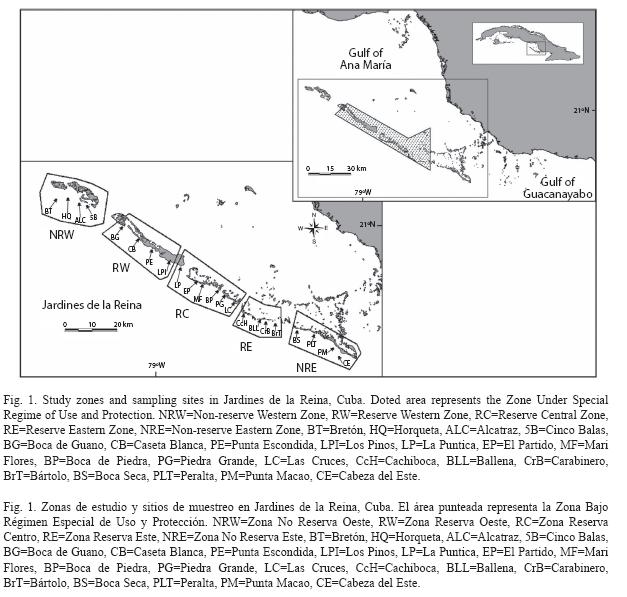
</front><body><![CDATA[ <p align="center"><b><font face="Verdana" size="4">Abundance, distribution and size structure of </font></b><font face="Verdana" size="4"><i>Diadema antillarum </i><b>(Echinodermata: Diadematidae) in South Eastern Cuban coral reefs</b></font></p> <b><font face="Verdana" size="2"> </font></b>     <p><font face="Verdana" size="2">F. Mart&iacute;n Blanco<sup><a  href="#autor1">1</a>,<a href="#autor2">2</a></sup>, G. Gonz&aacute;lez Sans&oacute;n<a href="#autor2"><sup>2</sup></a>, F. Pina Amarg&oacute;s<a  href="#autor1"><sup>1</sup></a> &amp; L. Clero Alonso<sup><a  href="#autor1">1</a>,<a href="#autor2">2</a></sup></font></p>     <p><font face="Verdana" size="2"><a name="autor1"></a>1. Centro de Investigaciones de Ecosistemas Costeros, Ministerio de Ciencia, Tecnolog&iacute;a y Medio Ambiente. Cayo Coco, Mor&oacute;n, Ciego de &Aacute;vila, CP 69400, Cuba; <a href="mailto:felix.martin79@gmail.com">felix.martin79@gmail.com</a>, <a href="mailto:fabian@ciec.fica.inf.cu">fabian@ciec.fica.inf.cu</a>, <a  href="mailto:lclero@yahoo.es">lclero@yahoo.es</a>    <br> <a name="autor2"></a>2. Centro de Investigaciones Marinas, Universidad de La Habana. Calle 16, #114 e/ 1ra y 3ra, Miramar, Playa, Ciudad de La Habana, CP. 11300, Cuba; <a href="mailto:gaspargonzalez2001@yahoo.es">gaspargonzalez2001@yahoo.es</a></font></p> <font face="Verdana" size="2"><b> </b></font><b><font face="Verdana" size="3"></font></b> <hr style="width: 100%; height: 2px;"><b><font face="Verdana" size="3">     <p>Abstract</p> </font><font face="Verdana" size="2"> </font></b>     <p><font face="Verdana" size="2">The 1983-1984 mass mortality event of <i>Diadema antillarum </i>affected more than 93% of the total Caribbean population. Although there are no records about the status of <i>Diadema </i>populations before and after die-off on Cuban reefs, anecdotal information suggests that populations were struck. We analyzed spatial variation in the abundance and size structure of <i>D. antillarum </i>in 22 reefs sites in Jardines de la Reina, from June 2004 to September 2005. Counts of <i>Diadema </i>were performed in five 30x2m transects at each sampling site and sampling time, and test diameters were measured in September 2005 at the same fore reefs. Abundances were higher at reef crests (mean densities 0.08-2.18 ind./m<sup>2</sup>), while reef slope populations reached a maximum site level of 0.13 ind./m<sup>2</sup> at only one site and showed values up to three orders of magnitude lower than those from reef crests. Highest abundance occurred at the west margin of major channels between keys where larval recruitment seems to be favored by local oceanographic features and facilitated by the abundance of <i>Echinometra lucunter</i>. The size frequency distribution of <i>D. antillarum </i>indicates that recruitment began to be noticeable three years before September 2005, suggesting these populations were depleted in the past and they are recovering now. Rev. Biol. Trop. 58 (2): 663-676. Epub 2010 June 02.</font></p> <font face="Verdana" size="2"><b> </b></font>     <p><font face="Verdana" size="2"><b>Keywords: </b><i>Diadema antillarum</i>, sea urchin recovery, population density, size structure, Jardines de la Reina, Cuba.    <br> </font></p>     <p><b><font face="Verdana" size="3">     <p>Resumen</p> </font></b><font face="Verdana" size="2"> </font></p>     ]]></body>
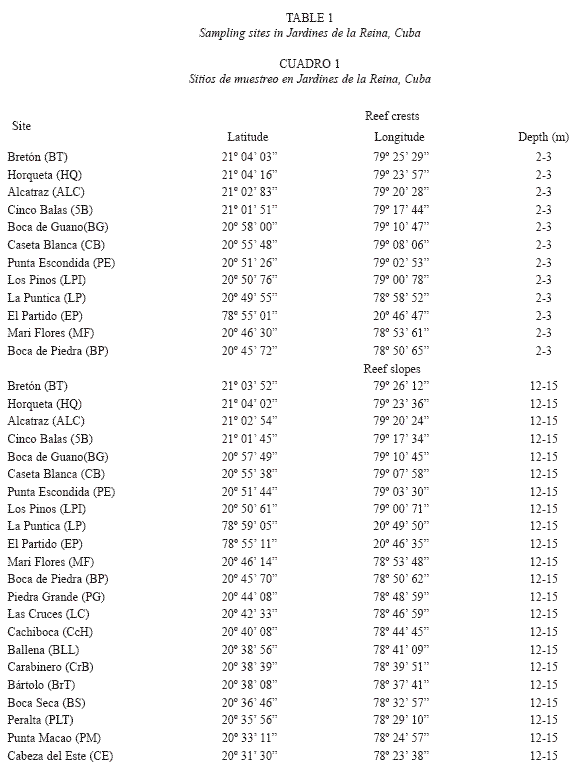
<body><![CDATA[<p><font face="Verdana" size="2">La mortalidad de <i>Diadema antillarum </i>en 1983-1984 afect&oacute; m&aacute;s del 93% de la poblaci&oacute;n del Caribe. Aunque no existen datos publicados sobre el estado de sus poblaciones en arrecifes cubanos antes y despu&eacute;s de la mortalidad, se conoce anecd&oacute;ticamente que fueron afectadas. En el presente trabajo se analizan las variaciones espaciales de la abundancia y estructura de tallas de <i>D. antillarum </i>en 22 arrecifes frontales en Jardines de la Reina, para lo cual se realizaron cinco recorridos de 30x2m en cada sitio entre Junio de 2004 y Septiembre de 2005. Las densidades de <i>Diadema </i>fueron mayores en las crestas arrecifales (0.08-2.18 ind./m<sup>2</sup>) mientras que en las pendientes fueron hasta tres &oacute;rdenes de magnitud menor y la densidad m&aacute;xima fue 0.13 ind./m<sup>2</sup>. Las crestas con mayor abundancia de <i>Diadema </i>est&aacute;n ubicadas en los m&aacute;rgenes de las grandes pasas existentes entre cayos donde el reclutamiento parece estar favorecido por las condiciones oceanogr&aacute;ficas locales y facilitado por la abundancia de <i>Echinometra lucunter</i>. La distribuci&oacute;n de frecuencia de tallas de <i>Diadema </i>sugiere que el reclutamiento comenz&oacute; a ser notable aproximadamente tres a&ntilde;os antes del muestreo, indicando que en el pasado sus poblaciones estuvieron afectadas y ahora est&aacute;n recuper&aacute;ndose.</font></p> <font face="Verdana" size="2"><b> </b></font><font face="Verdana" size="2"><b>Palabras clave: </b><i>Diadema antillarum</i>, recuperaci&oacute;n de erizos marinos, densidad poblacional, estructura de tallas, Jardines de la Reina, Cuba.</font> <hr style="width: 100%; height: 2px;">     <p><font face="Verdana" size="2">The 1983-1984 mass mortality of <i>Diadema antillarum </i>(Philippi 1845) in the Caribbean produced several ill effects on many coral reefs in the region. Beginning in Panama, in January 1983, the mortality spread throughout the area following the course of prevailing surface currents (Lessios <i>et al. </i>1984). Due to an unidentified pathogen, <i>Diadema </i>populations were depleted by more than 93% failing to recover in almost the two subsequent decades (Lessios <i>et al. </i>1984, Lessios 1988, 1995, 2005). It was not until the beginning of the 2000&acute;s, with the exception of Barbados where populations recovered up to 57% of pre-mortality levels (Hunte &amp; Younglao 1988), that noticeable increases in population densities were reported for the first time in Jamaica (Aronson &amp; Precht 2000, Edmunds &amp; Carpenter 2001, Moses &amp; Bonem 2001) and St. Croix (Miller <i>et al. </i>2003); events that were followed by a series of subsequent recovery reports in Costa Rica (Alvarado <i>et al. </i>2004, Fonseca <i>et al</i>. 2006, Myhre &amp; Acevedo- Guti&eacute;rrez 2007), Puerto Rico (Weil <i>et al. </i>2005), Jamaica, St. Croix, Barbados, Grenada, Bonaire, Belize (Carpenter &amp; Edmunds 2006), Cura&ccedil;ao (Debrot &amp; Nagelkerken 2006), Dominica (Steiner &amp; Williams 2006) and Yucatan (Jord&aacute;n-Garza <i>et al. </i>2008). </font></p>     <p><font face="Verdana" size="2">In Cuba there are no records about the status of <i>Diadema </i>populations before die-off [only one paper about methodological aspects was published, Herrera-Moreno <i>et al. </i>(1981)], nor scientific reports documenting the mortality. However, anecdotal information indicates that <i>Diadema </i>abundances decreased considerably around Cuban reefs at the beginning of the 1980&acute;s (Alcolado P.M., pers. comm.). As Lessios (2005) pointed out, pre-mortality density data are essential for determining the degree of subsequent recovery, so any apparent recovery of <i>Diadema </i>populations in Cuban reefs should be discussed with caution. In spite of the importance of <i>Diadema </i>as a keystone species in structuring coral reefs, available information about its current status in Cuban reefs is scarce. Except for local density data, no other aspects of the species ecology have been reported. The most complete data come from The Atlantic and Gulf Rapid Reef Assessment (AGRRA) surveys carried out at 199 reef sites around the Cuban archipelago from 1999 to 2003. Using that information, Alcolado <i>et al. </i>(unpublished data) only reported punctual values of <i>Diadema </i>densities showing that there is still little evidence of a country-wide recovery. Williams &amp; Polunin (2001) and Guardia <i>et al. </i>(2004a, b, 2006), reported zero or near zero densities in Cuban Western reefs, while the most recent data correspond to surveys in the North coast of Havana where Caballero <i>et al. </i>(2006) reported mean densities of <i>D. antillarum </i>in collection sites monitored by scientists from the National Aquarium of Cuba.</font></p>     <p><font face="Verdana" size="2">The present report analyzes spatial variation in densities and size structure (for the first time) of <i>D. antillarum </i>within and adjacent to a marine reserve in Jardines de la Reina Archipelago, Cuba, compares density data from local and country wide assessments and discusses the possible factors that influence sea urchin abundance and distribution in the study area. Surveys were part of a broader research to evaluate the effectiveness of the marine reserve on reef fish assemblages.</font></p> <b><font face="Verdana" size="3">     <p>Materials and methods</p> </font><font face="Verdana" size="2"> </font></b>     <p><b><font face="Verdana" size="2">Study area: </font></b><font  face="Verdana" size="2">The Archipelago of Jardines de la Reina is one of the four main groups of islands around Cuba and the best conserved of all. Stretching approximately 360km, it is formed by 661 keys, which are located in the south-central part of the Cuban shelf between the Gulf of Ana Mar&iacute;a and the Gulf of Guacanayabo (<a  href="/img/revistas/rbt/v58n2/a11i1.jpg">Fig. 1</a>). The archipelago has three groups of keys, the most important one is that of "Las Doce Leguas" (The Twelve Leagues) located in its westernmost end. In 1996 two thirds of the archipelago (about 950km<sup>2</sup>) were declared as Zone Under Special Regime of Use and Protection (equivalent to the internationally known Marine Reserves, and so termed in this paper) by the Ministry of Fisheries and currently pending approval as a National Park by the Cuban Government. This is the largest of the Caribbean Marine Reserves and its coral reefs are among the best preserved in the region (Appeldoorn &amp; Lindeman 2003). Several patch reefs exist to the north of the keys while the most important and well developed fringing reefs are found in the southern side, where the most conspicuous are reefs crests (1-3m depth) and reefs slopes (12-15m the shallow reef slope and 20-30m the deep reef slope).</font></p>     <p><font face="Verdana" size="2"><b>Survey methodology: </b>Surveys were conducted in the southern fore reefs of Jardines de la Reina, in the group of keys of "Las Doce Leguas", in June 2004, April 2005 and September 2005. Counts of <i>D. antillarum </i>were performed at each sampling time in five 30x2m transects located parallel to 12 reefs crests (specifically in the front part) and 22 shallow reefs slopes, all distributed along 22 sampling sites (<a  href="/img/revistas/rbt/v58n2/a11t1.gif">Table 1</a>, <a  href="/img/revistas/rbt/v58n2/a11i1.jpg">Fig. 1</a>). <i>Diadema </i>test diameters were measured in September 2005 at the same fore reefs; maximum test diameter of individuals encountered in transects was measured to the nearest millimeter with long-jawed calipers.</font></p>     <p><font face="Verdana" size="2">Bottom rugosity was estimated at sites surveyed in June 2004 by means of the tape contour method. Measures (n=5) were made by laying a 10m long PVC tape over the substrate, positioned to follow the contours of the reef as closely as possible and then measuring the distance between the start and end of the "contour". Rugosity was calculated as the ratio of "contour" length to tape length. Complementary information, based on the results of Pina-Amarg&oacute;s <i>et al. </i>(2008) who analyzed habitat complexity at the same sites in April 2005, September, 2005 and December 2005 by means of a semi-quantitative scale, were used for discussion.</font></p>     <p><font face="Verdana" size="2">Data collected from sites were grouped in pre-determined zones, three within the marine reserve and two (westward and eastward) adjacent to the marine reserve (<a  href="/img/revistas/rbt/v58n2/a11i1.jpg">Fig. 1</a>). The zone classifying criteria was based on the existing different degrees of protection in the Marine Reserve regarding that protection decreases from Reserve Central Zone (RC), Reserve Western Zone (RW), Reserve Eastern Zone (RE) to Non-reserve Western Zone (NRW) and Non-reserve Eastern Zone (NRE) which show a higher human activity. That information was obtained previously to the design of this study which is part of a broader research (Pina-Amarg&oacute;s 2008) carried out to evaluate the effectiveness of the Marine Reserve. Densities and test diameters of <i>D. antillarum </i>recorded from reef crests were compared among zones at each sampling time using a one way ANOVA and the Student-Newman-Keuls test for posthoc comparisons. Density data were transformed using the forth root transformation as suggested by the log-mean vs. log-variance relationship (Taylor&#8217;s Law) for conformity to the assumptions of normality and variance homogeneity. No statistical analyses were performed with densities recorded from reef slopes to prevent erroneous results caused by a high proportion of zero values. Because of obvious differences in <i>Diadema </i>densities between habitats, statistical comparison was unnecessary.</font></p>     <p><font face="Verdana" size="2">The size frequency distributions of <i>Diadema </i>pooled across all sites and pooled across sites of different zones at reef crests were determined and the latter were compared among zones with chi-square tests. Pearson&#8217;s correlation coefficient was used to determine whether mean test diameters were correlated with mean densities of <i>Diadema </i>at reefs crests and whether there was a relationship between the mean densities of <i>Diadema </i>and the mean densities of <i>Echinometra lucunter </i>(Linnaeus) recorded at the same sites in June 2004, prior to the beginning of <i>Diadema </i>counts.</font></p>     ]]></body>
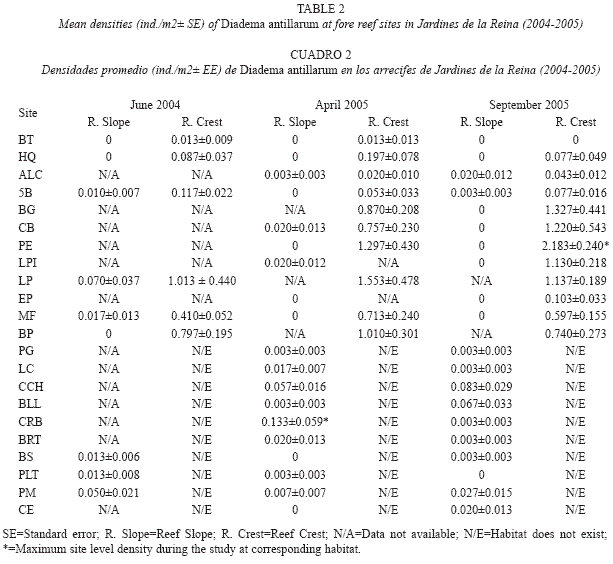
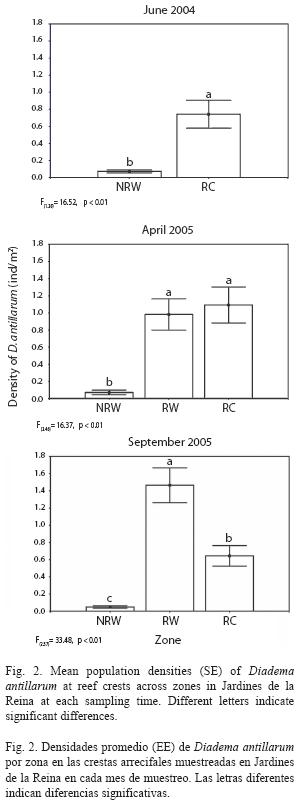
<body><![CDATA[<p><font face="Verdana" size="2">A one way ANOVA was also used to test for significant differences among zones in habitat structural complexity and the Student- Newman-Keuls test for post-hoc comparisons. Pearson&#8217;s correlation coefficient was also used to test for the influence of substrate rugosity on <i>Diadema </i>population densities across sites at both the reef crest and reef slope habitats (Power calculations were performed using GPOWER 2.0). All statistical analyses were performed using STATISTICA 6.0.</font></p> <b><font face="Verdana" size="3">     <p>Results</p> </font><font face="Verdana" size="2"> </font></b>     <p><b><font face="Verdana" size="2">Urchin abundance and habitat structural complexity: </font></b><font face="Verdana" size="2">Abundances of <i>D. antillarum </i>were lowest at reef slopes during the study. In June 2004, urchins were found at six of nine sites surveyed (67%), while in the next year <i>Diadema </i>was present at only 58 % (of 19 sites) and 55% (of 20 sites) in April and September respectively. Mean population densities recorded at this habitat ranged from 0.010- 0.070 ind./m<sup>2</sup> in June 2004, while the lowest local value in April 2005 was 0.003 ind./m<sup>2</sup> (<a  href="/img/revistas/rbt/v58n2/a11t2.gif">Table 2</a>). The maximum site level density (0.133 ind./m<sup>2</sup>) occurred in April 2005, but there was only one site showing this value. Abundances remained low in September 2005 ranging from 0.003-0.083 ind./m2 with only three sites showing densities higher than 0.020 ind./m<sup>2</sup> (<a  href="/img/revistas/rbt/v58n2/a11t2.gif">Table 2</a>).</font></p>     <p><font face="Verdana" size="2">In contrast to reef slopes, mean densities of <i>Diadema </i>at reef crests were up to three orders of magnitude higher, showing local values from 0.013 ind./m<sup>2</sup> at <b>BT </b>to 1.016 ind./m<sup>2</sup> at <b>LP </b>in June 2004 while in April 2005 densities ranged from 0.013-1.553 ind./m<sup>2</sup> with extreme values at same sites. The maximum site level density was recorded in September 2005, at <b>PE</b>, population densities were higher than 1 ind./m<sup>2</sup> at 42 % of the reef crests surveyed (<a href="/img/revistas/rbt/v58n2/a11t2.gif">Table 2</a>).</font></p>     <p><font face="Verdana" size="2">Mean population densities of <i>D. antillarum </i>varied significantly among zones at reef crests at each sampling time (F<sub>(1, 28)</sub>=36.434, p&lt;0.01, in June 2004; F<sub>(2, 46)</sub>=36.522, p&lt;0.01, in April 2005; F<sub>(2, 57)</sub>=45.409, p&lt;0.01, in September 2005; <a href="#fig2">Fig. 2</a>) and followed the same spatial pattern of variation as mean densities across sites (F<sub>(5,24)</sub>=12.426, p&lt;0.01, in June 2004, F<sub>(9,39)</sub>=10.155, p&lt;0.01, in April 2005 and F<sub>(11,48)</sub>=17.596, p&lt;0.01, in September 2005; data not shown). Mean abundances were higher at zones <b>RC </b>(0.741 ind./m<sup>2</sup>) and <b>RW </b>(1.465 ind./m<sup>2</sup>) in June 2004 and September 2005 respectively while in April 2005 there were no significant differences in densities recorded from these zones which were indeed significantly higher than density recorded from <b>NRW </b>zone, where lowest values occurred during the study (<a href="#fig2">Fig. 2</a>).    <br> </font></p>     <p><font face="Verdana" size="2">    <br> </font></p>     <div style="text-align: center;"><a name="fig2"></a><img  src="/img/revistas/rbt/v58n2/a11i2.jpg" title="" alt=""  style="width: 306px; height: 802px;">    <br>     ]]></body>
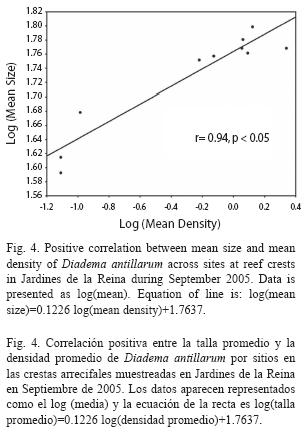
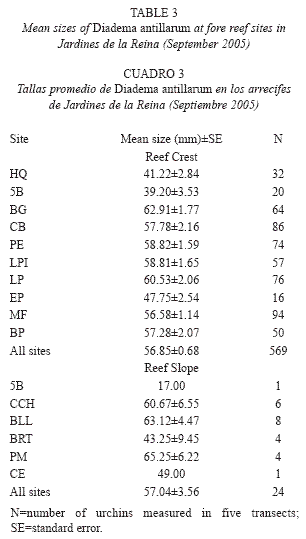
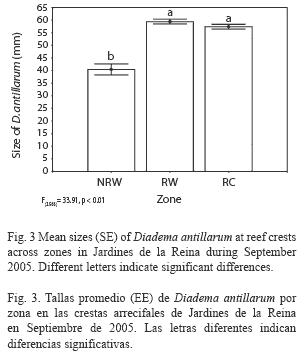
<body><![CDATA[<br> </div>     <p><font face="Verdana" size="2">Mean densities of <i>Diadema </i>at reef crests were correlated with mean densities of <i>E. lucunter </i>showing a significant positive relationship in June 2004 (Pearson&#8217;s correlation, r=0.85, p=0.03, n=6).</font></p>     <p><font face="Verdana" size="2">Bottom rugosity in June 2004 did not vary significantly among zones neither at reef slopes nor at reef crests (F<sub>(1, 43)</sub>=0.20, p&gt;0.05, Power=1; F<sub>(1, 28)</sub>=0.34, p&gt;0.05 Power=1 respectively). Correlation between mean values of substrate rugosity and mean population densities of <i>D. antillarum </i>were not significant at reef crest (r=0.74, p=0.09, n=6, Power=0.81).</font></p> <font face="Verdana" size="2"><b> </b></font>     <p><font face="Verdana" size="2"><b>Size structure: </b>Mean test diameter of <i>D. antillarum </i>in September 2005 was 57.04&plusmn;3.56mm at reef slope and 56.85&plusmn;0.68 at reef crest (<a href="#tabla3">Table 3</a>). Due to the low number of measurements at reef slopes (n=24) no statistical analyzes were performed. On the other hand, mean sizes at reef crests were significantly different among zones (F<sub>(2, 566</sub>=33.914, p&lt;0.01; <a href="#fig3">Fig. 3</a>) and showed a significant positive relationship with mean population density (Pearson&#8217;s correlation, r=0.94, p&lt;0.05; Fig. 4). Urchins from zones <b>RW </b>and <b>RC </b>were similar in size and larger than urchins from zone <b>NRW </b>(<a href="#fig3">Fig. 3</a>).    <br> </font></p>     <p><font face="Verdana" size="2">    <br> </font></p>     <div style="text-align: center;"><a name="tabla3"></a><img  src="/img/revistas/rbt/v58n2/a11t3.gif" title="" alt=""  style="width: 306px; height: 539px;">    <br>     <br>     ]]></body>
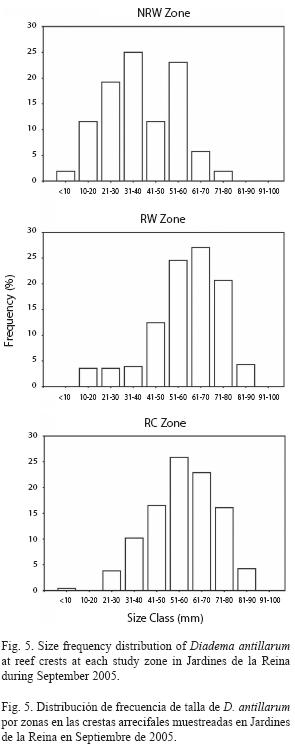
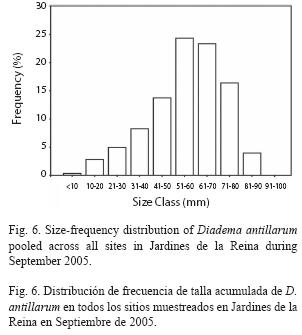
<body><![CDATA[<br> <a name="fig3"></a><img src="/img/revistas/rbt/v58n2/a11i3.jpg" title=""  alt="" style="width: 306px; height: 358px;">    <br>     <br>     <br> </div>     <p><font face="Verdana" size="2">Size frequency distribution of <i>Diadema </i>at reef crests varied significantly among zones. The <b>NRW </b>size distribution was different from both the <b>RW </b>distribution (chisquare= 298.81, p&lt;0.01) and the <b>RC </b>distribution (chi-square=191.65, p&lt;0.01) which did not differ significantly from one another (chisquare= 7.39, p&gt;0.05) and were dominated by 51-70mm urchins (52% at zone <b>RW </b>and 49% at zone <b>RC</b>). In contrast, <b>NRW </b>zone showed a higher proportion of individuals in the smallest cohort (58% &#8804;40mm) particularly in the 31-40mm size class (25%); mid sizes were also well represented in that zone with 23% of urchins in the 51-60mm size class (<a href="#fig5">Fig. 5</a>). The size frequency distribution pooled across all sites was dominated by medium-sized to large urchins with 48% between 51-70mm and individuals from small sizes (&#8804;40mm) were scarce (16%; <a href="#fig6">Fig. 6</a>).    <br> </font></p>     <p><font face="Verdana" size="2">    <br> </font></p>     <div style="text-align: center;"><a name="fig5"></a><img  src="/img/revistas/rbt/v58n2/a11i5.jpg" title="" alt=""  style="width: 295px; height: 750px;">    <br>     ]]></body>
<body><![CDATA[<br>     <br>     <br> <a name="fig6"></a><img src="/img/revistas/rbt/v58n2/a11i6.jpg" title=""  alt="" style="width: 302px; height: 335px;">    <br>     <br> </div> <b><font face="Verdana" size="3">     <p>Discussion</p> </font></b><font face="Verdana" size="2">     <p>Populations of <i>D. antillarum </i>were restricted to the reef crests (1-3m depth) in the 40% of surveyed sites in Jardines de la Reina Archipelago. Even when <i>Diadema </i>appeared at reef slopes (12-15m depth) population densities were very low (up to three orders of magnitude lower than reef crests). Because of the lack of scientific records about the status of <i>Diadema </i>before and after the mass mortality, current urchin abundances can not be compared with historical data. However, if we consider premortality values reported by Hughes <i>et al. </i>(1985) and Liddell &amp; Ohlhorst (1986) at similar depths in the north coast of Jamaica, recent densities in Jardines de la Reina are far below those that could potentially exist at such depths before the mortality.</p>     <p>Similar results have been recently reported for several locations around the Cuban archipelago, suggesting a country wide pattern of low population density at mid depth reefs. Alcolado <i>et al. </i>(unpublished data) recorded very low densities (0.01- 0.1 ind./m<sup>2</sup>) at reef slopes in Jardines de la Reina (same region of present study but different sampling sites) Eastern Bah&iacute;a de Cochinos, south-central Cuba (&lt;0.05 ind./m<sup>2</sup>) and Mar&iacute;a La Gorda, southwestern end of Cuba (&lt;0.05 ind./m<sup>2</sup>) where Guardia <i>et al. </i>(2004a) found no urchins at similar depths. <i>Diadema </i>was also absent at reef slopes, except in one site (0.01 ind./m<sup>2</sup>), in Sabana-Camag&uuml;ey Archipelago, north-central Cuba (Alcolado <i>et al. </i>unpublished data), and absent at all sampled locations in Punta Franc&eacute;s, southwestern Cuba (Williams &amp; Polunin 2001, Guardia <i>et al. </i>2004b) and Punta del Este, southwestern Cuba (Williams &amp; Polunin 2001). In contrast, reef slope populations from the north coast of Havana, where <i>Diadema </i>appears to be more abundant at mid depths, showed higher levels of population density, reaching up to 0.63 ind./ m<sup>2</sup> (Alcolado <i>et al. </i>unpublished data).</p>     <p>Data collected from Cuban reef slopes and those of other recent studies in the Caribbean region at similar depths (Haley &amp; Solandt 2001, Moses &amp; Bonem 2001 in Jamaica; Williams &amp; Polunin 2001 in Barbados, Belize, Grand Cayman and Jamaica; Chiappone <i>et al. </i>2002 in Florida Keys; Lessios 2005 in Panama; Carpenter &amp; Edmunds 2006 in Jamaica, St. Croix, Grenada, Barbados, Bonaire and Belize; Debrot &amp; Nagelkerken 2006 in Cura&ccedil;ao) show that western Atlantic mid-depth populations of <i>D. antillarum </i>are still far from recovery, despite simultaneous increases in shallow reef populations observed in Jamaica (Aronson &amp; Precht 2000, Edmunds &amp; Carpenter 2001, Haley &amp; Solandt 2001), St. Croix (Miller <i>et al. </i>2003) and earlier in Barbados (Hunte &amp; Younglao 1988) indicated the possible beginning of a full population recovery in the Caribbean. Such a recovery has been recently documented in Costa Rica (Alvarado <i>et al. </i>2004, Myhre &amp; Acevedo-Guti&eacute;rrez 2007), Puerto Rico (Weil <i>et al. </i>2005) Barbados (Macintyre <i>et al. </i>2005, Carpenter &amp; Edmunds 2006), Cura&ccedil;ao (Debrot &amp; Nagelkerken 2006), Dominica (Steiner &amp; Williams 2006), Jamaica, St. Croix, Grenada, Bonaire, Belize (Carpenter &amp; Edmunds 2006), Venezuela (Noriega <i>et al</i>. 2006) and Yucatan (Jord&aacute;n-Garza <i>et al. </i>2008).</p>     <p>Results from reef crest populations in Jardines de la Reina (this study) are consistent with those presented by Carpenter &amp; Edmunds (2006), who reported that dense populations of <i>D. antillarum </i>now occur at both local and regional scales in the Caribbean. Mean population densities recorded in Jardines de la Reina shallow reefs by this study are higher than those reported by Alcolado <i>et al. </i>(unpublished data) at similar depths in Eastern Bah&iacute;a de Cochinos, south-central Cuba (&#8776;0.075 ind./m2); Gulf of Bataban&oacute;, southwestern Cuba (&#8776;0.83 ind./ m<sup>2</sup>) and Archipelago Sabana-Camag&uuml;ey, northcentral Cuba (&lt;0.2 ind./m<sup>2</sup>). The maximum site level densities recorded by these authors at the reef crests of "Las Doce Leguas" in Jardines de la Reina were slightly lower (0.93 ind./m<sup>2</sup> in Caballones Centro and 0.94 ind./m<sup>2</sup> in Cayo Grande Este) than present densities at neighbor reefs. Because of different sites and sampling methodology, no statistical comparisons were possible. Only one site studied by Alcolado <i>et al. </i>(Canal de las Mulatas) located westward, out of the keys of "Las Doce Leguas" and closer to mainland showed a comparatively high density of <i>Diadema </i>(2.11 ind./m2), similar to the highest density recorded at present study (2.18 ind./m<sup>2</sup>).</p>     ]]></body>
<body><![CDATA[<p>On the other hand, abundances of <i>D. antillarum </i>recorded at Jardines de la Reina (this study) are lower than those recorded by Alcolado <i>et al. </i>(unpublished data) at Playa Franceses, north coast of Havana, which represents the highest value reported for Cuban shallow reefs until now (8.1 ind./m<sup>2</sup>). The increase in more than 5 ind./m<sup>2</sup> at this site between 1997 and 2003 indicates successful recruitment and population persistence along time. However, due to the sampling method used at this site (1m<sup>2</sup> quadrants) or maybe a bias in the way the quadrants were placed, density values reported by these authors at this site could be an overestimate. As Moses &amp; Bonem (2001) pointed out, given the tendency of the species to aggregate, estimates of density using this method can reach &gt;10 ind./m<sup>2</sup> in one sampling unit, while surrounding abundances may be close to zero. Results from all other shallow reef sites in the north coast of Havana surveyed by Alcolado <i>et al. </i>(unpublished data) using a different sampling method (10x1m transects) support this idea, since urchin densities (even being among the highest of the study, up to 0.77 ind./m<sup>2</sup>) were one order of magnitude lower than Playa Franceses&#8217;s abundance and are into conformity with population pattern observed at shallow reefs studied by those authors around Cuba. Thus, population densities from Playa Franceses&#8217;s should be resurveyed in order to provide a better estimate of current population status.</p>     <p>Although our results can not explain the relative importance of mechanisms affecting abundance patterns of <i>D. antillarum </i>populations in Jardines de la Reina; observed differences in mean densities seem to be the result of local factors regulating recruitment processes rather than those responsible for inadequate larval supply or post-settlement mortality. The higher abundance of <i>Diadema </i>at <b>RW </b>and <b>RC </b>zones may be explained by the numerical contribution (to the overall density) of local densities from sites <b>BG</b>, <b>LP </b>and <b>BP </b>which are located on the west margins of major channels between keys (Pasa de Boca de Guano, Pasa de Caballones and Pasa de Boca de Piedra respectively). These sites are under the influence of a higher water flow generated by tide-driven currents circulating through those important channels and hence they might be exposed to a major larval supply when larvae are transported in the water column to the inner and outer waters of the platform as a result of diurnal tide cycles. Furthermore, the pattern of prevailing surface current in the archipelago is from east to west (Gonz&aacute;lez de Zayas <i>et al. </i>2006). Thus, this water circulation pattern acting synergistically with tide-driven processes could produce a major larval retention at the west margins of those channels, enhancing urchin recruitment at reefs mentioned above. In addition, the apparently higher abundance of <i>Diadema </i>(author&#8217;s observations) in the margins of small channels that locally bisect reef crests, reinforce that discussed above and seems to be determined by the same processes acting in a shorter spatial scale. Results from shallow reefs of Cura&ccedil;ao also support our findings since more abundant populations of <i>D. antillarum </i>occurred at the entrance of coastal lagoon as reported by Debrot &amp; Nagelkerken (2006). Future research should be addressed to determine rates of recruitment as well as variations in the abundance and size structure of <i>Diadema </i>among different zones within the reef crest and between both the west and the east sides of channels between keys. Although <b>PE </b>(site with the highest mean density) receives no influence of major channels, it is close to a communicating channel that allows a substantial water exchange between the Gulf of Ana Mar&iacute;a and the adjacent Caribbean Sea; thus the explanation discussed above is also applicable to this site.</p>     <p>Availability of refuges is one factor that can potentially influence on <i>D. antillarum </i>populations; since more rugose reefs can support higher urchin populations by providing shelters from predation, differences in habitat structural complexity could lead to differences in numbers of <i>Diadema </i>(Haley &amp; Solandt 2001). In addition, the biomass and structure of sea urchins assemblages is greatly dependent on three- dimensional structure of the habitat (Lee 2006). However, it is unlikely that sheltering represents a limited resource at the reef crests surveyed in June 2004 because rugosity not only was similar among studied zones in June 2004 (present study) but also among the same sites and zones analyzed by Pina-Amarg&oacute;s <i>et al. </i>(2008) in April 2005, September, 2005 and December 2005 using the semi- quantitative scale. Furthermore, considering that the power of Pearson&acute;s correlation test, performed to analyze the association between mean values of rugosity and mean population densities of <i>Diadema</i>, was acceptably high (Power=0.81), the lack of significance in such association obtained from the test, support the idea that sheltering is not a limited resource, at least at the reef crests surveyed in June 2004. However, more detailed studies (with more replicate samples) should be conducted toward analyzing the influence of habitat structural complexity on <i>Diadema </i>population density in order to improve understanding of distribution patterns at a greater spatial scale.</p>     <p>Although juvenile <i>D. antillarum </i>could be competitively excluded by adult <i>E. lucunter </i>and <i>E. viridis </i>(Shulman 1990), <i>Diadema </i>recruitment could be facilitated by the presence of <i>E. lucunter </i>as their mean densities were positively correlated. Given the propensity of <i>Diadema </i>larvae to settle in areas cleared of filamentous algae (Bak 1985), grazing activity of <i>E. lucunter </i>and its consequent benefit to <i>Diadema </i>recruitment, might be more important than possible competitive exclusion in postsettlement stages of small juvenile <i>Diadema </i>at the reefs crests of Jardines de la Reina. Because correlations do not prove causality, long term experimental studies considering recruitment should be carried out in the future to corroborate our findings. However, the pattern we found was consistent with that obtained by Lessios (1988, 1995) in the echinoid exclusion and inclusion experiments performed in the San Blas Archipelago, Panam&aacute;. Due to the absence of <i>T. ventricosus </i>in surveyed reefs during this study, no facilitation by this species has influenced the recruitment of <i>Diadema</i>, as has been suggested in Jamaica by Aronson &amp; Precht (2000) and Haley &amp; Solandt (2001).</p>     <p>Since abundances of <i>D. antillarum </i>were relatively high at several reef crests in Jardines de la Reina, low densities observed at <b>NRW </b>zone might be unrelated to low numbers of larvae in the water column. Inadequate larval supply due to poor fertilization success caused by low densities of upstream reproducing adults (the Alle effect) has been reported as the most likely explanation for the lack of recruitment of <i>Diadema </i>in the Caribbean (Lessios 1988, 1995, 2005, Hughes 1994, Edmunds &amp; Carpenter 2001, Miller <i>et al. </i>2003) but considering abundances from <b>RW </b>and <b>RC </b>zones, it could be agreed that upstream populations have reached such levels of population density that they are able to produce enough larvae to overcome mortality in the planktonic stage and therefore an adequate larval supply to sustain recruitment at surveyed reefs. Thus, <i>Diadema </i>populations from <b>NRW </b>zone seem to be limited, in part, by oceanographic features of the reefs in question and could be conditioned by the presence of <i>E. lucunter </i>that might provide suitable substrata for larval settlement as discussed above. However, the size frequency distribution of <i>D. antillarum </i>at this zone indicates successful recruitment and that in spite of low densities, juvenile <i>Diadema </i>persist along time.</p>     <p>Mean test sizes showed the same pattern of variation as mean densities of <i>D. antillarum </i>across zones, being higher within the marine reserve where abundances reached the maximum values. These results are consistent with the positive relationship found between size and density across sites at the present study. Contrary to our finding, an inverse relationship between size and density has been well documented for the species by Carpenter (1981) and Levitan (1988, 1989, 1991) who pointed out the ability of <i>Diadema </i>to reduce body size when density increases and therefore food is limited. Considering abundance patterns and size frequency distributions, the association we found appear to be the result of a recent recruitment event at reefs from <b>NRW </b>zone as suggested by the high proportion of urchins with sizes &#8804;40 mm encountered in that zone (<a href="#fig4">Fig. 4</a>).    <br> </p>     <p>    <br>     <br> </p> </font>     ]]></body>
<body><![CDATA[<div style="text-align: center;"><a name="fig4"></a><img  src="/img/revistas/rbt/v58n2/a11i4.jpg" title="" alt=""  style="width: 308px; height: 433px;">    <br>     <br> </div> <font face="Verdana" size="2">     <p>Given that growth rate of <i>D. antillarum </i>slows down as the test diameter increase (Ogden &amp; Carpenter 1987), estimation of age in adult sea urchins, could lead to inaccurate results, even when food is not limited. However, the size frequency distribution pooled across all sites, in association with the fact that the maximum test diameter of the species has not been attained (about 100mm; Ogden &amp; Carpenter 1987), indicates that recruitment of <i>D. antillarum </i>populations in Jardines de la Reina began to be noticeable few years (&#8776;3 years) before the survey took place, suggesting that <i>Diadema </i>was depleted in the past and population is recovering now.</p>     <p>Because of the lack of scientific information about abundances of <i>D. antillarum </i>in Jardines de la Reina before 2001 [data reported by Alcolado <i>et al. </i>(unpublished data)] and the complete lack of information about size structure before the present study it is impossible to arrive to more detailed conclusions about its population dynamics. Nevertheless, our study shows that environmental conditions across the best conserved of the four archipelagos around Cuba, one of the best conserved and also the largest marine reserve in the Caribbean, appear to enhance larval recruitment and survival in post-settlement stages of <i>D. antillarum</i>, suggesting that recovery is undergoing in Jardines de la Reina and that if a sustained increase in population densities occurs, the patterns we found and those from other particular reefs around Cuba could become in a country wide recovery of the species, contributing to the wider Caribbean population.</p> </font><b><font face="Verdana" size="3">     <p>Acknowledgments</p> </font></b><font face="Verdana" size="2">     <p>The authors are thankful to the staff of Azulmar for logistical support on Jardines de la Reina, especially to Giuseppe Omegna (Pepe) its manager and Noel L&oacute;pez. To WWF Canada for funding this research and to E. Sala, Director of the Center for Marine Biodiversity and Conservation of the Scripps Institution of Oceanography, for funding and logistics. We thank the Ministry of Science, Technology and Environment for funds and logistics, especially C. Pazos Alberdi, R. G&oacute;mez Fern&aacute;ndez, A. Z&uacute;&ntilde;iga R&iacute;os. Infinite thanks to CIEC&acute;s staff for supporting us in doing research on Jardines de la Reina, specially to L. Hern&aacute;ndez Fern&aacute;ndez, A. Zayas Fern&aacute;ndez, W. Acosta de la Red, A. Jim&eacute;nez del Castillo, M. Lazarte Llanes and V.O. Rodr&iacute;guez C&aacute;rdenas. We also want to thanks P.M. Alcolado, H.P. Caballero, Y. Lezcano, R. del Valle, H.A. Lessios, M. Chiappone and R.J. Miller for assistance in bibliography and especial considerations.</p> </font><b><font face="Verdana" size="3"> </font></b> <hr style="width: 100%; height: 2px;">     <p><b><font face="Verdana" size="3">References</font></b></p> <font face="Verdana" size="2">     <!-- ref --><p>Appeldoorn, R.C. &amp; K.C. Lindeman. 2003. A Caribbeanwide survey of marine reserves: spatial coverage and attributes of effectiveness. Gulf. Caribb. Res. 14: 139-154.    &nbsp;&nbsp;&nbsp;&nbsp;&nbsp;&nbsp;&nbsp;&nbsp;[&#160;<a href="javascript:void(0);" onclick="javascript: window.open('/scielo.php?script=sci_nlinks&ref=1411441&pid=S0034-7744201000020001100001&lng=','','width=640,height=500,resizable=yes,scrollbars=1,menubar=yes,');">Links</a>&#160;]<!-- end-ref --></p>     ]]></body>
<body><![CDATA[<!-- ref --><p>Alvarado, J.J., J. Cort&eacute;s &amp; E. Salas. 2004. Population densities of <i>Diadema antillarum </i>Philippi at Cahuita National Park (1977-2003), Costa Rica. Caribb. J. Sci. 40: 257-259.    &nbsp;&nbsp;&nbsp;&nbsp;&nbsp;&nbsp;&nbsp;&nbsp;[&#160;<a href="javascript:void(0);" onclick="javascript: window.open('/scielo.php?script=sci_nlinks&ref=1411443&pid=S0034-7744201000020001100002&lng=','','width=640,height=500,resizable=yes,scrollbars=1,menubar=yes,');">Links</a>&#160;]<!-- end-ref --></p>     <!-- ref --><p>Aronson, R.B. &amp; W.F. Precht. 2000. Herbivory and algal dynamics on the coral reef at Discovery Bay, Jamaica. Limnol. Oceanogr. 45: 251-255.    &nbsp;&nbsp;&nbsp;&nbsp;&nbsp;&nbsp;&nbsp;&nbsp;[&#160;<a href="javascript:void(0);" onclick="javascript: window.open('/scielo.php?script=sci_nlinks&ref=1411445&pid=S0034-7744201000020001100003&lng=','','width=640,height=500,resizable=yes,scrollbars=1,menubar=yes,');">Links</a>&#160;]<!-- end-ref --></p>     <!-- ref --><p>Back, R.P.M. 1985. Recruitment patterns and mass mortalities in the sea urchin <i>Diadema antillarum</i>. Proc. 5<sup>th</sup> Int. Coral Reef Congress 5: 267-272.    &nbsp;&nbsp;&nbsp;&nbsp;&nbsp;&nbsp;&nbsp;&nbsp;[&#160;<a href="javascript:void(0);" onclick="javascript: window.open('/scielo.php?script=sci_nlinks&ref=1411447&pid=S0034-7744201000020001100004&lng=','','width=640,height=500,resizable=yes,scrollbars=1,menubar=yes,');">Links</a>&#160;]<!-- end-ref --></p>     <!-- ref --><p>Caballero, H.P., D. Rosales &amp; A. Alcal&aacute;. 2006. Estudio diagn&oacute;stico del arrecife coralino del Rinc&oacute;n de Guanabo, Ciudad de la Habana, Cuba.1. Corales, esponjas y gorgon&aacute;ceos. Rev. Invest. Mar. 27: 49-59.    &nbsp;&nbsp;&nbsp;&nbsp;&nbsp;&nbsp;&nbsp;&nbsp;[&#160;<a href="javascript:void(0);" onclick="javascript: window.open('/scielo.php?script=sci_nlinks&ref=1411449&pid=S0034-7744201000020001100005&lng=','','width=640,height=500,resizable=yes,scrollbars=1,menubar=yes,');">Links</a>&#160;]<!-- end-ref --></p>     <!-- ref --><p>Carpenter, R.C. 1981. Grazing by <i>Diadema antillarum </i>Philippi and its effects on the benthic algal community. J. Mar. Res. 39: 747-765.    &nbsp;&nbsp;&nbsp;&nbsp;&nbsp;&nbsp;&nbsp;&nbsp;[&#160;<a href="javascript:void(0);" onclick="javascript: window.open('/scielo.php?script=sci_nlinks&ref=1411451&pid=S0034-7744201000020001100006&lng=','','width=640,height=500,resizable=yes,scrollbars=1,menubar=yes,');">Links</a>&#160;]<!-- end-ref --></p>     ]]></body>
<body><![CDATA[<!-- ref --><p>Carpenter, R.C. &amp; P.J. Edmunds. 2006. Local and regional scale recovery of <i>Diadema </i>promotes recruitment of scleractinian corals. Ecol. Lett. 9: 271-280.    &nbsp;&nbsp;&nbsp;&nbsp;&nbsp;&nbsp;&nbsp;&nbsp;[&#160;<a href="javascript:void(0);" onclick="javascript: window.open('/scielo.php?script=sci_nlinks&ref=1411453&pid=S0034-7744201000020001100007&lng=','','width=640,height=500,resizable=yes,scrollbars=1,menubar=yes,');">Links</a>&#160;]<!-- end-ref --></p>     <!-- ref --><p>Chiappone, M., D.W. Swanson &amp; S.L. Miller. 2002. Density, spatial distribution and size structure of sea urchins in Florida Keys coral reef and hard-bottom habitats. Mar. Ecol. Prog. Ser. 235: 117-126.    &nbsp;&nbsp;&nbsp;&nbsp;&nbsp;&nbsp;&nbsp;&nbsp;[&#160;<a href="javascript:void(0);" onclick="javascript: window.open('/scielo.php?script=sci_nlinks&ref=1411455&pid=S0034-7744201000020001100008&lng=','','width=640,height=500,resizable=yes,scrollbars=1,menubar=yes,');">Links</a>&#160;]<!-- end-ref --></p>     <!-- ref --><p>Debrot, A.O. &amp; I. Nagelkerken. 2006. Recovery of the long-spined sea urchin <i>Diadema antillarum </i>in Cura&ccedil;ao (Netherlands Antilles) linked to lagoonal and wave sheltered shallow rocky habitats. Bull. Mar. Sci. 79: 415-424.    &nbsp;&nbsp;&nbsp;&nbsp;&nbsp;&nbsp;&nbsp;&nbsp;[&#160;<a href="javascript:void(0);" onclick="javascript: window.open('/scielo.php?script=sci_nlinks&ref=1411457&pid=S0034-7744201000020001100009&lng=','','width=640,height=500,resizable=yes,scrollbars=1,menubar=yes,');">Links</a>&#160;]<!-- end-ref --></p>     <!-- ref --><p>Edmunds, P.J. &amp; R.C. Carpenter. 2001. Recovery of <i>Diadema antillarum </i>reduces macroalgal cover and increases abundance of juvenile corals on a Caribbean reef. Proc. Natl. Acad. Sci. 98: 5057-5071.    &nbsp;&nbsp;&nbsp;&nbsp;&nbsp;&nbsp;&nbsp;&nbsp;[&#160;<a href="javascript:void(0);" onclick="javascript: window.open('/scielo.php?script=sci_nlinks&ref=1411459&pid=S0034-7744201000020001100010&lng=','','width=640,height=500,resizable=yes,scrollbars=1,menubar=yes,');">Links</a>&#160;]<!-- end-ref --></p>     <!-- ref --><p>Fonseca, A.C., E. Salas &amp; J. Cort&eacute;s. 2006. Monitoreo del arrecife coralino Meager Shoal, Parque Nacional Cahuita, Costa Rica (sitio CARICOMP). Rev. Biol. Trop. 54: 755-763.    &nbsp;&nbsp;&nbsp;&nbsp;&nbsp;&nbsp;&nbsp;&nbsp;[&#160;<a href="javascript:void(0);" onclick="javascript: window.open('/scielo.php?script=sci_nlinks&ref=1411461&pid=S0034-7744201000020001100011&lng=','','width=640,height=500,resizable=yes,scrollbars=1,menubar=yes,');">Links</a>&#160;]<!-- end-ref --></p>     ]]></body>
<body><![CDATA[<!-- ref --><p>Guardia, E., A.P. Valdivia &amp; P. Gonz&aacute;lez-D&iacute;az. 2004a. Estructura de las comunidades bent&oacute;nicas en la zona de buceo de Mar&iacute;a La Gorda, Ensenada de Corrientes, Sureste de la Pen&iacute;nsula de Guanahacabibes, Cuba. Rev. Invest. Mar. 25: 103-111.    &nbsp;&nbsp;&nbsp;&nbsp;&nbsp;&nbsp;&nbsp;&nbsp;[&#160;<a href="javascript:void(0);" onclick="javascript: window.open('/scielo.php?script=sci_nlinks&ref=1411463&pid=S0034-7744201000020001100012&lng=','','width=640,height=500,resizable=yes,scrollbars=1,menubar=yes,');">Links</a>&#160;]<!-- end-ref --></p>     <!-- ref --><p>Guardia, E., P. Gonz&aacute;lez-D&iacute;az &amp; S. Castellanos-Iglesias. 2004b. Estructura de la comunidad de grupos bent&oacute;nicos s&eacute;siles en la zona de buceo de Punta Franc&eacute;s, Cuba Rev. Invest. Mar. 25: 81-90.    &nbsp;&nbsp;&nbsp;&nbsp;&nbsp;&nbsp;&nbsp;&nbsp;[&#160;<a href="javascript:void(0);" onclick="javascript: window.open('/scielo.php?script=sci_nlinks&ref=1411465&pid=S0034-7744201000020001100013&lng=','','width=640,height=500,resizable=yes,scrollbars=1,menubar=yes,');">Links</a>&#160;]<!-- end-ref --></p>     <!-- ref --><p>Guardia, E., P. Gonz&aacute;lez-D&iacute;az, A. Valdivia &amp; O.O. Gonz&aacute;lez. 2006. Estructura y salud de la comunidad de corales en el arrecife de la zona de buceo de Cayo Levisa, Archipi&eacute;lago Los Colorados, Cuba Rev. Invest. Mar. 27: 197-208.    &nbsp;&nbsp;&nbsp;&nbsp;&nbsp;&nbsp;&nbsp;&nbsp;[&#160;<a href="javascript:void(0);" onclick="javascript: window.open('/scielo.php?script=sci_nlinks&ref=1411467&pid=S0034-7744201000020001100014&lng=','','width=640,height=500,resizable=yes,scrollbars=1,menubar=yes,');">Links</a>&#160;]<!-- end-ref --></p>     <!-- ref --><p>Gonz&aacute;lez de Zayas, R., A. Z&uacute;&ntilde;iga-R&iacute;os, O. Camejo-Cardoso, L.M. Batista-Tamayo &amp; R. C&aacute;rdenas-Murillo. 2006. Atributos f&iacute;sicos del ecosistema Jardines de la Reina, p. 296-351. <i>In</i>: F. Pina-Amarg&oacute;s. Ecosistemas costeros: biodiversidad y gesti&oacute;n de los recursos naturales. Compilaci&oacute;n por el XV Aniversario del Centro de Investigaciones de Ecosistemas Costeros (CIEC). CUJAE, Ciudad de la Habana, Cuba.    &nbsp;&nbsp;&nbsp;&nbsp;&nbsp;&nbsp;&nbsp;&nbsp;[&#160;<a href="javascript:void(0);" onclick="javascript: window.open('/scielo.php?script=sci_nlinks&ref=1411469&pid=S0034-7744201000020001100015&lng=','','width=640,height=500,resizable=yes,scrollbars=1,menubar=yes,');">Links</a>&#160;]<!-- end-ref --></p>     <!-- ref --><p>Haley, M.P. &amp; J.L. Solandt. 2001. Population fluctuations of the sea urchins <i>Diadema antillarum </i>and <i>Tripneustes ventricosus </i>at Discovery Bay, Jamaica: a case of biological succession? Caribb. J. Sci. 37: 239-245.    &nbsp;&nbsp;&nbsp;&nbsp;&nbsp;&nbsp;&nbsp;&nbsp;[&#160;<a href="javascript:void(0);" onclick="javascript: window.open('/scielo.php?script=sci_nlinks&ref=1411471&pid=S0034-7744201000020001100016&lng=','','width=640,height=500,resizable=yes,scrollbars=1,menubar=yes,');">Links</a>&#160;]<!-- end-ref --></p>     ]]></body>
<body><![CDATA[<!-- ref --><p>Herrera-Moreno, A., E. Vald&eacute;s-Mu&ntilde;oz &amp; D. Ibarz&aacute;bal. 1981. Evaluaci&oacute;n poblacional del erizo negro, <i>Diadema antillarum </i>Phillipi, mediante un dise&ntilde;o de muestreo aleatorio estratificado, y algunos aspectos de su biolog&iacute;a. Ciencias Biol&oacute;gicas 6: 61-79.    &nbsp;&nbsp;&nbsp;&nbsp;&nbsp;&nbsp;&nbsp;&nbsp;[&#160;<a href="javascript:void(0);" onclick="javascript: window.open('/scielo.php?script=sci_nlinks&ref=1411473&pid=S0034-7744201000020001100017&lng=','','width=640,height=500,resizable=yes,scrollbars=1,menubar=yes,');">Links</a>&#160;]<!-- end-ref --></p>     <!-- ref --><p>Hughes, T.P. 1994. Catastrophes, phase shifts and largescale degradation of a Caribbean coral reef. Science 265: 1547-1551.    &nbsp;&nbsp;&nbsp;&nbsp;&nbsp;&nbsp;&nbsp;&nbsp;[&#160;<a href="javascript:void(0);" onclick="javascript: window.open('/scielo.php?script=sci_nlinks&ref=1411475&pid=S0034-7744201000020001100018&lng=','','width=640,height=500,resizable=yes,scrollbars=1,menubar=yes,');">Links</a>&#160;]<!-- end-ref --></p>     <!-- ref --><p>Hughes, T.P., B.D. Keller, J.B.C. Jackson &amp; M.J. Boyle. 1985. Mass mortality of the echinoid <i>Diadema antillarum </i>Philippi in Jamaica. Bull. Mar. Sci. 36: 377-384.    &nbsp;&nbsp;&nbsp;&nbsp;&nbsp;&nbsp;&nbsp;&nbsp;[&#160;<a href="javascript:void(0);" onclick="javascript: window.open('/scielo.php?script=sci_nlinks&ref=1411477&pid=S0034-7744201000020001100019&lng=','','width=640,height=500,resizable=yes,scrollbars=1,menubar=yes,');">Links</a>&#160;]<!-- end-ref --></p>     <!-- ref --><p>Hunte, W. &amp; D. Younglao. 1988. Recruitment and population recovery in the black sea urchin <i>Diadema antillarum </i>in Barbados. Mar. Ecol. Prog. Ser. 45: 109-119.    &nbsp;&nbsp;&nbsp;&nbsp;&nbsp;&nbsp;&nbsp;&nbsp;[&#160;<a href="javascript:void(0);" onclick="javascript: window.open('/scielo.php?script=sci_nlinks&ref=1411479&pid=S0034-7744201000020001100020&lng=','','width=640,height=500,resizable=yes,scrollbars=1,menubar=yes,');">Links</a>&#160;]<!-- end-ref --></p>     <!-- ref --><p>Jord&aacute;n-Garza, A.G., R.E. Rodr&iacute;guez-Mart&iacute;nez, M.A. Maldonado &amp; D.M. Baker. 2008. High abundance of <i>Diadema antillarum </i>on a Mexican reef. Coral Reefs 27: 295.    &nbsp;&nbsp;&nbsp;&nbsp;&nbsp;&nbsp;&nbsp;&nbsp;[&#160;<a href="javascript:void(0);" onclick="javascript: window.open('/scielo.php?script=sci_nlinks&ref=1411481&pid=S0034-7744201000020001100021&lng=','','width=640,height=500,resizable=yes,scrollbars=1,menubar=yes,');">Links</a>&#160;]<!-- end-ref --></p>     ]]></body>
<body><![CDATA[<!-- ref --><p>Lee, S.C. 2006. Habitat complexity and consumer-mediated positive feedbacks on a Caribbean coral reef. Oikos 112: 442-447.    &nbsp;&nbsp;&nbsp;&nbsp;&nbsp;&nbsp;&nbsp;&nbsp;[&#160;<a href="javascript:void(0);" onclick="javascript: window.open('/scielo.php?script=sci_nlinks&ref=1411483&pid=S0034-7744201000020001100022&lng=','','width=640,height=500,resizable=yes,scrollbars=1,menubar=yes,');">Links</a>&#160;]<!-- end-ref --></p>     <!-- ref --><p>Lessios, H.A. 1988. Population dynamics of <i>Diadema antillarum </i>(Echinodermata: Echinoidea) following mass mortality in Panama. Mar. Biol. 99: 515-526.    &nbsp;&nbsp;&nbsp;&nbsp;&nbsp;&nbsp;&nbsp;&nbsp;[&#160;<a href="javascript:void(0);" onclick="javascript: window.open('/scielo.php?script=sci_nlinks&ref=1411485&pid=S0034-7744201000020001100023&lng=','','width=640,height=500,resizable=yes,scrollbars=1,menubar=yes,');">Links</a>&#160;]<!-- end-ref --></p>     <!-- ref --><p>Lessios, H.A. 1995. <i>Diadema antillarum </i>10 years after mass mortality: still rare, despite help from a competitor. Proc. R. Soc. Lond. B. 259: 331-337.    &nbsp;&nbsp;&nbsp;&nbsp;&nbsp;&nbsp;&nbsp;&nbsp;[&#160;<a href="javascript:void(0);" onclick="javascript: window.open('/scielo.php?script=sci_nlinks&ref=1411487&pid=S0034-7744201000020001100024&lng=','','width=640,height=500,resizable=yes,scrollbars=1,menubar=yes,');">Links</a>&#160;]<!-- end-ref --></p>     <!-- ref --><p>Lessios, H.A. 2005. <i>Diadema antillarum </i>populations in Panama twenty years following mass mortality. Coral Reefs 24: 125-127.    &nbsp;&nbsp;&nbsp;&nbsp;&nbsp;&nbsp;&nbsp;&nbsp;[&#160;<a href="javascript:void(0);" onclick="javascript: window.open('/scielo.php?script=sci_nlinks&ref=1411489&pid=S0034-7744201000020001100025&lng=','','width=640,height=500,resizable=yes,scrollbars=1,menubar=yes,');">Links</a>&#160;]<!-- end-ref --></p>     <!-- ref --><p>Lessios, H.A., D.R. Robertson &amp; J.D. Cubit. 1984. Spread of <i>Diadema </i>mass mortality through the Caribbean. Science 226: 335-337.    &nbsp;&nbsp;&nbsp;&nbsp;&nbsp;&nbsp;&nbsp;&nbsp;[&#160;<a href="javascript:void(0);" onclick="javascript: window.open('/scielo.php?script=sci_nlinks&ref=1411491&pid=S0034-7744201000020001100026&lng=','','width=640,height=500,resizable=yes,scrollbars=1,menubar=yes,');">Links</a>&#160;]<!-- end-ref --></p>     ]]></body>
<body><![CDATA[<!-- ref --><p>Levitan, D.R. 1988. Density-dependent size regulation and negative growth in the sea urchin <i>Diadema antillarum </i>Philippi. Oecologia 76: 627-629.    &nbsp;&nbsp;&nbsp;&nbsp;&nbsp;&nbsp;&nbsp;&nbsp;[&#160;<a href="javascript:void(0);" onclick="javascript: window.open('/scielo.php?script=sci_nlinks&ref=1411493&pid=S0034-7744201000020001100027&lng=','','width=640,height=500,resizable=yes,scrollbars=1,menubar=yes,');">Links</a>&#160;]<!-- end-ref --></p>     <!-- ref --><p>Levitan, D.R. 1989. Density-dependent size regulation in <i>Diadema antillarum</i>: effects on fecundity and survivorship. Ecology 70: 1414-1424.    &nbsp;&nbsp;&nbsp;&nbsp;&nbsp;&nbsp;&nbsp;&nbsp;[&#160;<a href="javascript:void(0);" onclick="javascript: window.open('/scielo.php?script=sci_nlinks&ref=1411495&pid=S0034-7744201000020001100028&lng=','','width=640,height=500,resizable=yes,scrollbars=1,menubar=yes,');">Links</a>&#160;]<!-- end-ref --></p>     <!-- ref --><p>Levitan, D.R. 1991. Skeletal changes in the test and jaws of the sea urchin <i>Diadema antillarum </i>in response to food limitation. Mar. Biol. 111: 431-435.    &nbsp;&nbsp;&nbsp;&nbsp;&nbsp;&nbsp;&nbsp;&nbsp;[&#160;<a href="javascript:void(0);" onclick="javascript: window.open('/scielo.php?script=sci_nlinks&ref=1411497&pid=S0034-7744201000020001100029&lng=','','width=640,height=500,resizable=yes,scrollbars=1,menubar=yes,');">Links</a>&#160;]<!-- end-ref --></p>     <!-- ref --><p>Liddell, W.D. &amp; S.L. Ohlhorst. 1986. Changes in benthic community composition following the mass mortality of <i>Diadema </i>at Jamaica. J. Exp. Mar. Biol. Ecol. 95: 271-278.    &nbsp;&nbsp;&nbsp;&nbsp;&nbsp;&nbsp;&nbsp;&nbsp;[&#160;<a href="javascript:void(0);" onclick="javascript: window.open('/scielo.php?script=sci_nlinks&ref=1411499&pid=S0034-7744201000020001100030&lng=','','width=640,height=500,resizable=yes,scrollbars=1,menubar=yes,');">Links</a>&#160;]<!-- end-ref --></p>     <!-- ref --><p>Macintyre, I.G., P.W. Glynn &amp; F. Hinds. 2005. Evidence of the role of <i>Diadema antillarum </i>in the promotion of coral settlement and survivorship. Coral Reefs 24: 273.    &nbsp;&nbsp;&nbsp;&nbsp;&nbsp;&nbsp;&nbsp;&nbsp;[&#160;<a href="javascript:void(0);" onclick="javascript: window.open('/scielo.php?script=sci_nlinks&ref=1411501&pid=S0034-7744201000020001100031&lng=','','width=640,height=500,resizable=yes,scrollbars=1,menubar=yes,');">Links</a>&#160;]<!-- end-ref --></p>     ]]></body>
<body><![CDATA[<!-- ref --><p>Miller, J.R., A.J. Adams, N.B. Ogden, J.C. Ogden &amp; J.P. Ebersole. 2003. <i>Diadema antillarum </i>17 years after mass mortality: is recovery beginning on St. Croix? Coral Reefs 22: 181-187.    &nbsp;&nbsp;&nbsp;&nbsp;&nbsp;&nbsp;&nbsp;&nbsp;[&#160;<a href="javascript:void(0);" onclick="javascript: window.open('/scielo.php?script=sci_nlinks&ref=1411503&pid=S0034-7744201000020001100032&lng=','','width=640,height=500,resizable=yes,scrollbars=1,menubar=yes,');">Links</a>&#160;]<!-- end-ref --></p>     <!-- ref --><p>Moses, C.S. &amp; R.M. Bonem. 2001. Recent population dynamics of <i>Diadema antillarum </i>and <i>Tripneustes ventricosus </i>along the north coast of Jamaica, W. I. Bull. Mar. Sci. 68:327-336.    &nbsp;&nbsp;&nbsp;&nbsp;&nbsp;&nbsp;&nbsp;&nbsp;[&#160;<a href="javascript:void(0);" onclick="javascript: window.open('/scielo.php?script=sci_nlinks&ref=1411505&pid=S0034-7744201000020001100033&lng=','','width=640,height=500,resizable=yes,scrollbars=1,menubar=yes,');">Links</a>&#160;]<!-- end-ref --></p>     <!-- ref --><p>Myhre, S. &amp; A. Acevedo-Guti&eacute;rrez. 2007. Recovery of sea urchin <i>Diadema antillarum </i>populations is correlated to increased coral and reduced macroalgal cover. Mar. Ecol. Prog. Ser. 329: 205-210.    &nbsp;&nbsp;&nbsp;&nbsp;&nbsp;&nbsp;&nbsp;&nbsp;[&#160;<a href="javascript:void(0);" onclick="javascript: window.open('/scielo.php?script=sci_nlinks&ref=1411507&pid=S0034-7744201000020001100034&lng=','','width=640,height=500,resizable=yes,scrollbars=1,menubar=yes,');">Links</a>&#160;]<!-- end-ref --></p>     <!-- ref --><p>Noriega, N., S.M. Pauls &amp; C. del M&oacute;naco. 2006. Abundancia de <i>Diadema antillarum </i>(Echinodermata: Echinoidea) en las costas de Venezuela. Rev. Biol. Trop. 54: 793-802.    &nbsp;&nbsp;&nbsp;&nbsp;&nbsp;&nbsp;&nbsp;&nbsp;[&#160;<a href="javascript:void(0);" onclick="javascript: window.open('/scielo.php?script=sci_nlinks&ref=1411509&pid=S0034-7744201000020001100035&lng=','','width=640,height=500,resizable=yes,scrollbars=1,menubar=yes,');">Links</a>&#160;]<!-- end-ref --></p>     <!-- ref --><p>Ogden, J.C. &amp; R.C. Carpenter. 1987. Species profiles: life histories and environmental requirements of coastal fishes and invertebrates (south Florida) Long spined black sea urchin. U.S. Fish Wildl. Serv. Biol. Rep. 82. U.S. Army Corps of Engineers, TR EL-82-4. 17 p.    &nbsp;&nbsp;&nbsp;&nbsp;&nbsp;&nbsp;&nbsp;&nbsp;[&#160;<a href="javascript:void(0);" onclick="javascript: window.open('/scielo.php?script=sci_nlinks&ref=1411511&pid=S0034-7744201000020001100036&lng=','','width=640,height=500,resizable=yes,scrollbars=1,menubar=yes,');">Links</a>&#160;]<!-- end-ref --></p>     ]]></body>
<body><![CDATA[<!-- ref --><p>Pina-Amarg&oacute;s, F. 2008. Efectividad de la Reserva Marina de Jardines de la Reina en la conservaci&oacute;n de la ictiofauna. Tesis de Doctorado, Universidad de La Habana, La Habana, Cuba.    &nbsp;&nbsp;&nbsp;&nbsp;&nbsp;&nbsp;&nbsp;&nbsp;[&#160;<a href="javascript:void(0);" onclick="javascript: window.open('/scielo.php?script=sci_nlinks&ref=1411513&pid=S0034-7744201000020001100037&lng=','','width=640,height=500,resizable=yes,scrollbars=1,menubar=yes,');">Links</a>&#160;]<!-- end-ref --></p>     <!-- ref --><p>Pina-Amarg&oacute;s, F., L. Hern&aacute;ndez-Fern&aacute;ndez, L. Clero- Alonso &amp; G. Gonz&aacute;lez-Sans&oacute;n. 2008. Caracter&iacute;sticas de los h&aacute;bitats coralinos en Jardines de la Reina, Cuba. Rev. Invest. Mar. 29: 225-237.    &nbsp;&nbsp;&nbsp;&nbsp;&nbsp;&nbsp;&nbsp;&nbsp;[&#160;<a href="javascript:void(0);" onclick="javascript: window.open('/scielo.php?script=sci_nlinks&ref=1411515&pid=S0034-7744201000020001100038&lng=','','width=640,height=500,resizable=yes,scrollbars=1,menubar=yes,');">Links</a>&#160;]<!-- end-ref --></p>     <!-- ref --><p>Randall, J.E., R.E. Schroeder &amp; W.A. Starck. 1964. Notes on the biology of the echinoid <i>Diadema antillarum</i>. Caribb. J. Sci. 4: 421-433.    &nbsp;&nbsp;&nbsp;&nbsp;&nbsp;&nbsp;&nbsp;&nbsp;[&#160;<a href="javascript:void(0);" onclick="javascript: window.open('/scielo.php?script=sci_nlinks&ref=1411517&pid=S0034-7744201000020001100039&lng=','','width=640,height=500,resizable=yes,scrollbars=1,menubar=yes,');">Links</a>&#160;]<!-- end-ref --></p>     <!-- ref --><p>Shulman, M.J. 1990. Aggression among sea urchins on Caribbean coral reefs. J. Exp. Mar. Biol. Ecol. 140: 197-207.    &nbsp;&nbsp;&nbsp;&nbsp;&nbsp;&nbsp;&nbsp;&nbsp;[&#160;<a href="javascript:void(0);" onclick="javascript: window.open('/scielo.php?script=sci_nlinks&ref=1411519&pid=S0034-7744201000020001100040&lng=','','width=640,height=500,resizable=yes,scrollbars=1,menubar=yes,');">Links</a>&#160;]<!-- end-ref --></p>     <!-- ref --><p>Steiner, S.C.C. &amp; S.M. Williams. 2006. The density and size distribution of <i>Diadema antillarum </i>in Dominica (Lesser Antilles): 2001-2004. Mar. Biol. 149: 1071- 1078.    &nbsp;&nbsp;&nbsp;&nbsp;&nbsp;&nbsp;&nbsp;&nbsp;[&#160;<a href="javascript:void(0);" onclick="javascript: window.open('/scielo.php?script=sci_nlinks&ref=1411521&pid=S0034-7744201000020001100041&lng=','','width=640,height=500,resizable=yes,scrollbars=1,menubar=yes,');">Links</a>&#160;]<!-- end-ref --></p>     ]]></body>
<body><![CDATA[<!-- ref --><p>Weil, E., J.L. Torres &amp; M. Ashton. 2005. Population characteristics of the sea urchin <i>Diadema antillarum </i>in La Parguera, Puerto Rico, 17 years after the mass mortality event. Rev. Biol. Trop. 53: 219-231.    &nbsp;&nbsp;&nbsp;&nbsp;&nbsp;&nbsp;&nbsp;&nbsp;[&#160;<a href="javascript:void(0);" onclick="javascript: window.open('/scielo.php?script=sci_nlinks&ref=1411523&pid=S0034-7744201000020001100042&lng=','','width=640,height=500,resizable=yes,scrollbars=1,menubar=yes,');">Links</a>&#160;]<!-- end-ref --></p>     <!-- ref --><p>Williams, I.D. &amp; N.V.C. Polunin. 2001. Large-scale associations between macroalgal cover and grazer biomass on mid-depth reefs in the Caribbean. Coral Reefs 19: 358-366.    &nbsp;&nbsp;&nbsp;&nbsp;&nbsp;&nbsp;&nbsp;&nbsp;[&#160;<a href="javascript:void(0);" onclick="javascript: window.open('/scielo.php?script=sci_nlinks&ref=1411525&pid=S0034-7744201000020001100043&lng=','','width=640,height=500,resizable=yes,scrollbars=1,menubar=yes,');">Links</a>&#160;]<!-- end-ref --><br> </p> </font> <hr style="width: 100%; height: 2px;">     <div style="text-align: center;"><font face="Verdana" size="2">Recibido 20-VII-2009. Corregido 05-X-2009. Aceptado 01-XI-2009.</font>    <br> </div>     <br> <font face="Verdana" size="2"></font>      ]]></body><back>
<ref-list>
<ref id="B1">
<nlm-citation citation-type="journal">
<person-group person-group-type="author">
<name>
<surname><![CDATA[Appeldoorn]]></surname>
<given-names><![CDATA[R.C]]></given-names>
</name>
<name>
<surname><![CDATA[Lindeman]]></surname>
<given-names><![CDATA[K.C]]></given-names>
</name>
</person-group>
<article-title xml:lang="en"><![CDATA[A Caribbeanwide survey of marine reserves: spatial coverage and attributes of effectiveness]]></article-title>
<source><![CDATA[Gulf. Caribb. Res]]></source>
<year>2003</year>
<volume>14</volume>
<page-range>139-154</page-range></nlm-citation>
</ref>
<ref id="B2">
<nlm-citation citation-type="journal">
<person-group person-group-type="author">
<name>
<surname><![CDATA[Alvarado]]></surname>
<given-names><![CDATA[J.J]]></given-names>
</name>
<name>
<surname><![CDATA[Cortés]]></surname>
<given-names><![CDATA[J]]></given-names>
</name>
<name>
<surname><![CDATA[Salas]]></surname>
<given-names><![CDATA[E]]></given-names>
</name>
</person-group>
<article-title xml:lang="en"><![CDATA[Population densities of Diadema antillarum Philippi at Cahuita National Park (1977-2003), Costa Rica]]></article-title>
<source><![CDATA[Caribb. J. Sci]]></source>
<year>2004</year>
<volume>40</volume>
<page-range>257-259</page-range></nlm-citation>
</ref>
<ref id="B3">
<nlm-citation citation-type="journal">
<person-group person-group-type="author">
<name>
<surname><![CDATA[Aronson]]></surname>
<given-names><![CDATA[R.B]]></given-names>
</name>
<name>
<surname><![CDATA[Precht]]></surname>
<given-names><![CDATA[W.F]]></given-names>
</name>
</person-group>
<article-title xml:lang="en"><![CDATA[Herbivory and algal dynamics on the coral reef at Discovery Bay, Jamaica]]></article-title>
<source><![CDATA[Limnol. Oceanogr]]></source>
<year>2000</year>
<volume>45</volume>
<page-range>251-255</page-range></nlm-citation>
</ref>
<ref id="B4">
<nlm-citation citation-type="confpro">
<person-group person-group-type="author">
<name>
<surname><![CDATA[Back]]></surname>
<given-names><![CDATA[R.P.M]]></given-names>
</name>
</person-group>
<source><![CDATA[Recruitment patterns and mass mortalities in the sea urchin Diadema antillarum]]></source>
<year>1985</year>
<conf-name><![CDATA[5 Coral Reef Congress]]></conf-name>
<conf-loc> </conf-loc>
<page-range>267-272</page-range></nlm-citation>
</ref>
<ref id="B5">
<nlm-citation citation-type="journal">
<person-group person-group-type="author">
<name>
<surname><![CDATA[Caballero]]></surname>
<given-names><![CDATA[H.P]]></given-names>
</name>
<name>
<surname><![CDATA[Rosales]]></surname>
<given-names><![CDATA[D]]></given-names>
</name>
<name>
<surname><![CDATA[Alcalá]]></surname>
<given-names><![CDATA[A]]></given-names>
</name>
</person-group>
<article-title xml:lang="es"><![CDATA[Estudio diagnóstico del arrecife coralino del Rincón de Guanabo, Ciudad de la Habana, Cuba.1. Corales, esponjas y gorgonáceos]]></article-title>
<source><![CDATA[Rev. Invest. Mar]]></source>
<year>2006</year>
<volume>27</volume>
<page-range>49-59</page-range></nlm-citation>
</ref>
<ref id="B6">
<nlm-citation citation-type="journal">
<person-group person-group-type="author">
<name>
<surname><![CDATA[Carpenter]]></surname>
<given-names><![CDATA[R.C]]></given-names>
</name>
</person-group>
<article-title xml:lang="en"><![CDATA[Grazing by Diadema antillarum Philippi and its effects on the benthic algal community]]></article-title>
<source><![CDATA[J. Mar. Res]]></source>
<year>1981</year>
<volume>39</volume>
<page-range>747-765</page-range></nlm-citation>
</ref>
<ref id="B7">
<nlm-citation citation-type="journal">
<person-group person-group-type="author">
<name>
<surname><![CDATA[Carpenter]]></surname>
<given-names><![CDATA[R.C]]></given-names>
</name>
<name>
<surname><![CDATA[Edmunds]]></surname>
<given-names><![CDATA[P.J]]></given-names>
</name>
</person-group>
<article-title xml:lang="en"><![CDATA[Local and regional scale recovery of Diadema promotes recruitment of scleractinian corals]]></article-title>
<source><![CDATA[Ecol. Lett]]></source>
<year>2006</year>
<volume>9</volume>
<page-range>271-280</page-range></nlm-citation>
</ref>
<ref id="B8">
<nlm-citation citation-type="journal">
<person-group person-group-type="author">
<name>
<surname><![CDATA[Chiappone]]></surname>
<given-names><![CDATA[M]]></given-names>
</name>
<name>
<surname><![CDATA[Swanson]]></surname>
<given-names><![CDATA[D.W]]></given-names>
</name>
<name>
<surname><![CDATA[Miller]]></surname>
<given-names><![CDATA[S.L]]></given-names>
</name>
</person-group>
<article-title xml:lang="en"><![CDATA[Density, spatial distribution and size structure of sea urchins in Florida Keys coral reef and hard-bottom habitats]]></article-title>
<source><![CDATA[Mar. Ecol. Prog. Ser]]></source>
<year>2002</year>
<volume>235</volume>
<page-range>117-126</page-range></nlm-citation>
</ref>
<ref id="B9">
<nlm-citation citation-type="journal">
<person-group person-group-type="author">
<name>
<surname><![CDATA[Debrot]]></surname>
<given-names><![CDATA[A.O]]></given-names>
</name>
<name>
<surname><![CDATA[Nagelkerken]]></surname>
<given-names><![CDATA[I]]></given-names>
</name>
</person-group>
<article-title xml:lang="en"><![CDATA[Recovery of the long-spined sea urchin Diadema antillarum in Curaçao (Netherlands Antilles) linked to lagoonal and wave sheltered shallow rocky habitats]]></article-title>
<source><![CDATA[Bull. Mar. Sci]]></source>
<year>2006</year>
<volume>79</volume>
</nlm-citation>
</ref>
<ref id="B10">
<nlm-citation citation-type="journal">
<person-group person-group-type="author">
<name>
<surname><![CDATA[Edmunds]]></surname>
<given-names><![CDATA[P.J]]></given-names>
</name>
<name>
<surname><![CDATA[Carpenter]]></surname>
<given-names><![CDATA[R.C]]></given-names>
</name>
</person-group>
<article-title xml:lang="en"><![CDATA[Recovery of Diadema antillarum reduces macroalgal cover and increases abundance of juvenile corals on a Caribbean reef]]></article-title>
<source><![CDATA[Proc. Natl. Acad. Sci]]></source>
<year>2001</year>
<volume>98</volume>
<page-range>5057-5071</page-range></nlm-citation>
</ref>
<ref id="B11">
<nlm-citation citation-type="journal">
<person-group person-group-type="author">
<name>
<surname><![CDATA[Fonseca]]></surname>
<given-names><![CDATA[A.C]]></given-names>
</name>
<name>
<surname><![CDATA[Salas]]></surname>
<given-names><![CDATA[E]]></given-names>
</name>
<name>
<surname><![CDATA[Cortés]]></surname>
<given-names><![CDATA[J]]></given-names>
</name>
</person-group>
<article-title xml:lang="es"><![CDATA[Monitoreo del arrecife coralino Meager Shoal, Parque Nacional Cahuita, Costa Rica (sitio CARICOMP)]]></article-title>
<source><![CDATA[Rev. Biol. Trop]]></source>
<year>2006</year>
<volume>54</volume>
<page-range>755-763</page-range></nlm-citation>
</ref>
<ref id="B12">
<nlm-citation citation-type="journal">
<person-group person-group-type="author">
<name>
<surname><![CDATA[Guardia]]></surname>
<given-names><![CDATA[E]]></given-names>
</name>
<name>
<surname><![CDATA[Valdivia]]></surname>
<given-names><![CDATA[A.P]]></given-names>
</name>
<name>
<surname><![CDATA[González-Díaz]]></surname>
<given-names><![CDATA[P]]></given-names>
</name>
</person-group>
<article-title xml:lang="es"><![CDATA[Estructura de las comunidades bentónicas en la zona de buceo de María La Gorda, Ensenada de Corrientes, Sureste de la Península de Guanahacabibes, Cuba]]></article-title>
<source><![CDATA[Rev. Invest. Mar]]></source>
<year>2004</year>
<volume>25</volume>
<page-range>103-111</page-range></nlm-citation>
</ref>
<ref id="B13">
<nlm-citation citation-type="journal">
<person-group person-group-type="author">
<name>
<surname><![CDATA[Guardia]]></surname>
<given-names><![CDATA[E]]></given-names>
</name>
<name>
<surname><![CDATA[González-Díaz]]></surname>
<given-names><![CDATA[P]]></given-names>
</name>
<name>
<surname><![CDATA[Castellanos-Iglesias]]></surname>
<given-names><![CDATA[S]]></given-names>
</name>
</person-group>
<article-title xml:lang="es"><![CDATA[Estructura de la comunidad de grupos bentónicos sésiles en la zona de buceo de Punta Francés, Cuba]]></article-title>
<source><![CDATA[Rev. Invest. Mar]]></source>
<year>2004</year>
<volume>25</volume>
<page-range>81-90</page-range></nlm-citation>
</ref>
<ref id="B14">
<nlm-citation citation-type="journal">
<person-group person-group-type="author">
<name>
<surname><![CDATA[Guardia]]></surname>
<given-names><![CDATA[E]]></given-names>
</name>
<name>
<surname><![CDATA[González-Díaz]]></surname>
<given-names><![CDATA[P]]></given-names>
</name>
<name>
<surname><![CDATA[Valdivia]]></surname>
<given-names><![CDATA[A]]></given-names>
</name>
<name>
<surname><![CDATA[González]]></surname>
<given-names><![CDATA[O.O]]></given-names>
</name>
</person-group>
<article-title xml:lang="es"><![CDATA[Estructura y salud de la comunidad de corales en el arrecife de la zona de buceo de Cayo Levisa, Archipiélago Los Colorados, Cuba]]></article-title>
<source><![CDATA[Rev. Invest. Mar]]></source>
<year>2006</year>
<volume>27</volume>
<page-range>197-208</page-range></nlm-citation>
</ref>
<ref id="B15">
<nlm-citation citation-type="book">
<person-group person-group-type="author">
<name>
<surname><![CDATA[González de Zayas]]></surname>
<given-names><![CDATA[R]]></given-names>
</name>
<name>
<surname><![CDATA[Zúñiga-Ríos]]></surname>
<given-names><![CDATA[A]]></given-names>
</name>
<name>
<surname><![CDATA[Camejo-Cardoso]]></surname>
<given-names><![CDATA[O]]></given-names>
</name>
<name>
<surname><![CDATA[Batista-Tamayo]]></surname>
<given-names><![CDATA[L.M]]></given-names>
</name>
<name>
<surname><![CDATA[Cárdenas-Murillo]]></surname>
<given-names><![CDATA[R]]></given-names>
</name>
</person-group>
<article-title xml:lang="es"><![CDATA[Atributos físicos del ecosistema Jardines de la Reina]]></article-title>
<collab>F^dPina-Amargós</collab>
<source><![CDATA[Ecosistemas costeros: biodiversidad y gestión de los recursos naturales]]></source>
<year>2006</year>
<page-range>296-351</page-range><publisher-loc><![CDATA[Ciudad de la Habana ]]></publisher-loc>
<publisher-name><![CDATA[CUJAE]]></publisher-name>
</nlm-citation>
</ref>
<ref id="B16">
<nlm-citation citation-type="journal">
<person-group person-group-type="author">
<name>
<surname><![CDATA[Haley]]></surname>
<given-names><![CDATA[M.P]]></given-names>
</name>
<name>
<surname><![CDATA[Solandt]]></surname>
<given-names><![CDATA[J.L]]></given-names>
</name>
</person-group>
<article-title xml:lang="en"><![CDATA[Population fluctuations of the sea urchins Diadema antillarum and Tripneustes ventricosus at Discovery Bay, Jamaica: a case of biological succession]]></article-title>
<source><![CDATA[Caribb. J. Sci]]></source>
<year>2001</year>
<volume>37</volume>
<page-range>239-245</page-range></nlm-citation>
</ref>
<ref id="B17">
<nlm-citation citation-type="journal">
<person-group person-group-type="author">
<name>
<surname><![CDATA[Herrera-Moreno]]></surname>
<given-names><![CDATA[A]]></given-names>
</name>
<name>
<surname><![CDATA[Valdés-Muñoz]]></surname>
<given-names><![CDATA[E]]></given-names>
</name>
<name>
<surname><![CDATA[Ibarzábal]]></surname>
<given-names><![CDATA[D]]></given-names>
</name>
</person-group>
<article-title xml:lang="es"><![CDATA[Evaluación poblacional del erizo negro, Diadema antillarum Phillipi, mediante un diseño de muestreo aleatorio estratificado, y algunos aspectos de su biología]]></article-title>
<source><![CDATA[Ciencias Biológicas]]></source>
<year>1981</year>
<volume>6</volume>
<page-range>61-79</page-range></nlm-citation>
</ref>
<ref id="B18">
<nlm-citation citation-type="journal">
<person-group person-group-type="author">
<name>
<surname><![CDATA[Hughes]]></surname>
<given-names><![CDATA[T.P]]></given-names>
</name>
</person-group>
<article-title xml:lang="en"><![CDATA[Catastrophes, phase shifts and largescale degradation of a Caribbean coral reef]]></article-title>
<source><![CDATA[Science]]></source>
<year>1994</year>
<volume>265</volume>
<page-range>1547-1551</page-range></nlm-citation>
</ref>
<ref id="B19">
<nlm-citation citation-type="journal">
<person-group person-group-type="author">
<name>
<surname><![CDATA[Hughes]]></surname>
<given-names><![CDATA[T.P]]></given-names>
</name>
<name>
<surname><![CDATA[Keller]]></surname>
<given-names><![CDATA[B.D]]></given-names>
</name>
<name>
<surname><![CDATA[Jackson]]></surname>
<given-names><![CDATA[J.B.C]]></given-names>
</name>
<name>
<surname><![CDATA[Boyle]]></surname>
<given-names><![CDATA[M.J]]></given-names>
</name>
</person-group>
<article-title xml:lang="en"><![CDATA[Mass mortality of the echinoid Diadema antillarum Philippi in Jamaica]]></article-title>
<source><![CDATA[Bull. Mar. Sci]]></source>
<year>1985</year>
<volume>36</volume>
<page-range>377-384</page-range></nlm-citation>
</ref>
<ref id="B20">
<nlm-citation citation-type="journal">
<person-group person-group-type="author">
<name>
<surname><![CDATA[Hunte]]></surname>
<given-names><![CDATA[W]]></given-names>
</name>
<name>
<surname><![CDATA[Younglao]]></surname>
<given-names><![CDATA[D]]></given-names>
</name>
</person-group>
<article-title xml:lang="en"><![CDATA[Recruitment and population recovery in the black sea urchin Diadema antillarum in Barbados]]></article-title>
<source><![CDATA[Mar. Ecol. Prog. Ser]]></source>
<year>1988</year>
<volume>45</volume>
<page-range>109-119</page-range></nlm-citation>
</ref>
<ref id="B21">
<nlm-citation citation-type="journal">
<person-group person-group-type="author">
<name>
<surname><![CDATA[Jordán-Garza]]></surname>
<given-names><![CDATA[A.G]]></given-names>
</name>
<name>
<surname><![CDATA[Rodríguez-Martínez]]></surname>
<given-names><![CDATA[R.E]]></given-names>
</name>
<name>
<surname><![CDATA[Maldonado]]></surname>
<given-names><![CDATA[M.A]]></given-names>
</name>
<name>
<surname><![CDATA[Baker]]></surname>
<given-names><![CDATA[D.M]]></given-names>
</name>
</person-group>
<article-title xml:lang="en"><![CDATA[High abundance of Diadema antillarum on a Mexican reef]]></article-title>
<source><![CDATA[Coral Reefs]]></source>
<year>2008</year>
<volume>27</volume>
<page-range>295</page-range></nlm-citation>
</ref>
<ref id="B22">
<nlm-citation citation-type="journal">
<person-group person-group-type="author">
<name>
<surname><![CDATA[Lee]]></surname>
<given-names><![CDATA[S.C]]></given-names>
</name>
</person-group>
<article-title xml:lang="en"><![CDATA[Habitat complexity and consumer-mediated positive feedbacks on a Caribbean coral reef]]></article-title>
<source><![CDATA[Oikos]]></source>
<year>2006</year>
<volume>112</volume>
<page-range>442-447</page-range></nlm-citation>
</ref>
<ref id="B23">
<nlm-citation citation-type="journal">
<person-group person-group-type="author">
<name>
<surname><![CDATA[Lessios]]></surname>
<given-names><![CDATA[H.A]]></given-names>
</name>
</person-group>
<article-title xml:lang="en"><![CDATA[Population dynamics of Diadema antillarum (Echinodermata: Echinoidea) following mass mortality in Panama]]></article-title>
<source><![CDATA[Mar. Biol]]></source>
<year>1988</year>
<volume>99</volume>
<page-range>515-526</page-range></nlm-citation>
</ref>
<ref id="B24">
<nlm-citation citation-type="journal">
<person-group person-group-type="author">
<name>
<surname><![CDATA[Lessios]]></surname>
<given-names><![CDATA[H.A]]></given-names>
</name>
</person-group>
<article-title xml:lang="en"><![CDATA[Diadema antillarum 10 years after mass mortality: still rare, despite help from a competitor]]></article-title>
<source><![CDATA[Proc. R. Soc. Lond. B]]></source>
<year>1995</year>
<volume>259</volume>
<page-range>331-337</page-range></nlm-citation>
</ref>
<ref id="B25">
<nlm-citation citation-type="journal">
<person-group person-group-type="author">
<name>
<surname><![CDATA[Lessios]]></surname>
<given-names><![CDATA[H.A]]></given-names>
</name>
</person-group>
<article-title xml:lang="en"><![CDATA[Diadema antillarum populations in Panama twenty years following mass mortality]]></article-title>
<source><![CDATA[Coral Reefs]]></source>
<year>2005</year>
<volume>24</volume>
<page-range>125-127</page-range></nlm-citation>
</ref>
<ref id="B26">
<nlm-citation citation-type="journal">
<person-group person-group-type="author">
<name>
<surname><![CDATA[Lessios]]></surname>
<given-names><![CDATA[H.A]]></given-names>
</name>
<name>
<surname><![CDATA[Robertson]]></surname>
<given-names><![CDATA[D.R]]></given-names>
</name>
<name>
<surname><![CDATA[Cubit]]></surname>
<given-names><![CDATA[J.D]]></given-names>
</name>
</person-group>
<article-title xml:lang="en"><![CDATA[Spread of Diadema mass mortality through the Caribbean]]></article-title>
<source><![CDATA[Science]]></source>
<year>1984</year>
<volume>226</volume>
<page-range>335-337</page-range></nlm-citation>
</ref>
<ref id="B27">
<nlm-citation citation-type="journal">
<person-group person-group-type="author">
<name>
<surname><![CDATA[Levitan]]></surname>
<given-names><![CDATA[D.R]]></given-names>
</name>
</person-group>
<article-title xml:lang="en"><![CDATA[Density-dependent size regulation and negative growth in the sea urchin Diadema antillarum Philippi]]></article-title>
<source><![CDATA[Oecologia]]></source>
<year>1988</year>
<volume>76</volume>
<page-range>627-629</page-range></nlm-citation>
</ref>
<ref id="B28">
<nlm-citation citation-type="journal">
<person-group person-group-type="author">
<name>
<surname><![CDATA[Levitan]]></surname>
<given-names><![CDATA[D.R]]></given-names>
</name>
</person-group>
<article-title xml:lang="en"><![CDATA[Density-dependent size regulation in Diadema antillarum: effects on fecundity and survivorship]]></article-title>
<source><![CDATA[Ecology]]></source>
<year>1989</year>
<volume>70</volume>
<page-range>1414-1424</page-range></nlm-citation>
</ref>
<ref id="B29">
<nlm-citation citation-type="journal">
<person-group person-group-type="author">
<name>
<surname><![CDATA[Levitan]]></surname>
<given-names><![CDATA[D.R]]></given-names>
</name>
</person-group>
<article-title xml:lang="en"><![CDATA[Skeletal changes in the test and jaws of the sea urchin Diadema antillarum in response to food limitation]]></article-title>
<source><![CDATA[Mar. Biol]]></source>
<year>1991</year>
<volume>111</volume>
<page-range>431-435</page-range></nlm-citation>
</ref>
<ref id="B30">
<nlm-citation citation-type="journal">
<person-group person-group-type="author">
<name>
<surname><![CDATA[Liddell]]></surname>
<given-names><![CDATA[W.D]]></given-names>
</name>
<name>
<surname><![CDATA[Ohlhorst]]></surname>
<given-names><![CDATA[S.L]]></given-names>
</name>
</person-group>
<article-title xml:lang="en"><![CDATA[Changes in benthic community composition following the mass mortality of Diadema at Jamaica]]></article-title>
<source><![CDATA[J. Exp. Mar. Biol. Ecol]]></source>
<year>1986</year>
<volume>95</volume>
<page-range>271-278</page-range></nlm-citation>
</ref>
<ref id="B31">
<nlm-citation citation-type="journal">
<person-group person-group-type="author">
<name>
<surname><![CDATA[Macintyre]]></surname>
<given-names><![CDATA[I.G]]></given-names>
</name>
<name>
<surname><![CDATA[Glynn]]></surname>
<given-names><![CDATA[P.W]]></given-names>
</name>
<name>
<surname><![CDATA[Hinds]]></surname>
<given-names><![CDATA[F]]></given-names>
</name>
</person-group>
<article-title xml:lang="en"><![CDATA[Evidence of the role of Diadema antillarum in the promotion of coral settlement and survivorship]]></article-title>
<source><![CDATA[Coral Reefs]]></source>
<year>2005</year>
<volume>24</volume>
<page-range>273</page-range></nlm-citation>
</ref>
<ref id="B32">
<nlm-citation citation-type="journal">
<person-group person-group-type="author">
<name>
<surname><![CDATA[Miller]]></surname>
<given-names><![CDATA[J.R]]></given-names>
</name>
<name>
<surname><![CDATA[Adams]]></surname>
<given-names><![CDATA[A.J]]></given-names>
</name>
<name>
<surname><![CDATA[Ogden]]></surname>
<given-names><![CDATA[N.B]]></given-names>
</name>
<name>
<surname><![CDATA[Ogden]]></surname>
<given-names><![CDATA[J.C]]></given-names>
</name>
<name>
<surname><![CDATA[Ebersole]]></surname>
<given-names><![CDATA[J.P]]></given-names>
</name>
</person-group>
<article-title xml:lang="en"><![CDATA[Diadema antillarum 17 years after mass mortality: is recovery beginning on St. Croix]]></article-title>
<source><![CDATA[Coral Reefs]]></source>
<year>2003</year>
<volume>22</volume>
<page-range>181-187</page-range></nlm-citation>
</ref>
<ref id="B33">
<nlm-citation citation-type="journal">
<person-group person-group-type="author">
<name>
<surname><![CDATA[Moses]]></surname>
<given-names><![CDATA[C.S]]></given-names>
</name>
<name>
<surname><![CDATA[Bonem]]></surname>
<given-names><![CDATA[R.M]]></given-names>
</name>
</person-group>
<article-title xml:lang="en"><![CDATA[Recent population dynamics of Diadema antillarum and Tripneustes ventricosus along the north coast of Jamaica]]></article-title>
<source><![CDATA[W. I. Bull. Mar. Sci]]></source>
<year>2001</year>
<volume>68</volume>
<page-range>327-336</page-range></nlm-citation>
</ref>
<ref id="B34">
<nlm-citation citation-type="journal">
<person-group person-group-type="author">
<name>
<surname><![CDATA[Myhre]]></surname>
<given-names><![CDATA[S]]></given-names>
</name>
<name>
<surname><![CDATA[Acevedo-Gutiérrez]]></surname>
<given-names><![CDATA[A]]></given-names>
</name>
</person-group>
<article-title xml:lang="en"><![CDATA[Recovery of sea urchin Diadema antillarum populations is correlated to increased coral and reduced macroalgal cover]]></article-title>
<source><![CDATA[Mar. Ecol. Prog. Ser]]></source>
<year>2007</year>
<volume>329</volume>
<page-range>205-210</page-range></nlm-citation>
</ref>
<ref id="B35">
<nlm-citation citation-type="journal">
<person-group person-group-type="author">
<name>
<surname><![CDATA[Noriega]]></surname>
<given-names><![CDATA[N]]></given-names>
</name>
<name>
<surname><![CDATA[Pauls]]></surname>
<given-names><![CDATA[S.M]]></given-names>
</name>
<name>
<surname><![CDATA[del Mónaco]]></surname>
<given-names><![CDATA[C]]></given-names>
</name>
</person-group>
<article-title xml:lang="es"><![CDATA[Abundancia de Diadema antillarum (Echinodermata: Echinoidea) en las costas de Venezuela]]></article-title>
<source><![CDATA[Rev. Biol. Trop]]></source>
<year>2006</year>
<volume>54</volume>
<page-range>793-802</page-range></nlm-citation>
</ref>
<ref id="B36">
<nlm-citation citation-type="book">
<person-group person-group-type="author">
<name>
<surname><![CDATA[Ogden]]></surname>
<given-names><![CDATA[J.C]]></given-names>
</name>
<name>
<surname><![CDATA[Carpenter]]></surname>
<given-names><![CDATA[R.C]]></given-names>
</name>
</person-group>
<source><![CDATA[Species profiles: life histories and environmental requirements of coastal fishes and invertebrates (south Florida) Long spined black sea urchin]]></source>
<year>1987</year>
<volume>2</volume>
<page-range>17</page-range><publisher-name><![CDATA[U.S. Army Corps of Engineers]]></publisher-name>
</nlm-citation>
</ref>
<ref id="B37">
<nlm-citation citation-type="">
<person-group person-group-type="author">
<name>
<surname><![CDATA[Pina-Amargós]]></surname>
<given-names><![CDATA[F]]></given-names>
</name>
</person-group>
<source><![CDATA[Efectividad de la Reserva Marina de Jardines de la Reina en la conservación de la ictiofauna]]></source>
<year>2008</year>
</nlm-citation>
</ref>
<ref id="B38">
<nlm-citation citation-type="journal">
<person-group person-group-type="author">
<name>
<surname><![CDATA[Pina-Amargós]]></surname>
<given-names><![CDATA[F]]></given-names>
</name>
<name>
<surname><![CDATA[Hernández-Fernández]]></surname>
<given-names><![CDATA[L]]></given-names>
</name>
<name>
<surname><![CDATA[Clero- Alonso]]></surname>
<given-names><![CDATA[L]]></given-names>
</name>
<name>
<surname><![CDATA[González-Sansón]]></surname>
<given-names><![CDATA[G]]></given-names>
</name>
</person-group>
<article-title xml:lang="es"><![CDATA[Características de los hábitats coralinos en Jardines de la Reina, Cuba]]></article-title>
<source><![CDATA[Rev. Invest. Mar]]></source>
<year>2008</year>
<volume>29</volume>
<page-range>225-237</page-range></nlm-citation>
</ref>
<ref id="B39">
<nlm-citation citation-type="journal">
<person-group person-group-type="author">
<name>
<surname><![CDATA[Randall]]></surname>
<given-names><![CDATA[J.E]]></given-names>
</name>
<name>
<surname><![CDATA[Schroeder]]></surname>
<given-names><![CDATA[R.E]]></given-names>
</name>
<name>
<surname><![CDATA[Starck]]></surname>
<given-names><![CDATA[W.A]]></given-names>
</name>
</person-group>
<article-title xml:lang="en"><![CDATA[Notes on the biology of the echinoid Diadema antillarum]]></article-title>
<source><![CDATA[Caribb. J. Sci]]></source>
<year>1964</year>
<volume>4</volume>
<page-range>421-433</page-range></nlm-citation>
</ref>
<ref id="B40">
<nlm-citation citation-type="journal">
<person-group person-group-type="author">
<name>
<surname><![CDATA[Shulman]]></surname>
<given-names><![CDATA[M.J]]></given-names>
</name>
</person-group>
<article-title xml:lang="en"><![CDATA[Aggression among sea urchins on Caribbean coral reefs]]></article-title>
<source><![CDATA[J. Exp. Mar. Biol. Ecol]]></source>
<year>1990</year>
<volume>140</volume>
<page-range>197-207</page-range></nlm-citation>
</ref>
<ref id="B41">
<nlm-citation citation-type="journal">
<person-group person-group-type="author">
<name>
<surname><![CDATA[Steiner]]></surname>
<given-names><![CDATA[S.C.C]]></given-names>
</name>
<name>
<surname><![CDATA[Williams]]></surname>
<given-names><![CDATA[S.M]]></given-names>
</name>
</person-group>
<article-title xml:lang="en"><![CDATA[The density and size distribution of Diadema antillarum in Dominica (Lesser Antilles): 2001-2004]]></article-title>
<source><![CDATA[Mar. Biol]]></source>
<year>2006</year>
<volume>149</volume>
<page-range>1071- 1078</page-range></nlm-citation>
</ref>
<ref id="B42">
<nlm-citation citation-type="journal">
<person-group person-group-type="author">
<name>
<surname><![CDATA[Weil]]></surname>
<given-names><![CDATA[E]]></given-names>
</name>
<name>
<surname><![CDATA[Torres]]></surname>
<given-names><![CDATA[J.L]]></given-names>
</name>
<name>
<surname><![CDATA[Ashton]]></surname>
<given-names><![CDATA[M]]></given-names>
</name>
</person-group>
<article-title xml:lang="en"><![CDATA[Population characteristics of the sea urchin Diadema antillarum in La Parguera, Puerto Rico, 17 years after the mass mortality event]]></article-title>
<source><![CDATA[Rev. Biol. Trop]]></source>
<year>2005</year>
<volume>53</volume>
<page-range>219-231</page-range></nlm-citation>
</ref>
<ref id="B43">
<nlm-citation citation-type="journal">
<person-group person-group-type="author">
<name>
<surname><![CDATA[Williams]]></surname>
<given-names><![CDATA[I.D]]></given-names>
</name>
<name>
<surname><![CDATA[Polunin]]></surname>
<given-names><![CDATA[N.V.C]]></given-names>
</name>
</person-group>
<article-title xml:lang="en"><![CDATA[Large-scale associations between macroalgal cover and grazer biomass on mid-depth reefs in the Caribbean]]></article-title>
<source><![CDATA[Coral Reefs]]></source>
<year>2001</year>
<volume>19</volume>
<page-range>358-366</page-range></nlm-citation>
</ref>
</ref-list>
</back>
</article>