<?xml version="1.0" encoding="ISO-8859-1"?><article xmlns:mml="http://www.w3.org/1998/Math/MathML" xmlns:xlink="http://www.w3.org/1999/xlink" xmlns:xsi="http://www.w3.org/2001/XMLSchema-instance">
<front>
<journal-meta>
<journal-id>0034-7744</journal-id>
<journal-title><![CDATA[Revista de Biología Tropical]]></journal-title>
<abbrev-journal-title><![CDATA[Rev. biol. trop]]></abbrev-journal-title>
<issn>0034-7744</issn>
<publisher>
<publisher-name><![CDATA[Universidad de Costa Rica]]></publisher-name>
</publisher>
</journal-meta>
<article-meta>
<article-id>S0034-77442010000200010</article-id>
<title-group>
<article-title xml:lang="en"><![CDATA[Mitotic karyotype of the tropical freshwater crayfish Procambarus (Austrocambarus) llamasi (Decapoda: Cambaridae)]]></article-title>
</title-group>
<contrib-group>
<contrib contrib-type="author">
<name>
<surname><![CDATA[Indy]]></surname>
<given-names><![CDATA[Jeane R]]></given-names>
</name>
<xref ref-type="aff" rid="A02"/>
</contrib>
<contrib contrib-type="author">
<name>
<surname><![CDATA[Arias-Rodriguez]]></surname>
<given-names><![CDATA[Lenin]]></given-names>
</name>
<xref ref-type="aff" rid="A01"/>
</contrib>
<contrib contrib-type="author">
<name>
<surname><![CDATA[Páramo-Delgadillo]]></surname>
<given-names><![CDATA[Salomón]]></given-names>
</name>
<xref ref-type="aff" rid="A01"/>
</contrib>
<contrib contrib-type="author">
<name>
<surname><![CDATA[Hernández- Vidal]]></surname>
<given-names><![CDATA[Ulises]]></given-names>
</name>
<xref ref-type="aff" rid="A01"/>
</contrib>
<contrib contrib-type="author">
<name>
<surname><![CDATA[Álvarez-González]]></surname>
<given-names><![CDATA[Carlos A]]></given-names>
</name>
<xref ref-type="aff" rid="A01"/>
</contrib>
<contrib contrib-type="author">
<name>
<surname><![CDATA[Contreras-Sánchez]]></surname>
<given-names><![CDATA[Wilfrido M]]></given-names>
</name>
<xref ref-type="aff" rid="A01"/>
</contrib>
</contrib-group>
<aff id="A01">
<institution><![CDATA[,Universidad Jeárez Autónoma de Tabasco División Académica de Ciencias Biológicas ]]></institution>
<addr-line><![CDATA[Tabasco ]]></addr-line>
<country>México</country>
</aff>
<aff id="A02">
<institution><![CDATA[,Sam Ratulangi University. Jl. Kampus Bahu Faculty of Fisheries and Marine Sciences ]]></institution>
<addr-line><![CDATA[Manado ]]></addr-line>
<country>Indonesia</country>
</aff>
<pub-date pub-type="pub">
<day>00</day>
<month>06</month>
<year>2010</year>
</pub-date>
<pub-date pub-type="epub">
<day>00</day>
<month>06</month>
<year>2010</year>
</pub-date>
<volume>58</volume>
<numero>2</numero>
<fpage>655</fpage>
<lpage>662</lpage>
<copyright-statement/>
<copyright-year/>
<self-uri xlink:href="http://www.scielo.sa.cr/scielo.php?script=sci_arttext&amp;pid=S0034-77442010000200010&amp;lng=en&amp;nrm=iso"></self-uri><self-uri xlink:href="http://www.scielo.sa.cr/scielo.php?script=sci_abstract&amp;pid=S0034-77442010000200010&amp;lng=en&amp;nrm=iso"></self-uri><self-uri xlink:href="http://www.scielo.sa.cr/scielo.php?script=sci_pdf&amp;pid=S0034-77442010000200010&amp;lng=en&amp;nrm=iso"></self-uri><abstract abstract-type="short" xml:lang="en"><p><![CDATA[In Mexico, the biology of Procambarus has been more studied than the biology of other Cambarids because of its diversity and potential use in aquaculture. We determined the karyotype of the Mexican tropical freshwater crayfish Procambarus (Austrocambarus) llamasi from 189 metaphase spreads from gill tissues of 17 adults. They had 98-120 chromosomes (mode 2n=120 chromosomes). There are 60 pairs of monoarm, telocentric chromosomes. Sex chromosomes were not detected and we propose that the P. llamasi karyotype can be used to distinguish this species from other Mexican crayfish. Additionally, we suggest using karyological data in aquaculture and conservation biology. Rev. Biol. Trop. 58 (2): 655-662. Epub 2010 June 02.]]></p></abstract>
<abstract abstract-type="short" xml:lang="es"><p><![CDATA[El género Procambarus ha recibido mayor atención en los estudios de los principios fundamentales de su biología debido a su diversidad en el territorio mexicano y potencial uso en acuicultura. El cariotipo típico del acocil tropical mexicano Procambarus (Austrocambarus) llamasi, se estudió mediante 189 dispersiones cromosómicas en metafase del tejido branquial de 17 adultos tratados con la técnica citológica de inmersión. Encontramos un amplio número de cromosomas, que variaron entre 98-120 elementos cromosómicos, con número modal diploide de 2n=120 elementos cromosómicos. El cariotipo del acocil tropical esta constituido por 60 pares de cromosomas monorrámeos, todos los centrómero están en la región telocéntrica de los cromosomas. En las metafases mitóticas de hembras y machos no fueron identificados cromosomas sexuales. Sugerimos considerar la estructura cromosómica del cariotipo como una herramienta citotaxonómica así como el empleo de datos cariológicos para propósitos de acuicultura y conservación del acocil tropical.]]></p></abstract>
<kwd-group>
<kwd lng="en"><![CDATA[chromosome number]]></kwd>
<kwd lng="en"><![CDATA[karyotype]]></kwd>
<kwd lng="en"><![CDATA[tropical crayfish]]></kwd>
<kwd lng="en"><![CDATA[Procambarus (Austrocambarus) llamasi]]></kwd>
<kwd lng="es"><![CDATA[cromosoma]]></kwd>
<kwd lng="es"><![CDATA[cariotipo]]></kwd>
<kwd lng="es"><![CDATA[acocil tropical]]></kwd>
<kwd lng="es"><![CDATA[Procambarus (Austrocambarus) llamasi]]></kwd>
</kwd-group>
</article-meta>
</front><body><![CDATA[ <p align="center"><b><font face="Verdana" size="4">Mitotic karyotype of the tropical freshwater crayfish </font></b><font face="Verdana" size="4"><i>Procambarus </i><b>(</b><i>Austrocambarus</i><b>) </b><i>llamasi </i><b>(Decapoda: Cambaridae)</b></font></p> <b><font face="Verdana" size="2"> </font></b>     <p><font face="Verdana" size="2">Jeane R. Indy<sup><a href="#autor1">1</a>,<a  href="#autor2">2</a></sup>, Lenin Arias-Rodriguez<a href="#autor1"><sup>1</sup></a>, Salom&oacute;n P&aacute;ramo-Delgadillo<a href="#autor1"><sup>1</sup></a>, Ulises Hern&aacute;ndez- Vidal<a href="#autor1"><sup>1</sup></a>, Carlos A. &Aacute;lvarez-Gonz&aacute;lez<a href="#autor1"><sup>1</sup></a> &amp; Wilfrido M. Contreras-S&aacute;nchez<a href="#autor1"><sup>1</sup></a></font></p>     <p><font face="Verdana" size="2"><a name="autor1"></a>1. Divisi&oacute;n Acad&eacute;mica de Ciencias Biol&oacute;gicas, Universidad Ju&aacute;rez Aut&oacute;noma de Tabasco (UJAT). Villahermosa, Tabasco, M&eacute;xico. C.P. 86150; <a href="mailto:leninariasrodriguez@hotmail.com">leninariasrodriguez@hotmail.com</a>    <br> <a name="autor2"></a>2. Faculty of Fisheries and Marine Sciences, Sam Ratulangi University. Jl. Kampus Bahu, UNSRAT, Manado, Indonesia. P.O. 95115; <a href="mailto:jeanerimberindy@yahoo.com">jeanerimberindy@yahoo.com</a></font></p> <a href="mailto:jeanerimberindy@yahoo.com"><font face="Verdana" size="2"><b> </b></font></a> <hr style="width: 100%; height: 2px;">     <p><font face="Verdana" size="3"><b>Abstract    <br> </b></font></p>     <p><font face="Verdana" size="2">In Mexico, the biology of <i>Procambarus </i>has been more studied than the biology of other Cambarids because of its diversity and potential use in aquaculture. We determined the karyotype of the Mexican tropical freshwater crayfish <i>Procambarus </i>(<i>Austrocambarus</i>) <i>llamasi </i>from 189 metaphase spreads from gill tissues of 17 adults. They had 98-120 chromosomes (mode 2n=120 chromosomes). There are 60 pairs of monoarm, telocentric chromosomes. Sex chromosomes were not detected and we propose that the <i>P. llamasi </i>karyotype can be used to distinguish this species from other Mexican crayfish. Additionally, we suggest using karyological data in aquaculture and conservation biology. Rev. Biol. Trop. 58 (2): 655-662. Epub 2010 June 02.</font></p> <font face="Verdana" size="2"><b> </b></font>     <p><font face="Verdana" size="2"><b>Key words</b>: chromosome number, karyotype, tropical crayfish, <i>Procambarus </i>(<i>Austrocambarus</i>) <i>llamasi.    <br> </i></font></p>     <p><b><font face="Verdana" size="3">     ]]></body>
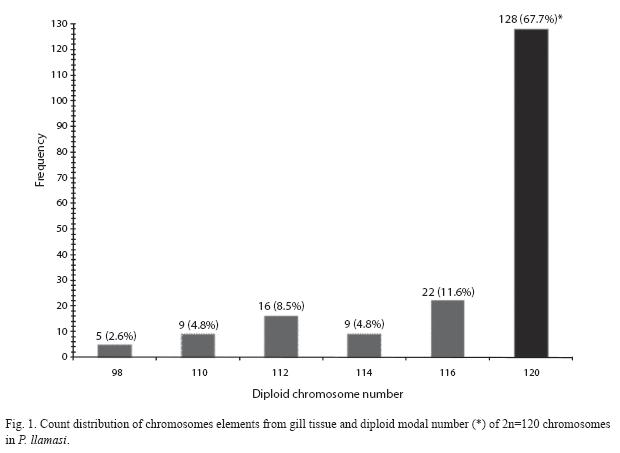
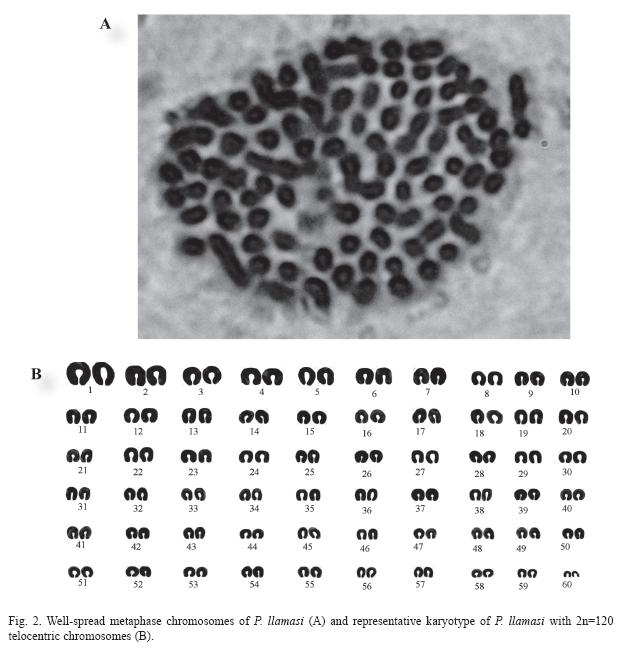
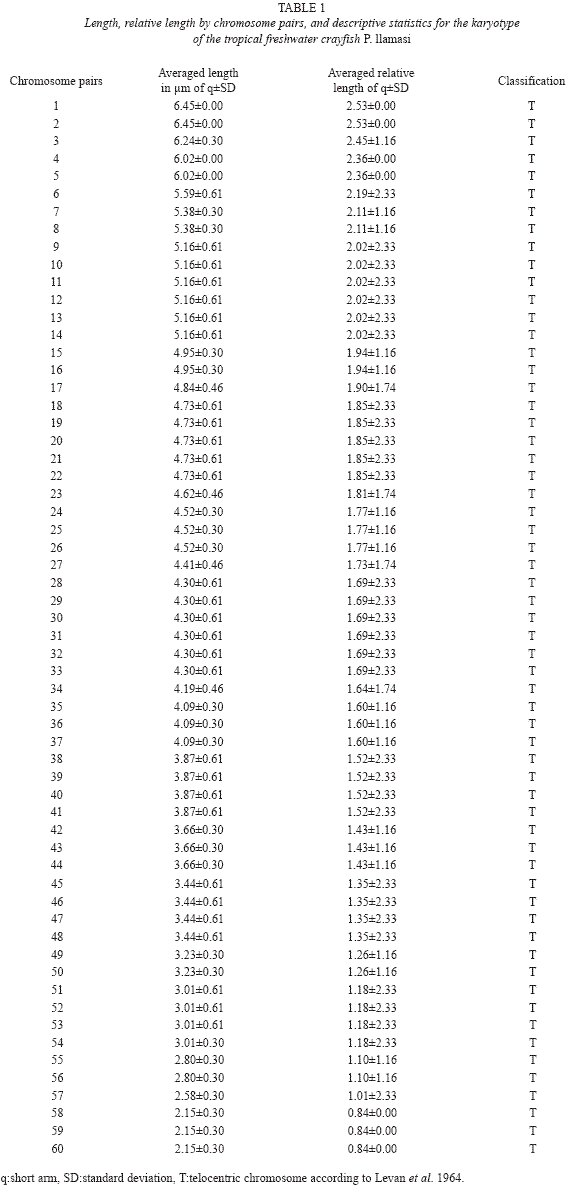
<body><![CDATA[<p>Resumen</p> </font></b><font face="Verdana" size="2"> </font></p>     <p><font face="Verdana" size="2">El g&eacute;nero <i>Procambarus </i>ha recibido mayor atenci&oacute;n en los estudios de los principios fundamentales de su biolog&iacute;a debido a su diversidad en el territorio mexicano y potencial uso en acuicultura. El cariotipo t&iacute;pico del acocil tropical mexicano <i>Procambarus </i>(<i>Austrocambarus</i>) <i>llamasi, </i>se estudi&oacute; mediante 189 dispersiones cromos&oacute;micas en metafase del tejido branquial de 17 adultos tratados con la t&eacute;cnica citol&oacute;gica de inmersi&oacute;n. Encontramos un amplio n&uacute;mero de cromosomas, que variaron entre 98-120 elementos cromos&oacute;micos, con n&uacute;mero modal diploide de 2n=120 elementos cromos&oacute;micos. El cariotipo del acocil tropical esta constituido por 60 pares de cromosomas monorr&aacute;meos, todos los centr&oacute;mero est&aacute;n en la regi&oacute;n teloc&eacute;ntrica de los cromosomas. En las metafases mit&oacute;ticas de hembras y machos no fueron identificados cromosomas sexuales. Sugerimos considerar la estructura cromos&oacute;mica del cariotipo como una herramienta citotaxon&oacute;mica as&iacute; como el empleo de datos cariol&oacute;gicos para prop&oacute;sitos de acuicultura y conservaci&oacute;n del acocil tropical.</font></p> <font face="Verdana" size="2"><b> </b></font><font face="Verdana" size="2"><b>Palabras clave: </b>cromosoma, cariotipo, acocil tropical, <i>Procambarus </i>(<i>Austrocambarus</i>) <i>llamasi.</i></font> <hr style="width: 100%; height: 2px;">     <p><font face="Verdana" size="2">There are three genera and about 50 species of cambarids in Mexico: <i>Procambarus </i>with 39 species, <i>Cambarellus </i>with 10 and <i>Orconectes </i>with only one species (Villalobos- Figueroa 1983). In that country, the biology of <i>Procambarus </i>has been more studied than the biology of other Cambarids because of its diversity and potential use in aquaculture (Villalobos-Figueroa 1983, Diupotex-Chong <i>et al</i>. 1997, Rodr&iacute;guez-Serna <i>et al</i>. 2000, 2002).</font></p>     <p><font face="Verdana" size="2">Since Villalobos-Figueroa (1983) reported the endemic distribution of the freshwater crayfish <i>Procambarus </i>(<i>Austrocambarus</i>) <i>llamasi </i>to the south-east region of Mexico, several studies have been done on its biology (Morales &amp; Bosada 1987), ecology (Morales <i>et al</i>. 1987, Villalobos-Hiriart <i>et al</i>. 1993), reproductive behavior (Mendoza 1994), reproduction (Rodr&iacute;guez-Serna <i>et al</i>. 2000) and geographic distribution (Rodr&iacute;guez-Serna <i>et al</i>. 2002). However, studies on basic genetics like chromosome structure for karyotype determination are still rare, with exception of a study on <i>P. diugeti </i>which revealed a chromosome number of 2n=102 chromosomes (Diupotex-Chong <i>et al</i>. 1997).</font></p>     <p><font face="Verdana" size="2">In general, cytogenetics studies of crustaceans are relatively few and very difficult to perform because their chromosome numbers are large (Niiyama 1962, Roberts 1969, Mittal &amp; Dhall 1971, Campos-Ramos 1997, Dumas &amp; Campos-Ramos 1999, Zhang <i>et al</i>. 2003, Lee <i>et al</i>. 2004), chromosomes are small and theirs shapes are very variable including metacentric, submetacentric, and acrocentric chromosomes (Tan <i>et al</i>. 2004, Salema &amp; Heino 1990, Damrongphol <i>et al</i>. 1991). Such distinctiveness makes them difficult to karyotype in comparison with the chromosomes of insects and some vertebrate species (White 1973).</font></p>     <p><font face="Verdana" size="2">Early karyological studies have provided basic information on the number, size, and morphology of chromosomes which is an important prerequisite to the use of techniques for set chromosome manipulations in fishes (Arai 2001, Hulata 2001), marine crustaceans, such as the white shrimp <i>Litopenaeus vannammei </i>(Dumas &amp; Campos-Ramos 1999), and the Chinese shrimp <i>Fenneropenaeus chinensis </i>(Zhang <i>et al</i>. 2003), as well as in marine bivalves such as the Japanese oyster <i>Crassostrea gigas </i>(Allen <i>et al</i>. 1989). Consequently, information on the basic genetics of the tropical crayfish <i>P. llamasi </i>is necessary not only to reinforce its potential for aquaculture, but also for genetic improvements and conservation. The main aim of this study was to describe the mitotic chromosome number and karyotype of the tropical freshwater crayfish <i>P. llamasi </i>that inhabits the Grijalva River in Tabasco, southern of M&eacute;xico. </font></p> <b><font face="Verdana" size="3">     <p>Materials and methods</p> </font><font face="Verdana" size="2"> </font></b>     <p><b><font face="Verdana" size="2">Sampling site and crayfish maintenance: </font></b><font face="Verdana" size="2">Seven adult females and ten males of <i>P. llamasi </i>ranging from 5.5-14.0cm of total length were used. Crayfish specimens were collected from the artificial creeks along the Academic Division for Biological Sciences of the Juarez University Autonomous of Tabasco (DACBIOL- UJAT); specimens frequently invade during the raining season (October-November) when the Grijalva River fills up with flood waters. Collected specimens were reared in the laboratory and fed daily with shrimp pellets throughout this study.</font></p> <font face="Verdana" size="2"><b> </b></font>     <p><font face="Verdana" size="2"><b>Cytological procedure and preparation of chromosome slides</b>: crayfish specimens were processed following the procedure by Lakra <i>et al </i>(1997) and Arias- Rodriguez <i>et al</i>. (2007, 2008) with slight modifications as follows: Specimens were incubated for five hours in a well-aerated plastic bottle containing 10ml of freshwater that were mixed with 1.0ml of 1.0% colchicine solution. Then crayfish were sacrificed and gill tissue dissected out. Minced gill tissues were kept in hypotonic treatment with 1.0% sodium citrate for two hours at room temperature. Well swollen tissues were fixed in 4:1 fresh fixative solution made by chilled methanol (4&deg;C) and glacial acetic acid. Three changes were essential at the interval of 15 min to give appropriated fixation of the cytological tissue by a refrigerated (4&deg;C) centrifugation at 3000r.p.m for 10min. The tissues were kept then at 4&deg;C for about one month.</font></p>     <p><font face="Verdana" size="2">Chromosome slides were prepared from the fixed tissues following the methods by Arias-Rodriguez <i>et al</i>. (2008) after adoption of the technique by Lakra <i>et al</i>. (1997) technique<b>. </b>The chromosome slides were stained for about 30min in giemsa diluted at 10.0% with phosphate buffer (pH=7.0); and washed with distilled water before letting air-dry at room temperatures for 24 hours.</font></p> <font face="Verdana" size="2"><b> </b></font>     ]]></body>
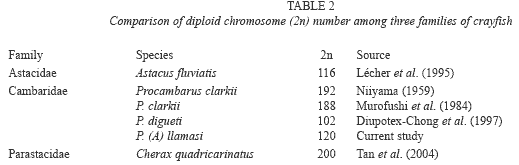
<body><![CDATA[<p><font face="Verdana" size="2"><b>Microscopic analyses, karyotype assembling and classification: </b>Well-spread mitotic metaphases were photographed using a Zeiss Axiostart plus microscope at 100X of magnifications by a coupled digital camera Sony Cybershot (DSC-W30). Diploid chromosome (2n) number or modal chromosome number was calculated on the base of the most frequently occurring measurement by counting the metaphases chromosomes.</font></p>     <p><font face="Verdana" size="2">Four of the best well spread mitotic metaphases were employed to assemble the most parsimonious karyotype of the species based on shape and measurements on chromosomes arms p (short arm) using Photoshop 6.0 (Adobe&reg;). The data-base was collected in the Microsoft&reg; Excel-2003 for analysis and classification of karyotype formula as recommended by Levan <i>et al. </i>(1964). The ideogram was drawing on the basis of the averaged length of each homologous chromosome pair (p) and their centromeric position.</font></p> <b><font face="Verdana" size="3">     <p>Results</p> </font></b><font face="Verdana" size="2"> </font>     <p><font face="Verdana" size="2">A total of 189 well-spread metaphases were scored from 70 analyzed chromosome slides from 17 adult specimens of the tropical crayfish <i>P. llamasi</i>. The mitotic counts ranged from 98 (2.6%) to 120 (67.7%) chromosome elements per diploid metaphase (<a href="/img/revistas/rbt/v58n2/a10i1.jpg">Fig. 1</a>). Basic statistical analysis indicated that modal chromosome number is 2n=120 chromosome elements found in 67.7% of the 189 examined metaphases (<a href="/img/revistas/rbt/v58n2/a10i1.jpg">Fig. 1</a>).</font></p>     <p><font face="Verdana" size="2">A typical diploid mitotic chromosome spread of the tropical crayfish <i>P. llamasi </i>is shown in <a  href="/img/revistas/rbt/v58n2/a10i2.jpg">figure 2-A</a>, and the most parsimonious karyotype of the species in figure 2-B. The average size of the 60 pairs of telocentric (T) monoarm homologous chromosomes that comprise the karyotype of <i>P. llamasi </i>varied from the biggest pair one with 6.45&plusmn;0.0 </font><font  face="Verdana" size="2">&#956;</font><font face="Verdana" size="2">m to the smallest pair sixty with 2.15&plusmn;0.30 </font><font face="Verdana" size="2">&#956;</font><font  face="Verdana" size="2">m (<a href="/img/revistas/rbt/v58n2/a10t1.gif">Table 1</a>, <a href="/img/revistas/rbt/v58n2/a10i2.jpg">Fig. 2</a>). The chromosome formula proposed for <i>P. llamasi </i>is 2n=120 telocentric (T) chromosomes (<a href="/img/revistas/rbt/v58n2/a10t1.gif">Table 1</a>, <a  href="/img/revistas/rbt/v58n2/a10i2.jpg">Fig. 2</a>). We did not detect any sex chromosomes (<a href="/img/revistas/rbt/v58n2/a10i1.jpg">Fig. 2</a>).</font></p> <b><font face="Verdana" size="3">     <p>Discussion</p> </font></b><font face="Verdana" size="2">     <p>In cytogenetic studies, rapid growing tissues are required to obtain a large number of metaphase chromosomes spreads. Several karyological studies on crustacean have been performed from male gonad tissue (Murofushi &amp; Deguchi 1983, Chow <i>et al</i>. 1990, Chavez- Justo <i>et al</i>. 1991, Damrongphol 1991, Xiang <i>et al</i>. 1994, Lakra <i>et al</i>. 1997, Tan <i>et al</i>. 2004). However, there are no available reports on karyotypes obtained from gill tissue of freshwater crayfish although the analysis of mitotic chromosomes provides a good tool to obtain the modal diploid chromosome number.</p>     <p>The mitotic procedure employed in this study allowed the establishment of the typical karyotype of <i>P. llamasi </i>that was characterized by 2n=120 monoarm chromosomes. The karyotype structure of this species shares some chromosomal similarities like variation in chromosome number, variation in size and shape as in other crustaceans (Niiyama 1959, Murofushi <i>et al</i>. 1984, L&eacute;cher <i>et al</i>. 1995). For example, for <i>P. clarkii </i>two reported diploid numbers has been dated for similar species with 2n=192 (Niiyama 1959) and 2n=188 (Murofushi <i>et al</i>. 1984), while in the Cambaridae <i>A. fluviatilis </i>2n=116 (L&eacute;cher <i>et al</i>. 1995). Comparative chromosome data in other crustacean species is shown in <a  href="#tabla2">Table 2</a>. These studies suggest that the ranges of chromosome number in freshwater crayfish families (Astacidae, Cambaridae, and Parastacidae) are larger than that reported for palaemonoid prawn (<a href="#tabla2">Table 2</a>). Such cytological settings represent a methodological problem for cytotaxonomist who wants to employ karyotypical characters as taxonomic key for species identification.    <br> </p>     <p>    ]]></body>
<body><![CDATA[<br> </p> </font>     <div style="text-align: center;"><font face="Verdana" size="2">     <p><a name="tabla2"></a><img src="/img/revistas/rbt/v58n2/a10t2.gif"  title="" alt="" style="width: 519px; height: 165px;">    <br> </p> </font>    <br> </div> <font face="Verdana" size="2">     <p>Karyotypical studies are still absent for several Mexican species, but comparative data are now available based on the present report for the tropical crayfish <i>P. llamasi </i>and the <i>P. diugeti </i>studied by Diupotex-Chong <i>et al</i>. (1997). The reported fundamental number (FN) of 204 autosomal arms for <i>P. diugeti </i>(Diupotex- Chong <i>et al</i>.1997), suggests that described karyotype structure of <i>P. llamasi </i>with NF of 120 arms is a cytotaxonomical key to separate both species, because their chromosome constitutions are quite different in the compared species. In addition both studies revealed that the presence of sex chromosomes is not a cytological characteristic of crayfish karyotype. Studies regarding chromosomes number, morphological taxonomy and molecular tools are still needed in many Mexican crayfish species to understand the evolutionary processes that promote their radiation in Mexico.</p> </font><b><font face="Verdana" size="3">     <p>Acknowledgments</p> </font></b><font face="Verdana" size="2">     <p>Special thanks to Ingo Schlupp from Department of Zoology, Oklahoma University for his comments to this paper. This research was partially supported from PROMEP (UJATPTC- 047), CONACYT (76305) and SEPCONACyT (79544) granted to L.A.R.</p> </font><b><font face="Verdana" size="3"> </font></b> <hr style="width: 100%; height: 2px;">     <p><b><font face="Verdana" size="3">References</font></b></p> <font face="Verdana" size="2">     <!-- ref --><p>Allen, Jr. S.K., S.L. Downing &amp; K.K. Chew. 1989. Hatchery manual for producing triploid oyster. University of Washington, Seattle, U.S.A.    &nbsp;&nbsp;&nbsp;&nbsp;&nbsp;&nbsp;&nbsp;&nbsp;[&#160;<a href="javascript:void(0);" onclick="javascript: window.open('/scielo.php?script=sci_nlinks&ref=1407922&pid=S0034-7744201000020001000001&lng=','','width=640,height=500,resizable=yes,scrollbars=1,menubar=yes,');">Links</a>&#160;]<!-- end-ref --></p>     <!-- ref --><p>Arai, K. 2001. Genetic improvement of aquaculture finfish species by chromosome manipulation techniques in Japan. Aquaculture 197: 205-228.    &nbsp;&nbsp;&nbsp;&nbsp;&nbsp;&nbsp;&nbsp;&nbsp;[&#160;<a href="javascript:void(0);" onclick="javascript: window.open('/scielo.php?script=sci_nlinks&ref=1407924&pid=S0034-7744201000020001000002&lng=','','width=640,height=500,resizable=yes,scrollbars=1,menubar=yes,');">Links</a>&#160;]<!-- end-ref --></p>     <!-- ref --><p>Arias-Rodriguez, L., J.P. Gonz&aacute;lez-Hermoso, H. Fletes- Regalado, L.E. Rodr&iacute;guez- Ibarra &amp; G. Del Valle- Pignataro. 2007. Cariotipos de los caracoles de tinte <i>Plicopurpura pansa </i>(Gould, 1853) y <i>Plicopurpura columellaris </i>(Lamarck, 1816) (Gastropoda: Muricidae). Rev. Biol. Trop. 55: 853-866.    &nbsp;&nbsp;&nbsp;&nbsp;&nbsp;&nbsp;&nbsp;&nbsp;[&#160;<a href="javascript:void(0);" onclick="javascript: window.open('/scielo.php?script=sci_nlinks&ref=1407926&pid=S0034-7744201000020001000003&lng=','','width=640,height=500,resizable=yes,scrollbars=1,menubar=yes,');">Links</a>&#160;]<!-- end-ref --></p>     <!-- ref --><p>Arias-Rodriguez, L., L. Ibarra-Castro &amp; S. P&aacute;ramo-Delgadillo. 2008. Los cromosomas mit&oacute;ticos y mei&oacute;ticos del pez tropical <i>Petenia splendida </i>(Pisces: Cichlidae). Rev. Biol. Trop. 56: 895-907.    &nbsp;&nbsp;&nbsp;&nbsp;&nbsp;&nbsp;&nbsp;&nbsp;[&#160;<a href="javascript:void(0);" onclick="javascript: window.open('/scielo.php?script=sci_nlinks&ref=1407928&pid=S0034-7744201000020001000004&lng=','','width=640,height=500,resizable=yes,scrollbars=1,menubar=yes,');">Links</a>&#160;]<!-- end-ref --></p>     <!-- ref --><p>Campos-Ramos, R. 1997. Chromosome studies on the marine shrimps <i>Penaeus vannamei </i>and <i>P. californiensis </i>(Decapoda). J. Crustac. Biol. 17: 66-673.    &nbsp;&nbsp;&nbsp;&nbsp;&nbsp;&nbsp;&nbsp;&nbsp;[&#160;<a href="javascript:void(0);" onclick="javascript: window.open('/scielo.php?script=sci_nlinks&ref=1407930&pid=S0034-7744201000020001000005&lng=','','width=640,height=500,resizable=yes,scrollbars=1,menubar=yes,');">Links</a>&#160;]<!-- end-ref --></p>     <!-- ref --><p>Chavez-Justo, C., M. Murofushi., M. Aida &amp; K. Hanyu. 1991. Karyological studies on the freshwater prawn <i>Macrobrachium rosenbergii</i>. Aquaculture 97: 327- 334.    &nbsp;&nbsp;&nbsp;&nbsp;&nbsp;&nbsp;&nbsp;&nbsp;[&#160;<a href="javascript:void(0);" onclick="javascript: window.open('/scielo.php?script=sci_nlinks&ref=1407932&pid=S0034-7744201000020001000006&lng=','','width=640,height=500,resizable=yes,scrollbars=1,menubar=yes,');">Links</a>&#160;]<!-- end-ref --></p>     <!-- ref --><p>Chow, S., W.J. Dougherty &amp; P.A. Sandifer. 1990. Meiotic chromosome complements and nuclear DNA contents of four species of shrimps of the genus <i>Penaeus</i>. J. Crustac. Biol. 10: 29-36.    &nbsp;&nbsp;&nbsp;&nbsp;&nbsp;&nbsp;&nbsp;&nbsp;[&#160;<a href="javascript:void(0);" onclick="javascript: window.open('/scielo.php?script=sci_nlinks&ref=1407934&pid=S0034-7744201000020001000007&lng=','','width=640,height=500,resizable=yes,scrollbars=1,menubar=yes,');">Links</a>&#160;]<!-- end-ref --></p>     <!-- ref --><p>Damrongphol, P., N. Eangchuan, S. Ajpru, B. Poolsanguan &amp; B. Withyachumnarkul. 1991. Karyotype of giant freshwater prawn, <i>Macrobrachium rosenbergii</i>. J. Sci. Soc. Thai. 17: 57-69.    &nbsp;&nbsp;&nbsp;&nbsp;&nbsp;&nbsp;&nbsp;&nbsp;[&#160;<a href="javascript:void(0);" onclick="javascript: window.open('/scielo.php?script=sci_nlinks&ref=1407936&pid=S0034-7744201000020001000008&lng=','','width=640,height=500,resizable=yes,scrollbars=1,menubar=yes,');">Links</a>&#160;]<!-- end-ref --></p>     <!-- ref --><p>Diupotex-Chong, M.E., N.R. Foster &amp; L.A. Zarate. 1997. A cytogenetic of the crayfish <i>Procambarus digueti </i>(Bouvier, 1987) (Decapoda Cambaridae) from lake Camecuaro, Michoacan, Mexico. Crustaceana 70: 875-885.    &nbsp;&nbsp;&nbsp;&nbsp;&nbsp;&nbsp;&nbsp;&nbsp;[&#160;<a href="javascript:void(0);" onclick="javascript: window.open('/scielo.php?script=sci_nlinks&ref=1407938&pid=S0034-7744201000020001000009&lng=','','width=640,height=500,resizable=yes,scrollbars=1,menubar=yes,');">Links</a>&#160;]<!-- end-ref --></p>     <!-- ref --><p>Dumas, S. &amp; R. Campos-Ramos. 1999. Triploidy induction in the pacific White shrimp <i>Litopenaeus vannamei </i>(Boone). Aquacult. Res. 30: 621-624.    &nbsp;&nbsp;&nbsp;&nbsp;&nbsp;&nbsp;&nbsp;&nbsp;[&#160;<a href="javascript:void(0);" onclick="javascript: window.open('/scielo.php?script=sci_nlinks&ref=1407940&pid=S0034-7744201000020001000010&lng=','','width=640,height=500,resizable=yes,scrollbars=1,menubar=yes,');">Links</a>&#160;]<!-- end-ref --></p>     <!-- ref --><p>Hulata, G. 2001. Genetic manipulations in aquaculture: a review of stock improvement by classical and modern technologies. Genetica 111: 155-73.    &nbsp;&nbsp;&nbsp;&nbsp;&nbsp;&nbsp;&nbsp;&nbsp;[&#160;<a href="javascript:void(0);" onclick="javascript: window.open('/scielo.php?script=sci_nlinks&ref=1407942&pid=S0034-7744201000020001000011&lng=','','width=640,height=500,resizable=yes,scrollbars=1,menubar=yes,');">Links</a>&#160;]<!-- end-ref --></p>     <!-- ref --><p>Lakra, W.S., P. Kumar, M. Das &amp; U. Goswami. 1997. Improved techniques of chromosome preparation from shrimp and prawns. Asian Fish. Sci. 10: 117- 121.    &nbsp;&nbsp;&nbsp;&nbsp;&nbsp;&nbsp;&nbsp;&nbsp;[&#160;<a href="javascript:void(0);" onclick="javascript: window.open('/scielo.php?script=sci_nlinks&ref=1407944&pid=S0034-7744201000020001000012&lng=','','width=640,height=500,resizable=yes,scrollbars=1,menubar=yes,');">Links</a>&#160;]<!-- end-ref --></p>     <!-- ref --><p>L&eacute;cher, P., D. Defaye &amp; P. Noel. 1995. Chromosomes and nuclear DNA of crustacean. Invertebr. Reprod. Dev. 27: 85-114.    &nbsp;&nbsp;&nbsp;&nbsp;&nbsp;&nbsp;&nbsp;&nbsp;[&#160;<a href="javascript:void(0);" onclick="javascript: window.open('/scielo.php?script=sci_nlinks&ref=1407946&pid=S0034-7744201000020001000013&lng=','','width=640,height=500,resizable=yes,scrollbars=1,menubar=yes,');">Links</a>&#160;]<!-- end-ref --></p>     <!-- ref --><p>Lee, T.H., N. Naitoh &amp; F. Yamazaki. 2004. Chromosome studies on the mitten crabs <i>Eriocheir japonica </i>and <i>E. sinensis</i>. Fish. Sci. 70: 211-214.    &nbsp;&nbsp;&nbsp;&nbsp;&nbsp;&nbsp;&nbsp;&nbsp;[&#160;<a href="javascript:void(0);" onclick="javascript: window.open('/scielo.php?script=sci_nlinks&ref=1407948&pid=S0034-7744201000020001000014&lng=','','width=640,height=500,resizable=yes,scrollbars=1,menubar=yes,');">Links</a>&#160;]<!-- end-ref --></p>     <!-- ref --><p>Levan, A., K. Fredga &amp; A.A. Sandberg. 1964. Nomenclature for centromeric position on chromosomes. Hereditas 52: 201-220.    &nbsp;&nbsp;&nbsp;&nbsp;&nbsp;&nbsp;&nbsp;&nbsp;[&#160;<a href="javascript:void(0);" onclick="javascript: window.open('/scielo.php?script=sci_nlinks&ref=1407950&pid=S0034-7744201000020001000015&lng=','','width=640,height=500,resizable=yes,scrollbars=1,menubar=yes,');">Links</a>&#160;]<!-- end-ref --></p>     <!-- ref --><p>Mendoza, M. 1994. H&aacute;bitos reproductivos del acocil <i>Procambarus (Austrocambarus) llamasi </i>(Crustacea: Astacidae) en condiciones de laboratorio. Universidad y Ciencia 11: 149-157.    &nbsp;&nbsp;&nbsp;&nbsp;&nbsp;&nbsp;&nbsp;&nbsp;[&#160;<a href="javascript:void(0);" onclick="javascript: window.open('/scielo.php?script=sci_nlinks&ref=1407952&pid=S0034-7744201000020001000016&lng=','','width=640,height=500,resizable=yes,scrollbars=1,menubar=yes,');">Links</a>&#160;]<!-- end-ref --></p>     <!-- ref --><p>Mittal, O.P. &amp; U. Dhall. 1971. Chromosome studies in three species of freshwater decapods (Crustacea). Cytologia 36: 633-638.    &nbsp;&nbsp;&nbsp;&nbsp;&nbsp;&nbsp;&nbsp;&nbsp;[&#160;<a href="javascript:void(0);" onclick="javascript: window.open('/scielo.php?script=sci_nlinks&ref=1407954&pid=S0034-7744201000020001000017&lng=','','width=640,height=500,resizable=yes,scrollbars=1,menubar=yes,');">Links</a>&#160;]<!-- end-ref --></p>     <!-- ref --><p>Morales, M. &amp; L. Bosada. 1987. Algunos aspectos de la biolog&iacute;a del acocil reculador <i>Procambarus (Austrocambarus) llamasi </i>y consideraci&oacute;n sobre su cultivo en el tr&oacute;pico h&uacute;medo mexicano, p. 201-211. <i>In </i>L. Bozada (eds.). Otros Recursos Alimenticos. Serie Medio Ambiente En Coatzacoalcos, Universidad de Veracruz, Veracruz, M&eacute;xico.    &nbsp;&nbsp;&nbsp;&nbsp;&nbsp;&nbsp;&nbsp;&nbsp;[&#160;<a href="javascript:void(0);" onclick="javascript: window.open('/scielo.php?script=sci_nlinks&ref=1407956&pid=S0034-7744201000020001000018&lng=','','width=640,height=500,resizable=yes,scrollbars=1,menubar=yes,');">Links</a>&#160;]<!-- end-ref --></p>     <!-- ref --><p>Morales, M., L. Bosada &amp; A. Casanova. 1987. Prospecci&oacute;n poblacional, distribuci&oacute;n geogr&aacute;fica y aspectos ecol&oacute;gicos del acocil <i>Procambarus (Austrocambarus) llamasi </i>del sureste de Veracruz, p. 169-199. <i>In </i>L. Bozada (eds.). Otros Recursos Alimenticos. Serie Medio Ambiente en Coatzacoalcos, Universidad de Veracruz, Veracruz, M&eacute;xico.    &nbsp;&nbsp;&nbsp;&nbsp;&nbsp;&nbsp;&nbsp;&nbsp;[&#160;<a href="javascript:void(0);" onclick="javascript: window.open('/scielo.php?script=sci_nlinks&ref=1407958&pid=S0034-7744201000020001000019&lng=','','width=640,height=500,resizable=yes,scrollbars=1,menubar=yes,');">Links</a>&#160;]<!-- end-ref --></p>     <!-- ref --><p>Murofushi, M. &amp; Y. Deguchi. 1983. A method for obtaining metaphase chromosomes from large shrimp-like crustaceans. Rep. Inst. Sci. Living, Nihon Univ. 9: 95-157.    &nbsp;&nbsp;&nbsp;&nbsp;&nbsp;&nbsp;&nbsp;&nbsp;[&#160;<a href="javascript:void(0);" onclick="javascript: window.open('/scielo.php?script=sci_nlinks&ref=1407960&pid=S0034-7744201000020001000020&lng=','','width=640,height=500,resizable=yes,scrollbars=1,menubar=yes,');">Links</a>&#160;]<!-- end-ref --></p>     <!-- ref --><p>Murofushi, M., Y. Deguchi &amp; H. Yoshida. 1984. Karyological study of the red swamp crayfish and the Japanese lobster by air-drying method. Proc. Japan. Acad. Ser. B 60: 306-309.    &nbsp;&nbsp;&nbsp;&nbsp;&nbsp;&nbsp;&nbsp;&nbsp;[&#160;<a href="javascript:void(0);" onclick="javascript: window.open('/scielo.php?script=sci_nlinks&ref=1407962&pid=S0034-7744201000020001000021&lng=','','width=640,height=500,resizable=yes,scrollbars=1,menubar=yes,');">Links</a>&#160;]<!-- end-ref --></p>     <!-- ref --><p>Niiyama, H. 1959. A comparative study of the chromosomes in decapods, isopods and amphipods, with some remarks on cytotaxonomy and sex-determination in crustacean. Mem. Fac. Fish. Hokkaido Univ. 7: 1-60.    &nbsp;&nbsp;&nbsp;&nbsp;&nbsp;&nbsp;&nbsp;&nbsp;[&#160;<a href="javascript:void(0);" onclick="javascript: window.open('/scielo.php?script=sci_nlinks&ref=1407964&pid=S0034-7744201000020001000022&lng=','','width=640,height=500,resizable=yes,scrollbars=1,menubar=yes,');">Links</a>&#160;]<!-- end-ref --></p>     <!-- ref --><p>Niiyama, H. 1962. On the unprecedently large number of chromosome of the crayfish, <i>Astacus trowbridgii </i>Stimpson. Annot. Zool. Jpn. 35: 229-233.    &nbsp;&nbsp;&nbsp;&nbsp;&nbsp;&nbsp;&nbsp;&nbsp;[&#160;<a href="javascript:void(0);" onclick="javascript: window.open('/scielo.php?script=sci_nlinks&ref=1407966&pid=S0034-7744201000020001000023&lng=','','width=640,height=500,resizable=yes,scrollbars=1,menubar=yes,');">Links</a>&#160;]<!-- end-ref --></p>     <!-- ref --><p>Roberts, E.L. 1969. Studies on the chromosomes in the lobster, <i>Homarus americanus. </i>Crustaceana 16: 194-196.    &nbsp;&nbsp;&nbsp;&nbsp;&nbsp;&nbsp;&nbsp;&nbsp;[&#160;<a href="javascript:void(0);" onclick="javascript: window.open('/scielo.php?script=sci_nlinks&ref=1407968&pid=S0034-7744201000020001000024&lng=','','width=640,height=500,resizable=yes,scrollbars=1,menubar=yes,');">Links</a>&#160;]<!-- end-ref --></p>     <!-- ref --><p>Rodr&iacute;guez-Serna, M., C. Carmona-Osalde, J.L. Arredondo- Figueroa &amp; M.A. Olvera- Novoa. 2002. Distribuci&oacute;n geogr&aacute;fica de <i>Procambarus </i>(<i>Austrocambarus</i>) <i>llamasi </i>(Cambaridae) en la pen&iacute;nsula de Yucatan. Hidrobiol&oacute;gia 12:1-5.    &nbsp;&nbsp;&nbsp;&nbsp;&nbsp;&nbsp;&nbsp;&nbsp;[&#160;<a href="javascript:void(0);" onclick="javascript: window.open('/scielo.php?script=sci_nlinks&ref=1407970&pid=S0034-7744201000020001000025&lng=','','width=640,height=500,resizable=yes,scrollbars=1,menubar=yes,');">Links</a>&#160;]<!-- end-ref --></p>     <!-- ref --><p>Rodriguez-Serna, M., C. Carmona-Osalde, M.A. Olvera- Novoa &amp; J.L. Arredondo- Figueroa. 2000. Fecundity, egg, development and growth of juvenile crayfish <i>Procambarus (Austrocambarus) llamasi </i>(Villalobos, 1955) under laboratory condition. Aquac. Res. 31: 173-179.    &nbsp;&nbsp;&nbsp;&nbsp;&nbsp;&nbsp;&nbsp;&nbsp;[&#160;<a href="javascript:void(0);" onclick="javascript: window.open('/scielo.php?script=sci_nlinks&ref=1407972&pid=S0034-7744201000020001000026&lng=','','width=640,height=500,resizable=yes,scrollbars=1,menubar=yes,');">Links</a>&#160;]<!-- end-ref --></p>     <!-- ref --><p>Salemaa, H. &amp; T. Heino. 1990. Chromosome numbers of Fennoscandian glacial relict Crustacea. Ann. Zool. Fennici. 27: 207-210.    &nbsp;&nbsp;&nbsp;&nbsp;&nbsp;&nbsp;&nbsp;&nbsp;[&#160;<a href="javascript:void(0);" onclick="javascript: window.open('/scielo.php?script=sci_nlinks&ref=1407974&pid=S0034-7744201000020001000027&lng=','','width=640,height=500,resizable=yes,scrollbars=1,menubar=yes,');">Links</a>&#160;]<!-- end-ref --></p>     <!-- ref --><p>Tan, X., J.G. Qin, B. Chen, L. Chen &amp; X. Li. 2004. Karyological analyses on redclaw crayfish <i>Cherax quadricarinatus </i>(Decapoda : Parastacidae). Aquaculture 234: 65-76.    &nbsp;&nbsp;&nbsp;&nbsp;&nbsp;&nbsp;&nbsp;&nbsp;[&#160;<a href="javascript:void(0);" onclick="javascript: window.open('/scielo.php?script=sci_nlinks&ref=1407976&pid=S0034-7744201000020001000028&lng=','','width=640,height=500,resizable=yes,scrollbars=1,menubar=yes,');">Links</a>&#160;]<!-- end-ref --></p>     <!-- ref --><p>Villalobos-Figueroa, A. 1983. Crayfishes of M&eacute;xico (Crustacea: Decapoda). Smithsonian Institution Libraries and the National Science Foundation, American Publishing, New Delhi, USA. 276 p.    &nbsp;&nbsp;&nbsp;&nbsp;&nbsp;&nbsp;&nbsp;&nbsp;[&#160;<a href="javascript:void(0);" onclick="javascript: window.open('/scielo.php?script=sci_nlinks&ref=1407978&pid=S0034-7744201000020001000029&lng=','','width=640,height=500,resizable=yes,scrollbars=1,menubar=yes,');">Links</a>&#160;]<!-- end-ref --></p>     <!-- ref --><p>Villalobos-Hiriart, J.L., A. Cantu, F. D&iacute;az-Barriga &amp; E. Lira-Fern&aacute;ndez. 1993. Los crust&aacute;ceos de agua dulce de M&eacute;xico. Rev. Soc. Mex. Hist. Nat. 44: 267-290.    &nbsp;&nbsp;&nbsp;&nbsp;&nbsp;&nbsp;&nbsp;&nbsp;[&#160;<a href="javascript:void(0);" onclick="javascript: window.open('/scielo.php?script=sci_nlinks&ref=1407980&pid=S0034-7744201000020001000030&lng=','','width=640,height=500,resizable=yes,scrollbars=1,menubar=yes,');">Links</a>&#160;]<!-- end-ref --></p>     <!-- ref --><p>White, M.J.D. 1973. Animal Cytology and Evolution. Cambridge University, Cambridge, United Kingdom.    &nbsp;&nbsp;&nbsp;&nbsp;&nbsp;&nbsp;&nbsp;&nbsp;[&#160;<a href="javascript:void(0);" onclick="javascript: window.open('/scielo.php?script=sci_nlinks&ref=1407982&pid=S0034-7744201000020001000031&lng=','','width=640,height=500,resizable=yes,scrollbars=1,menubar=yes,');">Links</a>&#160;]<!-- end-ref --></p>     <!-- ref --><p>Xiang, J.H., R.Y. Liu &amp; L.H. Zhou. 1994. Chromosomes of marine shrimps with special reference to different techniques. Aquaculture 111: 321.    &nbsp;&nbsp;&nbsp;&nbsp;&nbsp;&nbsp;&nbsp;&nbsp;[&#160;<a href="javascript:void(0);" onclick="javascript: window.open('/scielo.php?script=sci_nlinks&ref=1407984&pid=S0034-7744201000020001000032&lng=','','width=640,height=500,resizable=yes,scrollbars=1,menubar=yes,');">Links</a>&#160;]<!-- end-ref --></p>     <!-- ref --><p>Zhang, X., L. Fuhua &amp; J. Xiang. 2003. Chromosome behavior of heat shock induced triploid in <i>Fenneropenaeus chinensis</i>. Chin. J. Ocean. Lim. 3: 22-228.    &nbsp;&nbsp;&nbsp;&nbsp;&nbsp;&nbsp;&nbsp;&nbsp;[&#160;<a href="javascript:void(0);" onclick="javascript: window.open('/scielo.php?script=sci_nlinks&ref=1407986&pid=S0034-7744201000020001000033&lng=','','width=640,height=500,resizable=yes,scrollbars=1,menubar=yes,');">Links</a>&#160;]<!-- end-ref --><br> </p> </font> <hr style="width: 100%; height: 2px;">     <div style="text-align: center;"><font face="Verdana" size="2">Received 22-V-2009. Corrected 06-X-2009. Accepted 01-XI-2009.</font>    <br> </div>     <br> <font face="Verdana" size="2"></font>      ]]></body><back>
<ref-list>
<ref id="B1">
<nlm-citation citation-type="book">
<person-group person-group-type="author">
<name>
<surname><![CDATA[Allen]]></surname>
<given-names><![CDATA[Jr. S.K]]></given-names>
</name>
<name>
<surname><![CDATA[Downing]]></surname>
<given-names><![CDATA[S.L]]></given-names>
</name>
<name>
<surname><![CDATA[Chew]]></surname>
<given-names><![CDATA[K.K]]></given-names>
</name>
</person-group>
<source><![CDATA[Hatchery manual for producing triploid oyster]]></source>
<year>1989</year>
<publisher-loc><![CDATA[Seattle ]]></publisher-loc>
<publisher-name><![CDATA[University of Washington]]></publisher-name>
</nlm-citation>
</ref>
<ref id="B2">
<nlm-citation citation-type="journal">
<person-group person-group-type="author">
<name>
<surname><![CDATA[Arai]]></surname>
<given-names><![CDATA[K]]></given-names>
</name>
</person-group>
<article-title xml:lang="en"><![CDATA[Genetic improvement of aquaculture finfish species by chromosome manipulation techniques in Japan]]></article-title>
<source><![CDATA[Aquaculture]]></source>
<year>2001</year>
<volume>197</volume>
<page-range>205-228</page-range></nlm-citation>
</ref>
<ref id="B3">
<nlm-citation citation-type="journal">
<person-group person-group-type="author">
<name>
<surname><![CDATA[Arias-Rodriguez]]></surname>
<given-names><![CDATA[L]]></given-names>
</name>
<name>
<surname><![CDATA[González-Hermoso]]></surname>
<given-names><![CDATA[J.P]]></given-names>
</name>
<name>
<surname><![CDATA[Fletes- Regalado]]></surname>
<given-names><![CDATA[H]]></given-names>
</name>
<name>
<surname><![CDATA[Rodríguez- Ibarra]]></surname>
<given-names><![CDATA[L.E]]></given-names>
</name>
<name>
<surname><![CDATA[Del Valle- Pignataro]]></surname>
<given-names><![CDATA[G]]></given-names>
</name>
</person-group>
<article-title xml:lang="es"><![CDATA[Cariotipos de los caracoles de tinte Plicopurpura pansa (Gould, 1853) y Plicopurpura columellaris (Lamarck, 1816) (Gastropoda: Muricidae)]]></article-title>
<source><![CDATA[Rev. Biol. Trop]]></source>
<year>2007</year>
<volume>55</volume>
<page-range>853-866</page-range></nlm-citation>
</ref>
<ref id="B4">
<nlm-citation citation-type="journal">
<person-group person-group-type="author">
<name>
<surname><![CDATA[Arias-Rodriguez]]></surname>
<given-names><![CDATA[L]]></given-names>
</name>
<name>
<surname><![CDATA[Ibarra-Castro]]></surname>
<given-names><![CDATA[L]]></given-names>
</name>
<name>
<surname><![CDATA[Páramo-Delgadillo]]></surname>
<given-names><![CDATA[S]]></given-names>
</name>
</person-group>
<article-title xml:lang="es"><![CDATA[Los cromosomas mitóticos y meióticos del pez tropical Petenia splendida (Pisces: Cichlidae)]]></article-title>
<source><![CDATA[Rev. Biol. Trop]]></source>
<year>2008</year>
<volume>56</volume>
<page-range>895-907</page-range></nlm-citation>
</ref>
<ref id="B5">
<nlm-citation citation-type="journal">
<person-group person-group-type="author">
<name>
<surname><![CDATA[Campos-Ramos]]></surname>
<given-names><![CDATA[R]]></given-names>
</name>
</person-group>
<article-title xml:lang="en"><![CDATA[Chromosome studies on the marine shrimps Penaeus vannamei and P. californiensis (Decapoda)]]></article-title>
<source><![CDATA[J. Crustac. Biol]]></source>
<year>1997</year>
<volume>17</volume>
<page-range>66-673</page-range></nlm-citation>
</ref>
<ref id="B6">
<nlm-citation citation-type="journal">
<person-group person-group-type="author">
<name>
<surname><![CDATA[Chavez-Justo]]></surname>
<given-names><![CDATA[C]]></given-names>
</name>
<name>
<surname><![CDATA[Murofushi]]></surname>
<given-names><![CDATA[M]]></given-names>
</name>
<name>
<surname><![CDATA[Aida]]></surname>
<given-names><![CDATA[M]]></given-names>
</name>
<name>
<surname><![CDATA[Hanyu]]></surname>
<given-names><![CDATA[K]]></given-names>
</name>
</person-group>
<article-title xml:lang="en"><![CDATA[Karyological studies on the freshwater prawn Macrobrachium rosenbergii]]></article-title>
<source><![CDATA[Aquaculture]]></source>
<year>1991</year>
<volume>97</volume>
<page-range>327- 334</page-range></nlm-citation>
</ref>
<ref id="B7">
<nlm-citation citation-type="journal">
<person-group person-group-type="author">
<name>
<surname><![CDATA[Chow]]></surname>
<given-names><![CDATA[S]]></given-names>
</name>
<name>
<surname><![CDATA[Dougherty]]></surname>
<given-names><![CDATA[W.J]]></given-names>
</name>
<name>
<surname><![CDATA[Sandifer]]></surname>
<given-names><![CDATA[P.A]]></given-names>
</name>
</person-group>
<article-title xml:lang="en"><![CDATA[Meiotic chromosome complements and nuclear DNA contents of four species of shrimps of the genus Penaeus]]></article-title>
<source><![CDATA[J. Crustac. Biol]]></source>
<year>1990</year>
<volume>10</volume>
<page-range>29-36</page-range></nlm-citation>
</ref>
<ref id="B8">
<nlm-citation citation-type="journal">
<person-group person-group-type="author">
<name>
<surname><![CDATA[Damrongphol]]></surname>
<given-names><![CDATA[P]]></given-names>
</name>
<name>
<surname><![CDATA[Eangchuan]]></surname>
<given-names><![CDATA[N]]></given-names>
</name>
<name>
<surname><![CDATA[Ajpru]]></surname>
<given-names><![CDATA[S]]></given-names>
</name>
<name>
<surname><![CDATA[Poolsanguan]]></surname>
<given-names><![CDATA[B]]></given-names>
</name>
<name>
<surname><![CDATA[Withyachumnarkul]]></surname>
<given-names><![CDATA[B]]></given-names>
</name>
</person-group>
<article-title xml:lang="en"><![CDATA[Karyotype of giant freshwater prawn, Macrobrachium rosenbergii]]></article-title>
<source><![CDATA[J. Sci. Soc. Thai]]></source>
<year>1991</year>
<volume>17</volume>
<page-range>57-69</page-range></nlm-citation>
</ref>
<ref id="B9">
<nlm-citation citation-type="journal">
<person-group person-group-type="author">
<name>
<surname><![CDATA[Diupotex-Chong]]></surname>
<given-names><![CDATA[M.E]]></given-names>
</name>
<name>
<surname><![CDATA[Foster]]></surname>
<given-names><![CDATA[N.R]]></given-names>
</name>
<name>
<surname><![CDATA[Zarate]]></surname>
<given-names><![CDATA[L.A]]></given-names>
</name>
</person-group>
<article-title xml:lang="en"><![CDATA[A cytogenetic of the crayfish Procambarus digueti (Bouvier, 1987) (Decapoda Cambaridae) from lake Camecuaro, Michoacan, Mexico]]></article-title>
<source><![CDATA[Crustaceana]]></source>
<year>1997</year>
<volume>70</volume>
<page-range>875-885</page-range></nlm-citation>
</ref>
<ref id="B10">
<nlm-citation citation-type="journal">
<person-group person-group-type="author">
<name>
<surname><![CDATA[Dumas]]></surname>
<given-names><![CDATA[S]]></given-names>
</name>
<name>
<surname><![CDATA[Campos-Ramos]]></surname>
<given-names><![CDATA[R]]></given-names>
</name>
</person-group>
<article-title xml:lang="en"><![CDATA[Triploidy induction in the pacific White shrimp Litopenaeus vannamei (Boone)]]></article-title>
<source><![CDATA[Aquacult. Res]]></source>
<year>1999</year>
<volume>30</volume>
<page-range>621-624</page-range></nlm-citation>
</ref>
<ref id="B11">
<nlm-citation citation-type="journal">
<person-group person-group-type="author">
<name>
<surname><![CDATA[Hulata]]></surname>
<given-names><![CDATA[G]]></given-names>
</name>
</person-group>
<article-title xml:lang="en"><![CDATA[Genetic manipulations in aquaculture: a review of stock improvement by classical and modern technologies]]></article-title>
<source><![CDATA[Genetica]]></source>
<year>2001</year>
<volume>111</volume>
<page-range>155-73</page-range></nlm-citation>
</ref>
<ref id="B12">
<nlm-citation citation-type="journal">
<person-group person-group-type="author">
<name>
<surname><![CDATA[Lakra]]></surname>
<given-names><![CDATA[W.S]]></given-names>
</name>
<name>
<surname><![CDATA[Kumar]]></surname>
<given-names><![CDATA[P]]></given-names>
</name>
<name>
<surname><![CDATA[Das]]></surname>
<given-names><![CDATA[M]]></given-names>
</name>
<name>
<surname><![CDATA[Goswami]]></surname>
<given-names><![CDATA[U]]></given-names>
</name>
</person-group>
<article-title xml:lang="en"><![CDATA[Improved techniques of chromosome preparation from shrimp and prawns]]></article-title>
<source><![CDATA[Asian Fish. Sci]]></source>
<year>1997</year>
<volume>10</volume>
<page-range>117- 121</page-range></nlm-citation>
</ref>
<ref id="B13">
<nlm-citation citation-type="journal">
<person-group person-group-type="author">
<name>
<surname><![CDATA[Lécher]]></surname>
<given-names><![CDATA[P]]></given-names>
</name>
<name>
<surname><![CDATA[Defaye]]></surname>
<given-names><![CDATA[D]]></given-names>
</name>
<name>
<surname><![CDATA[Noel]]></surname>
<given-names><![CDATA[P]]></given-names>
</name>
</person-group>
<article-title xml:lang="en"><![CDATA[Chromosomes and nuclear DNA of crustacean]]></article-title>
<source><![CDATA[Invertebr. Reprod. Dev]]></source>
<year>1995</year>
<volume>27</volume>
<page-range>85-114</page-range></nlm-citation>
</ref>
<ref id="B14">
<nlm-citation citation-type="journal">
<person-group person-group-type="author">
<name>
<surname><![CDATA[Lee]]></surname>
<given-names><![CDATA[T.H]]></given-names>
</name>
<name>
<surname><![CDATA[Naitoh]]></surname>
<given-names><![CDATA[N]]></given-names>
</name>
<name>
<surname><![CDATA[Yamazaki]]></surname>
<given-names><![CDATA[F]]></given-names>
</name>
</person-group>
<article-title xml:lang="en"><![CDATA[Chromosome studies on the mitten crabs Eriocheir japonica and E. sinensis]]></article-title>
<source><![CDATA[Fish. Sci]]></source>
<year>2004</year>
<volume>70</volume>
<page-range>211-214</page-range></nlm-citation>
</ref>
<ref id="B15">
<nlm-citation citation-type="journal">
<person-group person-group-type="author">
<name>
<surname><![CDATA[Levan]]></surname>
<given-names><![CDATA[A]]></given-names>
</name>
<name>
<surname><![CDATA[Fredga]]></surname>
<given-names><![CDATA[K]]></given-names>
</name>
<name>
<surname><![CDATA[Sandberg]]></surname>
<given-names><![CDATA[A.A]]></given-names>
</name>
</person-group>
<article-title xml:lang="en"><![CDATA[Nomenclature for centromeric position on chromosomes]]></article-title>
<source><![CDATA[Hereditas]]></source>
<year>1964</year>
<volume>52</volume>
<page-range>201-220</page-range></nlm-citation>
</ref>
<ref id="B16">
<nlm-citation citation-type="journal">
<person-group person-group-type="author">
<name>
<surname><![CDATA[Mendoza]]></surname>
<given-names><![CDATA[M]]></given-names>
</name>
</person-group>
<article-title xml:lang="es"><![CDATA[Hábitos reproductivos del acocil Procambarus (Austrocambarus) llamasi (Crustacea: Astacidae) en condiciones de laboratorio]]></article-title>
<source><![CDATA[Universidad y Ciencia]]></source>
<year>1994</year>
<volume>11</volume>
<page-range>149-157</page-range></nlm-citation>
</ref>
<ref id="B17">
<nlm-citation citation-type="journal">
<person-group person-group-type="author">
<name>
<surname><![CDATA[Mittal]]></surname>
<given-names><![CDATA[O.P]]></given-names>
</name>
<name>
<surname><![CDATA[Dhall]]></surname>
<given-names><![CDATA[U]]></given-names>
</name>
</person-group>
<article-title xml:lang="en"><![CDATA[Chromosome studies in three species of freshwater decapods (Crustacea]]></article-title>
<source><![CDATA[Cytologia]]></source>
<year>1971</year>
<volume>36</volume>
<page-range>633-638</page-range></nlm-citation>
</ref>
<ref id="B18">
<nlm-citation citation-type="book">
<person-group person-group-type="author">
<name>
<surname><![CDATA[Morales]]></surname>
<given-names><![CDATA[M]]></given-names>
</name>
<name>
<surname><![CDATA[Bosada]]></surname>
<given-names><![CDATA[L]]></given-names>
</name>
</person-group>
<article-title xml:lang="es"><![CDATA[Algunos aspectos de la biología del acocil reculador Procambarus (Austrocambarus) llamasi y consideración sobre su cultivo en el trópico húmedo mexicano]]></article-title>
<person-group person-group-type="editor">
<name>
<surname><![CDATA[Bozada]]></surname>
<given-names><![CDATA[L]]></given-names>
</name>
</person-group>
<source><![CDATA[Otros Recursos Alimenticos]]></source>
<year>1987</year>
<page-range>201-211</page-range><publisher-loc><![CDATA[Veracruz ]]></publisher-loc>
<publisher-name><![CDATA[Universidad de Veracruz]]></publisher-name>
</nlm-citation>
</ref>
<ref id="B19">
<nlm-citation citation-type="book">
<person-group person-group-type="author">
<name>
<surname><![CDATA[Morales]]></surname>
<given-names><![CDATA[M]]></given-names>
</name>
<name>
<surname><![CDATA[Bosada]]></surname>
<given-names><![CDATA[L]]></given-names>
</name>
<name>
<surname><![CDATA[Casanova]]></surname>
<given-names><![CDATA[A]]></given-names>
</name>
</person-group>
<article-title xml:lang="es"><![CDATA[Prospección poblacional, distribución geográfica y aspectos ecológicos del acocil Procambarus (Austrocambarus) llamasi del sureste de Veracruz]]></article-title>
<person-group person-group-type="editor">
<name>
<surname><![CDATA[Bozada]]></surname>
<given-names><![CDATA[L]]></given-names>
</name>
</person-group>
<source><![CDATA[Otros Recursos Alimenticos]]></source>
<year>1987</year>
<page-range>169-199</page-range><publisher-loc><![CDATA[Veracruz ]]></publisher-loc>
<publisher-name><![CDATA[Universidad de Veracruz]]></publisher-name>
</nlm-citation>
</ref>
<ref id="B20">
<nlm-citation citation-type="journal">
<person-group person-group-type="author">
<name>
<surname><![CDATA[Murofushi]]></surname>
<given-names><![CDATA[M]]></given-names>
</name>
<name>
<surname><![CDATA[Deguchi]]></surname>
<given-names><![CDATA[Y]]></given-names>
</name>
</person-group>
<article-title xml:lang="en"><![CDATA[A method for obtaining metaphase chromosomes from large shrimp-like crustaceans]]></article-title>
<source><![CDATA[Rep. Inst. Sci. Living, Nihon Univ]]></source>
<year>1983</year>
<volume>9</volume>
<page-range>95-157</page-range></nlm-citation>
</ref>
<ref id="B21">
<nlm-citation citation-type="journal">
<person-group person-group-type="author">
<name>
<surname><![CDATA[Murofushi]]></surname>
<given-names><![CDATA[M]]></given-names>
</name>
<name>
<surname><![CDATA[Deguchi]]></surname>
<given-names><![CDATA[Y]]></given-names>
</name>
<name>
<surname><![CDATA[Yoshida]]></surname>
<given-names><![CDATA[H]]></given-names>
</name>
</person-group>
<article-title xml:lang="en"><![CDATA[Karyological study of the red swamp crayfish and the Japanese lobster by air-drying method]]></article-title>
<source><![CDATA[Proc. Japan. Acad. Ser. B]]></source>
<year>1984</year>
<volume>60</volume>
<page-range>306-309</page-range></nlm-citation>
</ref>
<ref id="B22">
<nlm-citation citation-type="journal">
<person-group person-group-type="author">
<name>
<surname><![CDATA[Niiyama]]></surname>
<given-names><![CDATA[H]]></given-names>
</name>
</person-group>
<article-title xml:lang="en"><![CDATA[A comparative study of the chromosomes in decapods, isopods and amphipods, with some remarks on cytotaxonomy and sex-determination in crustacean]]></article-title>
<source><![CDATA[Mem. Fac. Fish. Hokkaido Univ]]></source>
<year>1959</year>
<volume>7</volume>
<page-range>1-60</page-range></nlm-citation>
</ref>
<ref id="B23">
<nlm-citation citation-type="journal">
<person-group person-group-type="author">
<name>
<surname><![CDATA[Niiyama]]></surname>
<given-names><![CDATA[H]]></given-names>
</name>
</person-group>
<article-title xml:lang="en"><![CDATA[On the unprecedently large number of chromosome of the crayfish, Astacus trowbridgii Stimpson]]></article-title>
<source><![CDATA[Annot. Zool. Jpn]]></source>
<year>1962</year>
<volume>35</volume>
<page-range>229-233</page-range></nlm-citation>
</ref>
<ref id="B24">
<nlm-citation citation-type="journal">
<person-group person-group-type="author">
<name>
<surname><![CDATA[Roberts]]></surname>
<given-names><![CDATA[E.L]]></given-names>
</name>
</person-group>
<article-title xml:lang="en"><![CDATA[Studies on the chromosomes in the lobster, Homarus americanus]]></article-title>
<source><![CDATA[Crustaceana]]></source>
<year>1969</year>
<volume>16</volume>
<page-range>194-196</page-range></nlm-citation>
</ref>
<ref id="B25">
<nlm-citation citation-type="journal">
<person-group person-group-type="author">
<name>
<surname><![CDATA[Rodríguez-Serna]]></surname>
<given-names><![CDATA[M]]></given-names>
</name>
<name>
<surname><![CDATA[Carmona-Osalde]]></surname>
<given-names><![CDATA[C]]></given-names>
</name>
<name>
<surname><![CDATA[Arredondo- Figueroa]]></surname>
<given-names><![CDATA[J.L]]></given-names>
</name>
<name>
<surname><![CDATA[Olvera- Novoa]]></surname>
<given-names><![CDATA[M.A]]></given-names>
</name>
</person-group>
<article-title xml:lang="es"><![CDATA[Distribución geográfica de Procambarus (Austrocambarus) llamasi (Cambaridae) en la península de Yucatan]]></article-title>
<source><![CDATA[Hidrobiológia]]></source>
<year>2002</year>
<volume>12</volume>
<page-range>1-5</page-range></nlm-citation>
</ref>
<ref id="B26">
<nlm-citation citation-type="journal">
<person-group person-group-type="author">
<name>
<surname><![CDATA[Rodriguez-Serna]]></surname>
<given-names><![CDATA[M]]></given-names>
</name>
<name>
<surname><![CDATA[Carmona-Osalde]]></surname>
<given-names><![CDATA[C]]></given-names>
</name>
<name>
<surname><![CDATA[Olvera- Novoa]]></surname>
<given-names><![CDATA[M.A]]></given-names>
</name>
<name>
<surname><![CDATA[Arredondo- Figueroa]]></surname>
<given-names><![CDATA[J.L]]></given-names>
</name>
</person-group>
<article-title xml:lang="en"><![CDATA[Fecundity, egg, development and growth of juvenile crayfish Procambarus (Austrocambarus) llamasi (Villalobos, 1955) under laboratory condition]]></article-title>
<source><![CDATA[Aquac. Res]]></source>
<year>2000</year>
<volume>31</volume>
<page-range>173-179</page-range></nlm-citation>
</ref>
<ref id="B27">
<nlm-citation citation-type="journal">
<person-group person-group-type="author">
<name>
<surname><![CDATA[Salemaa]]></surname>
<given-names><![CDATA[H]]></given-names>
</name>
<name>
<surname><![CDATA[Heino]]></surname>
<given-names><![CDATA[T]]></given-names>
</name>
</person-group>
<article-title xml:lang="en"><![CDATA[Chromosome numbers of Fennoscandian glacial relict Crustacea]]></article-title>
<source><![CDATA[Ann. Zool. Fennici]]></source>
<year>1990</year>
<volume>27</volume>
<page-range>207-210</page-range></nlm-citation>
</ref>
<ref id="B28">
<nlm-citation citation-type="journal">
<person-group person-group-type="author">
<name>
<surname><![CDATA[Tan]]></surname>
<given-names><![CDATA[X]]></given-names>
</name>
<name>
<surname><![CDATA[Qin]]></surname>
<given-names><![CDATA[J.G]]></given-names>
</name>
<name>
<surname><![CDATA[Chen]]></surname>
<given-names><![CDATA[B]]></given-names>
</name>
<name>
<surname><![CDATA[Chen]]></surname>
<given-names><![CDATA[L]]></given-names>
</name>
<name>
<surname><![CDATA[Li]]></surname>
<given-names><![CDATA[X]]></given-names>
</name>
</person-group>
<article-title xml:lang="en"><![CDATA[Karyological analyses on redclaw crayfish Cherax quadricarinatus (Decapoda: Parastacidae)]]></article-title>
<source><![CDATA[Aquaculture]]></source>
<year>2004</year>
<volume>234</volume>
<page-range>65-76</page-range></nlm-citation>
</ref>
<ref id="B29">
<nlm-citation citation-type="book">
<person-group person-group-type="author">
<name>
<surname><![CDATA[Villalobos-Figueroa]]></surname>
<given-names><![CDATA[A]]></given-names>
</name>
</person-group>
<source><![CDATA[Crayfishes of México (Crustacea: Decapoda)]]></source>
<year>1983</year>
<page-range>276</page-range><publisher-loc><![CDATA[New Delhi ]]></publisher-loc>
<publisher-name><![CDATA[Smithsonian Institution Libraries and the National Science Foundation, American Publishing]]></publisher-name>
</nlm-citation>
</ref>
<ref id="B30">
<nlm-citation citation-type="journal">
<person-group person-group-type="author">
<name>
<surname><![CDATA[Villalobos-Hiriart]]></surname>
<given-names><![CDATA[J.L]]></given-names>
</name>
<name>
<surname><![CDATA[Cantu]]></surname>
<given-names><![CDATA[A]]></given-names>
</name>
<name>
<surname><![CDATA[Díaz-Barriga]]></surname>
<given-names><![CDATA[F]]></given-names>
</name>
<name>
<surname><![CDATA[Lira-Fernández]]></surname>
<given-names><![CDATA[E]]></given-names>
</name>
</person-group>
<article-title xml:lang="es"><![CDATA[Los crustáceos de agua dulce de México]]></article-title>
<source><![CDATA[Rev. Soc. Mex. Hist. Nat]]></source>
<year>1993</year>
<volume>44</volume>
<page-range>267-290</page-range></nlm-citation>
</ref>
<ref id="B31">
<nlm-citation citation-type="book">
<person-group person-group-type="author">
<name>
<surname><![CDATA[White]]></surname>
<given-names><![CDATA[M.J.D]]></given-names>
</name>
</person-group>
<source><![CDATA[Animal Cytology and Evolution]]></source>
<year>1973</year>
<publisher-loc><![CDATA[Cambridge ]]></publisher-loc>
<publisher-name><![CDATA[Cambridge University]]></publisher-name>
</nlm-citation>
</ref>
<ref id="B32">
<nlm-citation citation-type="journal">
<person-group person-group-type="author">
<name>
<surname><![CDATA[Xiang]]></surname>
<given-names><![CDATA[J.H]]></given-names>
</name>
<name>
<surname><![CDATA[R.Y]]></surname>
<given-names><![CDATA[Liu]]></given-names>
</name>
<name>
<surname><![CDATA[Zhou]]></surname>
<given-names><![CDATA[L.H]]></given-names>
</name>
</person-group>
<article-title xml:lang="en"><![CDATA[Chromosomes of marine shrimps with special reference to different techniques]]></article-title>
<source><![CDATA[Aquaculture]]></source>
<year>1994</year>
<volume>111</volume>
<page-range>321</page-range></nlm-citation>
</ref>
<ref id="B33">
<nlm-citation citation-type="journal">
<person-group person-group-type="author">
<name>
<surname><![CDATA[Zhang]]></surname>
<given-names><![CDATA[X]]></given-names>
</name>
<name>
<surname><![CDATA[Fuhua]]></surname>
<given-names><![CDATA[L]]></given-names>
</name>
<name>
<surname><![CDATA[Xiang]]></surname>
<given-names><![CDATA[J]]></given-names>
</name>
</person-group>
<article-title xml:lang="en"><![CDATA[Chromosome behavior of heat shock induced triploid in Fenneropenaeus chinensis]]></article-title>
<source><![CDATA[Chin. J. Ocean. Lim]]></source>
<year>2003</year>
<volume>3</volume>
</nlm-citation>
</ref>
</ref-list>
</back>
</article>