<?xml version="1.0" encoding="ISO-8859-1"?><article xmlns:mml="http://www.w3.org/1998/Math/MathML" xmlns:xlink="http://www.w3.org/1999/xlink" xmlns:xsi="http://www.w3.org/2001/XMLSchema-instance">
<front>
<journal-meta>
<journal-id>0034-7744</journal-id>
<journal-title><![CDATA[Revista de Biología Tropical]]></journal-title>
<abbrev-journal-title><![CDATA[Rev. biol. trop]]></abbrev-journal-title>
<issn>0034-7744</issn>
<publisher>
<publisher-name><![CDATA[Universidad de Costa Rica]]></publisher-name>
</publisher>
</journal-meta>
<article-meta>
<article-id>S0034-77442010000100004</article-id>
<title-group>
<article-title xml:lang="en"><![CDATA[Diatoms from the Colombian and Peruvian Amazon: the Genera Encyonema, Encyonopsis and Gomphonema (Cymbellales: Bacillariophyceae)]]></article-title>
</title-group>
<contrib-group>
<contrib contrib-type="author">
<name>
<surname><![CDATA[Vouilloud]]></surname>
<given-names><![CDATA[Amelia A]]></given-names>
</name>
<xref ref-type="aff" rid="A01"/>
</contrib>
<contrib contrib-type="author">
<name>
<surname><![CDATA[Sala]]></surname>
<given-names><![CDATA[Silvia E]]></given-names>
</name>
<xref ref-type="aff" rid="A01"/>
</contrib>
<contrib contrib-type="author">
<name>
<surname><![CDATA[Núñez Avellaneda]]></surname>
<given-names><![CDATA[Marcela]]></given-names>
</name>
<xref ref-type="aff" rid="A02"/>
</contrib>
<contrib contrib-type="author">
<name>
<surname><![CDATA[Duque]]></surname>
<given-names><![CDATA[Santiago R]]></given-names>
</name>
<xref ref-type="aff" rid="A03"/>
</contrib>
</contrib-group>
<aff id="A01">
<institution><![CDATA[,Facultad de Ciencias Naturales y Museo Departamento Científico Ficología ]]></institution>
<addr-line><![CDATA[La Plata ]]></addr-line>
<country>Argentina</country>
</aff>
<aff id="A02">
<institution><![CDATA[,Instituto Amazónico de Investigaciones Científicas  ]]></institution>
<addr-line><![CDATA[Leticia, Amazonas ]]></addr-line>
<country>Colombia</country>
</aff>
<aff id="A03">
<institution><![CDATA[,Universidad Nacional de Colombia Sede Amazonia Instituto Amazónico de Investigaciones]]></institution>
<addr-line><![CDATA[Leticia, Amazonas ]]></addr-line>
<country>Colombia</country>
</aff>
<pub-date pub-type="pub">
<day>00</day>
<month>03</month>
<year>2010</year>
</pub-date>
<pub-date pub-type="epub">
<day>00</day>
<month>03</month>
<year>2010</year>
</pub-date>
<volume>58</volume>
<numero>1</numero>
<fpage>45</fpage>
<lpage>62</lpage>
<copyright-statement/>
<copyright-year/>
<self-uri xlink:href="http://www.scielo.sa.cr/scielo.php?script=sci_arttext&amp;pid=S0034-77442010000100004&amp;lng=en&amp;nrm=iso"></self-uri><self-uri xlink:href="http://www.scielo.sa.cr/scielo.php?script=sci_abstract&amp;pid=S0034-77442010000100004&amp;lng=en&amp;nrm=iso"></self-uri><self-uri xlink:href="http://www.scielo.sa.cr/scielo.php?script=sci_pdf&amp;pid=S0034-77442010000100004&amp;lng=en&amp;nrm=iso"></self-uri><abstract abstract-type="short" xml:lang="en"><p><![CDATA[Diatoms from the Colombian and Peruvian Amazon: the Genera Encyonema, Encyonopsis and Gomphonema (Cymbellales, Bacillariophyceae). The diatom flora of the Colombian and Peruvian Amazon is far less studied than the flora of the Brazilian sector of the basin. Here we present results related to the genera Encyonema, Encyonopsis and Gomphonema. Plankton and periphyton samples were collected in lotic and lentic waterbodies from the Amazonian-Andean region, the Amazon River, Japurá River and Porvenir River basins during 1993, 1994, 2001 and 2003. At each sampling station pH, temperature, water transparency and conductivity were registered. Samples were analyzed with phase contrast microscope (LM) and scanning electron microscope (SEM). Ten taxa are new records for the area; Encyonema for the Peruvian and Colombian Amazon and Encyonopsis for the Colombian Sector. Encyonema neogracile var. tenuipunctatum, E. vulgare, Encyonopsis frequentis, Gomphonema augur var. sphaerophorum and G. contraturris are recorded for the first time in Colombia; Encyonema venezolanum and G. neoapiculatum in Colombia and Peru and the latter also for Amazonia. E. angustecapitatum was mentioned in Colombia before at a pond located at 3000m asl. We describe a new species from Porvenir River, Amazonas, Colombia: Encyonema amazonianum. Rev. Biol. Trop. 58 (1): 45-62. Epub 2010 March 01.]]></p></abstract>
<abstract abstract-type="short" xml:lang="es"><p><![CDATA[La flora diatomológica de la Amazonia Colombiana y Peruana está mucho menos estudiada que la flora del sector brasilero. Se presentan los resultados de los géneros Encyonema, Encyonopsis y Gomphonema. Muestras de plancton y perifiton fueron colectadas en ambientes lóticos y lénticos de la región amazónica-andina, en los ríos Amazonas, Japurá y Porvenir durante 1993, 1994, 2001 y 2003. En cada estación de muestreo se realizaron mediciones de pH, temperatura, transparencia del agua y conductividad. Las muestras fueron analizadas con microscopio óptico con contraste de fases y microscopio electrónico de barrido. Diez taxones son nuevos registros para el área; Encyonema en la Amazonia peruano-colombiana y Encyonopsis en el sector colombiano. Encyonema neogracile var. tenuipunctatum, E. vulgare, Encyonopsis frequentis, Gomphonema augur var. sphaerophorum y G. contraturris se reportan por primera vez en Colombia; Encyonema venezolanum y Gomphonema neoapiculatum en Colombia y Perú y la última también en la Amazonia. E. angustecapitatum fue previamente registrada en una laguna de altura en Colombia localizada a 3.000 msnm. Se describe una nueva especie, Encyonema amazonianum, colectada en el Río Porvenir, Amazonas, Colombia.]]></p></abstract>
<kwd-group>
<kwd lng="en"><![CDATA[diatoms]]></kwd>
<kwd lng="en"><![CDATA[Encyonema]]></kwd>
<kwd lng="en"><![CDATA[Encyonopsis]]></kwd>
<kwd lng="en"><![CDATA[Gomphonema]]></kwd>
<kwd lng="en"><![CDATA[Amazonia]]></kwd>
<kwd lng="en"><![CDATA[diatomeas]]></kwd>
<kwd lng="en"><![CDATA[Encyonema]]></kwd>
<kwd lng="en"><![CDATA[Encyonopsis]]></kwd>
<kwd lng="en"><![CDATA[Gomphonema]]></kwd>
<kwd lng="en"><![CDATA[Amazonia]]></kwd>
</kwd-group>
</article-meta>
</front><body><![CDATA[ <p align="center"><b><font face="Verdana" size="4">Diatoms from the Colombian and Peruvian Amazon: the Genera </font></b><font  face="Verdana" size="4"><i>Encyonema</i>,<b> </b><i>Encyonopsis </i><b>and </b><i>Gomphonema </i><b>(Cymbellales: Bacillariophyceae)</b></font></p> <b><font face="Verdana" size="2"> </font></b>     <p><font face="Verdana" size="2">Amelia A. Vouilloud<a href="#autor1"><sup>1</sup></a>, Silvia E. Sala<a href="#autor1"><sup>1</sup></a>, Marcela N&uacute;&ntilde;ez Avellaneda<a href="#autor2"><sup>2</sup></a> &amp; Santiago R. Duque<a href="#autor3"><sup>3</sup></a></font></p>     <p><font face="Verdana" size="2"><a name="autor1"></a>1. Departamento Cient&iacute;fico Ficolog&iacute;a. Facultad de Ciencias Naturales y Museo. Paseo del Bosque s/n. 1900. La Plata. Argentina; <a href="mailto:avouilloud@yahoo.com.ar">avouilloud@yahoo.com.ar</a>; sesala@museo.fcnym.unlp.edu.ar    <br> <a name="autor2"></a>2. Instituto Amaz&oacute;nico de Investigaciones Cient&iacute;ficas (SINCHI). Avenida V&aacute;squez Cobo entre calles 15 y 16. Leticia, Amazonas. Colombia; <a href="mailto:mnunez@sinchi.org.co">mnunez@sinchi.org.co</a>    <br> <a name="autor3"></a>3. Instituto Amaz&oacute;nico de Investigaciones (Imani), Sede Amazonia Universidad Nacional de Colombia. Kil&oacute;metro 2 v&iacute;a Tarapac&aacute;. Leticia, Amazonas. Colombia; <a href="mailto:srduquee@unal.edu.co">srduquee@unal.edu.co</a></font></p> <font face="Verdana" size="2"><b> </b></font> <hr style="width: 100%; height: 2px;">     <p><font face="Verdana" size="2"><b>Abstract: </b>Diatoms from the Colombian and Peruvian Amazon: the Genera <i>Encyonema</i>, <i>Encyonopsis </i>and <i>Gomphonema </i>(Cymbellales, Bacillariophyceae). The diatom flora of the Colombian and Peruvian Amazon is far less studied than the flora of the Brazilian sector of the basin. Here we present results related to the genera <i>Encyonema</i>, <i>Encyonopsis </i>and <i>Gomphonema</i>. Plankton and periphyton samples were collected in lotic and lentic waterbodies from the Amazonian-Andean region, the Amazon River, Japur&aacute; River and Porvenir River basins during 1993, 1994, 2001 and 2003. At each sampling station pH, temperature, water transparency and conductivity were registered. Samples were analyzed with phase contrast microscope (LM) and scanning electron microscope (SEM). Ten taxa are new records for the area; <i>Encyonema </i>for the Peruvian and Colombian Amazon and <i>Encyonopsis </i>for the Colombian Sector<i>. Encyonema neogracile </i>var. <i>tenuipunctatum</i>, <i>E. vulgare</i>, <i>Encyonopsis frequentis</i>, <i>Gomphonema augur </i>var. <i>sphaerophorum </i>and <i>G. contraturris </i>are recorded for the first time in Colombia; <i>Encyonema venezolanum </i>and <i>G. neoapiculatum </i>in Colombia and Peru and the latter also for Amazonia. <i>E. angustecapitatum </i>was mentioned in Colombia before at a pond located at 3000m asl. We describe a new species from Porvenir River, Amazonas, Colombia: <i>Encyonema amazonianum</i>. Rev. Biol. Trop. 58 (1): 45-62. Epub 2010 March 01.</font></p> <font face="Verdana" size="2"><b> </b></font>     <p><font face="Verdana" size="2"><b>Key words: </b>diatoms, <i>Encyonema</i><b>, </b><i>Encyonopsis</i>, <i>Gomphonema</i>, Amazonia.</font></p> <hr style="width: 100%; height: 2px;">     <p><font face="Verdana" size="2">Information about diatom flora of South America is incomplete and needs careful revision on the basis of modern analytical tools. Although most diatom researchers assume that freshwater diatoms are widespread, the cosmopolitan paradigm is, however, in conflict with observations (Kociolek &amp; Spaulding 2000). These authors pointed out that regional studies in which a concerted effort to determine species with a consistent taxonomy provide a way to examine cosmopolitism. They also mentioned several examples of morphological detailed studies which demonstrated that taxa may be misidentified or erroneously described as having disjoint distribution. Part of this problem can be attributed to the use of bibliography from Central Europe where diatom studies have great development. Logares (2006) points out the same ideas for other groups of microorganisms. </font></p>     <p><font face="Verdana" size="2">The most recent and general analyses of South American diatom flora were held by Metzeltin &amp; Lange-Bertalot (1998, 2007) in tropical areas, by Rumrich <i>et al. </i>(2000) in the Andes from Venezuela to Tierra del Fuego and Metzeltin <i>et al. </i>(2005) from temperate zones. Metzeltin &amp; Lange-Bertalot (1998) pointed out that in warm or cold regions of South America there is a great number of species that are cosmopolitan or typical of temperate climatic zones, while in the tropical regions the flora is completely different, with exception of the areas with a high antropic influence, and that there are many endemic taxa. The observations of Rumrich <i>et al. </i>(2000) confirm these ideas with exception of many endemic taxa of high altitudes. These approaches are of great interest as a starting point of modern floristic studies in South America, but regional studies are still necessary for testing them because these analyses were based in a limited number of samples in relation to the dimensions of the studied area. </font></p>     <p><font face="Verdana" size="2">Recent studies of the diatom flora of Colombia also show important differences between Andean and Amazonian regions that could be attributed to altitudinal gradients (Sala <i>et al. </i>2008b). </font></p>     ]]></body>
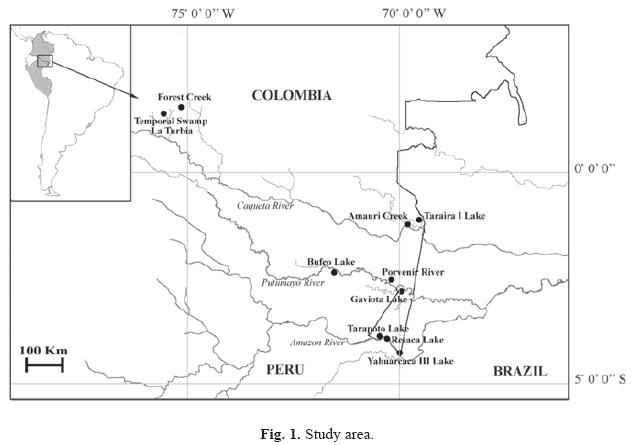
<body><![CDATA[<p><font face="Verdana" size="2">N&uacute;&ntilde;ez- Avellaneda (2008) points out that aquatic studies in the Amazon region are concentrated in the Brazilian sector of the basin from Manaus to Tef&eacute; while in the higher sectors studies are scarce. This lack of information is more evident in relation to microalgae including diatoms. Although there are some diatom taxa described in classic, general and or ecological studies, the studies focused in morphology and taxonomy of diatoms from Amazonia are scarce. De Souza- Mosimann <i>et al</i>. (1997) and Ferrari <i>et al</i>. (2007) have studied diatoms from the Brazilian Amazon; Oliveira &amp; Steinitz- Kannan (1992) from Ecuadorian Amazonia; Sala <i>et al</i>. (1999, 2002a,b) from the Colombian Amazon and Sala <i>et al</i>. (2008a) also included information about Peruvian Amazon. </font></p>     <p><font face="Verdana" size="2">This paper is part of an integrated study of the diatom flora from the Colombian and Peruvian Amazon (Sala <i>et al</i>. 1999, 2002 a,b and 2008 a). In this opportunity the study area was enlarged. The studied sites comprise a large geographic area of the Amazonian basin in Colombia, and a sector shared by Colombia and Peru on the Putumayo River. Geological ancient areas related to the Guyanese Shield (Amauri Creek and Taraira I Lake), sectors related to the Tertiary Pebas Formation and the section of the Putumayo River (Gaviota and Bufeo Lakes and Porvenir River) and Recent Quaternary alluvial valley of the Amazon River (Lakes Yahuarcaca, Resaca and Tarapoto) were visited in Colombia. The new study area corresponds to a low area between the Andes and Amazonia with areas of higher antropic influence, but maintaining conditions of low mineralized waters. </font></p>     <p><font face="Verdana" size="2">Here we present those results related to the genera <i>Encyonema</i>, <i>Encyonopsis </i>and <i>Gomphonema</i>. Each taxon is described and its fine valve morphology compared with that of other specimens collected in other regions of the world. Also, we give information about geographic distribution and the environmental conditions of the sites where they were collected. </font></p> <b><font face="Verdana" size="3">     <p>Materials and methods</p> </font></b><font face="Verdana" size="2"> </font>     <p><font face="Verdana" size="2">Samples for this study were collected during 1993, 1994, 2001 and 2003 in lotic and lentic water bodies in the Colombian and Peruvian Amazon (<a href="#fig1">Fig. 1</a>). In Colombia the sampling sites are from the Amazonian-Andean region (a forest inundated creek); from the Amazon River (Tarapoto, Yahuarcaca III and Resaca Lakes) and from Japur&aacute; (Caquet&aacute;) River (Amauri Creek and Taraira I Lake). Sampling sites from Peruvian Amazon basin are placed at the Porvenir River, Gaviota and Bufeo Lakes (Putumayo or I&ccedil;&acirc; River).    <br> </font></p>     <p><font face="Verdana" size="2">    <br> </font></p>     <div style="text-align: center;"><a name="fig1"></a><img  src="/img/revistas/rbt/v58n1/a04i1.jpg" title="" alt=""  style="width: 639px; height: 445px;">    <br>     ]]></body>
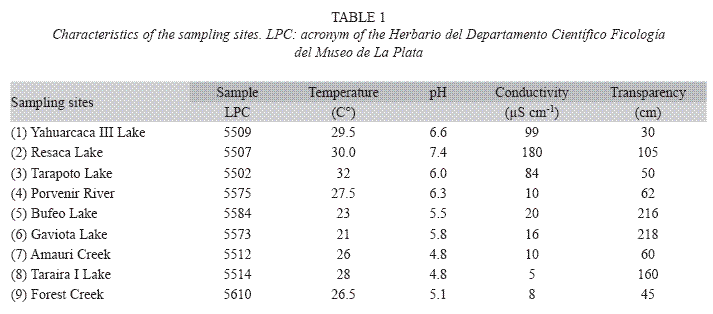
<body><![CDATA[<br> </div>     <p><font face="Verdana" size="2">Horizontal and vertical tows were made with a plankton net (mesh size = 24</font><font face="Verdana" size="2">&#956;</font><font  face="Verdana" size="2">m) at different depths in the photic zone, and benthic diatoms were sampled by squeezing macrophytes. At each sampling station pH, temperature, water transparency (Secchi disc) and conductivity using a combine probe YSI were registered (<a  href="#tabla1">Table 1</a>).    <br> </font></p>     <p><font face="Verdana" size="2">    <br> </font></p>     <div style="text-align: center;"><a name="tabla1"></a><img  src="/img/revistas/rbt/v58n1/a04t1.gif" title="" alt=""  style="width: 713px; height: 314px;">    <br>     <br> </div>     <p><font face="Verdana" size="2">Samples were fixed with 6-8 % formalin and were treated to eliminate organic matter following the method of Hasle &amp; Fryxell (1970) <i>in </i>Ferrario <i>et al</i>. (1995) and/or in a muffle furnace at 500 &deg;C during 10 minutes. Samples for light microscopy (LM) were mounted in Hyrax or Naphrax. For scanning electron microscopy (SEM) samples were mounted on glass stubs and then metalized with gold palladium. Observations were carried out with an Olympus CH2 LM, a phase contrast Leica DM 2500 LM equipped with a Leica DFC420 digital camera and a Jeol TM 100 SEM and Jeol JSM- T100 SEM. </font></p>     <p><font face="Verdana" size="2">Materials were deposited in Ficoteca Amaz&oacute;nica at Universidad Nacional de Colombia (F.A.) and at Colecci&oacute;n de Microorganismos Acu&aacute;ticos Amaz&oacute;nicos, del Instituto Sinchi, Colombia (MICRA). Uncleaned and cleaned subsamples and permanent slides were also deposited at Herbario del Departamento Cient&iacute;fico Ficolog&iacute;a, Museo de Ciencias Naturales de La Plata, Argentina (LPC). <a href="#tabla1">Table 1</a> summarizes the physico-chemical information about samples. Other details of the samples and sampling stations are given below.</font></p>     ]]></body>
<body><![CDATA[<p><font face="Verdana" size="2">1. LPC 5509 (F.A. 300): Yahuarcaca III Lake, Departamento del Amazonas, Colombia. 3-11-1994. Phytoplankton. 4&deg;12&#8217;12.71"S, 69&deg;57&#8217;03.05"W    <br> 2. LPC 5507 (F.A. 270): Resaca Lake, Mocagua Island, Colombia. 15/08/1994. Tycoplankton. 3&deg;51&#8217;00.28" S, 70&deg;15&#8217;35.12" W    <br> 3. LPC 5502 (F.A. 159): Tarapoto Lake, Departamento del Amazonas, Colombia. 09-01-1993. Phytoplankton. 3&deg;47&#8217;18.46" S, 70&deg;25&#8217;30.55" W    <br> 4. LPC 5575 (MICRA 0059): Porvenir River, Departamento del Amazonas, Colombia. 06-2001. Phytoplankton. 02&ordm;29&#8217;54" S, 70&ordm;11&#8217;14" W    <br> 5. LPC 5584 (MICRA 0100): Bufeo Lake, Provincia de Mainas, Per&uacute;. 6- 2001. Periphyton. 02&ordm;18&#8217;13" S, 71&ordm;31&#8217;59" W    <br> 6. LPC 5573 (MICRA 0041): Gaviota Lake, Departamento del Amazonas, Colombia. 06-2001. Tycoperiphyton. 02&ordm;44&#8217;38" S, 69&ordm;56&#8217;18" W    <br> 7. LPC 5512 (F.A. 312): Amauri Creek, Departamento del Amazonas, Colombia. 07- 11-1994. Periphyton. 1&deg;10&#8217;50.19" N, 69&deg;48&#8217;21.80" W    <br> 8. LPC 5514 (F.A. 329): Taraira I Lake, Departamento de Vaup&eacute;s, Colombia. 9-11-1994. Metaphyton. 1&deg;05&#8217;09.88" N, 69&deg;31&#8217;18.33" W    <br> 9. LPC 5610: inundated forest creek, Departamento de Caquet&aacute;, Colombia. 11- 2003. Periphyton. 1&deg;38&#8217;01,46" N, 75&deg;28&#8217;45,98" W.</font></p>     <p><font face="Verdana" size="2">The terminology used is that suggested in Anonymous (1975), Ross <i>et al</i>. (1979) and Barber &amp; Haworth (1981). For synonymy were followed Kusber &amp; Jahn (2003).</font></p> <b><font face="Verdana" size="3">     ]]></body>
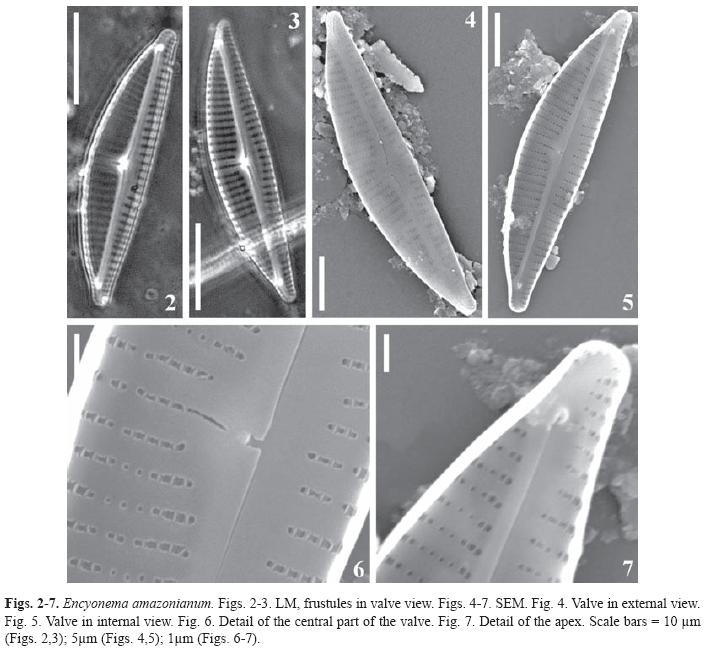
<body><![CDATA[<p>Results</p> </font><i><font face="Verdana" size="2"> </font></i></b>     <p><b><i><font face="Verdana" size="2">Encyonema amazonianum </font></i><font  face="Verdana" size="2">nov. sp. </font></b><font face="Verdana"  size="2">(<a href="#fig2-7">Figs. 2-7</a>)    <br> </font></p>     <p><font face="Verdana" size="2">    <br> </font></p>     <div style="text-align: center;"><a name="fig2-7"></a><img  src="/img/revistas/rbt/v58n1/a04i2-7.jpg" title="" alt=""  style="width: 705px; height: 653px;">    <br>     <br> </div>     <p><font face="Verdana" size="2">Valves asymmetric, dorsiventral, dorsal margin strongly convex, ventral margin slightly convex or straight. Ends rounded, rostrated. Striae uniseriated &#8211;with parallel lineolae&#8211; slightly radiate to the ends and finally parallel. One dorsal stigmoid, externally inconspicuous, is an unoccluded poroid at the end of the central stria; internally opened in a transversal slit just at the intermissio. Internally, the interstriae are not swollen to form transapical ribs; some areolae placed at the striae centre are reduced and rounded. Central area asymmetric, rounded on the dorsal side and continuous with the axial area moderately narrow on the ventral side. Raphe filiform. Externally slightly curved to the dorsal side of the valve, sinuous to the poles, central endings slightly expanded, terminal fissures hocked to the ventral margin. Internally the raphe has a small intermissio; distal endings with small helictoglossae, curved to the ventral margin, distant from the valve apex.</font></p> <font face="Verdana" size="2"><b> </b></font>     <p><font face="Verdana" size="2"><b>Dimensions: </b>Length 30-34</font><font  face="Verdana" size="2">&#956;</font><font face="Verdana" size="2">m, breadth 6-7</font><font face="Verdana" size="2">&#956;</font><font  face="Verdana" size="2">m, l/b 4.5-5.5, 11-12 dorsal striae in 10</font><font  face="Verdana" size="2">&#956;</font><font face="Verdana" size="2">m, 12-13 ventral striae in 10</font><font face="Verdana" size="2">&#956;</font><font  face="Verdana" size="2">m, 18-20 striae in 10</font><font  face="Verdana" size="2">&#956;</font><font face="Verdana" size="2">m at the ends, 36-38 areolae in 10</font><font face="Verdana" size="2">&#956;</font><font  face="Verdana" size="2">m. </font></p> <font face="Verdana" size="2"><b> </b></font>     ]]></body>
<body><![CDATA[<p><font face="Verdana" size="2"><b>Studied material: </b>Sample LPC 5575.</font></p> <font face="Verdana" size="2"><b> </b></font>     <p><font face="Verdana" size="2"><b>Type locality: </b>Porvenir River, Colombia.</font></p> <font face="Verdana" size="2"><i> </i></font>     <p><font face="Verdana" size="2"><i>Valvae valde dorsiventrales, semi-lanceolatae, margine dorsali valde convexiore, margine ventrali convexo vel rectus, apicibus rotundatis, rostratis. 30-34</i></font><i><font  face="Verdana" size="2">&#956;</font><font face="Verdana" size="2">m longae, 6-7</font><font face="Verdana" size="2">&#956;</font><font  face="Verdana" size="2">m latae. Latere dorsale cum unum stigmoideum. Striae in latere dorsali in media parte modice radiantes ad polus versus paralellae, 18-20 in 10</font><font face="Verdana" size="2">&#956;</font><font  face="Verdana" size="2">m, puncta 36-38 in 10</font><font  face="Verdana" size="2">&#956;</font><font face="Verdana" size="2">m. Area axialis angusta, area centralis asymmetrica, orbicularis ad latere dorsale et lanceolata ad latere ventrali. Raphe excentrica, filiformis, paulo curvata margine ventralibus, terminis proximalibus (poris centralibus) at latus dorsalis inclinatis, fissuris distalibus in latus ventralis deflexis. Intermissio modice. Helictoglossae curvatis ad latere ventralis, distantis ab apex.</font></i></p> <font face="Verdana" size="2"><b> </b></font>     <p><font face="Verdana" size="2"><b>Typus: </b>LPC 5575.</font></p> <font face="Verdana" size="2"><b> </b></font>     <p><font face="Verdana" size="2"><b>Locus typicus: </b>Porvenir River.</font></p>     <p><font face="Verdana" size="2">When observed with LM, this species is similar to the <i>Encyonema neogracile </i>Krammer, its varieties and other related taxa: <i>E. pseudogracile </i>Krammer, <i>E. pergracile </i>Krammer and <i>E. supergracile </i>Krammer &amp; Lange-Bertalot (Krammer 1997a). It can be easily confused particularly with their smaller specimens as they have similar dimensions, l/b ratio, and rostrated ends. Siever <i>et al. </i>2005, point out that this group of related taxa needs careful further revision as they have overlapping characters. Nevertheless, the fine valve morphology of our specimens clearly differs from all the above mentioned in the absence of transapical costae and in the structure of the central striae with some areolae smaller and partially occluded. Besides, our specimens differ from <i>E. pseudogracile </i>in the narrow axial area, from <i>E. neogracile </i>in the intermissio with separate raphe ends and from <i>E. supergracile </i>in the smaller helictoglossae and the intermissio with raphe ends more distant.</font></p>     <p><font face="Verdana" size="2">This rare species was collected in a phytoplankton sample of a river with pH 6.3, conductivity of 10</font><font  face="Verdana" size="2">&#956;</font><font face="Verdana" size="2">Scm-1, Secchi depth of 62cm and temperature of 27.5 &ordm;C.</font></p> <font face="Verdana" size="2"><b><i> </i></b></font>     <p><font face="Verdana" size="2"><b><i>Encyonema angustecapitatum </i>Krammer</b>, Biblioth. Diatomol. 37, p. 192, pl. 130: <a href="#fig8-11">Figs. 8</a>-<a  href="#fig12-15">15</a> (1997). (<a href="#fig8-11">Figs. 8-11</a>)    <br> </font></p>     <p><font face="Verdana" size="2">    ]]></body>
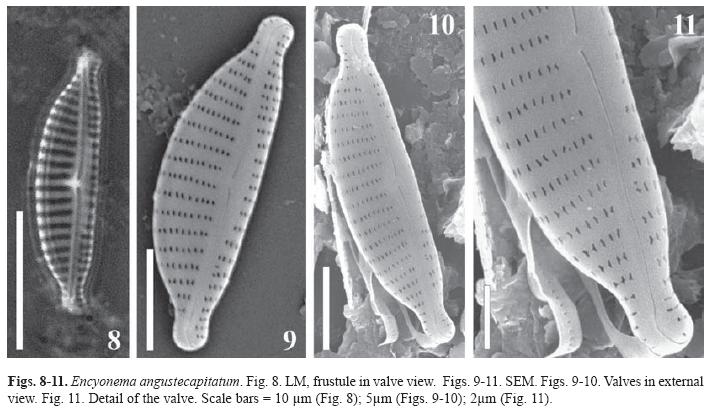
<body><![CDATA[<br> </font></p>     <div style="text-align: center;"><a name="fig8-11"></a><img  src="/img/revistas/rbt/v58n1/a04i8-11.jpg" title="" alt=""  style="width: 712px; height: 414px;">    <br>     <br> </div>     <p><font face="Verdana" size="2">Valves asymmetric, strongly dorsi-ventral, dorsal margin strongly convex, ventral margin straight and ends capitated. Striae uniseriated, slightly radiate all along the valve, sometimes parallel or convergent at the ends, areolae apically elongated, to the apices the areolae are more rounded or even transapically elongated. The Voigt fault is evident as a supernumerary areola on the ventral side of the valve. Axial area linear, slightly wide; central area asymmetric, on the dorsal side slightly differentiated from the axial area and widened at the ventral side. Stigmoid absent. Raphe filiform, moderately sinuous, curved to the dorsal side at the centre with slightly expanded ends, terminal fissures hooked to the ventral margin.</font></p> <font face="Verdana" size="2"><b> </b></font>     <p><font face="Verdana" size="2"><b>Dimensions: </b>Length 16-20</font><font  face="Verdana" size="2">&#956;</font><font face="Verdana" size="2">m, breadth 5</font><font face="Verdana" size="2">&#956;</font><font  face="Verdana" size="2">m, l/b 3.5-4, 10-12 dorsal striae in 10</font><font  face="Verdana" size="2">&#956;</font><font face="Verdana" size="2">m, 12-14 ventral striae in 10</font><font face="Verdana" size="2">&#956;</font><font  face="Verdana" size="2">m, 16-20 striae in 10</font><font  face="Verdana" size="2">&#956;</font><font face="Verdana" size="2">m at the apices, 35-38 areolae in 10</font><font face="Verdana" size="2">&#956;</font><font  face="Verdana" size="2">m. </font></p> <font face="Verdana" size="2"><b> </b></font>     <p><font face="Verdana" size="2"><b>Studied material: </b>Sample LPC 5575.</font></p> <font face="Verdana" size="2"><b> </b></font>     <p><font face="Verdana" size="2"><b>Distribution: </b>South American species. Type locality: R&iacute;o Caroni, Venezuela (Krammer 1997b). Metzeltin &amp; Lange-Bertalot (1998) mentioned the species at the R&iacute;o Tapaj&oacute;s (Brazilian Amazon) but the specimen illustrated with SEM (PL. 141, Fig. 6) does not correspond to this taxon, showing differences in the arrangement of the central dorsal striae and raphe fissures. Rumrich <i>et al. </i>(2000) mentioned it at San Lucior pond (Colombia) at 3000m asl.</font></p> <font face="Verdana" size="2"><b> </b></font>     <p><font face="Verdana" size="2"><b>Observations: </b>In the original description, Krammer (1997b) states that the central area is absent and continuous with the axial area, character considered diagnostic. The specimens in Rumrich <i>et al. </i>(2000) show a small central widening that comprises the two dorsal central striae. As in the studied specimens the dorsal entral area is variable, we considered that this difference is not enough to separate them as a new taxon.</font></p>     <p><font face="Verdana" size="2">This species was collected in a phytoplankton sample of a river with pH 6.3, conductivity of 10</font><font  face="Verdana" size="2">&#956;</font><font face="Verdana" size="2">Scm<sup>-1</sup>, Secchi depth of 62cm and a temperature of 27.5 &ordm;C.</font></p> <font face="Verdana" size="2"><b><i> </i></b></font>     ]]></body>
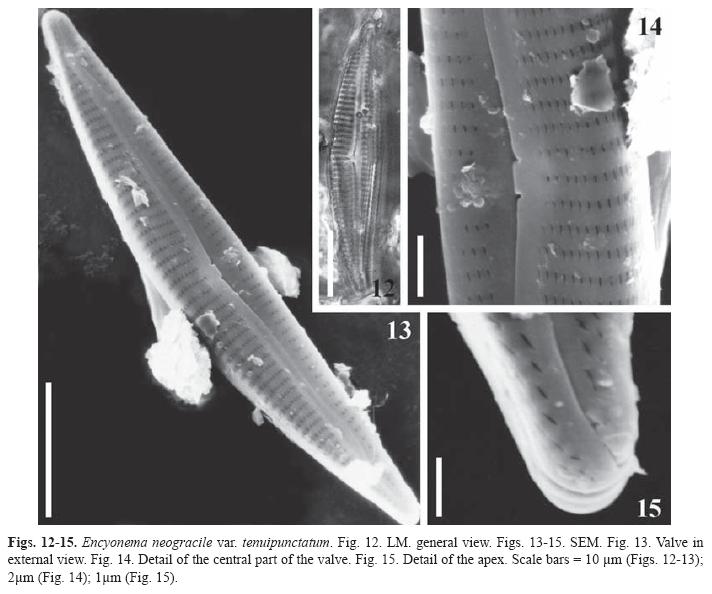
<body><![CDATA[<p><font face="Verdana" size="2"><b><i>Encyonema neogracile </i>var. <i>tenuipunctatum </i>Krammer</b>, Biblioth. Diatomol. 36, p. 178, pl. 85: <a  href="#fig1">Figs. 1</a>-<a href="#fig2-7">6</a> (1997). (<a href="#fig12-15">Figs. 12-15</a>)    <br> </font></p>     <p>    <br> </p>     <p style="text-align: center;"><font face="Verdana" size="2"><a  name="fig12-15"></a><img src="/img/revistas/rbt/v58n1/a04i12-15.jpg" title="" alt=""  style="width: 712px; height: 594px;">    <br>     <br> </font></p>     <p><font face="Verdana" size="2">Valves asymmetric, dorsiventral, dorsal margin convex, ventral margin concave or straight, slightly tumid at the centre. Rounded ends slightly elongated. Uniseriated striae, with parallel lineolae, more distant at the centre, slightly radiate to convergent at the ends. Stigmoid absent; the innermost pore of the dorsal central stria, round, internally opened in a transversal slit just at the intermissio. Central area absent, continuous with the moderately narrow axial area. Raphe filiform externally sinuous, slightly curved to the dorsal side of the valve; central endings expanded, distal fissures hocked to the ventral margin.</font></p> <font face="Verdana" size="2"><b> </b></font>     <p><font face="Verdana" size="2"><b>Dimensions: </b>Length 31-46</font><font  face="Verdana" size="2">&#956;</font><font face="Verdana" size="2">m, breadth 6.5-7</font><font face="Verdana" size="2">&#956;</font><font  face="Verdana" size="2">m, l/b 4.6-7.2, 12-15 dorsal striae in 10</font><font  face="Verdana" size="2">&#956;</font><font face="Verdana" size="2">m, 12-14 ventral striae in 10</font><font face="Verdana" size="2">&#956;</font><font  face="Verdana" size="2">m, 14-16 striae in 10</font><font  face="Verdana" size="2">&#956;</font><font face="Verdana" size="2">m at the ends, 32-36 areolae in 10</font><font face="Verdana" size="2">&#956;</font><font  face="Verdana" size="2">m.</font></p> <font face="Verdana" size="2"><b> </b></font>     <p><font face="Verdana" size="2"><b>Studied material: </b>Samples LPC 5512, LPC 5575.</font></p> <font face="Verdana" size="2"><b> </b></font>     ]]></body>
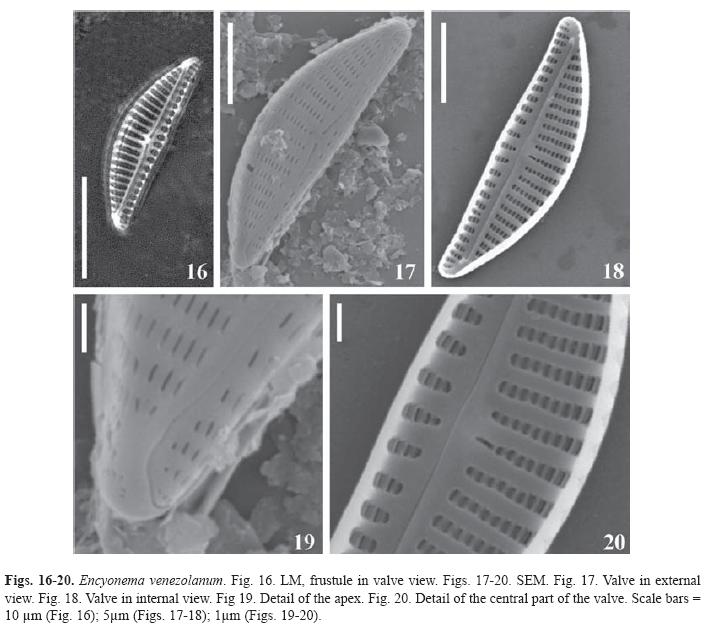
<body><![CDATA[<p><font face="Verdana" size="2"><b>Distribution: </b>Type locality: Laguna Santarem, Brazilian Amazon (Krammer 1997a). This species, is cited in the literature as cosmopolitan living in oligotrophic environments (Krammer 1997a), and is recorded for the first time in Colombia.</font></p>     <p><font face="Verdana" size="2">The species was collected in plankton and periphyton of lotic waterbodies with pH 4.8- 6.3, conductivity of 10</font><font  face="Verdana" size="2">&#956;</font><font face="Verdana" size="2">Scm-1, Secchi depth of 60-62cm and a temperature of 26-27.5 &ordm;C.</font></p> <font face="Verdana" size="2"><b><i> </i></b></font>     <p><font face="Verdana" size="2"><b><i>Encyonema venezolanum </i>Krammer, </b>Biblioth. Diatomol. 36, p. 162, pl. 19: <a href="#fig1">Figs. 1</a>-<a  href="#fig8-11">8</a> (1997). (<a href="#fig16-20">Figs. 16-20</a>)    <br> </font></p>     <p>    <br> </p>     <p style="text-align: center;"><font face="Verdana" size="2"><a  name="fig16-20"></a><img src="/img/revistas/rbt/v58n1/a04i16-20.jpg" title="" alt=""  style="width: 712px; height: 628px;">    <br>     <br> </font></p>     <p><font face="Verdana" size="2">Cells strongly dorsiventral. Valves asymmetric, dorsal margin strongly convex, ventral margin straight slightly tumid at the centre; ends rounded. Striae uniseriated, lineolated, parallel and distant at the centre, slightly radiate and densely arranged at the ends; internally the interstriae strongly silicified with internal ribs. Central area absent, continuous with the axial area linear and moderately narrow. Stigmoid absent, the innermost areola of the central dorsal stria is externally rounded and internally opens as a small transverse slit. Raphe filiform sinuous, curved to the dorsal side at the centre with expanded ends, with distal fissures hocked Rev. Biol. Trop. (Int. J. Trop. Biol. ISSN-0034-7744) Vol. 58 (1): 45-62, March 2010 to the ventral margin. Internally the raphe has no intermissio but has distal ends with small helictoglossae curved to the ventral margin.</font></p> <font face="Verdana" size="2"><b> </b></font>     ]]></body>
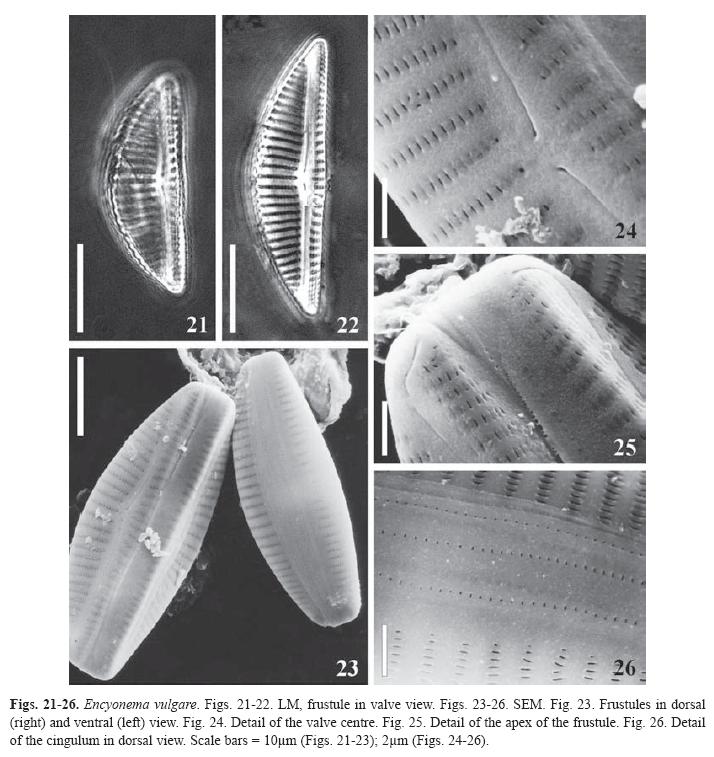
<body><![CDATA[<p><font face="Verdana" size="2"><b>Dimensions: </b>Length, 18.5-21</font><font  face="Verdana" size="2">&#956;</font><font face="Verdana" size="2">m, breadth, 4.5-5</font><font face="Verdana" size="2">&#956;</font><font  face="Verdana" size="2">m, l/b, 3.8-4.1, 11-12 dorsal striae in 10</font><font  face="Verdana" size="2">&#956;</font><font face="Verdana" size="2">m, 11-12 ventral striae in 10</font><font face="Verdana" size="2">&#956;</font><font  face="Verdana" size="2">m, 28-32 areolae in 10</font><font  face="Verdana" size="2">&#956;</font><font face="Verdana" size="2">m.</font></p> <font face="Verdana" size="2"><b> </b></font>     <p><font face="Verdana" size="2"><b>Studied material: </b>Samples LPC 5502, LPC 5584<b>. </b></font></p>     <p><font face="Verdana" size="2"><b>Distribution: </b>South America. Type locality: R&iacute;o Kukenan, Venezuela (Krammer 1997a). This species is recorded in Colombia and Peru for the first time.</font></p> <font face="Verdana" size="2"><b> </b></font>     <p><font face="Verdana" size="2"><b>Observations: </b>It is difficult to differentiate this taxon from <i>E. silesiacum </i>and <i>E. minutum </i>with LM as they have quite similar dimensions and valve outline, but it is easy to differentiate it among them with SEM as only the former has intermissio.</font></p>     <p><font face="Verdana" size="2">The species was collected in plankton and periphyton samples in two lakes with pH 5.5-6, conductivity of 20-84</font><font  face="Verdana" size="2">&#956;</font><font face="Verdana" size="2">Scm<sup>-1</sup>, Secchi depth of 50-216cm and a temperature of 23-32 &ordm;C.</font></p> <font face="Verdana" size="2"><b><i> </i></b></font>     <p><font face="Verdana" size="2"><b><i>Encyonema vulgare </i></b>Krammer, Biblioth. Diatomol. 36, p. 167, pl. 36: <a href="#fig2-7">Figs. 4</a>-<a  href="#fig8-11">10</a> (1997). (<a href="#fig21-26">Figs. 21-26</a>)    <br> </font></p>     <p><font face="Verdana" size="2">    <br> </font></p>     <div style="text-align: center;"><a name="fig21-26"></a><img  src="/img/revistas/rbt/v58n1/a04i21-26.jpg" title="" alt=""  style="width: 714px; height: 757px;">    ]]></body>
<body><![CDATA[<br>     <br> </div> <font face="Verdana" size="2"><b> </b></font>     <p><font face="Verdana" size="2"><b>Synonym: </b><i>Cymbella turgida </i>sensu lato, pro parte.</font></p>     <p><font face="Verdana" size="2">Cells strongly dorsiventral. Valves asymmetric, dorsal margin strongly convex, ventral margin slightly tumid at the centre; ends rounded. Striae uniseriated, lineolate, slightly radiate all along the valve, central striae more distant; the striae run without interruption on the valve mantle. Central area continuous with the linear axial area. One dorsal stigmoid. Raphe with proximal ends expanded slightly curved to the dorsal side, terminal fissures hooked to the ventral margin. Girdle bands with small poroids.</font></p> <font face="Verdana" size="2"><b> </b></font>     <p><font face="Verdana" size="2"><b>Dimensions: </b>Length 22-43</font><font  face="Verdana" size="2">&#956;</font><font face="Verdana" size="2">m, breadth 7.5-11</font><font face="Verdana" size="2">&#956;</font><font  face="Verdana" size="2">m, l/b 3.4, 7-11 dorsal striae in 10</font><font  face="Verdana" size="2">&#956;</font><font face="Verdana" size="2">m, 9-12 ventral striae in 10</font><font face="Verdana" size="2">&#956;</font><font  face="Verdana" size="2">m, 29-35 areolae in 10</font><font  face="Verdana" size="2">&#956;</font><font face="Verdana" size="2">m, 23 in 10</font><font face="Verdana" size="2">&#956;</font><font face="Verdana"  size="2">m poroids of the girdle bands.</font></p> <font face="Verdana" size="2"><b> </b></font>     <p><font face="Verdana" size="2"><b>Studied material: </b>Samples LPC 5502 and 5509.</font></p> <font face="Verdana" size="2"><b> </b></font>     <p><font face="Verdana" size="2"><b>Distribution: </b>Cosmopolitan, recorded in Amazonia (Krammer 1997a) and Laguna Negra, Venezuela (Metzeltin &amp; Lange-Bertalot 1998). This species is mentioned in Colombia for the first time.</font></p> <font face="Verdana" size="2"><b> </b></font>     <p><font face="Verdana" size="2"><b>Observations: </b>The studied specimens coincide in dimensions and general features with those described by Krammer (1997a) but it was not possible to compare the fine structure of the materials as the author illustrated them only with LM. It is difficult to differentiate this taxon from <i>E. jemtlandicum </i>Krammer 1997a (Figs 35: 1-9). <i>E. jemtlandicum </i>is wider (maximal l/b= 5.3) and more tumid.</font></p>     <p><font face="Verdana" size="2">The species was collected in plankton samples of a lake with pH 6-6.6, conductivity of 84-99</font><font  face="Verdana" size="2">&#956;</font><font face="Verdana" size="2">Scm<sup>-1</sup>, Secchi depth of 30-50cm and a temperature of 29.5-32 &ordm;C.</font></p> <font face="Verdana" size="2"><b><i> </i></b></font>     <p><font face="Verdana" size="2"><b><i>Encyonopsis frequentis </i></b>Krammer, Biblioth. Diatomol. 37, p. 201-202, pl. 157: <a href="#fig8-11">Figs. 10-11</a>, pl. 158: <a href="#fig1">Figs. 1</a>-<a href="#fig2-7">3</a>, pl. 202: <a  href="#fig1">Figs. 1</a>-<a href="#fig2-7">6</a> (1997). (<a  href="#fig27-33">Figs. 27-33</a>)    ]]></body>
<body><![CDATA[<br> </font></p>     <p><font face="Verdana" size="2">    <br> </font></p>     <div style="text-align: center;"><a name="fig27-33"></a><img  src="/img/revistas/rbt/v58n1/a04i27-33.jpg" title="" alt=""  style="width: 707px; height: 776px;">    <br>     <br> </div>     <p><font face="Verdana" size="2">Valves slightly dorsiventral, almost naviculoid, lanceolate with convex dorsal and ventral margins and capitated ends. Uniseriated striae with apically elongated poroids; radiate and more distant at the valve centre, parallel to convergent at the valve ends; the striae are continuous at the mantle. Central area small, at both sides delimited by the irregularly shortened central striae. One dorsal stigmoid at the end of the central stria, with an external round poroid without occlusion, bigger than the other areolae and internally elongated as a slit oblique in relation to the transapical axis. Axial area linear, moderately wide. Raphe filiform sinuous, proximal ends expanded, smoothly curved to the dorsal side, distal fissures hooked to the ventral margin. Apical pore fields at both sides of the raphe fissure. Externally, proximal ends hooked towards the dorsal side and distal ones straight, ending at small helictoglossae.</font></p> <font face="Verdana" size="2"><b> </b></font>     <p><font face="Verdana" size="2"><b>Dimensions: </b>Length 37.5-43</font><font  face="Verdana" size="2">&#956;</font><font face="Verdana" size="2">m, breadth 8-9.5</font><font face="Verdana" size="2">&#956;</font><font  face="Verdana" size="2">m, l/b 4.5-4.6, 13.5-15 striae in 10</font><font  face="Verdana" size="2">&#956;</font><font face="Verdana" size="2">m, 40-41 areolae in 10</font><font face="Verdana" size="2">&#956;</font><font  face="Verdana" size="2">m.</font></p> <font face="Verdana" size="2"><b> </b></font>     <p><font face="Verdana" size="2"><b>Studied material: </b>Samples LPC 5573, LPC 5575, LPC 5610.</font></p> <font face="Verdana" size="2"><b> </b></font>     <p><font face="Verdana" size="2"><b>Distribution: </b>Type Locality: R&iacute;o Kukenan, Venezuela (Krammer 1997b). This species is recorded in Colombia for the first time. Metzeltin &amp; Lange-Bertalot (1998) mentioned it at Lago Calado (Amazonia Brasilera).</font></p> <font face="Verdana" size="2"><b> </b></font>     ]]></body>
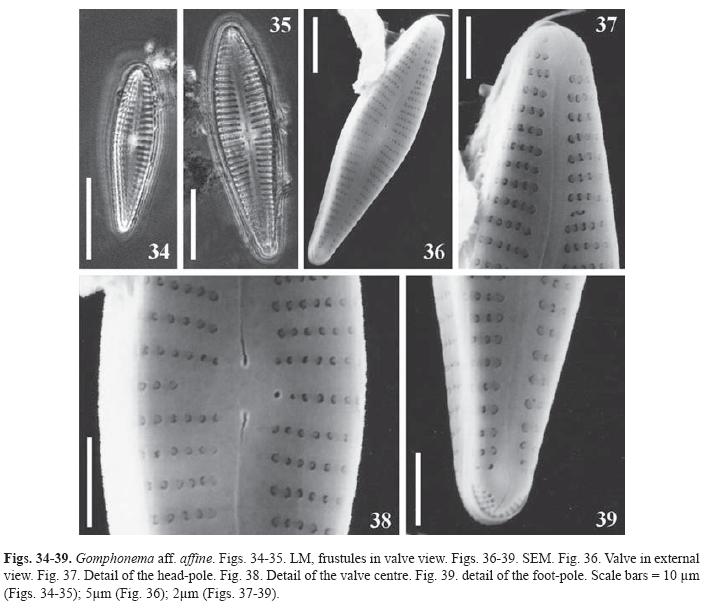
<body><![CDATA[<p><font face="Verdana" size="2"><b>Observations: </b>The central area and central striae form a cruciform structure characteristic for the species (Krammer 1997b). This structure is visible at the external valve side of the studied specimens.</font></p>     <p><font face="Verdana" size="2">The specimens from Guyana described by Reichardt (1995) as <i>Cymbella aequalis </i>W. Smith, coincide with our material in the fine valve morphology, except for some slight morphometric differences (length 30-31</font><font face="Verdana"  size="2">&#956;</font><font face="Verdana" size="2">m, breadth 6-6.5</font><font  face="Verdana" size="2">&#956;</font><font face="Verdana" size="2">m, 14-17 striae in 10</font><font face="Verdana" size="2">&#956;</font><font  face="Verdana" size="2">m, 39-42 poroids in 10</font><font  face="Verdana" size="2">&#956;</font><font face="Verdana" size="2">m).</font></p>     <p><font face="Verdana" size="2">The species was collected in periphyton and phytoplankton samples of lotic and lentic water bodies with pH 5.1-6.3, conductivity of 10-16</font><font face="Verdana"  size="2">&#956;</font><font face="Verdana" size="2">Scm<sup>-1</sup>, Secchi depth of 45-218cm and temperature of 21-27.5 &ordm;C.</font></p> <font face="Verdana" size="2"><b><i> </i></b></font>     <p><font face="Verdana" size="2"><b><i>Gomphonema </i>aff. <i>affine </i></b>K&uuml;tzing, Die. Kiesel. Bacill. oder Diat., p. 86, pl. 30, Fig. 54 (1844). (<a  href="#fig34-39">Figs. 34-39</a>)    <br> </font></p>     <p><font face="Verdana" size="2">    <br> </font></p>     <div style="text-align: center;"><a name="fig34-39"></a><img  src="/img/revistas/rbt/v58n1/a04i34-39.jpg" title="" alt=""  style="width: 708px; height: 608px;">    <br>     <br> </div>     ]]></body>
<body><![CDATA[<p><font face="Verdana" size="2">Valves heteropolar, claviform, broader at the central area level. Apical and basal ends rounded. Striae uniseriated, occluded with reniform volae, slightly radiate and more distant at the centre, parallel to the valve ends. The Voigt fault is evident at the upper part of the valve in the presence of a reduced stria. The striae are continuous on the valve mantle. Raphe sinuous in external view, proximal ends straight, with elongated pores, distal fissure sinuous. There are round depressions irregularly distributed at the central area and the central portion of the axial area. A semicircular apical pore field with 5-6 rows of unoccluded small poroids can be observed at both side of the basal terminal fissure. Externally, the stigma is an unoccluded pore placed near the central stria. Central area asymmetric, unilateral, delimited by the shortening of the central stria opposite to the stigma.</font></p> <font face="Verdana" size="2"><b> </b></font>     <p><font face="Verdana" size="2"><b>Dimensions: </b>length: 17.5-28</font><font  face="Verdana" size="2">&#956;</font><font face="Verdana" size="2">m; breadth: 4.5-5.5</font><font face="Verdana" size="2">&#956;</font><font  face="Verdana" size="2">m; maximal l/b: 4.2-5; 12-15 striae in 10</font><font  face="Verdana" size="2">&#956;</font><font face="Verdana" size="2">m; 30-32 areolae in 10</font><font face="Verdana" size="2">&#956;</font><font  face="Verdana" size="2">m.</font></p> <font face="Verdana" size="2"><b> </b></font>     <p><font face="Verdana" size="2"><b>Studied material: </b>Sample LPC 5502.</font></p> <font face="Verdana" size="2"><b> </b></font>     <p><font face="Verdana" size="2"><b>Observations: </b>The studied specimens are smaller than those described in Krammer &amp; Lange- Bertalot (1986) and Reichardt (1999). The dimensions given by these authors are: length: 30-100</font><font face="Verdana" size="2">&#956;</font><font  face="Verdana" size="2">m, breadth: 7-12</font><font face="Verdana"  size="2">&#956;</font><font face="Verdana" size="2">m, striae in 10</font><font  face="Verdana" size="2">&#956;</font><font face="Verdana" size="2">m: 9-13 and length: 36-88, breadth: 9-13, 8-11 striae in 10</font><font  face="Verdana" size="2">&#956;</font><font face="Verdana" size="2">m, 18-23 poroids in 10</font><font face="Verdana" size="2">&#956;</font><font  face="Verdana" size="2">m, respectively. Nevertheless, our material coincides in the type of striae and areolae and the presence of round marks at the axial and central areas. There are also differences in valve outline but this may be due to the smaller dimensions. </font></p>     <p><font face="Verdana" size="2">The species was collected in a phytoplankton sample of lake with pH 6, conductivity of 84</font><font  face="Verdana" size="2">&#956;</font><font face="Verdana" size="2">Scm<sup>-1</sup>, Secchi depth of 50cm and temperature of 32 &ordm;C.</font></p> <font face="Verdana" size="2"><b><i> </i></b></font>     <p><font face="Verdana" size="2"><b><i>Gomphonema augur </i>var. <i>sphaerophorum </i></b>(Ehrenberg) Lange-Bertalot, Biblioth. Diatomol. 9, p. 43 (1985). (<a href="#fig40-45">Figs. 40-41</a>)    <br> </font></p>     <p><font face="Verdana" size="2">    <br> </font></p>     <div style="text-align: center;"><a name="fig40-45"></a><img  src="/img/revistas/rbt/v58n1/a04i40-45.jpg" title="" alt=""  style="width: 718px; height: 765px;">    ]]></body>
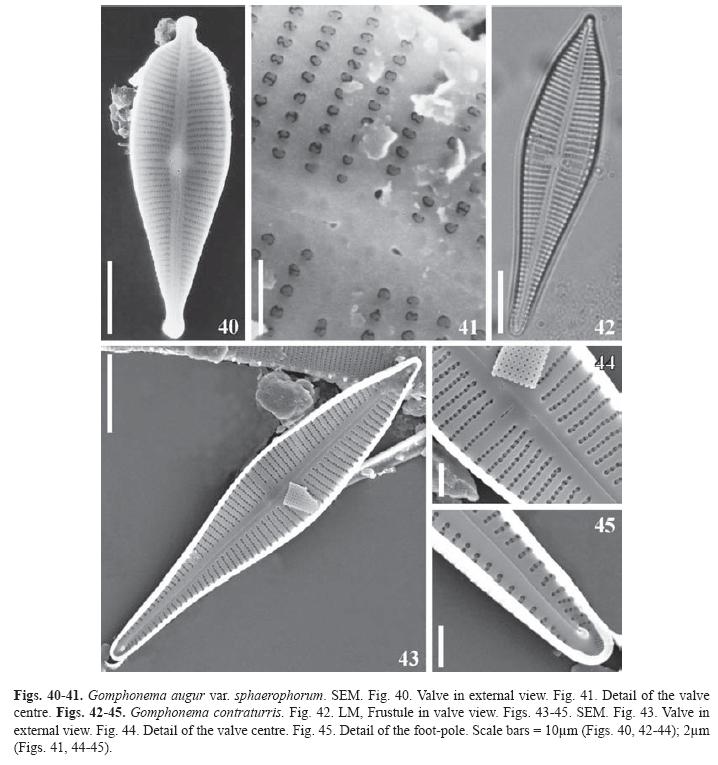
<body><![CDATA[<br>     <br> </div> <font face="Verdana" size="2"><b> </b></font>     <p><font face="Verdana" size="2"><b>Basionym: </b><i>Gomphonema sphaerophorum </i>Ehr., Ber. Bekanntm. Verh. K&ouml;nigl. Preuss. Akad. Wiss. Berlin 1845, p. 78 (1845). Valves heteropolar, apical and basal poles narrowly capitated. Maximum width at the central area. Striae uniseriated, parallel at the centre and slightly radiate to the poles; the two central striae more separated than the others; areolae occluded with reniform volae. Raphe sinuous in external view, proximal ends straight, expanded in a pore, terminal fissures sinuous. One stigma without occlusion placed at the end of the central stria. Central area asymmetric, slightly laterally expanded by the shortening of the central stria on the opposite side of the stigma.</font></p> <font face="Verdana" size="2"><b> </b></font>     <p><font face="Verdana" size="2"><b>Studied material: </b>Samples LPC 5502, LPC 5507, LPC 5509, and LPC 5514.</font></p> <font face="Verdana" size="2"><b> </b></font>     <p><font face="Verdana" size="2"><b>Dimensions: </b>Length 40-56</font><font  face="Verdana" size="2">&#956;</font><font face="Verdana" size="2">m, breadth 12-15</font><font face="Verdana" size="2">&#956;</font><font  face="Verdana" size="2">m, maximal l/b 3.7, 10-12 striae in 10</font><font  face="Verdana" size="2">&#956;</font><font face="Verdana" size="2">m at the centre, 12-15 in 10</font><font face="Verdana" size="2">&#956;</font><font  face="Verdana" size="2">m at the ends, 23 areolae in 10</font><font  face="Verdana" size="2">&#956;</font><font face="Verdana" size="2">m.</font></p> <font face="Verdana" size="2"><b> </b></font>     <p><font face="Verdana" size="2"><b>Distribution: </b>It is difficult to establish the distribution of the species as there have been confusions about the identity of this taxon, but it was reported without any doubt in Brazilian Amazon by Metzeltin &amp; Lange-Bertalot (1998) and at present is reported now for the first time in Colombia.</font></p>     <p><font face="Verdana" size="2">The species is abundant in phytoplankton, tycoplankton and metaphyton samples from lakes with pH 4.8-7.4, conductivity of 5-180</font><font face="Verdana" size="2">&#956;</font><font  face="Verdana" size="2">Scm<sup>-1</sup>, Secchi depth of 30- 160cm and temperature of 28-32 &ordm;C.</font></p> <font face="Verdana" size="2"><b><i> </i></b></font>     <p><font face="Verdana" size="2"><b><i>Gomphonema contraturris </i>Lange-Bertalot &amp; Reichardt in Lange-Bertalot</b>, Bibliot. Diatomol. 27, p. 57-58, pl. 78: <a href="#fig2-7">Figs. 2</a>-<a href="#fig8-11">9</a>, pl. 79: <a href="#fig1">Figs. 1</a>-<a href="#fig2-7">5</a> (1993). (<a  href="#fig40-45">Figs. 42-45</a>)</font></p>     <p><font face="Verdana" size="2"><b>Synonyms: </b><i>Gomphonema acuminatun </i>var. <i>turris </i>(Ehrenberg) Cleve sensu Fricke 1902; <i>Gomphonema lanceolatum </i>var. <i>turris </i>(Ehrenberg ex parte) Hustedt (1935) 1936, p. 166, <a href="#fig2-7">Fig. 3</a>: 23; <i>Gomphonema lanceolatum </i>f. <i>turris </i>(Ehrenberg ex parte) Hustedt 1938, p.437, <a href="#fig21-26">Fig. 26</a>: 8-11.</font></p>     <p><font face="Verdana" size="2">Valves heteropolar. Apical end apiculate, basal end narrowly rounded. Maximal width at the valve centre. Striae uniseriated, those at the centre (3) more distant than the others, parallel to slightly radiate all along the valve except at the basal pole where they are strongly radiate. Raphe slightly sinuous in internal view, proximal ends curved with L shape to the side of the stigma; distal ends slightly curved to the opposite side of the central ones, helictoglossae small. Apical pore fields semicircular. Internally the stigma is a transverse slit aligned with the median stria. Central area asymmetric, delimited by the shortening of the median stria on the side opposite to the stigma.</font></p> <font face="Verdana" size="2"><b> </b></font>     ]]></body>
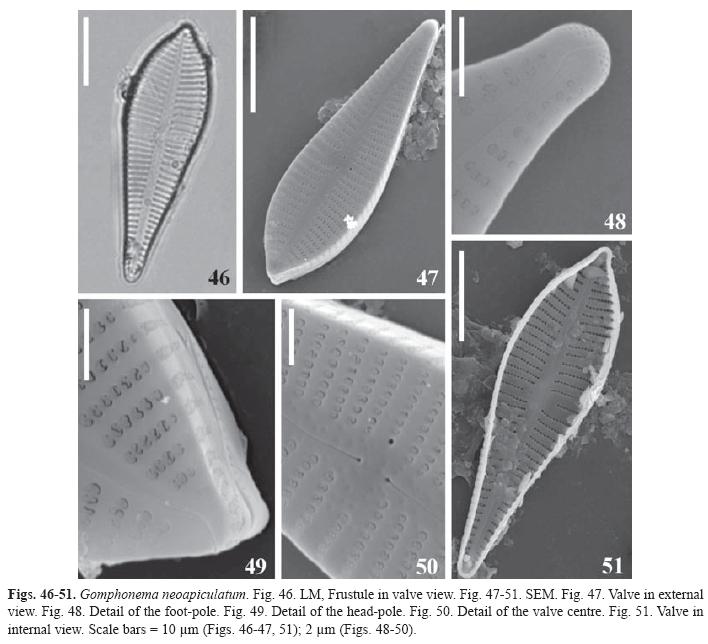
<body><![CDATA[<p><font face="Verdana" size="2"><b>Dimensions: </b>Length 54.5-75</font><font  face="Verdana" size="2">&#956;</font><font face="Verdana" size="2">m, breadth 10.5-12</font><font face="Verdana" size="2">&#956;</font><font  face="Verdana" size="2">m, maximal l/b 4.9-6.2, 8-10 striae in 10</font><font  face="Verdana" size="2">&#956;</font><font face="Verdana" size="2">m at the centre, 12-13 striae in 10</font><font face="Verdana" size="2">&#956;</font><font  face="Verdana" size="2">m at the </font><font face="Verdana" size="2">poles, 25-28 areolae in 10&#956;m.</font></p> <b><font face="Verdana" size="2"> </font></b>     <p><b><font face="Verdana" size="2">Studied material: </font></b><font  face="Verdana" size="2">Sample LPC 5575.</font></p> <font face="Verdana" size="2"><b> </b></font>     <p><font face="Verdana" size="2"><b>Distribution: </b>Type locality: Germany: M&uuml;nchen: Botanical Garden. Collector: Reichardt. This cosmopolitan species is now recorded in Colombia for the first time.</font></p> <font face="Verdana" size="2"><b> </b></font>     <p><font face="Verdana" size="2"><b>Observations: </b>The species was abundant in a phytoplankton sample of a river with pH 6.3, conductivity of 10</font><font face="Verdana" size="2">&#956;</font><font face="Verdana"  size="2">Scm<sup>-1</sup>, Secchi depth of 62cm and temperature of 27.5 &ordm;C.</font></p> <font face="Verdana" size="2"><b><i> </i></b></font>     <p><font face="Verdana" size="2"><b><i>Gomphonema neoapiculatum </i></b>Lange-Bertalot, Reichardt &amp; Metzeltin in Metzeltin &amp; Lange- Bertalot, Iconogr. Diatomol. 5, p. 120, pl. 157: <a href="#fig2-7">Figs. 6</a>-<a  href="#fig8-11">9</a> (1998). (<a href="#fig46-51">Figs. 46-51</a>)    <br> </font></p>     <p><font face="Verdana" size="2">    <br> </font></p>     <div style="text-align: center;"><a name="fig46-51"></a><img  src="/img/revistas/rbt/v58n1/a04i46-51.jpg" title="" alt=""  style="width: 708px; height: 644px;">    <br>     ]]></body>
<body><![CDATA[<br> </div> <font face="Verdana" size="2"><b> </b></font>     <p><font face="Verdana" size="2"><b>Synonym: </b><i>Gomphonema apiculatum </i>Ehrenberg sensu Reichardt 1995.</font></p>     <p><font face="Verdana" size="2">Valves heteropolar; apical pole apiculate, basal pole rounded. Striae uniseriated with areoale occluded by reniform volae, slightly radiate alongside the valve. Foot- pole with triangular apical pore fields. Raphe sinuous in external view, proximal ends straight, expanded in pores, terminal fissure sinuous. Internally the raphe is straight, with proximal ends hooked to the side of the stigma; distal ends straight, helictoglossae small. Externally the stigma is an unoccluded pore placed at the end of the central stria; internally is a transapically elongated slit. Central area asymmetric delimited by the shortening of the central stria opposite to the stigma. At the central area and central portion of the axial area there are round depressions irregularly distributed.</font></p> <font face="Verdana" size="2"><b> </b></font>     <p><font face="Verdana" size="2"><b>Dimensions: </b>Length 28-41</font><font  face="Verdana" size="2">&#956;</font><font face="Verdana" size="2">m, breadth 9-11</font><font face="Verdana" size="2">&#956;</font><font  face="Verdana" size="2">m, maximal l/b 3,8, 10-13 striae in 10</font><font  face="Verdana" size="2">&#956;</font><font face="Verdana" size="2">m at the centre, 12-15 striae in 10</font><font face="Verdana" size="2">&#956;</font><font  face="Verdana" size="2">m at the ends, 24-30 areolae in 10</font><font  face="Verdana" size="2">&#956;</font><font face="Verdana" size="2">m.</font></p> <font face="Verdana" size="2"><b> </b></font>     <p><font face="Verdana" size="2"><b>Studied material: </b>samples LPC 5509, LPC 5512, LPC 5514, LPC 5575, and LPC 5584. </font></p> <font face="Verdana" size="2"><b> </b></font>     <p><font face="Verdana" size="2"><b>Distribution: </b>Type locality: R&iacute;o Essequibo, Guyana (Metzeltin &amp; Lange-Bertalot 1998). This species is recorded in Colombia, Peru and Amazonia for the first time.</font></p> <font face="Verdana" size="2"><b> </b></font>     <p><font face="Verdana" size="2"><b>Observations: </b>The species was abundant in phytoplankton, periphyton and metaphyton samples collected in lentic and lotic waterbodies with pH 4.8-6.6, conductivity of 5-99</font><font  face="Verdana" size="2">&#956;</font><font face="Verdana" size="2">Scm<sup>-1</sup>, Secchi depth of 30-216cm and temperature of 23-29.5 &ordm;C.</font></p> <b><font face="Verdana" size="3">     <p>Discussion and conclusions</p> </font></b><font face="Verdana" size="2"> </font>     <p><font face="Verdana" size="2">Although high biodiversity of the Amazon region has been widely recognized, microalgae have been almost ignored and detail studies are needed (N&uacute;&ntilde;ez-Avellaneda 2008). Aquatic ecosystem research began in the middle of the twentieth century but concentrated at the Brazilian sector while in the Colombian sector studies started in the nineties and up to now thirty new algal species have been described. Results given in this paper add information about the diatom flora of the Amazon basin particularly about a large geographic area in Colombia, and a sector shared by Colombia and Peru on the Putumayo River. Some of the studied sites are pristine and visited for the first time for algal collection.</font></p>     <p><font face="Verdana" size="2">All the analyzed taxa are new records for the studied area as in previous papers of the Colombian Amazon were only analyzed two <i>Gomphonema </i>species: <i>G. parvulum </i>(K&uuml;tzing) K&uuml;tzing (Sala <i>et al. </i>1999) and <i>G. archaevibrio </i>Lange-Bertalot &amp; Reichardt (Sala <i>et al.</i>, 2002b) and the only diatoms publication available is from the Peruvian Amazon genus <i>Urosolenia </i>(Sala <i>et al. </i>2008b). The genus <i>Encyonema </i>is mentioned for the first time in the Peruvian and Colombian Amazon and <i>Encyonopsis </i>in the Colombian Sector.</font></p>     ]]></body>
<body><![CDATA[<p><font face="Verdana" size="2">A new species, <i>Encyonema amazonianum<b>, </b></i>was found in a phytoplankton sample collected at the Porvenir River, Departamento del Amazonas, Colombia<i>. </i>This species is similar to <i>Encyonema neogracile</i>, <i>E. pseudogracile</i>, <i>E. pergracile </i>and <i>E. supergracile </i>(Krammer 1997a) but clearly differs in its valve fine morphology. Besides morphological similarities this group of taxa has similar ecological requirements living in oligotrophic waterbodies and is well represented in the neotropics. <i>E. neogracile </i>is cosmopolitan but one morphotype of the var. <i>neogracile </i>and the var. <i>teniupuctatum </i>were collected in Brazil. On the other hand <i>E. pseudogracile </i>and <i>E. supergracile </i>were only registered in the type localities in Venezuela and in Colombia at 3500m asl respectively.</font></p>     <p><font face="Verdana" size="2">Moreover, at Taropoto Lake were collected some <i>Gomphonema </i>specimens similar to <i>G. affine</i>. Although this species is considered cosmopolitan, the specimens found in the study area have morphometric differences that inhibit us to assign them reliably to this taxon. Many new neotropical taxa have been recently described, sometimes based on SEM analyses but sometimes based on the observation of few specimens with LM, generating more confusion. In this case we consider that the information about fine valve morphology of these materials is insufficient to generate a new taxon and prefer to maintain it as <i>G. </i>aff. <i>affine </i>until more material can be analyzed.</font></p> <font face="Verdana" size="2"><i> </i></font>     <p><font face="Verdana" size="2"><i>Gomphonema augur </i>var. <i>sphaerophorum<b>, </b>G. contraturris</i>, <i>Encyonema neogracile </i>var. <i>tenuipunctatum</i>, <i>E. vulgare </i>and <i>Encyonopsis frequentis</i>, are recorded for the first time in Colombia; <i>Encyonema venezolanum </i>and <i>Gomphonema neoapiculatum </i>in Colombia and Peru and the latter is also mentioned for the first time in Amazonia.</font></p>     <p><font face="Verdana" size="2">The major part of the treated taxa is Neotropical, only <i>Gomphonema contraturris</i><b>, </b><i>Encyonema neogracile </i>var. <i>tenuipunctatum </i>and <i>E. vulgare </i>are cosmopolitan. On the other hand only <i>Encyonema angustecapitatum </i>was recorded before in South American highlands. Although this paper deals with few genera, these results support the ideas exposed in Metzeltin &amp; Lange-Bertalot (1998, 2007), Rumrich <i>et al. </i>(2000) and Sala <i>et al. </i>(2008b) about the existence of a particular diatom flora restricted to lowland tropical waters.</font></p>     <p><font face="Verdana" size="2">In the major part of the analyzed samples diatoms were scarce but it is striking the high species richness. The studied sites are waterbodies with high temperatures (21-32 &ordm;C), poor salt content (conductivity 5-180</font><font  face="Verdana" size="2">&#956;</font><font face="Verdana" size="2">Scm-1), low pH (4.8-7.4) and variable transparency (30-60 or 160-218cm) classified as Whyte waters type I or II (N&uacute;&ntilde;ez Avellaneda &amp; Duque 2001).</font></p>     <p><font face="Verdana" size="2">In the study area some species were restricted to one type of water and/or waterbody while others have a wide distribution. The most widespread taxon was <i>Gomphonema neoapiculatum </i>collected in lotic and lentic waterbodies with both types of water while <i>Encyonopsis frequentis </i>was collected in rivers and lakes but always in waters Type II influenced by Paleozoic and Tertiary geological formations with low pH (4.8-6.3) and conductivity (8-20</font><font face="Verdana" size="2">&#956;</font><font  face="Verdana" size="2">Scm-1). These waters also have low chlorophyll <i>a </i>content </font><font face="Verdana" size="2">(0.04-1.2 &#956;gl-1 in N&#970;</font><font face="Verdana" size="2">&ntilde;ez-Avellaneda &amp; Duque 2001, Ricaurte <i>et al</i>. 2009).</font></p> <font face="Verdana" size="2"><i> </i></font>     <p><font face="Verdana" size="2"><i>Encyonema amazonianum</i>, <i>E. angustecapitatum</i>, <i>E. neogracile </i>var. <i>tenuipunctatum </i>and <i>Gomphonema contraturris </i>were restricted to lotic waterbodies with White Waters Type II. <i>Encyonema vulgare </i>and <i>Gomphonema </i>aff <i>affine </i>were the only ones collected in Lake Tarapoto with White waters Type I that corresponds to waterbodies from the Quaternary alluvial plain. In comparison with White waters Type II, this type has higher pH (6-7.4) and conductivity (84-180</font><font  face="Verdana" size="2">&#956;</font><font face="Verdana" size="2">Scm<sup>-1</sup>) and also higher trophic levels (chlorophyll a 2.3-23.6 </font><font  face="Verdana" size="2">&#956;</font><font face="Verdana" size="2">gl-1 <i>sensu </i>Duque <i>et al</i>. 1997; N&uacute;&ntilde;ez- Avellaneda 2005 and Ricaurte <i>et al</i>. 2009). Finally, <i>E. venezolanum </i>was restricted to lentic waterbodies with both water types.</font></p> <b><font face="Verdana" size="3">     <p>Acknowledgments</p> </font></b><font face="Verdana" size="2">     <p>This research was held with the financial support of Universidad Nacional de La Plata; Instituto Amaz&oacute;nico de Investigaciones Cient&iacute;ficas Sinchi, Beca de la Red Latinoamericana de Bot&aacute;nica RLB-04-P2-Tyler Prize 2004; Convenci&oacute;n Ramsar, Instituto Nacional de Desarrollo (INADE) del Per&uacute; and Instituto Amaz&oacute;nico de Investigaciones (Imani) de la Universidad Nacional de Colombia, Sede Amazonia. The authors want to specially thank John Jairo D&iacute;az who kindly prepared the map of the study area.</p> </font><b><font face="Verdana" size="3"> </font></b> <hr style="width: 100%; height: 2px;"><b><font face="Verdana" size="3">     <p>Resumen</p> </font></b><font face="Verdana" size="2"> </font>     ]]></body>
<body><![CDATA[<p><font face="Verdana" size="2">La flora diatomol&oacute;gica de la Amazonia Colombiana y Peruana est&aacute; mucho menos estudiada que la flora del sector brasilero. Se presentan los resultados de los g&eacute;neros <i>Encyonema</i>, <i>Encyonopsis </i>y <i>Gomphonema. </i>Muestras de plancton y perifiton fueron colectadas en ambientes l&oacute;ticos y l&eacute;nticos de la regi&oacute;n amaz&oacute;nica-andina, en los r&iacute;os Amazonas, Japur&aacute; y Porvenir durante 1993, 1994, 2001 y 2003. En cada estaci&oacute;n de muestreo se realizaron mediciones de pH, temperatura, transparencia del agua y conductividad. Las muestras fueron analizadas con microscopio &oacute;ptico con contraste de fases y microscopio electr&oacute;nico de barrido. Diez taxones son nuevos registros para el &aacute;rea; <i>Encyonema </i>en la Amazonia peruano-colombiana y <i>Encyonopsis </i>en el sector colombiano. <i>Encyonema neogracile </i>var. <i>tenuipunctatum</i>, <i>E. vulgare</i>, <i>Encyonopsis frequentis</i>, <i>Gomphonema augur </i>var. <i>sphaerophorum </i>y <i>G. contraturris </i>se reportan por primera vez en Colombia; <i>Encyonema venezolanum </i>y <i>Gomphonema neoapiculatum </i>en Colombia y Per&uacute; y la &uacute;ltima tambi&eacute;n en la Amazonia. <i>E. angustecapitatum </i>fue previamente registrada en una laguna de altura en Colombia localizada a 3.000 msnm. Se describe una nueva especie, <i>Encyonema amazonianum<b>, </b></i>colectada en el R&iacute;o Porvenir, Amazonas, Colombia.</font></p> <font face="Verdana" size="2"><b> </b></font>     <p><font face="Verdana" size="2"><b>Palabras clave: </b>diatomeas, <i>Encyonema</i><b>, </b><i>Encyonopsis</i>, <i>Gomphonema</i>, Amazonia    <br> </font></p>     <div style="text-align: center;"><font face="Verdana" size="2">Received 13-II-2009. Corrected 14-VII-2009. Accepted 14-VIII-2009.</font>    <br> </div> <b><font face="Verdana" size="3"> </font></b> <hr style="width: 100%; height: 2px;"><b><font face="Verdana" size="3">     <p>References</p> </font></b><font face="Verdana" size="2"> </font>     <!-- ref --><p><font face="Verdana" size="2">Anonymous. 1975. Proposals for a standardization of diatom terminology and diagnosis. Nova Hedw. Beih. 53: 323-354.</font>&nbsp;&nbsp;&nbsp;&nbsp;&nbsp;&nbsp;&nbsp;&nbsp;[&#160;<a href="javascript:void(0);" onclick="javascript: window.open('/scielo.php?script=sci_nlinks&ref=1327301&pid=S0034-7744201000010000400001&lng=','','width=640,height=500,resizable=yes,scrollbars=1,menubar=yes,');">Links</a>&#160;]<!-- end-ref --><!-- ref --><p><font face="Verdana" size="2">Barber, H. G. &amp; E.Y. Haworth. 1981. A guide to the morphology of the diatom frustule with a key to the British freshwater genera. Freshwater Biological Association 44, Ambleside, England.</font>&nbsp;&nbsp;&nbsp;&nbsp;&nbsp;&nbsp;&nbsp;&nbsp;[&#160;<a href="javascript:void(0);" onclick="javascript: window.open('/scielo.php?script=sci_nlinks&ref=1327302&pid=S0034-7744201000010000400002&lng=','','width=640,height=500,resizable=yes,scrollbars=1,menubar=yes,');">Links</a>&#160;]<!-- end-ref --><!-- ref --><p><font face="Verdana" size="2">De Souza-Mosimann, R. M., A.S. Tavares &amp; V.P. Freitas. 1997. Contribui&ccedil;&atilde;o ao conhecimento da diatomofl&oacute;rula do conte&uacute;do estomacal de algumas esp&eacute;cies de peixes da Amaz&ocirc;nia. I. <i>Myleus </i>sp. (pac&uacute;) do lago do Prato, AM, Brasil. Acta Amazonica 27: 9-26 (also available on-line: http://acta.inpa.gov.br/fasciculos/27-1/PDF/v27n1a02.pdf).</font>&nbsp;&nbsp;&nbsp;&nbsp;&nbsp;&nbsp;&nbsp;&nbsp;[&#160;<a href="javascript:void(0);" onclick="javascript: window.open('/scielo.php?script=sci_nlinks&ref=1327303&pid=S0034-7744201000010000400003&lng=','','width=640,height=500,resizable=yes,scrollbars=1,menubar=yes,');">Links</a>&#160;]<!-- end-ref --><p><font face="Verdana" size="2"> </font></p>     ]]></body>
<body><![CDATA[<!-- ref --><p><font face="Verdana" size="2">Duque, S. R., J. E. Ruiz, J. G&oacute;mez &amp; E. Roessler. 1997. Limnolog&iacute;a. p. 71-134. <i>In </i>IGAC (ed.). Zonificaci&oacute;n ambiental para el plan modelo Colombo &#8211; Brasilero (Eje Apaporis &#8211; Tabatinga: PAT). Editorial Linotipia, Bogot&aacute;, Colombia.</font>&nbsp;&nbsp;&nbsp;&nbsp;&nbsp;&nbsp;&nbsp;&nbsp;[&#160;<a href="javascript:void(0);" onclick="javascript: window.open('/scielo.php?script=sci_nlinks&ref=1327305&pid=S0034-7744201000010000400004&lng=','','width=640,height=500,resizable=yes,scrollbars=1,menubar=yes,');">Links</a>&#160;]<!-- end-ref --><!-- ref --><p><font face="Verdana" size="2">Ferrari, F., L. K. Procopiak, Y. B. Alencar &amp; T. A.V. Ludwig. 2007. Eunotiaceae (Bacillariophyceae) em igarap&eacute;s da Amaz&ocirc;nia Central, Manaus e Presidente Figueiredo, Brasil. Acta Amazonica 37: 1-16 (also available on-line: http://www.scielo.br/pdf/aa/v37n1/v37n1a01.pdf).</font>&nbsp;&nbsp;&nbsp;&nbsp;&nbsp;&nbsp;&nbsp;&nbsp;[&#160;<a href="javascript:void(0);" onclick="javascript: window.open('/scielo.php?script=sci_nlinks&ref=1327306&pid=S0034-7744201000010000400005&lng=','','width=640,height=500,resizable=yes,scrollbars=1,menubar=yes,');">Links</a>&#160;]<!-- end-ref --><!-- ref --><p><font face="Verdana" size="2">Ferrario, M.E., E.A. Sar &amp; S.E. Sala. 1995. Metodolog&iacute;a b&aacute;sica para el estudio del fitoplancton con especial referencia a las diatomeas, p. 1-23. <i>In </i>K. Alveal, M.E. Ferrario, E. Oliveira &amp; E.A. Sar (eds.). Manual de M&eacute;todos Ficol&oacute;gicos. Universidad de Concepci&oacute;n, Concepci&oacute;n, Chile.</font>&nbsp;&nbsp;&nbsp;&nbsp;&nbsp;&nbsp;&nbsp;&nbsp;[&#160;<a href="javascript:void(0);" onclick="javascript: window.open('/scielo.php?script=sci_nlinks&ref=1327307&pid=S0034-7744201000010000400006&lng=','','width=640,height=500,resizable=yes,scrollbars=1,menubar=yes,');">Links</a>&#160;]<!-- end-ref --><!-- ref --><p><font face="Verdana" size="2">Kociolek, P. &amp; S. Spaulding. 2000. Freshwater Diatom. Biography. Nova Hedw. 71: 1-19.</font>&nbsp;&nbsp;&nbsp;&nbsp;&nbsp;&nbsp;&nbsp;&nbsp;[&#160;<a href="javascript:void(0);" onclick="javascript: window.open('/scielo.php?script=sci_nlinks&ref=1327308&pid=S0034-7744201000010000400007&lng=','','width=640,height=500,resizable=yes,scrollbars=1,menubar=yes,');">Links</a>&#160;]<!-- end-ref --><!-- ref --><p><font face="Verdana" size="2">Krammer, K. 1997a. Die cymbelloiden Diatomeen. Eine Monographie der weltweit bekannten taxa. Teil 1. Allgemeines und Encyonema Part. Bibliotheca Diatomologica. Band 36. J. Cramer, Berlin-Stuttgart, Germany. </font>&nbsp;&nbsp;&nbsp;&nbsp;&nbsp;&nbsp;&nbsp;&nbsp;[&#160;<a href="javascript:void(0);" onclick="javascript: window.open('/scielo.php?script=sci_nlinks&ref=1327309&pid=S0034-7744201000010000400008&lng=','','width=640,height=500,resizable=yes,scrollbars=1,menubar=yes,');">Links</a>&#160;]<!-- end-ref --><!-- ref --><p><font face="Verdana" size="2">Krammer, K. 1997b. Die cymbelloiden Diatomeen. Eine Monographie der weltweit bekannten taxa. Teil 2. Encyonema Part., Encyonopsis and Cymbellopsis. Bibliotheca Diatomologica Band 37. J. Cramer, Berlin- Stuttgart, Germany.</font>&nbsp;&nbsp;&nbsp;&nbsp;&nbsp;&nbsp;&nbsp;&nbsp;[&#160;<a href="javascript:void(0);" onclick="javascript: window.open('/scielo.php?script=sci_nlinks&ref=1327310&pid=S0034-7744201000010000400009&lng=','','width=640,height=500,resizable=yes,scrollbars=1,menubar=yes,');">Links</a>&#160;]<!-- end-ref --><!-- ref --><p><font face="Verdana" size="2">Krammer, K. &amp; H. Lange Bertalot. 1986. Bacillariophyceae. <i>In </i>S&uuml;sswasserflora von Mittleuropa. Band 2, Teil 1. Naviculaceae. Gustav Fisher Verlag, Jena, Germany.</font>&nbsp;&nbsp;&nbsp;&nbsp;&nbsp;&nbsp;&nbsp;&nbsp;[&#160;<a href="javascript:void(0);" onclick="javascript: window.open('/scielo.php?script=sci_nlinks&ref=1327311&pid=S0034-7744201000010000400010&lng=','','width=640,height=500,resizable=yes,scrollbars=1,menubar=yes,');">Links</a>&#160;]<!-- end-ref --><!-- ref --><p><font face="Verdana" size="2">Lange-Bertalot, H. 1993. 85 New Taxa and much more the 100 taxonomic clarifications supplementary to S&uuml;&szlig;wasserflora von Mitteleuropa. Vol. 2/1-4. Bibliotheca Diatomologica. Band 27. J. Cramer, Berlin- Stuttgart, Germany.</font>&nbsp;&nbsp;&nbsp;&nbsp;&nbsp;&nbsp;&nbsp;&nbsp;[&#160;<a href="javascript:void(0);" onclick="javascript: window.open('/scielo.php?script=sci_nlinks&ref=1327312&pid=S0034-7744201000010000400011&lng=','','width=640,height=500,resizable=yes,scrollbars=1,menubar=yes,');">Links</a>&#160;]<!-- end-ref --><!-- ref --><p><font face="Verdana" size="2">Logares, R.E. 2006. Does the global microbiota consists of a few cosmopolitan species. Ecolog&iacute;a austral 16: 85-90 (also available on-line: http://www.scielo.br/pdf/aa/v37n1/v37n1a01.pdf).</font>&nbsp;&nbsp;&nbsp;&nbsp;&nbsp;&nbsp;&nbsp;&nbsp;[&#160;<a href="javascript:void(0);" onclick="javascript: window.open('/scielo.php?script=sci_nlinks&ref=1327313&pid=S0034-7744201000010000400012&lng=','','width=640,height=500,resizable=yes,scrollbars=1,menubar=yes,');">Links</a>&#160;]<!-- end-ref --><!-- ref --><p><font face="Verdana" size="2">Metzeltin, D. &amp; H. Lange-Bertalot. 1998. Tropical diatoms of South America I. Iconographia Diatomologica. Annotated Diatom Micrographs. Vol. V. Koeltz Scientific Books, K&ouml;nigstein, Germany.</font>&nbsp;&nbsp;&nbsp;&nbsp;&nbsp;&nbsp;&nbsp;&nbsp;[&#160;<a href="javascript:void(0);" onclick="javascript: window.open('/scielo.php?script=sci_nlinks&ref=1327314&pid=S0034-7744201000010000400013&lng=','','width=640,height=500,resizable=yes,scrollbars=1,menubar=yes,');">Links</a>&#160;]<!-- end-ref --><!-- ref --><p><font face="Verdana" size="2">Metzeltin, D. &amp; H. Lange-Bertalot. 2007. Tropical diatoms of the South America II. Iconographia Diatomologica. Annotated Diatom Micrographs. Volume XVIII. K&ouml;nigstein, Germany.</font>&nbsp;&nbsp;&nbsp;&nbsp;&nbsp;&nbsp;&nbsp;&nbsp;[&#160;<a href="javascript:void(0);" onclick="javascript: window.open('/scielo.php?script=sci_nlinks&ref=1327315&pid=S0034-7744201000010000400014&lng=','','width=640,height=500,resizable=yes,scrollbars=1,menubar=yes,');">Links</a>&#160;]<!-- end-ref --><!-- ref --><p><font face="Verdana" size="2">Metzeltin, D., H. Lange-Bertalot &amp; F. Garc&iacute;a-Rodr&iacute;guez. 2005. Diatoms of Uruguay. Iconographia Diatomologica. Volume XV. K&ouml;nigstein, Germany.</font>&nbsp;&nbsp;&nbsp;&nbsp;&nbsp;&nbsp;&nbsp;&nbsp;[&#160;<a href="javascript:void(0);" onclick="javascript: window.open('/scielo.php?script=sci_nlinks&ref=1327316&pid=S0034-7744201000010000400015&lng=','','width=640,height=500,resizable=yes,scrollbars=1,menubar=yes,');">Links</a>&#160;]<!-- end-ref --><!-- ref --><p><font face="Verdana" size="2">N&uacute;&ntilde;ez-Avellaneda, M. 2005. Fitoplancton de la cuenca del r&iacute;o Putumayo, Amazonia colombo-peruana. Tesis Mag&iacute;ster. Universidad Nacional de Colombia - Sede Amazonia. Leticia, Colombia.</font>&nbsp;&nbsp;&nbsp;&nbsp;&nbsp;&nbsp;&nbsp;&nbsp;[&#160;<a href="javascript:void(0);" onclick="javascript: window.open('/scielo.php?script=sci_nlinks&ref=1327317&pid=S0034-7744201000010000400016&lng=','','width=640,height=500,resizable=yes,scrollbars=1,menubar=yes,');">Links</a>&#160;]<!-- end-ref --><!-- ref --><p><font face="Verdana" size="2">N&uacute;&ntilde;ez-Avellaneda, M. 2008. Microalgas acu&aacute;ticas: la otra escala de la biodiversidad en la Amazonia colombiana. Instituto Amaz&oacute;nico de Investigaciones Cient&iacute;ficas, SINCHI. Bogot&aacute;, Colombia. </font>&nbsp;&nbsp;&nbsp;&nbsp;&nbsp;&nbsp;&nbsp;&nbsp;[&#160;<a href="javascript:void(0);" onclick="javascript: window.open('/scielo.php?script=sci_nlinks&ref=1327318&pid=S0034-7744201000010000400017&lng=','','width=640,height=500,resizable=yes,scrollbars=1,menubar=yes,');">Links</a>&#160;]<!-- end-ref --><!-- ref --><p><font face="Verdana" size="2">N&uacute;&ntilde;ez- Avellaneda, M. &amp; S.R. Duque. 2001. Estudio del fitoplancton en ambientes acu&aacute;ticos de la Amazonia colombiana, p. 305-335. <i>In </i>C. Franky &amp; C. Z&aacute;rate (eds.). Estudios en la Amazonia Colombiana IMANI MUNDO, Universidad Nacional de Colombia, Instituto Amaz&oacute;nico de Investigaciones. Editorial Unibiblos. Bogot&aacute;, Colombia.</font>&nbsp;&nbsp;&nbsp;&nbsp;&nbsp;&nbsp;&nbsp;&nbsp;[&#160;<a href="javascript:void(0);" onclick="javascript: window.open('/scielo.php?script=sci_nlinks&ref=1327319&pid=S0034-7744201000010000400018&lng=','','width=640,height=500,resizable=yes,scrollbars=1,menubar=yes,');">Links</a>&#160;]<!-- end-ref --><!-- ref --><p><font face="Verdana" size="2">Oliveira, P. E. &amp; M. Steinitz-Kannan. 1992. The diatom flora (Bacillariophyceae) of the Cuyabeno Faunistic Reserve, Ecuadorian Amazonia. Nova Hedw. 54: 515-552.</font>&nbsp;&nbsp;&nbsp;&nbsp;&nbsp;&nbsp;&nbsp;&nbsp;[&#160;<a href="javascript:void(0);" onclick="javascript: window.open('/scielo.php?script=sci_nlinks&ref=1327320&pid=S0034-7744201000010000400019&lng=','','width=640,height=500,resizable=yes,scrollbars=1,menubar=yes,');">Links</a>&#160;]<!-- end-ref --><!-- ref --><p><font face="Verdana" size="2">Reichardt, E. 1995. Die Diatomeen (Bacillariophyceae) in Ehrenbergs material von Cayenne, Guyana Gallica (1843). Iconographia Diatomologica. Volume I. Koeltz Scientific Books, K&ouml;nigstein, Germany.</font>&nbsp;&nbsp;&nbsp;&nbsp;&nbsp;&nbsp;&nbsp;&nbsp;[&#160;<a href="javascript:void(0);" onclick="javascript: window.open('/scielo.php?script=sci_nlinks&ref=1327321&pid=S0034-7744201000010000400020&lng=','','width=640,height=500,resizable=yes,scrollbars=1,menubar=yes,');">Links</a>&#160;]<!-- end-ref --><!-- ref --><p><font face="Verdana" size="2">Reichardt, E. 1999. Zur revision der gattung <i>Gomphonema</i>. Iconographia Diatomologica. Volume VII. Koeltz Scientific Books, K&ouml;nigstein, Germany.</font>&nbsp;&nbsp;&nbsp;&nbsp;&nbsp;&nbsp;&nbsp;&nbsp;[&#160;<a href="javascript:void(0);" onclick="javascript: window.open('/scielo.php?script=sci_nlinks&ref=1327322&pid=S0034-7744201000010000400021&lng=','','width=640,height=500,resizable=yes,scrollbars=1,menubar=yes,');">Links</a>&#160;]<!-- end-ref --><!-- ref --><p><font face="Verdana" size="2">Ricaurte, L. F., M. N&uacute;&ntilde;ez-Avellaneda, J. C. Alonso &amp; J. C. Donato. 2009. Inventario y clasificaci&oacute;n de humedales en el piedemonte amaz&oacute;nico colombiano: una gu&iacute;a para inventarios a nivel regional. Instituto Amaz&oacute;nico de Investigaciones Cient&iacute;ficas, SINCHI y Convenci&oacute;n de Ramsar. Bogot&aacute;, Colombia.</font>&nbsp;&nbsp;&nbsp;&nbsp;&nbsp;&nbsp;&nbsp;&nbsp;[&#160;<a href="javascript:void(0);" onclick="javascript: window.open('/scielo.php?script=sci_nlinks&ref=1327323&pid=S0034-7744201000010000400022&lng=','','width=640,height=500,resizable=yes,scrollbars=1,menubar=yes,');">Links</a>&#160;]<!-- end-ref --><!-- ref --><p><font face="Verdana" size="2">Ross, R., E.J. Cox, D.G. Karayeva&cedil; D.G. Mann, T.B. Paddock, R. Simonsen &amp; P.A. Sims. 1979. An emended terminology for the siliceous components of the diatom cell. Nova Hedw. 64: 513-533.</font>&nbsp;&nbsp;&nbsp;&nbsp;&nbsp;&nbsp;&nbsp;&nbsp;[&#160;<a href="javascript:void(0);" onclick="javascript: window.open('/scielo.php?script=sci_nlinks&ref=1327324&pid=S0034-7744201000010000400023&lng=','','width=640,height=500,resizable=yes,scrollbars=1,menubar=yes,');">Links</a>&#160;]<!-- end-ref --><!-- ref --><p><font face="Verdana" size="2">Rumrich, U., H. Lange-Bertalot &amp; M. Rumrich. 2000. Diatomeen der Anden von Venezuela bis Patagonien/ Feuerland Und zwei weitere Beitr&auml;ge. Iconographia Diatomologica. Volume IX. K&ouml;nigstein, Germany.    &nbsp;&nbsp;&nbsp;&nbsp;&nbsp;&nbsp;&nbsp;&nbsp;[&#160;<a href="javascript:void(0);" onclick="javascript: window.open('/scielo.php?script=sci_nlinks&ref=1327325&pid=S0034-7744201000010000400024&lng=','','width=640,height=500,resizable=yes,scrollbars=1,menubar=yes,');">Links</a>&#160;]<!-- end-ref --><!-- ref --> Sala, S., S.R. Duque, M. N&uacute;&ntilde;ez- Avellaneda &amp; A.A. Lamaro. 1999. Nuevos registros de diatomeas Bacillariophyceae) de la Amazonia Colombiana. Caldasia 21: 26-37.</font>&nbsp;&nbsp;&nbsp;&nbsp;&nbsp;&nbsp;&nbsp;&nbsp;[&#160;<a href="javascript:void(0);" onclick="javascript: window.open('/scielo.php?script=sci_nlinks&ref=1327326&pid=S0034-7744201000010000400025&lng=','','width=640,height=500,resizable=yes,scrollbars=1,menubar=yes,');">Links</a>&#160;]<!-- end-ref --><!-- ref --><p><font face="Verdana" size="2">Sala, S., S.R. Duque, M. N&uacute;&ntilde;ez-Avellaneda &amp; A.A. Lamaro. 2002a. Diatoms from the Colombian Amazonia. Cryptog. Algol. 23: 75-99.</font>&nbsp;&nbsp;&nbsp;&nbsp;&nbsp;&nbsp;&nbsp;&nbsp;[&#160;<a href="javascript:void(0);" onclick="javascript: window.open('/scielo.php?script=sci_nlinks&ref=1327327&pid=S0034-7744201000010000400026&lng=','','width=640,height=500,resizable=yes,scrollbars=1,menubar=yes,');">Links</a>&#160;]<!-- end-ref --><!-- ref --><p><font face="Verdana" size="2">Sala, S., S.R. Duque, M. N&uacute;&ntilde;ez-Avellaneda &amp; A.A. Lamaro. 2002b. Diatoms from the Colombian Amazon: some species of the genus <i>Eunotia </i>(Bacillaryophyceae). Acta Amazon. 32: 589-603 (also available on-line: http://acta.inpa.gov.br/fasciculos/32-4/PDF/v32n4a05.pdf).</font>&nbsp;&nbsp;&nbsp;&nbsp;&nbsp;&nbsp;&nbsp;&nbsp;[&#160;<a href="javascript:void(0);" onclick="javascript: window.open('/scielo.php?script=sci_nlinks&ref=1327328&pid=S0034-7744201000010000400027&lng=','','width=640,height=500,resizable=yes,scrollbars=1,menubar=yes,');">Links</a>&#160;]<!-- end-ref --><!-- ref --><p><font face="Verdana" size="2">Sala, S.E., M. N&uacute;&ntilde;ez-Avellaneda &amp; A.A. Vouilloud. 2008a. Ultrastructure of the frustule of <i>Urosolenia </i>species from the colombian and peruvian Amazon: <i>U. delicatissima </i>nov. spec., <i>U. amazonica </i>nov. spec. and <i>U. braunii </i>(Hustedt). Diat. Res. 23: 159-169.</font>&nbsp;&nbsp;&nbsp;&nbsp;&nbsp;&nbsp;&nbsp;&nbsp;[&#160;<a href="javascript:void(0);" onclick="javascript: window.open('/scielo.php?script=sci_nlinks&ref=1327329&pid=S0034-7744201000010000400028&lng=','','width=640,height=500,resizable=yes,scrollbars=1,menubar=yes,');">Links</a>&#160;]<!-- end-ref --><!-- ref --><p><font face="Verdana" size="2">Sala, S.E., J.J. Ramirez &amp; Y. Plata Diaz. 2008b. Diatoms from lentic and lotic systems in Antioquia, Choc&oacute; and Santander Departments in Colombia. Rev. Biol. Trop. 56: 1159-1178.</font>&nbsp;&nbsp;&nbsp;&nbsp;&nbsp;&nbsp;&nbsp;&nbsp;[&#160;<a href="javascript:void(0);" onclick="javascript: window.open('/scielo.php?script=sci_nlinks&ref=1327330&pid=S0034-7744201000010000400029&lng=','','width=640,height=500,resizable=yes,scrollbars=1,menubar=yes,');">Links</a>&#160;]<!-- end-ref --><!-- ref --><p><font face="Verdana" size="2">Siver, P.A., P.B. Hamilton, K. Stachura-Suchoples &amp; J.P. Kociolek. 2005. Diatoms of North America. The freshwater Flora of Cape Cod. Iconographia Diatomologica. Vol. XIV. K&ouml;nigstein, Germany.</font>&nbsp;&nbsp;&nbsp;&nbsp;&nbsp;&nbsp;&nbsp;&nbsp;[&#160;<a href="javascript:void(0);" onclick="javascript: window.open('/scielo.php?script=sci_nlinks&ref=1327331&pid=S0034-7744201000010000400030&lng=','','width=640,height=500,resizable=yes,scrollbars=1,menubar=yes,');">Links</a>&#160;]<!-- end-ref --><p>Internet references</p> </font></b><font face="Verdana" size="2"> </font>     <!-- ref --><p><font face="Verdana" size="2">Kusber, W.H. &amp; R. Jahn. 2003. Annotated list of diatom names by Horst Lange- Bertalot and co-workers. Botanic Garden and Botanical Museum Berlin- Dahlem, Free University Berlin, Berl&iacute;n, Alemania. (Consultado: 2/10/2008, http://www.algaterra.org/Names_Version 3.0.pdf).</font>&nbsp;&nbsp;&nbsp;&nbsp;&nbsp;&nbsp;&nbsp;&nbsp;[&#160;<a href="javascript:void(0);" onclick="javascript: window.open('/scielo.php?script=sci_nlinks&ref=1327333&pid=S0034-7744201000010000400031&lng=','','width=640,height=500,resizable=yes,scrollbars=1,menubar=yes,');">Links</a>&#160;]<!-- end-ref --> ]]></body><back>
<ref-list>
<ref id="B1">
<nlm-citation citation-type="journal">
<person-group person-group-type="author">
<name>
</name>
<name>
</name>
</person-group>
<article-title xml:lang="en"><![CDATA[Proposals for a standardization of diatom terminology and diagnosis]]></article-title>
<source><![CDATA[Nova Hedw. Beih]]></source>
<year>1975</year>
<volume>53</volume>
<page-range>323-354</page-range></nlm-citation>
</ref>
<ref id="B2">
<nlm-citation citation-type="">
<person-group person-group-type="author">
<name>
<surname><![CDATA[Barber]]></surname>
<given-names><![CDATA[H. G]]></given-names>
</name>
<name>
<surname><![CDATA[Haworth]]></surname>
<given-names><![CDATA[E.Y]]></given-names>
</name>
</person-group>
<source><![CDATA[A guide to the morphology of the diatom frustule with a key to the British freshwater genera]]></source>
<year>1981</year>
<volume>44</volume>
<publisher-loc><![CDATA[Ambleside ]]></publisher-loc>
</nlm-citation>
</ref>
<ref id="B3">
<nlm-citation citation-type="journal">
<person-group person-group-type="author">
<name>
<surname><![CDATA[De Souza-Mosimann]]></surname>
<given-names><![CDATA[R. M]]></given-names>
</name>
<name>
<surname><![CDATA[Tavares]]></surname>
<given-names><![CDATA[A.S]]></given-names>
</name>
<name>
<surname><![CDATA[Freitas]]></surname>
<given-names><![CDATA[V.P]]></given-names>
</name>
</person-group>
<article-title xml:lang="pt"><![CDATA[Contribuição ao conhecimento da diatomoflórula do conteúdo estomacal de algumas espécies de peixes da Amazônia. I. Myleus sp. (pacú) do lago do Prato, AM, Brasil]]></article-title>
<source><![CDATA[Acta Amazonica]]></source>
<year>1997</year>
<volume>27</volume>
<page-range>9-26</page-range></nlm-citation>
</ref>
<ref id="B4">
<nlm-citation citation-type="book">
<person-group person-group-type="author">
<name>
<surname><![CDATA[Duque]]></surname>
<given-names><![CDATA[S. R]]></given-names>
</name>
<name>
<surname><![CDATA[Ruiz]]></surname>
<given-names><![CDATA[J. E]]></given-names>
</name>
<name>
<surname><![CDATA[Gómez]]></surname>
<given-names><![CDATA[J]]></given-names>
</name>
<name>
<surname><![CDATA[Roessler]]></surname>
<given-names><![CDATA[E]]></given-names>
</name>
</person-group>
<article-title xml:lang="es"><![CDATA[Limnología]]></article-title>
<collab>IGAC</collab>
<source><![CDATA[Zonificación ambiental para el plan modelo Colombo - Brasilero (Eje Apaporis - Tabatinga: PAT)]]></source>
<year>1997</year>
<page-range>71-134</page-range><publisher-loc><![CDATA[Bogotá ]]></publisher-loc>
<publisher-name><![CDATA[Editorial Linotipia]]></publisher-name>
</nlm-citation>
</ref>
<ref id="B5">
<nlm-citation citation-type="journal">
<person-group person-group-type="author">
<name>
<surname><![CDATA[Ferrari]]></surname>
<given-names><![CDATA[F]]></given-names>
</name>
<name>
<surname><![CDATA[Procopiak]]></surname>
<given-names><![CDATA[L. K]]></given-names>
</name>
<name>
<surname><![CDATA[Alencar]]></surname>
<given-names><![CDATA[Y. B]]></given-names>
</name>
<name>
<surname><![CDATA[Ludwig]]></surname>
<given-names><![CDATA[T. A.V]]></given-names>
</name>
</person-group>
<article-title xml:lang="pt"><![CDATA[Eunotiaceae (Bacillariophyceae) em igarapés da Amazônia Central, Manaus e Presidente Figueiredo, Brasi]]></article-title>
<source><![CDATA[Acta Amazonica]]></source>
<year>2007</year>
<volume>37</volume>
<page-range>1-16</page-range></nlm-citation>
</ref>
<ref id="B6">
<nlm-citation citation-type="book">
<person-group person-group-type="author">
<name>
<surname><![CDATA[Ferrario]]></surname>
<given-names><![CDATA[M.E]]></given-names>
</name>
<name>
<surname><![CDATA[Sar]]></surname>
<given-names><![CDATA[E.A]]></given-names>
</name>
<name>
<surname><![CDATA[Sala]]></surname>
<given-names><![CDATA[S.E]]></given-names>
</name>
</person-group>
<article-title xml:lang="es"><![CDATA[Metodología básica para el estudio del fitoplancton con especial referencia a las diatomeas]]></article-title>
<person-group person-group-type="editor">
<name>
<surname><![CDATA[Alveal]]></surname>
<given-names><![CDATA[K]]></given-names>
</name>
<name>
<surname><![CDATA[Ferrario]]></surname>
<given-names><![CDATA[M.E]]></given-names>
</name>
<name>
<surname><![CDATA[Oliveira]]></surname>
<given-names><![CDATA[E]]></given-names>
</name>
<name>
<surname><![CDATA[Sar]]></surname>
<given-names><![CDATA[E.A]]></given-names>
</name>
</person-group>
<source><![CDATA[Manual de Métodos Ficológicos]]></source>
<year>1995</year>
<page-range>1-23</page-range><publisher-loc><![CDATA[Concepción ]]></publisher-loc>
<publisher-name><![CDATA[Universidad de Concepción]]></publisher-name>
</nlm-citation>
</ref>
<ref id="B7">
<nlm-citation citation-type="journal">
<person-group person-group-type="author">
<name>
<surname><![CDATA[Kociolek]]></surname>
<given-names><![CDATA[P]]></given-names>
</name>
<name>
<surname><![CDATA[Spaulding]]></surname>
<given-names><![CDATA[S]]></given-names>
</name>
</person-group>
<article-title xml:lang="en"><![CDATA[Freshwater Diatom. Biography]]></article-title>
<source><![CDATA[Nova Hedw]]></source>
<year>2000</year>
<volume>71</volume>
<page-range>1-19</page-range></nlm-citation>
</ref>
<ref id="B8">
<nlm-citation citation-type="">
<person-group person-group-type="author">
<name>
<surname><![CDATA[Krammer]]></surname>
<given-names><![CDATA[K]]></given-names>
</name>
</person-group>
<source><![CDATA[Die cymbelloiden Diatomeen. Eine Monographie der weltweit bekannten taxa. Teil 1. Allgemeines und Encyonema Part]]></source>
<year>1997</year>
<volume>36</volume>
<publisher-loc><![CDATA[Berlin-Stuttgart ]]></publisher-loc>
</nlm-citation>
</ref>
<ref id="B9">
<nlm-citation citation-type="">
<person-group person-group-type="author">
<name>
<surname><![CDATA[Krammer]]></surname>
<given-names><![CDATA[K]]></given-names>
</name>
</person-group>
<source><![CDATA[Die cymbelloiden Diatomeen. Eine Monographie der weltweit bekannten taxa. Teil 2. Encyonema Part., Encyonopsis and Cymbellopsis]]></source>
<year>1997</year>
<volume>37</volume>
<publisher-loc><![CDATA[Berlin- Stuttgart ]]></publisher-loc>
</nlm-citation>
</ref>
<ref id="B10">
<nlm-citation citation-type="">
<person-group person-group-type="author">
<name>
<surname><![CDATA[Krammer]]></surname>
<given-names><![CDATA[K]]></given-names>
</name>
<name>
<surname><![CDATA[Lange Bertalot]]></surname>
<given-names><![CDATA[H]]></given-names>
</name>
</person-group>
<article-title xml:lang="es"><![CDATA[Bacillariophyceae]]></article-title>
<source><![CDATA[Süsswasserflora von Mittleuropa. Band 2, Teil 1. Naviculaceae]]></source>
<year>1986</year>
<publisher-loc><![CDATA[Jena ]]></publisher-loc>
</nlm-citation>
</ref>
<ref id="B11">
<nlm-citation citation-type="">
<person-group person-group-type="author">
<name>
<surname><![CDATA[Lange-Bertalot]]></surname>
<given-names><![CDATA[H]]></given-names>
</name>
</person-group>
<source><![CDATA[85 New Taxa and much more the 100 taxonomic clarifications supplementary to Süßwasserflora von Mitteleuropa. Vol. 2/1-4]]></source>
<year>1993</year>
<volume>27</volume>
<publisher-loc><![CDATA[Berlin- Stuttgart ]]></publisher-loc>
</nlm-citation>
</ref>
<ref id="B12">
<nlm-citation citation-type="journal">
<person-group person-group-type="author">
<name>
<surname><![CDATA[Logares]]></surname>
<given-names><![CDATA[R.E]]></given-names>
</name>
</person-group>
<article-title xml:lang="en"><![CDATA[Does the global microbiota consists of a few cosmopolitan species]]></article-title>
<source><![CDATA[Ecología austral]]></source>
<year>2006</year>
<volume>16</volume>
<page-range>85-90</page-range></nlm-citation>
</ref>
<ref id="B13">
<nlm-citation citation-type="book">
<person-group person-group-type="author">
<name>
<surname><![CDATA[Metzeltin]]></surname>
<given-names><![CDATA[D]]></given-names>
</name>
<name>
<surname><![CDATA[Lange-Bertalot]]></surname>
<given-names><![CDATA[H]]></given-names>
</name>
</person-group>
<source><![CDATA[Tropical diatoms of South America I]]></source>
<year>1998</year>
<volume>V</volume>
<publisher-loc><![CDATA[Königstein ]]></publisher-loc>
<publisher-name><![CDATA[Koeltz Scientific Books]]></publisher-name>
</nlm-citation>
</ref>
<ref id="B14">
<nlm-citation citation-type="">
<person-group person-group-type="author">
<name>
<surname><![CDATA[Metzeltin]]></surname>
<given-names><![CDATA[D]]></given-names>
</name>
<name>
<surname><![CDATA[Lange-Bertalot]]></surname>
<given-names><![CDATA[H]]></given-names>
</name>
</person-group>
<source><![CDATA[Tropical diatoms of the South America II]]></source>
<year>2007</year>
<volume>XVIII</volume>
<publisher-loc><![CDATA[Königstein ]]></publisher-loc>
</nlm-citation>
</ref>
<ref id="B15">
<nlm-citation citation-type="">
<person-group person-group-type="author">
<name>
<surname><![CDATA[Metzeltin]]></surname>
<given-names><![CDATA[D]]></given-names>
</name>
<name>
<surname><![CDATA[Lange-Bertalot]]></surname>
<given-names><![CDATA[H]]></given-names>
</name>
<name>
<surname><![CDATA[García-Rodríguez]]></surname>
<given-names><![CDATA[F]]></given-names>
</name>
</person-group>
<source><![CDATA[Diatoms of Uruguay]]></source>
<year>2005</year>
<volume>XV</volume>
<publisher-loc><![CDATA[Königstein ]]></publisher-loc>
</nlm-citation>
</ref>
<ref id="B16">
<nlm-citation citation-type="">
<person-group person-group-type="author">
<name>
<surname><![CDATA[Núñez-Avellaneda]]></surname>
<given-names><![CDATA[M]]></given-names>
</name>
</person-group>
<source><![CDATA[Fitoplancton de la cuenca del río Putumayo, Amazonia colombo-peruana]]></source>
<year>2005</year>
</nlm-citation>
</ref>
<ref id="B17">
<nlm-citation citation-type="book">
<person-group person-group-type="author">
<name>
<surname><![CDATA[Núñez-Avellaneda]]></surname>
<given-names><![CDATA[M]]></given-names>
</name>
</person-group>
<source><![CDATA[Microalgas acuáticas: la otra escala de la biodiversidad en la Amazonia colombiana]]></source>
<year>2008</year>
<publisher-loc><![CDATA[Bogotá ]]></publisher-loc>
<publisher-name><![CDATA[Instituto Amazónico de Investigaciones Científicas, SINCHI]]></publisher-name>
</nlm-citation>
</ref>
<ref id="B18">
<nlm-citation citation-type="book">
<person-group person-group-type="author">
<name>
<surname><![CDATA[Núñez- Avellaneda]]></surname>
<given-names><![CDATA[M]]></given-names>
</name>
<name>
<surname><![CDATA[Duque]]></surname>
<given-names><![CDATA[S.R]]></given-names>
</name>
</person-group>
<article-title xml:lang="es"><![CDATA[Estudio del fitoplancton en ambientes acuáticos de la Amazonia colombiana]]></article-title>
<person-group person-group-type="editor">
<name>
<surname><![CDATA[Franky]]></surname>
<given-names><![CDATA[C]]></given-names>
</name>
<name>
<surname><![CDATA[Zárate]]></surname>
<given-names><![CDATA[C]]></given-names>
</name>
</person-group>
<source><![CDATA[Estudios en la Amazonia Colombiana IMANI MUNDO]]></source>
<year>2001</year>
<page-range>305-335</page-range><publisher-loc><![CDATA[Bogotá ]]></publisher-loc>
<publisher-name><![CDATA[Editorial Unibiblos]]></publisher-name>
</nlm-citation>
</ref>
<ref id="B19">
<nlm-citation citation-type="journal">
<person-group person-group-type="author">
<name>
<surname><![CDATA[Oliveira]]></surname>
<given-names><![CDATA[P. E]]></given-names>
</name>
<name>
<surname><![CDATA[Steinitz-Kannan]]></surname>
<given-names><![CDATA[M]]></given-names>
</name>
</person-group>
<article-title xml:lang="en"><![CDATA[The diatom flora (Bacillariophyceae) of the Cuyabeno Faunistic Reserve, Ecuadorian Amazonia]]></article-title>
<source><![CDATA[Nova Hedw]]></source>
<year>1992</year>
<volume>54</volume>
<page-range>515-552</page-range></nlm-citation>
</ref>
<ref id="B20">
<nlm-citation citation-type="book">
<person-group person-group-type="author">
<name>
<surname><![CDATA[Reichardt]]></surname>
<given-names><![CDATA[E]]></given-names>
</name>
</person-group>
<source><![CDATA[Die Diatomeen (Bacillariophyceae) in Ehrenbergs material von Cayenne, Guyana Gallica (1843)]]></source>
<year>1995</year>
<volume>I</volume>
<publisher-loc><![CDATA[Königstein ]]></publisher-loc>
<publisher-name><![CDATA[Koeltz Scientific Books]]></publisher-name>
</nlm-citation>
</ref>
<ref id="B21">
<nlm-citation citation-type="book">
<person-group person-group-type="author">
<name>
<surname><![CDATA[Reichardt]]></surname>
<given-names><![CDATA[E]]></given-names>
</name>
</person-group>
<source><![CDATA[Zur revision der gattung Gomphonema]]></source>
<year>1999</year>
<volume>VII</volume>
<publisher-loc><![CDATA[Königstein ]]></publisher-loc>
<publisher-name><![CDATA[Koeltz Scientific Books]]></publisher-name>
</nlm-citation>
</ref>
<ref id="B22">
<nlm-citation citation-type="book">
<person-group person-group-type="author">
<name>
<surname><![CDATA[Ricaurte]]></surname>
<given-names><![CDATA[L. F]]></given-names>
</name>
<name>
<surname><![CDATA[Núñez-Avellaneda]]></surname>
<given-names><![CDATA[M]]></given-names>
</name>
<name>
<surname><![CDATA[Alonso]]></surname>
<given-names><![CDATA[J. C]]></given-names>
</name>
<name>
<surname><![CDATA[Donato]]></surname>
<given-names><![CDATA[J. C]]></given-names>
</name>
</person-group>
<source><![CDATA[Inventario y clasificación de humedales en el piedemonte amazónico colombiano: una guía para inventarios a nivel regional]]></source>
<year>2009</year>
<publisher-loc><![CDATA[Bogotá ]]></publisher-loc>
<publisher-name><![CDATA[Instituto Amazónico de Investigaciones Científicas, SINCHI y Convención de Ramsar]]></publisher-name>
</nlm-citation>
</ref>
<ref id="B23">
<nlm-citation citation-type="journal">
<person-group person-group-type="author">
<name>
<surname><![CDATA[Ross]]></surname>
<given-names><![CDATA[R]]></given-names>
</name>
<name>
<surname><![CDATA[Cox]]></surname>
<given-names><![CDATA[E.J]]></given-names>
</name>
<name>
<surname><![CDATA[Karayeva]]></surname>
<given-names><![CDATA[D.G]]></given-names>
</name>
<name>
<surname><![CDATA[Mann]]></surname>
<given-names><![CDATA[D.G]]></given-names>
</name>
<name>
<surname><![CDATA[Paddock]]></surname>
<given-names><![CDATA[T.B]]></given-names>
</name>
<name>
<surname><![CDATA[Simonsen]]></surname>
<given-names><![CDATA[R]]></given-names>
</name>
<name>
<surname><![CDATA[Sims]]></surname>
<given-names><![CDATA[P.A]]></given-names>
</name>
</person-group>
<article-title xml:lang="en"><![CDATA[An emended terminology for the siliceous components of the diatom cell]]></article-title>
<source><![CDATA[Nova Hedw]]></source>
<year>1979</year>
<volume>64</volume>
<page-range>513-533</page-range></nlm-citation>
</ref>
<ref id="B24">
<nlm-citation citation-type="">
<person-group person-group-type="author">
<name>
<surname><![CDATA[Rumrich]]></surname>
<given-names><![CDATA[U]]></given-names>
</name>
<name>
<surname><![CDATA[Lange-Bertalot]]></surname>
<given-names><![CDATA[H]]></given-names>
</name>
<name>
<surname><![CDATA[Rumrich]]></surname>
<given-names><![CDATA[M]]></given-names>
</name>
</person-group>
<source><![CDATA[Diatomeen der Anden von Venezuela bis Patagonien/ Feuerland Und zwei weitere Beiträge]]></source>
<year>2000</year>
<volume>IX</volume>
<publisher-loc><![CDATA[Königstein ]]></publisher-loc>
</nlm-citation>
</ref>
<ref id="B25">
<nlm-citation citation-type="journal">
<person-group person-group-type="author">
<name>
<surname><![CDATA[Sala]]></surname>
<given-names><![CDATA[S]]></given-names>
</name>
<name>
<surname><![CDATA[Duque]]></surname>
<given-names><![CDATA[S.R]]></given-names>
</name>
<name>
<surname><![CDATA[Núñez- Avellaneda]]></surname>
<given-names><![CDATA[M]]></given-names>
</name>
<name>
<surname><![CDATA[Lamaro]]></surname>
<given-names><![CDATA[A.A]]></given-names>
</name>
</person-group>
<article-title xml:lang="es"><![CDATA[Nuevos registros de diatomeas Bacillariophyceae) de la Amazonia Colombiana]]></article-title>
<source><![CDATA[Caldasia]]></source>
<year>1999</year>
<volume>21</volume>
<page-range>26-37</page-range></nlm-citation>
</ref>
<ref id="B26">
<nlm-citation citation-type="journal">
<person-group person-group-type="author">
<name>
<surname><![CDATA[Sala]]></surname>
<given-names><![CDATA[S]]></given-names>
</name>
<name>
<surname><![CDATA[Duque]]></surname>
<given-names><![CDATA[S.R]]></given-names>
</name>
<name>
<surname><![CDATA[Núñez-Avellaneda]]></surname>
<given-names><![CDATA[M]]></given-names>
</name>
<name>
<surname><![CDATA[Lamaro]]></surname>
<given-names><![CDATA[A.A]]></given-names>
</name>
</person-group>
<article-title xml:lang="en"><![CDATA[Diatoms from the Colombian Amazonia]]></article-title>
<source><![CDATA[Cryptog. Algol]]></source>
<year>2002</year>
<volume>23</volume>
<page-range>75-99</page-range></nlm-citation>
</ref>
<ref id="B27">
<nlm-citation citation-type="journal">
<person-group person-group-type="author">
<name>
<surname><![CDATA[Sala]]></surname>
<given-names><![CDATA[S]]></given-names>
</name>
<name>
<surname><![CDATA[Duque]]></surname>
<given-names><![CDATA[S.R]]></given-names>
</name>
<name>
<surname><![CDATA[Núñez-Avellaneda]]></surname>
<given-names><![CDATA[M]]></given-names>
</name>
<name>
<surname><![CDATA[Lamaro]]></surname>
<given-names><![CDATA[A.A]]></given-names>
</name>
</person-group>
<article-title xml:lang="en"><![CDATA[Diatoms from the Colombian Amazon: some species of the genus Eunotia (Bacillaryophyceae)]]></article-title>
<source><![CDATA[Acta Amazon]]></source>
<year>2002</year>
<volume>32</volume>
<page-range>589-603</page-range></nlm-citation>
</ref>
<ref id="B28">
<nlm-citation citation-type="journal">
<person-group person-group-type="author">
<name>
<surname><![CDATA[Sala]]></surname>
<given-names><![CDATA[S.E]]></given-names>
</name>
<name>
<surname><![CDATA[Núñez-Avellaneda]]></surname>
<given-names><![CDATA[M]]></given-names>
</name>
<name>
<surname><![CDATA[Vouilloud]]></surname>
<given-names><![CDATA[A.A]]></given-names>
</name>
</person-group>
<article-title xml:lang="en"><![CDATA[Ultrastructure of the frustule of Urosolenia species from the colombian and peruvian Amazon: U. delicatissima nov. spec., U. amazonica nov. spec. and U. braunii (Hustedt)]]></article-title>
<source><![CDATA[Diat. Res]]></source>
<year>2008</year>
<volume>23</volume>
<page-range>159-169</page-range></nlm-citation>
</ref>
<ref id="B29">
<nlm-citation citation-type="journal">
<person-group person-group-type="author">
<name>
<surname><![CDATA[Sala]]></surname>
<given-names><![CDATA[S.E]]></given-names>
</name>
<name>
<surname><![CDATA[Ramirez]]></surname>
<given-names><![CDATA[J.J]]></given-names>
</name>
<name>
<surname><![CDATA[Plata Diaz]]></surname>
<given-names><![CDATA[Y]]></given-names>
</name>
</person-group>
<article-title xml:lang="en"><![CDATA[Diatoms from lentic and lotic systems in Antioquia, Chocó and Santander Departments in Colombia]]></article-title>
<source><![CDATA[Rev. Biol. Trop]]></source>
<year>2008</year>
<volume>56</volume>
<page-range>1159-1178</page-range></nlm-citation>
</ref>
<ref id="B30">
<nlm-citation citation-type="">
<person-group person-group-type="author">
<name>
<surname><![CDATA[Siver]]></surname>
<given-names><![CDATA[P.A]]></given-names>
</name>
<name>
<surname><![CDATA[Hamilton]]></surname>
<given-names><![CDATA[P.B]]></given-names>
</name>
<name>
<surname><![CDATA[Stachura-Suchoples]]></surname>
<given-names><![CDATA[K]]></given-names>
</name>
<name>
<surname><![CDATA[Kociolek]]></surname>
<given-names><![CDATA[J.P]]></given-names>
</name>
</person-group>
<source><![CDATA[Diatoms of North America. The freshwater Flora of Cape Cod]]></source>
<year>2005</year>
<volume>XIV</volume>
<publisher-loc><![CDATA[Königstein ]]></publisher-loc>
</nlm-citation>
</ref>
<ref id="B31">
<nlm-citation citation-type="book">
<person-group person-group-type="author">
<name>
<surname><![CDATA[Kusber]]></surname>
<given-names><![CDATA[W.H]]></given-names>
</name>
<name>
<surname><![CDATA[Jahn]]></surname>
<given-names><![CDATA[R]]></given-names>
</name>
</person-group>
<source><![CDATA[Annotated list of diatom names by Horst Lange- Bertalot and co-workers]]></source>
<year>2003</year>
<publisher-loc><![CDATA[Berlín ]]></publisher-loc>
<publisher-name><![CDATA[Botanic Garden and Botanical Museum Berlin- Dahlem, Free University Berlin]]></publisher-name>
</nlm-citation>
</ref>
</ref-list>
</back>
</article>