<?xml version="1.0" encoding="ISO-8859-1"?><article xmlns:mml="http://www.w3.org/1998/Math/MathML" xmlns:xlink="http://www.w3.org/1999/xlink" xmlns:xsi="http://www.w3.org/2001/XMLSchema-instance">
<front>
<journal-meta>
<journal-id>0034-7744</journal-id>
<journal-title><![CDATA[Revista de Biología Tropical]]></journal-title>
<abbrev-journal-title><![CDATA[Rev. biol. trop]]></abbrev-journal-title>
<issn>0034-7744</issn>
<publisher>
<publisher-name><![CDATA[Universidad de Costa Rica]]></publisher-name>
</publisher>
</journal-meta>
<article-meta>
<article-id>S0034-77442009000500025</article-id>
<title-group>
<article-title xml:lang="en"><![CDATA[Ontogenic changes in the feeding habits of the fishes Agonostomus monticola (Mugilidae) and Brycon behreae (Characidae), Térraba River, Costa Rica]]></article-title>
</title-group>
<contrib-group>
<contrib contrib-type="author">
<name>
<surname><![CDATA[Cotta-Ribeiro]]></surname>
<given-names><![CDATA[Thiago]]></given-names>
</name>
</contrib>
<contrib contrib-type="author">
<name>
<surname><![CDATA[Molina-Ureña]]></surname>
<given-names><![CDATA[Helena]]></given-names>
</name>
</contrib>
</contrib-group>
<aff id="A01">
<institution><![CDATA[,Universidade Federal de Minas Gerais Centro de Transposição de Peixes ]]></institution>
<addr-line><![CDATA[Belo Horizonte ]]></addr-line>
<country>Brasil</country>
</aff>
<aff id="A02">
<institution><![CDATA[,Universidad de Costa Rica Escuela de Biología ]]></institution>
<addr-line><![CDATA[ ]]></addr-line>
<country>Costa Rica</country>
</aff>
<aff id="A03">
<institution><![CDATA[,Universidad de Costa Rica Centro de Investigación del Mar y Limnología ]]></institution>
<addr-line><![CDATA[ ]]></addr-line>
<country>Costa Rica</country>
</aff>
<pub-date pub-type="pub">
<day>00</day>
<month>11</month>
<year>2009</year>
</pub-date>
<pub-date pub-type="epub">
<day>00</day>
<month>11</month>
<year>2009</year>
</pub-date>
<volume>57</volume>
<fpage>285</fpage>
<lpage>290</lpage>
<copyright-statement/>
<copyright-year/>
<self-uri xlink:href="http://www.scielo.sa.cr/scielo.php?script=sci_arttext&amp;pid=S0034-77442009000500025&amp;lng=en&amp;nrm=iso"></self-uri><self-uri xlink:href="http://www.scielo.sa.cr/scielo.php?script=sci_abstract&amp;pid=S0034-77442009000500025&amp;lng=en&amp;nrm=iso"></self-uri><self-uri xlink:href="http://www.scielo.sa.cr/scielo.php?script=sci_pdf&amp;pid=S0034-77442009000500025&amp;lng=en&amp;nrm=iso"></self-uri><abstract abstract-type="short" xml:lang="en"><p><![CDATA[Fish diets can vary in food quality, quantity and size. The variation can be caused by several factors, including season and the ontogenic phase of the individual (McCormick 1998). We studied the ontogenic changes in feeding habits of two freshwater fishes, Agonostomus monticola and Brycon behreae, from the Térraba River basin, South Pacific of Costa Rica. Both populations were omnivorous, but displayed ontogenic shifts in terms of quantity and quality of the food items consumed. As it grew, A. monticola modified its diet from insectivorous towards a higher consumption of vegetables, which was accompanied by an increase in relative length of the intestine. While remaining dependent on vegetation as staple food, B. behreae diversified its diet in two ways. Initially, from soft plant parts to seeds, leaves, and fruits. Secondly, prey items changed from insects into a more carnivore diet (fish and shrimp). These findings for both species stress the importance of protecting riparian vegetation in these tropical ecosystems. Rev. Biol. Trop. 57 (Suppl. 1): 285-290. Epub 2009 November 30.]]></p></abstract>
<abstract abstract-type="short" xml:lang="es"><p><![CDATA[Las dietas de los peces varían con respecto a la calidad, la cantidad y el tamaño del alimento. Esta variación puede deberse a factores como la estacionalidad y la fase del desarrollo del individuo. Estudiamos los cambios ontogénicos en los hábitos alimentarios de dos peces dulceacuícolas, Agonostomus monticola y Brycon behreae, de la Cuenca del Río Térraba, Pacífico sur de Costa Rica. Ambas poblaciones son omnívoras, pero con cambios ontogénicos en la cantidad y calidad de los ítemes consumidos. Conforme crecía, A. monticola modificó su dieta de insectívora hacia un mayor consumo de materia vegetal, asociado con un aumento en la longitud relativa del intestino. Aunque mantuvo su dependencia de alimentos vegetales, B. behreae diversificó su dieta de dos formas. Primero, pasó de partes suaves de plantas a semillas, hojas y frutos. Luego, los ítemes cambiaron de insectos hacia una dieta más carnívora (peces y camarones). Estos hallazgos para ambas especies enfatizan la importancia de proteger la vegetación riparia de estos ecosistemas tropicales.]]></p></abstract>
<kwd-group>
<kwd lng="en"><![CDATA[ontogenic changes]]></kwd>
<kwd lng="en"><![CDATA[feeding ecology]]></kwd>
<kwd lng="en"><![CDATA[freshwater fish]]></kwd>
<kwd lng="en"><![CDATA[Agonostomus]]></kwd>
<kwd lng="en"><![CDATA[Brycon]]></kwd>
<kwd lng="en"><![CDATA[Costa Rica]]></kwd>
<kwd lng="es"><![CDATA[cambios ontogénicos]]></kwd>
<kwd lng="es"><![CDATA[ecología de la alimentación]]></kwd>
<kwd lng="es"><![CDATA[peces de agua dulce]]></kwd>
<kwd lng="es"><![CDATA[Agonostomus]]></kwd>
<kwd lng="es"><![CDATA[Brycon]]></kwd>
<kwd lng="es"><![CDATA[Costa Rica]]></kwd>
</kwd-group>
</article-meta>
</front><body><![CDATA[ <p align="center"><b><font face="Verdana" size="4">Ontogenic changes in the feeding habits of the fishes </font></b><font face="Verdana"><i>Agonostomus monticola </i><b>(Mugilidae) and </b><i>Brycon behreae </i><b>(Characidae), Térraba River, Costa Rica</b></font></p>     <p><b><font face="Verdana" size="2">Thiago Cotta-Ribeiro1 &amp; Helena Molina-Ureña2, 3</font></b></p>     <p><font face="Verdana" size="2">1. Centro de Transposição de Peixes, Universidade Federal de Minas Gerais, 31270-901, Belo Horizonte, MG, Brasil; <a href="mailto:thiagocribeiro@yahoo.com.br">thiagocribeiro@yahoo.com.br</a></font></p>     <p><font face="Verdana" size="2">2. Escuela de Biología, Universidad de Costa Rica, San José, 11501-2060, Costa Rica; <a  href="mailto:hmolina@rsmas.miami.edu">hmolina@rsmas.miami.edu</a></font></p>     <p><font face="Verdana" size="2">3. Centro de Investigación del Mar y Limnología (CIMAR), Universidad de Costa Rica, 11501-2060, Costa Rica.</font></p> <hr style="width: 100%; height: 2px;">     <p><font face="Verdana" size="2"><b>Abstract: </b>Fish diets can vary in food quality, quantity and size. The variation can be caused by several factors, including season and the ontogenic phase of the individual (McCormick 1998). We studied the ontogenic changes in feeding habits of two freshwater fishes, <i>Agonostomus monticola </i>and <i>Brycon behreae, </i>from the Térraba River basin, South Pacific of Costa Rica. Both populations were omnivorous, but displayed ontogenic shifts in terms of quantity and quality of the food items consumed. As it grew, <i>A. monticola </i>modified its diet from insectivorous towards a higher consumption of vegetables, which was accompanied by an increase in relative length of the intestine. While remaining dependent on vegetation as staple food, <i>B. behreae </i>diversified its diet in two ways. Initially, from soft plant parts to seeds, leaves, and fruits. Secondly, prey items changed from insects into a more carnivore diet (fish and shrimp). These findings for both species stress the importance of protecting riparian vegetation in these tropical ecosystems. Rev. Biol. Trop. 57 (Suppl. 1): 285-290. Epub 2009 November 30.</font></p>     <p><font face="Verdana" size="2"><b>Key words: </b>ontogenic changes, feeding ecology, freshwater fish, <i>Agonostomus</i>, <i>Brycon</i>, Costa Rica.</font></p> <hr style="width: 100%; height: 2px;">     <p><font face="Verdana" size="2">The diet of fishes can vary in food quality, quantity, size and also according to season (Vaske Jr. &amp; Castello 1999, Weliange &amp; Amarasinghe 2003, Araújo <i>et al</i>. 2005), as well as ontogeny (Abelha <i>et al</i>. 2001). For example, in <i>Cheilodactylus spectabilis </i>(Cheilodactylidae), all size categories feed on similar taxa of insects, but proportions and size of prey differed among developmental stages of the fish (McCormick 1998, McCormick &amp; Hoey 2004). These feeding shifts are due to several factors, depending on the ontogenic phase of the individual (McCormick 1998). Changes can be related to intra- and inter-specific behavior, like territorial responses to maintain control of food places (Muñoz &amp; Ojeda 1998), or to variations in resource availability (Albrecht 2003), since hunger can make them feed on alternate prey after the decline of preferential food items (Dill 1983). Other factors include variations of individual endocrine physiology (Stern 1999), biological stressors, e.g., risk of predation (Holbrook &amp; Schmitt 1992), as well as ontogenic anatomical changes resulting in ontogenic behavioral alterations that are often followed by dramatic shifts in diet, habitat, and interspecific interactions (Bergman &amp; reenberg 1994, McCormick 1998). </font></p>     <p><font face="Verdana" size="2">Stomach content analyses (Burchan 1988) allow the characterization of microhabitat use at different life stages of a given species (Nakamura <i>et al. </i>2003), and is of utmost importance for management and conservation programs. <i>Agonostomus monticola</i>, locally known as Tepemechín, is a catadrome species that lives in waters of low to strong currents and can resist the speeds of the rapids and waterfalls typical of the South Pacific slopes of Costa Rican rivers. Populations can be found in streams and rivers from sea level to 650m. of altitude, at water temperatures ranging between 20 and 31ºC. They are omnivorous and their food items reportedly include aquatic insects, crustaceans and algae (Bussing 2002).</font></p> <font face="Verdana" size="2"><i> </i></font>     <p><font face="Verdana" size="2"><i>Brycon behreae</i>, known as Machaca or Sabalete, is a fish restricted to freshwater habitats in Southern Central American Pacific slope, inhabiting rivers and streams with moderate to high velocity, or in pools. They form schools over rocky or sandy bottoms. This species s omnivorous, feeding on insects, crustaceans and fish, as well as leaves, flowers, fruits and seeds. They can be found from 10 to 640m of altitude, at water temperatures between 21 and 29ºC. Their geographic range lies between Quepos, Costa Rica, and San Pedro River in Western Panama (Bussing 2002). </font></p>     ]]></body>
<body><![CDATA[<p><font face="Verdana" size="2">The present study aimed at determining diet variations of <i>A. monticola </i>and <i>B. behreae</i>, at different lifestages during the dry season.This type of baseline information is crucial for the understanding of the Térraba basin ecosystem, since a hydroelectric plant is planned to be built. Conducting stomach content studies to address ontogenic patterns before the construction and operation of a dam, can be an important tool to detect potential interference of hydroelectric activity with feeding habits of native ichthyofauna (Gama &amp; Caramashi 2001).</font></p> <b><font face="Verdana">     <p>Materials and methods</p> </font></b><font face="Verdana" size="2">     <p>Sixty-one specimens of <i>A. monticola </i>and seventy-seven of <i>B. behreae </i>were collected in the Térraba River and three of its tributaries, the streams Ojochal, Brujo and Caña Blancal, during the dry season. Electrofishing techniques were applied in the smaller streams with a Samus® voltage regulator, while in the main river, two trawls were done with 3.5-in. mesh; the net was taken to the middle of the river in a motorboat. The samples were preserved frozen.</p>     <p>Stomach content analyses were conducted in the laboratory. Total length of the body (TL) and digestive tract length (DL) were determined to the nearest cm. Fish were classified according to TL as juveniles (&lt;12 cm for <i>A. monticola</i>, &lt;15 cm for <i>B. behreae</i>) or adults (&#8805;12 and &#8805;15cm, respectively). Both TL and DL values were log-transformed for the relative digestive tract analysis. </p>     <p>Gut contents were identified and quantified as percentages under a stereoscope, based on the relative amount of 1-cm2 squares on a petri dish that were occupied by each category. Food items were sorted into four major categories: meat (i.e., fish and shrimp); insects (both terrestrial and aquatic), algae (filamentous forms), and vegetables (i.e., leaves, fruits, seeds, and flowers). The four types of items classified as "vegetation" were quantified separately. Contingency tables were used to compare gut contents and lifestages. </p> </font><b><font face="Verdana">     <p>Results</p> </font></b><font face="Verdana" size="2"> </font>     <p><font face="Verdana" size="2">Fish size ranges were 2.5-40.9cm TL (<i>A. monticola</i>) and 0.8-50.4cm TL (<i>B. behreae</i>). For both species, the intestine showed to be proportionally longer in adult individuals than for juveniles (R<sup>2</sup>=0.68, <i>p&lt; </i>0.001 for <i>A. monticola</i>, and R<sup>2</sup>=0.78, <i>p&lt;</i>0.001 for <i>B. behreae</i>). Although both species displayed omnivorous diets including animal and vegetable items, several trends were observed. </font></p>     <p><font face="Verdana" size="2"><i>A. monticola </i>showed ontogenic differences in the proportions of the resources consumed (x<sup>2</sup>=12.520; gl=1; <i>p&lt;</i>0.001). Juvenile phases (<a href="#i1">Fig. 1</a>) consumed mostly insects (90%) while adults showed a greater range of food item categories: insects, meat, and vegetation (42%, 22%, and 36%, respectively). Within the vegetable component (<a href="#i2">Fig. 2</a>), this species presented an ontogenic shift. While juveniles fed exclusively on leaves and algae (50%), adults consumed similar amounts of leaves, fruits, seeds, and algae (24, 21, 21, and 28%, respectively). </font></p>     <p><font face="Verdana" size="2">Food consumption by juvenile <i>B. behreae </i>consisted of 62% vegetables and 38% insects, while the adult diet displayed three categories, 71% vegetables, 13% meat, and 16% insects (<a href="#i1">Fig. 1</a>). As for the vegetation portions (<a  href="#i2">Fig. 2</a>), juveniles ingested similar quantities of seeds, flowers, and filamentous algae (29, 31, and 33%, respectively), while in adults, this proportion changed to a higher consumption of seeds, rather than leaves and fruits (48%, 31%, and 16%, respectively) (x<sup>2</sup>=26.962; gl=1; <i>p&lt;</i>0.001).</font></p>     <p><font face="Verdana" size="2">As for the source of the food items, in the diets of both species allochthonous material was significantly more representative than autochthonous resources (x<sup>2</sup>=32.142; gl=1; <i>p&lt;</i>0.001).    ]]></body>
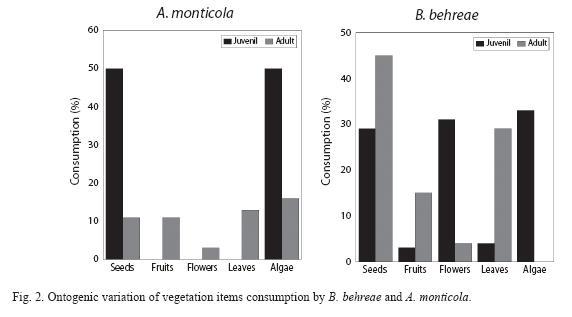
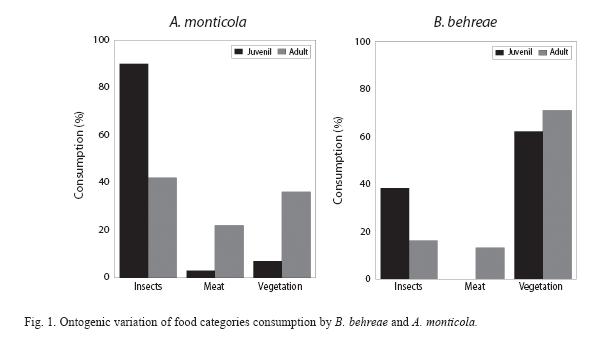
<body><![CDATA[<br> </font></p>     <p style="text-align: center;"><font face="Verdana" size="2"><img  src="/img/revistas/rbt/v57s1/art25img1.jpg" title="" alt=""  style="width: 600px; height: 341px;"><a name="i1"></a>    <br> </font></p>     <p style="text-align: center;"><font face="Verdana" size="2"><img  src="/img/revistas/rbt/v57s1/art25img2.jpg" title="" alt=""  style="width: 572px; height: 317px;"><a name="i2"></a>    <br> </font></p>     <p><b><font face="Verdana">Discussion</font></b></p> <font face="Verdana" size="2">     <p>Fish species commonly show dietary changes during their development (Meschiatti &amp; Arcifa 2002). In the present study, life stages (juvenile and adult) of <i>A. monticola </i>and <i>B. behreae </i>differed in the quality and proportions of the food consumed. In some instances, this ontogenic behavioral change may be an adaptation to reduce interspecific competition (Baumar <i>et al</i>. 2003, Muñoz &amp; Ojeda 1998), allowing sympatric coexistence (Castro-Souza &amp; Bond-Buckup 2004). <i>A. monticola </i>and <i>B. behreae </i>coexist and feed from similar groups. However, in this study we did not conducted any analyses to verify the occurrence of competition between these two species.</p>     <p>Gurgel <i>et al. </i>(2002) showed the importance of the autochthonous food resource for <i>Astyanax aeneus </i>(Characidae). However, for other characids, e.g., <i>Triportheus albus </i>(Gama &amp; Caramashi 2001) and <i>B. behreae </i>here studied, allochthonous material played a much more important role in their diets compared to local resources. This was more evident for vegetables, in which ca. 75% of the gut contents consisted of terrestrial plant parts, notwithstanding the high representation of terrestrial insects consumed. This finding points out not only the importance of conservation of the aquatic diversity (Colwell &amp; Futuyma 1971), but also the protection of the riverside forests to preserve this species at Térraba basin.</p>     <p>The results suggested that the maintenance of these species at a local level could be based on the use of the diverse riparian insect community and vegetation as food source, coupled with the ability to capture and digest a wide spectrum of prey, which in turn is associated with the basic mouth structure enabling most teleostei to feed by suction. </p>     <p>Thus, as long as the riverside natural vegetation is preserved, the food resource will hardly be a limiting factor for omnivorous species like <i>B. behreae </i>and <i>A. monticola</i>. A similar situation was observed in neotropical characids (Gama &amp; Caramashi 2001, Albrecht 2003) in similar hydroelectric projects. Also, the fact that <i>Brycon guatemalensis </i>has kept its population after the formation of the Arenal Reservoir in Costa Rica (Ulloa <i>et al</i>. 1989), and that <i>B. behreae </i>can inhabit environments of calm currents and pools (Bussing 2002), lead to the hypothesis that this characid Could maintain a viable population after the construction of the Térraba River dam. On the other hand, <i>A. monticola </i>could have its population affected upstream of the dam by other factors. Since they are catadromous, the dam will create a barrier preventing the arrival of recruits upstream, while the adults that might be trapped there would not be able to migrate to coastal waters to reproduce (Melvin &amp; Warren 1998, Ovidio &amp; Philippart 2002).</p>     ]]></body>
<body><![CDATA[<p>This study showed that the ontogenic shift in feeding habits is accompanied by morphological changes in the structure of the digestive system, corroborating with the concept that behavioral changes are related to morphology (Gerking 1954, Hernández 2000, Abelha <i>et al</i>. 2001, Nakamura <i>et al</i>. 2003). An increase of the relative length of the intestine, found in both species, along with an increased vegetable consumption of adult <i>A. monticola</i>, and higher proportions of seeds and leaves by adult <i>B. behreae </i>(considering that these plant parts are rich in lignine, which makes them harder to digest), suggests that both species have developed evolutionary adaptations to a more herbivorous, allochthonous feeding habits in their adult phases. This further evidence supports the recommendation to protect riverside forests. </p> </font><b><font face="Verdana">     <p>Acknowledgments</p> </font></b>     <p><font face="Verdana" size="2"> </font></p>     <p><font face="Verdana" size="2">We thank the Instituto Costarricense de Electricidad (ICE) and the Centro de Investigación en Ciencias del Mar y Limnología (CIMAR) of Universidad de Costa Rica, for logistic support. Suggestions by Gerardo Umaña, William Eberhard, and William Bussing were instrumental for data analysis and interpretation. This research was part of a thesis for a master of science degree, conducted by the senior author, at the Universidad de Costa Rica.</font></p> <hr style="width: 100%; height: 2px;"><font face="Verdana" size="2"><b>     <p>Resumen</p> </b> </font>     <p><font face="Verdana" size="2">Las dietas de los peces varían con respecto a la calidad, la cantidad y el tamaño del alimento. Esta variación puede deberse a factores como la estacionalidad y la fase del desarrollo del individuo. Estudiamos los cambios ontogénicos en los hábitos alimentarios de dos peces dulceacuícolas, <i>Agonostomus monticola </i>y <i>Brycon behreae</i>, de la Cuenca del Río Térraba, Pacífico sur de Costa Rica. Ambas poblaciones son omnívoras, pero con cambios ontogénicos en la cantidad y calidad de los ítemes consumidos. Conforme crecía, <i>A. monticola </i>modificó su dieta de insectívora hacia un mayor consumo de materia vegetal, asociado con un aumento en la longitud relativa del intestino. Aunque mantuvo su dependencia de alimentos vegetales, <i>B. behreae </i>diversificó su dieta de dos formas. Primero, pasó de partes suaves de plantas a semillas, hojas y frutos. Luego, los ítemes cambiaron de insectos hacia una dieta más carnívora (peces y camarones). Estos hallazgos para ambas especies enfatizan la importancia de proteger la vegetación riparia de estos ecosistemas tropicales. </font></p>     <p><font face="Verdana" size="2"><b>Palabras clave: </b>cambios ontogénicos, ecología de la alimentación, peces de agua dulce, <i>Agonostomus</i>, <i>Brycon</i>, Costa Rica.</font></p> <hr style="width: 100%; height: 2px;">     <p align="center"><font face="Verdana" size="2">Received 09-X-2007. Corrected 10-VI-2009. Accepted 25-VII-2009.</font></p> <font face="Verdana" size="2"><b> </b></font>     <p><b><font face="Verdana">References</font></b></p> <font face="Verdana" size="2">     <!-- ref --><p>Abelha, M.C.F., A.A Agostinho &amp; E.Goulart. 2001. Plasticidade trófica em peixes de água doce. Acta Scientiarum Maringá 23(2): 425-434.    &nbsp;&nbsp;&nbsp;&nbsp;&nbsp;&nbsp;&nbsp;&nbsp;[&#160;<a href="javascript:void(0);" onclick="javascript: window.open('/scielo.php?script=sci_nlinks&ref=1382721&pid=S0034-7744200900050002500001&lng=','','width=640,height=500,resizable=yes,scrollbars=1,menubar=yes,');">Links</a>&#160;]<!-- end-ref --></p>     <!-- ref --><p>Albrecht, M.P. &amp; E.P. Caramaschi. 2003. Feeding ecology of <i>Leporinus taeniofascicatus </i>(Characiformes: Anostomidae) before and after installation of a hydroelectric plant in the upper rio Tocantins, Brazil. Neot. Ichthyol. 1: 53-60.    &nbsp;&nbsp;&nbsp;&nbsp;&nbsp;&nbsp;&nbsp;&nbsp;[&#160;<a href="javascript:void(0);" onclick="javascript: window.open('/scielo.php?script=sci_nlinks&ref=1382723&pid=S0034-7744200900050002500002&lng=','','width=640,height=500,resizable=yes,scrollbars=1,menubar=yes,');">Links</a>&#160;]<!-- end-ref --></p>     <!-- ref --><p>Araújo, F.G., C.C. Andrade, R.N. Santos, A.F.G.N. Santos &amp; L.N. Santos. 2005. Spatial and seasonal changes in the diet of <i>Oligosarcus hepsetus </i>(Characiformes, Characidae) in a Brazilian Reservoir. Braz. J. Biol. 65 (1): 1-8.    &nbsp;&nbsp;&nbsp;&nbsp;&nbsp;&nbsp;&nbsp;&nbsp;[&#160;<a href="javascript:void(0);" onclick="javascript: window.open('/scielo.php?script=sci_nlinks&ref=1382725&pid=S0034-7744200900050002500003&lng=','','width=640,height=500,resizable=yes,scrollbars=1,menubar=yes,');">Links</a>&#160;]<!-- end-ref --></p>     <!-- ref --><p>Baumar, J., E. Marin, A. Quintero, D. Bussière &amp; J. Dodson. 2003. Reproduction and recruitment of white mullet (<i>Mugil curema</i>) to a tropical lagoon (Margarita Island, Venezuela) as revealed by otolith microstructure. Fish. Bull. 101: 809-821.    &nbsp;&nbsp;&nbsp;&nbsp;&nbsp;&nbsp;&nbsp;&nbsp;[&#160;<a href="javascript:void(0);" onclick="javascript: window.open('/scielo.php?script=sci_nlinks&ref=1382727&pid=S0034-7744200900050002500004&lng=','','width=640,height=500,resizable=yes,scrollbars=1,menubar=yes,');">Links</a>&#160;]<!-- end-ref --></p>     <!-- ref --><p>Bergman, E. &amp; L.A. Greenberg. 1994. Competition between a planktivore, a benthivore, and a species with ontogenetic diet shifts. Ecology 75: 1233-1245.    &nbsp;&nbsp;&nbsp;&nbsp;&nbsp;&nbsp;&nbsp;&nbsp;[&#160;<a href="javascript:void(0);" onclick="javascript: window.open('/scielo.php?script=sci_nlinks&ref=1382729&pid=S0034-7744200900050002500005&lng=','','width=640,height=500,resizable=yes,scrollbars=1,menubar=yes,');">Links</a>&#160;]<!-- end-ref --></p>     <!-- ref --><p>Burchan, J. 1988. Fish communities and environmental characteristics of two lowland streams in Costa Rica. Rev. Biol. Trop. 36 (2A): 273-285.    &nbsp;&nbsp;&nbsp;&nbsp;&nbsp;&nbsp;&nbsp;&nbsp;[&#160;<a href="javascript:void(0);" onclick="javascript: window.open('/scielo.php?script=sci_nlinks&ref=1382731&pid=S0034-7744200900050002500006&lng=','','width=640,height=500,resizable=yes,scrollbars=1,menubar=yes,');">Links</a>&#160;]<!-- end-ref --></p>     <!-- ref --><p>Bussing, W.A. 2002. Peces de las aguas continentales de Costa Rica. San José, Costa Rica. Editorial de la Universidad de Costa Rica. San José, Costa Rica.    &nbsp;&nbsp;&nbsp;&nbsp;&nbsp;&nbsp;&nbsp;&nbsp;[&#160;<a href="javascript:void(0);" onclick="javascript: window.open('/scielo.php?script=sci_nlinks&ref=1382733&pid=S0034-7744200900050002500007&lng=','','width=640,height=500,resizable=yes,scrollbars=1,menubar=yes,');">Links</a>&#160;]<!-- end-ref --></p>     <!-- ref --><p>Castro-Souza, T. &amp; G. Bond-Buckup. 2004. O nicho trófico de duas espécies simpátricas de <i>Aegla </i>Leach (Crustacea, Aeglidae) no tributário da bacia hidrográfica do Rio Pelotas, Rio Grande do Sul, Brasil. Rev. Brasil. Zool. 21(4): 805-813.    &nbsp;&nbsp;&nbsp;&nbsp;&nbsp;&nbsp;&nbsp;&nbsp;[&#160;<a href="javascript:void(0);" onclick="javascript: window.open('/scielo.php?script=sci_nlinks&ref=1382735&pid=S0034-7744200900050002500008&lng=','','width=640,height=500,resizable=yes,scrollbars=1,menubar=yes,');">Links</a>&#160;]<!-- end-ref --></p>     <!-- ref --><p>Colwell, R.K. &amp; D.J. Futuyma. 1971. On the measurement of niche breadth and overlap. Ecology 52: 558-567 &nbsp;&nbsp;&nbsp;&nbsp;&nbsp;&nbsp;&nbsp;&nbsp;[&#160;<a href="javascript:void(0);" onclick="javascript: window.open('/scielo.php?script=sci_nlinks&ref=1382737&pid=S0034-7744200900050002500009&lng=','','width=640,height=500,resizable=yes,scrollbars=1,menubar=yes,');">Links</a>&#160;]<!-- end-ref --><!-- ref --><p>Dill, L.M. 1983. Adaptative flexibility in the foraging behaviour of fishes. Can. J. Fish. Aquat. Sci. 40: 398-408.    &nbsp;&nbsp;&nbsp;&nbsp;&nbsp;&nbsp;&nbsp;&nbsp;[&#160;<a href="javascript:void(0);" onclick="javascript: window.open('/scielo.php?script=sci_nlinks&ref=1382738&pid=S0034-7744200900050002500010&lng=','','width=640,height=500,resizable=yes,scrollbars=1,menubar=yes,');">Links</a>&#160;]<!-- end-ref --></p>     <!-- ref --><p>Gama, C.S. &amp; E.P. Caramashi. 2001. Alimentaçao de <i>Triportheus albus </i>(Cope, 1971) (Osteichthyes, Characiformes) face a implantaçã do AHE Serra da Mesa no rio Tocantins. Rev. Brasil. Zoocien. 3: 159-170.    &nbsp;&nbsp;&nbsp;&nbsp;&nbsp;&nbsp;&nbsp;&nbsp;[&#160;<a href="javascript:void(0);" onclick="javascript: window.open('/scielo.php?script=sci_nlinks&ref=1382740&pid=S0034-7744200900050002500011&lng=','','width=640,height=500,resizable=yes,scrollbars=1,menubar=yes,');">Links</a>&#160;]<!-- end-ref --></p>     ]]></body>
<body><![CDATA[<!-- ref --><p>Gerking, D. 1954. Food turnover of a Bluegill population. Ecology 35: 490-498.    &nbsp;&nbsp;&nbsp;&nbsp;&nbsp;&nbsp;&nbsp;&nbsp;[&#160;<a href="javascript:void(0);" onclick="javascript: window.open('/scielo.php?script=sci_nlinks&ref=1382742&pid=S0034-7744200900050002500012&lng=','','width=640,height=500,resizable=yes,scrollbars=1,menubar=yes,');">Links</a>&#160;]<!-- end-ref --></p>     <!-- ref --><p>Gurgel, H.C.B., F.D. Lucas, L.L.G. Souza. 2002. Dieta de sete espécies de peixes do semi-árido do Rio Grande do Norte, Brasil. Rev. Ictiol. 10: 7-16.    &nbsp;&nbsp;&nbsp;&nbsp;&nbsp;&nbsp;&nbsp;&nbsp;[&#160;<a href="javascript:void(0);" onclick="javascript: window.open('/scielo.php?script=sci_nlinks&ref=1382744&pid=S0034-7744200900050002500013&lng=','','width=640,height=500,resizable=yes,scrollbars=1,menubar=yes,');">Links</a>&#160;]<!-- end-ref --></p>     <!-- ref --><p>Hernández, P.L. 2000. Introduction of intraspecific scaling of feeding mechanics in an ontogenetic series of zebrafish, <i>Danio rerio. </i>J. Exp. Biol. 203: 3033-3043.    &nbsp;&nbsp;&nbsp;&nbsp;&nbsp;&nbsp;&nbsp;&nbsp;[&#160;<a href="javascript:void(0);" onclick="javascript: window.open('/scielo.php?script=sci_nlinks&ref=1382746&pid=S0034-7744200900050002500014&lng=','','width=640,height=500,resizable=yes,scrollbars=1,menubar=yes,');">Links</a>&#160;]<!-- end-ref --></p>     <!-- ref --><p>Holbrook, S.J. &amp; R.J. Schmitt. 1992. Causes and consequences of dietary specialization in surf perches, patch choice and intra-specific competition. Ecology 73: 402-412.    &nbsp;&nbsp;&nbsp;&nbsp;&nbsp;&nbsp;&nbsp;&nbsp;[&#160;<a href="javascript:void(0);" onclick="javascript: window.open('/scielo.php?script=sci_nlinks&ref=1382748&pid=S0034-7744200900050002500015&lng=','','width=640,height=500,resizable=yes,scrollbars=1,menubar=yes,');">Links</a>&#160;]<!-- end-ref --></p>     <!-- ref --><p>McCormick, M.I. 1998. Ontogeny of diet shifts by a microcarnivorous fish, <i>Cheilodactylus spectabilis</i>: relationship between feeding mechanics, microhabitat selection and growth. Mar. Biol. 132: 9-20.    &nbsp;&nbsp;&nbsp;&nbsp;&nbsp;&nbsp;&nbsp;&nbsp;[&#160;<a href="javascript:void(0);" onclick="javascript: window.open('/scielo.php?script=sci_nlinks&ref=1382750&pid=S0034-7744200900050002500016&lng=','','width=640,height=500,resizable=yes,scrollbars=1,menubar=yes,');">Links</a>&#160;]<!-- end-ref --> </p>     ]]></body>
<body><![CDATA[<!-- ref --><p>McCormick, M.I. &amp; A.S. Hoey. 2004. Larval growth history determines juvenile growth and survival in a tropical marine fish. Oikos 106: 225-242.    &nbsp;&nbsp;&nbsp;&nbsp;&nbsp;&nbsp;&nbsp;&nbsp;[&#160;<a href="javascript:void(0);" onclick="javascript: window.open('/scielo.php?script=sci_nlinks&ref=1382752&pid=S0034-7744200900050002500017&lng=','','width=640,height=500,resizable=yes,scrollbars=1,menubar=yes,');">Links</a>&#160;]<!-- end-ref --></p>     <!-- ref --><p>Melvin, L. &amp; J.R. Warren. 1998. Road crossings as barriers to small-stream fish movement. Am. Fish. Soc. 127: 637-644.    &nbsp;&nbsp;&nbsp;&nbsp;&nbsp;&nbsp;&nbsp;&nbsp;[&#160;<a href="javascript:void(0);" onclick="javascript: window.open('/scielo.php?script=sci_nlinks&ref=1382754&pid=S0034-7744200900050002500018&lng=','','width=640,height=500,resizable=yes,scrollbars=1,menubar=yes,');">Links</a>&#160;]<!-- end-ref --> </p>     <!-- ref --><p>Meschiatti, A.J. &amp; M.S. Arcifa. 2002. Early life stages of fish and the relationships with zooplankton in a tropical Brazilian reservoir: lake Monte Alegre. Braz. J. Biol. 62: 41-50.    &nbsp;&nbsp;&nbsp;&nbsp;&nbsp;&nbsp;&nbsp;&nbsp;[&#160;<a href="javascript:void(0);" onclick="javascript: window.open('/scielo.php?script=sci_nlinks&ref=1382756&pid=S0034-7744200900050002500019&lng=','','width=640,height=500,resizable=yes,scrollbars=1,menubar=yes,');">Links</a>&#160;]<!-- end-ref --></p>     <!-- ref --><p>Muñoz, A.A. &amp; F.P. Ojeda. 1998. Guild structure of carnivorous intertidal of the Chilean coast: implications of ontogenetic dietary shifts. Oecologia 114: 563-573.    &nbsp;&nbsp;&nbsp;&nbsp;&nbsp;&nbsp;&nbsp;&nbsp;[&#160;<a href="javascript:void(0);" onclick="javascript: window.open('/scielo.php?script=sci_nlinks&ref=1382758&pid=S0034-7744200900050002500020&lng=','','width=640,height=500,resizable=yes,scrollbars=1,menubar=yes,');">Links</a>&#160;]<!-- end-ref --> </p>     <!-- ref --><p>Nakamura, Y., M. Horinouchi, T. Nakai &amp; M. Sano. 2003. Food habits of fishes in a seagrass bed on a fringing coral reef at Riomote Island, Southern Japan. Ichthyol. Res. 50: 15-22.    &nbsp;&nbsp;&nbsp;&nbsp;&nbsp;&nbsp;&nbsp;&nbsp;[&#160;<a href="javascript:void(0);" onclick="javascript: window.open('/scielo.php?script=sci_nlinks&ref=1382760&pid=S0034-7744200900050002500021&lng=','','width=640,height=500,resizable=yes,scrollbars=1,menubar=yes,');">Links</a>&#160;]<!-- end-ref --></p>     ]]></body>
<body><![CDATA[<!-- ref --><p>Ovidio, M. &amp; J.-C. Philippart. 2002. The impact of small physical obstacles on upstream movements of six species of fish. Hydrobiologia 483: 55-69.    &nbsp;&nbsp;&nbsp;&nbsp;&nbsp;&nbsp;&nbsp;&nbsp;[&#160;<a href="javascript:void(0);" onclick="javascript: window.open('/scielo.php?script=sci_nlinks&ref=1382762&pid=S0034-7744200900050002500022&lng=','','width=640,height=500,resizable=yes,scrollbars=1,menubar=yes,');">Links</a>&#160;]<!-- end-ref --></p>     <!-- ref --><p>Stern, D.L. 1999. The developmental basis for allometry in insects. Development 126: 1091-1101.    &nbsp;&nbsp;&nbsp;&nbsp;&nbsp;&nbsp;&nbsp;&nbsp;[&#160;<a href="javascript:void(0);" onclick="javascript: window.open('/scielo.php?script=sci_nlinks&ref=1382764&pid=S0034-7744200900050002500023&lng=','','width=640,height=500,resizable=yes,scrollbars=1,menubar=yes,');">Links</a>&#160;]<!-- end-ref --></p>     <p> </p>     <p>Ulloa R., J.B., J. Cabrera P. &amp; M. Mora J. 1989. Composición,diversidad y abundancia de peces en el Embalse Arenal, Guanacaste, Costa Rica. Rev. Biol. Trop. 37: 127-132.</p>     <!-- ref --><p>Vaske Jr, T. &amp; J.P. Castello. 1999. Conteúdo estomacal da albacora-laje, <i>Thunnus albacares</i>, durante o inverno e primavera no sul do Brasil. Rev. Brasil. Biol. 58: 639-647.    &nbsp;&nbsp;&nbsp;&nbsp;&nbsp;&nbsp;&nbsp;&nbsp;[&#160;<a href="javascript:void(0);" onclick="javascript: window.open('/scielo.php?script=sci_nlinks&ref=1382768&pid=S0034-7744200900050002500025&lng=','','width=640,height=500,resizable=yes,scrollbars=1,menubar=yes,');">Links</a>&#160;]<!-- end-ref --></p>     <!-- ref --><p>Weliange, W.S. &amp; U.S. Amarasinghe. 2003. Seasonality in dietary shifts in size-structured freshwater fish assemblages in three reservoirs of Sri Lanka. Env. Biol. Fishes 68: 269-282.    &nbsp;&nbsp;&nbsp;&nbsp;&nbsp;&nbsp;&nbsp;&nbsp;[&#160;<a href="javascript:void(0);" onclick="javascript: window.open('/scielo.php?script=sci_nlinks&ref=1382770&pid=S0034-7744200900050002500026&lng=','','width=640,height=500,resizable=yes,scrollbars=1,menubar=yes,');">Links</a>&#160;]<!-- end-ref --></p> </font>     ]]></body>
<body><![CDATA[ ]]></body><back>
<ref-list>
<ref id="B1">
<nlm-citation citation-type="journal">
<person-group person-group-type="author">
<name>
<surname><![CDATA[Abelha]]></surname>
<given-names><![CDATA[M.C.F]]></given-names>
</name>
<name>
<surname><![CDATA[Agostinho]]></surname>
<given-names><![CDATA[A.A]]></given-names>
</name>
<name>
<surname><![CDATA[Goulart]]></surname>
<given-names><![CDATA[E]]></given-names>
</name>
</person-group>
<article-title xml:lang="fr"><![CDATA[Plasticidade trófica em peixes de água doce]]></article-title>
<source><![CDATA[Acta Scientiarum Maringá]]></source>
<year>2001</year>
<volume>23</volume>
<numero>2</numero>
<issue>2</issue>
<page-range>425-434</page-range></nlm-citation>
</ref>
<ref id="B2">
<nlm-citation citation-type="journal">
<person-group person-group-type="author">
<name>
<surname><![CDATA[Albrecht]]></surname>
<given-names><![CDATA[M.P]]></given-names>
</name>
<name>
<surname><![CDATA[Caramaschi]]></surname>
<given-names><![CDATA[E.P]]></given-names>
</name>
</person-group>
<article-title xml:lang="en"><![CDATA[Feeding ecology of Leporinus taeniofascicatus (Characiformes: Anostomidae) before and after installation of a hydroelectric plant in the upper rio Tocantins, Brazil]]></article-title>
<source><![CDATA[Neot. Ichthyol]]></source>
<year>2003</year>
<volume>1</volume>
<page-range>53-60</page-range></nlm-citation>
</ref>
<ref id="B3">
<nlm-citation citation-type="journal">
<person-group person-group-type="author">
<name>
<surname><![CDATA[Araújo]]></surname>
<given-names><![CDATA[F.G]]></given-names>
</name>
<name>
<surname><![CDATA[Andrade]]></surname>
<given-names><![CDATA[C.C]]></given-names>
</name>
<name>
<surname><![CDATA[Santos]]></surname>
<given-names><![CDATA[R.N]]></given-names>
</name>
<name>
<surname><![CDATA[Santos]]></surname>
<given-names><![CDATA[A.F.G.N]]></given-names>
</name>
<name>
<surname><![CDATA[Santos]]></surname>
<given-names><![CDATA[L.N]]></given-names>
</name>
</person-group>
<article-title xml:lang="en"><![CDATA[Spatial and seasonal changes in the diet of Oligosarcus hepsetus (Characiformes, Characidae) in a Brazilian Reservoir]]></article-title>
<source><![CDATA[Braz. J. Biol]]></source>
<year>2005</year>
<volume>65</volume>
<numero>1</numero>
<issue>1</issue>
<page-range>1-8</page-range></nlm-citation>
</ref>
<ref id="B4">
<nlm-citation citation-type="journal">
<person-group person-group-type="author">
<name>
<surname><![CDATA[Baumar]]></surname>
<given-names><![CDATA[J]]></given-names>
</name>
<name>
<surname><![CDATA[Marin]]></surname>
<given-names><![CDATA[E]]></given-names>
</name>
<name>
<surname><![CDATA[Quintero]]></surname>
<given-names><![CDATA[A]]></given-names>
</name>
<name>
<surname><![CDATA[Bussière]]></surname>
<given-names><![CDATA[D]]></given-names>
</name>
<name>
<surname><![CDATA[Dodson]]></surname>
<given-names><![CDATA[J]]></given-names>
</name>
</person-group>
<article-title xml:lang="en"><![CDATA[Reproduction and recruitment of white mullet (Mugil curema) to a tropical lagoon (Margarita Island, Venezuela) as revealed by otolith microstructure]]></article-title>
<source><![CDATA[Fish. Bull]]></source>
<year>2003</year>
<volume>101</volume>
<page-range>809-821</page-range></nlm-citation>
</ref>
<ref id="B5">
<nlm-citation citation-type="journal">
<person-group person-group-type="author">
<name>
<surname><![CDATA[Bergman]]></surname>
<given-names><![CDATA[E]]></given-names>
</name>
<name>
<surname><![CDATA[Greenberg]]></surname>
<given-names><![CDATA[L.A]]></given-names>
</name>
</person-group>
<article-title xml:lang="en"><![CDATA[Competition between a planktivore, a benthivore, and a species with ontogenetic diet shifts]]></article-title>
<source><![CDATA[Ecology]]></source>
<year>1994</year>
<volume>75</volume>
<page-range>1233-1245</page-range></nlm-citation>
</ref>
<ref id="B6">
<nlm-citation citation-type="journal">
<person-group person-group-type="author">
<name>
<surname><![CDATA[Burchan]]></surname>
<given-names><![CDATA[J]]></given-names>
</name>
</person-group>
<article-title xml:lang="en"><![CDATA[Fish communities and environmental characteristics of two lowland streams in Costa Rica]]></article-title>
<source><![CDATA[Rev. Biol. Trop]]></source>
<year>1988</year>
<volume>36</volume>
<numero>2</numero>
<issue>2</issue>
<page-range>273-285</page-range></nlm-citation>
</ref>
<ref id="B7">
<nlm-citation citation-type="book">
<person-group person-group-type="author">
<name>
<surname><![CDATA[Bussing]]></surname>
<given-names><![CDATA[W.A]]></given-names>
</name>
</person-group>
<source><![CDATA[Peces de las aguas continentales de Costa Rica]]></source>
<year>2002</year>
<publisher-loc><![CDATA[San José ]]></publisher-loc>
<publisher-name><![CDATA[Editorial de la Universidad de Costa Rica]]></publisher-name>
</nlm-citation>
</ref>
<ref id="B8">
<nlm-citation citation-type="journal">
<person-group person-group-type="author">
<name>
<surname><![CDATA[Castro-Souza]]></surname>
<given-names><![CDATA[T]]></given-names>
</name>
<name>
<surname><![CDATA[Bond-Buckup]]></surname>
<given-names><![CDATA[G]]></given-names>
</name>
</person-group>
<article-title xml:lang="pt"><![CDATA[O nicho trófico de duas espécies simpátricas de Aegla Leach (Crustacea, Aeglidae) no tributário da bacia hidrográfica do Rio Pelotas, Rio Grande do Sul, Brasil]]></article-title>
<source><![CDATA[Rev. Brasil. Zool]]></source>
<year>2004</year>
<volume>21</volume>
<numero>4</numero>
<issue>4</issue>
<page-range>805-813</page-range></nlm-citation>
</ref>
<ref id="B9">
<nlm-citation citation-type="journal">
<person-group person-group-type="author">
<name>
<surname><![CDATA[Colwell]]></surname>
<given-names><![CDATA[R.K]]></given-names>
</name>
<name>
<surname><![CDATA[Futuyma]]></surname>
<given-names><![CDATA[D.J]]></given-names>
</name>
</person-group>
<article-title xml:lang="en"><![CDATA[On the measurement of niche breadth and overlap]]></article-title>
<source><![CDATA[Ecology]]></source>
<year>1971</year>
<volume>52</volume>
<page-range>558-567</page-range></nlm-citation>
</ref>
<ref id="B10">
<nlm-citation citation-type="journal">
<person-group person-group-type="author">
<name>
<surname><![CDATA[Dill]]></surname>
<given-names><![CDATA[L.M]]></given-names>
</name>
</person-group>
<article-title xml:lang="en"><![CDATA[Adaptative flexibility in the foraging behaviour of fishes]]></article-title>
<source><![CDATA[Can. J. Fish. Aquat. Sci]]></source>
<year>1983</year>
<volume>40</volume>
<page-range>398-408</page-range></nlm-citation>
</ref>
<ref id="B11">
<nlm-citation citation-type="journal">
<person-group person-group-type="author">
<name>
<surname><![CDATA[Gama]]></surname>
<given-names><![CDATA[C.S]]></given-names>
</name>
<name>
<surname><![CDATA[Caramashi]]></surname>
<given-names><![CDATA[E.P]]></given-names>
</name>
</person-group>
<article-title xml:lang="pt"><![CDATA[Alimentaçao de Triportheus albus (Cope, 1971) (Osteichthyes, Characiformes) face a implantaçã do AHE Serra da Mesa no rio Tocantins]]></article-title>
<source><![CDATA[Rev. Brasil. Zoocien]]></source>
<year>2001</year>
<volume>3</volume>
<page-range>159-170</page-range></nlm-citation>
</ref>
<ref id="B12">
<nlm-citation citation-type="journal">
<person-group person-group-type="author">
<name>
<surname><![CDATA[Gerking]]></surname>
<given-names><![CDATA[D]]></given-names>
</name>
</person-group>
<article-title xml:lang="en"><![CDATA[Food turnover of a Bluegill population]]></article-title>
<source><![CDATA[Ecology]]></source>
<year>1954</year>
<volume>35</volume>
<page-range>490-498</page-range></nlm-citation>
</ref>
<ref id="B13">
<nlm-citation citation-type="journal">
<person-group person-group-type="author">
<name>
<surname><![CDATA[Gurgel]]></surname>
<given-names><![CDATA[H.C.B]]></given-names>
</name>
<name>
<surname><![CDATA[Lucas]]></surname>
<given-names><![CDATA[F.D]]></given-names>
</name>
<name>
<surname><![CDATA[Souza]]></surname>
<given-names><![CDATA[L.L.G]]></given-names>
</name>
</person-group>
<article-title xml:lang="pt"><![CDATA[Dieta de sete espécies de peixes do semi-árido do Rio Grande do Norte, Brasil]]></article-title>
<source><![CDATA[Rev. Ictiol]]></source>
<year>2002</year>
<volume>10</volume>
<page-range>7-16</page-range></nlm-citation>
</ref>
<ref id="B14">
<nlm-citation citation-type="journal">
<person-group person-group-type="author">
<name>
<surname><![CDATA[Hernández]]></surname>
<given-names><![CDATA[P.L]]></given-names>
</name>
</person-group>
<article-title xml:lang="en"><![CDATA[Introduction of intraspecific scaling of feeding mechanics in an ontogenetic series of zebrafish, Danio rerio]]></article-title>
<source><![CDATA[J. Exp. Biol]]></source>
<year>2000</year>
<volume>203</volume>
<page-range>3033-3043</page-range></nlm-citation>
</ref>
<ref id="B15">
<nlm-citation citation-type="journal">
<person-group person-group-type="author">
<name>
<surname><![CDATA[Holbrook]]></surname>
<given-names><![CDATA[S.J]]></given-names>
</name>
<name>
<surname><![CDATA[Schmitt]]></surname>
<given-names><![CDATA[R.J]]></given-names>
</name>
</person-group>
<article-title xml:lang="en"><![CDATA[Causes and consequences of dietary specialization in surf perches, patch choice and intra-specific competition]]></article-title>
<source><![CDATA[Ecology]]></source>
<year>1992</year>
<volume>73</volume>
<page-range>402-412</page-range></nlm-citation>
</ref>
<ref id="B16">
<nlm-citation citation-type="journal">
<person-group person-group-type="author">
<name>
<surname><![CDATA[McCormick]]></surname>
<given-names><![CDATA[M.I]]></given-names>
</name>
</person-group>
<article-title xml:lang="en"><![CDATA[Ontogeny of diet shifts by a microcarnivorous fish, Cheilodactylus spectabilis: relationship between feeding mechanics, microhabitat selection and growth]]></article-title>
<source><![CDATA[Mar. Biol]]></source>
<year>1998</year>
<volume>132</volume>
<page-range>9-20</page-range></nlm-citation>
</ref>
<ref id="B17">
<nlm-citation citation-type="journal">
<person-group person-group-type="author">
<name>
<surname><![CDATA[McCormick]]></surname>
<given-names><![CDATA[M.I]]></given-names>
</name>
<name>
<surname><![CDATA[Hoey]]></surname>
<given-names><![CDATA[A.S]]></given-names>
</name>
</person-group>
<article-title xml:lang="en"><![CDATA[Larval growth history determines juvenile growth and survival in a tropical marine fish]]></article-title>
<source><![CDATA[Oikos]]></source>
<year>2004</year>
<volume>106</volume>
<page-range>225-242</page-range></nlm-citation>
</ref>
<ref id="B18">
<nlm-citation citation-type="journal">
<person-group person-group-type="author">
<name>
<surname><![CDATA[Melvin]]></surname>
<given-names><![CDATA[L]]></given-names>
</name>
<name>
<surname><![CDATA[Warren]]></surname>
<given-names><![CDATA[J.R]]></given-names>
</name>
</person-group>
<article-title xml:lang="en"><![CDATA[Road crossings as barriers to small-stream fish movement]]></article-title>
<source><![CDATA[Am. Fish. Soc]]></source>
<year>1998</year>
<volume>127</volume>
<page-range>637-644</page-range></nlm-citation>
</ref>
<ref id="B19">
<nlm-citation citation-type="journal">
<person-group person-group-type="author">
<name>
<surname><![CDATA[Meschiatti]]></surname>
<given-names><![CDATA[A.J]]></given-names>
</name>
<name>
<surname><![CDATA[Arcifa]]></surname>
<given-names><![CDATA[M.S]]></given-names>
</name>
</person-group>
<article-title xml:lang="en"><![CDATA[Early life stages of fish and the relationships with zooplankton in a tropical Brazilian reservoir: lake Monte Alegre]]></article-title>
<source><![CDATA[Braz. J. Biol]]></source>
<year>2002</year>
<volume>62</volume>
<page-range>41-50</page-range></nlm-citation>
</ref>
<ref id="B20">
<nlm-citation citation-type="journal">
<person-group person-group-type="author">
<name>
<surname><![CDATA[Muñoz]]></surname>
<given-names><![CDATA[A.A]]></given-names>
</name>
<name>
<surname><![CDATA[Ojeda]]></surname>
<given-names><![CDATA[F.P]]></given-names>
</name>
</person-group>
<article-title xml:lang="en"><![CDATA[Guild structure of carnivorous intertidal of the Chilean coast: implications of ontogenetic dietary shifts]]></article-title>
<source><![CDATA[Oecologia]]></source>
<year>1998</year>
<volume>114</volume>
<page-range>563-573</page-range></nlm-citation>
</ref>
<ref id="B21">
<nlm-citation citation-type="journal">
<person-group person-group-type="author">
<name>
<surname><![CDATA[Nakamura]]></surname>
<given-names><![CDATA[Y]]></given-names>
</name>
<name>
<surname><![CDATA[Horinouchi]]></surname>
<given-names><![CDATA[M]]></given-names>
</name>
<name>
<surname><![CDATA[Nakai]]></surname>
<given-names><![CDATA[T]]></given-names>
</name>
<name>
<surname><![CDATA[Sano]]></surname>
<given-names><![CDATA[M]]></given-names>
</name>
</person-group>
<article-title xml:lang="en"><![CDATA[Food habits of fishes in a seagrass bed on a fringing coral reef at Riomote Island, Southern Japan]]></article-title>
<source><![CDATA[Ichthyol. Res]]></source>
<year>2003</year>
<volume>50</volume>
<page-range>15-22</page-range></nlm-citation>
</ref>
<ref id="B22">
<nlm-citation citation-type="journal">
<person-group person-group-type="author">
<name>
<surname><![CDATA[Ovidio]]></surname>
<given-names><![CDATA[M]]></given-names>
</name>
<name>
<surname><![CDATA[Philippart]]></surname>
<given-names><![CDATA[J.-C]]></given-names>
</name>
</person-group>
<article-title xml:lang="en"><![CDATA[The impact of small physical obstacles on upstream movements of six species of fish]]></article-title>
<source><![CDATA[Hydrobiologia]]></source>
<year>2002</year>
<volume>483</volume>
<page-range>55-69</page-range></nlm-citation>
</ref>
<ref id="B23">
<nlm-citation citation-type="journal">
<person-group person-group-type="author">
<name>
<surname><![CDATA[Stern]]></surname>
<given-names><![CDATA[D.L]]></given-names>
</name>
</person-group>
<article-title xml:lang="en"><![CDATA[The developmental basis for allometry in insects]]></article-title>
<source><![CDATA[Development]]></source>
<year>1999</year>
<volume>126</volume>
<page-range>1091-1101</page-range></nlm-citation>
</ref>
<ref id="B24">
<nlm-citation citation-type="journal">
<person-group person-group-type="author">
<name>
<surname><![CDATA[Ulloa R.]]></surname>
<given-names><![CDATA[J.B]]></given-names>
</name>
<name>
<surname><![CDATA[Cabrera P]]></surname>
<given-names><![CDATA[J]]></given-names>
</name>
<name>
<surname><![CDATA[Mora J]]></surname>
<given-names><![CDATA[M]]></given-names>
</name>
</person-group>
<source><![CDATA[Rev. Biol. Trop]]></source>
<year>1989</year>
<volume>37</volume>
<page-range>127-132</page-range></nlm-citation>
</ref>
<ref id="B25">
<nlm-citation citation-type="journal">
<person-group person-group-type="author">
<name>
<surname><![CDATA[Vaske Jr]]></surname>
<given-names><![CDATA[T]]></given-names>
</name>
<name>
<surname><![CDATA[Castello]]></surname>
<given-names><![CDATA[J.P]]></given-names>
</name>
</person-group>
<article-title xml:lang="pt"><![CDATA[Conteúdo estomacal da albacora-laje, Thunnus albacares, durante o inverno e primavera no sul do Brasil]]></article-title>
<source><![CDATA[Rev. Brasil. Bio]]></source>
<year>1999</year>
<volume>58</volume>
<page-range>639-647</page-range></nlm-citation>
</ref>
<ref id="B26">
<nlm-citation citation-type="journal">
<person-group person-group-type="author">
<name>
<surname><![CDATA[Weliange]]></surname>
<given-names><![CDATA[W.S]]></given-names>
</name>
<name>
<surname><![CDATA[Amarasinghe]]></surname>
<given-names><![CDATA[U.S]]></given-names>
</name>
</person-group>
<article-title xml:lang="en"><![CDATA[Seasonality in dietary shifts in size-structured freshwater fish assemblages in three reservoirs of Sri Lanka]]></article-title>
<source><![CDATA[Env. Biol. Fishes]]></source>
<year>2003</year>
<volume>68</volume>
<page-range>269-282</page-range></nlm-citation>
</ref>
</ref-list>
</back>
</article>