<?xml version="1.0" encoding="ISO-8859-1"?><article xmlns:mml="http://www.w3.org/1998/Math/MathML" xmlns:xlink="http://www.w3.org/1999/xlink" xmlns:xsi="http://www.w3.org/2001/XMLSchema-instance">
<front>
<journal-meta>
<journal-id>0034-7744</journal-id>
<journal-title><![CDATA[Revista de Biología Tropical]]></journal-title>
<abbrev-journal-title><![CDATA[Rev. biol. trop]]></abbrev-journal-title>
<issn>0034-7744</issn>
<publisher>
<publisher-name><![CDATA[Universidad de Costa Rica]]></publisher-name>
</publisher>
</journal-meta>
<article-meta>
<article-id>S0034-77442009000500023</article-id>
<title-group>
<article-title xml:lang="en"><![CDATA[Substrate vibrations in the scorpion Centruroides margaritatus (Scorpiones: Buthidae) during courtship]]></article-title>
</title-group>
<contrib-group>
<contrib contrib-type="author">
<name>
<surname><![CDATA[Briceño]]></surname>
<given-names><![CDATA[R.D]]></given-names>
</name>
</contrib>
<contrib contrib-type="author">
<name>
<surname><![CDATA[Bonilla]]></surname>
<given-names><![CDATA[F]]></given-names>
</name>
</contrib>
</contrib-group>
<aff id="A01">
<institution><![CDATA[,Universidad de Costa Rica Escuela de Biología ]]></institution>
<addr-line><![CDATA[San José ]]></addr-line>
<country>Costa Rica</country>
</aff>
<aff id="A02">
<institution><![CDATA[,Universidad de Costa Rica Instituto Clodomiro Picado ]]></institution>
<addr-line><![CDATA[Ciudad Universitaria Rodrigo Facio ]]></addr-line>
<country>Costa Rica</country>
</aff>
<pub-date pub-type="pub">
<day>00</day>
<month>11</month>
<year>2009</year>
</pub-date>
<pub-date pub-type="epub">
<day>00</day>
<month>11</month>
<year>2009</year>
</pub-date>
<volume>57</volume>
<fpage>267</fpage>
<lpage>274</lpage>
<copyright-statement/>
<copyright-year/>
<self-uri xlink:href="http://www.scielo.sa.cr/scielo.php?script=sci_arttext&amp;pid=S0034-77442009000500023&amp;lng=en&amp;nrm=iso"></self-uri><self-uri xlink:href="http://www.scielo.sa.cr/scielo.php?script=sci_abstract&amp;pid=S0034-77442009000500023&amp;lng=en&amp;nrm=iso"></self-uri><self-uri xlink:href="http://www.scielo.sa.cr/scielo.php?script=sci_pdf&amp;pid=S0034-77442009000500023&amp;lng=en&amp;nrm=iso"></self-uri><abstract abstract-type="short" xml:lang="en"><p><![CDATA[Mating behavior in Centruroides margaritatus, as in other scorpion species, includes a series of rapid rocking or shaking movements of the male ("juddering"). It has been suggested that substrate vibrations are generated by juddering and that females respond to them by approaching the male, but its functional significance remains little studied. For the first time, substrate vibrations produced by males during courtship in Centruroides margaritatus are documented. The male started juddering after his first physical contact with the female and only one type of male vibratory signal was registered. The signal is produced during a series of rapid shaking of the male’s body from front to rear and consists of multiple short pulses. Each pulse is called a judder and several judders "a series". The average duration of each judder was 0.018±0.009s (n=50) with an interval of 0.028±0.013s (n=50); the average duration of each series of judders was 4.2±3.5s with an interval between series of 3.5±6.3s and a rate of 0.21±0.17 series per second. The females responded in 72% of the time to the males juddering. Rev. Biol. Trop. 57 (Suppl. 1): 267-274. Epub 2009 November 30.]]></p></abstract>
<abstract abstract-type="short" xml:lang="es"><p><![CDATA[El comportamiento de apareamiento en Centruroides margaritatus como en otras especies del escorpiones, incluye una serie de oscilaciones rápidas hacia adelante y hacia atrás del cuerpo del macho (juddering). Se ha especulado que tales oscilaciones generan vibraciones en el substrato y las hembras pueden responder a ellas aproximándose al macho, pero su significado funcional sigue siendo poco estudiado. Por primera vez, las vibraciones del substrato producidas por los machos durante el comportamiento de cortejo de Centruroides margaritatus son documentadas. El macho comenzó las vibraciones después de su primer contacto físico con la hembra y sólo se registró un tipo de señal vibratoria. La señal se produce durante una serie de rápidas sacudidas del cuerpo del macho de adelante hacia atrás y se compone de múltiples pulsos cortos. La duración media de cada pulso fue 0.018±0.009s (n = 50) con un intervalo de 0.028±0.013s (n=50); la duración media de cada serie de pulsos fue de 4.2±3.5s, con un intervalo entre las series de 3.5±6.3s y una tasa de 0.21±0.17 serie por segundo. Las hembras respondieron en un 72% del tiempo a las sacudidas de los machos. Se discute acerca de su posible función como señal.]]></p></abstract>
<kwd-group>
<kwd lng="en"><![CDATA[Centruroides margaritatus]]></kwd>
<kwd lng="en"><![CDATA[scorpions]]></kwd>
<kwd lng="en"><![CDATA[juddering]]></kwd>
<kwd lng="en"><![CDATA[Costa Rica]]></kwd>
<kwd lng="es"><![CDATA[Centruroides margaritatus]]></kwd>
<kwd lng="es"><![CDATA[escorpiones]]></kwd>
<kwd lng="es"><![CDATA[vibraciones de cortejo]]></kwd>
<kwd lng="es"><![CDATA[Costa Rica]]></kwd>
</kwd-group>
</article-meta>
</front><body><![CDATA[ <p align="center"><b><font face="Verdana" size="4">Substrate vibrations in the scorpion </font></b><font face="Verdana"><i>Centruroides margaritatus</i></font><font  face="Verdana"><b> (Scorpiones: Buthidae) during courtship</b></font> </p>     <p><b><font face="Verdana" size="2">R.D. Briceño1 &amp; F. Bonilla2</font></b></p>     <p><font face="Verdana" size="2">1. Escuela de Biología, Universidad de Costa Rica, Ciudad Universitaria Rodrigo Facio, 11501-2060, San José, Costa Rica.    <br> 2. Instituto Clodomiro Picado, Universidad de Costa Rica, 11501-2060, Ciudad Universitaria Rodrigo Facio, Costa Rica.</font></p> <hr style="width: 100%; height: 2px;">     <p><font face="Verdana" size="2"><b>Abstract: </b>Mating behavior in <i>Centruroides margaritatus</i>, as in other scorpion species, includes a series of rapid rocking or shaking movements of the male ("juddering"). It has been suggested that substrate vibrations are generated by juddering and that females respond to them by approaching the male, but its functional significance remains little studied. For the first time, substrate vibrations produced by males during courtship in <i>Centruroides margaritatus </i>are documented. The male started juddering after his first physical contact with the female and only one type of male vibratory signal was registered. The signal is produced during a series of rapid shaking of the male’s body from front to rear and consists of multiple short pulses. Each pulse is called a judder and several judders "a series". The average duration of each judder was 0.018±0.009s (n=50) with an interval of 0.028±0.013s (n=50); the average duration of each series of judders was 4.2±3.5s with an interval between series of 3.5±6.3s and a rate of 0.21±0.17 series per second. The females responded in 72% of the time to the males juddering. Rev. Biol. Trop. 57 (Suppl. 1): 267-274. Epub 2009 November 30. </font></p>     <p><font face="Verdana" size="2"><b>Key words: </b><i>Centruroides margaritatus</i>, scorpions, juddering, Costa Rica.</font></p> <hr style="width: 100%; height: 2px;">     <p><font face="Verdana" size="2">Communication through substrate vibrations has been recognized for a long time, but has received very little attention in comparison with sounds transmitted through the air. Nevertheless, in recent years, it has become clear that these signals play a crucial role in many groups of insects, spiders and crustaceans, in transmitting information related to sexual behavior, alarm, defensive behavior, and to coordinate complex actions in groups and social interactions ( Aicher &amp; Tautz 1990, Schüch &amp; Barth 1990, Hill 2001, Elias <i>et a.l </i>2003).</font></p>     <p><font face="Verdana" size="2">Vibration can be used in predator prey interactions, and scorpions have evolved a high sensitivity to information that is received through the surface. Brownel &amp; Farley (1979 a,b,c.) demonstrated that <i>Paruroctonus mesaensis </i>is capable of responding to substrate vibrations up to half a meter away and can use vibrations in sand to determine both direction and distance of prey species. In turn the burrowing cockroach, <i>Arenivaga investigata</i>, uses vibration to detect and avoid the approach of the scorpion species (Brownell 1977). Vibrations can also provide a channel of communication between males and females during mating. Mating behaviors have been described for about 30 species of scorpions (Polis &amp; Sissom 1990) and usually interactions between sexes are often complicated by conflicting stimuli which simultaneously produce incompatible tendencies to flee, attack and mate (Tinbergen 1953, Morris 1956) <i>Centruroides margaritatus </i>(Gervais, 1841), belongs to the family Buthidae, the most numerous and widely distributed group of modern scorpions, and includes about 45 of the total of 115 genera (39%) and 600 of 1200 described species (50%) (Escobar &amp; Ochoa 2003). <i>Centruroides margaritatus </i>is about 5 to 8cm long including the telson, and is native to Mexico, Central America and Northern South America (Venezuela, Colombia and Ecuador) (Escobar &amp; Ochoa 2003) and with unintentional introductions in parts of West Africa and Japan (Armas 1977, 1981). In Costa Rica it is distributed from the lowlands of the tropical dry forest on the Pacific coast to the Central Valley (1300m). Studies on scorpion life histories, however, are few in number. The lack of data is due in part to difficulties in rearing scorpions in captivity (Francke 1976, 1979a, 1981, Polis &amp; Farley 1979) therefore it is no surprising how little is nown about behavior general biology of this species. This paper represents the first description of substrate vibrations during sexual interactions in <i>Centruroides margaritatus </i>and its characterization.</font></p> <b><font face="Verdana" size="3">     <p>Materials and methods</p> </font></b><font face="Verdana" size="2">     <p>All scorpions studied were from a stock maintained in rearing conditions at the Instituto Clodomiro Picado (Universidad de Costa Rica), from specimens collected in a tropical dry forest at Parque Nacional Santa Rosa, Guanacaste, in 2006/07. The scorpions were keep individually in round plastic boxes with a diameter of 15 cm, with multiple holes for ventilation, with humid cotton and crumpled paper as a refuge. The animals were maintained at room temperature between 20-24°C, and relative humidity between 62-70%. The scorpions were fed every 15 days, with insects such a cockroaches <i>(Periplaneta americana, Blaberus giganteus)</i>, crickets (<i>Acheta domesticus) </i>and larvae of tenebrionids beetles (<i>Tenebrio molitor</i>) reared in the laboratory. </p>     ]]></body>
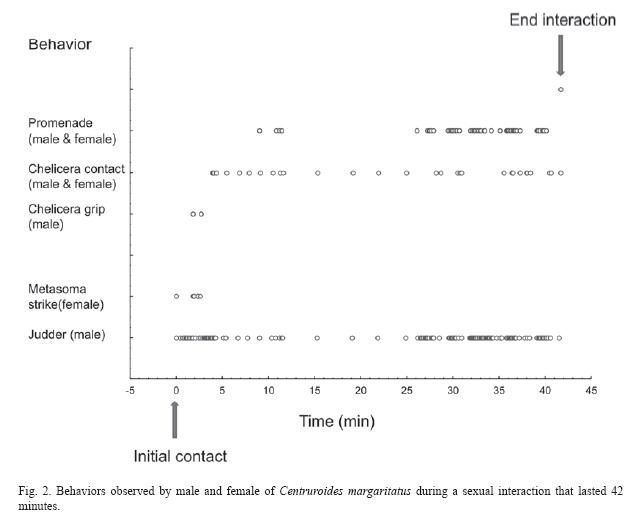
<body><![CDATA[<p>A total of 10 pairs of scorpions were used. A mature female was placed in an aquarium (29.5cm high, 24cm wide and 50cm long) filled with river sand, and once she became calm a male was introduced. If mating was not initiated within half an hour, one or both members of the pair were replaced. If courtship began a vibration sensor was located approximately 2-5mm from the juddering male (<a href="#i1">Fig 1</a>). Each mating pair was recorded once for an entire hour. The recordings were made during the day in a dark room under laboratory conditions with a ICP acceleration sensor® (model 352C65) and a signal conditioner® (amplifier, model 480E09 PCB Piezotronics), connected to a video camera Sony DCR-TRV 80 equipped with night shot and +6 close up lenses. The signals were digitized (22 kHz, 16 bits mono), stored on the hard disk and analyzed with the computer program Avisoft®. For the signal analysis we used an equal number of measurements per individual. The variables analyzed for each song were: pulse duration, interval between pulses, maximal frequency and amplitude. Means are followed by ± one standard    <br> deviation.    <br> </p> </font>     <div style="text-align: center;"><font face="Verdana" size="2">     <p><img src="/img/revistas/rbt/v57s1/art23img1.jpg" title="" alt=""  style="width: 639px; height: 506px;"><a name="i1"></a></p> </font>    <br> <font face="Verdana" size="2">     <p> </p> </font></div> <font face="Verdana" size="2"></font><font style="font-weight: bold;"  face="Verdana" size="3">     <p>Results</p> </font><font face="Verdana" size="2"> </font>     <p><font face="Verdana" size="2"> As have been observed in sexual interactions in other species (after Polis &amp; Sissom, 1990) four behavior sequences can be distinguish in <i>C. margaritatus</i>: initiation, <i>promenade a deux</i>, sperm transfer and insemination, detailed in next paragraphs. </font></p>     <p><font face="Verdana" size="2"><b>Initiation: </b>Males usually initiated courtship after he detected the female’s presence and approached her, making searching movements with his chelae extended and opened. During the search the pectines are spread wide and swept across the substrate. Males may rock or judder in the presence of the female and it appears that this occurs only during sexual interactions. During searching the male begins with a series of rapid shaking of his body from front to rear (juddering). These vibrations also occurred when the male was otherwise immobile in front of the female, after making physical contact, or at a "certain distance". The male´s pectines were usually spread and his legs firmly planted on the substrate. Juddering also occurred during the <i>promenade </i>phase (mating dance or <i>promenade a deux</i>, Maccary, 1810), and when male and female were touching each other with their chelicera. </font></p>     ]]></body>
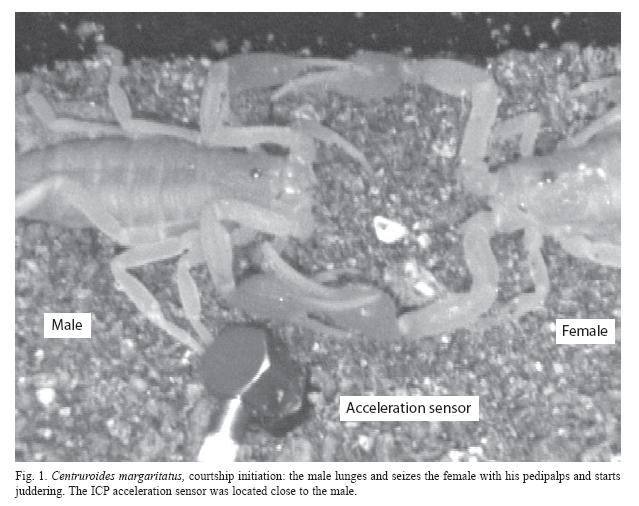
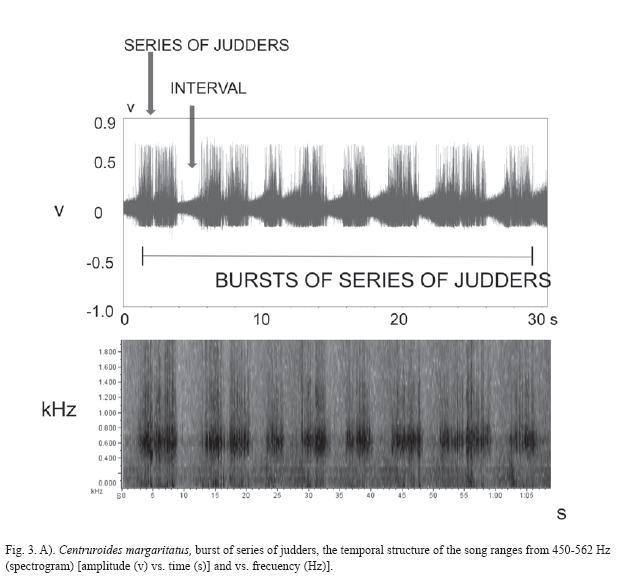
<body><![CDATA[<p><font face="Verdana" size="2">During this initial contact, the male appeared to grasp the female’s tail and club her with his tail, while the female moved toward the male, grasped and released his body with her chelae, clubbed or attempted to sting him with her metasoma, and then retreated. Polis &amp; Farley (1979) called this the female’s "mating attack behavior". Clubbing is defined as hitting with the metasoma while the sting is tucked away (McAlister 1966). The male then began to "strut defensively" (Stahnke 1966). During this behavior, the male stilted on his legs, his metasoma is raised parallel to the ground, and he remained still or moved intermittently while his pectines slowly swept the substrate. </font></p>     <p><font face="Verdana" size="2">Occasionally females participated in the initiation by approaching the male. A receptive female will approach a male with raised pedipalps and either bump or walk over the male until he responds with a lunge and grasps her as described above.</font></p>     <p><font face="Verdana" size="2"><b><i>Promenade a deux</i></b><i>: </i>Once the male grasped the female’s chelae with his own, the pair started to move together for short periods (4.4±3.1min, n=8) back and forth. The male was the most active of the pair and guided this <i>promenade</i>. During this dance the male raised his first walking legs and moved them very rapidly in front of the female. Usually the pair eventually touched each other’s chelicerae (6.3±4.2min, n=9), and they stayed immobile in this position for long periods, in some cases for the entire day.</font></p>     <p><font face="Verdana" size="2"><b>Sperm transfer and insemination</b>: Once a suitable substrate was encountered during tandem movement, the male lowered his mesosoma until the genital aperture touched the ground and extruded the spermatophore. After extrusion, the male repeatedly jerked rearward, eventually succeeding in pulling the female over the spermatophore. In one of matings the female avoided the male´s spermatophore.</font></p>     <p><font face="Verdana" size="2"><b>Substrate vibrations: </b>We observed a total of 20 interactions with an average duration of 3.7±5.4 min of which in 73% of the occasions the males started juddering prior to grasping the female with his chelae. Only 40% (n=8) of the total interactions ended in female grasping, and in all cases the males continued juddering. The average number of series while grasping the female with his chelae was 13.6±21 (n=20), and 14.2±14.3 (n= 6) when not grasping the female. In an encounter that lasted 42 minutes, we observed that juddering is an activity that occurred frequently, especially at the beginning and end of the interaction (<a href="#i2">Fig. 2</a>), coordinated with other activities such as <i>promenade </i>and cheliceral contact. The male started juddering 5.8±6.2s after his first physical contact with the female.    <br> </font></p>     <p style="text-align: center;"><font face="Verdana" size="2"><img  src="/img/revistas/rbt/v57s1/art23img2.jpg" title="" alt=""  style="width: 644px; height: 525px;"><a name="i2"></a>    <br> </font></p>     <p><font face="Verdana" size="2">Only one type of male vibratory signal was registered during the juddering behavior; it was of low amplitude, and not audible. The signal is produced during a series of rapid shaking of the male’s body from front to rear, and consists of multiple short pulses. Each pulse is called a judder and several judders a series of judders (<a href="#i3">Fig. 3B</a>). The temporal structure and spectrogram of a burst of juddering is shown in <a href="#i3">Fig. 3A.</a> The average frequency of the signal was 486.6±36.1Hz at 117.5±17.5 db (10 pairs, n=200). The average duration of each judder was 0.018±0.009s (n=50) with an interval of 0.028±0.013s (n=50); the average duration of each series of judders was 4.2±3.5s with an interval between series of 3.5±6.3s and a rate of 0.21±0.17 series per second. The frequency of the bursts of juddering was 6.9±2.5 per min.    <br> </font></p>     ]]></body>
<body><![CDATA[<p style="text-align: center;"><font face="Verdana" size="2"><img  src="/img/revistas/rbt/v57s1/art23img3.jpg" title="" alt=""  style="width: 620px; height: 584px;"><a name="i3"></a>    <br> </font></p> <font face="Verdana" size="2"><b> </b></font>     <p><font face="Verdana" size="2"><b>Female behavior when confronted withmale juddering</b>: From a total of 14 interactions in which males started juddering prior to grasping the female with his chelae, in 28% of the cases the females remained motionless, in 26% she oriented toward the male, in 16.5% she walked towards the male, in 9.3% she tried to grasp the male´s chelae, in 7.8% she hit the male with her metasoma and in 13% she moved away from the male. In total, females responded 72% of the time to the males’ juddering. </font></p>     <p><b><font face="Verdana" size="3">Discussion</font></b></p> <font face="Verdana" size="2"> </font>     <p><font face="Verdana" size="2">Scorpion courtship and mating have been described for many species (Garner &amp; Stockman 1972), and Polis &amp; Sissom (1990) calculated that in 59% of the species (5 families) males produced shaking movements during courtship (male juddering). But few of them have provided a detailed description of the juddering behavior. </font></p>     <p><font face="Verdana" size="2">This study has shown, for the first time, that juddering produced vibrations that are transmitted through the substrate. Brownel &amp; Farley (1979) showed that low-frequency surface waves, termed Rayleigh waves, and higher-frequency compression waves, could be transmitted through a sandy substrate; they also discovered that two different receptors on the legs were responding to substrate vibrations and used for prey detection.</font></p>     <p><font face="Verdana" size="2">Also we showed that females reacted to male juddering. Rosin &amp; Shulov (1963) noted that female <i>Nebo </i>definitely sense the pre-<i>promenade </i>juddering of the male from a distance of several centimeters. In <i>Opistophthalmus latimanus </i>the primary releaser of courtship behavior appears to be a change in the female behavior in response to juddering by the approaching male (Alexander 1958). Polis &amp; Farley (1979a) showed that receptive <i>P. mesanensis </i>females sense substrate vibrations of moving males (see also Armas 1986). That means that vibrations produced during courtship probably are used as a channel of communication between males and females, but at this point, there are a few works that explore this possibility and its possible role. <i>C. margaritatus </i>also tends to produce such vibrations from a certain distance from a female after a previous contact. It is possible that these vibrations have different roles at different stages of the courtship, for example we observed that vibratory signals during searching behavior apparently are less intense than during sexual contact. Some possible functions are: sex or species recognition behavior, as a releaser of mating behavior so that the female is stimulated to cooperate and/ or inhibition of aggressive and escape behaviors so that courtship can be initiated. We cannot discard the possibility that vibratory signals during courtship serves to bias cryptic female choice to favor the male (Eberhard 1996). In jumping spiders, the importance of vibratory signals in courtship display was demonstrated in males of <i>H. dossenus </i>by comparing mating frequencies across experimentally manipulated treatments: females were significantly more likely to copulate with nonmuted males than with muted males (Elias <i>et al</i>. 2005). In <i>Bothriurus flavidus </i>the female allowed the male to execute the <i>promenade </i>and deposit his spermatophore, but then, resisted the final step of spermatophore transfer. Female resistance at the final stage causes failure of sperm transfer and has been seen in other species of <i>Bothriurus</i>, <i>Timogensis elegans </i>and <i>Urophonius iheringi</i>. It is possible that these female behavior patterns were also a response to the number, intensity and/or durations in the vibratory signals produced by males during juddering. Differences between males need to be investigated. </font></p>     <p><b><font face="Verdana" size="3">Acknowledgments</font></b></p> <font face="Verdana" size="2"> </font>     <p><font face="Verdana" size="2">We thank William Eberhard and P. Hanson and two anonymous reviewers for suggestions to previous drafts. Thanks are also given to the Vice-presidency for Research, Clodomiro Picado Institute and the University of Costa Rica for financial support.</font>    <br> </p> <hr style="width: 100%; height: 2px;"><small><span  style="font-family: verdana; font-weight: bold;">Resumen</span></small> <font face="Verdana" size="2"><b></b></font>     ]]></body>
<body><![CDATA[<p><font face="Verdana" size="2">El comportamiento de apareamiento en <i>Centruroides margaritatus </i>como en otras especies del escorpiones, incluye una serie de oscilaciones rápidas hacia adelante y hacia atrás del cuerpo del macho (juddering). Se ha especulado que tales oscilaciones generan vibraciones en el substrato y las hembras pueden responder a ellas aproximándose al macho, pero su significado funcional sigue siendo poco estudiado. Por primera vez, las vibraciones del substrato producidas por los machos durante el comportamiento de cortejo de <i>Centruroides margaritatus </i>son documentadas. El macho comenzó las vibraciones después de su primer contacto físico con la hembra y sólo se registró un tipo de señal vibratoria. La señal se produce durante una serie de rápidas sacudidas del cuerpo del macho de adelante hacia atrás y se compone de múltiples pulsos cortos. La duración media de cada pulso fue 0.018±0.009s (n = 50) con un intervalo de 0.028±0.013s (n=50); la duración media de cada serie de pulsos fue de 4.2±3.5s, con un intervalo entre las series de 3.5±6.3s y una tasa de 0.21±0.17 serie por segundo. Las hembras respondieron en un 72% del tiempo a las sacudidas de los machos. Se discute acerca de su posible función como señal. </font></p>     <p><font face="Verdana" size="2"><b>Palabras clave: </b><i>Centruroides margaritatus</i>, escorpiones, vibraciones de cortejo, Costa Rica.</font></p> <hr style="width: 100%; height: 2px;">     <p align="center"><font face="Verdana" size="2">Received 03-X-2007. Corrected 20-VIII-2009. Accepted 26-X-2009.</font></p>     <p><b><font face="Verdana" size="3">References</font></b></p> <font face="Verdana" size="2"> </font>     <!-- ref --><p><font face="Verdana" size="2">Aicher, B. &amp; J. Tautz. 1990. Vibrational communication in the fiddler crab, <i>Uca pugilator</i>. J. Comp. Physiol. 166: 345-353.    &nbsp;&nbsp;&nbsp;&nbsp;&nbsp;&nbsp;&nbsp;&nbsp;[&#160;<a href="javascript:void(0);" onclick="javascript: window.open('/scielo.php?script=sci_nlinks&ref=1387777&pid=S0034-7744200900050002300001&lng=','','width=640,height=500,resizable=yes,scrollbars=1,menubar=yes,');">Links</a>&#160;]<!-- end-ref --></font></p>     <!-- ref --><p><font face="Verdana" size="2">Alexander, A.J. 1958. On the stridulations of scorpions. Behaviour 12: 339-352.    &nbsp;&nbsp;&nbsp;&nbsp;&nbsp;&nbsp;&nbsp;&nbsp;[&#160;<a href="javascript:void(0);" onclick="javascript: window.open('/scielo.php?script=sci_nlinks&ref=1387779&pid=S0034-7744200900050002300002&lng=','','width=640,height=500,resizable=yes,scrollbars=1,menubar=yes,');">Links</a>&#160;]<!-- end-ref --></font></p>     <!-- ref --><p><font face="Verdana" size="2">Armas, L.F. De. 1977. Identidad subespecífica de <i>Centruroides margaritatus </i>(Scorpionida: Buthidae) de Jamaica. Misc. Zool<i>. </i>6: 4.    &nbsp;&nbsp;&nbsp;&nbsp;&nbsp;&nbsp;&nbsp;&nbsp;[&#160;<a href="javascript:void(0);" onclick="javascript: window.open('/scielo.php?script=sci_nlinks&ref=1387781&pid=S0034-7744200900050002300003&lng=','','width=640,height=500,resizable=yes,scrollbars=1,menubar=yes,');">Links</a>&#160;]<!-- end-ref --></font></p>     ]]></body>
<body><![CDATA[<!-- ref --><p><font face="Verdana" size="2">Armas, L.F. De. 1981. El género <i>Centruroides </i>Marx, 1889 (Scorpiones: Buthidae) en Bahamas y República Dominicana. Poeyana 223: 1-21.    &nbsp;&nbsp;&nbsp;&nbsp;&nbsp;&nbsp;&nbsp;&nbsp;[&#160;<a href="javascript:void(0);" onclick="javascript: window.open('/scielo.php?script=sci_nlinks&ref=1387783&pid=S0034-7744200900050002300004&lng=','','width=640,height=500,resizable=yes,scrollbars=1,menubar=yes,');">Links</a>&#160;]<!-- end-ref --></font></p>     <!-- ref --><p><font face="Verdana" size="2">Armas, L.F. De. 1987. Cópula de escorpiones (Arachnida: Scorpiones: Buthidae). Poeyana 333: 1-27. Brownell, P.H. 1977. Compressional and surface waves in sand used by desert scorpions to locate prey. Science 197: 479-482.    &nbsp;&nbsp;&nbsp;&nbsp;&nbsp;&nbsp;&nbsp;&nbsp;[&#160;<a href="javascript:void(0);" onclick="javascript: window.open('/scielo.php?script=sci_nlinks&ref=1387785&pid=S0034-7744200900050002300005&lng=','','width=640,height=500,resizable=yes,scrollbars=1,menubar=yes,');">Links</a>&#160;]<!-- end-ref --></font></p>     <!-- ref --><p><font face="Verdana" size="2">Brownell, P.H. &amp; R.D. Farley. 1979. Detections of vibrations in sand by tarsal sense organs of the nocturnal scorpion, <i>Paruroctonus mesaensis</i>. J. Comp. Physiol. 131: 23-30.    &nbsp;&nbsp;&nbsp;&nbsp;&nbsp;&nbsp;&nbsp;&nbsp;[&#160;<a href="javascript:void(0);" onclick="javascript: window.open('/scielo.php?script=sci_nlinks&ref=1387787&pid=S0034-7744200900050002300006&lng=','','width=640,height=500,resizable=yes,scrollbars=1,menubar=yes,');">Links</a>&#160;]<!-- end-ref --></font></p>     <!-- ref --><p><font face="Verdana" size="2">Brownell, P.H. &amp; R.D. Farley. 1979b. Prey location behavior of the nocturnal desert scorpion, <i>Paruroctonus mesaensis</i>: Orientation to substrate vibrations. Anim. Behav. 27: 185-193.    &nbsp;&nbsp;&nbsp;&nbsp;&nbsp;&nbsp;&nbsp;&nbsp;[&#160;<a href="javascript:void(0);" onclick="javascript: window.open('/scielo.php?script=sci_nlinks&ref=1387789&pid=S0034-7744200900050002300007&lng=','','width=640,height=500,resizable=yes,scrollbars=1,menubar=yes,');">Links</a>&#160;]<!-- end-ref --></font></p>     <!-- ref --><p><font face="Verdana" size="2">Brownell, P.H. &amp; R.D. Farley. 1979c. Orientation to vibrations in sand by the nocturnal scorpion, <i>Paruroctonus mesaensis</i>: Mechanism of target localization. J. Comp. Physiol.131: 31-38.    &nbsp;&nbsp;&nbsp;&nbsp;&nbsp;&nbsp;&nbsp;&nbsp;[&#160;<a href="javascript:void(0);" onclick="javascript: window.open('/scielo.php?script=sci_nlinks&ref=1387791&pid=S0034-7744200900050002300008&lng=','','width=640,height=500,resizable=yes,scrollbars=1,menubar=yes,');">Links</a>&#160;]<!-- end-ref --></font></p>     ]]></body>
<body><![CDATA[<!-- ref --><p><font face="Verdana" size="2">Brownell, P.H. &amp; G. Polis (eds). 2001. Scorpions biology and research. Oxford University Press. Oxford, England.    &nbsp;&nbsp;&nbsp;&nbsp;&nbsp;&nbsp;&nbsp;&nbsp;[&#160;<a href="javascript:void(0);" onclick="javascript: window.open('/scielo.php?script=sci_nlinks&ref=1387793&pid=S0034-7744200900050002300009&lng=','','width=640,height=500,resizable=yes,scrollbars=1,menubar=yes,');">Links</a>&#160;]<!-- end-ref --> </font></p>     <!-- ref --><p><font face="Verdana" size="2">Eberhard, W.E. 1996. Female control: sexual selection by cryptic female choice. Monographs in behavior and ecology. Princeton University Press, New Jersey, USA.    &nbsp;&nbsp;&nbsp;&nbsp;&nbsp;&nbsp;&nbsp;&nbsp;[&#160;<a href="javascript:void(0);" onclick="javascript: window.open('/scielo.php?script=sci_nlinks&ref=1387795&pid=S0034-7744200900050002300010&lng=','','width=640,height=500,resizable=yes,scrollbars=1,menubar=yes,');">Links</a>&#160;]<!-- end-ref --></font></p>     <!-- ref --><p><font face="Verdana" size="2">Elias, D.O., A.C. Mason, W.P. Madison &amp; R.R. Hoy. 2003. Seismic signals in a courting male jumping spider (Araneae: Salticidae). J. Exp. Biol. 206: 4029-4039.    &nbsp;&nbsp;&nbsp;&nbsp;&nbsp;&nbsp;&nbsp;&nbsp;[&#160;<a href="javascript:void(0);" onclick="javascript: window.open('/scielo.php?script=sci_nlinks&ref=1387797&pid=S0034-7744200900050002300011&lng=','','width=640,height=500,resizable=yes,scrollbars=1,menubar=yes,');">Links</a>&#160;]<!-- end-ref --></font></p>     <!-- ref --><p><font face="Verdana" size="2">Elias, D.O., E.A. Hebets, R.R. Hoy &amp; A.C. Mason. 2005. Seismic signals are crucial for male mating success in a visual specialist jumping spider (Araneae: Salticidae). Anim. Behav. 6: 931-938.    &nbsp;&nbsp;&nbsp;&nbsp;&nbsp;&nbsp;&nbsp;&nbsp;[&#160;<a href="javascript:void(0);" onclick="javascript: window.open('/scielo.php?script=sci_nlinks&ref=1387799&pid=S0034-7744200900050002300012&lng=','','width=640,height=500,resizable=yes,scrollbars=1,menubar=yes,');">Links</a>&#160;]<!-- end-ref --> </font></p>     <!-- ref --><p><font face="Verdana" size="2">Escobar, E. &amp; J. Ochoa. 2003. Confirmación de la presencia de <i>Centruroides margaritatus </i>(Gervais,1841) (Scorpiones: Buthidae) en el Perú. Libro de resúmenes XII Reunión Científica ICBAR. UNMSM. Lima, Perú.    &nbsp;&nbsp;&nbsp;&nbsp;&nbsp;&nbsp;&nbsp;&nbsp;[&#160;<a href="javascript:void(0);" onclick="javascript: window.open('/scielo.php?script=sci_nlinks&ref=1387801&pid=S0034-7744200900050002300013&lng=','','width=640,height=500,resizable=yes,scrollbars=1,menubar=yes,');">Links</a>&#160;]<!-- end-ref --> </font></p>     ]]></body>
<body><![CDATA[<!-- ref --><p><font face="Verdana" size="2">Francke, O.F. 1976b. Observations on the life history of <i>Uroctomes mordax </i>Thorell (Scorpionidae, Vaejovidae) Bull. Brit. Arachnol. Soc. 3: 254-260. Francke, O.F. 1979. Spermatophores of some North American scorpions (Arachnida, Scorpiones). J. Arachnol. 7: 19-32.    &nbsp;&nbsp;&nbsp;&nbsp;&nbsp;&nbsp;&nbsp;&nbsp;[&#160;<a href="javascript:void(0);" onclick="javascript: window.open('/scielo.php?script=sci_nlinks&ref=1387803&pid=S0034-7744200900050002300014&lng=','','width=640,height=500,resizable=yes,scrollbars=1,menubar=yes,');">Links</a>&#160;]<!-- end-ref --></font></p>     <p><font face="Verdana" size="2"> </font></p>     <!-- ref --><p><font face="Verdana" size="2">Francke, O.F. 1981. Birth behavior and life history of <i>Diplocentrus spitzeri </i>Stalmke. Southwest. Nat. 25: 517-523.    &nbsp;&nbsp;&nbsp;&nbsp;&nbsp;&nbsp;&nbsp;&nbsp;[&#160;<a href="javascript:void(0);" onclick="javascript: window.open('/scielo.php?script=sci_nlinks&ref=1387806&pid=S0034-7744200900050002300015&lng=','','width=640,height=500,resizable=yes,scrollbars=1,menubar=yes,');">Links</a>&#160;]<!-- end-ref --></font></p>     <!-- ref --><p><font face="Verdana" size="2">Garner, G. &amp; R. Stockman.1972 . Etude comparative de la paraide chez differentes espèces de scorpions et chez <i>Pandinus imperator. </i>Ann. Univ. Abdijan Ser. E (Ecologie) 5: 475-497.    &nbsp;&nbsp;&nbsp;&nbsp;&nbsp;&nbsp;&nbsp;&nbsp;[&#160;<a href="javascript:void(0);" onclick="javascript: window.open('/scielo.php?script=sci_nlinks&ref=1387808&pid=S0034-7744200900050002300016&lng=','','width=640,height=500,resizable=yes,scrollbars=1,menubar=yes,');">Links</a>&#160;]<!-- end-ref --></font></p>     <!-- ref --><p><font face="Verdana" size="2">Hill, P.S. 2001. Vibration and animal communication. Ann. R. Amer. Zool. 41: 1135-1142.    &nbsp;&nbsp;&nbsp;&nbsp;&nbsp;&nbsp;&nbsp;&nbsp;[&#160;<a href="javascript:void(0);" onclick="javascript: window.open('/scielo.php?script=sci_nlinks&ref=1387810&pid=S0034-7744200900050002300017&lng=','','width=640,height=500,resizable=yes,scrollbars=1,menubar=yes,');">Links</a>&#160;]<!-- end-ref --></font></p>     <!-- ref --><p><font face="Verdana" size="2">Morris, D.J.1956. The function and causation of courtship ceremonies. pp. 54-89 <i>In </i>P.P. Grasse. (ed.). L’Instinct dans le comportement des animaux et de l’homme. Masson Cie. Paris, France.    &nbsp;&nbsp;&nbsp;&nbsp;&nbsp;&nbsp;&nbsp;&nbsp;[&#160;<a href="javascript:void(0);" onclick="javascript: window.open('/scielo.php?script=sci_nlinks&ref=1387812&pid=S0034-7744200900050002300018&lng=','','width=640,height=500,resizable=yes,scrollbars=1,menubar=yes,');">Links</a>&#160;]<!-- end-ref --></font></p>     <!-- ref --><p><font face="Verdana" size="2">McAlister, W. H. 1965. The mating behavior of <i>Centruroides vittatus. </i>Tex. J. Sci. 17: 307-312.    &nbsp;&nbsp;&nbsp;&nbsp;&nbsp;&nbsp;&nbsp;&nbsp;[&#160;<a href="javascript:void(0);" onclick="javascript: window.open('/scielo.php?script=sci_nlinks&ref=1387814&pid=S0034-7744200900050002300019&lng=','','width=640,height=500,resizable=yes,scrollbars=1,menubar=yes,');">Links</a>&#160;]<!-- end-ref --></font></p>     <!-- ref --><p><font face="Verdana" size="2">Maccary, A. 1810. Memoire sur le scorpions qui se trouvent sur la montagne de Cette, Gabon, Paris, France.    &nbsp;&nbsp;&nbsp;&nbsp;&nbsp;&nbsp;&nbsp;&nbsp;[&#160;<a href="javascript:void(0);" onclick="javascript: window.open('/scielo.php?script=sci_nlinks&ref=1387816&pid=S0034-7744200900050002300020&lng=','','width=640,height=500,resizable=yes,scrollbars=1,menubar=yes,');">Links</a>&#160;]<!-- end-ref --></font></p>     <!-- ref --><p><font face="Verdana" size="2">Polis, G.A. &amp; R.D. Farley. 1979. Behavior and ecology of mating in the cannibalistic scorpions <i>Paruroctomus mesaensis </i>Stahnke (Scorpionida: Vaejovidae). J. Arachnol. 7: 33-46.    &nbsp;&nbsp;&nbsp;&nbsp;&nbsp;&nbsp;&nbsp;&nbsp;[&#160;<a href="javascript:void(0);" onclick="javascript: window.open('/scielo.php?script=sci_nlinks&ref=1387818&pid=S0034-7744200900050002300021&lng=','','width=640,height=500,resizable=yes,scrollbars=1,menubar=yes,');">Links</a>&#160;]<!-- end-ref --></font></p>     <!-- ref --><p><font face="Verdana" size="2">Polis, G. &amp; W. Sissom <i>1990. </i>Life history. The biology of scorpions. Stanford University, California, USA.    &nbsp;&nbsp;&nbsp;&nbsp;&nbsp;&nbsp;&nbsp;&nbsp;[&#160;<a href="javascript:void(0);" onclick="javascript: window.open('/scielo.php?script=sci_nlinks&ref=1387820&pid=S0034-7744200900050002300022&lng=','','width=640,height=500,resizable=yes,scrollbars=1,menubar=yes,');">Links</a>&#160;]<!-- end-ref --></font></p>     <!-- ref --><p><font face="Verdana" size="2">Rosin, R. &amp; A. Shulov. 1963. Studies on the scorpion <i>Nebo hierochonticus</i>. Proc. Zool. Soc. London 140: 547-575.    &nbsp;&nbsp;&nbsp;&nbsp;&nbsp;&nbsp;&nbsp;&nbsp;[&#160;<a href="javascript:void(0);" onclick="javascript: window.open('/scielo.php?script=sci_nlinks&ref=1387822&pid=S0034-7744200900050002300023&lng=','','width=640,height=500,resizable=yes,scrollbars=1,menubar=yes,');">Links</a>&#160;]<!-- end-ref --></font></p>     <p><font face="Verdana" size="2"> </font></p>     <!-- ref --><p><font face="Verdana" size="2">Scüech, W. &amp; F.G. Barth. 1990. Vibratory communication in a spider: female responses to synthetic male vibration. J. Comp. Physiol. 166: 817-826.    &nbsp;&nbsp;&nbsp;&nbsp;&nbsp;&nbsp;&nbsp;&nbsp;[&#160;<a href="javascript:void(0);" onclick="javascript: window.open('/scielo.php?script=sci_nlinks&ref=1387825&pid=S0034-7744200900050002300024&lng=','','width=640,height=500,resizable=yes,scrollbars=1,menubar=yes,');">Links</a>&#160;]<!-- end-ref --></font></p>     <!-- ref --><p><font face="Verdana" size="2">Stahnke, H. L. 1966. Some aspects of scorpion behavior. Bull. Southern California Acad. Sci. 65: 65-80.    &nbsp;&nbsp;&nbsp;&nbsp;&nbsp;&nbsp;&nbsp;&nbsp;[&#160;<a href="javascript:void(0);" onclick="javascript: window.open('/scielo.php?script=sci_nlinks&ref=1387827&pid=S0034-7744200900050002300025&lng=','','width=640,height=500,resizable=yes,scrollbars=1,menubar=yes,');">Links</a>&#160;]<!-- end-ref --></font></p>     <!-- ref --><p><font face="Verdana" size="2">Stürzl, W., R. Kempter &amp; J.L. van Hemmen. 2000. Theory of arachnid prey localization. Phys. Rev. Lett. 84: 5668-5671.    &nbsp;&nbsp;&nbsp;&nbsp;&nbsp;&nbsp;&nbsp;&nbsp;[&#160;<a href="javascript:void(0);" onclick="javascript: window.open('/scielo.php?script=sci_nlinks&ref=1387829&pid=S0034-7744200900050002300026&lng=','','width=640,height=500,resizable=yes,scrollbars=1,menubar=yes,');">Links</a>&#160;]<!-- end-ref --></font></p>     <!-- ref --><p><font face="Verdana" size="2">Tallarovic, S.K., J.M. Melville &amp; P.H. Brownell. 2000. Courtship and mating in the giant hairy desert scorpion, <i>Hadrurus arizonensis </i>(Scorpionida, Iuridae). J. Insect Behav. 13: 827-838.    &nbsp;&nbsp;&nbsp;&nbsp;&nbsp;&nbsp;&nbsp;&nbsp;[&#160;<a href="javascript:void(0);" onclick="javascript: window.open('/scielo.php?script=sci_nlinks&ref=1387831&pid=S0034-7744200900050002300027&lng=','','width=640,height=500,resizable=yes,scrollbars=1,menubar=yes,');">Links</a>&#160;]<!-- end-ref --></font></p>     ]]></body>
<body><![CDATA[<!-- ref --><p><font face="Verdana" size="2">Tinbergen, H. 1953. Social behavior in animals. Methuen Co., London, England.    &nbsp;&nbsp;&nbsp;&nbsp;&nbsp;&nbsp;&nbsp;&nbsp;[&#160;<a href="javascript:void(0);" onclick="javascript: window.open('/scielo.php?script=sci_nlinks&ref=1387833&pid=S0034-7744200900050002300028&lng=','','width=640,height=500,resizable=yes,scrollbars=1,menubar=yes,');">Links</a>&#160;]<!-- end-ref --></font></p>      ]]></body><back>
<ref-list>
<ref id="B1">
<nlm-citation citation-type="journal">
<person-group person-group-type="author">
<name>
<surname><![CDATA[Aicher]]></surname>
<given-names><![CDATA[B]]></given-names>
</name>
<name>
<surname><![CDATA[Tautz]]></surname>
<given-names><![CDATA[J]]></given-names>
</name>
</person-group>
<article-title xml:lang="en"><![CDATA[Vibrational communication in the fiddler crab, Uca pugilator]]></article-title>
<source><![CDATA[J. Comp. Physiol]]></source>
<year>1990</year>
<volume>166</volume>
<page-range>345-353</page-range></nlm-citation>
</ref>
<ref id="B2">
<nlm-citation citation-type="journal">
<person-group person-group-type="author">
<name>
<surname><![CDATA[Alexander]]></surname>
<given-names><![CDATA[A.J]]></given-names>
</name>
</person-group>
<article-title xml:lang="en"><![CDATA[On the stridulations of scorpions]]></article-title>
<source><![CDATA[Behaviour]]></source>
<year>1958</year>
<volume>12</volume>
<page-range>339-352</page-range></nlm-citation>
</ref>
<ref id="B3">
<nlm-citation citation-type="journal">
<person-group person-group-type="author">
<name>
<surname><![CDATA[Armas]]></surname>
<given-names><![CDATA[L.F. De]]></given-names>
</name>
</person-group>
<article-title xml:lang="es"><![CDATA[Identidad subespecífica de Centruroides margaritatus (Scorpionida: Buthidae) de Jamaica]]></article-title>
<source><![CDATA[Misc. Zool]]></source>
<year>1977</year>
<volume>6</volume>
<page-range>4</page-range></nlm-citation>
</ref>
<ref id="B4">
<nlm-citation citation-type="journal">
<person-group person-group-type="author">
<name>
<surname><![CDATA[Armas]]></surname>
<given-names><![CDATA[L.F. De]]></given-names>
</name>
</person-group>
<article-title xml:lang="es"><![CDATA[El género Centruroides Marx, 1889 (Scorpiones: Buthidae) en Bahamas y República Dominicana]]></article-title>
<source><![CDATA[Poeyana]]></source>
<year>1981</year>
<volume>223</volume>
<page-range>1-21</page-range></nlm-citation>
</ref>
<ref id="B5">
<nlm-citation citation-type="journal">
<person-group person-group-type="author">
<name>
<surname><![CDATA[Armas]]></surname>
<given-names><![CDATA[L.F. De]]></given-names>
</name>
</person-group>
<article-title xml:lang="en"><![CDATA[Cópula de escorpiones (Arachnida: Scorpiones: Buthidae). Poeyana 333: 1-27. Brownell, P.H. 1977. Compressional and surface waves in sand used by desert scorpions to locate prey]]></article-title>
<source><![CDATA[Science]]></source>
<year>1987</year>
<volume>197</volume>
<page-range>479-482</page-range></nlm-citation>
</ref>
<ref id="B6">
<nlm-citation citation-type="journal">
<person-group person-group-type="author">
<name>
<surname><![CDATA[Brownell]]></surname>
<given-names><![CDATA[P.H]]></given-names>
</name>
<name>
<surname><![CDATA[Farley]]></surname>
<given-names><![CDATA[R.D]]></given-names>
</name>
</person-group>
<article-title xml:lang="en"><![CDATA[Detections of vibrations in sand by tarsal sense organs of the nocturnal scorpion, Paruroctonus mesaensis]]></article-title>
<source><![CDATA[J. Comp. Physiol]]></source>
<year>1979</year>
<volume>131</volume>
<page-range>23-30</page-range></nlm-citation>
</ref>
<ref id="B7">
<nlm-citation citation-type="journal">
<person-group person-group-type="author">
<name>
<surname><![CDATA[Brownell]]></surname>
<given-names><![CDATA[P.H]]></given-names>
</name>
<name>
<surname><![CDATA[Farley]]></surname>
<given-names><![CDATA[R.D]]></given-names>
</name>
</person-group>
<article-title xml:lang="en"><![CDATA[Prey location behavior of the nocturnal desert scorpion, Paruroctonus mesaensis: Orientation to substrate vibrations]]></article-title>
<source><![CDATA[Anim. Behav]]></source>
<year>1979</year>
<volume>27</volume>
<page-range>185-193</page-range></nlm-citation>
</ref>
<ref id="B8">
<nlm-citation citation-type="journal">
<person-group person-group-type="author">
<name>
<surname><![CDATA[Brownell]]></surname>
<given-names><![CDATA[P.H]]></given-names>
</name>
<name>
<surname><![CDATA[Farley]]></surname>
<given-names><![CDATA[R.D]]></given-names>
</name>
</person-group>
<article-title xml:lang="en"><![CDATA[Orientation to vibrations in sand by the nocturnal scorpion, Paruroctonus mesaensis: Mechanism of target localization]]></article-title>
<source><![CDATA[J. Comp. Physiol]]></source>
<year>1979</year>
<volume>131</volume>
<page-range>31-38</page-range></nlm-citation>
</ref>
<ref id="B9">
<nlm-citation citation-type="book">
<person-group person-group-type="author">
<name>
<surname><![CDATA[Brownell]]></surname>
<given-names><![CDATA[P.H]]></given-names>
</name>
<name>
<surname><![CDATA[Polis]]></surname>
<given-names><![CDATA[G]]></given-names>
</name>
</person-group>
<source><![CDATA[Scorpions biology and research]]></source>
<year>2001</year>
<publisher-loc><![CDATA[Oxford ]]></publisher-loc>
<publisher-name><![CDATA[Oxford University Press]]></publisher-name>
</nlm-citation>
</ref>
<ref id="B10">
<nlm-citation citation-type="book">
<person-group person-group-type="author">
<name>
<surname><![CDATA[Eberhard]]></surname>
<given-names><![CDATA[W.E]]></given-names>
</name>
</person-group>
<source><![CDATA[Female control: sexual selection by cryptic female choice. Monographs in behavior and ecology.]]></source>
<year>1996</year>
<publisher-loc><![CDATA[New Jersey ]]></publisher-loc>
<publisher-name><![CDATA[Princeton University Press]]></publisher-name>
</nlm-citation>
</ref>
<ref id="B11">
<nlm-citation citation-type="journal">
<person-group person-group-type="author">
<name>
<surname><![CDATA[Elias]]></surname>
<given-names><![CDATA[D.O]]></given-names>
</name>
<name>
<surname><![CDATA[Mason]]></surname>
<given-names><![CDATA[A.C]]></given-names>
</name>
<name>
<surname><![CDATA[Madison]]></surname>
<given-names><![CDATA[W.P]]></given-names>
</name>
<name>
<surname><![CDATA[Hoy]]></surname>
<given-names><![CDATA[R.R]]></given-names>
</name>
</person-group>
<article-title xml:lang="en"><![CDATA[Seismic signals in a courting male jumping spider (Araneae: Salticidae)]]></article-title>
<source><![CDATA[J. Exp. Biol]]></source>
<year>2003</year>
<volume>206</volume>
<page-range>4029-4039</page-range></nlm-citation>
</ref>
<ref id="B12">
<nlm-citation citation-type="journal">
<person-group person-group-type="author">
<name>
<surname><![CDATA[Elias]]></surname>
<given-names><![CDATA[D.O]]></given-names>
</name>
<name>
<surname><![CDATA[Hebets]]></surname>
<given-names><![CDATA[E.A]]></given-names>
</name>
<name>
<surname><![CDATA[Hoy]]></surname>
<given-names><![CDATA[R.R]]></given-names>
</name>
<name>
<surname><![CDATA[Mason]]></surname>
<given-names><![CDATA[A.C]]></given-names>
</name>
</person-group>
<article-title xml:lang="en"><![CDATA[Seismic signals are crucial for male mating success in a visual specialist jumping spider (Araneae: Salticidae)]]></article-title>
<source><![CDATA[Anim. Behav]]></source>
<year>2005</year>
<volume>6</volume>
<page-range>931-938</page-range></nlm-citation>
</ref>
<ref id="B13">
<nlm-citation citation-type="book">
<person-group person-group-type="author">
<name>
<surname><![CDATA[Escobar]]></surname>
<given-names><![CDATA[E]]></given-names>
</name>
<name>
<surname><![CDATA[Ochoa]]></surname>
<given-names><![CDATA[J]]></given-names>
</name>
</person-group>
<source><![CDATA[Confirmación de la presencia de Centruroides margaritatus (Gervais,1841) (Scorpiones: Buthidae) en el Perú. Libro de resúmenes XII Reunión Científica ICBAR]]></source>
<year>2003</year>
<publisher-loc><![CDATA[Lima ]]></publisher-loc>
<publisher-name><![CDATA[UNMSM]]></publisher-name>
</nlm-citation>
</ref>
<ref id="B14">
<nlm-citation citation-type="journal">
<person-group person-group-type="author">
<name>
<surname><![CDATA[Francke]]></surname>
<given-names><![CDATA[O.F]]></given-names>
</name>
</person-group>
<article-title xml:lang="en"><![CDATA[Observations on the life history of Uroctomes mordax Thorell (Scorpionidae, Vaejovidae). Bull. Brit. Arachnol. Soc. 3: 254-260. Francke, O.F. 1979. Spermatophores of some North American scorpions (Arachnida, Scorpiones)]]></article-title>
<source><![CDATA[J. Arachnol]]></source>
<year>1976</year>
<volume>7</volume>
<page-range>19-32</page-range></nlm-citation>
</ref>
<ref id="B15">
<nlm-citation citation-type="journal">
<person-group person-group-type="author">
<name>
<surname><![CDATA[Francke]]></surname>
<given-names><![CDATA[O.F]]></given-names>
</name>
</person-group>
<article-title xml:lang="en"><![CDATA[Birth behavior and life history of Diplocentrus spitzeri Stalmke]]></article-title>
<source><![CDATA[Southwest. Nat]]></source>
<year>1981</year>
<volume>25</volume>
<page-range>517-523</page-range></nlm-citation>
</ref>
<ref id="B16">
<nlm-citation citation-type="journal">
<person-group person-group-type="author">
<name>
<surname><![CDATA[Garner]]></surname>
<given-names><![CDATA[G]]></given-names>
</name>
<name>
<surname><![CDATA[Stockman]]></surname>
<given-names><![CDATA[R]]></given-names>
</name>
</person-group>
<article-title xml:lang="fr"><![CDATA[Etude comparative de la paraide chez differentes espèces de scorpions et chez Pandinus imperator]]></article-title>
<source><![CDATA[Ann. Univ. Abdijan Ser. E (Ecologie)]]></source>
<year>1972</year>
<volume>5</volume>
<page-range>475-497</page-range></nlm-citation>
</ref>
<ref id="B17">
<nlm-citation citation-type="journal">
<person-group person-group-type="author">
<name>
<surname><![CDATA[Hill]]></surname>
<given-names><![CDATA[P.S]]></given-names>
</name>
</person-group>
<article-title xml:lang="en"><![CDATA[Vibration and animal communication]]></article-title>
<source><![CDATA[Ann. R. Amer. Zool]]></source>
<year>2001</year>
<volume>41</volume>
<page-range>1135-1142</page-range></nlm-citation>
</ref>
<ref id="B18">
<nlm-citation citation-type="book">
<person-group person-group-type="author">
<name>
<surname><![CDATA[Morris]]></surname>
<given-names><![CDATA[D.J]]></given-names>
</name>
</person-group>
<article-title xml:lang="en"><![CDATA[The function and causation of courtship ceremonies]]></article-title>
<person-group person-group-type="editor">
<name>
<surname><![CDATA[Grasse]]></surname>
<given-names><![CDATA[P.P]]></given-names>
</name>
</person-group>
<source><![CDATA[L’Instinct dans le comportement des animaux et de l’homme]]></source>
<year>1956</year>
<page-range>54-89</page-range><publisher-loc><![CDATA[Paris ]]></publisher-loc>
<publisher-name><![CDATA[Masson Cie]]></publisher-name>
</nlm-citation>
</ref>
<ref id="B19">
<nlm-citation citation-type="journal">
<person-group person-group-type="author">
<name>
<surname><![CDATA[McAlister]]></surname>
<given-names><![CDATA[W. H]]></given-names>
</name>
</person-group>
<article-title xml:lang="en"><![CDATA[The mating behavior of Centruroides vittatus]]></article-title>
<source><![CDATA[Tex. J. Sci]]></source>
<year>1965</year>
<volume>17</volume>
<page-range>307-312</page-range></nlm-citation>
</ref>
<ref id="B20">
<nlm-citation citation-type="book">
<person-group person-group-type="author">
<name>
<surname><![CDATA[Maccary]]></surname>
<given-names><![CDATA[A]]></given-names>
</name>
</person-group>
<source><![CDATA[Memoire sur le scorpions qui se trouvent sur la montagne de Cette]]></source>
<year>1810</year>
<publisher-loc><![CDATA[Paris ]]></publisher-loc>
<publisher-name><![CDATA[Gabon]]></publisher-name>
</nlm-citation>
</ref>
<ref id="B21">
<nlm-citation citation-type="journal">
<person-group person-group-type="author">
<name>
<surname><![CDATA[Polis]]></surname>
<given-names><![CDATA[G.A]]></given-names>
</name>
<name>
<surname><![CDATA[Farley]]></surname>
<given-names><![CDATA[R.D]]></given-names>
</name>
</person-group>
<article-title xml:lang="en"><![CDATA[Behavior and ecology of mating in the cannibalistic scorpions Paruroctomus mesaensis Stahnke (Scorpionida: Vaejovidae)]]></article-title>
<source><![CDATA[J. Arachnol]]></source>
<year>1979</year>
<volume>7</volume>
<page-range>33-46</page-range></nlm-citation>
</ref>
<ref id="B22">
<nlm-citation citation-type="book">
<person-group person-group-type="author">
<name>
<surname><![CDATA[Polis]]></surname>
<given-names><![CDATA[G]]></given-names>
</name>
<name>
<surname><![CDATA[Sissom]]></surname>
<given-names><![CDATA[W]]></given-names>
</name>
</person-group>
<source><![CDATA[Life history. The biology of scorpions]]></source>
<year>1990</year>
<publisher-loc><![CDATA[California ]]></publisher-loc>
<publisher-name><![CDATA[Stanford University]]></publisher-name>
</nlm-citation>
</ref>
<ref id="B23">
<nlm-citation citation-type="journal">
<person-group person-group-type="author">
<name>
<surname><![CDATA[Rosin]]></surname>
<given-names><![CDATA[R]]></given-names>
</name>
<name>
<surname><![CDATA[Shulov]]></surname>
<given-names><![CDATA[A]]></given-names>
</name>
</person-group>
<article-title xml:lang="en"><![CDATA[Studies on the scorpion Nebo hierochonticus]]></article-title>
<source><![CDATA[Proc. Zool. Soc. London]]></source>
<year>1963</year>
<volume>140</volume>
<page-range>547-575</page-range></nlm-citation>
</ref>
<ref id="B24">
<nlm-citation citation-type="journal">
<person-group person-group-type="author">
<name>
<surname><![CDATA[Scüech]]></surname>
<given-names><![CDATA[W]]></given-names>
</name>
<name>
<surname><![CDATA[Barth]]></surname>
<given-names><![CDATA[F.G]]></given-names>
</name>
</person-group>
<article-title xml:lang="en"><![CDATA[Vibratory communication in a spider: female responses to synthetic male vibration]]></article-title>
<source><![CDATA[J. Comp. Physiol]]></source>
<year>1990</year>
<volume>166</volume>
<page-range>817-826</page-range></nlm-citation>
</ref>
<ref id="B25">
<nlm-citation citation-type="journal">
<person-group person-group-type="author">
<name>
<surname><![CDATA[Stahnke]]></surname>
<given-names><![CDATA[H. L]]></given-names>
</name>
</person-group>
<article-title xml:lang="en"><![CDATA[Some aspects of scorpion behavior]]></article-title>
<source><![CDATA[Bull. Southern California Acad. Sci]]></source>
<year>1966</year>
<volume>65</volume>
<page-range>65-80</page-range></nlm-citation>
</ref>
<ref id="B26">
<nlm-citation citation-type="journal">
<person-group person-group-type="author">
<name>
<surname><![CDATA[Stürzl]]></surname>
<given-names><![CDATA[W]]></given-names>
</name>
<name>
<surname><![CDATA[Kempter]]></surname>
<given-names><![CDATA[R]]></given-names>
</name>
<name>
<surname><![CDATA[van Hemmen]]></surname>
<given-names><![CDATA[J.L]]></given-names>
</name>
</person-group>
<article-title xml:lang="en"><![CDATA[Theory of arachnid prey localization]]></article-title>
<source><![CDATA[Phys. Rev. Lett]]></source>
<year>2000</year>
<volume>84</volume>
<page-range>5668-5671</page-range></nlm-citation>
</ref>
<ref id="B27">
<nlm-citation citation-type="journal">
<person-group person-group-type="author">
<name>
<surname><![CDATA[Tallarovic]]></surname>
<given-names><![CDATA[S.K]]></given-names>
</name>
<name>
<surname><![CDATA[Melville]]></surname>
<given-names><![CDATA[J.M]]></given-names>
</name>
<name>
<surname><![CDATA[Brownell]]></surname>
<given-names><![CDATA[P.H]]></given-names>
</name>
</person-group>
<source><![CDATA[J. Insect Behav]]></source>
<year></year>
<volume>13</volume>
<page-range>827-838</page-range></nlm-citation>
</ref>
<ref id="B28">
<nlm-citation citation-type="book">
<person-group person-group-type="author">
<name>
<surname><![CDATA[Tinbergen]]></surname>
<given-names><![CDATA[H]]></given-names>
</name>
</person-group>
<source><![CDATA[Social behavior in animals]]></source>
<year>1953</year>
<publisher-loc><![CDATA[London ]]></publisher-loc>
<publisher-name><![CDATA[Methuen CoEngland]]></publisher-name>
</nlm-citation>
</ref>
</ref-list>
</back>
</article>