<?xml version="1.0" encoding="ISO-8859-1"?><article xmlns:mml="http://www.w3.org/1998/Math/MathML" xmlns:xlink="http://www.w3.org/1999/xlink" xmlns:xsi="http://www.w3.org/2001/XMLSchema-instance">
<front>
<journal-meta>
<journal-id>0034-7744</journal-id>
<journal-title><![CDATA[Revista de Biología Tropical]]></journal-title>
<abbrev-journal-title><![CDATA[Rev. biol. trop]]></abbrev-journal-title>
<issn>0034-7744</issn>
<publisher>
<publisher-name><![CDATA[Universidad de Costa Rica]]></publisher-name>
</publisher>
</journal-meta>
<article-meta>
<article-id>S0034-77442009000500021</article-id>
<title-group>
<article-title xml:lang="en"><![CDATA[Genitalic stridulation during copulation in a species of crane fly,Tipula (Bellardina) sp. (Diptera: Tipulidae)]]></article-title>
</title-group>
<contrib-group>
<contrib contrib-type="author">
<name>
<surname><![CDATA[Eberhard]]></surname>
<given-names><![CDATA[William G]]></given-names>
</name>
</contrib>
<contrib contrib-type="author">
<name>
<surname><![CDATA[Gelhaus]]></surname>
<given-names><![CDATA[Jon K]]></given-names>
</name>
</contrib>
</contrib-group>
<aff id="A01">
<institution><![CDATA[,Universidad de Costa Rica Escuela de Biología Smithsonian Tropical Research Institute (STRI)]]></institution>
<addr-line><![CDATA[ ]]></addr-line>
<country>Costa Rica</country>
</aff>
<aff id="A02">
<institution><![CDATA[,The Academy of Natural Sciences Department of Entomology ]]></institution>
<addr-line><![CDATA[ ]]></addr-line>
</aff>
<pub-date pub-type="pub">
<day>00</day>
<month>11</month>
<year>2009</year>
</pub-date>
<pub-date pub-type="epub">
<day>00</day>
<month>11</month>
<year>2009</year>
</pub-date>
<volume>57</volume>
<fpage>251</fpage>
<lpage>256</lpage>
<copyright-statement/>
<copyright-year/>
<self-uri xlink:href="http://www.scielo.sa.cr/scielo.php?script=sci_arttext&amp;pid=S0034-77442009000500021&amp;lng=en&amp;nrm=iso"></self-uri><self-uri xlink:href="http://www.scielo.sa.cr/scielo.php?script=sci_abstract&amp;pid=S0034-77442009000500021&amp;lng=en&amp;nrm=iso"></self-uri><self-uri xlink:href="http://www.scielo.sa.cr/scielo.php?script=sci_pdf&amp;pid=S0034-77442009000500021&amp;lng=en&amp;nrm=iso"></self-uri><abstract abstract-type="short" xml:lang="en"><p><![CDATA[The male genitalia of many animal groups have elaborate and species-specific forms. One hypothesis  to explain why this is so is that male genitalia function as stimulatory devices that are under sexual selection by cryptic female choice. This report is based on a videotaped observation of a single male of an unidentified species of Tipula (Bellarina) from San José Province, Costa Rica. A male crane fly stridulated (produced vibrations) during copulation using sustained and stereotyped movements of file and scraper structures on his genitalia. Males of related species have similar file and scraper structures on their genitalia, suggesting that they probably also stridulate during copulation. Rev. Biol. Trop. 57 (Suppl. 1): 251-256. Epub 2009 November 30.]]></p></abstract>
<abstract abstract-type="short" xml:lang="es"><p><![CDATA[Un macho de Tipula (Bellardina) sp. estriduló (produjo vibraciones) por medio de movimientos estereotipados de estructuras de sus órganos genitales durante varios minutos de la cópula. Los machos de algunas especies relacionadas poseen estructuras similares, lo cual sugiere que también estridulan durante la cópula.]]></p></abstract>
<kwd-group>
<kwd lng="en"><![CDATA[copulatory courtship]]></kwd>
<kwd lng="en"><![CDATA[genitalic evolution]]></kwd>
<kwd lng="en"><![CDATA[sexual selection]]></kwd>
<kwd lng="en"><![CDATA[cryptic female choice]]></kwd>
<kwd lng="en"><![CDATA[Costa Rica]]></kwd>
<kwd lng="es"><![CDATA[cortejo copulatorio]]></kwd>
<kwd lng="es"><![CDATA[evolución órganos sexuales]]></kwd>
<kwd lng="es"><![CDATA[selección sexual]]></kwd>
<kwd lng="es"><![CDATA[selección críptica en hembras]]></kwd>
<kwd lng="es"><![CDATA[Costa Rica]]></kwd>
</kwd-group>
</article-meta>
</front><body><![CDATA[ <div class="Section1">     <p class="MsoNormal" align="center" style="text-align: center;"><span  class="SpellE"><b style=""><span lang="EN-US"  style="font-family: Verdana;">Genitalic</span></b></span><b style=""><span  lang="EN-US" style="font-family: Verdana;"> <span class="SpellE">stridulation</span> during copulation in a species of crane <span class="SpellE">fly<span  class="GramE">,<i><span style="font-weight: normal;">Tipula</span></i></span></span></span></b><i><span  lang="EN-US" style="font-family: Verdana;"> </span></i><i style=""><span  lang="EN-US" style="font-family: Verdana;">(</span></i><span  class="SpellE"><i><span lang="EN-US" style="font-family: Verdana;">Bellardina</span></i></span><i  style=""><span lang="EN-US" style="font-family: Verdana;">)</span></i><b  style=""><span lang="EN-US" style="font-family: Verdana;"> sp. </span></b><b  style=""><span style="font-family: Verdana;">(<span class="SpellE">Diptera</span>: <span class="SpellE">Tipulidae</span>)<o:p></o:p></span></b></p>     <p class="MsoNormal"><span  style="font-size: 10pt; font-family: Verdana;"><o:p>&nbsp;</o:p></span></p>     <p class="MsoNormal"><b style=""><span lang="EN-US"  style="font-size: 10pt; font-family: Verdana;">William G. Eberhard1* &amp; Jon K. Gelhaus2<o:p></o:p></span></b></p>     <p class="MsoNormal"><b style=""><span lang="EN-US"  style="font-size: 10pt; font-family: Verdana;"><o:p>&nbsp;</o:p></span></b></p>     <p class="MsoNormal"><span  style="font-size: 10pt; font-family: Verdana;">1. Smithsonian Tropical <span class="SpellE">Research</span> <span class="SpellE">Institute</span> (STRI), <span class="SpellE">and</span> Escuela de Biología, Universidad de Costa Rica, 11501-2060,<o:p></o:p></span></p>     <p class="MsoNormal"><span  style="font-size: 10pt; font-family: Verdana;">Ciudad Universitaria, Costa Rica; <a href="mailto:william.eberhard@gmail.com">william.eberhard@gmail.com</a>    <br> </span></p>     <p class="MsoNormal"><span  style="font-size: 10pt; font-family: Verdana;"><o:p></o:p></span></p>     <p class="MsoNormal"><span lang="EN-US"  style="font-size: 10pt; font-family: Verdana;">    ]]></body>
<body><![CDATA[<br> 2. Department of Entomology, The Academy of Natural Sciences, 1900 Ben Franklin Parkway Philadelphia, PA,<o:p></o:p></span></p>     <p class="MsoNormal"><span  style="font-size: 10pt; font-family: Verdana;">USA 19103-1195; <a href="mailto:gelhaus@ansp.org">gelhaus@ansp.org</a><o:p></o:p></span></p>     <p class="MsoNormal"><span class="SpellE"><span  style="font-size: 10pt; font-family: Verdana;">Correspondence</span></span><span  style="font-size: 10pt; font-family: Verdana;">.</span></p> <hr style="width: 100%; height: 2px;">     <p class="MsoNormal"><span  style="font-size: 10pt; font-family: Verdana;"><o:p></o:p></span></p>     <p class="MsoNormal"><span  style="font-size: 10pt; font-family: Verdana;"><o:p>&nbsp;</o:p></span></p>     <p class="MsoNormal"><span lang="EN-US"  style="font-size: 10pt; font-family: Verdana;"><span  style="font-weight: bold;">Abstract:</span> </span><span lang="EN-US"  style="font-size: 10pt; font-family: Verdana;">The male genitalia of many animal groups have elaborate and species-specific forms. One <span class="GramE">hypothesis<span  style="">&nbsp; </span>to</span> explain why this is so is that male genitalia function as stimulatory devices that are under sexual selection by cryptic female choice. This report is based on a videotaped observation of a single male of an unidentified species of </span><span class="SpellE"><i><span  lang="EN-US" style="font-size: 10pt; font-family: Verdana;">Tipula</span></i></span><i><span  lang="EN-US" style="font-size: 10pt; font-family: Verdana;"> </span></i><span  lang="EN-US" style="font-size: 10pt; font-family: Verdana;">(</span><span  class="SpellE"><i><span lang="EN-US"  style="font-size: 10pt; font-family: Verdana;">Bellarina</span></i></span><span  lang="EN-US" style="font-size: 10pt; font-family: Verdana;">) from <st1:place  w:st="on"><st1:city w:st="on">San José Province</st1:city>, <st1:country-region  w:st="on">Costa Rica</st1:country-region></st1:place>. <span class="GramE">A male crane fly</span> stridulated (produced vibrations) during copulation using sustained and stereotyped movements of file and scraper structures on his genitalia.<o:p></o:p></span></p>     <p class="MsoNormal"><span lang="EN-US"  style="font-size: 10pt; font-family: Verdana;">Males of related species have similar file and scraper structures on their genitalia, suggesting that they probably also stridulate during copulation. Rev. Biol. </span><span class="SpellE"><span  style="font-size: 10pt; font-family: Verdana;">Trop</span></span><span  style="font-size: 10pt; font-family: Verdana;">. 57 (<span  class="SpellE">Suppl</span>. 1): 251-256. <span class="SpellE">Epub</span> 2009 <span class="SpellE">November</span> 30.<o:p></o:p></span></p>     <p class="MsoNormal"><span lang="EN-US"  style="font-size: 10pt; font-family: Verdana;"><o:p>&nbsp;</o:p></span></p>     <p class="MsoNormal"><b style=""><span lang="EN-US"  style="font-size: 10pt; font-family: Verdana;">Key words:</span></b><span  lang="EN-US" style="font-size: 10pt; font-family: Verdana;"> </span><span class="SpellE"><span lang="EN-US"  style="font-size: 10pt; font-family: Verdana;">copulatory</span></span><span  lang="EN-US" style="font-size: 10pt; font-family: Verdana;"> courtship, <span class="SpellE">genitalic</span> evolution, sexual selection, cryptic female choice, <st1:place  w:st="on"><st1:country-region w:st="on">Costa Rica</st1:country-region></st1:place>.</span></p> <hr style="width: 100%; height: 2px;">     <p class="MsoNormal"><span lang="EN-US"  style="font-size: 10pt; font-family: Verdana;"><o:p></o:p></span></p>     ]]></body>
<body><![CDATA[<p class="MsoNormal"><span lang="EN-US"  style="font-size: 10pt; font-family: Verdana;"><o:p>&nbsp;</o:p></span></p>     <p class="MsoNormal"><span lang="EN-US"  style="font-size: 10pt; font-family: Verdana;">The male genitalia of many animal groups have elaborate and species-specific forms. One hypothesis to explain why this is so is that male genitalia function as stimulatory devices that are under sexual selection by cryptic <span class="SpellE">femalechoice</span> (<span class="SpellE">Eberhard</span> 1985). One prediction made by this hypothesis is that the male genitalia of some species will be found to move during copulation in ways that are appropriate to stimulate the female. One possible type of stimulation is vibration, and the structure of the male’s genitalia in two groups suggests that he stridulates (produces vibrations) during copulation, <span class="SpellE">apatelodid</span> moths (Forbes 1941, <span class="SpellE">Franclemont</span> 1973) and the <span  class="SpellE">vespid</span> wasp </span><span class="SpellE"><i><span lang="EN-US"  style="font-size: 10pt; font-family: Verdana;">Chartergellus</span></i></span><i><span  lang="EN-US" style="font-size: 10pt; font-family: Verdana;"> </span></i><span  lang="EN-US" style="font-size: 10pt; font-family: Verdana;">(Richards 1978). No behavioral observations of <span class="SpellE">genitalic</span> <span class="SpellE">stridulation</span> have ever been made, however, and <span class="SpellE">stridulation</span> prior to copulation, as occurs in the <span class="SpellE">pyralid</span> moth </span><span  class="SpellE"><i><span lang="EN-US"  style="font-size: 10pt; font-family: Verdana;">Syntonarcha</span></i></span><i><span  lang="EN-US" style="font-size: 10pt; font-family: Verdana;"> <span  class="SpellE">iriastis</span> </span></i><span lang="EN-US"  style="font-size: 10pt; font-family: Verdana;">using the male genitalia (Gwynne &amp; Edwards 1986)<span class="GramE">,was</span> not ruled out in these groups.<o:p></o:p></span></p>     <p class="MsoNormal"><span lang="EN-US"  style="font-size: 10pt; font-family: Verdana;"><o:p>&nbsp;</o:p></span></p>     <p class="MsoNormal"><span lang="EN-US"  style="font-size: 10pt; font-family: Verdana;">Behavior by male genitalia that Could stimulate the female, mainly involving rhythmic thrusting or<span style="">&nbsp; </span>squeezing, occurs in a variety of animals, is widespread, and has been observed in insects, spiders,<span style="">&nbsp; </span>mammals, <span class="SpellE">pseudoscorpions</span>, nematodes, reptiles and mites (<span class="SpellE">Eberhard</span> 1996). The functions of some of these behavior patterns are open to alternative interpretations, however. For example thrusting might provide the male with sensory information on female readiness to receive and accept his ejaculate, or help remove or immobilize the sperm from previous males (<span  class="SpellE">Waage</span> 1984<span class="GramE">,<span style="">&nbsp; </span><span  class="SpellE">Eberhard</span></span> 1996). Thus further observations of apparent stimulatory movements in which such alternative interpretations can be ruled out </span><span class="GramE"><span lang="EN-US"  style="font-size: 10pt; font-family: Verdana;">are</span></span><span  lang="EN-US" style="font-size: 10pt; font-family: Verdana;"> of interest. This note documents <span class="SpellE">genitalic</span> <span  class="SpellE">stridulation</span> by the male genitalia of the <span  class="SpellE">tipulid</span> fly </span><span class="SpellE"><i><span  lang="EN-US" style="font-size: 10pt; font-family: Verdana;">Tipula</span></i></span><i><span  lang="EN-US" style="font-size: 10pt; font-family: Verdana;"> </span></i><span  lang="EN-US" style="font-size: 10pt; font-family: Verdana;">(</span><span  class="SpellE"><i><span lang="EN-US"  style="font-size: 10pt; font-family: Verdana;">Bellardina</span></i></span><span  lang="EN-US" style="font-size: 10pt; font-family: Verdana;">) sp. It describes file and scraper structures in this and related species, and presents the first direct observations of the behavior of such a genital structure, confirming that the file and scraper are used to stridulate during copulation.<o:p></o:p></span></p>     <p class="MsoNormal"><span lang="EN-US"  style="font-size: 10pt; font-family: Verdana;"><o:p>&nbsp;</o:p></span></p>     <p class="MsoNormal"><span lang="EN-US"  style="font-size: 10pt; font-family: Verdana;"><span style="">&nbsp;</span><o:p></o:p></span></p>     <p class="MsoNormal"><b style=""><span lang="EN-US"  style="font-size: 11pt; font-family: Verdana;">Materials and methods <o:p></o:p></span></b></p>     <p class="MsoNormal"><span lang="EN-US"  style="font-size: 10pt; font-family: Verdana;"><o:p>&nbsp;</o:p></span></p>     <p class="MsoNormal"><span lang="EN-US"  style="font-size: 10pt; font-family: Verdana;">On the relatively cool morning of 27 December <st1:metricconverter  productid="2006 a" w:st="on">2006 a</st1:metricconverter> copulating pair of </span><i><span lang="EN-US"  style="font-size: 10pt; font-family: Verdana;">T</span></i><span  lang="EN-US" style="font-size: 10pt; font-family: Verdana;">. (</span><span  class="SpellE"><i><span lang="EN-US"  style="font-size: 10pt; font-family: Verdana;">Bellardina</span></i></span><span  lang="EN-US" style="font-size: 10pt; font-family: Verdana;">) sp. was found by one of us (WGE) at about 11 AM clinging to the outer wall of a house near San Antonio de <span  class="SpellE">Escazú</span>, 1 325m, San José Province, Costa Rica, with the male hanging below the female. The female was induced to climb onto a plant stem, and the stem was placed under a dissecting microscope, where the pair’s genitalia were observed. Behavior was taped <span class="GramE">at 30 frames/sec</span> through the microscope at room temperature using a SONY DCR TRV50 digital video camera. The flies gave little sign of being disturbed by this treatment, and their large size permitted detailed observations. “Dorsal” and “ventral” in the descriptions below are determined with respect to the male. The specimens are deposited in the collection of the <st1:placetype w:st="on">Academy</st1:placetype> of <st1:placename w:st="on">Natural Sciences</st1:placename>, <st1:city  w:st="on"><st1:place w:st="on">Philadelphia</st1:place></st1:city>. <o:p></o:p></span></p>     <p class="MsoNormal"><span lang="EN-US"  style="font-size: 10pt; font-family: Verdana;"><o:p>&nbsp;</o:p></span></p>     ]]></body>
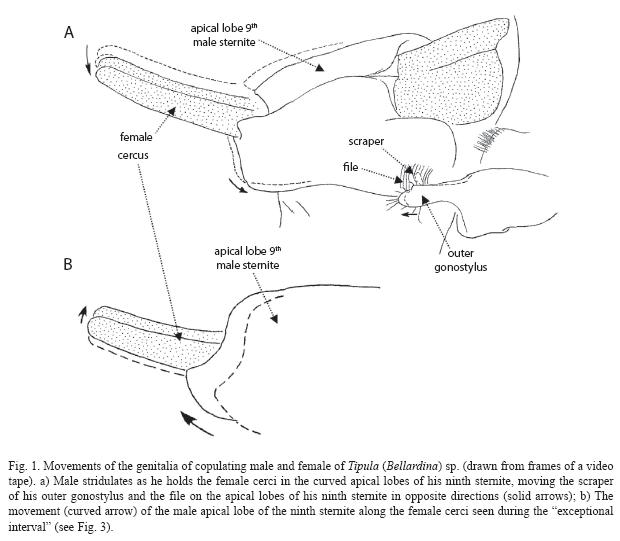
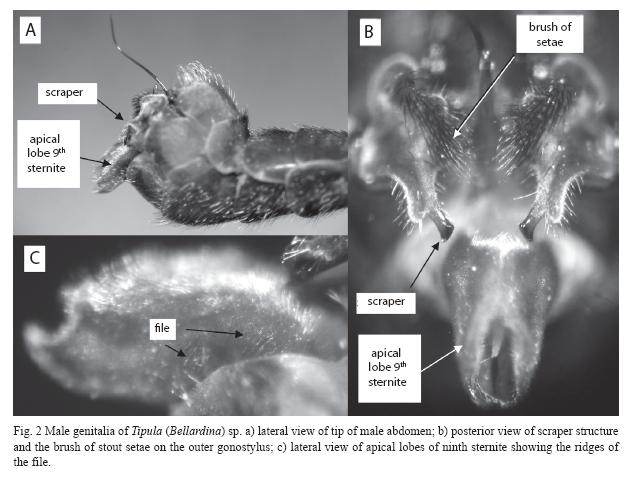
<body><![CDATA[<p class="MsoNormal"><b style=""><span lang="EN-US"  style="font-size: 11pt; font-family: Verdana;">Results<o:p></o:p></span></b></p>     <p class="MsoNormal"><span lang="EN-US"  style="font-size: 10pt; font-family: Verdana;"><o:p>&nbsp;</o:p></span></p>     <p class="MsoNormal"><span lang="EN-US"  style="font-size: 10pt; font-family: Verdana;">The female’s cerci were flexed sharply dorsally, and inserted through the cylinder formed by the male’s curved apical lobes of the ninth <span class="SpellE">sternite</span>; the tips of the female cerci protruded free in the air beyond (<a  href="#i1">Fig. 1</a>). For about 10-15min the pair was nearly completely immobile, except for one brief 2-3second <span class="GramE">burst<span style="">&nbsp; </span>of</span> rhythmic genital movements. Then, however, the male abruptly began to vibrate his genitalia in bursts, and continued to do so nearly continually for more than 10min (just over 8.5min were taped). Each vibration consisted of two movements: movements of his ninth <span class="SpellE">sternite</span> apical lobes (and thus of the female’s cerci which they held) (two curved arrows at left of <a href="#i1">Fig. 1A</a>); and a smaller, simultaneous movement of the outer <span class="SpellE">gonostylus</span> in approximately the opposite direction (arrow at right in <a href="#i1">Fig. 1A</a>). The female cerci shifted little if at all in the grip of the male ninth <span class="SpellE">sternite</span> apical lobes during these movements. <o:p></o:p></span></p>     <p class="MsoNormal"><span lang="EN-US"  style="font-size: 10pt; font-family: Verdana;"><o:p>&nbsp;</o:p></span></p>     <p class="MsoNormal"><span lang="EN-US"  style="font-size: 10pt; font-family: Verdana;">During each movement the tip of the strong, dark-tipped, flattened extension of the outer <span class="SpellE">gonostylus</span> (“scraper” in <a  href="#i1">Fig. 1A</a>, <a href="#i2">2B</a>) scraped across a striated region at the lateral base of the male apical lobes of the ninth <span class="SpellE">sternite</span> (“file” in <a href="#i1">Figs. 1A</a>, <a href="#i2"><st1:metricconverter productid="2C" w:st="on">2C</st1:metricconverter></a>). The scraper <span class="GramE">typically<span style="">&nbsp; </span>moved</span> across about four ridges of the file with each stroke (<a href="#i1">Fig. 1A</a>). The scraper was probably in contact with the file during these movements, as the setae on the more basal portion of the outer <span class="SpellE">gonostylus</span> were sometimes deflected by contact with the file during a scraping movement.    <br> </span></p>     <p class="MsoNormal"><span lang="EN-US"  style="font-size: 10pt; font-family: Verdana;">    <br> </span></p>     <div style="text-align: center;"><span lang="EN-US"  style="font-size: 10pt; font-family: Verdana;"><img  src="/img/revistas/rbt/v57s1/art21img1.jpg" title="" alt=""  style="width: 620px; height: 541px;"><a name="i1"></a>     <br>     ]]></body>
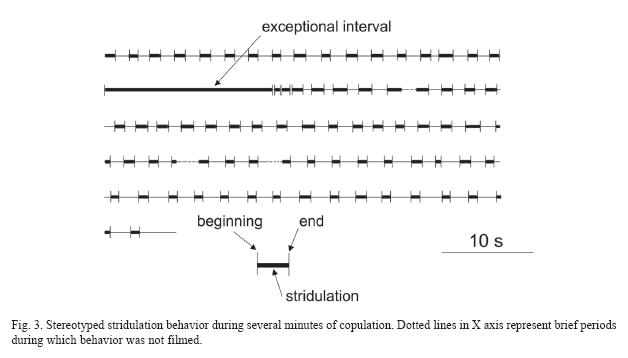
<body><![CDATA[<br>     <br> <img src="/img/revistas/rbt/v57s1/art21img2.jpg" title="" alt=""  style="width: 637px; height: 478px;"><a name="i2"></a><o:p></o:p></span></div>     <p class="MsoNormal"><span lang="EN-US"  style="font-size: 10pt; font-family: Verdana;"><o:p>&nbsp;</o:p></span></p>     <p class="MsoNormal"><span lang="EN-US"  style="font-size: 10pt; font-family: Verdana;">The rate of scrapes during a single burst of vibration was on the order of 15-30cycles/sec. The rhythm of bursts of scraping and pauses between them was very regular, except during one 33.9sec burst of scraping (<a href="#i3">Fig. 3</a>). During the regular phase, the duration of a burst averaged 2.02+0.39sec (N=83), and bursts were </span><span  class="GramE"><span lang="EN-US"  style="font-size: 10pt; font-family: Verdana;">separated</span></span><span  lang="EN-US" style="font-size: 10pt; font-family: Verdana;"> by pauses that averaged 2.91+0.90sec (N=79). During the exceptional 33.9sec interval, both the rhythm of bursts of scraping and the movements themselves changed. <span class="SpellE">Stridulatory</span> movements were nearly continuous, but an additional movement was imposed, in which the male’s ninth <span class="SpellE">sternite</span> apical lobes periodically slid distally along the female cerci and also moved slightly dorsally (<a href="#i1">Fig. 1B</a>), and then returned to the previous position. This movement was also very rhythmic, occurring on average once every 1.34+0.36sec.    <br> </span></p>     <p class="MsoNormal"><span lang="EN-US"  style="font-size: 10pt; font-family: Verdana;">    <br> </span></p>     <p class="MsoNormal" style="text-align: center;"><span lang="EN-US"  style="font-size: 10pt; font-family: Verdana;"><img  src="/img/revistas/rbt/v57s1/art21img3.jpg" title="" alt=""  style="width: 628px; height: 358px;"><a name="i3"></a>&nbsp;<o:p></o:p></span></p>     <p class="MsoNormal"><span lang="EN-US"  style="font-size: 10pt; font-family: Verdana;"><o:p>&nbsp;</o:p></span></p>     <p class="MsoNormal"><span lang="EN-US"  style="font-size: 10pt; font-family: Verdana;">The pair separated when an attempt <span class="GramE">was<span style="">&nbsp; </span>made</span> to flash-freeze them with ethyl chloride spray, and they were placed in 80% ethyl alcohol. Any lingering doubt that the rhythmic movements just described were due to movements of the male rather than of the female genitalia was dispelled by the fact that the male outer <span  class="SpellE">gonostyli</span> continued to execute the scraping movements in slow motion as the male expired.<o:p></o:p></span></p>     ]]></body>
<body><![CDATA[<p class="MsoNormal"><span lang="EN-US"  style="font-size: 10pt; font-family: Verdana;"><o:p>&nbsp;</o:p></span></p>     <p class="MsoNormal"><span lang="EN-US"  style="font-size: 10pt; font-family: Verdana;">Species identification: </span><span lang="EN-US" style="font-size: 10pt; font-family: Verdana;">The subgenus </span><span class="SpellE"><i><span lang="EN-US"  style="font-size: 10pt; font-family: Verdana;">Tipula</span></i></span><i><span  lang="EN-US" style="font-size: 10pt; font-family: Verdana;"> (<span  class="SpellE">Bellardina</span></span></i><span lang="EN-US"  style="font-size: 10pt; font-family: Verdana;">) is an entirely New World group of 15 species distributed from the Central and Southwestern USA to the central <st1:place w:st="on">Andes</st1:place> (<span class="SpellE">Oosterbroek</span> 2006); the aquatic larval stage is described in <span class="SpellE">Gelhaus</span> (1986) and <span class="SpellE">biogeographic</span> distribution is discussed by Contreras Ramos &amp; <span class="SpellE">Gelhaus</span> (2002). Although identification to subgenus can be made by keys (Alexander &amp; Byers 1981 for North America; <span class="SpellE">Gelhaus</span>, 2009, for Central America), the group is otherwise poorly known, with no keys or comprehensive reviews of species, and the identity of several described species is still uncertain. <span class="SpellE">Gelhaus</span> (2009<span class="GramE">),</span> provides a summary of knowledge for this group in Central America; there are no described species recorded for <st1:place w:st="on"><st1:country-region w:st="on">Costa Rica</st1:country-region></st1:place>. <o:p></o:p></span></p>     <p class="MsoNormal"><span lang="EN-US"  style="font-size: 10pt; font-family: Verdana;"><o:p>&nbsp;</o:p></span></p>     <p class="MsoNormal"><span lang="EN-US"  style="font-size: 10pt; font-family: Verdana;">One of us (JKG) attempted to identify the species whose behavior was observed using the literature, and specimens, including types, in the Alexander Collection of the Smithsonian Institution and in The Academy of Natural Sciences. At least four species occur in <st1:country-region w:st="on"><st1:place w:st="on">Costa Rica</st1:place></st1:country-region>, with none clearly matching any identified species in the material from the Smithsonian or Academy collections. Based on scraper and<o:p></o:p></span></p>     <p class="MsoNormal"><span class="GramE"><span lang="EN-US"  style="font-size: 10pt; font-family: Verdana;">file</span></span><span  lang="EN-US" style="font-size: 10pt; font-family: Verdana;"> morphology, three groups of species were identified:<o:p></o:p></span></p>     <p class="MsoNormal"><span lang="EN-US"  style="font-size: 10pt; font-family: Verdana;"><o:p>&nbsp;</o:p></span></p>     <p class="MsoNormal"><span class="GramE"><span lang="EN-US"  style="font-size: 10pt; font-family: Verdana;">The </span><i><span  lang="EN-US" style="font-size: 10pt; font-family: Verdana;">T</span></i><span  lang="EN-US" style="font-size: 10pt; font-family: Verdana;">. </span><span  class="SpellE"><i><span lang="EN-US"  style="font-size: 10pt; font-family: Verdana;">rupicola</span></i></span><i><span  lang="EN-US" style="font-size: 10pt; font-family: Verdana;"> </span></i><span  lang="EN-US" style="font-size: 10pt; font-family: Verdana;">species group including at least </span><i><span lang="EN-US"  style="font-size: 10pt; font-family: Verdana;">T. <span class="SpellE">cydippe</span> </span></i><span lang="EN-US"  style="font-size: 10pt; font-family: Verdana;">(<st1:country-region  w:st="on">Guatemala</st1:country-region>, <st1:country-region  w:st="on">Venezuela</st1:country-region>), </span><i><span lang="EN-US"  style="font-size: 10pt; font-family: Verdana;">T. <span class="SpellE">fuscolimbata</span> </span></i><span lang="EN-US"  style="font-size: 10pt; font-family: Verdana;">(<st1:country-region  w:st="on">Mexico</st1:country-region>), </span><i><span lang="EN-US"  style="font-size: 10pt; font-family: Verdana;">T. <span class="SpellE">larga</span> </span></i><span lang="EN-US"  style="font-size: 10pt; font-family: Verdana;">(<st1:country-region  w:st="on">Mexico</st1:country-region>), </span><i><span lang="EN-US"  style="font-size: 10pt; font-family: Verdana;">T. <span class="SpellE">rupicola</span> </span></i><span lang="EN-US"  style="font-size: 10pt; font-family: Verdana;">(<st1:state w:st="on">Arizona</st1:state>, <st1:country-region w:st="on">USA</st1:country-region>) and two <span  class="SpellE">undescribed</span> species from <st1:place w:st="on"><st1:country-region  w:st="on">Costa Rica</st1:country-region></st1:place>, including the Costa Rican specimens whose behavior is described here.</span></span><span  lang="EN-US" style="font-size: 10pt; font-family: Verdana;"> The male genitalia of these species all show the following traits. The apical lobe of the outer <span  class="SpellE">gonostylus</span> (scraper) in flat, of variable </span><span class="GramE"><span  lang="EN-US" style="font-size: 10pt; font-family: Verdana;">length</span></span><span  lang="EN-US" style="font-size: 10pt; font-family: Verdana;">, with a slightly expanded, darkened truncate to <span class="SpellE">spatulate</span> apex (<a href="#i2">Fig. 2b</a>). The <span class="SpellE">mesal</span> aspect of the outer <span class="SpellE">gonostylus</span> is expanded into a ridge near the base covered with a distinct brush of strong setae. The apical lobes of the ninth <span  class="SpellE">sternite</span> show distinct ridges on their outer surfaces at the base (<a href="#i2">Fig. 2c</a>); the number and height of the ridges is variable among the species. The species which is the subject of this paper is closest to </span><i><span  lang="EN-US" style="font-size: 10pt; font-family: Verdana;">T. <span  class="SpellE">rupicola</span></span></i><span lang="EN-US"  style="font-size: 10pt; font-family: Verdana;">, differing in minor details such as the lobe of the outer <span class="SpellE">gonostylus</span>.<o:p></o:p></span></p>     <p class="MsoNormal"><span lang="EN-US"  style="font-size: 10pt; font-family: Verdana;"><span style="">&nbsp;</span><o:p></o:p></span></p>     <p class="MsoNormal"><span lang="EN-US"  style="font-size: 10pt; font-family: Verdana;">The </span><i><span  lang="EN-US" style="font-size: 10pt; font-family: Verdana;">T. <span  class="SpellE">schizomera</span> </span></i><span lang="EN-US"  style="font-size: 10pt; font-family: Verdana;">species group including at least </span><i><span lang="EN-US"  style="font-size: 10pt; font-family: Verdana;">T. <span class="SpellE">flinti</span> </span></i><span lang="EN-US"  style="font-size: 10pt; font-family: Verdana;">(<st1:country-region  w:st="on">Mexico</st1:country-region>), </span><i><span lang="EN-US"  style="font-size: 10pt; font-family: Verdana;">T. <span class="SpellE">praeluta</span> </span></i><span lang="EN-US"  style="font-size: 10pt; font-family: Verdana;">(Southwest USA), </span><i><span  lang="EN-US" style="font-size: 10pt; font-family: Verdana;">T. <span  class="SpellE">pura</span> </span></i><span lang="EN-US"  style="font-size: 10pt; font-family: Verdana;">(Southern Rockies, <st1:country-region  w:st="on">USA</st1:country-region>), </span><i><span lang="EN-US"  style="font-size: 10pt; font-family: Verdana;">T. <span class="SpellE">schizomera</span> </span></i><span lang="EN-US"  style="font-size: 10pt; font-family: Verdana;">(Southwest USA to <st1:country-region  w:st="on">Mexico</st1:country-region>) and two <span class="SpellE">undescribed</span> species from <st1:country-region  w:st="on"><st1:place w:st="on">Costa Rica</st1:place></st1:country-region>. In the male genitalia of these species, the apical lobe of the outer <span  class="SpellE">gonostylus</span> (scraper) forms a strong, black, apical spine, often separated from an equally long fleshy lobe. The <span  class="SpellE">mesal</span> aspect of the outer <span class="SpellE">gonostylus</span> is not expanded into a ridge and lacks strong setae, although scattered hairs are sometimes present. The apical lobes of the ninth <span class="SpellE">sternite</span> lack distinct strong <span class="SpellE">striae</span> or ridges at the base, but have a roughened surface of fine bumps extending from <span class="SpellE">midlength</span> to near the apex, sometimes set </span><span class="GramE"><span  lang="EN-US" style="font-size: 10pt; font-family: Verdana;">in</span></span><span  lang="EN-US" style="font-size: 10pt; font-family: Verdana;"> a depressed region. <o:p></o:p></span></p>     <p class="MsoNormal"><span lang="EN-US"  style="font-size: 10pt; font-family: Verdana;"><o:p>&nbsp;</o:p></span></p>     ]]></body>
<body><![CDATA[<p class="MsoNormal"><span lang="EN-US"  style="font-size: 10pt; font-family: Verdana;">The </span><i><span  lang="EN-US" style="font-size: 10pt; font-family: Verdana;">T. <span  class="SpellE">theobromina</span> </span></i><span lang="EN-US"  style="font-size: 10pt; font-family: Verdana;">species group includes only this single species (distributed in the Central to <st1:place  w:st="on">Northern Andes</st1:place>). The male genitalia of this species are intermediate with respect to the above two groups. The apical lobe of the outer <span class="SpellE">gonostylus</span> (scraper) is flat, with a rounded, not expanded, darkened apex. The <span class="SpellE">mesal</span> aspect of the outer <span class="SpellE">gonostylus</span> is slightly expanded into a ridge, but has only scattered setae that are not concentrated in a distinct brush. The apical lobes of the ninth <span class="SpellE">sternite</span> lack distinct strong <span class="SpellE">striae</span> at the base, but show a set of very fine lines at <span class="SpellE">midlength</span> which are seen at high magnifications (400X) to be a roughened surface of fine bumps.<o:p></o:p></span></p>     <p class="MsoNormal"><span lang="EN-US"  style="font-size: 10pt; font-family: Verdana;"><o:p>&nbsp;</o:p></span></p>     <p class="MsoNormal"><b style=""><span lang="EN-US"  style="font-size: 11pt; font-family: Verdana;">Discussion<o:p></o:p></span></b></p>     <p class="MsoNormal"><span lang="EN-US"  style="font-size: 10pt; font-family: Verdana;"><o:p>&nbsp;</o:p></span></p>     <p class="MsoNormal"><span lang="EN-US"  style="font-size: 10pt; font-family: Verdana;">This is apparently the first direct observation of <span class="SpellE">stridulatory</span> behavior in male genitalia; previous examples of male genital <span  class="SpellE">stridulation</span> were based only on observations of apparent file and scraper morphology in dead specimens. Although the observation described here concerns only a single pair, the sustained and highly stereotyped movements that caused the process of the outer <span  class="SpellE">gonostylus</span> to scrape </span><span class="GramE"><span lang="EN-US"  style="font-size: 10pt; font-family: Verdana;">repeatedly</span></span><span  lang="EN-US" style="font-size: 10pt; font-family: Verdana;"> across the low, closely spaced ridges on the ninth <span class="SpellE">sternite</span> apical lobes, and the appropriate designs of these two <span  class="SpellE">genitalic</span> structures for <span class="SpellE">stridulation</span> leave little doubt that these portions of the male’s genitalia function to produce <span  class="SpellE">stridulation</span> during copulation. It seems reasonable to conclude that the function of this behavior and of these structures is to stimulate the female, because <span  class="SpellE">stridulation</span> behavior is ill-designed for any of the alternative functions that have been mentioned previously for genital movements, such as sensing the female, removing sperm, forcing open female passages, or penetrating more deeply.<o:p></o:p></span></p>     <p class="MsoNormal"><span lang="EN-US"  style="font-size: 10pt; font-family: Verdana;"><o:p>&nbsp;</o:p></span></p>     <p class="MsoNormal"><span lang="EN-US"  style="font-size: 10pt; font-family: Verdana;">An additional structure on the male genitalia of </span><i><span lang="EN-US"  style="font-size: 10pt; font-family: Verdana;">T</span></i><span  lang="EN-US" style="font-size: 10pt; font-family: Verdana;">. (</span><span  class="SpellE"><i><span lang="EN-US"  style="font-size: 10pt; font-family: Verdana;">Bellardina</span></i></span><span  lang="EN-US" style="font-size: 10pt; font-family: Verdana;">) sp. is the brush of robust pointed setae projecting medially from the male’s outer <span class="SpellE">gonostylus</span> (<a href="#i2">Fig. 2B</a>). These setae probably press on the female’s 10th segment pleural membranous area, just basal to her cerci during copulation, and the setae may scrape against the female during male <span class="SpellE">stridulatory</span> movements. These setae may thus constitute<o:p></o:p></span></p>     <p class="MsoNormal"><span class="GramE"><span lang="EN-US"  style="font-size: 10pt; font-family: Verdana;">a</span></span><span  lang="EN-US" style="font-size: 10pt; font-family: Verdana;"> second structure that produces <span class="SpellE">copulatory</span> stimulation of the female.<o:p></o:p></span></p>     <p class="MsoNormal"><span lang="EN-US"  style="font-size: 10pt; font-family: Verdana;"><o:p>&nbsp;</o:p></span></p>     <p class="MsoNormal"><span lang="EN-US"  style="font-size: 10pt; font-family: Verdana;">These behaviors are likely to occur in a number of other species related to the one studied here (see previous Identification section). The flat truncate scraper, strongly ridged file, and distinct brush of medially-directed setae all occur in at least five other species of </span><i><span lang="EN-US"  style="font-size: 10pt; font-family: Verdana;">T. (<span class="SpellE">Bellardina</span></span></i><span  lang="EN-US" style="font-size: 10pt; font-family: Verdana;">). In addition, in six other species of </span><i><span lang="EN-US"  style="font-size: 10pt; font-family: Verdana;">T. (<span class="SpellE">Bellardina</span></span></i><span  lang="EN-US" style="font-size: 10pt; font-family: Verdana;">), there is a spine-like “scraper” structure, and there is no “file” structure but instead a roughened or bumpy surface at <span class="SpellE">midlength</span> of the ninth <span  class="SpellE">sternite</span> apical lobes, indicating either a lack of <span class="SpellE">stridulation</span>, or possibly a different mechanism. These species also lack a brush of setae on the <span class="SpellE">mesal</span> aspect of the outer <span  class="SpellE">gonostylus</span>.<o:p></o:p></span></p>     ]]></body>
<body><![CDATA[<p class="MsoNormal"><span lang="EN-US"  style="font-size: 10pt; font-family: Verdana;"><o:p>&nbsp;</o:p></span></p>     <p class="MsoNormal"><span lang="EN-US"  style="font-size: 10pt; font-family: Verdana;">The evidence that favors a <span class="SpellE">stridulation</span> function for the male apical lobe of the ninth <span class="SpellE">sternite</span> (file) and outer <span class="SpellE">gonostylus</span> (scraper) of the species we studied also constitutes evidence against two other alternative hypotheses that have been proposed to explain the rapid divergent evolution of <span  class="SpellE">genitalic</span> structures, species isolation by lock and key (Shapiro &amp; Porter 1989), and sexually antagonistic <span class="SpellE">coevolution</span> (Chapman </span><i><span lang="EN-US"  style="font-size: 10pt; font-family: Verdana;">et al. </span></i><span  lang="EN-US" style="font-size: 10pt; font-family: Verdana;">2003, <span  class="SpellE">Arnqvist</span> &amp; Rowe 2005.) There is no female “lock” with which the <span  class="SpellE">stridulatory</span> structures mesh; and <span class="SpellE">stridulation</span> by the male exerts no appreciable coercive force on the female.<o:p></o:p></span></p>     <p class="MsoNormal"><span lang="EN-US"  style="font-size: 10pt; font-family: Verdana;"><o:p>&nbsp;</o:p></span></p>     <p class="MsoNormal"><b style=""><span lang="EN-US"  style="font-size: 11pt; font-family: Verdana;">Acknowledgments<o:p></o:p></span></b></p>     <p class="MsoNormal"><span lang="EN-US"  style="font-size: 10pt; font-family: Verdana;"><o:p>&nbsp;</o:p></span></p>     <p class="MsoNormal"><span lang="EN-US"  style="font-size: 10pt; font-family: Verdana;">We thank STRI and UCR for financial support to WGE. We thank Wayne Mathis, curator, and Holly Williams, collection manager, for the loan of specimens from the Alexander Collection of Crane Flies at the Smithsonian Institution.</span></p> <hr style="width: 100%; height: 2px;">     <p class="MsoNormal"><span lang="EN-US"  style="font-size: 10pt; font-family: Verdana;"><o:p></o:p></span></p>     <p class="MsoNormal"><span lang="EN-US"  style="font-size: 10pt; font-family: Verdana;"><o:p>&nbsp;</o:p></span></p>     <p class="MsoNormal"><b style=""><span  style="font-size: 10pt; font-family: Verdana;">Resumen<o:p></o:p></span></b></p>     <p class="MsoNormal"><span  style="font-size: 10pt; font-family: Verdana;"><o:p>&nbsp;</o:p></span></p>     ]]></body>
<body><![CDATA[<p class="MsoNormal"><span  style="font-size: 10pt; font-family: Verdana;">Un macho de </span><span  class="SpellE"><i><span style="font-size: 10pt; font-family: Verdana;">Tipula</span></i></span><i><span  style="font-size: 10pt; font-family: Verdana;"> </span></i><span  style="font-size: 10pt; font-family: Verdana;">(</span><span  class="SpellE"><i><span style="font-size: 10pt; font-family: Verdana;">Bellardina</span></i></span><span  style="font-size: 10pt; font-family: Verdana;">) <span class="SpellE">sp</span>. <span class="GramE">estriduló</span> (produjo vibraciones) por medio de movimientos estereotipados de estructuras de sus órganos genitales durante varios minutos de la cópula. Los machos de algunas especies relacionadas poseen estructuras similares, lo cual sugiere que también estridulan durante la cópula.<o:p></o:p></span></p>     <p class="MsoNormal"><span  style="font-size: 10pt; font-family: Verdana;"><o:p>&nbsp;</o:p></span></p>     <p class="MsoNormal"><b style=""><span  style="font-size: 10pt; font-family: Verdana;">Palabras clave:</span></b><span style="font-size: 10pt; font-family: Verdana;"> </span><span  style="font-size: 10pt; font-family: Verdana;">cortejo <span  class="SpellE">copulatorio</span>, evolución órganos sexuales, selección sexual, selección críptica en hembras, Costa Rica.</span></p> <hr style="width: 100%; height: 2px;">     <p class="MsoNormal"><span  style="font-size: 10pt; font-family: Verdana;"><o:p></o:p></span></p>     <p class="MsoNormal"><span lang="EN-US"  style="font-size: 10pt; font-family: Verdana;"><o:p>&nbsp;</o:p></span></p>     <p class="MsoNormal" align="center" style="text-align: center;"><span  class="GramE"><span lang="EN-US"  style="font-size: 10pt; font-family: Verdana;">Received 28-IX-2007.</span></span><span  lang="EN-US" style="font-size: 10pt; font-family: Verdana;"> <span  class="GramE">Corrected 05-VI-2009.</span> Accepted 28-VII-2009.<o:p></o:p></span></p>     <p class="MsoNormal"><span lang="EN-US"  style="font-size: 10pt; font-family: Verdana;"><o:p>&nbsp;</o:p></span></p>     <p class="MsoNormal"><b style=""><span lang="EN-US"  style="font-size: 11pt; font-family: Verdana;">References<o:p></o:p></span></b></p>     <p class="MsoNormal"><span lang="EN-US"  style="font-size: 10pt; font-family: Verdana;"><o:p>&nbsp;</o:p></span></p>     <!-- ref --><p class="MsoNormal"><span class="GramE"><span lang="EN-US"  style="font-size: 10pt; font-family: Verdana;">Alexander, C.P. &amp; G.W. Byers.</span></span><span lang="EN-US"  style="font-size: 10pt; font-family: Verdana;"> 1981. <span  class="SpellE">Tipulidae</span>, p. 153-<st1:metricconverter  productid="190. In" w:st="on">190. <span class="GramE"><i><span  style="">In</span></i></span></st1:metricconverter><span class="GramE"><i><span  style=""> </span></i>J.F. <span class="SpellE">McAlpine</span> <i><span style="">et al. </span></i>(eds.), Manual of <span class="SpellE">Nearctic</span> <span class="SpellE">Diptera</span>, Vol. 1.</span> Agriculture <st1:country-region  w:st="on"><st1:place w:st="on">Canada</st1:place></st1:country-region> Monographs No. 27.    &nbsp;&nbsp;&nbsp;&nbsp;&nbsp;&nbsp;&nbsp;&nbsp;[&#160;<a href="javascript:void(0);" onclick="javascript: window.open('/scielo.php?script=sci_nlinks&ref=1390511&pid=S0034-7744200900050002100001&lng=','','width=640,height=500,resizable=yes,scrollbars=1,menubar=yes,');">Links</a>&#160;]<!-- end-ref --><o:p></o:p></span></p>     <p class="MsoNormal"><span lang="EN-US"  style="font-size: 10pt; font-family: Verdana;"><o:p>&nbsp;</o:p></span></p>     <!-- ref --><p class="MsoNormal"><span class="SpellE"><span lang="EN-US"  style="font-size: 10pt; font-family: Verdana;">Arnqvist</span></span><span  lang="EN-US" style="font-size: 10pt; font-family: Verdana;">, G. &amp; L. Rowe. 2005. Sexual conflict. <span class="SpellE"><span  class="GramE">PrincetonUniversity</span></span><span class="GramE">, <st1:place  w:st="on"><st1:city w:st="on">Princeton</st1:city> <st1:state  w:st="on">New Jersey</st1:state>, <st1:country-region w:st="on">USA</st1:country-region></st1:place>.    &nbsp;&nbsp;&nbsp;&nbsp;&nbsp;&nbsp;&nbsp;&nbsp;[&#160;<a href="javascript:void(0);" onclick="javascript: window.open('/scielo.php?script=sci_nlinks&ref=1390514&pid=S0034-7744200900050002100002&lng=','','width=640,height=500,resizable=yes,scrollbars=1,menubar=yes,');">Links</a>&#160;]<!-- end-ref --></span><o:p></o:p></span></p>     <p class="MsoNormal"><span lang="EN-US"  style="font-size: 10pt; font-family: Verdana;"><o:p>&nbsp;</o:p></span></p>     <!-- ref --><p class="MsoNormal"><span class="GramE"><span lang="EN-US"  style="font-size: 10pt; font-family: Verdana;">Chapman, T., G. <span  class="SpellE">Arnqvist</span>, J. <span class="SpellE">Bangham</span>, &amp; L. Rowe.</span></span><span lang="EN-US"  style="font-size: 10pt; font-family: Verdana;"> 2003. Sexual conflict. <span class="GramE">Trends Ecol. <span class="SpellE">Evol</span>.</span> 18: 41-47.    &nbsp;&nbsp;&nbsp;&nbsp;&nbsp;&nbsp;&nbsp;&nbsp;[&#160;<a href="javascript:void(0);" onclick="javascript: window.open('/scielo.php?script=sci_nlinks&ref=1390517&pid=S0034-7744200900050002100003&lng=','','width=640,height=500,resizable=yes,scrollbars=1,menubar=yes,');">Links</a>&#160;]<!-- end-ref --><o:p></o:p></span></p>     <p class="MsoNormal"><span lang="PT-BR"  style="font-size: 10pt; font-family: Verdana;"><o:p>&nbsp;</o:p></span></p>     <!-- ref --><p class="MsoNormal"><span class="SpellE"><span lang="PT-BR"  style="font-size: 10pt; font-family: Verdana;">Contreras-Ramos</span></span><span  lang="PT-BR" style="font-size: 10pt; font-family: Verdana;">, A. &amp; J. <span class="SpellE">Gelhaus</span>. </span><span lang="EN-US"  style="font-size: 10pt; font-family: Verdana;">2002. <span  class="SpellE">Tipulidae</span> (<span class="SpellE">Diptera</span>), p. 583-<st1:metricconverter  productid="595. In" w:st="on">595. <i><span style="">In</span></i></st1:metricconverter><i><span  style=""> </span></i>J.L. <span class="SpellE">Bousquets</span>, &amp; J.J. <span class="SpellE">Morrone</span> (<span class="GramE">eds</span>.). </span><span style="font-size: 10pt; font-family: Verdana;">Biodiversidad, <span class="SpellE">taxonomia</span> y <span class="SpellE">biogeograiía</span> de artrópodos de México: Hacia una síntesis de su conocimiento. Vol. III. Universidad Nacional Autónoma México, <span class="SpellE">Mexico</span> D.F., <span  class="SpellE">Mexico</span>.    &nbsp;&nbsp;&nbsp;&nbsp;&nbsp;&nbsp;&nbsp;&nbsp;[&#160;<a href="javascript:void(0);" onclick="javascript: window.open('/scielo.php?script=sci_nlinks&ref=1390520&pid=S0034-7744200900050002100004&lng=','','width=640,height=500,resizable=yes,scrollbars=1,menubar=yes,');">Links</a>&#160;]<!-- end-ref --><o:p></o:p></span></p>     ]]></body>
<body><![CDATA[<p class="MsoNormal"><span lang="EN-US"  style="font-size: 10pt; font-family: Verdana;"><o:p>&nbsp;</o:p></span></p>     <!-- ref --><p class="MsoNormal"><span class="SpellE"><span lang="EN-US"  style="font-size: 10pt; font-family: Verdana;">Eberhard</span></span><span  lang="EN-US" style="font-size: 10pt; font-family: Verdana;">, W.G. 1985. <span class="GramE">Sexual selection and animal genitalia.</span> <st1:placename w:st="on"><span class="GramE">Harvard</span></st1:placename><span  class="GramE"> <st1:placetype w:st="on">University</st1:placetype>, <st1:place  w:st="on"><st1:city w:st="on">Cambridge</st1:city>, <st1:state  w:st="on">Massachusetts</st1:state>, <st1:country-region w:st="on">USA</st1:country-region></st1:place>.    &nbsp;&nbsp;&nbsp;&nbsp;&nbsp;&nbsp;&nbsp;&nbsp;[&#160;<a href="javascript:void(0);" onclick="javascript: window.open('/scielo.php?script=sci_nlinks&ref=1390523&pid=S0034-7744200900050002100005&lng=','','width=640,height=500,resizable=yes,scrollbars=1,menubar=yes,');">Links</a>&#160;]<!-- end-ref --></span><o:p></o:p></span></p>     <p class="MsoNormal"><span lang="EN-US"  style="font-size: 10pt; font-family: Verdana;"><o:p>&nbsp;</o:p></span></p>     <!-- ref --><p class="MsoNormal"><span class="SpellE"><span lang="EN-US"  style="font-size: 10pt; font-family: Verdana;">Eberhard</span></span><span  lang="EN-US" style="font-size: 10pt; font-family: Verdana;">, W.G. 1996. Female control: sexual selection by cryptic female choice. <st1:placename  w:st="on"><span class="GramE">Princeton</span></st1:placename><span  class="GramE"> <st1:placetype w:st="on">University</st1:placetype>, <st1:place  w:st="on"><st1:city w:st="on">Princeton</st1:city>, <st1:state  w:st="on"><span class="SpellE"><span lang="ES" style="">New</span></span><span  lang="ES" style=""> Jersey</span></st1:state><span lang="ES" style="">, <st1:country-region w:st="on">USA</st1:country-region></span></st1:place><span  lang="ES" style="">.    &nbsp;&nbsp;&nbsp;&nbsp;&nbsp;&nbsp;&nbsp;&nbsp;[&#160;<a href="javascript:void(0);" onclick="javascript: window.open('/scielo.php?script=sci_nlinks&ref=1390526&pid=S0034-7744200900050002100006&lng=','','width=640,height=500,resizable=yes,scrollbars=1,menubar=yes,');">Links</a>&#160;]<!-- end-ref --></span></span></span><span  style="font-size: 10pt; font-family: Verdana;"><o:p></o:p></span></p>     <p class="MsoNormal"><span lang="EN-US"  style="font-size: 10pt; font-family: Verdana;"><o:p>&nbsp;</o:p></span></p>     <!-- ref --><p class="MsoNormal"><span lang="EN-US"  style="font-size: 10pt; font-family: Verdana;">Forbes, W.T.M. 1941. Does he stridulate? </span><span  style="font-size: 10pt; font-family: Verdana;">(<span class="SpellE">Lepidoptera</span>: <span class="SpellE">Eupteroptidae</span>). Ent. <span class="SpellE">News</span> 52: 79-82.    &nbsp;&nbsp;&nbsp;&nbsp;&nbsp;&nbsp;&nbsp;&nbsp;[&#160;<a href="javascript:void(0);" onclick="javascript: window.open('/scielo.php?script=sci_nlinks&ref=1390529&pid=S0034-7744200900050002100007&lng=','','width=640,height=500,resizable=yes,scrollbars=1,menubar=yes,');">Links</a>&#160;]<!-- end-ref --><o:p></o:p></span></p>     <p class="MsoNormal"><span lang="EN-US"  style="font-size: 10pt; font-family: Verdana;"><o:p>&nbsp;</o:p></span></p>     ]]></body>
<body><![CDATA[<p class="MsoNormal"><span class="SpellE"><span lang="EN-US"  style="font-size: 10pt; font-family: Verdana;">Franclemont</span></span><span  lang="EN-US" style="font-size: 10pt; font-family: Verdana;">, J.C. 1973. <span class="GramE">The moths of America North of Mexico.</span> Fasc. <st1:metricconverter productid="20 pt" w:st="on">20 pt</st1:metricconverter>. 1: <span class="SpellE">Mimallonoidea</span> and <span class="SpellE">Bombycoidea</span></span><i><span  lang="EN-US" style="font-size: 10pt; font-family: Verdana;">.<o:p></o:p></span></i></p>     <p class="MsoNormal"><span lang="EN-US"  style="font-size: 10pt; font-family: Verdana;">E. W. <span  class="SpellE">Classey</span> Ltd. and R. B. D. Publishers<span  class="GramE">,<span style="">&nbsp; </span><st1:place w:st="on"><st1:city  w:st="on">London</st1:city>, <st1:country-region w:st="on">England</st1:country-region></st1:place>. </span><o:p></o:p></span></p>     <p class="MsoNormal"><span lang="EN-US"  style="font-size: 10pt; font-family: Verdana;"><o:p>&nbsp;</o:p></span></p>     <!-- ref --><p class="MsoNormal"><span class="SpellE"><span lang="EN-US"  style="font-size: 10pt; font-family: Verdana;">Gelhaus</span></span><span  lang="EN-US" style="font-size: 10pt; font-family: Verdana;">, J.K. 1986. Larvae of the crane fly genus </span><span class="SpellE"><i><span  lang="EN-US" style="font-size: 10pt; font-family: Verdana;">Tipula</span></i></span><i><span  lang="EN-US" style="font-size: 10pt; font-family: Verdana;"> </span></i><span  lang="EN-US" style="font-size: 10pt; font-family: Verdana;">in <st1:place  w:st="on">North America</st1:place> (<span class="SpellE">Diptera</span>: <span class="SpellE">Tipulidae</span></span><i><span lang="EN-US"  style="font-size: 10pt; font-family: Verdana;">). </span></i><span  class="GramE"><span lang="EN-US"  style="font-size: 10pt; font-family: Verdana;">Univ. <st1:place  w:st="on"><st1:state w:st="on">Kansas</st1:state></st1:place> <span  class="SpellE">Scien</span>.</span></span><span lang="EN-US"  style="font-size: 10pt; font-family: Verdana;"> Bull. 53: 121-182.    &nbsp;&nbsp;&nbsp;&nbsp;&nbsp;&nbsp;&nbsp;&nbsp;[&#160;<a href="javascript:void(0);" onclick="javascript: window.open('/scielo.php?script=sci_nlinks&ref=1390535&pid=S0034-7744200900050002100009&lng=','','width=640,height=500,resizable=yes,scrollbars=1,menubar=yes,');">Links</a>&#160;]<!-- end-ref --><o:p></o:p></span></p>     <p class="MsoNormal"><span lang="EN-US"  style="font-size: 10pt; font-family: Verdana;"><o:p>&nbsp;</o:p></span></p>     <!-- ref --><p class="MsoNormal"><span class="SpellE"><span class="GramE"><span  lang="EN-US" style="font-size: 10pt; font-family: Verdana;">Gelhaus</span></span></span><span  class="GramE"><span lang="EN-US"  style="font-size: 10pt; font-family: Verdana;">, J.K. 2009.</span></span><span  lang="EN-US" style="font-size: 10pt; font-family: Verdana;"> <span  class="SpellE"><span class="GramE">Tipulidae</span></span><span  class="GramE"> (Crane flies, <span class="SpellE">Tipulidos</span>), Chapter 8, pp. 193-<st1:metricconverter productid="236. In" w:st="on">236. <i><span style="">In</span></i></st1:metricconverter><i><span style=""> </span></i></span>Brown, B.V. </span><i><span lang="EN-US"  style="font-size: 10pt; font-family: Verdana;">et al. </span></i><span  lang="EN-US" style="font-size: 10pt; font-family: Verdana;">(eds.), Manual of Central American <span class="SpellE">Diptera</span>: Volume 1. NRC Research Press, <st1:place w:st="on"><st1:city w:st="on">Ottawa</st1:city>, <st1:state w:st="on">Ontario</st1:state>, <st1:country-region w:st="on">Canada</st1:country-region></st1:place>.    &nbsp;&nbsp;&nbsp;&nbsp;&nbsp;&nbsp;&nbsp;&nbsp;[&#160;<a href="javascript:void(0);" onclick="javascript: window.open('/scielo.php?script=sci_nlinks&ref=1390538&pid=S0034-7744200900050002100010&lng=','','width=640,height=500,resizable=yes,scrollbars=1,menubar=yes,');">Links</a>&#160;]<!-- end-ref --><o:p></o:p></span></p>     <p class="MsoNormal"><span lang="EN-US"  style="font-size: 10pt; font-family: Verdana;"><o:p>&nbsp;</o:p></span></p>     <!-- ref --><p class="MsoNormal"><span lang="EN-US"  style="font-size: 10pt; font-family: Verdana;">Gwynne, D.T. &amp; E.D. Edwards. 1986. Ultrasound production by genital <span  class="SpellE">stridulation</span> in </span><span class="SpellE"><i><span lang="EN-US"  style="font-size: 10pt; font-family: Verdana;">Syntonarcha</span></i></span><i><span  lang="EN-US" style="font-size: 10pt; font-family: Verdana;"> <span  class="SpellE">iriastis</span> </span></i><span lang="EN-US"  style="font-size: 10pt; font-family: Verdana;">(Lepidoptera: <span  class="SpellE">Pyralidae</span>): long-distance signaling by male moths? Zool. J. Linn. Soc. 88: 363-376.    &nbsp;&nbsp;&nbsp;&nbsp;&nbsp;&nbsp;&nbsp;&nbsp;[&#160;<a href="javascript:void(0);" onclick="javascript: window.open('/scielo.php?script=sci_nlinks&ref=1390541&pid=S0034-7744200900050002100011&lng=','','width=640,height=500,resizable=yes,scrollbars=1,menubar=yes,');">Links</a>&#160;]<!-- end-ref --><o:p></o:p></span></p>     <p class="MsoNormal"><span lang="EN-US"  style="font-size: 10pt; font-family: Verdana;"><o:p>&nbsp;</o:p></span></p>     <!-- ref --><p class="MsoNormal"><span lang="EN-US"  style="font-size: 10pt; font-family: Verdana;">Richards, O.W. 1978. <span class="GramE">The social wasps of the <st1:place w:st="on"><st1:country-region  w:st="on">Americas</st1:country-region></st1:place>.</span> <st1:placename  w:st="on">British</st1:placename> <st1:placetype w:st="on">Museum</st1:placetype> (Natural History), <st1:place w:st="on"><st1:city w:st="on">London</st1:city>, <st1:country-region w:st="on">England</st1:country-region></st1:place>.    &nbsp;&nbsp;&nbsp;&nbsp;&nbsp;&nbsp;&nbsp;&nbsp;[&#160;<a href="javascript:void(0);" onclick="javascript: window.open('/scielo.php?script=sci_nlinks&ref=1390544&pid=S0034-7744200900050002100012&lng=','','width=640,height=500,resizable=yes,scrollbars=1,menubar=yes,');">Links</a>&#160;]<!-- end-ref --><o:p></o:p></span></p>     <p class="MsoNormal"><span lang="EN-US"  style="font-size: 10pt; font-family: Verdana;"><o:p>&nbsp;</o:p></span></p>     <p class="MsoNormal"><span lang="EN-US"  style="font-size: 10pt; font-family: Verdana;">Shapiro, A.M. &amp; A.H. Porter. 1989. The lock-and-key hypothesis. Evolutionary and <span  class="SpellE">biosystematic</span> interpretations<o:p></o:p></span></p>     <p class="MsoNormal"><span class="GramE"><span lang="EN-US"  style="font-size: 10pt; font-family: Verdana;">of</span></span><span  lang="EN-US" style="font-size: 10pt; font-family: Verdana;"> insect genitalia. Ann. Rev. <span class="SpellE">Entomol</span>. 34: 231-245.<o:p></o:p></span></p>     <p class="MsoNormal"><span lang="EN-US"  style="font-size: 10pt; font-family: Verdana;"><o:p>&nbsp;</o:p></span></p>     <p class="MsoNormal"><span class="SpellE"><span lang="EN-US"  style="font-size: 10pt; font-family: Verdana;">Waage</span></span><span  lang="EN-US" style="font-size: 10pt; font-family: Verdana;">, J. 1984. <span class="GramE">Sperm competition and the evolution of <span  class="SpellE">odonate</span> mating systems.</span> p. 251-<st1:metricconverter  productid="290 In" w:st="on">290 <span class="GramE"><i><span style="">In</span></i></span></st1:metricconverter></span><i><span  lang="EN-US" style="font-size: 10pt; font-family: Verdana;"> </span></i><span  lang="EN-US" style="font-size: 10pt; font-family: Verdana;">R.E. Smith<o:p></o:p></span></p>     <p class="MsoNormal"><span lang="EN-US"  style="font-size: 10pt; font-family: Verdana;">(<span class="GramE">ed</span>.) <span class="GramE">Sperm competition and the evolution of animal mating systems.</span> <st1:place w:st="on"><st1:city  w:st="on">Academic</st1:city>, <st1:state w:st="on">New York</st1:state>, <st1:country-region w:st="on">USA</st1:country-region></st1:place>.<o:p></o:p></span></p>     ]]></body>
<body><![CDATA[<p class="MsoNormal"><span lang="EN-US"  style="font-size: 10pt; font-family: Verdana;"><o:p>&nbsp;</o:p></span></p>     <p class="MsoNormal"><b style=""><span lang="EN-US"  style="font-size: 11pt; font-family: Verdana;">Internet References<o:p></o:p></span></b></p>     <p class="MsoNormal"><span lang="EN-US"  style="font-size: 10pt; font-family: Verdana;"><o:p>&nbsp;</o:p></span></p>     <!-- ref --><p class="MsoNormal"><span class="SpellE"><span lang="EN-US"  style="font-size: 10pt; font-family: Verdana;">Oosterbroek</span></span><span  lang="EN-US" style="font-size: 10pt; font-family: Verdana;">, P. 2006. <span class="GramE">Catalogue of the Crane flies of the World (CCW).</span> (http://ip30.eti.uva.nl/ccw/)</span><span lang="EN-US"  style="font-size: 10pt;    &nbsp;&nbsp;&nbsp;&nbsp;&nbsp;&nbsp;&nbsp;&nbsp;[&#160;<a href="javascript:void(0);" onclick="javascript: window.open('/scielo.php?script=sci_nlinks&ref=1390555&pid=S0034-7744200900050002100015&lng=','','width=640,height=500,resizable=yes,scrollbars=1,menubar=yes,');">Links</a>&#160;]<!-- end-ref --> font-family: Verdana;"><o:p></o:p></span></p> </div>      ]]></body><back>
<ref-list>
<ref id="B1">
<nlm-citation citation-type="">
<person-group person-group-type="author">
<name>
<surname><![CDATA[Alexander]]></surname>
<given-names><![CDATA[C.P]]></given-names>
</name>
<name>
<surname><![CDATA[Byers]]></surname>
<given-names><![CDATA[G.W]]></given-names>
</name>
</person-group>
<article-title xml:lang="es"><![CDATA[Tipulidae]]></article-title>
<person-group person-group-type="editor">
<name>
<surname><![CDATA[McAlpine]]></surname>
<given-names><![CDATA[J.F]]></given-names>
</name>
</person-group>
<source><![CDATA[Manual of Nearctic Diptera]]></source>
<year>1981</year>
<volume>1</volume>
<page-range>153-190</page-range></nlm-citation>
</ref>
<ref id="B2">
<nlm-citation citation-type="book">
<person-group person-group-type="author">
<name>
<surname><![CDATA[Arnqvist]]></surname>
<given-names><![CDATA[G]]></given-names>
</name>
<name>
<surname><![CDATA[Rowe]]></surname>
<given-names><![CDATA[L]]></given-names>
</name>
</person-group>
<source><![CDATA[Sexual conflict]]></source>
<year>2005</year>
<publisher-loc><![CDATA[Princeton New Jersey ]]></publisher-loc>
<publisher-name><![CDATA[PrincetonUniversity]]></publisher-name>
</nlm-citation>
</ref>
<ref id="B3">
<nlm-citation citation-type="journal">
<person-group person-group-type="author">
<name>
<surname><![CDATA[Chapman]]></surname>
<given-names><![CDATA[T]]></given-names>
</name>
<name>
<surname><![CDATA[Arnqvist]]></surname>
<given-names><![CDATA[G]]></given-names>
</name>
<name>
<surname><![CDATA[Bangham]]></surname>
<given-names><![CDATA[J]]></given-names>
</name>
<name>
<surname><![CDATA[Rowe]]></surname>
<given-names><![CDATA[L]]></given-names>
</name>
</person-group>
<article-title xml:lang="en"><![CDATA[Sexual conflict]]></article-title>
<source><![CDATA[Trends Ecol. Evol]]></source>
<year>2003</year>
<volume>18</volume>
<page-range>41-47</page-range></nlm-citation>
</ref>
<ref id="B4">
<nlm-citation citation-type="book">
<person-group person-group-type="author">
<name>
<surname><![CDATA[Contreras-Ramos]]></surname>
<given-names><![CDATA[A]]></given-names>
</name>
<name>
<surname><![CDATA[Gelhaus]]></surname>
<given-names><![CDATA[J]]></given-names>
</name>
</person-group>
<article-title xml:lang="en"><![CDATA[Tipulidae (Diptera)]]></article-title>
<person-group person-group-type="editor">
<name>
<surname><![CDATA[Bousquets]]></surname>
<given-names><![CDATA[J.L]]></given-names>
</name>
<name>
<surname><![CDATA[Morrone]]></surname>
<given-names><![CDATA[J.J]]></given-names>
</name>
</person-group>
<source><![CDATA[Biodiversidad, taxonomia y biogeograiía de artrópodos de México: Hacia una síntesis de su conocimiento. Vol. III.]]></source>
<year>2002</year>
<page-range>583-595</page-range><publisher-loc><![CDATA[Mexico D.F. ]]></publisher-loc>
<publisher-name><![CDATA[Universidad Nacional Autónoma México]]></publisher-name>
</nlm-citation>
</ref>
<ref id="B5">
<nlm-citation citation-type="book">
<person-group person-group-type="author">
<name>
<surname><![CDATA[Eberhard]]></surname>
<given-names><![CDATA[W.G]]></given-names>
</name>
</person-group>
<source><![CDATA[Sexual selection and animal genitalia]]></source>
<year>1985</year>
<publisher-loc><![CDATA[Cambridge ]]></publisher-loc>
<publisher-name><![CDATA[Harvard University]]></publisher-name>
</nlm-citation>
</ref>
<ref id="B6">
<nlm-citation citation-type="book">
<person-group person-group-type="author">
<name>
<surname><![CDATA[Eberhard]]></surname>
<given-names><![CDATA[W.G]]></given-names>
</name>
</person-group>
<source><![CDATA[Female control: sexual selection by cryptic female choice]]></source>
<year>1996</year>
<publisher-loc><![CDATA[Princeton ]]></publisher-loc>
<publisher-name><![CDATA[Princeton UniversityUSA]]></publisher-name>
</nlm-citation>
</ref>
<ref id="B7">
<nlm-citation citation-type="journal">
<person-group person-group-type="author">
<name>
<surname><![CDATA[Forbes]]></surname>
<given-names><![CDATA[W.T.M]]></given-names>
</name>
</person-group>
<article-title xml:lang="en"><![CDATA[Does he stridulate? (Lepidoptera: Eupteroptidae)]]></article-title>
<source><![CDATA[Ent. News]]></source>
<year>1941</year>
<volume>52</volume>
<page-range>79-82</page-range></nlm-citation>
</ref>
<ref id="B8">
<nlm-citation citation-type="book">
<person-group person-group-type="author">
<name>
<surname><![CDATA[Franclemont]]></surname>
<given-names><![CDATA[J.C]]></given-names>
</name>
</person-group>
<source><![CDATA[The moths of America North of Mexico]]></source>
<year>1973</year>
<publisher-loc><![CDATA[London ]]></publisher-loc>
<publisher-name><![CDATA[Mimallonoidea and Bombycoidea. E. W. Classey Ltd. and R. B. D. Publishers]]></publisher-name>
</nlm-citation>
</ref>
<ref id="B9">
<nlm-citation citation-type="journal">
<person-group person-group-type="author">
<name>
<surname><![CDATA[Gelhaus]]></surname>
<given-names><![CDATA[J.K]]></given-names>
</name>
</person-group>
<article-title xml:lang="en"><![CDATA[Larvae of the crane fly genus Tipula in North America (Diptera: Tipulidae). Univ. Kansas Scien]]></article-title>
<source><![CDATA[Bull]]></source>
<year>1986</year>
<volume>53</volume>
<page-range>121-182</page-range></nlm-citation>
</ref>
<ref id="B10">
<nlm-citation citation-type="book">
<person-group person-group-type="author">
<name>
<surname><![CDATA[Gelhaus]]></surname>
<given-names><![CDATA[J.K]]></given-names>
</name>
</person-group>
<article-title xml:lang="en"><![CDATA[Tipulidae (Crane flies, Tipulidos), Chapter 8]]></article-title>
<person-group person-group-type="editor">
<name>
<surname><![CDATA[Brown]]></surname>
<given-names><![CDATA[B.V]]></given-names>
</name>
</person-group>
<source><![CDATA[Manual of Central American Diptera]]></source>
<year>2009</year>
<page-range>193-236</page-range><publisher-loc><![CDATA[Ottawa ]]></publisher-loc>
<publisher-name><![CDATA[NRC Research PressCanada]]></publisher-name>
</nlm-citation>
</ref>
<ref id="B11">
<nlm-citation citation-type="journal">
<person-group person-group-type="author">
<name>
<surname><![CDATA[Gwynne]]></surname>
<given-names><![CDATA[D.T]]></given-names>
</name>
<name>
<surname><![CDATA[Edwards]]></surname>
<given-names><![CDATA[E.D]]></given-names>
</name>
</person-group>
<article-title xml:lang="en"><![CDATA[Ultrasound production by genital stridulation in Syntonarcha iriastis (Lepidoptera: Pyralidae): long-distance signaling by male moths?]]></article-title>
<source><![CDATA[Zool. J. Linn. Soc]]></source>
<year>1986</year>
<volume>88</volume>
<page-range>363-376</page-range></nlm-citation>
</ref>
<ref id="B12">
<nlm-citation citation-type="book">
<person-group person-group-type="author">
<name>
<surname><![CDATA[Richards]]></surname>
<given-names><![CDATA[O.W]]></given-names>
</name>
</person-group>
<source><![CDATA[The social wasps of the Americas]]></source>
<year>1978</year>
<publisher-loc><![CDATA[London ]]></publisher-loc>
<publisher-name><![CDATA[British Museum (Natural History)]]></publisher-name>
</nlm-citation>
</ref>
<ref id="B13">
<nlm-citation citation-type="journal">
<person-group person-group-type="author">
<name>
<surname><![CDATA[Shapiro]]></surname>
<given-names><![CDATA[A.M]]></given-names>
</name>
<name>
<surname><![CDATA[Porter]]></surname>
<given-names><![CDATA[A.H]]></given-names>
</name>
</person-group>
<article-title xml:lang="en"><![CDATA[The lock-and-key hypothesis. Evolutionary and biosystematic interpretations of insect genitalia]]></article-title>
<source><![CDATA[Ann. Rev. Entomol]]></source>
<year>1989</year>
<volume>34</volume>
<page-range>231-245</page-range></nlm-citation>
</ref>
<ref id="B14">
<nlm-citation citation-type="book">
<person-group person-group-type="author">
<name>
<surname><![CDATA[Waage]]></surname>
<given-names><![CDATA[J]]></given-names>
</name>
</person-group>
<article-title xml:lang="en"><![CDATA[Sperm competition and the evolution of odonate mating systems]]></article-title>
<person-group person-group-type="editor">
<name>
<surname><![CDATA[Smith]]></surname>
<given-names><![CDATA[R.E]]></given-names>
</name>
</person-group>
<source><![CDATA[Sperm competition and the evolution of animal mating systems]]></source>
<year>1984</year>
<page-range>251-290</page-range><publisher-loc><![CDATA[New York ]]></publisher-loc>
<publisher-name><![CDATA[Academic]]></publisher-name>
</nlm-citation>
</ref>
<ref id="B15">
<nlm-citation citation-type="">
<person-group person-group-type="author">
<name>
<surname><![CDATA[Oosterbroek]]></surname>
<given-names><![CDATA[P]]></given-names>
</name>
</person-group>
<source><![CDATA[Catalogue of the Crane flies of the World (CCW)]]></source>
<year>2006</year>
</nlm-citation>
</ref>
</ref-list>
</back>
</article>