<?xml version="1.0" encoding="ISO-8859-1"?><article xmlns:mml="http://www.w3.org/1998/Math/MathML" xmlns:xlink="http://www.w3.org/1999/xlink" xmlns:xsi="http://www.w3.org/2001/XMLSchema-instance">
<front>
<journal-meta>
<journal-id>0034-7744</journal-id>
<journal-title><![CDATA[Revista de Biología Tropical]]></journal-title>
<abbrev-journal-title><![CDATA[Rev. biol. trop]]></abbrev-journal-title>
<issn>0034-7744</issn>
<publisher>
<publisher-name><![CDATA[Universidad de Costa Rica]]></publisher-name>
</publisher>
</journal-meta>
<article-meta>
<article-id>S0034-77442009000500014</article-id>
<title-group>
<article-title xml:lang="en"><![CDATA[Optimization of coffee (Coffea arabica) transformation parameters using uidA and hpt genes: effect of osmotic pre-treatment, helium pressure and target distance]]></article-title>
</title-group>
<contrib-group>
<contrib contrib-type="author">
<name>
<surname><![CDATA[Gatica]]></surname>
<given-names><![CDATA[Andrés M]]></given-names>
</name>
<xref ref-type="aff" rid="A01"/>
</contrib>
<contrib contrib-type="author">
<name>
<surname><![CDATA[Arrieta]]></surname>
<given-names><![CDATA[Griselda]]></given-names>
</name>
<xref ref-type="aff" rid="A01"/>
</contrib>
<contrib contrib-type="author">
<name>
<surname><![CDATA[Espinoza]]></surname>
<given-names><![CDATA[Ana M]]></given-names>
</name>
<xref ref-type="aff" rid="A03"/>
</contrib>
</contrib-group>
<aff id="A01">
<institution><![CDATA[,Universidad de Costa Rica Centro de Investigación en Biología Celular y Molecular ]]></institution>
<addr-line><![CDATA[San José ]]></addr-line>
<country>Costa Rica</country>
</aff>
<aff id="A02">
<institution><![CDATA[,Universidad de Costa Rica Escuela de Biología ]]></institution>
<addr-line><![CDATA[San José ]]></addr-line>
<country>Costa Rica</country>
</aff>
<aff id="A03">
<institution><![CDATA[,Universidad de Costa Rica Facultad de Ciencias Agroalimentarias Escuela de Agronomía]]></institution>
<addr-line><![CDATA[San José ]]></addr-line>
<country>Costa Rica</country>
</aff>
<pub-date pub-type="pub">
<day>00</day>
<month>11</month>
<year>2009</year>
</pub-date>
<pub-date pub-type="epub">
<day>00</day>
<month>11</month>
<year>2009</year>
</pub-date>
<volume>57</volume>
<fpage>151</fpage>
<lpage>160</lpage>
<copyright-statement/>
<copyright-year/>
<self-uri xlink:href="http://www.scielo.sa.cr/scielo.php?script=sci_arttext&amp;pid=S0034-77442009000500014&amp;lng=en&amp;nrm=iso"></self-uri><self-uri xlink:href="http://www.scielo.sa.cr/scielo.php?script=sci_abstract&amp;pid=S0034-77442009000500014&amp;lng=en&amp;nrm=iso"></self-uri><self-uri xlink:href="http://www.scielo.sa.cr/scielo.php?script=sci_pdf&amp;pid=S0034-77442009000500014&amp;lng=en&amp;nrm=iso"></self-uri><abstract abstract-type="short" xml:lang="en"><p><![CDATA[The aim of this work was to optimize the biolistic delivery parameters that affect the DNA delivery and stable expression of marker genes into coffee tissues (Coffea arabica. L. cvs. Caturra and Catuaí). The effect of osmotic preculture length, osmotic concentration of medium, Helium pressure and target distance on transient expression of the uidA gene in coffee leaves and somatic embryos were tested. The highest transient uidA expression was obtained when Caturra (18.3±2.8) and Catuaí (6.8±2.0) leaves and Catuaí embryos (80.0±7.4) were cultured for 5h on Yasuda medium complemented with 0.5M Mannitol +0.5M Sorbitol. The combination of 1100psi and a target distance of 9cm resulted in the highest number of blue spots per Caturra leaf segment (23.6±3.9), whereas for the Catuaí variety the combination of 1100psi and a target distance of six (10.2±1.9) and nine (8.2±1.9) cm gave the highest number of blue spots per leaf segment. The optimized protocol was tested with pCAMBIA 1 301 (uidA gene and the hpt gene), pCAMBIA 1 305.2 (uidA version GUSPlus ™ and the hpt gene) and pCAMBIA 1 301-BAR (uidA gene and the bar gene). The highest number of blue spots was obtained when Caturra (54.6±5.7) and Catuaí (28.9±4.3) leaves were bombarded with pCAMBIA 1 305.2. Selection of bombarded coffee tissues with 100mg/l hygromicyn caused the oxidation of tissues. Rev. Biol. Trop. 57 (Suppl. 1): 151-160. Epub 2009 November 30.]]></p></abstract>
<abstract abstract-type="short" xml:lang="es"><p><![CDATA[La presente investigación tuvo como objetivo optimizar los parámetros que afectan la incorporación y expresión de genes marcadores mediante biobalística en segmentos de hoja y embriones somáticos de café (Coffea arabica. L. cvs. Caturra y Catuaí). La mayor expresión transitoria del gen uidA en segmentos de hoja de Caturra (18.3±2.8) y Catuaí (6.8±2.0) y embriones somáticos de Catuaí (80.0±7.4) se obtuvo al cultivar los explantes por cinco horas previo al bombardeo en el medio Yasuda complementado con 0.5M mannitol+0.5M sorbitol. Asimismo, se obtuvo una mayor expresión transitoria del gen uidA al bombardear los segmentos de hoja de Caturra y Catuaí y embriones somáticos de Catuaí con una presión de helio de 1 100psi y una distancia de bombardeo de 6 o 9 cm.]]></p></abstract>
<kwd-group>
<kwd lng="en"><![CDATA[Coffea arabica]]></kwd>
<kwd lng="en"><![CDATA[Caturra]]></kwd>
<kwd lng="en"><![CDATA[Catuaí]]></kwd>
<kwd lng="en"><![CDATA[biolistic delivery]]></kwd>
<kwd lng="en"><![CDATA[osmotic treatment]]></kwd>
<kwd lng="en"><![CDATA[uidA]]></kwd>
<kwd lng="en"><![CDATA[GUSPlus™]]></kwd>
<kwd lng="en"><![CDATA[bar]]></kwd>
<kwd lng="en"><![CDATA[hpt]]></kwd>
<kwd lng="en"><![CDATA[nptII]]></kwd>
<kwd lng="en"><![CDATA[Costa Rica]]></kwd>
<kwd lng="es"><![CDATA[Caturra]]></kwd>
<kwd lng="es"><![CDATA[Catuaí]]></kwd>
<kwd lng="es"><![CDATA[biobalística]]></kwd>
<kwd lng="es"><![CDATA[tratamiento osmótico]]></kwd>
<kwd lng="es"><![CDATA[uidA]]></kwd>
<kwd lng="es"><![CDATA[GUSPlus™]]></kwd>
<kwd lng="es"><![CDATA[bar]]></kwd>
<kwd lng="es"><![CDATA[hpt]]></kwd>
<kwd lng="es"><![CDATA[nptII]]></kwd>
<kwd lng="es"><![CDATA[Costa Rica]]></kwd>
</kwd-group>
</article-meta>
</front><body><![CDATA[  <font face="Verdana" size="4">     <p> </p> </font>     <p align="center"><font face="Verdana"><span style="font-weight: bold;">Optimization of coffee</span> (<i>Coffea arabica</i><b>) transformation parameters using <i>uidA </i>and <i>hpt </i>genes: effect of osmotic pre-treatment, helium pressure and target distance</b></font></p>     <p><b><font face="Verdana" size="2"> </font></b></p>     <p><b><font face="Verdana" size="2">Andrés M. Gatica<sup>1, 2</sup>, Griselda Arrieta<sup>1 </sup>&amp; Ana M. Espinoza<sup>1, 3 </sup></font></b></p>     <p><font face="Verdana" size="2">1. Centro de Investigación en Biología Celular y Molecular (CIBCM), Universidad de Costa Rica, 11501-2060, San José, Costa Rica; <a href="mailto:agatica@biologia.ucr.ac.cr">agatica@biologia.ucr.ac.cr</a>; <a href="mailto:andresgat@gmail.com">andresgat@gmail.com</a> </font></p>     <p><font face="Verdana" size="2">2. Dirección actual: Escuela de Biología, Universidad de Costa Rica, 2060 San José, Costa Rica. </font></p>     <p><font face="Verdana" size="2">3. Escuela de Agronomía, Facultad de Ciencias Agroalimentarias, Universidad de Costa Rica, 11501-2060, San José, Costa Rica.</font></p> <hr style="width: 100%; height: 2px;">     <p><font face="Verdana" size="2"> </font></p>     <p><font face="Verdana" size="2"><b>Abstract: </b>The aim of this work was to optimize the biolistic delivery parameters that affect the DNA delivery and stable expression of marker genes into coffee tissues (<i>Coffea arabica</i>. L. cvs. Caturra and Catuaí). The effect of osmotic preculture length, osmotic concentration of medium, Helium pressure and target distance on transient expression of the <i>uidA </i>gene in coffee leaves and somatic embryos were tested. The highest transient <i>uidA </i>expression was obtained when Caturra (18.3±2.8) and Catuaí (6.8±2.0) leaves and Catuaí embryos (80.0±7.4) were cultured for 5h on Yasuda medium complemented with 0.5M Mannitol +0.5M Sorbitol. The combination of 1100psi and a target distance of 9cm resulted in the highest number of blue spots per Caturra leaf segment (23.6±3.9), whereas for the Catuaí variety the combination of 1100psi and a target distance of six (10.2±1.9) and nine (8.2±1.9) cm gave the highest number of blue spots per leaf segment. The optimized protocol was tested with pCAMBIA 1 301 (<i>uidA </i>gene and the <i>hpt </i>gene), pCAMBIA 1 305.2 (<i>uidA </i>version GUSPlus ™ and the <i>hpt </i>gene) and pCAMBIA 1 301-BAR (<i>uidA </i>gene and the <i>bar </i>gene). The highest number of blue spots was obtained when Caturra (54.6±5.7) and Catuaí (28.9±4.3) leaves were bombarded with pCAMBIA 1 305.2. Selection of bombarded coffee tissues with 100mg/l hygromicyn caused the oxidation of tissues. Rev. Biol. Trop. 57 (Suppl. 1): 151-160. Epub 2009 November 30. </font></p>     ]]></body>
<body><![CDATA[<p><font face="Verdana" size="2"><b>Key words: </b><i>Coffea arabica</i>, Caturra, Catuaí, biolistic delivery, osmotic treatment, <i>uidA, </i>GUSPlus™, <i>bar</i>, <i>hpt</i>, <i>nptII, </i>Costa Rica.</font></p> <hr style="width: 100%; height: 2px;">     <p><font face="Verdana" size="2"> </font></p>     <p><font face="Verdana" size="2">Coffee (<i>Coffea arabica </i>L.) is one of the most important cash crops for more than 50 countries in the world and it is highly valuable for beverage consumption. Nevertheless, this crop is susceptible to different diseases and pests, the coffee berry borer (<i>Hypothenemus hampei </i>Ferrari) (Coleoptera: Curculionidae: Scolytinae) being one of the major threats for its production (Carneiro 1999, Méndez-López <i>et al</i>. 2003). Actually, <i>H. hampei </i>control depends mostly on the application of synthetic insecticides, with the simultaneous damage to the environment (Méndez- López <i>et al</i>. 2003). </font></p>     <p><font face="Verdana" size="2">The genetic improvement of coffee to confer resistance to <i>H. hampei </i>is the most promis ing strategy to control the pest (Méndez-López <i>et al</i>. 2003). Nevertheless, introduction of resistance by conventional breeding is limited by the lack of natural resistance to <i>H. hampei </i>in both <i>C. arabica </i>and <i>C. canephora </i>(Fernandez- Da Silva &amp; Menéndez-Yuffá 2003). As a result, genetic transformation represents an efficient alternative to incorporate insect resistance genes into commercial varieties (Fernandez-Da Silva &amp; Menéndez-Yuffá 2003). </font></p>     <p><font face="Verdana" size="2">Genetic transformation of <i>C. arabica </i>and <i>C. canephora </i>has been reported using <i>Agrobacterium tumefaciens </i>(Hatanaka <i>et al</i>. 1999, Leroy <i>et al</i>. 2000, Ogita <i>et al</i>. 2002, Canche-Moo <i>et al</i>. 2006, Ribas <i>et al</i>. 2006), <i>Agrobacterium rhizogenes </i>(Kumar <i>et al</i>. 2006, Alpizar <i>et al</i>. 2006), electroporation (Fernández-Da Silva &amp; Menéndez-Yuffá 2003) and biolistic delivery method (van Boxtel <i>et al</i>. 1995, Rosillo <i>et al</i>. 2003, Ribas <i>et al</i>. 2005). Direct gene transfer via biolistic delivery offers some advantages in relation to <i>Agrobacterium </i>and electroporation. Thus, with biolistic delivery diverse cell types can be targeted, there are no genotype limitations, the plant/bacteria relationship is eliminated and co-transformation is facilitated (Altpeter <i>et al</i>. 2005, Sharma <i>et al</i>. 2005). </font></p>     <p><font face="Verdana" size="2">In any plant transformation procedure, establishment of an efficient gene transfer method is imperative (Sharma <i>et al</i>. 2005). Moreover, genetic transformation sometimes results in low efficiency of stable transformed cells, in which case it is necessary to optimize transformation conditions (Tee &amp; Maziah 2005). With the biolistic delivery method, the transformation efficiency is influenced by the composition and size of the microcarriers, precipitation and binding of DNA to the micro-carriers, Helium pressure, bombardment distance, chamber vacuum pressure, temperature, humidity, light intensity and condition, the cell type, cell size, cell culture age, cell density and cell turgor pressure (Rasco-Gaunt <i>et al</i>. 1999, Kikkert <i>et al</i>. 2004). Therefore, in the present work various biolistic delivery parameters were evaluated with the aim of optimizing DNA delivery and stable expression of marker genes and identify the conditions which minimize damage to the coffee tissues (<i>Coffea arabica</i>. L. cvs. Caturra and Catuaí). </font></p>     <p style="font-weight: bold;"><font face="Verdana" size="3">Materials and methods</font></p>     <p><font face="Verdana" size="2"><b>Plant material and explant preparation: </b>Leaf sections (0.5cm<sup>2</sup>) of coffee vitroplants (<i>Coffea arabica </i>L. cvs Caturra and Catuaí) and somatic embryos of Catuaí variety were used as explants for particle bombardment. The zygotic embryos were excised from Caturra and Catuaí seeds and cultured in baby food jars, closed with polyethylene food wrap (Glad, Costa Rica), containing 20mL of MS medium (Murashige &amp; Skoog 1962) supplemented with Morel vitamins (Morel 1965), 100mg/1 myoinositol, 200mg/1 casein hydrolysate, 400mg/1 malt extract, 4.4µM BAP and 2g/1 Gelrite; pH was adjusted to 5.6 before autoclaving for 21min at 121°C and 1.07kg/cm<sup>2</sup>. In vitro plantlets developed from these embryos were cultured with 20mL of the above medium under a 16h light photoperiod (30µmol/m<sup>2</sup>s<sup>1</sup>) at 26±2°C and transferred to fresh medium every 90 days. Somatic embryos were obtained through DSE from leaf sections of Catuaí vitro-plants cultured on Yasuda et al. (1985) medium in the dark at 26±2°C. </font></p>     <p><font face="Verdana" size="2"><b>Preparation of plasmid DNA: </b>The plasmid pCAMBIA 1 301 (Center for the Application of Molecular Biology to International Agriculture, Canberra, Australia) containing a uidA gene and the hpt gene, both under control of the constitutive CaMV35S promoter, was used for biolistic delivery optimization. The plasmid was isolated from Escherichia coli XL1 cells using the Wizard&#63722; Plus Midipreps DNA purification systems (Promega). Ten µl of DNA (1µg/µl) was precipitated onto 50µL sterile gold particles (1µM, Bio-Rad Laboratories Inc, Hercules, CA, USA) according to the protocol described by Russell (1993). </font></p>     <p><font face="Verdana" size="2"><b>Optimization of DNA delivery into coffee tissues: </b>In order to determine the best osmotic preculture conditions, leaf explants (0.5cm<sup>2</sup>) and somatic embryos were cultured for 5h and 20h prior to particle bombardment in the Yasuda <i>et al. </i>(1985) medium supplemented with 0.295M sucrose+4 g/1 Gelrite (MY<sub>0</sub>) (van Boxtel et al. 1995), 0.25M Mannitol+0.25M Sorbitol (MY<sub>1</sub>) or 0.5M Mannitol+0.5M Sorbitol (MY<sub>2</sub>) (Rosillo <i>et al. </i>2003). Also, leaf explants and somatic embryos were cultured in the Yasuda <i>et al. </i>(1985) medium without osmotic agent. Particle bombardment was conducted with pCAMBIA 1301 using a PDS 1 000/ He Biolistic Particle Delivery System (Bio-Rad) and conditions included a Helium pressure of 1 100psi, a 9cm target distance and a vacuum of 650mm of Hg. </font></p>     ]]></body>
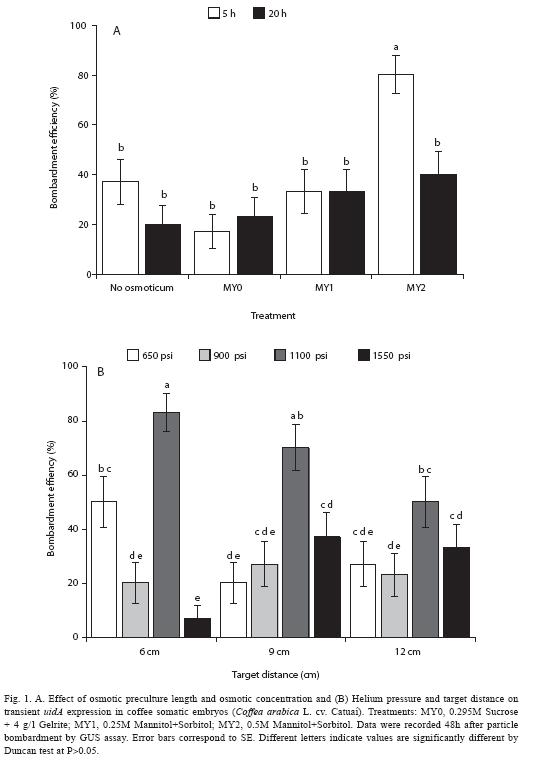
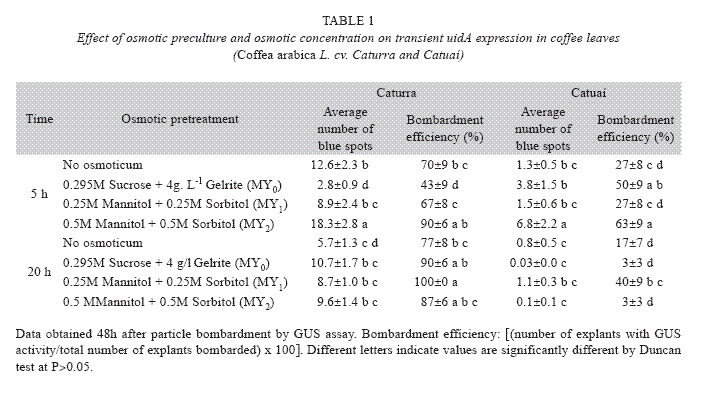
<body><![CDATA[<p><font face="Verdana" size="2">Once the best osmotic preculture treatment was determined, leaf explants and somatic embryos were bombarded using Helium pressure of 650, 900, 1 100 or 1 550psi from a target distance of 6, 9 or 12cm. The optimized particle bombardment protocol was tested with the plasmid pCAMBIA 1305.2 (<i>uidA </i>version GUSPlus ™ and the <i>hpt </i>gene) and the pCAMBIA 1 301-BAR (<i>uidA </i>gene and the <i>bar </i>gene). All the genes are under control of the constitutive CaMv35S promoter. In all the experiments, 30 explants were bombarded once and cultured in the dark at 26±2°C. Non- bombarded explants were included as controls. </font></p>     <p><font face="Verdana" size="2"><b>Assay for </b></font><font  face="Verdana" size="2">&#946;</font><b><font face="Verdana" size="2">-glucoronidase activity: </font></b><font face="Verdana" size="2">Histochemical GUS assays were performed 48h after plasmid delivery following the protocol described by van Boxtel <i>et al. </i>(1995). Briefly, bombarded explants were incubated in x-Gluc buffer (2mM x-Gluc, 100mM sodium phosphate buffer pH 8.0, 10mM EDTA, 1mM Potassium Ferricyanide, 1mM Potassium Ferrocyanide and 20% v/v Methanol) for 24h at 37°C in the dark. The explants were cleared using 95% (v/v) alcohol and the number of blue spots per explant and number of explants with uidA expression were counted using a binocular stereoscope. </font></p>     <p><font face="Verdana" size="2"><b>Selection of putative transformants: </b>Leaves and somatic embryos bombarded with pCAMBIA 1 301 and pCAMBIA 1 305.2 were cultured on semisolid Yasuda <i>et al. </i>(1985) medium supplemented with 100mg/1 hygromycin. During all culture period, the explants were maintained with 16h light photoperiod (30µmol/m<sup>2</sup>s<sup>1</sup>) at 26±2°C. Four weeks after the selective agent was supplied, the growth inhibition was determined taking into consideration the necrosis of the tissue. </font></p>     <p><font face="Verdana" size="2">The average and the standard error of the number of blue spots per explant and bombardment efficiency [(number of explants with GUS activity/total number of explants bombarded) x100] were determined. Data were analyzed using one-way ANOvA and the differences between means were contrasted using the Duncan test (Duncan 1955) at the level of 5%. The program STATISTICA (StatSoft, Tulsa, OK, USA) version 6.0 was used. </font></p>     <p><font face="Verdana" size="2"><b>Abbreviations: </b>CaMv-cauliflower mosaic virus; BAP-benzyladenine; DSE-Direct somatic embr</font><font  face="Verdana" size="2">yogenesis; GUS- &#946;-glucoronidase; GFP-green fluorescent protein; </font><i><font face="Verdana" size="2">hpt</font></i><font  face="Verdana" size="2">-hygromycin phosphotransferase gene; MS-Murashige and Skoog; <i>nptII</i>-neomycin phosphotransferase gene; <i>uidA</i></font><font face="Verdana" size="2">-&#946;-glucoronidase gene. </font></p> <b><font face="Verdana" size="3"> </font></b>     <p><b><font face="Verdana" size="3">Results</font></b><font  face="Verdana" size="2"> </font></p>     <p><font face="Verdana" size="2"><b>Transient <i>uidA </i>expression: </b>The length of osmotic preculture, osmotic concentration of culture medium, Helium pressure and target distance had a significant influence on the number of blue spots per explant and percentage of explants with transient uidA expression. </font></p>     <p style="text-align: left;"><font face="Verdana" size="2">The highest number of blue spots per explant and the highest percentage of explants with transient uidA expression were obtained when Caturra and Catuaí leaf explants and Catuaí somatic embryos were cultured on Yasuda <i>et al</i>. (1985) medium supplemented with 0.5M Mannitol+0.5M Sorbitol for 5h prior to particle bombardment (<a href="#t1">Table 1</a> and <a href="#i1">Fig. 1A</a>).    <br> </font></p>     <p style="text-align: center;"><font face="Verdana" size="2"><img alt=""  src="/img/revistas/rbt/v57s1/art14t1.gif" style="width: 703px; height: 394px;"><a  name="t1"></a>    ]]></body>
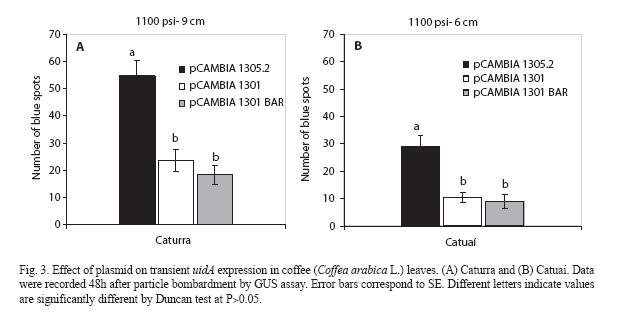
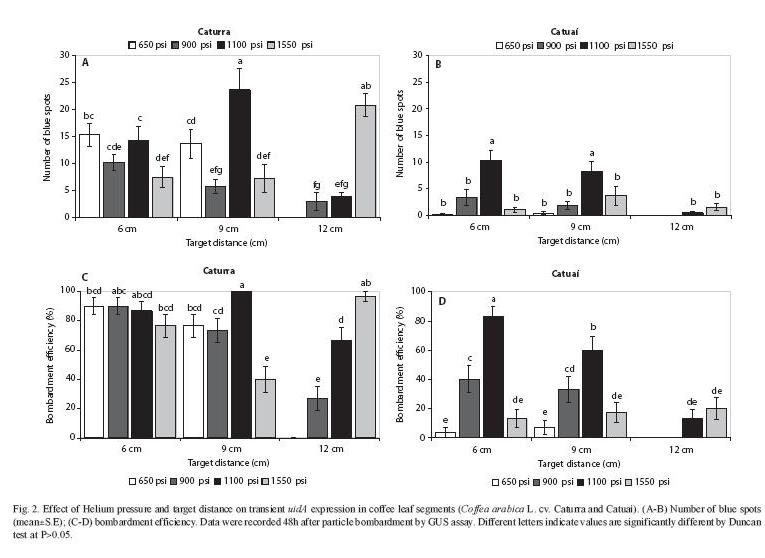
<body><![CDATA[<br> </font></p>     <p style="text-align: center;"><font face="Verdana" size="2"><img  src="/img/revistas/rbt/v57s1/art14img1.jpg" alt=""  style="width: 544px; height: 764px;"><a name="i1"></a>    <br> </font></p>     <p><font face="Verdana" size="2">The highest percentage of transient <i>uidA </i>expression on Catuaí somatic embryos was obtained using a Helium pressure of 1 100psi and a target distance of 6cm (83.3±6.9) and 9cm (70.0±8.5), whereas the lowest percentage of transient <i>uidA </i>expression on Catuaí somatic embryos was obtained using 1 550psi and 6cm (6.7±4.6) (<a href="#i1">Fig. 1B</a>). On the other hand, the highest number of blue spots in Caturra leaf segments was obtained with 1 100psi and 9cm of target distance (23.6±3.9) and the lowest number of blue spots per explant was obtained using 900psi and 12cm of target distance (2.9±1.6) (<a  href="#i2">Fig. 2</a>). For the Catuaí variety, the combination of 1 100psi and target distance of 6 and 9cm gave the highest number of blue spots per explant (10.2±1.9 and 8.2±1.9). In contrast, the     <br> combination of 650, 900 and 1550psi with 6, 9 and 12cm respectively and the combination of 1100psi with a target distance of 12cm resulted in the lowest number of blue spots per explant (<a href="#i2">Fig. 2</a>). Moreover, the highest percentage of Caturra leaf explants with <i>uidA </i>expression was obtained using 1100psi and a target distance of 9cm. For the Catuaí variety, the combination of 1100psi and a target distance of 6cm resulted in the highest percentage of explants with transient <i>uidA </i>expression (<a href="#i2">Fig. 2</a>).    <br> </font></p>     <p><font face="Verdana" size="2"><img  src="/img/revistas/rbt/v57s1/art14img2.jpg" title="" alt=""  style="width: 765px; height: 558px;"><a name="i2"></a>    <br> </font></p>     <p><font face="Verdana" size="2">The bombardment of Caturra and Catuaí leaves with pCAMBIA 1 305.2 significantly influenced the transient <i>uidA </i>expression. The highest number of blue spots per explant was obtained when Caturra (54.6±5.7) and Catuaí (28.9±4.3) leaf explants were bombarded with the plasmid pCAMBIA 1 305.2. No significant differences in the transient <i>uidA </i>expression were obtained between pCAMBIA 1 301 and pCAMBIA 1 301-BAR (<a href="#i3">Fig. 3A</a> and <a href="#i3">3B</a>).    <br> </font></p>     ]]></body>
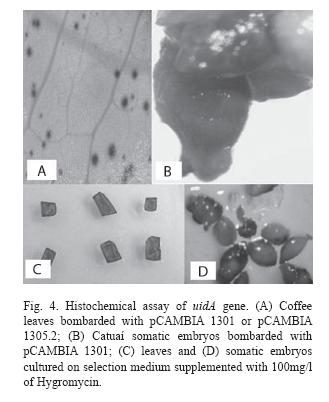
<body><![CDATA[<p style="text-align: center;"><font face="Verdana" size="2"><img  src="/img/revistas/rbt/v57s1/art14img3.jpg" title="" alt=""  style="width: 624px; height: 322px;"><a name="i3"></a>    <br> </font></p>     <p><font face="Verdana" size="2"><b>Selection of putative stable transformants: </b>Although transient uidA expression was obtained by bombarding leaves and somatic embryos with pCAMBIA 1 301 and pCAM-BIA 1 305.2 (<a href="#i4">Fig. 4A</a> and <a href="#i4">4B</a>), the explants turned brown after four weeks of culture on selection medium supplemented with 100mg/l of hygromycin (<a href="#i4">Fig. 4C</a> and <a href="#i4">4D</a>). As a result, no transgenic plants with stable hpt and uidA gene expression were recovered.    <br> </font></p>     <p style="text-align: center;"><font face="Verdana" size="2"><img  src="/img/revistas/rbt/v57s1/art14img4.jpg" title="" alt=""  style="width: 329px; height: 402px;"><a name="i4"></a>    <br> </font></p> <b><font face="Verdana" size="3">     <p>Discussion </p> </font></b><font face="Verdana" size="2"> </font>     <p><font face="Verdana" size="2">The establishment of the best parameters in any plant tissue using particle bombardment is necessary for transient or stable gene expression (Tee &amp; Maziah 2005). To the best of our knowledge this is the first report of optimization of biolistic delivery parameters for DNA delivery and gene expression into <i>C. arabica </i>cv. Caturra and Catuaí leaves and Catuaí somatic embryos. </font></p>     <p><font face="Verdana" size="2">The influence of the osmotic preculture and osmotic concentration of the medium was corroborated. It was shown that shorter periods of preculture in combination with higher concentration of osmotic agents resulted in a higher number of blue spots and percentage of explants with transient <i>uidA </i>expression. A similar result was obtained by Rosillo <i>et al</i>. (2003) who demonstrated that culture of <i>C. arabica </i>cv. Colombia suspension cultures for 4h prior to bombardment with a 0.5M Mannitol and Sorbitol mixture resulted in a higher number of blue spots. Moreover, the use of high concentrations of Mannitol, Sorbitol or Sucrose has improved transient <i>uidA </i>expression in maize (vain <i>et al</i>. 1993), rice (Jain <i>et al</i>. 1996), wheat (Ingram <i>et al</i>. 1999, Rasco-Gaunt <i>et al</i>. 1999) and marigold (vanegas <i>et al</i>. 2006). For <i>C. arabica </i>L. cvs. Caturra and Catuaí this is the first report of the use of 0.5M Mannitol and 0.5M Sorbitol as a high osmotic treatment to enhance transient <i>uidA </i>expression on leaves and somatic embryos. It is known that the type and concentration of osmotic agent may increase transient gene expression by reducing turgor pressure in cells. Therefore, the chance of cell survival increases by avoiding leakage following the shock wave created during bombardment (Rosillo <i>et al</i>. 2003). Moreover, a high concentration of osmotic agents may also induce changes in cell membranes, leading to increased cell tolerance to biolistic delivery impact (Ingram <i>et al</i>. 1999). </font></p>     <p><font face="Verdana" size="2">In the present work, significant differences in the expression of <i>uidA </i>in coffee leaves and somatic embryos were observed with respect to the Helium pressure and target distance (<a href="#i1">Fig 1B</a>, <a href="#i2">Fig 2</a>). It is known that Helium pressure and target distance influence the entry of DNA into the cell, the distribution of particles and tissue injury (Rasco-Gaunt <i>et al</i>. 1999, Rosillo <i>et al</i>. 2003, Rubio <i>et al</i>. 2004). It has been demonstrated that Helium pressure and target distance influence transient gene expression in rice (Jain <i>et al</i>. 1996), wheat (Ingram <i>et al</i>. 1999, Rasco-Gaunt <i>et al</i>. 1999), pine (Fernando <i>et al</i>. 2000), carrot, sweet potato and ohelo (Deroles <i>et al</i>. 2002), coffee (Rosillo <i>et al</i>. 2003), sorghum (Tadesse <i>et al</i>. 2003), triticale (Rubio <i>et al</i>. 2004), <i>Dendrobium </i>Sonia 17 (Tee &amp; Maziah 2005) and marigold (vanegas <i>et al</i>. 2006). Moreover, optimization of Helium pressure and target distance for gene delivery into plastid genome has been reported in carrot (Kumar <i>et al</i>. 2004a) and cotton (Kumar <i>et al</i>. 2004b). </font></p>     ]]></body>
<body><![CDATA[<p><font face="Verdana" size="2">Although, the highest number of blue spots per Caturra and Catuaí leaves and Catuaí somatic embryos were obtained using a Helium pressure of 1 100psi, different target distances were required. These observations suggest different target tissues and genotypes require different bombardment conditions (Tadesse <i>et al</i>. 2003). Tee &amp; Maziah (2005) reported bombardment of <i>Dendrobium </i>Sonia 17 type A calli using 1 100psi and 6cm but type B calli required 650psi and 6cm. Moreover, Tadesse <i>et al</i>. (2003) obtained higher transient <i>uidA </i>expression when sorghum immature embryos and shoot tips were bombarded using 1 100 or 1 300psi in combination with a target distance of 6cm. </font></p>     <p><font face="Verdana" size="2">The higher transient <i>uidA </i>expression obtained on coffee leaves bombarded with pCAMBIA 1 305.2 could be related to the properties of the new GUS<i>Plus</i>™ reporter gene isolated form <i>Staphylococcus </i>sp<i>. </i>(Broothaerts <i>et al</i>. 2005). In contrast to <i>uidA </i>gene isolated from <i>E. coli</i>, GUS<i>Plus</i>™ has a better catalytic activity for more rapid detection of GUS activity, greater stability at 60°C and in the presence of fixatives such as formaldehyde and glutaraldehyde. Moreover, GUS<i>Plus</i>™ represents an alternative to GFP since rice glycine-rich protein signal peptide for extracellular secretion provides rapid and non destructive <i>in vivo </i>GUS assays (Jefferson <i>et al</i>. 2003). </font></p>     <p><font face="Verdana" size="2">Van Boxtel <i>et al</i>. (1995) reported that somatic embryos are less appropriate for transient <i>uidA </i>expression than leaves. Nevertheless, high levels of transient <i>uidA </i>expression were observed on Catuaí somatic embryos using the optimized biolistic delivery protocol developed in the present work. Moreover, van Boxtel <i>et al</i>. (1995) observed false GUS positive somatic embryos, probably due to the presence of endogenous bacteria, often encountered in culture tissue of tropical woody species such as coffee. In contrast, in the present work endogenous GUS activity caused by endogenous bacteria was not observed in any of the explants analyzed because of the elimination of endogenous GUS activity by using Methanol in X-Gluc solution (Kosugi <i>et al</i>. 1990). </font></p>     <p><font face="Verdana" size="2">Although, transient <i>uidA </i>expression was observed in leaves and somatic embryos bombarded with pCAMBIA 1 301 (<i>hpt </i>and <i>uidA</i>) or pCAMBIA 1 305.2 (<i>uidA </i>version GUS-<i>Plus </i>™ and <i>hpt</i>), the use of 100mg/1 of Hygromycin led to oxidation of leaves and somatic embryos. Van Boxtel <i>et al</i>. (1994) indicated that transformed cells seemed to be hindered in their multiplication by abundant necrosis of surrounding tissue. In this regard, these authors reported that hygromycin caused severe necrosis of coffee leaves and suspension cultures. Nevertheless, if a lower concentration of hygromycin is used, as reported by Kumar <i>et al</i>. (2006) who used 20mg/1 of Hygromycin for the selection of <i>C. canephora </i>putative transformants, the method developed in the present work can be used for the genetic transformation of <i>Coffea</i>. </font></p>     <p><font face="Verdana" size="2">The conditions for transient gene expression in <i>C. arabica </i>L. cvs. Caturra and Catuaí have been established. These conditions consist of 5h preculture on 0.5M Mannitol and 0.5M Sorbitol, a Helium pressure of 1 100 psi and target distance of 6 or 9cm, depending on the explant used. Furthermore, the optimized protocol developed in the present study could be used for incorporation and stable expression of <i>cry </i>genes from <i>Bacillus thuringiensis </i>in order to confer resistance to <i>H. hampei. </i></font></p> <b><font face="Verdana" size="3"> </font></b>     <p><b><font face="Verdana" size="3">Acknowledgments</font></b><font  face="Verdana" size="2"> </font></p>     <p><font face="Verdana" size="2">The authors are grateful to Eric Guevara (CIGRAS, University of Costa Rica) and Paul Hanson (Escuela Biología, University of Costa Rica) for the heplful disscusion, critical review and English correction of the manuscript. This research was supported by the Costa Rica-United States of America Foundation for Cooperation (CRUSA) and the University of Costa Rica.</font></p> <hr style="width: 100%; height: 2px;">     <p><font face="Verdana" size="2"> </font></p> <font face="Verdana" size="2"><b> </b></font>     <p><font face="Verdana" size="2"><b>Resumen</b> </font></p>     <p><font face="Verdana" size="2">La presente investigación tuvo como objetivo optimizar los parámetros que afectan la incorporación y expresión de genes marcadores mediante biobalística en segmentos de hoja y embriones somáticos de café (<i>Coffea arabica</i>. L. cvs. Caturra y Catuaí). La mayor expresión transitoria del gen <i>uidA </i>en segmentos de hoja de Caturra (18.3±2.8) y Catuaí (6.8±2.0) y embriones somáticos de Catuaí (80.0±7.4) se obtuvo al cultivar los explantes por cinco horas previo al bombardeo en el medio Yasuda complementado con 0.5M mannitol+0.5M sorbitol. Asimismo, se obtuvo una mayor expresión transitoria del gen <i>uidA </i>al bombardear los segmentos de hoja de Caturra y Catuaí y embriones somáticos de Catuaí con una presión de helio de 1 100psi y una distancia de bombardeo de 6 o 9 cm. </font></p>     ]]></body>
<body><![CDATA[<p><font face="Verdana" size="2"><b>Palabras clave: </b>Caturra, Catuaí, biobalística, tratamiento osmótico, <i>uidA, </i>GUSPlus™, <i>bar</i>, <i>hpt</i>, <i>nptII</i>, Costa Rica.</font></p> <hr style="width: 100%; height: 2px;">     <p><font face="Verdana" size="2"> </font></p>     <p align="center"><font face="Verdana" size="2">Received 10-XI-2007. Corrected 15-VI-2009. Accepted 07-VII-2009.</font></p> <b><font face="Verdana" size="3"> </font></b>     <p><b><font face="Verdana" size="3">References</font></b><font  face="Verdana" size="2"> </font></p>     <!-- ref --><p><font face="Verdana" size="2">Alpizar, E., E. Dechamp, S. Espeout, M. Royer, A.C. Lecouls, M. Nicole, B. Bertrand, P. Lashermes &amp; H. Etienne. 2006. Efficient production of <i>Agrobacterium rhizogenes</i>-transformed roots and composite plants for studying gene expression in coffee roots. Plant Cell Rep. 25: 959-967.    &nbsp;&nbsp;&nbsp;&nbsp;&nbsp;&nbsp;&nbsp;&nbsp;[&#160;<a href="javascript:void(0);" onclick="javascript: window.open('/scielo.php?script=sci_nlinks&ref=1387950&pid=S0034-7744200900050001400001&lng=','','width=640,height=500,resizable=yes,scrollbars=1,menubar=yes,');">Links</a>&#160;]<!-- end-ref --> </font></p>     <!-- ref --><p><font face="Verdana" size="2">Altpeter, F., N. Baisakh, R. Beachy, R. Bock, T. Capell, P. Christou, H. Daniell, K. Datta, S. Datta, P.J. Dix, C. Fauquet, N. Huang, A. Kohli, H. Mooibroek, L. Nicholson, T.T. Nguyen, G. Nugent, K. Raemakers, A. Romano, D.A. Somers, E. Stoger, N. Taylor &amp; R. visser. 2005. Particle bombardment and the genetic enhancement of crops: myths and realities. Mol. Breeding. 15: 305-327.    &nbsp;&nbsp;&nbsp;&nbsp;&nbsp;&nbsp;&nbsp;&nbsp;[&#160;<a href="javascript:void(0);" onclick="javascript: window.open('/scielo.php?script=sci_nlinks&ref=1387952&pid=S0034-7744200900050001400002&lng=','','width=640,height=500,resizable=yes,scrollbars=1,menubar=yes,');">Links</a>&#160;]<!-- end-ref --> </font></p>     <!-- ref --><p><font face="Verdana" size="2">Broothaerts, W., H.J. Mitchell, B. Weir, S. Kaines, L.M.A. Smith, W. Yang, J.E. Mayer, C. Roa-Rodríguez &amp; A.J. Richard. 2005 Gene transfer to plants by diverse species of bacteria. Nature 433: 629-633.    &nbsp;&nbsp;&nbsp;&nbsp;&nbsp;&nbsp;&nbsp;&nbsp;[&#160;<a href="javascript:void(0);" onclick="javascript: window.open('/scielo.php?script=sci_nlinks&ref=1387954&pid=S0034-7744200900050001400003&lng=','','width=640,height=500,resizable=yes,scrollbars=1,menubar=yes,');">Links</a>&#160;]<!-- end-ref --> </font></p>     ]]></body>
<body><![CDATA[<!-- ref --><p><font face="Verdana" size="2">Canchee- Moo, R.L.R., A. Ku- González, C. Burgeff, V.M. Loyola- vargas, L.C. Rodríguez- Zapata &amp; E. Castaño. 2006. Genetic transformation of <i>Coffea canephora </i>by vacuum infiltration. Plant Cell Tiss. Org. Cult. 84: 373-377.    &nbsp;&nbsp;&nbsp;&nbsp;&nbsp;&nbsp;&nbsp;&nbsp;[&#160;<a href="javascript:void(0);" onclick="javascript: window.open('/scielo.php?script=sci_nlinks&ref=1387956&pid=S0034-7744200900050001400004&lng=','','width=640,height=500,resizable=yes,scrollbars=1,menubar=yes,');">Links</a>&#160;]<!-- end-ref --> </font></p>     <!-- ref --><p><font face="Verdana" size="2">Carneiro, M.F. 1999. Advances in coffee biotechnology. AgBiotech. Net. 1: 1-7.    &nbsp;&nbsp;&nbsp;&nbsp;&nbsp;&nbsp;&nbsp;&nbsp;[&#160;<a href="javascript:void(0);" onclick="javascript: window.open('/scielo.php?script=sci_nlinks&ref=1387958&pid=S0034-7744200900050001400005&lng=','','width=640,height=500,resizable=yes,scrollbars=1,menubar=yes,');">Links</a>&#160;]<!-- end-ref --> </font></p>     <!-- ref --><p><font face="Verdana" size="2">Deroles, S., M.A.L. Smith &amp; C. Lee. 2002. Factors affecting transformation of cell cultures from three dicotyledonous pigment-producing species using microprojectile bombardment. Plant Cell Tiss. Org. Cult. 70: 69-76.    &nbsp;&nbsp;&nbsp;&nbsp;&nbsp;&nbsp;&nbsp;&nbsp;[&#160;<a href="javascript:void(0);" onclick="javascript: window.open('/scielo.php?script=sci_nlinks&ref=1387960&pid=S0034-7744200900050001400006&lng=','','width=640,height=500,resizable=yes,scrollbars=1,menubar=yes,');">Links</a>&#160;]<!-- end-ref --> </font></p>     <!-- ref --><p><font face="Verdana" size="2">Duncan, D.B. 1955. Multiple range and multiple <i>F </i>tests. Biometrics 11: 1-42.    &nbsp;&nbsp;&nbsp;&nbsp;&nbsp;&nbsp;&nbsp;&nbsp;[&#160;<a href="javascript:void(0);" onclick="javascript: window.open('/scielo.php?script=sci_nlinks&ref=1387962&pid=S0034-7744200900050001400007&lng=','','width=640,height=500,resizable=yes,scrollbars=1,menubar=yes,');">Links</a>&#160;]<!-- end-ref --> </font></p>     <!-- ref --><p><font face="Verdana" size="2">Fernández-Da Silva, R. &amp; A. Menéndez-Yuffá. 2003. Transient gene expression in secondary somatic embryos from coffee tissues electrophorated with the gene <i>gus </i>and <i>bar</i>. Electron. J. Biotechnol. 6: 29-38.    &nbsp;&nbsp;&nbsp;&nbsp;&nbsp;&nbsp;&nbsp;&nbsp;[&#160;<a href="javascript:void(0);" onclick="javascript: window.open('/scielo.php?script=sci_nlinks&ref=1387964&pid=S0034-7744200900050001400008&lng=','','width=640,height=500,resizable=yes,scrollbars=1,menubar=yes,');">Links</a>&#160;]<!-- end-ref --> </font></p>     ]]></body>
<body><![CDATA[<!-- ref --><p><font face="Verdana" size="2">Fernando, D.D., J.N. Owens &amp; S. Misra. 2000. Transient gene expression in pine pollen tubes following particle bombardment. Plant Cell Rep. 19: 224-228.    &nbsp;&nbsp;&nbsp;&nbsp;&nbsp;&nbsp;&nbsp;&nbsp;[&#160;<a href="javascript:void(0);" onclick="javascript: window.open('/scielo.php?script=sci_nlinks&ref=1387966&pid=S0034-7744200900050001400009&lng=','','width=640,height=500,resizable=yes,scrollbars=1,menubar=yes,');">Links</a>&#160;]<!-- end-ref --> </font></p>     <!-- ref --><p><font face="Verdana" size="2">Hatanaka, T., Y.E. Choi, Kusano T. &amp; H. Sano. 1999. Transgenic plant of coffee <i>Coffea canephora </i>from embryogenic calli via <i>Agrobacterium tumefaciens</i>-mediated transformation. Plant Cell Rep. 19: 106-110.    &nbsp;&nbsp;&nbsp;&nbsp;&nbsp;&nbsp;&nbsp;&nbsp;[&#160;<a href="javascript:void(0);" onclick="javascript: window.open('/scielo.php?script=sci_nlinks&ref=1387968&pid=S0034-7744200900050001400010&lng=','','width=640,height=500,resizable=yes,scrollbars=1,menubar=yes,');">Links</a>&#160;]<!-- end-ref --> </font></p>     <!-- ref --><p><font face="Verdana" size="2">Ingram, H.M., J.B. Power, K.C. Lowe &amp; M.R. Davey. 1999. Optimization of procedures for microprojectile bombardment of microspore-derived embryo in wheat. Plant Cell Tiss. Org. Cult. 57: 207-210.    &nbsp;&nbsp;&nbsp;&nbsp;&nbsp;&nbsp;&nbsp;&nbsp;[&#160;<a href="javascript:void(0);" onclick="javascript: window.open('/scielo.php?script=sci_nlinks&ref=1387970&pid=S0034-7744200900050001400011&lng=','','width=640,height=500,resizable=yes,scrollbars=1,menubar=yes,');">Links</a>&#160;]<!-- end-ref --> </font></p>     <!-- ref --><p><font face="Verdana" size="2">Jain, R.K., S. Jain, B. Wang &amp; R. Wu. 1996. Optimization of biolistic method for transient gene expression and production of agronomically useful transgenic Basmati rice plants. Plant Cell Rep. 15: 963-968.    &nbsp;&nbsp;&nbsp;&nbsp;&nbsp;&nbsp;&nbsp;&nbsp;[&#160;<a href="javascript:void(0);" onclick="javascript: window.open('/scielo.php?script=sci_nlinks&ref=1387972&pid=S0034-7744200900050001400012&lng=','','width=640,height=500,resizable=yes,scrollbars=1,menubar=yes,');">Links</a>&#160;]<!-- end-ref --> </font></p>     <!-- ref --><p><font face="Verdana" size="2">Jefferson, R.A., R.L. Harcourt, A. Kilian, K.J. Wilson &amp; </font><font face="Verdana" size="2">P.K. Keese. 2003. Microbial &#946;-glucuronidase genes, gene products and</font><font  face="Verdana" size="2"> uses thereof. US Patent 6: 391-547.    &nbsp;&nbsp;&nbsp;&nbsp;&nbsp;&nbsp;&nbsp;&nbsp;[&#160;<a href="javascript:void(0);" onclick="javascript: window.open('/scielo.php?script=sci_nlinks&ref=1387974&pid=S0034-7744200900050001400013&lng=','','width=640,height=500,resizable=yes,scrollbars=1,menubar=yes,');">Links</a>&#160;]<!-- end-ref --> </font></p>     ]]></body>
<body><![CDATA[<!-- ref --><p><font face="Verdana" size="2">Kikkert, J.R., J.R. vidal &amp; B.I. Reish. 2004. Stable transformation of plant cells by particle bombardment/ biolistics. <i>In </i>L. Peña (ed). Transgenic plants: methods and protocols. Methods in Molecular Biology. Humana, Totowa, New Jersey, USA.    &nbsp;&nbsp;&nbsp;&nbsp;&nbsp;&nbsp;&nbsp;&nbsp;[&#160;<a href="javascript:void(0);" onclick="javascript: window.open('/scielo.php?script=sci_nlinks&ref=1387976&pid=S0034-7744200900050001400014&lng=','','width=640,height=500,resizable=yes,scrollbars=1,menubar=yes,');">Links</a>&#160;]<!-- end-ref --> </font></p>     <!-- ref --><p><font face="Verdana" size="2">Kosugi, S., Y. Ohashi, K. Nakajima &amp; Y. Arai. 1990. An improved assay for &#946;-glucoronidase in transformed cells: methanol almost completely suppresses a putative endogenous &#946;-glucoronidase activity. Plant Sci. </font><font  face="Verdana" size="2">70: 133-140.    &nbsp;&nbsp;&nbsp;&nbsp;&nbsp;&nbsp;&nbsp;&nbsp;[&#160;<a href="javascript:void(0);" onclick="javascript: window.open('/scielo.php?script=sci_nlinks&ref=1387978&pid=S0034-7744200900050001400015&lng=','','width=640,height=500,resizable=yes,scrollbars=1,menubar=yes,');">Links</a>&#160;]<!-- end-ref --> </font></p>     <!-- ref --><p><font face="Verdana" size="2">Kumar, S., A. Dhingra &amp; H. Daniell. 2004a. Plastid-expressed <i>Betaine aldehyde dehydrogenase </i>gene in carrot cultures cells, roots and leaves confers enhanced salt tolerant. Plant Physiol. 136: 2843-2854.    &nbsp;&nbsp;&nbsp;&nbsp;&nbsp;&nbsp;&nbsp;&nbsp;[&#160;<a href="javascript:void(0);" onclick="javascript: window.open('/scielo.php?script=sci_nlinks&ref=1387980&pid=S0034-7744200900050001400016&lng=','','width=640,height=500,resizable=yes,scrollbars=1,menubar=yes,');">Links</a>&#160;]<!-- end-ref --> </font></p>     <!-- ref --><p><font face="Verdana" size="2">Kumar, S., A. Dhingra &amp; H. Daniell. 2004b Stable transformation of cotton plastid genome and maternal inheritance of transgenes. Plant Mol. Biol. 56: 203-216.    &nbsp;&nbsp;&nbsp;&nbsp;&nbsp;&nbsp;&nbsp;&nbsp;[&#160;<a href="javascript:void(0);" onclick="javascript: window.open('/scielo.php?script=sci_nlinks&ref=1387982&pid=S0034-7744200900050001400017&lng=','','width=640,height=500,resizable=yes,scrollbars=1,menubar=yes,');">Links</a>&#160;]<!-- end-ref --> </font></p>     <!-- ref --><p><font face="Verdana" size="2">Kumar, V., K.v. Satyanarayana, S. Sarala, E.P. Indu, P. Giridar, A. Chandrashekar &amp; G.A. Ravishankar. 2006. Stable transformation and direct regeneration in <i>Coffea canephora </i>P ex. Fr. by <i>Agrobacterium rhizogenes </i>mediated transformation without hairy-root phenotype. Plant Cell Rep. 3: 214-222.    &nbsp;&nbsp;&nbsp;&nbsp;&nbsp;&nbsp;&nbsp;&nbsp;[&#160;<a href="javascript:void(0);" onclick="javascript: window.open('/scielo.php?script=sci_nlinks&ref=1387984&pid=S0034-7744200900050001400018&lng=','','width=640,height=500,resizable=yes,scrollbars=1,menubar=yes,');">Links</a>&#160;]<!-- end-ref --> </font></p>     ]]></body>
<body><![CDATA[<!-- ref --><p><font face="Verdana" size="2">Leroy, T., A.M. Henry, M. Royer, I. Altosaar, R. Frutos, D. Duris &amp; R. Philippe. 2000. Genetically modified coffee plants expressing the <i>Bacillus thuringiensis cry1Ac </i>gene for resistance to leaf miner. Plant Cell Rep. 19: 382-389.    &nbsp;&nbsp;&nbsp;&nbsp;&nbsp;&nbsp;&nbsp;&nbsp;[&#160;<a href="javascript:void(0);" onclick="javascript: window.open('/scielo.php?script=sci_nlinks&ref=1387986&pid=S0034-7744200900050001400019&lng=','','width=640,height=500,resizable=yes,scrollbars=1,menubar=yes,');">Links</a>&#160;]<!-- end-ref --> </font></p>     <!-- ref --><p><font face="Verdana" size="2">Méndez-López, I., R. Basurto-Ríos &amp; J. Ibarra 2003. <i>Bacillus thuringiensis </i>serovar <i>israelensis </i>is highly toxic to the coffee berry borer, <i>Hypothenemus hampei </i>Ferr. (Coleoptera: Scolytidae). FEMS Microbiol. Lett. 226: 73-77.    &nbsp;&nbsp;&nbsp;&nbsp;&nbsp;&nbsp;&nbsp;&nbsp;[&#160;<a href="javascript:void(0);" onclick="javascript: window.open('/scielo.php?script=sci_nlinks&ref=1387988&pid=S0034-7744200900050001400020&lng=','','width=640,height=500,resizable=yes,scrollbars=1,menubar=yes,');">Links</a>&#160;]<!-- end-ref --> </font></p>     <!-- ref --><p><font face="Verdana" size="2">Morel, G. 1965. Clonal propagation of orchids by meristems culture. Cymbidium Soc. News 20: 3.    &nbsp;&nbsp;&nbsp;&nbsp;&nbsp;&nbsp;&nbsp;&nbsp;[&#160;<a href="javascript:void(0);" onclick="javascript: window.open('/scielo.php?script=sci_nlinks&ref=1387990&pid=S0034-7744200900050001400021&lng=','','width=640,height=500,resizable=yes,scrollbars=1,menubar=yes,');">Links</a>&#160;]<!-- end-ref --> </font></p>     <!-- ref --><p><font face="Verdana" size="2">Murashige, T. &amp; F. Skoog. 1962. A revised medium for rapid growth and bioassays with tobacco tissue culture. Physiol. Plant. 15: 473-497.    &nbsp;&nbsp;&nbsp;&nbsp;&nbsp;&nbsp;&nbsp;&nbsp;[&#160;<a href="javascript:void(0);" onclick="javascript: window.open('/scielo.php?script=sci_nlinks&ref=1387992&pid=S0034-7744200900050001400022&lng=','','width=640,height=500,resizable=yes,scrollbars=1,menubar=yes,');">Links</a>&#160;]<!-- end-ref --><!-- ref --> </font>&nbsp;&nbsp;&nbsp;&nbsp;&nbsp;&nbsp;&nbsp;&nbsp;[&#160;<a href="javascript:void(0);" onclick="javascript: window.open('/scielo.php?script=sci_nlinks&ref=1387993&pid=S0034-7744200900050001400023&lng=','','width=640,height=500,resizable=yes,scrollbars=1,menubar=yes,');">Links</a>&#160;]<!-- end-ref --> </font>     <!-- ref --><p><font face="Verdana" size="2">Rasco-Gaunt, S., A. Riley, P. Barcelo &amp; P.A. Lazzeri. 1999. Analysis of particle bombardment parameters to optimize DNA delivery into wheat tissues. Plant Cell Rep. 19: 118-127.    &nbsp;&nbsp;&nbsp;&nbsp;&nbsp;&nbsp;&nbsp;&nbsp;[&#160;<a href="javascript:void(0);" onclick="javascript: window.open('/scielo.php?script=sci_nlinks&ref=1387995&pid=S0034-7744200900050001400024&lng=','','width=640,height=500,resizable=yes,scrollbars=1,menubar=yes,');">Links</a>&#160;]<!-- end-ref --> </font></p>     <!-- ref --><p><font face="Verdana" size="2">Ribas, A.F., A.K. Kobayashi, L.F.P. Pereira &amp; L.G.E. vieira. 2005. Genetic transformation of <i>Coffea canephora </i>by particle bombardment. Biol. Plant. 49: 493-497.    &nbsp;&nbsp;&nbsp;&nbsp;&nbsp;&nbsp;&nbsp;&nbsp;[&#160;<a href="javascript:void(0);" onclick="javascript: window.open('/scielo.php?script=sci_nlinks&ref=1387997&pid=S0034-7744200900050001400025&lng=','','width=640,height=500,resizable=yes,scrollbars=1,menubar=yes,');">Links</a>&#160;]<!-- end-ref --> </font></p>     <!-- ref --><p><font face="Verdana" size="2">Ribas, A.F., A.K. Kobayashi, L.F.P. Pereira &amp; L.G.E. vieira. 2006. Production of herbicide-resistant coffee plants (<i>Coffea canephora </i>P.) via <i>Agrobacterium tumefaciens</i>-mediated transformation. Braz. Arch. Biol. Technol. 49: 11-19.    &nbsp;&nbsp;&nbsp;&nbsp;&nbsp;&nbsp;&nbsp;&nbsp;[&#160;<a href="javascript:void(0);" onclick="javascript: window.open('/scielo.php?script=sci_nlinks&ref=1387999&pid=S0034-7744200900050001400026&lng=','','width=640,height=500,resizable=yes,scrollbars=1,menubar=yes,');">Links</a>&#160;]<!-- end-ref --> </font></p>     <!-- ref --><p><font face="Verdana" size="2">Rosillo, G., J. Acuña, A. Gaitan &amp; M. Peña De. 2003. Optimized DNA delivery into <i>Coffea arabica </i>suspension culture cells by particle bombardment. Plant Cell Tiss. Org. Cult. 74: 45-49.    &nbsp;&nbsp;&nbsp;&nbsp;&nbsp;&nbsp;&nbsp;&nbsp;[&#160;<a href="javascript:void(0);" onclick="javascript: window.open('/scielo.php?script=sci_nlinks&ref=1388001&pid=S0034-7744200900050001400027&lng=','','width=640,height=500,resizable=yes,scrollbars=1,menubar=yes,');">Links</a>&#160;]<!-- end-ref --> </font></p>     <!-- ref --><p><font face="Verdana" size="2">Rubio, S., N. Jouve &amp; J.M. González. 2004. Biolistic transfer of the gene <i>uidA </i>and its expression in haploid embryo-like structures of triticale (<i>xTriticosecale </i>Wittmack). Plant Cell Tiss. Org. Cult. 77: 203-209.    &nbsp;&nbsp;&nbsp;&nbsp;&nbsp;&nbsp;&nbsp;&nbsp;[&#160;<a href="javascript:void(0);" onclick="javascript: window.open('/scielo.php?script=sci_nlinks&ref=1388003&pid=S0034-7744200900050001400028&lng=','','width=640,height=500,resizable=yes,scrollbars=1,menubar=yes,');">Links</a>&#160;]<!-- end-ref --> </font></p>     <!-- ref --><p><font face="Verdana" size="2">Russell, J.A. 1993. The Biolistic® PDS-100/He device. Plant Cell Tiss. Org. Cult. 33: 221-226.    &nbsp;&nbsp;&nbsp;&nbsp;&nbsp;&nbsp;&nbsp;&nbsp;[&#160;<a href="javascript:void(0);" onclick="javascript: window.open('/scielo.php?script=sci_nlinks&ref=1388005&pid=S0034-7744200900050001400029&lng=','','width=640,height=500,resizable=yes,scrollbars=1,menubar=yes,');">Links</a>&#160;]<!-- end-ref --> </font></p>     <!-- ref --><p><font face="Verdana" size="2">Sharma, K.K., P. Bhatnagar-Mathur &amp; T.A. Thorpe. 2005. Genetic transformation technology: status and problems. <i>In Vitro </i>Cell. Dev. Biol. Plant. 41: 102-112.    &nbsp;&nbsp;&nbsp;&nbsp;&nbsp;&nbsp;&nbsp;&nbsp;[&#160;<a href="javascript:void(0);" onclick="javascript: window.open('/scielo.php?script=sci_nlinks&ref=1388007&pid=S0034-7744200900050001400030&lng=','','width=640,height=500,resizable=yes,scrollbars=1,menubar=yes,');">Links</a>&#160;]<!-- end-ref --> </font></p>     <!-- ref --><p><font face="Verdana" size="2">Tadesse, Y., L. Sági, R. Swennen &amp; M. Jacobs. 2003. Optimization of transformation conditions and production of transgenic sorghum (<i>Sorghum bicolor</i>) via microparticle bombardment. Plant Cell Tiss. Org. Cult. 75: 1-18.    &nbsp;&nbsp;&nbsp;&nbsp;&nbsp;&nbsp;&nbsp;&nbsp;[&#160;<a href="javascript:void(0);" onclick="javascript: window.open('/scielo.php?script=sci_nlinks&ref=1388009&pid=S0034-7744200900050001400031&lng=','','width=640,height=500,resizable=yes,scrollbars=1,menubar=yes,');">Links</a>&#160;]<!-- end-ref --> </font></p>     <!-- ref --><p><font face="Verdana" size="2">Tee, C.H.S. &amp; M. Maziah. 2005. Optimization of biolistic bombardment parameters for <i>Dendrobium </i>Sonia 17 callies using GFP and GUS as the reporter system. Plant Cell Tiss. Org. Cult. 80: 77-89.    &nbsp;&nbsp;&nbsp;&nbsp;&nbsp;&nbsp;&nbsp;&nbsp;[&#160;<a href="javascript:void(0);" onclick="javascript: window.open('/scielo.php?script=sci_nlinks&ref=1388011&pid=S0034-7744200900050001400032&lng=','','width=640,height=500,resizable=yes,scrollbars=1,menubar=yes,');">Links</a>&#160;]<!-- end-ref --> </font></p>     <!-- ref --><p><font face="Verdana" size="2">Vain, P., M.D. Mcmullen &amp; J.J. Finer. 1993. Osmotic treatment enhances particle bombardment- mediated transient and stable transformation of maize. Plant Cell Rep. 12: 84-88.    &nbsp;&nbsp;&nbsp;&nbsp;&nbsp;&nbsp;&nbsp;&nbsp;[&#160;<a href="javascript:void(0);" onclick="javascript: window.open('/scielo.php?script=sci_nlinks&ref=1388013&pid=S0034-7744200900050001400033&lng=','','width=640,height=500,resizable=yes,scrollbars=1,menubar=yes,');">Links</a>&#160;]<!-- end-ref --> </font></p>     <!-- ref --><p><font face="Verdana" size="2">Van Boxtel, J., A. Eskes &amp; M. Berthouly. 1994. Studies on genetic transformation of coffee by using electroporation and biolistic method. Ph.D. Thesis, University of Wageningen, Wageningen, Holland.    &nbsp;&nbsp;&nbsp;&nbsp;&nbsp;&nbsp;&nbsp;&nbsp;[&#160;<a href="javascript:void(0);" onclick="javascript: window.open('/scielo.php?script=sci_nlinks&ref=1388015&pid=S0034-7744200900050001400034&lng=','','width=640,height=500,resizable=yes,scrollbars=1,menubar=yes,');">Links</a>&#160;]<!-- end-ref --> </font></p>     <!-- ref --><p><font face="Verdana" size="2">V</font><font face="Verdana" size="2">an Boxtel, J., M. Berthouly, C. Carrasco, M. Dufour &amp; Eskes A. 1995. Transient expression of &#946;-glucoronidase following biolistic delivery of foreing DNA into coffee tissues. Plant Cel</font><font face="Verdana"  size="2">l Rep. 14: 748-752.    &nbsp;&nbsp;&nbsp;&nbsp;&nbsp;&nbsp;&nbsp;&nbsp;[&#160;<a href="javascript:void(0);" onclick="javascript: window.open('/scielo.php?script=sci_nlinks&ref=1388017&pid=S0034-7744200900050001400035&lng=','','width=640,height=500,resizable=yes,scrollbars=1,menubar=yes,');">Links</a>&#160;]<!-- end-ref --> </font></p>     <!-- ref --><p><font face="Verdana" size="2">Vanegas, P.E., M. valdez-Morales, M.E. valverde, A. Cruz-Hernández &amp; O. Paredes-López. 2006. Particle bombardment, a method for gene transfer in marigold. Plant Cell Tiss. Org. Cult. 84: 359-363.    &nbsp;&nbsp;&nbsp;&nbsp;&nbsp;&nbsp;&nbsp;&nbsp;[&#160;<a href="javascript:void(0);" onclick="javascript: window.open('/scielo.php?script=sci_nlinks&ref=1388019&pid=S0034-7744200900050001400036&lng=','','width=640,height=500,resizable=yes,scrollbars=1,menubar=yes,');">Links</a>&#160;]<!-- end-ref --> </font></p>     <!-- ref --><p><font face="Verdana" size="2">Yasuda, T., Y. Fujii &amp; T. Yamaguchi. 1985. Embryogenic calli induction from <i>Coffea arabica </i>leaf explant by benziladenine. Plant Cell Physiol. 26: 595-597.    &nbsp;&nbsp;&nbsp;&nbsp;&nbsp;&nbsp;&nbsp;&nbsp;[&#160;<a href="javascript:void(0);" onclick="javascript: window.open('/scielo.php?script=sci_nlinks&ref=1388021&pid=S0034-7744200900050001400037&lng=','','width=640,height=500,resizable=yes,scrollbars=1,menubar=yes,');">Links</a>&#160;]<!-- end-ref --> </font></p>      ]]></body><back>
<ref-list>
<ref id="B1">
<nlm-citation citation-type="journal">
<person-group person-group-type="author">
<name>
<surname><![CDATA[Alpizar]]></surname>
<given-names><![CDATA[E]]></given-names>
</name>
<name>
<surname><![CDATA[Dechamp]]></surname>
<given-names><![CDATA[E]]></given-names>
</name>
<name>
<surname><![CDATA[Espeout]]></surname>
<given-names><![CDATA[S]]></given-names>
</name>
<name>
<surname><![CDATA[Royer]]></surname>
<given-names><![CDATA[M]]></given-names>
</name>
<name>
<surname><![CDATA[Lecouls]]></surname>
<given-names><![CDATA[A.C]]></given-names>
</name>
<name>
<surname><![CDATA[Nicole]]></surname>
<given-names><![CDATA[M]]></given-names>
</name>
<name>
<surname><![CDATA[Bertrand]]></surname>
<given-names><![CDATA[B]]></given-names>
</name>
<name>
<surname><![CDATA[Lashermes]]></surname>
<given-names><![CDATA[P]]></given-names>
</name>
<name>
<surname><![CDATA[Etienne]]></surname>
<given-names><![CDATA[H]]></given-names>
</name>
</person-group>
<article-title xml:lang="en"><![CDATA[Efficient production of Agrobacterium rhizogenes-transformed roots and composite plants for studying gene expression in coffee roots]]></article-title>
<source><![CDATA[Plant Cell Rep]]></source>
<year>2006</year>
<volume>25</volume>
<page-range>959-967</page-range></nlm-citation>
</ref>
<ref id="B2">
<nlm-citation citation-type="journal">
<person-group person-group-type="author">
<name>
<surname><![CDATA[Altpeter]]></surname>
<given-names><![CDATA[F]]></given-names>
</name>
<name>
<surname><![CDATA[Baisakh]]></surname>
<given-names><![CDATA[N]]></given-names>
</name>
<name>
<surname><![CDATA[Beachy]]></surname>
<given-names><![CDATA[R]]></given-names>
</name>
<name>
<surname><![CDATA[Bock]]></surname>
<given-names><![CDATA[R]]></given-names>
</name>
<name>
<surname><![CDATA[Capell]]></surname>
<given-names><![CDATA[T]]></given-names>
</name>
<name>
<surname><![CDATA[Christou]]></surname>
<given-names><![CDATA[P]]></given-names>
</name>
<name>
<surname><![CDATA[Daniell]]></surname>
<given-names><![CDATA[H]]></given-names>
</name>
<name>
<surname><![CDATA[Datta]]></surname>
<given-names><![CDATA[K]]></given-names>
</name>
<name>
<surname><![CDATA[Datta]]></surname>
<given-names><![CDATA[S]]></given-names>
</name>
<name>
<surname><![CDATA[Dix]]></surname>
<given-names><![CDATA[P.J]]></given-names>
</name>
<name>
<surname><![CDATA[Fauquet]]></surname>
<given-names><![CDATA[C]]></given-names>
</name>
<name>
<surname><![CDATA[Huang]]></surname>
<given-names><![CDATA[N]]></given-names>
</name>
<name>
<surname><![CDATA[Kohli]]></surname>
<given-names><![CDATA[A]]></given-names>
</name>
<name>
<surname><![CDATA[Mooibroek]]></surname>
<given-names><![CDATA[H]]></given-names>
</name>
<name>
<surname><![CDATA[Nicholson]]></surname>
<given-names><![CDATA[L]]></given-names>
</name>
<name>
<surname><![CDATA[Nguyen]]></surname>
<given-names><![CDATA[T.T]]></given-names>
</name>
<name>
<surname><![CDATA[Nugent]]></surname>
<given-names><![CDATA[G]]></given-names>
</name>
<name>
<surname><![CDATA[Raemakers]]></surname>
<given-names><![CDATA[K]]></given-names>
</name>
<name>
<surname><![CDATA[Romano]]></surname>
<given-names><![CDATA[A]]></given-names>
</name>
<name>
<surname><![CDATA[Somers]]></surname>
<given-names><![CDATA[D.A]]></given-names>
</name>
<name>
<surname><![CDATA[Stoger]]></surname>
<given-names><![CDATA[E]]></given-names>
</name>
<name>
<surname><![CDATA[Taylor]]></surname>
<given-names><![CDATA[N]]></given-names>
</name>
<name>
<surname><![CDATA[Visser]]></surname>
<given-names><![CDATA[R]]></given-names>
</name>
</person-group>
<article-title xml:lang="en"><![CDATA[Particle bombardment and the genetic enhancement of crops: myths and realities]]></article-title>
<source><![CDATA[Mol. Breeding]]></source>
<year>2005</year>
<volume>15</volume>
<page-range>305-327</page-range></nlm-citation>
</ref>
<ref id="B3">
<nlm-citation citation-type="journal">
<person-group person-group-type="author">
<name>
<surname><![CDATA[Broothaerts]]></surname>
<given-names><![CDATA[W]]></given-names>
</name>
<name>
<surname><![CDATA[Mitchell]]></surname>
<given-names><![CDATA[H.J]]></given-names>
</name>
<name>
<surname><![CDATA[Weir]]></surname>
<given-names><![CDATA[B]]></given-names>
</name>
<name>
<surname><![CDATA[Kaines]]></surname>
<given-names><![CDATA[S]]></given-names>
</name>
<name>
<surname><![CDATA[Smith]]></surname>
<given-names><![CDATA[L.M.A]]></given-names>
</name>
<name>
<surname><![CDATA[Yang]]></surname>
<given-names><![CDATA[W]]></given-names>
</name>
<name>
<surname><![CDATA[Mayer]]></surname>
<given-names><![CDATA[J.E]]></given-names>
</name>
<name>
<surname><![CDATA[Roa-Rodríguez]]></surname>
<given-names><![CDATA[C]]></given-names>
</name>
<name>
<surname><![CDATA[Richard]]></surname>
<given-names><![CDATA[A.J]]></given-names>
</name>
</person-group>
<article-title xml:lang="en"><![CDATA[Gene transfer to plants by diverse species of bacteria]]></article-title>
<source><![CDATA[Nature]]></source>
<year>2005</year>
<volume>433</volume>
<page-range>629-633</page-range></nlm-citation>
</ref>
<ref id="B4">
<nlm-citation citation-type="journal">
<person-group person-group-type="author">
<name>
<surname><![CDATA[Canchee- Moo]]></surname>
<given-names><![CDATA[R.L.R]]></given-names>
</name>
<name>
<surname><![CDATA[Ku- González]]></surname>
<given-names><![CDATA[A]]></given-names>
</name>
<name>
<surname><![CDATA[Burgeff]]></surname>
<given-names><![CDATA[C]]></given-names>
</name>
<name>
<surname><![CDATA[Loyola- Vargas]]></surname>
<given-names><![CDATA[V.M]]></given-names>
</name>
<name>
<surname><![CDATA[Rodríguez- Zapata]]></surname>
<given-names><![CDATA[L.C]]></given-names>
</name>
<name>
<surname><![CDATA[Castaño]]></surname>
<given-names><![CDATA[E]]></given-names>
</name>
</person-group>
<article-title xml:lang="en"><![CDATA[Genetic transformation of Coffea canephora by vacuum infiltration]]></article-title>
<source><![CDATA[Plant Cell Tiss. Org. Cult]]></source>
<year>2006</year>
<volume>84</volume>
<page-range>373-377</page-range></nlm-citation>
</ref>
<ref id="B5">
<nlm-citation citation-type="journal">
<person-group person-group-type="author">
<name>
<surname><![CDATA[Carneiro]]></surname>
<given-names><![CDATA[M.F]]></given-names>
</name>
</person-group>
<article-title xml:lang="en"><![CDATA[Advances in coffee biotechnology]]></article-title>
<source><![CDATA[AgBiotech. Net.]]></source>
<year>1999</year>
<volume>1</volume>
<page-range>1-7</page-range></nlm-citation>
</ref>
<ref id="B6">
<nlm-citation citation-type="journal">
<person-group person-group-type="author">
<name>
<surname><![CDATA[Deroles]]></surname>
<given-names><![CDATA[S]]></given-names>
</name>
<name>
<surname><![CDATA[Smith]]></surname>
<given-names><![CDATA[M.A.L]]></given-names>
</name>
<name>
<surname><![CDATA[Lee]]></surname>
<given-names><![CDATA[C]]></given-names>
</name>
</person-group>
<article-title xml:lang="en"><![CDATA[Factors affecting transformation of cell cultures from three dicotyledonous pigment-producing species using microprojectile bombardment]]></article-title>
<source><![CDATA[Plant Cell Tiss. Org. Cult]]></source>
<year>2002</year>
<volume>70</volume>
<page-range>69-76</page-range></nlm-citation>
</ref>
<ref id="B7">
<nlm-citation citation-type="journal">
<person-group person-group-type="author">
<name>
<surname><![CDATA[Duncan]]></surname>
<given-names><![CDATA[D.B]]></given-names>
</name>
</person-group>
<article-title xml:lang="en"><![CDATA[Multiple range and multiple F tests]]></article-title>
<source><![CDATA[Biometrics]]></source>
<year>1955</year>
<volume>11</volume>
<page-range>1-42</page-range></nlm-citation>
</ref>
<ref id="B8">
<nlm-citation citation-type="journal">
<person-group person-group-type="author">
<name>
<surname><![CDATA[Fernández-Da Silva]]></surname>
<given-names><![CDATA[R]]></given-names>
</name>
<name>
<surname><![CDATA[Menéndez-Yuffá]]></surname>
<given-names><![CDATA[A]]></given-names>
</name>
</person-group>
<article-title xml:lang="en"><![CDATA[Transient gene expression in secondary somatic embryos from coffee tissues electrophorated with the gene gus and bar]]></article-title>
<source><![CDATA[Electron. J. Biotechnol]]></source>
<year>2003</year>
<volume>6</volume>
<page-range>29-38</page-range></nlm-citation>
</ref>
<ref id="B9">
<nlm-citation citation-type="journal">
<person-group person-group-type="author">
<name>
<surname><![CDATA[Fernando]]></surname>
<given-names><![CDATA[D.D]]></given-names>
</name>
<name>
<surname><![CDATA[Owens]]></surname>
<given-names><![CDATA[J.N]]></given-names>
</name>
<name>
<surname><![CDATA[Misra]]></surname>
<given-names><![CDATA[S]]></given-names>
</name>
</person-group>
<article-title xml:lang="en"><![CDATA[Transient gene expression in pine pollen tubes following particle bombardment]]></article-title>
<source><![CDATA[Plant Cell Rep]]></source>
<year>2000</year>
<volume>19</volume>
<page-range>224-228</page-range></nlm-citation>
</ref>
<ref id="B10">
<nlm-citation citation-type="journal">
<person-group person-group-type="author">
<name>
<surname><![CDATA[Hatanaka]]></surname>
<given-names><![CDATA[T]]></given-names>
</name>
<name>
<surname><![CDATA[Choi]]></surname>
<given-names><![CDATA[Y.E]]></given-names>
</name>
<name>
<surname><![CDATA[Kusano]]></surname>
<given-names><![CDATA[T]]></given-names>
</name>
<name>
<surname><![CDATA[Sano]]></surname>
<given-names><![CDATA[H]]></given-names>
</name>
</person-group>
<article-title xml:lang="en"><![CDATA[Transgenic plant of coffee Coffea canephora from embryogenic calli via Agrobacterium tumefaciens-mediated transformation]]></article-title>
<source><![CDATA[Plant Cell Rep]]></source>
<year>1999</year>
<volume>19</volume>
<page-range>106-110</page-range></nlm-citation>
</ref>
<ref id="B11">
<nlm-citation citation-type="journal">
<person-group person-group-type="author">
<name>
<surname><![CDATA[Ingram]]></surname>
<given-names><![CDATA[H.M]]></given-names>
</name>
<name>
<surname><![CDATA[Power]]></surname>
<given-names><![CDATA[J.B]]></given-names>
</name>
<name>
<surname><![CDATA[Lowe]]></surname>
<given-names><![CDATA[K.C]]></given-names>
</name>
<name>
<surname><![CDATA[Davey]]></surname>
<given-names><![CDATA[M.R]]></given-names>
</name>
</person-group>
<article-title xml:lang="en"><![CDATA[Optimization of procedures for microprojectile bombardment of microspore-derived embryo in wheat]]></article-title>
<source><![CDATA[Plant Cell Tiss. Org. Cult]]></source>
<year>1999</year>
<volume>57</volume>
<page-range>207-210</page-range></nlm-citation>
</ref>
<ref id="B12">
<nlm-citation citation-type="journal">
<person-group person-group-type="author">
<name>
<surname><![CDATA[Jain]]></surname>
<given-names><![CDATA[R.K]]></given-names>
</name>
<name>
<surname><![CDATA[Jain]]></surname>
<given-names><![CDATA[S]]></given-names>
</name>
<name>
<surname><![CDATA[Wang]]></surname>
<given-names><![CDATA[B]]></given-names>
</name>
<name>
<surname><![CDATA[Wu]]></surname>
<given-names><![CDATA[R]]></given-names>
</name>
</person-group>
<article-title xml:lang="en"><![CDATA[Optimization of biolistic method for transient gene expression and production of agronomically useful transgenic Basmati rice plants]]></article-title>
<source><![CDATA[Plant Cell Rep]]></source>
<year>1996</year>
<volume>15</volume>
<page-range>963-968</page-range></nlm-citation>
</ref>
<ref id="B13">
<nlm-citation citation-type="journal">
<person-group person-group-type="author">
<name>
<surname><![CDATA[Jefferson]]></surname>
<given-names><![CDATA[R.A]]></given-names>
</name>
<name>
<surname><![CDATA[Harcourt]]></surname>
<given-names><![CDATA[R.L]]></given-names>
</name>
<name>
<surname><![CDATA[Kilian]]></surname>
<given-names><![CDATA[A]]></given-names>
</name>
<name>
<surname><![CDATA[Wilson]]></surname>
<given-names><![CDATA[K.J]]></given-names>
</name>
<name>
<surname><![CDATA[Keese]]></surname>
<given-names><![CDATA[P.K]]></given-names>
</name>
</person-group>
<article-title xml:lang="en"><![CDATA[Microbial &#946;-glucuronidase genes, gene products and uses thereof]]></article-title>
<source><![CDATA[US Patent]]></source>
<year>2003</year>
<volume>6</volume>
<page-range>391-547</page-range></nlm-citation>
</ref>
<ref id="B14">
<nlm-citation citation-type="book">
<person-group person-group-type="author">
<name>
<surname><![CDATA[Kikkert]]></surname>
<given-names><![CDATA[J.R]]></given-names>
</name>
<name>
<surname><![CDATA[Vidal]]></surname>
<given-names><![CDATA[J.R]]></given-names>
</name>
<name>
<surname><![CDATA[Reish]]></surname>
<given-names><![CDATA[B.I]]></given-names>
</name>
</person-group>
<article-title xml:lang="en"><![CDATA[Stable transformation of plant cells by particle bombardment/ biolistics]]></article-title>
<person-group person-group-type="editor">
<name>
<surname><![CDATA[Peña]]></surname>
<given-names><![CDATA[L]]></given-names>
</name>
</person-group>
<source><![CDATA[Transgenic plants: methods and protocols. Methods in Molecular Biology. Humana]]></source>
<year>2004</year>
<publisher-loc><![CDATA[New Jersey ]]></publisher-loc>
<publisher-name><![CDATA[Totowa]]></publisher-name>
</nlm-citation>
</ref>
<ref id="B15">
<nlm-citation citation-type="journal">
<person-group person-group-type="author">
<name>
<surname><![CDATA[Kosugi]]></surname>
<given-names><![CDATA[S]]></given-names>
</name>
<name>
<surname><![CDATA[Ohashi]]></surname>
<given-names><![CDATA[Y]]></given-names>
</name>
<name>
<surname><![CDATA[Nakajima]]></surname>
<given-names><![CDATA[K]]></given-names>
</name>
<name>
<surname><![CDATA[Arai]]></surname>
<given-names><![CDATA[Y]]></given-names>
</name>
</person-group>
<article-title xml:lang="en"><![CDATA[An improved assay for &#946;-glucoronidase in transformed cells: methanol almost completely suppresses a putative endogenous &#946;-glucoronidase activity]]></article-title>
<source><![CDATA[Plant Sci]]></source>
<year>1990</year>
<volume>70</volume>
<page-range>133-140</page-range></nlm-citation>
</ref>
<ref id="B16">
<nlm-citation citation-type="journal">
<person-group person-group-type="author">
<name>
<surname><![CDATA[Kumar]]></surname>
<given-names><![CDATA[S]]></given-names>
</name>
<name>
<surname><![CDATA[Dhingra]]></surname>
<given-names><![CDATA[A]]></given-names>
</name>
<name>
<surname><![CDATA[Daniell]]></surname>
<given-names><![CDATA[H]]></given-names>
</name>
</person-group>
<article-title xml:lang="en"><![CDATA[Plastid-expressed Betaine aldehyde dehydrogenase gene in carrot cultures cells, roots and leaves confers enhanced salt tolerant]]></article-title>
<source><![CDATA[Plant Physiol]]></source>
<year>2004</year>
<volume>136</volume>
<page-range>2843-2854</page-range></nlm-citation>
</ref>
<ref id="B17">
<nlm-citation citation-type="journal">
<person-group person-group-type="author">
<name>
<surname><![CDATA[Kumar]]></surname>
<given-names><![CDATA[S]]></given-names>
</name>
<name>
<surname><![CDATA[Dhingra]]></surname>
<given-names><![CDATA[A]]></given-names>
</name>
<name>
<surname><![CDATA[Daniell]]></surname>
<given-names><![CDATA[H]]></given-names>
</name>
</person-group>
<article-title xml:lang="en"><![CDATA[Stable transformation of cotton plastid genome and maternal inheritance of transgenes]]></article-title>
<source><![CDATA[Plant Mol. Biol]]></source>
<year>2004</year>
<volume>56</volume>
<page-range>203-216</page-range></nlm-citation>
</ref>
<ref id="B18">
<nlm-citation citation-type="journal">
<person-group person-group-type="author">
<name>
<surname><![CDATA[Kumar]]></surname>
<given-names><![CDATA[V]]></given-names>
</name>
<name>
<surname><![CDATA[Satyanarayana]]></surname>
<given-names><![CDATA[K.V]]></given-names>
</name>
<name>
<surname><![CDATA[Sarala]]></surname>
<given-names><![CDATA[S]]></given-names>
</name>
<name>
<surname><![CDATA[Indu]]></surname>
<given-names><![CDATA[E.P]]></given-names>
</name>
<name>
<surname><![CDATA[Giridar]]></surname>
<given-names><![CDATA[P]]></given-names>
</name>
<name>
<surname><![CDATA[Chandrashekar]]></surname>
<given-names><![CDATA[A]]></given-names>
</name>
<name>
<surname><![CDATA[Ravishankar]]></surname>
<given-names><![CDATA[G.A]]></given-names>
</name>
</person-group>
<article-title xml:lang="en"><![CDATA[Stable transformation and direct regeneration in Coffea canephora P ex. Fr. by Agrobacterium rhizogenes mediated transformation without hairy-root phenotype]]></article-title>
<source><![CDATA[Plant Cell Rep]]></source>
<year>2006</year>
<volume>3</volume>
<page-range>214-222</page-range></nlm-citation>
</ref>
<ref id="B19">
<nlm-citation citation-type="journal">
<person-group person-group-type="author">
<name>
<surname><![CDATA[Leroy]]></surname>
<given-names><![CDATA[T]]></given-names>
</name>
<name>
<surname><![CDATA[Henry]]></surname>
<given-names><![CDATA[A.M]]></given-names>
</name>
<name>
<surname><![CDATA[Royer]]></surname>
<given-names><![CDATA[M]]></given-names>
</name>
<name>
<surname><![CDATA[Altosaar]]></surname>
<given-names><![CDATA[I]]></given-names>
</name>
<name>
<surname><![CDATA[Frutos]]></surname>
<given-names><![CDATA[R]]></given-names>
</name>
<name>
<surname><![CDATA[Duris]]></surname>
<given-names><![CDATA[D]]></given-names>
</name>
<name>
<surname><![CDATA[Philippe]]></surname>
<given-names><![CDATA[R]]></given-names>
</name>
</person-group>
<article-title xml:lang="en"><![CDATA[Genetically modified coffee plants expressing the Bacillus thuringiensis cry1Ac gene for resistance to leaf miner]]></article-title>
<source><![CDATA[Plant Cell Rep]]></source>
<year>2000</year>
<volume>19</volume>
<page-range>382-389</page-range></nlm-citation>
</ref>
<ref id="B20">
<nlm-citation citation-type="journal">
<person-group person-group-type="author">
<name>
<surname><![CDATA[Méndez-López]]></surname>
<given-names><![CDATA[I]]></given-names>
</name>
<name>
<surname><![CDATA[Basurto-Ríos]]></surname>
<given-names><![CDATA[R]]></given-names>
</name>
<name>
<surname><![CDATA[Ibarra]]></surname>
<given-names><![CDATA[J]]></given-names>
</name>
</person-group>
<article-title xml:lang="en"><![CDATA[Bacillus thuringiensis serovar israelensis is highly toxic to the coffee berry borer, Hypothenemus hampei Ferr. (Coleoptera: Scolytidae)]]></article-title>
<source><![CDATA[FEMS Microbiol. Lett]]></source>
<year>2003</year>
<volume>226</volume>
<page-range>73-77</page-range></nlm-citation>
</ref>
<ref id="B21">
<nlm-citation citation-type="journal">
<person-group person-group-type="author">
<name>
<surname><![CDATA[Morel]]></surname>
<given-names><![CDATA[G]]></given-names>
</name>
</person-group>
<source><![CDATA[Cymbidium Soc. News]]></source>
<year>1965</year>
<volume>20</volume>
<page-range>3</page-range></nlm-citation>
</ref>
<ref id="B22">
<nlm-citation citation-type="journal">
<person-group person-group-type="author">
<name>
<surname><![CDATA[Murashige]]></surname>
<given-names><![CDATA[T]]></given-names>
</name>
<name>
<surname><![CDATA[Skoog]]></surname>
<given-names><![CDATA[F]]></given-names>
</name>
</person-group>
<article-title xml:lang="en"><![CDATA[A revised medium for rapid growth and bioassays with tobacco tissue culture]]></article-title>
<source><![CDATA[Physiol. Plant]]></source>
<year>1962</year>
<volume>15</volume>
<page-range>473-497</page-range></nlm-citation>
</ref>
<ref id="B23">
<nlm-citation citation-type="journal">
<person-group person-group-type="author">
<name>
<surname><![CDATA[Ogita]]></surname>
<given-names><![CDATA[S]]></given-names>
</name>
<name>
<surname><![CDATA[Uefuji]]></surname>
<given-names><![CDATA[H]]></given-names>
</name>
<name>
<surname><![CDATA[Choi]]></surname>
<given-names><![CDATA[Y]]></given-names>
</name>
<name>
<surname><![CDATA[Hatanaka]]></surname>
<given-names><![CDATA[T]]></given-names>
</name>
<name>
<surname><![CDATA[Ogawa]]></surname>
<given-names><![CDATA[M]]></given-names>
</name>
<name>
<surname><![CDATA[Yamaguchi]]></surname>
<given-names><![CDATA[Y]]></given-names>
</name>
<name>
<surname><![CDATA[Koizumi]]></surname>
<given-names><![CDATA[N]]></given-names>
</name>
<name>
<surname><![CDATA[Sano]]></surname>
<given-names><![CDATA[H]]></given-names>
</name>
</person-group>
<article-title xml:lang="en"><![CDATA[Genetic modification of coffee plants]]></article-title>
<source><![CDATA[J. Plant Biotechnol]]></source>
<year>2002</year>
<volume>3</volume>
<page-range>91-94</page-range></nlm-citation>
</ref>
<ref id="B24">
<nlm-citation citation-type="journal">
<person-group person-group-type="author">
<name>
<surname><![CDATA[Rasco-Gaunt]]></surname>
<given-names><![CDATA[S]]></given-names>
</name>
<name>
<surname><![CDATA[Riley]]></surname>
<given-names><![CDATA[A]]></given-names>
</name>
<name>
<surname><![CDATA[Barcelo]]></surname>
<given-names><![CDATA[P]]></given-names>
</name>
<name>
<surname><![CDATA[Lazzeri]]></surname>
<given-names><![CDATA[P.A]]></given-names>
</name>
</person-group>
<article-title xml:lang="en"><![CDATA[Analysis of particle bombardment parameters to optimize DNA delivery into wheat tissues]]></article-title>
<source><![CDATA[Plant Cell Rep]]></source>
<year>1999</year>
<volume>19</volume>
<page-range>118-127</page-range></nlm-citation>
</ref>
<ref id="B25">
<nlm-citation citation-type="journal">
<person-group person-group-type="author">
<name>
<surname><![CDATA[Ribas]]></surname>
<given-names><![CDATA[A.F]]></given-names>
</name>
<name>
<surname><![CDATA[Kobayashi]]></surname>
<given-names><![CDATA[A.K]]></given-names>
</name>
<name>
<surname><![CDATA[Pereira]]></surname>
<given-names><![CDATA[L.F.P]]></given-names>
</name>
<name>
<surname><![CDATA[Vieira]]></surname>
<given-names><![CDATA[L.G.E]]></given-names>
</name>
</person-group>
<article-title xml:lang="en"><![CDATA[Genetic transformation of Coffea canephora by particle bombardment]]></article-title>
<source><![CDATA[Biol. Plant]]></source>
<year>2005</year>
<volume>49</volume>
<page-range>493-497</page-range></nlm-citation>
</ref>
<ref id="B26">
<nlm-citation citation-type="journal">
<person-group person-group-type="author">
<name>
<surname><![CDATA[Ribas]]></surname>
<given-names><![CDATA[A.F]]></given-names>
</name>
<name>
<surname><![CDATA[Kobayashi]]></surname>
<given-names><![CDATA[A.K]]></given-names>
</name>
<name>
<surname><![CDATA[Pereira]]></surname>
<given-names><![CDATA[L.F.P]]></given-names>
</name>
<name>
<surname><![CDATA[Vieira]]></surname>
<given-names><![CDATA[L.G.E]]></given-names>
</name>
</person-group>
<article-title xml:lang="en"><![CDATA[Production of herbicide-resistant coffee plants (Coffea canephora P.) via Agrobacterium tumefaciens-mediated transformation]]></article-title>
<source><![CDATA[Braz. Arch. Biol. Technol]]></source>
<year>2006</year>
<volume>49</volume>
<page-range>11-19</page-range></nlm-citation>
</ref>
<ref id="B27">
<nlm-citation citation-type="journal">
<person-group person-group-type="author">
<name>
<surname><![CDATA[Rosillo]]></surname>
<given-names><![CDATA[G]]></given-names>
</name>
<name>
<surname><![CDATA[Acuña]]></surname>
<given-names><![CDATA[J]]></given-names>
</name>
<name>
<surname><![CDATA[Gaitan]]></surname>
<given-names><![CDATA[A]]></given-names>
</name>
<name>
<surname><![CDATA[Peña De]]></surname>
<given-names><![CDATA[M]]></given-names>
</name>
</person-group>
<article-title xml:lang="en"><![CDATA[Optimized DNA delivery into Coffea arabica suspension culture cells by particle bombardment]]></article-title>
<source><![CDATA[Plant Cell Tiss. Org. Cult]]></source>
<year>2003</year>
<volume>74</volume>
<page-range>45-49</page-range></nlm-citation>
</ref>
<ref id="B28">
<nlm-citation citation-type="journal">
<person-group person-group-type="author">
<name>
<surname><![CDATA[Rubio]]></surname>
<given-names><![CDATA[S]]></given-names>
</name>
<name>
<surname><![CDATA[Jouve]]></surname>
<given-names><![CDATA[N]]></given-names>
</name>
<name>
<surname><![CDATA[González]]></surname>
<given-names><![CDATA[J.M]]></given-names>
</name>
</person-group>
<article-title xml:lang="en"><![CDATA[Biolistic transfer of the gene uidA and its expression in haploid embryo-like structures of triticale (xTriticosecale Wittmack)]]></article-title>
<source><![CDATA[Plant Cell Tiss. Org. Cult]]></source>
<year>2004</year>
<volume>77</volume>
<page-range>203-209</page-range></nlm-citation>
</ref>
<ref id="B29">
<nlm-citation citation-type="journal">
<person-group person-group-type="author">
<name>
<surname><![CDATA[Russell]]></surname>
<given-names><![CDATA[J.A]]></given-names>
</name>
</person-group>
<article-title xml:lang="en"><![CDATA[The Biolistic® PDS-100/He device]]></article-title>
<source><![CDATA[Plant Cell Tiss. Org. Cult]]></source>
<year>1993</year>
<volume>33</volume>
<page-range>221-226</page-range></nlm-citation>
</ref>
<ref id="B30">
<nlm-citation citation-type="journal">
<person-group person-group-type="author">
<name>
<surname><![CDATA[Sharma]]></surname>
<given-names><![CDATA[K.K]]></given-names>
</name>
<name>
<surname><![CDATA[Bhatnagar-Mathur]]></surname>
<given-names><![CDATA[P]]></given-names>
</name>
<name>
<surname><![CDATA[Thorpe]]></surname>
<given-names><![CDATA[T.A]]></given-names>
</name>
</person-group>
<article-title xml:lang="en"><![CDATA[Genetic transformation technology: status and problems]]></article-title>
<source><![CDATA[Vitro Cell. Dev. Biol. Plant.]]></source>
<year>2005</year>
<volume>41</volume>
<page-range>102-112</page-range></nlm-citation>
</ref>
<ref id="B31">
<nlm-citation citation-type="journal">
<person-group person-group-type="author">
<name>
<surname><![CDATA[Tadesse]]></surname>
<given-names><![CDATA[Y]]></given-names>
</name>
<name>
<surname><![CDATA[Sági]]></surname>
<given-names><![CDATA[L]]></given-names>
</name>
<name>
<surname><![CDATA[Swennen]]></surname>
<given-names><![CDATA[R]]></given-names>
</name>
<name>
<surname><![CDATA[Jacobs]]></surname>
<given-names><![CDATA[M]]></given-names>
</name>
</person-group>
<article-title xml:lang="en"><![CDATA[Optimization of transformation conditions and production of transgenic sorghum (Sorghum bicolor) via microparticle bombardment]]></article-title>
<source><![CDATA[Plant Cell Tiss. Org. Cult]]></source>
<year>2003</year>
<volume>75</volume>
<page-range>1-18</page-range></nlm-citation>
</ref>
<ref id="B32">
<nlm-citation citation-type="journal">
<person-group person-group-type="author">
<name>
<surname><![CDATA[Tee]]></surname>
<given-names><![CDATA[C.H.S]]></given-names>
</name>
<name>
<surname><![CDATA[Maziah]]></surname>
<given-names><![CDATA[M]]></given-names>
</name>
</person-group>
<article-title xml:lang="en"><![CDATA[Optimization of biolistic bombardment parameters for Dendrobium Sonia 17 callies using GFP and GUS as the reporter system]]></article-title>
<source><![CDATA[Plant Cell Tiss. Org. Cult]]></source>
<year>2005</year>
<volume>80</volume>
<page-range>77-89</page-range></nlm-citation>
</ref>
<ref id="B33">
<nlm-citation citation-type="journal">
<person-group person-group-type="author">
<name>
<surname><![CDATA[Vain]]></surname>
<given-names><![CDATA[P]]></given-names>
</name>
<name>
<surname><![CDATA[Mcmullen]]></surname>
<given-names><![CDATA[M.D]]></given-names>
</name>
<name>
<surname><![CDATA[Finer]]></surname>
<given-names><![CDATA[J.J]]></given-names>
</name>
</person-group>
<article-title xml:lang="en"><![CDATA[Osmotic treatment enhances particle bombardment- mediated transient and stable transformation of maize]]></article-title>
<source><![CDATA[Plant Cell Rep]]></source>
<year>1993</year>
<volume>12</volume>
<page-range>84-88</page-range></nlm-citation>
</ref>
<ref id="B34">
<nlm-citation citation-type="">
<person-group person-group-type="author">
<name>
<surname><![CDATA[Van Boxtel]]></surname>
<given-names><![CDATA[J]]></given-names>
</name>
<name>
<surname><![CDATA[Eskes]]></surname>
<given-names><![CDATA[A]]></given-names>
</name>
<name>
<surname><![CDATA[Berthouly]]></surname>
<given-names><![CDATA[M]]></given-names>
</name>
</person-group>
<source><![CDATA[Studies on genetic transformation of coffee by using electroporation and biolistic method]]></source>
<year>1994</year>
</nlm-citation>
</ref>
<ref id="B35">
<nlm-citation citation-type="journal">
<person-group person-group-type="author">
<name>
<surname><![CDATA[Van Boxtel]]></surname>
<given-names><![CDATA[J]]></given-names>
</name>
<name>
<surname><![CDATA[Berthouly]]></surname>
<given-names><![CDATA[M]]></given-names>
</name>
<name>
<surname><![CDATA[Carrasco]]></surname>
<given-names><![CDATA[C]]></given-names>
</name>
<name>
<surname><![CDATA[Dufour]]></surname>
<given-names><![CDATA[M]]></given-names>
</name>
<name>
<surname><![CDATA[Eskes]]></surname>
<given-names><![CDATA[A]]></given-names>
</name>
</person-group>
<article-title xml:lang="en"><![CDATA[Transient expression of &#946;-glucoronidase following biolistic delivery of foreing DNA into coffee tissues]]></article-title>
<source><![CDATA[Plant Cell Rep]]></source>
<year>1995</year>
<volume>14</volume>
<page-range>748-752</page-range></nlm-citation>
</ref>
<ref id="B36">
<nlm-citation citation-type="journal">
<person-group person-group-type="author">
<name>
<surname><![CDATA[Vanegas]]></surname>
<given-names><![CDATA[P.E]]></given-names>
</name>
<name>
<surname><![CDATA[Valdez-Morales]]></surname>
<given-names><![CDATA[M]]></given-names>
</name>
<name>
<surname><![CDATA[Valverde]]></surname>
<given-names><![CDATA[M.E]]></given-names>
</name>
<name>
<surname><![CDATA[Cruz-Hernández]]></surname>
<given-names><![CDATA[A]]></given-names>
</name>
<name>
<surname><![CDATA[Paredes-López]]></surname>
<given-names><![CDATA[O]]></given-names>
</name>
</person-group>
<article-title xml:lang="en"><![CDATA[Particle bombardment, a method for gene transfer in marigold]]></article-title>
<source><![CDATA[Plant Cell Tiss. Org. Cult]]></source>
<year>2006</year>
<volume>84</volume>
<page-range>359-363</page-range></nlm-citation>
</ref>
<ref id="B37">
<nlm-citation citation-type="journal">
<person-group person-group-type="author">
<name>
<surname><![CDATA[Yasuda]]></surname>
<given-names><![CDATA[T]]></given-names>
</name>
<name>
<surname><![CDATA[Fujii]]></surname>
<given-names><![CDATA[Y]]></given-names>
</name>
<name>
<surname><![CDATA[Yamaguchi]]></surname>
<given-names><![CDATA[T]]></given-names>
</name>
</person-group>
<article-title xml:lang="en"><![CDATA[Embryogenic calli induction from Coffea arabica leaf explant by benziladenine]]></article-title>
<source><![CDATA[Plant Cell Physiol]]></source>
<year>1985</year>
<volume>26</volume>
<page-range>595-597</page-range></nlm-citation>
</ref>
</ref-list>
</back>
</article>