<?xml version="1.0" encoding="ISO-8859-1"?><article xmlns:mml="http://www.w3.org/1998/Math/MathML" xmlns:xlink="http://www.w3.org/1999/xlink" xmlns:xsi="http://www.w3.org/2001/XMLSchema-instance">
<front>
<journal-meta>
<journal-id>0034-7744</journal-id>
<journal-title><![CDATA[Revista de Biología Tropical]]></journal-title>
<abbrev-journal-title><![CDATA[Rev. biol. trop]]></abbrev-journal-title>
<issn>0034-7744</issn>
<publisher>
<publisher-name><![CDATA[Universidad de Costa Rica]]></publisher-name>
</publisher>
</journal-meta>
<article-meta>
<article-id>S0034-77442009000400030</article-id>
<title-group>
<article-title xml:lang="en"><![CDATA[The marine algae Sargassum spp. (Sargassaceae) as feed for sheep in tropical and subtropical regions]]></article-title>
</title-group>
<contrib-group>
<contrib contrib-type="author">
<name>
<surname><![CDATA[Marín]]></surname>
<given-names><![CDATA[Alejandro]]></given-names>
</name>
<xref ref-type="aff" rid="A01"/>
</contrib>
<contrib contrib-type="author">
<name>
<surname><![CDATA[Casas-Valdez]]></surname>
<given-names><![CDATA[Margarita]]></given-names>
</name>
<xref ref-type="aff" rid="A01"/>
</contrib>
<contrib contrib-type="author">
<name>
<surname><![CDATA[Carrillo]]></surname>
<given-names><![CDATA[Silvia]]></given-names>
</name>
<xref ref-type="aff" rid="A02"/>
</contrib>
<contrib contrib-type="author">
<name>
<surname><![CDATA[Hernández]]></surname>
<given-names><![CDATA[Hugo]]></given-names>
</name>
<xref ref-type="aff" rid="A03"/>
</contrib>
<contrib contrib-type="author">
<name>
<surname><![CDATA[Monroy]]></surname>
<given-names><![CDATA[Alberto]]></given-names>
</name>
<xref ref-type="aff" rid="A03"/>
</contrib>
<contrib contrib-type="author">
<name>
<surname><![CDATA[Sanginés]]></surname>
<given-names><![CDATA[Leonor]]></given-names>
</name>
<xref ref-type="aff" rid="A02"/>
</contrib>
<contrib contrib-type="author">
<name>
<surname><![CDATA[Pérez-Gil]]></surname>
<given-names><![CDATA[Fernando]]></given-names>
</name>
<xref ref-type="aff" rid="A02"/>
</contrib>
</contrib-group>
<aff id="A01">
<institution><![CDATA[,Inatituto Politécnico Nacional Centro Interdisciplinario de Ciencias Marinas Laboratorio de Macroalgas]]></institution>
<addr-line><![CDATA[La Paz ]]></addr-line>
<country>México, C.P</country>
</aff>
<aff id="A02">
<institution><![CDATA[,Inatituto Nacional de Ciencias Médicas y Nutrición Salvador Zubirán Departamento de Nutrición Animal ]]></institution>
<addr-line><![CDATA[Vasco de Quiroga ]]></addr-line>
<country>México, D. F</country>
</aff>
<aff id="A03">
<institution><![CDATA[,Universidad Autónoma de Baja California Departamento de Zootecnia ]]></institution>
<addr-line><![CDATA[La Paz ]]></addr-line>
<country>México, C.P</country>
</aff>
<pub-date pub-type="pub">
<day>00</day>
<month>12</month>
<year>2009</year>
</pub-date>
<pub-date pub-type="epub">
<day>00</day>
<month>12</month>
<year>2009</year>
</pub-date>
<volume>57</volume>
<numero>4</numero>
<fpage>1271</fpage>
<lpage>1281</lpage>
<copyright-statement/>
<copyright-year/>
<self-uri xlink:href="http://www.scielo.sa.cr/scielo.php?script=sci_arttext&amp;pid=S0034-77442009000400030&amp;lng=en&amp;nrm=iso"></self-uri><self-uri xlink:href="http://www.scielo.sa.cr/scielo.php?script=sci_abstract&amp;pid=S0034-77442009000400030&amp;lng=en&amp;nrm=iso"></self-uri><self-uri xlink:href="http://www.scielo.sa.cr/scielo.php?script=sci_pdf&amp;pid=S0034-77442009000400030&amp;lng=en&amp;nrm=iso"></self-uri><abstract abstract-type="short" xml:lang="en"><p><![CDATA[The objective of this study was to evaluate Sargassum meal as feed for sheep through the measures of in vivo digestibility, dry matter degradability, pH, ammonia and volatile fatty acids in rumen. The Sargassum algae used in this experiment were collected at the end of spring, when they are more abundant, bigger, and have completed their reproductive cycle. Four tons (wet weigth) were collected manually from the intertidal zone of La Paz bay, Baja California Sur, Mexico. These algae were sun-dried and ground in a hammer mill to obtain the Sargassum meal. Four fistulated Pelibuey sheep, were fed daily with diets containing the marine algae (MA) at different levels (0, 10, 20 and 30 %), using a 4 x 4 Latin-square design experiment. Feed intake was not affected (p>0.05). Water consumption and urine excretion increased with MA (p<0.05; r²=0.54 and r²=0.74, respectively). In all treatments dry matter digestibility was of 74%-79%, and crude protein digestibility was of 85%-88%. Acid detergent fiber (59%-65%) and neutral detergent fiber (55%-66%) digestibility were greater in all treatments with MA. Ruminal pH was greater in all groups fed with MA (p<0.05). Ammonium concentration was not influenced (p>0.05) by MA. Ruminal volatile fatty acids decreased in all MA groups (p<0.05). The marine algae Sargassum spp. can be used as a feed supplement for sheep, especially in tropical and subtropical regions where these marine algae are available. Rev. Biol. Trop. 57 (4): 1271-1281. Epub 2009 December 01.]]></p></abstract>
<abstract abstract-type="short" xml:lang="es"><p><![CDATA[El objetivo de este estudio fue evaluar la harina del alga marina Sargassum como alimento para ovejas, midiendo la digestibilidad in vivo, la degradabilidad de la materia seca, así como el pH y los ácidos grasos volátiles en rumen. El alga Sargassum utilizada en este experimento, fue recolectada a finales de la primavera, cuando esta alga es más abundante, alcanza su mayor talla y ha completado su ciclo reproductivo. Se recolectaron manualmente, cuatro toneladas (peso húmedo) de la zona intermareal en la Bahía de La Paz, Baja California Sur, México. Estas algas fueron secadas directamente al sol y molidas en un molino de martillos, para obtener la harina. Se utilizaron cuatro borregos Pelibuey fistulados, distribuidos en un arreglo factorial de 4 x 4. Los animales fueron alimentados diariamente con dietas que contenían el alga marina (AM) Sargassum a diferentes niveles (0, 10, 20 y 30%). El consumo de alimento no se vio afectado con la inclusión del alga (p> 0.05). El consumo de agua y la excreción de orina se incrementaron conforme aumentó la concentración de AM en las dietas (p<0.05; r²=0.54 and r²=0.74, respectivamente). En todos los tratamientos la digestibilidad de la materia seca fue de 74% a 79%, la digestibilidad de la proteína cruda fue de 85% a 88%. La digestibilidad de la fibra ácido detergente (59%-65%) y de la neutro detergente (55%-66%) fue mayor en todos los tratamientos con AM, lo mismo ocurrió con el pH en rumen (p<0.05). La concentración de amonio en rumen no se vio afectada por AM (p>0.05). La concentración de ácidos grasos volátiles se redujo en todos los tratamientos con AM (p<0.05). El alga marina Sargassum spp. puede ser usada como complemento alimenticio para ovejas, especialmente en las regiones tropicales y subtropicales donde está disponible.]]></p></abstract>
<kwd-group>
<kwd lng="en"><![CDATA[marine algae]]></kwd>
<kwd lng="en"><![CDATA[sheep]]></kwd>
<kwd lng="en"><![CDATA[Sargassum]]></kwd>
<kwd lng="en"><![CDATA[digestibility]]></kwd>
<kwd lng="en"><![CDATA[ruminal fermentation]]></kwd>
<kwd lng="en"><![CDATA[volatile fatty acids]]></kwd>
<kwd lng="es"><![CDATA[alga marina]]></kwd>
<kwd lng="es"><![CDATA[Sargassum]]></kwd>
<kwd lng="es"><![CDATA[ovinos]]></kwd>
<kwd lng="es"><![CDATA[digestibilidad]]></kwd>
<kwd lng="es"><![CDATA[fermentación ruminal]]></kwd>
<kwd lng="es"><![CDATA[ácidos grasos volátiles]]></kwd>
</kwd-group>
</article-meta>
</front><body><![CDATA[  <b><font face="Verdana" size="4">     <p align="center">The marine algae <i>Sargassum </i>spp. (Sargassaceae) as feed for sheep in tropical and subtropical regions    <br>     <br> </p> </font><font face="Verdana" size="2"> </font></b>     <p><font face="Verdana" size="2">Alejandro Mar&iacute;n<a href="#autor1"><sup>1</sup></a>; Margarita Casas-Valdez<a href="#autor1"><sup>1</sup></a>; Silvia Carrillo<a  href="#autor2"><sup>2</sup></a>; Hugo Hern&aacute;ndez<a href="#autor3"><sup>3</sup></a>; Alberto Monroy<a href="#autor3"><sup>3</sup></a>; Leonor Sangin&eacute;s<a  href="#autor2"><sup>2</sup></a> &amp; Fernando P&eacute;rez-Gil<a href="#autor2"><sup>2</sup></a></font></p>     <p><font face="Verdana" size="2"><a name="autor1"></a>1. Laboratorio de Macroalgas. Centro Interdisciplinario de Ciencias Marinas, Ave. Instituto Polit&eacute;cnico Nacional s/n, Col. Playa Palo de Santa Rita, La Paz, Baja California Sur, M&eacute;xico, phone: (612) 12 2 53 44, ext. 82411; fax: (612) 12 2 53 22. Apdo. Postal 592. La Paz, B. C. S., M&eacute;xico, C.P. 23090; <a href="mailto:mcasasv@hotmail.com">mcasasv@hotmail.com</a>, <a  href="mailto:amarinal@ipn.mx">amarinal@ipn.mx</a></font></p>     <p><font face="Verdana" size="2"><a name="autor2"></a>2. Departamento de Nutrici&oacute;n Animal. Instituto Nacional de Ciencias M&eacute;dicas y Nutrici&oacute;n Salvador Zubir&aacute;n. Vasco de Quiroga No. 15, M&eacute;xico, D. F., C.P. 14000; <a href="mailto:silviecarrillo3@hotmail.com">silviecarrillo3@hotmail.com</a>; </font><a href="mailto:leosangines@hotmail.com"><font face="Verdana"  size="2">leosangines@hotmail.com</font></a><font face="Verdana"  size="2">; <a href="mailto:rosyo@prodigy.net.mx">rosyo@prodigy.net.mx</a></font></p>     <p><font face="Verdana" size="2"><a name="autor3"></a>3. Departamento de Zootecnia. Universidad Aut&oacute;noma de Baja California Sur. Km 5 Carr. al Sur. La Paz, B. C. S., M&eacute;xico, C.P. 23050; <a href="mailto:amonroy@uabcs.mx">amonroy@uabcs.mx</a>; </font><a href="mailto:hehi@uabcs.mx"><font face="Verdana" size="2">hehi@uabcs.mx</font></a></p> <font face="Verdana" size="2"> </font> <hr style="width: 100%; height: 2px;">     <p><font face="Verdana" size="2"><b>Abstract: </b>The objective of this study was to evaluate <i>Sargassum </i>meal as feed for sheep through the measures of <i>in vivo </i>digestibility, dry matter degradability, pH, ammonia and volatile fatty acids in rumen. The <i>Sargassum </i>algae used in this experiment were collected at the end of spring, when they are more abundant, bigger, and have completed their reproductive cycle. Four tons (wet weigth) were collected manually from the intertidal zone of La Paz bay, Baja California Sur, Mexico. These algae were sun-dried and ground in a hammer mill to obtain the <i>Sargassum </i>meal. Four fistulated Pelibuey sheep, were fed daily with diets containing the marine algae (MA) at different levels (0, 10, 20 and 30 %), using a 4 x 4 Latin-square design experiment. Feed intake was not affected (p&gt;0.05). Water consumption and urine excretion increased with MA (p&lt;0.05; r<sup>2</sup>=0.54 and r<sup>2</sup>=0.74, respectively). In all treatments dry matter digestibility was of 74%-79%, and crude protein digestibility was of 85%-88%. Acid detergent fiber (59%-65%) and neutral detergent fiber (55%-66%) digestibility were greater in all treatments with MA. Ruminal pH was greater in all groups fed with MA (p&lt;0.05). Ammonium concentration was not influenced (p&gt;0.05) by MA. Ruminal volatile fatty acids decreased in all MA groups (p&lt;0.05). The marine algae <i>Sargassum </i>spp. can be used as a feed supplement for sheep, especially in tropical and subtropical regions where these marine algae are available. Rev. Biol. Trop. 57 (4): 1271-1281. Epub 2009 December 01.</font></p>     <p><font face="Verdana" size="2"><b>Key words: </b>marine algae, sheep, <i>Sargassum, </i>digestibility, ruminal fermentation, volatile fatty acids.</font></p> <hr style="width: 100%; height: 2px;">     ]]></body>
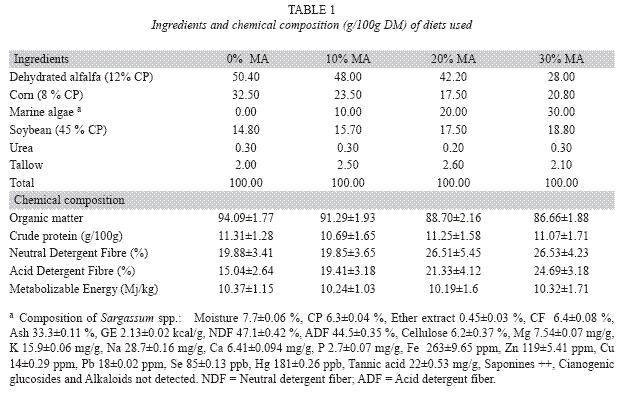
<body><![CDATA[<p><font face="Verdana" size="2">In Mexico as in other countries around the world, there are arid regions where sheep and goats are severely affected during the dry season because naturally- grown feed is scarce (Yahaya <i>et al</i>. 1999, Mora <i>et al</i>. 2009). The marine algae, <i>Sargassum </i>spp. represents an important alternative as food.</font></p> <font face="Verdana" size="2"><i> </i></font>     <p><font face="Verdana" size="2"><i>Sargassum </i>forms large beds in tropical and subtropical waters around the world, growing along beaches with a rocky substrate, rolling stones and pebbles (Ganzon- Fortes <i>et al</i>. 1993).</font></p>     <p><font face="Verdana" size="2">This algae is especially abundant along the Gulf of California coast, where a harvestable amount of 183 000 t has been estimated (Casas-Valdez <i>et al</i>. 2006a). This genus is a good source of minerals, carbohydrates and some essential amino- acids like arginine, tryptophane and phenylalanine. It is also rich in beta-carotene and vitamins. Furthermore, no antinutritious elements have been detected in it (Carrillo <i>et al. </i>2002, Casas-Valdez <i>et al</i>. 2006a). Some studies have shown a seaweed digestibility rangingfrom 28% to 67% (dry matter), and a protein degradability of 95% (Goj&oacute;n <i>et al. </i>1998).</font></p>     <p><font face="Verdana" size="2">Experimental works conducted with sheep and seaweeds are scarce. Arieli <i>et al</i>. (1993) mention that <i>Ulva lactuca </i>(Linnaeus) 1753 could be categorized as a low- energy highnitrogen foodstuff, and that these algae is a useful supplement for sheep. Hansen <i>et al</i>. (2003) concluded that <i>Laminaria digitata </i>(Hudson) J.V. Lamouroux 1813 and <i>L. hyperborea </i>(Gunnerus) Foslie 1884 can be used as an alternative food for north Ronaldsoy sheep. The effects of <i>Sargassum </i>spp. on digestibility and ruminal parameters in ruminants are unknown.</font></p>     <p><font face="Verdana" size="2">The objective of this study was to evaluate <i>Sargassum </i>meal as feed for sheep through the measures of <i>in vivo </i>digestibility, dry matter degradability, pH, ammonia and volatile fatty acids in rumen.</font></p> <b><font face="Verdana" size="3">     <p>Material and methods</p> </font><font face="Verdana" size="2"> </font></b>     <p><b><font face="Verdana" size="2">Algae and chemical analysis <i>Sargassum </i>spp.: </font></b><font face="Verdana" size="2">Specimens were collected at the San Juan de La Costa beach, which is located in La Paz bay, Baja California Sur, Mexico (24&ordm; 27&acute;-24&ordm; 06&acute; N and 110&ordm; 18&acute;-110&ordm; 40&acute; W). Four tons (wet weight) were collected manually from the intertidal zone at depths between 60cm and 1.20m. Plants were spread on a cement surface and sun-dried for two days. Then the marine algae (MA) was ground in a hammer mill (JERZA, model L) and afterwards in a knife mill using a 1mm mesh. A sample of 1kg was taking by quartering, to grind it finely and carry out chemical analysis by triplicate (<a  href="#tabla1">Table 1</a>).    <br> </font></p>     <p><font face="Verdana" size="2">    <br> </font></p>     ]]></body>
<body><![CDATA[<div style="text-align: center;"><a name="tabla1"></a><img  src="/img/revistas/rbt/v57n4/a30t1.gif" title="" alt=""  style="width: 623px; height: 399px;">    <br>     <br> </div>     <p><font face="Verdana" size="2">The following analyses were carried out on the <i>Sargassum </i>meal and diets using standard methods (AOAC 2000): moisture content (over-drying at 60&ordm;C to constant weigth, AOAC 2000 method 976.05), ash (ignition at 550&ordm;C in an electric furnace, AOAC 2000 method 923.03), nitrogen content was determined using the micro- Kjeldahl method (AOAC 2000 method 976.05), and a conversion factor of 6.25 was used to calculate protein content (CP), and ether extract (EE) (Soxhlet apparatus, AOAC 2000 method 920.39). Cell wall fractions: neutral detergent fibre (NDF), acid detergent fibre (ADF), cellulose, hemicellulose and lignin were analyzed according to the Van Soest method described by Tejada (1985), and gross energy was determined using a calorimetric Parr Bomb Parr Instrument Bomb, Mod. 6300).</font></p>     <p><font face="Verdana" size="2">To determine Ca, Mg, Na, K and Fe samples of MA meal were subjected to acid digestion and analyzed by atomic absorption spectrophotometry (Brand GBC, Mod. Avanta PM) following the procedures described by AOAC (2000) method 968.08 (Table 1). Zn and Cu by AOAC (2000) method 999.11. P was obtained by colorimetric (Clesceri <i>et al. </i>1989, method 4500). Pb, Hg y Se (NOM-117-SSA1-1994).</font></p>     <p><font face="Verdana" size="2">Metabolizable Energy (ME), Digestible Energy (DE) and Total Digestible Nutrients (TDN), were calculated: ME=D E*0.82; DE=TDN*4409 kcal; TDN= crude fiber(0.5)+crude protein(0.75)+nitrogen free extract (0.75)+(ethereal extract (0.90 * 2.25)).</font></p> <font face="Verdana" size="2"><b> </b></font>     <p><font face="Verdana" size="2"><b>Experimental designs: </b>The diets utilized were: control diet (0% MA), diet supplemented with 10%, 20% and 30% of <i>Sargassum </i>spp. meal (10% MA, 20% MA and 30% MA). The four diets met the sheep&#8217;s nutritional requirements (12.8% of crude protein and 10.19Mj/ kg) (NRC 1996) (<a href="#tabla1">Table 1</a>).</font></p>     <p><font face="Verdana" size="2">The study was conducted at La Paz City, Baja California Sur, Mexico. The weather in this region is typically warm and semi-arid, with an annual precipitation of 220 mm, a 50% average humidity and a 28&ordm;C average temperature.</font></p>     <p><font face="Verdana" size="2">Four Pelibuey sheep (mean BW=24.5kg, 18 months old) fitted with ruminal cannulae (Plastisol 1"; Bar Diamond) were randomly distributed in a replicated 4 x 4 Latin-square design, and were kept in metabolism cages with restricted access to feeding. All animals were treated with anthelmintics. The experimental protocol was approved by the Scientific Committee of the Universidad Aut&oacute;noma de Baja California Sur.</font></p>     <p><font face="Verdana" size="2">Feed (0.600 kg of diet) was provided twice a day at 06:00 and 18:00 hours. Water intake was provided <i>ad libitum</i>. Each one of the four experimental periods comprised 15 days; 10 days for diet-adaptation period, and 5 days for total feces and urine collection. feed intake (the difference between feed offered and feed refusal) and water intake were recorded daily. Total feces and urine were collected daily. In addition, dry matter (DM), CP, ADF and NDF digestibility (total fecal collection) were determined.</font></p>     ]]></body>
<body><![CDATA[<p><font face="Verdana" size="2">The DM digestibility coefficient of each diet was estimated using the following formula:    <br> </font></p>     <p><font face="Verdana" size="2">DC=<span  style="text-decoration: underline;">FI-FO</span> X 10    <br> &nbsp;&nbsp;&nbsp;&nbsp;&nbsp;&nbsp;&nbsp; FI    <br> </font></p>     <p><font face="Verdana" size="2">Where: DC=digestibility coefficient (%); FI=feed intake (DM basis) and FO=fecal output (DM basis).</font></p>     <p><font face="Verdana" size="2">Rumen degradability of dry matter for each diet was determined <i>in situ </i>using a nylon bag technique. The nylon bags (224 of 10 x 5 cm; pore size=60 </font><font  face="Verdana" size="2">&#956;</font><font face="Verdana" size="2">m) were filled with 3g of each diet and suspended in the rumen of each sheep. The bags were incubated for 3, 6, 9, 12, 24, 30, 36, 48 and 72 hours (zero time disappearance was obtained by suspending the nylon bags in a NaCl 0.15 N solution, at 37&ordm;C for 5min). Upon removal from the rumen, bags were washed five times during one min in a mechanical agitator until obtaining a clear and transparent rinsing liquid and afterwards, dried at 60&ordm;C and weighed (Harmon &amp; Richards 1997, Stern <i>et al. </i>1997) before determining DM disappearance which was calculated as follows:    <br> </font></p>     <p><font face="Verdana" size="2">DM(%)= <span  style="text-decoration: underline;">((WB+WBI)-(WB+WAI))</span> x 100    <br> &nbsp;&nbsp;&nbsp;&nbsp;&nbsp;&nbsp;&nbsp;&nbsp;&nbsp;&nbsp;&nbsp;&nbsp;&nbsp;&nbsp;&nbsp;&nbsp;&nbsp;&nbsp;&nbsp;&nbsp;&nbsp;&nbsp;&nbsp;&nbsp; SW    ]]></body>
<body><![CDATA[<br> </font></p>     <p><font face="Verdana" size="2">Where: DM (%)= dry matter disappearance; WB= bag weight; WBI= sample weight prior to incubation; WAI= sample weight after incubation; SW= sample weight.</font></p>     <p><font face="Verdana" size="2">Result of the <i>in situ </i>digestibility of DM were fitted to the non-linear equation: P= a+b(1-e<sup>-ct</sup>) (Orskov &amp; McDonald 1979) using the Neway Excel program, where: P= disappeared at time <i>t</i>; (a+b)= potential degradability; c= rate of degradation. The effective degradation was estimated at different degradation rates (fraction h<sup>-1</sup>): 0.02, 0.05 and 0.08.</font></p>     <p><font face="Verdana" size="2">Ruminal content samples of 150 ml were collected at 03:00, 06:00, 09:00, 12:00, 18:00 and 24:00 hr through the ruminal cannulae, for five days. One portion of the ruminal content was filtered by squeezing out eight layers of gauze and the pH of the filtrate was recorded immediately using a potentiometer (Orion Mod. 701A) with a Corning electrode (AOAC 2000). Ammoniacal nitrogen was determined by the distillation method (Clesceri <i>et al. </i>1989, method 4500). To determine volatile fatty acids (VFA&#8217;s), 5ml of filtrate were mixed with 1ml of a 3:1 (25 %) metaphosphoric acid/formic acid solution followed by centrifugation at 2 300g for 30min, then the supernatant was frozen and stored until analyzed. VFA&#8217;s content were determined using a Varian Star 3400 CX chromatograph (AOAC 2000, method 996.06). Data were analyzed by triplicate.</font></p> <font face="Verdana" size="2"><b> </b></font>     <p><font face="Verdana" size="2"><b>Statistical analysis: </b>Data of digestibility <i>in vivo</i>, kinetic of digestibility <i>in situ </i>of dry matter, feed and water intake, and urine excreted were examined using analysis of variance with a Latin square design (4 x 4) (Kuehl 1999) and Tukey&#8217;s test for a multiple comparisons of means, with a significance level of p&lt;0.05. Correlation analysis was made to know if there was a relationship between the concentration of <i>Sargassum </i>in the diet and: a) water intake, b) urine excretion, as well as between water intake and urine excretion. Ruminal pH, ruminal ammonia, and VFA data were analyzed as repeated measures using the Statistical Analysis System program (SAS 1985).</font></p> <b><font face="Verdana" size="3">     <p>Results</p> </font><font face="Verdana" size="2"> </font></b>     <p><b><font face="Verdana" size="2">Digestibility: </font></b><font  face="Verdana" size="2">No significant difference was found in feed intake among all experimental diets (p&gt;0.05) (<a href="#tabla2">Table 2</a>). There was significant difference in water intake and urine excretion between the control diet and the diets with MA (p&lt;0.05). A progressive increase in water intake (r&sup2;=0.54) and urine excretion (r&sup2;=0.74) (<a  href="#tabla2">Table 2</a>) was observed as the concentration of MA added in the diets increased; a positive correlation (r<sup>2</sup>=0.80) was found between water intake and urine excretion. Feces output did not present significant difference among all experimental diets (p&gt;0.05); however, the feces output of the animals fed with the diets 20% and 30% MA were more humid.    <br> </font></p>     <p><font face="Verdana" size="2">    <br> </font></p>     ]]></body>
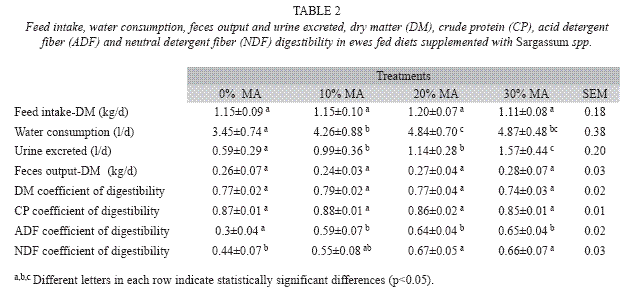
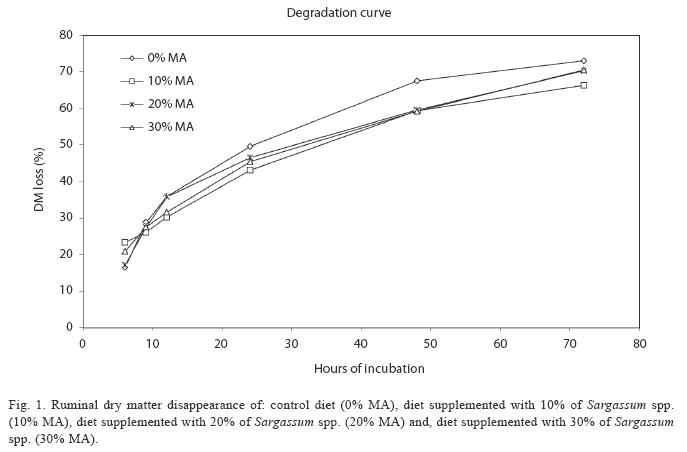
<body><![CDATA[<div style="text-align: center;"><a name="tabla2"></a><img  src="/img/revistas/rbt/v57n4/a30t2.gif" title="" alt=""  style="width: 628px; height: 294px;">    <br>     <br> </div>     <p><font face="Verdana" size="2">The <i>in vivo </i>digestibility coefficient of DM and CP showed no significant differences among control diet and the diets with MA (p&gt;0 .05) (<a href="#tabla2">Table 2</a>). The digestibility of ADF of the control diet was smaller in regard to all other treatments (p&lt;0.05). Moreover, the digestibility of NDF was greater in the 20% and 30% MA compared to the control diet (p&lt;0.05).</font></p> <font face="Verdana" size="2"><b> </b></font>     <p><font face="Verdana" size="2"><b>Dry matter disappearance: </b>During the ruminal incubation of diets, no significant differences were found in the DM disappearance among treatments in the first 24 hours (p&gt;0.05), but from 48 to 72 hr the disappearance of the control diet was higher (<a href="#fig1">Fig. 1</a>). Differences were observed in each treatments as time passed by (p&lt;0.05), DM disappearance increased with time of incubation.    <br> </font></p>     <p><font face="Verdana" size="2">    <br> </font></p>     <div style="text-align: center;"><a name="fig1"></a><img  src="/img/revistas/rbt/v57n4/a30i1.jpg" title="" alt=""  style="width: 687px; height: 452px;">    <br>     ]]></body>
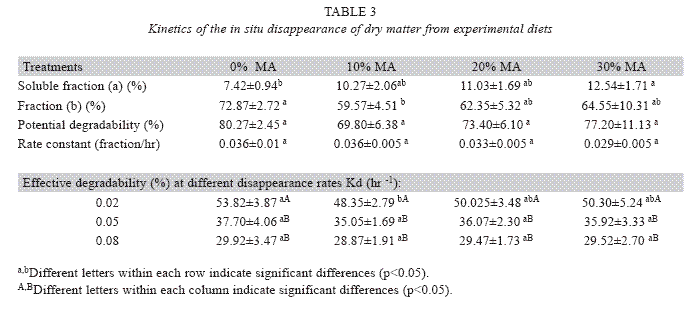
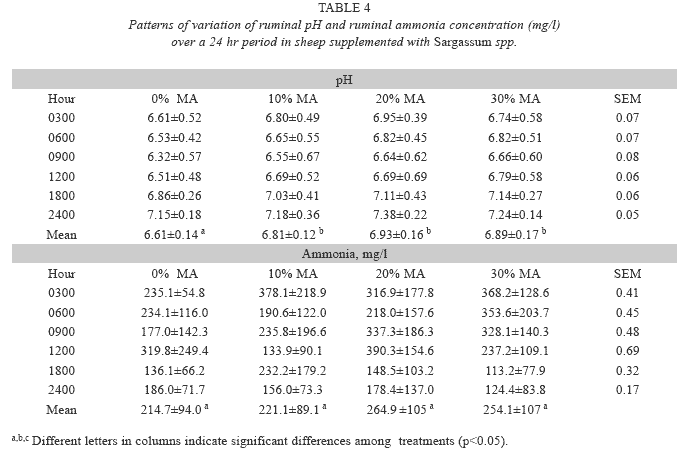
<body><![CDATA[<br> </div> <font face="Verdana" size="2"><b> </b></font>     <p><font face="Verdana" size="2"><b>Kinetics of the <i>in situ </i>digestibility of DM: </b>The soluble fraction (a) exhibited significant difference between the control diet and the diet with 30% MA which is higher (p&lt;0.05). The potentially digestible fraction (b) was higher in control diet than 10% MA (p&lt;0.05), but there was not significant difference in relation to 20% and 30% MA. Not any significant difference was found between the diets in the potential degradability (p&gt;0.05). No significant difference was found among the diets in degradability rate (Rate constant (fraction/hr)) (p&gt;0.05). The effective degradation was higher (p&lt;0.05) at the lowest degradation rate (0.02/ hr) in all treatments (<a href="#tabla3">Table 3</a>).    <br> </font></p>     <p><font face="Verdana" size="2">    <br> </font></p>     <div style="text-align: center;"><a name="tabla3"></a><img  src="/img/revistas/rbt/v57n4/a30t3.gif" title="" alt=""  style="width: 699px; height: 311px;">    <br>     <br> </div> <font face="Verdana" size="2"><b> </b></font>     <p><font face="Verdana" size="2"><b>pH, ammonia and volatile fatty acids in the rumen: </b>The lowest pH value was recorded on the control diet (p&lt;0.05), compared to the diets with MA, therefore <i>Sargassum </i>spp. meal favoring a neutral pH (<a href="#tabla4">Table 4</a>). Patterns of pH variation were similar among treatments.    <br> </font></p>     ]]></body>
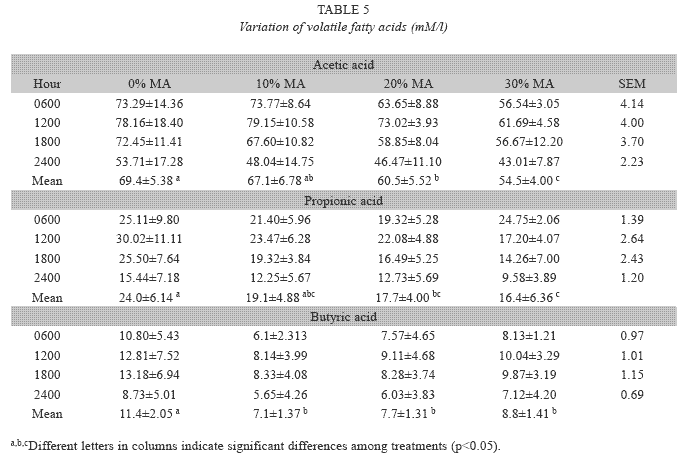
<body><![CDATA[<p><font face="Verdana" size="2">    <br> </font></p>     <div style="text-align: center;"><a name="tabla4"></a><img  src="/img/revistas/rbt/v57n4/a30t4.gif" title="" alt=""  style="width: 689px; height: 457px;">    <br>     <br> </div>     <p><font face="Verdana" size="2">No differences were observed in ammonia concentration among treatments (p&gt;0.05) (<a href="#tabla4">Table 4</a>). Ruminal NH<sub>3</sub> concentration (mg/l) was of 215 in the control group, and varied between 221 and 265 in the treatments with MA.</font></p>     <p><font face="Verdana" size="2">Acetic acid declined in all treatments 12 hours after the first meal (<a href="#tabla5">Table 5</a>). Significant differences (p&lt;0.05) were observed among 20% and 30% MA whose concentration was smaller than the control group. Propionic acid also displayed a similar pattern (<a href="#tabla5">Table 5</a>), with levels decreasing at 18:00 (12 hours after the first meal). The 20% and 30% MA treatments presented significant differences (p&lt;0.05) with respect to 0% MA. Butyric acid increased from 06:00 to 18:00 hr in 0% MA and 10% MA and of 06:00 to 12:00 in 20% MA and 30% MA (<a href="#tabla5">Table 5</a>). Levels of butyric acid were always lower in diets containing <i>Sargassum </i>spp. these showed significant differences (p&lt;0.05) with 0% MA.    <br> </font></p>     <p><font face="Verdana" size="2">    <br> </font></p>     ]]></body>
<body><![CDATA[<div style="text-align: center;"><a name="tabla5"></a><img  src="/img/revistas/rbt/v57n4/a30t5.gif" title="" alt=""  style="width: 690px; height: 458px;">    <br>     <br> </div> <b><font face="Verdana" size="3">     <p>Discussion</p> </font></b><font face="Verdana" size="2">     <p>The chemical composition of the algae varies seasonally and annually in relation to environmental factors, geographic distribution and physiological variations (Jimenez &amp; Go&ntilde;i 1999, Aguilera <i>et al</i>. 2005). P&eacute;rez (1999) reports variations in the chemical composition of <i>Sargassum </i>spp., collected in February, March, April and May in La Paz bay, in 1995. Their main components varied in a range of: protein 3.5 to 4.7%, ash 26.5 to 31.7%, crude fiber 10.2 to 11.4%, and ether extract 0.1 to 0.4. As <i>Sargassum </i>presents their maximum abundance, bidder size and completed their reproductive and life cycle at the end of spring, this seaweed is commonly collected then to do different experiments, as in the present research. Results about the chemical composition of <i>Sargassum</i>, collected at the end of spring, show the following values, protein 6.1 to 7.7%, ash 31 to 38%, crude fiber 6.5 to 9.3%, and ether extract 0.34 to 1.8% (Carrillo <i>et al</i>. 2002, Mar&iacute;n <i>et al</i>. 2003, Casas-Valdez <i>et al</i>. 2006a, 2006b). The results obtained in this study (protein 7.7%, ash 33.3%, crude fiber 6.4% and ether extract 0.45%) are similar to the ones previously mentioned. There are others components, like minerals analyzed in this study that also have seasonally and annually variations (Aguilera <i>et al</i>. 2005).</p>     <p>It seems that the palatability and taste of the different diets were not influenced by the inclusion of <i>Sargassum </i>meal as a feed ingredient, since there were not significant differences in feed intake. Water intake increased, as a result of the concentration of <i>Sargassum </i>included in the diet, particularly due to the large amount of Na and K in the algae. Consequently, the amount of urine excreted per day increased, being more abundant when sheep were fed with diets containing algae, as a result of the rise in water intake (Forbes 1995). Mora <i>et al</i>. (2009) also observed a progressive increase in the water intake and the urine excreted as the concentration of the alga <i>Macrocystis pyrifera </i>was higher (from 10 % to 30 %) on diets given to goats. It is likely that fecal matter excreted by sheep was more humid in the 20% MA and 30% MA groups, because of the water intake increase.</p>     <p>The digestibility of the diets including <i>Sargassum </i>meal, showed an adequate utilization of algal nutrients (79% to 74%). Our results suggest that values obtained for dry matter digestibility with diets supplemented with <i>Sargassum </i>spp. are similar to commonly used forages, like bean and soybean with 71.8 % and 69.4 %, respectively (Valdez <i>et al. </i>2002).</p>     <p>The concentration of seaweeds included in the diets, did not affect the digestibility of CP. The digestibility of cellular walls (FDN and FDA) increased, as a result of the concentration of <i>Sargassum </i>in the diet. This could be due to the presence of alginates, in the cellular walls of the algae.</p>     <p>The <i>in situ </i>digestibility allows determine whether degradation characteristics of vegetative species could be used to predict its nutritional value (Shem <i>et al. </i>1995). The dry matter disappearance obtained in this work at 72 hr varied from 65% to 68% as the concentration of <i>Sargassum </i>meal was increased. These values are in the range of those reported by Ram&iacute;rez <i>et al. </i>(2000) for different shrubs from Baja California Sur, with a mean of 0.68, and are closer to sorghum values (0.68) reported by Mart&iacute;nez <i>et al. </i>(1995). Mora <i>et al. </i>(2009) found a similar behavior in the dry matter disappearance when including the alga <i>Macrocystis pyrifera </i>on diets for goats, which rose from 0.73 to 0.80 as the concentration of the algae were increased from 10% to 30%. This result is considered to be due to the fact that <i>Macrocystis </i>has a higher concentration of soluble carbohydrates (Rodr&iacute;guez- Montesinos &amp; Hern&aacute;ndez-Carmona 1991) than <i>Sargassum </i>(Casas-Valdez <i>et al. </i>2006a), which is degraded faster in the rumen. Goj&oacute;n <i>et al. </i>(1998) reported a 54.8% disappearance of <i>Sargassum </i>dry matter in an experiment conducted with bovines. This difference might be attributed to the fact that they evaluated the algae alone.</p>     <p>It is important to evaluate the kinetics of the digestion since it allows the proportion of nutrients of dry matter consumed that can be absorbed, and assimilated by the animal (Mertens 1993). The soluble fraction (a) was higher at all diets that included <i>Sargassum </i>with respect to the control diet. This is related to the high content of soluble ashes in the algae. According to Goj&oacute;n <i>et al. </i>(1998) the minerals of <i>Sargassum </i>disappear from the nylon bag up to 78% at time 0 by diffusion.</p>     ]]></body>
<body><![CDATA[<p>The values of potentially digestible fraction of dry matter (b) obtained in the diets that included the alga (59% to 64%), are higher than those found by Ram&iacute;rez <i>et al</i>. (2000) in nine shrubs from Northwest Mexico supplied to sheep (15.5% to 54.7%), and similar to those reported by Galina <i>et al</i>. (2004) for diets that included maize, fish flour and urea (59 %). As well as those obtained by Mora <i>et al. </i>(2009) when supplying diets that included 10%, 20% and 30% of the alga <i>M. pyrifera </i>to goats (61 to 64%).</p>     <p>There was not any significant difference on the degradable fraction among the diets used in this experiment, observing values from 70% to 80%, what exhibits a low percentage of the indigestible fraction within each diet. These values were lower to those reported by Mora <i>et al. </i>(2009) (84% to 87%) when included <i>M. pyrifera </i>at concentrations from 10% to 30% on diets for goats. This could be related to the high content of ashes and soluble carbohydrates in <i>Macrocystis </i>(Mora <i>et al. </i>2009).</p>     <p>The highest values of effective degradation were obtained at a disappearance or passage rate (fraction/hr) of 0.02/hr in comparison to the rates of 0.05/hr and 0.08/hr; similar to the results obtained by Mora <i>et al. </i>(2009) with a diet containing <i>M. pyrifera </i>supplied to goats. Because when the flow is slower, it allows the feed to have a longer retention time in the rumen, obtaining a better degradation, as Forbes (1995) mentions that digestibility is the product of the retention time.</p>     <p>The rise in ruminal pH in sheep fed with marine algae could be as a consequence of the greater water consumption as mention Casas <i>et al. </i>(2003) and Mora <i>et al</i>. (2009). Furthermore, the addition of feedstuff with large amounts of starch or soluble carbohydrates will result in lower pH values (Fimbres <i>et al. </i>2002, Giri <i>et al. </i>2004) compared to diets with a prevalence of cellulose or other carbohydrates that are metabolized slowly. The proportion of <i>Sargassum </i>spp. in the diet affected positively ruminal pH, because it favors a neutral pH that helps cellulolytic bacteria replication, which are responsible for the degradation of the cellulose in the feed (Weimer 1996).</p>     <p>Obara <i>et al. </i>(1991) suggested that lower levels of ruminal NH<sub>3</sub>N are associated to increased rumen fermentation rates by stimulating an increased NH3N uptake for microbial protein synthesis. In this study, ruminal NH<sub>3</sub>N levels for sheep fed with <i>Sargassum </i>spp. were higher than the critical level (20mg/l) suggested by Satter &amp; Slyter (1974) for microbial protein synthesis and digestibility.</p>     <p>The total VFA&#8217;s concentration varies due to several factors. This may decline to a minimum 30mM or rise above 200mM, but it is normally between 70 and 130mM. The values obtained in this study fell within this range, except at 24:00 hr when VFA&#8217;s concentration was below 70mM in treatments with <i>Sargassum </i>meal. Volatile fatty acids concentration in the rumen at any given time reflects the balance between production and loss rates. Immediately after feed intake, VFA&#8217;s production exceeds the loss and the concentration increases, but subsequently this situation is reversed and VFA&#8217;s concentration falls (France &amp; Siddons 1993), as was observed in this work. However, the acetate:propionate:butyrate molar proportions in VFA&#8217;s obtained with diets containing <i>Sargassum </i>spp. were always lower than those in the control group. This can be explained because VFA&#8217;s are produced in the rumen as end-products of microbial fermentation. Therefore, it is likely that <i>Sargassum </i>polysaccharides, namely mannuronic and guluronic acids from alginate, the fucose and xylose (soluble polysaccharide), were not fully degraded by microbial populations in the rumen.</p>     <p>It is concluded that the marine algae <i>Sargassum </i>spp. meal can be used as a feed supplement for sheep, especially in tropical and subtropical regions where this marine algae is available.</p> </font><b><font face="Verdana" size="3">     <p>Acknowledgments</p> </font></b><font face="Verdana" size="2">     <p>The author Margarita Casas is grateful to Comisi&oacute;n de Fomento a las Actividades Acad&eacute;micas and Est&iacute;mulo al Desempe&ntilde;o a la Investigaci&oacute;n fellowships of Instituto Polit&eacute;cnico Nacional. Alejandro Mar&iacute;n was granted with a scholarship from Programa de Formaci&oacute;n de Investigadores of Instituto Polit&eacute;cnico Nacional and Consejo Nacional de Ciencia y Tecnolog&iacute;a.</p> </font> <hr style="width: 100%; height: 2px;"><b><font face="Verdana" size="3">     <p>Resumen</p> </font></b><font face="Verdana" size="2"> </font>     ]]></body>
<body><![CDATA[<p><font face="Verdana" size="2">El objetivo de este estudio fue evaluar la harina del alga marina <i>Sargassum </i>como alimento para ovejas, midiendo la digestibilidad <i>in vivo, </i>la degradabilidad de la materia seca<i>, </i>as&iacute; como el pH y los &aacute;cidos grasos vol&aacute;tiles en rumen. El alga <i>Sargassum </i>utilizada en este experimento, fue recolectada a finales de la primavera, cuando esta alga es m&aacute;s abundante, alcanza su mayor talla y ha completado su ciclo reproductivo. Se recolectaron manualmente, cuatro toneladas (peso h&uacute;medo) de la zona intermareal en la Bah&iacute;a de La Paz, Baja California Sur, M&eacute;xico. Estas algas fueron secadas directamente al sol y molidas en un molino de martillos, para obtener la harina. Se utilizaron cuatro borregos Pelibuey fistulados, distribuidos en un arreglo factorial de 4 x 4. Los animales fueron alimentados diariamente con dietas que conten&iacute;an el alga marina (AM) <i>Sargassum </i>a diferentes niveles (0, 10, 20 y 30%). El consumo de alimento no se vio afectado con la inclusi&oacute;n del alga (p&gt; 0.05). El consumo de agua y la excreci&oacute;n de orina se incrementaron conforme aument&oacute; la concentraci&oacute;n de AM en las dietas (p&lt;0.05; r<sup>2</sup>=0.54 and r<sup>2</sup>=0.74, respectivamente). En todos los tratamientos la digestibilidad de la materia seca fue de 74% a 79%, la digestibilidad de la prote&iacute;na cruda fue de 85% a 88%. La digestibilidad de la fibra &aacute;cido detergente (59%-65%) y de la neutro detergente (55%-66%) fue mayor en todos los tratamientos con AM, lo mismo ocurri&oacute; con el pH en rumen (p&lt;0.05). La concentraci&oacute;n de amonio en rumen no se vio afectada por AM (p&gt;0.05). La concentraci&oacute;n de &aacute;cidos grasos vol&aacute;tiles se redujo en todos los tratamientos con AM (p&lt;0.05). El alga marina <i>Sargassum </i>spp. puede ser usada como complemento alimenticio para ovejas, especialmente en las regiones tropicales y subtropicales donde est&aacute; disponible.</font></p> <font face="Verdana" size="2"><b> </b></font>     <p><font face="Verdana" size="2"><b>Key words: </b>alga marina, <i>Sargassum, </i>ovinos, digestibilidad, fermentaci&oacute;n ruminal, &aacute;cidos grasos vol&aacute;tiles.    <br> </font></p>     <p><font face="Verdana" size="2">    <br> </font></p>     <div style="text-align: center;"><font face="Verdana" size="2">Recibido 13-XI-2008. Corregido 15-II-2009. Aceptado 16-III-2009.</font>    <br> </div> <hr style="width: 100%; height: 2px;"><b><font face="Verdana" size="3">     <p>Resumen</p> </font></b><font face="Verdana" size="2">     <!-- ref --><p>Aguilera, M.M., M. Casas-Valdez, S. Carrillo, B. Gonz&aacute;lez &amp; F. P&eacute;rez-Gil. 2005. Chemical composition and microbiological assay of marine algae <i>Enteromorpha </i>spp. as potential food source. J. Food Compos. Anal. 18: 79-88.&nbsp;&nbsp;&nbsp;&nbsp;&nbsp;&nbsp;&nbsp;&nbsp;[&#160;<a href="javascript:void(0);" onclick="javascript: window.open('/scielo.php?script=sci_nlinks&ref=1277997&pid=S0034-7744200900040003000001&lng=','','width=640,height=500,resizable=yes,scrollbars=1,menubar=yes,');">Links</a>&#160;]<!-- end-ref --><!-- ref --><p>AOAC (Association of Analytical Chemists). 2000. Official Methods of Analysis of Association of Analytical Chemist, Horwitz, W., Gaithersburg, Maryland, USA.&nbsp;&nbsp;&nbsp;&nbsp;&nbsp;&nbsp;&nbsp;&nbsp;[&#160;<a href="javascript:void(0);" onclick="javascript: window.open('/scielo.php?script=sci_nlinks&ref=1277998&pid=S0034-7744200900040003000002&lng=','','width=640,height=500,resizable=yes,scrollbars=1,menubar=yes,');">Links</a>&#160;]<!-- end-ref --><!-- ref --><p>Arieli, A., D. Skland &amp; G. Kissil. 1993. A note on the nutritive value of <i>Ulva lactuca </i>for ruminants. Anim. Prod. 57: 329-331.&nbsp;&nbsp;&nbsp;&nbsp;&nbsp;&nbsp;&nbsp;&nbsp;[&#160;<a href="javascript:void(0);" onclick="javascript: window.open('/scielo.php?script=sci_nlinks&ref=1277999&pid=S0034-7744200900040003000003&lng=','','width=640,height=500,resizable=yes,scrollbars=1,menubar=yes,');">Links</a>&#160;]<!-- end-ref --><!-- ref --><p>Carrillo, S., M. Casas, F.R. P&eacute;rez-Gil &amp; I. S&aacute;nchez. 2002. Algas marinas de Baja California Sur, M&eacute;xico: Valor nutrimental. Arch. Latinoamer. Nutr. 52: 400-405.&nbsp;&nbsp;&nbsp;&nbsp;&nbsp;&nbsp;&nbsp;&nbsp;[&#160;<a href="javascript:void(0);" onclick="javascript: window.open('/scielo.php?script=sci_nlinks&ref=1278000&pid=S0034-7744200900040003000004&lng=','','width=640,height=500,resizable=yes,scrollbars=1,menubar=yes,');">Links</a>&#160;]<!-- end-ref --><!-- ref --><p>Casas, M., H. Hern&aacute;ndez, A. Mar&iacute;n, R.N. &Aacute;guila &amp; S. Carrillo. 2003. Use of <i>Sargassum </i>spp. algae as supplement for goats cattle, p. 263. XIII Congreso Latinoamericano de Nutrici&oacute;n<b>. </b>Acapulco, Guerrero, Mexico.&nbsp;&nbsp;&nbsp;&nbsp;&nbsp;&nbsp;&nbsp;&nbsp;[&#160;<a href="javascript:void(0);" onclick="javascript: window.open('/scielo.php?script=sci_nlinks&ref=1278001&pid=S0034-7744200900040003000005&lng=','','width=640,height=500,resizable=yes,scrollbars=1,menubar=yes,');">Links</a>&#160;]<!-- end-ref --><!-- ref --><p>Casas-Valdez, M., H.E. Hern&aacute;ndez-Contreras, A. Mar&iacute;n-Alvarez, R.N. &Aacute;guila- Ram&iacute;rez, C.J. Hern&aacute;ndez-Guerrero, I. S&aacute;nchez-Rodr&iacute;guez &amp; S. Carrillo-Dom&iacute;nguez. 2006a. El Alga marina <i>Sargassum </i>(<i>Sargassaceae</i>): una alternativa tropical para la alimentaci&oacute;n de ganado caprino. Rev. Biol. Trop. 54: 83-92.&nbsp;&nbsp;&nbsp;&nbsp;&nbsp;&nbsp;&nbsp;&nbsp;[&#160;<a href="javascript:void(0);" onclick="javascript: window.open('/scielo.php?script=sci_nlinks&ref=1278002&pid=S0034-7744200900040003000006&lng=','','width=640,height=500,resizable=yes,scrollbars=1,menubar=yes,');">Links</a>&#160;]<!-- end-ref --><!-- ref --><p>Casas-Valdez, M., G. Portillo-Clark, N. &Aacute;guila-Ram&iacute;rez, S. Rodr&iacute;guez-Astudillo, I. S&aacute;nchez-Rodr&iacute;guez &amp; S. Carrillo-Dom&iacute;nguez. 2006b. Efecto del alga marina <i>Sargassum </i>spp. sobre las variables productivas y la concentraci&oacute;n de colesterol en el camar&oacute;n caf&eacute;, <i>Farfantepenaeus californiensis </i>(Holmes, 1900). Rev. Biol. Mar. Oceanogr. 41:97-105.&nbsp;&nbsp;&nbsp;&nbsp;&nbsp;&nbsp;&nbsp;&nbsp;[&#160;<a href="javascript:void(0);" onclick="javascript: window.open('/scielo.php?script=sci_nlinks&ref=1278003&pid=S0034-7744200900040003000007&lng=','','width=640,height=500,resizable=yes,scrollbars=1,menubar=yes,');">Links</a>&#160;]<!-- end-ref --><!-- ref --><p>Clesceri, L., A. Grenberg &amp; R. Trussel. 1989. Standard methods for examination of water and wastewater. American Public Health Association, Washington, DC, USA.&nbsp;&nbsp;&nbsp;&nbsp;&nbsp;&nbsp;&nbsp;&nbsp;[&#160;<a href="javascript:void(0);" onclick="javascript: window.open('/scielo.php?script=sci_nlinks&ref=1278004&pid=S0034-7744200900040003000008&lng=','','width=640,height=500,resizable=yes,scrollbars=1,menubar=yes,');">Links</a>&#160;]<!-- end-ref --><!-- ref --><p>Fimbres, H., J.R. Kawas, G. Hern&aacute;ndez-Vidal, J.F. Pic&oacute;n- Rubio &amp; C.D. Lu. 2002. Nutrient intake, digestibility, mastication a ruminal fermentation of lambs fed finishing ration with various forage levels. Small Ruminant Res. 43: 275-281.&nbsp;&nbsp;&nbsp;&nbsp;&nbsp;&nbsp;&nbsp;&nbsp;[&#160;<a href="javascript:void(0);" onclick="javascript: window.open('/scielo.php?script=sci_nlinks&ref=1278005&pid=S0034-7744200900040003000009&lng=','','width=640,height=500,resizable=yes,scrollbars=1,menubar=yes,');">Links</a>&#160;]<!-- end-ref --><!-- ref --><p>Forbes, J.M. 1995. Voluntary food intake and diet selection in farm animals. CAB International, Wallingford, Oxford, England.&nbsp;&nbsp;&nbsp;&nbsp;&nbsp;&nbsp;&nbsp;&nbsp;[&#160;<a href="javascript:void(0);" onclick="javascript: window.open('/scielo.php?script=sci_nlinks&ref=1278006&pid=S0034-7744200900040003000010&lng=','','width=640,height=500,resizable=yes,scrollbars=1,menubar=yes,');">Links</a>&#160;]<!-- end-ref --><!-- ref --><p>France, J. &amp; R.C. Siddons. 1993. Volatile fatty acid production, p. 107-121. <i>In </i>J.M. Forbes &amp; J. France (eds.). Quantitative aspects of ruminant digestion and metabolism. CAB International, Wallingford, Oxford, England.&nbsp;&nbsp;&nbsp;&nbsp;&nbsp;&nbsp;&nbsp;&nbsp;[&#160;<a href="javascript:void(0);" onclick="javascript: window.open('/scielo.php?script=sci_nlinks&ref=1278007&pid=S0034-7744200900040003000011&lng=','','width=640,height=500,resizable=yes,scrollbars=1,menubar=yes,');">Links</a>&#160;]<!-- end-ref --><!-- ref --><p>Galina, M.A., M. Guerrero, C.D. Puga &amp; G.F.W. Haenlin. 2004. Effects of slow-intake urea supplementation on goat kids pasturing natural Mexican rangeland. Small Ruminant Res. 55: 85-95.&nbsp;&nbsp;&nbsp;&nbsp;&nbsp;&nbsp;&nbsp;&nbsp;[&#160;<a href="javascript:void(0);" onclick="javascript: window.open('/scielo.php?script=sci_nlinks&ref=1278008&pid=S0034-7744200900040003000012&lng=','','width=640,height=500,resizable=yes,scrollbars=1,menubar=yes,');">Links</a>&#160;]<!-- end-ref --><!-- ref --><p>Ganzon-Fortes, E.T., R.R. Campos &amp; J. Udarbe. 1993. The use of Philippine seaweeds in agriculture. Appl. Phycol. Forum 10: 6-7.&nbsp;&nbsp;&nbsp;&nbsp;&nbsp;&nbsp;&nbsp;&nbsp;[&#160;<a href="javascript:void(0);" onclick="javascript: window.open('/scielo.php?script=sci_nlinks&ref=1278009&pid=S0034-7744200900040003000013&lng=','','width=640,height=500,resizable=yes,scrollbars=1,menubar=yes,');">Links</a>&#160;]<!-- end-ref --><!-- ref --><p>Giri, S.S., S. Jaggi &amp; N.N. Pathakl. 2004. Feeding of grain less diets containing different nitrogen sources to crossbred growing bulls: effects on rumen fermentation pattern, microbial enzyme activity and ciliate protozoa population. Anim. Feed Sci. Technol. 118: 187-200.&nbsp;&nbsp;&nbsp;&nbsp;&nbsp;&nbsp;&nbsp;&nbsp;[&#160;<a href="javascript:void(0);" onclick="javascript: window.open('/scielo.php?script=sci_nlinks&ref=1278010&pid=S0034-7744200900040003000014&lng=','','width=640,height=500,resizable=yes,scrollbars=1,menubar=yes,');">Links</a>&#160;]<!-- end-ref --><!-- ref --><p>Goj&oacute;n, B.H., D. Siqueiros &amp; H. Hern&aacute;ndez. 1998. <i>In situ </i>ruminal digestibility and degradability of <i>Macrocystis pyrifera </i>and <i>Sargassum </i>spp. in bovine livestock. Cien. Mar. 24: 463-481.&nbsp;&nbsp;&nbsp;&nbsp;&nbsp;&nbsp;&nbsp;&nbsp;[&#160;<a href="javascript:void(0);" onclick="javascript: window.open('/scielo.php?script=sci_nlinks&ref=1278011&pid=S0034-7744200900040003000015&lng=','','width=640,height=500,resizable=yes,scrollbars=1,menubar=yes,');">Links</a>&#160;]<!-- end-ref --><!-- ref --><p>Hansen, H.R., B.L. Hector &amp; J. Feldmann. 2003. A qualitative and quantitative evaluation of the seaweed diet of North Ronaldsay sheep. Anim. Feed Sci. Technol. 105: 21-28.&nbsp;&nbsp;&nbsp;&nbsp;&nbsp;&nbsp;&nbsp;&nbsp;[&#160;<a href="javascript:void(0);" onclick="javascript: window.open('/scielo.php?script=sci_nlinks&ref=1278012&pid=S0034-7744200900040003000016&lng=','','width=640,height=500,resizable=yes,scrollbars=1,menubar=yes,');">Links</a>&#160;]<!-- end-ref --><!-- ref --><p>Harmon, D.L. &amp; C.J. Richards. 1997. Considerations for gastrointestinal cannulations in ruminants. J. Anim. Sci. 75: 2248-2255.&nbsp;&nbsp;&nbsp;&nbsp;&nbsp;&nbsp;&nbsp;&nbsp;[&#160;<a href="javascript:void(0);" onclick="javascript: window.open('/scielo.php?script=sci_nlinks&ref=1278013&pid=S0034-7744200900040003000017&lng=','','width=640,height=500,resizable=yes,scrollbars=1,menubar=yes,');">Links</a>&#160;]<!-- end-ref --><!-- ref --><p>Jimenez, E.A. &amp; I.C. Go&ntilde;i. 1999. Evaluaci&oacute;n nutricional y efectos fisiol&oacute;gicos de macroalgas marinas comestibles. Arch. Latinoamer. Nutr. 49: 114-120.&nbsp;&nbsp;&nbsp;&nbsp;&nbsp;&nbsp;&nbsp;&nbsp;[&#160;<a href="javascript:void(0);" onclick="javascript: window.open('/scielo.php?script=sci_nlinks&ref=1278014&pid=S0034-7744200900040003000018&lng=','','width=640,height=500,resizable=yes,scrollbars=1,menubar=yes,');">Links</a>&#160;]<!-- end-ref --><!-- ref --><p>Kuehl, R.O. 1999. Design of experiments: statistical principles of research design and Analysis. Duxbury/ Thomson Learning, Pacific Grove, California, USA.&nbsp;&nbsp;&nbsp;&nbsp;&nbsp;&nbsp;&nbsp;&nbsp;[&#160;<a href="javascript:void(0);" onclick="javascript: window.open('/scielo.php?script=sci_nlinks&ref=1278015&pid=S0034-7744200900040003000019&lng=','','width=640,height=500,resizable=yes,scrollbars=1,menubar=yes,');">Links</a>&#160;]<!-- end-ref --><!-- ref --><p>Mar&iacute;n, A., M. Casas, S. Carrillo, H. Hern&aacute;ndez &amp; A. Monroy. 2003. Performance of sheep fed rations with <i>Sargassum </i>spp. algae. Cuban J. Agric. Sci. 37:119-123.&nbsp;&nbsp;&nbsp;&nbsp;&nbsp;&nbsp;&nbsp;&nbsp;[&#160;<a href="javascript:void(0);" onclick="javascript: window.open('/scielo.php?script=sci_nlinks&ref=1278016&pid=S0034-7744200900040003000020&lng=','','width=640,height=500,resizable=yes,scrollbars=1,menubar=yes,');">Links</a>&#160;]<!-- end-ref --><!-- ref --><p>Mart&iacute;nez, R.G., M. N&uacute;&ntilde;ez, A. Herbele &amp; J. M&aacute;rquez. 1995. Evaluaci&oacute;n de forrajes para la sustituci&oacute;n de la alfalfa en la regi&oacute;n &aacute;rida de M&eacute;xico. I. Digestibilidad, p. 244-249. <i>In </i>Memorias de la Asociaci&oacute;n Mexicana de Producci&oacute;n Animal. Mexico, D.F., Mexico.&nbsp;&nbsp;&nbsp;&nbsp;&nbsp;&nbsp;&nbsp;&nbsp;[&#160;<a href="javascript:void(0);" onclick="javascript: window.open('/scielo.php?script=sci_nlinks&ref=1278017&pid=S0034-7744200900040003000021&lng=','','width=640,height=500,resizable=yes,scrollbars=1,menubar=yes,');">Links</a>&#160;]<!-- end-ref --><!-- ref --><p>Mertens, D.R. 1993. Rate and extent of digestion, p. 13-51. <i>In </i>J.M. Forbes &amp; J. France (eds.). Quantitative Aspects of Ruminant Digestion and Metabolism. CAB International, Wallingford, Oxford, England.&nbsp;&nbsp;&nbsp;&nbsp;&nbsp;&nbsp;&nbsp;&nbsp;[&#160;<a href="javascript:void(0);" onclick="javascript: window.open('/scielo.php?script=sci_nlinks&ref=1278018&pid=S0034-7744200900040003000022&lng=','','width=640,height=500,resizable=yes,scrollbars=1,menubar=yes,');">Links</a>&#160;]<!-- end-ref --><!-- ref --><p>Mora, C.N., M. Casas-Valdez, A. Mar&iacute;n, R. Aguila, I. S&aacute;nchez, H. Hern&aacute;ndez &amp; L. Sangin&eacute;s. 2009. The kelp <i>Macrocystis pyrifera </i>as nutritional supplement for goats. Rev. Cientif. FVC-LUZ. XIX: 1-8.&nbsp;&nbsp;&nbsp;&nbsp;&nbsp;&nbsp;&nbsp;&nbsp;[&#160;<a href="javascript:void(0);" onclick="javascript: window.open('/scielo.php?script=sci_nlinks&ref=1278019&pid=S0034-7744200900040003000023&lng=','','width=640,height=500,resizable=yes,scrollbars=1,menubar=yes,');">Links</a>&#160;]<!-- end-ref --><!-- ref --><p>NRC (National Research Council). 1996. Nutrient Requirements of Beef Cattle. Academy, Washington, DC, USA.&nbsp;&nbsp;&nbsp;&nbsp;&nbsp;&nbsp;&nbsp;&nbsp;[&#160;<a href="javascript:void(0);" onclick="javascript: window.open('/scielo.php?script=sci_nlinks&ref=1278020&pid=S0034-7744200900040003000024&lng=','','width=640,height=500,resizable=yes,scrollbars=1,menubar=yes,');">Links</a>&#160;]<!-- end-ref --><!-- ref --><p>NOM-117-SSA1-1994. 1994. Norma Oficial Mexicana. M&eacute;todo de Prueba para la determinaci&oacute;n de cadmio, ars&eacute;nico, plomo, esta&ntilde;o, cobre, hierro, zinc y mercurio en alimentos, agua potable y agua purificada por espectrometr&iacute;a de absorci&oacute;n at&oacute;mica. Gobierno Federal, M&eacute;xico.&nbsp;&nbsp;&nbsp;&nbsp;&nbsp;&nbsp;&nbsp;&nbsp;[&#160;<a href="javascript:void(0);" onclick="javascript: window.open('/scielo.php?script=sci_nlinks&ref=1278021&pid=S0034-7744200900040003000025&lng=','','width=640,height=500,resizable=yes,scrollbars=1,menubar=yes,');">Links</a>&#160;]<!-- end-ref --><!-- ref --><p>Obara, Y., D.W. Dellow &amp; J.V. Nolan. 1991. The influence of energy-rich supplements on nitrogen kinetics in ruminants, p. 515-540. <i>In</i>: T. Tsuda, Y. Sasaki, I. Kawashima (eds.). Physiological Aspects of Digestion and Metabolism in Ruminants. Proc. Seventh Symp. Academic, San Diego, California, USA.&nbsp;&nbsp;&nbsp;&nbsp;&nbsp;&nbsp;&nbsp;&nbsp;[&#160;<a href="javascript:void(0);" onclick="javascript: window.open('/scielo.php?script=sci_nlinks&ref=1278022&pid=S0034-7744200900040003000026&lng=','','width=640,height=500,resizable=yes,scrollbars=1,menubar=yes,');">Links</a>&#160;]<!-- end-ref --><!-- ref --><p>Orskov, E.R. &amp; L. McDonald. 1979. The estimation of protein degradability in the rumen form incubation measurements weighed according to the rate of passage. J. Agric. Sci. 92: 499-503.&nbsp;&nbsp;&nbsp;&nbsp;&nbsp;&nbsp;&nbsp;&nbsp;[&#160;<a href="javascript:void(0);" onclick="javascript: window.open('/scielo.php?script=sci_nlinks&ref=1278023&pid=S0034-7744200900040003000027&lng=','','width=640,height=500,resizable=yes,scrollbars=1,menubar=yes,');">Links</a>&#160;]<!-- end-ref --><!-- ref --><p>P&eacute;rez, R.C. 1999.Composici&oacute;n qu&iacute;mica de <i>Sargassum </i>spp. colectado en la Bah&iacute;a de La Paz, B.C.S., y la factibilidad de su aprovechamiento en forma directa o como fuente de alginato. Tesis de Maestr&iacute;a, La Paz, Baja California Sur, M&eacute;xico.&nbsp;&nbsp;&nbsp;&nbsp;&nbsp;&nbsp;&nbsp;&nbsp;[&#160;<a href="javascript:void(0);" onclick="javascript: window.open('/scielo.php?script=sci_nlinks&ref=1278024&pid=S0034-7744200900040003000028&lng=','','width=640,height=500,resizable=yes,scrollbars=1,menubar=yes,');">Links</a>&#160;]<!-- end-ref --><!-- ref --><p>Ram&iacute;rez, R.G., R.R. Neira, R.A. Ledezma &amp; C.A. Garibaldi. 2000. Ruminal digestion characteristics and effective degradability of cell wall of browse species from northeastern Mexico. Small Ruminant. Res. 36: 49-55.&nbsp;&nbsp;&nbsp;&nbsp;&nbsp;&nbsp;&nbsp;&nbsp;[&#160;<a href="javascript:void(0);" onclick="javascript: window.open('/scielo.php?script=sci_nlinks&ref=1278025&pid=S0034-7744200900040003000029&lng=','','width=640,height=500,resizable=yes,scrollbars=1,menubar=yes,');">Links</a>&#160;]<!-- end-ref --><!-- ref --><p>Rodr&iacute;guez-Montesinos, Y.E. &amp; G. Hern&aacute;ndez-Carmona. 1991. Seasonal and geographic variations of <i>Macrocystis pyrifera </i>chemical composition at the western coast of Baja California. Cien. Mar. 17: 91-107.&nbsp;&nbsp;&nbsp;&nbsp;&nbsp;&nbsp;&nbsp;&nbsp;[&#160;<a href="javascript:void(0);" onclick="javascript: window.open('/scielo.php?script=sci_nlinks&ref=1278026&pid=S0034-7744200900040003000030&lng=','','width=640,height=500,resizable=yes,scrollbars=1,menubar=yes,');">Links</a>&#160;]<!-- end-ref --><!-- ref --><p>SAS. 1985. SAS/STAT guide for personal computers (Version 6a. ed.). SAS Inst. Inc. Cary, N.C.&nbsp;&nbsp;&nbsp;&nbsp;&nbsp;&nbsp;&nbsp;&nbsp;[&#160;<a href="javascript:void(0);" onclick="javascript: window.open('/scielo.php?script=sci_nlinks&ref=1278027&pid=S0034-7744200900040003000031&lng=','','width=640,height=500,resizable=yes,scrollbars=1,menubar=yes,');">Links</a>&#160;]<!-- end-ref --><!-- ref --><p>Satter, L.D. &amp; L.L. Slyter. 1974. Effect of ammonia concentration on rumen microbial protein production in vitro. Br. J. Nutr. 32: 199-208.&nbsp;&nbsp;&nbsp;&nbsp;&nbsp;&nbsp;&nbsp;&nbsp;[&#160;<a href="javascript:void(0);" onclick="javascript: window.open('/scielo.php?script=sci_nlinks&ref=1278028&pid=S0034-7744200900040003000032&lng=','','width=640,height=500,resizable=yes,scrollbars=1,menubar=yes,');">Links</a>&#160;]<!-- end-ref --><!-- ref --><p>Shem, M.N., E.R. Orskov &amp; A.E. Kimambo. 1995. Prediction of voluntary dry-matter intake, digestible dry-matter intake and growth rate of cattle from the degradation characteristics of tropical foods. Anim. Sci. (Pencaitland) 60: 65-74.&nbsp;&nbsp;&nbsp;&nbsp;&nbsp;&nbsp;&nbsp;&nbsp;[&#160;<a href="javascript:void(0);" onclick="javascript: window.open('/scielo.php?script=sci_nlinks&ref=1278029&pid=S0034-7744200900040003000033&lng=','','width=640,height=500,resizable=yes,scrollbars=1,menubar=yes,');">Links</a>&#160;]<!-- end-ref --><!-- ref --><p>Stern, M.D., A. Bach &amp; S. Calsamiglia. 1997. Alternative techniques for measuring nutrient digestion in ruminants<b>. </b>J. Anim. Sci. 75: 2256-2276.&nbsp;&nbsp;&nbsp;&nbsp;&nbsp;&nbsp;&nbsp;&nbsp;[&#160;<a href="javascript:void(0);" onclick="javascript: window.open('/scielo.php?script=sci_nlinks&ref=1278030&pid=S0034-7744200900040003000034&lng=','','width=640,height=500,resizable=yes,scrollbars=1,menubar=yes,');">Links</a>&#160;]<!-- end-ref --><!-- ref --><p>Tejada, I.H. 1985. Manual de laboratorio para an&aacute;lisis de ingredientes utilizados en la alimentaci&oacute;n animal, Patronato de Apoyo a la Investigaci&oacute;n y Experimentaci&oacute;n Pecuaria en M&eacute;xico, INIFAP, Secretar&iacute;a de Agricultura y Recursos Hidr&aacute;ulicos, Mexico, D. F., Mexico.&nbsp;&nbsp;&nbsp;&nbsp;&nbsp;&nbsp;&nbsp;&nbsp;[&#160;<a href="javascript:void(0);" onclick="javascript: window.open('/scielo.php?script=sci_nlinks&ref=1278031&pid=S0034-7744200900040003000035&lng=','','width=640,height=500,resizable=yes,scrollbars=1,menubar=yes,');">Links</a>&#160;]<!-- end-ref --><!-- ref --><p>Valdez, L.M., V.L. Almeida, G.U. Maldonado, G.E. V&aacute;zquez, A.M. Luque &amp; L.J. Portillo. 2002. Efecto del frijol (<i>Phaseolus vulgaris</i>) de rezaga cocido en la digestibilidad aparente de la fibra en cabras lecheras, p. 273-279. <i>In </i>L.M. Valdez, V.L. Almeida, G.U. Maldonado, G.E. V&aacute;zquez, A.M. Luque &amp; L.J. Portillo (eds.). Memorias de la XX Reuni&oacute;n Nacional Sobre Caprinocultura. Culiac&aacute;n, Sinaloa, Mexico.&nbsp;&nbsp;&nbsp;&nbsp;&nbsp;&nbsp;&nbsp;&nbsp;[&#160;<a href="javascript:void(0);" onclick="javascript: window.open('/scielo.php?script=sci_nlinks&ref=1278032&pid=S0034-7744200900040003000036&lng=','','width=640,height=500,resizable=yes,scrollbars=1,menubar=yes,');">Links</a>&#160;]<!-- end-ref --><!-- ref --><p>Weimer, P.J. 1996. Why don&acute;t ruminal bacteria digest cellulose faster? J. Dairy Sci. 79: 1496-1502.&nbsp;&nbsp;&nbsp;&nbsp;&nbsp;&nbsp;&nbsp;&nbsp;[&#160;<a href="javascript:void(0);" onclick="javascript: window.open('/scielo.php?script=sci_nlinks&ref=1278033&pid=S0034-7744200900040003000037&lng=','','width=640,height=500,resizable=yes,scrollbars=1,menubar=yes,');">Links</a>&#160;]<!-- end-ref --><!-- ref --><p>Yahaya, M.S., J. Takahasi, S. Matsuoka &amp; A. Kibon. 1999. Effect of supplementary feeding of cotton seed cake on feed intake, water consumption and work output of work bulls in Borno State, Nigeria. Anim. Feed Sci. Technol. 79: 137-143.&nbsp;&nbsp;&nbsp;&nbsp;&nbsp;&nbsp;&nbsp;&nbsp;[&#160;<a href="javascript:void(0);" onclick="javascript: window.open('/scielo.php?script=sci_nlinks&ref=1278034&pid=S0034-7744200900040003000038&lng=','','width=640,height=500,resizable=yes,scrollbars=1,menubar=yes,');">Links</a>&#160;]<!-- end-ref --> ]]></body><back>
<ref-list>
<ref id="B1">
<nlm-citation citation-type="journal">
<person-group person-group-type="author">
<name>
<surname><![CDATA[Aguilera]]></surname>
<given-names><![CDATA[M.M]]></given-names>
</name>
<name>
<surname><![CDATA[Casas-Valdez]]></surname>
<given-names><![CDATA[M]]></given-names>
</name>
<name>
<surname><![CDATA[Carrillo]]></surname>
<given-names><![CDATA[S]]></given-names>
</name>
<name>
<surname><![CDATA[González]]></surname>
<given-names><![CDATA[B]]></given-names>
</name>
<name>
<surname><![CDATA[Pérez-Gil]]></surname>
<given-names><![CDATA[F]]></given-names>
</name>
</person-group>
<article-title xml:lang="en"><![CDATA[Chemical composition and microbiological assay of marine algae Enteromorpha spp. as potential food source]]></article-title>
<source><![CDATA[J. Food Compos. Anal]]></source>
<year>2005</year>
<volume>18</volume>
<page-range>79-88</page-range></nlm-citation>
</ref>
<ref id="B2">
<nlm-citation citation-type="">
<collab>AOAC (Association of Analytical Chemists)</collab>
<source><![CDATA[Official Methods of Analysis of Association of Analytical Chemist]]></source>
<year>2000</year>
<publisher-loc><![CDATA[Gaithersburg^eMaryland Maryland]]></publisher-loc>
</nlm-citation>
</ref>
<ref id="B3">
<nlm-citation citation-type="journal">
<person-group person-group-type="author">
<name>
<surname><![CDATA[Arieli]]></surname>
<given-names><![CDATA[A]]></given-names>
</name>
<name>
<surname><![CDATA[Skland]]></surname>
<given-names><![CDATA[D]]></given-names>
</name>
<name>
<surname><![CDATA[Kissil]]></surname>
<given-names><![CDATA[G]]></given-names>
</name>
</person-group>
<article-title xml:lang="en"><![CDATA[A note on the nutritive value of Ulva lactuca for ruminants]]></article-title>
<source><![CDATA[Anim. Prod]]></source>
<year>1993</year>
<volume>57</volume>
<page-range>329-331</page-range></nlm-citation>
</ref>
<ref id="B4">
<nlm-citation citation-type="journal">
<person-group person-group-type="author">
<name>
<surname><![CDATA[Carrillo]]></surname>
<given-names><![CDATA[S]]></given-names>
</name>
<name>
<surname><![CDATA[Casas]]></surname>
<given-names><![CDATA[M]]></given-names>
</name>
<name>
<surname><![CDATA[Pérez-Gil]]></surname>
<given-names><![CDATA[F.R]]></given-names>
</name>
<name>
<surname><![CDATA[Sánchez]]></surname>
<given-names><![CDATA[I]]></given-names>
</name>
</person-group>
<article-title xml:lang="en"><![CDATA[Algas marinas de Baja California Sur, México: Valor nutrimental]]></article-title>
<source><![CDATA[Arch. Latinoamer. Nutr]]></source>
<year>2002</year>
<volume>52</volume>
<page-range>400-405</page-range></nlm-citation>
</ref>
<ref id="B5">
<nlm-citation citation-type="confpro">
<person-group person-group-type="author">
<name>
<surname><![CDATA[Casas]]></surname>
<given-names><![CDATA[M]]></given-names>
</name>
<name>
<surname><![CDATA[Hernández]]></surname>
<given-names><![CDATA[H]]></given-names>
</name>
<name>
<surname><![CDATA[Marín]]></surname>
<given-names><![CDATA[A]]></given-names>
</name>
<name>
<surname><![CDATA[Águila]]></surname>
<given-names><![CDATA[R.N]]></given-names>
</name>
<name>
<surname><![CDATA[Carrillo]]></surname>
<given-names><![CDATA[S]]></given-names>
</name>
</person-group>
<source><![CDATA[Use of Sargassum spp. algae as supplement for goats cattle]]></source>
<year>2003</year>
<conf-name><![CDATA[XIII Congreso Latinoamericano de Nutrición]]></conf-name>
<conf-loc>Acapulco Guerrero</conf-loc>
<page-range>263</page-range></nlm-citation>
</ref>
<ref id="B6">
<nlm-citation citation-type="journal">
<person-group person-group-type="author">
<name>
<surname><![CDATA[Casas-Valdez]]></surname>
<given-names><![CDATA[M]]></given-names>
</name>
<name>
<surname><![CDATA[Hernández-Contreras]]></surname>
<given-names><![CDATA[H.E]]></given-names>
</name>
<name>
<surname><![CDATA[Marín-Alvarez]]></surname>
<given-names><![CDATA[A]]></given-names>
</name>
<name>
<surname><![CDATA[Águila- Ramírez]]></surname>
<given-names><![CDATA[R.N]]></given-names>
</name>
<name>
<surname><![CDATA[Hernández-Guerrero]]></surname>
<given-names><![CDATA[C.J]]></given-names>
</name>
<name>
<surname><![CDATA[Sánchez-Rodríguez]]></surname>
<given-names><![CDATA[I]]></given-names>
</name>
<name>
<surname><![CDATA[Carrillo-Domínguez]]></surname>
<given-names><![CDATA[S]]></given-names>
</name>
</person-group>
<article-title xml:lang="es"><![CDATA[El Alga marina Sargassum (Sargassaceae): una alternativa tropical para la alimentación de ganado caprino]]></article-title>
<source><![CDATA[Rev. Biol. Trop]]></source>
<year>2006</year>
<volume>54</volume>
<page-range>83-92</page-range></nlm-citation>
</ref>
<ref id="B7">
<nlm-citation citation-type="journal">
<person-group person-group-type="author">
<name>
<surname><![CDATA[Casas-Valdez]]></surname>
<given-names><![CDATA[M]]></given-names>
</name>
<name>
<surname><![CDATA[Portillo-Clark]]></surname>
<given-names><![CDATA[G]]></given-names>
</name>
<name>
<surname><![CDATA[Águila-Ramírez]]></surname>
<given-names><![CDATA[N]]></given-names>
</name>
<name>
<surname><![CDATA[Rodríguez-Astudillo]]></surname>
<given-names><![CDATA[S]]></given-names>
</name>
<name>
<surname><![CDATA[Sánchez-Rodríguez]]></surname>
<given-names><![CDATA[I]]></given-names>
</name>
<name>
<surname><![CDATA[Carrillo-Domínguez]]></surname>
<given-names><![CDATA[S]]></given-names>
</name>
</person-group>
<article-title xml:lang="es"><![CDATA[Efecto del alga marina Sargassum spp. sobre las variables productivas y la concentración de colesterol en el camarón café, Farfantepenaeus californiensis (Holmes, 1900)]]></article-title>
<source><![CDATA[Rev. Biol. Mar. Oceanogr]]></source>
<year>2006</year>
<volume>41</volume>
<page-range>97-105</page-range></nlm-citation>
</ref>
<ref id="B8">
<nlm-citation citation-type="book">
<person-group person-group-type="author">
<name>
<surname><![CDATA[Clesceri]]></surname>
<given-names><![CDATA[L]]></given-names>
</name>
<name>
<surname><![CDATA[Grenberg]]></surname>
<given-names><![CDATA[A]]></given-names>
</name>
<name>
<surname><![CDATA[Trussel]]></surname>
<given-names><![CDATA[R]]></given-names>
</name>
</person-group>
<source><![CDATA[Standard methods for examination of water and wastewater]]></source>
<year>1989</year>
<publisher-loc><![CDATA[^eWashington, DC Washington, DC]]></publisher-loc>
<publisher-name><![CDATA[American Public Health Association]]></publisher-name>
</nlm-citation>
</ref>
<ref id="B9">
<nlm-citation citation-type="journal">
<person-group person-group-type="author">
<name>
<surname><![CDATA[Fimbres]]></surname>
<given-names><![CDATA[H]]></given-names>
</name>
<name>
<surname><![CDATA[Kawas]]></surname>
<given-names><![CDATA[J.R]]></given-names>
</name>
<name>
<surname><![CDATA[Hernández-Vidal]]></surname>
<given-names><![CDATA[G]]></given-names>
</name>
<name>
<surname><![CDATA[Picón- Rubio]]></surname>
<given-names><![CDATA[J.F]]></given-names>
</name>
<name>
<surname><![CDATA[Lu]]></surname>
<given-names><![CDATA[C.D]]></given-names>
</name>
</person-group>
<article-title xml:lang="en"><![CDATA[Nutrient intake, digestibility, mastication a ruminal fermentation of lambs fed finishing ration with various forage levels]]></article-title>
<source><![CDATA[Small Ruminant Res]]></source>
<year>2002</year>
<volume>43</volume>
<page-range>275-281</page-range></nlm-citation>
</ref>
<ref id="B10">
<nlm-citation citation-type="book">
<person-group person-group-type="author">
<name>
<surname><![CDATA[Forbes]]></surname>
<given-names><![CDATA[J.M]]></given-names>
</name>
</person-group>
<source><![CDATA[Voluntary food intake and diet selection in farm animals]]></source>
<year>1995</year>
<publisher-loc><![CDATA[WallingfordOxford ]]></publisher-loc>
<publisher-name><![CDATA[CAB International]]></publisher-name>
</nlm-citation>
</ref>
<ref id="B11">
<nlm-citation citation-type="book">
<person-group person-group-type="author">
<name>
<surname><![CDATA[France]]></surname>
<given-names><![CDATA[J]]></given-names>
</name>
<name>
<surname><![CDATA[Siddons]]></surname>
<given-names><![CDATA[R.C]]></given-names>
</name>
</person-group>
<article-title xml:lang="en"><![CDATA[Volatile fatty acid production]]></article-title>
<person-group person-group-type="editor">
<name>
<surname><![CDATA[Forbes]]></surname>
<given-names><![CDATA[J.M]]></given-names>
</name>
<name>
<surname><![CDATA[France]]></surname>
<given-names><![CDATA[J]]></given-names>
</name>
</person-group>
<source><![CDATA[Quantitative aspects of ruminant digestion and metabolism]]></source>
<year>1993</year>
<page-range>107-121</page-range><publisher-loc><![CDATA[WallingfordOxford ]]></publisher-loc>
<publisher-name><![CDATA[CAB International]]></publisher-name>
</nlm-citation>
</ref>
<ref id="B12">
<nlm-citation citation-type="journal">
<person-group person-group-type="author">
<name>
<surname><![CDATA[Galina]]></surname>
<given-names><![CDATA[M.A]]></given-names>
</name>
<name>
<surname><![CDATA[Guerrero]]></surname>
<given-names><![CDATA[M]]></given-names>
</name>
<name>
<surname><![CDATA[Puga]]></surname>
<given-names><![CDATA[C.D]]></given-names>
</name>
<name>
<surname><![CDATA[Haenlin]]></surname>
<given-names><![CDATA[G.F.W]]></given-names>
</name>
</person-group>
<article-title xml:lang="en"><![CDATA[Effects of slow-intake urea supplementation on goat kids pasturing natural Mexican rangeland]]></article-title>
<source><![CDATA[Small Ruminant Res]]></source>
<year>2004</year>
<volume>55</volume>
<page-range>85-95</page-range></nlm-citation>
</ref>
<ref id="B13">
<nlm-citation citation-type="journal">
<person-group person-group-type="author">
<name>
<surname><![CDATA[Ganzon-Fortes]]></surname>
<given-names><![CDATA[E.T]]></given-names>
</name>
<name>
<surname><![CDATA[Campos]]></surname>
<given-names><![CDATA[R.R]]></given-names>
</name>
<name>
<surname><![CDATA[Udarbe]]></surname>
<given-names><![CDATA[J]]></given-names>
</name>
</person-group>
<article-title xml:lang="en"><![CDATA[The use of Philippine seaweeds in agriculture]]></article-title>
<source><![CDATA[Appl. Phycol. Forum]]></source>
<year>1993</year>
<volume>10</volume>
<page-range>6-7</page-range></nlm-citation>
</ref>
<ref id="B14">
<nlm-citation citation-type="journal">
<person-group person-group-type="author">
<name>
<surname><![CDATA[Giri]]></surname>
<given-names><![CDATA[S.S]]></given-names>
</name>
<name>
<surname><![CDATA[Jaggi]]></surname>
<given-names><![CDATA[S]]></given-names>
</name>
<name>
<surname><![CDATA[Pathak]]></surname>
<given-names><![CDATA[N.N]]></given-names>
</name>
</person-group>
<article-title xml:lang="en"><![CDATA[Feeding of grain less diets containing different nitrogen sources to crossbred growing bulls: effects on rumen fermentation pattern, microbial enzyme activity and ciliate protozoa population]]></article-title>
<source><![CDATA[Anim. Feed Sci. Technol]]></source>
<year>2004</year>
<volume>118</volume>
<page-range>187-200</page-range></nlm-citation>
</ref>
<ref id="B15">
<nlm-citation citation-type="journal">
<person-group person-group-type="author">
<name>
<surname><![CDATA[Gojón]]></surname>
<given-names><![CDATA[B.H]]></given-names>
</name>
<name>
<surname><![CDATA[Siqueiros]]></surname>
<given-names><![CDATA[D]]></given-names>
</name>
<name>
<surname><![CDATA[Hernández]]></surname>
<given-names><![CDATA[H]]></given-names>
</name>
</person-group>
<article-title xml:lang="en"><![CDATA[In situ ruminal digestibility and degradability of Macrocystis pyrifera and Sargassum spp. in bovine livestock]]></article-title>
<source><![CDATA[Cien. Mar]]></source>
<year>1998</year>
<volume>24</volume>
<page-range>463-481</page-range></nlm-citation>
</ref>
<ref id="B16">
<nlm-citation citation-type="journal">
<person-group person-group-type="author">
<name>
<surname><![CDATA[Hansen]]></surname>
<given-names><![CDATA[H.R]]></given-names>
</name>
<name>
<surname><![CDATA[Hector]]></surname>
<given-names><![CDATA[B.L]]></given-names>
</name>
<name>
<surname><![CDATA[Feldmann]]></surname>
<given-names><![CDATA[J]]></given-names>
</name>
</person-group>
<article-title xml:lang="en"><![CDATA[A qualitative and quantitative evaluation of the seaweed diet of North Ronaldsay sheep]]></article-title>
<source><![CDATA[Anim. Feed Sci. Technol]]></source>
<year>2003</year>
<volume>105</volume>
<page-range>21-28</page-range></nlm-citation>
</ref>
<ref id="B17">
<nlm-citation citation-type="journal">
<person-group person-group-type="author">
<name>
<surname><![CDATA[Harmon]]></surname>
<given-names><![CDATA[D.L]]></given-names>
</name>
<name>
<surname><![CDATA[Richards]]></surname>
<given-names><![CDATA[C.J]]></given-names>
</name>
</person-group>
<article-title xml:lang="en"><![CDATA[Considerations for gastrointestinal cannulations in ruminants]]></article-title>
<source><![CDATA[J. Anim. Sci]]></source>
<year>1997</year>
<volume>75</volume>
<page-range>2248-2255</page-range></nlm-citation>
</ref>
<ref id="B18">
<nlm-citation citation-type="journal">
<person-group person-group-type="author">
<name>
<surname><![CDATA[Jimenez]]></surname>
<given-names><![CDATA[E.A]]></given-names>
</name>
<name>
<surname><![CDATA[Goñi]]></surname>
<given-names><![CDATA[I.C]]></given-names>
</name>
</person-group>
<article-title xml:lang="es"><![CDATA[Evaluación nutricional y efectos fisiológicos de macroalgas marinas comestibles]]></article-title>
<source><![CDATA[Arch. Latinoamer. Nutr]]></source>
<year>1999</year>
<volume>49</volume>
<page-range>114-120</page-range></nlm-citation>
</ref>
<ref id="B19">
<nlm-citation citation-type="book">
<person-group person-group-type="author">
<name>
<surname><![CDATA[Kuehl]]></surname>
<given-names><![CDATA[R.O]]></given-names>
</name>
</person-group>
<source><![CDATA[Design of experiments: statistical principles of research design and Analysis]]></source>
<year>1999</year>
<publisher-loc><![CDATA[Pacific Grove^eCalifornia California]]></publisher-loc>
<publisher-name><![CDATA[Duxbury/ Thomson Learning]]></publisher-name>
</nlm-citation>
</ref>
<ref id="B20">
<nlm-citation citation-type="journal">
<person-group person-group-type="author">
<name>
<surname><![CDATA[Marín]]></surname>
<given-names><![CDATA[A]]></given-names>
</name>
<name>
<surname><![CDATA[Casas]]></surname>
<given-names><![CDATA[M]]></given-names>
</name>
<name>
<surname><![CDATA[Carrillo]]></surname>
<given-names><![CDATA[S]]></given-names>
</name>
<name>
<surname><![CDATA[Hernández]]></surname>
<given-names><![CDATA[H]]></given-names>
</name>
<name>
<surname><![CDATA[Monroy]]></surname>
<given-names><![CDATA[A]]></given-names>
</name>
</person-group>
<article-title xml:lang="en"><![CDATA[Performance of sheep fed rations with Sargassum spp. algae]]></article-title>
<source><![CDATA[Cuban J. Agric. Sci]]></source>
<year>2003</year>
<volume>37</volume>
<page-range>119-123</page-range></nlm-citation>
</ref>
<ref id="B21">
<nlm-citation citation-type="">
<person-group person-group-type="author">
<name>
<surname><![CDATA[Martínez]]></surname>
<given-names><![CDATA[R.G]]></given-names>
</name>
<name>
<surname><![CDATA[Núñez]]></surname>
<given-names><![CDATA[M]]></given-names>
</name>
<name>
<surname><![CDATA[Herbele]]></surname>
<given-names><![CDATA[A]]></given-names>
</name>
<name>
<surname><![CDATA[Márque]]></surname>
<given-names><![CDATA[J]]></given-names>
</name>
</person-group>
<article-title xml:lang="es"><![CDATA[Evaluación de forrajes para la sustitución de la alfalfa en la región árida de México. I. Digestibilidad]]></article-title>
<source><![CDATA[Memorias de la Asociación Mexicana de Producción Animal]]></source>
<year>1995</year>
<page-range>244-249</page-range><publisher-loc><![CDATA[Mexico, D.F ]]></publisher-loc>
</nlm-citation>
</ref>
<ref id="B22">
<nlm-citation citation-type="book">
<person-group person-group-type="author">
<name>
<surname><![CDATA[Mertens]]></surname>
<given-names><![CDATA[D.R]]></given-names>
</name>
</person-group>
<article-title xml:lang="en"><![CDATA[Rate and extent of digestion]]></article-title>
<person-group person-group-type="editor">
<name>
<surname><![CDATA[Forbes]]></surname>
<given-names><![CDATA[J.M]]></given-names>
</name>
<name>
<surname><![CDATA[France]]></surname>
<given-names><![CDATA[J]]></given-names>
</name>
</person-group>
<source><![CDATA[Quantitative Aspects of Ruminant Digestion and Metabolism]]></source>
<year>1993</year>
<page-range>13-51</page-range><publisher-loc><![CDATA[WallingfordOxford ]]></publisher-loc>
<publisher-name><![CDATA[CAB International]]></publisher-name>
</nlm-citation>
</ref>
<ref id="B23">
<nlm-citation citation-type="journal">
<person-group person-group-type="author">
<name>
<surname><![CDATA[Mora]]></surname>
<given-names><![CDATA[C.N]]></given-names>
</name>
<name>
<surname><![CDATA[Casas-Valdez]]></surname>
<given-names><![CDATA[M]]></given-names>
</name>
<name>
<surname><![CDATA[Marín]]></surname>
<given-names><![CDATA[A]]></given-names>
</name>
<name>
<surname><![CDATA[Aguila]]></surname>
<given-names><![CDATA[R]]></given-names>
</name>
<name>
<surname><![CDATA[Sánchez]]></surname>
<given-names><![CDATA[I]]></given-names>
</name>
<name>
<surname><![CDATA[Hernández]]></surname>
<given-names><![CDATA[H]]></given-names>
</name>
<name>
<surname><![CDATA[Sanginés]]></surname>
<given-names><![CDATA[L]]></given-names>
</name>
</person-group>
<article-title xml:lang="en"><![CDATA[The kelp Macrocystis pyrifera as nutritional supplement for goats]]></article-title>
<source><![CDATA[Rev. Cientif. FVC-LUZ]]></source>
<year>2009</year>
<volume>XIX</volume>
<page-range>1-8</page-range></nlm-citation>
</ref>
<ref id="B24">
<nlm-citation citation-type="book">
<collab>NRC (National Research Council)</collab>
<source><![CDATA[Nutrient Requirements of Beef Cattle]]></source>
<year>1996</year>
<publisher-loc><![CDATA[^eWashington, DC Washington, DC]]></publisher-loc>
<publisher-name><![CDATA[Academy]]></publisher-name>
</nlm-citation>
</ref>
<ref id="B25">
<nlm-citation citation-type="book">
<source><![CDATA[Norma Oficial Mexicana. Método de Prueba para la determinación de cadmio, arsénico, plomo, estaño, cobre, hierro, zinc y mercurio en alimentos, agua potable y agua purificada por espectrometría de absorción atómica]]></source>
<year>1994</year>
<publisher-name><![CDATA[Gobierno Federal]]></publisher-name>
</nlm-citation>
</ref>
<ref id="B26">
<nlm-citation citation-type="confpro">
<person-group person-group-type="author">
<name>
<surname><![CDATA[Obara]]></surname>
<given-names><![CDATA[Y]]></given-names>
</name>
<name>
<surname><![CDATA[Dellow]]></surname>
<given-names><![CDATA[D.W]]></given-names>
</name>
<name>
<surname><![CDATA[Nolan]]></surname>
<given-names><![CDATA[J.V]]></given-names>
</name>
</person-group>
<article-title xml:lang="en"><![CDATA[The influence of energy-rich supplements on nitrogen kinetics in ruminants]]></article-title>
<person-group person-group-type="editor">
<name>
<surname><![CDATA[Tsuda]]></surname>
<given-names><![CDATA[T]]></given-names>
</name>
<name>
<surname><![CDATA[Sasaki]]></surname>
<given-names><![CDATA[Y]]></given-names>
</name>
<name>
<surname><![CDATA[Kawashima]]></surname>
<given-names><![CDATA[I]]></given-names>
</name>
</person-group>
<source><![CDATA[Physiological Aspects of Digestion and Metabolism in Ruminants]]></source>
<year>1991</year>
<conf-name><![CDATA[ Proc. Seventh Symp. Academic]]></conf-name>
<conf-loc>San Diego California</conf-loc>
<page-range>515-540</page-range></nlm-citation>
</ref>
<ref id="B27">
<nlm-citation citation-type="journal">
<person-group person-group-type="author">
<name>
<surname><![CDATA[Orskov]]></surname>
<given-names><![CDATA[E.R]]></given-names>
</name>
<name>
<surname><![CDATA[McDonald]]></surname>
<given-names><![CDATA[L]]></given-names>
</name>
</person-group>
<article-title xml:lang="en"><![CDATA[The estimation of protein degradability in the rumen form incubation measurements weighed according to the rate of passage]]></article-title>
<source><![CDATA[J. Agric. Sci]]></source>
<year>1979</year>
<volume>92</volume>
<page-range>499-503</page-range></nlm-citation>
</ref>
<ref id="B28">
<nlm-citation citation-type="">
<person-group person-group-type="author">
<name>
<surname><![CDATA[Pérez]]></surname>
<given-names><![CDATA[R.C]]></given-names>
</name>
</person-group>
<source><![CDATA[Composición química de Sargassum spp. colectado en la Bahía de La Paz, B.C.S., y la factibilidad de su aprovechamiento en forma directa o como fuente de alginato]]></source>
<year>1999</year>
</nlm-citation>
</ref>
<ref id="B29">
<nlm-citation citation-type="journal">
<person-group person-group-type="author">
<name>
<surname><![CDATA[Ramírez]]></surname>
<given-names><![CDATA[R.G]]></given-names>
</name>
<name>
<surname><![CDATA[Neira]]></surname>
<given-names><![CDATA[R.R]]></given-names>
</name>
<name>
<surname><![CDATA[Ledezma]]></surname>
<given-names><![CDATA[R.A]]></given-names>
</name>
<name>
<surname><![CDATA[Garibald]]></surname>
<given-names><![CDATA[C.A]]></given-names>
</name>
</person-group>
<article-title xml:lang="en"><![CDATA[Ruminal digestion characteristics and effective degradability of cell wall of browse species from northeastern Mexico]]></article-title>
<source><![CDATA[Small Ruminant. Res]]></source>
<year>2000</year>
<volume>36</volume>
<page-range>49-55</page-range></nlm-citation>
</ref>
<ref id="B30">
<nlm-citation citation-type="journal">
<person-group person-group-type="author">
<name>
<surname><![CDATA[Rodríguez-Montesinos]]></surname>
<given-names><![CDATA[Y.E]]></given-names>
</name>
<name>
<surname><![CDATA[Hernández-Carmona]]></surname>
<given-names><![CDATA[G]]></given-names>
</name>
</person-group>
<article-title xml:lang="en"><![CDATA[Seasonal and geographic variations of Macrocystis pyrifera chemical composition at the western coast of Baja California]]></article-title>
<source><![CDATA[Cien. Mar]]></source>
<year>1991</year>
<volume>17</volume>
<page-range>91-107</page-range></nlm-citation>
</ref>
<ref id="B31">
<nlm-citation citation-type="book">
<collab>SAS</collab>
<source><![CDATA[SAS/STAT guide for personal computers]]></source>
<year>1985</year>
<edition>6a</edition>
<publisher-name><![CDATA[SAS Inst. Inc. Cary, N.C]]></publisher-name>
</nlm-citation>
</ref>
<ref id="B32">
<nlm-citation citation-type="journal">
<person-group person-group-type="author">
<name>
<surname><![CDATA[Satter]]></surname>
<given-names><![CDATA[L.D]]></given-names>
</name>
<name>
<surname><![CDATA[Slyter]]></surname>
<given-names><![CDATA[L.L]]></given-names>
</name>
</person-group>
<article-title xml:lang="en"><![CDATA[Effect of ammonia concentration on rumen microbial protein production in vitro]]></article-title>
<source><![CDATA[Br. J. Nutr]]></source>
<year>1974</year>
<volume>32</volume>
<page-range>199-208</page-range></nlm-citation>
</ref>
<ref id="B33">
<nlm-citation citation-type="journal">
<person-group person-group-type="author">
<name>
<surname><![CDATA[Shem]]></surname>
<given-names><![CDATA[M.N]]></given-names>
</name>
<name>
<surname><![CDATA[Orskov]]></surname>
<given-names><![CDATA[E.R]]></given-names>
</name>
<name>
<surname><![CDATA[Kimambo]]></surname>
<given-names><![CDATA[A.E]]></given-names>
</name>
</person-group>
<article-title xml:lang="en"><![CDATA[Prediction of voluntary dry-matter intake, digestible dry-matter intake and growth rate of cattle from the degradation characteristics of tropical foods]]></article-title>
<source><![CDATA[Anim. Sci. (Pencaitland)]]></source>
<year>1995</year>
<volume>60</volume>
<page-range>65-74</page-range></nlm-citation>
</ref>
<ref id="B34">
<nlm-citation citation-type="journal">
<person-group person-group-type="author">
<name>
<surname><![CDATA[Stern]]></surname>
<given-names><![CDATA[M.D]]></given-names>
</name>
<name>
<surname><![CDATA[Bach]]></surname>
<given-names><![CDATA[A]]></given-names>
</name>
<name>
<surname><![CDATA[Calsamiglia]]></surname>
<given-names><![CDATA[S]]></given-names>
</name>
</person-group>
<article-title xml:lang="en"><![CDATA[Alternative techniques for measuring nutrient digestion in ruminants]]></article-title>
<source><![CDATA[J. Anim. Sci]]></source>
<year>1997</year>
<volume>75</volume>
<page-range>2256-2276</page-range></nlm-citation>
</ref>
<ref id="B35">
<nlm-citation citation-type="book">
<person-group person-group-type="author">
<name>
<surname><![CDATA[Tejada]]></surname>
<given-names><![CDATA[I.H]]></given-names>
</name>
</person-group>
<source><![CDATA[Manual de laboratorio para análisis de ingredientes utilizados en la alimentación animal, Patronato de Apoyo a la Investigación y Experimentación Pecuaria en México]]></source>
<year>1985</year>
<publisher-loc><![CDATA[Mexico, D. F ]]></publisher-loc>
<publisher-name><![CDATA[INIFAP, Secretaría de Agricultura y Recursos Hidráulicos]]></publisher-name>
</nlm-citation>
</ref>
<ref id="B36">
<nlm-citation citation-type="">
<person-group person-group-type="author">
<name>
<surname><![CDATA[Valdez]]></surname>
<given-names><![CDATA[L.M]]></given-names>
</name>
<name>
<surname><![CDATA[Almeida]]></surname>
<given-names><![CDATA[V.L]]></given-names>
</name>
<name>
<surname><![CDATA[Maldonado]]></surname>
<given-names><![CDATA[G.U]]></given-names>
</name>
<name>
<surname><![CDATA[Vázquez]]></surname>
<given-names><![CDATA[G.E]]></given-names>
</name>
<name>
<surname><![CDATA[Luque]]></surname>
<given-names><![CDATA[A.M]]></given-names>
</name>
<name>
<surname><![CDATA[Portillo]]></surname>
<given-names><![CDATA[L.J]]></given-names>
</name>
</person-group>
<article-title xml:lang="es"><![CDATA[Efecto del frijol (Phaseolus vulgaris) de rezaga cocido en la digestibilidad aparente de la fibra en cabras lecheras]]></article-title>
<person-group person-group-type="editor">
<name>
<surname><![CDATA[Valdez]]></surname>
<given-names><![CDATA[L.M]]></given-names>
</name>
<name>
<surname><![CDATA[Almeida]]></surname>
<given-names><![CDATA[V.L]]></given-names>
</name>
<name>
<surname><![CDATA[Maldonado]]></surname>
<given-names><![CDATA[G.U]]></given-names>
</name>
<name>
<surname><![CDATA[Vázquez]]></surname>
<given-names><![CDATA[G.E]]></given-names>
</name>
<name>
<surname><![CDATA[Luque]]></surname>
<given-names><![CDATA[A.M]]></given-names>
</name>
<name>
<surname><![CDATA[Portillo]]></surname>
<given-names><![CDATA[L.J]]></given-names>
</name>
</person-group>
<source><![CDATA[Memorias de la XX Reunión Nacional Sobre Caprinocultura]]></source>
<year>2002</year>
<page-range>273-279</page-range><publisher-loc><![CDATA[CuliacánSinaloa ]]></publisher-loc>
</nlm-citation>
</ref>
<ref id="B37">
<nlm-citation citation-type="journal">
<person-group person-group-type="author">
<name>
<surname><![CDATA[Weimer]]></surname>
<given-names><![CDATA[P.J]]></given-names>
</name>
</person-group>
<article-title xml:lang="en"><![CDATA[Why don´t ruminal bacteria digest cellulose faster]]></article-title>
<source><![CDATA[J. Dairy Sci]]></source>
<year>1996</year>
<volume>79</volume>
<page-range>1496-1502</page-range></nlm-citation>
</ref>
<ref id="B38">
<nlm-citation citation-type="journal">
<person-group person-group-type="author">
<name>
<surname><![CDATA[Yahaya]]></surname>
<given-names><![CDATA[M.S]]></given-names>
</name>
<name>
<surname><![CDATA[Takahasi]]></surname>
<given-names><![CDATA[J]]></given-names>
</name>
<name>
<surname><![CDATA[Matsuoka]]></surname>
<given-names><![CDATA[S]]></given-names>
</name>
<name>
<surname><![CDATA[Kibon]]></surname>
<given-names><![CDATA[A]]></given-names>
</name>
</person-group>
<article-title xml:lang="en"><![CDATA[Effect of supplementary feeding of cotton seed cake on feed intake, water consumption and work output of work bulls in Borno State, Nigeria]]></article-title>
<source><![CDATA[Anim. Feed Sci. Technol]]></source>
<year>1999</year>
<volume>79</volume>
<page-range>137-143</page-range></nlm-citation>
</ref>
</ref-list>
</back>
</article>