<?xml version="1.0" encoding="ISO-8859-1"?><article xmlns:mml="http://www.w3.org/1998/Math/MathML" xmlns:xlink="http://www.w3.org/1999/xlink" xmlns:xsi="http://www.w3.org/2001/XMLSchema-instance">
<front>
<journal-meta>
<journal-id>0034-7744</journal-id>
<journal-title><![CDATA[Revista de Biología Tropical]]></journal-title>
<abbrev-journal-title><![CDATA[Rev. biol. trop]]></abbrev-journal-title>
<issn>0034-7744</issn>
<publisher>
<publisher-name><![CDATA[Universidad de Costa Rica]]></publisher-name>
</publisher>
</journal-meta>
<article-meta>
<article-id>S0034-77442009000400026</article-id>
<title-group>
<article-title xml:lang="en"><![CDATA[Presence and significance of Bacillus thuringiensis Cry proteins associated with the Andean weevil Premnotrypes vorax (Coleoptera: Curculionidae)]]></article-title>
</title-group>
<contrib-group>
<contrib contrib-type="author">
<name>
<surname><![CDATA[López-Pazos]]></surname>
<given-names><![CDATA[SilvioAlejandro]]></given-names>
</name>
<xref ref-type="aff" rid="A01"/>
</contrib>
<contrib contrib-type="author">
<name>
<surname><![CDATA[Martínez]]></surname>
<given-names><![CDATA[John Wilson]]></given-names>
</name>
<xref ref-type="aff" rid="A02"/>
</contrib>
<contrib contrib-type="author">
<name>
<surname><![CDATA[Castillo]]></surname>
<given-names><![CDATA[Adriana Ximena]]></given-names>
</name>
<xref ref-type="aff" rid="A01"/>
</contrib>
<contrib contrib-type="author">
<name>
<surname><![CDATA[Cerón Salamanca]]></surname>
<given-names><![CDATA[Jairo Alonso]]></given-names>
</name>
<xref ref-type="aff" rid="A01"/>
</contrib>
</contrib-group>
<aff id="A01">
<institution><![CDATA[,Universidad Nacional de Colombia Instituto de Biotecnología ]]></institution>
<addr-line><![CDATA[Santafé de Bogotá DC ]]></addr-line>
<country>Colombia</country>
</aff>
<aff id="A02">
<institution><![CDATA[,Universidad Pedagógica y Tecnológica de Colombia Programa de Ingeniería Agronómica Grupo Manejo Biológico de Cultivos]]></institution>
<addr-line><![CDATA[Tunja ]]></addr-line>
<country>Colombia</country>
</aff>
<pub-date pub-type="pub">
<day>00</day>
<month>12</month>
<year>2009</year>
</pub-date>
<pub-date pub-type="epub">
<day>00</day>
<month>12</month>
<year>2009</year>
</pub-date>
<volume>57</volume>
<numero>4</numero>
<fpage>1235</fpage>
<lpage>1243</lpage>
<copyright-statement/>
<copyright-year/>
<self-uri xlink:href="http://www.scielo.sa.cr/scielo.php?script=sci_arttext&amp;pid=S0034-77442009000400026&amp;lng=en&amp;nrm=iso"></self-uri><self-uri xlink:href="http://www.scielo.sa.cr/scielo.php?script=sci_abstract&amp;pid=S0034-77442009000400026&amp;lng=en&amp;nrm=iso"></self-uri><self-uri xlink:href="http://www.scielo.sa.cr/scielo.php?script=sci_pdf&amp;pid=S0034-77442009000400026&amp;lng=en&amp;nrm=iso"></self-uri><abstract abstract-type="short" xml:lang="en"><p><![CDATA[The Andean weevil Premnotrypes vorax represents an important cause of damage to Colombian potato crops. Due to the impact of this plague on the economy of the country, we searched for new alternatives for its biological control, based on the entomopathogenic bacteria Bacillus thuringiensis. A total of 300 B. thuringiensis strains obtained from potato plantations infested with P. vorax were analyzed through crystal morphology, SDS-PAGE, PCR and bioassays. We used site- directed mutagenesis to modify the Cry3Aa protein. Most of the B. thuringiensis isolates had a bipyramidal crystal morphology. SDS-PAGE analyses had seven strains groups with &#963;-endotoxins from 35 to 135 kDa. The genes cry 2 and cry 1 were significantly more frequent in the P. vorax habitat (PCR analyses). Three mutant toxins, 1 (D354E), 2 (R345A, &#8710;Y350, &#8710;Y351), and 3 (Q482A, S484A, R485A), were analyzed to assess their activity against P. vorax larvae. Toxicity was low, or absent, against P. vorax for isolates, wild type cry 3Aa and cry 3Aa mutants. The genetic characterization of the collection provides opportunities for the selection of strains to be tested in bioassays against other insect pests of agricultural importance, and for designing Cry proteins with improved insecticidal toxicity. Rev. Biol. Trop. 57 (4): 1235-1243. Epub 2009 December 01.]]></p></abstract>
<abstract abstract-type="short" xml:lang="es"><p><![CDATA[El gorgojo andino Premnotrypes vorax es una causa importante de daño en los cultivos colombianos de este tubérculo. Debido al impacto que esta plaga tiene sobre la economía del país, nos interesamos en buscar alternativas nuevas para el control biológico de P. vorax, basadas en la bacteria entomopatógena Bacillus thuringiensis. Se recolectaron un total de 300 cepas de B. thuringiensis a partir de plantaciones de papa infestadas con P. vorax, las cuales fueron analizadas por medio de la morfología del cristal, SDS-PAGE, PCR y ensayos biológicos. La mayoría de los aislamientos de B. thuringiensis presentaron cristales bipiramidales. Los análisis de SDS-PAGE indicaron la presencia de siete grupos de cepas con &#963;- endotoxinas que variaban entre 35 a 135 kDa. Las pruebas con PCR demostraron que los genes cry 2 y cry 1 fueron significativamente más frecuentes en el medioambiente de P. vorax. Además, se utilizó la mutagénesis sitio-dirigida para modificar la proteína Cry3Aa. Se analizaron tres toxinas mutantes, 1 (D354E), 2 (R345A, &#8710;Y350, &#8710;Y351), y 3 (Q482A, S484A, R485A), para determinar su actividad contra larvas de P. vorax. Los ensayos de toxicidad señalaron escasa, o nula, actividad hacia P. vorax tanto para las cepas, la toxina Cry3Aa de referencia y las proteínas Cry3Aa mutantes. La caracterización genética de la colección puede proveer oportunidades para la selección de cepas que pueden evaluarse por medio de bioensayos contra otros insectos-plaga de importancia agrícola, y para el diseño de proteínas Cry con actividad toxica mejorada.]]></p></abstract>
<kwd-group>
<kwd lng="en"><![CDATA[native strain]]></kwd>
<kwd lng="en"><![CDATA[Andean weevil]]></kwd>
<kwd lng="en"><![CDATA[Cry3Aa protein]]></kwd>
<kwd lng="en"><![CDATA[potato crop]]></kwd>
<kwd lng="en"><![CDATA[site-directed mutagenesis]]></kwd>
<kwd lng="es"><![CDATA[cepa nativa]]></kwd>
<kwd lng="es"><![CDATA[gorgojo andino]]></kwd>
<kwd lng="es"><![CDATA[proteína Cry3Aa]]></kwd>
<kwd lng="es"><![CDATA[cultivo de papa]]></kwd>
<kwd lng="es"><![CDATA[mutagénesis sitio-dirigida]]></kwd>
</kwd-group>
</article-meta>
</front><body><![CDATA[  <b><font face="Verdana" size="4">     <p align="center">Presence and significance of <i>Bacillus thuringiensis </i>Cry proteins associated with the Andean weevil <i>Premnotrypes vorax </i>(Coleoptera: Curculionidae)</p> </font><font face="Verdana" size="2"> </font></b>     <p><font face="Verdana" size="2">    <br> Silvio Alejandro L&oacute;pez-Pazos<a href="#autor1"><sup>1</sup></a>; John Wilson Mart&iacute;nez<a href="#autor2"><sup>2</sup></a>; Adriana Ximena Castillo<a href="#autor1"><sup>1</sup></a> &amp; Jairo Alonso Cer&oacute;n Salamanca<a href="#autor1"><sup>1</sup></a></font></p>     <p><font face="Verdana" size="2"><a name="autor1"></a>1. Instituto de Biotecnolog&iacute;a, Universidad Nacional de Colombia, A.A 14-490, Santaf&eacute; de Bogot&aacute; DC, Colombia; <a href="mailto:olger.calderon@ucr.ac.cr">salopezp@unal.edu.co</a>; <a href="mailto:axcastillog@unal.edu.co">axcastillog@unal.edu.co</a>, <a href="mailto:jacerons@unal.edu.co">jacerons@unal.edu.co</a></font></p>     <p><font face="Verdana" size="2"><a name="autor2"></a>2. Grupo Manejo Biol&oacute;gico de Cultivos. Programa de Ingenier&iacute;a Agron&oacute;mica, Universidad Pedag&oacute;gica y Tecnol&oacute;gica de Colombia. Tunja. Colombia; </font><a  href="mailto:wilsonmarti@yahoo.es"><font face="Verdana" size="2">wilsonmarti@yahoo.es</font></a></p> <font face="Verdana" size="2"> </font> <hr style="width: 100%; height: 2px;">     <p><font face="Verdana" size="2"><b>Abstract: </b>The Andean weevil <i>Premnotrypes vorax </i>represents an important cause of damage to Colombian potato crops. Due to the impact of this plague on the economy of the country, we searched for new alternatives for its biological control, based on the entomopathogenic bacteria <i>Bacillus thuringiensis</i>. A total of 300 <i>B. thuringiensis </i>strains obtained from potato plantations infested with <i>P. vorax </i>were analyzed through crystal morphology, SDS-PAGE, PCR and bioassays. We used site- directed mutagenesis to modify the Cry3Aa protein. Most of the <i>B. thuringiensis </i>isolates had a bipyramidal crystal morphology. SDS-PAGE analyses had seven strains groups with </font><font  face="Verdana" size="2">&#963;</font><font face="Verdana" size="2">-endotoxins from 35 to 135 kDa. The genes <i>cry </i>2 and <i>cry </i>1 were significantly more frequent in the <i>P. vorax </i>habitat (PCR analyses). Three mutant toxins, 1 (D354E), 2 (R345A, &#8710;Y350, &#8710;Y351), and 3 (Q482A, S484A, R485A), were analyzed to assess their activity against <i>P. vorax </i>larvae. Toxicity was low, or absent, against <i>P. vorax </i>for isolates, wild type <i>cry </i>3Aa and <i>cry </i>3Aa mutants. The genetic characterization of the collection provides opportunities for the selection of strains to be tested in bioassays against other insect pests of agricultural importance, and for designing Cry proteins with improved insecticidal toxicity. Rev. Biol. Trop. 57 (4): 1235-1243. Epub 2009 December 01.</font></p> <font face="Verdana" size="2"><b> </b></font>     <p><font face="Verdana" size="2"><b>Key words: </b>native strain, Andean weevil, Cry3Aa protein, potato crop, site-directed mutagenesis.</font></p> <hr style="width: 100%; height: 2px;">     <p><font face="Verdana" size="2">It has been estimated that 9000 species of insect pests affect commercial crops in the world. Sustainable control of insects in agriculture is very important since it was estimated that chemical control cost 7500 million dollars (Arrieta &amp; Espinoza 2006). In addition, the use of synthetic insecticides is not recommended because of the long residual action and toxicity to a wide spectrum of organisms, including human (Song <i>et al</i>. 2008). Consequently, interest has developed in the use of alternative strategies for biological control, such as <i>Bacillus thuringiensis (Bravo et al. 1998)</i>.</font></p>     <p><font face="Verdana" size="2">The entomopathogenic activity of Gram positive <i>B. thuringiensis </i>is mainly due to the synthesis of large quantities of insecticidal crystal proteins (ICPs), or &#61668;- endotoxins, during sporulation that can be distinguished as distinctively shaped crystals under electronic scanning microscopy (Kati <i>et al</i>. 2007). These inclusions are comprised of toxins known as Cry and Cyt proteins. Up to date, more than 300 toxins have been cloned, sequenced, and classified into 55 groups of Cry proteins and two groups of Cyt proteins based on the amino acid homology (Crickmore <i>et al</i>. 2008). Cry proteins have been used as biopesticide sprays on a significant scale for more than 50 years, and their safety has been demonstrated (Schnepf <i>et al</i>. 1998). Some of the ICP genes have been applied for bioengineered crop protection, resulting in transgenic crop plants with excellent insect protection (Song <i>et al</i>. 2008). The active spectra of ICPs includes larvae of Lepidoptera, Coleoptera, Diptera, Hymenoptera, Homoptera, Mallophaga and Orthoptera (L&oacute;pez-Pazos &amp; Cer&oacute;n 2007). <i>B. thuringiensis </i>strains are distributed worldwide in soil, stored products, insects, insect breeding environments, and the phylloplane (Mahalakshmi <i>et al</i>. 2005). It is still necessary to search for more strains and toxins, since a significant number of pests are not controlled with the available. It is also important to provide alternatives for insect resistance, especially with regard to the transgenic crops (Bravo <i>et al</i>. 1998).</font></p>     ]]></body>
<body><![CDATA[<p><font face="Verdana" size="2">The Andean potato weevil (or White Worm as named in Colombia) <i>Premnotrypes vorax </i>(Coleoptera: Curculionidae) is a major cause of damage to potato crops in the Andean regions of Colombia, affects 75% of cultivated area, and 10-90% of the potato harvest losses are due to this insect (Herrera 1997). The aim of this study was to analyze the effect of <i>B. thuringiensis </i>on the survival of <i>P. vorax</i>. Firstly, to characterize a <i>B. thuringiensis </i>native strain collection from <i>P. vorax </i>ecosystem, and secondly, to identify, through bioassays, the biological activity of <i>B. thuringiensis </i>native strains against Andean potato weevil. Also, the toxicity of the Cry 3A </font><font face="Verdana"  size="2">&#963;</font><font face="Verdana" size="2">- endotoxin in <i>P. vorax </i>larvae was evaluated by engineering the specific residues D354, R345, Y350 and Y351 (loop I in the binding domain), and Q482, S484 and R485 (loop III) in domain II (Wu &amp; Dean 1996, Wu <i>et al</i>. 2000).</font></p> <b><font face="Verdana" size="3">     <p>Materials and methods</p> </font></b><font face="Verdana" size="2"> </font>     <p><font face="Verdana" size="2"><b>Samples collection: </b>Different colombian potato crops (<i>Solanum tuberosum </i>spp. <i>andigena </i>var. Diacol Capiro R-12) (Andean region) were sampled randomly chosen. They were located in Cerro La Conejera ecological park (Geographic coordinates 4&deg;47&#8217;14,3&#8217;&#8217;-5&deg;35&#8217;13&#8217;&#8217; N, 74&deg;4&#8217;3,4&#8217;&#8217;-73&deg;15&#8217;49,7&#8217;&#8217; W) and Romeral municipal rural settlement of Sibate municipality (Geographic coordinates 4&deg;26&#8217;3&#8217;&#8217; N, 74&deg;14&#8217;8&#8217;&#8217; W). No commercial <i>B. thuringiensis </i>based product had been used in any of the sampled areas. Two hundred grams of samples (soil and stored products) was collected with a sterile spatula at 10 cm deep. Dead <i>P. vorax </i>insects were obtained from soil and tubers. Samples were stored in labeled sterile plastic bags at room temperature until processed.</font></p> <font face="Verdana" size="2"><b> </b></font>     <p><font face="Verdana" size="2"><b>Bacterial strains: </b><i>B. thuringiensis </i>subsp <i>kurstaki </i>(HD1), <i>B. thuringiensis </i>subsp <i>aizawai </i>(HD137), <i>B. thuringiensis </i>subsp. <i>Tenebrionis </i>and <i>B. thuringiensis </i>subsp. <i>san diego </i>were supplied by <i>Bacillus </i>Genetic Stock Center (The Ohio State University, Columbus, OH). Acetate selection method developed by Travers <i>et al</i>. (1987) was used to isolate the native strains.</font></p> <font face="Verdana" size="2"><b> </b></font>     <p><font face="Verdana" size="2"><b>Phase contrast microscopy and SDSPAGE: </b>Parasporal inclusions of each isolate were classified through phase contrast microscopy in one of the following types: bipyramidal, rectangular, cuboidal, spherical, triangular, and amorphous. Spore- crystal suspensions were used for protein analyses in 10% SDSpolyacrylamide gels.</font></p> <font face="Verdana" size="2"><b> </b></font>     <p><font face="Verdana" size="2"><b>PCR </b><i>cry </i><b>gene analysis: </b>Native <i>B. thuringiensis </i>strains were characterized in terms of <i>cry </i>gene presence. Those strains which reacted with the general <i>cry </i>primers were characterized subsequently through additional PCRs with specific primers, in order to identify <i>cry </i>1Aa, <i>cry </i>1Ab, <i>cry </i>1Ac, <i>cry </i>1Ba, <i>cry </i>1Da, <i>cry </i>2, and <i>cry </i>3 and <i>cry </i>7 genes presence. The Cry primers used were designed by Cer&oacute;n <i>et al</i>. (1994, 1995) and Ben-Dov <i>et al</i>. (1997). DNA preparation and PCRs were made in a thermocycler (Perkins-Elmer model 480) using Cer&oacute;n <i>et al</i>. (1995) methods.</font></p> <font face="Verdana" size="2"><b> </b></font>     <p><font face="Verdana" size="2"><b>Mutagenesis and protein isolation: </b>Three Cry 3Aa-mutants have been described elsewhere (Wu <i>et al</i>. 2000, Wu &amp; Dean 1996) and were constructed by introduction of the mutations D354E (loop 1 in domain II), R345A, &#8710;Y350, &#8710;Y351 (loop 1 in domain II), Q482A, S484A and R485A (loop 3 in domain. II) in expression plasmid pMH10 derived from pKK233-2 (Pharmacy LKB Biotechnology), using the Kit GeneTailor&#8482; Site-Directed Mutagenesis System (Invitrogen). After mutagenesis, single-strand DNA sequencing was carried out (Macrogen, Korea).</font></p>     <p><font face="Verdana" size="2">Wild-type <i>cry </i>3Aa and mutant genes were expressed in <i>Escherichia coli </i>XL-1-Blue. Cells were grown for 48 h in 500 ml of TB medium (Sambrook <i>et al</i>. 1989) containing 100 </font><font face="Verdana" size="2">&#956;</font><font  face="Verdana" size="2">g/ ml ampicillin. Crystal extracts were prepared and solubilized in 50 mM sodium carbonate buffer (pH 10.0). The concentration of solubilized protoxin was determined by Lowry assay (Lowry <i>et al</i>. 1951). When necessary, activation of protoxin was performed by adding trypsin at a ratio of 1:10 (trypsin:protoxin, w/v) and incubating for 2 h at 37 &ordm;C. The activated toxin was used immediately. Protoxin and toxins were analyzed by SDS-polyacrylamide gel (8%) electrophoresis (SDS- PAGE).</font></p> <font face="Verdana" size="2"><b> </b></font>     <p><font face="Verdana" size="2"><b>Bioassays: </b>The biopesticide activity of different <i>B. thuringiensis </i>strains, Cry 3Aa and mutants, was evaluated on first instar larvae of <i>P. vorax </i>from a laboratory colony. Potato cubes were surface contaminated with a toxin concentration of 10000 (bacterial strains) and 2000 (Wild-type <i>cry </i>3Aa and mutants) ng/cm2 diluted in 60 </font><font face="Verdana"  size="2">&#956;</font><font face="Verdana" size="2">l deionized water. Cubes were distributed in plate wells and each one was infested with one <i>P. vorax </i>first instar larvae. Plates were sealed and incubated into a 18&ordm;C, 60 &plusmn; 5% relative humidity, and 12:12 h light:dark photoperiod room. In insect bioassay 72 neonate larvae per treatment were used and mortality was recorded after 7 days (Mart&iacute;nez &amp; Cer&oacute;n 2002). </font></p> <b><font face="Verdana" size="3">     <p>Results</p> </font></b><font face="Verdana" size="2">     ]]></body>
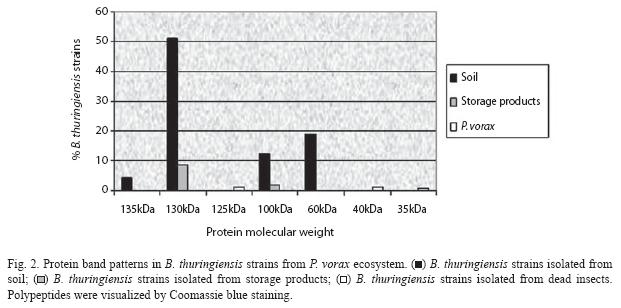
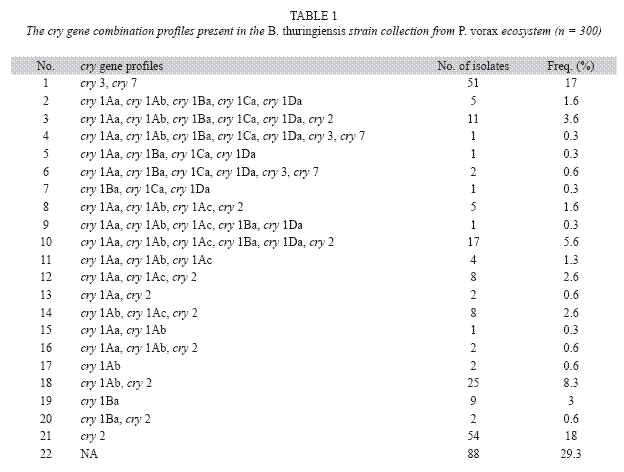
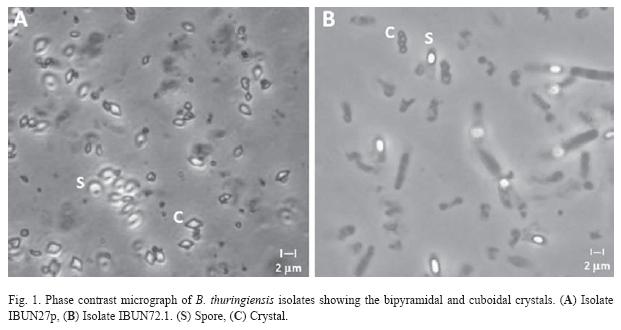
<body><![CDATA[<p>A total of 300 (42.85%, out of 700) strains, of <i>P. vorax </i>environment samples examined showed colonial and microscopic morphology identical to <i>B. thuringiensis</i>. The value of Bt index, according to Iriarte <i>et al</i>. (1998), calculated as a number of <i>B. thuringiensis </i>isolates, divided by the total number of <i>Bacillus </i>strains, was assessed to be 0.43. Phase contrast microscopy demonstrated that all strains presented diverse crystal morphologies: bipyramidal, cuboidal, point and pleomorphic. Isolates with bipyramidal and cuboidal-shape crystals predominated on the soil and dead insects (63% and 25% respectively) (<a href="#fig1">Fig. 1</a>).    <br> </p>     <p>    <br>     <br> </p> </font>     <div style="text-align: center;"><a name="fig1"></a><img  src="/img/revistas/rbt/v57n4/a26i1.jpg" title="" alt=""  style="width: 621px; height: 330px;">    <br>     <br> </div> <font face="Verdana" size="2">     <p>All <i>B. thuringiensis </i>isolates of their crystal protein products were further characterized by SDS-PAGE. The results revealed that the colombian <i>P. vorax </i>environment strains synthesize a protein, or group of proteins, with a molecular mass between 35 and 135 kDa (<a href="#fig2">Fig. 2</a>). The highest percentage of isolates contained two protein types, 130 and 60 kDa; and, in addition to these proteins, an intermediate molecular weight protein of approximately 100 kDa. However, insects isolates possessing others toxins (125, 40 and 35 kDa) combinations were represented by less than 2%.    <br> </p>     ]]></body>
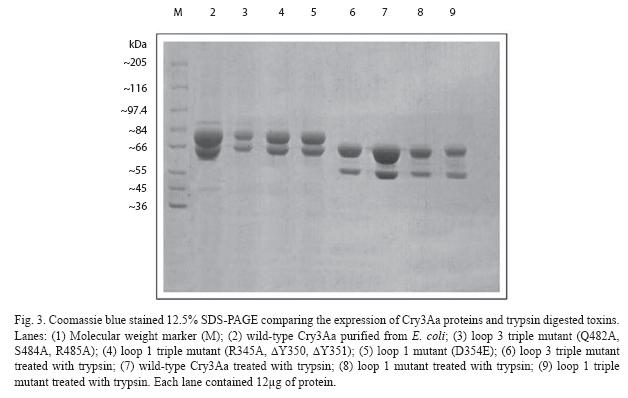
<body><![CDATA[<p>    <br>     <br> </p> </font>     <div style="text-align: center;"><a name="fig2"></a><img  src="/img/revistas/rbt/v57n4/a26i2.jpg" title="" alt=""  style="width: 621px; height: 308px;">    <br>     <br> </div> <font face="Verdana" size="2">     <p>The profiles of all PCR products were compared with those of standard strains. An isolate was considered to contain a determined gene only when the amplification product was of the expected size. Analysis of the <i>B. thuringiensis </i>isolates indicated that most contained several <i>cry </i>2 genes, as well as <i>cry </i>1 (<a href="#tabla1">Table 1</a>). Within the 300 strains, 212 isolates (70.6%) harbored <i>cry </i>1, <i>cry </i>2, <i>cry </i>3 or <i>cry </i>7 gene. Several strains carried the <i>cry </i>1-type genes (107 or 35.6%) or <i>cry </i>2 gene (134 or 44.6%) whereas only 51 strains (17%) contained the <i>cry </i>3- <i>cry </i>7 genes (<a href="#tabla1">Table 1</a>). Eighty- eight of the 300 isolates (29.3%) did not harbor any of the <i>cry </i>1, <i>cry </i>2 or <i>cry </i>3- <i>cry </i>7 genes. All of the different <i>Cry </i>1 subfamilies were observed with different frequencies. Among them, <i>cry </i>1A in 95 strains (31.6%) and <i>cry </i>1B in 50 strains (16.6%) were considered abundant<i>, </i>while <i>cry </i>1D in 39 strains (13%) and <i>cry </i>1C in 21 strains (7%) were less prevalent (<a  href="#tabla1">Table 1</a>). The study of <i>cry </i>gene combinations in <i>cry </i>gene-containing isolates showed that more than 49% (147) harbored more than one type of <i>cry </i>gene. About 74.7% of the <i>cry </i>1 gene-containing isolates also harbored a <i>cry </i>2 gene while 59.7% of the <i>cry </i>2 gene-containing isolates also harbored a <i>cry </i>1-type gene and about 5.5% of the <i>cry </i>3- <i>cry </i>7 gene-containing isolates also harbored <i>cry </i>1 gene. However, only 2.8% of the <i>cry </i>1 gene-containing isolates also harbored a <i>cry </i>3- <i>cry </i>7 gene. These results indicated that <i>cry </i>1 and <i>cry </i>2 genes have a high tendency to occur together and the <i>cry </i>3- <i>cry </i>7 gene frequently occurred alone.    <br> </p>     <p>    <br>     ]]></body>
<body><![CDATA[<br> </p> </font>     <div style="text-align: center;"><a name="tabla1"></a><img  src="/img/revistas/rbt/v57n4/a26t1.gif" title="" alt=""  style="width: 624px; height: 472px;">    <br>     <br> </div> <font face="Verdana" size="2">     <p>The expression of the <i>cry </i>3Aa gene in XL- 1-Blue was analyzed by sequencing (data not shown) and SDS-PAGE (<a href="#fig3">Fig. 3</a>). The predominant band of expressed protein visualized on SDS-PAGE was 73 kDa. These crystal proteins could be further reduced to 67 and 55 kDa if treated with trypsin (<a href="#fig3">Fig. 3</a>). All mutants were highly expressed as inclusion bodies in <i>E. coli</i>, similar to the wild type Cry 3Aa.    <br> </p>     <p>    <br>     <br> </p> </font>     <div style="text-align: center;"><a name="fig3"></a><img  src="/img/revistas/rbt/v57n4/a26i3.jpg" title="" alt=""  style="width: 628px; height: 398px;">    ]]></body>
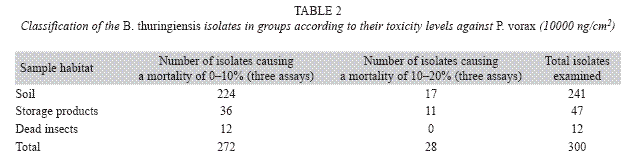
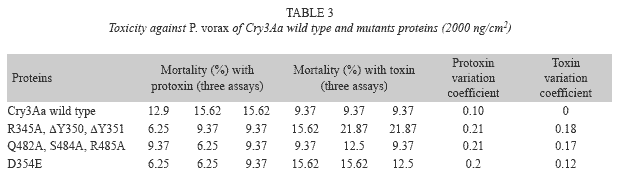
<body><![CDATA[<br>     <br> </div> <font face="Verdana" size="2">     <p>To test the toxicity of <i>B. thuringiensis </i>native strains, Cry 3Aa and mutants, first instar larvae of <i>P. vorax </i>were exposed to media whose surface was spread with 10 000 ng/cm2 protoxins and activated toxins, and 2 000 ng/cm2 recombinant protoxins and toxins. Larvae exposed to toxin treated media exhibited a mortality percentage lower than 22% (<a href="#tabla2">Tables 2</a> and <a  href="#tabla3">3</a>).    <br> </p>     <p>    <br>     <br> </p> </font>     <div style="text-align: center;"><a name="tabla2"></a><img  src="/img/revistas/rbt/v57n4/a26t2.gif" title="" alt=""  style="width: 635px; height: 159px;">    <br>     <br>     ]]></body>
<body><![CDATA[<br>     <br> <a name="tabla3"></a><img src="/img/revistas/rbt/v57n4/a26t3.gif" title="" alt=""  style="width: 620px; height: 178px;">    <br>     <br> </div> <font face="Verdana" size="2"></font><b><font face="Verdana" size="3">     <p>Discussion</p> </font></b><font face="Verdana" size="2"> </font>     <p><font face="Verdana" size="2">Since potatoes are the most important crop in the Andean region, all the samples collected were related to this crop, and 100% of them had an origin associated with the important pest in the area: the Andean weevil <i>P. vorax</i>. Here, we determined the presence of different <i>cry </i>genes within the <i>P. vorax </i>ecosystem collection. The selection of <i>B. thuringiensis </i>isolates was based principally on phase-contrast microscopy. The Bt index was high (0.43). Probably, humidity and excrements produced by <i>P. vorax </i>larvae in the galleries of the infested potatoes make a favorable environment for <i>B. thuringiensis </i>colonization. Similar to the lepidopteran- active reference strains (especially <i>B. thuringiensis kurstaki</i>), most of the isolates exhibited two major polypeptides with a relative molecular mass in the range of 130 to 140 kDa and approximately 70 kDa, respectively. The SDS-PAGE analysis showed other proteins (125, 100, 40 and 35 kDa from soil, store products and dead <i>P. vorax </i>samples) in <i>B. thuringiensis </i>strains, thus, these results predicted that our insect isolates contain possible novel Coleopteran-specific proteins. Based on the varied parasporal polypeptide patterns of the isolates, we conclude that this <i>B. thuringiensis </i>collection has quite an attractive diversity of Cry proteins.</font></p>     <p><font face="Verdana" size="2">The important biological activity of <i>B. thuringiensis </i>isolates appears to be derived from the combined attributes of different Cry toxins formed into a proteinaceous body. Determination of their <i>Cry </i>gene contents is useful for the prediction of their toxicity. <i>B. thuringiensis </i>strains recovered from <i>P. vorax </i>environment were diverse in terms of their <i>cry </i>gene contents. According to PCR analysis, the <i>cry </i>1, <i>cry </i>2 and <i>cry </i>3- <i>cry </i>7 genes were observed in our <i>B. thuringiensis </i>collection but in different frequency. The <i>cry </i>2 genes were the most frequently found in the native isolates collection (<a href="#tabla1">Table 1</a>). A high frequency of <i>cry </i>1 genes seems to be common to all <i>B. thuringiensis </i>strain collections analyzed so far (Bravo <i>et al</i>. 1998, Hern&aacute;ndez <i>et al</i>. 2005, Cinar <i>et al</i>. 2008). It is possible that <i>cry </i>1 gene-containing strains may be more abundant. We cannot exclude the probability that the high percentage of <i>cry </i>2 genes in <i>B. thuringiensis </i>isolates may have been biased because of the procedure used for selection (Bravo <i>et al</i>. 1998). The second most abundant genes in the bacterial strain collection were the <i>cry </i>1 genes and then the <i>cry </i>3- <i>cry </i>7 genes (<a  href="#tabla1">Table 1</a>). In our study, the <i>cry </i>2 gene (44.6%) was detected more frequently than in other reports. For instant Ben-Dov <i>et al</i>. (1997) found that strains containing <i>cry </i>1 genes were the most abundant; Bravo <i>et al. </i>(1998) detected 49.5% of <i>cry </i>1 gene; Uribe <i>et al</i>. (2003) reported 73% of <i>cry </i>1 gene; Wang <i>et al</i>. (2003) detected 76.5% of <i>cry </i>1 gene and 70% of <i>cry </i>2 gene; Thammasittirong &amp; Attathom (2008) reported strains containing <i>cry </i>1-type genes (81.3%) at the same frequency as strains harboring <i>cry </i>2 gene (80.6%). There is low presence of <i>cry </i>3- <i>cry </i>7 gene in potato crops infested with <i>P. vorax</i>. It is important to mention that many of the isolates harbored more than one <i>cry </i>gene, suggesting that <i>B. thuringiensis </i>strains have a high frequency of genetic information exchange. Twenty-one distinct <i>cry </i>gene profiles were identified in our collection (<a href="#tabla1">Table 1</a>), which indicates the high diversity in the <i>cry </i>gene contents of the <i>B. thuringiensis </i>strains. The analysis of the genes showed that the <i>cry </i>1 and <i>cry </i>2 genes were most often present together and most of the bacterial strains contained more than one type of lepidopteran-active <i>cry </i>gene. Some strains containing combinations of <i>cry </i>genes that were less frequently observed, such as lepidopteranactive <i>cry </i>1 genes and coleopteran-active <i>cry </i>3- <i>cry </i>7 genes, were identified (<a href="#tabla1">Table 1</a>), these isolates are good possibilities in the search for biological control agents with a wider spectrum of activity. Other groups have reported the presence of <i>cry </i>1 genes and <i>cry </i>3- <i>cry </i>7 genes in the same <i>B. thuringiensis </i>strain (Bravo <i>et al. </i>1998), suggesting that strains with dual activity are also present in other regions. The great variability and distribution of <i>cry </i>gene content in <i>B. thuringiensis </i>strains even from the same country is well recognized, and the variations were likely associated with differences in the biological, geographical and ecological properties of the collected areas. The above evidences show the importance of establishing collections of this microorganism in different countries for developing strategies of biological insect control. Finally, 88 isolates did not react with any PCR primer. These isolates are candidates for harboring putative different <i>cry </i>genes. The identification of different <i>B. thuringiensis </i>isolates could be the first phase in the project for finding major toxicities, since different proteins may be toxic for new insects. The characterization of different <i>cry </i>genes should be encouraged once the susceptible insect is identified and more evidence on the potential of different proteins as pest control agents is available.</font></p>     <p><font face="Verdana" size="2">Under the conditions tested both native strain and recombinant and mutant <i>cry </i>3Aa proteins presented in bioassays a mortality below 22% with the evaluated dose (<a href="#tabla2">Tables 2</a> and <a href="#fig3">3</a>). The original objective of this project was to select strains, or recombinant proteins, with activity against <i>P. vorax</i>. Unfortunately, none of the isolates, or wild type Cry 3Aa and mutants, was toxic against this weevil. In spite of the fact that <i>cry</i>3 proteins bind to <i>P. vorax </i>brush border membrane vesicles (Martinez &amp; Cer&oacute;n 2004) it is still difficult to find active proteins to this pest. This result is not at all unexpected, as most screening studies of susceptibility to <i>B. thuringiensis </i>proteins have shown a frequent insecticidal toxicity of this organism to lepidopteran species, while only very few isolates and toxins have been found active against Coleoptera (Hernandez <i>et al</i>. 2005). Also, we tested the theory that surface loops in domain II of Cry 3Aa are involved inreceptor binding of <i>P. vorax </i>larvae. Previous results revealed that substitutions within surface exposed loops of domain II on the <i>cry </i>3Aa can affect reversible and irreversible receptor binding in coleopteran (Wu &amp; Dean 1996, Wu <i>et al</i>. 2000). However, none of the mutants was toxic to <i>P. vorax </i>larvae. The implications of our studies are important for new design of </font><font  face="Verdana" size="2">&#948;</font><font face="Verdana" size="2">-endotoxins that overcome insect resistance to these toxins and for altered or improved insecticidal activity, as has been achieved in other Cry proteins.</font></p> <b><font face="Verdana" size="3"> </font></b> <hr style="width: 100%; height: 2px;"><b><font face="Verdana" size="3">     <p>Resumen</p> </font></b><font face="Verdana" size="2"> </font>     <p><font face="Verdana" size="2">El gorgojo andino <i>Premnotrypes vorax </i>es una causa importante de da&ntilde;o en los cultivos colombianos de este tub&eacute;rculo. Debido al impacto que esta plaga tiene sobre la econom&iacute;a del pa&iacute;s, nos interesamos en buscar alternativas nuevas para el control biol&oacute;gico de <i>P. vorax</i>, basadas en la bacteria entomopat&oacute;gena <i>Bacillus thuringiensis</i>. Se recolectaron un total de 300 cepas de <i>B. thuringiensis </i>a partir de plantaciones de papa infestadas con <i>P. vorax</i>, las cuales fueron analizadas por medio de la morfolog&iacute;a del cristal, SDS-PAGE, PCR y ensayos biol&oacute;gicos. La mayor&iacute;a de los aislamientos de <i>B. thuringiensis </i>presentaron cristales bipiramidales. Los an&aacute;lisis de SDS-PAGE indicaron la presencia de siete grupos de cepas con &#963;- endotoxinas que variaban entre 35 a 135 kDa. Las pruebas con PCR demostraron que los genes <i>cry </i>2 y <i>cry </i>1 fueron significativamente m&aacute;s frecuentes en el medioambiente de <i>P. vorax</i>. Adem&aacute;s, se utiliz&oacute; la mutag&eacute;nesis sitio-dirigida para modificar la prote&iacute;na Cry3Aa. Se analizaron tres toxinas mutantes, 1 (D354E), 2 (R345A, &#8710;Y350, &#8710;Y351), y 3 (Q482A, S484A, R485A), para determinar su actividad contra larvas de <i>P. vorax</i>. Los ensayos de toxicidad se&ntilde;alaron escasa, o nula, actividad hacia <i>P. vorax </i>tanto para las cepas, la toxina Cry3Aa de referencia y las prote&iacute;nas Cry3Aa mutantes. La caracterizaci&oacute;n gen&eacute;tica de la colecci&oacute;n puede proveer oportunidades para la selecci&oacute;n de cepas que pueden evaluarse por medio de bioensayos contra otros insectos-plaga de importancia agr&iacute;cola, y para el dise&ntilde;o de prote&iacute;nas Cry con actividad toxica mejorada.</font></p> <font face="Verdana" size="2"><b> </b></font>     ]]></body>
<body><![CDATA[<p><font face="Verdana" size="2"><b>Palabras clave: </b>cepa nativa, gorgojo andino, prote&iacute;na Cry3Aa, cultivo de papa, mutag&eacute;nesis sitio-dirigida.    <br>     <br> </font></p>     <p style="text-align: center;"><font face="Verdana" size="2">Received 15-X-2008. Corrected 20-III-2009. Accepted 20-IV-2009.</font></p> <hr style="width: 100%; height: 2px;">     <p><b><font face="Verdana" size="3">References</font></b></p> <font face="Verdana" size="2"> </font>     <!-- ref --><p><font face="Verdana" size="2">Arrieta, G. &amp; A.M. Espinoza. 2006. Characterization of a <i>Bacillus thuringiensis </i>strain collection isolated from diverse Costa Rican natural ecosystems. Rev. Biol. Trop. 54: 13-27.</font>&nbsp;&nbsp;&nbsp;&nbsp;&nbsp;&nbsp;&nbsp;&nbsp;[&#160;<a href="javascript:void(0);" onclick="javascript: window.open('/scielo.php?script=sci_nlinks&ref=1267831&pid=S0034-7744200900040002600001&lng=','','width=640,height=500,resizable=yes,scrollbars=1,menubar=yes,');">Links</a>&#160;]<!-- end-ref --><!-- ref --><p><font face="Verdana" size="2">Ben-Dov, E., A. Zaritsky, E. Dahan, Z. Barak, R. Sinai, R. Manasherob, A. Khamraev, E. Troitskaya, A. Dubitsky, N. Berezina &amp; Y. Margalith. 1997. Extended screening by PCR for seven <i>cry </i>group genes from field-collected strains of <i>Bacillus thuringiensis</i>. Appl. Environ. Microbiol. 63: 4883-4890.</font>&nbsp;&nbsp;&nbsp;&nbsp;&nbsp;&nbsp;&nbsp;&nbsp;[&#160;<a href="javascript:void(0);" onclick="javascript: window.open('/scielo.php?script=sci_nlinks&ref=1267832&pid=S0034-7744200900040002600002&lng=','','width=640,height=500,resizable=yes,scrollbars=1,menubar=yes,');">Links</a>&#160;]<!-- end-ref --><!-- ref --><p><font face="Verdana" size="2">Bravo A., S. Sarabia, L. Lopez, H. Ontiveros, C. Abarca, A. Ortiz, M. Ortiz, L. Lina, F. Villalobos, G. Pe&ntilde;a, M.E. Nu&ntilde;ez-Valdez, M. Sober&oacute;n &amp; R. Quintero. 1998. Characterization of <i>cry </i>genes in a mexican <i>Bacillus thuringiensis </i>strain collection. Appl. Environ. Microbiol. 64: 4965-4972.</font>&nbsp;&nbsp;&nbsp;&nbsp;&nbsp;&nbsp;&nbsp;&nbsp;[&#160;<a href="javascript:void(0);" onclick="javascript: window.open('/scielo.php?script=sci_nlinks&ref=1267833&pid=S0034-7744200900040002600003&lng=','','width=640,height=500,resizable=yes,scrollbars=1,menubar=yes,');">Links</a>&#160;]<!-- end-ref --><!-- ref --><p><font face="Verdana" size="2">Cer&oacute;n, J., L. Covarrubias, R. Quintero, A. Ortiz, M. Ortiz, E. Aranda &amp; A. Bravo. 1994. PCR analysis of the CryI insecticidal crystal family genes from <i>Bacillus thuringiensis</i>. Appl. Environ. Microbiol. 60: 353- 356.</font>&nbsp;&nbsp;&nbsp;&nbsp;&nbsp;&nbsp;&nbsp;&nbsp;[&#160;<a href="javascript:void(0);" onclick="javascript: window.open('/scielo.php?script=sci_nlinks&ref=1267834&pid=S0034-7744200900040002600004&lng=','','width=640,height=500,resizable=yes,scrollbars=1,menubar=yes,');">Links</a>&#160;]<!-- end-ref --><!-- ref --><p><font face="Verdana" size="2">Cer&oacute;n, J., A. Ortiz, R. Quintero, L. Guereca &amp; A. Bravo. 1995. Specific PCR primers directed to identify <i>cry </i>I and <i>cry </i>III genes within a <i>Bacillus thuringiensis </i>strain collection. Appl. Environ. Microbiol. 61: 3826- 3831.</font>&nbsp;&nbsp;&nbsp;&nbsp;&nbsp;&nbsp;&nbsp;&nbsp;[&#160;<a href="javascript:void(0);" onclick="javascript: window.open('/scielo.php?script=sci_nlinks&ref=1267835&pid=S0034-7744200900040002600005&lng=','','width=640,height=500,resizable=yes,scrollbars=1,menubar=yes,');">Links</a>&#160;]<!-- end-ref --><!-- ref --><p><font face="Verdana" size="2">Cinar, C., O. Apaydin, A.F. Yenidunya, S. Harsa &amp; H. Gunes. 2008. Isolation and characterization of <i>Bacillus thuringiensis </i>strains from olive-related habitats in Turkey. J. Appl. Microbiol. 104: 515-525.</font>&nbsp;&nbsp;&nbsp;&nbsp;&nbsp;&nbsp;&nbsp;&nbsp;[&#160;<a href="javascript:void(0);" onclick="javascript: window.open('/scielo.php?script=sci_nlinks&ref=1267836&pid=S0034-7744200900040002600006&lng=','','width=640,height=500,resizable=yes,scrollbars=1,menubar=yes,');">Links</a>&#160;]<!-- end-ref --><!-- ref --><p><font face="Verdana" size="2">Hern&aacute;ndez, S., R. Andrew, Y. Bela &amp; J. Ferr&eacute;. 2005. Isolation and toxicity of <i>Bacillus thuringiensis </i>from potato-growing areas in Bolivia Carmen. J. Invertebr. Pathol. 88: 8-16.</font>&nbsp;&nbsp;&nbsp;&nbsp;&nbsp;&nbsp;&nbsp;&nbsp;[&#160;<a href="javascript:void(0);" onclick="javascript: window.open('/scielo.php?script=sci_nlinks&ref=1267837&pid=S0034-7744200900040002600007&lng=','','width=640,height=500,resizable=yes,scrollbars=1,menubar=yes,');">Links</a>&#160;]<!-- end-ref --><!-- ref --><p><font face="Verdana" size="2">Herrera, F. 1997. El gusano blanco de la papa: biolog&iacute;a, comportamiento y pr&aacute;cticas de manejo integrado. Ministerio de Agricultura y Desarrollo Rural/Corporaci&oacute;n Colombiana de Investigaci&oacute;n Agropecuaria CORPOICA Regional Uno Cundinamarca&#8211;Boyac&aacute;. (Available on-line: http://www.redepapa.org/patologiared.html).</font>&nbsp;&nbsp;&nbsp;&nbsp;&nbsp;&nbsp;&nbsp;&nbsp;[&#160;<a href="javascript:void(0);" onclick="javascript: window.open('/scielo.php?script=sci_nlinks&ref=1267838&pid=S0034-7744200900040002600008&lng=','','width=640,height=500,resizable=yes,scrollbars=1,menubar=yes,');">Links</a>&#160;]<!-- end-ref --><!-- ref --><p><font face="Verdana" size="2">Iriarte, J., Y. Bel, M.D. Ferrandis, R. Andrew, J. Murillo, J. Ferre &amp; P. Caballero. 1998. Environmental distribution and diversity of <i>Bacillus thuringiensis </i>in Spain. Syst. Appl. Microbiol. 21: 97-106. </font>&nbsp;&nbsp;&nbsp;&nbsp;&nbsp;&nbsp;&nbsp;&nbsp;[&#160;<a href="javascript:void(0);" onclick="javascript: window.open('/scielo.php?script=sci_nlinks&ref=1267839&pid=S0034-7744200900040002600009&lng=','','width=640,height=500,resizable=yes,scrollbars=1,menubar=yes,');">Links</a>&#160;]<!-- end-ref --><!-- ref --><p><font face="Verdana" size="2">Kati, H., K. Sezen, R. Nalcacioglu &amp; Z. Demirbag. 2007. A highly pathogenic strain of <i>Bacillus thuringiensis </i>serovar <i>kurstaki </i>in lepidopteran pests. J. Microbiol. 45: 553-557.</font>&nbsp;&nbsp;&nbsp;&nbsp;&nbsp;&nbsp;&nbsp;&nbsp;[&#160;<a href="javascript:void(0);" onclick="javascript: window.open('/scielo.php?script=sci_nlinks&ref=1267840&pid=S0034-7744200900040002600010&lng=','','width=640,height=500,resizable=yes,scrollbars=1,menubar=yes,');">Links</a>&#160;]<!-- end-ref --><!-- ref --><p><font face="Verdana" size="2">L&oacute;pez-Pazos, S.A. &amp; J. Cer&oacute;n. 2007. Three-dimensional structure of <i>Bacillus thuringiensis </i>toxins: a review. Acta Biol. Colomb. 12: 19-32.</font>&nbsp;&nbsp;&nbsp;&nbsp;&nbsp;&nbsp;&nbsp;&nbsp;[&#160;<a href="javascript:void(0);" onclick="javascript: window.open('/scielo.php?script=sci_nlinks&ref=1267841&pid=S0034-7744200900040002600011&lng=','','width=640,height=500,resizable=yes,scrollbars=1,menubar=yes,');">Links</a>&#160;]<!-- end-ref --><!-- ref --><p><font face="Verdana" size="2">Lowry, O., N.J. Rosenbrough, A.L. Farr &amp; R.J. Randall. 1951. Protein measurement with the Folin phenol reagent. J. Biol. Chem. 193: 265-275.</font>&nbsp;&nbsp;&nbsp;&nbsp;&nbsp;&nbsp;&nbsp;&nbsp;[&#160;<a href="javascript:void(0);" onclick="javascript: window.open('/scielo.php?script=sci_nlinks&ref=1267842&pid=S0034-7744200900040002600012&lng=','','width=640,height=500,resizable=yes,scrollbars=1,menubar=yes,');">Links</a>&#160;]<!-- end-ref --><!-- ref --><p><font face="Verdana" size="2">Mahalakshmi, A., R. Shenbagarathai &amp; K. Sujatha. 2005. Identification of novel indigenous <i>Bacillus thuringiensis </i>isolates. Indian J. Exp. Biol. 43: 867-872.</font>&nbsp;&nbsp;&nbsp;&nbsp;&nbsp;&nbsp;&nbsp;&nbsp;[&#160;<a href="javascript:void(0);" onclick="javascript: window.open('/scielo.php?script=sci_nlinks&ref=1267843&pid=S0034-7744200900040002600013&lng=','','width=640,height=500,resizable=yes,scrollbars=1,menubar=yes,');">Links</a>&#160;]<!-- end-ref --><!-- ref --><p><font face="Verdana" size="2">Mart&iacute;nez, W. &amp; J. Cer&oacute;n. 2004. Uni&oacute;n de prote&iacute;nas de <i>Bacillus thuringiensis </i>con ves&iacute;culas de las microvellosidades del tracto digestivo del gusano blanco de la papa <i>Premnotrypes vorax </i>(Coleoptera: Curculionidae). Rev. Colomb. Entomol. 30: 51-56.</font>&nbsp;&nbsp;&nbsp;&nbsp;&nbsp;&nbsp;&nbsp;&nbsp;[&#160;<a href="javascript:void(0);" onclick="javascript: window.open('/scielo.php?script=sci_nlinks&ref=1267844&pid=S0034-7744200900040002600014&lng=','','width=640,height=500,resizable=yes,scrollbars=1,menubar=yes,');">Links</a>&#160;]<!-- end-ref --><!-- ref --><p><font face="Verdana" size="2">Sambrook, J., E.F. Fritsch &amp; T. Maniatis. 1989. Molecular cloning: a laboratory manual. Cold-Spring Harbor Laboratory, Cold Spring Harbor, New York, USA.</font>&nbsp;&nbsp;&nbsp;&nbsp;&nbsp;&nbsp;&nbsp;&nbsp;[&#160;<a href="javascript:void(0);" onclick="javascript: window.open('/scielo.php?script=sci_nlinks&ref=1267845&pid=S0034-7744200900040002600015&lng=','','width=640,height=500,resizable=yes,scrollbars=1,menubar=yes,');">Links</a>&#160;]<!-- end-ref --><!-- ref --><p><font face="Verdana" size="2">Schnepf, E., N. Crickmore, J. Van Rie, D. Lereclus, J. Baum, J. Feitelson, D.R. Zeigler &amp; D.H. Dean. 1998. <i>Bacillus thuringiensis </i>and its pesticidal crystal proteins. Microbiol. Mol. Biol. Rev. 62: 775-806.</font>&nbsp;&nbsp;&nbsp;&nbsp;&nbsp;&nbsp;&nbsp;&nbsp;[&#160;<a href="javascript:void(0);" onclick="javascript: window.open('/scielo.php?script=sci_nlinks&ref=1267846&pid=S0034-7744200900040002600016&lng=','','width=640,height=500,resizable=yes,scrollbars=1,menubar=yes,');">Links</a>&#160;]<!-- end-ref --><!-- ref --><p><font face="Verdana" size="2">Song, L., M. Gao, S. Dai, Y. Wu, D. Yi &amp; R. Li. 2008. Specific activity of a <i>Bacillus thuringiensis </i>strain against <i>Locusta migratoria manilensis</i>. J. Invertebr. Pathol. 98: 169-176.</font>&nbsp;&nbsp;&nbsp;&nbsp;&nbsp;&nbsp;&nbsp;&nbsp;[&#160;<a href="javascript:void(0);" onclick="javascript: window.open('/scielo.php?script=sci_nlinks&ref=1267847&pid=S0034-7744200900040002600017&lng=','','width=640,height=500,resizable=yes,scrollbars=1,menubar=yes,');">Links</a>&#160;]<!-- end-ref --><!-- ref --><p><font face="Verdana" size="2">Thammasittirong, A. &amp; T. Attathom. 2008. PCR-based method for the detection of <i>Cry </i>genes in local isolates of <i>Bacillus thuringiensis </i>from Thailand. J. Invertebr. Pathol. 98: 121-126.</font>&nbsp;&nbsp;&nbsp;&nbsp;&nbsp;&nbsp;&nbsp;&nbsp;[&#160;<a href="javascript:void(0);" onclick="javascript: window.open('/scielo.php?script=sci_nlinks&ref=1267848&pid=S0034-7744200900040002600018&lng=','','width=640,height=500,resizable=yes,scrollbars=1,menubar=yes,');">Links</a>&#160;]<!-- end-ref --><!-- ref --><p><font face="Verdana" size="2">Travers, R.S., P.A. Martin &amp; C.F. Reichelderfer. 1987. Selective process for efficient isolation of soil <i>Bacillus </i>spp. Appl. Environ. Microbiol. 53: 1263-1266.</font>&nbsp;&nbsp;&nbsp;&nbsp;&nbsp;&nbsp;&nbsp;&nbsp;[&#160;<a href="javascript:void(0);" onclick="javascript: window.open('/scielo.php?script=sci_nlinks&ref=1267849&pid=S0034-7744200900040002600019&lng=','','width=640,height=500,resizable=yes,scrollbars=1,menubar=yes,');">Links</a>&#160;]<!-- end-ref --><!-- ref --><p><font face="Verdana" size="2">Uribe, D., W. Mart&iacute;nez &amp; J. Cer&oacute;n. 2003. Distribution and diversity of <i>cry </i>genes in native strains of <i>Bacillus thuringiensis </i>obtained from different ecosystems from Colombia. J. Invertebr. Pathol. 82: 119-127.</font>&nbsp;&nbsp;&nbsp;&nbsp;&nbsp;&nbsp;&nbsp;&nbsp;[&#160;<a href="javascript:void(0);" onclick="javascript: window.open('/scielo.php?script=sci_nlinks&ref=1267850&pid=S0034-7744200900040002600020&lng=','','width=640,height=500,resizable=yes,scrollbars=1,menubar=yes,');">Links</a>&#160;]<!-- end-ref --><!-- ref --><p><font face="Verdana" size="2">Wang, J.H., A. Boets, J. Van Rie &amp; G.X. Ren. 2003. Characterization of <i>cry </i>1, <i>cry </i>2 and <i>cry </i>9 genes in <i>Bacillus thuringiensis </i>isolates from China. J. Invertebr. Pathol. 82: 63-71.</font>&nbsp;&nbsp;&nbsp;&nbsp;&nbsp;&nbsp;&nbsp;&nbsp;[&#160;<a href="javascript:void(0);" onclick="javascript: window.open('/scielo.php?script=sci_nlinks&ref=1267851&pid=S0034-7744200900040002600021&lng=','','width=640,height=500,resizable=yes,scrollbars=1,menubar=yes,');">Links</a>&#160;]<!-- end-ref --><!-- ref --><p><font face="Verdana" size="2">Wu, S.J. &amp; D. Dean. 1996. Functional significance of loops in the receptor binding domain of <i>Bacillus thuringiensis cry </i>IIIA </font><font face="Verdana" size="2">&#963;</font><font  face="Verdana" size="2">-Endotoxin. J. Mol. Biol. 255: 628-640.</font>&nbsp;&nbsp;&nbsp;&nbsp;&nbsp;&nbsp;&nbsp;&nbsp;[&#160;<a href="javascript:void(0);" onclick="javascript: window.open('/scielo.php?script=sci_nlinks&ref=1267852&pid=S0034-7744200900040002600022&lng=','','width=640,height=500,resizable=yes,scrollbars=1,menubar=yes,');">Links</a>&#160;]<!-- end-ref --><!-- ref --><p><font face="Verdana" size="2">Wu, S.J., C. Koller, D. Miller, L. Bauer &amp; D. Dean. 2000. Enhanced toxicity of <i>Bacillus thuringiensis </i>Cry3A </font><font face="Verdana" size="2">&#948;</font><font  face="Verdana" size="2">-endotoxin in coleopterans by mutagenesis in a receptor binding loop. FEBS Letters 473: 227-232.</font>&nbsp;&nbsp;&nbsp;&nbsp;&nbsp;&nbsp;&nbsp;&nbsp;[&#160;<a href="javascript:void(0);" onclick="javascript: window.open('/scielo.php?script=sci_nlinks&ref=1267853&pid=S0034-7744200900040002600023&lng=','','width=640,height=500,resizable=yes,scrollbars=1,menubar=yes,');">Links</a>&#160;]<!-- end-ref --><p>Internet reference</p> </font></b><font face="Verdana" size="2">     <!-- ref --><p>Crickmore, N., D.R. Zeigler, E. Schnepf, J. Van Rie, D. Lereclus, J. Baum, A. Bravo &amp; D.H. Dean. 2008. <i>Bacillus thuringiensis </i>toxin nomenclature. (Downloaded: February 2008. http://www.lifesci.sussex.ac.uk/Home/Neil_Crickmore/Bt/)&nbsp;&nbsp;&nbsp;&nbsp;&nbsp;&nbsp;&nbsp;&nbsp;[&#160;<a href="javascript:void(0);" onclick="javascript: window.open('/scielo.php?script=sci_nlinks&ref=1267855&pid=S0034-7744200900040002600024&lng=','','width=640,height=500,resizable=yes,scrollbars=1,menubar=yes,');">Links</a>&#160;]<!-- end-ref --> ]]></body><back>
<ref-list>
<ref id="B1">
<nlm-citation citation-type="journal">
<person-group person-group-type="author">
<name>
<surname><![CDATA[Arrieta]]></surname>
<given-names><![CDATA[G]]></given-names>
</name>
<name>
<surname><![CDATA[Espinoza]]></surname>
<given-names><![CDATA[A.M]]></given-names>
</name>
</person-group>
<article-title xml:lang="en"><![CDATA[Characterization of a Bacillus thuringiensis strain collection isolated from diverse Costa Rican natural ecosystems]]></article-title>
<source><![CDATA[Rev. Biol. Trop]]></source>
<year>2006</year>
<volume>54</volume>
<page-range>13-27</page-range></nlm-citation>
</ref>
<ref id="B2">
<nlm-citation citation-type="journal">
<person-group person-group-type="author">
<name>
<surname><![CDATA[Ben-Dov]]></surname>
<given-names><![CDATA[E]]></given-names>
</name>
<name>
<surname><![CDATA[Zaritsky]]></surname>
<given-names><![CDATA[A]]></given-names>
</name>
<name>
<surname><![CDATA[Dahan]]></surname>
<given-names><![CDATA[E]]></given-names>
</name>
<name>
<surname><![CDATA[Barak]]></surname>
<given-names><![CDATA[Z]]></given-names>
</name>
<name>
<surname><![CDATA[Sinai]]></surname>
<given-names><![CDATA[R]]></given-names>
</name>
<name>
<surname><![CDATA[Manasherob]]></surname>
<given-names><![CDATA[R]]></given-names>
</name>
<name>
<surname><![CDATA[Khamraev]]></surname>
<given-names><![CDATA[A]]></given-names>
</name>
<name>
<surname><![CDATA[Troitskaya]]></surname>
<given-names><![CDATA[E]]></given-names>
</name>
<name>
<surname><![CDATA[Dubitsky]]></surname>
<given-names><![CDATA[A]]></given-names>
</name>
<name>
<surname><![CDATA[Berezina]]></surname>
<given-names><![CDATA[N]]></given-names>
</name>
<name>
<surname><![CDATA[Margalith]]></surname>
<given-names><![CDATA[Y]]></given-names>
</name>
</person-group>
<article-title xml:lang="en"><![CDATA[Extended screening by PCR for seven cry group genes from field-collected strains of Bacillus thuringiensis]]></article-title>
<source><![CDATA[Appl. Environ. Microbiol]]></source>
<year>1997</year>
<volume>63</volume>
<page-range>4883-4890</page-range></nlm-citation>
</ref>
<ref id="B3">
<nlm-citation citation-type="journal">
<person-group person-group-type="author">
<name>
<surname><![CDATA[Bravo]]></surname>
<given-names><![CDATA[A]]></given-names>
</name>
<name>
<surname><![CDATA[Sarabia]]></surname>
<given-names><![CDATA[S]]></given-names>
</name>
<name>
<surname><![CDATA[Lopez]]></surname>
<given-names><![CDATA[L]]></given-names>
</name>
<name>
<surname><![CDATA[Ontiveros]]></surname>
<given-names><![CDATA[H]]></given-names>
</name>
<name>
<surname><![CDATA[Abarca]]></surname>
<given-names><![CDATA[C]]></given-names>
</name>
<name>
<surname><![CDATA[Ortiz]]></surname>
<given-names><![CDATA[A]]></given-names>
</name>
<name>
<surname><![CDATA[Ortiz]]></surname>
<given-names><![CDATA[M]]></given-names>
</name>
<name>
<surname><![CDATA[Lina]]></surname>
<given-names><![CDATA[L]]></given-names>
</name>
<name>
<surname><![CDATA[Villalobos]]></surname>
<given-names><![CDATA[F]]></given-names>
</name>
<name>
<surname><![CDATA[Peña]]></surname>
<given-names><![CDATA[G]]></given-names>
</name>
<name>
<surname><![CDATA[Nuñez-Valdez]]></surname>
<given-names><![CDATA[M.E]]></given-names>
</name>
<name>
<surname><![CDATA[Soberón]]></surname>
<given-names><![CDATA[M]]></given-names>
</name>
<name>
<surname><![CDATA[Quintero]]></surname>
<given-names><![CDATA[R]]></given-names>
</name>
</person-group>
<article-title xml:lang="en"><![CDATA[Characterization of cry genes in a mexican Bacillus thuringiensis strain collection]]></article-title>
<source><![CDATA[Appl. Environ. Microbiol]]></source>
<year>1998</year>
<volume>64</volume>
<page-range>4965-4972</page-range></nlm-citation>
</ref>
<ref id="B4">
<nlm-citation citation-type="journal">
<person-group person-group-type="author">
<name>
<surname><![CDATA[Cerón]]></surname>
<given-names><![CDATA[J]]></given-names>
</name>
<name>
<surname><![CDATA[Covarrubias]]></surname>
<given-names><![CDATA[L]]></given-names>
</name>
<name>
<surname><![CDATA[Quintero]]></surname>
<given-names><![CDATA[R]]></given-names>
</name>
<name>
<surname><![CDATA[Ortiz]]></surname>
<given-names><![CDATA[A]]></given-names>
</name>
<name>
<surname><![CDATA[Ortiz]]></surname>
<given-names><![CDATA[M]]></given-names>
</name>
<name>
<surname><![CDATA[Aranda]]></surname>
<given-names><![CDATA[E]]></given-names>
</name>
<name>
<surname><![CDATA[Bravo]]></surname>
<given-names><![CDATA[A]]></given-names>
</name>
</person-group>
<article-title xml:lang="en"><![CDATA[PCR analysis of the CryI insecticidal crystal family genes from Bacillus thuringiensis]]></article-title>
<source><![CDATA[Appl. Environ. Microbiol]]></source>
<year>1994</year>
<volume>60</volume>
<page-range>353- 356</page-range></nlm-citation>
</ref>
<ref id="B5">
<nlm-citation citation-type="journal">
<person-group person-group-type="author">
<name>
<surname><![CDATA[Cerón]]></surname>
<given-names><![CDATA[J]]></given-names>
</name>
<name>
<surname><![CDATA[Ortiz]]></surname>
<given-names><![CDATA[A]]></given-names>
</name>
<name>
<surname><![CDATA[Quintero]]></surname>
<given-names><![CDATA[R]]></given-names>
</name>
<name>
<surname><![CDATA[Guereca]]></surname>
<given-names><![CDATA[L]]></given-names>
</name>
<name>
<surname><![CDATA[Bravo]]></surname>
<given-names><![CDATA[A]]></given-names>
</name>
</person-group>
<article-title xml:lang="en"><![CDATA[Specific PCR primers directed to identify cry I and cry III genes within a Bacillus thuringiensis strain collection]]></article-title>
<source><![CDATA[Appl. Environ. Microbiol]]></source>
<year>1995</year>
<volume>61</volume>
<page-range>3826- 3831</page-range></nlm-citation>
</ref>
<ref id="B6">
<nlm-citation citation-type="journal">
<person-group person-group-type="author">
<name>
<surname><![CDATA[Cinar]]></surname>
<given-names><![CDATA[C]]></given-names>
</name>
<name>
<surname><![CDATA[Apaydin]]></surname>
<given-names><![CDATA[O]]></given-names>
</name>
<name>
<surname><![CDATA[Yenidunya]]></surname>
<given-names><![CDATA[A.F]]></given-names>
</name>
<name>
<surname><![CDATA[Harsa]]></surname>
<given-names><![CDATA[S]]></given-names>
</name>
<name>
<surname><![CDATA[Gunes]]></surname>
<given-names><![CDATA[H]]></given-names>
</name>
</person-group>
<article-title xml:lang="en"><![CDATA[Isolation and characterization of Bacillus thuringiensis strains from olive-related habitats in Turkey]]></article-title>
<source><![CDATA[J. Appl. Microbiol]]></source>
<year>2008</year>
<volume>104</volume>
<page-range>515-525</page-range></nlm-citation>
</ref>
<ref id="B7">
<nlm-citation citation-type="journal">
<person-group person-group-type="author">
<name>
<surname><![CDATA[Hernández]]></surname>
<given-names><![CDATA[S]]></given-names>
</name>
<name>
<surname><![CDATA[Andrew]]></surname>
<given-names><![CDATA[R]]></given-names>
</name>
<name>
<surname><![CDATA[Bela]]></surname>
<given-names><![CDATA[Y]]></given-names>
</name>
<name>
<surname><![CDATA[Ferré]]></surname>
<given-names><![CDATA[J]]></given-names>
</name>
</person-group>
<article-title xml:lang="en"><![CDATA[Isolation and toxicity of Bacillus thuringiensis from potato-growing areas in Bolivia Carmen]]></article-title>
<source><![CDATA[J. Invertebr. Pathol]]></source>
<year>2005</year>
<volume>88</volume>
<page-range>8-16</page-range></nlm-citation>
</ref>
<ref id="B8">
<nlm-citation citation-type="book">
<person-group person-group-type="author">
<name>
<surname><![CDATA[Herrera]]></surname>
<given-names><![CDATA[F]]></given-names>
</name>
</person-group>
<source><![CDATA[El gusano blanco de la papa: biología, comportamiento y prácticas de manejo integrado]]></source>
<year>1997</year>
<publisher-name><![CDATA[Ministerio de Agricultura y Desarrollo Rural/Corporación Colombiana de Investigación Agropecuaria CORPOICA Regional Uno Cundinamarca-Boyacá]]></publisher-name>
</nlm-citation>
</ref>
<ref id="B9">
<nlm-citation citation-type="journal">
<person-group person-group-type="author">
<name>
<surname><![CDATA[Iriarte]]></surname>
<given-names><![CDATA[J]]></given-names>
</name>
<name>
<surname><![CDATA[Bel]]></surname>
<given-names><![CDATA[Y]]></given-names>
</name>
<name>
<surname><![CDATA[Ferrandis]]></surname>
<given-names><![CDATA[M.D]]></given-names>
</name>
<name>
<surname><![CDATA[Andrew]]></surname>
<given-names><![CDATA[R]]></given-names>
</name>
<name>
<surname><![CDATA[Murillo]]></surname>
<given-names><![CDATA[J]]></given-names>
</name>
<name>
<surname><![CDATA[Ferre]]></surname>
<given-names><![CDATA[J]]></given-names>
</name>
<name>
<surname><![CDATA[Caballero]]></surname>
<given-names><![CDATA[P]]></given-names>
</name>
</person-group>
<article-title xml:lang="en"><![CDATA[Environmental distribution and diversity of Bacillus thuringiensis in Spain]]></article-title>
<source><![CDATA[Syst. Appl. Microbiol]]></source>
<year>1998</year>
<volume>21</volume>
<page-range>97-106</page-range></nlm-citation>
</ref>
<ref id="B10">
<nlm-citation citation-type="journal">
<person-group person-group-type="author">
<name>
<surname><![CDATA[Kati]]></surname>
<given-names><![CDATA[H]]></given-names>
</name>
<name>
<surname><![CDATA[Sezen]]></surname>
<given-names><![CDATA[K]]></given-names>
</name>
<name>
<surname><![CDATA[Nalcacioglu]]></surname>
<given-names><![CDATA[R]]></given-names>
</name>
<name>
<surname><![CDATA[Demirbag]]></surname>
<given-names><![CDATA[Z]]></given-names>
</name>
</person-group>
<article-title xml:lang="en"><![CDATA[A highly pathogenic strain of Bacillus thuringiensis serovar kurstaki in lepidopteran pests]]></article-title>
<source><![CDATA[J. Microbiol]]></source>
<year>2007</year>
<volume>45</volume>
<page-range>553-557</page-range></nlm-citation>
</ref>
<ref id="B11">
<nlm-citation citation-type="journal">
<person-group person-group-type="author">
<name>
<surname><![CDATA[López-Pazos]]></surname>
<given-names><![CDATA[S.A]]></given-names>
</name>
<name>
<surname><![CDATA[Cerón]]></surname>
<given-names><![CDATA[J]]></given-names>
</name>
</person-group>
<article-title xml:lang="en"><![CDATA[Three-dimensional structure of Bacillus thuringiensis toxins: a review]]></article-title>
<source><![CDATA[Acta Biol. Colomb]]></source>
<year>2007</year>
<volume>12</volume>
<page-range>19-32</page-range></nlm-citation>
</ref>
<ref id="B12">
<nlm-citation citation-type="journal">
<person-group person-group-type="author">
<name>
<surname><![CDATA[Lowry]]></surname>
<given-names><![CDATA[O]]></given-names>
</name>
<name>
<surname><![CDATA[Rosenbrough]]></surname>
<given-names><![CDATA[N.J]]></given-names>
</name>
<name>
<surname><![CDATA[Farr]]></surname>
<given-names><![CDATA[A.L]]></given-names>
</name>
<name>
<surname><![CDATA[Randall]]></surname>
<given-names><![CDATA[R.J]]></given-names>
</name>
</person-group>
<article-title xml:lang="en"><![CDATA[Protein measurement with the Folin phenol reagent]]></article-title>
<source><![CDATA[J. Biol. Chem]]></source>
<year>1951</year>
<volume>193</volume>
<page-range>265-275</page-range></nlm-citation>
</ref>
<ref id="B13">
<nlm-citation citation-type="journal">
<person-group person-group-type="author">
<name>
<surname><![CDATA[Mahalakshmi]]></surname>
<given-names><![CDATA[A]]></given-names>
</name>
<name>
<surname><![CDATA[Shenbagarathai]]></surname>
<given-names><![CDATA[R]]></given-names>
</name>
<name>
<surname><![CDATA[Sujatha]]></surname>
<given-names><![CDATA[K]]></given-names>
</name>
</person-group>
<article-title xml:lang="en"><![CDATA[Identification of novel indigenous Bacillus thuringiensis isolates]]></article-title>
<source><![CDATA[Indian J. Exp. Biol]]></source>
<year>2005</year>
<volume>43</volume>
<page-range>867-872</page-range></nlm-citation>
</ref>
<ref id="B14">
<nlm-citation citation-type="journal">
<person-group person-group-type="author">
<name>
<surname><![CDATA[Martínez]]></surname>
<given-names><![CDATA[W]]></given-names>
</name>
<name>
<surname><![CDATA[Cerón]]></surname>
<given-names><![CDATA[J]]></given-names>
</name>
</person-group>
<article-title xml:lang="es"><![CDATA[Unión de proteínas de Bacillus thuringiensis con vesículas de las microvellosidades del tracto digestivo del gusano blanco de la papa Premnotrypes vorax (Coleoptera: Curculionidae)]]></article-title>
<source><![CDATA[Rev. Colomb. Entomol]]></source>
<year>2004</year>
<volume>30</volume>
<page-range>51-56</page-range></nlm-citation>
</ref>
<ref id="B15">
<nlm-citation citation-type="book">
<person-group person-group-type="author">
<name>
<surname><![CDATA[Sambrook]]></surname>
<given-names><![CDATA[J]]></given-names>
</name>
<name>
<surname><![CDATA[Fritsch]]></surname>
<given-names><![CDATA[E.F]]></given-names>
</name>
<name>
<surname><![CDATA[Maniatis]]></surname>
<given-names><![CDATA[T]]></given-names>
</name>
</person-group>
<source><![CDATA[Molecular cloning: a laboratory manual]]></source>
<year>1989</year>
<publisher-loc><![CDATA[^eNew York New York]]></publisher-loc>
<publisher-name><![CDATA[Cold-Spring Harbor Laboratory, Cold Spring Harbor]]></publisher-name>
</nlm-citation>
</ref>
<ref id="B16">
<nlm-citation citation-type="journal">
<person-group person-group-type="author">
<name>
<surname><![CDATA[Schnepf]]></surname>
<given-names><![CDATA[E]]></given-names>
</name>
<name>
<surname><![CDATA[Crickmore]]></surname>
<given-names><![CDATA[N]]></given-names>
</name>
<name>
<surname><![CDATA[Van Rie]]></surname>
<given-names><![CDATA[J]]></given-names>
</name>
<name>
<surname><![CDATA[Lereclus]]></surname>
<given-names><![CDATA[D]]></given-names>
</name>
<name>
<surname><![CDATA[Baum]]></surname>
<given-names><![CDATA[J]]></given-names>
</name>
<name>
<surname><![CDATA[Feitelson]]></surname>
<given-names><![CDATA[J]]></given-names>
</name>
<name>
<surname><![CDATA[Zeigler]]></surname>
<given-names><![CDATA[D.R]]></given-names>
</name>
<name>
<surname><![CDATA[Dean]]></surname>
<given-names><![CDATA[D.H]]></given-names>
</name>
</person-group>
<article-title xml:lang="en"><![CDATA[Bacillus thuringiensis and its pesticidal crystal proteins]]></article-title>
<source><![CDATA[Microbiol. Mol. Biol. Rev]]></source>
<year>1998</year>
<volume>62</volume>
<page-range>775-806</page-range></nlm-citation>
</ref>
<ref id="B17">
<nlm-citation citation-type="journal">
<person-group person-group-type="author">
<name>
<surname><![CDATA[Song]]></surname>
<given-names><![CDATA[L]]></given-names>
</name>
<name>
<surname><![CDATA[Gao]]></surname>
<given-names><![CDATA[M]]></given-names>
</name>
<name>
<surname><![CDATA[Dai]]></surname>
<given-names><![CDATA[S]]></given-names>
</name>
<name>
<surname><![CDATA[Wu]]></surname>
<given-names><![CDATA[Y]]></given-names>
</name>
<name>
<surname><![CDATA[Yi]]></surname>
<given-names><![CDATA[D]]></given-names>
</name>
<name>
<surname><![CDATA[Li]]></surname>
<given-names><![CDATA[R]]></given-names>
</name>
</person-group>
<article-title xml:lang="en"><![CDATA[Specific activity of a Bacillus thuringiensis strain against Locusta migratoria manilensis]]></article-title>
<source><![CDATA[J. Invertebr. Pathol]]></source>
<year>2008</year>
<volume>98</volume>
<page-range>169-176</page-range></nlm-citation>
</ref>
<ref id="B18">
<nlm-citation citation-type="journal">
<person-group person-group-type="author">
<name>
<surname><![CDATA[Thammasittirong]]></surname>
<given-names><![CDATA[A]]></given-names>
</name>
<name>
<surname><![CDATA[Attathom]]></surname>
<given-names><![CDATA[T]]></given-names>
</name>
</person-group>
<article-title xml:lang="en"><![CDATA[PCR-based method for the detection of Cry genes in local isolates of Bacillus thuringiensis from Thailand]]></article-title>
<source><![CDATA[J. Invertebr. Pathol]]></source>
<year>2008</year>
<volume>98</volume>
<page-range>121-126</page-range></nlm-citation>
</ref>
<ref id="B19">
<nlm-citation citation-type="journal">
<person-group person-group-type="author">
<name>
<surname><![CDATA[Travers]]></surname>
<given-names><![CDATA[R.S]]></given-names>
</name>
<name>
<surname><![CDATA[Martin]]></surname>
<given-names><![CDATA[P.A]]></given-names>
</name>
<name>
<surname><![CDATA[Reichelderfer]]></surname>
<given-names><![CDATA[C.F]]></given-names>
</name>
</person-group>
<article-title xml:lang="en"><![CDATA[Selective process for efficient isolation of soil Bacillus spp]]></article-title>
<source><![CDATA[Appl. Environ. Microbiol]]></source>
<year>1987</year>
<volume>53</volume>
<page-range>1263-1266</page-range></nlm-citation>
</ref>
<ref id="B20">
<nlm-citation citation-type="journal">
<person-group person-group-type="author">
<name>
<surname><![CDATA[Uribe]]></surname>
<given-names><![CDATA[D]]></given-names>
</name>
<name>
<surname><![CDATA[Martínez]]></surname>
<given-names><![CDATA[W]]></given-names>
</name>
<name>
<surname><![CDATA[Cerón]]></surname>
<given-names><![CDATA[J]]></given-names>
</name>
</person-group>
<article-title xml:lang="en"><![CDATA[Distribution and diversity of cry genes in native strains of Bacillus thuringiensis obtained from different ecosystems from Colombia]]></article-title>
<source><![CDATA[J. Invertebr. Pathol]]></source>
<year>2003</year>
<volume>82</volume>
<page-range>119-127</page-range></nlm-citation>
</ref>
<ref id="B21">
<nlm-citation citation-type="journal">
<person-group person-group-type="author">
<name>
<surname><![CDATA[Wang]]></surname>
<given-names><![CDATA[J.H]]></given-names>
</name>
<name>
<surname><![CDATA[Boets]]></surname>
<given-names><![CDATA[A]]></given-names>
</name>
<name>
<surname><![CDATA[Van Rie]]></surname>
<given-names><![CDATA[J]]></given-names>
</name>
<name>
<surname><![CDATA[Ren]]></surname>
<given-names><![CDATA[G.X]]></given-names>
</name>
</person-group>
<article-title xml:lang="en"><![CDATA[Characterization of cry 1, cry 2 and cry 9 genes in Bacillus thuringiensis isolates from China]]></article-title>
<source><![CDATA[J. Invertebr. Pathol]]></source>
<year>2003</year>
<volume>82</volume>
<page-range>63-71</page-range></nlm-citation>
</ref>
<ref id="B22">
<nlm-citation citation-type="journal">
<person-group person-group-type="author">
<name>
<surname><![CDATA[Wu]]></surname>
<given-names><![CDATA[S.J]]></given-names>
</name>
<name>
<surname><![CDATA[Dean]]></surname>
<given-names><![CDATA[D]]></given-names>
</name>
</person-group>
<article-title xml:lang="en"><![CDATA[Functional significance of loops in the receptor binding domain of Bacillus thuringiensis cry IIIA &#963;-Endotoxin]]></article-title>
<source><![CDATA[J. Mol. Biol]]></source>
<year>1996</year>
<volume>255</volume>
<page-range>628-640</page-range></nlm-citation>
</ref>
<ref id="B23">
<nlm-citation citation-type="journal">
<person-group person-group-type="author">
<name>
<surname><![CDATA[Wu]]></surname>
<given-names><![CDATA[S.J]]></given-names>
</name>
<name>
<surname><![CDATA[Koller]]></surname>
<given-names><![CDATA[C]]></given-names>
</name>
<name>
<surname><![CDATA[Miller]]></surname>
<given-names><![CDATA[D]]></given-names>
</name>
<name>
<surname><![CDATA[Bauer]]></surname>
<given-names><![CDATA[L]]></given-names>
</name>
<name>
<surname><![CDATA[Dean]]></surname>
<given-names><![CDATA[D]]></given-names>
</name>
</person-group>
<article-title xml:lang="en"><![CDATA[Enhanced toxicity of Bacillus thuringiensis Cry3A &#948;-endotoxin in coleopterans by mutagenesis in a receptor binding loop]]></article-title>
<source><![CDATA[FEBS Letters]]></source>
<year>2000</year>
<volume>473</volume>
<page-range>227-232</page-range></nlm-citation>
</ref>
<ref id="B24">
<nlm-citation citation-type="">
<person-group person-group-type="author">
<name>
<surname><![CDATA[Crickmore]]></surname>
<given-names><![CDATA[N]]></given-names>
</name>
<name>
<surname><![CDATA[Zeigler]]></surname>
<given-names><![CDATA[D.R]]></given-names>
</name>
<name>
<surname><![CDATA[Schnepf]]></surname>
<given-names><![CDATA[E]]></given-names>
</name>
<name>
<surname><![CDATA[Van Rie]]></surname>
<given-names><![CDATA[J]]></given-names>
</name>
<name>
<surname><![CDATA[Lereclus]]></surname>
<given-names><![CDATA[D]]></given-names>
</name>
<name>
<surname><![CDATA[Baum]]></surname>
<given-names><![CDATA[J]]></given-names>
</name>
<name>
<surname><![CDATA[Bravo]]></surname>
<given-names><![CDATA[A]]></given-names>
</name>
<name>
<surname><![CDATA[Dean]]></surname>
<given-names><![CDATA[D.H]]></given-names>
</name>
</person-group>
<source><![CDATA[Bacillus thuringiensis toxin nomenclature]]></source>
<year>2008</year>
</nlm-citation>
</ref>
</ref-list>
</back>
</article>