<?xml version="1.0" encoding="ISO-8859-1"?><article xmlns:mml="http://www.w3.org/1998/Math/MathML" xmlns:xlink="http://www.w3.org/1999/xlink" xmlns:xsi="http://www.w3.org/2001/XMLSchema-instance">
<front>
<journal-meta>
<journal-id>0034-7744</journal-id>
<journal-title><![CDATA[Revista de Biología Tropical]]></journal-title>
<abbrev-journal-title><![CDATA[Rev. biol. trop]]></abbrev-journal-title>
<issn>0034-7744</issn>
<publisher>
<publisher-name><![CDATA[Universidad de Costa Rica]]></publisher-name>
</publisher>
</journal-meta>
<article-meta>
<article-id>S0034-77442009000400024</article-id>
<title-group>
<article-title xml:lang="en"><![CDATA[Life history of the land snail Habroconus semenlini (Stylommatophora: Euconulidae) under laboratory conditions]]></article-title>
</title-group>
<contrib-group>
<contrib contrib-type="author">
<name>
<surname><![CDATA[Silva]]></surname>
<given-names><![CDATA[Lidiane]]></given-names>
</name>
<xref ref-type="aff" rid="A02"/>
</contrib>
<contrib contrib-type="author">
<name>
<surname><![CDATA[Meireles]]></surname>
<given-names><![CDATA[Liliane]]></given-names>
</name>
<xref ref-type="aff" rid="A02"/>
</contrib>
<contrib contrib-type="author">
<name>
<surname><![CDATA[Vargas]]></surname>
<given-names><![CDATA[Tércia]]></given-names>
</name>
<xref ref-type="aff" rid="A01"/>
</contrib>
<contrib contrib-type="author">
<name>
<surname><![CDATA[Junqueira]]></surname>
<given-names><![CDATA[Flávia O]]></given-names>
</name>
<xref ref-type="aff" rid="A01"/>
</contrib>
<contrib contrib-type="author">
<name>
<surname><![CDATA[A. Bessa]]></surname>
<given-names><![CDATA[Elisabeth C]]></given-names>
</name>
<xref ref-type="aff" rid="A02"/>
</contrib>
</contrib-group>
<aff id="A01">
<institution><![CDATA[,Universidad Federal de Juiz de Fora  ]]></institution>
<addr-line><![CDATA[ ]]></addr-line>
</aff>
<aff id="A02">
<institution><![CDATA[,Universidade Federal de Juiz de Fora Instituto de Ciências Biológicas Comportamento e Biologia Animal]]></institution>
<addr-line><![CDATA[ ]]></addr-line>
<country>Brazil</country>
</aff>
<pub-date pub-type="pub">
<day>00</day>
<month>12</month>
<year>2009</year>
</pub-date>
<pub-date pub-type="epub">
<day>00</day>
<month>12</month>
<year>2009</year>
</pub-date>
<volume>57</volume>
<numero>4</numero>
<fpage>1217</fpage>
<lpage>1222</lpage>
<copyright-statement/>
<copyright-year/>
<self-uri xlink:href="http://www.scielo.sa.cr/scielo.php?script=sci_arttext&amp;pid=S0034-77442009000400024&amp;lng=en&amp;nrm=iso"></self-uri><self-uri xlink:href="http://www.scielo.sa.cr/scielo.php?script=sci_abstract&amp;pid=S0034-77442009000400024&amp;lng=en&amp;nrm=iso"></self-uri><self-uri xlink:href="http://www.scielo.sa.cr/scielo.php?script=sci_pdf&amp;pid=S0034-77442009000400024&amp;lng=en&amp;nrm=iso"></self-uri><abstract abstract-type="short" xml:lang="en"><p><![CDATA[Habroconus semenlini is a micro-terrestrial gastropod native to South America. There are no previous studies on its biology. We studied its pattern of growth, fertility and lifespan under laboratory conditions. For this purpose, 80 snails were either grouped or kept isolated (40 animals in each condition) during their lifetime. Growth is indeterminate and the species is capable of self-fertilization with high reproductive success. Grouped snails had lower fecundity than the animals that were kept in isolation. This species has a short lifespan and only one reproductive period, which characterizes the occurrence of semelparity. Rev. Biol. Trop. 57 (4): 1217-1222. Epub 2009 December 01.]]></p></abstract>
<abstract abstract-type="short" xml:lang="es"><p><![CDATA[Habroconus semenlini es un gastrópodo micro-terrestre nativo de América del Sur. Actualmente se carece de estudios sobre su biología. Este estudio tuvo como objetivo verificar el patrón de crecimiento, la fecundidad y la esperanza de vida de esta especie en condiciones de laboratorio. Con este fin, 80 caracoles fueron mantenidos aislados o agrupados (40 animales en cada condición) durante su ciclo de vida. La especie tiene crecimiento indeterminado y es capaz de auto-fertilización con alto grado de éxito reproductivo. Los caracoles agrupados tuvieron menor fecundidad que los que se mantuvieron en aislamiento. Esta especie tiene una vida útil corta, y sólo un período reproductivo, lo que caracteriza la semelparidad.]]></p></abstract>
<kwd-group>
<kwd lng="en"><![CDATA[Growth]]></kwd>
<kwd lng="en"><![CDATA[land snail]]></kwd>
<kwd lng="en"><![CDATA[longevity]]></kwd>
<kwd lng="en"><![CDATA[reproduction]]></kwd>
<kwd lng="en"><![CDATA[self-fertilization]]></kwd>
<kwd lng="es"><![CDATA[Crecimiento]]></kwd>
<kwd lng="es"><![CDATA[caracoles de tierra]]></kwd>
<kwd lng="es"><![CDATA[longevidad]]></kwd>
<kwd lng="es"><![CDATA[reproducción]]></kwd>
<kwd lng="es"><![CDATA[fecundación libre]]></kwd>
</kwd-group>
</article-meta>
</front><body><![CDATA[ <p align="center"><b><font face="Verdana" size="4">Life history of the land snail </font></b><font face="Verdana" size="4"><i>Habroconus semenlini </i><b>(Stylommatophora: Euconulidae) under laboratory conditions</b></font></p> <b><font face="Verdana" size="2"> </font></b>     <p><font face="Verdana" size="2">    <br> Lidiane Silva<sup><a href="#autor1">1</a>,<a href="#autor2">2</a></sup>; Liliane Meireles<sup><a href="#autor1">1</a>,<a href="#autor2">2</a></sup>; T&eacute;rcia Vargas<a href="#autor1"><sup>1</sup></a>; Fl&aacute;via O. Junqueira<a  href="#autor1"><sup>1</sup></a> &amp; Elisabeth C.A. Bessa<sup><a href="#autor1">1</a>,<a href="#autor2">2</a></sup></font></p>     <p><font face="Verdana" size="2"><a name="autor1"></a>1. N&uacute;cleo de Malacologia Prof. Maury Pinto de Oliveira, Universidade Federal de Juiz de Fora</font></p>     <p><font face="Verdana" size="2"><a name="autor2"></a>2. Mestrado em Ci&ecirc;ncias Biol&oacute;gicas - Comportamento e Biologia Animal, Instituto de Ci&ecirc;ncias Biol&oacute;gicas, Universidade Federal de Juiz de Fora, Campus Universit&aacute;rio, 36036-330, Juiz de Fora, Minas Gerais, Brazil; </font><a  href="mailto:lhybio@yahoo.com.br"><font face="Verdana" size="2">lhybio@yahoo.com.br</font></a></p> <a href="mailto:lhybio@yahoo.com.br"><font face="Verdana" size="2"> </font></a> <hr style="width: 100%; height: 2px;">     <p><font face="Verdana" size="2"><b>Abstract: </b><i>Habroconus semenlini </i>is a micro-terrestrial gastropod native to South America. There are no previous studies on its biology. We studied its pattern of growth, fertility and lifespan under laboratory conditions. For this purpose, 80 snails were either grouped or kept isolated (40 animals in each condition) during their lifetime. Growth is indeterminate and the species is capable of self-fertilization with high reproductive success. Grouped snails had lower fecundity than the animals that were kept in isolation. This species has a short lifespan and only one reproductive period, which characterizes the occurrence of semelparity. Rev. Biol. Trop. 57 (4): 1217-1222. Epub 2009 December 01.</font></p>     <p><font face="Verdana" size="2"><b>Key words: </b>Growth, land snail, longevity, reproduction, self-fertilization.</font></p> <hr style="width: 100%; height: 2px;">     <p><font face="Verdana" size="2">Land snails are ecologically and economically important. Many species spread seeds and spores, which can become adhered to their mucus or be eliminated in their feces. In nature they recycle nutrients, especially calcium, and function as bioindicators, since they are sensitive to pollution (Simone 1999). Despite the relevance of the molluscan group, there are few studies on the physiology and biology (Almeida &amp; Bessa 2001, Thom&eacute; <i>et al</i>. 2006, Meireles <i>et al</i>. 2008, Silva <i>et al. </i>2008).</font></p> <font face="Verdana" size="2"><i> </i></font>     <p><font face="Verdana" size="2"><i>Habroconus semenlini </i>(Moricand, 1846) is a land snail native to South America, with wide distribution in Brazil, Paraguay, Argentina and Uruguay (Simone 2006). They live in woods and forest areas, under rocks and in leaf litter (Veitenheimer- Mendes &amp; Aguiar-Nunes 2001, Veitenheimer-Mendes &amp; Postal 2003), and their life cycle has not yet been studied. </font></p>     <p><font face="Verdana" size="2">The goal of this study was to investigate the life history of <i>H. semenlini </i>its self- fertilization, fecundity, growth and lifespan under laboratory conditions.</font></p>     ]]></body>
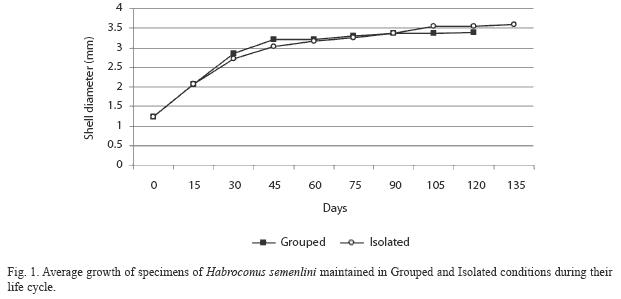
<body><![CDATA[<p><b><font face="Verdana" size="3">Material and methods</font></b></p> <font face="Verdana" size="2">     <p>A group of 50 adult individuals of <i>H. semenlini</i>, were collected in the field&#8211; Morro do Imperador (21&deg;45&#8217;13"-21&deg;46&#8217;13" S, 43&deg;21&#8217;19"-43&deg;22&#8217;15" W)&#8211; Juiz de Fora, State of Minas Gerais, Brazil, during summer (January 2008). These animals were reared in the Laboratory of Mollusk Biology, Museum of Malacology "Professor Maury Pinto de Oliveira" at the Federal University of Juiz de Fora. Some specimens were sent to the mollusk collection at the National Museum of Federal University of Rio de Janeiro, State of Rio de Janeiro, Brazil (register MNRJ 12855).</p>     <p>The life cycle of <i>H. semenlini </i>was studied from February to July 2008, using recently hatched animals only. This study was carried out at a temperature of 20&deg;C&plusmn; 2, relative humidity of 85% &plusmn; 2, during natural photoperiod, under laboratory conditions. </p>     <p>Four groups of animals (10 snails each) were kept in larger plastic terrariums (8cm diameter x 6cm deep) during their lifespan (Grouped). The substrate (mulch) was sterilized at 120&deg;C for one hour and then humidified once a day during culture. Animals were fed commercial ration for broilers (SOMA IND&Uacute;STRIA E COM&Eacute;RCIO DE ALIMENTOS LTDA &reg;), enriched with calcium carbonate at 3:1 (Bessa &amp; Ara&uacute;jo 1995).</p>     <p>Shell diameter measurements were made, with the aid of a caliper (0.05mm precision), to each organism the first day of the study and every 15 days, so growth rates could be studied. The time range to the first reproduction was identified by the presence of hatched animals in the terrariums; throughout the experiment, terrariums were examined for daily hatched animals. In this case, all animals were counted and their day of hatch was scored.</p>     <p>In order to test self-fertilization, 40 recently hatched snails were kept individually isolated in small plastic terrariums (6 diameter x 4cm deep) during their lifespan (Isolated). This group was fed and observed, and reproduction was controlled as previously described, following Bessa &amp; Ara&uacute;jo (1995). Mortality control was also considered daily through direct observation of Grouped and Isolated animals.</p> </font><b><font face="Verdana" size="3">     <p>Results</p> </font></b><font face="Verdana" size="2">     <p>The average growth of Grouped and Isolated <i>H. semenlini </i>during their life cycle is shown in <a href="#fig1">Fig. 1</a>. There is a continuous growth after reproduction and for this species can be considered indeterminate.    <br> </p>     <p>    ]]></body>
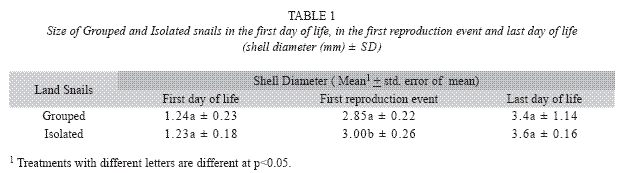
<body><![CDATA[<br>     <br> </p> </font>     <div style="text-align: center;"><a name="fig1"></a><img  src="/img/revistas/rbt/v57n4/a24i1.jpg" title="" alt=""  style="width: 621px; height: 299px;">    <br>     <br> </div> <font face="Verdana" size="2">     <p>From the first reproduction event the average size of Grouped and Isolated snails was different (Mann-Whitney=3.62, p=0.0003), whereas no significant difference was measured in the first and last days of life (Mann-Whitney= 0.16; p=0.87 and Mann-Whitney=0.53, p=0.60, respectively) (<a href="#tabla1">Table 1</a>).    <br> </p>     <p>    <br>     <br> </p> </font>     ]]></body>
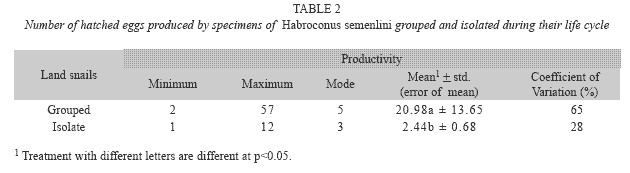
<body><![CDATA[<div style="text-align: center;"><a name="tabla1"></a><img  src="/img/revistas/rbt/v57n4/a24t1.gif" title="" alt=""  style="width: 627px; height: 173px;">    <br>     <br>     <br> </div> <font face="Verdana" size="2">     <p>We observed that <i>H. semenlini </i>has a capacity of self-fertilization, evidenced by the fact that hatched snails appeared in isolation conditions (40 days&plusmn;9). For this species only one reproductive period was observed during their life cycle. Isolated snails have produced a total of 1 332 hatched animals (33.3 hatched animals/snail). For animals kept in groups, reproduction was verified in 32 days&plusmn;3, which was not significantly different in isolation conditions (Mann-Whitney=1.96, p=0.08). During the life cycle of Grouped animals a total of 1 280 hatched animals (32.0 hatched animals/ snail) appeared in all terrariums. However, the total number of hatched animals produced by Grouped snails was significantly lower than that produced by Isolated individuals (Mann- Whitney=9.59, p=0.0001). <a  href="#tabla2">Table 2</a> shows the fecundity of <i>H. semenlini</i>.    <br> </p>     <p>    <br>     <br> </p> </font>     <div style="text-align: center;"><a name="tabla2"></a><img  src="/img/revistas/rbt/v57n4/a24t2.gif" title="" alt=""  style="width: 630px; height: 173px;">    ]]></body>
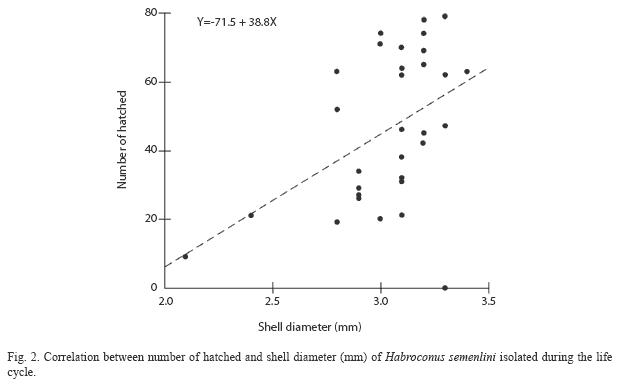
<body><![CDATA[<br>     <br> </div> <font face="Verdana" size="2">     <p>The test of simple linear regression showed significant correlation between shell diameter and number of hatched animals produced (Simple Linear Regression=8, p=0.0009; <a href="#fig2">Fig. 2</a>).    <br> </p>     <p>    <br>     <br> </p> </font>     <div style="text-align: center;"><a name="fig2"></a><img  src="/img/revistas/rbt/v57n4/a24i2.jpg" title="" alt=""  style="width: 627px; height: 389px;">    <br>     <br> </div> <font face="Verdana" size="2">     ]]></body>
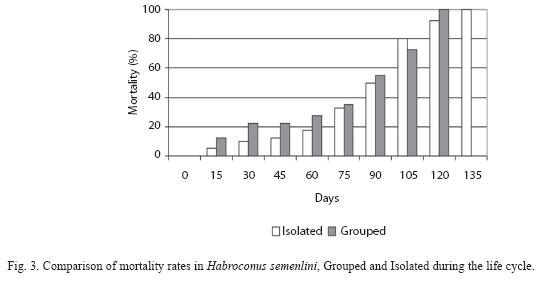
<body><![CDATA[<p>Isolated individuals lived longer than Grouped individuals (<a  href="#fig3">Fig. 3</a>). Lifespan was 111.75 days &plusmn;6 for Isolated and 77.30 days &plusmn; 41.50 for Grouped, but with no statistical difference (Mann-Whitney=0.28, p=0.78).    <br> </p>     <p>    <br>     <br> </p> </font>     <div style="text-align: center;"><a name="fig3"></a><img  src="/img/revistas/rbt/v57n4/a24i3.jpg" title="" alt=""  style="width: 538px; height: 283px;">    <br>     <br> </div> <font face="Verdana" size="2"></font><b><font face="Verdana" size="3">     <p>Discussion</p> </font></b><font face="Verdana" size="2"> </font>     <p><font face="Verdana" size="2">The pattern of indeterminate growth observed in this species has been reported for other tropical land snail species, such as <i>Leptinaria unilamellata </i>(d&#8217; Orbigny, 1835) and <i>Bulimulus tenuissimus </i>(d&#8217; Orbigny, 1835) (Almeida &amp; Bessa 2001, Silva <i>et al. </i>2008). Indeterminate growth is apparently optimal when productivity increases with shell size. Thus, growth after the initiation of egg-laying does not reduce reproductive success, since it is compensated by an increase in body size (Heller 2001).</font></p>     ]]></body>
<body><![CDATA[<p><font face="Verdana" size="2">For this species, there was a high correlation between body size and fecundity. Body weight, shell length and egg production are all correlated in land snails <i>Subulina octona </i>(Brug&uuml;i&egrave;re, 1789) (D&#8217;&Aacute;vila &amp; Bessa 2005) and <i>B. tenuissimus </i>(Silva <i>et al</i>. 2008), which suggests that <i>H. semenlini </i>gain reproductive success by breeding when they have reached a larger size.</font></p>     <p><font face="Verdana" size="2">A relationship between body size and egg production is often assumed. Since eggs are energetically costly, larger individuals should have the capacity to produce more eggs (Ghiselin 1969). Body size can be an important factor in sex allocation since it is an important indicator of resources available and therefore of energy available for gamete production (Norton &amp; Bronson 2006).</font></p> <font face="Verdana" size="2"><i> </i></font>     <p><font face="Verdana" size="2"><i>Habroconus semenlini </i>was able to reproduce through self-fertilization. This is an important characteristic for snails, which inhabit forest areas that have been destroyed. Thus, the ability to self-fertilize can ensure survival of the species in cases of environmental disturbances (Heller 2001).</font></p>     <p><font face="Verdana" size="2">Unlike what has been observed for other terrestrial gastropods (Almeida &amp; Bessa 2001, Meireles <i>et al</i>. 2008, Silva <i>et al</i>. 2008), <i>H</i>. <i>semenlini </i>displayed higher fecundity when kept in isolation. It has been reported that the frequency of self- fertilization can vary widely (Heller 1993, 2001). In <i>B. tenuissimus </i>there is a clear preference for cross-fertilization, and self-fertilization happens after a long period of isolation (Silva <i>et al</i>. 2008). For <i>S. octona </i>reproductive success was the same in both reproductive processes (Bessa &amp; Ara&uacute;jo 1995). For slug <i>Deroceras agrestis </i>(Linnaeus, 1758) reproduction by cross-fertilization can be four times more successful than reproduction by self-fertilization (Foltz <i>et al</i>. 1982).</font></p>     <p><font face="Verdana" size="2">The frequency of self-fertilization may vary within a single genus, as reported for species of <i>Arion </i>(F&eacute;russac, 1819) some of which reproduce only by cross- fertilization, while others only by self-fertilization, and others use both processes (Heller 2001). Age may influence self-fertilization frequency, as seen for the land snail <i>Partula taeniata </i>(M&ouml;rch, 1876), whose rates of self-fertilization are reported to decrease their life cycle (Murray &amp; Clark 1966, 1976). Self-fertilization is a costly process in terms of energy, due to the need to develop two reproductive apparatus. Thus, this process would be beneficial when reproductive success is higher than energy costs. The greater reproductive success of <i>H</i>. <i>semenlini </i>through selffertilization was compensated by an increase in the number of the hatched animals produced.</font></p>     <p><font face="Verdana" size="2">In <i>H</i>. <i>semenlini</i>, egg-laying was not observed, but the presence of hatched specimens in all terrariums was observed. This fact indicates that this species is viviparous or ovoviviparous. However, in order to establish the strategy adopted by this species, histological studies of the reproductive tract are required (Heller 2001).</font></p>     <p><font face="Verdana" size="2">The life cycle of <i>H</i>. <i>semenlini </i>was short. Johnson &amp; Black (1991) suggest that smallsized land snails of tropical regions tend to be short-lived. Moreover, this species only has one reproductive period during their life cycle, which characterizes semelparity in this species. Land snails have two reproductive strategies, namely semelparity and iteroparity. In semelparity, animals only have one reproductive period during their life cycle, after which death occurs, as seen in this study with <i>H. semenlini</i>. In iteroparity, instead, animals have more than one reproductive period during their life cycle (Heller 2001). Semelparity has been reported for others land snails, such as <i>Xeropicta vestalis </i>(Pfeiffer, 1841) (Heller &amp; Volokita 1981), <i>Monacha cartusiana </i>(M&uuml;ller, 1774) (Staikou &amp; Lazaridou-Dimitriadou 1990), <i>Helicela itala </i>(Linnaeus, 1758) (Lazaridou- Dimitriadou &amp; Sgardelis 1995) and species of the genus <i>Arion </i>(South 1992). Semelparity and iteroparity were related to environmental conditions. Thus, semelparity would be favored in unstable environments, giving the animals a short life cycle, with maximum reproductive effort, as observed in this study for <i>H. semenlini. </i>It is believed that the life cycle characteristics seen in <i>H. semenlini </i>are related to habitat type and morphological characteristics of the species. Specimens of <i>H. semenlini </i>have been found in border areas (unpublished data) that make them susceptible to environmental variations throughout the day, such as light, temperature and humidity, common in these areas (Murcia 1995). Environmental variations and small body size cause water stress in these animals and facilitate desiccation. Thus, environmental and morphological conditions may have favored semelparity in this species.</font></p>     <p><b><font face="Verdana" size="3">Acknowledgment</font></b></p> <font face="Verdana" size="2">     <p>We thank Coordena&ccedil;&atilde;o de Aperfei&ccedil;oamento de Pessoal de N&iacute;vel Superior (CAPES) and Conselho Nacional de Pesquisa (CNPq) for the fellowship.</p> </font> <hr style="width: 100%; height: 2px;"><b><font face="Verdana" size="3">     <p>Resumen</p> </font></b>     ]]></body>
<body><![CDATA[<p><i><font face="Verdana" size="2"> </font></i></p>     <p><i><font face="Verdana" size="2">Habroconus semenlini </font></i><font  face="Verdana" size="2">es un gastr&oacute;podo micro-terrestre nativo de Am&eacute;rica del Sur. Actualmente se carece de estudios sobre su biolog&iacute;a. Este estudio tuvo como objetivo verificar el patr&oacute;n de crecimiento, la fecundidad y la esperanza de vida de esta especie en condiciones de laboratorio. Con este fin, 80 caracoles fueron mantenidos aislados o agrupados (40 animales en cada condici&oacute;n) durante su ciclo de vida. La especie tiene crecimiento indeterminado y es capaz de auto-fertilizaci&oacute;n con alto grado de &eacute;xito reproductivo. Los caracoles agrupados tuvieron menor fecundidad que los que se mantuvieron en aislamiento. Esta especie tiene una vida &uacute;til corta, y s&oacute;lo un per&iacute;odo reproductivo, lo que caracteriza la semelparidad.</font></p> <font face="Verdana" size="2"><b> </b></font>     <p><font face="Verdana" size="2"><b>Key words: </b>Crecimiento, caracoles de tierra, longevidad, reproducci&oacute;n, fecundaci&oacute;n libre.    <br>     <br> </font></p>     <p style="text-align: center;"><font face="Verdana" size="2">Received 01-II -2009. Corrected 17-IV-2009. Accepted 19-V-2009.</font></p> <hr style="width: 100%; height: 2px;"><b><font face="Verdana" size="3">     <p>References</p> </font></b><font face="Verdana" size="2">     <!-- ref --><p>Almeida, M.N. &amp; E.C.A. Bessa. 2001. Estudo do crescimento e da reprodu&ccedil;&atilde;o de <i>Bradybaena similaris </i>(Mollusca, Xanthonychidae) em laborat&oacute;rio. Rev. Bras. Zool. 18: 1115-1122.&nbsp;&nbsp;&nbsp;&nbsp;&nbsp;&nbsp;&nbsp;&nbsp;[&#160;<a href="javascript:void(0);" onclick="javascript: window.open('/scielo.php?script=sci_nlinks&ref=1267208&pid=S0034-7744200900040002400001&lng=','','width=640,height=500,resizable=yes,scrollbars=1,menubar=yes,');">Links</a>&#160;]<!-- end-ref --><!-- ref --><p>D&#8217;&Aacute;vila, S. &amp; E.C.A. Bessa. 2005. Influ&ecirc;ncia do substrato sobre o crescimento de <i>Subulina octona </i>(Brug&uuml;i&egrave;re) (Mollusca, Subulinidae), sob condi&ccedil;&otilde;es de laborat&oacute;rio. Rev. Bras. Zool. 22: 205-211.&nbsp;&nbsp;&nbsp;&nbsp;&nbsp;&nbsp;&nbsp;&nbsp;[&#160;<a href="javascript:void(0);" onclick="javascript: window.open('/scielo.php?script=sci_nlinks&ref=1267209&pid=S0034-7744200900040002400002&lng=','','width=640,height=500,resizable=yes,scrollbars=1,menubar=yes,');">Links</a>&#160;]<!-- end-ref --><!-- ref --><p>Bessa, E.C.A. &amp; J.L.B. Ara&uacute;jo. 1995. Oviposi&ccedil;&atilde;o, tamanho de ovos e medida do comprimento da concha em diferentes fases do desenvolvimento de <i>Subulina octona </i>(Brug&uuml;i&egrave;re) (Pulmonata, Subulinidae) em condi&ccedil;&otilde;es de laborat&oacute;rio. Rev. Bras. Zool. 12: 647-654.&nbsp;&nbsp;&nbsp;&nbsp;&nbsp;&nbsp;&nbsp;&nbsp;[&#160;<a href="javascript:void(0);" onclick="javascript: window.open('/scielo.php?script=sci_nlinks&ref=1267210&pid=S0034-7744200900040002400003&lng=','','width=640,height=500,resizable=yes,scrollbars=1,menubar=yes,');">Links</a>&#160;]<!-- end-ref --><!-- ref --><p>Foltz, D.W., H. Ochman, J.S. Jones, M. Evangelisti &amp; R.K. Selander. 1982. Genetic population structure and breeding systems in arionid slugs (Mollusca, Pulmonata). Biol. J. Linnean Soc. 17: 225-242.&nbsp;&nbsp;&nbsp;&nbsp;&nbsp;&nbsp;&nbsp;&nbsp;[&#160;<a href="javascript:void(0);" onclick="javascript: window.open('/scielo.php?script=sci_nlinks&ref=1267211&pid=S0034-7744200900040002400004&lng=','','width=640,height=500,resizable=yes,scrollbars=1,menubar=yes,');">Links</a>&#160;]<!-- end-ref --><!-- ref --><p>Ghiselin, M.T. 1969. The evolution of hermaphroditism among animals. Q. R. B. 44 :189-208. &nbsp;&nbsp;&nbsp;&nbsp;&nbsp;&nbsp;&nbsp;&nbsp;[&#160;<a href="javascript:void(0);" onclick="javascript: window.open('/scielo.php?script=sci_nlinks&ref=1267212&pid=S0034-7744200900040002400005&lng=','','width=640,height=500,resizable=yes,scrollbars=1,menubar=yes,');">Links</a>&#160;]<!-- end-ref --><!-- ref --><p>Heller, J. 1993. Hermafroditism in molluscs. Biol. J. Linnean Soc. 48: 19-42.&nbsp;&nbsp;&nbsp;&nbsp;&nbsp;&nbsp;&nbsp;&nbsp;[&#160;<a href="javascript:void(0);" onclick="javascript: window.open('/scielo.php?script=sci_nlinks&ref=1267213&pid=S0034-7744200900040002400006&lng=','','width=640,height=500,resizable=yes,scrollbars=1,menubar=yes,');">Links</a>&#160;]<!-- end-ref --><!-- ref --><p>Heller, J. 2001. Life History Strategies, p. 413-445. <i>In </i>G. M. Barker (ed.). The biology of terrestrial molluscs. CABI Publishing. Wallingford, New Zealand.&nbsp;&nbsp;&nbsp;&nbsp;&nbsp;&nbsp;&nbsp;&nbsp;[&#160;<a href="javascript:void(0);" onclick="javascript: window.open('/scielo.php?script=sci_nlinks&ref=1267214&pid=S0034-7744200900040002400007&lng=','','width=640,height=500,resizable=yes,scrollbars=1,menubar=yes,');">Links</a>&#160;]<!-- end-ref --><!-- ref --><p>Heller, J. &amp; M. Volokita. 1981. Gene regulation of shell in a land snail from Israel. Biol. J. Linnean Soc. 16: 261-277.&nbsp;&nbsp;&nbsp;&nbsp;&nbsp;&nbsp;&nbsp;&nbsp;[&#160;<a href="javascript:void(0);" onclick="javascript: window.open('/scielo.php?script=sci_nlinks&ref=1267215&pid=S0034-7744200900040002400008&lng=','','width=640,height=500,resizable=yes,scrollbars=1,menubar=yes,');">Links</a>&#160;]<!-- end-ref --><!-- ref --><p>Johnson, M.S. &amp; R. Black. 1991. Growth, survivorship, and population size in the land snail <i>Rhagada convicta </i>Cox, 1870 (Pulmonata: Camaenidae) from a semiarid environment in Western Australia. J. Molluscan Stud. 57: 367-374.&nbsp;&nbsp;&nbsp;&nbsp;&nbsp;&nbsp;&nbsp;&nbsp;[&#160;<a href="javascript:void(0);" onclick="javascript: window.open('/scielo.php?script=sci_nlinks&ref=1267216&pid=S0034-7744200900040002400009&lng=','','width=640,height=500,resizable=yes,scrollbars=1,menubar=yes,');">Links</a>&#160;]<!-- end-ref --><!-- ref --><p>Lazaridou-Dimitriadou, M. &amp; S. Sgardelis. 1995. Biological strategies and population dynamics of the Northern Greek terrestrial gastropods. <i>In </i>G. M. Barker (ed.). The biology of terrestrial molluscs. CABI Publishing. Wallingford, New Zealand.&nbsp;&nbsp;&nbsp;&nbsp;&nbsp;&nbsp;&nbsp;&nbsp;[&#160;<a href="javascript:void(0);" onclick="javascript: window.open('/scielo.php?script=sci_nlinks&ref=1267217&pid=S0034-7744200900040002400010&lng=','','width=640,height=500,resizable=yes,scrollbars=1,menubar=yes,');">Links</a>&#160;]<!-- end-ref --><!-- ref --><p>Meireles, L.M.O., L.C. Silva, F.O. Junqueira &amp; E.C.A. Bessa. 2008. The influence of diet and isolation on growth and survival in the land snail <i>Bulimulus tenuissimus </i>(Mollusca: Bulimulidae) in laboratory. Rev. Bras. Zool. 25: 224-227.&nbsp;&nbsp;&nbsp;&nbsp;&nbsp;&nbsp;&nbsp;&nbsp;[&#160;<a href="javascript:void(0);" onclick="javascript: window.open('/scielo.php?script=sci_nlinks&ref=1267218&pid=S0034-7744200900040002400011&lng=','','width=640,height=500,resizable=yes,scrollbars=1,menubar=yes,');">Links</a>&#160;]<!-- end-ref --><!-- ref --><p>Murcia, C. 1995. Edge effects in fragmented forests: implications for conservation. Tree. 10: 58-62.&nbsp;&nbsp;&nbsp;&nbsp;&nbsp;&nbsp;&nbsp;&nbsp;[&#160;<a href="javascript:void(0);" onclick="javascript: window.open('/scielo.php?script=sci_nlinks&ref=1267219&pid=S0034-7744200900040002400012&lng=','','width=640,height=500,resizable=yes,scrollbars=1,menubar=yes,');">Links</a>&#160;]<!-- end-ref --><p> </p>     ]]></body>
<body><![CDATA[<!-- ref --><p>Murray, J. &amp; B. Clark. 1966. The inheritance of polymorphic shell characters in <i>Partula </i>(Gastropoda), p. 413-445. <i>In </i>G. M. Barker (ed.). The biology of terrestrial molluscs. CABI Publishing. Wallingford, New Zealand.&nbsp;&nbsp;&nbsp;&nbsp;&nbsp;&nbsp;&nbsp;&nbsp;[&#160;<a href="javascript:void(0);" onclick="javascript: window.open('/scielo.php?script=sci_nlinks&ref=1267221&pid=S0034-7744200900040002400013&lng=','','width=640,height=500,resizable=yes,scrollbars=1,menubar=yes,');">Links</a>&#160;]<!-- end-ref --><!-- ref --><p>Murray, J. &amp; B. Clark .1976. Supergenes in polymorphic land snail <i>Partula taeniata</i>, p. 413-445. <i>In </i>G. M. Barker (ed.). The biology of terrestrial molluscs. CABI Publishing, Oxon, UK.&nbsp;&nbsp;&nbsp;&nbsp;&nbsp;&nbsp;&nbsp;&nbsp;[&#160;<a href="javascript:void(0);" onclick="javascript: window.open('/scielo.php?script=sci_nlinks&ref=1267222&pid=S0034-7744200900040002400014&lng=','','width=640,height=500,resizable=yes,scrollbars=1,menubar=yes,');">Links</a>&#160;]<!-- end-ref --><!-- ref --><p>Norton, C. G. &amp; J. M. Bronson. 2006. The relationship of body size and growth to egg production in the hermaphroditic freshwater snail, <i>Helissoma tricolvis</i>. J. Molluscan Stud. 72: 143-147.&nbsp;&nbsp;&nbsp;&nbsp;&nbsp;&nbsp;&nbsp;&nbsp;[&#160;<a href="javascript:void(0);" onclick="javascript: window.open('/scielo.php?script=sci_nlinks&ref=1267223&pid=S0034-7744200900040002400015&lng=','','width=640,height=500,resizable=yes,scrollbars=1,menubar=yes,');">Links</a>&#160;]<!-- end-ref --><!-- ref --><p>Silva, L.C., L.M.O. Meireles, F.O. Junqueira &amp; E.C.A. Bessa. 2008. Development and reproduction in <i>Bulimulus tenuissimus </i>(Mollusca, Bulimulidae) in laboratory. Rev. Bras. Zool. 25: 220-223.&nbsp;&nbsp;&nbsp;&nbsp;&nbsp;&nbsp;&nbsp;&nbsp;[&#160;<a href="javascript:void(0);" onclick="javascript: window.open('/scielo.php?script=sci_nlinks&ref=1267224&pid=S0034-7744200900040002400016&lng=','','width=640,height=500,resizable=yes,scrollbars=1,menubar=yes,');">Links</a>&#160;]<!-- end-ref --><!-- ref --><p>Simone, L.R.L. 1999. Mollusca Terrestres, p. 5: 3-8. <i>In </i>C.R. Brand&atilde;o &amp; E.M. Cancello, (Org.). Biodiversidade do Estado de S&atilde;o Paulo, Brasil: s&iacute;ntese do conhecimento ao final do s&eacute;culo XX: Invertebrados Terrestres. FAPESP Editora, S&atilde;o Paulo, S&atilde;o Paulo, Brasil.&nbsp;&nbsp;&nbsp;&nbsp;&nbsp;&nbsp;&nbsp;&nbsp;[&#160;<a href="javascript:void(0);" onclick="javascript: window.open('/scielo.php?script=sci_nlinks&ref=1267225&pid=S0034-7744200900040002400017&lng=','','width=640,height=500,resizable=yes,scrollbars=1,menubar=yes,');">Links</a>&#160;]<!-- end-ref --><!-- ref --><p>South, H. 1992. A comparison of the life cicle of <i>Deroceras reticulatum </i>(M&uuml;ller) and <i>Arion intermedius </i>Normand (Pulmonata: Stylommatophora) at different temperatures under laboratory conditions. J. Molluscan Stud. 48: 233-244. &nbsp;&nbsp;&nbsp;&nbsp;&nbsp;&nbsp;&nbsp;&nbsp;[&#160;<a href="javascript:void(0);" onclick="javascript: window.open('/scielo.php?script=sci_nlinks&ref=1267226&pid=S0034-7744200900040002400018&lng=','','width=640,height=500,resizable=yes,scrollbars=1,menubar=yes,');">Links</a>&#160;]<!-- end-ref --><!-- ref --><p>Staikou, A. &amp; M. Lazaridou-Dimitriadou. 1990. Aspects of the cycle, population dynamics, growth and secondary production of the snail <i>Monacha cartusina </i>(M&uuml;ller, 1774) (Gastropoda, Pulmonata) in Greece. Malacol. 31: 353-362. &nbsp;&nbsp;&nbsp;&nbsp;&nbsp;&nbsp;&nbsp;&nbsp;[&#160;<a href="javascript:void(0);" onclick="javascript: window.open('/scielo.php?script=sci_nlinks&ref=1267227&pid=S0034-7744200900040002400019&lng=','','width=640,height=500,resizable=yes,scrollbars=1,menubar=yes,');">Links</a>&#160;]<!-- end-ref --><!-- ref --><p>Thom&eacute;, J.W., S.R. Gomes &amp; J.B. Pican&ccedil;o. 2006. Guia ilustrado: os carac&oacute;is e as lesmas dos nossos bosques e jardins, p. 1-124. Editora USEB, Pelotas, Rio Grande do Sul, Brasil.&nbsp;&nbsp;&nbsp;&nbsp;&nbsp;&nbsp;&nbsp;&nbsp;[&#160;<a href="javascript:void(0);" onclick="javascript: window.open('/scielo.php?script=sci_nlinks&ref=1267228&pid=S0034-7744200900040002400020&lng=','','width=640,height=500,resizable=yes,scrollbars=1,menubar=yes,');">Links</a>&#160;]<!-- end-ref --><!-- ref --><p>Veitenheimer-Mendes, I. L. &amp; J. Aguiar-Nunes. 2001. Moluscos, p. 48-57. <i>In </i>Mirapalhete, S. R. (Coord. E Org.). Flora e Fauna do Parque Natural do Morro do Osso. Secretaria Municipal do Meio Ambiente, Porto Alegre, Brasil.&nbsp;&nbsp;&nbsp;&nbsp;&nbsp;&nbsp;&nbsp;&nbsp;[&#160;<a href="javascript:void(0);" onclick="javascript: window.open('/scielo.php?script=sci_nlinks&ref=1267229&pid=S0034-7744200900040002400021&lng=','','width=640,height=500,resizable=yes,scrollbars=1,menubar=yes,');">Links</a>&#160;]<!-- end-ref --><!-- ref --><p>Veitenheimer-Mendes, I. L. &amp; M. Postal. 2003. Moluscos terrestres e l&iacute;mnicos registrados para a sub-bacia hidrogr&aacute;fica do arroio Itapu&atilde;, Viam&atilde;o, Rio Grande do Sul, Brasil. R.B.B. 1: 55-68.&nbsp;&nbsp;&nbsp;&nbsp;&nbsp;&nbsp;&nbsp;&nbsp;[&#160;<a href="javascript:void(0);" onclick="javascript: window.open('/scielo.php?script=sci_nlinks&ref=1267230&pid=S0034-7744200900040002400022&lng=','','width=640,height=500,resizable=yes,scrollbars=1,menubar=yes,');">Links</a>&#160;]<!-- end-ref --> ]]></body><back>
<ref-list>
<ref id="B1">
<nlm-citation citation-type="journal">
<person-group person-group-type="author">
<name>
<surname><![CDATA[Almeida]]></surname>
<given-names><![CDATA[M.N]]></given-names>
</name>
<name>
<surname><![CDATA[Bessa]]></surname>
<given-names><![CDATA[E.C.A]]></given-names>
</name>
</person-group>
<article-title xml:lang="pt"><![CDATA[Estudo do crescimento e da reprodução de Bradybaena similaris (Mollusca, Xanthonychidae) em laboratório]]></article-title>
<source><![CDATA[Rev. Bras. Zool]]></source>
<year>2001</year>
<volume>18</volume>
<page-range>1115-1122</page-range></nlm-citation>
</ref>
<ref id="B2">
<nlm-citation citation-type="journal">
<person-group person-group-type="author">
<name>
<surname><![CDATA[D’Ávila]]></surname>
<given-names><![CDATA[S]]></given-names>
</name>
<name>
<surname><![CDATA[Bessa]]></surname>
<given-names><![CDATA[E.C.A]]></given-names>
</name>
</person-group>
<article-title xml:lang="pt"><![CDATA[Influência do substrato sobre o crescimento de Subulina octona (Brugüière) (Mollusca, Subulinidae), sob condições de laboratório]]></article-title>
<source><![CDATA[Rev. Bras. Zool]]></source>
<year>2005</year>
<volume>22</volume>
<page-range>205-211</page-range></nlm-citation>
</ref>
<ref id="B3">
<nlm-citation citation-type="journal">
<person-group person-group-type="author">
<name>
<surname><![CDATA[Bessa]]></surname>
<given-names><![CDATA[E.C.A]]></given-names>
</name>
<name>
<surname><![CDATA[Araújo]]></surname>
<given-names><![CDATA[J.L.B]]></given-names>
</name>
</person-group>
<article-title xml:lang="pt"><![CDATA[Oviposição, tamanho de ovos e medida do comprimento da concha em diferentes fases do desenvolvimento de Subulina octona (Brugüière) (Pulmonata, Subulinidae) em condições de laboratório]]></article-title>
<source><![CDATA[Rev. Bras. Zool]]></source>
<year>1995</year>
<volume>12</volume>
<page-range>647-654</page-range></nlm-citation>
</ref>
<ref id="B4">
<nlm-citation citation-type="journal">
<person-group person-group-type="author">
<name>
<surname><![CDATA[Foltz]]></surname>
<given-names><![CDATA[D.W]]></given-names>
</name>
<name>
<surname><![CDATA[Ochman]]></surname>
<given-names><![CDATA[H]]></given-names>
</name>
<name>
<surname><![CDATA[Jones]]></surname>
<given-names><![CDATA[J.S]]></given-names>
</name>
<name>
<surname><![CDATA[Evangelisti]]></surname>
<given-names><![CDATA[M]]></given-names>
</name>
<name>
<surname><![CDATA[Selander]]></surname>
<given-names><![CDATA[R.K]]></given-names>
</name>
</person-group>
<article-title xml:lang="en"><![CDATA[Genetic population structure and breeding systems in arionid slugs (Mollusca, Pulmonata)]]></article-title>
<source><![CDATA[Biol. J. Linnean Soc]]></source>
<year>1982</year>
<numero>17</numero>
<issue>17</issue>
<page-range>225-242</page-range></nlm-citation>
</ref>
<ref id="B5">
<nlm-citation citation-type="journal">
<person-group person-group-type="author">
<name>
<surname><![CDATA[Ghiselin]]></surname>
<given-names><![CDATA[M.T]]></given-names>
</name>
</person-group>
<article-title xml:lang="en"><![CDATA[The evolution of hermaphroditism among animals]]></article-title>
<source><![CDATA[Q. R. B]]></source>
<year>1969</year>
<volume>44</volume>
<page-range>189-208</page-range></nlm-citation>
</ref>
<ref id="B6">
<nlm-citation citation-type="journal">
<person-group person-group-type="author">
<name>
<surname><![CDATA[Heller]]></surname>
<given-names><![CDATA[J]]></given-names>
</name>
</person-group>
<article-title xml:lang="en"><![CDATA[Hermafroditism in molluscs]]></article-title>
<source><![CDATA[Biol. J. Linnean Soc]]></source>
<year>1993</year>
<volume>48</volume>
<page-range>19-42</page-range></nlm-citation>
</ref>
<ref id="B7">
<nlm-citation citation-type="book">
<person-group person-group-type="author">
<name>
<surname><![CDATA[Heller]]></surname>
<given-names><![CDATA[J]]></given-names>
</name>
</person-group>
<article-title xml:lang="en"><![CDATA[Life History Strategies]]></article-title>
<person-group person-group-type="editor">
<name>
<surname><![CDATA[Barker]]></surname>
<given-names><![CDATA[G. M]]></given-names>
</name>
</person-group>
<source><![CDATA[The biology of terrestrial molluscs]]></source>
<year>2001</year>
<page-range>413-445</page-range><publisher-loc><![CDATA[Wallingford ]]></publisher-loc>
<publisher-name><![CDATA[CABI Publishing]]></publisher-name>
</nlm-citation>
</ref>
<ref id="B8">
<nlm-citation citation-type="journal">
<person-group person-group-type="author">
<name>
<surname><![CDATA[Heller]]></surname>
<given-names><![CDATA[J]]></given-names>
</name>
<name>
<surname><![CDATA[Volokita]]></surname>
<given-names><![CDATA[M]]></given-names>
</name>
</person-group>
<article-title xml:lang="en"><![CDATA[Gene regulation of shell in a land snail from Israel]]></article-title>
<source><![CDATA[Biol. J. Linnean Soc]]></source>
<year>1981</year>
<volume>16</volume>
<page-range>261-277</page-range></nlm-citation>
</ref>
<ref id="B9">
<nlm-citation citation-type="journal">
<person-group person-group-type="author">
<name>
<surname><![CDATA[Johnson]]></surname>
<given-names><![CDATA[M.S]]></given-names>
</name>
<name>
<surname><![CDATA[Black]]></surname>
<given-names><![CDATA[R]]></given-names>
</name>
</person-group>
<article-title xml:lang="en"><![CDATA[Growth, survivorship, and population size in the land snail Rhagada convicta Cox, 1870 (Pulmonata: Camaenidae) from a semiarid environment in Western Australia]]></article-title>
<source><![CDATA[J. Molluscan Stud]]></source>
<year>1991</year>
<volume>57</volume>
<page-range>367-374</page-range></nlm-citation>
</ref>
<ref id="B10">
<nlm-citation citation-type="book">
<person-group person-group-type="author">
<name>
<surname><![CDATA[Lazaridou-Dimitriadou]]></surname>
<given-names><![CDATA[M]]></given-names>
</name>
<name>
<surname><![CDATA[Sgardelis]]></surname>
<given-names><![CDATA[S]]></given-names>
</name>
</person-group>
<article-title xml:lang="en"><![CDATA[Biological strategies and population dynamics of the Northern Greek terrestrial gastropods]]></article-title>
<person-group person-group-type="editor">
<name>
<surname><![CDATA[Barker]]></surname>
<given-names><![CDATA[G. M]]></given-names>
</name>
</person-group>
<source><![CDATA[The biology of terrestrial molluscs]]></source>
<year>1995</year>
<publisher-loc><![CDATA[Wallingford ]]></publisher-loc>
<publisher-name><![CDATA[CABI Publishing]]></publisher-name>
</nlm-citation>
</ref>
<ref id="B11">
<nlm-citation citation-type="journal">
<person-group person-group-type="author">
<name>
<surname><![CDATA[Meireles]]></surname>
<given-names><![CDATA[L.M.O]]></given-names>
</name>
<name>
<surname><![CDATA[Silva]]></surname>
<given-names><![CDATA[L.C]]></given-names>
</name>
<name>
<surname><![CDATA[Junqueira]]></surname>
<given-names><![CDATA[F.O]]></given-names>
</name>
<name>
<surname><![CDATA[Bessa]]></surname>
<given-names><![CDATA[E.C.A]]></given-names>
</name>
</person-group>
<article-title xml:lang="en"><![CDATA[The influence of diet and isolation on growth and survival in the land snail Bulimulus tenuissimus (Mollusca: Bulimulidae) in laboratory]]></article-title>
<source><![CDATA[Rev. Bras. Zool]]></source>
<year>2008</year>
<volume>25</volume>
<page-range>224-227</page-range></nlm-citation>
</ref>
<ref id="B12">
<nlm-citation citation-type="journal">
<person-group person-group-type="author">
<name>
<surname><![CDATA[Murcia]]></surname>
<given-names><![CDATA[C]]></given-names>
</name>
</person-group>
<article-title xml:lang="en"><![CDATA[Edge effects in fragmented forests: implications for conservation]]></article-title>
<source><![CDATA[Tree]]></source>
<year>1995</year>
<volume>10</volume>
<page-range>58-62</page-range></nlm-citation>
</ref>
<ref id="B13">
<nlm-citation citation-type="book">
<person-group person-group-type="author">
<name>
<surname><![CDATA[Murray]]></surname>
<given-names><![CDATA[J]]></given-names>
</name>
<name>
<surname><![CDATA[Clark]]></surname>
<given-names><![CDATA[B]]></given-names>
</name>
</person-group>
<article-title xml:lang="en"><![CDATA[The inheritance of polymorphic shell characters in Partula (Gastropoda)]]></article-title>
<person-group person-group-type="editor">
<name>
<surname><![CDATA[Barker]]></surname>
<given-names><![CDATA[G. M]]></given-names>
</name>
</person-group>
<source><![CDATA[The biology of terrestrial molluscs]]></source>
<year>1966</year>
<page-range>413-445</page-range><publisher-loc><![CDATA[Wallingford ]]></publisher-loc>
<publisher-name><![CDATA[CABI Publishing]]></publisher-name>
</nlm-citation>
</ref>
<ref id="B14">
<nlm-citation citation-type="book">
<person-group person-group-type="author">
<name>
<surname><![CDATA[Murray]]></surname>
<given-names><![CDATA[J]]></given-names>
</name>
<name>
<surname><![CDATA[Clark]]></surname>
<given-names><![CDATA[B]]></given-names>
</name>
</person-group>
<article-title xml:lang="en"><![CDATA[Supergenes in polymorphic land snail Partula taeniata]]></article-title>
<person-group person-group-type="editor">
<name>
<surname><![CDATA[Barker]]></surname>
<given-names><![CDATA[G. M]]></given-names>
</name>
</person-group>
<source><![CDATA[The biology of terrestrial molluscs]]></source>
<year>1976</year>
<page-range>413-445</page-range><publisher-loc><![CDATA[Oxon ]]></publisher-loc>
<publisher-name><![CDATA[CABI Publishing]]></publisher-name>
</nlm-citation>
</ref>
<ref id="B15">
<nlm-citation citation-type="journal">
<person-group person-group-type="author">
<name>
<surname><![CDATA[Norton]]></surname>
<given-names><![CDATA[C. G]]></given-names>
</name>
<name>
<surname><![CDATA[Bronson]]></surname>
<given-names><![CDATA[J. M]]></given-names>
</name>
</person-group>
<article-title xml:lang="en"><![CDATA[The relationship of body size and growth to egg production in the hermaphroditic freshwater snail, Helissoma tricolvis]]></article-title>
<source><![CDATA[J. Molluscan Stud]]></source>
<year>2006</year>
<volume>72</volume>
<page-range>143-147</page-range></nlm-citation>
</ref>
<ref id="B16">
<nlm-citation citation-type="journal">
<person-group person-group-type="author">
<name>
<surname><![CDATA[Silva]]></surname>
<given-names><![CDATA[L.C]]></given-names>
</name>
<name>
<surname><![CDATA[Meireles]]></surname>
<given-names><![CDATA[L.M.O]]></given-names>
</name>
<name>
<surname><![CDATA[Junqueira]]></surname>
<given-names><![CDATA[F.O]]></given-names>
</name>
<name>
<surname><![CDATA[Bessa]]></surname>
<given-names><![CDATA[E.C.A]]></given-names>
</name>
</person-group>
<article-title xml:lang="en"><![CDATA[Development and reproduction in Bulimulus tenuissimus (Mollusca, Bulimulidae) in laboratory]]></article-title>
<source><![CDATA[Rev. Bras. Zool]]></source>
<year>2008</year>
<volume>25</volume>
<page-range>220-223</page-range></nlm-citation>
</ref>
<ref id="B17">
<nlm-citation citation-type="book">
<person-group person-group-type="author">
<name>
<surname><![CDATA[Simone]]></surname>
<given-names><![CDATA[L.R.L]]></given-names>
</name>
</person-group>
<article-title xml:lang="es"><![CDATA[Mollusca Terrestres]]></article-title>
<person-group person-group-type="editor">
<name>
<surname><![CDATA[Brandão]]></surname>
<given-names><![CDATA[C.R]]></given-names>
</name>
<name>
<surname><![CDATA[Cancello]]></surname>
<given-names><![CDATA[E.M]]></given-names>
</name>
</person-group>
<source><![CDATA[Biodiversidade do Estado de São Paulo, Brasil: síntese do conhecimento ao final do século XX: Invertebrados Terrestres]]></source>
<year>1999</year>
<page-range>3-8</page-range><publisher-loc><![CDATA[São PauloSão Paulo ]]></publisher-loc>
<publisher-name><![CDATA[FAPESP Editora]]></publisher-name>
</nlm-citation>
</ref>
<ref id="B18">
<nlm-citation citation-type="journal">
<person-group person-group-type="author">
<name>
<surname><![CDATA[South]]></surname>
<given-names><![CDATA[H]]></given-names>
</name>
</person-group>
<article-title xml:lang="en"><![CDATA[A comparison of the life cicle of Deroceras reticulatum (Müller) and Arion intermedius Normand (Pulmonata: Stylommatophora) at different temperatures under laboratory conditions]]></article-title>
<source><![CDATA[J. Molluscan Stud]]></source>
<year>1992</year>
<volume>48</volume>
<page-range>233-244</page-range></nlm-citation>
</ref>
<ref id="B19">
<nlm-citation citation-type="journal">
<person-group person-group-type="author">
<name>
<surname><![CDATA[Staikou]]></surname>
<given-names><![CDATA[A]]></given-names>
</name>
<name>
<surname><![CDATA[Lazaridou-Dimitriadou]]></surname>
<given-names><![CDATA[M]]></given-names>
</name>
</person-group>
<article-title xml:lang="en"><![CDATA[Aspects of the cycle, population dynamics, growth and secondary production of the snail Monacha cartusina (Müller, 1774) (Gastropoda, Pulmonata) in Greece]]></article-title>
<source><![CDATA[Malacol]]></source>
<year>1990</year>
<volume>31</volume>
<page-range>353-362</page-range></nlm-citation>
</ref>
<ref id="B20">
<nlm-citation citation-type="book">
<person-group person-group-type="author">
<name>
<surname><![CDATA[Thomé]]></surname>
<given-names><![CDATA[J.W]]></given-names>
</name>
<name>
<surname><![CDATA[Gomes]]></surname>
<given-names><![CDATA[S.R]]></given-names>
</name>
<name>
<surname><![CDATA[Picanço]]></surname>
<given-names><![CDATA[J.B]]></given-names>
</name>
</person-group>
<source><![CDATA[Guia ilustrado: os caracóis e as lesmas dos nossos bosques e jardins]]></source>
<year>2006</year>
<page-range>1-124</page-range><publisher-loc><![CDATA[Rio Grande do Sul ]]></publisher-loc>
<publisher-name><![CDATA[USEB]]></publisher-name>
</nlm-citation>
</ref>
<ref id="B21">
<nlm-citation citation-type="book">
<person-group person-group-type="author">
<name>
<surname><![CDATA[Veitenheimer-Mendes]]></surname>
<given-names><![CDATA[I. L]]></given-names>
</name>
<name>
<surname><![CDATA[Aguiar-Nunes]]></surname>
<given-names><![CDATA[J]]></given-names>
</name>
</person-group>
<article-title xml:lang="es"><![CDATA[Moluscos]]></article-title>
<person-group person-group-type="editor">
<name>
<surname><![CDATA[Mirapalhete]]></surname>
<given-names><![CDATA[S. R]]></given-names>
</name>
</person-group>
<source><![CDATA[Flora e Fauna do Parque Natural do Morro do Osso]]></source>
<year>2001</year>
<page-range>48-57</page-range><publisher-loc><![CDATA[Porto Alegre ]]></publisher-loc>
<publisher-name><![CDATA[Secretaria Municipal do Meio Ambiente]]></publisher-name>
</nlm-citation>
</ref>
<ref id="B22">
<nlm-citation citation-type="journal">
<person-group person-group-type="author">
<name>
<surname><![CDATA[Veitenheimer-Mendes]]></surname>
<given-names><![CDATA[I. L]]></given-names>
</name>
<name>
<surname><![CDATA[Postal]]></surname>
<given-names><![CDATA[M]]></given-names>
</name>
</person-group>
<article-title xml:lang="es"><![CDATA[Moluscos terrestres e límnicos registrados para a sub-bacia hidrográfica do arroio Itapuã, Viamão, Rio Grande do Sul, Brasil]]></article-title>
<source><![CDATA[R.B.B]]></source>
<year>2003</year>
<volume>1</volume>
<page-range>55-68</page-range></nlm-citation>
</ref>
</ref-list>
</back>
</article>