<?xml version="1.0" encoding="ISO-8859-1"?><article xmlns:mml="http://www.w3.org/1998/Math/MathML" xmlns:xlink="http://www.w3.org/1999/xlink" xmlns:xsi="http://www.w3.org/2001/XMLSchema-instance">
<front>
<journal-meta>
<journal-id>0034-7744</journal-id>
<journal-title><![CDATA[Revista de Biología Tropical]]></journal-title>
<abbrev-journal-title><![CDATA[Rev. biol. trop]]></abbrev-journal-title>
<issn>0034-7744</issn>
<publisher>
<publisher-name><![CDATA[Universidad de Costa Rica]]></publisher-name>
</publisher>
</journal-meta>
<article-meta>
<article-id>S0034-77442009000400011</article-id>
<title-group>
<article-title xml:lang="en"><![CDATA[Immunodetection of Luteinizing Hormone (LH), Follicle-Stimulating Hormone (FSH), Thyroid Stimulating Hormone (TSH) and Prolactin (PRL) in Brachionus calyciflorus (Rotifera: Monogononta)]]></article-title>
</title-group>
<contrib-group>
<contrib contrib-type="author">
<name>
<surname><![CDATA[Alvarado-Flores]]></surname>
<given-names><![CDATA[Jesús]]></given-names>
</name>
<xref ref-type="aff" rid="A01"/>
</contrib>
<contrib contrib-type="author">
<name>
<surname><![CDATA[Montoya-Garcia]]></surname>
<given-names><![CDATA[María Del Rosario]]></given-names>
</name>
<xref ref-type="aff" rid="A02"/>
</contrib>
<contrib contrib-type="author">
<name>
<surname><![CDATA[Ventura Juárez]]></surname>
<given-names><![CDATA[Javier]]></given-names>
</name>
<xref ref-type="aff" rid="A03"/>
</contrib>
<contrib contrib-type="author">
<name>
<surname><![CDATA[Rico-Martínez]]></surname>
<given-names><![CDATA[Roberto]]></given-names>
</name>
<xref ref-type="aff" rid="A04"/>
</contrib>
</contrib-group>
<aff id="A01">
<institution><![CDATA[,Universidad Autónoma de Aguascalientes Centro de Ciencias Básicas ]]></institution>
<addr-line><![CDATA[Aguascalientes ]]></addr-line>
<country>México</country>
</aff>
<aff id="A02">
<institution><![CDATA[,Universidad Autónoma de Aguascalientes Departamento de Fisiología y Farmacología ]]></institution>
<addr-line><![CDATA[Aguascalientes ]]></addr-line>
<country>México</country>
</aff>
<aff id="A03">
<institution><![CDATA[,Universidad Autónoma de Aguascalientes Centro de Ciencias Básicas Departamento de Morfología]]></institution>
<addr-line><![CDATA[Aguascalientes ]]></addr-line>
<country>México</country>
</aff>
<aff id="A04">
<institution><![CDATA[,Universidad Autónoma de Aguascalientes Departamento de Química Centro de Ciencias Básicas]]></institution>
<addr-line><![CDATA[Aguascalientes ]]></addr-line>
<country>México</country>
</aff>
<pub-date pub-type="pub">
<day>00</day>
<month>12</month>
<year>2009</year>
</pub-date>
<pub-date pub-type="epub">
<day>00</day>
<month>12</month>
<year>2009</year>
</pub-date>
<volume>57</volume>
<numero>4</numero>
<fpage>1049</fpage>
<lpage>1058</lpage>
<copyright-statement/>
<copyright-year/>
<self-uri xlink:href="http://www.scielo.sa.cr/scielo.php?script=sci_arttext&amp;pid=S0034-77442009000400011&amp;lng=en&amp;nrm=iso"></self-uri><self-uri xlink:href="http://www.scielo.sa.cr/scielo.php?script=sci_abstract&amp;pid=S0034-77442009000400011&amp;lng=en&amp;nrm=iso"></self-uri><self-uri xlink:href="http://www.scielo.sa.cr/scielo.php?script=sci_pdf&amp;pid=S0034-77442009000400011&amp;lng=en&amp;nrm=iso"></self-uri><abstract abstract-type="short" xml:lang="en"><p><![CDATA[The endocrine system controls and coordinates behavioral, biochemical, and physiological processes through signal mechanisms using neuropeptides or products of neurosecretory cells. Among invertebrates, this system is poorly studied in rotifers, in which estrogens and androgens significantly affect sexual reproduction. This is the first report of the presence of the Luteinizing Hormone (LH), Follicle-Stimulating Hormone (FSH), Thyroid Stimulating Hormone (TSH) and Prolactin (PRL) in rotifers. Analyses included the avidin-biotin-peroxidase complex method with primary antibodies LH (Anti-Rat LH serum for RIA), PRL (Anti-Rat PRL serum for RIA), FSH (Anti-Rat FSH serum for RIA) and TSH (Anti-Rat TSH serum for RIA). These hormones were found in females, males and parthenogenetic and sexual eggs of the freshwater Brachionus calyciflorus. The immunoreactivity of FSH, LH, TSH and PRL in females was observed in: ovaries, cerebrum, mastax, stomach, lorica, and the stomach gland. However, in males LH was observed only at the trochal disk and cerebrum. The hormones FSH, TSH and PRL, were observed in testicles, contractil vesicles, and cementary gland of males. Regarding amictic or parthenogenetic eggs, the hormones LH, FSH, TSH, and PRL were located mainly in the micromeres, and the staining in the macromeres was weak. On the other hand, in the mictic or sexual eggs the inner shell is stained for the hormones PRL and LH, opposite to the staining of FSH and TSH, located mainly in the embryo. In general, immuno-reactivity was observed in areas important for the reproductive, excretory, digestive and developmental processes. Rev. Biol. Trop. 57 (4): 1049-1058. Epub 2009 December 01.]]></p></abstract>
<abstract abstract-type="short" xml:lang="es"><p><![CDATA[Se logró detectar la presencia de las hormonas: Hormona Luteinizante (LH), Hormona Folículo Estimulante (FSH), Hormona Estimulante de la Tiroides (TSH) y Prolactina (PRL) en Brachionus calyciflorus siendo el primer reporte de la presencia de dichas hormonas en rotíferos. Estas hormonas fueron identificadas por un método inmunológico-histológico-químico usando el complejo avidina-biotina- peroxidasa con los siguientes anticuerpos primarios: LH (Anti-Rata LH suero para RIA), PRL (Anti-Rata PRL suero para RIA), FSH (Anti-Rata FSH suero para RIA) y TSH (Anti-Rata TSH en suero para RIA). Estas hormonas se encontraron en las hembras, machos, huevos partenogenéticos y huevos sexuales del rotífero dulceacuícola B. calyciflorus. La reactividad inmunológica de FSH, LH, PRL y TSH en las hembras se observó en ovarios, cerebro, mástax, estómago, lorica, y la glándula del estómago. Sin embargo, en machos, la LH se observó sólo en el disco trocal y cerebro mientras que las hormonas FSH, PRL y TSH, se observaron en testículos, vesícula contráctil, y la glándula cementaria. En cuanto a los huevos partenogenéticos o amícticos, las hormonas LH, FSH, TSH, y PRL, se encontraron principalmente en los micrómeros, y en los macrómeros la tinción es débil. Por otra parte, el huevo sexual o míctico muestra reactividad inmunológica en la cubierta interior del huevo para las hormonas LH y PRL, lo contrario para FSH y TSH, las cuales se observaron principalmente en el embrión. La reactividad inmunológica fue observada, en general, en áreas importantes para los procesos reproductivos, excretorios, digestivos y del desarrollo.]]></p></abstract>
<kwd-group>
<kwd lng="en"><![CDATA[Gonadotropic hormones]]></kwd>
<kwd lng="en"><![CDATA[lactogenic hormones]]></kwd>
<kwd lng="en"><![CDATA[thyroid hormones]]></kwd>
<kwd lng="en"><![CDATA[Rotifera]]></kwd>
<kwd lng="en"><![CDATA[invertebrates]]></kwd>
<kwd lng="es"><![CDATA[hormonas gonadotrofinas]]></kwd>
<kwd lng="es"><![CDATA[hormonas lactogénicas]]></kwd>
<kwd lng="es"><![CDATA[hormonas tiroideas]]></kwd>
<kwd lng="es"><![CDATA[Rotífera]]></kwd>
<kwd lng="es"><![CDATA[invertebrados]]></kwd>
</kwd-group>
</article-meta>
</front><body><![CDATA[ <p align="center"><b><font face="Verdana" size="4">Immunodetection of Luteinizing Hormone (LH), Follicle-Stimulating Hormone (FSH), Thyroid Stimulating Hormone (TSH) and Prolactin (PRL) in </font></b><font  face="Verdana" size="4"><i>Brachionus calyciflorus </i><b>(Rotifera: Monogononta)</b></font></p> <b><font face="Verdana" size="2"> </font></b>     <p><font face="Verdana" size="2">    <br> Jes&uacute;s Alvarado-Flores<a href="#autor1"><sup>1</sup></a>; Mar&iacute;a Del Rosario Montoya-Garcia<a href="#autor2"><sup>2</sup></a>; Javier Ventura Ju&aacute;rez<a href="#autor3"><sup>3</sup></a> &amp; Roberto Rico-Mart&iacute;nez<a href="#autor4"><sup>4</sup></a></font></p>     <p><font face="Verdana" size="2"><a name="autor1"></a>1. Centro de Ciencias B&aacute;sicas, Universidad Aut&oacute;noma de Aguascalientes, Avenida Universidad 940, Aguascalientes, C.P. 20100, M&eacute;xico; <a  href="mailto:jalvaflo@yahoo.com.mx">jalvaflo@yahoo.com.mx</a></font></p>     <p><font face="Verdana" size="2"><a name="autor2"></a>2. Departamento de Fisiolog&iacute;a y Farmacolog&iacute;a, Universidad Aut&oacute;noma de Aguascalientes, Avenida Universidad 940, Aguascalientes, 20100, M&eacute;xico; <a href="mailto:rosariomg2003@yahoo.com.mx">rosariomg2003@yahoo.com.mx</a></font></p>     <p><font face="Verdana" size="2"><a name="autor3"></a>3. Dpto. de Morfolog&iacute;a, Centro de Ciencias B&aacute;sicas, Universidad Aut&oacute;noma de Aguascalientes, Avenida Universidad 940, C.P. 20100, Aguascalientes, Aguascalientes, M&eacute;xico; <a href="mailto:jventur@correo.uaa.mx">jventur@correo.uaa.mx</a></font></p>     <p><font face="Verdana" size="2"><a name="autor4"></a>4. Centro de Ciencias B&aacute;sicas, Departamento de Qu&iacute;mica, Universidad Aut&oacute;noma de Aguascalientes, Avenida Universidad 940, Aguascalientes, C. P. 20100, M&eacute;xico; </font><a  href="mailto:rrico@correo.uaa.mx"><font face="Verdana" size="2">rrico@correo.uaa.mx</font></a></p> <a href="mailto:rrico@correo.uaa.mx"><font face="Verdana" size="2"> </font></a> <hr style="width: 100%; height: 2px;">     <p><font face="Verdana" size="2"><b>Abstract: </b>The endocrine system controls and coordinates behavioral, biochemical, and physiological processes through signal mechanisms using neuropeptides or products of neurosecretory cells. Among invertebrates, this system is poorly studied in rotifers, in which estrogens and androgens significantly affect sexual reproduction. This is the first report of the presence of the Luteinizing Hormone (LH), Follicle-Stimulating Hormone (FSH), Thyroid Stimulating Hormone (TSH) and Prolactin (PRL) in rotifers. Analyses included the avidin-biotin-peroxidase complex method with primary antibodies LH (Anti-Rat LH serum for RIA), PRL (Anti-Rat PRL serum for RIA), FSH (Anti-Rat FSH serum for RIA) and TSH (Anti-Rat TSH serum for RIA). These hormones were found in females, males and parthenogenetic and sexual eggs of the freshwater <i>Brachionus calyciflorus</i>. The immunoreactivity of FSH, LH, TSH and PRL in females was observed in: ovaries, cerebrum, mastax, stomach, lorica, and the stomach gland. However, in males LH was observed only at the trochal disk and cerebrum. The hormones FSH, TSH and PRL, were observed in testicles, contractil vesicles, and cementary gland of males. Regarding amictic or parthenogenetic eggs, the hormones LH, FSH, TSH, and PRL were located mainly in the micromeres, and the staining in the macromeres was weak. On the other hand, in the mictic or sexual eggs the inner shell is stained for the hormones PRL and LH, opposite to the staining of FSH and TSH, located mainly in the embryo. In general, immuno-reactivity was observed in areas important for the reproductive, excretory, digestive and developmental processes. Rev. Biol. Trop. 57 (4): 1049-1058. Epub 2009 December 01.</font></p> <font face="Verdana" size="2"><b> </b></font>     <p><font face="Verdana" size="2"><b>Keywords: </b>Gonadotropic hormones, lactogenic hormones, thyroid hormones, Rotifera, invertebrates.</font></p> <hr style="width: 100%; height: 2px;">     <p><font face="Verdana" size="2">The endocrine system controls and coordinates behavioral, biochemical, and physiological processes through signal mechanisms using neuropeptides or products of neurosecretory cells specialized in this system. Among invertebrates, this system has been mostly studied in coelenterates, nematodes, mollusks, annelids, crustaceans, insects, echinoderms, and tunicates (Wigham <i>et al. </i>1975, Terakado <i>et al. </i>1997, Pinder <i>et al. </i>1999, Wheeler 2003, Wilhem 2006, Hutchinson 2007). In rotifers, there is evidence that estrogens and androgens affect significantly sexual reproduction. Among the hormones tested for its effects on population growth in rotifers are: gama-aminobutiric acid, growth hormone, human chorionic gonadotropic hormone, estradiol, triiodothyronine, 20-hydroxyecdisone, 5- hydroxytryptamine, and juvenile hormone (Gallardo <i>et al. </i>1997, 2000, Preston <i>et al. </i>2000).</font></p>     ]]></body>
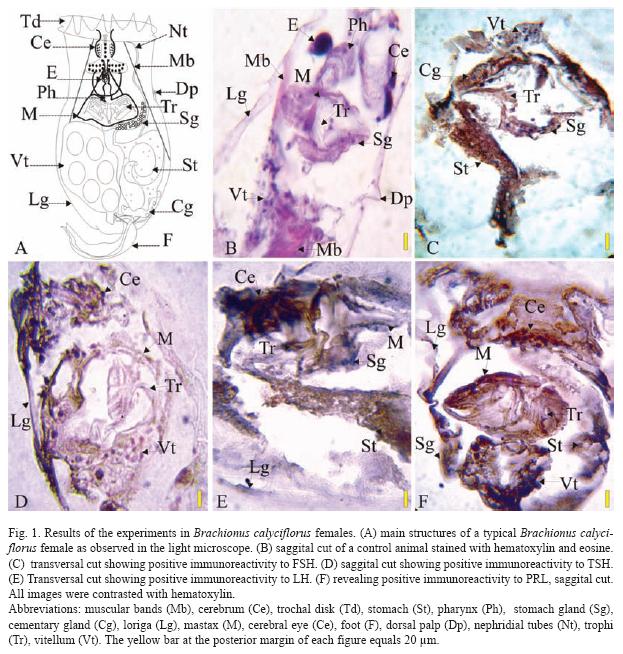
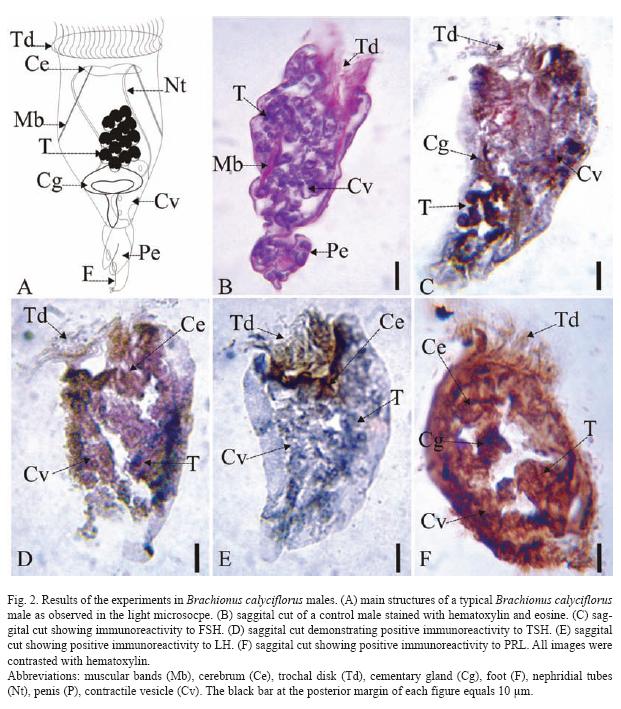
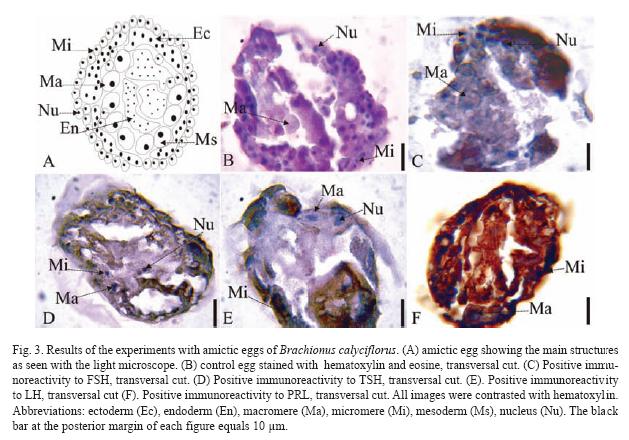
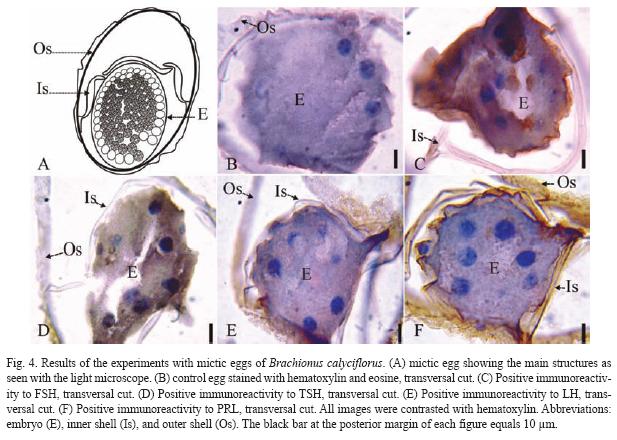
<body><![CDATA[<p><font face="Verdana" size="2">The catecholaminergic and cholinergic system of several rotifer species has been studied by several authors (Nogrady &amp; Alai 1983, Raineri 1984, Kotikova 1995, 1998, Kotikova <i>et al. </i>2005, Pineda-Rosas <i>et al. </i>2005), who have identified acethylcholinesterase activity and its receptors were described and the general characteristics of these systems were corroborated. The cholinergic system is involved in the reproduction and the fertility control because some neuropeptides control the synthesis of selected glycoproteins like the luteinizing hormone (LH) and gonadotropin (Vijayan 1985). The presence of exocitotic proteins such as Sintaxin- 1, Sintaxin-4, SNAP-23 and SNAP-25 in rotifers suggests a mechanism of neurosecretion via exocitotic vesicles of enzymes, and other molecules, like hormones, related to glandular secretions (P&eacute;rez-Legaspi <i>et al. </i>2008) which are employed in diverse mechanisms. Snell &amp; Joaquim-Justo (2007), suggest that since rotifers are particularly sensitive to androgenic and anti-androgenic substances, their use as models to study the nature and the impact of substances that are potential endocrine disruptors.</font></p>     <p><font face="Verdana" size="2">The invertebrates have developed a great diversity of lifestyles combining larval formation, followed by a succession of different stages, metamorphosis, production of resting eggs or other kind of resting stages, which are not produced in vertebrates, it is evident that the endocrine systems of invertebrates is more diverse than that of vertebrates (Oehlmann &amp; Schulte-Oehlmann 2003). In fact, the unicellular protozoan <i>Tetrahymena pyriformis </i>contains several types of molecules, which are immunologically similar to the glycoprotein hormones of the human pituitary gland (FSH, LH, and TSH), and that treatment with these molecules induced production of the appropriate hormone, and this effect is transmitted to the progeny generations (Csaba &amp; Kov&aacute;cs 2000). Likewise, TSH has been identified in the annelid <i>Eisenia fetida</i>, in both neuronal and non-neuronal cells of the central nervous system and several peripheral organs (Di Fiore <i>et al. </i>1997). Furthermore, there have been reports of the presence of TSH receptors in several invertebrates: <i>Caenorhabditis elegans </i>(nematode), the fruit fly, <i>Drosophila melanogaster </i>and the freshwater gastropod <i>Limnaea stagnalis </i>(Tensen <i>et al. </i>1994, Hauser <i>et al. </i>1997, Eriksen <i>et al. </i>2000, Kudo <i>et al. </i>2000).</font></p>     <p><font face="Verdana" size="2">Several authors reported the presence of PRL in invertebrates. Quintanar <i>et al. </i>(2007a) found PRL in larval stages of the nematode <i>Trichinella spiralis</i>, in the nervous and reproductive systems of cestodes: <i>Ligula intestinalis </i>(Liu <i>et al. </i>1995), <i>Taenia solium </i>and <i>Taenia hydatigena </i>(Liu <i>et al. </i>1996), and it has been found in granules of neurons in insects: <i>Leucophaena maderae </i>(Veenstra <i>et al. </i>1985), <i>Apis mellifera </i>(Schmid <i>et al. </i>1990), <i>Locusta migratoria </i>and <i>Sarcophaga bullata </i>Swinnen&nbsp;</font><font face="Verdana"  size="2"><i>et al. </i>1990).</font></p>     <p><font face="Verdana" size="2">However, the presence, function, and distribution of hormones in rotifers have been poorly studied (see Wallace <i>et al. </i>2006). Therefore, the goal of this contribution is to demonstrate the presence of the gonadotropic hormones; Luteinizing Hormone (LH) and Follicle-Stimulating Hormone (FSH), the thyroid hormone, Thyroid Stimulating Hormone (TSH) and the lactogenic hormone, Prolactin (PRL) in females, males, parthenogenetic and mictic eggs of the freshwater rotifer <i>Brachionus calyciflorus</i>.</font></p>     <p><b><font face="Verdana" size="3">Materials and methods</font></b></p> <b><font face="Verdana" size="2"> </font></b>     <p><b><font face="Verdana" size="2">Rotifer collection and culture: </font></b><font  face="Verdana" size="2">The freshwater rotifer <i>Brachionus calyciflorus </i>(Pallas 1766) was collected from the water treatment pond of the Universidad Aut&oacute;noma de Aguascalientes, Mexico, geographic coordinates of this site have been already published (P&eacute;rez- Legaspi &amp; Rico-Mart&iacute;nez 1998). The rotifer was cultured according to the protocol of P&eacute;rez-Legaspi &amp; Rico-Mart&iacute;nez (1998). Such protocol implies the use of a bioclimatic chamber with a 16:8 dark:light period and a temperature of 25&plusmn;2&ordm;C, where the rotifers were kept in Petri dishes with EPA medium (U.S. Environmental Protection Agency 1985). Rotifers were fed with the green alga <i>Nannochloris oculata (</i>strain LB2194 of the University of Texas Collection) grown in Bold&acute;s Basal Medium (Nichols 1973). Typically 10-15 Petri dishes containing each from 100 to 500 rotifer females were kept.</font></p> <font face="Verdana" size="2"><b> </b></font>     <p><font face="Verdana" size="2"><b>Rotifer embedding: </b>Rotifers were collected from cultures, 500 to 1000 amictic females of different ages (without making distinctions) for this species in 1.0ml of EPA medium by transferring them into a microcentrifuge tube of 1.5ml and added 100</font><font face="Verdana" size="2">&#956;</font><font  face="Verdana" size="2">l of 10% formalin solution for 30min to sacrifice and fix animals. Subsequently they were centrifuged at 4 000rpm to eliminate the supernatant and then we add drop by drop 2% liquid agar into the rotifer pellets until they became hard. Then the rotifer-agar-pellets were fixed in 5ml of 3% formalin plus Bouin&#8217;s fixative solution (saturated aqueous picric acid solution, 37-40% formalin, and glacial acetic acid, according to McElroy <i>et al. </i>1994). After one-hour fixation the rotifer-agar- pellet were rinsed in water for one hour, dehydrated in a series of ethanol solutions (80, 96, 100% for 20, 30 and 30min, respectively), and ethanol plus xylol (1:1) for 30min, and 100% xylol for 25min (2x). Subsequently one paraffin drop plus 1.0mg of sudan IV was added for one hour at 58&deg;C. Finally the rotifers were transferred into 100% paraffin liquid at 56&deg;C for 12hr. Then 3</font><font face="Verdana" size="2">&#956;</font><font face="Verdana"  size="2">m thick sections were cut by a microtome and the section were fixed to microscope slides, the sections were stained with hematoxylin and eosin, and examined under a compound light microscope as morphological reference.</font></p> <font face="Verdana" size="2"><b> </b></font>     <p><font face="Verdana" size="2"><b>Immunohistochemical method: </b>To demonstrate immunoreactivity of the LH, FSH, TSH and PRL hormones, the avidin-biotinperoxidase complex method was practiced (Hsu <i>et al. </i>1981), using the kit (Vectastin ABC kit, Dimension Laboratories Inc., CA, U.S.A.) with slight modifications (Quintanar <i>et al. </i>2007b). Primary antibodies LH (Anti- Rat LH serum for RIA), PRL (Anti-Rat PRL serum for RIA), FSH (Anti-Rat FSH serum for RIA) and TSH (Anti-Rat TSH serum for RIA) were used at 1:20, 1:30, 1:50 and 1:100 dilutions, respectively; which are intermediate values according to manufacturer&#8217;s suggestion and previous results (Salinas <i>et al. </i>2004). All samples exposed to primary antibodies were incubated at 4&deg;C overnight. The peroxidase complex was visualized by incubating the sections with 0.05% diaminobenzidine and 0.01% H<sub>2</sub>O<sub>2</sub>. Slides were positive with immunohistochemistry staining showing a brown dark color, negative slides showed no color.</font></p>     <p><b><font face="Verdana" size="3">Results</font></b></p> <font face="Verdana" size="2"> </font>     <p><font face="Verdana" size="2">The results of the <i>Brachionus calyciflorus </i>immunodetection experiments are shown in <a  href="#fig1.A-F">figures 1</a> to <a href="#fig4.A-F">4</a> that correspond to females (<a  href="#fig1.A-F">Fig. 1</a>), male (<a href="#fig2.A-F">Fig. 2</a>), amictic egg (<a href="#fig3.A-F">Fig. 3</a>) and mictic egg (<a href="#fig4.A-F">Fig. 4</a>).    ]]></body>
<body><![CDATA[<br> </font></p>     <p><font face="Verdana" size="2">    <br> </font></p>     <div style="text-align: center;"><a name="fig1.A-F"></a><img  src="/img/revistas/rbt/v57n4/a11i1.jpg" title="" alt=""  style="width: 623px; height: 654px;">    <br>     <br>     <br>     <br> <a name="fig2.A-F"></a><img src="/img/revistas/rbt/v57n4/a11i2.jpg" title="" alt=""  style="width: 621px; height: 709px;">    <br>     <br>     ]]></body>
<body><![CDATA[<br> <a name="fig3.A-F"></a><img src="/img/revistas/rbt/v57n4/a11i3.jpg" title="" alt=""  style="width: 629px; height: 440px;">    <br>     <br>     <br>     <br> <a name="fig4.A-F"></a><img src="/img/revistas/rbt/v57n4/a11i4.jpg" title="" alt=""  style="width: 617px; height: 440px;">    <br>     <br> </div> <font face="Verdana" size="2"><b> </b></font>     <p><font face="Verdana" size="2"><b>Female: </b>Control rotifers were stained with hematoxylin-eosin (sagittal cut, <a href="#fig1.A-F">Fig. 1B</a>) where several structures can be observed: muscular bands (Mb), cerebrum (Ce), pharynx (Ph), stomach gland (Sg), lorica (Lg), mastax (M), cerebral eye (E), dorsal palp (Dp), trophi (Tr), and vitellum (Vt). In <a  href="#fig1.A-F">Fig. 1C</a> (transversal cut) the positive immunoreactivity to FSH, in stomach (St), stomach gland (Sg), contractile gland (Cg), trophi (Tr), and vitellum (Vt) is shown. Positive immunoreactivity to TSH is shown in <a href="#fig1.A-F">Fig. 1D </a>(sagittal cut) in cerebrum: (Ce), lorica (Lg), mastax (M), trophi (Tr), and vitellum (Vt). Positive immunoreactivity to LH is shown <a href="#fig1.A-F">Fig. 1E</a> (transversal cut) in: cerebrum (Ce), stomach (St), stomach gland (Sg), lorica (Lg), and mastax (M). Positive immunoreactivity to PRL is shown in <a href="#fig1.A-F">Fig. 1F</a> (sagittal cut) in: cerebrum (Ce), stomach (St), stomach gland (Sg), lorica (Lg), mastax (M), trophi (Tr), and vitellum (Vt), the latest one being the most stained. </font></p> <font face="Verdana" size="2"><b> </b></font>     <p><font face="Verdana" size="2"><b>Male: </b>Control males were stained with hematoxylin-eosin (saggital cut, <a href="#fig2.A-F">Fig. 2B</a>) where it is possible to observe muscular bands (Mb), trochal disk (Td), penis (Pe), esticles (T), and contractile vesicle (Cv). The <a href="#fig2.A-F">Fig. 2C</a> (sagital cut) shows positive immunoreactivity for FSH in trochal disk (Td), cement gland (Cg), testicles (T), and contractile vesicle (Cv). In <a  href="#fig2.A-F">Fig. 2D</a> (sagital cut) shows positive immunoreactivity to TSH in trochal disk (Td), contractile vesicle (Cv), and testicles (T). The <a  href="#fig2.A-F">Fig. 2E</a> (sagital cut) shows positive immunoreactivity to LH trochal disk (Td), and cerebrum (Ce). In <a href="#fig2.A-F">Fig. 2F</a> (sagital cut) there is positive immunoreactivity to PRL in cerebrum (Ce), cement gland (Cg), contractile vesicle (Cv), and testicles (T), the latest one being the most intense.</font></p> <font face="Verdana" size="2"><b> </b></font>     <p><font face="Verdana" size="2"><b>Parthenogenetic Egg: </b>Control eggs were stained with hematoxylin-eosin (transversal cut, <a  href="#fig3.A-F">Fig. 3B</a>) showing different types of cells: macromeres (Ma), micromeres (Mi), and the nuclei (Nu). In <a href="#fig3.A-F">Fig. 3C</a> (transversal cut) there is positive immunoreactivity to FSH very weak in the macromeres (Ma), but very strong in micromeres (Mi), especially in the nuclei (Nu). In <a  href="#fig3.A-F">Fig. 3D</a> (transversal cut) there is positive immunoreactivity to TSH in macromeres (Ma), micromeres (Mi), and nuclei (Nu). In <a  href="#fig3.A-F">Fig. 3E</a> (transversal cut) there is positive immunoreactivity to LH in macromeres (Ma), micromers (Mi), and nuclei (Nu). The <a  href="#fig3.A-F">Fig. 3F </a>(transversal cut) shows immunoreactivity to PRL in macromeres (Ma), and micromeres (Mi) the latest one being the most intense.</font></p> <font face="Verdana" size="2"><b> </b></font>     ]]></body>
<body><![CDATA[<p><font face="Verdana" size="2"><b>Mictic Egg: </b>Control sexual eggs were stained with hematoxylin-eosin (transversal cut, <a  href="#fig4.A-F">Fig. 4B</a>) showing the outer shell (Os), inner shell (Is), and embryo (E). The <a href="#fig4.A-F">Fig. 4C</a> (transversal cut) shows positive immunoreactivity to FSH in the inner shell (Is), and the embryo (E). In <a href="#fig4.A-F">Fig. 4D</a> (transversal cut) there is positive immunoreactivity to TSH in the outer shell (Os) and embryo (E). The <a href="#fig4.A-F">Fig. 4E</a> (transversal cut) shows positive immunoreactivity to LH in the outer shell (Os) and in the inner shell (Is). In <a href="#fig4.A-F">Fig. 4F</a> (transversal cut) there is positive immunoreactivity to PRL in the outer shell (Os), inner shell (Is), and embryo (E).</font></p>     <p><b><font face="Verdana" size="3">Discussion</font></b></p> <font face="Verdana" size="2"> </font>     <p><font face="Verdana" size="2">Our contribution represents the first report of the presence of the Luteinizing Hormone (LH), Follicle-Stimulating Hormone (FSH), Thyroid Stimulating Hormone (TSH) and Prolactin (PRL) in rotifers. These hormones were found in females, males and parthenogenetic and sexual eggs of the freshwater <i>Brachionus calyciflorus</i>. The immunoreactivity of FSH, LH, TSH and PRL in females was observed in ovaries, cerebrum, mastax, stomach, loriga, and the stomach gland. However, in males LH is observed only at the trochal disk and cerebrum. The hormones FSH, TSH and PRL, are observed in testicles, contractil vesicles, and cementary gland of males.</font></p>     <p><font face="Verdana" size="2">Regarding amictic or parthenogenetic eggs, the hormones LH, FSH, TSH, and PRL are located mainly in the micromeres, and the staining in the macromeres is weak. On the other hand, the mictic or sexual eggs the inner shell is stained for the hormones PRL and LH, opposite to the staining of FSH and TSH, located mainly in the embryo.</font></p>     <p><font face="Verdana" size="2">In general, the immunoreactivity was observed in areas important for the reproductive, excretory, digestive and developmental processes. These areas stained for the hormones match the areas where the cholinergic and catecolaminergic systems have been reported (Nogrady &amp; Alai 1983, Raineri 1984, Kotikova, 1995, 1998, Kotikova <i>et al. </i>2005, Pineda-Rosas <i>et al. </i>2005). Furthermore, in these areas there have been already reports of the presence of exocitotic proteins in rotifers, suggesting the presence of a cholinergic system coupled to a hormone release system (P&eacute;rez-Legaspi <i>et al. </i>2008).</font></p>     <p><font face="Verdana" size="2">What is the function of these hormones in rotifers? When T<sub>3</sub> was added to algal food, there were no effects in the population growth of <i>Brachionus plicatilis</i>, but produced size reduction in females (Gallardo <i>et al. </i>1997). Since TSH stimulates the production of T<sub>3</sub> and T<sub>4</sub>, perhaps the rotifer can use this hormone to reduce female size as a mechanism to avoid predation by visual predators or as a response to any other environmental clue that favors size reduction in females.</font></p>     <p><font face="Verdana" size="2">The presence of LH and FSH in amictic and mictic eggs of <i>B</i>. <i>calyciflorus </i>suggests their influence in the embryologic development in this rotifer. The presence of LH and FSH in females and males in areas like ovaries, testicles and vitellum suggest its influence in gonadic development and reproduction. </font></p>     <p><font face="Verdana" size="2">The hormone PRL has been located by immunohistochemical techniques in glandular regions of neuronal cells of the sea pineapple <i>Halocynthia roretzi </i>(Terakado <i>et al. </i>1997). PRL has been described as very active inducing cell proliferation and differentiation of multiple tissues in humans (Coppenolle <i>et al. </i>2004). Perhaps, PRL has a similar function in rotifers stimulating cell proliferation and differentiation. That function would fit right with their ample distribution in females, males and both types of eggs that were found in <i>B</i>. <i>calyciflorus</i>.</font></p>     <p><font face="Verdana" size="2">The response of the ovaries of crustaceans to the presence of FSH and LH from mammals, indicates that such hormones can act in similar ways in invertebrates (Zukowska-Arendarczyk 1981). Both hormones stimulate the synthesis and secretion of sexual steroids in the gonads of vertebrates. For examples, LH stimulates the synthesis and secretion of testosterone that later transforms into estrogens. High concentrations of LH induce the formation of mature follicles in the ovary. Similarly, FSH stimulates the maturation process of follicles and of sperm (Kawauchi &amp; Sower 2006). It is noteworthy to point out that rotifers responded to exposure to several androgenic agents by reducing the fertilization rate and sexual reproduction (Preston <i>et al. </i>2000, Snell &amp; Joaquim-Justo 2007). As more information on the catecholaminergic and cholinergic systems of aquatic invertebrates (and the hormone secretion systems attached to them), is unveiled, the more it will be possible to know about the mode of action and mechanisms of detoxification of these animals that could be used as toxicity models. </font></p> <b><font face="Verdana" size="3">     <p>Acknowledgments</p> </font></b><font face="Verdana" size="2">     ]]></body>
<body><![CDATA[<p>Sincere gratitude to Alejandro Perez- Legaspi and Jos&eacute; Luis Quintanar-Stephano for their valuable support in the development of this research, and to Rosa Isela Sandoval for methodological support.</p> </font><b><font face="Verdana" size="3"> </font></b> <hr style="width: 100%; height: 2px;"><b><font face="Verdana" size="3">     <p>Resumen</p> </font></b><font face="Verdana" size="2"> </font>     <p><font face="Verdana" size="2">Se logr&oacute; detectar la presencia de las hormonas: Hormona Luteinizante (LH), Hormona Fol&iacute;culo Estimulante (FSH), Hormona Estimulante de la Tiroides (TSH) y Prolactina (PRL) en <i>Brachionus calyciflorus </i>siendo el primer reporte de la presencia de dichas hormonas en rot&iacute;feros. Estas hormonas fueron identificadas por un m&eacute;todo inmunol&oacute;gico-histol&oacute;gico-qu&iacute;mico usando el complejo avidina-biotina- peroxidasa con los siguientes anticuerpos primarios: LH (Anti-Rata LH suero para RIA), PRL (Anti-Rata PRL suero para RIA), FSH (Anti-Rata FSH suero para RIA) y TSH (Anti-Rata TSH en suero para RIA). Estas hormonas se encontraron en las hembras, machos, huevos partenogen&eacute;ticos y huevos sexuales del rot&iacute;fero dulceacu&iacute;cola <i>B. calyciflorus</i>. La reactividad inmunol&oacute;gica de FSH, LH, PRL y TSH en las hembras se observ&oacute; en ovarios, cerebro, m&aacute;stax, est&oacute;mago, lorica, y la gl&aacute;ndula del est&oacute;mago. Sin embargo, en machos, la LH se observ&oacute; s&oacute;lo en el disco trocal y cerebro mientras que las hormonas FSH, PRL y TSH, se observaron en test&iacute;culos, ves&iacute;cula contr&aacute;ctil, y la gl&aacute;ndula cementaria. En cuanto a los huevos partenogen&eacute;ticos o am&iacute;cticos, las hormonas LH, FSH, TSH, y PRL, se encontraron principalmente en los micr&oacute;meros, y en los macr&oacute;meros la tinci&oacute;n es d&eacute;bil. Por otra parte, el huevo sexual o m&iacute;ctico muestra reactividad inmunol&oacute;gica en la cubierta interior del huevo para las hormonas LH y PRL, lo contrario para FSH y TSH, las cuales se observaron principalmente en el embri&oacute;n. La reactividad inmunol&oacute;gica fue observada, en general, en &aacute;reas importantes para los procesos reproductivos, excretorios, digestivos y del desarrollo. </font></p> <font face="Verdana" size="2"><b> </b></font>     <p><font face="Verdana" size="2"><b>Palabras claves: </b>hormonas gonadotrofinas, hormonas lactog&eacute;nicas, hormonas tiroideas, Rot&iacute;fera, invertebrados.    <br>     <br> </font></p>     <p style="text-align: center;"><font face="Verdana" size="2">Received 29-XI-2008. Corrected 06-III-2009. Accepted 07-IV-2009.</font></p> <hr style="width: 100%; height: 2px;">     <p><b><font face="Verdana" size="3">References</font></b></p> <font face="Verdana" size="2"> </font>     <!-- ref --><p><font face="Verdana" size="2">Coppenolle, V.F., R. Skryma, H. Ouadid-Ahidouch, C. Slomianny, M. Roudbaraki, P. Delcourt, E. Dewailly, S. Humez, A. Cr&eacute;pin, I. Gourdou, J. Djiane, J.L. Bonnal, B. Mauroy &amp; N. Prevarskaya. 2004. Prolactin stimulates cell proliferation through a long form of prolactin receptor and K+channel activation. J. Biochem. 377: 569-578.</font>&nbsp;&nbsp;&nbsp;&nbsp;&nbsp;&nbsp;&nbsp;&nbsp;[&#160;<a href="javascript:void(0);" onclick="javascript: window.open('/scielo.php?script=sci_nlinks&ref=1272744&pid=S0034-7744200900040001100001&lng=','','width=640,height=500,resizable=yes,scrollbars=1,menubar=yes,');">Links</a>&#160;]<!-- end-ref --><!-- ref --><p><font face="Verdana" size="2">Csaba, G. &amp; P. Kov&aacute;cs. 2000. Human Chorionic Gonadotropin (HCG)-like Hormones (FSH, LH, TSH) in <i>Tetrahymena</i>. A Confocal Microscopic Analysis. Acta Protozool. 39: 191-198. </font>&nbsp;&nbsp;&nbsp;&nbsp;&nbsp;&nbsp;&nbsp;&nbsp;[&#160;<a href="javascript:void(0);" onclick="javascript: window.open('/scielo.php?script=sci_nlinks&ref=1272745&pid=S0034-7744200900040001100002&lng=','','width=640,height=500,resizable=yes,scrollbars=1,menubar=yes,');">Links</a>&#160;]<!-- end-ref --><!-- ref --><p><font face="Verdana" size="2">Di Fiore, M.M., L. Perrone &amp; A. D&#8217;Aniello. 1997. Presence of humanlike thyroid stimulating hormone (TSH) in <i>Ciona intestinalis</i>. Life Sci. 61: 623-629.</font>&nbsp;&nbsp;&nbsp;&nbsp;&nbsp;&nbsp;&nbsp;&nbsp;[&#160;<a href="javascript:void(0);" onclick="javascript: window.open('/scielo.php?script=sci_nlinks&ref=1272746&pid=S0034-7744200900040001100003&lng=','','width=640,height=500,resizable=yes,scrollbars=1,menubar=yes,');">Links</a>&#160;]<!-- end-ref --><!-- ref --><p><font face="Verdana" size="2">Eriksen, K.K., F. Hauser, M. Schiott, K.M. Pederson, L. Sondergaard &amp; C.J.P. Grimmelikhuijzen. 2000. Molecular cloning, genomic organization, developmental regulation, and a knock-out mutant of a novel leu-rich repeats-containing G protein-coupled receptor (DLGR-2) from <i>Drosophila melanogaster. </i>Genome Res. 10: 924-938.</font>&nbsp;&nbsp;&nbsp;&nbsp;&nbsp;&nbsp;&nbsp;&nbsp;[&#160;<a href="javascript:void(0);" onclick="javascript: window.open('/scielo.php?script=sci_nlinks&ref=1272747&pid=S0034-7744200900040001100004&lng=','','width=640,height=500,resizable=yes,scrollbars=1,menubar=yes,');">Links</a>&#160;]<!-- end-ref --><!-- ref --><p><font face="Verdana" size="2">Gallardo, G.W., A. Hagiwara, Y. Tomita, K. Soyano &amp; W.T. Snell. 1997. Effect of some vertebrates and invertebrate hormones on the population growth, mictic female production, and body size of the marine rotifer <i>Brachionus plicatilis </i>M&uuml;ller. Hydrobiologia 358: 113-120. </font>&nbsp;&nbsp;&nbsp;&nbsp;&nbsp;&nbsp;&nbsp;&nbsp;[&#160;<a href="javascript:void(0);" onclick="javascript: window.open('/scielo.php?script=sci_nlinks&ref=1272748&pid=S0034-7744200900040001100005&lng=','','width=640,height=500,resizable=yes,scrollbars=1,menubar=yes,');">Links</a>&#160;]<!-- end-ref --><!-- ref --><p><font face="Verdana" size="2">Gallardo, G.W., A. Hagiwara &amp; T. W. Snell. 2000. GABA enhances reproduction of the rotifer <i>Brachionus plicatilis </i>Muller: application to mass culture. Aquacult. Res. 31: 713-718.</font>&nbsp;&nbsp;&nbsp;&nbsp;&nbsp;&nbsp;&nbsp;&nbsp;[&#160;<a href="javascript:void(0);" onclick="javascript: window.open('/scielo.php?script=sci_nlinks&ref=1272749&pid=S0034-7744200900040001100006&lng=','','width=640,height=500,resizable=yes,scrollbars=1,menubar=yes,');">Links</a>&#160;]<!-- end-ref --><!-- ref --><p><font face="Verdana" size="2">Hauser, F., H.P. Nothacker &amp; C.J. Grimmelikhuijzen. 1997. Molecular cloning, genomic organization, and developmental regulation of a novel receptor from <i>Drosophila melanogaster </i>structurally related to members of the thyroid stimulating hormone, folliclestimulating hormone, luteinizing hormone/ choriogonadotropin receptor family from mammals. J. Biol. Chem. 272: 1002-1010.</font>&nbsp;&nbsp;&nbsp;&nbsp;&nbsp;&nbsp;&nbsp;&nbsp;[&#160;<a href="javascript:void(0);" onclick="javascript: window.open('/scielo.php?script=sci_nlinks&ref=1272750&pid=S0034-7744200900040001100007&lng=','','width=640,height=500,resizable=yes,scrollbars=1,menubar=yes,');">Links</a>&#160;]<!-- end-ref --><!-- ref --><p><font face="Verdana" size="2">Hsu, S.M., L. Raine &amp; H. Fagner. 1981. The use antividin antibody and avidin-biotin peroxidasa complex in inmunoperoxidasa technics. Am. J. Clin. Pathol. 75: 816-821.</font>&nbsp;&nbsp;&nbsp;&nbsp;&nbsp;&nbsp;&nbsp;&nbsp;[&#160;<a href="javascript:void(0);" onclick="javascript: window.open('/scielo.php?script=sci_nlinks&ref=1272751&pid=S0034-7744200900040001100008&lng=','','width=640,height=500,resizable=yes,scrollbars=1,menubar=yes,');">Links</a>&#160;]<!-- end-ref --><!-- ref --><p><font face="Verdana" size="2">Hutchinson, T.H. 2007. Smalls useful in endocrine disrupter assessment-four key recommendations for aquatic invertebrates research. Ecotoxicology 16: 231-238.</font>&nbsp;&nbsp;&nbsp;&nbsp;&nbsp;&nbsp;&nbsp;&nbsp;[&#160;<a href="javascript:void(0);" onclick="javascript: window.open('/scielo.php?script=sci_nlinks&ref=1272752&pid=S0034-7744200900040001100009&lng=','','width=640,height=500,resizable=yes,scrollbars=1,menubar=yes,');">Links</a>&#160;]<!-- end-ref --><!-- ref --><p><font face="Verdana" size="2">Kawauchi, H. &amp; S.A. Sower. 2006. The dawn and evolution of hormones in the adenohypophysis. Gen. Comp. Endocrinol. 148: 3-14.</font>&nbsp;&nbsp;&nbsp;&nbsp;&nbsp;&nbsp;&nbsp;&nbsp;[&#160;<a href="javascript:void(0);" onclick="javascript: window.open('/scielo.php?script=sci_nlinks&ref=1272753&pid=S0034-7744200900040001100010&lng=','','width=640,height=500,resizable=yes,scrollbars=1,menubar=yes,');">Links</a>&#160;]<!-- end-ref --><!-- ref --><p><font face="Verdana" size="2">Kotikova, E.A. 1995. Localization and neuroanatomy of catecholaminergic neurons in some rotifers species. Hydrobiologia 313/314: 123-127.</font>&nbsp;&nbsp;&nbsp;&nbsp;&nbsp;&nbsp;&nbsp;&nbsp;[&#160;<a href="javascript:void(0);" onclick="javascript: window.open('/scielo.php?script=sci_nlinks&ref=1272754&pid=S0034-7744200900040001100011&lng=','','width=640,height=500,resizable=yes,scrollbars=1,menubar=yes,');">Links</a>&#160;]<!-- end-ref --><!-- ref --><p><font face="Verdana" size="2">Kotikova, E.A. 1998. Catecholaminergic and neuroanatonomy of rotifers. Hydrobiologia 387/388: 135-140.</font>&nbsp;&nbsp;&nbsp;&nbsp;&nbsp;&nbsp;&nbsp;&nbsp;[&#160;<a href="javascript:void(0);" onclick="javascript: window.open('/scielo.php?script=sci_nlinks&ref=1272755&pid=S0034-7744200900040001100012&lng=','','width=640,height=500,resizable=yes,scrollbars=1,menubar=yes,');">Links</a>&#160;]<!-- end-ref --><!-- ref --><p><font face="Verdana" size="2">Kotikova, E.A., O.I. Raikova, M. Reuter &amp; M.K.S. Gustafsson. 2005. Rotifer nervous system visualized by FMRF amide and 5-HT inmunocytochemistry and confocal laser scanning microscopy. Hydrobiologia 546: 239-248.</font>&nbsp;&nbsp;&nbsp;&nbsp;&nbsp;&nbsp;&nbsp;&nbsp;[&#160;<a href="javascript:void(0);" onclick="javascript: window.open('/scielo.php?script=sci_nlinks&ref=1272756&pid=S0034-7744200900040001100013&lng=','','width=640,height=500,resizable=yes,scrollbars=1,menubar=yes,');">Links</a>&#160;]<!-- end-ref --><!-- ref --><p><font face="Verdana" size="2">Kudo, M., T. Chen, K. Nakabayashi, S.Y Hsu &amp;A.J Hsueh. 2000. The nematode leucine-rich repeat-containing, G protein-coupled receptor (LGR) protein homologous to vertebrate gonadogtropin and thyrotropin receptors is constitutively active in mammalian cells. Mol. Endocrinol. 14: 272-284.</font>&nbsp;&nbsp;&nbsp;&nbsp;&nbsp;&nbsp;&nbsp;&nbsp;[&#160;<a href="javascript:void(0);" onclick="javascript: window.open('/scielo.php?script=sci_nlinks&ref=1272757&pid=S0034-7744200900040001100014&lng=','','width=640,height=500,resizable=yes,scrollbars=1,menubar=yes,');">Links</a>&#160;]<!-- end-ref --><!-- ref --><p><font face="Verdana" size="2">Liu, B., H. Wakuri &amp; K. Mutoh. 1995. Immunocytochemical evidence for the presence of prolactin in the plerocercoid of <i>Ligula intestinalis </i>(Cestoda: Pseudophyllidea). Okajimas folia Anat. Jpn. 72: 277-283.</font>&nbsp;&nbsp;&nbsp;&nbsp;&nbsp;&nbsp;&nbsp;&nbsp;[&#160;<a href="javascript:void(0);" onclick="javascript: window.open('/scielo.php?script=sci_nlinks&ref=1272758&pid=S0034-7744200900040001100015&lng=','','width=640,height=500,resizable=yes,scrollbars=1,menubar=yes,');">Links</a>&#160;]<!-- end-ref --><!-- ref --><p><font face="Verdana" size="2">Liu, B., H. Wakuri &amp; K. Mutoh. 1996. Prolactin in the cestodes, <i>Taenia solium </i>and <i>Taenia hydatigena</i>: an immunocytochemical study. Okajimas Folia Anat. Jpn. 73: 25-35.</font>&nbsp;&nbsp;&nbsp;&nbsp;&nbsp;&nbsp;&nbsp;&nbsp;[&#160;<a href="javascript:void(0);" onclick="javascript: window.open('/scielo.php?script=sci_nlinks&ref=1272759&pid=S0034-7744200900040001100016&lng=','','width=640,height=500,resizable=yes,scrollbars=1,menubar=yes,');">Links</a>&#160;]<!-- end-ref --><!-- ref --><p><font face="Verdana" size="2">McElroy, D.A. 1994. Connective tissue. p. 127-147. <i>In </i>E.B. Prophet, B. Mills, J.B. Arrington &amp; L.H. Sobin (eds.). Armed Forces Institute of Phatology Laboratory Methods in Histotechnology, Washington D.C., USA.</font>&nbsp;&nbsp;&nbsp;&nbsp;&nbsp;&nbsp;&nbsp;&nbsp;[&#160;<a href="javascript:void(0);" onclick="javascript: window.open('/scielo.php?script=sci_nlinks&ref=1272760&pid=S0034-7744200900040001100017&lng=','','width=640,height=500,resizable=yes,scrollbars=1,menubar=yes,');">Links</a>&#160;]<!-- end-ref --><!-- ref --><p><font face="Verdana" size="2">Nichols, H. W. 1973. Growth media-freshwater, p.7-24. <i>In </i>J. R. Stein (ed). Handbook of physiological methods. Cambridge, Massachussets, USA.</font>&nbsp;&nbsp;&nbsp;&nbsp;&nbsp;&nbsp;&nbsp;&nbsp;[&#160;<a href="javascript:void(0);" onclick="javascript: window.open('/scielo.php?script=sci_nlinks&ref=1272761&pid=S0034-7744200900040001100018&lng=','','width=640,height=500,resizable=yes,scrollbars=1,menubar=yes,');">Links</a>&#160;]<!-- end-ref --><!-- ref --><p><font face="Verdana" size="2">Nogrady, T. &amp; M. Alai. 1983. Cholinergic neurotransmission in rotifers. Hydrobiologia 104: 149-153. </font>&nbsp;&nbsp;&nbsp;&nbsp;&nbsp;&nbsp;&nbsp;&nbsp;[&#160;<a href="javascript:void(0);" onclick="javascript: window.open('/scielo.php?script=sci_nlinks&ref=1272762&pid=S0034-7744200900040001100019&lng=','','width=640,height=500,resizable=yes,scrollbars=1,menubar=yes,');">Links</a>&#160;]<!-- end-ref --><!-- ref --><p><font face="Verdana" size="2">Oehlmann, J. &amp; U. Schulte-Oehlmann. 2003. Endocrine disruption in invertebrates. Pure Appl. Chem. 75: 2207-2218.</font>&nbsp;&nbsp;&nbsp;&nbsp;&nbsp;&nbsp;&nbsp;&nbsp;[&#160;<a href="javascript:void(0);" onclick="javascript: window.open('/scielo.php?script=sci_nlinks&ref=1272763&pid=S0034-7744200900040001100020&lng=','','width=640,height=500,resizable=yes,scrollbars=1,menubar=yes,');">Links</a>&#160;]<!-- end-ref --><!-- ref --><p><font face="Verdana" size="2">P&eacute;rez- Legaspi, I. A. &amp; R. Rico-Mart&iacute;nez. 1998. Effect of temperature and food concentration in two species of littoral rotifers. Hydrobiologia 387/388: 341-348.</font>&nbsp;&nbsp;&nbsp;&nbsp;&nbsp;&nbsp;&nbsp;&nbsp;[&#160;<a href="javascript:void(0);" onclick="javascript: window.open('/scielo.php?script=sci_nlinks&ref=1272764&pid=S0034-7744200900040001100021&lng=','','width=640,height=500,resizable=yes,scrollbars=1,menubar=yes,');">Links</a>&#160;]<!-- end-ref --><!-- ref --><p><font face="Verdana" size="2">P&eacute;rez-Legaspi, I. A., M. R. Montoya-Garc&iacute;a, J. L. Quintanar, E. Salinas, &amp; R. Rico-Mart&iacute;nez. 2008. Identification of exocytotic membrane proteins in three rotifer species. Hydrobiologia 600: 147-154.</font>&nbsp;&nbsp;&nbsp;&nbsp;&nbsp;&nbsp;&nbsp;&nbsp;[&#160;<a href="javascript:void(0);" onclick="javascript: window.open('/scielo.php?script=sci_nlinks&ref=1272765&pid=S0034-7744200900040001100022&lng=','','width=640,height=500,resizable=yes,scrollbars=1,menubar=yes,');">Links</a>&#160;]<!-- end-ref --><!-- ref --><p><font face="Verdana" size="2">Pinder, L.C.V., T.G. Pottinger, Z. Billinghurst &amp; M.H. Depledge. 1999. R&amp;D Technical Report E67. Endocrine function in aquatic invertebrates and evidence for disruption by environmental pollutants. Environment Agency Rio House. Bristol, United Kingdom.</font>&nbsp;&nbsp;&nbsp;&nbsp;&nbsp;&nbsp;&nbsp;&nbsp;[&#160;<a href="javascript:void(0);" onclick="javascript: window.open('/scielo.php?script=sci_nlinks&ref=1272766&pid=S0034-7744200900040001100023&lng=','','width=640,height=500,resizable=yes,scrollbars=1,menubar=yes,');">Links</a>&#160;]<!-- end-ref --><!-- ref --><p><font face="Verdana" size="2">Pineda-Rosas, A., G.E. Santos-Medrano., M.F. Zavala- Reynoso &amp; R. Rico-Mart&iacute;nez. 2005. Identification of acetilcholinesterase receptors in Rotifera. Hydrobiologia 546: 249-253.</font>&nbsp;&nbsp;&nbsp;&nbsp;&nbsp;&nbsp;&nbsp;&nbsp;[&#160;<a href="javascript:void(0);" onclick="javascript: window.open('/scielo.php?script=sci_nlinks&ref=1272767&pid=S0034-7744200900040001100024&lng=','','width=640,height=500,resizable=yes,scrollbars=1,menubar=yes,');">Links</a>&#160;]<!-- end-ref --><!-- ref --><p><font face="Verdana" size="2">Preston, B.L., T.W. Snell, T.L. Robertson &amp; B.J. Dingmann. 2000. Use of freshwater rotifer <i>Brachionus calyciflorus </i>in screening assay for potential endocrine disruptors. Environ. Toxicol. Chem. 19: 2923-2928.</font>&nbsp;&nbsp;&nbsp;&nbsp;&nbsp;&nbsp;&nbsp;&nbsp;[&#160;<a href="javascript:void(0);" onclick="javascript: window.open('/scielo.php?script=sci_nlinks&ref=1272768&pid=S0034-7744200900040001100025&lng=','','width=640,height=500,resizable=yes,scrollbars=1,menubar=yes,');">Links</a>&#160;]<!-- end-ref --><!-- ref --><p><font face="Verdana" size="2">Quintanar, J.L., E. Salinas, R. Guerrero, R. G&oacute;mez, S. Vidal, J. Aranda &amp; C. Clapp. 2007a. Prolactin-like hormone in the nematode <i>Trichinella spiralis </i>larvae. Exp. Parasitol. 116: 137-141.</font>&nbsp;&nbsp;&nbsp;&nbsp;&nbsp;&nbsp;&nbsp;&nbsp;[&#160;<a href="javascript:void(0);" onclick="javascript: window.open('/scielo.php?script=sci_nlinks&ref=1272769&pid=S0034-7744200900040001100026&lng=','','width=640,height=500,resizable=yes,scrollbars=1,menubar=yes,');">Links</a>&#160;]<!-- end-ref --><p><font face="Verdana" size="2"> </font></p>     <!-- ref --><p><font face="Verdana" size="2">Quintanar J.L., E. Salinas &amp; R. Gonz&aacute;lez. 2007b. Expression of gonadotropin-releasing hormone receptor in cerebral cortical neurons of embryos and adult rats. Neurosci. Lett. 411: 22-25. </font>&nbsp;&nbsp;&nbsp;&nbsp;&nbsp;&nbsp;&nbsp;&nbsp;[&#160;<a href="javascript:void(0);" onclick="javascript: window.open('/scielo.php?script=sci_nlinks&ref=1272771&pid=S0034-7744200900040001100027&lng=','','width=640,height=500,resizable=yes,scrollbars=1,menubar=yes,');">Links</a>&#160;]<!-- end-ref --><!-- ref --><p><font face="Verdana" size="2">Raineri, M. 1984. Histochemical investigation of Rotifera Bdelloidea. I. Localization of cholinesterase activity. Histochem. J. 16: 601-616.</font>&nbsp;&nbsp;&nbsp;&nbsp;&nbsp;&nbsp;&nbsp;&nbsp;[&#160;<a href="javascript:void(0);" onclick="javascript: window.open('/scielo.php?script=sci_nlinks&ref=1272772&pid=S0034-7744200900040001100028&lng=','','width=640,height=500,resizable=yes,scrollbars=1,menubar=yes,');">Links</a>&#160;]<!-- end-ref --><!-- ref --><p><font face="Verdana" size="2">Salinas, E., J. Ventura, L.E. C&oacute;rdova &amp; J.L. Quintanar. 2004. Presence of SNAP-25 in rat mast cells. Immunol. Lett. 95: 105-108.</font>&nbsp;&nbsp;&nbsp;&nbsp;&nbsp;&nbsp;&nbsp;&nbsp;[&#160;<a href="javascript:void(0);" onclick="javascript: window.open('/scielo.php?script=sci_nlinks&ref=1272773&pid=S0034-7744200900040001100029&lng=','','width=640,height=500,resizable=yes,scrollbars=1,menubar=yes,');">Links</a>&#160;]<!-- end-ref --><!-- ref --><p><font face="Verdana" size="2">Schmid, K.P., V. Maier, C. Haug &amp; E.F Pfeiffer. 1990. Ultrastructural localization of prolactin-like antigenic determinants in neurosecretory cells in the brain of the honeybee (<i>Apis mellifica</i>). Horm. Metab. Res. 22: 413-417.</font>&nbsp;&nbsp;&nbsp;&nbsp;&nbsp;&nbsp;&nbsp;&nbsp;[&#160;<a href="javascript:void(0);" onclick="javascript: window.open('/scielo.php?script=sci_nlinks&ref=1272774&pid=S0034-7744200900040001100030&lng=','','width=640,height=500,resizable=yes,scrollbars=1,menubar=yes,');">Links</a>&#160;]<!-- end-ref --><!-- ref --><p><font face="Verdana" size="2">Swinnen, K., J.V. Broeck, P. Verhaert &amp; A. De Loof. 1990. Immunocytochemical localization of human growth and prolactin-like antigenic determinants in the insects, <i>Locusta migratoria </i>and <i>Sarcophaga bullata</i>. Comp. Biochem. Physiol. 95: 373-378.</font>&nbsp;&nbsp;&nbsp;&nbsp;&nbsp;&nbsp;&nbsp;&nbsp;[&#160;<a href="javascript:void(0);" onclick="javascript: window.open('/scielo.php?script=sci_nlinks&ref=1272775&pid=S0034-7744200900040001100031&lng=','','width=640,height=500,resizable=yes,scrollbars=1,menubar=yes,');">Links</a>&#160;]<!-- end-ref --><!-- ref --><p><font face="Verdana" size="2">Snell, T.W. &amp; C. Joaquim-Justo. 2007. Workshop on rotifers in ecotoxicology. Hydrobiologia 593: 227-232.</font>&nbsp;&nbsp;&nbsp;&nbsp;&nbsp;&nbsp;&nbsp;&nbsp;[&#160;<a href="javascript:void(0);" onclick="javascript: window.open('/scielo.php?script=sci_nlinks&ref=1272776&pid=S0034-7744200900040001100032&lng=','','width=640,height=500,resizable=yes,scrollbars=1,menubar=yes,');">Links</a>&#160;]<!-- end-ref --><!-- ref --><p><font face="Verdana" size="2">Tensen, C.P, E.R Van Kasteren, R.J Planta, K.J Cox, J.F Burke, H. van Heerikhuizen &amp; E. Vreugdenhil. 1994. A G protein coupled receptor with low-density lipoprotein- bindig motifs suggests a role for lipoproteins in G-linked signal transduction. Proc. Natl. Acad. Sci. USA 91: 4816-4820.</font>&nbsp;&nbsp;&nbsp;&nbsp;&nbsp;&nbsp;&nbsp;&nbsp;[&#160;<a href="javascript:void(0);" onclick="javascript: window.open('/scielo.php?script=sci_nlinks&ref=1272777&pid=S0034-7744200900040001100033&lng=','','width=640,height=500,resizable=yes,scrollbars=1,menubar=yes,');">Links</a>&#160;]<!-- end-ref --><!-- ref --><p><font face="Verdana" size="2">Terakado, K., M. Ogawa, K. Inoue, K. Yamamoto &amp; S. Kikuyama. 1997. Prolactin-like immunoreactivity in the granules of neural complex cells in the ascidian <i>Halocynthia roretzy</i>. Cell. Tissue. Res. 289: 63-71.</font>&nbsp;&nbsp;&nbsp;&nbsp;&nbsp;&nbsp;&nbsp;&nbsp;[&#160;<a href="javascript:void(0);" onclick="javascript: window.open('/scielo.php?script=sci_nlinks&ref=1272778&pid=S0034-7744200900040001100034&lng=','','width=640,height=500,resizable=yes,scrollbars=1,menubar=yes,');">Links</a>&#160;]<!-- end-ref --><!-- ref --><p><font face="Verdana" size="2">U.S.EPA. 1985. Methods for measuring the acute toxicity of effluents to freshwater and marine organisms. Environmental Monitoring and Support Laboratory, U.S. Environmental Protection Agency, Cincinnati, Ohio, USA.</font>&nbsp;&nbsp;&nbsp;&nbsp;&nbsp;&nbsp;&nbsp;&nbsp;[&#160;<a href="javascript:void(0);" onclick="javascript: window.open('/scielo.php?script=sci_nlinks&ref=1272779&pid=S0034-7744200900040001100035&lng=','','width=640,height=500,resizable=yes,scrollbars=1,menubar=yes,');">Links</a>&#160;]<!-- end-ref --><!-- ref --><p><font face="Verdana" size="2">Veenstra, J.A., H.M. Romberg-Privee, H. Schooneveld &amp; J.M. Polak. 1985. Immunocytochemical localization of peptidergic neurons and neurosecretory cells in the neuro-endocrine system of the Colorado potato beetle with antisera to vertebrate regulatory peptides. Histochem. 82: 9-18.</font>&nbsp;&nbsp;&nbsp;&nbsp;&nbsp;&nbsp;&nbsp;&nbsp;[&#160;<a href="javascript:void(0);" onclick="javascript: window.open('/scielo.php?script=sci_nlinks&ref=1272780&pid=S0034-7744200900040001100036&lng=','','width=640,height=500,resizable=yes,scrollbars=1,menubar=yes,');">Links</a>&#160;]<!-- end-ref --><!-- ref --><p><font face="Verdana" size="2">Vijayan, E. 1985. Role of neurotransmiter and neuropeptides in the control of gonadotropin release: a review. J. Biosci. 2: 207-213.</font>&nbsp;&nbsp;&nbsp;&nbsp;&nbsp;&nbsp;&nbsp;&nbsp;[&#160;<a href="javascript:void(0);" onclick="javascript: window.open('/scielo.php?script=sci_nlinks&ref=1272781&pid=S0034-7744200900040001100037&lng=','','width=640,height=500,resizable=yes,scrollbars=1,menubar=yes,');">Links</a>&#160;]<!-- end-ref --><!-- ref --><p><font face="Verdana" size="2">Wallace, R.L., Snell T.W., C. Ricci &amp; T. Nogrady. 2006. Rotifera. 1: Biology, ecology and systematic, Kenobi Productions, Ghent, Belgium.</font>&nbsp;&nbsp;&nbsp;&nbsp;&nbsp;&nbsp;&nbsp;&nbsp;[&#160;<a href="javascript:void(0);" onclick="javascript: window.open('/scielo.php?script=sci_nlinks&ref=1272782&pid=S0034-7744200900040001100038&lng=','','width=640,height=500,resizable=yes,scrollbars=1,menubar=yes,');">Links</a>&#160;]<!-- end-ref --><!-- ref --><p><font face="Verdana" size="2">Wheeler, E.D. &amp; H.F. Nijhout. 2003. A perspective for understanding the modes of juvenile hormone action as a lipid signaling system. BioEssays 25: 994-1001.</font>&nbsp;&nbsp;&nbsp;&nbsp;&nbsp;&nbsp;&nbsp;&nbsp;[&#160;<a href="javascript:void(0);" onclick="javascript: window.open('/scielo.php?script=sci_nlinks&ref=1272783&pid=S0034-7744200900040001100039&lng=','','width=640,height=500,resizable=yes,scrollbars=1,menubar=yes,');">Links</a>&#160;]<!-- end-ref --><!-- ref --><p><font face="Verdana" size="2">Wigham, T., J.N. Ball &amp; P.M. Ingleton. 1975. Secretion of prolactin and growth hormone by teleost pituitaries in vitro. J. Comp. Physiol. 104: 87-96.</font>&nbsp;&nbsp;&nbsp;&nbsp;&nbsp;&nbsp;&nbsp;&nbsp;[&#160;<a href="javascript:void(0);" onclick="javascript: window.open('/scielo.php?script=sci_nlinks&ref=1272784&pid=S0034-7744200900040001100040&lng=','','width=640,height=500,resizable=yes,scrollbars=1,menubar=yes,');">Links</a>&#160;]<!-- end-ref --><!-- ref --><p><font face="Verdana" size="2">Wilhelm, M., A. Koza, P. Engelmann, P. N&eacute;meth &amp; Csoknya M. 2006. Evidence for the presence of thyroid-stimulating hormone, thyroglobulin and their receptors in <i>Eisenia fetida</i>: a multilevel hormonal interface between the nervous system and the peripheral tissues. Cell. Tissue. Res. 324: 535-546.</font>&nbsp;&nbsp;&nbsp;&nbsp;&nbsp;&nbsp;&nbsp;&nbsp;[&#160;<a href="javascript:void(0);" onclick="javascript: window.open('/scielo.php?script=sci_nlinks&ref=1272785&pid=S0034-7744200900040001100041&lng=','','width=640,height=500,resizable=yes,scrollbars=1,menubar=yes,');">Links</a>&#160;]<!-- end-ref --><!-- ref --><p><font face="Verdana" size="2">Zukowska-Arendarczyk, M. 1981. Effect of hypophyseal gonadotropins (FSH and LH) on the ovaries of the sand shrimp <i>Crangon crangon </i>(Crustacea: Decapoda). Mar. Biol. 63: 241-247.</font>&nbsp;&nbsp;&nbsp;&nbsp;&nbsp;&nbsp;&nbsp;&nbsp;[&#160;<a href="javascript:void(0);" onclick="javascript: window.open('/scielo.php?script=sci_nlinks&ref=1272786&pid=S0034-7744200900040001100042&lng=','','width=640,height=500,resizable=yes,scrollbars=1,menubar=yes,');">Links</a>&#160;]<!-- end-ref --> ]]></body><back>
<ref-list>
<ref id="B1">
<nlm-citation citation-type="journal">
<person-group person-group-type="author">
<name>
<surname><![CDATA[Coppenolle]]></surname>
<given-names><![CDATA[V.F]]></given-names>
</name>
<name>
<surname><![CDATA[Skryma]]></surname>
<given-names><![CDATA[R]]></given-names>
</name>
<name>
<surname><![CDATA[Ouadid-Ahidouch]]></surname>
<given-names><![CDATA[H]]></given-names>
</name>
<name>
<surname><![CDATA[Slomianny]]></surname>
<given-names><![CDATA[C]]></given-names>
</name>
<name>
<surname><![CDATA[Roudbaraki]]></surname>
<given-names><![CDATA[M]]></given-names>
</name>
<name>
<surname><![CDATA[Delcourt]]></surname>
<given-names><![CDATA[P]]></given-names>
</name>
<name>
<surname><![CDATA[Dewailly]]></surname>
<given-names><![CDATA[E]]></given-names>
</name>
<name>
<surname><![CDATA[Humez]]></surname>
<given-names><![CDATA[S]]></given-names>
</name>
<name>
<surname><![CDATA[A. Crépin]]></surname>
<given-names><![CDATA[I]]></given-names>
</name>
<name>
<surname><![CDATA[Gourdou]]></surname>
<given-names><![CDATA[J]]></given-names>
</name>
<name>
<surname><![CDATA[Djiane]]></surname>
<given-names><![CDATA[J.L]]></given-names>
</name>
<name>
<surname><![CDATA[Bonnal]]></surname>
<given-names><![CDATA[B]]></given-names>
</name>
<name>
<surname><![CDATA[Mauroy]]></surname>
</name>
<name>
<surname><![CDATA[Prevarskaya]]></surname>
<given-names><![CDATA[N]]></given-names>
</name>
</person-group>
<article-title xml:lang="en"><![CDATA[Prolactin stimulates cell proliferation through a long form of prolactin receptor and K+channel activation]]></article-title>
<source><![CDATA[J. Biochem]]></source>
<year>2004</year>
<volume>377</volume>
<page-range>569-578</page-range></nlm-citation>
</ref>
<ref id="B2">
<nlm-citation citation-type="journal">
<person-group person-group-type="author">
<name>
<surname><![CDATA[Csaba]]></surname>
<given-names><![CDATA[G]]></given-names>
</name>
<name>
<surname><![CDATA[Kovács]]></surname>
<given-names><![CDATA[P]]></given-names>
</name>
</person-group>
<article-title xml:lang="en"><![CDATA[Human Chorionic Gonadotropin (HCG)-like Hormones (FSH, LH, TSH) in Tetrahymena. A Confocal Microscopic Analysis]]></article-title>
<source><![CDATA[Acta Protozool]]></source>
<year>2000</year>
<volume>39</volume>
<page-range>191-198</page-range></nlm-citation>
</ref>
<ref id="B3">
<nlm-citation citation-type="journal">
<person-group person-group-type="author">
<name>
<surname><![CDATA[Di Fiore]]></surname>
<given-names><![CDATA[M.M]]></given-names>
</name>
<name>
<surname><![CDATA[Perrone]]></surname>
<given-names><![CDATA[L]]></given-names>
</name>
<name>
<surname><![CDATA[D’Aniello]]></surname>
<given-names><![CDATA[A]]></given-names>
</name>
</person-group>
<article-title xml:lang="en"><![CDATA[Presence of humanlike thyroid stimulating hormone (TSH) in Ciona intestinalis]]></article-title>
<source><![CDATA[Life Sci]]></source>
<year>1997</year>
<volume>61</volume>
<page-range>623-629</page-range></nlm-citation>
</ref>
<ref id="B4">
<nlm-citation citation-type="journal">
<person-group person-group-type="author">
<name>
<surname><![CDATA[Eriksen]]></surname>
<given-names><![CDATA[K.K]]></given-names>
</name>
<name>
<surname><![CDATA[Hauser]]></surname>
<given-names><![CDATA[F]]></given-names>
</name>
<name>
<surname><![CDATA[Schiott]]></surname>
<given-names><![CDATA[M]]></given-names>
</name>
<name>
<surname><![CDATA[Pederson]]></surname>
<given-names><![CDATA[K.M]]></given-names>
</name>
<name>
<surname><![CDATA[Sondergaard]]></surname>
<given-names><![CDATA[L]]></given-names>
</name>
<name>
<surname><![CDATA[Grimmelikhuijzen]]></surname>
<given-names><![CDATA[C.J.P]]></given-names>
</name>
</person-group>
<article-title xml:lang="en"><![CDATA[Molecular cloning, genomic organization, developmental regulation, and a knock-out mutant of a novel leu-rich repeats-containing G protein-coupled receptor (DLGR-2) from Drosophila melanogaster]]></article-title>
<source><![CDATA[Genome Res]]></source>
<year>2000</year>
<volume>10</volume>
<page-range>924-938</page-range></nlm-citation>
</ref>
<ref id="B5">
<nlm-citation citation-type="journal">
<person-group person-group-type="author">
<name>
<surname><![CDATA[Gallardo]]></surname>
<given-names><![CDATA[G.W]]></given-names>
</name>
<name>
<surname><![CDATA[Hagiwara]]></surname>
<given-names><![CDATA[A]]></given-names>
</name>
<name>
<surname><![CDATA[Tomita]]></surname>
<given-names><![CDATA[Y]]></given-names>
</name>
<name>
<surname><![CDATA[Soyano]]></surname>
<given-names><![CDATA[K]]></given-names>
</name>
<name>
<surname><![CDATA[Snell]]></surname>
<given-names><![CDATA[W.T]]></given-names>
</name>
</person-group>
<article-title xml:lang="en"><![CDATA[Effect of some vertebrates and invertebrate hormones on the population growth, mictic female production, and body size of the marine rotifer Brachionus plicatilis Müller]]></article-title>
<source><![CDATA[Hydrobiologia]]></source>
<year>1997</year>
<volume>358</volume>
<page-range>113-120</page-range></nlm-citation>
</ref>
<ref id="B6">
<nlm-citation citation-type="journal">
<person-group person-group-type="author">
<name>
<surname><![CDATA[Gallardo]]></surname>
<given-names><![CDATA[G.W]]></given-names>
</name>
<name>
<surname><![CDATA[Hagiwara]]></surname>
<given-names><![CDATA[A]]></given-names>
</name>
<name>
<surname><![CDATA[Snell]]></surname>
<given-names><![CDATA[T. W]]></given-names>
</name>
</person-group>
<article-title xml:lang="en"><![CDATA[GABA enhances reproduction of the rotifer Brachionus plicatilis Muller: application to mass culture]]></article-title>
<source><![CDATA[Aquacult. Res]]></source>
<year>2000</year>
<volume>31</volume>
<page-range>713-718</page-range></nlm-citation>
</ref>
<ref id="B7">
<nlm-citation citation-type="journal">
<person-group person-group-type="author">
<name>
<surname><![CDATA[Hauser]]></surname>
<given-names><![CDATA[F]]></given-names>
</name>
<name>
<surname><![CDATA[Nothacker]]></surname>
<given-names><![CDATA[H.P]]></given-names>
</name>
<name>
<surname><![CDATA[Grimmelikhuijzen]]></surname>
<given-names><![CDATA[C.J]]></given-names>
</name>
</person-group>
<article-title xml:lang="en"><![CDATA[Molecular cloning, genomic organization, and developmental regulation of a novel receptor from Drosophila melanogaster structurally related to members of the thyroid stimulating hormone, folliclestimulating hormone, luteinizing hormone/ choriogonadotropin receptor family from mammals]]></article-title>
<source><![CDATA[J. Biol. Chem]]></source>
<year>1997</year>
<page-range>1002-1010</page-range><publisher-name><![CDATA[272]]></publisher-name>
</nlm-citation>
</ref>
<ref id="B8">
<nlm-citation citation-type="journal">
<person-group person-group-type="author">
<name>
<surname><![CDATA[Hsu]]></surname>
<given-names><![CDATA[S.M]]></given-names>
</name>
<name>
<surname><![CDATA[Raine]]></surname>
<given-names><![CDATA[L]]></given-names>
</name>
<name>
<surname><![CDATA[Fagner]]></surname>
<given-names><![CDATA[H]]></given-names>
</name>
</person-group>
<article-title xml:lang="en"><![CDATA[The use antividin antibody and avidin-biotin peroxidasa complex in inmunoperoxidasa technics]]></article-title>
<source><![CDATA[Am. J. Clin. Pathol]]></source>
<year>1981</year>
<volume>75</volume>
<page-range>816-821</page-range></nlm-citation>
</ref>
<ref id="B9">
<nlm-citation citation-type="journal">
<person-group person-group-type="author">
<name>
<surname><![CDATA[Hutchinson]]></surname>
<given-names><![CDATA[T.H]]></given-names>
</name>
</person-group>
<article-title xml:lang="en"><![CDATA[Smalls useful in endocrine disrupter assessment-four key recommendations for aquatic invertebrates research]]></article-title>
<source><![CDATA[Ecotoxicology]]></source>
<year>2007</year>
<volume>16</volume>
<page-range>231-238</page-range></nlm-citation>
</ref>
<ref id="B10">
<nlm-citation citation-type="journal">
<person-group person-group-type="author">
<name>
<surname><![CDATA[Kawauchi]]></surname>
<given-names><![CDATA[H]]></given-names>
</name>
<name>
<surname><![CDATA[Sower]]></surname>
<given-names><![CDATA[S.A]]></given-names>
</name>
</person-group>
<article-title xml:lang="en"><![CDATA[The dawn and evolution of hormones in the adenohypophysis]]></article-title>
<source><![CDATA[Gen. Comp. Endocrinol]]></source>
<year>2006</year>
<volume>148</volume>
<page-range>3-14</page-range></nlm-citation>
</ref>
<ref id="B11">
<nlm-citation citation-type="journal">
<person-group person-group-type="author">
<name>
<surname><![CDATA[Kotikova]]></surname>
<given-names><![CDATA[E.A]]></given-names>
</name>
</person-group>
<article-title xml:lang="en"><![CDATA[Localization and neuroanatomy of catecholaminergic neurons in some rotifers species]]></article-title>
<source><![CDATA[Hydrobiologia]]></source>
<year>1995</year>
<volume>313/314</volume>
<page-range>123-127</page-range></nlm-citation>
</ref>
<ref id="B12">
<nlm-citation citation-type="journal">
<person-group person-group-type="author">
<name>
<surname><![CDATA[Kotikova]]></surname>
<given-names><![CDATA[E.A]]></given-names>
</name>
</person-group>
<article-title xml:lang="en"><![CDATA[Catecholaminergic and neuroanatonomy of rotifers]]></article-title>
<source><![CDATA[Hydrobiologia]]></source>
<year>1998</year>
<volume>387/388</volume>
<page-range>135-140</page-range></nlm-citation>
</ref>
<ref id="B13">
<nlm-citation citation-type="journal">
<person-group person-group-type="author">
<name>
<surname><![CDATA[Kotikova]]></surname>
<given-names><![CDATA[E.A]]></given-names>
</name>
<name>
<surname><![CDATA[Raikova]]></surname>
<given-names><![CDATA[O.I]]></given-names>
</name>
<name>
<surname><![CDATA[Reuter]]></surname>
<given-names><![CDATA[M]]></given-names>
</name>
<name>
<surname><![CDATA[Gustafsson]]></surname>
<given-names><![CDATA[M.K.S]]></given-names>
</name>
</person-group>
<article-title xml:lang="en"><![CDATA[Rotifer nervous system visualized by FMRF amide and 5-HT inmunocytochemistry and confocal laser scanning microscopy]]></article-title>
<source><![CDATA[Hydrobiologia]]></source>
<year>2005</year>
<volume>546</volume>
<page-range>239-248</page-range></nlm-citation>
</ref>
<ref id="B14">
<nlm-citation citation-type="journal">
<person-group person-group-type="author">
<name>
<surname><![CDATA[Kudo]]></surname>
<given-names><![CDATA[M]]></given-names>
</name>
<name>
<surname><![CDATA[Chen]]></surname>
<given-names><![CDATA[T]]></given-names>
</name>
<name>
<surname><![CDATA[Nakabayashi]]></surname>
<given-names><![CDATA[K]]></given-names>
</name>
<name>
<surname><![CDATA[Hsu]]></surname>
<given-names><![CDATA[S.Y]]></given-names>
</name>
<name>
<surname><![CDATA[Hsueh]]></surname>
<given-names><![CDATA[A.J]]></given-names>
</name>
</person-group>
<article-title xml:lang="en"><![CDATA[The nematode leucine-rich repeat-containing, G protein-coupled receptor (LGR) protein homologous to vertebrate gonadogtropin and thyrotropin receptors is constitutively active in mammalian cells]]></article-title>
<source><![CDATA[Mol. Endocrinol]]></source>
<year>2000</year>
<volume>14</volume>
<page-range>272-284</page-range></nlm-citation>
</ref>
<ref id="B15">
<nlm-citation citation-type="journal">
<person-group person-group-type="author">
<name>
<surname><![CDATA[Liu]]></surname>
<given-names><![CDATA[B]]></given-names>
</name>
<name>
<surname><![CDATA[Wakuri]]></surname>
<given-names><![CDATA[H]]></given-names>
</name>
<name>
<surname><![CDATA[Mutoh]]></surname>
<given-names><![CDATA[K]]></given-names>
</name>
</person-group>
<article-title xml:lang="en"><![CDATA[Immunocytochemical evidence for the presence of prolactin in the plerocercoid of Ligula intestinalis (Cestoda: Pseudophyllidea)]]></article-title>
<source><![CDATA[Okajimas folia Anat. Jpn]]></source>
<year>1995</year>
<volume>72</volume>
<page-range>277-283</page-range></nlm-citation>
</ref>
<ref id="B16">
<nlm-citation citation-type="journal">
<person-group person-group-type="author">
<name>
<surname><![CDATA[Liu]]></surname>
<given-names><![CDATA[B]]></given-names>
</name>
<name>
<surname><![CDATA[Wakuri]]></surname>
<given-names><![CDATA[H]]></given-names>
</name>
<name>
<surname><![CDATA[Mutoh]]></surname>
<given-names><![CDATA[K]]></given-names>
</name>
</person-group>
<article-title xml:lang="en"><![CDATA[Prolactin in the cestodes, Taenia solium and Taenia hydatigena: an immunocytochemical study]]></article-title>
<source><![CDATA[Okajimas Folia Anat. Jpn]]></source>
<year>1996</year>
<volume>73</volume>
<page-range>25-35</page-range></nlm-citation>
</ref>
<ref id="B17">
<nlm-citation citation-type="">
<person-group person-group-type="author">
<name>
<surname><![CDATA[McElroy]]></surname>
<given-names><![CDATA[D.A]]></given-names>
</name>
</person-group>
<article-title xml:lang="en"><![CDATA[Connective tissue]]></article-title>
<person-group person-group-type="editor">
<name>
<surname><![CDATA[Prophet]]></surname>
<given-names><![CDATA[E.B]]></given-names>
</name>
<name>
<surname><![CDATA[Mills]]></surname>
<given-names><![CDATA[B]]></given-names>
</name>
<name>
<surname><![CDATA[Arrington]]></surname>
<given-names><![CDATA[J.B]]></given-names>
</name>
<name>
<surname><![CDATA[Sobin]]></surname>
<given-names><![CDATA[L.H]]></given-names>
</name>
</person-group>
<source><![CDATA[Armed Forces Institute of Phatology Laboratory Methods in Histotechnology]]></source>
<year>1994</year>
<page-range>127-147</page-range><publisher-loc><![CDATA[^eWashington D.C Washington D.C]]></publisher-loc>
</nlm-citation>
</ref>
<ref id="B18">
<nlm-citation citation-type="">
<person-group person-group-type="author">
<name>
<surname><![CDATA[Nichols]]></surname>
<given-names><![CDATA[H. W]]></given-names>
</name>
</person-group>
<article-title xml:lang="en"><![CDATA[Growth media-freshwater]]></article-title>
<person-group person-group-type="editor">
<name>
<surname><![CDATA[Stein]]></surname>
<given-names><![CDATA[J. R]]></given-names>
</name>
</person-group>
<source><![CDATA[Handbook of physiological methods]]></source>
<year>1973</year>
<page-range>7-24</page-range><publisher-loc><![CDATA[Cambridge^eMassachussets Massachussets]]></publisher-loc>
</nlm-citation>
</ref>
<ref id="B19">
<nlm-citation citation-type="journal">
<person-group person-group-type="author">
<name>
<surname><![CDATA[Nogrady]]></surname>
<given-names><![CDATA[T]]></given-names>
</name>
<name>
<surname><![CDATA[Alai]]></surname>
<given-names><![CDATA[M]]></given-names>
</name>
</person-group>
<article-title xml:lang="en"><![CDATA[Cholinergic neurotransmission in rotifers]]></article-title>
<source><![CDATA[Hydrobiologia]]></source>
<year>1983</year>
<volume>104</volume>
<page-range>149-153</page-range></nlm-citation>
</ref>
<ref id="B20">
<nlm-citation citation-type="journal">
<person-group person-group-type="author">
<name>
<surname><![CDATA[Oehlmann]]></surname>
<given-names><![CDATA[J]]></given-names>
</name>
<name>
<surname><![CDATA[Schulte-Oehlmann]]></surname>
<given-names><![CDATA[U]]></given-names>
</name>
</person-group>
<article-title xml:lang="en"><![CDATA[Endocrine disruption in invertebrates]]></article-title>
<source><![CDATA[Pure Appl. Chem]]></source>
<year>2003</year>
<volume>75</volume>
<page-range>2207-2218</page-range></nlm-citation>
</ref>
<ref id="B21">
<nlm-citation citation-type="journal">
<person-group person-group-type="author">
<name>
<surname><![CDATA[Pérez- Legaspi]]></surname>
<given-names><![CDATA[I. A]]></given-names>
</name>
<name>
<surname><![CDATA[Rico-Martínez]]></surname>
<given-names><![CDATA[R]]></given-names>
</name>
</person-group>
<article-title xml:lang="en"><![CDATA[Effect of temperature and food concentration in two species of littoral rotifers]]></article-title>
<source><![CDATA[Hydrobiologia]]></source>
<year>1998</year>
<volume>387/388</volume>
<page-range>341-348</page-range></nlm-citation>
</ref>
<ref id="B22">
<nlm-citation citation-type="journal">
<person-group person-group-type="author">
<name>
<surname><![CDATA[Pérez-Legaspi]]></surname>
<given-names><![CDATA[I. A]]></given-names>
</name>
<name>
<surname><![CDATA[Montoya-García]]></surname>
<given-names><![CDATA[M. R]]></given-names>
</name>
<name>
<surname><![CDATA[Quintanar]]></surname>
<given-names><![CDATA[J. L]]></given-names>
</name>
<name>
<surname><![CDATA[Salinas]]></surname>
<given-names><![CDATA[E]]></given-names>
</name>
<name>
<surname><![CDATA[Rico-Martínez]]></surname>
<given-names><![CDATA[R]]></given-names>
</name>
</person-group>
<article-title xml:lang="en"><![CDATA[Identification of exocytotic membrane proteins in three rotifer species]]></article-title>
<source><![CDATA[Hydrobiologia]]></source>
<year>2008</year>
<volume>600</volume>
<page-range>147-154</page-range></nlm-citation>
</ref>
<ref id="B23">
<nlm-citation citation-type="book">
<person-group person-group-type="author">
<name>
<surname><![CDATA[Pinder]]></surname>
<given-names><![CDATA[L.C.V]]></given-names>
</name>
<name>
<surname><![CDATA[Pottinger]]></surname>
<given-names><![CDATA[T.G]]></given-names>
</name>
<name>
<surname><![CDATA[Billinghurst]]></surname>
<given-names><![CDATA[Z]]></given-names>
</name>
<name>
<surname><![CDATA[Depledge]]></surname>
<given-names><![CDATA[M.H]]></given-names>
</name>
</person-group>
<source><![CDATA[Endocrine function in aquatic invertebrates and evidence for disruption by environmental pollutants]]></source>
<year>1999</year>
<volume>67</volume>
<publisher-loc><![CDATA[Bristol ]]></publisher-loc>
<publisher-name><![CDATA[Environment Agency Rio House]]></publisher-name>
</nlm-citation>
</ref>
<ref id="B24">
<nlm-citation citation-type="journal">
<person-group person-group-type="author">
<name>
<surname><![CDATA[Pineda-Rosas]]></surname>
<given-names><![CDATA[A]]></given-names>
</name>
<name>
<surname><![CDATA[Santos-Medrano]]></surname>
<given-names><![CDATA[G.E]]></given-names>
</name>
<name>
<surname><![CDATA[Zavala- Reynoso]]></surname>
<given-names><![CDATA[M.F]]></given-names>
</name>
<name>
<surname><![CDATA[Rico-Martínez]]></surname>
<given-names><![CDATA[R]]></given-names>
</name>
</person-group>
<article-title xml:lang="en"><![CDATA[Identification of acetilcholinesterase receptors in Rotifera]]></article-title>
<source><![CDATA[Hydrobiologia]]></source>
<year>2005</year>
<volume>546</volume>
<page-range>249-253</page-range></nlm-citation>
</ref>
<ref id="B25">
<nlm-citation citation-type="journal">
<person-group person-group-type="author">
<name>
<surname><![CDATA[Preston]]></surname>
<given-names><![CDATA[B.L]]></given-names>
</name>
<name>
<surname><![CDATA[Snell]]></surname>
<given-names><![CDATA[T.W]]></given-names>
</name>
<name>
<surname><![CDATA[Robertson]]></surname>
<given-names><![CDATA[T.L]]></given-names>
</name>
<name>
<surname><![CDATA[Dingmann]]></surname>
<given-names><![CDATA[B.J]]></given-names>
</name>
</person-group>
<article-title xml:lang="en"><![CDATA[Use of freshwater rotifer Brachionus calyciflorus in screening assay for potential endocrine disruptors]]></article-title>
<source><![CDATA[Environ. Toxicol. Chem]]></source>
<year>2000</year>
<volume>19</volume>
<page-range>2923-2928</page-range></nlm-citation>
</ref>
<ref id="B26">
<nlm-citation citation-type="journal">
<person-group person-group-type="author">
<name>
<surname><![CDATA[Quintanar]]></surname>
<given-names><![CDATA[J.L]]></given-names>
</name>
<name>
<surname><![CDATA[Salinas]]></surname>
<given-names><![CDATA[E]]></given-names>
</name>
<name>
<surname><![CDATA[Guerrero]]></surname>
<given-names><![CDATA[R]]></given-names>
</name>
<name>
<surname><![CDATA[Gómez]]></surname>
<given-names><![CDATA[R]]></given-names>
</name>
<name>
<surname><![CDATA[Vidal]]></surname>
<given-names><![CDATA[S]]></given-names>
</name>
<name>
<surname><![CDATA[Aranda]]></surname>
<given-names><![CDATA[J]]></given-names>
</name>
<name>
<surname><![CDATA[Clapp]]></surname>
<given-names><![CDATA[C]]></given-names>
</name>
</person-group>
<article-title xml:lang="en"><![CDATA[Prolactin-like hormone in the nematode Trichinella spiralis larvae]]></article-title>
<source><![CDATA[Exp. Parasitol]]></source>
<year>2007</year>
<volume>116</volume>
<page-range>137-141</page-range></nlm-citation>
</ref>
<ref id="B27">
<nlm-citation citation-type="journal">
<person-group person-group-type="author">
<name>
<surname><![CDATA[Quintanar]]></surname>
<given-names><![CDATA[J.L]]></given-names>
</name>
<name>
<surname><![CDATA[Salinas]]></surname>
<given-names><![CDATA[E]]></given-names>
</name>
<name>
<surname><![CDATA[González]]></surname>
<given-names><![CDATA[R]]></given-names>
</name>
</person-group>
<article-title xml:lang="en"><![CDATA[Expression of gonadotropin-releasing hormone receptor in cerebral cortical neurons of embryos and adult rats]]></article-title>
<source><![CDATA[Neurosci. Lett]]></source>
<year>2007</year>
<volume>411</volume>
<page-range>22-25</page-range></nlm-citation>
</ref>
<ref id="B28">
<nlm-citation citation-type="journal">
<person-group person-group-type="author">
<name>
<surname><![CDATA[Raineri]]></surname>
<given-names><![CDATA[M]]></given-names>
</name>
</person-group>
<article-title xml:lang="en"><![CDATA[Histochemical investigation of Rotifera Bdelloidea. I. Localization of cholinesterase activity]]></article-title>
<source><![CDATA[Histochem. J]]></source>
<year>1984</year>
<volume>16</volume>
<page-range>601-616</page-range></nlm-citation>
</ref>
<ref id="B29">
<nlm-citation citation-type="journal">
<person-group person-group-type="author">
<name>
<surname><![CDATA[Salinas]]></surname>
<given-names><![CDATA[E]]></given-names>
</name>
<name>
<surname><![CDATA[Ventura]]></surname>
<given-names><![CDATA[J]]></given-names>
</name>
<name>
<surname><![CDATA[Córdova]]></surname>
<given-names><![CDATA[L.E]]></given-names>
</name>
<name>
<surname><![CDATA[Quintanar]]></surname>
<given-names><![CDATA[J.L]]></given-names>
</name>
</person-group>
<article-title xml:lang="en"><![CDATA[Presence of SNAP-25 in rat mast cells]]></article-title>
<source><![CDATA[Immunol. Lett]]></source>
<year>2004</year>
<volume>95</volume>
<page-range>105-108</page-range></nlm-citation>
</ref>
<ref id="B30">
<nlm-citation citation-type="journal">
<person-group person-group-type="author">
<name>
<surname><![CDATA[Schmid]]></surname>
<given-names><![CDATA[K.P]]></given-names>
</name>
<name>
<surname><![CDATA[Maier]]></surname>
<given-names><![CDATA[V]]></given-names>
</name>
<name>
<surname><![CDATA[Haug]]></surname>
<given-names><![CDATA[C]]></given-names>
</name>
<name>
<surname><![CDATA[Pfeiffer]]></surname>
<given-names><![CDATA[E.F]]></given-names>
</name>
</person-group>
<article-title xml:lang="en"><![CDATA[Ultrastructural localization of prolactin-like antigenic determinants in neurosecretory cells in the brain of the honeybee (Apis mellifica)]]></article-title>
<source><![CDATA[Horm. Metab. Res]]></source>
<year>1990</year>
<volume>22</volume>
<page-range>413-417</page-range></nlm-citation>
</ref>
<ref id="B31">
<nlm-citation citation-type="journal">
<person-group person-group-type="author">
<name>
<surname><![CDATA[Swinnen]]></surname>
<given-names><![CDATA[K]]></given-names>
</name>
<name>
<surname><![CDATA[Broeck]]></surname>
<given-names><![CDATA[J.V]]></given-names>
</name>
<name>
<surname><![CDATA[Verhaert]]></surname>
<given-names><![CDATA[P]]></given-names>
</name>
<name>
<surname><![CDATA[De Loof]]></surname>
<given-names><![CDATA[A]]></given-names>
</name>
</person-group>
<article-title xml:lang="en"><![CDATA[Immunocytochemical localization of human growth and prolactin-like antigenic determinants in the insects, Locusta migratoria and Sarcophaga bullata]]></article-title>
<source><![CDATA[Comp. Biochem. Physiol]]></source>
<year>1990</year>
<volume>95</volume>
<page-range>373-378</page-range></nlm-citation>
</ref>
<ref id="B32">
<nlm-citation citation-type="journal">
<person-group person-group-type="author">
<name>
<surname><![CDATA[Snell]]></surname>
<given-names><![CDATA[T.W]]></given-names>
</name>
<name>
<surname><![CDATA[Joaquim-Justo]]></surname>
<given-names><![CDATA[C]]></given-names>
</name>
</person-group>
<article-title xml:lang="en"><![CDATA[Workshop on rotifers in ecotoxicology]]></article-title>
<source><![CDATA[Hydrobiologia]]></source>
<year>2007</year>
<volume>593</volume>
<page-range>227-232</page-range></nlm-citation>
</ref>
<ref id="B33">
<nlm-citation citation-type="journal">
<person-group person-group-type="author">
<name>
<surname><![CDATA[Tensen]]></surname>
<given-names><![CDATA[C.P]]></given-names>
</name>
<name>
<surname><![CDATA[Van Kasteren]]></surname>
<given-names><![CDATA[E.R]]></given-names>
</name>
<name>
<surname><![CDATA[Planta]]></surname>
<given-names><![CDATA[R.J]]></given-names>
</name>
<name>
<surname><![CDATA[Cox]]></surname>
<given-names><![CDATA[K.J]]></given-names>
</name>
<name>
<surname><![CDATA[Burke]]></surname>
<given-names><![CDATA[J.F]]></given-names>
</name>
<name>
<surname><![CDATA[van Heerikhuizen]]></surname>
<given-names><![CDATA[H]]></given-names>
</name>
<name>
<surname><![CDATA[Vreugdenhil]]></surname>
<given-names><![CDATA[E]]></given-names>
</name>
</person-group>
<article-title xml:lang="en"><![CDATA[A G protein coupled receptor with low-density lipoprotein- bindig motifs suggests a role for lipoproteins in G-linked signal transduction]]></article-title>
<source><![CDATA[Proc. Natl. Acad. Sci]]></source>
<year>1994</year>
<volume>91</volume>
<page-range>4816-4820</page-range></nlm-citation>
</ref>
<ref id="B34">
<nlm-citation citation-type="journal">
<person-group person-group-type="author">
<name>
<surname><![CDATA[Terakado]]></surname>
<given-names><![CDATA[K]]></given-names>
</name>
<name>
<surname><![CDATA[Ogawa]]></surname>
<given-names><![CDATA[M]]></given-names>
</name>
<name>
<surname><![CDATA[Inoue]]></surname>
<given-names><![CDATA[K]]></given-names>
</name>
<name>
<surname><![CDATA[Yamamoto]]></surname>
<given-names><![CDATA[K]]></given-names>
</name>
<name>
<surname><![CDATA[Kikuyama]]></surname>
<given-names><![CDATA[S]]></given-names>
</name>
</person-group>
<article-title xml:lang="en"><![CDATA[Prolactin-like immunoreactivity in the granules of neural complex cells in the ascidian Halocynthia roretzy]]></article-title>
<source><![CDATA[Cell. Tissue. Res]]></source>
<year>1997</year>
<volume>289</volume>
<page-range>63-71</page-range></nlm-citation>
</ref>
<ref id="B35">
<nlm-citation citation-type="book">
<collab>U.S.EPA</collab>
<source><![CDATA[Methods for measuring the acute toxicity of effluents to freshwater and marine organisms. Environmental Monitoring and Support Laboratory, U.S]]></source>
<year>1985</year>
<publisher-loc><![CDATA[Cincinnati^eOhio Ohio]]></publisher-loc>
<publisher-name><![CDATA[Environmental Protection Agency]]></publisher-name>
</nlm-citation>
</ref>
<ref id="B36">
<nlm-citation citation-type="journal">
<person-group person-group-type="author">
<name>
<surname><![CDATA[Veenstra]]></surname>
<given-names><![CDATA[J.A]]></given-names>
</name>
<name>
<surname><![CDATA[Romberg-Privee]]></surname>
<given-names><![CDATA[H.M]]></given-names>
</name>
<name>
<surname><![CDATA[Schooneveld]]></surname>
<given-names><![CDATA[H]]></given-names>
</name>
<name>
<surname><![CDATA[Polak]]></surname>
<given-names><![CDATA[J.M]]></given-names>
</name>
</person-group>
<article-title xml:lang="en"><![CDATA[Immunocytochemical localization of peptidergic neurons and neurosecretory cells in the neuro-endocrine system of the Colorado potato beetle with antisera to vertebrate regulatory peptides]]></article-title>
<source><![CDATA[Histochem]]></source>
<year>1985</year>
<volume>82</volume>
<page-range>9-18</page-range></nlm-citation>
</ref>
<ref id="B37">
<nlm-citation citation-type="journal">
<person-group person-group-type="author">
<name>
<surname><![CDATA[Vijayan]]></surname>
<given-names><![CDATA[E]]></given-names>
</name>
</person-group>
<article-title xml:lang="en"><![CDATA[Role of neurotransmiter and neuropeptides in the control of gonadotropin release: a review]]></article-title>
<source><![CDATA[J. Biosci]]></source>
<year>1985</year>
<volume>2</volume>
<page-range>207-213</page-range></nlm-citation>
</ref>
<ref id="B38">
<nlm-citation citation-type="book">
<person-group person-group-type="author">
<name>
<surname><![CDATA[Wallace]]></surname>
<given-names><![CDATA[R.L]]></given-names>
</name>
<name>
<surname><![CDATA[Snell]]></surname>
<given-names><![CDATA[T.W]]></given-names>
</name>
<name>
<surname><![CDATA[Ricci]]></surname>
<given-names><![CDATA[C]]></given-names>
</name>
<name>
<surname><![CDATA[Nogrady]]></surname>
<given-names><![CDATA[T]]></given-names>
</name>
</person-group>
<source><![CDATA[Rotifera. 1: Biology, ecology and systematic]]></source>
<year>2006</year>
<publisher-loc><![CDATA[Ghent ]]></publisher-loc>
<publisher-name><![CDATA[Kenobi Productions]]></publisher-name>
</nlm-citation>
</ref>
<ref id="B39">
<nlm-citation citation-type="journal">
<person-group person-group-type="author">
<name>
<surname><![CDATA[Wheeler]]></surname>
<given-names><![CDATA[E.D]]></given-names>
</name>
<name>
<surname><![CDATA[Nijhout]]></surname>
<given-names><![CDATA[H.F]]></given-names>
</name>
</person-group>
<article-title xml:lang="en"><![CDATA[A perspective for understanding the modes of juvenile hormone action as a lipid signaling system]]></article-title>
<source><![CDATA[BioEssays]]></source>
<year>2003</year>
<volume>25</volume>
<page-range>994-1001</page-range></nlm-citation>
</ref>
<ref id="B40">
<nlm-citation citation-type="journal">
<person-group person-group-type="author">
<name>
<surname><![CDATA[Wigham]]></surname>
<given-names><![CDATA[T]]></given-names>
</name>
<name>
<surname><![CDATA[Ball]]></surname>
<given-names><![CDATA[J.N]]></given-names>
</name>
<name>
<surname><![CDATA[Ingleton]]></surname>
<given-names><![CDATA[P.M]]></given-names>
</name>
</person-group>
<article-title xml:lang="en"><![CDATA[Secretion of prolactin and growth hormone by teleost pituitaries in vitro]]></article-title>
<source><![CDATA[J. Comp. Physiol]]></source>
<year>1975</year>
<volume>104</volume>
<page-range>87-96</page-range></nlm-citation>
</ref>
<ref id="B41">
<nlm-citation citation-type="journal">
<person-group person-group-type="author">
<name>
<surname><![CDATA[Wilhelm]]></surname>
<given-names><![CDATA[M]]></given-names>
</name>
<name>
<surname><![CDATA[Koza]]></surname>
<given-names><![CDATA[A]]></given-names>
</name>
<name>
<surname><![CDATA[Engelmann]]></surname>
<given-names><![CDATA[P]]></given-names>
</name>
<name>
<surname><![CDATA[Németh]]></surname>
<given-names><![CDATA[P]]></given-names>
</name>
<name>
<surname><![CDATA[Csoknya]]></surname>
<given-names><![CDATA[M]]></given-names>
</name>
</person-group>
<article-title xml:lang="en"><![CDATA[Evidence for the presence of thyroid-stimulating hormone, thyroglobulin and their receptors in Eisenia fetida: a multilevel hormonal interface between the nervous system and the peripheral tissues]]></article-title>
<source><![CDATA[Cell. Tissue. Res]]></source>
<year>2006</year>
<volume>324</volume>
<page-range>535-546</page-range></nlm-citation>
</ref>
<ref id="B42">
<nlm-citation citation-type="journal">
<person-group person-group-type="author">
<name>
<surname><![CDATA[Zukowska-Arendarczyk]]></surname>
<given-names><![CDATA[M]]></given-names>
</name>
</person-group>
<article-title xml:lang="en"><![CDATA[Effect of hypophyseal gonadotropins (FSH and LH) on the ovaries of the sand shrimp Crangon crangon (Crustacea: Decapoda)]]></article-title>
<source><![CDATA[Mar. Biol]]></source>
<year>1981</year>
<volume>63</volume>
<page-range>241-247</page-range></nlm-citation>
</ref>
</ref-list>
</back>
</article>
