<?xml version="1.0" encoding="ISO-8859-1"?><article xmlns:mml="http://www.w3.org/1998/Math/MathML" xmlns:xlink="http://www.w3.org/1999/xlink" xmlns:xsi="http://www.w3.org/2001/XMLSchema-instance">
<front>
<journal-meta>
<journal-id>0034-7744</journal-id>
<journal-title><![CDATA[Revista de Biología Tropical]]></journal-title>
<abbrev-journal-title><![CDATA[Rev. biol. trop]]></abbrev-journal-title>
<issn>0034-7744</issn>
<publisher>
<publisher-name><![CDATA[Universidad de Costa Rica]]></publisher-name>
</publisher>
</journal-meta>
<article-meta>
<article-id>S0034-77442009000300031</article-id>
<title-group>
<article-title xml:lang="en"><![CDATA[Is the red spotted green frog Hypsiboas punctatus (Anura: Hylidae) selecting its preys?: The importance of prey availability]]></article-title>
</title-group>
<contrib-group>
<contrib contrib-type="author">
<name>
<surname><![CDATA[López]]></surname>
<given-names><![CDATA[Javier A]]></given-names>
</name>
<xref ref-type="aff" rid="A01"/>
</contrib>
<contrib contrib-type="author">
<name>
<surname><![CDATA[Scarabotti]]></surname>
<given-names><![CDATA[Pablo A]]></given-names>
</name>
<xref ref-type="aff" rid="A02"/>
</contrib>
<contrib contrib-type="author">
<name>
<surname><![CDATA[Medrano]]></surname>
<given-names><![CDATA[María C]]></given-names>
</name>
<xref ref-type="aff" rid="A03"/>
</contrib>
<contrib contrib-type="author">
<name>
<surname><![CDATA[Ghirardi]]></surname>
<given-names><![CDATA[Romina]]></given-names>
</name>
<xref ref-type="aff" rid="A04"/>
</contrib>
</contrib-group>
<aff id="A01">
<institution><![CDATA[,Instituto Nacional de Limnología (CONICET - UNL) Ciudad Universitaria Paraje El Pozo ]]></institution>
<addr-line><![CDATA[ ]]></addr-line>
<country>Argentina</country>
</aff>
<aff id="A02">
<institution><![CDATA[,Universidad Autónoma de Entre Ríos Facultad de Ciencia y Tecnología ]]></institution>
<addr-line><![CDATA[ ]]></addr-line>
</aff>
<aff id="A03">
<institution><![CDATA[,Museo Provincial de Ciencias Naturales Florentino Ameghino  ]]></institution>
<addr-line><![CDATA[ ]]></addr-line>
<country>Argentina</country>
</aff>
<aff id="A04">
<institution><![CDATA[,Instituto de Botánica Carlos Spegazzini  ]]></institution>
<addr-line><![CDATA[Buenos Aires ]]></addr-line>
</aff>
<pub-date pub-type="pub">
<day>00</day>
<month>09</month>
<year>2009</year>
</pub-date>
<pub-date pub-type="epub">
<day>00</day>
<month>09</month>
<year>2009</year>
</pub-date>
<volume>57</volume>
<numero>3</numero>
<fpage>847</fpage>
<lpage>857</lpage>
<copyright-statement/>
<copyright-year/>
<self-uri xlink:href="http://www.scielo.sa.cr/scielo.php?script=sci_arttext&amp;pid=S0034-77442009000300031&amp;lng=en&amp;nrm=iso"></self-uri><self-uri xlink:href="http://www.scielo.sa.cr/scielo.php?script=sci_abstract&amp;pid=S0034-77442009000300031&amp;lng=en&amp;nrm=iso"></self-uri><self-uri xlink:href="http://www.scielo.sa.cr/scielo.php?script=sci_pdf&amp;pid=S0034-77442009000300031&amp;lng=en&amp;nrm=iso"></self-uri><abstract abstract-type="short" xml:lang="en"><p><![CDATA[The study of the feeding ecology of amphibians is an old issue in herpetology. Notwithstanding, the lack of food resources data in many studies of amphibians feeding has lead to partial understanding of frog feeding strategies. In this study we evaluate the trophic selectivity of a red spotted green frog (Hypsiboas punctatus) population from a Middle Paraná River floodplain pond in Argentina, and discuss the importance of prey availability data when interpreting results from diet analysis. We analyzed the gut contents of 47 H. punctatus adults and compared frog’s diet with the environmental food resources. Prey availability was estimated by systematically seep-netting the microhabitat where anurans were localized foraging. We identified 33 taxonomic categories from gastrointestinal contents. Numerically, the most important prey categories were dipterans, followed by hemipterans, homopterans and coleopterans. The diet similarity between males and females was high and no statistical differences in diet composition were found. The most abundant food resources in the environment were dipterans, coleopterans, homopterans and collembolans. In order to assess whether frogs were selecting their preys, we calculated Pianka’s niche overlap index and Jacobs’ electivity index comparing gut contents to prey availability data. Trophic niche overlap was medium but significantly higher than expected by chance. The electivity index indicated that H. punctatus foraged dipterans slightly above their environmental abundance. Among the secondary preys, hemipterans were foraged selectively, homopterans were consumed in the same proportion to their occurrence in the environment, coleopterans were foraged quite under their availability and collembolans were practically ignored by frogs. Without food resources data, H. punctatus could be classified as a specialist feeder, but dipterans also were quite abundant in the environment. Our results show that H. punctatus fit better as a generalist feeder, foraging on their main food item and some secondary preys in similar proportion to their environmental availability; even though other secondary preys are being selectively preferred or ignored by frogs. Our data illustrate the importance of including the resource availability data on diet studies to improve the understanding of amphibian feeding ecology. Rev. Biol. Trop. 57 (3): 847-857. Epub 2009 September 30.]]></p></abstract>
<abstract abstract-type="short" xml:lang="en"><p><![CDATA[La falta de datos sobre la disponibilidad de recursos alimenticios en muchos trabajos sobre ecología trófica de anfibios ha llevado a una comprensión parcial de las estrategias alimentarias de este grupo. Este estudio evalúa la selectividad trófica de una población de Hypsiboas punctatus en una laguna del valle aluvial del río Paraná Medio en Argentina, y discute la importancia de los datos de disponibilidad de presas para interpretar las estrategias de alimentación de las ranas. Se analizaron los contenidos gastrointestinales de 47 adultos, y se compararon con la disponibilidad ambiental de presas, estimada mediante muestreo sistemático del micro-hábitat de forrajeo de los anuros. Se identificaron 33 categorías de presas. Las más importantes fueron dípteros, hemípteros, homópteros y coleópteros. Se encontró una elevada similitud entre la dieta de machos y hembras, y no se hallaron diferencias significativas en su composición. Los recursos alimenticios más abundantes fueron los dípteros, coleópteros, homópteros y colémbolos. La superposición de nicho trófico fue media (índice de Pianka) pero significativamente más elevada que la esperada por azar. H. punctatus consumió dípteros en una proporción levemente superior a su disponibilidad ambiental (índice de selectividad de Jacobs). La estrategia de depredación de H. punctatus se ajusta mejor a una táctica generalista, ya que su principal ítem presa y algunos ítems secundarios fueron capturados en proporciones similares a su disponibilidad ambiental, y solo una porción reducida de su espectro de recursos tróficos fue consumida selectivamente. Estos resultados evidencian la importancia de incluir los datos de disponibilidad de recursos en los estudios de alimentación para lograr un mejor entendimiento de la ecología trófica de los anfibios.]]></p></abstract>
<kwd-group>
<kwd lng="en"><![CDATA[Hypsiboas punctatus]]></kwd>
<kwd lng="en"><![CDATA[trophic selectivity]]></kwd>
<kwd lng="en"><![CDATA[food resources]]></kwd>
<kwd lng="en"><![CDATA[diet]]></kwd>
<kwd lng="en"><![CDATA[anuran]]></kwd>
<kwd lng="en"><![CDATA[Hypsiboas punctatus]]></kwd>
<kwd lng="en"><![CDATA[selectividad trófica]]></kwd>
<kwd lng="en"><![CDATA[recursos alimenticios]]></kwd>
<kwd lng="en"><![CDATA[dieta]]></kwd>
<kwd lng="en"><![CDATA[anuros]]></kwd>
</kwd-group>
</article-meta>
</front><body><![CDATA[  <font face="Verdana" size="2">     <p> </p> </font>     <p style="text-align: center;"><b><font face="Verdana" size="4">Is the red spotted green frog </font></b><font face="Verdana" size="4"><i>Hypsiboas punctatus </i><b>(Anura: Hylidae) selecting its preys? The importance of prey availability </b></font></p>     <p><font face="Verdana" size="2" style="font-weight: bold;">Javier A. López</font><sup style="font-weight: bold;"><font face="Verdana"  size="1"><a name="a1"></a><a href="#a2">1</a>,<a href="#a2">2</a></font></sup><font  face="Verdana" size="2" style="font-weight: bold;">, Pablo A. Scarabotti</font><sup style="font-weight: bold;"><font  face="Verdana" size="1"><a href="#a2">1</a>,<a href="#a2">2</a></font></sup><font  face="Verdana" size="2" style="font-weight: bold;">, María C. Medrano</font><sup  style="font-weight: bold;"><font face="Verdana" size="1"><a href="#a2">3</a> </font></sup><font face="Verdana" size="2" style="font-weight: bold;">&amp; Romina Ghirardi</font><sup><font face="Verdana" size="1"><span  style="font-weight: bold;"><a href="#a2">1</a>,<a href="#a2">4</a></span> </font></sup></p>     <p><font face="Verdana" size="2"><a name="a2"></a><a href="#a1">1.</a> Instituto Nacional de Limnología (CONICET - UNL), Ciudad Universitaria "Paraje El Pozo", (3000) Santa Fe, provincia de Santa Fe, Argentina; <a href="mailto:yojalg@gmail.com">yojalg@gmail.com</a>, <a href="mailto:pascarabotti@yahoo.com.ar">pascarabotti@yahoo.com.ar</a>, <a href="mailto:romighirardi@yahoo.com.ar">romighirardi@yahoo.com.ar</a> </font></p>     <p><font face="Verdana" size="2"><a href="#a1">2.</a> Universidad Autónoma de Entre Ríos, Facultad de Ciencia y Tecnología, Andrés Pazos y Corrientes, (3100), Paraná, provincia de Entre Ríos, Argentina </font></p>     <p><font face="Verdana" size="2"><a href="#a1">3.</a> Museo Provincial de Ciencias Naturales "Florentino Ameghino", Primera Junta 2859, (3000) Santa Fe, provincia de Santa Fe, Argentina; <a href="mailto:celestazo@hotmail.com">celestazo@hotmail.com</a> </font></p>     <p><font face="Verdana" size="2"><a href="#a1">4.</a> Instituto de Botánica Carlos Spegazzini, Avenida 53 No. 477, (1900) La Plata, provincia de Buenos Aires, Argentina. </font></p>     <p><font face="Verdana" size="2"> </font></p> <hr style="width: 100%; height: 2px;">     <p><font face="Verdana" size="2"><b>Abstract: </b>The study of the feeding ecology of amphibians is an old issue in herpetology. Notwithstanding, the lack of food resources data in many studies of amphibians feeding has lead to partial understanding of frog feeding strategies. In this study we evaluate the trophic selectivity of a red spotted green frog (<i>Hypsiboas punctatus</i>) population from a Middle Paraná River floodplain pond in Argentina, and discuss the importance of prey availability data when interpreting results from diet analysis. We analyzed the gut contents of 47 <i>H. punctatus </i>adults and compared frog’s diet with the environmental food resources. Prey availability was estimated by systematically seep-netting the microhabitat where anurans were localized foraging. We identified 33 taxonomic categories from gastrointestinal contents. Numerically, the most important prey categories were dipterans, followed by hemipterans, homopterans and coleopterans. The diet similarity between males and females was high and no statistical differences in diet composition were found. The most abundant food resources in the environment were dipterans, coleopterans, homopterans and collembolans. In order to assess whether frogs were selecting their preys, we calculated Pianka’s niche overlap index and Jacobs’ electivity index comparing gut contents to prey availability data. Trophic niche overlap was medium but significantly higher than expected by chance. The electivity index indicated that <i>H. punctatus </i>foraged dipterans slightly above their environmental abundance. Among the secondary preys, hemipterans were foraged selectively, homopterans were consumed in the same proportion to their occurrence in the environment, coleopterans were foraged quite under their availability and collembolans were practically ignored by frogs. Without food resources data, <i>H. punctatus </i>could be classified as a specialist feeder, but dipterans also were quite abundant in the environment. Our results show that <i>H. punctatus </i>fit better as a generalist feeder, foraging on their main food item and some secondary preys in similar proportion to their environmental availability; even though other secondary preys are being selectively preferred or ignored by frogs. Our data illustrate the importance of including the resource availability data on diet studies to improve the understanding of amphibian feeding ecology. Rev. Biol. Trop. 57 (3): 847-857. Epub 2009 September 30. </font></p>     ]]></body>
<body><![CDATA[<p><font face="Verdana" size="2"><b>Key words: </b><i>Hypsiboas punctatus</i>, trophic selectivity, food resources, diet, anuran.</font></p> <hr style="width: 100%; height: 2px;">     <p><font face="Verdana" size="2"> </font></p>     <p><font face="Verdana" size="2">Historically, amphibian feeding ecology </font><font face="Verdana" size="2">analysis has been carried out based on taxo</font><font face="Verdana" size="2">nomic identification of gut contents (Frost </font><font face="Verdana"  size="2">1935, Klimstra &amp; Meyers 1965, Lajmanovich </font><font  face="Verdana" size="2">1995, Caldwell &amp; vitt 1999, Parmelee 1999, </font><font face="Verdana" size="2">Maneyro <i>et al</i>. 2004, López <i>et al</i>. 2005b). On</font><font face="Verdana" size="2"> this basis, amphibians have been classified as</font><font face="Verdana" size="2"> </font><font  face="Verdana" size="2">active or passive ("sit and wait") foragers, and specialist, intermediate or generalist predators&nbsp; (Toft 1980, Simon 1982, Lieberman 1986,&nbsp; Simon &amp; Toft 1991, Duellman &amp; Lizana 1994,&nbsp; López <i>et al</i>. 2003, Lajmanovich 1996, Hirai &amp; Maneyro <i>et al</i>. 2004, López <i>et al</i>. 2005b). On Matsui 2000a) depending on relative propor tions of the different type of prey found in their gastrointestinal tracts and trophic niche amplitude. Moreover, feeding strategies of this group can show a wide variation when prey differing in quality and abundance, either temporally or spatially, are available (Burton 1976, Krebs 1978, López <i>et al</i>. 2005a). </font></p>     <p><font face="Verdana" size="2">Foraging selectivity is usually defined as any significant deviation in predator diet compared to prey samples taken from habitat used by the predator (Stephens &amp; Krebs 1986). Many factors contribute to selectivity but prey body size is often considered a major determinant (Krebs 1978, Stephens &amp; Krebs 1986). Although feeding habits are an old subject in amphibian natural history studies (Frost 1924, 1935, Hamilton 1930, 1948, Cott 1932, 1934, Korschgen &amp; Moyle 1955), the analysis of environmental prey availability for a better understanding of feeding ecology of this group was recently incorporated on batrachological studies (Hirai &amp; Matsui 2000b, 2001a, Isacch &amp; Barg 2002, Hirai 2004, López <i>et al</i>. 2007). </font></p>     <p><font face="Verdana" size="2"><i>Hypsiboas punctatus </i>is a widely distributed Neotropical hylid frog (total range area = 11 306 927km</font><sup><font face="Verdana" size="1">2</font></sup><font  face="Verdana" size="2">). This species occurs throughout the Amazon basin in South America, south to the Chaco region of Paraguay and along the banks of the Paraguay-Paraná Rivers in Argentina. It is also present on Trinidad Island, in Trinidad and Tobago (IUCN 2006). On the Paraná River floodplain, <i>H. punctatus </i>is usually found calling in lagoons on aquatic grasses, cyperaceous and floating mats of water hyacinth (<i>Eichhornia crassipes</i>) and floating primrose-willow (<i>Ludwigia peploides</i>). These environments have a rich trophic offer to amphibians, based on abundant insects and other arthropods. Although Gallardo &amp; varela de Olmedo (1992) discussed some aspects of the ecology of <i>H. punctatus</i>, there is only one analysis of the diet of this frog for the Paraná River environments (López <i>et al</i>. 2002). In this short communication, López <i>et al</i>. (2002) reported a high proportion of dipterans (over 50%) in <i>H. punctatus </i>gut contents but suggested a "sit and wait" foraging behaviour for this species without assessing frogs food selection. </font></p>     <p><font face="Verdana" size="2">The purpose of this study is to describe the diet, compare it to the environmental food resources, and evaluate the trophic selectivity of a <i>H. punctatus </i>population inhabiting a fluvial pond of middle Paraná River in Argentina. </font></p>     <p><font face="Verdana" size="3"><span style="font-weight: bold;">Materials and methods</span> </font></p>     <p><font face="Verdana" size="2"><b>Study site: </b>Sampling was conducted on an alluvial pond of the vast Paraná River floodplain system (38 000km</font><sup><font face="Verdana" size="1">2</font></sup><font  face="Verdana" size="2">, Neiff 2001), at Sirgandero Island (31°38’S, 60°40’W, 2300ha approximately), near Santa Fe city (Santa Fe province, Argentina). The Paraná River has a complex system of islands, sand bars, tributaries, branches, marshes and ponds, connected at different degrees with the main channel (Neiff 2001, Drago <i>et al</i>. 2003). The warmer months are September to February, with a mean annual temperature of 18±1 ºC. Average annual precipitations are slightly below 1000mm and rainfalls concentrates in summer season. The sampled pond was covered by floating mats of water hyacinth (<i>E. crassipes</i>) and floating primrose-willow (<i>L. peploides</i>). Surroundings were characterized by tall grass wetlands and hydrophilous forests (assemblages of <i>Salix humboldtiana</i>, <i>Tessaria integrifolia</i>, <i>Enterolobium contortisiliquum </i>and <i>Erithrina crista-galli</i>). </font></p>     <p><font face="Verdana" size="2"><b>Diet analysis: </b>In April 2004 we collected 47 <i>H. punctatus </i>adults (snout-vent length: males, mean=25.9mm, SD=1.91, N=6; females, mean=26.1mm, SD=1.9, N=41) within two hours after sunset. Specimens were deposited in the herpetological collection of the Instituto Nacional de Limnología (INALI-CONICETUNL, Santa Fé, Argentina) (Catalog numbers: INALI-HP-1 to INALI-HP-47). In order to determine frogs’ diet, digestive tracts contents were analyzed under a stereoscopic dissecting microscope. Each prey was identified to the lowest possible taxonomic level (usually family) and measured using a 0.01 mm precision digital caliper (length and wide at the broader portion of the body). We counted as individuals only preys that still evidenced key structures for identification (heads, elytra, jaws, and the like). Volume for each order of prey item was estimated using the ellipsoid formula (see Dunham 1983). For each taxon, frequency of occurrence (FO) was calculated according to the formula of Lescure (1971). Most papers on feeding ecology use prey number (N), volume (v), or frequency of occurrence separately to analyze frog diet. In this work we calculated values of the relative importance index (IRI) (Pinkas <i>et al</i>. 1971) that combine the three measurements mentioned above to determine each prey category contribution to the diet (Lajmanovich 1995). As this index gives a value with no maximum limit, we transformed quantitative results into percentages (IRI%) to allow an easier interpretation (López <i>et al</i>. 2007). </font></p>     <p><font face="Verdana" size="2"><b>Food resources samples: </b>Arthropods abundances were estimated by entomological sweep-net sampling (Hirai &amp; Matsui 2000a, 2001b). Netting was carried out in two seven-minutes zigzag transects through <i>H. punctatus </i>foraging microhabitats at the same night in which frogs were manually captured. Data of the two sweep-net transects were combined for the analysis. </font></p>     ]]></body>
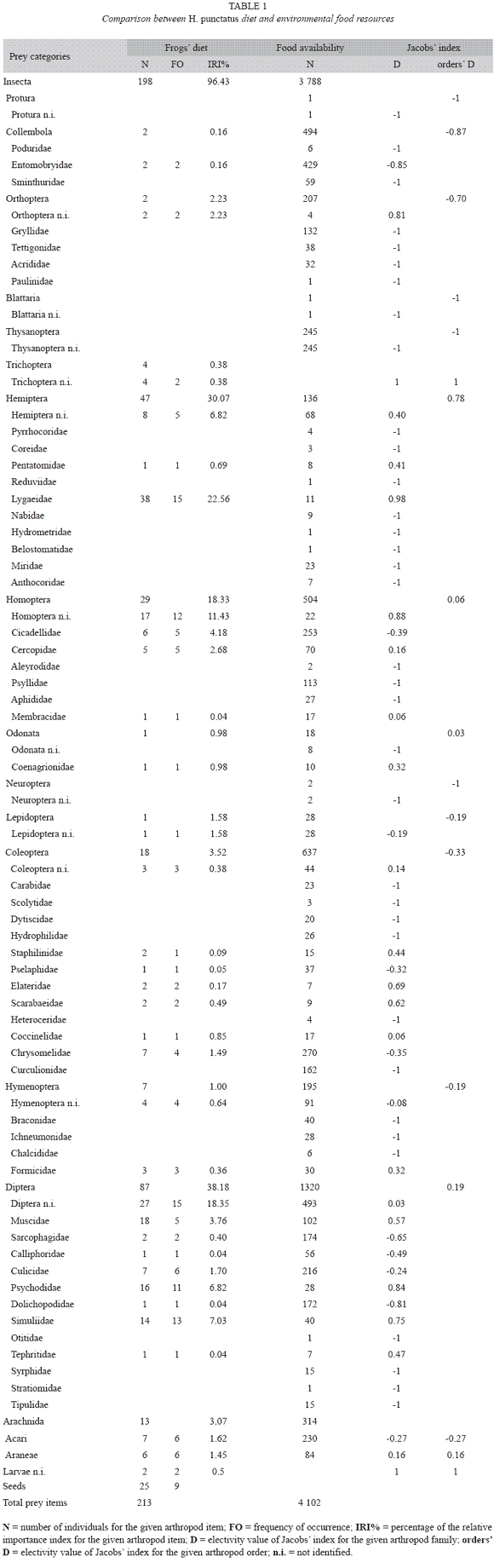
<body><![CDATA[<p><font face="Verdana" size="2"><b>Trophic selectivity analysis: </b>We evaluated diet composition similarity between males and females with Pianka’s niche overlap index (O</font><sub><font face="Verdana" size="1">jk</font></sub><font  face="Verdana" size="2">) and Chi Square test (López <i>et al</i>. 2005b). Pianka’s niche overlap index (Pianka 1974) also was used to compare the diet of frogs with environmental prey availability. To determine whether measured overlap and Chi Square values differed from what would be expected by chance, we performed a randomization analysis through the EcoSim software (Gotelli &amp; Entsminger 2003). EcoSim performs Monte Carlo randomizations to create ‘‘pseudo-communities’’ (Pianka 1986), and then statistically compares the patterns in these randomized communities with those in the real data matrix. In this analysis, the values of the original matrix were randomized 1 000 times and the niche breadth was retained. We also calculated Jacobs’ selectivity index (D) and compared the results for the more abundant arthropods in the environment and frogs’ gut contents (Jacobs 1974). Additionally, we tested the differences in relative abundances of the more important preys between environment and frogs’ diet with a Z Test (Filipello &amp; Crespo 1994, Sokal &amp; Rohlf 1995). </font></p>     <p><font face="Verdana" size="3"><span style="font-weight: bold;">Results</span> </font></p>     <p><font face="Verdana" size="2">The most abundant prey on gut contents were also the most important diet items following IRI values (Table 1). From the 33 prey items determined in the frog diet, dipterans were the most important (40.85%), followed by hemipterans (22.07%), with the bulk of this order abundance represented by the family Lygaeidae (17.84%). Homopterans (13.62%) and coleopterans (8.45%) also contributes importantly to frogs’ diet (Table 1). In the environment, the most abundant items were also dipterans (32.18%), followed by coleopterans (15.53%), homopterans (12.29%) and collembolans (12.04%) (<a href="#t1">Table 1</a>).    <br> </font></p>     <p><font face="Verdana" size="2">    <br> <a name="t1"></a></font></p>     <div style="text-align: center;"><font face="Verdana" size="2"><img  src="/img/revistas/rbt/v57n3/art31t1.gif" title="" alt=""  style="width: 580px; height: 1840px;"></font>    <br> <font face="Verdana" size="2"> </font></div> <font face="Verdana" size="2"> </font>     <p><font face="Verdana" size="2">Diet composition analyzed at prey family level was quite similar between males and females, as indicated by a relatively high dietary overlap (O</font><sub><font face="Verdana"  size="1">jk</font></sub><font face="Verdana" size="2">=0.5534), statistically higher than expected by chance (mean of simulated indexes: O<sub><font face="Verdana" size="1">jk</font></sub><font  face="Verdana" size="2">=0.3091; p[observed&#8805;expected]=0.044; p[observed&#8804;expected]=0.956). When analyzing diet at order level, the similarity between sexes was extremely high (O</font><sub><font  face="Verdana" size="1">jk</font></sub><font face="Verdana" size="2">=0.9369) and statistically higher than expected by chance (mean of simulated indexes: O<sub>jk</sub>=0.3044; p[observed&#8805;expected]&lt;0.0001; p[observed&#8804;expected]=1). The diet (at <font face="Verdana" size="2">family level) did not differ between sexes neither in frequency of occurrence (observed &#967;</font><sup><font  face="Verdana" size="1">2</font></sup><font face="Verdana" size="2">=49.619, mean of simulated indexes=166.081, p[observed&#8805;expected]=1; p[observed&#8804;expected]&lt;0.0001) nor in abundances of prey taxa (observed &#967;</font><sup><font face="Verdana"  size="1">2</font></sup><font face="Verdana" size="2">=68.969, mean of simulated index es=244.843, p[observed&#8805;expected]=1; p[observed&#8804;expected]&lt;0.0001 respectively). With the exception of four Trichoptera (1.88%) and two undetermined larvae (0.94%), all prey categories found in <i>H. punctatus </i>gut contents were also found in sweep net samples, suggesting that food resources estimation was representative. Thirty two out of the sixty six determined arthropods categories in sweep-net samples were found in the guts of frogs. However, four insect orders sampled in the environment were not consumed by <i>H. punctatus</i>, but, with the exception of Thysanoptera (n=245, 5.97%), none of them represented an important portion of environmental food resources (Protura: 0.02%; Blattaria: 0.02%; Neuroptera: 0.05%) (<a href="#t1">Table 1</a>). </font></font></font></p>     <p><font face="Verdana" size="2"><font face="Verdana" size="2"><font  face="Verdana" size="2">Pianka’s overlap index between frog diet and environmental food resources was medium (O</font><sub><font  face="Verdana" size="1">jk</font></sub><font face="Verdana" size="2">=0.4739) but statistically higher than expected by chance (mean of simulated indexes: O</font><sub><font face="Verdana" size="1">jk</font></sub><font  face="Verdana" size="2">=0.2296; p[observed&#8805;expected]=0.017; p[observed&#8804;expected]=0.983). </font></font></font></p>     ]]></body>
<body><![CDATA[<p><font face="Verdana" size="2"><font face="Verdana" size="2"><font  face="Verdana" size="2">Electivity index shows that <i>H. punctatus </i>forages hemipterans selectively over the observed environmental abundance (Z=13.901, p&lt;0.001), particularly because of the disproportional consumption of Lygaeidae (Z=23.386, p&lt;0.001) (Table 1). In contrast, frogs captured coleopterans relatively under their observed environmental abundance (Z=-3.137, p&lt;0.001), while homopterans were foraged almost proportionally to their observed environmental availability (Z=0.873, p=0.383) (<a href="#t1">Table 1</a>). Dipterans were numerically and IRI the most important prey item and abundant food resource, and they were consumed scarcely over the observed environmental availability (Z=2.736, p&lt;0.003) (<a href="#t1">Table 1</a>). Collembolans were a moderately abundant food resource (12.04% of net sampled arthropods) and it appears that frogs avoided to forage on them (Z=-4.914, p&lt;0.001) (<a href="#t1">Table 1</a>). </font></font></font></p>     <p><font face="Verdana" size="2"><font face="Verdana" size="2"><font  face="Verdana" size="2">Plant seeds were found in 19% of the guts of frogs. Only five prey items had a greater FO than seeds and only three out of 12 prey orders were more abundant (<a href="#t1">Table 1</a>). </font></font></font></p>     <p><font face="Verdana" size="2"><font face="Verdana" size="2"><font  face="Verdana" size="3"><span style="font-weight: bold;">Discussion</span> </font></font></font></p>     <p><font face="Verdana" size="2"><font face="Verdana" size="2"><font  face="Verdana" size="2">The primary food resources for amphibians are insects and other arthropods like spiders and mites (Duellman &amp; Trueb 1986, Simon &amp; Toft 1991). In this work, we found that <i>H. punctatus </i>feeds principally on insects, being the more important orders Diptera, Hemiptera and Homoptera, and marginally on spiders and mites. The sympatric and cogeneric <i>H. raniceps </i>also was reported to predate mainly on insects over arachnids (Peltzer &amp; Lajmanovich 2001, vaz-Silva 2004). Simon &amp; Toft (1991), analyzing mite-eating in frogs, found no specialization on Acari in family Hylidae. On the other hand, Maneyro &amp; Da Rosa (2004) found that Araneae showed the largest numerical proportion in the diet of <i>H. pulchellus </i>(also sympatric with <i>H. punctatus</i>), followed by Diptera, Hymenoptera and Coleoptera. As well, the diet of <i>H. albomarginatus </i>was described to be compound by a greater proportion of arachnids, especially in the dry season (Santos <i>et al</i>. 2004). In other two <i>Hypsiboas </i>species, <i>H. calcaratus </i>and <i>H. boans</i>, spiders represented the secondary prey item by their volumetric contribution to frogs diet (Parmelee 1999). Parmelee (1999), also reported an "important volumetric contribution of Araneae to <i>H. punctatus </i>diet" in Peruvian Amazonian, but feeding analysis in the cited work was carried on just five frogs and only two spiders were found in anuran guts. </font></font></font></p>     <p><font face="Verdana" size="2"><font face="Verdana" size="2"><font  face="Verdana" size="2">Comparisons of diet composition between males and females are not common in frogs feeding studies. This could be due to the relative difficulty of capturing females in many amphibian species. Particularly in <i>H. punctatus</i>, none work evaluates differences in diet between sexes (Parmelee 1999, López <i>et al</i>. 2002). In some amphibian species were this comparison has been explored, no differences between sexes have been found in the diet composition (Measey 1998, Hirai and Matsui 2000c), but in other anuran species, differences between males and females have been reported in proportions of several of their more important preys items (Filipello &amp; Crespo 1994, Kam <i>et al</i>. 1995). In the present study, we did not found statistical differences between the diet of males and females of <i>H. punctatus </i>and, although diet composition similarity was lower when overlap analysis was carried on prey family level than on order level, diet overlap was always high, and higher than expected by chance. Moreover, the reduced number of males in comparison to females analyzed could be limiting diet similarity results reliability, thus larger samples of males should be needed to strengthen these conclusions. </font></font></font></p>     <p><font face="Verdana" size="2"><font face="Verdana" size="2"><font  face="Verdana" size="2">In this study we reported that nine out of forty seven <i>H. punctatus </i>specimens analyzed ingested seeds. Although consumption of plant material has been reported in studies on anuran feeding habits, plants are not regarded as an important resource in the anuran diet and some authors suggest the ingestion of plant parts as incidental (Korschgen &amp; Moyle 1955, Linzey 1967, Hedeen 1972, Mahan and Johnson 2007). According to Anderson <i>et al</i>. (1999), plant contents may help in the elimination of parasites and provide roughage to assist in grinding up arthropod exoskeletons. To explore any conclusion on the presence of seeds in <i>H. punctatus </i>gastrointestinal tracts more studies are required. </font></font></font></p>     <p><font face="Verdana" size="2"><font face="Verdana" size="2"><font  face="Verdana" size="2">As Simon &amp; Toft (1991) argue in their work about diet specialization in small vertebrates, the notion of "specialized" versus "opportunistic" ("generalized") is often constrained by preconcepts on what certain taxa are "supposed" to eat. That is, as insectivores, frogs are already specialized; it is tempting to claim in this context that frogs show no selectivity within a range of prey that one expects them, <i>a priori</i>, to eat (Simon &amp; Toft 1991). This issue has been tackled in several feeding studies that evaluated the ant selectivity of a number of anurans based on the comparison of frogs’ diet and environmental food resources (Toft 1980, 1981, Issach &amp; Barg 2002, Hirai &amp; Matsui 2000a, 2000b, López <i>et al</i>. 2007). These studies have arrived at diverse conclusions for different frog species. While López <i>et al</i>. (2007) found that the microhylid <i>Elachistocleis bicolor </i>was really selecting ants among a wider range of preys, Hirai &amp; Matsui (2000b) concluded that, although <i>Gladirana rugosa </i>consumes a large proportion of ants (56.8%), this foraging pattern really shows a weak avoidance to this abundant prey since its proportion among environmental food resources was 81.3%. To obviate food availability data may lead to an incorrect categorization of predators as specialist or generalist feeders. </font></font></font></p>     <p><font face="Verdana" size="2"><font face="Verdana" size="2"><font  face="Verdana" size="2">In a previous work, López <i>et al</i>. (2002) found that <i>H. punctatus </i>feeds on dipterans in a similar proportion to our results, with a frequency of occurrence of 58% (FO=56% in this work), and representing 57% of the total prey items computed (41% here). Without an estimation of environmental food resources, the high proportion of this prey item in gut contents may lead to the assumption that red spotted green frog is foraging selectively on dipterans. In the present study, the incorporation of food availability data allowed us to reevaluate this postulation. On one hand, although overlap index between frogs’ diet and food resources was medium, it was statistically higher than expected by chance, meaning that this overlap is not the result of a strong selection of food resources consumed. On the other hand, prey electivity index values on the most important food items of <i>H. punctatus </i>showed a noticeable selection only for hemipterans, particularly family Lygaeidae, and slight sub-forage on coleopterans. However, the principal food item (numerically, by FO and IRI), dipterans, was consumed in a proportion only slightly over to the observed environmental abundance, thus indicating little selectivity for this prey item. Data on food resource availability is essential for the analysis of feeding ecology of frogs (or any other predator) because it provides critical information for a suitable categorization as generalist or specialist predators and the understanding of their role in trophic webs. </font></font></font></p>     <p><font face="Verdana" size="2"><font face="Verdana" size="2"><font  face="Verdana" size="2">Finally, considering the wide range distribution of <i>H. punctatus</i>, it would be interesting to encourage new feeding studies of this species on other regions of South-America to elucidate if the foraging pattern here described is repeated in different populations and environments where different food resources are available. </font></font></font></p>     <p><font face="Verdana" size="2"><font face="Verdana" size="2"><font  face="Verdana" size="3"><span style="font-weight: bold;">Acknowledgments</span> </font></font></font></p>     ]]></body>
<body><![CDATA[<p><font face="Verdana" size="2"><font face="Verdana" size="2"><font  face="Verdana" size="2">We thank María Gabriela Perotti, Felix Cruz and Gerardo Daniel López for the critical reading of the manuscript, their helpful suggestions and comments. This study was supported with a fellowship of Consejo Nacional de Ciencia y Tecnología (CONICET, Argentina).    <br> </font></font></font></p> <hr style="width: 100%; height: 2px;">     <p><font face="Verdana" size="2"><font face="Verdana" size="2"><font  face="Verdana" size="2"><span style="font-weight: bold;">Resumen</span> </font></font></font></p>     <p><font face="Verdana" size="2"><font face="Verdana" size="2"><font  face="Verdana" size="2">La falta de datos sobre la disponibilidad de recursos alimenticios en muchos trabajos sobre ecología trófica de anfibios ha llevado a una comprensión parcial de las estrategias alimentarias de este grupo. Este estudio evalúa la selectividad trófica de una población de <i>Hypsiboas punctatus </i>en una laguna del valle aluvial del río Paraná Medio en Argentina, y discute la importancia de los datos de disponibilidad de presas para interpretar las estrategias de alimentación de las ranas. Se analizaron los contenidos gastrointestinales de 47 adultos, y se compararon con la disponibilidad ambiental de presas, estimada mediante muestreo sistemático del micro-hábitat de forrajeo de los anuros. Se identificaron 33 categorías de presas. Las más importantes fueron dípteros, hemípteros, homópteros y coleópteros. Se encontró una elevada similitud entre la dieta de machos y hembras, y no se hallaron diferencias significativas en su composición. Los recursos alimenticios más abundantes fueron los dípteros, coleópteros, homópteros y colémbolos. La superposición de nicho trófico fue media (índice de Pianka) pero significativamente más elevada que la esperada por azar. <i>H. punctatus </i>consumió dípteros en una proporción levemente superior a su disponibilidad ambiental (índice de selectividad de Jacobs). La estrategia de depredación de <i>H. punctatus </i>se ajusta mejor a una táctica generalista, ya que su principal ítem presa y algunos ítems secundarios fueron capturados en proporciones similares a su disponibilidad ambiental, y solo una porción reducida de su espectro de recursos tróficos fue consumida selectivamente. Estos resultados evidencian la importancia de incluir los datos de disponibilidad de recursos en los estudios de alimentación para lograr un mejor entendimiento de la ecología trófica de los anfibios. </font></font></font></p>     <p><font face="Verdana" size="2"><font face="Verdana" size="2"><font  face="Verdana" size="2"><b>Palabras clave: </b><i>Hypsiboas punctatus</i>, selectividad trófica, recursos alimenticios, dieta, anuros.    <br> </font></font></font></p> <hr style="width: 100%; height: 2px;">     <p><font face="Verdana" size="2"><font face="Verdana" size="2"><font  face="Verdana" size="2"></font></font></font></p>     <p style="text-align: center;"><font face="Verdana" size="2"><font  face="Verdana" size="2"><font face="Verdana" size="2">Received 19-VI-2008. Corrected 22-II-2009. Accepted 25-III-2009.</font></font></font></p> <font face="Verdana" size="2"><font face="Verdana" size="2"><font  face="Verdana" size="2"> <font size="3">     <p><span style="font-weight: bold;">References</span> </p> </font></font><font face="Verdana" size="2">     <!-- ref --><p>Anderson, A.M., D.A. Haukos &amp; T.J. Anderson. 1999. Diet composition of three anurans from the Playa Wetlands of Northwest Texas. Copeia 1999: 515-520. &nbsp;&nbsp;&nbsp;&nbsp;&nbsp;&nbsp;&nbsp;&nbsp;[&#160;<a href="javascript:void(0);" onclick="javascript: window.open('/scielo.php?script=sci_nlinks&ref=1376430&pid=S0034-7744200900030003100001&lng=','','width=640,height=500,resizable=yes,scrollbars=1,menubar=yes,');">Links</a>&#160;]<!-- end-ref --><!-- ref --><p>Burton, T.M. 1976. An analysis of feeding ecology of the salamanders (Amphibia, Urodela) of the Hubbard Brook Experimental Forest, New Hampshire. J. Herpetol. 10: 487-204. &nbsp;&nbsp;&nbsp;&nbsp;&nbsp;&nbsp;&nbsp;&nbsp;[&#160;<a href="javascript:void(0);" onclick="javascript: window.open('/scielo.php?script=sci_nlinks&ref=1376431&pid=S0034-7744200900030003100002&lng=','','width=640,height=500,resizable=yes,scrollbars=1,menubar=yes,');">Links</a>&#160;]<!-- end-ref --><!-- ref --><p>Caldwell, J.P. &amp; L.J. Vitt. 1999. Dietary asymmetry in leaf litter frogs and lizards in a transitional northern Amazonian rain forest. Oikos. 84: 383-397. &nbsp;&nbsp;&nbsp;&nbsp;&nbsp;&nbsp;&nbsp;&nbsp;[&#160;<a href="javascript:void(0);" onclick="javascript: window.open('/scielo.php?script=sci_nlinks&ref=1376432&pid=S0034-7744200900030003100003&lng=','','width=640,height=500,resizable=yes,scrollbars=1,menubar=yes,');">Links</a>&#160;]<!-- end-ref --><!-- ref --><p>Cott, H.B. 1932. On the ecology of tree-frogs of the Lower Zambesi valley, with special reference to predatory habits considered in relation to the theory of warning colours and mimicry. Proc. Zool. Soc. Lond. 1932: 471-541. &nbsp;&nbsp;&nbsp;&nbsp;&nbsp;&nbsp;&nbsp;&nbsp;[&#160;<a href="javascript:void(0);" onclick="javascript: window.open('/scielo.php?script=sci_nlinks&ref=1376433&pid=S0034-7744200900030003100004&lng=','','width=640,height=500,resizable=yes,scrollbars=1,menubar=yes,');">Links</a>&#160;]<!-- end-ref --><!-- ref --><p>Cott, H.B. 1934. On the ecology of <i>Hyla arborea var. meridionalis </i>in Gran Canaria, with special reference to predatory habits considered in relation to the protective adaptations of insects. Proc. Zool. Soc. Lond. 1934: 311-331. &nbsp;&nbsp;&nbsp;&nbsp;&nbsp;&nbsp;&nbsp;&nbsp;[&#160;<a href="javascript:void(0);" onclick="javascript: window.open('/scielo.php?script=sci_nlinks&ref=1376434&pid=S0034-7744200900030003100005&lng=','','width=640,height=500,resizable=yes,scrollbars=1,menubar=yes,');">Links</a>&#160;]<!-- end-ref --><!-- ref --><p>Drago, E.C., I.E. de Drago, O.B. Oliveros &amp; A.R. Paira. 2003. Aquatic habitats, fish and invertebrates assemblages of the Middle Paraná River. Amazoniana. 17: 291-341. &nbsp;&nbsp;&nbsp;&nbsp;&nbsp;&nbsp;&nbsp;&nbsp;[&#160;<a href="javascript:void(0);" onclick="javascript: window.open('/scielo.php?script=sci_nlinks&ref=1376435&pid=S0034-7744200900030003100006&lng=','','width=640,height=500,resizable=yes,scrollbars=1,menubar=yes,');">Links</a>&#160;]<!-- end-ref --><!-- ref --><p>Duellman, W.E. &amp; L. Trueb. 1986. Biology of Amphibians. McGraw-Hill, New York, New York, USA. 670p. &nbsp;&nbsp;&nbsp;&nbsp;&nbsp;&nbsp;&nbsp;&nbsp;[&#160;<a href="javascript:void(0);" onclick="javascript: window.open('/scielo.php?script=sci_nlinks&ref=1376436&pid=S0034-7744200900030003100007&lng=','','width=640,height=500,resizable=yes,scrollbars=1,menubar=yes,');">Links</a>&#160;]<!-- end-ref --><!-- ref --><p>Duellman, W.E. &amp; M. Lizana. 1994. Biology of a sit-andwait predator, the leptodactylid frog <i>Ceratophrys cornuta</i>. Herpetologica, Emporia. 50: 51-64. &nbsp;&nbsp;&nbsp;&nbsp;&nbsp;&nbsp;&nbsp;&nbsp;[&#160;<a href="javascript:void(0);" onclick="javascript: window.open('/scielo.php?script=sci_nlinks&ref=1376437&pid=S0034-7744200900030003100008&lng=','','width=640,height=500,resizable=yes,scrollbars=1,menubar=yes,');">Links</a>&#160;]<!-- end-ref --><!-- ref --><p>Dunham, A.E. 1983. Realized niche overlap, resource abundance, and intensity of interspecific competition: pp. 261-280, In: R.B. Pianka &amp; T. Schoener (eds.), Lizard Ecology: studies of a model organism. Harvard, Massachussetts, USA. &nbsp;&nbsp;&nbsp;&nbsp;&nbsp;&nbsp;&nbsp;&nbsp;[&#160;<a href="javascript:void(0);" onclick="javascript: window.open('/scielo.php?script=sci_nlinks&ref=1376438&pid=S0034-7744200900030003100009&lng=','','width=640,height=500,resizable=yes,scrollbars=1,menubar=yes,');">Links</a>&#160;]<!-- end-ref --><!-- ref --><p>Filipello, M.A. &amp; F.A. Crespo. 1994. Alimentación en <i>Melanophryniscus stelzneri </i>(Anura: Bufonidae). Cuad. de Herp. 8: 18-24. &nbsp;&nbsp;&nbsp;&nbsp;&nbsp;&nbsp;&nbsp;&nbsp;[&#160;<a href="javascript:void(0);" onclick="javascript: window.open('/scielo.php?script=sci_nlinks&ref=1376439&pid=S0034-7744200900030003100010&lng=','','width=640,height=500,resizable=yes,scrollbars=1,menubar=yes,');">Links</a>&#160;]<!-- end-ref --><!-- ref --><p>Frost, S.W. 1924. Frogs as insect collectors. J. N. Y. Entomol Soc. 32:174-185. &nbsp;&nbsp;&nbsp;&nbsp;&nbsp;&nbsp;&nbsp;&nbsp;[&#160;<a href="javascript:void(0);" onclick="javascript: window.open('/scielo.php?script=sci_nlinks&ref=1376440&pid=S0034-7744200900030003100011&lng=','','width=640,height=500,resizable=yes,scrollbars=1,menubar=yes,');">Links</a>&#160;]<!-- end-ref --><!-- ref --><p>Frost, S.W. 1935.The food of <i>Rana catesbeiana</i>. Copeia. 1935: 15-18. &nbsp;&nbsp;&nbsp;&nbsp;&nbsp;&nbsp;&nbsp;&nbsp;[&#160;<a href="javascript:void(0);" onclick="javascript: window.open('/scielo.php?script=sci_nlinks&ref=1376441&pid=S0034-7744200900030003100012&lng=','','width=640,height=500,resizable=yes,scrollbars=1,menubar=yes,');">Links</a>&#160;]<!-- end-ref --><!-- ref --><p>Gallardo, J.M. 1987. Anfibios Argentinos. Guía para su identificación. 83p. &nbsp;&nbsp;&nbsp;&nbsp;&nbsp;&nbsp;&nbsp;&nbsp;[&#160;<a href="javascript:void(0);" onclick="javascript: window.open('/scielo.php?script=sci_nlinks&ref=1376442&pid=S0034-7744200900030003100013&lng=','','width=640,height=500,resizable=yes,scrollbars=1,menubar=yes,');">Links</a>&#160;]<!-- end-ref --><!-- ref --><p>Gallardo, J.M. &amp; E. Varela de Olmedo. 1992. Anfibios de la República Argentina: Ecología y comportamiento. Fauna de agua dulce de la República Argentina. PROFADU (CONICET), La Plata, 41(1): 116 pp. &nbsp;&nbsp;&nbsp;&nbsp;&nbsp;&nbsp;&nbsp;&nbsp;[&#160;<a href="javascript:void(0);" onclick="javascript: window.open('/scielo.php?script=sci_nlinks&ref=1376443&pid=S0034-7744200900030003100014&lng=','','width=640,height=500,resizable=yes,scrollbars=1,menubar=yes,');">Links</a>&#160;]<!-- end-ref --><!-- ref --><p>Gotelli, N.J. &amp; G.L. Entsminger. 2003. EcoSim: Null Models Software for Ecology, version 7. Acquired Intelligence Inc. &amp; Kesey-Bear, Burlington, Vermont, USA. <a href="http://www.garyentsminger.com/ecosim/index.htm">http://www.garyentsminger.com/ecosim/index.htm</a>. Accessed on 18 June 2008. &nbsp;&nbsp;&nbsp;&nbsp;&nbsp;&nbsp;&nbsp;&nbsp;[&#160;<a href="javascript:void(0);" onclick="javascript: window.open('/scielo.php?script=sci_nlinks&ref=1376444&pid=S0034-7744200900030003100015&lng=','','width=640,height=500,resizable=yes,scrollbars=1,menubar=yes,');">Links</a>&#160;]<!-- end-ref --><!-- ref --><p>Hamilton, W.J. Jr. 1930. Notes on the food of the American toad. Copeia. 2: 45. &nbsp;&nbsp;&nbsp;&nbsp;&nbsp;&nbsp;&nbsp;&nbsp;[&#160;<a href="javascript:void(0);" onclick="javascript: window.open('/scielo.php?script=sci_nlinks&ref=1376445&pid=S0034-7744200900030003100016&lng=','','width=640,height=500,resizable=yes,scrollbars=1,menubar=yes,');">Links</a>&#160;]<!-- end-ref --><!-- ref --><p>Hamilton, W.J. Jr. 1948. The food and feeding behavior of the green frog <i>Rana clamitans </i>Latreille in New York State. Copeia. 1948: 203-207. &nbsp;&nbsp;&nbsp;&nbsp;&nbsp;&nbsp;&nbsp;&nbsp;[&#160;<a href="javascript:void(0);" onclick="javascript: window.open('/scielo.php?script=sci_nlinks&ref=1376446&pid=S0034-7744200900030003100017&lng=','','width=640,height=500,resizable=yes,scrollbars=1,menubar=yes,');">Links</a>&#160;]<!-- end-ref --><!-- ref --><p>Hedeen, S.E. 1972. Food and feeding behavior of the mink frog, <i>Rana septentrionalis </i>Baird, in Minnesota. Am. Midl. Nat. 88:291-300. &nbsp;&nbsp;&nbsp;&nbsp;&nbsp;&nbsp;&nbsp;&nbsp;[&#160;<a href="javascript:void(0);" onclick="javascript: window.open('/scielo.php?script=sci_nlinks&ref=1376447&pid=S0034-7744200900030003100018&lng=','','width=640,height=500,resizable=yes,scrollbars=1,menubar=yes,');">Links</a>&#160;]<!-- end-ref --><!-- ref --><p>Hirai, T. 2004. Diet composition of the Indian rice frog, <i>Rana limnocharis</i>, in the floodplain of the Kizu River, Japan. Herpetol. J. 14: 149-152. &nbsp;&nbsp;&nbsp;&nbsp;&nbsp;&nbsp;&nbsp;&nbsp;[&#160;<a href="javascript:void(0);" onclick="javascript: window.open('/scielo.php?script=sci_nlinks&ref=1376448&pid=S0034-7744200900030003100019&lng=','','width=640,height=500,resizable=yes,scrollbars=1,menubar=yes,');">Links</a>&#160;]<!-- end-ref --><!-- ref --><p>Hirai, T. &amp; M. Matsui. 2000a. Ant specialization in diet of the narrowmouthed toad, <i>Microhyla ornata</i>, from Amamioshima Island of the Ryukyu Archipelago. Curr. Herpetol. 19: 27-34. &nbsp;&nbsp;&nbsp;&nbsp;&nbsp;&nbsp;&nbsp;&nbsp;[&#160;<a href="javascript:void(0);" onclick="javascript: window.open('/scielo.php?script=sci_nlinks&ref=1376449&pid=S0034-7744200900030003100020&lng=','','width=640,height=500,resizable=yes,scrollbars=1,menubar=yes,');">Links</a>&#160;]<!-- end-ref --><!-- ref --><p>Hirai, T. &amp; M. Matsui. 2000b. Myrmecophagy in a Ranid Frog <i>Rana rugosa</i>: Specialization or Weak Avoidance to Ant Eating? Zool. Sci. (Tokyo). 17: 459-466. &nbsp;&nbsp;&nbsp;&nbsp;&nbsp;&nbsp;&nbsp;&nbsp;[&#160;<a href="javascript:void(0);" onclick="javascript: window.open('/scielo.php?script=sci_nlinks&ref=1376450&pid=S0034-7744200900030003100021&lng=','','width=640,height=500,resizable=yes,scrollbars=1,menubar=yes,');">Links</a>&#160;]<!-- end-ref --><!-- ref --><p>Hirai, T. &amp; M. Matsui. 2000c. Feeding Habits of the Japanese Tree Frog, <i>Hyla japonica</i>, in the Reproductive Season. Zool. Sci. 17: 977-982 &nbsp;&nbsp;&nbsp;&nbsp;&nbsp;&nbsp;&nbsp;&nbsp;[&#160;<a href="javascript:void(0);" onclick="javascript: window.open('/scielo.php?script=sci_nlinks&ref=1376451&pid=S0034-7744200900030003100022&lng=','','width=640,height=500,resizable=yes,scrollbars=1,menubar=yes,');">Links</a>&#160;]<!-- end-ref --><!-- ref --><p>Hirai, T. &amp; M. Matsui. 2001a. Food habits of an endangered Japanese frog, <i>Rana porosa brevipoda</i>. Ecol. Res. 16: 737-743. &nbsp;&nbsp;&nbsp;&nbsp;&nbsp;&nbsp;&nbsp;&nbsp;[&#160;<a href="javascript:void(0);" onclick="javascript: window.open('/scielo.php?script=sci_nlinks&ref=1376452&pid=S0034-7744200900030003100023&lng=','','width=640,height=500,resizable=yes,scrollbars=1,menubar=yes,');">Links</a>&#160;]<!-- end-ref --><!-- ref --><p>Isacch, J.P. &amp; M. Barg. 2002. Are bufonid toads specialized ant-feeders? A case test from the Argentinian flooding pampa. Journal of Natural History. 36: 2005-2012. &nbsp;&nbsp;&nbsp;&nbsp;&nbsp;&nbsp;&nbsp;&nbsp;[&#160;<a href="javascript:void(0);" onclick="javascript: window.open('/scielo.php?script=sci_nlinks&ref=1376453&pid=S0034-7744200900030003100024&lng=','','width=640,height=500,resizable=yes,scrollbars=1,menubar=yes,');">Links</a>&#160;]<!-- end-ref --><!-- ref --><p>IUCN, Conservation International, and NatureServe. 2006. Global Amphibian Assessment. &lt;<a href="http://www.globalamphibians.org">www.globalamphibians.org</a>&gt;. Accessed on 18 June 2008. &nbsp;&nbsp;&nbsp;&nbsp;&nbsp;&nbsp;&nbsp;&nbsp;[&#160;<a href="javascript:void(0);" onclick="javascript: window.open('/scielo.php?script=sci_nlinks&ref=1376454&pid=S0034-7744200900030003100025&lng=','','width=640,height=500,resizable=yes,scrollbars=1,menubar=yes,');">Links</a>&#160;]<!-- end-ref --><!-- ref --><p>Jacobs, J. 1974. Quantitative measurement of food selection: a modification of the forage ratio and Ivlev’s electivity indices. Oecologia. 14: 413-417. &nbsp;&nbsp;&nbsp;&nbsp;&nbsp;&nbsp;&nbsp;&nbsp;[&#160;<a href="javascript:void(0);" onclick="javascript: window.open('/scielo.php?script=sci_nlinks&ref=1376455&pid=S0034-7744200900030003100026&lng=','','width=640,height=500,resizable=yes,scrollbars=1,menubar=yes,');">Links</a>&#160;]<!-- end-ref --><!-- ref --><p>Kam, Y.C., C.S. Wang &amp; Y.S. Lin. 1995. Reproduction and diet of te brown frog <i>Rana longicrus </i>in Taiwan. Zool. Stud. 34: 193-201. &nbsp;&nbsp;&nbsp;&nbsp;&nbsp;&nbsp;&nbsp;&nbsp;[&#160;<a href="javascript:void(0);" onclick="javascript: window.open('/scielo.php?script=sci_nlinks&ref=1376456&pid=S0034-7744200900030003100027&lng=','','width=640,height=500,resizable=yes,scrollbars=1,menubar=yes,');">Links</a>&#160;]<!-- end-ref --><!-- ref --><p>Klimstra, W.D. &amp; C.W. Meyers. 1965. Foods of the toad <i>Bufo woodhousei fowleri </i>Hinckley. Transactions of the Illinois State Academy of Science. 58: 11-26. &nbsp;&nbsp;&nbsp;&nbsp;&nbsp;&nbsp;&nbsp;&nbsp;[&#160;<a href="javascript:void(0);" onclick="javascript: window.open('/scielo.php?script=sci_nlinks&ref=1376457&pid=S0034-7744200900030003100028&lng=','','width=640,height=500,resizable=yes,scrollbars=1,menubar=yes,');">Links</a>&#160;]<!-- end-ref --><!-- ref --><p>Korschgen, L.J. &amp; D.L. Moyle. 1955. Food habits of the bullfrog in central Missouri farm ponds. Am. Midl. Nat. 54: 332-341. &nbsp;&nbsp;&nbsp;&nbsp;&nbsp;&nbsp;&nbsp;&nbsp;[&#160;<a href="javascript:void(0);" onclick="javascript: window.open('/scielo.php?script=sci_nlinks&ref=1376458&pid=S0034-7744200900030003100029&lng=','','width=640,height=500,resizable=yes,scrollbars=1,menubar=yes,');">Links</a>&#160;]<!-- end-ref --><!-- ref --><p>Krebs, J.R. 1978. Optimal foraging: decision rules for predators, p 23–63. In: J.R. Krebs &amp; N.B. Davies (eds). Behavioural Ecology: An Evolutionary Approach. Oxford: Blackwell, London, England. &nbsp;&nbsp;&nbsp;&nbsp;&nbsp;&nbsp;&nbsp;&nbsp;[&#160;<a href="javascript:void(0);" onclick="javascript: window.open('/scielo.php?script=sci_nlinks&ref=1376459&pid=S0034-7744200900030003100030&lng=','','width=640,height=500,resizable=yes,scrollbars=1,menubar=yes,');">Links</a>&#160;]<!-- end-ref --><!-- ref --><p>Lajmanovich, R.C. 1995. Relaciones tróficas de bufonidos (Anura, Bufonidae) en ambientes del Río Paraná, Argentina. Alytes. 13: 87-103. &nbsp;&nbsp;&nbsp;&nbsp;&nbsp;&nbsp;&nbsp;&nbsp;[&#160;<a href="javascript:void(0);" onclick="javascript: window.open('/scielo.php?script=sci_nlinks&ref=1376460&pid=S0034-7744200900030003100031&lng=','','width=640,height=500,resizable=yes,scrollbars=1,menubar=yes,');">Links</a>&#160;]<!-- end-ref --><!-- ref --><p>Lajmanovich, R.C. 1996. Dinámica trófica de jóvenes de <i>Leptodactylus ocellatus </i>(Amphibia: Anura), en una isla del Paraná, Argentina. Cuad. Herpetol. 10: 11-23. &nbsp;&nbsp;&nbsp;&nbsp;&nbsp;&nbsp;&nbsp;&nbsp;[&#160;<a href="javascript:void(0);" onclick="javascript: window.open('/scielo.php?script=sci_nlinks&ref=1376461&pid=S0034-7744200900030003100032&lng=','','width=640,height=500,resizable=yes,scrollbars=1,menubar=yes,');">Links</a>&#160;]<!-- end-ref --><!-- ref --><p>Lescure, J. 1971. L’álimentation du crapaud <i>Bufo regularis </i>Reuss et de la grenouille <i>Dicroglossus occipitales </i>(Gunther) au Senégal. Bulletin del’Institut Fondamental d’Afrique Noire. 33: 446-466. &nbsp;&nbsp;&nbsp;&nbsp;&nbsp;&nbsp;&nbsp;&nbsp;[&#160;<a href="javascript:void(0);" onclick="javascript: window.open('/scielo.php?script=sci_nlinks&ref=1376462&pid=S0034-7744200900030003100033&lng=','','width=640,height=500,resizable=yes,scrollbars=1,menubar=yes,');">Links</a>&#160;]<!-- end-ref --><!-- ref --><p>Lieberman, S.S. 1986. Ecology of the leaf litter herpetofauna of a Neotropical rain forest: La Selva, Costa Rica. Acta Zool. Mex. 15: 1-72. &nbsp;&nbsp;&nbsp;&nbsp;&nbsp;&nbsp;&nbsp;&nbsp;[&#160;<a href="javascript:void(0);" onclick="javascript: window.open('/scielo.php?script=sci_nlinks&ref=1376463&pid=S0034-7744200900030003100034&lng=','','width=640,height=500,resizable=yes,scrollbars=1,menubar=yes,');">Links</a>&#160;]<!-- end-ref --><!-- ref --><p>Linzey, D.W. 1967. Food of the leopard frog <i>Rana pipiens</i>, in central New York. Herpetologica. 23: 11-17. &nbsp;&nbsp;&nbsp;&nbsp;&nbsp;&nbsp;&nbsp;&nbsp;[&#160;<a href="javascript:void(0);" onclick="javascript: window.open('/scielo.php?script=sci_nlinks&ref=1376464&pid=S0034-7744200900030003100035&lng=','','width=640,height=500,resizable=yes,scrollbars=1,menubar=yes,');">Links</a>&#160;]<!-- end-ref --><!-- ref --><p>López, J.A., M.P. Perltzer &amp; R.C. Lajmanovich. 2002. <i>Hyla punctata </i>(NCN). Diet. Herpetol. Rev. 33: 125-126. &nbsp;&nbsp;&nbsp;&nbsp;&nbsp;&nbsp;&nbsp;&nbsp;[&#160;<a href="javascript:void(0);" onclick="javascript: window.open('/scielo.php?script=sci_nlinks&ref=1376465&pid=S0034-7744200900030003100036&lng=','','width=640,height=500,resizable=yes,scrollbars=1,menubar=yes,');">Links</a>&#160;]<!-- end-ref --><!-- ref --><p>López, J.A., M.P. Perltzer &amp; R.C. Lajmanovich. 2003. <i>Physalaemus riograndensis </i>(NCN). Diet. Herpetol. Rev. 34: 360. &nbsp;&nbsp;&nbsp;&nbsp;&nbsp;&nbsp;&nbsp;&nbsp;[&#160;<a href="javascript:void(0);" onclick="javascript: window.open('/scielo.php?script=sci_nlinks&ref=1376466&pid=S0034-7744200900030003100037&lng=','','width=640,height=500,resizable=yes,scrollbars=1,menubar=yes,');">Links</a>&#160;]<!-- end-ref --><!-- ref --><p>López, J.A., M.M. Arias, M.P. Perltzer &amp; R.C. Lajmanovich. 2005a. Dieta y variación morfométrica de <i>Leptodactylus ocellatus </i>(linnaeus, 1758) (anura: leptodactylidae) en tres localidades del centro-este de argentina. Bol. Asoc. Herpetol. Esp. 16: 32-39. &nbsp;&nbsp;&nbsp;&nbsp;&nbsp;&nbsp;&nbsp;&nbsp;[&#160;<a href="javascript:void(0);" onclick="javascript: window.open('/scielo.php?script=sci_nlinks&ref=1376467&pid=S0034-7744200900030003100038&lng=','','width=640,height=500,resizable=yes,scrollbars=1,menubar=yes,');">Links</a>&#160;]<!-- end-ref --><!-- ref --><p>López, J.A., M.P. Perltzer &amp; R.C. Lajmanovich. 2005b. Dieta y solapamiento del subnicho trófico de nueve especies de leptodactílidos en el Parque General San Martín (Argentina). Rev. Esp. Herpetol. 19: 19-31. &nbsp;&nbsp;&nbsp;&nbsp;&nbsp;&nbsp;&nbsp;&nbsp;[&#160;<a href="javascript:void(0);" onclick="javascript: window.open('/scielo.php?script=sci_nlinks&ref=1376468&pid=S0034-7744200900030003100039&lng=','','width=640,height=500,resizable=yes,scrollbars=1,menubar=yes,');">Links</a>&#160;]<!-- end-ref --><!-- ref --><p>López, J.A., R. Ghirardi, P.A. Scarabotti &amp; M.C. Medrano. 2007. Feeding ecology of <i>Elachistocleis bicolor </i>in a riparian locality of the middle Paraná River. Herpetol. J. 17: 48-53. &nbsp;&nbsp;&nbsp;&nbsp;&nbsp;&nbsp;&nbsp;&nbsp;[&#160;<a href="javascript:void(0);" onclick="javascript: window.open('/scielo.php?script=sci_nlinks&ref=1376469&pid=S0034-7744200900030003100040&lng=','','width=640,height=500,resizable=yes,scrollbars=1,menubar=yes,');">Links</a>&#160;]<!-- end-ref --><!-- ref --><p>Mahan, R.D. &amp; J.R. Johnson. 2007. Diet of the Gray Treefrog (<i>Hyla versicolor</i>) in Relation to Foraging Site Location, J. Herpetol. 41: 16-23. &nbsp;&nbsp;&nbsp;&nbsp;&nbsp;&nbsp;&nbsp;&nbsp;[&#160;<a href="javascript:void(0);" onclick="javascript: window.open('/scielo.php?script=sci_nlinks&ref=1376470&pid=S0034-7744200900030003100041&lng=','','width=640,height=500,resizable=yes,scrollbars=1,menubar=yes,');">Links</a>&#160;]<!-- end-ref --><!-- ref --><p>Maneyro, R. &amp; I. da Rosa. 2004. Temporal and spatial changes in the diet of <i>Hyla pulchella </i>(Anura, Hylidae) in southern Uruguay. Phyllomedusa 3: 101-113. &nbsp;&nbsp;&nbsp;&nbsp;&nbsp;&nbsp;&nbsp;&nbsp;[&#160;<a href="javascript:void(0);" onclick="javascript: window.open('/scielo.php?script=sci_nlinks&ref=1376471&pid=S0034-7744200900030003100042&lng=','','width=640,height=500,resizable=yes,scrollbars=1,menubar=yes,');">Links</a>&#160;]<!-- end-ref --><!-- ref --><p>Maneyro, R., D.E. Naya, I. da Rosa, A. Canavero &amp; A. Camargo. 2004. Diet of the South American frog <i>Leptodactylus ocellatus </i>(Anura, Leptodactylidae) in Uruguay. Iheringia Ser. Zool. 94: 57-61. &nbsp;&nbsp;&nbsp;&nbsp;&nbsp;&nbsp;&nbsp;&nbsp;[&#160;<a href="javascript:void(0);" onclick="javascript: window.open('/scielo.php?script=sci_nlinks&ref=1376472&pid=S0034-7744200900030003100043&lng=','','width=640,height=500,resizable=yes,scrollbars=1,menubar=yes,');">Links</a>&#160;]<!-- end-ref --><!-- ref --><p>Measey, G. J. 1998. Diet of feral <i>Xenopus laevis </i>(Daudin) in South Wales, U. K. J. Zool. Lond. 246: 287-298. &nbsp;&nbsp;&nbsp;&nbsp;&nbsp;&nbsp;&nbsp;&nbsp;[&#160;<a href="javascript:void(0);" onclick="javascript: window.open('/scielo.php?script=sci_nlinks&ref=1376473&pid=S0034-7744200900030003100044&lng=','','width=640,height=500,resizable=yes,scrollbars=1,menubar=yes,');">Links</a>&#160;]<!-- end-ref --><!-- ref --><p>Neiff, J.J. 2001. Biodiversity in some tropical wetlands systems of South America, pp 157-186. <i>In: </i>B. Gopal, W.J. Junk &amp; J.A. Davis (eds). Biodiversity in wetlands: assessment, function and conservation. Blackhuys, Leiden, The Netherlands. &nbsp;&nbsp;&nbsp;&nbsp;&nbsp;&nbsp;&nbsp;&nbsp;[&#160;<a href="javascript:void(0);" onclick="javascript: window.open('/scielo.php?script=sci_nlinks&ref=1376474&pid=S0034-7744200900030003100045&lng=','','width=640,height=500,resizable=yes,scrollbars=1,menubar=yes,');">Links</a>&#160;]<!-- end-ref --><!-- ref --><p>Parmelee, J.R. 1999. Trofhic ecology of a tropical anuran assemblage. Scientific Papers. Natural History Museum, The University of Kansas. 11: 1-59. &nbsp;&nbsp;&nbsp;&nbsp;&nbsp;&nbsp;&nbsp;&nbsp;[&#160;<a href="javascript:void(0);" onclick="javascript: window.open('/scielo.php?script=sci_nlinks&ref=1376475&pid=S0034-7744200900030003100046&lng=','','width=640,height=500,resizable=yes,scrollbars=1,menubar=yes,');">Links</a>&#160;]<!-- end-ref --><!-- ref --><p>Peltzer, P.M. &amp; R.C. Lajmanovich. 2001. <i>Hyla raniceps </i>(NCN). Diet. Herp. Rev. 32: 247-248. &nbsp;&nbsp;&nbsp;&nbsp;&nbsp;&nbsp;&nbsp;&nbsp;[&#160;<a href="javascript:void(0);" onclick="javascript: window.open('/scielo.php?script=sci_nlinks&ref=1376476&pid=S0034-7744200900030003100047&lng=','','width=640,height=500,resizable=yes,scrollbars=1,menubar=yes,');">Links</a>&#160;]<!-- end-ref --><!-- ref --><p>Pianka, E.R. 1974. Niche overlap and diffuse competition. Proc. Natl. Acad. Sci. U. S. A. 71: 2141-2145. &nbsp;&nbsp;&nbsp;&nbsp;&nbsp;&nbsp;&nbsp;&nbsp;[&#160;<a href="javascript:void(0);" onclick="javascript: window.open('/scielo.php?script=sci_nlinks&ref=1376477&pid=S0034-7744200900030003100048&lng=','','width=640,height=500,resizable=yes,scrollbars=1,menubar=yes,');">Links</a>&#160;]<!-- end-ref --><!-- ref --><p>Pianka, E.R. 1986. Ecology and Natural History of Desert Lizards. Princeton, New Jersey, U.S.A. 150-167. &nbsp;&nbsp;&nbsp;&nbsp;&nbsp;&nbsp;&nbsp;&nbsp;[&#160;<a href="javascript:void(0);" onclick="javascript: window.open('/scielo.php?script=sci_nlinks&ref=1376478&pid=S0034-7744200900030003100049&lng=','','width=640,height=500,resizable=yes,scrollbars=1,menubar=yes,');">Links</a>&#160;]<!-- end-ref --><!-- ref --><p>Pinkas, L., M.S. Oliphant &amp; Z.L. Iverson. 1971. Food habit of albacore bluefin, tuna and bonito in California water. California Department of Fishing Game. Fish Bull. 152: 1105. &nbsp;&nbsp;&nbsp;&nbsp;&nbsp;&nbsp;&nbsp;&nbsp;[&#160;<a href="javascript:void(0);" onclick="javascript: window.open('/scielo.php?script=sci_nlinks&ref=1376479&pid=S0034-7744200900030003100050&lng=','','width=640,height=500,resizable=yes,scrollbars=1,menubar=yes,');">Links</a>&#160;]<!-- end-ref --><!-- ref --><p>Santos, E.M., A.V. Almeida &amp; D. Vasconcelos. 2004. Feeding of six anuran (Amphibian: Anura) species in a rainforest fragment in Northeastern Brazil. Iheringia, Ser. Zool. 94: 433-438. &nbsp;&nbsp;&nbsp;&nbsp;&nbsp;&nbsp;&nbsp;&nbsp;[&#160;<a href="javascript:void(0);" onclick="javascript: window.open('/scielo.php?script=sci_nlinks&ref=1376480&pid=S0034-7744200900030003100051&lng=','','width=640,height=500,resizable=yes,scrollbars=1,menubar=yes,');">Links</a>&#160;]<!-- end-ref --><!-- ref --><p>Simon, M.P. 1982. The evolution and ecology of parental care in a terrestrial breeding frog from New Guinea. - Ph.D. Thesis, University of California, Davis, USA. &nbsp;&nbsp;&nbsp;&nbsp;&nbsp;&nbsp;&nbsp;&nbsp;[&#160;<a href="javascript:void(0);" onclick="javascript: window.open('/scielo.php?script=sci_nlinks&ref=1376481&pid=S0034-7744200900030003100052&lng=','','width=640,height=500,resizable=yes,scrollbars=1,menubar=yes,');">Links</a>&#160;]<!-- end-ref --><!-- ref --><p>Simon, M.P &amp; C.A. Toft. 1991. Diet Specialization in Small vertebrates: Mite-Eating in Frogs. Oikos. 61: 263-278. &nbsp;&nbsp;&nbsp;&nbsp;&nbsp;&nbsp;&nbsp;&nbsp;[&#160;<a href="javascript:void(0);" onclick="javascript: window.open('/scielo.php?script=sci_nlinks&ref=1376482&pid=S0034-7744200900030003100053&lng=','','width=640,height=500,resizable=yes,scrollbars=1,menubar=yes,');">Links</a>&#160;]<!-- end-ref --><!-- ref --><p>Smith, H.M. 1950. Handbook of Amphibians and Reptiles of Kansas. -University of Kansas, Museum of Natural History. Mac-Millan, New York, USA. &nbsp;&nbsp;&nbsp;&nbsp;&nbsp;&nbsp;&nbsp;&nbsp;[&#160;<a href="javascript:void(0);" onclick="javascript: window.open('/scielo.php?script=sci_nlinks&ref=1376483&pid=S0034-7744200900030003100054&lng=','','width=640,height=500,resizable=yes,scrollbars=1,menubar=yes,');">Links</a>&#160;]<!-- end-ref --><!-- ref --><p>Sokal, R.R. &amp; F.J. Rohlf. 1995. Biometry: The principles and practice of statistics in biological research. Third edition. Freeman. 887 p. &nbsp;&nbsp;&nbsp;&nbsp;&nbsp;&nbsp;&nbsp;&nbsp;[&#160;<a href="javascript:void(0);" onclick="javascript: window.open('/scielo.php?script=sci_nlinks&ref=1376484&pid=S0034-7744200900030003100055&lng=','','width=640,height=500,resizable=yes,scrollbars=1,menubar=yes,');">Links</a>&#160;]<!-- end-ref --><!-- ref --><p>Stephens, D.W &amp; J.R. Krebs. 1986. Foraging Theory. Princeton: Princeton, New Jersey, USA. 240 p. &nbsp;&nbsp;&nbsp;&nbsp;&nbsp;&nbsp;&nbsp;&nbsp;[&#160;<a href="javascript:void(0);" onclick="javascript: window.open('/scielo.php?script=sci_nlinks&ref=1376485&pid=S0034-7744200900030003100056&lng=','','width=640,height=500,resizable=yes,scrollbars=1,menubar=yes,');">Links</a>&#160;]<!-- end-ref --><!-- ref --><p>Toft, C.A. 1980. Feeding ecology of thirteen syntopic species of anurans in a seasonal tropical environment. Oecologia. 45: 131-141. &nbsp;&nbsp;&nbsp;&nbsp;&nbsp;&nbsp;&nbsp;&nbsp;[&#160;<a href="javascript:void(0);" onclick="javascript: window.open('/scielo.php?script=sci_nlinks&ref=1376486&pid=S0034-7744200900030003100057&lng=','','width=640,height=500,resizable=yes,scrollbars=1,menubar=yes,');">Links</a>&#160;]<!-- end-ref --><!-- ref --><p>Toft, C.A. 1981. Feeding ecology of Panamanian litter anurans: Patterns in diet and foraging mode. J. Herpetol. 15: 130-144. &nbsp;&nbsp;&nbsp;&nbsp;&nbsp;&nbsp;&nbsp;&nbsp;[&#160;<a href="javascript:void(0);" onclick="javascript: window.open('/scielo.php?script=sci_nlinks&ref=1376487&pid=S0034-7744200900030003100058&lng=','','width=640,height=500,resizable=yes,scrollbars=1,menubar=yes,');">Links</a>&#160;]<!-- end-ref --><!-- ref --><p>Vaz-Silva, W. 2004. <i>Hyla raniceps </i>(Chaco Treefrog). Diet. Herp. Rev. 35: 159. &nbsp;&nbsp;&nbsp;&nbsp;&nbsp;&nbsp;&nbsp;&nbsp;[&#160;<a href="javascript:void(0);" onclick="javascript: window.open('/scielo.php?script=sci_nlinks&ref=1376488&pid=S0034-7744200900030003100059&lng=','','width=640,height=500,resizable=yes,scrollbars=1,menubar=yes,');">Links</a>&#160;]<!-- end-ref --> ]]></body><back>
<ref-list>
<ref id="B1">
<nlm-citation citation-type="journal">
<person-group person-group-type="author">
<name>
<surname><![CDATA[Anderson]]></surname>
<given-names><![CDATA[A.M]]></given-names>
</name>
<name>
<surname><![CDATA[Haukos]]></surname>
<given-names><![CDATA[D.A]]></given-names>
</name>
<name>
<surname><![CDATA[Anderson]]></surname>
<given-names><![CDATA[T.J]]></given-names>
</name>
</person-group>
<article-title xml:lang="en"><![CDATA[Diet composition of three anurans from the Playa Wetlands of Northwest Texas]]></article-title>
<source><![CDATA[Copeia]]></source>
<year>1999</year>
<volume>1999</volume>
<page-range>515-520</page-range></nlm-citation>
</ref>
<ref id="B2">
<nlm-citation citation-type="journal">
<person-group person-group-type="author">
<name>
<surname><![CDATA[Burton]]></surname>
<given-names><![CDATA[T.M]]></given-names>
</name>
</person-group>
<article-title xml:lang="en"><![CDATA[An analysis of feeding ecology of the salamanders (Amphibia, Urodela) of the Hubbard Brook Experimental Forest, New Hampshire]]></article-title>
<source><![CDATA[J. Herpetol]]></source>
<year>1976</year>
<volume>10</volume>
<page-range>487-204</page-range></nlm-citation>
</ref>
<ref id="B3">
<nlm-citation citation-type="journal">
<person-group person-group-type="author">
<name>
<surname><![CDATA[Caldwell]]></surname>
<given-names><![CDATA[J.P]]></given-names>
</name>
<name>
<surname><![CDATA[Vitt]]></surname>
<given-names><![CDATA[L.J]]></given-names>
</name>
</person-group>
<article-title xml:lang="en"><![CDATA[Dietary asymmetry in leaf litter frogs and lizards in a transitional northern Amazonian rain forest]]></article-title>
<source><![CDATA[Oikos]]></source>
<year>1999</year>
<volume>84</volume>
<page-range>383-397</page-range></nlm-citation>
</ref>
<ref id="B4">
<nlm-citation citation-type="journal">
<person-group person-group-type="author">
<name>
<surname><![CDATA[Cott]]></surname>
<given-names><![CDATA[H.B]]></given-names>
</name>
</person-group>
<article-title xml:lang="en"><![CDATA[On the ecology of tree-frogs of the Lower Zambesi valley, with special reference to predatory habits considered in relation to the theory of warning colours and mimicry]]></article-title>
<source><![CDATA[Proc. Zool. Soc. Lond]]></source>
<year>1932</year>
<volume>1932</volume>
<page-range>471-541</page-range></nlm-citation>
</ref>
<ref id="B5">
<nlm-citation citation-type="journal">
<person-group person-group-type="author">
<name>
<surname><![CDATA[Cott]]></surname>
<given-names><![CDATA[H.B]]></given-names>
</name>
</person-group>
<article-title xml:lang="en"><![CDATA[On the ecology of Hyla arborea var. meridionalis in Gran Canaria, with special reference to predatory habits considered in relation to the protective adaptations of insects]]></article-title>
<source><![CDATA[Proc. Zool. Soc. Lond]]></source>
<year>1934</year>
<volume>1934</volume>
<page-range>311-331</page-range></nlm-citation>
</ref>
<ref id="B6">
<nlm-citation citation-type="journal">
<person-group person-group-type="author">
<name>
<surname><![CDATA[Drago]]></surname>
<given-names><![CDATA[E.C]]></given-names>
</name>
<name>
<surname><![CDATA[de Drago]]></surname>
<given-names><![CDATA[I.E]]></given-names>
</name>
<name>
<surname><![CDATA[Oliveros]]></surname>
<given-names><![CDATA[O.B]]></given-names>
</name>
<name>
<surname><![CDATA[Paira]]></surname>
<given-names><![CDATA[A.R]]></given-names>
</name>
</person-group>
<article-title xml:lang="en"><![CDATA[Aquatic habitats, fish and invertebrates assemblages of the Middle Paraná River]]></article-title>
<source><![CDATA[Amazoniana]]></source>
<year>2003</year>
<volume>17</volume>
<page-range>291-341</page-range></nlm-citation>
</ref>
<ref id="B7">
<nlm-citation citation-type="book">
<person-group person-group-type="author">
<name>
<surname><![CDATA[Duellman]]></surname>
<given-names><![CDATA[W.E]]></given-names>
</name>
<name>
<surname><![CDATA[Trueb]]></surname>
<given-names><![CDATA[L]]></given-names>
</name>
</person-group>
<source><![CDATA[Biology of Amphibians]]></source>
<year>1986</year>
<publisher-loc><![CDATA[New York^eNew York New York]]></publisher-loc>
<publisher-name><![CDATA[McGraw-Hill]]></publisher-name>
</nlm-citation>
</ref>
<ref id="B8">
<nlm-citation citation-type="journal">
<person-group person-group-type="author">
<name>
<surname><![CDATA[Duellman]]></surname>
<given-names><![CDATA[W.E]]></given-names>
</name>
<name>
<surname><![CDATA[Lizana]]></surname>
<given-names><![CDATA[M]]></given-names>
</name>
</person-group>
<article-title xml:lang="en"><![CDATA[Biology of a sit-andwait predator, the leptodactylid frog Ceratophrys cornuta]]></article-title>
<source><![CDATA[Herpetologica, Emporia]]></source>
<year>1994</year>
<volume>50</volume>
<page-range>51-64</page-range></nlm-citation>
</ref>
<ref id="B9">
<nlm-citation citation-type="book">
<person-group person-group-type="author">
<name>
<surname><![CDATA[Dunham]]></surname>
<given-names><![CDATA[A.E]]></given-names>
</name>
</person-group>
<article-title xml:lang="en"><![CDATA[Realized niche overlap, resource abundance, and intensity of interspecific competition]]></article-title>
<person-group person-group-type="editor">
<name>
<surname><![CDATA[Pianka]]></surname>
<given-names><![CDATA[R.B]]></given-names>
</name>
<name>
<surname><![CDATA[Schoener]]></surname>
<given-names><![CDATA[T]]></given-names>
</name>
</person-group>
<source><![CDATA[Lizard Ecology: studies of a model organism]]></source>
<year>1983</year>
<page-range>261-280</page-range><publisher-loc><![CDATA[^eMassachussetts Massachussetts]]></publisher-loc>
<publisher-name><![CDATA[Harvard]]></publisher-name>
</nlm-citation>
</ref>
<ref id="B10">
<nlm-citation citation-type="journal">
<person-group person-group-type="author">
<name>
<surname><![CDATA[Filipello]]></surname>
<given-names><![CDATA[M.A]]></given-names>
</name>
<name>
<surname><![CDATA[Crespo]]></surname>
<given-names><![CDATA[F.A]]></given-names>
</name>
</person-group>
<article-title xml:lang="es"><![CDATA[Alimentación en Melanophryniscus stelzneri (Anura: Bufonidae)]]></article-title>
<source><![CDATA[Cuad. de Herp]]></source>
<year>1994</year>
<volume>8</volume>
<page-range>18-24</page-range></nlm-citation>
</ref>
<ref id="B11">
<nlm-citation citation-type="journal">
<person-group person-group-type="author">
<name>
<surname><![CDATA[Frost]]></surname>
<given-names><![CDATA[S.W]]></given-names>
</name>
</person-group>
<article-title xml:lang="en"><![CDATA[Frogs as insect collectors]]></article-title>
<source><![CDATA[J. N. Y. Entomol Soc]]></source>
<year>1924</year>
<volume>32</volume>
<page-range>174-185</page-range></nlm-citation>
</ref>
<ref id="B12">
<nlm-citation citation-type="journal">
<person-group person-group-type="author">
<name>
<surname><![CDATA[Frost]]></surname>
<given-names><![CDATA[S.W]]></given-names>
</name>
</person-group>
<article-title xml:lang="en"><![CDATA[The food of Rana catesbeiana]]></article-title>
<source><![CDATA[Copeia]]></source>
<year>1935</year>
<volume>1935</volume>
<page-range>15-18</page-range></nlm-citation>
</ref>
<ref id="B13">
<nlm-citation citation-type="">
<person-group person-group-type="author">
<name>
<surname><![CDATA[Gallardo]]></surname>
<given-names><![CDATA[J.M]]></given-names>
</name>
</person-group>
<source><![CDATA[Anfibios Argentinos: Guía para su identificación]]></source>
<year>1987</year>
</nlm-citation>
</ref>
<ref id="B14">
<nlm-citation citation-type="journal">
<person-group person-group-type="author">
<name>
<surname><![CDATA[Gallardo]]></surname>
<given-names><![CDATA[J.M]]></given-names>
</name>
<name>
<surname><![CDATA[Varela de Olmedo]]></surname>
<given-names><![CDATA[E]]></given-names>
</name>
</person-group>
<article-title xml:lang="es"><![CDATA[Anfibios de la República Argentina: Ecología y comportamiento. Fauna de agua dulce de la República Argentina]]></article-title>
<source><![CDATA[PROFADU (CONICET)]]></source>
<year>1992</year>
<volume>41</volume>
<numero>1</numero>
<issue>1</issue>
<publisher-loc><![CDATA[La Plata ]]></publisher-loc>
</nlm-citation>
</ref>
<ref id="B15">
<nlm-citation citation-type="book">
<person-group person-group-type="author">
<name>
<surname><![CDATA[Gotelli]]></surname>
<given-names><![CDATA[N.J]]></given-names>
</name>
<name>
<surname><![CDATA[Entsminger]]></surname>
<given-names><![CDATA[G.L]]></given-names>
</name>
</person-group>
<source><![CDATA[EcoSim: Null Models Software for Ecology, version 7]]></source>
<year>2003</year>
<publisher-loc><![CDATA[Burlington^eVermont Vermont]]></publisher-loc>
<publisher-name><![CDATA[Acquired Intelligence Inc. & Kesey-Bear]]></publisher-name>
</nlm-citation>
</ref>
<ref id="B16">
<nlm-citation citation-type="journal">
<person-group person-group-type="author">
<name>
<surname><![CDATA[Hamilton]]></surname>
<given-names><![CDATA[W.J. Jr]]></given-names>
</name>
</person-group>
<article-title xml:lang="en"><![CDATA[Notes on the food of the American toad]]></article-title>
<source><![CDATA[Copeia]]></source>
<year>1930</year>
<volume>2</volume>
</nlm-citation>
</ref>
<ref id="B17">
<nlm-citation citation-type="journal">
<person-group person-group-type="author">
<name>
<surname><![CDATA[Hamilton]]></surname>
<given-names><![CDATA[W.J. Jr]]></given-names>
</name>
</person-group>
<article-title xml:lang="en"><![CDATA[The food and feeding behavior of the green frog Rana clamitans Latreille in New York State]]></article-title>
<source><![CDATA[Copeia]]></source>
<year>1948</year>
<volume>1948</volume>
<page-range>203-207</page-range></nlm-citation>
</ref>
<ref id="B18">
<nlm-citation citation-type="journal">
<person-group person-group-type="author">
<name>
<surname><![CDATA[Hedeen]]></surname>
<given-names><![CDATA[S.E]]></given-names>
</name>
</person-group>
<article-title xml:lang="en"><![CDATA[Food and feeding behavior of the mink frog, Rana septentrionalis Baird, in Minnesota]]></article-title>
<source><![CDATA[Am. Midl. Nat]]></source>
<year>1972</year>
<volume>88</volume>
<page-range>291-300</page-range></nlm-citation>
</ref>
<ref id="B19">
<nlm-citation citation-type="journal">
<person-group person-group-type="author">
<name>
<surname><![CDATA[Hirai]]></surname>
<given-names><![CDATA[T]]></given-names>
</name>
</person-group>
<article-title xml:lang="en"><![CDATA[Diet composition of the Indian rice frog, Rana limnocharis, in the floodplain of the Kizu River, Japan]]></article-title>
<source><![CDATA[Herpetol. J]]></source>
<year>2004</year>
<volume>14</volume>
<page-range>149-152</page-range></nlm-citation>
</ref>
<ref id="B20">
<nlm-citation citation-type="journal">
<person-group person-group-type="author">
<name>
<surname><![CDATA[Hirai]]></surname>
<given-names><![CDATA[T]]></given-names>
</name>
<name>
<surname><![CDATA[Matsui]]></surname>
<given-names><![CDATA[M]]></given-names>
</name>
</person-group>
<article-title xml:lang="en"><![CDATA[Ant specialization in diet of the narrowmouthed toad, Microhyla ornata, from Amamioshima Island of the Ryukyu Archipelago]]></article-title>
<source><![CDATA[Curr. Herpetol]]></source>
<year>2000</year>
<volume>19</volume>
<page-range>27-34</page-range></nlm-citation>
</ref>
<ref id="B21">
<nlm-citation citation-type="journal">
<person-group person-group-type="author">
<name>
<surname><![CDATA[Hirai]]></surname>
<given-names><![CDATA[T]]></given-names>
</name>
<name>
<surname><![CDATA[Matsui]]></surname>
<given-names><![CDATA[M]]></given-names>
</name>
</person-group>
<article-title xml:lang="en"><![CDATA[Myrmecophagy in a Ranid Frog Rana rugosa: Specialization or Weak Avoidance to Ant Eating?]]></article-title>
<source><![CDATA[Zool. Sci. (Tokyo)]]></source>
<year>2000</year>
<volume>17</volume>
<page-range>459-466</page-range></nlm-citation>
</ref>
<ref id="B22">
<nlm-citation citation-type="journal">
<person-group person-group-type="author">
<name>
<surname><![CDATA[Hirai]]></surname>
<given-names><![CDATA[T]]></given-names>
</name>
<name>
<surname><![CDATA[Matsui]]></surname>
<given-names><![CDATA[M]]></given-names>
</name>
</person-group>
<article-title xml:lang="en"><![CDATA[Feeding Habits of the Japanese Tree Frog, Hyla japonica, in the Reproductive Season]]></article-title>
<source><![CDATA[Zool. Sci]]></source>
<year>2000</year>
<volume>17</volume>
<page-range>977-982</page-range></nlm-citation>
</ref>
<ref id="B23">
<nlm-citation citation-type="journal">
<person-group person-group-type="author">
<name>
<surname><![CDATA[Hirai]]></surname>
<given-names><![CDATA[T]]></given-names>
</name>
<name>
<surname><![CDATA[Matsui]]></surname>
<given-names><![CDATA[M]]></given-names>
</name>
</person-group>
<article-title xml:lang="en"><![CDATA[Food habits of an endangered Japanese frog, Rana porosa brevipoda]]></article-title>
<source><![CDATA[Ecol. Res]]></source>
<year>2001</year>
<volume>16</volume>
<page-range>737-743</page-range></nlm-citation>
</ref>
<ref id="B24">
<nlm-citation citation-type="journal">
<person-group person-group-type="author">
<name>
<surname><![CDATA[Isacch]]></surname>
<given-names><![CDATA[J.P]]></given-names>
</name>
<name>
<surname><![CDATA[Barg]]></surname>
<given-names><![CDATA[M]]></given-names>
</name>
</person-group>
<article-title xml:lang="en"><![CDATA[Are bufonid toads specialized ant-feeders?: A case test from the Argentinian flooding pampa]]></article-title>
<source><![CDATA[Journal of Natural History]]></source>
<year>2002</year>
<volume>36</volume>
<page-range>2005-2012</page-range></nlm-citation>
</ref>
<ref id="B25">
<nlm-citation citation-type="">
<collab>IUCN, Conservation International, and NatureServe</collab>
<source><![CDATA[Global Amphibian Assessment]]></source>
<year>2006</year>
</nlm-citation>
</ref>
<ref id="B26">
<nlm-citation citation-type="journal">
<person-group person-group-type="author">
<name>
<surname><![CDATA[Jacobs]]></surname>
<given-names><![CDATA[J]]></given-names>
</name>
</person-group>
<article-title xml:lang="en"><![CDATA[Quantitative measurement of food selection: a modification of the forage ratio and Ivlev’s electivity indices]]></article-title>
<source><![CDATA[Oecologia]]></source>
<year>1974</year>
<volume>14</volume>
<page-range>413-417</page-range></nlm-citation>
</ref>
<ref id="B27">
<nlm-citation citation-type="journal">
<person-group person-group-type="author">
<name>
<surname><![CDATA[Kam]]></surname>
<given-names><![CDATA[Y.C]]></given-names>
</name>
<name>
<surname><![CDATA[Wang]]></surname>
<given-names><![CDATA[C.S]]></given-names>
</name>
<name>
<surname><![CDATA[Lin]]></surname>
<given-names><![CDATA[Y. S]]></given-names>
</name>
</person-group>
<article-title xml:lang="en"><![CDATA[Reproduction and diet of te brown frog Rana longicrus in Taiwan]]></article-title>
<source><![CDATA[Zool. Stud]]></source>
<year>1995</year>
<volume>34</volume>
<page-range>193-201</page-range></nlm-citation>
</ref>
<ref id="B28">
<nlm-citation citation-type="journal">
<person-group person-group-type="author">
<name>
<surname><![CDATA[Klimstra]]></surname>
<given-names><![CDATA[W.D]]></given-names>
</name>
<name>
<surname><![CDATA[Meyers]]></surname>
<given-names><![CDATA[C.W]]></given-names>
</name>
</person-group>
<article-title xml:lang="en"><![CDATA[Foods of the toad Bufo woodhousei fowleri Hinckley]]></article-title>
<source><![CDATA[Transactions of the Illinois State Academy of Science]]></source>
<year>1965</year>
<volume>58</volume>
<page-range>11-26</page-range></nlm-citation>
</ref>
<ref id="B29">
<nlm-citation citation-type="journal">
<person-group person-group-type="author">
<name>
<surname><![CDATA[Korschgen]]></surname>
<given-names><![CDATA[L.J]]></given-names>
</name>
<name>
<surname><![CDATA[Moyle]]></surname>
<given-names><![CDATA[D.L]]></given-names>
</name>
</person-group>
<article-title xml:lang="en"><![CDATA[Food habits of the bullfrog in central Missouri farm ponds]]></article-title>
<source><![CDATA[Am. Midl. Nat]]></source>
<year>1955</year>
<volume>54</volume>
<page-range>332-341</page-range></nlm-citation>
</ref>
<ref id="B30">
<nlm-citation citation-type="book">
<person-group person-group-type="author">
<name>
<surname><![CDATA[Krebs]]></surname>
<given-names><![CDATA[J.R]]></given-names>
</name>
</person-group>
<article-title xml:lang="en"><![CDATA[Optimal foraging: decision rules for predators]]></article-title>
<person-group person-group-type="editor">
<name>
<surname><![CDATA[Krebs]]></surname>
<given-names><![CDATA[J.R]]></given-names>
</name>
<name>
<surname><![CDATA[Davies]]></surname>
<given-names><![CDATA[N.B]]></given-names>
</name>
</person-group>
<source><![CDATA[Behavioural Ecology: An Evolutionary Approach]]></source>
<year>1978</year>
<page-range>23-63</page-range><publisher-loc><![CDATA[Oxford ]]></publisher-loc>
<publisher-name><![CDATA[Blackwell]]></publisher-name>
</nlm-citation>
</ref>
<ref id="B31">
<nlm-citation citation-type="journal">
<person-group person-group-type="author">
<name>
<surname><![CDATA[Lajmanovich]]></surname>
<given-names><![CDATA[R.C]]></given-names>
</name>
</person-group>
<article-title xml:lang="es"><![CDATA[Relaciones tróficas de bufonidos (Anura, Bufonidae) en ambientes del Río Paraná, Argentina]]></article-title>
<source><![CDATA[Alytes]]></source>
<year>1995</year>
<volume>13</volume>
<page-range>87-103</page-range></nlm-citation>
</ref>
<ref id="B32">
<nlm-citation citation-type="journal">
<person-group person-group-type="author">
<name>
<surname><![CDATA[Lajmanovich]]></surname>
<given-names><![CDATA[R.C]]></given-names>
</name>
</person-group>
<article-title xml:lang="es"><![CDATA[Dinámica trófica de jóvenes de Leptodactylus ocellatus (Amphibia: Anura), en una isla del Paraná, Argentina]]></article-title>
<source><![CDATA[Cuad. Herpetol]]></source>
<year>1996</year>
<volume>10</volume>
<page-range>11-23</page-range></nlm-citation>
</ref>
<ref id="B33">
<nlm-citation citation-type="journal">
<person-group person-group-type="author">
<name>
<surname><![CDATA[Lescure]]></surname>
<given-names><![CDATA[J]]></given-names>
</name>
</person-group>
<article-title xml:lang="fr"><![CDATA[L’álimentation du crapaud Bufo regularis Reuss et de la grenouille Dicroglossus occipitales (Gunther) au Senégal]]></article-title>
<source><![CDATA[Bulletin del’Institut Fondamental d’Afrique Noire]]></source>
<year>1971</year>
<volume>33</volume>
<page-range>446-466</page-range></nlm-citation>
</ref>
<ref id="B34">
<nlm-citation citation-type="journal">
<person-group person-group-type="author">
<name>
<surname><![CDATA[Lieberman]]></surname>
<given-names><![CDATA[S.S]]></given-names>
</name>
</person-group>
<article-title xml:lang="en"><![CDATA[Ecology of the leaf litter herpetofauna of a Neotropical rain forest: La Selva, Costa Rica]]></article-title>
<source><![CDATA[Acta Zool. Mex]]></source>
<year>1986</year>
<volume>15</volume>
<page-range>1-72</page-range></nlm-citation>
</ref>
<ref id="B35">
<nlm-citation citation-type="journal">
<person-group person-group-type="author">
<name>
<surname><![CDATA[Linzey]]></surname>
<given-names><![CDATA[D.W]]></given-names>
</name>
</person-group>
<article-title xml:lang="en"><![CDATA[Food of the leopard frog Rana pipiens, in central New York]]></article-title>
<source><![CDATA[Herpetologica]]></source>
<year>1967</year>
<volume>23</volume>
<page-range>11-17</page-range></nlm-citation>
</ref>
<ref id="B36">
<nlm-citation citation-type="journal">
<person-group person-group-type="author">
<name>
<surname><![CDATA[López]]></surname>
<given-names><![CDATA[J.A]]></given-names>
</name>
<name>
<surname><![CDATA[Perltzer]]></surname>
<given-names><![CDATA[M.P]]></given-names>
</name>
<name>
<surname><![CDATA[Lajmanovich]]></surname>
<given-names><![CDATA[R.C]]></given-names>
</name>
</person-group>
<article-title xml:lang="en"><![CDATA[Hyla punctata (NCN)]]></article-title>
<source><![CDATA[Diet. Herpetol. Rev]]></source>
<year>2002</year>
<volume>33</volume>
<page-range>125-126</page-range></nlm-citation>
</ref>
<ref id="B37">
<nlm-citation citation-type="journal">
<person-group person-group-type="author">
<name>
<surname><![CDATA[López]]></surname>
<given-names><![CDATA[J.A]]></given-names>
</name>
<name>
<surname><![CDATA[Perltzer]]></surname>
<given-names><![CDATA[M.P]]></given-names>
</name>
<name>
<surname><![CDATA[Lajmanovich]]></surname>
<given-names><![CDATA[R.C]]></given-names>
</name>
</person-group>
<article-title xml:lang="en"><![CDATA[Physalaemus riograndensis (NCN)]]></article-title>
<source><![CDATA[Diet. Herpetol. Rev]]></source>
<year>2003</year>
<volume>34</volume>
</nlm-citation>
</ref>
<ref id="B38">
<nlm-citation citation-type="journal">
<person-group person-group-type="author">
<name>
<surname><![CDATA[López]]></surname>
<given-names><![CDATA[J.A]]></given-names>
</name>
<name>
<surname><![CDATA[Arias]]></surname>
<given-names><![CDATA[M.M]]></given-names>
</name>
<name>
<surname><![CDATA[Perltzer]]></surname>
<given-names><![CDATA[M.P]]></given-names>
</name>
<name>
<surname><![CDATA[Lajmanovich]]></surname>
<given-names><![CDATA[R.C]]></given-names>
</name>
</person-group>
<article-title xml:lang="es"><![CDATA[Dieta y variación morfométrica de Leptodactylus ocellatus (linnaeus, 1758) (anura: leptodactylidae) en tres localidades del centro-este de argentina]]></article-title>
<source><![CDATA[Bol. Asoc. Herpetol. Esp]]></source>
<year>2005</year>
<volume>16</volume>
<page-range>32-39</page-range></nlm-citation>
</ref>
<ref id="B39">
<nlm-citation citation-type="journal">
<person-group person-group-type="author">
<name>
<surname><![CDATA[López]]></surname>
<given-names><![CDATA[J.A]]></given-names>
</name>
<name>
<surname><![CDATA[Perltzer]]></surname>
<given-names><![CDATA[M.P]]></given-names>
</name>
<name>
<surname><![CDATA[Lajmanovich]]></surname>
<given-names><![CDATA[R.C]]></given-names>
</name>
</person-group>
<article-title xml:lang="es"><![CDATA[Dieta y solapamiento del subnicho trófico de nueve especies de leptodactílidos en el Parque General San Martín (Argentina)]]></article-title>
<source><![CDATA[Rev. Esp. Herpetol]]></source>
<year>2005</year>
<volume>19</volume>
<page-range>19-31</page-range></nlm-citation>
</ref>
<ref id="B40">
<nlm-citation citation-type="journal">
<person-group person-group-type="author">
<name>
<surname><![CDATA[López]]></surname>
<given-names><![CDATA[J.A]]></given-names>
</name>
<name>
<surname><![CDATA[Ghirardi]]></surname>
<given-names><![CDATA[R]]></given-names>
</name>
<name>
<surname><![CDATA[Scarabotti]]></surname>
<given-names><![CDATA[P.A]]></given-names>
</name>
<name>
<surname><![CDATA[Medrano]]></surname>
<given-names><![CDATA[M.C]]></given-names>
</name>
</person-group>
<article-title xml:lang="en"><![CDATA[Feeding ecology of Elachistocleis bicolor in a riparian locality of the middle Paraná River]]></article-title>
<source><![CDATA[Herpetol. J]]></source>
<year>2007</year>
<volume>17</volume>
<page-range>48-53</page-range></nlm-citation>
</ref>
<ref id="B41">
<nlm-citation citation-type="journal">
<person-group person-group-type="author">
<name>
<surname><![CDATA[Mahan]]></surname>
<given-names><![CDATA[R.D]]></given-names>
</name>
<name>
<surname><![CDATA[Johnson]]></surname>
<given-names><![CDATA[J.R]]></given-names>
</name>
</person-group>
<article-title xml:lang="en"><![CDATA[Diet of the Gray Treefrog (Hyla versicolor) in Relation to Foraging Site Location]]></article-title>
<source><![CDATA[J. Herpetol]]></source>
<year>2007</year>
<volume>41</volume>
<page-range>16-23</page-range></nlm-citation>
</ref>
<ref id="B42">
<nlm-citation citation-type="journal">
<person-group person-group-type="author">
<name>
<surname><![CDATA[Maneyro]]></surname>
<given-names><![CDATA[R]]></given-names>
</name>
<name>
<surname><![CDATA[da Rosa]]></surname>
<given-names><![CDATA[I]]></given-names>
</name>
</person-group>
<article-title xml:lang="en"><![CDATA[Temporal and spatial changes in the diet of Hyla pulchella (Anura, Hylidae) in southern Uruguay]]></article-title>
<source><![CDATA[Phyllomedusa]]></source>
<year>2004</year>
<volume>3</volume>
<page-range>101-113</page-range></nlm-citation>
</ref>
<ref id="B43">
<nlm-citation citation-type="journal">
<person-group person-group-type="author">
<name>
<surname><![CDATA[Maneyro]]></surname>
<given-names><![CDATA[R]]></given-names>
</name>
<name>
<surname><![CDATA[Naya]]></surname>
<given-names><![CDATA[D.E]]></given-names>
</name>
<name>
<surname><![CDATA[da Rosa]]></surname>
<given-names><![CDATA[I]]></given-names>
</name>
<name>
<surname><![CDATA[Canavero]]></surname>
<given-names><![CDATA[A]]></given-names>
</name>
<name>
<surname><![CDATA[Camargo]]></surname>
<given-names><![CDATA[A]]></given-names>
</name>
</person-group>
<article-title xml:lang="en"><![CDATA[Diet of the South American frog Leptodactylus ocellatus (Anura, Leptodactylidae) in Uruguay]]></article-title>
<source><![CDATA[Iheringia Ser. Zool]]></source>
<year>2004</year>
<volume>94</volume>
<page-range>57-61</page-range></nlm-citation>
</ref>
<ref id="B44">
<nlm-citation citation-type="journal">
<person-group person-group-type="author">
<name>
<surname><![CDATA[Measey]]></surname>
<given-names><![CDATA[G. J]]></given-names>
</name>
</person-group>
<article-title xml:lang="en"><![CDATA[Diet of feral Xenopus laevis (Daudin) in South Wales, U. K]]></article-title>
<source><![CDATA[J. Zool. Lond]]></source>
<year>1998</year>
<volume>246</volume>
<page-range>287-298</page-range></nlm-citation>
</ref>
<ref id="B45">
<nlm-citation citation-type="book">
<person-group person-group-type="author">
<name>
<surname><![CDATA[Neiff]]></surname>
<given-names><![CDATA[J.J]]></given-names>
</name>
</person-group>
<article-title xml:lang="en"><![CDATA[Biodiversity in some tropical wetlands systems of South America]]></article-title>
<person-group person-group-type="editor">
<name>
<surname><![CDATA[Gopal]]></surname>
<given-names><![CDATA[B]]></given-names>
</name>
<name>
<surname><![CDATA[Junk]]></surname>
<given-names><![CDATA[W.J]]></given-names>
</name>
<name>
<surname><![CDATA[Davis]]></surname>
<given-names><![CDATA[J.A]]></given-names>
</name>
</person-group>
<source><![CDATA[Biodiversity in wetlands: assessment, function and conservation]]></source>
<year>2001</year>
<page-range>157-186</page-range><publisher-loc><![CDATA[Leiden ]]></publisher-loc>
<publisher-name><![CDATA[Blackhuys]]></publisher-name>
</nlm-citation>
</ref>
<ref id="B46">
<nlm-citation citation-type="journal">
<person-group person-group-type="author">
<name>
<surname><![CDATA[Parmelee]]></surname>
<given-names><![CDATA[J.R]]></given-names>
</name>
</person-group>
<article-title xml:lang="en"><![CDATA[Trofhic ecology of a tropical anuran assemblage: Scientific Papers]]></article-title>
<source><![CDATA[Natural History Museum, The University of Kansas]]></source>
<year>1999</year>
<volume>11</volume>
<page-range>1-59</page-range></nlm-citation>
</ref>
<ref id="B47">
<nlm-citation citation-type="journal">
<person-group person-group-type="author">
<name>
<surname><![CDATA[Peltzer]]></surname>
<given-names><![CDATA[P.M]]></given-names>
</name>
<name>
<surname><![CDATA[Lajmanovich]]></surname>
<given-names><![CDATA[R.C]]></given-names>
</name>
</person-group>
<article-title xml:lang="en"><![CDATA[Hyla raniceps (NCN)]]></article-title>
<source><![CDATA[Diet. Herp. Rev]]></source>
<year>2001</year>
<volume>32</volume>
<page-range>247-248</page-range></nlm-citation>
</ref>
<ref id="B48">
<nlm-citation citation-type="journal">
<person-group person-group-type="author">
<name>
<surname><![CDATA[Pianka]]></surname>
<given-names><![CDATA[E.R]]></given-names>
</name>
</person-group>
<article-title xml:lang="en"><![CDATA[Niche overlap and diffuse competition]]></article-title>
<source><![CDATA[Proc. Natl. Acad. Sci. U. S. A]]></source>
<year>1974</year>
<volume>71</volume>
<page-range>2141-2145</page-range></nlm-citation>
</ref>
<ref id="B49">
<nlm-citation citation-type="book">
<person-group person-group-type="author">
<name>
<surname><![CDATA[Pianka]]></surname>
<given-names><![CDATA[E.R]]></given-names>
</name>
</person-group>
<source><![CDATA[Ecology and Natural History of Desert Lizards]]></source>
<year>1986</year>
<page-range>150-167</page-range><publisher-loc><![CDATA[^eNew Jersey New Jersey]]></publisher-loc>
<publisher-name><![CDATA[Princeton]]></publisher-name>
</nlm-citation>
</ref>
<ref id="B50">
<nlm-citation citation-type="journal">
<person-group person-group-type="author">
<name>
<surname><![CDATA[Pinkas]]></surname>
<given-names><![CDATA[L]]></given-names>
</name>
<name>
<surname><![CDATA[Oliphant]]></surname>
<given-names><![CDATA[M.S]]></given-names>
</name>
<name>
<surname><![CDATA[Iverson]]></surname>
<given-names><![CDATA[Z.L]]></given-names>
</name>
</person-group>
<article-title xml:lang="en"><![CDATA[Food habit of albacore bluefin, tuna and bonito in California water: California Department of Fishing Game]]></article-title>
<source><![CDATA[Fish Bull]]></source>
<year>1971</year>
<volume>152</volume>
</nlm-citation>
</ref>
<ref id="B51">
<nlm-citation citation-type="journal">
<person-group person-group-type="author">
<name>
<surname><![CDATA[Santos]]></surname>
<given-names><![CDATA[E.M]]></given-names>
</name>
<name>
<surname><![CDATA[Almeida]]></surname>
<given-names><![CDATA[A.V]]></given-names>
</name>
<name>
<surname><![CDATA[Vasconcelos]]></surname>
<given-names><![CDATA[D]]></given-names>
</name>
</person-group>
<article-title xml:lang="en"><![CDATA[Feeding of six anuran (Amphibian: Anura) species in a rainforest fragment in Northeastern Brazil]]></article-title>
<source><![CDATA[Iheringia, Ser. Zool]]></source>
<year>2004</year>
<volume>94</volume>
<page-range>433-438</page-range></nlm-citation>
</ref>
<ref id="B52">
<nlm-citation citation-type="">
<person-group person-group-type="author">
<name>
<surname><![CDATA[Simon]]></surname>
<given-names><![CDATA[M.P]]></given-names>
</name>
</person-group>
<source><![CDATA[The evolution and ecology of parental care in a terrestrial breeding frog from New Guinea]]></source>
<year>1982</year>
</nlm-citation>
</ref>
<ref id="B53">
<nlm-citation citation-type="journal">
<person-group person-group-type="author">
<name>
<surname><![CDATA[Simon]]></surname>
<given-names><![CDATA[M.P]]></given-names>
</name>
<name>
<surname><![CDATA[Toft]]></surname>
<given-names><![CDATA[C.A]]></given-names>
</name>
</person-group>
<article-title xml:lang="en"><![CDATA[Diet Specialization in Small vertebrates: Mite-Eating in Frogs]]></article-title>
<source><![CDATA[Oikos]]></source>
<year>1991</year>
<volume>61</volume>
<page-range>263-278</page-range></nlm-citation>
</ref>
<ref id="B54">
<nlm-citation citation-type="book">
<person-group person-group-type="author">
<name>
<surname><![CDATA[Smith]]></surname>
<given-names><![CDATA[H.M]]></given-names>
</name>
</person-group>
<source><![CDATA[Handbook of Amphibians and Reptiles of Kansas]]></source>
<year>1950</year>
<publisher-loc><![CDATA[^eNew York New York]]></publisher-loc>
<publisher-name><![CDATA[Mac-Millan]]></publisher-name>
</nlm-citation>
</ref>
<ref id="B55">
<nlm-citation citation-type="book">
<person-group person-group-type="author">
<name>
<surname><![CDATA[Sokal]]></surname>
<given-names><![CDATA[R.R]]></given-names>
</name>
<name>
<surname><![CDATA[Rohlf]]></surname>
<given-names><![CDATA[F.J]]></given-names>
</name>
</person-group>
<source><![CDATA[Biometry: The principles and practice of statistics in biological research]]></source>
<year>1995</year>
<edition>Third</edition>
<publisher-name><![CDATA[Freeman]]></publisher-name>
</nlm-citation>
</ref>
<ref id="B56">
<nlm-citation citation-type="book">
<person-group person-group-type="author">
<name>
<surname><![CDATA[Stephens]]></surname>
<given-names><![CDATA[D.W]]></given-names>
</name>
<name>
<surname><![CDATA[Krebs]]></surname>
<given-names><![CDATA[J.R]]></given-names>
</name>
</person-group>
<source><![CDATA[Foraging Theory]]></source>
<year>1986</year>
<publisher-loc><![CDATA[Princeton^eNew Jersey New Jersey]]></publisher-loc>
<publisher-name><![CDATA[Princeton]]></publisher-name>
</nlm-citation>
</ref>
<ref id="B57">
<nlm-citation citation-type="journal">
<person-group person-group-type="author">
<name>
<surname><![CDATA[Toft]]></surname>
<given-names><![CDATA[C.A]]></given-names>
</name>
</person-group>
<article-title xml:lang="en"><![CDATA[Feeding ecology of thirteen syntopic species of anurans in a seasonal tropical environment]]></article-title>
<source><![CDATA[Oecologia]]></source>
<year>1980</year>
<volume>45</volume>
<page-range>131-141</page-range></nlm-citation>
</ref>
<ref id="B58">
<nlm-citation citation-type="journal">
<person-group person-group-type="author">
<name>
<surname><![CDATA[Toft]]></surname>
<given-names><![CDATA[C.A]]></given-names>
</name>
</person-group>
<article-title xml:lang="en"><![CDATA[Feeding ecology of Panamanian litter anurans: Patterns in diet and foraging mode]]></article-title>
<source><![CDATA[J. Herpetol]]></source>
<year>1981</year>
<volume>15</volume>
<page-range>130-144</page-range></nlm-citation>
</ref>
<ref id="B59">
<nlm-citation citation-type="journal">
<person-group person-group-type="author">
<name>
<surname><![CDATA[Vaz-Silva]]></surname>
<given-names><![CDATA[W]]></given-names>
</name>
</person-group>
<article-title xml:lang="en"><![CDATA[Hyla raniceps (Chaco Treefrog)]]></article-title>
<source><![CDATA[Diet. Herp. Rev]]></source>
<year>2004</year>
<volume>35</volume>
</nlm-citation>
</ref>
</ref-list>
</back>
</article>
