<?xml version="1.0" encoding="ISO-8859-1"?><article xmlns:mml="http://www.w3.org/1998/Math/MathML" xmlns:xlink="http://www.w3.org/1999/xlink" xmlns:xsi="http://www.w3.org/2001/XMLSchema-instance">
<front>
<journal-meta>
<journal-id>0034-7744</journal-id>
<journal-title><![CDATA[Revista de Biología Tropical]]></journal-title>
<abbrev-journal-title><![CDATA[Rev. biol. trop]]></abbrev-journal-title>
<issn>0034-7744</issn>
<publisher>
<publisher-name><![CDATA[Universidad de Costa Rica]]></publisher-name>
</publisher>
</journal-meta>
<article-meta>
<article-id>S0034-77442009000300030</article-id>
<title-group>
<article-title xml:lang="en"><![CDATA[Beneficial effect of spider presence on seedling recruitment of the tropical rainforest tree Dipteryx oleifera (Fabaceae)]]></article-title>
</title-group>
<contrib-group>
<contrib contrib-type="author">
<name>
<surname><![CDATA[Ruiz]]></surname>
<given-names><![CDATA[Javier]]></given-names>
</name>
<xref ref-type="aff" rid="A01"/>
</contrib>
<contrib contrib-type="author">
<name>
<surname><![CDATA[Ingram-Flóres]]></surname>
<given-names><![CDATA[Cherryl]]></given-names>
</name>
<xref ref-type="aff" rid="A02"/>
</contrib>
<contrib contrib-type="author">
<name>
<surname><![CDATA[Boucher]]></surname>
<given-names><![CDATA[Douglas H]]></given-names>
</name>
<xref ref-type="aff" rid="A03"/>
</contrib>
<contrib contrib-type="author">
<name>
<surname><![CDATA[Chaves]]></surname>
<given-names><![CDATA[Luis F]]></given-names>
</name>
<xref ref-type="aff" rid="A01"/>
</contrib>
</contrib-group>
<aff id="A01">
<institution><![CDATA[,University of Michigan Department of Ecology and Evolutionary Biology ]]></institution>
<addr-line><![CDATA[ ]]></addr-line>
<country>USA</country>
</aff>
<aff id="A02">
<institution><![CDATA[,Programa Científico Complementario  ]]></institution>
<addr-line><![CDATA[ ]]></addr-line>
<country>Nicaragua</country>
</aff>
<aff id="A03">
<institution><![CDATA[,Union of Concerned Scientists  ]]></institution>
<addr-line><![CDATA[ ]]></addr-line>
<country>USA</country>
</aff>
<pub-date pub-type="pub">
<day>00</day>
<month>09</month>
<year>2009</year>
</pub-date>
<pub-date pub-type="epub">
<day>00</day>
<month>09</month>
<year>2009</year>
</pub-date>
<volume>57</volume>
<numero>3</numero>
<fpage>837</fpage>
<lpage>846</lpage>
<copyright-statement/>
<copyright-year/>
<self-uri xlink:href="http://www.scielo.sa.cr/scielo.php?script=sci_arttext&amp;pid=S0034-77442009000300030&amp;lng=en&amp;nrm=iso"></self-uri><self-uri xlink:href="http://www.scielo.sa.cr/scielo.php?script=sci_abstract&amp;pid=S0034-77442009000300030&amp;lng=en&amp;nrm=iso"></self-uri><self-uri xlink:href="http://www.scielo.sa.cr/scielo.php?script=sci_pdf&amp;pid=S0034-77442009000300030&amp;lng=en&amp;nrm=iso"></self-uri><abstract abstract-type="short" xml:lang="en"><p><![CDATA[This research presents evidence showing that: (1) lower arthropod herbivory correlates with seedling survival, and (2) spider presence correlates with lower arthropod herbivory, seedling growth, and seedling survival of the tropical rainforest tree species Dipteryx oleifera in eastern Nicaragua. The study was conducted from January 2005 to January 2006 in a 6.37 ha permanent plot established in 2002. Seedling height, spider behavior and presence on seedlings, and percentage of leaf area lost due to arthropod herbivory were measured. Arthropod herbivory was assessed from digital photographs of each seedling within the permanent plot. Seedling fate was followed in order to determine its correlation with spider presence, initial seedling size, and arthropod herbivory. A GLM showed that seedling survival correlated negatively with lower levels of arthropod herbivory (<20%), while seedlings with higher levels of herbivore damage experienced mortalities close to 100%. Results from another GLM suggests that seedling mean height (aprox. 8 cm) would be increased by approximately 1.5 cm for each year that spiders were present on seedlings and would be decreased 0.75 cm in height for each percent unit of arthropod herbivory. We also report a trend toward lower arthropod herbivory in seedlings colonized by spiders with aggressive traits, presumably because more aggressive spiders better defended seedlings against herbivorous arthropods than less aggressive spiders. Rev. Biol. Trop. 57 (3): 837-846. Epub 2009 September 30.]]></p></abstract>
<abstract abstract-type="short" xml:lang="es"><p><![CDATA[Se presenta evidencia que sugiere (1) que los niveles bajos de herbivoría de artrópodos se correlacionan con la supervivencia de plántulas y, (2) que la presencia de arañas se correlaciona con los niveles bajos de herbivoría de artrópodos, crecimiento y supervivencia de plántulas de la especie de bosque húmedo tropical Dipteryx oleifera en el este de Nicaragua. El estudio se realizó entre enero del 2005 y enero del 2006 en una parcela de 6.37 ha establecida en 2002. Se midió altura de plántulas, presencia de arañas en plántulas, comportamiento de arañas, y porcentaje de herbivoría de artrópodos. La suerte de las plántulas fue monitoreada con el objetivo de determinar su correlación con la presencia de arañas, el tamaño inicial de las plántulas y herbivoría de artrópodos. Un GLM mostró que las plántulas con bajo nivel de daño de herbivoría (<20%) sobrevivieron más que las plántulas con niveles mayores de daño por herbivoría, las cuales experimentaron mortalidades cercanas al 100 por ciento. Los resultados de otro GLM sugieren que la altura media de plántulas (aprox. 8 cm) incrementó aproximadamente 1.5 cm por cada año en el cual las arañas se encontraron presente en las plántulas, y decrecieron 0.75 cm en altura por cada unidad de herbivoría. También se reporta menor herbivoría en plántulas colonizadas por arañas de comportamiento agresivo.]]></p></abstract>
<kwd-group>
<kwd lng="en"><![CDATA[Dipteryx oleifera]]></kwd>
<kwd lng="en"><![CDATA[arthropod herbivory]]></kwd>
<kwd lng="en"><![CDATA[seedling demography]]></kwd>
<kwd lng="en"><![CDATA[Nicaragua]]></kwd>
<kwd lng="es"><![CDATA[Dipteryx oleifera]]></kwd>
<kwd lng="es"><![CDATA[herbivoría de artrópodos]]></kwd>
<kwd lng="es"><![CDATA[demografía de plántulas]]></kwd>
<kwd lng="es"><![CDATA[Nicaragua]]></kwd>
</kwd-group>
</article-meta>
</front><body><![CDATA[  <font face="Verdana" size="2">     <p> </p> </font>     <p style="text-align: center;"><b><font face="Verdana" size="4">Beneficial effect of spider presence on seedling recruitment of the tropical rainforest tree </font></b><font  face="Verdana" size="4"><i>Dipteryx oleifera </i><b>(Fabaceae) </b></font></p>     <p><font face="Verdana" size="2" style="font-weight: bold;">Javier Ruiz</font><sup  style="font-weight: bold;"><font face="Verdana" size="1"><a name="a1"></a><a  href="#a2">1</a>,<a href="#a2">2</a></font></sup><font face="Verdana"  size="2" style="font-weight: bold;">, Cherryl Ingram-Flóres</font><a href="#a2"><sup  style="font-weight: bold;"><font face="Verdana" size="1">2</font></sup></a><font  face="Verdana" size="2" style="font-weight: bold;">, Douglas H. Boucher</font><sup  style="font-weight: bold;"><font face="Verdana" size="1"><a href="#a2">3</a> </font></sup><font face="Verdana" size="2" style="font-weight: bold;">&amp; Luis F. Chaves</font><sup><font face="Verdana" size="1"><a href="#a2"><span  style="font-weight: bold;">1</span></a> </font></sup></p>     <p><font face="Verdana" size="2"><a name="a2"></a><a href="#a1">1.</a> Department of Ecology and Evolutionary Biology, University of Michigan, Ann Arbor, MI 48109, USA; <a href="mailto:jeruiz@umich.edu">jeruiz@umich.edu</a>; <a  href="mailto:lchaves@umich.edu">lchaves@umich.edu</a> </font></p>     <p><font face="Verdana" size="2"><a href="#a1">2.</a> Programa Científico Complementario. Barrio Punta Fría, Frente a Imprenta La Salle Costeña, Bluefields, Nicaragua; <a href="mailto:cheinflor@hotmail.com">cheinflor@hotmail.com</a> </font></p>     <p><font face="Verdana" size="2"><a href="#a1">3.</a> Union of Concerned Scientists, 1825 K Street, NW, Suite 800 Washington, DC 20006-1232, USA; <a href="mailto:dboucher@ucsusa.org">dboucher@ucsusa.org</a> </font></p>     <p><font face="Verdana" size="2"> </font></p> <hr style="width: 100%; height: 2px;">     <p><font face="Verdana" size="2"><b>Abstract: </b>This research presents evidence showing that: (1) lower arthropod herbivory correlates with seedling survival, and (2) spider presence correlates with lower arthropod herbivory, seedling growth, and seedling survival of the tropical rainforest tree species <i>Dipteryx oleifera </i>in eastern Nicaragua. The study was conducted from January 2005 to January 2006 in a 6.37 ha permanent plot established in 2002. Seedling height, spider behavior and presence on seedlings, and percentage of leaf area lost due to arthropod herbivory were measured. Arthropod herbivory was assessed from digital photographs of each seedling within the permanent plot. Seedling fate was followed in order to determine its correlation with spider presence, initial seedling size, and arthropod herbivory. A GLM showed that seedling survival correlated negatively with lower levels of arthropod herbivory (&lt;20%), while seedlings with higher levels of herbivore damage experienced mortalities close to 100%. Results from another GLM suggests that seedling mean height (aprox. 8 cm) would be increased by approximately 1.5 cm for each year that spiders were present on seedlings and would be decreased 0.75 cm in height for each percent unit of arthropod herbivory. We also report a trend toward lower arthropod herbivory in seedlings colonized by spiders with aggressive traits, presumably because more aggressive spiders better defended seedlings against herbivorous arthropods than less aggressive spiders. Rev. Biol. Trop. 57 (3): 837-846. Epub 2009 September 30. </font></p>     <p><font face="Verdana" size="2"><b>Key words: </b><i>Dipteryx oleifera</i>, arthropod herbivory, seedling demography, Nicaragua.</font></p> <hr style="width: 100%; height: 2px;">     ]]></body>
<body><![CDATA[<p><font face="Verdana" size="2"> </font></p>     <p><font face="Verdana" size="2">Species in a community are thought to be </font><font face="Verdana" size="2">linked directly or indirectly via interactions </font><font face="Verdana"  size="2">between consumers and producers e.g. a lake </font><font  face="Verdana" size="2">community (Carpenter <i>et al. </i>2001). In a system </font><font face="Verdana" size="2">with three trophic levels, such as plants, her</font><font face="Verdana"  size="2">bivorous arthropods, and predators, a trophic </font><font  face="Verdana" size="2">cascade describes the effect of predators on </font><font face="Verdana" size="2">the abundance, richness or structure of the </font><font face="Verdana" size="2">producer’s level (Hairston <i>et al</i>. 1960, Levins </font><font face="Verdana"  size="2">1974, Gruner 2004, Moreau <i>et al</i>. 2006). For </font><font face="Verdana" size="2">instance, spiders could lower insect herbivory </font><font face="Verdana"  size="2">damages on seedlings and thus could increase </font><font  face="Verdana" size="2">plant reproduction (Romero &amp; Vasconcellos-</font><font face="Verdana" size="2">Neto 2004). Those upper trophic level effects </font><font face="Verdana" size="2">on plant demography are frequently associated</font><font face="Verdana"  size="2"> </font><font face="Verdana" size="2">with reduced arthropod abundance (Van Bael <i>et&nbsp;</i> <i>al. </i>2003, Romero &amp; Vasconcellos-Neto 2004,&nbsp; Van Bael &amp; Brawn 2005) or reduced arthropod&nbsp; herbivory (Clark &amp; Clark 1985). Foliar herbivory damage can negatively&nbsp; affect seedling (Coley 1983, Dirzo 1987,&nbsp; Coley 1990), and can be severe enough to&nbsp; determine seedling fate (Sullivan 2003).&nbsp;     <br> </font></p>     <p><font face="Verdana" size="2">Foliar insect herbivory accounts for about&nbsp; 10% of the leaf damage in tropical tree species&nbsp; (Dirzo 1987) and the majority of herbivory is&nbsp; by Lepidopteran larvae (Dirzo 1987, Coley 1990, Coley &amp; Barone 1996). A reduction in&nbsp; arthropod herbivory can lead to higher recruitment rates in tropical rainforest tree species (Coley 1983, Coley <i>et al</i>. 1985, Coley 1990, Clark <i>et al</i>. 1993).</font></p>     <p><font face="Verdana" size="2">Lower seedling recruitment in tropical rainforests may be at least in part determined by herbivorous arthropods effects on seedling fate (Augspurger 1983, Augspurger 1984, Clark &amp; Clark 1984, Augspurger &amp; Kitajima 1992, Hyatt <i>et al. </i>2003). For instance, seedling recruitment of <i>Dipteryx oleifera </i>is negatively correlated with levels of insect herbivory damage. Even when this type of damage was &lt;8% of seedling leaf area, this stress seems to have determined seedling survival rates (Clark &amp; Clark 1985). Since low levels of insect herbivory are omnipresent at the forest floor, more research is needed in order to determine which factor is responsible for seedling transition to larger size stages (Clark &amp; Clark 1985, Ruiz <i>et al. </i>2009). In this communication we evaluate the ecological role that predatory spiders could play in seedling recruitment dynamics if their presence leads to lower arthropod herbivory and higher seedling survival. Previous field research provides little evidence on the ecological effect of spiders on the herbivorous arthropod population (Basset 2001), and therefore we know little about the effects spiders have on seedling recruitment dynamics. This study focuses on several novel ideas that would improve our current understanding of the role of spiders in seedling demography in tropical rainforests. Specifically, we seek to address: (1) whether spider presence correlates negatively with arthropod herbivory and whether arthropod herbivory levels correlate negatively with (2) seedling survival and (3) growth of <i>D. oleifera</i>, a shade-tolerant tropical rainforest tree species. We tested the null hypotheses that seedling performance (survival and growth) is independent of arthropod herbivory and the presence of spiders. </font></p>     <p><font face="Verdana" size="3"><span style="font-weight: bold;">Materials and methods</span> </font></p>     <p><font face="Verdana" size="2"><b>Study site: </b>Fieldwork was conducted at the La Unión site located in eastern Nicaragua (12°05’ N, 83°55’ W, elevation 10-20 m) from January 2005 to January 2006; mean annual temperature 26°C (IRENA 1991). This site is within the lowland tropical rainforest region where we have been conducting research since 1989 (Vandermeer <i>et al</i>. 2000) and is accessible by Caño Negro River. We have worked at the site since 1994. Detailed descriptions of the site were published earlier (Yih <i>et al</i>. 1991, Granzow-de-la-Cerda <i>et al</i>. 1997). </font></p>     <p><font face="Verdana" size="2"><b>Species in study: </b><i>D. oleifera</i>, previously known as <i>D. panamensis </i>(Pittier) Record &amp; Mell (Fournier 2003), is a Neotropical canopy emergent tree common in lowland forests of Central America, Panama and Venezuela. <i>D. oleifera </i>adults can reach a height of about 50m and diameter at breast height (DBH) of about 1.5 m (Clark &amp; Clark 1992). The wood is very dense and allows saplings to withstand damage inflicted by branches falling from the forest canopy (Clark &amp; Clark 1991). </font></p>     <p><font face="Verdana" size="2"><b>Methods: </b>A continuous permanent plot of 6.37 ha was established in 2002 consisting of 10x10 m quadrants. Seedlings were sampled by censusing the entire area. Yearly censuses of the basic demography of each individual of <i>D. oleifera </i>have been assessed since the beginning of the study in 2002. The complete seedling survey takes approximately two to three weeks each year. The sample size was 1 983 seedlings of <i>D. oleifera </i>from 2005 to 2006. The effect of arthropods herbivory on seedling survival was measured in 1 280 seedlings in 2005 and 703 seedlings in 2006 on a total of 34 800 leaflets. Seedlings are considered to be individuals with maximum height &#8804;100 cm (Clark &amp; Clark 1984, Clark &amp; Clark 1985). Maximum height is the vertical distance from the forest floor to the highest green tissue. An aluminum tag with a unique number was looped around the stem of each seedling as these were found. Seedlings were considered dead when the aluminum tags were found alone or when seedlings were completely brown and without green tissue. </font></p>     <p><font face="Verdana" size="2"><b>Herbivory assessment: </b>For each seedling, a digital photograph of all the leaves and leaflets was made. The percentage of leaf area damaged by herbivory was calculated from digital photographs taken from above the seedling canopy in January 2005 and January 2006. Leaflets of <i>D. oleifera </i>are remarkably horizontal which allowed us to visually estimate the percentage of herbivory per leaflet from digital photographs. The estimated area lost due to arthropod herbivory of all leaflets was summed and divided by the total number of leaflets in order to assess the percentage of arthropod herbivory per seedling. To determine the accuracy of the estimated arthropod herbivory damage, 100 seedlings were randomly sampled, 50 per year. For those 100 seedlings a second estimate of leaf area lost was conducted using a grid following the methods developed by Dirzo (1987). A <i>t </i>test for two samples was used in order to estimate differences between mean herbivore damage calculated independently from these two herbivory assessment methods. Because there were no significant differences between the methods, the faster visual estimation is reported here. </font></p>     ]]></body>
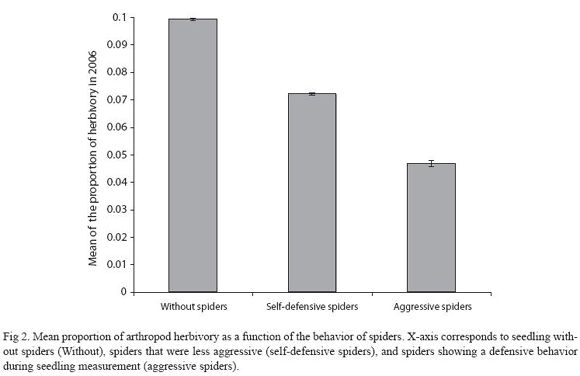
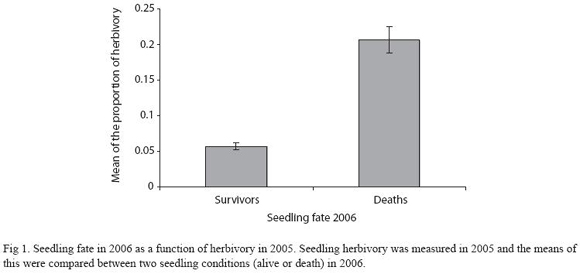
<body><![CDATA[<p><font face="Verdana" size="2"><b>Spider censuses: </b>Spider species, including different morphs, present on <i>D. oleifera </i>seedlings were collected outside the research plot in 2004, and specimens were deposited at the Natural History Museum of the University of Central America in Managua, Nicaragua. A description of the morphology of each spider was made and when present, the form of web built. Web building spiders were evident because the presence of their webs below or between leaflets and between leaves. The presence or absence of spiders was described in all seedlings present within the research area in January 2005 and January 2006. The field researchers approached each seedling very carefully, trying to minimize the "researcher effect" while examining each seedling for spiders. Two categories for spider location in each seedling of <i>D. oleifera </i>were used: (1) Present, when spiders were spotted on a seedling or when an abandoned spider web was found within or below leaflets of a seedling. In all cases when a spider was present on a seedling only one adult spider was located. It was observed that spiders re-colonized a seedling after spiders either jumped off or dropped down to the ground during the process of measurement. (2) Absent, without a spider and without evidence of spiders. Two categories for spider behavior in seedlings of <i>D. oleifera </i>were evaluated. First, when spiders were actively defending a seedling (aggressive behavior). Second, when spiders retreated once researchers approached a seedling (self-defensive behavior). </font></p>     <p><font face="Verdana" size="2"><b>Herbivory and relation to seedling demography: </b>A one-way ANOVA (Model I) was used to statistically compare the initial means of herbivory damage area in 2005 between the two seedling fate categories, surviving and dead seedlings in 2006 (a factor with two categorical levels). Arthropod herbivory damage was square root transformed in order to normalize data. A one-way ANOVA (Model I) was used to test for differences in mean herbivory damage between seedlings without spiders, seedlings with aggressive spiders and seedlings with self-defensive spiders (less aggressive spiders). Again, arthropod herbivory damage was square root transformed in order to normalize data. </font></p> <i><font face="Verdana" size="1"> </font></i>     <p><font face="Verdana" size="2">The growth of 514 surviving seedlings, whose height was measured during the two years of the observational study, was evaluated using ANCOVAs. A first model studied the seedling height in the second year (<i>Y</i><sub>t</sub>) as a</font><span  style="font-family: verdana;"> </span><font face="Verdana" size="2">function of the height in the first year (<i>Y</i></font><i><sub><font  face="Verdana" size="1">t-1</font></sub></i><font face="Verdana"  size="2">), the presence/absence of spiders in both years (<i>S<sub>t</sub>,</i><span style="font-style: italic;">S<sub>t-1</sub></span>) and the percentage of arthropod herbivory</font><span style="font-family: verdana;"><span  style="font-style: italic;"> </span></span><font face="Verdana"  size="2">in both years (<i>H<sub>t</sub>, H</i></font><i><sub><font face="Verdana"  size="1">t-1</font></sub></i><font face="Verdana" size="2">):</font></p>     <p style="text-align: center;"><i><font face="Verdana" size="2">Y<sub>t</sub></font></i><font  face="Verdana" size="2">= &#956; + &#945;</font><i><font face="Verdana" size="2"> Y</font><sub><font face="Verdana" size="1">t-1 </font></sub></i><font  face="Verdana" size="2">+ &#946;</font><i><font face="Verdana" size="2"><sub>1</sub>S<sub>t</sub></font></i><font  face="Verdana" size="2">+ &#946;</font><sub><font face="Verdana" size="1">2</font></sub><i><font  face="Verdana" size="2">H<sub>t-1</sub></font></i><font face="Verdana"  size="2">+ &#947;</font><sub><font face="Verdana" size="1">2</font></sub><font  face="Verdana" size="2">Ht-1 + </font><font face="Verdana" size="2">&#949;</font><font  face="Verdana" size="2">&nbsp;&nbsp; (1)</font></p>     <p><font face="Verdana" size="2">Where &#956;</font><font face="Verdana"  size="2"> is the intercept which gives an idea of the average growth per seedling, </font><font face="Verdana" size="2">&#945; is a parameter relating the current height with the height from the previous year, &#946;</font><sub><font  face="Verdana" size="1">i </font></sub><font face="Verdana" size="2">accounts for the additional growth due to the presence of spiders in each year, &#947;</font><sub><font  face="Verdana" size="1">i </font></sub><font face="Verdana" size="2">measures the effect of herbivory on seedling growth, and </font><font  face="Verdana" size="2">&#949; is the error which is assumed to be identically and independently distributed. The model presented </font></p> <font face="Verdana" size="2">     <p>in formula 1 was analyzed in order to test for the statistical significance of each predictor and based on this result the model was simplified by a process of backward elimination (Venables &amp; Ripley 2002). The predictors in the model that are statistically significant are in Formula 2: </p> </font>     <p style="text-align: center;"><i><font face="Verdana" size="2">Y<sub>t</sub></font></i> <font face="Verdana" size="2">= &#956; + &#945;</font><i><font face="Verdana"  size="2"> Y</font><sub><font face="Verdana" size="1">t-1 </font></sub></i><font  face="Verdana" size="2">+ &#946;<sub>1</sub>S<sub>t</sub></font><font  face="Verdana" size="2">+ &#946;</font><sub><font face="Verdana" size="1">2</font></sub><i><font  face="Verdana" size="2">S<sub>t-1</sub> + </font></i><i><font  face="Verdana" size="2">Y<sub>t</sub></font></i><i><font face="Verdana"  size="2">H<sub>1</sub></font></i><font face="Verdana" size="2">+ &#949;</font> <sup><font face="Verdana" size="2">(2) </font></sup></p>     <p><font face="Verdana" size="3"><span style="font-weight: bold;">Results</span> </font></p>     <p><font face="Verdana" size="2"><b>Spider census, herbivory and seedling demography: </b>Arthropod herbivory damage in 2005 (&lt;20%) correlated negatively with seedling survival in 2006 (<i>F</i></font><sub><font  face="Verdana" size="1">1,1278 </font></sub><font face="Verdana"  size="2">= 111.9, p&lt;0.001; <a href="#f1">Fig. 1</a>). There is a tend towards lower arthropod herbivory damage in seedlings with "selfdefensive" spiders and more so in seedlings that harbored spiders with "aggressive" traits (F<sub>2,701</sub>= 2.65, p&lt;0.05; <a href="#f2">Fig. 2</a>).    <br> </font></p>     ]]></body>
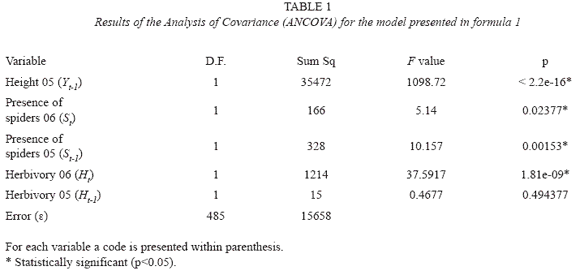
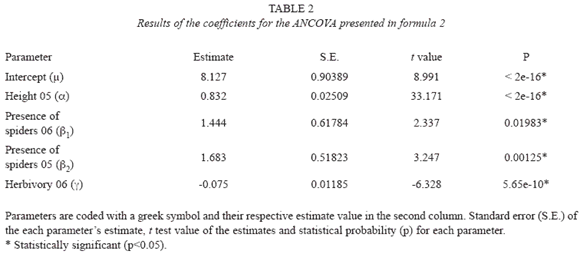
<body><![CDATA[<p><font face="Verdana" size="2">    <br> <a name="f1"></a></font></p>     <div style="text-align: center;"><font face="Verdana" size="2"><img  src="/img/revistas/rbt/v57n3/art30i1.jpg" title="" alt=""  style="width: 580px; height: 274px;"></font>    <br> </div>     <p><font face="Verdana" size="2">    <br> <a name="f2"></a></font></p>     <div style="text-align: center;"><font face="Verdana" size="2"><img  src="/img/revistas/rbt/v57n3/art30i2.jpg" title="" alt=""  style="width: 580px; height: 376px;"></font>    <br> <font face="Verdana" size="2"> </font></div> <font face="Verdana" size="2">     <p>For seedlings without spiders present and without herbivory, growth was not related to seedling size in the previous year, since the coefficient relating the size in 2006 (<i>Y</i><sub>t</sub>) to <font  face="Verdana" size="2">the size in 2005 (<i>Y</i></font><i><sub><font  face="Verdana" size="1">t-1</font></sub></i><font face="Verdana"  size="2">), is almost constant for all these seedlings (&#956;~8 cm) (<a href="#t1">Table 1</a>, <a href="#t2">2</a>). For seedlings with spiders present and herbivory damage, growth was positively correlated with spider presen</font><font face="Verdana"  size="2">ce and negatively correlated with arthropod herbivory damage. The result showed that the mean seedling height (&#956;~8 cm), increased approximately 1.5 cm for each year that a spider was present on the seedlings (&#946;</font><sub><font face="Verdana" size="1">1</font></sub><font  face="Verdana" size="2">, &#946;</font><sub><font face="Verdana" size="1">2</font></sub><font  face="Verdana" size="2">) and decreased 0.75 cm in height for each percent unit of arthropod herbivory (&#947;). The model presented in formula 2 is also statistically significant A</font><font face="Verdana"  size="2">NCOVA (<i>R</i></font><sup><font face="Verdana" size="1">2 </font></sup><font  face="Verdana" size="2">= 0.72, <i>F</i></font><sub><font  face="Verdana" size="1">4,509 </font></sub><font face="Verdana"  size="2">= 333.5, p&lt;0.05; <a href="#t1">Table 1</a>) and all coefficients are statistically significant (see <a href="#t2">Table 2</a>).    <br> </font></p>     ]]></body>
<body><![CDATA[<p><font face="Verdana" size="2">    <br> <a name="t1"></a></font></p> </font>     <div style="text-align: center;"><font face="Verdana" size="2"><img  src="/img/revistas/rbt/v57n3/art30t1.gif" title="" alt=""  style="width: 580px; height: 275px;"></font>    <br> </div> <font face="Verdana" size="2">     <p><font face="Verdana" size="2">    <br> <a name="t2"></a></font></p> </font>     <div style="text-align: center;"><font face="Verdana" size="2"><img  src="/img/revistas/rbt/v57n3/art30t2.gif" title="" alt=""  style="width: 580px; height: 254px;"></font>    <br> <font face="Verdana" size="2"> </font></div>     <p><font face="Verdana" size="2"><a href="#f3">Figure 3</a> shows seedling height in 2006 as a function of its value in 2005 with coded symbols that represent the presence of spiders in panel A and for different intensities of arthropod herbivory in panel B. Spider presence correlated with higher growth rates represented by the code "S" clustered above the 45 degrees line, thus corroborating the correlation between spider presence and seedling growth (<a href="#t1">Table 1</a>,<a href="#t2">2</a>; <a  href="#f3">Fig. 3A</a>). In <a href="#f3">Fig. 3B</a> it is clear that seedling growth correlated negatively with level of arthropod herbivory represented by the green "L" code clustered above the 45 degrees line. A decrease in seedling height is observed in seedlings with high arthropod herbivory, represented by the cluster of blue "H" codes (<a href="#t1">Table 1</a>,<a href="#t2">2</a>). The high degree of scattering suggests that for seedlings without herbivory growth did not depend on seedling height in the previous year – represented by the black "A" code.    <br> </font></p>     ]]></body>
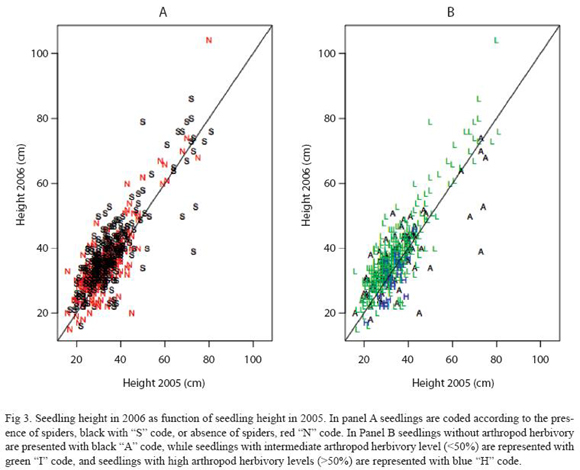
<body><![CDATA[<p><font face="Verdana" size="2">    <br> <a name="f3"></a></font></p>     <div style="text-align: center;"><font face="Verdana" size="2"><img  src="/img/revistas/rbt/v57n3/art30i3.jpg" title="" alt=""  style="width: 580px; height: 470px;"></font>    <br> <font face="Verdana" size="2"> </font></div> <font face="Verdana" size="1">    <br> </font><font face="Verdana" size="2"> </font>     <p><font face="Verdana" size="2"><font size="3"><span  style="font-weight: bold;">Discussion</span>    <br> </font></font></p>     <p><font face="Verdana" size="2"><font size="3"><font><font  face="Verdana" size="2">There is a positive indirect effect of spiders on seedling survival and growth since reduced arthropod herbivory correlated with spider presence (<a href="#f1">Fig. 1</a>). We think that spiders could be preying on or harassing herbivorous arthropods, because field observations suggested that aggressive spider behaviors –within the spider community– led to reduced arthropod herbivory levels. For instance, <a href="#f2">Fig. 2</a> shows that aggressive spider behaviors correlated<sub>&nbsp;</sub> negatively with levels of arthropod herbivory.&nbsp; Although the beneficial effect of the spider community on seedlings could vary in part due&nbsp; to spider species behaviors. The net beneficial effect of spiders on seedling survival is strongly supported by our findings here (<a href="#t1">Table 1</a>,<a href="#t2">2</a>; <a  href="#f3">Fig. 3A</a>). The biological interaction responsible for the positive indirect effect of spiders on seedlings needs to be investigated in more detail. Future lines of research would focus on identifying the herbivorous arthropods and determining the relative predatory effect of spiders upon herbivorous arthropods of <i>D. oleifera</i>.</font></font></font></font></p>     <p><font face="Verdana" size="2"><font size="3"><font><font  face="Verdana" size="2">While spider presence correlated negatively with arthropod herbivory, several spider species could reduce photosynthetic leaf area. For example, in a study of the plant <i>Styrax benzoin </i>in Malaysia, 19% of seedlings had spiders whose presence led to 2-43% of reduction in photosynthetic area (Kiew 1982). The reason for this relationship is due to the fact that several spider species roll leaves to use as a refuge. A similar relationship was found in a population of <i>D. oleifera </i>in Costa Rica (Clark &amp; Clark 1985). In this research spiders are mainly web builders, and these kinds of spiders do not reduced photosynthetic leaf area because web spiders construct webs between leaflets or below leaflets. The relative effect of web builder spiders as predators of herbivorous arthropods might not be as important as spiders in the familiy Salticidae. Web building spiders rely on webs to capture herbivorous arthropods and do not seems to be as aggressive. Spiders in the family Salticidae patrol leaves and hunt herbivorous arthropods and thus could be efficient predators in the <i>D. oleifera </i>system (pers. obs.).     <br> </font></font></font></font></p>     ]]></body>
<body><![CDATA[<p><font face="Verdana" size="2"><font size="3"><font><font  face="Verdana" size="2">The level of arthropod herbivory decreases with distance to the nearest conspecific adult tree. This result was discussed in great detail in a previous paper (Ruiz <i>et al. </i>2009). The observed arthropod herbivory pattern suggests that a species-specific arthropod herbivore could be acting upon seedlings of <i>D. oleifera</i>. Here, we looked for the herbivorous arthropod responsible of the herbivory damage to seedlings of <i>D. oleifera</i>. Even when we approached seedlings carefully, we were unable to find the herbivorous arthropods on seedlings of <i>D. oleifera</i>. Presumably, the damage was done during the night by a nocturnal insect species. Sampling the insect community with sticky traps set up near seedlings of <i>D. oleifera </i>would be necessary to identify the agent causing the herbivory damage.</font></font></font></font></p>     <p><font face="Verdana" size="2"><font size="3"><font><font  face="Verdana" size="2">There is a strong pressure of herbivorous arthropods on seedling fate of <i>D. oleifera</i>. It is remarkably that lower levels of herbivory damage (&lt;20%) were severe enough to determine seedling growth and fate. This result is nothing new, since the work conducted in a population of <i>D. oleifera </i>in a tropical rainforest of Costa Rica showed that even low levels of insect herbivory (~8%) were lethal (Clark &amp; Clark 1985). Low levels of insect herbivory seem to be omnipresent on the forest floor. Even though herbivory decreased with the distance to the nearest conspecific adult tree in both studies, low levels of arthropod herbivory are distributed throughout the forest floor and can be severe enough to lead to seedling mortality in practically all circumstances (Clark &amp; Clark 1985). This trend has been repeatedly observed in this rainforest in eastern Nicaragua. The interesting question is why such low levels of herbivory damage are so important on seedling demography? One possible answer to this question is the notion that in the shaded forest floor rainforest seedlings may be close to –or at– the compensatory point of light (point where respiration equals photosynthesis). Under these conditions even low levels of herbivory could be subtracting critically necessary photosynthetic tissue for survival.</font></font></font></font></p>     <p><font face="Verdana" size="2"><font size="3"><font><font  face="Verdana" size="2">Seedling height increment was not related to seedling height in the previous year but seedling height is positively related to the presence of spiders and negatively to levels of herbivory. Our previous fieldwork suggested that seedling survival of <i>D. oleifera </i>was not related to seedling growth (Ruiz <i>et al. </i>2009). Perhaps seedling growth may be required only when conditions are suitable – <i>i.e. </i>when a light-gap forms. Thus, maintaining a canopy area above a threshold would keep seedlings close to the compensatory point of light until the occurrence of a light-gap. Under these conditions the beneficial indirect effect of spiders on seedling recruitment matters because spider would lower arthropod herbivore abundance, lower arthropod herbivory, and increase seedling survival rate (<a href="#f1">Fig. 1</a>, <a href="#f3">3B</a>).</font></font></font></font></p>     <p><font face="Verdana" size="2"><font size="3"><font><font  face="Verdana" size="2">Although insect herbivory is negatively correlated with seedling height, seedling growth may be determined by other factors. For example, seedling growth of <i>D. oleifera </i>in Costa Rica decreased due to apical meristem damage – apparently caused by fungal infections (Clark &amp; Clark 1985). Another kind of damage that seedlings experienced is the impact of branches and twigs fallings from the canopy (Clark &amp; Clark 1987); this kind of seedling damage was rare in the <i>D. oleifera </i>population in eastern Nicaragua. In addition, recent field research has suggested beneficial trophic cascade effects of arboreal ants (Floren <i>et al</i>. 2002) and birds (Van Bael <i>et al</i>. 2003) on seedlings because these are predators of herbivorous arthropods. The relative contribution of arboreal ants and birds on seedling growth seem to be minimal in the <i>D. oleifera </i>system because the suspected herbivores are nocturnal and could be safe from ants and birds which in general are diurnal.</font></font></font></font></p>     <p><font face="Verdana" size="2"><font size="3"><font><font  face="Verdana" size="2">In sum, spider presence leads to lower herbivory levels, more seedling growth and better survival of <i>D. oleifera</i>. The present study is only correlative and work is still needed to unequivocally establish cause-andeffect relationships among spiders, herbivorous arthropods and seedling demography. In spite of this, the idea that spider presence led to higher seedling recruitment is novel in tropical rainforest studies and opens new and exciting research lines. For example, including trophic cascade effects in forest organization theories would lead us to a better understanding of how recruitment occurs in tropical rainforests.</font></font></font></font></p> <font face="Verdana" size="2" style="font-weight: bold;"><font size="3"><font><font  face="Verdana" size="2"><font size="3">     <p>Acknowledgments</p> </font></font></font></font></font>     <p><font face="Verdana" size="2"><font size="3"><font><font  face="Verdana" size="2">Financial support came from a National Science Foundation Research in Undergraduate Institutions grant (DEB-0135350) to Douglas H. Boucher; a block grant from the Department of Ecology and Evolutionary Biology of the University of Michigan (UM) to Javier Ruiz (JR); an individual fellowship from the International Institute of the UM to JR; an International Foundation for Science Grant, Sweden (D-3939-1) to JR and the Rackham International Student Grant of the University of Michigan to JR. Two undergraduate students from the University of the Autonomous Regions of the Atlantic Coast of Nicaragua (URACCAN) helped with data gathering. Logistical support was provided by members of Proyecto Biodiversidad of URACCAN. Beverly Rathcke, Paul Foster and Sandra Yap gave valuable comments on early versions of the manuscript.</font></font></font></font></p> <hr style="width: 100%; height: 2px;">     <p><font face="Verdana" size="2"><font size="3"><font><font  face="Verdana" size="2"><span style="font-weight: bold;">Resumen</span> </font></font></font></font></p> <font face="Verdana" size="2"><font size="3"><font><font face="Verdana"  size="2"><font face="Verdana" size="2"><font size="3"><font><font  face="Verdana" size="2"> </font></font></font></font></font></font></font></font>     <p><font face="Verdana" size="2"><font size="3"><font><font  face="Verdana" size="2"><font face="Verdana" size="2"><font size="3"><font  face="Verdana" size="2"><font face="Verdana" size="2">Se presenta evidencia que sugiere (1) que los niveles bajos de herbivoría de artrópodos se correlacionan con la supervivencia de plántulas y, (2) que la presencia de arañas se correlaciona con los niveles bajos de herbivoría de artrópodos, crecimiento y supervivencia de plántulas de la especie de bosque húmedo tropical <i>Dipteryx oleifera </i>en el este de Nicaragua. El estudio se realizó entre enero del 2005 y enero del 2006 en una parcela de 6.37 ha establecida en 2002. Se midió altura de plántulas, presencia de arañas en plántulas, comportamiento de arañas, y porcentaje de herbivoría de artrópodos. La suerte de las plántulas fue monitoreada con el objetivo de determinar su correlación con la presencia de arañas, el tamaño inicial de las plántulas y herbivoría de artrópodos. Un GLM mostró que las plántulas con bajo nivel de daño de herbivoría (&lt;20%) sobrevivieron más que las plántulas con niveles mayores de daño por herbivoría, las cuales experimentaron mortalidades cercanas al 100 por ciento. Los resultados de otro GLM sugieren que la altura media de plántulas (aprox. 8 cm) incrementó aproximadamente 1.5 cm por cada año en el cual las arañas se encontraron presente en las plántulas, y decrecieron 0.75 cm en altura por cada unidad de herbivoría. También se reporta menor herbivoría en plántulas colonizadas por arañas de comportamiento agresivo. </font></font></font></font></font></font></font></font></p>     <p><font face="Verdana" size="2"><font size="3"><font><font  face="Verdana" size="2"><font face="Verdana" size="2"><font size="3"><font  face="Verdana" size="2"><font face="Verdana" size="2"><b>Palabras clave: </b><i>Dipteryx oleifera</i>, herbivoría de artrópodos, demografía de plántulas, Nicaragua.    ]]></body>
<body><![CDATA[<br> </font></font></font></font></font></font></font></font></p> <hr style="width: 100%; height: 2px;">     <p><font face="Verdana" size="2"><font size="3"><font><font  face="Verdana" size="2"><font face="Verdana" size="2"><font size="3"><font  face="Verdana" size="2"><font face="Verdana" size="2"></font></font></font></font></font></font></font></font></p>     <p style="text-align: center;"><font face="Verdana" size="2"><font  size="3"><font><font face="Verdana" size="2"><font face="Verdana"  size="2"><font size="3"><font face="Verdana" size="2"><font  face="Verdana" size="2">Received 18-I-2008. Corrected 22-II-2009. Accepted 25-III-2009.</font></font></font></font></font></font></font></font></p>     <p><font face="Verdana" size="2"><font size="3"><font><font  face="Verdana" size="2"><font face="Verdana" size="2"><font size="3"><font  face="Verdana" size="2"><font face="Verdana" size="3"><span  style="font-weight: bold;">References</span> </font></font></font></font></font></font></font></font></p>     <!-- ref --><p><font face="Verdana" size="2">Augspurger, C. &amp; K. Kitajima. 1992. Experimental studies of seedling recruitment from contrasting seed distribution. Ecology 73: 1270-1284. </font>&nbsp;&nbsp;&nbsp;&nbsp;&nbsp;&nbsp;&nbsp;&nbsp;[&#160;<a href="javascript:void(0);" onclick="javascript: window.open('/scielo.php?script=sci_nlinks&ref=1381358&pid=S0034-7744200900030003000001&lng=','','width=640,height=500,resizable=yes,scrollbars=1,menubar=yes,');">Links</a>&#160;]<!-- end-ref --><!-- ref --><p><font face="Verdana" size="2>Augspurger,C.K. 1983. Seed dispersal of the tropical tree, <i>Platypodium elegans</i>, and the escape of its seedlings from fungal pathogens. J. Ecol. 71: 759-771. </font></font></font></font></font>&nbsp;&nbsp;&nbsp;&nbsp;&nbsp;&nbsp;&nbsp;&nbsp;[&#160;<a href="javascript:void(0);" onclick="javascript: window.open('/scielo.php?script=sci_nlinks&ref=1381359&pid=S0034-7744200900030003000002&lng=','','width=640,height=500,resizable=yes,scrollbars=1,menubar=yes,');">Links</a>&#160;]<!-- end-ref --><!-- ref --><p><font face="Verdana" size="2">Augspurger, C.K. 1984. Seedling survival of tropical tree species: interactions of dispersal distance, light-gaps, and pathogens. Ecology 65: 1705-1712. </font>&nbsp;&nbsp;&nbsp;&nbsp;&nbsp;&nbsp;&nbsp;&nbsp;[&#160;<a href="javascript:void(0);" onclick="javascript: window.open('/scielo.php?script=sci_nlinks&ref=1381360&pid=S0034-7744200900030003000003&lng=','','width=640,height=500,resizable=yes,scrollbars=1,menubar=yes,');">Links</a>&#160;]<!-- end-ref --><!-- ref --><p><font face="Verdana" size="2"><font size="3"><font><font  face="Verdana" size="2"><font face="Verdana" size="2"><font size="3"><font  face="Verdana" size="2"><font face="Verdana" size="2">Basset, Y. 2001. Invertebrates in the canopy of tropical rain forests. How much do we really know? Plant Ecol. 153: 87-107. </font></font></font></font></font></font></font></font>&nbsp;&nbsp;&nbsp;&nbsp;&nbsp;&nbsp;&nbsp;&nbsp;[&#160;<a href="javascript:void(0);" onclick="javascript: window.open('/scielo.php?script=sci_nlinks&ref=1381361&pid=S0034-7744200900030003000004&lng=','','width=640,height=500,resizable=yes,scrollbars=1,menubar=yes,');">Links</a>&#160;]<!-- end-ref --><!-- ref --><p><font face="Verdana" size="2"><font size="3"><font><font  face="Verdana" size="2"><font face="Verdana" size="2"><font size="3"><font  face="Verdana" size="2"><font face="Verdana" size="2">Carpenter, S.R., J.J. Cole, J.R. Hodgson, J.F. Kitchell, M.L. Pace, D. Bade, K.L. Cottingham, T.E. Essington, J.N. Houser &amp; D.E. Schindler. 2001. Trophic cascades, nutrients, and lake productivity: whole-lake experiments. Ecolog. Monog. 71: 163-186. </font></font></font></font></font></font></font></font>&nbsp;&nbsp;&nbsp;&nbsp;&nbsp;&nbsp;&nbsp;&nbsp;[&#160;<a href="javascript:void(0);" onclick="javascript: window.open('/scielo.php?script=sci_nlinks&ref=1381362&pid=S0034-7744200900030003000005&lng=','','width=640,height=500,resizable=yes,scrollbars=1,menubar=yes,');">Links</a>&#160;]<!-- end-ref --><!-- ref --><p><font face="Verdana" size="2"><font size="3"><font><font  face="Verdana" size="2"><font face="Verdana" size="2"><font size="3"><font  face="Verdana" size="2"><font face="Verdana" size="2">Clark, D.A. &amp; D.B. Clark. 1984. Spacing dynamics of a tropical rain forest tree: evaluation of the Janzen-Connel model. The American Naturalist 124: 769-788. </font></font></font></font></font></font></font></font>&nbsp;&nbsp;&nbsp;&nbsp;&nbsp;&nbsp;&nbsp;&nbsp;[&#160;<a href="javascript:void(0);" onclick="javascript: window.open('/scielo.php?script=sci_nlinks&ref=1381363&pid=S0034-7744200900030003000006&lng=','','width=640,height=500,resizable=yes,scrollbars=1,menubar=yes,');">Links</a>&#160;]<!-- end-ref --><!-- ref --><p><font face="Verdana" size="2"><font size="3"><font><font  face="Verdana" size="2"><font face="Verdana" size="2"><font size="3"><font  face="Verdana" size="2"><font face="Verdana" size="2">Clark, D.A. &amp; D.B. Clark. 1992. Life history diversity of canopy and emergent trees in a neotropical rain forest. Ecolog. Monog. 62: 315-344. </font></font></font></font></font></font></font></font>&nbsp;&nbsp;&nbsp;&nbsp;&nbsp;&nbsp;&nbsp;&nbsp;[&#160;<a href="javascript:void(0);" onclick="javascript: window.open('/scielo.php?script=sci_nlinks&ref=1381364&pid=S0034-7744200900030003000007&lng=','','width=640,height=500,resizable=yes,scrollbars=1,menubar=yes,');">Links</a>&#160;]<!-- end-ref --><!-- ref --><p><font face="Verdana" size="2"><font size="3"><font><font  face="Verdana" size="2"><font face="Verdana" size="2"><font size="3"><font  face="Verdana" size="2"><font face="Verdana" size="2">Clark, D.B. &amp; D.A. Clark. 1985. Seedling dynamics of a tropical tree: impacts of herbivory and meristem damage. Ecology 66: 1884-1892. </font></font></font></font></font></font></font></font>&nbsp;&nbsp;&nbsp;&nbsp;&nbsp;&nbsp;&nbsp;&nbsp;[&#160;<a href="javascript:void(0);" onclick="javascript: window.open('/scielo.php?script=sci_nlinks&ref=1381365&pid=S0034-7744200900030003000008&lng=','','width=640,height=500,resizable=yes,scrollbars=1,menubar=yes,');">Links</a>&#160;]<!-- end-ref --><!-- ref --><p><font face="Verdana" size="2"><font size="3"><font><font  face="Verdana" size="2"><font face="Verdana" size="2"><font size="3"><font  face="Verdana" size="2"><font face="Verdana" size="2">Clark, D.B. &amp; D.A. Clark. 1987. Population ecology and microhabitat distribution of <i>Dipteryx panamensis </i>a neotropical rain forest tree. Biotropica 19: 236-244. </font></font></font></font></font></font></font></font>&nbsp;&nbsp;&nbsp;&nbsp;&nbsp;&nbsp;&nbsp;&nbsp;[&#160;<a href="javascript:void(0);" onclick="javascript: window.open('/scielo.php?script=sci_nlinks&ref=1381366&pid=S0034-7744200900030003000009&lng=','','width=640,height=500,resizable=yes,scrollbars=1,menubar=yes,');">Links</a>&#160;]<!-- end-ref --><!-- ref --><p><font face="Verdana" size="2"><font size="3"><font><font  face="Verdana" size="2"><font face="Verdana" size="2"><font size="3"><font  face="Verdana" size="2"><font face="Verdana" size="2">Clark, D.B. &amp; D.A. Clark. 1991. The impact of physical damage on canopy tree regeneration in tropical rain forest. J. Ecol. 79: 447-457. </font></font></font></font></font></font></font></font>&nbsp;&nbsp;&nbsp;&nbsp;&nbsp;&nbsp;&nbsp;&nbsp;[&#160;<a href="javascript:void(0);" onclick="javascript: window.open('/scielo.php?script=sci_nlinks&ref=1381367&pid=S0034-7744200900030003000010&lng=','','width=640,height=500,resizable=yes,scrollbars=1,menubar=yes,');">Links</a>&#160;]<!-- end-ref --><!-- ref --><p><font face="Verdana" size="2"><font size="3"><font><font  face="Verdana" size="2"><font face="Verdana" size="2"><font size="3"><font  face="Verdana" size="2"><font face="Verdana" size="2">Clark, D.B., D.A. Clark &amp; P.M. Rich. 1993. Comparative analysis of micohabitat utilization by saplings of nine tree species in neotropical rain forest. Biotropica 25: 395-407. </font></font></font></font></font></font></font></font>&nbsp;&nbsp;&nbsp;&nbsp;&nbsp;&nbsp;&nbsp;&nbsp;[&#160;<a href="javascript:void(0);" onclick="javascript: window.open('/scielo.php?script=sci_nlinks&ref=1381368&pid=S0034-7744200900030003000011&lng=','','width=640,height=500,resizable=yes,scrollbars=1,menubar=yes,');">Links</a>&#160;]<!-- end-ref --><!-- ref --><p><font face="Verdana" size="2"><font size="3"><font><font  face="Verdana" size="2"><font face="Verdana" size="2"><font size="3"><font  face="Verdana" size="2"><font face="Verdana" size="2">Coley, P.D. 1983. Intraspecific variation in herbivory on two tropical tree species. Ecology 64: 426-433. </font></font></font></font></font></font></font></font>&nbsp;&nbsp;&nbsp;&nbsp;&nbsp;&nbsp;&nbsp;&nbsp;[&#160;<a href="javascript:void(0);" onclick="javascript: window.open('/scielo.php?script=sci_nlinks&ref=1381369&pid=S0034-7744200900030003000012&lng=','','width=640,height=500,resizable=yes,scrollbars=1,menubar=yes,');">Links</a>&#160;]<!-- end-ref --><!-- ref --><p><font face="Verdana" size="2"><font size="3"><font><font  face="Verdana" size="2"><font face="Verdana" size="2"><font size="3"><font  face="Verdana" size="2"><font face="Verdana" size="2">Coley, P.D. 1990. Tasas de herbivorismo en diferentes árboles tropicales, p. 191-199. <i>In </i>E.G. Leigh Jr., A.S. Rand &amp; D.M. Windsor (eds.). Ecología de un bosque tropical: Ciclos estacionales y cambios a largo plazo. Instituto Smithsonian de Investigaciones Tropicales, Panama City, Panama. </font></font></font></font></font></font></font></font>&nbsp;&nbsp;&nbsp;&nbsp;&nbsp;&nbsp;&nbsp;&nbsp;[&#160;<a href="javascript:void(0);" onclick="javascript: window.open('/scielo.php?script=sci_nlinks&ref=1381370&pid=S0034-7744200900030003000013&lng=','','width=640,height=500,resizable=yes,scrollbars=1,menubar=yes,');">Links</a>&#160;]<!-- end-ref --><!-- ref --><p><font face="Verdana" size="2"><font size="3"><font><font  face="Verdana" size="2"><font face="Verdana" size="2"><font size="3"><font  face="Verdana" size="2"><font face="Verdana" size="2">Coley, P.D. &amp; J. Barone. 1996. Herbivory and plant defenses in tropical forest. Annu. Rev. Ecol. Syst. 27: 305-335. </font></font></font></font></font></font></font></font>&nbsp;&nbsp;&nbsp;&nbsp;&nbsp;&nbsp;&nbsp;&nbsp;[&#160;<a href="javascript:void(0);" onclick="javascript: window.open('/scielo.php?script=sci_nlinks&ref=1381371&pid=S0034-7744200900030003000014&lng=','','width=640,height=500,resizable=yes,scrollbars=1,menubar=yes,');">Links</a>&#160;]<!-- end-ref --><!-- ref --><p><font face="Verdana" size="2"><font size="3"><font><font  face="Verdana" size="2"><font face="Verdana" size="2"><font size="3"><font  face="Verdana" size="2"><font face="Verdana" size="2">Coley, P.D., J.P. Bryant &amp; F.S.I. Chapin. 1985. Resource availability and plant antiherbivore defense. Science 230: 895-899. </font></font></font></font></font></font></font></font>&nbsp;&nbsp;&nbsp;&nbsp;&nbsp;&nbsp;&nbsp;&nbsp;[&#160;<a href="javascript:void(0);" onclick="javascript: window.open('/scielo.php?script=sci_nlinks&ref=1381372&pid=S0034-7744200900030003000015&lng=','','width=640,height=500,resizable=yes,scrollbars=1,menubar=yes,');">Links</a>&#160;]<!-- end-ref --><!-- ref --><p><font face="Verdana" size="2"><font size="3"><font><font  face="Verdana" size="2"><font face="Verdana" size="2"><font size="3"><font  face="Verdana" size="2"><font face="Verdana" size="2">Dirzo, R. 1987. Estudio sobre interacciones planta herbívoros en Los "Tuxtlas" Veracruz. Rev. Biol. Trop. 35: 119-132. </font></font></font></font></font></font></font></font>&nbsp;&nbsp;&nbsp;&nbsp;&nbsp;&nbsp;&nbsp;&nbsp;[&#160;<a href="javascript:void(0);" onclick="javascript: window.open('/scielo.php?script=sci_nlinks&ref=1381373&pid=S0034-7744200900030003000016&lng=','','width=640,height=500,resizable=yes,scrollbars=1,menubar=yes,');">Links</a>&#160;]<!-- end-ref --><!-- ref --><p><font face="Verdana" size="2"><font size="3"><font><font  face="Verdana" size="2"><font face="Verdana" size="2"><font size="3"><font  face="Verdana" size="2"><font face="Verdana" size="2">Floren, A., A. Biun &amp; K.E. Linsenmair. 2002. Arboreal ants as key predators in tropical lowland forest trees. Oecologia 131: 137-144. </font></font></font></font></font></font></font></font>&nbsp;&nbsp;&nbsp;&nbsp;&nbsp;&nbsp;&nbsp;&nbsp;[&#160;<a href="javascript:void(0);" onclick="javascript: window.open('/scielo.php?script=sci_nlinks&ref=1381374&pid=S0034-7744200900030003000017&lng=','','width=640,height=500,resizable=yes,scrollbars=1,menubar=yes,');">Links</a>&#160;]<!-- end-ref --><!-- ref --><p><font face="Verdana" size="2"><font size="3"><font><font  face="Verdana" size="2"><font face="Verdana" size="2"><font size="3"><font  face="Verdana" size="2"><font face="Verdana" size="2">Granzow-de-la-Cerda, I., N. Zamora, J.H. Vandermeer &amp; D.H. Boucher. 1997. Biodiversidad de especies arbóreas en el bosque tropical húmedo del Caribe Nicaragüense siete años después del huracán Juana. Rev. Biol. Trop. 45: 1409-1419. </font></font></font></font></font></font></font></font>&nbsp;&nbsp;&nbsp;&nbsp;&nbsp;&nbsp;&nbsp;&nbsp;[&#160;<a href="javascript:void(0);" onclick="javascript: window.open('/scielo.php?script=sci_nlinks&ref=1381375&pid=S0034-7744200900030003000018&lng=','','width=640,height=500,resizable=yes,scrollbars=1,menubar=yes,');">Links</a>&#160;]<!-- end-ref --><!-- ref --><p><font face="Verdana" size="2"><font size="3"><font><font  face="Verdana" size="2"><font face="Verdana" size="2"><font size="3"><font  face="Verdana" size="2"><font face="Verdana" size="2">Gruner, D.S. 2004. Attenuation of top-down and bottom-up forces in a complex terrestrial community. Ecology 85: 3010-3022. </font></font></font></font></font></font></font></font>&nbsp;&nbsp;&nbsp;&nbsp;&nbsp;&nbsp;&nbsp;&nbsp;[&#160;<a href="javascript:void(0);" onclick="javascript: window.open('/scielo.php?script=sci_nlinks&ref=1381376&pid=S0034-7744200900030003000019&lng=','','width=640,height=500,resizable=yes,scrollbars=1,menubar=yes,');">Links</a>&#160;]<!-- end-ref --><!-- ref --><p><font face="Verdana" size="2"><font size="3"><font><font  face="Verdana" size="2"><font face="Verdana" size="2"><font size="3"><font  face="Verdana" size="2"><font face="Verdana" size="2">Hairston, N.G., E.S. Frederick &amp; B.S. Lawerence. 1960. Community structure, population control, and competition. The American Naturalist 94: 421-425. </font></font></font></font></font></font></font></font>&nbsp;&nbsp;&nbsp;&nbsp;&nbsp;&nbsp;&nbsp;&nbsp;[&#160;<a href="javascript:void(0);" onclick="javascript: window.open('/scielo.php?script=sci_nlinks&ref=1381377&pid=S0034-7744200900030003000020&lng=','','width=640,height=500,resizable=yes,scrollbars=1,menubar=yes,');">Links</a>&#160;]<!-- end-ref --><!-- ref --><p><font face="Verdana" size="2"><font size="3"><font><font  face="Verdana" size="2"><font face="Verdana" size="2"><font size="3"><font  face="Verdana" size="2"><font face="Verdana" size="2">Hyatt, L.A., M.S. Rosenberg, T.G. Howard, G. Bole, W. Fang, K. Anastacia, K. Brown, R. Grella, K. Hinman, J.P. Kruidiziel &amp; J. Gurevitch. 2003. The distance dependence prediction of the Janzen-Connell hypothesis: a meta-analysis. Oikos 103: 590-602. </font></font></font></font></font></font></font></font>&nbsp;&nbsp;&nbsp;&nbsp;&nbsp;&nbsp;&nbsp;&nbsp;[&#160;<a href="javascript:void(0);" onclick="javascript: window.open('/scielo.php?script=sci_nlinks&ref=1381378&pid=S0034-7744200900030003000021&lng=','','width=640,height=500,resizable=yes,scrollbars=1,menubar=yes,');">Links</a>&#160;]<!-- end-ref --><!-- ref --><p><font face="Verdana" size="2"><font size="3"><font><font  face="Verdana" size="2"><font face="Verdana" size="2"><font size="3"><font  face="Verdana" size="2"><font face="Verdana" size="2">IRENA. 1991. Diagnóstico de los recursos naturales no renovables. <i>In </i>Generalidades sobre la Costa Atlántica. Internal Report (IRENA) Vol II: 9-14. </font></font></font></font></font></font></font></font>&nbsp;&nbsp;&nbsp;&nbsp;&nbsp;&nbsp;&nbsp;&nbsp;[&#160;<a href="javascript:void(0);" onclick="javascript: window.open('/scielo.php?script=sci_nlinks&ref=1381379&pid=S0034-7744200900030003000022&lng=','','width=640,height=500,resizable=yes,scrollbars=1,menubar=yes,');">Links</a>&#160;]<!-- end-ref --><!-- ref --><p><font face="Verdana" size="2"><font size="3"><font><font  face="Verdana" size="2"><font face="Verdana" size="2"><font size="3"><font  face="Verdana" size="2"><font face="Verdana" size="2">Kiew, R. 1982. Germination and seedling survival in Kemenyan, <i>Styrax benzoin</i>. Malayasian Forester 45: 69-80. </font></font></font></font></font></font></font></font>&nbsp;&nbsp;&nbsp;&nbsp;&nbsp;&nbsp;&nbsp;&nbsp;[&#160;<a href="javascript:void(0);" onclick="javascript: window.open('/scielo.php?script=sci_nlinks&ref=1381380&pid=S0034-7744200900030003000023&lng=','','width=640,height=500,resizable=yes,scrollbars=1,menubar=yes,');">Links</a>&#160;]<!-- end-ref --><!-- ref --><p><font face="Verdana" size="2"><font size="3"><font><font  face="Verdana" size="2"><font face="Verdana" size="2"><font size="3"><font  face="Verdana" size="2"><font face="Verdana" size="2">Levins, R. 1974. Qualitative analysis of partially specified systems. Annals of the New York Academy of Science 231:123-138. </font></font></font></font></font></font></font></font>&nbsp;&nbsp;&nbsp;&nbsp;&nbsp;&nbsp;&nbsp;&nbsp;[&#160;<a href="javascript:void(0);" onclick="javascript: window.open('/scielo.php?script=sci_nlinks&ref=1381381&pid=S0034-7744200900030003000024&lng=','','width=640,height=500,resizable=yes,scrollbars=1,menubar=yes,');">Links</a>&#160;]<!-- end-ref --><!-- ref --><p><font face="Verdana" size="2"><font size="3"><font><font  face="Verdana" size="2"><font face="Verdana" size="2"><font size="3"><font  face="Verdana" size="2"><font face="Verdana" size="2">Moreau, G., E.S. Elveleigh, C.J. Lucarotti &amp; D.T. Quiring. 2006. Ecosystem alteration modifies the relative strength of bottom-up and top-down forces in a herbivore population. J. Animal Ecol. 75:853-861. </font></font></font></font></font></font></font></font>&nbsp;&nbsp;&nbsp;&nbsp;&nbsp;&nbsp;&nbsp;&nbsp;[&#160;<a href="javascript:void(0);" onclick="javascript: window.open('/scielo.php?script=sci_nlinks&ref=1381382&pid=S0034-7744200900030003000025&lng=','','width=640,height=500,resizable=yes,scrollbars=1,menubar=yes,');">Links</a>&#160;]<!-- end-ref --><!-- ref --><p><font face="Verdana" size="2"><font size="3"><font><font  face="Verdana" size="2"><font face="Verdana" size="2"><font size="3"><font  face="Verdana" size="2"><font face="Verdana" size="2">Romero, G.Q. &amp; J. Vasconcellos-Neto. 2004. Beneficial effects of flower-dwelling predators on their host plant. Ecology 85: 446-457. </font></font></font></font></font></font></font></font>&nbsp;&nbsp;&nbsp;&nbsp;&nbsp;&nbsp;&nbsp;&nbsp;[&#160;<a href="javascript:void(0);" onclick="javascript: window.open('/scielo.php?script=sci_nlinks&ref=1381383&pid=S0034-7744200900030003000026&lng=','','width=640,height=500,resizable=yes,scrollbars=1,menubar=yes,');">Links</a>&#160;]<!-- end-ref --><!-- ref --><p><font face="Verdana" size="2"><font size="3"><font><font  face="Verdana" size="2"><font face="Verdana" size="2"><font size="3"><font  face="Verdana" size="2"><font face="Verdana" size="2">Ruiz, J., D.H. Boucher, D. Ruiz-Moreno &amp; Ingram-Flores C. 2009. Recruitment Dynamics of the Tropical Rainforest tree <i>Dipteryx oleifera </i>(Fabaceae) in Eastern Nicaragua. Revista de Biología Tropical 57(1-2): 321-338. </font></font></font></font></font></font></font></font>&nbsp;&nbsp;&nbsp;&nbsp;&nbsp;&nbsp;&nbsp;&nbsp;[&#160;<a href="javascript:void(0);" onclick="javascript: window.open('/scielo.php?script=sci_nlinks&ref=1381384&pid=S0034-7744200900030003000027&lng=','','width=640,height=500,resizable=yes,scrollbars=1,menubar=yes,');">Links</a>&#160;]<!-- end-ref --><!-- ref --><p><font face="Verdana" size="2"><font size="3"><font><font  face="Verdana" size="2"><font face="Verdana" size="2"><font size="3"><font  face="Verdana" size="2"><font face="Verdana" size="2">Sullivan, J.J. 2003. Density-dependent shoot-borer herbivory increases the age of first reproduction and mortality of neotropical tree saplings. Oecologia 136: 96-106. </font></font></font></font></font></font></font></font>&nbsp;&nbsp;&nbsp;&nbsp;&nbsp;&nbsp;&nbsp;&nbsp;[&#160;<a href="javascript:void(0);" onclick="javascript: window.open('/scielo.php?script=sci_nlinks&ref=1381385&pid=S0034-7744200900030003000028&lng=','','width=640,height=500,resizable=yes,scrollbars=1,menubar=yes,');">Links</a>&#160;]<!-- end-ref --><!-- ref --><p><font face="Verdana" size="2"><font size="3"><font><font  face="Verdana" size="2"><font face="Verdana" size="2"><font size="3"><font  face="Verdana" size="2"><font face="Verdana" size="2">Van Bael, S.A. &amp; J.D. Brawn. 2005. The direct and indirect effects of insectivory by birds in two contrasting Neotropical forest. Oecologia 145:658-668. </font></font></font></font></font></font></font></font>&nbsp;&nbsp;&nbsp;&nbsp;&nbsp;&nbsp;&nbsp;&nbsp;[&#160;<a href="javascript:void(0);" onclick="javascript: window.open('/scielo.php?script=sci_nlinks&ref=1381386&pid=S0034-7744200900030003000029&lng=','','width=640,height=500,resizable=yes,scrollbars=1,menubar=yes,');">Links</a>&#160;]<!-- end-ref --><!-- ref --><p><font face="Verdana" size="2"><font size="3"><font><font  face="Verdana" size="2"><font face="Verdana" size="2"><font size="3"><font  face="Verdana" size="2"><font face="Verdana" size="2">Van Bael, S. A., J. D. Brawn, and S. K. Robinson. 2003. Birds defend trees from herbivores in neotropical forest canopy. PNAS 100: 8304-8307. </font></font></font></font></font></font></font></font>&nbsp;&nbsp;&nbsp;&nbsp;&nbsp;&nbsp;&nbsp;&nbsp;[&#160;<a href="javascript:void(0);" onclick="javascript: window.open('/scielo.php?script=sci_nlinks&ref=1381387&pid=S0034-7744200900030003000030&lng=','','width=640,height=500,resizable=yes,scrollbars=1,menubar=yes,');">Links</a>&#160;]<!-- end-ref --><!-- ref --><p><font face="Verdana" size="2"><font size="3"><font><font  face="Verdana" size="2"><font face="Verdana" size="2"><font size="3"><font  face="Verdana" size="2"><font face="Verdana" size="2">Vandermeer, J.H., I. Granzow-de-la-Cerda, D.H. Boucher, I. Perfecto &amp; J. Ruiz. 2000. Hurricane disturbance and tropical tree species diversity. Science 290: 788-791. </font></font></font></font></font></font></font></font>&nbsp;&nbsp;&nbsp;&nbsp;&nbsp;&nbsp;&nbsp;&nbsp;[&#160;<a href="javascript:void(0);" onclick="javascript: window.open('/scielo.php?script=sci_nlinks&ref=1381388&pid=S0034-7744200900030003000031&lng=','','width=640,height=500,resizable=yes,scrollbars=1,menubar=yes,');">Links</a>&#160;]<!-- end-ref --><!-- ref --><p><font face="Verdana" size="2"><font size="3"><font><font  face="Verdana" size="2"><font face="Verdana" size="2"><font size="3"><font  face="Verdana" size="2"><font face="Verdana" size="2">Venables, W.N. &amp; B.D. Ripley. 2002. Modern Applied Statistics with S. Springer, New York, USA. </font></font></font></font></font></font></font></font>&nbsp;&nbsp;&nbsp;&nbsp;&nbsp;&nbsp;&nbsp;&nbsp;[&#160;<a href="javascript:void(0);" onclick="javascript: window.open('/scielo.php?script=sci_nlinks&ref=1381389&pid=S0034-7744200900030003000032&lng=','','width=640,height=500,resizable=yes,scrollbars=1,menubar=yes,');">Links</a>&#160;]<!-- end-ref --><!-- ref --><p><font face="Verdana" size="2"><font size="3"><font><font  face="Verdana" size="2"><font face="Verdana" size="2"><font size="3"><font  face="Verdana" size="2"><font face="Verdana" size="2">Yih, K., D.H. Boucher, J.H. Vandermeer &amp; N. Zamora. 1991. Recovery of the rainforest of southeastern Nicaragua after destruction by hurricane Joan. Biotropica 23: 106-113. </font></font></font></font></font></font></font></font>&nbsp;&nbsp;&nbsp;&nbsp;&nbsp;&nbsp;&nbsp;&nbsp;[&#160;<a href="javascript:void(0);" onclick="javascript: window.open('/scielo.php?script=sci_nlinks&ref=1381390&pid=S0034-7744200900030003000033&lng=','','width=640,height=500,resizable=yes,scrollbars=1,menubar=yes,');">Links</a>&#160;]<!-- end-ref --><p><font face="Verdana" size="2"><font size="3"><font><font  face="Verdana" size="2"><font face="Verdana" size="2"><font size="3"><font  face="Verdana" size="2"><font face="Verdana" size="3"><span  style="font-weight: bold;">Internet references</span> </font></font></font></font></font></font></font></font></p> <font face="Verdana" size="2"><font size="3"><font><font face="Verdana"  size="2"><font face="Verdana" size="2"><font size="3"><font  face="Verdana" size="2"><font face="Verdana" size="2">     <!-- ref --><p>Fournier, L.A. 2003. <i>Dipteryx panamensis </i>(pittier) Record &amp; Mell. (Downloaded: July 10, 2005, <a  href="http://www.rngr.net/publications/ttsm/folder.2003-07-11.4726">www.rngr.net/ publications/ttsm/folder.2003-07-11.4726</a>). &nbsp;&nbsp;&nbsp;&nbsp;&nbsp;&nbsp;&nbsp;&nbsp;[&#160;<a href="javascript:void(0);" onclick="javascript: window.open('/scielo.php?script=sci_nlinks&ref=1381392&pid=S0034-7744200900030003000034&lng=','','width=640,height=500,resizable=yes,scrollbars=1,menubar=yes,');">Links</a>&#160;]<!-- end-ref --> ]]></body><back>
<ref-list>
<ref id="B1">
<nlm-citation citation-type="journal">
<person-group person-group-type="author">
<name>
<surname><![CDATA[Augspurger]]></surname>
<given-names><![CDATA[C]]></given-names>
</name>
<name>
<surname><![CDATA[Kitajima]]></surname>
<given-names><![CDATA[K]]></given-names>
</name>
</person-group>
<article-title xml:lang="en"><![CDATA[Experimental studies of seedling recruitment from contrasting seed distribution]]></article-title>
<source><![CDATA[Ecology]]></source>
<year>1992</year>
<volume>73</volume>
<page-range>1270-1284</page-range></nlm-citation>
</ref>
<ref id="B2">
<nlm-citation citation-type="journal">
<person-group person-group-type="author">
<name>
<surname><![CDATA[Augspurger]]></surname>
<given-names><![CDATA[C.K]]></given-names>
</name>
</person-group>
<article-title xml:lang="en"><![CDATA[Seed dispersal of the tropical tree, Platypodium elegans, and the escape of its seedlings from fungal pathogens]]></article-title>
<source><![CDATA[J. Ecol]]></source>
<year>1983</year>
<volume>71</volume>
<page-range>759-771</page-range></nlm-citation>
</ref>
<ref id="B3">
<nlm-citation citation-type="journal">
<person-group person-group-type="author">
<name>
<surname><![CDATA[Augspurger]]></surname>
<given-names><![CDATA[C.K]]></given-names>
</name>
</person-group>
<article-title xml:lang="en"><![CDATA[Seedling survival of tropical tree species: interactions of dispersal distance, light-gaps, and pathogens]]></article-title>
<source><![CDATA[Ecology]]></source>
<year>1984</year>
<volume>65</volume>
<page-range>1705-1712</page-range></nlm-citation>
</ref>
<ref id="B4">
<nlm-citation citation-type="journal">
<person-group person-group-type="author">
<name>
<surname><![CDATA[Basset]]></surname>
<given-names><![CDATA[Y]]></given-names>
</name>
</person-group>
<article-title xml:lang="en"><![CDATA[Invertebrates in the canopy of tropical rain forests: How much do we really know?]]></article-title>
<source><![CDATA[Plant Ecol]]></source>
<year>2001</year>
<volume>153</volume>
<page-range>87-107</page-range></nlm-citation>
</ref>
<ref id="B5">
<nlm-citation citation-type="journal">
<person-group person-group-type="author">
<name>
<surname><![CDATA[Carpenter]]></surname>
<given-names><![CDATA[S.R]]></given-names>
</name>
<name>
<surname><![CDATA[Cole]]></surname>
<given-names><![CDATA[J.J]]></given-names>
</name>
<name>
<surname><![CDATA[Hodgson]]></surname>
<given-names><![CDATA[J.R]]></given-names>
</name>
<name>
<surname><![CDATA[Kitchell]]></surname>
<given-names><![CDATA[J.F]]></given-names>
</name>
<name>
<surname><![CDATA[Pace]]></surname>
<given-names><![CDATA[M.L]]></given-names>
</name>
<name>
<surname><![CDATA[Bade]]></surname>
<given-names><![CDATA[D]]></given-names>
</name>
<name>
<surname><![CDATA[Cottingham]]></surname>
<given-names><![CDATA[K.L]]></given-names>
</name>
<name>
<surname><![CDATA[Essington]]></surname>
<given-names><![CDATA[T.E]]></given-names>
</name>
<name>
<surname><![CDATA[Houser]]></surname>
<given-names><![CDATA[J.N]]></given-names>
</name>
<name>
<surname><![CDATA[Schindler]]></surname>
<given-names><![CDATA[D.E]]></given-names>
</name>
</person-group>
<article-title xml:lang="en"><![CDATA[Trophic cascades, nutrients, and lake productivity: whole-lake experiments]]></article-title>
<source><![CDATA[Ecolog. Monog]]></source>
<year>2001</year>
<volume>71</volume>
<page-range>163-186</page-range></nlm-citation>
</ref>
<ref id="B6">
<nlm-citation citation-type="journal">
<person-group person-group-type="author">
<name>
<surname><![CDATA[Clark]]></surname>
<given-names><![CDATA[D.A]]></given-names>
</name>
<name>
<surname><![CDATA[Clark]]></surname>
<given-names><![CDATA[D.B]]></given-names>
</name>
</person-group>
<article-title xml:lang="en"><![CDATA[Spacing dynamics of a tropical rain forest tree: evaluation of the Janzen-Connel model]]></article-title>
<source><![CDATA[The American Naturalist]]></source>
<year>1984</year>
<volume>124</volume>
<page-range>769-788</page-range></nlm-citation>
</ref>
<ref id="B7">
<nlm-citation citation-type="journal">
<person-group person-group-type="author">
<name>
<surname><![CDATA[Clark]]></surname>
<given-names><![CDATA[D.A]]></given-names>
</name>
<name>
<surname><![CDATA[Clark]]></surname>
<given-names><![CDATA[D.B]]></given-names>
</name>
</person-group>
<article-title xml:lang="en"><![CDATA[Life history diversity of canopy and emergent trees in a neotropical rain forest]]></article-title>
<source><![CDATA[Ecolog. Monog]]></source>
<year>1992</year>
<volume>62</volume>
<page-range>315-344</page-range></nlm-citation>
</ref>
<ref id="B8">
<nlm-citation citation-type="journal">
<person-group person-group-type="author">
<name>
<surname><![CDATA[Clark]]></surname>
<given-names><![CDATA[D.B]]></given-names>
</name>
<name>
<surname><![CDATA[Clark]]></surname>
<given-names><![CDATA[D.A]]></given-names>
</name>
</person-group>
<article-title xml:lang="en"><![CDATA[Seedling dynamics of a tropical tree: impacts of herbivory and meristem damage]]></article-title>
<source><![CDATA[Ecology]]></source>
<year>1985</year>
<volume>66</volume>
<page-range>1884-1892</page-range></nlm-citation>
</ref>
<ref id="B9">
<nlm-citation citation-type="journal">
<person-group person-group-type="author">
<name>
<surname><![CDATA[Clark]]></surname>
<given-names><![CDATA[D.B]]></given-names>
</name>
<name>
<surname><![CDATA[Clark]]></surname>
<given-names><![CDATA[D.A]]></given-names>
</name>
</person-group>
<article-title xml:lang="en"><![CDATA[Population ecology and microhabitat distribution of Dipteryx panamensis a neotropical rain forest tree]]></article-title>
<source><![CDATA[Biotropica]]></source>
<year>1987</year>
<volume>19</volume>
<page-range>236-244</page-range></nlm-citation>
</ref>
<ref id="B10">
<nlm-citation citation-type="journal">
<person-group person-group-type="author">
<name>
<surname><![CDATA[Clark]]></surname>
<given-names><![CDATA[D.B]]></given-names>
</name>
<name>
<surname><![CDATA[Clark]]></surname>
<given-names><![CDATA[D.A]]></given-names>
</name>
</person-group>
<article-title xml:lang="en"><![CDATA[The impact of physical damage on canopy tree regeneration in tropical rain forest]]></article-title>
<source><![CDATA[J. Ecol]]></source>
<year>1991</year>
<volume>79</volume>
<page-range>447-457</page-range></nlm-citation>
</ref>
<ref id="B11">
<nlm-citation citation-type="journal">
<person-group person-group-type="author">
<name>
<surname><![CDATA[Clark]]></surname>
<given-names><![CDATA[D.B]]></given-names>
</name>
<name>
<surname><![CDATA[Clark]]></surname>
<given-names><![CDATA[D.A]]></given-names>
</name>
<name>
<surname><![CDATA[Rich]]></surname>
<given-names><![CDATA[P.M]]></given-names>
</name>
</person-group>
<article-title xml:lang="en"><![CDATA[Comparative analysis of micohabitat utilization by saplings of nine tree species in neotropical rain forest]]></article-title>
<source><![CDATA[Biotropica]]></source>
<year>1993</year>
<volume>25</volume>
<page-range>395-407</page-range></nlm-citation>
</ref>
<ref id="B12">
<nlm-citation citation-type="journal">
<person-group person-group-type="author">
<name>
<surname><![CDATA[Coley]]></surname>
<given-names><![CDATA[P.D]]></given-names>
</name>
</person-group>
<article-title xml:lang="en"><![CDATA[Intraspecific variation in herbivory on two tropical tree species]]></article-title>
<source><![CDATA[Ecology]]></source>
<year>1983</year>
<volume>64</volume>
<page-range>426-433</page-range></nlm-citation>
</ref>
<ref id="B13">
<nlm-citation citation-type="book">
<person-group person-group-type="author">
<name>
<surname><![CDATA[Coley]]></surname>
<given-names><![CDATA[P.D]]></given-names>
</name>
</person-group>
<article-title xml:lang="es"><![CDATA[Tasas de herbivorismo en diferentes árboles tropicales]]></article-title>
<person-group person-group-type="editor">
<name>
<surname><![CDATA[Leigh Jr]]></surname>
<given-names><![CDATA[E.G]]></given-names>
</name>
<name>
<surname><![CDATA[Rand]]></surname>
<given-names><![CDATA[A.S]]></given-names>
</name>
<name>
<surname><![CDATA[Windsor]]></surname>
<given-names><![CDATA[D.M]]></given-names>
</name>
</person-group>
<source><![CDATA[Ecología de un bosque tropical: Ciclos estacionales y cambios a largo plazo]]></source>
<year>1990</year>
<page-range>191-199</page-range><publisher-loc><![CDATA[Panama City ]]></publisher-loc>
<publisher-name><![CDATA[Instituto Smithsonian de Investigaciones Tropicales]]></publisher-name>
</nlm-citation>
</ref>
<ref id="B14">
<nlm-citation citation-type="journal">
<person-group person-group-type="author">
<name>
<surname><![CDATA[Coley]]></surname>
<given-names><![CDATA[P.D]]></given-names>
</name>
<name>
<surname><![CDATA[Barone]]></surname>
<given-names><![CDATA[J]]></given-names>
</name>
</person-group>
<article-title xml:lang="en"><![CDATA[Herbivory and plant defenses in tropical forest]]></article-title>
<source><![CDATA[Annu. Rev. Ecol. Syst]]></source>
<year>1996</year>
<volume>27</volume>
<page-range>305-335</page-range></nlm-citation>
</ref>
<ref id="B15">
<nlm-citation citation-type="journal">
<person-group person-group-type="author">
<name>
<surname><![CDATA[Coley]]></surname>
<given-names><![CDATA[P.D]]></given-names>
</name>
<name>
<surname><![CDATA[Bryant]]></surname>
<given-names><![CDATA[J.P]]></given-names>
</name>
<name>
<surname><![CDATA[Chapin]]></surname>
<given-names><![CDATA[F.S.I]]></given-names>
</name>
</person-group>
<article-title xml:lang="en"><![CDATA[Resource availability and plant antiherbivore defense]]></article-title>
<source><![CDATA[Science]]></source>
<year>1985</year>
<volume>230</volume>
<page-range>895-899</page-range></nlm-citation>
</ref>
<ref id="B16">
<nlm-citation citation-type="journal">
<person-group person-group-type="author">
<name>
<surname><![CDATA[Dirzo]]></surname>
<given-names><![CDATA[R]]></given-names>
</name>
</person-group>
<article-title xml:lang="es"><![CDATA[Estudio sobre interacciones planta herbívoros en Los "Tuxtlas" Veracruz]]></article-title>
<source><![CDATA[Rev. Biol. Trop]]></source>
<year>1987</year>
<volume>35</volume>
<page-range>119-132</page-range></nlm-citation>
</ref>
<ref id="B17">
<nlm-citation citation-type="journal">
<person-group person-group-type="author">
<name>
<surname><![CDATA[Floren]]></surname>
<given-names><![CDATA[A]]></given-names>
</name>
<name>
<surname><![CDATA[Biun]]></surname>
<given-names><![CDATA[A]]></given-names>
</name>
<name>
<surname><![CDATA[Linsenmair]]></surname>
<given-names><![CDATA[K.E]]></given-names>
</name>
</person-group>
<article-title xml:lang="en"><![CDATA[Arboreal ants as key predators in tropical lowland forest trees]]></article-title>
<source><![CDATA[Oecologia]]></source>
<year>2002</year>
<volume>131</volume>
<page-range>137-144</page-range></nlm-citation>
</ref>
<ref id="B18">
<nlm-citation citation-type="journal">
<person-group person-group-type="author">
<name>
<surname><![CDATA[Granzow-de-la-Cerda]]></surname>
<given-names><![CDATA[I]]></given-names>
</name>
<name>
<surname><![CDATA[Zamora]]></surname>
<given-names><![CDATA[N]]></given-names>
</name>
<name>
<surname><![CDATA[Vandermeer]]></surname>
<given-names><![CDATA[J.H]]></given-names>
</name>
<name>
<surname><![CDATA[Boucher]]></surname>
<given-names><![CDATA[D.H]]></given-names>
</name>
</person-group>
<article-title xml:lang="es"><![CDATA[Biodiversidad de especies arbóreas en el bosque tropical húmedo del Caribe Nicaragüense siete años después del huracán Juana]]></article-title>
<source><![CDATA[Rev. Biol. Trop]]></source>
<year>1997</year>
<volume>45</volume>
<page-range>1409-1419</page-range></nlm-citation>
</ref>
<ref id="B19">
<nlm-citation citation-type="journal">
<person-group person-group-type="author">
<name>
<surname><![CDATA[Gruner]]></surname>
<given-names><![CDATA[D.S]]></given-names>
</name>
</person-group>
<article-title xml:lang="en"><![CDATA[Attenuation of top-down and bottom-up forces in a complex terrestrial community]]></article-title>
<source><![CDATA[Ecology]]></source>
<year>2004</year>
<volume>85</volume>
<page-range>3010-3022</page-range></nlm-citation>
</ref>
<ref id="B20">
<nlm-citation citation-type="journal">
<person-group person-group-type="author">
<name>
<surname><![CDATA[Hairston]]></surname>
<given-names><![CDATA[N.G]]></given-names>
</name>
<name>
<surname><![CDATA[Frederick]]></surname>
<given-names><![CDATA[E.S]]></given-names>
</name>
<name>
<surname><![CDATA[Lawerence]]></surname>
<given-names><![CDATA[B.S]]></given-names>
</name>
</person-group>
<article-title xml:lang="en"><![CDATA[Community structure, population control, and competition]]></article-title>
<source><![CDATA[The American Naturalist]]></source>
<year>1960</year>
<volume>94</volume>
<page-range>421-425</page-range></nlm-citation>
</ref>
<ref id="B21">
<nlm-citation citation-type="journal">
<person-group person-group-type="author">
<name>
<surname><![CDATA[Hyatt]]></surname>
<given-names><![CDATA[L.A]]></given-names>
</name>
<name>
<surname><![CDATA[Rosenberg]]></surname>
<given-names><![CDATA[M.S]]></given-names>
</name>
<name>
<surname><![CDATA[Howard]]></surname>
<given-names><![CDATA[T.G]]></given-names>
</name>
<name>
<surname><![CDATA[Bole]]></surname>
<given-names><![CDATA[G]]></given-names>
</name>
<name>
<surname><![CDATA[Fang]]></surname>
<given-names><![CDATA[W]]></given-names>
</name>
<name>
<surname><![CDATA[Anastacia]]></surname>
<given-names><![CDATA[K]]></given-names>
</name>
<name>
<surname><![CDATA[Brown]]></surname>
<given-names><![CDATA[K]]></given-names>
</name>
<name>
<surname><![CDATA[Grella]]></surname>
<given-names><![CDATA[R]]></given-names>
</name>
<name>
<surname><![CDATA[Hinman]]></surname>
<given-names><![CDATA[K]]></given-names>
</name>
<name>
<surname><![CDATA[Kruidiziel]]></surname>
<given-names><![CDATA[J.P]]></given-names>
</name>
<name>
<surname><![CDATA[Gurevitch]]></surname>
<given-names><![CDATA[J]]></given-names>
</name>
</person-group>
<article-title xml:lang="en"><![CDATA[The distance dependence prediction of the Janzen-Connell hypothesis: a meta-analysis]]></article-title>
<source><![CDATA[Oikos]]></source>
<year>2003</year>
<volume>103</volume>
<page-range>590-602</page-range></nlm-citation>
</ref>
<ref id="B22">
<nlm-citation citation-type="">
<collab>IRENA</collab>
<article-title xml:lang="es"><![CDATA[Diagnóstico de los recursos naturales no renovables]]></article-title>
<source><![CDATA[Generalidades sobre la Costa Atlántica: Internal Report (IRENA)]]></source>
<year>1991</year>
<volume>II</volume>
<page-range>9-14</page-range></nlm-citation>
</ref>
<ref id="B23">
<nlm-citation citation-type="journal">
<person-group person-group-type="author">
<name>
<surname><![CDATA[Kiew]]></surname>
<given-names><![CDATA[R]]></given-names>
</name>
</person-group>
<article-title xml:lang="en"><![CDATA[Germination and seedling survival in Kemenyan, Styrax benzoin]]></article-title>
<source><![CDATA[Malayasian Forester]]></source>
<year>1982</year>
<volume>45</volume>
<page-range>69-80</page-range></nlm-citation>
</ref>
<ref id="B24">
<nlm-citation citation-type="journal">
<person-group person-group-type="author">
<name>
<surname><![CDATA[Levins]]></surname>
<given-names><![CDATA[R]]></given-names>
</name>
</person-group>
<article-title xml:lang="en"><![CDATA[Qualitative analysis of partially specified systems]]></article-title>
<source><![CDATA[Annals of the New York Academy of Science]]></source>
<year>1974</year>
<volume>231</volume>
<page-range>123-138</page-range></nlm-citation>
</ref>
<ref id="B25">
<nlm-citation citation-type="journal">
<person-group person-group-type="author">
<name>
<surname><![CDATA[Moreau]]></surname>
<given-names><![CDATA[G]]></given-names>
</name>
<name>
<surname><![CDATA[Elveleigh]]></surname>
<given-names><![CDATA[E.S]]></given-names>
</name>
<name>
<surname><![CDATA[Lucarotti]]></surname>
<given-names><![CDATA[C.J]]></given-names>
</name>
<name>
<surname><![CDATA[Quiring]]></surname>
<given-names><![CDATA[D.T]]></given-names>
</name>
</person-group>
<article-title xml:lang="en"><![CDATA[Ecosystem alteration modifies the relative strength of bottom-up and top-down forces in a herbivore population]]></article-title>
<source><![CDATA[J. Animal Ecol]]></source>
<year>2006</year>
<volume>75</volume>
<page-range>853-861</page-range></nlm-citation>
</ref>
<ref id="B26">
<nlm-citation citation-type="journal">
<person-group person-group-type="author">
<name>
<surname><![CDATA[Romero]]></surname>
<given-names><![CDATA[G.Q]]></given-names>
</name>
<name>
<surname><![CDATA[Vasconcellos-Neto]]></surname>
<given-names><![CDATA[J]]></given-names>
</name>
</person-group>
<article-title xml:lang="en"><![CDATA[Beneficial effects of flower-dwelling predators on their host plant]]></article-title>
<source><![CDATA[Ecology]]></source>
<year>2004</year>
<volume>85</volume>
<page-range>446-457</page-range></nlm-citation>
</ref>
<ref id="B27">
<nlm-citation citation-type="journal">
<person-group person-group-type="author">
<name>
<surname><![CDATA[Ruiz]]></surname>
<given-names><![CDATA[J]]></given-names>
</name>
<name>
<surname><![CDATA[Boucher]]></surname>
<given-names><![CDATA[D.H]]></given-names>
</name>
<name>
<surname><![CDATA[Ruiz-Moreno]]></surname>
<given-names><![CDATA[D]]></given-names>
</name>
<name>
<surname><![CDATA[Ingram-Flores]]></surname>
<given-names><![CDATA[C]]></given-names>
</name>
</person-group>
<article-title xml:lang="en"><![CDATA[Recruitment Dynamics of the Tropical Rainforest tree Dipteryx oleifera (Fabaceae) in Eastern Nicaragua]]></article-title>
<source><![CDATA[Revista de Biología Tropical]]></source>
<year>2009</year>
<volume>57</volume>
<numero>1-2</numero>
<issue>1-2</issue>
<page-range>321-338</page-range></nlm-citation>
</ref>
<ref id="B28">
<nlm-citation citation-type="journal">
<person-group person-group-type="author">
<name>
<surname><![CDATA[Sullivan]]></surname>
<given-names><![CDATA[J.J]]></given-names>
</name>
</person-group>
<article-title xml:lang="en"><![CDATA[Density-dependent shoot-borer herbivory increases the age of first reproduction and mortality of neotropical tree saplings]]></article-title>
<source><![CDATA[Oecologia]]></source>
<year>2003</year>
<volume>136</volume>
<page-range>96-106</page-range></nlm-citation>
</ref>
<ref id="B29">
<nlm-citation citation-type="journal">
<person-group person-group-type="author">
<name>
<surname><![CDATA[Van Bael]]></surname>
<given-names><![CDATA[S.A]]></given-names>
</name>
<name>
<surname><![CDATA[Brawn]]></surname>
<given-names><![CDATA[J.D]]></given-names>
</name>
</person-group>
<article-title xml:lang="en"><![CDATA[The direct and indirect effects of insectivory by birds in two contrasting Neotropical forest]]></article-title>
<source><![CDATA[Oecologia]]></source>
<year>2005</year>
<volume>145</volume>
<page-range>658-668</page-range></nlm-citation>
</ref>
<ref id="B30">
<nlm-citation citation-type="journal">
<person-group person-group-type="author">
<name>
<surname><![CDATA[Van Bael]]></surname>
<given-names><![CDATA[S. A]]></given-names>
</name>
<name>
<surname><![CDATA[Brawn]]></surname>
<given-names><![CDATA[J. D]]></given-names>
</name>
<name>
<surname><![CDATA[Robinson]]></surname>
<given-names><![CDATA[S. K]]></given-names>
</name>
</person-group>
<article-title xml:lang="en"><![CDATA[Birds defend trees from herbivores in neotropical forest canopy]]></article-title>
<source><![CDATA[PNAS]]></source>
<year>2003</year>
<volume>100</volume>
<page-range>8304-8307</page-range></nlm-citation>
</ref>
<ref id="B31">
<nlm-citation citation-type="journal">
<person-group person-group-type="author">
<name>
<surname><![CDATA[Vandermeer]]></surname>
<given-names><![CDATA[J.H]]></given-names>
</name>
<name>
<surname><![CDATA[Granzow-de-la-Cerda]]></surname>
<given-names><![CDATA[I]]></given-names>
</name>
<name>
<surname><![CDATA[Boucher]]></surname>
<given-names><![CDATA[D.H]]></given-names>
</name>
<name>
<surname><![CDATA[Perfecto]]></surname>
<given-names><![CDATA[I]]></given-names>
</name>
<name>
<surname><![CDATA[Ruiz]]></surname>
<given-names><![CDATA[J]]></given-names>
</name>
</person-group>
<article-title xml:lang="en"><![CDATA[Hurricane disturbance and tropical tree species diversity]]></article-title>
<source><![CDATA[Science]]></source>
<year>2000</year>
<volume>290</volume>
<page-range>788-791</page-range></nlm-citation>
</ref>
<ref id="B32">
<nlm-citation citation-type="book">
<person-group person-group-type="author">
<name>
<surname><![CDATA[Venables]]></surname>
<given-names><![CDATA[W.N]]></given-names>
</name>
<name>
<surname><![CDATA[Ripley]]></surname>
<given-names><![CDATA[B.D]]></given-names>
</name>
</person-group>
<source><![CDATA[Modern Applied Statistics with S]]></source>
<year>2002</year>
<publisher-loc><![CDATA[^eNew York New York]]></publisher-loc>
<publisher-name><![CDATA[Springer]]></publisher-name>
</nlm-citation>
</ref>
<ref id="B33">
<nlm-citation citation-type="journal">
<person-group person-group-type="author">
<name>
<surname><![CDATA[Yih]]></surname>
<given-names><![CDATA[K]]></given-names>
</name>
<name>
<surname><![CDATA[Boucher]]></surname>
<given-names><![CDATA[D.H]]></given-names>
</name>
<name>
<surname><![CDATA[Vandermeer]]></surname>
<given-names><![CDATA[J.H]]></given-names>
</name>
<name>
<surname><![CDATA[Zamora]]></surname>
<given-names><![CDATA[N]]></given-names>
</name>
</person-group>
<article-title xml:lang="en"><![CDATA[Recovery of the rainforest of southeastern Nicaragua after destruction by hurricane Joan]]></article-title>
<source><![CDATA[Biotropica]]></source>
<year>1991</year>
<volume>23</volume>
<page-range>106-113</page-range></nlm-citation>
</ref>
<ref id="B34">
<nlm-citation citation-type="">
<person-group person-group-type="author">
<name>
<surname><![CDATA[Fournier]]></surname>
<given-names><![CDATA[L.A]]></given-names>
</name>
</person-group>
<source><![CDATA[Dipteryx panamensis (pittier) Record & Mell]]></source>
<year>2003</year>
</nlm-citation>
</ref>
</ref-list>
</back>
</article>