<?xml version="1.0" encoding="ISO-8859-1"?><article xmlns:mml="http://www.w3.org/1998/Math/MathML" xmlns:xlink="http://www.w3.org/1999/xlink" xmlns:xsi="http://www.w3.org/2001/XMLSchema-instance">
<front>
<journal-meta>
<journal-id>0034-7744</journal-id>
<journal-title><![CDATA[Revista de Biología Tropical]]></journal-title>
<abbrev-journal-title><![CDATA[Rev. biol. trop]]></abbrev-journal-title>
<issn>0034-7744</issn>
<publisher>
<publisher-name><![CDATA[Universidad de Costa Rica]]></publisher-name>
</publisher>
</journal-meta>
<article-meta>
<article-id>S0034-77442009000300027</article-id>
<title-group>
<article-title xml:lang="en"><![CDATA[Resprouting from roots in four Brazilian tree species]]></article-title>
</title-group>
<contrib-group>
<contrib contrib-type="author">
<name>
<surname><![CDATA[Hissae Hayashi]]></surname>
<given-names><![CDATA[Adriana]]></given-names>
</name>
<xref ref-type="aff" rid="A01"/>
</contrib>
<contrib contrib-type="author">
<name>
<surname><![CDATA[Appezzato-da-Glória]]></surname>
<given-names><![CDATA[Beatriz]]></given-names>
</name>
<xref ref-type="aff" rid="A02"/>
</contrib>
</contrib-group>
<aff id="A01">
<institution><![CDATA[,Instituto de Botânica Seção de Anatomia e Morfologia ]]></institution>
<addr-line><![CDATA[São Paulo São Paulo]]></addr-line>
<country>Brazil</country>
</aff>
<aff id="A02">
<institution><![CDATA[,Universidade de São Paulo Escola Superior de Agricultura ‘Luiz de Queiroz’ Departamento de Ciências Biológicas]]></institution>
<addr-line><![CDATA[Piracicaba São Paulo]]></addr-line>
<country>Brazil</country>
</aff>
<pub-date pub-type="pub">
<day>00</day>
<month>09</month>
<year>2009</year>
</pub-date>
<pub-date pub-type="epub">
<day>00</day>
<month>09</month>
<year>2009</year>
</pub-date>
<volume>57</volume>
<numero>3</numero>
<fpage>789</fpage>
<lpage>800</lpage>
<copyright-statement/>
<copyright-year/>
<self-uri xlink:href="http://www.scielo.sa.cr/scielo.php?script=sci_arttext&amp;pid=S0034-77442009000300027&amp;lng=en&amp;nrm=iso"></self-uri><self-uri xlink:href="http://www.scielo.sa.cr/scielo.php?script=sci_abstract&amp;pid=S0034-77442009000300027&amp;lng=en&amp;nrm=iso"></self-uri><self-uri xlink:href="http://www.scielo.sa.cr/scielo.php?script=sci_pdf&amp;pid=S0034-77442009000300027&amp;lng=en&amp;nrm=iso"></self-uri><abstract abstract-type="short" xml:lang="en"><p><![CDATA[Previous studies pointed out that species richness and high density values within the Leguminosae in Brazilian forest fragments affected by fire could be due, at least partially, to the high incidence of root sprouting in this family. However, there are few studies of the factors that induce root sprouting in woody plants after disturbance. We investigated the bud formation on root cuttings, and considered a man-made disturbance that isolates the root from the shoot apical dominance of three Leguminosae (Bauhinia forficata Link., Centrolobium tomentosum Guill. ex Benth, and Inga laurina (Sw.) Willd) and one Rutaceae (Esenbeckia febrifuga (St. Hil.) Juss. ex Mart.). All these species resprout frequently after fire. We also attempted to induce bud formation on root systems by removing the main trunk, girdling or sectioning the shallow lateral roots from forest tree species Esenbeckia febrifuga and Hymenaea courbaril L. We identified the origin of shoot primordia and their early development by fixing the samples in Karnovsky solution, dehydrating in ethyl alcohol series and embedding in plastic resin. Serial sections were cut on a rotary microtome and stained with toluidine blue O. Permanent slides were mounted in synthetic resin. We observed different modes of bud origin on root cuttings: close to the vascular cambium (C. tomentosum), from the callus (B. forficata and E. febrifuga) and from the phloematic parenchyma proliferation (I. laurina). Fragments of B. forficata root bark were also capable of forming reparative buds from healing phellogen formed in callus in the bark’s inner side. In the attempt of bud induction on root systems, Hymenaea courbaril did not respond to any of the induction tests, probably because of plant age. However, Esenbeckia febrifuga roots formed suckers when the main trunk was removed or their roots were sectioned and isolated from the original plant. We experimentally demonstrated the ability of four tree species to resprout from roots after disturbance. Our results suggest that the release of apical dominance enables root resprouting in the studied species. Rev. Biol. Trop. 57 (3): 789-800. Epub 2009 September 30.]]></p></abstract>
<abstract abstract-type="short" xml:lang="es"><p><![CDATA[Estudios anteriores señalaron que la alta riqueza de especies de Leguminosae en fragmentos de bosques afectadas por el fuego podría deberse, al menos parcialmente, a la alta incidencia de brotes de raíz en esta familia. Sin embargo, existen pocos estudios. Investigamos la formación de brotes en tres Leguminosae (Bauhinia forficata Link., Centrolobium tomentosum Guill. ex Benth, e Inga laurina (Sw.) Willd) y una Rutaceae (Esenbeckia febrifuga (St. Hil.) Juss. ex Mart.). Todas estas especies suelen rebrotar después de los incendios. También hicimos cortes experimentales en árboles forestales: Esenbeckia febrifuga e Hymenaea courbaril L. Observamos tres orígenes: cerca del cambium vascular (C. tomentosum), desde el callo (B. forficata y E. febrifuga) y de parénquima (I. laurina). Hymenaea courbaril no respondió a ninguna de las pruebas de inducción, probablemente debido a la edad de la planta. Sin embargo, las raíces de Esenbeckia febrifuga forman retoños tras retirar el tronco o separar sus raíces. Hemos demostrado experimentalmente la capacidad de las cuatro especies de árbol de rebrotar a partir de sus raíces tras una perturbación grave.]]></p></abstract>
<kwd-group>
<kwd lng="en"><![CDATA[anatomy]]></kwd>
<kwd lng="en"><![CDATA[Leguminosae]]></kwd>
<kwd lng="en"><![CDATA[root buds]]></kwd>
<kwd lng="en"><![CDATA[Rutaceae]]></kwd>
<kwd lng="en"><![CDATA[propagation]]></kwd>
<kwd lng="en"><![CDATA[wood cuttings]]></kwd>
<kwd lng="es"><![CDATA[anatomía]]></kwd>
<kwd lng="es"><![CDATA[estacas leñosas]]></kwd>
<kwd lng="es"><![CDATA[Leguminosae]]></kwd>
<kwd lng="es"><![CDATA[propagación vegetativa]]></kwd>
<kwd lng="es"><![CDATA[Rutaceae]]></kwd>
<kwd lng="es"><![CDATA[yema radical]]></kwd>
</kwd-group>
</article-meta>
</front><body><![CDATA[  <font face="Verdana" size="2">     <p> </p> </font><b><font face="Verdana" size="4"> </font></b>     <div style="text-align: center;"><b><font face="Verdana" size="4">     <p>Resprouting from roots in four Brazilian tree species </p> </font></b></div>     <p><font face="Verdana" size="2" style="font-weight: bold;">Adriana Hissae Hayashi<a name="a1"></a></font><sup style="font-weight: bold;"><font  face="Verdana" size="1"><a href="#a2">1</a> </font></sup><font  face="Verdana" size="2" style="font-weight: bold;">&amp; Beatriz Appezzato-da-Glória</font><sup><font face="Verdana" size="1"><a  href="#a2"><span style="font-weight: bold;">2</span></a> </font></sup></p>     <p><font face="Verdana" size="2"><a name="a2"></a><a href="#a1">1.</a> Seção de Anatomia e Morfologia, Instituto de Botânica, C.P. 3005, 01061-970, São Paulo, São Paulo, Brazil; </font></p>     <p><font face="Verdana" size="2"><a href="#a1">2.</a> Departamento de Ciências Biológicas, Escola Superior de Agricultura ‘Luiz de Queiroz’, Universidade de São Paulo, C.P. 09, 13418-900, Piracicaba, São Paulo, Brazil; <a href="mailto:bagloria@esalq.usp.br">bagloria@esalq.usp.br</a> </font></p>     <p><font face="Verdana" size="2"> </font></p> <hr style="width: 100%; height: 2px;">     <p><font face="Verdana" size="2"><b>Abstract: </b>Previous studies pointed out that species richness and high density values within the Leguminosae in Brazilian forest fragments affected by fire could be due, at least partially, to the high incidence of root sprouting in this family. However, there are few studies of the factors that induce root sprouting in woody plants after disturbance. We investigated the bud formation on root cuttings, and considered a man-made disturbance that isolates the root from the shoot apical dominance of three Leguminosae (Bauhinia forficata Link., <i>Centrolobium tomentosum </i>Guill. ex Benth, and <i>Inga laurina </i>(Sw.) Willd) and one Rutaceae (<i>Esenbeckia febrifuga </i>(St. Hil.) Juss. ex Mart.). All these species resprout frequently after fire. We also attempted to induce bud formation on root systems by removing the main trunk, girdling or sectioning the shallow lateral roots from forest tree species <i>Esenbeckia febrifuga </i>and <i>Hymenaea courbaril </i>L. We identified the origin of shoot primordia and their early development by fixing the samples in Karnovsky solution, dehydrating in ethyl alcohol series and embedding in plastic resin. Serial sections were cut on a rotary microtome and stained with toluidine blue O. Permanent slides were mounted in synthetic resin. We observed different modes of bud origin on root cuttings: close to the vascular cambium (<i>C. tomentosum</i>), from the callus (<i>B. forficata </i>and <i>E. febrifuga</i>) and from the phloematic parenchyma proliferation (<i>I. laurina</i>). Fragments of <i>B. forficata </i>root bark were also capable of forming reparative buds from healing phellogen formed in callus in the bark’s inner side. In the attempt of bud induction on root systems, <i>Hymenaea courbaril </i>did not respond to any of the induction tests, probably because of plant age. However, <i>Esenbeckia febrifuga </i>roots formed suckers when the main trunk was removed or their roots were sectioned and isolated from the original plant. We experimentally demonstrated the ability of four tree species to resprout from roots after disturbance. Our results suggest that the release of apical dominance enables root resprouting in the studied species. Rev. Biol. Trop. 57 (3): 789-800. Epub 2009 September 30. </font></p>     <p><font face="Verdana" size="2"><b>Key words: </b>anatomy, Leguminosae, root buds, Rutaceae, propagation, wood cuttings.</font></p> <hr style="width: 100%; height: 2px;">     ]]></body>
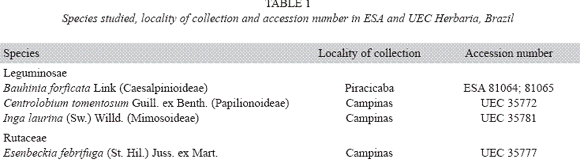
<body><![CDATA[<p><font face="Verdana" size="2"> </font></p>     <p><font face="Verdana" size="2">Resprouting is an efficient means for </font><font face="Verdana" size="2">woody plants to regain biomass loss after fire </font><font face="Verdana" size="2">disturbance (Bellingham and Sparrow 2000). </font><font face="Verdana" size="2">However, according to Rodrigues <i>et al. </i>(2004), </font><font  face="Verdana" size="2">evaluations of root sprouting in disturbed </font><font face="Verdana" size="2">Seasonal Semideciduous Forests of Southeast </font><font face="Verdana" size="2">Brazil are still very scarce. Rodrigues <i>et al. </i></font><font  face="Verdana" size="2">(2004) studied which species and in what per</font><font face="Verdana" size="2">centage of tree species resprouted from root </font><font face="Verdana" size="2">buds in an urban forest remnant in Brazil </font><font face="Verdana"  size="2">(State of São Paulo) seriously affected by </font><font face="Verdana" size="2">frequent fires. According to this study, 27 tree </font><font face="Verdana"  size="2">species belonging to 17 families were able to</font><font  face="Verdana" size="2"> </font><font face="Verdana" size="2">resprout from roots and the most representa tive was Leguminosae followed by Rubiaceae,&nbsp; Rutaceae, Sapindaceae and Solanaceae.&nbsp; Resprouting from root buds could represent an&nbsp; effective process of spatial reoccupation and&nbsp; vegetative propagation, as sucker shoots have&nbsp;<i> </i>the potential to emerge at variable distances from the main trunk and become independent&nbsp; (Rodrigues <i>et al. </i>2004). Penha (2004) studied&nbsp; the influence of root suckering on popula tional characteristics of tree species in another&nbsp; Seasonal Semideciduous Forest fragment in the&nbsp; State of São Paulo and observed young clones for <i>Centrolobium tomentosum </i>at fire-disturbed forest areas, whereas no clone was found at the non fire-disturbed forest areas. That high species richness and density values within Leguminosae species, such as <i>Bauhinia forficata </i>and <i>Centrolobium tomentosum</i>, in forest fragments affected by fire disturbances could be due, at least partially, to the high incidence of root resprouting potential in this family (Rodrigues <i>et al. </i>2004). It is well known that fire can cause severe damages to aerial portion of the main trunk interfering to the apical dominance (Lacey and Johnston 1990), however other factors can induce bud formation on roots like increase in soil temperature (Zasada and Schier 1973), main trunk removing (Lacey and Johnston 1990, Paukkonen <i>et al. </i>1992), damage on roots (Burrows 1990, Lacey and Johnston 1990, Fraser <i>et al. </i>2004), and exposing root to light (Lacey and Johnston 1990, Saner <i>et al. </i>1995). In addition, severe damage to aerial portion of the main trunk probably affects the movement of auxins and cytokinins in the roots (Farmer 1962, Schier 1975). Therefore, bud formation was investigated on root cuttings of three Leguminosae (<i>Bauhinia forficata </i>Link., <i>Centrolobium tomentosum </i>Guill. ex Benth, <i>Inga laurina </i>(Sw.) Willd) and one Rutaceae species (<i>Esenbeckia febrifuga </i>(St. Hil.) Juss. ex Mart.) that resprout frequently in Brazilian forest fragments. Furthermore, bud formation was also induced on root systems through removal of the main trunk, girdling or sectioning the shallow lateral roots of forest tree species <i>Esenbeckia febrifuga </i>and <i>Hymenaea courbaril </i>L. </font></p>     <p><font face="Verdana" size="3"><span style="font-weight: bold;">Materials and methods</span> </font></p>     <p><font face="Verdana" size="2">Fragments of <i>Bauhinia forficata </i>root bark and root cuttings of four species (<a href="#t1">Table 1</a>) were collected from individuals in a Semideciduous Seasonal Forest remnant in Campinas (22°55’S and 47°05’W; 22°48’S and 47°07’W) and Piracicaba (22</font><sup><font  face="Verdana" size="1">o</font></sup><font face="Verdana" size="2">42’S and 47</font><sup><font face="Verdana" size="1">o</font></sup><font  face="Verdana" size="2">38’W), in the State of São Paulo, Brazil.    <br> </font></p>     <p><font face="Verdana" size="2">    <br> <a name="t1"></a></font></p>     <div style="text-align: center;"><font face="Verdana" size="2"><img  src="/img/revistas/rbt/v57n3/art27t1.gif" title="" alt=""  style="width: 580px; height: 163px;"></font>    <br> <font face="Verdana" size="2"> </font></div>     <p><font face="Verdana" size="2">Ten root cuttings (ca. 20 cm long and 1 cm in diameter) of each species were planted horizontally in plastic boxes containing sand and kept inside a greenhouse until bud sprouting. </font></p>     ]]></body>
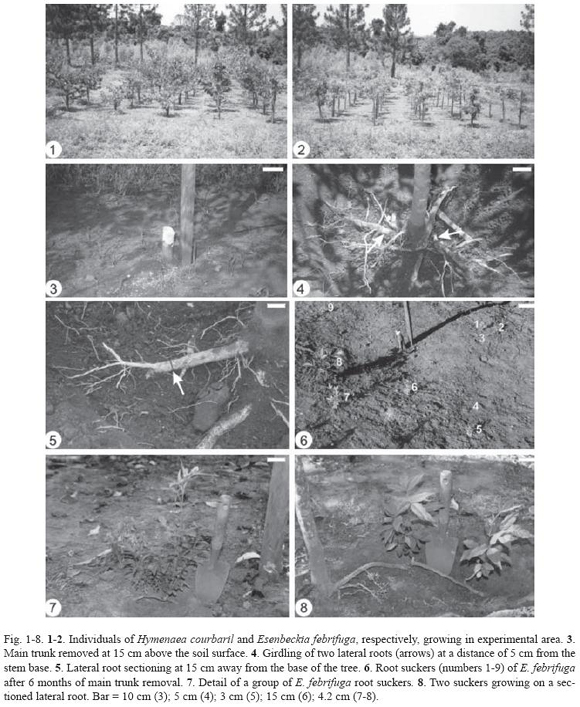
<body><![CDATA[<p><font face="Verdana" size="2">The identification of the origin of shoot primordia and their early development were carried out by fixing the samples in Karnovsky solution (Karnovsky 1965). Samples were dehydrated in ethyl alcohol series and embedded in plastic resin (Leica Historesin). Serial sections (5-7 µm thick) were cut on a rotary microtome and stained with toluidine blue O (Sakai, 1973). Permanent slides were mounted in synthetic resin. </font></p>     <p><font face="Verdana" size="2">For the study under field conditions, nursery trees of <i>Hymenaea courbaril </i>L. (Leguminosae -Caesalpinioideae) and <i>Esenbeckia febrifuga </i>7 and 10 months-old (respectively) from a commercial orchard were planted in an experimental area in December 1998. These species were selected from the sucker-producing roots survey of Rodrigues (1999). </font></p>     <p><font face="Verdana" size="2">In December 2001, after establishment and growth period of individuals of <i>H. courbaril </i>(43 months-old) and <i>Esenbeckia febrifuga </i>(46 months-old) in the field, 11 individuals of each species were left intact (control) or were submitted to removal of their main trunk or their shallow lateral roots were sectioned or then girdled by removing the bark (total of 44 individuals per species).<span style="font-family: verdana;">    <br>     <br> </span>Removal of the main trunk was performed at the height of ca. 15 cm above the soil surface. For girdling or sectioning of the lateral roots, two roots of each individual (ca. 1.9 cm diameter for <i>H. courbaril </i>and 1.3 cm for <i>E. febrifuga</i>) were selected. Girdling was carried out by removing a bark strip (1.5 cm wide) at a distance of 5 cm from the stem base. Sectioning was performed at 15 cm away from the base of the trees with a sharp knife.</font></p>     <p><font face="Verdana" size="2"><font size="3"><span  style="font-weight: bold;">Results</span>    <br> </font><span style="font-family: verdana;">    <br> </span>Responses of <i>Hymenaea courbaril </i>and <i>Esenbeckia febrifuga </i>(<a href="#f1-8">Fig. 1</a>-<a href="#f1-8">8</a>) were different after removal of the main trunk (<a href="#f1-8">Fig. 3</a>) or girdling (<a href="#f1-8">Fig. 4</a>) or sectioning (<a href="#f1-8">Fig. 5</a>) of the shallow lateral roots in study under field conditions.    <br> </font></p>     <p>    ]]></body>
<body><![CDATA[<br> </p>     <div style="text-align: center;"><font face="Verdana" size="2"><span  style="font-family: verdana;"><a name="f1-8"></a><img  src="/img/revistas/rbt/v57n3/art27i1.jpg" title="" alt=""  style="width: 580px; height: 707px;"></span></font>    <br> </div>     <p><font face="Verdana" size="2">Individuals of <i>Hymenaea courbaril </i>did not resprout from roots, independently of treatment. On the other hand, <i>Esenbeckia febrifuga </i>originated several suckers from roots when the main trunk was removed (<a href="#f1-8">Fig. 6</a>-<a href="#f1-8">7</a>) or when lateral roots were sectioned (<a href="#f1-8">Fig. 8</a>). Six of 11 individuals of <i>E. febrifuga </i>submitted to the removal of the main trunk originated sucker shoots on roots (<a  href="#t2">Table 2</a>). Shoots developed on several lateral roots, totalizing 89 suckers 61.7 cm away from the trunk base and at a depth of 1.8 cm in the insertion point of the sprouts on roots (<a href="#t2">Table 2</a>). Sometimes, there was a thickening of root on the distal portion of the root sucker.    <br> </font></p>     <p><font face="Verdana" size="2">    <br> <a name="t2"></a></font></p>     <div style="text-align: center;"><font face="Verdana" size="2"><img  src="/img/revistas/rbt/v57n3/art27t2.gif" title="" alt=""  style="width: 580px; height: 180px;"></font>    <br> </div>     <p><font face="Verdana" size="2">From 11 individuals with lateral roots sectioned, six resprouted from roots, totalizing 30 sucker sprouts. These suckers were formed generally on the proximal end of the sectioned root, that is, in the side next to the main tree, and, occasionally, along the roots. The average diameter of the roots was 1.3 cm at a depth of 6.3 cm in the insertion point of the sprouts on roots and at 17.5 cm away from the base of the trees (<a href="#t2">Table 2</a>). These sprouts might develop individually or in clusters.</font></p>     ]]></body>
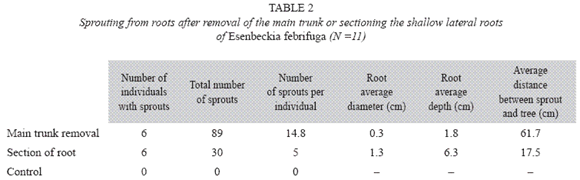
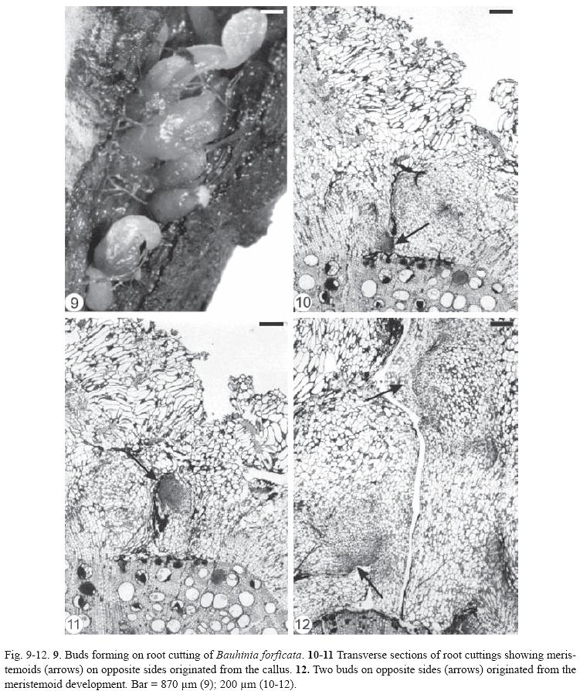
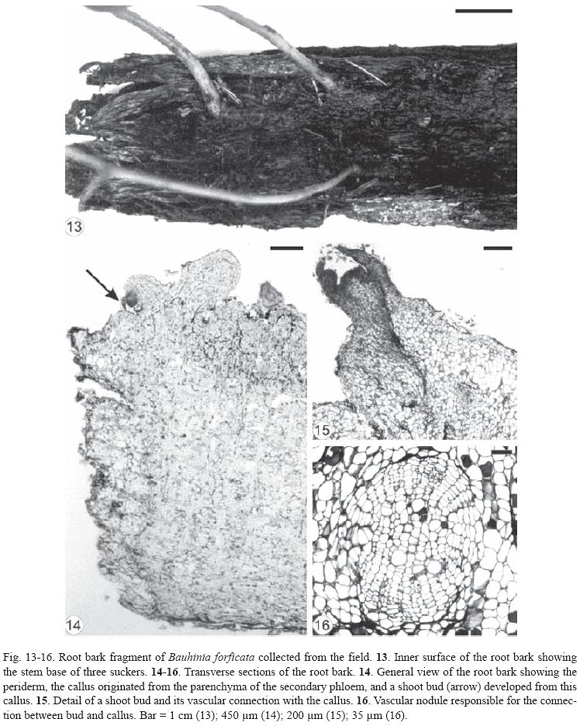
<body><![CDATA[<p><font face="Verdana" size="2">Individuals of <i>Esenbeckia febrifuga </i>showed no sucker sprout originated on roots from individuals with girdled or intact lateral roots (control).</font></p>     <p><font face="Verdana" size="2">All studied species produced buds on root cuttings but the mode of bud origin varied among them.</font></p>     <p><font face="Verdana" size="2">Initially, there was a thickening of certain areas of the root cuttings of <i>Bauhinia forficata </i>and, later, buds emerged through the bark. The gap formed in this region of the root cutting (<a href="#f9-12">Fig. 9</a>) extended from the periderm to the secondary xylem, exposing partially the latter (<a href="#f9-12">Fig. 10</a>-<a href="#f9-12">12</a>). The outer cells of the exposed secondary xylem were ruptured or obliterated in this region. Accumulation of substances inside vessel elements below them could be observed and the tylose formation was intensified (<a href="#f9-12">Fig. 11</a>). Healing phellogen developed only in the cut edges of the bark bounding the wounded secondary phloem and became continuous with the phellogen of original periderm of intact areas of the root. The vascular cambium cells next to the gap divided to form a small callus with cells of different size and shape (<a href="#f9-12">Fig. 11</a>-<a href="#f9-12">12</a>). The vascular cambium was restored from the differentiation of the callus cells in some areas of the root and became continuous with the vascular cambium of intact areas. Adventitious buds, which can grow in opposite&nbsp; sides (<a href="#f9-12">Fig. 12</a>), developed from meristemoids&nbsp; formed in the callus edge.&nbsp; Root fragments of <i style="font-family: verdana;">Bauhinia forficata </i><span style="font-family: verdana;">collected at random from the field (<a href="#f13-16">Fig. 13</a>) were&nbsp; constituted only by bark, that is, periderm and secondary phloem (<a href="#f13-16">Fig. 14</a>). Parenchymatic cells</span> <font><font><font><font face="Verdana" size="2"><font face="Verdana"  size="2"><font face="Verdana" size="2">of the secondary phloem on the opposite side of </font></font></font></font></font></font><font><font><font><font  face="Verdana" size="2"><font face="Verdana" size="2"><font  face="Verdana" size="2">the original periderm elongated and divided to </font></font></font></font></font></font><font><font><font><font  face="Verdana" size="2"><font face="Verdana" size="2"><font  face="Verdana" size="2">form a callus (<a href="#f13-16">Fig. 14</a>) bordering wounded sur</font></font></font></font></font></font><font><font><font><font  face="Verdana" size="2"><font face="Verdana" size="2"><font  face="Verdana" size="2">face after debarking. Cells of peripherical region </font></font></font></font></font></font><font><font><font><font  face="Verdana" size="2"><font face="Verdana" size="2"><font  face="Verdana" size="2">in the callus and in all injured secondary phloem</font></font></font></font></font></font><font><font><font><font  face="Verdana" size="2"><font face="Verdana" size="2"><font  face="Verdana" size="2"> </font></font></font></font></font></font>differentiated into healing phellogen continuous&nbsp; with the phellogen of existing original periderm.&nbsp; Buds developed exogenously at the periphery of the callus (<a href="#f13-16">Fig. 15</a>) from meristemoids originat ed from cell divisions of the healing phellogen.&nbsp; Vascular nodules were formed next to the site of bud emergence and were constituted by the <font><font><font><font  face="Verdana" size="2"><font face="Verdana" size="2"><font  face="Verdana" size="2">cylindrical vascular cambium producing phloem </font></font></font></font></font></font><font><font><font><font  face="Verdana" size="2"><font face="Verdana" size="2"><font  face="Verdana" size="2">to the outside and xylem to the inside part of the </font></font></font></font></font></font><font><font><font><font  face="Verdana" size="2"><font face="Verdana" size="2"><font  face="Verdana" size="2">ring. The vascular connection between bud and </font></font></font></font></font></font><font><font><font><font  face="Verdana" size="2"><font face="Verdana" size="2"><font  face="Verdana" size="2">callus was made via this nodule (<a  href="#f13-16">Fig. 16</a>).    <br> </font></font></font></font></font></font></font></p>     <p><font face="Verdana" size="2"><font><font><font><font face="Verdana"  size="2"><font face="Verdana" size="2"><font face="Verdana" size="2">    <br> <a name="f9-12"></a></font></font></font></font></font></font></font></p>     <div style="text-align: center;"><font face="Verdana" size="2"><font><font><font><font  face="Verdana" size="2"><font face="Verdana" size="2"><font  face="Verdana" size="2"><img src="/img/revistas/rbt/v57n3/art27i2.jpg"  title="" alt="" style="width: 580px; height: 691px;">    <br>     <br>     <br> <a name="f13-16"></a><img src="/img/revistas/rbt/v57n3/art27i3.jpg"  title="" alt="" style="width: 580px; height: 726px;">    ]]></body>
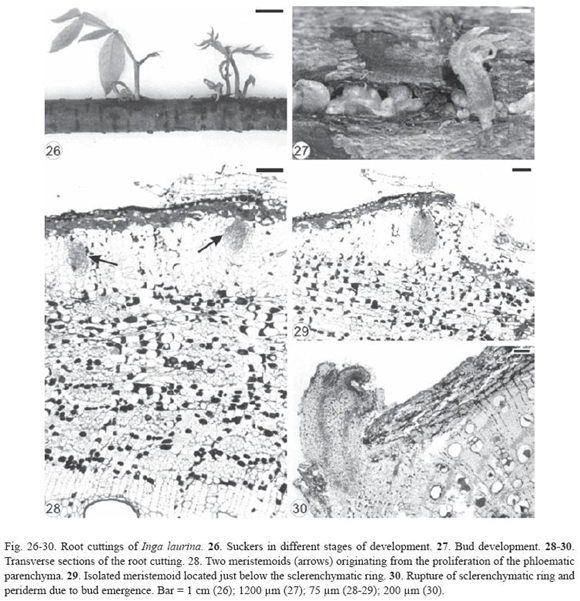
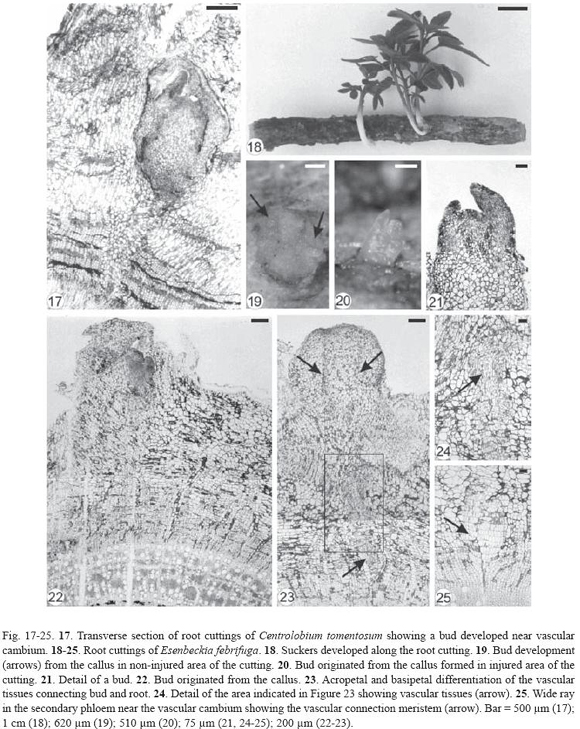
<body><![CDATA[<br> </font></font></font></font></font></font></font></div>     <p><font face="Verdana" size="2"><i>Centrolobium tomentosum </i>buds devel oped near the vascular cambium (<a href="#f17-25">Fig. 17</a>) and&nbsp; <i>Esenbeckia febrifuga </i>buds originated from the&nbsp; callus (<a href="#f17-25">Fig. 18</a>-<a href="#f17-25">23</a>) in injured and non-injured&nbsp; areas of the cutting. The differentiation of <font face="Verdana" size="2"><font face="Verdana"  size="2"><font face="Verdana" size="2">the vascular tissues between the bud and root was acropetal in <i>C. tomentosum</i>. Buds of <i>E. febrifuga </i>formed in the callus periphery (<a href="#f17-25">Fig. 19</a>-<a href="#f17-25">22</a>) developed from cell divisions of pericycle and phloem parenchyma (<a href="#f17-25">Fig. 22</a>-<a  href="#f17-25">23</a>) and established vascular connection with the root by acropetal and basipetal differentiation of vascular tissues (<a href="#f17-25">Fig. 23</a>-<a href="#f17-25">25</a>). The acropetal differentiation was due to meristem formation which was named as vascular connection meristem (<a href="#f17-25">Fig. 23</a>-<a href="#f17-25">25</a>). This meristem was formed near the periphery of wide rays in the secondary phloem, whose dilatation is due to anticlinal cell divisions restricted to bud site (<a href="#f17-25">Fig. 23</a>). In this dilated area, vascular cambium produced more parenchymatic cells than other cell types in the secondary xylem.    <br> </font></font></font></font></p>     <p><font face="Verdana" size="2"><font face="Verdana" size="2"><font  face="Verdana" size="2"><font face="Verdana" size="2">    <br> <a name="f17-25"></a></font></font></font></font></p>     <div style="text-align: center;"><font face="Verdana" size="2"><font  face="Verdana" size="2"><font face="Verdana" size="2"><font  face="Verdana" size="2"><img  src="/img/revistas/rbt/v57n3/art27i17-25.jpg" title="" alt=""  style="width: 580px; height: 729px;"></font></font></font></font>    <br> <font face="Verdana" size="2"><font face="Verdana" size="2"><font  face="Verdana" size="2"><font face="Verdana" size="2"> </font></font></font></font></div>     <p><font face="Verdana" size="2"><font face="Verdana" size="2"><font  face="Verdana" size="2"><font face="Verdana" size="2"><i>Inga laurina </i>had exogenous buds (<a href="#f26-30">Fig. 26</a>-<a href="#f26-30">27</a>) originated from meristemoids formed in the proliferated phloematic parenchyma located just below the sclerenchymatic ring (<a href="#f26-30">Fig. 28</a>-<a href="#f26-30">29</a>). These meristemoids were very close to each other (<a href="#f26-30">Fig. 28</a>) or isolated (<a  href="#f26-30">Fig. 29</a>) and developed into buds (<a href="#f26-30">Fig. 30</a>), confirming the proximity of the shoots in the root cutting (<a href="#f26-30">Fig. 26</a>-<a href="#f26-30">27</a>). Vascular tissues developed between bud and root cutting and then the sclerenchymatic ring and periderm were ruptured by the emergence of the bud (<a href="#f26-30">Fig. 29</a>-<a  href="#f26-30">30</a>).    <br> </font></font></font></font></p>     <p><font face="Verdana" size="2"><font face="Verdana" size="2"><font  face="Verdana" size="2"><font face="Verdana" size="2">    ]]></body>
<body><![CDATA[<br> <a name="f26-30"></a></font></font></font></font></p>     <div style="text-align: center;"><font face="Verdana" size="2"><font  face="Verdana" size="2"><font face="Verdana" size="2"><font  face="Verdana" size="2"><img  src="/img/revistas/rbt/v57n3/art27i26-30.jpg" title="" alt=""  style="width: 580px; height: 601px;"></font></font></font></font>    <br> <font face="Verdana" size="2"><font face="Verdana" size="2"><font  face="Verdana" size="2"><font face="Verdana" size="2"> </font></font></font></font></div>     <p><font face="Verdana" size="2"><font face="Verdana" size="2"><font  face="Verdana" size="2"><font face="Verdana" size="2">It was not possible to verify the direction of vascular differentiation between bud and root cutting in <i>Inga laurina </i>and <i>Bauhinia forficata</i>. </font></font></font></font></p>     <p><font face="Verdana" size="2"><font face="Verdana" size="2"><font  face="Verdana" size="2"><font face="Verdana" size="3"><span  style="font-weight: bold;">Discussion</span> </font></font></font></font></p>     <p><font face="Verdana" size="2"><font face="Verdana" size="2"><font  face="Verdana" size="2"><font face="Verdana" size="2">Disturbance such as herbivore, fire, floods, hurricanes, landslides, or logging may kill or induce resprouting of woody plants (Bond and Midgley 2003) after causing damages to aerial or subterranean organs (Lacey and Johnston 1990, Paukkonen <i>et al. </i>1992, Bosela and Ewers 1997). </font></font></font></font></p>     <p><font face="Verdana" size="2"><font face="Verdana" size="2"><font  face="Verdana" size="2"><font face="Verdana" size="2">The majority of tree species produces secondary trunks only when apical control is destroyed or blocked by some extrinsic factor (Del Tredici 2001). Even though growth is the result of a complex interaction of auxins and other hormones (Schier 1975), heavy root sprouting following lethal aboveground disturbances can be due to the interruption of auxin transport from stems to roots and the subsequent release of buds from hormonal suppression (Farmer 1962, Schier 1975). Indeed, after collection of root cuttings, auxin levels drop rapidly with time (Eliasson 1971), and sucker development can proceed. Our results support the results found in these studies, because all studied species produced buds on root cuttings and there was a great number of suckering on roots in <i>Esenbeckia febrifuga </i>when the main trunk was cut or when the shallow lateral roots were sectioned. However, the individuals submitted to the treatment of girdling of the lateral roots did not sprout. According to Jones (1998), auxin transport in root is predominantly down through the central stele and after auxin reaches the root tip, it is distributed back upward along the root in the epidermis and subtending cortical cells. Thus, the removal of the strip of bark has not been efficient to prevent the auxin transport along the root.     <br> </font></font></font></font></p>     <p><font face="Verdana" size="2"><font face="Verdana" size="2"><font  face="Verdana" size="2"><font face="Verdana" size="2"><font  face="Verdana" size="2">We believe that <i>Hymenaea courbaril </i>did not produce suckers on roots, as it does in native ecosystems due to the age of individuals. <i>E. febrifuga </i>is an understory species, while <i>H. courbaril </i>is a late secondary species (Rodrigues <i>et al. </i>2004). They were in different physiological phases during our observations: E. <i>febrifuga </i>was already in the reproductive phase, whilst <i>H. courbaril </i>was in the vegetative phase. According to Zimmerman (1972), flower production is the first sign for adult phase, even though the end of the juvenile phase and the first flowering may not coincide. <i>H. courbaril </i>individuals were 3 years 7 months old when they were submitted to resprout induction treatments and they did not produce flowers until the end of our observations (4,5 years old). Probably, <i>H. courbaril </i>will express the capacity of root sprouting late in plant development. This could explain why root sprouting was not observed during the analyzed period, while it is usually observed in adult plants growing in native environment (Rodrigues <i>et al. </i>2004). Martínková <i>et al. </i>(2004) also observed that plant age was an important factor influencing resprouting ability in short-life herb <i>Rorippa palustris </i>(Brassicaceae). The authors suggested that resprouting ability in the vegetative stage of the plant’s life cycle is age-dependent and plants must reach a certain age to be able to resprout from roots. </font></font></font></font></font></p>     <p><font face="Verdana" size="2"><font face="Verdana" size="2"><font  face="Verdana" size="2"><font face="Verdana" size="2"><font  face="Verdana" size="2">The mode of bud origin on roots varied among the studied species. Buds originated from the callus in <i>Bauhinia forficata </i>and <i>Esenbeckia febrifuga </i>or they developed near the vascular cambium in <i>Centrolobium tomentosum </i>and from the proliferated phloematic parenchyma in <i>Inga laurina</i>. The callus formation prior to bud origin was also verified in <i>Fagus grandifolia </i>Ehrh. (Fagaceae) by Jones and Raynal (1986) and in <i>Machaerium stipitatum </i>(DC.) Vog. (Leguminosae) by Hayashi <i>et al. </i>(2001). According to Sharples and Gunnery (1933), when the callus extended to fill the wounding region in <i>Hibiscus rosa-sinensis </i>L. and <i>Hevea brasiliensis </i>Müll. Arg., phellogen and vascular cambium were completely restored differentiating from areas near the phellogen and vascular cambium of undamaged portion of the bark into the central region of the callus until they became continuous. </font></font></font></font></font></p>     ]]></body>
<body><![CDATA[<p><font face="Verdana" size="2"><font face="Verdana" size="2"><font  face="Verdana" size="2"><font face="Verdana" size="2"><font  face="Verdana" size="2">In the injured areas of <i>Esenbeckia febrifuga </i>cuttings, callus formation occurred on wounded surface. Nevertheless, these two meristems (phellogen and vascular cambium) did not regenerate. However, callus filled partially the gap formed in the root bark in <i>Bauhinia forficata </i>cuttings and in some areas the vascular cambium was restored from the differentiation of the callus cells becoming continuous with the cambium of intact areas while the phellogen differentiated only in the cut edges of the bark bounding the wound tissue. </font></font></font></font></font></p>     <p><font face="Verdana" size="2"><font face="Verdana" size="2"><font  face="Verdana" size="2"><font face="Verdana" size="2"><font  face="Verdana" size="2">Fragments of <i>B. forficata </i>root bark developed buds from the healing phellogen formed in the callus periphery. Similar process was observed by Mello <i>et al. </i>(2000) when hypocotyl segments of this specie were cultivated <i>in vitro</i>, promoting bud differentiation from superficial layers of callus formed on the explant surface. </font></font></font></font></font></p>     <p><font face="Verdana" size="2"><font face="Verdana" size="2"><font  face="Verdana" size="2"><font face="Verdana" size="2"><font  face="Verdana" size="2">Vascular connection between buds and root cutting of <i>Esenbeckia febrifuga </i>was established by an acropetal and basipetal differentiation of vascular tissues as observed in <i>Machaerium stipitatum </i>(Hayashi <i>et al. </i>2001). The acropetal vascular differentiation of <i>E. febrifuga </i>buds was associated with the dilatation of phloematic ray as observed in the adventitious roots of stem cuttings of <i>Acacia baileyana </i>F. Muell. (Schwarz <i>et al.</i>1999). This dilatation of phloematic ray in <i>E. febrifuga </i>always occurred on opposite side to the bud, but it was not associated with bud origin as verified in stems of <i>Tilia platyphyllos</i>, <i>Fraxinus excelsior </i>and <i>Couroupita guianensis </i>(Fink 1983) and in <i>Ulmus americana </i>(Angeles <i>et al. </i>1986). In the root bark fragments of <i>Bauhinia forficata</i>, the vascular connection between buds and callus occurred by vascular nodules formed next to the site of bud emergence. This type of connection between bud and its origin tissue was also observed by Appezzato-da-Glória and Estelita (1995) in tuberous root of <i>Mandevilla illustris </i>(Vell.) Woodson. </font></font></font></font></font></p>     <p><font face="Verdana" size="2"><font face="Verdana" size="2"><font  face="Verdana" size="2"><font face="Verdana" size="2"><font  face="Verdana" size="2">All studied species showed reparative root buds, as they were exogenous in origin and did not have bud traces produced in the secondary xylem (Bosela and Ewers 1997). Reparative buds form <i>de novo </i>in response to senescence, injuries or other types of disturbance of the root, and may therefore be initiated at any period of root secondary growth (Bosela and Ewers 1997). According to the authors, the presence of additional buds, formed during the early growth of uninjured roots, is a characteristic related to clonal spread. Therefore, it is possible that individuals of <i>Centrolobium tomentosum </i>in natural conditions produce additional and reparative buds as Penha (2004) confirmed young clones through RAPD molecular markers for this species in forest fragments. Thus, the great number of tree species of Leguminosae in forest fragments affected by disturbances can be probably due to their ability of root-sprouting (Rodrigues <i>et al. </i>2004). </font></font></font></font></font></p>     <p><font face="Verdana" size="2"><font face="Verdana" size="2"><font  face="Verdana" size="2"><font face="Verdana" size="2"><font  face="Verdana" size="2">Root suckering promotes vegetative propagation because it allows spreading of individuals from the original site of establishment, promoting the colonization of new sites (Bond and Midgley 2003, Del Tredici 2001). Therefore, the capacity of producing reparative buds from underground systems, as demonstrated here, shows the vegetative reproduction potential of these species as already discussed by Rodrigues <i>et al. </i>(2004). In addition, it emphasizes its importance in the process of spatial reoccupation of fire events. The advantages of root sprouting over sexual reproduction are that sprouts have an established root system supplying water and reserve compounds (Simões and Marques 2007). Some studies were carried out in tropical forests in order to understand process of root sprouting of tree species in disturbed environments (e.g., Hayashi <i>et al. </i>2001, Penha 2004, Rodrigues <i>et al. </i>2004). Data from such studies may direct management plans by recommending natural or artificial propagation to restore forest structure and function (Simões and Marques 2007). </font></font></font></font></font></p>     <p><font face="Verdana" size="2"><font face="Verdana" size="2"><font  face="Verdana" size="2"><font face="Verdana" size="2"><font  face="Verdana" size="3"><span style="font-weight: bold;">Acknowledgments</span> </font></font></font></font></font></p>     <p><font face="Verdana" size="2"><font face="Verdana" size="2"><font  face="Verdana" size="2"><font face="Verdana" size="2"><font  face="Verdana" size="2">We are grateful to the Instituto Agronômico de Campinas and Fundação José Pedro de Oliveira in giving permission to collect plant materials. This research was supported by FAPESP, CAPES and CNPq. </font></font></font></font></font></p> <hr style="width: 100%; height: 2px;">     <p><font face="Verdana" size="2"><font face="Verdana" size="2"><font  face="Verdana" size="2"><font face="Verdana" size="2"><font  face="Verdana" size="2"><span style="font-weight: bold;">Resumen</span> </font></font></font></font></font></p>     <p><font face="Verdana" size="2"><font face="Verdana" size="2"><font  face="Verdana" size="2"><font face="Verdana" size="2"><font  face="Verdana" size="2">Estudios anteriores señalaron que la alta riqueza de especies de Leguminosae en fragmentos de bosques afectadas por el fuego podría deberse, al menos parcialmente, a la alta incidencia de brotes de raíz en esta familia. Sin embargo, existen pocos estudios. Investigamos la formación de brotes en tres Leguminosae (<i>Bauhinia forficata </i>Link., <i>Centrolobium tomentosum </i>Guill. ex Benth, e <i>Inga laurina </i>(Sw.) Willd) y una Rutaceae (<i>Esenbeckia febrifuga </i>(St. Hil.) Juss. ex Mart.). Todas estas especies suelen rebrotar después de los incendios. También hicimos cortes experimentales en árboles forestales: <i>Esenbeckia febrifuga </i>e <i>Hymenaea courbaril </i>L. Observamos tres orígenes: cerca del cambium vascular (<i>C. tomentosum</i>), desde el callo (<i>B. forficata </i>y <i>E. febrifuga</i>) y de parénquima (<i>I. laurina</i>). <i>Hymenaea courbaril </i>no respondió a ninguna de las pruebas de inducción, probablemente debido a la edad de la planta. Sin embargo, las raíces de <i>Esenbeckia febrifuga </i>forman retoños tras retirar el tronco o separar sus raíces. Hemos demostrado experimentalmente la capacidad de las cuatro especies de árbol de rebrotar a partir de sus raíces tras una perturbación grave. </font></font></font></font></font></p>     <p><font face="Verdana" size="2"><font face="Verdana" size="2"><font  face="Verdana" size="2"><font face="Verdana" size="2"><font  face="Verdana" size="2"><b>Palabras clave: </b>anatomía, estacas leñosas, Leguminosae, propagación vegetativa, Rutaceae, yema radical.    ]]></body>
<body><![CDATA[<br> </font></font></font></font></font></p> <hr style="width: 100%; height: 2px;">     <p><font face="Verdana" size="2"><font face="Verdana" size="2"><font  face="Verdana" size="2"><font face="Verdana" size="2"><font  face="Verdana" size="2"></font></font></font></font></font></p>     <p style="text-align: center;"><font face="Verdana" size="2"><font  face="Verdana" size="2"><font face="Verdana" size="2"><font  face="Verdana" size="2"><font face="Verdana" size="2">Received 27-II-2007. Corrected 01-II-2009. Accepted 01-III-2009.</font></font></font></font></font></p> <font face="Verdana" size="2"><font face="Verdana" size="2"><font  face="Verdana" size="2"><font face="Verdana" size="2"><font  face="Verdana" size="2"> <font size="3">     <p><span style="font-weight: bold;">References</span> </p> </font></font><font face="Verdana" size="2">     <!-- ref --><p>Angeles, G., R.F. Evert &amp; T.T. Kozlowski. 1986. Development of lenticels and adventitious roots in flooded <i>Ulmus americana </i>seedlings. Can. J. For. Res. 16: 585-590. &nbsp;&nbsp;&nbsp;&nbsp;&nbsp;&nbsp;&nbsp;&nbsp;[&#160;<a href="javascript:void(0);" onclick="javascript: window.open('/scielo.php?script=sci_nlinks&ref=1375691&pid=S0034-7744200900030002700001&lng=','','width=640,height=500,resizable=yes,scrollbars=1,menubar=yes,');">Links</a>&#160;]<!-- end-ref --><!-- ref --><p>Appezzato-da-Glória, B. &amp; M.E.M. Estelita. 1995. Caracteres anatômicos da propagação vegetativa de <i>Mandevilla illustris </i>(Vell.) Woodson e de <i>M. velutina </i>(Mart. ex Stadelm.) Woodson -Apocynaceae. <i>In </i>Congresso da Sociedade Botânica de São Paulo, 9., Ilha Solteira, 1995. Anais. Ilha Solteira: SBSP, p. 5-13. &nbsp;&nbsp;&nbsp;&nbsp;&nbsp;&nbsp;&nbsp;&nbsp;[&#160;<a href="javascript:void(0);" onclick="javascript: window.open('/scielo.php?script=sci_nlinks&ref=1375692&pid=S0034-7744200900030002700002&lng=','','width=640,height=500,resizable=yes,scrollbars=1,menubar=yes,');">Links</a>&#160;]<!-- end-ref --><!-- ref --><p>Bellingham, P.J. &amp; A.D. Sparrow. 2000. Resprouting as a life history strategy in woody plant communities. Oikos 89: 409-416. &nbsp;&nbsp;&nbsp;&nbsp;&nbsp;&nbsp;&nbsp;&nbsp;[&#160;<a href="javascript:void(0);" onclick="javascript: window.open('/scielo.php?script=sci_nlinks&ref=1375693&pid=S0034-7744200900030002700003&lng=','','width=640,height=500,resizable=yes,scrollbars=1,menubar=yes,');">Links</a>&#160;]<!-- end-ref --><!-- ref --><p>Bond, W.J. &amp; J.J. Midgley. 2003. The evolutionary ecology of sprouting. Int. J. Plant Sci. 164: S103-S114. &nbsp;&nbsp;&nbsp;&nbsp;&nbsp;&nbsp;&nbsp;&nbsp;[&#160;<a href="javascript:void(0);" onclick="javascript: window.open('/scielo.php?script=sci_nlinks&ref=1375694&pid=S0034-7744200900030002700004&lng=','','width=640,height=500,resizable=yes,scrollbars=1,menubar=yes,');">Links</a>&#160;]<!-- end-ref --><!-- ref --><p>Bosela, M.J. &amp; F.W. Ewers. 1997. The mode of origin of root buds and root sprouts in the clonal tree <i>Sassafras albidum </i>(Lauraceae). Am. J. Bot. 84: 1466-1481. &nbsp;&nbsp;&nbsp;&nbsp;&nbsp;&nbsp;&nbsp;&nbsp;[&#160;<a href="javascript:void(0);" onclick="javascript: window.open('/scielo.php?script=sci_nlinks&ref=1375695&pid=S0034-7744200900030002700005&lng=','','width=640,height=500,resizable=yes,scrollbars=1,menubar=yes,');">Links</a>&#160;]<!-- end-ref --><!-- ref --><p>Burrows, G.E. 1990. Anatomical aspects of root bud development in hoop pine (<i>Araucaria cunninghamii</i>). Aust. J. Bot. 38: 73-78. &nbsp;&nbsp;&nbsp;&nbsp;&nbsp;&nbsp;&nbsp;&nbsp;[&#160;<a href="javascript:void(0);" onclick="javascript: window.open('/scielo.php?script=sci_nlinks&ref=1375696&pid=S0034-7744200900030002700006&lng=','','width=640,height=500,resizable=yes,scrollbars=1,menubar=yes,');">Links</a>&#160;]<!-- end-ref --><!-- ref --><p>Del Tredici, P. 2001. Sprouting in temperate trees: a morphological and ecological review. Bot. Rev. 67: 121-140. &nbsp;&nbsp;&nbsp;&nbsp;&nbsp;&nbsp;&nbsp;&nbsp;[&#160;<a href="javascript:void(0);" onclick="javascript: window.open('/scielo.php?script=sci_nlinks&ref=1375697&pid=S0034-7744200900030002700007&lng=','','width=640,height=500,resizable=yes,scrollbars=1,menubar=yes,');">Links</a>&#160;]<!-- end-ref --><!-- ref --><p>Eliasson, L. 1971. Growth regulators in <i>Populus tremula</i>. III. Variation of auxin and inhibitor level in roots in relation to root sucker formation. Physiol. Plantarum 25: 118-121.&nbsp;&nbsp;&nbsp;&nbsp;&nbsp;&nbsp;&nbsp;&nbsp;[&#160;<a href="javascript:void(0);" onclick="javascript: window.open('/scielo.php?script=sci_nlinks&ref=1375698&pid=S0034-7744200900030002700008&lng=','','width=640,height=500,resizable=yes,scrollbars=1,menubar=yes,');">Links</a>&#160;]<!-- end-ref --><!-- ref --><p>Farmer Jr, R.E. 1962. Aspen root sucker formation and apical dominance. For. Sci. 8: p.403-410. &nbsp;&nbsp;&nbsp;&nbsp;&nbsp;&nbsp;&nbsp;&nbsp;[&#160;<a href="javascript:void(0);" onclick="javascript: window.open('/scielo.php?script=sci_nlinks&ref=1375699&pid=S0034-7744200900030002700009&lng=','','width=640,height=500,resizable=yes,scrollbars=1,menubar=yes,');">Links</a>&#160;]<!-- end-ref --><!-- ref --><p>Fink, S. 1983. The occurrence of adventitious and preventitious bud within the bark of some temperate and tropical trees. Am. J. Bot. 70: 532-542. &nbsp;&nbsp;&nbsp;&nbsp;&nbsp;&nbsp;&nbsp;&nbsp;[&#160;<a href="javascript:void(0);" onclick="javascript: window.open('/scielo.php?script=sci_nlinks&ref=1375700&pid=S0034-7744200900030002700010&lng=','','width=640,height=500,resizable=yes,scrollbars=1,menubar=yes,');">Links</a>&#160;]<!-- end-ref --><!-- ref --><p>Fraser, E.C., V.J. Lieffers &amp; S.M. Landhäusser. 2004. Wounding of aspen roots promotes suckering. Can. J. Bot. 82: 310-315. &nbsp;&nbsp;&nbsp;&nbsp;&nbsp;&nbsp;&nbsp;&nbsp;[&#160;<a href="javascript:void(0);" onclick="javascript: window.open('/scielo.php?script=sci_nlinks&ref=1375701&pid=S0034-7744200900030002700011&lng=','','width=640,height=500,resizable=yes,scrollbars=1,menubar=yes,');">Links</a>&#160;]<!-- end-ref --><!-- ref --><p>Hayashi, A.H., A.S. Penha, R.R. Rodrigues &amp; B. Appezzatoda-Glória. 2001. Anatomical studies of shoot bud-forming roots of Brazilian tree species. Aust. J. Bot. 49: 745-751. &nbsp;&nbsp;&nbsp;&nbsp;&nbsp;&nbsp;&nbsp;&nbsp;[&#160;<a href="javascript:void(0);" onclick="javascript: window.open('/scielo.php?script=sci_nlinks&ref=1375702&pid=S0034-7744200900030002700012&lng=','','width=640,height=500,resizable=yes,scrollbars=1,menubar=yes,');">Links</a>&#160;]<!-- end-ref --><!-- ref --><p>Jones, A.M. 1998. Auxin transport: down and out and up again. Science 282: 2201-2202. &nbsp;&nbsp;&nbsp;&nbsp;&nbsp;&nbsp;&nbsp;&nbsp;[&#160;<a href="javascript:void(0);" onclick="javascript: window.open('/scielo.php?script=sci_nlinks&ref=1375703&pid=S0034-7744200900030002700013&lng=','','width=640,height=500,resizable=yes,scrollbars=1,menubar=yes,');">Links</a>&#160;]<!-- end-ref --><!-- ref --><p>Jones, R.H. &amp; D.J. Raynal. 1986. Spatial distribution and development of root sprouts in <i>Fagus grandifolia </i>(Fagaceae). Amer. J. Bot. 73: 1723-1731. &nbsp;&nbsp;&nbsp;&nbsp;&nbsp;&nbsp;&nbsp;&nbsp;[&#160;<a href="javascript:void(0);" onclick="javascript: window.open('/scielo.php?script=sci_nlinks&ref=1375704&pid=S0034-7744200900030002700014&lng=','','width=640,height=500,resizable=yes,scrollbars=1,menubar=yes,');">Links</a>&#160;]<!-- end-ref --><!-- ref --><p>Karnovsky, M.J. 1965. A formaldehyde-glutaraldehyde fixative of high osmolality for use in electron microscopy. J. Cell Biol. 27: 137-138. &nbsp;&nbsp;&nbsp;&nbsp;&nbsp;&nbsp;&nbsp;&nbsp;[&#160;<a href="javascript:void(0);" onclick="javascript: window.open('/scielo.php?script=sci_nlinks&ref=1375705&pid=S0034-7744200900030002700015&lng=','','width=640,height=500,resizable=yes,scrollbars=1,menubar=yes,');">Links</a>&#160;]<!-- end-ref --><!-- ref --><p>Lacey, C.J. &amp; R.D. Johnston. 1990. Woody clumps and clumpwoods. Aust. J. Bot. 38: 299-334. &nbsp;&nbsp;&nbsp;&nbsp;&nbsp;&nbsp;&nbsp;&nbsp;[&#160;<a href="javascript:void(0);" onclick="javascript: window.open('/scielo.php?script=sci_nlinks&ref=1375706&pid=S0034-7744200900030002700016&lng=','','width=640,height=500,resizable=yes,scrollbars=1,menubar=yes,');">Links</a>&#160;]<!-- end-ref --><!-- ref --><p><font face="Verdana" size="2"><font face="Verdana" size="2"><font  face="Verdana" size="2"><font face="Verdana" size="2"><font  face="Verdana" size="2">Martínková, J., M. Ko&#711;cvarová &amp; J. Klimešová. 2004. Resprouting after disturbance in the short-lived herb </font><i><font  face="Verdana" size="2">Rorippa palustris </font></i><font  face="Verdana" size="2">(Brassicaceae): an experiment with juveniles. Acta Oecol. 25: 143-150. </font></font></font></font></font>&nbsp;&nbsp;&nbsp;&nbsp;&nbsp;&nbsp;&nbsp;&nbsp;[&#160;<a href="javascript:void(0);" onclick="javascript: window.open('/scielo.php?script=sci_nlinks&ref=1375707&pid=S0034-7744200900030002700017&lng=','','width=640,height=500,resizable=yes,scrollbars=1,menubar=yes,');">Links</a>&#160;]<!-- end-ref --><!-- ref --><p><font face="Verdana" size="2"><font face="Verdana" size="2"><font  face="Verdana" size="2"><font face="Verdana" size="2"><font  face="Verdana" size="2">Mello, M.O., M. Melo &amp; B. Appezzato-da-Glória. 2000. <i>Bauhinia forficata </i>Link Shoot regeneration: histological analysis of organogenesis pathway. Braz. arch. biol. technol. 43: 431-436. </font></font></font></font></font>&nbsp;&nbsp;&nbsp;&nbsp;&nbsp;&nbsp;&nbsp;&nbsp;[&#160;<a href="javascript:void(0);" onclick="javascript: window.open('/scielo.php?script=sci_nlinks&ref=1375708&pid=S0034-7744200900030002700018&lng=','','width=640,height=500,resizable=yes,scrollbars=1,menubar=yes,');">Links</a>&#160;]<!-- end-ref --><!-- ref --><p><font face="Verdana" size="2"><font face="Verdana" size="2"><font  face="Verdana" size="2"><font face="Verdana" size="2"><font  face="Verdana" size="2">Paukkonen, K., A. Kauppi &amp; A. Ferm. 1992. Root and stump buds as structural faculties for reinvigoration in <i>Alnus incana </i>(L.) Moench. Flora 187: 353-367. </font></font></font></font></font>&nbsp;&nbsp;&nbsp;&nbsp;&nbsp;&nbsp;&nbsp;&nbsp;[&#160;<a href="javascript:void(0);" onclick="javascript: window.open('/scielo.php?script=sci_nlinks&ref=1375709&pid=S0034-7744200900030002700019&lng=','','width=640,height=500,resizable=yes,scrollbars=1,menubar=yes,');">Links</a>&#160;]<!-- end-ref --><!-- ref --><p><font face="Verdana" size="2"><font face="Verdana" size="2"><font  face="Verdana" size="2"><font face="Verdana" size="2"><font  face="Verdana" size="2">Penha, A. S. 2004. Influência da propagação vegetativa a partir de raízes gemíferas nas características populacionais de espécies arbóreas em fragmentos de Florestas Estacionais Semideciduais. Ph. D. Thesis; Universidade Estadual de Campinas, Campinas, Brazil. 135 p. </font></font></font></font></font>&nbsp;&nbsp;&nbsp;&nbsp;&nbsp;&nbsp;&nbsp;&nbsp;[&#160;<a href="javascript:void(0);" onclick="javascript: window.open('/scielo.php?script=sci_nlinks&ref=1375710&pid=S0034-7744200900030002700020&lng=','','width=640,height=500,resizable=yes,scrollbars=1,menubar=yes,');">Links</a>&#160;]<!-- end-ref --><!-- ref --><p><font face="Verdana" size="2"><font face="Verdana" size="2"><font  face="Verdana" size="2"><font face="Verdana" size="2"><font  face="Verdana" size="2">Rodrigues, R.R. 1999. Colonização e enriquecimento de um fragmento florestal urbano após a ocorrência de fogo, Fazenda Santa Elisa, Campinas, SP: avaliação temporal da regeneração natural (66 meses) e do crescimento (51 meses) de 30 espécies florestais plantadas em consórcios sucessionais. Thesis; Universidade de São Paulo, Piracicaba, Brazil. 167 p. </font></font></font></font></font>&nbsp;&nbsp;&nbsp;&nbsp;&nbsp;&nbsp;&nbsp;&nbsp;[&#160;<a href="javascript:void(0);" onclick="javascript: window.open('/scielo.php?script=sci_nlinks&ref=1375711&pid=S0034-7744200900030002700021&lng=','','width=640,height=500,resizable=yes,scrollbars=1,menubar=yes,');">Links</a>&#160;]<!-- end-ref --><!-- ref --><p><font face="Verdana" size="2"><font face="Verdana" size="2"><font  face="Verdana" size="2"><font face="Verdana" size="2"><font  face="Verdana" size="2">Rodrigues, R.R., R.B. Torres, L.A.F. Matthes &amp; A.S. Penha. 2004. Tree species sprouting from root buds in a Semideciduous Forest affected by fires. Braz. arch. biol. technol. 47: 127-133. </font></font></font></font></font>&nbsp;&nbsp;&nbsp;&nbsp;&nbsp;&nbsp;&nbsp;&nbsp;[&#160;<a href="javascript:void(0);" onclick="javascript: window.open('/scielo.php?script=sci_nlinks&ref=1375712&pid=S0034-7744200900030002700022&lng=','','width=640,height=500,resizable=yes,scrollbars=1,menubar=yes,');">Links</a>&#160;]<!-- end-ref --><!-- ref --><p><font face="Verdana" size="2"><font face="Verdana" size="2"><font  face="Verdana" size="2"><font face="Verdana" size="2"><font  face="Verdana" size="2">Sakai, W.S. 1973. Simple method for differential staining of paraffin embedded plant material using toluidine blue O. Stain Tech. 48: 247-249. </font></font></font></font></font>&nbsp;&nbsp;&nbsp;&nbsp;&nbsp;&nbsp;&nbsp;&nbsp;[&#160;<a href="javascript:void(0);" onclick="javascript: window.open('/scielo.php?script=sci_nlinks&ref=1375713&pid=S0034-7744200900030002700023&lng=','','width=640,height=500,resizable=yes,scrollbars=1,menubar=yes,');">Links</a>&#160;]<!-- end-ref --><!-- ref --><p><font face="Verdana" size="2"><font face="Verdana" size="2"><font  face="Verdana" size="2"><font face="Verdana" size="2"><font  face="Verdana" size="2">Saner, M.A., D.R. Clements, M.R. Hall, D.J. Doohan &amp; C.W. Crompton. 1995. The biology of Canadian weeds. 105. <i>Linaria vulgaris </i>Mill. Can. J. Plant Sci. 75: 525-537. </font></font></font></font></font>&nbsp;&nbsp;&nbsp;&nbsp;&nbsp;&nbsp;&nbsp;&nbsp;[&#160;<a href="javascript:void(0);" onclick="javascript: window.open('/scielo.php?script=sci_nlinks&ref=1375714&pid=S0034-7744200900030002700024&lng=','','width=640,height=500,resizable=yes,scrollbars=1,menubar=yes,');">Links</a>&#160;]<!-- end-ref --><!-- ref --><p><font face="Verdana" size="2"><font face="Verdana" size="2"><font  face="Verdana" size="2"><font face="Verdana" size="2"><font  face="Verdana" size="2">Schier, G.A. 1975. Promotion of sucker development on <i>Populus tremuloides </i>root cuttings by an antiauxin. Can. J. For. Res. 5: 338-340. </font></font></font></font></font>&nbsp;&nbsp;&nbsp;&nbsp;&nbsp;&nbsp;&nbsp;&nbsp;[&#160;<a href="javascript:void(0);" onclick="javascript: window.open('/scielo.php?script=sci_nlinks&ref=1375715&pid=S0034-7744200900030002700025&lng=','','width=640,height=500,resizable=yes,scrollbars=1,menubar=yes,');">Links</a>&#160;]<!-- end-ref --><!-- ref --><p><font face="Verdana" size="2"><font face="Verdana" size="2"><font  face="Verdana" size="2"><font face="Verdana" size="2"><font  face="Verdana" size="2">Schwarz, J.L., P.L. Glocke &amp; M. Sedgley. 1999. Adventitious root formation in <i>Acacia baileyana </i>F. Muell. J. Hort. Sci. Biotech. 74: 561-565. </font></font></font></font></font>&nbsp;&nbsp;&nbsp;&nbsp;&nbsp;&nbsp;&nbsp;&nbsp;[&#160;<a href="javascript:void(0);" onclick="javascript: window.open('/scielo.php?script=sci_nlinks&ref=1375716&pid=S0034-7744200900030002700026&lng=','','width=640,height=500,resizable=yes,scrollbars=1,menubar=yes,');">Links</a>&#160;]<!-- end-ref --><!-- ref --><p><font face="Verdana" size="2"><font face="Verdana" size="2"><font  face="Verdana" size="2"><font face="Verdana" size="2"><font  face="Verdana" size="2">Sharples, A. &amp; H. Gunnery. 1933. Callus formation in <i>Hibiscus rosa-sinensis </i>L. and <i>Hevea brasiliensis </i>Müll. Arg. Ann. Bot. 47: 827-839. </font></font></font></font></font>&nbsp;&nbsp;&nbsp;&nbsp;&nbsp;&nbsp;&nbsp;&nbsp;[&#160;<a href="javascript:void(0);" onclick="javascript: window.open('/scielo.php?script=sci_nlinks&ref=1375717&pid=S0034-7744200900030002700027&lng=','','width=640,height=500,resizable=yes,scrollbars=1,menubar=yes,');">Links</a>&#160;]<!-- end-ref --><!-- ref --><p><font face="Verdana" size="2"><font face="Verdana" size="2"><font  face="Verdana" size="2"><font face="Verdana" size="2"><font  face="Verdana" size="2">Simões, C.G. &amp; M.C.M. Marques. 2007. The role of sprouts in the restoration of Atlantic Rainforest in southern Brazil. Rest. Ecol. 15: 53-59. </font></font></font></font></font>&nbsp;&nbsp;&nbsp;&nbsp;&nbsp;&nbsp;&nbsp;&nbsp;[&#160;<a href="javascript:void(0);" onclick="javascript: window.open('/scielo.php?script=sci_nlinks&ref=1375718&pid=S0034-7744200900030002700028&lng=','','width=640,height=500,resizable=yes,scrollbars=1,menubar=yes,');">Links</a>&#160;]<!-- end-ref --><!-- ref --><p><font face="Verdana" size="2"><font face="Verdana" size="2"><font  face="Verdana" size="2"><font face="Verdana" size="2"><font  face="Verdana" size="2">Zasada, J.C. &amp; G.A. Schier. 1973. Aspen root suckering in Alaska: effect of clone, collection date and temperature. Northwest Sci. 47: 100-104. </font></font></font></font></font>&nbsp;&nbsp;&nbsp;&nbsp;&nbsp;&nbsp;&nbsp;&nbsp;[&#160;<a href="javascript:void(0);" onclick="javascript: window.open('/scielo.php?script=sci_nlinks&ref=1375719&pid=S0034-7744200900030002700029&lng=','','width=640,height=500,resizable=yes,scrollbars=1,menubar=yes,');">Links</a>&#160;]<!-- end-ref --><!-- ref --><p><font face="Verdana" size="2"><font face="Verdana" size="2"><font  face="Verdana" size="2"><font face="Verdana" size="2"><font  face="Verdana" size="2">Zimmerman, R.H. 1972. Juvenility and flowering in wood plants: a review. HortScience 7: 447-455. </font></font></font></font></font>&nbsp;&nbsp;&nbsp;&nbsp;&nbsp;&nbsp;&nbsp;&nbsp;[&#160;<a href="javascript:void(0);" onclick="javascript: window.open('/scielo.php?script=sci_nlinks&ref=1375720&pid=S0034-7744200900030002700030&lng=','','width=640,height=500,resizable=yes,scrollbars=1,menubar=yes,');">Links</a>&#160;]<!-- end-ref --> ]]></body><back>
<ref-list>
<ref id="B1">
<nlm-citation citation-type="journal">
<person-group person-group-type="author">
<name>
<surname><![CDATA[Angeles]]></surname>
<given-names><![CDATA[G]]></given-names>
</name>
<name>
<surname><![CDATA[Evert]]></surname>
<given-names><![CDATA[R.F]]></given-names>
</name>
<name>
<surname><![CDATA[Kozlowski]]></surname>
<given-names><![CDATA[T.T]]></given-names>
</name>
</person-group>
<article-title xml:lang="en"><![CDATA[Development of lenticels and adventitious roots in flooded Ulmus americana seedlings]]></article-title>
<source><![CDATA[Can. J. For. Res]]></source>
<year>1986</year>
<volume>16</volume>
<page-range>585-590</page-range></nlm-citation>
</ref>
<ref id="B2">
<nlm-citation citation-type="confpro">
<person-group person-group-type="author">
<name>
<surname><![CDATA[Appezzato-da-Glória]]></surname>
<given-names><![CDATA[B]]></given-names>
</name>
<name>
<surname><![CDATA[Estelita]]></surname>
<given-names><![CDATA[M.E.M]]></given-names>
</name>
</person-group>
<article-title xml:lang="pt"><![CDATA[Caracteres anatômicos da propagação vegetativa de Mandevilla illustris (Vell.) Woodson e de M. velutina (Mart. ex Stadelm.) Woodson -Apocynaceae]]></article-title>
<source><![CDATA[]]></source>
<year>1995</year>
<conf-name><![CDATA[9 Congresso da Sociedade Botânica de São Paulo]]></conf-name>
<conf-date>1995</conf-date>
<conf-loc> </conf-loc>
</nlm-citation>
</ref>
<ref id="B3">
<nlm-citation citation-type="journal">
<person-group person-group-type="author">
<name>
<surname><![CDATA[Bellingham]]></surname>
<given-names><![CDATA[P.J]]></given-names>
</name>
<name>
<surname><![CDATA[Sparrow]]></surname>
<given-names><![CDATA[A.D]]></given-names>
</name>
</person-group>
<article-title xml:lang="en"><![CDATA[Resprouting as a life history strategy in woody plant communities]]></article-title>
<source><![CDATA[Oikos]]></source>
<year>2000</year>
<volume>89</volume>
<page-range>409-416</page-range></nlm-citation>
</ref>
<ref id="B4">
<nlm-citation citation-type="journal">
<person-group person-group-type="author">
<name>
<surname><![CDATA[Bond]]></surname>
<given-names><![CDATA[W.J]]></given-names>
</name>
<name>
<surname><![CDATA[Midgley]]></surname>
<given-names><![CDATA[J.J]]></given-names>
</name>
</person-group>
<article-title xml:lang="en"><![CDATA[The evolutionary ecology of sprouting]]></article-title>
<source><![CDATA[Int. J. Plant Sci]]></source>
<year>2003</year>
<volume>164</volume>
<page-range>S103-S114</page-range></nlm-citation>
</ref>
<ref id="B5">
<nlm-citation citation-type="journal">
<person-group person-group-type="author">
<name>
<surname><![CDATA[Bosela]]></surname>
<given-names><![CDATA[M.J]]></given-names>
</name>
<name>
<surname><![CDATA[Ewers]]></surname>
<given-names><![CDATA[F.W]]></given-names>
</name>
</person-group>
<article-title xml:lang="en"><![CDATA[The mode of origin of root buds and root sprouts in the clonal tree Sassafras albidum (Lauraceae)]]></article-title>
<source><![CDATA[Am. J. Bot]]></source>
<year>1997</year>
<volume>84</volume>
<page-range>1466-1481</page-range></nlm-citation>
</ref>
<ref id="B6">
<nlm-citation citation-type="journal">
<person-group person-group-type="author">
<name>
<surname><![CDATA[Burrows]]></surname>
<given-names><![CDATA[G.E]]></given-names>
</name>
</person-group>
<article-title xml:lang="en"><![CDATA[Anatomical aspects of root bud development in hoop pine (Araucaria cunninghamii)]]></article-title>
<source><![CDATA[Aust. J. Bot]]></source>
<year>1990</year>
<volume>38</volume>
<page-range>73-78</page-range></nlm-citation>
</ref>
<ref id="B7">
<nlm-citation citation-type="journal">
<person-group person-group-type="author">
<name>
<surname><![CDATA[Del Tredici]]></surname>
<given-names><![CDATA[P]]></given-names>
</name>
</person-group>
<article-title xml:lang="en"><![CDATA[Sprouting in temperate trees: a morphological and ecological review]]></article-title>
<source><![CDATA[Bot. Rev]]></source>
<year>2001</year>
<volume>67</volume>
<page-range>121-140</page-range></nlm-citation>
</ref>
<ref id="B8">
<nlm-citation citation-type="journal">
<person-group person-group-type="author">
<name>
<surname><![CDATA[Eliasson]]></surname>
<given-names><![CDATA[L]]></given-names>
</name>
</person-group>
<article-title xml:lang="en"><![CDATA[Growth regulators in Populus tremula: III. Variation of auxin and inhibitor level in roots in relation to root sucker formation]]></article-title>
<source><![CDATA[Physiol. Plantarum]]></source>
<year>1971</year>
<volume>25</volume>
<page-range>118-121</page-range></nlm-citation>
</ref>
<ref id="B9">
<nlm-citation citation-type="journal">
<person-group person-group-type="author">
<name>
<surname><![CDATA[Farmer Jr]]></surname>
<given-names><![CDATA[R.E]]></given-names>
</name>
</person-group>
<article-title xml:lang="en"><![CDATA[Aspen root sucker formation and apical dominance]]></article-title>
<source><![CDATA[For. Sci]]></source>
<year>1962</year>
<volume>8</volume>
<page-range>403-410</page-range></nlm-citation>
</ref>
<ref id="B10">
<nlm-citation citation-type="journal">
<person-group person-group-type="author">
<name>
<surname><![CDATA[Fink]]></surname>
<given-names><![CDATA[S]]></given-names>
</name>
</person-group>
<article-title xml:lang="en"><![CDATA[The occurrence of adventitious and preventitious bud within the bark of some temperate and tropical trees]]></article-title>
<source><![CDATA[Am. J. Bot]]></source>
<year>1983</year>
<volume>70</volume>
<page-range>532-542</page-range></nlm-citation>
</ref>
<ref id="B11">
<nlm-citation citation-type="journal">
<person-group person-group-type="author">
<name>
<surname><![CDATA[Fraser]]></surname>
<given-names><![CDATA[E.C]]></given-names>
</name>
<name>
<surname><![CDATA[Lieffers]]></surname>
<given-names><![CDATA[V.J]]></given-names>
</name>
<name>
<surname><![CDATA[Landhäusser]]></surname>
<given-names><![CDATA[S.M]]></given-names>
</name>
</person-group>
<article-title xml:lang="en"><![CDATA[Wounding of aspen roots promotes suckering]]></article-title>
<source><![CDATA[Can. J. Bot]]></source>
<year>2004</year>
<volume>82</volume>
<page-range>310-315</page-range></nlm-citation>
</ref>
<ref id="B12">
<nlm-citation citation-type="journal">
<person-group person-group-type="author">
<name>
<surname><![CDATA[Hayashi]]></surname>
<given-names><![CDATA[A.H]]></given-names>
</name>
<name>
<surname><![CDATA[Penha]]></surname>
<given-names><![CDATA[A.S]]></given-names>
</name>
<name>
<surname><![CDATA[Rodrigues]]></surname>
<given-names><![CDATA[R.R]]></given-names>
</name>
<name>
<surname><![CDATA[Appezzatoda-Glória]]></surname>
<given-names><![CDATA[B]]></given-names>
</name>
</person-group>
<article-title xml:lang="en"><![CDATA[Anatomical studies of shoot bud-forming roots of Brazilian tree species]]></article-title>
<source><![CDATA[Aust. J. Bot]]></source>
<year>2001</year>
<volume>49</volume>
<page-range>745-751</page-range></nlm-citation>
</ref>
<ref id="B13">
<nlm-citation citation-type="journal">
<person-group person-group-type="author">
<name>
<surname><![CDATA[Jones]]></surname>
<given-names><![CDATA[A.M]]></given-names>
</name>
</person-group>
<article-title xml:lang="en"><![CDATA[Auxin transport: down and out and up again]]></article-title>
<source><![CDATA[Science]]></source>
<year>1998</year>
<volume>282</volume>
<page-range>2201-2202</page-range></nlm-citation>
</ref>
<ref id="B14">
<nlm-citation citation-type="journal">
<person-group person-group-type="author">
<name>
<surname><![CDATA[Jones]]></surname>
<given-names><![CDATA[R.H]]></given-names>
</name>
<name>
<surname><![CDATA[Raynal]]></surname>
<given-names><![CDATA[D.J]]></given-names>
</name>
</person-group>
<article-title xml:lang="en"><![CDATA[Spatial distribution and development of root sprouts in Fagus grandifolia (Fagaceae)]]></article-title>
<source><![CDATA[Amer. J. Bot]]></source>
<year>1986</year>
<volume>73</volume>
<page-range>1723-1731</page-range></nlm-citation>
</ref>
<ref id="B15">
<nlm-citation citation-type="journal">
<person-group person-group-type="author">
<name>
<surname><![CDATA[Karnovsky]]></surname>
<given-names><![CDATA[M.J]]></given-names>
</name>
</person-group>
<article-title xml:lang="en"><![CDATA[A formaldehyde-glutaraldehyde fixative of high osmolality for use in electron microscopy]]></article-title>
<source><![CDATA[J. Cell Biol]]></source>
<year>1965</year>
<volume>27</volume>
<page-range>137-138</page-range></nlm-citation>
</ref>
<ref id="B16">
<nlm-citation citation-type="journal">
<person-group person-group-type="author">
<name>
<surname><![CDATA[Lacey]]></surname>
<given-names><![CDATA[C.J]]></given-names>
</name>
<name>
<surname><![CDATA[Johnston]]></surname>
<given-names><![CDATA[R.D]]></given-names>
</name>
</person-group>
<article-title xml:lang="en"><![CDATA[Woody clumps and clumpwoods]]></article-title>
<source><![CDATA[Aust. J. Bot]]></source>
<year>1990</year>
<volume>38</volume>
<page-range>299-334</page-range></nlm-citation>
</ref>
<ref id="B17">
<nlm-citation citation-type="journal">
<person-group person-group-type="author">
<name>
<surname><![CDATA[Martínková]]></surname>
<given-names><![CDATA[J]]></given-names>
</name>
<name>
<surname><![CDATA[Kocvarová]]></surname>
<given-names><![CDATA[M]]></given-names>
</name>
<name>
<surname><![CDATA[Klimešová]]></surname>
<given-names><![CDATA[J]]></given-names>
</name>
</person-group>
<article-title xml:lang="en"><![CDATA[Resprouting after disturbance in the short-lived herb Rorippa palustris (Brassicaceae): an experiment with juveniles]]></article-title>
<source><![CDATA[Acta Oecol]]></source>
<year>2004</year>
<volume>25</volume>
<page-range>143-150</page-range></nlm-citation>
</ref>
<ref id="B18">
<nlm-citation citation-type="journal">
<person-group person-group-type="author">
<name>
<surname><![CDATA[Mello]]></surname>
<given-names><![CDATA[M.O]]></given-names>
</name>
<name>
<surname><![CDATA[Melo]]></surname>
<given-names><![CDATA[M]]></given-names>
</name>
<name>
<surname><![CDATA[Appezzato-da-Glória]]></surname>
<given-names><![CDATA[B]]></given-names>
</name>
</person-group>
<article-title xml:lang="en"><![CDATA[Bauhinia forficata Link Shoot regeneration: histological analysis of organogenesis pathway]]></article-title>
<source><![CDATA[Braz. arch. biol. technol]]></source>
<year>2000</year>
<volume>43</volume>
<page-range>431-436</page-range></nlm-citation>
</ref>
<ref id="B19">
<nlm-citation citation-type="journal">
<person-group person-group-type="author">
<name>
<surname><![CDATA[Paukkonen]]></surname>
<given-names><![CDATA[K]]></given-names>
</name>
<name>
<surname><![CDATA[Kauppi]]></surname>
<given-names><![CDATA[A]]></given-names>
</name>
<name>
<surname><![CDATA[Ferm]]></surname>
<given-names><![CDATA[A]]></given-names>
</name>
</person-group>
<article-title xml:lang="en"><![CDATA[Root and stump buds as structural faculties for reinvigoration in Alnus incana (L.) Moench]]></article-title>
<source><![CDATA[Flora]]></source>
<year>1992</year>
<volume>187</volume>
<page-range>353-367</page-range></nlm-citation>
</ref>
<ref id="B20">
<nlm-citation citation-type="">
<person-group person-group-type="author">
<name>
<surname><![CDATA[Penha]]></surname>
<given-names><![CDATA[A. S]]></given-names>
</name>
</person-group>
<source><![CDATA[Influência da propagação vegetativa a partir de raízes gemíferas nas características populacionais de espécies arbóreas em fragmentos de Florestas Estacionais Semideciduais]]></source>
<year>2004</year>
<page-range>135</page-range></nlm-citation>
</ref>
<ref id="B21">
<nlm-citation citation-type="">
<person-group person-group-type="author">
<name>
<surname><![CDATA[Rodrigues]]></surname>
<given-names><![CDATA[R.R]]></given-names>
</name>
</person-group>
<source><![CDATA[Colonização e enriquecimento de um fragmento florestal urbano após a ocorrência de fogo, Fazenda Santa Elisa, Campinas, SP: avaliação temporal da regeneração natural (66 meses) e do crescimento (51 meses) de 30 espécies florestais plantadas em consórcios sucessionais]]></source>
<year>1999</year>
</nlm-citation>
</ref>
<ref id="B22">
<nlm-citation citation-type="journal">
<person-group person-group-type="author">
<name>
<surname><![CDATA[Rodrigues]]></surname>
<given-names><![CDATA[R.R]]></given-names>
</name>
<name>
<surname><![CDATA[Torres]]></surname>
<given-names><![CDATA[R.B]]></given-names>
</name>
<name>
<surname><![CDATA[Matthes]]></surname>
<given-names><![CDATA[L.A.F]]></given-names>
</name>
<name>
<surname><![CDATA[Penha]]></surname>
<given-names><![CDATA[A.S]]></given-names>
</name>
</person-group>
<article-title xml:lang="en"><![CDATA[Tree species sprouting from root buds in a Semideciduous Forest affected by fires]]></article-title>
<source><![CDATA[Braz. arch. biol. technol]]></source>
<year>2004</year>
<volume>47</volume>
<page-range>127-133</page-range></nlm-citation>
</ref>
<ref id="B23">
<nlm-citation citation-type="journal">
<person-group person-group-type="author">
<name>
<surname><![CDATA[Sakai]]></surname>
<given-names><![CDATA[W.S]]></given-names>
</name>
</person-group>
<article-title xml:lang="en"><![CDATA[Simple method for differential staining of paraffin embedded plant material using toluidine blue O]]></article-title>
<source><![CDATA[Stain Tech]]></source>
<year>1973</year>
<volume>48</volume>
<page-range>247-249</page-range></nlm-citation>
</ref>
<ref id="B24">
<nlm-citation citation-type="journal">
<person-group person-group-type="author">
<name>
<surname><![CDATA[Saner]]></surname>
<given-names><![CDATA[M.A]]></given-names>
</name>
<name>
<surname><![CDATA[Clements]]></surname>
<given-names><![CDATA[D.R]]></given-names>
</name>
<name>
<surname><![CDATA[Hall]]></surname>
<given-names><![CDATA[M.R]]></given-names>
</name>
<name>
<surname><![CDATA[Doohan]]></surname>
<given-names><![CDATA[D.J]]></given-names>
</name>
<name>
<surname><![CDATA[Crompton]]></surname>
<given-names><![CDATA[C.W]]></given-names>
</name>
</person-group>
<article-title xml:lang="en"><![CDATA[The biology of Canadian weeds: 105. Linaria vulgaris Mill]]></article-title>
<source><![CDATA[Can. J. Plant Sci]]></source>
<year>1995</year>
<volume>75</volume>
<page-range>525-537</page-range></nlm-citation>
</ref>
<ref id="B25">
<nlm-citation citation-type="journal">
<person-group person-group-type="author">
<name>
<surname><![CDATA[Schier]]></surname>
<given-names><![CDATA[G.A]]></given-names>
</name>
</person-group>
<article-title xml:lang="en"><![CDATA[Promotion of sucker development on Populus tremuloides root cuttings by an antiauxin]]></article-title>
<source><![CDATA[Can. J. For. Res]]></source>
<year>1975</year>
<volume>5</volume>
<page-range>338-340</page-range></nlm-citation>
</ref>
<ref id="B26">
<nlm-citation citation-type="journal">
<person-group person-group-type="author">
<name>
<surname><![CDATA[Schwarz]]></surname>
<given-names><![CDATA[J.L]]></given-names>
</name>
<name>
<surname><![CDATA[Glocke]]></surname>
<given-names><![CDATA[P.L]]></given-names>
</name>
<name>
<surname><![CDATA[Sedgley]]></surname>
<given-names><![CDATA[M]]></given-names>
</name>
</person-group>
<article-title xml:lang="en"><![CDATA[Adventitious root formation in Acacia baileyana]]></article-title>
<source><![CDATA[F. Muell. J. Hort. Sci. Biotech]]></source>
<year>1999</year>
<volume>74</volume>
<page-range>561-565</page-range></nlm-citation>
</ref>
<ref id="B27">
<nlm-citation citation-type="journal">
<person-group person-group-type="author">
<name>
<surname><![CDATA[Sharples]]></surname>
<given-names><![CDATA[A]]></given-names>
</name>
<name>
<surname><![CDATA[Gunnery]]></surname>
<given-names><![CDATA[H]]></given-names>
</name>
</person-group>
<article-title xml:lang="en"><![CDATA[Callus formation in Hibiscus rosa-sinensis L. and Hevea brasiliensis Müll]]></article-title>
<source><![CDATA[Arg. Ann. Bot]]></source>
<year>1933</year>
<volume>47</volume>
<page-range>827-839</page-range></nlm-citation>
</ref>
<ref id="B28">
<nlm-citation citation-type="journal">
<person-group person-group-type="author">
<name>
<surname><![CDATA[Simões]]></surname>
<given-names><![CDATA[C.G]]></given-names>
</name>
<name>
<surname><![CDATA[Marques]]></surname>
<given-names><![CDATA[M.C.M]]></given-names>
</name>
</person-group>
<article-title xml:lang="en"><![CDATA[The role of sprouts in the restoration of Atlantic Rainforest in southern Brazil]]></article-title>
<source><![CDATA[Rest. Ecol]]></source>
<year>2007</year>
<volume>15</volume>
<page-range>53-59</page-range></nlm-citation>
</ref>
<ref id="B29">
<nlm-citation citation-type="journal">
<person-group person-group-type="author">
<name>
<surname><![CDATA[Zasada]]></surname>
<given-names><![CDATA[J.C]]></given-names>
</name>
<name>
<surname><![CDATA[Schier]]></surname>
<given-names><![CDATA[G.A]]></given-names>
</name>
</person-group>
<article-title xml:lang="en"><![CDATA[Aspen root suckering in Alaska: effect of clone, collection date and temperature]]></article-title>
<source><![CDATA[Northwest Sci]]></source>
<year>1973</year>
<volume>47</volume>
<page-range>100-104</page-range></nlm-citation>
</ref>
<ref id="B30">
<nlm-citation citation-type="journal">
<person-group person-group-type="author">
<name>
<surname><![CDATA[Zimmerman]]></surname>
<given-names><![CDATA[R.H]]></given-names>
</name>
</person-group>
<article-title xml:lang="en"><![CDATA[Juvenility and flowering in wood plants: a review]]></article-title>
<source><![CDATA[HortScience]]></source>
<year>1972</year>
<volume>7</volume>
<page-range>447-455</page-range></nlm-citation>
</ref>
</ref-list>
</back>
</article>