<?xml version="1.0" encoding="ISO-8859-1"?><article xmlns:mml="http://www.w3.org/1998/Math/MathML" xmlns:xlink="http://www.w3.org/1999/xlink" xmlns:xsi="http://www.w3.org/2001/XMLSchema-instance">
<front>
<journal-meta>
<journal-id>0034-7744</journal-id>
<journal-title><![CDATA[Revista de Biología Tropical]]></journal-title>
<abbrev-journal-title><![CDATA[Rev. biol. trop]]></abbrev-journal-title>
<issn>0034-7744</issn>
<publisher>
<publisher-name><![CDATA[Universidad de Costa Rica]]></publisher-name>
</publisher>
</journal-meta>
<article-meta>
<article-id>S0034-77442009000300020</article-id>
<title-group>
<article-title xml:lang="en"><![CDATA[Influence of watershed activities on the water quality and fish assemblages of a tropical African reservoir]]></article-title>
</title-group>
<contrib-group>
<contrib contrib-type="author">
<name>
<surname><![CDATA[Mustapha]]></surname>
<given-names><![CDATA[Moshood K]]></given-names>
</name>
<xref ref-type="aff" rid="A01"/>
</contrib>
</contrib-group>
<aff id="A01">
<institution><![CDATA[,University of Ilorin Dept. of Zoology ]]></institution>
<addr-line><![CDATA[Ilorin ]]></addr-line>
<country>Nigeria</country>
</aff>
<pub-date pub-type="pub">
<day>00</day>
<month>09</month>
<year>2009</year>
</pub-date>
<pub-date pub-type="epub">
<day>00</day>
<month>09</month>
<year>2009</year>
</pub-date>
<volume>57</volume>
<numero>3</numero>
<fpage>707</fpage>
<lpage>719</lpage>
<copyright-statement/>
<copyright-year/>
<self-uri xlink:href="http://www.scielo.sa.cr/scielo.php?script=sci_arttext&amp;pid=S0034-77442009000300020&amp;lng=en&amp;nrm=iso"></self-uri><self-uri xlink:href="http://www.scielo.sa.cr/scielo.php?script=sci_abstract&amp;pid=S0034-77442009000300020&amp;lng=en&amp;nrm=iso"></self-uri><self-uri xlink:href="http://www.scielo.sa.cr/scielo.php?script=sci_pdf&amp;pid=S0034-77442009000300020&amp;lng=en&amp;nrm=iso"></self-uri><abstract abstract-type="short" xml:lang="en"><p><![CDATA[Agricultural and fisheries activities around the watershed of an African tropical reservoir (Oyun reservoir, Offa, Nigeria) were found to contribute significantly to water quality deterioration of the dam axis of the reservoir, leading to eutrophication of that part of the reservoir. This is evident from the high amount of nitrate (6.4 mg/l), phosphate (2.2 mg/l) and sulphate (16.9 mg/l) in the water body which was higher than most other reservoirs in Nigeria. These nutrients originate in fertilizer run-offs from nearby farmlands and were found in higher concentrations in the rainy season which is usually the peak of agricultural activities in the locality. The eutrophication was more pronounced on the dam axis because it is the point of greatest human contact where pressure and run-off of sediments were high. The eutrophication altered the food web cycle which consequently affected the fish species composition and abundance with the dominance of cichlids (planktivorous group) and decline of some species in the fish population. Best management practices (BMP) to control and reduce the eutrophication and improve water quality and fish assemblages should be adopted and adapted to suit the situation in the reservoir. Rev. Biol. Trop. 57 (3): 707-719. Epub 2009 September 30.]]></p></abstract>
<abstract abstract-type="short" xml:lang="es"><p><![CDATA[Las actividades agrícolas y pesqueras que se desarrollan alrededor del embalse tropical africano de Oyun, Offa, Nigeria, contribuyen de forma significativa al deterioro de la calidad del agua, provocando eutroficación. Esto es evidente a partir de la gran cantidad de nitrato (6.4 mg / l), fosfato (2.2 mg / l) y sulfato (16.9 mg / l), si se compara con otros embalses de Nigeria. Estos nutrientes proceden de fertilizantes utilizados en áreas agrícolas y las concentraciones aumentan en la estación lluviosa cuando aumentan las actividades agrícolas en la zona. La eutroficación es más pronunciada donde existe mayor actividad humana, y altera la cadena trófica y en consecuencia, la composición íctica, con predominio de los cíclidos y disminución de otros peces. Se requiere manejo de la cuenca para reducir la eutrofización y mejorar la calidad del agua y los peces.]]></p></abstract>
<kwd-group>
<kwd lng="en"><![CDATA[Reservoir]]></kwd>
<kwd lng="en"><![CDATA[water quality]]></kwd>
<kwd lng="en"><![CDATA[fish assemblages]]></kwd>
<kwd lng="en"><![CDATA[watershed]]></kwd>
<kwd lng="en"><![CDATA[management]]></kwd>
<kwd lng="es"><![CDATA[embalse]]></kwd>
<kwd lng="es"><![CDATA[calidad del agua]]></kwd>
<kwd lng="es"><![CDATA[grupos ícticos]]></kwd>
<kwd lng="es"><![CDATA[cuencas hidrográficas]]></kwd>
<kwd lng="es"><![CDATA[manejo]]></kwd>
</kwd-group>
</article-meta>
</front><body><![CDATA[  <font face="Verdana" size="2">     <p> </p> </font><b><font face="Verdana" size="4"> </font></b>     <div style="text-align: center;"><b><font face="Verdana" size="4">     <p>Influence of watershed activities on the water quality and fish assemblages of a tropical African reservoir </p> </font></b></div>     <p><font face="Verdana" size="2" style="font-weight: bold;">Moshood K. Mustapha </font><font face="Verdana" size="1">    <br> </font></p>     <p><font face="Verdana" size="2">Dept. of Zoology, University of Ilorin, Ilorin, Nigeria; <a href="mailto:moonstapha@yahoo.com">moonstapha@yahoo.com</a> </font></p>     <p><font face="Verdana" size="2"> </font></p> <hr style="width: 100%; height: 2px;">     <p><font face="Verdana" size="2"><b>Abstract: </b>Agricultural and fisheries activities around the watershed of an African tropical reservoir (Oyun reservoir, Offa, Nigeria) were found to contribute significantly to water quality deterioration of the dam axis of the reservoir, leading to eutrophication of that part of the reservoir. This is evident from the high amount of nitrate (6.4 mg/l), phosphate (2.2 mg/l) and sulphate (16.9 mg/l) in the water body which was higher than most other reservoirs in Nigeria. These nutrients originate in fertilizer run-offs from nearby farmlands and were found in higher concentrations in the rainy season which is usually the peak of agricultural activities in the locality. The eutrophication was more pronounced on the dam axis because it is the point of greatest human contact where pressure and run-off of sediments were high. The eutrophication altered the food web cycle which consequently affected the fish species composition and abundance with the dominance of cichlids (planktivorous group) and decline of some species in the fish population. Best management practices (BMP) to control and reduce the eutrophication and improve water quality and fish assemblages should be adopted and adapted to suit the situation in the reservoir. Rev. Biol. Trop. 57 (3): 707-719. Epub 2009 September 30. </font></p>     <p><font face="Verdana" size="2"><b>Key words: </b>Reservoir, water quality, fish assemblages, watershed, management.</font></p> <hr style="width: 100%; height: 2px;">     ]]></body>
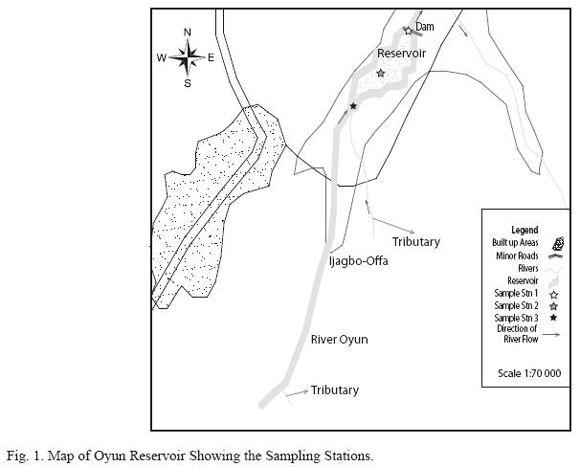
<body><![CDATA[<p><font face="Verdana" size="2"> </font></p>     <p><font face="Verdana" size="2">Africa tropical reservoirs are often con</font><font face="Verdana" size="2">structed for a single purpose like provision of </font><font face="Verdana" size="2">domestic and industrial water supply, irriga</font><font face="Verdana" size="2">tion, hydroelectric power generation or fish </font><font face="Verdana" size="2">production. With time, other functions like </font><font face="Verdana" size="2">flood control, navigation, recreation and tour</font><font face="Verdana"  size="2">ism are superimposed on them, making them </font><font face="Verdana" size="2">assume multipurpose roles. The ability of the </font><font face="Verdana"  size="2">reservoir to deliver its function(s) effectively </font><font  face="Verdana" size="2">depends largely on its watershed activities. </font><font face="Verdana" size="2">A watershed is the land from which rain and </font><font face="Verdana" size="2">surface water drain into the reservoir. Reservoir </font><font face="Verdana"  size="2">characteristics are a reflection of its watershed </font><font face="Verdana" size="2">(Holdren <i>et al. </i>2001). The watershed land </font><font face="Verdana"  size="2">cover is a major determinant of water qual</font><font face="Verdana" size="2">ity and fish community composition (Miranda </font><font face="Verdana" size="2">2008). Therefore any alterations in the water</font><font face="Verdana"  size="2">shed could consequently affect the water qual</font><font face="Verdana" size="2">ity and fish assemblages.    <br> </font></p>     <p><font face="Verdana" size="2">Various activities such as farming, fishing, forestry, construction, mining, urban development and land pollution occurring in or near&nbsp; the watershed of a reservoir could bring about water quality problems and disruption in fish species composition. These activities could also&nbsp; affect habitat structure, flow regime, food web&nbsp; and biotic interactions in the reservoir (Karr 1991). The effects these activities produce&nbsp; on water quality and fish assemblages may&nbsp; vary with season, intensity of the activity and magnitude of discharge of the nutrients or sedi&nbsp; ments into the reservoir. The human activities&nbsp; occurring on the watershed of Oyun reservoir include various agricultural practices such as&nbsp; farming with the use of fertilizers and cassava fermentation. Fishing activities like fish landing, scaling, marketing, fishing net and canoe&nbsp; repairs are the other human activities around the watershed of the reservoir. Municipal uses of the reservoir for washing and bathing with phosphate-based detergents and soaps as well as washing of cow dung left by nomadic cattle are some of the other activities occurring in the watershed of the reservoir.</font></p>     <p><font face="Verdana" size="2">Effective reservoir management and sustainable fish production will depend on effective watershed use and management. A number of watershed management practices known as Best Management Practices (BMP) have been developed and used over the years in many developed countries to protect and sustain both land use and the bodies of water that receive run off from the watershed. These practices however are non-existent or totally ignored in the management of many tropical African reservoirs thereby leading to the deteriorating water quality and inadequate fish assemblages with the absence of local species, dominance of one species over another, as well as decline in commercial species in many of the reservoirs. The relationships between watershed inputs and fish assemblages in many tropical African reservoirs are yet to be documented. </font></p>     <p><font face="Verdana" size="2">The goal of this paper is to look at various human activities occurring on the watershed of Oyun reservoir (a tropical African reservoir) and their effects on the water quality and fish species composition and abundance of the reservoir. This is with a view to managing the reservoir effectively and for sustainable exploitation of its fishes. </font></p>     <p><font face="Verdana" size="3"><span style="font-weight: bold;">Materials and methods</span> </font></p>     <p><font face="Verdana" size="2"><b>Study Site Description: </b>Oyun reservoir (<a href="#f1">Fig. 1</a>) is located in Offa, Kwara State, Nigeria, (8º30’05’’ N, 8º15’55’’ E). It is a dam reservoir on Oyun River, created in 1964, (expanded in 1983, and 1995 with further expansions proposed) by damming the Oyun River. The reservoir was created to supply potable water for domestic and industrial uses to an estimated population of about 300000 people. Subsistence and commercial fishing activities is also carried out on the reservoir. The reservoir has a maximum length of 128 m, maximum width of 50m and maximum depth of 8.0 m, mean depth of 2.6m. The surface area is 6.9 x 10</font><sup><font face="Verdana"  size="1">5</font></sup><font face="Verdana" size="2">m</font><sup><font  face="Verdana" size="1">2 </font></sup><font face="Verdana" size="2">while the water volume is 3.50 x 10</font><sup><font face="Verdana" size="1">6</font></sup><font  face="Verdana" size="2">m</font><sup><font face="Verdana" size="1">3</font></sup><font  face="Verdana" size="2">. The net storage capacity is 2.9 x 10</font><sup><font face="Verdana"  size="1">6</font></sup><font face="Verdana" size="2">m</font><sup><font  face="Verdana" size="1">3</font></sup><font face="Verdana" size="2">. The water retention time is between 3 – 4 months in the rainy season (April – October), while the water residence time in the dry season (November-March) is few days due to high evaporation.    <br> </font></p>     <p><font face="Verdana" size="2">    ]]></body>
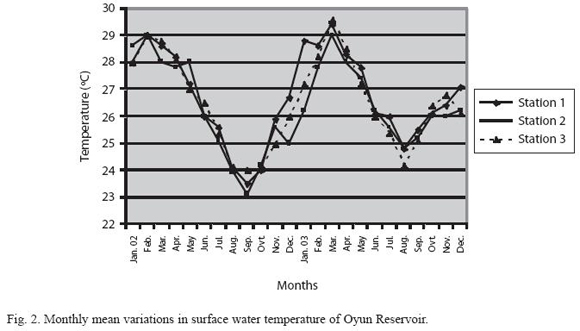
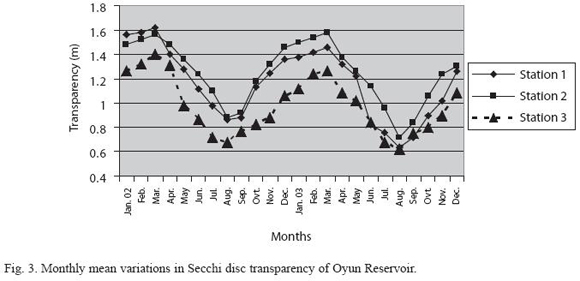
<body><![CDATA[<br> <a name="f1"></a></font></p>     <div style="text-align: center;"><font face="Verdana" size="2"><img  src="/img/revistas/rbt/v57n3/art20i1.jpg" title="" alt=""  style="width: 580px; height: 467px;"></font>    <br> <font face="Verdana" size="2"> </font></div>     <p><font face="Verdana" size="2"><b>Sampling and Sampling Stations: </b>Duplicate surface water samples were collected from 10 cm depth monthly from three stations for two years between January, 2002 and December 2003 into 50ml plastic water bottles that have been acid-washed prior to water analyses. Station 1 was at the dam axis where a lot of human activities such as washing, bathing, fish landing and cassava fermentation take place. It is the highest point of human and animal contact with the reservoir. Station 2 was at the mid-section of the reservoir which represented the area of lentic water while station 3 was at the head water of the reservoir which represented the lotic section of the reservoir. </font></p>     <p><font face="Verdana" size="2"><b>Physico-chemical factors: </b>Surface water temperature, pH, electrical conductivity and total dissolved solids were measured <i>in situ </i>using Hanna portable pH/EC/TDS/Temperature combined water proof tester model HI 98129. The following factors selected as water quality parameters were measured using the methods described for each factor as follows. </font></p>     <p><font face="Verdana" size="2">Transparency was determined by extinction method using the secchi disc by measuring the mean of the depths at which the secchi disc disappears and at which it reappears, dissolved oxygen was determined by Azide modification of the Winkler method, chemical oxygen demand was measured using the dichromate reaction method (Hach 2003), carbon dioxide and alkalinity were determined by titration (APHA 1995). Nitrate-Nitrogen (NO</font><sub><font  face="Verdana" size="1">3</font></sub><font face="Verdana" size="2">-N), phosphate (PO</font><sub><font face="Verdana" size="1">4</font></sub><font  face="Verdana" size="2">-P) and sulphate (SO</font><sub><font  face="Verdana" size="1">4</font></sub><font face="Verdana" size="1"><sup>2-</sup></font><font  face="Verdana" size="2">) were measured according to APHA (1995) standard procedures using Hach spectrophotometer model DR-EL/2. All the chemical analyses were done at the water quality laboratory of Kwara State Utility Board, Ilorin, Nigeria, immediately after the sample collection. </font></p>     <p><font face="Verdana" size="2"><b>Fish composition and abundance: </b>Fish species composition and abundance were estimated through monthly collection of fish samples between January, 2002 and December, 2003 from the three stations. Gill nets, cast nets and lift nets of various mesh sizes ranging between 5.08cm and 17.78cm were used to sample the fishes from all the stations. A variety of mesh sizes was used to reduce species and size selectivity characteristics of gill nets (van der Mheen 1995). The fishes were identified using keys compiled by Holdeen &amp; Reed (1972) and Reed <i>et al. </i>(1967), sorted into species and families, and each fish was weighed to the nearest 0.1g using the mettler balance. </font></p>     <p><font face="Verdana" size="2"><b>Statistical analyses: </b>General linear models (GLM) procedure of statistical analysis system 9.1.3 (SAS Institute, 2003) was used to analyze the results. Raw data (physico-chemical and fish) were log transformed Log</font><sub><font face="Verdana" size="1">10</font></sub><font  face="Verdana" size="2">(X+1) for normality parametric statistical test requirements. Two-way analysis of variance (ANOVA) at P&lt;0.05 were used to compare the averages and test for significant differences in means of the parameters in the stations, seasons and years. Two-way (ANOVA) was also applied to fish species seasonal catch per unit effort (CPUE) and weight abundance data to determine if there were significant differences between the seasons. The Proc GLM of SAS 9.1.3 was used in ascertaining if monthly abundance of all fish families exhibited any seasonal relationship. Prior to these analyses, the fish data was log transformed for normality. </font></p>     <p><font face="Verdana" size="3"><span style="font-weight: bold;">Results</span> </font></p>     <p><font face="Verdana" size="2"><b>Physico-chemical factors: </b>The mean monthly variation in the surface water temperature of the three stations is presented in <a href="#f2">Fig. 2</a>. The temperature ranged between the lowest value of 23.1</font><sup><font face="Verdana" size="1">0</font></sup><font  face="Verdana" size="2">C ± 0.5 obtained from Station 2 in September and highest of 29.6<sup>0</sup>C ±0.1 obtained from station 3 in March, 2003. Dry season temperature was significantly higher than the wet season (F<sub>11, 60 </sub>= 4.62, p = 0.0001). No significant difference was seen among the stations and in the two years. Secchi disc transparency was highest at station 1 with a mean value of 1.62m ±0.32 obtained in March 2002. Station 3 recorded the least secchi disc transparency value with a mean of 0.62m ±0.8 obtained in August of 2003 (<a href="#f3">Fig. 3</a>). The dry season, stations 2 and year 2002 had significant higher transparency (F<sub>11, 60 </sub>= 41.82, p = 0.0001).    ]]></body>
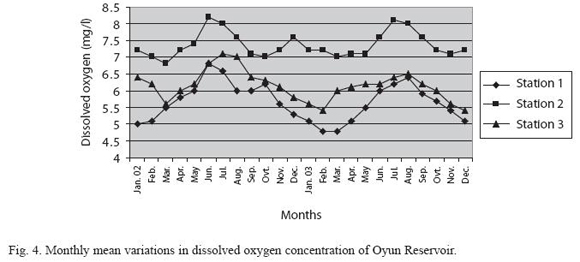
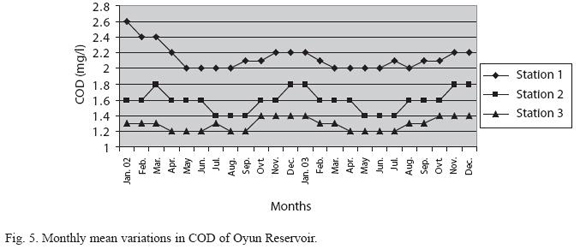
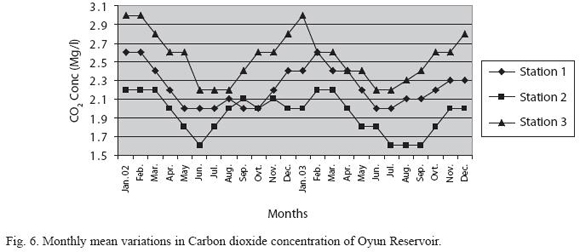
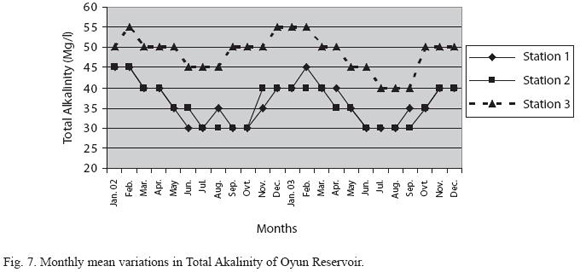
<body><![CDATA[<br> </font></p>     <p><font face="Verdana" size="2">    <br> <a name="f2"></a></font></p>     <div style="text-align: center;"><font face="Verdana" size="2"><img  src="/img/revistas/rbt/v57n3/art20i2.jpg" title="" alt=""  style="width: 580px; height: 331px;"></font>    <br> </div>     <p><font face="Verdana" size="2">    <br> <a name="f3"></a></font></p>     <div style="text-align: center;"><font face="Verdana" size="2"><img  src="/img/revistas/rbt/v57n3/art20i3.jpg" title="" alt=""  style="width: 580px; height: 281px;"></font>    <br> <font face="Verdana" size="2"> </font></div> <font face="Verdana" size="2">     <p>Dissolved oxygen fluctuated between lowest monthly mean of 4.8mg/l ±0.25 obtained in February and March 2003 from Station 1 and highest monthly mean of 8.2mg/l ±0.31 recorded in June 2002 from Station 2 (<a href="#f4">Fig. 4</a>). Statistical <font face="Verdana" size="2">difference was noticed in the Dissolved oxygen concentration among the stations, (with station 2 having the highest concentration) season, (the wet season values were significantly higher than dry season) and years with 2002 having a higher concentration than 2003 (F</font><sub><font face="Verdana"  size="1">11, 60 </font></sub><font face="Verdana" size="2">= 42.16, p = 0.0001). Chemical Oxygen Demand (COD) varied between 1.2mg/l ±0.1 and 2.6mg/l ±0.2 and was significantly higher in the dry season with station 1 recording the highest concentration and station 3 recording the lowest concentration in the wet season (<a href="#f5">Fig. 5</a>). There was no statistical difference in COD between the two years of study (F</font><sub><font  face="Verdana" size="1">11, 60 </font></sub><font face="Verdana"  size="2">= 88.58, p = 0.0001). Carbon dioxide and total alkalinity showed similar pattern in their concentration among the stations and in the seasons. The two factors were statistically higher in the dry season as well as in Station 3 (F</font><sub><font face="Verdana"  size="1">11, 60 </font></sub><font face="Verdana" size="2">= 28.34, p = 0.0001 and F<sub>11,60</sub> = 41.83, p = 0.0001). Carbon dioxide</font><font  face="Verdana" size="1"> </font><font face="Verdana" size="2">ranged between monthly mean of 1.6mg/l ±0.2 to 3.0mg/l ±0.6 (<a href="#f6">Fig. 6</a>) while total alkalinity fluctuated between monthly mean of 30mg/l ±2.6 and 55mg/l ±3.4 (<a href="#f7">Fig. 7</a>).    ]]></body>
<body><![CDATA[<br> </font></p>     <p><font face="Verdana" size="2">    <br> <a name="f4"></a></font></p> </font>     <div style="text-align: center;"><font face="Verdana" size="2"><img  src="/img/revistas/rbt/v57n3/art20i4.jpg" title="" alt=""  style="width: 580px; height: 262px;"></font>    <br> </div> <font face="Verdana" size="2">     <p><font face="Verdana" size="2">    <br> <a name="f5"></a></font></p> </font>     <div style="text-align: center;"><font face="Verdana" size="2"><img  src="/img/revistas/rbt/v57n3/art20i5.jpg" title="" alt=""  style="width: 580px; height: 249px;"></font>    <br> </div> <font face="Verdana" size="2">     <p><font face="Verdana" size="2">    ]]></body>
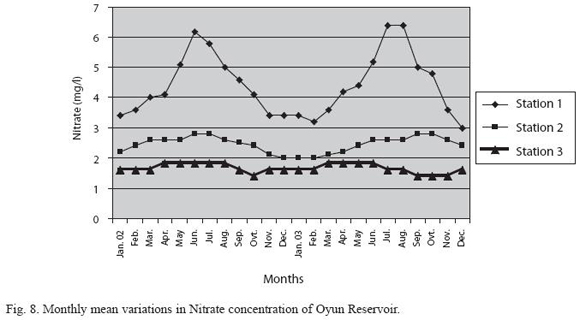
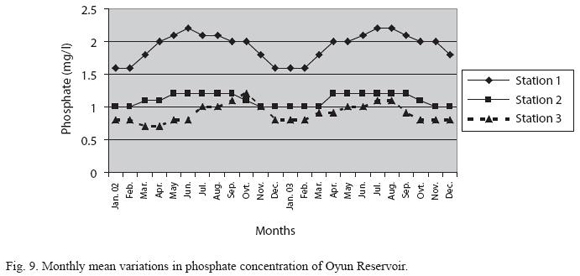
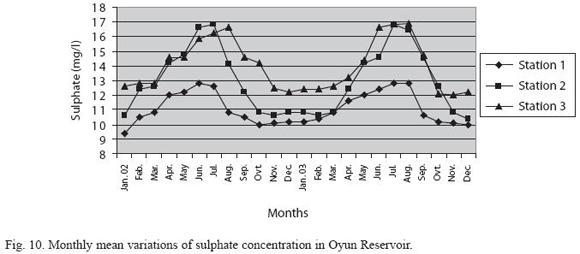
<body><![CDATA[<br> <a name="f6"></a></font></p> </font>     <div style="text-align: center;"><font face="Verdana" size="2"><img  src="/img/revistas/rbt/v57n3/art20i6.jpg" title="" alt=""  style="width: 580px; height: 252px;"></font>    <br> </div> <font face="Verdana" size="2">     <p><font face="Verdana" size="2">    <br> <a name="f7"></a></font></p> </font>     <div style="text-align: center;"><font face="Verdana" size="2"><img  src="/img/revistas/rbt/v57n3/art20i7.jpg" title="" alt=""  style="width: 580px; height: 272px;"></font>    <br> <font face="Verdana" size="2"> </font></div>     <p><font face="Verdana" size="2">The highest monthly mean concentration of Nitrate recorded was 6.4mg/l ±0.3 obtained from Station 1 at the peak of the rains in August 2003. Adecrease was observed in the dry season with the lowest concentration of 1.4mg/l ±0.1 recorded from Station 3 in October 2003 (<a href="#f8">Fig. 8</a>). ANOVA shows significant difference in the nitrate concentration during the seasons and within the stations (F</font><sub><font  face="Verdana" size="1">11, 60 </font></sub><font face="Verdana"  size="2">= 68.54, p = 0.0001). Nitrate was higher in the raining season and the order of magnitude in the concentration among the stations was station 1 &gt; 2 &gt; 3. Phosphate had the least concentration among the ions. It ranged between 0.7mg/l ±0.0 to 2.2mg/l ±0.2 (<a href="#f9">Fig. 9</a>). Like Nitrate, phosphate concentration was significantly higher in raining season and in station 1 (F</font><sub><font  face="Verdana" size="1">11, 60 </font></sub><font face="Verdana"  size="2">= 119.01, p = 0.0001). No significant difference occurred between the years of study in Nitrate and phosphate concentrations. The fluctuations in sulphate concentration are shown in <a href="#f10">Fig. 10</a>. Sulphate concentration was lowest at 9mg/l ±0.2 at the beginning of the study in Station 1, it gradually increased until a maximum concentration of 16.9mg/l ±0.45 was recorded in Station 3. Sulphate was significantly higher in the wet season while the order of higher concentration among the stations was stations 3 &gt; 2 &gt; 1. No difference occurred within the years (F</font><sub><font  face="Verdana" size="1">11, 60 </font></sub><font face="Verdana"  size="2">= 11.80, p = 0.0001).    <br> </font></p>     <p><font face="Verdana" size="2">    ]]></body>
<body><![CDATA[<br> <a name="f8"></a></font></p>     <div style="text-align: center;"><font face="Verdana" size="2"><img  src="/img/revistas/rbt/v57n3/art20i8.jpg" title="" alt=""  style="width: 580px; height: 320px;"></font>    <br> </div>     <p><font face="Verdana" size="2">    <br> <a name="f9"></a></font></p>     <div style="text-align: center;"><font face="Verdana" size="2"><img  src="/img/revistas/rbt/v57n3/art20i9.jpg" title="" alt=""  style="width: 580px; height: 276px;"></font>    <br> </div>     <p><font face="Verdana" size="2">    <br> <a name="f10"></a></font></p>     <div style="text-align: center;"><font face="Verdana" size="2"><img  src="/img/revistas/rbt/v57n3/art20i10.jpg" title="" alt=""  style="width: 580px; height: 254px;"></font>    ]]></body>
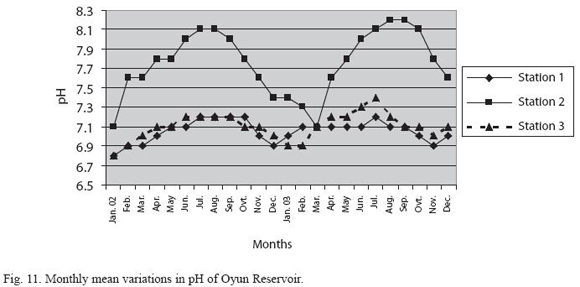
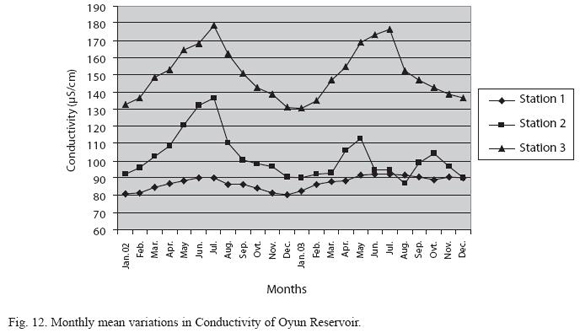
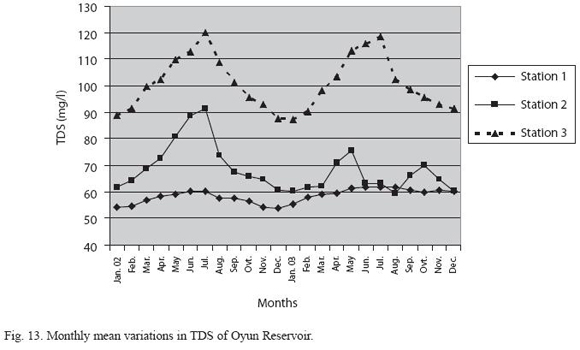
<body><![CDATA[<br> <font face="Verdana" size="2"> </font></div>     <p><font face="Verdana" size="2">The surface waster pH fluctuated between slight acidity and moderate alkalinity. The lowest monthly mean pH was 6.8 ±0.05 obtained at station 3 during the dry season in January 2002, while the highest was 8.2 ±0.2 obtained from stations 2 in August and September of 2003 (<a href="#f11">Fig. 11</a>). In the 3 stations, the pH was in the neutral range for most of the study period. No acidic pH was recorded from station 2; it was either neutral or alkaline for most part of the study. ANOvA showed pH to be statistically higher during the wet season than in the dry season and pH of station 2 was significantly higher than the other stations. No difference was noted between the years (F</font><sub><font face="Verdana" size="1">11, 60 </font></sub><font  face="Verdana" size="2">= 45.86, p = 00001). The monthly mean variations in electrical conductivity and total dissolved solids (TDS) followed similar trend. There was slight variation in conductivity and TDS in stations 1. The station recorded the lowest value of conductivity (80.4 µs/cm ±0.8) and TDS (53.9mg/l ±0.8) in December 2002 and station 3 recorded the highest variation and concentration of conductivity and TDS with the highest value of conductivity (178.8µs/cm ±2.0) and TDS (119.8mg/l ±2.0) obtained in July 2002 (<a href="#f12">Figs. 12</a> and <a href="#f13">13</a>). Both electrical conductivity and TDS showed significant differences in their concentrations among the seasons and stations. The two factors were statistically higher during the rainy season (F</font><sub><font  face="Verdana" size="1">11, 60 </font></sub><font face="Verdana"  size="2">= 63.19, p = 0.0001, = 63.67, p = 0.0001) while the order of significant difference between the stations was station 3 &gt; 2 &gt; 1.    <br> </font></p>     <p><font face="Verdana" size="2">    <br> <a name="f11"></a></font></p>     <div style="text-align: center;"><font face="Verdana" size="2"><img  src="/img/revistas/rbt/v57n3/art20i11.jpg" title="" alt=""  style="width: 580px; height: 287px;"></font>    <br> </div>     <p><font face="Verdana" size="2">    <br> <a name="f12"></a></font></p>     <div style="text-align: center;"><font face="Verdana" size="2"><img  src="/img/revistas/rbt/v57n3/art20i12.jpg" title="" alt=""  style="width: 580px; height: 333px;"></font>    ]]></body>
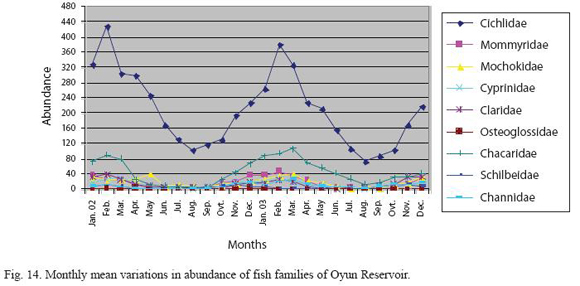
<body><![CDATA[<br> </div>     <p><font face="Verdana" size="2">    <br> <a name="f13"></a></font></p>     <div style="text-align: center;"><font face="Verdana" size="2"><img  src="/img/revistas/rbt/v57n3/art20i13.jpg" title="" alt=""  style="width: 580px; height: 350px;"></font>    <br> <font face="Verdana" size="2"> </font></div>     <p><font face="Verdana" size="2"><b>Fish composition and abundance: </b>A total of 7713 fish samples comprising of 18 species belonging to 9 families were recorded from the reservoir (<a  href="/img/revistas/rbt/v57n3/art20t1.gif">Table 1</a>). The families Cichlidae and Mormyridae were each represented by four species, but Cichlidae dominated the fish species in terms of number and weight with 64.56% and 69.31 % respectively. The families Mochokidae, Cyprinidae and Clariidae were each represented by two species, while Osteoglossidae, Characidae, Schilbeidae and Channidae had one species each. The family Osteoglossidae had the lowest abundance comprising just 0.22%; it also had the lowest weight percentage of 0.82% in the fish population. Among the individual fish species, <i>Tilapia zillii </i>constituting 30.0% and 28.55% by abundance and weight was the dominant species in terms of number and weight, while <i>Heterotis niloticus </i>constituting 0.22% by abundance and <i>Gnathonemus cyprinoides </i>having a weight percentage of 0.29% were the species with the lowest number and weight respectively. Majority of the fish species and families were caught all year round except for Osteoglossidae which was caught for only four months in a year (<a href="#f14">Fig. 14</a>). The species and families were highly abundant in the dry season between November and May, while in the rains and flood periods, between June and October, there was a decline in their population and diversity. <i>Heterotis niloticus </i>(Family Osteoglossidae), the least abundant species was also found in high numbers during the dry season. Significant higher weight was found in the dry season among the fish population. Low water volume, high transparency and temperature in the dry season might have encouraged high fish catch, while flood and turbid water resulting in low transparency and large water volume which hampered fishing gear efficiency may have caused the low catch ability of fish in the rainy season.    <br> </font></p>     <p><font face="Verdana" size="2">    <br> <a name="f14"></a></font></p>     <div style="text-align: center;"><font face="Verdana" size="2"><img  src="/img/revistas/rbt/v57n3/art20i14.jpg" title="" alt=""  style="width: 580px; height: 286px;"></font>    ]]></body>
<body><![CDATA[<br> <font face="Verdana" size="2"> </font></div>     <p><font face="Verdana" size="3"><span style="font-weight: bold;">Discussion</span> </font></p>     <p><font face="Verdana" size="2"><b>Physico-chemical factors: </b>The variations observed in the physico-chemical parameters and fish species composition and abundance of Oyun reservoir could be linked to the various interactions of the human activities on the water shed and competing uses of the reservoir by stakeholders. The various recorded human activities in the watershed of the reservoir include agricultural activities like farming, cassava fermentation, fish landing, scaling, marketing and fishing nets and canoe repair. All these activities were found to be more prevalent in station 1 (the dam axis). The watershed of Oyun reservoir is mainly agricultural with nutrient inputs coming from fertilizer run-off and cassava fermentation which occurs on a large scale around the reservoir, cassava being a staple food in the locality. Thus large amount of particulate organic matter was exported into the reservoir from sediments run-off. The high concentrations of nitrate, phosphate and sulphate during the rains possibly came from the run-off of nitrophosphate and sulphate fertilizers from nearby farmlands into the reservoir. The rainy season is usually the time of high fertilizer applications in the locality (personal observation). Fertilizer application has been reported to be a major disturbance to the watershed (Novotny 2003), while Carpenter <i>et al. </i>(1998) observed that nutrients input from the watershed are a leading cause of eutrophication. Other watershed activities that could have caused the eutrophication include washing and bathing with phosphate based detergents and soaps as well as washing of cow dungs into the reservoir. The nitrate and phosphate concentrations of Oyun reservoir were slightly higher than other reservoirs in Nigeria such as Shiroro (Kolo 1996), Jebba (Adeniji 1991), Ethiope ( Aluyi <i>et al, </i>2003) and this resulted in cultural eutrophication seen in the reservoir. The eutrophication brought about by high nutrients inputs was termed cultural, because, it was accelerated by human influences and this caused physical, chemical and biological changes to the reservoir. The high conductivity and total dissolved values of the water was a reflection of the high nutrients present in the reservoir, with the two factors having a positive correlation. </font></p>     <p><font face="Verdana" size="2"><b>Fish composition and abundance: </b>The high sediment run-offs could be responsible for the low fish species abundance in the rainy season through the reduction in light penetration and photosynthesis. This could have altered the food web cycle and food availability to fishes and consequently reduced the fish population. According to Kirk &amp; Gilbert (1990), increase in turbidity driven by the sediments delivered by agricultural watersheds tends to interfere with fish food. High suspended solids which made its way to the reservoir could also have caused the low fish abundance as Total suspended solids TSS have been reported to reduce fish visibility, growth, health and could produce a shift in fish habitat use (Bruton 1985), cover fish spawning sites, smoother their eggs and damage habitat for aquatic insects which are a major food source for the fishes (Holdren <i>et al. </i>2001). </font></p>     <p><font face="Verdana" size="2">Many of the watershed activities in the reservoir produced dissolved organic or particulate matter which was washed into the reservoir releasing high amount of carbon, consuming a large concentration of dissolved oxygen, produced high concentration of carbon dioxide and increase the chemical oxygen demand of the water. This is particularly more evident during the dry season when fisheries related activities were at their peak. Thus the low concentration of dissolved oxygen and the high concentration of carbon dioxide and chemical oxygen demand in the dry season could be attributed to this phenomenon. High concentration of carbon dioxide in the dry season might be responsible for the slight acidity of the water (pH 6.8), while total alkalinity acted as a buffer for the pH during most of the time. An important beneficial effect of the allochtonous carbon on fisheries is that population dynamics, predator-prey interactions and the reservoir ecosystems are enhanced (Polis <i>et al. </i>1997), which could have aided the high fish production in the dry season. </font></p>     <p><font face="Verdana" size="2">The various human activities in the watershed of Oyun reservoir led to increase in the nutrient levels and inadequate fish assemblages with the preponderance of some species, absence of other species and decline of commercially important species. The human-induced eutrophication which released high amounts of nutrients affected the water quality and species composition and abundance of some species in the reservoir. This is evident in the reduction seen in abundance of commercially important species like <i>Heterotis niloticus </i>and <i>Barbus occidentalis </i>as well as in the absence of some other familiar families and species in the reservoir. In order to arrest further degradation of the water quality and inadequate fish assemblages in the reservoir, various watershed activities that put in high amounts of nutrients and sediments into the reservoir should be halted. Good and safe agricultural practices in the watershed will protect the reservoir water quality and improve the fish diversity and abundance. This could be achieved by protecting the reservoir from run-off of agricultural fertilizers and cow dungs from nearby farmlands, educating the end users of the reservoir on the municipal abuse and misuse of the reservoir and its watershed, as well as in the conservation of the fisheries resources of the reservoir. </font></p>     <p><font face="Verdana" size="2">These activities identified as contributing to the eutrophication of the reservoir need to be eliminated. Best Management Practices (BMP) which is in use in many reservoirs of developed countries should be adopted and adapted to suit the situation in tropical African reservoirs. We should start to look beyond the traditional in-reservoir management to improve water quality and fish production, but extend the scale of the management to the reservoir catchments area and watershed. This according to Miranda (2008) will enhance the managers’ ability to impact reservoir fish population and communities. </font></p>     <p><font face="Verdana" size="3"><span style="font-weight: bold;">Acknowledgment</span> </font></p>     <p><font face="Verdana" size="2">I thank the International Association of Theoretical and Applied Limnology (SIL) for their financial support through the Tonolli Fund for Post Graduate Fellowships in Limnology. </font></p> <hr style="width: 100%; height: 2px;">     <p><font face="Verdana" size="2"><span style="font-weight: bold;">Resumen</span> </font></p>     ]]></body>
<body><![CDATA[<p><font face="Verdana" size="2">Las actividades agrícolas y pesqueras que se desarrollan alrededor del embalse tropical africano de Oyun, Offa, Nigeria, contribuyen de forma significativa al deterioro de la calidad del agua, provocando eutroficación. Esto es evidente a partir de la gran cantidad de nitrato (6.4 mg / l), fosfato (2.2 mg / l) y sulfato (16.9 mg / l), si se compara con otros embalses de Nigeria. Estos nutrientes proceden de fertilizantes utilizados en áreas agrícolas y las concentraciones aumentan en la estación lluviosa cuando aumentan las actividades agrícolas en la zona. La eutroficación es más pronunciada donde existe mayor actividad humana, y altera la cadena trófica y en consecuencia, la composición íctica, con predominio de los cíclidos y disminución de otros peces. Se requiere manejo de la cuenca para reducir la eutrofización y mejorar la calidad del agua y los peces. </font></p>     <p><font face="Verdana" size="2"><b>Palabras clave: </b>embalse, calidad del agua, grupos ícticos, cuencas hidrográficas, manejo.    <br> </font></p> <hr style="width: 100%; height: 2px;">     <p style="text-align: center;"><font face="Verdana" size="2">Received 09-VI-2008. Corrected 22-II-2009. Accepted 25-III-2009.</font></p> <font face="Verdana" size="2"> <font size="3">     <p><span style="font-weight: bold;">References</span> </p> </font></font>     <!-- ref --><p><font face="Verdana" size="2">Adeniji, H.A. 1991. Limnology and Biological production in the pelagic zone of Jebba Lake, Nigeria. Ph.D thesis. University of Ibadan, Ibadan, Nigeria.&nbsp;&nbsp;&nbsp;&nbsp;&nbsp;&nbsp;&nbsp;&nbsp;[&#160;<a href="javascript:void(0);" onclick="javascript: window.open('/scielo.php?script=sci_nlinks&ref=1378803&pid=S0034-7744200900030002000001&lng=','','width=640,height=500,resizable=yes,scrollbars=1,menubar=yes,');">Links</a>&#160;]<!-- end-ref --><!-- ref --><p> Aluyi, H.S.A., Atuanya,E.I. &amp; Amoforitse, S.C. 2003. Bacteriological and physico-chemical investigations of Ethiope River, Delta State, Nigeria. <i>Afr. J. of Appl. Zool. &amp; Envt. Biol. </i>29-36. </font>&nbsp;&nbsp;&nbsp;&nbsp;&nbsp;&nbsp;&nbsp;&nbsp;[&#160;<a href="javascript:void(0);" onclick="javascript: window.open('/scielo.php?script=sci_nlinks&ref=1378804&pid=S0034-7744200900030002000002&lng=','','width=640,height=500,resizable=yes,scrollbars=1,menubar=yes,');">Links</a>&#160;]<!-- end-ref --><!-- ref --><p><font face="Verdana" size="2">APHA (American Public Health Association) 1995. Standard methods for the examination of water and waste water. 19</font><sup><font face="Verdana" size="1">th </font></sup><font  face="Verdana" size="2">edition. American Public Health Association, New York, USA. </font>&nbsp;&nbsp;&nbsp;&nbsp;&nbsp;&nbsp;&nbsp;&nbsp;[&#160;<a href="javascript:void(0);" onclick="javascript: window.open('/scielo.php?script=sci_nlinks&ref=1378805&pid=S0034-7744200900030002000003&lng=','','width=640,height=500,resizable=yes,scrollbars=1,menubar=yes,');">Links</a>&#160;]<!-- end-ref --><!-- ref --><p><font face="Verdana" size="2">Brutton, M.N. 1985. Effects of suspensoids on fish. Hydrobiologia 125: 221-241. </font>&nbsp;&nbsp;&nbsp;&nbsp;&nbsp;&nbsp;&nbsp;&nbsp;[&#160;<a href="javascript:void(0);" onclick="javascript: window.open('/scielo.php?script=sci_nlinks&ref=1378806&pid=S0034-7744200900030002000004&lng=','','width=640,height=500,resizable=yes,scrollbars=1,menubar=yes,');">Links</a>&#160;]<!-- end-ref --><!-- ref --><p><font face="Verdana" size="2">Carpenter S.R., N.F. Caranco, D.L. Correll, R.W. Howarth, A.N. Sharpley, &amp; V.H Smith. 1998. Non point pollution of surface waters with Phosphorous and Nitrogen. Ecol Appl. 8: 559-568. </font>&nbsp;&nbsp;&nbsp;&nbsp;&nbsp;&nbsp;&nbsp;&nbsp;[&#160;<a href="javascript:void(0);" onclick="javascript: window.open('/scielo.php?script=sci_nlinks&ref=1378807&pid=S0034-7744200900030002000005&lng=','','width=640,height=500,resizable=yes,scrollbars=1,menubar=yes,');">Links</a>&#160;]<!-- end-ref --><!-- ref --><p><font face="Verdana" size="2">Hach. 2003. Water analysis handbook (Fourth edition), Vol. 2: Hach Chemical Company, Loveland,Colorado, USA. </font>&nbsp;&nbsp;&nbsp;&nbsp;&nbsp;&nbsp;&nbsp;&nbsp;[&#160;<a href="javascript:void(0);" onclick="javascript: window.open('/scielo.php?script=sci_nlinks&ref=1378808&pid=S0034-7744200900030002000006&lng=','','width=640,height=500,resizable=yes,scrollbars=1,menubar=yes,');">Links</a>&#160;]<!-- end-ref --><!-- ref --><p><font face="Verdana" size="2">Holdeen, M. &amp; W. Reed. 1972. West African Freshwater Fish. Longmans Group. London, England. </font>&nbsp;&nbsp;&nbsp;&nbsp;&nbsp;&nbsp;&nbsp;&nbsp;[&#160;<a href="javascript:void(0);" onclick="javascript: window.open('/scielo.php?script=sci_nlinks&ref=1378809&pid=S0034-7744200900030002000007&lng=','','width=640,height=500,resizable=yes,scrollbars=1,menubar=yes,');">Links</a>&#160;]<!-- end-ref --><!-- ref --><p><font face="Verdana" size="2">Holdren, C., W. Jones &amp; J. Taggart. 2001. Managing Lakes and Reservoirs. N. Am. Lake Manage. Soc. and Terrene Inst., in coop. with Off. Water Assess. Watershed Prot. Div. U.S. Environ. Prot. Agency, Madison, Wisconsin, USA. </font>&nbsp;&nbsp;&nbsp;&nbsp;&nbsp;&nbsp;&nbsp;&nbsp;[&#160;<a href="javascript:void(0);" onclick="javascript: window.open('/scielo.php?script=sci_nlinks&ref=1378810&pid=S0034-7744200900030002000008&lng=','','width=640,height=500,resizable=yes,scrollbars=1,menubar=yes,');">Links</a>&#160;]<!-- end-ref --><!-- ref --><p><font face="Verdana" size="2">Karr, J.R. 1991. Biological integrity: A long neglected aspect of water resource management. Ecol. Appl. 1: 66-84. </font>&nbsp;&nbsp;&nbsp;&nbsp;&nbsp;&nbsp;&nbsp;&nbsp;[&#160;<a href="javascript:void(0);" onclick="javascript: window.open('/scielo.php?script=sci_nlinks&ref=1378811&pid=S0034-7744200900030002000009&lng=','','width=640,height=500,resizable=yes,scrollbars=1,menubar=yes,');">Links</a>&#160;]<!-- end-ref --><!-- ref --><p><font face="Verdana" size="2">Kirk, K.L. &amp; J.J. Gilbert. 1990. Suspended clay and the population dynamics of planktonic rotifers and cladocerans. Ecology 71: 1741-1755. </font>&nbsp;&nbsp;&nbsp;&nbsp;&nbsp;&nbsp;&nbsp;&nbsp;[&#160;<a href="javascript:void(0);" onclick="javascript: window.open('/scielo.php?script=sci_nlinks&ref=1378812&pid=S0034-7744200900030002000010&lng=','','width=640,height=500,resizable=yes,scrollbars=1,menubar=yes,');">Links</a>&#160;]<!-- end-ref --><!-- ref --><p><font face="Verdana" size="2">Kolo, R.J. 1999. The asssessment of physico-chemical parameters of Shiroro Lake and its major tributaries. In: Eyo, A.A (ed). Proceeding of the annual conference of the Fisheries Society of Nigeria,Abuja, Nigeria. </font>&nbsp;&nbsp;&nbsp;&nbsp;&nbsp;&nbsp;&nbsp;&nbsp;[&#160;<a href="javascript:void(0);" onclick="javascript: window.open('/scielo.php?script=sci_nlinks&ref=1378813&pid=S0034-7744200900030002000011&lng=','','width=640,height=500,resizable=yes,scrollbars=1,menubar=yes,');">Links</a>&#160;]<!-- end-ref --><!-- ref --><p><font face="Verdana" size="2">Miranda L.E. 2008. Extending the Scale of Reservoir Management. <i>In</i>: M. Allen and S. Sammons (editors). Balancing fisheries management and water uses for impounded river systems. American Fisheries Society. Bethesda, Maryland USA (In press). </font>&nbsp;&nbsp;&nbsp;&nbsp;&nbsp;&nbsp;&nbsp;&nbsp;[&#160;<a href="javascript:void(0);" onclick="javascript: window.open('/scielo.php?script=sci_nlinks&ref=1378814&pid=S0034-7744200900030002000012&lng=','','width=640,height=500,resizable=yes,scrollbars=1,menubar=yes,');">Links</a>&#160;]<!-- end-ref --><!-- ref --><p><font face="Verdana" size="2">Novotny, V. 2003. Water quality: diffuse pollution and water shed management. Wiley, Hoboken, New Jersey, USA. </font>&nbsp;&nbsp;&nbsp;&nbsp;&nbsp;&nbsp;&nbsp;&nbsp;[&#160;<a href="javascript:void(0);" onclick="javascript: window.open('/scielo.php?script=sci_nlinks&ref=1378815&pid=S0034-7744200900030002000013&lng=','','width=640,height=500,resizable=yes,scrollbars=1,menubar=yes,');">Links</a>&#160;]<!-- end-ref --><!-- ref --><p><font face="Verdana" size="2">Polis, G.A., W.B. Anderson. &amp; R.D. Holt. 1997. Toward an integration of landscape and food web ecology: the dynamics of spatially subsidized food webs. Ann. Rev. of Ecol. Syst. 28: 289-316. </font>&nbsp;&nbsp;&nbsp;&nbsp;&nbsp;&nbsp;&nbsp;&nbsp;[&#160;<a href="javascript:void(0);" onclick="javascript: window.open('/scielo.php?script=sci_nlinks&ref=1378816&pid=S0034-7744200900030002000014&lng=','','width=640,height=500,resizable=yes,scrollbars=1,menubar=yes,');">Links</a>&#160;]<!-- end-ref --><!-- ref --><p><font face="Verdana" size="2">Reed, W., J. Burchard, A.J. Hopson. &amp; I. Yaro. 1967. Fish and Fisheries of Northern Nigeria. M.A.N.R. Publ. Nigeria.    &nbsp;&nbsp;&nbsp;&nbsp;&nbsp;&nbsp;&nbsp;&nbsp;[&#160;<a href="javascript:void(0);" onclick="javascript: window.open('/scielo.php?script=sci_nlinks&ref=1378817&pid=S0034-7744200900030002000015&lng=','','width=640,height=500,resizable=yes,scrollbars=1,menubar=yes,');">Links</a>&#160;]<!-- end-ref --><br> </font></p>     <!-- ref --><p><font face="Verdana" size="2">SAS Institute. (2003): SAS/Stat User’s Guide, version 9.1.3. SAS Institute Inc., Carry, North Carolina, USA. </font>&nbsp;&nbsp;&nbsp;&nbsp;&nbsp;&nbsp;&nbsp;&nbsp;[&#160;<a href="javascript:void(0);" onclick="javascript: window.open('/scielo.php?script=sci_nlinks&ref=1378819&pid=S0034-7744200900030002000016&lng=','','width=640,height=500,resizable=yes,scrollbars=1,menubar=yes,');">Links</a>&#160;]<!-- end-ref --><!-- ref --><p><font face="Verdana" size="2">Van Der Mheen, H. 1995. The use of multi-mesh gill nets for sampling fish stocks in southern Africa. Fisheries Department, FAO, Rome, Italy. </font>&nbsp;&nbsp;&nbsp;&nbsp;&nbsp;&nbsp;&nbsp;&nbsp;[&#160;<a href="javascript:void(0);" onclick="javascript: window.open('/scielo.php?script=sci_nlinks&ref=1378820&pid=S0034-7744200900030002000017&lng=','','width=640,height=500,resizable=yes,scrollbars=1,menubar=yes,');">Links</a>&#160;]<!-- end-ref --> ]]></body><back>
<ref-list>
<ref id="B1">
<nlm-citation citation-type="">
<person-group person-group-type="author">
<name>
<surname><![CDATA[Adeniji]]></surname>
<given-names><![CDATA[H.A]]></given-names>
</name>
</person-group>
<source><![CDATA[Limnology and Biological production in the pelagic zone of Jebba Lake, Nigeria]]></source>
<year>1991</year>
</nlm-citation>
</ref>
<ref id="B2">
<nlm-citation citation-type="journal">
<person-group person-group-type="author">
<name>
<surname><![CDATA[Aluyi]]></surname>
<given-names><![CDATA[H.S.A]]></given-names>
</name>
<name>
<surname><![CDATA[Atuanya]]></surname>
<given-names><![CDATA[E.I]]></given-names>
</name>
<name>
<surname><![CDATA[Amoforitse]]></surname>
<given-names><![CDATA[S.C]]></given-names>
</name>
</person-group>
<article-title xml:lang="en"><![CDATA[Bacteriological and physico-chemical investigations of Ethiope River, Delta State, Nigeria]]></article-title>
<source><![CDATA[Afr. J. of Appl. Zool. & Envt. Biol]]></source>
<year>2003</year>
<page-range>29-36</page-range></nlm-citation>
</ref>
<ref id="B3">
<nlm-citation citation-type="book">
<collab>APHA (American Public Health Association)</collab>
<source><![CDATA[Standard methods for the examination of water and waste water]]></source>
<year>1995</year>
<edition>19</edition>
<publisher-loc><![CDATA[^eNew York New York]]></publisher-loc>
<publisher-name><![CDATA[American Public Health Association]]></publisher-name>
</nlm-citation>
</ref>
<ref id="B4">
<nlm-citation citation-type="journal">
<person-group person-group-type="author">
<name>
<surname><![CDATA[Brutton]]></surname>
<given-names><![CDATA[M.N]]></given-names>
</name>
</person-group>
<article-title xml:lang="en"><![CDATA[Effects of suspensoids on fish]]></article-title>
<source><![CDATA[Hydrobiologia]]></source>
<year>1985</year>
<volume>125</volume>
<page-range>221-241</page-range></nlm-citation>
</ref>
<ref id="B5">
<nlm-citation citation-type="journal">
<person-group person-group-type="author">
<name>
<surname><![CDATA[Carpenter]]></surname>
<given-names><![CDATA[S.R]]></given-names>
</name>
<name>
<surname><![CDATA[Caranco]]></surname>
<given-names><![CDATA[N.F]]></given-names>
</name>
<name>
<surname><![CDATA[Correll]]></surname>
<given-names><![CDATA[D.L]]></given-names>
</name>
<name>
<surname><![CDATA[Howarth]]></surname>
<given-names><![CDATA[R.W]]></given-names>
</name>
<name>
<surname><![CDATA[Sharpley]]></surname>
<given-names><![CDATA[A.N]]></given-names>
</name>
<name>
<surname><![CDATA[Smith]]></surname>
<given-names><![CDATA[V.H]]></given-names>
</name>
</person-group>
<article-title xml:lang="en"><![CDATA[Non point pollution of surface waters with Phosphorous and Nitrogen]]></article-title>
<source><![CDATA[Ecol Appl]]></source>
<year>1998</year>
<volume>8</volume>
<page-range>559-568</page-range></nlm-citation>
</ref>
<ref id="B6">
<nlm-citation citation-type="">
<person-group person-group-type="author">
<name>
<surname><![CDATA[Hach]]></surname>
</name>
</person-group>
<source><![CDATA[Water analysis handbook (Fourth edition), Vol. 2: Hach Chemical Company, Loveland,Colorado, USA]]></source>
<year>2003</year>
</nlm-citation>
</ref>
<ref id="B7">
<nlm-citation citation-type="book">
<person-group person-group-type="author">
<name>
<surname><![CDATA[Holdeen]]></surname>
<given-names><![CDATA[M]]></given-names>
</name>
<name>
<surname><![CDATA[Reed]]></surname>
<given-names><![CDATA[W]]></given-names>
</name>
</person-group>
<source><![CDATA[West African Freshwater Fish]]></source>
<year>1972</year>
<publisher-loc><![CDATA[London ]]></publisher-loc>
<publisher-name><![CDATA[Longmans Group]]></publisher-name>
</nlm-citation>
</ref>
<ref id="B8">
<nlm-citation citation-type="book">
<person-group person-group-type="author">
<name>
<surname><![CDATA[Holdren]]></surname>
<given-names><![CDATA[C]]></given-names>
</name>
<name>
<surname><![CDATA[Jones]]></surname>
<given-names><![CDATA[W]]></given-names>
</name>
<name>
<surname><![CDATA[Taggart]]></surname>
<given-names><![CDATA[J]]></given-names>
</name>
</person-group>
<source><![CDATA[Managing Lakes and Reservoirs]]></source>
<year>2001</year>
<publisher-loc><![CDATA[Madison^eWisconsin Wisconsin]]></publisher-loc>
<publisher-name><![CDATA[N. Am. Lake Manage. Soc. and Terrene Inst., in coop. with Off. Water Assess. Watershed Prot. Div. U.S. Environ. Prot. Agency]]></publisher-name>
</nlm-citation>
</ref>
<ref id="B9">
<nlm-citation citation-type="journal">
<person-group person-group-type="author">
<name>
<surname><![CDATA[Karr]]></surname>
<given-names><![CDATA[J.R]]></given-names>
</name>
</person-group>
<article-title xml:lang="en"><![CDATA[Biological integrity: A long neglected aspect of water resource management]]></article-title>
<source><![CDATA[Ecol. Appl]]></source>
<year>1991</year>
<volume>1</volume>
<page-range>66-84</page-range></nlm-citation>
</ref>
<ref id="B10">
<nlm-citation citation-type="journal">
<person-group person-group-type="author">
<name>
<surname><![CDATA[Kirk]]></surname>
<given-names><![CDATA[K.L]]></given-names>
</name>
<name>
<surname><![CDATA[Gilbert]]></surname>
<given-names><![CDATA[J.J]]></given-names>
</name>
</person-group>
<article-title xml:lang="en"><![CDATA[Suspended clay and the population dynamics of planktonic rotifers and cladocerans]]></article-title>
<source><![CDATA[Ecology]]></source>
<year>1990</year>
<volume>71</volume>
<page-range>1741-1755</page-range></nlm-citation>
</ref>
<ref id="B11">
<nlm-citation citation-type="">
<person-group person-group-type="author">
<name>
<surname><![CDATA[Kolo]]></surname>
<given-names><![CDATA[R.J]]></given-names>
</name>
</person-group>
<article-title xml:lang="en"><![CDATA[The asssessment of physico-chemical parameters of Shiroro Lake and its major tributaries]]></article-title>
<person-group person-group-type="editor">
<name>
<surname><![CDATA[Eyo]]></surname>
<given-names><![CDATA[A.A]]></given-names>
</name>
</person-group>
<source><![CDATA[Proceeding of the annual conference of the Fisheries Society of Nigeria,Abuja, Nigeria]]></source>
<year>1999</year>
</nlm-citation>
</ref>
<ref id="B12">
<nlm-citation citation-type="book">
<person-group person-group-type="author">
<name>
<surname><![CDATA[Miranda]]></surname>
<given-names><![CDATA[L.E]]></given-names>
</name>
</person-group>
<article-title xml:lang="en"><![CDATA[Extending the Scale of Reservoir Management]]></article-title>
<person-group person-group-type="editor">
<name>
<surname><![CDATA[Allen]]></surname>
<given-names><![CDATA[M]]></given-names>
</name>
<name>
<surname><![CDATA[Sammons]]></surname>
<given-names><![CDATA[S]]></given-names>
</name>
</person-group>
<source><![CDATA[Balancing fisheries management and water uses for impounded river systems]]></source>
<year>2008</year>
<publisher-loc><![CDATA[Bethesda^eMaryland Maryland]]></publisher-loc>
<publisher-name><![CDATA[American Fisheries Society]]></publisher-name>
</nlm-citation>
</ref>
<ref id="B13">
<nlm-citation citation-type="book">
<person-group person-group-type="author">
<name>
<surname><![CDATA[Novotny]]></surname>
<given-names><![CDATA[V]]></given-names>
</name>
</person-group>
<source><![CDATA[Water quality: diffuse pollution and water shed management]]></source>
<year>2003</year>
<publisher-loc><![CDATA[Hoboken^eNew Jersey New Jersey]]></publisher-loc>
<publisher-name><![CDATA[Wiley]]></publisher-name>
</nlm-citation>
</ref>
<ref id="B14">
<nlm-citation citation-type="journal">
<person-group person-group-type="author">
<name>
<surname><![CDATA[Polis]]></surname>
<given-names><![CDATA[G.A]]></given-names>
</name>
<name>
<surname><![CDATA[Anderson]]></surname>
<given-names><![CDATA[W.B]]></given-names>
</name>
<name>
<surname><![CDATA[Holt]]></surname>
<given-names><![CDATA[R.D]]></given-names>
</name>
</person-group>
<article-title xml:lang="en"><![CDATA[Toward an integration of landscape and food web ecology: the dynamics of spatially subsidized food webs]]></article-title>
<source><![CDATA[Ann. Rev. of Ecol. Syst]]></source>
<year>1997</year>
<volume>28</volume>
<page-range>289-316</page-range></nlm-citation>
</ref>
<ref id="B15">
<nlm-citation citation-type="book">
<person-group person-group-type="author">
<name>
<surname><![CDATA[Reed]]></surname>
<given-names><![CDATA[W]]></given-names>
</name>
<name>
<surname><![CDATA[Burchard]]></surname>
<given-names><![CDATA[J]]></given-names>
</name>
<name>
<surname><![CDATA[Hopson]]></surname>
<given-names><![CDATA[A.J]]></given-names>
</name>
<name>
<surname><![CDATA[Yaro]]></surname>
<given-names><![CDATA[I]]></given-names>
</name>
</person-group>
<source><![CDATA[Fish and Fisheries of Northern Nigeria]]></source>
<year>1967</year>
<publisher-name><![CDATA[M.A.N.R. Publ]]></publisher-name>
</nlm-citation>
</ref>
<ref id="B16">
<nlm-citation citation-type="book">
<collab>SAS Institute</collab>
<source><![CDATA[SAS/Stat User’s Guide, version 9.1.3]]></source>
<year>2003</year>
<publisher-loc><![CDATA[Carry^eNorth Carolina North Carolina]]></publisher-loc>
<publisher-name><![CDATA[SAS Institute Inc]]></publisher-name>
</nlm-citation>
</ref>
<ref id="B17">
<nlm-citation citation-type="book">
<person-group person-group-type="author">
<name>
<surname><![CDATA[Van Der Mheen]]></surname>
<given-names><![CDATA[H]]></given-names>
</name>
</person-group>
<source><![CDATA[The use of multi-mesh gill nets for sampling fish stocks in southern Africa]]></source>
<year>1995</year>
<publisher-loc><![CDATA[Rome ]]></publisher-loc>
<publisher-name><![CDATA[Fisheries Department, FAO]]></publisher-name>
</nlm-citation>
</ref>
</ref-list>
</back>
</article>