<?xml version="1.0" encoding="ISO-8859-1"?><article xmlns:mml="http://www.w3.org/1998/Math/MathML" xmlns:xlink="http://www.w3.org/1999/xlink" xmlns:xsi="http://www.w3.org/2001/XMLSchema-instance">
<front>
<journal-meta>
<journal-id>0034-7744</journal-id>
<journal-title><![CDATA[Revista de Biología Tropical]]></journal-title>
<abbrev-journal-title><![CDATA[Rev. biol. trop]]></abbrev-journal-title>
<issn>0034-7744</issn>
<publisher>
<publisher-name><![CDATA[Universidad de Costa Rica]]></publisher-name>
</publisher>
</journal-meta>
<article-meta>
<article-id>S0034-77442009000300005</article-id>
<title-group>
<article-title xml:lang="en"><![CDATA[Humoral response of paracoccidioidomycosis sera in hamsters with different Venezuelan isolates]]></article-title>
</title-group>
<contrib-group>
<contrib contrib-type="author">
<name>
<surname><![CDATA[Spencer]]></surname>
<given-names><![CDATA[Lilian M]]></given-names>
</name>
<xref ref-type="aff" rid="A01"/>
</contrib>
<contrib contrib-type="author">
<name>
<surname><![CDATA[Mateu]]></surname>
<given-names><![CDATA[Guaniri]]></given-names>
</name>
<xref ref-type="aff" rid="A01"/>
</contrib>
<contrib contrib-type="author">
<name>
<surname><![CDATA[Magaldi]]></surname>
<given-names><![CDATA[Sylvia]]></given-names>
</name>
<xref ref-type="aff" rid="A02"/>
</contrib>
<contrib contrib-type="author">
<name>
<surname><![CDATA[García]]></surname>
<given-names><![CDATA[Fabiola]]></given-names>
</name>
<xref ref-type="aff" rid="A03"/>
</contrib>
<contrib contrib-type="author">
<name>
<surname><![CDATA[Mata-Essayag]]></surname>
<given-names><![CDATA[Sofia]]></given-names>
</name>
<xref ref-type="aff" rid="A02"/>
</contrib>
</contrib-group>
<aff id="A01">
<institution><![CDATA[,Universidad Simón Bolívar Departamento de Biología Celular ]]></institution>
<addr-line><![CDATA[ ]]></addr-line>
<country>Venezuela</country>
</aff>
<aff id="A02">
<institution><![CDATA[,Universidad Central de Venezuela Instituto de Medicina Tropical Sección de Micología Médica]]></institution>
<addr-line><![CDATA[Caracas ]]></addr-line>
<country>Venezuela</country>
</aff>
<aff id="A03">
<institution><![CDATA[,Universidad Central de Venezuela Escuela de Bioanálisis Cátedra de Micología]]></institution>
<addr-line><![CDATA[Caracas ]]></addr-line>
<country>Venezuela</country>
</aff>
<pub-date pub-type="pub">
<day>00</day>
<month>09</month>
<year>2009</year>
</pub-date>
<pub-date pub-type="epub">
<day>00</day>
<month>09</month>
<year>2009</year>
</pub-date>
<volume>57</volume>
<numero>3</numero>
<fpage>489</fpage>
<lpage>504</lpage>
<copyright-statement/>
<copyright-year/>
<self-uri xlink:href="http://www.scielo.sa.cr/scielo.php?script=sci_arttext&amp;pid=S0034-77442009000300005&amp;lng=en&amp;nrm=iso"></self-uri><self-uri xlink:href="http://www.scielo.sa.cr/scielo.php?script=sci_abstract&amp;pid=S0034-77442009000300005&amp;lng=en&amp;nrm=iso"></self-uri><self-uri xlink:href="http://www.scielo.sa.cr/scielo.php?script=sci_pdf&amp;pid=S0034-77442009000300005&amp;lng=en&amp;nrm=iso"></self-uri><abstract abstract-type="short" xml:lang="en"><p><![CDATA[Humoral response of paracoccidioidomycosis sera in hamsters with different Venezuelan isolates. Paracoccidioidomycosis (PCM) is a progressive systemic mycosis caused by the fungus Paraccocidioides brasiliensis (Pb), endemic to Venezuela and Latin America. In this study, eight different Venezuelan isolates obtained from patients with PCM, were inoculated intraperitoneally in Syrian hamsters (Cricetus auratus) and studied by immune-serum. Each strain was collected by gently scraping the surface of the culture medium (Sabouraud Dextrose Agar) and suspended in 3ml of 0.15 M phosphate-buffered saline. The antigen obtained was called Paraccocidioides brasiliensis Crude Antigen (CAP). Immunoblotting results showed that the immune-sera from hamsters recognized at least 3 bands: one over 200 kDa, and two of 80 and 15-20 kDa. This study suggests that IgG anti-CAP can reveal a significant variability in the eight Venezuelan isolates. Sera from 88 infected hamsters were evaluated by ELISA with eight different CAPs and Western blot with CAP 37383. ELISA results showed that, the antigen of the virulent isolate 37383 had the highest percentage (38%) of positivity, while the non-virulent isolate 1458 had the lowest one (13.6%). Furthermore, scanning densitometry revealed that the isolate 37383 had less bands than the non-virulent isolates. These results suggest that the ELISA test with CAP 37383 can detect circulating antibodies, and that this virulent isolate may be useful for the diagnosis of PCM, and to monitor disease responses to treatments. Rev. Biol. Trop. 57 (3): 505-513. Epub 2009 September 30.]]></p></abstract>
<abstract abstract-type="short" xml:lang="es"><p><![CDATA[La Paracoccidioidomicosis (PCM), es una micosis sistémica causada por el hongo Paraccocidioides brasiliensis (Pb), endémica en Venezuela y Latino América. En este estudio ocho diferentes aislados venezolanos, obtenidos de pacientes con PCM, fueron inoculados intraperitonealmente en hámsteres y fueron estudiados por ELISA e inmunoblotting. Los antígenos obtenidos de P. brasiliensis fueron llamados, Antígeno Crudo (CAP). Los resultados del immunoblotting mostraron que los sueros inmunes de hámsteres reconocieron al menos tres bandas: una sobre 200, y otras de 80, y 15-20 kDa. Este estudio sugiere que la IgG anti-CAP muestra una variabilidad en los ocho aislados Venezolanos. Sueros de 88 hámsteres infectados fueron evaluados usando ELISA, el antígeno del aislado virulento 37383 mostró el más alto porcentaje de positividad (38%) en los sueros de los hámsteres estudiados. El aislado novirulento 1458 mostró un porcentaje bajo de positividad (13.6%). Además, un escaneo densitométrico reveló que el aislado 37383 tiene menos bandas que el otro aislado no-virulento. Por lo tanto, estos resultados sugieren que el ensayo de ELISA con CAP 37383 puede detectar anticuerpos circulantes y este aislado virulento puede ser útil para el diagnostico de PCM, y para el monitoreo de la respuesta al tratamiento de la enfermedad.]]></p></abstract>
<kwd-group>
<kwd lng="en"><![CDATA[humoral response]]></kwd>
<kwd lng="en"><![CDATA[Paracoccidioides brasiliensis]]></kwd>
<kwd lng="en"><![CDATA[paracoccidioidomycosis]]></kwd>
<kwd lng="en"><![CDATA[Syrian hamsters]]></kwd>
<kwd lng="en"><![CDATA[Venezuelan isolates]]></kwd>
<kwd lng="en"><![CDATA[ELISA]]></kwd>
<kwd lng="en"><![CDATA[Immunoblotting]]></kwd>
<kwd lng="es"><![CDATA[respuesta humoral]]></kwd>
<kwd lng="es"><![CDATA[Paracoccidioides brasiliensis]]></kwd>
<kwd lng="es"><![CDATA[paracoccidioidomicosis]]></kwd>
<kwd lng="es"><![CDATA[hámsteres Syrian]]></kwd>
<kwd lng="es"><![CDATA[aislados venezolanos]]></kwd>
<kwd lng="es"><![CDATA[ELISA]]></kwd>
<kwd lng="es"><![CDATA[Immunoblotting]]></kwd>
</kwd-group>
</article-meta>
</front><body><![CDATA[  <font face="Verdana" size="2">     <p> </p> </font><font face="Verdana" size="4"> </font>     <div style="text-align: center;"><font face="Verdana" size="4">     <p><span style="font-weight: bold;">Humoral response of paracoccidioidomycosis sera in hamsters with different Venezuelan isolates</span> </p> </font></div>     <p><font face="Verdana" size="2" style="font-weight: bold;">Lilian M. Spencer<a name="a1"></a><a href="#a2"><sup>1</sup></a></font><font  face="Verdana" size="2" style="font-weight: bold;">, Guaniri Mateu<a href="#a2"><sup>1</sup></a></font><font face="Verdana"  size="2" style="font-weight: bold;">, Sylvia Magaldi<a href="#a2"><sup>2</sup></a></font><font  face="Verdana" size="2" style="font-weight: bold;">, Fabiola García<a href="#a2"><sup>3</sup></a></font><sup  style="font-weight: bold;"><font face="Verdana" size="2"> </font></sup><font  face="Verdana" size="2" style="font-weight: bold;">&amp; Sofia Mata-Essayag<a href="#a2"><sup>2</sup></a></font><sup><font  face="Verdana" size="2"> </font></sup></p>     <p><font face="Verdana" size="2"><a name="a2"></a><a href="#a1">1.</a> Departamento de Biología Celular, Universidad Simón Bolívar, Caracas, Venezuela. Apartado 89000, Caracas 1080, Venezuela. Tel-fax: +58-212-9064221; <a  href="mailto:lspencer@usb.ve">lspencer@usb.ve</a> </font></p>     <p><font face="Verdana" size="2"><a href="#a1">2.</a> Sección de Micología Médica, Instituto de Medicina Tropical, Universidad Central de Venezuela, Caracas, Venezuela. </font></p>     <p><font face="Verdana" size="2"><a href="#a1">3.</a> Cátedra de Micología, Escuela de Bioanálisis, Universidad Central de Venezuela, Caracas, Venezuela. </font></p>     <p><font face="Verdana" size="2"> </font></p> <hr style="width: 100%; height: 2px;">     <p><font face="Verdana" size="2"><b>Abstract: </b>Humoral response of paracoccidioidomycosis sera in hamsters with different Venezuelan isolates. Paracoccidioidomycosis (PCM) is a progressive systemic mycosis caused by the fungus <i>Paraccocidioides brasiliensis </i>(Pb), endemic to Venezuela and Latin America. In this study, eight different Venezuelan isolates obtained from patients with PCM, were inoculated intraperitoneally in Syrian hamsters (<i>Cricetus auratus</i>) and studied by immune-serum. Each strain was collected by gently scraping the surface of the culture medium (Sabouraud Dextrose Agar) and suspended in 3ml of 0.15 M phosphate-buffered saline. The antigen obtained was called <i>Paraccocidioides brasiliensis </i>Crude Antigen (CAP). Immunoblotting results showed that the immune-sera from hamsters recognized at least 3 bands: one over 200 kDa, and two of 80 and 15-20 kDa. This study suggests that IgG anti-CAP can reveal a significant variability in the eight Venezuelan isolates. Sera from 88 infected hamsters were evaluated by ELISA with eight different CAPs and Western blot with CAP 37383. ELISA results showed that, the antigen of the virulent isolate 37383 had the highest percentage (38%) of positivity, while the non-virulent isolate 1458 had the lowest one (13.6%). Furthermore, scanning densitometry revealed that the isolate 37383 had less bands than the non-virulent isolates. These results suggest that the ELISA test with CAP 37383 can detect circulating antibodies, and that this virulent isolate may be useful for the diagnosis of PCM, and to monitor disease responses to treatments. Rev. Biol. Trop. 57 (3): 505-513. Epub 2009 September 30. </font></p>     ]]></body>
<body><![CDATA[<p><font face="Verdana" size="2"><b>Key words: </b>humoral response, <i>Paracoccidioides brasiliensis</i>, paracoccidioidomycosis, Syrian hamsters, Venezuelan isolates, ELISA, Immunoblotting.</font></p> <hr style="width: 100%; height: 2px;">     <p><font face="Verdana" size="2"> </font></p>     <p><font face="Verdana" size="2">Paracoccidioidiomycosis (PCM) has been </font><font face="Verdana" size="2">recognized as a public health problem in Latin </font><font face="Verdana" size="2">America, being the most prevalent human </font><font face="Verdana" size="2">deep mycosis in the region. It is a progres</font><font face="Verdana" size="2">sive systemic granulomatous disease caused </font><font face="Verdana" size="2">by the fungus <i>Paraccocidioides brasiliensis </i></font><font  face="Verdana" size="2">(Pb) (Brummer <i>et al. </i>1993). Diagnosis of </font><font face="Verdana" size="2">PCM includes direct observation of the char</font><font face="Verdana"  size="2">acteristic multiple-budding cells in clinical </font><font  face="Verdana" size="2">material, tissue section of biopsy specimens </font><font face="Verdana" size="2">and/or culture. Serology has become a vital </font><font face="Verdana"  size="2">instrument for the diagnosis of PCM infection </font><font face="Verdana" size="2">and the identification of antibody response has</font><font face="Verdana"  size="2"> </font><font face="Verdana" size="2">proven to be very useful. However, some crude&nbsp; antigens have low sensibility and show cross- reactivity with other mycosis. Using different immunodiagnostic tests, several authors have&nbsp; reported different recognition patterns by the&nbsp;<i> </i>antibodies in immunoblotting assays using low&nbsp; virulent and virulent isolates (Camargo <i>et al. </i>1991, Casotto <i>et al. </i>1991, Blotta &amp; Camargo&nbsp; 1993, Vaz <i>et al. </i>1992). Successful application&nbsp; of a serological test for diagnosis relays on&nbsp; the quality of the antigenic preparation. Since&nbsp; purified proteins may provide more specific&nbsp; results (Vaz <i>et al. </i>1992). </font></p>     <p><font face="Verdana" size="2">Syrian hamsters (<i>Cricetus auratus</i>, Waterhouse) are valuable experimental models of human disease by <i>Paraccocidioides brasiliensis </i>(Salfelder e<i>t al. </i>1968, Iabuki &amp; Montenegro 1979, Peracolli <i>et al. </i>1982, Borelli 1984). The aim of this work is the study of the humoral immune response in these animals using crude soluble antigens (CAP) from 8 different isolates of Venezuelan patients, looking for the best antigen for diagnostic purposes. </font></p>     <p><font face="Verdana" size="3"><span style="font-weight: bold;">Materials and methods</span> </font></p>     <p><font face="Verdana" size="2">The 88 young adult males Syrian hamsters (weighing approximately 50-80 g) were supplied by the Institute of Tropical Medicine, Universidad Central de Venezuela. </font></p>     <p><font face="Verdana" size="2">Eight isolates of <i>P. brasiliensis </i>(37383, 231a12, 34667, 2511a, 9860, 231a20, 97203 and 1458) were used, preserved on Sabouraud dextrose agar at room temperature at the Medical Mycology Section, IMT. Also, an isolate of <i>Histoplasma capsulatum </i>(10023) was employed for the cross-reaction experiment. All were isolated from human cases. </font></p>     <p><font face="Verdana" size="2">The inoculum was prepared using a fragment of each isolate transferred and homogenized in a mortar and mixed using 5 ml of phosphate-buffered saline (PBS). The fungal concentration was determined by counting the number of cells in a Neubauer Chamber and colony forming unit (CFU/ml) in each culture. The concentration was adjusted to 1.4 x 10</font><sup><font face="Verdana"  size="1">6 </font></sup><font face="Verdana" size="2">CFU of fungal elements per ml of suspension. </font></p>     <p><font face="Verdana" size="2">Eleven hamsters per group of each isolates were inoculated intraperitoneally with 1ml of homogenized suspension of fungal of <i>P. brasiliensis</i>. Another group was inoculated with <i>H. capsulatum</i>. Ten more healthy hamsters were used as control. Water and food were allowed <i>ad libitum</i>. The animals that did not die before four months from the inoculation were sacrificed under deep anesthesia with ether and exsanguinated by cardiac puncture to collect the serum. </font></p>     <p><font face="Verdana" size="2">The virulence of the eight isolates was determined on the base of yeast phase transformation (Carbonell &amp; Rodriguez 1965), clinical response of the inoculated animals and by the results of animal necropsy. </font></p>     ]]></body>
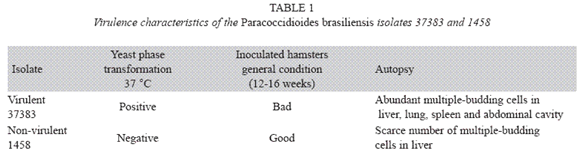
<body><![CDATA[<p><font face="Verdana" size="2"><b>Antigen preparation: </b>Each isolate was collected by gently scraping the medium surface and suspended in 3 ml of 0.15 M PBS, centrifuged at 3 000 g per 30 minutes at 4 °C. These antigens were called <i>Paraccocidioides brasiliensis </i>Crude Antigen (CAP) (37383, 231a12, 34667, 2511a, 9860, 231a20, 97203, 1458) and a <i>Histoplasma capsulatum </i>Crude Antigen (CAH) (10023). The antigens were prepared in two conditions: with and without protease inhibitors and their protein concentrations were determined using the Bradford method (Bradford 1976). A cocktail of protease inhibitors containing 1mM PMSF (phenylmethylsulfonyl fluoride, Sigma), 1 mM TLCK (tosyl-lysine-chloromethyl-ketone, Sigma) and 1 mM Leupeptin was added to the suspension of fungi. </font></p>     <p><font face="Verdana" size="2"><span style="font-weight: bold;">Sodium dodecyl sulphate-polyacrylam</span><b>ide gel electrophoresis (SDS-PAGE): </b>CAPs were analyzed by SDS-PAGE on 12.5% w/v polyacrylamide gels (Laemmli 1970). Protein samples were solubilized in SDS sample buffer (0.15M Tris-Cl, pH 6.8, 4.6% SDS, 23% glyc</font><font face="Verdana" size="2">erol, and 0.2M DTT in 0.1% w/v bromophenol blue) and heated at 100 °C for 5 min. Proteins samples 4&#956;g track were loaded onto a SDSPAGE gel; the same concentration of protein was loaded for each isolated. The SDS-PAGE gel consisted of a separating gel (1</font><font face="Verdana" size="2">2.5% w/v acrylamide/bis-acrylamide, 0.37M Tris-Cl, pH 8.8, 0.1% w/v SDS, set by the addition of 0.3% w/v TEMED, 0.03% w/v ammonium persulphate) with a 3% stacking gel (3% w/v acrylamide/bis-acrylamide, 0.1M Tris-Cl pH 6.8, 0.1% w/v SDS, plus TEMED and 0.05% w/v ammonium persulphate). Electrophoresis was carried out at 20 mA for 1 hour using a Mighty Small II vertical slab gel unit (Bio Rad Instruments). Wide molecular mass markers obtained from BioRad (6.5-200, Kda) were used. After electrophoresis the gel was stained with 0.1 % w/v Coomassie Brilliant Blue R-250 (Sigma) in methanol:water:ethanoic acid (5:5:1) and then destained with a solution of methanol:water:ethanoic acid (1:17:2). </font></p>     <p><font face="Verdana" size="2"><b>Immunoblotting: </b>After SDS-PAGE, proteins were electrophoretically transferred to nitrocellulose paper (NCP, Schleicher &amp; Schuell, 0.45 µm pore size) to allow immunodetection of the proteins, which could be recognized by the antibodies from sera. The proteins were transferred at 120 mA in a transblotting chamber (Bio-Rad, Instruments), for 1 h at 4°C, using 25 mM Tris-HCl, 150 mM glycine, 20% v/v methanol, by the method of Towbin <i>et al. </i>(1979). </font></p>     <p><font face="Verdana" size="2">After transfer, the blots were blocked by incubation with a solution of 3% w/v non-fat milk powder in PBS for 5 min at room temperature, and were then washed three times (3x) in PBS, containing 0.05% v/v Tween-20 (Sigma) (PBS/T). Blots were incubated with a solution of primary antibody diluted 1:200 in PBS/T for 1 hour at room temperature. Blots were then washed 3x, and incubated in a solution of affinity purified goat anti-hamster polyvalent immunoglobulin conjugated to peroxidase, at a 1:1000 dilution (Vector Laboratories), for 1 hour at room temperature. Blots were washed again in PBS (3x) and the antibody binding was detected by chemiluminescent substrate Luminol&#63720; (ECL Detection System, Amershan, UK). Finally, the strips were exposed to Hyperfilm&#63720; (Amersham, UK) in the dark and developed photographically using the manufacture’s instructions. </font></p>     <p><font face="Verdana" size="2"><b>Scanning densitometry: </b>After separation by SDS-PAGE and immunoblotting, each track of the SDS-PAGE and NCP strips were analyzed by scanning densitometry (CS 9000; Shimadzu Corporation Spectrophotometric Instrument, Japan) at 550nm. </font></p>     <p><font face="Verdana" size="2"><b>Enzyme-linked Immunosorbent Assay (ELISA): </b>ELISA test was used to detect antibodies in the sera of hamsters secreting CAP specific antibodies. Ninety-six well plates (Immulon 4 from Dynatech) were coated with 100µl of antigen solution (CAP) per well, using 10 µg/ml of the antigen solution diluted in coating buffer (0.1 M sodium carbonate/bicarbonate pH 9.6). Plates were incubated overnight at 4°C and washed three times (3x) with PBS containing 0.05% v/v Tween 20 (PBS/T). Plates were then blocked by the addition of PBS containing 1% v/v bovine serum albumin (BSA) for 30 minutes at room temperature, followed by further washing with PBS (3x). One hundred µl of the dilution 1:200 of serum were added to each well and incubated at 37°C for 1 hour. The plates were then washed 3x with PBS and 100µl/well of horseradish peroxidase-conjugated (HRP-) goat biotinylated anti-hamster monovalent immunoglobulin (IgG; H+L) (Vector Laboratories), were added at a 1:500 dilution. After incubation for 1 hour at 37°C the plates were washed again with PBS. Binding of the conjugate to bound antibody was detected by the addition of 100µl of azino-bis (3-ethylbenzthiazoline-6-sulfonic acid) (ABTS, KPL) as substrate, pH 5.0 containing 0.03%w/v sodium perborate. The reaction was stopped by addition of 50µl 2M H</font><sub><font face="Verdana"  size="1">2</font></sub><font face="Verdana" size="1">SO<sub>4 </sub></font><font  face="Verdana" size="2">per well. The plates were read in Titertek Multiscan MCC/340, using Titer-soft Software (Flow) to measure the Absorbance at 405 nm (Mendes-Giannini <i>et al. </i>1984). A hamster polyclonal serum against CAP antigens of <i>P. brasiliensis </i>was used as a positive control and 10 normal hamster sera (NHS) were used as a negative control. </font></p>     <p><font face="Verdana" size="2"><b>Statistical analysis: </b>The statistical analysis was made by Chi square (X</font><sup><font  face="Verdana" size="1">2</font></sup><font face="Verdana" size="2">) test, and the significance level used was 0.05. </font></p>     <p><font face="Verdana" size="3"><span style="font-weight: bold;">Results</span> </font></p>     <p><font face="Verdana" size="2">Among the eight isolates in study the 37383 isolate was the most virulent and the isolate 1458 the least virulent (<a href="#t1">Table 1</a>). The remaining isolates showed yeast phase transformation at 37°C but the health conditions of the animals were good and on necropsy, a scarce number of multiple-budding cells were found in the lungs and livers.    <br> </font></p>     ]]></body>
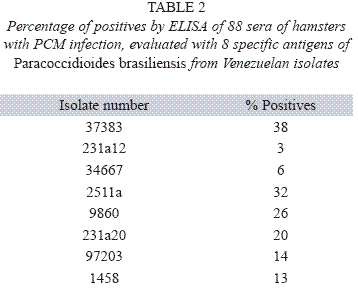
<body><![CDATA[<p><font face="Verdana" size="2">    <br> <a name="t1"></a></font></p>     <div style="text-align: center;"><font face="Verdana" size="2"><img  src="/img/revistas/rbt/v57n3/art05t1.gif" title="" alt=""  style="width: 580px; height: 154px;"></font>    <br> <font face="Verdana" size="2"> </font></div>     <p><font face="Verdana" size="2">When using the ELISA method to test the eight different isolates as antigens, we found that the isolate 37383 presented the highest percentage of positivity (<a href="#t2">Table 2</a>). The chi-square value for isolate 37383 was p= 7x10</font><sup><font face="Verdana" size="1">-5</font></sup><font  face="Verdana" size="2">, when the null hypothesis was the dependence between the serological test (ELISA) and the clinical diagnosis of PCM of the hamsters and the alternative hypothesis was the independence of clinical observation of PCM. For the study, 88 sera reported by ELISA were evaluated by this method of diagnosis. The sensitivity and specificity of the ELISA test with the antigen 37383 was 60% and 80% respectively. In the same way the p value of the antigen 1458 was p= 9x10</font><sup><font face="Verdana" size="1">-4 </font></sup><font  face="Verdana" size="2">and it was related to the clinical observations. In this case the sensitivity and specificity was 28% and 96% respectively. However, the ELISA test with this antigen reported false negatives.    <br> </font></p>     <p><font face="Verdana" size="2">    <br> <a name="t2"></a></font></p>     <div style="text-align: center;"><font face="Verdana" size="2"><img  src="/img/revistas/rbt/v57n3/art05t2.gif" title="" alt=""  style="width: 358px; height: 295px;"></font>    <br> <font face="Verdana" size="2"> </font></div>     ]]></body>
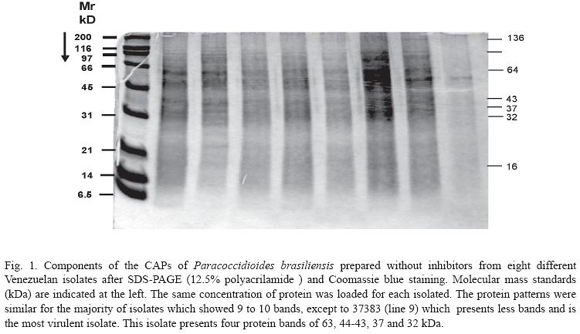
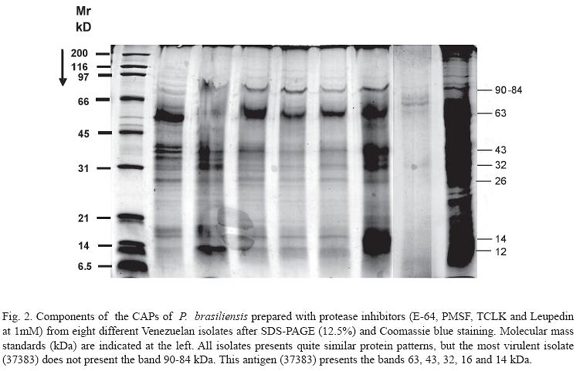
<body><![CDATA[<p><font face="Verdana" size="2">The components of the CAPs of <i>P. brasiliensis </i>from the different Venezuelan isolates were analyzed by SDS-PAGE. At least 9 to 10 bands (120, 110, 105, 97, 73, 60, 40-43, 35, 17 and 12 kDa) were observed after Coomassie blue staining in the majority of the isolates studied (<a href="#f1">Fig. 1</a>). The components of CAPs prepared with protease inhibitors showed a reduction in the bands to 7 (90-87, 65, 42-40, 35, 28, 15 and 12-13 kDa) (<a href="#f2">Fig. 2</a>).    <br> </font></p>     <p><font face="Verdana" size="2">    <br> <a name="f1"></a></font></p>     <div style="text-align: center;"><font face="Verdana" size="2"><img  src="/img/revistas/rbt/v57n3/art05i1.jpg" title="" alt=""  style="width: 580px; height: 334px;"></font>    <br> </div>     <p><font face="Verdana" size="2">    <br> <a name="f2"></a></font></p>     <div style="text-align: center;"><font face="Verdana" size="2"><img  src="/img/revistas/rbt/v57n3/art05i2.jpg" title="" alt=""  style="width: 580px; height: 371px;"></font>    <br> <font face="Verdana" size="2"> </font></div>     ]]></body>
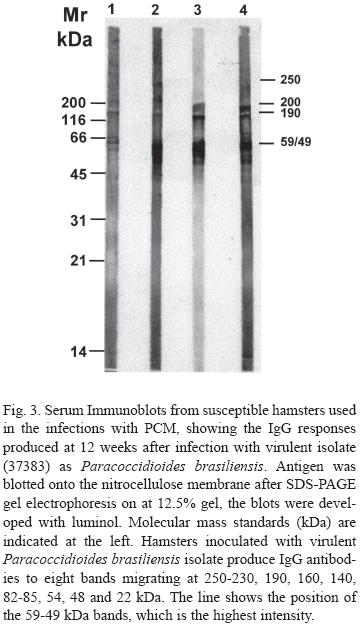
<body><![CDATA[<p><font face="Verdana" size="2">Analyzing the components of the CAPs of the <i>P. brasiliensis </i>prepared without inhibitors from the eight different isolates after SDSPAGE (12.5% polyacrilamide) and Coomassie blue staining, we observed that the protein patterns were similar for the majority of isolates which showed 9 to 10 bands, except isolated 37383 (line 9) which presented fewer bands. This isolate presented four protein bands of 63, 44-43, 37 and 32 kDa (<a href="#f1">Fig. 1</a>). </font></p> <font face="Verdana" size="2"><font face="Verdana" size="2">     <p>Using components of the CAPs of <i>P. brasiliensis </i>prepared with protease inhibitors (E-64, PMSF, TCLK and Leupeptin at 1mM) from the same isolates after SDS-PAGE (12.5%) and Coomassie blue staining, all isolates presented very similar protein patterns, but the most virulent isolate (37383), which did not present a band at 90-84 kDa. This antigen (37383) showed bands at 63, 43, 32, 16 and 14 kDa (<a  href="#f2">Fig. 2</a>). </p>     <p>The sera immunoblots from inoculated hamsters, to demonstrate the IgG responses produced after 12 weeks of infection with the virulent isolate (37383), showed that those animals produced IgG antibodies showing eight migrating bands at 250-230, 190, 160, 140, 82-85, 54, 48 and 22 kDa. The highest intensity band was the 59-49 kDa (<a href="#f3">Fig. 3</a>).    <br> </p>     <p>    <br> <a name="f3"></a></p> </font></font>     <div style="text-align: center;"><img  src="/img/revistas/rbt/v57n3/art05i3.jpg" title="" alt=""  style="width: 364px; height: 630px;">    <br> </div> <font face="Verdana" size="2"><font face="Verdana" size="2"> </font></font><font face="Verdana" size="2"><font face="Verdana"  size="2">     <p>The PCM sera (IgG) recognized eight bands of 250, 190, 160, 140, 85, 54, 48 and 22 kDa with the antigen 37383 prepared with protease inhibitors. The most frequent reactive components for the IgG serum were 190, 160, 85 and 48 kDa. Sera from hamsters with the disease had antibodies reactive with seven antigenic components of <i>P. brasiliensis </i>by immunoblot with the virulent 37383 isolate. </p>     <p>Our results indicate that in an experimental animal model of PCM infection, IgG antibodies were able to recognize similar components of the CAP. Similar results have been previously reported (Vaz 1992). </p>     ]]></body>
<body><![CDATA[<p>The literature about the serodiagnosis to PCM has reported crossreactivity between <i>P.brasiliensis </i>and <i>H. capsulatum </i>(Puccia &amp; Travassos 1991). We also evaluated the cross reactivity with an isolated of <i>H. capsulatum </i>(10023) as antigen and obtained 22% of the cross-reaction with sera from hamsters infected with different isolated of <i>P. brasiliensis </i>by the ELISA test (data do not showed). </p> <font size="3">     <p><span style="font-weight: bold;">Discussion</span> </p> </font>     <p>Many serological tests, based on crude extracts obtained from the cultured fungus, have been used in PCM diagnosis (Brummer <i>et al. </i>1993, Camargo <i>et al. </i>1989). In these cases, one of the main problems is the high cross reactivity with agents causing other mycosis, especially with histoplasmosis. In addition, the understanding of the uses and limitations of laboratory methods is very important in the correct PCM diagnose (Camargo 2008). </p>     <p>However, this study showed that CAPs preparations from eight different isolates were useful in ELISA test to evaluate the humural responses in hamsters with PCM infection. According to Table 2, the antigen preparations demonstrated different percentages of positives by ELISA test. Moreover, the antigen 37383 with a 38% of positivity, presented a considerable degree of sensitivity (60%) and specificity (80%). Therefore, this high percentage of positivity together with its sensitivity suggests that antigen 37383 is the most appropriate in serological diagnosis. Others studies have reported ELISA results with similar sensitivity and specificity. Mendes-Giannini <i>et al. </i>(1984) reported a 100% of sensitivity and 88% of specificity using yeast filtrate as antigen in ELISA test. Camargo <i>et al. </i>(1984), studying 20 human sera of PCM and 11 of histoplasmosis in an ELISA test, reported similar sensitivity. </p>     <p>In general, immunoblots of serum from hamsters infected with PMC showed differences in the intensities of bands when compared with those obtained from animals infected with a low virulent isolate. The reactions of IgG with most antigen bands were clearly more intense in hamsters infected with the isolate 37383. This result suggests that those bands of 63, 43 and 26 kDa were more antigenic and the humoral response had higher levels. These bands, possibly, correspond to the 70, 43 and 28 kDa bands reported by other authors (Mendes- Giannini <i>et al. </i>1984, Camargo <i>et al. </i>1989, Reis <i>et al. </i>2005, Correa <i>et al. </i>2006). The protein 43pg is an antigen in conventional and different ELISA tests, recognized by antibodies from heterologous sera and presents reactivity mainly with histoplasmosis sera (Camargo <i>et al. </i>1994). </p>     <p>In the present study, the antigenic patterns of isolates 231a12, 34667, 2511a, 9860, 231a20, 97203 and 1458 were more complex than those obtained with the isolate 37383 (virulent). We suggest the use of a virulent isolate of <i>P. brasiliensis, </i>such as our isolate 37383, as an antigen for the ELISA test, because this virulent isolate antigen showed the largest percentage of positives samples of infected hamsters and presented one of the highest sensitivities, 60% to 100% of PCM sera with a high specificity (80%). </p>     <p>The production of specific antibodies (IgG) during the course of experimental PCM is related to the severity of the disease. The IgG isotype is significantly elevated in progressive and chronic forms of the disease. We investigated just the IgG anti-<i>P.brasiliensis </i>responses produced in the virulent isolate (37383). In a similar way Vaz <i>et al. </i>(1998), investigated the IgG, IgM, and IgA responses produced in susceptible and persistent mice inoculated with low virulent isolated (Pb 265) and found that the blots with IgG showed a 43-kDa antigen band. Casotto <i>et al. </i>(1991) found antigens of 45 and 48 kDa reactive with antibodies present in patient sera, similar to the 59-49 kDa band, found in the sera of our hamsters. Also, Camargo <i>et al. </i>(1989) using exo-antigen in Western blot for diagnosis of PCM patiens and the IgG response, recognized four bands of 70, 52, 43 and 29 kDa. Our results suggest that the 59-49 kDa component could be the same molecular band as 43-gp kDa reported by other authors. </p>     <p>On the basis of the Chi-square statistical analysis, the ELISA test is a good tool for diagnosis, since it correlates best with the clinical diagnosis. </p>     <p>The results of the analysis by SDS-PAGE could be indicative that a virulent isolate presents fewer components than low virulent isolates. We think that the protease inhibitors are useful in the preparation of the CAPs antigens if they are to be stored for long periods of time, since they are more protected against endogenous proteases than those excreted into liquid culture medium. However, if the antigen is going to be used immediately it is not necessary. Finally, we recommend to first screen with the ELISA test as a diagnostic tool, and confirm in the cases where the ELISA is not clear with Immunoblot test (Camargo <i>et al</i>. 1989). </p>     <p>In general, different authors agree that the cross-reactions are due to the use of unfractionated antigens and they have eliminated the cross-reactivity using the purified molecule of 43gp of <i>P.brasiliensis </i>as an antigen in ELISA tests and reported a rapid, sensitive and specific diagnosis that differentiates between the acute and chronic form the disease (Camargo 2008). This is supported by the works of Albuquerque and colleagues (2005) and Ferreira and coworker (2008); who worked with 43gp antigen treated with sodium metaperiodate to eliminated the carbohydrate epitopes responsible for cross reactions between PCM and histoplasmosis sera. </p>     ]]></body>
<body><![CDATA[<p>Actually, tests based in molecular technique present more sensitivity than serologic tests like ELISA. Correa <i>et al. </i>(2006) subcloned the <i>P. brasiliensis </i>p27 gene and used the recombinant protein as antigen in dot blot assay to improve the PCM diagnosis. In this case, they obtained results with a 100 and 98% of sensitivity and specificity respectively (Ortiz <i>et al. </i>1998). Also, the 43 gp has been used as recombinant protein in PCM diagnosis. Taborda &amp; Camargo (1994), and Cisalpino <i>et al. </i>(1996), found good sensitivity and specificity with the use of recombinant antigens. But in regions where the possibilities doing this kind of assay do not exist, the serologic test is a good alternative to be used in PCM. Establishing the differences in the recognition patterns of antibodies present in any serum with different immunological tests (ELISA, Immunoblot) and a good preparation of antigen allowed us to obtain a useful tool for serological diagnosis of PMC. </p>     <p>Even more, we think that each region should study its own isolates of PCM in order to obtain better diagnosis. Our results suggest that in Venezuela the ELISA test to PCM based on 43 gp molecule could be improved by using a purified antigen of the virulent isolate 37383. </p> <font size="3">     <p><span style="font-weight: bold;">Acknowlegments</span> </p> </font>     <p>We wish to thank Claudia Hartung for technical assistance in culture of <i>Paracoccidioides brasiliensis</i>. Also, we thank Cristina Castelli and Juan Carlos Piña-Crespo for critical reading of this manuscript. This work was supported by Decanato de Investigación de la Universidad Simón Bolívar and Consejo de Desarrollo Científico y Humanístico (CDCH) de la Universidad Central de Venezuela, project N° 09-3454-97. </p> </font></font> <hr style="width: 100%; height: 2px;"><font face="Verdana" size="2"><font  face="Verdana" size="2">     <p><span style="font-weight: bold;">Resumen</span> </p> </font> </font>     <p><font face="Verdana" size="2"><font face="Verdana" size="2">La Paracoccidioidomicosis (PCM), es una micosis sistémica causada por el hongo <i>Paraccocidioides brasiliensis </i>(Pb), endémica en Venezuela y Latino América. En este estudio ocho diferentes aislados venezolanos, obtenidos de pacientes con PCM, fueron inoculados intraperitonealmente en hámsteres y fueron estudiados por ELISA e inmunoblotting. Los antígenos obtenidos de <i>P. brasiliensis </i>fueron llamados, Antígeno Crudo (CAP). Los resultados del immunoblotting mostraron que los sueros inmunes de hámsteres reconocieron al menos tres bandas: una sobre 200, y otras de 80, y 15-20 kDa. Este estudio sugiere que la IgG anti-CAP muestra una variabilidad en los ocho aislados Venezolanos. Sueros de 88 hámsteres infectados fueron evaluados usando ELISA, el antígeno del aislado virulento 37383 mostró el más alto porcentaje de positividad (38%) en los sueros de los hámsteres estudiados. El aislado novirulento 1458 mostró un porcentaje bajo de positividad (13.6%). Además, un escaneo densitométrico reveló que el aislado 37383 tiene menos bandas que el otro aislado no-virulento. Por lo tanto, estos resultados sugieren que el ensayo de ELISA con CAP 37383 puede detectar anticuerpos circulantes y este aislado virulento puede ser útil para el diagnostico de PCM, y para el monitoreo de la respuesta al tratamiento de la enfermedad. </font></font></p>     <p><font face="Verdana" size="2"><font face="Verdana" size="2"><b>Palabras clave: </b>respuesta humoral, <i>Paracoccidioides brasiliensis</i>, paracoccidioidomicosis, hámsteres Syrian, aislados venezolanos, ELISA, Immunoblotting.    <br> </font></font></p> <hr style="width: 100%; height: 2px;">     <p><font face="Verdana" size="2"><font face="Verdana" size="2"></font></font></p>     <p style="text-align: center;"><font face="Verdana" size="2"><font  face="Verdana" size="2">Received 09-IX-2008. Corrected 22-II-2009. Accepted 25-III-2009.</font></font></p> <font face="Verdana" size="2"><font face="Verdana" size="2"> <font size="3">     ]]></body>
<body><![CDATA[<p><span style="font-weight: bold;">References</span> </p> </font></font> </font>     <!-- ref --><p><font face="Verdana" size="2"><font face="Verdana" size="2">Albuquerque C.F., S.H. Marques da Silva &amp; Z.P. Camargo. 2005. Improvement of the specificity of an ELISA-linked immunosorbent assay for diagnosis of Paracoccidioidomycosis. J. Clin. Microbiol. 43: 1944-1946. </font></font>&nbsp;&nbsp;&nbsp;&nbsp;&nbsp;&nbsp;&nbsp;&nbsp;[&#160;<a href="javascript:void(0);" onclick="javascript: window.open('/scielo.php?script=sci_nlinks&ref=1362114&pid=S0034-7744200900030000500001&lng=','','width=640,height=500,resizable=yes,scrollbars=1,menubar=yes,');">Links</a>&#160;]<!-- end-ref --><!-- ref --><p><font face="Verdana" size="2"><font face="Verdana" size="2">Blotta, M.H.S.L. &amp; Z.P. Camargo. 1993. Immunological response to cell-free antigens of <i>Paracoccidioides brasiliensis</i>: Relationship with clinical forms of Paracoccidioidomycosis. J. Clin. Microbiol. 31: 671-676. </font></font>&nbsp;&nbsp;&nbsp;&nbsp;&nbsp;&nbsp;&nbsp;&nbsp;[&#160;<a href="javascript:void(0);" onclick="javascript: window.open('/scielo.php?script=sci_nlinks&ref=1362115&pid=S0034-7744200900030000500002&lng=','','width=640,height=500,resizable=yes,scrollbars=1,menubar=yes,');">Links</a>&#160;]<!-- end-ref --><!-- ref --><p><font face="Verdana" size="2"><font face="Verdana" size="2">Borelli, D. 1984. Micopatología experimental: modelos múltiples. Rev. Fundación José María Vargas 8: 188-92. </font></font>&nbsp;&nbsp;&nbsp;&nbsp;&nbsp;&nbsp;&nbsp;&nbsp;[&#160;<a href="javascript:void(0);" onclick="javascript: window.open('/scielo.php?script=sci_nlinks&ref=1362116&pid=S0034-7744200900030000500003&lng=','','width=640,height=500,resizable=yes,scrollbars=1,menubar=yes,');">Links</a>&#160;]<!-- end-ref --><!-- ref --><p><font face="Verdana" size="2"><font face="Verdana" size="2">Bradford, M. 1976. A rapid and sensitive method for the quantification of microgram quantities of protein utilizing the principle of protein-dye binding. Anal. Biochem. 72: 248-254. </font></font>&nbsp;&nbsp;&nbsp;&nbsp;&nbsp;&nbsp;&nbsp;&nbsp;[&#160;<a href="javascript:void(0);" onclick="javascript: window.open('/scielo.php?script=sci_nlinks&ref=1362117&pid=S0034-7744200900030000500004&lng=','','width=640,height=500,resizable=yes,scrollbars=1,menubar=yes,');">Links</a>&#160;]<!-- end-ref --><!-- ref --><p><font face="Verdana" size="2"><font face="Verdana" size="2">Brummer, E., E. Castañeda, A. Restrepo. 1993. Paracoccidioidomycosis: an update. Clin. Microbiol. Rev. 6: 89-117. </font></font>&nbsp;&nbsp;&nbsp;&nbsp;&nbsp;&nbsp;&nbsp;&nbsp;[&#160;<a href="javascript:void(0);" onclick="javascript: window.open('/scielo.php?script=sci_nlinks&ref=1362118&pid=S0034-7744200900030000500005&lng=','','width=640,height=500,resizable=yes,scrollbars=1,menubar=yes,');">Links</a>&#160;]<!-- end-ref --><!-- ref --><p><font face="Verdana" size="2"><font face="Verdana" size="2">Camargo Z.P., J.L. Guesdon, E. Drouhet &amp; L. Improvisi. 1984. Enzyme-linked immunosorbent assay with counterimmunoelectrophoresis and erythro-immunoassay. Mycopathologia. 81: 31-37. </font></font>&nbsp;&nbsp;&nbsp;&nbsp;&nbsp;&nbsp;&nbsp;&nbsp;[&#160;<a href="javascript:void(0);" onclick="javascript: window.open('/scielo.php?script=sci_nlinks&ref=1362119&pid=S0034-7744200900030000500006&lng=','','width=640,height=500,resizable=yes,scrollbars=1,menubar=yes,');">Links</a>&#160;]<!-- end-ref --><!-- ref --><p><font face="Verdana" size="2"><font face="Verdana" size="2">Camargo Z.P., C.S. Unterkircher &amp; L.R. Travassos. 1989. Identification of antigenic polypeptides of <i>Paracoccidioides brasiliensis </i>by immunoblotting. J. Med. Vet. Mycol. 27: 407–412. </font></font>&nbsp;&nbsp;&nbsp;&nbsp;&nbsp;&nbsp;&nbsp;&nbsp;[&#160;<a href="javascript:void(0);" onclick="javascript: window.open('/scielo.php?script=sci_nlinks&ref=1362120&pid=S0034-7744200900030000500007&lng=','','width=640,height=500,resizable=yes,scrollbars=1,menubar=yes,');">Links</a>&#160;]<!-- end-ref --><!-- ref --><p><font face="Verdana" size="2"><font face="Verdana" size="2">Camargo Z.P., C.P. Taborda, E.C. Rodríguez &amp; L.R. Travassos. 1991. The use of cell-free antigen of <i>Paracoccidioides brasiliensis </i>I serological tests. J. Med. Vet. Mycol. 29: 31-38. </font></font>&nbsp;&nbsp;&nbsp;&nbsp;&nbsp;&nbsp;&nbsp;&nbsp;[&#160;<a href="javascript:void(0);" onclick="javascript: window.open('/scielo.php?script=sci_nlinks&ref=1362121&pid=S0034-7744200900030000500008&lng=','','width=640,height=500,resizable=yes,scrollbars=1,menubar=yes,');">Links</a>&#160;]<!-- end-ref --><!-- ref --><p><font face="Verdana" size="2"><font face="Verdana" size="2">Camargo Z.P., J-L. Gesztesi, E.C.O. Saraiva, C.P. Taborda, A.P. Vicente &amp; J.D. Lopes. 1994. Monoclonal antibody capture enzyme immunoassay for detection of <i>Paracoccidioides brasiliensis </i>antibodies in paracoccidioidomycosis. J. Clin. Microbiol. 32: 2377-2381. </font></font>&nbsp;&nbsp;&nbsp;&nbsp;&nbsp;&nbsp;&nbsp;&nbsp;[&#160;<a href="javascript:void(0);" onclick="javascript: window.open('/scielo.php?script=sci_nlinks&ref=1362122&pid=S0034-7744200900030000500009&lng=','','width=640,height=500,resizable=yes,scrollbars=1,menubar=yes,');">Links</a>&#160;]<!-- end-ref --><!-- ref --><p><font face="Verdana" size="2"><font face="Verdana" size="2">Camargo Z.P. 2008. Serology of paracoccidioidomycosis. Mycopathologia 165: 289-302. </font></font>&nbsp;&nbsp;&nbsp;&nbsp;&nbsp;&nbsp;&nbsp;&nbsp;[&#160;<a href="javascript:void(0);" onclick="javascript: window.open('/scielo.php?script=sci_nlinks&ref=1362123&pid=S0034-7744200900030000500010&lng=','','width=640,height=500,resizable=yes,scrollbars=1,menubar=yes,');">Links</a>&#160;]<!-- end-ref --><!-- ref --><p><font face="Verdana" size="2"><font face="Verdana" size="2">Carbonell LM. &amp; J. Rodríguez. 1965. Transformation of mycelial and yeast forms of <i>Paracoccidiodes brasiliensis </i>in cultures and in experimental inoculations. J. Bact. 90: 504-506. </font></font>&nbsp;&nbsp;&nbsp;&nbsp;&nbsp;&nbsp;&nbsp;&nbsp;[&#160;<a href="javascript:void(0);" onclick="javascript: window.open('/scielo.php?script=sci_nlinks&ref=1362124&pid=S0034-7744200900030000500011&lng=','','width=640,height=500,resizable=yes,scrollbars=1,menubar=yes,');">Links</a>&#160;]<!-- end-ref --><!-- ref --><p><font face="Verdana" size="2"><font face="Verdana" size="2">Cassotto M., S. Paris &amp; Z.P. Camargo. 1991. Antigens of diagnostic value in three isolates of <i>Paracoccidioides brasiliensis</i>. J. Med. Vet. Mycol. 29: 243-253. </font></font>&nbsp;&nbsp;&nbsp;&nbsp;&nbsp;&nbsp;&nbsp;&nbsp;[&#160;<a href="javascript:void(0);" onclick="javascript: window.open('/scielo.php?script=sci_nlinks&ref=1362125&pid=S0034-7744200900030000500012&lng=','','width=640,height=500,resizable=yes,scrollbars=1,menubar=yes,');">Links</a>&#160;]<!-- end-ref --><!-- ref --><p><font face="Verdana" size="2"><font face="Verdana" size="2">Cisalpino P., R. Puccia, L. Yamauchi, M. Cano, J.F. da Silveira &amp; L.R. Travassos. 1996. J. Biol. Chem. 271: 45-60. </font></font>&nbsp;&nbsp;&nbsp;&nbsp;&nbsp;&nbsp;&nbsp;&nbsp;[&#160;<a href="javascript:void(0);" onclick="javascript: window.open('/scielo.php?script=sci_nlinks&ref=1362126&pid=S0034-7744200900030000500013&lng=','','width=640,height=500,resizable=yes,scrollbars=1,menubar=yes,');">Links</a>&#160;]<!-- end-ref --><!-- ref --><p><font face="Verdana" size="2"><font face="Verdana" size="2">Correa M.M., A.M. Bedoya, M.P. Guerrero, A. Restrepo &amp; J.G. McEwen. 2006. Diagnosis of paracoccidioidomycosis by a dot blot assay usisng a recombinant <i>Paracoccidioides brasiliensis </i>p27 protein. Mycoses 50: 41-47. </font></font>&nbsp;&nbsp;&nbsp;&nbsp;&nbsp;&nbsp;&nbsp;&nbsp;[&#160;<a href="javascript:void(0);" onclick="javascript: window.open('/scielo.php?script=sci_nlinks&ref=1362127&pid=S0034-7744200900030000500014&lng=','','width=640,height=500,resizable=yes,scrollbars=1,menubar=yes,');">Links</a>&#160;]<!-- end-ref --><!-- ref --><p><font face="Verdana" size="2"><font face="Verdana" size="2">Ferreira, A.P., T. Correa , R. Cunha , M.J. Marquez, M.A. Montesano, M.A. Souza &amp; H.C. Teixeira. 2008. Human serum antibody reactivity towards <i>Paracoccidioides brasiliensis </i>antigens treated with sodium metaperiodate. Rev. Soc. Bras. Med. Trop. 41: 325-329. </font></font>&nbsp;&nbsp;&nbsp;&nbsp;&nbsp;&nbsp;&nbsp;&nbsp;[&#160;<a href="javascript:void(0);" onclick="javascript: window.open('/scielo.php?script=sci_nlinks&ref=1362128&pid=S0034-7744200900030000500015&lng=','','width=640,height=500,resizable=yes,scrollbars=1,menubar=yes,');">Links</a>&#160;]<!-- end-ref --><!-- ref --><p><font face="Verdana" size="2"><font face="Verdana" size="2">Iabuki, K. &amp; M. Montenegro. 1979. Experimental paracoccidioidomycosis in the Syrian hamster: morphology, ultrastructure and correlation of lesions with presence of specific antigens and serum levels of antibodies. Mycopathology 67: 131-141. </font></font>&nbsp;&nbsp;&nbsp;&nbsp;&nbsp;&nbsp;&nbsp;&nbsp;[&#160;<a href="javascript:void(0);" onclick="javascript: window.open('/scielo.php?script=sci_nlinks&ref=1362129&pid=S0034-7744200900030000500016&lng=','','width=640,height=500,resizable=yes,scrollbars=1,menubar=yes,');">Links</a>&#160;]<!-- end-ref --><p><font face="Verdana" size="2"><font face="Verdana" size="2">Laemmli, U.K. 1970. Cleavage of structural proteins during the assembly of head of bacteriophage T</font><sub><font  face="Verdana" size="1">4</font></sub><font face="Verdana" size="2">. Nature     <br> 227: 680-685. </font></font></p>     <!-- ref --><p><font face="Verdana" size="2"><font face="Verdana" size="2">Mendes-Giannini, M.J.S., M.E Camargo, C.S. Lacaz &amp; A.W. Ferreira. 1984. Immunoenzymatic absorption test for serodiagnosis of paracoccidioidomycosis. J. Clin. Microbiol. 20: 103-108. </font></font>&nbsp;&nbsp;&nbsp;&nbsp;&nbsp;&nbsp;&nbsp;&nbsp;[&#160;<a href="javascript:void(0);" onclick="javascript: window.open('/scielo.php?script=sci_nlinks&ref=1362132&pid=S0034-7744200900030000500018&lng=','','width=640,height=500,resizable=yes,scrollbars=1,menubar=yes,');">Links</a>&#160;]<!-- end-ref --><!-- ref --><p><font face="Verdana" size="2"><font face="Verdana" size="2">Ortiz B.L., S. Diez, M.E. Urán, J.M. Rivas, M. Romero, V. Caicedo, A. Restrepo &amp; J.G. McEwen. 1998. Use of the 27-kilodalton serodiagnosis of paracoccidioidomycosis. Clin. Diagn. Lab. Immunol. 5: 826-830. </font></font>&nbsp;&nbsp;&nbsp;&nbsp;&nbsp;&nbsp;&nbsp;&nbsp;[&#160;<a href="javascript:void(0);" onclick="javascript: window.open('/scielo.php?script=sci_nlinks&ref=1362133&pid=S0034-7744200900030000500019&lng=','','width=640,height=500,resizable=yes,scrollbars=1,menubar=yes,');">Links</a>&#160;]<!-- end-ref --><!-- ref --><p><font face="Verdana" size="2"><font face="Verdana" size="2">Peracolli M.T.S., N.G.S. Mota &amp; M.R. Montenegro. 1982. Morphology and correlation of lesions with humoral and cell-mediated immunity. Mycopathologia. 79: 7-17. </font></font>&nbsp;&nbsp;&nbsp;&nbsp;&nbsp;&nbsp;&nbsp;&nbsp;[&#160;<a href="javascript:void(0);" onclick="javascript: window.open('/scielo.php?script=sci_nlinks&ref=1362134&pid=S0034-7744200900030000500020&lng=','','width=640,height=500,resizable=yes,scrollbars=1,menubar=yes,');">Links</a>&#160;]<!-- end-ref --><!-- ref --><p><font face="Verdana" size="2"><font face="Verdana" size="2">Puccia R. &amp; L.R. Travassos. 1991. 43-kilodalton glycoprotein from <i>Paracoccidioides brasiliensis</i>: immunochemical reactions with sera from patients with paracoccidioidomycosis, histoplasmosis, and Jorge Lobo’s disease. J. Clin Microbiol. 29: 1610–1615. </font></font>&nbsp;&nbsp;&nbsp;&nbsp;&nbsp;&nbsp;&nbsp;&nbsp;[&#160;<a href="javascript:void(0);" onclick="javascript: window.open('/scielo.php?script=sci_nlinks&ref=1362135&pid=S0034-7744200900030000500021&lng=','','width=640,height=500,resizable=yes,scrollbars=1,menubar=yes,');">Links</a>&#160;]<!-- end-ref --><!-- ref --><p><font face="Verdana" size="2"><font face="Verdana" size="2">Reis B. S., A. Bozzi, F.L.S. Prado, M.C.N. Pereira, F.E. Ferreira, P. Godoy, L. Moro, E.P. Pedroso, M.F. Leite &amp; A.M. Goes. 2005. Membrane and extracellular antigens of <i>Paracoccidioides brasiliensis </i>(Mexo): identification of 28-kDa protein suitable for immunodiagnosis of paracoccidioidomycosis. J. Immunol. Meth. 307: 118-126. </font></font>&nbsp;&nbsp;&nbsp;&nbsp;&nbsp;&nbsp;&nbsp;&nbsp;[&#160;<a href="javascript:void(0);" onclick="javascript: window.open('/scielo.php?script=sci_nlinks&ref=1362136&pid=S0034-7744200900030000500022&lng=','','width=640,height=500,resizable=yes,scrollbars=1,menubar=yes,');">Links</a>&#160;]<!-- end-ref --><!-- ref --><p><font face="Verdana" size="2"><font face="Verdana" size="2">Salfelder K., J. Schuwarz &amp; C. Johnson. 1968. Experimental cutaneous South American blastomycosis in hamsters. Arch. Dermatol. 97: 69-77. </font></font>&nbsp;&nbsp;&nbsp;&nbsp;&nbsp;&nbsp;&nbsp;&nbsp;[&#160;<a href="javascript:void(0);" onclick="javascript: window.open('/scielo.php?script=sci_nlinks&ref=1362137&pid=S0034-7744200900030000500023&lng=','','width=640,height=500,resizable=yes,scrollbars=1,menubar=yes,');">Links</a>&#160;]<!-- end-ref --><!-- ref --><p><font face="Verdana" size="2"><font face="Verdana" size="2">Taborda C. &amp; Z.P. Camargo. 1994. Diagnosis of paracoccidioidomicosis by dot immunobinding assay for antibody detection using the purified and specific antigen gp43. J. Clin Microbiol. 32: 554-556. </font></font>&nbsp;&nbsp;&nbsp;&nbsp;&nbsp;&nbsp;&nbsp;&nbsp;[&#160;<a href="javascript:void(0);" onclick="javascript: window.open('/scielo.php?script=sci_nlinks&ref=1362138&pid=S0034-7744200900030000500024&lng=','','width=640,height=500,resizable=yes,scrollbars=1,menubar=yes,');">Links</a>&#160;]<!-- end-ref --><!-- ref --><p><font face="Verdana" size="2"><font face="Verdana" size="2">Towbin H., T. Staehelin &amp; J. Gordon. 1979. Electrophoresis transfer of proteins from polyacrylamide gels to nitrocellulose sheets: produce and some applications. Proc. Natl. Acad. Sci. Unit. States Am. 76: 4350-4354. </font></font>&nbsp;&nbsp;&nbsp;&nbsp;&nbsp;&nbsp;&nbsp;&nbsp;[&#160;<a href="javascript:void(0);" onclick="javascript: window.open('/scielo.php?script=sci_nlinks&ref=1362139&pid=S0034-7744200900030000500025&lng=','','width=640,height=500,resizable=yes,scrollbars=1,menubar=yes,');">Links</a>&#160;]<!-- end-ref --><!-- ref --><p><font face="Verdana" size="2"><font face="Verdana" size="2">Vaz C.A.C., D.W.R., Mackenzie, V.M. Hearm, Z.P. Camargo, L.M. Singer-Vermes., E. Burge &amp; V.L.G. Calich. 1992. Specific recognition pattern of IgM and IgG antibodies produced in the course of experimental paracoccidioidomycosis. Clin. Exp. Immunol. 88: 119-123. </font></font>&nbsp;&nbsp;&nbsp;&nbsp;&nbsp;&nbsp;&nbsp;&nbsp;[&#160;<a href="javascript:void(0);" onclick="javascript: window.open('/scielo.php?script=sci_nlinks&ref=1362140&pid=S0034-7744200900030000500026&lng=','','width=640,height=500,resizable=yes,scrollbars=1,menubar=yes,');">Links</a>&#160;]<!-- end-ref --><!-- ref --><p><font face="Verdana" size="2"><font face="Verdana" size="2">Vaz C.A.C., L.M. Singer-Vermes &amp; V.L.G. Calich. 1998. Comparative studies on the antibody repertorie produced by susceptible and resistant mice to virulent and nonvirulent of <i>Paracoccidioides brasiliensis </i>isolates. Am. J. Trop. Med. Hyg. 59: 971-977. </font></font>&nbsp;&nbsp;&nbsp;&nbsp;&nbsp;&nbsp;&nbsp;&nbsp;[&#160;<a href="javascript:void(0);" onclick="javascript: window.open('/scielo.php?script=sci_nlinks&ref=1362141&pid=S0034-7744200900030000500027&lng=','','width=640,height=500,resizable=yes,scrollbars=1,menubar=yes,');">Links</a>&#160;]<!-- end-ref --> ]]></body><back>
<ref-list>
<ref id="B1">
<nlm-citation citation-type="journal">
<person-group person-group-type="author">
<name>
<surname><![CDATA[Albuquerque]]></surname>
<given-names><![CDATA[C.F]]></given-names>
</name>
<name>
<surname><![CDATA[Marques da Silva]]></surname>
<given-names><![CDATA[S.H]]></given-names>
</name>
<name>
<surname><![CDATA[Camargo]]></surname>
<given-names><![CDATA[Z.P]]></given-names>
</name>
</person-group>
<article-title xml:lang="en"><![CDATA[Improvement of the specificity of an ELISA-linked immunosorbent assay for diagnosis of Paracoccidioidomycosis]]></article-title>
<source><![CDATA[J. Clin. Microbiol]]></source>
<year>2005</year>
<volume>43</volume>
<page-range>1944-1946</page-range></nlm-citation>
</ref>
<ref id="B2">
<nlm-citation citation-type="journal">
<person-group person-group-type="author">
<name>
<surname><![CDATA[Blotta]]></surname>
<given-names><![CDATA[M.H.S.L]]></given-names>
</name>
<name>
<surname><![CDATA[Camargo]]></surname>
<given-names><![CDATA[Z.P]]></given-names>
</name>
</person-group>
<article-title xml:lang="en"><![CDATA[Immunological response to cell-free antigens of Paracoccidioides brasiliensis: Relationship with clinical forms of Paracoccidioidomycosis]]></article-title>
<source><![CDATA[J. Clin. Microbiol]]></source>
<year>1993</year>
<volume>31</volume>
<page-range>671-676</page-range></nlm-citation>
</ref>
<ref id="B3">
<nlm-citation citation-type="journal">
<person-group person-group-type="author">
<name>
<surname><![CDATA[Borelli]]></surname>
<given-names><![CDATA[D]]></given-names>
</name>
</person-group>
<article-title xml:lang="es"><![CDATA[Micopatología experimental: modelos múltiples]]></article-title>
<source><![CDATA[Rev. Fundación José María Vargas]]></source>
<year>1984</year>
<volume>8</volume>
<page-range>188-92</page-range></nlm-citation>
</ref>
<ref id="B4">
<nlm-citation citation-type="journal">
<person-group person-group-type="author">
<name>
<surname><![CDATA[Bradford]]></surname>
<given-names><![CDATA[M]]></given-names>
</name>
</person-group>
<article-title xml:lang="en"><![CDATA[A rapid and sensitive method for the quantification of microgram quantities of protein utilizing the principle of protein-dye binding]]></article-title>
<source><![CDATA[Anal. Biochem]]></source>
<year>1976</year>
<volume>72</volume>
<page-range>248-254</page-range></nlm-citation>
</ref>
<ref id="B5">
<nlm-citation citation-type="journal">
<person-group person-group-type="author">
<name>
<surname><![CDATA[Brummer]]></surname>
<given-names><![CDATA[E]]></given-names>
</name>
<name>
<surname><![CDATA[Castañeda]]></surname>
<given-names><![CDATA[E]]></given-names>
</name>
<name>
<surname><![CDATA[Restrepo]]></surname>
<given-names><![CDATA[A]]></given-names>
</name>
</person-group>
<article-title xml:lang="en"><![CDATA[Paracoccidioidomycosis: an update]]></article-title>
<source><![CDATA[Clin. Microbiol. Rev]]></source>
<year>1993</year>
<volume>6</volume>
<page-range>89-117</page-range></nlm-citation>
</ref>
<ref id="B6">
<nlm-citation citation-type="journal">
<person-group person-group-type="author">
<name>
<surname><![CDATA[Camargo]]></surname>
<given-names><![CDATA[Z.P]]></given-names>
</name>
<name>
<surname><![CDATA[Guesdon]]></surname>
<given-names><![CDATA[J.L]]></given-names>
</name>
<name>
<surname><![CDATA[Drouhet]]></surname>
<given-names><![CDATA[E]]></given-names>
</name>
<name>
<surname><![CDATA[Improvisi]]></surname>
<given-names><![CDATA[L]]></given-names>
</name>
</person-group>
<article-title xml:lang="en"><![CDATA[Enzyme-linked immunosorbent assay with counterimmunoelectrophoresis and erythro-immunoassay]]></article-title>
<source><![CDATA[Mycopathologia]]></source>
<year>1984</year>
<volume>81</volume>
<page-range>31-37</page-range></nlm-citation>
</ref>
<ref id="B7">
<nlm-citation citation-type="journal">
<person-group person-group-type="author">
<name>
<surname><![CDATA[Camargo]]></surname>
<given-names><![CDATA[Z.P]]></given-names>
</name>
<name>
<surname><![CDATA[Unterkircher]]></surname>
<given-names><![CDATA[C.S]]></given-names>
</name>
<name>
<surname><![CDATA[Travassos]]></surname>
<given-names><![CDATA[L.R]]></given-names>
</name>
</person-group>
<article-title xml:lang="en"><![CDATA[Identification of antigenic polypeptides of Paracoccidioides brasiliensis by immunoblotting]]></article-title>
<source><![CDATA[J. Med. Vet. Mycol]]></source>
<year>1989</year>
<volume>27</volume>
<page-range>407-412</page-range></nlm-citation>
</ref>
<ref id="B8">
<nlm-citation citation-type="journal">
<person-group person-group-type="author">
<name>
<surname><![CDATA[Camargo]]></surname>
<given-names><![CDATA[Z.P]]></given-names>
</name>
<name>
<surname><![CDATA[Taborda]]></surname>
<given-names><![CDATA[C.P]]></given-names>
</name>
<name>
<surname><![CDATA[Rodríguez]]></surname>
<given-names><![CDATA[E.C]]></given-names>
</name>
<name>
<surname><![CDATA[Travassos]]></surname>
<given-names><![CDATA[L.R]]></given-names>
</name>
</person-group>
<article-title xml:lang="en"><![CDATA[The use of cell-free antigen of Paracoccidioides brasiliensis I serological tests]]></article-title>
<source><![CDATA[J. Med. Vet. Mycol]]></source>
<year>1991</year>
<volume>29</volume>
<page-range>31-38</page-range></nlm-citation>
</ref>
<ref id="B9">
<nlm-citation citation-type="journal">
<person-group person-group-type="author">
<name>
<surname><![CDATA[Camargo]]></surname>
<given-names><![CDATA[Z.P]]></given-names>
</name>
<name>
<surname><![CDATA[Gesztesi]]></surname>
<given-names><![CDATA[J-L]]></given-names>
</name>
<name>
<surname><![CDATA[Saraiva]]></surname>
<given-names><![CDATA[E.C.O]]></given-names>
</name>
<name>
<surname><![CDATA[Taborda]]></surname>
<given-names><![CDATA[C.P]]></given-names>
</name>
<name>
<surname><![CDATA[Vicente]]></surname>
<given-names><![CDATA[A.P]]></given-names>
</name>
<name>
<surname><![CDATA[Lopes]]></surname>
<given-names><![CDATA[J.D]]></given-names>
</name>
</person-group>
<article-title xml:lang="en"><![CDATA[Monoclonal antibody capture enzyme immunoassay for detection of Paracoccidioides brasiliensis antibodies in paracoccidioidomycosis]]></article-title>
<source><![CDATA[J. Clin. Microbiol]]></source>
<year>1994</year>
<volume>32</volume>
<page-range>2377-2381</page-range></nlm-citation>
</ref>
<ref id="B10">
<nlm-citation citation-type="journal">
<person-group person-group-type="author">
<name>
<surname><![CDATA[Camargo]]></surname>
<given-names><![CDATA[Z.P]]></given-names>
</name>
</person-group>
<article-title xml:lang="en"><![CDATA[Serology of paracoccidioidomycosis]]></article-title>
<source><![CDATA[Mycopathologia]]></source>
<year>2008</year>
<volume>165</volume>
<page-range>289-302</page-range></nlm-citation>
</ref>
<ref id="B11">
<nlm-citation citation-type="journal">
<person-group person-group-type="author">
<name>
<surname><![CDATA[Carbonell]]></surname>
<given-names><![CDATA[LM]]></given-names>
</name>
<name>
<surname><![CDATA[Rodríguez]]></surname>
<given-names><![CDATA[J]]></given-names>
</name>
</person-group>
<article-title xml:lang="en"><![CDATA[Transformation of mycelial and yeast forms of Paracoccidiodes brasiliensis in cultures and in experimental inoculations]]></article-title>
<source><![CDATA[J. Bact]]></source>
<year>1965</year>
<volume>90</volume>
<page-range>504-506</page-range></nlm-citation>
</ref>
<ref id="B12">
<nlm-citation citation-type="journal">
<person-group person-group-type="author">
<name>
<surname><![CDATA[Cassotto]]></surname>
<given-names><![CDATA[M]]></given-names>
</name>
<name>
<surname><![CDATA[Paris]]></surname>
<given-names><![CDATA[S]]></given-names>
</name>
<name>
<surname><![CDATA[Camargo]]></surname>
<given-names><![CDATA[Z.P]]></given-names>
</name>
</person-group>
<article-title xml:lang="en"><![CDATA[Antigens of diagnostic value in three isolates of Paracoccidioides brasiliensis]]></article-title>
<source><![CDATA[J. Med. Vet. Mycol]]></source>
<year>1991</year>
<volume>29</volume>
<page-range>243-253</page-range></nlm-citation>
</ref>
<ref id="B13">
<nlm-citation citation-type="journal">
<person-group person-group-type="author">
<name>
<surname><![CDATA[Cisalpino]]></surname>
<given-names><![CDATA[P]]></given-names>
</name>
<name>
<surname><![CDATA[Puccia]]></surname>
<given-names><![CDATA[R]]></given-names>
</name>
<name>
<surname><![CDATA[Yamauchi]]></surname>
<given-names><![CDATA[L]]></given-names>
</name>
<name>
<surname><![CDATA[Cano]]></surname>
<given-names><![CDATA[M]]></given-names>
</name>
<name>
<surname><![CDATA[da Silveira]]></surname>
<given-names><![CDATA[J.F]]></given-names>
</name>
<name>
<surname><![CDATA[Travassos]]></surname>
<given-names><![CDATA[L.R]]></given-names>
</name>
</person-group>
<source><![CDATA[J. Biol. Chem]]></source>
<year>1996</year>
<volume>271</volume>
<page-range>45-60</page-range></nlm-citation>
</ref>
<ref id="B14">
<nlm-citation citation-type="journal">
<person-group person-group-type="author">
<name>
<surname><![CDATA[Correa]]></surname>
<given-names><![CDATA[M.M]]></given-names>
</name>
<name>
<surname><![CDATA[Bedoya]]></surname>
<given-names><![CDATA[A.M]]></given-names>
</name>
<name>
<surname><![CDATA[Guerrero]]></surname>
<given-names><![CDATA[M.P]]></given-names>
</name>
<name>
<surname><![CDATA[Restrepo]]></surname>
<given-names><![CDATA[A]]></given-names>
</name>
<name>
<surname><![CDATA[McEwen]]></surname>
<given-names><![CDATA[J.G]]></given-names>
</name>
</person-group>
<article-title xml:lang="en"><![CDATA[Diagnosis of paracoccidioidomycosis by a dot blot assay usisng a recombinant Paracoccidioides brasiliensis p27 protein]]></article-title>
<source><![CDATA[Mycoses]]></source>
<year>2006</year>
<volume>50</volume>
<page-range>41-47</page-range></nlm-citation>
</ref>
<ref id="B15">
<nlm-citation citation-type="journal">
<person-group person-group-type="author">
<name>
<surname><![CDATA[Ferreira]]></surname>
<given-names><![CDATA[A.P]]></given-names>
</name>
<name>
<surname><![CDATA[Correa]]></surname>
<given-names><![CDATA[T]]></given-names>
</name>
<name>
<surname><![CDATA[Cunha]]></surname>
<given-names><![CDATA[R]]></given-names>
</name>
<name>
<surname><![CDATA[Marquez]]></surname>
<given-names><![CDATA[M.J]]></given-names>
</name>
<name>
<surname><![CDATA[Montesano]]></surname>
<given-names><![CDATA[M.A]]></given-names>
</name>
<name>
<surname><![CDATA[Souza]]></surname>
<given-names><![CDATA[M.A]]></given-names>
</name>
<name>
<surname><![CDATA[Teixeira]]></surname>
<given-names><![CDATA[H.C]]></given-names>
</name>
</person-group>
<article-title xml:lang="en"><![CDATA[Human serum antibody reactivity towards Paracoccidioides brasiliensis antigens treated with sodium metaperiodate]]></article-title>
<source><![CDATA[Rev. Soc. Bras. Med. Trop]]></source>
<year>2008</year>
<volume>41</volume>
<page-range>325-329</page-range></nlm-citation>
</ref>
<ref id="B16">
<nlm-citation citation-type="journal">
<person-group person-group-type="author">
<name>
<surname><![CDATA[Iabuki]]></surname>
<given-names><![CDATA[K]]></given-names>
</name>
<name>
<surname><![CDATA[Montenegro]]></surname>
<given-names><![CDATA[M]]></given-names>
</name>
</person-group>
<article-title xml:lang="en"><![CDATA[Experimental paracoccidioidomycosis in the Syrian hamster: morphology, ultrastructure and correlation of lesions with presence of specific antigens and serum levels of antibodies]]></article-title>
<source><![CDATA[Mycopathology]]></source>
<year>1979</year>
<volume>67</volume>
<page-range>131-141</page-range></nlm-citation>
</ref>
<ref id="B17">
<nlm-citation citation-type="journal">
<person-group person-group-type="author">
<name>
<surname><![CDATA[Laemmli]]></surname>
<given-names><![CDATA[U.K]]></given-names>
</name>
</person-group>
<article-title xml:lang="en"><![CDATA[Cleavage of structural proteins during the assembly of head of bacteriophage T4]]></article-title>
<source><![CDATA[Nature]]></source>
<year>1970</year>
<volume>227</volume>
<page-range>680-685</page-range></nlm-citation>
</ref>
<ref id="B18">
<nlm-citation citation-type="journal">
<person-group person-group-type="author">
<name>
<surname><![CDATA[Mendes-Giannini]]></surname>
<given-names><![CDATA[M.J.S]]></given-names>
</name>
<name>
<surname><![CDATA[Camargo]]></surname>
<given-names><![CDATA[M.E]]></given-names>
</name>
<name>
<surname><![CDATA[Lacaz]]></surname>
<given-names><![CDATA[C.S]]></given-names>
</name>
<name>
<surname><![CDATA[Ferreira]]></surname>
<given-names><![CDATA[A.W]]></given-names>
</name>
</person-group>
<article-title xml:lang="en"><![CDATA[Immunoenzymatic absorption test for serodiagnosis of paracoccidioidomycosis]]></article-title>
<source><![CDATA[J. Clin. Microbiol]]></source>
<year>1984</year>
<volume>20</volume>
<page-range>103-108</page-range></nlm-citation>
</ref>
<ref id="B19">
<nlm-citation citation-type="journal">
<person-group person-group-type="author">
<name>
<surname><![CDATA[Ortiz]]></surname>
<given-names><![CDATA[B.L]]></given-names>
</name>
<name>
<surname><![CDATA[Diez]]></surname>
<given-names><![CDATA[S]]></given-names>
</name>
<name>
<surname><![CDATA[Urán]]></surname>
<given-names><![CDATA[M.E]]></given-names>
</name>
<name>
<surname><![CDATA[Rivas]]></surname>
<given-names><![CDATA[J.M]]></given-names>
</name>
<name>
<surname><![CDATA[Romero]]></surname>
<given-names><![CDATA[M]]></given-names>
</name>
<name>
<surname><![CDATA[Caicedo]]></surname>
<given-names><![CDATA[V]]></given-names>
</name>
<name>
<surname><![CDATA[Restrepo]]></surname>
<given-names><![CDATA[A]]></given-names>
</name>
<name>
<surname><![CDATA[McEwen]]></surname>
<given-names><![CDATA[J.G]]></given-names>
</name>
</person-group>
<article-title xml:lang="en"><![CDATA[Use of the 27-kilodalton serodiagnosis of paracoccidioidomycosis]]></article-title>
<source><![CDATA[Clin. Diagn. Lab. Immunol]]></source>
<year>1998</year>
<volume>5</volume>
<page-range>826-830</page-range></nlm-citation>
</ref>
<ref id="B20">
<nlm-citation citation-type="journal">
<person-group person-group-type="author">
<name>
<surname><![CDATA[Peracolli]]></surname>
<given-names><![CDATA[M.T.S]]></given-names>
</name>
<name>
<surname><![CDATA[Mota]]></surname>
<given-names><![CDATA[N.G.S]]></given-names>
</name>
<name>
<surname><![CDATA[Montenegro]]></surname>
<given-names><![CDATA[M.R]]></given-names>
</name>
</person-group>
<article-title xml:lang="en"><![CDATA[Morphology and correlation of lesions with humoral and cell-mediated immunity]]></article-title>
<source><![CDATA[Mycopathologia]]></source>
<year>1982</year>
<volume>79</volume>
<page-range>7-17</page-range></nlm-citation>
</ref>
<ref id="B21">
<nlm-citation citation-type="journal">
<person-group person-group-type="author">
<name>
<surname><![CDATA[Puccia]]></surname>
<given-names><![CDATA[R]]></given-names>
</name>
<name>
<surname><![CDATA[Travassos]]></surname>
<given-names><![CDATA[L.R]]></given-names>
</name>
</person-group>
<article-title xml:lang="en"><![CDATA[43-kilodalton glycoprotein from Paracoccidioides brasiliensis: immunochemical reactions with sera from patients with paracoccidioidomycosis, histoplasmosis, and Jorge Lobo’s disease]]></article-title>
<source><![CDATA[J. Clin Microbiol]]></source>
<year>1991</year>
<volume>29</volume>
<page-range>1610-1615</page-range></nlm-citation>
</ref>
<ref id="B22">
<nlm-citation citation-type="journal">
<person-group person-group-type="author">
<name>
<surname><![CDATA[Reis]]></surname>
<given-names><![CDATA[B. S]]></given-names>
</name>
<name>
<surname><![CDATA[Bozzi]]></surname>
<given-names><![CDATA[A]]></given-names>
</name>
<name>
<surname><![CDATA[Prado]]></surname>
<given-names><![CDATA[F.L.S]]></given-names>
</name>
<name>
<surname><![CDATA[Pereira]]></surname>
<given-names><![CDATA[M.C.N]]></given-names>
</name>
<name>
<surname><![CDATA[Ferreira]]></surname>
<given-names><![CDATA[F.E]]></given-names>
</name>
<name>
<surname><![CDATA[Godoy]]></surname>
<given-names><![CDATA[P]]></given-names>
</name>
<name>
<surname><![CDATA[Moro]]></surname>
<given-names><![CDATA[L]]></given-names>
</name>
<name>
<surname><![CDATA[Pedroso]]></surname>
<given-names><![CDATA[E.P]]></given-names>
</name>
<name>
<surname><![CDATA[Leite]]></surname>
<given-names><![CDATA[M.F]]></given-names>
</name>
<name>
<surname><![CDATA[Goes]]></surname>
<given-names><![CDATA[A.M]]></given-names>
</name>
</person-group>
<article-title xml:lang="en"><![CDATA[Membrane and extracellular antigens of Paracoccidioides brasiliensis (Mexo): identification of 28-kDa protein suitable for immunodiagnosis of paracoccidioidomycosis]]></article-title>
<source><![CDATA[J. Immunol. Meth]]></source>
<year>2005</year>
<volume>307</volume>
<page-range>118-126</page-range></nlm-citation>
</ref>
<ref id="B23">
<nlm-citation citation-type="journal">
<person-group person-group-type="author">
<name>
<surname><![CDATA[Salfelder]]></surname>
<given-names><![CDATA[K]]></given-names>
</name>
<name>
<surname><![CDATA[Schuwarz]]></surname>
<given-names><![CDATA[J]]></given-names>
</name>
<name>
<surname><![CDATA[Johnson]]></surname>
<given-names><![CDATA[C]]></given-names>
</name>
</person-group>
<article-title xml:lang="en"><![CDATA[Experimental cutaneous South American blastomycosis in hamsters]]></article-title>
<source><![CDATA[Arch. Dermatol]]></source>
<year>1968</year>
<volume>97</volume>
<page-range>69-77</page-range></nlm-citation>
</ref>
<ref id="B24">
<nlm-citation citation-type="journal">
<person-group person-group-type="author">
<name>
<surname><![CDATA[Taborda]]></surname>
<given-names><![CDATA[C]]></given-names>
</name>
<name>
<surname><![CDATA[Camargo]]></surname>
<given-names><![CDATA[Z.P]]></given-names>
</name>
</person-group>
<article-title xml:lang="en"><![CDATA[Diagnosis of paracoccidioidomicosis by dot immunobinding assay for antibody detection using the purified and specific antigen gp43]]></article-title>
<source><![CDATA[J. Clin Microbiol]]></source>
<year>1994</year>
<volume>32</volume>
<page-range>554-556</page-range></nlm-citation>
</ref>
<ref id="B25">
<nlm-citation citation-type="journal">
<person-group person-group-type="author">
<name>
<surname><![CDATA[Towbin]]></surname>
<given-names><![CDATA[H]]></given-names>
</name>
<name>
<surname><![CDATA[Staehelin]]></surname>
<given-names><![CDATA[T]]></given-names>
</name>
<name>
<surname><![CDATA[Gordon]]></surname>
<given-names><![CDATA[J]]></given-names>
</name>
</person-group>
<article-title xml:lang="en"><![CDATA[Electrophoresis transfer of proteins from polyacrylamide gels to nitrocellulose sheets: produce and some applications]]></article-title>
<source><![CDATA[Proc. Natl. Acad. Sci. Unit. States Am]]></source>
<year>1979</year>
<volume>76</volume>
<page-range>4350-4354</page-range></nlm-citation>
</ref>
<ref id="B26">
<nlm-citation citation-type="journal">
<person-group person-group-type="author">
<name>
<surname><![CDATA[Vaz]]></surname>
<given-names><![CDATA[C.A.C]]></given-names>
</name>
<name>
<surname><![CDATA[Mackenzie]]></surname>
<given-names><![CDATA[D.W.R]]></given-names>
</name>
<name>
<surname><![CDATA[Hearm]]></surname>
<given-names><![CDATA[V.M]]></given-names>
</name>
<name>
<surname><![CDATA[Camargo]]></surname>
<given-names><![CDATA[Z.P]]></given-names>
</name>
<name>
<surname><![CDATA[Singer-Vermes]]></surname>
<given-names><![CDATA[L.M]]></given-names>
</name>
<name>
<surname><![CDATA[Burge]]></surname>
<given-names><![CDATA[E]]></given-names>
</name>
<name>
<surname><![CDATA[Calich]]></surname>
<given-names><![CDATA[V.L.G]]></given-names>
</name>
</person-group>
<article-title xml:lang="en"><![CDATA[Specific recognition pattern of IgM and IgG antibodies produced in the course of experimental paracoccidioidomycosis]]></article-title>
<source><![CDATA[Clin. Exp. Immunol]]></source>
<year>1992</year>
<volume>88</volume>
<page-range>119-123</page-range></nlm-citation>
</ref>
<ref id="B27">
<nlm-citation citation-type="journal">
<person-group person-group-type="author">
<name>
<surname><![CDATA[Vaz]]></surname>
<given-names><![CDATA[C.A.C]]></given-names>
</name>
<name>
<surname><![CDATA[Singer-Vermes]]></surname>
<given-names><![CDATA[L.M]]></given-names>
</name>
<name>
<surname><![CDATA[Calich]]></surname>
<given-names><![CDATA[V.L.G]]></given-names>
</name>
</person-group>
<article-title xml:lang="en"><![CDATA[Comparative studies on the antibody repertorie produced by susceptible and resistant mice to virulent and nonvirulent of Paracoccidioides brasiliensis isolates]]></article-title>
<source><![CDATA[Am. J. Trop. Med. Hyg]]></source>
<year>1998</year>
<volume>59</volume>
<page-range>971-977</page-range></nlm-citation>
</ref>
</ref-list>
</back>
</article>