<?xml version="1.0" encoding="ISO-8859-1"?><article xmlns:mml="http://www.w3.org/1998/Math/MathML" xmlns:xlink="http://www.w3.org/1999/xlink" xmlns:xsi="http://www.w3.org/2001/XMLSchema-instance">
<front>
<journal-meta>
<journal-id>0034-7744</journal-id>
<journal-title><![CDATA[Revista de Biología Tropical]]></journal-title>
<abbrev-journal-title><![CDATA[Rev. biol. trop]]></abbrev-journal-title>
<issn>0034-7744</issn>
<publisher>
<publisher-name><![CDATA[Universidad de Costa Rica]]></publisher-name>
</publisher>
</journal-meta>
<article-meta>
<article-id>S0034-77442009000100027</article-id>
<title-group>
<article-title xml:lang="en"><![CDATA[Wood anatomy of tribe Detarieae and comparison with tribe Caesalpinieae (Leguminosae, Caesalpinioideae) in Venezuela]]></article-title>
</title-group>
<contrib-group>
<contrib contrib-type="author">
<name>
<surname><![CDATA[Melandri]]></surname>
<given-names><![CDATA[José Luis]]></given-names>
</name>
<xref ref-type="aff" rid="A01"/>
</contrib>
<contrib contrib-type="author">
<name>
<surname><![CDATA[Espinoza de Pernía]]></surname>
<given-names><![CDATA[Narcisana]]></given-names>
</name>
<xref ref-type="aff" rid="A02"/>
</contrib>
</contrib-group>
<aff id="A01">
<institution><![CDATA[,Universidad de Los Andes Facultad de Ciencias Forestales y Ambientales Laboratorio de Anatomía de Maderas]]></institution>
<addr-line><![CDATA[Mérida ]]></addr-line>
<country>Venezuela</country>
</aff>
<aff id="A02">
<institution><![CDATA[,Universidad de Los Andes Facultad de Ciencias Forestales y Ambientales Laboratorio de Anatomía de Maderas]]></institution>
<addr-line><![CDATA[ ]]></addr-line>
</aff>
<pub-date pub-type="pub">
<day>00</day>
<month>06</month>
<year>2009</year>
</pub-date>
<pub-date pub-type="epub">
<day>00</day>
<month>06</month>
<year>2009</year>
</pub-date>
<volume>57</volume>
<numero>1-2</numero>
<fpage>303</fpage>
<lpage>319</lpage>
<copyright-statement/>
<copyright-year/>
<self-uri xlink:href="http://www.scielo.sa.cr/scielo.php?script=sci_arttext&amp;pid=S0034-77442009000100027&amp;lng=en&amp;nrm=iso"></self-uri><self-uri xlink:href="http://www.scielo.sa.cr/scielo.php?script=sci_abstract&amp;pid=S0034-77442009000100027&amp;lng=en&amp;nrm=iso"></self-uri><self-uri xlink:href="http://www.scielo.sa.cr/scielo.php?script=sci_pdf&amp;pid=S0034-77442009000100027&amp;lng=en&amp;nrm=iso"></self-uri><abstract abstract-type="short" xml:lang="en"><p><![CDATA[We studied the wood anatomy of 29 species belonging to 10 genera of the tribe Detarieae, subfamily Caesalpinioideae and compare them with tribe Caesalpinieae. Detarieae is the largest of four tribes of Caesalpinioideae, with 84 genera, only eleven occur in Venezuela with species of timber importance. The specimens were collected in Venezuela and include wood samples from the collection of the Laboratorio de Anatomía de Maderas de la Facultad de Ciencias Forestales y Ambientales de la Universidad de Los Andes, Venezuela, and of the Forest Products Laboratory of the USDA Forest Service in Madison, Wisconsin, USA. The terminology and methodology used followed the IAWA List of Microscopic Features for Hardwood identification of the IAWA Committee, 1989. Measurements from each specimen were averaged (vessel diameters, vessel element lengths, intervessels pit size, fibre lengths and ray height). The species of Detarieae can be separated using a combination of diagnostic features. Wood characters that provide the most important diagnosis and may be used in systematics of Detarieae include: intercellular axial canals, rays heterocellular, rays exclusively or predominantly uniseriate, prismatic crystals common in ray cells, irregular storied structure and fibre wall thickness. For comparative anatomy between Detarieae and Caesalpinieae: intercellular axial canals, heterocellular rays, rays exclusively or predominantly uniseriate, prismatic crystals common in ray cells (in Detarieae) and regular storied structure, fibres septate, fibre wall thick or very thick, rays homocellular, multiseriate rays and silica bodies (in Caesalpinieae). Axial parenchyma is typically a good diagnostic feature for Leguminosae, but not for Detarieae and Caesalpinieae comparisons. Rev. Biol. Trop. 57 (1-2): 303-319. Epub 2009 June 30.]]></p></abstract>
<abstract abstract-type="short" xml:lang="es"><p><![CDATA[Se estudió la anatomía de la madera de 29 especies de 10 géneros de la tribu Detarieae, subfamilia Caesalpinioideae, enfocado hacia la identificación de la estructura de la madera y su comparación con la tribu Caesalpinieae. Los especímenes fueron recolectados en Venezuela y pertenecen a la colecciones de maderas del Laboratorio de Anatomía de Maderas de la Facultad de Ciencias Forestales y Ambientales de la Universidad de Los Andes, Mérida, Venezuela y del USDA Forest Service, Forest Products Laboratory, Madison, Wisconsin, USA. Las características anatómicas evaluadas siguen lo propuesto por IAWA List of Microscopic Features for Hardwood identification (IAWA Committee 1989). Las especies de la tribu Detarieae pueden ser identificadas usando un número de características de diagnóstico combinadas: canales intercelulares longitudinales, radios heterocelulares exclusiva o predominantemente uniseriados, patrones del parénquima axial, cristales prismáticos en las células radiales, estructura estratificada y grosor de las paredes de las fibras. Estos caracteres también proporcionan una valiosa información para estudios sistemáticos y filogenéticos. Se presenta la descripción anatómica a nivel de género, una tabla sinóptica con los caracteres de diagnóstico principales y fotomicrografías de las características más importantes.]]></p></abstract>
<kwd-group>
<kwd lng="en"><![CDATA[Leguminosae]]></kwd>
<kwd lng="en"><![CDATA[Caesalpinioideae]]></kwd>
<kwd lng="en"><![CDATA[Detarieae]]></kwd>
<kwd lng="en"><![CDATA[Caesalpinieae]]></kwd>
<kwd lng="en"><![CDATA[wood anatomy]]></kwd>
<kwd lng="en"><![CDATA[identification]]></kwd>
<kwd lng="es"><![CDATA[Leguminosae]]></kwd>
<kwd lng="es"><![CDATA[Caesalpinioideae]]></kwd>
<kwd lng="es"><![CDATA[Detarieae]]></kwd>
<kwd lng="es"><![CDATA[Caesalpinieae]]></kwd>
<kwd lng="es"><![CDATA[anatomía de la madera]]></kwd>
<kwd lng="es"><![CDATA[identificación]]></kwd>
</kwd-group>
</article-meta>
</front><body><![CDATA[  <font face="Courier New" size="4" style="font-family: verdana;">     <p>Wood anatomy of tribe Detarieae and comparison with tribe Caesalpinieae (Leguminosae, Caesalpinioideae) in Venezuela </p> </font><font face="Courier New" size="2" style="font-family: verdana;">     <p><span style="font-weight: bold;">José Luis Melandri<a name="a1"></a><sup><a  href="#a2">1</a>,</sup> <a href="#a2"><sup>2</sup></a> &amp; Narcisana Espinoza de Pernía<a href="#a2"><sup>1</sup></a></span> </p>     <p><a name="a2"></a><a href="#a1">1</a>. Laboratorio de Anatomía de Maderas, Facultad de Ciencias Forestales y Ambientales. Universidad de Los Andes, Mérida, Venezuela, <a  href="mailto:melandri@ula.ve">melandri@ula.ve</a>, <a  href="mailto:nepernia@ula.ve">nepernia@ula.ve</a> </p>     <p><a href="#a1">2</a>. Author for correspondence: <a  href="mailto:melandri@ula.ve">melandri@ula.ve</a> </p>     <p> </p> </font> <hr style="width: 100%; height: 2px;"><font face="Courier New" size="2"  style="font-family: verdana;">     <p><span style="font-weight: bold;">Abstract:</span> We studied the wood anatomy of 29 species belonging to 10 genera of the tribe Detarieae, subfamily Caesalpinioideae and compare them with tribe Caesalpinieae. Detarieae is the largest of four tribes of Caesalpinioideae, with 84 genera, only eleven occur in Venezuela with species of timber importance. The specimens were collected in Venezuela and include wood samples from the collection of the Laboratorio de Anatomía de Maderas de la Facultad de Ciencias Forestales y Ambientales de la Universidad de Los Andes, Venezuela, and of the Forest Products Laboratory of the USDA Forest Service in Madison, Wisconsin, USA. The terminology and methodology used followed the IAWA List of Microscopic Features for Hardwood identification of the IAWA Committee, 1989. Measurements from each specimen were averaged (vessel diameters, vessel element lengths, intervessels pit size, fibre lengths and ray height). The species of Detarieae can be separated using a combination of diagnostic features. Wood characters that provide the most important diagnosis and may be used in systematics of Detarieae include: intercellular axial canals, rays heterocellular, rays exclusively or predominantly uniseriate, prismatic crystals common in ray cells, irregular storied structure and fibre wall thickness. For comparative anatomy between Detarieae and Caesalpinieae: intercellular axial canals, heterocellular rays, rays exclusively or predominantly uniseriate, prismatic crystals common in ray cells (in Detarieae) and regular storied structure, fibres septate, fibre wall thick or very thick, rays homocellular, multiseriate rays and silica bodies (in Caesalpinieae). Axial parenchyma is typically a good diagnostic feature for Leguminosae, but not for Detarieae and Caesalpinieae comparisons. Rev. Biol. Trop. 57 (1-2): 303-319. Epub 2009 June 30. </p>     <p><span style="font-weight: bold;">Key words:</span> Leguminosae, Caesalpinioideae, Detarieae, Caesalpinieae, wood anatomy, identification.</p> </font> <hr style="width: 100%; height: 2px;"><font face="Courier New" size="2"  style="font-family: verdana;">     <p> </p>     <p>The legume tribe Detarieae is the largest of four tribes of subfamily Caesalpinioideae, comprises 84 genera including approximately half of the genera of subfamily Caesalpinioideae. Most of these genera occur in tropical Africa, with a less diverse representation in tropical America and Asia (Barneby <span style="font-style: italic;">et al</span>. 1998, Bruneau <span style="font-style: italic;">et al</span>. 2000, Herendeen 2000, Gasson <span style="font-style: italic;">et al</span>. 2003, Herendeen <span style="font-style: italic;">et al</span>. 2003,). Only eleven genera of the Detarieae tribe are distributed in Venezuela (Barneby <span style="font-style: italic;">et al</span>. 1998, Aristeguieta 2003). Wood anatomy study of the tribes, genera or species in the subfamily Caesalpinioideae that have attempted to identify important wood characters for taxonomic, systematic and properties of commercial timbers purposes include Reinders-Gouwentak (1955), Baretta-Kuipers (1981), Ranjani and Krishnamurthy (1988), Détienne and Welle (1989), Wheeler and Baas (1992), Nardi and Edlmann (1992), Gasson (1994), (1996), (1999), Höhn (1999), Herendeen (2000), Miller and Détienne (2001), Chauhan and Rao (2003), Gasson <span  style="font-style: italic;">et al</span>. (2003), Espinoza de Pernía and Melandri (2006a,b). </p>     ]]></body>
<body><![CDATA[<p>Some genera of the tribe Detarieae yield commercial timbers, particularly <span style="font-style: italic;">Copaifera</span>, <span  style="font-style: italic;">Eperua</span>, <span  style="font-style: italic;">Hymenaea</span>, and <span  style="font-style: italic;">Peltogyne</span>, this last is known as "Purpleheart" high-quality wood that is widely appreciated for its unusual color and resistance to insects (JUNAC 1981, INIA 1996, Barneby <span style="font-style: italic;">et al</span>. 1998, Aristeguieta 2003). Others genera such as Brownea and Dicymbe are important ornamental trees, in gardens, city avenues and parks (Barneby <span  style="font-style: italic;">et al</span>. 1998, Aristeguieta 2003). Medicinal plants such as Copaifera are of high industrial value for their gum or balsam of Copaiba for medical treatments, manufacturing of varnishes and shellacs, and as a fixative of fragrances in soaps and perfumes. The <span style="font-style: italic;">Elizabetha</span> genus yields a hallucinogenic drug, while <span  style="font-style: italic;">Hymenaea</span> genus is used for food and forage, medical treatments, canoe building and manufacturing of varnishes     <br> (Mabberley 1997, Barneby <span style="font-style: italic;">et al</span>. 1998, Aristeguieta 2003). Some <span style="font-style: italic;">Dicymbe</span>, <span style="font-style: italic;">Eperua</span>, <span  style="font-style: italic;">Heterostemom</span> and <span  style="font-style: italic;">Macrolobium</span> species are endemic to the Venezuelan Guayana (Barneby <span style="font-style: italic;">et al</span>. 1998). </p>     <p>This paper provides information about wood anatomy of native genera of the tribe Detarieae, that has not been adequately studied, and to compare them with the tribe Caesalpinieae (Espinoza de Pernía and Melandri 2006b). The microscopic wood anatomy of both tribes was studied because of its great importance in the timber industry and the complexity of its anatomy. The anatomical descriptions provide tools for the identification of the genera and groups within the tribe. </p>     <p><font size="3"><span style="font-weight: bold;">Materials and methods</span>    <br> </font></p>     <p>Microscope slides from 70 wood samples representing 28 species from 10 genera the tribe Detarieae were examined (only 11 genera of the tribe are distributed in Venezuela: <span style="font-style: italic;">Brownea</span>, <span style="font-style: italic;">Copaifera</span>, <span  style="font-style: italic;">Crudia</span>, <span  style="font-style: italic;">Cynometra</span>, <span  style="font-style: italic;">Dicymbe</span>, <span  style="font-style: italic;">Elizabetha</span>, <span  style="font-style: italic;">Eperua</span>, <span  style="font-style: italic;">Heterostemon</span>, <span  style="font-style: italic;">Hymenaea</span>, <span  style="font-style: italic;">Macrolobium</span>, <span  style="font-style: italic;">Peltogyne</span>). The majority of the specimens were collected in Venezuela and includes specimens from the wood collection at the Laboratorio de Anatomía de Maderas de la Facultad de Ciencias Forestales y Ambientales de la Universidad de Los Andes, Mérida, Venezuela (MERw) and at the USDA Forest Service, Forest Products Laboratory, Madison, Wisconsin, USA (MADw and SJRw). </p>     <p>We followed the List of Microscopic Features for Hardwood identification (IAWA Committee 1989) for terminology and methodology. The following characters were recorded for each specimen studied: presence/absence of growth rings, porosity, vessels distribution, intervessels pit size, vestured pits, fibre wall thickness, septate fibres, axial parenchyma patterns, number of the cells per axial parenchyma strand, ray size in height and width in cells, composition ray cell, storeyed structure, prismatic crystals, silica bodies, and axial canal, among others characters. Generic descriptions follow in alphabetical order and features not listed in the generic descriptions are either absent or do not apply. For vessel diameters, vessel element lengths, fibre lengths and ray height 25 measurements were taken from each specimen and averaged. The measurements are accurate only to the 10 um level, and are reported accordingly. The values reported [e.g. 30 (50–110) 150 µm], are minimum value, range of averages, and maximum value. For other quantitative values the most frequent range is reported. Photomicrographs were taken using a film camera with a light microscope. </p>     <p style="font-weight: bold;"><font size="3">Results</font></p>     <p style="font-style: italic;"><span style="font-weight: bold;">Generic descriptions</span> </p>     <p><span style="font-style: italic;">Brownea</span> Jacq. -<a  href="#f1-4">Fig. 1</a> &amp; <a href="#f1-4">2</a>    ]]></body>
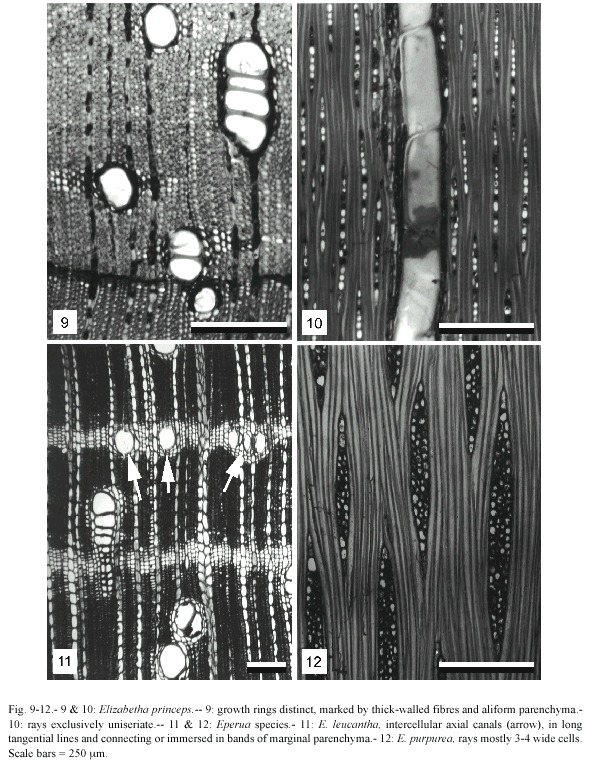
<body><![CDATA[<br> </p>     <p>    <br> <a name="f1-4"></a></p> </font>     <div style="text-align: center;"><img  src="/img/revistas/rbt/v57n1-2/art27i1.jpg" title="" alt=""  style="width: 587px; height: 759px;">    <br> </div> <font face="Courier New" size="2" style="font-family: verdana;"> </font><font face="Courier New" size="2" style="font-family: verdana;">     <p><span style="font-weight: bold;">Growth rings</span> distinct, marked by marginal parenchyma bands and/or thick-walled fibres. <span  style="font-weight: bold;">Diffuse</span> porous. Vessels solitary and in radial multiples of 2-4, 3-17 per mm<sup>2</sup>, 40(70-128) 160 µm in diameter, 130(209-372)550 µm in element length. Simple perforation plates. Alternate intervessel pits circular or oval and polygonal, minute to small, 3-6 µm in diameter. Vessel-ray pits with distinct borders, similar to intervessel pits in size and shape, pits vestured. Brown gum-like deposits in vessels. <span style="font-weight: bold;">Fibres</span> non-septate, medium- to thick-walled, 700(908-1436)1680 µm in length. <span  style="font-weight: bold;">Axial parenchyma </span>vasicentric (in <span  style="font-style: italic;">B coccinea</span>), aliform to confluent in all species, aliform parenchyma of the lozenge type. Banded parenchyma of more than three cells wide in <span  style="font-style: italic;">B. grandiceps </span>and <span  style="font-style: italic;">B. macrophylla</span>. Marginal parenchyma bands present. Axial parenchyma 3-6 cells per parenchyma strand. Rays heterocellular with 1 to 2 rows of upright and/or square marginal cells, 9-20 per mm, exclusively (in <span style="font-style: italic;">B. coccinea</span>) or mostly uniseriate (in <span  style="font-style: italic;">B. grandiceps</span>, <span  style="font-style: italic;">B. macrophylla</span>), 120(252-340)600 µm in height. <span style="font-weight: bold;">Prismatic crystals</span> common in ray cells (both upright and/or square and procumbent cells) and occasionally in short chains in axial parenchyma cells, one crystal per cell or chamber. </p>     <p><span style="font-weight: bold;">Material studied:</span> 7 specimens, <span style="font-style: italic;">B. coccinea </span>Jacq., MADw 32265, B. grandiceps Jacq., MADw 4835, MADw 4836, MADw 11163, MADw 14229, MADw 32266, <span style="font-style: italic;">B. macrophylla </span>Hort. ex Mast., MERw 1277. </p>     <p><span style="font-style: italic;">Copaifera</span> L. -Fig. <a  href="#f1-4">3</a> &amp; <a href="#f1-4">4</a>    <br> </p>     <p><span style="font-weight: bold;">Growth rings</span> distinct, marked by marginal parenchyma bands. <span style="font-weight: bold;">Diffuse</span> porous. Vessels solitary and in radial multiples of 2-4, 3-8 per mm<sup>2</sup>, 90(100-190)210 µm in diameter, 100(253-348) 480 µm in element length. Simple perforation plates. Alternate intervessel pits small to medium, 6-10 µm in diameter. Vessel-ray pits with distinct borders, similar to intervessel pits in size and shape, pits vestured. Brown gumlike deposits in vessels. <span style="font-weight: bold;">Fibres</span> non-septate, medium-walled, 800(908-1264)1570 µm in length. <span  style="font-weight: bold;">Axial parenchyma</span> vasicentric, aliform to confluent, aliform parenchyma of the lozenge type. Marginal parenchyma bands present. Axial parenchyma 2-4 cells per parenchyma strand. Rays mostly homocellular with typically procumbent cells to heterocellular, with 1 row of upright and/or square marginal cells, 6-8 per mm, 1 to 3 occasionally up to 4 cells wide, commonly less than 1 mm, to slightly more than 1 mm: 220(250-691)1050 µm in height. <span  style="font-weight: bold;">Prismatic crystals</span> common in chains in axial parenchyma cells, one crystal per cell or chamber. <span  style="font-weight: bold;">Intercellular canals axial</span> in long tangential lines and connecting or immersed in bands of marginal parenchyma, 60-170 µm in diameter. </p>     ]]></body>
<body><![CDATA[<p><span style="font-weight: bold;">Material studied:</span> 13 specimens, <span style="font-style: italic;">C. officinalis </span>(Jacq.) L., MERw 1533, MERw 1780, MERw 3297, MERw 5584, MERw 5585, MERw 5586, MERw 5587, MERw 5588, <span style="font-style: italic;">C. pubiflora</span> Benth., MERw 4541, MERw 4542, MERw 4543, MERw 4544, MERw 4545. </p>     <p><span style="font-weight: bold;">Note:</span> Metcalfe and Chalk (1950), Corothie (1967), Detienne <span style="font-style: italic;">et al</span>. (1982), Richter and Dallwitz (2000) characterize the rays of <span style="font-style: italic;">Copaifera</span> as homocellular (homogeneous), but Baretta-Kuipers (1981) described them as heterocellular. Additionally, JUNAC (1981) described homocellular rays <span  style="font-style: italic;">C. officinalis</span> and heterocellular rays in <span style="font-style: italic;">C. pubiflora</span>. Mainieri and Chimelo (1989) report for C. cf. <span  style="font-style: italic;">langsdorffii </span>homocellular rays with tendency to heterocellular, and for C. cf. <span  style="font-style: italic;">reticulate</span>, heterocellular rays. Concerning fibres character JUNAC (1981), reports fibres partially septate, however, this feature was not observed in our specimens. </p>     <p><span style="font-style: italic;">Cynometra</span> L. -<a  href="#f5-8">Fig. 5</a> &amp; <a href="#f5-8">6</a>    <br> </p>     <p>    <br> <a name="f5-8"></a></p> </font>     <div style="text-align: center;"><img  src="/img/revistas/rbt/v57n1-2/art27i5-8.jpg" title="" alt=""  style="width: 587px; height: 749px;">    <br> </div> <font face="Courier New" size="2" style="font-family: verdana;"> </font><font face="Courier New" size="2" style="font-family: verdana;">     <p><span style="font-weight: bold;">Growth rings</span> indistinct marked by marginal parenchyma bands. <span style="font-weight: bold;">Diffuse</span> porous. Vessels solitary and in radial multiples of 2-4; occasionally clusters; 9-16 per mm<sup>2</sup>; 35(98-104) 145 µm in diameter, 150(264-331)450 µm in element length. Simple perforation plates. Alternate intervessel pits minute to small, 3-7 µm in diameter. Vessel-ray pits with distinct borders, similar to intervessel pits in size and shape; pits vestured. Brown gum-like deposits in vessels. <span  style="font-weight: bold;">Fibres</span> non-septate, thick-walled, 1050(1375-1605)1950 µm in length. <span style="font-weight: bold;">Axial parenchyma</span> aliform to confluent, aliform parenchyma of the lozenge type, occasionally unilateral. Banded parenchyma mostly in bands more than three cells wide. Marginal parenchyma bands occasionally present. Axial parenchyma 2-4 cells per parenchyma strand. <span style="font-weight: bold;">Rays</span> heterocellular with 1 to 2 rows of upright and/or square marginal cells, rarely up to 3 marginal rows, 8-16 per mm, 1 to 4 cells wide, 220(381-600)850 µm in height. <span  style="font-weight: bold;">Prismatic crystals</span> common in upright and/or square ray cells and occasionally in short chains in axial parenchyma cells, one crystal per cell or chamber. </p>     <p><span style="font-weight: bold;">Material studied:</span> 3 specimens, <span style="font-style: italic;">C. spruceana </span>Benth., MADw 32048; <span style="font-style: italic;">C</span>. sp. L. MERw 2152, MERw 2233. </p>     ]]></body>
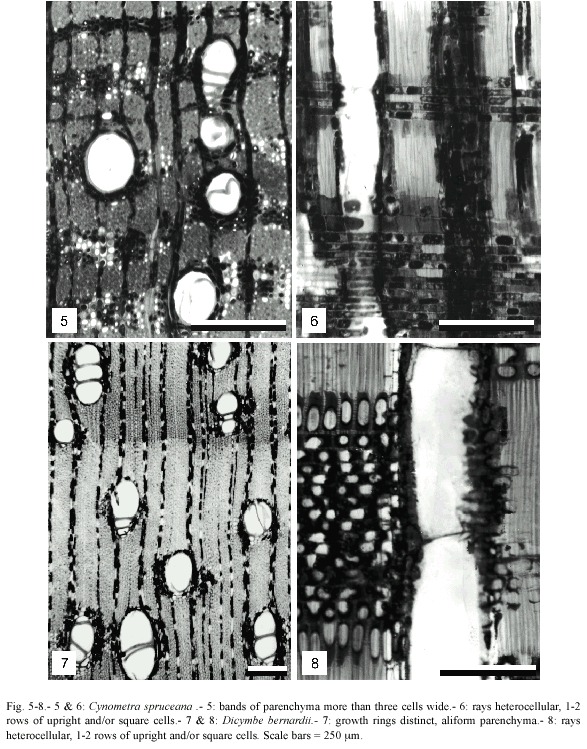
<body><![CDATA[<p><span style="font-weight: bold;">Note:</span> Metcalfe &amp; Chalk (1950) for <span style="font-style: italic;">Cynometra</span> (except <span  style="font-style: italic;">C. ramiflora</span>) and Kribs (1968) for <span  style="font-style: italic;">C. alexandri</span> described the rays as homogeneous, but Baretta-Kuipers (1981); Richter &amp; Dallwitz (2000) for <span style="font-style: italic;">Cynometra</span> and Detienne <span  style="font-style: italic;">et al</span>. (1982) for <span  style="font-style: italic;">C. hostmanniana</span> and <span  style="font-style: italic;">C. parvifolia</span> described the rays as heterocellular. </p>     <p><span style="font-style: italic;">Dicymbe</span> Spruce ex Benth. -<a  href="#f5-8">Fig. 7</a> &amp; <a href="#f5-8">8</a> </p>     <p><span style="font-weight: bold;">Growth rings</span> distinct, marked by marginal parenchyma bands and/or thick-walled fibres. <span  style="font-weight: bold;">Diffuse</span> porous. Vessels solitary and in radial multiples of 2-5; sometimes up to 9; occasionally some clusters, 4-6 per mm<sup>2</sup>; 80(121-150)210 µm in diameter, 200(307-327) 520 µm in element length. Simple perforation plates. Alternate intervessel pits small, 4-6 µm in diameter. Vessel-ray pits with distinct borders, similar to intervessel pits in size and shape; pits vestured. Brown gum-like deposits in vessels. <span  style="font-weight: bold;">Fibres</span> non-septate, thick- to very thick-walled, 800(918-1600)2000 µm in length. <span  style="font-weight: bold;">Axial parenchyma</span> mostly aliform, aliform parenchyma of the lozenge type, vasicentric, confluent. Marginal parenchyma bands absent in MERw 239 and present in MADw 31798. Axial parenchyma 3-4 cells per parenchyma strand. <span  style="font-weight: bold;">Rays</span> mostly homocellular with typically procumbent cells to heterocellular, with 1-4 rows of upright and/or square marginal cells, 8-14 per mm, mostly 1 to 2 cells wide (occasionally 3 cells wide), 100(275-706)930 µm in height. <span  style="font-weight: bold;">Prismatic crystals</span> occasionally present in upright and/or square ray cells and in short chains in axial parenchyma cells, one crystal per cell or chamber. </p>     <p><span style="font-weight: bold;">Material studied:</span> 2 specimens, <span style="font-style: italic;">D. bernardii </span>R.S Cowan, MERw 239; <span style="font-style: italic;">D</span>. sp. MADw 31798. </p>     <p><span style="font-weight: bold;">Note:</span> Metcalfe &amp; Chalk (1950) characterizes the rays of <span style="font-weight: bold;">Dicymbe</span> as homogeneous, but Baretta-Kuipers (1981) described the rays as heterocellular. </p>     <p><span style="font-style: italic;">Elizabetha</span> Schomburgk ex Benth. -<a href="#f9-10">Fig. 9</a> &amp; <a href="#f9-10">10</a>    <br> </p>     <p>    <br> <a name="f9-10"></a></p> </font>     <div style="text-align: center;"><img  src="/img/revistas/rbt/v57n1-2/art27i9-12.jpg" title="" alt=""  style="width: 589px; height: 765px;">    ]]></body>
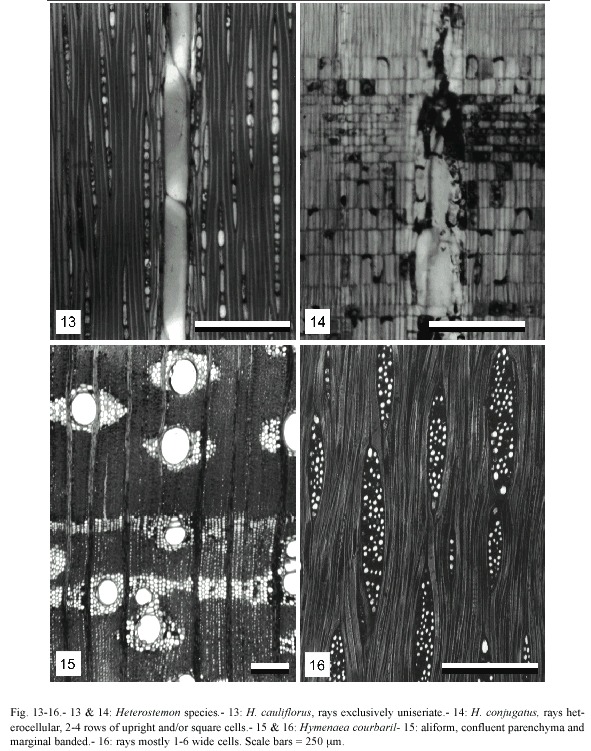
<body><![CDATA[<br> </div> <font face="Courier New" size="2" style="font-family: verdana;"> </font><font face="Courier New" size="2" style="font-family: verdana;">     <p><span style="font-weight: bold;">Growth rings</span> distinct, marked by marginal parenchyma bands and/or thick-walled fibres. <span  style="font-weight: bold;">Diffuse</span> porous. Vessels solitary and in radial multiples of 2-3, sometimes up to 5, occasionally some clusters, 5-10 per mm<sup>2</sup>, 70(110-130)150 µm in diameter, 200(320-355) 490 µm in element length. Simple perforation plates. Alternate intervessel pits small, 4-5 µm in diameter. Vessel-ray pits with distinct borders, similar to intervessel pits in size and shape, pits vestured. Brown gum-like deposits in vessels. <span  style="font-weight: bold;">Fibres</span> non-septate, medium-to thick-walled, 950(1240-1365)1580 µm in length. <span  style="font-weight: bold;">Axial parenchyma</span> aliform to confluent, aliform parenchyma of the lozenge type, occasionally vasicentric. Banded parenchyma mostly in bands 3-5 cells wide. Marginal parenchyma bands present. Axial parenchyma 3-4 cells per parenchyma strand. Rays heterocellular with 1 to 2 rows of upright and/or square marginal cells, 7-10 per mm, exclusively or mostly uniseriate, 110(220-230)420 µm in height. <span style="font-weight: bold;">Prismatic crystals</span> common in procumbent ray cells (occasionally in upright and/or square) and occasionally in short chains in axial parenchyma cells, one crystal per cell or chamber. </p>     <p><span style="font-weight: bold;">Material studied:</span> 2 specimens, <span style="font-style: italic;">E. princeps </span>Schomburgk ex Benth., MADw 31823, <span style="font-style: italic;">E. macrostachya</span> Benth., MERw 5275. </p>     <p><span style="font-style: italic;">Eperua</span> Aublet. -<a  href="#f9-10">Fig. 11</a> &amp; <a href="#f9-10">12</a>    <br> </p>     <p><span style="font-weight: bold;">Growth rings</span> distinct marked by marginal parenchyma bands. <span style="font-weight: bold;">Diffuse</span> porous. Vessels solitary and in radial multiples of 2-3, sometimes up to 8, occasionally some clusters, 3-13 per mm<sup>2</sup>, 70(155-235) 300 µm in diameter, 200(364-436) 600 µm in element length. Simple perforation plates. Alternate intervessel pits circular or oval and poligonal, small to medium, 4-8 µm in diameter. Vessel-ray pits with distinct borders, similar to intervessel pits in size and shape, pits vestured. Brown gum-like deposits in vessels. <span  style="font-weight: bold;">Fibres</span> non-septate, medium-walled, 970(1104-1459)1600 µm in length. <span style="font-weight: bold;">Axial parenchyma</span> scanty, vasicentric thin, sometimes diffuse-in-aggregates. Marginal parenchyma bands present. Axial parenchyma 3-4 cells per parenchyma strand. Rays heterocellular with 1 to 4 rows of upright and/or square marginal cells, 5-8 per mm, 1 to 4 cells wide, 180(200-510)750 µm in height. <span  style="font-weight: bold;">Prismatic crystals</span> common in long chains in axial parenchyma cells, one crystal per cell or chamber. <span  style="font-weight: bold;">Intercellular axial</span> canals in long tangential lines and connecting or immersed in bands of marginal parenchyma, occasionally diffuse (<span style="font-style: italic;">E. purpurea</span>), 50-150 µm in diameter. </p>     <p><span style="font-weight: bold;">Material studied:</span> 4 specimens, <span style="font-style: italic;">E. grandiflora </span>(Aubl.) Benth., MERw 200, <span style="font-style: italic;">E. leucantha </span>Benth., MERw 194, <span style="font-style: italic;">E. purpurea</span> Benth., MERw 5273, MERw 5276. </p>     <p><span style="font-style: italic;">Heterostemon</span> Desf. -<a  href="#f13-14">Fig. 13</a> &amp; <a href="#f13-14">14</a>    <br> </p>     <p>    ]]></body>
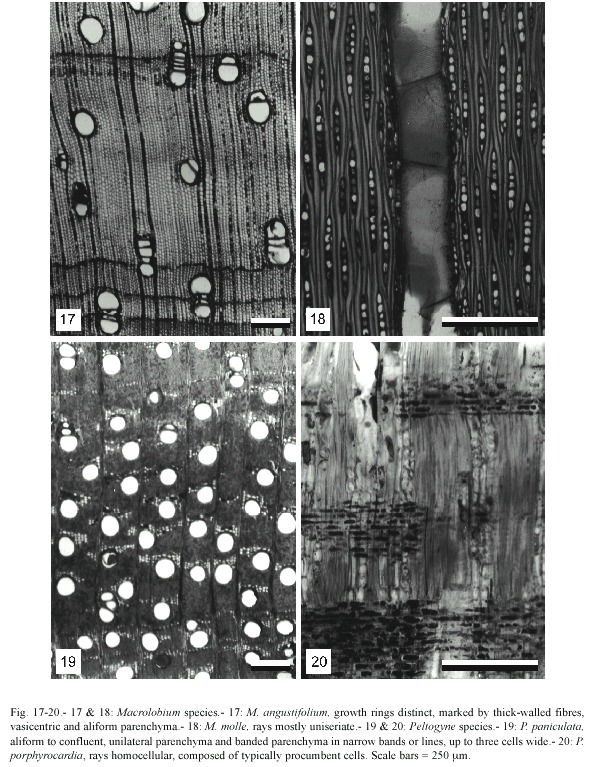
<body><![CDATA[<br> <a name="f13-14"></a></p> </font>     <div style="text-align: center;"><img  src="/img/revistas/rbt/v57n1-2/art27i13-16.jpg" title="" alt=""  style="width: 591px; height: 751px;">    <br> </div> <font face="Courier New" size="2" style="font-family: verdana;"> </font><font face="Courier New" size="2" style="font-family: verdana;">     <p><span style="font-weight: bold;">Growth rings</span> distinct, marked by marginal parenchyma bands and thick-walled fibres. <span  style="font-weight: bold;">Diffuse</span> porous. Vessels solitary and radial multiples of 2-3, sometimes up to 5, occasionally some clusters, 7-15 per mm<sup>2</sup>, 50(73-98)140 µm in diameter, 160(264-322)430 µm in element length. Simple perforation plates. Alternate intervessel pits circular or oval of them shape polygonal, minute to small, 3-6 µm in diameter. Vessel-ray pits with distinct borders, similar to intervessel pits in size and shape, pits vestured. Brown gum-like deposits in vessels. <span style="font-weight: bold;">Fibres</span> non-septate, medium- to thick-walled, 700(740-949)1240 µm in length. <span  style="font-weight: bold;">Axial parenchyma </span>vasicentric, aliform to confluent, aliform parenchyma of the lozenge type. Banded parenchyma occasionally more than three cells wide in <span  style="font-style: italic;">H. conjugatus</span>. Marginal parenchyma bands present. Axial parenchyma 2-4 cells per parenchyma strand. Rays heterocellular with 1 to 4 rows of upright and/or square marginal cells, occasionally 5 in <span style="font-style: italic;">H. conjugatus</span>, 7-17 per mm, exclusively or mostly uniseriate, 170(250-517) 640 µm in height. <span style="font-weight: bold;">Prismatic crystals</span> not common, mostly present in procumbent ray cells, one crystal per cell or chamber. </p>     <p><span style="font-weight: bold;">Material studied:</span> 6 specimens, <span style="font-style: italic;">H. cauliflorus </span>Pittier, MADw 31929, MADw 31931, <span style="font-style: italic;">H. conjugatus</span> Spruce ex Benth., MERw 5283, MADw 31932, MADw 31933, <span  style="font-style: italic;">H. mimosoides </span>Desf., MADW 31934. </p>     <p><span style="font-style: italic;">Hymenaea</span> L. -<a  href="#f13-14">Fig. 15</a> &amp; <a href="#f13-14">16</a> </p>     <p><span style="font-weight: bold;">Growth rings</span> distinct, marked by marginal parenchyma bands and beside very thick-walled fibres in H. oblongifolia. <span style="font-weight: bold;">Diffuse</span> porous. Vessels solitary and radial multiples of 2-4, occasionally some clusters, 2-3 per mm<sup>2</sup>, 90(132-202)300 µm in diameter, 160(238-354) 520 µm in element length. Simple perforation plates. Alternate intervessel pits circular or oval, of them shape polygonal, small, 4-7 µm in diameter. Vessel-ray pits with distinct borders, similar to intervessel pits in size and shape, pits vestured. Reddish brown gum-like deposits in vessels. Fibres non-septate, thick-to very thick-walled, 1000(1340-1525)1890 µm in length. <span  style="font-weight: bold;">Axial parenchyma</span> mostly aliform to confluent, aliform parenchyma of the lozenge type. Banded parenchyma of more than three cells wide in <span style="font-style: italic;">H. courbaril </span>and <span style="font-style: italic;">H. oblongifolia</span>. Marginal parenchyma bands present. Axial parenchyma 2-4 cells per parenchyma strand. Rays homocellular with typically procumbent cells (marginal cells sometimes slightly enlarged), 3-8 per mm, 1 to 6 cells wide, 110(192-450)650 µm in height. <span style="font-weight: bold;">Prismatic crystals</span> common in long chains in chambered axial parenchyma cells, one crystal per cell or chamber. </p>     <p><span style="font-weight: bold;">Material studied:</span> 11 specimens, <span style="font-style: italic;">H. courbaril</span> L., MERw 1507, MERw 3394, MERw 4564, MERw 4565, MERw 4566, MERw 4567, MERw 2489, <span style="font-style: italic;">H. oblongifolia</span> Huber, MERw 2087, MERw 2533, MERw 2648, <span style="font-style: italic;">H. parvifolia</span> Huber, MERw 2053. </p>     <p><span style="font-style: italic;">Macrolobium</span> Schreber. -<a  href="#f17-18">Fig. 17</a> &amp; <a href="#f17-18">18</a>    <br> </p>     ]]></body>
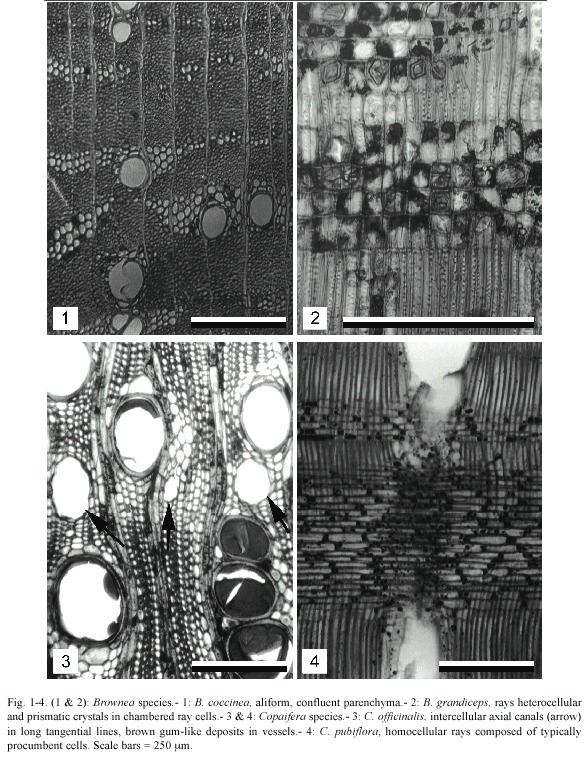
<body><![CDATA[<p>    <br> <a name="f17-18"></a></p> </font>     <div style="text-align: center;"><img  src="/img/revistas/rbt/v57n1-2/art27i17-20.jpg" title="" alt=""  style="width: 591px; height: 767px;">    <br> </div> <font face="Courier New" size="2" style="font-family: verdana;"> </font><font face="Courier New" size="2" style="font-family: verdana;">     <p><span style="font-weight: bold;">Growth rings</span> distinct, marked by marginal parenchyma bands and/or thick-walled fibres. <span  style="font-weight: bold;">Diffuse</span> porous. Vessels solitary and radial multiples of 2-3, sometimes up to 8, occasionally some clusters, 2-13 per mm<sup>2</sup>, 60 (85-177) 230 µm in diameter, 133 (236-439) 590 µm in element length. Simple perforation plates. Alternate intervessel pits circular or oval and polygonal, small, 5-8 µm in diameter. Vessel-ray pits with distinct borders, similar to intervessel pits in size and shape, pits vestured. Brown gumlike deposits in vessels. <span style="font-weight: bold;">Fibres</span> non-septate, thin-walled to thick-walled, 670(817-1765)2350 µm in length. <span  style="font-weight: bold;">Axial parenchyma</span> vasicentric, aliform to confluent, aliform parenchyma of the lozenge type. Banded parenchyma of 2-4 cells wide. Marginal parenchyma bands present. Axial parenchyma 2-5 cells per parenchyma strand. Rays heterocellular with 1 to 2 rows of upright and/or square marginal cells (sometimes to 3), 9-20 per mm, exclusively or mostly uniseriate in <span  style="font-style: italic;">M. gracile</span>, <span  style="font-style: italic;">M. limbatum</span>, <span  style="font-style: italic;">M. molle </span>and <span  style="font-style: italic;">M. rubrum</span>, uniseriate and biseriate in <span style="font-style: italic;">M. acaciifolium</span>, <span  style="font-style: italic;">M. angustifolium</span>, <span  style="font-style: italic;">M. multijugum </span>and <span  style="font-style: italic;">M. punctatum</span>, 100(220-390)650 µm in height. Storied structure not observed, only rays irregularly storied (rays in echelon) in <span style="font-style: italic;">M. molle</span>. <span style="font-weight: bold;">Prismatic crystals</span> common in ray cells (both upright and/or square ray cells and procumbent cells) and occasionally in short chains in axial parenchyma cells in <span  style="font-style: italic;">M. angustifolium</span>, <span  style="font-style: italic;">M. gracile</span>, <span  style="font-style: italic;">M. limbatum</span>, <span  style="font-style: italic;">M. molle</span>, <span  style="font-style: italic;">M. multijugum</span> and <span  style="font-style: italic;">M. punctatum</span>. Prismatic crystals common in axial parenchyma cells and sporadic in ray cells in <span  style="font-style: italic;">M. acaciifolium</span> and <span  style="font-style: italic;">M. rubrum</span>, one to occasionally two crystals per cell or chamber. </p>     <p><span style="font-weight: bold;">Material studied:</span> 15 specimens, <span style="font-style: italic;">M. acaciifolium</span> (Benth.) Benth., MERw 2084, MERw 3374, MADw 14917, <span  style="font-style: italic;">M. angustifolium </span>(Benth.) Cowan, MADw 31604, MADw 31617, MADw 31620, <span style="font-style: italic;">M. gracile Spruce</span> ex Benth., MADw 31611, <span  style="font-style: italic;">M. limbatum</span> Spruce ex Benth., MERw 2050, <span style="font-style: italic;">M. molle</span> (Benth.) Cowan, MADw 14912, MADw 31613, MADw 31614, <span  style="font-style: italic;">M. multijugum</span> (DC.) Benth., MADw 31605, MADw 31612, M. punctatum Spruce ex Benth., MERw 2021, <span  style="font-style: italic;">M. rubrum</span> R.S Cowan, MADw 22398. </p>     <p><span style="font-style: italic;">Peltogyne Vogel</span>. -<a  href="#f17-18">Fig. 19</a> &amp; <a href="#f17-18">20</a> </p>     <p><span style="font-weight: bold;">Growth rings</span> distinct, marked by marginal parenchyma bands in <span  style="font-style: italic;">P. paniculata</span> but absent in <span  style="font-style: italic;">P. floribunda</span>. <span  style="font-weight: bold;">Diffuse</span> porous. Vessels solitary and in radial multiples of 2-3, sometimes up to 5, occasionally some clusters, 20-46 per mm<sup>2</sup>, 50(60-120) 140 µm in diameter, 200 (260-390) 420 µm in element length. Simple perforation plates. Alternate intervessel pits circular or oval, of them shape polygonal, small to medium, 5-8 µm in diameter. Vessel-ray pits with distinct borders, similar to intervessel pits in size and shape, pits vestured. Reddish brown gum-like deposits in vessels. <span  style="font-weight: bold;">Fibres </span>non-septate, very thick-walled, 860(1208-1700) 1820 µm in length. <span  style="font-weight: bold;">Axial parenchyma</span> mostly aliform to confluent, aliform parenchyma of the winged type, unilateral. Banded parenchyma in narrow bands or lines, up to three cells wide. Marginal parenchyma bands present in <span style="font-style: italic;">P. paniculata</span>. Axial parenchyma 3-5 cells per parenchyma strand. Rays homocellular with typically procumbent cells, 5-10 per mm, 2 to 4 cells wide, 140(160-480)830 µm in height. Storied structure in axial parenchyma in <span style="font-style: italic;">P. paniculata</span> and irregularly storied in axial parenchyma in <span  style="font-style: italic;">P. floribunda</span>. <span  style="font-weight: bold;">Prismatic crystals</span> common in chains in chambered axial parenchyma cells, one crystal per cell or chamber. Intercellular canals of traumatic origin present in <span  style="font-style: italic;">P. floribunda</span>. </p>     <p><span style="font-weight: bold;">Material studied:</span> 7 specimens, <span style="font-style: italic;">P. paniculata </span>Benth., MERw 1760, MERw 2463, <span style="font-style: italic;">P. floribunda </span>(Kunth) Pittier, MERw 1524, MERw 1771, MERw 4568, MERw 4569, MERw 4570. </p>     <p><span style="font-weight: bold;">Note:</span> Metcalfe and Chalk (1950) mention tendencies to storied axial parenchyma in some species of <span style="font-style: italic;">Peltogyne</span>. This feature was also found in <span style="font-style: italic;">P. floribunda</span> (= <span style="font-style: italic;">P. porphyrocardia</span>) by JUNAC (1981), but is not mentioned by Corothie (1967) for the same specie and by Detienne <span style="font-style: italic;">et al</span>. (1982) and Nardi and Edlmann (1992) for <span  style="font-style: italic;">P. paniculata</span>. However, other species of the genus were described by Kribs (1968) for <span  style="font-style: italic;">P. densiflora</span>, Detienne <span  style="font-style: italic;">et al</span>. (1982) and Miller and Détienne (2001) for <span style="font-style: italic;">P. venosa</span>, all with storied structure not observed. </p>     ]]></body>
<body><![CDATA[<p style="font-weight: bold;"><font size="3">Discussion</font></p>     <p>All wood characters have been recorded, but only the most systematically and diagnostically important ones are displays in <a  href="/img/revistas/rbt/v57n1-2/art27t1.gif">Table 1</a> and the following discussion. These characters emphasized the anatomical information to help in the identification of the species and genera of the Venezuelan Detarieae. Diagnostic features for reliable identification and potentially phylogenetically valuable information within the tribe Detarieae include: fibre wall thickness, ray composition, ray width, intercellular axial canals and storied structure, parenchyma type and prismatic crystals in ray cells. Quantitative features also vary (see <a  href="/img/revistas/rbt/v57n1-2/art27t1.gif">Table 1</a>), but most vary too much to be useful in identifications or comparisons. The exceptions are vessels per mm<sup>2</sup> (e.g. species of Peltogyne) ray width (e.g. species of Hymenaea) and intervessel pit size. Vessels per mm<sup>2</sup> and ray width are a good diagnostic quantitative character in these groups. </p>     <p style="font-style: italic;"><span style="font-weight: bold;">Comparison of Detarieae with Caesalpinieae</span> </p>     <p>All legume woods have simple perforation plates, alternate intervessel pitting, vessel-ray pits similar to intervessel pits in size and shape, fibres with simple pits, vestured pits (with some exceptions) and in general axial parenchyma with mostly 2-4 cells per strand. in general, the species of the subfamily Caesalpinioideae have medium to thick fibre walls, aliform, confluent and marginal parenchyma, homocellular rays or with a row of square or upright marginals cells, biseriate rays non-storeyed and prismatic crystals in chambered axial parenchyma cells (Baretta-Kuipers 1981, Höhn 1999, Herendeen 2000, Gasson <span style="font-style: italic;">et al</span>. 2003, Espinoza de Pernía and Melandri 2006a,b). While, the following wood characters provide the most systematically important characters between Detarieae and Caesalpinieae:     <br> </p>     <p><span style="font-weight: bold;">Fibres:</span> septate only in <span  style="font-style: italic;">Schizolobium </span>(Caesalpinieae) and are absent in Detarieae genera. Usually thin to thick walled in Detarieae and thick and very thick in the most of Caesalpinieae. </p>     <p><span style="font-weight: bold;">Rays:</span> there is considerable variation in ray cell composition and ray width between taxa. Homocellular rays are most common in Caesalpinieae, while in Detarieae, most common rays are heterocellular. Concerning width ray, in agreement with Metcalfe and Chalk (1950), Baretta and Kuipers (1981), Détienne and Welle (1989), Mainieri and Peres (1989), Miller and Détienne (2001) and Gasson <span style="font-style: italic;">et al</span>. (2003), we observed in both tribes two groups: 1) Uniseriate (exclusively or predominantly) to biseriate rays in <span style="font-style: italic;">Brownea</span>, <span style="font-style: italic;">Elizabetha</span>, <span  style="font-style: italic;">Heterostemom</span>, <span  style="font-style: italic;">Macrolobium</span>, <span  style="font-style: italic;">Sclerolobium subbullatum</span> and <span  style="font-style: italic;">Tachigali</span>. 2) Multiseriate rays in <span  style="font-style: italic;">Caesalpinia</span>, <span  style="font-style: italic;">Campsiandra</span>, <span  style="font-style: italic;">Copaifera</span>, <span  style="font-style: italic;">Cynometra</span>, <span  style="font-style: italic;">Delonix regia</span>, <span  style="font-style: italic;">Dimorphandra</span>, <span  style="font-style: italic;">Dicymbe</span>, <span  style="font-style: italic;">Eperua</span>, <span  style="font-style: italic;">Hymenaea</span>, <span  style="font-style: italic;">Mora</span>, <span  style="font-style: italic;">Peltogyne </span>and <span  style="font-style: italic;">Schizolobium</span>. </p>     <p><span style="font-weight: bold;">Intercellular axial canals:</span> the presence and distribution of axial canals is a good diagnostic and systematic character in Detarieae. They are found in long tangential lines and immersed in bands of marginal parenchyma in <span  style="font-style: italic;">Copaifera</span> and <span  style="font-style: italic;">Eperua</span> (Detarieae tribe), also reported and discussed by Barettta-Kuipers (1981), Détienne <span  style="font-style: italic;">et al</span>. (1982), Détienne and Welle (1989), Miller and Détienne (2001) and Gasson <span  style="font-style: italic;">et al</span>. (2003), occasionally diffuse in <span style="font-style: italic;">Eperua purpurea</span>, absent in all Caesalpinieae genera. </p>     <p><span style="font-weight: bold;">Axial parenchyma</span> in narrow bands uncommon in both tribes, however, common in <span  style="font-style: italic;">Caesalpinia coriaria</span>, <span  style="font-style: italic;">C. ebano</span> of Caesalpinieae tribe and <span style="font-style: italic;">Macrolobium gracile</span>, <span  style="font-style: italic;">M. limbatum</span>, <span  style="font-style: italic;">M. molle</span>, <span  style="font-style: italic;">Peltogyne floribunda</span>, <span  style="font-style: italic;">P. paniculata</span> and occasionally in <span  style="font-style: italic;">Hymenaea oblongifolia</span> and <span  style="font-style: italic;">Macrolobium acaciifolium</span> of Detarieae tribe. Bands more than three cells wide in <span  style="font-style: italic;">Caesalpinia granadillo</span>, <span  style="font-style: italic;">C. sclerocarpa</span>, <span  style="font-style: italic;">Campsiandra</span>, <span  style="font-style: italic;">Dimorphardra cuprea </span>subsp. ferruginea, <span style="font-style: italic;">D. davisii</span>, <span  style="font-style: italic;">Mora gonggrijpii</span>, of Caesalpinieae tribe and <span style="font-style: italic;">Brownea grandiceps</span>, <span style="font-style: italic;">B. macrophylla</span>, <span  style="font-style: italic;">Cynometra spruceana</span>, <span  style="font-style: italic;">Elizabetha</span>, <span  style="font-style: italic;">Hymenaea courbaril</span>, <span  style="font-style: italic;">H.oblongifolia</span>, <span  style="font-style: italic;">Magrolobium angustifolia</span>, <span  style="font-style: italic;">M. gracile</span>, <span  style="font-style: italic;">M. molle</span>, <span  style="font-style: italic;">M. multijugum</span>, <span  style="font-style: italic;">M. punctatum </span>of Detarieae tribe. Storeying in axial parenchyma in <font><font face="Courier New"  size="2" style="font-family: verdana;"><span  style="font-style: italic;">P.</span><font><font face="Courier New"  size="2" style="font-family: verdana;"><span  style="font-style: italic;"> paniculata</span></font></font></font></font> storied and&nbsp; <font><font face="Courier New" size="2"  style="font-family: verdana;"><span style="font-style: italic;">P. floribunda </span></font></font>irregularly storied, but rays never storied in Detarieae tribe. Storied structure in all the cell types only occurs in <span style="font-style: italic;">Caesalpinia</span>. </p>     <p><span style="font-weight: bold;">Prismatic crystals</span> are common in subfamily Caesalpinioideae, particularly frequent in axial parenchyma cells, however a of number important genera of the Detarieae tribe also have prismatic crystals common in ray cells, usually one crystal per cell or chamber: <span style="font-style: italic;">Brownea</span>, <span style="font-style: italic;">Cynometra</span>, <span  style="font-style: italic;">Dicymbe</span>, <span  style="font-style: italic;">Elizabetha</span>, <span  style="font-style: italic;">Heterostemon</span> and <span  style="font-style: italic;">Macrolobium</span> (except <span  style="font-style: italic;">M. rubrum</span>). This observation coincides with recorded by Détienne <span style="font-style: italic;">et al</span>. (1982), Détienne and Welle (1989), Miller and Détienne (2001). Silica bodies only present in the tribe Caesalpinieae (<span  style="font-style: italic;">Tachigali</span> and <span  style="font-style: italic;">Sclerolobium</span> species), absent in all Detarieae studied, also discussed by Koeppen (1980), Barettta-Kuipers (1981) and Gasson <span style="font-style: italic;">et al</span>. (2003). </p>     ]]></body>
<body><![CDATA[<p><span style="font-weight: bold;">Vessels</span> per mm<sup>2</sup> of 2 to 10 in most species of Caesalpinieae and Detarieae tribes, however Peltogyne is very different, presents from 20 to 46 per mm<sup>2</sup>. Intervessel pit size in most Caesalpinieae and Detarieae is commonly medium to large, while in <span style="font-style: italic;">Brownea</span>, <span style="font-style: italic;">Cynometra</span>, <span  style="font-style: italic;">Dimorphandra</span>, <span  style="font-style: italic;">Heterostemon</span> and <span  style="font-style: italic;">Mora</span>, there is a tendency towards minute to small. </p>     <p>Finally, in summary the diagnostic features important for identification of the tribe Detarieae and for comparison with Caesalpinieae are: intercellular axial canals, rays heterocellular, rays exclusively or predominantly uniseriate, prismatic crystals common in ray cells, storied structure, fibre wall thickness and absent of silica bodies. The interpretation of homocellular versus heterocellular rays in <span style="font-style: italic;">Copaifera</span>, <span  style="font-style: italic;">Cynometra</span> and <span  style="font-style: italic;">Dicymbe</span> is not consistent in the literature with similar inconsistencies for the tribe Caesalpinieae (Espinoza de Pernía and Melandri 2006b). Therefore, this character may need to be re-examined in the wood of other legumes and possibly re-defined for use in keys and descriptions. In addition, the distribution of these diagnostic features in particular groups, often in agreement with phylogenies and also certain characters may have some relationship to ecological conditions (e.g. vessels per mm<sup>2</sup>, intervessel pit size, axial parenchyma abundance and fibre wall thickness). </p>     <p style="font-weight: bold;"><font size="3">Acknowledgments</font></p>     <p>We thank Regis B. Miller, USDA Forest Service, Forest Products Laboratory, Madison, Wisconsin for helpful suggestions and also for providing the sectioning blocks of some materials studied. For the financial help we wish to thank C.D.C.H.T of the Universidad de Los Andes (Project: FO-392-96-01-B), Mérida, Venezuela. </p> </font> <hr style="width: 100%; height: 2px;"><font face="Courier New" size="2"  style="font-family: verdana;">     <p><span style="font-weight: bold;">Resumen</span> </p>     <p>Se estudió la anatomía de la madera de 29 especies de 10 géneros de la tribu Detarieae, subfamilia Caesalpinioideae, enfocado hacia la identificación de la estructura de la madera y su comparación con la tribu Caesalpinieae. Los especímenes fueron recolectados en Venezuela y pertenecen a la colecciones de maderas del Laboratorio de Anatomía de Maderas de la Facultad de Ciencias Forestales y Ambientales de la Universidad de Los Andes, Mérida, Venezuela y del USDA Forest Service, Forest Products Laboratory, Madison, Wisconsin, USA. Las características anatómicas evaluadas siguen lo propuesto por IAWA List of Microscopic Features for Hardwood identification (IAWA Committee 1989). Las especies de la tribu Detarieae pueden ser identificadas usando un número de características de diagnóstico combinadas: canales intercelulares longitudinales, radios heterocelulares exclusiva o predominantemente uniseriados, patrones del parénquima axial, cristales prismáticos en las células radiales, estructura estratificada y grosor de las paredes de las fibras. Estos caracteres también proporcionan una valiosa información para estudios sistemáticos y filogenéticos. Se presenta la descripción anatómica a nivel de género, una tabla sinóptica con los caracteres de diagnóstico principales y fotomicrografías de las características más importantes. </p>     <p><span style="font-weight: bold;">Palabras claves:</span> Leguminosae, Caesalpinioideae, Detarieae, Caesalpinieae, anatomía de la madera, identificación.    <br> </p> </font> <hr style="width: 100%; height: 2px;"><font face="Courier New" size="2"  style="font-family: verdana;"></font>     <div style="text-align: center;"><font><font face="Courier New" size="2"  style="font-family: verdana;">Received 28-II-2008. Corrected 06-VII-2008. Accepted 04-VIII-2008.</font></font>&nbsp;</div> <font face="Courier New" size="2" style="font-family: verdana;">     <p style="font-weight: bold;"><font size="3">References</font></p>     ]]></body>
<body><![CDATA[<!-- ref --><p>Aristeguieta, L. 2003. Estudio dendrológico de la Flora Venezolana. Vol. XXXVIII. Academia de Ciencias Físicas, Matemáticas y Naturales. Caracas, Venezuela. &nbsp;&nbsp;&nbsp;&nbsp;&nbsp;&nbsp;&nbsp;&nbsp;[&#160;<a href="javascript:void(0);" onclick="javascript: window.open('/scielo.php?script=sci_nlinks&ref=1261682&pid=S0034-7744200900010002700001&lng=','','width=640,height=500,resizable=yes,scrollbars=1,menubar=yes,');">Links</a>&#160;]<!-- end-ref --><!-- ref --><p>Baretta-Kuipers, T. 1981. Wood anatomy of Leguminosae: its relevance to taxonomy, p. 677-705. <span style="font-style: italic;">In</span> R.M. Polhill &amp; P.H. Raven (eds), Advances in Legume Systematics, Part 2, Royal Botanic Gardens, Kew, England. &nbsp;&nbsp;&nbsp;&nbsp;&nbsp;&nbsp;&nbsp;&nbsp;[&#160;<a href="javascript:void(0);" onclick="javascript: window.open('/scielo.php?script=sci_nlinks&ref=1261683&pid=S0034-7744200900010002700002&lng=','','width=640,height=500,resizable=yes,scrollbars=1,menubar=yes,');">Links</a>&#160;]<!-- end-ref --><!-- ref --><p>Barneby, R., B. Stergios, R. Cowan, P. Berry, J. Zarucchi, R. Wunderlin, D. Kearns, M.F da Silva, A. Sprada, D. Velaázquez, N. Xena &amp; G. Aymard. 1998. Caesalpiniaceae, p. 1-121. <span  style="font-style: italic;">In</span> Berry P., B. Holst &amp; K. Yatskievych (eds). Flora of the Venezuelan Guayana. Vol. 4. Missouri Botanical Garden, St. Louis, Missouri. &nbsp;&nbsp;&nbsp;&nbsp;&nbsp;&nbsp;&nbsp;&nbsp;[&#160;<a href="javascript:void(0);" onclick="javascript: window.open('/scielo.php?script=sci_nlinks&ref=1261684&pid=S0034-7744200900010002700003&lng=','','width=640,height=500,resizable=yes,scrollbars=1,menubar=yes,');">Links</a>&#160;]<!-- end-ref --><!-- ref --><p>Bruneau, A., F.J. Breteler, J.J. Wieringa, G.Y.F. Gervais and F. Forest. 2000. Phylogenetic relationships in tribes Macrolobieae and Detarieae as inferred from chloroplast trnL intro sequences. <span  style="font-style: italic;">In</span> P.S. Herendeen and A. Bruneau (eds), Advances in Legume Systematics, Part 9: 121-149. Royal Botanic Gardens, Kew, England. &nbsp;&nbsp;&nbsp;&nbsp;&nbsp;&nbsp;&nbsp;&nbsp;[&#160;<a href="javascript:void(0);" onclick="javascript: window.open('/scielo.php?script=sci_nlinks&ref=1261685&pid=S0034-7744200900010002700004&lng=','','width=640,height=500,resizable=yes,scrollbars=1,menubar=yes,');">Links</a>&#160;]<!-- end-ref --><!-- ref --><p>Chauhan, L. &amp; R.V. Rao. 2003. Wood anatomy of legumes of India: their identification, properties and uses. Bishen Singh Mahendra Pal Singh, Dehra-Dun, India. &nbsp;&nbsp;&nbsp;&nbsp;&nbsp;&nbsp;&nbsp;&nbsp;[&#160;<a href="javascript:void(0);" onclick="javascript: window.open('/scielo.php?script=sci_nlinks&ref=1261686&pid=S0034-7744200900010002700005&lng=','','width=640,height=500,resizable=yes,scrollbars=1,menubar=yes,');">Links</a>&#160;]<!-- end-ref --><!-- ref --><p>Corothie, H. 1967. Estructura anatómica de 47 maderas de la Guayana Venezolana. Laboratorio Nacional de Productos Forestales. Universidad de los Andes - Ministerio de Agricultura y Cría. Mérida, Venezuela. &nbsp;&nbsp;&nbsp;&nbsp;&nbsp;&nbsp;&nbsp;&nbsp;[&#160;<a href="javascript:void(0);" onclick="javascript: window.open('/scielo.php?script=sci_nlinks&ref=1261687&pid=S0034-7744200900010002700006&lng=','','width=640,height=500,resizable=yes,scrollbars=1,menubar=yes,');">Links</a>&#160;]<!-- end-ref --><!-- ref --><p>Détienne, P. &amp; B.J.H. ter Welle. 1989. Wood and timber. <span  style="font-style: italic;">In</span> R.S. Cowan &amp; J.C Lindemann (A.R.A. Gorts ven Rijn, editor) Flora of the Guianas 88 Caesalpinieae, 123-149. Koeltz Scientific, Koenigstein, Germany. &nbsp;&nbsp;&nbsp;&nbsp;&nbsp;&nbsp;&nbsp;&nbsp;[&#160;<a href="javascript:void(0);" onclick="javascript: window.open('/scielo.php?script=sci_nlinks&ref=1261688&pid=S0034-7744200900010002700007&lng=','','width=640,height=500,resizable=yes,scrollbars=1,menubar=yes,');">Links</a>&#160;]<!-- end-ref --><!-- ref --><p>Détienne, P., P. Jacquet &amp; A. Mariaux. 1982. Manuel d´ identification des bois tropicaux. Tome 3. Guyana Française. Centre Technique Forestier Tropical, Nogent-sur-Marne, France. &nbsp;&nbsp;&nbsp;&nbsp;&nbsp;&nbsp;&nbsp;&nbsp;[&#160;<a href="javascript:void(0);" onclick="javascript: window.open('/scielo.php?script=sci_nlinks&ref=1261689&pid=S0034-7744200900010002700008&lng=','','width=640,height=500,resizable=yes,scrollbars=1,menubar=yes,');">Links</a>&#160;]<!-- end-ref --><!-- ref --><p>Espinoza de Pernía, N. &amp; J.L. Melandri. 2006a. Anatomía de la madera de 68 especies de la subfamilia Caesalpinioideae (Leguminosae) en Venezuela. Universidad de Los Andes. Consejo de Desarrollo Científico, Humanístico y Tecnológico (CDCHT). Mérida, Venezuela. &nbsp;&nbsp;&nbsp;&nbsp;&nbsp;&nbsp;&nbsp;&nbsp;[&#160;<a href="javascript:void(0);" onclick="javascript: window.open('/scielo.php?script=sci_nlinks&ref=1261690&pid=S0034-7744200900010002700009&lng=','','width=640,height=500,resizable=yes,scrollbars=1,menubar=yes,');">Links</a>&#160;]<!-- end-ref --><!-- ref --><p>Espinoza de Pernía, N. &amp; J.L. Melandri. 2006b. Wood anatomy of the tribe Caesalpinieae (Leguminosae, Caesalpinioideae) in Venezuela. IAWA J. 27: 99-114. &nbsp;&nbsp;&nbsp;&nbsp;&nbsp;&nbsp;&nbsp;&nbsp;[&#160;<a href="javascript:void(0);" onclick="javascript: window.open('/scielo.php?script=sci_nlinks&ref=1261691&pid=S0034-7744200900010002700010&lng=','','width=640,height=500,resizable=yes,scrollbars=1,menubar=yes,');">Links</a>&#160;]<!-- end-ref --><!-- ref --><p>Gasson, P. 1994. Wood anatomy of the tribe Sophoreae and related Caesalpinioideae and Papilionoideae. <span style="font-style: italic;">In</span> I.K. Fergunson &amp; S. Tucker (eds), Advances in Legume Systematics, Part 6: 165-203, Royal Botanic Gardens, Kew, England. &nbsp;&nbsp;&nbsp;&nbsp;&nbsp;&nbsp;&nbsp;&nbsp;[&#160;<a href="javascript:void(0);" onclick="javascript: window.open('/scielo.php?script=sci_nlinks&ref=1261692&pid=S0034-7744200900010002700011&lng=','','width=640,height=500,resizable=yes,scrollbars=1,menubar=yes,');">Links</a>&#160;]<!-- end-ref --><!-- ref --><p>Gasson, P. 1996. Wood anatomy of the tribe Swartzieae with comments on related Papilionoid and Caesalpinioid Leguminosae. IAWA J. 17: 45-75. &nbsp;&nbsp;&nbsp;&nbsp;&nbsp;&nbsp;&nbsp;&nbsp;[&#160;<a href="javascript:void(0);" onclick="javascript: window.open('/scielo.php?script=sci_nlinks&ref=1261693&pid=S0034-7744200900010002700012&lng=','','width=640,height=500,resizable=yes,scrollbars=1,menubar=yes,');">Links</a>&#160;]<!-- end-ref --><!-- ref --><p>Gasson, P. 1999. Wood anatomy of the tribe Dipterygeae with comments on related Papilionoid and Caesalpinioid Leguminosae. IAWA J. 20: 441-455. &nbsp;&nbsp;&nbsp;&nbsp;&nbsp;&nbsp;&nbsp;&nbsp;[&#160;<a href="javascript:void(0);" onclick="javascript: window.open('/scielo.php?script=sci_nlinks&ref=1261694&pid=S0034-7744200900010002700013&lng=','','width=640,height=500,resizable=yes,scrollbars=1,menubar=yes,');">Links</a>&#160;]<!-- end-ref --><!-- ref --><p>Gasson P., C. Trafford &amp; B. Matthews. 2003. Wood anatomy of Caesalpinioideae. <span style="font-style: italic;">In</span>: B.B. Klitgaard and A. Bruneau (eds). Advances in Legume Systematics, Part 10: 63-93. Royal Botanic Gardens, Kew, England. &nbsp;&nbsp;&nbsp;&nbsp;&nbsp;&nbsp;&nbsp;&nbsp;[&#160;<a href="javascript:void(0);" onclick="javascript: window.open('/scielo.php?script=sci_nlinks&ref=1261695&pid=S0034-7744200900010002700014&lng=','','width=640,height=500,resizable=yes,scrollbars=1,menubar=yes,');">Links</a>&#160;]<!-- end-ref --><!-- ref --><p>Herendeen, P.S. 2000. Structural evolution in Caesalpinioideae (Leguminosae). <span style="font-style: italic;">In</span> P.S. Herendeen and A. Bruneau (eds), Advances in Legume Systematics, Part 9: 45-64, Royal Botanic Gardens, Kew, England. &nbsp;&nbsp;&nbsp;&nbsp;&nbsp;&nbsp;&nbsp;&nbsp;[&#160;<a href="javascript:void(0);" onclick="javascript: window.open('/scielo.php?script=sci_nlinks&ref=1261696&pid=S0034-7744200900010002700015&lng=','','width=640,height=500,resizable=yes,scrollbars=1,menubar=yes,');">Links</a>&#160;]<!-- end-ref --><!-- ref --><p>Herendeen, P.S., A. Bruneau &amp; G.P. Lewis. 2003. Phylogenetic relationships in Caesalpinioid Legumes: A preliminary analysis based on morphological and molecular data. In B. B. Klitgaard and A. Bruneau, Editors. Advances in Legume Systematics, part 10, 37-62. Royal Botanic Gardens, Kew, England. &nbsp;&nbsp;&nbsp;&nbsp;&nbsp;&nbsp;&nbsp;&nbsp;[&#160;<a href="javascript:void(0);" onclick="javascript: window.open('/scielo.php?script=sci_nlinks&ref=1261697&pid=S0034-7744200900010002700016&lng=','','width=640,height=500,resizable=yes,scrollbars=1,menubar=yes,');">Links</a>&#160;]<!-- end-ref --><!-- ref --><p>Höhn, A. 1999. Wood anatomy of selected West African species of Caesalpinioideae and Mimosoideae (Leguminosae): a comparative study. IAWA J. 20: 115-146. &nbsp;&nbsp;&nbsp;&nbsp;&nbsp;&nbsp;&nbsp;&nbsp;[&#160;<a href="javascript:void(0);" onclick="javascript: window.open('/scielo.php?script=sci_nlinks&ref=1261698&pid=S0034-7744200900010002700017&lng=','','width=640,height=500,resizable=yes,scrollbars=1,menubar=yes,');">Links</a>&#160;]<!-- end-ref --><!-- ref --><p>IAWA Committee. 1989. IAWA list of microscopic features for hardwood identification. IAWA Bull. n.s. 10: 219-332. &nbsp;&nbsp;&nbsp;&nbsp;&nbsp;&nbsp;&nbsp;&nbsp;[&#160;<a href="javascript:void(0);" onclick="javascript: window.open('/scielo.php?script=sci_nlinks&ref=1261699&pid=S0034-7744200900010002700018&lng=','','width=640,height=500,resizable=yes,scrollbars=1,menubar=yes,');">Links</a>&#160;]<!-- end-ref --><!-- ref --><p>INIA. 1996. Manual de identificación de especies forestales de la subregión Andina. Instituto Nacional de Investigaciones Agrarias. Lima, Perú. &nbsp;&nbsp;&nbsp;&nbsp;&nbsp;&nbsp;&nbsp;&nbsp;[&#160;<a href="javascript:void(0);" onclick="javascript: window.open('/scielo.php?script=sci_nlinks&ref=1261700&pid=S0034-7744200900010002700019&lng=','','width=640,height=500,resizable=yes,scrollbars=1,menubar=yes,');">Links</a>&#160;]<!-- end-ref --><!-- ref --><p>JUNAC. 1981. Descripción general y anatómica de 105 maderas del grupo Andino. PADT-REPORT, Junta del acuerdo de Cartagena (JUNAC). Lima, Perú.    &nbsp;&nbsp;&nbsp;&nbsp;&nbsp;&nbsp;&nbsp;&nbsp;[&#160;<a href="javascript:void(0);" onclick="javascript: window.open('/scielo.php?script=sci_nlinks&ref=1261701&pid=S0034-7744200900010002700020&lng=','','width=640,height=500,resizable=yes,scrollbars=1,menubar=yes,');">Links</a>&#160;]<!-- end-ref --><br> </p>     <!-- ref --><p>Koeppen, R.C. 1980. Silica bodies in wood of arborescent Leguminosae. IAWA Bull. n.s. 1: 180-184.&nbsp;&nbsp;&nbsp;&nbsp;&nbsp;&nbsp;&nbsp;&nbsp;[&#160;<a href="javascript:void(0);" onclick="javascript: window.open('/scielo.php?script=sci_nlinks&ref=1261703&pid=S0034-7744200900010002700021&lng=','','width=640,height=500,resizable=yes,scrollbars=1,menubar=yes,');">Links</a>&#160;]<!-- end-ref --><!-- ref --><p>Kribs, D.A. 1968. Commercial foreign woods on the American Market. Dover Publications. New York, USA. &nbsp;&nbsp;&nbsp;&nbsp;&nbsp;&nbsp;&nbsp;&nbsp;[&#160;<a href="javascript:void(0);" onclick="javascript: window.open('/scielo.php?script=sci_nlinks&ref=1261704&pid=S0034-7744200900010002700022&lng=','','width=640,height=500,resizable=yes,scrollbars=1,menubar=yes,');">Links</a>&#160;]<!-- end-ref --><!-- ref --><p>Mabberley, D.J. 1997. The plant-book. A portable dictionary of the vascular plants. Cambridge University, United Kingdom. &nbsp;&nbsp;&nbsp;&nbsp;&nbsp;&nbsp;&nbsp;&nbsp;[&#160;<a href="javascript:void(0);" onclick="javascript: window.open('/scielo.php?script=sci_nlinks&ref=1261705&pid=S0034-7744200900010002700023&lng=','','width=640,height=500,resizable=yes,scrollbars=1,menubar=yes,');">Links</a>&#160;]<!-- end-ref --><!-- ref --><p>Mainieri, C. &amp; J.P. Chimelo. 1989. Fichas de características das madeiras brasileiras. Instituto de Pesquisas Tecnológicas. Divisao de Madeiras. Sao Paulo, Brasil. &nbsp;&nbsp;&nbsp;&nbsp;&nbsp;&nbsp;&nbsp;&nbsp;[&#160;<a href="javascript:void(0);" onclick="javascript: window.open('/scielo.php?script=sci_nlinks&ref=1261706&pid=S0034-7744200900010002700024&lng=','','width=640,height=500,resizable=yes,scrollbars=1,menubar=yes,');">Links</a>&#160;]<!-- end-ref --><!-- ref --><p>Metcalfe, C.R. &amp; L. Chalk. 1950. Anatomy of the dicotyledons. Vol. I. Clarendon, Oxford. England. &nbsp;&nbsp;&nbsp;&nbsp;&nbsp;&nbsp;&nbsp;&nbsp;[&#160;<a href="javascript:void(0);" onclick="javascript: window.open('/scielo.php?script=sci_nlinks&ref=1261707&pid=S0034-7744200900010002700025&lng=','','width=640,height=500,resizable=yes,scrollbars=1,menubar=yes,');">Links</a>&#160;]<!-- end-ref --><!-- ref --><p>Miller, R.B. &amp; P. Détienne. 2001. Mayor timber trees of Guyana. Wood anatomy. Tropenbos Series 20. The Tropenbos Foundation, Wageningen, The Netherlands. &nbsp;&nbsp;&nbsp;&nbsp;&nbsp;&nbsp;&nbsp;&nbsp;[&#160;<a href="javascript:void(0);" onclick="javascript: window.open('/scielo.php?script=sci_nlinks&ref=1261708&pid=S0034-7744200900010002700026&lng=','','width=640,height=500,resizable=yes,scrollbars=1,menubar=yes,');">Links</a>&#160;]<!-- end-ref --><!-- ref --><p>Nardi Berti, R. &amp; M. Edlmann Abbate. 1992. Legnami tropicali importati in Italia: anatomia e identificazione. Vol. II. América Latina. C.N.R: Firenze, Italia. &nbsp;&nbsp;&nbsp;&nbsp;&nbsp;&nbsp;&nbsp;&nbsp;[&#160;<a href="javascript:void(0);" onclick="javascript: window.open('/scielo.php?script=sci_nlinks&ref=1261709&pid=S0034-7744200900010002700027&lng=','','width=640,height=500,resizable=yes,scrollbars=1,menubar=yes,');">Links</a>&#160;]<!-- end-ref --><!-- ref --><p>Ranjani, K. &amp; K.V. Krishnamurthy. 1988. Nature of vestures in the vestured pits of some Caesalpiniaceae. IAWA Bull. n.s. 9: 31-33. &nbsp;&nbsp;&nbsp;&nbsp;&nbsp;&nbsp;&nbsp;&nbsp;[&#160;<a href="javascript:void(0);" onclick="javascript: window.open('/scielo.php?script=sci_nlinks&ref=1261710&pid=S0034-7744200900010002700028&lng=','','width=640,height=500,resizable=yes,scrollbars=1,menubar=yes,');">Links</a>&#160;]<!-- end-ref --><!-- ref --><p>Reinders-Gouwentak, C. A. 1955. The storied-structurefeatures and the taxonomic rank of the leguminous taxa. Acta Bot. Neerl. 4: 460-470. &nbsp;&nbsp;&nbsp;&nbsp;&nbsp;&nbsp;&nbsp;&nbsp;[&#160;<a href="javascript:void(0);" onclick="javascript: window.open('/scielo.php?script=sci_nlinks&ref=1261711&pid=S0034-7744200900010002700029&lng=','','width=640,height=500,resizable=yes,scrollbars=1,menubar=yes,');">Links</a>&#160;]<!-- end-ref --><!-- ref --><p>Richter, H.G &amp; M.J. Dallwitz. 2000. Commercial timbers: descriptions, illustrations, identification and information retrieval. [Online]. In English, French, German and Spanish. Version: 18th October 2002. Available: <a href="http://biodiversity.uno.edu/delta/">http://biodiversity.uno.edu/delta/</a> [24 May 2006]. &nbsp;&nbsp;&nbsp;&nbsp;&nbsp;&nbsp;&nbsp;&nbsp;[&#160;<a href="javascript:void(0);" onclick="javascript: window.open('/scielo.php?script=sci_nlinks&ref=1261712&pid=S0034-7744200900010002700030&lng=','','width=640,height=500,resizable=yes,scrollbars=1,menubar=yes,');">Links</a>&#160;]<!-- end-ref --><!-- ref --><p>Wheeler, E. &amp; Baas, P. 1992. Fossil wood of the Leguminosae: a case study in xylem evolution and ecological anatomy. <span  style="font-style: italic;">In</span> P.S Herendeen &amp; D.I. Dilcher (eds), Advances in Legume Systematics, Part 4, The Fossil Record, pp. 281-301, Royal Botanic Gardens, Kew, England. &nbsp;&nbsp;&nbsp;&nbsp;&nbsp;&nbsp;&nbsp;&nbsp;[&#160;<a href="javascript:void(0);" onclick="javascript: window.open('/scielo.php?script=sci_nlinks&ref=1261713&pid=S0034-7744200900010002700031&lng=','','width=640,height=500,resizable=yes,scrollbars=1,menubar=yes,');">Links</a>&#160;]<!-- end-ref --><p>&nbsp;</p>     <p>&nbsp;</p> </font>      ]]></body><back>
<ref-list>
<ref id="B1">
<nlm-citation citation-type="book">
<person-group person-group-type="author">
<name>
<surname><![CDATA[Aristeguieta]]></surname>
<given-names><![CDATA[L]]></given-names>
</name>
</person-group>
<source><![CDATA[Estudio dendrológico de la Flora Venezolana: Vol. XXXVIII]]></source>
<year>2003</year>
<publisher-loc><![CDATA[Caracas ]]></publisher-loc>
<publisher-name><![CDATA[Academia de Ciencias Físicas, Matemáticas y Naturales]]></publisher-name>
</nlm-citation>
</ref>
<ref id="B2">
<nlm-citation citation-type="">
<person-group person-group-type="author">
<name>
<surname><![CDATA[Baretta-Kuipers]]></surname>
<given-names><![CDATA[T]]></given-names>
</name>
</person-group>
<article-title xml:lang="en"><![CDATA[Wood anatomy of Leguminosae: its relevance to taxonomy]]></article-title>
<person-group person-group-type="editor">
<name>
<surname><![CDATA[Polhill]]></surname>
<given-names><![CDATA[R.M]]></given-names>
</name>
<name>
<surname><![CDATA[Raven]]></surname>
<given-names><![CDATA[P.H]]></given-names>
</name>
</person-group>
<source><![CDATA[Advances in Legume Systematics, Part 2, Royal Botanic Gardens]]></source>
<year>1981</year>
<page-range>677-705</page-range><publisher-loc><![CDATA[Kew ]]></publisher-loc>
</nlm-citation>
</ref>
<ref id="B3">
<nlm-citation citation-type="book">
<person-group person-group-type="author">
<name>
<surname><![CDATA[Barneby]]></surname>
<given-names><![CDATA[R]]></given-names>
</name>
<name>
<surname><![CDATA[Stergios]]></surname>
<given-names><![CDATA[B]]></given-names>
</name>
<name>
<surname><![CDATA[Cowan]]></surname>
<given-names><![CDATA[R]]></given-names>
</name>
<name>
<surname><![CDATA[Berry]]></surname>
<given-names><![CDATA[P]]></given-names>
</name>
<name>
<surname><![CDATA[Zarucchi]]></surname>
<given-names><![CDATA[J]]></given-names>
</name>
<name>
<surname><![CDATA[Wunderlin]]></surname>
<given-names><![CDATA[R]]></given-names>
</name>
<name>
<surname><![CDATA[Kearns]]></surname>
<given-names><![CDATA[D]]></given-names>
</name>
<name>
<surname><![CDATA[da Silva]]></surname>
<given-names><![CDATA[M.F]]></given-names>
</name>
<name>
<surname><![CDATA[Sprada]]></surname>
<given-names><![CDATA[A]]></given-names>
</name>
<name>
<surname><![CDATA[Velaázquez]]></surname>
<given-names><![CDATA[D]]></given-names>
</name>
<name>
<surname><![CDATA[Xena]]></surname>
<given-names><![CDATA[N]]></given-names>
</name>
<name>
<surname><![CDATA[Aymard]]></surname>
<given-names><![CDATA[G]]></given-names>
</name>
</person-group>
<article-title xml:lang="en"><![CDATA[Caesalpiniaceae]]></article-title>
<person-group person-group-type="editor">
<name>
<surname><![CDATA[Berry]]></surname>
<given-names><![CDATA[P]]></given-names>
</name>
<name>
<surname><![CDATA[Holst]]></surname>
<given-names><![CDATA[B]]></given-names>
</name>
<name>
<surname><![CDATA[Yatskievych]]></surname>
<given-names><![CDATA[K]]></given-names>
</name>
</person-group>
<source><![CDATA[Flora of the Venezuelan Guayana: Vol. 4]]></source>
<year>1998</year>
<page-range>1-121</page-range><publisher-loc><![CDATA[St. Louis ]]></publisher-loc>
<publisher-name><![CDATA[Missouri Botanical Garden]]></publisher-name>
</nlm-citation>
</ref>
<ref id="B4">
<nlm-citation citation-type="book">
<person-group person-group-type="author">
<name>
<surname><![CDATA[Bruneau]]></surname>
<given-names><![CDATA[A]]></given-names>
</name>
<name>
<surname><![CDATA[Breteler]]></surname>
<given-names><![CDATA[F.J]]></given-names>
</name>
<name>
<surname><![CDATA[Wieringa]]></surname>
<given-names><![CDATA[J.J]]></given-names>
</name>
<name>
<surname><![CDATA[Gervais]]></surname>
<given-names><![CDATA[G.Y.F]]></given-names>
</name>
<name>
<surname><![CDATA[Forest]]></surname>
<given-names><![CDATA[F]]></given-names>
</name>
</person-group>
<article-title xml:lang="en"><![CDATA[Phylogenetic relationships in tribes Macrolobieae and Detarieae as inferred from chloroplast trnL intro sequences]]></article-title>
<person-group person-group-type="editor">
<name>
<surname><![CDATA[Herendeen]]></surname>
<given-names><![CDATA[P.S]]></given-names>
</name>
<name>
<surname><![CDATA[Bruneau]]></surname>
<given-names><![CDATA[A]]></given-names>
</name>
</person-group>
<source><![CDATA[Advances in Legume Systematics: Part 9]]></source>
<year>2000</year>
<page-range>121-149</page-range><publisher-loc><![CDATA[Kew ]]></publisher-loc>
<publisher-name><![CDATA[Royal Botanic Gardens]]></publisher-name>
</nlm-citation>
</ref>
<ref id="B5">
<nlm-citation citation-type="book">
<person-group person-group-type="author">
<name>
<surname><![CDATA[Chauhan]]></surname>
<given-names><![CDATA[L]]></given-names>
</name>
<name>
<surname><![CDATA[Rao]]></surname>
<given-names><![CDATA[R.V]]></given-names>
</name>
</person-group>
<source><![CDATA[Wood anatomy of legumes of India: their identification, properties and uses]]></source>
<year>2003</year>
<publisher-loc><![CDATA[Dehra-Dun ]]></publisher-loc>
<publisher-name><![CDATA[Bishen Singh Mahendra Pal Singh]]></publisher-name>
</nlm-citation>
</ref>
<ref id="B6">
<nlm-citation citation-type="book">
<person-group person-group-type="author">
<name>
<surname><![CDATA[Corothie]]></surname>
<given-names><![CDATA[H]]></given-names>
</name>
</person-group>
<source><![CDATA[Estructura anatómica de 47 maderas de la Guayana Venezolana]]></source>
<year>1967</year>
<publisher-loc><![CDATA[Mérida ]]></publisher-loc>
<publisher-name><![CDATA[Laboratorio Nacional de Productos Forestales. Universidad de los Andes - Ministerio de Agricultura y Cría]]></publisher-name>
</nlm-citation>
</ref>
<ref id="B7">
<nlm-citation citation-type="book">
<person-group person-group-type="author">
<name>
<surname><![CDATA[Détienne]]></surname>
<given-names><![CDATA[P]]></given-names>
</name>
<name>
<surname><![CDATA[ter Welle]]></surname>
<given-names><![CDATA[B.J.H]]></given-names>
</name>
</person-group>
<article-title xml:lang="en"><![CDATA[Wood and timber]]></article-title>
<person-group person-group-type="editor">
<name>
<surname><![CDATA[Cowan]]></surname>
<given-names><![CDATA[R.S]]></given-names>
</name>
<name>
<surname><![CDATA[Lindemann]]></surname>
<given-names><![CDATA[J.C]]></given-names>
</name>
<name>
<surname><![CDATA[Gorts ven Rijn]]></surname>
<given-names><![CDATA[A.R.A]]></given-names>
</name>
</person-group>
<source><![CDATA[Flora of the Guianas 88 Caesalpinieae]]></source>
<year>1989</year>
<page-range>123-149</page-range><publisher-loc><![CDATA[Koenigstein ]]></publisher-loc>
<publisher-name><![CDATA[Koeltz Scientific]]></publisher-name>
</nlm-citation>
</ref>
<ref id="B8">
<nlm-citation citation-type="book">
<person-group person-group-type="author">
<name>
<surname><![CDATA[Détienne]]></surname>
<given-names><![CDATA[P]]></given-names>
</name>
<name>
<surname><![CDATA[Jacquet]]></surname>
<given-names><![CDATA[P]]></given-names>
</name>
<name>
<surname><![CDATA[Mariaux]]></surname>
<given-names><![CDATA[A]]></given-names>
</name>
</person-group>
<source><![CDATA[Manuel d´ identification des bois tropicaux: Tome 3. Guyana Française]]></source>
<year>1982</year>
<publisher-loc><![CDATA[Nogent-sur-Marne ]]></publisher-loc>
<publisher-name><![CDATA[Centre Technique Forestier Tropical]]></publisher-name>
</nlm-citation>
</ref>
<ref id="B9">
<nlm-citation citation-type="book">
<person-group person-group-type="author">
<name>
<surname><![CDATA[Espinoza de Pernía]]></surname>
<given-names><![CDATA[N]]></given-names>
</name>
<name>
<surname><![CDATA[Melandri]]></surname>
<given-names><![CDATA[J.L]]></given-names>
</name>
</person-group>
<source><![CDATA[Anatomía de la madera de 68 especies de la subfamilia Caesalpinioideae (Leguminosae) en Venezuela]]></source>
<year>2006</year>
<publisher-loc><![CDATA[Mérida ]]></publisher-loc>
<publisher-name><![CDATA[Universidad de Los Andes. Consejo de Desarrollo Científico, Humanístico y Tecnológico (CDCHT)]]></publisher-name>
</nlm-citation>
</ref>
<ref id="B10">
<nlm-citation citation-type="journal">
<person-group person-group-type="author">
<name>
<surname><![CDATA[Espinoza de Pernía]]></surname>
<given-names><![CDATA[N]]></given-names>
</name>
<name>
<surname><![CDATA[Melandri]]></surname>
<given-names><![CDATA[J.L]]></given-names>
</name>
</person-group>
<article-title xml:lang="en"><![CDATA[Wood anatomy of the tribe Caesalpinieae (Leguminosae, Caesalpinioideae) in Venezuela]]></article-title>
<source><![CDATA[IAWA J]]></source>
<year>2006</year>
<volume>27</volume>
<page-range>99-114</page-range></nlm-citation>
</ref>
<ref id="B11">
<nlm-citation citation-type="book">
<person-group person-group-type="author">
<name>
<surname><![CDATA[Gasson]]></surname>
<given-names><![CDATA[P]]></given-names>
</name>
</person-group>
<article-title xml:lang="en"><![CDATA[Wood anatomy of the tribe Sophoreae and related Caesalpinioideae and Papilionoideae]]></article-title>
<person-group person-group-type="editor">
<name>
<surname><![CDATA[Fergunson]]></surname>
<given-names><![CDATA[I.K]]></given-names>
</name>
<name>
<surname><![CDATA[Tucker]]></surname>
<given-names><![CDATA[S]]></given-names>
</name>
</person-group>
<source><![CDATA[Advances in Legume Systematics, Part 6]]></source>
<year>1994</year>
<page-range>165-203</page-range><publisher-loc><![CDATA[Kew ]]></publisher-loc>
<publisher-name><![CDATA[Royal Botanic Gardens]]></publisher-name>
</nlm-citation>
</ref>
<ref id="B12">
<nlm-citation citation-type="journal">
<person-group person-group-type="author">
<name>
<surname><![CDATA[Gasson]]></surname>
<given-names><![CDATA[P]]></given-names>
</name>
</person-group>
<article-title xml:lang="en"><![CDATA[Wood anatomy of the tribe Swartzieae with comments on related Papilionoid and Caesalpinioid Leguminosae]]></article-title>
<source><![CDATA[IAWA J]]></source>
<year>1996</year>
<volume>17</volume>
<page-range>45-75</page-range></nlm-citation>
</ref>
<ref id="B13">
<nlm-citation citation-type="journal">
<person-group person-group-type="author">
<name>
<surname><![CDATA[Gasson]]></surname>
<given-names><![CDATA[P]]></given-names>
</name>
</person-group>
<article-title xml:lang="en"><![CDATA[Wood anatomy of the tribe Dipterygeae with comments on related Papilionoid and Caesalpinioid Leguminosae]]></article-title>
<source><![CDATA[IAWA J]]></source>
<year>1999</year>
<volume>20</volume>
<page-range>441-455</page-range></nlm-citation>
</ref>
<ref id="B14">
<nlm-citation citation-type="book">
<person-group person-group-type="author">
<name>
<surname><![CDATA[Gasson]]></surname>
<given-names><![CDATA[P]]></given-names>
</name>
<name>
<surname><![CDATA[Trafford]]></surname>
<given-names><![CDATA[C]]></given-names>
</name>
<name>
<surname><![CDATA[Matthews]]></surname>
<given-names><![CDATA[B]]></given-names>
</name>
</person-group>
<article-title xml:lang="en"><![CDATA[Wood anatomy of Caesalpinioideae]]></article-title>
<person-group person-group-type="editor">
<name>
<surname><![CDATA[Klitgaard]]></surname>
<given-names><![CDATA[B.B]]></given-names>
</name>
<name>
<surname><![CDATA[Bruneau]]></surname>
<given-names><![CDATA[A]]></given-names>
</name>
</person-group>
<source><![CDATA[Advances in Legume Systematics, Part 10]]></source>
<year>2003</year>
<page-range>63-93</page-range><publisher-loc><![CDATA[Kew ]]></publisher-loc>
<publisher-name><![CDATA[Royal Botanic Gardens]]></publisher-name>
</nlm-citation>
</ref>
<ref id="B15">
<nlm-citation citation-type="book">
<person-group person-group-type="author">
<name>
<surname><![CDATA[Herendeen]]></surname>
<given-names><![CDATA[P.S]]></given-names>
</name>
</person-group>
<article-title xml:lang="en"><![CDATA[Structural evolution in Caesalpinioideae (Leguminosae)]]></article-title>
<person-group person-group-type="editor">
<name>
<surname><![CDATA[Herendeen]]></surname>
<given-names><![CDATA[P.S]]></given-names>
</name>
<name>
<surname><![CDATA[Bruneau]]></surname>
<given-names><![CDATA[A]]></given-names>
</name>
</person-group>
<source><![CDATA[Advances in Legume Systematics, Part 9]]></source>
<year>2000</year>
<page-range>45-64</page-range><publisher-loc><![CDATA[Kew ]]></publisher-loc>
<publisher-name><![CDATA[Royal Botanic Gardens]]></publisher-name>
</nlm-citation>
</ref>
<ref id="B16">
<nlm-citation citation-type="book">
<person-group person-group-type="author">
<name>
<surname><![CDATA[Herendeen]]></surname>
<given-names><![CDATA[P.S]]></given-names>
</name>
<name>
<surname><![CDATA[Bruneau]]></surname>
<given-names><![CDATA[A]]></given-names>
</name>
<name>
<surname><![CDATA[Lewis]]></surname>
<given-names><![CDATA[G.P]]></given-names>
</name>
</person-group>
<article-title xml:lang="en"><![CDATA[Phylogenetic relationships in Caesalpinioid Legumes: A preliminary analysis based on morphological and molecular data]]></article-title>
<person-group person-group-type="editor">
<name>
<surname><![CDATA[Klitgaard]]></surname>
<given-names><![CDATA[B. B]]></given-names>
</name>
<name>
<surname><![CDATA[Bruneau]]></surname>
<given-names><![CDATA[A]]></given-names>
</name>
</person-group>
<source><![CDATA[Advances in Legume Systematics, part 10]]></source>
<year>2003</year>
<page-range>37-62</page-range><publisher-loc><![CDATA[Kew ]]></publisher-loc>
<publisher-name><![CDATA[Royal Botanic Gardens]]></publisher-name>
</nlm-citation>
</ref>
<ref id="B17">
<nlm-citation citation-type="journal">
<person-group person-group-type="author">
<name>
<surname><![CDATA[Höhn]]></surname>
<given-names><![CDATA[A]]></given-names>
</name>
</person-group>
<article-title xml:lang="en"><![CDATA[Wood anatomy of selected West African species of Caesalpinioideae and Mimosoideae (Leguminosae): a comparative study]]></article-title>
<source><![CDATA[IAWA J]]></source>
<year>1999</year>
<volume>20</volume>
<page-range>115-146</page-range></nlm-citation>
</ref>
<ref id="B18">
<nlm-citation citation-type="journal">
<collab>IAWA Committee</collab>
<article-title xml:lang="en"><![CDATA[IAWA list of microscopic features for hardwood identification]]></article-title>
<source><![CDATA[IAWA Bull. n.s]]></source>
<year>1989</year>
<volume>10</volume>
<page-range>219-332</page-range></nlm-citation>
</ref>
<ref id="B19">
<nlm-citation citation-type="book">
<collab>INIA</collab>
<source><![CDATA[Manual de identificación de especies forestales de la subregión Andina]]></source>
<year>1996</year>
<publisher-loc><![CDATA[Lima ]]></publisher-loc>
<publisher-name><![CDATA[Instituto Nacional de Investigaciones Agrarias]]></publisher-name>
</nlm-citation>
</ref>
<ref id="B20">
<nlm-citation citation-type="book">
<collab>JUNAC</collab>
<source><![CDATA[Descripción general y anatómica de 105 maderas del grupo Andino]]></source>
<year>1981</year>
<publisher-loc><![CDATA[Lima ]]></publisher-loc>
<publisher-name><![CDATA[PADT-REPORT, Junta del acuerdo de Cartagena (JUNAC)]]></publisher-name>
</nlm-citation>
</ref>
<ref id="B21">
<nlm-citation citation-type="journal">
<person-group person-group-type="author">
<name>
<surname><![CDATA[Koeppen]]></surname>
<given-names><![CDATA[R.C]]></given-names>
</name>
</person-group>
<article-title xml:lang="en"><![CDATA[Silica bodies in wood of arborescent Leguminosae]]></article-title>
<source><![CDATA[IAWA Bull. n.s]]></source>
<year>1980</year>
<volume>1</volume>
<page-range>180-184</page-range></nlm-citation>
</ref>
<ref id="B22">
<nlm-citation citation-type="book">
<person-group person-group-type="author">
<name>
<surname><![CDATA[Kribs]]></surname>
<given-names><![CDATA[D.A]]></given-names>
</name>
</person-group>
<source><![CDATA[Commercial foreign woods on the American Market]]></source>
<year>1968</year>
<publisher-loc><![CDATA[^eNew York New York]]></publisher-loc>
<publisher-name><![CDATA[Dover Publications]]></publisher-name>
</nlm-citation>
</ref>
<ref id="B23">
<nlm-citation citation-type="book">
<person-group person-group-type="author">
<name>
<surname><![CDATA[Mabberley]]></surname>
<given-names><![CDATA[D.J]]></given-names>
</name>
</person-group>
<source><![CDATA[The plant-book: A portable dictionary of the vascular plants]]></source>
<year>1997</year>
<publisher-name><![CDATA[Cambridge University]]></publisher-name>
</nlm-citation>
</ref>
<ref id="B24">
<nlm-citation citation-type="book">
<person-group person-group-type="author">
<name>
<surname><![CDATA[Mainieri]]></surname>
<given-names><![CDATA[C]]></given-names>
</name>
<name>
<surname><![CDATA[Chimelo]]></surname>
<given-names><![CDATA[J.P]]></given-names>
</name>
</person-group>
<source><![CDATA[Fichas de características das madeiras brasileiras]]></source>
<year>1989</year>
<publisher-loc><![CDATA[^eSao Paulo Sao Paulo]]></publisher-loc>
<publisher-name><![CDATA[Instituto de Pesquisas Tecnológicas. Divisao de Madeiras]]></publisher-name>
</nlm-citation>
</ref>
<ref id="B25">
<nlm-citation citation-type="book">
<person-group person-group-type="author">
<name>
<surname><![CDATA[Metcalfe]]></surname>
<given-names><![CDATA[C.R]]></given-names>
</name>
<name>
<surname><![CDATA[Chalk]]></surname>
<given-names><![CDATA[L]]></given-names>
</name>
</person-group>
<source><![CDATA[Anatomy of the dicotyledons: Vol. I]]></source>
<year>1950</year>
<publisher-loc><![CDATA[Oxford ]]></publisher-loc>
<publisher-name><![CDATA[Clarendon]]></publisher-name>
</nlm-citation>
</ref>
<ref id="B26">
<nlm-citation citation-type="book">
<person-group person-group-type="author">
<name>
<surname><![CDATA[Miller]]></surname>
<given-names><![CDATA[R.B]]></given-names>
</name>
<name>
<surname><![CDATA[Détienne]]></surname>
<given-names><![CDATA[P]]></given-names>
</name>
</person-group>
<source><![CDATA[Mayor timber trees of Guyana: Wood anatomy]]></source>
<year>2001</year>
<volume>20</volume>
<publisher-loc><![CDATA[Wageningen ]]></publisher-loc>
<publisher-name><![CDATA[The Tropenbos Foundation]]></publisher-name>
</nlm-citation>
</ref>
<ref id="B27">
<nlm-citation citation-type="book">
<person-group person-group-type="author">
<name>
<surname><![CDATA[Nardi Berti]]></surname>
<given-names><![CDATA[R]]></given-names>
</name>
<name>
<surname><![CDATA[Edlmann Abbate]]></surname>
<given-names><![CDATA[M]]></given-names>
</name>
</person-group>
<source><![CDATA[Legnami tropicali importati in Italia: anatomia e identificazione. Vol. II. América Latina]]></source>
<year>1992</year>
<publisher-loc><![CDATA[Firenze ]]></publisher-loc>
<publisher-name><![CDATA[C.N.R]]></publisher-name>
</nlm-citation>
</ref>
<ref id="B28">
<nlm-citation citation-type="journal">
<person-group person-group-type="author">
<name>
<surname><![CDATA[Ranjani]]></surname>
<given-names><![CDATA[K]]></given-names>
</name>
<name>
<surname><![CDATA[Krishnamurthy]]></surname>
<given-names><![CDATA[K.V]]></given-names>
</name>
</person-group>
<article-title xml:lang="en"><![CDATA[Nature of vestures in the vestured pits of some Caesalpiniaceae]]></article-title>
<source><![CDATA[IAWA Bull. n.s]]></source>
<year>1988</year>
<volume>9</volume>
<page-range>31-33</page-range></nlm-citation>
</ref>
<ref id="B29">
<nlm-citation citation-type="journal">
<person-group person-group-type="author">
<name>
<surname><![CDATA[Reinders-Gouwentak]]></surname>
<given-names><![CDATA[C. A]]></given-names>
</name>
</person-group>
<article-title xml:lang="en"><![CDATA[The storied-structurefeatures and the taxonomic rank of the leguminous taxa]]></article-title>
<source><![CDATA[Acta Bot. Neerl]]></source>
<year>1955</year>
<volume>4</volume>
<page-range>460-470</page-range></nlm-citation>
</ref>
<ref id="B30">
<nlm-citation citation-type="">
<person-group person-group-type="author">
<name>
<surname><![CDATA[Richter]]></surname>
<given-names><![CDATA[H.G]]></given-names>
</name>
<name>
<surname><![CDATA[Dallwitz]]></surname>
<given-names><![CDATA[M.J]]></given-names>
</name>
</person-group>
<source><![CDATA[Commercial timbers: descriptions, illustrations, identification and information retrieval]]></source>
<year>2000</year>
</nlm-citation>
</ref>
<ref id="B31">
<nlm-citation citation-type="book">
<person-group person-group-type="author">
<name>
<surname><![CDATA[Wheeler]]></surname>
<given-names><![CDATA[E]]></given-names>
</name>
<name>
<surname><![CDATA[Baas]]></surname>
<given-names><![CDATA[P]]></given-names>
</name>
</person-group>
<article-title xml:lang="en"><![CDATA[Fossil wood of the Leguminosae: a case study in xylem evolution and ecological anatomy]]></article-title>
<person-group person-group-type="editor">
<name>
<surname><![CDATA[Herendeen]]></surname>
<given-names><![CDATA[P.S]]></given-names>
</name>
<name>
<surname><![CDATA[Dilcher]]></surname>
<given-names><![CDATA[D.I]]></given-names>
</name>
</person-group>
<source><![CDATA[Advances in Legume Systematics, Part 4, The Fossil Record]]></source>
<year>1992</year>
<page-range>281-301</page-range><publisher-loc><![CDATA[Kew ]]></publisher-loc>
<publisher-name><![CDATA[Royal Botanic Gardens]]></publisher-name>
</nlm-citation>
</ref>
</ref-list>
</back>
</article>