<?xml version="1.0" encoding="ISO-8859-1"?><article xmlns:mml="http://www.w3.org/1998/Math/MathML" xmlns:xlink="http://www.w3.org/1999/xlink" xmlns:xsi="http://www.w3.org/2001/XMLSchema-instance">
<front>
<journal-meta>
<journal-id>0034-7744</journal-id>
<journal-title><![CDATA[Revista de Biología Tropical]]></journal-title>
<abbrev-journal-title><![CDATA[Rev. biol. trop]]></abbrev-journal-title>
<issn>0034-7744</issn>
<publisher>
<publisher-name><![CDATA[Universidad de Costa Rica]]></publisher-name>
</publisher>
</journal-meta>
<article-meta>
<article-id>S0034-77442009000100018</article-id>
<title-group>
<article-title xml:lang="es"><![CDATA[Selectividad del zooplancton y solapamiento trófico entre tallas del pez Menidia humboldtiana (Atheriniformes: Atherinopsidae) en el embalse Danxhó, México]]></article-title>
</title-group>
<contrib-group>
<contrib contrib-type="author">
<name>
<surname><![CDATA[Sánchez Merino]]></surname>
<given-names><![CDATA[Regina]]></given-names>
</name>
<xref ref-type="aff" rid="A01"/>
</contrib>
<contrib contrib-type="author">
<name>
<surname><![CDATA[Fermín Benítez]]></surname>
<given-names><![CDATA[Miriam Y]]></given-names>
</name>
<xref ref-type="aff" rid="A01"/>
</contrib>
<contrib contrib-type="author">
<name>
<surname><![CDATA[Mendoza Estrada]]></surname>
<given-names><![CDATA[Angélica]]></given-names>
</name>
<xref ref-type="aff" rid="A01"/>
</contrib>
</contrib-group>
<aff id="A01">
<institution><![CDATA[,Facultad de Estudios Superiores Iztacala  ]]></institution>
<addr-line><![CDATA[ estado de México]]></addr-line>
<country>México</country>
</aff>
<pub-date pub-type="pub">
<day>00</day>
<month>06</month>
<year>2009</year>
</pub-date>
<pub-date pub-type="epub">
<day>00</day>
<month>06</month>
<year>2009</year>
</pub-date>
<volume>57</volume>
<numero>1-2</numero>
<fpage>187</fpage>
<lpage>194</lpage>
<copyright-statement/>
<copyright-year/>
<self-uri xlink:href="http://www.scielo.sa.cr/scielo.php?script=sci_arttext&amp;pid=S0034-77442009000100018&amp;lng=en&amp;nrm=iso"></self-uri><self-uri xlink:href="http://www.scielo.sa.cr/scielo.php?script=sci_abstract&amp;pid=S0034-77442009000100018&amp;lng=en&amp;nrm=iso"></self-uri><self-uri xlink:href="http://www.scielo.sa.cr/scielo.php?script=sci_pdf&amp;pid=S0034-77442009000100018&amp;lng=en&amp;nrm=iso"></self-uri><abstract abstract-type="short" xml:lang="en"><p><![CDATA[Selectivity of zooplankton and trophic overlap between size Menidia humboldtiana fish (Atheriniformes: Atherinopsidae) in the reservoir Danxhó, Mexico. The Menidia humboldtiana silverside is considered one of the most important species in fisheries in some states of Mexico. Knowing the choice that this species exercises over its food gives us an understanding of the behavior of zooplankton in presence of zooplanktonic fish, and tells us if the silverside choose amongst bigger prey fish, and if there is competition for food between the native and introduced fish in the reservoir. The purpose of this study was to determine if M. humboldtiana selects its food, and in which genera, and to establish whether there was an overlap in the diet of the different sizes of silverside. The fish were catched with a 88 mm mesh net, in six sampling points during one year, from Danxhó (19°5´17" - 53´46" N, 99° 32´42" - 35´40" W) reservoir. Samples of filtered zooplankton were also taken with a 125 micron net. The analysis of stomach contents was carried out in fish grouped by regular size intervals during each season of the year, using the volumetric method and Chesson’s selectivity coefficient. To evaluate the trophic overlap between the different size groups, the Morisita index, modified by Horn, was used. The zooplankton community was represented by twelve genera: Mastigodiaptomus and Cyclops (Copepoda); Bosmina, Diaphanosoma, Daphnia, Ceriodaphnia, Moina, Alonopsis and Camptocercus, (Cladocera); Asplanchna, Conochillus and Filinia (Rotifera). Mastigodiaptomus was the most abundant throughout the year. The silverside consumed only four genera: Bosmina, Mastigodiaptomus, Daphnia and Ceriodaphnia; the group measuring 5 to 8.9 cm consumed a high percentage of Bosmina, Mastigodiaptomus and Daphnia, and a lesser percentage of Ceriodaphnia. The larger fish (9 to 10.9 cm) consumed only Mastigodiaptomus and Daphnia. In accordance with the selectivity values, the small and medium size silverside selected their prey, with more intensity on the genera Bosmina and Daphnia, while the bigger fish concentrated on Daphnia and Mastigodiaptomus. During spring, the silverside between 3 to 8.9 cm showed overlap in diet; in summer the bigger size group (7-10.9 cm) showed the overlap. In autumm the overlap ocurred in all sizes, and in winter it was shown only in the medium size fish (5-8.9 cm). Rev. Biol. Trop. 57 (1-2): 187-194. Epub 2009 June 30.]]></p></abstract>
<abstract abstract-type="short" xml:lang="es"><p><![CDATA[El charal Menidia humboldtiana es considerado como una de las especies de gran importancia en la industria pesquera de algunos estados de México. Es necesario conocer el efecto que esta especie ejerce sobre su alimento para saber si seleccionan las presas de mayor talla, si hay competencia por el alimento entre especies nativas e introducidas, y para comprender el comportamiento del zooplancton ante peces zooplanctófagos. Se determinó si M. humboldtiana selecciona su alimento, sobre qué géneros lo hace, y si existe traslape en la dieta entre las diferentes tallas. Los peces se recolectaron por medio de un chinchorro de 88 mm de abertura de malla, en seis estaciones de muestreo durante un año, en el embalse Danxhó, y una muestra de zooplancton fue recolectada por filtrado con una red de 125 µm. El análisis de los contenidos estomacales se realizó en peces agrupados en intervalos de longitud estándar para cada época del año, por medio del método volumétrico. Para evaluar el traslape trófico entre los diferentes intervalos de longitud, se utilizó el índice de Morisita modificado por Horn. El zooplancton estuvo representado por doce géneros: Mastigodiaptomus y Cyclops (Copepoda); Bosmina, Diaphanosoma, Daphnia, Ceriodaphnia, Moina, Alonopsis y Camptocercus (Cladocera); Asplanchna, Conochillus y Filinia (Rotifera). Durante la primavera, los charales de 3-8.9 cm presentaron un marcado traslape, para el verano fueron los grandes (7-10.9 cm), en otoño el traslape fue en todas las tallas, y en invierno solo las tallas intermedias (5-8.9 cm) lo presentaron.]]></p></abstract>
<kwd-group>
<kwd lng="en"><![CDATA[Menidia]]></kwd>
<kwd lng="en"><![CDATA[Atherinopsidae]]></kwd>
<kwd lng="en"><![CDATA[charal]]></kwd>
<kwd lng="en"><![CDATA[artificial lake]]></kwd>
<kwd lng="en"><![CDATA[silverside]]></kwd>
<kwd lng="en"><![CDATA[food selectivity]]></kwd>
<kwd lng="es"><![CDATA[Menidia]]></kwd>
<kwd lng="es"><![CDATA[Atherinopsidae]]></kwd>
<kwd lng="es"><![CDATA[charal]]></kwd>
<kwd lng="es"><![CDATA[lago artificial]]></kwd>
<kwd lng="es"><![CDATA[selectividad alimentaria]]></kwd>
</kwd-group>
</article-meta>
</front><body><![CDATA[ <div style="text-align: center;"><font face="Courier New" size="4"  style="font-family: verdana;">     <p><span style="font-weight: bold;">Selectividad del zooplancton y solapamiento trófico entre tallas del pez <span style="font-style: italic;">Menidia humboldtiana</span> (Atheriniformes: Atherinopsidae) en el embalse Danxhó, México</span> </p> </font></div> <font face="Courier New" size="2" style="font-family: verdana;">     <p><span style="font-weight: bold;">Regina Sánchez Merino, Miriam Y. Fermín Benítez &amp; Angélica Mendoza Estrada</span> </p>     <p>Facultad de Estudios Superiores Iztacala. Av. De los Barrios # 1 Los Reyes Iztacala, Tlalnepantla, estado de México, c.p. 54090 México; <a  href="mailto:regmer14@yahoo.com.mx">regmer14@yahoo.com.mx</a>, <a  href="mailto:miriamfermin@hotmail.com">miriamfermin@hotmail.com</a>, <a href="mailto:efimerangie@yahoo.com.mx">efimerangie@yahoo.com.mx</a> </p>     <p> </p> </font> <hr style="width: 100%; height: 2px;"><font face="Courier New" size="2"  style="font-family: verdana;">     <p><span style="font-weight: bold;">Abstract: Selectivity of zooplankton and trophic overlap between size <span style="font-style: italic;">Menidia humboldtiana</span> fish </span>    <br> <span style="font-weight: bold;">(Atheriniformes: Atherinopsidae) in the reservoir Danxhó, Mexico</span>. The Menidia humboldtiana silverside is considered one of the most important species in fisheries in some states of Mexico. Knowing the choice that this species exercises over its food gives us an understanding of the behavior of zooplankton in presence of zooplanktonic fish, and tells us if the silverside choose amongst bigger prey fish, and if there is competition for food between the native and introduced fish in the reservoir. The purpose of this study was to determine if <span  style="font-style: italic;">M. humboldtiana</span> selects its food, and in which genera, and to establish whether there was an overlap in the diet of the different sizes of silverside. The fish were catched with a 88 mm mesh net, in six sampling points during one year, from Danxhó (19°5´17" – 53´46" N, 99° 32´42" – 35´40" W) reservoir. Samples of filtered zooplankton were also taken with a 125 micron net. The analysis of stomach contents was carried out in fish grouped by regular size intervals during each season of the year, using the volumetric method and Chesson’s selectivity coefficient. To evaluate the trophic overlap between the different size groups, the Morisita index, modified by Horn, was used. The zooplankton community was represented by twelve genera: <span style="font-style: italic;">Mastigodiaptomus</span> and <span style="font-style: italic;">Cyclops</span> (Copepoda); <span  style="font-style: italic;">Bosmina</span>, <span  style="font-style: italic;">Diaphanosoma</span>, <span  style="font-style: italic;">Daphnia</span>, <span  style="font-style: italic;">Ceriodaphnia</span>, <span style="font-style: italic;">Moina</span>, <span  style="font-style: italic;">Alonopsis </span>and <span  style="font-style: italic;">Camptocercus</span>, (Cladocera); <span  style="font-style: italic;">Asplanchna</span>, <span  style="font-style: italic;">Conochillus</span> and <span  style="font-style: italic;">Filinia </span>(Rotifera). <span style="font-style: italic;">Mastigodiaptomus</span> was the most abundant throughout the year. The silverside consumed only four genera: <span style="font-style: italic;">Bosmina</span>, <span  style="font-style: italic;">Mastigodiaptomus</span>, <span  style="font-style: italic;">Daphnia</span> and <span  style="font-style: italic;">Ceriodaphnia</span>; the group measuring 5 to 8.9 cm consumed a high percentage of <span style="font-style: italic;">Bosmina</span>, <span  style="font-style: italic;">Mastigodiaptomus </span>and <span  style="font-style: italic;">Daphnia</span>, and a lesser percentage of <span style="font-style: italic;">Ceriodaphnia</span>. The larger fish (9 to 10.9 cm) consumed only <span style="font-style: italic;">Mastigodiaptomus</span> and <span style="font-style: italic;">Daphnia</span>. In accordance with the selectivity values, the small and medium size silverside selected their prey, with more intensity on the genera <span style="font-style: italic;">Bosmina</span> and <span style="font-style: italic;">Daphnia</span>, while the bigger fish concentrated on <span style="font-style: italic;">Daphnia</span> and <span  style="font-style: italic;">Mastigodiaptomus</span>. During spring, the silverside between 3 to 8.9 cm showed overlap in diet; in summer the bigger size group (7-10.9 cm) showed the overlap. In autumm the overlap ocurred in all sizes, and in winter it was shown only in the medium size fish (5-8.9 cm). Rev. Biol. Trop. 57 (1-2): 187-194. Epub 2009 June 30. </p>     <p><span style="font-weight: bold;">Key words:</span> <span  style="font-style: italic;">Menidia</span>, Atherinopsidae, charal, artificial lake, silverside, food selectivity.</p> </font> <hr style="width: 100%; height: 2px;"><font face="Courier New" size="2"  style="font-family: verdana;">     <p> </p>     <p>El charal <span style="font-style: italic;">Menidia humboldtiana</span> pertenece a la familia Atherinopsidae (Millar 2005) y es característico de la Meseta central Mexicana, esta especie, y en general los charales, tienen gran importancia al mantener una fuerte industria pesquera en el estado de Michoacán (Rojas&nbsp; 2006).    ]]></body>
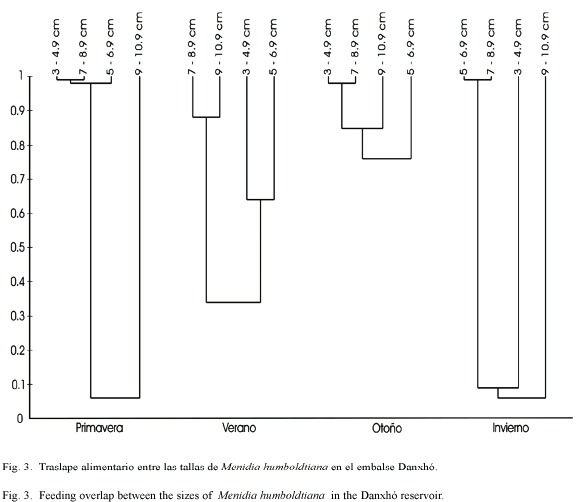
<body><![CDATA[<br> </p>     <p><font><font face="Courier New" size="2" style="font-family: verdana;">Las variaciones alimentarias desde un </font></font><font><font  face="Courier New" size="2" style="font-family: verdana;">punto de vista ontogénico, y la selectividad </font></font>que puedan ejercer los peces sobre su alimento, suelen relacionarse con alteraciones en las condiciones ambientales o con los requerimientos energéticos de los individuos (Vilchis 2000). Estas variaciones y selectividad involucran cambios en el tamaño y tipo de presas consumidas, así como un aumento en las cantidades de alimento ingerido, lo cual es de gran importancia para comprender el comportamiento de las poblaciones del zooplancton en presencia de peces zooplanctófagos. Al respecto Brooks y Dodson (1965), Wells (1970) y vanderploeg y Scavia (1979b), mencionan que al existir un gran número de peces zooplanctófagos en sistemas naturales, disminuyen sensiblemente las poblaciones del zooplancton de tallas grandes a la vez que propician un aumento en el fitoplancton. Por el contrario, si la abundancia de estos peces es baja, aumentan las poblaciones de zooplancton de tallas grandes, disminuyendo con ello el fitoplancton, a la vez que se da una acumulación de nutrimentos. Se ha demostrado una selectividad de estos peces por determinadas tallas de presa, lo que hace que exista una estrecha relación entre el zooplancton de tamaño grande con la presencia de los mismos. El conocimiento generado por este tipo de estudios ha sido empleado para llevar a cabo la biomanipulación de tramas tróficas en lagos (Shapiro y Wright 1984). Asimismo, nos permite entender el comportamiento de los peces nativos en los cuerpos de agua en los que se han realizado introducciones de peces exóticos, y que en muchos casos compiten por el alimento en alguna etapa de su vida. (Navarrete y Sánchez 1991). </p>     <p>Finalmente, se podrían plantear estrategias adecuadas para su cultivo, si se considera el alimento vivo que se suministre en las diferentes etapas del desarrollo de los charales, de ahí que el objetivo de este trabajo fue determinar si el charal <span  style="font-style: italic;">Menidia humboldtiana</span> selecciona su alimento, y si es así, sobre qué géneros la realiza, y establecer si existe traslape en la dieta entre las diferentes tallas del charal. </p>     <p><font size="3"><span style="font-weight: bold;">Materiales y métodos</span>    <br> </font></p>     <p>El presente estudio se realizó en el embalse Danxhó localizado entre los 19º51’17"-53’46" N y los 99º32’42"-35’40" W, a una altura de 2 560 msnm con una extensión de 3.96 km<sup>2</sup>. El clima de la zona, según Köppen modificado por García (1973), es el más húmedo de los templados subhúmedos. </p>     <p>En el embalse se establecieron seis estaciones de muestreo con base a sus características, en cada una se obtuvo una muestra de zooplancton por medio del filtrado de 10 l de agua a través de una red de 125 µm de abertura de malla que posteriormente fue fijada con formol al 4% (Gaviño <span style="font-style: italic;">et al</span>. 1982). </p>     <p>Para recolectar los peces se utilizó un chinchorro de 8 mm de luz de malla, los charales fueron fijados con formol al 10% para detener los procesos digestivos. </p>     <p>El zooplancton fue determinado a nivel genérico mediante las claves de Pennak (1989) y Dussart y Defaye (1995), y se registró el número de organismos (por unidad de volumen) para cada género. </p>     <p>Para el análisis de los contenidos estomacales se agruparon los peces en intervalos de longitud estándar para cada época del año. La determinación de los grupos presentes en los contenidos se realizó a nivel de género con las claves antes mencionadas. El método utilizado para el análisis de los contenidos estomacales fue el volumétrico propuesto por Laevastu (1971), y el coeficiente de selección fue de acuerdo a Chesson (1978, 1983), el cual relaciona la proporción de la presa en la dieta, su contraparte en el ambiente, y el número total de tipos de presa. Para evaluar el traslape trófico entre las tallas, se utilizó el índice de Morisita modificado por Horn (Arcifa <span  style="font-style: italic;">et al</span>. 1991). </p>     ]]></body>
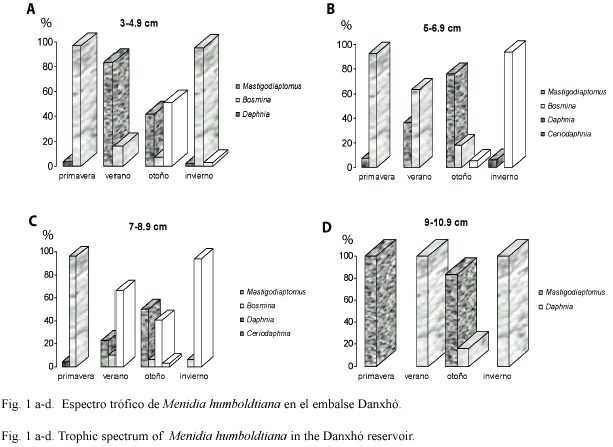
<body><![CDATA[<p style="font-weight: bold;"><font size="3">Resultados</font></p>     <p>La comunidad zooplanctónica estuvo representada por doce géneros de los cuales <span style="font-style: italic;">Mastigodiaptomus</span> (Copepoda) fue el más abundante en las cuatro épocas del año (3 774-6 668 org/10 l), seguido de <span style="font-style: italic;">Bosmina</span> y <span style="font-style: italic;">Diaphanosoma</span> (Cladocera) que registraron abundancias máximas de 2 247 org/10 l y 877 org/10 l respectivamente (<a href="#t1">Cuadro 1</a>). Los demás géneros presentaron máximas abundancias menores a los 700 org/10 l; <span  style="font-style: italic;">Daphnia</span>, <span  style="font-style: italic;">Ceriodaphnia</span> (Cladocera) 610 org/10 l y 476 org/10 l respectivamente; <span style="font-style: italic;">Asplanchna</span> (Rotifera) 445 org/10 l; <span style="font-style: italic;">Conochillus</span> (Rotifera) 220 org/10 l; <span style="font-style: italic;">Cyclops </span>(Copepoda) 292 org/10 l; <span style="font-style: italic;">Moina</span>, <span  style="font-style: italic;">Alonopsis </span>y <span  style="font-style: italic;">Camptocercus</span> (Cladocera) 43 org/10 l, 25 org/10 l y ocho org/10 l respectivamente, y <span  style="font-style: italic;">Filinia</span> (Rotifera) 25 org/10 l. De los doce géneros encontrados en el embalse solo <span  style="font-style: italic;">Bosmina</span>, <span  style="font-style: italic;">Mastigodiaptomus</span>, <span  style="font-style: italic;">Daphnia</span> y <span  style="font-style: italic;">Ceriodaphnia </span>fueron consumidos por los charales.     <br> </p>     <p>    <br> <a name="t1"></a></p> </font>     <div style="text-align: center;"><img  src="/img/revistas/rbt/v57n1-2/art18t1.gif" title="" alt=""  style="width: 585px; height: 355px;">    <br> </div> <font face="Courier New" size="2" style="font-family: verdana;"> </font><font face="Courier New" size="2" style="font-family: verdana;">     <p>Se analizó un total de 1 200 charales, los peces pequeños de 3-4.9 cm de longitud consumieron altos porcentajes de <span  style="font-style: italic;">Bosmina</span> en primavera e invierno (96.6 y 95.01% respectivamente), <span style="font-style: italic;">Mastigodiaptomus</span> fue consumido en forma importante en verano (83.66%), y <span  style="font-style: italic;">Daphnia</span> en otoño contribuyendo con un 50.99% a la dieta (<a href="#f1">Fig. 1a</a>).    <br> </p>     <p>    ]]></body>
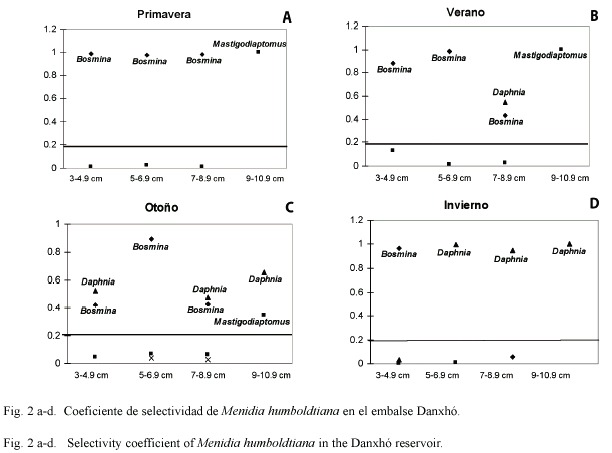
<body><![CDATA[<br> </p> </font>     <div style="text-align: center;"><a name="f1"></a><img  src="/img/revistas/rbt/v57n1-2/art18i1.jpg" title="" alt=""  style="width: 613px; height: 447px;">    <br> </div> <font face="Courier New" size="2" style="font-family: verdana;"> </font><font face="Courier New" size="2" style="font-family: verdana;">     <p>Los charales de 5-6.9 cm (<a href="#f1">Fig. 1b</a>) consumen a <span  style="font-style: italic;">Bosmina</span> en primavera (92.76%), y en verano (63.51%), a diferencia del otoño, cuando ingieren a <span  style="font-style: italic;">Mastigodiaptomus</span> (76.14%), y en invierno a <span style="font-style: italic;">Daphnia</span> (93.61%). </p>     <p>El género <span style="font-style: italic;">Daphnia</span> fue consumido en verano e invierno (66.56 y 93.84% respectivamente) por los peces de 7-8.9 cm; <span style="font-style: italic;">Bosmina</span> (95.8%) en primavera, y <span style="font-style: italic;">Mastigodiaptomus</span> (50.03 %) en otoño (<a href="#f1">Fig. 1c</a>). </p>     <p>Los charales más grandes (9-10.9 cm) solo consumen a <span  style="font-style: italic;">Mastigodiaptomus</span> en primavera y otoño (100 y 83.66% respectivamente), y a <span  style="font-style: italic;">Daphnia</span> (100 %) en verano e invierno (<a href="#f1">Fig. 1d</a>). </p>     <p>Con respecto a la selectividad de <span style="font-style: italic;">Menidia humboldtiana</span> podemos observar en primavera que el género <span  style="font-style: italic;">Bosmina</span> (<a href="#f2">Fig. 2a</a>) fue seleccionado por los peces de 3 a 8.9 cm, y <span  style="font-style: italic;">Mastigodiaptomus</span> por los charales de 9-10.9 cm. En verano la selección de los charales recae sobre <span  style="font-style: italic;">Bosmina</span> (3-8.9 cm), <span  style="font-style: italic;">Daphnia</span> por los peces de 7-8.9 cm, y <span style="font-style: italic;">Mastigodiaptomus</span> por los grandes (9-10.9 cm) (<a href="#f2">Fig. 2b</a>). Para el otoño las tallas de 3-4.9 cm y 7-8.9 cm seleccionaron a <span  style="font-style: italic;">Daphnia</span> y <span  style="font-style: italic;">Bosmina</span>, los charales de 5-6.9 cm de longitud solo seleccionaron a <span style="font-style: italic;">Bosmina</span>, y <span style="font-style: italic;">Mastigodiaptomus</span> fue seleccionado solo por los charales grandes (<a href="#f2">Fig. 2c</a>). Finalmente para el invierno el género más seleccionado fue <span  style="font-style: italic;">Daphnia</span>, por los charales de 5 a 10.9 cm, y Bosmina por las tallas pequeñas (3-4.9 cm) (<a href="#f2">Fig. 2d</a>).    <br> </p>     <p>    <br> <a name="f2"></a></p> </font>     ]]></body>
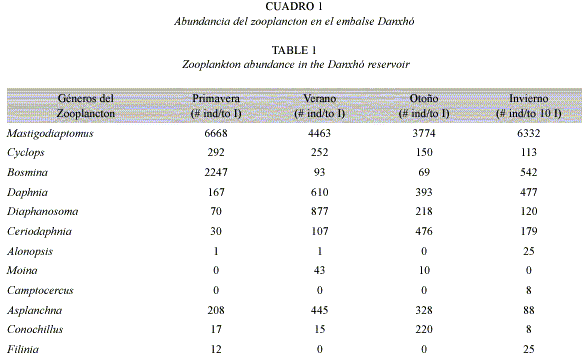
<body><![CDATA[<div style="text-align: center;"><img  src="/img/revistas/rbt/v57n1-2/art18i2.jpg" title="" alt=""  style="width: 612px; height: 453px;">    <br> </div> <font face="Courier New" size="2" style="font-family: verdana;"> </font><font face="Courier New" size="2" style="font-family: verdana;">     <p>Con respecto al traslape entre las tallas del charal en las diferentes épocas del año (<a href="#f3">Fig. 3</a>), se observó en primavera un marcado traslape 0.99 (considerando que el índice de Morisita va de cero hasta uno cuando hay traslape total) entre los intervalos de tallas de 3-8.9 cm, a diferencia del verano cuando las tallas grandes (7-10.9 cm) fueron las que traslaparon sus dietas (0.8834). En otoño el traslape se dio en todas las tallas con valores superiores a 0.736, y finalmente en el invierno solo las tallas de 5-8.9 cm presentaron traslape (0.99).    <br> </p>     <p>    <br> <a name="f3"></a></p> </font>     <div style="text-align: center;"><img  src="/img/revistas/rbt/v57n1-2/art18i3.jpg" title="" alt=""  style="width: 577px; height: 502px;">    <br> </div> <font face="Courier New" size="2" style="font-family: verdana;"> </font><font face="Courier New" size="2" style="font-family: verdana;">     <p style="font-weight: bold;"><font size="3">Discusión</font></p>     <p>Al notar la amplitud en su dieta, puede considerarse al charal <span  style="font-style: italic;">Menidia humboldtiana</span> como un especialista (Hyslop 1980), ya que consume pocos tipos de presa. De los doce géneros de zooplancton existentes en el ambiente, éste consumió solo cuatro, lo que se puede explicar si se toma en cuenta que la ictiofauna en el embalse estuvo representada por <span  style="font-style: italic;">Cyprinus carpio</span>, <span  style="font-style: italic;">Carassius auratus</span> y <span  style="font-style: italic;">Algansea tincella</span>, que registraron abundancias elevadas y que son especies que consumen organismos zooplanctónicos en las primeras etapas de su desarrollo (Navarrete y Sánchez 1991). </p>     ]]></body>
<body><![CDATA[<p>Al comparar la composición de los grupos alimentarios en la dieta de <span style="font-style: italic;">Menidia humboldtiana</span> con la disponibilidad de las presas en el ambiente, se observan preferencias alimentarias (Hyslop 1980) sobre los géneros <span  style="font-style: italic;">Bosmina</span>, <span  style="font-style: italic;">Daphnia</span> y <span  style="font-style: italic;">Mastigodiaptomus</span>, y se da una diferenciación de las mismas con relación a los diferentes intervalos de longitud; así los aterínidos de 3-4.9 cm ingieren preferentemente a <span  style="font-style: italic;">Bosmina</span> en primavera e invierno concordando con sus máximas abundancias en el ambiente. Para el verano el alimento principal fue el copépodo <span style="font-style: italic;">Mastigodiaptomus</span>, y es importante mencionar que si bien en esta época no se registró la máxima abundancia del mismo, éste sin embargo fue el género más abundante durante las cuatro épocas del año. Finalmente en el otoño comparten importancia en los contenidos <span  style="font-style: italic;">Daphnia</span> y <span  style="font-style: italic;">Mastigodiaptomus</span>. </p>     <p>Para las tallas intermedias (5-6.9 cm) el componente principal en primavera y verano fue <span style="font-style: italic;">Bosmina</span>; <span style="font-style: italic;">Mastigodiaptomus</span> en otoño, y <span  style="font-style: italic;">Daphnia</span> en invierno. Los charales de 7-8.9 cm de longitud se alimentaron en mayor proporción del género <span  style="font-style: italic;">Daphnia</span> en verano, otoño e invierno. Cabe mencionar que si bien <span style="font-style: italic;">Daphnia </span>no registró elevadas abundancias en el ambiente en estas épocas (5.06-7.54% del zooplancton), sí contribuye con buenos porcentajes a la dieta de los charales, a diferencia de la primavera cuando el género mas importante en los contenidos estomacales fue <span  style="font-style: italic;">Bosmina</span>, coincidiendo con la máxima abundancia del bosmínido en el ambiente. </p>     <p>Los charales más grandes de 9-10.9 cm ingieren solo dos géneros, <span  style="font-style: italic;">Mastigodiaptomus</span> en primavera y otoño, y <span style="font-style: italic;">Daphnia</span> en verano e invierno. Es importante remarcar que las tallas pequeñas e intermedias consumen preferentemente a <span style="font-style: italic;">Bosmina</span>, que es sustituida por <span style="font-style: italic;">Daphnia</span> en las tallas grandes. Además, hay una disminución en el número de géneros zooplanctónicos ingeridos por estas últimas, observado que existe una relación aparente entre el tipo y cantidad de presas consumidas y las diferentes tallas del pez (Wootton 1992). Esta alimentación diferencial que presenta el aterínido es una estrategia mediante la cual se disminuye la competencia intraespecífica que se da entre los organismos de una población (Krebs 1985). Estos resultados concuerdan con los reportados por Navarrete y Cházaro (1992). </p>     <p> </p>     <p><span style="font-style: italic;">M. humboldtiana</span> es un depredador selectivo positivo ya que consume mayores proporciones que las correspondientes en el ambiente sobre el género <span  style="font-style: italic;">Bosmina</span> (por las tallas de 3-8.9 cm en las cuatro épocas del año), y <span style="font-style: italic;">Daphnia </span>(por los charales de 3-10.9 cm en verano, otoño e invierno). Es importante mencionar que a pesar del amplio intervalo de tallas que seleccionan a estos géneros, se observa por los valores de selección, que los peces pequeños seleccionan de manera más intensa al género <span  style="font-style: italic;">Bosmina</span>, las tallas intermedias a ambos géneros, y las tallas grandes la realizan más sobre <span  style="font-style: italic;">Daphnia</span>. Este mismo comportamiento fue observado en <span style="font-style: italic;">Chirostoma jordani</span>, por Navarrete <span style="font-style: italic;">et al</span>. 1996. La selectividad sobre los cladóceros, y en especial sobre estos géneros, se ha tratado de explicar con base en características como la presencia de un ojo compuesto relativamente grande en relación a su cabeza, de color rojo intenso, que los hace más visibles para el depredador (Zaret 1972, Zaret y Kerfoot 1975, Saegror <span style="font-style: italic;">et al</span>. 1996). De igual manera el tamaño y los movimientos lentos y regulares que presentan en general los cladóceros propician una mayor vulnerabilidad de los mismos (O’Brien 1979, Vinyard 1980, Li <span  style="font-style: italic;">et al</span>. 1985). Otras características que presentan en especial las dafnias son un intestino que contrasta con el resto del medio (vinyard y O’Brien 1975), y su tamaño relativamente grande. Al respecto Brooks y Dodson (1965) y Galbraith (1967) consideran que un organismo de talla grande propiciará una mayor detectabilidad del mismo, ésta será proporcional al tamaño del propio organismo (Werner y Hall 1974, O’Brien 1979) operando de esta manera una selectividad por tallas. Es importante mencionar que es muy probable que este tipo de selectividad la estén llevando a cabo las tallas grandes sobre el género Mastigodiaptomus y <span  style="font-style: italic;">Daphnia</span>. Clements y Livingston (1984), afirman que la vulnerabilidad de una especie a la depredación está en función de su detectabilidad y facilidad de captura, y que dependen de su morfología, comportamiento y distribución en el microhábitat. Por su parte, Wootton (1992), sugiere que la dieta de un animal es el resultado de algunas causas como su capacidad para obtener presas, la disponibilidad de las mismas en el ambiente o las necesidades energéticas. Y han observado que existe una relación aparente entre el tipo y cantidad de presas consumidas y las diferentes tallas del pez.    <br> </p> </font> <hr style="width: 100%; height: 2px;"><font face="Courier New" size="2"  style="font-family: verdana;">     <p><span style="font-weight: bold;">Resumen</span> </p>     <p>El charal <span style="font-style: italic;">Menidia humboldtiana</span> es considerado como una de las especies de gran importancia en la industria pesquera de algunos estados de México. Es necesario conocer el efecto que esta especie ejerce sobre su alimento para saber si seleccionan las presas de mayor talla, si hay competencia por el alimento entre especies nativas e introducidas, y para comprender el comportamiento del zooplancton ante peces zooplanctófagos. Se determinó si <span style="font-style: italic;">M. humboldtiana </span>selecciona su alimento, sobre qué géneros lo hace, y si existe traslape en la dieta entre las diferentes tallas. Los peces se recolectaron por medio de un chinchorro de 88 mm de abertura de malla, en seis estaciones de muestreo durante un año, en el embalse Danxhó, y una muestra de zooplancton fue recolectada por filtrado con una red de 125 µm. El análisis de los contenidos estomacales se realizó en peces agrupados en intervalos de longitud estándar para cada época del año, por medio del método volumétrico. Para evaluar el traslape trófico entre los diferentes intervalos de longitud, se utilizó el índice de Morisita modificado por Horn. El zooplancton estuvo representado por doce géneros: <span style="font-style: italic;">Mastigodiaptomus</span> y <span  style="font-style: italic;">Cyclops</span> (Copepoda); <span  style="font-style: italic;">Bosmina</span>, <span  style="font-style: italic;">Diaphanosoma</span>, <span  style="font-style: italic;">Daphnia</span>, <span  style="font-style: italic;">Ceriodaphnia</span>, <span  style="font-style: italic;">Moina</span>, <span  style="font-style: italic;">Alonopsis</span> y <span  style="font-style: italic;">Camptocercus</span> (Cladocera); <span  style="font-style: italic;">Asplanchna</span>, <span  style="font-style: italic;">Conochillus</span> y <span  style="font-style: italic;">Filinia</span> (Rotifera). Durante la primavera, los charales de 3-8.9 cm presentaron un marcado traslape, para el verano fueron los grandes (7-10.9 cm), en otoño el traslape fue en todas las tallas, y en invierno solo las tallas intermedias (5-8.9 cm) lo presentaron. </p>     <p><span style="font-weight: bold;">Palabras clave:</span> <span  style="font-style: italic;">Menidia</span>, Atherinopsidae, charal, lago artificial, selectividad alimentaria.    <br> </p> </font> <hr style="width: 100%; height: 2px;"><font face="Courier New" size="2"  style="font-family: verdana;"></font>     ]]></body>
<body><![CDATA[<div style="text-align: center;"><font><font face="Courier New" size="2"  style="font-family: verdana;">Recibido 29-VIII-2007. Corregido 10-X-2008. Aceptado 11-IX-2008.</font></font></div> <font face="Courier New" size="2" style="font-family: verdana;">     <p style="font-weight: bold;"><font size="3">Referencias</font></p>     <!-- ref --><p>Arcifa, M.S., T.G. Norticote &amp; O. Froehlich. 1991. Interactive ecology of two cohabiting characin fisher (<span  style="font-style: italic;">Astyanax fasciatus</span> and <span  style="font-style: italic;">Astyanax bimaculatus</span>) in a eutrophic Brazilian reservoir. J. Trop. Ecol. 7: 257-268. &nbsp;&nbsp;&nbsp;&nbsp;&nbsp;&nbsp;&nbsp;&nbsp;[&#160;<a href="javascript:void(0);" onclick="javascript: window.open('/scielo.php?script=sci_nlinks&ref=1260098&pid=S0034-7744200900010001800001&lng=','','width=640,height=500,resizable=yes,scrollbars=1,menubar=yes,');">Links</a>&#160;]<!-- end-ref --><!-- ref --><p>Brooks, J.L. &amp; S.I. Dodson. 1965. Predation body size and competition of plankton. Science 150: 28-35. &nbsp;&nbsp;&nbsp;&nbsp;&nbsp;&nbsp;&nbsp;&nbsp;[&#160;<a href="javascript:void(0);" onclick="javascript: window.open('/scielo.php?script=sci_nlinks&ref=1260099&pid=S0034-7744200900010001800002&lng=','','width=640,height=500,resizable=yes,scrollbars=1,menubar=yes,');">Links</a>&#160;]<!-- end-ref --><!-- ref --><p>Clements, H.W. &amp; R.J. Livingston. 1984. Prey selectivity of the fringed filefish <span style="font-style: italic;">Monacanthus ciliatus</span> (Pisces:Monacanthidae): role of prey accessibility. Mar. Ecol. Prog. Ser. 16:291-295. &nbsp;&nbsp;&nbsp;&nbsp;&nbsp;&nbsp;&nbsp;&nbsp;[&#160;<a href="javascript:void(0);" onclick="javascript: window.open('/scielo.php?script=sci_nlinks&ref=1260100&pid=S0034-7744200900010001800003&lng=','','width=640,height=500,resizable=yes,scrollbars=1,menubar=yes,');">Links</a>&#160;]<!-- end-ref --><!-- ref --><p>Chesson, J. 1978. Measuring preference in selective predation. Ecology 59: 211-215. &nbsp;&nbsp;&nbsp;&nbsp;&nbsp;&nbsp;&nbsp;&nbsp;[&#160;<a href="javascript:void(0);" onclick="javascript: window.open('/scielo.php?script=sci_nlinks&ref=1260101&pid=S0034-7744200900010001800004&lng=','','width=640,height=500,resizable=yes,scrollbars=1,menubar=yes,');">Links</a>&#160;]<!-- end-ref --><!-- ref --><p>Chesson, J. 1983. The estimation and analysis of preference and its relationship to foraging models. Ecology 64: 1297-1304. &nbsp;&nbsp;&nbsp;&nbsp;&nbsp;&nbsp;&nbsp;&nbsp;[&#160;<a href="javascript:void(0);" onclick="javascript: window.open('/scielo.php?script=sci_nlinks&ref=1260102&pid=S0034-7744200900010001800005&lng=','','width=640,height=500,resizable=yes,scrollbars=1,menubar=yes,');">Links</a>&#160;]<!-- end-ref --><!-- ref --><p>Dussart, B. &amp; D. Defaye. 1995. Guides to the identification of the microinvertebrates of the continental waters of the World : Introduction to the Copepoda. Academic, Londres, Inglaterra. 277 p. &nbsp;&nbsp;&nbsp;&nbsp;&nbsp;&nbsp;&nbsp;&nbsp;[&#160;<a href="javascript:void(0);" onclick="javascript: window.open('/scielo.php?script=sci_nlinks&ref=1260103&pid=S0034-7744200900010001800006&lng=','','width=640,height=500,resizable=yes,scrollbars=1,menubar=yes,');">Links</a>&#160;]<!-- end-ref --><!-- ref --><p>Galbraith, M.G. 1967. Size-selective predation on <span  style="font-style: italic;">Daphnia </span>by rainbow trout and yellow perch. Trans. Am Fish. Soc. 96: 1-10. &nbsp;&nbsp;&nbsp;&nbsp;&nbsp;&nbsp;&nbsp;&nbsp;[&#160;<a href="javascript:void(0);" onclick="javascript: window.open('/scielo.php?script=sci_nlinks&ref=1260104&pid=S0034-7744200900010001800007&lng=','','width=640,height=500,resizable=yes,scrollbars=1,menubar=yes,');">Links</a>&#160;]<!-- end-ref --><!-- ref --><p>García, E. 1973. Modificación del sistema de clasificación (adaptado a las condiciones de la República Mexicana). Instituto de Geografía, UNAM, México. 357 p. &nbsp;&nbsp;&nbsp;&nbsp;&nbsp;&nbsp;&nbsp;&nbsp;[&#160;<a href="javascript:void(0);" onclick="javascript: window.open('/scielo.php?script=sci_nlinks&ref=1260105&pid=S0034-7744200900010001800008&lng=','','width=640,height=500,resizable=yes,scrollbars=1,menubar=yes,');">Links</a>&#160;]<!-- end-ref --><!-- ref --><p>Gaviño, G., J.C. Juárez &amp; H.H. Figueroa. 1982. Técnicas biológicas selectas de laboratorio y de campo. Limusa, México. 251 p. &nbsp;&nbsp;&nbsp;&nbsp;&nbsp;&nbsp;&nbsp;&nbsp;[&#160;<a href="javascript:void(0);" onclick="javascript: window.open('/scielo.php?script=sci_nlinks&ref=1260106&pid=S0034-7744200900010001800009&lng=','','width=640,height=500,resizable=yes,scrollbars=1,menubar=yes,');">Links</a>&#160;]<!-- end-ref --><!-- ref --><p>Hyslop, E.J. 1980. Stomach contents analysis. A review of methods and their application. J. Fish Biol. 17: 411-429. &nbsp;&nbsp;&nbsp;&nbsp;&nbsp;&nbsp;&nbsp;&nbsp;[&#160;<a href="javascript:void(0);" onclick="javascript: window.open('/scielo.php?script=sci_nlinks&ref=1260107&pid=S0034-7744200900010001800010&lng=','','width=640,height=500,resizable=yes,scrollbars=1,menubar=yes,');">Links</a>&#160;]<!-- end-ref --><!-- ref --><p>Krebs, M.E. 1985. Ecología estudio sobre la distribución y abundancia. Harla, México. 369 p. &nbsp;&nbsp;&nbsp;&nbsp;&nbsp;&nbsp;&nbsp;&nbsp;[&#160;<a href="javascript:void(0);" onclick="javascript: window.open('/scielo.php?script=sci_nlinks&ref=1260108&pid=S0034-7744200900010001800011&lng=','','width=640,height=500,resizable=yes,scrollbars=1,menubar=yes,');">Links</a>&#160;]<!-- end-ref --><!-- ref --><p>Laevastu, T. 1971. Manual de métodos de biología pesquera. Acribia, España. 250 p. &nbsp;&nbsp;&nbsp;&nbsp;&nbsp;&nbsp;&nbsp;&nbsp;[&#160;<a href="javascript:void(0);" onclick="javascript: window.open('/scielo.php?script=sci_nlinks&ref=1260109&pid=S0034-7744200900010001800012&lng=','','width=640,height=500,resizable=yes,scrollbars=1,menubar=yes,');">Links</a>&#160;]<!-- end-ref --><!-- ref --><p>Li, K.T., J.K. Wetterer &amp; N.G. Hairston. 1985. Fish size, visual resolution, and prey selectivity. J. Ecology. 66: 1729-1735. &nbsp;&nbsp;&nbsp;&nbsp;&nbsp;&nbsp;&nbsp;&nbsp;[&#160;<a href="javascript:void(0);" onclick="javascript: window.open('/scielo.php?script=sci_nlinks&ref=1260110&pid=S0034-7744200900010001800013&lng=','','width=640,height=500,resizable=yes,scrollbars=1,menubar=yes,');">Links</a>&#160;]<!-- end-ref --><!-- ref --><p>Millar, R.R. 2005. Freshwater fishes of Mexico. University of Chicago, Chicago, EEUU. 490 p. &nbsp;&nbsp;&nbsp;&nbsp;&nbsp;&nbsp;&nbsp;&nbsp;[&#160;<a href="javascript:void(0);" onclick="javascript: window.open('/scielo.php?script=sci_nlinks&ref=1260111&pid=S0034-7744200900010001800014&lng=','','width=640,height=500,resizable=yes,scrollbars=1,menubar=yes,');">Links</a>&#160;]<!-- end-ref --><!-- ref --><p>Navarrete, S.N. &amp; R. Sánchez. 1991. Variaciones alimenticias de los peces del embalse Danxhó, en tres épocas del año. (Resumen).II Congreso Nacional de Ictiología.Monterrey, Nuevo León, México.2-50 p. &nbsp;&nbsp;&nbsp;&nbsp;&nbsp;&nbsp;&nbsp;&nbsp;[&#160;<a href="javascript:void(0);" onclick="javascript: window.open('/scielo.php?script=sci_nlinks&ref=1260112&pid=S0034-7744200900010001800015&lng=','','width=640,height=500,resizable=yes,scrollbars=1,menubar=yes,');">Links</a>&#160;]<!-- end-ref --><!-- ref --><p>Navarrete, S.N. &amp; S. Cházaro. 1992 Espectro trófico del charal <span  style="font-style: italic;">Chirostoma humboldtianum</span> del embalse San Felipe Tiacaque, Estado de México. Revista de Zoología. ENEPI, UNAM, México, D.F., México. 3: 28-34. &nbsp;&nbsp;&nbsp;&nbsp;&nbsp;&nbsp;&nbsp;&nbsp;[&#160;<a href="javascript:void(0);" onclick="javascript: window.open('/scielo.php?script=sci_nlinks&ref=1260113&pid=S0034-7744200900010001800016&lng=','','width=640,height=500,resizable=yes,scrollbars=1,menubar=yes,');">Links</a>&#160;]<!-- end-ref --><!-- ref --><p>Navarrete, S.N., R. Sánchez &amp; M.L. Rojas. 1996. Selección del zooplancton por el charal <span style="font-style: italic;">Chirostoma jordani </span>(Atheriniformes:Atherinidae). Rev. Biol. Trop. 2: 757-761. &nbsp;&nbsp;&nbsp;&nbsp;&nbsp;&nbsp;&nbsp;&nbsp;[&#160;<a href="javascript:void(0);" onclick="javascript: window.open('/scielo.php?script=sci_nlinks&ref=1260114&pid=S0034-7744200900010001800017&lng=','','width=640,height=500,resizable=yes,scrollbars=1,menubar=yes,');">Links</a>&#160;]<!-- end-ref --><!-- ref --><p>O’Brien, W.L. 1979. The predator prey interaction of plaktivorous fish and zooplankton. Am. Scien. 67: 572-581. &nbsp;&nbsp;&nbsp;&nbsp;&nbsp;&nbsp;&nbsp;&nbsp;[&#160;<a href="javascript:void(0);" onclick="javascript: window.open('/scielo.php?script=sci_nlinks&ref=1260115&pid=S0034-7744200900010001800018&lng=','','width=640,height=500,resizable=yes,scrollbars=1,menubar=yes,');">Links</a>&#160;]<!-- end-ref --><p> </p>     <!-- ref --><p>Pennak, R.W. 1989. Freshwater invertebrates of the United States. Wiley, Nueva York, Nueva York, EEUU. 803 p.    &nbsp;&nbsp;&nbsp;&nbsp;&nbsp;&nbsp;&nbsp;&nbsp;[&#160;<a href="javascript:void(0);" onclick="javascript: window.open('/scielo.php?script=sci_nlinks&ref=1260117&pid=S0034-7744200900010001800019&lng=','','width=640,height=500,resizable=yes,scrollbars=1,menubar=yes,');">Links</a>&#160;]<!-- end-ref --><br> &nbsp;</p>     <!-- ref --><p>Rojas, C.P. 2006. Aspectos reproductivos del "charal prieto" <span  style="font-style: italic;">Chirostoma attenuatum</span> (Meek, 1902) del lago de Pátzcuaro, Michoacán. Nuevas líneas de investigación en atherinópsidos de México. Hidrobiológica. 1: 1-9. &nbsp;&nbsp;&nbsp;&nbsp;&nbsp;&nbsp;&nbsp;&nbsp;[&#160;<a href="javascript:void(0);" onclick="javascript: window.open('/scielo.php?script=sci_nlinks&ref=1260119&pid=S0034-7744200900010001800020&lng=','','width=640,height=500,resizable=yes,scrollbars=1,menubar=yes,');">Links</a>&#160;]<!-- end-ref --><!-- ref --><p>Saegror, H., A. Hobaek &amp; J.H. L’Abee-Lund. 1996. Vulnerability of melanic <span style="font-style: italic;">Daphnia</span> to brown trout predation. J. Plankton 18: 2113-2118. &nbsp;&nbsp;&nbsp;&nbsp;&nbsp;&nbsp;&nbsp;&nbsp;[&#160;<a href="javascript:void(0);" onclick="javascript: window.open('/scielo.php?script=sci_nlinks&ref=1260120&pid=S0034-7744200900010001800021&lng=','','width=640,height=500,resizable=yes,scrollbars=1,menubar=yes,');">Links</a>&#160;]<!-- end-ref --><!-- ref --><p>Shapiro, J. &amp; D.I. Wrigth. 1984. Lake restoration by biomanipulation: Round lake, Minesota the first two years. Freshwater Biol. 14: 371-378. &nbsp;&nbsp;&nbsp;&nbsp;&nbsp;&nbsp;&nbsp;&nbsp;[&#160;<a href="javascript:void(0);" onclick="javascript: window.open('/scielo.php?script=sci_nlinks&ref=1260121&pid=S0034-7744200900010001800022&lng=','','width=640,height=500,resizable=yes,scrollbars=1,menubar=yes,');">Links</a>&#160;]<!-- end-ref --><!-- ref --><p>Vanderploeg, H.A. &amp; D. Scavia. 1979b. Two selectivity indices for feeding with special reference to zooplankton grazing. J. Fish. Res. Board Can. 36: 362-365. &nbsp;&nbsp;&nbsp;&nbsp;&nbsp;&nbsp;&nbsp;&nbsp;[&#160;<a href="javascript:void(0);" onclick="javascript: window.open('/scielo.php?script=sci_nlinks&ref=1260122&pid=S0034-7744200900010001800023&lng=','','width=640,height=500,resizable=yes,scrollbars=1,menubar=yes,');">Links</a>&#160;]<!-- end-ref --><!-- ref --><p>Vilchis, M.O. 2000. Modelos nulos en interacciones biológicas, una propuesta: depredación en <span style="font-style: italic;">Chirostoma riojai</span>-zooplancton. Ciencia Ergo Sum. 7:153-156. &nbsp;&nbsp;&nbsp;&nbsp;&nbsp;&nbsp;&nbsp;&nbsp;[&#160;<a href="javascript:void(0);" onclick="javascript: window.open('/scielo.php?script=sci_nlinks&ref=1260123&pid=S0034-7744200900010001800024&lng=','','width=640,height=500,resizable=yes,scrollbars=1,menubar=yes,');">Links</a>&#160;]<!-- end-ref --><!-- ref --><p>Vinyard, G.L. 1980. Differential prey vulnerability and predator selectivity: effects of evasive prey an bluegill (<span  style="font-style: italic;">Lepomis macrochirus</span>) and pumpkinseed (<span style="font-style: italic;">L. gibbosus</span>) predation. J. Fish. Aquat. Sci. 37: 2294-2299. &nbsp;&nbsp;&nbsp;&nbsp;&nbsp;&nbsp;&nbsp;&nbsp;[&#160;<a href="javascript:void(0);" onclick="javascript: window.open('/scielo.php?script=sci_nlinks&ref=1260124&pid=S0034-7744200900010001800025&lng=','','width=640,height=500,resizable=yes,scrollbars=1,menubar=yes,');">Links</a>&#160;]<!-- end-ref --><!-- ref --><p>Vinyard, G.L. &amp; W.J. O’Brien. 1975. Dorsal ligth response as a index of prey preference in bluegill (<span style="font-style: italic;">Lepomis macrochir</span>). J. Fish. Res. 32: 1860-1863. &nbsp;&nbsp;&nbsp;&nbsp;&nbsp;&nbsp;&nbsp;&nbsp;[&#160;<a href="javascript:void(0);" onclick="javascript: window.open('/scielo.php?script=sci_nlinks&ref=1260125&pid=S0034-7744200900010001800026&lng=','','width=640,height=500,resizable=yes,scrollbars=1,menubar=yes,');">Links</a>&#160;]<!-- end-ref --><!-- ref --><p>Wells, L. 1970. Effects of alewife predation on zooplankton populations in lake Michigan. Limnology 15: 556-565. &nbsp;&nbsp;&nbsp;&nbsp;&nbsp;&nbsp;&nbsp;&nbsp;[&#160;<a href="javascript:void(0);" onclick="javascript: window.open('/scielo.php?script=sci_nlinks&ref=1260126&pid=S0034-7744200900010001800027&lng=','','width=640,height=500,resizable=yes,scrollbars=1,menubar=yes,');">Links</a>&#160;]<!-- end-ref --><!-- ref --><p>Werner, E.E. &amp; D.J. Hall. 1974. Optimal foraging and the size selection of prey by the bluegill sunfish (<span  style="font-style: italic;">Lepomis macrochirus</span>). Ecology 55: 1042-1052. &nbsp;&nbsp;&nbsp;&nbsp;&nbsp;&nbsp;&nbsp;&nbsp;[&#160;<a href="javascript:void(0);" onclick="javascript: window.open('/scielo.php?script=sci_nlinks&ref=1260127&pid=S0034-7744200900010001800028&lng=','','width=640,height=500,resizable=yes,scrollbars=1,menubar=yes,');">Links</a>&#160;]<!-- end-ref --><!-- ref --><p>Wootton, R. 1992. Fish ecology. Blackie, Nueva York, EEUU.. 212 p. &nbsp;&nbsp;&nbsp;&nbsp;&nbsp;&nbsp;&nbsp;&nbsp;[&#160;<a href="javascript:void(0);" onclick="javascript: window.open('/scielo.php?script=sci_nlinks&ref=1260128&pid=S0034-7744200900010001800029&lng=','','width=640,height=500,resizable=yes,scrollbars=1,menubar=yes,');">Links</a>&#160;]<!-- end-ref --><!-- ref --><p>Zaret, T.M. 1972. Predator, invisible prey and the nature of polimorphism in the cladoceras (Class Crustacea). Limnology. 17: 171-184. &nbsp;&nbsp;&nbsp;&nbsp;&nbsp;&nbsp;&nbsp;&nbsp;[&#160;<a href="javascript:void(0);" onclick="javascript: window.open('/scielo.php?script=sci_nlinks&ref=1260129&pid=S0034-7744200900010001800030&lng=','','width=640,height=500,resizable=yes,scrollbars=1,menubar=yes,');">Links</a>&#160;]<!-- end-ref --><p> </p>     <!-- ref --><p>Zaret, T.M. &amp; W.C. Kerfoot. 1975. Fish predation on <span  style="font-style: italic;">Bosmina longirostris</span>, body size selection versus visibility selection planktivores. Ecology. 56: 232-237.    &nbsp;&nbsp;&nbsp;&nbsp;&nbsp;&nbsp;&nbsp;&nbsp;[&#160;<a href="javascript:void(0);" onclick="javascript: window.open('/scielo.php?script=sci_nlinks&ref=1260131&pid=S0034-7744200900010001800031&lng=','','width=640,height=500,resizable=yes,scrollbars=1,menubar=yes,');">Links</a>&#160;]<!-- end-ref --><br> &nbsp;</p>     <p>&nbsp;</p> </font>      ]]></body><back>
<ref-list>
<ref id="B1">
<nlm-citation citation-type="journal">
<person-group person-group-type="author">
<name>
<surname><![CDATA[Arcifa]]></surname>
<given-names><![CDATA[M.S]]></given-names>
</name>
<name>
<surname><![CDATA[Norticote]]></surname>
<given-names><![CDATA[T.G]]></given-names>
</name>
<name>
<surname><![CDATA[Froehlich]]></surname>
<given-names><![CDATA[O]]></given-names>
</name>
</person-group>
<article-title xml:lang="en"><![CDATA[Interactive ecology of two cohabiting characin fisher (Astyanax fasciatus and Astyanax bimaculatus) in a eutrophic Brazilian reservoir]]></article-title>
<source><![CDATA[J. Trop. Ecol]]></source>
<year>1991</year>
<volume>7</volume>
<page-range>257-268</page-range></nlm-citation>
</ref>
<ref id="B2">
<nlm-citation citation-type="journal">
<person-group person-group-type="author">
<name>
<surname><![CDATA[Brooks]]></surname>
<given-names><![CDATA[J.L]]></given-names>
</name>
<name>
<surname><![CDATA[Dodson]]></surname>
<given-names><![CDATA[S.I]]></given-names>
</name>
</person-group>
<article-title xml:lang="en"><![CDATA[Predation body size and competition of plankton]]></article-title>
<source><![CDATA[Science]]></source>
<year>1965</year>
<volume>150</volume>
<page-range>28-35</page-range></nlm-citation>
</ref>
<ref id="B3">
<nlm-citation citation-type="journal">
<person-group person-group-type="author">
<name>
<surname><![CDATA[Clements]]></surname>
<given-names><![CDATA[H.W]]></given-names>
</name>
<name>
<surname><![CDATA[Livingston]]></surname>
<given-names><![CDATA[R.J]]></given-names>
</name>
</person-group>
<article-title xml:lang="en"><![CDATA[Prey selectivity of the fringed filefish Monacanthus ciliatus (Pisces:Monacanthidae): role of prey accessibility]]></article-title>
<source><![CDATA[Mar. Ecol. Prog. Ser]]></source>
<year>1984</year>
<volume>16</volume>
<page-range>291-295</page-range></nlm-citation>
</ref>
<ref id="B4">
<nlm-citation citation-type="journal">
<person-group person-group-type="author">
<name>
<surname><![CDATA[Chesson]]></surname>
<given-names><![CDATA[J]]></given-names>
</name>
</person-group>
<article-title xml:lang="en"><![CDATA[Measuring preference in selective predation]]></article-title>
<source><![CDATA[Ecology]]></source>
<year>1978</year>
<volume>59</volume>
<page-range>211-215</page-range></nlm-citation>
</ref>
<ref id="B5">
<nlm-citation citation-type="journal">
<person-group person-group-type="author">
<name>
<surname><![CDATA[Chesson]]></surname>
<given-names><![CDATA[J]]></given-names>
</name>
</person-group>
<article-title xml:lang="en"><![CDATA[The estimation and analysis of preference and its relationship to foraging models]]></article-title>
<source><![CDATA[Ecology]]></source>
<year>1983</year>
<volume>64</volume>
<page-range>1297-1304</page-range></nlm-citation>
</ref>
<ref id="B6">
<nlm-citation citation-type="book">
<person-group person-group-type="author">
<name>
<surname><![CDATA[Dussart]]></surname>
<given-names><![CDATA[B]]></given-names>
</name>
<name>
<surname><![CDATA[Defaye]]></surname>
<given-names><![CDATA[D]]></given-names>
</name>
</person-group>
<source><![CDATA[Guides to the identification of the microinvertebrates of the continental waters of the World: Introduction to the Copepoda]]></source>
<year>1995</year>
<publisher-loc><![CDATA[Londres ]]></publisher-loc>
<publisher-name><![CDATA[Academic]]></publisher-name>
</nlm-citation>
</ref>
<ref id="B7">
<nlm-citation citation-type="journal">
<person-group person-group-type="author">
<name>
<surname><![CDATA[Galbraith]]></surname>
<given-names><![CDATA[M.G]]></given-names>
</name>
</person-group>
<article-title xml:lang="en"><![CDATA[Size-selective predation on Daphnia by rainbow trout and yellow perch]]></article-title>
<source><![CDATA[Trans. Am Fish. Soc]]></source>
<year>1967</year>
<volume>96</volume>
<page-range>1-10</page-range></nlm-citation>
</ref>
<ref id="B8">
<nlm-citation citation-type="book">
<person-group person-group-type="author">
<name>
<surname><![CDATA[García]]></surname>
<given-names><![CDATA[E]]></given-names>
</name>
</person-group>
<source><![CDATA[Modificación del sistema de clasificación (adaptado a las condiciones de la República Mexicana)]]></source>
<year>1973</year>
<page-range>357</page-range><publisher-name><![CDATA[Instituto de Geografía, UNAM]]></publisher-name>
</nlm-citation>
</ref>
<ref id="B9">
<nlm-citation citation-type="book">
<person-group person-group-type="author">
<name>
<surname><![CDATA[Gaviño]]></surname>
<given-names><![CDATA[G]]></given-names>
</name>
<name>
<surname><![CDATA[Juárez]]></surname>
<given-names><![CDATA[J.C]]></given-names>
</name>
<name>
<surname><![CDATA[Figueroa]]></surname>
<given-names><![CDATA[H.H]]></given-names>
</name>
</person-group>
<source><![CDATA[Técnicas biológicas selectas de laboratorio y de campo]]></source>
<year>1982</year>
<page-range>251</page-range><publisher-name><![CDATA[Limusa]]></publisher-name>
</nlm-citation>
</ref>
<ref id="B10">
<nlm-citation citation-type="journal">
<person-group person-group-type="author">
<name>
<surname><![CDATA[Hyslop]]></surname>
<given-names><![CDATA[E.J]]></given-names>
</name>
</person-group>
<article-title xml:lang="en"><![CDATA[Stomach contents analysis: A review of methods and their application]]></article-title>
<source><![CDATA[J. Fish Biol]]></source>
<year>1980</year>
<volume>17</volume>
<page-range>411-429</page-range></nlm-citation>
</ref>
<ref id="B11">
<nlm-citation citation-type="book">
<person-group person-group-type="author">
<name>
<surname><![CDATA[Krebs]]></surname>
<given-names><![CDATA[M.E]]></given-names>
</name>
</person-group>
<source><![CDATA[Ecología estudio sobre la distribución y abundancia]]></source>
<year>1985</year>
<publisher-name><![CDATA[Harla]]></publisher-name>
</nlm-citation>
</ref>
<ref id="B12">
<nlm-citation citation-type="book">
<person-group person-group-type="author">
<name>
<surname><![CDATA[Laevastu]]></surname>
<given-names><![CDATA[T]]></given-names>
</name>
</person-group>
<source><![CDATA[Manual de métodos de biología pesquera]]></source>
<year>1971</year>
<page-range>250</page-range><publisher-name><![CDATA[Acribia]]></publisher-name>
</nlm-citation>
</ref>
<ref id="B13">
<nlm-citation citation-type="journal">
<person-group person-group-type="author">
<name>
<surname><![CDATA[Li]]></surname>
<given-names><![CDATA[K.T]]></given-names>
</name>
<name>
<surname><![CDATA[Wetterer]]></surname>
<given-names><![CDATA[J.K]]></given-names>
</name>
<name>
<surname><![CDATA[Hairston]]></surname>
<given-names><![CDATA[N.G]]></given-names>
</name>
</person-group>
<article-title xml:lang="en"><![CDATA[Fish size, visual resolution, and prey selectivity]]></article-title>
<source><![CDATA[J. Ecology]]></source>
<year>1985</year>
<volume>66</volume>
<page-range>1729-1735</page-range></nlm-citation>
</ref>
<ref id="B14">
<nlm-citation citation-type="book">
<person-group person-group-type="author">
<name>
<surname><![CDATA[Millar]]></surname>
<given-names><![CDATA[R.R]]></given-names>
</name>
</person-group>
<source><![CDATA[Freshwater fishes of Mexico]]></source>
<year>2005</year>
<page-range>490</page-range><publisher-loc><![CDATA[^eChicago Chicago]]></publisher-loc>
<publisher-name><![CDATA[University of Chicago]]></publisher-name>
</nlm-citation>
</ref>
<ref id="B15">
<nlm-citation citation-type="confpro">
<person-group person-group-type="author">
<name>
<surname><![CDATA[Navarrete]]></surname>
<given-names><![CDATA[S.N]]></given-names>
</name>
<name>
<surname><![CDATA[Sánchez]]></surname>
<given-names><![CDATA[R]]></given-names>
</name>
</person-group>
<source><![CDATA[Variaciones alimenticias de los peces del embalse Danxhó, en tres épocas del año]]></source>
<year>1991</year>
<conf-name><![CDATA[II Congreso Nacional de Ictiología]]></conf-name>
<conf-loc>Monterrey Nuevo León</conf-loc>
<page-range>2-50</page-range></nlm-citation>
</ref>
<ref id="B16">
<nlm-citation citation-type="journal">
<person-group person-group-type="author">
<name>
<surname><![CDATA[Navarrete]]></surname>
<given-names><![CDATA[S.N]]></given-names>
</name>
<name>
<surname><![CDATA[Cházaro]]></surname>
<given-names><![CDATA[S]]></given-names>
</name>
</person-group>
<article-title xml:lang="es"><![CDATA[Espectro trófico del charal Chirostoma humboldtianum del embalse San Felipe Tiacaque, Estado de México]]></article-title>
<source><![CDATA[Revista de Zoología]]></source>
<year>1992</year>
<volume>3</volume>
<page-range>28-34</page-range><publisher-loc><![CDATA[México, D.F ]]></publisher-loc>
<publisher-name><![CDATA[ENEPI, UNAM]]></publisher-name>
</nlm-citation>
</ref>
<ref id="B17">
<nlm-citation citation-type="journal">
<person-group person-group-type="author">
<name>
<surname><![CDATA[Navarrete]]></surname>
<given-names><![CDATA[S.N]]></given-names>
</name>
<name>
<surname><![CDATA[Sánchez]]></surname>
<given-names><![CDATA[R]]></given-names>
</name>
<name>
<surname><![CDATA[Rojas]]></surname>
<given-names><![CDATA[M.L]]></given-names>
</name>
</person-group>
<article-title xml:lang="es"><![CDATA[Selección del zooplancton por el charal Chirostoma jordani (Atheriniformes:Atherinidae)]]></article-title>
<source><![CDATA[Rev. Biol. Trop]]></source>
<year>1996</year>
<volume>2</volume>
<page-range>757-761</page-range></nlm-citation>
</ref>
<ref id="B18">
<nlm-citation citation-type="journal">
<person-group person-group-type="author">
<name>
<surname><![CDATA[O’Brien]]></surname>
<given-names><![CDATA[W.L]]></given-names>
</name>
</person-group>
<article-title xml:lang="en"><![CDATA[The predator prey interaction of plaktivorous fish and zooplankton]]></article-title>
<source><![CDATA[Am. Scien]]></source>
<year>1979</year>
<volume>67</volume>
<page-range>572-581</page-range></nlm-citation>
</ref>
<ref id="B19">
<nlm-citation citation-type="book">
<person-group person-group-type="author">
<name>
<surname><![CDATA[Pennak]]></surname>
<given-names><![CDATA[R.W]]></given-names>
</name>
</person-group>
<source><![CDATA[Freshwater invertebrates of the United States]]></source>
<year>1989</year>
<publisher-loc><![CDATA[Nueva York^eNueva York Nueva York]]></publisher-loc>
<publisher-name><![CDATA[Wiley]]></publisher-name>
</nlm-citation>
</ref>
<ref id="B20">
<nlm-citation citation-type="journal">
<person-group person-group-type="author">
<name>
<surname><![CDATA[Rojas]]></surname>
<given-names><![CDATA[C.P]]></given-names>
</name>
</person-group>
<article-title xml:lang="es"><![CDATA[Aspectos reproductivos del "charal prieto" Chirostoma attenuatum (Meek, 1902) del lago de Pátzcuaro, Michoacán: Nuevas líneas de investigación en atherinópsidos de México]]></article-title>
<source><![CDATA[Hidrobiológica]]></source>
<year>2006</year>
<volume>1</volume>
<page-range>1-9</page-range></nlm-citation>
</ref>
<ref id="B21">
<nlm-citation citation-type="journal">
<person-group person-group-type="author">
<name>
<surname><![CDATA[Saegror]]></surname>
<given-names><![CDATA[H]]></given-names>
</name>
<name>
<surname><![CDATA[Hobaek]]></surname>
<given-names><![CDATA[A]]></given-names>
</name>
<name>
<surname><![CDATA[L’Abee-Lund]]></surname>
<given-names><![CDATA[J.H]]></given-names>
</name>
</person-group>
<article-title xml:lang="en"><![CDATA[Vulnerability of melanic Daphnia to brown trout predation]]></article-title>
<source><![CDATA[J. Plankton]]></source>
<year>1996</year>
<volume>18</volume>
<page-range>2113-2118</page-range></nlm-citation>
</ref>
<ref id="B22">
<nlm-citation citation-type="journal">
<person-group person-group-type="author">
<name>
<surname><![CDATA[Shapiro]]></surname>
<given-names><![CDATA[J]]></given-names>
</name>
<name>
<surname><![CDATA[Wrigth]]></surname>
<given-names><![CDATA[D.I]]></given-names>
</name>
</person-group>
<article-title xml:lang="en"><![CDATA[Lake restoration by biomanipulation: Round lake, Minesota the first two years]]></article-title>
<source><![CDATA[Freshwater Biol]]></source>
<year>1984</year>
<volume>14</volume>
<page-range>371-378</page-range></nlm-citation>
</ref>
<ref id="B23">
<nlm-citation citation-type="journal">
<person-group person-group-type="author">
<name>
<surname><![CDATA[Vanderploeg]]></surname>
<given-names><![CDATA[H.A]]></given-names>
</name>
<name>
<surname><![CDATA[Scavia]]></surname>
<given-names><![CDATA[D]]></given-names>
</name>
</person-group>
<article-title xml:lang="en"><![CDATA[Two selectivity indices for feeding with special reference to zooplankton grazing]]></article-title>
<source><![CDATA[J. Fish. Res. Board Can]]></source>
<year>1979</year>
<volume>36</volume>
<page-range>362-365</page-range></nlm-citation>
</ref>
<ref id="B24">
<nlm-citation citation-type="journal">
<person-group person-group-type="author">
<name>
<surname><![CDATA[Vilchis]]></surname>
<given-names><![CDATA[M.O]]></given-names>
</name>
</person-group>
<article-title xml:lang="es"><![CDATA[Modelos nulos en interacciones biológicas, una propuesta: depredación en Chirostoma riojai-zooplancton]]></article-title>
<source><![CDATA[Ciencia Ergo Sum]]></source>
<year>2000</year>
<volume>7</volume>
<page-range>153-156</page-range></nlm-citation>
</ref>
<ref id="B25">
<nlm-citation citation-type="journal">
<person-group person-group-type="author">
<name>
<surname><![CDATA[Vinyard]]></surname>
<given-names><![CDATA[G.L]]></given-names>
</name>
</person-group>
<article-title xml:lang="en"><![CDATA[Differential prey vulnerability and predator selectivity: effects of evasive prey an bluegill (Lepomis macrochirus) and pumpkinseed (L. gibbosus) predation]]></article-title>
<source><![CDATA[J. Fish. Aquat. Sci]]></source>
<year>1980</year>
<volume>37</volume>
<page-range>2294-2299</page-range></nlm-citation>
</ref>
<ref id="B26">
<nlm-citation citation-type="journal">
<person-group person-group-type="author">
<name>
<surname><![CDATA[Vinyard]]></surname>
<given-names><![CDATA[G.L]]></given-names>
</name>
<name>
<surname><![CDATA[O’Brien]]></surname>
<given-names><![CDATA[W.J]]></given-names>
</name>
</person-group>
<article-title xml:lang="en"><![CDATA[Dorsal ligth response as a index of prey preference in bluegill (Lepomis macrochir)]]></article-title>
<source><![CDATA[J. Fish. Res]]></source>
<year>1975</year>
<volume>32</volume>
<page-range>1860-1863</page-range></nlm-citation>
</ref>
<ref id="B27">
<nlm-citation citation-type="journal">
<person-group person-group-type="author">
<name>
<surname><![CDATA[Wells]]></surname>
<given-names><![CDATA[L]]></given-names>
</name>
</person-group>
<article-title xml:lang="en"><![CDATA[Effects of alewife predation on zooplankton populations in lake Michigan]]></article-title>
<source><![CDATA[Limnology]]></source>
<year>1970</year>
<volume>15</volume>
<page-range>556-565</page-range></nlm-citation>
</ref>
<ref id="B28">
<nlm-citation citation-type="journal">
<person-group person-group-type="author">
<name>
<surname><![CDATA[Werner]]></surname>
<given-names><![CDATA[E.E]]></given-names>
</name>
<name>
<surname><![CDATA[Hall]]></surname>
<given-names><![CDATA[D.J]]></given-names>
</name>
</person-group>
<article-title xml:lang="en"><![CDATA[Optimal foraging and the size selection of prey by the bluegill sunfish (Lepomis macrochirus)]]></article-title>
<source><![CDATA[Ecology]]></source>
<year>1974</year>
<volume>55</volume>
<page-range>1042-1052</page-range></nlm-citation>
</ref>
<ref id="B29">
<nlm-citation citation-type="book">
<person-group person-group-type="author">
<name>
<surname><![CDATA[Wootton]]></surname>
<given-names><![CDATA[R]]></given-names>
</name>
</person-group>
<source><![CDATA[Fish ecology]]></source>
<year>1992</year>
<publisher-loc><![CDATA[^eNueva York Nueva York]]></publisher-loc>
<publisher-name><![CDATA[Blackie]]></publisher-name>
</nlm-citation>
</ref>
<ref id="B30">
<nlm-citation citation-type="journal">
<person-group person-group-type="author">
<name>
<surname><![CDATA[Zaret]]></surname>
<given-names><![CDATA[T.M]]></given-names>
</name>
</person-group>
<article-title xml:lang="en"><![CDATA[Predator, invisible prey and the nature of polimorphism in the cladoceras (Class Crustacea)]]></article-title>
<source><![CDATA[Limnology]]></source>
<year>1972</year>
<volume>17</volume>
<page-range>171-184</page-range></nlm-citation>
</ref>
<ref id="B31">
<nlm-citation citation-type="journal">
<person-group person-group-type="author">
<name>
<surname><![CDATA[Zaret]]></surname>
<given-names><![CDATA[T.M]]></given-names>
</name>
<name>
<surname><![CDATA[Kerfoot]]></surname>
<given-names><![CDATA[W.C]]></given-names>
</name>
</person-group>
<article-title xml:lang="en"><![CDATA[Fish predation on Bosmina longirostris, body size selection versus visibility selection planktivores]]></article-title>
<source><![CDATA[Ecology]]></source>
<year>1975</year>
<volume>56</volume>
<page-range>232-237</page-range></nlm-citation>
</ref>
</ref-list>
</back>
</article>