<?xml version="1.0" encoding="ISO-8859-1"?><article xmlns:mml="http://www.w3.org/1998/Math/MathML" xmlns:xlink="http://www.w3.org/1999/xlink" xmlns:xsi="http://www.w3.org/2001/XMLSchema-instance">
<front>
<journal-meta>
<journal-id>0034-7744</journal-id>
<journal-title><![CDATA[Revista de Biología Tropical]]></journal-title>
<abbrev-journal-title><![CDATA[Rev. biol. trop]]></abbrev-journal-title>
<issn>0034-7744</issn>
<publisher>
<publisher-name><![CDATA[Universidad de Costa Rica]]></publisher-name>
</publisher>
</journal-meta>
<article-meta>
<article-id>S0034-77442009000100004</article-id>
<title-group>
<article-title xml:lang="en"><![CDATA[Cyanobacteria abundance and its relationship to water quality in the Mid-Cross River floodplain, Nigeria]]></article-title>
</title-group>
<contrib-group>
<contrib contrib-type="author">
<name>
<surname><![CDATA[Okechukwu I]]></surname>
<given-names><![CDATA[Okogwu]]></given-names>
</name>
<xref ref-type="aff" rid="A01"/>
</contrib>
<contrib contrib-type="author">
<name>
<surname><![CDATA[O]]></surname>
<given-names><![CDATA[Ugwumba Alex]]></given-names>
</name>
<xref ref-type="aff" rid="A02"/>
</contrib>
</contrib-group>
<aff id="A01">
<institution><![CDATA[,Ebonyi State University Applied Biology Department ]]></institution>
<addr-line><![CDATA[Abakaliki Ebonyi State]]></addr-line>
<country>Nigeria</country>
</aff>
<aff id="A02">
<institution><![CDATA[,University of Ibadan Zoology Department ]]></institution>
<addr-line><![CDATA[Ibadan Oyo State]]></addr-line>
<country>Nigeria</country>
</aff>
<pub-date pub-type="pub">
<day>00</day>
<month>06</month>
<year>2009</year>
</pub-date>
<pub-date pub-type="epub">
<day>00</day>
<month>06</month>
<year>2009</year>
</pub-date>
<volume>57</volume>
<numero>1-2</numero>
<fpage>33</fpage>
<lpage>43</lpage>
<copyright-statement/>
<copyright-year/>
<self-uri xlink:href="http://www.scielo.sa.cr/scielo.php?script=sci_arttext&amp;pid=S0034-77442009000100004&amp;lng=en&amp;nrm=iso"></self-uri><self-uri xlink:href="http://www.scielo.sa.cr/scielo.php?script=sci_abstract&amp;pid=S0034-77442009000100004&amp;lng=en&amp;nrm=iso"></self-uri><self-uri xlink:href="http://www.scielo.sa.cr/scielo.php?script=sci_pdf&amp;pid=S0034-77442009000100004&amp;lng=en&amp;nrm=iso"></self-uri><abstract abstract-type="short" xml:lang="en"><p><![CDATA[The physicochemical variables and cyanobacteria of Mid-Cross River, Nigeria, were studied in six stations between March 2005 and August 2006 to determine the relationship between water quality and cyanobacteria abundance. Canonical Correspondence Analysis (CCA) showed that biological oxygen demand (BOD), dissolved oxygen, pH, water velocity, width and depth were important environmental factors that influenced cyanobacteria abundance. Trace metals, phosphate and nitrate increased significantly from values of previous studies indicating increased eutrophication of the river but were weakly correlated with cyanobacteria abundance and could be scarcely regarded as regulating factors. A higher cyanobacteria abundance was recorded during the wet season in most of the sampled stations. The dominant cyanobacteria included Microcystis aeruginosa, Aphanizomenon flos-aquae, Oscillatoria limnetica and Anabaena spiroides. The toxins produced by these species could degrade water quality. The factors favouring cyanobacteria abundance were identified as increased pH, width and depth. Increase in cyanobacteria abundance was associated with reduction in dissolved oxygen and increase in BOD values. Rev. Biol. Trop. 57 (1-2): 33-43. Epub 2009 June 30.]]></p></abstract>
<abstract abstract-type="short" xml:lang="es"><p><![CDATA[Las variables físico-químicas y la abundancia de cianobacterias del río nigeriano Mid-Cross fueron estudiadas en seis estaciones entre marzo del 2005 y agosto del 2006. El Análisis de Correspondencia Canónica (CCA) demostró que la demanda biológica de oxígeno (DBO), oxígeno disuelto, pH, velocidad de agua, anchura y profundidad son factores ambientales importantes que influyen en la abundancia de cianobacterias. Los mayores valores de trazas de metales, fosfatos y nitratos, en comparación con estudios previos, indican mayor eutrofización, pero tienen poca correlación con la abundancia de las cianobacterias. La mayor abundancia de cianobacterias se registró durante el periodo más húmedo de la estación seca en la mayoría de las estaciones de muestreo. Las cianobacterias dominantes incluyen Microcystis aeruginosa, Aphanizomenon flos-Aquae, Oscillatoria limnetica y Anabaena spiroide. Las toxinas producidas por estas especies podrían degradar la calidad del agua. Los factores que favorecen la abundancia de cianobacterias fueron identificados como el aumento de pH, ancho y profundidad. El aumento de la abundancia se asoció con una reducción de oxígeno disuelto y un aumento de los valores de DBO.]]></p></abstract>
<kwd-group>
<kwd lng="en"><![CDATA[Cross River]]></kwd>
<kwd lng="en"><![CDATA[floodplain]]></kwd>
<kwd lng="en"><![CDATA[cyanobacteria]]></kwd>
<kwd lng="en"><![CDATA[water quality]]></kwd>
<kwd lng="en"><![CDATA[Nigeria]]></kwd>
<kwd lng="es"><![CDATA[río Cross]]></kwd>
<kwd lng="es"><![CDATA[llanura de inundación]]></kwd>
<kwd lng="es"><![CDATA[cianobacterias]]></kwd>
<kwd lng="es"><![CDATA[calidad del agua]]></kwd>
<kwd lng="es"><![CDATA[Nigeria]]></kwd>
</kwd-group>
</article-meta>
</front><body><![CDATA[ <p style="text-align: center;"><font face="Courier New" size="4"  style="font-family: verdana;"><span style="font-weight: bold;">Cyanobacteria abundance and its relationship to water quality in the Mid-Cross River floodplain, Nigeria</span>    <br> </font></p>     <p>    <br> <font face="Courier New" size="2" style="font-family: verdana;"><span  style="font-weight: bold;">Okogwu Okechukwu I.<sup>1</sup> &amp; Ugwumba Alex O.<sup>2</sup></span> </font></p>     <p><font face="Courier New" size="4" style="font-family: verdana;"><font  face="Courier New" size="2" style="font-family: verdana;">1. Applied Biology Department, Ebonyi State University, PMB 53, Abakaliki, Ebonyi State, Nigeria; <a href="mailto:okeyokogwu@yahoo.com">okeyokogwu@yahoo.com</a> </font></font></p>     <p><font face="Courier New" size="2" style="font-family: verdana;">2. Zoology Department, University of Ibadan, Ibadan, Oyo State, Nigeria; <a href="mailto:adiaha4me@yahoo.co.nz">adiaha4me@yahoo.co.nz</a> </font></p>     <p><font face="Courier New" size="2" style="font-family: verdana;"> </font></p> <hr style="width: 100%; height: 2px;">     <p><font face="Courier New" size="2" style="font-family: verdana;"><span  style="font-weight: bold;">Abstract:</span> The physicochemical variables and cyanobacteria of Mid-Cross River, Nigeria, were studied in six stations between March 2005 and August 2006 to determine the relationship between water quality and cyanobacteria abundance. Canonical Correspondence Analysis (CCA) showed that biological oxygen demand (BOD), dissolved oxygen, pH, water velocity, width and depth were important environmental factors that influenced cyanobacteria abundance. Trace metals, phosphate and nitrate increased significantly from values of previous studies indicating increased eutrophication of the river but were weakly correlated with cyanobacteria abundance and could be scarcely regarded as regulating factors. A higher cyanobacteria abundance was recorded during the wet season in most of the sampled stations. The dominant cyanobacteria included <span style="font-style: italic;">Microcystis aeruginosa</span>, <span style="font-style: italic;">Aphanizomenon flos-aquae</span>, <span style="font-style: italic;">Oscillatoria limnetica</span> and <span style="font-style: italic;">Anabaena spiroides</span>. The toxins produced by these species could degrade water quality. The factors favouring cyanobacteria abundance were identified as increased pH, width and depth. Increase in cyanobacteria abundance was associated with reduction in dissolved oxygen and increase in BOD values. Rev. Biol. Trop. 57 (1-2): 33-43. Epub 2009 June 30. </font></p>     <p><font face="Courier New" size="2" style="font-family: verdana;"><span  style="font-weight: bold;">Key words:</span> Cross River, floodplain, cyanobacteria, water quality, Nigeria.</font></p> <hr style="width: 100%; height: 2px;">     <p><font face="Courier New" size="2" style="font-family: verdana;"> </font></p>     ]]></body>
<body><![CDATA[<p><font face="Courier New" size="2" style="font-family: verdana;">Cyanobacteria in water pose a serious concern, as they can be harmful in several ways. Their blooms reduce the aesthetic value of recreational water, decaying algal blooms may result in anoxia, due to high biological activity, and may lead to mortality of fish and other aquatic organisms. The toxins they produce could harm several aquatic organisms, birds and man (Richardson 1997). </font></p>     <p><font face="Courier New" size="2" style="font-family: verdana;">The genus of most concern for toxin production is the cosmopolitan <span style="font-style: italic;">Microcystis</span>, predominantly Microcystis aeruginosa, with other genera being <span style="font-style: italic;">Oscillatoria</span>, <span  style="font-style: italic;">Anabaena</span>, <span  style="font-style: italic;">Aphanizomenon</span> and <span style="font-style: italic;">Nodularia</span>. Where climate and other environmental factors permit, there may be continuous water blooms of toxic cyanobacteria in surface water. The dominance of cyanobacteria may be due to their low need for uptake of nutrients during the benthic life phase additionally, buoyancy control, tolerance to high temperature and pH, release of allelopathic compounds, grazing resistance and phosphorous and nitrogen storing (Keating 1977, Smith 1986, Reynolds <span style="font-style: italic;">et al</span>. 1987, Robarts and Zohary 1987, Sterner 1989, Shapiro 1990, Blomqvist <span  style="font-style: italic;">et al</span>. 1994, Hyenstrand <span style="font-style: italic;">et al</span>. 1998, Mur <span style="font-style: italic;">et al</span>. 1999, Mitrovic <span style="font-style: italic;">et al</span>. 2001, Hanson <span style="font-style: italic;">et al</span>. 2007). </font></p>     <p><font face="Courier New" size="2" style="font-family: verdana;">Cyanobacteria can produce both hepatotoxic peptides which cause liver damage and are tumor-inducing e.g. microcystin (produced by <span style="font-style: italic;">M. aeruginosa</span>) as well as neurotoxic alkaloids e.g. aphanotoxin from <span style="font-style: italic;">Aphanizomenon flosaquae </span>and anatoxin-a produced by <span style="font-style: italic;">Anabaena</span> and <span style="font-style: italic;">Oscillatoria</span> (Pushparaj 1999, Lansberg 2002, Lehtiniemi <span style="font-style: italic;">et al</span>. 2002, Koslowsky-Suzuki <span style="font-style: italic;">et al</span>. 2003, Suikkanen <span style="font-style: italic;">et al</span>. 2004, Karjaleinen <span style="font-style: italic;">et al</span>. 2005, Oberholster <span  style="font-style: italic;">et al</span>. 2005, Hannson <span  style="font-style: italic;">et al</span>. 2007). These toxins are known to also have allelopathic effect and could inhibit the growth of other phytoplankton as well as harm zooplankton and fish (Nizan <span style="font-style: italic;">et al</span>. 1986, DeMott and Moxter 1991, Koslowsky-Suzuki, <span style="font-style: italic;">et al</span>. 2003, Suikkanen <span style="font-style: italic;">et al</span>. 2004). Some of these toxins can cause skin irritation in human swimmers (Pushparaj 1999). High toxin production is usually associated with increased density of cyanobacteria in freshwater (Visser <span style="font-style: italic;">et al</span>. 2005). </font></p>     <p><font face="Courier New" size="2" style="font-family: verdana;">In Nigeria, cyanobacteria have been given little attention despite their occurrence in several rivers and lakes (Ugwumba and Ugwumba 1993, Akin-Oriola 2003, Okogwu and Ugwumba 2006). The Cross River is about the fifth longest river in Nigeria and is of notable economic, ecological and cultural significance but there is dearth of information on its phytoplankton composition. Domestic water supply to Afikpo town and it’s environ is sourced from the Cross River. Yearly fish and shrimp production in the Cross River basin is about 8000 tonnes and 2000 tonnes respectively and it is one of the richest in Nigeria (Akpan and Offem 1993). Fish production in the Cross River is highly dependent on seasonal fish breeding in the floodplains during the wet season. Juvenile fish and shrimp are known to be highly susceptible to cyanobacterial toxins. Karjalainen <span style="font-style: italic;">et al</span>. (2005) reported reduced feeding rate of larval fish exposed to cyanobacterial toxin. Therefore, knowledge of the spatio-seasonal abundance of cyanobacteria in relation to water quality will be invaluable in adopting sustainable strategy in the management of the fisheries of Cross River. This paper focuses on the cyanobacteria abundance of Mid-Cross River floodplain ecosystem, a source of municipal water and region of high fisheries and recreational activities. </font></p>     <p><font face="Courier New" size="3" style="font-family: verdana;"><span  style="font-weight: bold;">Material and methods</span>    <br> </font></p>     <p><font face="Courier New" size="2" style="font-family: verdana;"><span  style="font-weight: bold;">Study area.</span> Cross River system lies approximately between longitude 3º30’E and 10º00’E and latitude 4ºN and 8ºN. The river basin covers an area of 54 000 km<sup>2</sup> with 14 000 km<sup>2</sup> in the Cameroon and 39 500 km<sup>2</sup> in Southern Nigeria. It empties into the Atlantic Ocean. The dry season starts from November and lasts till the end of March. The wet season is between April and October. Maximum precipitation (about 70% of the total) occurs between June and October. Rainfall is all year round with annual total of 290 cm. At the onset of rainy season, the water level in the river starts to rise gradually from the dry season level. By the third week of June the rise is rather sharp then drops slightly during August break. The level of water rises again in September to a maximum in the middle of October (when lakes within the floodplains are connected to the river), and then drops rapidly by the middle of November and continuously falls to the minimum dry season level. </font></p>     <p><font face="Courier New" size="4" style="font-family: verdana;"><font  face="Courier New" size="2" style="font-family: verdana;">The climate is tropical. Temperature variation within the basin is slight (27.5ºC-33.0ºC maximum; 22.5ºC-24.0ºC minimum). The annual range is about 7.0ºC. The relative humidity is high throughout the year particularly in the coastal area (93%). The flood regime of the river is strongly linked to the climatic factors. Mean annual discharge at Obubra m<sup>3</sup>s<sup>-1 </sup>is 995 with minimum and maximum values of 80m<sup>3</sup>s<sup>-1</sup> (February) and 3300m<sup>3</sup>s<sup>-1</sup> (September) respectively (Moses 1979). </font></font></p>     <p><font face="Courier New" size="2" style="font-family: verdana;">Six stations were sampled, Station I (Itigidi) is a major water transport route between Cross River State and Ebonyi State. It is also a source of municipal water supply. Minor dredging activity takes place in this station. Station II (Ozziza) is a minor transport rout, domestic activities like washing of clothes, kitchen utensils and swimming take place here. Station III (Ndibe) is a major commuters’ and wood transport route. Dredging activities also take place here during the dry season due to the appearance of sand bank, which also attracts a lot of recreational activities to the site. Stations IV and V (Iyieke and Ehoma) are shallow lakes located on the Cross River floodplain. Local inhabitants conserve the fishery resources of the lakes. The lakes are fished once in a year in February or March each year. The banks of the lakes are well vegetated. Although there is a high deforestation activity going on around the banks. During the dry season aquatic weeds appear on these lakes. The stations are in close proximity to farm lands and parts of these lakes are usually cultivated during the periods when water recedes in the dry season. Station VI (Unwana) is a source of municipal water supply with low fishing activities. Limited dredging and recreational activities take place here. </font></p>     <p><font face="Courier New" size="2" style="font-family: verdana;"><span  style="font-weight: bold;">Sampling and analysis.</span> The transparency of the water was measured using 15 cm diameter white secchi disc. Temperature, dissolved oxygen, pH, conductivity and total dissolved solid (TDS) were determined in situ using HANNA field meters. The depth of the water was measured at each station using a fortified secchi disc. The width of the river at each station was taken by running a builder’s line from one bank of the river to the other. The surface water current velocity was determined according to Maitland (1978) using a half submerged float made of weighted cork. </font></p>     ]]></body>
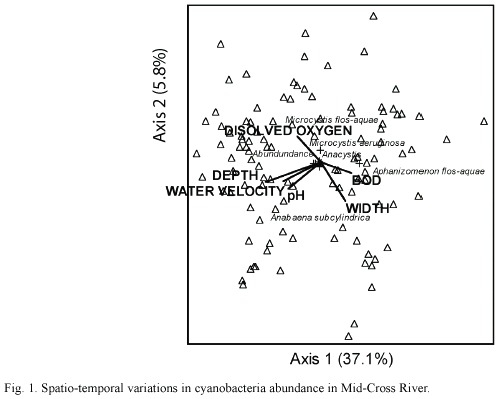
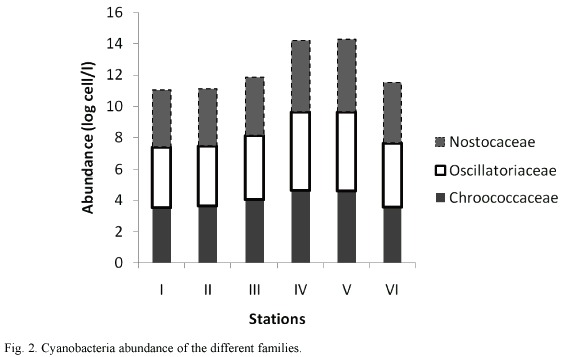
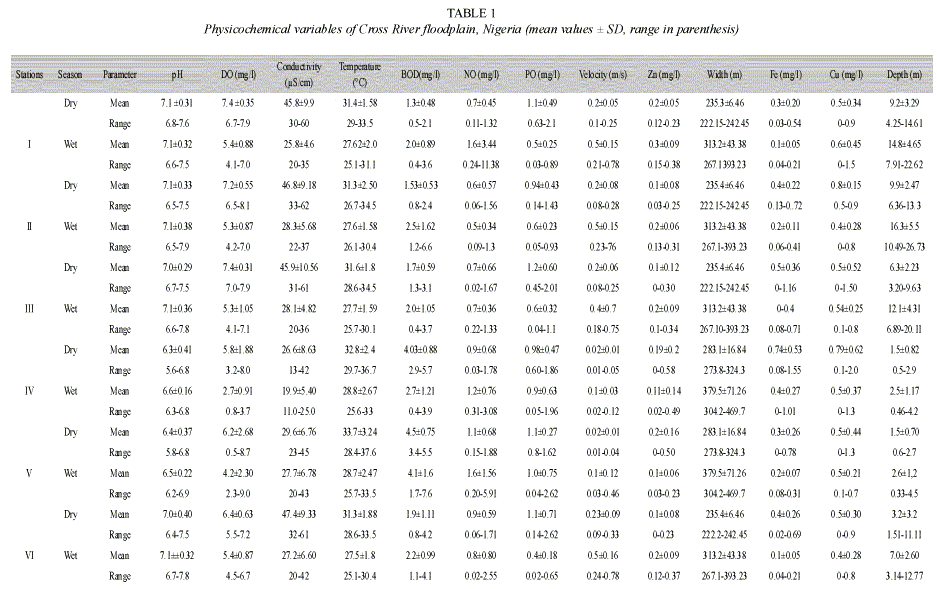
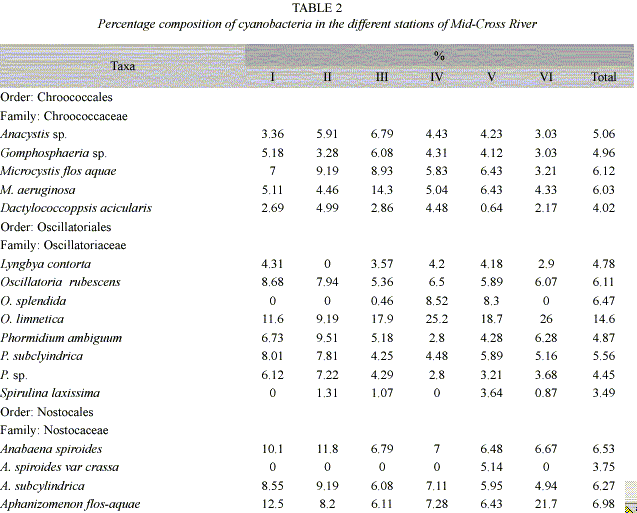
<body><![CDATA[<p><font face="Courier New" size="2" style="font-family: verdana;">Water samples for chemical analysis were collected in 1.5 L plastic containers samples were collected at each station from the surface and a depth of 2 m from the surface and these were pooled together for a given station. Samples for metal analysis were collected separately in 1 L plastic containers and preserved using 1.5 mL conc. nitric acid (HNO3) per litre of sample. Iron, copper and zinc were analysed using Perkin Elmer Atomic Absorption Spectrometer (AAS) (Model 403) according to the standard methods of APHA (1992). Nitrate and phosphate were determined by colorimetric method (APHA 1992). </font></p>     <p><font face="Courier New" size="2" style="font-family: verdana;">Phytoplankton samples were collected using 45µm mesh size silk plankton net and were preserved in 4% buffered formalin. Enumeration of phytoplankton was done according to Ovie (1997) using Sedgwick- Rafter counting chamber. A minimum of three subsequent sub-samples was counted and the mean value for each identified organism used to estimate abundance of the species. </font></p>     <p><font face="Courier New" size="2" style="font-family: verdana;">Analysis of variance (ANOVA) was used to test for significant difference in spatial and temporal variation in environmental and biological data. Canonical correspondence analysis (CCA) was used to evaluate cyanobacteria-environment relationship. All data were first transformed logarithmically using the formula log (x +1) before CCA was applied. All statistical analyses were carried out using the PC-ORD and Statistical package for social science (SPSS) softwares. </font></p>     <p><font face="Courier New" size="3" style="font-family: verdana;"><span  style="font-weight: bold;">Results</span> </font></p>     <p><font face="Courier New" size="2" style="font-family: verdana;"><a  href="/img/revistas/rbt/v57n1-2/art04t1.gif">Table 1</a> shows the mean and ranges of the physiochemical parameters. Dissolved oxygen, depth, biological oxygen demand, river width, nitrate, phosphate and water velocity showed remarkable significant seasonal and spatial variation (p&lt;0.05) during the study. The wide variation in pH (5.6-7.8) was due to neutral and acidic values in the river and floodplains respectively. Dissolved oxygen values recorded in stations on the floodplains were significantly lower than the values of riverine stations. The nutrient values (nitrate and phosphate) were high.    <br> </font></p>     <p><font face="Courier New" size="2" style="font-family: verdana;"><a  href="#t2">Table 2</a> shows the percentage composition of cyanobacteria in the different sampled stations. Seventeen species of cyanobacteria were identified. The dominant cyanobacteria included <span style="font-style: italic;">Oscillatoria rubescens</span>, <span  style="font-style: italic;">O. splendida</span>, <span  style="font-style: italic;">O. Limnetica</span>, <span style="font-style: italic;">Anabaena spirodides</span>, <span style="font-style: italic;">Aphanizomenon flos-aquae</span> and <span style="font-style: italic;">Microcystis flosaquae</span>. The highest cyanobacteria abundance was recorded in Station V were total abundance reached values of 1.7x 10⁵ cells/L while the lowest values were recorded in Station II (<a href="#f1">Fig. 1</a>). Analysis of variance showed that cyanobacteria abundance was significantly higher in the stations located on the floodplains than those on the open river (p &lt;0.01). Cyanobacteria abundance was also significantly (p &lt;0.05) higher during the wet season than the dry season (<a href="#f2">Fig. 2</a>) in all the stations except Station VI. However, the densities of <span style="font-style: italic;">M. aeruginosa</span> and <span  style="font-style: italic;">A. flos-aquae </span>were higher during the dry than wet season in Station III (p &lt;0.05).    <br> </font></p>     <p><font face="Courier New" size="2" style="font-family: verdana;">    <br> </font></p>     ]]></body>
<body><![CDATA[<p><font face="Courier New" size="2" style="font-family: verdana;"> </font></p>     <p style="text-align: center;"><font face="Courier New" size="4"  style="font-family: verdana;"><font face="Courier New" size="2"  style="font-family: verdana;">&nbsp;<a name="t2"></a><img  src="/img/revistas/rbt/v57n1-2/art04t2.gif" title="" alt=""  style="width: 637px; height: 513px;">    <br> </font></font></p>     <p style="text-align: center;"><font face="Courier New" size="4"  style="font-family: verdana;"><font face="Courier New" size="2"  style="font-family: verdana;">    <br> <a name="f1"></a><img src="/img/revistas/rbt/v57n1-2/art04i1.jpg"  title="" alt="" style="width: 499px; height: 399px;">    <br> </font></font></p>     <p style="text-align: center;"><font face="Courier New" size="4"  style="font-family: verdana;"><font face="Courier New" size="2"  style="font-family: verdana;">    <br> <a name="f2"></a><img src="/img/revistas/rbt/v57n1-2/art04i2.jpg"  title="" alt="" style="width: 561px; height: 357px;">    <br> </font></font></p>     <p><font face="Courier New" size="2" style="font-family: verdana;">&nbsp;    ]]></body>
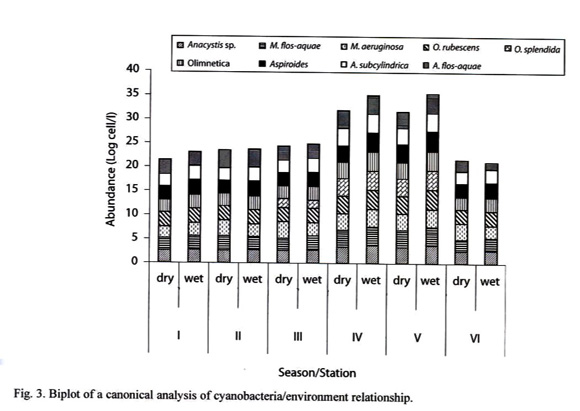
<body><![CDATA[<br> <a href="#f3">Fig. 3</a> shows the biplot of a canonical analysis (CCA). The first two axis of the Canonical correspondence analysis (CCA) explained 42.9% of cyanobacteria-environment relationship. The first axis was negatively correlated with pH (r= -0.51), dissolved oxygen (r= -0.37), water velocity (r= -0.59), conductivity (r= -0.34) and depth (r= -0.86) and positively with width (r= 0.40) and biological oxygen demand (r= 0.48). The second axis was positively correlated with oxygen (r= 0.40) and negatively correlated with pH (r= -0.42) and width (r= -0.62). The wet season was characterized by increased river width and depth, low conductivity and reduced oxygen content, whereas cyanobacteria abundance was high especially <span style="font-style: italic;">O. limnetica</span> and <span  style="font-style: italic;">M. flos-aquae</span>. During the dry season conductivity and oxygen content were high and water velocity, depth and width were low and cyanobacteria abundance was low especially <span style="font-style: italic;">O. limnetica</span>.    <br> </font></p>     <p><font face="Courier New" size="2" style="font-family: verdana;">    <br> </font></p>     <p style="text-align: center;"><font face="Courier New" size="2"  style="font-family: verdana;"><a name="f3"></a><img  src="/img/revistas/rbt/v57n1-2/art04i3.jpg" title="" alt=""  style="width: 580px; height: 411px;">    <br> </font></p>     <p><font face="Courier New" size="2" style="font-family: verdana;">    <br> </font></p>     <p><font face="Courier New" size="3" style="font-family: verdana;"><span  style="font-weight: bold;">Discussion</span> </font></p>     <p><font face="Courier New" size="4" style="font-family: verdana;"><font  face="Courier New" size="2" style="font-family: verdana;">The wide variation recorded in pH, dissolved oxygen, water depth and velocity was probably due to spatial variation in these variables especially between the lotic and lentic ecosystems. The lentic stations (Stations IV and V) are located close to agricultural lands and frequently received organic fertilizer runoffs. The decomposition of these and litters from riparian vegetations could be responsible for the low pH and oxygen content of the lakes as suggested by del Giorgio <span style="font-style: italic;">et al</span>. (1991). Seasonal variations in rainfall could be responsible for the wide variation in water depth and velocity, as these variables are strongly linked to meteorological conditions in tropical waters (Aoyagui and Bonecker 2004). Electrical conductivity of the Mid- Cross was very low and consistent with what has been recorded for the Upper and Lower Cross (Moses 1979, Akpan and Offem 1993). It was lower than that of most Nigerian rivers and other tropical rivers (Ovie and Adeniji 1994, Phiri 2000, Akin-Oriola 2003, Obire <span style="font-style: italic;">et al</span>. 2003, Mokaya <span style="font-style: italic;">et al</span>. 2004). It was within the range of River Modder (Koning <span style="font-style: italic;">et al</span>. 2000). In contrast, the phosphate and nitrate values were higher than 0.008-0.02 mg/L and 0-0.8 mg/L respectively recorded by Moses (1979) and mean values of 0.07mg/L (phosphate) and 1.02mg/L (nitrate) reported by Akpan (1993). In fact, there was ten-fold increase in phosphate from the 1992 values, indicating increased eutrophication of the Cross River ecosystem. This is probably due to increase in anthropogenic activities (notable agriculture and sewage disposal) near the river. Increased phosphate level of the river will definitely give competitive advantage to the cyanobacteria over diatoms and green algae. The growth of cyanobacteria is P-limited principally due to the ability of several species to fix nitrogen (Blomqvist <span style="font-style: italic;">et al</span>. 1994). Several studies revealed that cyanobacteria are generally poor competitors for phosphorous in comparison to diatoms and green algae (Sterner 1994, Fujimoto <span style="font-style: italic;">et al</span>. 1997). This is probably why they rarely dominate oligotrophic waters (Downing <span  style="font-style: italic;">et al</span>. 2001). Consequently, increase in phosphate will favour increased cyanobacteria abundance. The trace metals were fairly high but below the EPA (2006) standards. High metal values could be as a result of runoffs from pockets of illegal zinc-copper mining activities around the Cross River basin. values were particularly higher in the floodplains than in the open water due to proximity of the floodplains to the mines. </font></font></p>     ]]></body>
<body><![CDATA[<p><font face="Courier New" size="2" style="font-family: verdana;">Cyanobacteria abundance was fairly high between seasons and stations. This may be attributed to the presence of still waters in the several ponds and lakes within the Cross River floodplain with conditions conducive for the proliferation of these plankton groups. Still blackwater was suggested by del Giorgio <span style="font-style: italic;">et al</span>. (1992) to be the likely sources of cyanobacteria bloom in rivers. In line with this, cyanobacteria abundance was remarkably higher in the lakes than in the open water. High cyanobacteria abundance in the lake was mainly attributed to crustacean grazing activities, which depleted the smaller edible algae to the advantage of the cyanobacteria (Okogwu 2008). Cyanobacteria are known to be less palatable and less attractive to zooplankton (especially cladocerans), so they receive little grazing attention (Relevante and Gilmartin 1982, Repka 1996). In cladoceran dominated lakes, cyanobacteria are known to have high densities as the grazing activities of this group of zooplankton effectively eliminate other competing alga from the phytoplankton community. This may explain the higher density of cyanobacteria recorded during the wet season compared to the dry season in most of the stations as cladoceran density attained peak in these lakes during the wet season (Okogwu 2008). The density of green algae and diatom was reported to be very low during this period (wet season) (Okogwu 2008). Grazing zooplankton remove their natural competitors (small alga) releasing nutrients to them (Repka 1996). However cyanobacteria are generally harmful to zooplankton by clogging their feeding apparatus, toxin production and poor nutritional quality of the cells (DeMott <span  style="font-style: italic;">et al</span>. 2001, Sterner and Elser 2002, Jang <span  style="font-style: italic;">et al</span>. 2003). Therefore, the cyanobacteria abundance recorded in the floodplains of the Cross River should be of concern as these are the breeding grounds of the important fishes of the river notably <span style="font-style: italic;">Chrysichthys nigroditatus</span>, <span style="font-style: italic;">Clarias gariepinus Oreochromis niloticus</span> and <span  style="font-style: italic;">Tilapia zilli</span> during the wet season. Fish larvae exposed to cyanobacterial toxin showed reduced feeding and growth rate (Baganz <span style="font-style: italic;">et al</span>. 1998). </font></p>     <p><font face="Courier New" size="2" style="font-family: verdana;">Canonical correspondence analysis (CCA) showed a strong correlation between cyanobacteria abundance and the water quality variables; pH, BOD, dissolved oxygen, water velocity and width. There was a positive significant correlation between water width and cyanobacteria abundance (0.36, p &lt;0.05). During the wet season, the river extends its width and connects with the lakes leading to exchange of biotic and abiotic materials as well as mild increase in the mixing of water column. Under this condition available literature (Reynolds 1997, Huisman 1999) showed that cyanobacteria may have competitive advantage over diatoms and green algae. The buoyant cyanobacteria float upwards forming gradually a bloom that shades their competitors from light. It is also possible that the interaction between the lentic and lotic ecosystems of Cross River during the wet seasons lead to inoculation of the riverine stations with cyanobacteria from the floodplains. Cyanobacteria negatively correlated with oxygen content (-0.37, p &lt;0.01) and pH (-0.51, p &lt;0.01). This may be attributed to high degradation of dead cyanobacteria subsequent to blooms leading to oxygen depletion and reduced pH; this reasserts the findings of Richardson (1997). The positive significant relationship between cyanobacteria and BOD further buttresses this point. Huisman and Hulot (2005) stated that die-off of surface cyanobacteria bloom in Lake Nieuwe Meer resulted in disgusting smell and anoxia. Cyanobacteria blooms therefore have serious adverse effects on other aquatic biota especially fish larvae and zooplankton and humans. The negative correlation between cyanobacteria and pH may be explained by the fact that cyanobacteria growth is inhibited at low pH (Shapiro 1997). It has been suggested that an effective way of managing cyanobacteria in freshwater is by reducing pH in addition to decreasing eutrophication (Huisman and Hulot 2005). From <a href="#f3">Fig. 3</a>, it could be deduced that <span style="font-style: italic;">Microcystis flos-aquae</span>, <span style="font-style: italic;">Microcystis aeruginosa</span> and <span style="font-style: italic;">Aphanizomenon subcylindrica</span> were more susceptible to low pH than <span style="font-style: italic;">Anabaena subcylindrica</span>. High phosphate, nitrate and trace metals and low N:P have been widely reported as major factors limiting cyanobacteria bacteria abundance (Elser et al. 1990, del Giorgio 1991, Akin-Oriola 2003). However, CCA analysis showed no significant correlation between these parameters and cyanobacteria of Cross River floodplain. This therefore validates the views of Ibelings and Maberly (1998) that in eutrophic waters factors other than nutrients may limit cyanobacteria growth. Consequently factors influencing cyanobacteria bloom may be ecosystem-dependent ranging from hydrographic to trophic related variables. In order to reduce the abundance of cyanobacteria in the Mid-Cross River to protect the fisheries, drinking water quality and recreational value of the region, management strategy should include reduction in pH and nutrient enrichment and biomanipulation. </font></p> <hr style="width: 100%; height: 2px;">     <p><font face="Courier New" size="2" style="font-family: verdana;"><span  style="font-weight: bold;">Resumen</span> </font></p>     <p><font face="Courier New" size="2" style="font-family: verdana;">Las variables físico-químicas y la abundancia de cianobacterias del río nigeriano Mid-Cross fueron estudiadas en seis estaciones entre marzo del 2005 y agosto del 2006. El Análisis de Correspondencia Canónica (CCA) demostró que la demanda biológica de oxígeno (DBO), oxígeno disuelto, pH, velocidad de agua, anchura y profundidad son factores ambientales importantes que influyen en la abundancia de cianobacterias. Los mayores valores de trazas de metales, fosfatos y nitratos, en comparación con estudios previos, indican mayor eutrofización, pero tienen poca correlación con la abundancia de las cianobacterias. La mayor abundancia de cianobacterias se registró durante el periodo más húmedo de la estación seca en la mayoría de las estaciones de muestreo. Las cianobacterias dominantes incluyen <span style="font-style: italic;">Microcystis aeruginosa</span>, <span  style="font-style: italic;">Aphanizomenon flos-Aquae</span>, <span style="font-style: italic;">Oscillatoria limnetica</span> y <span  style="font-style: italic;">Anabaena spiroide</span>. Las toxinas producidas por estas especies podrían degradar la calidad del agua. Los factores que favorecen la abundancia de cianobacterias fueron identificados como el aumento de pH, ancho y profundidad. El aumento de la abundancia se asoció con una reducción de oxígeno disuelto y un aumento de los valores de DBO. </font></p>     <p><font face="Courier New" size="2" style="font-family: verdana;"><span  style="font-weight: bold;">Palabras clave:</span> río Cross, llanura de inundación, cianobacterias, calidad del agua, Nigeria.    <br> </font></p> <hr style="width: 100%; height: 2px;">     <p style="text-align: center;"><font face="Courier New" size="4"  style="font-family: verdana;"><font face="Courier New" size="2"  style="font-family: verdana;">Received 14-III-2008. Corrected 15-VII-2008. Accepted 17-VIII-2008.</font></font></p>     <p><font face="Courier New" size="3" style="font-family: verdana;"><span  style="font-weight: bold;">References</span> </font></p>     <!-- ref --><p><font face="Courier New" size="4" style="font-family: verdana;"><font  face="Courier New" size="2" style="font-family: verdana;">Akin-Oriola, G.A. 2003. On the phytoplankton of Awba reservoir, Ibadan, Nigeria. Rev. Biol. Trop. 51: 9-16.    &nbsp;&nbsp;&nbsp;&nbsp;&nbsp;&nbsp;&nbsp;&nbsp;[&#160;<a href="javascript:void(0);" onclick="javascript: window.open('/scielo.php?script=sci_nlinks&ref=1275186&pid=S0034-7744200900010000400001&lng=','','width=640,height=500,resizable=yes,scrollbars=1,menubar=yes,');">Links</a>&#160;]<!-- end-ref --><br> </font></font></p>     ]]></body>
<body><![CDATA[<!-- ref --><p><font face="Courier New" size="4" style="font-family: verdana;"><font  face="Courier New" size="2" style="font-family: verdana;">Akpan, E.R. &amp; J.O. Offem. 1993. Seasonal variations in water quality of the Cross River, Nigeria. Rev. Hydrobiol. Trop. 26: 95- 103.    &nbsp;&nbsp;&nbsp;&nbsp;&nbsp;&nbsp;&nbsp;&nbsp;[&#160;<a href="javascript:void(0);" onclick="javascript: window.open('/scielo.php?script=sci_nlinks&ref=1275188&pid=S0034-7744200900010000400002&lng=','','width=640,height=500,resizable=yes,scrollbars=1,menubar=yes,');">Links</a>&#160;]<!-- end-ref --><br> </font></font></p>     <!-- ref --><p><font face="Courier New" size="4" style="font-family: verdana;"><font  face="Courier New" size="2" style="font-family: verdana;">Akpan, E.R. 1993. Seasonal cycles of phytoplankton and grazing activity in the Cross River system of south eastern Nigeria. Trop. Ecol. 34: 143-149.    &nbsp;&nbsp;&nbsp;&nbsp;&nbsp;&nbsp;&nbsp;&nbsp;[&#160;<a href="javascript:void(0);" onclick="javascript: window.open('/scielo.php?script=sci_nlinks&ref=1275190&pid=S0034-7744200900010000400003&lng=','','width=640,height=500,resizable=yes,scrollbars=1,menubar=yes,');">Links</a>&#160;]<!-- end-ref --><br> </font></font></p>     <!-- ref --><p><font face="Courier New" size="4" style="font-family: verdana;"><font  face="Courier New" size="2" style="font-family: verdana;">Aoyagui, A.S.M. &amp; C.C. Bonecker. 2004. Rotifers in different environments of the upper Parana River floodplain (Brazil): richness, abundance and the relationship to connectivity. Hydrobiologia 522: 281-290. </font></font>&nbsp;&nbsp;&nbsp;&nbsp;&nbsp;&nbsp;&nbsp;&nbsp;[&#160;<a href="javascript:void(0);" onclick="javascript: window.open('/scielo.php?script=sci_nlinks&ref=1275192&pid=S0034-7744200900010000400004&lng=','','width=640,height=500,resizable=yes,scrollbars=1,menubar=yes,');">Links</a>&#160;]<!-- end-ref --><!-- ref --><p><font face="Courier New" size="4" style="font-family: verdana;"><font  face="Courier New" size="2" style="font-family: verdana;">APHA. 1992. Standard methods for the examination of water and wastewater. American Public Health Association, Washington, D.C., USA. 1268 p.    &nbsp;&nbsp;&nbsp;&nbsp;&nbsp;&nbsp;&nbsp;&nbsp;[&#160;<a href="javascript:void(0);" onclick="javascript: window.open('/scielo.php?script=sci_nlinks&ref=1275193&pid=S0034-7744200900010000400005&lng=','','width=640,height=500,resizable=yes,scrollbars=1,menubar=yes,');">Links</a>&#160;]<!-- end-ref --><br> </font></font></p>     <!-- ref --><p><font face="Courier New" size="4" style="font-family: verdana;"><font  face="Courier New" size="2" style="font-family: verdana;">Baganz, D., G. Staaks &amp; C. Steinberg. 1998. Impact of the cyanobacteria toxin, microcystin-LR on behaviour of zebra fish, Danio rerio. Wat. Res. 32: 948-952.    &nbsp;&nbsp;&nbsp;&nbsp;&nbsp;&nbsp;&nbsp;&nbsp;[&#160;<a href="javascript:void(0);" onclick="javascript: window.open('/scielo.php?script=sci_nlinks&ref=1275195&pid=S0034-7744200900010000400006&lng=','','width=640,height=500,resizable=yes,scrollbars=1,menubar=yes,');">Links</a>&#160;]<!-- end-ref --><br> </font></font></p>     <!-- ref --><p><font face="Courier New" size="4" style="font-family: verdana;"><font  face="Courier New" size="2" style="font-family: verdana;">Blomqvist, P., A. Pettersson &amp; P. Hyenstrand. 1994. Ammonium-nitrogen: A key regulatory factor causing dominance of non-nitrogen-fixing cyanobacteria inaquatic systems. Arch. Hydrobiol. 132: 141-164.    &nbsp;&nbsp;&nbsp;&nbsp;&nbsp;&nbsp;&nbsp;&nbsp;[&#160;<a href="javascript:void(0);" onclick="javascript: window.open('/scielo.php?script=sci_nlinks&ref=1275197&pid=S0034-7744200900010000400007&lng=','','width=640,height=500,resizable=yes,scrollbars=1,menubar=yes,');">Links</a>&#160;]<!-- end-ref --><br> </font></font></p>     <!-- ref --><p><font face="Courier New" size="4" style="font-family: verdana;"><font  face="Courier New" size="2" style="font-family: verdana;">del Giorgio, P.A., A.L. Vinocur, R.J. Lombardo &amp; H.G. Tell. 1991. Progressive changes in the structure and dynamics of the phytoplankton community along a pollution gradient in a lowland river- a multivariate approach. Hydrobiologia 224: 129-154.    &nbsp;&nbsp;&nbsp;&nbsp;&nbsp;&nbsp;&nbsp;&nbsp;[&#160;<a href="javascript:void(0);" onclick="javascript: window.open('/scielo.php?script=sci_nlinks&ref=1275199&pid=S0034-7744200900010000400008&lng=','','width=640,height=500,resizable=yes,scrollbars=1,menubar=yes,');">Links</a>&#160;]<!-- end-ref --><br> </font></font></p>     <!-- ref --><p><font face="Courier New" size="4" style="font-family: verdana;"><font  face="Courier New" size="2" style="font-family: verdana;">DeMott, W. &amp; F. Moxter. 1991. Foraging on cyanobacteria by copepods: responses to chemical defenses and resource abundance. Ecology 72: 1820-1834.    &nbsp;&nbsp;&nbsp;&nbsp;&nbsp;&nbsp;&nbsp;&nbsp;[&#160;<a href="javascript:void(0);" onclick="javascript: window.open('/scielo.php?script=sci_nlinks&ref=1275201&pid=S0034-7744200900010000400009&lng=','','width=640,height=500,resizable=yes,scrollbars=1,menubar=yes,');">Links</a>&#160;]<!-- end-ref --><br> </font></font></p>     <!-- ref --><p><font face="Courier New" size="4" style="font-family: verdana;"><font  face="Courier New" size="2" style="font-family: verdana;">DeMott, W.R., R.D. Gulati and E. van Donk. 2001. Daphnia food limitation in three hyperhypereutrophic Dutch lakes: evidence for exclusion of large-bodied species by interfering filaments of cyanobacteria. Limnol. Oceanogr. 46: 2054-2060     &nbsp;&nbsp;&nbsp;&nbsp;&nbsp;&nbsp;&nbsp;&nbsp;[&#160;<a href="javascript:void(0);" onclick="javascript: window.open('/scielo.php?script=sci_nlinks&ref=1275203&pid=S0034-7744200900010000400010&lng=','','width=640,height=500,resizable=yes,scrollbars=1,menubar=yes,');">Links</a>&#160;]<!-- end-ref --><br> </font></font></p>     <!-- ref --><p><font face="Courier New" size="4" style="font-family: verdana;"><font  face="Courier New" size="2" style="font-family: verdana;">Downing, J.A., S.B. Watson &amp; E. McCauley. 2001. Predicting cyanobacteria dominance in lakes. Can. J. Fish. Aquat. Sci. 58: 1905-1908     &nbsp;&nbsp;&nbsp;&nbsp;&nbsp;&nbsp;&nbsp;&nbsp;[&#160;<a href="javascript:void(0);" onclick="javascript: window.open('/scielo.php?script=sci_nlinks&ref=1275205&pid=S0034-7744200900010000400011&lng=','','width=640,height=500,resizable=yes,scrollbars=1,menubar=yes,');">Links</a>&#160;]<!-- end-ref --><br> </font></font></p>     <!-- ref --><p><font face="Courier New" size="4" style="font-family: verdana;"><font  face="Courier New" size="2" style="font-family: verdana;">Elser, J.J., E.R. Marzolf &amp; C.R. Goldman. 1990. Phosphorous and nitrogen limitations in the freshwaters of North America: a review and critique of experimental enrichments. Can. J. Fish. Aquat. Sci. 47: 1468-1477     &nbsp;&nbsp;&nbsp;&nbsp;&nbsp;&nbsp;&nbsp;&nbsp;[&#160;<a href="javascript:void(0);" onclick="javascript: window.open('/scielo.php?script=sci_nlinks&ref=1275207&pid=S0034-7744200900010000400012&lng=','','width=640,height=500,resizable=yes,scrollbars=1,menubar=yes,');">Links</a>&#160;]<!-- end-ref --><br> </font></font></p>     <!-- ref --><p><font face="Courier New" size="4" style="font-family: verdana;"><font  face="Courier New" size="2" style="font-family: verdana;">EPA (United States Environmental Protection Agency) 2006. National recommended water quality criteria. EPA 4304T, Washington, DC.    &nbsp;&nbsp;&nbsp;&nbsp;&nbsp;&nbsp;&nbsp;&nbsp;[&#160;<a href="javascript:void(0);" onclick="javascript: window.open('/scielo.php?script=sci_nlinks&ref=1275209&pid=S0034-7744200900010000400013&lng=','','width=640,height=500,resizable=yes,scrollbars=1,menubar=yes,');">Links</a>&#160;]<!-- end-ref --><br> </font></font></p>     <!-- ref --><p><font face="Courier New" size="4" style="font-family: verdana;"><font  face="Courier New" size="2" style="font-family: verdana;">Fujimoto, N., R. Sudo, N. Sugiura &amp; Y. Inamori. 1997. Nutrient-limited growth of <span style="font-style: italic;">Microcystis aeruginosa</span> and <span style="font-style: italic;">Phormidium tenue</span> and competition under various N:P supply ratios and temperature. Limnol. Oceanogr. 42: 250-256.    &nbsp;&nbsp;&nbsp;&nbsp;&nbsp;&nbsp;&nbsp;&nbsp;[&#160;<a href="javascript:void(0);" onclick="javascript: window.open('/scielo.php?script=sci_nlinks&ref=1275211&pid=S0034-7744200900010000400014&lng=','','width=640,height=500,resizable=yes,scrollbars=1,menubar=yes,');">Links</a>&#160;]<!-- end-ref --><br> </font></font></p>     <!-- ref --><p><font face="Courier New" size="4" style="font-family: verdana;"><font  face="Courier New" size="2" style="font-family: verdana;">Hansson, L., S. Gustafsson, K. Rengefors &amp; L. Bomark. 2007. Cyanobacterial chemical warfare affects zooplankton community composition. Freshwat. Biol. 52: 1290–1301.    &nbsp;&nbsp;&nbsp;&nbsp;&nbsp;&nbsp;&nbsp;&nbsp;[&#160;<a href="javascript:void(0);" onclick="javascript: window.open('/scielo.php?script=sci_nlinks&ref=1275213&pid=S0034-7744200900010000400015&lng=','','width=640,height=500,resizable=yes,scrollbars=1,menubar=yes,');">Links</a>&#160;]<!-- end-ref --><br> </font></font></p>     <!-- ref --><p><font face="Courier New" size="4" style="font-family: verdana;"><font  face="Courier New" size="2" style="font-family: verdana;">Huisman, J. &amp; F.D. Hulot. 2005. Population dynamics of harmful cyanobacteria: factors affecting species composition. <span style="font-style: italic;">In</span> J. Husiman, H.C.P Matthijs &amp; P.M. Visser (eds.). Harmful cyanobacteria. Springer, Berlin, Germany.    &nbsp;&nbsp;&nbsp;&nbsp;&nbsp;&nbsp;&nbsp;&nbsp;[&#160;<a href="javascript:void(0);" onclick="javascript: window.open('/scielo.php?script=sci_nlinks&ref=1275215&pid=S0034-7744200900010000400016&lng=','','width=640,height=500,resizable=yes,scrollbars=1,menubar=yes,');">Links</a>&#160;]<!-- end-ref --><br> </font></font></p>     <!-- ref --><p><font face="Courier New" size="4" style="font-family: verdana;"><font  face="Courier New" size="2" style="font-family: verdana;">Huisman, J. 1990. Population dynamics of light-limited phytoplankton: microcosm experiments. Ecology 80: 202-210.    &nbsp;&nbsp;&nbsp;&nbsp;&nbsp;&nbsp;&nbsp;&nbsp;[&#160;<a href="javascript:void(0);" onclick="javascript: window.open('/scielo.php?script=sci_nlinks&ref=1275217&pid=S0034-7744200900010000400017&lng=','','width=640,height=500,resizable=yes,scrollbars=1,menubar=yes,');">Links</a>&#160;]<!-- end-ref --><br> </font></font></p>     <!-- ref --><p><font face="Courier New" size="4" style="font-family: verdana;"><font  face="Courier New" size="2" style="font-family: verdana;">Hyenstrand, P., P. Blomqvist &amp; A. Pettersson. 1998. Factors determining cyanobacterial success in aquatic systems – a literature review. Arch. Hydrobiol. 51: 41-62.    &nbsp;&nbsp;&nbsp;&nbsp;&nbsp;&nbsp;&nbsp;&nbsp;[&#160;<a href="javascript:void(0);" onclick="javascript: window.open('/scielo.php?script=sci_nlinks&ref=1275219&pid=S0034-7744200900010000400018&lng=','','width=640,height=500,resizable=yes,scrollbars=1,menubar=yes,');">Links</a>&#160;]<!-- end-ref --><br> </font></font></p>     <!-- ref --><p><font face="Courier New" size="4" style="font-family: verdana;"><font  face="Courier New" size="2" style="font-family: verdana;">Ibelings, B.W., &amp; S.C Maberly. 1998. Photoinhibition and the availability of inorganic carbón restrict hotosynthesis by surface blooms of cyanobacteria. Limnol. Oceanogr. 43: 408-419.    &nbsp;&nbsp;&nbsp;&nbsp;&nbsp;&nbsp;&nbsp;&nbsp;[&#160;<a href="javascript:void(0);" onclick="javascript: window.open('/scielo.php?script=sci_nlinks&ref=1275221&pid=S0034-7744200900010000400019&lng=','','width=640,height=500,resizable=yes,scrollbars=1,menubar=yes,');">Links</a>&#160;]<!-- end-ref --><br> </font></font></p>     <!-- ref --><p><font face="Courier New" size="4" style="font-family: verdana;"><font  face="Courier New" size="2" style="font-family: verdana;">Jang, M.H., K. Ha, G.J. Joo and N. Takamura. 2003. Toxin production of cyanobacteria is increased by exposure to zooplankton. Freshwat. Biol. 48: 1540-1550.    &nbsp;&nbsp;&nbsp;&nbsp;&nbsp;&nbsp;&nbsp;&nbsp;[&#160;<a href="javascript:void(0);" onclick="javascript: window.open('/scielo.php?script=sci_nlinks&ref=1275223&pid=S0034-7744200900010000400020&lng=','','width=640,height=500,resizable=yes,scrollbars=1,menubar=yes,');">Links</a>&#160;]<!-- end-ref --><br> </font></font></p>     <!-- ref --><p><font face="Courier New" size="4" style="font-family: verdana;"><font  face="Courier New" size="2" style="font-family: verdana;">Karjalainen, M., M. Reinikainen, L. Spoof, J.A.O. Meriluoto, K. Sivonen &amp; M. viitasalo. 2005. Trophic Transfer of Cyanobacterial Toxins from Zooplankton to Planktivores: Consequences for Pike Larvae and Mysid Shrimps. Environ. Toxicol. 20: 354–362.    &nbsp;&nbsp;&nbsp;&nbsp;&nbsp;&nbsp;&nbsp;&nbsp;[&#160;<a href="javascript:void(0);" onclick="javascript: window.open('/scielo.php?script=sci_nlinks&ref=1275225&pid=S0034-7744200900010000400021&lng=','','width=640,height=500,resizable=yes,scrollbars=1,menubar=yes,');">Links</a>&#160;]<!-- end-ref --><br> </font></font></p>     <!-- ref --><p><font face="Courier New" size="4" style="font-family: verdana;"><font  face="Courier New" size="2" style="font-family: verdana;">Keating, K.I 1977. Allelopathic influence on blue-green bloom sequence in a eutrophic lake. Science 196: 885-887     &nbsp;&nbsp;&nbsp;&nbsp;&nbsp;&nbsp;&nbsp;&nbsp;[&#160;<a href="javascript:void(0);" onclick="javascript: window.open('/scielo.php?script=sci_nlinks&ref=1275227&pid=S0034-7744200900010000400022&lng=','','width=640,height=500,resizable=yes,scrollbars=1,menubar=yes,');">Links</a>&#160;]<!-- end-ref --><br> </font></font></p>     <!-- ref --><p><font face="Courier New" size="4" style="font-family: verdana;"><font  face="Courier New" size="2" style="font-family: verdana;">Koning, N., J.C. Roos &amp; J.U. Grobbelaar. 2000. Water quality of the Modder River, South Africa. Afr. J. Aqu. Sci. 25: 202-210.    &nbsp;&nbsp;&nbsp;&nbsp;&nbsp;&nbsp;&nbsp;&nbsp;[&#160;<a href="javascript:void(0);" onclick="javascript: window.open('/scielo.php?script=sci_nlinks&ref=1275229&pid=S0034-7744200900010000400023&lng=','','width=640,height=500,resizable=yes,scrollbars=1,menubar=yes,');">Links</a>&#160;]<!-- end-ref --><br> </font></font></p>     <!-- ref --><p><font face="Courier New" size="4" style="font-family: verdana;"><font  face="Courier New" size="2" style="font-family: verdana;">Kozlowsky-Suzuki, B., M. Karjalainen, M. Lehtiniemi, J. Engström-Öst, M. Koski &amp; P. Carlsson. 2003. Feeding, reproduction and toxin accumulation by the copepods <span style="font-style: italic;">Acartia bifilosa</span> and <span  style="font-style: italic;">Eurytemora affinis</span> in the presence of the toxic cyanobacterium <span style="font-style: italic;">Nodularia spumigen</span>. Mar. Ecol. Prog. Ser. 249: 237-249[    &nbsp;&nbsp;&nbsp;&nbsp;&nbsp;&nbsp;&nbsp;&nbsp;[&#160;<a href="javascript:void(0);" onclick="javascript: window.open('/scielo.php?script=sci_nlinks&ref=1275231&pid=S0034-7744200900010000400024&lng=','','width=640,height=500,resizable=yes,scrollbars=1,menubar=yes,');">Links</a>&#160;]<!-- end-ref -->STANDARDIZEDENDPARAG]<br> </font></font></p>     <!-- ref --><p><font face="Courier New" size="4" style="font-family: verdana;"><font  face="Courier New" size="2" style="font-family: verdana;">Landsberg, J.H. 2002. The effects of harmful algal blooms on aquatic organisms. Rev. Fish. Sci. 10:113–390[    &nbsp;&nbsp;&nbsp;&nbsp;&nbsp;&nbsp;&nbsp;&nbsp;[&#160;<a href="javascript:void(0);" onclick="javascript: window.open('/scielo.php?script=sci_nlinks&ref=1275233&pid=S0034-7744200900010000400025&lng=','','width=640,height=500,resizable=yes,scrollbars=1,menubar=yes,');">Links</a>&#160;]<!-- end-ref -->STANDARDIZEDENDPARAG]<br> </font></font></p>     <!-- ref --><p><font face="Courier New" size="4" style="font-family: verdana;"><font  face="Courier New" size="2" style="font-family: verdana;">Lehtiniemi, L., J. Engstrom-Ost, M. Karjalainen, B. Kozlskwy-Suziki &amp; M. Viitasalo. 2002. Fate of cynobacterial toxin in the pelagic food web: transfer to copepod or fecal pellets. Mar. Ecol. Prog. Ser. 241: 13-21.    &nbsp;&nbsp;&nbsp;&nbsp;&nbsp;&nbsp;&nbsp;&nbsp;[&#160;<a href="javascript:void(0);" onclick="javascript: window.open('/scielo.php?script=sci_nlinks&ref=1275235&pid=S0034-7744200900010000400026&lng=','','width=640,height=500,resizable=yes,scrollbars=1,menubar=yes,');">Links</a>&#160;]<!-- end-ref --><br> </font></font></p>     <!-- ref --><p><font face="Courier New" size="4" style="font-family: verdana;"><font  face="Courier New" size="2" style="font-family: verdana;">Maitland, P.S. 1978. Biology of Freshwaters. Blackie, London, England. 244p[    &nbsp;&nbsp;&nbsp;&nbsp;&nbsp;&nbsp;&nbsp;&nbsp;[&#160;<a href="javascript:void(0);" onclick="javascript: window.open('/scielo.php?script=sci_nlinks&ref=1275237&pid=S0034-7744200900010000400027&lng=','','width=640,height=500,resizable=yes,scrollbars=1,menubar=yes,');">Links</a>&#160;]<!-- end-ref -->STANDARDIZEDENDPARAG]<br> </font></font></p>     <!-- ref --><p><font face="Courier New" size="4" style="font-family: verdana;"><font  face="Courier New" size="2" style="font-family: verdana;">Mitrovic, S.M., L.C. Bowling &amp; R.T. Buckney. 2001. Vertical disentrainment of <span style="font-style: italic;">Anabaena ircinalis</span> in the turbid, freshwater Darling River, Australia: quantifying potential benefits from buoyancy. J. Plank. Res. 23: 47-55.    &nbsp;&nbsp;&nbsp;&nbsp;&nbsp;&nbsp;&nbsp;&nbsp;[&#160;<a href="javascript:void(0);" onclick="javascript: window.open('/scielo.php?script=sci_nlinks&ref=1275239&pid=S0034-7744200900010000400028&lng=','','width=640,height=500,resizable=yes,scrollbars=1,menubar=yes,');">Links</a>&#160;]<!-- end-ref --><br> </font></font></p>     <!-- ref --><p><font face="Courier New" size="4" style="font-family: verdana;"><font  face="Courier New" size="2" style="font-family: verdana;">Mokaya, S.K., J.M. Mathooko &amp; M. Leichtfried. 2004. Influence of anthropogenic activities on water quality of a tropical stream ecosystem. Afr. J. Ecol. 42: 281–288.    &nbsp;&nbsp;&nbsp;&nbsp;&nbsp;&nbsp;&nbsp;&nbsp;[&#160;<a href="javascript:void(0);" onclick="javascript: window.open('/scielo.php?script=sci_nlinks&ref=1275241&pid=S0034-7744200900010000400029&lng=','','width=640,height=500,resizable=yes,scrollbars=1,menubar=yes,');">Links</a>&#160;]<!-- end-ref --><br> </font></font></p>     <!-- ref --><p><font face="Courier New" size="4" style="font-family: verdana;"><font  face="Courier New" size="2" style="font-family: verdana;">Moses, B.S. 1979. The Cross River; its ecology and fisheries. Proceedings of the international Conference on Kainji Lake and River Basin Development in Africa. New Bussa. Niger. 365-367.    &nbsp;&nbsp;&nbsp;&nbsp;&nbsp;&nbsp;&nbsp;&nbsp;[&#160;<a href="javascript:void(0);" onclick="javascript: window.open('/scielo.php?script=sci_nlinks&ref=1275243&pid=S0034-7744200900010000400030&lng=','','width=640,height=500,resizable=yes,scrollbars=1,menubar=yes,');">Links</a>&#160;]<!-- end-ref --><br> </font></font></p>     <!-- ref --><p><font face="Courier New" size="4" style="font-family: verdana;"><font  face="Courier New" size="2" style="font-family: verdana;">Mur, L.R., O.M. Skulberg &amp; H. Utkilen. 1999. Cyanobacteria in the environment. <span style="font-style: italic;">In</span> I. Chorus &amp; J. Bartram (eds.). Toxic cyanobacteria in water. A guide to their public health consequences, monitoring and management. E. &amp; F. N. Spon, London, England.    &nbsp;&nbsp;&nbsp;&nbsp;&nbsp;&nbsp;&nbsp;&nbsp;[&#160;<a href="javascript:void(0);" onclick="javascript: window.open('/scielo.php?script=sci_nlinks&ref=1275245&pid=S0034-7744200900010000400031&lng=','','width=640,height=500,resizable=yes,scrollbars=1,menubar=yes,');">Links</a>&#160;]<!-- end-ref --><br> </font></font></p>     <!-- ref --><p><font face="Courier New" size="4" style="font-family: verdana;"><font  face="Courier New" size="2" style="font-family: verdana;">Nizan, S., C. Dimentman &amp; M. Shilo 1986. Acute toxic effects of the Cyanobacterium <span style="font-style: italic;">Microcystis aeruginosa</span> on <span style="font-style: italic;">Daphnia magna</span>. Limnol. Oceanogr. 31: 497-502.    &nbsp;&nbsp;&nbsp;&nbsp;&nbsp;&nbsp;&nbsp;&nbsp;[&#160;<a href="javascript:void(0);" onclick="javascript: window.open('/scielo.php?script=sci_nlinks&ref=1275247&pid=S0034-7744200900010000400032&lng=','','width=640,height=500,resizable=yes,scrollbars=1,menubar=yes,');">Links</a>&#160;]<!-- end-ref --><br> </font></font></p>     <!-- ref --><p><font face="Courier New" size="4" style="font-family: verdana;"><font  face="Courier New" size="2" style="font-family: verdana;">Oberholster, P.J., A. Botha &amp; E.T. Cloete. 2005. An overview of toxic freshwater cyanobacteria in South Africa with special reference to risk, impact and detection by molecular marker tools. Biokemistri 17: 57-71. </font></font>&nbsp;&nbsp;&nbsp;&nbsp;&nbsp;&nbsp;&nbsp;&nbsp;[&#160;<a href="javascript:void(0);" onclick="javascript: window.open('/scielo.php?script=sci_nlinks&ref=1275249&pid=S0034-7744200900010000400033&lng=','','width=640,height=500,resizable=yes,scrollbars=1,menubar=yes,');">Links</a>&#160;]<!-- end-ref --><!-- ref --><p><font face="Courier New" size="4" style="font-family: verdana;"><font  face="Courier New" size="2" style="font-family: verdana;">Obire, O. D.C. Tamuno &amp; S.A. Wemando. 2003. The physiochemical quality of Elechi Creek in Port Harcourt, Nigeria. J. Appl. Sci. Env. Mgt. 7: 43-49. </font></font>&nbsp;&nbsp;&nbsp;&nbsp;&nbsp;&nbsp;&nbsp;&nbsp;[&#160;<a href="javascript:void(0);" onclick="javascript: window.open('/scielo.php?script=sci_nlinks&ref=1275250&pid=S0034-7744200900010000400034&lng=','','width=640,height=500,resizable=yes,scrollbars=1,menubar=yes,');">Links</a>&#160;]<!-- end-ref --><!-- ref --><p><font face="Courier New" size="4" style="font-family: verdana;"><font  face="Courier New" size="2" style="font-family: verdana;">Okogwu, O.I. &amp; A.O. Ugwumba. 2006. The zooplankton and environmental characteristics of Ologe Lagoon, Southwest, Nigeria. The Zoologist. 3: 86-92. </font></font>&nbsp;&nbsp;&nbsp;&nbsp;&nbsp;&nbsp;&nbsp;&nbsp;[&#160;<a href="javascript:void(0);" onclick="javascript: window.open('/scielo.php?script=sci_nlinks&ref=1275251&pid=S0034-7744200900010000400035&lng=','','width=640,height=500,resizable=yes,scrollbars=1,menubar=yes,');">Links</a>&#160;]<!-- end-ref --><!-- ref --><p><font face="Courier New" size="4" style="font-family: verdana;"><font  face="Courier New" size="2" style="font-family: verdana;">Okogwu, O.I. 2008. The physicochemistry, plankton and ichthyofauna of Mid-Cross River-floodplain ecosystem, southeast, Nigeria. Ph.D. Thesis, Ibadan, Nigeria. 210p </font></font>&nbsp;&nbsp;&nbsp;&nbsp;&nbsp;&nbsp;&nbsp;&nbsp;[&#160;<a href="javascript:void(0);" onclick="javascript: window.open('/scielo.php?script=sci_nlinks&ref=1275252&pid=S0034-7744200900010000400036&lng=','','width=640,height=500,resizable=yes,scrollbars=1,menubar=yes,');">Links</a>&#160;]<!-- end-ref --><!-- ref --><p><font face="Courier New" size="4" style="font-family: verdana;"><font  face="Courier New" size="2" style="font-family: verdana;">Ovie, S. I. 1997. The Ecology and culture of the Zooplankton of Jebba Lake, Nigeria. Ph.D. Thesis, Benin, Nigeria. 212p. </font></font>&nbsp;&nbsp;&nbsp;&nbsp;&nbsp;&nbsp;&nbsp;&nbsp;[&#160;<a href="javascript:void(0);" onclick="javascript: window.open('/scielo.php?script=sci_nlinks&ref=1275253&pid=S0034-7744200900010000400037&lng=','','width=640,height=500,resizable=yes,scrollbars=1,menubar=yes,');">Links</a>&#160;]<!-- end-ref --><!-- ref --><p><font face="Courier New" size="4" style="font-family: verdana;"><font  face="Courier New" size="2" style="font-family: verdana;">Ovie, S.I. &amp;Adeniji, H.A. 1994. Zooplankton and environmental characteristics of Shiroro Lake at the extremes of its hydrological cycle. Hydrobiologia 286: 175-182. </font></font>&nbsp;&nbsp;&nbsp;&nbsp;&nbsp;&nbsp;&nbsp;&nbsp;[&#160;<a href="javascript:void(0);" onclick="javascript: window.open('/scielo.php?script=sci_nlinks&ref=1275254&pid=S0034-7744200900010000400038&lng=','','width=640,height=500,resizable=yes,scrollbars=1,menubar=yes,');">Links</a>&#160;]<!-- end-ref --><!-- ref --><p><font face="Courier New" size="4" style="font-family: verdana;"><font  face="Courier New" size="2" style="font-family: verdana;">Phiri, C. 2000. An assessment of the health of two rivers within Harare, Zimbabwe on the basis of the macro invertebrate community structure and selected physicochemical variables. Afr. J. Aqu. Sci. 25: 134-145. </font></font>&nbsp;&nbsp;&nbsp;&nbsp;&nbsp;&nbsp;&nbsp;&nbsp;[&#160;<a href="javascript:void(0);" onclick="javascript: window.open('/scielo.php?script=sci_nlinks&ref=1275255&pid=S0034-7744200900010000400039&lng=','','width=640,height=500,resizable=yes,scrollbars=1,menubar=yes,');">Links</a>&#160;]<!-- end-ref --><!-- ref --><p><font face="Courier New" size="4" style="font-family: verdana;"><font  face="Courier New" size="2" style="font-family: verdana;">Pushparaj, B., E. Pelosi &amp; F. Ju¨ttner. 1999. Toxicological analysis of the marine cyanobacterium <span style="font-style: italic;">Nodularia harveyana</span>. J. Appl. Phyco. 10: 527-530. </font></font>&nbsp;&nbsp;&nbsp;&nbsp;&nbsp;&nbsp;&nbsp;&nbsp;[&#160;<a href="javascript:void(0);" onclick="javascript: window.open('/scielo.php?script=sci_nlinks&ref=1275256&pid=S0034-7744200900010000400040&lng=','','width=640,height=500,resizable=yes,scrollbars=1,menubar=yes,');">Links</a>&#160;]<!-- end-ref --><!-- ref --><p><font face="Courier New" size="4" style="font-family: verdana;"><font  face="Courier New" size="2" style="font-family: verdana;">Repka, S. 1996. Inter and intraspecific differences in <span  style="font-style: italic;">Daphnia</span> life histories in response to 2 food sources: the green alga <span style="font-style: italic;">Scenedesmus</span> and the filamentous cyanobacterium <span style="font-style: italic;">Oscillatoria</span>. J. Plank. Res. 18: 1213-1223.    &nbsp;&nbsp;&nbsp;&nbsp;&nbsp;&nbsp;&nbsp;&nbsp;[&#160;<a href="javascript:void(0);" onclick="javascript: window.open('/scielo.php?script=sci_nlinks&ref=1275257&pid=S0034-7744200900010000400041&lng=','','width=640,height=500,resizable=yes,scrollbars=1,menubar=yes,');">Links</a>&#160;]<!-- end-ref --><br> </font></font></p>     <!-- ref --><p><font face="Courier New" size="4" style="font-family: verdana;"><font  face="Courier New" size="2" style="font-family: verdana;">Revelante, N. &amp; M. Gilmartin. 1982. Dynamics of phytoplankton in the Great Barrier Reef lagoon. J. Plank. Res. 4: 47-76.    &nbsp;&nbsp;&nbsp;&nbsp;&nbsp;&nbsp;&nbsp;&nbsp;[&#160;<a href="javascript:void(0);" onclick="javascript: window.open('/scielo.php?script=sci_nlinks&ref=1275259&pid=S0034-7744200900010000400042&lng=','','width=640,height=500,resizable=yes,scrollbars=1,menubar=yes,');">Links</a>&#160;]<!-- end-ref --><br> </font></font></p>     <!-- ref --><p><font face="Courier New" size="4" style="font-family: verdana;"><font  face="Courier New" size="2" style="font-family: verdana;">Reynolds C.S. 1997. Vegetation processes in the pelagic: a model for ecosystem theory. Ecology Institute, Oldendorf, Germany. </font></font>&nbsp;&nbsp;&nbsp;&nbsp;&nbsp;&nbsp;&nbsp;&nbsp;[&#160;<a href="javascript:void(0);" onclick="javascript: window.open('/scielo.php?script=sci_nlinks&ref=1275261&pid=S0034-7744200900010000400043&lng=','','width=640,height=500,resizable=yes,scrollbars=1,menubar=yes,');">Links</a>&#160;]<!-- end-ref --><!-- ref --><p><font face="Courier New" size="4" style="font-family: verdana;"><font  face="Courier New" size="2" style="font-family: verdana;">Reynolds, C.S., R.L. Oliver &amp; A.E. Walsby. 1987. Cyanobacterial dominance: the role of buoyancy regulation in dynamic lake environment. N. Z. J. Mar. Freshwat. Res. 21: 379-390. </font></font>&nbsp;&nbsp;&nbsp;&nbsp;&nbsp;&nbsp;&nbsp;&nbsp;[&#160;<a href="javascript:void(0);" onclick="javascript: window.open('/scielo.php?script=sci_nlinks&ref=1275262&pid=S0034-7744200900010000400044&lng=','','width=640,height=500,resizable=yes,scrollbars=1,menubar=yes,');">Links</a>&#160;]<!-- end-ref --><!-- ref --><p><font face="Courier New" size="4" style="font-family: verdana;"><font  face="Courier New" size="2" style="font-family: verdana;">Richardson, K. 1997. Harmful or exceptional phytoplankton blooms in the marine ecosystem. Adv. Mar. Biol. 31: 301-385. </font></font>&nbsp;&nbsp;&nbsp;&nbsp;&nbsp;&nbsp;&nbsp;&nbsp;[&#160;<a href="javascript:void(0);" onclick="javascript: window.open('/scielo.php?script=sci_nlinks&ref=1275263&pid=S0034-7744200900010000400045&lng=','','width=640,height=500,resizable=yes,scrollbars=1,menubar=yes,');">Links</a>&#160;]<!-- end-ref --><!-- ref --><p><font face="Courier New" size="4" style="font-family: verdana;"><font  face="Courier New" size="2" style="font-family: verdana;">Robarts, R.D. &amp; T. Zohary. 1987. Temperature effects on photosynthetic capacity, respiration, and growth rates of bloom-forming cyanobacteria. N. Z. J. Mar. Freshwat. Res. 21: 379-399. </font></font>&nbsp;&nbsp;&nbsp;&nbsp;&nbsp;&nbsp;&nbsp;&nbsp;[&#160;<a href="javascript:void(0);" onclick="javascript: window.open('/scielo.php?script=sci_nlinks&ref=1275264&pid=S0034-7744200900010000400046&lng=','','width=640,height=500,resizable=yes,scrollbars=1,menubar=yes,');">Links</a>&#160;]<!-- end-ref --><!-- ref --><p><font face="Courier New" size="4" style="font-family: verdana;"><font  face="Courier New" size="2" style="font-family: verdana;">Shapiro, J. 1990. Current beliefs regarding dominance by blue-greens: The case for the importance of CO2 and pH. Verh. Int. Verein. Limnol. 24: 38-54. </font></font>&nbsp;&nbsp;&nbsp;&nbsp;&nbsp;&nbsp;&nbsp;&nbsp;[&#160;<a href="javascript:void(0);" onclick="javascript: window.open('/scielo.php?script=sci_nlinks&ref=1275265&pid=S0034-7744200900010000400047&lng=','','width=640,height=500,resizable=yes,scrollbars=1,menubar=yes,');">Links</a>&#160;]<!-- end-ref --><!-- ref --><p><font face="Courier New" size="4" style="font-family: verdana;"><font  face="Courier New" size="2" style="font-family: verdana;">Shapiro, J. 1997. The role of carbon dioxide in the initiation and maintenance of blue-green dominance in lakes. Freshwat. Biol. 37: 307-323 </font></font>&nbsp;&nbsp;&nbsp;&nbsp;&nbsp;&nbsp;&nbsp;&nbsp;[&#160;<a href="javascript:void(0);" onclick="javascript: window.open('/scielo.php?script=sci_nlinks&ref=1275266&pid=S0034-7744200900010000400048&lng=','','width=640,height=500,resizable=yes,scrollbars=1,menubar=yes,');">Links</a>&#160;]<!-- end-ref --><!-- ref --><p><font face="Courier New" size="4" style="font-family: verdana;"><font  face="Courier New" size="2" style="font-family: verdana;">Smith, V. H. 1986. Light and nutrient effects on the relative biomass of blue-green algae in lake phytoplankton. Can. J. Fish. Aquat. Sci. 43: 148-153. </font></font>&nbsp;&nbsp;&nbsp;&nbsp;&nbsp;&nbsp;&nbsp;&nbsp;[&#160;<a href="javascript:void(0);" onclick="javascript: window.open('/scielo.php?script=sci_nlinks&ref=1275267&pid=S0034-7744200900010000400049&lng=','','width=640,height=500,resizable=yes,scrollbars=1,menubar=yes,');">Links</a>&#160;]<!-- end-ref --><!-- ref --><p><font face="Courier New" size="4" style="font-family: verdana;"><font  face="Courier New" size="2" style="font-family: verdana;">Sterner, R.W. &amp; J.J. Elser. 2002. Ecological stoichiometry: The biology of elements from molecules to the biosphere. Princeton, Princeton, New Jersey, USA. </font></font>&nbsp;&nbsp;&nbsp;&nbsp;&nbsp;&nbsp;&nbsp;&nbsp;[&#160;<a href="javascript:void(0);" onclick="javascript: window.open('/scielo.php?script=sci_nlinks&ref=1275268&pid=S0034-7744200900010000400050&lng=','','width=640,height=500,resizable=yes,scrollbars=1,menubar=yes,');">Links</a>&#160;]<!-- end-ref --><!-- ref --><p><font face="Courier New" size="4" style="font-family: verdana;"><font  face="Courier New" size="2" style="font-family: verdana;">Sterner, R.W. 1989. Resource competition during seasonal succession toward dominance by cyanobacteria. Ecology 70: 229-245. </font></font>&nbsp;&nbsp;&nbsp;&nbsp;&nbsp;&nbsp;&nbsp;&nbsp;[&#160;<a href="javascript:void(0);" onclick="javascript: window.open('/scielo.php?script=sci_nlinks&ref=1275269&pid=S0034-7744200900010000400051&lng=','','width=640,height=500,resizable=yes,scrollbars=1,menubar=yes,');">Links</a>&#160;]<!-- end-ref --><!-- ref --><p><font face="Courier New" size="4" style="font-family: verdana;"><font  face="Courier New" size="2" style="font-family: verdana;">Sterner, R.W. 1994. Seasonal and spatial patterns in macro-and micronutrient limitation in Joe Pool Lake, Texas. Limnol. Oceanogr. 39: 535-550. </font></font>&nbsp;&nbsp;&nbsp;&nbsp;&nbsp;&nbsp;&nbsp;&nbsp;[&#160;<a href="javascript:void(0);" onclick="javascript: window.open('/scielo.php?script=sci_nlinks&ref=1275270&pid=S0034-7744200900010000400052&lng=','','width=640,height=500,resizable=yes,scrollbars=1,menubar=yes,');">Links</a>&#160;]<!-- end-ref --><!-- ref --><p><font face="Courier New" size="4" style="font-family: verdana;"><font  face="Courier New" size="2" style="font-family: verdana;">Suikkanen, S., O. Giovana, B. Fistarol &amp; E Grane´lib. 2004. Allelopathic effects of the Baltic cyanobacteria <span  style="font-style: italic;">Nodularia spumigena</span>, <span style="font-style: italic;">Aphanizomenon flos-aquae </span>and <span style="font-style: italic;">Anabaena lemmermannii</span> on algal monocultures. J. Exp. Mar. Biol. Ecol. 308: 85-101. </font></font>&nbsp;&nbsp;&nbsp;&nbsp;&nbsp;&nbsp;&nbsp;&nbsp;[&#160;<a href="javascript:void(0);" onclick="javascript: window.open('/scielo.php?script=sci_nlinks&ref=1275271&pid=S0034-7744200900010000400053&lng=','','width=640,height=500,resizable=yes,scrollbars=1,menubar=yes,');">Links</a>&#160;]<!-- end-ref --><p><font face="Courier New" size="4" style="font-family: verdana;"><font  face="Courier New" size="2" style="font-family: verdana;"> </font></font></p>     <!-- ref --><p><font face="Courier New" size="4" style="font-family: verdana;"><font  face="Courier New" size="2" style="font-family: verdana;">Ugwumba, O.A. &amp; A.A. Ugwumba. 1993. A study of the physico-chemical hydrology and plankton of Awba Lake in Ibadan, Nigeria Fisheries. Acadbiz Comm. 1: 20-39.</font></font>&nbsp;&nbsp;&nbsp;&nbsp;&nbsp;&nbsp;&nbsp;&nbsp;[&#160;<a href="javascript:void(0);" onclick="javascript: window.open('/scielo.php?script=sci_nlinks&ref=1275273&pid=S0034-7744200900010000400054&lng=','','width=640,height=500,resizable=yes,scrollbars=1,menubar=yes,');">Links</a>&#160;]<!-- end-ref --> ]]></body><back>
<ref-list>
<ref id="B1">
<nlm-citation citation-type="journal">
<person-group person-group-type="author">
<name>
<surname><![CDATA[Akin-Oriola]]></surname>
<given-names><![CDATA[G.A]]></given-names>
</name>
</person-group>
<article-title xml:lang="en"><![CDATA[On the phytoplankton of Awba reservoir, Ibadan, Nigeria]]></article-title>
<source><![CDATA[Rev. Biol. Trop]]></source>
<year>2003</year>
<volume>51</volume>
<page-range>9-16</page-range></nlm-citation>
</ref>
<ref id="B2">
<nlm-citation citation-type="journal">
<person-group person-group-type="author">
<name>
<surname><![CDATA[Akpan]]></surname>
<given-names><![CDATA[E.R]]></given-names>
</name>
<name>
<surname><![CDATA[Offem]]></surname>
<given-names><![CDATA[J.O]]></given-names>
</name>
</person-group>
<article-title xml:lang="en"><![CDATA[Seasonal variations in water quality of the Cross River, Nigeria]]></article-title>
<source><![CDATA[Rev. Hydrobiol. Trop]]></source>
<year>1993</year>
<volume>26</volume>
<page-range>95- 103</page-range></nlm-citation>
</ref>
<ref id="B3">
<nlm-citation citation-type="journal">
<person-group person-group-type="author">
<name>
<surname><![CDATA[Akpan]]></surname>
<given-names><![CDATA[E.R]]></given-names>
</name>
</person-group>
<article-title xml:lang="en"><![CDATA[Seasonal cycles of phytoplankton and grazing activity in the Cross River system of south eastern Nigeria]]></article-title>
<source><![CDATA[Trop. Ecol]]></source>
<year>1993</year>
<volume>34</volume>
<page-range>143-149</page-range></nlm-citation>
</ref>
<ref id="B4">
<nlm-citation citation-type="journal">
<person-group person-group-type="author">
<name>
<surname><![CDATA[Aoyagui]]></surname>
<given-names><![CDATA[A.S.M]]></given-names>
</name>
<name>
<surname><![CDATA[Bonecker]]></surname>
<given-names><![CDATA[C.C]]></given-names>
</name>
</person-group>
<article-title xml:lang="en"><![CDATA[Rotifers in different environments of the upper Parana River floodplain (Brazil): richness, abundance and the relationship to connectivity]]></article-title>
<source><![CDATA[Hydrobiologia]]></source>
<year>2004</year>
<volume>522</volume>
<page-range>281-290</page-range></nlm-citation>
</ref>
<ref id="B5">
<nlm-citation citation-type="book">
<collab>APHA</collab>
<source><![CDATA[Standard methods for the examination of water and wastewater]]></source>
<year>1992</year>
<page-range>1268</page-range><publisher-loc><![CDATA[^eWashington, D.C Washington, D.C]]></publisher-loc>
<publisher-name><![CDATA[American Public Health Association]]></publisher-name>
</nlm-citation>
</ref>
<ref id="B6">
<nlm-citation citation-type="journal">
<person-group person-group-type="author">
<name>
<surname><![CDATA[Baganz]]></surname>
<given-names><![CDATA[D]]></given-names>
</name>
<name>
<surname><![CDATA[Staaks]]></surname>
<given-names><![CDATA[G]]></given-names>
</name>
<name>
<surname><![CDATA[Steinberg]]></surname>
<given-names><![CDATA[C]]></given-names>
</name>
</person-group>
<article-title xml:lang="en"><![CDATA[Impact of the cyanobacteria toxin, microcystin-LR on behaviour of zebra fish, Danio rerio]]></article-title>
<source><![CDATA[Wat. Res]]></source>
<year>1998</year>
<volume>32</volume>
<page-range>948-952</page-range></nlm-citation>
</ref>
<ref id="B7">
<nlm-citation citation-type="journal">
<person-group person-group-type="author">
<name>
<surname><![CDATA[Blomqvist]]></surname>
<given-names><![CDATA[P]]></given-names>
</name>
<name>
<surname><![CDATA[Pettersson]]></surname>
<given-names><![CDATA[A]]></given-names>
</name>
<name>
<surname><![CDATA[Hyenstrand]]></surname>
<given-names><![CDATA[P]]></given-names>
</name>
</person-group>
<article-title xml:lang="en"><![CDATA[Ammonium-nitrogen: A key regulatory factor causing dominance of non-nitrogen-fixing cyanobacteria inaquatic systems]]></article-title>
<source><![CDATA[Arch. Hydrobiol]]></source>
<year>1994</year>
<volume>132</volume>
<page-range>141-164</page-range></nlm-citation>
</ref>
<ref id="B8">
<nlm-citation citation-type="journal">
<person-group person-group-type="author">
<name>
<surname><![CDATA[del Giorgio]]></surname>
<given-names><![CDATA[P.A]]></given-names>
</name>
<name>
<surname><![CDATA[Vinocur]]></surname>
<given-names><![CDATA[A.L]]></given-names>
</name>
<name>
<surname><![CDATA[Lombardo]]></surname>
<given-names><![CDATA[R.J]]></given-names>
</name>
<name>
<surname><![CDATA[Tell]]></surname>
<given-names><![CDATA[H.G]]></given-names>
</name>
</person-group>
<article-title xml:lang="en"><![CDATA[Progressive changes in the structure and dynamics of the phytoplankton community along a pollution gradient in a lowland river- a multivariate approach]]></article-title>
<source><![CDATA[Hydrobiologia]]></source>
<year>1991</year>
<volume>224</volume>
<page-range>129-154</page-range></nlm-citation>
</ref>
<ref id="B9">
<nlm-citation citation-type="journal">
<person-group person-group-type="author">
<name>
<surname><![CDATA[DeMott]]></surname>
<given-names><![CDATA[W]]></given-names>
</name>
<name>
<surname><![CDATA[Moxter]]></surname>
<given-names><![CDATA[F]]></given-names>
</name>
</person-group>
<article-title xml:lang="en"><![CDATA[Foraging on cyanobacteria by copepods: responses to chemical defenses and resource abundance]]></article-title>
<source><![CDATA[Ecology]]></source>
<year>1991</year>
<volume>72</volume>
<page-range>1820-1834</page-range></nlm-citation>
</ref>
<ref id="B10">
<nlm-citation citation-type="journal">
<person-group person-group-type="author">
<name>
<surname><![CDATA[DeMott]]></surname>
<given-names><![CDATA[W.R]]></given-names>
</name>
<name>
<surname><![CDATA[Gulati]]></surname>
<given-names><![CDATA[R.D]]></given-names>
</name>
<name>
<surname><![CDATA[van Donk]]></surname>
<given-names><![CDATA[E]]></given-names>
</name>
</person-group>
<article-title xml:lang="en"><![CDATA[Daphnia food limitation in three hyperhypereutrophic Dutch lakes: evidence for exclusion of large-bodied species by interfering filaments of cyanobacteria]]></article-title>
<source><![CDATA[Limnol. Oceanogr]]></source>
<year>2001</year>
<volume>46</volume>
<page-range>2054-2060</page-range></nlm-citation>
</ref>
<ref id="B11">
<nlm-citation citation-type="journal">
<person-group person-group-type="author">
<name>
<surname><![CDATA[Downing]]></surname>
<given-names><![CDATA[J.A]]></given-names>
</name>
<name>
<surname><![CDATA[Watson]]></surname>
<given-names><![CDATA[S.B]]></given-names>
</name>
<name>
<surname><![CDATA[McCauley]]></surname>
<given-names><![CDATA[E]]></given-names>
</name>
</person-group>
<article-title xml:lang="en"><![CDATA[Predicting cyanobacteria dominance in lakes]]></article-title>
<source><![CDATA[Can. J. Fish. Aquat. Sci]]></source>
<year>2001</year>
<volume>58</volume>
<page-range>1905-1908</page-range></nlm-citation>
</ref>
<ref id="B12">
<nlm-citation citation-type="journal">
<person-group person-group-type="author">
<name>
<surname><![CDATA[Elser]]></surname>
<given-names><![CDATA[J.J]]></given-names>
</name>
<name>
<surname><![CDATA[Marzolf]]></surname>
<given-names><![CDATA[E.R]]></given-names>
</name>
<name>
<surname><![CDATA[Goldman]]></surname>
<given-names><![CDATA[C.R]]></given-names>
</name>
</person-group>
<article-title xml:lang="en"><![CDATA[Phosphorous and nitrogen limitations in the freshwaters of North America: a review and critique of experimental enrichments]]></article-title>
<source><![CDATA[Can. J. Fish. Aquat. Sci]]></source>
<year>1990</year>
<volume>47</volume>
<page-range>1468-1477</page-range></nlm-citation>
</ref>
<ref id="B13">
<nlm-citation citation-type="book">
<collab>EPA (United States Environmental Protection Agency)</collab>
<source><![CDATA[National recommended water quality criteria]]></source>
<year>2006</year>
<publisher-loc><![CDATA[^eWashington, DC Washington, DC]]></publisher-loc>
<publisher-name><![CDATA[EPA 4304T]]></publisher-name>
</nlm-citation>
</ref>
<ref id="B14">
<nlm-citation citation-type="journal">
<person-group person-group-type="author">
<name>
<surname><![CDATA[Fujimoto]]></surname>
<given-names><![CDATA[N]]></given-names>
</name>
<name>
<surname><![CDATA[Sudo]]></surname>
<given-names><![CDATA[R]]></given-names>
</name>
<name>
<surname><![CDATA[Sugiura]]></surname>
<given-names><![CDATA[N]]></given-names>
</name>
<name>
<surname><![CDATA[Inamori]]></surname>
<given-names><![CDATA[Y]]></given-names>
</name>
</person-group>
<article-title xml:lang="en"><![CDATA[Nutrient-limited growth of Microcystis aeruginosa and Phormidium tenue and competition under various N: P supply ratios and temperature]]></article-title>
<source><![CDATA[Limnol. Oceanogr]]></source>
<year>1997</year>
<volume>42</volume>
<page-range>250-256</page-range></nlm-citation>
</ref>
<ref id="B15">
<nlm-citation citation-type="journal">
<person-group person-group-type="author">
<name>
<surname><![CDATA[Hansson]]></surname>
<given-names><![CDATA[L]]></given-names>
</name>
<name>
<surname><![CDATA[Gustafsson]]></surname>
<given-names><![CDATA[S]]></given-names>
</name>
<name>
<surname><![CDATA[Rengefors]]></surname>
<given-names><![CDATA[K]]></given-names>
</name>
<name>
<surname><![CDATA[Bomark]]></surname>
<given-names><![CDATA[L]]></given-names>
</name>
</person-group>
<article-title xml:lang="en"><![CDATA[Cyanobacterial chemical warfare affects zooplankton community composition]]></article-title>
<source><![CDATA[Freshwat. Biol]]></source>
<year>2007</year>
<volume>52</volume>
<page-range>1290-1301</page-range></nlm-citation>
</ref>
<ref id="B16">
<nlm-citation citation-type="book">
<person-group person-group-type="author">
<name>
<surname><![CDATA[Huisman]]></surname>
<given-names><![CDATA[J]]></given-names>
</name>
<name>
<surname><![CDATA[Hulot]]></surname>
<given-names><![CDATA[F.D]]></given-names>
</name>
</person-group>
<article-title xml:lang="en"><![CDATA[Population dynamics of harmful cyanobacteria: factors affecting species composition]]></article-title>
<person-group person-group-type="editor">
<name>
<surname><![CDATA[Husiman]]></surname>
<given-names><![CDATA[J]]></given-names>
</name>
<name>
<surname><![CDATA[Matthijs]]></surname>
<given-names><![CDATA[H.C.P]]></given-names>
</name>
<name>
<surname><![CDATA[Visser]]></surname>
<given-names><![CDATA[P.M]]></given-names>
</name>
</person-group>
<source><![CDATA[Harmful cyanobacteria]]></source>
<year>2005</year>
<publisher-loc><![CDATA[Berlin ]]></publisher-loc>
<publisher-name><![CDATA[Springer]]></publisher-name>
</nlm-citation>
</ref>
<ref id="B17">
<nlm-citation citation-type="journal">
<person-group person-group-type="author">
<name>
<surname><![CDATA[Huisman]]></surname>
<given-names><![CDATA[J]]></given-names>
</name>
</person-group>
<article-title xml:lang="en"><![CDATA[Population dynamics of light-limited phytoplankton: microcosm experiments]]></article-title>
<source><![CDATA[Ecology]]></source>
<year>1990</year>
<volume>80</volume>
<page-range>202-210</page-range></nlm-citation>
</ref>
<ref id="B18">
<nlm-citation citation-type="journal">
<person-group person-group-type="author">
<name>
<surname><![CDATA[Hyenstrand]]></surname>
<given-names><![CDATA[P]]></given-names>
</name>
<name>
<surname><![CDATA[Blomqvist]]></surname>
<given-names><![CDATA[P]]></given-names>
</name>
<name>
<surname><![CDATA[Pettersson]]></surname>
<given-names><![CDATA[A]]></given-names>
</name>
</person-group>
<article-title xml:lang="en"><![CDATA[Factors determining cyanobacterial success in aquatic systems - a literature review]]></article-title>
<source><![CDATA[Arch. Hydrobiol]]></source>
<year>1998</year>
<volume>51</volume>
<page-range>41-62</page-range></nlm-citation>
</ref>
<ref id="B19">
<nlm-citation citation-type="journal">
<person-group person-group-type="author">
<name>
<surname><![CDATA[Ibelings]]></surname>
<given-names><![CDATA[B.W]]></given-names>
</name>
<name>
<surname><![CDATA[Maberly]]></surname>
<given-names><![CDATA[S.C]]></given-names>
</name>
</person-group>
<article-title xml:lang="en"><![CDATA[Photoinhibition and the availability of inorganic carbón restrict hotosynthesis by surface blooms of cyanobacteria]]></article-title>
<source><![CDATA[Limnol. Oceanogr]]></source>
<year>1998</year>
<volume>43</volume>
<page-range>408-419</page-range></nlm-citation>
</ref>
<ref id="B20">
<nlm-citation citation-type="journal">
<person-group person-group-type="author">
<name>
<surname><![CDATA[Jang]]></surname>
<given-names><![CDATA[M.H]]></given-names>
</name>
<name>
<surname><![CDATA[Ha]]></surname>
<given-names><![CDATA[K]]></given-names>
</name>
<name>
<surname><![CDATA[Joo]]></surname>
<given-names><![CDATA[G.J]]></given-names>
</name>
<name>
<surname><![CDATA[Takamura]]></surname>
<given-names><![CDATA[N]]></given-names>
</name>
</person-group>
<article-title xml:lang="en"><![CDATA[Toxin production of cyanobacteria is increased by exposure to zooplankton]]></article-title>
<source><![CDATA[Freshwat. Biol]]></source>
<year>2003</year>
<volume>48</volume>
<page-range>1540-1550</page-range></nlm-citation>
</ref>
<ref id="B21">
<nlm-citation citation-type="journal">
<person-group person-group-type="author">
<name>
<surname><![CDATA[Karjalainen]]></surname>
<given-names><![CDATA[M]]></given-names>
</name>
<name>
<surname><![CDATA[Reinikainen]]></surname>
<given-names><![CDATA[M]]></given-names>
</name>
<name>
<surname><![CDATA[Spoof]]></surname>
<given-names><![CDATA[L]]></given-names>
</name>
<name>
<surname><![CDATA[Meriluoto]]></surname>
<given-names><![CDATA[J.A.O]]></given-names>
</name>
<name>
<surname><![CDATA[Sivonen]]></surname>
<given-names><![CDATA[K]]></given-names>
</name>
<name>
<surname><![CDATA[Viitasalo]]></surname>
<given-names><![CDATA[M]]></given-names>
</name>
</person-group>
<article-title xml:lang="en"><![CDATA[Trophic Transfer of Cyanobacterial Toxins from Zooplankton to Planktivores: Consequences for Pike Larvae and Mysid Shrimps]]></article-title>
<source><![CDATA[Environ. Toxicol]]></source>
<year>2005</year>
<volume>20</volume>
<page-range>354-362</page-range></nlm-citation>
</ref>
<ref id="B22">
<nlm-citation citation-type="journal">
<person-group person-group-type="author">
<name>
<surname><![CDATA[Keating]]></surname>
<given-names><![CDATA[K.I]]></given-names>
</name>
</person-group>
<article-title xml:lang="en"><![CDATA[Allelopathic influence on blue-green bloom sequence in a eutrophic lake]]></article-title>
<source><![CDATA[Science]]></source>
<year>1977</year>
<volume>196</volume>
<page-range>885-887</page-range></nlm-citation>
</ref>
<ref id="B23">
<nlm-citation citation-type="journal">
<person-group person-group-type="author">
<name>
<surname><![CDATA[Koning]]></surname>
<given-names><![CDATA[N]]></given-names>
</name>
<name>
<surname><![CDATA[Roos]]></surname>
<given-names><![CDATA[J.C]]></given-names>
</name>
<name>
<surname><![CDATA[Grobbelaar]]></surname>
<given-names><![CDATA[J.U]]></given-names>
</name>
</person-group>
<article-title xml:lang="en"><![CDATA[Water quality of the Modder River, South Africa]]></article-title>
<source><![CDATA[Afr. J. Aqu. Sci]]></source>
<year>2000</year>
<volume>25</volume>
<page-range>202-210</page-range></nlm-citation>
</ref>
<ref id="B24">
<nlm-citation citation-type="journal">
<person-group person-group-type="author">
<name>
<surname><![CDATA[Kozlowsky-Suzuki]]></surname>
<given-names><![CDATA[B]]></given-names>
</name>
<name>
<surname><![CDATA[Karjalainen]]></surname>
<given-names><![CDATA[M]]></given-names>
</name>
<name>
<surname><![CDATA[Lehtiniemi]]></surname>
<given-names><![CDATA[M]]></given-names>
</name>
<name>
<surname><![CDATA[Engström-Öst]]></surname>
<given-names><![CDATA[J]]></given-names>
</name>
<name>
<surname><![CDATA[Koski]]></surname>
<given-names><![CDATA[M]]></given-names>
</name>
<name>
<surname><![CDATA[Carlsson]]></surname>
<given-names><![CDATA[P]]></given-names>
</name>
</person-group>
<article-title xml:lang="en"><![CDATA[Feeding, reproduction and toxin accumulation by the copepods Acartia bifilosa and Eurytemora affinis in the presence of the toxic cyanobacterium Nodularia spumigen]]></article-title>
<source><![CDATA[Mar. Ecol. Prog. Ser]]></source>
<year>2003</year>
<volume>249</volume>
<page-range>237-249</page-range></nlm-citation>
</ref>
<ref id="B25">
<nlm-citation citation-type="journal">
<person-group person-group-type="author">
<name>
<surname><![CDATA[Landsberg]]></surname>
<given-names><![CDATA[J.H]]></given-names>
</name>
</person-group>
<article-title xml:lang="en"><![CDATA[The effects of harmful algal blooms on aquatic organisms]]></article-title>
<source><![CDATA[Rev. Fish. Sci]]></source>
<year>2002</year>
<volume>10</volume>
<page-range>113-390</page-range></nlm-citation>
</ref>
<ref id="B26">
<nlm-citation citation-type="journal">
<person-group person-group-type="author">
<name>
<surname><![CDATA[Lehtiniemi]]></surname>
<given-names><![CDATA[L]]></given-names>
</name>
<name>
<surname><![CDATA[Engstrom-Ost]]></surname>
<given-names><![CDATA[J]]></given-names>
</name>
<name>
<surname><![CDATA[Karjalainen]]></surname>
<given-names><![CDATA[M]]></given-names>
</name>
<name>
<surname><![CDATA[Kozlskwy-Suziki]]></surname>
<given-names><![CDATA[B]]></given-names>
</name>
<name>
<surname><![CDATA[Viitasalo]]></surname>
<given-names><![CDATA[M]]></given-names>
</name>
</person-group>
<article-title xml:lang="en"><![CDATA[Fate of cynobacterial toxin in the pelagic food web: transfer to copepod or fecal pellets]]></article-title>
<source><![CDATA[Mar. Ecol. Prog. Ser]]></source>
<year>2002</year>
<volume>241</volume>
<page-range>13-21</page-range></nlm-citation>
</ref>
<ref id="B27">
<nlm-citation citation-type="book">
<person-group person-group-type="author">
<name>
<surname><![CDATA[Maitland]]></surname>
<given-names><![CDATA[P.S]]></given-names>
</name>
</person-group>
<source><![CDATA[Biology of Freshwaters]]></source>
<year>1978</year>
<page-range>244</page-range><publisher-loc><![CDATA[^eLondon London]]></publisher-loc>
<publisher-name><![CDATA[Blackie]]></publisher-name>
</nlm-citation>
</ref>
<ref id="B28">
<nlm-citation citation-type="journal">
<person-group person-group-type="author">
<name>
<surname><![CDATA[Mitrovic]]></surname>
<given-names><![CDATA[S.M]]></given-names>
</name>
<name>
<surname><![CDATA[Bowling]]></surname>
<given-names><![CDATA[L.C]]></given-names>
</name>
<name>
<surname><![CDATA[Buckney]]></surname>
<given-names><![CDATA[R.T]]></given-names>
</name>
</person-group>
<article-title xml:lang="en"><![CDATA[Vertical disentrainment of Anabaena ircinalis in the turbid, freshwater Darling River, Australia: quantifying potential benefits from buoyancy]]></article-title>
<source><![CDATA[J. Plank. Res]]></source>
<year>2001</year>
<volume>23</volume>
<page-range>47-55</page-range></nlm-citation>
</ref>
<ref id="B29">
<nlm-citation citation-type="journal">
<person-group person-group-type="author">
<name>
<surname><![CDATA[Mokaya]]></surname>
<given-names><![CDATA[S.K]]></given-names>
</name>
<name>
<surname><![CDATA[Mathooko]]></surname>
<given-names><![CDATA[J.M]]></given-names>
</name>
<name>
<surname><![CDATA[Leichtfried]]></surname>
<given-names><![CDATA[M]]></given-names>
</name>
</person-group>
<article-title xml:lang="en"><![CDATA[Influence of anthropogenic activities on water quality of a tropical stream ecosystem]]></article-title>
<source><![CDATA[Afr. J. Ecol]]></source>
<year>2004</year>
<volume>42</volume>
<page-range>281-288</page-range></nlm-citation>
</ref>
<ref id="B30">
<nlm-citation citation-type="journal">
<person-group person-group-type="author">
<name>
<surname><![CDATA[Moses]]></surname>
<given-names><![CDATA[B.S]]></given-names>
</name>
</person-group>
<article-title xml:lang="en"><![CDATA[The Cross River; its ecology and fisheries: Proceedings of the international Conference on Kainji Lake and River Basin Development in Africa]]></article-title>
<source><![CDATA[New Bussa. Niger]]></source>
<year>1979</year>
<page-range>365-367</page-range></nlm-citation>
</ref>
<ref id="B31">
<nlm-citation citation-type="book">
<person-group person-group-type="author">
<name>
<surname><![CDATA[Mur]]></surname>
<given-names><![CDATA[L.R]]></given-names>
</name>
<name>
<surname><![CDATA[Skulberg]]></surname>
<given-names><![CDATA[O.M]]></given-names>
</name>
<name>
<surname><![CDATA[Utkilen]]></surname>
<given-names><![CDATA[H]]></given-names>
</name>
</person-group>
<article-title xml:lang="en"><![CDATA[Cyanobacteria in the environment]]></article-title>
<person-group person-group-type="editor">
<name>
<surname><![CDATA[Chorus]]></surname>
<given-names><![CDATA[I]]></given-names>
</name>
<name>
<surname><![CDATA[Bartram]]></surname>
<given-names><![CDATA[J]]></given-names>
</name>
</person-group>
<source><![CDATA[Toxic cyanobacteria in water: A guide to their public health consequences, monitoring and management]]></source>
<year>1999</year>
<publisher-loc><![CDATA[London ]]></publisher-loc>
<publisher-name><![CDATA[E. & F. N. Spon]]></publisher-name>
</nlm-citation>
</ref>
<ref id="B32">
<nlm-citation citation-type="journal">
<person-group person-group-type="author">
<name>
<surname><![CDATA[Nizan]]></surname>
<given-names><![CDATA[S]]></given-names>
</name>
<name>
<surname><![CDATA[Dimentman]]></surname>
<given-names><![CDATA[C]]></given-names>
</name>
<name>
<surname><![CDATA[Shilo]]></surname>
<given-names><![CDATA[M]]></given-names>
</name>
</person-group>
<article-title xml:lang="en"><![CDATA[Acute toxic effects of the Cyanobacterium Microcystis aeruginosa on Daphnia magna]]></article-title>
<source><![CDATA[Limnol. Oceanogr]]></source>
<year>1986</year>
<volume>31</volume>
<page-range>497-502</page-range></nlm-citation>
</ref>
<ref id="B33">
<nlm-citation citation-type="journal">
<person-group person-group-type="author">
<name>
<surname><![CDATA[Oberholster]]></surname>
<given-names><![CDATA[P.J]]></given-names>
</name>
<name>
<surname><![CDATA[Botha]]></surname>
<given-names><![CDATA[A]]></given-names>
</name>
<name>
<surname><![CDATA[Cloete]]></surname>
<given-names><![CDATA[E.T]]></given-names>
</name>
</person-group>
<article-title xml:lang="en"><![CDATA[An overview of toxic freshwater cyanobacteria in South Africa with special reference to risk, impact and detection by molecular marker tools]]></article-title>
<source><![CDATA[Biokemistri]]></source>
<year>2005</year>
<volume>17</volume>
<page-range>57-71</page-range></nlm-citation>
</ref>
<ref id="B34">
<nlm-citation citation-type="journal">
<person-group person-group-type="author">
<name>
<surname><![CDATA[Obire]]></surname>
<given-names><![CDATA[O. D.C. Tamuno]]></given-names>
</name>
<name>
<surname><![CDATA[Wemando]]></surname>
<given-names><![CDATA[S.A]]></given-names>
</name>
</person-group>
<article-title xml:lang="en"><![CDATA[The physiochemical quality of Elechi Creek in Port Harcourt, Nigeria]]></article-title>
<source><![CDATA[J. Appl. Sci. Env. Mgt]]></source>
<year>2003</year>
<volume>7</volume>
<page-range>43-49</page-range></nlm-citation>
</ref>
<ref id="B35">
<nlm-citation citation-type="journal">
<person-group person-group-type="author">
<name>
<surname><![CDATA[Okogwu]]></surname>
<given-names><![CDATA[O.I]]></given-names>
</name>
<name>
<surname><![CDATA[Ugwumba]]></surname>
<given-names><![CDATA[A.O]]></given-names>
</name>
</person-group>
<article-title xml:lang="en"><![CDATA[The zooplankton and environmental characteristics of Ologe Lagoon, Southwest, Nigeria]]></article-title>
<source><![CDATA[The Zoologist]]></source>
<year>2006</year>
<volume>3</volume>
<page-range>86-92</page-range></nlm-citation>
</ref>
<ref id="B36">
<nlm-citation citation-type="">
<person-group person-group-type="author">
<name>
<surname><![CDATA[Okogwu]]></surname>
<given-names><![CDATA[O.I]]></given-names>
</name>
</person-group>
<source><![CDATA[The physicochemistry, plankton and ichthyofauna of Mid-Cross River-floodplain ecosystem, southeast, Nigeria]]></source>
<year>2008</year>
<page-range>210</page-range></nlm-citation>
</ref>
<ref id="B37">
<nlm-citation citation-type="">
<person-group person-group-type="author">
<name>
<surname><![CDATA[Ovie]]></surname>
<given-names><![CDATA[S. I]]></given-names>
</name>
</person-group>
<source><![CDATA[The Ecology and culture of the Zooplankton of Jebba Lake, Nigeria]]></source>
<year>1997</year>
<page-range>212</page-range></nlm-citation>
</ref>
<ref id="B38">
<nlm-citation citation-type="journal">
<person-group person-group-type="author">
<name>
<surname><![CDATA[Ovie]]></surname>
<given-names><![CDATA[S.I]]></given-names>
</name>
<name>
<surname><![CDATA[Adeniji]]></surname>
<given-names><![CDATA[H.A]]></given-names>
</name>
</person-group>
<article-title xml:lang="en"><![CDATA[Zooplankton and environmental characteristics of Shiroro Lake at the extremes of its hydrological cycle]]></article-title>
<source><![CDATA[Hydrobiologia]]></source>
<year>1994</year>
<volume>286</volume>
<page-range>175-182</page-range></nlm-citation>
</ref>
<ref id="B39">
<nlm-citation citation-type="journal">
<person-group person-group-type="author">
<name>
<surname><![CDATA[Phiri]]></surname>
<given-names><![CDATA[C]]></given-names>
</name>
</person-group>
<article-title xml:lang="en"><![CDATA[An assessment of the health of two rivers within Harare, Zimbabwe on the basis of the macro invertebrate community structure and selected physicochemical variables]]></article-title>
<source><![CDATA[Afr. J. Aqu. Sci]]></source>
<year>2000</year>
<volume>25</volume>
<page-range>134-145</page-range></nlm-citation>
</ref>
<ref id="B40">
<nlm-citation citation-type="journal">
<person-group person-group-type="author">
<name>
<surname><![CDATA[Pushparaj]]></surname>
<given-names><![CDATA[B]]></given-names>
</name>
<name>
<surname><![CDATA[Pelosi]]></surname>
<given-names><![CDATA[E]]></given-names>
</name>
<name>
<surname><![CDATA[Ju¨ttner]]></surname>
<given-names><![CDATA[F]]></given-names>
</name>
</person-group>
<article-title xml:lang="en"><![CDATA[Toxicological analysis of the marine cyanobacterium Nodularia harveyana]]></article-title>
<source><![CDATA[J. Appl. Phyco]]></source>
<year>1999</year>
<volume>10</volume>
<page-range>527-530</page-range></nlm-citation>
</ref>
<ref id="B41">
<nlm-citation citation-type="journal">
<person-group person-group-type="author">
<name>
<surname><![CDATA[Repka]]></surname>
<given-names><![CDATA[S]]></given-names>
</name>
</person-group>
<article-title xml:lang="en"><![CDATA[Inter and intraspecific differences in Daphnia life histories in response to 2 food sources: the green alga Scenedesmus and the filamentous cyanobacterium Oscillatoria]]></article-title>
<source><![CDATA[J. Plank. Res]]></source>
<year>1996</year>
<volume>18</volume>
<page-range>1213-1223</page-range></nlm-citation>
</ref>
<ref id="B42">
<nlm-citation citation-type="journal">
<person-group person-group-type="author">
<name>
<surname><![CDATA[Revelante]]></surname>
<given-names><![CDATA[N]]></given-names>
</name>
<name>
<surname><![CDATA[Gilmartin]]></surname>
<given-names><![CDATA[M]]></given-names>
</name>
</person-group>
<article-title xml:lang="en"><![CDATA[Dynamics of phytoplankton in the Great Barrier Reef lagoon]]></article-title>
<source><![CDATA[J. Plank. Res]]></source>
<year>1982</year>
<volume>4</volume>
<page-range>47-76</page-range></nlm-citation>
</ref>
<ref id="B43">
<nlm-citation citation-type="book">
<person-group person-group-type="author">
<name>
<surname><![CDATA[Reynolds]]></surname>
<given-names><![CDATA[C.S]]></given-names>
</name>
</person-group>
<source><![CDATA[Vegetation processes in the pelagic: a model for ecosystem theory]]></source>
<year>1997</year>
<publisher-loc><![CDATA[Oldendorf ]]></publisher-loc>
<publisher-name><![CDATA[Ecology Institute]]></publisher-name>
</nlm-citation>
</ref>
<ref id="B44">
<nlm-citation citation-type="journal">
<person-group person-group-type="author">
<name>
<surname><![CDATA[Reynolds]]></surname>
<given-names><![CDATA[C.S]]></given-names>
</name>
<name>
<surname><![CDATA[Oliver]]></surname>
<given-names><![CDATA[R.L]]></given-names>
</name>
<name>
<surname><![CDATA[Walsby]]></surname>
<given-names><![CDATA[A.E]]></given-names>
</name>
</person-group>
<article-title xml:lang="en"><![CDATA[Cyanobacterial dominance: the role of buoyancy regulation in dynamic lake environment]]></article-title>
<source><![CDATA[N. Z. J. Mar. Freshwat. Res]]></source>
<year>1987</year>
<volume>21</volume>
<page-range>379-390</page-range></nlm-citation>
</ref>
<ref id="B45">
<nlm-citation citation-type="journal">
<person-group person-group-type="author">
<name>
<surname><![CDATA[Richardson]]></surname>
<given-names><![CDATA[K]]></given-names>
</name>
</person-group>
<article-title xml:lang="en"><![CDATA[Harmful or exceptional phytoplankton blooms in the marine ecosystem]]></article-title>
<source><![CDATA[Adv. Mar. Biol]]></source>
<year>1997</year>
<volume>31</volume>
<page-range>301-385</page-range></nlm-citation>
</ref>
<ref id="B46">
<nlm-citation citation-type="journal">
<person-group person-group-type="author">
<name>
<surname><![CDATA[Robarts]]></surname>
<given-names><![CDATA[R.D]]></given-names>
</name>
<name>
<surname><![CDATA[Zohary]]></surname>
<given-names><![CDATA[T]]></given-names>
</name>
</person-group>
<article-title xml:lang="en"><![CDATA[Temperature effects on photosynthetic capacity, respiration, and growth rates of bloom-forming cyanobacteria]]></article-title>
<source><![CDATA[N. Z. J. Mar. Freshwat. Res]]></source>
<year>1987</year>
<volume>21</volume>
<page-range>379-399</page-range></nlm-citation>
</ref>
<ref id="B47">
<nlm-citation citation-type="journal">
<person-group person-group-type="author">
<name>
<surname><![CDATA[Shapiro]]></surname>
<given-names><![CDATA[J]]></given-names>
</name>
</person-group>
<article-title xml:lang="en"><![CDATA[Current beliefs regarding dominance by blue-greens: The case for the importance of CO2 and pH]]></article-title>
<source><![CDATA[Verh. Int. Verein. Limnol]]></source>
<year>1990</year>
<volume>24</volume>
<page-range>38-54</page-range></nlm-citation>
</ref>
<ref id="B48">
<nlm-citation citation-type="journal">
<person-group person-group-type="author">
<name>
<surname><![CDATA[Shapiro]]></surname>
<given-names><![CDATA[J]]></given-names>
</name>
</person-group>
<article-title xml:lang="en"><![CDATA[The role of carbon dioxide in the initiation and maintenance of blue-green dominance in lakes]]></article-title>
<source><![CDATA[Freshwat. Biol]]></source>
<year>1997</year>
<volume>37</volume>
<page-range>307-323</page-range></nlm-citation>
</ref>
<ref id="B49">
<nlm-citation citation-type="journal">
<person-group person-group-type="author">
<name>
<surname><![CDATA[Smith]]></surname>
<given-names><![CDATA[V. H]]></given-names>
</name>
</person-group>
<article-title xml:lang="en"><![CDATA[Light and nutrient effects on the relative biomass of blue-green algae in lake phytoplankton]]></article-title>
<source><![CDATA[Can. J. Fish. Aquat. Sci]]></source>
<year>1986</year>
<volume>43</volume>
<page-range>148-153</page-range></nlm-citation>
</ref>
<ref id="B50">
<nlm-citation citation-type="book">
<person-group person-group-type="author">
<name>
<surname><![CDATA[Sterner]]></surname>
<given-names><![CDATA[R.W]]></given-names>
</name>
<name>
<surname><![CDATA[Elser]]></surname>
<given-names><![CDATA[J.J]]></given-names>
</name>
</person-group>
<source><![CDATA[Ecological stoichiometry: The biology of elements from molecules to the biosphere]]></source>
<year>2002</year>
<publisher-loc><![CDATA[Princeton^eNew Jersey New Jersey]]></publisher-loc>
<publisher-name><![CDATA[Princeton]]></publisher-name>
</nlm-citation>
</ref>
<ref id="B51">
<nlm-citation citation-type="journal">
<person-group person-group-type="author">
<name>
<surname><![CDATA[Sterner]]></surname>
<given-names><![CDATA[R.W]]></given-names>
</name>
</person-group>
<article-title xml:lang="en"><![CDATA[Resource competition during seasonal succession toward dominance by cyanobacteria]]></article-title>
<source><![CDATA[Ecology]]></source>
<year>1989</year>
<volume>70</volume>
<page-range>229-245</page-range></nlm-citation>
</ref>
<ref id="B52">
<nlm-citation citation-type="journal">
<person-group person-group-type="author">
<name>
<surname><![CDATA[Sterner]]></surname>
<given-names><![CDATA[R.W]]></given-names>
</name>
</person-group>
<article-title xml:lang="en"><![CDATA[Seasonal and spatial patterns in macro-and micronutrient limitation in Joe Pool Lake, Texas]]></article-title>
<source><![CDATA[Limnol. Oceanogr]]></source>
<year>1994</year>
<volume>39</volume>
<page-range>535-550</page-range></nlm-citation>
</ref>
<ref id="B53">
<nlm-citation citation-type="journal">
<person-group person-group-type="author">
<name>
<surname><![CDATA[Suikkanen]]></surname>
<given-names><![CDATA[S]]></given-names>
</name>
<name>
<surname><![CDATA[Giovana]]></surname>
<given-names><![CDATA[O]]></given-names>
</name>
<name>
<surname><![CDATA[Fistarol]]></surname>
<given-names><![CDATA[B]]></given-names>
</name>
<name>
<surname><![CDATA[Grane´lib]]></surname>
<given-names><![CDATA[E]]></given-names>
</name>
</person-group>
<article-title xml:lang="en"><![CDATA[Allelopathic effects of the Baltic cyanobacteria Nodularia spumigena, Aphanizomenon flos-aquae and Anabaena lemmermannii on algal monocultures]]></article-title>
<source><![CDATA[J. Exp. Mar. Biol. Ecol]]></source>
<year>2004</year>
<volume>308</volume>
<page-range>85-101</page-range></nlm-citation>
</ref>
<ref id="B54">
<nlm-citation citation-type="journal">
<person-group person-group-type="author">
<name>
<surname><![CDATA[Ugwumba]]></surname>
<given-names><![CDATA[O.A]]></given-names>
</name>
<name>
<surname><![CDATA[Ugwumba]]></surname>
<given-names><![CDATA[A.A]]></given-names>
</name>
</person-group>
<article-title xml:lang="en"><![CDATA[A study of the physico-chemical hydrology and plankton of Awba Lake in Ibadan, Nigeria Fisheries]]></article-title>
<source><![CDATA[Acadbiz Comm]]></source>
<year>1993</year>
<volume>1</volume>
<page-range>20-39</page-range></nlm-citation>
</ref>
</ref-list>
</back>
</article>