<?xml version="1.0" encoding="ISO-8859-1"?><article xmlns:mml="http://www.w3.org/1998/Math/MathML" xmlns:xlink="http://www.w3.org/1999/xlink" xmlns:xsi="http://www.w3.org/2001/XMLSchema-instance">
<front>
<journal-meta>
<journal-id>0034-7744</journal-id>
<journal-title><![CDATA[Revista de Biología Tropical]]></journal-title>
<abbrev-journal-title><![CDATA[Rev. biol. trop]]></abbrev-journal-title>
<issn>0034-7744</issn>
<publisher>
<publisher-name><![CDATA[Universidad de Costa Rica]]></publisher-name>
</publisher>
</journal-meta>
<article-meta>
<article-id>S0034-77442008000400042</article-id>
<title-group>
<article-title xml:lang="en"><![CDATA[Nematode parasites of two anuran species Rhinella schneideri (Bufonidae) and Scinax acuminatus (Hylidae) from Corrientes, Argentina]]></article-title>
</title-group>
<contrib-group>
<contrib contrib-type="author">
<name>
<surname><![CDATA[González]]></surname>
<given-names><![CDATA[Cynthya Elizabeth]]></given-names>
</name>
</contrib>
<contrib contrib-type="author">
<name>
<surname><![CDATA[Hamann]]></surname>
<given-names><![CDATA[Monika Inés]]></given-names>
</name>
</contrib>
</contrib-group>
<aff id="A01">
<institution><![CDATA[,Consejo Nacional de Investigaciones Científicas y Técnicas (CONICET) Centro de Ecología aplicada del Litoral (CECOAL) ]]></institution>
<addr-line><![CDATA[Corrientes ]]></addr-line>
<country>Argentina</country>
</aff>
<pub-date pub-type="pub">
<day>00</day>
<month>12</month>
<year>2008</year>
</pub-date>
<pub-date pub-type="epub">
<day>00</day>
<month>12</month>
<year>2008</year>
</pub-date>
<volume>56</volume>
<numero>4</numero>
<fpage>2147</fpage>
<lpage>2161</lpage>
<copyright-statement/>
<copyright-year/>
<self-uri xlink:href="http://www.scielo.sa.cr/scielo.php?script=sci_arttext&amp;pid=S0034-77442008000400042&amp;lng=en&amp;nrm=iso"></self-uri><self-uri xlink:href="http://www.scielo.sa.cr/scielo.php?script=sci_abstract&amp;pid=S0034-77442008000400042&amp;lng=en&amp;nrm=iso"></self-uri><self-uri xlink:href="http://www.scielo.sa.cr/scielo.php?script=sci_pdf&amp;pid=S0034-77442008000400042&amp;lng=en&amp;nrm=iso"></self-uri><abstract abstract-type="short" xml:lang="en"><p><![CDATA[The nematological fauna of most anuran species from Corrientes province, north of Argentina; has not been studied. We report for the first time the nematode species found in Rhinella schneideri and Scinax acuminatus. Forty four amphibians representing two species (R. schneideri -six males, three females and two juveniles- and S. acuminatus -fifteen males and eighteen females) were collected near the city of Corrientes, between January 2002 and December 2003 and searched for nematodes. R. schneideri contained eight species of nematodes (adults: Rhabdias füelleborni, R. elegans, Oswaldocruzia proencai, Cosmocerca podicipinus, C. parva and Falcaustra mascula; larvae: Porrocaecum sp. and Physaloptera sp.), and S. acuminatus contained three (adults: Cosmocerca parva and Oxyascaris caudacutus; larvae: Physaloptera sp.). We present morphology (scanning electron microscope) and metric information, range extensions, and new host records for these nematode species. Rev. Biol. Trop. 56 (4): 2147-2161. Epub 2008 December 12.]]></p></abstract>
<abstract abstract-type="short" xml:lang="es"><p><![CDATA[Cuarenta y cuatro anfibios pertenecientes a dos especies (Rhinella schneideri -seis machos, tres hembras y dos juveniles- y Scinax acuminatus -quince machos y dieciocho hembras) fueron recolectados para extraer nemátodos en las proximidades de la ciudad de Corrientes, provincia de Corrientes en Argentina, entre enero 2002 y diciembre 2003. Rhinella schneideri estuvo parasitada por ocho especies de nemátodos (adultos: Rhabdias füelleborni, R. elegans, Oswaldocruzia proencai, Cosmocerca podicipinus, C. parva y Falcaustra mascula; larvas: Porrocaecum sp. y Physaloptera sp.), y S. acuminatus presentó tres especies de nemátodos (adultos: Cosmocerca parva y Oxyascaris caudacutus; larva: Physaloptera sp.). Para todas estas especies de nemátodos se presentan datos morfológicos y métricos, y para algunas sus nuevos ámbitos y caracteres, así como también los detalles obtenidos mediante el microscopio electrónico de barrido. Éste es el primer informe de nemátodos parásitos para los citados anfibios de Corrientes, Argentina.]]></p></abstract>
<kwd-group>
<kwd lng="en"><![CDATA[Amphibians]]></kwd>
<kwd lng="en"><![CDATA[Rhinella schneideri]]></kwd>
<kwd lng="en"><![CDATA[Scinax acuminatus]]></kwd>
<kwd lng="en"><![CDATA[Nematodes]]></kwd>
<kwd lng="en"><![CDATA[Corrientes]]></kwd>
<kwd lng="en"><![CDATA[Argentina]]></kwd>
<kwd lng="es"><![CDATA[anfibios]]></kwd>
<kwd lng="es"><![CDATA[Rhinella schneideri]]></kwd>
<kwd lng="es"><![CDATA[Scinax acuminatus]]></kwd>
<kwd lng="es"><![CDATA[nemátodos parásitos]]></kwd>
<kwd lng="es"><![CDATA[Corrientes]]></kwd>
<kwd lng="es"><![CDATA[Argentina]]></kwd>
</kwd-group>
</article-meta>
</front><body><![CDATA[  <font face="Verdana"></font>     <p align="center"></p> <font face="Verdana"><b></b></font>     <p align="center"><font face="Verdana"><b>Nematode parasites of two anuran species </b><i>Rhinella schneideri </i> <b>(Bufonidae) and </b><i>Scinax acuminatus </i><b>(Hylidae) from Corrientes, Argentina</b></font></p> <font face="Verdana" size="2"> <b></b></font>     <p><font face="Verdana" size="2"><b>Cynthya Elizabeth González<sup>1 </sup>&amp; Monika Inés Hamann<sup>2 </sup></b></font></p>     <p><font face="Verdana" size="2">1, 2. Centro de Ecología aplicada del Litoral (CECOAL), Consejo Nacional de Investigaciones Científicas y Técnicas (CONICET), C.C. 291, C.P. 3400, Corrientes, Argentina; </font></p>     <p><font face="Verdana" size="2">1. <a  href="mailto:cynthyaelizabethg@hotmail.com">cynthyaelizabethg@hotmail.com</a>; </font></p>     <p><font face="Verdana" size="2">2. <a  href="mailto:monika_hamann@yahoo.com">monika_hamann@yahoo.com</a></font></p> <hr style="width: 100%; height: 2px;">     <p><font face="Verdana" size="2"> </font></p> <font face="Verdana" size="2"><b></b></font>     <p><font face="Verdana" size="2"><b>Abstract: </b>The nematological fauna of most anuran species from Corrientes province, north of Argentina; has not been studied. We report for the first time the nematode species found in <i>Rhinella schneideri </i>and <i>Scinax acuminatus. </i>Forty four amphibians representing two species (<i>R. schneideri </i>-six males, three females and two juveniles- and <i>S. acuminatus </i>–fifteen males and eighteen females) were collected near the city of Corrientes, between January 2002 and December 2003 and searched for nematodes. <i>R. schneideri </i>contained eight species of nematodes (adults: <i>Rhabdias füelleborni</i>, <i>R. elegans</i>, <i>Oswaldocruzia proencai</i>, <i>Cosmocerca podicipinus</i>, <i>C. parva </i>and <i>Falcaustra mascula</i>; larvae: <i>Porrocaecum </i>sp. and <i>Physaloptera </i>sp.), and <i>S. acuminatus </i>contained three (adults: <i>Cosmocerca parva </i>and <i>Oxyascaris caudacutus</i>; larvae: <i>Physaloptera </i>sp.). We present morphology (scanning electron microscope) and metric information, range extensions, and new host records for these nematode species. Rev. Biol. Trop. 56 (4): 2147-2161. Epub 2008 December 12. </font></p> <font face="Verdana" size="2"><b></b></font>     <p><font face="Verdana" size="2"><b>Key words: </b>Amphibians, <i>Rhinella schneideri</i>, <i>Scinax acuminatus</i>, Nematodes, Corrientes, Argentina.</font></p> <hr style="width: 100%; height: 2px;">     ]]></body>
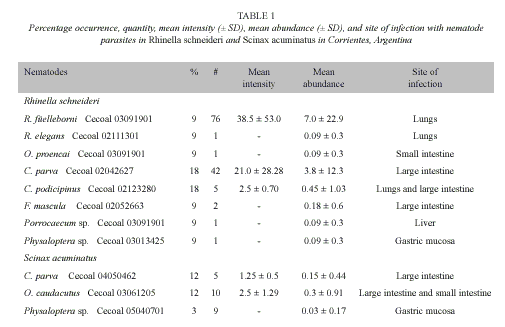
<body><![CDATA[<p><font face="Verdana" size="2"> </font></p>     <p><font face="Verdana" size="2">Lavilla <i>et al. </i>(2000) referred to 52 species of anurans for Corrientes province in the north of Argentina; the nematological fauna of most to these species has not been studied. Mordeglia and Digiani (1998) and González and Hamann (2004, 2006a, b, 2007a,b,c) have analyzed nematode parasites of the following species: <i>Chaunus granulosus major </i>(Müller &amp;</font><font  size="2"> </font><font face="Verdana" size="2">Hellmich, 1936), <i>C. fernandezae </i>(Gallardo, 1957), <i>C. bergi </i>(Céspedez, 2000) (Bufonidae), <i>Lysapsus limellum </i>Cope, 1862 (Hylidae), <i>Pseudopaludicola falcipes </i>(Hensel, 1867) (Leiuperidae), and, <i>Leptodactylus bufonius </i>Boulenger, 1894 (Leptodactylidae). Nematodes of larval amphibians have been reported by González and Hamann (2005) who found one pharyngodonid species, <i>Gyrinicola chabaudi </i>Araujo &amp; Artigas, 1982 in tadpoles of the hylid <i>Scinax nasicus </i>(Cope, 1862). </font></p>     <p><font face="Verdana" size="2">Continuing the study of Argentinean amphibians, we analyzed the parasite fauna of one bufonid species, <i>Rhinella schneideri </i>(Werner, 1894), and one hylid species, <i>Scinax acuminatus </i>(Cope, 1862). </font></p>     <p><font face="Verdana" size="2"><i>Rhinella schneideri </i>is distributed from the Atlantic coast of Brazil inland through Paraguay to central Bolivia; and southwest to northern and central Argentina and Uruguay, whereas to <i>S. acuminatus </i>is distributed in southern Mato Grosso and Mato Grosso do Sul (Brazil), Paraguay, Bolivia and northern Argentina (Frost 2007). <i>Rhinella schneideri</i>, like the majority species of <i>Rhinella</i>, is highly terrestrial and is an active predator with a gen- eralist diet. On the other hand, <i>S. acuminatus </i>occurs in forests, shrublands, and grasslands, and is very well adapted to anthropogenic areas; it has a generalist diet that it can be considered intermediate between a sit-and-wait and an actively foraging predator (Duré 2004). </font></p>     <p><font face="Verdana" size="2">The purpose of this study is to report for the first time nematodes harboured by <i>R. schneideri </i>and <i>S. acuminatus</i>. We describe the nematodes found in both species and present new morphological and metric data. </font></p> <b><font face="Verdana" size="3"> </font></b>     <p><b><font face="Verdana" size="3">Materials and methods</font></b><font  face="Verdana" size="2"> </font></p>     <p><font face="Verdana" size="2">Samples of <i>R. schneideri </i>(N = 11) and <i>S. acuminatus </i>(N = 33) were collected near the city of Corrientes, Province of Corrientes in Argentina (27°28’S -58°50’W), between January 2002 and December 2003. Six males (snout-vent length - SvL) = 42.58 mm ±31.82 SD; min.–max. = 10.1-86.6 and 26.0 g ±37.0 SD; min.–max. = 0.19-86.6 of weight), three females (SvL = 81.8 mm ±77.8 SD; min.–max. = 23.0-170.0, and 23.4 g ±24.5 SD; min.–max. = 1.8-50.0 of weight), and two juvenile (SvL = 15.75 mm ±1.06 SD; min.–max. = 15.0-16.5 and 0.39 g ±0.007 SD; min.–max. = 0.39-0.4 of weight), of <i>R. schneideri </i>were collected. Fifteen males (snout-vent length -SvL) = 33.64 mm ±5.42 SD; min.–max. = 25.5-43.0 and 3.87 g ±1.48 SD; min.–max. = 1.24-6.29 of weight) and eighteen females (snout-vent length -SvL) = 29.44 mm±4.65 SD; min.– max. = 21.0–41.0 and 3.06 g±1.99 SD; min.– max. = 0.74–9.19 of weight) of <i>S. acuminatus </i>were collected in same area. </font></p>     <p><font face="Verdana" size="2">Amphibians were transported live to the laboratory, killed in a chloroform (CHCL<sub>3</sub>) solution; and their snout-vent length (SvL) and body weight were recorded. At necropsy, hosts were sexed and the alimentary canal, lungs, liver, kidneys, urinary bladder, musculature and integument examined for parasites by dissection. Nematodes were observed in vivo, counted and killed in hot distilled water and preserved in 70% ethyl alcohol, cleared in glycerine or lactophenol and examined as temporary mounts. Some specimens were studied by scanning electron microscopy (SEM); these specimens were dehydrated in ethanol series, dried using the critical point technique, coated with gold, and examined with a JSM-5800 scanning electron microscope. Measurements are given in micrometers (µm) unless otherwise stated, as the mean ± SD followed by range in parentheses. Prevalence, mean intensity and mean abundance were calculated according to Bush <i>et al</i>. (1997). voucher specimens of all nematode species were deposited in the Helminthological Collection of the Centro de Ecología Aplicada del Litoral (CECOAL), Corrientes, Argentina. Amphibians were deposited in the Herpetological Collection of CECOAL (<i>S. acuminatus</i>: Cecoal 2405; <i>R. schneideri</i>: Cecoal 2663) </font></p> <b><font face="Verdana" size="3">     <p>Results</p> </font></b><font face="Verdana" size="2"> </font>     <p><font face="Verdana" size="2">A total of 153 nematodes was collected from 44 anurans examined. In <i>R. schneideri</i>, we found eight species of nematodes from six families: Rhabdiasidae: <i>Rhabdias füelleborni </i>Travassos, 1926 and <i>Rhabdias elegans </i>Gutierrez, 1945; Molineidae: <i>Oswaldocruzia proencai </i>Ben Slimane &amp; Durette-Desset, 1995; Cosmocercidae: <i>Cosmocerca podicipinus </i>Baker &amp; vaucher, 1984 and <i>Cosmocerca parva </i>Travassos, 1925; Kathlaniidae: <i>Falcaustra mascula </i>(Rudolphi, 1819) Freitas &amp; Lent, 1941; Ascarididae: <i>Porrocaecum </i>sp. (Larvae) and Physalopteridae: <i>Physaloptera </i>sp. (Larvae). In <i>S. acuminatus</i>, we found three species of nematodes from two families: Cosmocercidae: <i>Cosmocerca parva </i>and <i>Oxyascaris caudacutus </i>(Freitas, 1958) Baker &amp; vaucher, 1984, and, Physalopteridae: <i>Physaloptera </i>sp. (Larvae). Prevalence, number of parasites, mean intensity, mean abundance and site of infection for each one of these nematodes in each host appear in <a href="#t1">Table 1</a>. </font></p>     ]]></body>
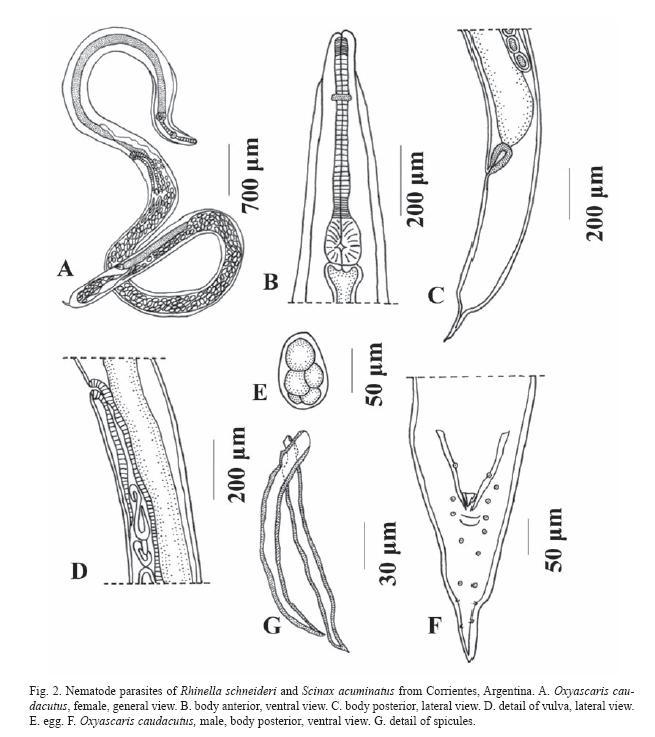
<body><![CDATA[<p align="center"><font face="Verdana" size="2">Family Rhabdiasidae Railliet, 1915 Genus <i>Rhabdias </i>Stiles &amp; Hassall, 1905 <i>Rhabdias füelleborni </i>Travassos, 1926 (<a href="#i1">Fig. 1A</a>)    <br> </font></p>     <p align="center"><font face="Verdana" size="2">    <br> <img src="/img/revistas/rbt/v56n4/art42t1.gif" title="" alt=""  style="width: 545px; height: 367px;"><a name="t1"></a>    <br> </font></p>     <p align="center"><font face="Verdana" size="2"><img  src="/img/revistas/rbt/v56n4/art42img1.jpg" title="" alt=""  style="width: 656px; height: 785px;"><a name="i1"></a>    <br> </font></p> <font face="Verdana" size="2"><b> </b></font>     <p><font face="Verdana" size="2"><b>Description: </b>Based on 14 gravid specimens. Body of parthenogenetic female 10.18±1.12 mm (8.55-12.0 mm) x 408.2±33.7 (350-450). Outer layers of body cuticle inflated.&nbsp; </font></p> <font face="Verdana" size="2"><i></i></font>     <p><font face="Verdana" size="2"><i> </i>Oral opening small, almost circular, surrounded by six small lips. Intestine filled with brown or black contents. Clavicular esophagus 560.7±66.5 (460-650) x 63.1±7.5 (50-75). Nerve ring 237.4±46.1 (186-350) from anterior extremity. vulva 4.88±0.32 mm (4.42-5.46 mm) from anterior end of body; ovaries straight, lying along intestine. Uteri wide, filled with numerous eggs; egg shell thin, smooth, hyaline; larvate eggs placed near to the vagina 114.6±19.6 (97-160) x 58.0±9.3 (48-80) wide. Tail conical, 358.3±69.7 (250-450) in length. </font></p> <font face="Verdana" size="2"><i> </i></font>     <p><font face="Verdana" size="2"><b>Remarks: </b><i>Rhabdias </i>Stiles and Hassall, irregular 1905 is a genus of nematode parasites widely distributed in ranids and bufonids but is infrequently found in salamanders, snakes and lizards (Baker 1987, Bursey <i>et al</i>. 2003, Martínez-Salazar and León-Règagnon 2006). In South American <i>Rhabdias füelleborni </i>was found in Brazil, Uruguay and Paraguay in the following hosts: <i>Bufo marinus</i>, <i>B. arenarum</i>, <i>B. ictericus</i>, <i>B. paracnemis </i>(Bufonidae) and <i>Leptodactylus pentadactylus </i>and <i>Eleutherodactylus guentheri </i> (Leptodactylidae) (Travassos 1926, Fahel 1952, Kloss 1971, 1974, Masi Pallares and Maciel 1974, Rodrigues <i>et al</i>. 1982, vicente <i>et al</i>. 1990, Luque <i>et al</i>. 2005, Martins and Fabio 2005). This is the first report of <i>R. füelleborni </i>in an amphibian from Argentina. The metric and morphologic data of specimens studied here agree with those of Travassos (1926). </font></p>     ]]></body>
<body><![CDATA[<p align="center"><font face="Verdana" size="2"><i>Rhabdias elegans </i>Gutierrez, 1945</font></p> <font face="Verdana" size="2"><b></b></font>     <p><font face="Verdana" size="2"><b>Description: </b>Based on 1 gravid specimen. Body of parthenogenetic female 6.2 mm x 400 mm. Cuticle swollen, with folds. Head end rounded. Simple mouth, not surrounded by distinguishable lips. Esophagus, 390 x 50. vulva 3.5 mm from anterior end of body. Uteri with numerous eggs; larvated eggs 88 x 53 wide. Tail conical 220 in length.</font></p> <font face="Verdana" size="2"><b></b></font>     <p><font face="Verdana" size="2"><b>Remarks: </b>In Argentina, this species was found in <i>B. arenarum </i>(Bufonidae) from the province of Buenos Aires (Gutierrez 1945) and from the province of Salta (Sueldo and Ramírez 1976), in <i>Leptodactylus bufonius </i>(Leptodactylidae) from the province of Corrientes (González and Hamann 2006b), in <i>Bufo rufus </i>from Brazil, in <i>B. ictericus </i>from Paraguay and Brazil, and in <i>B. arenarum </i>(Bufonidae) from Uruguay (Kloss 1971, 1974, Baker 1987, vicente <i>et al</i>. 1990, Luque <i>et al. </i>2005). </font></p>     <p><font face="Verdana" size="2">Compared with specimens studied by Gutierrez (1945) the female found in <i>R. schneideri </i>has eggs with a smaller length (Gutiérrez 1945: 91-112 µm); other characters (e.g., body size and esophagus length) are similar. </font></p>     <p align="center"><font face="Verdana" size="2">Family Molineidae</font>    <br> <font face="Verdana" size="2">Durette-Desset &amp; Chabaud, 1977</font>    <br> <font face="Verdana" size="2">Genus <i>Oswaldocruzia </i>Travassos, 1917</font>    <br> <font face="Verdana" size="2"><i> Oswaldocruzia proencai    <br> </i></font> <font face="Verdana" size="2">Ben Slimane &amp; Durette-Desset, 1995</font></p> <font face="Verdana" size="2"><b></b></font>     <p><font face="Verdana" size="2"><b>Description: </b>Based on 1 male specimen. Body 10.5 mm x 127.5, with maximum width at level of midbody. Claviform esophagus 540 length. Nerve ring 184 from anterior extremity. Excretory pore 282 from anterior extremity. Caudal bursa: rays 8 arising on root of the dorsal ray, and overlapped with rays 6 in half of its length only. Dorsal ray conical, rising from common base with ribs 8, tapering to pointed tip. Spicules 165.6 in length, distal third divided into 3 branches: blade, shoe and fork. Ribs 4 more short than ribs 5. Branches of the spicule with equivalent length. </font></p> <font face="Verdana" size="2"><b></b></font>     ]]></body>
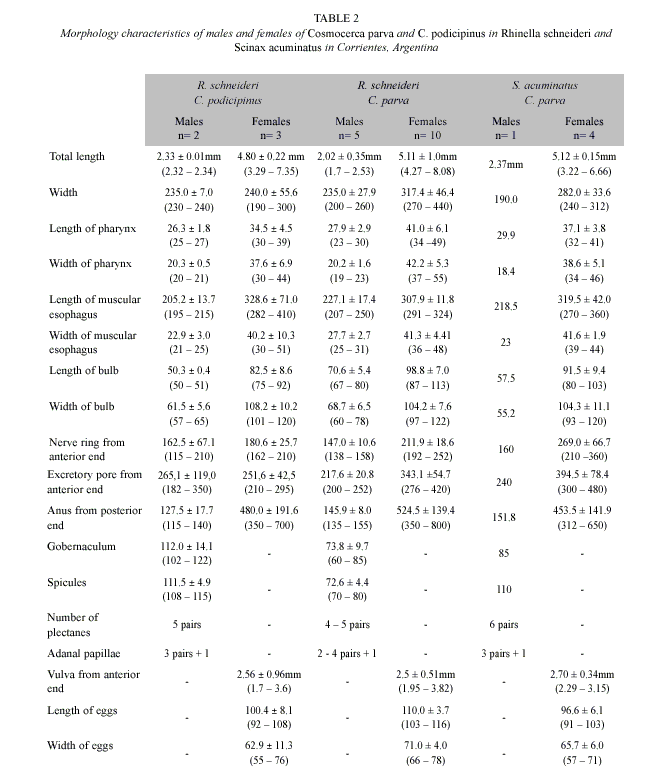
<body><![CDATA[<p><font face="Verdana" size="2"><b>Remarks: </b>Ben Slimane <i>et al</i>. (1996) analyzed the morphology of the caudal bursa and identified 72 species of <i>Oswaldocruzia</i>. The species <i>O. proencai </i>is included within the groupe possessing type II bursa. The neotropical <i>Oswaldocruzia </i>have spicula divided in three main branches: blade, shoe and fork and the division of the fork always occurs before the distal third of its length (in holartic species occurs beyond the distal third). Gubernaculum is absent. On the other hand, Ben Slimane and Durette-Desset (1995) proposed the species </font></p>     <p><font face="Verdana" size="2">O. <i>proencai </i>for the specimens collected in the amphibians <i>Bufo paracnemis</i>, <i>Leptodactylus ocellatus </i>and <i>L. bufonius </i>from Paraguay and that was described by Lent <i>et al</i>. (1946) like <i>O. mazzai </i>Travassos, 1935. This is the first report of <i>O. proencai </i>in an amphibian from Argentina. </font></p>     <p align="center"><font face="Verdana" size="2">Family Cosmocercidae Travassos, 1925</font></p>     <p align="center"><font face="Verdana" size="2">Genus <i>Cosmocerca </i>Diesing, 1861</font></p> <font face="Verdana" size="2"><i>     <p align="center">Cosmocerca podicipinus</p> </i></font>     <p align="center"><font face="Verdana" size="2">Baker &amp; vaucher, 1984</font></p>     <p><font face="Verdana" size="2">The caudal portion of the males of this species was extensively detailed for González and Hamann (2004), those that provided new morphologic information related to the structure of the plectanas and the adanal papillae. This species is readily distinguished from other species by the fusion of the underlying sclerotized plectane supports between the plectanes (Baker and vaucher 1984). The <a href="#t2">Table 2</a> shows the metric characters of the males and females of <i>C. podicipinus </i>found in <i>R. schneideri</i>. </font></p> <font face="Verdana" size="2"><i>     <p align="center">Cosmocerca parva</p> </i></font>     <p align="center"><font face="Verdana" size="2">Travassos, 1925 (<a  href="#i1">Fig. 1B, C, D</a>)</font></p>     <p><font face="Verdana" size="2">This species is distinguished from the <i>Cosmocerca podicipinus </i>in the morphology of the plectanes; in <i>C. parva </i>union between the plectanas of each row does not exist, whereas in <i>C. podicipinus </i>the plectanes on each side of body are fused by underlying sclerotized supports; in addition, the lateral alae in this species are very marked. </font></p>     ]]></body>
<body><![CDATA[<p><font face="Verdana" size="2">The metric characters of the males and females of these nematodes found in <i>R</i>. <i>schneideri </i>and <i>S. acuminatus </i>are present in <a href="#t2">Table 2</a>.    <br> </font></p>     <p style="text-align: center;"><font face="Verdana" size="2"><img  src="/img/revistas/rbt/v56n4/art42t2.gif" title="" alt=""  style="width: 692px; height: 816px;"><a name="t2"></a>    <br> </font></p> <font face="Verdana" size="2"><b></b></font>     <p><font face="Verdana" size="2"><b>    <br> Remarks: </b>In South America, the genus <i>Cosmocerca </i>is widely distributed in amphibians and reptiles (Baker 1987). </font></p>     <p><font face="Verdana" size="2">In Paraguay, <i>C. podicipinus </i>was found in <i>Leptodactylus podicipinus</i>, <i>L. fuscus</i>, <i>L. elenae </i>and <i>L. chaquensis </i>(Leptodactylidae) (Baker and vaucher 1984); in Colombia was found by Goldberg and Bursey (2003) in <i>Atelopus spurrelli </i>(Bufonidae) and <i>Dendrobates histrionicus </i>(Dendrobatidae); in Peru was found in <i>Bufo typhonius </i>(Bufonidae), <i>Colostethus marchesianus</i>, <i>Epipedobates femoralis </i>(Dendrobatidae), <i>Eleutherodactylus imitatrix </i>and <i>Leptodactylus leptodactyloides </i>(Leptodactylidae) by Bursey <i>et al. </i>(2001), in Brazil in <i>Scinax fuscomarginatus</i>(Goldberg <i>et al</i>. 2007), and, in Argentina, in <i>Pseudopaludicola falcipes </i>(Leiuperidae), <i>Leptodactylus bufonius</i>, <i>L. latinasus</i>, <i>L. chaquensis </i>(Leptodactylidae) and <i>Chaunus granulosus major</i>, <i>C. bergi </i>and </font><i>C. fernandezae </i>(Bufonidae) (González and Hamann 2004, 2006a,b, 2007a, b, Hamann <i>et al. </i>2006a, b). </p> <font face="Verdana" size="2"></font>     <p><font face="Verdana" size="2"><i>Cosmocerca parva </i>was found in <i>Leptodactylus mystaceus</i>, <i>L</i>. <i>caliginosus</i>, <i>L. fuscus</i>, <i>L. ocellatus</i>, <i>Adenomera marmorata</i>, <i>Physalaemus signiferus </i>and <i>P. soaresi </i>(Leptodactylidae) and <i>Olylogon fuscovaria </i>(Hylidae) from Brazil (Silva 1954, Fabio 1982); in <i>Leptodactylus </i>sp., <i>L. chaquensis</i>, <i>L. elenae </i>(Leptodactylidae) and <i>Olylogon fuscovaria </i>(Hylidae) from Paraguay (Masi Pallares and Maciel 1974, Baker and vaucher 1984); in <i>Bufo glaberrimus, B. marinus </i>and <i>B. typhonius </i>(Bufonidae), <i>Epipedobates pictus </i>(Dendrobatidae), <i>Hyla fasciata, Phyllomedusa atelopoides</i>, <i>Scarthyla ostinodactyla</i>, <i>Scinax garbei</i>, <i>S. icterica </i>(Hylidae), <i>Edalorhina perezi</i>, <i>Eleutherodactylus fenestratus</i>, <i>E. peruvianus</i>, <i>E. toftae</i>, <i>Leptodactylus leptodactyloides</i>, <i>L. mystaceus </i>(Leptodactylidae), <i>Elachistocleis ovalis </i>and <i>Hamptophryne boliviana </i>(Microhylidae) from Peru (Bursey <i>et al</i>. 2001). Finally, in Argentina, it was found in bufonids <i>Chaunus granulosus major</i>, <i>C. fernandezae </i>and <i>C. bergi </i>and, in leptodactylids <i>Leptodactylus bufonius</i>, <i>L. chaquensis </i>and <i>L. latinasus </i>(Mordeglia and Digiani 1998, González and Hamann 2006a,b, González and Hamann 2007a, b, Hamann <i>et al</i>. 2006a, b). </font></p>     <p><font face="Verdana" size="2">The general metric characteristics of the specimens of <i>Cosmocerca podicipinus </i>corresponds to others nematodes of the same species analyzed from others hosts of Corrientes, Argentina. Nevertheless, the body size of the females of this study is greater (3.0-7.0 mm) than the found ones in other hosts; for example, the maximum body size of females of <i>C. podicipinus </i>from <i>P. falcipes</i>: 6.0 mm (González and Hamann, 2004); from <i>C. fernandezae</i>: 4.3 mm; from <i>C. bergi</i>: 6.9 mm (González and Hamann, 2007a). The other metric characters, in both males and females, are similar to those found by the authors mentioned for this geographic region. The length of spicule of male collected from <i>S. acuminatus </i>is longer than found in <i>R. schneideri</i>. </font></p>     <p><font face="Verdana" size="2">With respect to <i>Cosmocerca parva</i>, we found that the female specimens collected from <i>R. schneideri </i>are longer than found in <i>S. acuminatus </i>and the other specimens collected from bufonids of the same area, i.e., from <i>Chaunus granulosus major</i>: 5.1 mm (González and Hamann 2006a); <i>C. fernandezae</i>: 6.7 mm and <i>C. bergi</i>: 5.6 mm (González and Hamann 2007a). </font></p>     ]]></body>
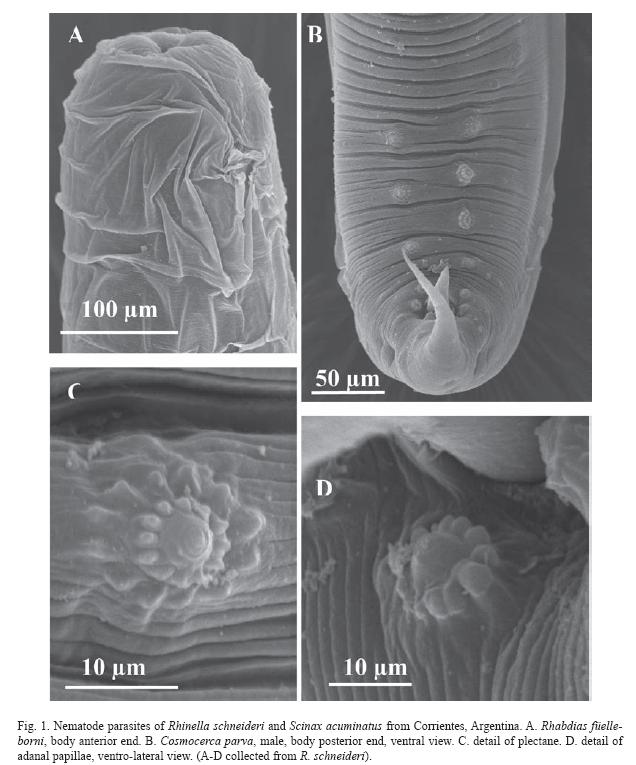
<body><![CDATA[<p><font face="Verdana" size="2">The males of <i>C. parva </i>can have from 5 to 7 pairs of plectanes (Baker and vaucher 1984). In the present study, the most males of <i>C. parva </i>analyzed from <i>R. schneideri </i>had 5 pairs of plectanes, although some of them had 4 pairs. Each plectane was formed by one interior complete rosette of 12-15 punctations and one exterior complete rosette of 12-15 punctations, and, a relatively inconspicuous underlying sclerotized support which is not fused to other plectanes. Previously reports of plectanes with scanning electron microscopy realized by Mordeglia and Digiani (1998) showed 12-16 punctations in each rosette of these structures. The only male of <i>C. parva </i>found in <i>S. acuminatus </i>presented 6 pairs of plectanes. </font></p>     <p><font face="Verdana" size="2">The numbers of pairs of adanal papillae varied between 2 and 4 pairs in specimens from <i>R. schneideri </i>but were 3 pairs only in male collected from <i>S. acuminatus</i>. González and Hamann (2006a, 2007a) found 2-4 pairs of adanal papillae in males of <i>C. parva </i>from <i>C. granulosus major </i>and <i>C. fernandezae</i>; and 3 pairs only in males from <i>C. bergi</i>. We observed the unpaired little papilla on the anterior lip of anus in males of <i>C. parva </i>in both hosts of this study. </font></p>     <p><font face="Verdana" size="2">Both, <i>R. schneideri </i>and <i>S. acuminata</i>, represent new host records for <i>C</i>. <i>podicipinus </i>and <i>C. parva</i>. </font></p>     <p><font face="Verdana" size="2"> </font></p>     <p align="center"><font face="Verdana" size="2">Genus <i>Oxyascaris </i>Travassos, 1920</font></p> <font face="Verdana" size="2"><i></i></font>     <p align="center"><font face="Verdana" size="2"><i>Oxyascaris caudacutus </i>(Freitas, 1958)</font></p>     <p align="center"><font face="Verdana" size="2">Baker &amp; vaucher, 1984 (<a href="#i2">Fig. 2 A-G</a>)    <br> </font></p>     <p align="center"><font face="Verdana" size="2">    <br> </font></p>     ]]></body>
<body><![CDATA[<p align="center"><font face="Verdana" size="2"><img  src="/img/revistas/rbt/v56n4/art42img2.jpg" title="" alt=""  style="width: 675px; height: 757px;"><a name="i2"></a>    <br> </font></p> <font face="Verdana" size="2"><b></b></font>     <p><font face="Verdana" size="2"><b>Description: </b>Nematodes with marked dimorphism in size; mature females more than twice as large as male. Oral opening triangular, three small lips present. Four large outer papillae and six minute inner labial papillae in the cephalic extremity. Lateral alae extending from just anterior to nerve ring in both sexes to the preanal region in males and to near midbody in females. Markedly wide and thick at anterior end and tapering rapidly posteriorly. Somatic papillae present, in two subventral and two subdorsal rows. </font></p> <font face="Verdana" size="2"><b><i></i></b></font>     <p><font face="Verdana" size="2"><b><i>Males: </i></b>based on 3 specimens. Body 3.4±0.65 mm (2.65-3.9 mm) x 173.33±32.14 (150-210). Pharynx 31.5±7.46 (23-37) x 22.56±1.69 (20.7-24). Esophagus divided in two portions: corpus 290±28.28 (270-310) x 29.93±4.60 (25.3-34.5), and bulb 72.0±4.24 (69-75) x 68.26±9.61 (57.5-76). Nerve ring 200.0±70.71 (150-250) from anterior extremity. Excretory pore 370.6±25.32 (342-390) from anterior extremity. Tail conical, 208.0±9.16 (198-216) long, with four pairs of subventral and two pairs of subdorsal papillae; one umpaired papilla on anterior lip of cloaca, and three pairs of subventral papillae variable in position. Spicules sharply pointed distally, 144.0±29.4 (110-161) long. Gubernaculm weakly sclerotized, 37.25±3.88 (34.5-40) long.</font></p>     <p><font face="Verdana" size="2"> </font></p> <font face="Verdana" size="2"><b><i></i></b></font>     <p><font face="Verdana" size="2"><b><i>Females: </i></b>based on 7 gravid specimens. Body 12.0±2.07 mm (9.0-16.0 mm) x 272.0±58.93 (165-375) with maximum width at level of vulva. Pharynx 45.91±6.71 (34.557.5) x 42.04±5.83 (34.5-52.9). Esophagus divided in two portions: corpus 439.0±34.47 (384-498) x 46.84±7.91 (34.5-57.5), and bulb 91.15±9.78 (78.2-110) x 89.03 ±8.91 (75.9100). Nerve ring 415.5±50.04 (342-450) from anterior extremity. Excretory pore 434.8±62.91 (354-534) from anterior end of body. vulva 4.0±0.59 (3.15-4.8) from anterior extremity. Tail robust, tapering abruptly to distal spike, 0.90±0.11 mm (0.67-1.05 mm) long. Uteri in mature females containing many eggs and free larvae. Eggs oval, thin-walled, 84.48±10.91 (69-103.5) x 52.28±5.75 (46-62.140), often contains fully developed larvae. </font></p> <font face="Verdana" size="2"><b></b></font>     <p><font face="Verdana" size="2"><b>Remarks: </b>This species was originally described from <i>Hyla nasica </i>(identification of host not definitive according to Freitas 1958), of Sao Paulo, Brazil. Then, it was found in <i>Leptodactylus fuscus </i>and <i>L. mystacinus </i>(Leptodactylidae) from Brazil, too (Fabio 1982) and, in <i>Ololygon fuscovaria </i>(Hylidae) from Paraguay (Baker and vaucher 1985). This is the first report of this species for Argentinean amphibians. </font></p>     <p><font face="Verdana" size="2">The general morphology of this specimens correspond with others descriptions (Freitas 1958, Baker and vaucher 1985) but we added with this study some metric characters, e.i., the range of body size of male specimens: of these study are greater than of those of the original description, and of the other host (Freitas 1958: 2.78-3.62 mm; Baker and vaucher 1985: 3.50-3.70 mm; present study: 2.65-3.90 mm); in these specimens they have been spicules of greater length than in the specimens of previous studies (Freitas 1958: 122-134 µm; Baker and vaucher 1985: 148-155 µm; present study: 110-161 µm); finally, with respect to gubernaculum, Freitas (1958) does not provide any measurement of this masculine genital structure; on the other hand, Baker and vaucher (1985) found in this structure a length between 36 and 40 µm. The lateral alae got to measure 35 µm in specimens studied by Baker and vaucher (1985), whereas in the present study they reached 39 µm. </font></p>     <p align="center"><font face="Verdana" size="2">Family Kathlaniidae Lane, 1914</font></p>     <p align="center"><font face="Verdana" size="2">Genus <i>Falcaustra </i>Lane, 1915</font></p> <font face="Verdana" size="2"><i></i></font>     ]]></body>
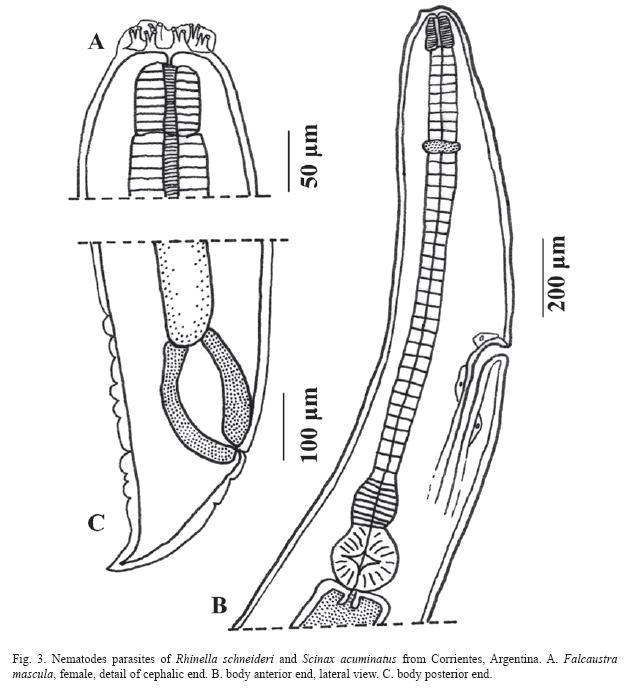
<body><![CDATA[<p align="center"><font face="Verdana" size="2"><i>Falcaustra mascula </i>(Rudolphi, 1819)</font></p>     <p align="center"><font face="Verdana" size="2">Freitas &amp; Lent, 1941 (<a href="#i3">Fig. 3 A-C</a>)    <br> </font></p>     <p align="center"><font face="Verdana" size="2">    <br> <img src="/img/revistas/rbt/v56n4/art42img3.jpg" title="" alt=""  style="width: 658px; height: 702px;"><a name="i3"></a>    <br> </font></p> <font face="Verdana" size="2"><b></b></font>     <p><font face="Verdana" size="2"><b>Description: </b>Based on 2 females specimens. Body 10.75±1.9mm (9.37-12.12 mm) x 405±7.07 (400-410). Cuticle with fine longitudinal striations. Pharynx 75.0±7.07 (70-80) x 71.0±1.41 (70-72). Esophagus (with isthmus) 1.38±0.017 mm (1.37-1.4 mm) x 70.8±5.86 (66.7-75); isthmus 135.0±21.21 (120-150) x 105.0±7.07 (100-110); bulb 163.5±2.12 (162165) x 193.0±9.89 (186-200). Nerve ring 345.0±7.07 (340-350) from anterior end of body. Excretory pore 1.09±0.22 mm (0.931.25 mm) from anterior extremity. vulva 7.70±1.73 mm (6.47-8.92) from anterior end of body. Tail 355.0±7.07 (350-360) in length. The studied females did not have eggs. </font></p>     <p><font face="Verdana" size="2"><b>Remarks: </b>In South America, <i>Falcaustra mascula </i>was found in <i>Leptodactylus ocellatus</i>, <i>L. pentadactylus</i>, <i>L. caliginosus</i>, <i>L. rhodomystax</i>, <i>Crossodactylus gaudichaudii</i>, <i>Eleutherodactylus parvus</i>, <i>E. guentheri </i>and <i>Elosia nasus </i>(Leptodactylidae), <i>Bufo paracnemis </i>and <i>B. ictericus </i>(Bufonidae), <i>Hyla faber </i>(Hylidae) from Brazil and Paraguay (Freitas and Lent 1941, Lent <i>et al</i>. 1946, Gomes and vicente 1966, vicente and dos Santos 1976, Guimaraes <i>et al</i>. 1976, Fabio 1982, Rodrigues <i>et al</i>. 1982, Baker 1987, vicente <i>et al</i>. 1990, Luque <i>et al</i>. 2005, Martins and Fabio 2005, Goldberg <i>et al</i>. 2007). </font></p>     <p><font face="Verdana" size="2">The measurements of these specimens are something greater than those found by Freitas and Lent (1941) and by vicente and dos Santos (1976); for example, the total length of body (Freitas and Lent 1941: 8.66-9.78 mm; vicente and dos Santos 1976: 7.23 mm; present study: 9.37-12.12 mm), the length of excretory pore to anterior end (Freitas and Lent 1941: 1.07-1.20 mm; vicente and dos Santos 1976: 1.07 mm; present study: 0.93-1.25 mm) and the distance of vulva to the anterior end (vicente and dos Santos 1976: 5.67 mm; present study: 6.478.92 mm). </font></p>     <p><font face="Verdana" size="2">This is the first record of <i>F. mascula </i>in an amphibian from Argentina. </font></p>     ]]></body>
<body><![CDATA[<p align="center"><font face="Verdana" size="2">Family Ascarididae Baird, 1853</font></p>     <p align="center"><font face="Verdana" size="2">Genus <i>Porrocaecum </i>Raillet &amp; Henry, 1912</font></p> <font face="Verdana" size="2"><i></i></font>     <p align="center"><font face="Verdana" size="2"><i>Porrocaecum </i>sp. (Larvae)</font></p>     <p align="center"></p>     <p><font face="Verdana" size="2"><b>Description: </b>Based on 1 specimen. Body witish, 9.3 mm x 195.0. Cuticle almost smooth or with very fine transverse striations. Cephalic end rounded, bearing small ventral larval tooth. Lips with dentigerous ridges. Esophagus narrow, 875.0 long. Nerve ring encircling esophagus, 186.3 from anterior extremity. Excretory pore 222.0 from anterior end of body. ventriculus elongate 130 x 90; caecum 550 x 37.5. Rectum a short hyaline tube; small rectal glands present. Anus 126.5 from posterior extremity. </font></p> <font face="Verdana" size="2"><b></b></font>     <p><font face="Verdana" size="2"><b>Remarks: </b>In South America, <i>Porrocaecum </i>larvae were recorded in <i>Pipa pipa </i>(Pipidae) from Peru (Bursey <i>et al</i>. 2001) and in <i>L. chaquensis </i>(Leptodactylidae) from Argentina (Hamann <i>et al</i>. 2006b). These larvae undoubtedly belong to a <i>Porrocaecum </i>species parasitizing predatory birds, with amphibians and reptiles serving as paratenic hosts. </font></p>     <p align="center"><font face="Verdana" size="2">Family Physalopteridae Leiper, 1908</font></p>     <p align="center"><font face="Verdana" size="2">Genus <i>Physaloptera </i>Rudolphi, 1819</font></p> <font face="Verdana" size="2"><i></i></font>     <p align="center"><font face="Verdana" size="2"><i>Physaloptera </i>sp. (Larvae)</font></p>     <p align="center"></p> <font face="Verdana" size="2"><b></b></font>     ]]></body>
<body><![CDATA[<p><font face="Verdana" size="2"><b>Description: </b>(corresponding measurements of larvae obtained in <i>R. schneideri </i>are given whitin brackets). Larval body whitish, with transversely annulated cuticle. Terminus of head with two lateral lips and cephalic collar formed by inflated cuticle. On either lip a sclerotized support and one terminal tooth present at upper margin. Each lip bearing two cephalic papillae and one amphid. Total length 3.59±0.65 mm (2.3-4.4) [5.9mm] x 163.3±22.7. (120200) [280.0]. Muscular esophagus 176.0±18.4 (138-205) [275.0] x 32.7±3.5 (28-38) [45.0] and glandular esophagus 1.1±0.13mm (0.8-1.2) [1.75mm] x 59.3±7.0(51-70) [69.0]. Nerve ring and excretory pore from anterior end 149.0±17.8 (122-175) [275.0] and 161.1±12.0 (138-174) [360.0], respectively. Tail conical. Anus from posterior end 120.7±9.4 (110-135) [120.0]. </font></p> <font face="Verdana" size="2"><b></b></font>     <p><font face="Verdana" size="2"><b>Remarks: </b>Larvae of this genus were found in the following South American amphibians: <i>Hyla faber </i>(Hylidae),<i>Bufo marinus </i>(Bufonidae), <i>Adenomera marmorata</i>, <i>Leptodactylus caliginosus</i>, <i>L. mystaceus</i>, <i>Physalaemus signiferus</i>, </font></p> <font face="Verdana" size="2"><i></i></font>     <p><font face="Verdana" size="2"><i>P. soaresi </i>and <i>Proceratophrys appendiculata </i>(Leptodactylidae), from Brazil (Boquimpani-Freitas <i>et al</i>. 2001, vicente <i>et al</i>. 1990); in <i>Bufo marinus </i>and <i>B. typhonius </i>(Bufonidae), in <i>Colostethus marchesianus </i>(Dendrobatidae), in <i>Hyla boans</i>, <i>H. fasciata</i>, <i>H. granosa</i>, <i>H. leali</i>, <i>H. leucophyllata</i>, <i>H. marmorata</i>, <i>Osteocephalus taurinus</i>, <i>Phrynohyas coriacea</i>, <i>P. venulosa</i>, <i>Phyllomedusa tomopterna</i>, <i>Scinax ictericus </i>and <i>S. ruba </i>(Hylidae), in <i>Edalorhina perezi</i>, <i>Eleutherodactylus cruralis</i>, <i>E. fenestratus</i>, <i>Leptodactylus bolivianus</i>, <i>L. leptodactyloides</i>, <i>L. mystaceus</i>, <i>L. pentadactylus</i>, <i>L. rhodonotus </i>and <i>Lithodytes lineatus </i>(Leptodactylidae), in <i>Ctenophryne geayi </i>and <i>Hamptophryne boliviana </i>(Microhylidae) and <i>Pseudis paradoxa </i>(Pseudidae) from Peru (Bursey <i>et al</i>. 2001). In Argentina, it was found by Gutiérrez <i>et al</i>. (2005) in <i>Physalaemus biligonigerus </i>and by González and Hamann (2006a, b, 2007a) in <i>Leptodactylus bufonius </i>(Leptodactylidae) and in <i>Chaunus granulosus major </i>and in <i>C. fernandezae </i>(Bufonidae). <i>Rhinella schneideri </i>and <i>Scinax acuminatus </i>represent two new records for this nematode. </font></p>     <p><font face="Verdana" size="2">The measures of the larvae found in the bufonid were, in general, greater than the found ones in the hilids. These measurements correspond to the larvae found in other bufonids studied in the same area (González and Hamann 2006a). </font></p> <b><font face="Verdana" size="3"> </font></b>     <p><b><font face="Verdana" size="3">Discussion </font></b><font  face="Verdana" size="2"> </font></p>     <p><font face="Verdana" size="2">Four of nine species of nematodes found in amphibians of this study were new records for Argentina: <i>Rhabdias füelleborni</i>, <i>Oswaldocruzia proencai</i>, <i>Falcaustra mascula </i>and <i>Oxyascaris caudacutus</i>, whereas <i>Rhabdias elegans</i>, <i>Cosmocerca parva</i>, <i>C. podicipinus</i>, <i>Porrocaecum </i>sp. and <i>Physaloptera </i>sp. have previously been reported from Argentinean amphibians. All these nematodes have been found in hylids and bufonids of South America, except <i>Porrocaecum </i>sp. that until now had been found in leptodactilids and pipids amphibians only from Argentina (Hamann <i>et al</i>. 2006b) and Peru (Bursey <i>et al</i>. 2001). In the present study no rhabditids were found in <i>S. acuminatus</i>. Besides, this host has less than half species of nematodes that <i>R. schneideri</i>. </font></p>     <p><font face="Verdana" size="2">All nematode species found in this study were classified as generalist because they were not restricted to a single host species. </font></p>     <p><font face="Verdana" size="2">In general, the bufonids present high predominance of nematodes in their parasitofauna; the highest species richness of nematodes in South America was reported by Luque <i>et al</i>. (2005) in <i>Bufo ictericus </i>from Brazil with thirteen nematodes species. For other bufonids the reports were the following: six species for <i>B. typhonius</i>, four species for <i>B. marinus </i>and <i>Atelopus bomolochus</i>, and two species for <i>B. glaberrimus </i>from Peru (Bursey <i>et al</i>. 2001, Iannacone 2003), three species for <i>Atelopus spurelli </i>from Colombia (Goldberg and Bursey 2003), and four species for <i>Chaunus granulosus major </i>and <i>C. fernandezae </i>from Argentina (González and Hamann 2006a, 2007); lowest species richness of nematodes in Argentinean bufonids were two species for <i>C. bergi </i>(González and Hamann 2007a,b). </font></p>     <p><font face="Verdana" size="2">In the genus <i>Scinax </i>nematode species richness is, in general, low. In Peruvian anurans only one species was found in <i>S. pedromedinai</i>, two in <i>S. garbei </i>and <i>S</i>. <i>ruba</i>, and three species in <i>S. icterica </i>(Bursey <i>et al</i>. 2001); in Brazil, Azevedo-Ramos <i>et al. </i>(1998) found two species of nematodes in <i>S. trilineata </i>and in <i>S. nebulosa, </i>and, and Goldberg <i>et al. </i>(2007) found two species in <i>S. fuscomarginatus. </i></font></p>     <p><font face="Verdana" size="2">In agreement with Bursey <i>et al</i>. (2001), we found different nematode species between <i>R. schneideri </i>(terrestrial habitat), and <i>S. acuminatus </i>(mostly arboreal habitat), suggesting host behaviour and parasites biology are an important factor in the infection of parasites, but, in contraposition of these authors we found the most important intestinal nematodes in terrestrial amphibia were those that infect host by skin penetration (i.e., <i>Rhabdias </i>spp. and <i>Cosmocerca </i>spp.) this result could be explained by the type of habitat in our studies. </font></p> <b><font face="Verdana" size="3">     ]]></body>
<body><![CDATA[<p>Acknowledgments</p> </font></b><font face="Verdana" size="2"> </font>     <p><font face="Verdana" size="2">This work was partially supported by Consejo Nacional de Investigaciones Científicas y Técnicas (CONICET) from Argentina, through grant PIP 2945 to M. I. Hamann. The suggestions made by referees have greatly improved the manuscript.</font></p> <hr style="width: 100%; height: 2px;">     <p><font face="Verdana" size="2"> </font></p> <font face="Verdana" size="2"><b> </b></font>     <p><font face="Verdana" size="2"><b>Resumen</b> </font></p>     <p><font face="Verdana" size="2">Cuarenta y cuatro anfibios pertenecientes a dos especies (<i>Rhinella schneideri </i>–seis machos, tres hembras y dos juveniles- y <i>Scinax acuminatus </i>–quince machos y dieciocho hembras) fueron recolectados para extraer nemátodos en las proximidades de la ciudad de Corrientes, provincia de Corrientes en Argentina, entre enero 2002 y diciembre 2003. <i>Rhinella schneideri </i>estuvo parasitada por ocho especies de nemátodos (adultos: <i>Rhabdias füelleborni</i>, <i>R. elegans</i>, <i>Oswaldocruzia proencai</i>, <i>Cosmocerca podicipinus</i>, <i>C. parva </i>y <i>Falcaustra mascula</i>; larvas: <i>Porrocaecum </i>sp. y <i>Physaloptera </i>sp.), y <i>S. acuminatus </i>presentó tres especies de nemátodos (adultos: <i>Cosmocerca parva </i>y <i>Oxyascaris caudacutus</i>; larva: <i>Physaloptera </i>sp.). Para todas estas especies de nemátodos se presentan datos morfológicos y métricos, y para algunas sus nuevos ámbitos y caracteres, así como también los detalles obtenidos mediante el microscopio electrónico de barrido. Éste es el primer informe de nemátodos parásitos para los citados anfibios de Corrientes, Argentina. </font></p> <font face="Verdana" size="2"><b></b></font>     <p><font face="Verdana" size="2"><b>Palabras clave: </b>anfibios, <i>Rhinella schneideri</i>, <i>Scinax acuminatus</i>, nemátodos parásitos, Corrientes, Argentina.</font></p> <hr style="width: 100%; height: 2px;">     <p align="center"><font face="Verdana" size="2">Received 10-I-2008. Corrected 30-VI-2008. Accepted 31-VII-2008.</font></p> <b><font face="Verdana" size="3"> </font></b>     <p><b><font face="Verdana" size="3">References </font></b><font  face="Verdana" size="2"> </font></p>     <!-- ref --><p><font face="Verdana" size="2">Azevedo-Ramos, C., M.M.Q. Santos &amp; v.R.L Oliveira. 1998. Helminths of Three Amazonian Treefrogs: Interspecific Differences in Prevalence and Infection Intensity of Parasites. Cien. Cult. 50: 361-363.    &nbsp;&nbsp;&nbsp;&nbsp;&nbsp;&nbsp;&nbsp;&nbsp;[&#160;<a href="javascript:void(0);" onclick="javascript: window.open('/scielo.php?script=sci_nlinks&ref=1690600&pid=S0034-7744200800040004200001&lng=','','width=640,height=500,resizable=yes,scrollbars=1,menubar=yes,');">Links</a>&#160;]<!-- end-ref --> </font></p>     ]]></body>
<body><![CDATA[<!-- ref --><p><font face="Verdana" size="2">Baker, M.R. 1987. Synopsis of the nematoda parasitic in amphibians and reptiles. Occasional Papers in Biology. No 11. Memorial University of Newfoundland. Guelph, Ontario, Canada.    &nbsp;&nbsp;&nbsp;&nbsp;&nbsp;&nbsp;&nbsp;&nbsp;[&#160;<a href="javascript:void(0);" onclick="javascript: window.open('/scielo.php?script=sci_nlinks&ref=1690602&pid=S0034-7744200800040004200002&lng=','','width=640,height=500,resizable=yes,scrollbars=1,menubar=yes,');">Links</a>&#160;]<!-- end-ref --> </font></p>     <!-- ref --><p><font face="Verdana" size="2">Baker, M.R. &amp; C. vaucher. 1984. Parasitic Helminths from Paraguay vI: <i>Cosmocerca </i>Diesing, 1861 (Nematoda: Cosmocercoidea) from frogs. Rev. suisse Zool. 91, 925-934.    &nbsp;&nbsp;&nbsp;&nbsp;&nbsp;&nbsp;&nbsp;&nbsp;[&#160;<a href="javascript:void(0);" onclick="javascript: window.open('/scielo.php?script=sci_nlinks&ref=1690604&pid=S0034-7744200800040004200003&lng=','','width=640,height=500,resizable=yes,scrollbars=1,menubar=yes,');">Links</a>&#160;]<!-- end-ref --> </font></p>     <!-- ref --><p><font face="Verdana" size="2">Baker, M.R. &amp; C. vaucher. 1985. Parasitic Helminths from Paraguay vII: Systematic Position of <i>Oxyascaris </i>Travassos, 1920 (Nematoda: Cosmocercoidea). Rev. suisse Zool. 92: 303-310.    &nbsp;&nbsp;&nbsp;&nbsp;&nbsp;&nbsp;&nbsp;&nbsp;[&#160;<a href="javascript:void(0);" onclick="javascript: window.open('/scielo.php?script=sci_nlinks&ref=1690606&pid=S0034-7744200800040004200004&lng=','','width=640,height=500,resizable=yes,scrollbars=1,menubar=yes,');">Links</a>&#160;]<!-- end-ref --> </font></p>     <!-- ref --><p><font face="Verdana" size="2">Ben Slimane, B. &amp; M-C. Durette-Desset. 1995. <i>Oswaldocruzia </i>(Nematoda, Trichostrongylina, Molineoidea) parasites d’Amphibiens du Brésil et de l’Équateur, avec redéfinition de l’espèce-type <i>O. subauricularis </i>(Rudolphi, 1819) et d’<i>O. mazzai </i>Travassos, 1935. Rev. suisse Zool. 102: 635-653.    &nbsp;&nbsp;&nbsp;&nbsp;&nbsp;&nbsp;&nbsp;&nbsp;[&#160;<a href="javascript:void(0);" onclick="javascript: window.open('/scielo.php?script=sci_nlinks&ref=1690608&pid=S0034-7744200800040004200005&lng=','','width=640,height=500,resizable=yes,scrollbars=1,menubar=yes,');">Links</a>&#160;]<!-- end-ref --></font></p>     <p><font face="Verdana" size="2"> </font></p>     <!-- ref --><p><font face="Verdana" size="2">Ben Slimane, B., A.G. Chabaud &amp; M-C. Durette-Desset. 1996. Les nématodes Trichostrongylinae parasites d’amphibiens et de reptiles: Problèmes toxonomiques, phylétiques et biogéographiques. Syst. Parasitol. 35: 179-206.    &nbsp;&nbsp;&nbsp;&nbsp;&nbsp;&nbsp;&nbsp;&nbsp;[&#160;<a href="javascript:void(0);" onclick="javascript: window.open('/scielo.php?script=sci_nlinks&ref=1690611&pid=S0034-7744200800040004200006&lng=','','width=640,height=500,resizable=yes,scrollbars=1,menubar=yes,');">Links</a>&#160;]<!-- end-ref --> </font></p>     <!-- ref --><p><font face="Verdana" size="2">Bolek, M.G. &amp; J.R. Coggins. 2000. Seasonal occurrence and community structure of helminth parasites from the eastern American toad, <i>Bufo americanus americanus </i>from southeastern Wisconsin, U.S.A. Comp. Parasitol. 67: 202-209.    &nbsp;&nbsp;&nbsp;&nbsp;&nbsp;&nbsp;&nbsp;&nbsp;[&#160;<a href="javascript:void(0);" onclick="javascript: window.open('/scielo.php?script=sci_nlinks&ref=1690613&pid=S0034-7744200800040004200007&lng=','','width=640,height=500,resizable=yes,scrollbars=1,menubar=yes,');">Links</a>&#160;]<!-- end-ref --> </font></p>     <!-- ref --><p><font face="Verdana" size="2">Bolek, M.G. &amp; J.R. Coggins. 2003. Helminth community structure of sympatric eastern american toad, <i>Bufo americanus americanus</i>, northern leopard frog, <i>Rana pipiens</i>, and blue-spotted salamander, <i>Ambystoma laterale</i>, from southeastern Wisconsin. J. Parasitol. 89: 673-680.    &nbsp;&nbsp;&nbsp;&nbsp;&nbsp;&nbsp;&nbsp;&nbsp;[&#160;<a href="javascript:void(0);" onclick="javascript: window.open('/scielo.php?script=sci_nlinks&ref=1690615&pid=S0034-7744200800040004200008&lng=','','width=640,height=500,resizable=yes,scrollbars=1,menubar=yes,');">Links</a>&#160;]<!-- end-ref --> </font></p>     <!-- ref --><p><font face="Verdana" size="2">Boquimpani-Freitas, L., D. vrcibradic, J.J. vicente, C.R Bursey, C.F.D. Rocha &amp; M. van Sluys. 2001. Helminths of the horned leaf frog, <i>Proceratophrys appendiculata</i>, from southeastern Brazil. J. Helminthol. 75: 233-236.    &nbsp;&nbsp;&nbsp;&nbsp;&nbsp;&nbsp;&nbsp;&nbsp;[&#160;<a href="javascript:void(0);" onclick="javascript: window.open('/scielo.php?script=sci_nlinks&ref=1690617&pid=S0034-7744200800040004200009&lng=','','width=640,height=500,resizable=yes,scrollbars=1,menubar=yes,');">Links</a>&#160;]<!-- end-ref --> </font></p>     <!-- ref --><p><font face="Verdana" size="2">Bursey, C.R., S.R Goldberg &amp; J.R Pamarlee. 2001. Gastrointestinal helminths of 51 species of anurans from Reserva Cuzco Amazónico, Peru. Comp. Parasitol. 68: 21-35.    &nbsp;&nbsp;&nbsp;&nbsp;&nbsp;&nbsp;&nbsp;&nbsp;[&#160;<a href="javascript:void(0);" onclick="javascript: window.open('/scielo.php?script=sci_nlinks&ref=1690619&pid=S0034-7744200800040004200010&lng=','','width=640,height=500,resizable=yes,scrollbars=1,menubar=yes,');">Links</a>&#160;]<!-- end-ref --> </font></p>     <!-- ref --><p><font face="Verdana" size="2">Bursey, C.R., S.R Goldberg &amp; S.R. Telford, Jr. 2003. <i>Rhabdias anolis </i>n. sp. (Nematoda: Rhabdiasidae) from the lizard, <i>Anolis frenatus </i>(Sauria: Polychrotidae), from Panama. J. Parasitol. 89: 113-117.    &nbsp;&nbsp;&nbsp;&nbsp;&nbsp;&nbsp;&nbsp;&nbsp;[&#160;<a href="javascript:void(0);" onclick="javascript: window.open('/scielo.php?script=sci_nlinks&ref=1690621&pid=S0034-7744200800040004200011&lng=','','width=640,height=500,resizable=yes,scrollbars=1,menubar=yes,');">Links</a>&#160;]<!-- end-ref --> </font></p>     <!-- ref --><p><font face="Verdana" size="2">Bush, A.O., K.D. Lafferty, J.M. Lotz &amp; A.W. Shostak. 1997. Parasitology meets ecology on its own terms: Margolis <i>et al</i>. revisted. J. Parasitol. 83: 575-583.    &nbsp;&nbsp;&nbsp;&nbsp;&nbsp;&nbsp;&nbsp;&nbsp;[&#160;<a href="javascript:void(0);" onclick="javascript: window.open('/scielo.php?script=sci_nlinks&ref=1690623&pid=S0034-7744200800040004200012&lng=','','width=640,height=500,resizable=yes,scrollbars=1,menubar=yes,');">Links</a>&#160;]<!-- end-ref --> </font></p>     <!-- ref --><p><font face="Verdana" size="2">Duré, M.I. 2004. Estructura trófica y aspectos ecológicos de los gremios de una comunidad de anfibios de la provincia de Corrientes. Tesis, Universidad Nacional de La Plata. Argentina.    &nbsp;&nbsp;&nbsp;&nbsp;&nbsp;&nbsp;&nbsp;&nbsp;[&#160;<a href="javascript:void(0);" onclick="javascript: window.open('/scielo.php?script=sci_nlinks&ref=1690625&pid=S0034-7744200800040004200013&lng=','','width=640,height=500,resizable=yes,scrollbars=1,menubar=yes,');">Links</a>&#160;]<!-- end-ref --></font></p>     <p><font face="Verdana" size="2"> </font></p>     <!-- ref --><p><font face="Verdana" size="2">Fabio, S.P. 1982. Helmintos de populações simpátricas de algumas especies de anfibios anuros da familia Leptodactylidae. Arq. Univ. Fed. Rur. Rio de Janeiro 5: 69-83.    &nbsp;&nbsp;&nbsp;&nbsp;&nbsp;&nbsp;&nbsp;&nbsp;[&#160;<a href="javascript:void(0);" onclick="javascript: window.open('/scielo.php?script=sci_nlinks&ref=1690628&pid=S0034-7744200800040004200014&lng=','','width=640,height=500,resizable=yes,scrollbars=1,menubar=yes,');">Links</a>&#160;]<!-- end-ref --> </font></p>     <!-- ref --><p><font face="Verdana" size="2">Fahel, J. 1952. Fauna helminthologica das "gias" de Salvador (<i>Leptodactylus pentadactylus </i>(Lau.). An. Acad. Brasil. Ci. 24: 389-436.    &nbsp;&nbsp;&nbsp;&nbsp;&nbsp;&nbsp;&nbsp;&nbsp;[&#160;<a href="javascript:void(0);" onclick="javascript: window.open('/scielo.php?script=sci_nlinks&ref=1690630&pid=S0034-7744200800040004200015&lng=','','width=640,height=500,resizable=yes,scrollbars=1,menubar=yes,');">Links</a>&#160;]<!-- end-ref --> </font></p>     ]]></body>
<body><![CDATA[<!-- ref --><p><font face="Verdana" size="2">Freitas, J.F.T. 1958. Estudos sobre "Oxyascarididae" (Travassos, 1920) (Nematoda, Subuluroidea). Mem. Inst.Oswaldo Cruz 56: 489-515.    &nbsp;&nbsp;&nbsp;&nbsp;&nbsp;&nbsp;&nbsp;&nbsp;[&#160;<a href="javascript:void(0);" onclick="javascript: window.open('/scielo.php?script=sci_nlinks&ref=1690632&pid=S0034-7744200800040004200016&lng=','','width=640,height=500,resizable=yes,scrollbars=1,menubar=yes,');">Links</a>&#160;]<!-- end-ref --> </font></p>     <!-- ref --><p><font face="Verdana" size="2">Freitas J.F.T. &amp; H. Lent. 1941. Contribução ao estudo da sub-família Kathlaniinae Lane, 1914 (Nematoda, Subuluroidea). Arq. Zool. S. Paulo 3: 13-42.    &nbsp;&nbsp;&nbsp;&nbsp;&nbsp;&nbsp;&nbsp;&nbsp;[&#160;<a href="javascript:void(0);" onclick="javascript: window.open('/scielo.php?script=sci_nlinks&ref=1690634&pid=S0034-7744200800040004200017&lng=','','width=640,height=500,resizable=yes,scrollbars=1,menubar=yes,');">Links</a>&#160;]<!-- end-ref --> </font></p>     <!-- ref --><p><font face="Verdana" size="2">Gomes, D.C. &amp; J.J. vicente. 1966. Ocorrência de <i>Falcaustra mascula </i>(Rud., 1819) em <i>Crossodactylus gaudichaudii </i>Dum. &amp; Bibr. (Nematoda, Kathlanidae). Atas Soc. Biol. Rio de Janeiro 10: 113-116.    &nbsp;&nbsp;&nbsp;&nbsp;&nbsp;&nbsp;&nbsp;&nbsp;[&#160;<a href="javascript:void(0);" onclick="javascript: window.open('/scielo.php?script=sci_nlinks&ref=1690636&pid=S0034-7744200800040004200018&lng=','','width=640,height=500,resizable=yes,scrollbars=1,menubar=yes,');">Links</a>&#160;]<!-- end-ref --> </font></p>     <!-- ref --><p><font face="Verdana" size="2">Goldberg, S.R. &amp; C.R. Bursey. 2003. Helminths of two anuran species; <i>Atelopus spurrelli </i>(Bufonidae) and <i>Dendrobates histrionicus </i>(Dendrobatidae), from Colombia, South America. Parasitol. Int. 52: 251-253.    &nbsp;&nbsp;&nbsp;&nbsp;&nbsp;&nbsp;&nbsp;&nbsp;[&#160;<a href="javascript:void(0);" onclick="javascript: window.open('/scielo.php?script=sci_nlinks&ref=1690638&pid=S0034-7744200800040004200019&lng=','','width=640,height=500,resizable=yes,scrollbars=1,menubar=yes,');">Links</a>&#160;]<!-- end-ref --> </font></p>     <!-- ref --><p><font face="Verdana" size="2">Goldberg, S.R., C.R. Bursey, J.P. Caldwell, L.J. vitt &amp; G.C. Costa. 2007. Gastrointestinal helminths from six species of frogs and three species of lizards, sympatric in Pará State, Brazil. Comp. Parasitol. 74: 327-342.    &nbsp;&nbsp;&nbsp;&nbsp;&nbsp;&nbsp;&nbsp;&nbsp;[&#160;<a href="javascript:void(0);" onclick="javascript: window.open('/scielo.php?script=sci_nlinks&ref=1690640&pid=S0034-7744200800040004200020&lng=','','width=640,height=500,resizable=yes,scrollbars=1,menubar=yes,');">Links</a>&#160;]<!-- end-ref --> </font></p>     ]]></body>
<body><![CDATA[<!-- ref --><p><font face="Verdana" size="2">González, C.E. &amp; M.I. Hamann. 2004. Primer registro de <i>Cosmocerca podicipinus </i>Baker y vaucher, 1984 (Nematoda: Cosmocercidae) en <i>Pseudopaludicola falcipes </i>(Hensel, 1867) (Amphibia: Leptodactylidae) en Corrientes, Argentina. Facena 20: 65-72.    &nbsp;&nbsp;&nbsp;&nbsp;&nbsp;&nbsp;&nbsp;&nbsp;[&#160;<a href="javascript:void(0);" onclick="javascript: window.open('/scielo.php?script=sci_nlinks&ref=1690642&pid=S0034-7744200800040004200021&lng=','','width=640,height=500,resizable=yes,scrollbars=1,menubar=yes,');">Links</a>&#160;]<!-- end-ref --> </font></p>     <!-- ref --><p><font face="Verdana" size="2">González, C.E. &amp; M.I. Hamann. 2005. <i>Gyrinicola chabaudi </i>Araujo &amp; Artigas, 1982 (Nematoda: Pharyngodonidae) in tadpoles of <i>Scinax nasicus </i>(Cope, 1862) (Anura: Hylidae) from Corrientes, Argentina. Facena 21: 145-148.    &nbsp;&nbsp;&nbsp;&nbsp;&nbsp;&nbsp;&nbsp;&nbsp;[&#160;<a href="javascript:void(0);" onclick="javascript: window.open('/scielo.php?script=sci_nlinks&ref=1690644&pid=S0034-7744200800040004200022&lng=','','width=640,height=500,resizable=yes,scrollbars=1,menubar=yes,');">Links</a>&#160;]<!-- end-ref --> </font></p>     <!-- ref --><p><font face="Verdana" size="2">González, C.E. &amp; M.I. Hamann. 2006a. Nematodes parásitos de <i>Chaunus granulosus major </i>(Müller &amp; Hellmich, 1936) (Anura: Bufonidae) en Corrientes, Argentina. Cuad. Herpetol. 20: 43-49.    &nbsp;&nbsp;&nbsp;&nbsp;&nbsp;&nbsp;&nbsp;&nbsp;[&#160;<a href="javascript:void(0);" onclick="javascript: window.open('/scielo.php?script=sci_nlinks&ref=1690646&pid=S0034-7744200800040004200023&lng=','','width=640,height=500,resizable=yes,scrollbars=1,menubar=yes,');">Links</a>&#160;]<!-- end-ref --> </font></p>     <!-- ref --><p><font face="Verdana" size="2">González, C.E. &amp; M.I. Hamann. 2006b. Helmintos parásitos de <i>Leptodactylus bufonius </i>Boulenger, 1894 (Anura: Leptodactylidae) de Corrientes, Argentina. Rev. Esp. Herpetol. 20: 39-46.    &nbsp;&nbsp;&nbsp;&nbsp;&nbsp;&nbsp;&nbsp;&nbsp;[&#160;<a href="javascript:void(0);" onclick="javascript: window.open('/scielo.php?script=sci_nlinks&ref=1690648&pid=S0034-7744200800040004200024&lng=','','width=640,height=500,resizable=yes,scrollbars=1,menubar=yes,');">Links</a>&#160;]<!-- end-ref --> </font></p>     <!-- ref --><p><font face="Verdana" size="2">González, C.E. &amp; M.I. Hamann. 2007a. Nematode parasites of two species of <i>Chaunus </i>(Anura: Bufonidae) from Corrientes, Argentina. Zootaxa 1393: 27-34.    &nbsp;&nbsp;&nbsp;&nbsp;&nbsp;&nbsp;&nbsp;&nbsp;[&#160;<a href="javascript:void(0);" onclick="javascript: window.open('/scielo.php?script=sci_nlinks&ref=1690650&pid=S0034-7744200800040004200025&lng=','','width=640,height=500,resizable=yes,scrollbars=1,menubar=yes,');">Links</a>&#160;]<!-- end-ref --> </font></p>     ]]></body>
<body><![CDATA[<!-- ref --><p><font face="Verdana" size="2">González, C.E. &amp; M.I. Hamann. 2007b. <i>Chaunus bergi </i>(NCN) Endoparasites. Herpetol. Rev. 38: 181.    &nbsp;&nbsp;&nbsp;&nbsp;&nbsp;&nbsp;&nbsp;&nbsp;[&#160;<a href="javascript:void(0);" onclick="javascript: window.open('/scielo.php?script=sci_nlinks&ref=1690652&pid=S0034-7744200800040004200026&lng=','','width=640,height=500,resizable=yes,scrollbars=1,menubar=yes,');">Links</a>&#160;]<!-- end-ref --> </font></p>     <!-- ref --><p><font face="Verdana" size="2">González, C.E. &amp; M.I. Hamann. 2007c. The first record of amphibians as paratenic host of <i>Serpinema </i>larvae (Nematoda: Camallanidae). Braz. J. Biol. 67: 579-580.    &nbsp;&nbsp;&nbsp;&nbsp;&nbsp;&nbsp;&nbsp;&nbsp;[&#160;<a href="javascript:void(0);" onclick="javascript: window.open('/scielo.php?script=sci_nlinks&ref=1690654&pid=S0034-7744200800040004200027&lng=','','width=640,height=500,resizable=yes,scrollbars=1,menubar=yes,');">Links</a>&#160;]<!-- end-ref --></font></p>     <p><font face="Verdana" size="2"> </font></p>     <!-- ref --><p><font face="Verdana" size="2">Guimaraes, J.F., R. Cristofaro &amp; H.O. Rodrigues. 1976. Alguns nematódeos de anfibios de Salvador, Bahia. Atas Soc. Biol. Rio de Janeiro 18: 71-74.    &nbsp;&nbsp;&nbsp;&nbsp;&nbsp;&nbsp;&nbsp;&nbsp;[&#160;<a href="javascript:void(0);" onclick="javascript: window.open('/scielo.php?script=sci_nlinks&ref=1690657&pid=S0034-7744200800040004200028&lng=','','width=640,height=500,resizable=yes,scrollbars=1,menubar=yes,');">Links</a>&#160;]<!-- end-ref --> </font></p>     <!-- ref --><p><font face="Verdana" size="2">Gutierrez, R.O. 1945. Contribución al conocimiento de los nematodes parásitos de anfibios argentinos. Tesis. Universidad Nacional de La Plata. Argentina.    &nbsp;&nbsp;&nbsp;&nbsp;&nbsp;&nbsp;&nbsp;&nbsp;[&#160;<a href="javascript:void(0);" onclick="javascript: window.open('/scielo.php?script=sci_nlinks&ref=1690659&pid=S0034-7744200800040004200029&lng=','','width=640,height=500,resizable=yes,scrollbars=1,menubar=yes,');">Links</a>&#160;]<!-- end-ref --></font></p>     <p><font face="Verdana" size="2"> </font></p>     ]]></body>
<body><![CDATA[<!-- ref --><p><font face="Verdana" size="2">Gutierrez, C., A. Attademo, S. Guerrero, P. Peltzer &amp; R. Lajmanovich. 2005. <i>Physalaemus biligonigerus </i>(False-eyed Frog). Endoparasites. Herpetol. Rev<i>. </i>36: 161-162.    &nbsp;&nbsp;&nbsp;&nbsp;&nbsp;&nbsp;&nbsp;&nbsp;[&#160;<a href="javascript:void(0);" onclick="javascript: window.open('/scielo.php?script=sci_nlinks&ref=1690662&pid=S0034-7744200800040004200030&lng=','','width=640,height=500,resizable=yes,scrollbars=1,menubar=yes,');">Links</a>&#160;]<!-- end-ref --> </font></p>     <!-- ref --><p><font face="Verdana" size="2">Hamann, M.I., C.E. González &amp; A.I. Kehr. 2006a. Helminth community structure of the oven frog <i>Leptodactylus latinasus </i>(Anura, Leptodactylidae) from Corrientes, Argentina. Acta Parasitol. 51: 294-299.    &nbsp;&nbsp;&nbsp;&nbsp;&nbsp;&nbsp;&nbsp;&nbsp;[&#160;<a href="javascript:void(0);" onclick="javascript: window.open('/scielo.php?script=sci_nlinks&ref=1690664&pid=S0034-7744200800040004200031&lng=','','width=640,height=500,resizable=yes,scrollbars=1,menubar=yes,');">Links</a>&#160;]<!-- end-ref --> </font></p>     <!-- ref --><p><font face="Verdana" size="2">Hamann, M.I., A.I. Kehr &amp; C.E. González. 2006b. Species affinity and infracommunity ordination of helminths of <i>Leptodactylus chaquensis </i>(Anura: Leptodactylidae) of two contrasting environments from northeastern Argentina. J. Parasitol. 92: 1171-1179.    &nbsp;&nbsp;&nbsp;&nbsp;&nbsp;&nbsp;&nbsp;&nbsp;[&#160;<a href="javascript:void(0);" onclick="javascript: window.open('/scielo.php?script=sci_nlinks&ref=1690666&pid=S0034-7744200800040004200032&lng=','','width=640,height=500,resizable=yes,scrollbars=1,menubar=yes,');">Links</a>&#160;]<!-- end-ref --> </font></p>     <!-- ref --><p><font face="Verdana" size="2">Ianaconne, J. 2003. Helmintos parásitos de <i>Atelopus bomolochus </i>Peters, 1973 (Anura: Bufonidae) from Piura, Peru. Gayana 67: 9-15.    &nbsp;&nbsp;&nbsp;&nbsp;&nbsp;&nbsp;&nbsp;&nbsp;[&#160;<a href="javascript:void(0);" onclick="javascript: window.open('/scielo.php?script=sci_nlinks&ref=1690668&pid=S0034-7744200800040004200033&lng=','','width=640,height=500,resizable=yes,scrollbars=1,menubar=yes,');">Links</a>&#160;]<!-- end-ref --> </font></p>     <!-- ref --><p><font face="Verdana" size="2">Kloss, G.R. 1971. Alguns <i>Rhabdias </i>(Nematoda) de <i>Bufo </i>no Brasil. Pap. Avuls. Dep. Zool. S. Paulo 24: 1-52.    &nbsp;&nbsp;&nbsp;&nbsp;&nbsp;&nbsp;&nbsp;&nbsp;[&#160;<a href="javascript:void(0);" onclick="javascript: window.open('/scielo.php?script=sci_nlinks&ref=1690670&pid=S0034-7744200800040004200034&lng=','','width=640,height=500,resizable=yes,scrollbars=1,menubar=yes,');">Links</a>&#160;]<!-- end-ref --> </font></p>     ]]></body>
<body><![CDATA[<!-- ref --><p><font face="Verdana" size="2">Kloss, G.R. 1974. <i>Rhabdias </i>(Nematoda, Rhabditoidea) from the <i>marinus </i>group of <i>Bufo</i>. A study of sibling species. Arq. Zool<i>. </i>25: 61-120.    &nbsp;&nbsp;&nbsp;&nbsp;&nbsp;&nbsp;&nbsp;&nbsp;[&#160;<a href="javascript:void(0);" onclick="javascript: window.open('/scielo.php?script=sci_nlinks&ref=1690672&pid=S0034-7744200800040004200035&lng=','','width=640,height=500,resizable=yes,scrollbars=1,menubar=yes,');">Links</a>&#160;]<!-- end-ref --> </font></p>     <!-- ref --><p><font face="Verdana" size="2">Lavilla, E.O., E. Richard &amp; G.J. Scrocchi. 2000. Categorización de los anfibios y reptiles de la República Argentina. Asociación Herpetológica Argentina. Tucumán, Tucumán. Argentina.    &nbsp;&nbsp;&nbsp;&nbsp;&nbsp;&nbsp;&nbsp;&nbsp;[&#160;<a href="javascript:void(0);" onclick="javascript: window.open('/scielo.php?script=sci_nlinks&ref=1690674&pid=S0034-7744200800040004200036&lng=','','width=640,height=500,resizable=yes,scrollbars=1,menubar=yes,');">Links</a>&#160;]<!-- end-ref --> </font></p>     <!-- ref --><p><font face="Verdana" size="2">Lent, H., J.F.T. Freitas &amp; M.C. Proença. 1946. Alguns helmintos de batráquios colecionados no Paraguai. Mem. Inst. Oswaldo Cruz 44: 195-214.    &nbsp;&nbsp;&nbsp;&nbsp;&nbsp;&nbsp;&nbsp;&nbsp;[&#160;<a href="javascript:void(0);" onclick="javascript: window.open('/scielo.php?script=sci_nlinks&ref=1690676&pid=S0034-7744200800040004200037&lng=','','width=640,height=500,resizable=yes,scrollbars=1,menubar=yes,');">Links</a>&#160;]<!-- end-ref --> </font></p>     <!-- ref --><p><font face="Verdana" size="2">Luque, J.L., A.N. Martins &amp; L.E.R. Tavares. 2005. Community structure of metazoan parasites of the yellow Cururu toad, <i>Bufo ictericus </i>(Anura, Bufonidae) from Rio de Janeiro, Brazil. Acta Parasitol<i>. </i>50: 215-220.    &nbsp;&nbsp;&nbsp;&nbsp;&nbsp;&nbsp;&nbsp;&nbsp;[&#160;<a href="javascript:void(0);" onclick="javascript: window.open('/scielo.php?script=sci_nlinks&ref=1690678&pid=S0034-7744200800040004200038&lng=','','width=640,height=500,resizable=yes,scrollbars=1,menubar=yes,');">Links</a>&#160;]<!-- end-ref --> </font></p>     <!-- ref --><p><font face="Verdana" size="2">Masi Pallares, R. &amp; S. Maciel. 1974. Helminthes en batracios del Paraguay (1ra. Parte), con descripción de una nueva especie, <i>Aplectana pudenda </i>(Oxyuridae: Cosmocercinae). Rev. Paraguaya Microbiol<i>. </i>9: 55-60.    &nbsp;&nbsp;&nbsp;&nbsp;&nbsp;&nbsp;&nbsp;&nbsp;[&#160;<a href="javascript:void(0);" onclick="javascript: window.open('/scielo.php?script=sci_nlinks&ref=1690680&pid=S0034-7744200800040004200039&lng=','','width=640,height=500,resizable=yes,scrollbars=1,menubar=yes,');">Links</a>&#160;]<!-- end-ref --> </font></p>     ]]></body>
<body><![CDATA[<!-- ref --><p><font face="Verdana" size="2">Martínez-Salazar, E.A. &amp; v. León-Règagnon. 2006. <i>Rhabdias lamothei </i>n. sp. (Nematoda: Rhabdiasidae) from <i>Leptodeira maculata </i>(Colubridae) in Mexico, including new records of <i>R. fuscovenosa </i>(Railliet, 1899) Goodey, 1924. Zootaxa 1257: 27-48.    &nbsp;&nbsp;&nbsp;&nbsp;&nbsp;&nbsp;&nbsp;&nbsp;[&#160;<a href="javascript:void(0);" onclick="javascript: window.open('/scielo.php?script=sci_nlinks&ref=1690682&pid=S0034-7744200800040004200040&lng=','','width=640,height=500,resizable=yes,scrollbars=1,menubar=yes,');">Links</a>&#160;]<!-- end-ref --> </font></p>     <!-- ref --><p><font face="Verdana" size="2">Martins, A.N. &amp; S.P. Fabio. 2005. Parasitismo por nematóides em populações simpátricas de <i>Eleutherodactylus parvus </i>(Girard, 1853) e <i>Eleutherodactylus guentheri </i>(Steindachner, 1864) -(Anura: Leptodactylidae). Acta Biol Leopol. 27: 47-50.    &nbsp;&nbsp;&nbsp;&nbsp;&nbsp;&nbsp;&nbsp;&nbsp;[&#160;<a href="javascript:void(0);" onclick="javascript: window.open('/scielo.php?script=sci_nlinks&ref=1690684&pid=S0034-7744200800040004200041&lng=','','width=640,height=500,resizable=yes,scrollbars=1,menubar=yes,');">Links</a>&#160;]<!-- end-ref --> </font></p>     <!-- ref --><p><font face="Verdana" size="2">Mordeglia, C. &amp; M.C. Digiani. 1998. <i>Cosmocerca parva </i>Travassos, 1925 (Nematoda: Cosmocercidae) in Toads from Argentina. Mem. Inst. Oswaldo Cruz 93: 737-738.    &nbsp;&nbsp;&nbsp;&nbsp;&nbsp;&nbsp;&nbsp;&nbsp;[&#160;<a href="javascript:void(0);" onclick="javascript: window.open('/scielo.php?script=sci_nlinks&ref=1690686&pid=S0034-7744200800040004200042&lng=','','width=640,height=500,resizable=yes,scrollbars=1,menubar=yes,');">Links</a>&#160;]<!-- end-ref --> </font></p>     <!-- ref --><p><font face="Verdana" size="2">Rodrigues, H.O., S.S. Rodrigues &amp; R. Cristofaro. 1982. Contribução ao conhecimento da fauna helmintológica de Barra do Piraí, Estado do Rio de Janeiro. Atas Soc. Biol. Rio de Janeiro 23: 5-8.    &nbsp;&nbsp;&nbsp;&nbsp;&nbsp;&nbsp;&nbsp;&nbsp;[&#160;<a href="javascript:void(0);" onclick="javascript: window.open('/scielo.php?script=sci_nlinks&ref=1690688&pid=S0034-7744200800040004200043&lng=','','width=640,height=500,resizable=yes,scrollbars=1,menubar=yes,');">Links</a>&#160;]<!-- end-ref --> </font></p>     <!-- ref --><p><font face="Verdana" size="2">Sueldo, C. &amp; v.G. Ramírez. 1976. Aportes sobre parásitos de <i>Bufo arenarum </i>en la provincia de Salta (Nematoda). Neotropica 22: 105-106.    &nbsp;&nbsp;&nbsp;&nbsp;&nbsp;&nbsp;&nbsp;&nbsp;[&#160;<a href="javascript:void(0);" onclick="javascript: window.open('/scielo.php?script=sci_nlinks&ref=1690690&pid=S0034-7744200800040004200044&lng=','','width=640,height=500,resizable=yes,scrollbars=1,menubar=yes,');">Links</a>&#160;]<!-- end-ref --> </font></p>     ]]></body>
<body><![CDATA[<!-- ref --><p><font face="Verdana" size="2">Travassos, L. 1926. Entwicklung des <i>Rhabdias füelleborni </i>n. sp. Arch. f Schiffs Trop. Hyg. 30: 594-602.    &nbsp;&nbsp;&nbsp;&nbsp;&nbsp;&nbsp;&nbsp;&nbsp;[&#160;<a href="javascript:void(0);" onclick="javascript: window.open('/scielo.php?script=sci_nlinks&ref=1690692&pid=S0034-7744200800040004200045&lng=','','width=640,height=500,resizable=yes,scrollbars=1,menubar=yes,');">Links</a>&#160;]<!-- end-ref --> </font></p>     <!-- ref --><p><font face="Verdana" size="2">Vicente, J.J. &amp; E. dos Santos. 1976. Fauna helmintológica de <i>Leptodactylus ocellatus </i>(L., 1758) de Volta Redonda, Estado do Rio de Janeiro. Atas Soc. Biol. Rio de Janeiro 18: 27-42.    &nbsp;&nbsp;&nbsp;&nbsp;&nbsp;&nbsp;&nbsp;&nbsp;[&#160;<a href="javascript:void(0);" onclick="javascript: window.open('/scielo.php?script=sci_nlinks&ref=1690694&pid=S0034-7744200800040004200046&lng=','','width=640,height=500,resizable=yes,scrollbars=1,menubar=yes,');">Links</a>&#160;]<!-- end-ref --></font></p>     <p><font face="Verdana" size="2"> </font></p>     <!-- ref --><p><font face="Verdana" size="2">Vicente, J.J., H.O. Rodrigues, D.C. Gomes &amp; R.M. Pinto. 1990. Nematóides do Brasil. Parte II: Nematóides de anfíbios. Rev. Brasil. Zool. 7: 549-626.    &nbsp;&nbsp;&nbsp;&nbsp;&nbsp;&nbsp;&nbsp;&nbsp;[&#160;<a href="javascript:void(0);" onclick="javascript: window.open('/scielo.php?script=sci_nlinks&ref=1690697&pid=S0034-7744200800040004200047&lng=','','width=640,height=500,resizable=yes,scrollbars=1,menubar=yes,');">Links</a>&#160;]<!-- end-ref --> </font></p>     <!-- ref --><p><font face="Verdana" size="2">Yoder, H.R. &amp; J.R. Coggins. 1996. Helminth communities in the northern spring peeper, <i>Pseudacris c. crucifer </i>Wied., and the wood frog, <i>Rana sylvatica </i>Le Conte from southeastern Wisconsin. J. Helminthol. Soc. Wash. 63: 211-214.    &nbsp;&nbsp;&nbsp;&nbsp;&nbsp;&nbsp;&nbsp;&nbsp;[&#160;<a href="javascript:void(0);" onclick="javascript: window.open('/scielo.php?script=sci_nlinks&ref=1690699&pid=S0034-7744200800040004200048&lng=','','width=640,height=500,resizable=yes,scrollbars=1,menubar=yes,');">Links</a>&#160;]<!-- end-ref --> </font></p>     <!-- ref --><p><font face="Verdana" size="2">Yoder, H.R. &amp; J.R. Coggins. 2007<b>. </b>Helminth communities in five species of sympatric amphibians from three adjacent ephemeral ponds in Southeastern Wisconsin. J. Parasitol. 93: 755-760.    &nbsp;&nbsp;&nbsp;&nbsp;&nbsp;&nbsp;&nbsp;&nbsp;[&#160;<a href="javascript:void(0);" onclick="javascript: window.open('/scielo.php?script=sci_nlinks&ref=1690701&pid=S0034-7744200800040004200049&lng=','','width=640,height=500,resizable=yes,scrollbars=1,menubar=yes,');">Links</a>&#160;]<!-- end-ref --> </font></p> <b><font face="Verdana" size="3">     <p>Internet reference </p> </font></b><font face="Verdana" size="2">     <!-- ref --><p>Frost, D.R. 2007. Amphibian species of the world: an online reference. version 4.0. American Museum of Natural History, New York, USA. (Downloaded: 19 June 2008, http://research.amnh.org/herpetology/ amphibia/index.php.    &nbsp;&nbsp;&nbsp;&nbsp;&nbsp;&nbsp;&nbsp;&nbsp;[&#160;<a href="javascript:void(0);" onclick="javascript: window.open('/scielo.php?script=sci_nlinks&ref=1690704&pid=S0034-7744200800040004200050&lng=','','width=640,height=500,resizable=yes,scrollbars=1,menubar=yes,');">Links</a>&#160;]<!-- end-ref -->). </p> </font>      ]]></body><back>
<ref-list>
<ref id="B1">
<nlm-citation citation-type="journal">
<person-group person-group-type="author">
<name>
<surname><![CDATA[Azevedo-Ramos]]></surname>
<given-names><![CDATA[C]]></given-names>
</name>
<name>
<surname><![CDATA[Santos]]></surname>
<given-names><![CDATA[M.M.Q]]></given-names>
</name>
<name>
<surname><![CDATA[Oliveira]]></surname>
<given-names><![CDATA[V.R.L]]></given-names>
</name>
</person-group>
<article-title xml:lang="en"><![CDATA[Helminths of Three Amazonian Treefrogs: Interspecific Differences in Prevalence and Infection Intensity of Parasites]]></article-title>
<source><![CDATA[Cien. Cult.]]></source>
<year>1998</year>
<volume>50</volume>
<page-range>361-363</page-range></nlm-citation>
</ref>
<ref id="B2">
<nlm-citation citation-type="book">
<person-group person-group-type="author">
<name>
<surname><![CDATA[Baker]]></surname>
<given-names><![CDATA[M.R]]></given-names>
</name>
</person-group>
<source><![CDATA[Synopsis of the nematoda parasitic in amphibians and reptiles. Occasional Papers in Biology]]></source>
<year>1987</year>
<publisher-loc><![CDATA[Guelph^eOntario Ontario]]></publisher-loc>
<publisher-name><![CDATA[Memorial University of Newfoundland]]></publisher-name>
</nlm-citation>
</ref>
<ref id="B3">
<nlm-citation citation-type="journal">
<person-group person-group-type="author">
<name>
<surname><![CDATA[Baker]]></surname>
<given-names><![CDATA[M.R]]></given-names>
</name>
<name>
<surname><![CDATA[Vaucher]]></surname>
<given-names><![CDATA[C]]></given-names>
</name>
</person-group>
<article-title xml:lang="en"><![CDATA[Parasitic Helminths from Paraguay VI: Cosmocerca Diesing, 1861 (Nematoda: Cosmocercoidea) from frogs]]></article-title>
<source><![CDATA[Rev. suisse Zool.]]></source>
<year>1984</year>
<volume>91</volume>
<page-range>925-934</page-range></nlm-citation>
</ref>
<ref id="B4">
<nlm-citation citation-type="journal">
<person-group person-group-type="author">
<name>
<surname><![CDATA[Baker]]></surname>
<given-names><![CDATA[M.R]]></given-names>
</name>
<name>
<surname><![CDATA[Vaucher]]></surname>
<given-names><![CDATA[C]]></given-names>
</name>
</person-group>
<article-title xml:lang="en"><![CDATA[Parasitic Helminths from Paraguay VII: Systematic Position of Oxyascaris Travassos, 1920 (Nematoda: Cosmocercoidea)]]></article-title>
<source><![CDATA[Rev. suisse Zool.]]></source>
<year>1985</year>
<volume>92</volume>
<page-range>303-310</page-range></nlm-citation>
</ref>
<ref id="B5">
<nlm-citation citation-type="journal">
<person-group person-group-type="author">
<name>
<surname><![CDATA[Ben Slimane]]></surname>
<given-names><![CDATA[B]]></given-names>
</name>
<name>
<surname><![CDATA[Durette-Desset]]></surname>
<given-names><![CDATA[M-C]]></given-names>
</name>
</person-group>
<article-title xml:lang="fr"><![CDATA[Oswaldocruzia (Nematoda, Trichostrongylina, Molineoidea) parasites d’Amphibiens du Brésil et de l’Équateur, avec redéfinition de l’espèce-type O. subauricularis (Rudolphi, 1819) et d’O. mazzai Travassos, 1935]]></article-title>
<source><![CDATA[Rev. suisse Zool.]]></source>
<year>1995</year>
<volume>102</volume>
<page-range>635-653</page-range></nlm-citation>
</ref>
<ref id="B6">
<nlm-citation citation-type="journal">
<person-group person-group-type="author">
<name>
<surname><![CDATA[Ben Slimane]]></surname>
<given-names><![CDATA[B]]></given-names>
</name>
<name>
<surname><![CDATA[Chabaud]]></surname>
<given-names><![CDATA[A.G]]></given-names>
</name>
<name>
<surname><![CDATA[Durette-Desset]]></surname>
<given-names><![CDATA[M-C]]></given-names>
</name>
</person-group>
<article-title xml:lang="fr"><![CDATA[Les nématodes Trichostrongylinae parasites d’amphibiens et de reptiles: Problèmes toxonomiques, phylétiques et biogéographiques]]></article-title>
<source><![CDATA[Syst. Parasitol.]]></source>
<year>1996</year>
<volume>35</volume>
<page-range>179-206</page-range></nlm-citation>
</ref>
<ref id="B7">
<nlm-citation citation-type="journal">
<person-group person-group-type="author">
<name>
<surname><![CDATA[Bolek]]></surname>
<given-names><![CDATA[M.G]]></given-names>
</name>
<name>
<surname><![CDATA[Coggins]]></surname>
<given-names><![CDATA[J.R]]></given-names>
</name>
</person-group>
<article-title xml:lang="en"><![CDATA[Seasonal occurrence and community structure of helminth parasites from the eastern American toad, Bufo americanus americanus from southeastern Wisconsin, U.S.A.]]></article-title>
<source><![CDATA[Comp. Parasitol.]]></source>
<year>2000</year>
<volume>67</volume>
<page-range>202-209</page-range></nlm-citation>
</ref>
<ref id="B8">
<nlm-citation citation-type="journal">
<person-group person-group-type="author">
<name>
<surname><![CDATA[Bolek]]></surname>
<given-names><![CDATA[M.G]]></given-names>
</name>
<name>
<surname><![CDATA[Coggins]]></surname>
<given-names><![CDATA[J.R]]></given-names>
</name>
</person-group>
<article-title xml:lang="en"><![CDATA[Helminth community structure of sympatric eastern american toad, Bufo americanus americanus, northern leopard frog, Rana pipiens, and blue-spotted salamander, Ambystoma laterale, from southeastern Wisconsin]]></article-title>
<source><![CDATA[J. Parasitol.]]></source>
<year>2003</year>
<volume>89</volume>
<page-range>673-680</page-range></nlm-citation>
</ref>
<ref id="B9">
<nlm-citation citation-type="journal">
<person-group person-group-type="author">
<name>
<surname><![CDATA[Boquimpani-Freitas]]></surname>
<given-names><![CDATA[L]]></given-names>
</name>
<name>
<surname><![CDATA[Vrcibradic]]></surname>
<given-names><![CDATA[D]]></given-names>
</name>
<name>
<surname><![CDATA[Vicente]]></surname>
<given-names><![CDATA[J.J]]></given-names>
</name>
<name>
<surname><![CDATA[Bursey]]></surname>
<given-names><![CDATA[C.R]]></given-names>
</name>
<name>
<surname><![CDATA[Rocha]]></surname>
<given-names><![CDATA[C.F.D]]></given-names>
</name>
<name>
<surname><![CDATA[Van Sluys]]></surname>
<given-names><![CDATA[M]]></given-names>
</name>
</person-group>
<article-title xml:lang="en"><![CDATA[Helminths of the horned leaf frog, Proceratophrys appendiculata, from southeastern Brazil]]></article-title>
<source><![CDATA[J. Helminthol.]]></source>
<year>2001</year>
<volume>75</volume>
<page-range>233-236</page-range></nlm-citation>
</ref>
<ref id="B10">
<nlm-citation citation-type="journal">
<person-group person-group-type="author">
<name>
<surname><![CDATA[Bursey]]></surname>
<given-names><![CDATA[C.R]]></given-names>
</name>
<name>
<surname><![CDATA[Goldberg]]></surname>
<given-names><![CDATA[S.R]]></given-names>
</name>
<name>
<surname><![CDATA[Pamarlee]]></surname>
<given-names><![CDATA[J.R]]></given-names>
</name>
</person-group>
<article-title xml:lang="en"><![CDATA[Gastrointestinal helminths of 51 species of anurans from Reserva Cuzco Amazónico, Peru]]></article-title>
<source><![CDATA[Comp. Parasitol.]]></source>
<year>2001</year>
<volume>68</volume>
<page-range>21-35</page-range></nlm-citation>
</ref>
<ref id="B11">
<nlm-citation citation-type="journal">
<person-group person-group-type="author">
<name>
<surname><![CDATA[Bursey]]></surname>
<given-names><![CDATA[C.R]]></given-names>
</name>
<name>
<surname><![CDATA[Goldberg]]></surname>
<given-names><![CDATA[S.R]]></given-names>
</name>
<name>
<surname><![CDATA[Telford]]></surname>
<given-names><![CDATA[S.R]]></given-names>
</name>
</person-group>
<article-title xml:lang="en"><![CDATA[Rhabdias anolis n. sp. (Nematoda: Rhabdiasidae) from the lizard, Anolis frenatus (Sauria: Polychrotidae), from Panama]]></article-title>
<source><![CDATA[J. Parasitol.]]></source>
<year>2003</year>
<volume>89</volume>
<page-range>113-117</page-range></nlm-citation>
</ref>
<ref id="B12">
<nlm-citation citation-type="journal">
<person-group person-group-type="author">
<name>
<surname><![CDATA[Bush]]></surname>
<given-names><![CDATA[A.O]]></given-names>
</name>
<name>
<surname><![CDATA[Lafferty]]></surname>
<given-names><![CDATA[K.D]]></given-names>
</name>
<name>
<surname><![CDATA[Lotz]]></surname>
<given-names><![CDATA[J.M]]></given-names>
</name>
<name>
<surname><![CDATA[Shostak]]></surname>
<given-names><![CDATA[A.W]]></given-names>
</name>
</person-group>
<article-title xml:lang="en"><![CDATA[Parasitology meets ecology on its own terms: Margolis et al. revisted]]></article-title>
<source><![CDATA[J. Parasitol.]]></source>
<year>1997</year>
<volume>83</volume>
<page-range>575-583</page-range></nlm-citation>
</ref>
<ref id="B13">
<nlm-citation citation-type="">
<person-group person-group-type="author">
<name>
<surname><![CDATA[Duré]]></surname>
<given-names><![CDATA[M.I]]></given-names>
</name>
</person-group>
<source><![CDATA[Estructura trófica y aspectos ecológicos de los gremios de una comunidad de anfibios de la provincia de Corrientes]]></source>
<year>2004</year>
</nlm-citation>
</ref>
<ref id="B14">
<nlm-citation citation-type="journal">
<person-group person-group-type="author">
<name>
<surname><![CDATA[Fabio]]></surname>
<given-names><![CDATA[S.P]]></given-names>
</name>
</person-group>
<article-title xml:lang="es"><![CDATA[Helmintos de populações simpátricas de algumas especies de anfibios anuros da familia Leptodactylidae]]></article-title>
<source><![CDATA[Arq. Univ. Fed. Rur. Rio de Janeiro]]></source>
<year>1982</year>
<volume>5</volume>
<page-range>69-83</page-range></nlm-citation>
</ref>
<ref id="B15">
<nlm-citation citation-type="journal">
<person-group person-group-type="author">
<name>
<surname><![CDATA[Fahel]]></surname>
<given-names><![CDATA[J]]></given-names>
</name>
</person-group>
<article-title xml:lang="es"><![CDATA[Fauna helminthologica das "gias" de Salvador (Leptodactylus pentadactylus (Lau.)]]></article-title>
<source><![CDATA[An. Acad. Brasil. Ci.]]></source>
<year>1952</year>
<volume>24</volume>
<page-range>389-436</page-range></nlm-citation>
</ref>
<ref id="B16">
<nlm-citation citation-type="journal">
<person-group person-group-type="author">
<name>
<surname><![CDATA[Freitas]]></surname>
<given-names><![CDATA[J.F.T]]></given-names>
</name>
</person-group>
<article-title xml:lang="es"><![CDATA[Estudos sobre "Oxyascarididae" (Travassos, 1920) (Nematoda, Subuluroidea)]]></article-title>
<source><![CDATA[Mem. Inst.Oswaldo Cruz]]></source>
<year>1958</year>
<volume>56</volume>
<page-range>489-515</page-range></nlm-citation>
</ref>
<ref id="B17">
<nlm-citation citation-type="journal">
<person-group person-group-type="author">
<name>
<surname><![CDATA[Freitas]]></surname>
<given-names><![CDATA[J.F.T]]></given-names>
</name>
<name>
<surname><![CDATA[Lent]]></surname>
<given-names><![CDATA[H]]></given-names>
</name>
</person-group>
<article-title xml:lang="pt"><![CDATA[Contribução ao estudo da sub-família Kathlaniinae Lane, 1914 (Nematoda, Subuluroidea)]]></article-title>
<source><![CDATA[Arq. Zool. S. Paulo]]></source>
<year>1941</year>
<volume>3</volume>
<page-range>13-42</page-range></nlm-citation>
</ref>
<ref id="B18">
<nlm-citation citation-type="journal">
<person-group person-group-type="author">
<name>
<surname><![CDATA[Gomes]]></surname>
<given-names><![CDATA[D.C]]></given-names>
</name>
<name>
<surname><![CDATA[Vicente]]></surname>
<given-names><![CDATA[J.J]]></given-names>
</name>
</person-group>
<article-title xml:lang="pt"><![CDATA[Ocorrência de Falcaustra mascula (Rud., 1819) em Crossodactylus gaudichaudii Dum. & Bibr. (Nematoda, Kathlanidae)]]></article-title>
<source><![CDATA[Atas Soc. Biol. Rio de Janeiro]]></source>
<year>1966</year>
<volume>10</volume>
<page-range>113-116</page-range></nlm-citation>
</ref>
<ref id="B19">
<nlm-citation citation-type="journal">
<person-group person-group-type="author">
<name>
<surname><![CDATA[Goldberg]]></surname>
<given-names><![CDATA[S.R]]></given-names>
</name>
<name>
<surname><![CDATA[Bursey]]></surname>
<given-names><![CDATA[C.R]]></given-names>
</name>
</person-group>
<article-title xml:lang="en"><![CDATA[Helminths of two anuran species; Atelopus spurrelli (Bufonidae) and Dendrobates histrionicus (Dendrobatidae), from Colombia, South America]]></article-title>
<source><![CDATA[Parasitol. Int.]]></source>
<year>2003</year>
<volume>52</volume>
<page-range>251-253</page-range></nlm-citation>
</ref>
<ref id="B20">
<nlm-citation citation-type="journal">
<person-group person-group-type="author">
<name>
<surname><![CDATA[Goldberg]]></surname>
<given-names><![CDATA[S.R]]></given-names>
</name>
<name>
<surname><![CDATA[Bursey]]></surname>
<given-names><![CDATA[C.R]]></given-names>
</name>
<name>
<surname><![CDATA[Caldwell]]></surname>
<given-names><![CDATA[J.P]]></given-names>
</name>
<name>
<surname><![CDATA[Vitt]]></surname>
<given-names><![CDATA[L.J]]></given-names>
</name>
<name>
<surname><![CDATA[Costa]]></surname>
<given-names><![CDATA[G.C]]></given-names>
</name>
</person-group>
<article-title xml:lang="en"><![CDATA[Gastrointestinal helminths from six species of frogs and three species of lizards, sympatric in Pará State, Brazil]]></article-title>
<source><![CDATA[Comp. Parasitol.]]></source>
<year>2007</year>
<volume>74</volume>
<page-range>327-342</page-range></nlm-citation>
</ref>
<ref id="B21">
<nlm-citation citation-type="journal">
<person-group person-group-type="author">
<name>
<surname><![CDATA[González]]></surname>
<given-names><![CDATA[C.E]]></given-names>
</name>
<name>
<surname><![CDATA[Hamann]]></surname>
<given-names><![CDATA[M.I]]></given-names>
</name>
</person-group>
<article-title xml:lang="es"><![CDATA[Primer registro de Cosmocerca podicipinus Baker y Vaucher, 1984 (Nematoda: Cosmocercidae) en Pseudopaludicola falcipes (Hensel, 1867) (Amphibia: Leptodactylidae) en Corrientes, Argentina]]></article-title>
<source><![CDATA[Facena]]></source>
<year>2004</year>
<volume>20</volume>
<page-range>65-72</page-range></nlm-citation>
</ref>
<ref id="B22">
<nlm-citation citation-type="journal">
<person-group person-group-type="author">
<name>
<surname><![CDATA[González]]></surname>
<given-names><![CDATA[C.E]]></given-names>
</name>
<name>
<surname><![CDATA[Hamann]]></surname>
<given-names><![CDATA[M.I]]></given-names>
</name>
</person-group>
<article-title xml:lang="en"><![CDATA[Gyrinicola chabaudi Araujo & Artigas, 1982 (Nematoda: Pharyngodonidae) in tadpoles of Scinax nasicus (Cope, 1862) (Anura: Hylidae) from Corrientes, Argentina]]></article-title>
<source><![CDATA[Facena]]></source>
<year>2005</year>
<volume>21</volume>
<page-range>145-148</page-range></nlm-citation>
</ref>
<ref id="B23">
<nlm-citation citation-type="journal">
<person-group person-group-type="author">
<name>
<surname><![CDATA[González]]></surname>
<given-names><![CDATA[C.E]]></given-names>
</name>
<name>
<surname><![CDATA[Hamann]]></surname>
<given-names><![CDATA[M.I]]></given-names>
</name>
</person-group>
<article-title xml:lang="es"><![CDATA[Nematodes parásitos de Chaunus granulosus major (Müller & Hellmich, 1936) (Anura: Bufonidae) en Corrientes, Argentina]]></article-title>
<source><![CDATA[Cuad. Herpetol.]]></source>
<year>2006</year>
<volume>20</volume>
<page-range>43-49</page-range></nlm-citation>
</ref>
<ref id="B24">
<nlm-citation citation-type="journal">
<person-group person-group-type="author">
<name>
<surname><![CDATA[González]]></surname>
<given-names><![CDATA[C.E]]></given-names>
</name>
<name>
<surname><![CDATA[Hamann]]></surname>
<given-names><![CDATA[M.I]]></given-names>
</name>
</person-group>
<article-title xml:lang="es"><![CDATA[Helmintos parásitos de Leptodactylus bufonius Boulenger, 1894 (Anura: Leptodactylidae) de Corrientes, Argentina]]></article-title>
<source><![CDATA[Rev. Esp. Herpetol.]]></source>
<year>2006</year>
<volume>20</volume>
<page-range>39-46</page-range></nlm-citation>
</ref>
<ref id="B25">
<nlm-citation citation-type="journal">
<person-group person-group-type="author">
<name>
<surname><![CDATA[González]]></surname>
<given-names><![CDATA[C.E]]></given-names>
</name>
<name>
<surname><![CDATA[Hamann]]></surname>
<given-names><![CDATA[M.I]]></given-names>
</name>
</person-group>
<article-title xml:lang="en"><![CDATA[Nematode parasites of two species of Chaunus (Anura: Bufonidae) from Corrientes, Argentina]]></article-title>
<source><![CDATA[Zootaxa]]></source>
<year>2007</year>
<volume>1393</volume>
<page-range>27-34</page-range></nlm-citation>
</ref>
<ref id="B26">
<nlm-citation citation-type="journal">
<person-group person-group-type="author">
<name>
<surname><![CDATA[González]]></surname>
<given-names><![CDATA[C.E]]></given-names>
</name>
<name>
<surname><![CDATA[Hamann]]></surname>
<given-names><![CDATA[M.I]]></given-names>
</name>
</person-group>
<article-title xml:lang="en"><![CDATA[Chaunus bergi (NCN) Endoparasites]]></article-title>
<source><![CDATA[Herpetol. Rev.]]></source>
<year>2007</year>
<volume>38</volume>
<numero>^s181</numero>
<issue>^s181</issue>
<supplement>181</supplement>
</nlm-citation>
</ref>
<ref id="B27">
<nlm-citation citation-type="journal">
<person-group person-group-type="author">
<name>
<surname><![CDATA[González]]></surname>
<given-names><![CDATA[C.E]]></given-names>
</name>
<name>
<surname><![CDATA[Hamann]]></surname>
<given-names><![CDATA[M.I]]></given-names>
</name>
</person-group>
<article-title xml:lang="en"><![CDATA[The first record of amphibians as paratenic host of Serpinema larvae (Nematoda: Camallanidae)]]></article-title>
<source><![CDATA[Braz. J. Biol.]]></source>
<year>2007</year>
<volume>67</volume>
<page-range>579-580</page-range></nlm-citation>
</ref>
<ref id="B28">
<nlm-citation citation-type="journal">
<person-group person-group-type="author">
<name>
<surname><![CDATA[Guimaraes]]></surname>
<given-names><![CDATA[J.F]]></given-names>
</name>
<name>
<surname><![CDATA[Cristofaro]]></surname>
<given-names><![CDATA[R]]></given-names>
</name>
<name>
<surname><![CDATA[Rodrigues]]></surname>
<given-names><![CDATA[H.O]]></given-names>
</name>
</person-group>
<article-title xml:lang="es"><![CDATA[Alguns nematódeos de anfibios de Salvador, Bahia]]></article-title>
<source><![CDATA[Atas Soc. Biol. Rio de Janeiro]]></source>
<year>1976</year>
<volume>18</volume>
<page-range>71-74</page-range></nlm-citation>
</ref>
<ref id="B29">
<nlm-citation citation-type="">
<person-group person-group-type="author">
<name>
<surname><![CDATA[Gutierrez]]></surname>
<given-names><![CDATA[R.O]]></given-names>
</name>
</person-group>
<source><![CDATA[Contribución al conocimiento de los nematodes parásitos de anfibios argentinos]]></source>
<year>1945</year>
</nlm-citation>
</ref>
<ref id="B30">
<nlm-citation citation-type="journal">
<person-group person-group-type="author">
<name>
<surname><![CDATA[Gutierrez]]></surname>
<given-names><![CDATA[C]]></given-names>
</name>
<name>
<surname><![CDATA[Attademo]]></surname>
<given-names><![CDATA[A]]></given-names>
</name>
<name>
<surname><![CDATA[Guerrero]]></surname>
<given-names><![CDATA[S]]></given-names>
</name>
<name>
<surname><![CDATA[Peltzer]]></surname>
<given-names><![CDATA[P]]></given-names>
</name>
<name>
<surname><![CDATA[Lajmanovich]]></surname>
<given-names><![CDATA[R]]></given-names>
</name>
</person-group>
<article-title xml:lang="en"><![CDATA[Physalaemus biligonigerus (False-eyed Frog). Endoparasites]]></article-title>
<source><![CDATA[Herpetol. Rev.]]></source>
<year>2005</year>
<volume>36</volume>
<page-range>161-162</page-range></nlm-citation>
</ref>
<ref id="B31">
<nlm-citation citation-type="journal">
<person-group person-group-type="author">
<name>
<surname><![CDATA[Hamann]]></surname>
<given-names><![CDATA[M.I]]></given-names>
</name>
<name>
<surname><![CDATA[González]]></surname>
<given-names><![CDATA[C.E]]></given-names>
</name>
<name>
<surname><![CDATA[Kehr]]></surname>
<given-names><![CDATA[A.I]]></given-names>
</name>
</person-group>
<article-title xml:lang="en"><![CDATA[Helminth community structure of the oven frog Leptodactylus latinasus (Anura, Leptodactylidae) from Corrientes, Argentina]]></article-title>
<source><![CDATA[Acta Parasitol]]></source>
<year>2006</year>
<volume>51</volume>
<page-range>294-299</page-range></nlm-citation>
</ref>
<ref id="B32">
<nlm-citation citation-type="journal">
<person-group person-group-type="author">
<name>
<surname><![CDATA[Hamann]]></surname>
<given-names><![CDATA[M.I]]></given-names>
</name>
<name>
<surname><![CDATA[Kehr]]></surname>
<given-names><![CDATA[A.I]]></given-names>
</name>
<name>
<surname><![CDATA[González]]></surname>
<given-names><![CDATA[C.E]]></given-names>
</name>
</person-group>
<article-title xml:lang="en"><![CDATA[Species affinity and infracommunity ordination of helminths of Leptodactylus chaquensis (Anura: Leptodactylidae) of two contrasting environments from northeastern Argentina.]]></article-title>
<source><![CDATA[J. Parasitol.]]></source>
<year>2006</year>
<volume>92</volume>
<page-range>1171-1179</page-range></nlm-citation>
</ref>
<ref id="B33">
<nlm-citation citation-type="journal">
<person-group person-group-type="author">
<name>
<surname><![CDATA[Ianaconne]]></surname>
<given-names><![CDATA[J]]></given-names>
</name>
</person-group>
<article-title xml:lang="es"><![CDATA[Helmintos parásitos de Atelopus bomolochus Peters, 1973 (Anura: Bufonidae) from Piura, Peru]]></article-title>
<source><![CDATA[Gayana]]></source>
<year>2003</year>
<volume>67</volume>
<page-range>9-15</page-range></nlm-citation>
</ref>
<ref id="B34">
<nlm-citation citation-type="journal">
<person-group person-group-type="author">
<name>
<surname><![CDATA[Kloss]]></surname>
<given-names><![CDATA[G.R]]></given-names>
</name>
</person-group>
<article-title xml:lang="es"><![CDATA[Alguns Rhabdias (Nematoda) de Bufo no Brasil]]></article-title>
<source><![CDATA[Pap. Avuls. Dep. Zool. S. Paulo]]></source>
<year>1971</year>
<volume>24</volume>
<page-range>1-52</page-range></nlm-citation>
</ref>
<ref id="B35">
<nlm-citation citation-type="journal">
<person-group person-group-type="author">
<name>
<surname><![CDATA[Kloss]]></surname>
<given-names><![CDATA[G.R]]></given-names>
</name>
</person-group>
<article-title xml:lang="en"><![CDATA[Rhabdias (Nematoda, Rhabditoidea) from the marinus group of Bufo. A study of sibling species]]></article-title>
<source><![CDATA[Arq. Zool.]]></source>
<year>1974</year>
<volume>25</volume>
<page-range>61-120</page-range></nlm-citation>
</ref>
<ref id="B36">
<nlm-citation citation-type="book">
<person-group person-group-type="author">
<name>
<surname><![CDATA[Lavilla]]></surname>
<given-names><![CDATA[E.O]]></given-names>
</name>
<name>
<surname><![CDATA[Richard]]></surname>
<given-names><![CDATA[E]]></given-names>
</name>
<name>
<surname><![CDATA[Scrocchi]]></surname>
<given-names><![CDATA[G.J]]></given-names>
</name>
</person-group>
<source><![CDATA[Categorización de los anfibios y reptiles de la República Argentina]]></source>
<year>2000</year>
<publisher-loc><![CDATA[Tucumán ]]></publisher-loc>
<publisher-name><![CDATA[Asociación Herpetológica Argentina. Tucumán]]></publisher-name>
</nlm-citation>
</ref>
<ref id="B37">
<nlm-citation citation-type="journal">
<person-group person-group-type="author">
<name>
<surname><![CDATA[Lent]]></surname>
<given-names><![CDATA[H]]></given-names>
</name>
<name>
<surname><![CDATA[Freitas]]></surname>
<given-names><![CDATA[J.F.T]]></given-names>
</name>
<name>
<surname><![CDATA[Proença]]></surname>
<given-names><![CDATA[M.C]]></given-names>
</name>
</person-group>
<article-title xml:lang="es"><![CDATA[Alguns helmintos de batráquios colecionados no Paraguai]]></article-title>
<source><![CDATA[Mem. Inst. Oswaldo Cruz]]></source>
<year>1946</year>
<volume>44</volume>
<page-range>195-214</page-range></nlm-citation>
</ref>
<ref id="B38">
<nlm-citation citation-type="journal">
<person-group person-group-type="author">
<name>
<surname><![CDATA[Luque]]></surname>
<given-names><![CDATA[J.L]]></given-names>
</name>
<name>
<surname><![CDATA[Martins]]></surname>
<given-names><![CDATA[A.N]]></given-names>
</name>
<name>
<surname><![CDATA[Tavares]]></surname>
<given-names><![CDATA[L.E.R]]></given-names>
</name>
</person-group>
<article-title xml:lang="en"><![CDATA[Community structure of metazoan parasites of the yellow Cururu toad, Bufo ictericus (Anura, Bufonidae) from Rio de Janeiro, Brazil]]></article-title>
<source><![CDATA[Acta Parasitol.]]></source>
<year>2005</year>
<volume>50</volume>
<page-range>215-220</page-range></nlm-citation>
</ref>
<ref id="B39">
<nlm-citation citation-type="journal">
<person-group person-group-type="author">
<name>
<surname><![CDATA[Masi Pallares]]></surname>
<given-names><![CDATA[R]]></given-names>
</name>
<name>
<surname><![CDATA[Maciel]]></surname>
<given-names><![CDATA[S]]></given-names>
</name>
</person-group>
<article-title xml:lang="es"><![CDATA[Helminthes en batracios del Paraguay (1ra. Parte), con descripción de una nueva especie, Aplectana pudenda (Oxyuridae: Cosmocercinae)]]></article-title>
<source><![CDATA[Rev. Paraguaya Microbiol.]]></source>
<year>1974</year>
<volume>9</volume>
<page-range>55-60</page-range></nlm-citation>
</ref>
<ref id="B40">
<nlm-citation citation-type="journal">
<person-group person-group-type="author">
<name>
<surname><![CDATA[Martínez-Salazar]]></surname>
<given-names><![CDATA[E.A]]></given-names>
</name>
<name>
<surname><![CDATA[León-Règagnon]]></surname>
<given-names><![CDATA[V]]></given-names>
</name>
</person-group>
<article-title xml:lang="en"><![CDATA[Rhabdias lamothei n. sp. (Nematoda: Rhabdiasidae) from Leptodeira maculata (Colubridae) in Mexico, including new records of R. fuscovenosa (Railliet, 1899) Goodey, 1924]]></article-title>
<source><![CDATA[Zootaxa]]></source>
<year>2006</year>
<volume>1257</volume>
<page-range>27-48</page-range></nlm-citation>
</ref>
<ref id="B41">
<nlm-citation citation-type="journal">
<person-group person-group-type="author">
<name>
<surname><![CDATA[Martins]]></surname>
<given-names><![CDATA[A.N]]></given-names>
</name>
<name>
<surname><![CDATA[Fabio]]></surname>
<given-names><![CDATA[S.P]]></given-names>
</name>
</person-group>
<article-title xml:lang="pt"><![CDATA[Parasitismo por nematóides em populações simpátricas de Eleutherodactylus parvus (Girard, 1853) e Eleutherodactylus guentheri (Steindachner, 1864) -(Anura: Leptodactylidae)]]></article-title>
<source><![CDATA[Acta Biol Leopol.]]></source>
<year>2005</year>
<volume>27</volume>
<page-range>47-50</page-range></nlm-citation>
</ref>
<ref id="B42">
<nlm-citation citation-type="journal">
<person-group person-group-type="author">
<name>
<surname><![CDATA[Mordeglia]]></surname>
<given-names><![CDATA[C]]></given-names>
</name>
<name>
<surname><![CDATA[Digiani]]></surname>
<given-names><![CDATA[M.C]]></given-names>
</name>
</person-group>
<article-title xml:lang="en"><![CDATA[Cosmocerca parva Travassos, 1925 (Nematoda: Cosmocercidae) in Toads from Argentina]]></article-title>
<source><![CDATA[Mem. Inst. Oswaldo Cruz]]></source>
<year>1998</year>
<volume>93</volume>
<page-range>737-738</page-range></nlm-citation>
</ref>
<ref id="B43">
<nlm-citation citation-type="journal">
<person-group person-group-type="author">
<name>
<surname><![CDATA[Rodrigues]]></surname>
<given-names><![CDATA[H.O]]></given-names>
</name>
<name>
<surname><![CDATA[Rodrigues]]></surname>
<given-names><![CDATA[S.S]]></given-names>
</name>
<name>
<surname><![CDATA[Cristofaro]]></surname>
<given-names><![CDATA[R]]></given-names>
</name>
</person-group>
<article-title xml:lang="pt"><![CDATA[Contribução ao conhecimento da fauna helmintológica de Barra do Piraí, Estado do Rio de Janeiro]]></article-title>
<source><![CDATA[Atas Soc. Biol. Rio de Janeiro]]></source>
<year>1982</year>
<volume>23</volume>
<page-range>5-8</page-range></nlm-citation>
</ref>
<ref id="B44">
<nlm-citation citation-type="journal">
<person-group person-group-type="author">
<name>
<surname><![CDATA[Sueldo]]></surname>
<given-names><![CDATA[C]]></given-names>
</name>
<name>
<surname><![CDATA[Ramírez]]></surname>
<given-names><![CDATA[V.G]]></given-names>
</name>
</person-group>
<article-title xml:lang="es"><![CDATA[Aportes sobre parásitos de Bufo arenarum en la provincia de Salta (Nematoda)]]></article-title>
<source><![CDATA[Neotropica]]></source>
<year>1976</year>
<volume>22</volume>
<page-range>105-106</page-range></nlm-citation>
</ref>
<ref id="B45">
<nlm-citation citation-type="journal">
<person-group person-group-type="author">
<name>
<surname><![CDATA[Travassos]]></surname>
<given-names><![CDATA[L]]></given-names>
</name>
</person-group>
<article-title xml:lang="en"><![CDATA[Entwicklung des Rhabdias füelleborni n. sp]]></article-title>
<source><![CDATA[Arch. f Schiffs Trop. Hyg.]]></source>
<year>1926</year>
<volume>30</volume>
<page-range>594-602</page-range></nlm-citation>
</ref>
<ref id="B46">
<nlm-citation citation-type="journal">
<person-group person-group-type="author">
<name>
<surname><![CDATA[Vicente]]></surname>
<given-names><![CDATA[J.J]]></given-names>
</name>
<name>
<surname><![CDATA[dos Santos]]></surname>
<given-names><![CDATA[E]]></given-names>
</name>
</person-group>
<article-title xml:lang="es"><![CDATA[Fauna helmintológica de Leptodactylus ocellatus (L., 1758) de Volta Redonda, Estado do Rio de Janeiro]]></article-title>
<source><![CDATA[Atas Soc. Biol. Rio de Janeiro]]></source>
<year>1976</year>
<volume>18</volume>
<page-range>27-42</page-range></nlm-citation>
</ref>
<ref id="B47">
<nlm-citation citation-type="journal">
<person-group person-group-type="author">
<name>
<surname><![CDATA[Vicente]]></surname>
<given-names><![CDATA[J.J]]></given-names>
</name>
<name>
<surname><![CDATA[Rodrigues]]></surname>
<given-names><![CDATA[H.O]]></given-names>
</name>
<name>
<surname><![CDATA[Gomes]]></surname>
<given-names><![CDATA[D.C]]></given-names>
</name>
<name>
<surname><![CDATA[Pinto]]></surname>
<given-names><![CDATA[R.M]]></given-names>
</name>
</person-group>
<article-title xml:lang="pt"><![CDATA[Nematóides do Brasil. Parte II: Nematóides de anfíbios]]></article-title>
<source><![CDATA[Rev. Brasil. Zool.]]></source>
<year>1990</year>
<volume>7</volume>
<page-range>549-626</page-range></nlm-citation>
</ref>
<ref id="B48">
<nlm-citation citation-type="journal">
<person-group person-group-type="author">
<name>
<surname><![CDATA[Yoder]]></surname>
<given-names><![CDATA[H.R]]></given-names>
</name>
<name>
<surname><![CDATA[Coggins]]></surname>
<given-names><![CDATA[J.R]]></given-names>
</name>
</person-group>
<article-title xml:lang="en"><![CDATA[Helminth communities in the northern spring peeper, Pseudacris c. crucifer Wied., and the wood frog, Rana sylvatica Le Conte from southeastern Wisconsin]]></article-title>
<source><![CDATA[J. Helminthol. Soc. Wash.]]></source>
<year>1996</year>
<volume>63</volume>
<page-range>211-214</page-range></nlm-citation>
</ref>
<ref id="B49">
<nlm-citation citation-type="journal">
<person-group person-group-type="author">
<name>
<surname><![CDATA[Yoder]]></surname>
<given-names><![CDATA[H.R]]></given-names>
</name>
<name>
<surname><![CDATA[Coggins]]></surname>
<given-names><![CDATA[J.R]]></given-names>
</name>
</person-group>
<article-title xml:lang="en"><![CDATA[Helminth communities in five species of sympatric amphibians from three adjacent ephemeral ponds in Southeastern Wisconsin]]></article-title>
<source><![CDATA[J. Parasitol.]]></source>
<year>2007</year>
<volume>93</volume>
<page-range>755-760</page-range></nlm-citation>
</ref>
<ref id="B50">
<nlm-citation citation-type="">
<person-group person-group-type="author">
<name>
<surname><![CDATA[Frost]]></surname>
<given-names><![CDATA[D.R]]></given-names>
</name>
</person-group>
<source><![CDATA[Amphibian species of the world: an online reference. version 4.0. American Museum of Natural History, New York, USA]]></source>
<year>2007</year>
</nlm-citation>
</ref>
</ref-list>
</back>
</article>