<?xml version="1.0" encoding="ISO-8859-1"?><article xmlns:mml="http://www.w3.org/1998/Math/MathML" xmlns:xlink="http://www.w3.org/1999/xlink" xmlns:xsi="http://www.w3.org/2001/XMLSchema-instance">
<front>
<journal-meta>
<journal-id>0034-7744</journal-id>
<journal-title><![CDATA[Revista de Biología Tropical]]></journal-title>
<abbrev-journal-title><![CDATA[Rev. biol. trop]]></abbrev-journal-title>
<issn>0034-7744</issn>
<publisher>
<publisher-name><![CDATA[Universidad de Costa Rica]]></publisher-name>
</publisher>
</journal-meta>
<article-meta>
<article-id>S0034-77442008000300034</article-id>
<title-group>
<article-title xml:lang="en"><![CDATA[Seasonal patterns in metazoan parasite community of the "Fat Sleeper" Dormitator latifrons (Pisces: Eleotridae) from Tres Palos Lagoon, Guerrero, Mexico]]></article-title>
</title-group>
<contrib-group>
<contrib contrib-type="author">
<name>
<surname><![CDATA[Violante-González]]></surname>
<given-names><![CDATA[Juan]]></given-names>
</name>
</contrib>
<contrib contrib-type="author">
<name>
<surname><![CDATA[Rojas-Herrera]]></surname>
<given-names><![CDATA[Agustín]]></given-names>
</name>
</contrib>
</contrib-group>
<aff id="A01">
<institution><![CDATA[,Universidad Autónoma de Guerrero Unidad Académica de Ecología Marina ]]></institution>
<addr-line><![CDATA[Acapulco Guerrero ]]></addr-line>
<country>México</country>
</aff>
<aff id="A02">
<institution><![CDATA[,Centro de Investigación y Estudios Avanzados del Instituto Politécnico Nacional Laboratorio de Parasitología ]]></institution>
<addr-line><![CDATA[Mérida Yucatán]]></addr-line>
<country>México</country>
</aff>
<pub-date pub-type="pub">
<day>00</day>
<month>09</month>
<year>2008</year>
</pub-date>
<pub-date pub-type="epub">
<day>00</day>
<month>09</month>
<year>2008</year>
</pub-date>
<volume>56</volume>
<numero>3</numero>
<fpage>1419</fpage>
<lpage>1427</lpage>
<copyright-statement/>
<copyright-year/>
<self-uri xlink:href="http://www.scielo.sa.cr/scielo.php?script=sci_arttext&amp;pid=S0034-77442008000300034&amp;lng=en&amp;nrm=iso"></self-uri><self-uri xlink:href="http://www.scielo.sa.cr/scielo.php?script=sci_abstract&amp;pid=S0034-77442008000300034&amp;lng=en&amp;nrm=iso"></self-uri><self-uri xlink:href="http://www.scielo.sa.cr/scielo.php?script=sci_pdf&amp;pid=S0034-77442008000300034&amp;lng=en&amp;nrm=iso"></self-uri><abstract abstract-type="short" xml:lang="en"><p><![CDATA[Dormitator is among the most important fish genera in the Mexican Pacific coastal lagoon systems. In Tres Palos Lagoon, the Fat Sleeper Dormitator latifrons is one of the most significant species based on catch volume, although it is only consumed locally. Very little information exists on this species’ parasitofauna. Composition and temporal variation in the metazoan parasite community structure of Dormitator latifrons from Tres Palos Lagoon (99º47’ W, 16º48’ N), Guerrero, Mexico, were determined using seasonal samples taken between April 2000 and June 2002. Ten parasite species (55 817 individuals) were recovered from 219 examined hosts. These species included eight helminths (Ascocotyle (Phagicola) longa, Echinochasmus leopoldinae, Clinostomum complanatum, Pseudoacanthostomum panamense, Saccocoelioides lamothei, Parvitaenia cochlearii, Contracaecum sp. and Neoechinorhynchus golvani) and two crustaceans (Argulus sp. and Ergasilus sp.). Five of the helminth species exhibited seasonal variation in their infection dynamics associated with environmental changes during the dry and rainy seasons. The variations in the infection dynamics generated changes in the community structure over time. Rev. Biol. Trop. 56 (3): 1419-1427. Epub 2008 September 30.]]></p></abstract>
<abstract abstract-type="short" xml:lang="es"><p><![CDATA[Entre abril del 2000 y junio del 2002 se efectuó un estudio para determinar la composición y la variación temporal en la estructura de la comunidad de parásitos metazoarios del popoyote Dormitator latifrons en la laguna de Tres Palos, Guerrero, México, a partir de muestras temporales. Se recuperaron diez especies de parásitos (55 817 individuos) de 219 hospederos examinados. Estas especies incluyeron ocho helmintos (Ascocotyle (Phagicola) longa, Echinochasmus leopoldinae, Clinostomum complanatum, Pseudoacanthostomum panamense, Saccocoelioides lamothei, Parvitaenia cochlearii, Contracaecum sp. y Neoechinorhynchus golvani) y dos crustáceos (Argulus sp. y Ergasilus sp.). Cinco de las especies de helmintos registraron variación temporal en su dinámica de infección, la cual fue asociada con cambios ambientales durante las estaciones de secas y lluvias. Las variaciones en la dinámica de infección de estas especies generaron cambios en la estructura de la comunidad a lo largo del tiempo.]]></p></abstract>
<kwd-group>
<kwd lng="en"><![CDATA[Mexico]]></kwd>
<kwd lng="en"><![CDATA[Dormitator latifrons]]></kwd>
<kwd lng="en"><![CDATA[parasite communities]]></kwd>
<kwd lng="es"><![CDATA[México]]></kwd>
<kwd lng="es"><![CDATA[Dormitator latifrons]]></kwd>
<kwd lng="es"><![CDATA[comunidades de parásitos]]></kwd>
</kwd-group>
</article-meta>
</front><body><![CDATA[ <p align="center"><font face="Verdana" size="4"><b>Seasonal patterns in metazoan parasite community of the "Fat Sleeper" </b><i>Dormitator latifrons </i><b>(Pisces: Eleotridae) from Tres Palos Lagoon, Guerrero, Mexico</b></font></p>     <p><font face="Verdana" size="2"><b>Juan Violante-González<sup>1</sup>, Agustín Rojas-Herrera<sup>1 </sup>&amp; Ma. Leopoldina Aguirre-Macedo<sup>2 </sup></b></font></p>     <p><font face="Verdana" size="2">1. Unidad Académica de Ecología Marina, Universidad Autónoma de Guerrero, Gran Vía Tropical No. 20, Fracc. Las Playas. A.P. 39390, Acapulco Guerrero, México; <a  href="mailto:viojuang@yahoo.com.mx">viojuang@yahoo.com.mx</a> </font></p>     <p><font face="Verdana" size="2">2. Laboratorio de Parasitología, Centro de Investigación y Estudios Avanzados del Instituto Politécnico Nacional (CINVESTAV-IPN) Unidad Mérida, Carretera Antigua a Progreso Km 6, A.P. 73 Cordemex, 97310 Mérida, Yucatán, México; <a  href="mailto:leo@mda.cinvestav.mx">leo@mda.cinvestav.mx</a></font></p> <hr style="width: 100%; height: 2px;">     <p><font face="Verdana" size="2"> </font></p>     <p><font face="Verdana" size="2"><b>Abstract: </b><i>Dormitator </i>is among the most important fish genera in the Mexican Pacific coastal lagoon systems. In Tres Palos Lagoon, the Fat Sleeper <i>Dormitator latifrons </i>is one of the most significant species based on catch volume, although it is only consumed locally. Very little information exists on this species’ parasitofauna. Composition and temporal variation in the metazoan parasite community structure of <i>Dormitator latifrons </i>from Tres Palos Lagoon (99º47’ W, 16º48’ N), Guerrero, Mexico, were determined using seasonal samples taken between April 2000 and June 2002. Ten parasite species (55 817 individuals) were recovered from 219 examined hosts. These species included eight helminths (<i>Ascocotyle </i>(<i>Phagicola</i>) <i>longa</i>, <i>Echinochasmus leopoldinae</i>, <i>Clinostomum complanatum</i>, <i>Pseudoacanthostomum panamense</i>, <i>Saccocoelioides lamothei</i>, <i>Parvitaenia cochlearii, Contracaecum </i>sp. and <i>Neoechinorhynchus golvani</i>) and two crustaceans (<i>Argulus </i>sp. and <i>Ergasilus </i>sp.). Five of the helminth species exhibited seasonal variation in their infection dynamics associated with environmental changes during the dry and rainy seasons. The variations in the infection dynamics generated changes in the community structure over time. Rev. Biol. Trop. 56 (3): 1419-1427. Epub 2008 September 30. </font></p>     <p><font face="Verdana" size="2"><b>Key words: </b>Mexico, <i>Dormitator latifrons</i>, parasite communities.</font></p> <hr style="width: 100%; height: 2px;">     <p><font face="Verdana" size="2"> </font></p>     <p><font face="Verdana" size="2">The Eleotridae family consists of 150 fish species distributed in 35 genera found principally in the tropics and subtropics. Species in this family are largely permanent inhabitants of coastal lagoons and estuarine systems, although certain groups are exclusive to freshwater environments (Castro-Aguirre <i>et al. </i>1999). <i>Dormitator </i>is one of the most important fish genera in the Mexican Pacific coastal lagoon systems. In Tres Palos Lagoon (99º47’ W, 16º48’ N), <i>Dormitator latifrons </i>is one of the most significant species based on catch volume (Pilo-Guzmán 2003), although it is only consumed locally. Very little information exists on this species’ parasitofauna (Pérez-Ponce de León <i>et al. </i>1999, Garrido-Olvera <i>et al. </i>2004), despite its importance as a fishing resource, its heavy use as food and its recent use in aquacul ture applications (Castro-Rivera <i>et al. </i>2005). </font></p>     <p><font face="Verdana" size="2">One of the less studied aspects of tropical parasite community ecology is whether or not these communities experience temporal changes in structure and species composition in response to seasonal variations in biotic and abiotic environmental factors (Salgado Maldonado 1993, Jiménez 2003, Pineda-López 1994, Violante-Gonzalez <i>et al. </i>2008) determining the roles of different parasite species within a community, and if their infection levels are constant and predictable over time is vital to implement biological control methods in culture systems. Recently, Violante-Gonzalez <i>et al. </i>(2008) found temporal variation in parasite communities of this fish host at the same locality though one year, but in other to know wether this variations remains over time, data were collected over five seasons (dry and rainy along 3 years) to: 1.- characterize its parasite community; and 2.- determine if its parasite community experiences seasonal paterns in structure and species composition, through several years. </font></p> <b><font face="Verdana" size="3">     ]]></body>
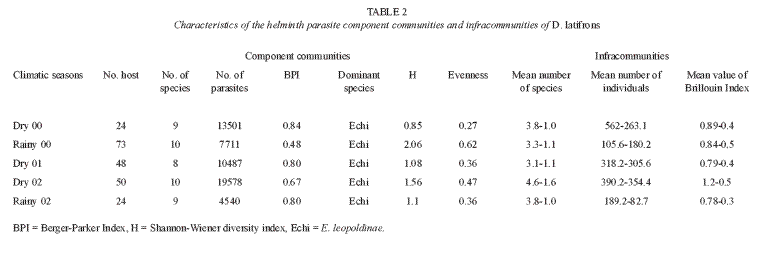
<body><![CDATA[<p>Materials and methods</p> </font></b><font face="Verdana" size="2"> </font>     <p><font face="Verdana" size="2">A total of 219 <i>D. latifrons </i>specimens with total lengths ranging from 13.6 to 26.3 cm (21.2±) were collected over five climatic seasons (April 2000 to June 2002) from Tres Palos Lagoon, in the state of Guerrero, Mexico (Table 1). A complete necropsy was done on all host specimens, including all organs except the blood. Internal and external metazoan parasites collected from the hosts were processed according to the methods described by Lamothe-Argumedo (1997) and Vidal-Martínez <i>et al. </i>(2001). All helminths recovered from each fish were counted. Digeneans (adults and metacercariae), cestodes, and nematodes were fixed in AFA (formalin-ethanol-acetic acid). Acanthocephalans were placed in distilled water and refrigerated overnight (6-12 h) to evert the proboscis, then fixed in 70% ethanol. Digenean, cestodes, and acanthocephalans were stained with carmine. Nematodes were cleared with glycerine for light microscopy and stored in 70% ethanol. A species-richness sampling effort curve (Aho <i>et al. </i>1991) was used to determine if sample size was sufficient to recover the highest proportion of parasite species and therefore accurately characterize the component communities. Voucher specimens of almost all taxa were deposited in the Colección Nacional de Helmintos, Instituto de Biología, Universidad Nacional Autónoma de México, Mexico City. </font></p>     <p><font face="Verdana" size="2">Autogenic parasite species were defined as those that reach maturity in aquatic hosts and thus have a limited ability to colonize new locations. Allogenic species were those with birds or mammals as definitive hosts and whose natural migrations favor dispersion, giving them a wide geographic distribution (Esch <i>et al. </i>1988). The host range concept (Rohde 2005) was used to classify the parasite species as specialists or generalists. According to this concept, a specialist parasite species is one that has a marked affinity for a specific host family, genus or species, while a generalist is one that parasitizes a number of families. </font></p>     <p><font face="Verdana" size="2">Variation in species composition over time was described using prevalence (percent of hosts infected), mean abundance (mean number of parasites per examined fish), expressed as mean ± standard deviation, and the range of intensity (Bush <i>et al. </i>1997) for each helminth species per sampling period. To determine possible differences in infection parameters between sampling periods, G tests were used for prevalence and a one-way ANCOVA for abundance, with total length as a covariate to control the in</font><font face="Verdana"  size="2">fluence of host size. The significance of all statistical analyses was established at &#945; = 0.05. </font></p> <font face="Verdana" size="2"> </font>     <p><font face="Verdana" size="2"><b>Community analysis: </b>analyses were taken to the component community and infracommunity levels (Holmes and Price 1986), that is, all the helminthes in all the hosts collected per sampling period and all the helminthes in an individual fish respectively. The component community parameters included total number of parasite species, total number of individual parasites, the Shannon-Wiener Index (H) as a measure of diversity and the Berger-Parker Index (BPI) as a measure of numerical dominance. Kruskal-Wallis tests were used to determine significant differences in the component community parameters between sampling periods at this level. The infracommunities were described by the mean number of helminth parasite species per fish, mean number of parasite individuals per fish and the mean value of the Brillouin Diversity Index (H’) per fish. A one-way ANCOVA was used to determine significant differences in infracommunity parameters between sampling periods. Correlations were made using the Spearman range coefficient (r<sub>s</sub>) (Krebs 1999). </font></p> <b><font face="Verdana" size="3"> </font></b>     <p><b><font face="Verdana" size="3"> Results</font></b><font  face="Verdana" size="2"> </font></p>     <p><font face="Verdana" size="2"><b>Community characterization: </b>a total of ten metazoan parasite species were identified in the 219 <i>D. latifrons </i>specimens examined: five digeneans; one cestode; one acanthocephalan; one nematode and two crustaceans. Six parasite species were found in larval form parasitizing different organs, such as the heart, liver, mesentery, muscles and gills (<a href="#t1">Table 1</a>). In contrast, only one digenean (<i>S. lamothei</i>) and the acanthocephalan (<i>Neoechinorhynchus golvani</i>), both intestinal parasites, were recovered in adult stage. Five of the species recovered in larval stage were classified as allogenic; the autogenic species included the two species recovered in adult form, as well as the metacercariae of <i>Pseudoacanthostomum panamense </i>(<a href="#t1">Table 1</a>). All the parasite species recovered were classified as generalists.    <br> </font></p> <font face="Verdana" size="2">The frequency distributions of the parasite species in all the samples showed the community was made up of two groups: common parasites, with prevalence greater than 25% (<i>N. golvani</i>, <i>Ergasilus </i>sp., <i>Echinochasmus leopoldinae</i>, <i>Saccocoelioides </i>sp., <i>Parvitaenia cochlearii </i>and <i>Pseudoacanthostomum panamense</i>); and rare parasites, with prevalence less than 25%. The most frequent species were also the most abundant (mean abundance&gt;10 parasites).    <br>     <br> </font>     ]]></body>
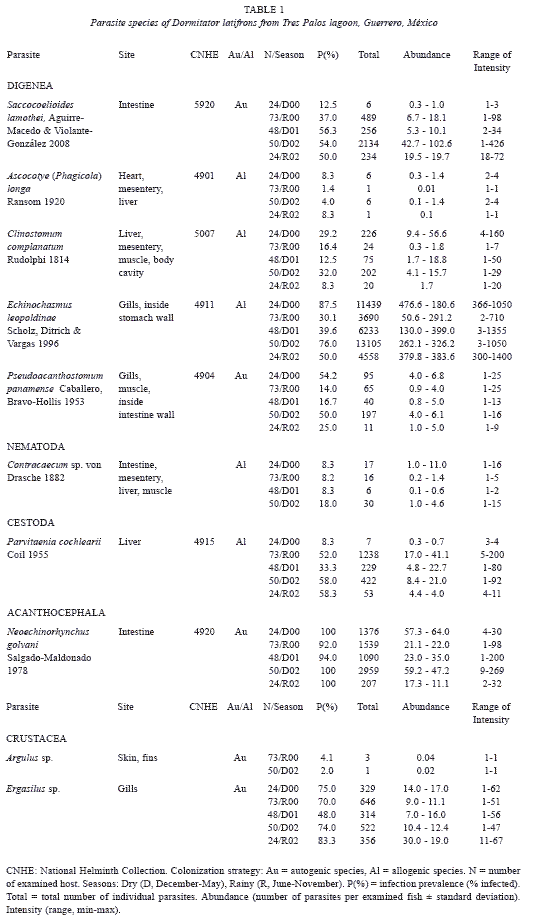
<body><![CDATA[<div style="text-align: center;"><img  src="/img/revistas/rbt/v56n3/art34t1.gif" title="" alt=""  style="width: 534px; height: 922px;"><a name="t1"></a>    <br> </div>     <p><font face="Verdana" size="2"> </font></p>     <p><font face="Verdana" size="2"><b>Parasite infection dynamics: </b>the prevalence of four parasite species differed significantly between seasons (<a href="#t1">Table 1</a>). The digeneans <i>C. complanatum </i>(G=8.79, p&lt;0.05) and <i>E. leopoldinae </i>(G=39.61, p&lt;0.05) exhibited higher prevalence in 2000 and 2002 dry seasons. <i>S. lamothei </i>had higher prevalence in 2001 and 2002 dry seasons (G=30.68, p&lt;0.05), and <i>P. cochlearii </i>had higher prevalence in 2000 rainy season and 2002 dry season. These four species, in addition to <i>N. golvani</i>, exhibited variable mean abundance over time (<a href="#t1">Table 1</a>). The species <i>E. leopoldinae </i>(one-way ANCOVA F=42.95, p&lt;0.05) and <i>N. golvani </i>(one-way ANCOVA F=7.85, p&lt;0.05) had their highest abundances in two dry seasons (2000 and 2002), while <i>C. complanatum </i>(one-way ANCOVA F=10.06, p&lt;0.05) and <i>S. lamothei </i>(one-way ANCOVA F=6.65, p&lt;0.05) had theirs during just one dry season. Only the cestode <i>P. cochlearii </i>had its highest abundance during a rainy season (2000). </font></p>     <p><font face="Verdana" size="2"><b>Component community: </b>based on cumulative species curves, it was determined that 90% of the recorded parasite species could have been recovered by examining not more than 20 fish hosts. No correlation was observed between sample size and any of the parameters at the two levels (Spearman p&gt;0.05). The number of parasite species recovered from the samples varied from eigth to ten (<a href="#t2">Table 2</a>) and was significantly higher during the 2000 rainy season and 2002 dry season (Kruskal-Wallis H=8.52, p&lt;0.05). Total number of parasites collected per season ranged from 4 540 (2002 rainy season) to 19 578 (2002 dry season), and was consistently higher during the three dry seasons (Kruskal-Wallis H=9.22, p<i>&lt;</i>0.05). <i>Echinochasmus leopoldinae </i>numerically dominated the parasite species community during both seasons (<a href="#t2">Table 2</a>). The Shannon-Wiener diversity index values ranged from 0.85 to 2.06 bits/ind. Comparison between seasons indicated that diversity did not vary between seasons (p&gt;0.05).    <br> </font></p>     <p style="text-align: center;"><font face="Verdana" size="2"><img  src="/img/revistas/rbt/v56n3/art34t2.gif" title="" alt=""  style="height: 257px; width: 761px;"><a name="t2"></a>    <br> </font></p> <font face="Verdana" size="2"><b> </b></font>     <p><font face="Verdana" size="2"><b>Infracommunity: </b>all <i>D. latifrons </i>specimens examined were infected and the number of parasite species per infected host range from 1 to 8. Only 5% of the hosts were parasitized by a single species, while 95% had mixed infections: 28% had 3 species; 39% had from 4 to 5; and 3% had from 7 to 8. Based on all samples, total host length was positively correlated with number of parasite species (r<sub>s</sub>=0.258, p&lt;0.05, n=219) and number of individual parasites (r<sub>s</sub>=0.320, p&lt;0.05, n=219). </font></p>     <p><font face="Verdana" size="2">Mean number of parasite species ranged from 3.1 ±1.1 to 4.4 ±1.6, and was significantly higher in the 2002 dry season (ANCOVA F=13.1, p&lt;0.05). Mean number of individual parasites varied between 105.6 ±180.2 and 562 ±263.1, and was highest during the 2000 and 2002 dry seasons (ANCOVA F=24.4, p&lt;0.05). Mean diversity (Brillouin index) ranged from 0.78 ±0.3 to 1.2 ±0.5, but did not vary between season (p&gt;0.05). </font></p> <b><font face="Verdana" size="3"> </font></b>     ]]></body>
<body><![CDATA[<p><b><font face="Verdana" size="3">Discussion</font></b><font  face="Verdana" size="2"> </font></p>     <p><font face="Verdana" size="2">All species found have been previously reported in this location (Garrido-Olvera et al. 2004; Violante-Gonzalez <i>et al</i>. 2008). Of the identified helminth species, only three were classified as autogenic because they mature in aquatic hosts: the digenean <i>S. lamothei </i>and the acanthocephalan <i>N. golvani </i>(both mature in&nbsp; </font><small><i  style="font-family: verdana;">D. latifrons</i><span  style="font-family: verdana;">); and the digenean </span><i  style="font-family: verdana;">P. panamense</i><span  style="font-family: verdana;">, which matures in </span><i  style="font-family: verdana;">Sciades guatemalensis</i><span  style="font-family: verdana;">. The other five species (in larval form) all mature in the piscivorous birds </span><i  style="font-family: verdana;">Casmerodius albus </i><span  style="font-family: verdana;">and </span><i  style="font-family: verdana;">Phalacrocorax olivaceus</i><span  style="font-family: verdana;">, found at Tres Palos Lagoon (data not included), and were thus classified as allogenic: </span><i  style="font-family: verdana;">C. complanatum</i><span  style="font-family: verdana;">; </span><i  style="font-family: verdana;">E. leopoldinae</i><span  style="font-family: verdana;">; </span><i  style="font-family: verdana;">Ascocotyle </i><span  style="font-family: verdana;">(</span><i style="font-family: verdana;">Phagicola</i><span  style="font-family: verdana;">) </span><i  style="font-family: verdana;">longa; P. cochlearii</i><span  style="font-family: verdana;">; and </span><i  style="font-family: verdana;">Contracaecum </i><span  style="font-family: verdana;">sp.</span></small> </p>     <p><font face="Verdana" size="2">The high abundance of allogenic species in the <i>D. latifrons </i>parasite community indicates that the numerous and permanent piscivorous bird population inhabiting the lagoon margins heavily influences this host’s parasite community composition. These bird species act as final hosts to the allogenic parasites and then disperse most of these parasite species. This is supported by the high number of larval helminthes in the community (5/8), which suggests that <i>D. latifrons </i>functions as an intermediary host (Zander <i>et al. </i>1999) for helminth parasite species in Tres Palos Lagoon. </font></p>     <p><font face="Verdana" size="2">Many of the most abundant and frequent helminth parasite species, such as <i>C. complanatum, E. leopoldinae, S. lamothei </i>and <i>N</i>. <i>golvani</i>, exhibited clear seasonal variations in their infection dynamics. Environmental stability and host feeding patterns most likely play an important role in determining seasonal variations in abundance for some of the studied helminths, especially those with short life-cycle such as <i>N. golvani </i>and <i>S. lamothei. </i>The higher abundance of some parasite species, such as <i>C. complanatum </i>and <i>E. leopoldinae</i>, during the dry seasons probably resulted from the higher environmental stability in Tres Palos Lagoon during this season favoring their transmission process. In contrast, the higher abundance of <i>N. golvani </i>and <i>S. lamothei </i>in the dry seasons may be linked to higher host feeding activity levels during the season. During its July to October (rainy season) reproductive period (data not shown), <i>D. latifrons </i>reduces its feeding activity, meaning that intestinal helminths such as <i>N. golvani </i>and <i>S. lamothei </i>had lower abundance during this season (Table 1). This is supported by reports showing that seasonal variation in the diet and amount of food ingested by hosts is clearly linked to parasite community population dynamics and structure (Fiorillo and Font 1999, Fellis and Esch 2004, Zander 2004, 2005). </font></p>     <p><font face="Verdana" size="2">During the rainy season (July to December), environmental conditions in the lagoon become unstable in response to high volumes of organic matter contributed by the contiguous Sabana River. This enhances productivity (Stuardo and Villarroel 1974), and favors transmission of helminths that use copepods as primary hosts, such as the allogenic cestode <i>P. cochlearii </i>(<a href="#t1">Table 1</a>). </font></p>     <p><font face="Verdana" size="2">In <i>D. latifrons</i>, component community was generally poor in number of parasite species and lower in diversity compared to other tropical freshwater fish species such as <i>Cichlasoma</i> (<i>Nandopsis</i>) <i>urophthalmus </i>(38 species), <i>Parachromis managuensis </i>(34) and <i>Thorichthys hellerin </i>(32) (Salgado-Maldonado <i>et al. </i>2005). The low species richness in <i>D. latifrons </i>may be attributed to physiological, reproductive and feeding behavior factors (Kennedy <i>et al. </i>1986, Bush <i>et al. </i>2003). Yañez-Arancibia and Díaz-González (1977) reported that <i>D. latifrons </i>in Tres Palos Lagoon primarily feeds on detritus and plant remains, which may also explain this host’s low intestinal helminth richness (two species). The richest intestinal helminth assemblages in tropical freshwater fish are generally observed in hosts withdiets based on macroinvertebrates and fish, while herbivores and detritivores will generally have poorer intestinal helminth communities (Choudhury and Dick 2000). </font></p>     <p><font face="Verdana" size="2">Another possible explanation for the low parasite species richness in <i>D. latifrons </i>may be related to the low complexity food web structure in Tres Palos Lagoon. Food web structure is known to determine parasite species richness and diversity in freshwater systems (Marcogliese 2001). Zooplankton is not very diverse in this lagoon system and macrobenthos and mollusks are scarce: they are represented by just six species (Stuardo and Villarroel 1974). This system’s poor food web structure clearly restricts intermediary host availability (Marcogliese 2001). </font></p>     <p><font face="Verdana" size="2">The infracommunities presented the same pattern that the component communities, that is, they were also species-poor, highly numerically dominated and not highly diverse. This coincides with the general pattern observed in the communities of freshwater fish (Kennedy <i>et al. </i>1986, Kennedy 1990). The positive significant correlation of mean number of parasite species and mean parasite intensity with total host length indicates that larger hosts harbored more parasite species and more parasite burden than smaller ones. This is attributed to the fact that larger (i.e. older) fish, have had more time to accumulate parasites than younger (smaller) ones (Poulin 2000, Bush <i>et al. </i>2003, Zander 2004). </font></p>     <p><font face="Verdana" size="2">The main factors structuring these infra-communities were the same ones responsible for structuring the component communities (Holmes 1990, Zander 2004). These factors were host feeding behavior and the availability of free-swimming larvae, both of which are influenced by the dry/rainy season cycle. These two factors structured the infracommunities through accumulation of parasite species from free-swimming cercariae (<i>C. complanatum</i>, <i>E. leopoldinae</i>), encysted metacercariae (<i>Saccocoeloides </i>sp.) or infected (crustacean) prey (<i>N. golvani </i>and <i>P. cochlarii</i>). The structuring is completed by acquisition of other rare species. </font></p>     <p><font face="Verdana" size="2">In line with the component community level, the infracommunities exhibited seasonal changes in their structure that can be attributed to changes in the infection dynamics of the most abundant and frequent (common) parasite species. </font></p>     ]]></body>
<body><![CDATA[<p><font face="Verdana" size="2">Overall, <i>D. latifrons </i>does not have a very diverse parasite community, but its parasite load (i.e. the total number of individual parasites) can be very high, mainly during dry seasons. This is vital to consider in terms of its consumption by the local human population, and its effect in aquaculture applications. The results also indicate that environmental changes caused by the dry/rainy season cycle are the principal factor generating the observed temporal variation in the infection dynamics of the most common parasite species in Tres Palos Lagoon. This cycle also affects the feeding and reproductive behavior of <i>D. latifrons</i>, thus modifying its exposure to certain parasite species. The consequent seasonal variation in parasite species infection dynamics leads to changes in the parasite community structure of <i>D. latifrons</i>. </font></p> <b><font face="Verdana" size="3"> </font></b>     <p><b><font face="Verdana" size="3">Acknowlegments</font></b><font  face="Verdana" size="2"> </font></p>     <p><font face="Verdana" size="2">The authors thank the students of the Marine Ecology Academic Unit, UAG, for their help in the field and laboratory. We are also grateful to Guillermo Salgado-Maldonado and David Osorio-Sarabia for their assistance in identifying some of the parasite species. We thank two anonymous reviewers whose extensive and thoughtful comments substantially improved the manuscript. This research was financed by the Sistema de Investigación Benito Juárez (SIBEJ) (19990502017), and the Promep Program.</font></p> <hr style="width: 100%; height: 2px;">     <p><font face="Verdana" size="2"> </font></p> <font face="Verdana" size="2"><b> </b></font>     <p><font face="Verdana" size="2"><b>Resumen </b> </font></p>     <p><font face="Verdana" size="2">Entre abril del 2000 y junio del 2002 se efectuó un estudio para determinar la composición y la variación temporal en la estructura de la comunidad de parásitos metazoarios del popoyote <i>Dormitator latifrons </i>en la laguna de Tres Palos, Guerrero, México, a partir de muestras temporales. Se recuperaron diez especies de parásitos (55 817 individuos) de 219 hospederos examinados. Estas especies incluyeron ocho helmintos (<i>Ascocotyle </i>(<i>Phagicola</i>) <i>longa</i>, <i>Echinochasmus leopoldinae</i>, <i>Clinostomum complanatum</i>, <i>Pseudoacanthostomum panamense</i>, <i>Saccocoelioides lamothei</i>, <i>Parvitaenia cochlearii, Contracaecum </i>sp. y <i>Neoechinorhynchus golvani</i>) y dos crustáceos (<i>Argulus </i>sp. y <i>Ergasilus </i>sp.). Cinco de las especies de helmintos registraron variación temporal en su dinámica de infección, la cual fue asociada con cambios ambientales durante las estaciones de secas y lluvias. Las variaciones en la dinámica de infección de estas especies generaron cambios en la estructura de la comunidad a lo largo del tiempo. </font></p>     <p><font face="Verdana" size="2"><b>Palabras clave: </b>México, <i>Dormitator latifrons</i>, comunidades de parásitos.</font></p> <hr style="width: 100%; height: 2px;">     <p><font face="Verdana" size="2"> </font></p>     <p align="center"><font face="Verdana" size="2">Received 23-IV-2007. Corrected 30-VI-2008. Accepted 31-VII-2008.</font></p> <b><font face="Verdana" size="3">     <p>References </p> </font></b><font face="Verdana" size="2">     ]]></body>
<body><![CDATA[<!-- ref --><p>Aho, J.M., A.O. Bush &amp; R.W. Wolfe. 1991. Helminth parasites of bowfin (<i>Amia calva</i>) from South California. J. Helminthol. Soc. Wash. 58: 171-175.    &nbsp;&nbsp;&nbsp;&nbsp;&nbsp;&nbsp;&nbsp;&nbsp;[&#160;<a href="javascript:void(0);" onclick="javascript: window.open('/scielo.php?script=sci_nlinks&ref=1701435&pid=S0034-7744200800030003400001&lng=','','width=640,height=500,resizable=yes,scrollbars=1,menubar=yes,');">Links</a>&#160;]<!-- end-ref --> </p>     <!-- ref --><p>Bush, A.O., J. Fernandez, G.W. Esch &amp; J.R. Seed. 2003. Parasitism: The diversity and ecology of animal parasites. Cambridge University, Cambridge, England.    &nbsp;&nbsp;&nbsp;&nbsp;&nbsp;&nbsp;&nbsp;&nbsp;[&#160;<a href="javascript:void(0);" onclick="javascript: window.open('/scielo.php?script=sci_nlinks&ref=1701437&pid=S0034-7744200800030003400002&lng=','','width=640,height=500,resizable=yes,scrollbars=1,menubar=yes,');">Links</a>&#160;]<!-- end-ref --> </p>     <!-- ref --><p>Bush, A.O., K.D. Lafferty, J.M. Lotz &amp; A.W. Shostak. 1997. Parasitology meets ecology on its own terms: Margolis <i>et al. </i>revisited. J. Parasitol. 83: 575-583.    &nbsp;&nbsp;&nbsp;&nbsp;&nbsp;&nbsp;&nbsp;&nbsp;[&#160;<a href="javascript:void(0);" onclick="javascript: window.open('/scielo.php?script=sci_nlinks&ref=1701439&pid=S0034-7744200800030003400003&lng=','','width=640,height=500,resizable=yes,scrollbars=1,menubar=yes,');">Links</a>&#160;]<!-- end-ref --> </p>     <!-- ref --><p>Castro-Aguirre, J.L., H.S. Espinosa-Pérez &amp; J.J. Schmitter-Soto. 1999. Ictiofauna estuarino-lagunar y vicaria de México. Limusa, México D.F., México.    &nbsp;&nbsp;&nbsp;&nbsp;&nbsp;&nbsp;&nbsp;&nbsp;[&#160;<a href="javascript:void(0);" onclick="javascript: window.open('/scielo.php?script=sci_nlinks&ref=1701441&pid=S0034-7744200800030003400004&lng=','','width=640,height=500,resizable=yes,scrollbars=1,menubar=yes,');">Links</a>&#160;]<!-- end-ref --> </p>     <!-- ref --><p>Castro-Rivera, R., G. Aguilar-Benitez.&amp; J. Hernández-Girón. 2005. Conversión alimenticia en engordas puras y mixtas de Popoyote (<i>Dormitator latifrons</i>) en estanques de cemento. Aquatic 23: 45-52.    &nbsp;&nbsp;&nbsp;&nbsp;&nbsp;&nbsp;&nbsp;&nbsp;[&#160;<a href="javascript:void(0);" onclick="javascript: window.open('/scielo.php?script=sci_nlinks&ref=1701443&pid=S0034-7744200800030003400005&lng=','','width=640,height=500,resizable=yes,scrollbars=1,menubar=yes,');">Links</a>&#160;]<!-- end-ref --> </p>     ]]></body>
<body><![CDATA[<!-- ref --><p>Choudhury, A. &amp; T.A. Dick. 2000. Richness and diversity of helminth communities in tropical freshwater fishes: empirical evidence. J. Biogeogr. 27: 935-956.    &nbsp;&nbsp;&nbsp;&nbsp;&nbsp;&nbsp;&nbsp;&nbsp;[&#160;<a href="javascript:void(0);" onclick="javascript: window.open('/scielo.php?script=sci_nlinks&ref=1701445&pid=S0034-7744200800030003400006&lng=','','width=640,height=500,resizable=yes,scrollbars=1,menubar=yes,');">Links</a>&#160;]<!-- end-ref --> </p>     <!-- ref --><p>Esch, G.W., C.R. Kennedy, A.O. Bush &amp; J.M. Aho. 1988. Patterns in helminth communities in freshwater fish in Great Britain: alternative strategies for colonization. Parasitol. 96: 519-532.    &nbsp;&nbsp;&nbsp;&nbsp;&nbsp;&nbsp;&nbsp;&nbsp;[&#160;<a href="javascript:void(0);" onclick="javascript: window.open('/scielo.php?script=sci_nlinks&ref=1701447&pid=S0034-7744200800030003400007&lng=','','width=640,height=500,resizable=yes,scrollbars=1,menubar=yes,');">Links</a>&#160;]<!-- end-ref --> </p>     <!-- ref --><p>Fellis, K.J. &amp; G.W. Esch. 2004. Community structure and seasonal dynamics of helminth parasites in <i>Lepomis cyanellus </i>and <i>L. macrochirus </i>from Charlie’s pond, north Carolina: host size and species as determinants of community structure. J. Parasitol. 90: 41-49.    &nbsp;&nbsp;&nbsp;&nbsp;&nbsp;&nbsp;&nbsp;&nbsp;[&#160;<a href="javascript:void(0);" onclick="javascript: window.open('/scielo.php?script=sci_nlinks&ref=1701449&pid=S0034-7744200800030003400008&lng=','','width=640,height=500,resizable=yes,scrollbars=1,menubar=yes,');">Links</a>&#160;]<!-- end-ref --> </p>     <!-- ref --><p>Fiorillo, R.A. &amp; W.F. Font. 1999. Seasonal dynamics and community structure of helminths of spotted sunfish, <i>Lepomis miniatus </i>(Osteichthyes: Centrarchidae) from an oligohaline estuary in Southeastern Louisiana, U.S.A. J. Helminthol. Soc. Wash. 66: 101-110.    &nbsp;&nbsp;&nbsp;&nbsp;&nbsp;&nbsp;&nbsp;&nbsp;[&#160;<a href="javascript:void(0);" onclick="javascript: window.open('/scielo.php?script=sci_nlinks&ref=1701451&pid=S0034-7744200800030003400009&lng=','','width=640,height=500,resizable=yes,scrollbars=1,menubar=yes,');">Links</a>&#160;]<!-- end-ref --> </p>     <!-- ref --><p>Garrido-Olvera, L., L. García-Prieto &amp; B. Mendoza-Garfias. 2004. Helminth parasites of the fat sleeper, <i>Dormitator latifrons </i>(Richardson, 1844) from Tres Palos Lagoon, Guerrero, Mexico. Am. Midl. Nat. 151: 163-169.    &nbsp;&nbsp;&nbsp;&nbsp;&nbsp;&nbsp;&nbsp;&nbsp;[&#160;<a href="javascript:void(0);" onclick="javascript: window.open('/scielo.php?script=sci_nlinks&ref=1701453&pid=S0034-7744200800030003400010&lng=','','width=640,height=500,resizable=yes,scrollbars=1,menubar=yes,');">Links</a>&#160;]<!-- end-ref --> </p>     ]]></body>
<body><![CDATA[<!-- ref --><p>Holmes. J.C. 1990. Helminth communities of marine fishes. <i>In </i>G.W. Esch, A.O. Bush &amp; J.M. Aho (eds.). Parasite communities: Patterns and Process. Chapman, London, England.    &nbsp;&nbsp;&nbsp;&nbsp;&nbsp;&nbsp;&nbsp;&nbsp;[&#160;<a href="javascript:void(0);" onclick="javascript: window.open('/scielo.php?script=sci_nlinks&ref=1701455&pid=S0034-7744200800030003400011&lng=','','width=640,height=500,resizable=yes,scrollbars=1,menubar=yes,');">Links</a>&#160;]<!-- end-ref --> </p>     <!-- ref --><p>Holmes, J.C. &amp; P.W. Price. 1986. Communities of parasites in chapter 9. <i>In </i>J. Kikkawa &amp; D.J. Anderson (eds.). Community ecology: Patters and process. Chapman, London, England.    &nbsp;&nbsp;&nbsp;&nbsp;&nbsp;&nbsp;&nbsp;&nbsp;[&#160;<a href="javascript:void(0);" onclick="javascript: window.open('/scielo.php?script=sci_nlinks&ref=1701457&pid=S0034-7744200800030003400012&lng=','','width=640,height=500,resizable=yes,scrollbars=1,menubar=yes,');">Links</a>&#160;]<!-- end-ref --> </p>     <!-- ref --><p>Jiménez, M.I. 2003. Estructura temporal de las comunidades de parásitos metazoarios en poblaciones de cíclidos silvestres (<i>Cichlasoma urophthalmus</i>) e introducidos en Mitza, Yucatán: un enfoque experimental. Tesis Doctoral, Cinvestav IPN, Mérida, México.    &nbsp;&nbsp;&nbsp;&nbsp;&nbsp;&nbsp;&nbsp;&nbsp;[&#160;<a href="javascript:void(0);" onclick="javascript: window.open('/scielo.php?script=sci_nlinks&ref=1701459&pid=S0034-7744200800030003400013&lng=','','width=640,height=500,resizable=yes,scrollbars=1,menubar=yes,');">Links</a>&#160;]<!-- end-ref --> </p>     <!-- ref --><p>Kennedy, C.R., A.O. Bush &amp; J.M. Aho. 1986. Patterns in helminth communities: Why are bird and fishes different?. Parasitol. 93: 205-215.    &nbsp;&nbsp;&nbsp;&nbsp;&nbsp;&nbsp;&nbsp;&nbsp;[&#160;<a href="javascript:void(0);" onclick="javascript: window.open('/scielo.php?script=sci_nlinks&ref=1701461&pid=S0034-7744200800030003400014&lng=','','width=640,height=500,resizable=yes,scrollbars=1,menubar=yes,');">Links</a>&#160;]<!-- end-ref --> </p>     <!-- ref --><p>Kennedy, C.R. 1990. Helminth communities in freshwater fish: structured communities or stochastic assemblages? <i>In </i>G.W. Esch, A.O. Bush &amp; J.M. Aho (eds.). Parasite Communities: Patterns and Processes. Chapman, London, England.    &nbsp;&nbsp;&nbsp;&nbsp;&nbsp;&nbsp;&nbsp;&nbsp;[&#160;<a href="javascript:void(0);" onclick="javascript: window.open('/scielo.php?script=sci_nlinks&ref=1701463&pid=S0034-7744200800030003400015&lng=','','width=640,height=500,resizable=yes,scrollbars=1,menubar=yes,');">Links</a>&#160;]<!-- end-ref --> </p>     ]]></body>
<body><![CDATA[<!-- ref --><p>Klimpel, S., A. Seehagen &amp; H.W. Palm. 2003. Metazoan parasites and feeding behaviour of four small-sized fish species from the central North Sea. Parasitol. Res. 91: 290-297.    &nbsp;&nbsp;&nbsp;&nbsp;&nbsp;&nbsp;&nbsp;&nbsp;[&#160;<a href="javascript:void(0);" onclick="javascript: window.open('/scielo.php?script=sci_nlinks&ref=1701465&pid=S0034-7744200800030003400016&lng=','','width=640,height=500,resizable=yes,scrollbars=1,menubar=yes,');">Links</a>&#160;]<!-- end-ref --> </p>     <!-- ref --><p>Krebs, C.J. 1999. Ecological methodology. Harper Collins, New York, USA.    &nbsp;&nbsp;&nbsp;&nbsp;&nbsp;&nbsp;&nbsp;&nbsp;[&#160;<a href="javascript:void(0);" onclick="javascript: window.open('/scielo.php?script=sci_nlinks&ref=1701467&pid=S0034-7744200800030003400017&lng=','','width=640,height=500,resizable=yes,scrollbars=1,menubar=yes,');">Links</a>&#160;]<!-- end-ref --> </p>     <!-- ref --><p>Lamothe-Argumedo, R. 1997. Manual de técnicas para preparar y estudiar los parásitos de animales silvestres. AGT, México D.F., México.    &nbsp;&nbsp;&nbsp;&nbsp;&nbsp;&nbsp;&nbsp;&nbsp;[&#160;<a href="javascript:void(0);" onclick="javascript: window.open('/scielo.php?script=sci_nlinks&ref=1701469&pid=S0034-7744200800030003400018&lng=','','width=640,height=500,resizable=yes,scrollbars=1,menubar=yes,');">Links</a>&#160;]<!-- end-ref --> </p>     <!-- ref --><p>Marcogliese, D.J. 2001. Pursuing parasites up the food chain: Implications of food web structure and function on parasite communities in aquatic systems. Acta Parasitol. 46: 82-93.    &nbsp;&nbsp;&nbsp;&nbsp;&nbsp;&nbsp;&nbsp;&nbsp;[&#160;<a href="javascript:void(0);" onclick="javascript: window.open('/scielo.php?script=sci_nlinks&ref=1701471&pid=S0034-7744200800030003400019&lng=','','width=640,height=500,resizable=yes,scrollbars=1,menubar=yes,');">Links</a>&#160;]<!-- end-ref --> </p>     <!-- ref --><p>Pérez-Ponce de León, G., L. García-Prieto, B. Mendoza-Garfias, V. Léon-Règagnon, G. Pulido-Flores, C. Aranda-Cruz &amp; F. García-Vargas. 1999. IX. Biodiversidad de helmintos parásitos de peces marinos y estuarinos de la Bahía de Chamela, Jalisco. List faun Méx. UNAM, México D.F., México.    &nbsp;&nbsp;&nbsp;&nbsp;&nbsp;&nbsp;&nbsp;&nbsp;[&#160;<a href="javascript:void(0);" onclick="javascript: window.open('/scielo.php?script=sci_nlinks&ref=1701473&pid=S0034-7744200800030003400020&lng=','','width=640,height=500,resizable=yes,scrollbars=1,menubar=yes,');">Links</a>&#160;]<!-- end-ref --> </p>     ]]></body>
<body><![CDATA[<!-- ref --><p>Pilo-Guzmán, T. 2003. Evaluación de los parásitos metazoarios que atacan a <i>Mugil curema</i>, <i>Dormitator latifrons</i>, <i>Ariopsis guatemalensis</i>, <i>Eleotris pictus</i>, <i>Cichlasoma trimaculatum</i>, <i>Gobiomorus maculatus</i>, <i>Centropomus robalito </i>y <i>Centropomus nigrescens</i>, especies de mayor consumo local, que se capturan en la laguna de Tres Palos Gro., México. Tesis Maestría, Univ. Autón. Gro., México.    &nbsp;&nbsp;&nbsp;&nbsp;&nbsp;&nbsp;&nbsp;&nbsp;[&#160;<a href="javascript:void(0);" onclick="javascript: window.open('/scielo.php?script=sci_nlinks&ref=1701475&pid=S0034-7744200800030003400021&lng=','','width=640,height=500,resizable=yes,scrollbars=1,menubar=yes,');">Links</a>&#160;]<!-- end-ref --> </p>     <!-- ref --><p>Pineda-Lopez, R. 1994. Ecology of the helminth communities of cichlid fish in the flood plains of Southeastern México. Ph D Thesis, University of Exeter, Exeter, England.    &nbsp;&nbsp;&nbsp;&nbsp;&nbsp;&nbsp;&nbsp;&nbsp;[&#160;<a href="javascript:void(0);" onclick="javascript: window.open('/scielo.php?script=sci_nlinks&ref=1701477&pid=S0034-7744200800030003400022&lng=','','width=640,height=500,resizable=yes,scrollbars=1,menubar=yes,');">Links</a>&#160;]<!-- end-ref --> </p>     <!-- ref --><p>Poulin, R. 2000. Variation in the intraspecific relationship between fish length and intensity of parasitic infection: biological and statistical causes. J. Fish. Biol. 56: 123-137.    &nbsp;&nbsp;&nbsp;&nbsp;&nbsp;&nbsp;&nbsp;&nbsp;[&#160;<a href="javascript:void(0);" onclick="javascript: window.open('/scielo.php?script=sci_nlinks&ref=1701479&pid=S0034-7744200800030003400023&lng=','','width=640,height=500,resizable=yes,scrollbars=1,menubar=yes,');">Links</a>&#160;]<!-- end-ref --> </p>     <!-- ref --><p>Rohde, K. 2005. Ecology of marine parasites. CSIRO, Wallingford, Oxon, UK.    &nbsp;&nbsp;&nbsp;&nbsp;&nbsp;&nbsp;&nbsp;&nbsp;[&#160;<a href="javascript:void(0);" onclick="javascript: window.open('/scielo.php?script=sci_nlinks&ref=1701481&pid=S0034-7744200800030003400024&lng=','','width=640,height=500,resizable=yes,scrollbars=1,menubar=yes,');">Links</a>&#160;]<!-- end-ref --> </p>     <!-- ref --><p>Salgado-Maldonado, G. 1993. Ecología de helmintos parásitos de <i>Cichlasoma urophthalmus </i>(Günter) (Pisces: Cichlidae) en la Península de Yucatán, México. Tesis Doctoral, Cinvestav-IPN Unidad Mérida, Mérida, México.    &nbsp;&nbsp;&nbsp;&nbsp;&nbsp;&nbsp;&nbsp;&nbsp;[&#160;<a href="javascript:void(0);" onclick="javascript: window.open('/scielo.php?script=sci_nlinks&ref=1701483&pid=S0034-7744200800030003400025&lng=','','width=640,height=500,resizable=yes,scrollbars=1,menubar=yes,');">Links</a>&#160;]<!-- end-ref --> </p>     ]]></body>
<body><![CDATA[<!-- ref --><p>Salgado-Maldonado, G., R. Pineda-López, L. García-Magaña, S. López-Jiménez, V.M. Vidal-Martínez &amp; M.L. Aguirre-Macedo. 2005. Helmintos parásitos de peces dulceacuícolas. In J. Bueno, F. Álvarez &amp; S. Santiago (eds.). Biodiversidad del estado de Tabasco., Instituto de Biología, UNAM-CONABIO, México D.F., México.    &nbsp;&nbsp;&nbsp;&nbsp;&nbsp;&nbsp;&nbsp;&nbsp;[&#160;<a href="javascript:void(0);" onclick="javascript: window.open('/scielo.php?script=sci_nlinks&ref=1701485&pid=S0034-7744200800030003400026&lng=','','width=640,height=500,resizable=yes,scrollbars=1,menubar=yes,');">Links</a>&#160;]<!-- end-ref --> </p>     <!-- ref --><p>Stuardo, J. &amp; M. Villarroel. 1974. Aspectos ecológicos y distribución de los moluscos en las lagunas costeras de Guerrero, México. An. Inst. Cienc. Mar y Limnol. UNAM, México D.F., México.    &nbsp;&nbsp;&nbsp;&nbsp;&nbsp;&nbsp;&nbsp;&nbsp;[&#160;<a href="javascript:void(0);" onclick="javascript: window.open('/scielo.php?script=sci_nlinks&ref=1701487&pid=S0034-7744200800030003400027&lng=','','width=640,height=500,resizable=yes,scrollbars=1,menubar=yes,');">Links</a>&#160;]<!-- end-ref --> </p>     <!-- ref --><p>Vidal-Martínez, V.M., L. Aguirre-Macedo, T. Scholz, D. González-Solís &amp; E.F. Mendoza-Franco. 2001. Atlas of helminth parasites of Cichlid fish of Mexico. Academy of Sciences of the Czech Republic, Prague.    &nbsp;&nbsp;&nbsp;&nbsp;&nbsp;&nbsp;&nbsp;&nbsp;[&#160;<a href="javascript:void(0);" onclick="javascript: window.open('/scielo.php?script=sci_nlinks&ref=1701489&pid=S0034-7744200800030003400028&lng=','','width=640,height=500,resizable=yes,scrollbars=1,menubar=yes,');">Links</a>&#160;]<!-- end-ref --> </p>     <!-- ref --><p>Violante-Gonzalez, J., Aguirre-Macedo, M.L. &amp; Vidal-Martínez, V.M. 2008. Temporal variation in the helminth parasite communities of pacific fat sleeper Dormitator latifrons, from Tres Palos lagoon, Guerrero, Mexico.    &nbsp;&nbsp;&nbsp;&nbsp;&nbsp;&nbsp;&nbsp;&nbsp;[&#160;<a href="javascript:void(0);" onclick="javascript: window.open('/scielo.php?script=sci_nlinks&ref=1701491&pid=S0034-7744200800030003400029&lng=','','width=640,height=500,resizable=yes,scrollbars=1,menubar=yes,');">Links</a>&#160;]<!-- end-ref --> </p>     <!-- ref --><p>Yañez-Arancibia, A. &amp; G. Díaz-González. 1977. Ecología trofodinámica de <i>Dormitator latifrons </i>(Richardson) en nueve lagunas costeras del Pacífico de México (Pisces: Eleotridae). An. Inst. Cienc. Mar y Limnol. UNAM 4: 125-140.    &nbsp;&nbsp;&nbsp;&nbsp;&nbsp;&nbsp;&nbsp;&nbsp;[&#160;<a href="javascript:void(0);" onclick="javascript: window.open('/scielo.php?script=sci_nlinks&ref=1701493&pid=S0034-7744200800030003400030&lng=','','width=640,height=500,resizable=yes,scrollbars=1,menubar=yes,');">Links</a>&#160;]<!-- end-ref --> </p>     ]]></body>
<body><![CDATA[<!-- ref --><p>Zander, C.D., L.W. Reimer &amp; K. Barz. 1999. Parasite communities of the Salzhaff (Northwest Mecklenburg, Baltic Sea). I. Structure and dynamics of communities of littoral fish, especially small-sized fish. Parasitol. Res. 85: 356-372.    &nbsp;&nbsp;&nbsp;&nbsp;&nbsp;&nbsp;&nbsp;&nbsp;[&#160;<a href="javascript:void(0);" onclick="javascript: window.open('/scielo.php?script=sci_nlinks&ref=1701495&pid=S0034-7744200800030003400031&lng=','','width=640,height=500,resizable=yes,scrollbars=1,menubar=yes,');">Links</a>&#160;]<!-- end-ref --> </p>     <!-- ref --><p>Zander, C.D. 2004. Four-year monitoring of parasite communities in gobiid fishes of the south-western Baltic. II. Infracommunity. Parasitol. Res. 93: 17-29.    &nbsp;&nbsp;&nbsp;&nbsp;&nbsp;&nbsp;&nbsp;&nbsp;[&#160;<a href="javascript:void(0);" onclick="javascript: window.open('/scielo.php?script=sci_nlinks&ref=1701497&pid=S0034-7744200800030003400032&lng=','','width=640,height=500,resizable=yes,scrollbars=1,menubar=yes,');">Links</a>&#160;]<!-- end-ref --> </p>     <!-- ref --><p>Zander, C.D. 2005. Four-year monitoring of parasite communities in gobiid fishes of the southwest Baltic. III. Parasite species diversity and applicability of monitoring. Parasitol. Res. 95: 136-144.    &nbsp;&nbsp;&nbsp;&nbsp;&nbsp;&nbsp;&nbsp;&nbsp;[&#160;<a href="javascript:void(0);" onclick="javascript: window.open('/scielo.php?script=sci_nlinks&ref=1701499&pid=S0034-7744200800030003400033&lng=','','width=640,height=500,resizable=yes,scrollbars=1,menubar=yes,');">Links</a>&#160;]<!-- end-ref --> </p> </font>      ]]></body><back>
<ref-list>
<ref id="B1">
<nlm-citation citation-type="journal">
<person-group person-group-type="author">
<name>
<surname><![CDATA[Aho]]></surname>
<given-names><![CDATA[J.M]]></given-names>
</name>
<name>
<surname><![CDATA[Bush]]></surname>
<given-names><![CDATA[A.O]]></given-names>
</name>
<name>
<surname><![CDATA[Wolfe]]></surname>
<given-names><![CDATA[R.W]]></given-names>
</name>
</person-group>
<article-title xml:lang="en"><![CDATA[Helminth parasites of bowfin (Amia calva) from South California]]></article-title>
<source><![CDATA[J. Helminthol. Soc. Wash]]></source>
<year>1991</year>
<volume>58</volume>
<page-range>171-175</page-range></nlm-citation>
</ref>
<ref id="B2">
<nlm-citation citation-type="book">
<person-group person-group-type="author">
<name>
<surname><![CDATA[Bush]]></surname>
<given-names><![CDATA[A.O]]></given-names>
</name>
<name>
<surname><![CDATA[Fernandez]]></surname>
<given-names><![CDATA[J]]></given-names>
</name>
<name>
<surname><![CDATA[Esch]]></surname>
<given-names><![CDATA[G.W]]></given-names>
</name>
<name>
<surname><![CDATA[Seed]]></surname>
<given-names><![CDATA[J.R]]></given-names>
</name>
</person-group>
<source><![CDATA[Parasitism: The diversity and ecology of animal parasites]]></source>
<year>2003</year>
<publisher-loc><![CDATA[Cambridge ]]></publisher-loc>
<publisher-name><![CDATA[Cambridge University]]></publisher-name>
</nlm-citation>
</ref>
<ref id="B3">
<nlm-citation citation-type="journal">
<person-group person-group-type="author">
<name>
<surname><![CDATA[Bush]]></surname>
<given-names><![CDATA[A.O]]></given-names>
</name>
<name>
<surname><![CDATA[Lafferty]]></surname>
<given-names><![CDATA[K.D]]></given-names>
</name>
<name>
<surname><![CDATA[Lotz]]></surname>
<given-names><![CDATA[J.M]]></given-names>
</name>
<name>
<surname><![CDATA[Shostak]]></surname>
<given-names><![CDATA[A.W]]></given-names>
</name>
</person-group>
<article-title xml:lang="en"><![CDATA[Parasitology meets ecology on its own terms: Margolis et al. revisited]]></article-title>
<source><![CDATA[J. Parasitol]]></source>
<year>1997</year>
<volume>83</volume>
<page-range>575-583</page-range></nlm-citation>
</ref>
<ref id="B4">
<nlm-citation citation-type="book">
<person-group person-group-type="author">
<name>
<surname><![CDATA[Castro-Aguirre]]></surname>
<given-names><![CDATA[J.L]]></given-names>
</name>
<name>
<surname><![CDATA[Espinosa-Pérez]]></surname>
<given-names><![CDATA[H.S]]></given-names>
</name>
<name>
<surname><![CDATA[Schmitter-Soto]]></surname>
<given-names><![CDATA[J.J]]></given-names>
</name>
</person-group>
<source><![CDATA[Ictiofauna estuarino-lagunar y vicaria de México]]></source>
<year>1999</year>
<publisher-loc><![CDATA[México D.F ]]></publisher-loc>
<publisher-name><![CDATA[Limusa]]></publisher-name>
</nlm-citation>
</ref>
<ref id="B5">
<nlm-citation citation-type="journal">
<person-group person-group-type="author">
<name>
<surname><![CDATA[Castro-Rivera]]></surname>
<given-names><![CDATA[R]]></given-names>
</name>
<name>
<surname><![CDATA[Aguilar-Benitez]]></surname>
<given-names><![CDATA[G]]></given-names>
</name>
<name>
<surname><![CDATA[Hernández-Girón]]></surname>
<given-names><![CDATA[J]]></given-names>
</name>
</person-group>
<article-title xml:lang="es"><![CDATA[Conversión alimenticia en engordas puras y mixtas de Popoyote (Dormitator latifrons) en estanques de cemento]]></article-title>
<source><![CDATA[Aquatic]]></source>
<year>2005</year>
<volume>23</volume>
<page-range>45-52</page-range></nlm-citation>
</ref>
<ref id="B6">
<nlm-citation citation-type="journal">
<person-group person-group-type="author">
<name>
<surname><![CDATA[Choudhury]]></surname>
<given-names><![CDATA[A]]></given-names>
</name>
<name>
<surname><![CDATA[Dick]]></surname>
<given-names><![CDATA[T.A]]></given-names>
</name>
</person-group>
<article-title xml:lang="es"><![CDATA[Richness and diversity of helminth communities in tropical freshwater fishes: empirical evidence]]></article-title>
<source><![CDATA[J. Biogeogr]]></source>
<year>2000</year>
<volume>27</volume>
<page-range>935-956</page-range></nlm-citation>
</ref>
<ref id="B7">
<nlm-citation citation-type="journal">
<person-group person-group-type="author">
<name>
<surname><![CDATA[Esch]]></surname>
<given-names><![CDATA[G.W]]></given-names>
</name>
<name>
<surname><![CDATA[Kennedy]]></surname>
<given-names><![CDATA[C.R]]></given-names>
</name>
<name>
<surname><![CDATA[Bush]]></surname>
<given-names><![CDATA[A.O]]></given-names>
</name>
<name>
<surname><![CDATA[Aho]]></surname>
<given-names><![CDATA[J.M]]></given-names>
</name>
</person-group>
<article-title xml:lang="en"><![CDATA[Patterns in helminth communities in freshwater fish in Great Britain: alternative strategies for colonization]]></article-title>
<source><![CDATA[Parasitol]]></source>
<year>1988</year>
<volume>96</volume>
<page-range>519-532</page-range></nlm-citation>
</ref>
<ref id="B8">
<nlm-citation citation-type="journal">
<person-group person-group-type="author">
<name>
<surname><![CDATA[Fellis]]></surname>
<given-names><![CDATA[K.J]]></given-names>
</name>
<name>
<surname><![CDATA[Esch]]></surname>
<given-names><![CDATA[G.W]]></given-names>
</name>
</person-group>
<article-title xml:lang="en"><![CDATA[Community structure and seasonal dynamics of helminth parasites in Lepomis cyanellus and L. macrochirus from Charlie’s pond, north Carolina: host size and species as determinants of community structure]]></article-title>
<source><![CDATA[J. Parasitol]]></source>
<year>2004</year>
<volume>90</volume>
<page-range>41-49</page-range></nlm-citation>
</ref>
<ref id="B9">
<nlm-citation citation-type="journal">
<person-group person-group-type="author">
<name>
<surname><![CDATA[Fiorillo]]></surname>
<given-names><![CDATA[R.A]]></given-names>
</name>
<name>
<surname><![CDATA[Font]]></surname>
<given-names><![CDATA[W.F]]></given-names>
</name>
</person-group>
<article-title xml:lang="en"><![CDATA[Seasonal dynamics and community structure of helminths of spotted sunfish, Lepomis miniatus (Osteichthyes: Centrarchidae) from an oligohaline estuary in Southeastern Louisiana, U.S.A]]></article-title>
<source><![CDATA[J. Helminthol. Soc. Wash]]></source>
<year>1999</year>
<volume>66</volume>
<page-range>101-110</page-range></nlm-citation>
</ref>
<ref id="B10">
<nlm-citation citation-type="journal">
<person-group person-group-type="author">
<name>
<surname><![CDATA[Garrido-Olvera]]></surname>
<given-names><![CDATA[L]]></given-names>
</name>
<name>
<surname><![CDATA[García-Prieto]]></surname>
<given-names><![CDATA[L]]></given-names>
</name>
<name>
<surname><![CDATA[Mendoza-Garfias]]></surname>
<given-names><![CDATA[B]]></given-names>
</name>
</person-group>
<article-title xml:lang="en"><![CDATA[Helminth parasites of the fat sleeper, Dormitator latifrons (Richardson, 1844) from Tres Palos Lagoon, Guerrero, Mexico]]></article-title>
<source><![CDATA[Am. Midl. Nat]]></source>
<year>2004</year>
<volume>151</volume>
<page-range>163-169</page-range></nlm-citation>
</ref>
<ref id="B11">
<nlm-citation citation-type="book">
<person-group person-group-type="author">
<name>
<surname><![CDATA[Holmes]]></surname>
<given-names><![CDATA[J.C]]></given-names>
</name>
</person-group>
<article-title xml:lang="en"><![CDATA[Helminth communities of marine fishes]]></article-title>
<person-group person-group-type="editor">
<name>
<surname><![CDATA[Esch]]></surname>
<given-names><![CDATA[G.W]]></given-names>
</name>
<name>
<surname><![CDATA[Bush]]></surname>
<given-names><![CDATA[A.O]]></given-names>
</name>
<name>
<surname><![CDATA[Aho]]></surname>
<given-names><![CDATA[J.M]]></given-names>
</name>
</person-group>
<source><![CDATA[Parasite communities: Patterns and Process]]></source>
<year>1990</year>
<publisher-loc><![CDATA[London ]]></publisher-loc>
<publisher-name><![CDATA[Chapman]]></publisher-name>
</nlm-citation>
</ref>
<ref id="B12">
<nlm-citation citation-type="">
<person-group person-group-type="author">
<name>
<surname><![CDATA[Holmes]]></surname>
<given-names><![CDATA[J.C]]></given-names>
</name>
<name>
<surname><![CDATA[Price]]></surname>
<given-names><![CDATA[P.W]]></given-names>
</name>
</person-group>
<article-title xml:lang="en"><![CDATA[Communities of parasites in chapter 9]]></article-title>
<person-group person-group-type="editor">
<name>
<surname><![CDATA[Kikkawa]]></surname>
<given-names><![CDATA[J]]></given-names>
</name>
<name>
<surname><![CDATA[Anderson]]></surname>
<given-names><![CDATA[D.J]]></given-names>
</name>
</person-group>
<source><![CDATA[Community ecology: Patters and process]]></source>
<year>1986</year>
<publisher-loc><![CDATA[London ]]></publisher-loc>
</nlm-citation>
</ref>
<ref id="B13">
<nlm-citation citation-type="">
<person-group person-group-type="author">
<name>
<surname><![CDATA[Jiménez]]></surname>
<given-names><![CDATA[M.I]]></given-names>
</name>
</person-group>
<source><![CDATA[Estructura temporal de las comunidades de parásitos metazoarios en poblaciones de cíclidos silvestres (Cichlasoma urophthalmus) e introducidos en Mitza, Yucatán: un enfoque experimental]]></source>
<year>2003</year>
</nlm-citation>
</ref>
<ref id="B14">
<nlm-citation citation-type="journal">
<person-group person-group-type="author">
<name>
<surname><![CDATA[Kennedy]]></surname>
<given-names><![CDATA[C.R]]></given-names>
</name>
<name>
<surname><![CDATA[Bush]]></surname>
<given-names><![CDATA[A.O]]></given-names>
</name>
<name>
<surname><![CDATA[Aho]]></surname>
<given-names><![CDATA[J.M]]></given-names>
</name>
</person-group>
<article-title xml:lang="en"><![CDATA[Patterns in helminth communities: Why are bird and fishes different?]]></article-title>
<source><![CDATA[Parasitol]]></source>
<year>1986</year>
<volume>93</volume>
<page-range>205-215</page-range></nlm-citation>
</ref>
<ref id="B15">
<nlm-citation citation-type="book">
<person-group person-group-type="author">
<name>
<surname><![CDATA[Kennedy]]></surname>
<given-names><![CDATA[C.R]]></given-names>
</name>
</person-group>
<article-title xml:lang="en"><![CDATA[Helminth communities in freshwater fish: structured communities or stochastic assemblages?]]></article-title>
<person-group person-group-type="editor">
<name>
<surname><![CDATA[Esch]]></surname>
<given-names><![CDATA[G.W]]></given-names>
</name>
<name>
<surname><![CDATA[Bush]]></surname>
<given-names><![CDATA[A.O]]></given-names>
</name>
<name>
<surname><![CDATA[Aho]]></surname>
<given-names><![CDATA[J.M]]></given-names>
</name>
</person-group>
<source><![CDATA[Parasite Communities: Patterns and Processes]]></source>
<year>1990</year>
<publisher-loc><![CDATA[London ]]></publisher-loc>
<publisher-name><![CDATA[Chapman]]></publisher-name>
</nlm-citation>
</ref>
<ref id="B16">
<nlm-citation citation-type="journal">
<person-group person-group-type="author">
<name>
<surname><![CDATA[Klimpel]]></surname>
<given-names><![CDATA[S]]></given-names>
</name>
<name>
<surname><![CDATA[Seehagen]]></surname>
<given-names><![CDATA[A]]></given-names>
</name>
<name>
<surname><![CDATA[Palm]]></surname>
<given-names><![CDATA[H.W]]></given-names>
</name>
</person-group>
<article-title xml:lang="en"><![CDATA[Metazoan parasites and feeding behaviour of four small-sized fish species from the central North Sea]]></article-title>
<source><![CDATA[Parasitol. Res.]]></source>
<year>2003</year>
<volume>91</volume>
<page-range>290-297</page-range></nlm-citation>
</ref>
<ref id="B17">
<nlm-citation citation-type="book">
<person-group person-group-type="author">
<name>
<surname><![CDATA[Krebs]]></surname>
<given-names><![CDATA[C.J]]></given-names>
</name>
</person-group>
<source><![CDATA[Ecological methodology]]></source>
<year>1999</year>
<publisher-loc><![CDATA[New York ]]></publisher-loc>
<publisher-name><![CDATA[Harper Collins]]></publisher-name>
</nlm-citation>
</ref>
<ref id="B18">
<nlm-citation citation-type="book">
<person-group person-group-type="author">
<name>
<surname><![CDATA[Lamothe-Argumedo]]></surname>
<given-names><![CDATA[R]]></given-names>
</name>
</person-group>
<source><![CDATA[Manual de técnicas para preparar y estudiar los parásitos de animales silvestres]]></source>
<year>1997</year>
<publisher-loc><![CDATA[México D.F. ]]></publisher-loc>
<publisher-name><![CDATA[AGT]]></publisher-name>
</nlm-citation>
</ref>
<ref id="B19">
<nlm-citation citation-type="journal">
<person-group person-group-type="author">
<name>
<surname><![CDATA[Marcogliese]]></surname>
<given-names><![CDATA[D.J]]></given-names>
</name>
</person-group>
<article-title xml:lang="en"><![CDATA[Pursuing parasites up the food chain: Implications of food web structure and function on parasite communities in aquatic systems]]></article-title>
<source><![CDATA[Acta Parasitol]]></source>
<year>2001</year>
<volume>46</volume>
<page-range>82-93</page-range></nlm-citation>
</ref>
<ref id="B20">
<nlm-citation citation-type="book">
<person-group person-group-type="author">
<name>
<surname><![CDATA[Pérez-Ponce de León]]></surname>
<given-names><![CDATA[G]]></given-names>
</name>
<name>
<surname><![CDATA[García-Prieto]]></surname>
<given-names><![CDATA[L]]></given-names>
</name>
<name>
<surname><![CDATA[Mendoza-Garfias]]></surname>
<given-names><![CDATA[B]]></given-names>
</name>
<name>
<surname><![CDATA[Léon-Règagnon]]></surname>
<given-names><![CDATA[V]]></given-names>
</name>
<name>
<surname><![CDATA[Pulido-Flores]]></surname>
<given-names><![CDATA[G]]></given-names>
</name>
<name>
<surname><![CDATA[Aranda-Cruz]]></surname>
<given-names><![CDATA[C]]></given-names>
</name>
<name>
<surname><![CDATA[García-Vargas]]></surname>
<given-names><![CDATA[F]]></given-names>
</name>
</person-group>
<source><![CDATA[IX. Biodiversidad de helmintos parásitos de peces marinos y estuarinos de la Bahía de Chamela, Jalisco. List faun Méx.]]></source>
<year>1999</year>
<publisher-loc><![CDATA[México D.F. ]]></publisher-loc>
<publisher-name><![CDATA[UNAM]]></publisher-name>
</nlm-citation>
</ref>
<ref id="B21">
<nlm-citation citation-type="">
<person-group person-group-type="author">
<name>
<surname><![CDATA[Pilo-Guzmán]]></surname>
<given-names><![CDATA[T]]></given-names>
</name>
</person-group>
<source><![CDATA[Evaluación de los parásitos metazoarios que atacan a Mugil curema, Dormitator latifrons, Ariopsis guatemalensis, Eleotris pictus, Cichlasoma trimaculatum, Gobiomorus maculatus, Centropomus robalito y Centropomus nigrescens, especies de mayor consumo local, que se capturan en la laguna de Tres Palos Gro., México.]]></source>
<year>2003</year>
</nlm-citation>
</ref>
<ref id="B22">
<nlm-citation citation-type="">
<person-group person-group-type="author">
<name>
<surname><![CDATA[Pineda-Lopez]]></surname>
<given-names><![CDATA[R]]></given-names>
</name>
</person-group>
<source><![CDATA[Ecology of the helminth communities of cichlid fish in the flood plains of Southeastern México]]></source>
<year>1994</year>
</nlm-citation>
</ref>
<ref id="B23">
<nlm-citation citation-type="journal">
<person-group person-group-type="author">
<name>
<surname><![CDATA[Poulin]]></surname>
<given-names><![CDATA[R]]></given-names>
</name>
</person-group>
<article-title xml:lang="en"><![CDATA[Variation in the intraspecific relationship between fish length and intensity of parasitic infection: biological and statistical causes]]></article-title>
<source><![CDATA[J. Fish. Biol]]></source>
<year>2000</year>
<volume>56</volume>
<page-range>123-137</page-range></nlm-citation>
</ref>
<ref id="B24">
<nlm-citation citation-type="book">
<person-group person-group-type="author">
<name>
<surname><![CDATA[Rohde]]></surname>
<given-names><![CDATA[K]]></given-names>
</name>
</person-group>
<source><![CDATA[Ecology of marine parasites]]></source>
<year>2005</year>
<publisher-loc><![CDATA[Wallingford^eOxon Oxon]]></publisher-loc>
<publisher-name><![CDATA[CSIRO]]></publisher-name>
</nlm-citation>
</ref>
<ref id="B25">
<nlm-citation citation-type="">
<person-group person-group-type="author">
<name>
<surname><![CDATA[Salgado-Maldonado]]></surname>
<given-names><![CDATA[G]]></given-names>
</name>
</person-group>
<source><![CDATA[Ecología de helmintos parásitos de Cichlasoma urophthalmus (Günter) (Pisces: Cichlidae) en la Península de Yucatán, México.]]></source>
<year>1993</year>
</nlm-citation>
</ref>
<ref id="B26">
<nlm-citation citation-type="book">
<person-group person-group-type="author">
<name>
<surname><![CDATA[Salgado-Maldonado]]></surname>
<given-names><![CDATA[G]]></given-names>
</name>
<name>
<surname><![CDATA[Pineda-López]]></surname>
<given-names><![CDATA[R]]></given-names>
</name>
<name>
<surname><![CDATA[García-Magaña]]></surname>
<given-names><![CDATA[L]]></given-names>
</name>
<name>
<surname><![CDATA[López-Jiménez]]></surname>
<given-names><![CDATA[S]]></given-names>
</name>
<name>
<surname><![CDATA[Vidal-Martínez]]></surname>
<given-names><![CDATA[V.M]]></given-names>
</name>
<name>
<surname><![CDATA[Aguirre-Macedo]]></surname>
<given-names><![CDATA[M.L]]></given-names>
</name>
</person-group>
<article-title xml:lang="es"><![CDATA[Helmintos parásitos de peces dulceacuícolas]]></article-title>
<person-group person-group-type="editor">
<name>
<surname><![CDATA[Bueno]]></surname>
<given-names><![CDATA[J]]></given-names>
</name>
<name>
<surname><![CDATA[Álvarez]]></surname>
<given-names><![CDATA[F]]></given-names>
</name>
<name>
<surname><![CDATA[Santiago]]></surname>
<given-names><![CDATA[S]]></given-names>
</name>
</person-group>
<source><![CDATA[Biodiversidad del estado de Tabasco]]></source>
<year>2005</year>
<publisher-loc><![CDATA[México D.F. ]]></publisher-loc>
<publisher-name><![CDATA[Instituto de Biología, UNAM-CONABIO]]></publisher-name>
</nlm-citation>
</ref>
<ref id="B27">
<nlm-citation citation-type="book">
<person-group person-group-type="author">
<name>
<surname><![CDATA[Stuardo]]></surname>
<given-names><![CDATA[J]]></given-names>
</name>
<name>
<surname><![CDATA[Villarroel]]></surname>
<given-names><![CDATA[M]]></given-names>
</name>
</person-group>
<source><![CDATA[Aspectos ecológicos y distribución de los moluscos en las lagunas costeras de Guerrero, México.]]></source>
<year>1974</year>
<publisher-loc><![CDATA[México D.F. ]]></publisher-loc>
<publisher-name><![CDATA[An. Inst. Cienc. Mar y Limnol. UNAM]]></publisher-name>
</nlm-citation>
</ref>
<ref id="B28">
<nlm-citation citation-type="book">
<person-group person-group-type="author">
<name>
<surname><![CDATA[Vidal-Martínez]]></surname>
<given-names><![CDATA[V.M]]></given-names>
</name>
<name>
<surname><![CDATA[Aguirre-Macedo]]></surname>
<given-names><![CDATA[L]]></given-names>
</name>
<name>
<surname><![CDATA[Scholz]]></surname>
<given-names><![CDATA[T]]></given-names>
</name>
<name>
<surname><![CDATA[González-Solís]]></surname>
<given-names><![CDATA[D]]></given-names>
</name>
<name>
<surname><![CDATA[Mendoza-Franco]]></surname>
<given-names><![CDATA[E.F]]></given-names>
</name>
</person-group>
<source><![CDATA[Atlas of helminth parasites of Cichlid fish of Mexico]]></source>
<year>2001</year>
<publisher-name><![CDATA[Academy of Sciences of the Czech Republic]]></publisher-name>
</nlm-citation>
</ref>
<ref id="B29">
<nlm-citation citation-type="">
<person-group person-group-type="author">
<name>
<surname><![CDATA[Violante-Gonzalez]]></surname>
<given-names><![CDATA[J]]></given-names>
</name>
<name>
<surname><![CDATA[Aguirre-Macedo]]></surname>
<given-names><![CDATA[M.L]]></given-names>
</name>
<name>
<surname><![CDATA[Vidal-Martínez]]></surname>
<given-names><![CDATA[V.M]]></given-names>
</name>
</person-group>
<source><![CDATA[Temporal variation in the helminth parasite communities of pacific fat sleeper Dormitator latifrons, from Tres Palos lagoon]]></source>
<year>2008</year>
<publisher-loc><![CDATA[Guerrero ]]></publisher-loc>
</nlm-citation>
</ref>
<ref id="B30">
<nlm-citation citation-type="journal">
<person-group person-group-type="author">
<name>
<surname><![CDATA[Yañez-Arancibia]]></surname>
<given-names><![CDATA[A]]></given-names>
</name>
<name>
<surname><![CDATA[Díaz-González]]></surname>
<given-names><![CDATA[G]]></given-names>
</name>
</person-group>
<article-title xml:lang="en"><![CDATA[Ecología trofodinámica de Dormitator latifrons (Richardson) en nueve lagunas costeras del Pacífico de México (Pisces: Eleotridae)]]></article-title>
<source><![CDATA[An. Inst. Cienc. Mar y Limnol. UNAM]]></source>
<year>1977</year>
<volume>4</volume>
<page-range>125-140</page-range></nlm-citation>
</ref>
<ref id="B31">
<nlm-citation citation-type="journal">
<person-group person-group-type="author">
<name>
<surname><![CDATA[Zander]]></surname>
<given-names><![CDATA[C.D]]></given-names>
</name>
<name>
<surname><![CDATA[Reimer]]></surname>
<given-names><![CDATA[L.W]]></given-names>
</name>
<name>
<surname><![CDATA[Barz]]></surname>
<given-names><![CDATA[K]]></given-names>
</name>
</person-group>
<article-title xml:lang="en"><![CDATA[Parasite communities of the Salzhaff (Northwest Mecklenburg, Baltic Sea). I. Structure and dynamics of communities of littoral fish, especially small-sized fish]]></article-title>
<source><![CDATA[Parasitol. Res]]></source>
<year>1999</year>
<volume>85</volume>
<page-range>356-372</page-range></nlm-citation>
</ref>
<ref id="B32">
<nlm-citation citation-type="journal">
<person-group person-group-type="author">
<name>
<surname><![CDATA[Zander]]></surname>
<given-names><![CDATA[C.D]]></given-names>
</name>
</person-group>
<article-title xml:lang="en"><![CDATA[Four-year monitoring of parasite communities in gobiid fishes of the south-western Baltic. II. Infracommunity]]></article-title>
<source><![CDATA[Parasitol. Res]]></source>
<year>2004</year>
<volume>93</volume>
<page-range>17-29</page-range></nlm-citation>
</ref>
<ref id="B33">
<nlm-citation citation-type="journal">
<person-group person-group-type="author">
<name>
<surname><![CDATA[Zander]]></surname>
<given-names><![CDATA[C.D]]></given-names>
</name>
</person-group>
<article-title xml:lang="en"><![CDATA[Four-year monitoring of parasite communities in gobiid fishes of the southwest Baltic. III. Parasite species diversity and applicability of monitoring]]></article-title>
<source><![CDATA[Parasitol. Res]]></source>
<year>2005</year>
<volume>95</volume>
<page-range>136-144</page-range></nlm-citation>
</ref>
</ref-list>
</back>
</article>
