<?xml version="1.0" encoding="ISO-8859-1"?><article xmlns:mml="http://www.w3.org/1998/Math/MathML" xmlns:xlink="http://www.w3.org/1999/xlink" xmlns:xsi="http://www.w3.org/2001/XMLSchema-instance">
<front>
<journal-meta>
<journal-id>0034-7744</journal-id>
<journal-title><![CDATA[Revista de Biología Tropical]]></journal-title>
<abbrev-journal-title><![CDATA[Rev. biol. trop]]></abbrev-journal-title>
<issn>0034-7744</issn>
<publisher>
<publisher-name><![CDATA[Universidad de Costa Rica]]></publisher-name>
</publisher>
</journal-meta>
<article-meta>
<article-id>S0034-77442008000300016</article-id>
<title-group>
<article-title xml:lang="en"><![CDATA[Diatoms from lentic and lotic systems in Antioquia, Chocó and Santander Departments in Colombia]]></article-title>
</title-group>
<contrib-group>
<contrib contrib-type="author">
<name>
<surname><![CDATA[Sala]]></surname>
<given-names><![CDATA[Silvia E]]></given-names>
</name>
</contrib>
<contrib contrib-type="author">
<name>
<surname><![CDATA[Ramírez]]></surname>
<given-names><![CDATA[John J]]></given-names>
</name>
</contrib>
</contrib-group>
<aff id="A01">
<institution><![CDATA[,Facultad de Ciencias Naturales y Museo, Paseo del Bosque Departamento Científico Ficología ]]></institution>
<addr-line><![CDATA[La Plata ]]></addr-line>
<country>Argentina</country>
</aff>
<aff id="A02">
<institution><![CDATA[,Instituto de Biología Universidad de Antioquia ]]></institution>
<addr-line><![CDATA[Medellín ]]></addr-line>
<country>Colombia</country>
</aff>
<aff id="A03">
<institution><![CDATA[,Universidad Industrial de Santander Departamento de Biología Grupo de Estudios en Biodiversidad]]></institution>
<addr-line><![CDATA[Bucaramanga ]]></addr-line>
<country>Colombia</country>
</aff>
<pub-date pub-type="pub">
<day>00</day>
<month>09</month>
<year>2008</year>
</pub-date>
<pub-date pub-type="epub">
<day>00</day>
<month>09</month>
<year>2008</year>
</pub-date>
<volume>56</volume>
<numero>3</numero>
<fpage>1159</fpage>
<lpage>1178</lpage>
<copyright-statement/>
<copyright-year/>
<self-uri xlink:href="http://www.scielo.sa.cr/scielo.php?script=sci_arttext&amp;pid=S0034-77442008000300016&amp;lng=en&amp;nrm=iso"></self-uri><self-uri xlink:href="http://www.scielo.sa.cr/scielo.php?script=sci_abstract&amp;pid=S0034-77442008000300016&amp;lng=en&amp;nrm=iso"></self-uri><self-uri xlink:href="http://www.scielo.sa.cr/scielo.php?script=sci_pdf&amp;pid=S0034-77442008000300016&amp;lng=en&amp;nrm=iso"></self-uri><abstract abstract-type="short" xml:lang="en"><p><![CDATA[In the tropical and subtropical regions, there is a large number of species which has not been yet described. The high possibility of extinction makes their inventory a priority. In this paper, 23 diatoms taxa from Andean lotic systems and lentic waterbodies localized in the Departments of Antioquia, Santander and Chocó, Colombia, are analyzed with light and scanning electron microscopy. Each taxon is described and information about environmental characteristic of the sites where they were collected and distribution in Colombia is given. The studied taxa belong to the orders Thalassiosirales (1), Aulacoseirales (1), Fragilariales (4), Cymbellales (7), Achnanthales (2), Naviculales (7), and Thalassiophysales (1). Fifteen of them are recorded for the first time in Colombia and Encyonema jemtlandicum in South America. A comparison with the diatom flora of the Colombian Amazonia showed that there were only three taxa in common to these two equatorial regions probably due to the influence of altitudinal gradient. Rev. Biol. Trop. 56 (3): 1159-1178. Epub 2008 September 30.]]></p></abstract>
<abstract abstract-type="short" xml:lang="es"><p><![CDATA[En este artículo se analizan con microscopios de luz y electrónico de barrido 23 taxones de diatomeas provenientes de sistemas lénticos y lóticos andinos localizados en los Departamentos de Antioquia, Santander y Chocó, Colombia. Cada taxon es descrito e ilustrado y se brinda información acerca de su distribución en Colombia y de las condiciones físicas y químicas en las que fueron colectados. Los taxones estudiados pertenecen a los órdenes Thalassiosirales (1), Aulacoseirales (1), Fragilariales (4), Cymbellales (7), Achnanthales (2), Naviculales (7) y Thalassiophysales (1). 15 de ellos son registrados por primera vez para Colombia y Encyonema jemtlandicum es primer registro para América del Sur. Una comparación con la flora diatomológica de la Amazonía Colombiana, mostró que únicamente 3 taxones fueron hallados en ambas regiones, probablemente debido a la influencia de los gradientes altitudinales.]]></p></abstract>
<kwd-group>
<kwd lng="en"><![CDATA[diatoms]]></kwd>
<kwd lng="en"><![CDATA[taxonomy]]></kwd>
<kwd lng="en"><![CDATA[inland waters]]></kwd>
<kwd lng="en"><![CDATA[tropics]]></kwd>
<kwd lng="en"><![CDATA[Colombia]]></kwd>
<kwd lng="en"><![CDATA[Andean region]]></kwd>
<kwd lng="es"><![CDATA[diatomeas]]></kwd>
<kwd lng="es"><![CDATA[taxonomía]]></kwd>
<kwd lng="es"><![CDATA[cuerpos de agua continentales]]></kwd>
<kwd lng="es"><![CDATA[trópicos]]></kwd>
<kwd lng="es"><![CDATA[Colombia]]></kwd>
<kwd lng="es"><![CDATA[región andina]]></kwd>
</kwd-group>
</article-meta>
</front><body><![CDATA[  <font face="Verdana" size="2">     <p> </p> </font><b><font face="Verdana" size="4"> </font></b>     <div style="text-align: center;"><b><font face="Verdana" size="4">     <p>Diatoms from lentic and lotic systems in Antioquia, Chocó and Santander Departments in Colombia </p> </font></b></div>     <p><font face="Verdana" size="2" style="font-weight: bold;">Silvia E. Sala<a name="a1"></a></font><a href="#a2"><sup  style="font-weight: bold;"><font face="Verdana" size="1">1</font></sup></a><font  face="Verdana" size="2" style="font-weight: bold;">, John J. Ramírez</font><sup style="font-weight: bold;"><font  face="Verdana" size="1"><a href="#a2">2</a> </font></sup><font  face="Verdana" size="2" style="font-weight: bold;">&amp; Yasmín Plata</font><sup><font  face="Verdana" size="1"><a href="#a2"><span style="font-weight: bold;">3</span></a> </font></sup></p>     <p><font face="Verdana" size="2"><a name="a2"></a><a href="#a1">1.</a> Departamento Científico Ficología, Facultad de Ciencias Naturales y Museo, Paseo del Bosque s/n. 1900, La Plata, Argentina; <a href="mailto:sesala@museo.fcnym.unlp.edu.ar">sesala@museo.fcnym.unlp.edu.ar</a> </font></p>     <p><font face="Verdana" size="2"><a href="#a1">2.</a> Universidad de Antioquia, Instituto de Biología, Apartado 1226, Medellín, Colombia; <a  href="mailto:johnra77@yahoo.com">johnra77@yahoo.com</a> </font></p>     <p><font face="Verdana" size="2"><a href="#a1">3.</a> Grupo de Estudios en Biodiversidad, Departamento de Biología, Universidad Industrial de Santander, Apartado 678 Bucaramanga, Colombia; <a href="mailto:yasplad@tux.uis.edu.co">yasplad@tux.uis.edu.co</a> </font></p>     <p><font face="Verdana" size="2"> </font></p> <hr style="width: 100%; height: 2px;">     <p><font face="Verdana" size="2"><b>Abstract: </b>In the tropical and subtropical regions, there is a large number of species which has not been yet described. The high possibility of extinction makes their inventory a priority. In this paper, 23 diatoms taxa from Andean lotic systems and lentic waterbodies localized in the Departments of Antioquia, Santander and Chocó, Colombia, are analyzed with light and scanning electron microscopy. Each taxon is described and information about environmental characteristic of the sites where they were collected and distribution in Colombia is given. The studied taxa belong to the orders Thalassiosirales (1), Aulacoseirales (1), Fragilariales (4), Cymbellales (7), Achnanthales (2), Naviculales (7), and Thalassiophysales (1). Fifteen of them are recorded for the first time in Colombia and <i>Encyonema jemtlandicum </i>in South America. A comparison with the diatom flora of the Colombian Amazonia showed that there were only three taxa in common to these two equatorial regions probably due to the influence of altitudinal gradient. Rev. Biol. Trop. 56 (3): 1159-1178. Epub 2008 September 30. </font></p>     ]]></body>
<body><![CDATA[<p><font face="Verdana" size="2"><b>Key words: </b>diatoms, taxonomy, inland waters, tropics, Colombia, Andean region.</font></p> <hr style="width: 100%; height: 2px;">     <p><font face="Verdana" size="2"> </font></p>     <p><font face="Verdana" size="2">In the tropical and subtropical regions, there </font><font face="Verdana" size="2">is a large number of species which has not been </font><font face="Verdana"  size="2">yet described. The high possibility of extinction </font><font  face="Verdana" size="2">makes their inventory a priority. Although most </font><font face="Verdana" size="2">diatoms researchers work with the assumption </font><font face="Verdana"  size="2">that freshwater diatoms are widespread, the </font><font face="Verdana" size="2">cosmopolitan paradigm is, however, in conflict </font><font face="Verdana" size="2">with observations (Kociolek and Spaulding </font><font face="Verdana"  size="2">2000). These authors pointed out that regional </font><font face="Verdana" size="2">studies, in which a concerted effort to determine </font><font face="Verdana"  size="2">species with a consistent taxonomy, provide a </font><font face="Verdana" size="2">way to examine cosmopolitism. They also </font><font face="Verdana" size="2">mention several examples of morphological </font><font face="Verdana" size="2">detailed studies which demonstrated that taxa </font><font face="Verdana"  size="2">may be misidentified or erroneously described </font><font face="Verdana" size="2">as having disjoint distribution.    <br> </font></p>     <p><font face="Verdana" size="2">The information about the Diatom flora of </font><font face="Verdana" size="2">South America, but South America is incomplete and needs a care</font><font face="Verdana" size="2">ful revision on the basis of modern tools. The</font><font face="Verdana"  size="2"> </font><font face="Verdana" size="2">most recent and general analyses of this flora&nbsp; were held by Metzeltin and Lange-Bertalot&nbsp; (1998, 2007) in tropical areas and by Rumrich&nbsp; <i>et al. </i>(2000) in the Andes from Venezuela to&nbsp; Tierra del Fuego. Metzeltin and Lange-Bertalot (1998) pointed out that in warm or cold regions&nbsp; of South America there is a great number of&nbsp; species that are cosmopolitan or typical of&nbsp; temperate climatic zones, while in the tropical&nbsp; regions the flora is completely different, with&nbsp; exception of the areas with a high anthropogenic influence, and that many endemic taxa&nbsp; were found. The observations of Rumrich <i>et </i><i>al. </i>(2000) confirm these ideas with exception of many endemic taxa of high altitudes. These&nbsp; approaches are interesting as a start point of modern floristic studies in regional studies are still necessary for testing&nbsp; them because these analyses were based in a limited number of samples in relation to the dimensions of the studied area. </font></p>     <p><font face="Verdana" size="2">Colombia is an interesting country from a biogeographic point of view. The geographical situation favors the existence of a great variety of geomorphologic and climatic situations in small areas as a consequence of high altitudinal gradients. In this country, although there are numerous records of diatom taxa in ecological studies about periphitic communities (Moreno 1989, Donato <i>et al. </i>1996, Montoya 1998), in paleoecological investigations (Lozano <i>et al. </i>1999), and studies about phytoplankton ecology (Ramírez and Machado 1982, Ramírez 1994, Ramírez and Díaz 1994, Asprilla <i>et al. </i>1998, Plata 2000, Ramírez <i>et al. </i>2000, among many others), the knowledge about morphology and taxonomy of freshwaters diatoms is scarce. There are some publications about the Colombian Amazonia (Sala <i>et al. </i>1999, 2002a, b) and descriptions of few species collected in high mountains (Lange-Bertalot and Moser 1994, Lange-Bertalot <i>et al. </i>1996, Metzeltin and Lange-Bertalot 1998, 2007, Rumrich <i>et al. </i>2000). </font></p>     <p><font face="Verdana" size="2">Ninety diatom taxa were identified in a preliminary study held in lentic and lotic systems from Antioquia and Chocó Departments, while 116 taxa were recorded in lotic systems of Santander Department. Approximately 30 % of these taxa could not be assigned to recognized taxonomic entities being probably new for science. The aim of this paper is to describe those taxa common to these three systems, and to give information about the conditions in which they were collected and about their distribution in Colombia. </font></p>     <p><font face="Verdana" size="3"><span style="font-weight: bold;">Materials and methods</span> </font></p>     <p><font face="Verdana" size="2"><b>Description of the study area: </b>samples were collected from lotic and lentic systems of the Departments of Antioquia (05º26’20" N-08º52’23" N; and 73º53’11" W-77º07’16" W) and Santander (05º42’34" N-08º07’58" N and 72°26’ W-74º32’ W). These regions reflect many of the geographical characteristics of Colombia, because they belong to the Andean mountainous system. Also, samples from three shallow swamps were collected in the Department of Chocó (04º00’50" N-08°41’32" N and 76º02’57" W-77°53’38" W) that belongs to the region of the Pacific Plain. </font></p>     <p><font face="Verdana" size="2"><b>La Vega Stream: </b>la vega is a small lotic system located between 790 and 1 250 masl in the middle portion of the Nus River Basin (catchment area: 6.7 km</font><sup><font  face="Verdana" size="1">2</font></sup><font face="Verdana" size="2">), Municipality of San José del Nus (6°27’ N-6°29’30" N and 74°49’30" W-74°52’ W), Department of Antioquia. The studied material was collected in three sampling sites: Piedras Stream, Guaico Stream and La vega Stream between August 2001 and April 2002. Two samplings were made during the rainy season (November 2001, April 2002) and two in the dry one (August 2001 and February 2002). The area is subject to tree felling and extensive cattle raising, with advanced erosion processes; the riparian vegetation is composed by grasses and short shrubs (hernández-Atilano <i>et al. </i>2005). Code samples: LPC10001, April 2002; LPC10002, February 2002; LPC10003, April 2002; LPC10004, April 2002; LPC10005, November 2001; and LPC10006, November 2002. </font></p>     ]]></body>
<body><![CDATA[<p><font face="Verdana" size="2"><b>El Carmen de Viboral Municipality: </b>this municipality (6°05’09’’ N, 75°20’19’’ W) is located on the Central Mountain Range of Los Andes to the west of the Department of Antioquia, has an extension of 448 km</font><sup><font face="Verdana" size="1">2</font></sup><font  face="Verdana" size="2">, an altitude oscillating between 800 and 3 340 masl. Its annual mean temperature is 17 ºC and an annual mean precipitation oscillating between 2 150 and 2 235 mm. In accordance to Espinal (1992) the Life Zone of this municipality is bh-MB (bosque húmedo-Montano Bajo). In this locality was sampled an artificial small lake, located at 6º4’51.6’’ N, 75º20’7.8" W. This lake has an elongated form, moderate slopes, a mean depth of 0.55 m, a maximum depth of 2.80 m and its principal source is La Cuchilla spring. It is colonized by the floating macrophyte <i>Nymphoides </i>sp. (Montoya 2005). Code sample: LPC10011, November 2003. </font></p>     <p><font face="Verdana" size="2"><b>Piedras Blancas Stream: </b>it is a small stream located in the Park of the same name. Its basin is located between 2 200 and 2 600 masl on the Central Mountain Range of Los Andes, to the west of El Valle de Aburrá in the Department of Antioquia. It is an oblongousshaped basin, with a dendritic drainage pattern, with an annual mean precipitation of 1 815 mm, an annual mean temperature of 14.7 ºC, a maximum of 20 ºC and a minimum value of 5 ºC (Empresas Públicas de Medellín 1988). It has two rainy periods (April-May and September- November). </font></p>     <p><font face="Verdana" size="2">In the basin there are two life zones &#8722;bh-MB (bosque húmedo Montano Bajo) and bmh-MB (bosque muy húmedo Montano Bajo)- with natural vegetation, plantations of pines, cypress, eucalyptus and others; a part used for pastures, cultures and tree nursery, among other use (Espinal 1992). Code sample: LPC10012, July 2003. </font></p>     <p><font face="Verdana" size="2"><b>Tumaradó Swamp </b>(7º30’ N and 77º30’ W)<b>: </b>shallow waterbody (approximate 2-5 m depths) with black-type waters and a high content of humic substances incoming from the surrounding riparian wood. This swamp is located at the Parque Nacional Natural Los Katíos (PNNK), northwestern part of Colombia (7°30’ N, 77°30’ W) in the border with Panamá at the zone of intertropical convergence. PNNK comprises 720 km</font><sup><font  face="Verdana" size="1">2 </font></sup><font face="Verdana" size="2">belonging to the municipalities of Turbo (Department of Antioquia), Riosucio and Unguía (Department of Chocó) in the phytogeographic Province of Chocó. The dominant biome is the Tropical Rainy Forest. The park is located at an altitude varying between 2 and 650 masl with an annual precipitation varying from 2 000 to 3 500 mm and a mean annual temperature of 27 °C. Code samples: LPC10007, May 2000; LPC10008, May 2000; LPC10009, May 2000 and LPC10010, May 2000. </font></p>     <p><font face="Verdana" size="2"><b>Lebrija River Basin: </b>this river has a catchment area of 3 727 km</font><sup><font face="Verdana"  size="1">2</font></sup><font face="Verdana" size="2">, formed by 8 sub-basins and 25 micro-basins. The altitudinal gradient comprises from 300 to 3 800 masl with mean temperatures of 30 °C to 6 °C and mean annual precipitation between 2 065 and 660 mm respectively, with two rainy periods (March-May and September-November) and two dry periods (December-February and June-August) (CDMB 2004). In the framework of study held to evaluate water quality of the basin, samples were collected in 25 sites, for this paper we choose those samples with greater species richness. These were collected at eight rivers, upstream and downstream of the polluted places and after the confluence of the rivers. Codes and some general characteristics of these places are given below. </font></p>     <p><b><font face="Verdana" size="2">El Salado Stream: </font></b><font  face="Verdana" size="2">3 250 masl, black waters and high transparency; mean depth 50 cm; bed composed of small and median boulders; riparian vegetation composed by trees, dwarf bushes and grasses typical of paramuna vegetation. LPC10013, July 2000. </font></p>     <p><font face="Verdana" size="2"><b>Vetas River before the confluence with Suratá River: </b>1 600 masl Riparian vegetation composed by trees. Presence of dead leafs and signals of agriculture, cattle raising and sand extraction in the river bed. LPC10014, May 2000. </font></p>     <p><font face="Verdana" size="2"><b>Suratá River before the water inlet to aqueduct of Bosconia: </b>720 masl; riparian vegetation predominantly composed by trees. LPC10015, May 2000. </font></p>     <p><font face="Verdana" size="2"><b>Suratá River at the confluence with Oro River: </b>630 masl; strong influence of domestic, industrial and agricultural discharges. LPC10016, May 2000. </font></p>     <p><font face="Verdana" size="2"><b>Frío River at the aqueduct of Floridablanca: </b>1 060 masl; abundant riparian vegetation and domestic discharges upstream. LPC10017, March 2000. </font></p>     ]]></body>
<body><![CDATA[<p><font face="Verdana" size="2"><b>Frío River before the treatment water plant of Girón: </b>780 masl; high anthropogenic influence, vegetation dominated by grasses; turbid waters and domestic solid residues. LPC10018, May 2000. </font></p>     <p><font face="Verdana" size="2"><b>Oro River after the urban discharge of Piedecuesta: </b>840 masl; riparian vegetation with shrubs and grasses; solid residues. LPC10019, May 2000. </font></p>     <p><font face="Verdana" size="2"><b>Lebrija River in front of the Vanegas municipality: </b>400 masl.; turbid water; in a wide valley with subsistence farming and cattle raising activities; woody riparian vegetation. LPC10020, June 2000. </font></p>     <p><font face="Verdana" size="2"><b>Methods: </b>Epiliton samples at La Vega Stream were collected between August 2001 and April 2002 at three sampling places, brushing a total area of 900 cm</font><sup><font  face="Verdana" size="1">2</font></sup><font face="Verdana" size="2">. At the Lebrija River Basin they were collected during May and July 2000 by brushing the surfaces of a variable number of substrates delimited with a 25 cm</font><sup><font face="Verdana" size="1">2 </font></sup><font  face="Verdana" size="2">acrylic frame. At every place was also obtained information about water temperature, conductivity and dissolved oxygen. Fishes stomach contents samples from Tumaradó Swamps were obtained from <i>Prochilodus magdalenae </i>(Bocachico). </font></p>     <p><font face="Verdana" size="2">Samples were fixed with 10 % Lugol or 6-8 % formalin and were treated to eliminate organic matter following the method described in CEN/TC 230 (2002). Samples for light microscopy (LM) were mounted in Naphrax and for scanning electron microscopy (SEM) on glass stubs and then coated with gold-palladium in a Jeol FINE CoAT IoN SPUTTER JFC-1100. observations were carried out with a Wild M20 LM and a Jeol JSM- T100 SEM at the Servicio de Microscopía Electrónica del Museo de La Plata. </font></p>     <p><font face="Verdana" size="2">Terminology used is that suggested in Anonymous (1975), Ross <i>et al. </i>(1979) and Barber and haworth (1981). </font></p>     <p><font face="Verdana" size="2">The descriptions are accompanied with information about the physical and chemical data of the sites were the materials were collected. Information about distribution in Colombia is based in Imani (2003) and papers published afterwards. </font></p>     <p><font face="Verdana" size="2">Uncleaned and cleaned subsamples and permanent slides are deposited at the Laboratorio de Limnología del Instituto de Biología de la Universidad de Antioquia (Medellín, Colombia), the Colección Limnológica del Museo de historia Natural de la Universidad Industrial de Santander (UIS) and at the herbario of Departamento Científico Ficología, Museo de Ciencias Naturales de La Plata, Argentina (LPC). </font></p>     <p><font face="Verdana" size="3"><span style="font-weight: bold;">Results</span> </font></p> <font face="Verdana" size="2"><i>     <p>Achnanthidium minutissimum </p> </i></font>     ]]></body>
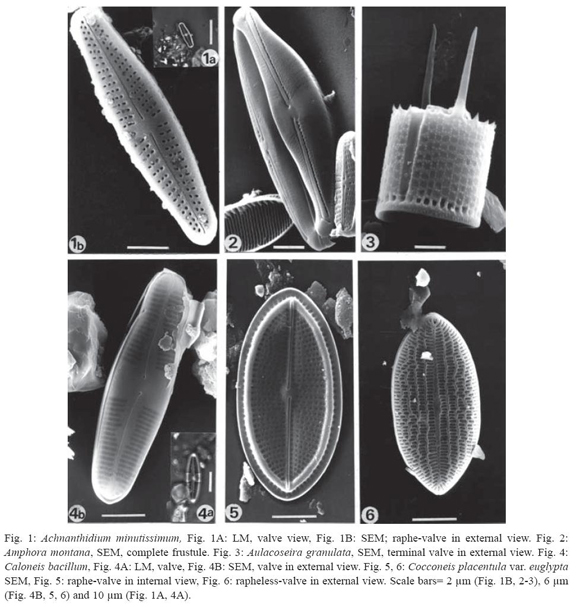
<body><![CDATA[<p><font face="Verdana" size="2">(Kützing) Czarnecki (<a href="#f1">Fig. 1A</a>, <a href="#f1">B</a>)    <br> </font></p>     <p><font face="Verdana" size="2">    <br> <a name="f1"></a></font></p>     <div style="text-align: center;"><font face="Verdana" size="2"><img  src="/img/revistas/rbt/v56n3/art16i1.jpg" title="" alt=""  style="width: 580px; height: 607px;"></font>    <br> <font face="Verdana" size="2"> </font></div>     <p><font face="Verdana" size="2">Czarnecki 1994, Mem. Calif. Acad. Sci. 17: 157.     <br> </font></p>     <p><font face="Verdana" size="2">Bas.: <i>Achnanthes minutissima </i>Kützing valves elliptical-lanceolate with rounded ends, sometimes slightly capitated. Raphe valve (RV): central area asymmetric reaching one margin. Axial area narrow, slightly widen to the valve center. Raphe filiform, external proximal ends gently dilated and internal ones slightly curved to opposite sides; distal ends externally curved to the same side and internally to opposite sides with little helictoglossae. Raphe-less valve (RLV): central area symmetric reaching both valve margins and axial area linear-lanceolate. Striae uniseriate, slightly radiate and interrupted near the mantle in both valves. Length: 8.5- 23.0 µm; width: 2.5-3.0 µm; striae: 25-29 in 10 µm (RV); 25-26 in 10 µm (RLV); areolae: 31-62 in 10 µm.</font></p>     <p><font face="Verdana" size="2"><b>Studied material: </b>LPC 10011, 10013, 10014. </font></p>     ]]></body>
<body><![CDATA[<p><font face="Verdana" size="2"><b>Ecological data: </b>altitude: 1 600-3 250 masl.; conductivity: 23-189 µScm</font><sup><font  face="Verdana" size="1">-1</font></sup><font face="Verdana" size="2">; Tºw: 11.026.3ºC; ph: 6.3-7.9; dissolved oxygen: 6.6-8.5 mgl</font><sup><font  face="Verdana" size="1">-1</font></sup><font face="Verdana" size="2">. </font></p>     <p><font face="Verdana" size="2"><b>Distribution in Colombia: </b>this cosmopolitan species was mentioned in Alta Montaña Province (Donato, 2001). </font></p> <font face="Verdana" size="2"><i>     <p>Amphora montana </p> </i></font>     <p><font face="Verdana" size="2">Krasske (<a href="#f1">Fig. 2</a>)</font></p>     <p><font face="Verdana" size="2">Krasske 1932, hedwigia 72: 119, <a  href="#f1">Fig. 2</a>.&nbsp;    <br> </font></p>     <p><font face="Verdana" size="2">Valves with the dorsal margin convex and with the ventral margin strongly tumid. Ends subcapitate, bent to the ventral side. Raphe forming an obtuse angle, close to the ventral edge; central external raphe endings slightly curved to the dorsal side and terminal ones dorsally deflected. Conopeum narrow; central area asymmetric, wider on the ventral side. Striae uniseriate, well developed at both sides, radiate at the center and convergent to the poles. Length: 14.5-16.0 µm; width: 3.0-3.5 µm. Dorsal striae: 37-44 in 10 µm, ventral striae: 48 in 10 µm. </font></p>     <p><font face="Verdana" size="2"><b>Studied material: </b>LPC 10011, 10016. </font></p>     <p><font face="Verdana" size="2"><b>Ecological data: </b>altitude: 630-1100 masl.; conductivity: 61.2-256.0 µScm</font><sup><font  face="Verdana" size="1">-1</font></sup><font face="Verdana" size="2">; Tºw: 23.2 26.3 ºC; ph: 6.0-9.2; dissolved oxygen: 5.5-8.0 mgl</font><sup><font face="Verdana" size="1">-1</font></sup><font  face="Verdana" size="2">. </font></p>     <p><font face="Verdana" size="2"><b>Distribution in Colombia: </b>this cosmopolitan species is recorded for the first time. </font></p> <font face="Verdana" size="2"><i>     ]]></body>
<body><![CDATA[<p>Aulacoseira granulata </p> </i></font>     <p><font face="Verdana" size="2">(Ehrenberg) Simonsen (<a href="#f1">Fig. 3</a>) </font></p>     <p><font face="Verdana" size="2">Simonsen 1979, Bacill. 2: 58 </font></p>     <p><font face="Verdana" size="2">Bas.: <i>Gallionella granulata </i>Ehrenberg </font></p>     <p><font face="Verdana" size="2">Frustules rectangular in girdle view joined forming filiform colonies. The terminal and intermediate cells of the colony are morphologically different. Separating cells (terminal), with a ring of short spines and 1-2 long spines. Linking cells (intermediate), have short spines variable in morphology, in the same number as the areolae. valve face smooth, in the linking cells, and with small areolae near the margin in the separating cells. valve mantle high, with subcuadrangular to round areolae, arranged in straight lines in the separating valves, and slightly helicoidal in the linking cells. Collum narrow, with small knobs in some specimens. Ringleseite narrow. Diameter: 7-17 µm; mantle height: 7.5-26.5 µm; striae: 7-21 in 10 µm; areolae: 8-17 in 10 µm </font></p>     <p><font face="Verdana" size="2"><b>Studied material: </b>LPC 10019, 10007. </font></p>     <p><font face="Verdana" size="2"><b>Ecological data: </b>altitude: 60-1 100 masl.; conductivity: 168-172 µScm</font><sup><font  face="Verdana" size="1">-1</font></sup><font face="Verdana" size="2">; Tºw: 23-27 ºC; ph: 5.8-7.2; dissolved oxygen: 4.7-5.3 mgl</font><sup><font  face="Verdana" size="1">-1</font></sup><font face="Verdana" size="2">. </font></p>     <p><font face="Verdana" size="2"><b>Distribution in Colombia: </b>this cosmopolitan species was reported in Colombia at Provincias Andina, Tierras Bajas and Amazonia. </font></p>     <p><font face="Verdana" size="2"><i>Caloneis </i>aff<i>. bacillum </i>(Grunow) Cleve (<a href="#f1">Fig. 4A</a>, <a href="#f1">B</a>) </font></p>     <p><font face="Verdana" size="2">Cleve 1894, Kongl. Svenksa vetensk. Akad. handl. 26(2): 99. </font></p>     ]]></body>
<body><![CDATA[<p><font face="Verdana" size="2">Bas.: <i>Stauroneis bacillum </i>Grunow </font></p>     <p><font face="Verdana" size="2">Valve linear to linear-lanceolate with rounded ends. Axial area narrow at the first third of the valve, widening to the valve center. Central area reaching both margins. Striae parallel to slightly radiate, irregular in length; areolae difficult to see even with SEM. Raphe filiform arched; external proximal ends dilated and slightly curved to the same side; terminal fissures curved in the same direction (opposite to the proximal ends). Length: 23-27 µm, width: 5.5-7.0 µm; striae: 17-23 in 10 µm. </font></p>     <p><font face="Verdana" size="2"><b>Studied material: </b>LPC 10011, 10019, 10015. </font></p>     <p><font face="Verdana" size="2"><b>Ecological data: </b>altitude: 720-1 100 masl.; conductivity: 61.2-190.0 µScm</font><sup><font  face="Verdana" size="1">-1</font></sup><font face="Verdana" size="2">; Tºw: 18.0-26.3 ºC; ph: 5.5- 8.6; dissolved oxygen: 4.7- 8.9 mgl</font><sup><font  face="Verdana" size="1">-1</font></sup><font face="Verdana" size="2">. </font></p>     <p><font face="Verdana" size="2"><b>Distribution in Colombia: </b>this cosmopolitan species is recorded for the first time. </font></p>     <p><font face="Verdana" size="2"><b>Observations: </b>Germain (1981) and Krammer and Lange-Bertalot (1986) described the species as extremely variable in valve outline and in the axial area. The studied materials differ from the materials described by these authors in the axial area and width of the central area, and coincide with the specimens illustrated in Rumrich <i>et al. </i>(2000) as <i>Caloneis </i>sp. cf. <i>bacillum </i>(Plate 136, <a href="#f1">Fig. 5</a>, <a  href="#f1">6</a>, 9). </font></p>     <p><font face="Verdana" size="2"><i>Cocconeis placentula </i>var. <i>euglypta </i>(Ehrenberg) Grunow (<a href="#f1">Fig. 5</a>-<a href="#f1">6</a>) </font></p>     <p><font face="Verdana" size="2">Grunow 1884, Akad. der Wissenchaften, Bd. 48: 97 </font></p>     <p><font face="Verdana" size="2">Bas.: <i>Cocconeis euglypta </i>Ehrenberg. </font></p>     <p><font face="Verdana" size="2">Valves elliptical to linear-elliptical. Raphe valve: axial area very narrow; central area small, more o less oval. Striae radiate, uniseriate, composed of a row of round areolae, interrupted at the valve margin by an internal circumferential costa. Raphe filiform with external proximal ends slightly dilated and distal ones straight and ended at the marginal hyaline costa. Internal proximal ends gently curved to opposite sides and terminal ones, straight, ended at small helictoglossae. Raphe-less valve: striae composed of 2-4 (5) areolae separated by longitudinal hyaline lines. Axial area narrow slightly widened at valve center; central area absent. Length: 19.5-26.0 µm, width: 9.0-12.5 µm; striae: 18-20 in 10 µm (raphe valve), 16-19 in 10 µm (raphe-less valve). </font></p>     ]]></body>
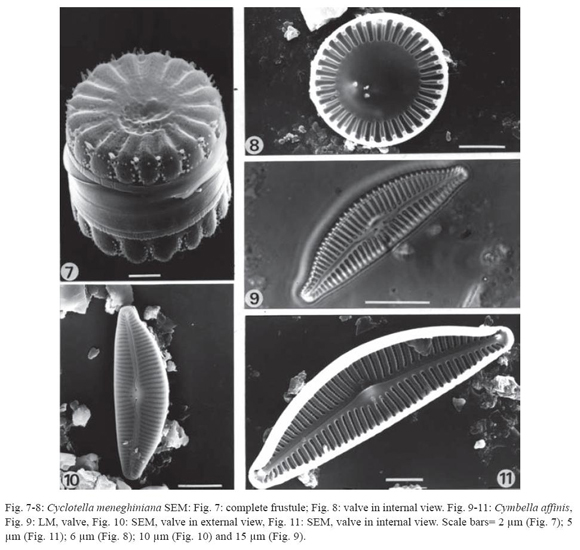
<body><![CDATA[<p><font face="Verdana" size="2"><b>Studied material: </b>LPC 10002, 10003. </font></p>     <p><font face="Verdana" size="2"><b>Ecological data: </b>altitude: 630-1 100 masl.; conductivity: 126.2-256.0 µScm</font><sup><font  face="Verdana" size="1">-1</font></sup><font face="Verdana" size="2">; Tºw: 23-24 ºC; ph 6.0-9.2; dissolved oxygen: 5.5-8.8 mgl</font><sup><font  face="Verdana" size="1">-1</font></sup><font face="Verdana" size="2">. </font></p>     <p><font face="Verdana" size="2"><b>Distribution in Colombia: </b>this cosmopolitan variety was mentioned in the Provincia de Alta Montaña. </font></p> <font face="Verdana" size="2"><i>     <p>Cyclotella meneghiniana </p> </i></font>     <p><font face="Verdana" size="2">Kützing (<a href="#f7-11">Fig. 7</a>-<a  href="#f7-11">8</a>)    <br> </font></p>     <p><font face="Verdana" size="2">    <br> <a name="f7-11"></a></font></p>     <div style="text-align: center;"><font face="Verdana" size="2"><img  src="/img/revistas/rbt/v56n3/art16i7-11.jpg" title="" alt=""  style="width: 580px; height: 550px;"></font>    <br> <font face="Verdana" size="2"> </font></div>     ]]></body>
<body><![CDATA[<p><font face="Verdana" size="2">Kützing 1844, Die. Kiesel. Bacil. oder. Diat.: 50, Pl. 30, Fig. 68. </font></p>     <p><font face="Verdana" size="2">Cells drum shaped, solitary. valve face with two differentiated areas, the central one tangentially undulated, with irregular areolae that do not penetrate the siliceous wall and the external one with areolae arranged in multiseriate fascicles and internal chambers. Fultoportulae with three satellite pores, 1-2 eccentric and the others in a marginal ring located at every interfascicle a little below the valve face/ mantle junction. one rimoportula placed in the same position of the fultoportulae ring. valve mantle with strong spines placed at the valve face/ mantle junction and others small with variable distribution. Diameter: 10-18 µm; fascicles: 6-8 in 10 µm. </font></p>     <p><font face="Verdana" size="2"><b>Studied material: </b>LPC 10001, 10006. </font></p>     <p><font face="Verdana" size="2"><b>Ecological data</b>: altitude: 840-1 100 masl; conductivity: 168-172 µScm</font><sup><font  face="Verdana" size="1">-1</font></sup><font face="Verdana" size="2">; Tºw: 23-27 ºC; ph: 5.8-7.2; dissolved oxygen: 4.7-5.3 mgl</font><sup><font  face="Verdana" size="1">-1</font></sup><font face="Verdana" size="2">. </font></p>     <p><font face="Verdana" size="2"><b>Distribution in Colombia: </b>this species, mentioned in the literature as cosmopolitan, was recorded in the Provincia Andina and in the Provincia Costera. </font></p> <font face="Verdana" size="2"><i>     <p>Cymbella affinis </p> </i></font>     <p><font face="Verdana" size="2">Kützing (<a href="#f7-11">Fig. 9</a>-<a  href="#f7-11">11</a>) </font></p>     <p><font face="Verdana" size="2">Kützing 1844, Die. Kiesel. Bacil. oder. Diat.: 8, Pl.6; <a href="#f12-17">Fig. 15</a>. </font></p>     <p><font face="Verdana" size="2">Valves semilanceolate with subrostrate ends, dorsal margin strongly convex and ventral margin straight or slightly convex. Axial area narrow; central area slightly differentiated, with one stigma located at the end of the ventral median striae. Raphe complex, externally it is strongly undulated with proximal and distant ends curved to the dorsal side. Internally, the raphe is arched to the dorsal side of the valve, without intermissio and conspicuous helictoglossae. Striae uniseriate, radiate. Length: 40-48 µm; width: 12-14 µm; dorsal striae: 7-10 in 10 µm at the center and 9-12 in 10 µm at the poles; ventral striae: 8-10 in 10 µm at the center and 9-12 in 10 µm at the poles; areolae: 25 -26 in 10 µm. </font></p>     <p><font face="Verdana" size="2"><b>Studied material: </b>LPC 10001, 10002, 10003, 10019. </font></p>     ]]></body>
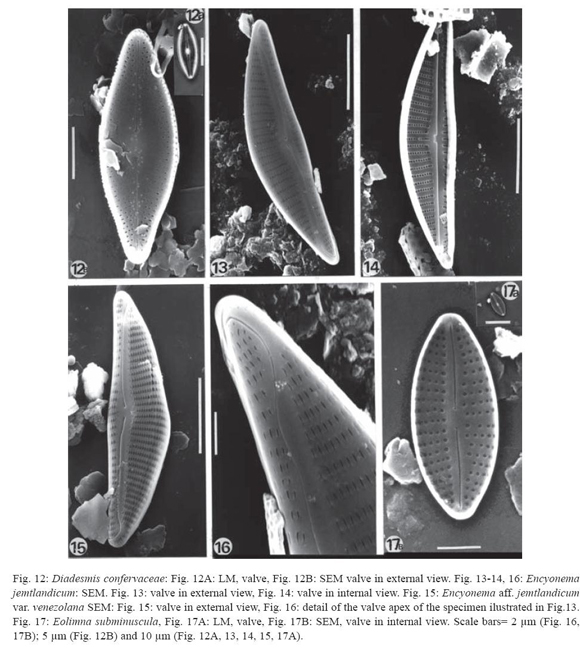
<body><![CDATA[<p><font face="Verdana" size="2"><b>Ecological data: </b>altitude: 400-1 100 masl.; conductivity: 61.2-176.0 µScm</font><sup><font  face="Verdana" size="1">-1</font></sup><font face="Verdana" size="2">; Tºw: 23.2-30.0 ºC; ph: 6.5-7.6; dissolved oxygen: 6.5-8.0 mgl</font><sup><font  face="Verdana" size="1">-1</font></sup><font face="Verdana" size="2">. </font></p>     <p><font face="Verdana" size="2"><b>Distribution in Colombia: </b>this cosmopolitan species is registered for the first time in the country. </font></p> <font face="Verdana" size="2"><i>     <p>Diadesmis confervacea </p> </i></font>     <p><font face="Verdana" size="2">Kützing (<a href="#f12-17">Fig. 12 A</a>, <a href="#f12-17">B</a>)    <br> </font></p>     <p><font face="Verdana" size="2">    <br> <a name="f12-17"></a></font></p>     <div style="text-align: center;"><font face="Verdana" size="2"><img  src="/img/revistas/rbt/v56n3/art16i12-17.jpg" title="" alt=""  style="width: 580px; height: 649px;"></font>    <br> <font face="Verdana" size="2"> </font></div>     <p><font face="Verdana" size="2">Kützing 1844, Bacill.: 109, pl. 30, <a href="#f7-11">Fig. 8</a>. </font></p>     ]]></body>
<body><![CDATA[<p><font face="Verdana" size="2">Valves elliptical-lanceolate, joined forming band colonies. Axial area narrow at the poles widening to the valve center. At the valve face/mantle junction there is a row of small spines. Raphe filiform, straight, external distal ends slightly dilated and proximal ends expanded. Uniseriate striae, radiate, composed of few transapically elongated to circular areolae. Length: 20.5-22.0 µm, width: 6.5-8.5 µm; striae: 16-20 in 10 µm at the center and 22-24 in 10 µm at the ends; areolae: 14 in 10 µm. </font></p>     <p><font face="Verdana" size="2"><b>Studied material: </b>LPC 10006, 10020. </font></p>     <p><font face="Verdana" size="2"><b>Ecological data: </b>altitude: 400-1 100 masl.; conductivity: 61.2-176.0 µScm</font><sup><font  face="Verdana" size="1">-1</font></sup><font face="Verdana" size="2">; Tºw: 23.2-30.0 ºC; ph: 6.5-7.4; dissolved oxygen: 6.5-8.0 mgl</font><sup><font  face="Verdana" size="1">-1</font></sup><font face="Verdana" size="2">. </font></p>     <p><font face="Verdana" size="2"><b>Distribution in Colombia: </b>this taxon was also found in Amazonia. </font></p> <font face="Verdana" size="2"><i>     <p>Encyonema jemtlandicum </p> </i></font>     <p><font face="Verdana" size="2">Krammer (<a href="#f12-17">Fig. 13</a>, <a href="#f12-17">14</a>, <a href="#f12-17">16</a>)</font></p>     <p><font face="Verdana" size="2">Krammer 1997, Bibl. Diat. 36: 82, Fig. 35: 1-9.</font></p>     <p><font face="Verdana" size="2">Valves semilanceolate, dorsal margin convex, and ventral margin slightly tumid, apices acute not differentiated. Axial area narrow, slightly dilated at the central area. Raphe complex, externally the raphe branches are strongly sinuous, with proximal ends dilated and curved to the dorsal side and terminal ends curved to the ventral side and internally straight with proximal ends curved to the dorsal side in straight angles and terminal ones not reaching the poles. Dorsal striae radiate and ventral striae parallel at the center and convergent at the poles; interstriae wide. Length: 34-35 µm, width: 7.5 µm; dorsal striae: 10 in 10 µm; ventral striae: 11 in 10 µm; areolae: 33 in 10 µm.</font></p>     <p><font face="Verdana" size="2"><b>Studied material: </b>LPC 10007. </font></p>     <p><font face="Verdana" size="2"><b>Ecological data: </b>altitude: 60 masl; conductivity: 172 µS.cm</font><sup><font face="Verdana" size="1">-1</font></sup><font  face="Verdana" size="2">; Tºw: 27; ph: 7.20; dissolved oxygen: 5.8 mgl</font><sup><font  face="Verdana" size="1">-1</font></sup><font face="Verdana" size="2">. </font></p>     ]]></body>
<body><![CDATA[<p><font face="Verdana" size="2"><b>Distribution in Colombia: </b>this taxon has been reported by Krammer (1997) only for Döda fallet; Abisko, Schwedisch-Lappland. In Colombia it is registered for the first time. </font></p>     <p><font face="Verdana" size="2"><b>Observations: </b>the studied material coincides with the specimens described in Krammer (1997: 166, Fig. 35). </font></p>     <p><font face="Verdana" size="2"><i>Encyonema </i>aff. <i>jemtlandicum </i>var. <i>venezolana </i>Krammer (<a href="#f12-17">Fig. 15</a>) </font></p>     <p><font face="Verdana" size="2">Krammer 1997, Bibl. Diat. 36: 82, <a  href="#f12-17">Fig. 14</a>: <a href="#f1">1-5</a>, <a href="#f34-42">36</a>: 1-3. </font></p>     <p><font face="Verdana" size="2">The studied material differs from the var. <i>jentlandicum </i>in the narrower interstriae, the dorsal areolae near the raphe more distant than the others, and the external proximal ends less dilated. Length: 35 µm, width: 8 µm; dorsal striae: 11 in 10 µm (center), 12 in 10 µm (poles); ventral striae: 10 in 10 µm (center), 11 </font><font face="Verdana" size="2">in 10 µm (poles); areolae: 32 in 10 µm.</font></p>     <p><font face="Verdana" size="2"><b>Studied material: </b>LPC 10007, 10017.    <br> </font></p>     <p><font face="Verdana" size="2"><b>Ecological data: </b>altitude: 1 060 masl; con</font><font face="Verdana" size="2">ductivity: 61.2-126.2 µS.cm</font><sup><font face="Verdana" size="1">-1</font></sup><font  face="Verdana" size="2">; Tºw: 19.0-26.3 °C; </font><font  face="Verdana" size="2">ph: 6.2-7.6; dissolved oxygen: 5.0-8.6 mgl</font><sup><font  face="Verdana" size="1">-1</font></sup><font face="Verdana" size="2">.    <br> </font></p>     <p><font face="Verdana" size="2"><b>Distribution in Colombia: </b>this species, </font><font face="Verdana" size="2">only reported at the Andes of Venezuela and</font><font face="Verdana"  size="2"> </font><font face="Verdana" size="2">Chile, is mentioned for the first time in the country. </font></p>     ]]></body>
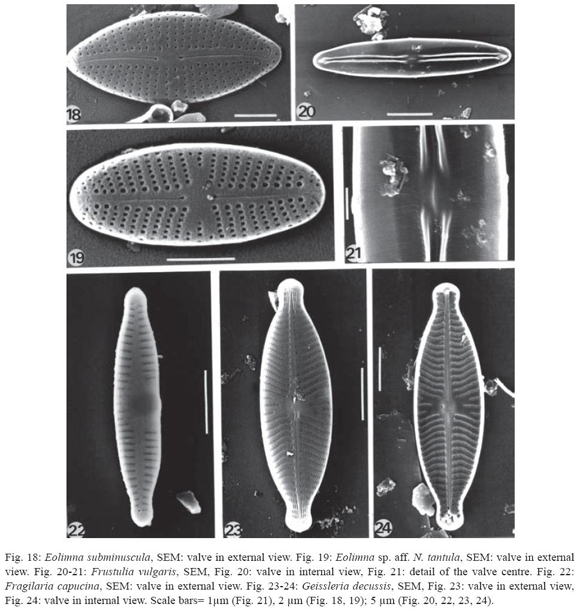
<body><![CDATA[<p><font face="Verdana" size="2"><b>Observations: </b>The studied materials are similar in valve outline and dimensions to the&nbsp;</font><font  face="Verdana" size="2"> material showed in Krammer (1997): 166, Fig. </font><font face="Verdana" size="2">14 but as in the literature there are not details of the fine morphology it is difficult to identify&nbsp; it without doubts. </font></p>     <p><font face="Verdana" size="2"><i>Eolimna subminuscula </i>(Manguin) </font></p>     <p><font face="Verdana" size="2">Lange-Bertalot (<a href="#f12-17">Fig. 17A</a>, <a href="#f12-17">B</a>, <a href="#f18-24">18</a>)    <br> </font></p>     <p><font face="Verdana" size="2">    <br> <a name="f18-24"></a></font></p>     <div style="text-align: center;"><font face="Verdana" size="2"><img  src="/img/revistas/rbt/v56n3/art16i18-24.jpg" title="" alt=""  style="width: 580px; height: 610px;"></font>    <br> </div>     <p><font face="Verdana" size="2">G. Moser, Lange-Bertalot <i>et </i>Metzeltin 1998, Bibl. Diat. 38, p. 154. </font></p>     <p><font face="Verdana" size="2">Bas.: <i>Navicula subminuscula </i>Manguin </font></p>     ]]></body>
<body><![CDATA[<p><font face="Verdana" size="2">Valves lanceolate with subrostrate or subacute ends. Axial area linear, moderately wide. Central area variable, absent in some specimens and asymmetric due to the shortening of the median striae. Striae uniseriate composed of circular areolae, radiate at the poles and parallel at the center. Raphe filiform slightly arcuate, external proximal ends, dilated in small pores, gently curved to the same side and opposite to the distal hooked endings; internal proximal raphe ends slightly curved in the same direction and terminal ones with small helictoglossae. Length: 9.0-10.5 µm, width: 4.0-4.5 µm; striae: 16-22 in 10 µm; areolae: 31-38 in 10 µm. </font></p>     <p><font face="Verdana" size="2"><b>Studied material: </b>LPC 10006, 10016, 10020.     <br> </font></p>     <p><font face="Verdana" size="2"><b>Ecological data: </b>altitude: 400-1100 masl.; conductivity: 126.2-256.0 µScm</font><sup><font face="Verdana" size="1">-1</font></sup><font  face="Verdana" size="2">; Tºw: 23.2-30.0 ºC; ph: 6.0-9.2; dissolved oxygen: 5.5-7.8 mgl</font><sup><font face="Verdana" size="1">-1</font></sup><font  face="Verdana" size="2">. </font></p>     <p><font face="Verdana" size="2"><b>Distribution in Colombia: </b>this species, mentioned in the literature as cosmopolitan, is recorded in Colombia for the first time. </font></p>     <p><font face="Verdana" size="2"><i>Eolimna </i>sp. aff. <i>N. tantula </i>hustedt (<a href="#f18-24">Fig. 19</a>) </font></p>     <p><font face="Verdana" size="2">Hustedt in A. Schmidt’s 1934 Atlas der Diatomaceen-Kunde: pl. 400, Fig. 54-57. </font></p>     <p><font face="Verdana" size="2">Valves linear-elliptical with rounded ends. Axial area linear-lanceolate, central area broad, semi-rectangular with short striae. Striae uniseriate, strongly radiate and curved; areolae punctate. Raphe filiform; external proximal ends dilated, internally gently curved to the same side; helictoglossae small. Length: 9-11 µm, width: 3.0-3.5 µm; striae: 22-28 in 10 µm at the center and 25-28 in 10 µm at the ends; areolae: 56.0-66.5 in 10 µm. </font></p>     <p><font face="Verdana" size="2"><b>Studied material: </b>LPC 10001, 10003. </font></p>     <p><font face="Verdana" size="2"><b>Distribution in Colombia: </b>this taxon is recorded in Colombia for the first time. </font></p>     ]]></body>
<body><![CDATA[<p><font face="Verdana" size="2"><b>Observations: </b>although the analyzed specimens belong to sites ecologically heterogeneous, they present little morphological variation. The valve outline, dimension, type of raphe and typo of striae evidences that the studied material belongs to the genus <i>Eolimna </i>but it could not be assigned to any species of the genus. It coincides in valve outline, dimensions and striae density with the specimens illustrated in Simonsen (1987) as the holotype of <i>N. tantula </i>hustedt (Plate 275, Fig. 20 a 26), but the general appearance of these materials differ from the specimens illustrated by hustedt (in Schmidt <i>et al</i>. 1934, Taf. 394-400) and in hustedt (1962) under this name. Simonsen (1987) pointed out that <i>N. tantula </i>was reported without description in hustedt (1934) and then described in hustedt (1937) as <i>Stauroneis fonticola</i>. Also, this author recommends consulting hustedt (1962). our material do not coincide with any of the specimens illustrated by hustedt in the above mentioned publications and are similar to <i>Stauroneis fonticola </i>in valve outline, morphometric data and the striae in the central area but differ in the presence of the conspicuous stauro. our material also differs from the specimens described in Krammer and Lange-Bertalot (1986, pl. 76, Fig. 39-47) who pointed out that <i>N. tantula </i>is synonym of <i>Navicula minima </i>Grunow and that their Fig. 47 corresponds to the holotype of <i>N. tantula</i>. Comparing our materials with others in the literature we found that they are similar in valve morphology and morphometric data to those collected in Ecuador and illustrated as <i>Eolimna </i>(nov.?) spec. and <i>Eolimna </i>aff. <i>minima </i>(Grunow) Lange-Bertalot by Rumrich <i>et al. </i>(2000, Pl. 71, <a href="#f1">Fig. 5-8</a> and 4, 9 and 10 respectively) and to the specimens illustrated as <i>E. </i>sp. aff. <i>minima </i>in Monnier <i>et al. </i>(2003). on the basis of all above mentioned we believe that before proposing any new taxon or new combination it is necessary a comparative study with electron microscope of all the materials studied by hustedt as <i>N. tantula </i>and <i>S. fonticola </i>and type material of <i>N. minima</i>. </font></p> <font face="Verdana" size="2"><i>     <p>Fragilaria capucina </p> </i></font>     <p><font face="Verdana" size="2">Desmazieres (<a href="#f18-24">Fig. 22</a>) </font></p>     <p><font face="Verdana" size="2">Desmazieres 1825: Plant. Cryp. Fr., Fasc. 10 N° 453 </font></p>     <p><font face="Verdana" size="2">Valves linear to linear-elliptical with rounded to capitate ends. Axial area widening to the central part of the valve; central area asymmetric reaching one of the valve sides, inflated in some specimens. Striae uniseriate, parallel and slightly radiate to the poles. Rimoportulae eccentric, placed at one pole near the last stria. </font></p>     <p><font face="Verdana" size="2">No spines in the valve face and mantle junction. Length: 18-26 µm; width: 3.5-4.5 µm; striae: 15-16 in 10 µm at the center and 14 in 10 µm at the ends; areolae: 49-66 in 10 µm. </font></p>     <p><font face="Verdana" size="2"><b>Studied material: </b>LPC 10012, 10019. </font></p>     <p><font face="Verdana" size="2"><b>Ecological data: </b>altitude: 840-1 100 masl; conductivity: 126.2-172.0 µScm</font><sup><font  face="Verdana" size="1">-1</font></sup><font face="Verdana" size="2">; Tºw: 23.0-23.2 ºC; ph: 5.8-7.6; dissolved oxygen: 4.7-6.5 mgl</font><sup><font  face="Verdana" size="1">-1</font></sup><font face="Verdana" size="2">. </font></p>     <p><font face="Verdana" size="2"><b>Distribution in Colombia: </b>this cosmopolitan species is recorded for the first time. </font></p>     <p><font face="Verdana" size="2"><b>Observations: </b>Williams and Round (1987) consider that <i>Fragilaria vaucheriae </i>(Kützing) Petersen is a different species and not a variety of <i>F. capucina. </i>Nevertheless in the studied populations we found a continious variation of the central area, some specimens with one side inflated and others without inflation. As they do not differ in the other characters we consider that all of them belong to <i>F. capucina</i>. This material resembles those described in Argentina (Sala, 1996) in the absence of marginal spines. </font></p>     ]]></body>
<body><![CDATA[<p><font face="Verdana" size="2"><i>Frustulia vulgaris </i>(Thwaites) De Toni (<a href="#f18-24">Fig. 20</a>-<a href="#f18-24">21</a>) </font></p>     <p><font face="Verdana" size="2">De Toni 1891, Syllog. Alg. 2: 280 </font></p>     <p><font face="Verdana" size="2">Bas. <i>Schizonema vulgare </i>Thwaites </font></p>     <p><font face="Verdana" size="2">Valves lanceolate to linear-lanceolate, ends rounded and slightly subrostrate. Raphe branches distinctly curved, accompanied by internal axial ribs which are interrupted at the central area. In internal view the central nodule and the helictoglossae are isolated from the axial ribs. External proximal and distal raphe endings Y-shaped. Axial area narrow; central area orbicular. Striae around the central area moderately but without exception distinctly radiate, circumradiate at the poles. Areolae somewhat irregularly spaced not forming straight apical lines. Length: 22-46 µm; width: 4.5-4.7 µm; striae: 22-35 in 10 µm; areolae: 44 in 10 µm. </font></p>     <p><font face="Verdana" size="2"><b>Studied material: </b>LPC 10001, 10019. </font></p>     <p><font face="Verdana" size="2"><b>Ecological data: </b>altitude: 840-1 100 masl; conductivity: 61.2-172.0 µScm</font><sup><font  face="Verdana" size="1">-1</font></sup><font face="Verdana" size="2">; Tºw: 23.0</font></p>     <p><font face="Verdana" size="2">26.3 ºC; ph: 5.8-7.6; dissolved oxygen: 4.7-8.0 mgl</font><sup><font face="Verdana" size="1">-1</font></sup><font  face="Verdana" size="2">. <b>    <br> </b></font></p>     <p><font face="Verdana" size="2"><b>Distribution in Colombia: </b>this cosmopolitan species was recorded in Tierras Bajas. </font></p>     <p><font face="Verdana" size="2"><b>Observations: </b>the studied material coincides with the description of the species given in Lange-Bertalot (2001). </font></p>     ]]></body>
<body><![CDATA[<p><font face="Verdana" size="2"><i>Geissleria decussis </i>(Østrup) </font></p>     <p><font face="Verdana" size="2">Lange-Bertalot (<a href="#f18-24">Fig. 23</a>-<a href="#f18-24">24</a>) </font></p>     <p><font face="Verdana" size="2">Lange-Bertalot and Metzeltin 1996, Iconogr. Diatomol. 2: 65. </font></p>     <p><font face="Verdana" size="2">Bas. <i>Navicula decussis </i>Østrup </font></p>     <p><font face="Verdana" size="2">Valves linear-elliptical with subcapitate ends. Axial area narrow and straight; central area transapically expanded with alternating short and long striae. Stigma, poroid, near the central nodule. Raphe filiform, straight, external proximal ends slightly dilated with two short ribs and distal ones curved to opposite sides. Internal proximal ends straight; helictoglossae small. Striae uniseriate and curved, radiate nearly all along the valve and gently convergent or parallel at the ends. Length: 22-23 µm, width: 6.5-11.0 µm; striae: 14-17 in 10 µm; areolae: 61-67 in 10 µm. </font></p>     <p><font face="Verdana" size="2"><b>Studied material: </b>LPC 10003, 10018, 10019, 10020. </font></p>     <p><font face="Verdana" size="2"><b>Ecological data: </b>altitude: 400-1 100 masl; conductivity: 61.2-213.0 µScm</font><sup><font  face="Verdana" size="1">-1</font></sup><font face="Verdana" size="2">; Tºw: 23.2</font></p>     <p><font face="Verdana" size="2">30.0 ºC; ph: 5.5-8.1; dissolved oxygen: 4.7-8.0 mgl</font><sup><font face="Verdana" size="1">-1</font></sup><font  face="Verdana" size="2">. </font></p>     <p><font face="Verdana" size="2"><b>Distribution in Colombia: </b>this cosmopolitan species is recorded for the first time in Colombia. </font></p> <font face="Verdana" size="2"><i>     <p>Gomphonema clavatum </p> </i></font>     ]]></body>
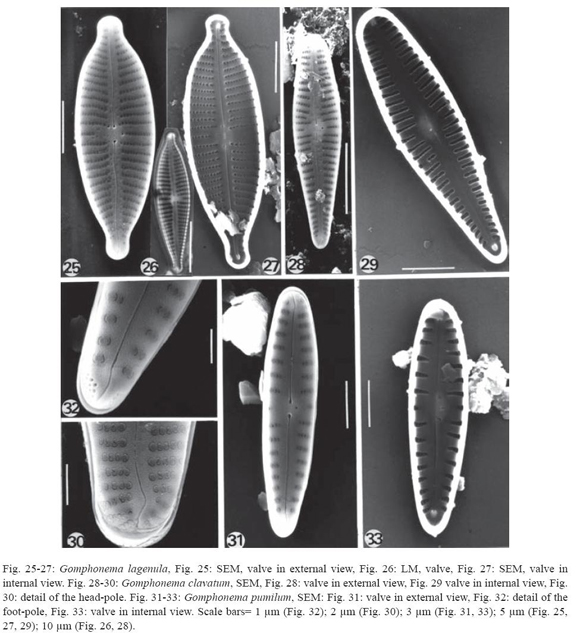
<body><![CDATA[<p><font face="Verdana" size="2">Ehrenberg (<a href="#f25-33">Fig. 28</a>-<a  href="#f25-33">30</a>)    <br> </font></p>     <p><font face="Verdana" size="2">    <br> <a name="f25-33"></a></font></p>     <div style="text-align: center;"><font face="Verdana" size="2"><img  src="/img/revistas/rbt/v56n3/art16i25-33jpg.JPG" title="" alt=""  style="width: 580px; height: 633px;"></font>    <br> <font face="Verdana" size="2"> </font></div>     <p><font face="Verdana" size="2">Ehrenberg 1832 sensu Krammer and Lange Bertalot 1986: 367, Fig. 163: 4. </font></p>     <p><font face="Verdana" size="2">Valve heteropolar, clavate with rounded ends. Axial area linear gently widened to the valve center. Central area with the median striae shortened, stigma with circular external foramen, internally elongated, placed at the central nodule. Striae uniseriate, radiate throughout the valve; areolae with c-shaped foramina. Raphe lateral with the external fissures undulated; proximal ends dilated and distal ones irregular, turned to the same side; internal raphe fissures straight with hooked proximal ends and conspicuous helictoglossae. In some specimens the striae occupy the place of the apical pore field. Length: 27.5-38.0 µm; width: 6.5-7.0 µm; striae: 10-11 in 10 µm at the center, 10-14 in 10 µm at the head- pole and 12-14 in 10 µm at the foot- pole; areolae: 28-38 in 10 µm. </font></p>     <p><font face="Verdana" size="2"><b>Studied material: </b>LPC 10002, 10013, 10017. </font></p>     <p><font face="Verdana" size="2"><b>Ecological data: </b>altitude: 1 060-3 250 masl; conductivity: 23.0-126.2 µScm</font><sup><font  face="Verdana" size="1">-1</font></sup><font face="Verdana" size="2">; Tºw: 11.0-26.3 ºC; ph: 6.2- 7.7; dissolved oxygen: 6.5- 8.6 mgl</font><sup><font  face="Verdana" size="1">-1</font></sup><font face="Verdana" size="2">. </font></p>     ]]></body>
<body><![CDATA[<p><font face="Verdana" size="2"><b>Distribution in Colombia: </b>this species was recorded in the Provincia de Alta Montaña. </font></p> <font face="Verdana" size="2"><i>     <p>Gomphonema lagenula </p> </i></font>     <p><font face="Verdana" size="2">Kützing (<a href="#f25-33">Fig. 25</a>-<a  href="#f25-33">27</a>) </font></p>     <p><font face="Verdana" size="2">Kützing 1844, Bacill.: 85, pl. 30, Fig. 60. </font></p>     <p><font face="Verdana" size="2">Valves heteropolar, ovate to clavate with subcapitate ends. Axial area straight; central area delimited by the shortening of one median stria. A stigma, placed at the central nodule at the end of the long central stria, has an external round opening and is internally elongated. Striae, uniseriate, slightly radiate at the center and radiate at the poles; areolae with c-shaped foramina. Raphe with external fissures slightly undulated, dilated proximal ends and distal ends bent to the same side; internally the raphe fissures are straight, with hooked proximal ends and conspicuous helictoglossae. Length: 24-31 µm; width: 4-7.5 µm; striae: 9-12 in 10 µm at the center, 10-15 in 10 µm at the head pole; areolae: 30-39 in 10 µm. </font></p>     <p><font face="Verdana" size="2"><b>Studied material: </b>LPC 10001, 10002, 10020. </font></p>     <p><font face="Verdana" size="2"><b>Ecological data: </b>altitude: 400-1 100 masl; conductivity: 126-213 µScm</font><sup><font  face="Verdana" size="1">-1</font></sup><font face="Verdana" size="2">; Tºw: 23.2-30.0 ºC; ph 5.5- 8.1; dissolved oxygen: 7.1- 7.9 mgl</font><sup><font  face="Verdana" size="1">-1</font></sup><font face="Verdana" size="2">. </font></p>     <p><font face="Verdana" size="2"><b>Distribution in Colombia: </b>this cosmopolitan species is recorded for the first time in the country. </font></p>     <p><font face="Verdana" size="2"><i>Gomphonema pumilum </i>(Grunow)     <br> </font></p>     ]]></body>
<body><![CDATA[<p><font face="Verdana" size="2">Reichardt and Lange-Bertalot (<a  href="#f25-33">Fig. 31</a>-<a href="#f25-33">33</a>) </font></p>     <p><font face="Verdana" size="2">Reichardt and Lange-Bertalot. 1991, Nova hedwigia 53: 528. </font></p>     <p><font face="Verdana" size="2">Valves heteropolar, lanceolate with rounded ends. Axial area lanceolate; central area symmetric with very short median striae; stigma externally circular and internally elongated, placed on the central nodule. Striae uniseriate, short, gently curved and slightly radiate; composed of areolae with external c-shaped foramina. Raphe nearly straight, external proximal ends dilated and distal ends bent to the same side; internal proximal ends bent in the same direction forming acute angles and then hooked; helictoglossae small. Apical pore fields small. Length: 10.5-22.5 µm, width: 3-4 µm; striae: 11-13 in 10 µm; areolae: 45-50 in 10 µm. </font></p>     <p><font face="Verdana" size="2"><b>Studied material: </b>LPC 10001, 10012, 10016, 10019. </font></p>     <p><font face="Verdana" size="2"><b>Ecological data: </b>altitude: 840-1 100 masl; conductivity: 126.2-256.0 µScm</font><sup><font  face="Verdana" size="1">-1</font></sup><font face="Verdana" size="2">; Tºw: 23-24ºC; ph: 5.8-9.2; dissolved oxygen: 5.3-7.2 mgl</font><sup><font  face="Verdana" size="1">-1</font></sup><font face="Verdana" size="2">. </font></p>     <p><font face="Verdana" size="2"><b>Distribution in Colombia: </b>this cosmopolitan species is recorded for the first time in the country. </font></p>     <p><font face="Verdana" size="2"><b>Observations: </b>our material coincide with those described in Reichardt (1997: 103). </font></p>     <p><font face="Verdana" size="2"><i>Gomphonema punae </i></font></p>     <p><font face="Verdana" size="2">Lange-Bertalot and Rumrich (<a  href="#f34-42">Fig. 34</a>-<a href="#f34-42">36</a>)    <br> </font></p>     ]]></body>
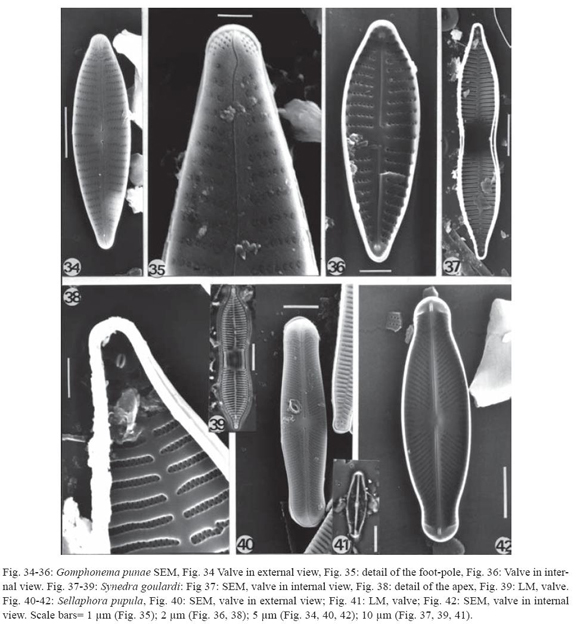
<body><![CDATA[<p><font face="Verdana" size="2">    <br> <a name="f34-42"></a></font></p>     <div style="text-align: center;"><font face="Verdana" size="2"><img  src="/img/revistas/rbt/v56n3/art16i34-42.jpg" title="" alt=""  style="width: 580px; height: 624px;"></font>    <br> <font face="Verdana" size="2"> </font></div>     <p><font face="Verdana" size="2">Lange-Bertalot and Rumrich in Rumrich <i>et al</i>. 2000. Iconogr. Diatomol. 9: 140, pl. 129: Fig. 1-14. </font></p>     <p><font face="Verdana" size="2">Valves heteropolar, ovate with subrostrate ends. Axial area straight; central area asymmetric, delimited by the shortening of one of the central striae; stigma with an external circular opening and internally elongated, placed near one of the central striae. Striae uniseriate, parallel to slightly radiate; areolae with external irregular c-shaped foramina. Raphe gently undulated with external proximal ends slightly dilated and terminal ones bent to the same side; internal proximal ends hooked in the same direction, helictoglossae conspicuous. Apical pore-fields composed of 6 rows of round pores diagonally arranged. Length: 13-21 µm; width: 4.5-5.0 µm; striae: 11-16 in 10 µm; areolae: 40-42 in 10 µm. </font></p>     <p><font face="Verdana" size="2"><b>Studied material: </b>LPC 10011, 10012, 10013, 10019. </font></p>     <p><font face="Verdana" size="2"><b>Ecological data: </b>altitude: 840-3 250 masl; conductivity: 23-172 µScm</font><sup><font  face="Verdana" size="1">-1</font></sup><font face="Verdana" size="2">; Tºw: 11.0-26.3 °C; ph: 6.3-7.6; dissolved oxygen: 4.7-8.0 mg.l</font><sup><font  face="Verdana" size="1">-1</font></sup><font face="Verdana" size="2">. </font></p>     <p><font face="Verdana" size="2"><b>Distribution in Colombia: </b>this taxon, recorded for the first time in Colombia, was only found in Chile (Rumrich <i>et al.</i>, 2000). </font></p>     <p><font face="Verdana" size="2"><i>Sellaphora pupula </i>(Kützing) </font></p>     ]]></body>
<body><![CDATA[<p><font face="Verdana" size="2">Mereschkowsky (<a href="#f34-42">Fig. 40</a>-<a href="#f34-42">42</a>) </font></p>     <p><font face="Verdana" size="2">Mereschkowsky 1902, Ann. Mag. Nat. hist. 2nd Ser. 7/9:187. </font></p>     <p><font face="Verdana" size="2">Bas.: <i>Navicula pupula </i>Kützing </font></p>     <p><font face="Verdana" size="2">Valves linear to elliptical-lanceolate with wide rounded ends, slightly protracted to sub-capitate. Raphe straight, filiform, external proximal ends gently dilated and curved to the same side, distal fissures hooked on the same direction but opposite to central ones; internal central endings hardly twisted to the same side; helictoglossae axially positioned over the conspicuous terminal nodules, laterally expanded. Axial area linear and narrow, internally swelled, visible even with LM; central area laterally expanded. Striae uniseriate, strongly radiate and undulated composed of small circular areolae. Length: 23.5-29 µm, width: 6-7 µm; striae: 20-25 in 10 µm at the center and 18-30 in 10 µm at the ends; areolae: 49-56 in 10 µm. </font></p>     <p><font face="Verdana" size="2"><b>Studied material: </b>LPC 10007, 10013, 10019, 10020. </font></p>     <p><font face="Verdana" size="2"><b>Ecological data: </b>altitude: 400-3 250 masl; conductivity: 23-176 µScm</font><sup><font  face="Verdana" size="1">-1</font></sup><font face="Verdana" size="2">; Tºw: 11-30 ºC; ph: 6.5-7.7; dissolved oxygen: 4.7-8.0 mgl</font><sup><font  face="Verdana" size="1">-1</font></sup><font face="Verdana" size="2">. </font></p>     <p><font face="Verdana" size="2"><b>Distribution in Colombia: </b>this species was registered in the Provincias Andina and Alta Montaña. </font></p>     <p><font face="Verdana" size="2"><b>Observations: </b>the striae density of the studied specimens coincides with those described in Germain (1981) and differs from those in Patrick and Reimer (1966). </font></p>     <p><font face="Verdana" size="2"><i>Synedra goulardi </i></font></p>     <p><font face="Verdana" size="2">Brébisson ex Cleve and Grunow (<a  href="#f34-42">Fig. 37</a>-<a href="#f34-42">39</a>) </font></p>     ]]></body>
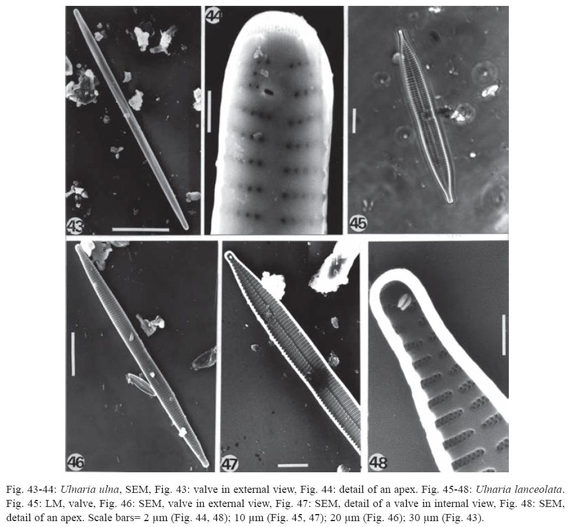
<body><![CDATA[<p><font face="Verdana" size="2">Cleve and Grunow 1880, <i>Kong. Svensk. Vetensk.-Akad. Hand., </i>17: 107. </font></p>     <p><font face="Verdana" size="2">Valves linear-lanceolate, constricted at the middle, with rostrate ends. Axial area narrow and straight; central area rectangular, reaching the margins. Striae biseriate, parallel or slightly radiate; areolae circular, small, arranged in quincunx. one rimoportula at each pole in variable position. Length: 52.5-80.0 µm; width: 8-16 µm; striae: 9-11 in 10 µm; areolae: 41-84 in 10 µm. </font></p>     <p><font face="Verdana" size="2"><b>Studied material: </b>LPC 10003, 10019. </font></p>     <p><font face="Verdana" size="2"><b>Ecological data: </b>altitude: 400-1 100 masl; conductivity: 61-176 µScm</font><sup><font  face="Verdana" size="1">-1</font></sup><font face="Verdana" size="2">; Tºw: 26.3-30.0 ºC; ph: 6.5-7.4; dissolved oxygen: 7.1-8.0 mgl</font><sup><font  face="Verdana" size="1">-1</font></sup><font face="Verdana" size="2">. </font></p>     <p><font face="Verdana" size="2"><b>Distribution in Colombia: </b>this pantropical species was reported in the Provincia Costera. </font></p>     <p><font face="Verdana" size="2"><b>Observations: </b>our material coincides in the ultrastructure with the material described in Williams (1986). According to Compère (2001) this species should be transferreded to the genus <i>Ulnaria </i>(Kützing) Compère but as our specimens differ in valve outline from the lectotype illustrated in Lange-Bertalot (1980), we pospone this proposal of transference until the type material is analysed with electron microscopy. </font></p>     <p><font face="Verdana" size="2"><i>Ulnaria lanceolata </i></font></p>     <p><font face="Verdana" size="2">(Kützing) Compère (<a href="#f43-48">Fig. 45</a>-<a href="#f43-48">48</a>)    <br> </font></p>     <p style="text-align: center;"><font face="Verdana" size="2"><a  name="f43-48"></a><img src="/img/revistas/rbt/v56n3/art16i43-48.jpg"  title="" alt="" style="width: 580px; height: 527px;">    ]]></body>
<body><![CDATA[<br> </font></p>     <p><font face="Verdana" size="2">Compère 2001, Stud. on Diat. ded. Prof. Lange-Bertalot: 10 </font></p>     <p><font face="Verdana" size="2">Bas.: <i>Synedra lanceolata </i>Kützing </font></p>     <p><font face="Verdana" size="2">valves linear, sometimes narrowed at valve center, with rostrate or subcapitate ends. Axial area narrow; central area rectangular unilateral in some specimens. Striae biseriate, parallel, slightly radiate at the poles; sunken in the internal side of the valve. Areolae circular and small, arranged in quincunx. one rimoportula at each pole with a prominent internal labium diagonally positioned. Apical pore fields well developed. Length: 81-117 µm; width: 6.5–10 µm; striae: 10-11 in 10 µm; areolae: 41-72 in 10 µm. </font></p>     <p><font face="Verdana" size="2"><b>Studied material: </b>LPC 10001, 10017, 10020. </font></p>     <p><font face="Verdana" size="2"><b>Ecological data: </b>altitude: 400-1 100 masl; conductivity: 61.2-126.2 µScm</font><sup><font  face="Verdana" size="1">-1</font></sup><font face="Verdana" size="2">; Tºw: 23.2-26.3 ºC; ph: 7.3-7.6; dissolved oxygen: 6.5-8.0 mgl</font><sup><font face="Verdana" size="1">-1</font></sup><font  face="Verdana" size="2">. </font></p>     <p><font face="Verdana" size="2"><b>Distribution in Colombia: </b>this pantropical species is recorded in the country for the first time. </font></p>     <p><font face="Verdana" size="2"><i>Ulnaria ulna </i></font></p>     <p><font face="Verdana" size="2">(Nitzsch) Compère (<a href="#f43-48">Fig. 43</a>-<a href="#f43-48">44</a>) </font></p>     <p><font face="Verdana" size="2">Compère 2001, Stud. on Diat. ded. Prof. Lange-Bertalot :100 </font></p>     ]]></body>
<body><![CDATA[<p><font face="Verdana" size="2">Bas. <i>Bacillaria ulna </i>Nitzsch </font></p>     <p><font face="Verdana" size="2">Valves linear with rostrate ends. Axial area narrow; central area rectangular with short striae at the margins or absent. Striae uniseriate, parallel, slightly radiate at the poles. one rimoportula at each pole at the end of one of the last striae. Apical pore fields well developed with two spines at the upper side. </font></p>     <p><font face="Verdana" size="2">Length: 117-217 µm, width: 4.5-7.8 µm; striae: 9-10 in 10 µm; areolae: 38 in 10 µm. </font></p>     <p><font face="Verdana" size="2"><b>Studied material: </b>LPC 10001, 10017. </font></p>     <p><font face="Verdana" size="2"><b>Ecological data: </b>altitude: 1 060-1 100 masl; conductivity: 61.2-126.2 µScm</font><sup><font  face="Verdana" size="1">-1</font></sup><font face="Verdana" size="2">; Tºw: 19.0-26.3 ºC; ph: 6.2-7.6; dissolved oxygen: 6.5-8.6 mgl</font><sup><font  face="Verdana" size="1">-1</font></sup><font face="Verdana" size="2">. </font></p>     <p><font face="Verdana" size="2"><b>Distribution in Colombia: </b>this cosmopolitan species has a wide distribution in Colombia, it was recorded in the Provinces of Alta Montaña, Andina, Tierras Bajas and Costera. </font></p>     <p><font face="Verdana" size="3"><span style="font-weight: bold;">Discussion</span> </font></p>     <p><font face="Verdana" size="2">Comparing the inventories of preliminary studies held in lentic and lotic systems, 90 diatom taxa were identified from Antioquia and Chocó Departments and 116 from Santander. Although the studied sites belong to the Colombian Andean region only 23 taxa were common to these three departments. These taxa belong to the orders Thalassiosirales (1), Aulacoseirales (1), Fragilariales (4), Cymbellales (7), Achnanthales (2), Naviculales (7), and Thalassiophysales (1). </font></p>     <p><font face="Verdana" size="2">From the species analised in this paper <i>A. montana</i>, <i>C. </i>aff. <i>bacillum</i>, <i>C. affinis</i>, <i>E. </i>aff. <i>jemtlandicum </i>var. <i>venezolana</i>, <i>E. subminuscula</i>, <i>Eolimna </i>sp. aff. <i>N. tantula</i>, <i>F. capucina</i>, <i>G. decussis</i>, <i>G. clavatum</i>, <i>G. lagenula</i>, <i>G. pumilum</i>, <i>G. punae </i>and <i>U. lanceolata </i>are reported for the first time in Colombia and <i>E. jemtlandicum </i>is here reported for the first time in South America. <i>A. granulata</i><b>, </b><i>C. meneghiniana </i>and <i>U. ulna </i>have a wide distribution in the country while <i>C. placentula </i>var. <i>euglypta </i>was recorded only in the Provincia de Alta Montaña, <i>S. pupula </i>in Río Medellín, <i>F. vulgaris </i>in Tierras Bajas and <i>S. goulardi </i>in Provincia Costera. The majority of the reports were obtained from ecological studies so it is difficult to corroborate or reject the distribution of these taxa in the country. We compared our results with the taxonomic analysis held in the Colombian Amazonia with SEM (Sala <i>et al. </i>1999, 2002a, 2002b). This comparison shows that although both areas are in the equatorial region, only <i>A. granulata</i>, <i>C. meneghiniana </i>and <i>D. confervacea </i>were represented at these areas. This difference in the diatom floras of low and highlands at the Ecuador and Tropics reflect the influence of altitude in climatic characteristics. our observations are coincident with those of Metzeltin and Lange-Bertalot (1998) and Rumrich <i>et al. </i>(2000) when studying the South American diatom flora.     <br> </font></p>     ]]></body>
<body><![CDATA[<p><font face="Verdana" size="2">On the other hand, the great majority of the analyzed taxa are mentioned in the literature as cosmopolitan with the exception of <i>U. lanceolata </i>and <i>S. goulardi </i>that have a pantropical distribution and <i>Encyonema </i>aff. <i>jemtlandicum </i>var. <i>venezolana </i>and <i>G. punae </i>found only in South America. </font></p>     <p><font face="Verdana" size="2">The comparison of the fine valve morphology of the studied materials and their descriptions in the literature, even in the case of taxa described in temperate or cold regions, showed that there are not important differences with the exception of <i>C. </i>aff. <i>bacillum</i><b>, </b><i>E. jemtlandicum </i>aff. var. <i>venezolana </i>and <i>Eolimna </i>sp. aff. <i>N. tantula </i>that need more detailed analyses. </font></p>     <p><font face="Verdana" size="3"><span style="font-weight: bold;">Acknowledgments</span> </font></p>     <p><font face="Verdana" size="2">To the Institute of Biología of Universidad de Antioquia, to Colciencias, and to Red Latinomericana de Botánica (RLB) for the fellowships given to the second and third authors respectively. </font></p> <hr style="width: 100%; height: 2px;">     <p><font face="Verdana" size="2"><span style="font-weight: bold;">Resumen</span> </font></p>     <p><font face="Verdana" size="2">En este artículo se analizan con microscopios de luz y electrónico de barrido 23 taxones de diatomeas provenientes de sistemas lénticos y lóticos andinos localizados en los Departamentos de Antioquia, Santander y Chocó, Colombia. Cada taxon es descrito e ilustrado y se brinda información acerca de su distribución en Colombia y de las condiciones físicas y químicas en las que fueron colectados. Los taxones estudiados pertenecen a los órdenes Thalassiosirales (1), Aulacoseirales (1), Fragilariales (4), Cymbellales (7), Achnanthales (2), Naviculales (7) y Thalassiophysales (1). 15 de ellos son registrados por primera vez para Colombia y <i>Encyonema jemtlandicum </i>es primer registro para América del Sur. Una comparación con la flora diatomológica de la Amazonía Colombiana, mostró que únicamente 3 taxones fueron hallados en ambas regiones, probablemente debido a la influencia de los gradientes altitudinales. </font></p>     <p><font face="Verdana" size="2"><b>Palabras clave: </b>diatomeas, taxonomía, cuerpos de agua continentales, trópicos, Colombia, región andina.</font></p> <hr style="width: 100%; height: 2px;">     <p style="text-align: center;"><font face="Verdana" size="2">Received 26-I-2007. Corrected 30-VI-2008. Accepted 31-VII-2008.</font>    <br> </p>     <p><font face="Verdana" size="3"><span style="font-weight: bold;">References</span> </font></p>     ]]></body>
<body><![CDATA[<!-- ref --><p><font face="Verdana" size="2">Anonymous. 1975. Proposals for standardization of diatom terminology and diagnoses. Nova hedw. 53: 232-354.    &nbsp;&nbsp;&nbsp;&nbsp;&nbsp;&nbsp;&nbsp;&nbsp;[&#160;<a href="javascript:void(0);" onclick="javascript: window.open('/scielo.php?script=sci_nlinks&ref=1697458&pid=S0034-7744200800030001600001&lng=','','width=640,height=500,resizable=yes,scrollbars=1,menubar=yes,');">Links</a>&#160;]<!-- end-ref --> </font></p>     <!-- ref --><p><font face="Verdana" size="2">Asprilla, S., J.J. Ramírez &amp; G. Roldan. 1998. Caracterización limnológica de la ciénaga de Joutaudó (Chocó, Colombia). Actual. Biol. 20: 87-107.    &nbsp;&nbsp;&nbsp;&nbsp;&nbsp;&nbsp;&nbsp;&nbsp;[&#160;<a href="javascript:void(0);" onclick="javascript: window.open('/scielo.php?script=sci_nlinks&ref=1697460&pid=S0034-7744200800030001600002&lng=','','width=640,height=500,resizable=yes,scrollbars=1,menubar=yes,');">Links</a>&#160;]<!-- end-ref --> </font></p>     <!-- ref --><p><font face="Verdana" size="2">Barber, H.G. &amp; E.Y. Haworth. 1981. A guide to the morphology of the diatom frustule. Freshwater Biological Association 44, Ambleside, England.    &nbsp;&nbsp;&nbsp;&nbsp;&nbsp;&nbsp;&nbsp;&nbsp;[&#160;<a href="javascript:void(0);" onclick="javascript: window.open('/scielo.php?script=sci_nlinks&ref=1697462&pid=S0034-7744200800030001600003&lng=','','width=640,height=500,resizable=yes,scrollbars=1,menubar=yes,');">Links</a>&#160;]<!-- end-ref --> </font></p>     <!-- ref --><p><font face="Verdana" size="2">Corporación Autónoma Regional para la Defensa de la Meseta de Bucaramanga (CDMB). 2004. Plan de acción trienal 2004-2006. Bucaramanga, Colombia.    &nbsp;&nbsp;&nbsp;&nbsp;&nbsp;&nbsp;&nbsp;&nbsp;[&#160;<a href="javascript:void(0);" onclick="javascript: window.open('/scielo.php?script=sci_nlinks&ref=1697464&pid=S0034-7744200800030001600004&lng=','','width=640,height=500,resizable=yes,scrollbars=1,menubar=yes,');">Links</a>&#160;]<!-- end-ref --> </font></p>     <!-- ref --><p><font face="Verdana" size="2">CEN/TC 230, prEN 13946. 2002. Water quality-Guidance standard for the routine sampling and pretreatment of benthic diatoms from rivers. 14 p. (<a  href="http://www.techind.fi/%20standard/uutiset/tilaajat/sfs_en_12952-6.pdf">www.techind.fi/standard/uutiset/tilaajat/sfs_en_12952-6.pdf</a>) </font>&nbsp;&nbsp;&nbsp;&nbsp;&nbsp;&nbsp;&nbsp;&nbsp;[&#160;<a href="javascript:void(0);" onclick="javascript: window.open('/scielo.php?script=sci_nlinks&ref=1697466&pid=S0034-7744200800030001600005&lng=','','width=640,height=500,resizable=yes,scrollbars=1,menubar=yes,');">Links</a>&#160;]<!-- end-ref --><!-- ref --><p><font face="Verdana" size="2">Compère, P. 2001. <i>Ulnaria </i>(Kützing) Compère, a new genus name for <i>Fragilaria </i>subgen <i>Alterasynedra </i>Lange-Bertalot with comments on the typification of <i>Synedra </i>Ehrenberg, p 97-101. <i>In </i>R. Jahn, P. Kociolek, A. Witkowski &amp; P. Compère (eds.). Studies on Diatoms. dedicated to Prof. Dr. Dr. hC horst Lange-Bertalot on the occasion of his 65</font><sup><font face="Verdana"  size="1">th </font></sup><font face="Verdana" size="2">Birthday. Gantner, Ruggell, Germany.    &nbsp;&nbsp;&nbsp;&nbsp;&nbsp;&nbsp;&nbsp;&nbsp;[&#160;<a href="javascript:void(0);" onclick="javascript: window.open('/scielo.php?script=sci_nlinks&ref=1697467&pid=S0034-7744200800030001600006&lng=','','width=640,height=500,resizable=yes,scrollbars=1,menubar=yes,');">Links</a>&#160;]<!-- end-ref --> </font></p>     <!-- ref --><p><font face="Verdana" size="2">Donato, J.C., L.E. González &amp; C.L. Rodríguez. 1996. Ecología de dos sistemas acuáticos de Páramo. Acad. Colomb. Cienc. Exac. Fis. Nat. Colección Javier Álvarez Lleras 9, Bogotá, Colombia.    &nbsp;&nbsp;&nbsp;&nbsp;&nbsp;&nbsp;&nbsp;&nbsp;[&#160;<a href="javascript:void(0);" onclick="javascript: window.open('/scielo.php?script=sci_nlinks&ref=1697469&pid=S0034-7744200800030001600007&lng=','','width=640,height=500,resizable=yes,scrollbars=1,menubar=yes,');">Links</a>&#160;]<!-- end-ref --> </font></p>     <!-- ref --><p><font face="Verdana" size="2">Donato, J.C. 2001. Fitoplancton de los lagos andinos del norte de Sudamérica (Colombia). Composición y factores de distribución. Acad. Colomb. Cienc. Exac. Fis. Nat. Colección Javier Álvarez Lleras 19, Bogotá, Colombia.    &nbsp;&nbsp;&nbsp;&nbsp;&nbsp;&nbsp;&nbsp;&nbsp;[&#160;<a href="javascript:void(0);" onclick="javascript: window.open('/scielo.php?script=sci_nlinks&ref=1697471&pid=S0034-7744200800030001600008&lng=','','width=640,height=500,resizable=yes,scrollbars=1,menubar=yes,');">Links</a>&#160;]<!-- end-ref --> </font></p>     <!-- ref --><p><font face="Verdana" size="2">Empresas Públicas de Medellín. 1988. Cuenca quebrada Piedras Blancas: estudio geomorfológico. Medellín, Colombia.    &nbsp;&nbsp;&nbsp;&nbsp;&nbsp;&nbsp;&nbsp;&nbsp;[&#160;<a href="javascript:void(0);" onclick="javascript: window.open('/scielo.php?script=sci_nlinks&ref=1697473&pid=S0034-7744200800030001600009&lng=','','width=640,height=500,resizable=yes,scrollbars=1,menubar=yes,');">Links</a>&#160;]<!-- end-ref --> </font></p>     <!-- ref --><p><font face="Verdana" size="2">Espinal, L.S. 1992. Formaciones vegetales de Antioquia. Rev. Fac. Nac. Agron. 24: 60-67.    &nbsp;&nbsp;&nbsp;&nbsp;&nbsp;&nbsp;&nbsp;&nbsp;[&#160;<a href="javascript:void(0);" onclick="javascript: window.open('/scielo.php?script=sci_nlinks&ref=1697475&pid=S0034-7744200800030001600010&lng=','','width=640,height=500,resizable=yes,scrollbars=1,menubar=yes,');">Links</a>&#160;]<!-- end-ref --> </font></p>     <!-- ref --><p><font face="Verdana" size="2">Germain, H. 1981. Flore des diatomées. Diatomophycées. Societé Nouvelle des Editions Boubée, Paris, France.    &nbsp;&nbsp;&nbsp;&nbsp;&nbsp;&nbsp;&nbsp;&nbsp;[&#160;<a href="javascript:void(0);" onclick="javascript: window.open('/scielo.php?script=sci_nlinks&ref=1697477&pid=S0034-7744200800030001600011&lng=','','width=640,height=500,resizable=yes,scrollbars=1,menubar=yes,');">Links</a>&#160;]<!-- end-ref --> </font></p>     <!-- ref --><p><font face="Verdana" size="2">Hernández-Atilano, E., N.J. Aguirre &amp; J. Palacio. 2005. variación de la estructura de la comunidad de algas perifíticas en la microcuenca de la quebrada La vega, municipio de San Roque (Antioquia), Colombia. Actual. Biol. 27: 67-77.    &nbsp;&nbsp;&nbsp;&nbsp;&nbsp;&nbsp;&nbsp;&nbsp;[&#160;<a href="javascript:void(0);" onclick="javascript: window.open('/scielo.php?script=sci_nlinks&ref=1697479&pid=S0034-7744200800030001600012&lng=','','width=640,height=500,resizable=yes,scrollbars=1,menubar=yes,');">Links</a>&#160;]<!-- end-ref --> </font></p>     <!-- ref --><p><font face="Verdana" size="2">Hustedt, F. 1934. Die Diatomeenflora von Poggenphols Moor bei Dötlingen in oldenburg. Abhandlungen und vortr. Bremer Wissenschaften Gesner 8/9: 362- 403.    &nbsp;&nbsp;&nbsp;&nbsp;&nbsp;&nbsp;&nbsp;&nbsp;[&#160;<a href="javascript:void(0);" onclick="javascript: window.open('/scielo.php?script=sci_nlinks&ref=1697481&pid=S0034-7744200800030001600013&lng=','','width=640,height=500,resizable=yes,scrollbars=1,menubar=yes,');">Links</a>&#160;]<!-- end-ref --> </font></p>     <!-- ref --><p><font face="Verdana" size="2">Hustedt, F. 1937. Systematische und ökologische Untersuchungen über die Diatomeen-Flora von Java, Bali und Sumatra nach dem Material der Deutschen Limnologischen Sunda-Expedition. Teil I. Systematischer Teil, Forsetzung. Arch. hydrobiol. Suppl. 15: 187-295.    &nbsp;&nbsp;&nbsp;&nbsp;&nbsp;&nbsp;&nbsp;&nbsp;[&#160;<a href="javascript:void(0);" onclick="javascript: window.open('/scielo.php?script=sci_nlinks&ref=1697483&pid=S0034-7744200800030001600014&lng=','','width=640,height=500,resizable=yes,scrollbars=1,menubar=yes,');">Links</a>&#160;]<!-- end-ref --> </font></p>     <!-- ref --><p><font face="Verdana" size="2">Hustedt, F. 1962. Die Kieselalgen Deutschlands, Österreichs und der Schweiz. Dr. L. Rabenhorst Kryptogamenflora von Deutschlan, Österreich und der Schweiz, Leipzig: Akademische verlagsgesellschaft 7 (Teil 3; Lief. 2): 161-348.    &nbsp;&nbsp;&nbsp;&nbsp;&nbsp;&nbsp;&nbsp;&nbsp;[&#160;<a href="javascript:void(0);" onclick="javascript: window.open('/scielo.php?script=sci_nlinks&ref=1697485&pid=S0034-7744200800030001600015&lng=','','width=640,height=500,resizable=yes,scrollbars=1,menubar=yes,');">Links</a>&#160;]<!-- end-ref --> </font></p>     <!-- ref --><p><font face="Verdana" size="2">Kociolek, P. &amp; S. Spaulding. 2000. Freshwater Diatom Biography. Nova hedw. 71: 1-19.    &nbsp;&nbsp;&nbsp;&nbsp;&nbsp;&nbsp;&nbsp;&nbsp;[&#160;<a href="javascript:void(0);" onclick="javascript: window.open('/scielo.php?script=sci_nlinks&ref=1697487&pid=S0034-7744200800030001600016&lng=','','width=640,height=500,resizable=yes,scrollbars=1,menubar=yes,');">Links</a>&#160;]<!-- end-ref --> </font></p>     <!-- ref --><p><font face="Verdana" size="2">Krammer, K. 1997. Die cymbelloiden Diatomeen. Eine Monographie der weltweit bekannten taxa. Teil 1. Allgemeines und <i>Encyonema </i>Part. Bibliotheca Diatomologica. Band 36. J. Cramer, Berlin-Stuttgart, Germany.    &nbsp;&nbsp;&nbsp;&nbsp;&nbsp;&nbsp;&nbsp;&nbsp;[&#160;<a href="javascript:void(0);" onclick="javascript: window.open('/scielo.php?script=sci_nlinks&ref=1697489&pid=S0034-7744200800030001600017&lng=','','width=640,height=500,resizable=yes,scrollbars=1,menubar=yes,');">Links</a>&#160;]<!-- end-ref --> </font></p>     <!-- ref --><p><font face="Verdana" size="2">Krammer, K. &amp; H. Lange Bertalot. 1986. Bacillariophyceae, <i>In </i>Süsswasserflora von Mittleuropa. Band 2, Teil 1. Naviculaceae. Gustav Fisher verlag, Jena, Germany. 876 p.    &nbsp;&nbsp;&nbsp;&nbsp;&nbsp;&nbsp;&nbsp;&nbsp;[&#160;<a href="javascript:void(0);" onclick="javascript: window.open('/scielo.php?script=sci_nlinks&ref=1697491&pid=S0034-7744200800030001600018&lng=','','width=640,height=500,resizable=yes,scrollbars=1,menubar=yes,');">Links</a>&#160;]<!-- end-ref --> </font></p>     <!-- ref --><p><font face="Verdana" size="2">Lange-Bertalot, H. 1980. Zur systematischen Bewertung der bandförmigen Kolonien bei <i>Navicula </i>und <i>Fragilaria</i>. Nova hedw. Band 33: 723-786.    &nbsp;&nbsp;&nbsp;&nbsp;&nbsp;&nbsp;&nbsp;&nbsp;[&#160;<a href="javascript:void(0);" onclick="javascript: window.open('/scielo.php?script=sci_nlinks&ref=1697493&pid=S0034-7744200800030001600019&lng=','','width=640,height=500,resizable=yes,scrollbars=1,menubar=yes,');">Links</a>&#160;]<!-- end-ref --> </font></p>     <!-- ref --><p><font face="Verdana" size="2">Lange-Bertalot, H. 2001. Diatoms of Europe. Diatoms of the European Inland Waters and Comparable habitats. Navicula <i>sensu stricto </i>10 Genera separated from <i>Navicula sensu lato Frustulia</i>. A.R.G. Gantner K.G., Ruggel, Germany.    &nbsp;&nbsp;&nbsp;&nbsp;&nbsp;&nbsp;&nbsp;&nbsp;[&#160;<a href="javascript:void(0);" onclick="javascript: window.open('/scielo.php?script=sci_nlinks&ref=1697495&pid=S0034-7744200800030001600020&lng=','','width=640,height=500,resizable=yes,scrollbars=1,menubar=yes,');">Links</a>&#160;]<!-- end-ref --> </font></p>     <!-- ref --><p><font face="Verdana" size="2">Lange-Bertalot, H. &amp; G. Moser. 1994. <i>Brachysira</i>. Monographie der Gattung. Wichtige Indikator -Species für das Gewässer- Monitoring und <i>Naviculadicta </i>nov. gen. Bibliotheca Diatomologica Band 29. J. Cramer, Berlin-Stuttgart, Germany.    &nbsp;&nbsp;&nbsp;&nbsp;&nbsp;&nbsp;&nbsp;&nbsp;[&#160;<a href="javascript:void(0);" onclick="javascript: window.open('/scielo.php?script=sci_nlinks&ref=1697497&pid=S0034-7744200800030001600021&lng=','','width=640,height=500,resizable=yes,scrollbars=1,menubar=yes,');">Links</a>&#160;]<!-- end-ref --> </font></p>     <!-- ref --><p><font face="Verdana" size="2">Lange-Bertalot, H., K. Külbs, T. Lauser, M. Nörpel-Schempp &amp; M. Willman. 1996. Diatom taxa introduced by Georg Krasske Documentation and Revision. Iconographia Diatomologica. Annotated Diatom Micrographs. volume 3. Koeltz Scientific Books, Königstein, Germany.    &nbsp;&nbsp;&nbsp;&nbsp;&nbsp;&nbsp;&nbsp;&nbsp;[&#160;<a href="javascript:void(0);" onclick="javascript: window.open('/scielo.php?script=sci_nlinks&ref=1697499&pid=S0034-7744200800030001600022&lng=','','width=640,height=500,resizable=yes,scrollbars=1,menubar=yes,');">Links</a>&#160;]<!-- end-ref --> </font></p>     <!-- ref --><p><font face="Verdana" size="2">Lozano, C.G., L.N. Parra, R.S. Moro &amp; J.J. Ramírez. 1999. Inferencias paleolimnológicas del holoceno con base en diatomeas en la laguna Puente Largo, Páramo de Frontino, Antioquia, p. 57-116. <i>In </i>M.T. Flórez &amp; C.G. Lozano (eds.). Silicofósiles altoandinos. Colciencias, Universidad Nacional de Medellín, Comité de Investigaciones Universidad de Antioquia, Medellín, Colombia.    &nbsp;&nbsp;&nbsp;&nbsp;&nbsp;&nbsp;&nbsp;&nbsp;[&#160;<a href="javascript:void(0);" onclick="javascript: window.open('/scielo.php?script=sci_nlinks&ref=1697501&pid=S0034-7744200800030001600023&lng=','','width=640,height=500,resizable=yes,scrollbars=1,menubar=yes,');">Links</a>&#160;]<!-- end-ref --> </font></p>     <!-- ref --><p><font face="Verdana" size="2">Metzeltin, D. &amp; H. Lange-Bertalot. 1998. Tropical Diatoms of South America I. Koeltz Scientific Books, Germany.    &nbsp;&nbsp;&nbsp;&nbsp;&nbsp;&nbsp;&nbsp;&nbsp;[&#160;<a href="javascript:void(0);" onclick="javascript: window.open('/scielo.php?script=sci_nlinks&ref=1697503&pid=S0034-7744200800030001600024&lng=','','width=640,height=500,resizable=yes,scrollbars=1,menubar=yes,');">Links</a>&#160;]<!-- end-ref --> </font></p>     <!-- ref --><p><font face="Verdana" size="2">Metzeltin, D. &amp; H. Lange-Bertalot. 2007. Tropical Diatoms of South America II. A.R.G. Gantner, Germany.    &nbsp;&nbsp;&nbsp;&nbsp;&nbsp;&nbsp;&nbsp;&nbsp;[&#160;<a href="javascript:void(0);" onclick="javascript: window.open('/scielo.php?script=sci_nlinks&ref=1697505&pid=S0034-7744200800030001600025&lng=','','width=640,height=500,resizable=yes,scrollbars=1,menubar=yes,');">Links</a>&#160;]<!-- end-ref --> </font></p>     <!-- ref --><p><font face="Verdana" size="2">Monnnier, O., H. Lange-Bertalot &amp; J. Bertrand. 2003. La Flore des diatomees d’un aquarium d’eau douce tropicale I. observations taxonomiques. Actes du XXI Colloque de l´Association des Diatomistes de Langue Française. Deuxième Supplément hors Série Société des Sciences Naturelles de l ´ouest de la France: 125-165.    &nbsp;&nbsp;&nbsp;&nbsp;&nbsp;&nbsp;&nbsp;&nbsp;[&#160;<a href="javascript:void(0);" onclick="javascript: window.open('/scielo.php?script=sci_nlinks&ref=1697507&pid=S0034-7744200800030001600026&lng=','','width=640,height=500,resizable=yes,scrollbars=1,menubar=yes,');">Links</a>&#160;]<!-- end-ref --> </font></p>     <!-- ref --><p><font face="Verdana" size="2">Montoya, Y. 1998. Estructura de la comunidad perifítica presente en dos estaciones muestreo en la zona de ritral del Río Medellín, Antioquia, Colombia. Trabajo de grado. Universidad de Antioquia, Medellín, Colombia.    &nbsp;&nbsp;&nbsp;&nbsp;&nbsp;&nbsp;&nbsp;&nbsp;[&#160;<a href="javascript:void(0);" onclick="javascript: window.open('/scielo.php?script=sci_nlinks&ref=1697509&pid=S0034-7744200800030001600027&lng=','','width=640,height=500,resizable=yes,scrollbars=1,menubar=yes,');">Links</a>&#160;]<!-- end-ref --> </font></p>     <!-- ref --><p><font face="Verdana" size="2">Montoya, Y. 2005. Caracterización morfométrica básica de tres lagos someros en el municipio de El Carmen de viboral (Antioquia), Colombia. Actual. Biol. 27 : 79-86.    &nbsp;&nbsp;&nbsp;&nbsp;&nbsp;&nbsp;&nbsp;&nbsp;[&#160;<a href="javascript:void(0);" onclick="javascript: window.open('/scielo.php?script=sci_nlinks&ref=1697511&pid=S0034-7744200800030001600028&lng=','','width=640,height=500,resizable=yes,scrollbars=1,menubar=yes,');">Links</a>&#160;]<!-- end-ref --> </font></p>     <!-- ref --><p><font face="Verdana" size="2">Moreno, L.F. 1989. Colonización del perifiton en tres embalses del oriente antioqueño. Disertación de Maestría. Universidad de Antioquia, Medellín, Colombia.    &nbsp;&nbsp;&nbsp;&nbsp;&nbsp;&nbsp;&nbsp;&nbsp;[&#160;<a href="javascript:void(0);" onclick="javascript: window.open('/scielo.php?script=sci_nlinks&ref=1697513&pid=S0034-7744200800030001600029&lng=','','width=640,height=500,resizable=yes,scrollbars=1,menubar=yes,');">Links</a>&#160;]<!-- end-ref --> </font></p>     <!-- ref --><p><font face="Verdana" size="2">Patrick, R. &amp; C.W. Reimer. 1966. The diatoms from the United States. Vol. II. Monogr. Acad. Nat. Sci., Philadelphia 13: 1-688.    &nbsp;&nbsp;&nbsp;&nbsp;&nbsp;&nbsp;&nbsp;&nbsp;[&#160;<a href="javascript:void(0);" onclick="javascript: window.open('/scielo.php?script=sci_nlinks&ref=1697515&pid=S0034-7744200800030001600030&lng=','','width=640,height=500,resizable=yes,scrollbars=1,menubar=yes,');">Links</a>&#160;]<!-- end-ref --> </font></p>     <!-- ref --><p><font face="Verdana" size="2">Plata, Y. 2000. Distribución horizontal, biomasa y productividad primaria de la comunidad fitoplantónica de la ciénaga de Chucurí (Santander, Colombia). Trabajo de grado. Universidad Industrial de Santander, Bucaramanga, Colombia.    &nbsp;&nbsp;&nbsp;&nbsp;&nbsp;&nbsp;&nbsp;&nbsp;[&#160;<a href="javascript:void(0);" onclick="javascript: window.open('/scielo.php?script=sci_nlinks&ref=1697517&pid=S0034-7744200800030001600031&lng=','','width=640,height=500,resizable=yes,scrollbars=1,menubar=yes,');">Links</a>&#160;]<!-- end-ref --> </font></p>     <!-- ref --><p><font face="Verdana" size="2">Ramírez, J.J. 1994. Dinámica poblacional de dos especies de <i>Anabaenopsis </i>(Wolosz.) V. Mill. 1923 en una laguna eutrófica tropical. Rev. Hidrobiol. Trop. 27: 337-346.    &nbsp;&nbsp;&nbsp;&nbsp;&nbsp;&nbsp;&nbsp;&nbsp;[&#160;<a href="javascript:void(0);" onclick="javascript: window.open('/scielo.php?script=sci_nlinks&ref=1697519&pid=S0034-7744200800030001600032&lng=','','width=640,height=500,resizable=yes,scrollbars=1,menubar=yes,');">Links</a>&#160;]<!-- end-ref --> </font></p>     <!-- ref --><p><font face="Verdana" size="2">Ramírez, J.J. &amp; A. Díaz. 1994. Caracterización limnológica y estructura de la comunidad fitoplanctónica en la laguna del Parque Norte, Medellín, Colombia. hoehnea 21: 7-28.    &nbsp;&nbsp;&nbsp;&nbsp;&nbsp;&nbsp;&nbsp;&nbsp;[&#160;<a href="javascript:void(0);" onclick="javascript: window.open('/scielo.php?script=sci_nlinks&ref=1697521&pid=S0034-7744200800030001600033&lng=','','width=640,height=500,resizable=yes,scrollbars=1,menubar=yes,');">Links</a>&#160;]<!-- end-ref --> </font></p>     <!-- ref --><p><font face="Verdana" size="2">Ramírez, J.J. &amp; T. Machado. 1982. Influencia de la precipitación y los ortofosfatos en el fitoplancton de la represa La Fé. Actual. Biol. 11: 3-21.    &nbsp;&nbsp;&nbsp;&nbsp;&nbsp;&nbsp;&nbsp;&nbsp;[&#160;<a href="javascript:void(0);" onclick="javascript: window.open('/scielo.php?script=sci_nlinks&ref=1697523&pid=S0034-7744200800030001600034&lng=','','width=640,height=500,resizable=yes,scrollbars=1,menubar=yes,');">Links</a>&#160;]<!-- end-ref --> </font></p>     <!-- ref --><p><font face="Verdana" size="2">Ramírez, J.J., C.E Bicudo; G. Roldán &amp; L.C. García. 2000. Temporal and vertical variations on the phytoplankton community structure and its relation with some morphometric factors in four colombian reservoirs. Caldasia 22: 108-126.    &nbsp;&nbsp;&nbsp;&nbsp;&nbsp;&nbsp;&nbsp;&nbsp;[&#160;<a href="javascript:void(0);" onclick="javascript: window.open('/scielo.php?script=sci_nlinks&ref=1697525&pid=S0034-7744200800030001600035&lng=','','width=640,height=500,resizable=yes,scrollbars=1,menubar=yes,');">Links</a>&#160;]<!-- end-ref --> </font></p>     <!-- ref --><p><font face="Verdana" size="2">Reichardt, E. 1997. Taxonomische Revision des Artenkomplexes um <i>Gomphonema pumilum </i>(Bacillariophyceae). Nova hedw. 65: 99-129.    &nbsp;&nbsp;&nbsp;&nbsp;&nbsp;&nbsp;&nbsp;&nbsp;[&#160;<a href="javascript:void(0);" onclick="javascript: window.open('/scielo.php?script=sci_nlinks&ref=1697527&pid=S0034-7744200800030001600036&lng=','','width=640,height=500,resizable=yes,scrollbars=1,menubar=yes,');">Links</a>&#160;]<!-- end-ref --> </font></p>     <!-- ref --><p><font face="Verdana" size="2">Ross, R., E.J. Cox, D.G. Karayeva, D.G. Mann, T.B. Padock, R. Simonsen &amp; P.A. Sims. 1979. An emended terminology for the siliceous components of the diatom cell. Nov. hedw. 64: 513-533.    &nbsp;&nbsp;&nbsp;&nbsp;&nbsp;&nbsp;&nbsp;&nbsp;[&#160;<a href="javascript:void(0);" onclick="javascript: window.open('/scielo.php?script=sci_nlinks&ref=1697529&pid=S0034-7744200800030001600037&lng=','','width=640,height=500,resizable=yes,scrollbars=1,menubar=yes,');">Links</a>&#160;]<!-- end-ref --> </font></p>     <!-- ref --><p><font face="Verdana" size="2">Rumrich, U., H. Lange-Bertalot &amp; M. Rumrich. 2000. Diatomeen der Anden von venezuela bis Patagonien/ Feuerland Und zwei weitere Beiträge. A.R.G. Gantner K.G., Germany.    &nbsp;&nbsp;&nbsp;&nbsp;&nbsp;&nbsp;&nbsp;&nbsp;[&#160;<a href="javascript:void(0);" onclick="javascript: window.open('/scielo.php?script=sci_nlinks&ref=1697531&pid=S0034-7744200800030001600038&lng=','','width=640,height=500,resizable=yes,scrollbars=1,menubar=yes,');">Links</a>&#160;]<!-- end-ref --> </font></p>     <!-- ref --><p><font face="Verdana" size="2">Sala, S., S. Duque, M. Núñez &amp; A. Lamaro. 2002a. Diatoms from the Colombian Amazonia. Cryptog. Algol. 23: 75-99.    &nbsp;&nbsp;&nbsp;&nbsp;&nbsp;&nbsp;&nbsp;&nbsp;[&#160;<a href="javascript:void(0);" onclick="javascript: window.open('/scielo.php?script=sci_nlinks&ref=1697533&pid=S0034-7744200800030001600039&lng=','','width=640,height=500,resizable=yes,scrollbars=1,menubar=yes,');">Links</a>&#160;]<!-- end-ref --> </font></p>     <!-- ref --><p><font face="Verdana" size="2">Sala, S.E., S. Duque, M. Núñez &amp; A. Lamaro 2002b. Diatoms from the Colombian Amazon: some species of the genus <i>Eunotia </i>(Bacillariophyceae). Acta Amazon. 32: 589-603.    &nbsp;&nbsp;&nbsp;&nbsp;&nbsp;&nbsp;&nbsp;&nbsp;[&#160;<a href="javascript:void(0);" onclick="javascript: window.open('/scielo.php?script=sci_nlinks&ref=1697535&pid=S0034-7744200800030001600040&lng=','','width=640,height=500,resizable=yes,scrollbars=1,menubar=yes,');">Links</a>&#160;]<!-- end-ref --> </font></p>     <!-- ref --><p><font face="Verdana" size="2">Sala, S.E., S. Duque, M. Nuñéz &amp; A. Lamaro. 1999. Nuevos registros de diatomeas (Bacillariophyceae) de la Amazonia Colombiana. Caldasia 21: 26-37.    &nbsp;&nbsp;&nbsp;&nbsp;&nbsp;&nbsp;&nbsp;&nbsp;[&#160;<a href="javascript:void(0);" onclick="javascript: window.open('/scielo.php?script=sci_nlinks&ref=1697537&pid=S0034-7744200800030001600041&lng=','','width=640,height=500,resizable=yes,scrollbars=1,menubar=yes,');">Links</a>&#160;]<!-- end-ref --> </font></p>     <!-- ref --><p><font face="Verdana" size="2">Sala, S.E. 1996. Flora Diatomológica del Embalse Paso de las Piedras (Argentina) I: Fam. Diatomaceae, Fam. Achnanthaceae y Fam. Eunotiaceae (o. Pennales). Darwiniana 34: 251-266.    &nbsp;&nbsp;&nbsp;&nbsp;&nbsp;&nbsp;&nbsp;&nbsp;[&#160;<a href="javascript:void(0);" onclick="javascript: window.open('/scielo.php?script=sci_nlinks&ref=1697539&pid=S0034-7744200800030001600042&lng=','','width=640,height=500,resizable=yes,scrollbars=1,menubar=yes,');">Links</a>&#160;]<!-- end-ref --> </font></p>     <!-- ref --><p><font face="Verdana" size="2">Schmitd, A., M. Schmidt, F. Fricke, H. Heiden, o. Müller &amp; H. Hustedt. 1934. Atlas der Diatomaceen Kunde, heft 97-98, T. 385-392. R. Reisland, Leipzig.    &nbsp;&nbsp;&nbsp;&nbsp;&nbsp;&nbsp;&nbsp;&nbsp;[&#160;<a href="javascript:void(0);" onclick="javascript: window.open('/scielo.php?script=sci_nlinks&ref=1697541&pid=S0034-7744200800030001600043&lng=','','width=640,height=500,resizable=yes,scrollbars=1,menubar=yes,');">Links</a>&#160;]<!-- end-ref --> </font></p>     <!-- ref --><p><font face="Verdana" size="2">Simonsen, R. 1987. Atlas and Catalogue of the Diatom Types of Friedrich hustedt. J. Cramer, Berlin, Germany. volume 1: 525 pp; Volume 2: 395 pl.    &nbsp;&nbsp;&nbsp;&nbsp;&nbsp;&nbsp;&nbsp;&nbsp;[&#160;<a href="javascript:void(0);" onclick="javascript: window.open('/scielo.php?script=sci_nlinks&ref=1697543&pid=S0034-7744200800030001600044&lng=','','width=640,height=500,resizable=yes,scrollbars=1,menubar=yes,');">Links</a>&#160;]<!-- end-ref --> </font></p>     <!-- ref --><p><font face="Verdana" size="2">Williams, D.M. 1986. Comparative morphology of some species of <i>Synedra </i>Ehrenb. With a new definition of the genus. Diat. Res. 1: 131-152.    &nbsp;&nbsp;&nbsp;&nbsp;&nbsp;&nbsp;&nbsp;&nbsp;[&#160;<a href="javascript:void(0);" onclick="javascript: window.open('/scielo.php?script=sci_nlinks&ref=1697545&pid=S0034-7744200800030001600045&lng=','','width=640,height=500,resizable=yes,scrollbars=1,menubar=yes,');">Links</a>&#160;]<!-- end-ref --> </font></p>     <!-- ref --><p><font face="Verdana" size="2">Williams, D.M. &amp; F.E. Round. 1987. Revision of the genus <i>Fragilaria</i>. Diatom Res. 2: 267-288.    &nbsp;&nbsp;&nbsp;&nbsp;&nbsp;&nbsp;&nbsp;&nbsp;[&#160;<a href="javascript:void(0);" onclick="javascript: window.open('/scielo.php?script=sci_nlinks&ref=1697547&pid=S0034-7744200800030001600046&lng=','','width=640,height=500,resizable=yes,scrollbars=1,menubar=yes,');">Links</a>&#160;]<!-- end-ref --> </font></p> <font face="Verdana" size="2"> <font size="3">     <p><span style="font-weight: bold;">Referencias de Internet</span> </p> </font></font><font face="Verdana" size="2">     <!-- ref --><p>Imani. 2003. Catálogo de poblaciones de algas dulceacuícolas registradas para Colombia. (Downloaded: April 1st, 2003, <a href="http://www.unal.edu.co/un/imani/algascloroph.htm">http://www.unal.edu.co/un/imani/algascloroph.htm</a>).    &nbsp;&nbsp;&nbsp;&nbsp;&nbsp;&nbsp;&nbsp;&nbsp;[&#160;<a href="javascript:void(0);" onclick="javascript: window.open('/scielo.php?script=sci_nlinks&ref=1697550&pid=S0034-7744200800030001600047&lng=','','width=640,height=500,resizable=yes,scrollbars=1,menubar=yes,');">Links</a>&#160;]<!-- end-ref --> </p> </font>      ]]></body><back>
<ref-list>
<ref id="B1">
<nlm-citation citation-type="journal">
<person-group person-group-type="author">
<name>
</name>
<name>
</name>
</person-group>
<article-title xml:lang="en"><![CDATA[Proposals for standardization of diatom terminology and diagnoses]]></article-title>
<source><![CDATA[Nova hedw]]></source>
<year>1975</year>
<volume>53</volume>
<page-range>232-354</page-range></nlm-citation>
</ref>
<ref id="B2">
<nlm-citation citation-type="journal">
<person-group person-group-type="author">
<name>
<surname><![CDATA[Asprilla]]></surname>
<given-names><![CDATA[S]]></given-names>
</name>
<name>
<surname><![CDATA[Ramírez]]></surname>
<given-names><![CDATA[J.J]]></given-names>
</name>
<name>
<surname><![CDATA[Roldan]]></surname>
<given-names><![CDATA[G]]></given-names>
</name>
</person-group>
<article-title xml:lang="es"><![CDATA[Caracterización limnológica de la ciénaga de Joutaudó (Chocó, Colombia)]]></article-title>
<source><![CDATA[Actual. Biol]]></source>
<year>1998</year>
<volume>20</volume>
<page-range>87-107</page-range></nlm-citation>
</ref>
<ref id="B3">
<nlm-citation citation-type="book">
<person-group person-group-type="author">
<name>
<surname><![CDATA[Barber]]></surname>
<given-names><![CDATA[H.G]]></given-names>
</name>
<name>
<surname><![CDATA[Haworth]]></surname>
<given-names><![CDATA[E.Y]]></given-names>
</name>
</person-group>
<source><![CDATA[A guide to the morphology of the diatom frustule]]></source>
<year>1981</year>
<publisher-loc><![CDATA[Ambleside ]]></publisher-loc>
<publisher-name><![CDATA[Freshwater Biological Association]]></publisher-name>
</nlm-citation>
</ref>
<ref id="B4">
<nlm-citation citation-type="">
<collab>Corporación Autónoma Regional para la Defensa de la Meseta de Bucaramanga</collab>
<source><![CDATA[Plan de acción trienal 2004-2006]]></source>
<year>2004</year>
<publisher-loc><![CDATA[Bucaramanga ]]></publisher-loc>
</nlm-citation>
</ref>
<ref id="B5">
<nlm-citation citation-type="">
<collab>CEN/TC 230</collab>
<source><![CDATA[Water quality-Guidance standard for the routine sampling and pretreatment of benthic diatoms from rivers]]></source>
<year></year>
<page-range>14</page-range></nlm-citation>
</ref>
<ref id="B6">
<nlm-citation citation-type="">
<person-group person-group-type="author">
<name>
<surname><![CDATA[Compère]]></surname>
<given-names><![CDATA[P]]></given-names>
</name>
</person-group>
<article-title xml:lang="en"><![CDATA[Ulnaria (Kützing) Compère, a new genus name for Fragilaria subgen Alterasynedra Lange-Bertalot with comments on the typification of Synedra Ehrenberg]]></article-title>
<person-group person-group-type="editor">
<name>
<surname><![CDATA[Jahn]]></surname>
<given-names><![CDATA[R]]></given-names>
</name>
<name>
<surname><![CDATA[Kociolek]]></surname>
<given-names><![CDATA[P]]></given-names>
</name>
<name>
<surname><![CDATA[Witkowski]]></surname>
<given-names><![CDATA[A]]></given-names>
</name>
<name>
<surname><![CDATA[Compère]]></surname>
<given-names><![CDATA[P]]></given-names>
</name>
</person-group>
<source><![CDATA[Studies on Diatoms. dedicated to Prof. Dr. Dr. hC horst Lange-Bertalot on the occasion of his 65th Birthday]]></source>
<year>2001</year>
<page-range>97-101</page-range><publisher-loc><![CDATA[Gantner^eRuggell Ruggell]]></publisher-loc>
</nlm-citation>
</ref>
<ref id="B7">
<nlm-citation citation-type="book">
<person-group person-group-type="author">
<name>
<surname><![CDATA[Donato]]></surname>
<given-names><![CDATA[J.C]]></given-names>
</name>
<name>
<surname><![CDATA[González]]></surname>
<given-names><![CDATA[L.E]]></given-names>
</name>
<name>
<surname><![CDATA[Rodríguez]]></surname>
<given-names><![CDATA[C.L]]></given-names>
</name>
</person-group>
<source><![CDATA[Ecología de dos sistemas acuáticos de Páramo]]></source>
<year>1996</year>
<publisher-loc><![CDATA[Bogotá ]]></publisher-loc>
<publisher-name><![CDATA[Acad. Colomb. Cienc. Exac. Fis. Nat]]></publisher-name>
</nlm-citation>
</ref>
<ref id="B8">
<nlm-citation citation-type="book">
<person-group person-group-type="author">
<name>
<surname><![CDATA[Donato]]></surname>
<given-names><![CDATA[J.C]]></given-names>
</name>
</person-group>
<source><![CDATA[Fitoplancton de los lagos andinos del norte de Sudamérica (Colombia). Composición y factores de distribución]]></source>
<year>2001</year>
<publisher-loc><![CDATA[Bogotá ]]></publisher-loc>
<publisher-name><![CDATA[Acad. Colomb. Cienc. Exac. Fis. Nat]]></publisher-name>
</nlm-citation>
</ref>
<ref id="B9">
<nlm-citation citation-type="">
<collab>Empresas Públicas de Medellín</collab>
<source><![CDATA[Cuenca quebrada Piedras Blancas: estudio geomorfológico]]></source>
<year>1988</year>
<publisher-loc><![CDATA[Medellín ]]></publisher-loc>
</nlm-citation>
</ref>
<ref id="B10">
<nlm-citation citation-type="journal">
<person-group person-group-type="author">
<name>
<surname><![CDATA[Espinal]]></surname>
<given-names><![CDATA[L.S]]></given-names>
</name>
</person-group>
<article-title xml:lang="es"><![CDATA[Formaciones vegetales de Antioquia]]></article-title>
<source><![CDATA[Rev. Fac. Nac. Agron]]></source>
<year>1992</year>
<volume>24</volume>
<page-range>60-67</page-range></nlm-citation>
</ref>
<ref id="B11">
<nlm-citation citation-type="book">
<person-group person-group-type="author">
<name>
<surname><![CDATA[Germain]]></surname>
<given-names><![CDATA[H]]></given-names>
</name>
</person-group>
<source><![CDATA[Flore des diatomées. Diatomophycées]]></source>
<year>1981</year>
<publisher-loc><![CDATA[Paris ]]></publisher-loc>
<publisher-name><![CDATA[Societé Nouvelle des Editions Boubée]]></publisher-name>
</nlm-citation>
</ref>
<ref id="B12">
<nlm-citation citation-type="journal">
<person-group person-group-type="author">
<name>
<surname><![CDATA[Hernández-Atilano]]></surname>
<given-names><![CDATA[E]]></given-names>
</name>
<name>
<surname><![CDATA[Aguirre]]></surname>
<given-names><![CDATA[N.J]]></given-names>
</name>
<name>
<surname><![CDATA[Palacio]]></surname>
<given-names><![CDATA[J]]></given-names>
</name>
</person-group>
<article-title xml:lang="es"><![CDATA[Variación de la estructura de la comunidad de algas perifíticas en la microcuenca de la quebrada La Vega, municipio de San Roque (Antioquia), Colombia]]></article-title>
<source><![CDATA[Actual. Biol]]></source>
<year>2005</year>
<volume>27</volume>
<page-range>67-77</page-range></nlm-citation>
</ref>
<ref id="B13">
<nlm-citation citation-type="journal">
<person-group person-group-type="author">
<name>
<surname><![CDATA[Hustedt]]></surname>
<given-names><![CDATA[F]]></given-names>
</name>
</person-group>
<article-title xml:lang="en"><![CDATA[Die Diatomeenflora von Poggenphols Moor bei Dötlingen in oldenburg. Abhandlungen und vortr]]></article-title>
<source><![CDATA[Bremer Wissenschaften Gesner]]></source>
<year>1934</year>
<volume>8/9</volume>
<page-range>362- 403</page-range></nlm-citation>
</ref>
<ref id="B14">
<nlm-citation citation-type="journal">
<person-group person-group-type="author">
<name>
<surname><![CDATA[Hustedt]]></surname>
<given-names><![CDATA[F]]></given-names>
</name>
</person-group>
<article-title xml:lang="de"><![CDATA[Systematische und ökologische Untersuchungen über die Diatomeen-Flora von Java, Bali und Sumatra nach dem Material der Deutschen Limnologischen Sunda-Expedition. Teil I. Systematischer Teil, Forsetzung]]></article-title>
<source><![CDATA[Arch. Hydrobiol]]></source>
<year>1937</year>
<volume>15</volume>
<page-range>187-295</page-range></nlm-citation>
</ref>
<ref id="B15">
<nlm-citation citation-type="journal">
<person-group person-group-type="author">
<name>
<surname><![CDATA[Hustedt]]></surname>
<given-names><![CDATA[F]]></given-names>
</name>
</person-group>
<article-title xml:lang="de"><![CDATA[Die Kieselalgen Deutschlands, Österreichs und der Schweiz. Dr. L. Rabenhorst Kryptogamenflora von Deutschlan, Österreich und der Schweiz]]></article-title>
<source><![CDATA[Leipzig: Akademische verlagsgesellschaft]]></source>
<year>1962</year>
<page-range>161-348</page-range></nlm-citation>
</ref>
<ref id="B16">
<nlm-citation citation-type="journal">
<person-group person-group-type="author">
<name>
<surname><![CDATA[Kociolek]]></surname>
<given-names><![CDATA[P]]></given-names>
</name>
<name>
<surname><![CDATA[Spaulding]]></surname>
<given-names><![CDATA[S]]></given-names>
</name>
</person-group>
<article-title xml:lang="en"><![CDATA[Freshwater Diatom Biography]]></article-title>
<source><![CDATA[Nova Hedw]]></source>
<year>2000</year>
<volume>71</volume>
<page-range>1-19</page-range></nlm-citation>
</ref>
<ref id="B17">
<nlm-citation citation-type="book">
<person-group person-group-type="author">
<name>
<surname><![CDATA[Krammer]]></surname>
<given-names><![CDATA[K]]></given-names>
</name>
</person-group>
<source><![CDATA[Die cymbelloiden Diatomeen. Eine Monographie der weltweit bekannten taxa. Teil 1. Allgemeines und Encyonema Part. Bibliotheca Diatomologica]]></source>
<year>1997</year>
<volume>36</volume>
<publisher-loc><![CDATA[Berlin-Stuttgart ]]></publisher-loc>
<publisher-name><![CDATA[J. Cramer]]></publisher-name>
</nlm-citation>
</ref>
<ref id="B18">
<nlm-citation citation-type="book">
<person-group person-group-type="author">
<name>
<surname><![CDATA[Krammer]]></surname>
<given-names><![CDATA[K]]></given-names>
</name>
<name>
<surname><![CDATA[Lange Bertalot]]></surname>
<given-names><![CDATA[H]]></given-names>
</name>
</person-group>
<article-title xml:lang="de"><![CDATA[Bacillariophyceae]]></article-title>
<source><![CDATA[Süsswasserflora von Mittleuropa]]></source>
<year>1986</year>
<volume>2</volume>
<page-range>876</page-range><publisher-loc><![CDATA[Jena ]]></publisher-loc>
<publisher-name><![CDATA[Naviculaceae. Gustav Fisher Verlag]]></publisher-name>
</nlm-citation>
</ref>
<ref id="B19">
<nlm-citation citation-type="journal">
<person-group person-group-type="author">
<name>
<surname><![CDATA[Lange-Bertalot]]></surname>
<given-names><![CDATA[H]]></given-names>
</name>
</person-group>
<article-title xml:lang="en"><![CDATA[Zur systematischen Bewertung der bandförmigen Kolonien bei Navicula und Fragilaria]]></article-title>
<source><![CDATA[Nova Hedw. Band]]></source>
<year>1980</year>
<volume>33</volume>
<page-range>723-786</page-range></nlm-citation>
</ref>
<ref id="B20">
<nlm-citation citation-type="book">
<person-group person-group-type="author">
<name>
<surname><![CDATA[Lange-Bertalot]]></surname>
<given-names><![CDATA[H]]></given-names>
</name>
</person-group>
<source><![CDATA[Diatoms of Europe. Diatoms of the European Inland Waters and Comparable habitats. Navicula sensu stricto 10 Genera separated from Navicula sensu lato Frustulia]]></source>
<year>2001</year>
<publisher-name><![CDATA[A.R.G. Gantner K.G., RuggelGermany]]></publisher-name>
</nlm-citation>
</ref>
<ref id="B21">
<nlm-citation citation-type="book">
<person-group person-group-type="author">
<name>
<surname><![CDATA[Lange-Bertalot]]></surname>
<given-names><![CDATA[H]]></given-names>
</name>
<name>
<surname><![CDATA[Moser]]></surname>
<given-names><![CDATA[G]]></given-names>
</name>
</person-group>
<source><![CDATA[Brachysira. Monographie der Gattung. Wichtige Indikator -Species für das Gewässer- Monitoring und Naviculadicta nov. gen. Bibliotheca Diatomologica Band 29.]]></source>
<year>1994</year>
<publisher-name><![CDATA[J. Cramer, Berlin-Stuttgart]]></publisher-name>
</nlm-citation>
</ref>
<ref id="B22">
<nlm-citation citation-type="book">
<person-group person-group-type="author">
<name>
<surname><![CDATA[Lange-Bertalot]]></surname>
<given-names><![CDATA[H]]></given-names>
</name>
<name>
<surname><![CDATA[Külbs]]></surname>
<given-names><![CDATA[K]]></given-names>
</name>
<name>
<surname><![CDATA[Lauser]]></surname>
<given-names><![CDATA[T]]></given-names>
</name>
<name>
<surname><![CDATA[Nörpel-Schempp]]></surname>
<given-names><![CDATA[M]]></given-names>
</name>
<name>
<surname><![CDATA[Willman]]></surname>
<given-names><![CDATA[M]]></given-names>
</name>
</person-group>
<source><![CDATA[Diatom taxa introduced by Georg Krasske Documentation and Revision. Iconographia Diatomologica. Annotated Diatom Micrographs]]></source>
<year>1996</year>
<volume>3</volume>
<publisher-name><![CDATA[Koeltz Scientific Books, Königstein]]></publisher-name>
</nlm-citation>
</ref>
<ref id="B23">
<nlm-citation citation-type="book">
<person-group person-group-type="author">
<name>
<surname><![CDATA[Lozano]]></surname>
<given-names><![CDATA[C.G]]></given-names>
</name>
<name>
<surname><![CDATA[Parra]]></surname>
<given-names><![CDATA[L.N]]></given-names>
</name>
<name>
<surname><![CDATA[Moro]]></surname>
<given-names><![CDATA[R.S]]></given-names>
</name>
<name>
<surname><![CDATA[Ramírez]]></surname>
<given-names><![CDATA[J.J]]></given-names>
</name>
</person-group>
<article-title xml:lang="es"><![CDATA[Inferencias paleolimnológicas del holoceno con base en diatomeas en la laguna Puente Largo, Páramo de Frontino, Antioquia]]></article-title>
<person-group person-group-type="editor">
<name>
<surname><![CDATA[Flórez]]></surname>
<given-names><![CDATA[M.T]]></given-names>
</name>
<name>
<surname><![CDATA[Lozano]]></surname>
<given-names><![CDATA[C.G]]></given-names>
</name>
</person-group>
<source><![CDATA[Silicofósiles altoandinos. Colciencias]]></source>
<year>1999</year>
<page-range>57-116</page-range><publisher-loc><![CDATA[Medellín ]]></publisher-loc>
<publisher-name><![CDATA[Universidad Nacional de Medellín, Comité de Investigaciones Universidad de Antioquia]]></publisher-name>
</nlm-citation>
</ref>
<ref id="B24">
<nlm-citation citation-type="book">
<person-group person-group-type="author">
<name>
<surname><![CDATA[Metzeltin]]></surname>
<given-names><![CDATA[D]]></given-names>
</name>
<name>
<surname><![CDATA[Lange-Bertalot]]></surname>
<given-names><![CDATA[H]]></given-names>
</name>
</person-group>
<source><![CDATA[Tropical Diatoms of South America I]]></source>
<year>1998</year>
<publisher-name><![CDATA[Koeltz Scientific Books]]></publisher-name>
</nlm-citation>
</ref>
<ref id="B25">
<nlm-citation citation-type="book">
<person-group person-group-type="author">
<name>
<surname><![CDATA[Metzeltin]]></surname>
<given-names><![CDATA[D]]></given-names>
</name>
<name>
<surname><![CDATA[Lange-Bertalot]]></surname>
<given-names><![CDATA[H]]></given-names>
</name>
</person-group>
<source><![CDATA[Tropical Diatoms of South America II]]></source>
<year>2007</year>
<publisher-name><![CDATA[A.R.G. Gantner]]></publisher-name>
</nlm-citation>
</ref>
<ref id="B26">
<nlm-citation citation-type="confpro">
<person-group person-group-type="author">
<name>
<surname><![CDATA[Monnnier]]></surname>
<given-names><![CDATA[O]]></given-names>
</name>
<name>
<surname><![CDATA[Lange-Bertalot]]></surname>
<given-names><![CDATA[H]]></given-names>
</name>
<name>
<surname><![CDATA[Bertrand]]></surname>
<given-names><![CDATA[J]]></given-names>
</name>
</person-group>
<source><![CDATA[La Flore des diatomees d’un aquarium d’eau douce tropicale I. observations taxonomiques.]]></source>
<year>2003</year>
<conf-name><![CDATA[ Actes du XXI Colloque de l´Association des Diatomistes de Langue Française. Deuxième Supplément hors Série Société des Sciences Naturelles de l ´ouest de la France]]></conf-name>
<conf-loc> </conf-loc>
<page-range>125-165</page-range></nlm-citation>
</ref>
<ref id="B27">
<nlm-citation citation-type="">
<person-group person-group-type="author">
<name>
<surname><![CDATA[Montoya]]></surname>
<given-names><![CDATA[Y]]></given-names>
</name>
</person-group>
<source><![CDATA[Estructura de la comunidad perifítica presente en dos estaciones muestreo en la zona de ritral del Río Medellín, Antioquia, Colombia]]></source>
<year>1998</year>
</nlm-citation>
</ref>
<ref id="B28">
<nlm-citation citation-type="journal">
<person-group person-group-type="author">
<name>
<surname><![CDATA[Montoya]]></surname>
<given-names><![CDATA[Y]]></given-names>
</name>
</person-group>
<article-title xml:lang="es"><![CDATA[Caracterización morfométrica básica de tres lagos someros en el municipio de El Carmen de viboral (Antioquia), Colombia]]></article-title>
<source><![CDATA[Actual. Biol]]></source>
<year>2005</year>
<volume>27</volume>
<page-range>79-86</page-range></nlm-citation>
</ref>
<ref id="B29">
<nlm-citation citation-type="">
<person-group person-group-type="author">
<name>
<surname><![CDATA[Moreno]]></surname>
<given-names><![CDATA[L.F]]></given-names>
</name>
</person-group>
<source><![CDATA[Colonización del perifiton en tres embalses del oriente antioqueño]]></source>
<year>1989</year>
</nlm-citation>
</ref>
<ref id="B30">
<nlm-citation citation-type="journal">
<person-group person-group-type="author">
<name>
<surname><![CDATA[Patrick]]></surname>
<given-names><![CDATA[R]]></given-names>
</name>
<name>
<surname><![CDATA[Reimer]]></surname>
<given-names><![CDATA[C.W]]></given-names>
</name>
</person-group>
<article-title xml:lang="en"><![CDATA[The diatoms from the United States]]></article-title>
<source><![CDATA[Monogr. Acad. Nat. Sci., Philadelphia]]></source>
<year>1966</year>
<volume>13</volume>
<page-range>1-688</page-range></nlm-citation>
</ref>
<ref id="B31">
<nlm-citation citation-type="">
<person-group person-group-type="author">
<name>
<surname><![CDATA[Plata]]></surname>
<given-names><![CDATA[Y]]></given-names>
</name>
</person-group>
<source><![CDATA[Distribución horizontal, biomasa y productividad primaria de la comunidad fitoplantónica de la ciénaga de Chucurí (Santander, Colombia)]]></source>
<year>2000</year>
</nlm-citation>
</ref>
<ref id="B32">
<nlm-citation citation-type="journal">
<person-group person-group-type="author">
<name>
<surname><![CDATA[Ramírez]]></surname>
<given-names><![CDATA[J.J]]></given-names>
</name>
</person-group>
<article-title xml:lang="es"><![CDATA[Dinámica poblacional de dos especies de Anabaenopsis (Wolosz.) V. Mill. 1923 en una laguna eutrófica tropical]]></article-title>
<source><![CDATA[Rev. Hidrobiol. Trop]]></source>
<year>1994</year>
<volume>27</volume>
<page-range>337-346</page-range></nlm-citation>
</ref>
<ref id="B33">
<nlm-citation citation-type="journal">
<person-group person-group-type="author">
<name>
<surname><![CDATA[Ramírez]]></surname>
<given-names><![CDATA[J.J]]></given-names>
</name>
<name>
<surname><![CDATA[Díaz]]></surname>
<given-names><![CDATA[A]]></given-names>
</name>
</person-group>
<article-title xml:lang="es"><![CDATA[Caracterización limnológica y estructura de la comunidad fitoplanctónica en la laguna del Parque Norte: Medellín, Colombia]]></article-title>
<source><![CDATA[Hoehnea]]></source>
<year>1994</year>
<volume>21</volume>
<page-range>7-28</page-range></nlm-citation>
</ref>
<ref id="B34">
<nlm-citation citation-type="journal">
<person-group person-group-type="author">
<name>
<surname><![CDATA[Ramírez]]></surname>
<given-names><![CDATA[J.J]]></given-names>
</name>
<name>
<surname><![CDATA[Machado]]></surname>
<given-names><![CDATA[T]]></given-names>
</name>
</person-group>
<article-title xml:lang="es"><![CDATA[Influencia de la precipitación y los ortofosfatos en el fitoplancton de la represa La Fé]]></article-title>
<source><![CDATA[Actual. Biol]]></source>
<year>1982</year>
<volume>11</volume>
<page-range>3-21</page-range></nlm-citation>
</ref>
<ref id="B35">
<nlm-citation citation-type="journal">
<person-group person-group-type="author">
<name>
<surname><![CDATA[Ramírez]]></surname>
<given-names><![CDATA[J.J]]></given-names>
</name>
<name>
<surname><![CDATA[Bicudo]]></surname>
<given-names><![CDATA[C.E]]></given-names>
</name>
<name>
<surname><![CDATA[Roldán]]></surname>
<given-names><![CDATA[G]]></given-names>
</name>
<name>
<surname><![CDATA[García]]></surname>
<given-names><![CDATA[L.C]]></given-names>
</name>
</person-group>
<article-title xml:lang="en"><![CDATA[Temporal and vertical variations on the phytoplankton community structure and its relation with some morphometric factors in four colombian reservoirs]]></article-title>
<source><![CDATA[Caldasia]]></source>
<year>2000</year>
<volume>22</volume>
<page-range>108-126</page-range></nlm-citation>
</ref>
<ref id="B36">
<nlm-citation citation-type="journal">
<person-group person-group-type="author">
<name>
<surname><![CDATA[Reichardt]]></surname>
<given-names><![CDATA[E]]></given-names>
</name>
</person-group>
<article-title xml:lang="en"><![CDATA[Taxonomische Revision des Artenkomplexes um Gomphonema pumilum (Bacillariophyceae)]]></article-title>
<source><![CDATA[Nova Hedw]]></source>
<year>1997</year>
<volume>65</volume>
<page-range>99-129</page-range></nlm-citation>
</ref>
<ref id="B37">
<nlm-citation citation-type="journal">
<person-group person-group-type="author">
<name>
<surname><![CDATA[Ross]]></surname>
<given-names><![CDATA[R]]></given-names>
</name>
<name>
<surname><![CDATA[Cox]]></surname>
<given-names><![CDATA[E.J]]></given-names>
</name>
<name>
<surname><![CDATA[Karayeva]]></surname>
<given-names><![CDATA[D.G]]></given-names>
</name>
<name>
<surname><![CDATA[Mann]]></surname>
<given-names><![CDATA[D.G]]></given-names>
</name>
<name>
<surname><![CDATA[Padock]]></surname>
<given-names><![CDATA[T.B]]></given-names>
</name>
<name>
<surname><![CDATA[Simonsen]]></surname>
<given-names><![CDATA[R]]></given-names>
</name>
<name>
<surname><![CDATA[Sims]]></surname>
<given-names><![CDATA[P.A]]></given-names>
</name>
</person-group>
<article-title xml:lang="en"><![CDATA[An emended terminology for the siliceous components of the diatom cell]]></article-title>
<source><![CDATA[Nov. Hedw]]></source>
<year>1979</year>
<volume>64</volume>
<page-range>513-533</page-range></nlm-citation>
</ref>
<ref id="B38">
<nlm-citation citation-type="book">
<person-group person-group-type="author">
<name>
<surname><![CDATA[Rumrich]]></surname>
<given-names><![CDATA[U]]></given-names>
</name>
<name>
<surname><![CDATA[Lange-Bertalot]]></surname>
<given-names><![CDATA[H]]></given-names>
</name>
<name>
<surname><![CDATA[Rumrich]]></surname>
<given-names><![CDATA[M]]></given-names>
</name>
</person-group>
<source><![CDATA[Diatomeen der Anden von venezuela bis Patagonien/ Feuerland Und zwei weitere Beiträge]]></source>
<year>2000</year>
<publisher-name><![CDATA[A.R.G. Gantner K.G.]]></publisher-name>
</nlm-citation>
</ref>
<ref id="B39">
<nlm-citation citation-type="journal">
<person-group person-group-type="author">
<name>
<surname><![CDATA[Sala]]></surname>
<given-names><![CDATA[S]]></given-names>
</name>
<name>
<surname><![CDATA[Duque]]></surname>
<given-names><![CDATA[S]]></given-names>
</name>
<name>
<surname><![CDATA[Núñez]]></surname>
<given-names><![CDATA[M]]></given-names>
</name>
<name>
<surname><![CDATA[Lamaro]]></surname>
<given-names><![CDATA[A]]></given-names>
</name>
</person-group>
<article-title xml:lang="en"><![CDATA[Diatoms from the Colombian Amazonia]]></article-title>
<source><![CDATA[Cryptog. Algol]]></source>
<year>2002</year>
<volume>23</volume>
<page-range>75-99</page-range></nlm-citation>
</ref>
<ref id="B40">
<nlm-citation citation-type="journal">
<person-group person-group-type="author">
<name>
<surname><![CDATA[Sala]]></surname>
<given-names><![CDATA[S.E]]></given-names>
</name>
<name>
<surname><![CDATA[Duque]]></surname>
<given-names><![CDATA[S]]></given-names>
</name>
<name>
<surname><![CDATA[Núñez]]></surname>
<given-names><![CDATA[M]]></given-names>
</name>
<name>
<surname><![CDATA[Lamaro]]></surname>
<given-names><![CDATA[A]]></given-names>
</name>
</person-group>
<article-title xml:lang="en"><![CDATA[Diatoms from the Colombian Amazon: some species of the genus Eunotia (Bacillariophyceae)]]></article-title>
<source><![CDATA[Acta Amazon]]></source>
<year>2002</year>
<volume>32</volume>
<page-range>589-603</page-range></nlm-citation>
</ref>
<ref id="B41">
<nlm-citation citation-type="journal">
<person-group person-group-type="author">
<name>
<surname><![CDATA[Sala]]></surname>
<given-names><![CDATA[S.E]]></given-names>
</name>
<name>
<surname><![CDATA[Duque]]></surname>
<given-names><![CDATA[S]]></given-names>
</name>
<name>
<surname><![CDATA[Nuñéz]]></surname>
<given-names><![CDATA[M]]></given-names>
</name>
<name>
<surname><![CDATA[Lamaro]]></surname>
<given-names><![CDATA[A]]></given-names>
</name>
</person-group>
<article-title xml:lang="en"><![CDATA[Nuevos registros de diatomeas (Bacillariophyceae) de la Amazonia Colombiana]]></article-title>
<source><![CDATA[Caldasia]]></source>
<year>1999</year>
<volume>21</volume>
<page-range>26-37</page-range></nlm-citation>
</ref>
<ref id="B42">
<nlm-citation citation-type="journal">
<person-group person-group-type="author">
<name>
<surname><![CDATA[Sala]]></surname>
<given-names><![CDATA[S.E]]></given-names>
</name>
</person-group>
<article-title xml:lang="en"><![CDATA[Flora Diatomológica del Embalse Paso de las Piedras (Argentina) I: Fam. Diatomaceae, Fam. Achnanthaceae y Fam. Eunotiaceae (o. Pennales)]]></article-title>
<source><![CDATA[Darwiniana]]></source>
<year>1996</year>
<volume>34</volume>
<page-range>251-266</page-range></nlm-citation>
</ref>
<ref id="B43">
<nlm-citation citation-type="book">
<person-group person-group-type="author">
<name>
<surname><![CDATA[Schmitd]]></surname>
<given-names><![CDATA[A]]></given-names>
</name>
<name>
<surname><![CDATA[Schmidt]]></surname>
<given-names><![CDATA[M]]></given-names>
</name>
<name>
<surname><![CDATA[Fricke]]></surname>
<given-names><![CDATA[F]]></given-names>
</name>
<name>
<surname><![CDATA[Heiden]]></surname>
<given-names><![CDATA[H]]></given-names>
</name>
<name>
<surname><![CDATA[Müller]]></surname>
<given-names><![CDATA[O]]></given-names>
</name>
<name>
<surname><![CDATA[Hustedt]]></surname>
<given-names><![CDATA[H]]></given-names>
</name>
</person-group>
<source><![CDATA[Atlas der Diatomaceen Kunde, Heft 97-98, T. 385-392]]></source>
<year>1934</year>
<publisher-name><![CDATA[R. Reisland, Leipzig]]></publisher-name>
</nlm-citation>
</ref>
<ref id="B44">
<nlm-citation citation-type="book">
<person-group person-group-type="author">
<name>
<surname><![CDATA[Simonsen]]></surname>
<given-names><![CDATA[R]]></given-names>
</name>
</person-group>
<source><![CDATA[Atlas and Catalogue of the Diatom Types of Friedrich hustedt]]></source>
<year>1987</year>
<publisher-name><![CDATA[J. Cramer, Berlin]]></publisher-name>
</nlm-citation>
</ref>
<ref id="B45">
<nlm-citation citation-type="journal">
<person-group person-group-type="author">
<name>
<surname><![CDATA[Williams]]></surname>
<given-names><![CDATA[D.M]]></given-names>
</name>
</person-group>
<article-title xml:lang="en"><![CDATA[Comparative morphology of some species of Synedra Ehrenb. With a new definition of the genus]]></article-title>
<source><![CDATA[Diat. Res]]></source>
<year>1986</year>
<volume>1</volume>
<page-range>131-152</page-range></nlm-citation>
</ref>
<ref id="B46">
<nlm-citation citation-type="journal">
<person-group person-group-type="author">
<name>
<surname><![CDATA[Williams]]></surname>
<given-names><![CDATA[D.M]]></given-names>
</name>
<name>
<surname><![CDATA[Round]]></surname>
<given-names><![CDATA[F.E]]></given-names>
</name>
</person-group>
<article-title xml:lang="en"><![CDATA[Revision of the genus Fragilaria]]></article-title>
<source><![CDATA[Diatom Res]]></source>
<year>1987</year>
<volume>2</volume>
<page-range>267-288</page-range></nlm-citation>
</ref>
<ref id="B47">
<nlm-citation citation-type="">
<collab>Imani</collab>
<source><![CDATA[Catálogo de poblaciones de algas dulceacuícolas registradas para Colombia]]></source>
<year>2003</year>
</nlm-citation>
</ref>
</ref-list>
</back>
</article>