<?xml version="1.0" encoding="ISO-8859-1"?><article xmlns:mml="http://www.w3.org/1998/Math/MathML" xmlns:xlink="http://www.w3.org/1999/xlink" xmlns:xsi="http://www.w3.org/2001/XMLSchema-instance">
<front>
<journal-meta>
<journal-id>0034-7744</journal-id>
<journal-title><![CDATA[Revista de Biología Tropical]]></journal-title>
<abbrev-journal-title><![CDATA[Rev. biol. trop]]></abbrev-journal-title>
<issn>0034-7744</issn>
<publisher>
<publisher-name><![CDATA[Universidad de Costa Rica]]></publisher-name>
</publisher>
</journal-meta>
<article-meta>
<article-id>S0034-77442008000300011</article-id>
<title-group>
<article-title xml:lang="en"><![CDATA[Mycorrhizal-like interaction between gametophytes and young sporophytes of the fern Dryopteris muenchii (Filicales) and its fungal endophyte]]></article-title>
</title-group>
<contrib-group>
<contrib contrib-type="author">
<name>
<surname><![CDATA[Reyes-Jaramillo]]></surname>
<given-names><![CDATA[Irma]]></given-names>
</name>
</contrib>
<contrib contrib-type="author">
<name>
<surname><![CDATA[Camargo-Ricalde]]></surname>
<given-names><![CDATA[Sara Lucía]]></given-names>
</name>
</contrib>
<contrib contrib-type="author">
<name>
<surname><![CDATA[Aquiahuatl-Ramos]]></surname>
<given-names><![CDATA[Ma. de los Ángeles]]></given-names>
</name>
</contrib>
</contrib-group>
<aff id="A01">
<institution><![CDATA[,Universidad Autónoma Metropolitana-Iztapalapa División de Ciencias Biológicas y de la Salud Depto. de Biotecnología]]></institution>
<addr-line><![CDATA[México D.F ]]></addr-line>
<country>México</country>
</aff>
<pub-date pub-type="pub">
<day>00</day>
<month>09</month>
<year>2008</year>
</pub-date>
<pub-date pub-type="epub">
<day>00</day>
<month>09</month>
<year>2008</year>
</pub-date>
<volume>56</volume>
<numero>3</numero>
<fpage>1101</fpage>
<lpage>1107</lpage>
<copyright-statement/>
<copyright-year/>
<self-uri xlink:href="http://www.scielo.sa.cr/scielo.php?script=sci_arttext&amp;pid=S0034-77442008000300011&amp;lng=en&amp;nrm=iso"></self-uri><self-uri xlink:href="http://www.scielo.sa.cr/scielo.php?script=sci_abstract&amp;pid=S0034-77442008000300011&amp;lng=en&amp;nrm=iso"></self-uri><self-uri xlink:href="http://www.scielo.sa.cr/scielo.php?script=sci_pdf&amp;pid=S0034-77442008000300011&amp;lng=en&amp;nrm=iso"></self-uri><abstract abstract-type="short" xml:lang="en"><p><![CDATA[The morphology of a Glomus-like fungus-host interaction in chlorophyllous gametophytes and young apogamic sporophytes of Dryopteris muenchii A.R. Sm. was studied from ferns cultivated in laboratory, using soil as substrate. An aseptate fungus colonized the gametophytes’ tissue through the rhizoids, developing vesicles. The fungus penetrated the young sporophytes primary roots by developing appressoria. It spread forming inter- and intra-cellular hyphae through the epidermis and the outermost cortical cell layers, where it formed vesicles, hyphal coils-like and arbuscules. The fungus hyphae never colonized the gametophyte-sporophyte cellular junction. The fungal structures observed on D. muenchii during this study, are rather similar to those reported for the plant host-arbuscular mycorrhizal fungus (AMF) interaction, where the AMF described belonged to Phylum Glomeromycota. Therefore, this study is a contribution to the scarce knowledgement of the association between AMF and chlorophyllous gametophytes and young apogamic sporophytes of ferns. Rev. Biol. Trop. 56 (3): 1101-1107. Epub 2008 September 30.]]></p></abstract>
<abstract abstract-type="short" xml:lang="es"><p><![CDATA[Se describe la morfología de un hongo endófito afín al género Glomus, como colonizador de gametofitos clorofílicos y de esporofitos apogámicos jóvenes del helecho Dryopteris muenchii A.R. Sm.; el estudio se llevó a cabo con helechos cultivados en el laboratorio y utilizando tierra como substrato. El tejido del gametofito fue colonizado, a través de los rizoides, por un hongo miceliar aseptado, el cual formó vesículas. El hongo logró penetrar las raíces primarias de los esporofitos jóvenes desarrollando apresorios. El hongo se dispersó formando hifas inter- e intra-celulares a través de la epidermis y de la capa de células corticales más externas, donde produjo vesículas, estructuras similares a ovillos y arbúsculos. Las hifas del hongo nunca colonizaron las células de la unión entre el gametofito y el esporofito. Las estructuras observadas durante este estudio en D. muenchii, son muy similares a las de la interacción planta hospedera-hongo micorrícico arbuscular (HMA), en donde el HMA descrito corresponde al Phylum Glomeromycota. Por lo anterior, este estudio es una contribución al escaso conocimiento que se tiene sobre la asociación entre los HMA y gametofitos clorofílicos y esporofitos apogámicos de helechos jóvenes.]]></p></abstract>
<kwd-group>
<kwd lng="en"><![CDATA[Arbuscular mycorrhiza]]></kwd>
<kwd lng="en"><![CDATA[endophyte]]></kwd>
<kwd lng="en"><![CDATA[chlorophyllous gametophyte]]></kwd>
<kwd lng="en"><![CDATA[Dryopteridaceae]]></kwd>
<kwd lng="en"><![CDATA[endemic fern]]></kwd>
<kwd lng="en"><![CDATA[Mexico]]></kwd>
<kwd lng="es"><![CDATA[Micorriza arbuscular]]></kwd>
<kwd lng="es"><![CDATA[endófito]]></kwd>
<kwd lng="es"><![CDATA[gametofito clorofílico]]></kwd>
<kwd lng="es"><![CDATA[Dryopteridaceae]]></kwd>
<kwd lng="es"><![CDATA[helecho endémico]]></kwd>
<kwd lng="es"><![CDATA[México]]></kwd>
</kwd-group>
</article-meta>
</front><body><![CDATA[  <font face="Verdana" size="2">     <p> </p> </font>     <p style="text-align: center;"><b><font face="Verdana" size="4">Mycorrhizal-like interaction between gametophytes and young sporophytes of the fern </font></b><font  face="Verdana" size="4"><i>Dryopteris muenchii </i><b>(Filicales) and its fungal endophyte </b></font></p>     <p><font face="Verdana" size="2" style="font-weight: bold;">Irma Reyes-Jaramillo</font><sup style="font-weight: bold;"><font  face="Verdana" size="1"><a name="a1"></a><a href="#a2">1*</a></font></sup><font  face="Verdana" size="2" style="font-weight: bold;">, Sara Lucía Camargo-Ricalde</font><sup style="font-weight: bold;"><font  face="Verdana" size="1"><a href="#a2">1</a> </font></sup><font  face="Verdana" size="2" style="font-weight: bold;">&amp; Ma. de los Ángeles Aquiahuatl-Ramos</font><sup><font face="Verdana" size="1"><span  style="font-weight: bold;">2</span> </font></sup></p>     <p><font face="Verdana" size="2"><a name="a2"></a><a href="#a1">1.</a> Depto. de Biología, 2Depto. de Biotecnología, División de Ciencias Biológicas y de la Salud, Universidad Autónoma Metropolitana-Iztapalapa, México D.F, México. Fax: (+55)-58 04 46 88; <a href="mailto:irj@xanum.uam.mx">irj@xanum.uam.mx</a> </font></p>     <p><font face="Verdana" size="2"> </font></p> <hr style="width: 100%; height: 2px;">     <p><font face="Verdana" size="2"><b>Abstract </b>The morphology of a <i>Glomus</i>-like fungus-host interaction in chlorophyllous gametophytes and young apogamic sporophytes of <i>Dryopteris muenchii </i>A.R. Sm. was studied from ferns cultivated in laboratory, using soil as substrate. An aseptate fungus colonized the gametophytes’ tissue through the rhizoids, developing vesicles. The fungus penetrated the young sporophytes primary roots by developing appressoria. It spread forming inter- and intra-cellular hyphae through the epidermis and the outermost cortical cell layers, where it formed vesicles, hyphal coils-like and arbuscules. The fungus hyphae never colonized the gametophyte-sporophyte cellular junction. The fungal structures observed on <i>D. muenchii </i>during this study, are rather similar to those reported for the plant host-arbuscular mycorrhizal fungus (AMF) interaction, where the AMF described belonged to Phylum Glomeromycota. Therefore, this study is a contribution to the scarce knowledgement of the association between AMF and chlorophyllous gametophytes and young apogamic sporophytes of ferns. Rev. Biol. Trop. 56 (3): 1101-1107. Epub 2008 September 30. </font></p>     <p><font face="Verdana" size="2"><b>Key words: </b>Arbuscular mycorrhiza (AM), endophyte, chlorophyllous gametophyte, Dryopteridaceae, endemic fern, Mexico.</font></p> <hr style="width: 100%; height: 2px;">     <p><font face="Verdana" size="2"> </font></p>     <p><font face="Verdana" size="2">Arbuscular mycorrhizal fungi (AMF) are </font><font face="Verdana" size="2">associated with <i>ca. </i>80-85% of living terrestrial </font><font face="Verdana" size="2">plants (Pirozynski 1981, Dickson 2004), and </font><font face="Verdana"  size="2">are considered to be ecologically important for </font><font face="Verdana" size="2">most vascular plants because they improve the </font><font face="Verdana" size="2">uptake of specific nutrients by the host, other </font><font face="Verdana" size="2">functions attributed to the fungi include the </font><font face="Verdana"  size="2">promotion of plant growth hormones produc</font><font face="Verdana" size="2">tion, protection of host roots from pathogens, </font><font face="Verdana" size="2">and favors the increase of solubility of soil </font><font face="Verdana"  size="2">minerals, among other benefits (Remy <i>et al</i>. </font><font face="Verdana" size="2">1994, Newsham <i>et al</i>. 1995, Merryweather and </font><font  face="Verdana" size="2">Fitter 1996, 1998a, 1998b).    ]]></body>
<body><![CDATA[<br> </font></p>     <p><font face="Verdana" size="2">Blackwell (2000) suggested that symbiotic </font><font face="Verdana" size="2">relationships of AMF and the roots of higher </font><font face="Verdana" size="2">plants were essential in moving plants to land. </font><font face="Verdana"  size="2">The fossil record shows that some Devonian </font><font  face="Verdana" size="2">fossil plants (genera <i>Aglaophyton, Rhynia </i>and </font><font face="Verdana" size="2"><i>Asteroxylon</i>, 400 Myr) already had vesicle-</font><font face="Verdana" size="2">like structures similar to those of <i>Glomus </i></font><font  face="Verdana" size="2">(Pirozynski 1981, Remy <i>et al</i>. 1994), which is&nbsp; consistent with the hypothesis that arbuscular&nbsp; mycorrhizas (AM) were instrumental in the&nbsp; colonization of land by ancient plants (Taylor&nbsp; <i>et al</i>. 1995).     <br> </font></p>     <p><font face="Verdana" size="2">Mycorrhyzal associations are common in&nbsp; the roots of numerous fern species (sporophytic phase) and are documented in several light- and electron microscopic studies (Rayner 1927, Burgeff 1938, Boullard 1957, Fontana 1959,&nbsp; Hepden 1960, Cooper 1976, Mishra <i>et al</i>. 1980, Iqbal <i>et al</i>. 1981, Laferière and Koske 1981,&nbsp; Berch and Kendrick 1982, Gemma and Koske 1990, Ragupathy and Mahadevan 1993, Raja <i>et al</i>. 1995, Schmid and Oberwinkler 1995, Zhi-wei 2000, Muthukumar and Udaiyan 2000,&nbsp; Zhang <i>et al</i>. 2004).&nbsp;     <br> </font></p>     <p><font face="Verdana" size="2">Fern gametophytes (haploid phase) may also be associated with endophytic fungi; in particular, the subterranean achlorophyllous gametophytes within the Pteridophytes, which are frequently infected by fungal endophytes; hence few studies on this matter are found (Bruchmann 1904, 1906, 1908, Campbell 1907, Whittier 1977, Boullard 1979, Peterson <i>et al</i>. 1981, Schmid and Oberwinkler 1993, 1994, 1995, Kovacs <i>et al</i>. 2003, Duckett and Ligrone 2005). In contrast, there is little knowledge about fern chlorophyllous gametophytes associated with endophytic fungi. Campbell (1908) described the AM of some species of Marattiaceae and Gleicheniaceae, and of <i>Osmunda cinnamomea </i>L. Bower (1923) studied the symbiotic interaction in gametophytes of Marattiaceae and Schizaceae. Schmid and Oberwinkler (1995) studied the AM in gametophytes and young sporophytes of <i>Gleichenia bifida </i>(Willd.) Spreng. (=<i>Sticherus bifidus </i>(Willd.) Ching.), and other Gleicheniaceae, and Turnau <i>et al</i>. (2005) worked with <i>Pellea viridis.    <br>     <br> </i>Therefore, the aim of this study is to contribute to the knowledge of the AMF-host association by describing the morphology of a <i>Glomus</i>-like fungus-host interaction in chlorophyllous gametophytes and young apogamic sporophytes of <i>Dryopteris muenchii </i>A. R. Sm. (Dryopteridaceae), a narrow endemic Mexican fern species. </font></p>     <p><font face="Verdana" size="2">Although there are studies of this type in other regions of the world, as far as we know, this is the first one done in Mexico and it is related to the knowledge of the state of <i>D. muenchii </i>wild populations. </font></p>     <p><font face="Verdana" size="2"><i>Dryopteris muenchii </i>in Mexico </font></p>     ]]></body>
<body><![CDATA[<p><font face="Verdana" size="2">Family Dryopteridaceae comprises 16 genera and <i>ca. </i>400 species. In Mexico, this family is represented by eight genera: <i>Arachniodes</i>, <i>Didymochlaena</i>, <i>Dryopteris</i>, <i>Olfersia</i>, <i>Phanerophlebia</i>, <i>Polybotrya</i>, <i>Polystichum </i>and <i>Stigmatopteris </i>(Moran 1995). Genus <i>Dryopteris </i>Adans. ("shield fern") occurs in temperate and tropical regions of the world, 300-3050 m.o.s.l., with <i>ca</i>. 225 species. Its highest diversity occurs in Eastern Asia, while only 30 species are found in the New World, 13 of them occurring in Mexico (Mickel and Smith 2004). </font></p>     <p><font face="Verdana" size="2">According to Mickel and Smith (2004), <i>D. muenchii </i>A.R. Sm. is endemic to Mexico; it has only been collected in the states of Hidalgo and Chiapas; this species is found in cloud forest (2000-2850 m.o.s.l). </font></p>     <p><font face="Verdana" size="3"><span style="font-weight: bold;">Materials and methods</span> </font></p>     <p><font face="Verdana" size="2"><i>Dryopteris muenchii </i>spores were collected from fertile sporophytes, using paper bags, from the Paraje Bonabil, state of Chiapas, Mexico (5 km on Matzab deviation, San Cristóbal de las Casas-Tenejapa road); voucher specimens are deposited at the Herbario Metropolitano-UAMIZ (A. Mendoza, R-182, R-244). Fern spores were sown, without sterilization, in 16 pots (5 cm in diam.), filled with 30 g of soil collected at 0-30 cm depth. Gametophyte cultures were maintained during nine months under laboratory conditions, inside transparent polyethylene bags for avoiding dehydratation and contamination, and using a 12 h light-12 h darkness photoperiod (artificial light, 75 watts), with a daily mean temperature of 25 °C. Pots were watered every ten days with distilled water. Gametophytes, with and without young sporophytes, were carefully washed with distilled water, and fixed with FAA (formol 5%, glacial acetic acid 5%, ethylic alcohol 45%, and distilled water). </font></p>     <p><font face="Verdana" size="2">For light microscopy, 200 gametophytes and 250 gametophytes with young sporophytes were cleared with 5% KOH for 15 min and stained with acidic glycerol/trypan-blue 0.08% (Phillips and Hayman 1970, Koske and Gemma 1989). Microphotographs were taken using a light microscope. </font></p>     <p><font face="Verdana" size="3"><span style="font-weight: bold;">Results</span> </font></p>     <p><font face="Verdana" size="2"><i>D. muenchii </i>gametophytes are chlorophyllous with a cordate-spatulate shape. The midrib, with 3-4 cells thick, projects numerous rhizoids (<a href="#f1">Figs. 1</a> and <a  href="#f1">2</a>). This species is considered apogamic because, <i>in vitro</i>, it does not form archegonia and the sporophytes developed have an apogamic origin. The antheridia are produced in the middle region or in the margins of the prothallia (<a href="#f1">Fig. 3</a>). From 450 gametophytes examined, 51.6% of the prothallia developed apogamic sporophytes (<a href="#f1">Fig. 1</a>), 43% were asexual (without antheridia and archegonia), and 5% developed only antheridia without sporophytes. Only 4% of the gametophytes, with or without sporophytes, were mycorrhizal.    <br> </font></p>     <p><font face="Verdana" size="2">    <br> <a name="f1"></a></font></p>     ]]></body>
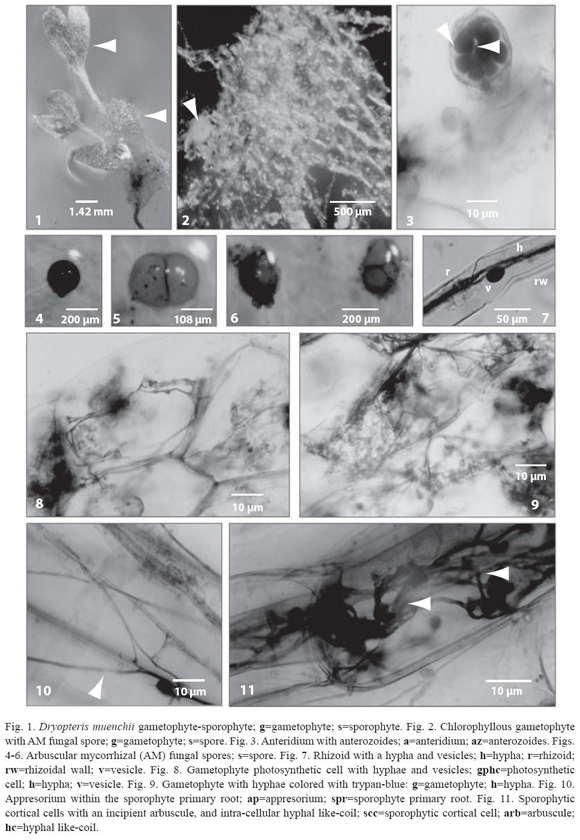
<body><![CDATA[<div style="text-align: center;"><font face="Verdana" size="2"><img  src="/img/revistas/rbt/v56n3/art11i1.jpg" title="" alt=""  style="width: 580px; height: 840px;"></font>    <br> </div>     <p><font face="Verdana" size="2"> Very few AMF spores were reported amongst the gametophyte rhizoids, the spores were organized in groups of 5, pairs or singles, adhering to each other by common peridial hyphae. AMF spores are globose to subglobose, varying in color from orange- to red-brown (<a href="#f1">Figs. 4</a>-<a href="#f1">6</a>).</font></p>     <p><font face="Verdana" size="2">Gametophyte rhizoids are unicellular and hyaline with 23 µm to 50 µm in diameter. The endophytic fungus enters the host tissue through the rhizoids developing appresoria in the rhizoid wall at the penetration point. Hyphae, 2.5 to 5 µm in diameter, are found inside the rhizoids; these hyphae occur near the rhizoid apex up to the prothallic cells of the gametophyte, where they branch out. Rhizoidal hyphae are aseptate; frequently, these hyphae give rise to oval-shaped vesicles of <i>ca. </i>15 x 20 µm in diameter, which are densely colored (<a href="#f1">Fig. 7</a>).</font></p>     <p><font face="Verdana" size="2">Arbuscular mycorrhizal fungi (AMF) produced inter- and intracellular hyphae on the gametophyte midrib and wings prothallic cells; hyphae branch dispersing over a bigger surface (<a href="#f1">Figs. 8</a> and <a  href="#f1">9</a>).</font></p>     <p><font face="Verdana" size="2">The meristematic region, placed in the midrib of the gametophyte, and the antheridia are regularly free of infection. The fungus never colonizes the sporophyte foot cells. The primary roots of the young sporophyte are frequently found colonized by a fungal endophyte, morphologically similar to the one described within the gametophyte. The fungus enters the host tissue through the roots developing appessoria in the rhizodermis surface at the penetration point (<a  href="#f1">Fig. 10</a>).</font></p>     <p><font face="Verdana" size="2">The fungus penetrates the primary roots and spreads forming intra-cellular linear grouped hyphae in the rhizodermis and in the outermost cortical cell layers of the roots, developing hyphal enlargements at the distal hyphal tip, increasing the AMF surface; these structures look like incipient arbuscles (<a href="#f1">Fig. 11</a>), which colored intensively with trypanblue. Structures similar to hyphal coils were observed, as well, inside the inner root cortex (<a href="#f1">Fig. 11</a>).     <br> </font></p>     <p><font face="Verdana" size="2">Finally, it is important to mention that the endophitic fungi associated to the young sporophytes, did not infected the gametophyte talus.</font></p> <font face="Verdana" size="2" style="font-weight: bold;"><font size="3">     <p>Discussion</p> </font></font>     ]]></body>
<body><![CDATA[<p><font face="Verdana" size="2">Under laboratory conditions, <i>D. muenchii </i>is cordiforme, no archegonia are produced, only antheridia were reported; nevertheless, the sporophyte talus has an apogamic origin (Pérez-García <i>et al</i>. 1999, Reyes-Jaramillo and Mendoza 2004).</font></p>     <p><font face="Verdana" size="2">Apomictic plants are usually adapted to microhabitats, which could explain, in part, the fact that <i>D. muenchii </i>is a narrow endemic fern, and apomixis is also associated with polyploidy, phenomenon rather common in ferns. However, there are no studies relating both AMF and apogamic ferns, in functional and evolutionary terms.</font></p>     <p><font face="Verdana" size="2">From 450 gametophytes, only 4% of them, with or without sporophytes, were mycorrhizal. The scarce AMF spores, obtained from the pots, closely resemble to those of <i>Glomus globiferum</i>: the spores were organized in groups of 5, pairs or singles, adhering to each other by common peridial hyphae, having a globose to subglobose shape and varying in color from orange- to red-brown (Koske and Walker 1986).</font></p>     <p><font face="Verdana" size="2">We also found similar fungal structures than the ones found in <i>Gleichenia bifida (</i>Willd.) Spreng by Schmid and Oberwinkler (1995): the endophytic fungal hyphae were aseptate and spread inter- and intra-cellularly, they penetrated the host tissue through the rhizoids, developed vesicles in both the rhizoidal and the prothallic cells.</font></p>     <p><font face="Verdana" size="2">Within the gametophyte chlorophillic cells, intracellular fungal hyphae were reported; the hyphae branched covering most of the prothallic cells and, in some cases, the hyphae managed to trespass the cell wall, establishing inter-cellular hyphae; however, no arbuscles were registered.</font></p>     <p><font face="Verdana" size="2">In spite of this, the fungus penetrated the sporophyte primary roots and spread forming intra- and inter-cellular linear grouped hyphae in the rhizodermis and in the outermost cortical cell layers of the roots, developing "arbusculeshaped structures" and hyphal like-coils. The fungus continued to spread by linear or coiled hyphae; this might be considered a fungal adaptation to the limited growth of both the gametophytes and the sporophytes in comparison to the root system of the vascular plants root system.</font></p>     <p><font face="Verdana" size="2">The fungal structures observed on <i>D. muenchii </i>during this study, are rather similar to those reported for the plant host-AMF interaction, where the AMF described belonged to Glomeromycota. Therefore, this study is a contribution to the scarce knowledgement acquired of the association between AMF and chlorophyllous gametophytes and young apogamic sporophytes of ferns.</font></p>     <p><font face="Verdana" size="3"><span style="font-weight: bold;">Acknowledgments</span>    <br> </font></p> <font face="Verdana" size="2"><font face="Verdana" size="2">     <p>We thank Rosaura Grether González and Armida Leticia Pacheco Mota, from UAM-Iztapalapa, for the critical review of this manuscript. </p> </font></font> <hr style="width: 100%; height: 2px;"><font face="Verdana" size="2"><font  face="Verdana" size="2">     ]]></body>
<body><![CDATA[<p><span style="font-weight: bold;">Resumen</span> </p> </font> </font>     <p><font face="Verdana" size="2"><font face="Verdana" size="2">Se describe la morfología de un hongo endófito afín al género <i>Glomus</i>, como colonizador de gametofitos clorofílicos y de esporofitos apogámicos jóvenes del helecho <i>Dryopteris muenchii </i>A.R. Sm.; el estudio se llevó a cabo con helechos cultivados en el laboratorio y utilizando tierra como substrato. El tejido del gametofito fue colonizado, a través de los rizoides, por un hongo miceliar aseptado, el cual formó vesículas. El hongo logró penetrar las raíces primarias de los esporofitos jóvenes desarrollando apresorios. El hongo se dispersó formando hifas inter- e intra-celulares a través de la epidermis y de la capa de células corticales más externas, donde produjo vesículas, estructuras similares a ovillos y arbúsculos. Las hifas del hongo nunca colonizaron las células de la unión entre el gametofito y el esporofito. Las estructuras observadas durante este estudio en <i>D. muenchii</i>, son muy similares a las de la interacción planta hospedera-hongo micorrícico arbuscular (HMA), en donde el HMA descrito corresponde al Phylum Glomeromycota. Por lo anterior, este estudio es una contribución al escaso conocimiento que se tiene sobre la asociación entre los HMA y gametofitos clorofílicos y esporofitos apogámicos de helechos jóvenes. </font></font></p>     <p><font face="Verdana" size="2"><font face="Verdana" size="2"><b>Palabras clave: </b>Micorriza arbuscular (MA), endófito, gametofito clorofílico, Dryopteridaceae, helecho endémico, México.    <br> </font></font></p> <hr style="width: 100%; height: 2px;">     <p><font face="Verdana" size="2"><font face="Verdana" size="2"></font></font></p>     <p style="text-align: center;"><font face="Verdana" size="2"><font  face="Verdana" size="2">Received 23-II-2007. Corrected 30-XI-2007. Accepted 31-VII-2008.</font></font></p> <font face="Verdana" size="2"><font face="Verdana" size="2"> <font size="3">     <p><span style="font-weight: bold;">References</span> </p> </font></font><font face="Verdana" size="2">     <!-- ref --><p>Berch, M. &amp; B. Kendrick. 1982. vesicular-arbuscular mycorrhizae of Soutthern Ontario ferns and fern-allies. Micologia. 74: 769-776.    &nbsp;&nbsp;&nbsp;&nbsp;&nbsp;&nbsp;&nbsp;&nbsp;[&#160;<a href="javascript:void(0);" onclick="javascript: window.open('/scielo.php?script=sci_nlinks&ref=1699277&pid=S0034-7744200800030001100001&lng=','','width=640,height=500,resizable=yes,scrollbars=1,menubar=yes,');">Links</a>&#160;]<!-- end-ref --> </p>     <!-- ref --><p>Blackwell, M. 2000. Terrestrial life-fungal from the start? Science. 289: 1884-1885.    &nbsp;&nbsp;&nbsp;&nbsp;&nbsp;&nbsp;&nbsp;&nbsp;[&#160;<a href="javascript:void(0);" onclick="javascript: window.open('/scielo.php?script=sci_nlinks&ref=1699279&pid=S0034-7744200800030001100002&lng=','','width=640,height=500,resizable=yes,scrollbars=1,menubar=yes,');">Links</a>&#160;]<!-- end-ref --> </p>     <!-- ref --><p>Boullard, B. 1957. La micotrophie chez les ptéridophytes. Sa fréquence, ses caractères, sa signification. Botanist. 41: 5-185.    &nbsp;&nbsp;&nbsp;&nbsp;&nbsp;&nbsp;&nbsp;&nbsp;[&#160;<a href="javascript:void(0);" onclick="javascript: window.open('/scielo.php?script=sci_nlinks&ref=1699281&pid=S0034-7744200800030001100003&lng=','','width=640,height=500,resizable=yes,scrollbars=1,menubar=yes,');">Links</a>&#160;]<!-- end-ref --> </p>     <!-- ref --><p>Boullard, B. 1979. Consideration sur la symbiose fongique chez les Pteridophytes. Syllogeus 19: 1-59 &nbsp;&nbsp;&nbsp;&nbsp;&nbsp;&nbsp;&nbsp;&nbsp;[&#160;<a href="javascript:void(0);" onclick="javascript: window.open('/scielo.php?script=sci_nlinks&ref=1699283&pid=S0034-7744200800030001100004&lng=','','width=640,height=500,resizable=yes,scrollbars=1,menubar=yes,');">Links</a>&#160;]<!-- end-ref --><!-- ref --><p>Bower, F. O. 1923. The ferns. Vol. 1. Cambridge, London, England.    &nbsp;&nbsp;&nbsp;&nbsp;&nbsp;&nbsp;&nbsp;&nbsp;[&#160;<a href="javascript:void(0);" onclick="javascript: window.open('/scielo.php?script=sci_nlinks&ref=1699284&pid=S0034-7744200800030001100005&lng=','','width=640,height=500,resizable=yes,scrollbars=1,menubar=yes,');">Links</a>&#160;]<!-- end-ref --> </p>     <!-- ref --><p>Bruchmann, H. 1904. Úber das Prothallium und die Keimpflanze von <i>Ophioglossum vulgare</i> L. Bot. Zeit. 62: 227-248.    &nbsp;&nbsp;&nbsp;&nbsp;&nbsp;&nbsp;&nbsp;&nbsp;[&#160;<a href="javascript:void(0);" onclick="javascript: window.open('/scielo.php?script=sci_nlinks&ref=1699286&pid=S0034-7744200800030001100006&lng=','','width=640,height=500,resizable=yes,scrollbars=1,menubar=yes,');">Links</a>&#160;]<!-- end-ref --> </p>     <!-- ref --><p>Bruchmann, H. 1906. Über das Prothallium und die Sporenpflanze von <i>Botrychium lunaria </i>Sw. Flora 96: 203-230.    &nbsp;&nbsp;&nbsp;&nbsp;&nbsp;&nbsp;&nbsp;&nbsp;[&#160;<a href="javascript:void(0);" onclick="javascript: window.open('/scielo.php?script=sci_nlinks&ref=1699288&pid=S0034-7744200800030001100007&lng=','','width=640,height=500,resizable=yes,scrollbars=1,menubar=yes,');">Links</a>&#160;]<!-- end-ref --> </p>     ]]></body>
<body><![CDATA[<!-- ref --><p>Bruchmann, H. 1908. Das Prothalliun von <i>Lycopodium complanatum </i>L. Bot. Zeit. 66: 169-181.    &nbsp;&nbsp;&nbsp;&nbsp;&nbsp;&nbsp;&nbsp;&nbsp;[&#160;<a href="javascript:void(0);" onclick="javascript: window.open('/scielo.php?script=sci_nlinks&ref=1699290&pid=S0034-7744200800030001100008&lng=','','width=640,height=500,resizable=yes,scrollbars=1,menubar=yes,');">Links</a>&#160;]<!-- end-ref --> </p>     <!-- ref --><p>Burgeff, H. 1938. Mycorriza, p. 159-191 in F. Verdoon. Manual of Pteridology. The Hague, Holland.    &nbsp;&nbsp;&nbsp;&nbsp;&nbsp;&nbsp;&nbsp;&nbsp;[&#160;<a href="javascript:void(0);" onclick="javascript: window.open('/scielo.php?script=sci_nlinks&ref=1699292&pid=S0034-7744200800030001100009&lng=','','width=640,height=500,resizable=yes,scrollbars=1,menubar=yes,');">Links</a>&#160;]<!-- end-ref --> </p>     <!-- ref --><p>Campbell, D.H. 1907. Studies on some Javanese Anthocerothaceae. I. Ann. Bot. 21: 467-486.    &nbsp;&nbsp;&nbsp;&nbsp;&nbsp;&nbsp;&nbsp;&nbsp;[&#160;<a href="javascript:void(0);" onclick="javascript: window.open('/scielo.php?script=sci_nlinks&ref=1699294&pid=S0034-7744200800030001100010&lng=','','width=640,height=500,resizable=yes,scrollbars=1,menubar=yes,');">Links</a>&#160;]<!-- end-ref --> </p>     <!-- ref --><p>Campbell, D. H. 1908. Symbiosis in fern prothallia. Amer. Nat. 42: 154-165.    &nbsp;&nbsp;&nbsp;&nbsp;&nbsp;&nbsp;&nbsp;&nbsp;[&#160;<a href="javascript:void(0);" onclick="javascript: window.open('/scielo.php?script=sci_nlinks&ref=1699296&pid=S0034-7744200800030001100011&lng=','','width=640,height=500,resizable=yes,scrollbars=1,menubar=yes,');">Links</a>&#160;]<!-- end-ref --> </p>     <!-- ref --><p>Cooper, K. M.1976. A field survery of mycorrhizas in New Zeland ferns. New Zealand J. Bot. 14: 169-181.    &nbsp;&nbsp;&nbsp;&nbsp;&nbsp;&nbsp;&nbsp;&nbsp;[&#160;<a href="javascript:void(0);" onclick="javascript: window.open('/scielo.php?script=sci_nlinks&ref=1699298&pid=S0034-7744200800030001100012&lng=','','width=640,height=500,resizable=yes,scrollbars=1,menubar=yes,');">Links</a>&#160;]<!-- end-ref --> </p>     ]]></body>
<body><![CDATA[<!-- ref --><p>Dickson, S. 2004. The <i>Arum</i>-<i>Paris </i>continuum of mycorrhizal symbioses. New Phytol. 163: 187-200.    &nbsp;&nbsp;&nbsp;&nbsp;&nbsp;&nbsp;&nbsp;&nbsp;[&#160;<a href="javascript:void(0);" onclick="javascript: window.open('/scielo.php?script=sci_nlinks&ref=1699300&pid=S0034-7744200800030001100013&lng=','','width=640,height=500,resizable=yes,scrollbars=1,menubar=yes,');">Links</a>&#160;]<!-- end-ref --> </p>     <!-- ref --><p>Duckett, J.G. &amp; R. Ligrone. 2005. A comparative cytological analysis of fungal endophytes in the sporophyte rhizomes and vascularized gametophytes of <i>Tmesipteris </i>and <i>Psilotum</i>. Can. J. Bot. 83: 14431456.    &nbsp;&nbsp;&nbsp;&nbsp;&nbsp;&nbsp;&nbsp;&nbsp;[&#160;<a href="javascript:void(0);" onclick="javascript: window.open('/scielo.php?script=sci_nlinks&ref=1699302&pid=S0034-7744200800030001100014&lng=','','width=640,height=500,resizable=yes,scrollbars=1,menubar=yes,');">Links</a>&#160;]<!-- end-ref --> </p>     <!-- ref --><p>Fontana, A. 1959. Ricerche sulla simbiosi micorrizica nelle pteridofite e sui microrganismi normalamente prenti nelle loro radici. Allionia 5: 27-66.    &nbsp;&nbsp;&nbsp;&nbsp;&nbsp;&nbsp;&nbsp;&nbsp;[&#160;<a href="javascript:void(0);" onclick="javascript: window.open('/scielo.php?script=sci_nlinks&ref=1699304&pid=S0034-7744200800030001100015&lng=','','width=640,height=500,resizable=yes,scrollbars=1,menubar=yes,');">Links</a>&#160;]<!-- end-ref --> </p>     <!-- ref --><p>Gemma, J.N. &amp; R.E. Koske. 1990. Mycorrhizae in recent volcanic substrates in Hawaii. Am. J. Bot. 77: 1193-1200.    &nbsp;&nbsp;&nbsp;&nbsp;&nbsp;&nbsp;&nbsp;&nbsp;[&#160;<a href="javascript:void(0);" onclick="javascript: window.open('/scielo.php?script=sci_nlinks&ref=1699306&pid=S0034-7744200800030001100016&lng=','','width=640,height=500,resizable=yes,scrollbars=1,menubar=yes,');">Links</a>&#160;]<!-- end-ref --> </p>     <!-- ref --><p>Hepden, P.M. 1960. Studies in vesicular-arbuscular endophytes. II. Endophytes in the Pteridophyta with special reference to leptosporangiate ferns. Trans.Br. Mycol. Soc. 43: 559-570.    &nbsp;&nbsp;&nbsp;&nbsp;&nbsp;&nbsp;&nbsp;&nbsp;[&#160;<a href="javascript:void(0);" onclick="javascript: window.open('/scielo.php?script=sci_nlinks&ref=1699308&pid=S0034-7744200800030001100017&lng=','','width=640,height=500,resizable=yes,scrollbars=1,menubar=yes,');">Links</a>&#160;]<!-- end-ref --> </p>     ]]></body>
<body><![CDATA[<!-- ref --><p>Iqbal, S.H., M. Yousaf &amp; M. Younus. 1981. A field survey of mycorrhizal associations in ferns of Pakistan. New Phytol. 87: 69-79.    &nbsp;&nbsp;&nbsp;&nbsp;&nbsp;&nbsp;&nbsp;&nbsp;[&#160;<a href="javascript:void(0);" onclick="javascript: window.open('/scielo.php?script=sci_nlinks&ref=1699310&pid=S0034-7744200800030001100018&lng=','','width=640,height=500,resizable=yes,scrollbars=1,menubar=yes,');">Links</a>&#160;]<!-- end-ref --> </p>     <!-- ref --><p>Koske, R.E. &amp; J. Gemma. 1989. A modified procedure for staining roots to detect vA mycorrhizas. Mycol. Res. 92: 486-505.    &nbsp;&nbsp;&nbsp;&nbsp;&nbsp;&nbsp;&nbsp;&nbsp;[&#160;<a href="javascript:void(0);" onclick="javascript: window.open('/scielo.php?script=sci_nlinks&ref=1699312&pid=S0034-7744200800030001100019&lng=','','width=640,height=500,resizable=yes,scrollbars=1,menubar=yes,');">Links</a>&#160;]<!-- end-ref --> </p>     <!-- ref --><p>Koske, R.E. &amp; C. Walker. 1986. <i>Glomus globiferum</i>: a new species of Endogonaceae with a hyphal peridium. Mycotaxon. 26: 133-142.    &nbsp;&nbsp;&nbsp;&nbsp;&nbsp;&nbsp;&nbsp;&nbsp;[&#160;<a href="javascript:void(0);" onclick="javascript: window.open('/scielo.php?script=sci_nlinks&ref=1699314&pid=S0034-7744200800030001100020&lng=','','width=640,height=500,resizable=yes,scrollbars=1,menubar=yes,');">Links</a>&#160;]<!-- end-ref --> </p>     <!-- ref --><p>Kovacs, G.M., I. Kottke &amp; F. Oberwinkler. 2003. Light and electron microscopic study on the mycorrhizae of sporophytes of <i>Botrichium virginianum </i>arbuscular structure resembling fossil forms. Plant Biology. 5: 574-580.    &nbsp;&nbsp;&nbsp;&nbsp;&nbsp;&nbsp;&nbsp;&nbsp;[&#160;<a href="javascript:void(0);" onclick="javascript: window.open('/scielo.php?script=sci_nlinks&ref=1699316&pid=S0034-7744200800030001100021&lng=','','width=640,height=500,resizable=yes,scrollbars=1,menubar=yes,');">Links</a>&#160;]<!-- end-ref --> </p>     <!-- ref --><p>Laferière, J. L. &amp; R.E. Koske. 1981. Ocurrence of VA-mycorrhizas in some Rhodes Island Perodophytes. Trans. Br. Mycol. Soc. 76: 331-332.    &nbsp;&nbsp;&nbsp;&nbsp;&nbsp;&nbsp;&nbsp;&nbsp;[&#160;<a href="javascript:void(0);" onclick="javascript: window.open('/scielo.php?script=sci_nlinks&ref=1699318&pid=S0034-7744200800030001100022&lng=','','width=640,height=500,resizable=yes,scrollbars=1,menubar=yes,');">Links</a>&#160;]<!-- end-ref --> </p>     ]]></body>
<body><![CDATA[<!-- ref --><p>Merryweather, J. &amp; A.H. Fitter. 1996. Phosphorus nutrition of an obligate mycorrhizal plant treated with the fungicide benomyl in the field. New Phytol. 132: 307-311.    &nbsp;&nbsp;&nbsp;&nbsp;&nbsp;&nbsp;&nbsp;&nbsp;[&#160;<a href="javascript:void(0);" onclick="javascript: window.open('/scielo.php?script=sci_nlinks&ref=1699320&pid=S0034-7744200800030001100023&lng=','','width=640,height=500,resizable=yes,scrollbars=1,menubar=yes,');">Links</a>&#160;]<!-- end-ref --> </p>     <!-- ref --><p>Merryweather. J. &amp; A.H. Fitter. 1998a. The arbuscular mycorrhizal fungi of <i>Hyacinthoides non-scripta</i>. I. Diversity of fungal taxa. New Phytol. 138: 117-129.    &nbsp;&nbsp;&nbsp;&nbsp;&nbsp;&nbsp;&nbsp;&nbsp;[&#160;<a href="javascript:void(0);" onclick="javascript: window.open('/scielo.php?script=sci_nlinks&ref=1699322&pid=S0034-7744200800030001100024&lng=','','width=640,height=500,resizable=yes,scrollbars=1,menubar=yes,');">Links</a>&#160;]<!-- end-ref --> </p>     <!-- ref --><p>Merryweather, J. &amp; A.H. Fitter. 1998b. The arbuscular mycorrhizal fungi of <i>Hyacinthoides non-scripta</i>. II. Seasonal and spatial patterns of fungal populations. New Phytol. 138: 131-142.    &nbsp;&nbsp;&nbsp;&nbsp;&nbsp;&nbsp;&nbsp;&nbsp;[&#160;<a href="javascript:void(0);" onclick="javascript: window.open('/scielo.php?script=sci_nlinks&ref=1699324&pid=S0034-7744200800030001100025&lng=','','width=640,height=500,resizable=yes,scrollbars=1,menubar=yes,');">Links</a>&#160;]<!-- end-ref --> </p>     <!-- ref --><p>Mickel, J.T. &amp; A.R. Smith. 2004. The Pteridophytes of Mexico. Memoirs of the New York Botanical Garden. USA. 88: 1-277.    &nbsp;&nbsp;&nbsp;&nbsp;&nbsp;&nbsp;&nbsp;&nbsp;[&#160;<a href="javascript:void(0);" onclick="javascript: window.open('/scielo.php?script=sci_nlinks&ref=1699326&pid=S0034-7744200800030001100026&lng=','','width=640,height=500,resizable=yes,scrollbars=1,menubar=yes,');">Links</a>&#160;]<!-- end-ref --> </p>     <!-- ref --><p>Mishra, R.R., G.D. Shrama. &amp; A.R. Gatphoh. 1980. Mycorrhizas in the ferns of North Eastern India. Proc. Indian Acad. Sci. 46: 546-551.    &nbsp;&nbsp;&nbsp;&nbsp;&nbsp;&nbsp;&nbsp;&nbsp;[&#160;<a href="javascript:void(0);" onclick="javascript: window.open('/scielo.php?script=sci_nlinks&ref=1699328&pid=S0034-7744200800030001100027&lng=','','width=640,height=500,resizable=yes,scrollbars=1,menubar=yes,');">Links</a>&#160;]<!-- end-ref --> </p>     ]]></body>
<body><![CDATA[<!-- ref --><p>Moran, R.C. 1995. Dryopteridaceae, p. 210-226 <i>In </i>R.C. Moran &amp; R. Riba. Flora Mesoamericana: Psilotaceae to Salviniaceae. Instituto de Biología (UNAM), Missouri Botanical Garden &amp; the Natural History Museum, London, England.    &nbsp;&nbsp;&nbsp;&nbsp;&nbsp;&nbsp;&nbsp;&nbsp;[&#160;<a href="javascript:void(0);" onclick="javascript: window.open('/scielo.php?script=sci_nlinks&ref=1699330&pid=S0034-7744200800030001100028&lng=','','width=640,height=500,resizable=yes,scrollbars=1,menubar=yes,');">Links</a>&#160;]<!-- end-ref --> </p>     <!-- ref --><p>Muthukumar, T. &amp; K. Udaiyan. 2000. Vesicular arbuscular mycorrhizae in pteridophytes of western ghats, South India. Phytomorphology. 50: 132-142.    &nbsp;&nbsp;&nbsp;&nbsp;&nbsp;&nbsp;&nbsp;&nbsp;[&#160;<a href="javascript:void(0);" onclick="javascript: window.open('/scielo.php?script=sci_nlinks&ref=1699332&pid=S0034-7744200800030001100029&lng=','','width=640,height=500,resizable=yes,scrollbars=1,menubar=yes,');">Links</a>&#160;]<!-- end-ref --> </p>     <!-- ref --><p>Newsham, K.K., A.H. Fitter &amp; A.R. Watkinson. 1995. Multifunctionality and biodiversity in arbuscular mycorrhizas. TREE. 10: 407-411.    &nbsp;&nbsp;&nbsp;&nbsp;&nbsp;&nbsp;&nbsp;&nbsp;[&#160;<a href="javascript:void(0);" onclick="javascript: window.open('/scielo.php?script=sci_nlinks&ref=1699334&pid=S0034-7744200800030001100030&lng=','','width=640,height=500,resizable=yes,scrollbars=1,menubar=yes,');">Links</a>&#160;]<!-- end-ref --> </p>     <!-- ref --><p>Pérez-García, B., A. Mendoza, I. Reyes-Jaramillo &amp; R. Riba. 1999. Morfogénesis de la fase sexual de seis especies mexicanas de helechos del género <i>Dryopteris </i>(Dryopteridaceae). Rev. Biol. Trop. 47: 69-81.    &nbsp;&nbsp;&nbsp;&nbsp;&nbsp;&nbsp;&nbsp;&nbsp;[&#160;<a href="javascript:void(0);" onclick="javascript: window.open('/scielo.php?script=sci_nlinks&ref=1699336&pid=S0034-7744200800030001100031&lng=','','width=640,height=500,resizable=yes,scrollbars=1,menubar=yes,');">Links</a>&#160;]<!-- end-ref --> </p>     <!-- ref --><p>Peterson, R.L., M.J. Howarth &amp; D.P. Whittier.1981. Interactions between a fungal endophyte and gametophyte cells in <i>Psilotum nudum</i>. Can. J. Bot. 59: 711-720.    &nbsp;&nbsp;&nbsp;&nbsp;&nbsp;&nbsp;&nbsp;&nbsp;[&#160;<a href="javascript:void(0);" onclick="javascript: window.open('/scielo.php?script=sci_nlinks&ref=1699338&pid=S0034-7744200800030001100032&lng=','','width=640,height=500,resizable=yes,scrollbars=1,menubar=yes,');">Links</a>&#160;]<!-- end-ref --> </p>     ]]></body>
<body><![CDATA[<!-- ref --><p>Phillips, J.M. &amp; D.S. Hayman. 1970. Improved procedures for clearing roots and staining parasitic and vesiculararbuscular mycorrhizas fungi for rapid assessment of infection. Trans. Br. Mycol. Soc. 55: 158-161.    &nbsp;&nbsp;&nbsp;&nbsp;&nbsp;&nbsp;&nbsp;&nbsp;[&#160;<a href="javascript:void(0);" onclick="javascript: window.open('/scielo.php?script=sci_nlinks&ref=1699340&pid=S0034-7744200800030001100033&lng=','','width=640,height=500,resizable=yes,scrollbars=1,menubar=yes,');">Links</a>&#160;]<!-- end-ref --> </p>     <!-- ref --><p>Pirozynski, K.A. 1981. Interactions between fungi and plants through the ages. Can. J. Bot. 59: 1824-1827.    &nbsp;&nbsp;&nbsp;&nbsp;&nbsp;&nbsp;&nbsp;&nbsp;[&#160;<a href="javascript:void(0);" onclick="javascript: window.open('/scielo.php?script=sci_nlinks&ref=1699342&pid=S0034-7744200800030001100034&lng=','','width=640,height=500,resizable=yes,scrollbars=1,menubar=yes,');">Links</a>&#160;]<!-- end-ref --> </p>     <!-- ref --><p>Ragupathy, S. &amp; A. Mahadevan. 1993. Distribution of vesicular-arbuscular mycorrhizae in the plants and rhizosphere soils of the tropical plants. Tamil Nadu, India. Mycorrhiza 3: 123-136.    &nbsp;&nbsp;&nbsp;&nbsp;&nbsp;&nbsp;&nbsp;&nbsp;[&#160;<a href="javascript:void(0);" onclick="javascript: window.open('/scielo.php?script=sci_nlinks&ref=1699344&pid=S0034-7744200800030001100035&lng=','','width=640,height=500,resizable=yes,scrollbars=1,menubar=yes,');">Links</a>&#160;]<!-- end-ref --> </p>     <!-- ref --><p>Raja, P., S. Ragupathy &amp; A. Mahadevan. 1995. Arbuscular mycorrhizal association of pteridophytes of Nilgiris and Kodaikanal hills, South India. Acta Botanica India 23: 181-186.    &nbsp;&nbsp;&nbsp;&nbsp;&nbsp;&nbsp;&nbsp;&nbsp;[&#160;<a href="javascript:void(0);" onclick="javascript: window.open('/scielo.php?script=sci_nlinks&ref=1699346&pid=S0034-7744200800030001100036&lng=','','width=640,height=500,resizable=yes,scrollbars=1,menubar=yes,');">Links</a>&#160;]<!-- end-ref --> </p>     <!-- ref --><p>Rayner, M.C. 1927. Mycorriza. New Phytol. 26: 22-45.    &nbsp;&nbsp;&nbsp;&nbsp;&nbsp;&nbsp;&nbsp;&nbsp;[&#160;<a href="javascript:void(0);" onclick="javascript: window.open('/scielo.php?script=sci_nlinks&ref=1699348&pid=S0034-7744200800030001100037&lng=','','width=640,height=500,resizable=yes,scrollbars=1,menubar=yes,');">Links</a>&#160;]<!-- end-ref --> </p>     ]]></body>
<body><![CDATA[<!-- ref --><p>Remy, W., T.N. Taylor., H. Hass &amp; H. Kerp. 1994. Four hundred-million-year-old vesicular arbuscular mycorrhizae. Proc. Natl. Acad. Sci. USA 91: 11841-11843.    &nbsp;&nbsp;&nbsp;&nbsp;&nbsp;&nbsp;&nbsp;&nbsp;[&#160;<a href="javascript:void(0);" onclick="javascript: window.open('/scielo.php?script=sci_nlinks&ref=1699350&pid=S0034-7744200800030001100038&lng=','','width=640,height=500,resizable=yes,scrollbars=1,menubar=yes,');">Links</a>&#160;]<!-- end-ref --> </p>     <!-- ref --><p>Reyes-Jaramillo, I. &amp; A. Mendoza. 2004. Apogamia en <i>Dryopteris muenchii </i>(Dryopteridaceae). Polibotánica 18: 99-110.    &nbsp;&nbsp;&nbsp;&nbsp;&nbsp;&nbsp;&nbsp;&nbsp;[&#160;<a href="javascript:void(0);" onclick="javascript: window.open('/scielo.php?script=sci_nlinks&ref=1699352&pid=S0034-7744200800030001100039&lng=','','width=640,height=500,resizable=yes,scrollbars=1,menubar=yes,');">Links</a>&#160;]<!-- end-ref --> </p>     <!-- ref --><p>Schmid, E. &amp; F. Oberwinkler. 1993. Mycorriza-like interaction between the achlorophyllous gametophyte of <i>Lycopodium clavatum </i>L. and its fungal endophyte studied by light an electron microscopy. New Phytol. 124: 69-81.    &nbsp;&nbsp;&nbsp;&nbsp;&nbsp;&nbsp;&nbsp;&nbsp;[&#160;<a href="javascript:void(0);" onclick="javascript: window.open('/scielo.php?script=sci_nlinks&ref=1699354&pid=S0034-7744200800030001100040&lng=','','width=640,height=500,resizable=yes,scrollbars=1,menubar=yes,');">Links</a>&#160;]<!-- end-ref --> </p>     <!-- ref --><p>Schmid, E. &amp; F. Oberwinkler.1994. Light- and electromicroscopy of the host-fungus interaction in the achorophyllous gametophyte of <i>Botrichum lunaria</i>. Can. J. Bot. 72: 182-188.    &nbsp;&nbsp;&nbsp;&nbsp;&nbsp;&nbsp;&nbsp;&nbsp;[&#160;<a href="javascript:void(0);" onclick="javascript: window.open('/scielo.php?script=sci_nlinks&ref=1699356&pid=S0034-7744200800030001100041&lng=','','width=640,height=500,resizable=yes,scrollbars=1,menubar=yes,');">Links</a>&#160;]<!-- end-ref --> </p>     <!-- ref --><p>Schmid, E. &amp; F. Oberwinkler. 1995. A light- and electron-microscopic a vesicular-arbuscular host-fungus interaction in gametophytes and young sporophytes of the Gleicheniaceae (Filicales). New Phytol. 129: 317-324.    &nbsp;&nbsp;&nbsp;&nbsp;&nbsp;&nbsp;&nbsp;&nbsp;[&#160;<a href="javascript:void(0);" onclick="javascript: window.open('/scielo.php?script=sci_nlinks&ref=1699358&pid=S0034-7744200800030001100042&lng=','','width=640,height=500,resizable=yes,scrollbars=1,menubar=yes,');">Links</a>&#160;]<!-- end-ref --> </p>     ]]></body>
<body><![CDATA[<!-- ref --><p>Taylor, T.N., W. Remy, H. Hass &amp; H. Kerp. 1995. Fossil arbuscular mycorrhizae from the early Devonian. Mycologia. 87: 560-573.    &nbsp;&nbsp;&nbsp;&nbsp;&nbsp;&nbsp;&nbsp;&nbsp;[&#160;<a href="javascript:void(0);" onclick="javascript: window.open('/scielo.php?script=sci_nlinks&ref=1699360&pid=S0034-7744200800030001100043&lng=','','width=640,height=500,resizable=yes,scrollbars=1,menubar=yes,');">Links</a>&#160;]<!-- end-ref --> </p>     <!-- ref --><p>Turnau. K., T. Anielska &amp; A. Jurkiewicz. 2005. Mycothallic/ mycorrhizal symbiosis of chlorophyllous gametophytes and sporophytes of a fern, <i>Pellaea viridis </i>(Forsk.) Prantl (Pellaeaceae, Pteridales). Mycorrhiza. 15: 121-128.    &nbsp;&nbsp;&nbsp;&nbsp;&nbsp;&nbsp;&nbsp;&nbsp;[&#160;<a href="javascript:void(0);" onclick="javascript: window.open('/scielo.php?script=sci_nlinks&ref=1699362&pid=S0034-7744200800030001100044&lng=','','width=640,height=500,resizable=yes,scrollbars=1,menubar=yes,');">Links</a>&#160;]<!-- end-ref --> </p>     <!-- ref --><p>Whittier, D.P. 1977. Gametophytes of Lycopodium obscurum grown in axenic culture. Can. J. Bot. 55: 563-567.    &nbsp;&nbsp;&nbsp;&nbsp;&nbsp;&nbsp;&nbsp;&nbsp;[&#160;<a href="javascript:void(0);" onclick="javascript: window.open('/scielo.php?script=sci_nlinks&ref=1699364&pid=S0034-7744200800030001100045&lng=','','width=640,height=500,resizable=yes,scrollbars=1,menubar=yes,');">Links</a>&#160;]<!-- end-ref --> </p>     <!-- ref --><p>Zhang, Y., L.-D. Guo &amp; R.-J. Liu. 2004. Arbuscular mycorrhizal fungi associated with common pteridophytes in Dujiangyan soutwest China. Mycorrhiza. 14: 25-30.    &nbsp;&nbsp;&nbsp;&nbsp;&nbsp;&nbsp;&nbsp;&nbsp;[&#160;<a href="javascript:void(0);" onclick="javascript: window.open('/scielo.php?script=sci_nlinks&ref=1699366&pid=S0034-7744200800030001100046&lng=','','width=640,height=500,resizable=yes,scrollbars=1,menubar=yes,');">Links</a>&#160;]<!-- end-ref --> </p>     <!-- ref --><p>Zhi-wei, Z. 2000. The arbuscular mycorrhizas of pteridophytes in Yunnan, southwest China: evolutionary interpretations. Mycorrhiza. 10: 145-149.    &nbsp;&nbsp;&nbsp;&nbsp;&nbsp;&nbsp;&nbsp;&nbsp;[&#160;<a href="javascript:void(0);" onclick="javascript: window.open('/scielo.php?script=sci_nlinks&ref=1699368&pid=S0034-7744200800030001100047&lng=','','width=640,height=500,resizable=yes,scrollbars=1,menubar=yes,');">Links</a>&#160;]<!-- end-ref --> </p> </font> </font>     ]]></body>
<body><![CDATA[ ]]></body><back>
<ref-list>
<ref id="B1">
<nlm-citation citation-type="journal">
<person-group person-group-type="author">
<name>
<surname><![CDATA[Berch]]></surname>
<given-names><![CDATA[M]]></given-names>
</name>
<name>
<surname><![CDATA[Kendrick]]></surname>
<given-names><![CDATA[B]]></given-names>
</name>
</person-group>
<article-title xml:lang="en"><![CDATA[Vesicular-arbuscular mycorrhizae of Soutthern Ontario ferns and fern-allies]]></article-title>
<source><![CDATA[Micologia]]></source>
<year>1982</year>
<volume>74</volume>
<page-range>769-776</page-range></nlm-citation>
</ref>
<ref id="B2">
<nlm-citation citation-type="journal">
<person-group person-group-type="author">
<name>
<surname><![CDATA[Blackwell]]></surname>
<given-names><![CDATA[M]]></given-names>
</name>
</person-group>
<article-title xml:lang="en"><![CDATA[Terrestrial life-fungal from the start?]]></article-title>
<source><![CDATA[Science]]></source>
<year>2000</year>
<volume>289</volume>
<page-range>1884-1885</page-range></nlm-citation>
</ref>
<ref id="B3">
<nlm-citation citation-type="journal">
<person-group person-group-type="author">
<name>
<surname><![CDATA[Boullard]]></surname>
<given-names><![CDATA[B]]></given-names>
</name>
</person-group>
<article-title xml:lang="en"><![CDATA[La micotrophie chez les ptéridophytes. Sa fréquence, ses caractères, sa signification]]></article-title>
<source><![CDATA[Botanist]]></source>
<year>1957</year>
<volume>41</volume>
<page-range>5-185</page-range></nlm-citation>
</ref>
<ref id="B4">
<nlm-citation citation-type="journal">
<person-group person-group-type="author">
<name>
<surname><![CDATA[Boullard]]></surname>
<given-names><![CDATA[B]]></given-names>
</name>
</person-group>
<article-title xml:lang="en"><![CDATA[Consideration sur la symbiose fongique chez les Pteridophytes]]></article-title>
<source><![CDATA[Syllogeus]]></source>
<year>1979</year>
<volume>19</volume>
<page-range>1-59</page-range></nlm-citation>
</ref>
<ref id="B5">
<nlm-citation citation-type="book">
<person-group person-group-type="author">
<name>
<surname><![CDATA[Bower]]></surname>
<given-names><![CDATA[F. O]]></given-names>
</name>
</person-group>
<source><![CDATA[The ferns]]></source>
<year>1923</year>
<volume>1</volume>
<publisher-loc><![CDATA[London ]]></publisher-loc>
<publisher-name><![CDATA[Cambridge]]></publisher-name>
</nlm-citation>
</ref>
<ref id="B6">
<nlm-citation citation-type="journal">
<person-group person-group-type="author">
<name>
<surname><![CDATA[Bruchmann]]></surname>
<given-names><![CDATA[H]]></given-names>
</name>
</person-group>
<article-title xml:lang="en"><![CDATA[Úber das Prothallium und die Keimpflanze von Ophioglossum vulgare L]]></article-title>
<source><![CDATA[Bot. Zeit]]></source>
<year>1904</year>
<volume>62</volume>
<page-range>227-248</page-range></nlm-citation>
</ref>
<ref id="B7">
<nlm-citation citation-type="journal">
<person-group person-group-type="author">
<name>
<surname><![CDATA[Bruchmann]]></surname>
<given-names><![CDATA[H]]></given-names>
</name>
</person-group>
<article-title xml:lang="en"><![CDATA[Über das Prothallium und die Sporenpflanze von Botrychium lunaria Sw]]></article-title>
<source><![CDATA[Flora]]></source>
<year>1906</year>
<volume>96</volume>
<page-range>203-230</page-range></nlm-citation>
</ref>
<ref id="B8">
<nlm-citation citation-type="journal">
<person-group person-group-type="author">
<name>
<surname><![CDATA[Bruchmann]]></surname>
<given-names><![CDATA[H]]></given-names>
</name>
</person-group>
<article-title xml:lang="en"><![CDATA[Das Prothalliun von Lycopodium complanatum L]]></article-title>
<source><![CDATA[Bot. Zeit]]></source>
<year>1908</year>
<volume>66</volume>
<page-range>169-181</page-range></nlm-citation>
</ref>
<ref id="B9">
<nlm-citation citation-type="book">
<person-group person-group-type="author">
<name>
<surname><![CDATA[Burgeff]]></surname>
<given-names><![CDATA[H]]></given-names>
</name>
</person-group>
<article-title xml:lang="en"><![CDATA[Mycorriza]]></article-title>
<person-group person-group-type="editor">
<name>
<surname><![CDATA[Verdoon]]></surname>
<given-names><![CDATA[F]]></given-names>
</name>
</person-group>
<source><![CDATA[Manual of Pteridology]]></source>
<year>1938</year>
<page-range>159-191</page-range><publisher-name><![CDATA[The Hague]]></publisher-name>
</nlm-citation>
</ref>
<ref id="B10">
<nlm-citation citation-type="journal">
<person-group person-group-type="author">
<name>
<surname><![CDATA[Campbell]]></surname>
<given-names><![CDATA[D.H]]></given-names>
</name>
</person-group>
<article-title xml:lang="en"><![CDATA[Studies on some Javanese Anthocerothaceae]]></article-title>
<source><![CDATA[I. Ann. Bot]]></source>
<year>1907</year>
<volume>21</volume>
<page-range>467-486</page-range></nlm-citation>
</ref>
<ref id="B11">
<nlm-citation citation-type="journal">
<person-group person-group-type="author">
<name>
<surname><![CDATA[Campbell]]></surname>
<given-names><![CDATA[D. H]]></given-names>
</name>
</person-group>
<article-title xml:lang="en"><![CDATA[Symbiosis in fern prothallia]]></article-title>
<source><![CDATA[Amer. Nat]]></source>
<year>1908</year>
<volume>42</volume>
<page-range>154-165</page-range></nlm-citation>
</ref>
<ref id="B12">
<nlm-citation citation-type="journal">
<person-group person-group-type="author">
<name>
<surname><![CDATA[Cooper]]></surname>
<given-names><![CDATA[K. M]]></given-names>
</name>
</person-group>
<article-title xml:lang="en"><![CDATA[A field survery of mycorrhizas in New Zeland ferns]]></article-title>
<source><![CDATA[New Zealand J. Bot]]></source>
<year>1976</year>
<volume>14</volume>
<page-range>169-181</page-range></nlm-citation>
</ref>
<ref id="B13">
<nlm-citation citation-type="journal">
<person-group person-group-type="author">
<name>
<surname><![CDATA[Dickson]]></surname>
<given-names><![CDATA[S]]></given-names>
</name>
</person-group>
<article-title xml:lang="en"><![CDATA[The Arum-Paris continuum of mycorrhizal symbioses]]></article-title>
<source><![CDATA[New Phytol]]></source>
<year>2004</year>
<volume>163</volume>
<page-range>187-200</page-range></nlm-citation>
</ref>
<ref id="B14">
<nlm-citation citation-type="journal">
<person-group person-group-type="author">
<name>
<surname><![CDATA[Duckett]]></surname>
<given-names><![CDATA[J.G]]></given-names>
</name>
<name>
<surname><![CDATA[Ligrone]]></surname>
<given-names><![CDATA[R]]></given-names>
</name>
</person-group>
<article-title xml:lang="en"><![CDATA[A comparative cytological analysis of fungal endophytes in the sporophyte rhizomes and vascularized gametophytes of Tmesipteris and Psilotum]]></article-title>
<source><![CDATA[Can. J. Bot]]></source>
<year>2005</year>
<volume>83</volume>
<page-range>1443-1456</page-range></nlm-citation>
</ref>
<ref id="B15">
<nlm-citation citation-type="journal">
<person-group person-group-type="author">
<name>
<surname><![CDATA[Fontana]]></surname>
<given-names><![CDATA[A]]></given-names>
</name>
</person-group>
<article-title xml:lang="en"><![CDATA[Ricerche sulla simbiosi micorrizica nelle pteridofite e sui microrganismi normalamente prenti nelle loro radici]]></article-title>
<source><![CDATA[Allionia]]></source>
<year>1959</year>
<volume>5</volume>
<page-range>27-66</page-range></nlm-citation>
</ref>
<ref id="B16">
<nlm-citation citation-type="journal">
<person-group person-group-type="author">
<name>
<surname><![CDATA[Gemma]]></surname>
<given-names><![CDATA[J.N]]></given-names>
</name>
<name>
<surname><![CDATA[Koske]]></surname>
<given-names><![CDATA[R.E]]></given-names>
</name>
</person-group>
<article-title xml:lang="en"><![CDATA[Mycorrhizae in recent volcanic substrates in Hawaii]]></article-title>
<source><![CDATA[Am. J. Bot]]></source>
<year>1990</year>
<volume>77</volume>
<page-range>1193-1200</page-range></nlm-citation>
</ref>
<ref id="B17">
<nlm-citation citation-type="journal">
<person-group person-group-type="author">
<name>
<surname><![CDATA[Hepden]]></surname>
<given-names><![CDATA[P.M]]></given-names>
</name>
</person-group>
<article-title xml:lang="en"><![CDATA[Studies in vesicular-arbuscular endophytes. II. Endophytes in the Pteridophyta with special reference to leptosporangiate ferns]]></article-title>
<source><![CDATA[Trans.Br. Mycol. Soc]]></source>
<year>1960</year>
<volume>43</volume>
<page-range>559-570</page-range></nlm-citation>
</ref>
<ref id="B18">
<nlm-citation citation-type="journal">
<person-group person-group-type="author">
<name>
<surname><![CDATA[Iqbal]]></surname>
<given-names><![CDATA[S.H]]></given-names>
</name>
<name>
<surname><![CDATA[Yousaf]]></surname>
<given-names><![CDATA[M]]></given-names>
</name>
<name>
<surname><![CDATA[Younus]]></surname>
<given-names><![CDATA[M]]></given-names>
</name>
</person-group>
<article-title xml:lang="en"><![CDATA[A field survey of mycorrhizal associations in ferns of Pakistan]]></article-title>
<source><![CDATA[New Phytol]]></source>
<year>1981</year>
<volume>87</volume>
<page-range>69-79</page-range></nlm-citation>
</ref>
<ref id="B19">
<nlm-citation citation-type="journal">
<person-group person-group-type="author">
<name>
<surname><![CDATA[Koske]]></surname>
<given-names><![CDATA[R.E]]></given-names>
</name>
<name>
<surname><![CDATA[Gemma]]></surname>
<given-names><![CDATA[J]]></given-names>
</name>
</person-group>
<article-title xml:lang="en"><![CDATA[A modified procedure for staining roots to detect VA mycorrhizas]]></article-title>
<source><![CDATA[Mycol. Res]]></source>
<year>1989</year>
<volume>92</volume>
<page-range>486-505</page-range></nlm-citation>
</ref>
<ref id="B20">
<nlm-citation citation-type="journal">
<person-group person-group-type="author">
<name>
<surname><![CDATA[Koske]]></surname>
<given-names><![CDATA[R.E]]></given-names>
</name>
<name>
<surname><![CDATA[Walker]]></surname>
<given-names><![CDATA[C]]></given-names>
</name>
</person-group>
<article-title xml:lang="en"><![CDATA[Glomus globiferum: a new species of Endogonaceae with a hyphal peridium]]></article-title>
<source><![CDATA[Mycotaxon]]></source>
<year>1986</year>
<volume>26</volume>
<page-range>133-142</page-range></nlm-citation>
</ref>
<ref id="B21">
<nlm-citation citation-type="journal">
<person-group person-group-type="author">
<name>
<surname><![CDATA[Kovacs]]></surname>
<given-names><![CDATA[G.M]]></given-names>
</name>
<name>
<surname><![CDATA[Kottke]]></surname>
<given-names><![CDATA[I]]></given-names>
</name>
<name>
<surname><![CDATA[Oberwinkler]]></surname>
<given-names><![CDATA[F]]></given-names>
</name>
</person-group>
<article-title xml:lang="en"><![CDATA[Light and electron microscopic study on the mycorrhizae of sporophytes of Botrichium virginianum arbuscular structure resembling fossil forms]]></article-title>
<source><![CDATA[Plant Biology]]></source>
<year>2003</year>
<volume>5</volume>
<page-range>574-580</page-range></nlm-citation>
</ref>
<ref id="B22">
<nlm-citation citation-type="journal">
<person-group person-group-type="author">
<name>
<surname><![CDATA[Laferière]]></surname>
<given-names><![CDATA[J. L]]></given-names>
</name>
<name>
<surname><![CDATA[Koske]]></surname>
<given-names><![CDATA[R.E]]></given-names>
</name>
</person-group>
<article-title xml:lang="en"><![CDATA[Ocurrence of VA-mycorrhizas in some Rhodes Island Perodophytes]]></article-title>
<source><![CDATA[Trans. Br. Mycol. Soc]]></source>
<year>1981</year>
<volume>76</volume>
<page-range>331-332</page-range></nlm-citation>
</ref>
<ref id="B23">
<nlm-citation citation-type="journal">
<person-group person-group-type="author">
<name>
<surname><![CDATA[Merryweather]]></surname>
<given-names><![CDATA[J]]></given-names>
</name>
<name>
<surname><![CDATA[Fitter]]></surname>
<given-names><![CDATA[A.H]]></given-names>
</name>
</person-group>
<article-title xml:lang="en"><![CDATA[Phosphorus nutrition of an obligate mycorrhizal plant treated with the fungicide benomyl in the field]]></article-title>
<source><![CDATA[New Phytol]]></source>
<year>1996</year>
<volume>132</volume>
<page-range>307-311</page-range></nlm-citation>
</ref>
<ref id="B24">
<nlm-citation citation-type="journal">
<person-group person-group-type="author">
<name>
<surname><![CDATA[Merryweather]]></surname>
<given-names><![CDATA[J]]></given-names>
</name>
<name>
<surname><![CDATA[Fitter]]></surname>
<given-names><![CDATA[A.H]]></given-names>
</name>
</person-group>
<article-title xml:lang="en"><![CDATA[The arbuscular mycorrhizal fungi of Hyacinthoides non-scripta. I. Diversity of fungal taxa]]></article-title>
<source><![CDATA[New Phytol]]></source>
<year>1998</year>
<volume>138</volume>
<page-range>117-129</page-range></nlm-citation>
</ref>
<ref id="B25">
<nlm-citation citation-type="journal">
<person-group person-group-type="author">
<name>
<surname><![CDATA[Merryweather]]></surname>
<given-names><![CDATA[J]]></given-names>
</name>
<name>
<surname><![CDATA[Fitter]]></surname>
<given-names><![CDATA[A.H]]></given-names>
</name>
</person-group>
<article-title xml:lang="en"><![CDATA[The arbuscular mycorrhizal fungi of Hyacinthoides non-scripta. II. Seasonal and spatial patterns of fungal populations]]></article-title>
<source><![CDATA[New Phytol]]></source>
<year>1998</year>
<volume>138</volume>
<page-range>131-142</page-range></nlm-citation>
</ref>
<ref id="B26">
<nlm-citation citation-type="journal">
<person-group person-group-type="author">
<name>
<surname><![CDATA[Mickel]]></surname>
<given-names><![CDATA[J.T]]></given-names>
</name>
<name>
<surname><![CDATA[Smith]]></surname>
<given-names><![CDATA[A.R]]></given-names>
</name>
</person-group>
<article-title xml:lang="en"><![CDATA[The Pteridophytes of Mexico]]></article-title>
<source><![CDATA[Memoirs of the New York Botanical Garden. USA]]></source>
<year>2004</year>
<volume>88</volume>
<page-range>1-277</page-range></nlm-citation>
</ref>
<ref id="B27">
<nlm-citation citation-type="journal">
<person-group person-group-type="author">
<name>
<surname><![CDATA[Mishra]]></surname>
<given-names><![CDATA[R.R]]></given-names>
</name>
<name>
<surname><![CDATA[Shrama]]></surname>
<given-names><![CDATA[G.D]]></given-names>
</name>
<name>
<surname><![CDATA[Gatphoh]]></surname>
<given-names><![CDATA[A.R]]></given-names>
</name>
</person-group>
<article-title xml:lang="en"><![CDATA[Mycorrhizas in the ferns of North Eastern India]]></article-title>
<source><![CDATA[Proc. Indian Acad. Sci]]></source>
<year>1980</year>
<volume>46</volume>
<page-range>546-551</page-range></nlm-citation>
</ref>
<ref id="B28">
<nlm-citation citation-type="book">
<person-group person-group-type="author">
<name>
<surname><![CDATA[Moran]]></surname>
<given-names><![CDATA[R.C]]></given-names>
</name>
</person-group>
<article-title xml:lang="en"><![CDATA[Dryopteridaceae]]></article-title>
<person-group person-group-type="editor">
<name>
<surname><![CDATA[Moran]]></surname>
<given-names><![CDATA[R.C]]></given-names>
</name>
<name>
<surname><![CDATA[Riba]]></surname>
<given-names><![CDATA[R]]></given-names>
</name>
</person-group>
<source><![CDATA[Flora Mesoamericana: Psilotaceae to Salviniaceae]]></source>
<year>1995</year>
<page-range>210-226</page-range><publisher-loc><![CDATA[London ]]></publisher-loc>
<publisher-name><![CDATA[Instituto de Biología (UNAM)Missouri Botanical Garden & the Natural History Museum]]></publisher-name>
</nlm-citation>
</ref>
<ref id="B29">
<nlm-citation citation-type="journal">
<person-group person-group-type="author">
<name>
<surname><![CDATA[Muthukumar]]></surname>
<given-names><![CDATA[T]]></given-names>
</name>
<name>
<surname><![CDATA[Udaiyan]]></surname>
<given-names><![CDATA[K]]></given-names>
</name>
</person-group>
<article-title xml:lang="en"><![CDATA[Vesicular arbuscular mycorrhizae in pteridophytes of western ghats, South India]]></article-title>
<source><![CDATA[Phytomorphology]]></source>
<year>2000</year>
<volume>50</volume>
<page-range>132-142</page-range></nlm-citation>
</ref>
<ref id="B30">
<nlm-citation citation-type="journal">
<person-group person-group-type="author">
<name>
<surname><![CDATA[Newsham]]></surname>
<given-names><![CDATA[K.K]]></given-names>
</name>
<name>
<surname><![CDATA[Fitter]]></surname>
<given-names><![CDATA[A.H]]></given-names>
</name>
<name>
<surname><![CDATA[Watkinson]]></surname>
<given-names><![CDATA[A.R]]></given-names>
</name>
</person-group>
<article-title xml:lang="en"><![CDATA[Multifunctionality and biodiversity in arbuscular mycorrhizas]]></article-title>
<source><![CDATA[TREE]]></source>
<year>1995</year>
<volume>10</volume>
<page-range>407-411</page-range></nlm-citation>
</ref>
<ref id="B31">
<nlm-citation citation-type="journal">
<person-group person-group-type="author">
<name>
<surname><![CDATA[Pérez-García]]></surname>
<given-names><![CDATA[B]]></given-names>
</name>
<name>
<surname><![CDATA[Mendoza]]></surname>
<given-names><![CDATA[A]]></given-names>
</name>
<name>
<surname><![CDATA[Reyes-Jaramillo]]></surname>
<given-names><![CDATA[I]]></given-names>
</name>
<name>
<surname><![CDATA[Riba]]></surname>
<given-names><![CDATA[R]]></given-names>
</name>
</person-group>
<article-title xml:lang="en"><![CDATA[Morfogénesis de la fase sexual de seis especies mexicanas de helechos del género Dryopteris (Dryopteridaceae)]]></article-title>
<source><![CDATA[Rev. Biol. Trop]]></source>
<year>1999</year>
<volume>47</volume>
<page-range>69-81</page-range></nlm-citation>
</ref>
<ref id="B32">
<nlm-citation citation-type="journal">
<person-group person-group-type="author">
<name>
<surname><![CDATA[Peterson]]></surname>
<given-names><![CDATA[R.L]]></given-names>
</name>
<name>
<surname><![CDATA[Howarth]]></surname>
<given-names><![CDATA[M.J]]></given-names>
</name>
<name>
<surname><![CDATA[Whittier]]></surname>
<given-names><![CDATA[D.P]]></given-names>
</name>
</person-group>
<article-title xml:lang="en"><![CDATA[Interactions between a fungal endophyte and gametophyte cells in Psilotum nudum]]></article-title>
<source><![CDATA[Can. J. Bot]]></source>
<year>1981</year>
<volume>59</volume>
<page-range>711-720</page-range></nlm-citation>
</ref>
<ref id="B33">
<nlm-citation citation-type="journal">
<person-group person-group-type="author">
<name>
<surname><![CDATA[Phillips]]></surname>
<given-names><![CDATA[J.M]]></given-names>
</name>
<name>
<surname><![CDATA[Hayman]]></surname>
<given-names><![CDATA[D.S]]></given-names>
</name>
</person-group>
<article-title xml:lang="en"><![CDATA[Improved procedures for clearing roots and staining parasitic and vesiculararbuscular mycorrhizas fungi for rapid assessment of infection]]></article-title>
<source><![CDATA[Trans. Br. Mycol. Soc]]></source>
<year>1970</year>
<volume>55</volume>
<page-range>158-161</page-range></nlm-citation>
</ref>
<ref id="B34">
<nlm-citation citation-type="journal">
<person-group person-group-type="author">
<name>
<surname><![CDATA[Pirozynski]]></surname>
<given-names><![CDATA[K.A]]></given-names>
</name>
</person-group>
<article-title xml:lang="en"><![CDATA[Interactions between fungi and plants through the ages]]></article-title>
<source><![CDATA[Can. J. Bot]]></source>
<year>1981</year>
<volume>59</volume>
<page-range>1824-1827</page-range></nlm-citation>
</ref>
<ref id="B35">
<nlm-citation citation-type="journal">
<person-group person-group-type="author">
<name>
<surname><![CDATA[Ragupathy]]></surname>
<given-names><![CDATA[S]]></given-names>
</name>
<name>
<surname><![CDATA[Mahadevan]]></surname>
<given-names><![CDATA[A]]></given-names>
</name>
</person-group>
<article-title xml:lang="en"><![CDATA[Distribution of vesicular-arbuscular mycorrhizae in the plants and rhizosphere soils of the tropical plants]]></article-title>
<source><![CDATA[Tamil Nadu, India. Mycorrhiza]]></source>
<year>1993</year>
<volume>3</volume>
<page-range>123-136</page-range></nlm-citation>
</ref>
<ref id="B36">
<nlm-citation citation-type="journal">
<person-group person-group-type="author">
<name>
<surname><![CDATA[Raja]]></surname>
<given-names><![CDATA[P]]></given-names>
</name>
<name>
<surname><![CDATA[Ragupathy]]></surname>
<given-names><![CDATA[S]]></given-names>
</name>
<name>
<surname><![CDATA[Mahadevan]]></surname>
<given-names><![CDATA[A]]></given-names>
</name>
</person-group>
<article-title xml:lang="en"><![CDATA[Arbuscular mycorrhizal association of pteridophytes of Nilgiris and Kodaikanal hills, South India]]></article-title>
<source><![CDATA[Acta Botanica India]]></source>
<year>1995</year>
<volume>23</volume>
<page-range>181-186</page-range></nlm-citation>
</ref>
<ref id="B37">
<nlm-citation citation-type="journal">
<person-group person-group-type="author">
<name>
<surname><![CDATA[Rayner]]></surname>
<given-names><![CDATA[M.C]]></given-names>
</name>
</person-group>
<article-title xml:lang="en"><![CDATA[Mycorriza]]></article-title>
<source><![CDATA[New Phytol]]></source>
<year>1927</year>
<volume>26</volume>
<page-range>22-45</page-range></nlm-citation>
</ref>
<ref id="B38">
<nlm-citation citation-type="journal">
<person-group person-group-type="author">
<name>
<surname><![CDATA[Remy]]></surname>
<given-names><![CDATA[W]]></given-names>
</name>
<name>
<surname><![CDATA[Taylor]]></surname>
<given-names><![CDATA[T.N]]></given-names>
</name>
<name>
<surname><![CDATA[Hass]]></surname>
<given-names><![CDATA[H]]></given-names>
</name>
<name>
<surname><![CDATA[Kerp]]></surname>
<given-names><![CDATA[H]]></given-names>
</name>
</person-group>
<article-title xml:lang="en"><![CDATA[Four hundred-million-year-old vesicular arbuscular mycorrhizae]]></article-title>
<source><![CDATA[Proc. Natl. Acad. Sci. USA]]></source>
<year>1994</year>
<volume>91</volume>
<page-range>11841-11843</page-range></nlm-citation>
</ref>
<ref id="B39">
<nlm-citation citation-type="journal">
<person-group person-group-type="author">
<name>
<surname><![CDATA[Reyes-Jaramillo]]></surname>
<given-names><![CDATA[I]]></given-names>
</name>
<name>
<surname><![CDATA[Mendoza]]></surname>
<given-names><![CDATA[A]]></given-names>
</name>
</person-group>
<article-title xml:lang="en"><![CDATA[Apogamia en Dryopteris muenchii (Dryopteridaceae)]]></article-title>
<source><![CDATA[Polibotánica]]></source>
<year>2004</year>
<volume>18</volume>
<page-range>99-110</page-range></nlm-citation>
</ref>
<ref id="B40">
<nlm-citation citation-type="journal">
<person-group person-group-type="author">
<name>
<surname><![CDATA[Schmid]]></surname>
<given-names><![CDATA[E]]></given-names>
</name>
<name>
<surname><![CDATA[Oberwinkler]]></surname>
<given-names><![CDATA[F]]></given-names>
</name>
</person-group>
<article-title xml:lang="en"><![CDATA[Mycorriza-like interaction between the achlorophyllous gametophyte of Lycopodium clavatum L. and its fungal endophyte studied by light an electron microscopy]]></article-title>
<source><![CDATA[New Phytol]]></source>
<year>1993</year>
<volume>124</volume>
<page-range>69-81</page-range></nlm-citation>
</ref>
<ref id="B41">
<nlm-citation citation-type="journal">
<person-group person-group-type="author">
<name>
<surname><![CDATA[Schmid]]></surname>
<given-names><![CDATA[E]]></given-names>
</name>
<name>
<surname><![CDATA[Oberwinkler]]></surname>
<given-names><![CDATA[F]]></given-names>
</name>
</person-group>
<article-title xml:lang="en"><![CDATA[Light- and electromicroscopy of the host-fungus interaction in the achorophyllous gametophyte of Botrichum lunaria]]></article-title>
<source><![CDATA[Can. J. Bot]]></source>
<year>1994</year>
<volume>72</volume>
<page-range>182-188</page-range></nlm-citation>
</ref>
<ref id="B42">
<nlm-citation citation-type="journal">
<person-group person-group-type="author">
<name>
<surname><![CDATA[Schmid]]></surname>
<given-names><![CDATA[E]]></given-names>
</name>
<name>
<surname><![CDATA[Oberwinkler]]></surname>
<given-names><![CDATA[F]]></given-names>
</name>
</person-group>
<article-title xml:lang="en"><![CDATA[A light- and electron-microscopic a vesicular-arbuscular host-fungus interaction in gametophytes and young sporophytes of the Gleicheniaceae (Filicales)]]></article-title>
<source><![CDATA[New Phytol]]></source>
<year>1995</year>
<volume>129</volume>
<page-range>317-324</page-range></nlm-citation>
</ref>
<ref id="B43">
<nlm-citation citation-type="journal">
<person-group person-group-type="author">
<name>
<surname><![CDATA[Taylor]]></surname>
<given-names><![CDATA[T.N]]></given-names>
</name>
<name>
<surname><![CDATA[Remy]]></surname>
<given-names><![CDATA[W]]></given-names>
</name>
<name>
<surname><![CDATA[Hass]]></surname>
<given-names><![CDATA[H]]></given-names>
</name>
<name>
<surname><![CDATA[Kerp]]></surname>
<given-names><![CDATA[H]]></given-names>
</name>
</person-group>
<article-title xml:lang="en"><![CDATA[Fossil arbuscular mycorrhizae from the early Devonian]]></article-title>
<source><![CDATA[Mycologia]]></source>
<year>1995</year>
<volume>87</volume>
<page-range>560-573</page-range></nlm-citation>
</ref>
<ref id="B44">
<nlm-citation citation-type="journal">
<person-group person-group-type="author">
<name>
<surname><![CDATA[Turnau]]></surname>
<given-names><![CDATA[K]]></given-names>
</name>
<name>
<surname><![CDATA[Anielska]]></surname>
<given-names><![CDATA[T]]></given-names>
</name>
<name>
<surname><![CDATA[Jurkiewicz]]></surname>
<given-names><![CDATA[A]]></given-names>
</name>
</person-group>
<article-title xml:lang="en"><![CDATA[Mycothallic/ mycorrhizal symbiosis of chlorophyllous gametophytes and sporophytes of a fern, Pellaea viridis (Forsk.) Prantl (Pellaeaceae, Pteridales)]]></article-title>
<source><![CDATA[Mycorrhiza]]></source>
<year>2005</year>
<volume>15</volume>
<page-range>121-128</page-range></nlm-citation>
</ref>
<ref id="B45">
<nlm-citation citation-type="journal">
<person-group person-group-type="author">
<name>
<surname><![CDATA[Whittier]]></surname>
<given-names><![CDATA[D.P]]></given-names>
</name>
</person-group>
<article-title xml:lang="en"><![CDATA[Gametophytes of Lycopodium obscurum grown in axenic culture]]></article-title>
<source><![CDATA[Can. J. Bot]]></source>
<year>1977</year>
<volume>55</volume>
<page-range>563-567</page-range></nlm-citation>
</ref>
<ref id="B46">
<nlm-citation citation-type="journal">
<person-group person-group-type="author">
<name>
<surname><![CDATA[Zhang]]></surname>
<given-names><![CDATA[Y]]></given-names>
</name>
<name>
<surname><![CDATA[Guo]]></surname>
<given-names><![CDATA[L.-D]]></given-names>
</name>
<name>
<surname><![CDATA[Liu]]></surname>
<given-names><![CDATA[R.-J]]></given-names>
</name>
</person-group>
<article-title xml:lang="en"><![CDATA[Arbuscular mycorrhizal fungi associated with common pteridophytes in Dujiangyan soutwest China]]></article-title>
<source><![CDATA[Mycorrhiza]]></source>
<year>2004</year>
<volume>14</volume>
<page-range>25-30</page-range></nlm-citation>
</ref>
<ref id="B47">
<nlm-citation citation-type="journal">
<person-group person-group-type="author">
<name>
<surname><![CDATA[Zhi-wei]]></surname>
<given-names><![CDATA[Z]]></given-names>
</name>
</person-group>
<article-title xml:lang="en"><![CDATA[The arbuscular mycorrhizas of pteridophytes in Yunnan, southwest China: evolutionary interpretations]]></article-title>
<source><![CDATA[Mycorrhiza]]></source>
<year>2000</year>
<volume>10</volume>
<page-range>145-149</page-range></nlm-citation>
</ref>
</ref-list>
</back>
</article>
