<?xml version="1.0" encoding="ISO-8859-1"?><article xmlns:mml="http://www.w3.org/1998/Math/MathML" xmlns:xlink="http://www.w3.org/1999/xlink" xmlns:xsi="http://www.w3.org/2001/XMLSchema-instance">
<front>
<journal-meta>
<journal-id>0034-7744</journal-id>
<journal-title><![CDATA[Revista de Biología Tropical]]></journal-title>
<abbrev-journal-title><![CDATA[Rev. biol. trop]]></abbrev-journal-title>
<issn>0034-7744</issn>
<publisher>
<publisher-name><![CDATA[Universidad de Costa Rica]]></publisher-name>
</publisher>
</journal-meta>
<article-meta>
<article-id>S0034-77442008000200039</article-id>
<title-group>
<article-title xml:lang="en"><![CDATA[The dietary habits of the upside-down catfish, Synodontis membranaceus (Osteichthyes: Mochokidae) in Jebba lake, Nigeria]]></article-title>
</title-group>
<contrib-group>
<contrib contrib-type="author">
<name>
<surname><![CDATA[Owolabi]]></surname>
<given-names><![CDATA[Olufemi David]]></given-names>
</name>
<xref ref-type="aff" rid="A01"/>
</contrib>
</contrib-group>
<aff id="A01">
<institution><![CDATA[,University of Ilorin Department of Zoology ]]></institution>
<addr-line><![CDATA[ ]]></addr-line>
<country>Nigeria</country>
</aff>
<pub-date pub-type="pub">
<day>00</day>
<month>06</month>
<year>2008</year>
</pub-date>
<pub-date pub-type="epub">
<day>00</day>
<month>06</month>
<year>2008</year>
</pub-date>
<volume>56</volume>
<numero>2</numero>
<fpage>931</fpage>
<lpage>936</lpage>
<copyright-statement/>
<copyright-year/>
<self-uri xlink:href="http://www.scielo.sa.cr/scielo.php?script=sci_arttext&amp;pid=S0034-77442008000200039&amp;lng=en&amp;nrm=iso"></self-uri><self-uri xlink:href="http://www.scielo.sa.cr/scielo.php?script=sci_abstract&amp;pid=S0034-77442008000200039&amp;lng=en&amp;nrm=iso"></self-uri><self-uri xlink:href="http://www.scielo.sa.cr/scielo.php?script=sci_pdf&amp;pid=S0034-77442008000200039&amp;lng=en&amp;nrm=iso"></self-uri><abstract abstract-type="short" xml:lang="en"><p><![CDATA[Dietary habits of the up side-down Mochokid catfish, Synodontis membranaceus were investigated for 24 months (April 2002-March 2004, in Jebba lake, Nigeria) using frequency of occurrence, numerical, gravimetric and index of relative importance (RI) methods. The fish is euryphagus and feeds more at night. RI values indicate that 10 of the 16 food items were major diet components. The main five food categories are detritus (10.64 %), Aspatharia (9.08 %), plant parts (8.85 %), seeds (8.61 %) and Spirogyra (8.43 %), while the 5 less prominent food categories were gastropods (7.05 %), insect appendages (6.88 %), copepods (6.31 %), adult Povilla adusta (5.89 %) and coleoptera larvae (5.36 %). The remaining six food items, dragon flies, P. adusta larvae, chironomid larvae, Daphnia, water mites and fish scales had RI values considerably under 5 %. The prominence of detritus in the diet indicated that the fish is a bottom or benthic feeder. The wide variability in food supply enables S. membranaceus to maintain its overwhelming prominence in Jebba lake, and its euryphagus habit makes it suited for pond culture. Rev. Biol. Trop. 56 (2): 931-936. Epub 2008 June 30.]]></p></abstract>
<abstract abstract-type="short" xml:lang="es"><p><![CDATA[Los hábitos alimenticios del pez Synodontis membranaceus fueron investigados durante 24 meses (abril 2002-marzo 2004) en el lago Jebba, Nigeria; utilizando frecuencia de aparición, métodos numéricos, métodos gravimétricos y el Índice de Importancia Relativa (IR). El incremento de estómagos llenos durante la noche, en comparación con el día, indica una intensidad alta de alimentación durante la noche. El pez tiene una dieta eurífaga. De los 16 tipos de comida ingeridos, 10 constituyen la dieta principal, según los valores del IR. Las cinco principales categorías fueron detritos (10.64 %), Aspatharia (9.08 %), plantas (8.85 %), semillas (8.61 %) y Spirogyra (8.43 %), mientras que las cinco categorías menores corresponden a gastrópodos (7.05 %), apéndices de insectos (6.88 %), copépodos (6.31 %), adultos de Povilla adusta (5.89 %) y larvas de coleóptero (5.3 %). Las restantes seis categorías de alimentación son odonatos larvales, larvas de P. adusta, larvas de quironómidos, Daphnia, ácaros de agua y escamas de pez, las cuales no mostraron gran significancia debido a que los valores de IR fueron menores a 5 %. La importancia del detrito en la dieta indica que el pez habita en el fondo o posee alimentación bentónica. La amplia variabilidad de alimentos y la adaptabilidad natural a cualquiera de los recursos alimenticios presentes en el lago permite a S. membranaceus mantener su gran abundancia en el lago Jebba. Su comportamiento eurífago lo hace apropiado para su cultivo.]]></p></abstract>
<kwd-group>
<kwd lng="en"><![CDATA[S. membranaceus]]></kwd>
<kwd lng="en"><![CDATA[food]]></kwd>
<kwd lng="en"><![CDATA[trophic activity]]></kwd>
<kwd lng="en"><![CDATA[Jebba lake]]></kwd>
<kwd lng="en"><![CDATA[Nigeria]]></kwd>
<kwd lng="es"><![CDATA[S. membranaceus]]></kwd>
<kwd lng="es"><![CDATA[alimento]]></kwd>
<kwd lng="es"><![CDATA[actividad trófica]]></kwd>
<kwd lng="es"><![CDATA[lago Jebba]]></kwd>
<kwd lng="es"><![CDATA[Nigeria]]></kwd>
</kwd-group>
</article-meta>
</front><body><![CDATA[ <div style="text-align: center;"><font face="Verdana" size="4">     <p><span style="font-weight: bold;">The dietary habits of the upside-down catfish, <span style="font-style: italic;">Synodontis membranaceus</span> (Osteichthyes: Mochokidae) in Jebba lake, Nigeria</span> </p> </font></div> <font face="Verdana" size="2">     <p><span style="font-weight: bold;">Olufemi David Owolabi</span> </p>     <p>Department of Zoology, University of Ilorin, P.M.B. 1515, Ilorin 240003, Nigeria; <a href="mailto:olulabi47@yahoo.com">olulabi47@yahoo.com</a>; <a href="mailto:olulabi@unilorin.edu.ng">olulabi@unilorin.edu.ng</a> </p>     <p> </p> </font> <hr style="width: 100%; height: 2px;"><font face="Verdana" size="2">     <p><span style="font-weight: bold;">Abstract:</span> Dietary habits of the up side-down Mochokid catfish, <span style="font-style: italic;">Synodontis membranaceus</span> were investigated for 24 months (April 2002-March 2004, in Jebba lake, Nigeria) using frequency of occurrence, numerical, gravimetric and index of relative importance (RI) methods. The fish is euryphagus and feeds more at night. RI values indicate that 10 of the 16 food items were major diet components. The main five food categories are detritus (10.64 %), Aspatharia (9.08 %), plant parts (8.85 %), seeds (8.61 %) and Spirogyra (8.43 %), while the 5 less prominent food categories were gastropods (7.05 %), insect appendages (6.88 %), copepods (6.31 %), adult <span  style="font-style: italic;">Povilla adusta</span> (5.89 %) and coleoptera larvae (5.36 %). The remaining six food items, dragon flies, <span  style="font-style: italic;">P. adusta</span> larvae, chironomid larvae, Daphnia, water mites and fish scales had RI values considerably under 5 %. The prominence of detritus in the diet indicated that the fish is a bottom or benthic feeder. The wide variability in food supply enables <span  style="font-style: italic;">S. membranaceus</span> to maintain its overwhelming prominence in Jebba lake, and its euryphagus habit makes it suited for pond culture. Rev. Biol. Trop. 56 (2): 931-936. Epub 2008 June 30. </p>     <p><span style="font-weight: bold;">Key words:</span> <span  style="font-style: italic;">S. membranaceus</span>, food, trophic activity, Jebba lake, Nigeria.</p> </font> <hr style="width: 100%; height: 2px;"><font face="Verdana" size="2">     <p> </p>     <p>The genus <span style="font-style: italic;">Synodontis</span> is among the most favoured edible fish in Northern Nigeria (Reed <span  style="font-style: italic;">et al</span>. 1967), owing to their overwhelming abundance in the artisanal fisheries. It contributes a large proportion to the annual fish landings in the region. The genus consists of many species, some of which are commercially more important. Synodontis membranaceus is generally preferred by fishermen and consumers because of their relatively large sizes. They command a higher market value than other species of the genus. In Jebba lake, <span  style="font-style: italic;">S. membranaceus</span> is the dominant species, occupying unique and prominent position in the commercial fisheries of the lake (Owolabi 2005). It is highly relished either fresh or smoke-dried. The study of dietary habits of fishes based on stomach content analysis is widely used in fish biology and ecology to indicate the position of a species within a food web and to provide information on the contribution of different prey items to the diet. Information about the food habits of fishes is useful in defining predator-prey relationships, estimation of trophic level (Sa-a <span  style="font-style: italic;">et al</span>. 1997) and in the creation of trophic models as a tool to understanding complex ecosystems (Lopez-Peralta and Arcila 2002). <span style="font-style: italic;">S. membranaceus </span>has been found to be a typical example of fish without strict feeding habit. It is regarded as omnivore, because of its ability to use just any food material present in its habitat. Many food types ranging from insects, planktons, molluscs to fish and crustaceans have been observed in the stomachs of <span  style="font-style: italic;">S. membranaceus </span>in different waters. In lake Chad, Blache (1964) documented the presence of plant materials, mud deposits and plankton in the stomach of <span  style="font-style: italic;">S. membranaceus</span>, while Bishai and Abu-Gideiri (1965) working on River Nile at Khartoum reported that its food consists of plankton, mud deposits and insect larvae. While the species fed on plant materials and mud deposits in lake Volta (Petr 1967), Willoughby (1974) observed that plant materials and insect larvae constitute the diet of the species in lake Kainji. In lower River Benue, the fish is described as omnivore feeding on insects, fragments of higher plants, molluscs, bottom deposits and fish scales (Fagade 1983). Apart from the fact that information provided by these studies has proved inadequate since few specimens were examined; no information exists on the feeding intensity and diel feeding pattern of <span style="font-style: italic;">S. membranaceus</span>. Even though <span  style="font-style: italic;">S. membranaceus</span> constitutes an important part of the ichthyofauna of Jebba lake, its food composition, position in the food web of the lake, intensity of feeding and diel feeding activity is not yet ascertained. This study is therefore aimed to identify the dietary items of <span style="font-style: italic;">S. membranaceus</span>, its trophic activities and position in Jebba lake. </p> <font size="3">     <p><span style="font-weight: bold;">Materials and methods</span> </p> </font>     ]]></body>
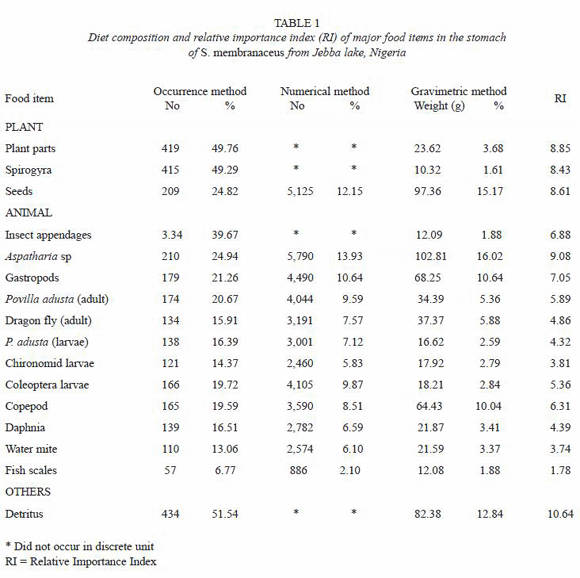
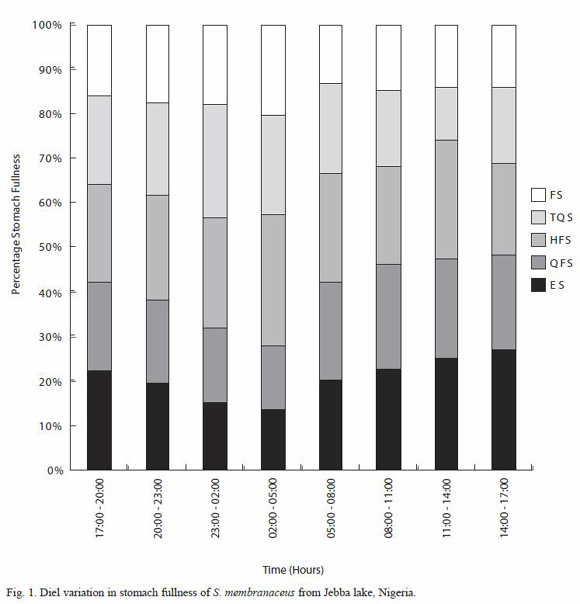
<body><![CDATA[<p>Jebba lake (9°10’ to 9°55’ N and 4°30’ to 5°00’ E) was formed in August 1993 as an impoundment in the valley of River Niger. It extends from the dam-site at Jebba to southern tip of Kainji dam. The lake is therefore unique as the first and only man-made lake in Nigeria that has a direct inflow from another man-made lake located upstream. It is bounded by Kwara State on the West and Niger State on the East. The lake has a surface area of 303x10<sup>6</sup> m<sup>2</sup>, ength of 100 km, maximum depth of 33.0 m; maximum width of 10.0 km; and maximum volume of 1 000x10<sup>6</sup> m<sup>3</sup>. One sampling station was selected from each of the three zones (basins) i.e. Dam-site from the Southern basin (maximum depth: 23.0 m), Old Gbajibo from middle basin (maximum depth: 27.0 m) and Faku from the Northern basin (maximum depth: 33.0 m). </p>     <p>Bi-monthly collection of 1 208 fish specimens as carried out for 24 months (April 2002 to March 2004) using gill nets of different mesh sizes ranging from 5.08 cm to10.16 cm. Of this, 310 fish specimens were caught during the day and night (i.e. 128 during the day and 182 at night) at three hours interval. Fishes caught were identified using the meristic features provided by Willoughby (1974) and were put in ice chest to reduce post humous digestion. </p>     <p>In the laboratory, the total and standard lengths (to the nearest cm) and weight (to the nearest g) of each specimen were measured following the procedure of King (1996) after blotting out excess water on the fish. Each specimen was slit open and its degree of stomach fullness rated as 0 (Empty; ES), 1 (quarter-full; QFS), 2 (half-full; HFS), 3 (three quarter-full; TQF) or 4 (Full stomach; FS). The fullness proportions (%) of each stomach was used to evaluate feeding pattern and the diel feeding activity. </p>     <p>The contents of the stomachs were emptied into separate petri dishes and the items identified to the lowest taxonomic level according to the method of Ward and Whipple (1950). The contents were analyzed instantly, but when this was not possible, the contents were preserved in 4 % formaldehyde. Frequencies of occurrence, numerical and gravimetric methods (Ricker 1968, George and Hadley 1979) were employed in the analysis of the gut contents. To reduce bias, dietary importance of food items was determined using the relative importance (RI) index (George and Hadley 1979, Hyslop 1980). Food items with RI &gt;5.0 % were considered major or important food items.</p> <font size="3">     <p><span style="font-weight: bold;">Results</span> </p> </font>     <p>Of the 1 208 <span style="font-style: italic;">S.membranaceus</span> examined, 366 (30.29 %) had empty stomachs, 202 (16.72 %) quarter-full stomachs, 194 (16.06 %) half-full stomachs, 172 (14.25 %) three quarterfull stomachs and 274 (22.68 %) full stomachs. The diel feeding pattern (<a href="#f1">Fig. 1</a>) shows that the stomachs were fuller, at least, half-full during the night and at dawn (20.00-05.00 h), with a higher percentage of FS (20.3), TQF (22.5), HFS (29.1) and lower ES (13.7) recorded respectively than during the day. The food items found in the stomachs (<a href="#t1">Table 1</a>) showed that the variety of food items comprised organisms of both plant and animal materials as well as detritus. The most important plant food consumed were materials in form of aquatic plants, which occurred in 49.76 % of stomachs, accounting for 3.68 % by weight. The most frequently utilized food types were the insects. They were, however, encountered in their dismembered form in 39.67 % of the stomachs representing 1.88 % of stomach contents by weight. However, of all the dietary items, detritus contributed most by occurrence (51.54 %) and by weight (12.84 %), while fish scales and water mites were less significant.    <br> </p>     <p>    <br> <a name="f1"></a></p> </font>     <div style="text-align: center;"><img  src="/img/revistas/rbt/v56n2/art39i1.jpg" title="" alt=""  style="width: 580px; height: 604px;">    ]]></body>
<body><![CDATA[<br> </div> <font face="Verdana" size="2"> </font><font face="Verdana" size="2">     <p>    <br> <a name="t1"></a></p> </font>     <div style="text-align: center;"><img  src="/img/revistas/rbt/v56n2/art39t1.gif" title="" alt=""  style="width: 580px; height: 578px;">    <br> </div> <font face="Verdana" size="2"> </font><font face="Verdana" size="2">     <p>Of the 16 food items ingested by <span style="font-style: italic;">S. membranaceus</span>, 10 constituted major food items. The ranking or relative importance index (RI) established five of them as most prominent food categories viz detritus (10.64 %), <span  style="font-style: italic;">Aspatharia (</span>9.08 %), plant parts (8.85 %), seeds (8.61 %) and spirogyra (8.43 %); while the relatively less prominent foods were gastropod (7.05 %), insect appendages (6.88 %), copepod (6.31 %), adult <span style="font-style: italic;">P.adusta</span> (5.89 %) and <span style="font-style: italic;">Coleoptera </span>larvae (5.36 %). The remaining food items showed no great significance as their RI values were considerably less than 5 %. However, the average RI values of the dietary components from <font><font face="Verdana"  size="2">each of plant (8.63 %), animal (5.20 %) and </font></font><font><font  face="Verdana" size="2">detritus (10.64 %) were not less than 5 %.    <br> </font></font><font><font face="Verdana" size="3">    <br> <span style="font-weight: bold;">Discussion</span>    <br> </font></font>    <br> <font><font face="Verdana" size="2">The increased stomach fullness during the </font></font><font><font face="Verdana" size="2">night other than in the day (<a href="#f1">Fig. 1</a>) indicated </font></font><font><font  face="Verdana" size="2">higher feeding intensity at night, thus confirm</font></font><font><font  face="Verdana" size="2">ing <span style="font-style: italic;">S. membranaceus</span> to be nocturnal in feeding&nbsp;</font></font><font><font face="Verdana" size="2">habits. Siluroid catfishes in tropical freshwaters </font></font><font><font  face="Verdana" size="2">have been reported to be nocturnal in their&nbsp;</font></font><font><font face="Verdana" size="2">trophic activity (Boujard and Luquet 1976,</font></font> Bruton 1979, Ezenwaji 1999, 2002, Idodo Umeh 2005). The number of empty stomachs recorded, i.e. an incidence of 30.29 % is considered low enough to suggest a fairly regular feeding intensity by the fish in Jebba lake. The relatively higher incidence (&gt;50 %) of half or more stomach full condition, according to Ikusemiju and Olaniyan (1977), Ikusemiju (1981) and Ekpo (1982) is indicative of abundant food supply in the habitat. The variety of prey items in the diets of <span style="font-style: italic;">S. membranaceus </span>showed that all the major biotopes seem to be explored for food. The prominence of detritus in the diets of the fishes, as reflected by the RI values, is an indication that <span style="font-style: italic;">S. membranaceu </span>is a bottom-benthic feeder, feeding actively on mud and bottom deposits containing falling organic debris. </p> </font><font face="Verdana" size="2">     ]]></body>
<body><![CDATA[<p>Ecological field studies on the dietary habits of <span  style="font-style: italic;">S. membranaceus</span> (Sandon and El-Tayib 1953, Bishai and Abu-Gideiri 1965, Blache 1964, Petr 1967, Willoughby 1974) showed that the usual diets of this species were insects, plant materials, mud deposits and plankton. Even though these results are limited by the sample size, they are fairly consistent with the observations made from this study. However, some food items such as water mite, <span style="font-style: italic;">Aspatharia</span> and dragonfly that were not observed by these authors were recorded in Jebba lake. It is therefore pertinent to note that the food of a foraging fish depends on the availability of any dietary items in its environment. According to Dill (1983) the forager must monitor food availability and respond to any variation. This perhaps, explains the slight difference in dietary composition of the fish in Jebba lake from those reported by previous workers. The presence of fish scales in the stomach of <span style="font-style: italic;">S. membranaceus </span>suggests a piscivorous habit and seems to negate its polyculture desirability and potentials, although they may have been ingested as part of the bottom deposits due to the ventral position of the mouth and not necessarily suggest a piscivorous habit. </p>     <p>The qualitative food composition indicated that food item from detritus; plant and animal sources are important, their RI values were higher than 5 %. It can therefore be inferred that <span  style="font-style: italic;">S. membranaceus</span> is omnivorous or euryphagous and occupy the third link of the food chain by feeding on phytoplankton and plant materials (primary producers); and makes the resultant energy available to predatory species within the water body. Omnivory or euryphagy is a characteristic feature of ubiquitous fishes (Lowe-McConnell 1975, Welcomme 1979, 1985) and explains <span  style="font-style: italic;">S. membranaceus</span>’s wide distribution, a phenomenon reported also for other mochokid catfishes (Olatunde 1989, Owolabi and Omotosho 1999, Araoye and Jeje 1999). Therefore the overwhelming presence of <span  style="font-style: italic;">S. membranaceus</span> in Jebba lake appears to be consequent on the wide variety and adaptiveness to whatever natural diets that are present in the lake; and coupled with the potential for rapid growth impetus and high fecundity (Owolabi 2005) make <span style="font-style: italic;">S. membranaceus</span> suited for culture in freshwater ponds. </p> </font> <hr style="width: 100%; height: 2px;"><font face="Verdana" size="2">     <p><span style="font-weight: bold;">Resumen</span> </p>     <p>Los hábitos alimenticios del pez <span style="font-style: italic;">Synodontis membranaceus </span>fueron investigados durante 24 meses (abril 2002-marzo 2004) en el lago Jebba, Nigeria; utilizando frecuencia de aparición, métodos numéricos, métodos gravimétricos y el Índice de Importancia Relativa (IR). El incremento de estómagos llenos durante la noche, en comparación con el día, indica una intensidad alta de alimentación durante la noche. El pez tiene una dieta eurífaga. De los 16 tipos de comida ingeridos, 10 constituyen la dieta principal, según los valores del IR. Las cinco principales categorías fueron detritos (10.64 %), <span style="font-style: italic;">Aspatharia</span> (9.08 %), plantas (8.85 %), semillas (8.61 %) y <span  style="font-style: italic;">Spirogyra</span> (8.43 %), mientras que las cinco categorías menores corresponden a gastrópodos (7.05 %), apéndices de insectos (6.88 %), copépodos (6.31 %), adultos de <span  style="font-style: italic;">Povilla adusta</span> (5.89 %) y larvas de coleóptero (5.3 %). Las restantes seis categorías de alimentación son odonatos larvales, larvas de <span style="font-style: italic;">P. adusta</span>, larvas de quironómidos, <span  style="font-style: italic;">Daphnia</span>, ácaros de agua y escamas de pez, las cuales no mostraron gran significancia debido a que los valores de IR fueron menores a 5 %. La importancia del detrito en la dieta indica que el pez habita en el fondo o posee alimentación bentónica. La amplia variabilidad de alimentos y la adaptabilidad natural a cualquiera de los recursos alimenticios presentes en el lago permite a <span style="font-style: italic;">S. membranaceus</span> mantener su gran abundancia en el lago Jebba. Su comportamiento eurífago lo hace apropiado para su cultivo. </p>     <p><span style="font-weight: bold;">Palabras clave:</span> <span  style="font-style: italic;">S. membranaceus</span>, alimento, actividad trófica, lago Jebba, Nigeria.    <br> </p> </font> <hr style="width: 100%; height: 2px;"><font face="Verdana" size="2"></font>     <div style="text-align: center;"><font><font face="Verdana" size="2">Received 15-III-2007. Corrected 29-IX-2007. Accepted 20-XI-2007.</font></font></div> <font face="Verdana" size="2">     <p> </p> <font size="3">     <p><span style="font-weight: bold;">References</span> </p> </font>     <!-- ref --><p>Araoye, P.A. &amp; Jeje, C.Y. 1999. The diet of <span  style="font-style: italic;">Synodontis schall</span> (Block-Schneider, 1801) in Asa Dam, Ilorin, Nigeria. Nig. J. Sci. 33: 67-76. &nbsp;&nbsp;&nbsp;&nbsp;&nbsp;&nbsp;&nbsp;&nbsp;[&#160;<a href="javascript:void(0);" onclick="javascript: window.open('/scielo.php?script=sci_nlinks&ref=1256304&pid=S0034-7744200800020003900001&lng=','','width=640,height=500,resizable=yes,scrollbars=1,menubar=yes,');">Links</a>&#160;]<!-- end-ref --><!-- ref --><p>Bishai, H.M. &amp; Y.B. Abu-Gideiri. 1965. Studies on the biology of the genus Synodontis at Khartoum.II. Food and feeding habits. Hydrobiologia 26: 85-97. &nbsp;&nbsp;&nbsp;&nbsp;&nbsp;&nbsp;&nbsp;&nbsp;[&#160;<a href="javascript:void(0);" onclick="javascript: window.open('/scielo.php?script=sci_nlinks&ref=1256305&pid=S0034-7744200800020003900002&lng=','','width=640,height=500,resizable=yes,scrollbars=1,menubar=yes,');">Links</a>&#160;]<!-- end-ref --><!-- ref --><p>Blache, J. 1964. Less poisons du basin du Tchad et Mayo Kebbi. Cah. Me. D.R.S.T.O.M. 4: 1-438. &nbsp;&nbsp;&nbsp;&nbsp;&nbsp;&nbsp;&nbsp;&nbsp;[&#160;<a href="javascript:void(0);" onclick="javascript: window.open('/scielo.php?script=sci_nlinks&ref=1256306&pid=S0034-7744200800020003900003&lng=','','width=640,height=500,resizable=yes,scrollbars=1,menubar=yes,');">Links</a>&#160;]<!-- end-ref --><!-- ref --><p>Boujard, T. &amp; P. Luquet. 1996. Rythemes alimentaires et alimentation chez les Siluroidei. <span style="font-style: italic;">In</span> M. Lengendre &amp; J.P. Proteau (eds.).The biology and culture of catfishes. Aquat Living Resour 9: 113-120. &nbsp;&nbsp;&nbsp;&nbsp;&nbsp;&nbsp;&nbsp;&nbsp;[&#160;<a href="javascript:void(0);" onclick="javascript: window.open('/scielo.php?script=sci_nlinks&ref=1256307&pid=S0034-7744200800020003900004&lng=','','width=640,height=500,resizable=yes,scrollbars=1,menubar=yes,');">Links</a>&#160;]<!-- end-ref --><!-- ref --><p>Bruton, M.N. 1979. The food and feeding behaviour of <span  style="font-style: italic;">Clarias gariepinus</span> (Pisces: Clariidae) in Lake Sibaya, South Africa, with emphasis on its role as a predator of Cichlid. Trans. Zool. Soc. Lond. 35: 47-114. &nbsp;&nbsp;&nbsp;&nbsp;&nbsp;&nbsp;&nbsp;&nbsp;[&#160;<a href="javascript:void(0);" onclick="javascript: window.open('/scielo.php?script=sci_nlinks&ref=1256308&pid=S0034-7744200800020003900005&lng=','','width=640,height=500,resizable=yes,scrollbars=1,menubar=yes,');">Links</a>&#160;]<!-- end-ref --><!-- ref --><p>Dill, M.L. 1983. Adaptive flexibility in the foraging behaviour of fish. Can. J. Fish Aquat. Sci. 41: 398-409. &nbsp;&nbsp;&nbsp;&nbsp;&nbsp;&nbsp;&nbsp;&nbsp;[&#160;<a href="javascript:void(0);" onclick="javascript: window.open('/scielo.php?script=sci_nlinks&ref=1256309&pid=S0034-7744200800020003900006&lng=','','width=640,height=500,resizable=yes,scrollbars=1,menubar=yes,');">Links</a>&#160;]<!-- end-ref --><!-- ref --><p>Ekpo, A.E. 1982. Length-weight relationship, food and feeding habits and fecundity of non-cichlid fishes of Lekki Lagoon, Lagos, Nigeria. M.Sc Thesis, University of Lagos, Lagos, Nigeria. &nbsp;&nbsp;&nbsp;&nbsp;&nbsp;&nbsp;&nbsp;&nbsp;[&#160;<a href="javascript:void(0);" onclick="javascript: window.open('/scielo.php?script=sci_nlinks&ref=1256310&pid=S0034-7744200800020003900007&lng=','','width=640,height=500,resizable=yes,scrollbars=1,menubar=yes,');">Links</a>&#160;]<!-- end-ref --><!-- ref --><p>Ezenwaji, H.M.G. 1999. The abundance and trophic biology of Clarias albopunctatus Nichols and La Monte, 1953 (Osteichthyes: Clariidae) in tropical flood river basin. Hydrobiologia 392: 159-168. &nbsp;&nbsp;&nbsp;&nbsp;&nbsp;&nbsp;&nbsp;&nbsp;[&#160;<a href="javascript:void(0);" onclick="javascript: window.open('/scielo.php?script=sci_nlinks&ref=1256311&pid=S0034-7744200800020003900008&lng=','','width=640,height=500,resizable=yes,scrollbars=1,menubar=yes,');">Links</a>&#160;]<!-- end-ref --><!-- ref --><p>Ezenwaji, H.M.G. 2002. The biology of <span  style="font-style: italic;">Clarias ebriensis </span>Pellegrin, 1920 (Osteichthyes: Clariidae) in an Africa rain forest river basin. Fish. Res. 54: 235-252. &nbsp;&nbsp;&nbsp;&nbsp;&nbsp;&nbsp;&nbsp;&nbsp;[&#160;<a href="javascript:void(0);" onclick="javascript: window.open('/scielo.php?script=sci_nlinks&ref=1256312&pid=S0034-7744200800020003900009&lng=','','width=640,height=500,resizable=yes,scrollbars=1,menubar=yes,');">Links</a>&#160;]<!-- end-ref --><!-- ref --><p>Fagade, S.O. 1983. The food and feeding habits of the fishes of lower River Benue (Nigeria). Bull. de I, I.F.A.N.T. 45 Ser. Nos 3-6: 316-341. &nbsp;&nbsp;&nbsp;&nbsp;&nbsp;&nbsp;&nbsp;&nbsp;[&#160;<a href="javascript:void(0);" onclick="javascript: window.open('/scielo.php?script=sci_nlinks&ref=1256313&pid=S0034-7744200800020003900010&lng=','','width=640,height=500,resizable=yes,scrollbars=1,menubar=yes,');">Links</a>&#160;]<!-- end-ref --><!-- ref --><p>George, E.L. &amp; W.F. Hadley. 1979. Food and habits partitioning between rock bass (<span style="font-style: italic;">Ambloplites rupestris</span>) and small mouth bass (<span  style="font-style: italic;">Micropterus dolomieni</span>) young of the year. Trans. Amer. Fish. Soc. 108: 253-261. &nbsp;&nbsp;&nbsp;&nbsp;&nbsp;&nbsp;&nbsp;&nbsp;[&#160;<a href="javascript:void(0);" onclick="javascript: window.open('/scielo.php?script=sci_nlinks&ref=1256314&pid=S0034-7744200800020003900011&lng=','','width=640,height=500,resizable=yes,scrollbars=1,menubar=yes,');">Links</a>&#160;]<!-- end-ref --><!-- ref --><p>Hyslop, E.J. 1980. Stomach content analysis, a review of methods and their application. J. Fish Biol. 17: 411-430. &nbsp;&nbsp;&nbsp;&nbsp;&nbsp;&nbsp;&nbsp;&nbsp;[&#160;<a href="javascript:void(0);" onclick="javascript: window.open('/scielo.php?script=sci_nlinks&ref=1256315&pid=S0034-7744200800020003900012&lng=','','width=640,height=500,resizable=yes,scrollbars=1,menubar=yes,');">Links</a>&#160;]<!-- end-ref --><!-- ref --><p>Idodo-Umeh, G. 2005. The feeding ecology of Mochokid species in River Ase, Niger Delta, Nigeria. Trop. Freshwat. Biol. 14: 71-93. &nbsp;&nbsp;&nbsp;&nbsp;&nbsp;&nbsp;&nbsp;&nbsp;[&#160;<a href="javascript:void(0);" onclick="javascript: window.open('/scielo.php?script=sci_nlinks&ref=1256316&pid=S0034-7744200800020003900013&lng=','','width=640,height=500,resizable=yes,scrollbars=1,menubar=yes,');">Links</a>&#160;]<!-- end-ref --><!-- ref --><p>Ikusemiju, K. &amp; C.I.O. Olaniyan. 1977. The food and feeding habits of the catfishes <span style="font-style: italic;">Chrysichthys walkeri </span>(Gunther) and <span style="font-style: italic;">Chrysichthys filamentosus</span> (Boulenger) and <span style="font-style: italic;">Chrysicthhys nigrodigitatus </span>(Lacepede) in the Lekki lagoon, Nigeria. J. Fish Biol. 10: 105-112. &nbsp;&nbsp;&nbsp;&nbsp;&nbsp;&nbsp;&nbsp;&nbsp;[&#160;<a href="javascript:void(0);" onclick="javascript: window.open('/scielo.php?script=sci_nlinks&ref=1256317&pid=S0034-7744200800020003900014&lng=','','width=640,height=500,resizable=yes,scrollbars=1,menubar=yes,');">Links</a>&#160;]<!-- end-ref --><!-- ref --><p>Ikusemiju, K. 1981. Hydrobiology and fishes of the Lekki lagoon, Nigeria. J. Nat. Sci. 3 (I and II): 135-146. &nbsp;&nbsp;&nbsp;&nbsp;&nbsp;&nbsp;&nbsp;&nbsp;[&#160;<a href="javascript:void(0);" onclick="javascript: window.open('/scielo.php?script=sci_nlinks&ref=1256318&pid=S0034-7744200800020003900015&lng=','','width=640,height=500,resizable=yes,scrollbars=1,menubar=yes,');">Links</a>&#160;]<!-- end-ref --><!-- ref --><p>King, R.P. 1996. Length-Weight relationships of Nigerian fresh water fishes. Naga, ICLARM Quarterly 19: 49-52. &nbsp;&nbsp;&nbsp;&nbsp;&nbsp;&nbsp;&nbsp;&nbsp;[&#160;<a href="javascript:void(0);" onclick="javascript: window.open('/scielo.php?script=sci_nlinks&ref=1256319&pid=S0034-7744200800020003900016&lng=','','width=640,height=500,resizable=yes,scrollbars=1,menubar=yes,');">Links</a>&#160;]<!-- end-ref --><!-- ref --><p>Lopez-Peralta, R.H &amp; C.A. Arcila. T. 2002. Diet composition of fish species from Sourthern Continental shelf of Colombia. Naga World Fish Cent. Quart. 25: 23-29 &nbsp;&nbsp;&nbsp;&nbsp;&nbsp;&nbsp;&nbsp;&nbsp;[&#160;<a href="javascript:void(0);" onclick="javascript: window.open('/scielo.php?script=sci_nlinks&ref=1256320&pid=S0034-7744200800020003900017&lng=','','width=640,height=500,resizable=yes,scrollbars=1,menubar=yes,');">Links</a>&#160;]<!-- end-ref --><!-- ref --><p>Lowe-McConnel, R.H. 1975. Fish Communities in tropical freshwaters: their distribution, ecology and evolution. Longman, London, England. &nbsp;&nbsp;&nbsp;&nbsp;&nbsp;&nbsp;&nbsp;&nbsp;[&#160;<a href="javascript:void(0);" onclick="javascript: window.open('/scielo.php?script=sci_nlinks&ref=1256321&pid=S0034-7744200800020003900018&lng=','','width=640,height=500,resizable=yes,scrollbars=1,menubar=yes,');">Links</a>&#160;]<!-- end-ref --><!-- ref --><p>Olatunde, A.A. 1999. Some aspects of the biology of <span  style="font-style: italic;">Synodontis schall</span> (Bloch-Schneider) in Zaria. Nig. J. Aquatic Sci. 4: 49-54. &nbsp;&nbsp;&nbsp;&nbsp;&nbsp;&nbsp;&nbsp;&nbsp;[&#160;<a href="javascript:void(0);" onclick="javascript: window.open('/scielo.php?script=sci_nlinks&ref=1256322&pid=S0034-7744200800020003900019&lng=','','width=640,height=500,resizable=yes,scrollbars=1,menubar=yes,');">Links</a>&#160;]<!-- end-ref --><!-- ref --><p>Owolabi, O.D. &amp; J.S. Omotosho. 1999. Aspect of the biology of <span  style="font-style: italic;">Synodontis gambiensis</span> (Gunther) from Asa lake, Ilorin, Nigeria. Nig. J. Pure Appl. Sci. 14: 778-783. &nbsp;&nbsp;&nbsp;&nbsp;&nbsp;&nbsp;&nbsp;&nbsp;[&#160;<a href="javascript:void(0);" onclick="javascript: window.open('/scielo.php?script=sci_nlinks&ref=1256323&pid=S0034-7744200800020003900020&lng=','','width=640,height=500,resizable=yes,scrollbars=1,menubar=yes,');">Links</a>&#160;]<!-- end-ref --><!-- ref --><p>Owolabi, O.D. 2005. Some aspects of the Biology of <span  style="font-style: italic;">Synodontis membranaceus</span> (Geoffroy Saint Hillarie, 1809) in Jebba lake, Nigeria. Ph.D. Thesis, University of Ilorin, Ilorin, Nigeria. &nbsp;&nbsp;&nbsp;&nbsp;&nbsp;&nbsp;&nbsp;&nbsp;[&#160;<a href="javascript:void(0);" onclick="javascript: window.open('/scielo.php?script=sci_nlinks&ref=1256324&pid=S0034-7744200800020003900021&lng=','','width=640,height=500,resizable=yes,scrollbars=1,menubar=yes,');">Links</a>&#160;]<!-- end-ref --><!-- ref --><p>Petr, T. 1967. Food preferences of commercial fishes in the Volta lake. Tech Report X, Volta Basin Research Project, University of Ghana, Ghana. &nbsp;&nbsp;&nbsp;&nbsp;&nbsp;&nbsp;&nbsp;&nbsp;[&#160;<a href="javascript:void(0);" onclick="javascript: window.open('/scielo.php?script=sci_nlinks&ref=1256325&pid=S0034-7744200800020003900022&lng=','','width=640,height=500,resizable=yes,scrollbars=1,menubar=yes,');">Links</a>&#160;]<!-- end-ref --><!-- ref --><p>Reed, W., J. Burchad, A.J. Hopson, J. Jenness &amp; I. Yaro. 1967. Fish and fisheries of Northern Nigeria. Publ. MANR, Lagos, Nigeria. &nbsp;&nbsp;&nbsp;&nbsp;&nbsp;&nbsp;&nbsp;&nbsp;[&#160;<a href="javascript:void(0);" onclick="javascript: window.open('/scielo.php?script=sci_nlinks&ref=1256326&pid=S0034-7744200800020003900023&lng=','','width=640,height=500,resizable=yes,scrollbars=1,menubar=yes,');">Links</a>&#160;]<!-- end-ref --><!-- ref --><p>Ricker, W.E. 1968. Method of Assessment of fish production in freshwater. Blackwell Scientific Publication, Oxford, England. &nbsp;&nbsp;&nbsp;&nbsp;&nbsp;&nbsp;&nbsp;&nbsp;[&#160;<a href="javascript:void(0);" onclick="javascript: window.open('/scielo.php?script=sci_nlinks&ref=1256327&pid=S0034-7744200800020003900024&lng=','','width=640,height=500,resizable=yes,scrollbars=1,menubar=yes,');">Links</a>&#160;]<!-- end-ref --><!-- ref --><p>Sa-a, P., M.L. Palomares &amp; D. Pauly. 1997. The food items Table. In Fish Base 1997 CD-ROM, ICLARM, Manila, Phillipines. &nbsp;&nbsp;&nbsp;&nbsp;&nbsp;&nbsp;&nbsp;&nbsp;[&#160;<a href="javascript:void(0);" onclick="javascript: window.open('/scielo.php?script=sci_nlinks&ref=1256328&pid=S0034-7744200800020003900025&lng=','','width=640,height=500,resizable=yes,scrollbars=1,menubar=yes,');">Links</a>&#160;]<!-- end-ref --><!-- ref --><p>Sandon, H. &amp; A.A. El-Tayib. 1953. The food of some Nile fishes. Sudan Notes and Records 34: 219-221. &nbsp;&nbsp;&nbsp;&nbsp;&nbsp;&nbsp;&nbsp;&nbsp;[&#160;<a href="javascript:void(0);" onclick="javascript: window.open('/scielo.php?script=sci_nlinks&ref=1256329&pid=S0034-7744200800020003900026&lng=','','width=640,height=500,resizable=yes,scrollbars=1,menubar=yes,');">Links</a>&#160;]<!-- end-ref --><!-- ref --><p>Ward, H.B &amp; G.C. Whipple. 1950. Freshwater biology. Wiley, London, England. &nbsp;&nbsp;&nbsp;&nbsp;&nbsp;&nbsp;&nbsp;&nbsp;[&#160;<a href="javascript:void(0);" onclick="javascript: window.open('/scielo.php?script=sci_nlinks&ref=1256330&pid=S0034-7744200800020003900027&lng=','','width=640,height=500,resizable=yes,scrollbars=1,menubar=yes,');">Links</a>&#160;]<!-- end-ref --><!-- ref --><p>Welcomme, R.L. 1979. Fisheries ecology of flood plain rivers. Longman, London, England. &nbsp;&nbsp;&nbsp;&nbsp;&nbsp;&nbsp;&nbsp;&nbsp;[&#160;<a href="javascript:void(0);" onclick="javascript: window.open('/scielo.php?script=sci_nlinks&ref=1256331&pid=S0034-7744200800020003900028&lng=','','width=640,height=500,resizable=yes,scrollbars=1,menubar=yes,');">Links</a>&#160;]<!-- end-ref --><!-- ref --><p>Welcomme, R.L. 1985. River Fisheries. FAO Tech. Paper No 262 FAO, Rome, Italy. &nbsp;&nbsp;&nbsp;&nbsp;&nbsp;&nbsp;&nbsp;&nbsp;[&#160;<a href="javascript:void(0);" onclick="javascript: window.open('/scielo.php?script=sci_nlinks&ref=1256332&pid=S0034-7744200800020003900029&lng=','','width=640,height=500,resizable=yes,scrollbars=1,menubar=yes,');">Links</a>&#160;]<!-- end-ref --><!-- ref --><p>Willoughby, N.G. 1974. The ecology of the genus <span  style="font-style: italic;">Synodontis</span> (Pisces: Siluroidei) in lake Kainji, Nigeria. Ph.D. Thesis, University of Southampton, Nigeria. &nbsp;&nbsp;&nbsp;&nbsp;&nbsp;&nbsp;&nbsp;&nbsp;[&#160;<a href="javascript:void(0);" onclick="javascript: window.open('/scielo.php?script=sci_nlinks&ref=1256333&pid=S0034-7744200800020003900030&lng=','','width=640,height=500,resizable=yes,scrollbars=1,menubar=yes,');">Links</a>&#160;]<!-- end-ref --><br> </font>     ]]></body>
<body><![CDATA[ ]]></body><back>
<ref-list>
<ref id="B1">
<nlm-citation citation-type="journal">
<person-group person-group-type="author">
<name>
<surname><![CDATA[Araoye]]></surname>
<given-names><![CDATA[P.A]]></given-names>
</name>
<name>
<surname><![CDATA[Jeje]]></surname>
<given-names><![CDATA[C.Y]]></given-names>
</name>
</person-group>
<article-title xml:lang="en"><![CDATA[The diet of Synodontis schall (Block-Schneider, 1801) in Asa Dam, Ilorin, Nigeria]]></article-title>
<source><![CDATA[Nig. J. Sci]]></source>
<year>1999</year>
<volume>33</volume>
<page-range>67-76</page-range></nlm-citation>
</ref>
<ref id="B2">
<nlm-citation citation-type="journal">
<person-group person-group-type="author">
<name>
<surname><![CDATA[Bishai]]></surname>
<given-names><![CDATA[H.M]]></given-names>
</name>
<name>
<surname><![CDATA[Abu-Gideiri]]></surname>
<given-names><![CDATA[Y.B]]></given-names>
</name>
</person-group>
<article-title xml:lang="en"><![CDATA[Studies on the biology of the genus Synodontis at Khartoum: II. Food and feeding habits]]></article-title>
<source><![CDATA[Hydrobiologia]]></source>
<year>1965</year>
<volume>26</volume>
<page-range>85-97</page-range></nlm-citation>
</ref>
<ref id="B3">
<nlm-citation citation-type="journal">
<person-group person-group-type="author">
<name>
<surname><![CDATA[Blache]]></surname>
<given-names><![CDATA[J]]></given-names>
</name>
</person-group>
<article-title xml:lang="fr"><![CDATA[Less poisons du basin du Tchad et Mayo Kebbi]]></article-title>
<source><![CDATA[Cah. Me. D.R.S.T.O.M]]></source>
<year>1964</year>
<volume>4</volume>
<page-range>1-438</page-range></nlm-citation>
</ref>
<ref id="B4">
<nlm-citation citation-type="">
<person-group person-group-type="author">
<name>
<surname><![CDATA[Boujard]]></surname>
<given-names><![CDATA[T]]></given-names>
</name>
<name>
<surname><![CDATA[Luquet]]></surname>
<given-names><![CDATA[P]]></given-names>
</name>
</person-group>
<article-title xml:lang="fr"><![CDATA[Rythemes alimentaires et alimentation chez les Siluroidei]]></article-title>
<person-group person-group-type="editor">
<name>
<surname><![CDATA[Lengendre]]></surname>
<given-names><![CDATA[M]]></given-names>
</name>
<name>
<surname><![CDATA[Proteau]]></surname>
<given-names><![CDATA[J.P]]></given-names>
</name>
</person-group>
<source><![CDATA[The biology and culture of catfishes]]></source>
<year>1996</year>
<volume>9</volume>
<page-range>113-120</page-range></nlm-citation>
</ref>
<ref id="B5">
<nlm-citation citation-type="journal">
<person-group person-group-type="author">
<name>
<surname><![CDATA[Bruton]]></surname>
<given-names><![CDATA[M.N]]></given-names>
</name>
</person-group>
<article-title xml:lang="en"><![CDATA[The food and feeding behaviour of Clarias gariepinus (Pisces: Clariidae) in Lake Sibaya, South Africa, with emphasis on its role as a predator of Cichlid]]></article-title>
<source><![CDATA[Trans. Zool. Soc. Lond]]></source>
<year>1979</year>
<volume>35</volume>
<page-range>47-114</page-range></nlm-citation>
</ref>
<ref id="B6">
<nlm-citation citation-type="journal">
<person-group person-group-type="author">
<name>
<surname><![CDATA[Dill]]></surname>
<given-names><![CDATA[M.L]]></given-names>
</name>
</person-group>
<article-title xml:lang="en"><![CDATA[Adaptive flexibility in the foraging behaviour of fish]]></article-title>
<source><![CDATA[Can. J. Fish Aquat. Sci]]></source>
<year>1983</year>
<volume>41</volume>
<page-range>398-409</page-range></nlm-citation>
</ref>
<ref id="B7">
<nlm-citation citation-type="">
<person-group person-group-type="author">
<name>
<surname><![CDATA[Ekpo]]></surname>
<given-names><![CDATA[A.E]]></given-names>
</name>
</person-group>
<source><![CDATA[Length-weight relationship, food and feeding habits and fecundity of non-cichlid fishes of Lekki Lagoon, Lagos, Nigeria]]></source>
<year>1982</year>
</nlm-citation>
</ref>
<ref id="B8">
<nlm-citation citation-type="journal">
<person-group person-group-type="author">
<name>
<surname><![CDATA[Ezenwaji]]></surname>
<given-names><![CDATA[H.M.G]]></given-names>
</name>
</person-group>
<article-title xml:lang="en"><![CDATA[The abundance and trophic biology of Clarias albopunctatus Nichols and La Monte, 1953 (Osteichthyes: Clariidae) in tropical flood river basin]]></article-title>
<source><![CDATA[Hydrobiologia]]></source>
<year>1999</year>
<volume>392</volume>
<page-range>159-168</page-range></nlm-citation>
</ref>
<ref id="B9">
<nlm-citation citation-type="journal">
<person-group person-group-type="author">
<name>
<surname><![CDATA[Ezenwaji]]></surname>
<given-names><![CDATA[H.M.G]]></given-names>
</name>
</person-group>
<article-title xml:lang="en"><![CDATA[The biology of Clarias ebriensis Pellegrin, 1920 (Osteichthyes: Clariidae) in an Africa rain forest river basin]]></article-title>
<source><![CDATA[Fish. Res]]></source>
<year>2002</year>
<volume>54</volume>
<page-range>235-252</page-range></nlm-citation>
</ref>
<ref id="B10">
<nlm-citation citation-type="journal">
<person-group person-group-type="author">
<name>
<surname><![CDATA[Fagade]]></surname>
<given-names><![CDATA[S.O]]></given-names>
</name>
</person-group>
<article-title xml:lang="en"><![CDATA[The food and feeding habits of the fishes of lower River Benue (Nigeria)]]></article-title>
<source><![CDATA[Bull. de I, I.F.A.N.T. 45 Ser]]></source>
<year>1983</year>
<numero>3-6</numero>
<issue>3-6</issue>
<page-range>316-341</page-range></nlm-citation>
</ref>
<ref id="B11">
<nlm-citation citation-type="journal">
<person-group person-group-type="author">
<name>
<surname><![CDATA[George]]></surname>
<given-names><![CDATA[E.L]]></given-names>
</name>
<name>
<surname><![CDATA[Hadley]]></surname>
<given-names><![CDATA[W.F]]></given-names>
</name>
</person-group>
<article-title xml:lang="en"><![CDATA[Food and habits partitioning between rock bass (Ambloplites rupestris) and small mouth bass (Micropterus dolomieni) young of the year]]></article-title>
<source><![CDATA[Trans. Amer. Fish. Soc]]></source>
<year>1979</year>
<volume>108</volume>
<page-range>253-261</page-range></nlm-citation>
</ref>
<ref id="B12">
<nlm-citation citation-type="journal">
<person-group person-group-type="author">
<name>
<surname><![CDATA[Hyslop]]></surname>
<given-names><![CDATA[E.J]]></given-names>
</name>
</person-group>
<article-title xml:lang="en"><![CDATA[Stomach content analysis, a review of methods and their application]]></article-title>
<source><![CDATA[J. Fish Biol]]></source>
<year>1980</year>
<volume>17</volume>
<page-range>411-430</page-range></nlm-citation>
</ref>
<ref id="B13">
<nlm-citation citation-type="journal">
<person-group person-group-type="author">
<name>
<surname><![CDATA[Idodo-Umeh]]></surname>
<given-names><![CDATA[G]]></given-names>
</name>
</person-group>
<article-title xml:lang="en"><![CDATA[The feeding ecology of Mochokid species in River Ase, Niger Delta, Nigeria]]></article-title>
<source><![CDATA[Trop. Freshwat. Biol]]></source>
<year>2005</year>
<volume>14</volume>
<page-range>71-93</page-range></nlm-citation>
</ref>
<ref id="B14">
<nlm-citation citation-type="journal">
<person-group person-group-type="author">
<name>
<surname><![CDATA[Ikusemiju]]></surname>
<given-names><![CDATA[K]]></given-names>
</name>
<name>
<surname><![CDATA[Olaniyan]]></surname>
<given-names><![CDATA[C.I.O]]></given-names>
</name>
</person-group>
<article-title xml:lang="en"><![CDATA[The food and feeding habits of the catfishes Chrysichthys walkeri (Gunther) and Chrysichthys filamentosus (Boulenger) and Chrysicthhys nigrodigitatus (Lacepede) in the Lekki lagoon, Nigeria]]></article-title>
<source><![CDATA[J. Fish Biol]]></source>
<year>1977</year>
<volume>10</volume>
<page-range>105-112</page-range></nlm-citation>
</ref>
<ref id="B15">
<nlm-citation citation-type="journal">
<person-group person-group-type="author">
<name>
<surname><![CDATA[Ikusemiju]]></surname>
<given-names><![CDATA[K]]></given-names>
</name>
</person-group>
<article-title xml:lang="en"><![CDATA[Hydrobiology and fishes of the Lekki lagoon, Nigeria]]></article-title>
<source><![CDATA[J. Nat. Sci]]></source>
<year>1981</year>
<volume>3</volume>
<numero>I and II</numero>
<issue>I and II</issue>
<page-range>135-146</page-range></nlm-citation>
</ref>
<ref id="B16">
<nlm-citation citation-type="journal">
<person-group person-group-type="author">
<name>
<surname><![CDATA[King]]></surname>
<given-names><![CDATA[R.P]]></given-names>
</name>
</person-group>
<article-title xml:lang="en"><![CDATA[Length-Weight relationships of Nigerian fresh water fishes]]></article-title>
<source><![CDATA[Naga, ICLARM Quarterly]]></source>
<year>1996</year>
<volume>19</volume>
<page-range>49-52</page-range></nlm-citation>
</ref>
<ref id="B17">
<nlm-citation citation-type="journal">
<person-group person-group-type="author">
<name>
<surname><![CDATA[Lopez-Peralta]]></surname>
<given-names><![CDATA[R.H]]></given-names>
</name>
<name>
<surname><![CDATA[Arcila. T]]></surname>
<given-names><![CDATA[C.A]]></given-names>
</name>
</person-group>
<article-title xml:lang="en"><![CDATA[Diet composition of fish species from Sourthern Continental shelf of Colombia]]></article-title>
<source><![CDATA[Naga World Fish Cent. Quart]]></source>
<year>2002</year>
<volume>25</volume>
<page-range>23-29</page-range></nlm-citation>
</ref>
<ref id="B18">
<nlm-citation citation-type="book">
<person-group person-group-type="author">
<name>
<surname><![CDATA[Lowe-McConnel]]></surname>
<given-names><![CDATA[R.H]]></given-names>
</name>
</person-group>
<source><![CDATA[Fish Communities in tropical freshwaters: their distribution, ecology and evolution]]></source>
<year>1975</year>
<publisher-loc><![CDATA[London ]]></publisher-loc>
<publisher-name><![CDATA[Longman]]></publisher-name>
</nlm-citation>
</ref>
<ref id="B19">
<nlm-citation citation-type="journal">
<person-group person-group-type="author">
<name>
<surname><![CDATA[Olatunde]]></surname>
<given-names><![CDATA[A.A]]></given-names>
</name>
</person-group>
<article-title xml:lang="en"><![CDATA[Some aspects of the biology of Synodontis schall (Bloch-Schneider) in Zaria]]></article-title>
<source><![CDATA[Nig. J. Aquatic Sci]]></source>
<year>1999</year>
<volume>4</volume>
<page-range>49-54</page-range></nlm-citation>
</ref>
<ref id="B20">
<nlm-citation citation-type="journal">
<person-group person-group-type="author">
<name>
<surname><![CDATA[Owolabi]]></surname>
<given-names><![CDATA[O.D]]></given-names>
</name>
<name>
<surname><![CDATA[Omotosho]]></surname>
<given-names><![CDATA[J.S]]></given-names>
</name>
</person-group>
<article-title xml:lang="en"><![CDATA[Aspect of the biology of Synodontis gambiensis (Gunther) from Asa lake, Ilorin, Nigeria]]></article-title>
<source><![CDATA[Nig. J. Pure Appl. Sci]]></source>
<year>1999</year>
<volume>14</volume>
<page-range>778-783</page-range></nlm-citation>
</ref>
<ref id="B21">
<nlm-citation citation-type="">
<person-group person-group-type="author">
<name>
<surname><![CDATA[Owolabi]]></surname>
<given-names><![CDATA[O.D]]></given-names>
</name>
</person-group>
<source><![CDATA[Some aspects of the Biology of Synodontis membranaceus (Geoffroy Saint Hillarie, 1809) in Jebba lake, Nigeria]]></source>
<year>2005</year>
</nlm-citation>
</ref>
<ref id="B22">
<nlm-citation citation-type="book">
<person-group person-group-type="author">
<name>
<surname><![CDATA[Petr]]></surname>
<given-names><![CDATA[T]]></given-names>
</name>
</person-group>
<source><![CDATA[Food preferences of commercial fishes in the Volta lake: Tech Report X, Volta Basin Research Project]]></source>
<year>1967</year>
<publisher-name><![CDATA[University of Ghana]]></publisher-name>
</nlm-citation>
</ref>
<ref id="B23">
<nlm-citation citation-type="book">
<person-group person-group-type="author">
<name>
<surname><![CDATA[Reed]]></surname>
<given-names><![CDATA[W]]></given-names>
</name>
<name>
<surname><![CDATA[Burchad]]></surname>
<given-names><![CDATA[J]]></given-names>
</name>
<name>
<surname><![CDATA[Hopson]]></surname>
<given-names><![CDATA[A.J]]></given-names>
</name>
<name>
<surname><![CDATA[Jenness]]></surname>
<given-names><![CDATA[J]]></given-names>
</name>
<name>
<surname><![CDATA[Yaro]]></surname>
<given-names><![CDATA[I]]></given-names>
</name>
</person-group>
<source><![CDATA[Fish and fisheries of Northern Nigeria]]></source>
<year>1967</year>
<publisher-loc><![CDATA[Lagos ]]></publisher-loc>
<publisher-name><![CDATA[Publ. MANR]]></publisher-name>
</nlm-citation>
</ref>
<ref id="B24">
<nlm-citation citation-type="book">
<person-group person-group-type="author">
<name>
<surname><![CDATA[Ricker]]></surname>
<given-names><![CDATA[W.E]]></given-names>
</name>
</person-group>
<source><![CDATA[Method of Assessment of fish production in freshwater]]></source>
<year>1968</year>
<publisher-loc><![CDATA[Oxford ]]></publisher-loc>
<publisher-name><![CDATA[Blackwell Scientific Publication]]></publisher-name>
</nlm-citation>
</ref>
<ref id="B25">
<nlm-citation citation-type="book">
<person-group person-group-type="author">
<name>
<surname><![CDATA[Sa-a]]></surname>
<given-names><![CDATA[P]]></given-names>
</name>
<name>
<surname><![CDATA[Palomares]]></surname>
<given-names><![CDATA[M.L]]></given-names>
</name>
<name>
<surname><![CDATA[Pauly]]></surname>
<given-names><![CDATA[D]]></given-names>
</name>
</person-group>
<source><![CDATA[The food items Table: In Fish Base 1997 CD-ROM]]></source>
<year>1997</year>
<publisher-loc><![CDATA[Manila ]]></publisher-loc>
<publisher-name><![CDATA[ICLARM]]></publisher-name>
</nlm-citation>
</ref>
<ref id="B26">
<nlm-citation citation-type="journal">
<person-group person-group-type="author">
<name>
<surname><![CDATA[Sandon]]></surname>
<given-names><![CDATA[H]]></given-names>
</name>
<name>
<surname><![CDATA[El-Tayib]]></surname>
<given-names><![CDATA[A.A]]></given-names>
</name>
</person-group>
<article-title xml:lang="en"><![CDATA[The food of some Nile fishes]]></article-title>
<source><![CDATA[Sudan Notes and Records]]></source>
<year>1953</year>
<volume>34</volume>
<page-range>219-221</page-range></nlm-citation>
</ref>
<ref id="B27">
<nlm-citation citation-type="book">
<person-group person-group-type="author">
<name>
<surname><![CDATA[Ward]]></surname>
<given-names><![CDATA[H.B]]></given-names>
</name>
<name>
<surname><![CDATA[Whipple]]></surname>
<given-names><![CDATA[G.C]]></given-names>
</name>
</person-group>
<source><![CDATA[Freshwater biology]]></source>
<year>1950</year>
<publisher-loc><![CDATA[London ]]></publisher-loc>
<publisher-name><![CDATA[Wiley]]></publisher-name>
</nlm-citation>
</ref>
<ref id="B28">
<nlm-citation citation-type="book">
<person-group person-group-type="author">
<name>
<surname><![CDATA[Welcomme]]></surname>
<given-names><![CDATA[R.L]]></given-names>
</name>
</person-group>
<source><![CDATA[Fisheries ecology of flood plain rivers]]></source>
<year>1979</year>
<publisher-loc><![CDATA[London ]]></publisher-loc>
<publisher-name><![CDATA[Longman]]></publisher-name>
</nlm-citation>
</ref>
<ref id="B29">
<nlm-citation citation-type="book">
<person-group person-group-type="author">
<name>
<surname><![CDATA[Welcomme]]></surname>
<given-names><![CDATA[R.L]]></given-names>
</name>
</person-group>
<source><![CDATA[River Fisheries: FAO Tech. Paper No 262]]></source>
<year>1985</year>
<publisher-loc><![CDATA[Rome ]]></publisher-loc>
<publisher-name><![CDATA[FAO]]></publisher-name>
</nlm-citation>
</ref>
<ref id="B30">
<nlm-citation citation-type="">
<person-group person-group-type="author">
<name>
<surname><![CDATA[Willoughby]]></surname>
<given-names><![CDATA[N.G]]></given-names>
</name>
</person-group>
<source><![CDATA[The ecology of the genus Synodontis (Pisces: Siluroidei) in lake Kainji, Nigeria]]></source>
<year>1974</year>
</nlm-citation>
</ref>
</ref-list>
</back>
</article>