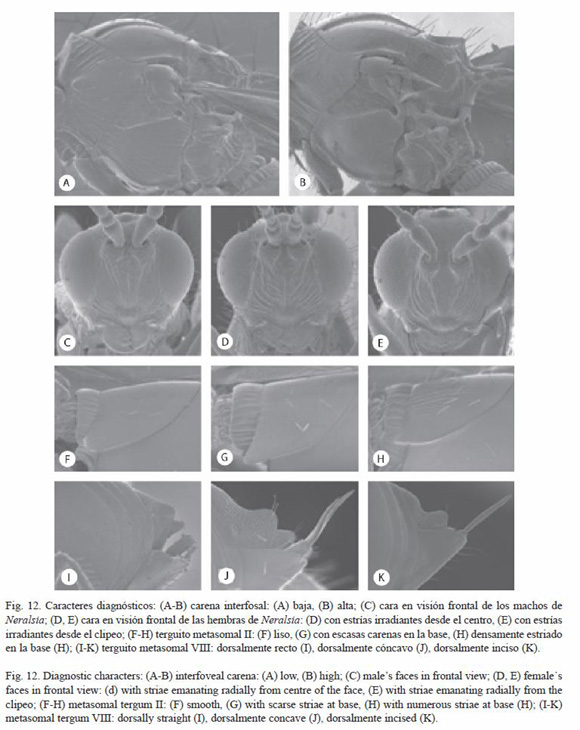
<?xml version="1.0" encoding="ISO-8859-1"?><article xmlns:mml="http://www.w3.org/1998/Math/MathML" xmlns:xlink="http://www.w3.org/1999/xlink" xmlns:xsi="http://www.w3.org/2001/XMLSchema-instance">
<front>
<journal-meta>
<journal-id>0034-7744</journal-id>
<journal-title><![CDATA[Revista de Biología Tropical]]></journal-title>
<abbrev-journal-title><![CDATA[Rev. biol. trop]]></abbrev-journal-title>
<issn>0034-7744</issn>
<publisher>
<publisher-name><![CDATA[Universidad de Costa Rica]]></publisher-name>
</publisher>
</journal-meta>
<article-meta>
<article-id>S0034-77442008000200030</article-id>
<title-group>
<article-title xml:lang="en"><![CDATA[Revision of the South American species of Neralsia (Hymenoptera: Figitidae) with the description of eight new species]]></article-title>
</title-group>
<contrib-group>
<contrib contrib-type="author">
<name>
<surname><![CDATA[Jiménez]]></surname>
<given-names><![CDATA[M]]></given-names>
</name>
<xref ref-type="aff" rid="A01"/>
</contrib>
<contrib contrib-type="author">
<name>
<surname><![CDATA[Díaz]]></surname>
<given-names><![CDATA[N.B]]></given-names>
</name>
<xref ref-type="aff" rid="A02"/>
</contrib>
<contrib contrib-type="author">
<name>
<surname><![CDATA[Gallardo]]></surname>
<given-names><![CDATA[F]]></given-names>
</name>
<xref ref-type="aff" rid="A02"/>
</contrib>
<contrib contrib-type="author">
<name>
<surname><![CDATA[Ros-Farré]]></surname>
<given-names><![CDATA[P]]></given-names>
</name>
<xref ref-type="aff" rid="A01"/>
</contrib>
<contrib contrib-type="author">
<name>
<surname><![CDATA[Pujade-Villar]]></surname>
<given-names><![CDATA[J]]></given-names>
</name>
<xref ref-type="aff" rid="A01"/>
</contrib>
</contrib-group>
<aff id="A01">
<institution><![CDATA[,Universitat de Barcelona Facultat de Biologia Departament de Biologia Animal]]></institution>
<addr-line><![CDATA[ ]]></addr-line>
<country>España</country>
</aff>
<aff id="A02">
<institution><![CDATA[,Museo de La Plata División Entomología ]]></institution>
<addr-line><![CDATA[ ]]></addr-line>
<country>Argentina</country>
</aff>
<pub-date pub-type="pub">
<day>00</day>
<month>06</month>
<year>2008</year>
</pub-date>
<pub-date pub-type="epub">
<day>00</day>
<month>06</month>
<year>2008</year>
</pub-date>
<volume>56</volume>
<numero>2</numero>
<fpage>795</fpage>
<lpage>828</lpage>
<copyright-statement/>
<copyright-year/>
<self-uri xlink:href="http://www.scielo.sa.cr/scielo.php?script=sci_arttext&amp;pid=S0034-77442008000200030&amp;lng=en&amp;nrm=iso"></self-uri><self-uri xlink:href="http://www.scielo.sa.cr/scielo.php?script=sci_abstract&amp;pid=S0034-77442008000200030&amp;lng=en&amp;nrm=iso"></self-uri><self-uri xlink:href="http://www.scielo.sa.cr/scielo.php?script=sci_pdf&amp;pid=S0034-77442008000200030&amp;lng=en&amp;nrm=iso"></self-uri><abstract abstract-type="short" xml:lang="en"><p><![CDATA[Neralsia is a genus of Figitid hymenopterans present in both the Neartic and the Neotropical regions. In this work, material from several museums (including all types of the South American species of Neralsia) was analyzed with light and electron microscopy. The South American species are studied as a whole, reviewing 26 previously cited species and describing eight new species. A key for their identification is included and the characters to differentiate species here considered are illustrated. Rev. Biol. Trop. 56 (2): 795-828. Epub 2008 June 30.]]></p></abstract>
<abstract abstract-type="short" xml:lang="es"><p><![CDATA[Neralsia es un género de himenópteros de distribución americana, presente tanto en la región Neártica como en la Neotropical. En este trabajo se estudian, usando microscopia de luz y electrónica, las especies sudamericanas en su conjunto, 26 anteriormente citadas y ocho especies nuevas, que se describen aquí formalmente. Se presenta, además, una clave para su identificación; y se ilustran los caracteres que permiten definir las especies consideradas en este estudio.]]></p></abstract>
<kwd-group>
<kwd lng="en"><![CDATA[Cynipoidea]]></kwd>
<kwd lng="en"><![CDATA[Figitidae]]></kwd>
<kwd lng="en"><![CDATA[Figitinae]]></kwd>
<kwd lng="en"><![CDATA[Neralsia]]></kwd>
<kwd lng="en"><![CDATA[South America]]></kwd>
<kwd lng="en"><![CDATA[revision]]></kwd>
<kwd lng="en"><![CDATA[new species]]></kwd>
<kwd lng="es"><![CDATA[Cynipoidea]]></kwd>
<kwd lng="es"><![CDATA[Figitidae]]></kwd>
<kwd lng="es"><![CDATA[Figitinae]]></kwd>
<kwd lng="es"><![CDATA[Neralsia]]></kwd>
<kwd lng="es"><![CDATA[Sudamérica]]></kwd>
<kwd lng="es"><![CDATA[revisión]]></kwd>
<kwd lng="es"><![CDATA[nuevas especies]]></kwd>
</kwd-group>
</article-meta>
</front><body><![CDATA[ <p style="text-align: center;"><font face="Verdana" size="4"><span  style="font-weight: bold;">Revision of the South American species of <span style="font-style: italic;">Neralsia </span>(Hymenoptera: Figitidae) with the description of eight new species</span> </font></p>     <p><font face="Verdana" size="2"><span style="font-weight: bold;">M. Jiménez<a name="a1"></a><a href="#a2"><sup>1</sup></a>, N.B. Díaz<a  href="#a2"><sup>2</sup></a>, F. Gallardo<a href="#a2"><sup>2</sup></a>, P. Ros-Farré<a href="#a2"><sup>1</sup></a> &amp; J. Pujade-Villar<a  href="#a2"><sup>1</sup></a></span> </font></p>     <p><font face="Verdana" size="2"><a name="a2"></a><a href="#a1">1</a> Universitat de Barcelona, Facultat de Biologia, Departament de Biologia Animal, Avda. Diagonal 646, 08028-Barcelona, España. Fax (+34) 934035740; <a href="mailto:mauriziojimenez@yahoo.es">mauriziojimenez@yahoo.es</a>; <a href="mailto:palmira.ros.farre@gmail.com">palmira.ros.farre@gmail.com</a>; <a href="mailto:jpujade@ub.edu">jpujade@ub.edu</a> </font></p>     <p><font face="Verdana" size="2"><a href="#a1">2</a> División Entomología, Museo de La Plata, Paseo del Bosque, 1900-La Plata, Argentina. Fax (54) 254232575; <a  href="mailto:ndiaz@museo.fcnym.unlp.edu.ar">ndiaz@museo.fcnym.unlp.edu.ar</a>; <a href="mailto:gallardo@museo.fcnym.unlp.edu.ar">gallardo@museo.fcnym.unlp.edu.ar</a> </font></p>     <p><font face="Verdana" size="2"> </font></p>     <p><font face="Verdana" size="2"><span style="font-weight: bold;">Abstract:</span> Neralsia is a genus of Figitid hymenopterans present in both the Neartic and the Neotropical regions. In this work, material from several museums (including all types of the South American species of Neralsia) was analyzed with light and electron microscopy. The South American species are studied as a whole, reviewing 26 previously cited species and describing eight new species. A key for their identification is included and the characters to differentiate species here considered are illustrated. Rev. Biol. Trop. 56 (2): 795-828. Epub 2008 June 30. </font></p>     <p><font face="Verdana" size="2"><span style="font-weight: bold;">Key words:</span> Cynipoidea, Figitidae, Figitinae, Neralsia, South America, revision, new species.</font></p> <hr style="width: 100%; height: 2px;">     <p><font face="Verdana" size="2"> </font></p>     <p><font face="Verdana" size="2">The genus <span  style="font-style: italic;">Neralsia</span> was described by Cameron (1883) to include a species collected in Guatemala, Neralsia rufipes, characterized, according to the author, by presenting the radial cell closed. Weld (1930), after studying this species type, affirmed that this cell was open; the study of this material allowed us to check Cameron’s mistake and observe that the radial cell of <span style="font-style: italic;">N. rufipes</span> presents a marginal darkening that should not be considered as a real venation. Weld (1930) established the synonymy between <span style="font-style: italic;">Neralsia</span> and <span  style="font-style: italic;">Xyalosema</span>, and transferred the species of the latter genus to <span style="font-style: italic;">Neralsia</span>, except for <span  style="font-style: italic;">Xyalosema singularis</span> (Ashmead 1896) that was transferred to <span style="font-style: italic;">Xyalophora</span> Kieffer 1901. Afterwards, Weld (1952) transferred all the American species of <span style="font-style: italic;">Xyalophora</span> to the genus <span style="font-style: italic;">Neralsia</span>. <span  style="font-style: italic;">Neralsia</span> and <span  style="font-style: italic;">Xyalophora</span> gather the figitines presenting the distal part of the scutellum in the form of a spine, differently to the rest where the scutellum is distally blunt. </font></p>     <p><font face="Verdana" size="2">Species included in this subfamily are characterized by being parasitoids of Diptera-Muscomorpha; these cause huge economical losses in crops of multiple areas and especially in the Neotropical region (Clavijo 1993, Madrigal-Cardeño 2001, among others). The only bio-economical known datum for the species of <span style="font-style: italic;">Neralsia</span> was the observation made by Díaz (1990) for <span style="font-style: italic;">Neralsia fossulata</span> (=splendens), the representatives of this species attack pre-imaginal states of Diptera of dung of the genus <span style="font-style: italic;">Sarcophagula </span>(Sarcophagidae); later studies (Díaz and Gallardo 1995, 1996, Díaz <span  style="font-style: italic;">et al</span>. 2000, Marchiori <span style="font-style: italic;">et al</span>. 2000a-e, 2003) have corroborated the presence of <span style="font-style: italic;">N. fossulata</span> in <span style="font-style: italic;">Sarcophagula occidua</span> in several countries of South America. Recently, it was described a new species in North America (Jiménez <span style="font-style: italic;">et al</span>., in prep.) that parasitoidizes larvae of Sarcophaga bullata. </font></p>     ]]></body>
<body><![CDATA[<p><font face="Verdana" size="2">Figitines and particularly those from the genus <span style="font-style: italic;">Neralsia</span> are distributed along the whole American continent and are especially abundant in South America. This one is the fifth contribution made by the authors aiming to update the knowledge of the named taxon in this part of the continent. Till today, the morphological characters to take into account in the identification of the species have been analyzed, considering as a reference Dettmer’s survey (1932) (Jiménez <span style="font-style: italic;">et al</span>. 2005a); the types of the described species in South America were studied (Jiménez <span style="font-style: italic;">et al</span>. 2004), and 17 new species were described (Jiménez <span style="font-style: italic;">et al</span>. 2005b, 2006a). </font></p>     <p><font face="Verdana" size="3"><span style="font-weight: bold;">Materials and methods</span> </font></p>     <p><font face="Verdana" size="2">Part of the material analyzed belongs to samples conserved in 70º (Canadian National Collection of insects, Ottawa, Canada) and that collected in campaigns made in several South American countries (Argentina, Bolivia, Brazil and Colombia). These samples were conveniently dried, glued to entomological cards with Arabic glue and labelled, following the standard procedure for entomological studies. All types of the South American species of <span style="font-style: italic;">Neralsia</span> (Jiménez <span style="font-style: italic;">et al</span>. 2004, 2005b, 2006a, Pujade-Villar <span style="font-style: italic;">et al</span>. 2006) were analyzed; the type species of <span style="font-style: italic;">Xyalophora</span>, <span  style="font-style: italic;">Figites clavatus</span> Giraud 1860 (Muséum National d’Histoire Naturelle, Paris, France), the Neralsia, <span style="font-style: italic;">N. rufipes</span> Cameron 1883 (British Museum, London, United Kingdom), and the type species of Solenaspis transferred afterwards to <span style="font-style: italic;">Xyalosema</span> (because of homonymy), <span style="font-style: italic;">S. hyalinipennis</span> Ashmead 1887 (Smithsonian Institution National Museum of Natural History, Washington DC, USA) were analyzed. </font></p>     <p><font face="Verdana" size="2">The acronyms of the institutions where the rest of the material examined is conserved and the name of the people responsible of the collections are listed below: </font></p>     <p><font face="Verdana" size="2">AMNH (American Museum of Natural History, New York, NY, USA; D. Grimaldi) </font></p>     <p><font face="Verdana" size="2">CNCI (Canadian National Collection of Insects, Ottawa, Canada; G. Gibson) </font></p>     <p><font face="Verdana" size="2">CAS (California Academy of Sciences, San Francisco, California, USA; R. Zuparko) </font></p>     <p><font face="Verdana" size="2">DCBU (Departamento de Biología de la Universidad Federal de Sao Carlos, SP, Brazil; A. Penteado-Días) </font></p>     <p><font face="Verdana" size="2">FOC (Fundación Oswaldo Cruz, Rio de Janeiro, Brazil; S.J. da Oliveira) </font></p>     <p><font face="Verdana" size="2">LACM (Los Angeles County Museum of Natural History, Los Angeles, California, USA; B.V. Brown) </font></p>     ]]></body>
<body><![CDATA[<p><font face="Verdana" size="2">MEL (Museo Entomológico de León, León, Nicaragua; J.M. Maes) </font></p>     <p><font face="Verdana" size="2">MLP (Museo de La Plata, La Plata, Argentina; N.B. Díaz) </font></p>     <p><font face="Verdana" size="2">MNHN-Paris (Muséum National d’Histoire Naturelle, Paris, France; C. Villeman) </font></p>     <p><font face="Verdana" size="2">MNHN-Chile(MuseoNacionaldeHistoriaNatural de Chile, Santiago, Chile; F. Rojas A.) </font></p>     <p><font face="Verdana" size="2">MNRJ (Museo Nacional de Rio de Janeiro, Brazil; M. Monné) </font></p>     <p><font face="Verdana" size="2">MZUSP (Museu de Zoologia da Universidade de São Paulo, Brazil; C.R.F. Brandao) </font></p>     <p><font face="Verdana" size="2">NHN (British Museum, London, United Kingdom; S. Lewis) </font></p>     <p><font face="Verdana" size="2">NMM (Naturhistorisch Museum Maastricht, Netherlands; F. Dingemans-Bakels) </font></p>     <p><font face="Verdana" size="2">UB (Universitat de Barcelona, Barcelona, Spain; J. Pujade-Villar). </font></p>     <p><font face="Verdana" size="2">UCR (Universidad de Costa Rica, San Pedro, Costa Rica; P. Hanson) </font></p>     ]]></body>
<body><![CDATA[<p><font face="Verdana" size="2">UFES (Universidade Federal do Espíritu Santo, Brazil; C.O. Acevedo) </font></p>     <p><font face="Verdana" size="2">USNM (United States National Museum of Natural History, Smithsonian Institution, Washington DC, USA; D. Furth) </font></p>     <p><font face="Verdana" size="2">ZMB (Zoologisches Museum Humboldt-Universität, Berlin, Germany; R. Koch) </font></p>     <p><font face="Verdana" size="2">The data detailed for each of the studied specimens are a faithful copy of the existing labels. </font></p>     <p><font face="Verdana" size="2">Pictures illustrating this survey were taken with scanning electron microscope (Stereoscan Leica 360) in the Servicio Científico-Técnico of the Universidad de Barcelona, at low voltage and without gold cover to preserve the specimens. Pictures of the radial cells were obtained with a digital camera (Minolta model Dimage-Xt) and were taken directly through the ocular of a lens (Olympus model SZ30). Drawings of the antennae were made by hand from the digital pictures directly obtained from binocular lens. </font></p>     <p><font face="Verdana" size="2">For the terminology of the morphological structures were considered works made by Gibson (1985) and Ronquist and Nordlander (1989), and to define the sculpture the one by Harris (1979). Measures and abbreviations used include: F1–F11, first and subsequent flagellomeres; POC (post-ocellar distance) is the distance between the internal margins of the posterior ocellus; OOC (ocellus-ocular distance) is the distance between the external margin of the lateral ocellus and the internal margin of the compound eye; COC (ocellar distance) is the distance between the lateral and frontal ocellus; the diameter of the lateral ocellus is the biggest one of this organ; the transfacial line is the distance between the internal margin of the compound eyes measures at the antennal foveae. For the adults length, the maximum and minimum value of the individuals studied is indicated. </font></p>     <p><font face="Verdana" size="2">In the description of new species, in the case that specimens of both sexes have been able to be studied, the characters are common to both, unless the contrary is indicated; characters showing sexual dimorphism are not included in this generalization, such as: sculpturation of the face, antennae and the aspect of the metasoma, in which case the female is described; males, for these features, do not show specific differentiation, they are homogenous within the genus. </font></p>     <p><font face="Verdana" size="3"><span style="font-weight: bold;">Results</span> </font></p>     <p style="font-style: italic;"><font face="Verdana" size="2"><span  style="font-weight: bold;">Species treatment</span> </font></p>     <p><font face="Verdana" size="2"><span style="font-style: italic;">Neralsia albipennis</span>    ]]></body>
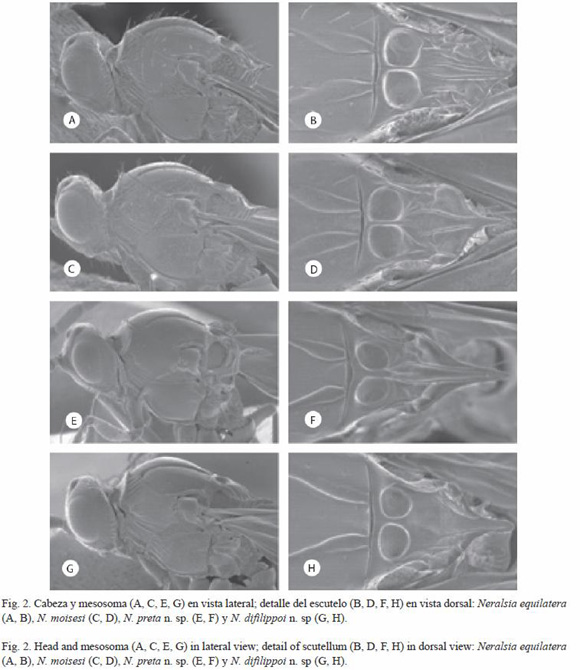
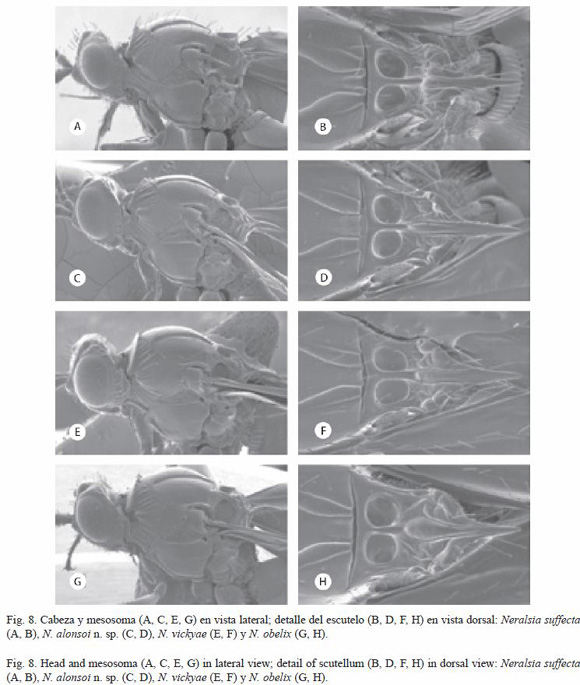
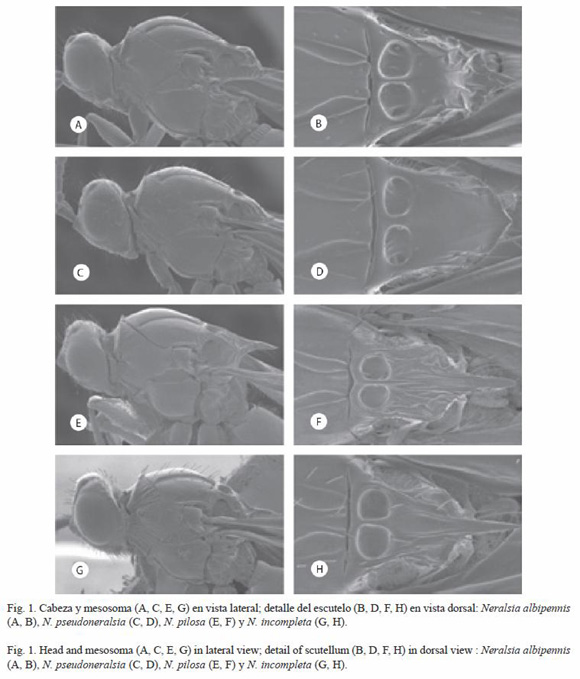
<body><![CDATA[<br> (Kieffer 1909) (<a href="#f1">Fig. 1A</a>, <a href="#f1">B</a>)    <br> </font></p>     <p><font face="Verdana" size="2">    <br> <a name="f1"></a></font></p>     <div style="text-align: center;"><font face="Verdana" size="2"><img  src="/img/revistas/rbt/v56n2/art30i1.jpg" title="" alt=""  style="width: 580px; height: 679px;"></font>    <br> <font face="Verdana" size="2"> </font></div>     <p><font face="Verdana" size="2"><span style="font-style: italic;">Xyalophora albipennis</span> Kieffer 1909: 94 <span style="font-style: italic;">    <br> Neralsia albipennis</span> (Kieffer 1909) Jiménez <span style="font-style: italic;">et al</span>. 2004: 64 </font></p>     <p><font face="Verdana" size="2"><span style="font-weight: bold;">Studied material:</span> see Jiménez <span style="font-style: italic;">et al</span>. 2004. Additional material studied. ARGENTINA: Bariloche, Río Negro, Arg., Nov. 1929, R. &amp; E. Shannon: 1 male (USNM); Bariloche, Rio Negro, Arg., XI. 1926, R. &amp; E., Shannon: 1 male (USNM) CHiLE: Rivadavia, Chile, Coquimbo, 30.X.1957, L.E. Peña: 1 male (CNCI); El Manzano, Cord. Ovalle, XI.1964, Peña: 1 female (CNCi); Santiago, Renca, 26.II.1965, Col. T. Ramírez, S., Neralsia: 1 male (MNHN-Chile). </font></p>     <p><font face="Verdana" size="2"><span style="font-weight: bold;">Diagnosis:</span> re-described in Jiménez <span style="font-style: italic;">et al</span>. 2004: 64. <span style="font-style: italic;">Neralsia albipennis</span>, belongs to the group of species with low interfoveal carina; in this case the aforementioned carina is at the same level as the scutellar foveae. it is differentiated from the rest of South American species that also present this feature by being the only one with the scutellar disc hunchbacked (<a href="#f1">Fig. 1A</a>). </font></p>     ]]></body>
<body><![CDATA[<p><font face="Verdana" size="2"><span style="font-weight: bold;">Distribution:</span> known species from Argentina, Bolivia, Brazil and Chile (Jiménez <span style="font-style: italic;">et al</span>. 2004). </font></p>     <p><font face="Verdana" size="2"><span style="font-style: italic;">Neralsia pseudoneralsia</span>    <br> Jiménez and Pujade-Villar 2006    <br> (<a href="#f1">Fig. 1C</a>, <a href="#f1">D</a>) </font></p>     <p><font face="Verdana" size="2"><span style="font-style: italic;">Neralsia pseudoneralsia</span> Jiménez and Pujade-Villar 2006a: 63. </font></p>     <p><font face="Verdana" size="2"><span style="font-weight: bold;">Studied material:</span> see Jiménez <span style="font-style: italic;">et al</span>. 2006a. Additional material studied. ARGENTINA: Horco Molle, Tucumán, Argentina, VI. 1968, C.C. Porter: 1 female (CNCI); VENEZUELA: Kavanayen, Gran Sabana, 28. XIII. 1987, <span style="font-style: italic;">M. Sanborne</span>, Mal.-intercept tp. (forest); <span style="font-style: italic;">Xyalophora</span>, det. K. Schick, 2003: 1 female (CNCI). </font></p>     <p><font face="Verdana" size="2"><span style="font-weight: bold;">Diagnosis:</span> <span style="font-style: italic;">Neralsia pseudoneralsia </span>belongs to the group of species with low interfoveal carina. it is differentiated from the rest of South American species by this feature, by presenting the scutellar disc smooth and flat, and the spine extremely short (<a href="#f1">Fig. 1D</a>). The closest species are <span style="font-style: italic;">N. equilatera</span> and <span style="font-style: italic;">N. moisesi </span>with which share the characteristics of the flagellomeres and the metasomal tergum II and from which is easily separated by presenting wings with marginal setae. </font></p>     <p><font face="Verdana" size="2"><span style="font-weight: bold;">Distribution:</span> species known from Argentina (Jiménez <span style="font-style: italic;">et al</span>. 2006a). in this study it is also cited from Venezuela. </font></p>     <p><font face="Verdana" size="2"><span style="font-style: italic;">Neralsia pilosa</span>    <br> (Borgmeier 1935) (<a href="#f1">Fig. 1E</a>, <a href="#f1">F</a>) </font></p>     ]]></body>
<body><![CDATA[<p><font face="Verdana" size="2"><span style="font-style: italic;">Xyalophora pilosa</span> Borgmeier 1935: 103    <br> <span style="font-style: italic;">Neralsia pilosa</span> (Borgmeier 1935) Weld 1952: 176 </font></p>     <p><font face="Verdana" size="2"><span style="font-weight: bold;">Studied material:</span> see Jiménez <span style="font-style: italic;">et al</span>. 2004. </font></p>     <p><font face="Verdana" size="2"><span style="font-weight: bold;">Diagnosis:</span> re-described in Jiménez <span style="font-style: italic;">et al</span>. 2004: 76. <span style="font-style: italic;">Neralsia pilosa</span> belongs to the group of species with low interfoveal carina. It is the only described species of <span  style="font-style: italic;">Neralsia </span>that presents dense long pubescence, whitish and silky in the face and the legs, and that lacks genal sulcus.</font></p>     <p><font face="Verdana" size="2"><span style="font-weight: bold;">Distribution:</span> species only known from Brazil (Jiménez <span  style="font-style: italic;">et al</span>. 2004). It has not been found again since its description. </font></p>     <p><font face="Verdana" size="2"><span style="font-style: italic;">Neralsia incompleta</span>    <br> Jiménez and Pujade-Villar 2006    <br> (<a href="#f1">Fig. 1G</a>, <a href="#f1">H</a>, <a href="#f10">10H</a>)    <br> </font></p>     <p><font face="Verdana" size="2">    ]]></body>
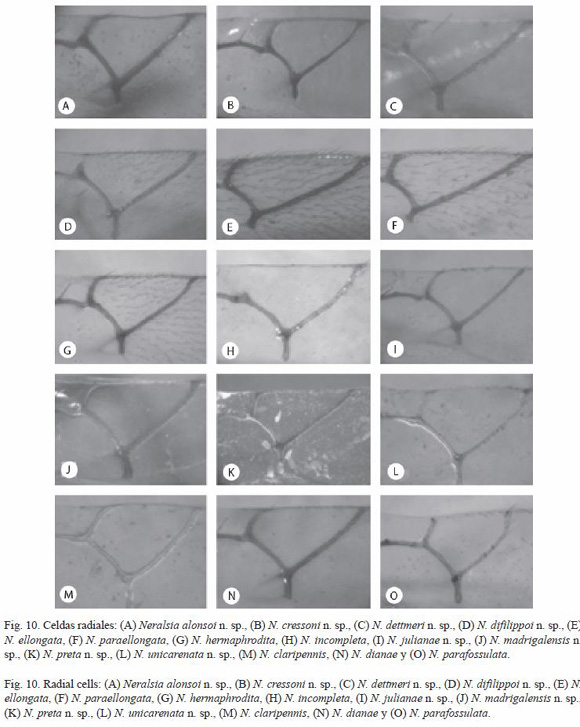
<body><![CDATA[<br> </font></p>     <div style="text-align: center;"><font face="Verdana" size="2"><a  name="f10"></a><img src="/img/revistas/rbt/v56n2/art30i10.jpg" title=""  alt="" style="width: 580px; height: 727px;"></font>    <br> <font face="Verdana" size="2"> </font></div>     <p><font face="Verdana" size="2"><span style="font-style: italic;">Neralsia incompleta</span> Jiménez and Pujade-Villar 2006b: 47 </font></p>     <p><font face="Verdana" size="2"><span style="font-weight: bold;">Studied material:</span> see Pujade-Villar <span style="font-style: italic;">et al</span>. 2006b. </font></p>     <p><font face="Verdana" size="2"><span style="font-weight: bold;">Diagnosis:</span> <span style="font-style: italic;">Neralsia incompleta</span> belongs to the group of species with low interfoveal carina and metasomal tergum ii completely smooth at base. it is differentiated from the rest of known South American species by presenting the radial cell incomplete, R1 is very short, being located very far from the wing margin (<a href="#f10">Fig. 10H</a>) or absent. </font></p>     <p><font face="Verdana" size="2"><span style="font-weight: bold;">Distribution:</span> species widely distributed in the whole American continent; in South America it has been collected only from Paraguay (Pujade-Villar <span style="font-style: italic;">et al</span>. 2006b). </font></p>     <p><font face="Verdana" size="2"><span style="font-style: italic;">Neralsia equilatera</span>    <br> Jiménez and Pujade-Villar 2006    <br> (<a href="#f2">Fig. 2A</a>, <a href="#f2">B</a>)    ]]></body>
<body><![CDATA[<br> </font></p>     <p><font face="Verdana" size="2">    <br> <a name="f2"></a></font></p>     <div style="text-align: center;"><font face="Verdana" size="2"><img  src="/img/revistas/rbt/v56n2/art30i2.jpg" title="" alt=""  style="width: 580px; height: 670px;"></font>    <br> <font face="Verdana" size="2"> </font></div>     <p><font face="Verdana" size="2"><span style="font-style: italic;">Neralsia equilatera</span> Jiménez and Pujade-Villar 2006a: 60 </font></p>     <p><font face="Verdana" size="2"><span style="font-weight: bold;">Studied material:</span> see Jiménez <span style="font-style: italic;">et al</span>. 2006a. </font></p>     <p><font face="Verdana" size="2"><span style="font-weight: bold;">Diagnosis:</span> <span style="font-style: italic;">Neralsia equilatera</span> belongs to the group of species with low interfoveal carina. Together with <span style="font-style: italic;">N. moisesi</span> is included in the subgroup of those that present the anterior wings with no marginal setae and are differentiated between them by the character indicated in the key. From <span style="font-style: italic;">N. pseudoneralsia</span> (<a href="#f1">Fig. 1D</a>), that also has the scutellar spine very short, it is differentiated by presenting the scutellum disc carinated (<a href="#f2">Fig. 2B</a>). </font></p>     <p><font face="Verdana" size="2"><span style="font-weight: bold;">Distribution:</span> species known from Argentina and Chile (Jiménez <span  style="font-style: italic;">et al</span>. 2006a). </font></p>     <p><font face="Verdana" size="2"><span style="font-style: italic;">Neralsia moisesi</span>    ]]></body>
<body><![CDATA[<br> Jiménez and Pujade-Villar 2006 (<a href="#f2">Fig. 2C</a>, <a href="#f2">D</a>) </font></p>     <p><font face="Verdana" size="2"><span style="font-style: italic;">Neralsia moisesi</span> Jiménez and Pujade-Villar 2006a: 61 </font></p>     <p><font face="Verdana" size="2"><span style="font-weight: bold;">Studied material:</span> see Jiménez <span style="font-style: italic;">et al</span>. 2006a. </font></p>     <p><font face="Verdana" size="2"><span style="font-weight: bold;">Diagnosis:</span> <span style="font-style: italic;">Neralsia moisesi</span> belongs to the group of species with low interfoveal carina and metasomal tergum II smooth at base. It is similar to <span style="font-style: italic;">N. equilatera</span>, <span style="font-style: italic;">N. pseudoneralsia</span>, and <span style="font-style: italic;">N. desantisi</span>, because of the form of the flagellomeres; from these it is easily differentiated by the characteristics of the scutellum; <span style="font-style: italic;">N. moisesi</span> (<a  href="#f2">Fig. 2D</a>) presents the scutellar spine shorter than <span style="font-style: italic;">N. desantisi</span> (Fig. 4H) and more developed than <span style="font-style: italic;">N. equilatera</span> (<a href="#f2">Fig. 2B</a>) and <span style="font-style: italic;">N. pseudoneralsia</span> (<a  href="#f1">Fig. 1D</a>). From the latter (<a href="#f1">Fig. 1D</a>), it is distinguished, moreover, by presenting the scutellar disc carinated (<a href="#f2">Fig. 2D</a>). Distribution: species known from Argentina, Chile and Venezuela (Jiménez et al. 2006a). </font></p>     <p><font face="Verdana" size="2"><span style="font-style: italic;">Neralsia preta</span>    <br> Jiménez and Pujade-Villar n. sp (<a href="#f2">Fig. 2E</a>, <a href="#f2">F</a>, <a href="#f10">10k</a>) </font></p>     <p><font face="Verdana" size="2"><span style="font-weight: bold;">Etymology: </span>the name of the species alludes to the dark pigmentation of the specimen studied; only the ventral part of the metasoma is reddish. </font></p>     <p><font face="Verdana" size="2"><span style="font-weight: bold;">Type material:</span> holotype (male) deposited in CNCI (Ottawa, Canada), BOLiViA: "Yungas, Chaparé, 2 200 m, 1-4.II.1976, L.E. Pena" (white label), Holotype desig.-2004 Jiménez and Pujade-Villar" (red label), "<span style="font-style: italic;">Neralsia preta </span>n. sp male Jiménez and Pujade-Villar det.2004" (white label). </font></p>     <p><font face="Verdana" size="2"><span style="font-weight: bold;">Diagnosis:</span> <span style="font-style: italic;">Neralsia preta</span> n. sp. is differentiated from the rest of described species of the genus by its coloration and the presence of a genal sulcus completely smooth. </font></p>     <p><font face="Verdana" size="2"><span style="font-weight: bold;">Length:</span> male: 4.3 mm; female: unknown. </font></p>     ]]></body>
<body><![CDATA[<p><font face="Verdana" size="2"><span style="font-weight: bold;">Coloration:</span> black (body, antennae and legs), but for the ventral part of the metasoma which is dark reddish. Wings slightly dusky, venation brown. </font></p>     <p><font face="Verdana" size="2"><span style="font-weight: bold;">Head:</span> in frontal view sub-squared, in dorsal view 1.8 times longer than wide. Face with two smooth areas. Transfacial line 1.2 times longer than the height of the eye. The relation POL:OOL:OCO is 7:6:3.5, diameter of the lateral ocellus 4.5. Genal sulcus hardly marked and completely smooth. Occiput carinated. </font></p>     <p><font face="Verdana" size="2"><span style="font-weight: bold;">Antennae:</span> <a href="#f1">F1</a> shorter than the rest of the flagellomeres (as in all males of <span style="font-style: italic;">Neralsia</span> species studied). </font></p>     <p><font face="Verdana" size="2"><span style="font-weight: bold;">Mesosoma</span> (<a href="#f2">Fig. 2E</a>, <a href="#f2">F</a>): pronotal plate incised. Lateral areas of the pronotum smooth, with scarce carinae weakly marked in the dorsal part and in greater number than in the ventral part. Mesopleura smooth in most of it surface, presenting antero-ventral striae. Medial sulcus of the scutum very marked. Interfoveal carina surpassing slightly the level of the scutellar foveae. Scutellar disc strongly carinated, being noticed two carinae that begin in the interfoveal carina and end in the base of the spine, forming between them a wide and smooth sulcus, the rest of the disc with short longitudinal carinae that do not reach the posterior margin. Scutellar spine wide in the base, bigger than 1/3 the total length of the scutellum. </font></p>     <p><font face="Verdana" size="2"><span style="font-weight: bold;">Metasoma:</span> tergum I carinated. Tergum II with scarce short striate at base. </font></p>     <p><font face="Verdana" size="2"><span style="font-weight: bold;">Distribution:</span> species collected from Bolivia. </font></p>     <p><font face="Verdana" size="2"><span style="font-style: italic;">Neralsia difilippoi</span>    <br> Jiménez and Pujade-Villar n. sp.    <br> (<a href="#f2">Fig. 2G</a>, <a href="#f2">H</a>, <a href="#f10">10D</a>) </font></p>     <p><font face="Verdana" size="2"><span style="font-weight: bold;">Etymology:</span> species dedicated, in posthumous memory, to the italian ancestor of one of the authors, his grandmother in his mother’s side Aurora Difilippo Pianetta (1916-1977). </font></p>     ]]></body>
<body><![CDATA[<p><font face="Verdana" size="2"><span style="font-weight: bold;">Type material:</span> holotype (male) deposited in CNCI (Ottawa, Canada), ECUADOR: C-386"1900 Laja, Malacutos, 21-27.VIII.1977" (white label), Holotype desig.-2004 Jiménez and Pujade-Villar" (red label), "<span style="font-style: italic;">Neralsia difilippoi </span>n. sp male Jiménez and Pujade-Villar det. 2004" (white label). </font></p>     <p><font face="Verdana" size="2"><span style="font-weight: bold;">Diagnosis:</span> <span style="font-style: italic;">Neralsia difilippoi</span> n. sp. presents a scutellum very particular that makes this species unmistakable with any other species of this genus. The surface of the disc of the scutellum is almost smooth, with no medial carina, central sulcus absent; these characters set it close <span style="font-style: italic;">N. pseudoneralsia</span> from which is distinguished by the length of the spine (<a href="#f1">Fig. 1D</a>). On the other hand, <span style="font-style: italic;">N. difilippoi</span> n. sp. presents the scutellar spine blunt and of the same thickness in all its way (<a href="#f2">Fig. 2H</a>), characters that set it close to <span style="font-style: italic;">N. flavidipennis</span> and <span style="font-style: italic;">N. hermaphrodita</span>, in which the scutellar spine is far longer (<a href="#f3">Fig. 3B</a>, <a href="#f3">D</a>).    <br> </font></p>     <p><font face="Verdana" size="2">    <br> <a name="f3"></a></font></p>     <div style="text-align: center;"><font face="Verdana" size="2"><img  src="/img/revistas/rbt/v56n2/art30i3.jpg" title="" alt=""  style="width: 580px; height: 681px;"></font>    <br> <font face="Verdana" size="2"> </font></div>     <p><font face="Verdana" size="2"><span style="font-weight: bold;">Length:</span> male: 2.6 mm; female: unknown. </font></p>     <p><font face="Verdana" size="2"><span style="font-weight: bold;">Coloration:</span> black, except for the antennae and tegulae that are reddish brown. Translucent wings, venation pale brown. </font></p>     <p><font face="Verdana" size="2"><span style="font-weight: bold;">Head:</span> in frontal view sub-triangular, in dorsal view 1.9 times longer than wide. Transfacial line 0.94 times as long as the height of the eye. The relation POL:OOL:OCO is 8:6.5:4, diameter of the lateral ocellus 3.5. Genal sulcus present, provided with some transversal costulae. </font></p>     ]]></body>
<body><![CDATA[<p><font face="Verdana" size="2"><span style="font-weight: bold;">Antennae:</span> F1 hardly shorter F2, the rest of the flagellomeres three times longer than wide, all with sensilia. </font></p>     <p><font face="Verdana" size="2"><span style="font-weight: bold;">Mesosoma (<a href="#f2">Fig. 2G</a>, <a href="#f2">H</a>):</span> Lateral areas of the pronotum with scarce sharp carinae and very visible in the anterior dorsal part, more abundant in the ventral part, the posterior smooth. Mesopleura smooth in most of its surface, with striae only in the anterior ventral part. Medial sulcus of the scutellum very marked. Interfoveal carina slightly surpassing the level of scutellar foveae. Scutellar disc smooth, scutellar sulcus hardly defined, spine of uniform thickness, finished bluntly, its size 1/3 of the total length of the scutellum. </font></p>     <p><font face="Verdana" size="2"><span style="font-weight: bold;">Wings:</span> radial cell 2.3 times longer than wide (<a href="#f10">Fig. 10D</a>). Discal and marginal setae present. Areolet incomplete.     <br> </font></p>     <p><font face="Verdana" size="2"><span style="font-weight: bold;">Metasoma:</span> tergum I wide, strongly carinated. Tergum II completely smooth at base.     <br> </font></p>     <p><font face="Verdana" size="2"><span style="font-weight: bold;">Distribution:</span> species collected from Ecuador. </font></p>     <p><font face="Verdana" size="2"><span style="font-style: italic;">Neralsia flavidipennis</span>    <br> (Kieffer 1909) (<a href="#f3">Fig. 3A</a>, <a href="#f3">B</a>, <a  href="#f11">11G</a>)    <br> </font></p>     ]]></body>
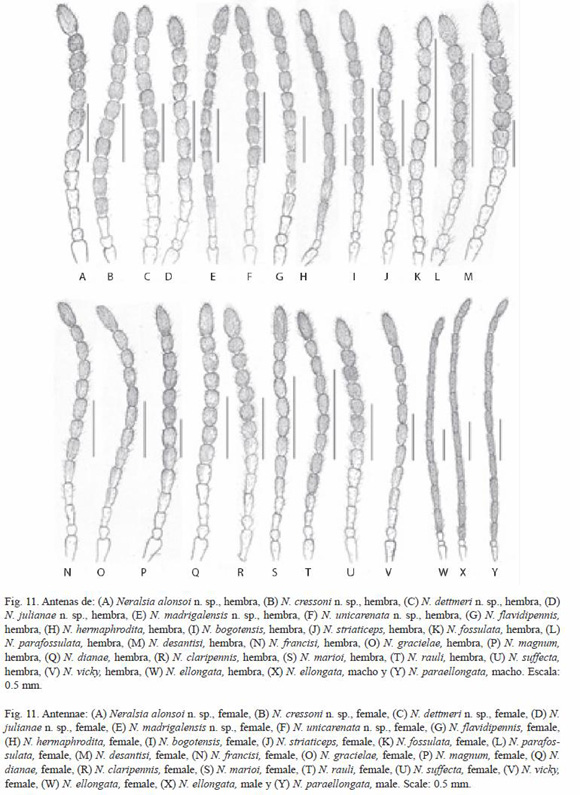
<body><![CDATA[<p><font face="Verdana" size="2">    <br> <a name="f11"></a></font></p>     <div style="text-align: center;"><font face="Verdana" size="2"><img  src="/img/revistas/rbt/v56n2/art30i11.jpg" title="" alt=""  style="width: 580px; height: 795px;"></font>    <br> <font face="Verdana" size="2"> </font></div>     <p><font face="Verdana" size="2"><span style="font-style: italic;">Xyalophora flavidipennis</span> Kieffer 1909: 95 <span style="font-style: italic;">    <br> Neralsia flavidipennis</span> (Kieffer 1909) Weld 1952: 176 </font></p>     <p><font face="Verdana" size="2"><span style="font-weight: bold;">Studied material:</span> see Jiménez <span style="font-style: italic;">et al</span>. 2004. </font></p>     <p><font face="Verdana" size="2"><span style="font-weight: bold;">Diagnosis:</span> re-described in Jiménez <span style="font-style: italic;">et al</span>. 2004: 71. <span style="font-style: italic;">Neralsia flavidipennis</span> belongs to the group of species with low interfoveal carina and metasomal tergum II with scarce striae at base. The closest species are <span  style="font-style: italic;">N. difilippoi</span> n. sp. and <span style="font-style: italic;">N. hermaphrodita</span>. From <span style="font-style: italic;">N. difilippoi </span>n. sp., it is differentiated by the morphology of the scutellum and from <span style="font-style: italic;">N. hermaphrodita</span> by the characters indicated in the key. </font></p>     <p><font face="Verdana" size="2"><span style="font-weight: bold;">Distribution: </span>species known from Argentina, Bolivia, Ecuador and Peru (Jiménez <span style="font-style: italic;">et al</span>. 2004). </font></p>     <p><font face="Verdana" size="2"><span style="font-style: italic;">Neralsia hermaphrodita</span>    ]]></body>
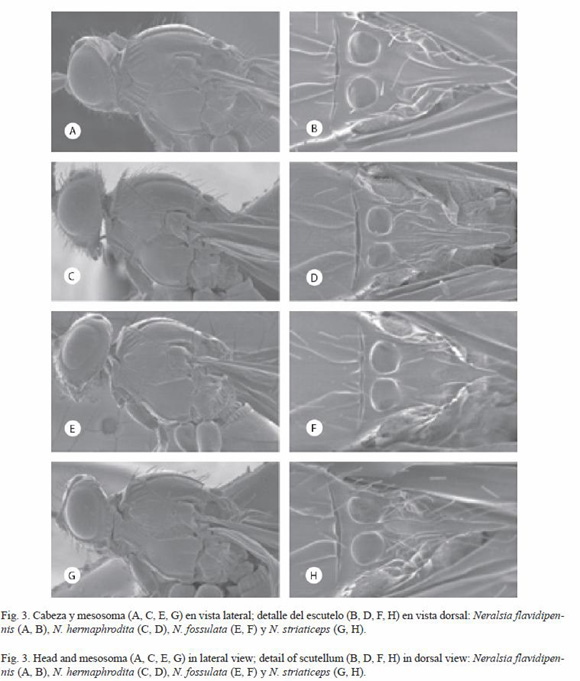
<body><![CDATA[<br> Jiménez and Pujade-Villar 2006    <br> (<a href="#f3">Fig. 3C</a>, <a href="#f3">D</a>, <a href="#f10">10G</a>, <a href="#f11">11H</a>) </font></p>     <p><font face="Verdana" size="2"><span style="font-style: italic;">Neralsia hermaphrodita</span> Jiménez and Pujade-Villar 2006a: 63. </font></p>     <p><font face="Verdana" size="2"><span style="font-weight: bold;">Material studied:</span> see Jiménez <span style="font-style: italic;">et al</span>. 2006a. </font></p>     <p><font face="Verdana" size="2"><span style="font-weight: bold;">Diagnosis:</span> <span style="font-style: italic;">Neralsia hermaphrodita </span>belongs to the group of species with low interfoveal carina. It is similar to <span style="font-style: italic;">N. pilosa </span>given the pubescence of the mesosoma, and to <span style="font-style: italic;">N. flavidipennis</span> given the morphology of the scutellar spine. Females of <span style="font-style: italic;">N. hermaphrodita </span>(males unknown) are easily separated from the other known species of this group when considering the form of the flagellomeres (with similar aspect to males of <span  style="font-style: italic;">Neralsia</span>). This feature is also present in <span style="font-style: italic;">N. ellongata</span>, species of the group with high interfoveal carina. </font></p>     <p><font face="Verdana" size="2"><span style="font-weight: bold;">Distribution:</span> species only known from Brazil (Jiménez <span  style="font-style: italic;">et al</span>. 2006a). </font></p>     <p><font face="Verdana" size="2"><span style="font-weight: bold;">Observations:</span> when describing <span style="font-style: italic;">N. hermaphrodita </span>in Jiménez <span style="font-style: italic;">et al</span>. (2006a: 63) it is erroneously said that the radial cell is closed, when it is actually open in the frontal margin, this structure presents a darkening that should not be considered as a vein (<a href="#f10">Fig. 10G</a>). </font></p>     <p><font face="Verdana" size="2"><span style="font-style: italic;">Neralsia fossulata</span>    <br> (Kieffer 1909) (<a href="#f3">Fig. 3E</a>, <a href="#f3">F</a>, <a  href="#f11">11K</a>) </font></p>     <p><font face="Verdana" size="2"><span style="font-style: italic;">Xyalosema fossulata</span> Kieffer 1909: 81    ]]></body>
<body><![CDATA[<br> <span style="font-style: italic;">Neralsia fossulata</span> (Kieffer 1909) Weld 1952: 176    <br> <span style="font-style: italic;">Xyalophora splendens</span> Borgmeier 1935: 102    <br> <span style="font-style: italic;">Neralsia splendens</span> (Borgmeier 1935) Weld 1952: 176; synonymyzed in Jiménez <span  style="font-style: italic;">et al</span>. 2004: 73. </font></p>     <p><font face="Verdana" size="2"><span style="font-weight: bold;">Studied material:</span> see Jiménez <span style="font-style: italic;">et al</span>. 2004. </font></p>     <p><font face="Verdana" size="2"><span style="font-weight: bold;">Diagnosis:</span> re-described in Jiménez <span style="font-style: italic;">et al</span>. 2004: 73. <span style="font-style: italic;">Neralsia fossulata</span> belongs to the group of species with low interfoveal carina and the metasomal tergum II densely striated at base. It stands out for having testaceous antennae (<a href="#f11">Fig. 11k</a>), with short and moniliform flagellomeres, length of the pedicellum subequal to that of F2. On the other hand, it is the species with the smallest representatives of the genus (1.9-2.2 mm). </font></p>     <p><font face="Verdana" size="2"><span style="font-weight: bold;">Distribution:</span> species known from Argentina, Brazil and Peru (Jiménez <span  style="font-style: italic;">et al</span>. 2004). </font></p>     <p><font face="Verdana" size="2"><span style="font-style: italic;">Neralsia striaticeps</span>    <br> (Kieffer 1909) (<a href="#f3">Fig. 3G</a>, <a href="#f3">H</a>, <a  href="#f11">11J</a>) </font></p>     <p><font face="Verdana" size="2"><span style="font-style: italic;">Xyalophora flavidipennis</span> var. <span style="font-style: italic;">striaticeps </span>Kieffer 1909: 95.    <br> <span style="font-style: italic;">Xyalophora striaticeps</span> Kieffer 1909, in Dettmer 1932: 124, 133.    ]]></body>
<body><![CDATA[<br> <span style="font-style: italic;">Neralsia striaticeps</span> (Kieffer 1909) Weld 1952: 176. </font></p>     <p><font face="Verdana" size="2"><span style="font-weight: bold;">Studied material:</span> see Jiménez <span style="font-style: italic;">et al</span>. 2004. </font></p>     <p><font face="Verdana" size="2"><span style="font-weight: bold;">Additional material studied.</span> BRAZIL: Luís Antonio, SP, Bra., 22.X.1987, L.A. Joaquin col.: 1 female (Angélica); Luis Antonio, S.P. Brazil, 12.III. 1987, L.A. Joaquim col: 1 female (Angélica); ECUADOR: C-368, Ecuador 1 female (CNCI); C-381, Ecuador, Napo, 400 m, Jatun Sacha Biol. Station (21Km E, Puerto Napo), 9.VII.1994, F. Géner, virgen rain forest, feces tp: 1 female (CNCi); C-396 Napo. Oyacachi, 3150 m, 0º22’S, 78.08ºW, 30.II-15. IV.1996, Durero Ecuador (Oriente), 23-28. IX.1997 150-200 m: 1 male (CNCi); Ecuador, Pich., 47 Km S. Sto. Domingo, Rio Palenque Sta. 22-31.VI.1976, S. &amp; J. Peck: 1 female (CNCI); ARGENTINA: Loreto, Exp. St., Misiones, Arg., Dr. A.A. Ogloblin, 1 male and 2 females (MLP); Loreto, Misiones, 1930: 1 female (MLP); Exp. St. Loreto, Misiones, Arg., Dr. A.A. Ogloblin, 17.III.1932: 1 male. </font></p>     <p><font face="Verdana" size="2"><span style="font-weight: bold;">Diagnosis:</span> re-described in Jiménez <span style="font-style: italic;">et al</span>. 2004: 77. <span style="font-style: italic;">Neralsia striaticeps</span>, belongs to the group species with low interfoveal carina and metasomal tergum ii densely striated at base. The closest species are <span style="font-style: italic;">N. fossulata</span>, <span style="font-style: italic;">N. bogotensis</span>, <span  style="font-style: italic;">N. parafossulata</span> and <span  style="font-style: italic;">N. julianae</span> n. sp. Differently to the mentioned species, <span style="font-style: italic;">N. striaticeps </span>stands out by having a dense and abundant striation in the lateral areas of the pronotum and in the mesopleura (<a href="#f3">Fig. 3g</a>). </font></p>     <p><font face="Verdana" size="2"><span style="font-weight: bold;">Distribution:</span> species of wide distribution in South America, known from Bolivia, Brazil, Colombia, Ecuador, French Guiana, Peru and Venezuela (Jiménez <span style="font-style: italic;">et al</span>. 2004). In this survey it is also cited from Argentina.    <br> </font></p>     <p><font face="Verdana" size="2"><span style="font-style: italic;">Neralsia bogotensis     <br> </span>(Kieffer 1909) (<a href="#f4">Fig. 4A</a>, <a href="#f4">B</a>, <a href="#f11">11I</a>)    <br> </font></p>     <p><font face="Verdana" size="2">    ]]></body>
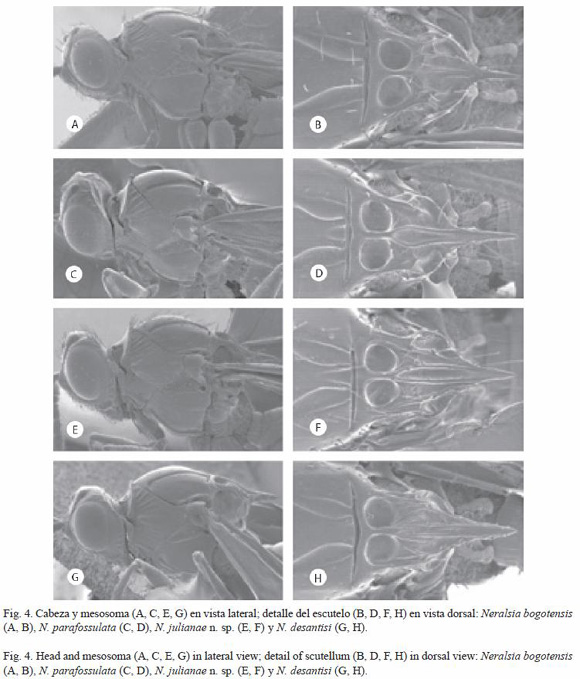
<body><![CDATA[<br> <a name="f4"></a></font></p>     <div style="text-align: center;"><font face="Verdana" size="2"><img  src="/img/revistas/rbt/v56n2/art30i4.jpg" title="" alt=""  style="width: 580px; height: 679px;"></font>    <br> <font face="Verdana" size="2"> </font></div>     <p><font face="Verdana" size="2"><span style="font-style: italic;">Xyalophora bogotensis</span> Kieffer 1909: 95    <br> <span style="font-style: italic;">Neralsia bogotensis</span> (Kieffer 1909) Weld 1952: 176 </font></p>     <p><font face="Verdana" size="2"><span style="font-weight: bold;">Studied material:</span> see Jiménez <span style="font-style: italic;">et al</span>. 2004; Additional material studied. PERU: Pasco, Peru, 1 600-1 800 m., 10º35’ S; 75º35’ W., 30-31.XII.1972., J. Helava: 1 male (CNCI); VENEZUELA: Venezuela, Mérida-Sta Rosa, cca. 1 800 m., L. Master, 11.V.1981, Old cofee plant: 1 female (CNCi). </font></p>     <p><font face="Verdana" size="2"><span style="font-weight: bold;">Diagnosis:</span> re-described in Jiménez <span style="font-style: italic;">et al</span>. 2004: 66. <span style="font-style: italic;">Neralsia bogotensis</span>, belongs to the group of species with low interfoveal carina and metasomal tergum II densely striated at base. The closest species is <span  style="font-style: italic;">N. striaticeps</span> from which is differentiated by the characteristics of the pronotum and the coloration of antennae. </font></p>     <p><font face="Verdana" size="2"><span style="font-weight: bold;">Distribution:</span> known species from Brazil, Colombia, Ecuador, Paraguay, Peru and Venezuela (Jiménez <span  style="font-style: italic;">et al</span>. 2004). </font></p>     <p><font face="Verdana" size="2"><span style="font-style: italic;">Neralsia parafossulata    <br> </span>Jiménez and Pujade-Villar 2006    ]]></body>
<body><![CDATA[<br> (<a href="#f4">Fig. 4C</a>, <a href="#f4">D</a>, <a href="#f10">10O</a>, <a href="#f11">11l</a>) </font></p>     <p><font face="Verdana" size="2"><span style="font-style: italic;">Neralsia parafossulata</span> Jiménez and Pujade-Villar 2006a: 68. </font></p>     <p><font face="Verdana" size="2"><span style="font-weight: bold;">Studied material:</span> see Jiménez <span style="font-style: italic;">et al</span>. 2006a. </font></p>     <p><font face="Verdana" size="2"><span style="font-weight: bold;">Diagnosis:</span> <span style="font-style: italic;">Neralsia parafossulata</span> belongs to the group of species with low interfoveal carina and the base of the metasomal tergum II dense and uniformly striated. It is close to <span style="font-style: italic;">N. fossulata</span>, <span  style="font-style: italic;">N. bogotensis</span>, <span  style="font-style: italic;">N. striaticeps </span>and <span style="font-style: italic;">N. julianae</span> n. sp. <span style="font-style: italic;">Neralsia parafossulata </span>is separated from the first three by its scarce mesopleural sculpturation and by the design of the striation in the face. The differences between <span style="font-style: italic;">N. parafossulata</span> n. sp. and <span style="font-style: italic;">N. julianae </span>n. sp. are indicated in the key. </font></p>     <p><font face="Verdana" size="2"><span style="font-weight: bold;">Distribution: </span>species known from Colombia and Venezuela (Jiménez <span  style="font-style: italic;">et al</span>. 2006a). </font></p>     <p><font face="Verdana" size="2"><span style="font-style: italic;">Neralsia julianae</span>    <br> Jiménez and Pujade-Villar n.sp.    <br> (<a href="#f4">Fig. 4E</a>, <a href="#f4">F</a>, <a href="#f10">10I</a>, <a href="#f11">11D</a>) </font></p>     <p><font face="Verdana" size="2"><span style="font-weight: bold;">Etymology:</span> species dedicated to Juliana Salazar Rojas, friend of the first of the authors. </font></p>     <p><font face="Verdana" size="2"><span style="font-weight: bold;">Type material:</span> holotype (female) deposited in CNCI (Ottawa, Canada) BRAZIL: Nova Teutonia, 27º11’ S, 52º23’ W, Brazil 300-500 m, VIII.1971, Fritz Plaumann: (white label), "Holotype desig. 2005, Jiménez and Pujade-Villar" (red label); "<span style="font-style: italic;">Neralsia julianae</span> n. sp. female Jiménez and Pujade-Villar det. 2005" (white label). Paratype: with the same data as the holotype: 1 male (CNCI). </font></p>     ]]></body>
<body><![CDATA[<p><font face="Verdana" size="2"><span style="font-weight: bold;">Diagnosis: </span><span style="font-style: italic;">Neralsia julianae</span> n. sp. belongs to the group of species with low interfoveal carina and low metasomal tergum II striated at base, together <span style="font-style: italic;">N. fossulata</span>, <span style="font-style: italic;">N. striaticeps</span>, <span style="font-style: italic;">N. bogotensis</span> and <span style="font-style: italic;">N. parafossulata</span>. The scarce sculpture of the mesopleura (<a href="#f4">Fig. 4E</a>), the straight dorsal margin of the metasomal tergum VIII (Fig. 12I) and the sub-squared form of the last flagellomeres (<a href="#f11">Fig. 11D</a>) allow differentiating it from the three first cited species for this group. The differences between <span style="font-style: italic;">N. julianae</span> n. sp. and <span style="font-style: italic;">N. parafossulata</span> are indicated in the key.    <br> </font></p>     <p><font face="Verdana" size="2">    <br> <a name="f12"></a></font></p>     <div style="text-align: center;"><font face="Verdana" size="2"><img  src="/img/revistas/rbt/v56n2/art30i12.jpg" title="" alt=""  style="width: 580px; height: 730px;"></font>    <br> <font face="Verdana" size="2"> </font></div>     <p><font face="Verdana" size="2"><span style="font-weight: bold;">Length:</span> female: 4.1 mm; male: 3.0 mm </font></p>     <p><font face="Verdana" size="2"><span style="font-weight: bold;">Coloration:</span> black.Antennae reddish brown; tegulae, legs and ventral area of the metasoma reddish. Translucent wings, venation brown.     <br> </font></p>     <p><font face="Verdana" size="2"><span style="font-weight: bold;">Head:</span> in frontal view sub-squared, in dorsal view twice longer than wide. Face of the female with striae that depart radially from the clipeus and the middle of the face towards the interfoveal antennae and the inferior part of the compound eyes, surface between them, smooth. Transfacial line equal in length to the height of the compound eye. The relation POL:OOL:OCO is 9:6:5; diameter of the lateral ocellus 5. Genal sulcus present, with transversal costulae marked. Occiput dorsally carinated; visible genal carina behind the compound eyes. </font></p>     ]]></body>
<body><![CDATA[<p><font face="Verdana" size="2"><span style="font-weight: bold;">Antennae (<a href="#f11">Fig. 11D</a>):</span> F1 and F2 subequal in length, shorter than F3, last flagellomeres sub-squared, 1.1 times longer than wide. Sensilia absent in F1 and F2. </font></p>     <p><font face="Verdana" size="2"><span style="font-weight: bold;">Mesosoma (<a href="#f4">Fig. 4E</a>, <a href="#f4">F</a>):</span> Pronotal plate dorsally incised, lateral areas of the pronotum with scarce sharp and spaced carina in the dorsal part, thin and denser in anterior ventral part, the rest smooth. Mesopleura smooth in the greatest part of its surface, ventral part thinly striated. Medial sulcus of scutellum very marked and elongated. Low interfoveal carina, slightly surpassing the level of the scutellar foveae (lateral view). Scutellar disc very slightly carinated, being noticeable two carinae that form between them a smooth and well defined sulcus that reaches the middle of the spine. Scutellar spine long, bigger than 1/3 of the total length of the scutellum. </font></p>     <p><font face="Verdana" size="2"><span style="font-weight: bold;">Wings:</span> radial cell 1.6 times longer than wide (<a href="#f10">Fig. 10I</a>). Discal and marginal setae present. Areolet almost formed. </font></p>     <p><font face="Verdana" size="2"><span style="font-weight: bold;">Metasoma:</span> tergum I wide, strongly carinated. Tergum II uniformly striated at base. Dorsal margin of tergum Viii, in lateral view, straight. </font></p>     <p><font face="Verdana" size="2"><span style="font-weight: bold;">Distribution:</span> species collected from Brazil. </font></p>     <p><font face="Verdana" size="2"><span style="font-style: italic;">Neralsia desantisi</span>    <br> Jiménez and Pujade-Villar 2006    <br> (<a href="#f4">Fig. 4G</a>, <a href="#f4">H</a>, <a href="#f11">11M</a>) </font></p>     <p><font face="Verdana" size="2"><span style="font-style: italic;">Neralsia desantisi</span> Jiménez and Pujade-Villar 2006a: 65. </font></p>     <p><font face="Verdana" size="2"><span style="font-weight: bold;">Studied material:</span> see Jiménez <span style="font-style: italic;">et al</span>. 2006a. Additional material studied. BRAZIL: Parasoles de Roma, Diadora, X.1937: 1 male (MNRJ). </font></p>     ]]></body>
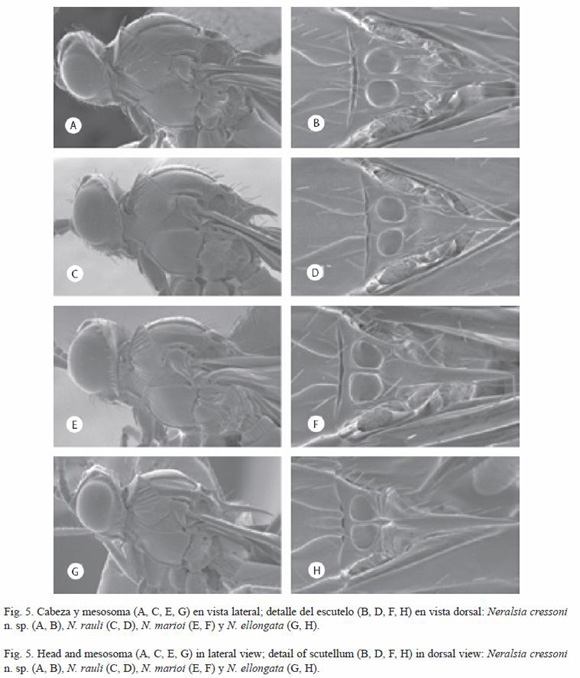
<body><![CDATA[<p><font face="Verdana" size="2"><span style="font-weight: bold;">Diagnosis: </span><span style="font-style: italic;">Neralsia desantisi</span> belongs to the group of species with low interfoveal carina and the metasomal tergum smooth or with scarce striae at base, characters that share with <span style="font-style: italic;">N. cressoni</span> n. sp., <span style="font-style: italic;">N. rauli</span> and <span style="font-style: italic;">N. marioi</span>. <span  style="font-style: italic;">Neralsia desantisi</span> presents the last flagellomeres sub-squared (<a href="#f11">Fig. 11M</a>), fact that differentiates it from the species previously cited whose flagellomeres are much longer than wide. The morphology of the antennal flagellomeres sets <span style="font-style: italic;">N. desantisi</span> close to <span style="font-style: italic;">N. equilatera</span> and <span style="font-style: italic;">N. moisesi</span>, that also coincide in presenting the base of the metasomal tergum II smooth; nevertheless, <span style="font-style: italic;">N. equilatera</span> and <span style="font-style: italic;">N. moisesi</span> are differentiated from <span style="font-style: italic;">N. desantisi</span> by lacking discal and marginal etae in the first pair of wings. The differences between <span style="font-style: italic;">N. desantisi</span> and <span style="font-style: italic;">N. cressoni</span> n. sp. are indicated in the key. </font></p>     <p><font face="Verdana" size="2"><span style="font-weight: bold;">Distribution:</span> known species from Argentina (Jiménez <span style="font-style: italic;">et al</span>. 2006a). In this survey it is also cited from Brazil. </font></p>     <p><font face="Verdana" size="2"><span style="font-style: italic;">Neralsia cressoni</span>    <br> Jiménez and Pujade-Villar n. sp.    <br> (<a href="#f5">Fig. 5A</a>, <a href="#f5">B</a>, <a href="#f10">10B</a>, <a href="#f11">11B</a>)    <br> </font></p>     <p><font face="Verdana" size="2">    <br> <a name="f5"></a></font></p>     <div style="text-align: center;"><font face="Verdana" size="2"><img  src="/img/revistas/rbt/v56n2/art30i5.jpg" title="" alt=""  style="width: 580px; height: 678px;"></font>    <br> <font face="Verdana" size="2"> </font></div>     ]]></body>
<body><![CDATA[<p><font face="Verdana" size="2"><span style="font-weight: bold;">Etymology:</span> species dedicated to the United States hymenopterologist Ezra Townsend Cresson (1838-1926). </font></p>     <p><font face="Verdana" size="2"><span style="font-weight: bold;">Type material:</span> holotype (female) deposited in CNCI (Ottawa, Canada) VENEZUELA: "Mérida, Tabay La Mucuy, 1 900 m, 18.VII-2. VIII.1989, S. &amp; J. Peck, MT., Streamside meadow" (white label), "Holotype desig. 2004, Jiménez and Pujade-Villar" (red label), <span style="font-style: italic;">Neralsia cressoni</span> n. sp. female Jiménez and Pujade-Villar det. 2005" (white label). </font></p>     <p><font face="Verdana" size="2"><span style="font-weight: bold;">Diagnosis:</span> <span style="font-style: italic;">Neralsia cressoni</span> n. sp., together with a <span style="font-style: italic;">N. desantisi</span>, <span style="font-style: italic;">N. rauli</span> and <span  style="font-style: italic;">N. marioi</span>, belong to the group of species with low interfoveal carina and metasomal tergum II smooth at base. However, <span style="font-style: italic;">N. cressoni</span> n. sp. is differentiated from <span style="font-style: italic;">N. rauli</span> and <span style="font-style: italic;">N. marioi</span>, among other characters, by the morphology of the antennae since the last flagellomeres of its antennae are short and sub-cylindrical (<a href="#f11">Fig. 11B</a>). The differences between <span style="font-style: italic;">N. cressoni</span> n. sp. and <span style="font-style: italic;">N. desantisi</span> are indicated in the key. </font></p>     <p><font face="Verdana" size="2"><span style="font-weight: bold;">Length:</span> female: 3.4 mm; male: unknown. </font></p>     <p><font face="Verdana" size="2"><span style="font-weight: bold;">Coloration:</span> black. Antennae dark brown; tegulae, legs (except for the coxa that are black) and ventral area of the metasoma reddish. Wings dusky, venation brown. </font></p>     <p><font face="Verdana" size="2"><span style="font-weight: bold;">Head:</span> in frontal view, sub-squared; in dorsal view twice as long as wide. Face with striae that depart radially from the clipeus towards the antennal foveae and inferior part of the compound eyes, surface between them, smooth. Transfacial line 1.1 times the height of the eye. The relation POL:OOL:OCO is 7:4:3.5; diameter of the lateral ocellus 3. Genal sulcus present, with transversal costulae very marked. Occiput dorsally carinated; genal carina visible behind the compound eyes. </font></p>     <p><font face="Verdana" size="2"><span style="font-weight: bold;">Antennae (<a href="#f11">Fig. 11B</a>):</span> F1 longer than F2, with no sensilia; the last flagellomeres 1.2 times longer than wide. </font></p>     <p><font face="Verdana" size="2"><span style="font-weight: bold;">Mesosoma (<a href="#f5">Fig. 5A</a>, <a href="#f5">B</a>):</span> pronotal plate dorsally incised, lateral areas of the pronotum with sharp carinae, scarce and spaced in the dorsal part, denser in the anterior ventral part, the rest smooth. Mesopleura smooth in the middle, dorsal and ventral areas slightly striated. Medial sulcus of the scutum short and visible. Interfoveal carina low, surpassing very slightly the level of the scutellar foveae (lateral view). Scutellar disc more or less ridged, with longitudinal carinae hardly defined that can form or not the scutellar sulcus. Scutellar spine long and coriaceous, its size bigger than 1/3 the total length of the scutellum. </font></p>     <p><font face="Verdana" size="2"><span style="font-weight: bold;">Wings:</span> radial cell 1.5 longer than wide (<a href="#f10">Fig. 10b</a>). Discal and marginal setae present. Areolet weakly formed. </font></p>     <p><font face="Verdana" size="2"><span style="font-weight: bold;">Metasoma: </span>tergum I wide, strongly carinated. Tergum II completely smooth at base. Dorsal margin of the tergum VIII, in lateral view, weakly concave. </font></p>     ]]></body>
<body><![CDATA[<p><font face="Verdana" size="2"><span style="font-weight: bold;">Distribution:</span> species collected from Venezuela. </font></p>     <p><font face="Verdana" size="2"><span style="font-style: italic;">Neralsia rauli</span>    <br> Jiménez and Pujade-Villar 2006    <br> (<a href="#f5">Fig. 5C</a>, <a href="#f5">D</a>, <a href="#f11">11T</a>) </font></p>     <p><font face="Verdana" size="2"><span style="font-style: italic;">Neralsia rauli</span> Jiménez and Pujade-Villar 2006a: 66. </font></p>     <p><font face="Verdana" size="2"><span style="font-weight: bold;">Studied material:</span> see Jiménez <span style="font-style: italic;">et al</span>. 2006a. Additional material studied. PERU: Pasco, Peru, 1 600-1 800 m, 10º35’ S; 75º35’ W., 30-31.XII.1972, J. Helava. 1 male (CNCI); BRAZIL: Jatai, 30.III.1988, Varr Angélica, Goias, Brazil: 1 male (Angélica). </font></p>     <p><font face="Verdana" size="2"><span style="font-weight: bold;">Diagnosis:</span> <span style="font-style: italic;">Neralsia rauli</span>, belongs to the group of species with low interfoveal carina and metasomal tergum II with scarce and short striae at base. Close to this species are <span style="font-style: italic;">N. desantisi</span>, <span  style="font-style: italic;">N. cressoni</span> n. sp. and <span  style="font-style: italic;">N. marioi</span>. <span style="font-style: italic;">Neralsia rauli</span> presents long antennal flagellomeres (<a href="#f11">Fig. 11T</a>) and the medial sulcus is weakly marked (<a href="#f5">Fig. 5D</a>) different from <span  style="font-style: italic;">N. desantisi</span> (<a href="#f4">Fig. 4H</a>, <a href="#f11">11M</a>) and <span  style="font-style: italic;">N. cressoni</span> n. sp. (<a href="#f5">Fig. 5B</a>, <a href="#f11">11B</a>) in which the flagellomeres are shorter and the medial sulcus is very marked and visible. The differences between <span style="font-style: italic;">N. rauli</span> and <span style="font-style: italic;">N. marioi</span> are indicated in the key. </font></p>     <p><font face="Verdana" size="2"><span style="font-weight: bold;">Distribution:</span> species known from Brazil, French Guiana and Peru (Jiménez <span  style="font-style: italic;">et al</span>. 2006a). </font></p>     <p><font face="Verdana" size="2"><span style="font-style: italic;">Neralsia marioi</span>    <br> Jiménez and Pujade-Villar 2006    ]]></body>
<body><![CDATA[<br> (<a href="#f5">Fig. 5E</a>, <a href="#f5">F</a>, <a href="#f11">11S</a>) </font></p>     <p><font face="Verdana" size="2"><span style="font-style: italic;">Neralsia marioi</span> Jiménez and Pujade-Villar 2006a: 66 </font></p>     <p><font face="Verdana" size="2"><span style="font-weight: bold;">Studied material:</span> see Jiménez <span style="font-style: italic;">et al</span>. 2006a. Additional material studied. ECUADOR: C-396 Napo, Oyacachi, 3 150 m, 0º22’ S, 78.08º W, 30.II-15.IV.1996, ? Durero, Ecuador (Oriente), 23-28.IX.1997, 150-200 m: 1 female (CNCI); BRAZIL: M. Gerais, Aguas Vermelhas, 800 m, VII.1983, M. Alvarenga: 1 female (CNCI). </font></p>     <p><font face="Verdana" size="2"><span style="font-weight: bold;">Diagnosis:</span> <span style="font-style: italic;">Neralsia marioi</span> belongs to the group of species with low interfoveal carina and the metasomal tergum ii with scarce and short carina at base. Close to this species are <span style="font-style: italic;">N. desantisi</span>, <span  style="font-style: italic;">N. cressoni</span> n. sp., and <span style="font-style: italic;">N. rauli</span>. <span  style="font-style: italic;">Neralsia marioi</span> presents very long antennal flagellomeres (<a href="#f11">Fig. 11S</a>) and the medial sulcus of the scutellum slightly marked (<a href="#f5">Fig. 5F</a>) differently from <span style="font-style: italic;">N. desantisi</span> and <span style="font-style: italic;">N. cressoni</span> n. sp. where the flagellomeres are shorter (<a href="#f11">Fig. 11B</a>, <a href="#f11">M</a>) and the medial sulcus is very marked and visible (<a href="#f4">Figs. 4H</a>, <a href="#f5">5B</a>). The differences between <span style="font-style: italic;">N. marioi</span> and <span style="font-style: italic;">N. rauli</span> are indicated in the key. </font></p>     <p><font face="Verdana" size="2"><span style="font-weight: bold;">Distribution: </span>species known from Brazil, Ecuador and Venezuela (Jiménez <span  style="font-style: italic;">et al</span>. 2006a). </font></p>     <p><font face="Verdana" size="2"><span style="font-style: italic;">Neralsia ellongata</span>    <br> Jiménez and Pujae-Villar 2005    <br> (<a href="#f5">Fig. 5G</a>, <a href="#f5">H</a>, <a href="#f10">10E</a>, <a href="#f11">11W</a>, <a href="#f11">X</a>) </font></p>     <p><font face="Verdana" size="2"><span style="font-style: italic;">Neralsia ellongata</span> Jiménez and Pujade-Villar 2005b:169. </font></p>     <p><font face="Verdana" size="2"><span style="font-weight: bold;">Studied material:</span> see Jiménez <span style="font-style: italic;">et al</span>. 2005b. Additional material studied. BRAZIL: Est. Biol. Boraceia, Salesópolis- S.P. Brazil, XI.1960, K. Lento col: 1 male. </font></p>     ]]></body>
<body><![CDATA[<p><font face="Verdana" size="2"><span style="font-weight: bold;">Diagnosis:</span> <span style="font-style: italic;">Neralsia ellongata</span> belongs to the group of species with high interfoveal carina and the metasomal tergum II completely smooth at base. Males of <span style="font-style: italic;">N. ellongata</span> as those of <span style="font-style: italic;">N. paraellongata</span> are differentiated from the rest of <span style="font-style: italic;">Neralsia</span> species by the relation between F1 and F2. Females of <span  style="font-style: italic;">N. ellongata</span> are distinguished from the rest of species of the genus by presenting the flagellomeres very long, four times longer than wide (<a href="#f11">Fig. 11W</a>), and the radial cell elongated, more than twice longer than wide (<a href="#f10">Fig. 10E</a>). On the other hand, the scutellum spine is longer than half the length of the scutellar disc (<a href="#f5">Fig. 5H</a>), feature shared only with <span style="font-style: italic;">N. paraellongata</span> from which is differentiated by the characters indicated in the key. </font></p>     <p><font face="Verdana" size="2"><span style="font-weight: bold;">Distribution:</span> species widely distributed in South America; known from Bolivia, Brazil, Ecuador, French Guiana, Peru and Venezuela (Jiménez <span style="font-style: italic;">et al</span>. 2005b). </font></p>     <p><font face="Verdana" size="2"><span style="font-weight: bold;">Observations: </span>when described <span style="font-style: italic;">N. ellongata </span>in Jiménez <span style="font-style: italic;">et al</span>. (2005b: 171) it is erroneously said that the radial cell is closed, when it is actually open in the frontal margin; this structure presents a darkening that should not be considered as a vein. </font></p>     <p><font face="Verdana" size="2"><span style="font-style: italic;">Neralsia paraellongata</span>    <br> Jiménez and Pujade-Villar 2005    <br> (<a href="#f10">Fig. 10F</a>, <a href="#f11">11Y</a>) </font></p>     <p><font face="Verdana" size="2"><span style="font-style: italic;">Neralsia paraellongata</span> Jiménez and Pujade-Villar 2005b: 175. </font></p>     <p><font face="Verdana" size="2"><span style="font-weight: bold;">Studied material:</span> see Jiménez <span style="font-style: italic;">et al</span>. 2005b. </font></p>     <p><font face="Verdana" size="2"><span style="font-weight: bold;">Diagnosis:</span> <span style="font-style: italic;">Neralsia paraellongata </span>belongs to the group of species with high interfoveal carina and metasomal tergum II smooth at base. <span  style="font-style: italic;">N. paraellongata</span> and <span  style="font-style: italic;">N. ellongata</span> are very close species; males of both species are differentiated by the relative length between F1 and F2, which is 0.8 in <span style="font-style: italic;">N. paraellongata</span> and 0.5-0.6 in <span style="font-style: italic;">N. ellongata</span>. This feature separates also <span style="font-style: italic;">N. paraellongata</span> from all the other known species of <span style="font-style: italic;">Neralsia</span>, in which the males present a similar length between the aforementioned flagellomeres. Despite the females of <span style="font-style: italic;">N. paraellongata</span> are unknown, we suspect that they have to show very long flagellomeres as in <span style="font-style: italic;">N. ellongata</span> due to the morphological similarity between the males of both species. </font></p>     <p><font face="Verdana" size="2"><span style="font-weight: bold;">Distribution: </span>species only known from Brazil (Jiménez <span  style="font-style: italic;">et al</span>. 2005b). </font></p>     ]]></body>
<body><![CDATA[<p><font face="Verdana" size="2"><span style="font-weight: bold;">Observations:</span> erroneously, when describing <span style="font-style: italic;">N. paraellongata</span> in Jiménez <span style="font-style: italic;">et al</span>. (2005b: 176) it is said that the radial cell is closed, while it is actually open in the frontal margin, this presenting a darkening that should not be considered as a vein.    <br> </font></p>     <p><font face="Verdana" size="2"><span style="font-style: italic;">Neralsia scutellata</span>    <br> Jiménez and Pujade-Villar 2005    <br> (<a href="#f6">Fig. 6A</a>, <a href="#f6">B</a>)    <br> </font></p>     <p><font face="Verdana" size="2">    <br> <a name="f6"></a></font></p>     <div style="text-align: center;"><font face="Verdana" size="2"><img  src="/img/revistas/rbt/v56n2/art30i6.jpg" title="" alt=""  style="width: 580px; height: 674px;"></font>    <br> <font face="Verdana" size="2"> </font></div>     ]]></body>
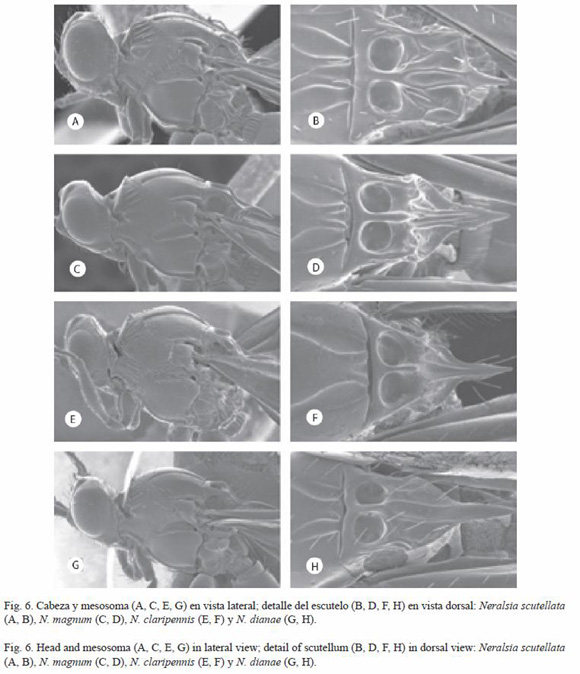
<body><![CDATA[<p><font face="Verdana" size="2"><span style="font-style: italic;">Neralsia scutellata</span> Jiménez and Pujade-Villar 2005b: 176. </font></p>     <p><font face="Verdana" size="2"><span style="font-weight: bold;">Studied material:</span> see Jiménez <span style="font-style: italic;">et al</span>. 2005b. </font></p>     <p><font face="Verdana" size="2"><span style="font-weight: bold;">Diagnosis:</span> <span style="font-style: italic;">Neralsia scutellata</span> belongs to the group of species with high interfoveal carina and it is differentiated from all the other species that share this feature by presenting the scutellar spine shorter. it is distinguished from the rest of South American species of the genus by the shape of the scutellum, as this, in lateral view, is sub-squared. </font></p>     <p><font face="Verdana" size="2"><span style="font-weight: bold;">Distribution:</span> species known from Brazil, Colombia and Venezuela (Jiménez <span  style="font-style: italic;">et al</span>. 2005b). </font></p>     <p><font face="Verdana" size="2"><span style="font-style: italic;">Neralsia magnum</span>    <br> Jiménez and Pujade-Villar, 2005    <br> (<a href="#f6">Fig. 6C</a>, <a href="#f6">D</a>, <a href="#f11">11P</a>) </font></p>     <p><font face="Verdana" size="2"><span style="font-style: italic;">Neralsia magnum</span> Jiménez and Pujade-Villar 2005b: 174. </font></p>     <p><font face="Verdana" size="2"><span style="font-weight: bold;">Studied material:</span> see Jiménez <span style="font-style: italic;">et al</span>. 2005b. </font></p>     <p><font face="Verdana" size="2"><span style="font-weight: bold;">Diagnosis:</span> <span style="font-style: italic;">Neralsia magnum</span> is the biggest species of the South American <span style="font-style: italic;">Neralsia</span>, belonging to the group presenting high interfoveal carina. Its morphological characters set it close to <span style="font-style: italic;">N. dianae</span> and <span style="font-style: italic;">N. claripennis</span>; all of them have in common the interfoveal carina in the shape of blunt tooth. <span style="font-style: italic;">Neralsia magnum</span> is differentiated from the mentioned species, besides because of its big size, because of the shape of the antennal flagellomeres (<a href="#f11">Fig. 11P-R</a>), it is the only one that presents the lateral margins of the scutellum at the same level of the interfoveal carina. </font></p>     ]]></body>
<body><![CDATA[<p><font face="Verdana" size="2"><span style="font-weight: bold;">Distribution:</span> species only known from Brazil (Jiménez <span  style="font-style: italic;">et al</span>. 2005b). </font></p>     <p><font face="Verdana" size="2"><span style="font-style: italic;">Neralsia claripennis</span>    <br> (Dettmer 1932) (<a href="#f6">Fig. 6E</a>, <a href="#f6">F</a>)</font></p>     <p><font face="Verdana" size="2"><span style="font-style: italic;">Xyalophora claripennis</span> Dettmer 1932: 124, 137.    <br> <span style="font-style: italic;">Neralsia claripennis</span> (Dettmer 1932) Weld 1952: 176. </font></p>     <p><font face="Verdana" size="2"><span style="font-weight: bold;">Studied material:</span> see Jiménez <span style="font-style: italic;">et al</span>. 2004. </font></p>     <p><font face="Verdana" size="2"><span style="font-weight: bold;">Diagnosis: </span>re-described in Jiménez <span style="font-style: italic;">et al</span>. 2004: 70. <span style="font-style: italic;">Neralsia claripennis</span> belongs to the group of species with high interfoveal carina and metasomal tergum II densely striated in the base. in this species the genal sulcus is scarcely defined and presents no costulae (<a href="#f6">Fig. 6E</a>), feature only shared with <span style="font-style: italic;">N. dianae</span> (<a href="#f6">Fig. 6G</a>) that presents scarce or absent striation of the metasomal tergum II and wings dusky at base. </font></p>     <p><font face="Verdana" size="2"><span style="font-style: italic;">Neralsia claripennis</span> and <span style="font-style: italic;">N. fossulata</span> are the only South American species with hyaline wings and with pale yellow veins. </font></p>     <p><font face="Verdana" size="2"><span style="font-weight: bold;">Distribution:</span> known species only from Brazil. It has not been further collected since its description. </font></p>     <p><font face="Verdana" size="2"><span style="font-weight: bold;">Observations:</span> when <span style="font-style: italic;">N. claripennis</span> is redescribed in Jiménez <span style="font-style: italic;">et al</span>. (2004: 70) the coloration of the wings is erroneously mentioned as dusky. </font></p>     ]]></body>
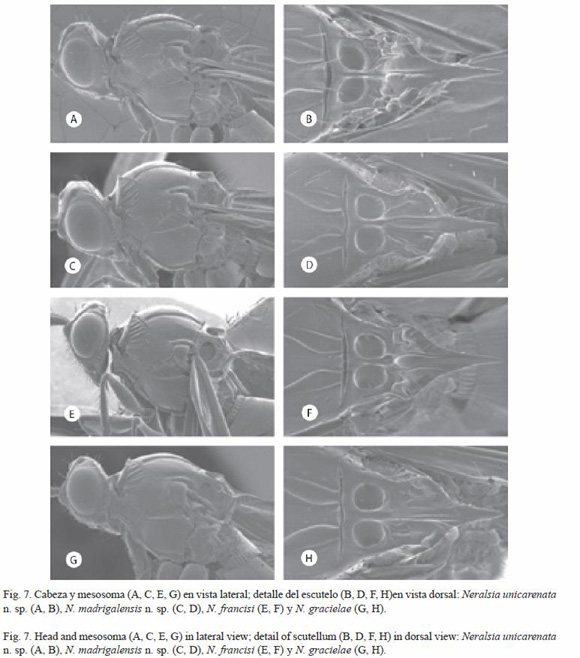
<body><![CDATA[<p><font face="Verdana" size="2"><span style="font-style: italic;">Neralsia dianae</span>    <br> Jiménez and Pujade-Villar 2005    <br> (<a href="#f6">Fig. 6G</a>, <a href="#f6">H</a>, <a href="#f11">11Q</a>) </font></p>     <p><font face="Verdana" size="2"><span style="font-style: italic;">Neralsia dianae</span> Jiménez and Pujade-Villar 2005b: 168. </font></p>     <p><font face="Verdana" size="2"><span style="font-weight: bold;">Studied material:</span> see Jiménez <span style="font-style: italic;">et al</span>. 2005b. </font></p>     <p><font face="Verdana" size="2"><span style="font-weight: bold;">Diagnosis:</span> <span style="font-style: italic;">Neralsia dianae</span> belongs to the group of species with high interfoveal carina; as in <span style="font-style: italic;">N. magnum</span> and<span style="font-style: italic;"> N. claripennis</span> the aforementioned carina has the shape of a blunt tooth. <span style="font-style: italic;">Neralsia dianae</span> is distinguished from <span style="font-style: italic;">N. magnum</span>, by the shape of the last flagellomeres (<a href="#f11">Fig. 11Q</a>) and by presenting the lateral margins of the scutellum lower than the interfoveal carina. The differences between <span  style="font-style: italic;">N. dianae</span> and <span style="font-style: italic;">N. Claripennis</span> are indicated in the key. </font></p>     <p><font face="Verdana" size="2"><span style="font-weight: bold;">Distribution:</span> species only known from French Guiana (Jiménez <span  style="font-style: italic;">et al</span>. 2005b). </font></p>     <p><font face="Verdana" size="2"><span style="font-style: italic;">Neralsia unicarenata</span>    <br> Jiménez and Pujade-Villar n. sp.    <br> (<a href="#f7">Fig. 7A</a>, <a href="#f7">B</a>, <a href="#f10">10L</a>, <a href="#f11">11F</a>)    ]]></body>
<body><![CDATA[<br> </font></p>     <p><font face="Verdana" size="2">    <br> <a name="f7"></a></font></p>     <div style="text-align: center;"><font face="Verdana" size="2"><img  src="/img/revistas/rbt/v56n2/art30i7.jpg" title="" alt=""  style="width: 580px; height: 658px;"></font>    <br> <font face="Verdana" size="2"> </font></div>     <p><font face="Verdana" size="2"><span style="font-weight: bold;">Etymology:</span> the name of this species alludes to the presence of a single central carina noticeable in the disc of the scutellum.     <br> </font></p>     <p><font face="Verdana" size="2"><span style="font-weight: bold;">Type material:</span> holotype (female) deposited in DCBU (Sao Carlos, Brazil) BRAZIL: "Ubatuba est. Exp., 19.Vi.1990 Moer, N.F.de Cristo, Col. Angélica" (white label); Holotype desig.-2005 Jiménez and Pujade-Villar" (red label), "<span style="font-style: italic;">Neralsia unicarenata</span>" n. sp female Jiménez and Pujade-Villar det. 2005" (white label). Paratypes: VENEZUELA: Mt. Ruida, Venezuela, 4.XI.1928, Ac. 29500, Tate, No.89: 1 female (NY); Jatai, 30.III.1988, varr. Angélica: 1 female (Angélica). </font></p>     <p><font face="Verdana" size="2"><span style="font-weight: bold;">Diagnosis:</span> <span style="font-style: italic;">Neralsia unicarenata</span> n. sp., presents the scutellum with a single central carina between the foveae and the spine; it seems to be the fusion of the two carinae that form the typical sulcus of the scutellum of all <span style="font-style: italic;">Neralsia</span>, or a prolongation of the interfoveal carina till the base of the spine. </font></p>     <p><font face="Verdana" size="2"><span style="font-weight: bold;">Length:</span> females: 2.4-3.3 mm; males: unknown. </font></p>     ]]></body>
<body><![CDATA[<p><font face="Verdana" size="2"><span style="font-weight: bold;">Coloration:</span> black. Antennae reddish brown; tegulae, legs and ventral part of the metasoma reddish. Translucent wings, venation light brown.    <br> </font></p>     <p><font face="Verdana" size="2"><span style="font-weight: bold;">Head:</span> in frontal view oval; in dorsal view 2.4 times longer than wide. Face with striae that depart radially from the clipeus towards the antennal foveae, surface between them smooth, around the compound eyes coriaceous. Transfacial line 1.2 times the height of the eye. The relation POL:OOL:OCO is 7:4:5, diameter of the medial ocellus 3. Genal sulcus defined with transversal costulae marked. Occiput weakly carinated in the dorsal part; genal carina visible behind the compound eyes. Antennae (<a href="#f11">Fig. 11F</a>). F1 longer than F2; last flagellomeres 1.4 times longer than wide. Sensilia absent in F1, F2 and F3. </font></p>     <p><font face="Verdana" size="2"><span style="font-weight: bold;">Mesosoma (<a href="#f7">Fig. 7A</a>, <a href="#f7">B</a>):</span> pronotal plate dorsally incised, lateral areas of the pronotum with scarce carinae sharp and spaced in the dorsal part, only a bit denser in the anterior ventral part, the rest smooth. Mesopleura smooth in most of its surface, ventral part slightly striated. Medial sulcus of the scutum marked. interfoveal carina in shape of a sharp tooth that surpasses the level of the scutellar foveae (lateral view). Scutellar disc slightly carinated, being noticed an apparent prolongation of the carina that separate the foveae and that longitudinally crosses the scutellum until the base of the spine without forming a sulcus. Scutellar spine long, its size 1/3 of the total length of the scutellum. </font></p>     <p><font face="Verdana" size="2"><span style="font-weight: bold;">Wings:</span> radial cell 1.5 times longer than wide (<a href="#f10">Fig. 10L</a>). Discal and marginal setae present. Areolet absent. </font></p>     <p><font face="Verdana" size="2"><span style="font-weight: bold;">Metasoma:</span> tergum I narrow, strongly carinated. Tergum II densely and uniformly striated at base. Dorsal margin of tergum VIII, in lateral view, strongly incised. </font></p>     <p><font face="Verdana" size="2"><span style="font-weight: bold;">Distribution:</span> species collected from Brazil and Venezuela. </font></p>     <p><font face="Verdana" size="2"><span style="font-style: italic;">Neralsia madrigalensis</span>    <br> Jiménez and Pujade-Villar n. sp.    <br> (Fig. 7C, D, 10J, <a href="#f11">11E</a>) </font></p>     ]]></body>
<body><![CDATA[<p><font face="Verdana" size="2"><span style="font-weight: bold;">Etymology:</span> species dedicated to Dr. Alejandro Madrigal Cardeño, entomologist of the Universidad Nacional de Colombia (Medellín). </font></p>     <p><font face="Verdana" size="2"><span style="font-weight: bold;">Type material:</span> holotype (female) deposited in (CNCI) BRAZIL: "M.Gerais, Agua Vermelha, 800 m, VII.1983, M. Alvarenga" (white label); Holotype desig.-2005 Jiménez and Pujade-Villar" (red label), "<span style="font-style: italic;">Neralsia madrigalensis</span>" n. sp female Jiménez and Pujade-Villar det. 2005" (white label). Paratype: ARGENTINA: Punta Lara, III.1974, Díaz Col.: female (MLP). </font></p>     <p><font face="Verdana" size="2"><span style="font-weight: bold;">Diagnosis:</span> <span style="font-style: italic;">Neralsia madrigalensis</span> n. sp. belongs to the group of species with high interfoveal carina and metasomal tergum II striated at base. This species is close to <span  style="font-style: italic;">N. unicarenata </span>n. sp., <span style="font-style: italic;">N. francisi</span>, <span style="font-style: italic;">N. gracielae</span>, <span style="font-style: italic;">N. suffecta</span> and <span style="font-style: italic;">N. alonsoi</span> n. sp. <span style="font-style: italic;">Neralsia madrigalensis</span> n. sp. is differentiated from <span  style="font-style: italic;">N. unicarenata</span>. n. sp. as the latter presents a single main carina very visible over the scutellar disc (<a href="#f7">Fig. 7B</a>). The flagellomeres are long (<a href="#f11">Fig. 11E</a>) and the face with striae departing radially from the clipeus towards the antennal foveae and the inferior part of the compound eyes separate <span style="font-style: italic;">N. madrigalensis</span> n. sp. from the rest of the mentioned species. </font></p>     <p><font face="Verdana" size="2"><span style="font-weight: bold;">Length:</span> females: 2.4-3.3 mm; males: unknown. </font></p>     <p><font face="Verdana" size="2"><span style="font-weight: bold;">Coloration:</span> black. Antennae brown; tegulae, legs and ventral part of the metasoma reddish. Wings dusky; venation brown. </font></p>     <p><font face="Verdana" size="2"><span style="font-weight: bold;">Head:</span> in frontal view oval; in dorsal view twice longer than wide. The face of the female with striae that depart radially from the clipeus towards the antennal foveae and the inferior part of the compound eyes; surface between the striae smooth. Transfacial line equal in length to the height of the compound eye. The relation POL:OOL:OCO is 7.5:4:4.5, diameter of the lateral ocellus 3.5. Genal sulcus defined with transversal costulae marked. Occiput dorsally carinated; genal carina visible behind the compound eyes. </font></p>     <p><font face="Verdana" size="2"><span style="font-weight: bold;">Antennae (<a href="#f11">Fig. 11E</a>):</span> filiform, F2, F3 and F4 of the same size, approximately 2.6 times longer than wide and of bigger length than F1, last flagellomeres 1.8 times longer than wide. Sensilia absent in F1. </font></p>     <p><font face="Verdana" size="2"><span style="font-weight: bold;">Mesosoma (<a href="#f7">Fig. 7C</a>, <a href="#f7">D</a>):</span> pronotal plate dorsally incised, lateral areas of the pronotum with scarce sharp carina in the dorsal part, thinner and denser in the anterior ventral part, the rest smooth. Mesopleura smooth in the middle, dorsal and ventral part, thinly striated. Medial sulcus of the pronotum short, wide and flat. High interfoveal carina, in shape of a sharp tooth, surpassing by far the level of the scutellar foveae (lateral view). Scutellar disc carinated, being noticed two carina heading towards the spine, forming between them a defined and smooth sulcus. Scutellar spine long, thick and coriaceous, ending in a sharp end, its size bigger than 1/3 the total length of the scutellum.    <br> </font></p>     <p><font face="Verdana" size="2"><span style="font-weight: bold;">Wings:</span> radial cell 1.5 times longer than wide (<a href="#f10">Fig. 10J</a>). Discal and marginal setae present. Areolet almost formed. </font></p>     ]]></body>
<body><![CDATA[<p><font face="Verdana" size="2"><span style="font-weight: bold;">Metasoma:</span> tergum I wide, strongly carinated. Tergum II densely striated at base. Dorsal margin of the tergum VIII, in lateral view, strongly incised. </font></p>     <p><font face="Verdana" size="2"><span style="font-weight: bold;">Distribution:</span> species collected from Argentina and Brazil     <br> </font></p>     <p><font face="Verdana" size="2"><span style="font-style: italic;">Neralsia francisi</span>    <br> Jiménez and Pujade-Villar 2005    <br> (<a href="#f7">Fig. 7E</a>, <a href="#f7">F</a>, <a href="#f11">11N</a>) </font></p>     <p><font face="Verdana" size="2"><span style="font-style: italic;">Neralsia francisi</span> Jiménez and Pujade-Villar 2005b: 171 </font></p>     <p><font face="Verdana" size="2"><span style="font-weight: bold;">Studied material:</span> see Jiménez <span style="font-style: italic;">et al</span>. 2005b. Additional material studied. ECUADOR: C-396 Napo. Oyacachi, 3 150 m, 0º22’ S, 78.08º W, 30.II-15.IV.1996, ? ;Durero, Ecuador (Oriente), 23-28.IX.1997, 150-200 m: 1 female (CNCI), C-394, Ecuador, Sucumbios. Napo River Sacha Lodge, 0º30’ S y 76º30’ W, 270 m, 3-25. VII. 1999, Meter Hibbs, MT: 1 male (CNCI); BRAZIL: Santana F. Dos, Macacos, PA, Brazil, IX.1969, Exp. Perm. Amax.: 1 female (CNCI); ARGENTINA: Loreto, Misiones, Republica Argentina. Dr. A.A. Ogloblin, 12.IX.1934: 1 male (MLP); </font></p>     <p><font face="Verdana" size="2"><span style="font-weight: bold;">Diagnosis:</span> <span style="font-style: italic;">Neralsia francisi</span> belongs to the group of species with high interfoveal carina and the metasomal tergum II densely striated at base. It is close to <span style="font-style: italic;">N. unicarenata</span>., n. sp., <span style="font-style: italic;">N. madrigalensis</span> n. sp., <span style="font-style: italic;">N. gracielae</span>, <span style="font-style: italic;">N. suffecta </span>and <span style="font-style: italic;">N. alonsoi</span> n. sp. <span style="font-style: italic;">Neralsia unicarenata</span>. n. sp. is differentiated, among other characters, by having a single, very visible, carina in the scutellar disc (<a href="#f7">Fig. 7B</a>). <span  style="font-style: italic;">Neralsia madrigalensis </span>n. sp. by presenting the flagellomeres extremely long (<a href="#f11">Fig. 11E</a>). <span  style="font-style: italic;">Neralsia alonsoi</span> n. sp. and <span style="font-style: italic;">N. suffecta</span>, have antennal flagellomeres (<a href="#f11">Fig. 11N</a>) shorter (<a href="#f11">Fig. 11A</a>, <a href="#f11">U</a>) than <span style="font-style: italic;">N. francisi</span>, species where the flagellomeres are moderately long. Finally, the differences between <span style="font-style: italic;">N. francisi</span> and <span  style="font-style: italic;">N. gracielae </span>are indicated in the key. </font></p>     <p><font face="Verdana" size="2"><span style="font-weight: bold;">Distribution:</span> species known from Argentina, Brazil, Ecuador, Paraguay y Peru (Jiménez <span style="font-style: italic;">et al</span>. 2005b). </font></p>     ]]></body>
<body><![CDATA[<p><font face="Verdana" size="2"><span style="font-style: italic;">Neralsia gracielae    <br> </span>Jiménez and Pujade-Villar 2005    <br> (<a href="#f7">Fig. 7G</a>, <a href="#f7">H</a>, <a href="#f11">11O</a>) </font></p>     <p><font face="Verdana" size="2"><span style="font-style: italic;">Neralsia gracielae</span> Jiménez and Pujade-Villar 2005b: 172 </font></p>     <p><font face="Verdana" size="2"><span style="font-weight: bold;">Studied material:</span> see Jiménez et al. 2005b. Additional material studied. ARGENTINA: Loreto, Exp. St., Misiones Arg., Dr. A.A. Ogloblin, 15.III.1932: 1 male and 2 females (MLP); idem except for the date of recollection, 17.III.1932: 1 female (MLP); BRAZIL: Minas Gerais, Sinop. XI.1975, M. Alvarenga. M.T.: 1 female (CNCI); Mata Canchim, 3.X-16.X.1997, Malaise: 1 male (CNCI). </font></p>     <p><font face="Verdana" size="2"><span style="font-weight: bold;">Diagnosis:</span> <span style="font-style: italic;">Neralsia gracielae</span>, belongs to the group of species with high interfoveal carina and the metasomal tergum II striated a base, it is close to <span style="font-style: italic;">N. unicarenata</span>. n. sp., <span style="font-style: italic;">N. madrigalensis</span> n. sp., <span style="font-style: italic;">N. francisi</span>, <span  style="font-style: italic;">N. suffecta </span>and <span style="font-style: italic;">N. alonsoi</span> n. sp. <span style="font-style: italic;">Neralsia unicarenata</span>. n. sp. is differentiated, among other characters, by having a single, very visible, carina in the scutellar disc (<a href="#f7">Fig. 7B</a>), the flagellomeres are extremely long (<a href="#f11">Fig. 11E</a>) and face with striae that depart radially from the clipeus towards the antennal foveae and the inferior part of the compound eyes. <span style="font-style: italic;">Neralsia alonsoi</span> n. sp. and <span style="font-style: italic;">N. suffecta</span>, have short antennal flagellomeres (<a href="#f11">Fig. 11A</a>, <a href="#f11">U</a>) differently to <span style="font-style: italic;">N. gracielae</span> where are moderately long (<a href="#f11">Fig. 11O</a>). The differences between <span style="font-style: italic;">N. gracielae</span> and <span style="font-style: italic;">N. francisi</span> are indicated in the key. </font></p>     <p><font face="Verdana" size="2"><span style="font-weight: bold;">Distribution:</span> species known from Colombia (Jiménez <span style="font-style: italic;">et al</span>. 2005b). In this study it is also cited from Argentina and Brazil. </font></p>     <p><font face="Verdana" size="2"><span style="font-style: italic;">Neralsia suffecta</span>    <br> (Dettmer 1932) (<a href="#f8">Fig. 8A</a>, <a href="#f8">B</a>, <a  href="#f11">11U</a>)    <br> </font></p>     ]]></body>
<body><![CDATA[<p><font face="Verdana" size="2">    <br> <a name="f8"></a></font></p>     <div style="text-align: center;"><font face="Verdana" size="2"><img  src="/img/revistas/rbt/v56n2/art30i8.jpg" title="" alt=""  style="width: 580px; height: 685px;"></font>    <br> <font face="Verdana" size="2"> </font></div>     <p><font face="Verdana" size="2"><span style="font-style: italic;">Xyalophora suffecta</span> Dettmer 1932: 124, 131    <br> <span style="font-style: italic;">Neralsia suffecta</span> (Dettmer 1932) Weld 1952: 177 </font></p>     <p><font face="Verdana" size="2"><span style="font-weight: bold;">Studied material:</span> see Jiménez <span style="font-style: italic;">et al</span>. 2004. Additional material studied. COLOMBIA: Quindío, 1 Kms, Calarcá, for, 8-10.III.1974, 5000’, S and J. Peck, DT990-2: 2 females (CNCI); VENEZUELA: Mérida, Mérida Sta. Rosa, 2000 m, 15.VI-15.VII. 1981, pantraps, A. Briceño and F. Suárez: 2 females (CNCI); Mérida, Mérida Sta. Rosa, 2 000 m, 15.VI-15. VII.1981, 8º35’54" N y 71º08’42" W, YPT, A. Briceño y F. Suárez: 2 females (CNCI); Mérida, Mérida Sta. Rosa, 2 000m, 8º35’54" N y 71º08’42" W, 15.VI-15.VII.1981, sep in cloud for, pasture, Masner y Marsh 8111: 1 male (CNCI); Mérida, Tabay La Mucuy, 1 900m, 18.VI-2.VIII.1989, S.J. Peck, M.T., Streamside meadow: 2 males (CNCI); C-156 A Edo Aragua, Cerro el Café, 1 200m, 10 Km NW Valencia, 23-26-II.1971,s.Peck, forest humandung t: 2 albino females (CNCI); C-156, Venezuela, A. Edo. Aragua. Centro el café, 1 200m, 10 Km NW, Valencia, 23-26.II.1971, s. Peck forest humandung t: 2 females (CNCI); ECUADOR: Napo, 12 Km S.W. Tena, 500 m, 8-11.VII.1976, S. and J. Peck: 1 male (CNCI). </font></p>     <p><font face="Verdana" size="2"><span style="font-weight: bold;">Diagnosis:</span> <span style="font-style: italic;">Neralsia suffecta</span> belongs to the group of species with high interfoveal carina and metasomal tergum II strongly striated at base. It is close to <span  style="font-style: italic;">N. madrigalensis</span> n. sp., <span style="font-style: italic;">N. francisi</span>, <span style="font-style: italic;">N. gracielae</span> and <span style="font-style: italic;">N. alonsoi</span> n. sp. From which is differentiated by the features of the scutellar disc. </font></p>     <p><font face="Verdana" size="2"><span style="font-weight: bold;">Distribution:</span> species widely distributed in South America, known from Argentina, Brazil, Bolivia, Colombia, Ecuador, Paraguay, Peru and Venezuela (Jiménez <span style="font-style: italic;">et al</span>. 2004). </font></p>     <p><font face="Verdana" size="2"><span style="font-style: italic;">Neralsia alonsoi    ]]></body>
<body><![CDATA[<br> </span>Jiménez and Pujade-Villar n. sp.    <br> (<a href="#f8">Fig. 8C</a>, <a href="#f8">D</a>, <a href="#f10">10A</a>, <a href="#f11">11A</a>) </font></p>     <p><font face="Verdana" size="2"><span style="font-weight: bold;">Etymology:</span> species dedicated to the first of the author’s father (Alonso Jiménez)     <br> </font></p>     <p><font face="Verdana" size="2"><span style="font-weight: bold;">Type material:</span> holotype. (female) deposited in UB "Felix, MEI, 29. IV.96" (white label); Holotype desig.-2004 Jiménez and Pujade-Villar" (red label), "<span style="font-style: italic;">Neralsia alonsoi</span> n. sp female Jiménez and Pujade-Villar det. 2004" (white label). Paratypes (2 males and 11 females): BRAZiL: Caruaru, 900 m, Pernambuco, V.1972, J. Lima: 1 male (CNCI); Mata Canchim, 4.IV.97: 1 female (DCBU); Petrópolis, R Ueter, Nou gen. Borgmeier 193?, <span style="font-style: italic;">Xyalophora</span> n. sp female. Det. Borgmeier 193?, X.1937: 1 female (MNRJ); Nova Teutonia, 27º11’ S-52º23’ W, Brazil, 300-500 m, 3.IV.1971, Fritz Plaumam: 1 female (CNCI); BOLIVIA: La Paz: Alto Río Beni, south of Rio inicua, 1 100 m. January 15-18, 1976, L.E. Peña: 2 females (AMNH); COLOMBIA: Valle, Above Saladido, 6 500’, 8.IV.1971, Eberhard and García: 1 female (CNCI); ECUADOR: C-Sucumbios, Napo River, Socha Lodge, 0º30’ S y 76º30’ W 270 m, 3-25.VII.1999, Peter Hibbs, MT: 1 male and 1 female (CNCI); Napo Limonocha, 250 m, 15-28.VI.1976: 1 female (CNCI); PARAGUAY: Itapón, Karonay. S. Rafael Reserve, 18-20.X.2000, Z.H. Falin Fit: 1 female (CNCI). </font></p>     <p><font face="Verdana" size="2"><span style="font-weight: bold;">Diagnosis:</span> <span style="font-style: italic;">Neralsia alonsoi</span> n. sp., belongs to the group of species with high interfoveal carina and metasomal tergum II striated at base. The closest species are <span  style="font-style: italic;">N. unicarenata</span>., n. sp., <span style="font-style: italic;">N. madrigalensis</span> n. sp., <span style="font-style: italic;">N. francisi</span>, <span style="font-style: italic;">N. gracielae</span>, and <span  style="font-style: italic;">N. suffecta</span>. It is differentiated from <span style="font-style: italic;">N. unicarenata</span> n. sp., among other features, because this one only presents a single carina in the scutellar disc (<a href="#f7">Fig. 7B</a>). In <span  style="font-style: italic;">N. alonsoi</span> n. sp. The flagellomeres are very short (<a href="#f11">Fig. 11A</a>), differently from <span  style="font-style: italic;">N. madrigalensis</span> n. sp., <span style="font-style: italic;">N. francisi</span> and <span  style="font-style: italic;">N. gracielae</span>, in which the relation between them is bigger. On the other hand, <span style="font-style: italic;">N. alonsoi</span> n. sp. is separated from all the rest of species mentioned because the metasomal tergum VIII, in lateral view, is concave (similar to <a href="#f12">figure 12J</a>) while in the rest, is incised (similar to <a href="#f12">figure 12K</a>). </font></p>     <p><font face="Verdana" size="2"><span style="font-weight: bold;">Length.</span> Females: 3.4-3.7 mm, males: 3.2-3.4 mm </font></p>     <p><font face="Verdana" size="2"><span style="font-weight: bold;">Coloration:</span> black, except for the antennae, that are reddish brown. Tegulae, legs and ventral part of metasoma reddish. Wings dusky, venation brown. </font></p>     <p><font face="Verdana" size="2"><span style="font-weight: bold;">Head:</span> in frontal view slightly oval, in dorsal view 1.2 times longer than wider. Transfacial line 1.1 times longer than the height of the eye. The relationship POL:OOL:OCO is 8:6:4:5, the diameter of the lateral ocellum is 4. Genal sulcus present, transversal costulae marked.     <br> </font></p>     ]]></body>
<body><![CDATA[<p><font face="Verdana" size="2"><span style="font-weight: bold;">Antennae (</span><a href="#f11" style="font-weight: bold;">Fig. 11A</a><span  style="font-weight: bold;">):</span> females with F1 and F2 without sensilia and of the same size, bigger than the following; F3 with scarce sensilia, the last flagellomeres sub-squared, as long as wide. </font></p>     <p><font face="Verdana" size="2"><span style="font-weight: bold;">Mesosoma (<a href="#f8">Fig. 8C</a>, <a href="#f8">D</a>):</span> pronotum with scarce sharp carinae in dorsal and ventral anterior part, the rest smooth. Mesopleura smooth in most of the surface, with some striae in the posterior and anterior extreme. Medial sulcus very marked. interfoveal carina forming a blunt tooth and surpassing the level of scutellar foveae. Scutellar disc carinated with two carinae emerging that begin at the interfoveal and head towards the spine forming between them a smooth sulcus; parallel to these, the disc present other carinae that reach its posterior edge. Scutellar spine long, sharp and shining, its size approximately 1/3 the total length of the scutellum. </font></p>     <p><font face="Verdana" size="2"><span style="font-weight: bold;">Wings:</span> radial cell 1.5 times longer than wider (<a href="#f10">Fig. 10A</a>). Marginal setae deciduous and discals very scarce. Areolet missing. </font></p>     <p><font face="Verdana" size="2"><span style="font-weight: bold;">Metasoma:</span> tergum I with gross carinae. Tergum II with striae at base, scarce and short in the lateral part, not always easy to see in the dorsal part. Dorsal margin of the tergum VIII concave in lateral view. </font></p>     <p><font face="Verdana" size="2"><span style="font-weight: bold;">Distribution:</span> species of presumably wide distribution in South America. It has been collected from Brazil, Bolivia, Colombia, Ecuador and Paraguay. </font></p>     <p><font face="Verdana" size="2"><span style="font-style: italic;">Neralsia vickyae</span>    <br> Jiménez and Pujade-Villar 2005    <br> (<a href="#f8">Fig. 8E</a>, <a href="#f8">F</a>, <a href="#f11">11V</a>) </font></p>     <p><font face="Verdana" size="2"><span style="font-style: italic;">Neralsia vickyae</span> Jiménez and Pujade-Villar 2005b:178. </font></p>     <p><font face="Verdana" size="2"><span style="font-weight: bold;">Studied material:</span> see Jiménez <span style="font-style: italic;">et al</span>. 2005b. Additional material studied. ECUADOR: C-396 Napo. Oyacachi, 3 150m, 0º22’ S, 78.08º W, 30.II-15.IV.1996, ? Durero Ecuador (Oriente), 23-28.IX.1997, 150-200 m: 1 female (CNCI); C-369 Sucumbios, Napo, River, Sacha Lodge, 270 Km, 0º30’ S-76º30’ W, 4-14.III.1994 P. Hibbs, Mt: 1 male (CNCI); Ecuador, Pich., 47 km S. Sto. Domingo, Rio Palenque Sta. 22-31.VI.1976, S. &amp; J. Peck: 1 female (CNCI); BRAZIL: M. Gerais, Sinop, XI.1976 M. Alvarenga, MT: 1 female (CNCI); VENEZUELA: Venezuela, Rancho Grande, 12-30.XII.1987, M. Sanborne, MT: 1 female (CNCI). </font></p>     ]]></body>
<body><![CDATA[<p><font face="Verdana" size="2"><span style="font-weight: bold;">Diagnosis:</span> <span style="font-style: italic;">Neralsia vickyae</span>, belongs to the group of species with high interfoveal carina and metasomal tergum II with scarce striae at base. The closest species are <span style="font-style: italic;">N. obelix </span>and <span  style="font-style: italic;">N. dettmeri</span> n. sp. The length and dark coloration of its antennae and the sharp shape of the interfoveal carina (<a href="#f8">Fig. 8E</a>), easily separate it from <span style="font-style: italic;">N. obelix</span>. The longer flagellomeres and the genal costulae hardly marked (<a href="#f8">Fig. 8E</a>, <a href="#f11">11V</a>) set it away from <span  style="font-style: italic;">N. dettmeri</span> n. sp. (<a href="#f9">Fig. 9A</a>, <a href="#f11">11C</a>).    <br> </font></p>     <p><font face="Verdana" size="2">    <br> <a name="f9"></a></font></p>     <div style="text-align: center;"><font face="Verdana" size="2"><img  src="/img/revistas/rbt/v56n2/art30i9.jpg" title="" alt=""  style="width: 580px; height: 220px;"></font>    <br> <font face="Verdana" size="2"> </font></div>     <p><font face="Verdana" size="2"><span style="font-weight: bold;">Distribution:</span> species known from Bolivia, Ecuador and Venezuela (Jiménez <span  style="font-style: italic;">et al</span>. 2005b). In this survey it is also cited from Brazil. </font></p>     <p><font face="Verdana" size="2"><span style="font-style: italic;">Neralsia obelix</span>    <br> Jiménez and Pujade-Villar 2006    <br> (<a href="#f8">Fig. 8G</a>, <a href="#f8">H</a>) </font></p>     ]]></body>
<body><![CDATA[<p><font face="Verdana" size="2"><span style="font-style: italic;">Neralsia obelix</span> Jiménez and Pujade-Villar 2006a: 65. </font></p>     <p><font face="Verdana" size="2"><span style="font-weight: bold;">Studied material:</span> see Jiménez <span style="font-style: italic;">et al</span>. 2006a. Additional material studied. BOLIVIA: Santa Cruz 5 mi. N. Santa Cruz, 27.III.1976 C.R. Ward, EX: General collection 1 male (SINM). </font></p>     <p><font face="Verdana" size="2"><span style="font-weight: bold;">Diagnosis:</span> <span style="font-style: italic;">Neralsia obelix</span>, belongs to the group of species presenting high interfoveal carina. The closest species are <span  style="font-style: italic;">N. vickyiae</span> and <span style="font-style: italic;">N. dettmeri</span> n. sp. because they present the metasomal tergum II smooth or with scarce striae at base. The big size and reddish coloration of the antennae of <span style="font-style: italic;">N. obelix</span> set it away from <span style="font-style: italic;">N. vickyae</span>. The differences between <span style="font-style: italic;">N. obelix</span> and <span  style="font-style: italic;">N. dettmeri</span> n. sp. are indicated in the key. </font></p>     <p><font face="Verdana" size="2"><span style="font-weight: bold;">Distribution:</span> species known from Argentina (Jiménez <span style="font-style: italic;">et al</span>. 2006a). In this study it is also cited from Bolivia. </font></p>     <p><font face="Verdana" size="2"><span style="font-weight: bold;">Observations:</span> <span style="font-style: italic;">Neralsia obelix</span> was erroneously described in Jiménez <span style="font-style: italic;">et al</span>. (2006a: 65) as belonging to the group of species with low interfoveal carina. Only a single specimen presents the aforementioned carina unusually low, probably owing to an individual malformation. </font></p>     <p><font face="Verdana" size="2"><span style="font-style: italic;">Neralsia dettmeri</span>    <br> Jiménez and Pujade-Villar n. sp.    <br> (<a href="#f9">Fig. 9A</a>, <a href="#f9">B</a>, <a href="#f10">10C</a>, <a href="#f11">11C</a>) </font></p>     <p><font face="Verdana" size="2"><span style="font-weight: bold;">Etymology:</span> species dedicated to the entomologist Rvdo. Heinrich Dettmer (1873-1933) who developed the first revision of the South American species of this genus. </font></p>     <p><font face="Verdana" size="2"><span style="font-weight: bold;">Type material:</span> holotype (female) deposited in CNCI (Ottawa, Canada), BRAZIL: "Minas Gerais, Pedra Azul, XI.1972, <span style="font-style: italic;">M. Alvarenga</span>" (white label), "Holotype desig. 2005, Jiménez and Pujade-Villar" (red label), "<span style="font-style: italic;">Neralsia dettmeri</span> n. sp. female Jiménez and Pujade-Villar, det. 2004" (white label). Paratypes: BRAZIL: same data of holotype: 3 females, 2 females CNCi, 1 female UB. </font></p>     ]]></body>
<body><![CDATA[<p><font face="Verdana" size="2"><span style="font-weight: bold;">Diagnosis:</span> <span style="font-style: italic;">Neralsia dettmeri</span> n. sp. belongs to the group of species with high interfoveal carina. It is close to<span style="font-style: italic;"> N. vickyiae</span> and <span style="font-style: italic;">N. obelix</span> for they present the metasomal tergum II smooth or with few carinae at base. The length of the flagellomeres and the genal sulcus strongly costulated of <span style="font-style: italic;">N. vickyiae</span> (<a href="#f8">Fig. 8E</a>) allows us to easily differentiate it from <span  style="font-style: italic;">N. dettmeri</span> n. sp. (<a href="#f9">Fig. 9A</a>); the differences between the latter and <span style="font-style: italic;">N. obelix</span> are indicated in the key. </font></p>     <p><font face="Verdana" size="2"><span style="font-weight: bold;">Length:</span> females: 3.3-3.8 mm; males: unknown.. </font></p>     <p><font face="Verdana" size="2"><span style="font-weight: bold;">Coloration:</span> black. Antennae dark brown; tegulae, legs and part of the ventral metasoma reddish. Wings dusky; venation brown. </font></p>     <p><font face="Verdana" size="2"><span style="font-weight: bold;">Head:</span> in frontal view oval; in dorsal view twice longer than wide. The face of the female with striae that depart radially from the clipeus and the middle of the face towards the antennal foveae and inferior part of the compound eyes, surface between them smooth. Transfacial line 0.9 times the height of the eye. The relation POL:OOL:OCO is 7:4:3.5; diameter of the lateral ocellus 3. Genal sulcus defined with tranversal costulae weakly marked or absent. Occiput dorsally carinated; genal carina visible behind the compound eyes. </font></p>     <p><font face="Verdana" size="2"><span style="font-weight: bold;">Antennae (<a href="#f11">Fig. 11C</a>): </span>F1, F2 and F3 of similar length, the last flagellomeres 1.3 longer than wide. F1 and F2 without sensilia. </font></p>     <p><font face="Verdana" size="2"><span style="font-weight: bold;">Mesosoma (<a href="#f9">Fig. 9A</a>, <a href="#f9">B</a>):</span> pronotal plate dorsally entire, lateral areas of the pronotum with scarce sharp carinae and spaced in the dorsal part, denser in the anterior ventral part, the rest smooth. Mesopleura smooth in the majority of the surface, ventral part slightly striated. Medial sulcus of scutum very marked. Interfoveal carina high with the shape of a sharp tooth. Scutellar disc slightly carinated, noticing two carinae that head towards the base of the spine forming between them a well defined smooth sulcus. Scutellar spine long, size higher than 1/3 the total length of the scutellum.</font></p>     <p><font face="Verdana" size="2"><span style="font-weight: bold;">Wings: </span>radial cell 1.8 times longer than wide (<a href="#f10">Fig. 10C</a>). Discal and marginal setae present. Areolet weakly formed. </font></p>     <p><font face="Verdana" size="2"><span style="font-weight: bold;">Metasoma:</span> tergum I strongly carinated. Tergum II completely smooth or with very few striae at base. Dorsal margin of the tergum VIII, in lateral view, concave. </font></p>     <p><font face="Verdana" size="2"><span style="font-weight: bold;">Distribution:</span> species collected from Brazil. </font></p>     <div style="text-align: center;"><span style="font-family: verdana;"><img  src="/img/revistas/rbt/v56n2/art30k1.gif" title="" alt=""  style="width: 580px; height: 3035px;"></span>    ]]></body>
<body><![CDATA[<br> </div>     <p><font face="Verdana" size="2">In brief and as a result of the presented taxonomical survey: </font></p>     <p><font face="Verdana" size="2">Twenty six species of the genus <span style="font-style: italic;">Neralsia</span> present in South America have been comparatively studied. </font></p>     <p><font face="Verdana" size="2">Observations of systematical characters were made, important at the time of identification, to <span style="font-style: italic;">N. claripennis</span>, <span style="font-style: italic;">N. ellongata</span>, <span  style="font-style: italic;">N. hermaphrodita</span>, <span style="font-style: italic;">N. obelix</span> and <span style="font-style: italic;">N. paraellongata</span>. </font></p>     <p><font face="Verdana" size="2">We revised additional material of <span  style="font-style: italic;">N. albipennis</span>, <span style="font-style: italic;">N. bogotensis</span>, <span style="font-style: italic;">N. desantisi</span>, <span  style="font-style: italic;">N. ellongata</span>, <span style="font-style: italic;">N. francisi</span>, <span style="font-style: italic;">N. gracielae</span>, <span  style="font-style: italic;">N. marioi</span>, <span style="font-style: italic;">N. obelix</span>, <span  style="font-style: italic;">N. pseudoneralsia</span>, <span  style="font-style: italic;">N. rauli</span>, <span style="font-style: italic;">N. striaticeps</span>, <span  style="font-style: italic;">N. suffecta</span> and <span  style="font-style: italic;">N. vickyae</span>; for some of these species, the aforementioned material allow increasing the knowledge of their geographical distribution, such as in the case of <span style="font-style: italic;">N. desantisi</span>, <span  style="font-style: italic;">N. gracielae</span>, <span  style="font-style: italic;">N. obelix</span> <span  style="font-style: italic;">N. pseudoneralsia</span>, <span style="font-style: italic;">N. striaticeps</span> and <span style="font-style: italic;">N. vickyae</span>. </font></p>     <p><font face="Verdana" size="2">Eight new species were described, and with them the number of Neralsia species in this part of the continent is increased to 34 and a key was developed to allow their identification. </font></p>     <p><font face="Verdana" size="3"><span style="font-weight: bold;">Acknowledgments</span> </font></p>     <p><font face="Verdana" size="2">We thank all the previously mentioned institutions and their respective responsible people for sending the material to be studied. We thank the Universidad de Barcelona, España, Universidad Nacional de La Plata and Consejo Nacional de Investigaciones Científicas y Técnicas, Argentina for their constant support, and Cecilia Gorreta for the technical support. </font></p> <hr style="width: 100%; height: 2px;">     <p><font face="Verdana" size="2"><span style="font-weight: bold;">Resumen</span> </font></p>     <p><font face="Verdana" size="2"><span style="font-style: italic;">Neralsia</span> es un género de himenópteros de distribución americana, presente tanto en la región Neártica como en la Neotropical. En este trabajo se estudian, usando microscopia de luz y electrónica, las especies sudamericanas en su conjunto, 26 anteriormente citadas y ocho especies nuevas, que se describen aquí formalmente. Se presenta, además, una clave para su identificación; y se ilustran los caracteres que permiten definir las especies consideradas en este estudio. </font></p>     ]]></body>
<body><![CDATA[<p><font face="Verdana" size="2"><span style="font-weight: bold;">Palabras clave:</span> Cynipoidea, Figitidae, Figitinae, <span style="font-style: italic;">Neralsia</span>, Sudamérica, revisión, nuevas especies.    <br> </font></p> <hr style="width: 100%; height: 2px;">     <p><font face="Verdana" size="2"></font></p>     <p style="text-align: center;"><font face="Verdana" size="2">Received 12-III-2007. Corrected 11-X-2007. Accepted 20-XI-2007.</font></p>     <p><font face="Verdana" size="3"><span style="font-weight: bold;">References</span> </font></p>     <!-- ref --><p><font face="Verdana" size="2">Ashmead, W.H. 1887. On the Cynipidous galls of Florida, with descriptions of new pecies and synopsis of described species of North America. Trans. Am. Ent. Soc. 14: 125-158. </font>&nbsp;&nbsp;&nbsp;&nbsp;&nbsp;&nbsp;&nbsp;&nbsp;[&#160;<a href="javascript:void(0);" onclick="javascript: window.open('/scielo.php?script=sci_nlinks&ref=1262348&pid=S0034-7744200800020003000001&lng=','','width=640,height=500,resizable=yes,scrollbars=1,menubar=yes,');">Links</a>&#160;]<!-- end-ref --><!-- ref --><p><font face="Verdana" size="2">Ashmead, W.H. 1896. Descriptions of new parasitic Hymenoptera. Trans. Am. Ent. Soc. 23:179-234. </font>&nbsp;&nbsp;&nbsp;&nbsp;&nbsp;&nbsp;&nbsp;&nbsp;[&#160;<a href="javascript:void(0);" onclick="javascript: window.open('/scielo.php?script=sci_nlinks&ref=1262349&pid=S0034-7744200800020003000002&lng=','','width=640,height=500,resizable=yes,scrollbars=1,menubar=yes,');">Links</a>&#160;]<!-- end-ref --><!-- ref --><p><font face="Verdana" size="2">Borgmeier, T. 1935. Sobre alguns Cynipideos parasiticos e Cecidogenos do Brasil (Hymenoptera, Cynipidae). Arch. Inst. Biol. Veget. Río de Janeiro 2: 97-124. </font>&nbsp;&nbsp;&nbsp;&nbsp;&nbsp;&nbsp;&nbsp;&nbsp;[&#160;<a href="javascript:void(0);" onclick="javascript: window.open('/scielo.php?script=sci_nlinks&ref=1262350&pid=S0034-7744200800020003000003&lng=','','width=640,height=500,resizable=yes,scrollbars=1,menubar=yes,');">Links</a>&#160;]<!-- end-ref --><!-- ref --><p><font face="Verdana" size="2">Cameron, P. 1883. Fam. Figitidae. <span  style="font-style: italic;">In</span> F.D. Godman &amp; O. Salvin (eds.). Biologia Centrali-Americana or Contributions to the knowledge of the fauna and flora of Mexico and Central America, vol. I (Hymenoptera). Taylor and Francis, London. </font>&nbsp;&nbsp;&nbsp;&nbsp;&nbsp;&nbsp;&nbsp;&nbsp;[&#160;<a href="javascript:void(0);" onclick="javascript: window.open('/scielo.php?script=sci_nlinks&ref=1262351&pid=S0034-7744200800020003000004&lng=','','width=640,height=500,resizable=yes,scrollbars=1,menubar=yes,');">Links</a>&#160;]<!-- end-ref --><!-- ref --><p><font face="Verdana" size="2">Clavijo, S. 1993. Fundamentos de manejo de plagas. Univer. Central Venez. Consejo desarrollo Cient. Humanístico, Caracas, Venezuela. </font>&nbsp;&nbsp;&nbsp;&nbsp;&nbsp;&nbsp;&nbsp;&nbsp;[&#160;<a href="javascript:void(0);" onclick="javascript: window.open('/scielo.php?script=sci_nlinks&ref=1262352&pid=S0034-7744200800020003000005&lng=','','width=640,height=500,resizable=yes,scrollbars=1,menubar=yes,');">Links</a>&#160;]<!-- end-ref --><!-- ref --><p><font face="Verdana" size="2">Dettmer, H. 1932. Beschreibung einiger südamerikanischer Arten der Gattung Xyalophora Kieffer. Brotéria, ser. Cienc. Nat. 1: 120-143. </font>&nbsp;&nbsp;&nbsp;&nbsp;&nbsp;&nbsp;&nbsp;&nbsp;[&#160;<a href="javascript:void(0);" onclick="javascript: window.open('/scielo.php?script=sci_nlinks&ref=1262353&pid=S0034-7744200800020003000006&lng=','','width=640,height=500,resizable=yes,scrollbars=1,menubar=yes,');">Links</a>&#160;]<!-- end-ref --><!-- ref --><p><font face="Verdana" size="2">Díaz, N.B. 1990. Presencia de <span  style="font-style: italic;">Neralsia splendens</span> en la República Argentina (Cyn. Figitidae). Neotrópica 36: 22. </font>&nbsp;&nbsp;&nbsp;&nbsp;&nbsp;&nbsp;&nbsp;&nbsp;[&#160;<a href="javascript:void(0);" onclick="javascript: window.open('/scielo.php?script=sci_nlinks&ref=1262354&pid=S0034-7744200800020003000007&lng=','','width=640,height=500,resizable=yes,scrollbars=1,menubar=yes,');">Links</a>&#160;]<!-- end-ref --><!-- ref --><p><font face="Verdana" size="2">Díaz, N.B. &amp; F.E. Gallardo. 1995. Nuevos aportes al conocimiento de <span style="font-style: italic;">Neralsia splendens</span> en la Rca. Argentina. (Hym., Cyn., Figitidae). Rev. Soc. Entomol Argent. 54: 74. </font>&nbsp;&nbsp;&nbsp;&nbsp;&nbsp;&nbsp;&nbsp;&nbsp;[&#160;<a href="javascript:void(0);" onclick="javascript: window.open('/scielo.php?script=sci_nlinks&ref=1262355&pid=S0034-7744200800020003000008&lng=','','width=640,height=500,resizable=yes,scrollbars=1,menubar=yes,');">Links</a>&#160;]<!-- end-ref --><!-- ref --><p><font face="Verdana" size="2">Díaz, N.B. &amp; F.E. Gallardo. 1996. Sobre Cinipoideos de Brasil, parasitoides de dípteros estercoleros (Hymenoptera: Cynipoidea). Rev. Soc. Entomol. Argent. 55: 127-129. </font>&nbsp;&nbsp;&nbsp;&nbsp;&nbsp;&nbsp;&nbsp;&nbsp;[&#160;<a href="javascript:void(0);" onclick="javascript: window.open('/scielo.php?script=sci_nlinks&ref=1262356&pid=S0034-7744200800020003000009&lng=','','width=640,height=500,resizable=yes,scrollbars=1,menubar=yes,');">Links</a>&#160;]<!-- end-ref --><!-- ref --><p><font face="Verdana" size="2">Díaz, N.B., F.E. Gallardo, C. Marchiori &amp; A. Linhares. 2000. Cynipoidea parasitoids of dung-flies in Brazil. II (insecta: Hymenoptera). An. Soc. Entomol. Brasil. 29: 469- 474. </font>&nbsp;&nbsp;&nbsp;&nbsp;&nbsp;&nbsp;&nbsp;&nbsp;[&#160;<a href="javascript:void(0);" onclick="javascript: window.open('/scielo.php?script=sci_nlinks&ref=1262357&pid=S0034-7744200800020003000010&lng=','','width=640,height=500,resizable=yes,scrollbars=1,menubar=yes,');">Links</a>&#160;]<!-- end-ref --><!-- ref --><p><font face="Verdana" size="2">Gibson, G.A.P. 1985. Some pro-and mesothoracic characters important for phylogenetic analysis of Hymenoptera, with a review of terms used for structures. Can. Entom. 117: 1395-1443. </font>&nbsp;&nbsp;&nbsp;&nbsp;&nbsp;&nbsp;&nbsp;&nbsp;[&#160;<a href="javascript:void(0);" onclick="javascript: window.open('/scielo.php?script=sci_nlinks&ref=1262358&pid=S0034-7744200800020003000011&lng=','','width=640,height=500,resizable=yes,scrollbars=1,menubar=yes,');">Links</a>&#160;]<!-- end-ref --><!-- ref --><p><font face="Verdana" size="2">Giraud, J. 1860. Enumeration des Figitides de l’Autriche. Ver. Zool.-Bot. Ges. Wien. 10: 123-176. </font>&nbsp;&nbsp;&nbsp;&nbsp;&nbsp;&nbsp;&nbsp;&nbsp;[&#160;<a href="javascript:void(0);" onclick="javascript: window.open('/scielo.php?script=sci_nlinks&ref=1262359&pid=S0034-7744200800020003000012&lng=','','width=640,height=500,resizable=yes,scrollbars=1,menubar=yes,');">Links</a>&#160;]<!-- end-ref --><!-- ref --><p><font face="Verdana" size="2">Harris, R.A. 1979. A glossary of surface sculpturing. Occ. Pap. Ent. Calif. 28: 1-31. </font>&nbsp;&nbsp;&nbsp;&nbsp;&nbsp;&nbsp;&nbsp;&nbsp;[&#160;<a href="javascript:void(0);" onclick="javascript: window.open('/scielo.php?script=sci_nlinks&ref=1262360&pid=S0034-7744200800020003000013&lng=','','width=640,height=500,resizable=yes,scrollbars=1,menubar=yes,');">Links</a>&#160;]<!-- end-ref --><!-- ref --><p><font face="Verdana" size="2">Jiménez, M., N.B. Díaz, F.E. Gallardo, P. Ros-Farré &amp; J. Pujade-Villar. 2004. Las especies sudamericanas del género <span style="font-style: italic;">Neralsia </span>Cameron (Hymenoptera: Cynipoidea: Figitidae: Figitinae): estudio del material tipo. Butll. Inst. Cat. Hist- Nat. 72: 61-81. </font>&nbsp;&nbsp;&nbsp;&nbsp;&nbsp;&nbsp;&nbsp;&nbsp;[&#160;<a href="javascript:void(0);" onclick="javascript: window.open('/scielo.php?script=sci_nlinks&ref=1262361&pid=S0034-7744200800020003000014&lng=','','width=640,height=500,resizable=yes,scrollbars=1,menubar=yes,');">Links</a>&#160;]<!-- end-ref --><!-- ref --><p><font face="Verdana" size="2">Jiménez, M., N.B. Díaz, F.E. Gallardo, P. Ros-Farré &amp; J. Pujade-Villar. 2005a. Resultados preliminares del estudio de las especies sudamericanas del género <span style="font-style: italic;">Neralsia</span> Cameron (Hymenoptera: Cynipoidea: Figitidae: Figitinae). Ses. Entom. ICHN-SCL 13: 73-84. </font>&nbsp;&nbsp;&nbsp;&nbsp;&nbsp;&nbsp;&nbsp;&nbsp;[&#160;<a href="javascript:void(0);" onclick="javascript: window.open('/scielo.php?script=sci_nlinks&ref=1262362&pid=S0034-7744200800020003000015&lng=','','width=640,height=500,resizable=yes,scrollbars=1,menubar=yes,');">Links</a>&#160;]<!-- end-ref --><!-- ref --><p><font face="Verdana" size="2">Jiménez, M., N.B. Díaz, F.E. Gallardo, P. Ros-Farré &amp; J. Pujade-Villar. 2005b. Descripción de ocho especies sudamericanas del género <span  style="font-style: italic;">Neralsia</span> Cameron 1883, con carena escutelar alta (Hymenoptera, Cynipoidea, Figitidae). Nouv. Revue Ent. (N.S.). 22: 165-179. </font>&nbsp;&nbsp;&nbsp;&nbsp;&nbsp;&nbsp;&nbsp;&nbsp;[&#160;<a href="javascript:void(0);" onclick="javascript: window.open('/scielo.php?script=sci_nlinks&ref=1262363&pid=S0034-7744200800020003000016&lng=','','width=640,height=500,resizable=yes,scrollbars=1,menubar=yes,');">Links</a>&#160;]<!-- end-ref --><!-- ref --><p><font face="Verdana" size="2">Jiménez, M., N.B. Díaz, F.E. Gallardo, P. Ros-Farré &amp; J. Pujade-Villar. 2006a. Descripción de nueve especies sudamericanas del género <span  style="font-style: italic;">Neralsia</span> Cameron, con carena escutelar baja (Hymenoptera: Cynipoidea: Figitidae). Neotrop. Entomol. 31: 59-69. </font>&nbsp;&nbsp;&nbsp;&nbsp;&nbsp;&nbsp;&nbsp;&nbsp;[&#160;<a href="javascript:void(0);" onclick="javascript: window.open('/scielo.php?script=sci_nlinks&ref=1262364&pid=S0034-7744200800020003000017&lng=','','width=640,height=500,resizable=yes,scrollbars=1,menubar=yes,');">Links</a>&#160;]<!-- end-ref --><!-- ref --><p><font face="Verdana" size="2">Kieffer, J.J. 1901. Notes sur les Cynipides (Hymén.). Bull. Soc. Ent. France. 1: 343-344. </font>&nbsp;&nbsp;&nbsp;&nbsp;&nbsp;&nbsp;&nbsp;&nbsp;[&#160;<a href="javascript:void(0);" onclick="javascript: window.open('/scielo.php?script=sci_nlinks&ref=1262365&pid=S0034-7744200800020003000018&lng=','','width=640,height=500,resizable=yes,scrollbars=1,menubar=yes,');">Links</a>&#160;]<!-- end-ref --><!-- ref --><p><font face="Verdana" size="2">Kieffer, J.J. 1909. Description de nouveaux Cynipides zoophages (2ème partie). Bull. Soc. Hist. Nat. Metz. 26: 57-96. </font>&nbsp;&nbsp;&nbsp;&nbsp;&nbsp;&nbsp;&nbsp;&nbsp;[&#160;<a href="javascript:void(0);" onclick="javascript: window.open('/scielo.php?script=sci_nlinks&ref=1262366&pid=S0034-7744200800020003000019&lng=','','width=640,height=500,resizable=yes,scrollbars=1,menubar=yes,');">Links</a>&#160;]<!-- end-ref --><!-- ref --><p><font face="Verdana" size="2">Madrigal-Cardeño, A. 2001. Fundamentos de Control Biológico de Plagas. Universidad Nacional de Colombia, Medellín, Colombia. </font>&nbsp;&nbsp;&nbsp;&nbsp;&nbsp;&nbsp;&nbsp;&nbsp;[&#160;<a href="javascript:void(0);" onclick="javascript: window.open('/scielo.php?script=sci_nlinks&ref=1262367&pid=S0034-7744200800020003000020&lng=','','width=640,height=500,resizable=yes,scrollbars=1,menubar=yes,');">Links</a>&#160;]<!-- end-ref --><!-- ref --><p><font face="Verdana" size="2">Marchiori, C., A. Oliveira, N.B. Díaz, F.E. Gallardo, M. Penteado-Dias &amp; A. Linhares. 2000a. Cynipoidea (Hymenoptera) associados com fezes bovinas e colectados em areas de mata nativa e pastos em Goias. Arq. Inst. Biol., São Paulo 67: 19-23. </font>&nbsp;&nbsp;&nbsp;&nbsp;&nbsp;&nbsp;&nbsp;&nbsp;[&#160;<a href="javascript:void(0);" onclick="javascript: window.open('/scielo.php?script=sci_nlinks&ref=1262368&pid=S0034-7744200800020003000021&lng=','','width=640,height=500,resizable=yes,scrollbars=1,menubar=yes,');">Links</a>&#160;]<!-- end-ref --><!-- ref --><p><font face="Verdana" size="2">Marchiori, C. 2000b. Parasitóides de estágios imaturos de dípteros sinantrópicos colectados em vários ambientes em Itumbiara-GO. Acta Scienctiarum 22: 655-661. </font>&nbsp;&nbsp;&nbsp;&nbsp;&nbsp;&nbsp;&nbsp;&nbsp;[&#160;<a href="javascript:void(0);" onclick="javascript: window.open('/scielo.php?script=sci_nlinks&ref=1262369&pid=S0034-7744200800020003000022&lng=','','width=640,height=500,resizable=yes,scrollbars=1,menubar=yes,');">Links</a>&#160;]<!-- end-ref --><!-- ref --><p><font face="Verdana" size="2">Marchiori, C., C. Vieira, E. Caldas, F. Teixeira, C. Silva &amp; A Linhares. 2000c. Dipteros muscóides asociados com fezes bovinas e seus parasitóides em Giás. Arq. Bras. Med. Vet. Zootec. 52: 354-356. </font>&nbsp;&nbsp;&nbsp;&nbsp;&nbsp;&nbsp;&nbsp;&nbsp;[&#160;<a href="javascript:void(0);" onclick="javascript: window.open('/scielo.php?script=sci_nlinks&ref=1262370&pid=S0034-7744200800020003000023&lng=','','width=640,height=500,resizable=yes,scrollbars=1,menubar=yes,');">Links</a>&#160;]<!-- end-ref --><!-- ref --><p><font face="Verdana" size="2">Marchiori, C., A. Lindares &amp; M. Penteado-Dias. 2000d. Occorréncia de Figitidae (Hymenoptera: Cynipoidea) em Itumbiara, Goiás, Brasil. Pesq. Agrop. Trop. 30: 69-71. </font>&nbsp;&nbsp;&nbsp;&nbsp;&nbsp;&nbsp;&nbsp;&nbsp;[&#160;<a href="javascript:void(0);" onclick="javascript: window.open('/scielo.php?script=sci_nlinks&ref=1262371&pid=S0034-7744200800020003000024&lng=','','width=640,height=500,resizable=yes,scrollbars=1,menubar=yes,');">Links</a>&#160;]<!-- end-ref --><!-- ref --><p><font face="Verdana" size="2">Marchiori, C., A. Oliveira, M. Penteado-Dias, D. Scatolini, N.B. Díaz &amp; F.E. Gallardo. 2000e. Fauna de Parasitóides asociados a Diptera Cyclorrhapha (Insecta). Arq. Inst. Biol. São Paulo. 67: 195-198. </font>&nbsp;&nbsp;&nbsp;&nbsp;&nbsp;&nbsp;&nbsp;&nbsp;[&#160;<a href="javascript:void(0);" onclick="javascript: window.open('/scielo.php?script=sci_nlinks&ref=1262372&pid=S0034-7744200800020003000025&lng=','','width=640,height=500,resizable=yes,scrollbars=1,menubar=yes,');">Links</a>&#160;]<!-- end-ref --><!-- ref --><p><font face="Verdana" size="2">Marchiori, C., A. Oliveira, E. Rodrigues &amp; A. Craças. 2003. Parasitoids collected from artificial bovine dung pats exponed for different periods of time in Itumbra, Goiás, Brazil. Acta Scientiarum: Biological Sciencies, Maringá 1: 9-13. </font>&nbsp;&nbsp;&nbsp;&nbsp;&nbsp;&nbsp;&nbsp;&nbsp;[&#160;<a href="javascript:void(0);" onclick="javascript: window.open('/scielo.php?script=sci_nlinks&ref=1262373&pid=S0034-7744200800020003000026&lng=','','width=640,height=500,resizable=yes,scrollbars=1,menubar=yes,');">Links</a>&#160;]<!-- end-ref --><!-- ref --><p><font face="Verdana" size="2">Pujade-Villar, J., J. Paretas-Martínez &amp; M. Jiménez. 2006. Description of a new species of <span style="font-style: italic;">Neralsia</span> Cameron with a wide distribution in the American continent: <span style="font-style: italic;">N. incompleta</span> n. sp. (Hymenoptera: Figitidae: Figitinae). Ann. Soc. entomol. Fr. (n.s.). 42: 45-49. </font>&nbsp;&nbsp;&nbsp;&nbsp;&nbsp;&nbsp;&nbsp;&nbsp;[&#160;<a href="javascript:void(0);" onclick="javascript: window.open('/scielo.php?script=sci_nlinks&ref=1262374&pid=S0034-7744200800020003000027&lng=','','width=640,height=500,resizable=yes,scrollbars=1,menubar=yes,');">Links</a>&#160;]<!-- end-ref --><!-- ref --><p><font face="Verdana" size="2">Ronquist, F. &amp; G. Nordlander. 1989. Skeletal morphology of an archaic cynipoid, <span  style="font-style: italic;">Ibalia rufipes</span> (Hymenoptera, Ibaliidae). Ent. scand., Suppl. 33: 1-60. </font>&nbsp;&nbsp;&nbsp;&nbsp;&nbsp;&nbsp;&nbsp;&nbsp;[&#160;<a href="javascript:void(0);" onclick="javascript: window.open('/scielo.php?script=sci_nlinks&ref=1262375&pid=S0034-7744200800020003000028&lng=','','width=640,height=500,resizable=yes,scrollbars=1,menubar=yes,');">Links</a>&#160;]<!-- end-ref --><!-- ref --><p><font face="Verdana" size="2">Weld, L.H. 1930. Notes on types (Hymenoptera, Cynipidae). Proc. Ent. Soc. Wash. 32: 137-144. </font>&nbsp;&nbsp;&nbsp;&nbsp;&nbsp;&nbsp;&nbsp;&nbsp;[&#160;<a href="javascript:void(0);" onclick="javascript: window.open('/scielo.php?script=sci_nlinks&ref=1262376&pid=S0034-7744200800020003000029&lng=','','width=640,height=500,resizable=yes,scrollbars=1,menubar=yes,');">Links</a>&#160;]<!-- end-ref --><!-- ref --><p><font face="Verdana" size="2">Weld, L.H. 1952. Cynipoidea (Hymenoptera) 1905-1950. Privately printed, Ann. Arbor, Michigan, EEUU. </font>&nbsp;&nbsp;&nbsp;&nbsp;&nbsp;&nbsp;&nbsp;&nbsp;[&#160;<a href="javascript:void(0);" onclick="javascript: window.open('/scielo.php?script=sci_nlinks&ref=1262377&pid=S0034-7744200800020003000030&lng=','','width=640,height=500,resizable=yes,scrollbars=1,menubar=yes,');">Links</a>&#160;]<!-- end-ref --><br>      ]]></body><back>
<ref-list>
<ref id="B1">
<nlm-citation citation-type="journal">
<person-group person-group-type="author">
<name>
<surname><![CDATA[Ashmead]]></surname>
<given-names><![CDATA[W.H]]></given-names>
</name>
</person-group>
<article-title xml:lang="en"><![CDATA[On the Cynipidous galls of Florida, with descriptions of new pecies and synopsis of described species of North America]]></article-title>
<source><![CDATA[Trans. Am. Ent. Soc]]></source>
<year>1887</year>
<volume>14</volume>
<page-range>125-158</page-range></nlm-citation>
</ref>
<ref id="B2">
<nlm-citation citation-type="journal">
<person-group person-group-type="author">
<name>
<surname><![CDATA[Ashmead]]></surname>
<given-names><![CDATA[W.H]]></given-names>
</name>
</person-group>
<article-title xml:lang="en"><![CDATA[Descriptions of new parasitic Hymenoptera]]></article-title>
<source><![CDATA[Trans. Am. Ent. Soc]]></source>
<year>1896</year>
<volume>23</volume>
<page-range>179-234</page-range></nlm-citation>
</ref>
<ref id="B3">
<nlm-citation citation-type="journal">
<person-group person-group-type="author">
<name>
<surname><![CDATA[Borgmeier]]></surname>
<given-names><![CDATA[T]]></given-names>
</name>
</person-group>
<article-title xml:lang="pt"><![CDATA[Sobre alguns Cynipideos parasiticos e Cecidogenos do Brasil (Hymenoptera, Cynipidae)]]></article-title>
<source><![CDATA[Arch. Inst. Biol. Veget. Río de Janeiro]]></source>
<year>1935</year>
<volume>2</volume>
<page-range>97-124</page-range></nlm-citation>
</ref>
<ref id="B4">
<nlm-citation citation-type="book">
<person-group person-group-type="author">
<name>
<surname><![CDATA[Cameron]]></surname>
<given-names><![CDATA[P]]></given-names>
</name>
</person-group>
<article-title xml:lang="en"><![CDATA[Fam. Figitidae]]></article-title>
<person-group person-group-type="editor">
<name>
<surname><![CDATA[Godman]]></surname>
<given-names><![CDATA[F.D]]></given-names>
</name>
<name>
<surname><![CDATA[Salvin]]></surname>
<given-names><![CDATA[O]]></given-names>
</name>
</person-group>
<source><![CDATA[Biologia Centrali-Americana or Contributions to the knowledge of the fauna and flora of Mexico and Central America, vol. I (Hymenoptera)]]></source>
<year>1883</year>
<publisher-loc><![CDATA[London ]]></publisher-loc>
<publisher-name><![CDATA[Taylor and Francis]]></publisher-name>
</nlm-citation>
</ref>
<ref id="B5">
<nlm-citation citation-type="book">
<person-group person-group-type="author">
<name>
<surname><![CDATA[Clavijo]]></surname>
<given-names><![CDATA[S]]></given-names>
</name>
</person-group>
<source><![CDATA[Fundamentos de manejo de plagas]]></source>
<year>1993</year>
<publisher-loc><![CDATA[Caracas ]]></publisher-loc>
<publisher-name><![CDATA[Univer. Central Venez. Consejo desarrollo Cient. Humanístico]]></publisher-name>
</nlm-citation>
</ref>
<ref id="B6">
<nlm-citation citation-type="journal">
<person-group person-group-type="author">
<name>
<surname><![CDATA[Dettmer]]></surname>
<given-names><![CDATA[H]]></given-names>
</name>
</person-group>
<article-title xml:lang="de"><![CDATA[Beschreibung einiger südamerikanischer Arten der Gattung Xyalophora Kieffer. Brotéria, ser]]></article-title>
<source><![CDATA[Cienc. Nat]]></source>
<year>1932</year>
<volume>1</volume>
<page-range>120-143</page-range></nlm-citation>
</ref>
<ref id="B7">
<nlm-citation citation-type="journal">
<person-group person-group-type="author">
<name>
<surname><![CDATA[Díaz]]></surname>
<given-names><![CDATA[N.B]]></given-names>
</name>
</person-group>
<article-title xml:lang="es"><![CDATA[Presencia de Neralsia splendens en la República Argentina (Cyn. Figitidae)]]></article-title>
<source><![CDATA[Neotrópica]]></source>
<year>1990</year>
<volume>36</volume>
</nlm-citation>
</ref>
<ref id="B8">
<nlm-citation citation-type="journal">
<person-group person-group-type="author">
<name>
<surname><![CDATA[Díaz]]></surname>
<given-names><![CDATA[N.B]]></given-names>
</name>
<name>
<surname><![CDATA[Gallardo]]></surname>
<given-names><![CDATA[F.E]]></given-names>
</name>
</person-group>
<article-title xml:lang="es"><![CDATA[Nuevos aportes al conocimiento de Neralsia splendens en la Rca. Argentina. (Hym., Cyn., Figitidae)]]></article-title>
<source><![CDATA[Rev. Soc. Entomol Argent]]></source>
<year>1995</year>
<volume>54</volume>
</nlm-citation>
</ref>
<ref id="B9">
<nlm-citation citation-type="journal">
<person-group person-group-type="author">
<name>
<surname><![CDATA[Díaz]]></surname>
<given-names><![CDATA[N.B]]></given-names>
</name>
<name>
<surname><![CDATA[Gallardo]]></surname>
<given-names><![CDATA[F.E]]></given-names>
</name>
</person-group>
<article-title xml:lang="es"><![CDATA[Sobre Cinipoideos de Brasil, parasitoides de dípteros estercoleros (Hymenoptera: Cynipoidea)]]></article-title>
<source><![CDATA[Rev. Soc. Entomol. Argent]]></source>
<year>1996</year>
<volume>55</volume>
<page-range>127-129</page-range></nlm-citation>
</ref>
<ref id="B10">
<nlm-citation citation-type="journal">
<person-group person-group-type="author">
<name>
<surname><![CDATA[Díaz]]></surname>
<given-names><![CDATA[N.B]]></given-names>
</name>
<name>
<surname><![CDATA[Gallardo]]></surname>
<given-names><![CDATA[F.E]]></given-names>
</name>
<name>
<surname><![CDATA[Marchiori]]></surname>
<given-names><![CDATA[C]]></given-names>
</name>
<name>
<surname><![CDATA[Linhares]]></surname>
<given-names><![CDATA[A]]></given-names>
</name>
</person-group>
<article-title xml:lang="en"><![CDATA[Cynipoidea parasitoids of dung-flies in Brazil: II (insecta: Hymenoptera)]]></article-title>
<source><![CDATA[An. Soc. Entomol. Brasil]]></source>
<year>2000</year>
<volume>29</volume>
<page-range>469- 474</page-range></nlm-citation>
</ref>
<ref id="B11">
<nlm-citation citation-type="journal">
<person-group person-group-type="author">
<name>
<surname><![CDATA[Gibson]]></surname>
<given-names><![CDATA[G.A.P]]></given-names>
</name>
</person-group>
<article-title xml:lang="en"><![CDATA[Some pro-and mesothoracic characters important for phylogenetic analysis of Hymenoptera, with a review of terms used for structures]]></article-title>
<source><![CDATA[Can. Entom]]></source>
<year>1985</year>
<volume>117</volume>
<page-range>1395-1443</page-range></nlm-citation>
</ref>
<ref id="B12">
<nlm-citation citation-type="journal">
<person-group person-group-type="author">
<name>
<surname><![CDATA[Giraud]]></surname>
<given-names><![CDATA[J]]></given-names>
</name>
</person-group>
<article-title xml:lang="fr"><![CDATA[Enumeration des Figitides de l’Autriche]]></article-title>
<source><![CDATA[Ver. Zool.-Bot. Ges. Wien]]></source>
<year>1860</year>
<volume>10</volume>
<page-range>123-176</page-range></nlm-citation>
</ref>
<ref id="B13">
<nlm-citation citation-type="journal">
<person-group person-group-type="author">
<name>
<surname><![CDATA[Harris]]></surname>
<given-names><![CDATA[R.A]]></given-names>
</name>
</person-group>
<article-title xml:lang="en"><![CDATA[A glossary of surface sculpturing]]></article-title>
<source><![CDATA[Occ. Pap. Ent. Calif]]></source>
<year>1979</year>
<volume>28</volume>
<page-range>1-31</page-range></nlm-citation>
</ref>
<ref id="B14">
<nlm-citation citation-type="journal">
<person-group person-group-type="author">
<name>
<surname><![CDATA[Jiménez]]></surname>
<given-names><![CDATA[M]]></given-names>
</name>
<name>
<surname><![CDATA[Díaz]]></surname>
<given-names><![CDATA[N.B]]></given-names>
</name>
<name>
<surname><![CDATA[Gallardo]]></surname>
<given-names><![CDATA[F.E]]></given-names>
</name>
<name>
<surname><![CDATA[Ros-Farré]]></surname>
<given-names><![CDATA[P]]></given-names>
</name>
<name>
<surname><![CDATA[Pujade-Villar]]></surname>
<given-names><![CDATA[J]]></given-names>
</name>
</person-group>
<article-title xml:lang="es"><![CDATA[Las especies sudamericanas del género Neralsia Cameron (Hymenoptera: Cynipoidea: Figitidae: Figitinae): estudio del material tipo]]></article-title>
<source><![CDATA[Butll. Inst. Cat. Hist- Nat]]></source>
<year>2004</year>
<volume>72</volume>
<page-range>61-81</page-range></nlm-citation>
</ref>
<ref id="B15">
<nlm-citation citation-type="journal">
<person-group person-group-type="author">
<name>
<surname><![CDATA[Jiménez]]></surname>
<given-names><![CDATA[M]]></given-names>
</name>
<name>
<surname><![CDATA[Díaz]]></surname>
<given-names><![CDATA[N.B]]></given-names>
</name>
<name>
<surname><![CDATA[Gallardo]]></surname>
<given-names><![CDATA[F.E]]></given-names>
</name>
<name>
<surname><![CDATA[Ros-Farré]]></surname>
<given-names><![CDATA[P]]></given-names>
</name>
<name>
<surname><![CDATA[Pujade-Villar]]></surname>
<given-names><![CDATA[J]]></given-names>
</name>
</person-group>
<article-title xml:lang="es"><![CDATA[Resultados preliminares del estudio de las especies sudamericanas del género Neralsia Cameron (Hymenoptera: Cynipoidea: Figitidae: Figitinae)]]></article-title>
<source><![CDATA[Ses. Entom. ICHN-SCL]]></source>
<year>2005</year>
<volume>13</volume>
<page-range>73-84</page-range></nlm-citation>
</ref>
<ref id="B16">
<nlm-citation citation-type="journal">
<person-group person-group-type="author">
<name>
<surname><![CDATA[Jiménez]]></surname>
<given-names><![CDATA[M]]></given-names>
</name>
<name>
<surname><![CDATA[Díaz]]></surname>
<given-names><![CDATA[N.B]]></given-names>
</name>
<name>
<surname><![CDATA[Gallardo]]></surname>
<given-names><![CDATA[F.E]]></given-names>
</name>
<name>
<surname><![CDATA[Ros-Farré]]></surname>
<given-names><![CDATA[P]]></given-names>
</name>
<name>
<surname><![CDATA[Pujade-Villar]]></surname>
<given-names><![CDATA[J]]></given-names>
</name>
</person-group>
<article-title xml:lang="es"><![CDATA[Descripción de ocho especies sudamericanas del género Neralsia Cameron 1883, con carena escutelar alta (Hymenoptera, Cynipoidea, Figitidae)]]></article-title>
<source><![CDATA[Nouv. Revue Ent. (N.S.)]]></source>
<year>2005</year>
<volume>22</volume>
<page-range>165-179</page-range></nlm-citation>
</ref>
<ref id="B17">
<nlm-citation citation-type="journal">
<person-group person-group-type="author">
<name>
<surname><![CDATA[Jiménez]]></surname>
<given-names><![CDATA[M]]></given-names>
</name>
<name>
<surname><![CDATA[Díaz]]></surname>
<given-names><![CDATA[N.B]]></given-names>
</name>
<name>
<surname><![CDATA[Gallardo]]></surname>
<given-names><![CDATA[F.E]]></given-names>
</name>
<name>
<surname><![CDATA[Ros-Farré]]></surname>
<given-names><![CDATA[P]]></given-names>
</name>
<name>
<surname><![CDATA[Pujade-Villar]]></surname>
<given-names><![CDATA[J]]></given-names>
</name>
</person-group>
<article-title xml:lang="es"><![CDATA[Descripción de nueve especies sudamericanas del género Neralsia Cameron, con carena escutelar baja (Hymenoptera: Cynipoidea: Figitidae)]]></article-title>
<source><![CDATA[Neotrop. Entomol]]></source>
<year>2006</year>
<volume>31</volume>
<page-range>59-69</page-range></nlm-citation>
</ref>
<ref id="B18">
<nlm-citation citation-type="journal">
<person-group person-group-type="author">
<name>
<surname><![CDATA[Kieffer]]></surname>
<given-names><![CDATA[J.J]]></given-names>
</name>
</person-group>
<article-title xml:lang="fr"><![CDATA[Notes sur les Cynipides (Hymén.)]]></article-title>
<source><![CDATA[Bull. Soc. Ent. France]]></source>
<year>1901</year>
<volume>1</volume>
<page-range>343-344</page-range></nlm-citation>
</ref>
<ref id="B19">
<nlm-citation citation-type="journal">
<person-group person-group-type="author">
<name>
<surname><![CDATA[Kieffer]]></surname>
<given-names><![CDATA[J.J]]></given-names>
</name>
</person-group>
<article-title xml:lang="fr"><![CDATA[Description de nouveaux Cynipides zoophages (2ème partie)]]></article-title>
<source><![CDATA[Bull. Soc. Hist. Nat. Metz]]></source>
<year>1909</year>
<volume>26</volume>
<page-range>57-96</page-range></nlm-citation>
</ref>
<ref id="B20">
<nlm-citation citation-type="book">
<person-group person-group-type="author">
<name>
<surname><![CDATA[Madrigal-Cardeño]]></surname>
<given-names><![CDATA[A]]></given-names>
</name>
</person-group>
<source><![CDATA[Fundamentos de Control Biológico de Plagas]]></source>
<year>2001</year>
<publisher-loc><![CDATA[Medellín ]]></publisher-loc>
<publisher-name><![CDATA[Universidad Nacional de Colombia]]></publisher-name>
</nlm-citation>
</ref>
<ref id="B21">
<nlm-citation citation-type="journal">
<person-group person-group-type="author">
<name>
<surname><![CDATA[Marchiori]]></surname>
<given-names><![CDATA[C]]></given-names>
</name>
<name>
<surname><![CDATA[Oliveira]]></surname>
<given-names><![CDATA[A]]></given-names>
</name>
<name>
<surname><![CDATA[Díaz]]></surname>
<given-names><![CDATA[N.B]]></given-names>
</name>
<name>
<surname><![CDATA[Gallardo]]></surname>
<given-names><![CDATA[F.E]]></given-names>
</name>
<name>
<surname><![CDATA[Penteado-Dias]]></surname>
<given-names><![CDATA[M]]></given-names>
</name>
<name>
<surname><![CDATA[Linhares]]></surname>
<given-names><![CDATA[A]]></given-names>
</name>
</person-group>
<article-title xml:lang="pt"><![CDATA[Cynipoidea (Hymenoptera) associados com fezes bovinas e colectados em areas de mata nativa e pastos em Goias]]></article-title>
<source><![CDATA[Arq. inst. Biol., São Paulo]]></source>
<year>2000</year>
<volume>67</volume>
<page-range>19-23</page-range></nlm-citation>
</ref>
<ref id="B22">
<nlm-citation citation-type="journal">
<person-group person-group-type="author">
<name>
<surname><![CDATA[Marchiori]]></surname>
<given-names><![CDATA[C]]></given-names>
</name>
</person-group>
<article-title xml:lang="fr"><![CDATA[Parasitóides de estágios imaturos de dípteros sinantrópicos colectados em vários ambientes em Itumbiara-GO]]></article-title>
<source><![CDATA[Acta Scienctiarum]]></source>
<year>2000</year>
<volume>22</volume>
<page-range>655-661</page-range></nlm-citation>
</ref>
<ref id="B23">
<nlm-citation citation-type="journal">
<person-group person-group-type="author">
<name>
<surname><![CDATA[Marchiori]]></surname>
<given-names><![CDATA[C]]></given-names>
</name>
<name>
<surname><![CDATA[Vieira]]></surname>
<given-names><![CDATA[C]]></given-names>
</name>
<name>
<surname><![CDATA[Caldas]]></surname>
<given-names><![CDATA[E]]></given-names>
</name>
<name>
<surname><![CDATA[Teixeira]]></surname>
<given-names><![CDATA[F]]></given-names>
</name>
<name>
<surname><![CDATA[Silva]]></surname>
<given-names><![CDATA[C]]></given-names>
</name>
<name>
<surname><![CDATA[Linhares]]></surname>
<given-names><![CDATA[A]]></given-names>
</name>
</person-group>
<article-title xml:lang="fr"><![CDATA[Dipteros muscóides asociados com fezes bovinas e seus parasitóides em Giás]]></article-title>
<source><![CDATA[Arq. Bras. Med. Vet. Zootec]]></source>
<year>2000</year>
<volume>52</volume>
<page-range>354-356</page-range></nlm-citation>
</ref>
<ref id="B24">
<nlm-citation citation-type="journal">
<person-group person-group-type="author">
<name>
<surname><![CDATA[Marchiori]]></surname>
<given-names><![CDATA[C]]></given-names>
</name>
<name>
<surname><![CDATA[Lindares]]></surname>
<given-names><![CDATA[A]]></given-names>
</name>
<name>
<surname><![CDATA[Penteado-Dias]]></surname>
<given-names><![CDATA[M]]></given-names>
</name>
</person-group>
<article-title xml:lang="pt"><![CDATA[Occorréncia de Figitidae (Hymenoptera: Cynipoidea) em Itumbiara, Goiás, Brasil]]></article-title>
<source><![CDATA[Pesq. Agrop. Trop]]></source>
<year>2000</year>
<volume>30</volume>
<page-range>69-71</page-range></nlm-citation>
</ref>
<ref id="B25">
<nlm-citation citation-type="journal">
<person-group person-group-type="author">
<name>
<surname><![CDATA[Marchiori]]></surname>
<given-names><![CDATA[C]]></given-names>
</name>
<name>
<surname><![CDATA[Oliveira]]></surname>
<given-names><![CDATA[A]]></given-names>
</name>
<name>
<surname><![CDATA[Penteado-Dias]]></surname>
<given-names><![CDATA[M]]></given-names>
</name>
<name>
<surname><![CDATA[Scatolini]]></surname>
<given-names><![CDATA[D]]></given-names>
</name>
<name>
<surname><![CDATA[Díaz]]></surname>
<given-names><![CDATA[N.B]]></given-names>
</name>
<name>
<surname><![CDATA[Gallardo]]></surname>
<given-names><![CDATA[F.E]]></given-names>
</name>
</person-group>
<article-title xml:lang="pt"><![CDATA[Fauna de Parasitóides asociados a Diptera Cyclorrhapha (Insecta)]]></article-title>
<source><![CDATA[Arq. inst. Biol. São Paulo]]></source>
<year>2000</year>
<volume>67</volume>
<page-range>195-198</page-range></nlm-citation>
</ref>
<ref id="B26">
<nlm-citation citation-type="journal">
<person-group person-group-type="author">
<name>
<surname><![CDATA[Marchiori]]></surname>
<given-names><![CDATA[C]]></given-names>
</name>
<name>
<surname><![CDATA[Oliveira]]></surname>
<given-names><![CDATA[A]]></given-names>
</name>
<name>
<surname><![CDATA[Rodrigues]]></surname>
<given-names><![CDATA[E]]></given-names>
</name>
<name>
<surname><![CDATA[Craças]]></surname>
<given-names><![CDATA[A]]></given-names>
</name>
</person-group>
<article-title xml:lang="en"><![CDATA[Parasitoids collected from artificial bovine dung pats exponed for different periods of time in Itumbra, Goiás, Brazil]]></article-title>
<source><![CDATA[Acta Scientiarum: Biological Sciencies, Maringá]]></source>
<year>2003</year>
<volume>1</volume>
<page-range>9-13</page-range></nlm-citation>
</ref>
<ref id="B27">
<nlm-citation citation-type="journal">
<person-group person-group-type="author">
<name>
<surname><![CDATA[Pujade-Villar]]></surname>
<given-names><![CDATA[J]]></given-names>
</name>
<name>
<surname><![CDATA[Paretas-Martínez]]></surname>
<given-names><![CDATA[J]]></given-names>
</name>
<name>
<surname><![CDATA[Jiménez]]></surname>
<given-names><![CDATA[M]]></given-names>
</name>
</person-group>
<article-title xml:lang="en"><![CDATA[Description of a new species of Neralsia Cameron with a wide distribution in the American continent: N. incompleta n. sp. (Hymenoptera: Figitidae: Figitinae)]]></article-title>
<source><![CDATA[Ann. Soc. entomol. Fr. (n.s.)]]></source>
<year>2006</year>
<volume>42</volume>
<page-range>45-49</page-range></nlm-citation>
</ref>
<ref id="B28">
<nlm-citation citation-type="journal">
<person-group person-group-type="author">
<name>
<surname><![CDATA[Ronquist]]></surname>
<given-names><![CDATA[F]]></given-names>
</name>
<name>
<surname><![CDATA[Nordlander]]></surname>
<given-names><![CDATA[G]]></given-names>
</name>
</person-group>
<article-title xml:lang="en"><![CDATA[Skeletal morphology of an archaic cynipoid, Ibalia rufipes (Hymenoptera, Ibaliidae)]]></article-title>
<source><![CDATA[Ent. scand., Suppl]]></source>
<year>1989</year>
<volume>33</volume>
<page-range>1-60</page-range></nlm-citation>
</ref>
<ref id="B29">
<nlm-citation citation-type="journal">
<person-group person-group-type="author">
<name>
<surname><![CDATA[Weld]]></surname>
<given-names><![CDATA[L.H]]></given-names>
</name>
</person-group>
<article-title xml:lang="en"><![CDATA[Notes on types (Hymenoptera, Cynipidae)]]></article-title>
<source><![CDATA[Proc. Ent. Soc. Wash]]></source>
<year>1930</year>
<volume>32</volume>
<page-range>137-144</page-range></nlm-citation>
</ref>
<ref id="B30">
<nlm-citation citation-type="">
<person-group person-group-type="author">
<name>
<surname><![CDATA[Weld]]></surname>
<given-names><![CDATA[L.H]]></given-names>
</name>
</person-group>
<source><![CDATA[Cynipoidea (Hymenoptera) 1905-1950]]></source>
<year>1952</year>
<publisher-loc><![CDATA[Ann. Arbor^eMichigan Michigan]]></publisher-loc>
</nlm-citation>
</ref>
</ref-list>
</back>
</article>