<?xml version="1.0" encoding="ISO-8859-1"?><article xmlns:mml="http://www.w3.org/1998/Math/MathML" xmlns:xlink="http://www.w3.org/1999/xlink" xmlns:xsi="http://www.w3.org/2001/XMLSchema-instance">
<front>
<journal-meta>
<journal-id>0034-7744</journal-id>
<journal-title><![CDATA[Revista de Biología Tropical]]></journal-title>
<abbrev-journal-title><![CDATA[Rev. biol. trop]]></abbrev-journal-title>
<issn>0034-7744</issn>
<publisher>
<publisher-name><![CDATA[Universidad de Costa Rica]]></publisher-name>
</publisher>
</journal-meta>
<article-meta>
<article-id>S0034-77442008000200029</article-id>
<title-group>
<article-title xml:lang="en"><![CDATA[Biting Midges of the Forcipomyia (Forcipomyia) argenteola group in southern South America, with description of a new species and a key to the Neotropical species (Diptera: Ceratopogonidae)]]></article-title>
</title-group>
<contrib-group>
<contrib contrib-type="author">
<name>
<surname><![CDATA[Marino]]></surname>
<given-names><![CDATA[Pablo I]]></given-names>
</name>
<xref ref-type="aff" rid="A01"/>
</contrib>
<contrib contrib-type="author">
<name>
<surname><![CDATA[Spinelli]]></surname>
<given-names><![CDATA[Gustavo R]]></given-names>
</name>
<xref ref-type="aff" rid="A01"/>
</contrib>
</contrib-group>
<aff id="A01">
<institution><![CDATA[,Museo de La Plata División Entomología ]]></institution>
<addr-line><![CDATA[La Plata ]]></addr-line>
<country>Argentina</country>
</aff>
<pub-date pub-type="pub">
<day>00</day>
<month>06</month>
<year>2008</year>
</pub-date>
<pub-date pub-type="epub">
<day>00</day>
<month>06</month>
<year>2008</year>
</pub-date>
<volume>56</volume>
<numero>2</numero>
<fpage>789</fpage>
<lpage>794</lpage>
<copyright-statement/>
<copyright-year/>
<self-uri xlink:href="http://www.scielo.sa.cr/scielo.php?script=sci_arttext&amp;pid=S0034-77442008000200029&amp;lng=en&amp;nrm=iso"></self-uri><self-uri xlink:href="http://www.scielo.sa.cr/scielo.php?script=sci_abstract&amp;pid=S0034-77442008000200029&amp;lng=en&amp;nrm=iso"></self-uri><self-uri xlink:href="http://www.scielo.sa.cr/scielo.php?script=sci_pdf&amp;pid=S0034-77442008000200029&amp;lng=en&amp;nrm=iso"></self-uri><abstract abstract-type="short" xml:lang="en"><p><![CDATA[A new species of the Forcipomyia (Forcipomyia) argenteola group, F. (F.) donatoi, is described and illustrated from males and females collected in several localities of northern Argentina and in Paraguay. The new species is compared with the similar congeners F. (F.) marini and F. (F.) uramaensis, both from Venezuela. The following three species: Forcipomyia (F.) argenteola, F. (F.) calatheae and F. (F.) quatei are recorded for the first time from Argentina, and a key is presented for the identification of the seven Neotropical species of the group. Rev. Biol. Trop. 56 (2): 789-794. Epub 2008 June 30.]]></p></abstract>
<abstract abstract-type="short" xml:lang="es"><p><![CDATA[Se describe e ilustra una especie nueva del grupo Forcipomyia (Forcipomyia) argenteola, F. (F.) donatoi, sobre la base de machos y hembras capturados en diversas localidades del norte de Argentina y Paraguay. Esta especie es comparada con F. (F.) marini y F. (F.) uramaensis, ambas de Venezuela, con las cuales presenta semejanzas morfológicas. Las especies Forcipomyia (F.) argenteola, F. (F.) calatheae y F. (F.) quatei se registran por primera vez en Argentina, y se provee, además, una clave para la identificación de las siete especies Neotropicales del grupo.]]></p></abstract>
<kwd-group>
<kwd lng="en"><![CDATA[Forcipomyia argenteola group]]></kwd>
<kwd lng="en"><![CDATA[new species]]></kwd>
<kwd lng="en"><![CDATA[new records]]></kwd>
<kwd lng="en"><![CDATA[key]]></kwd>
<kwd lng="en"><![CDATA[Neotropical region]]></kwd>
<kwd lng="es"><![CDATA[grupo Forcipomyia argenteola]]></kwd>
<kwd lng="es"><![CDATA[especie nueva]]></kwd>
<kwd lng="es"><![CDATA[nuevos registros]]></kwd>
<kwd lng="es"><![CDATA[clave]]></kwd>
<kwd lng="es"><![CDATA[región Neotropical]]></kwd>
</kwd-group>
</article-meta>
</front><body><![CDATA[ <div style="text-align: center;"><font face="Courier New" size="4"  style="font-family: verdana;">     <p><span style="font-weight: bold;">Biting Midges of the <span  style="font-style: italic;">Forcipomyia </span>(<span  style="font-style: italic;">Forcipomyia</span>) <span  style="font-style: italic;">argenteola</span> group in southern South America, with description of a new species and a key to the Neotropical species (Diptera: Ceratopogonidae)</span> </p> </font></div>     <p>&nbsp;    <br> <font face="Courier New" size="2" style="font-family: verdana;"><span  style="font-weight: bold;">Pablo I. Marino &amp; Gustavo R. Spinelli</span> </font></p> <font face="Courier New" size="2" style="font-family: verdana;"><font  face="Courier New" size="2" style="font-family: verdana;">     <p>División Entomología, Museo de La Plata, Paseo del Bosque s/n, 1900 La Plata, Argentina; <a href="mailto:pmarino@fcnym.unlp.edu.ar">pmarino@fcnym.unlp.edu.ar</a>; <a href="mailto:spinelli@fcnym.unlp.edu.ar">spinelli@fcnym.unlp.edu.ar</a> </p>     <p> </p> </font></font> <hr style="width: 100%; height: 2px;"><font face="Courier New" size="2"  style="font-family: verdana;"><font face="Courier New" size="2"  style="font-family: verdana;">     <p><span style="font-weight: bold;">Abstract:</span> A new species of the <span style="font-style: italic;">Forcipomyia </span>(<span  style="font-style: italic;">Forcipomyia</span>) <span  style="font-style: italic;">argenteola </span>group, <span style="font-style: italic;">F. (F.) donatoi</span>, is described and illustrated from males and females collected in several localities of northern Argentina and in Paraguay. The new species is compared with the similar congeners <span style="font-style: italic;">F. (F.) marini</span> and <span style="font-style: italic;">F. (F.) uramaensis</span>, both from Venezuela. The following three species: <span style="font-style: italic;">Forcipomyia (F.) argenteola</span>, <span style="font-style: italic;">F. (F.) calatheae</span> and <span style="font-style: italic;">F. (F.) quatei</span> are recorded for the first time from Argentina, and a key is presented for the identification of the seven Neotropical species of the group. Rev. Biol. Trop. 56 (2): 789-794. Epub 2008 June 30. </p>     <p><span style="font-weight: bold;">Key words:</span> <span  style="font-style: italic;">Forcipomyia argenteola </span>group, new species, new records, key, Neotropical region.</p> </font></font> <hr style="width: 100%; height: 2px;"><font face="Courier New" size="2"  style="font-family: verdana;"><font face="Courier New" size="2"  style="font-family: verdana;">     <p> </p>     <p><span style="font-style: italic;">Forcipomyia</span> Meigen, a worldwide genus, <font><font><font face="Courier New" size="2"  style="font-family: verdana;"><font face="Courier New" size="2"  style="font-family: verdana;">is one of the most species-rich in the fam</font></font></font></font><font><font><font face="Courier New"  size="2" style="font-family: verdana;"><font face="Courier New"  size="2" style="font-family: verdana;">ily Ceratopogonidae, with many species being </font></font></font></font><font><font><font  face="Courier New" size="2" style="font-family: verdana;"><font  face="Courier New" size="2" style="font-family: verdana;">important pollinators of tropical and subtropi</font></font></font></font><font><font><font  face="Courier New" size="2" style="font-family: verdana;"><font  face="Courier New" size="2" style="font-family: verdana;">cal cultivated plants (Winder 1977, Young </font></font></font></font><font><font><font  face="Courier New" size="2" style="font-family: verdana;"><font  face="Courier New" size="2" style="font-family: verdana;">1986, Martínez <span style="font-style: italic;">et al</span>. 2000).    ]]></body>
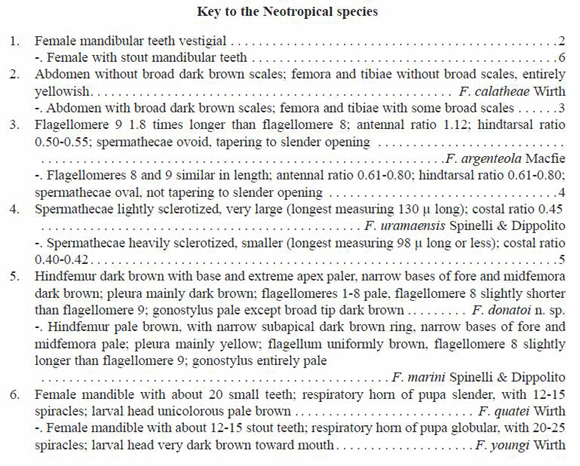
<body><![CDATA[<br> </font></font></font></font></p>     <p><font><font><font face="Courier New" size="2"  style="font-family: verdana;"><font face="Courier New" size="2"  style="font-family: verdana;">Borkent and Spinelli (2000), in their catalog </font></font></font></font><font><font><font  face="Courier New" size="2" style="font-family: verdana;"><font  face="Courier New" size="2" style="font-family: verdana;">of the New World ceratopogonids south of the </font></font></font></font><font><font><font  face="Courier New" size="2" style="font-family: verdana;"><font  face="Courier New" size="2" style="font-family: verdana;">United States of America, listed 33 species of </font></font></font></font><font><font><font  face="Courier New" size="2" style="font-family: verdana;"><font  face="Courier New" size="2" style="font-family: verdana;">subgenus <span  style="font-style: italic;">Forcipomyia </span>(<span  style="font-style: italic;">Forcipomyia</span>) for the </font></font></font></font><font><font><font  face="Courier New" size="2" style="font-family: verdana;"><font  face="Courier New" size="2" style="font-family: verdana;">region. Of this number, the following six belong </font></font></font></font><font><font><font  face="Courier New" size="2" style="font-family: verdana;"><font  face="Courier New" size="2" style="font-family: verdana;">to the <span  style="font-style: italic;">Forcipomyia argenteola</span> group, and are </font></font></font></font><font><font><font face="Courier New"  size="2" style="font-family: verdana;"><font face="Courier New"  size="2" style="font-family: verdana;">mostly distributed in northern South America </font></font></font></font><font><font><font  face="Courier New" size="2" style="font-family: verdana;"><font  face="Courier New" size="2" style="font-family: verdana;">and Central America: <span style="font-style: italic;">F. argenteola</span> Macfie </font></font></font></font><font><font><font face="Courier New"  size="2" style="font-family: verdana;"><font face="Courier New"  size="2" style="font-family: verdana;">from eastern Brazil, <span  style="font-style: italic;">F. quatei</span> Wirth from USA </font></font></font></font><font><font><font  face="Courier New" size="2" style="font-family: verdana;"><font  face="Courier New" size="2" style="font-family: verdana;">to northeastern Brazil, <span style="font-style: italic;">F. calatheae</span> Wirth from </font></font></font></font><font><font><font  face="Courier New" size="2" style="font-family: verdana;"><font  face="Courier New" size="2" style="font-family: verdana;">Dominica, Colombia and eastern Brazil, <span style="font-style: italic;">F. </span></font></font></font></font><font><font><font  face="Courier New" size="2" style="font-family: verdana;"><font  face="Courier New" size="2" style="font-family: verdana;"><span  style="font-style: italic;">youngi</span> Wirth from Panama, Costa Rica and </font></font></font></font><font><font><font  face="Courier New" size="2" style="font-family: verdana;"><font  face="Courier New" size="2" style="font-family: verdana;">Ecuador, and <span style="font-style: italic;">F. marini</span> Spinelli and Dippolito </font></font></font></font><font><font><font  face="Courier New" size="2" style="font-family: verdana;"><font  face="Courier New" size="2" style="font-family: verdana;">and <span  style="font-style: italic;">F. uramaensis</span> Spinelli and Dippolito, both </font></font></font></font><font><font><font  face="Courier New" size="2" style="font-family: verdana;"><font  face="Courier New" size="2" style="font-family: verdana;">from Venezuela. No further species in this group </font></font></font></font><font><font><font  face="Courier New" size="2" style="font-family: verdana;"><font  face="Courier New" size="2" style="font-family: verdana;">have been subsequently described.    <br> </font></font></font></font></p>     <p>During the past 15 years, several collecting trips to Paraguay and northern Argentina were undertaken, resulting in a large series of adults of the subgenus <span style="font-style: italic;">Forcipomyia (Forcipomyia)</span> deposited in the collection of the Museo de La Plata, Argentina. The purpose of this paper is to give the first results of the study of these&nbsp; new collections, describing a new species and recording for the first time from this area three species of the <span style="font-style: italic;">Forcipomyia argenteola</span> group, as well as to provide an identification key to the seven Neotropical species of the group. </p>     <p> </p>     <p> </p> <font size="3">     <p><span style="font-weight: bold;">Materials and methods</span> </p> </font>     <p> </p>     <p>Specimens were slide mounted in Canada balsam and examined, measured and drawn using a binocular compound microscope with attached camera lucida. Types of the new species are deposited in the collection of the Division Entomología, Museo de La Plata, Argentina (MLP). </p>     <br>     ]]></body>
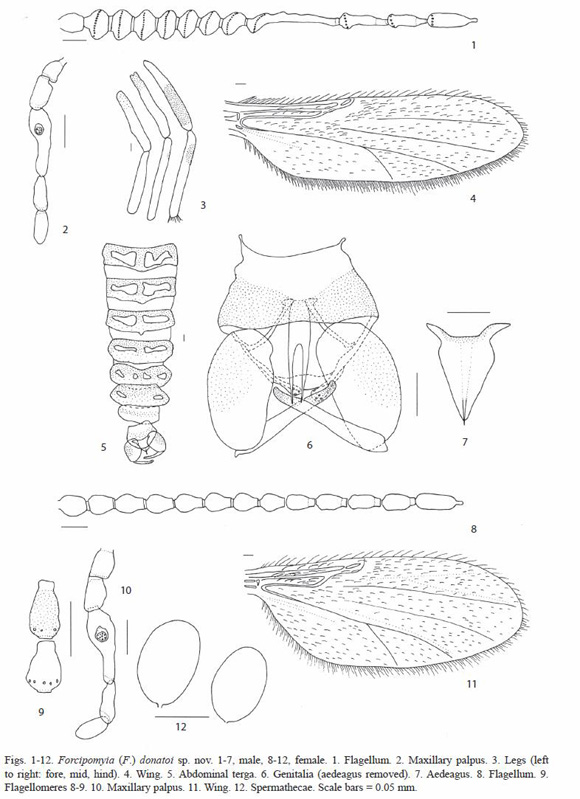
<body><![CDATA[<p>Terms for structures follow those used <font><font><font  face="Courier New" size="2" style="font-family: verdana;"><font  face="Courier New" size="2" style="font-family: verdana;">in the Manual of Nearctic Diptera (McAlpine </font></font></font></font><font><font><font  face="Courier New" size="2" style="font-family: verdana;"><font  face="Courier New" size="2" style="font-family: verdana;"><span  style="font-style: italic;">et al</span>. 1981). Terms for wing veins follow the </font></font></font></font>system of the Manual of Nearctic Diptera, with modifications proposed by Szadziewski (1996). </p> <font size="3">     <p><span style="font-weight: bold;">Results    <br>     <br> </span></p> </font></font></font>     <div style="text-align: center;"><font face="Courier New" size="2"  style="font-family: verdana;"><font face="Courier New" size="2"  style="font-family: verdana;"><font size="3">     <p><span style="font-weight: bold;"><img  src="/img/revistas/rbt/v56n2/art29k1.gif" title="" alt=""  style="width: 580px; height: 466px;"></span></p> </font></font></font>    <br> </div> <font face="Courier New" size="2" style="font-family: verdana;"><font  face="Courier New" size="2" style="font-family: verdana;">     <p><span style="font-weight: bold; font-style: italic;">Forcipomyia (Forcipomyia) donatoi, sp. nov. </span><font><font><font  face="Courier New" size="2" style="font-family: verdana;"><font  face="Courier New" size="2" style="font-family: verdana;"><span  style="font-weight: bold; font-style: italic;">(</span><a href="#f1-12"  style="font-weight: bold; font-style: italic;">Figs. 1-12</a><span  style="font-weight: bold; font-style: italic;">)</span>    <br> </font></font></font></font></p>     <p><font><font><font face="Courier New" size="2"  style="font-family: verdana;"><font face="Courier New" size="2"  style="font-family: verdana;">    ]]></body>
<body><![CDATA[<br> <a name="f1-12"></a></font></font></font></font></p> </font></font>     <div style="text-align: center;"><font><font><font face="Courier New"  size="2" style="font-family: verdana;"><font face="Courier New"  size="2" style="font-family: verdana;"><img  src="/img/revistas/rbt/v56n2/art29i1-12.jpg" title="" alt=""  style="width: 580px; height: 799px;"></font></font></font></font>    <br> </div> <font face="Courier New" size="2" style="font-family: verdana;"><font  face="Courier New" size="2" style="font-family: verdana;">     <p><font><font><font face="Courier New" size="2"  style="font-family: verdana;"><font face="Courier New" size="2"  style="font-family: verdana;"><span style="font-weight: bold;">Diagnosis.</span> Only species of the argenteola </font></font></font></font><font><font><font  face="Courier New" size="2" style="font-family: verdana;"><font  face="Courier New" size="2" style="font-family: verdana;">group with the hindfemur dark brown except its </font></font></font></font><font><font><font  face="Courier New" size="2" style="font-family: verdana;"><font  face="Courier New" size="2" style="font-family: verdana;">base and extreme apex pale, and the fore and </font></font></font></font><font><font><font  face="Courier New" size="2" style="font-family: verdana;"><font  face="Courier New" size="2" style="font-family: verdana;">midfemora with narrow, brown basal rings.    <br> </font></font></font></font></p>     <p><font><font><font face="Courier New" size="2"  style="font-family: verdana;"><font face="Courier New" size="2"  style="font-family: verdana;"><span style="font-weight: bold;">Description of male</span>    <br> </font></font></font></font></p>     <p> </p>     <p> </p>     <p> </p>     ]]></body>
<body><![CDATA[<p> </p>     <p> </p>     <p><font><font><font face="Courier New" size="2"  style="font-family: verdana;"><font face="Courier New" size="2"  style="font-family: verdana;"><span style="font-weight: bold;">Head.</span> Dark brown. Eyes bare, broadly </font></font></font></font>abutting medially for length of 5 ommatidia. Flagellum of antenna (<a href="#f1-12">Fig. 1</a>) brown with plume setae well developed, flagellomeres 1-9 at least partially fused, 10-13 elongate; AR 1.12 (1.07-1.16, n = 11). Palpus (<a href="#f1-12">Fig. 2</a>) dark brown; third segment moderately swollen at base, progressively tapering, with deep sensory pit at swollen portion opening by rounded pore, segments 4-5 separate; PR 3.44&nbsp; (2.95-3.71, n = 11). </p>     <p><span style="font-weight: bold;">Thorax.</span> Dark brown. Scutellum with inser tions of 15 stout setae, about 15 smaller ones.     <br> </p>     <p>Legs (<a href="#f1-12">Fig. 3</a>) pale brown except coxae and trochanters dark brown, hindfemur dark brown except base and extreme apex paler, hindtibia with subbasal, small dorsal dark spot; base of fore and midfemora brown (more evident on midleg), midtibia with subbasal, very small dark spot; femora and tibia with appresed striated brown scales; ventral palisade setae on tarsomeres 1-3 in all legs; hindtibial spur yellowish, length slightly shorter than width of hindtibia at midlength; hindtibial comb with two rows of spines, apical row with 8-9 spines, subapical row with 12-13 spines; prothoracic TR 0.86 (0.83-0.89, n = 11), mesothoracic TR 0.68 (0.62-0.73, n = 13), metathoracic TR 0.64 (0.59-0.69, n = 13); claws slender, curved; empodia present. Wing (<a href="#f1-12">Fig. 4</a>) brownish, with abundant long decumbent macrotrichia, darker anteriorly, small yellow spot at end of costa; first radial cell obliterated, second radial cell well-developed, triangular; wing length 1.42 (1.26-1.54, n = 13) mm; breadth 0.46 (0.40-0.50, n = 13) mm; CR 0.40 (0.39-0.42, n = 13). Halter pale. </p>     <p><span style="font-weight: bold;">Abdomen</span> (<a href="#f1-12">Fig. 5</a>). Tergites 2-7 brown with two lateral yellowish patches, tergite 8 almost entirely yellowish. Genitalia (<a href="#f1-12">Fig. 6</a>): tergite 9 short, not extending to apex of gonocoxite, posterior margin rounded; cercus short, extending beyond margin of tergite 9; sternite 9 broad, with shallow posteromedial excavation, proximal ½ yellowish, distal ½ dark brown. Gonocoxite moderately stout, 1.9 times longer than greatest breadth, yellowish except mesolateral portion brown; gonostylus pale except broad tip dark brown, slightly shorter than gonocoxite, nearly straight, tip barely curved. Parameres joined at base, fused portion extending to ½ of total length, distal processes narrowing to pointed tip. Aedeagus (<a href="#f1-12">Fig. 7</a>) nearly triangular with sharp pointed tip, 1.6 times longer than basal breadth; poorly sclerotized except basal arch, the later low, almost straight; basal arms well developed, directed anterolaterally. </p>     <p><span style="font-weight: bold;">Description of female</span> </p>     <p><span style="font-weight: bold;">Head.</span> dark brown. Antenna with proportions of flagellomeres as shown in <a href="#f1-12">Fig. 8</a>; flagellomeres 1-8 pale brown, slightly longer than broad, vasiform, flagellomeres 9-13 brown except apices pale; flagellomere 8 slightly shorter than flagellomere 9 (<a href="#f1-12">Fig. 9</a>); AR 0.81 (0.72-0.87, n = 20). Palpus (<a href="#f1-12">Fig. 10</a>) dark brown with third segment, swollen for basal ½ with deep sensory pit near midlength; segments 4, 5 separate, its combined similar in length to segment 3; segment 5 rounded; PR 2.79 (2.57-3.20, n = 15). Mandible poorly developed, without teeth. </p>     <p><span style="font-weight: bold;">Thorax.</span> Dark brown; scutellum with insertions of 15 stout setae, about 20 smaller ones; pleura mainly dark brown with few yellowish areas. Legs pale brown, hindfemur dark brown except base and extreme apex paler, base of fore and midfemora brown, hindtibia with subapical dorsal dark spot, not abutting ventral side; tarsomeres 1-3 with ventral palisade setae in all legs; hindtibial comb with two rows of spines, apical row with 9-10 spines, subapical row with 14-15 spines; prothoracic TR 0.95 (0.78-1.00, n = 20), mesothoracic TR 0.77 (0.70-0.86, n = 19), metathoracic TR 0.71 (0.64-0.79, n = 19); claws curved. Wing (<a  href="#f1-12">Fig. 10</a>) darker along anterior margin, especially on costa; small pale spot just beyond end of costa; first radial cell obliterated, second well formed, triangular; cubital fork slightly distal to level of end of costa; wing length 1.34 (1.12-1.48, n = 18) mm; breadth 0.58 (0.50-0.66, n = 19) mm; CR 0.42 (0.41-0.43, n = 18). Halter pale. </p>     ]]></body>
<body><![CDATA[<p><span style="font-weight: bold;">Abdomen.</span> Brown, covered with abundant narrow striated scales, especially on pleura. Tergites 1-7 dark brown. Segments 8-10 pale brown. Two spermathecae elongate, ovoid without neck, unequal, measuring 91 (80-98, n = 14) by 59 (48-72, n = 14) µ and 77 (70-82 n = 14) by 49 (44-60, n = 14) µ (<a href="#f1-12">Fig. 12</a>). Cercus pale. </p>     <p><span style="font-weight: bold;">Distribution.</span> Northeastern Argentina (Formosa, Misiones and Corrientes provinces), Paraguay. </p>     <p><span style="font-weight: bold;">Types.</span> Holotype male, allotype female, Paraguay, Dept. Presidente Hayes, 5 km E Rojas Sanchez, 14-V-1986, R. Woodruff, UV light trap (MLPA). Paratypes 12 males, 19 females, as follows: same data as holotype, 6 males, 5 females; Argentina, Formosa prov., Estancia La Marcela, 35 km E El Colorado, 27/28-VII-2003, J. Williams, 5 males, 7 females, at light; Misiones prov., Corpus, VII-2001, G. Spinelli, 1 female, CDC; same data except Posadas, 3-X-2001, 4 females; Corrientes prov., Santa Tecla, 5-IX-2001, G. Spinelli, 1 male, 2 females, CDC. </p> <font size="3">     <p><span style="font-weight: bold;">Discussion</span> </p> </font>     <p><span style="font-weight: bold;">Taxonomic Discussion.</span> Males and females were collected at the same locality and date. The abdominal pigmentation of terga of the male and female differed somewhat, being a distinctive pattern in the male, but absent in the female. </p>     <p>This new species resembles two species from Venezuela described by Spinelli and Dippolito (1995), <span style="font-style: italic;">F.(F.) marini</span> and <span style="font-style: italic;">F.(F.) uramaensis</span>. The later species, which is only known from female specimens, shares with F.(F.) donatoi the pigmentation pattern of flagellomeres and abdominal terga, but the spermathecae are larger and lightly sclerotized, the fore and midlegs are entirely yellowish, the hind femur is mostly yellowish with a subapical, broad dark brown ring and the costal ratio is larger. <span style="font-style: italic;">Forcipomyia (F.) marini</span> differs from the new species by the following characters: flagellomeres of female entirely brown, flagellomere 8 slightly longer than flagellomere 9, hindfemur mostly yellowish with a subapical, narrow dark brown ring, pleura mainly yellow, absence of abdominal pattern of pigmentation and gonostylus entirely pale. </p>     <p><span style="font-weight: bold;">Etymology. </span>This species is named after Dr. Mariano Donato, specialist of Chironomidae of the Museo de La Plata, in recognition of his valuable help collecting ceratopogonids. </p> <font size="3">     <p><span style="font-weight: bold;">New records</span> </p> </font>     <p style="font-style: italic;"><span style="font-weight: bold;">Forcipomyia (F.) argenteola Macfie</span> </p>     <p><span style="font-style: italic;">F. (F.) argenteola</span> Macfie, 1939: 146 (female; Brazil); Lane, 1947: 163 (male, larva, pupa; Brazil); Wirth, 1982: 572 (diagnosis; Brazil); Borkent and Spinelli, 2000: 14 (in Neotropical catalog; distrib.). </p>     ]]></body>
<body><![CDATA[<p><span style="font-weight: bold;">Specimens examined. </span>Argentina, Misiones prov., Puerto Iguazú, 21/27-X-2006, C. Cazorla, 1 male, at light. Paraguay, Itapúa, Carmen del Paraná, 20-V-1996, G. Spinelli, 1 male; Itapúa, Bella Vista, 6/7-VI-2000, A. Ortiz – D. Lopez, 1 male, CDC. </p>     <p><span style="font-weight: bold;">Distribution.</span> Brazil, Paraguay, Argentina (Misiones province). </p>     <p style="font-style: italic;"><span style="font-weight: bold;">Forcipomyia (F.) calatheae Wirth</span> </p>     <p><span style="font-style: italic;">F. (F.) calatheae</span> Wirth, 1982: 573 (female, male, pupa, larva; Brazil, Colombia, Dominica); Borkent and Spinelli, 2000: 14 (in Neotropical catalog; distrib.). </p>     <p><span style="font-weight: bold;">Specimens examined. </span>Argentina, Salta prov., Río Juramento y ruta nacional Nº 9, 8-VIII-1980, G. Spinelli, 2 males, 1 female, at light; Santiago del Estero prov., Ojo de Agua, 15-I-1980, Woodruff – De Loach, 1 male, 3 females, UV light trap; La Rioja prov., Chilecito, 29-IX-1989, G. Spinelli, 4 males, at light.     <br> </p>     <p><span style="font-weight: bold;">Distribution.</span> Dominica, Colombia, Brazil, northern Argentina (Salta, Santiago del Estero and La Rioja provinces). </p>     <p style="font-style: italic;"><span style="font-weight: bold;">Forcipomyia (F.) quatei Wirth</span> </p>     <p><span style="font-style: italic;">F. (F.) quatei</span> Wirth, 1952: 142 (male, female; USA); Wirth, 1982: 576 (female, male redescr., pupa, larva; Belize, Dominica, Costa Rica, Panama, Ecuador, Brazil); Borkent and Spinelli, 2000: 15 (in Neotropical catalog; distrib.). </p>     <p><span style="font-weight: bold;">Specimens examined. </span>Argentina, Misiones prov., Cuñapirú stream, 18/19-V-1997, J. Williams, 1 female, at light; Entre Ríos prov., Salto Grande, Puerto Luis, 9-XI-1984, G. Spinelli, 1 female. Paraguay, Itapúa, Bella Vista, 13-VIII-1998, G. Spinelli, 1 female, same data except, 13-VII-1999, 1 male, CDC.     ]]></body>
<body><![CDATA[<br> </p>     <p><span style="font-weight: bold;">Distribution.</span> From USA to Brazil, Paraguay and northeastearn Argentina (Misiones and Entre Ríos provinces). </p> </font></font> <hr style="width: 100%; height: 2px;"><font face="Courier New" size="2"  style="font-family: verdana;"><font face="Courier New" size="2"  style="font-family: verdana;">     <p><span style="font-weight: bold;">Resumen</span> </p>     <p>Se describe e ilustra una especie nueva del grupo <span  style="font-style: italic;">Forcipomyia (Forcipomyia) argenteola</span>, <span style="font-style: italic;">F. (F.) donatoi</span>, sobre la base de machos y hembras capturados en diversas localidades del norte de Argentina y Paraguay. Esta especie es comparada con <span  style="font-style: italic;">F. (F.) marini</span> y <span  style="font-style: italic;">F. (F.) uramaensis</span>, ambas de Venezuela, con las cuales presenta semejanzas morfológicas. Las especies <span style="font-style: italic;">Forcipomyia (F.) argenteola</span>, F. (F.) calatheae y F. (F.) quatei se registran por primera vez en Argentina, y se provee, además, una clave para la identificación de las siete especies Neotropicales del grupo. </p>     <p><span style="font-weight: bold;">Palabras clave:</span> grupo <span  style="font-style: italic;">Forcipomyia argenteola</span>, especie nueva, nuevos registros, clave, región Neotropical.    <br> </p> </font></font> <hr style="width: 100%; height: 2px;"><font face="Courier New" size="2"  style="font-family: verdana;"><font face="Courier New" size="2"  style="font-family: verdana;"></font></font>     <div style="text-align: center;"><font><font><font face="Courier New"  size="2" style="font-family: verdana;"><font face="Courier New"  size="2" style="font-family: verdana;">Received 18-V-2007. Corrected 16-XI-2007. Accepted 29-IV-2008.</font></font></font></font></div> &nbsp;<font face="Courier New" size="2" style="font-family: verdana;"><font  face="Courier New" size="2" style="font-family: verdana;">     <p> </p> <font size="3">     <p><span style="font-weight: bold;">References</span> </p> </font>     <!-- ref --><p>Borkent, A. &amp; G.R. Spinelli. 2000. Catalog of the New World biting midges south of the United States of America (Diptera: Ceratopogonidae). Contrib. Entomol. Internat. 4: 1-107. &nbsp;&nbsp;&nbsp;&nbsp;&nbsp;&nbsp;&nbsp;&nbsp;[&#160;<a href="javascript:void(0);" onclick="javascript: window.open('/scielo.php?script=sci_nlinks&ref=1266945&pid=S0034-7744200800020002900001&lng=','','width=640,height=500,resizable=yes,scrollbars=1,menubar=yes,');">Links</a>&#160;]<!-- end-ref --><!-- ref --><p>Lane, J. 1947. A biologia e taxonomia de algumas especies dos grupos Forcipomyia e Culicoides (Diptera: Ceratopogonidae) (Heleidae). Arq. Fac. Hig. Saude Pub. Univ. São Paulo 1: 159-170. &nbsp;&nbsp;&nbsp;&nbsp;&nbsp;&nbsp;&nbsp;&nbsp;[&#160;<a href="javascript:void(0);" onclick="javascript: window.open('/scielo.php?script=sci_nlinks&ref=1266946&pid=S0034-7744200800020002900002&lng=','','width=640,height=500,resizable=yes,scrollbars=1,menubar=yes,');">Links</a>&#160;]<!-- end-ref --><!-- ref --><p>Macfie, J.W.S. 1939. A report on a collection of Brazilian Ceratopogonidae (Dipt.). Rev. Ent. 10: 137-219. &nbsp;&nbsp;&nbsp;&nbsp;&nbsp;&nbsp;&nbsp;&nbsp;[&#160;<a href="javascript:void(0);" onclick="javascript: window.open('/scielo.php?script=sci_nlinks&ref=1266947&pid=S0034-7744200800020002900003&lng=','','width=640,height=500,resizable=yes,scrollbars=1,menubar=yes,');">Links</a>&#160;]<!-- end-ref --><!-- ref --><p>Martínez, A., Z. Narváez &amp; G.R. Spinelli. 2000. Mosquitas polinizadoras (Diptera: Ceratopogonidae) del cacao colectadas en comunidades Piaroa en Amazonas, Venezuela. Bol. Entomol. Venez. 15: 249-253.    &nbsp;&nbsp;&nbsp;&nbsp;&nbsp;&nbsp;&nbsp;&nbsp;[&#160;<a href="javascript:void(0);" onclick="javascript: window.open('/scielo.php?script=sci_nlinks&ref=1266948&pid=S0034-7744200800020002900004&lng=','','width=640,height=500,resizable=yes,scrollbars=1,menubar=yes,');">Links</a>&#160;]<!-- end-ref --><br> </p>     <!-- ref --><p>McAlpine, J.F., B.V. Peterson, G.E. Shewell, H.J. Teskey, J.R. Vockeroth &amp; D.M. Wood. 1981. Manual of Nearctic Diptera. Volume 1. Ottawa, Agriculture Canada Monograph 27. 674 p. &nbsp;&nbsp;&nbsp;&nbsp;&nbsp;&nbsp;&nbsp;&nbsp;[&#160;<a href="javascript:void(0);" onclick="javascript: window.open('/scielo.php?script=sci_nlinks&ref=1266950&pid=S0034-7744200800020002900005&lng=','','width=640,height=500,resizable=yes,scrollbars=1,menubar=yes,');">Links</a>&#160;]<!-- end-ref --><!-- ref --><p>Spinelli, G.R. &amp; A. Dippolito. 1995. Two new Neotropical species of the <span style="font-style: italic;">Forcipomyia (F.) argenteola</span> species group (Diptera: Ceratopogonidae). Rev. Soc. Entomol. Argent. 54: 155-158. &nbsp;&nbsp;&nbsp;&nbsp;&nbsp;&nbsp;&nbsp;&nbsp;[&#160;<a href="javascript:void(0);" onclick="javascript: window.open('/scielo.php?script=sci_nlinks&ref=1266951&pid=S0034-7744200800020002900006&lng=','','width=640,height=500,resizable=yes,scrollbars=1,menubar=yes,');">Links</a>&#160;]<!-- end-ref --><!-- ref --><p>Szadziewski, R. 1996. Biting midges from Lower Cretaceous amber of Lebanon and Upper Cretaceous Siberian amber of Taimyr (Diptera: Ceratopogonidae). Studia Dipterol. 3: 23-86. &nbsp;&nbsp;&nbsp;&nbsp;&nbsp;&nbsp;&nbsp;&nbsp;[&#160;<a href="javascript:void(0);" onclick="javascript: window.open('/scielo.php?script=sci_nlinks&ref=1266952&pid=S0034-7744200800020002900007&lng=','','width=640,height=500,resizable=yes,scrollbars=1,menubar=yes,');">Links</a>&#160;]<!-- end-ref --><!-- ref --><p>Winder, J.A. 1977. Field observations on Ceratopogonidae and other Diptera: Nematocera associated with cocoa flowers in Brazil. Bull. Entomol. Res. 67: 57-63. &nbsp;&nbsp;&nbsp;&nbsp;&nbsp;&nbsp;&nbsp;&nbsp;[&#160;<a href="javascript:void(0);" onclick="javascript: window.open('/scielo.php?script=sci_nlinks&ref=1266953&pid=S0034-7744200800020002900008&lng=','','width=640,height=500,resizable=yes,scrollbars=1,menubar=yes,');">Links</a>&#160;]<!-- end-ref --><!-- ref --><p>Wirth, W.W. 1952. The Heleidae of California. Univ. Calif. Publ. Entomol. 9: 95-266. &nbsp;&nbsp;&nbsp;&nbsp;&nbsp;&nbsp;&nbsp;&nbsp;[&#160;<a href="javascript:void(0);" onclick="javascript: window.open('/scielo.php?script=sci_nlinks&ref=1266954&pid=S0034-7744200800020002900009&lng=','','width=640,height=500,resizable=yes,scrollbars=1,menubar=yes,');">Links</a>&#160;]<!-- end-ref --><!-- ref --><p>Wirth, W.W. 1982. The cacao-pollinating midges of the Forcipomyia argenteola group Diptera: Ceratopogonidae). Proc. Entomol. Soc. Wash. 84: 568-585. &nbsp;&nbsp;&nbsp;&nbsp;&nbsp;&nbsp;&nbsp;&nbsp;[&#160;<a href="javascript:void(0);" onclick="javascript: window.open('/scielo.php?script=sci_nlinks&ref=1266955&pid=S0034-7744200800020002900010&lng=','','width=640,height=500,resizable=yes,scrollbars=1,menubar=yes,');">Links</a>&#160;]<!-- end-ref --><!-- ref --><p>Young, A.M. 1986. Notes on the distribution and abundance of midges (Diptera: Ceratopogonidae and Cecidomyiidae) in some Central American cacao plantations. Brenesia 0 (24): 273-286,&nbsp;    &nbsp;&nbsp;&nbsp;&nbsp;&nbsp;&nbsp;&nbsp;&nbsp;[&#160;<a href="javascript:void(0);" onclick="javascript: window.open('/scielo.php?script=sci_nlinks&ref=1266956&pid=S0034-7744200800020002900011&lng=','','width=640,height=500,resizable=yes,scrollbars=1,menubar=yes,');">Links</a>&#160;]<!-- end-ref --><br> </p> </font> </font>      ]]></body><back>
<ref-list>
<ref id="B1">
<nlm-citation citation-type="journal">
<person-group person-group-type="author">
<name>
<surname><![CDATA[Borkent]]></surname>
<given-names><![CDATA[A]]></given-names>
</name>
<name>
<surname><![CDATA[Spinelli]]></surname>
<given-names><![CDATA[G.R]]></given-names>
</name>
</person-group>
<article-title xml:lang="en"><![CDATA[Catalog of the New World biting midges south of the United States of America (Diptera: Ceratopogonidae)]]></article-title>
<source><![CDATA[Contrib. Entomol. Internat]]></source>
<year>2000</year>
<volume>4</volume>
<page-range>1-107</page-range></nlm-citation>
</ref>
<ref id="B2">
<nlm-citation citation-type="journal">
<person-group person-group-type="author">
<name>
<surname><![CDATA[Lane]]></surname>
<given-names><![CDATA[J]]></given-names>
</name>
</person-group>
<article-title xml:lang="pt"><![CDATA[A biologia e taxonomia de algumas especies dos grupos Forcipomyia e Culicoides (Diptera: Ceratopogonidae) (Heleidae)]]></article-title>
<source><![CDATA[Arq. Fac. Hig. Saude Pub. Univ. São Paulo]]></source>
<year>1947</year>
<volume>1</volume>
<page-range>159-170</page-range></nlm-citation>
</ref>
<ref id="B3">
<nlm-citation citation-type="journal">
<person-group person-group-type="author">
<name>
<surname><![CDATA[Macfie]]></surname>
<given-names><![CDATA[J.W.S]]></given-names>
</name>
</person-group>
<article-title xml:lang="en"><![CDATA[A report on a collection of Brazilian Ceratopogonidae (Dipt.)]]></article-title>
<source><![CDATA[Rev. Ent]]></source>
<year>1939</year>
<volume>10</volume>
<page-range>137-219</page-range></nlm-citation>
</ref>
<ref id="B4">
<nlm-citation citation-type="journal">
<person-group person-group-type="author">
<name>
<surname><![CDATA[Martínez]]></surname>
<given-names><![CDATA[A]]></given-names>
</name>
<name>
<surname><![CDATA[Narváez]]></surname>
<given-names><![CDATA[Z]]></given-names>
</name>
<name>
<surname><![CDATA[Spinelli]]></surname>
<given-names><![CDATA[G.R]]></given-names>
</name>
</person-group>
<article-title xml:lang="es"><![CDATA[Mosquitas polinizadoras (Diptera: Ceratopogonidae) del cacao colectadas en comunidades Piaroa en Amazonas, Venezuela]]></article-title>
<source><![CDATA[Bol. Entomol. Venez]]></source>
<year>2000</year>
<volume>15</volume>
<page-range>249-253</page-range></nlm-citation>
</ref>
<ref id="B5">
<nlm-citation citation-type="">
<person-group person-group-type="author">
<name>
<surname><![CDATA[McAlpine]]></surname>
<given-names><![CDATA[J.F]]></given-names>
</name>
<name>
<surname><![CDATA[Peterson]]></surname>
<given-names><![CDATA[B.V]]></given-names>
</name>
<name>
<surname><![CDATA[Shewell]]></surname>
<given-names><![CDATA[G.E]]></given-names>
</name>
<name>
<surname><![CDATA[Teskey]]></surname>
<given-names><![CDATA[H.J]]></given-names>
</name>
<name>
<surname><![CDATA[Vockeroth]]></surname>
<given-names><![CDATA[J.R]]></given-names>
</name>
<name>
<surname><![CDATA[Wood]]></surname>
<given-names><![CDATA[D.M]]></given-names>
</name>
</person-group>
<source><![CDATA[Manual of Nearctic Diptera: Volume 1]]></source>
<year>1981</year>
<volume>27</volume>
<publisher-loc><![CDATA[Ottawa ]]></publisher-loc>
</nlm-citation>
</ref>
<ref id="B6">
<nlm-citation citation-type="journal">
<person-group person-group-type="author">
<name>
<surname><![CDATA[Spinelli]]></surname>
<given-names><![CDATA[G.R]]></given-names>
</name>
<name>
<surname><![CDATA[Dippolito]]></surname>
<given-names><![CDATA[A]]></given-names>
</name>
</person-group>
<article-title xml:lang="en"><![CDATA[Two new Neotropical species of the Forcipomyia (F.) argenteola species group (Diptera: Ceratopogonidae)]]></article-title>
<source><![CDATA[Rev. Soc. Entomol. Argent]]></source>
<year>1995</year>
<volume>54</volume>
<page-range>155-158</page-range></nlm-citation>
</ref>
<ref id="B7">
<nlm-citation citation-type="journal">
<person-group person-group-type="author">
<name>
<surname><![CDATA[Szadziewski]]></surname>
<given-names><![CDATA[R]]></given-names>
</name>
</person-group>
<article-title xml:lang="en"><![CDATA[Biting midges from Lower Cretaceous amber of Lebanon and Upper Cretaceous Siberian amber of Taimyr (Diptera: Ceratopogonidae)]]></article-title>
<source><![CDATA[Studia Dipterol]]></source>
<year>1996</year>
<volume>3</volume>
<page-range>23-86</page-range></nlm-citation>
</ref>
<ref id="B8">
<nlm-citation citation-type="journal">
<person-group person-group-type="author">
<name>
<surname><![CDATA[Winder]]></surname>
<given-names><![CDATA[J.A]]></given-names>
</name>
</person-group>
<article-title xml:lang="en"><![CDATA[Field observations on Ceratopogonidae and other Diptera: Nematocera associated with cocoa flowers in Brazil]]></article-title>
<source><![CDATA[Bull. Entomol. Res]]></source>
<year>1977</year>
<volume>67</volume>
<page-range>57-63</page-range></nlm-citation>
</ref>
<ref id="B9">
<nlm-citation citation-type="journal">
<person-group person-group-type="author">
<name>
<surname><![CDATA[Wirth]]></surname>
<given-names><![CDATA[W.W]]></given-names>
</name>
</person-group>
<article-title xml:lang="en"><![CDATA[The Heleidae of California]]></article-title>
<source><![CDATA[Univ. Calif. Publ. Entomol]]></source>
<year>1952</year>
<volume>9</volume>
<page-range>95-266</page-range></nlm-citation>
</ref>
<ref id="B10">
<nlm-citation citation-type="journal">
<person-group person-group-type="author">
<name>
<surname><![CDATA[Wirth]]></surname>
<given-names><![CDATA[W.W]]></given-names>
</name>
</person-group>
<article-title xml:lang="en"><![CDATA[The cacao-pollinating midges of the Forcipomyia argenteola group Diptera: Ceratopogonidae)]]></article-title>
<source><![CDATA[Proc. Entomol. Soc. Wash]]></source>
<year>1982</year>
<volume>84</volume>
<page-range>568-585</page-range></nlm-citation>
</ref>
<ref id="B11">
<nlm-citation citation-type="journal">
<person-group person-group-type="author">
<name>
<surname><![CDATA[Young]]></surname>
<given-names><![CDATA[A.M]]></given-names>
</name>
</person-group>
<article-title xml:lang="en"><![CDATA[Notes on the distribution and abundance of midges (Diptera: Ceratopogonidae and Cecidomyiidae) in some Central American cacao plantations]]></article-title>
<source><![CDATA[Brenesia]]></source>
<year>1986</year>
<volume>0</volume>
<numero>24</numero>
<issue>24</issue>
<page-range>273-286</page-range></nlm-citation>
</ref>
</ref-list>
</back>
</article>