<?xml version="1.0" encoding="ISO-8859-1"?><article xmlns:mml="http://www.w3.org/1998/Math/MathML" xmlns:xlink="http://www.w3.org/1999/xlink" xmlns:xsi="http://www.w3.org/2001/XMLSchema-instance">
<front>
<journal-meta>
<journal-id>0034-7744</journal-id>
<journal-title><![CDATA[Revista de Biología Tropical]]></journal-title>
<abbrev-journal-title><![CDATA[Rev. biol. trop]]></abbrev-journal-title>
<issn>0034-7744</issn>
<publisher>
<publisher-name><![CDATA[Universidad de Costa Rica]]></publisher-name>
</publisher>
</journal-meta>
<article-meta>
<article-id>S0034-77442008000200026</article-id>
<title-group>
<article-title xml:lang="en"><![CDATA[Seasonal patterns of parasitism of the tropical spiders Theridion evexum (Araneae, Theridiidae) and Allocyclosa bifurca (Araneae, Araneidae) by the wasps Zatypota petronae and Polysphincta gutfreundi (Hymenoptera, Ichneumonidae)]]></article-title>
</title-group>
<contrib-group>
<contrib contrib-type="author">
<name>
<surname><![CDATA[Barrantes]]></surname>
<given-names><![CDATA[Gilbert]]></given-names>
</name>
<xref ref-type="aff" rid="A01"/>
</contrib>
<contrib contrib-type="author">
<name>
<surname><![CDATA[Eberhard]]></surname>
<given-names><![CDATA[William G]]></given-names>
</name>
<xref ref-type="aff" rid="A02"/>
</contrib>
<contrib contrib-type="author">
<name>
<surname><![CDATA[Weng]]></surname>
<given-names><![CDATA[Ju-Lin]]></given-names>
</name>
<xref ref-type="aff" rid="A03"/>
</contrib>
</contrib-group>
<aff id="A01">
<institution><![CDATA[,Universidad de Costa Rica Escuela de Biología ]]></institution>
<addr-line><![CDATA[San José ]]></addr-line>
<country>Costa Rica</country>
</aff>
<aff id="A02">
<institution><![CDATA[,Smithsonian Tropical Research Institute  ]]></institution>
<addr-line><![CDATA[ ]]></addr-line>
<country>Panama</country>
</aff>
<aff id="A03">
<institution><![CDATA[,Kansas State University Department of Entomology ]]></institution>
<addr-line><![CDATA[ ]]></addr-line>
</aff>
<pub-date pub-type="pub">
<day>00</day>
<month>06</month>
<year>2008</year>
</pub-date>
<pub-date pub-type="epub">
<day>00</day>
<month>06</month>
<year>2008</year>
</pub-date>
<volume>56</volume>
<numero>2</numero>
<fpage>749</fpage>
<lpage>754</lpage>
<copyright-statement/>
<copyright-year/>
<self-uri xlink:href="http://www.scielo.sa.cr/scielo.php?script=sci_arttext&amp;pid=S0034-77442008000200026&amp;lng=en&amp;nrm=iso"></self-uri><self-uri xlink:href="http://www.scielo.sa.cr/scielo.php?script=sci_abstract&amp;pid=S0034-77442008000200026&amp;lng=en&amp;nrm=iso"></self-uri><self-uri xlink:href="http://www.scielo.sa.cr/scielo.php?script=sci_pdf&amp;pid=S0034-77442008000200026&amp;lng=en&amp;nrm=iso"></self-uri><abstract abstract-type="short" xml:lang="en"><p><![CDATA[The rates of parasitism of Theridion evexum by the parasitoid wasp Zatypota petronae, and Allocyclosa bifurca by Polysphincta gutfreundi, were followed for two years. Parasitism of T. evexum was very low (mean 1.39+1.8%), and restricted to nearly seven months of the year. Parasitism of A. bifurca was higher (mean 7.8+7.6%), and did not show a seasonal pattern. Reproduction of the host spider T. evexum was highly seasonal, with only one, highly coordinated generation per year, while adults of A. bifurca were present year round. Short-term autocorrelation on parasitism rates over time at different sites suggest that P. gutfreundi tend to return to the same sites to hunt hosts over periods of a few weeks. Rev. Biol. Trop. 56 (2): 749-754. Epub 2008 June 30.]]></p></abstract>
<abstract abstract-type="short" xml:lang="es"><p><![CDATA[Las tasas de parasitismo de Theridion evexum por la avispa parasitoide Zatypota petronae y de Allocyclosa bifurca por Polysphincta gutfreundi fueron estudiadas durante dos años. El parasitismo en T. evexum fue muy bajo (promedio 1.39+1.8%) y restringido a aproximadamente siete meses del año. El parasitismo en A. bifurca fue más alto (promedio 7.8+7.6%) y no mostró un claro patrón estacional. La reproducción de la araña hospedera T. evexum fue muy estacional, con solamente una generación por año, mientras que los adultos de A. bifurca estuvieron presentes todo el año. Autocorrelaciones de las tasas de parasitismo entre censos consecutivos en diferentes sitios sugiere que P. gutfreundi tiende a retornar a los mismos sitios para parasitar las arañas hospederas durante algunas semanas.]]></p></abstract>
<kwd-group>
<kwd lng="en"><![CDATA[Parasitism rate]]></kwd>
<kwd lng="en"><![CDATA[parasitoids]]></kwd>
<kwd lng="en"><![CDATA[koinobiont wasps]]></kwd>
<kwd lng="en"><![CDATA[Theridiidae]]></kwd>
<kwd lng="en"><![CDATA[Araneidae]]></kwd>
<kwd lng="en"><![CDATA[Ichneumonidae]]></kwd>
<kwd lng="es"><![CDATA[Tasa de parasitismo]]></kwd>
<kwd lng="es"><![CDATA[parasitoides]]></kwd>
<kwd lng="es"><![CDATA[avispas koinobiontes]]></kwd>
<kwd lng="es"><![CDATA[Theridiidae]]></kwd>
<kwd lng="es"><![CDATA[Araneidae]]></kwd>
<kwd lng="es"><![CDATA[Ichneumonidae]]></kwd>
</kwd-group>
</article-meta>
</front><body><![CDATA[ <div style="text-align: center;"><font face="Courier New" size="4"  style="font-family: verdana;">     <p><span style="font-weight: bold;">Seasonal patterns of parasitism of the tropical spiders <span style="font-style: italic;">Theridion evexum</span> (Araneae, Theridiidae) and <span  style="font-style: italic;">Allocyclosa bifurca</span> (Araneae, Araneidae) by the wasps <span style="font-style: italic;">Zatypota petronae</span> and <span style="font-style: italic;">Polysphincta gutfreundi</span> (Hymenoptera, Ichneumonidae)</span> </p> </font></div> <font face="Courier New" size="2" style="font-family: verdana;">     <p><span style="font-weight: bold;">Gilbert Barrantes<a name="a1"></a><a  href="#a2"><sup>1</sup></a>, William G. Eberhard<sup><a href="#a2">1</a>,<a  href="#a2">2</a></sup> &amp; Ju-Lin Weng<sup><a href="#a2">1</a>,<a  href="#a2">3</a></sup></span> </p>     <p><a name="a2"></a><a href="#a1">1.</a> Escuela de Biología, Universidad de Costa Rica, San José, Costa Rica, Fax: 207-4216; <a href="mailto:gilbert.barrantes@gmail.com">gilbert.barrantes@gmail.com</a> </p>     <p><a href="#a1">2.</a> Smithsonian Tropical Research Institute, Panama. </p>     <p><a href="#a1">3.</a> Department of Entomology, Kansas State University, Manhattan KS 66506. </p>     <p> </p> </font> <hr style="width: 100%; height: 2px;"><font face="Courier New" size="2"  style="font-family: verdana;">     <p><span style="font-weight: bold;">Abstract:</span> The rates of parasitism of <span style="font-style: italic;">Theridion evexum</span> by the parasitoid wasp <span style="font-style: italic;">Zatypota petronae</span>, and <span style="font-style: italic;">Allocyclosa bifurca</span> by <span  style="font-style: italic;">Polysphincta gutfreundi</span>, were followed for two years. Parasitism of <span style="font-style: italic;">T. evexum</span> was very low (mean 1.39+1.8%), and restricted to nearly seven months of the year. Parasitism of <span style="font-style: italic;">A. bifurca</span> was higher (mean 7.8+7.6%), and did not show a seasonal pattern. Reproduction of the host spider <span style="font-style: italic;">T. evexum</span> was highly seasonal, with only one, highly coordinated generation per year, while adults of <span style="font-style: italic;">A. bifurca</span> were present year round. Short-term autocorrelation on parasitism rates over time at different sites suggest that <span style="font-style: italic;">P. gutfreundi</span> tend to return to the same sites to hunt hosts over periods of a few weeks. Rev. Biol. Trop. 56 (2): 749-754. Epub 2008 June 30. </p>     <p><span style="font-weight: bold;">Key words:</span> Parasitism rate, parasitoids, koinobiont wasps, Theridiidae, Araneidae, Ichneumonidae.</p> </font> <hr style="width: 100%; height: 2px;"><font face="Courier New" size="2"  style="font-family: verdana;">     <p> </p>     ]]></body>
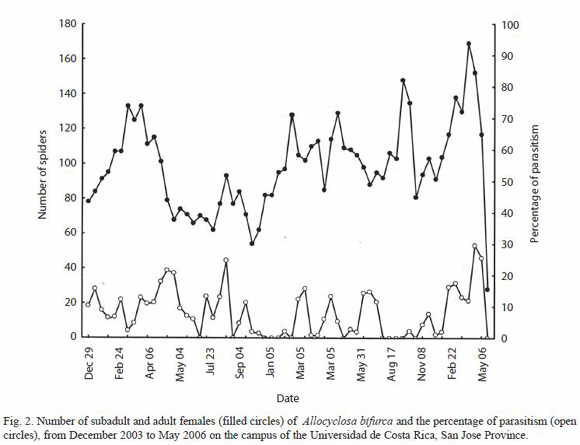
<body><![CDATA[<p>The Polysphinctini are koinobiont ectoparasitoid ichneumonid wasps that attack spiders in several families (Nielsen 1923, 1932a, b, Fincke <span style="font-style: italic;">et al</span>. 1990, Gauld and Shaw 1995, Gauld <span style="font-style: italic;">et al</span>. 1998). Rates of parasitism by polysphinctine wasps have seldom been studied; fragmentary data for tropical species suggest that parasitism rates vary among species, among populations, and between years (Fincke <span  style="font-style: italic;">et al</span>. 1990, Eberhard 2000a, b, Weng and Barrantes 2007). </p>     <p>Available data suggest that each polysphinctine wasp species attacks one or a few related spider species (Gauld <span  style="font-style: italic;">et al</span>. 1998, Hanson and Gauld 2006). Hence the life cycle and population size of different parasitoid species may be adjusted to the biology and changes in population size of their hosts. We describe the temporal variation in parasitism rate of two polysphinctine wasp species: <span style="font-style: italic;">Zatypota petronae</span> Gauld and <span style="font-style: italic;">Polysphincta gutfreundi</span> Gauld on their respective hosts, <span  style="font-style: italic;">Theridion evexum</span> Keyserling (Theridiidae) and <span style="font-style: italic;">Allocyclosa bifurca</span> (McCook) (Araneidae) in the Central valley of Costa Rica. </p>     <p><span style="font-style: italic;">Theridium evexum</span> constructs webs in the undergrowth of wet forests and associated secondary growth (Barrantes and Weng 2007). Its web has a green leaf folded to form a cone that is used by the spider as a retreat. Additionally, a small tangle, from which multiple long sticky lines extend mainly downward to other leaves, is constructed near the retreat opening (Barrantes and Weng 2007). <span style="font-style: italic;">Allocyclosa bifurca</span> builds orb webs attached primarily to large, rigid, long-lived leaves, especially those of plants in the family Agavacea (e.g. <span  style="font-style: italic;">Yucca</span> spp., <span  style="font-style: italic;">Agave</span> spp.); they also occur on buildings and bromeliads (Eberhard 2003). </p> <font size="3">     <p><span style="font-weight: bold;">Materials and methods</span> </p> </font>     <p>We censused spiders and parasitoid eggs and larvae on their abdomens (and also parasite pupae in their webs in the case of <span  style="font-style: italic;">Z. petronae</span>) approximately every two weeks from Octuber 2004 to October 2006 (for <span  style="font-style: italic;">T. evexum</span>) and from December 2003 to May 2006 (for <span style="font-style: italic;">A. bifurca</span>) on the campus of the Universidad de Costa Rica, San Jose Province (9°54’ N, 84°03’ W; elevation 1100 m). The campus is located on the western region of the Central valley where the mean annual precipitation is 1900 mm and the mean annual temperature 20°C, with a dry season from December through March (Bergoeing 1998). All juveniles and adults <span style="font-style: italic;">T. evexum</span> were censused in one plot of 250 m<sup>2</sup> of secondary forest in the Reserva Biologica Leonel Oviedo. We counted adults and subadults of <span  style="font-style: italic;">A. bifurca</span>, mostly on large, solitary individuals or small groups of Agavaceae plants scattered over the campus. The most distant places were separated by approximately 300-400 m. The total number of sites that were surveyed varied from four to six, as some plants died or were cut and removed, and other sites with spiders were discovered during the study. </p>     <p>Because the development time of the wasps from egg to pupa was less than two weeks (G. Barrantes and J. L. Weng unpub., W. G. Eberhard unpub.), parasitoids were not counted twice in different censuses. Parasitism rates were thus at least potentially independent between successive censuses. Autocorrelation analyses were performed on the percentage parasitism of <span style="font-style: italic;">A. bifurca</span> between censuses for four different sites. This analysis allowed us to examine whether parasitism rates were independent between successive censuses. Low values of the parameter&nbsp;<span  style="color: rgb(255, 102, 102);"><img  src="/img/revistas/rbt/v56n2/n.jpg" title="" alt=""  style="width: 17px; height: 18px;"> </span>(significantly lower than 2) indicate non-random consecutive sequences of low or high values (e.g., several consecutive censuses with high parasitism followed by several consecutive censuses with low parasitism), whereas high values of the same parameter (significantly higher than 2) indicate dependence between values of consecutive censuses (Sokal and Rohlf 1995: 393-396). Additionally, percentage of parasitism was scored at four different sites (separated by 100 to 400m) for each census, during 46 censuses. The site with highest parasitism received a score of 4, whereas the site with lowest parasitism received a score of 1. Scores of the different sites were analyzed using a Friedman test. Specimens of spiders and wasps were deposited in the Museo de Zoología, Universidad de Costa Rica. </p> <font size="3">     <p><span style="font-weight: bold;">Results</span> </p> </font>     <p><span style="font-weight: bold;">Population size:</span> The population of <span style="font-style: italic;">T. evexum</span> showed extreme annual seasonal fluctuations that were similar during both years (<a href="#f1">Fig. 1</a>) (Kolmogorov-Smirnov = 0.002, p &gt; 0.20). Egg sacs began to appear in the retreats in August, and were present until January or February. During this period (the end of the wet season and the beginning of the dry season), the population was lowest, and consisted of almost exclusively adult females. The population was consisted almost completely of juvenile individuals when it began to increase in December-January, and reached a maximum in May - July, then decreased steadily until the next reproductive period began.    <br> </p>     <p>    ]]></body>
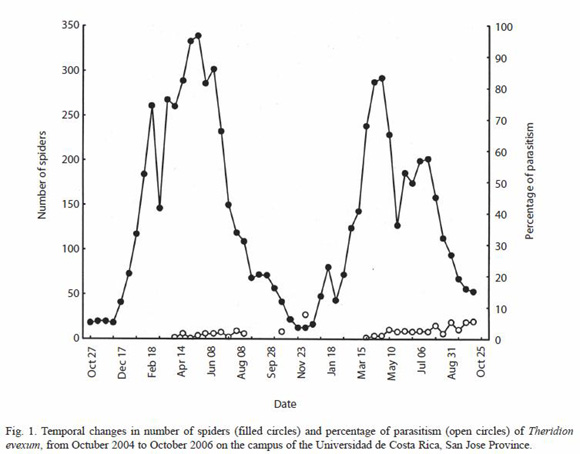
<body><![CDATA[<br> <a name="f1"></a></p> </font>     <div style="text-align: center;"><img  src="/img/revistas/rbt/v56n2/art26i1.jpg" title="" alt=""  style="width: 580px; height: 454px;">    <br> </div> <font face="Courier New" size="2" style="font-family: verdana;"> </font><font face="Courier New" size="2" style="font-family: verdana;">     <p>The censuses of <span style="font-style: italic;">A. bifurca</span> were less representative of the population of spiders, as they included only adult and subadult females (males are quite small, and subadult males were not counted), and the number of sites where spiders were censused varied. Thus particular peaks and valleys in <a href="#f3">Figure 3</a> are not necessarily biologically significant. It was clear; however, that adult and subadult females were present at all times of the year. A similar pattern was observed when censuses at some sites were analyzed independently.    <br> </p>     <p>    <br> <a name="f3"></a></p> </font>     <div style="text-align: center;"><img  src="/img/revistas/rbt/v56n2/art26i3.jpg" title="" alt=""  style="width: 580px; height: 287px;">    <br> </div> <font face="Courier New" size="2" style="font-family: verdana;"> </font><font face="Courier New" size="2" style="font-family: verdana;">     <p><span style="font-weight: bold;">Percentage of parasitism:</span> The mean rate of parasitism of <span style="font-style: italic;">T. evexum</span> was 1.39 ± 1.80%, and did not exceeded 7.7% in any census. Parasites were only found on larger immature spiders, and thus occurred during the second half of each annual peak of abundance (<a  href="#f1">Fig. 1</a>). Parasites were only found on larger immature spiders (apparently fourth instar up to subadults), and thus occurred during the second half of each annual peak of abundance (<a href="#f1">Fig. 1</a>); they were not present on adults or younger spiderlings. Parasitism in <span style="font-style: italic;">A. bifurca</span> was much higher, with an overall mean of 7.8 ± 7.6% and a maximum of 29.6%. Parasitized spiders were found in most censuses (<a href="#f2">Fig. 2</a>), and parasites were found only on subadult and adult females.    ]]></body>
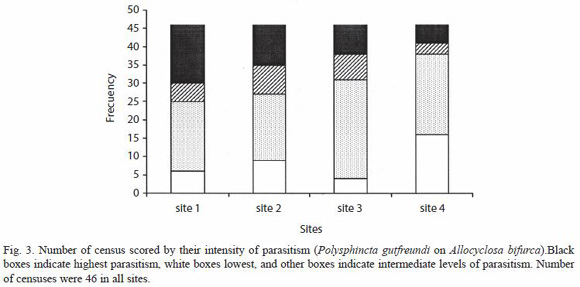
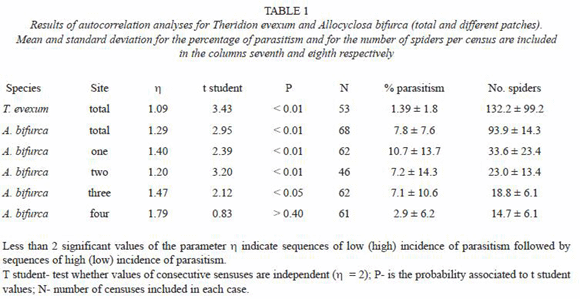
<body><![CDATA[<br> </p>     <p>    <br> <a name="f2"></a></p> </font>     <div style="text-align: center;"><img  src="/img/revistas/rbt/v56n2/art26i2.jpg" title="" alt=""  style="width: 580px; height: 445px;">    <br> </div> <font face="Courier New" size="2" style="font-family: verdana;"> </font><font face="Courier New" size="2" style="font-family: verdana;">     <p>In both spider species, the rate of parasitism was not related to the size of their population (<span style="font-style: italic;">T. evexum</span>: r = -0.001, p = .99, n = 55; <span  style="font-style: italic;">A. bifurca</span>: r = 0.13, p = 0.28, n = 68). Analyzing four different sites separately for <span  style="font-style: italic;">A. bifurca</span>, in only one was the parastism rate correlated with population size (r = 0.28, p = 0.027, n = 62). </p>     <p>Parasitism rates varied significantly over time. Autocorrelation analyses showed that both species tended to show periods with low rates in successive censuses, and other periods with successive high rates (<a  href="#t1">Table 1</a>). Separate analyses of <span  style="font-style: italic;">A. bifuca</span> parasitism at different sites showed the same trend in three of four sites (sites 1 to 3) with sufficient samples (<a href="#t1">Table 1</a>), the fourth site had the lowest mean spider number and its parasitism rate did not differ from what was expected from random (<a href="#t1">Table 1</a>). Furthermore, over-time rate of parasitism was significant higher at the site 1 and lower at the site 4 (Friedman test: X<sup>2</sup> = 9.76, n = 46, df = 2, p &lt; 0.02; <a href="#f3">Fig. 3</a>).    <br> </p>     <p>    <br> <a name="t1"></a></p> </font>     ]]></body>
<body><![CDATA[<div style="text-align: center;"><img  src="/img/revistas/rbt/v56n2/art26t1.gif" title="" alt=""  style="width: 580px; height: 299px;">    <br> </div> <font face="Courier New" size="2" style="font-family: verdana;"> </font><font face="Courier New" size="2" style="font-family: verdana;"><font  size="3">     <p><span style="font-weight: bold;">Discussion</span> </p> </font>     <p>The two pairs of host and parasitoid studied represent two different patterns in the population dynamics of tropical species: a highly seasonal fluctuation in which the populations of the host and the parasitoid are more or less in synchronized; and a relatively nonseasonal host whose parasitoid also shows little seasonality. The highly seasonal reproduction of <span style="font-style: italic;">T. evexum</span> resulted in a complete absence of appropriately sized hosts for <span style="font-style: italic;">Z. petronae</span> during about 5 months of the year (<a href="#f1">Fig. 1</a>). We suggest that <span  style="font-style: italic;">Z. petronae</span> may have another host species that it uses during at least this portion of the year. In contrast, <span style="font-style: italic;">A. bifurca</span> was present year round, and it was parasitized by <span  style="font-style: italic;">P. gutfreundi </span>throughout the year. </p>     <p>The spider <span style="font-style: italic;">A. bifurca</span> is unusual in having extremely low rates of movement between web sites; the mean residence time for marked mature females in one study was nearly eight weeks (Eberhard 2003). In addition, the distribution of spiders among different plants was quite patchy. Some particular plants that had a large population of <span style="font-style: italic;">A. bifurca</span> (&gt; 30 individuals) at one stage of this study were nearly deserted at others, despite the presence of substantial numbers of spiders on nearby plants. Similar patterns of fluctuation also occurred on different portions at another site in the Central valley (near San Antonio de Escazu, 1300 m, W. G. Eberhard, unpubl.). The patchiness of the parasitism of <span style="font-style: italic;">A. bifurca</span> by <span style="font-style: italic;">P. gutfreundi</span> at different sites at any given time of the year may be linked to these two traits of the host, low rates of movement and spider patchy distribution. We suspect that the parasitism patchiness results from a given female wasp learning and then returning to a particular patch of hosts day after day (Lessells 1985, Godfray 1993), particularly when patches have relatively high densities of spiders (<a href="#t1">Table 1</a>). We have seen on three occasions a female wasp attack several spiders on a given plant in the space of less than an hour (W. G. Eberhard in prep.). </p>     <p>Considering the little climatic fluctuation in the tropics (Cavelier and vargas 2002), it is somewhat unexpected the temporal population dynamics showed by <span style="font-style: italic;">T. evexum</span>. The population dynamic of this species closely resembles the dynamic of many temperate (Andrewartha and Birch 1982) or more seasonal tropical organisms (Robinson and Robinson 1973, Robinson and Lubin 1979, Janzen 1983). This suggests that relatively small climatic changes could trigger reproduction in <span style="font-style: italic;">T. evexum</span>, but it has not apparently effect on the reproduction of <span  style="font-style: italic;">A. bifurca</span>. However, long-term studies are needed to elucidate the effect of seasonal climatic changes on the reproduction of these tropical spider species. </p> <font size="3">     <p><span style="font-weight: bold;">Acknowledgments</span> </p> </font>     <p>We thank Luis Sandoval for helping with field work. Financial support was provided by the Universidad de Costa Rica.     <br> </p> </font> <hr style="width: 100%; height: 2px;"><font face="Courier New" size="2"  style="font-family: verdana;">     <p><span style="font-weight: bold;">Resumen</span> </p>     ]]></body>
<body><![CDATA[<p>Las tasas de parasitismo de <span style="font-style: italic;">Theridion evexum</span> por la avispa parasitoide <span  style="font-style: italic;">Zatypota petronae</span> y de <span  style="font-style: italic;">Allocyclosa bifurca</span> por <span  style="font-style: italic;">Polysphincta gutfreundi</span> fueron estudiadas durante dos años. El parasitismo en <span  style="font-style: italic;">T. evexum</span> fue muy bajo (promedio 1.39+1.8%) y restringido a aproximadamente siete meses del año. El parasitismo en <span style="font-style: italic;">A. bifurca</span> fue más alto (promedio 7.8+7.6%) y no mostró un claro patrón estacional. La reproducción de la araña hospedera <span style="font-style: italic;">T. evexum</span> fue muy estacional, con solamente una generación por año, mientras que los adultos de <span style="font-style: italic;">A. bifurca</span> estuvieron presentes todo el año. Autocorrelaciones de las tasas de parasitismo entre censos consecutivos en diferentes sitios sugiere que <span style="font-style: italic;">P. gutfreundi</span> tiende a retornar a los mismos sitios para parasitar las arañas hospederas durante algunas semanas. </p>     <p><span style="font-weight: bold;">Palabras clave:</span> Tasa de parasitismo, parasitoides, avispas koinobiontes, Theridiidae, Araneidae, Ichneumonidae    <br> </p> </font> <hr style="width: 100%; height: 2px;"><font face="Courier New" size="2"  style="font-family: verdana;">     <p></p> </font>     <div style="text-align: center;"><font><font face="Courier New" size="2"  style="font-family: verdana;">Received 05-II-2007. Corrected 23-X-2007. Accepted 29-IV-2008.</font></font></div> <font face="Courier New" size="2" style="font-family: verdana;">     <p> </p> <font size="3">     <p><span style="font-weight: bold;">References</span> </p> </font>     <!-- ref --><p>Andrewartha, H. G. &amp; L. C. Birch. 1982. Selection from the distribution and abundance of animals. University of Chicago, Chicago, Illinois, USA. &nbsp;&nbsp;&nbsp;&nbsp;&nbsp;&nbsp;&nbsp;&nbsp;[&#160;<a href="javascript:void(0);" onclick="javascript: window.open('/scielo.php?script=sci_nlinks&ref=1263242&pid=S0034-7744200800020002600001&lng=','','width=640,height=500,resizable=yes,scrollbars=1,menubar=yes,');">Links</a>&#160;]<!-- end-ref --><!-- ref --><p>Barrantes, G. &amp; J. L. Weng. 2007. Natural history, courtship, feeding behaviour and parasites of <span style="font-style: italic;">Theridion evexum</span> (Araneae: Theridiidae). Bull. British Arachnol. Soc. 14: 61 – 65. &nbsp;&nbsp;&nbsp;&nbsp;&nbsp;&nbsp;&nbsp;&nbsp;[&#160;<a href="javascript:void(0);" onclick="javascript: window.open('/scielo.php?script=sci_nlinks&ref=1263243&pid=S0034-7744200800020002600002&lng=','','width=640,height=500,resizable=yes,scrollbars=1,menubar=yes,');">Links</a>&#160;]<!-- end-ref --><!-- ref --><p>Bergoeing, J. P. 1998. Geomorfología de Costa Rica. Instituto Geográfico Nacional. San José, Costa Rica. &nbsp;&nbsp;&nbsp;&nbsp;&nbsp;&nbsp;&nbsp;&nbsp;[&#160;<a href="javascript:void(0);" onclick="javascript: window.open('/scielo.php?script=sci_nlinks&ref=1263244&pid=S0034-7744200800020002600003&lng=','','width=640,height=500,resizable=yes,scrollbars=1,menubar=yes,');">Links</a>&#160;]<!-- end-ref --><!-- ref --><p>Cavelier, J. &amp; G. Vargas. 2002. Procesos hidrológicos. pp. 145 – 165. <span style="font-style: italic;">In</span> M. R. Guariguata &amp; G. H. Kattan (eds.), Ecología y conservación de bosques tropicales. Tecnológica de Costa Rica, Cartago, Costa Rica. &nbsp;&nbsp;&nbsp;&nbsp;&nbsp;&nbsp;&nbsp;&nbsp;[&#160;<a href="javascript:void(0);" onclick="javascript: window.open('/scielo.php?script=sci_nlinks&ref=1263245&pid=S0034-7744200800020002600004&lng=','','width=640,height=500,resizable=yes,scrollbars=1,menubar=yes,');">Links</a>&#160;]<!-- end-ref --><!-- ref --><p>Eberhard, W. G. 2003. Substitution of silk stabilimenta for egg sacs by <span style="font-style: italic;">Allocyclosa bifurca</span> (Araneae: Araneidae) suggests that silk stabilimenta function as camouflage devices. Behaviour 140: 847 – 868. &nbsp;&nbsp;&nbsp;&nbsp;&nbsp;&nbsp;&nbsp;&nbsp;[&#160;<a href="javascript:void(0);" onclick="javascript: window.open('/scielo.php?script=sci_nlinks&ref=1263246&pid=S0034-7744200800020002600005&lng=','','width=640,height=500,resizable=yes,scrollbars=1,menubar=yes,');">Links</a>&#160;]<!-- end-ref --><!-- ref --><p>Eberhard, W. G. 2000a. The natural history and behavior of <span  style="font-style: italic;">Hymenoepimecis argyraphaga</span> (Hymenoptera: Ichneumonidae) as parasitoid of <span  style="font-style: italic;">Plesiometa argyra</span> (Araneae: Tetragnathidae). J. Hym. Res. 9: 220 – 240. &nbsp;&nbsp;&nbsp;&nbsp;&nbsp;&nbsp;&nbsp;&nbsp;[&#160;<a href="javascript:void(0);" onclick="javascript: window.open('/scielo.php?script=sci_nlinks&ref=1263247&pid=S0034-7744200800020002600006&lng=','','width=640,height=500,resizable=yes,scrollbars=1,menubar=yes,');">Links</a>&#160;]<!-- end-ref --><!-- ref --><p>Eberhard, W. G. 2000b. Spider web manipulation by a wasp larva. Nature 406: 255 – 256. &nbsp;&nbsp;&nbsp;&nbsp;&nbsp;&nbsp;&nbsp;&nbsp;[&#160;<a href="javascript:void(0);" onclick="javascript: window.open('/scielo.php?script=sci_nlinks&ref=1263248&pid=S0034-7744200800020002600007&lng=','','width=640,height=500,resizable=yes,scrollbars=1,menubar=yes,');">Links</a>&#160;]<!-- end-ref --><!-- ref --><p>Fincke, O. M., L. Higgins, &amp; E. Rojas. 1990. Parasitsm of <span  style="font-style: italic;">Nephila clavipes</span> (Araneae: Tetragnathidae) by an ichneumonid (Hymenoptera, Polysphinctini) in Panama. J. Arachnol. 18: 321 – 329. &nbsp;&nbsp;&nbsp;&nbsp;&nbsp;&nbsp;&nbsp;&nbsp;[&#160;<a href="javascript:void(0);" onclick="javascript: window.open('/scielo.php?script=sci_nlinks&ref=1263249&pid=S0034-7744200800020002600008&lng=','','width=640,height=500,resizable=yes,scrollbars=1,menubar=yes,');">Links</a>&#160;]<!-- end-ref --><!-- ref --><p>Gauld, I. D., J. A. Ugalde G. &amp; P. Hanson. 1998. Guía de los Pimplinae de Costa Rica (Hymenoptera: Ichneumonidae). Rev. Biol. Trop. 46 (Supl. 1): 1 – 189. &nbsp;&nbsp;&nbsp;&nbsp;&nbsp;&nbsp;&nbsp;&nbsp;[&#160;<a href="javascript:void(0);" onclick="javascript: window.open('/scielo.php?script=sci_nlinks&ref=1263250&pid=S0034-7744200800020002600009&lng=','','width=640,height=500,resizable=yes,scrollbars=1,menubar=yes,');">Links</a>&#160;]<!-- end-ref --><!-- ref --><p>Godfray, H. C. J. 1993. Parasitoids. Behavioral and evolutionary ecology. Princeton University, Princeton, New Jersey, USA. &nbsp;&nbsp;&nbsp;&nbsp;&nbsp;&nbsp;&nbsp;&nbsp;[&#160;<a href="javascript:void(0);" onclick="javascript: window.open('/scielo.php?script=sci_nlinks&ref=1263251&pid=S0034-7744200800020002600010&lng=','','width=640,height=500,resizable=yes,scrollbars=1,menubar=yes,');">Links</a>&#160;]<!-- end-ref --><!-- ref --><p>Gauld, I. D. &amp; S. R. Shaw. 1995. The ichneumonoid families. pp. 389 – 431. <span style="font-style: italic;">In</span> P. E. Hanson &amp; L. D. Gauld (eds.), The Hymenoptera of Costa Rica. Oxford University, Oxford, United Kingdom &nbsp;&nbsp;&nbsp;&nbsp;&nbsp;&nbsp;&nbsp;&nbsp;[&#160;<a href="javascript:void(0);" onclick="javascript: window.open('/scielo.php?script=sci_nlinks&ref=1263252&pid=S0034-7744200800020002600011&lng=','','width=640,height=500,resizable=yes,scrollbars=1,menubar=yes,');">Links</a>&#160;]<!-- end-ref --><!-- ref --><p>Hanson, P. E. &amp; I. D. Gauld. 2006. Hymenoptera de la Región Neotropical. American Entomological Institute, Gainesville, Florida, USA. &nbsp;&nbsp;&nbsp;&nbsp;&nbsp;&nbsp;&nbsp;&nbsp;[&#160;<a href="javascript:void(0);" onclick="javascript: window.open('/scielo.php?script=sci_nlinks&ref=1263253&pid=S0034-7744200800020002600012&lng=','','width=640,height=500,resizable=yes,scrollbars=1,menubar=yes,');">Links</a>&#160;]<!-- end-ref --><!-- ref --><p>Janzen, D. H. 1983. Insects. pp. 619 – 650. <span  style="font-style: italic;">In</span> D.H. Janzen (ed.), Costa Rican natural history. The University of Chicago Press, Chicago, Illinois, USA. &nbsp;&nbsp;&nbsp;&nbsp;&nbsp;&nbsp;&nbsp;&nbsp;[&#160;<a href="javascript:void(0);" onclick="javascript: window.open('/scielo.php?script=sci_nlinks&ref=1263254&pid=S0034-7744200800020002600013&lng=','','width=640,height=500,resizable=yes,scrollbars=1,menubar=yes,');">Links</a>&#160;]<!-- end-ref --><!-- ref --><p>Lessells, C. M. 1985. Parasitoid foraging: should parasitism be density dependent? J. Anim. Ecol. 54: 27 – 41. &nbsp;&nbsp;&nbsp;&nbsp;&nbsp;&nbsp;&nbsp;&nbsp;[&#160;<a href="javascript:void(0);" onclick="javascript: window.open('/scielo.php?script=sci_nlinks&ref=1263255&pid=S0034-7744200800020002600014&lng=','','width=640,height=500,resizable=yes,scrollbars=1,menubar=yes,');">Links</a>&#160;]<!-- end-ref --><!-- ref --><p>Nielsen, E. 1923. Contributions to the life history of the Pimpline spider parasites (<span style="font-style: italic;">Polysphincta</span>, <span style="font-style: italic;">Zaglyptus</span>, <span  style="font-style: italic;">Tromatobia</span>) (Hym. Ichneum.). Entomologisk Forening 14: 10 – 205. &nbsp;&nbsp;&nbsp;&nbsp;&nbsp;&nbsp;&nbsp;&nbsp;[&#160;<a href="javascript:void(0);" onclick="javascript: window.open('/scielo.php?script=sci_nlinks&ref=1263256&pid=S0034-7744200800020002600015&lng=','','width=640,height=500,resizable=yes,scrollbars=1,menubar=yes,');">Links</a>&#160;]<!-- end-ref --><!-- ref --><p>Nielsen, E. 1932a. The biology of spiders. Vol. 1. Levin &amp; Munksgaard. Copenhagen, Denmark. &nbsp;&nbsp;&nbsp;&nbsp;&nbsp;&nbsp;&nbsp;&nbsp;[&#160;<a href="javascript:void(0);" onclick="javascript: window.open('/scielo.php?script=sci_nlinks&ref=1263257&pid=S0034-7744200800020002600016&lng=','','width=640,height=500,resizable=yes,scrollbars=1,menubar=yes,');">Links</a>&#160;]<!-- end-ref --><!-- ref --><p>Nielsen, E. 1932b: The biology of spiders. Vol. 2. Levin &amp; Munksgaard. Copenhagen, Denmark. &nbsp;&nbsp;&nbsp;&nbsp;&nbsp;&nbsp;&nbsp;&nbsp;[&#160;<a href="javascript:void(0);" onclick="javascript: window.open('/scielo.php?script=sci_nlinks&ref=1263258&pid=S0034-7744200800020002600017&lng=','','width=640,height=500,resizable=yes,scrollbars=1,menubar=yes,');">Links</a>&#160;]<!-- end-ref --><!-- ref --><p>Robinson, M. H. and Y. D. Lubin. 1979. Specialists and generalists: the ecology and behavior of some webbuilding spiders from Papua New Guinea. Pac. Ins. 21: 133 – 164. &nbsp;&nbsp;&nbsp;&nbsp;&nbsp;&nbsp;&nbsp;&nbsp;[&#160;<a href="javascript:void(0);" onclick="javascript: window.open('/scielo.php?script=sci_nlinks&ref=1263259&pid=S0034-7744200800020002600018&lng=','','width=640,height=500,resizable=yes,scrollbars=1,menubar=yes,');">Links</a>&#160;]<!-- end-ref --><!-- ref --><p>Robinson, M. H. &amp; B. Robinson. 1973. Ecology and behavior of the Giant Wood Spider <span style="font-style: italic;">Nephila maculata </span>(Fabricius) New Guinea. Smithson. Contrib. Zool. 149: 1–76. &nbsp;&nbsp;&nbsp;&nbsp;&nbsp;&nbsp;&nbsp;&nbsp;[&#160;<a href="javascript:void(0);" onclick="javascript: window.open('/scielo.php?script=sci_nlinks&ref=1263260&pid=S0034-7744200800020002600019&lng=','','width=640,height=500,resizable=yes,scrollbars=1,menubar=yes,');">Links</a>&#160;]<!-- end-ref --><!-- ref --><p>Sokal, R. R. &amp; F. J. Rohlf. 1995. Biometry. W. F. Freeman, New York, USA. &nbsp;&nbsp;&nbsp;&nbsp;&nbsp;&nbsp;&nbsp;&nbsp;[&#160;<a href="javascript:void(0);" onclick="javascript: window.open('/scielo.php?script=sci_nlinks&ref=1263261&pid=S0034-7744200800020002600020&lng=','','width=640,height=500,resizable=yes,scrollbars=1,menubar=yes,');">Links</a>&#160;]<!-- end-ref --><!-- ref --><p>Weng, J. L. &amp; G. Barrantes. 2007. Natural History and Larval Behavior of the parasitoid Zatypota petronae (Hymenoptera: Ichneumonidae). J. Hym. Res. 16: 327-336. &nbsp;&nbsp;&nbsp;&nbsp;&nbsp;&nbsp;&nbsp;&nbsp;[&#160;<a href="javascript:void(0);" onclick="javascript: window.open('/scielo.php?script=sci_nlinks&ref=1263262&pid=S0034-7744200800020002600021&lng=','','width=640,height=500,resizable=yes,scrollbars=1,menubar=yes,');">Links</a>&#160;]<!-- end-ref --><br> </font>      ]]></body><back>
<ref-list>
<ref id="B1">
<nlm-citation citation-type="book">
<person-group person-group-type="author">
<name>
<surname><![CDATA[Andrewartha]]></surname>
<given-names><![CDATA[H. G]]></given-names>
</name>
<name>
<surname><![CDATA[Birch]]></surname>
<given-names><![CDATA[L. C]]></given-names>
</name>
</person-group>
<source><![CDATA[Selection from the distribution and abundance of animals]]></source>
<year>1982</year>
<publisher-loc><![CDATA[Chicago^eIllinois Illinois]]></publisher-loc>
<publisher-name><![CDATA[University of Chicago]]></publisher-name>
</nlm-citation>
</ref>
<ref id="B2">
<nlm-citation citation-type="journal">
<person-group person-group-type="author">
<name>
<surname><![CDATA[Barrantes]]></surname>
<given-names><![CDATA[G]]></given-names>
</name>
<name>
<surname><![CDATA[Weng]]></surname>
<given-names><![CDATA[J. L]]></given-names>
</name>
</person-group>
<article-title xml:lang="en"><![CDATA[Natural history, courtship, feeding behaviour and parasites of Theridion evexum (Araneae: Theridiidae)]]></article-title>
<source><![CDATA[Bull. British Arachnol. Soc]]></source>
<year>2007</year>
<volume>14</volume>
<page-range>61 - 65</page-range></nlm-citation>
</ref>
<ref id="B3">
<nlm-citation citation-type="book">
<person-group person-group-type="author">
<name>
<surname><![CDATA[Bergoeing]]></surname>
<given-names><![CDATA[J. P]]></given-names>
</name>
</person-group>
<source><![CDATA[Geomorfología de Costa Rica]]></source>
<year>1998</year>
<publisher-loc><![CDATA[San José ]]></publisher-loc>
<publisher-name><![CDATA[Instituto Geográfico Nacional]]></publisher-name>
</nlm-citation>
</ref>
<ref id="B4">
<nlm-citation citation-type="book">
<person-group person-group-type="author">
<name>
<surname><![CDATA[Cavelier]]></surname>
<given-names><![CDATA[J]]></given-names>
</name>
<name>
<surname><![CDATA[Vargas]]></surname>
<given-names><![CDATA[G]]></given-names>
</name>
</person-group>
<article-title xml:lang="es"><![CDATA[Procesos hidrológicos]]></article-title>
<person-group person-group-type="editor">
<name>
<surname><![CDATA[Guariguata]]></surname>
<given-names><![CDATA[M. R]]></given-names>
</name>
<name>
<surname><![CDATA[Kattan]]></surname>
<given-names><![CDATA[G. H]]></given-names>
</name>
</person-group>
<source><![CDATA[Ecología y conservación de bosques tropicales]]></source>
<year>2002</year>
<page-range>145 - 165</page-range><publisher-loc><![CDATA[Cartago ]]></publisher-loc>
<publisher-name><![CDATA[Tecnológica de Costa Rica]]></publisher-name>
</nlm-citation>
</ref>
<ref id="B5">
<nlm-citation citation-type="journal">
<person-group person-group-type="author">
<name>
<surname><![CDATA[Eberhard]]></surname>
<given-names><![CDATA[W. G]]></given-names>
</name>
</person-group>
<article-title xml:lang="en"><![CDATA[Substitution of silk stabilimenta for egg sacs by Allocyclosa bifurca (Araneae: Araneidae) suggests that silk stabilimenta function as camouflage devices]]></article-title>
<source><![CDATA[Behaviour]]></source>
<year>2003</year>
<volume>140</volume>
<page-range>847 - 868</page-range></nlm-citation>
</ref>
<ref id="B6">
<nlm-citation citation-type="journal">
<person-group person-group-type="author">
<name>
<surname><![CDATA[Eberhard]]></surname>
<given-names><![CDATA[W. G]]></given-names>
</name>
</person-group>
<article-title xml:lang="en"><![CDATA[The natural history and behavior of Hymenoepimecis argyraphaga (Hymenoptera: Ichneumonidae) as parasitoid of Plesiometa argyra (Araneae: Tetragnathidae)]]></article-title>
<source><![CDATA[J. Hym. Res]]></source>
<year>2000</year>
<volume>9</volume>
<page-range>220 - 240</page-range></nlm-citation>
</ref>
<ref id="B7">
<nlm-citation citation-type="journal">
<person-group person-group-type="author">
<name>
<surname><![CDATA[Eberhard]]></surname>
<given-names><![CDATA[W. G]]></given-names>
</name>
</person-group>
<article-title xml:lang="en"><![CDATA[Spider web manipulation by a wasp larva]]></article-title>
<source><![CDATA[Nature]]></source>
<year>2000</year>
<volume>406</volume>
<page-range>255 - 256</page-range></nlm-citation>
</ref>
<ref id="B8">
<nlm-citation citation-type="journal">
<person-group person-group-type="author">
<name>
<surname><![CDATA[Fincke]]></surname>
<given-names><![CDATA[O. M]]></given-names>
</name>
<name>
<surname><![CDATA[Higgins]]></surname>
<given-names><![CDATA[L]]></given-names>
</name>
<name>
<surname><![CDATA[Rojas]]></surname>
<given-names><![CDATA[E]]></given-names>
</name>
</person-group>
<article-title xml:lang="en"><![CDATA[Parasitsm of Nephila clavipes (Araneae: Tetragnathidae) by an ichneumonid (Hymenoptera, Polysphinctini) in Panama]]></article-title>
<source><![CDATA[J. Arachnol]]></source>
<year>1990</year>
<volume>18</volume>
<page-range>321 - 329</page-range></nlm-citation>
</ref>
<ref id="B9">
<nlm-citation citation-type="journal">
<person-group person-group-type="author">
<name>
<surname><![CDATA[Gauld]]></surname>
<given-names><![CDATA[I. D]]></given-names>
</name>
<name>
<surname><![CDATA[Ugalde G]]></surname>
<given-names><![CDATA[J. A]]></given-names>
</name>
<name>
<surname><![CDATA[Hanson]]></surname>
<given-names><![CDATA[P]]></given-names>
</name>
</person-group>
<article-title xml:lang="es"><![CDATA[Guía de los Pimplinae de Costa Rica (Hymenoptera: Ichneumonidae)]]></article-title>
<source><![CDATA[Rev. Biol. Trop]]></source>
<year>1998</year>
<volume>46</volume>
<numero>^s1</numero>
<issue>^s1</issue>
<supplement>1</supplement>
<page-range>1 - 189</page-range></nlm-citation>
</ref>
<ref id="B10">
<nlm-citation citation-type="book">
<person-group person-group-type="author">
<name>
<surname><![CDATA[Godfray]]></surname>
<given-names><![CDATA[H. C. J]]></given-names>
</name>
</person-group>
<source><![CDATA[Parasitoids: Behavioral and evolutionary ecology]]></source>
<year>1993</year>
<publisher-loc><![CDATA[Princeton^eNew Jersey New Jersey]]></publisher-loc>
<publisher-name><![CDATA[Princeton University]]></publisher-name>
</nlm-citation>
</ref>
<ref id="B11">
<nlm-citation citation-type="book">
<person-group person-group-type="author">
<name>
<surname><![CDATA[Gauld]]></surname>
<given-names><![CDATA[I. D]]></given-names>
</name>
<name>
<surname><![CDATA[Shaw]]></surname>
<given-names><![CDATA[S. R]]></given-names>
</name>
</person-group>
<article-title xml:lang="en"><![CDATA[The ichneumonoid families]]></article-title>
<person-group person-group-type="editor">
<name>
<surname><![CDATA[Hanson]]></surname>
<given-names><![CDATA[P. E]]></given-names>
</name>
<name>
<surname><![CDATA[Gauld]]></surname>
<given-names><![CDATA[L. D]]></given-names>
</name>
</person-group>
<source><![CDATA[The Hymenoptera of Costa Rica]]></source>
<year>1995</year>
<page-range>389 - 431</page-range><publisher-loc><![CDATA[Oxford ]]></publisher-loc>
<publisher-name><![CDATA[Oxford University]]></publisher-name>
</nlm-citation>
</ref>
<ref id="B12">
<nlm-citation citation-type="book">
<person-group person-group-type="author">
<name>
<surname><![CDATA[Hanson]]></surname>
<given-names><![CDATA[P. E]]></given-names>
</name>
<name>
<surname><![CDATA[Gauld]]></surname>
<given-names><![CDATA[I. D]]></given-names>
</name>
</person-group>
<source><![CDATA[Hymenoptera de la Región Neotropical]]></source>
<year>2006</year>
<publisher-loc><![CDATA[Gainesville^eFlorida Florida]]></publisher-loc>
<publisher-name><![CDATA[American Entomological Institute]]></publisher-name>
</nlm-citation>
</ref>
<ref id="B13">
<nlm-citation citation-type="book">
<person-group person-group-type="author">
<name>
<surname><![CDATA[Janzen]]></surname>
<given-names><![CDATA[D. H]]></given-names>
</name>
</person-group>
<article-title xml:lang="en"><![CDATA[Insects]]></article-title>
<person-group person-group-type="editor">
<name>
<surname><![CDATA[Janzen]]></surname>
<given-names><![CDATA[D.H]]></given-names>
</name>
</person-group>
<source><![CDATA[Costa Rican natural history]]></source>
<year>1983</year>
<page-range>619 - 650</page-range><publisher-loc><![CDATA[Chicago^eIllinois Illinois]]></publisher-loc>
<publisher-name><![CDATA[The University of Chicago Press]]></publisher-name>
</nlm-citation>
</ref>
<ref id="B14">
<nlm-citation citation-type="journal">
<person-group person-group-type="author">
<name>
<surname><![CDATA[Lessells]]></surname>
<given-names><![CDATA[C. M]]></given-names>
</name>
</person-group>
<article-title xml:lang="en"><![CDATA[Parasitoid foraging: should parasitism be density dependent?]]></article-title>
<source><![CDATA[J. Anim. Ecol]]></source>
<year>1985</year>
<volume>54</volume>
<page-range>27 - 41</page-range></nlm-citation>
</ref>
<ref id="B15">
<nlm-citation citation-type="journal">
<person-group person-group-type="author">
<name>
<surname><![CDATA[Nielsen]]></surname>
<given-names><![CDATA[E]]></given-names>
</name>
</person-group>
<article-title xml:lang="en"><![CDATA[Contributions to the life history of the Pimpline spider parasites (Polysphincta, Zaglyptus, Tromatobia) (Hym. Ichneum.)]]></article-title>
<source><![CDATA[Entomologisk Forening]]></source>
<year>1923</year>
<volume>14</volume>
<page-range>10 - 205</page-range></nlm-citation>
</ref>
<ref id="B16">
<nlm-citation citation-type="book">
<person-group person-group-type="author">
<name>
<surname><![CDATA[Nielsen]]></surname>
<given-names><![CDATA[E]]></given-names>
</name>
</person-group>
<source><![CDATA[The biology of spiders: Vol. 1]]></source>
<year>1932</year>
<publisher-loc><![CDATA[Copenhagen ]]></publisher-loc>
<publisher-name><![CDATA[Levin & Munksgaard]]></publisher-name>
</nlm-citation>
</ref>
<ref id="B17">
<nlm-citation citation-type="book">
<person-group person-group-type="author">
<name>
<surname><![CDATA[Nielsen]]></surname>
<given-names><![CDATA[E]]></given-names>
</name>
</person-group>
<source><![CDATA[The biology of spiders: Vol. 2]]></source>
<year>1932</year>
<publisher-loc><![CDATA[Copenhagen ]]></publisher-loc>
<publisher-name><![CDATA[Levin & Munksgaard]]></publisher-name>
</nlm-citation>
</ref>
<ref id="B18">
<nlm-citation citation-type="journal">
<person-group person-group-type="author">
<name>
<surname><![CDATA[Robinson]]></surname>
<given-names><![CDATA[M. H]]></given-names>
</name>
<name>
<surname><![CDATA[Lubin]]></surname>
<given-names><![CDATA[Y. D]]></given-names>
</name>
</person-group>
<article-title xml:lang="en"><![CDATA[Specialists and generalists: the ecology and behavior of some webbuilding spiders from Papua New Guinea]]></article-title>
<source><![CDATA[Pac. Ins]]></source>
<year>1979</year>
<volume>21</volume>
<page-range>133 - 164</page-range></nlm-citation>
</ref>
<ref id="B19">
<nlm-citation citation-type="journal">
<person-group person-group-type="author">
<name>
<surname><![CDATA[Robinson]]></surname>
<given-names><![CDATA[M. H]]></given-names>
</name>
<name>
<surname><![CDATA[Robinson]]></surname>
<given-names><![CDATA[B]]></given-names>
</name>
</person-group>
<article-title xml:lang="en"><![CDATA[Ecology and behavior of the Giant Wood Spider Nephila maculata (Fabricius) New Guinea]]></article-title>
<source><![CDATA[Smithson. Contrib. Zool]]></source>
<year>1973</year>
<volume>149</volume>
<page-range>1-76</page-range></nlm-citation>
</ref>
<ref id="B20">
<nlm-citation citation-type="book">
<person-group person-group-type="author">
<name>
<surname><![CDATA[Sokal]]></surname>
<given-names><![CDATA[R. R]]></given-names>
</name>
<name>
<surname><![CDATA[Rohlf]]></surname>
<given-names><![CDATA[F. J]]></given-names>
</name>
</person-group>
<source><![CDATA[Biometry]]></source>
<year>1995</year>
<publisher-loc><![CDATA[^eNew York New York]]></publisher-loc>
<publisher-name><![CDATA[W. F. Freeman]]></publisher-name>
</nlm-citation>
</ref>
<ref id="B21">
<nlm-citation citation-type="journal">
<person-group person-group-type="author">
<name>
<surname><![CDATA[Weng]]></surname>
<given-names><![CDATA[J. L]]></given-names>
</name>
<name>
<surname><![CDATA[Barrantes]]></surname>
<given-names><![CDATA[G]]></given-names>
</name>
</person-group>
<article-title xml:lang="en"><![CDATA[Natural History and Larval Behavior of the parasitoid Zatypota petronae (Hymenoptera: Ichneumonidae)]]></article-title>
<source><![CDATA[J. Hym. Res]]></source>
<year>2007</year>
<volume>16</volume>
<page-range>327-336</page-range></nlm-citation>
</ref>
</ref-list>
</back>
</article>