<?xml version="1.0" encoding="ISO-8859-1"?><article xmlns:mml="http://www.w3.org/1998/Math/MathML" xmlns:xlink="http://www.w3.org/1999/xlink" xmlns:xsi="http://www.w3.org/2001/XMLSchema-instance">
<front>
<journal-meta>
<journal-id>0034-7744</journal-id>
<journal-title><![CDATA[Revista de Biología Tropical]]></journal-title>
<abbrev-journal-title><![CDATA[Rev. biol. trop]]></abbrev-journal-title>
<issn>0034-7744</issn>
<publisher>
<publisher-name><![CDATA[Universidad de Costa Rica]]></publisher-name>
</publisher>
</journal-meta>
<article-meta>
<article-id>S0034-77442008000100025</article-id>
<title-group>
<article-title xml:lang="en"><![CDATA[The annual life history of a population of the aquatic Coleopteran Derallus angustus (Coleoptera: Hydrophilidae)]]></article-title>
</title-group>
<contrib-group>
<contrib contrib-type="author">
<name>
<surname><![CDATA[Fernández]]></surname>
<given-names><![CDATA[Liliana Alicia]]></given-names>
</name>
<xref ref-type="aff" rid="A01"/>
</contrib>
</contrib-group>
<aff id="A01">
<institution><![CDATA[,División Entomología del Museo de La Plata  ]]></institution>
<addr-line><![CDATA[La Plata ]]></addr-line>
<country>Argentina</country>
</aff>
<pub-date pub-type="pub">
<day>00</day>
<month>03</month>
<year>2008</year>
</pub-date>
<pub-date pub-type="epub">
<day>00</day>
<month>03</month>
<year>2008</year>
</pub-date>
<volume>56</volume>
<numero>1</numero>
<fpage>345</fpage>
<lpage>348</lpage>
<copyright-statement/>
<copyright-year/>
<self-uri xlink:href="http://www.scielo.sa.cr/scielo.php?script=sci_arttext&amp;pid=S0034-77442008000100025&amp;lng=en&amp;nrm=iso"></self-uri><self-uri xlink:href="http://www.scielo.sa.cr/scielo.php?script=sci_abstract&amp;pid=S0034-77442008000100025&amp;lng=en&amp;nrm=iso"></self-uri><self-uri xlink:href="http://www.scielo.sa.cr/scielo.php?script=sci_pdf&amp;pid=S0034-77442008000100025&amp;lng=en&amp;nrm=iso"></self-uri><abstract abstract-type="short" xml:lang="en"><p><![CDATA[Derallus Sharp, 1882 is a Neotropical genus of aquatic coleopterans that belongs in the tribe Berosini and includes 15 species. D. angustus Sharp is widely distributed from Guatemala to Argentina. The population dynamics of this species was studied by periodic sampling of a natural population from the southernmost Subtropical Domain of the Neotropical Region. The study site was near Punta Lara (34°47’ S, 58°01’ W; Ensenada, Buenos Aires province, Argentina). Twenty seven samples consisting of 20 units of aquatic vegetation (200 cm² each) were taken during one year. Larvae and adults were removed from the vegetation and counted (pupae were not studied). There was a peak of first instar larvae abundance at the end of spring, and another at the end of summer. Adults and third instar larvae were present throughout the whole year. The population is interpreted as being univoltine and including two periods of enhanced reproductive activity. Rev. Biol. Trop. 56 (1): 345-348. Epub 2008 March 31.]]></p></abstract>
<abstract abstract-type="short" xml:lang="es"><p><![CDATA[Derallus Sharp, 1882, de distribución Neotropical, pertenece a la tribu Berosini y está representado por 15 especies. D. angustus Sharp está ampliamente distribuida desde Guatemala hasta Argentina. El objetivo de este trabajo es el estudio de la dinámica poblacional de esta especie, en un limnótopo ubicado en el extremo sur del Dominio Subtropical de la Región Neotropical. El sitio de muestreo está localizado en Punta Lara (34°47’ S, 58°01’ W, Ensenada, Buenos Aires Province, Argentina). Se realizaron 27 muestreos durante un período de un año, cada uno consistió en la extracción de 20 muestras al azar de 200 cm² de vegetación flotante. El estado de pupa no fue incluido en este estudio. Se reconocieron dos picos de máxima abundancia del primer estadio larval (el primero a fines de primavera y el otro a fines del verano). Durante todo el período de estudio se registraron tanto adultos como larvas de tercer estadio. Se interpreta que la población es univoltina con dos períodos de actividad reproductiva.]]></p></abstract>
<kwd-group>
<kwd lng="en"><![CDATA[aquatic insects]]></kwd>
<kwd lng="en"><![CDATA[Hydrophilidae]]></kwd>
<kwd lng="en"><![CDATA[Derallus angustus]]></kwd>
<kwd lng="en"><![CDATA[population dynamics]]></kwd>
<kwd lng="en"><![CDATA[Argentina]]></kwd>
<kwd lng="es"><![CDATA[insectos acuáticos]]></kwd>
<kwd lng="es"><![CDATA[Hydrophilidae]]></kwd>
<kwd lng="es"><![CDATA[Derallus angustus]]></kwd>
<kwd lng="es"><![CDATA[dinámica poblacional]]></kwd>
<kwd lng="es"><![CDATA[Argentina]]></kwd>
</kwd-group>
</article-meta>
</front><body><![CDATA[ <div style="text-align: center;"><font face="Verdana" size="4">     <p><span style="font-weight: bold;">The annual life history of a population of the aquatic Coleopteran <span style="font-style: italic;">Derallus angustus</span> (Coleoptera: Hydrophilidae)</span> </p> </font></div> <font face="Verdana" size="2">     <p><span style="font-weight: bold;">Liliana Alicia Fernández</span> </p>     <p>División Entomología del Museo de La Plata. Paseo del Bosque, La Plata, 1900, Argentina; <a  href="mailto:liliafer@museo.fcnym.unlp.edu.ar">liliafer@museo.fcnym.unlp.edu.ar</a> </p>     <p> </p> </font> <hr style="width: 100%; height: 2px;"><font face="Verdana" size="2">     <p><span style="font-weight: bold;">Abstract:</span> <span  style="font-style: italic;">Derallus</span> Sharp, 1882 is a Neotropical genus of aquatic coleopterans that belongs in the tribe Berosini and includes 15 species. <span style="font-style: italic;">D. angustus</span> Sharp is widely distributed from Guatemala to Argentina. The population dynamics of this species was studied by periodic sampling of a natural population from the southernmost Subtropical Domain of the Neotropical Region. The study site was near Punta Lara (34°47’ S, 58°01’ W; Ensenada, Buenos Aires province, Argentina). Twenty seven samples consisting of 20 units of aquatic vegetation (200 cm² each) were taken during one year. Larvae and adults were removed from the vegetation and counted (pupae were not studied). There was a peak of first instar larvae abundance at the end of spring, and another at the end of summer. Adults and third instar larvae were present throughout the whole year. The population is interpreted as being univoltine and including two periods of enhanced reproductive activity. Rev. Biol. Trop. 56 (1): 345-348. Epub 2008 March 31. </p>     <p><span style="font-weight: bold;">Key words:</span> aquatic insects, Hydrophilidae, <span style="font-style: italic;">Derallus angustus</span>, population dynamics, Argentina.</p> </font> <hr style="width: 100%; height: 2px;"><font face="Verdana" size="2">     <p> </p>     <p><span style="font-style: italic;">Derallus</span> is a neotropical genus of the tribe Berosini and includes 15 species of aquatic coleopterans (Oliva 1981, 1983, 1995, Oliva <span  style="font-style: italic;">et al</span>. 1998, Hansen 1999). <span  style="font-style: italic;">D. angustus </span>Sharp is widely distributed from Guatemala to Argentina, and in the last country it has been recorded in Salta, Formosa, Chaco, Santa Fe, Corrientes, Entre Ríos, and Buenos Aires provinces (Fernández and Bachmann 1998). This species inhabit lentic environments covered by aquatic plants through which larvae and adults slowly moves. </p>     <p>Larval descriptions of this genera are scarce. Spangler (1966) carried out the first, on larvae of <span style="font-style: italic;">Derallus rudis</span> Sharp ,1887. Later, Archangelsky and Durand (1992) described all the preimaginal stages of <span  style="font-style: italic;">D. angustus</span>. Recently, Archangelsky and Fernández (2005) described the larvae of <span  style="font-style: italic;">D. paranensis</span> Oliva, 1981. No population studies have been carried out yet. The purpose of this research was to study the population dynamics of this species by periodic sampling of a natural population from the southernmost Subtropical Domain of the Neotropical Region (Cabrera and Willink 1980). </p> <font size="3">     ]]></body>
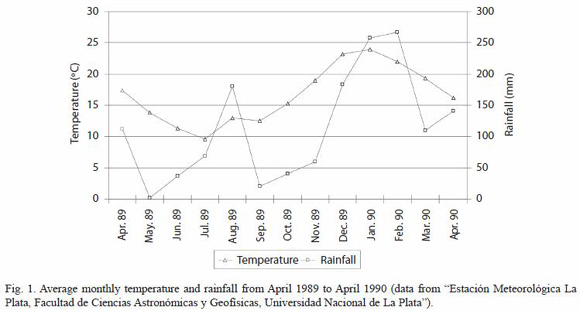
<body><![CDATA[<p><span style="font-weight: bold;">Materials and methods</span> </p> </font>     <p>The study site was a permanent water body, located near Punta Lara (34°47’ S, 58°01’ W; Ensenada, Buenos Aires Province, Argentina). This area represents the southern end of a "gallery forest" and has a subtropical and tropical floristic composition. The water level in the selected pond is partially influenced by the tides of the Río de La Plata river, which is approximately 200 m from it. During the sampling period the water body was covered by <span style="font-style: italic;">Salvinia rotundifolia</span> Wild., which was observed during the whole year, <span  style="font-style: italic;">Pistia stratiotes</span> L., <span  style="font-style: italic;">Spirodela intermedia</span> W. Koch, <span  style="font-style: italic;">Lemna</span> sp. and <span  style="font-style: italic;">Hydrocotyle ranunculoides</span> L. Twenty seven samples (approximately two per month) were taken from April 1989 to April 1990. On each sample date 20 random sample units of 200 cm² aquatic vegetation were taken with a strainer, between 10:30 and 11:30 AM. Each vegetation unit was spread separately on Berlese-Tullgren funnels in laboratory, and specimens were collected after 48 h. Larvae and adults were maintained in 70 % ethyl alcohol for subsequent identification and counting. Pupae were not included in this research as it would have been necessary to undertake a different methodological approach. </p>     <p>Temperature and rainfall data during the sampling period was provided by the "Estación Meteorológica La Plata, Facultad de Ciencias Astronómicas y Geofísicas, Universidad Nacional de La Plata". A Pearson Product Moment Correlation test was done between monthly mean temperature and rainfall and population data (adults and larvae). </p> <font size="3">     <p><span style="font-weight: bold;">Results</span> </p> </font>     <p>Average monthly temperature and rainfall are shown in <a href="#f1">Fig. 1</a>. Two well defined peaks of first instar larvae maximum abundance were recognized: the first one at the end of spring and the second one at the end of summer (<a href="#f2">Fig. 2</a>). This larval stage was not recorded from June to November. Adults and third instar larvae were present throughout the whole year. Concerning the larvae III, the highest abundance was reached in March-April (fall). Larvae II was not recorded neither in September nor in November.    <br> </p>     <p>    <br> <a name="f1"></a></p> </font>     <div style="text-align: center;"><img  src="/img/revistas/rbt/v56n1/art25i1.jpg" title="" alt=""  style="width: 580px; height: 314px;">    <br> </div> <font face="Verdana" size="2">     ]]></body>
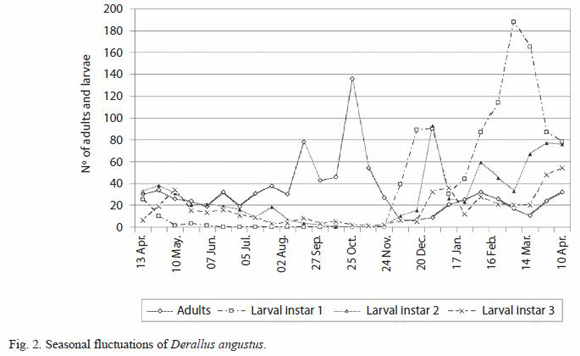
<body><![CDATA[<p></p> </font><font face="Verdana" size="2">     <p>    <br> <a name="f2"></a></p> </font>     <div style="text-align: center;"><img  src="/img/revistas/rbt/v56n1/art25i2.jpg" title="" alt=""  style="width: 580px; height: 356px;">    <br> </div> <font face="Verdana" size="2">     <p></p> </font><font face="Verdana" size="2">     <p>Adults and larvae II and III were neither significantly correlated with month mean temperature nor with month mean rainfall. Only larvae I was significantly correlated with month mean temperature (r= 0.688, p&lt;0.05) and with month mean rainfall (r= 0.607, p&lt;0.05). </p> <font size="3">     <p><span style="font-weight: bold;">Discussion</span> </p> </font>     <p>The greatest number of adults was observed in October (spring), probably because of the emergence of new adults from immature stages recorded in winter. The minimum number of adults was recorded in late spring, probably as consequence of enhanced mortality after egg laying. According to the observed abundances, the breeding period begins in early November (middle spring). in January, the slight increase in the number of adults, might be a result of a new generation. These adults may remain active during winter and would lay egg during the next spring. </p>     <p>Some laboratory data on the biology of this species were reported by Archangelsky and Durand (1992). Notoworthily, the highest mortality occurs at the prepupal and pupal stages. There is no pupation chamber or any other protection for the pupa and it remains completely exposed on the leaf surface of <span style="font-style: italic;">Salvinia</span> sp. (Archangelsky and Durand 1992). The fact that this population remains active throughout the whole year could be due to the environmental conditions, considering that its habitat belongs to a relatively stable microclimate within the "gallery forest", in contrast to the nearby environments of the pampasic grasslands. <span  style="font-style: italic;">D. angustus</span> has only been found as stable population in a "gallery forest" permanent pond with a dense carpet of floating <span style="font-style: italic;">Salvinia</span> sp. (von Ellenrieder and Fernández 2000). </p>     ]]></body>
<body><![CDATA[<p>The life cycle could therefore be assumed to be annual. The population is interpreted as univoltine including two periods of enhanced reproductive activity.&nbsp; </p> <font size="3">     <p><span style="font-weight: bold;">Acknowlegments</span> </p> </font>     <p>We thank A. Rodrígues Capítulo for the critical review of the manuscript. This paper is the scientific contribution n° 803 of the instituto de Limnología "Dr. Raúl A. Ringuelet". This study was supported by the National Research Council of Argentine (CONICET). </p> </font> <hr style="width: 100%; height: 2px;"><font face="Verdana" size="2">     <p><span style="font-weight: bold;">Resumen</span> </p>     <p><span style="font-style: italic;">Derallus</span> Sharp, 1882, de distribución Neotropical, pertenece a la tribu Berosini y está representado por 15 especies. <span style="font-style: italic;">D. angustus</span> Sharp está ampliamente distribuida desde Guatemala hasta Argentina. El objetivo de este trabajo es el estudio de la dinámica poblacional de esta especie, en un limnótopo ubicado en el extremo sur del Dominio Subtropical de la Región Neotropical. El sitio de muestreo está localizado en Punta Lara (34°47’ S, 58°01’ W, Ensenada, Buenos Aires Province, Argentina). Se realizaron 27 muestreos durante un período de un año, cada uno consistió en la extracción de 20 muestras al azar de 200 cm² de vegetación flotante. El estado de pupa no fue incluido en este estudio. Se reconocieron dos picos de máxima abundancia del primer estadio larval (el primero a fines de primavera y el otro a fines del verano). Durante todo el período de estudio se registraron tanto adultos como larvas de tercer estadio. Se interpreta que la población es univoltina con dos períodos de actividad reproductiva.     <br> </p>     <p><span style="font-weight: bold;">Palabras clave:</span> insectos acuáticos, Hydrophilidae, <span style="font-style: italic;">Derallus angustus</span>, dinámica poblacional, Argentina.</p> </font> <hr style="width: 100%; height: 2px;">     <div style="text-align: center;"><font><font face="Verdana" size="2">Received 17-VII-2006. Corrected 14-III-2007. Accepted 22-X-2007.</font></font></div> <font face="Verdana" size="2">     <p> </p> <font size="3">     <p><span style="font-weight: bold;">References</span> </p> </font>     ]]></body>
<body><![CDATA[<!-- ref --><p>Archangelsky, M. &amp; M. Durand. 1992. Description of the preimaginal stages of <span style="font-style: italic;">Derallus angustus</span> Sharp, 1882 (Coleoptera: Hydrophilidae, Berosinae). Aquat. Ins. 14: 169-178. &nbsp;&nbsp;&nbsp;&nbsp;&nbsp;&nbsp;&nbsp;&nbsp;[&#160;<a href="javascript:void(0);" onclick="javascript: window.open('/scielo.php?script=sci_nlinks&ref=1258262&pid=S0034-7744200800010002500001&lng=','','width=640,height=500,resizable=yes,scrollbars=1,menubar=yes,');">Links</a>&#160;]<!-- end-ref --><!-- ref --><p>Archangelsky, M. &amp; L.A. Fernández. 2005. Description of new Neotropical Berosini larvae: <span style="font-style: italic;">Derallus paranensis </span>and <span style="font-style: italic;">Hemiosus dejeanii</span> (Coleoptera: Hydrophilidae). Coleopts. Bull. 59: 211-220. &nbsp;&nbsp;&nbsp;&nbsp;&nbsp;&nbsp;&nbsp;&nbsp;[&#160;<a href="javascript:void(0);" onclick="javascript: window.open('/scielo.php?script=sci_nlinks&ref=1258263&pid=S0034-7744200800010002500002&lng=','','width=640,height=500,resizable=yes,scrollbars=1,menubar=yes,');">Links</a>&#160;]<!-- end-ref --><!-- ref --><p>Cabrera, A. &amp; A. Willink. 1980. Biogeografía de América Latina. Secretaría General de la OEA, Serie de Biología, Washington D.C., USA. &nbsp;&nbsp;&nbsp;&nbsp;&nbsp;&nbsp;&nbsp;&nbsp;[&#160;<a href="javascript:void(0);" onclick="javascript: window.open('/scielo.php?script=sci_nlinks&ref=1258264&pid=S0034-7744200800010002500003&lng=','','width=640,height=500,resizable=yes,scrollbars=1,menubar=yes,');">Links</a>&#160;]<!-- end-ref --><!-- ref --><p>Fernández, L.A. &amp; A.O. Bachmann. 1998. Hydrophiloidea, p. 218-226. <span style="font-style: italic;">In</span> Biodiversidad de artrópodos argentinos: una perspectiva biotaxonómica. J.J. Morrone &amp; S. Coscarón (eds.). Ediciones Sur, La Plata, Argentina. &nbsp;&nbsp;&nbsp;&nbsp;&nbsp;&nbsp;&nbsp;&nbsp;[&#160;<a href="javascript:void(0);" onclick="javascript: window.open('/scielo.php?script=sci_nlinks&ref=1258265&pid=S0034-7744200800010002500004&lng=','','width=640,height=500,resizable=yes,scrollbars=1,menubar=yes,');">Links</a>&#160;]<!-- end-ref --><!-- ref --><p>Hansen, M. 1999. World Catalogue of insects. Hydrophiloidea (Coleoptera), Vol. 2. Apollo, Stenstrup, Denmark. &nbsp;&nbsp;&nbsp;&nbsp;&nbsp;&nbsp;&nbsp;&nbsp;[&#160;<a href="javascript:void(0);" onclick="javascript: window.open('/scielo.php?script=sci_nlinks&ref=1258266&pid=S0034-7744200800010002500005&lng=','','width=640,height=500,resizable=yes,scrollbars=1,menubar=yes,');">Links</a>&#160;]<!-- end-ref --><!-- ref --><p>Oliva, A. 1981. El género <span style="font-style: italic;">Derallus</span> Sharp en la Argentina (Coleoptera, Hydrophilidae). Rev. Soc. Entom. Argent. 40: 285-296. &nbsp;&nbsp;&nbsp;&nbsp;&nbsp;&nbsp;&nbsp;&nbsp;[&#160;<a href="javascript:void(0);" onclick="javascript: window.open('/scielo.php?script=sci_nlinks&ref=1258267&pid=S0034-7744200800010002500006&lng=','','width=640,height=500,resizable=yes,scrollbars=1,menubar=yes,');">Links</a>&#160;]<!-- end-ref --><!-- ref --><p>Oliva, A. 1983. <span style="font-style: italic;">Derallus</span> de la cuenca del Amazonas (Coleoptera, Hydrophilidae). Rev. Soc. Entom. Argent. 42: 343-351. &nbsp;&nbsp;&nbsp;&nbsp;&nbsp;&nbsp;&nbsp;&nbsp;[&#160;<a href="javascript:void(0);" onclick="javascript: window.open('/scielo.php?script=sci_nlinks&ref=1258268&pid=S0034-7744200800010002500007&lng=','','width=640,height=500,resizable=yes,scrollbars=1,menubar=yes,');">Links</a>&#160;]<!-- end-ref --><!-- ref --><p>Oliva, A. 1995. Novedades sobre <span style="font-style: italic;">Derallus</span> (Coleoptera, Hydrophilidae). Physis Secc. B, 50: 1-3. &nbsp;&nbsp;&nbsp;&nbsp;&nbsp;&nbsp;&nbsp;&nbsp;[&#160;<a href="javascript:void(0);" onclick="javascript: window.open('/scielo.php?script=sci_nlinks&ref=1258269&pid=S0034-7744200800010002500008&lng=','','width=640,height=500,resizable=yes,scrollbars=1,menubar=yes,');">Links</a>&#160;]<!-- end-ref --><!-- ref --><p>Oliva, A., L.A. Fernández &amp; A.O. Bachmann. 1998. Sinopsis de los Hydrophiloidea acuáticos de la Argentina (insecta, Coleoptera). Monografías del Museo Argentino de Ciencias Naturales 2: 1- 67. &nbsp;&nbsp;&nbsp;&nbsp;&nbsp;&nbsp;&nbsp;&nbsp;[&#160;<a href="javascript:void(0);" onclick="javascript: window.open('/scielo.php?script=sci_nlinks&ref=1258270&pid=S0034-7744200800010002500009&lng=','','width=640,height=500,resizable=yes,scrollbars=1,menubar=yes,');">Links</a>&#160;]<!-- end-ref --><!-- ref --><p>Spangler, P. 1966. A description of the larva of <span  style="font-style: italic;">Derallus rudis</span> Sharp (Coleoptera: Hydrophilidae). Coleopts. Bull. 20: 97-103. &nbsp;&nbsp;&nbsp;&nbsp;&nbsp;&nbsp;&nbsp;&nbsp;[&#160;<a href="javascript:void(0);" onclick="javascript: window.open('/scielo.php?script=sci_nlinks&ref=1258271&pid=S0034-7744200800010002500010&lng=','','width=640,height=500,resizable=yes,scrollbars=1,menubar=yes,');">Links</a>&#160;]<!-- end-ref --><!-- ref --><p>von Ellenrieder N. &amp; L.A. Fernández. 2000. Aquatic Coleoptera in the Subtropical-Pampasic ecotone (Argentina, Buenos Aires): species composition and temporal changes. Coleopts. Bull. 54: 23-35. &nbsp;&nbsp;&nbsp;&nbsp;&nbsp;&nbsp;&nbsp;&nbsp;[&#160;<a href="javascript:void(0);" onclick="javascript: window.open('/scielo.php?script=sci_nlinks&ref=1258272&pid=S0034-7744200800010002500011&lng=','','width=640,height=500,resizable=yes,scrollbars=1,menubar=yes,');">Links</a>&#160;]<!-- end-ref --><p> </p>     <p>&nbsp;</p>     <p>&nbsp;</p> </font>      ]]></body><back>
<ref-list>
<ref id="B1">
<nlm-citation citation-type="journal">
<person-group person-group-type="author">
<name>
<surname><![CDATA[Archangelsky]]></surname>
<given-names><![CDATA[M]]></given-names>
</name>
<name>
<surname><![CDATA[Durand]]></surname>
<given-names><![CDATA[M]]></given-names>
</name>
</person-group>
<article-title xml:lang="en"><![CDATA[Description of the preimaginal stages of Derallus angustus Sharp, 1882 (Coleoptera: Hydrophilidae, Berosinae)]]></article-title>
<source><![CDATA[Aquat. Ins]]></source>
<year>1992</year>
<volume>14</volume>
<page-range>169-178</page-range></nlm-citation>
</ref>
<ref id="B2">
<nlm-citation citation-type="journal">
<person-group person-group-type="author">
<name>
<surname><![CDATA[Archangelsky]]></surname>
<given-names><![CDATA[M]]></given-names>
</name>
<name>
<surname><![CDATA[Fernández]]></surname>
<given-names><![CDATA[L.A]]></given-names>
</name>
</person-group>
<article-title xml:lang="en"><![CDATA[Description of new Neotropical Berosini larvae: Derallus paranensis and Hemiosus dejeanii (Coleoptera: Hydrophilidae)]]></article-title>
<source><![CDATA[Coleopts. Bull]]></source>
<year>2005</year>
<volume>59</volume>
<page-range>211-220</page-range></nlm-citation>
</ref>
<ref id="B3">
<nlm-citation citation-type="book">
<person-group person-group-type="author">
<name>
<surname><![CDATA[Cabrera]]></surname>
<given-names><![CDATA[A]]></given-names>
</name>
<name>
<surname><![CDATA[Willink]]></surname>
<given-names><![CDATA[A]]></given-names>
</name>
</person-group>
<source><![CDATA[Biogeografía de América Latina]]></source>
<year>1980</year>
<publisher-loc><![CDATA[^eWashington D.C Washington D.C]]></publisher-loc>
<publisher-name><![CDATA[Secretaría General de la OEA]]></publisher-name>
</nlm-citation>
</ref>
<ref id="B4">
<nlm-citation citation-type="book">
<person-group person-group-type="author">
<name>
<surname><![CDATA[Fernández]]></surname>
<given-names><![CDATA[L.A]]></given-names>
</name>
<name>
<surname><![CDATA[Bachmann]]></surname>
<given-names><![CDATA[A.O]]></given-names>
</name>
</person-group>
<article-title xml:lang="es"><![CDATA[Hydrophiloidea]]></article-title>
<person-group person-group-type="editor">
<name>
<surname><![CDATA[Morrone]]></surname>
<given-names><![CDATA[J.J]]></given-names>
</name>
<name>
<surname><![CDATA[Coscarón]]></surname>
<given-names><![CDATA[S]]></given-names>
</name>
</person-group>
<source><![CDATA[Biodiversidad de artrópodos argentinos: una perspectiva biotaxonómica]]></source>
<year>1998</year>
<page-range>218-226</page-range><publisher-loc><![CDATA[La Plata ]]></publisher-loc>
<publisher-name><![CDATA[Ediciones Sur]]></publisher-name>
</nlm-citation>
</ref>
<ref id="B5">
<nlm-citation citation-type="book">
<person-group person-group-type="author">
<name>
<surname><![CDATA[Hansen]]></surname>
<given-names><![CDATA[M]]></given-names>
</name>
</person-group>
<source><![CDATA[World Catalogue of insects: Hydrophiloidea (Coleoptera), Vol. 2]]></source>
<year>1999</year>
<publisher-loc><![CDATA[Stenstrup ]]></publisher-loc>
<publisher-name><![CDATA[Apollo]]></publisher-name>
</nlm-citation>
</ref>
<ref id="B6">
<nlm-citation citation-type="journal">
<person-group person-group-type="author">
<name>
<surname><![CDATA[Oliva]]></surname>
<given-names><![CDATA[A]]></given-names>
</name>
</person-group>
<article-title xml:lang="es"><![CDATA[El género Derallus Sharp en la Argentina (Coleoptera, Hydrophilidae)]]></article-title>
<source><![CDATA[Rev. Soc. Entom. Argent]]></source>
<year>1981</year>
<volume>40</volume>
<page-range>285-296</page-range></nlm-citation>
</ref>
<ref id="B7">
<nlm-citation citation-type="journal">
<person-group person-group-type="author">
<name>
<surname><![CDATA[Oliva]]></surname>
<given-names><![CDATA[A]]></given-names>
</name>
</person-group>
<article-title xml:lang="es"><![CDATA[Derallus de la cuenca del Amazonas (Coleoptera, Hydrophilidae)]]></article-title>
<source><![CDATA[Rev. Soc. Entom. Argent]]></source>
<year>1983</year>
<volume>42</volume>
<page-range>343-351</page-range></nlm-citation>
</ref>
<ref id="B8">
<nlm-citation citation-type="journal">
<person-group person-group-type="author">
<name>
<surname><![CDATA[Oliva]]></surname>
<given-names><![CDATA[A]]></given-names>
</name>
</person-group>
<article-title xml:lang="es"><![CDATA[Novedades sobre Derallus (Coleoptera, Hydrophilidae)]]></article-title>
<source><![CDATA[Physis Secc. B]]></source>
<year>1995</year>
<volume>50</volume>
<page-range>1-3</page-range></nlm-citation>
</ref>
<ref id="B9">
<nlm-citation citation-type="journal">
<person-group person-group-type="author">
<name>
<surname><![CDATA[Oliva]]></surname>
<given-names><![CDATA[A]]></given-names>
</name>
<name>
<surname><![CDATA[Fernández]]></surname>
<given-names><![CDATA[L.A]]></given-names>
</name>
<name>
<surname><![CDATA[Bachmann]]></surname>
<given-names><![CDATA[A.O]]></given-names>
</name>
</person-group>
<article-title xml:lang="es"><![CDATA[Sinopsis de los Hydrophiloidea acuáticos de la Argentina (insecta, Coleoptera)]]></article-title>
<source><![CDATA[Monografías del Museo Argentino de Ciencias Naturales]]></source>
<year>1998</year>
<volume>2</volume>
<page-range>1- 67</page-range></nlm-citation>
</ref>
<ref id="B10">
<nlm-citation citation-type="journal">
<person-group person-group-type="author">
<name>
<surname><![CDATA[Spangler]]></surname>
<given-names><![CDATA[P]]></given-names>
</name>
</person-group>
<article-title xml:lang="en"><![CDATA[A description of the larva of Derallus rudis Sharp (Coleoptera: Hydrophilidae)]]></article-title>
<source><![CDATA[Coleopts. Bull]]></source>
<year>1966</year>
<volume>20</volume>
<page-range>97-103</page-range></nlm-citation>
</ref>
<ref id="B11">
<nlm-citation citation-type="journal">
<person-group person-group-type="author">
<name>
<surname><![CDATA[von Ellenrieder]]></surname>
<given-names><![CDATA[N]]></given-names>
</name>
<name>
<surname><![CDATA[Fernández]]></surname>
<given-names><![CDATA[L.A]]></given-names>
</name>
</person-group>
<article-title xml:lang="en"><![CDATA[Aquatic Coleoptera in the Subtropical-Pampasic ecotone (Argentina, Buenos Aires): species composition and temporal changes]]></article-title>
<source><![CDATA[Coleopts. Bull]]></source>
<year>2000</year>
<volume>54</volume>
<page-range>23-35</page-range></nlm-citation>
</ref>
</ref-list>
</back>
</article>
