<?xml version="1.0" encoding="ISO-8859-1"?><article xmlns:mml="http://www.w3.org/1998/Math/MathML" xmlns:xlink="http://www.w3.org/1999/xlink" xmlns:xsi="http://www.w3.org/2001/XMLSchema-instance">
<front>
<journal-meta>
<journal-id>0034-7744</journal-id>
<journal-title><![CDATA[Revista de Biología Tropical]]></journal-title>
<abbrev-journal-title><![CDATA[Rev. biol. trop]]></abbrev-journal-title>
<issn>0034-7744</issn>
<publisher>
<publisher-name><![CDATA[Universidad de Costa Rica]]></publisher-name>
</publisher>
</journal-meta>
<article-meta>
<article-id>S0034-77442008000100015</article-id>
<title-group>
<article-title xml:lang="en"><![CDATA[Potential role of frugivorous birds (Passeriformes) on seed dispersal of six plant species in a restinga habitat, southeastern Brazil]]></article-title>
</title-group>
<contrib-group>
<contrib contrib-type="author">
<name>
<surname><![CDATA[Souza da Mota Gomes]]></surname>
<given-names><![CDATA[Verônica]]></given-names>
</name>
<xref ref-type="aff" rid="A01"/>
</contrib>
<contrib contrib-type="author">
<name>
<surname><![CDATA[Rodrigues Correia]]></surname>
<given-names><![CDATA[Maria Célia]]></given-names>
</name>
<xref ref-type="aff" rid="A02"/>
</contrib>
<contrib contrib-type="author">
<name>
<surname><![CDATA[Alves de Lima]]></surname>
<given-names><![CDATA[Heloisa]]></given-names>
</name>
<xref ref-type="aff" rid="A02"/>
</contrib>
<contrib contrib-type="author">
<name>
<surname><![CDATA[S. Alves]]></surname>
<given-names><![CDATA[Maria Alice]]></given-names>
</name>
<xref ref-type="aff" rid="A03"/>
</contrib>
</contrib-group>
<aff id="A01">
<institution><![CDATA[,Universidade Federal do Rio de Janeiro Programa de Pós-Graduação em Ecologia ]]></institution>
<addr-line><![CDATA[ RJ]]></addr-line>
<country>Brazil</country>
</aff>
<aff id="A02">
<institution><![CDATA[,Museu Nacional do Rio de Janeiro Laboratório de Biologia da Reprodução ]]></institution>
<addr-line><![CDATA[ RJ]]></addr-line>
<country>Brazil</country>
</aff>
<aff id="A03">
<institution><![CDATA[,Museu Nacional do Rio de Janeiro Departamento de Ecologia ]]></institution>
<addr-line><![CDATA[ RJ]]></addr-line>
<country>Brazil</country>
</aff>
<pub-date pub-type="pub">
<day>00</day>
<month>03</month>
<year>2008</year>
</pub-date>
<pub-date pub-type="epub">
<day>00</day>
<month>03</month>
<year>2008</year>
</pub-date>
<volume>56</volume>
<numero>1</numero>
<fpage>205</fpage>
<lpage>216</lpage>
<copyright-statement/>
<copyright-year/>
<self-uri xlink:href="http://www.scielo.sa.cr/scielo.php?script=sci_arttext&amp;pid=S0034-77442008000100015&amp;lng=en&amp;nrm=iso"></self-uri><self-uri xlink:href="http://www.scielo.sa.cr/scielo.php?script=sci_abstract&amp;pid=S0034-77442008000100015&amp;lng=en&amp;nrm=iso"></self-uri><self-uri xlink:href="http://www.scielo.sa.cr/scielo.php?script=sci_pdf&amp;pid=S0034-77442008000100015&amp;lng=en&amp;nrm=iso"></self-uri><abstract abstract-type="short" xml:lang="en"><p><![CDATA[Restingas are considered stressful habitats associated with the Brazilian Atlantic forest, and their ecological interactions are poorly known. The goal of the present study was to determine the potential role of frugivorous birds as seed dispersers in a restinga habitat. Data were collected in Parque Nacional da Restinga de Jurubatiba, southeastern Brazil, where the main physiognomy (Open Clusia Formation) is characterized by the presence of patches of vegetation covering 20 to 48 % of the sandy soil and reaching a height of 5 m. Birds were captured with mist nets (12 x 2.5 m; 36 mm mesh; 1 680 net-hrs) and had their fecal and regurgitate samples inspected for seeds. Six plant species found in these bird samples were studied. The germination of seeds obtained from plants was compared to those from the birds. Both groups of seeds were set on Petri dishes at room temperature and washed when infected with fungi. In general, there was no effect on germination rate, and the effect on germination speed was negative. Germination of seeds from Pilosocereus arrabidae treated by the birds seemed to be influenced by storage of defecated seeds, while few Miconia cinnamomifolia seeds both from plants and from birds germinated. Ocotea notata presented a great variation in time to the onset of germination, perhaps an advantage against dissecation. Aechmea nudicaulis, Clusia hilariana and Erythroxylum subsessile probably take advantage of the arrival to favorable microhabitats, not by the gut effect on the seeds. All plant species studied are numerically important for the community and some of them are main actors in the succession of vegetation patches. Among the birds, Mimus gilvus is an important resident species, endemic to restingas in Brazil, while Turdus amaurochalinus is a visitor and may be important for plants that fructify during its passage by the study site. Although the effect of pulp removal was only tested for one species (Achmea nudicaulis) in the present study, we confirmed that the tested effect of restinga frugivorous birds on seed germination was generally null. Although there is a need for more detailed studies on specific animal-plant interactions on this habitat, the overall effect of the birds on seed dispersal in restinga is probably positive. Rev. Biol. Trop. 56 (1): 205-216. Epub 2008 March 31.]]></p></abstract>
<abstract abstract-type="short" xml:lang="es"><p><![CDATA[Las restingas se consideran hábitats estresantes asociados al bosque del Atlántico brasileño y sus ecológicas se conocen poco. El objetivo principal del presente trabajo fue determinar el papel potencial de las aves frugívoras como dispersores de plantas en un hábitat de restinga. La información se recolectó en el Parque Nacional da Restinga de Jurubatiba, Brasil. Las aves se capturaron con redes de niebla y sus muestras fecales y de regurgitación se inspeccionaron en busca de semillas. Estudiamos seis especies de plantas de estas muestras. En general, el efecto del paso por el sistema digestivo de las aves sobre el porcentaje de germinación fue nulo (y negativo en la velocidad de germinación). Todas las especies de plantas estudiadas son numéricamente importantes a la comunidad y algunas de ellas tienen papeles principales en la sucesión de parches de vegetación. Entre las aves, Mimus gilvus es una especie residente importante, endémica de tales hábitats en Brasil, mientras que Turdus amaurochalinus es una especie visitante y puede ser importante para las plantas que fructifican durante su paso por el sitio del estudio. El efecto general de los pájaros en la dispersión de semillas en la restinga es probablemente positivo.]]></p></abstract>
<kwd-group>
<kwd lng="en"><![CDATA[Atlantic forest]]></kwd>
<kwd lng="en"><![CDATA[Brazil]]></kwd>
<kwd lng="en"><![CDATA[dispersal]]></kwd>
<kwd lng="en"><![CDATA[Mimus gilvus]]></kwd>
<kwd lng="en"><![CDATA[restinga]]></kwd>
<kwd lng="en"><![CDATA[seed germination]]></kwd>
<kwd lng="en"><![CDATA[Turdus amaurochalinus]]></kwd>
<kwd lng="es"><![CDATA[Dispersión de semillas]]></kwd>
<kwd lng="es"><![CDATA[bosque atlántico brasileño]]></kwd>
<kwd lng="es"><![CDATA[germinación]]></kwd>
<kwd lng="es"><![CDATA[Mimus gilvus]]></kwd>
<kwd lng="es"><![CDATA[restinga]]></kwd>
<kwd lng="es"><![CDATA[Turdus amaurochalinus]]></kwd>
</kwd-group>
</article-meta>
</front><body><![CDATA[ <p style="text-align: center;"><font face="Verdana" size="4"><span  style="font-weight: bold;">Potential role of frugivorous birds (Passeriformes) on seed dispersal of six plant species in a restinga habitat, southeastern Brazil</span> </font></p>     <p><font face="Verdana" size="2"><span style="font-weight: bold;">Verônica Souza da Mota Gomes<a name="a1"></a><sup><a href="#a2">1</a>,<a  href="#a2">3*</a></sup>, Maria Célia Rodrigues Correia<a href="#a2"><sup>2</sup></a>, Heloisa Alves de Lima<a href="#a2"><sup>2</sup></a> &amp; Maria Alice S. Alves<a  href="#a2"><sup>3*</sup></a></span> </font></p>     <p><font face="Verdana" size="2"><a name="a2"></a><a href="#a1">1</a> Programa de Pós-Graduação em Ecologia, Universidade Federal do Rio de Janeiro, CCS, IB, Sala A1 008, CP 68020, 21941-590, Rio de Janeiro, RJ, Brazil. </font></p>     <p><font face="Verdana" size="2"><a href="#a1">2</a> Laboratório de Biologia da Reprodução, Museu Nacional do Rio de Janeiro, UFRJ, Quinta da Boa Vista s/n0, São Cristóvão, 20940-040, Rio de Janeiro, RJ, Brazil; <a href="mailto:halcar@acd.ufrj.br">halcar@acd.ufrj.br</a>; <a href="mailto:mcorreia@acd.ufrj.br">mcorreia@acd.ufrj.br</a> </font></p>     <p><font face="Verdana" size="2"><a href="#a1">3</a> Departamento de Ecologia, IBRAG, Universidade do Estado do Rio de Janeiro, Rua São Francisco Xavier, 524. Maracanã, 20550-011, Rio de Janeiro, RJ, Brazil. fax: 55 21 2587 7614; <a href="mailto:masa@uerj.br">masa@uerj.br</a>; <a href="mailto:smgomes@yahoo.com.br">smgomes@yahoo.com.br</a> </font></p>     <p><font face="Verdana" size="2"><a href="#a1">*</a> Corresponding authors </font></p>     <p><font face="Verdana" size="2"> </font></p> <hr style="width: 100%; height: 2px;">     <p><font face="Verdana" size="2"><span style="font-weight: bold;">Abstract:</span> Restingas are considered stressful habitats associated with the Brazilian Atlantic forest, and their ecological interactions are poorly known. The goal of the present study was to determine the potential role of frugivorous birds as seed dispersers in a restinga habitat. Data were collected in Parque Nacional da Restinga de Jurubatiba, southeastern Brazil, where the main physiognomy (Open Clusia Formation) is characterized by the presence of patches of vegetation covering 20 to 48 % of the sandy soil and reaching a height of 5 m. Birds were captured with mist nets (12 x 2.5 m; 36 mm mesh; 1 680 net-hrs) and had their fecal and regurgitate samples inspected for seeds. Six plant species found in these bird samples were studied. The germination of seeds obtained from plants was compared to those from the birds. Both groups of seeds were set on Petri dishes at room temperature and washed when infected with fungi. In general, there was no effect on germination rate, and the effect on germination speed was negative. Germination of seeds from <span  style="font-style: italic;">Pilosocereus arrabidae</span> treated by the birds seemed to be influenced by storage of defecated seeds, while few Miconia cinnamomifolia seeds both from plants and from birds germinated. Ocotea notata presented a great variation in time to the onset of germination, perhaps an advantage against dissecation. <span style="font-style: italic;">Aechmea nudicaulis</span>, <span style="font-style: italic;">Clusia hilariana</span> and <span style="font-style: italic;">Erythroxylum subsessile</span> probably take advantage of the arrival to favorable microhabitats, not by the gut effect on the seeds. All plant species studied are numerically important for the community and some of them are main actors in the succession of vegetation patches. Among the birds, <span style="font-style: italic;">Mimus gilvus</span> is an important resident species, endemic to restingas in Brazil, while <span style="font-style: italic;">Turdus amaurochalinus</span> is a visitor and may be important for plants that fructify during its passage by the study site. Although the effect of pulp removal was only tested for one species (<span style="font-style: italic;">Achmea nudicaulis</span>) in the present study, we confirmed that the tested effect of restinga frugivorous birds on seed germination was generally null. Although there is a need for more detailed studies on specific animal-plant interactions on this habitat, the overall effect of the birds on seed dispersal in restinga is probably positive. Rev. Biol. Trop. 56 (1): 205-216. Epub 2008 March 31. </font></p>     <p><font face="Verdana" size="2"><span style="font-weight: bold;">Key words: </span>Atlantic forest, Brazil, dispersal, <span style="font-style: italic;">Mimus gilvus</span>, restinga, seed germination, <span style="font-style: italic;">Turdus amaurochalinus</span>.</font></p> <hr style="width: 100%; height: 2px;">     <p><font face="Verdana" size="2"> </font></p>     ]]></body>
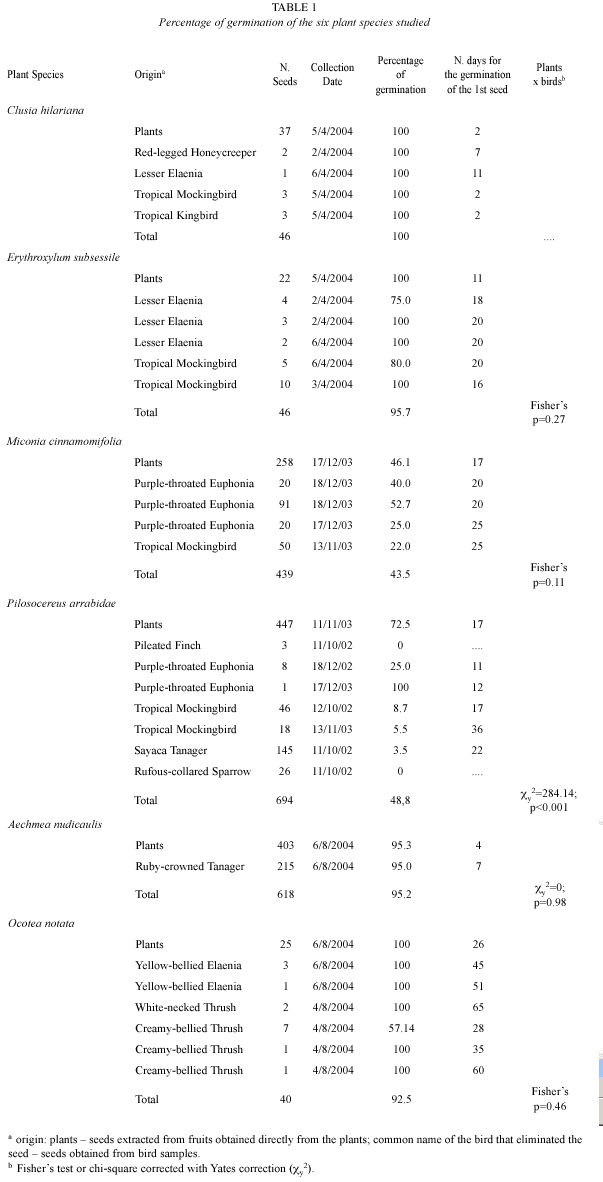
<body><![CDATA[<p><font face="Verdana" size="2">Restingas are coastal Brazilian ecosystems, </font><font face="Verdana" size="2">geologically recent and poor in endemisms, </font><font face="Verdana" size="2">being most of the flora and fauna typical of </font><font face="Verdana" size="2">the Atlantic forest (Rizzini 1979, Lacerda <span style="font-style: italic;">et </span></font><font  face="Verdana" size="2"><span style="font-style: italic;">al</span>. </font><font  face="Verdana" size="2">1993, Cerqueira 2000). Plants exhibit many </font><font face="Verdana" size="2">different physiological adaptations (Mattos </font><font face="Verdana" size="2"><span  style="font-style: italic;">et al</span>. 2004) to the harsh conditions of the </font><font face="Verdana" size="2">environment in restinga (low nutrient levels of the soil, ephemeral water availability, high temperatures, soil and air salinity) (Araujo <span  style="font-style: italic;">et al</span>. 1998). Then, asexual reproduction is probably important, as it occurs in other extreme habitats (Richards 1986). Indeed, many plant species present clonal development, although sexual reproduction is also present (Ormond <span style="font-style: italic;">et al</span>. 1991). Therefore, studies concerning the investments and predominance of each reproductive strategy are lacking (Scarano <span style="font-style: italic;">et al</span>. 2004). </font></p>     <p><font face="Verdana" size="2">The success of sexual reproduction depends on many factors acting in the production of flowers, presence and effectiveness of pollinators and fruit production. Furthermore, seed dispersal may be essential to final production of seedlings and their survival, as the disperser may alter seeds percentage of germination and germination rate (Traveset 1998), and also deposit them in specific favorable microhabitats (Calviño-Cancela 2004). However, there are few works that investigate the effect of frugivorous animals on seed dispersal in restingas (Castiglioni <span style="font-style: italic;">et al</span>. 1995, Passos and Oliveira 2003). </font></p>     <p><font face="Verdana" size="2">Birds are potential seed dispersers in the restingas, as 67.5 % of woody plant species of the predominant physiognomy is zoochorous (Pimentel 2002) and 15 % to 25 % of bird species in the same environment may be considered frugivorous (Sick 1997, Reis and Gonzaga 2000, Alves <span style="font-style: italic;">et al</span>. 2004). In general, the effect of the birds digestive system on the passage of the ingested seeds is positive or null, both on the percentage of germination and germination rate (Traveset 1998). However, the effects may vary with bird species (Traveset <span  style="font-style: italic;">et al</span>. 2001), plant species or habitat (Baskin and Baskin 1998), and also differences on population level (Traveset 1998). </font></p>     <p><font face="Verdana" size="2">Therefore, the goal of the present study was to evaluate the viability and speed of germination of seeds consumed by frugivorous birds in a restinga habitat, investigating the potential role of birds as seed dispersers in this environment. The specific questions were: 1) Are the eliminated seeds viable? 2) Do birds have any effect on seeds percentage of germination? 3) Do birds interfere in speed of germination?     <br> </font></p>     <p><font face="Verdana" size="2">From the plant species under investigation in the present study, those belonging to the families Clusiaceae, Erythroxylaceae, Lauraceae, Melastomataceae and Bromeliaceae are likely to present fully grown embryos and permeable seed cover structures in ripe fruits, as generally occurs for those families. Consequently, they probably present a lack of organic dormancy, being physical or chemical, which would need to be broken by the passage through the digestive system of some animal. Only Cactaceae tend to present physiological dormancy (Baskin and Baskin 1998). Therefore, in the present study, it was essentially tested the possibility of negative effects of the birds on the germination of ingested seeds. </font></p>     <p><font face="Verdana" size="3"><span style="font-weight: bold;">Material and methods</span> </font></p>     <p><font face="Verdana" size="2">Birds were captured and seeds collected in the Parque Nacional da Restinga de Jurubatiba (22º17’S, 41º41’W), a park created in 1998 in Macaé, on the north shore of Rio de Janeiro State. This region is a holocenic sandy plain covered by a mosaic of plant communities called restinga. The landscape is also marked by the presence of many lakes with various salinity levels. Climate is characterized by a wet season between October and April and a drier season between May and September. Mean annual pluviosity is 1 200 mm and temperature 22.6 ºC. The dominant plant formation is the Open Clusia Formation, formed by patches of vegetation that cover 20 % to 48 % of the soil and reach 5 m high, with few small plants in between. The park also includes forest formations, Ericaceae Shrub Formation and other formations with smaller plants, totaling ten plant communities (Henriques <span  style="font-style: italic;">et al</span>. 1986, Araujo <span style="font-style: italic;">et al</span>. 1998, Pimentel 2002). The present study was developed in the Open Clusia Formation in two sites: next to "Lagoa Comprida" (22º16’41’’S, 41º39’41’’W) and approximately 2 km to Northeast from that (22º16’13.2’’S, 41º38’50.3’’W). </font></p>     <p><font face="Verdana" size="2">Between August 2002 and August 2004, field trips were carried out bimonthly in the park to capture birds with mist nets (12 x 2.5 m; 36 mm mesh; 1 680 net-hours). Birds were identified according to Dunning (1989), except for <span style="font-style: italic;">Elaenia</span> spp., from which specimens were collected and compared to the collections of Museu de Zoologia da Universidade de São Paulo (MUZUSP) and Museu Nacional do Rio de Janeiro (MNRJ). The birds were released after sampled, except for the specimens collected for confirming identification. The frugivorous birds studied here were: <span style="font-style: italic;">Coryphospingus pileatus</span> (Wied) 1821 (Pileated Finch), <span style="font-style: italic;">Cyanerpes cyaneus</span> (Linnaeus) 1766 (Red-legged Honeycreeper), <span style="font-style: italic;">Elaenia chiriquensis </span>Lawrence 1865 (Lesser Elaenia), <span style="font-style: italic;">Elaenia flavogaster</span> (Thunberg) 1822 (Yellow-bellied Elaenia), <span style="font-style: italic;">Euphonia chlorotica</span> (Linnaeus) 1766 (Purple-throated Euphonia), <span  style="font-style: italic;">Mimus gilvus </span>(Vieillot) 1808 (Tropical Mockingbird), <span style="font-style: italic;">Tachyphonus coronatus</span> (Vieillot) 1822 (Rubycrowned Tanager), <span style="font-style: italic;">Thraupis sayaca</span> (Linnaeus) 1766 (Sayaca Tanager), <span  style="font-style: italic;">Tyrannus melancholicus </span>Vieillot 1819 (Tropical Kingbird), <span style="font-style: italic;">Turdus albicollis</span> Vieillot 1818 (White-necked Thrush), <span style="font-style: italic;">Turdus amaurochalinus</span> Cabanis 1851 (Creamybellied Thrush), <span style="font-style: italic;">Zonotrichia capensis</span> (Müller) 1776 (Rufous-collared Sparrow) (common names as in Dunning 1989 and authors and years from Sibley and Monroe Jr. 1990). </font></p>     <p><font face="Verdana" size="2">During the field trips, seeds apparently intact were eliminated by frugivorous birds, through defecation and natural regurgitation. Most of the times, it was not possible to know if seeds were defecated or regurgitated, as netted birds were kept in dark cloth bags while they waited to be manipulated. From the plant species consumed, it was chosen for the present study the most frequently recorded in the birds samples. The identification of the seeds was possible by comparison with a reference collection previously established. Then, seeds were also collected from fruits obtained directly from the plants, from three individuals of each studied plant species. The seeds were taken from the fruits, washed and stored in paper envelops. Animals and seeds collected are deposited at Depto de Ecologia/UERJ, under the custody of M. A. S. Alves. </font></p>     ]]></body>
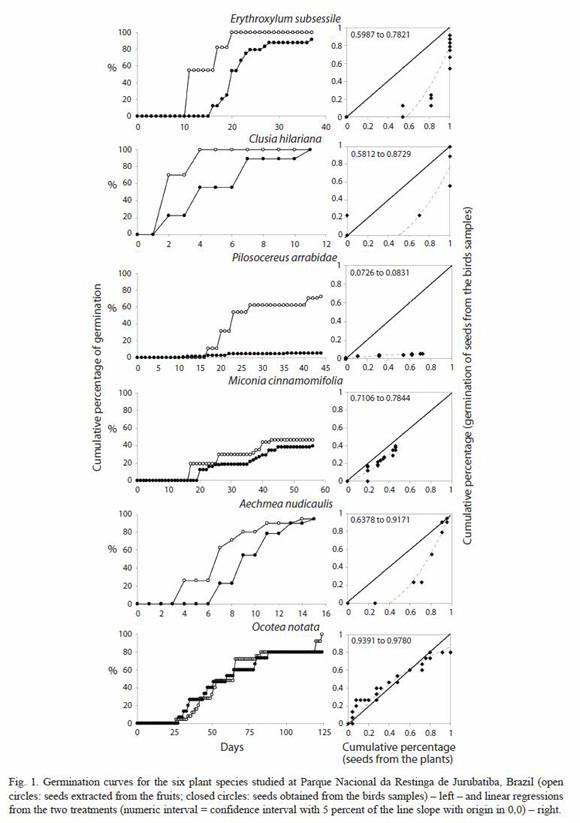
<body><![CDATA[<p><font face="Verdana" size="2">Collected seeds were set on Petri dishes with humid filter paper and left to room temperature and humidity. Seeds collected directly from the plants were set on one dish per species, while seeds from bird samples were grouped by origin (individual bird -see <a href="#t1">Table 1</a> to sample numbers). Dishes were examined regularly and the number of germinated seeds recorded. We considered germination when the radicle emerged. Experiments with <span  style="font-style: italic;">Clusia hilariana</span> Schltdl. (Clusiaceae), <span style="font-style: italic;">Erythroxylum subsessile</span> (Mart.) O. E. Schulz (Erythroxylaceae), <span style="font-style: italic;">Miconia cinnamomifolia </span>(DC.) Naudin (Melastomataceae) and <span  style="font-style: italic;">Pilosocereus arrabidae</span> (Lem.) Byles and G. D. Rowley (Cactaceae) have been conducted between April 13th and August 3rd 2004, while those with <span style="font-style: italic;">Aechmea nudicaulis</span> (L.) Griseb. (Bromeliaceae) and <span style="font-style: italic;">Ocotea notata</span> (Nees) Mez (Lauraceae) between August 9th and December 13th 2004. Seeds presenting fungi were washed with current water and reset in their dishes. That procedure was made because experiment conditions were different from what seeds face in the environment, so it is not possible to know if they would be infested in natural conditions. A possible effect of the presence of the pulp or the whole fruit was tested only for <span  style="font-style: italic;">A. nudicaulis</span> in September 2005: in one treatment, five whole fruits were set in Petri dishes on humid absorbent paper; in another treatment, 82 seeds were removed from the fruits along with the pulp and set to germinate in the same conditions.    <br> </font></p>     <p><font face="Verdana" size="2">    <br> <a name="t1"></a></font></p>     <div style="text-align: center;"><font face="Verdana" size="2"><img  src="/img/revistas/rbt/v56n1/art15t1.gif" title="" alt=""  style="width: 603px; height: 1182px;"></font>    <br> <font face="Verdana" size="2"> </font></div>     <p><font face="Verdana" size="2">To statistical analysis, seeds were treated as two groups (eliminated by the birds vs. collected from the plants) and the differences in percentage of seeds germinated and not germinated were tested by chi-square corrected with the Yates correction or by the Fisher’s test, when frequencies were small (Zar 1996; 2 x 2 contingency tables). Differences in speed of germination between seeds obtained from the plants and from the birds were tested by Linear Regression Analysis (as in Ellison <span style="font-style: italic;">et al</span>. 1993): if the slope of the regression line (forced to the origin) was significantly greater than one, we concluded that birds enhanced the speed and if lower than one, that birds delayed germination. </font></p>     <p><font face="Verdana" size="3"><span style="font-weight: bold;">Results</span> </font></p>     <p><font face="Verdana" size="2">From the six plant species studied, only the seeds from <span style="font-style: italic;">Ocotea notata</span> and <span style="font-style: italic;">Pilosocereus arrabidae</span> germinated less when treated by the birds (<a href="#t1">Table 1</a>). Comparing samples from <span style="font-style: italic;">P. arrabidae </span>stored for five months with those stored for more than one year, there was no difference in the percentage of germination, both for those treated by Purple-throated Euphonia (<span style="font-style: italic;">X</span><sup>2</sup>=2.25, df=1, 0.25&gt;p&gt;0.10) and by Tropical Mockingbird (<span style="font-style: italic;">X</span><sup>2</sup>=0.196, df=1, 0.75&gt;p&gt;0.50). Particularly those seeds treated by Purplethroated Euphonia began to germinate earlier than the seeds taken directly from the plants. On the other hand, seeds treated by Pileated Finch and Rufous-collared Sparrow did not germinate, although the experiment was made only with intact seeds found, among intact and mashed seeds present in the samples of those two bird species. To <span style="font-style: italic;">O. notata</span>, there was a marked variation in the time to the beginning of the germination. </font></p>     <p><font face="Verdana" size="2">Concerning speed of germination, there was a great variation among the plant species on the values of the slopes of the regression lines (<a href="#f1">Fig. 1</a>), although none had slope equal or greater than one. This indicates that birds delayed seed germination.    ]]></body>
<body><![CDATA[<br> </font></p>     <p><font face="Verdana" size="2">    <br> <a name="f1"></a></font></p>     <div style="text-align: center;"><font face="Verdana" size="2"><img  src="/img/revistas/rbt/v56n1/art15i1.jpg" title="" alt=""  style="width: 580px; height: 823px;"></font>    <br> <font face="Verdana" size="2"></font></div>     <p><font face="Verdana" size="2">Fruits from <span  style="font-style: italic;">A. nudicaulis</span> tested were infested with fungi seven days after the beginning of the experiment and even being washed twice, they have rotten completely in 20 days. Seeds with pulp started to be infested also in seven days, but after washed, they started to germinate in more seven days (14 days after the beginning of the experiment). At the end of the experiment, 84 % of the seeds that had pulp and were washed germinated. When the seeds were washed, practically all the pulp was removed, as it is a liquid substance. Those results demonstrate that the presence of the pulp may delay the germination, even when compared to the seeds treated by the birds, which started to germinate in seven days of experiment (ten days after being collected, <a href="#f1">Fig. 1</a>). </font></p>     <p><font face="Verdana" size="3"><span style="font-weight: bold;">Discussion</span> </font></p>     <p><font face="Verdana" size="2">Comparing bird effect on the percentage and speed of germination, the null effect is more frequent in germination studies, followed by the positive effects (Traveset 1998), what is in accordance with the present study only concerning percentage of germination and not speed of germination, which was reduced by the birds. </font></p>     <p><font face="Verdana" size="2">In the present study, from the seeds of <span style="font-style: italic;">P. arrabidae </span>treated by the birds, only 5.6 % germinated (varying from zero to 100 % between bird species, see <a  href="#t1">Table 1</a>). Probably the germination of seeds that had contact with bird’s feces was influenced by storage, as the same plant species may reach 54.7 % of germination when treated by <span style="font-style: italic;">Ramphocelus bresilius</span> (Linnaeus) 1766 (Brazilian Tanager) and set immediately to germinate (Castiglioni <span style="font-style: italic;">et al</span>. 1995). Those authors have also observed that seeds from that species maintain their viability for many months when kept dry. Furthermore, Meyer and Witmer (1998) have found a negative effect of the presence of bird fecal material on seed germination for two plant species, one of Lauraceae and one of Caprifoliaceae families. Rufous-collared Sparrow and Pileated Finch revealed to be seed predators for <span style="font-style: italic;">P. arrabidae</span>, what was in accordance with Silva (1988), who observed seed predation of <span style="font-style: italic;">Cereus peruvianus</span> (another Cactaceae) by Rufouscollared Sparrow and <span style="font-style: italic;">Coryphospingus cucullatus </span>(Müller) 1776 (Red-crested Finch). In fact, those two bird genus belong to a subfamily (Emberizinae) whose species are primarily seed predators (Sick 1997). In the Venezuelan semi-arid, seeds of two columnar cacti species, whose fruit pulp has germination inhibitors, germinated better when manually washed than when treated by birds or bats. Among seed dispersers, bats were responsible for the greatest enhance in percentage and delay in the beginning of germination and from the birds tested, Tropical Mockingbird was the best disperser (Naranjo et al. 2003). Many cacti species depend on nurse plants to the initial survivorship of seedlings and many of those nurse plants are perennial shrubs, which are in some cases replaced by the columnar cactus (Rojas-Aréchiga and Vázquez-Yanes 2000). In Restinga de Jurubatiba, <span  style="font-style: italic;">P. arrabidae </span>is positively associated to <span style="font-style: italic;">Allagoptera arenaria </span>(Arecaceae), which probably facilitates its germination and is probably replaced by other species during a patch succession (Zaluar and Scarano 2000). <span style="font-style: italic;">Pilosocereus arrabidae</span> has an additional role in this process by attracting seed dispersers that once arrive in the patch to consume its fruits, potentially bring seeds from other plant species (Zaluar 1997). </font></p>     <p><font face="Verdana" size="2"><span style="font-style: italic;">Miconia cinnamomifolia</span> had seeds treated and non-treated by the birds germinating in the same proportions. Some Melastomataceae present specific light requirements to germinate (Miconia argentea, Pearson <span style="font-style: italic;">et al</span>. 2003), while others present low germination percentage (Clidemia densiflora, Ellison <span  style="font-style: italic;">et al</span>. 1993), what suggests that the low percentage presented by <span style="font-style: italic;">M. cinnamomifolia</span> may have been caused by its seeds specific requirements and not by storage. Manhães <span style="font-style: italic;">et al</span>. (2003) also did not find any increase in percentage of germination or speed due to treatment by birds in <span style="font-style: italic;">M. urophylla</span>, in an Atlantic Forest site. </font></p>     ]]></body>
<body><![CDATA[<p><font face="Verdana" size="2">The obtained effect of bird treatment on seed germination of <span style="font-style: italic;">O. notata</span> was negative. However, pulp removal in <span style="font-style: italic;">Ocotea</span> spp. by ants (Leal and Oliveira 1998) or birds (Wenny 2000) may increase percentage of germination, what is also true for other species of Lauraceae (Moraes and Paoli 1995). Such effect was not tested here for that plant species, what indicates that the overall effect of birds on that species seed germination is not totally solved. Furthermore, although <span style="font-style: italic;">O. notata</span> had its percentage of germination reduced by the birds, it presented, among birds samples, a great variation in the time to initiate germination (28 to 65 days, see <a href="#t1">Table 1</a>). This great variation may mean different dormancy patterns, what occurs even for seeds produced by the same individual plant (Scarano 1998). Under an evolutive perspective, the greater the diversity of seed dispersers, the greater the diversity of gut treatments over the seeds and consequently the greater the variation of times for seedling emergence, diluting dissecation risk in a mesic habitat with an unpredictable rainfall pattern (Izhaki and Safriel 1990). In Restinga de Jurubatiba, during the fructification period of <span style="font-style: italic;">O. notata</span> (July to October, Gomes 2006), rainfall is lower or less regular than the rest of the year (Henriques <span style="font-style: italic;">et al</span>. 1986) and an advantage related to this variation in germination may coincide with what was found by Izhaki and Safriel (1990). </font></p>     <p><font face="Verdana" size="2">Concerning the remaining species studied, neither <span style="font-style: italic;">A. nudicaulis</span> nor <span style="font-style: italic;">C. hilariana germinate </span>on bare sand (Scarano 2002) and a congeneric species of <span style="font-style: italic;">E. subsessile</span> (<span style="font-style: italic;">E. ovalifolium</span>) germinates very well in the interior of bromeliads tanks (Fialho and Furtado 1993), what also occurs with <span  style="font-style: italic;">C. hilariana</span> (Scarano 2002). <span style="font-style: italic;">Aechmea nudicaulis</span> also presents limitations in germinating under high temperatures or in absence of light (Pinheiro and Borghetti 2003). Considering that birds frequently defecate and regurgitate seeds while perched on some vegetation patch (V. S. M. Gomes pers. obs.), they increase the chances of seeds find a favorable microhabitat. </font></p>     <p><font face="Verdana" size="2">Some studies have demonstrated that pulp removal by birds may have positive effects on seed germination of some plant species (Barnea <span style="font-style: italic;">et al</span>. 1991, Meyer and Witmer 1998, Yagihashi <span style="font-style: italic;">et al</span>. 1999), including restinga species (Castiglioni <span style="font-style: italic;">et al</span>. 1995). In the study of Castiglioni <span style="font-style: italic;">et al</span>. (1995) on the effect of Brazilian Tanager on the germination of restinga species, the effect of pulp removal on percentage of germination was null for seven species and positive for four, and the latter species had also the speed of germination increased. Although the effect of pulp removal was only tested for one species in the present study, we confirmed that the tested effect of restinga frugivorous birds on seed germination was generally null. At the end, the overall effect of the birds is probably positive, counting for pulp removal and microhabitat arrival. Calviño-Cancela (2004) have found that some frugivores were essential to seed germination of <span style="font-style: italic;">Corema album</span> (Empetraceae) in the Mediterranean, not by the direct effects on the seeds, but for their ability of carrying them to favorable microhabitats. Even the plant species that lost some seeds predated by the birds had seeds germinating after gut treatment, another indication that some seeds may survive and some species benefit from that relationship, which conceivably results in a positive balance, or a mutualistic relationship. </font></p>     <p><font face="Verdana" size="2">The bird species studied are considered generalists in habitat and diet, except for Tropical Mockingbird, species restricted to restingas in Brazil (Sick 1997, Reis and Gonzaga 2000). Such species deserves more detailed studies on their role as a resident seed disperser. On the other hand, Creamy-bellied Thrush is a visitant frugivorous species whose role as seed disperser should also be better investigated, as some plant species may depend on seed dispersal by migratory birds (Poulin <span style="font-style: italic;">et al</span>. 1999). Migratory thrushes (<span style="font-style: italic;">Turdus</span> species) consume fruits and disperse seeds of many plants in arid shrublands in the Mediterranean (Barnea <span  style="font-style: italic;">et al</span>. 1992, Obeso and Fernández-Calvo 2002), as well as in urban habitats in the tropics (Mallet-Rodrigues 2001). The effects of species of this genus on seeds of many plant species may be null or positive (Barnea <span style="font-style: italic;">et al</span>. 1991, Traveset and Willson 1997) not counting for pulp removal. In Restinga de Jurubatiba, Creamy-bellied Thrush may be especially important for the dispersal of <span style="font-style: italic;">O. notata</span>, whose fructification coincides with the presence of this bird in the restinga, making those two species mutually important, considering the high frequency of those seeds in fecal samples (Gomes 2006). </font></p>     <p><font face="Verdana" size="2">From the plant species studied, <span  style="font-style: italic;">C. hilariana</span>, <span style="font-style: italic;">E. subsessile</span> and <span style="font-style: italic;">O. notata</span> are among the six species with greatest importance value index (IVI) in the shrub stratum and <span style="font-style: italic;">A. nudicaulis </span>and <span  style="font-style: italic;">P. arrabidae</span> are among the eight species with greatest IVI in the herbaceous stratum in the Open Clusia Formation of Restinga de Jurubatiba (Araujo <span style="font-style: italic;">et al</span>. 2004). Particularly <span style="font-style: italic;">Clusia</span> spp. and <span style="font-style: italic;">Aechmea</span> spp. have a special role in the community by facilitating the germination and establishment of other species in restinga (Zaluar and Scarano 2000). <span style="font-style: italic;">Miconia cinnamomifolia</span> is mainly abundant on the surroundings of lagoons (D.S.D. Araujo pers. obs.). Given the great importance of such plant species to community structure and as food sources for birds in restinga, we suggest that future studies should focus on relative investments on sexual and asexual reproduction. Restinga environments may be interesting scenarios for those studies because plants are not endemic and are subject to extreme environmental conditions, differently from their distribution centers (Scarano 2002). Speciesspecific studies should also be carried on, to determine the dispersers effectiveness (Schupp 1993), mainly because the effect of secondary dispersers (Passos and Oliveira 2002, 2004) may be great in restinga habitats and alter the seed rain patterns. </font></p>     <p><font face="Verdana" size="3"><span style="font-weight: bold;">Acknowledgments</span> </font></p>     <p><font face="Verdana" size="2">To the staff of Laboratório de Ecologia de Aves/Universidade do Estado do Rio de Janeiro (UERJ) (especially Alline Storni, Adriano Lagos, Vanessa Tomás), Charles Ozanick, Francisco Mallet-Rodrigues, Karina Amaral, Davor Vrcibradic, Carlos Humberto Oliveira, Mariana Janiszewski and Ricardo Freitas for helping in the field work. To Dorothy S. D. Araujo and Alexandre Quinet (Ocotea) for the identification of the plants. To Luiz Fábio Silveira and Érica Hasui for helping with birds identification at Museu de Zoologia da Universidade de São Paulo (MUZUSP) and Marcos Raposo for helping at Museu Nacional do Rio de Janeiro (MNRJ). To Paulo Teixeira de Souza for helping in the germination experiments. To F. R. Scarano and R. Monteiro for reviewing the manuscript. To Coordenação de Aperfeiçoamento de Pessoal de Nível Superior (CAPES) and Fundação de Apoio à Pesquisa do Estado do Rio de Janeiro (FAPERJ) for scholarships to V. S. M. Gomes. To Conselho Nacional de Desenvolvimento Científico e Tecnológico (CNPq), for the research grant awarded to M. A. S. Alves (process number 302718/03-6). To Idea Wild for the mist nets and to Instituto Biomas and UERJ for the vehicles used in the field. This work is a subproject of Grupo de Vertebrados/ Peld - site 5/CNPq. Birds were captured under the license number P029/03 (Cemave/IBAMA) and collection of specimens under the licenses number 106/2003 and 116/2004 (IBAMA/DIREC -Parque Nacional da Restinga de Jurubatiba), 056/2002 and 093/2004 (Fauna). </font></p> <hr style="width: 100%; height: 2px;">     <p><font face="Verdana" size="2"><span style="font-weight: bold;">Resumen</span> </font></p>     <p><font face="Verdana" size="2">Las restingas se consideran hábitats estresantes asociados al bosque del Atlántico brasileño y sus ecológicas se conocen poco. El objetivo principal del presente trabajo fue determinar el papel potencial de las aves frugívoras como dispersores de plantas en un hábitat de restinga. La información se recolectó en el Parque Nacional da Restinga de Jurubatiba, Brasil. Las aves se capturaron con redes de niebla y sus muestras fecales y de regurgitación se inspeccionaron en busca de semillas. Estudiamos seis especies de plantas de estas muestras. En general, el efecto del paso por el sistema digestivo de las aves sobre el porcentaje de germinación fue nulo (y negativo en la velocidad de germinación). Todas las especies de plantas estudiadas son numéricamente importantes a la comunidad y algunas de ellas tienen papeles principales en la sucesión de parches de vegetación. Entre las aves, <span  style="font-style: italic;">Mimus gilvus</span> es una especie residente importante, endémica de tales hábitats en Brasil, mientras que <span  style="font-style: italic;">Turdus amaurochalinus</span> es una especie visitante y puede ser importante para las plantas que fructifican durante su paso por el sitio del estudio. El efecto general de los pájaros en la dispersión de semillas en la restinga es probablemente positivo.</font></p>     <p><font face="Verdana" size="2"><span style="font-weight: bold;">Palabras clave:</span> Dispersión de semillas, bosque atlántico brasileño, germinación, <span  style="font-style: italic;">Mimus gilvus</span>, restinga, <span style="font-style: italic;">Turdus amaurochalinus</span>.    ]]></body>
<body><![CDATA[<br> </font></p> <hr style="width: 100%; height: 2px;">     <p><font face="Verdana" size="2"></font></p>     <p style="text-align: center;"><font face="Verdana" size="2">Received 03-X-2006. Corrected 27-IV-2007. Accepted 27-VII-2007.</font></p>     <p><font face="Verdana" size="3"><span style="font-weight: bold;">References</span> </font></p>     <!-- ref --><p><font face="Verdana" size="2">Alves, M.A.S., A. Storni, E.M. Almeida, V.S.M. Gomes, C.H.P. Oliveira, R.V. Marques &amp; M.B. Vecchi. 2004. A comunidade de aves na Restinga de Jurubatiba, pp. 199-214. <span style="font-style: italic;">In</span> C.F.D. Rocha, F.A. Esteves &amp; F.R. Scarano (eds.). Pesquisas ecológicas de longa duração na Restinga de Jurubatiba: Ecologia, História Natural e Conservação. RiMa, São Carlos, São Paulo, Brazil. </font>&nbsp;&nbsp;&nbsp;&nbsp;&nbsp;&nbsp;&nbsp;&nbsp;[&#160;<a href="javascript:void(0);" onclick="javascript: window.open('/scielo.php?script=sci_nlinks&ref=1255040&pid=S0034-7744200800010001500001&lng=','','width=640,height=500,resizable=yes,scrollbars=1,menubar=yes,');">Links</a>&#160;]<!-- end-ref --><!-- ref --><p><font face="Verdana" size="2">Araujo, D.S.D., M.C. A. Pereira, &amp; M.C.P. Pimentel. 2004. Flora e estrutura de comunidades na Restinga de Jurubatiba - Síntese dos conhecimentos com enfoque especial para a Formação Aberta de Clusia, pp. 59-76. <span style="font-style: italic;">In</span> C.F.D. Rocha, F.A. Esteves &amp; F.R. Scarano (eds.). Pesquisas ecológicas de longa duração na Restinga de Jurubatiba: Ecologia, História Natural e Conservação. RiMa, São Carlos, São Paulo, Brazil. </font>&nbsp;&nbsp;&nbsp;&nbsp;&nbsp;&nbsp;&nbsp;&nbsp;[&#160;<a href="javascript:void(0);" onclick="javascript: window.open('/scielo.php?script=sci_nlinks&ref=1255041&pid=S0034-7744200800010001500002&lng=','','width=640,height=500,resizable=yes,scrollbars=1,menubar=yes,');">Links</a>&#160;]<!-- end-ref --><!-- ref --><p><font face="Verdana" size="2">Araujo, D.S.D., F.R. Scarano, C.F.C. Sá, B.C. Kurtz, H.L.T. Zaluar, R.C.M. Montezuma &amp; R.C. Oliveira. 1998. Comunidades Vegetais do Parque Nacional da Restinga de Jurubatiba, pp. 39-62. <span  style="font-style: italic;">In</span> F.A. Esteves (ed.). Ecologia das lagoas costeiras do Parque Nacional da Restinga de Jurubatiba e do Município de Macaé. UFRJ, Rio de Janeiro, Rio de Janeiro, Brazil. </font>&nbsp;&nbsp;&nbsp;&nbsp;&nbsp;&nbsp;&nbsp;&nbsp;[&#160;<a href="javascript:void(0);" onclick="javascript: window.open('/scielo.php?script=sci_nlinks&ref=1255042&pid=S0034-7744200800010001500003&lng=','','width=640,height=500,resizable=yes,scrollbars=1,menubar=yes,');">Links</a>&#160;]<!-- end-ref --><!-- ref --><p><font face="Verdana" size="2">Barnea, A., Y. Yom-Tov &amp; J. Friedman. 1991. Does ingestion by birds affect seed germination? Funct. Ecol. 5: 394-402. </font>&nbsp;&nbsp;&nbsp;&nbsp;&nbsp;&nbsp;&nbsp;&nbsp;[&#160;<a href="javascript:void(0);" onclick="javascript: window.open('/scielo.php?script=sci_nlinks&ref=1255043&pid=S0034-7744200800010001500004&lng=','','width=640,height=500,resizable=yes,scrollbars=1,menubar=yes,');">Links</a>&#160;]<!-- end-ref --><!-- ref --><p><font face="Verdana" size="2">Barnea, A., Y. Yom-Tov &amp; J. Friedman. 1992. Effect of frugivorous birds on seed dispersal and germination of multi-seeded fruits. Acta Oecol. 13: 209-219. </font>&nbsp;&nbsp;&nbsp;&nbsp;&nbsp;&nbsp;&nbsp;&nbsp;[&#160;<a href="javascript:void(0);" onclick="javascript: window.open('/scielo.php?script=sci_nlinks&ref=1255044&pid=S0034-7744200800010001500005&lng=','','width=640,height=500,resizable=yes,scrollbars=1,menubar=yes,');">Links</a>&#160;]<!-- end-ref --><!-- ref --><p><font face="Verdana" size="2">Baskin, C.C. &amp; J.M. Baskin. 1998. Seed: ecology, biogeography, and evolution of dormancy and germination. Academic, San Diego, California, USA. </font>&nbsp;&nbsp;&nbsp;&nbsp;&nbsp;&nbsp;&nbsp;&nbsp;[&#160;<a href="javascript:void(0);" onclick="javascript: window.open('/scielo.php?script=sci_nlinks&ref=1255045&pid=S0034-7744200800010001500006&lng=','','width=640,height=500,resizable=yes,scrollbars=1,menubar=yes,');">Links</a>&#160;]<!-- end-ref --><!-- ref --><p><font face="Verdana" size="2">Calviño-Cancela, M. 2004. Ingestion and dispersal: direct and indirect effects of frugivores on seed viability and germination of Corema album (Empetraceae). Acta Oecol. 26: 55-64. </font>&nbsp;&nbsp;&nbsp;&nbsp;&nbsp;&nbsp;&nbsp;&nbsp;[&#160;<a href="javascript:void(0);" onclick="javascript: window.open('/scielo.php?script=sci_nlinks&ref=1255046&pid=S0034-7744200800010001500007&lng=','','width=640,height=500,resizable=yes,scrollbars=1,menubar=yes,');">Links</a>&#160;]<!-- end-ref --><!-- ref --><p><font face="Verdana" size="2">Castiglioni, G.D. A., L.S.T. Cunha &amp; L.P. Gonzaga. 1995. <span style="font-style: italic;">Ramphocelus bresilius</span> como dispersor das sementes de plantas da restinga de Barra de Maricá, Estado do Rio de Janeiro (Passeriformes: Emberizidae). Ararajuba 3: 94-99. </font>&nbsp;&nbsp;&nbsp;&nbsp;&nbsp;&nbsp;&nbsp;&nbsp;[&#160;<a href="javascript:void(0);" onclick="javascript: window.open('/scielo.php?script=sci_nlinks&ref=1255047&pid=S0034-7744200800010001500008&lng=','','width=640,height=500,resizable=yes,scrollbars=1,menubar=yes,');">Links</a>&#160;]<!-- end-ref --><!-- ref --><p><font face="Verdana" size="2">Cerqueira, R. 2000. Biogeografia das restingas, pp. 65-75. <span style="font-style: italic;">In</span> F.A. Esteves &amp; L.D. Lacerda (eds.). Ecologia de restingas e lagoas costeiras. NUPEM\UFRJ, Rio de Janeiro, Brazil. </font>&nbsp;&nbsp;&nbsp;&nbsp;&nbsp;&nbsp;&nbsp;&nbsp;[&#160;<a href="javascript:void(0);" onclick="javascript: window.open('/scielo.php?script=sci_nlinks&ref=1255048&pid=S0034-7744200800010001500009&lng=','','width=640,height=500,resizable=yes,scrollbars=1,menubar=yes,');">Links</a>&#160;]<!-- end-ref --><!-- ref --><p><font face="Verdana" size="2">Dunning, J.S. 1989. South American Birds. A photographic aid to identification. Harrowood Books, Newton Square, Pennsylvania, USA. </font>&nbsp;&nbsp;&nbsp;&nbsp;&nbsp;&nbsp;&nbsp;&nbsp;[&#160;<a href="javascript:void(0);" onclick="javascript: window.open('/scielo.php?script=sci_nlinks&ref=1255049&pid=S0034-7744200800010001500010&lng=','','width=640,height=500,resizable=yes,scrollbars=1,menubar=yes,');">Links</a>&#160;]<!-- end-ref --><!-- ref --><p><font face="Verdana" size="2">Ellison, A.M., J.S. Denslow, B.A. Loiselle &amp; M.D. Brenes. 1993. Seed and seedling ecology of neotropical Melastomataceae. Ecology 74: 1733-1749. </font>&nbsp;&nbsp;&nbsp;&nbsp;&nbsp;&nbsp;&nbsp;&nbsp;[&#160;<a href="javascript:void(0);" onclick="javascript: window.open('/scielo.php?script=sci_nlinks&ref=1255050&pid=S0034-7744200800010001500011&lng=','','width=640,height=500,resizable=yes,scrollbars=1,menubar=yes,');">Links</a>&#160;]<!-- end-ref --><!-- ref --><p><font face="Verdana" size="2">Fialho, R.F. &amp; A.L.S. Furtado. 1993. Germination of <span style="font-style: italic;">Erythroxylum ovalifolium</span> (Erythroxylaceae) seeds within the terrestrial bromeliad <span style="font-style: italic;">Neoregelia cruenta</span>. Biotropica 25: 359-362. </font>&nbsp;&nbsp;&nbsp;&nbsp;&nbsp;&nbsp;&nbsp;&nbsp;[&#160;<a href="javascript:void(0);" onclick="javascript: window.open('/scielo.php?script=sci_nlinks&ref=1255051&pid=S0034-7744200800010001500012&lng=','','width=640,height=500,resizable=yes,scrollbars=1,menubar=yes,');">Links</a>&#160;]<!-- end-ref --><!-- ref --><p><font face="Verdana" size="2">Gomes, V.S.M. 2006. Variação espacial e dieta de aves terrestres na Restinga de Jurubatiba, RJ. PhD Thesis. Universidade Federal do Rio de Janeiro, Rio de Janeiro, Brazil. </font>&nbsp;&nbsp;&nbsp;&nbsp;&nbsp;&nbsp;&nbsp;&nbsp;[&#160;<a href="javascript:void(0);" onclick="javascript: window.open('/scielo.php?script=sci_nlinks&ref=1255052&pid=S0034-7744200800010001500013&lng=','','width=640,height=500,resizable=yes,scrollbars=1,menubar=yes,');">Links</a>&#160;]<!-- end-ref --><!-- ref --><p><font face="Verdana" size="2">Henriques, R.P.B., D.S.D. Araujo &amp; J.D. Hay. 1986. Descrição e classificação dos tipos de vegetação da restinga de Carapebus, Rio de Janeiro. Rev. bras. Bot. 9: 173-189. </font>&nbsp;&nbsp;&nbsp;&nbsp;&nbsp;&nbsp;&nbsp;&nbsp;[&#160;<a href="javascript:void(0);" onclick="javascript: window.open('/scielo.php?script=sci_nlinks&ref=1255053&pid=S0034-7744200800010001500014&lng=','','width=640,height=500,resizable=yes,scrollbars=1,menubar=yes,');">Links</a>&#160;]<!-- end-ref --><!-- ref --><p><font face="Verdana" size="2">Izhaki, I. &amp; U.N. Safriel. 1990. The effects of some Mediterranean scrubland frugivores upon germination patterns. J. Ecol. 78: 56-65. </font>&nbsp;&nbsp;&nbsp;&nbsp;&nbsp;&nbsp;&nbsp;&nbsp;[&#160;<a href="javascript:void(0);" onclick="javascript: window.open('/scielo.php?script=sci_nlinks&ref=1255054&pid=S0034-7744200800010001500015&lng=','','width=640,height=500,resizable=yes,scrollbars=1,menubar=yes,');">Links</a>&#160;]<!-- end-ref --><!-- ref --><p><font face="Verdana" size="2">Lacerda, L.D., D.S.D. Araujo &amp; N.C. Maciel. 1993. Chapter 32: Dry coastal ecosystems of the tropical Brazilian coast, pp. 477-493. <span  style="font-style: italic;">In</span> E. van der Maarel (ed.). Dry Coastal Ecosystems: Africa, America and Oceania. Elsevier, Amsterdam, Noord Holland, The Netherlands. </font>&nbsp;&nbsp;&nbsp;&nbsp;&nbsp;&nbsp;&nbsp;&nbsp;[&#160;<a href="javascript:void(0);" onclick="javascript: window.open('/scielo.php?script=sci_nlinks&ref=1255055&pid=S0034-7744200800010001500016&lng=','','width=640,height=500,resizable=yes,scrollbars=1,menubar=yes,');">Links</a>&#160;]<!-- end-ref --><!-- ref --><p><font face="Verdana" size="2">Leal, I.R. &amp; P.S. Oliveira. 1998. Interactions between fungus-growing ants (Attini), fruits and seeds in Cerrado vegetation in southeast Brazil. Biotropica 30: 170-178. </font>&nbsp;&nbsp;&nbsp;&nbsp;&nbsp;&nbsp;&nbsp;&nbsp;[&#160;<a href="javascript:void(0);" onclick="javascript: window.open('/scielo.php?script=sci_nlinks&ref=1255056&pid=S0034-7744200800010001500017&lng=','','width=640,height=500,resizable=yes,scrollbars=1,menubar=yes,');">Links</a>&#160;]<!-- end-ref --><!-- ref --><p><font face="Verdana" size="2">Mallet-Rodrigues, F. 2001. Potencial de germinação de sementes de <span style="font-style: italic;">Ficus microcarpa</span> tendo o sabiá-laranjeira, Turdus rufiventris, como dispersor. Tangara 1: 30-33. </font>&nbsp;&nbsp;&nbsp;&nbsp;&nbsp;&nbsp;&nbsp;&nbsp;[&#160;<a href="javascript:void(0);" onclick="javascript: window.open('/scielo.php?script=sci_nlinks&ref=1255057&pid=S0034-7744200800010001500018&lng=','','width=640,height=500,resizable=yes,scrollbars=1,menubar=yes,');">Links</a>&#160;]<!-- end-ref --><!-- ref --><p><font face="Verdana" size="2">Manhães, M.A., L.C.S. Assis &amp; R.M. Castro. 2003. Frugivoria e dispersão de sementes de <span style="font-style: italic;">Miconia urophylla </span>(Melastomataceae) por aves em um fragmento de Mata Atlântica secundária em Juiz de Fora, Minas Gerais, Brazil. Ararajuba 11: 173-180. </font>&nbsp;&nbsp;&nbsp;&nbsp;&nbsp;&nbsp;&nbsp;&nbsp;[&#160;<a href="javascript:void(0);" onclick="javascript: window.open('/scielo.php?script=sci_nlinks&ref=1255058&pid=S0034-7744200800010001500019&lng=','','width=640,height=500,resizable=yes,scrollbars=1,menubar=yes,');">Links</a>&#160;]<!-- end-ref --><!-- ref --><p><font face="Verdana" size="2">Mattos, E.A., M.I.G. Braz, P.O. Cavalin, B.H.P. Rosado, J.M. Gomes, L.S.T. Martins &amp; R.C.O. Arruda. 2004. Variação espacial e temporal em parâmetros fisio-ecológicos de plantas, pp. 100-116. <span  style="font-style: italic;">In</span> C.F.D. Rocha, F.A. Esteves &amp; F.R. Scarano (eds.). Pesquisas ecológicas de longa duração na Restinga de Jurubatiba: Ecologia, História Natural e Conservação. RiMa, São Carlos, São Paulo, Brazil. </font>&nbsp;&nbsp;&nbsp;&nbsp;&nbsp;&nbsp;&nbsp;&nbsp;[&#160;<a href="javascript:void(0);" onclick="javascript: window.open('/scielo.php?script=sci_nlinks&ref=1255059&pid=S0034-7744200800010001500020&lng=','','width=640,height=500,resizable=yes,scrollbars=1,menubar=yes,');">Links</a>&#160;]<!-- end-ref --><!-- ref --><p><font face="Verdana" size="2">Meyer, G.A. &amp; M.C. Witmer. 1998. Influence of seed processing by frugivorous birds on germination success of three North American shrubs. Am. Midl. Nat. 140: 129-139. </font>&nbsp;&nbsp;&nbsp;&nbsp;&nbsp;&nbsp;&nbsp;&nbsp;[&#160;<a href="javascript:void(0);" onclick="javascript: window.open('/scielo.php?script=sci_nlinks&ref=1255060&pid=S0034-7744200800010001500021&lng=','','width=640,height=500,resizable=yes,scrollbars=1,menubar=yes,');">Links</a>&#160;]<!-- end-ref --><!-- ref --><p><font face="Verdana" size="2">Moraes, P.L.R. &amp; A.A.S. Paoli. 1995. Dispersão e germinação de sementes de <span  style="font-style: italic;">Cryptocarya moschata </span>Nees and Martius Ex Nees, <span style="font-style: italic;">Ocotea catharinensis </span>Mez e <span style="font-style: italic;">Endlicheria paniculata</span> (Sprengel) Macbride (Lauraceae). Arq. Biol. Tecnol. 38: 1119-1129. </font>&nbsp;&nbsp;&nbsp;&nbsp;&nbsp;&nbsp;&nbsp;&nbsp;[&#160;<a href="javascript:void(0);" onclick="javascript: window.open('/scielo.php?script=sci_nlinks&ref=1255061&pid=S0034-7744200800010001500022&lng=','','width=640,height=500,resizable=yes,scrollbars=1,menubar=yes,');">Links</a>&#160;]<!-- end-ref --><!-- ref --><p><font face="Verdana" size="2">Naranjo, M.E., C. Rengifo &amp; P.J. Soriano. 2003. Effect of ingestion by bats and birds on seed germination of <span style="font-style: italic;">Stenocereus griseus</span> and <span style="font-style: italic;">Subpilocereus repandus </span>(Cactaceae). J. Trop. Ecol. 19: 19-25. </font>&nbsp;&nbsp;&nbsp;&nbsp;&nbsp;&nbsp;&nbsp;&nbsp;[&#160;<a href="javascript:void(0);" onclick="javascript: window.open('/scielo.php?script=sci_nlinks&ref=1255062&pid=S0034-7744200800010001500023&lng=','','width=640,height=500,resizable=yes,scrollbars=1,menubar=yes,');">Links</a>&#160;]<!-- end-ref --><!-- ref --><p><font face="Verdana" size="2">Obeso, J.R. &amp; J.C. Fernández-Calvo. 2002. Fruit removal, pyrene dispersal, post-dispersal predation and seedling establishment of a bird-dispersed tree. Plant Ecol. 165: 223-233. </font>&nbsp;&nbsp;&nbsp;&nbsp;&nbsp;&nbsp;&nbsp;&nbsp;[&#160;<a href="javascript:void(0);" onclick="javascript: window.open('/scielo.php?script=sci_nlinks&ref=1255063&pid=S0034-7744200800010001500024&lng=','','width=640,height=500,resizable=yes,scrollbars=1,menubar=yes,');">Links</a>&#160;]<!-- end-ref --><!-- ref --><p><font face="Verdana" size="2">Ormond, W.T., M.C.B. Pinheiro, H.A. Lima, M.C.R. Correia &amp; A.C. Castro. 1991. Sexualidade das plantas da Restinga de Maricá, RJ. Bol. Mus. Nac. l 87: 1-24. </font>&nbsp;&nbsp;&nbsp;&nbsp;&nbsp;&nbsp;&nbsp;&nbsp;[&#160;<a href="javascript:void(0);" onclick="javascript: window.open('/scielo.php?script=sci_nlinks&ref=1255064&pid=S0034-7744200800010001500025&lng=','','width=640,height=500,resizable=yes,scrollbars=1,menubar=yes,');">Links</a>&#160;]<!-- end-ref --><!-- ref --><p><font face="Verdana" size="2">Passos, L. &amp; P.S. Oliveira. 2002. Ants affect the distribution and performance of seedlings of <span  style="font-style: italic;">Clusia criuva</span>, a primarily bird-dispersed rain forest tree. J. Ecol. 90: 517-528. </font>&nbsp;&nbsp;&nbsp;&nbsp;&nbsp;&nbsp;&nbsp;&nbsp;[&#160;<a href="javascript:void(0);" onclick="javascript: window.open('/scielo.php?script=sci_nlinks&ref=1255065&pid=S0034-7744200800010001500026&lng=','','width=640,height=500,resizable=yes,scrollbars=1,menubar=yes,');">Links</a>&#160;]<!-- end-ref --><!-- ref --><p><font face="Verdana" size="2">Passos, L. &amp; P.S. Oliveira. 2003. Interactions between ants, fruits and seeds in a restinga forest in south-eastern Brazil. J. Trop. Ecol. 19: 261-270. </font>&nbsp;&nbsp;&nbsp;&nbsp;&nbsp;&nbsp;&nbsp;&nbsp;[&#160;<a href="javascript:void(0);" onclick="javascript: window.open('/scielo.php?script=sci_nlinks&ref=1255066&pid=S0034-7744200800010001500027&lng=','','width=640,height=500,resizable=yes,scrollbars=1,menubar=yes,');">Links</a>&#160;]<!-- end-ref --><!-- ref --><p><font face="Verdana" size="2">Passos, L. &amp; P.S. Oliveira. 2004. Interaction between ants and fruits of <span  style="font-style: italic;">Guapira opposita</span> (Nyctaginaceae) in a Brazilian sandy plain rain forest: ant effects on seeds and seedling. Oecologia 139: 376-382. </font>&nbsp;&nbsp;&nbsp;&nbsp;&nbsp;&nbsp;&nbsp;&nbsp;[&#160;<a href="javascript:void(0);" onclick="javascript: window.open('/scielo.php?script=sci_nlinks&ref=1255067&pid=S0034-7744200800010001500028&lng=','','width=640,height=500,resizable=yes,scrollbars=1,menubar=yes,');">Links</a>&#160;]<!-- end-ref --><!-- ref --><p><font face="Verdana" size="2">Pearson, T.R.H., D.F.R.P. Burslem, C.E. Mullins &amp; J.W. Dalling. 2003. Functional significance of photoblastic germination in neotropical pioneer trees: a seed’s eye view. Funct. Ecol. 17: 394-402. </font>&nbsp;&nbsp;&nbsp;&nbsp;&nbsp;&nbsp;&nbsp;&nbsp;[&#160;<a href="javascript:void(0);" onclick="javascript: window.open('/scielo.php?script=sci_nlinks&ref=1255068&pid=S0034-7744200800010001500029&lng=','','width=640,height=500,resizable=yes,scrollbars=1,menubar=yes,');">Links</a>&#160;]<!-- end-ref --><!-- ref --><p><font face="Verdana" size="2">Pimentel, M. 2002. Variação espacial na estrutura de comunidades vegetais da Formação Aberta de Clusia no Parque Nacional da Restinga de Jurubatiba, RJ. PhD Thesis. Universidade Federal do Rio de Janeiro, Rio de Janeiro, Brazil. </font>&nbsp;&nbsp;&nbsp;&nbsp;&nbsp;&nbsp;&nbsp;&nbsp;[&#160;<a href="javascript:void(0);" onclick="javascript: window.open('/scielo.php?script=sci_nlinks&ref=1255069&pid=S0034-7744200800010001500030&lng=','','width=640,height=500,resizable=yes,scrollbars=1,menubar=yes,');">Links</a>&#160;]<!-- end-ref --><!-- ref --><p><font face="Verdana" size="2">Pinheiro, F. &amp; F. Borghetti. 2003. Light and temperature requirements for germination of seeds of <span style="font-style: italic;">Aechmea nudicaulis</span> (L.) Griesebach and <span style="font-style: italic;">Streptocalyx floribundus </span>(Martius ex Schultes F.) Mez (Bromeliaceae). Acta Bot. Bras. 17: 27-35. </font>&nbsp;&nbsp;&nbsp;&nbsp;&nbsp;&nbsp;&nbsp;&nbsp;[&#160;<a href="javascript:void(0);" onclick="javascript: window.open('/scielo.php?script=sci_nlinks&ref=1255070&pid=S0034-7744200800010001500031&lng=','','width=640,height=500,resizable=yes,scrollbars=1,menubar=yes,');">Links</a>&#160;]<!-- end-ref --><!-- ref --><p><font face="Verdana" size="2">Poulin, B., S.J. Wright, G. Lefebvre &amp; O. Calderon. 1999. Interespecific synchrony and asynchrony in the fruiting phenologies of congeneric bird-dispersed plants in Panama. J. Trop. Ecol. 15: 213-227. </font>&nbsp;&nbsp;&nbsp;&nbsp;&nbsp;&nbsp;&nbsp;&nbsp;[&#160;<a href="javascript:void(0);" onclick="javascript: window.open('/scielo.php?script=sci_nlinks&ref=1255071&pid=S0034-7744200800010001500032&lng=','','width=640,height=500,resizable=yes,scrollbars=1,menubar=yes,');">Links</a>&#160;]<!-- end-ref --><!-- ref --><p><font face="Verdana" size="2">Reis, H.B.R. &amp; L.P. Gonzaga. 2000. Análise da distribuição geográfica das aves das restingas do Estado do Rio de Janeiro, pp. 165-178. <span  style="font-style: italic;">In</span> F.A. Esteves &amp; L.D. Lacerda (eds.). Ecologia de restingas e lagoas costeiras. NUPEM\UFRJ, Rio de Janeiro, Brazil. </font>&nbsp;&nbsp;&nbsp;&nbsp;&nbsp;&nbsp;&nbsp;&nbsp;[&#160;<a href="javascript:void(0);" onclick="javascript: window.open('/scielo.php?script=sci_nlinks&ref=1255072&pid=S0034-7744200800010001500033&lng=','','width=640,height=500,resizable=yes,scrollbars=1,menubar=yes,');">Links</a>&#160;]<!-- end-ref --><!-- ref --><p><font face="Verdana" size="2">Richards, A.J. 1986. Plant breeding systems. George Allen and Unwin, London, United Kingdom.    &nbsp;&nbsp;&nbsp;&nbsp;&nbsp;&nbsp;&nbsp;&nbsp;[&#160;<a href="javascript:void(0);" onclick="javascript: window.open('/scielo.php?script=sci_nlinks&ref=1255073&pid=S0034-7744200800010001500034&lng=','','width=640,height=500,resizable=yes,scrollbars=1,menubar=yes,');">Links</a>&#160;]<!-- end-ref --><br> </font></p>     <!-- ref --><p><font face="Verdana" size="2">Rizzini, C.T. 1979. Tratado de fitogeografia do Brazil. Aspectos sociológicos e florísticos. Vol. 2. Universidade de São Paulo, São Paulo, Brazil. </font>&nbsp;&nbsp;&nbsp;&nbsp;&nbsp;&nbsp;&nbsp;&nbsp;[&#160;<a href="javascript:void(0);" onclick="javascript: window.open('/scielo.php?script=sci_nlinks&ref=1255075&pid=S0034-7744200800010001500035&lng=','','width=640,height=500,resizable=yes,scrollbars=1,menubar=yes,');">Links</a>&#160;]<!-- end-ref --><!-- ref --><p><font face="Verdana" size="2">Rojas-Aréchiga, M. &amp; C. Vázquez-Yanes. 2000. Cactus seed germination: a review. J. Arid Environ. 44: 85-104. </font>&nbsp;&nbsp;&nbsp;&nbsp;&nbsp;&nbsp;&nbsp;&nbsp;[&#160;<a href="javascript:void(0);" onclick="javascript: window.open('/scielo.php?script=sci_nlinks&ref=1255076&pid=S0034-7744200800010001500036&lng=','','width=640,height=500,resizable=yes,scrollbars=1,menubar=yes,');">Links</a>&#160;]<!-- end-ref --><!-- ref --><p><font face="Verdana" size="2">Scarano, F.R. 1998. A comparison of dispersal, germination and establishment of woody plants subjected to distinct flooding regimes in Brazilian flood-prone forests and estuarine vegetation. Oecologia Bras. 4: 177-193. </font>&nbsp;&nbsp;&nbsp;&nbsp;&nbsp;&nbsp;&nbsp;&nbsp;[&#160;<a href="javascript:void(0);" onclick="javascript: window.open('/scielo.php?script=sci_nlinks&ref=1255077&pid=S0034-7744200800010001500037&lng=','','width=640,height=500,resizable=yes,scrollbars=1,menubar=yes,');">Links</a>&#160;]<!-- end-ref --><!-- ref --><p><font face="Verdana" size="2">Scarano, F.R. 2002. Structure, function and floristic relationships of plant communities in stressful habitats marginal to the Brazilian Atlantic Forest. Ann. Bot. 90: 517-524. </font>&nbsp;&nbsp;&nbsp;&nbsp;&nbsp;&nbsp;&nbsp;&nbsp;[&#160;<a href="javascript:void(0);" onclick="javascript: window.open('/scielo.php?script=sci_nlinks&ref=1255078&pid=S0034-7744200800010001500038&lng=','','width=640,height=500,resizable=yes,scrollbars=1,menubar=yes,');">Links</a>&#160;]<!-- end-ref --><p><font face="Verdana" size="2">Scarano, F.R., P. Cirne, M.T. Nascimento, M.C. Sampaio, D.M. Villela, T. Wendt &amp; H.L.T. Zaluar. 2004. Ecologia vegetal: integrando ecossistema, comunidade, populações e organismos, pp. 77-97. <span  style="font-style: italic;">In</span> </font></p>     <p><font face="Verdana" size="2">C.F.D. Rocha, F.A. Esteves &amp; F.R. Scarano (eds.). Pesquisas ecológicas de longa duração na Restinga de Jurubatiba: Ecologia, História Natural e Conservação. RiMa, São Carlos, Brazil. </font></p>     <!-- ref --><p><font face="Verdana" size="2">Schupp, E.W. 1993. Quantity, quality and the effectiveness of seed dispersal by animals. Vegetatio 107/108: 15-29. </font>&nbsp;&nbsp;&nbsp;&nbsp;&nbsp;&nbsp;&nbsp;&nbsp;[&#160;<a href="javascript:void(0);" onclick="javascript: window.open('/scielo.php?script=sci_nlinks&ref=1255081&pid=S0034-7744200800010001500040&lng=','','width=640,height=500,resizable=yes,scrollbars=1,menubar=yes,');">Links</a>&#160;]<!-- end-ref --><!-- ref --><p><font face="Verdana" size="2">Sibley, C.G. &amp; B.L. Monroe Jr. 1990. Distribution and taxonomy of birds of the world. Yale University, New Haven, Connecticut, USA. </font>&nbsp;&nbsp;&nbsp;&nbsp;&nbsp;&nbsp;&nbsp;&nbsp;[&#160;<a href="javascript:void(0);" onclick="javascript: window.open('/scielo.php?script=sci_nlinks&ref=1255082&pid=S0034-7744200800010001500041&lng=','','width=640,height=500,resizable=yes,scrollbars=1,menubar=yes,');">Links</a>&#160;]<!-- end-ref --><!-- ref --><p><font face="Verdana" size="2">Sick, H. 1997. Ornitologia Brasileira. Nova Fronteira, Rio de Janeiro, Brazil. </font>&nbsp;&nbsp;&nbsp;&nbsp;&nbsp;&nbsp;&nbsp;&nbsp;[&#160;<a href="javascript:void(0);" onclick="javascript: window.open('/scielo.php?script=sci_nlinks&ref=1255083&pid=S0034-7744200800010001500042&lng=','','width=640,height=500,resizable=yes,scrollbars=1,menubar=yes,');">Links</a>&#160;]<!-- end-ref --><!-- ref --><p><font face="Verdana" size="2">Silva, W.R. 1988. Ornitocoria em<span  style="font-style: italic;"> Cereus peruvianus</span> (Cactaceae) na Serra do Japi, Estado de São Paulo. Rev. bras. Biol. 48: 381-389.    &nbsp;&nbsp;&nbsp;&nbsp;&nbsp;&nbsp;&nbsp;&nbsp;[&#160;<a href="javascript:void(0);" onclick="javascript: window.open('/scielo.php?script=sci_nlinks&ref=1255084&pid=S0034-7744200800010001500043&lng=','','width=640,height=500,resizable=yes,scrollbars=1,menubar=yes,');">Links</a>&#160;]<!-- end-ref --><br> </font></p>     ]]></body>
<body><![CDATA[<!-- ref --><p><font face="Verdana" size="2">Traveset, A. 1998. Effect of seed passage through vertebrate frugivores’ guts on germination: a review. Persp. Plant Ecol. Evol. Syst. 12: 151-190. </font>&nbsp;&nbsp;&nbsp;&nbsp;&nbsp;&nbsp;&nbsp;&nbsp;[&#160;<a href="javascript:void(0);" onclick="javascript: window.open('/scielo.php?script=sci_nlinks&ref=1255086&pid=S0034-7744200800010001500044&lng=','','width=640,height=500,resizable=yes,scrollbars=1,menubar=yes,');">Links</a>&#160;]<!-- end-ref --><!-- ref --><p><font face="Verdana" size="2">Traveset, A., N. Riera &amp; R.E. Mas. 2001. Passage through bird guts causes interspecific differences in seed germination characteristics. Funct. Ecol. 15: 669-675. </font>&nbsp;&nbsp;&nbsp;&nbsp;&nbsp;&nbsp;&nbsp;&nbsp;[&#160;<a href="javascript:void(0);" onclick="javascript: window.open('/scielo.php?script=sci_nlinks&ref=1255087&pid=S0034-7744200800010001500045&lng=','','width=640,height=500,resizable=yes,scrollbars=1,menubar=yes,');">Links</a>&#160;]<!-- end-ref --><!-- ref --><p><font face="Verdana" size="2">Traveset, A. &amp; M.F. Willson. 1997. Effect of birds and bears on seed germination of fleshy-fruited plants in temperate rainforests of southeast Alaska. Oikos 80: 89-95. </font>&nbsp;&nbsp;&nbsp;&nbsp;&nbsp;&nbsp;&nbsp;&nbsp;[&#160;<a href="javascript:void(0);" onclick="javascript: window.open('/scielo.php?script=sci_nlinks&ref=1255088&pid=S0034-7744200800010001500046&lng=','','width=640,height=500,resizable=yes,scrollbars=1,menubar=yes,');">Links</a>&#160;]<!-- end-ref --><!-- ref --><p><font face="Verdana" size="2">Wenny, D.G. 2000. Seed dispersal, seed predation, and seedling recruitment of a neotropical montane tree. Ecol. Monogr. 70: 331-351. </font>&nbsp;&nbsp;&nbsp;&nbsp;&nbsp;&nbsp;&nbsp;&nbsp;[&#160;<a href="javascript:void(0);" onclick="javascript: window.open('/scielo.php?script=sci_nlinks&ref=1255089&pid=S0034-7744200800010001500047&lng=','','width=640,height=500,resizable=yes,scrollbars=1,menubar=yes,');">Links</a>&#160;]<!-- end-ref --><!-- ref --><p><font face="Verdana" size="2">Yagihashi, T., M. Hayashida &amp; T. Miyamoto. 1999. Effects of bird ingestion on seed germination of two Prunus species with different fruit-ripening seasons. Ecol. Res. 14: 71-76. </font>&nbsp;&nbsp;&nbsp;&nbsp;&nbsp;&nbsp;&nbsp;&nbsp;[&#160;<a href="javascript:void(0);" onclick="javascript: window.open('/scielo.php?script=sci_nlinks&ref=1255090&pid=S0034-7744200800010001500048&lng=','','width=640,height=500,resizable=yes,scrollbars=1,menubar=yes,');">Links</a>&#160;]<!-- end-ref --><!-- ref --><p><font face="Verdana" size="2">Zaluar, H.L.T. 1997. Espécies focais e a formação de moitas na restinga aberta de Clusia, Carapebus, RJ. Master Thesis. Universidade Federal do Rio de Janeiro, Rio de Janeiro, Brazil. </font>&nbsp;&nbsp;&nbsp;&nbsp;&nbsp;&nbsp;&nbsp;&nbsp;[&#160;<a href="javascript:void(0);" onclick="javascript: window.open('/scielo.php?script=sci_nlinks&ref=1255091&pid=S0034-7744200800010001500049&lng=','','width=640,height=500,resizable=yes,scrollbars=1,menubar=yes,');">Links</a>&#160;]<!-- end-ref --><!-- ref --><p><font face="Verdana" size="2">Zaluar, H.L.T. &amp; F.R. Scarano. 2000. Facilitação em restingas de moitas: um século de buscas por espécies focais, pp. 3-23. <span style="font-style: italic;">In</span> F. A. Esteves &amp; L. D. Lacerda (eds.). Ecologia de restingas e lagoas costeiras. NUPEM\UFRJ, Rio de Janeiro, Brazil. </font>&nbsp;&nbsp;&nbsp;&nbsp;&nbsp;&nbsp;&nbsp;&nbsp;[&#160;<a href="javascript:void(0);" onclick="javascript: window.open('/scielo.php?script=sci_nlinks&ref=1255092&pid=S0034-7744200800010001500050&lng=','','width=640,height=500,resizable=yes,scrollbars=1,menubar=yes,');">Links</a>&#160;]<!-- end-ref --><!-- ref --><p><font face="Verdana" size="2">Zar, J.H. 1996. Biostatistical Analysis. Prentice-Hall, London, London, United Kingdom.&nbsp;    &nbsp;&nbsp;&nbsp;&nbsp;&nbsp;&nbsp;&nbsp;&nbsp;[&#160;<a href="javascript:void(0);" onclick="javascript: window.open('/scielo.php?script=sci_nlinks&ref=1255093&pid=S0034-7744200800010001500051&lng=','','width=640,height=500,resizable=yes,scrollbars=1,menubar=yes,');">Links</a>&#160;]<!-- end-ref --><br> </font></p>     <br>     ]]></body>
<body><![CDATA[ ]]></body><back>
<ref-list>
<ref id="B1">
<nlm-citation citation-type="book">
<person-group person-group-type="author">
<name>
<surname><![CDATA[Alves]]></surname>
<given-names><![CDATA[M.A.S]]></given-names>
</name>
<name>
<surname><![CDATA[Storni]]></surname>
<given-names><![CDATA[A]]></given-names>
</name>
<name>
<surname><![CDATA[Almeida]]></surname>
<given-names><![CDATA[E.M]]></given-names>
</name>
<name>
<surname><![CDATA[Gomes]]></surname>
<given-names><![CDATA[V.S.M]]></given-names>
</name>
<name>
<surname><![CDATA[Oliveira]]></surname>
<given-names><![CDATA[C.H.P]]></given-names>
</name>
<name>
<surname><![CDATA[Marques]]></surname>
<given-names><![CDATA[R.V]]></given-names>
</name>
<name>
<surname><![CDATA[Vecchi]]></surname>
<given-names><![CDATA[M.B]]></given-names>
</name>
</person-group>
<article-title xml:lang="pt"><![CDATA[A comunidade de aves na Restinga de Jurubatiba]]></article-title>
<person-group person-group-type="editor">
<name>
<surname><![CDATA[Rocha]]></surname>
<given-names><![CDATA[C.F.D]]></given-names>
</name>
<name>
<surname><![CDATA[Esteves]]></surname>
<given-names><![CDATA[F.A]]></given-names>
</name>
<name>
<surname><![CDATA[Scarano]]></surname>
<given-names><![CDATA[F.R]]></given-names>
</name>
</person-group>
<source><![CDATA[Pesquisas ecológicas de longa duração na Restinga de Jurubatiba: Ecologia, História Natural e Conservação]]></source>
<year>2004</year>
<page-range>199-214</page-range><publisher-loc><![CDATA[São Carlos^eSão Paulo São Paulo]]></publisher-loc>
<publisher-name><![CDATA[RiMa]]></publisher-name>
</nlm-citation>
</ref>
<ref id="B2">
<nlm-citation citation-type="book">
<person-group person-group-type="author">
<name>
<surname><![CDATA[Araujo]]></surname>
<given-names><![CDATA[D.S.D]]></given-names>
</name>
<name>
<surname><![CDATA[Pereira]]></surname>
<given-names><![CDATA[M.C. A]]></given-names>
</name>
<name>
<surname><![CDATA[Pimentel]]></surname>
<given-names><![CDATA[M.C.P]]></given-names>
</name>
</person-group>
<article-title xml:lang="pt"><![CDATA[Flora e estrutura de comunidades na Restinga de Jurubatiba - Síntese dos conhecimentos com enfoque especial para a Formação Aberta de Clusia]]></article-title>
<person-group person-group-type="editor">
<name>
<surname><![CDATA[Rocha]]></surname>
<given-names><![CDATA[C.F.D]]></given-names>
</name>
<name>
<surname><![CDATA[Esteves]]></surname>
<given-names><![CDATA[F.A]]></given-names>
</name>
<name>
<surname><![CDATA[Scarano]]></surname>
<given-names><![CDATA[F.R]]></given-names>
</name>
</person-group>
<source><![CDATA[Pesquisas ecológicas de longa duração na Restinga de Jurubatiba: Ecologia, História Natural e Conservação]]></source>
<year>2004</year>
<page-range>59-76</page-range><publisher-loc><![CDATA[São Carlos^eSão Paulo São Paulo]]></publisher-loc>
<publisher-name><![CDATA[RiMa]]></publisher-name>
</nlm-citation>
</ref>
<ref id="B3">
<nlm-citation citation-type="book">
<person-group person-group-type="author">
<name>
<surname><![CDATA[Araujo]]></surname>
<given-names><![CDATA[D.S.D]]></given-names>
</name>
<name>
<surname><![CDATA[Scarano]]></surname>
<given-names><![CDATA[F.R]]></given-names>
</name>
<name>
<surname><![CDATA[Sá]]></surname>
<given-names><![CDATA[C.F.C]]></given-names>
</name>
<name>
<surname><![CDATA[Kurtz]]></surname>
<given-names><![CDATA[B.C]]></given-names>
</name>
<name>
<surname><![CDATA[Zaluar]]></surname>
<given-names><![CDATA[H.L.T]]></given-names>
</name>
<name>
<surname><![CDATA[Montezuma]]></surname>
<given-names><![CDATA[R.C.M]]></given-names>
</name>
<name>
<surname><![CDATA[Oliveira]]></surname>
<given-names><![CDATA[R.C]]></given-names>
</name>
</person-group>
<article-title xml:lang="pt"><![CDATA[Comunidades Vegetais do Parque Nacional da Restinga de Jurubatiba]]></article-title>
<person-group person-group-type="editor">
<name>
<surname><![CDATA[Esteves]]></surname>
<given-names><![CDATA[F.A]]></given-names>
</name>
</person-group>
<source><![CDATA[Ecologia das lagoas costeiras do Parque Nacional da Restinga de Jurubatiba e do Município de Macaé]]></source>
<year>1998</year>
<page-range>39-62</page-range><publisher-loc><![CDATA[Rio de Janeiro^eRio de Janeiro Rio de Janeiro]]></publisher-loc>
<publisher-name><![CDATA[UFRJ]]></publisher-name>
</nlm-citation>
</ref>
<ref id="B4">
<nlm-citation citation-type="journal">
<person-group person-group-type="author">
<name>
<surname><![CDATA[Barnea]]></surname>
<given-names><![CDATA[A]]></given-names>
</name>
<name>
<surname><![CDATA[Yom-Tov]]></surname>
<given-names><![CDATA[Y]]></given-names>
</name>
<name>
<surname><![CDATA[Friedman]]></surname>
<given-names><![CDATA[J]]></given-names>
</name>
</person-group>
<article-title xml:lang="en"><![CDATA[Does ingestion by birds affect seed germination?]]></article-title>
<source><![CDATA[Funct. Ecol]]></source>
<year>1991</year>
<volume>5</volume>
<page-range>394-402</page-range></nlm-citation>
</ref>
<ref id="B5">
<nlm-citation citation-type="journal">
<person-group person-group-type="author">
<name>
<surname><![CDATA[Barnea]]></surname>
<given-names><![CDATA[A]]></given-names>
</name>
<name>
<surname><![CDATA[Yom-Tov]]></surname>
<given-names><![CDATA[Y]]></given-names>
</name>
<name>
<surname><![CDATA[Friedman]]></surname>
<given-names><![CDATA[J]]></given-names>
</name>
</person-group>
<article-title xml:lang="en"><![CDATA[Effect of frugivorous birds on seed dispersal and germination of multi-seeded fruits]]></article-title>
<source><![CDATA[Acta Oecol]]></source>
<year>1992</year>
<volume>13</volume>
<page-range>209-219</page-range></nlm-citation>
</ref>
<ref id="B6">
<nlm-citation citation-type="book">
<person-group person-group-type="author">
<name>
<surname><![CDATA[Baskin]]></surname>
<given-names><![CDATA[C.C]]></given-names>
</name>
<name>
<surname><![CDATA[Baskin]]></surname>
<given-names><![CDATA[J.M]]></given-names>
</name>
</person-group>
<source><![CDATA[Seed: ecology, biogeography, and evolution of dormancy and germination]]></source>
<year>1998</year>
<publisher-loc><![CDATA[San Diego^eCalifornia California]]></publisher-loc>
<publisher-name><![CDATA[Academic]]></publisher-name>
</nlm-citation>
</ref>
<ref id="B7">
<nlm-citation citation-type="journal">
<person-group person-group-type="author">
<name>
<surname><![CDATA[Calviño-Cancela]]></surname>
<given-names><![CDATA[M]]></given-names>
</name>
</person-group>
<article-title xml:lang="en"><![CDATA[Ingestion and dispersal: direct and indirect effects of frugivores on seed viability and germination of Corema album (Empetraceae)]]></article-title>
<source><![CDATA[Acta Oecol]]></source>
<year>2004</year>
<volume>26</volume>
<page-range>55-64</page-range></nlm-citation>
</ref>
<ref id="B8">
<nlm-citation citation-type="journal">
<person-group person-group-type="author">
<name>
<surname><![CDATA[Castiglioni]]></surname>
<given-names><![CDATA[G.D. A]]></given-names>
</name>
<name>
<surname><![CDATA[Cunha]]></surname>
<given-names><![CDATA[L.S.T]]></given-names>
</name>
<name>
<surname><![CDATA[Gonzaga]]></surname>
<given-names><![CDATA[L.P]]></given-names>
</name>
</person-group>
<article-title xml:lang="pt"><![CDATA[Ramphocelus bresilius como dispersor das sementes de plantas da restinga de Barra de Maricá, Estado do Rio de Janeiro (Passeriformes: Emberizidae)]]></article-title>
<source><![CDATA[Ararajuba]]></source>
<year>1995</year>
<volume>3</volume>
<page-range>94-99</page-range></nlm-citation>
</ref>
<ref id="B9">
<nlm-citation citation-type="book">
<person-group person-group-type="author">
<name>
<surname><![CDATA[Cerqueira]]></surname>
<given-names><![CDATA[R]]></given-names>
</name>
</person-group>
<article-title xml:lang="pt"><![CDATA[Biogeografia das restingas]]></article-title>
<person-group person-group-type="editor">
<name>
<surname><![CDATA[Esteves]]></surname>
<given-names><![CDATA[F.A]]></given-names>
</name>
<name>
<surname><![CDATA[Lacerda]]></surname>
<given-names><![CDATA[L.D]]></given-names>
</name>
</person-group>
<source><![CDATA[Ecologia de restingas e lagoas costeiras]]></source>
<year>2000</year>
<page-range>65-75</page-range><publisher-loc><![CDATA[^eRio de Janeiro Rio de Janeiro]]></publisher-loc>
<publisher-name><![CDATA[NUPEM\UFRJ]]></publisher-name>
</nlm-citation>
</ref>
<ref id="B10">
<nlm-citation citation-type="book">
<person-group person-group-type="author">
<name>
<surname><![CDATA[Dunning]]></surname>
<given-names><![CDATA[J.S]]></given-names>
</name>
</person-group>
<source><![CDATA[South American Birds: A photographic aid to identification]]></source>
<year>1989</year>
<publisher-loc><![CDATA[Newton Square^ePennsylvania Pennsylvania]]></publisher-loc>
<publisher-name><![CDATA[Harrowood Books]]></publisher-name>
</nlm-citation>
</ref>
<ref id="B11">
<nlm-citation citation-type="journal">
<person-group person-group-type="author">
<name>
<surname><![CDATA[Ellison]]></surname>
<given-names><![CDATA[A.M]]></given-names>
</name>
<name>
<surname><![CDATA[Denslow]]></surname>
<given-names><![CDATA[J.S]]></given-names>
</name>
<name>
<surname><![CDATA[Loiselle]]></surname>
<given-names><![CDATA[B.A]]></given-names>
</name>
<name>
<surname><![CDATA[Brenes]]></surname>
<given-names><![CDATA[M.D]]></given-names>
</name>
</person-group>
<article-title xml:lang="en"><![CDATA[Seed and seedling ecology of neotropical Melastomataceae]]></article-title>
<source><![CDATA[Ecology]]></source>
<year>1993</year>
<volume>74</volume>
<page-range>1733-1749</page-range></nlm-citation>
</ref>
<ref id="B12">
<nlm-citation citation-type="journal">
<person-group person-group-type="author">
<name>
<surname><![CDATA[Fialho]]></surname>
<given-names><![CDATA[R.F]]></given-names>
</name>
<name>
<surname><![CDATA[Furtado]]></surname>
<given-names><![CDATA[A.L.S]]></given-names>
</name>
</person-group>
<article-title xml:lang="en"><![CDATA[Germination of Erythroxylum ovalifolium (Erythroxylaceae) seeds within the terrestrial bromeliad Neoregelia cruenta]]></article-title>
<source><![CDATA[Biotropica]]></source>
<year>1993</year>
<volume>25</volume>
<page-range>359-362</page-range></nlm-citation>
</ref>
<ref id="B13">
<nlm-citation citation-type="">
<person-group person-group-type="author">
<name>
<surname><![CDATA[Gomes]]></surname>
<given-names><![CDATA[V.S.M]]></given-names>
</name>
</person-group>
<source><![CDATA[Variação espacial e dieta de aves terrestres na Restinga de Jurubatiba, RJ]]></source>
<year>2006</year>
</nlm-citation>
</ref>
<ref id="B14">
<nlm-citation citation-type="journal">
<person-group person-group-type="author">
<name>
<surname><![CDATA[Henriques]]></surname>
<given-names><![CDATA[R.P.B]]></given-names>
</name>
<name>
<surname><![CDATA[Araujo]]></surname>
<given-names><![CDATA[D.S.D]]></given-names>
</name>
<name>
<surname><![CDATA[Hay]]></surname>
<given-names><![CDATA[J.D]]></given-names>
</name>
</person-group>
<article-title xml:lang="pt"><![CDATA[Descrição e classificação dos tipos de vegetação da restinga de Carapebus, Rio de Janeiro]]></article-title>
<source><![CDATA[Rev. bras. Bot]]></source>
<year>1986</year>
<volume>9</volume>
<page-range>173-189</page-range></nlm-citation>
</ref>
<ref id="B15">
<nlm-citation citation-type="journal">
<person-group person-group-type="author">
<name>
<surname><![CDATA[Izhaki]]></surname>
<given-names><![CDATA[I]]></given-names>
</name>
<name>
<surname><![CDATA[Safriel]]></surname>
<given-names><![CDATA[U.N]]></given-names>
</name>
</person-group>
<article-title xml:lang="en"><![CDATA[The effects of some Mediterranean scrubland frugivores upon germination patterns]]></article-title>
<source><![CDATA[J. Ecol]]></source>
<year>1990</year>
<volume>78</volume>
<page-range>56-65</page-range></nlm-citation>
</ref>
<ref id="B16">
<nlm-citation citation-type="book">
<person-group person-group-type="author">
<name>
<surname><![CDATA[Lacerda]]></surname>
<given-names><![CDATA[L.D]]></given-names>
</name>
<name>
<surname><![CDATA[Araujo]]></surname>
<given-names><![CDATA[D.S.D]]></given-names>
</name>
<name>
<surname><![CDATA[Maciel]]></surname>
<given-names><![CDATA[N.C]]></given-names>
</name>
</person-group>
<article-title xml:lang="en"><![CDATA[Chapter 32: Dry coastal ecosystems of the tropical Brazilian coast]]></article-title>
<person-group person-group-type="editor">
<name>
<surname><![CDATA[van der Maarel]]></surname>
<given-names><![CDATA[E]]></given-names>
</name>
</person-group>
<source><![CDATA[Dry Coastal Ecosystems: Africa, America and Oceania]]></source>
<year>1993</year>
<edition>Amsterdam</edition>
<page-range>477-493</page-range><publisher-loc><![CDATA[^eNoord Holland Noord Holland]]></publisher-loc>
<publisher-name><![CDATA[Elsevier]]></publisher-name>
</nlm-citation>
</ref>
<ref id="B17">
<nlm-citation citation-type="journal">
<person-group person-group-type="author">
<name>
<surname><![CDATA[Leal]]></surname>
<given-names><![CDATA[I.R]]></given-names>
</name>
<name>
<surname><![CDATA[Oliveira]]></surname>
<given-names><![CDATA[P.S]]></given-names>
</name>
</person-group>
<article-title xml:lang="en"><![CDATA[Interactions between fungus-growing ants (Attini), fruits and seeds in Cerrado vegetation in southeast Brazil]]></article-title>
<source><![CDATA[Biotropica]]></source>
<year>1998</year>
<volume>30</volume>
<page-range>170-178</page-range></nlm-citation>
</ref>
<ref id="B18">
<nlm-citation citation-type="journal">
<person-group person-group-type="author">
<name>
<surname><![CDATA[Mallet-Rodrigues]]></surname>
<given-names><![CDATA[F]]></given-names>
</name>
</person-group>
<article-title xml:lang="pt"><![CDATA[Potencial de germinação de sementes de Ficus microcarpa tendo o sabiá-laranjeira, Turdus rufiventris, como dispersor]]></article-title>
<source><![CDATA[Tangara]]></source>
<year>2001</year>
<volume>1</volume>
<page-range>30-33</page-range></nlm-citation>
</ref>
<ref id="B19">
<nlm-citation citation-type="journal">
<person-group person-group-type="author">
<name>
<surname><![CDATA[Manhães]]></surname>
<given-names><![CDATA[M.A]]></given-names>
</name>
<name>
<surname><![CDATA[Assis]]></surname>
<given-names><![CDATA[L.C.S]]></given-names>
</name>
<name>
<surname><![CDATA[Castro]]></surname>
<given-names><![CDATA[R.M]]></given-names>
</name>
</person-group>
<article-title xml:lang="pt"><![CDATA[Frugivoria e dispersão de sementes de Miconia urophylla (Melastomataceae) por aves em um fragmento de Mata Atlântica secundária em Juiz de Fora, Minas Gerais, Brazil]]></article-title>
<source><![CDATA[Ararajuba]]></source>
<year>2003</year>
<volume>11</volume>
<page-range>173-180</page-range></nlm-citation>
</ref>
<ref id="B20">
<nlm-citation citation-type="book">
<person-group person-group-type="author">
<name>
<surname><![CDATA[Mattos]]></surname>
<given-names><![CDATA[E.A]]></given-names>
</name>
<name>
<surname><![CDATA[Braz]]></surname>
<given-names><![CDATA[M.I.G]]></given-names>
</name>
<name>
<surname><![CDATA[Cavalin]]></surname>
<given-names><![CDATA[P.O]]></given-names>
</name>
<name>
<surname><![CDATA[Rosado]]></surname>
<given-names><![CDATA[B.H.P]]></given-names>
</name>
<name>
<surname><![CDATA[Gomes]]></surname>
<given-names><![CDATA[J.M]]></given-names>
</name>
<name>
<surname><![CDATA[Martins]]></surname>
<given-names><![CDATA[L.S.T]]></given-names>
</name>
<name>
<surname><![CDATA[Arruda]]></surname>
<given-names><![CDATA[R.C.O]]></given-names>
</name>
</person-group>
<article-title xml:lang="pt"><![CDATA[Variação espacial e temporal em parâmetros fisio-ecológicos de plantas]]></article-title>
<person-group person-group-type="editor">
<name>
<surname><![CDATA[Rocha]]></surname>
<given-names><![CDATA[C.F.D]]></given-names>
</name>
<name>
<surname><![CDATA[Esteves]]></surname>
<given-names><![CDATA[F.A]]></given-names>
</name>
<name>
<surname><![CDATA[Scarano]]></surname>
<given-names><![CDATA[F.R]]></given-names>
</name>
</person-group>
<source><![CDATA[Pesquisas ecológicas de longa duração na Restinga de Jurubatiba: Ecologia, História Natural e Conservação]]></source>
<year>2004</year>
<page-range>100-116</page-range><publisher-loc><![CDATA[São Carlos^eSão Paulo São Paulo]]></publisher-loc>
<publisher-name><![CDATA[RiMa]]></publisher-name>
</nlm-citation>
</ref>
<ref id="B21">
<nlm-citation citation-type="journal">
<person-group person-group-type="author">
<name>
<surname><![CDATA[Meyer]]></surname>
<given-names><![CDATA[G.A]]></given-names>
</name>
<name>
<surname><![CDATA[Witmer]]></surname>
<given-names><![CDATA[M.C]]></given-names>
</name>
</person-group>
<article-title xml:lang="en"><![CDATA[Influence of seed processing by frugivorous birds on germination success of three North American shrubs]]></article-title>
<source><![CDATA[Am. Midl. Nat]]></source>
<year>1998</year>
<volume>140</volume>
<page-range>129-139</page-range></nlm-citation>
</ref>
<ref id="B22">
<nlm-citation citation-type="journal">
<person-group person-group-type="author">
<name>
<surname><![CDATA[Moraes]]></surname>
<given-names><![CDATA[P.L.R]]></given-names>
</name>
<name>
<surname><![CDATA[Paoli]]></surname>
<given-names><![CDATA[A.A.S]]></given-names>
</name>
</person-group>
<article-title xml:lang="pt"><![CDATA[Dispersão e germinação de sementes de Cryptocarya moschata Nees and Martius Ex Nees, Ocotea catharinensis Mez e Endlicheria paniculata (Sprengel) Macbride (Lauraceae)]]></article-title>
<source><![CDATA[Arq. Biol. Tecnol]]></source>
<year>1995</year>
<volume>38</volume>
<page-range>1119-1129</page-range></nlm-citation>
</ref>
<ref id="B23">
<nlm-citation citation-type="journal">
<person-group person-group-type="author">
<name>
<surname><![CDATA[Naranjo]]></surname>
<given-names><![CDATA[M.E]]></given-names>
</name>
<name>
<surname><![CDATA[Rengifo]]></surname>
<given-names><![CDATA[C]]></given-names>
</name>
<name>
<surname><![CDATA[Soriano]]></surname>
<given-names><![CDATA[P.J]]></given-names>
</name>
</person-group>
<article-title xml:lang="en"><![CDATA[Effect of ingestion by bats and birds on seed germination of Stenocereus griseus and Subpilocereus repandus (Cactaceae)]]></article-title>
<source><![CDATA[J. Trop. Ecol]]></source>
<year>2003</year>
<volume>19</volume>
<page-range>19-25</page-range></nlm-citation>
</ref>
<ref id="B24">
<nlm-citation citation-type="journal">
<person-group person-group-type="author">
<name>
<surname><![CDATA[Obeso]]></surname>
<given-names><![CDATA[J.R]]></given-names>
</name>
<name>
<surname><![CDATA[Fernández-Calvo]]></surname>
<given-names><![CDATA[J.C]]></given-names>
</name>
</person-group>
<article-title xml:lang="en"><![CDATA[Fruit removal, pyrene dispersal, post-dispersal predation and seedling establishment of a bird-dispersed tree]]></article-title>
<source><![CDATA[Plant Ecol]]></source>
<year>2002</year>
<volume>165</volume>
<page-range>223-233</page-range></nlm-citation>
</ref>
<ref id="B25">
<nlm-citation citation-type="journal">
<person-group person-group-type="author">
<name>
<surname><![CDATA[Ormond]]></surname>
<given-names><![CDATA[W.T]]></given-names>
</name>
<name>
<surname><![CDATA[Pinheiro]]></surname>
<given-names><![CDATA[M.C.B]]></given-names>
</name>
<name>
<surname><![CDATA[Lima]]></surname>
<given-names><![CDATA[H.A]]></given-names>
</name>
<name>
<surname><![CDATA[Correia]]></surname>
<given-names><![CDATA[M.C.R]]></given-names>
</name>
<name>
<surname><![CDATA[Castro]]></surname>
<given-names><![CDATA[A.C]]></given-names>
</name>
</person-group>
<article-title xml:lang="pt"><![CDATA[Sexualidade das plantas da Restinga de Maricá, RJ]]></article-title>
<source><![CDATA[Bol. Mus. Nac]]></source>
<year>1991</year>
<volume>l 87</volume>
<page-range>1-24</page-range></nlm-citation>
</ref>
<ref id="B26">
<nlm-citation citation-type="journal">
<person-group person-group-type="author">
<name>
<surname><![CDATA[Passos]]></surname>
<given-names><![CDATA[L]]></given-names>
</name>
<name>
<surname><![CDATA[Oliveira]]></surname>
<given-names><![CDATA[P.S]]></given-names>
</name>
</person-group>
<article-title xml:lang="en"><![CDATA[Ants affect the distribution and performance of seedlings of Clusia criuva, a primarily bird-dispersed rain forest tree]]></article-title>
<source><![CDATA[J. Ecol]]></source>
<year>2002</year>
<volume>90</volume>
<page-range>517-528</page-range></nlm-citation>
</ref>
<ref id="B27">
<nlm-citation citation-type="journal">
<person-group person-group-type="author">
<name>
<surname><![CDATA[Passos]]></surname>
<given-names><![CDATA[L]]></given-names>
</name>
<name>
<surname><![CDATA[Oliveira]]></surname>
<given-names><![CDATA[P.S]]></given-names>
</name>
</person-group>
<article-title xml:lang="en"><![CDATA[Interactions between ants, fruits and seeds in a restinga forest in south-eastern Brazil]]></article-title>
<source><![CDATA[J. Trop. Ecol]]></source>
<year>2003</year>
<volume>19</volume>
<page-range>261-270</page-range></nlm-citation>
</ref>
<ref id="B28">
<nlm-citation citation-type="journal">
<person-group person-group-type="author">
<name>
<surname><![CDATA[Passos]]></surname>
<given-names><![CDATA[L]]></given-names>
</name>
<name>
<surname><![CDATA[Oliveira]]></surname>
<given-names><![CDATA[P.S]]></given-names>
</name>
</person-group>
<article-title xml:lang="en"><![CDATA[Interaction between ants and fruits of Guapira opposita (Nyctaginaceae) in a Brazilian sandy plain rain forest: ant effects on seeds and seedling]]></article-title>
<source><![CDATA[Oecologia]]></source>
<year>2004</year>
<volume>139</volume>
<page-range>376-382</page-range></nlm-citation>
</ref>
<ref id="B29">
<nlm-citation citation-type="journal">
<person-group person-group-type="author">
<name>
<surname><![CDATA[Pearson]]></surname>
<given-names><![CDATA[T.R.H]]></given-names>
</name>
<name>
<surname><![CDATA[Burslem]]></surname>
<given-names><![CDATA[D.F.R.P]]></given-names>
</name>
<name>
<surname><![CDATA[Mullins]]></surname>
<given-names><![CDATA[C.E]]></given-names>
</name>
<name>
<surname><![CDATA[Dalling]]></surname>
<given-names><![CDATA[J.W]]></given-names>
</name>
</person-group>
<article-title xml:lang="en"><![CDATA[Functional significance of photoblastic germination in neotropical pioneer trees: a seed’s eye view]]></article-title>
<source><![CDATA[Funct. Ecol]]></source>
<year>2003</year>
<volume>17</volume>
<page-range>394-402</page-range></nlm-citation>
</ref>
<ref id="B30">
<nlm-citation citation-type="">
<person-group person-group-type="author">
<name>
<surname><![CDATA[Pimentel]]></surname>
<given-names><![CDATA[M]]></given-names>
</name>
</person-group>
<source><![CDATA[Variação espacial na estrutura de comunidades vegetais da Formação Aberta de Clusia no Parque Nacional da Restinga de Jurubatiba, RJ]]></source>
<year>2002</year>
</nlm-citation>
</ref>
<ref id="B31">
<nlm-citation citation-type="journal">
<person-group person-group-type="author">
<name>
<surname><![CDATA[Pinheiro]]></surname>
<given-names><![CDATA[F]]></given-names>
</name>
<name>
<surname><![CDATA[Borghetti]]></surname>
<given-names><![CDATA[F]]></given-names>
</name>
</person-group>
<article-title xml:lang="en"><![CDATA[Light and temperature requirements for germination of seeds of Aechmea nudicaulis (L.) Griesebach and Streptocalyx floribundus (Martius ex Schultes F.) Mez (Bromeliaceae)]]></article-title>
<source><![CDATA[Acta Bot. Bras]]></source>
<year>2003</year>
<volume>17</volume>
<page-range>27-35</page-range></nlm-citation>
</ref>
<ref id="B32">
<nlm-citation citation-type="journal">
<person-group person-group-type="author">
<name>
<surname><![CDATA[Poulin]]></surname>
<given-names><![CDATA[B]]></given-names>
</name>
<name>
<surname><![CDATA[Wright]]></surname>
<given-names><![CDATA[S.J]]></given-names>
</name>
<name>
<surname><![CDATA[Lefebvre]]></surname>
<given-names><![CDATA[G]]></given-names>
</name>
<name>
<surname><![CDATA[Calderon]]></surname>
<given-names><![CDATA[O]]></given-names>
</name>
</person-group>
<article-title xml:lang="en"><![CDATA[Interespecific synchrony and asynchrony in the fruiting phenologies of congeneric bird-dispersed plants in Panama]]></article-title>
<source><![CDATA[J. Trop. Ecol]]></source>
<year>1999</year>
<volume>15</volume>
<page-range>213-227</page-range></nlm-citation>
</ref>
<ref id="B33">
<nlm-citation citation-type="book">
<person-group person-group-type="author">
<name>
<surname><![CDATA[Reis]]></surname>
<given-names><![CDATA[H.B.R]]></given-names>
</name>
<name>
<surname><![CDATA[Gonzaga]]></surname>
<given-names><![CDATA[L.P]]></given-names>
</name>
</person-group>
<article-title xml:lang="pt"><![CDATA[Análise da distribuição geográfica das aves das restingas do Estado do Rio de Janeiro]]></article-title>
<person-group person-group-type="editor">
<name>
<surname><![CDATA[Esteves]]></surname>
<given-names><![CDATA[F.A]]></given-names>
</name>
<name>
<surname><![CDATA[Lacerda]]></surname>
<given-names><![CDATA[L.D]]></given-names>
</name>
</person-group>
<source><![CDATA[Ecologia de restingas e lagoas costeiras]]></source>
<year>2000</year>
<page-range>165-178</page-range><publisher-loc><![CDATA[^eRio de Janeiro Rio de Janeiro]]></publisher-loc>
<publisher-name><![CDATA[NUPEM\UFRJ]]></publisher-name>
</nlm-citation>
</ref>
<ref id="B34">
<nlm-citation citation-type="book">
<person-group person-group-type="author">
<name>
<surname><![CDATA[Richards]]></surname>
<given-names><![CDATA[A.J]]></given-names>
</name>
</person-group>
<source><![CDATA[Plant breeding systems]]></source>
<year>1986</year>
<publisher-loc><![CDATA[London ]]></publisher-loc>
<publisher-name><![CDATA[George Allen and Unwin]]></publisher-name>
</nlm-citation>
</ref>
<ref id="B35">
<nlm-citation citation-type="book">
<person-group person-group-type="author">
<name>
<surname><![CDATA[Rizzini]]></surname>
<given-names><![CDATA[C.T]]></given-names>
</name>
</person-group>
<source><![CDATA[Tratado de fitogeografia do Brazil: Aspectos sociológicos e florísticos. Vol. 2]]></source>
<year>1979</year>
<publisher-loc><![CDATA[São Paulo ]]></publisher-loc>
<publisher-name><![CDATA[Universidade de São Paulo]]></publisher-name>
</nlm-citation>
</ref>
<ref id="B36">
<nlm-citation citation-type="journal">
<person-group person-group-type="author">
<name>
<surname><![CDATA[Rojas-Aréchiga]]></surname>
<given-names><![CDATA[M]]></given-names>
</name>
<name>
<surname><![CDATA[Vázquez-Yanes]]></surname>
<given-names><![CDATA[C]]></given-names>
</name>
</person-group>
<article-title xml:lang="en"><![CDATA[Cactus seed germination: a review]]></article-title>
<source><![CDATA[J. Arid Environ]]></source>
<year>2000</year>
<volume>44</volume>
<page-range>85-104</page-range></nlm-citation>
</ref>
<ref id="B37">
<nlm-citation citation-type="journal">
<person-group person-group-type="author">
<name>
<surname><![CDATA[Scarano]]></surname>
<given-names><![CDATA[F.R]]></given-names>
</name>
</person-group>
<article-title xml:lang="en"><![CDATA[A comparison of dispersal, germination and establishment of woody plants subjected to distinct flooding regimes in Brazilian flood-prone forests and estuarine vegetation]]></article-title>
<source><![CDATA[Oecologia Bras]]></source>
<year>1998</year>
<volume>4</volume>
<page-range>177-193</page-range></nlm-citation>
</ref>
<ref id="B38">
<nlm-citation citation-type="journal">
<person-group person-group-type="author">
<name>
<surname><![CDATA[Scarano]]></surname>
<given-names><![CDATA[F.R]]></given-names>
</name>
</person-group>
<article-title xml:lang="en"><![CDATA[Structure, function and floristic relationships of plant communities in stressful habitats marginal to the Brazilian Atlantic Forest]]></article-title>
<source><![CDATA[Ann. Bot]]></source>
<year>2002</year>
<volume>90</volume>
<page-range>517-524</page-range></nlm-citation>
</ref>
<ref id="B39">
<nlm-citation citation-type="book">
<person-group person-group-type="author">
<name>
<surname><![CDATA[Scarano]]></surname>
<given-names><![CDATA[F.R]]></given-names>
</name>
<name>
<surname><![CDATA[Cirne]]></surname>
<given-names><![CDATA[P]]></given-names>
</name>
<name>
<surname><![CDATA[Nascimento]]></surname>
<given-names><![CDATA[M.T]]></given-names>
</name>
<name>
<surname><![CDATA[Sampaio]]></surname>
<given-names><![CDATA[M.C]]></given-names>
</name>
<name>
<surname><![CDATA[Villela]]></surname>
<given-names><![CDATA[D.M]]></given-names>
</name>
<name>
<surname><![CDATA[Wendt]]></surname>
<given-names><![CDATA[T]]></given-names>
</name>
<name>
<surname><![CDATA[Zaluar]]></surname>
<given-names><![CDATA[H.L.T]]></given-names>
</name>
</person-group>
<article-title xml:lang="es"><![CDATA[Ecologia vegetal: integrando ecossistema, comunidade, populações e organismos]]></article-title>
<person-group person-group-type="editor">
<name>
<surname><![CDATA[Rocha]]></surname>
<given-names><![CDATA[C.F.D]]></given-names>
</name>
<name>
<surname><![CDATA[Esteves]]></surname>
<given-names><![CDATA[F.A]]></given-names>
</name>
<name>
<surname><![CDATA[Scarano]]></surname>
<given-names><![CDATA[F.R]]></given-names>
</name>
</person-group>
<source><![CDATA[Pesquisas ecológicas de longa duração na Restinga de Jurubatiba: Ecologia, História Natural e Conservação]]></source>
<year>2004</year>
<page-range>77-97</page-range><publisher-loc><![CDATA[São Carlos ]]></publisher-loc>
<publisher-name><![CDATA[RiMa]]></publisher-name>
</nlm-citation>
</ref>
<ref id="B40">
<nlm-citation citation-type="journal">
<person-group person-group-type="author">
<name>
<surname><![CDATA[Schupp]]></surname>
<given-names><![CDATA[E.W]]></given-names>
</name>
</person-group>
<article-title xml:lang="en"><![CDATA[Quantity, quality and the effectiveness of seed dispersal by animals]]></article-title>
<source><![CDATA[Vegetatio]]></source>
<year>1993</year>
<volume>107/108</volume>
<page-range>15-29</page-range></nlm-citation>
</ref>
<ref id="B41">
<nlm-citation citation-type="book">
<person-group person-group-type="author">
<name>
<surname><![CDATA[Sibley]]></surname>
<given-names><![CDATA[C.G]]></given-names>
</name>
<name>
<surname><![CDATA[Monroe Jr]]></surname>
<given-names><![CDATA[B.L]]></given-names>
</name>
</person-group>
<source><![CDATA[Distribution and taxonomy of birds of the world]]></source>
<year>1990</year>
<publisher-loc><![CDATA[New Haven^eConnecticut Connecticut]]></publisher-loc>
<publisher-name><![CDATA[Yale University]]></publisher-name>
</nlm-citation>
</ref>
<ref id="B42">
<nlm-citation citation-type="book">
<person-group person-group-type="author">
<name>
<surname><![CDATA[Sick]]></surname>
<given-names><![CDATA[H]]></given-names>
</name>
</person-group>
<source><![CDATA[Ornitologia Brasileira]]></source>
<year>1997</year>
<publisher-loc><![CDATA[^eRio de Janeiro Rio de Janeiro]]></publisher-loc>
<publisher-name><![CDATA[Nova Fronteira]]></publisher-name>
</nlm-citation>
</ref>
<ref id="B43">
<nlm-citation citation-type="journal">
<person-group person-group-type="author">
<name>
<surname><![CDATA[Silva]]></surname>
<given-names><![CDATA[W.R]]></given-names>
</name>
</person-group>
<article-title xml:lang="pt"><![CDATA[Ornitocoria em Cereus peruvianus (Cactaceae) na Serra do Japi, Estado de São Paulo]]></article-title>
<source><![CDATA[Rev. bras. Biol]]></source>
<year>1988</year>
<volume>48</volume>
<page-range>381-389</page-range></nlm-citation>
</ref>
<ref id="B44">
<nlm-citation citation-type="journal">
<person-group person-group-type="author">
<name>
<surname><![CDATA[Traveset]]></surname>
<given-names><![CDATA[A]]></given-names>
</name>
</person-group>
<article-title xml:lang="en"><![CDATA[Effect of seed passage through vertebrate frugivores’ guts on germination: a review]]></article-title>
<source><![CDATA[Persp. Plant Ecol. Evol. Syst]]></source>
<year>1998</year>
<volume>12</volume>
<page-range>151-190</page-range></nlm-citation>
</ref>
<ref id="B45">
<nlm-citation citation-type="journal">
<person-group person-group-type="author">
<name>
<surname><![CDATA[Traveset]]></surname>
<given-names><![CDATA[A]]></given-names>
</name>
<name>
<surname><![CDATA[Riera]]></surname>
<given-names><![CDATA[N]]></given-names>
</name>
<name>
<surname><![CDATA[Mas]]></surname>
<given-names><![CDATA[R.E]]></given-names>
</name>
</person-group>
<article-title xml:lang="en"><![CDATA[Passage through bird guts causes interspecific differences in seed germination characteristics]]></article-title>
<source><![CDATA[Funct. Ecol]]></source>
<year>2001</year>
<volume>15</volume>
<page-range>669-675</page-range></nlm-citation>
</ref>
<ref id="B46">
<nlm-citation citation-type="journal">
<person-group person-group-type="author">
<name>
<surname><![CDATA[Traveset]]></surname>
<given-names><![CDATA[A]]></given-names>
</name>
<name>
<surname><![CDATA[Willson]]></surname>
<given-names><![CDATA[M.F]]></given-names>
</name>
</person-group>
<article-title xml:lang="en"><![CDATA[Effect of birds and bears on seed germination of fleshy-fruited plants in temperate rainforests of southeast Alaska]]></article-title>
<source><![CDATA[Oikos]]></source>
<year>1997</year>
<volume>80</volume>
<page-range>89-95</page-range></nlm-citation>
</ref>
<ref id="B47">
<nlm-citation citation-type="journal">
<person-group person-group-type="author">
<name>
<surname><![CDATA[Wenny]]></surname>
<given-names><![CDATA[D.G]]></given-names>
</name>
</person-group>
<article-title xml:lang="en"><![CDATA[Seed dispersal, seed predation, and seedling recruitment of a neotropical montane tree]]></article-title>
<source><![CDATA[Ecol. Monogr]]></source>
<year>2000</year>
<volume>70</volume>
<page-range>331-351</page-range></nlm-citation>
</ref>
<ref id="B48">
<nlm-citation citation-type="journal">
<person-group person-group-type="author">
<name>
<surname><![CDATA[Yagihashi]]></surname>
<given-names><![CDATA[T]]></given-names>
</name>
<name>
<surname><![CDATA[Hayashida]]></surname>
<given-names><![CDATA[M]]></given-names>
</name>
<name>
<surname><![CDATA[Miyamoto]]></surname>
<given-names><![CDATA[T]]></given-names>
</name>
</person-group>
<article-title xml:lang="en"><![CDATA[Effects of bird ingestion on seed germination of two Prunus species with different fruit-ripening seasons]]></article-title>
<source><![CDATA[Ecol. Res]]></source>
<year>1999</year>
<volume>14</volume>
<page-range>71-76</page-range></nlm-citation>
</ref>
<ref id="B49">
<nlm-citation citation-type="">
<person-group person-group-type="author">
<name>
<surname><![CDATA[Zaluar]]></surname>
<given-names><![CDATA[H.L.T]]></given-names>
</name>
</person-group>
<source><![CDATA[Espécies focais e a formação de moitas na restinga aberta de Clusia, Carapebus, RJ]]></source>
<year>1997</year>
</nlm-citation>
</ref>
<ref id="B50">
<nlm-citation citation-type="book">
<person-group person-group-type="author">
<name>
<surname><![CDATA[Zaluar]]></surname>
<given-names><![CDATA[H.L.T]]></given-names>
</name>
<name>
<surname><![CDATA[Scarano]]></surname>
<given-names><![CDATA[F.R]]></given-names>
</name>
</person-group>
<article-title xml:lang="pt"><![CDATA[Facilitação em restingas de moitas: um século de buscas por espécies focais]]></article-title>
<person-group person-group-type="editor">
<name>
<surname><![CDATA[Esteves]]></surname>
<given-names><![CDATA[F. A]]></given-names>
</name>
<name>
<surname><![CDATA[Lacerda]]></surname>
<given-names><![CDATA[L. D]]></given-names>
</name>
</person-group>
<source><![CDATA[Ecologia de restingas e lagoas costeiras]]></source>
<year>2000</year>
<page-range>3-23</page-range><publisher-loc><![CDATA[^eRio de Janeiro Rio de Janeiro]]></publisher-loc>
<publisher-name><![CDATA[NUPEM\UFRJ]]></publisher-name>
</nlm-citation>
</ref>
<ref id="B51">
<nlm-citation citation-type="book">
<person-group person-group-type="author">
<name>
<surname><![CDATA[Zar]]></surname>
<given-names><![CDATA[J.H]]></given-names>
</name>
</person-group>
<source><![CDATA[Biostatistical Analysis]]></source>
<year>1996</year>
<publisher-loc><![CDATA[London^eLondon London]]></publisher-loc>
<publisher-name><![CDATA[Prentice-Hall]]></publisher-name>
</nlm-citation>
</ref>
</ref-list>
</back>
</article>