<?xml version="1.0" encoding="ISO-8859-1"?><article xmlns:mml="http://www.w3.org/1998/Math/MathML" xmlns:xlink="http://www.w3.org/1999/xlink" xmlns:xsi="http://www.w3.org/2001/XMLSchema-instance">
<front>
<journal-meta>
<journal-id>0034-7744</journal-id>
<journal-title><![CDATA[Revista de Biología Tropical]]></journal-title>
<abbrev-journal-title><![CDATA[Rev. biol. trop]]></abbrev-journal-title>
<issn>0034-7744</issn>
<publisher>
<publisher-name><![CDATA[Universidad de Costa Rica]]></publisher-name>
</publisher>
</journal-meta>
<article-meta>
<article-id>S0034-77442008000100012</article-id>
<title-group>
<article-title xml:lang="en"><![CDATA[Growth of the Pacific jack Caranx caninus (Pisces: Carangidae) from the coast of Colima, México]]></article-title>
</title-group>
<contrib-group>
<contrib contrib-type="author">
<name>
<surname><![CDATA[Espino Barr]]></surname>
<given-names><![CDATA[Elaine]]></given-names>
</name>
<xref ref-type="aff" rid="A01"/>
</contrib>
<contrib contrib-type="author">
<name>
<surname><![CDATA[Gallardo Cabello]]></surname>
<given-names><![CDATA[Manuel]]></given-names>
</name>
<xref ref-type="aff" rid="A02"/>
</contrib>
<contrib contrib-type="author">
<name>
<surname><![CDATA[Cabral Solís]]></surname>
<given-names><![CDATA[Esther Guadalupe]]></given-names>
</name>
<xref ref-type="aff" rid="A01"/>
</contrib>
<contrib contrib-type="author">
<name>
<surname><![CDATA[Garcia Boa]]></surname>
<given-names><![CDATA[Arturo]]></given-names>
</name>
<xref ref-type="aff" rid="A01"/>
</contrib>
<contrib contrib-type="author">
<name>
<surname><![CDATA[Puente Gómez]]></surname>
<given-names><![CDATA[Marcos]]></given-names>
</name>
<xref ref-type="aff" rid="A01"/>
</contrib>
</contrib-group>
<aff id="A01">
<institution><![CDATA[,CRIP-Manzanillo  ]]></institution>
<addr-line><![CDATA[Manzanillo Colima]]></addr-line>
<country>México</country>
</aff>
<aff id="A02">
<institution><![CDATA[,UNAM Instituto de Ciencias del Mar y Limnología ]]></institution>
<addr-line><![CDATA[ México, D.F]]></addr-line>
<country>México</country>
</aff>
<pub-date pub-type="pub">
<day>00</day>
<month>03</month>
<year>2008</year>
</pub-date>
<pub-date pub-type="epub">
<day>00</day>
<month>03</month>
<year>2008</year>
</pub-date>
<volume>56</volume>
<numero>1</numero>
<fpage>171</fpage>
<lpage>179</lpage>
<copyright-statement/>
<copyright-year/>
<self-uri xlink:href="http://www.scielo.sa.cr/scielo.php?script=sci_arttext&amp;pid=S0034-77442008000100012&amp;lng=en&amp;nrm=iso"></self-uri><self-uri xlink:href="http://www.scielo.sa.cr/scielo.php?script=sci_abstract&amp;pid=S0034-77442008000100012&amp;lng=en&amp;nrm=iso"></self-uri><self-uri xlink:href="http://www.scielo.sa.cr/scielo.php?script=sci_pdf&amp;pid=S0034-77442008000100012&amp;lng=en&amp;nrm=iso"></self-uri><abstract abstract-type="short" xml:lang="en"><p><![CDATA[The Pacific jack Caranx caninus is a common species fished by artisanal fishermen off the coast of Colima, México. During 2002, monthly samples of morphometric data and otoliths were taken to determine age and growth. Seven age groups were identified. The highest growth, 14.4 cm, takes place during the first year of life. During the second year, C. caninus grows 11.76 cm; the third year 9.61 cm; the fourth 7.85 cm; the fifth 6.41 cm and sixth year 5.24 cm. The constants of von Bertalanffy´s growth equation were: L&#8734; = 83.26 cm, W&#8734; = 18.138 g, K = 0.202, t o = -0.283 and A0.95 = 15 years. Growth curves of other species of the same genus were calculated in order to compare them with the one obtained in the present work. The gonadosomatic index presented higher values during November and May. The periods of more intensive feeding are from August to February. Rev. Biol. Trop. 56 (1): 171-179. Epub 2008 March 31.]]></p></abstract>
<abstract abstract-type="short" xml:lang="es"><p><![CDATA[El jurel Caranx caninus es una especie común que se captura en la pesca artesanal frente a las costas de Colima, México. Mensualmente, durante 2002, se tomaron datos morfométricos y muestras de otolitos para determinar la edad y el crecimiento. Se encontraron siete grupos de edad; durante el primer año de vida se da el mayor crecimiento, hasta 14.4 cm. Durante el segundo año, C. caninus crece 11.76 cm; el tercero 9.61 cm; el cuarto 7.85 cm; el quinto 6.41 cm y el último año crece 5.24 cm. Las constantes de la ecuación de crecimiento de von Bertalanffy fueron: L&#8734; = 83.26 cm, W&#8734; = 18.138 g, K = 0.202, to = -0.283 y la longevidad A0.95 = 15 años. Las curvas de crecimiento de otras especies del mismo género se compararon con las obtenidas en el presente trabajo. El índice gonadosomático presentó valores más altos durante noviembre y mayo. Los periodos de tiempo de alimentación más intensa son de agosto a febrero.]]></p></abstract>
<kwd-group>
<kwd lng="en"><![CDATA[Caranx caninus]]></kwd>
<kwd lng="en"><![CDATA[age and growth]]></kwd>
<kwd lng="en"><![CDATA[length frequency distribution]]></kwd>
<kwd lng="en"><![CDATA[sagittae]]></kwd>
<kwd lng="en"><![CDATA[asterisci]]></kwd>
<kwd lng="en"><![CDATA[von Bertalanffy’s equation]]></kwd>
<kwd lng="en"><![CDATA[longevity]]></kwd>
<kwd lng="es"><![CDATA[Caranx caninus]]></kwd>
<kwd lng="es"><![CDATA[edad y crecimiento]]></kwd>
<kwd lng="es"><![CDATA[distribución de frecuencia de talla]]></kwd>
<kwd lng="es"><![CDATA[sagittae]]></kwd>
<kwd lng="es"><![CDATA[asterisci]]></kwd>
<kwd lng="es"><![CDATA[ecuación von Bertalanffy]]></kwd>
<kwd lng="es"><![CDATA[longevidad]]></kwd>
</kwd-group>
</article-meta>
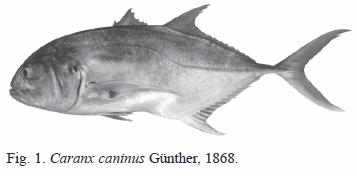
</front><body><![CDATA[ <div style="text-align: center;"><font face="Verdana" size="4"  style="font-weight: bold;">     <p>Growth of the Pacific jack <i>Caranx caninus </i>(Pisces: Carangidae) from the coast of Colima, México</p> </font></div>     <p style="font-weight: bold;"><font face="Verdana" size="2">Elaine Espino Barr</font><font face="Verdana" size="2"><a name="a1"></a><a  href="#a2"><sup>1</sup></a></font><font face="Verdana" size="2">, Manuel Gallardo Cabello</font><a href="#a2"><sup><font face="Verdana" size="2">2</font></sup></a><font  face="Verdana" size="2">, Esther Guadalupe Cabral Solís</font><a  href="#a2"><sup><font face="Verdana" size="2">1</font></sup></a><font  face="Verdana" size="2">, Arturo Garcia Boa</font><a><font face="Verdana" size="2"><a href="#a2"><sup>1</sup></a> </font></a><font face="Verdana" size="2">&amp; Marcos Puente Gómez</font><a href="#a2"><sup><font face="Verdana"  size="2">1</font></sup></a></p>     <p><font face="Verdana" size="2"><a name="a2"></a><a href="#a1">1</a> CRIP-Manzanillo,INP, Playa Ventanas s/n, Manzanillo, Colima, 28200, México. Tel: 01 (314) 33 32 37 50. Fax: 01(314) 33 32 37 51; <a href="mailto:elespino@bay.net.mx">elespino@bay.net.mx</a>; <a  href="mailto:escama@webtelmex.net.mx">escama@webtelmex.net.mx</a>; <a  href="mailto:elespino@gmail.com">elespino@gmail.com</a></font></p>     <p><font face="Verdana" size="2"><a href="#a1">2</a> Instituto de Ciencias del Mar y Limnología, UNAM, Apartado Postal 70-305, C.P 04510, México, D.F., México; <a href="mailto:gallardo@mar.icmyl.unam.mx">gallardo@mar.icmyl.unam.mx</a></font></p> <hr style="width: 100%; height: 2px;">     <p><font face="Verdana" size="2"><span style="font-weight: bold;">Abstract:</span> The Pacific jack <i>Caranx caninus </i>is a common species fished by artisanal fishermen off the coast of Colima, México. During 2002, monthly samples of morphometric data and otoliths were taken to determine age and growth. Seven age groups were identified. The highest growth, 14.4 cm, takes place during the first year of life. During the second year, <i>C. caninus </i>grows 11.76 cm; the third year 9.61 cm; the fourth 7.85 cm; the fifth 6.41 cm and sixth year 5.24 cm. The constants of von Bertalanffy´s growth equation were: L<sub>&#8734;</sub> = 83.26 cm, W<sub>&#8734;</sub> = 18.138 g, K = 0.202, t<sub>o</sub> = -0.283 and A<sub>0.95</sub> = 15 years. Growth curves of other species of the same genus were calculated in order to compare them with the one obtained in the present work. The gonadosomatic index presented higher values during November and May. The periods of more intensive feeding are from August to February. Rev. Biol. Trop. 56 (1): 171-179. Epub 2008 March 31.     <br> </font></p>     <p><font face="Verdana" size="2">Key words: <i>Caranx caninus, </i>age and growth, length frequency distribution, sagittae, asterisci, von Bertalanffy’s equation, longevity.</font></p> <hr style="width: 100%; height: 2px;">     <p><i><font face="Verdana" size="2">Caranx caninus </font></i><font  face="Verdana" size="2">Günther 1868 (<a href="#f1">Fig. 1</a>) is a pelagic and coastal species of the continental shelf from California, USA to the north of Perú (Chirichigno <i>et al</i>. 1982). It is fished during the whole year in the coast of Colima, México, and its capture volumes summing about 15 % of total catch annual average make it important (Cruz-Romero <i>et al</i>. 1993).    <br> </font></p>     ]]></body>
<body><![CDATA[<p><font face="Verdana" size="2">    <br> <a name="f1"></a></font></p>     <div style="text-align: center;"><font face="Verdana" size="2"><img  src="/img/revistas/rbt/v56n1/art12i1.jpg" title="" alt=""  style="width: 357px; height: 179px;"></font>    <br> </div>     <p><font face="Verdana" size="2">The Pacific jack is considered a second and third class commercial product; its price does not exceed five pesos on the beach or eight pesos per kg in the market ($0.50 to $0.80 USD). In the State of Guerrero it is considered a second class fish but with a better price (Pérez-Velásquez, pers. com.). Analysis on its taxonomic description have been made by Castro-Aguirre (1978), Chirichigno <i>et al</i>. (1982), van der Heiden (1985), Bussing and López (2004); on general aspects of its fishery by Ramírez-Granados (1977), Cruz-Romero <i>et al</i>. (1989, 1996), Espino-Barr <i>et al</i>. (2003, 2004). Cruz-Romero <i>et al</i>. (1993) analyzed general aspects of its biology. Recently Torres-Aguilar (2002) studied its age and growth determination in Guerrero and Michoacán, with vertebrae and spines. Espino-Barr <i>et al. </i>(2006) determined the average length for each age with the analysis of the sagittae and the asterisci.</font></p>     <p><font face="Verdana" size="2">Age and growth analysis are necessary to understand the population’s dynamics and the fluctuations of its biomass in time and space (Lucano-Ramírez <i>et al</i>. 2006). The use of the ELEFAN method (Gayanilo <i>et al</i>. 1994; Jiménez-Badillo 2006) and the analysis of the otoliths are good instruments to estimate age groups and obtain growth parameters.</font></p>     <p><font face="Verdana" size="2">The weight-length relation helps to calculate the condition factor that is necessary to understand weight variations through the year (Safran 1992). Likewise, the calculations of the gonadosomatic index and the gastric repletion index help to understand the growth phenomena, the gonadic maturity and the trophic dynamics of the populations (Saucedo-Lozano <i>et al. </i>1999; Rojas-Herrera <i>et al. </i>2004; Rojas <i>et al. </i>2004; Aguirre-León and Díaz-Ruiz 2006).</font></p>     <p><font face="Verdana" size="2">In this study the average length for each age was estimated by means of the monthly length frequency distributions. The time of the slow and fast growth bands formation in the otoliths sagittae was determined. The growth constants of von Bertalanffy´s (1938) equation were calculated from the polimodal analysis and from the analysis of sagittae and asterisci. The longevity and the values of the condition factor, gonadosomatic and gastric repletion were also calculated.</font></p>     <p style="font-weight: bold;"><font face="Verdana" size="3">Materials and methods    <br> </font></p>     ]]></body>
<body><![CDATA[<p><font face="Verdana" size="2">From January to December 2002, fifty specimens of the Pacific jack <i>C. caninus </i>were obtained monthly from the commercial catch in Manzanillo, Colima, México, and taken to the lab where standard (Ls, cm) and total length (Lt, cm), total (Wt, g) and eviscerated weight (We, g), gonad (Wg, g) and stomach weight (Ws, g) were recorded for each individual. The total weight (Wt), standard (Ls) and total length (Lt) of over 200 individuals per month were taken in situ.</font></p>     <p><font face="Verdana" size="2">The length frequency distribution was analyzed with the ELEFAN program of the FISAT package (Gayanilo <i>et al</i>. 1994) to obtain the average length of the polimodal curves corresponding to each age group.</font></p>     <p><font face="Verdana" size="2">The average length of the age groups determined by the analysis of the otoliths sagittae and asterisci by Espino-Barr <i>et al</i>. (2006) were used to obtain the constants of von Bertalanffy´s (1938) growth equation. The observed values were: for age 0=6.33 cm, age 1=15.09 cm; age 2=32.19 cm; age 3=41.50 cm; age 4=48.17 cm; age 5=55.58 cm and age 6=58.75 cm. The time of the growth ring formation was determined, observing whether the borders had slow or fast growth rings. In every case otoliths were observed by transparency with transmitted light; the hyaline zone corresponds to the slow growth band and the opaque zone to the fast growth band, which is in contrast with reflected light (Blacker 1974).</font></p>     <p><font face="Verdana" size="2">There were no growth differences between sexes (Espino-Barr <i>et al. </i>2006).</font></p>     <p><font face="Verdana" size="2">The constants L</font><font  face="Verdana" size="1">&#8734;</font><font face="Verdana" size="2">, K y t</font><font  face="Verdana" size="1">o </font><font face="Verdana" size="2">of von Bertalanffy´s (1938) equation were obtained with Ford´s (1933), Walford´s (1946) and Gulland´s method (1964) and were adjusted by convergent iterations with Newton´s algorithm with the Solver program in Excel software (Microsoft 1992).</font></p>     <p><font face="Verdana" size="2">Weight-length relationship was calculated with the function W=a*L</font><sup><font face="Verdana"  size="1">b</font></sup><font face="Verdana" size="2">, and a "t student test" was used to prove allometry (Mendenhall 1987, Zar 1996). The weight for every age was obtained with the growth data in length and the weight-length function. Weight growth was obtained substituting L</font><font face="Verdana" size="1"><sub>t</sub> </font><font face="Verdana" size="2">and L</font><font face="Verdana"  size="1"><sub>&#8734;</sub> </font><font face="Verdana" size="2">for W</font><font  face="Verdana" size="1">t </font><font face="Verdana" size="2">and W</font><sub><font  face="Verdana" size="1">&#8734;</font></sub><font face="Verdana" size="2">, in von Bertalanffy´s (1938) equation. Age limit or longevity (95 % of L</font><font face="Verdana" size="1">&#8734;</font><font  face="Verdana" size="2">) was determined with Taylor´s equation (1958, 1960):</font></p>     <p style="text-align: center;"><font face="Verdana" size="2">A</font><sub><font  face="Verdana" size="1">0.95</font></sub><font face="Verdana" size="2">=ln(1-0.95)/k+t</font><sub><font  face="Verdana" size="1">o</font></sub></p> <font face="Verdana" size="2">     <p>Monthly values of the condition factor, equivalent to the "a" parameter of weightlength equation, were obtained for total and eviscerated weight (Safran 1992), and compared with the confidence interval, to explain changes in the gonad, liver and stomach throughout the year.</p>     <p>The gonadosomatic index (GSI) was determined with the equation described by Rodríguez-Gutiérrez (1992): GSI=Wg/Wt*100, where Wg is gonad weight and Wt is the total weight of the individual.</p> </font>     <p><font face="Verdana" size="2">The gastric repletion index (GRI) according to Sierra and Popota (1988) is GRI=Ws/Wt*100, where Ws is the stomach weight and Wt is the total weight of the individual.</font></p>     ]]></body>
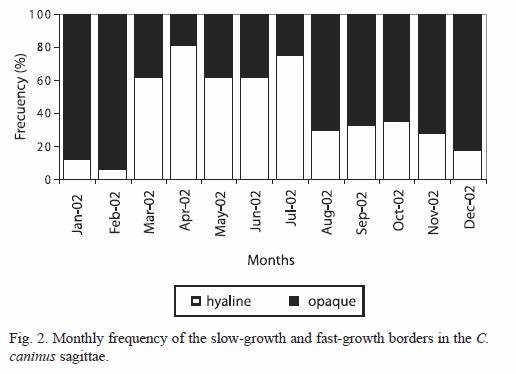
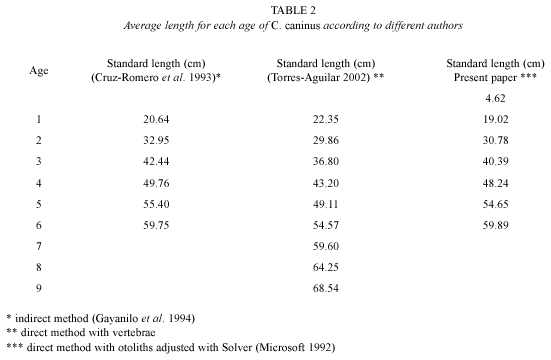
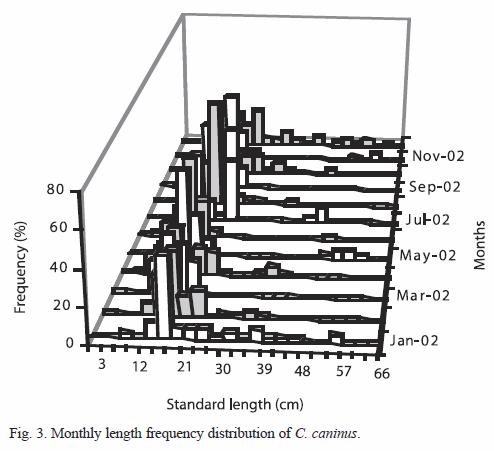
<body><![CDATA[<p style="font-weight: bold;"><font face="Verdana" size="3">Results</font></p>     <p><font face="Verdana" size="2">Growth rings time of formation of the slow and fast growth bands: <i>C. caninus </i>shows that a higher percentage of otoliths with fast growth borders occurs during August to February (autumn-winter), while the highest percentage of otoliths with slow growth bands in the border were observed during March to July (spring-summer) (<a href="#f2">Fig. 2</a>).    <br> </font></p>     <p><font face="Verdana" size="2">    <br> <a name="f2"></a></font></p>     <div style="text-align: center;"><font face="Verdana" size="2"><img  src="/img/revistas/rbt/v56n1/art12i2.jpg" title="" alt=""  style="width: 516px; height: 374px;"></font>    <br> </div> <font face="Verdana" size="2"><i> </i></font>     <p><font face="Verdana" size="2"><i>Analysis of length frequency:</i> <font  face="Verdana" size="2">the values of standard length for each age are shown in <a href="#t1">Table 1</a> and <a href="#f3">Figure 3</a>. The first year the organism grows 16.34 cm, during the second year it has reached 30 cm. Growth parameters for the standard length are: L</font><sub><font  face="Verdana" size="2">&#8734;</font></sub><font face="Verdana" size="2">=76.00 cm, K=0.26 years</font><font face="Verdana" size="2"><sup>-1</sup> </font><font  face="Verdana" size="2">and t</font><sub><font face="Verdana" size="2">o</font></sub><font  face="Verdana" size="2">=- 0.07. The highest increment occurs during the first year of life, during the next years growth rate decreases notably: 13.66 cm from age one to age two; 10.53 from age two to age three; 8.12 from age three to age four; 6.26 from age four to age five and 4.82 cm from age five to age six.    <br> </font></font></p>     <p><font face="Verdana" size="2"><font face="Verdana" size="2">    ]]></body>
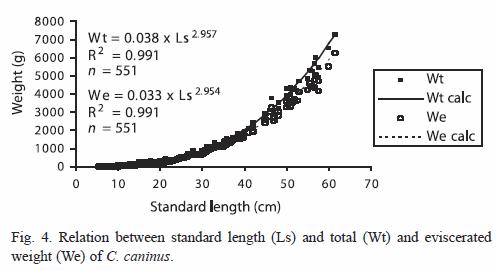
<body><![CDATA[<br> <a name="t1"></a></font></font></p>     <div style="text-align: center;"><font face="Verdana" size="2"><font  face="Verdana" size="2"><img src="/img/revistas/rbt/v56n1/art12t1.gif"  title="" alt="" style="width: 571px; height: 345px;">    <br>     <br>     <br> <a name="f3"></a><img src="/img/revistas/rbt/v56n1/art12i3.jpg" title=""  alt="" style="width: 494px; height: 451px;">    <br> </font></font></div>     <p><font face="Verdana" size="2"><i>Analysis of otoliths: </i>analysis of the sagittae and asterisci otoliths permitted to identify seven age groups. Growth parameters for the standard length were: L</font><sub><font  face="Verdana" size="1">&#8734;</font></sub><font face="Verdana" size="2">=83.26 cm; K=0.202 years</font><sup><font face="Verdana" size="1">-1</font></sup><font  face="Verdana" size="2">; t</font><sub><font face="Verdana" size="1">o</font></sub><font  face="Verdana" size="2">=-0.283. Instantaneous growth rate was 14.4 cm from age cero to age one; 11.76 from age one to age two; 9.61 from ages two to three; 7.85 from ages three to four; 6.41 from ages four to five and 5.24 cm from ages five to six.</font></p>     <p><font face="Verdana" size="2"><i>Growth in weight: </i>The allometric growth index value of the weight-length equation was isometric: b=2.957 with total weight data (t=0.561&lt;t</font><sub><font face="Verdana" size="1">0.05(2)426</font></sub><font  face="Verdana" size="2">) and b=2.954 with eviscerated specimens (t=0.875&lt;t</font><font  face="Verdana" size="1">0.05(2)91</font><font face="Verdana" size="2">); they were statistically equal to 3 (<a href="#f4">Fig. 4</a>).    <br> </font></p>     <p><font face="Verdana" size="2">    ]]></body>
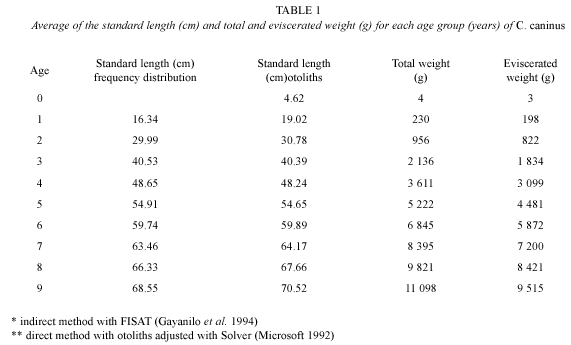
<body><![CDATA[<br> <a name="f4"></a></font></p>     <div style="text-align: center;"><font face="Verdana" size="2"><img  src="/img/revistas/rbt/v56n1/art12i4.jpg" title="" alt=""  style="width: 498px; height: 271px;"></font>    <br> </div>     <p><i><font face="Verdana" size="2">Theoretical growth in weight: </font></i><font  face="Verdana" size="2">table 1 shows the values of theoretical growth for total and eviscerated weight at each age. The first year the organism reaches 230 g of total weight and 198 g of eviscerated weight. For the second year the values increase potentially: 956 g of total weight and 822 g of eviscerated weight. The asymptotic total weight was Wt</font><font  face="Verdana" size="1"><sub>&#8734;</sub> </font><font face="Verdana" size="2">= 18.138 g and the eviscerated asymptotic weight, We = 15.544 g.</font></p>     <p><font face="Verdana" size="2"><i>Longevity (Age A</i></font><i><sub><font  face="Verdana" size="1">0.95</font></sub><font face="Verdana" size="2">): C. caninus </font></i><font face="Verdana" size="2">reached 95 % of its infinite length L</font><font face="Verdana" size="1">&#8734; </font><font  face="Verdana" size="2">at 15 years.</font></p>     <p><font face="Verdana" size="2"><i>Bioecologic considerations during the growth of </i>C. caninus<i>: </i>analysis of the confidence intervals of the indexes showed that there are no significant changes throughout the year. Figure 5 shows the trends of the monthly average data of the indexes of condition factor (a), gonadosomatic (GSI) and the gastric repletion (GRI). The massive spawning periods occur in November and May (GSI). The most active feeding season represented as condition factor (a tot and a evi) is from August to February. The gastric repletion index (GRI) seems stable during this period, reaching its higher value in December, January and May.</font></p> <font face="Verdana" size="2"><font face="Verdana" size="3"  style="font-weight: bold;">     <p>Discussion</p> </font>     <p>According to the results showed in <a href="#t2">Table 2</a>, each year a band of fast and of slow growth <font face="Verdana" size="2">are deposited in the otoliths, validating the use of this structure to estimate age based in the number of bands in <i>Caranx caninus</i>.    <br> </font></p>     <p><font face="Verdana" size="2">    ]]></body>
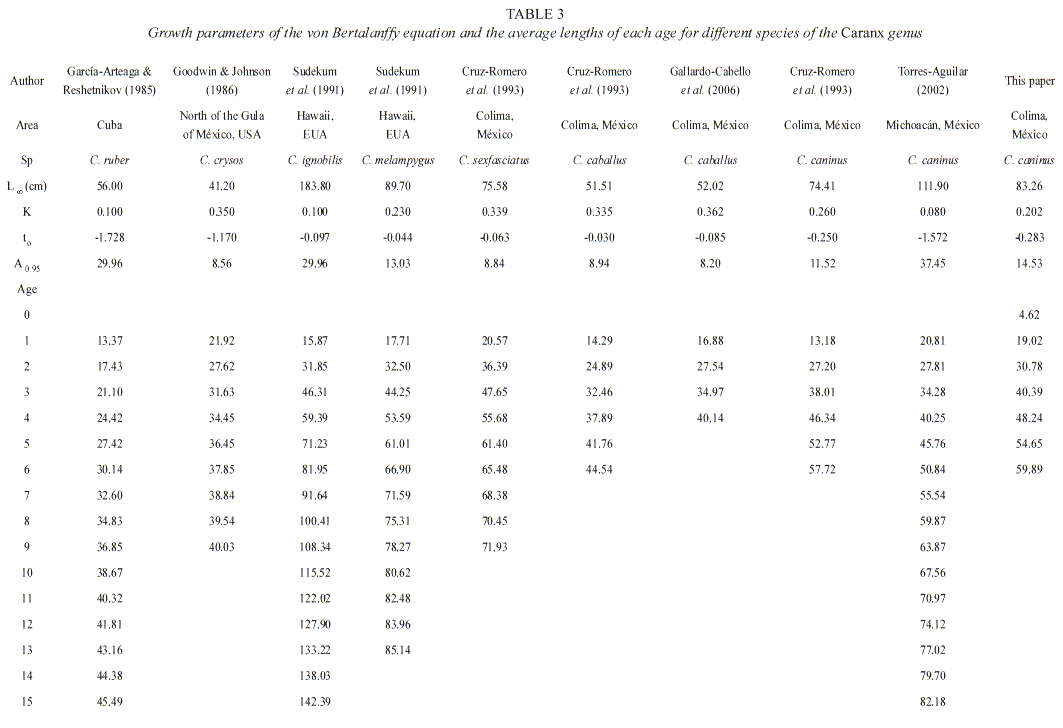
<body><![CDATA[<br> <a name="t2"></a></font></p> </font>     <div style="text-align: center;"><font face="Verdana" size="2"><img  src="/img/revistas/rbt/v56n1/art12t2.gif" title="" alt=""  style="width: 551px; height: 360px;"></font>    <br> </div>     <p><font face="Verdana" size="2">In this paper, the values obtained with the length frequency analysis were very similar to those found by the identification of growth rings in the sagittae and asterisci otoliths, which renders age determination in <i>C. caninus </i>valid with both methods. The otolith analysis allowed the calculation of the average length for age group cero, which was not identified by the polimodal curves, due to the very few organisms under one year of age in the commercial catch because of gear size selectivity. The use of the ELEFAN program (Gayanilo <i>et al</i>. 1994) distinguished similar age group comparable with those found by Cruz-Romero <i>et al</i>. (1993), who also used an indirect method for their analysis. It is important to note that the values of this paper and those of Torres-Aguilar (2002) in relation to the ones found a decade ago by Cruz-Romero <i>et al</i>. (1993) suggest that the population is stable in spite of the fluctuations in the physical, chemical and fishery variables; a reduction in its length which is an over fishing symptom has not been observed (Espino-Barr 2000).</font></p>     <p><font face="Verdana" size="2">Allometric growth index shows intrannual variations, which depend in great measure on the relation of the organism with its environment and is inversely proportional to the condition factor (Safran 1992). Cruz-Romero <i>et al</i>. (1993) found a negative allometric value, i.e., b=2.28, while in the present work the indexes are isometric b=2.957 with total weight and b=2.954 with eviscerated weight.</font></p>     <p><font face="Verdana" size="2">Theoretical value of longevity (Taylor 1958) is based in von Bertalanffy´s formula as 95 % of the asymptotic length (Taylor 1960). As with the growth parameters, longevity is very sensitive to the sample, that is, if the organisms are large, the asymptotic length increases and the growth coefficient decreases, whereas if the organisms present a large "K" value its asymptotic length is reached in a shorter period of time. In the present work, the value of longevity for the different species of carangids is from eight and beyond. Calculations for the Pacific jack in Colima are 12 and 15 years (Cruz-Romero <i>et al</i>. 1993 and this study, respectively), while the values for Guerrero and Michoacán (Torres-Aguilar 2002) reach up to 37 years.</font></p>     <p><font face="Verdana" size="2">Results on growth analysis of other species of <i>Caranx </i>genus were used, because of the lack of specific data (García-Arteaga and Reshetnikov 1985, Goodwin and Johnson 1986, Sudekum <i>et al. </i>1991, Cruz-Romero <i>et al. </i>1993, Torres-Aguilar 2002 and Gallardo-Cabello et al. 2006). For the different species, the value of the K index result in curves of steeper trends for larger specimens (0.26 to 0.35) and the length reaches the asymptotic length L</font><font face="Verdana" size="1"><sub>&#8734;</sub> </font><font  face="Verdana" size="2">faster or in a shorter time (<a href="/img/revistas/rbt/v56n1/art12t3.gif">Table 3</a>). This occurs with <i>C. crysos </i>a species with the highest growth rate which reaches 21.92 cm in its first year. Together with <i>C. caninus </i>(Torres-Aguilar 2002), <i>C. ruber</i>, <i>C. ignobilis </i>and <i>C. melampygus </i>these are the carangids with the highest longevity.</font></p>     <p><font face="Verdana" size="2">The GSI is an indicator of the gonad development and therefore of the reproductive cycle of the fish (Rodríguez-Gutiérrez 1992). The results indicate higher reproductive activity in May and November, different from <i>C. caballus </i>whose active months are June and October. This helps to avoid interspecific competition and achieve a successful spawning (Ibáñez-Aguirre 1995, Rojas-Herrera <i>et al</i>. 2004). These two species have similar characteristics and behavior. Morphologically the Pacific jack reaches larger sizes, but from the fishery point of view they are both coastal pelagic and are fished in the same way.</font></p>     <p><font face="Verdana" size="2">The three indexes: condition factor (a), gonadosomatic (IGS) and gastric repletion (IRG), help to assume that the main spawning periods occur in November and May, because during this period the corporal waste of the fish is higher and looses weight. The most active feeding periods coincide with the period of the fast growth rings in the otoliths, that is, during the months of August to February, period that also coincides with the rainy season (Observatorio de Manzanillo, pers. com.; Espino-Barr 2000) responsible for the wash of abundant nutriments to the rivers and to the coastal zones; the same is true for the hurricane season (Observatorio de Manzanillo, pers. com.; Espino-Barr 2000) which remove the marine bottoms of Colima´s narrow continental shelf, and sends nutrients to the surface of the ocean and increases food availability. During this time, the individual weight increases and a recovery of the reproductive population takes place (larvae and juveniles); also the recruitment to the fishing zone occurs.</font></p>     <p><font face="Verdana" size="2">Conversely, during the spring-summer period (March-August), the availability of the food diminishes the values of the condition factor index decreases and the slow growth rings are formed. However during this season a massive spawning period is also observed during May.</font></p> <font face="Verdana" size="2" style="font-weight: bold;"><font  face="Verdana" size="2"> </font></font> <hr style="width: 100%; height: 2px;"><font face="Verdana" size="2"  style="font-weight: bold;"><font face="Verdana" size="2">     ]]></body>
<body><![CDATA[<p>Resumen</p> </font> </font>     <p><font face="Verdana" size="2"><font face="Verdana" size="2">El jurel <i>Caranx caninus </i>es una especie común que se captura en la pesca artesanal frente a las costas de Colima, México. Mensualmente, durante 2002, se tomaron datos morfométricos y muestras de otolitos para determinar la edad y el crecimiento. Se encontraron siete grupos de edad; durante el primer año de vida se da el mayor crecimiento, hasta 14.4 cm. Durante el segundo año, <i>C. caninus </i>crece 11.76 cm; el tercero 9.61 cm; el cuarto 7.85 cm; el quinto 6.41 cm y el último año crece 5.24 cm. Las constantes de la ecuación de crecimiento de von Bertalanffy fueron: L</font><font face="Verdana" size="1"><sub>&#8734;</sub> </font><font face="Verdana" size="2">= 83.26 cm, W</font><font  face="Verdana" size="2"><sub>&#8734;</sub> </font><font face="Verdana"  size="2">= 18.138 g, K = 0.202, t</font><font face="Verdana" size="2">o </font><font  face="Verdana" size="2">= -0.283 y la longevidad A</font><font  face="Verdana" size="2"><sub>0.95</sub> </font><font face="Verdana"  size="2">= 15 años. Las curvas de crecimiento de otras especies del mismo género se compararon con las obtenidas en el presente trabajo. El índice gonadosomático presentó valores más altos durante noviembre y mayo. Los periodos de tiempo de alimentación más intensa son de agosto a febrero.</font></font></p>     <p><font face="Verdana" size="2"><font face="Verdana" size="2">Palabras clave: <i>Caranx caninus</i>, edad y crecimiento, distribución de frecuencia de talla, <i>sagittae, asterisci</i>, ecuación von Bertalanffy, longevidad.    <br> </font></font></p> <hr style="width: 100%; height: 2px;">     <p style="text-align: center;"><font face="Verdana" size="2"><font  face="Verdana" size="2">Received 02-IV-2006. Corrected 08-V-2007. Accepted 22-VIII-2007.</font></font></p> <font face="Verdana" size="2" style="font-weight: bold;"><font  face="Verdana" size="3">     <p>References</p> </font> </font>     <!-- ref --><p><font face="Verdana" size="2"><font face="Verdana" size="2">Aguirre-León, A. &amp; S. Díaz-Ruiz. 2006. Estructura de tallas, madurez gonádica y alimentación del pez <i>Diapterus rhombeus </i>(Gerreidae) en el sistema fluviodeltaico Pom-Atasta, Campeche, México. Rev. Biol. Trop. 54: 599-611.</font></font>&nbsp;&nbsp;&nbsp;&nbsp;&nbsp;&nbsp;&nbsp;&nbsp;[&#160;<a href="javascript:void(0);" onclick="javascript: window.open('/scielo.php?script=sci_nlinks&ref=1253713&pid=S0034-7744200800010001200001&lng=','','width=640,height=500,resizable=yes,scrollbars=1,menubar=yes,');">Links</a>&#160;]<!-- end-ref --><!-- ref --><p><font face="Verdana" size="2"><font face="Verdana" size="2">Blacker, R.W. 1974. Recent advances in otolith studies, p. 67-90. <i>In </i>J. Harden-Jones (ed.). Sea Fisheries Research, London, England.</font></font>&nbsp;&nbsp;&nbsp;&nbsp;&nbsp;&nbsp;&nbsp;&nbsp;[&#160;<a href="javascript:void(0);" onclick="javascript: window.open('/scielo.php?script=sci_nlinks&ref=1253714&pid=S0034-7744200800010001200002&lng=','','width=640,height=500,resizable=yes,scrollbars=1,menubar=yes,');">Links</a>&#160;]<!-- end-ref --><!-- ref --><p><font face="Verdana" size="2"><font face="Verdana" size="2">Bussing, W.A. &amp; M.I. Lopez. 2004. Peces de Isla del Coco y peces arrecifales de la costa pacifica de Centro América Meridional. Rev. Biol. Trop. 52: 1-191.</font></font>&nbsp;&nbsp;&nbsp;&nbsp;&nbsp;&nbsp;&nbsp;&nbsp;[&#160;<a href="javascript:void(0);" onclick="javascript: window.open('/scielo.php?script=sci_nlinks&ref=1253715&pid=S0034-7744200800010001200003&lng=','','width=640,height=500,resizable=yes,scrollbars=1,menubar=yes,');">Links</a>&#160;]<!-- end-ref --><!-- ref --><p><font face="Verdana" size="2"><font face="Verdana" size="2">Castro-Aguirre, J.L. 1978. Catálogo sistemático de los peces marinos que penetran a las aguas continentales de México, con aspectos zoogeográficos y ecológicos. Depto. Pesca, INP, Serie Científica 19, México D.F., México.</font></font>&nbsp;&nbsp;&nbsp;&nbsp;&nbsp;&nbsp;&nbsp;&nbsp;[&#160;<a href="javascript:void(0);" onclick="javascript: window.open('/scielo.php?script=sci_nlinks&ref=1253716&pid=S0034-7744200800010001200004&lng=','','width=640,height=500,resizable=yes,scrollbars=1,menubar=yes,');">Links</a>&#160;]<!-- end-ref --><!-- ref --><p><font face="Verdana" size="2"><font face="Verdana" size="2">Chirichigno, N., W. Fischer &amp; C.W. Nawen . 1982. Catálogo de especies marinas de interés económico actual o potencial para América Latina. Infopesca, Pacífico Centro y Suroriental, Roma fao/pnud, Italy.</font></font>&nbsp;&nbsp;&nbsp;&nbsp;&nbsp;&nbsp;&nbsp;&nbsp;[&#160;<a href="javascript:void(0);" onclick="javascript: window.open('/scielo.php?script=sci_nlinks&ref=1253717&pid=S0034-7744200800010001200005&lng=','','width=640,height=500,resizable=yes,scrollbars=1,menubar=yes,');">Links</a>&#160;]<!-- end-ref --><!-- ref --><p><font face="Verdana" size="2"><font face="Verdana" size="2">Cruz-Romero, M., E. Espino-Barr &amp; A. Garcia-Boa. 1989. Lista de peces del litoral Colimense. INP/SEPESCA Serie: Doc. Trab. 1: 21 p.</font></font>&nbsp;&nbsp;&nbsp;&nbsp;&nbsp;&nbsp;&nbsp;&nbsp;[&#160;<a href="javascript:void(0);" onclick="javascript: window.open('/scielo.php?script=sci_nlinks&ref=1253718&pid=S0034-7744200800010001200006&lng=','','width=640,height=500,resizable=yes,scrollbars=1,menubar=yes,');">Links</a>&#160;]<!-- end-ref --><!-- ref --><p><font face="Verdana" size="2"><font face="Verdana" size="2">Cruz-Romero, M., E. Espino-Barr &amp; A. Garcia-Boa. 1993. Carángidos: aspectos biológico-pesqueros en el litoral colimense. Cuad. Mex. Zool. 1: 81-88.</font></font>&nbsp;&nbsp;&nbsp;&nbsp;&nbsp;&nbsp;&nbsp;&nbsp;[&#160;<a href="javascript:void(0);" onclick="javascript: window.open('/scielo.php?script=sci_nlinks&ref=1253719&pid=S0034-7744200800010001200007&lng=','','width=640,height=500,resizable=yes,scrollbars=1,menubar=yes,');">Links</a>&#160;]<!-- end-ref --><!-- ref --><p><font face="Verdana" size="2"><font face="Verdana" size="2">Cruz-Romero, M., E. Espino-Barr &amp; A. Garcia-Boa. 1996. Potencial de la pesca ribereña en el estado de Colima, México, en 1989. INP/SEMARNAP, Ciencia Pesquera 12: 30-35</font></font>&nbsp;&nbsp;&nbsp;&nbsp;&nbsp;&nbsp;&nbsp;&nbsp;[&#160;<a href="javascript:void(0);" onclick="javascript: window.open('/scielo.php?script=sci_nlinks&ref=1253720&pid=S0034-7744200800010001200008&lng=','','width=640,height=500,resizable=yes,scrollbars=1,menubar=yes,');">Links</a>&#160;]<!-- end-ref --><!-- ref --><p><font face="Verdana" size="2"><font face="Verdana" size="2">Espino-Barr, E., M. Cruz-Romero &amp; A. Garcia-Boa. 2003. Peces marinos con valor comercial de la costa de Colima, México. CONABIO, INP, CRIP-Manzanillo, ISBN 970-9000-23-3, México D.F., México.</font></font>&nbsp;&nbsp;&nbsp;&nbsp;&nbsp;&nbsp;&nbsp;&nbsp;[&#160;<a href="javascript:void(0);" onclick="javascript: window.open('/scielo.php?script=sci_nlinks&ref=1253721&pid=S0034-7744200800010001200009&lng=','','width=640,height=500,resizable=yes,scrollbars=1,menubar=yes,');">Links</a>&#160;]<!-- end-ref --><!-- ref --><p><font face="Verdana" size="2"><font face="Verdana" size="2">Espino Barr, E., E.G. Cabral Solís, A. Garcia Boa &amp; M. Puente Gómez. 2004. Especies marinas con valor comercial de la costa de Jalisco, México. SAGARPA–INP, ISBN-968-800-570-3, México D.F., México.</font></font>&nbsp;&nbsp;&nbsp;&nbsp;&nbsp;&nbsp;&nbsp;&nbsp;[&#160;<a href="javascript:void(0);" onclick="javascript: window.open('/scielo.php?script=sci_nlinks&ref=1253722&pid=S0034-7744200800010001200010&lng=','','width=640,height=500,resizable=yes,scrollbars=1,menubar=yes,');">Links</a>&#160;]<!-- end-ref --><!-- ref --><p><font face="Verdana" size="2"><font face="Verdana" size="2">Espino-Barr, E. 2000. Criterios Biológicos para la administración de la pesca multiespecífica artesanal en la costa de Colima, México. Tesis de Doctorado, Colima, México.</font></font>&nbsp;&nbsp;&nbsp;&nbsp;&nbsp;&nbsp;&nbsp;&nbsp;[&#160;<a href="javascript:void(0);" onclick="javascript: window.open('/scielo.php?script=sci_nlinks&ref=1253723&pid=S0034-7744200800010001200011&lng=','','width=640,height=500,resizable=yes,scrollbars=1,menubar=yes,');">Links</a>&#160;]<!-- end-ref --><!-- ref --><p><font face="Verdana" size="2"><font face="Verdana" size="2">Espino-Barr, E., M. Gallardo-Cabello, A. Garcia-Boa, E.G. Cabral-Solís &amp; M. Puente-Gómez. 2006. Morphologic and morphometric analysis and growth rings identification of otoliths: sagitta, asteriscus and lapillus of <i>Caranx caninus </i>(Pisces: Carangidae) in the coast of Colima, Mexico. J. Fish. Aquat. Sci. 1: 157-170.</font></font>&nbsp;&nbsp;&nbsp;&nbsp;&nbsp;&nbsp;&nbsp;&nbsp;[&#160;<a href="javascript:void(0);" onclick="javascript: window.open('/scielo.php?script=sci_nlinks&ref=1253724&pid=S0034-7744200800010001200012&lng=','','width=640,height=500,resizable=yes,scrollbars=1,menubar=yes,');">Links</a>&#160;]<!-- end-ref --><!-- ref --><p><font face="Verdana" size="2"><font face="Verdana" size="2">Ford, E. 1933. An account of the herring investigations conducted at Plymouth during the years from 1924 to 1933. J. Mar. Biol. Assoc. U.K. 19: 305-384.</font></font>&nbsp;&nbsp;&nbsp;&nbsp;&nbsp;&nbsp;&nbsp;&nbsp;[&#160;<a href="javascript:void(0);" onclick="javascript: window.open('/scielo.php?script=sci_nlinks&ref=1253725&pid=S0034-7744200800010001200013&lng=','','width=640,height=500,resizable=yes,scrollbars=1,menubar=yes,');">Links</a>&#160;]<!-- end-ref --><!-- ref --><p><font face="Verdana" size="2"><font face="Verdana" size="2">Gallardo-Cabello, M., E. Espino-Barr, A. Garcia-Boa, E.G. Cabral-Solís &amp; M. Puente-Gómez. 2006. Morphologic and morphometric analysis and growth rings identification of otoliths: sagitta, asteriscus and lapillus of <i>Caranx caballus </i>(Pisces: Carangidae) in the coast of Colima, Mexico. Internat. J. Zool. Research 2: 34-47</font></font>&nbsp;&nbsp;&nbsp;&nbsp;&nbsp;&nbsp;&nbsp;&nbsp;[&#160;<a href="javascript:void(0);" onclick="javascript: window.open('/scielo.php?script=sci_nlinks&ref=1253726&pid=S0034-7744200800010001200014&lng=','','width=640,height=500,resizable=yes,scrollbars=1,menubar=yes,');">Links</a>&#160;]<!-- end-ref --><!-- ref --><p><font face="Verdana" size="2"><font face="Verdana" size="2">García-Arteaga, J.P. &amp; Y.S. Reshetnikov. 1985. Age and growth of the barjack (<i>Caranx ruber</i>) off the coast of Cuba. J. Ichthyol. 25: 120-131.</font></font>&nbsp;&nbsp;&nbsp;&nbsp;&nbsp;&nbsp;&nbsp;&nbsp;[&#160;<a href="javascript:void(0);" onclick="javascript: window.open('/scielo.php?script=sci_nlinks&ref=1253727&pid=S0034-7744200800010001200015&lng=','','width=640,height=500,resizable=yes,scrollbars=1,menubar=yes,');">Links</a>&#160;]<!-- end-ref --><!-- ref --><p><font face="Verdana" size="2"><font face="Verdana" size="2">Gayanilo, F.C., P. Sparre &amp; D. Pauly. 1994. The FAOICLARM Stock Assessment Tools (FiSAT) User´s Guide. FAO Computarized Information Series (Fisheries), Rome, Italy.</font></font>&nbsp;&nbsp;&nbsp;&nbsp;&nbsp;&nbsp;&nbsp;&nbsp;[&#160;<a href="javascript:void(0);" onclick="javascript: window.open('/scielo.php?script=sci_nlinks&ref=1253728&pid=S0034-7744200800010001200016&lng=','','width=640,height=500,resizable=yes,scrollbars=1,menubar=yes,');">Links</a>&#160;]<!-- end-ref --><!-- ref --><p><font face="Verdana" size="2"><font face="Verdana" size="2">Goodwin, J.M. &amp; A.G. Johnson. 1986. Age, growth, and mortality of blue runner, <i>Caranx crysos </i>form the northern Gulf of Mexico. Northeast Gulf Sci. 8: 107-114.</font></font>&nbsp;&nbsp;&nbsp;&nbsp;&nbsp;&nbsp;&nbsp;&nbsp;[&#160;<a href="javascript:void(0);" onclick="javascript: window.open('/scielo.php?script=sci_nlinks&ref=1253729&pid=S0034-7744200800010001200017&lng=','','width=640,height=500,resizable=yes,scrollbars=1,menubar=yes,');">Links</a>&#160;]<!-- end-ref --><!-- ref --><p><font face="Verdana" size="2"><font face="Verdana" size="2">Gulland, J.A. 1964. Manual of methods of fish population analysis. FAO Fish, Tech. Paper., Rome, Italy.    &nbsp;&nbsp;&nbsp;&nbsp;&nbsp;&nbsp;&nbsp;&nbsp;[&#160;<a href="javascript:void(0);" onclick="javascript: window.open('/scielo.php?script=sci_nlinks&ref=1253730&pid=S0034-7744200800010001200018&lng=','','width=640,height=500,resizable=yes,scrollbars=1,menubar=yes,');">Links</a>&#160;]<!-- end-ref --><br> </font></font></p>     <!-- ref --><p><font face="Verdana" size="2"><font face="Verdana" size="2">Jiménez-Badillo, L. 2006. Age-growth models for tilapia <i>Oreochromis aureus </i>(Perciformes, Cichlidae) of the Iniernillo reservoir, Mexico and reproductive behaviour. Rev. Biol. Trop. 54: 577-588.</font></font>&nbsp;&nbsp;&nbsp;&nbsp;&nbsp;&nbsp;&nbsp;&nbsp;[&#160;<a href="javascript:void(0);" onclick="javascript: window.open('/scielo.php?script=sci_nlinks&ref=1253732&pid=S0034-7744200800010001200019&lng=','','width=640,height=500,resizable=yes,scrollbars=1,menubar=yes,');">Links</a>&#160;]<!-- end-ref --><!-- ref --><p><font face="Verdana" size="2"><font face="Verdana" size="2">Ibáñez-Aguirre, A.L. 1995. Algunos aspectos de la dinámica de poblaciones de <i>Mugil cephalus </i>(Linneo, 1758) y <i>M. curema </i>(1836) (Pisces: Mugilidae) en la laguna de Tamiahua, Veracruz. Tesis doctoral, Fac. de Ciencias, UNAM, México D.F., México.</font></font>&nbsp;&nbsp;&nbsp;&nbsp;&nbsp;&nbsp;&nbsp;&nbsp;[&#160;<a href="javascript:void(0);" onclick="javascript: window.open('/scielo.php?script=sci_nlinks&ref=1253733&pid=S0034-7744200800010001200020&lng=','','width=640,height=500,resizable=yes,scrollbars=1,menubar=yes,');">Links</a>&#160;]<!-- end-ref --><!-- ref --><p><font face="Verdana" size="2"><font face="Verdana" size="2">Lucano-Ramírez, G., S. Ruiz-Ramírez &amp; J.A. Rojo-Vázquez. 2006. Composición por tallas y ciclo reproductivo de <i>Pseudupeneus grandisquamis </i>(Pisces: Mullidae) en el Pacífico central Mexicano. Rev. Biol. Trop. 54: 195-207.</font></font>&nbsp;&nbsp;&nbsp;&nbsp;&nbsp;&nbsp;&nbsp;&nbsp;[&#160;<a href="javascript:void(0);" onclick="javascript: window.open('/scielo.php?script=sci_nlinks&ref=1253734&pid=S0034-7744200800010001200021&lng=','','width=640,height=500,resizable=yes,scrollbars=1,menubar=yes,');">Links</a>&#160;]<!-- end-ref --><!-- ref --><p><font face="Verdana" size="2"><font face="Verdana" size="2">Mendenhall, W. 1987. Introduction to probability and statistics. PWS-Kent Publishing, Boston, Massachussets, USA.</font></font>&nbsp;&nbsp;&nbsp;&nbsp;&nbsp;&nbsp;&nbsp;&nbsp;[&#160;<a href="javascript:void(0);" onclick="javascript: window.open('/scielo.php?script=sci_nlinks&ref=1253735&pid=S0034-7744200800010001200022&lng=','','width=640,height=500,resizable=yes,scrollbars=1,menubar=yes,');">Links</a>&#160;]<!-- end-ref --><!-- ref --><p><font face="Verdana" size="2"><font face="Verdana" size="2">Microsoft. 1992. Excel. Manual de usuario. Referencia de funciones. Microsoft, Redmond, Washington, USA.</font></font>&nbsp;&nbsp;&nbsp;&nbsp;&nbsp;&nbsp;&nbsp;&nbsp;[&#160;<a href="javascript:void(0);" onclick="javascript: window.open('/scielo.php?script=sci_nlinks&ref=1253736&pid=S0034-7744200800010001200023&lng=','','width=640,height=500,resizable=yes,scrollbars=1,menubar=yes,');">Links</a>&#160;]<!-- end-ref --><!-- ref --><p><font face="Verdana" size="2"><font face="Verdana" size="2">Ramírez-Granados, R. 1977. Estudio de la factibilidad de una terminal pesquera en Manzanillo, Col. Depto. Pesca, México 2: 268-338.</font></font>&nbsp;&nbsp;&nbsp;&nbsp;&nbsp;&nbsp;&nbsp;&nbsp;[&#160;<a href="javascript:void(0);" onclick="javascript: window.open('/scielo.php?script=sci_nlinks&ref=1253737&pid=S0034-7744200800010001200024&lng=','','width=640,height=500,resizable=yes,scrollbars=1,menubar=yes,');">Links</a>&#160;]<!-- end-ref --><!-- ref --><p><font face="Verdana" size="2"><font face="Verdana" size="2">Rodríguez-Gutiérrez, M. 1992. Técnicas de evaluación cuantitativa de la madurez gonádica en peces. AGT, México DF.</font></font>&nbsp;&nbsp;&nbsp;&nbsp;&nbsp;&nbsp;&nbsp;&nbsp;[&#160;<a href="javascript:void(0);" onclick="javascript: window.open('/scielo.php?script=sci_nlinks&ref=1253738&pid=S0034-7744200800010001200025&lng=','','width=640,height=500,resizable=yes,scrollbars=1,menubar=yes,');">Links</a>&#160;]<!-- end-ref --><!-- ref --><p><font face="Verdana" size="2"><font face="Verdana" size="2">Rojas, M.J.R., E. Maravilla &amp; F. Chicas B. 2004. Hábitos alimentarios del pargo mancha <i>Lutjanus guttatus </i>(Pisces: Lutjanidae) en Los Cóbanos y Puerto La Libertad, El Salvador. Rev. Biol. Trop. 52: 163-170.</font></font>&nbsp;&nbsp;&nbsp;&nbsp;&nbsp;&nbsp;&nbsp;&nbsp;[&#160;<a href="javascript:void(0);" onclick="javascript: window.open('/scielo.php?script=sci_nlinks&ref=1253739&pid=S0034-7744200800010001200026&lng=','','width=640,height=500,resizable=yes,scrollbars=1,menubar=yes,');">Links</a>&#160;]<!-- end-ref --><!-- ref --><p><font face="Verdana" size="2"><font face="Verdana" size="2">Rojas-Herrera, A.A., M. Mascaró &amp; X. Chiappa-Carrara. 2004. Hábitos alimentarios de los peces <i>Lutjanus peru </i>y <i>Lutjanus guttatus </i>(Pisces: Lutjanidae) en Guerrero, México. Rev. Biol. Trop. 52: 959-972.</font></font>&nbsp;&nbsp;&nbsp;&nbsp;&nbsp;&nbsp;&nbsp;&nbsp;[&#160;<a href="javascript:void(0);" onclick="javascript: window.open('/scielo.php?script=sci_nlinks&ref=1253740&pid=S0034-7744200800010001200027&lng=','','width=640,height=500,resizable=yes,scrollbars=1,menubar=yes,');">Links</a>&#160;]<!-- end-ref --><!-- ref --><p><font face="Verdana" size="2"><font face="Verdana" size="2">Safran, P. 1992. Theoretical analysis of the weight-length relationship in fish juveniles. Mar. Biol. 112: 545- 551.</font></font>&nbsp;&nbsp;&nbsp;&nbsp;&nbsp;&nbsp;&nbsp;&nbsp;[&#160;<a href="javascript:void(0);" onclick="javascript: window.open('/scielo.php?script=sci_nlinks&ref=1253741&pid=S0034-7744200800010001200028&lng=','','width=640,height=500,resizable=yes,scrollbars=1,menubar=yes,');">Links</a>&#160;]<!-- end-ref --><!-- ref --><p><font face="Verdana" size="2"><font face="Verdana" size="2">Saucedo-Lozano, M., G. Gónzalez Sansón &amp; X. Chiappa Carrara. 1999. Alimentación Natural de jóvenes de <i>Lutjanus peru </i>(Nichols y Murphy, 1922) (Lutjanidae: Perciformes) en la costa de Jalisco y Colima, México. Ciencias Marinas 25: 381-400.</font></font>&nbsp;&nbsp;&nbsp;&nbsp;&nbsp;&nbsp;&nbsp;&nbsp;[&#160;<a href="javascript:void(0);" onclick="javascript: window.open('/scielo.php?script=sci_nlinks&ref=1253742&pid=S0034-7744200800010001200029&lng=','','width=640,height=500,resizable=yes,scrollbars=1,menubar=yes,');">Links</a>&#160;]<!-- end-ref --><!-- ref --><p><font face="Verdana" size="2"><font face="Verdana" size="2">Sierra, L.M. &amp; O.A. Popota. 1988. Velocidad de digestión, ritmo diario de la alimentación y raciones alimenticias de algunas especies de peces del Golfo de Batabanó, Cuba. Instituto de Oceanología, Acad. Cien. Cuba, La Habana, Cuba.</font></font>&nbsp;&nbsp;&nbsp;&nbsp;&nbsp;&nbsp;&nbsp;&nbsp;[&#160;<a href="javascript:void(0);" onclick="javascript: window.open('/scielo.php?script=sci_nlinks&ref=1253743&pid=S0034-7744200800010001200030&lng=','','width=640,height=500,resizable=yes,scrollbars=1,menubar=yes,');">Links</a>&#160;]<!-- end-ref --><!-- ref --><p><font face="Verdana" size="2"><font face="Verdana" size="2">Sudekum, A.E., J.D. Parrish, R.L. Radtke &amp; S. Ralston. 1991. Life history and ecology of large jacks in undisturbed, shallow, oceanic communities. Fish. Bull. U.S. 89: 493-513.</font></font>&nbsp;&nbsp;&nbsp;&nbsp;&nbsp;&nbsp;&nbsp;&nbsp;[&#160;<a href="javascript:void(0);" onclick="javascript: window.open('/scielo.php?script=sci_nlinks&ref=1253744&pid=S0034-7744200800010001200031&lng=','','width=640,height=500,resizable=yes,scrollbars=1,menubar=yes,');">Links</a>&#160;]<!-- end-ref --><!-- ref --><p><font face="Verdana" size="2"><font face="Verdana" size="2">Taylor, C.C. 1958. Cod growth and temperature. J. Conseil 23: 366-370.</font></font>&nbsp;&nbsp;&nbsp;&nbsp;&nbsp;&nbsp;&nbsp;&nbsp;[&#160;<a href="javascript:void(0);" onclick="javascript: window.open('/scielo.php?script=sci_nlinks&ref=1253745&pid=S0034-7744200800010001200032&lng=','','width=640,height=500,resizable=yes,scrollbars=1,menubar=yes,');">Links</a>&#160;]<!-- end-ref --><!-- ref --><p><font face="Verdana" size="2"><font face="Verdana" size="2">Taylor, C.C. 1960. Temperature, growth and mortality–the Pacific cockle. J. Conseil 26: 177-124.</font></font>&nbsp;&nbsp;&nbsp;&nbsp;&nbsp;&nbsp;&nbsp;&nbsp;[&#160;<a href="javascript:void(0);" onclick="javascript: window.open('/scielo.php?script=sci_nlinks&ref=1253746&pid=S0034-7744200800010001200033&lng=','','width=640,height=500,resizable=yes,scrollbars=1,menubar=yes,');">Links</a>&#160;]<!-- end-ref --><!-- ref --><p><font face="Verdana" size="2"><font face="Verdana" size="2">Torres-Aguilar, M. 2002. Estudio preliminar de edad y crecimiento del jurel, <i>Caranx caninus </i>(Günther, 1867), con base en vértebras y espinas, en las costas de Guerrero y Michoacán. M.Sc. Thesis, UNAM, México.</font></font>&nbsp;&nbsp;&nbsp;&nbsp;&nbsp;&nbsp;&nbsp;&nbsp;[&#160;<a href="javascript:void(0);" onclick="javascript: window.open('/scielo.php?script=sci_nlinks&ref=1253747&pid=S0034-7744200800010001200034&lng=','','width=640,height=500,resizable=yes,scrollbars=1,menubar=yes,');">Links</a>&#160;]<!-- end-ref --><!-- ref --><p><font face="Verdana" size="2"><font face="Verdana" size="2">van der Heiden, A.M. 1985. Taxonomía. Biología y evaluación de la ictiofauna demersal del Golfo de California, p.149-200. <i>In </i>A. Yánez-Arancibia (ed.). Recursos pesqueros potenciales de México. La Pesca acompañante del camarón. Progr. Univ. de Alimentos. ICMyL, UNAM, México D.F., México.</font></font>&nbsp;&nbsp;&nbsp;&nbsp;&nbsp;&nbsp;&nbsp;&nbsp;[&#160;<a href="javascript:void(0);" onclick="javascript: window.open('/scielo.php?script=sci_nlinks&ref=1253748&pid=S0034-7744200800010001200035&lng=','','width=640,height=500,resizable=yes,scrollbars=1,menubar=yes,');">Links</a>&#160;]<!-- end-ref --><!-- ref --><p><font face="Verdana" size="2"><font face="Verdana" size="2">von Bertalanffy, L. 1938. A quantitative theory of organic growth (inquiries on growth laws. Human Biology 10:181-213.</font></font>&nbsp;&nbsp;&nbsp;&nbsp;&nbsp;&nbsp;&nbsp;&nbsp;[&#160;<a href="javascript:void(0);" onclick="javascript: window.open('/scielo.php?script=sci_nlinks&ref=1253749&pid=S0034-7744200800010001200036&lng=','','width=640,height=500,resizable=yes,scrollbars=1,menubar=yes,');">Links</a>&#160;]<!-- end-ref --><!-- ref --><p><font face="Verdana" size="2"><font face="Verdana" size="2">Walford, L.A. 1946. A new graphic method of describing the growth of animals. Biol. Bull. 90: 141-147.</font></font>&nbsp;&nbsp;&nbsp;&nbsp;&nbsp;&nbsp;&nbsp;&nbsp;[&#160;<a href="javascript:void(0);" onclick="javascript: window.open('/scielo.php?script=sci_nlinks&ref=1253750&pid=S0034-7744200800010001200037&lng=','','width=640,height=500,resizable=yes,scrollbars=1,menubar=yes,');">Links</a>&#160;]<!-- end-ref --><!-- ref --><p><font face="Verdana" size="2"><font face="Verdana" size="2">Zar, J.H. 1996. Biostatistical analysis. Prentice Hall, New Jersey, USA.</font></font>&nbsp;&nbsp;&nbsp;&nbsp;&nbsp;&nbsp;&nbsp;&nbsp;[&#160;<a href="javascript:void(0);" onclick="javascript: window.open('/scielo.php?script=sci_nlinks&ref=1253751&pid=S0034-7744200800010001200038&lng=','','width=640,height=500,resizable=yes,scrollbars=1,menubar=yes,');">Links</a>&#160;]<!-- end-ref --> ]]></body><back>
<ref-list>
<ref id="B1">
<nlm-citation citation-type="journal">
<person-group person-group-type="author">
<name>
<surname><![CDATA[Aguirre-León]]></surname>
<given-names><![CDATA[A]]></given-names>
</name>
<name>
<surname><![CDATA[Díaz-Ruiz]]></surname>
<given-names><![CDATA[S]]></given-names>
</name>
</person-group>
<article-title xml:lang="es"><![CDATA[Estructura de tallas, madurez gonádica y alimentación del pez Diapterus rhombeus (Gerreidae) en el sistema fluviodeltaico Pom-Atasta, Campeche, México]]></article-title>
<source><![CDATA[Rev. Biol. Trop]]></source>
<year>2006</year>
<volume>54</volume>
<page-range>599-611</page-range></nlm-citation>
</ref>
<ref id="B2">
<nlm-citation citation-type="">
<person-group person-group-type="author">
<name>
<surname><![CDATA[Blacker]]></surname>
<given-names><![CDATA[R.W]]></given-names>
</name>
</person-group>
<article-title xml:lang="en"><![CDATA[Recent advances in otolith studies]]></article-title>
<person-group person-group-type="editor">
<name>
<surname><![CDATA[Harden-Jones]]></surname>
<given-names><![CDATA[J]]></given-names>
</name>
</person-group>
<source><![CDATA[Sea Fisheries Research]]></source>
<year>1974</year>
<page-range>67-90</page-range><publisher-loc><![CDATA[London ]]></publisher-loc>
</nlm-citation>
</ref>
<ref id="B3">
<nlm-citation citation-type="journal">
<person-group person-group-type="author">
<name>
<surname><![CDATA[Bussing]]></surname>
<given-names><![CDATA[W.A]]></given-names>
</name>
<name>
<surname><![CDATA[Lopez]]></surname>
<given-names><![CDATA[M.I]]></given-names>
</name>
</person-group>
<article-title xml:lang="es"><![CDATA[Peces de Isla del Coco y peces arrecifales de la costa pacifica de Centro América Meridional]]></article-title>
<source><![CDATA[Rev. Biol. Trop]]></source>
<year>2004</year>
<volume>52</volume>
<page-range>1-191</page-range></nlm-citation>
</ref>
<ref id="B4">
<nlm-citation citation-type="book">
<person-group person-group-type="author">
<name>
<surname><![CDATA[Castro-Aguirre]]></surname>
<given-names><![CDATA[J.L]]></given-names>
</name>
</person-group>
<source><![CDATA[Catálogo sistemático de los peces marinos que penetran a las aguas continentales de México, con aspectos zoogeográficos y ecológicos]]></source>
<year>1978</year>
<publisher-loc><![CDATA[^eMéxico D.F México D.F]]></publisher-loc>
<publisher-name><![CDATA[Depto. Pesca, INP]]></publisher-name>
</nlm-citation>
</ref>
<ref id="B5">
<nlm-citation citation-type="book">
<person-group person-group-type="author">
<name>
<surname><![CDATA[Chirichigno]]></surname>
<given-names><![CDATA[N]]></given-names>
</name>
<name>
<surname><![CDATA[Fischer]]></surname>
<given-names><![CDATA[W]]></given-names>
</name>
<name>
<surname><![CDATA[Nawen]]></surname>
<given-names><![CDATA[C.W]]></given-names>
</name>
</person-group>
<source><![CDATA[Catálogo de especies marinas de interés económico actual o potencial para América Latina]]></source>
<year>1982</year>
<publisher-name><![CDATA[Infopesca, Pacífico Centro y Suroriental, Roma fao/pnud]]></publisher-name>
</nlm-citation>
</ref>
<ref id="B6">
<nlm-citation citation-type="journal">
<person-group person-group-type="author">
<name>
<surname><![CDATA[Cruz-Romero]]></surname>
<given-names><![CDATA[M]]></given-names>
</name>
<name>
<surname><![CDATA[Espino-Barr]]></surname>
<given-names><![CDATA[E]]></given-names>
</name>
<name>
<surname><![CDATA[Garcia-Boa]]></surname>
<given-names><![CDATA[A]]></given-names>
</name>
</person-group>
<article-title xml:lang="es"><![CDATA[Lista de peces del litoral Colimense]]></article-title>
<source><![CDATA[INP/SEPESCA Serie: Doc. Trab]]></source>
<year>1989</year>
<volume>1</volume>
</nlm-citation>
</ref>
<ref id="B7">
<nlm-citation citation-type="journal">
<person-group person-group-type="author">
<name>
<surname><![CDATA[Cruz-Romero]]></surname>
<given-names><![CDATA[M]]></given-names>
</name>
<name>
<surname><![CDATA[Espino-Barr]]></surname>
<given-names><![CDATA[E]]></given-names>
</name>
<name>
<surname><![CDATA[Garcia-Boa]]></surname>
<given-names><![CDATA[A]]></given-names>
</name>
</person-group>
<article-title xml:lang="es"><![CDATA[Carángidos: aspectos biológico-pesqueros en el litoral colimense]]></article-title>
<source><![CDATA[Cuad. Mex. Zool]]></source>
<year>1993</year>
<volume>1</volume>
<page-range>81-88</page-range></nlm-citation>
</ref>
<ref id="B8">
<nlm-citation citation-type="journal">
<person-group person-group-type="author">
<name>
<surname><![CDATA[Cruz-Romero]]></surname>
<given-names><![CDATA[M]]></given-names>
</name>
<name>
<surname><![CDATA[Espino-Barr]]></surname>
<given-names><![CDATA[E]]></given-names>
</name>
<name>
<surname><![CDATA[Garcia-Boa]]></surname>
<given-names><![CDATA[A]]></given-names>
</name>
</person-group>
<article-title xml:lang="es"><![CDATA[Potencial de la pesca ribereña en el estado de Colima, México, en 1989]]></article-title>
<source><![CDATA[INP/SEMARNAP, Ciencia Pesquera]]></source>
<year>1996</year>
<volume>12</volume>
<page-range>30-35</page-range></nlm-citation>
</ref>
<ref id="B9">
<nlm-citation citation-type="book">
<person-group person-group-type="author">
<name>
<surname><![CDATA[Espino-Barr]]></surname>
<given-names><![CDATA[E]]></given-names>
</name>
<name>
<surname><![CDATA[Cruz-Romero]]></surname>
<given-names><![CDATA[M]]></given-names>
</name>
<name>
<surname><![CDATA[Garcia-Boa]]></surname>
<given-names><![CDATA[A]]></given-names>
</name>
</person-group>
<source><![CDATA[Peces marinos con valor comercial de la costa de Colima, México]]></source>
<year>2003</year>
<publisher-loc><![CDATA[^eMéxico D.F México D.F]]></publisher-loc>
<publisher-name><![CDATA[CONABIO, INP, CRIP-Manzanillo]]></publisher-name>
</nlm-citation>
</ref>
<ref id="B10">
<nlm-citation citation-type="book">
<person-group person-group-type="author">
<name>
<surname><![CDATA[Espino Barr]]></surname>
<given-names><![CDATA[E]]></given-names>
</name>
<name>
<surname><![CDATA[Cabral Solís]]></surname>
<given-names><![CDATA[E.G]]></given-names>
</name>
<name>
<surname><![CDATA[Garcia Boa]]></surname>
<given-names><![CDATA[A]]></given-names>
</name>
<name>
<surname><![CDATA[Puente Gómez]]></surname>
<given-names><![CDATA[M]]></given-names>
</name>
</person-group>
<source><![CDATA[Especies marinas con valor comercial de la costa de Jalisco, México]]></source>
<year>2004</year>
<publisher-loc><![CDATA[^eMéxico D.F México D.F]]></publisher-loc>
<publisher-name><![CDATA[SAGARPA-INP]]></publisher-name>
</nlm-citation>
</ref>
<ref id="B11">
<nlm-citation citation-type="">
<person-group person-group-type="author">
<name>
<surname><![CDATA[Espino-Barr]]></surname>
<given-names><![CDATA[E]]></given-names>
</name>
</person-group>
<source><![CDATA[Criterios Biológicos para la administración de la pesca multiespecífica artesanal en la costa de Colima, México]]></source>
<year>2000</year>
</nlm-citation>
</ref>
<ref id="B12">
<nlm-citation citation-type="journal">
<person-group person-group-type="author">
<name>
<surname><![CDATA[Espino-Barr]]></surname>
<given-names><![CDATA[E]]></given-names>
</name>
<name>
<surname><![CDATA[Gallardo-Cabello]]></surname>
<given-names><![CDATA[M]]></given-names>
</name>
<name>
<surname><![CDATA[Garcia-Boa]]></surname>
<given-names><![CDATA[A]]></given-names>
</name>
<name>
<surname><![CDATA[Cabral-Solís]]></surname>
<given-names><![CDATA[E.G]]></given-names>
</name>
<name>
<surname><![CDATA[Puente-Gómez]]></surname>
<given-names><![CDATA[M]]></given-names>
</name>
</person-group>
<article-title xml:lang="en"><![CDATA[Morphologic and morphometric analysis and growth rings identification of otoliths: sagitta, asteriscus and lapillus of Caranx caninus (Pisces: Carangidae) in the coast of Colima, Mexico]]></article-title>
<source><![CDATA[J. Fish. Aquat. Sci]]></source>
<year>2006</year>
<volume>1</volume>
<page-range>157-170</page-range></nlm-citation>
</ref>
<ref id="B13">
<nlm-citation citation-type="journal">
<person-group person-group-type="author">
<name>
<surname><![CDATA[Ford]]></surname>
<given-names><![CDATA[E]]></given-names>
</name>
</person-group>
<article-title xml:lang="en"><![CDATA[An account of the herring investigations conducted at Plymouth during the years from 1924 to 1933]]></article-title>
<source><![CDATA[J. Mar. Biol. Assoc. U.K]]></source>
<year>1933</year>
<volume>19</volume>
<page-range>305-384</page-range></nlm-citation>
</ref>
<ref id="B14">
<nlm-citation citation-type="journal">
<person-group person-group-type="author">
<name>
<surname><![CDATA[Gallardo-Cabello]]></surname>
<given-names><![CDATA[M]]></given-names>
</name>
<name>
<surname><![CDATA[Espino-Barr]]></surname>
<given-names><![CDATA[E]]></given-names>
</name>
<name>
<surname><![CDATA[Garcia-Boa]]></surname>
<given-names><![CDATA[A]]></given-names>
</name>
<name>
<surname><![CDATA[Cabral-Solís]]></surname>
<given-names><![CDATA[E.G]]></given-names>
</name>
<name>
<surname><![CDATA[Puente-Gómez]]></surname>
<given-names><![CDATA[M]]></given-names>
</name>
</person-group>
<article-title xml:lang="en"><![CDATA[Morphologic and morphometric analysis and growth rings identification of otoliths: sagitta, asteriscus and lapillus of Caranx caballus (Pisces: Carangidae) in the coast of Colima, Mexico]]></article-title>
<source><![CDATA[Internat. J. Zool. Research]]></source>
<year>2006</year>
<volume>2</volume>
<page-range>34-47</page-range></nlm-citation>
</ref>
<ref id="B15">
<nlm-citation citation-type="journal">
<person-group person-group-type="author">
<name>
<surname><![CDATA[García-Arteaga]]></surname>
<given-names><![CDATA[J.P]]></given-names>
</name>
<name>
<surname><![CDATA[Reshetnikov]]></surname>
<given-names><![CDATA[Y.S]]></given-names>
</name>
</person-group>
<article-title xml:lang="en"><![CDATA[Age and growth of the barjack (Caranx ruber) off the coast of Cuba]]></article-title>
<source><![CDATA[J. Ichthyol]]></source>
<year>1985</year>
<volume>25</volume>
<page-range>120-131</page-range></nlm-citation>
</ref>
<ref id="B16">
<nlm-citation citation-type="book">
<person-group person-group-type="author">
<name>
<surname><![CDATA[Gayanilo]]></surname>
<given-names><![CDATA[F.C]]></given-names>
</name>
<name>
<surname><![CDATA[Sparre]]></surname>
<given-names><![CDATA[P]]></given-names>
</name>
<name>
<surname><![CDATA[Pauly]]></surname>
<given-names><![CDATA[D]]></given-names>
</name>
</person-group>
<source><![CDATA[The FAOICLARM Stock Assessment Tools (FiSAT) User´s Guide]]></source>
<year>1994</year>
<publisher-loc><![CDATA[Rome ]]></publisher-loc>
<publisher-name><![CDATA[FAO Computarized Information Series (Fisheries)]]></publisher-name>
</nlm-citation>
</ref>
<ref id="B17">
<nlm-citation citation-type="journal">
<person-group person-group-type="author">
<name>
<surname><![CDATA[Goodwin]]></surname>
<given-names><![CDATA[J.M]]></given-names>
</name>
<name>
<surname><![CDATA[Johnson]]></surname>
<given-names><![CDATA[A.G]]></given-names>
</name>
</person-group>
<article-title xml:lang="en"><![CDATA[Age, growth, and mortality of blue runner, Caranx crysos form the northern Gulf of Mexico]]></article-title>
<source><![CDATA[Northeast Gulf Sci]]></source>
<year>1986</year>
<volume>8</volume>
<page-range>107-114</page-range></nlm-citation>
</ref>
<ref id="B18">
<nlm-citation citation-type="book">
<person-group person-group-type="author">
<name>
<surname><![CDATA[Gulland]]></surname>
<given-names><![CDATA[J.A]]></given-names>
</name>
</person-group>
<source><![CDATA[Manual of methods of fish population analysis]]></source>
<year>1964</year>
<publisher-loc><![CDATA[Rome ]]></publisher-loc>
<publisher-name><![CDATA[FAO Fish, Tech. Paper]]></publisher-name>
</nlm-citation>
</ref>
<ref id="B19">
<nlm-citation citation-type="journal">
<person-group person-group-type="author">
<name>
<surname><![CDATA[Jiménez-Badillo]]></surname>
<given-names><![CDATA[L]]></given-names>
</name>
</person-group>
<article-title xml:lang="en"><![CDATA[Age-growth models for tilapia Oreochromis aureus (Perciformes, Cichlidae) of the Iniernillo reservoir, Mexico and reproductive behaviour]]></article-title>
<source><![CDATA[Rev. Biol. Trop]]></source>
<year>2006</year>
<volume>54</volume>
<page-range>577-588</page-range></nlm-citation>
</ref>
<ref id="B20">
<nlm-citation citation-type="">
<person-group person-group-type="author">
<name>
<surname><![CDATA[Ibáñez-Aguirre]]></surname>
<given-names><![CDATA[A.L]]></given-names>
</name>
</person-group>
<source><![CDATA[Algunos aspectos de la dinámica de poblaciones de Mugil cephalus (Linneo, 1758) y M. curema (1836) (Pisces: Mugilidae) en la laguna de Tamiahua, Veracruz]]></source>
<year>1995</year>
</nlm-citation>
</ref>
<ref id="B21">
<nlm-citation citation-type="journal">
<person-group person-group-type="author">
<name>
<surname><![CDATA[Lucano-Ramírez]]></surname>
<given-names><![CDATA[G]]></given-names>
</name>
<name>
<surname><![CDATA[Ruiz-Ramírez]]></surname>
<given-names><![CDATA[S]]></given-names>
</name>
<name>
<surname><![CDATA[Rojo-Vázquez]]></surname>
<given-names><![CDATA[J.A]]></given-names>
</name>
</person-group>
<article-title xml:lang="es"><![CDATA[Composición por tallas y ciclo reproductivo de Pseudupeneus grandisquamis (Pisces: Mullidae) en el Pacífico central Mexicano]]></article-title>
<source><![CDATA[Rev. Biol. Trop]]></source>
<year>2006</year>
<volume>54</volume>
<page-range>195-207</page-range></nlm-citation>
</ref>
<ref id="B22">
<nlm-citation citation-type="book">
<person-group person-group-type="author">
<name>
<surname><![CDATA[Mendenhall]]></surname>
<given-names><![CDATA[W]]></given-names>
</name>
</person-group>
<source><![CDATA[Introduction to probability and statistics]]></source>
<year>1987</year>
<publisher-loc><![CDATA[Boston^eMassachussets Massachussets]]></publisher-loc>
<publisher-name><![CDATA[PWS-Kent Publishing]]></publisher-name>
</nlm-citation>
</ref>
<ref id="B23">
<nlm-citation citation-type="book">
<collab>Microsoft</collab>
<source><![CDATA[Excel: Manual de usuario. Referencia de funciones]]></source>
<year>1992</year>
<publisher-loc><![CDATA[Redmond^eWashington Washington]]></publisher-loc>
<publisher-name><![CDATA[Microsoft]]></publisher-name>
</nlm-citation>
</ref>
<ref id="B24">
<nlm-citation citation-type="journal">
<person-group person-group-type="author">
<name>
<surname><![CDATA[Ramírez-Granados]]></surname>
<given-names><![CDATA[R]]></given-names>
</name>
</person-group>
<article-title xml:lang="en"><![CDATA[Estudio de la factibilidad de una terminal pesquera en Manzanillo]]></article-title>
<source><![CDATA[Col. Depto. Pesca, México]]></source>
<year>1977</year>
<volume>2</volume>
<page-range>268-338</page-range></nlm-citation>
</ref>
<ref id="B25">
<nlm-citation citation-type="book">
<person-group person-group-type="author">
<name>
<surname><![CDATA[Rodríguez-Gutiérrez]]></surname>
<given-names><![CDATA[M]]></given-names>
</name>
</person-group>
<source><![CDATA[Técnicas de evaluación cuantitativa de la madurez gonádica en peces]]></source>
<year>1992</year>
<publisher-loc><![CDATA[^eMéxico DF México DF]]></publisher-loc>
<publisher-name><![CDATA[AGT]]></publisher-name>
</nlm-citation>
</ref>
<ref id="B26">
<nlm-citation citation-type="journal">
<person-group person-group-type="author">
<name>
<surname><![CDATA[Rojas]]></surname>
<given-names><![CDATA[M.J.R]]></given-names>
</name>
<name>
<surname><![CDATA[Maravilla]]></surname>
<given-names><![CDATA[E]]></given-names>
</name>
<name>
<surname><![CDATA[Chicas B]]></surname>
<given-names><![CDATA[F]]></given-names>
</name>
</person-group>
<article-title xml:lang="es"><![CDATA[Hábitos alimentarios del pargo mancha Lutjanus guttatus (Pisces: Lutjanidae) en Los Cóbanos y Puerto La Libertad, El Salvador]]></article-title>
<source><![CDATA[Rev. Biol. Trop]]></source>
<year>2004</year>
<volume>52</volume>
<page-range>163-170</page-range></nlm-citation>
</ref>
<ref id="B27">
<nlm-citation citation-type="journal">
<person-group person-group-type="author">
<name>
<surname><![CDATA[Rojas-Herrera]]></surname>
<given-names><![CDATA[A.A]]></given-names>
</name>
<name>
<surname><![CDATA[Mascaró]]></surname>
<given-names><![CDATA[M]]></given-names>
</name>
<name>
<surname><![CDATA[Chiappa-Carrara]]></surname>
<given-names><![CDATA[X]]></given-names>
</name>
</person-group>
<article-title xml:lang="es"><![CDATA[Hábitos alimentarios de los peces Lutjanus peru y Lutjanus guttatus (Pisces: Lutjanidae) en Guerrero, México]]></article-title>
<source><![CDATA[Rev. Biol. Trop]]></source>
<year>2004</year>
<volume>52</volume>
<page-range>959-972</page-range></nlm-citation>
</ref>
<ref id="B28">
<nlm-citation citation-type="journal">
<person-group person-group-type="author">
<name>
<surname><![CDATA[Safran]]></surname>
<given-names><![CDATA[P]]></given-names>
</name>
</person-group>
<article-title xml:lang="en"><![CDATA[Theoretical analysis of the weight-length relationship in fish juveniles]]></article-title>
<source><![CDATA[Mar. Biol]]></source>
<year>1992</year>
<volume>112</volume>
<page-range>545- 551</page-range></nlm-citation>
</ref>
<ref id="B29">
<nlm-citation citation-type="journal">
<person-group person-group-type="author">
<name>
<surname><![CDATA[Saucedo-Lozano]]></surname>
<given-names><![CDATA[M]]></given-names>
</name>
<name>
<surname><![CDATA[Gónzalez Sansón]]></surname>
<given-names><![CDATA[G]]></given-names>
</name>
<name>
<surname><![CDATA[Chiappa Carrara]]></surname>
<given-names><![CDATA[X]]></given-names>
</name>
</person-group>
<article-title xml:lang="es"><![CDATA[Alimentación Natural de jóvenes de Lutjanus peru (Nichols y Murphy, 1922) (Lutjanidae: Perciformes) en la costa de Jalisco y Colima, México]]></article-title>
<source><![CDATA[Ciencias Marinas]]></source>
<year>1999</year>
<volume>25</volume>
<page-range>381-400</page-range></nlm-citation>
</ref>
<ref id="B30">
<nlm-citation citation-type="book">
<person-group person-group-type="author">
<name>
<surname><![CDATA[Sierra]]></surname>
<given-names><![CDATA[L.M]]></given-names>
</name>
<name>
<surname><![CDATA[Popota]]></surname>
<given-names><![CDATA[O.A]]></given-names>
</name>
</person-group>
<source><![CDATA[Velocidad de digestión, ritmo diario de la alimentación y raciones alimenticias de algunas especies de peces del Golfo de Batabanó, Cuba]]></source>
<year>1988</year>
<publisher-loc><![CDATA[La Habana ]]></publisher-loc>
<publisher-name><![CDATA[Instituto de Oceanología, Acad. Cien. Cuba]]></publisher-name>
</nlm-citation>
</ref>
<ref id="B31">
<nlm-citation citation-type="journal">
<person-group person-group-type="author">
<name>
<surname><![CDATA[Sudekum]]></surname>
<given-names><![CDATA[A.E]]></given-names>
</name>
<name>
<surname><![CDATA[Parrish]]></surname>
<given-names><![CDATA[J.D]]></given-names>
</name>
<name>
<surname><![CDATA[Radtke]]></surname>
<given-names><![CDATA[R.L]]></given-names>
</name>
<name>
<surname><![CDATA[Ralston]]></surname>
<given-names><![CDATA[S]]></given-names>
</name>
</person-group>
<article-title xml:lang="en"><![CDATA[Life history and ecology of large jacks in undisturbed, shallow, oceanic communities]]></article-title>
<source><![CDATA[Fish. Bull. U.S]]></source>
<year>1991</year>
<volume>89</volume>
<page-range>493-513</page-range></nlm-citation>
</ref>
<ref id="B32">
<nlm-citation citation-type="journal">
<person-group person-group-type="author">
<name>
<surname><![CDATA[Taylor]]></surname>
<given-names><![CDATA[C.C]]></given-names>
</name>
</person-group>
<article-title xml:lang="en"><![CDATA[Cod growth and temperature]]></article-title>
<source><![CDATA[J. Conseil]]></source>
<year>1958</year>
<volume>23</volume>
<page-range>366-370</page-range></nlm-citation>
</ref>
<ref id="B33">
<nlm-citation citation-type="journal">
<person-group person-group-type="author">
<name>
<surname><![CDATA[Taylor]]></surname>
<given-names><![CDATA[C.C]]></given-names>
</name>
</person-group>
<article-title xml:lang="en"><![CDATA[Temperature, growth and mortality-the Pacific cockle]]></article-title>
<source><![CDATA[J. Conseil]]></source>
<year>1960</year>
<volume>26</volume>
<page-range>177-124</page-range></nlm-citation>
</ref>
<ref id="B34">
<nlm-citation citation-type="">
<person-group person-group-type="author">
<name>
<surname><![CDATA[Torres-Aguilar]]></surname>
<given-names><![CDATA[M]]></given-names>
</name>
</person-group>
<source><![CDATA[Estudio preliminar de edad y crecimiento del jurel, Caranx caninus (Günther, 1867), con base en vértebras y espinas, en las costas de Guerrero y Michoacán]]></source>
<year>2002</year>
</nlm-citation>
</ref>
<ref id="B35">
<nlm-citation citation-type="book">
<person-group person-group-type="author">
<name>
<surname><![CDATA[van der Heiden]]></surname>
<given-names><![CDATA[A.M]]></given-names>
</name>
</person-group>
<article-title xml:lang="es"><![CDATA[Taxonomía: Biología y evaluación de la ictiofauna demersal del Golfo de California]]></article-title>
<person-group person-group-type="editor">
<name>
<surname><![CDATA[Yánez-Arancibia]]></surname>
<given-names><![CDATA[A]]></given-names>
</name>
</person-group>
<source><![CDATA[Recursos pesqueros potenciales de México: La Pesca acompañante del camarón]]></source>
<year>1985</year>
<page-range>149-200</page-range><publisher-loc><![CDATA[^eMéxico D.F México D.F]]></publisher-loc>
<publisher-name><![CDATA[Progr. Univ. de Alimentos. ICMyL, UNAM]]></publisher-name>
</nlm-citation>
</ref>
<ref id="B36">
<nlm-citation citation-type="journal">
<person-group person-group-type="author">
<name>
<surname><![CDATA[von Bertalanffy]]></surname>
<given-names><![CDATA[L]]></given-names>
</name>
</person-group>
<article-title xml:lang="en"><![CDATA[A quantitative theory of organic growth (inquiries on growth laws]]></article-title>
<source><![CDATA[Human Biology]]></source>
<year>1938</year>
<volume>10</volume>
<page-range>181-213</page-range></nlm-citation>
</ref>
<ref id="B37">
<nlm-citation citation-type="journal">
<person-group person-group-type="author">
<name>
<surname><![CDATA[Walford]]></surname>
<given-names><![CDATA[L.A]]></given-names>
</name>
</person-group>
<article-title xml:lang="en"><![CDATA[A new graphic method of describing the growth of animals]]></article-title>
<source><![CDATA[Biol. Bull]]></source>
<year>1946</year>
<volume>90</volume>
<page-range>141-147</page-range></nlm-citation>
</ref>
<ref id="B38">
<nlm-citation citation-type="book">
<person-group person-group-type="author">
<name>
<surname><![CDATA[Zar]]></surname>
<given-names><![CDATA[J.H]]></given-names>
</name>
</person-group>
<source><![CDATA[Biostatistical analysis]]></source>
<year>1996</year>
<publisher-loc><![CDATA[^eNew Jersey New Jersey]]></publisher-loc>
<publisher-name><![CDATA[Prentice Hall]]></publisher-name>
</nlm-citation>
</ref>
</ref-list>
</back>
</article>