<?xml version="1.0" encoding="ISO-8859-1"?><article xmlns:mml="http://www.w3.org/1998/Math/MathML" xmlns:xlink="http://www.w3.org/1999/xlink" xmlns:xsi="http://www.w3.org/2001/XMLSchema-instance">
<front>
<journal-meta>
<journal-id>0034-7744</journal-id>
<journal-title><![CDATA[Revista de Biología Tropical]]></journal-title>
<abbrev-journal-title><![CDATA[Rev. biol. trop]]></abbrev-journal-title>
<issn>0034-7744</issn>
<publisher>
<publisher-name><![CDATA[Universidad de Costa Rica]]></publisher-name>
</publisher>
</journal-meta>
<article-meta>
<article-id>S0034-77442007000300020</article-id>
<title-group>
<article-title xml:lang="en"><![CDATA[Length weight relationship, condition factor and stomach contents of Hemichromis bimaculatus, Sarotherodon melanotheron and Chromidotilapia guentheri (Perciformes: Cichlidae) in Eleiyele Lake, Southwestern Nigeria]]></article-title>
</title-group>
<contrib-group>
<contrib contrib-type="author">
<name>
<surname><![CDATA[Ayoade]]></surname>
<given-names><![CDATA[A.A]]></given-names>
</name>
<xref ref-type="aff" rid="A01"/>
</contrib>
<contrib contrib-type="author">
<name>
<surname><![CDATA[Ikulala]]></surname>
<given-names><![CDATA[A.O.O]]></given-names>
</name>
<xref ref-type="aff" rid="A01"/>
</contrib>
</contrib-group>
<aff id="A01">
<institution><![CDATA[,University of Ibadan Department of Zoology Hydrobiology and Fisheries Unit]]></institution>
<addr-line><![CDATA[ ]]></addr-line>
<country>Nigeria</country>
</aff>
<pub-date pub-type="pub">
<day>00</day>
<month>12</month>
<year>2007</year>
</pub-date>
<pub-date pub-type="epub">
<day>00</day>
<month>12</month>
<year>2007</year>
</pub-date>
<volume>55</volume>
<numero>3-4</numero>
<fpage>969</fpage>
<lpage>977</lpage>
<copyright-statement/>
<copyright-year/>
<self-uri xlink:href="http://www.scielo.sa.cr/scielo.php?script=sci_arttext&amp;pid=S0034-77442007000300020&amp;lng=en&amp;nrm=iso"></self-uri><self-uri xlink:href="http://www.scielo.sa.cr/scielo.php?script=sci_abstract&amp;pid=S0034-77442007000300020&amp;lng=en&amp;nrm=iso"></self-uri><self-uri xlink:href="http://www.scielo.sa.cr/scielo.php?script=sci_pdf&amp;pid=S0034-77442007000300020&amp;lng=en&amp;nrm=iso"></self-uri><abstract abstract-type="short" xml:lang="en"><p><![CDATA[Length-weight relationship (LWR), condition factor (K) and stomach content of three cichlid fishes (Hemichromis bimaculatus, Sarotherodon melanotheron, and Chromidotilapia guentheri) were calculated at Eleiyele reservoir, Nigeria, Africa. The fish were collected monthly from fishermen during the dry season (January-March 2001) and the rainy season (April, May, June 2001). Gill nets of mesh sizes 50-55 mm were used. The LWR had a significant correlation for the three species and the growth exponent (b) for H. bimaculatus indicates a negative allometric growth (S. melanotheron and C. guentheri had isometric growth). Condition factor values were higher than one in the three species, and varied with size and season. Stomach contents revealed that the three species are omnivorous and that diet composition varies seasonally. Rev. Biol. Trop. 55 (3-4): 969-977. Epub 2007 December, 28.]]></p></abstract>
<abstract abstract-type="short" xml:lang="es"><p><![CDATA[Se investigó la relación de peso-longitud (LWR), factor de condición (K) y contenidos estomacales de tres peces cíclidos (Hemichromis bimaculatus, Sarotherodon melanotheron y Chromidotilapia guentheri) en la reserva de Eleiyele, Nigeria, África. El LWR muestra una correlación significativa para las tres especies y el crecimiento exponencial (b) indica que H. Bimaculatus tiene crecimiento alométrico negativo, mientras S. melanotheron y C. guentheri tienen un crecimiento alométrico isométrico. El factor de condición para las tres especies fue mayor a uno, y varía con el tamaño y la época. El análisis de los contenidos estomacales reveló que las tres especies son omnívoras, variando la composición relativa de cada tipo de alimento con la estación del año.]]></p></abstract>
<kwd-group>
<kwd lng="en"><![CDATA[length-weight relationship]]></kwd>
<kwd lng="en"><![CDATA[condition factor]]></kwd>
<kwd lng="en"><![CDATA[diet]]></kwd>
<kwd lng="en"><![CDATA[Hemichromis bimaculatus]]></kwd>
<kwd lng="en"><![CDATA[Sarotherodon melanotheron]]></kwd>
<kwd lng="en"><![CDATA[Chromidotilapia guentheri]]></kwd>
<kwd lng="es"><![CDATA[Relación longitud-peso]]></kwd>
<kwd lng="es"><![CDATA[factor de condición]]></kwd>
<kwd lng="es"><![CDATA[dieta]]></kwd>
<kwd lng="es"><![CDATA[Hemichromis bimaculatus]]></kwd>
<kwd lng="es"><![CDATA[Sarotherodon melanotheron]]></kwd>
<kwd lng="es"><![CDATA[Chromidotilapia guentheri]]></kwd>
</kwd-group>
</article-meta>
</front><body><![CDATA[ <div style="text-align: center;"><font face="Verdana" size="4">     <p><span style="font-weight: bold;">Length weight relationship, condition factor and stomach contents of <span style="font-style: italic;">Hemichromis bimaculatus</span>, <span  style="font-style: italic;">Sarotherodon melanotheron</span> and <span  style="font-style: italic;">Chromidotilapia guentheri</span> (Perciformes: Cichlidae) in Eleiyele Lake, Southwestern Nigeria</span> </p> </font></div>     <p>&nbsp;</p> <font face="Verdana" size="2">     <p><span style="font-weight: bold;">A.A. Ayoade &amp; A.O.O. Ikulala</span> </p>     <p>Hydrobiology and Fisheries Unit, Department of Zoology, University of Ibadan, Nigeria; <a href="mailto:dolaabekayoade@yahoo.co.uk">dolaabekayoade@yahoo.co.uk</a> </p>     <p> </p> </font> <hr style="width: 100%; height: 2px;"><font face="Verdana" size="2">     <p><span style="font-weight: bold;">Abstract:</span> Length-weight relationship (LWR), condition factor (K) and stomach content of three cichlid fishes (<span  style="font-style: italic;">Hemichromis bimaculatus</span>, <span  style="font-style: italic;">Sarotherodon melanotheron</span>, and <span style="font-style: italic;">Chromidotilapia guentheri</span>) were calculated at Eleiyele reservoir, Nigeria, Africa. The fish were collected monthly from fishermen during the dry season (January-March 2001) and the rainy season (April, May, June 2001). Gill nets of mesh sizes 50-55 mm were used. The LWR had a significant correlation for the three species and the growth exponent (b) for <span style="font-style: italic;">H. bimaculatus </span>indicates a negative allometric growth (<span  style="font-style: italic;">S. melanotheron</span> and <span  style="font-style: italic;">C. guentheri</span> had isometric growth). Condition factor values were higher than one in the three species, and varied with size and season. Stomach contents revealed that the three species are omnivorous and that diet composition varies seasonally. Rev. Biol. Trop. 55 (3-4): 969-977. Epub 2007 December, 28. </p>     <p><span style="font-weight: bold;">Key words:</span> length-weight relationship, condition factor, diet, <span style="font-style: italic;">Hemichromis bimaculatus</span>, <span  style="font-style: italic;">Sarotherodon melanotheron</span>, <span  style="font-style: italic;">Chromidotilapia guentheri</span>.</p> </font> <hr style="width: 100%; height: 2px;"><font face="Verdana" size="2">     <p> </p>     <p>Cichlids are important resources in the <font><font face="Verdana"  size="2">aquatic systems of tropical Africa (Fryer and </font></font><font><font  face="Verdana" size="2">Iles 1974). In many man made lakes they dom</font></font><font><font  face="Verdana" size="2">inate the fisheries and in Eleiyele Lake, they </font></font><font><font face="Verdana" size="2">constitute more than 50 % by number of the </font></font><font><font face="Verdana" size="2">total annual landings of artisanal fishermen. </font></font><font><font  face="Verdana" size="2">There is little published work on the biology </font></font><font><font  face="Verdana" size="2">of fish fauna of Eleiyele Lake and is mainly on </font></font><font><font face="Verdana" size="2">juvenile cichlids (Zelibe <span style="font-style: italic;">et al</span>. 1990a,b), who </font></font><font><font  face="Verdana" size="2">reported </font></font><font><font  face="Verdana" size="2">five cichlid species in the lake. From </font></font><font><font  face="Verdana" size="2">personal observation in 2001 based on moni</font></font><font><font  face="Verdana" size="2">toring catch by fishermen in Eleiyele Lake, we </font></font><font><font face="Verdana" size="2">found that there are seven species of cichlids </font></font><font><font face="Verdana"  size="2">including <span style="font-style: italic;">H. bimaculatus</span> (Gill 1862) and <span style="font-style: italic;">S. </span></font></font><font><font  face="Verdana" size="2"><span style="font-style: italic;">melanotheron</span> (Ruppell 1852) which were not </font></font><font><font face="Verdana"  size="2">reported earlier. Thus, this work try to investi</font></font><font><font  face="Verdana" size="2">gate and report on aspects of biology of these </font></font><font><font face="Verdana" size="2">species in Eleiyele Lake for the first time. </font></font><font><font face="Verdana"  size="2">Length weight relationship (LWR) of fishes </font></font><font><font  face="Verdana" size="2">are important in fisheries biology because</font></font><font><font  face="Verdana" size="2"> </font></font>they allow the estimation of the average weight of the fish of a given length group by establishing a mathematical relation between the two (Beyer 1987). They are also useful for assessing the relative well being of the fish population. LWR has a number of important applications in fish stock assessment. Among these applications are estimating the standing stock biomass, and comparing the ontogeny of fish population from different regions (Patrakis and Stergiou 1995). Length-weight data are often used as an indication of fatness, general well being (Le Cren 1951) or of gonad development of fish and are useful for between region comparisons of like histories of a specific species (Wooton 1990). The food of fish varies for individual species with age, locality where found and with season. </p>     ]]></body>
<body><![CDATA[<p>This paper aims to provide data on LWR, condition factor and stomach contents of these three cichlid species for the first time in Eleiyele lake and this information will enhance management, conservation and culture of these species. It will also allow for future comparisons between populations of the same species. </p> <font size="3">     <p><span style="font-weight: bold;">Materials and methods</span> </p> </font>     <p>Specimens of <span style="font-style: italic;">H. bimaculatus</span>, <span style="font-style: italic;">C. guentheri </span>(Sauvage 1882) and <span style="font-style: italic;">S. melanotheron</span> were collected monthly from fishermen in Eleiyele lake during the dry season (January, February, March 2001) and rainy season (April, May, June 2001). Gill nets of mesh sizes 50-55 mm were the fishing gear used. Specimens collected were kept chilled in an ice chest to reduce post humous digestion of the stomach contents to the minimum while in transit to the laboratory. Total length (TL) was measured from the tip of the snout (mouth closed) to the extended tip of the caudal fin. Standard length (SL) was measured from the tip of the snout to the caudal peduncle. The lengths were taken with measuring board to the nearest 0.1 cm. Body weight of individual fish was measured to the nearest 0.1 g with an electric balance after removing the adhered water and other particles from the surface of body. </p>     <p>The length-weight relationship (LWR) was estimated by using the equation: W= aL<sup>b</sup> where W= weight (g), L= total length (cm), a = constant, b= growth exponent. A logarithmic transformation was used to make the relationship linear log W=log a + log bL. </p>     <p>The values of the compiled growth exponent were used for the calculation of condition <font><font face="Verdana" size="2">factor, K.</font></font> </p> </font>     <div style="text-align: center;">     <p><font face="Verdana" size="2"><font><font face="Verdana" size="2">K=</font></font>&nbsp;&nbsp;&nbsp;&nbsp;&nbsp;&nbsp;&nbsp;<span  style="text-decoration: underline;">&nbsp; 100 W</span>    <br> &nbsp;&nbsp;&nbsp;&nbsp; &nbsp;&nbsp;&nbsp; &nbsp;&nbsp;&nbsp; L<sup>b</sup>    <br>     <br> </font></p>     ]]></body>
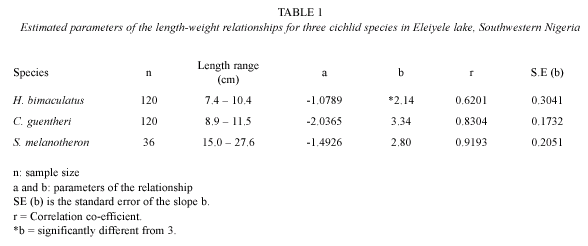
<body><![CDATA[<div style="text-align: left;"><font face="Verdana" size="2">where K= condition factor, W= total body weight (g), L= total length (cm), b= growth exponent. For each species, the slopes of length-weight regressions were compared to 3 using student’s t-test (Sokal and Rohlf 1987) to determine whether species grew isometrically. Student’s t-test was used to ascertain whether seasonal changes in condition factor for the species were statistically significant. </font></div> </div> <font face="Verdana" size="2"><font face="Verdana" size="2"><font  face="Verdana" size="2"><font face="Verdana" size="2">     <p> </p>     <p>The specimens were cut open and the stomachs were removed and immersed in 4 % formalin. Each stomach was slit open, and the contents poured into a petri dish. The food were observed with unaided eye. Then, random samples of the stomach contents were taken and dropped on slides with the aid of a dropping pipette and observed under a light microscope. The stomach contents were identified and analyzed using the frequency of occurrence and numerical methods (Bagenal 1978). </p>     <p>In the frequency of occurrence method, the number of stomachs containing each food item is expressed as a percentage of all non-empty stomachs, though this method is quick and requires minimal apparatus, it gives little indication of the relative quantities of each food category present in the stomach (Hynes 1950).     <br> </p>     <p>In the numerical method, the number of individuals in each food category is expressed as a percentage of the total individuals in all food categories. This method has the limitation in that it overemphasizes the importance of small prey items found in a large number in fish. This method is not suitable for dealing with food items such as fragments and detritus that do not occur in discrete units, also it is difficult to identify the numbers in each food category because of mastication of the food. The food items were not identified to the species level due to the fact that most of the food items were observed crushed and under varying stages of digestion. </p> <font size="3">     <p><span style="font-weight: bold;">Results</span> </p> </font>     <p>The results of the length-weight analyses are presented in <a  href="#t1">table 1</a>. All length-weight relationships were highly significant (p&lt;0.05) with r values greater than 0.60 slopes (b values) of the length weight relationship ranged from 2.14 for <span  style="font-style: italic;">H. bimaculatus</span> to 3.34 for <span  style="font-style: italic;">C. guentheri</span>. The regression coefficient (b) of <span style="font-style: italic;">H. bimaculatus </span>is significantly different from 3.    <br> </p>     <p>    ]]></body>
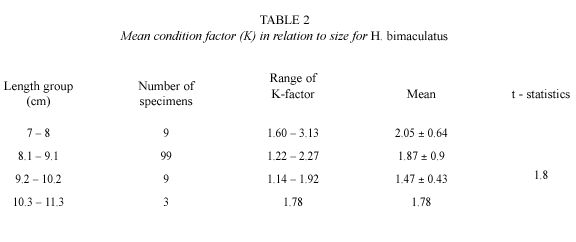
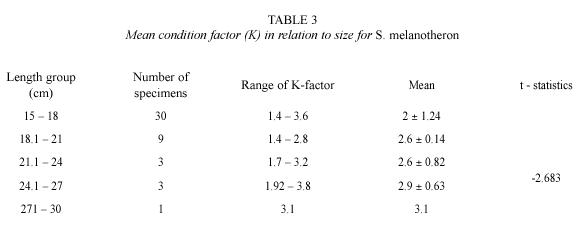
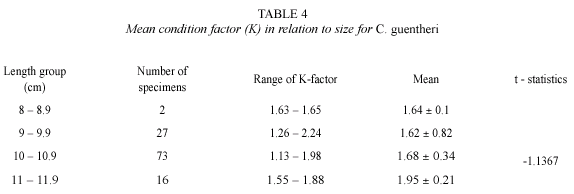
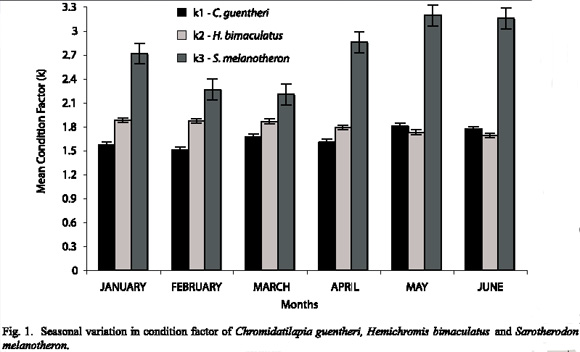
<body><![CDATA[<br> <a name="t1"></a></p> </font></font></font></font>     <div style="text-align: center;"><img  src="/img/revistas/rbt/v55n3-4/art20t1.gif" title="" alt=""  style="width: 588px; height: 246px;">    <br> </div> <font face="Verdana" size="2"><font face="Verdana" size="2"><font  face="Verdana" size="2"><font face="Verdana" size="2"> </font></font></font></font><font face="Verdana" size="2"><font  face="Verdana" size="2"><font face="Verdana" size="2"><font  face="Verdana" size="2">     <p><span style="font-weight: bold;">Condition factor:</span> the condition factor (k) calculated for <span style="font-style: italic;">H. bimaculatus</span> varied from 1.14-3.13±1.79, for <span  style="font-style: italic;">S. melanotheron</span>. K varied from 1.40-3.60±2.79, while it was 1.132.24± 1.67 for <span  style="font-style: italic;">C. guentheri</span>. The temporal changes for the three species are shown in <a href="#f1">Fig. 1</a>. This shows that seasonal variation occurred in k factor of the three cichlid species and the highest mean k factor were recorded during the rainy season for <span style="font-style: italic;">S. melanotheron </span>(3.21) and <span style="font-style: italic;">C. guentheri </span>(1.76), while for <span style="font-style: italic;">H. bimaculatus</span> highest mean k factor (1.92) was recorded during dry season. However only the dry season mean condition factor of <span  style="font-style: italic;">H. bimaculatus </span>was statistically different from rainy season K factor. Variations in condition factor with size for <span style="font-style: italic;">H. bimaculatus</span>, <span style="font-style: italic;">S. melanotheron </span>and <span  style="font-style: italic;">C. guentheri</span> were shown in <a  href="#t2">tables 2,</a> <a href="#t3">3</a> and <a href="#t4">4</a> respectively. It can be seen that smaller sizes of <span  style="font-style: italic;">H. bimaculatus</span> (7.7–9 cm) are in better condition than others, while <span style="font-style: italic;">S. melanotheron </span>(24.1-30 cm) and <span style="font-style: italic;">C. guentheri</span> (10–11.9 cm) larger size fishes had higher K factor. For the <font><font><font><font><font face="Verdana" size="2"><font  face="Verdana" size="2"><font face="Verdana" size="2"><font  face="Verdana" size="2">three species, there is no statistical difference </font></font></font></font></font></font></font></font><font><font><font><font><font  face="Verdana" size="2"><font face="Verdana" size="2"><font  face="Verdana" size="2"><font face="Verdana" size="2">between the k factor of the smaller and larger </font></font></font></font></font></font></font></font><font><font><font><font><font  face="Verdana" size="2"><font face="Verdana" size="2"><font  face="Verdana" size="2"><font face="Verdana" size="2">sized<span  style="font-style: italic;"> </span>fishes.    <br> </font></font></font></font></font></font></font></font></p>     <p><font><font><font><font><font face="Verdana" size="2"><font  face="Verdana" size="2"><font face="Verdana" size="2"><font  face="Verdana" size="2">    <br> </font></font></font></font></font></font></font></font></p> </font></font></font></font>     <div style="text-align: center;"><font><font><font><font><font  face="Verdana" size="2"><font face="Verdana" size="2"><font  face="Verdana" size="2"><font face="Verdana" size="2">&nbsp;<a  name="f1"></a><img src="/img/revistas/rbt/v55n3-4/art20i1.jpg" title=""  alt="" style="width: 580px; height: 352px;"></font></font></font></font></font></font></font></font>    <br> </div> <font face="Verdana" size="2"><font face="Verdana" size="2"><font  face="Verdana" size="2"><font face="Verdana" size="2">     <p><font><font><font><font><font face="Verdana" size="2"><font  face="Verdana" size="2"><font face="Verdana" size="2"><font  face="Verdana" size="2">    ]]></body>
<body><![CDATA[<br> <a name="t2"></a></font></font></font></font></font></font></font></font></p> </font></font></font></font>     <div style="text-align: center;"><font><font><font><font><font  face="Verdana" size="2"><font face="Verdana" size="2"><font  face="Verdana" size="2"><font face="Verdana" size="2"><img  src="/img/revistas/rbt/v55n3-4/art20t2.gif" title="" alt=""  style="width: 576px; height: 242px;"></font></font></font></font></font></font></font></font>    <br> </div> <font face="Verdana" size="2"><font face="Verdana" size="2"><font  face="Verdana" size="2"><font face="Verdana" size="2">     <p><font><font><font><font><font face="Verdana" size="2"><font  face="Verdana" size="2"><font face="Verdana" size="2"><font  face="Verdana" size="2">    <br> <a name="t3"></a></font></font></font></font></font></font></font></font></p> </font></font></font></font>     <div style="text-align: center;"><font><font><font><font><font  face="Verdana" size="2"><font face="Verdana" size="2"><font  face="Verdana" size="2"><font face="Verdana" size="2"><img  src="/img/revistas/rbt/v55n3-4/art20t3.gif" title="" alt=""  style="width: 586px; height: 230px;"></font></font></font></font></font></font></font></font>    <br> </div> <font face="Verdana" size="2"><font face="Verdana" size="2"><font  face="Verdana" size="2"><font face="Verdana" size="2">     <p><font><font><font><font><font face="Verdana" size="2"><font  face="Verdana" size="2"><font face="Verdana" size="2"><font  face="Verdana" size="2">    <br> <a name="t4"></a></font></font></font></font></font></font></font></font></p> </font></font></font></font>     <div style="text-align: center;"><font><font><font><font><font  face="Verdana" size="2"><font face="Verdana" size="2"><font  face="Verdana" size="2"><font face="Verdana" size="2"><img  src="/img/revistas/rbt/v55n3-4/art20t4.gif" title="" alt=""  style="width: 574px; height: 194px;"></font></font></font></font></font></font></font></font>    ]]></body>
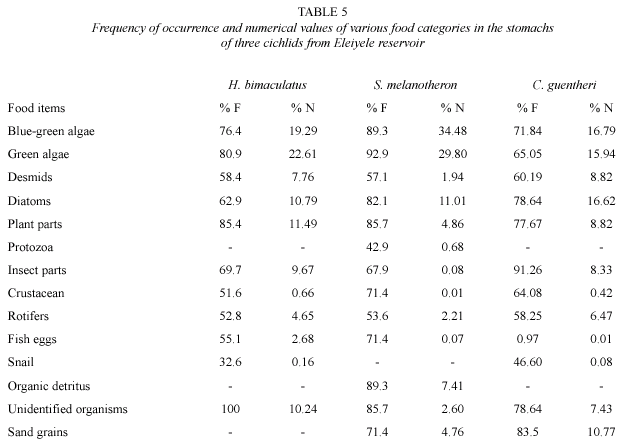
<body><![CDATA[<br> </div> <font face="Verdana" size="2"><font face="Verdana" size="2"><font  face="Verdana" size="2"><font face="Verdana" size="2">     <p><font><font><font><font><font face="Verdana" size="2"><font  face="Verdana" size="2"><font face="Verdana" size="2"><font  face="Verdana" size="2"><span  style="font-weight: bold; font-style: italic;">The composition of the diet</span>    <br> </font></font></font></font></font></font></font></font></p>     <p><font><font><font><font><font face="Verdana" size="2"><font  face="Verdana" size="2"><font face="Verdana" size="2"><font  face="Verdana" size="2"><a href="#t5">Table 5</a> shows a summary of the percent</font></font></font></font></font></font></font></font><font><font><font><font><font  face="Verdana" size="2"><font face="Verdana" size="2"><font  face="Verdana" size="2"><font face="Verdana" size="2">age frequency of occurrence and total number </font></font></font></font></font></font></font></font><font><font><font><font><font  face="Verdana" size="2"><font face="Verdana" size="2"><font  face="Verdana" size="2"><font face="Verdana" size="2">of various categories of food organisms in the </font></font></font></font></font></font></font></font><font><font><font><font><font  face="Verdana" size="2"><font face="Verdana" size="2"><font  face="Verdana" size="2"><font face="Verdana" size="2">stomachs of each cichlid examined.    <br> </font></font></font></font></font></font></font></font></p>     <p><font><font><font><font><font face="Verdana" size="2"><font  face="Verdana" size="2"><font face="Verdana" size="2"><font  face="Verdana" size="2">    <br> <a name="t5"></a></font></font></font></font></font></font></font></font></p> </font></font></font></font>     <div style="text-align: center;"><font><font><font><font><font  face="Verdana" size="2"><font face="Verdana" size="2"><font  face="Verdana" size="2"><font face="Verdana" size="2"><img  src="/img/revistas/rbt/v55n3-4/art20t5.gif" title="" alt=""  style="width: 624px; height: 448px;"></font></font></font></font></font></font></font></font>    <br> </div> <font face="Verdana" size="2"><font face="Verdana" size="2"><font  face="Verdana" size="2"><font face="Verdana" size="2">     <p><span style="font-style: italic;">H. bimaculatus</span>&nbsp;&nbsp;<span  style="font-weight: bold;"> </span>    ]]></body>
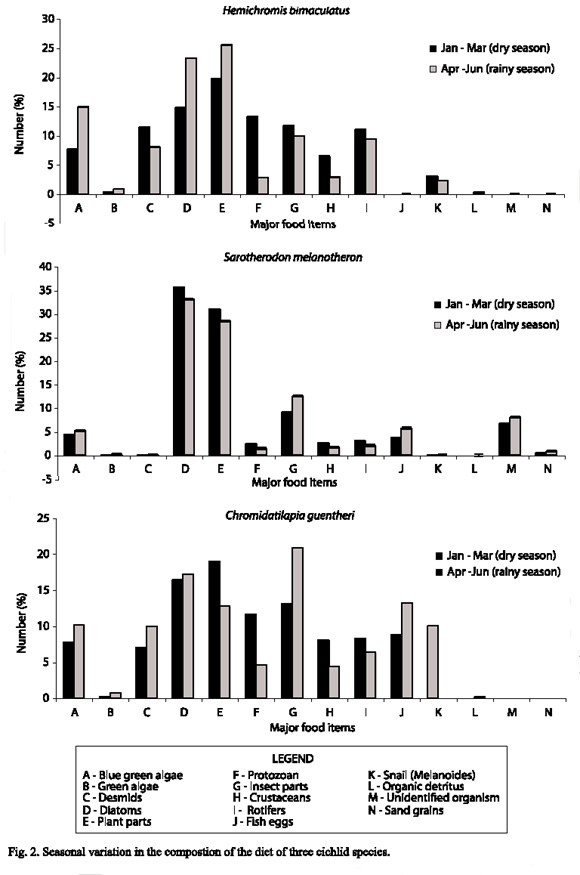
<body><![CDATA[<br> </p>     <p>Out of the 120 specimens of <span style="font-style: italic;">H. bimacu</span> latus examined, 89 (74.2 %) had food in their stomachs. The <a href="#t5">table 5</a> shows that food from plant sources dominates the diet and formed 71.94 % of the diet by numerical abundance method and all of them also occurred frequently in stomachs being encountered in more than 50 % of stomach examined. Algae that occurred in the diet include blue green algae represented by <span  style="font-style: italic;">Oscillatoria</span>, <span style="font-style: italic;">Phormidium</span>, <span  style="font-style: italic;">Anabaena</span>, <span  style="font-style: italic;">Coelospharium</span> species. Green algae present in the diet include <span style="font-style: italic;">Mougeotia</span>, <span style="font-style: italic;">Zygnema</span>, <span  style="font-style: italic;">Microspora</span> and <span  style="font-style: italic;">Cladophora</span>. Desmid is represented by <span style="font-style: italic;">Gonatozygon</span> and <span  style="font-style: italic;">Closterium</span>, <span  style="font-style: italic;">Docidium</span> and <span  style="font-style: italic;">Netrium</span> also occurred in the diet but in lesser quantity. </p>     <p>Some invertebrates animals are found in the diet mixed with the plant materials. These animals include appendages of arthropods, crustacean, and Mollusc which is represented only by <span  style="font-style: italic;">Melanoides tuberculata</span>. Species of <span  style="font-style: italic;">Gastropus</span>, <span  style="font-style: italic;">Trichocerca</span>, and <span  style="font-style: italic;">Trichotria</span> are the rotifers round in the diet. These animal component of the diet formed only 17.82 % of the diet by numerical abundance method. </p>     <p style="font-style: italic;">S. melanotheron </p>     <p>A total of 36 specimens were examined, out of which 28 (78.8 %) had food in their stomachs. Plant food organisms constituted the most important food items of <span style="font-style: italic;">S. melanotheron</span> by the numerical method (82.09 %) and they were also encountered frequently in the stomach content. Blue green algae (<span  style="font-style: italic;">Oscillatoria</span>, <span  style="font-style: italic;">Phormidium</span>, <span  style="font-style: italic;">Anabaena</span> and <span  style="font-style: italic;">Coelospharium</span>), green algae (<span  style="font-style: italic;">Mougeotia</span>, <span  style="font-style: italic;">Zygnema</span>, <span  style="font-style: italic;">Oedogonium</span>) and diatoms made up 34.48 %, 29.8 % and 11.01 % of the food ingested by this cichlid respectively. These were followed by organic detritus (7.41 %), and sand grains (4.76 %). Animal food organisms such as rotifers (<span  style="font-style: italic;">Gastropus</span>, <span  style="font-style: italic;">Synchaeta</span>, <span  style="font-style: italic;">Trichotria</span>), insect parts, crustaceans, copepods, Protozoans, (<span style="font-style: italic;">Chilodonella</span>, <span style="font-style: italic;">Loxodes</span>), and fish eggs represented only 3.05 % of the total number of food organism. Organic detritus, unidentified materials and sand grains formed 7.41 %, 2.60 % and 4.76 % of the food item ingested respectively. The occurrence method of stomach content analysis also indicated that food of plant source (origin) were more important than animal food organisms for this species, all of them occurred in more than 80 % of stomachs examined except desmids that occurred in 57.1 %. Food of animal origin also occurred frequently in stomachs examined with most of them encountered in more than 50 % of stomachs examined except protozoan which occurred in 42.9 %. Unidentified materials and sand grains also occurred frequently, seen in 85.7 % and 71.4 % of stomachs examined respectively.</p>     <p style="font-style: italic;">C. guentheri </p>     <p>A total of 120 specimens of <span style="font-style: italic;">C. guentheri </span>were examined, 103 (85.8 %) had food in them. Food encountered included blue green algae (<span style="font-style: italic;">Spirulina, Nostoc</span>) green algae (<span style="font-style: italic;">Mougeotia, Oedogonium</span>), desmids (<span style="font-style: italic;">Gonatozygon, Closterium, Spirotaemaia</span>), diatoms (<span  style="font-style: italic;">Navicula, Nitschia</span>); rotifers (<span  style="font-style: italic;">Gastropus, Trichocerca</span>), Crustacea, plant parts, insect appendages, sand grains, and snail (<span  style="font-style: italic;">Melanoides tuberculata</span>). Food of plant origin also dominated the diet and formed 66.99 % of food encountered in the stomach by numerical analysis while food from animal source formed just 15.31 % of food encountered in the stomach by numerical analysis. Both food of animal and plant origin were encountered frequently in the stomach occurring in over 50 % of stomachs examined, except snail (46.6 %) and fish eggs (0.97 %). </p>     <p style="font-style: italic;"><span style="font-weight: bold;">Seasonal variation in the diet</span> </p>     <p><span style="font-style: italic;">H. bimaculatus</span> </p>     <p>The food items selected were found to vary seasonally <a href="#f2">Fig. 2</a>. Mollusc (<span style="font-style: italic;">Melanoids tuberculata</span>) occurred in the stomach only during the raining season months (April to June) and did not form up to 1 % of the diet. Desmids are more predominant in the diet during the dry season months of January to March, where they constitute 13.26 % of the diet, while they formed just 2.85 % of diet on raining season. Insect parts and rotifers are also more in the diet during dry season months.    ]]></body>
<body><![CDATA[<br> </p>     <p>    <br> <a name="f2"></a></p> </font></font></font></font>     <div style="text-align: center;"><img  src="/img/revistas/rbt/v55n3-4/art20i2.jpg" title="" alt=""  style="width: 580px; height: 875px;">    <br> </div> <font face="Verdana" size="2"><font face="Verdana" size="2"><font  face="Verdana" size="2"><font face="Verdana" size="2"> </font></font></font></font><font face="Verdana" size="2"><font  face="Verdana" size="2"><font face="Verdana" size="2"><font  face="Verdana" size="2">     <p>In contrast blue green algae and plant part occurred in larger number during the rainy season. Crustacea, green algae, diatoms, eggs and unidentified food do not show any distinct seasonal variation in abundance. </p>     <p><span style="font-style: italic;">S. melanotheron</span> </p>     <p><a href="#f2">Fig. 2</a> illustrates the seasonal variation in the composition of the diet of <span style="font-style: italic;">S. melanotheron</span>. Numerical abundance of blue green algae, desmids, rotifers, eggs, and unidentified materials were higher during the dry season while plant parts, crustacean, insect parts, diatoms, organic detritus, sand grains and protozoa were higher during raining season. </p>     <p><span style="font-style: italic;">C. guentheri</span> </p>     <p>The seasonal variation in the composition of the diet of <span  style="font-style: italic;">C. guentheri</span> is illustrated in <a  href="#f2">Fig. 2</a>. numerical abundance of blue green algae, desmids, rotifers and unidentified materials were higher during dry season while plant parts, crustacean, insect parts and diatoms, were numerically more abundant during rainy season. Melanoides tuberculata occurred in the diet only during rainy months. </p> <font size="3">     ]]></body>
<body><![CDATA[<p><span style="font-weight: bold;">Discussion</span> </p> </font>     <p>The correlation coefficients (r) for LWR is high for <span  style="font-style: italic;">H. bimaculatus</span>, <span  style="font-style: italic;">C. guentheri</span> and <span  style="font-style: italic;">S. melanotheron</span>, which indicate/increase in length with increase in weight. These agreed with earlier studies involving fish species from different water bodies Fagade and Olaniyan (1972), Fagade (1983), Merella <span  style="font-style: italic;">et al</span>. (1997), Ruiz-Ramirez (1997), Laléyé (2006). The values of b (growth exponent) for the three species examined are within the limits (two and four) reported by Tesch (1971) for most fishes. Only b value of H. bimaculatus is significantly different from 3 and this indicate negative allometric growth (Tesch 1971) while the remaining two species grow isometrically. Laléyé (2006) also reported the b value of <span style="font-style: italic;">H. bimaculatus</span> in Ouémé River is significantly different from 3, while <span style="font-style: italic;">S. melanotheron</span> and <span  style="font-style: italic;">C. guentheri</span> were not significantly different 3. The mean K for the three cichlid species are greater than one, and this show that these fish species are above average condition within the lake (Wade 1992). The variation in mean K values observed during different months for the three species showed only significant difference for <span style="font-style: italic;">H. bimaculatus</span>, whose mean K value was higher during dry season. This appears to be related to the breeding activities of the fish due to depletion of reserves during rainy season. Condition factor has also been closely linked with reproductive cycle for fishes in other water bodies Salzen (1958), Fagade and Olaniyan (1972), Ugwumba (1990), Aboaba (1993), Saliu (1997). </p>     <p>In the three cichlids species, over 70 % of specimens had food in the stomach and this together with wide variety of food organisms encountered in the stomach contents indicate availability of food organisms within the study area. The results of the stomach content analyses showed that the three species examined, are omnivorous since they combine both plant and animal material as source of food (Fagade 1983). </p>     <p>Fagade and Olaniyan (1983) also reported that diet of <span  style="font-style: italic;">C. guentheri</span> in IITA reservoir, was dominated by plant materials and a wide variety of invertebrates were also included in the diet. Fagade (1973) showed that Tilapia melanotheron in Lagos Lagoon principal food items were algal filaments, diatoms and unidentified organic matter. Fragments of higher plants, arthropod appendages and some animal species were also included in the diet. According to Ugwumba and Adebisi (1992) <span  style="font-style: italic;">S. melanotheron </span>in Awba reservoir most important food organisms were blue green algae, mainly <span  style="font-style: italic;">Microcystis</span> and <span  style="font-style: italic;">Agmellun</span>. Also included are other phytoplankters, zooplankters, insect larvae, vascular plant materials, organic debris, remains of unidentified organisms and sand grains.</p>     <p>Seasonal variation occurs in the composition of the diet of the three cichlid species because availability of food organisms are often cyclic due to factors of their life histories or to climate, or other environmental conditions. Seasonal variation in the feeding habits of fish resulting from climatic changes has been reported by Moriarty and Moriarty (1973), Ikusemiju (1975), Tuderancea <span  style="font-style: italic;">et al</span>. (1988). The diet and feeding intensity can vary even during the diurnal cycle (Keast and Welsh (1968), Elliot (1970), Ikusemiju (1975). </p> </font></font></font></font> <hr style="width: 100%; height: 2px;"><font face="Verdana" size="2"><font  face="Verdana" size="2"><font face="Verdana" size="2"><font  face="Verdana" size="2">     <p><span style="font-weight: bold;">Resumen</span> </p>     <p>Se investigó la relación de peso-longitud (LWR), factor de condición (K) y contenidos estomacales de tres peces cíclidos (<span  style="font-style: italic;">Hemichromis bimaculatus</span>, <span  style="font-style: italic;">Sarotherodon melanotheron</span> y <span  style="font-style: italic;">Chromidotilapia guentheri</span>) en la reserva de Eleiyele, Nigeria, África. El LWR muestra una correlación significativa para las tres especies y el crecimiento exponencial (b) indica que <span style="font-style: italic;">H. Bimaculatus</span> tiene crecimiento alométrico negativo, mientras <span  style="font-style: italic;">S. melanotheron</span> y <span  style="font-style: italic;">C. guentheri</span> tienen un crecimiento alométrico isométrico. El factor de condición para las tres especies fue mayor a uno, y varía con el tamaño y la época. El análisis de los contenidos estomacales reveló que las tres especies son omnívoras, variando la composición relativa de cada tipo de alimento con la estación del año. </p>     <p><span style="font-weight: bold;">Palabras clave:</span> Relación longitud-peso, factor de condición, dieta, <span  style="font-style: italic;">Hemichromis bimaculatus</span>, <span  style="font-style: italic;">Sarotherodon melanotheron</span>, <span  style="font-style: italic;">Chromidotilapia guentheri</span>.    <br> </p> </font></font></font></font> <hr style="width: 100%; height: 2px;"><font face="Verdana" size="2"><font  face="Verdana" size="2"><font face="Verdana" size="2"><font  face="Verdana" size="2"></font></font></font></font>     <div style="text-align: center;"><font><font face="Verdana" size="2">Received 30-VI-2004. Corrected 01-XI-2006. Accepted 11-IV-2007.</font></font></div> <font face="Verdana" size="2"><font face="Verdana" size="2"><font  face="Verdana" size="2"><font face="Verdana" size="2">     ]]></body>
<body><![CDATA[<p> </p> <font size="3">     <p><span style="font-weight: bold;">References</span> </p> </font>     <!-- ref --><p>Aboaba, M.A. 1993. Reproduction, larval rearing and the influence of dietary protein on the growth of the catfish (<span  style="font-style: italic;">Chrysichthys nigrodigitatus</span>). Ph.D. Thesis, University of Ibadan, Ibadan, Nigeria. &nbsp;&nbsp;&nbsp;&nbsp;&nbsp;&nbsp;&nbsp;&nbsp;[&#160;<a href="javascript:void(0);" onclick="javascript: window.open('/scielo.php?script=sci_nlinks&ref=1252651&pid=S0034-7744200700030002000001&lng=','','width=640,height=500,resizable=yes,scrollbars=1,menubar=yes,');">Links</a>&#160;]<!-- end-ref --><!-- ref --><p>Bagenal, T.B. 1978. Methods for assessments of fish production in freshwater-IBP Handbook. Blackwell, Oxford, England. &nbsp;&nbsp;&nbsp;&nbsp;&nbsp;&nbsp;&nbsp;&nbsp;[&#160;<a href="javascript:void(0);" onclick="javascript: window.open('/scielo.php?script=sci_nlinks&ref=1252652&pid=S0034-7744200700030002000002&lng=','','width=640,height=500,resizable=yes,scrollbars=1,menubar=yes,');">Links</a>&#160;]<!-- end-ref --><!-- ref --><p>Beyer, J.E. 1987. On length-weight relationships. Part 1: Computing the mean weight of the fish of a given length class. Fishbyte 5: 11-13. &nbsp;&nbsp;&nbsp;&nbsp;&nbsp;&nbsp;&nbsp;&nbsp;[&#160;<a href="javascript:void(0);" onclick="javascript: window.open('/scielo.php?script=sci_nlinks&ref=1252653&pid=S0034-7744200700030002000003&lng=','','width=640,height=500,resizable=yes,scrollbars=1,menubar=yes,');">Links</a>&#160;]<!-- end-ref --><!-- ref --><p>Elliot, O.O. 1970. Diel changes in invertebrate drift and the food of trout, Salmon trutta. J. Fish. Biol. 2: 1-18. &nbsp;&nbsp;&nbsp;&nbsp;&nbsp;&nbsp;&nbsp;&nbsp;[&#160;<a href="javascript:void(0);" onclick="javascript: window.open('/scielo.php?script=sci_nlinks&ref=1252654&pid=S0034-7744200700030002000004&lng=','','width=640,height=500,resizable=yes,scrollbars=1,menubar=yes,');">Links</a>&#160;]<!-- end-ref --><!-- ref --><p>Fagade, S.O. 1983. The biology of <span style="font-style: italic;">Chromidotilapia guentheri</span> from a small lake. Arch. Hydrobiol. 97: 60-72. &nbsp;&nbsp;&nbsp;&nbsp;&nbsp;&nbsp;&nbsp;&nbsp;[&#160;<a href="javascript:void(0);" onclick="javascript: window.open('/scielo.php?script=sci_nlinks&ref=1252655&pid=S0034-7744200700030002000005&lng=','','width=640,height=500,resizable=yes,scrollbars=1,menubar=yes,');">Links</a>&#160;]<!-- end-ref --><!-- ref --><p>Fagade, S.O. &amp; C.I.O. Olaniyan. 1972. The biology of the West African Shad <span style="font-style: italic;">Ethmalosa fimbrita</span> (Bodwich) in the Lagos Lagoon, Nigeria. J. Fish. Biol. 4: 519-533. &nbsp;&nbsp;&nbsp;&nbsp;&nbsp;&nbsp;&nbsp;&nbsp;[&#160;<a href="javascript:void(0);" onclick="javascript: window.open('/scielo.php?script=sci_nlinks&ref=1252656&pid=S0034-7744200700030002000006&lng=','','width=640,height=500,resizable=yes,scrollbars=1,menubar=yes,');">Links</a>&#160;]<!-- end-ref --><!-- ref --><p>Fagade, S.O. &amp; C.I.O. Olaniyan. 1973. The food and feeding interrelationship of the fishes in the Lagos Lagoon. J. Fish Biol. 5: 205-225. &nbsp;&nbsp;&nbsp;&nbsp;&nbsp;&nbsp;&nbsp;&nbsp;[&#160;<a href="javascript:void(0);" onclick="javascript: window.open('/scielo.php?script=sci_nlinks&ref=1252657&pid=S0034-7744200700030002000007&lng=','','width=640,height=500,resizable=yes,scrollbars=1,menubar=yes,');">Links</a>&#160;]<!-- end-ref --><!-- ref --><p>Fryer, G. &amp; I.D. Iles. 1974. The cichlid fishes of the great lakes of Africa. Edinburgh: Oliver and Boyd, Edinburg, Scotland.&nbsp;&nbsp;&nbsp;&nbsp;&nbsp;&nbsp;&nbsp;&nbsp;[&#160;<a href="javascript:void(0);" onclick="javascript: window.open('/scielo.php?script=sci_nlinks&ref=1252658&pid=S0034-7744200700030002000008&lng=','','width=640,height=500,resizable=yes,scrollbars=1,menubar=yes,');">Links</a>&#160;]<!-- end-ref --><!-- ref --><p>Ikusemiju, K. 1975. Aspects of the ecology and history of the <span  style="font-style: italic;">Scopon cottus aletiticus</span> (gilbert) in Lake Washington. J. Fish. Biol. 7: 235-245. &nbsp;&nbsp;&nbsp;&nbsp;&nbsp;&nbsp;&nbsp;&nbsp;[&#160;<a href="javascript:void(0);" onclick="javascript: window.open('/scielo.php?script=sci_nlinks&ref=1252659&pid=S0034-7744200700030002000009&lng=','','width=640,height=500,resizable=yes,scrollbars=1,menubar=yes,');">Links</a>&#160;]<!-- end-ref --><!-- ref --><p>Ikusemiju, K. 1975. A comparative racial study of the catfish, (<span  style="font-style: italic;">Chrysichthys nigrodigitatus</span>) (Lacepede) from Lagos and Lekki Lagoons, Nigeria. Bulletin de I.F.A.N.T. 37. Ser A. 4: 887-898. &nbsp;&nbsp;&nbsp;&nbsp;&nbsp;&nbsp;&nbsp;&nbsp;[&#160;<a href="javascript:void(0);" onclick="javascript: window.open('/scielo.php?script=sci_nlinks&ref=1252660&pid=S0034-7744200700030002000010&lng=','','width=640,height=500,resizable=yes,scrollbars=1,menubar=yes,');">Links</a>&#160;]<!-- end-ref --><!-- ref --><p>Keast, H. &amp; Welsh. 1968. Daily feeding periodicities, food uptake rate and dietary changes with hour of the day in some lake fishes. Res. Bal. Can. 25: 1133-1144. &nbsp;&nbsp;&nbsp;&nbsp;&nbsp;&nbsp;&nbsp;&nbsp;[&#160;<a href="javascript:void(0);" onclick="javascript: window.open('/scielo.php?script=sci_nlinks&ref=1252661&pid=S0034-7744200700030002000011&lng=','','width=640,height=500,resizable=yes,scrollbars=1,menubar=yes,');">Links</a>&#160;]<!-- end-ref --><!-- ref --><p>Lalèyè, P.A. 2006. Length weight and length-length relationships of fishes from the Ouèmè River in Benin (West Africa). J. Appl. Ichth. 22: 330–333 &nbsp;&nbsp;&nbsp;&nbsp;&nbsp;&nbsp;&nbsp;&nbsp;[&#160;<a href="javascript:void(0);" onclick="javascript: window.open('/scielo.php?script=sci_nlinks&ref=1252662&pid=S0034-7744200700030002000012&lng=','','width=640,height=500,resizable=yes,scrollbars=1,menubar=yes,');">Links</a>&#160;]<!-- end-ref --><!-- ref --><p>Le Cren, E.D. 1951. The length weight relationship and seasonal cycle in gonad weight and condition in Perch (<span  style="font-style: italic;">Perca fluviatilis</span>). J. Aniun. Ecol. 20: 12-16 &nbsp;&nbsp;&nbsp;&nbsp;&nbsp;&nbsp;&nbsp;&nbsp;[&#160;<a href="javascript:void(0);" onclick="javascript: window.open('/scielo.php?script=sci_nlinks&ref=1252663&pid=S0034-7744200700030002000013&lng=','','width=640,height=500,resizable=yes,scrollbars=1,menubar=yes,');">Links</a>&#160;]<!-- end-ref --><!-- ref --><p>Merella, P., A. Quetglas, F. Alemary &amp; A. Carbonell. 1997. Length-weight relationship of fishes and cephalopods from the Balearic Islands (Western Mediterranean). Naga Iclarm quarterly, July-Dec. (s.p.). &nbsp;&nbsp;&nbsp;&nbsp;&nbsp;&nbsp;&nbsp;&nbsp;[&#160;<a href="javascript:void(0);" onclick="javascript: window.open('/scielo.php?script=sci_nlinks&ref=1252664&pid=S0034-7744200700030002000014&lng=','','width=640,height=500,resizable=yes,scrollbars=1,menubar=yes,');">Links</a>&#160;]<!-- end-ref --><!-- ref --><p>Moriarty, C.M. &amp; D.S.W. Moriarty. 1973. Quantitative estimation of the daily ingestion of phytoplankton by Tilapia nilotica and <span  style="font-style: italic;">Haplochronis nigripinis</span> in Lake George, Uganda. J. Zool. London 171:15-23. &nbsp;&nbsp;&nbsp;&nbsp;&nbsp;&nbsp;&nbsp;&nbsp;[&#160;<a href="javascript:void(0);" onclick="javascript: window.open('/scielo.php?script=sci_nlinks&ref=1252665&pid=S0034-7744200700030002000015&lng=','','width=640,height=500,resizable=yes,scrollbars=1,menubar=yes,');">Links</a>&#160;]<!-- end-ref --><!-- ref --><p>Ruiz-Ramirez, S., G. Lucano-Ramivez &amp; J. Mariscal-Romero. 1997. Length-weight relationships of soft bottom demersal fishes from Jalisco and Colima States Mexico. Iclarm quarterly, July-Dec. (s.p.). &nbsp;&nbsp;&nbsp;&nbsp;&nbsp;&nbsp;&nbsp;&nbsp;[&#160;<a href="javascript:void(0);" onclick="javascript: window.open('/scielo.php?script=sci_nlinks&ref=1252666&pid=S0034-7744200700030002000016&lng=','','width=640,height=500,resizable=yes,scrollbars=1,menubar=yes,');">Links</a>&#160;]<!-- end-ref --><!-- ref --><p>Saliu, J.K.O. 1997. Age, growth, feeding and reproductive ecology of the Characid: <span style="font-style: italic;">Brycinus nurse</span> (Paugy) in Asa reservoir, Ilorin, Nigeria. Ph.D. Thesis, University of Ibadan, Nigeria. &nbsp;&nbsp;&nbsp;&nbsp;&nbsp;&nbsp;&nbsp;&nbsp;[&#160;<a href="javascript:void(0);" onclick="javascript: window.open('/scielo.php?script=sci_nlinks&ref=1252667&pid=S0034-7744200700030002000017&lng=','','width=640,height=500,resizable=yes,scrollbars=1,menubar=yes,');">Links</a>&#160;]<!-- end-ref --><!-- ref --><p>Salzen, E. 1958. Observation on the biology of <span  style="font-style: italic;">Ethmalosa fimbriata</span>. Bull. IFAN Ser. A 18: 335-371. &nbsp;&nbsp;&nbsp;&nbsp;&nbsp;&nbsp;&nbsp;&nbsp;[&#160;<a href="javascript:void(0);" onclick="javascript: window.open('/scielo.php?script=sci_nlinks&ref=1252668&pid=S0034-7744200700030002000018&lng=','','width=640,height=500,resizable=yes,scrollbars=1,menubar=yes,');">Links</a>&#160;]<!-- end-ref --><!-- ref --><p>Sokal, R.R. &amp; F.J. Rohlf. 1987. Introduction to Biostatistics. W.H. Freeman, New York, New York, USA. &nbsp;&nbsp;&nbsp;&nbsp;&nbsp;&nbsp;&nbsp;&nbsp;[&#160;<a href="javascript:void(0);" onclick="javascript: window.open('/scielo.php?script=sci_nlinks&ref=1252669&pid=S0034-7744200700030002000019&lng=','','width=640,height=500,resizable=yes,scrollbars=1,menubar=yes,');">Links</a>&#160;]<!-- end-ref --><!-- ref --><p>Tesch, W. 1971. Age and growth, p. 97-130. <span  style="font-style: italic;">In</span> W.E. Ricker (ed.). Methods for assessments of fish production in freshwaters. International Biological Programme, Oxford, England. &nbsp;&nbsp;&nbsp;&nbsp;&nbsp;&nbsp;&nbsp;&nbsp;[&#160;<a href="javascript:void(0);" onclick="javascript: window.open('/scielo.php?script=sci_nlinks&ref=1252670&pid=S0034-7744200700030002000020&lng=','','width=640,height=500,resizable=yes,scrollbars=1,menubar=yes,');">Links</a>&#160;]<!-- end-ref --><!-- ref --><p>Tudorancea, C.J., C.N. Fermado &amp; J.C. Paggy. 1988. Food and feeding ecology of <span style="font-style: italic;">Oreochromis niloticus</span> (Linnaeus, 1758) jóvenes in Lake Awasa (Ethiopia). Arch. Hydrobiol. 79: 267-289. &nbsp;&nbsp;&nbsp;&nbsp;&nbsp;&nbsp;&nbsp;&nbsp;[&#160;<a href="javascript:void(0);" onclick="javascript: window.open('/scielo.php?script=sci_nlinks&ref=1252671&pid=S0034-7744200700030002000021&lng=','','width=640,height=500,resizable=yes,scrollbars=1,menubar=yes,');">Links</a>&#160;]<!-- end-ref --><!-- ref --><p>Ugwumba, A.A.A. 1990. Food and feeding ecology of <span  style="font-style: italic;">Oreochromis niloticus</span>, <span  style="font-style: italic;">Sarotherodon melanotheron </span>and <span  style="font-style: italic;">Heterotis niloticus</span> (Pisces: Osteichthyes) in Awba reservoir Ibadan. PhD Thesis, University of Ibadan, Ibadan, Nigeria. &nbsp;&nbsp;&nbsp;&nbsp;&nbsp;&nbsp;&nbsp;&nbsp;[&#160;<a href="javascript:void(0);" onclick="javascript: window.open('/scielo.php?script=sci_nlinks&ref=1252672&pid=S0034-7744200700030002000022&lng=','','width=640,height=500,resizable=yes,scrollbars=1,menubar=yes,');">Links</a>&#160;]<!-- end-ref --><!-- ref --><p>Ugwumba, A.A.A. &amp; A.A. Adebisi 1992. The food and feeding ecology of <span style="font-style: italic;">Sarotherodon melanotheron</span> (Ruppel) in a small freshwater reservoir in Ibadan, Nigeria. Arch. Hydrobiol. 124: 367-382. &nbsp;&nbsp;&nbsp;&nbsp;&nbsp;&nbsp;&nbsp;&nbsp;[&#160;<a href="javascript:void(0);" onclick="javascript: window.open('/scielo.php?script=sci_nlinks&ref=1252673&pid=S0034-7744200700030002000023&lng=','','width=640,height=500,resizable=yes,scrollbars=1,menubar=yes,');">Links</a>&#160;]<!-- end-ref --><!-- ref --><p>Wade, J.W. 1992. The relationship between temperature, food intake and growth of brown trout, <span style="font-style: italic;">Salmo trutta</span> (L); Fed. Natural and artificial pelted diet in earth pond. J. Aquatic Scien. 7: 59-71. &nbsp;&nbsp;&nbsp;&nbsp;&nbsp;&nbsp;&nbsp;&nbsp;[&#160;<a href="javascript:void(0);" onclick="javascript: window.open('/scielo.php?script=sci_nlinks&ref=1252674&pid=S0034-7744200700030002000024&lng=','','width=640,height=500,resizable=yes,scrollbars=1,menubar=yes,');">Links</a>&#160;]<!-- end-ref --><!-- ref --><p>Williams, V.M. 1962. The seasonal distribution of the teleost fish fauna in Lagos harbour creek and Lagoon in relation to salt tolerance. M.Sc. Thesis, University of Wales, Wales, United Kingdom. &nbsp;&nbsp;&nbsp;&nbsp;&nbsp;&nbsp;&nbsp;&nbsp;[&#160;<a href="javascript:void(0);" onclick="javascript: window.open('/scielo.php?script=sci_nlinks&ref=1252675&pid=S0034-7744200700030002000025&lng=','','width=640,height=500,resizable=yes,scrollbars=1,menubar=yes,');">Links</a>&#160;]<!-- end-ref --><!-- ref --><p>Wooton, J.R. 1990. Ecology of teleost fishes. Chapman &amp; Hall, London, England. &nbsp;&nbsp;&nbsp;&nbsp;&nbsp;&nbsp;&nbsp;&nbsp;[&#160;<a href="javascript:void(0);" onclick="javascript: window.open('/scielo.php?script=sci_nlinks&ref=1252676&pid=S0034-7744200700030002000026&lng=','','width=640,height=500,resizable=yes,scrollbars=1,menubar=yes,');">Links</a>&#160;]<!-- end-ref --><!-- ref --><p>Zelibe, S.A.A., S.O. Fagade &amp; A.A. Adebisi. 1990. Food and feeding interrelationships of jóvenes of cichlids in Eleiyele reservoir, Ibadan, Nigeria. J. Expt. Appl. Biol. 2: 70-81. &nbsp;&nbsp;&nbsp;&nbsp;&nbsp;&nbsp;&nbsp;&nbsp;[&#160;<a href="javascript:void(0);" onclick="javascript: window.open('/scielo.php?script=sci_nlinks&ref=1252677&pid=S0034-7744200700030002000027&lng=','','width=640,height=500,resizable=yes,scrollbars=1,menubar=yes,');">Links</a>&#160;]<!-- end-ref --><br> </font></font></font></font>     ]]></body>
<body><![CDATA[ ]]></body><back>
<ref-list>
<ref id="B1">
<nlm-citation citation-type="">
<person-group person-group-type="author">
<name>
<surname><![CDATA[Aboaba]]></surname>
<given-names><![CDATA[M.A]]></given-names>
</name>
</person-group>
<source><![CDATA[Reproduction, larval rearing and the influence of dietary protein on the growth of the catfish (Chrysichthys nigrodigitatus)]]></source>
<year>1993</year>
</nlm-citation>
</ref>
<ref id="B2">
<nlm-citation citation-type="book">
<person-group person-group-type="author">
<name>
<surname><![CDATA[Bagenal]]></surname>
<given-names><![CDATA[T.B]]></given-names>
</name>
</person-group>
<source><![CDATA[Methods for assessments of fish production in freshwater-IBP Handbook]]></source>
<year>1978</year>
<publisher-loc><![CDATA[Oxford ]]></publisher-loc>
<publisher-name><![CDATA[Blackwell]]></publisher-name>
</nlm-citation>
</ref>
<ref id="B3">
<nlm-citation citation-type="journal">
<person-group person-group-type="author">
<name>
<surname><![CDATA[Beyer]]></surname>
<given-names><![CDATA[J.E]]></given-names>
</name>
</person-group>
<article-title xml:lang="en"><![CDATA[On length-weight relationships: Part 1: Computing the mean weight of the fish of a given length class]]></article-title>
<source><![CDATA[Fishbyte]]></source>
<year>1987</year>
<volume>5</volume>
<page-range>11-13</page-range></nlm-citation>
</ref>
<ref id="B4">
<nlm-citation citation-type="journal">
<person-group person-group-type="author">
<name>
<surname><![CDATA[Elliot]]></surname>
<given-names><![CDATA[O.O]]></given-names>
</name>
</person-group>
<article-title xml:lang="en"><![CDATA[Diel changes in invertebrate drift and the food of trout, Salmon trutta]]></article-title>
<source><![CDATA[J. Fish. Biol]]></source>
<year>1970</year>
<volume>2</volume>
<page-range>1-18</page-range></nlm-citation>
</ref>
<ref id="B5">
<nlm-citation citation-type="journal">
<person-group person-group-type="author">
<name>
<surname><![CDATA[Fagade]]></surname>
<given-names><![CDATA[S.O]]></given-names>
</name>
</person-group>
<article-title xml:lang="en"><![CDATA[The biology of Chromidotilapia guentheri from a small lake]]></article-title>
<source><![CDATA[Arch. Hydrobiol]]></source>
<year>1983</year>
<volume>97</volume>
<page-range>60-72</page-range></nlm-citation>
</ref>
<ref id="B6">
<nlm-citation citation-type="journal">
<person-group person-group-type="author">
<name>
<surname><![CDATA[Fagade]]></surname>
<given-names><![CDATA[S.O]]></given-names>
</name>
<name>
<surname><![CDATA[Olaniyan]]></surname>
<given-names><![CDATA[C.I.O]]></given-names>
</name>
</person-group>
<article-title xml:lang="en"><![CDATA[The biology of the West African Shad Ethmalosa fimbrita (Bodwich) in the Lagos Lagoon, Nigeria]]></article-title>
<source><![CDATA[J. Fish. Biol]]></source>
<year>1972</year>
<volume>4</volume>
<page-range>519-533</page-range></nlm-citation>
</ref>
<ref id="B7">
<nlm-citation citation-type="journal">
<person-group person-group-type="author">
<name>
<surname><![CDATA[Fagade]]></surname>
<given-names><![CDATA[S.O]]></given-names>
</name>
<name>
<surname><![CDATA[Olaniyan]]></surname>
<given-names><![CDATA[C.I.O]]></given-names>
</name>
</person-group>
<article-title xml:lang="en"><![CDATA[The food and feeding interrelationship of the fishes in the Lagos Lagoon]]></article-title>
<source><![CDATA[J. Fish Biol]]></source>
<year>1973</year>
<volume>5</volume>
<page-range>205-225</page-range></nlm-citation>
</ref>
<ref id="B8">
<nlm-citation citation-type="book">
<person-group person-group-type="author">
<name>
<surname><![CDATA[Fryer]]></surname>
<given-names><![CDATA[G]]></given-names>
</name>
<name>
<surname><![CDATA[Iles]]></surname>
<given-names><![CDATA[I.D]]></given-names>
</name>
</person-group>
<source><![CDATA[The cichlid fishes of the great lakes of Africa]]></source>
<year>1974</year>
<publisher-loc><![CDATA[Edinburg ]]></publisher-loc>
<publisher-name><![CDATA[Edinburgh: Oliver and Boyd]]></publisher-name>
</nlm-citation>
</ref>
<ref id="B9">
<nlm-citation citation-type="journal">
<person-group person-group-type="author">
<name>
<surname><![CDATA[Ikusemiju]]></surname>
<given-names><![CDATA[K]]></given-names>
</name>
</person-group>
<article-title xml:lang="en"><![CDATA[Aspects of the ecology and history of the Scopon cottus aletiticus (gilbert) in Lake Washington]]></article-title>
<source><![CDATA[J. Fish. Biol]]></source>
<year>1975</year>
<volume>7</volume>
<page-range>235-245</page-range></nlm-citation>
</ref>
<ref id="B10">
<nlm-citation citation-type="journal">
<person-group person-group-type="author">
<name>
<surname><![CDATA[Ikusemiju]]></surname>
<given-names><![CDATA[K]]></given-names>
</name>
</person-group>
<article-title xml:lang="en"><![CDATA[A comparative racial study of the catfish, (Chrysichthys nigrodigitatus) (Lacepede) from Lagos and Lekki Lagoons, Nigeria]]></article-title>
<source><![CDATA[Bulletin de I.F.A.N.T]]></source>
<year>1975</year>
<volume>37. Ser A</volume><volume>4</volume>
<page-range>887-898</page-range></nlm-citation>
</ref>
<ref id="B11">
<nlm-citation citation-type="journal">
<person-group person-group-type="author">
<name>
<surname><![CDATA[Keast]]></surname>
<given-names><![CDATA[H]]></given-names>
</name>
<name>
<surname><![CDATA[Welsh]]></surname>
</name>
</person-group>
<article-title xml:lang="en"><![CDATA[Daily feeding periodicities, food uptake rate and dietary changes with hour of the day in some lake fishes]]></article-title>
<source><![CDATA[Res. Bal. Can]]></source>
<year>1968</year>
<volume>25</volume>
<page-range>1133-1144</page-range></nlm-citation>
</ref>
<ref id="B12">
<nlm-citation citation-type="journal">
<person-group person-group-type="author">
<name>
<surname><![CDATA[Lalèyè]]></surname>
<given-names><![CDATA[P.A]]></given-names>
</name>
</person-group>
<article-title xml:lang="en"><![CDATA[Length weight and length-length relationships of fishes from the Ouèmè River in Benin (West Africa)]]></article-title>
<source><![CDATA[J. Appl. Ichth]]></source>
<year>2006</year>
<volume>22</volume>
<page-range>330-333</page-range></nlm-citation>
</ref>
<ref id="B13">
<nlm-citation citation-type="journal">
<person-group person-group-type="author">
<name>
<surname><![CDATA[Le Cren]]></surname>
<given-names><![CDATA[E.D]]></given-names>
</name>
</person-group>
<article-title xml:lang="en"><![CDATA[The length weight relationship and seasonal cycle in gonad weight and condition in Perch (Perca fluviatilis)]]></article-title>
<source><![CDATA[J. Aniun. Ecol]]></source>
<year>1951</year>
<volume>20</volume>
<page-range>12-16</page-range></nlm-citation>
</ref>
<ref id="B14">
<nlm-citation citation-type="book">
<person-group person-group-type="author">
<name>
<surname><![CDATA[Merella]]></surname>
<given-names><![CDATA[P]]></given-names>
</name>
<name>
<surname><![CDATA[Quetglas]]></surname>
<given-names><![CDATA[A]]></given-names>
</name>
<name>
<surname><![CDATA[Alemary]]></surname>
<given-names><![CDATA[F]]></given-names>
</name>
<name>
<surname><![CDATA[Carbonell]]></surname>
<given-names><![CDATA[A]]></given-names>
</name>
</person-group>
<source><![CDATA[Length-weight relationship of fishes and cephalopods from the Balearic Islands (Western Mediterranean)]]></source>
<year>1997</year>
<publisher-name><![CDATA[Naga Iclarm quarterly]]></publisher-name>
</nlm-citation>
</ref>
<ref id="B15">
<nlm-citation citation-type="journal">
<person-group person-group-type="author">
<name>
<surname><![CDATA[Moriarty]]></surname>
<given-names><![CDATA[C.M]]></given-names>
</name>
<name>
<surname><![CDATA[Moriarty]]></surname>
<given-names><![CDATA[D.S.W]]></given-names>
</name>
</person-group>
<article-title xml:lang="en"><![CDATA[Quantitative estimation of the daily ingestion of phytoplankton by Tilapia nilotica and Haplochronis nigripinis in Lake George, Uganda]]></article-title>
<source><![CDATA[J. Zool. London]]></source>
<year>1973</year>
<volume>171</volume>
<page-range>15-23</page-range></nlm-citation>
</ref>
<ref id="B16">
<nlm-citation citation-type="book">
<person-group person-group-type="author">
<name>
<surname><![CDATA[Ruiz-Ramirez]]></surname>
<given-names><![CDATA[S]]></given-names>
</name>
<name>
<surname><![CDATA[Lucano-Ramivez]]></surname>
<given-names><![CDATA[G]]></given-names>
</name>
<name>
<surname><![CDATA[Mariscal-Romero]]></surname>
<given-names><![CDATA[J]]></given-names>
</name>
</person-group>
<source><![CDATA[Length-weight relationships of soft bottom demersal fishes from Jalisco and Colima States Mexico]]></source>
<year>1997</year>
<publisher-name><![CDATA[Iclarm quarterly]]></publisher-name>
</nlm-citation>
</ref>
<ref id="B17">
<nlm-citation citation-type="">
<person-group person-group-type="author">
<name>
<surname><![CDATA[Saliu]]></surname>
<given-names><![CDATA[J.K.O]]></given-names>
</name>
</person-group>
<source><![CDATA[Age, growth, feeding and reproductive ecology of the Characid: Brycinus nurse (Paugy) in Asa reservoir, Ilorin, Nigeria]]></source>
<year>1997</year>
</nlm-citation>
</ref>
<ref id="B18">
<nlm-citation citation-type="journal">
<person-group person-group-type="author">
<name>
<surname><![CDATA[Salzen]]></surname>
<given-names><![CDATA[E]]></given-names>
</name>
</person-group>
<article-title xml:lang="en"><![CDATA[Observation on the biology of Ethmalosa fimbriata]]></article-title>
<source><![CDATA[Bull. IFAN Ser. A]]></source>
<year>1958</year>
<volume>18</volume>
<page-range>335-371</page-range></nlm-citation>
</ref>
<ref id="B19">
<nlm-citation citation-type="book">
<person-group person-group-type="author">
<name>
<surname><![CDATA[Sokal]]></surname>
<given-names><![CDATA[R.R]]></given-names>
</name>
<name>
<surname><![CDATA[Rohlf]]></surname>
<given-names><![CDATA[F.J]]></given-names>
</name>
</person-group>
<source><![CDATA[Introduction to Biostatistics]]></source>
<year>1987</year>
<publisher-loc><![CDATA[New York^eNew York New York]]></publisher-loc>
<publisher-name><![CDATA[W.H. Freeman]]></publisher-name>
</nlm-citation>
</ref>
<ref id="B20">
<nlm-citation citation-type="book">
<person-group person-group-type="author">
<name>
<surname><![CDATA[Tesch]]></surname>
<given-names><![CDATA[W]]></given-names>
</name>
</person-group>
<article-title xml:lang="en"><![CDATA[Age and growth]]></article-title>
<person-group person-group-type="editor">
<name>
<surname><![CDATA[Ricker]]></surname>
<given-names><![CDATA[W.E]]></given-names>
</name>
</person-group>
<source><![CDATA[Methods for assessments of fish production in freshwaters]]></source>
<year>1971</year>
<page-range>97-130</page-range><publisher-loc><![CDATA[Oxford ]]></publisher-loc>
<publisher-name><![CDATA[International Biological Programme]]></publisher-name>
</nlm-citation>
</ref>
<ref id="B21">
<nlm-citation citation-type="journal">
<person-group person-group-type="author">
<name>
<surname><![CDATA[Tudorancea]]></surname>
<given-names><![CDATA[C.J]]></given-names>
</name>
<name>
<surname><![CDATA[Fermado]]></surname>
<given-names><![CDATA[C.N]]></given-names>
</name>
<name>
<surname><![CDATA[Paggy]]></surname>
<given-names><![CDATA[J.C]]></given-names>
</name>
</person-group>
<article-title xml:lang="en"><![CDATA[Food and feeding ecology of Oreochromis niloticus (Linnaeus, 1758) jóvenes in Lake Awasa (Ethiopia)]]></article-title>
<source><![CDATA[Arch. Hydrobiol]]></source>
<year>1988</year>
<volume>79</volume>
<page-range>267-289</page-range></nlm-citation>
</ref>
<ref id="B22">
<nlm-citation citation-type="">
<person-group person-group-type="author">
<name>
<surname><![CDATA[Ugwumba]]></surname>
<given-names><![CDATA[A.A.A]]></given-names>
</name>
</person-group>
<source><![CDATA[Food and feeding ecology of Oreochromis niloticus, Sarotherodon melanotheron and Heterotis niloticus (Pisces: Osteichthyes) in Awba reservoir Ibadan]]></source>
<year>1990</year>
</nlm-citation>
</ref>
<ref id="B23">
<nlm-citation citation-type="journal">
<person-group person-group-type="author">
<name>
<surname><![CDATA[Ugwumba]]></surname>
<given-names><![CDATA[A.A.A]]></given-names>
</name>
<name>
<surname><![CDATA[Adebisi]]></surname>
<given-names><![CDATA[A.A]]></given-names>
</name>
</person-group>
<article-title xml:lang="en"><![CDATA[The food and feeding ecology of Sarotherodon melanotheron (Ruppel) in a small freshwater reservoir in Ibadan, Nigeria]]></article-title>
<source><![CDATA[Arch. Hydrobiol]]></source>
<year>1992</year>
<volume>124</volume>
<page-range>367-382</page-range></nlm-citation>
</ref>
<ref id="B24">
<nlm-citation citation-type="journal">
<person-group person-group-type="author">
<name>
<surname><![CDATA[Wade]]></surname>
<given-names><![CDATA[J.W]]></given-names>
</name>
</person-group>
<article-title xml:lang="en"><![CDATA[The relationship between temperature, food intake and growth of brown trout, Salmo trutta (L); Fed. Natural and artificial pelted diet in earth pond]]></article-title>
<source><![CDATA[J. Aquatic Scien]]></source>
<year>1992</year>
<volume>7</volume>
<page-range>59-71</page-range></nlm-citation>
</ref>
<ref id="B25">
<nlm-citation citation-type="">
<person-group person-group-type="author">
<name>
<surname><![CDATA[Williams]]></surname>
<given-names><![CDATA[V.M]]></given-names>
</name>
</person-group>
<source><![CDATA[The seasonal distribution of the teleost fish fauna in Lagos harbour creek and Lagoon in relation to salt tolerance]]></source>
<year>1962</year>
</nlm-citation>
</ref>
<ref id="B26">
<nlm-citation citation-type="book">
<person-group person-group-type="author">
<name>
<surname><![CDATA[Wooton]]></surname>
<given-names><![CDATA[J.R]]></given-names>
</name>
</person-group>
<source><![CDATA[Ecology of teleost fishes]]></source>
<year>1990</year>
<publisher-loc><![CDATA[London ]]></publisher-loc>
<publisher-name><![CDATA[Chapman & Hall]]></publisher-name>
</nlm-citation>
</ref>
<ref id="B27">
<nlm-citation citation-type="journal">
<person-group person-group-type="author">
<name>
<surname><![CDATA[Zelibe]]></surname>
<given-names><![CDATA[S.A.A]]></given-names>
</name>
<name>
<surname><![CDATA[Fagade]]></surname>
<given-names><![CDATA[S.O]]></given-names>
</name>
<name>
<surname><![CDATA[Adebisi]]></surname>
<given-names><![CDATA[A.A]]></given-names>
</name>
</person-group>
<article-title xml:lang="en"><![CDATA[Food and feeding interrelationships of jóvenes of cichlids in Eleiyele reservoir, Ibadan, Nigeria]]></article-title>
<source><![CDATA[J. Expt. Appl. Biol]]></source>
<year>1990</year>
<volume>2</volume>
<page-range>70-81</page-range></nlm-citation>
</ref>
</ref-list>
</back>
</article>