<?xml version="1.0" encoding="ISO-8859-1"?><article xmlns:mml="http://www.w3.org/1998/Math/MathML" xmlns:xlink="http://www.w3.org/1999/xlink" xmlns:xsi="http://www.w3.org/2001/XMLSchema-instance">
<front>
<journal-meta>
<journal-id>0034-7744</journal-id>
<journal-title><![CDATA[Revista de Biología Tropical]]></journal-title>
<abbrev-journal-title><![CDATA[Rev. biol. trop]]></abbrev-journal-title>
<issn>0034-7744</issn>
<publisher>
<publisher-name><![CDATA[Universidad de Costa Rica]]></publisher-name>
</publisher>
</journal-meta>
<article-meta>
<article-id>S0034-77442007000300006</article-id>
<title-group>
<article-title xml:lang="en"><![CDATA[Prey composition in the carnivorous plants Utricularia inflata and U. gibba (Lentibulariaceae) from Paria Peninsula, Venezuela]]></article-title>
</title-group>
<contrib-group>
<contrib contrib-type="author">
<name>
<surname><![CDATA[Gordon]]></surname>
<given-names><![CDATA[Elizabeth]]></given-names>
</name>
<xref ref-type="aff" rid="A01"/>
</contrib>
<contrib contrib-type="author">
<name>
<surname><![CDATA[Pacheco]]></surname>
<given-names><![CDATA[Sergio]]></given-names>
</name>
<xref ref-type="aff" rid="A02"/>
</contrib>
</contrib-group>
<aff id="A01">
<institution><![CDATA[,Universidad Central de Venezuela Facultad de Ciencias Escuela de Biología]]></institution>
<addr-line><![CDATA[ ]]></addr-line>
<country>Venezuela</country>
</aff>
<aff id="A02">
<institution><![CDATA[,Universidad de Venezuela Facultad de Ciencias Escuela de Biología]]></institution>
<addr-line><![CDATA[ ]]></addr-line>
<country>Venezuela</country>
</aff>
<pub-date pub-type="pub">
<day>00</day>
<month>12</month>
<year>2007</year>
</pub-date>
<pub-date pub-type="epub">
<day>00</day>
<month>12</month>
<year>2007</year>
</pub-date>
<volume>55</volume>
<numero>3-4</numero>
<fpage>795</fpage>
<lpage>803</lpage>
<copyright-statement/>
<copyright-year/>
<self-uri xlink:href="http://www.scielo.sa.cr/scielo.php?script=sci_arttext&amp;pid=S0034-77442007000300006&amp;lng=en&amp;nrm=iso"></self-uri><self-uri xlink:href="http://www.scielo.sa.cr/scielo.php?script=sci_abstract&amp;pid=S0034-77442007000300006&amp;lng=en&amp;nrm=iso"></self-uri><self-uri xlink:href="http://www.scielo.sa.cr/scielo.php?script=sci_pdf&amp;pid=S0034-77442007000300006&amp;lng=en&amp;nrm=iso"></self-uri><abstract abstract-type="short" xml:lang="es"><p><![CDATA[Las plantas carnívoras acuáticas del género Utricularia (Lentibulariaceae), capturan pequeños organismos acuáticos, como rotíferos, copépodos, y cladóceros, por medio de estructuras anatómicas semejantes a vesículas. Este estudio tuvo como objetivo determinar el tamaño y tipo de presas de U. gibba y U. inflata, recolectados en un pequeño lago y en un pastizal inundado, respectivamente, en la localidad de la Península de Paria (Estado Sucre, Venezuela). La acidez, conductividad, cantidad de oxígeno disuelto y la salinidad del agua se midieron in situ para cada sitio de muestreo; también se tomaron muestras de agua para determinar niveles de N-Kjeldahl, P-total, Na+, K+, Ca++, Mg++ y Cl-. Se midieron cincuenta vesículas de cada especie y se analizaron sus contenidos. Los valores de N-Kjeldahl y P-total fueron similares en ambos sitios, y semejantes a los conocidos para ecosistemas eutróficos; sin embargo, las concentraciones de Na+, K+, Ca++, Mg++ y los valores in situ de los parámetros del agua fueron más altos en el pastizal inundado. Las vesículas contenían los siguientes grupos de zooplancton: rotíferos, cladóceros, copépodos, anélidos, rizópodos, e insectos; y las siguientes divisiones de fitoplancton: Bacillariophyta, Chlorophyta, Cyanophyta y Euglenophyta. Las vesículas presentadas por U. inflata fueron menores en tamaño y en cantidad, pero mayores en abundancia y riqueza total de morfoespecies algales y animales en comparación con U. gibba. La similitud en cuanto a composición de presas a nivel taxonómico, entre las dos especies de plantas carnívoras, fue baja.]]></p></abstract>
<kwd-group>
<kwd lng="en"><![CDATA[Lentibulariaceae]]></kwd>
<kwd lng="en"><![CDATA[Utricularia]]></kwd>
<kwd lng="en"><![CDATA[carnivorous plant]]></kwd>
<kwd lng="en"><![CDATA[prey composition]]></kwd>
<kwd lng="en"><![CDATA[prey capture]]></kwd>
<kwd lng="en"><![CDATA[plankton]]></kwd>
<kwd lng="en"><![CDATA[Venezuela]]></kwd>
<kwd lng="es"><![CDATA[Lentibulariaceae]]></kwd>
<kwd lng="es"><![CDATA[Utricularia]]></kwd>
<kwd lng="es"><![CDATA[planta carnívora]]></kwd>
<kwd lng="es"><![CDATA[composición de presas]]></kwd>
<kwd lng="es"><![CDATA[captura de presas]]></kwd>
<kwd lng="es"><![CDATA[plancton]]></kwd>
<kwd lng="es"><![CDATA[Venezuela]]></kwd>
</kwd-group>
</article-meta>
</front><body><![CDATA[ <div style="text-align: center;"><font face="Verdana" size="4">     <p><span style="font-weight: bold;">Prey composition in the carnivorous plants <span style="font-style: italic;">Utricularia inflata</span> and <span style="font-style: italic;">U. gibba</span> (Lentibulariaceae) from Paria Peninsula, Venezuela</span> </p> </font></div> <font face="Verdana" size="2">     <p><span style="font-weight: bold;">Elizabeth Gordon<a name="a1"></a><a  href="#a2"><sup>1</sup></a> &amp; Sergio Pacheco<a href="#a2"><sup>2</sup></a></span> </p>     <p><a name="a2"></a><a href="#a1">1</a> Instituto de Zoología Tropical, Escuela de Biología, Facultad de Ciencias, Universidad Central de Venezuela, A.P. 47058, Caracas 1041, Venezuela; <a href="mailto:egordon@strix.ciens.ucv.ve">egordon@strix.ciens.ucv.ve</a> </p>     <p><a href="#a1">2</a> Escuela de Biología, Facultad de Ciencias, Universidad Central de Venezuela, A.P. 47058, Caracas 1041, Venezuela </p>     <p> </p> </font> <hr style="width: 100%; height: 2px;"><font face="Verdana" size="2">     <p><span style="font-weight: bold;">Abstract: </span>Carnivorous aquatic plants, genus <span style="font-style: italic;">Utricularia</span> (Lentibulariaceae), capture small aquatic organisms, such as rotifers, copepods, and cladocerans, by means of anatomical structures named bladders. The present study aimed to determine prey size and composition in <span style="font-style: italic;">U. gibba</span> and <span style="font-style: italic;">U. inflata</span>, which were collected from a small lake and an herbaceous wetland, respectively, located in Paria Peninsula (Sucre State, Venezuela). Water pH, conductivity, dissolved oxygen, and salinity were measured in situ at each sampling location, and water samples were collected to determine N-Kjeldahl, total-P, Na<sup>+</sup>, K<sup>+</sup>, Ca<sup>++</sup>, Mg<sup>++</sup>, and Cl<sup>-</sup>. Fifty bladders from each plant species were measured and their contents were analyzed. N-Kjeldahl and total-P values were similar in both sites, and were also similar to values reported for eutrophic ecosystems, although Na+, K<sup>+</sup>, Ca<sup>++</sup>, Mg<sup>++</sup> concentrations and in situ water parameter values were higher in the herbaceous wetland. Bladder content showed the following zooplankton groups: rotifers, cladocerans, copepods, annelids, rhizopodeans, and insects; and the following phytoplankton divisions: Bacillariophyta, Chlorophyta, Cyanophyta, and Euglenophyta. <span style="font-style: italic;">U. inflata</span> presented smaller and fewer bladders, but higher abundance and total algal and animal morphospecies richness than <span  style="font-style: italic;">U. gibba</span>. Prey composition similarity at the taxon level between the two carnivorous species was low. Rev. Biol. Trop. 55 (3-4): 795-803. Epub 2007 December, 28. </p>     <p><span style="font-weight: bold;">Key words:</span> Lentibulariaceae, <span style="font-style: italic;">Utricularia</span>, carnivorous plant, prey composition, prey capture, plankton, Venezuela.</p> </font> <hr style="width: 100%; height: 2px;"><font face="Verdana" size="2">     <p> </p>     <p>Most carnivorous plants live in mineral<font><font face="Verdana"  size="2">-poor and acidic environments, and absorb a </font></font><font><font  face="Verdana" size="2">portion of their nutrients from dead animals </font></font><font><font  face="Verdana" size="2">through a variety of morphological, physiologi</font></font><font><font  face="Verdana" size="2">cal, and/or behavioral adaptations that let them</font></font><font><font face="Verdana" size="2"> </font></font><font><font  face="Verdana" size="2">attract, capture, and digest their prey (Schnell </font></font><font><font face="Verdana" size="2">1976, Slack 1980, Knight 1992, Ellison and </font></font><font><font face="Verdana"  size="2">Gotelli 2001). Lentibulariaceae, one of several </font></font><font><font  face="Verdana" size="2">carnivorous plant families, includes the gen</font></font><font><font  face="Verdana" size="2">era <span style="font-style: italic;">Genlisea</span>, <span style="font-style: italic;">Pinguicula</span>, <span  style="font-style: italic;">Polipompholyx</span>, and</font></font><font><font  face="Verdana" size="2"> </font></font><font><font face="Verdana"  size="2"><span style="font-style: italic;">Utricularia</span>, which are distributed throughout </font></font><font><font face="Verdana"  size="2">tropical and temperate regions. The genus </font></font><font><font  face="Verdana" size="2"><span style="font-style: italic;">Utricularia </span>makes up 42 % of all plants clas</font></font><font><font face="Verdana"  size="2">sified as carnivorous (Juniper <span  style="font-style: italic;">et al</span>. 1989)</font></font><font><font  face="Verdana" size="2"> </font></font><font><font face="Verdana"  size="2">with over 214 known species (Taylor 1989). </font></font><font><font  face="Verdana" size="2">Although occurring worldwide, including the </font></font>Arctic Circle, the vast majority of species live in tropical and subtropical regions, particularly seasonally wet and with high or very high rain-fall (Taylor 1989). </p>     ]]></body>
<body><![CDATA[<p><span style="font-style: italic;">Utricularia plants</span> present flat bladders or utricles of varied shapes (oval, circular) with bristles or trichomes on the rhizoids, stolons, or foliar segments (Cook 1996), which help capture a wide variety of small aquatic animals (Friday 1989). According to life form, <span style="font-style: italic;">Utricularia</span> plants can be classified as rootless free-submerged, free-floating with specialized floaters or soil-attached through root-like organs (rhizoids), and emergent; and according to their life cycle, as annual or perennial (Cook 1996). </p>     <p>The ecological importance of <span style="font-style: italic;">Utricularia </span>plants resides in its interaction with other elements of the trophic chain, such as insects and crustaceans. Bladders capture prey by suction, a process activated when bristles are touched, apparently guiding the prey into the trap (Pompêo and Bertuga 1996). Lloyd (1942) and Sculthorpe (1967) described the bladders’ opening and closing mechanism. Some authors have claimed that prey slowly asphyxiates inside the trap and bacteria decompose it later (Sculthorpe 1967), others have suggested the prey is digested with enzymes or other digestive substances (Hegner 1926, Heslop-Harrison 1978). </p>     <p>Although the carnivory of these plants has been known for a long time (Pietropaolo and Pietropaolo 1986), intensive research to discover the ecology of <span style="font-style: italic;">Utricularia</span> has been undertaken only recently. New studies include morphological aspects of the species that conform the genus Utricularia (Rutishauser and Brugger 1992, Sattler and Rutishauser 1992, Rutishauser 1993), the time it takes to capture their prey, the cost of their carnivory, their investment on carnivory and the quantification of number, size and biomass of the bladders (Friday 1989, 1992, Knight and Frost 1991, Knight 1992, Pompêo and Bertuga 1996). It is known that the bladders catch small aquatic animals such as rotifers, copepods, ostracods, cladocerans, ciliates, gastrotriches and chrinomids (Friday 1989, Knight and Frost 1991, Pompêo and Bertuga 1996, Mette <span  style="font-style: italic;">et al</span>. 2000) from which the plants absorb N and P (Friday and Quarmby 1994). Botta (1976), Mette <span  style="font-style: italic;">et al</span>. (2000) and Richards (2001) also reported the presence of algae, from divisions such as Cyanobacteria, Chrysophyta, Euglenophyta, Chlorophyta and Pyrrophyta. Baumgartner (1987) studied the role of <span  style="font-style: italic;">U. vulgaris</span> L. as a predator of late instar of <span style="font-style: italic;">Culex pipiens</span> L., 1758 and its contribution as a potential form of biocontrol. Angerilli and Beirne (1980) studied the influence of the aquatic plants <span style="font-style: italic;">U. minor</span> L, <span  style="font-style: italic;">Lemna minor</span> L, and <span  style="font-style: italic;">Elodea canadensis</span> Rich. on the colonization of artificial ponds by mosquitoes and their insect predators. </p>     <p>Few studies exist on <span style="font-style: italic;">Utricularia </span>ecology in general and on prey composition in tropical species. In the case of Venezuela, only a taxonomic description of species has been carried out (Velásquez 1994). Our study intended to determine the scarcely known bladder prey content in <span style="font-style: italic;">U. inflata</span> Walter and <span style="font-style: italic;">U. gibba</span> L., and characterize the physicochemical environment where these plants grow. </p> <font size="3">     <p><span style="font-weight: bold;">Materials and methods</span>    <br> </p> </font>     <p>Plants were collected in southern Paria Peninsula (Libertador Municipality, Sucre State) in the localities of Bohordal, located 36 masl at 10º35’26.8’’ N, 62º56’18.8’’ W, and Rio de Agua, 18 masl at 10º34’26.5’’ N, 62º59’13.5’’ W. Locations present Agwi type climate, according to the Köeppen classification system, characterized by two well-defined (dry and rainy) seasons (MARN 1985). Total annual precipitation during the study year (2000) was 1 471 mm, with maximum values between June and December. Average temperature ranged between 24 °C and 27 °C. </p>     <p>The small lake at Bohordal had an average depth of 59.8 cm with a maximum depth of 99 cm in January and a minimum of 30-40 cm in May. Arboreal vegetation surrounded the dark-watered lagoon, providing a shady environment. Free-floating <span style="font-style: italic;">Wolfia brasiliensis</span> Wedd. dominates aquatic vegetation with 8090 % cover and submerged U. inflata with 10-20 % cover. Some isolated specimens of <span style="font-style: italic;">Nymphaea alba</span> Salib, <span style="font-style: italic;">Azolla filiculoides </span>Lam., <span style="font-style: italic;">Eichhornia crassipes</span> (Mart.) Solms and <span style="font-style: italic;">L. valdiviana</span> Phil. were also found. In the dry season the whole body of water is covered with <span style="font-style: italic;">W. brasiliensis</span> (Gordon <span  style="font-style: italic;">et al</span>. 2003). Vegetation at Río de Agua corresponded to a typical herbaceous wetland, with no tree cover. Average water depth was 29.75 cm, with a maximum of 43 cm in January and a minimum of 14 cm in May, where <span style="font-style: italic;">Typha dominguensis</span> (Pers.) Steud predominates, reaching 70-80 % cover. Other species found were <span style="font-style: italic;">Eleocharis mutata</span> (L.) Roem and Schult., <span style="font-style: italic;">Cyperus articulatus</span> L., C. <span style="font-style: italic;">surinamensis</span> Rottb., <span style="font-style: italic;">Ceratopteris pteridiodes </span>(Hook) Hieron, the free-floating <span style="font-style: italic;">L. valdiviana</span>, and the submerged <span style="font-style: italic;">U. gibba</span> (Gordon <span style="font-style: italic;">et al</span>. 2003), which disappeared at the end of the dry season. </p>     <p>At the time (rainy season, 2000) plants were collected, dominant phytoplankton divisions in sampled water were <span  style="font-style: italic;">Bacillariophyta</span>, <span  style="font-style: italic;">Chlorophyta</span>, <span  style="font-style: italic;">Cyanobacteria</span>,and <span  style="font-style: italic;">Euglenophyta</span>. Total density of Bacillariophyta was 36 537 ind/l and 2 447 ind/l in lake and marsh, respectively. Density of Chlorophyta was 3 754 ind/l only in the marsh. Cyanobacteria had densities of 20 650 ind/l in the lake and 3 922 ind/l in the marsh. Likewise, Euglenophyta showed densities of 13 501 ind/l and 4 223 ind/l in lake and marsh, respectively (Delgado, unpub. data). In both locations, zooplankton was composed of copepods, cladocerans, and rotifers. In the Bohordal lake, average densities of copepods, cladocerans, and rotifers were 65, 30, and 26 ind/l, respectively; in Rio de Agua, average densities of copepods, rotifers, and cladocerans were 54, 36, and 22 ind/l, respectively (Zoppi de Roa <span  style="font-style: italic;">et al</span>. 2002). </p>     <p><span style="font-style: italic;">U. inflata</span> and <span  style="font-style: italic;">U. gibba</span> are free-submerged aquatic plants characterized by absence of real leaves or roots (Velásquez 1994), was found and collected in the Bohordal Lake and the latter in the <span style="font-style: italic;">T. dominguensis</span>- dominated herbaceous wetland of Rio de Agua. </p>     ]]></body>
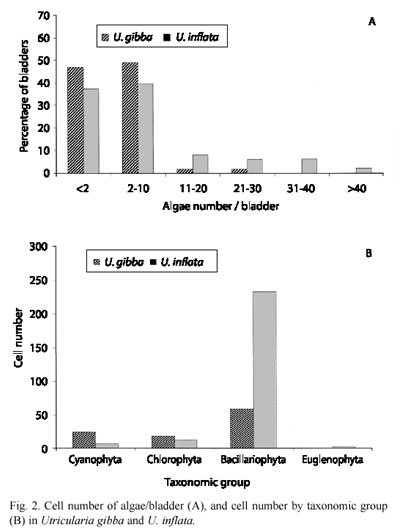
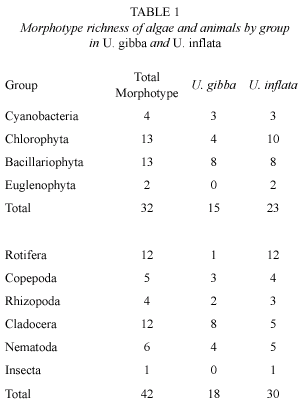
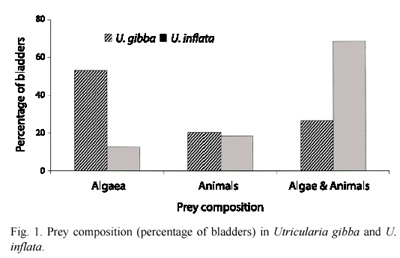
<body><![CDATA[<p>Water pH, conductivity, dissolved oxygen, and salinity were measured in situ in each of the two locations using a Horiba Walter Quality Checker, Mod. U-10, and water samples taken to analyze N, P, Ca<sup>++</sup>, Na<sup>+</sup>, K<sup>+</sup>, and Mg<sup>++</sup> content for the purpose of determining the main physical and chemical characteristics of the environment where the plants grow. Nitrogen was determined by the macro Kjeldahl method and phosphorus by colorimetric analysis (APHA 1992). Metals (Ca<sup>++</sup>, Na<sup>+</sup>, K<sup>+</sup>, and Mg<sup>++</sup>) were determined by atomic absorption. </p>     <p>Botanical samples were collected, labeled, and preserved in FAA fixing solution prepared with 500 ml alcohol, 100 ml formaldehyde, and 50 ml acetic acid. For each specimen quintuplicate sections of 5 cm were taken from each plant and bladder number recorded for each section. Fifty bladders approximately the same size and all appearing full (smaller bladders were discarded) were set aside from each species, washed with distilled water to eliminate any animal or algae adhered to the outer walls of the bladders so they would not be taken into account when analyzing contents. Bladders were then measured one by one and opened to disclose their contents under a stereoscopic microscope. Contents were analyzed and classified to respective supergroup level according to the available bibliography (Ward and Whipple 1959, Prescott 1970, Bold and Wynne 1985, APHA 1992). </p>     <p>The chi square test was applied to the number of individual algae and animals found in the 50 utricles analyzed for each of the two species, with a significance level of p&lt;0.05. The Spearman’s correlation coefficient was calculated to establish the percentage of similitude between the two species based on animal and vegetal morphospecies (taxa) density, also with a significance level of p&lt;0.05. Calculations were made using the Statistics 6.0 software package. </p> <font size="3">     <p><span style="font-weight: bold;">Results</span> </p> </font>     <p>In the Bohordal lake conductivity was 0.06 mS/cm, dissolved oxygen was 2.01 mg/l, and pH was 6.6. N-Kjeldahl and total P were 2.6 mg/l and 0.11 mg/l, respectively; Ca<sup>++</sup>, Mg<sup>++</sup>, Na<sup>+</sup>, and K<sup>+</sup> were 4.7 mg/l, 2.4 mg/l, 5 mg/l, and 5.5 mg/l, respectively. In the Rio de Agua herbaceous wetland, conductivity was 2.8 mS/cm, dissolved oxygen 3.4 m/l, pH 7.8, and salinity 1.84<sup>o</sup>/<sub>oo</sub>. N-Kjeldahl and total P were 2.81 mg/l and 0.13 mg/l, respectively; Ca<sup>++</sup>, Mg<sup>++</sup>, Na<sup>+</sup>, and K<sup>+</sup> were 77 mg/l, 36 mg/l, 177 mg/l, and 12 mg/l, respectively.    <br> </p>     <p>Mean bladder length and width were 1 651.81±397.00 µm and 1 219.33±313.75 µm, respectively for <span style="font-style: italic;">U. gibba</span>, and 1 243.46±222.02 µm and 994.78±200.91 µm for <span  style="font-style: italic;">U. inflata</span>. Bladder size expressed as length by width was 2.11±0.95 mm<sup>2</sup> for <span  style="font-style: italic;">U. gibba</span>, and 1.22±0.31 mm<sup>2</sup> for <span style="font-style: italic;">U. inflata</span>. Average bladder number in the 5 cm segments cut from the plants was 4 bladders/cm for <span style="font-style: italic;">U. inflata</span>, and 6 bladders/cm for <span style="font-style: italic;">U. gibba</span>. Found inside the utricles were algae and animals, free and/or adhered to walls or debris, partially digested animals, remains from other plants, nematodes, insects, eggs, and other non-identified material. </p>     <p>In <span style="font-style: italic;">U. inflata</span>, 69 % of the bladders contained both algae and animals, while in <span  style="font-style: italic;">U. gibba</span>, 53 % of the bladders contained only algae (<a href="#f1">Fig. 1</a>). For both species most bladders contained between two and ten algae (<a href="#f2">Fig. 2A</a>) with an average of 2 algae/bladder for <span  style="font-style: italic;">U. gibba</span> and 5 algae/bladder for <span  style="font-style: italic;">U. inflata</span>. A total of 102 algae were identified in <span style="font-style: italic;">U. gibba</span> and 256 in <span style="font-style: italic;">U. inflata</span>. Algae made up 61 % and 67 %, respectively, of all organisms found in <span  style="font-style: italic;">U. gibba</span> and <span  style="font-style: italic;">U. inflata</span>. Algae were classified into Cyanophyta (Cyanobacteria), Chlorophyta, Bacillariophyta, and Euglenophyta. Abundances of Cyanobacteria and Chlorophyta in both species were relatively similar. Bacillariophyta were more abundant in <span  style="font-style: italic;">U. Inflata</span>. Euglenophyta, the least abundant, were found only in <span style="font-style: italic;">U. inflata</span> (<a href="#f2">Fig. 2B</a>). The chi square test for algal density/division between the two species gave significant differences (<span style="font-style: italic;">X</span><sup>2</sup>= 7.81; df= 3; p&lt;0.05). Algal morphotype richness by division was superior in <span style="font-style: italic;">U. inflata</span>, especially in Chlorophyta (<a href="#t1">Table 1</a>). When prey composition was compared, based on density of vegetal morphospecies between both species, and using Spearman’s correlation coefficient, the result was non-significant, r<sub>s</sub>= -0.26 (p&lt;0.15).    <br> </p>     <p>    ]]></body>
<body><![CDATA[<br> <a name="f1"></a></p> </font>     <div style="text-align: center;"><img  src="/img/revistas/rbt/v55n3-4/art06i1.jpg" title="" alt=""  style="width: 400px; height: 258px;">    <br> </div> <font face="Verdana" size="2"> </font><font face="Verdana" size="2">     <p>    <br> <a name="f2"></a></p> </font>     <div style="text-align: center;"><img  src="/img/revistas/rbt/v55n3-4/art06i2.jpg" title="" alt=""  style="width: 400px; height: 530px;">    <br> </div> <font face="Verdana" size="2"> </font><font face="Verdana" size="2">     <p>    <br> <a name="t1"></a></p> </font>     <div style="text-align: center;"><img  src="/img/revistas/rbt/v55n3-4/art06t1.gif" title="" alt=""  style="width: 307px; height: 403px;">    ]]></body>
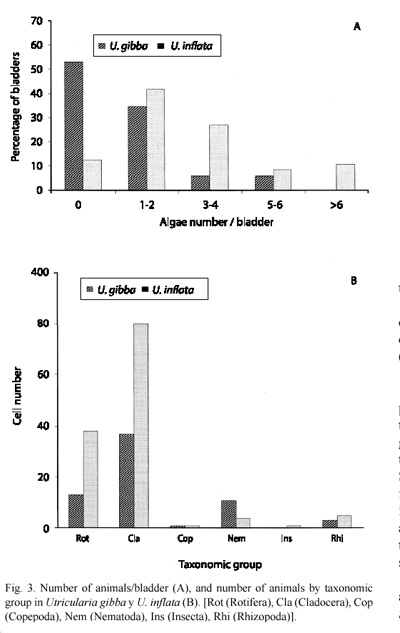
<body><![CDATA[<br> </div> <font face="Verdana" size="2"> </font><font face="Verdana" size="2">     <p>In <span style="font-style: italic;">U. gibba</span> more than 50 % of the bladders contained no animals and 35 % contained 1-2 individuals, and none of the bladders contained more than six. Meanwhile, in <span style="font-style: italic;">U. Inflata</span> a greater proportion of bladders (69 %) contained 1-4 individuals, with as many as 13 in some cases, and only 14 % contained no animals at all (Fig. 3A). Fixty six individual animals were identified in <span  style="font-style: italic;">U. gibba</span> with an average density of 1.30 animals/bladder and 129 in <span style="font-style: italic;">U. inflata</span> with an average of 2.58 animals/bladder. Animals represented 39 % and 34 %, respectively, of total of individuals in the bladders. In U. inflata, cladocerans and rotifers were more abundant, while in U. gibba were the nematodes. Copepod and rhizopod densities showed no major differences between the two species. Only one insect was found in <span style="font-style: italic;">U. inflata</span> (Fig. 3B). The chi square test of captured animals density between both species was significant (calculated: <span style="font-style: italic;">X</span><sup>2</sup>= 9.601; theoretical: <span style="font-style: italic;">X</span><sup>2</sup>= 0.711; df= 4; p&lt;0.05). Morphotype (taxon) richness was greater in <span  style="font-style: italic;">U. inflata</span>, especially in rotifers, while in <span style="font-style: italic;">U. gibba</span>, cladocerans were the group with greater richness (<a href="#t1">Table 1</a>). When prey composition was compared, based on animal morphotype density between both species, and using Spearman’s correlation coefficient, the result was non-significant, r<sub>s</sub>= -0.15 (p&lt;0.44).    <br> </p>     <p>    <br> <a name="f3"></a></p> </font>     <div style="text-align: center;"><img  src="/img/revistas/rbt/v55n3-4/art06i3.jpg" title="" alt=""  style="width: 400px; height: 633px;">    <br> </div> <font face="Verdana" size="2"> </font><font face="Verdana" size="3">     <p><span style="font-weight: bold;">Discussion</span> </p> </font><font face="Verdana" size="2">     <p>According to a classification of water bodies by trophic quality, and nitrogen and phosphorus data, Bohordal lake may be classified as a eutrophic ecosystem (OECD 1980, Colmenares 1990, Ryding and Rast 1992). The herbaceous wetland is included in the oligohaline category (Mitsch and Gosselink 2000), from salinity values and a slightly alkaline pH. In this habitat, total nitrogen, total phosphorous, and Ca<sup>++</sup>, Mg<sup>++</sup>, Na<sup>+</sup>, and K<sup>+</sup> values are similar to the concentration range reported by Kadlec and Knight (1996) for a eutrophic wetland containing <span style="font-style: italic;">Typha</span> spp. and <span style="font-style: italic;">Scirpus</span> spp., located in North America. So in both localities, in principle, no limitations should be found on nitrogen and phosphorous availability for carnivore plants. </p>     <p>The physicochemical characteristics - such as macronutrients and other ions, salinity and pH - of the water probably influence the composition and abundance of the phytoplankton and, of course, the zooplankton (Delgado <span style="font-style: italic;">et al</span>. unpublished, Zoppi <span style="font-style: italic;">et al</span>. 2002). Since <span style="font-style: italic;">Utricularia</span> catches both phytoplankton and zooplankton (Botta 1976, Pompêo and Bertuga 1996), the prey composition reflects possibly the plankton biodiversity outside the bladders. At the group level a correspondence between prey composition and plankton was observed, however there was a discrepancy regarding Chlorophyta; their presence was not determine in the Bohordal pond, but they were found inside the bladders of <span  style="font-style: italic;">U. inflata</span>; also the cladocera density in the water was lower in both environments in comparison with the total number of these organisms in both plant species. Mette <span  style="font-style: italic;">et al</span>. (2000) made comparisons between the surrounding plankton and the perifiton and demonstrated that the bladderworts do not trap the animals swimming in the open-water but those organisms staying as perifiton between and on the plants; also indicated that the prey composition from the bladders produces a partly image of environment, because to the presence of partly digestion organisms up to detritus indicate that a lot of organisms could not longer be determined and were therefore not counted. As certain taxa are digested faster than others -eg. ciliates and bdelloid rotifers can after a few hours no longer be taken into account, while crustaceans and armoured rotifers may still be identified after several days - they are not sufficiently represented in the evaluation. Besides there are organisms that live and thrive in the <span style="font-style: italic;">Utricularia</span> spp. trap, feeding on the captured prey without themselves being digested (Pietropaolo and Pietropaolo 1986). </p>     ]]></body>
<body><![CDATA[<p>Although both species plants are very similar in what they catch at the level of great group, however according to the data analysis (<span  style="font-style: italic;">X</span><sup>2</sup> test, Spearman correlation coefficient) there is no similarity regarding the algae and animal morphotypes caught, that is, the two species consume different morphotypes. <span style="font-style: italic;">U. gibba</span> has more bladders and they are bigger, but <span  style="font-style: italic;">U. inflata</span> catches more diverse prey, about three times more than <span style="font-style: italic;">U. gibba</span>. The possible reason for this is that in the Bohordal pond, the diversity and abundance of algae and animals is higher (Delgado <span style="font-style: italic;">et al</span>. unpublished, Zoppi de Roa <span style="font-style: italic;">et al</span>. 2002). The capture potential depends on the quantity as much as on the quality or the available organisms in the microhabitats where the plants grow and it is unquestionable that any variation on plankton composition will have an effect on prey composition (Zamora 1995). </p>     <p>The greater ammount organisms were found inside <span  style="font-style: italic;">U. inflata</span>, as much as 13 individuals per utricle. Pompêo and Bertuga (1996) reported on various species of <span style="font-style: italic;">Utricularia</span>, that the number of organisms caught in a 20-hour period varied between 3 and 11 individuals. Apparently, the size of the prey is determinant. <span  style="font-style: italic;">U. inflata</span> captures more rotifers, which are of a smaller size, typically 100-500 µm. On the other hand, <span  style="font-style: italic;">U. gibba</span> catches a higher diversity of cladocera, which are of higher size, typically 0.2-3mm (Kadlec and Knight 1996). </p>     <p>Results connected to group density and morphospecies diversity allow us to infer that both species of Utricularia capture whatever is around them, without discrimination and they are limited only by bladder size and prey availability and size. Apparently, <span  style="font-style: italic;">U. inflata</span> captures prey more efficiently but is limited by prey size, while <span  style="font-style: italic;">U. gibba</span> is limited by prey availability. Mette <span style="font-style: italic;">et al</span>. (2000) showed that <span style="font-style: italic;">Utricularia</span> in different European habitats do not capture their prey selectively but are dependent on the existing prey community. Zamora (1995) proposed that success for a carnivorous plant is the result of a complex process that depends on performance of trapping mechanisms as much as on prey abundance, its temporal and spatial distribution, and behavior, which determines the quantity of animal biomass that can be caught. </p>     <p>No animal content in 48 % of bladders in <span  style="font-style: italic;">U. gibba</span>, and the high proportion of algae inside the bladders of both species suggest these plants are either inefficient in capturing animal prey or do not require solely animal prey in natural conditions (Richards 2001). Zegarra (pers. comm.) proposes that <span style="font-style: italic;">Utricularia</span> might be showing an evolutionary trend from a mutualistic relationship between bladder plants and plankton organisms, especially the more abundant phytoplankton, towards the utilization of zooplankton or its byproducts, initially by using the debris of those dying in the bladders at the end of their life cycle or by predation from other microfaunal bladder inhabitants, and eventually, by the random emergence and subsequent selection of either metabolic pathways for optimizing nutrient absorption or mechanical adaptations for the development of a more functional carnivory or both. Botta (1976), Mette <span style="font-style: italic;">et al</span>. (2000) reported the presence of autotrophic organisms inside the bladders. Mette <span  style="font-style: italic;">et al</span>. (2000) further suggested that these autotrophs are not to be digested but use the bladder as a habitat in which they photosynthesize and reproduce. It seems autotrophic organisms as well as different groups of small animals are part of the food spectrum of <span style="font-style: italic;">Utricularia</span>. </p>     <p>. Since these ecosystems are eutrophic, the presence of <span  style="font-style: italic;">U. inflata</span> and <span  style="font-style: italic;">U. gibba</span> in them poses a conflict with the conclusions of several authors (Sculthorpe 1967, Heslop-Harrison 1978, Slack 1980, Friday 1989, Knight 1992, Pompêo and Bertuga 1996) about these plants growing in nutrient-poor environments. The majority of aquatic carnivorous plants usually grow in soft or medium-hard, acid or neutral, waters, and its can only use free CO<sub>2 </sub>(not HCO<sub>3</sub>-) for photosynthesis (Adamec 1997). Some aquatic carnivorous plants strictly require humic acids for normal growth and development, while other species only grow in a mineral medium with traces of peptone, beef extract, glucose or acetate (Adamec 1997). The growth of some aquatic <span style="font-style: italic;">Utricularia</span> species was promoted considerably by organic substances with or without N (Sculthorpe 1967). In aquatic aquatic carnivorous plants, the role of organic carbon absorbed from prey may be ecologically important, mainly under the conditions of CO<sub>2</sub> or light limitation. Adamec (1996) found that the growth of Aldrovanda vesiculosa L. (Droseraceae) - an aquatic carnivorous plant with a way of life and a strategy that resemble those of Utricularia -was greater in waters with a high concentration of CO<sub>2</sub> and suggested that carnivory can be a way to obtain additional carbon. These plants possibly confine living organisms not only to absorb nitrogen and phosphorous, also for the CO<sub>2</sub> produced through respiratory activity of the community inside the utricles. This would explain why <span style="font-style: italic;">U. gibba</span> and <span style="font-style: italic;">U. inflata</span> lives in environments where nitrogen and phosphorous do not limit growth, and also why a variety of organisms ranging from algae and animals to unidentified plant material are found inside them. </p>     <p>Further research should complement this study by including aspects like seasonal variation in prey composition, variation and percentage of inverted biomass in utricles, and comparison of productivity of these plants with and without bladders to find out how they can be affected by lack of carnivory-supplied nitrogen. Also, a comparison of prey composition in different sites, because, bladderworts of the same species may prey upon different organisms in different habitats (Mette <span  style="font-style: italic;">et al</span>. 2000). Also, available and total macronutrient concentration should be evaluated because of the huge difference between them in the water (or soil) (Adamec 1997). </p> <font size="3">     <p><span style="font-weight: bold;">Acknowledgments</span> </p> </font>     <p>Research was supported by a World Bank Grant # 021-044. We deeply appreciate the collaboration of Laura Delgado for the plankton data; to Cruz Salazar, Evelyn Zoppi de Roa and Federico González for their help in identification of algae and animal specimens; to Julio González and Napoleón León for their help in field, Argenis Delfín for water analysis and Jorge Zegarra for his help with the English manuscript. </p> </font> <hr style="width: 100%; height: 2px;"><font face="Verdana" size="2">     <p><span style="font-weight: bold;">Resumen</span> </p>     <p>Las plantas carnívoras acuáticas del género <span  style="font-style: italic;">Utricularia</span> (Lentibulariaceae), capturan pequeños organismos acuáticos, como rotíferos, copépodos, y cladóceros, por medio de estructuras anatómicas semejantes a vesículas. Este estudio tuvo como objetivo determinar el tamaño y tipo de presas de <span style="font-style: italic;">U. gibba</span> y <span  style="font-style: italic;">U. inflata</span>, recolectados en un pequeño lago y en un pastizal inundado, respectivamente, en la localidad de la Península de Paria (Estado Sucre, Venezuela). La acidez, conductividad, cantidad de oxígeno disuelto y la salinidad del agua se midieron in situ para cada sitio de muestreo; también se tomaron muestras de agua para determinar niveles de N-Kjeldahl, P-total, Na<sup>+</sup>, K<sup>+</sup>, Ca<sup>++</sup>, Mg<sup>++ </sup>y Cl<sup>-</sup>. Se midieron cincuenta vesículas de cada especie y se analizaron sus contenidos. Los valores de N-Kjeldahl y P-total fueron similares en ambos sitios, y semejantes a los conocidos para ecosistemas eutróficos; sin embargo, las concentraciones de Na<sup>+</sup>, K<sup>+</sup>, Ca<sup>++</sup>, Mg<sup>++</sup> y los valores in situ de los parámetros del agua fueron más altos en el pastizal inundado. Las vesículas contenían los siguientes grupos de zooplancton: rotíferos, cladóceros, copépodos, anélidos, rizópodos, e insectos; y las siguientes divisiones de fitoplancton: Bacillariophyta, Chlorophyta, Cyanophyta y Euglenophyta. Las vesículas presentadas por <span  style="font-style: italic;">U. inflata </span>fueron menores en tamaño y en cantidad, pero mayores en abundancia y riqueza total de morfoespecies algales y animales en comparación con <span  style="font-style: italic;">U. gibba</span>. La similitud en cuanto a composición de presas a nivel taxonómico, entre las dos especies de plantas carnívoras, fue baja. </p>     ]]></body>
<body><![CDATA[<p><span style="font-weight: bold;">Palabras clave:</span> Lentibulariaceae, <span style="font-style: italic;">Utricularia</span>, planta carnívora, composición de presas, captura de presas, plancton, Venezuela.    <br> </p> </font> <hr style="width: 100%; height: 2px;"><font face="Verdana" size="2"> </font>     <div style="text-align: center;"><font><font face="Verdana" size="2">Received 14-XII-2005. Corrected 24-IV-2006. Accepted 28-II-2007.</font></font></div> <font face="Verdana" size="2">     <p> </p> <font size="3">     <p><span style="font-weight: bold;">References</span> </p> </font>     <!-- ref --><p>Adamec, L. 1996. Photosynthetic characteristic of the aquatic carnivorous plant Aldrovanda vesiculosa. Aquat. Bot. 59: 297-306. &nbsp;&nbsp;&nbsp;&nbsp;&nbsp;&nbsp;&nbsp;&nbsp;[&#160;<a href="javascript:void(0);" onclick="javascript: window.open('/scielo.php?script=sci_nlinks&ref=1240717&pid=S0034-7744200700030000600001&lng=','','width=640,height=500,resizable=yes,scrollbars=1,menubar=yes,');">Links</a>&#160;]<!-- end-ref --><!-- ref --><p>Adamec, L. 1997. Mineral nutrition of carnivorous plants – A review. Bot. Rev. 63: 273-299. &nbsp;&nbsp;&nbsp;&nbsp;&nbsp;&nbsp;&nbsp;&nbsp;[&#160;<a href="javascript:void(0);" onclick="javascript: window.open('/scielo.php?script=sci_nlinks&ref=1240718&pid=S0034-7744200700030000600002&lng=','','width=640,height=500,resizable=yes,scrollbars=1,menubar=yes,');">Links</a>&#160;]<!-- end-ref --><!-- ref --><p>Angerilli, N.P.D &amp; B.P Beirne.1980. Influence of aquatic plants on colonization of artificial ponds by mosquitoes and their insect predators. Can. Ent. 112: 793-796. &nbsp;&nbsp;&nbsp;&nbsp;&nbsp;&nbsp;&nbsp;&nbsp;[&#160;<a href="javascript:void(0);" onclick="javascript: window.open('/scielo.php?script=sci_nlinks&ref=1240719&pid=S0034-7744200700030000600003&lng=','','width=640,height=500,resizable=yes,scrollbars=1,menubar=yes,');">Links</a>&#160;]<!-- end-ref --><!-- ref --><p>APHA. 1992. Standard Methods for the Examination of Water and Wastewater. American Public Health Association, Washington DC, USA. 560 p. &nbsp;&nbsp;&nbsp;&nbsp;&nbsp;&nbsp;&nbsp;&nbsp;[&#160;<a href="javascript:void(0);" onclick="javascript: window.open('/scielo.php?script=sci_nlinks&ref=1240720&pid=S0034-7744200700030000600004&lng=','','width=640,height=500,resizable=yes,scrollbars=1,menubar=yes,');">Links</a>&#160;]<!-- end-ref --><!-- ref --><p>Baumgartner, D.L. 1987. Laboratory evaluation of the bladderwort plant <span style="font-style: italic;">Utricularia vulgaris </span>(Lentibulariaceae), as a predator of late instar <span style="font-style: italic;">Culex pipiens</span> and assessment of its biocontrol potential. J. Am. Mosquito Contr. 3: 50-62. &nbsp;&nbsp;&nbsp;&nbsp;&nbsp;&nbsp;&nbsp;&nbsp;[&#160;<a href="javascript:void(0);" onclick="javascript: window.open('/scielo.php?script=sci_nlinks&ref=1240721&pid=S0034-7744200700030000600005&lng=','','width=640,height=500,resizable=yes,scrollbars=1,menubar=yes,');">Links</a>&#160;]<!-- end-ref --><!-- ref --><p>Bold, H.C. &amp; M.J. Wynne. 1985. Introduction to the Algae. Prentice-Hall, New Jersey, USA. 720 p. &nbsp;&nbsp;&nbsp;&nbsp;&nbsp;&nbsp;&nbsp;&nbsp;[&#160;<a href="javascript:void(0);" onclick="javascript: window.open('/scielo.php?script=sci_nlinks&ref=1240722&pid=S0034-7744200700030000600006&lng=','','width=640,height=500,resizable=yes,scrollbars=1,menubar=yes,');">Links</a>&#160;]<!-- end-ref --><!-- ref --><p>Botta, S.M. 1976. Sobre las trampas y las víctimas o presas de algunas especies argentinas del género Utricularia. Darwiniana 20: 127-154. &nbsp;&nbsp;&nbsp;&nbsp;&nbsp;&nbsp;&nbsp;&nbsp;[&#160;<a href="javascript:void(0);" onclick="javascript: window.open('/scielo.php?script=sci_nlinks&ref=1240723&pid=S0034-7744200700030000600007&lng=','','width=640,height=500,resizable=yes,scrollbars=1,menubar=yes,');">Links</a>&#160;]<!-- end-ref --><!-- ref --><p>Colmenares, A.S. 1990. Evaluación del Estado Trófico del Embalse La Mariposa, Caracas-Venezuela. Tesis de maestría, Instituto Venezolano de Investigaciones Científicas, Caracas, Venezuela. 168 p. &nbsp;&nbsp;&nbsp;&nbsp;&nbsp;&nbsp;&nbsp;&nbsp;[&#160;<a href="javascript:void(0);" onclick="javascript: window.open('/scielo.php?script=sci_nlinks&ref=1240724&pid=S0034-7744200700030000600008&lng=','','width=640,height=500,resizable=yes,scrollbars=1,menubar=yes,');">Links</a>&#160;]<!-- end-ref --><!-- ref --><p>Cook, D.K. 1996. Aquatic Plant Book. S.P.B. Academic, The Hague, Holland. 228 p. &nbsp;&nbsp;&nbsp;&nbsp;&nbsp;&nbsp;&nbsp;&nbsp;[&#160;<a href="javascript:void(0);" onclick="javascript: window.open('/scielo.php?script=sci_nlinks&ref=1240725&pid=S0034-7744200700030000600009&lng=','','width=640,height=500,resizable=yes,scrollbars=1,menubar=yes,');">Links</a>&#160;]<!-- end-ref --><!-- ref --><p>Ellison, A.M. &amp; N.J. Gotelli. 2001. Evolutionary ecology of carnivorous plants. Trends Ecol. Evol. 16: 623-629. &nbsp;&nbsp;&nbsp;&nbsp;&nbsp;&nbsp;&nbsp;&nbsp;[&#160;<a href="javascript:void(0);" onclick="javascript: window.open('/scielo.php?script=sci_nlinks&ref=1240726&pid=S0034-7744200700030000600010&lng=','','width=640,height=500,resizable=yes,scrollbars=1,menubar=yes,');">Links</a>&#160;]<!-- end-ref --><!-- ref --><p>Friday, L.E. 1989. Rapid turnover of traps in <span  style="font-style: italic;">Utricularia vulgaris</span> L. Oecologia 5: 272-277. &nbsp;&nbsp;&nbsp;&nbsp;&nbsp;&nbsp;&nbsp;&nbsp;[&#160;<a href="javascript:void(0);" onclick="javascript: window.open('/scielo.php?script=sci_nlinks&ref=1240727&pid=S0034-7744200700030000600011&lng=','','width=640,height=500,resizable=yes,scrollbars=1,menubar=yes,');">Links</a>&#160;]<!-- end-ref --><!-- ref --><p>Friday, L.E. 1992. Measuring investment in carnivory: Seasonal and individual variation in trap number and biomass in <span  style="font-style: italic;">Utricularia vulgaris</span> L. New Phytol. 126: 273-281. &nbsp;&nbsp;&nbsp;&nbsp;&nbsp;&nbsp;&nbsp;&nbsp;[&#160;<a href="javascript:void(0);" onclick="javascript: window.open('/scielo.php?script=sci_nlinks&ref=1240728&pid=S0034-7744200700030000600012&lng=','','width=640,height=500,resizable=yes,scrollbars=1,menubar=yes,');">Links</a>&#160;]<!-- end-ref --><!-- ref --><p>Friday, L.E. &amp; C. Quarmby. 1994. Uptake and translocation of prey derived 15N and 32P in Utricularia vulgaris L. New Phytol. 126: 273-281. &nbsp;&nbsp;&nbsp;&nbsp;&nbsp;&nbsp;&nbsp;&nbsp;[&#160;<a href="javascript:void(0);" onclick="javascript: window.open('/scielo.php?script=sci_nlinks&ref=1240729&pid=S0034-7744200700030000600013&lng=','','width=640,height=500,resizable=yes,scrollbars=1,menubar=yes,');">Links</a>&#160;]<!-- end-ref --><!-- ref --><p>Gordon, E., L. Delgado, E. Zoppi de Roa, J. Berti, E. Montiel &amp; S. Ramos. 2003. Composición florística de la vegetación y fisicoquímica del agua en humedales de la Península de Paria (Estado Sucre), 89 p. <span  style="font-style: italic;">In</span> Memorias del V Congreso Venezolano de Ecología. Sociedad Venezolana de Ecología, Margarita, Nueva Esparta, Venezuela. &nbsp;&nbsp;&nbsp;&nbsp;&nbsp;&nbsp;&nbsp;&nbsp;[&#160;<a href="javascript:void(0);" onclick="javascript: window.open('/scielo.php?script=sci_nlinks&ref=1240730&pid=S0034-7744200700030000600014&lng=','','width=640,height=500,resizable=yes,scrollbars=1,menubar=yes,');">Links</a>&#160;]<!-- end-ref --><!-- ref --><p>Hegner, R.W. 1926. The interrelations of Protozoa and the utricles of Utricularia. Biol. Bull. 50: 239-270. &nbsp;&nbsp;&nbsp;&nbsp;&nbsp;&nbsp;&nbsp;&nbsp;[&#160;<a href="javascript:void(0);" onclick="javascript: window.open('/scielo.php?script=sci_nlinks&ref=1240731&pid=S0034-7744200700030000600015&lng=','','width=640,height=500,resizable=yes,scrollbars=1,menubar=yes,');">Links</a>&#160;]<!-- end-ref --><!-- ref --><p>Heslop-Harrison, Y. 1978. Carnivorous Plants. Sci. Amer. 104: 156-185. &nbsp;&nbsp;&nbsp;&nbsp;&nbsp;&nbsp;&nbsp;&nbsp;[&#160;<a href="javascript:void(0);" onclick="javascript: window.open('/scielo.php?script=sci_nlinks&ref=1240732&pid=S0034-7744200700030000600016&lng=','','width=640,height=500,resizable=yes,scrollbars=1,menubar=yes,');">Links</a>&#160;]<!-- end-ref --><!-- ref --><p>Juniper, B.E, R.J. Robins &amp; D.M. Joel.1989. The Carnivorous Plants. Academic, London, England. 353 p. &nbsp;&nbsp;&nbsp;&nbsp;&nbsp;&nbsp;&nbsp;&nbsp;[&#160;<a href="javascript:void(0);" onclick="javascript: window.open('/scielo.php?script=sci_nlinks&ref=1240733&pid=S0034-7744200700030000600017&lng=','','width=640,height=500,resizable=yes,scrollbars=1,menubar=yes,');">Links</a>&#160;]<!-- end-ref --><!-- ref --><p>Kadlec, R. &amp; R. Knight. 1996. Treatment Wetlands. Lewis, New York, USA. 893 p. &nbsp;&nbsp;&nbsp;&nbsp;&nbsp;&nbsp;&nbsp;&nbsp;[&#160;<a href="javascript:void(0);" onclick="javascript: window.open('/scielo.php?script=sci_nlinks&ref=1240734&pid=S0034-7744200700030000600018&lng=','','width=640,height=500,resizable=yes,scrollbars=1,menubar=yes,');">Links</a>&#160;]<!-- end-ref --><!-- ref --><p>Knight, S.E. &amp; T.M. Frost. 1991. Bladder control in <span  style="font-style: italic;">Utricularia macrorhiza</span>: Lake-specific variation in plant investment in carnivory. Ecology 72: 728-734. &nbsp;&nbsp;&nbsp;&nbsp;&nbsp;&nbsp;&nbsp;&nbsp;[&#160;<a href="javascript:void(0);" onclick="javascript: window.open('/scielo.php?script=sci_nlinks&ref=1240735&pid=S0034-7744200700030000600019&lng=','','width=640,height=500,resizable=yes,scrollbars=1,menubar=yes,');">Links</a>&#160;]<!-- end-ref --><!-- ref --><p>Knight, S.E. 1992. Cost of carnivory in the common bladderwort, Utricularia macrorhiza. Oecologia 89: 348-355. &nbsp;&nbsp;&nbsp;&nbsp;&nbsp;&nbsp;&nbsp;&nbsp;[&#160;<a href="javascript:void(0);" onclick="javascript: window.open('/scielo.php?script=sci_nlinks&ref=1240736&pid=S0034-7744200700030000600020&lng=','','width=640,height=500,resizable=yes,scrollbars=1,menubar=yes,');">Links</a>&#160;]<!-- end-ref --><!-- ref --><p>Lloyd, F.E. 1942. The Carnivorous Plants. Chronica Botanica, New York, USA. 352 p. &nbsp;&nbsp;&nbsp;&nbsp;&nbsp;&nbsp;&nbsp;&nbsp;[&#160;<a href="javascript:void(0);" onclick="javascript: window.open('/scielo.php?script=sci_nlinks&ref=1240737&pid=S0034-7744200700030000600021&lng=','','width=640,height=500,resizable=yes,scrollbars=1,menubar=yes,');">Links</a>&#160;]<!-- end-ref --><!-- ref --><p>Mette, N., N. Wilbert &amp; W. Barthlott. 2000. Food composition of aquatic bladderworts (Utricularia, Lentibulariaceae) in various habitats. Beitr. Biol. Pflanzen 72: 1-13. &nbsp;&nbsp;&nbsp;&nbsp;&nbsp;&nbsp;&nbsp;&nbsp;[&#160;<a href="javascript:void(0);" onclick="javascript: window.open('/scielo.php?script=sci_nlinks&ref=1240738&pid=S0034-7744200700030000600022&lng=','','width=640,height=500,resizable=yes,scrollbars=1,menubar=yes,');">Links</a>&#160;]<!-- end-ref --><!-- ref --><p>Mitsch, W.J. &amp; J.G. Gosselink. 2000. Wetlands. Wiley, New York, USA. 920p. &nbsp;&nbsp;&nbsp;&nbsp;&nbsp;&nbsp;&nbsp;&nbsp;[&#160;<a href="javascript:void(0);" onclick="javascript: window.open('/scielo.php?script=sci_nlinks&ref=1240739&pid=S0034-7744200700030000600023&lng=','','width=640,height=500,resizable=yes,scrollbars=1,menubar=yes,');">Links</a>&#160;]<!-- end-ref --><!-- ref --><p>OECD (Organization for Economic Cooperation and Development). 1980. Cooperative Programme for monitoring of inland waters (Eutrophication Control). Regional project: Shallow lakes and reservoirs. Water Research Center, Paris, France. 297 p. &nbsp;&nbsp;&nbsp;&nbsp;&nbsp;&nbsp;&nbsp;&nbsp;[&#160;<a href="javascript:void(0);" onclick="javascript: window.open('/scielo.php?script=sci_nlinks&ref=1240740&pid=S0034-7744200700030000600024&lng=','','width=640,height=500,resizable=yes,scrollbars=1,menubar=yes,');">Links</a>&#160;]<!-- end-ref --><!-- ref --><p>Prescott, G.W. 1970. The Freshwater Algae. C. Brown, Duque, Iowa, USA. 348p. &nbsp;&nbsp;&nbsp;&nbsp;&nbsp;&nbsp;&nbsp;&nbsp;[&#160;<a href="javascript:void(0);" onclick="javascript: window.open('/scielo.php?script=sci_nlinks&ref=1240741&pid=S0034-7744200700030000600025&lng=','','width=640,height=500,resizable=yes,scrollbars=1,menubar=yes,');">Links</a>&#160;]<!-- end-ref --><!-- ref --><p>Pompêo, M.L &amp; M. Bertuga.1996. Captura de organismos planctônicos pelas plantas carnívoras do gênero Utricularia (Angiospermae, Dicotyledonea). Rev. Brasil. Biol. 56: 697-703. &nbsp;&nbsp;&nbsp;&nbsp;&nbsp;&nbsp;&nbsp;&nbsp;[&#160;<a href="javascript:void(0);" onclick="javascript: window.open('/scielo.php?script=sci_nlinks&ref=1240742&pid=S0034-7744200700030000600026&lng=','','width=640,height=500,resizable=yes,scrollbars=1,menubar=yes,');">Links</a>&#160;]<!-- end-ref --><!-- ref --><p>Pietropaolo, F. &amp; P. Pietropaolo. 1986. Carnivorous Plants of the World. Timber, Oregon, USA. 206 p. &nbsp;&nbsp;&nbsp;&nbsp;&nbsp;&nbsp;&nbsp;&nbsp;[&#160;<a href="javascript:void(0);" onclick="javascript: window.open('/scielo.php?script=sci_nlinks&ref=1240743&pid=S0034-7744200700030000600027&lng=','','width=640,height=500,resizable=yes,scrollbars=1,menubar=yes,');">Links</a>&#160;]<!-- end-ref --><!-- ref --><p>Richards, J.H. 2001. Bladder function in <span  style="font-style: italic;">Utricularia purpurea </span>(Lentibulariaceae): Is carnivory important? Amer. J. Bot. 88: 170-176. &nbsp;&nbsp;&nbsp;&nbsp;&nbsp;&nbsp;&nbsp;&nbsp;[&#160;<a href="javascript:void(0);" onclick="javascript: window.open('/scielo.php?script=sci_nlinks&ref=1240744&pid=S0034-7744200700030000600028&lng=','','width=640,height=500,resizable=yes,scrollbars=1,menubar=yes,');">Links</a>&#160;]<!-- end-ref --><!-- ref --><p>Rutishauser, R. &amp; J. Brugger. 1992. Structural and developmental diversity of Utricularia traps. Carnivorous Plants Newsletter 21: 68-74. &nbsp;&nbsp;&nbsp;&nbsp;&nbsp;&nbsp;&nbsp;&nbsp;[&#160;<a href="javascript:void(0);" onclick="javascript: window.open('/scielo.php?script=sci_nlinks&ref=1240745&pid=S0034-7744200700030000600029&lng=','','width=640,height=500,resizable=yes,scrollbars=1,menubar=yes,');">Links</a>&#160;]<!-- end-ref --><!-- ref --><p>Rutishauser, R. 1993. The developmental plasticity of <span  style="font-style: italic;">Utricularia aurea</span> (Lentibulariaceae) and its floats. Aquat. Bot. 45:119-143. &nbsp;&nbsp;&nbsp;&nbsp;&nbsp;&nbsp;&nbsp;&nbsp;[&#160;<a href="javascript:void(0);" onclick="javascript: window.open('/scielo.php?script=sci_nlinks&ref=1240746&pid=S0034-7744200700030000600030&lng=','','width=640,height=500,resizable=yes,scrollbars=1,menubar=yes,');">Links</a>&#160;]<!-- end-ref --><!-- ref --><p>Ryding, S.O. &amp; W. Rast. 1992. El Control de la Eutrofización en Lagos y Pantanos. Pirámide, Madrid, Spain. 375 p. &nbsp;&nbsp;&nbsp;&nbsp;&nbsp;&nbsp;&nbsp;&nbsp;[&#160;<a href="javascript:void(0);" onclick="javascript: window.open('/scielo.php?script=sci_nlinks&ref=1240747&pid=S0034-7744200700030000600031&lng=','','width=640,height=500,resizable=yes,scrollbars=1,menubar=yes,');">Links</a>&#160;]<!-- end-ref --><!-- ref --><p>Sattler, R. &amp; R. Rutishauser. 1990. Structural and dynamic descriptions of the development of <span style="font-style: italic;">Utricularia foliosa</span> and <span style="font-style: italic;">Utricularia australis</span>. Can. J. Bot. 68: 1989-2003. &nbsp;&nbsp;&nbsp;&nbsp;&nbsp;&nbsp;&nbsp;&nbsp;[&#160;<a href="javascript:void(0);" onclick="javascript: window.open('/scielo.php?script=sci_nlinks&ref=1240748&pid=S0034-7744200700030000600032&lng=','','width=640,height=500,resizable=yes,scrollbars=1,menubar=yes,');">Links</a>&#160;]<!-- end-ref --><!-- ref --><p>Slack, A. 1980. Carnivorous Plants. MIT, Cambridge MA, USA. 240 p. &nbsp;&nbsp;&nbsp;&nbsp;&nbsp;&nbsp;&nbsp;&nbsp;[&#160;<a href="javascript:void(0);" onclick="javascript: window.open('/scielo.php?script=sci_nlinks&ref=1240749&pid=S0034-7744200700030000600033&lng=','','width=640,height=500,resizable=yes,scrollbars=1,menubar=yes,');">Links</a>&#160;]<!-- end-ref --><!-- ref --><p>Schnell, D.E. 1976. Carnivorous Plants of the United States and Canada. John F. Blair, North Carolina, USA. 125 p. &nbsp;&nbsp;&nbsp;&nbsp;&nbsp;&nbsp;&nbsp;&nbsp;[&#160;<a href="javascript:void(0);" onclick="javascript: window.open('/scielo.php?script=sci_nlinks&ref=1240750&pid=S0034-7744200700030000600034&lng=','','width=640,height=500,resizable=yes,scrollbars=1,menubar=yes,');">Links</a>&#160;]<!-- end-ref --><!-- ref --><p>Sculthorpe, C.D. 1967. The Biology of Aquatic Vascular Plants. Edward Arnold, London, England. 610 p. &nbsp;&nbsp;&nbsp;&nbsp;&nbsp;&nbsp;&nbsp;&nbsp;[&#160;<a href="javascript:void(0);" onclick="javascript: window.open('/scielo.php?script=sci_nlinks&ref=1240751&pid=S0034-7744200700030000600035&lng=','','width=640,height=500,resizable=yes,scrollbars=1,menubar=yes,');">Links</a>&#160;]<!-- end-ref --><!-- ref --><p>Taylor, P. 1989. The Genus Utricularia -A taxonomic monograph. Royal Botanic Gardens, London, England. 724 p. &nbsp;&nbsp;&nbsp;&nbsp;&nbsp;&nbsp;&nbsp;&nbsp;[&#160;<a href="javascript:void(0);" onclick="javascript: window.open('/scielo.php?script=sci_nlinks&ref=1240752&pid=S0034-7744200700030000600036&lng=','','width=640,height=500,resizable=yes,scrollbars=1,menubar=yes,');">Links</a>&#160;]<!-- end-ref --><!-- ref --><p>Ulanowicz, R.E. 1995. Utricularia’s secret: The advantage of positive feedback in oligotrophic environments. Ecol. Model. 79: 49-57. &nbsp;&nbsp;&nbsp;&nbsp;&nbsp;&nbsp;&nbsp;&nbsp;[&#160;<a href="javascript:void(0);" onclick="javascript: window.open('/scielo.php?script=sci_nlinks&ref=1240753&pid=S0034-7744200700030000600037&lng=','','width=640,height=500,resizable=yes,scrollbars=1,menubar=yes,');">Links</a>&#160;]<!-- end-ref --><!-- ref --><p>Velásquez, J. 1994. Plantas Acuáticas Vasculares de Venezuela. Universidad Central de Venezuela, Caracas, Venezuela. 992 p. &nbsp;&nbsp;&nbsp;&nbsp;&nbsp;&nbsp;&nbsp;&nbsp;[&#160;<a href="javascript:void(0);" onclick="javascript: window.open('/scielo.php?script=sci_nlinks&ref=1240754&pid=S0034-7744200700030000600038&lng=','','width=640,height=500,resizable=yes,scrollbars=1,menubar=yes,');">Links</a>&#160;]<!-- end-ref --><!-- ref --><p>Ward, H.B. &amp; G.C. Whipple. 1959. Freshwater biology. Wiley, New York, USA. 1248p. &nbsp;&nbsp;&nbsp;&nbsp;&nbsp;&nbsp;&nbsp;&nbsp;[&#160;<a href="javascript:void(0);" onclick="javascript: window.open('/scielo.php?script=sci_nlinks&ref=1240755&pid=S0034-7744200700030000600039&lng=','','width=640,height=500,resizable=yes,scrollbars=1,menubar=yes,');">Links</a>&#160;]<!-- end-ref --><!-- ref --><p>Zamora, R. 1995. The trapping success of carnivorous plant, <span  style="font-style: italic;">Pinguicula vallisneriifolia</span>: The accumulative effects of availability, attraction, retention and robbery of prey. Oikos 73: 309-322. &nbsp;&nbsp;&nbsp;&nbsp;&nbsp;&nbsp;&nbsp;&nbsp;[&#160;<a href="javascript:void(0);" onclick="javascript: window.open('/scielo.php?script=sci_nlinks&ref=1240756&pid=S0034-7744200700030000600040&lng=','','width=640,height=500,resizable=yes,scrollbars=1,menubar=yes,');">Links</a>&#160;]<!-- end-ref --><br> </font>      ]]></body><back>
<ref-list>
<ref id="B1">
<nlm-citation citation-type="journal">
<person-group person-group-type="author">
<name>
<surname><![CDATA[Adamec]]></surname>
<given-names><![CDATA[L]]></given-names>
</name>
</person-group>
<article-title xml:lang="en"><![CDATA[Photosynthetic characteristic of the aquatic carnivorous plant Aldrovanda vesiculosa]]></article-title>
<source><![CDATA[Aquat. Bot]]></source>
<year>1996</year>
<volume>59</volume>
<page-range>297-306</page-range></nlm-citation>
</ref>
<ref id="B2">
<nlm-citation citation-type="journal">
<person-group person-group-type="author">
<name>
<surname><![CDATA[Adamec]]></surname>
<given-names><![CDATA[L]]></given-names>
</name>
</person-group>
<article-title xml:lang="en"><![CDATA[Mineral nutrition of carnivorous plants - A review]]></article-title>
<source><![CDATA[Bot. Rev]]></source>
<year>1997</year>
<volume>63</volume>
<page-range>273-299</page-range></nlm-citation>
</ref>
<ref id="B3">
<nlm-citation citation-type="journal">
<person-group person-group-type="author">
<name>
<surname><![CDATA[Angerilli]]></surname>
<given-names><![CDATA[N.P.D]]></given-names>
</name>
<name>
<surname><![CDATA[Beirne]]></surname>
<given-names><![CDATA[B.P]]></given-names>
</name>
</person-group>
<article-title xml:lang="en"><![CDATA[Influence of aquatic plants on colonization of artificial ponds by mosquitoes and their insect predators]]></article-title>
<source><![CDATA[Can. Ent]]></source>
<year>1980</year>
<volume>112</volume>
<page-range>793-796</page-range></nlm-citation>
</ref>
<ref id="B4">
<nlm-citation citation-type="book">
<collab>APHA</collab>
<source><![CDATA[Standard Methods for the Examination of Water and Wastewater]]></source>
<year>1992</year>
<publisher-loc><![CDATA[^eWashington DC Washington DC]]></publisher-loc>
<publisher-name><![CDATA[American Public Health Association]]></publisher-name>
</nlm-citation>
</ref>
<ref id="B5">
<nlm-citation citation-type="journal">
<person-group person-group-type="author">
<name>
<surname><![CDATA[Baumgartner]]></surname>
<given-names><![CDATA[D.L]]></given-names>
</name>
</person-group>
<article-title xml:lang="en"><![CDATA[Laboratory evaluation of the bladderwort plant Utricularia vulgaris (Lentibulariaceae), as a predator of late instar Culex pipiens and assessment of its biocontrol potential]]></article-title>
<source><![CDATA[J. Am. Mosquito Contr]]></source>
<year>1987</year>
<volume>3</volume>
<page-range>50-62</page-range></nlm-citation>
</ref>
<ref id="B6">
<nlm-citation citation-type="book">
<person-group person-group-type="author">
<name>
<surname><![CDATA[Bold]]></surname>
<given-names><![CDATA[H.C]]></given-names>
</name>
<name>
<surname><![CDATA[Wynne]]></surname>
<given-names><![CDATA[M.J]]></given-names>
</name>
</person-group>
<source><![CDATA[Introduction to the Algae]]></source>
<year>1985</year>
<publisher-loc><![CDATA[New Jersey ]]></publisher-loc>
<publisher-name><![CDATA[Prentice-Hall]]></publisher-name>
</nlm-citation>
</ref>
<ref id="B7">
<nlm-citation citation-type="journal">
<person-group person-group-type="author">
<name>
<surname><![CDATA[Botta]]></surname>
<given-names><![CDATA[S.M]]></given-names>
</name>
</person-group>
<article-title xml:lang="es"><![CDATA[Sobre las trampas y las víctimas o presas de algunas especies argentinas del género Utricularia]]></article-title>
<source><![CDATA[Darwiniana]]></source>
<year>1976</year>
<volume>20</volume>
<page-range>127-154</page-range></nlm-citation>
</ref>
<ref id="B8">
<nlm-citation citation-type="">
<person-group person-group-type="author">
<name>
<surname><![CDATA[Colmenares]]></surname>
<given-names><![CDATA[A.S]]></given-names>
</name>
</person-group>
<source><![CDATA[Evaluación del Estado Trófico del Embalse La Mariposa, Caracas-Venezuela]]></source>
<year>1990</year>
<page-range>168</page-range></nlm-citation>
</ref>
<ref id="B9">
<nlm-citation citation-type="book">
<person-group person-group-type="author">
<name>
<surname><![CDATA[Cook]]></surname>
<given-names><![CDATA[D.K]]></given-names>
</name>
</person-group>
<source><![CDATA[Aquatic Plant Book]]></source>
<year>1996</year>
<publisher-loc><![CDATA[The Hague ]]></publisher-loc>
<publisher-name><![CDATA[S.P.B. Academic]]></publisher-name>
</nlm-citation>
</ref>
<ref id="B10">
<nlm-citation citation-type="journal">
<person-group person-group-type="author">
<name>
<surname><![CDATA[Ellison]]></surname>
<given-names><![CDATA[A.M]]></given-names>
</name>
<name>
<surname><![CDATA[Gotelli]]></surname>
<given-names><![CDATA[N.J]]></given-names>
</name>
</person-group>
<article-title xml:lang="en"><![CDATA[Evolutionary ecology of carnivorous plants]]></article-title>
<source><![CDATA[Trends Ecol. Evol]]></source>
<year>2001</year>
<volume>16</volume>
<page-range>623-629</page-range></nlm-citation>
</ref>
<ref id="B11">
<nlm-citation citation-type="journal">
<person-group person-group-type="author">
<name>
<surname><![CDATA[Friday]]></surname>
<given-names><![CDATA[L.E]]></given-names>
</name>
</person-group>
<article-title xml:lang="en"><![CDATA[Rapid turnover of traps in Utricularia vulgaris L]]></article-title>
<source><![CDATA[Oecologia]]></source>
<year>1989</year>
<volume>5</volume>
<page-range>272-277</page-range></nlm-citation>
</ref>
<ref id="B12">
<nlm-citation citation-type="journal">
<person-group person-group-type="author">
<name>
<surname><![CDATA[Friday]]></surname>
<given-names><![CDATA[L.E]]></given-names>
</name>
</person-group>
<article-title xml:lang="en"><![CDATA[Measuring investment in carnivory: Seasonal and individual variation in trap number and biomass in Utricularia vulgaris L]]></article-title>
<source><![CDATA[New Phytol]]></source>
<year>1992</year>
<volume>126</volume>
<page-range>273-281</page-range></nlm-citation>
</ref>
<ref id="B13">
<nlm-citation citation-type="journal">
<person-group person-group-type="author">
<name>
<surname><![CDATA[Friday]]></surname>
<given-names><![CDATA[L.E]]></given-names>
</name>
<name>
<surname><![CDATA[Quarmby]]></surname>
<given-names><![CDATA[C]]></given-names>
</name>
</person-group>
<article-title xml:lang="en"><![CDATA[Uptake and translocation of prey derived 15N and 32P in Utricularia vulgaris L]]></article-title>
<source><![CDATA[New Phytol]]></source>
<year>1994</year>
<volume>126</volume>
<page-range>273-281</page-range></nlm-citation>
</ref>
<ref id="B14">
<nlm-citation citation-type="book">
<person-group person-group-type="author">
<name>
<surname><![CDATA[Gordon]]></surname>
<given-names><![CDATA[E]]></given-names>
</name>
<name>
<surname><![CDATA[Delgado]]></surname>
<given-names><![CDATA[L]]></given-names>
</name>
<name>
<surname><![CDATA[Zoppi de Roa]]></surname>
<given-names><![CDATA[E]]></given-names>
</name>
<name>
<surname><![CDATA[Berti]]></surname>
<given-names><![CDATA[J]]></given-names>
</name>
<name>
<surname><![CDATA[Montiel]]></surname>
<given-names><![CDATA[E]]></given-names>
</name>
<name>
<surname><![CDATA[Ramos]]></surname>
<given-names><![CDATA[S]]></given-names>
</name>
</person-group>
<article-title xml:lang="es"><![CDATA[Composición florística de la vegetación y fisicoquímica del agua en humedales de la Península de Paria (Estado Sucre)]]></article-title>
<source><![CDATA[Memorias del V Congreso Venezolano de Ecología]]></source>
<year>2003</year>
<page-range>89</page-range><publisher-loc><![CDATA[Margarita^eNueva Esparta Nueva Esparta]]></publisher-loc>
<publisher-name><![CDATA[Sociedad Venezolana de Ecología]]></publisher-name>
</nlm-citation>
</ref>
<ref id="B15">
<nlm-citation citation-type="journal">
<person-group person-group-type="author">
<name>
<surname><![CDATA[Hegner]]></surname>
<given-names><![CDATA[R.W]]></given-names>
</name>
</person-group>
<article-title xml:lang="en"><![CDATA[The interrelations of Protozoa and the utricles of Utricularia]]></article-title>
<source><![CDATA[Biol. Bull]]></source>
<year>1926</year>
<volume>50</volume>
<page-range>239-270</page-range></nlm-citation>
</ref>
<ref id="B16">
<nlm-citation citation-type="journal">
<person-group person-group-type="author">
<name>
<surname><![CDATA[Heslop-Harrison]]></surname>
<given-names><![CDATA[Y]]></given-names>
</name>
</person-group>
<article-title xml:lang="en"><![CDATA[Carnivorous Plants]]></article-title>
<source><![CDATA[Sci. Amer]]></source>
<year>1978</year>
<volume>104</volume>
<page-range>156-185</page-range></nlm-citation>
</ref>
<ref id="B17">
<nlm-citation citation-type="book">
<person-group person-group-type="author">
<name>
<surname><![CDATA[Juniper]]></surname>
<given-names><![CDATA[B.E]]></given-names>
</name>
<name>
<surname><![CDATA[Robins]]></surname>
<given-names><![CDATA[R.J]]></given-names>
</name>
<name>
<surname><![CDATA[Joel]]></surname>
<given-names><![CDATA[D.M]]></given-names>
</name>
</person-group>
<source><![CDATA[The Carnivorous Plants]]></source>
<year>1989</year>
<page-range>353</page-range><publisher-loc><![CDATA[London ]]></publisher-loc>
<publisher-name><![CDATA[Academic]]></publisher-name>
</nlm-citation>
</ref>
<ref id="B18">
<nlm-citation citation-type="book">
<person-group person-group-type="author">
<name>
<surname><![CDATA[Kadlec]]></surname>
<given-names><![CDATA[R]]></given-names>
</name>
<name>
<surname><![CDATA[Knight]]></surname>
<given-names><![CDATA[R]]></given-names>
</name>
</person-group>
<source><![CDATA[Treatment Wetlands]]></source>
<year>1996</year>
<publisher-loc><![CDATA[^eNew York New York]]></publisher-loc>
<publisher-name><![CDATA[Lewis]]></publisher-name>
</nlm-citation>
</ref>
<ref id="B19">
<nlm-citation citation-type="journal">
<person-group person-group-type="author">
<name>
<surname><![CDATA[Knight]]></surname>
<given-names><![CDATA[S.E]]></given-names>
</name>
<name>
<surname><![CDATA[Frost]]></surname>
<given-names><![CDATA[T.M]]></given-names>
</name>
</person-group>
<article-title xml:lang="en"><![CDATA[Bladder control in Utricularia macrorhiza: Lake-specific variation in plant investment in carnivory]]></article-title>
<source><![CDATA[Ecology]]></source>
<year>1991</year>
<volume>72</volume>
<page-range>728-734</page-range></nlm-citation>
</ref>
<ref id="B20">
<nlm-citation citation-type="journal">
<person-group person-group-type="author">
<name>
<surname><![CDATA[Knight]]></surname>
<given-names><![CDATA[S.E]]></given-names>
</name>
</person-group>
<article-title xml:lang="en"><![CDATA[Cost of carnivory in the common bladderwort, Utricularia macrorhiza]]></article-title>
<source><![CDATA[Oecologia]]></source>
<year>1992</year>
<volume>89</volume>
<page-range>348-355</page-range></nlm-citation>
</ref>
<ref id="B21">
<nlm-citation citation-type="book">
<person-group person-group-type="author">
<name>
<surname><![CDATA[Lloyd]]></surname>
<given-names><![CDATA[F.E]]></given-names>
</name>
</person-group>
<source><![CDATA[The Carnivorous Plants]]></source>
<year>1942</year>
<publisher-loc><![CDATA[^eNew York New York]]></publisher-loc>
<publisher-name><![CDATA[Chronica Botanica]]></publisher-name>
</nlm-citation>
</ref>
<ref id="B22">
<nlm-citation citation-type="journal">
<person-group person-group-type="author">
<name>
<surname><![CDATA[Mette]]></surname>
<given-names><![CDATA[N]]></given-names>
</name>
<name>
<surname><![CDATA[Wilbert]]></surname>
<given-names><![CDATA[N]]></given-names>
</name>
<name>
<surname><![CDATA[Barthlott]]></surname>
<given-names><![CDATA[W]]></given-names>
</name>
</person-group>
<article-title xml:lang="en"><![CDATA[Food composition of aquatic bladderworts (Utricularia, Lentibulariaceae) in various habitats]]></article-title>
<source><![CDATA[Beitr. Biol. Pflanzen]]></source>
<year>2000</year>
<volume>72</volume>
<page-range>1-13</page-range></nlm-citation>
</ref>
<ref id="B23">
<nlm-citation citation-type="book">
<person-group person-group-type="author">
<name>
<surname><![CDATA[Mitsch]]></surname>
<given-names><![CDATA[W.J]]></given-names>
</name>
<name>
<surname><![CDATA[Gosselink]]></surname>
<given-names><![CDATA[J.G]]></given-names>
</name>
</person-group>
<source><![CDATA[Wetlands]]></source>
<year>2000</year>
<page-range>920</page-range><publisher-loc><![CDATA[^eNew York New York]]></publisher-loc>
<publisher-name><![CDATA[Wiley]]></publisher-name>
</nlm-citation>
</ref>
<ref id="B24">
<nlm-citation citation-type="book">
<collab>OECD (Organization for Economic Cooperation and Development)</collab>
<source><![CDATA[Cooperative Programme for monitoring of inland waters (Eutrophication Control). Regional project: Shallow lakes and reservoirs]]></source>
<year>1980</year>
<publisher-loc><![CDATA[Paris ]]></publisher-loc>
<publisher-name><![CDATA[Water Research Center]]></publisher-name>
</nlm-citation>
</ref>
<ref id="B25">
<nlm-citation citation-type="book">
<person-group person-group-type="author">
<name>
<surname><![CDATA[Prescott]]></surname>
<given-names><![CDATA[G.W]]></given-names>
</name>
</person-group>
<source><![CDATA[The Freshwater Algae]]></source>
<year>1970</year>
<page-range>348</page-range><publisher-loc><![CDATA[Duque^eIowa Iowa]]></publisher-loc>
<publisher-name><![CDATA[C. Brown]]></publisher-name>
</nlm-citation>
</ref>
<ref id="B26">
<nlm-citation citation-type="journal">
<person-group person-group-type="author">
<name>
<surname><![CDATA[Pompêo]]></surname>
<given-names><![CDATA[M.L]]></given-names>
</name>
<name>
<surname><![CDATA[Bertuga]]></surname>
<given-names><![CDATA[M]]></given-names>
</name>
</person-group>
<article-title xml:lang="pt"><![CDATA[Captura de organismos planctônicos pelas plantas carnívoras do gênero Utricularia (Angiospermae, Dicotyledonea)]]></article-title>
<source><![CDATA[Rev. Brasil. Biol]]></source>
<year>1996</year>
<volume>56</volume>
<page-range>697-703</page-range></nlm-citation>
</ref>
<ref id="B27">
<nlm-citation citation-type="book">
<person-group person-group-type="author">
<name>
<surname><![CDATA[Pietropaolo]]></surname>
<given-names><![CDATA[F]]></given-names>
</name>
<name>
<surname><![CDATA[Pietropaolo]]></surname>
<given-names><![CDATA[P]]></given-names>
</name>
</person-group>
<source><![CDATA[Carnivorous Plants of the World]]></source>
<year>1986</year>
<publisher-loc><![CDATA[^eOregon Oregon]]></publisher-loc>
<publisher-name><![CDATA[Timber]]></publisher-name>
</nlm-citation>
</ref>
<ref id="B28">
<nlm-citation citation-type="journal">
<person-group person-group-type="author">
<name>
<surname><![CDATA[Richards]]></surname>
<given-names><![CDATA[J.H]]></given-names>
</name>
</person-group>
<article-title xml:lang="en"><![CDATA[Bladder function in Utricularia purpurea (Lentibulariaceae): Is carnivory important?]]></article-title>
<source><![CDATA[Amer. J. Bot]]></source>
<year>2001</year>
<volume>88</volume>
<page-range>170-176</page-range></nlm-citation>
</ref>
<ref id="B29">
<nlm-citation citation-type="journal">
<person-group person-group-type="author">
<name>
<surname><![CDATA[Rutishauser]]></surname>
<given-names><![CDATA[R]]></given-names>
</name>
<name>
<surname><![CDATA[Brugger]]></surname>
<given-names><![CDATA[J]]></given-names>
</name>
</person-group>
<article-title xml:lang="en"><![CDATA[Structural and developmental diversity of Utricularia traps]]></article-title>
<source><![CDATA[Carnivorous Plants Newsletter]]></source>
<year>1992</year>
<volume>21</volume>
<page-range>68-74</page-range></nlm-citation>
</ref>
<ref id="B30">
<nlm-citation citation-type="journal">
<person-group person-group-type="author">
<name>
<surname><![CDATA[Rutishauser]]></surname>
<given-names><![CDATA[R]]></given-names>
</name>
</person-group>
<article-title xml:lang="en"><![CDATA[The developmental plasticity of Utricularia aurea (Lentibulariaceae) and its floats]]></article-title>
<source><![CDATA[Aquat. Bot]]></source>
<year>1993</year>
<volume>45</volume>
<page-range>119-143</page-range></nlm-citation>
</ref>
<ref id="B31">
<nlm-citation citation-type="book">
<person-group person-group-type="author">
<name>
<surname><![CDATA[Ryding]]></surname>
<given-names><![CDATA[S.O]]></given-names>
</name>
<name>
<surname><![CDATA[Rast]]></surname>
<given-names><![CDATA[W]]></given-names>
</name>
</person-group>
<source><![CDATA[El Control de la Eutrofización en Lagos y Pantanos]]></source>
<year>1992</year>
<publisher-loc><![CDATA[Madrid ]]></publisher-loc>
<publisher-name><![CDATA[Pirámide]]></publisher-name>
</nlm-citation>
</ref>
<ref id="B32">
<nlm-citation citation-type="journal">
<person-group person-group-type="author">
<name>
<surname><![CDATA[Sattler]]></surname>
<given-names><![CDATA[R]]></given-names>
</name>
<name>
<surname><![CDATA[Rutishauser]]></surname>
<given-names><![CDATA[R]]></given-names>
</name>
</person-group>
<article-title xml:lang="en"><![CDATA[Structural and dynamic descriptions of the development of Utricularia foliosa and Utricularia australis]]></article-title>
<source><![CDATA[Can. J. Bot]]></source>
<year>1990</year>
<volume>68</volume>
<page-range>1989-2003</page-range></nlm-citation>
</ref>
<ref id="B33">
<nlm-citation citation-type="book">
<person-group person-group-type="author">
<name>
<surname><![CDATA[Slack]]></surname>
<given-names><![CDATA[A]]></given-names>
</name>
</person-group>
<source><![CDATA[Carnivorous Plants]]></source>
<year>1980</year>
<publisher-loc><![CDATA[Cambridge^eMA MA]]></publisher-loc>
<publisher-name><![CDATA[MIT]]></publisher-name>
</nlm-citation>
</ref>
<ref id="B34">
<nlm-citation citation-type="book">
<person-group person-group-type="author">
<name>
<surname><![CDATA[Schnell]]></surname>
<given-names><![CDATA[D.E]]></given-names>
</name>
</person-group>
<source><![CDATA[Carnivorous Plants of the United States and Canada]]></source>
<year>1976</year>
<publisher-loc><![CDATA[^eNorth Carolina North Carolina]]></publisher-loc>
<publisher-name><![CDATA[John F. Blair]]></publisher-name>
</nlm-citation>
</ref>
<ref id="B35">
<nlm-citation citation-type="book">
<person-group person-group-type="author">
<name>
<surname><![CDATA[Sculthorpe]]></surname>
<given-names><![CDATA[C.D]]></given-names>
</name>
</person-group>
<source><![CDATA[The Biology of Aquatic Vascular Plants]]></source>
<year>1967</year>
<publisher-loc><![CDATA[London ]]></publisher-loc>
<publisher-name><![CDATA[Edward Arnold]]></publisher-name>
</nlm-citation>
</ref>
<ref id="B36">
<nlm-citation citation-type="book">
<person-group person-group-type="author">
<name>
<surname><![CDATA[Taylor]]></surname>
<given-names><![CDATA[P]]></given-names>
</name>
</person-group>
<source><![CDATA[The Genus Utricularia -A taxonomic monograph]]></source>
<year>1989</year>
<publisher-loc><![CDATA[London ]]></publisher-loc>
<publisher-name><![CDATA[Royal Botanic Gardens]]></publisher-name>
</nlm-citation>
</ref>
<ref id="B37">
<nlm-citation citation-type="journal">
<person-group person-group-type="author">
<name>
<surname><![CDATA[Ulanowicz]]></surname>
<given-names><![CDATA[R.E]]></given-names>
</name>
</person-group>
<article-title xml:lang="en"><![CDATA[Utricularia’s secret: The advantage of positive feedback in oligotrophic environments]]></article-title>
<source><![CDATA[Ecol. Model]]></source>
<year>1995</year>
<volume>79</volume>
<page-range>49-57</page-range></nlm-citation>
</ref>
<ref id="B38">
<nlm-citation citation-type="book">
<person-group person-group-type="author">
<name>
<surname><![CDATA[Velásquez]]></surname>
<given-names><![CDATA[J]]></given-names>
</name>
</person-group>
<source><![CDATA[Plantas Acuáticas Vasculares de Venezuela]]></source>
<year>1994</year>
<page-range>992</page-range><publisher-loc><![CDATA[Caracas ]]></publisher-loc>
<publisher-name><![CDATA[Universidad Central de Venezuela]]></publisher-name>
</nlm-citation>
</ref>
<ref id="B39">
<nlm-citation citation-type="book">
<person-group person-group-type="author">
<name>
<surname><![CDATA[Ward]]></surname>
<given-names><![CDATA[H.B]]></given-names>
</name>
<name>
<surname><![CDATA[Whipple]]></surname>
<given-names><![CDATA[G.C]]></given-names>
</name>
</person-group>
<source><![CDATA[Freshwater biology]]></source>
<year>1959</year>
<publisher-loc><![CDATA[^eNew York New York]]></publisher-loc>
<publisher-name><![CDATA[Wiley]]></publisher-name>
</nlm-citation>
</ref>
<ref id="B40">
<nlm-citation citation-type="journal">
<person-group person-group-type="author">
<name>
<surname><![CDATA[Zamora]]></surname>
<given-names><![CDATA[R]]></given-names>
</name>
</person-group>
<article-title xml:lang="en"><![CDATA[The trapping success of carnivorous plant, Pinguicula vallisneriifolia: The accumulative effects of availability, attraction, retention and robbery of prey]]></article-title>
<source><![CDATA[Oikos]]></source>
<year>1995</year>
<volume>73</volume>
<page-range>309-322</page-range></nlm-citation>
</ref>
</ref-list>
</back>
</article>