<?xml version="1.0" encoding="ISO-8859-1"?><article xmlns:mml="http://www.w3.org/1998/Math/MathML" xmlns:xlink="http://www.w3.org/1999/xlink" xmlns:xsi="http://www.w3.org/2001/XMLSchema-instance">
<front>
<journal-meta>
<journal-id>0034-7744</journal-id>
<journal-title><![CDATA[Revista de Biología Tropical]]></journal-title>
<abbrev-journal-title><![CDATA[Rev. biol. trop]]></abbrev-journal-title>
<issn>0034-7744</issn>
<publisher>
<publisher-name><![CDATA[Universidad de Costa Rica]]></publisher-name>
</publisher>
</journal-meta>
<article-meta>
<article-id>S0034-77442007000200031</article-id>
<title-group>
<article-title xml:lang="en"><![CDATA[Hardening of the national flower of Colombia, the threatened Cattleya trianae (Orchidaceae), from in vitro culture with previous invigoration phase]]></article-title>
</title-group>
<contrib-group>
<contrib contrib-type="author">
<name>
<surname><![CDATA[Franco]]></surname>
<given-names><![CDATA[Marcela]]></given-names>
</name>
<xref ref-type="aff" rid="A01"/>
</contrib>
<contrib contrib-type="author">
<name>
<surname><![CDATA[Guevara]]></surname>
<given-names><![CDATA[Giovany]]></given-names>
</name>
<xref ref-type="aff" rid="A01"/>
</contrib>
<contrib contrib-type="author">
<name>
<surname><![CDATA[Mesa]]></surname>
<given-names><![CDATA[Neftali]]></given-names>
</name>
<xref ref-type="aff" rid="A02"/>
</contrib>
<contrib contrib-type="author">
<name>
<surname><![CDATA[Urueña]]></surname>
<given-names><![CDATA[Gloria]]></given-names>
</name>
<xref ref-type="aff" rid="A02"/>
</contrib>
</contrib-group>
<aff id="A01">
<institution><![CDATA[,Universidad Austral de Chile Facultad de Ciencias Instituto de Zoología]]></institution>
<addr-line><![CDATA[Valdivia ]]></addr-line>
<country>Chile</country>
</aff>
<aff id="A02">
<institution><![CDATA[,Universidad del Tolima Facultad de Ciencias Laboratorio de Cultivo de Tejidos]]></institution>
<addr-line><![CDATA[ ]]></addr-line>
</aff>
<pub-date pub-type="pub">
<day>00</day>
<month>06</month>
<year>2007</year>
</pub-date>
<pub-date pub-type="epub">
<day>00</day>
<month>06</month>
<year>2007</year>
</pub-date>
<volume>55</volume>
<numero>2</numero>
<fpage>681</fpage>
<lpage>691</lpage>
<copyright-statement/>
<copyright-year/>
<self-uri xlink:href="http://www.scielo.sa.cr/scielo.php?script=sci_arttext&amp;pid=S0034-77442007000200031&amp;lng=en&amp;nrm=iso"></self-uri><self-uri xlink:href="http://www.scielo.sa.cr/scielo.php?script=sci_abstract&amp;pid=S0034-77442007000200031&amp;lng=en&amp;nrm=iso"></self-uri><self-uri xlink:href="http://www.scielo.sa.cr/scielo.php?script=sci_pdf&amp;pid=S0034-77442007000200031&amp;lng=en&amp;nrm=iso"></self-uri><abstract abstract-type="short" xml:lang="en"><p><![CDATA[Cattleya trianae is an endemic species from the tropical rainforest in the Colombian Andes. Its survival is currently threatened due to habitat loss and commercial overexploitation. This study evaluates ten substrates, some organic (pine bark, coconut fiber and wood shavings), some inert icopor (polystyrene foam), vegetable coal and their combinations, and the effects these have on morphometric and phenotypic traits in the hardening phase of 250 plants of C. trianae cultivated in vitro. Recorded data include percent survival, length of longest leaf, biomass (wet weight) and number of roots and leaves at the beginning and at the end of the experiment. After the hardening phase, the plants were taken to a greenhouse and later to the natural environment. Coconut fiber alone or mixed in equal parts with pine bark and coal was the most efficient substrate when percent survival (80±SE=0.3742), biomass, and leaf length were evaluated. Hardened plants displayed qualitative characteristics such as vigor, hardness and waxy texture, strength of green coloration in the leaves, and velamen formation. Under greenhouse conditions, plants grew better with filtered light, relative humidity bordering on 80 %, permanent aeration, misting with water, and an average temperature of 25±2 °C. Invigorated plants were firmly anchored on their host trees. Rev. Biol. Trop. 55 (2): 681-691. Epub 2007 June, 29.]]></p></abstract>
<abstract abstract-type="short" xml:lang="es"><p><![CDATA[Cattleya trianae es una especie endémica de los bosques tropicales de los Andes colombianos. Actualmente se encuentra amenazada por la disminución de su hábitat natural y la sobreexplotación con fines comerciales. En este estudio se evaluó el efecto de diez tratamientos con sustratos biológicos (corteza de pino, fibra de coco y viruta) e inertes (esferitas de "icopor" y carbón vegetal) en diferentes combinaciones, sobre aspectos morfométricos y fenotípicos en la etapa de endurecimiento de 250 vitroplantas de C. trianae. Se registró porcentaje de supervivencia, longitud de la hoja, biomasa en peso fresco, número de raíces y hojas al inicio y al final del experimento. Al finalizar la fase de endurecimiento, las vitroplantas fueron llevadas a invernadero y posteriormente a ambiente natural. La fibra de coco sola ó mezclada en partes iguales con pino y carbón vegetal, fue el sustrato más eficiente cuando se evaluó el porcentaje de supervivencia (80 % ±SE=0.3742), biomasa en peso fresco y longitud de hoja. Las plantas endurecidas mostraron características cualitativas como vigorosidad, textura coriácea y cerosa, verdor intenso en sus hojas y velamen. En condiciones de invernadero las plantas se desarrollan mejor con luz filtrada, humedad relativa alrededor del 80 %, aireación continua, nebulización y temperatura promedio de 25±2 °C. Las plantas vigorizadas mostraron buen anclaje y adaptación en árboles.]]></p></abstract>
<kwd-group>
<kwd lng="en"><![CDATA[acclimation]]></kwd>
<kwd lng="en"><![CDATA[hardening]]></kwd>
<kwd lng="en"><![CDATA[substrates]]></kwd>
<kwd lng="en"><![CDATA[ornamental]]></kwd>
<kwd lng="en"><![CDATA[orchids]]></kwd>
<kwd lng="en"><![CDATA[conservation]]></kwd>
<kwd lng="en"><![CDATA[Cattleya trianae]]></kwd>
<kwd lng="es"><![CDATA[aclimatación]]></kwd>
<kwd lng="es"><![CDATA[endurecimiento]]></kwd>
<kwd lng="es"><![CDATA[sustratos]]></kwd>
<kwd lng="es"><![CDATA[ornamentales]]></kwd>
<kwd lng="es"><![CDATA[orquídeas]]></kwd>
<kwd lng="es"><![CDATA[conservación]]></kwd>
<kwd lng="es"><![CDATA[Cattleya trianae]]></kwd>
</kwd-group>
</article-meta>
</front><body><![CDATA[  <b><font face="Arial">     <p align="center">Hardening of the national flower of Colombia, the threatened <span style="font-weight: normal; font-style: italic;">Cattleya trianae</span><i> </i>(Orchidaceae), from <span  style="font-weight: normal; font-style: italic;">in vitro</span><i> </i>culture with previous invigoration phase    <br> </p> </font></b><font face="Arial" size="2"></font>     <p><font face="Arial" size="2">Marcela Franco<sup>1,2</sup>, Giovany Guevara<sup>1</sup>, Neftali Mesa<sup>2 </sup>&amp; Gloria Urueña<sup>2 </sup></font></p>     <p><font face="Arial" size="2"><a name="1"></a>1 Instituto de Zoología, Facultad de Ciencias, Universidad Austral de Chile, Campus Isla Teja, Valdivia, Chile; <a href="mailto:lidafranco@uach.cl">lidafranco@uach.cl</a> </font></p>     <p><font face="Arial" size="2"><a name="2"></a>2 Laboratorio de Cultivo de Tejidos, Facultad de Ciencias, Universidad del Tolima, Altos de Santa Elena, A.A. 546, Ibagué, Tolima, Colombia. </font></p>     <p align="center"><font face="Arial" size="2">Received 30-XI-2004. Corrected 12-I-2007. Accepted 28-II-2007.</font></p> <font face="Arial" size="2"><b></b></font>     <p><font face="Arial" size="2"><b>Abstract:</b> <i>Cattleya trianae </i>is an endemic species from the tropical rainforest in the Colombian Andes. Its survival is currently threatened due to habitat loss and commercial overexploitation. This study evaluates ten substrates, some organic (pine bark, coconut fiber and wood shavings), some inert icopor (polystyrene foam), vegetable coal and their combinations, and the effects these have on morphometric and phenotypic traits in the hardening phase of 250 plants of <i>C. trianae </i>cultivated <i>in vitro</i>. Recorded data include percent survival, length of longest leaf, biomass (wet weight) and number of roots and leaves at the beginning and at the end of the experiment. After the hardening phase, the plants were taken to a greenhouse and later to the natural environment. Coconut fiber alone or mixed in equal parts with pine bark and coal was the most efficient substrate when percent survival (80±SE=0.3742), biomass, and leaf length were evaluated. Hardened plants displayed qualitative characteristics such as vigor, hardness and waxy texture, strength of green coloration in the leaves, and velamen formation. Under greenhouse conditions, plants grew better with filtered light, relative humidity bordering on 80 %, permanent aeration, misting with water, and an average temperature of 25±2 °C. Invigorated plants were firmly anchored on their host trees. Rev. Biol. Trop. 55 (2): 681-691. Epub 2007 June, 29. </font></p> <font face="Arial" size="2"><b></b></font>     <p><font face="Arial" size="2"><b>Key words:</b> acclimation, hardening, substrates, ornamental, orchids, conservation, <i>Cattleya trianae</i>. </font></p>     <p><font face="Arial" size="2">Systematic degradation of natural ecosystems, deforestation, and anthropogenic impacts on tropical rainforests (Ortiz 1995), associated to the difficulty of natural propagation, and the boom in flower cultivation and commerce, contribute to the strong degradation and reduction of wild orchid populations. In Colombia, as in other tropical countries of the Americas, orchids embody one of the greatest expressions of floristic richness; not only for their beauty and color, but also for their capacity to adapt to almost every climate and natural condition (Ospina 1974, Krapiec <i>et al</i>. 2003). </font></p> <font face="Arial" size="2"><i></i></font>     ]]></body>
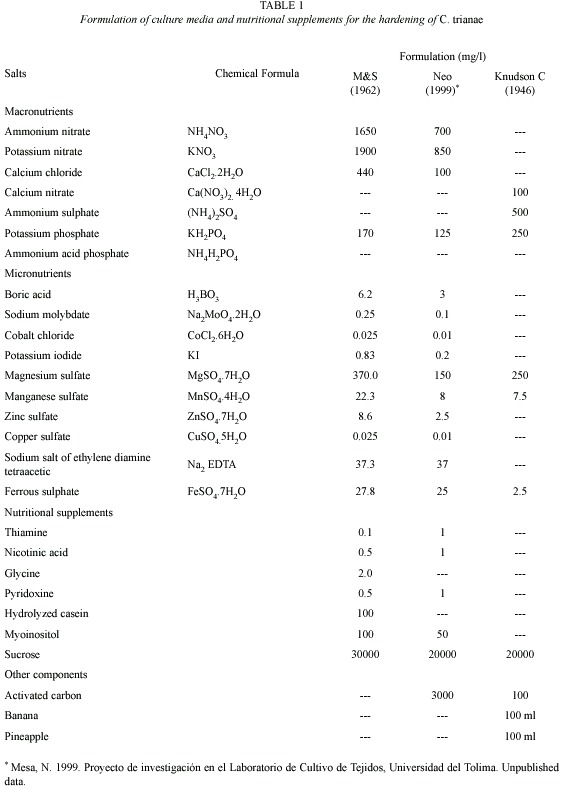
<body><![CDATA[<p><font face="Arial" size="2"><i>Cattleya trianae </i>(Linden and Reichb 1860) is an endemic species found in the Colombian Andes at altitudes ranging from 600 to 1 940 m, and its distribution is restricted to the Alto Magdalena watershed, in the states of Huila, Tolima and Cundinamarca (Constantino and Calderón 2002). It was declared the national flower of Colombia in 1936 (Ospina 1974, Díaz 1987) and is classified as a threatened species in Appendix I on the CITES convention (2003). </font></p>     <p><font face="Arial" size="2">In Colombia, this orchid is a valuable commodity, making its conservation more problematic since nurseries utilize native forests as extraction sites of source plant material (Ospina and Dressler 1979). <i>C. trianae </i>has been cultivated using primarily the rhizome from the tree fern <i>Cyathea </i>sp. as a propagation medium. The fern is found mainly in the Andean mountain ranges at 0-4 200 m in elevation, and since 1977 has been included in Appendix II of the CITES convention as a threatened species (Murillo and Murillo 2003). Therefore, this study aims to reduce the impact of indiscriminate extraction on the two species (<i>C. trianae </i>and <i>Cyathea </i>sp.) in native forests to supply nurseries and businesses. We promote <i>in vitro </i>culture and use of alternative substrates during the hardening stage. </font></p>     <p><font face="Arial" size="2">During the <i>in vitro </i>stage, plants are kept in a controlled environment, characterized by high humidity, low light intensity, supplementary sugar supply, and growth regulators (Murashige 1974, Viegas <i>et al</i>. 2005). These factors result in plants with physiological and a few times morphologic alterations, which hinder their survival when transferred to <i>ex vitro </i>conditions (Dhiraj <i>et al. </i>2003, Hazarika 2003, Martin and Pradeep 2003). Attainment of photosynthetic properties during the hardening phase constitutes a decisive phase when adapting to natural conditions (Arditti and Krikorian 1996, Sharma <i>et al. </i>1999, Dhiraj <i>et al. </i>2003, Nagaraju and Mani 2005). Accordingly, the selection of substrates that will ensure survival of plants taken from <i>in vitro </i>conditions is a key issue that must be addressed. Not many published works have dealt with this subject. Studies by González <i>et al. </i>(1994) and Arciniegas (1996) concentrated on investigating efficient substrates to be used in the hardening of the genus <i>Cattleya</i>, finally recommending fragments of fern rhizome (<i>Cyathea </i>sp.). The present work evaluated the performance of alternative substrates that would not require the disturbance of any threatened species. They should also be inexpensive and easy to obtain during the hardening stage of <i>C. trianae</i>. </font></p> <font face="Arial" size="2"><b>     <p align="center">Materials and methods</p> </b> <b></b></font>     <p><font face="Arial" size="2"><b>Source and preparation of plant material:</b> <i>C. trianae </i>seedlings were obtained from the orchid bank of the Tissue Culture Laboratory, Universidad del Tolima. They were grown from seed and maintained in Knudson C medium (Knudson 1946). Plants were selected according to their morphological characteristics (color, vigor, size, and presence of a root system). They were then put through an <i>in vitro </i>invigoration process for six months, cultured in NEO medium (Mesa, unpub. data), proposed and tested in the Tissue Culture Laboratory, Universidad del Tolima (<a  href="#t1">Table 1</a>). Plants were extracted from the flasks, washed in water, submerged in Dithane M-45 (Mancozeb, a practically non-toxic ethylene bisdithiocarbamate) fungicide (1.56 g per 0.5 l) for sanitary control, and randomly placed in each treatment. </font></p>     <p style="text-align: center;"><font face="Arial" size="2">&nbsp;<a  name="t1"></a><img src="/img/fbpe/rbt/v55n2/3665i1.JPG" title="" alt=""  style="width: 563px; height: 789px;"></font></p> <font face="Arial" size="2"></font>     
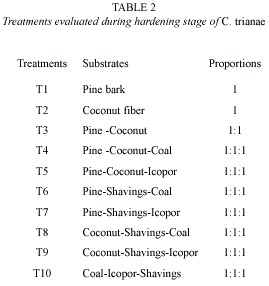
<p><font face="Arial" size="2"><b>Substrates evaluated during hardening stage: </b>substrates were selected considering relative resistance to decomposition, good water retention, and sufficient airflow. The following substrates were tested: pine bark (<i>Pinus patula</i>), coconut fiber (<i>Cocos nucifera</i>), vegetable coal, icopor (polystyrene foam) and wood shavings (<a href="#t2">Table 2</a>). Ten treatments were evaluated into a growth room displayed relative humidity (98 %). The percentage of fungal infection also was recorded. </font></p> <a name="t2"></a>     <div style="text-align: center;"><img src="/img/fbpe/rbt/v55n2/3665i2.JPG" title=""  alt="" style="width: 269px; height: 286px;"></div>     
<p><font face="Arial" size="2"><b>Substrate preparation and transplanting:</b> for the acclimation stage the substrates were sterilized in a 2.5 % sodium hypochlorite (NaOCl) solution. They were then sterilized in an autoclave and dried in a stove at 180 ºC for 3 h. After cooling they were put in sterile plastic trays, which measured 55 cm x 28 cm, contain 25 cells 5 cm deep, and have a surface area of 30 cm<sup>2</sup>. Plants were transplanted and trays labelled. Once every eight days during the first 32 days, we applied 5 ml doses of Murashige &amp; Skoog salts (M&amp;S, Murashige and Skoog 1962) at half concentration. Trays were covered with plastic lids during the first 30 days. Plants were watered daily using a sprinkling system with sterile distilled water. After a month, plants were watered with tap water. Fungal control consisted of the application of benomyl: methyl-1-(butylcarbamoyl)-2-benzimidazole carbamate (as the pure compound of the commercial preparation Benlate WP-systemic fungicide to 0.36 g per 0.5 l) every two days or as necessary depending on the phytosanitary evaluation. </font></p> <font face="Arial" size="2"><b></b></font>     <p><font face="Arial" size="2"><b>Record of morphometric variables:</b> we used the following growth indicators: length of longest leaf (cm), biomass (wet weight, g), and number of leaves and roots. Number of leaves and leaf length variables were measured every 15 days. The other variables were recorded at the beginning and at the end of the tests. Percent survival was recorded at the end of the experiment. Data were also collected or environmental factors, such as relative humidity (%), temperature (ºC), and percentage with fungal infection. </font></p> <font face="Arial" size="2"><b></b></font>     ]]></body>
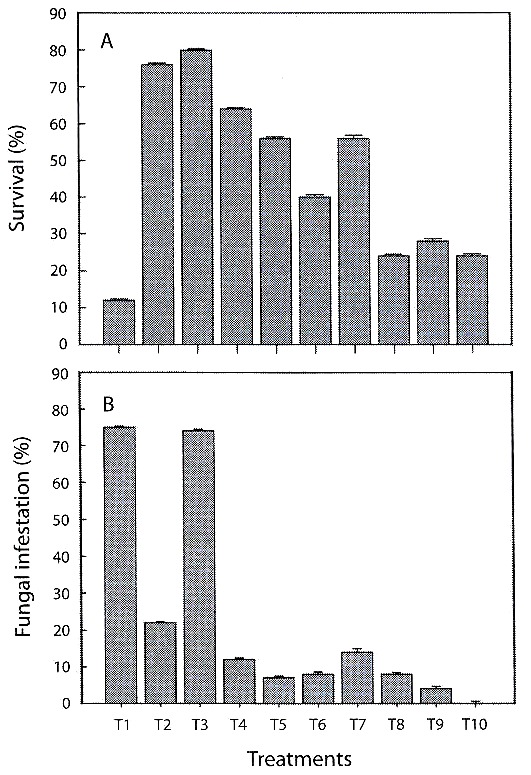
<body><![CDATA[<p><font face="Arial" size="2"><b>Greenhouse phase:</b> surviving plants after of the hardening were individually transplanted to substrates of only coconut fiber or coconut fiber mixed with pine and coal (treatments two, three and four respectively). Half of the resulting plants were taken to the greenhouse and placed in the shade, temperature of 25±2 °C, relative humidity of 80 %, and were continually misted with water. The other half of the plants were kept under full light, a temperature of 27.4 ºC, relative humidity of 58 %, and were watered twice a day. </font></p> <font face="Arial" size="2"><b></b></font>     <p><font face="Arial" size="2"><b>Statistical analysis:</b> each treatment was made up of 25 plants. However, at the end of the experiment, plant survival was different for each treatment, so uneven sample sizes were used for statistical analysis. To fulfil the assumptions of homoscedasticity and normality, data (leaf length and biomass) were log transformed (y=log<sub>10</sub>+1) (Zar 1999). A one-way MANOVA was used to evaluate the effect of treatments on dependent variables (leaf length and biomass). Duncan’s a posteriori test was done to compare significant treatments. In order to analyze the effect of treatments on the dependent variable for survival, and one way ANOVA (fixed factor) and Duncan’s a posteriori test were carried out. Statistical analysis was done using STATISTICA version 7.0 (StatSoft 2004). </font></p> <font face="Arial" size="2"><b>     <p align="center">Results</p> </b> <b></b></font>     <p><font face="Arial" size="2"><b>Phytosanitary control:</b> the highest percentages of fungal infestation occurred on treatments of pine bark (T1) (75±SE=0.24) and on pine-coconut (T3) (74±SE=0.37). The remaining tested substrates presented fungal contamination equal to or below (22±SE=0.34). Lowest percentages were recorded for treatments containing inert substrates, reaching 0 % in the case of coal-polystyrene-shavings (T10) (<a href="#fig1">Fig. 1B</a>). </font></p>     <p style="text-align: center;"><font face="Arial" size="2"><a  name="fig1"></a><img src="/img/fbpe/rbt/v55n2/3665i3.JPG" title="" alt=""  style="width: 461px; height: 673px;">    
<br> </font></p>     <div style="text-align: left; margin-left: 200px;"><font face="Arial"  size="2">Fig. 1. (A) Survival percentage in plants (±1 SE); (B) percentage of fungal     <br> infestation of </font><font face="Arial" size="2">substratesduring&nbsp; the hardening phase of <span style="font-style: italic;">C. trianae</span> </font><font face="Arial" size="2">(±1 SE).</font></div> <font face="Arial" size="2"><b></b></font>     <p><font face="Arial" size="2"><b>Acclimatization and hardening:</b> during the acclimation the growth was slow, but the physical appearance of the plants indicated tolerance. The 16 weeks long hardening period was critical for 53 % of the tested population. Highest mortality rates were observed during the hardening for plants growing on pine bark (T1). </font></p>     <p><font face="Arial" size="2"><b>Percentage survival:</b> there were significant differences in survival of <i>C. trianae </i>on different substrates (F<sub>9,40</sub>=4.631, p&lt;0.001). Results from Duncan’s test are shown in <a href="#t3">Table 3</a>. Substrates of pine-coconut (T3), coconut fiber (T2) and pine-coconut-coal (T4) had the highest percent survival (80, 76, and 60 %, respectively), while the lowest percent survival was recorded for pine bark (T1) at 12 % (<a href="#fig1">Fig. 1A</a>).    ]]></body>
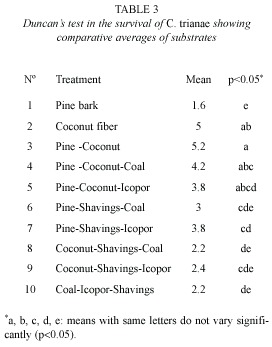
<body><![CDATA[<br> </font></p>     <p style="text-align: center;"><font face="Arial" size="2"><a name="t3"></a><img  src="/img/fbpe/rbt/v55n2/3665i4.JPG" title="" alt=""  style="width: 272px; height: 347px;">    
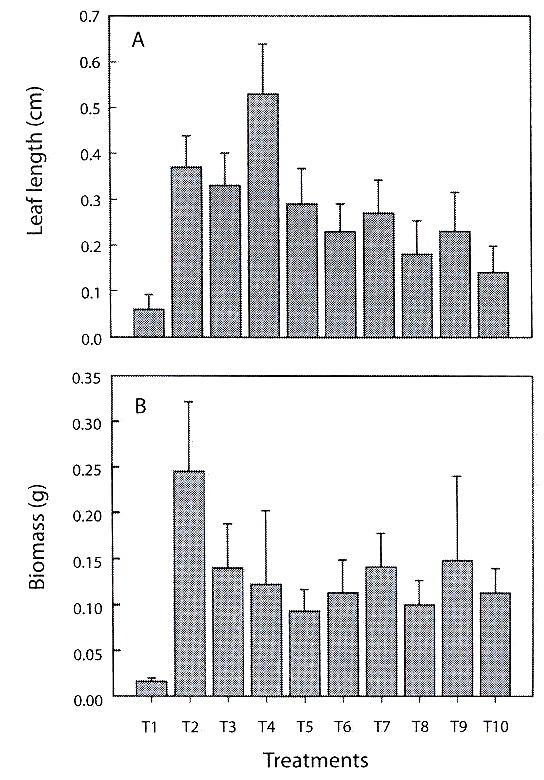
<br> </font></p> <font face="Arial" size="2"><b></b></font>     <p><font face="Arial" size="2"><b>Growth indicators</b></font></p>     <p align="center"></p>     <p><font face="Arial" size="2"><b>Leaf length and biomass (fresh weight):</b> coconut fiber (T2), pine-coconut (T3) and pine-coconut-coal (T4) stimulated leaf growth most effectively. Plants growing on pine bark (T1) had the poorest growth rates (<a href="#fig2">Fig. 2A</a>). Qualitative observations, such as number and dimensions of leaves and roots, point towards coconut fibre (T2), as the substrate that allowed the greatest increase for the biomass (fresh weight) variable. On the other hand, pine bark (T1) proved to be a hindrance to increase in biomass (<a href="#fig2">Fig. 2B</a>). </font></p>     <p style="text-align: center;"><span style="font-family: arial;"><a  name="fig2"></a><img src="/img/fbpe/rbt/v55n2/3665i5.JPG" title="" alt=""  style="width: 486px; height: 697px;">    
<br> </span></p>     <div style="text-align: left; margin-left: 200px;"><span  style="font-family: arial;"><small>Fig. 2. (A) Leaf length increase of C. trianae (±1 SE); (B) Biomass increase     <br> during </small></span><span style="font-family: arial;"><small>the hardening phase </small></span><small><span style="font-family: arial;">(±1 SE).</span></small></div>     ]]></body>
<body><![CDATA[<p><font face="Arial" size="2">The treatments (T2-T9) showed marked differences regarding morphological variables such as leaf length and biomass (MANOVA, Wilk’s Lambda=0.765156, d.f.=16, p=0.026). Pine bark (T1) was omitted from analysis due to the elevated index of plant mortality when using this treatment. The leaf length variable showed differences for the between treatments T2–T3 (Duncan’s test, p=0.0399), T3-T4 (p=0.0395), T3–T9 (p=0.0343), T8– T9 (p=0.0447) and for the biomass variable between T7–T8 (p=0.0482). </font></p> <font face="Arial" size="2"><b></b></font>     <p><font face="Arial" size="2"><b>Numbers of leaves and roots:</b> due to the behaviour of these variables during the study (the tendency of plants to lose leaves and roots), statistical differences between treatments could not be established. </font></p> <font face="Arial" size="2"><b>     <p align="center">Discussion</p> </b> <b></b></font>     <p><font face="Arial" size="2"><b>Phytosanitary control:</b> contamination by fungi and bacteria from the air, water, tools, glassware, and other sources may occur in orchid seedling and tissue cultures. Surface sterilization of the seeds or tissues can prevent initial contamination, but microorganisms often find their way into cultures at a later date. Incorporation of benomyl and another fungicides and bactericides in several combinations, can prevent or inhibit contamination of <i>C. aurantiaca </i>and <i>Stanhopea occulata </i>seedlings in vitro and <i>Phalaenopsis </i>flower stalk node cultures without adversely affecting the plants (Brown <i>et al</i>. 1982). Bayman <i>et al</i>. (2002) demonstrated that benomyl-treated plants of the orchid <i>Lephantes rupestris </i>had significantly lower mortality than controls (treated with water), and significantly fewer fungi in leaves that control plants. Sterilized substrates, control of environmental variables, and the source of the seedlings probably inhibited bacterial contamination in all treatments. Pine bark alone, or mixed with coconut fiber, increased fungal proliferation, so it is necessary to treat these substrates with more efficient disinfection techniques. Mendizabal (2001) recommends a controlled decomposition process for pine bark in order to inhibit pathogenic fungal activity. According to Cañas (1994), inert substrates are virtually unaffected by fungal and bacterial contamination. This was confirmed in this study for icopor (polystyrene foam) and coal. </font></p>     <p><font face="Arial" size="2">González <i>et al</i>. (1994), argued that the application of different fungicides in adequate doses does not seem to inhibit the growth of <i>Cattleya dowiana, </i>a point confirmed by the positive results obtained in this study when using the systemic fungicide benomyl (Benlate) in doses of 0.36 g per 500 ml. Also, there was no evidence of plant death due to fungal action. Thurston <i>et al</i>. (1979) recorded that some fungicides and bactericides can kill the seedlings, to induce deformed growth, or generally inhibiting development of <i>C. aurantiaca </i>and <i>S. occulata</i>. Others as Benlate had no observable effects, and enhanced growth, improving root and shoot development. </font></p> <font face="Arial" size="2"><b></b></font>     <p><font face="Arial" size="2"><b>Acclimation and hardening:</b> acclimation is an important step in micropropagation. During <i>in vitro </i>growth, plants develop under controlled conditions, including enclosed environments, without gaseous exchanges, with high moisture in the air, low light intensity, and the use of sugars from the medium as a source of carbon and energy (Pospísilová <i>et al</i>. 1999). Thus, the transplanting of <i>in vitro</i>-grown plantlets and the complete establishment in the greenhouse can be complex for some species (Hazarika 2003). The selection of a suitable substrate can be decisive for acclimation (Viegas <i>et al. </i>2005). Preece and Sutter (1991), Ziv (1991), Teixeira <i>et al. </i>(1995), Inoue <i>et al. </i>(1999), affirm that keeping plants <i>in vitro </i>produces physiological, structural, and anatomical abnormalities; such as absence of waxy cuticle, non functional stomates, photosynthetic inefficiency, and malfunctioning of hydric transport, these abnormalities resulting in elevated evapotranspiration rates. </font></p>     <p><font face="Arial" size="2">Driver and Suttle (1987), Ziv (1991), Donelly and Tisdall (1993), Agramante <i>et al. </i>(1998), indicated that it is necessary to maintain high relative humidity and low light intensity until plants have adequately developed stomates and cuticle. They also recommend a gradual conditioning to lower humidity and light intensity in order to avoid photoinhibition of the photosynthetic apparatus. This study found that keeping plants of <i>C. trianae, </i>which thrive only under shady conditions, and under constant atmospheric conditions (relative humidity=98 % and shadow) for the first two weeks of acclimation, improved survival during this phase (Franco, pers. obs.). According to Hazarika (2003), controlling nitrogen levels during the hardening phase is critical to enhancing plant growth. Therefore, the addition of M&amp;S salts allowed plants to gradually adapt to autotrophic conditions. </font></p>     <p><font face="Arial" size="2">High mortality rates among plants growing on pine bark was possibly due to low humidity retention in this substrate, preventing proper root development and strong anchorage of the root system. The acclimation and hardening phase was a key stage in the assessment of substrate efficiency. According to our observations, the best acclimation strategy was to condition plants for 30 days, then leaves them exposed outdoors in places where conditions are similar to those required by the plant in its natural habitat. </font></p> <font face="Arial" size="2"><b></b></font>     <p><font face="Arial" size="2"><b>Survival or adaptation percentages:</b> the greenhouse and field have substantially lower relative humidity, higher light level and septic environment that are stressful to micropropagated plants compared to <i>in vitro </i>conditions. The benefit of any micropropagation system can, however, only be fully realized by the successful transfer of plantlets from tissue-culture vessels to the ambient conditions found <i>ex vitro </i>(Hazarika 2003)<i>. </i>Percent survival was measured considering those plants that lasted from the beginning of the acclimation stage until the end of the greenhouse phase. No bibliographic references were found to compare with the results obtained in this study regarding percent survival of <i>C. trianae </i>during its conditioning from <i>in vitro </i>to <i>in vivo</i>. However, Saiprasad and Polisetty (2003) showed that the orchids <i>Dendrobium, Oncidium </i>and <i>Cattleya </i>had complete survival or establishment in potting media having wood charcoal pieces alone and wood charcoal + brick pieces, they attributed these results to the presence of wood charcoal and/or brick pieces, which allowed good circulation of air and excellent drainage. Minimum survival (&lt;60 %) was observed when soilrite alone was used as the potting medium, possibly because soilrite retains high moisture, but aeration may be inadequate. </font></p>     <p><font face="Arial" size="2">Survival fluctuation among different treatments could be explained through the variation in chemical composition and physical properties of the substrates employed (porosity and water retention capacity). Coconut (T2) and pine-coconut (T3) showed significantly higher percent survival. This could be due to the fibrous texture, good hydric retention, anchorage capacity, and porosity of coconut fibre. Lowest survival percentages were obtained with pure pine treatment, due to low water retention capacity, non-fibrous texture, and the low density of dry pine bark, hindering anchorage of the roots. This result differs from reported by Mendizabal (2001), who considers crushed pine bark to be one of the best organic substrates for the propagation of epiphytic orchids, serving as a superior alternative to artificial substrates. The data from the present study do not corroborate the interpretation given by Mendizabal (2001). Our results suggest that pine is not a favourable substrate in the hardening process of <i>C. trianae</i>. Better results were obtained when it was mixed with substrates that improve anchorage. Substrates with higher water retention properties (without it being excessive), showed improved survival rates of <i>Cattleya</i>. </font></p> <font face="Arial" size="2"><b></b></font>     ]]></body>
<body><![CDATA[<p><font face="Arial" size="2"><b>Leaf length:</b> treatments with coconut fibre alone or in a mix, stimulated leaf growth better than others. Growth was fair limited in substrates containing pine, and low in the rest. These results differed from those found by Arciniegas (1996), who maintains that the <i>Cyathea </i>substrate promotes better leaf growth in <i>C. trianae </i>than in the coconut fiber. It is important to refer that grown of the orchids is often quite slow during their life cycle. It is even more important for <i>Cattleya</i>, which takes years to develop into a mature plant (Ortiz 1995, Villee 1996). This slow rate of growth was corroborated during the present study. </font></p> <font face="Arial" size="2"><b></b></font>     <p><font face="Arial" size="2"><b>Biomass:</b> treatments T7 (pine-shavingsicopor) and T8 (coconut-shavings-coal) were the substrates that showed the lowest performances, according to the statistical analyses, compared with the rest of treatments. Poor anchorage ratios and poor water retention capacities meant that orchids had low survival rates during the hardening stage. This could change if they were used in combination with organic substrates that contribute better aeration, anchorage, and water retention. On the other hand, plants grown using coconut and coconut-shavings-icopor treatments had vigorous, healthy appearances good, velamen growth, strong adherence of roots to the substrate, rigid and coriaceous leaf structures (possibly due to the production of lignins, cutines, and wax on the surface of the cuticle) (Azcon and Talon 1993). A very conspicuous feature of the Orchidaceae is a root equipped with a multilayered epidermis covering the aerial and terrestrial roots of orchids, the velamen, which is underlaid by a distinct cortical exodermis (Engard 1944). Aspects of the structure and function of a variety of orchid roots have been described in some detail, yet controversy continues over how these organs operate to procure minerals and moisture, avoid desiccation and provides mechanical protection of the roots (Dycus and Knudson 1957, Benzing <i>et al</i>. 1982, Pridgeon <i>et al</i>. 1983). The velamen appeared around the 8<sup>th </sup>week in treatments containing coconut fiber, demonstrating that plants are developing morphological responses homologous to those observed in the field (Pridgeon <i>et al</i>. 1983). </font></p>     <p><font face="Arial" size="2">Leaves and roots: no statistical significant differences were recorded for these variables among tested treatments, because at the beginning of the experiment plants suffered leaf and root loss. At the beginning of the acclimation stage, plants started triggering physiological processes in response to environmental changes occurring when they were transferred from <i>in vitro </i>to <i>in vivo, </i>which stimulates the senescence and abscission of damaged organs (Pospísilová <i>et al</i>. 1999, Azcon and Talon 2001, Hazarika 2003, Viegas <i>et al. </i>2005). </font></p>     <p><font face="Arial" size="2">The process of abscission observed in the experimental units is possibly due to the plants decreasing respiratory demands and reducing the exposed area of unnecessary structures, which decrease the effects produced by different kinds of stress. Advanced symptoms of chlorosis, followed by death of the leaves, were observed in some experimental units. It is possible that a similar situation might have occurred with root loss (Azcon and Talon 1993), although this particular point was not confirmed. Root loss affected only some of the sampled treatments. Since data for this variable was recorded twice, at the beginning and at the end of the experiment, it is difficult to establish what factors might have influenced the loss of these organs at some stage of the hardening process. Therefore, it is not possible to make assumptions about the effects of substrates on these two variables. </font></p> <font face="Arial" size="2"><b></b></font>     <p><font face="Arial" size="2"><b>Greenhouse phase:</b> plants kept in shady conditions, RH=80 %, T=25.3 ºC and under continual misting, looked very healthy the third day onward, so it would seem advisable to apply these findings in other studies. Plants grown without shading suffered morphological changes provoked by excessive absorption of light. These changes could possibly be due to an increase in wax or salt deposits on the upper surface of the leaves resulting in reflective surfaces, or to other mechanisms, such as the redistribution of chloroplasts in the mesophyll cells, leaf curling, and wilting (Azcon and Talon 1993, Hazarika 2003). </font></p>     <p><font face="Arial" size="2">This study recommends a protocol for the management of <i>C. trianae </i>during the hardening phase. Also, it is advisable to use efficient, economically viable substrates (coconut, pine-coconut, and pine-coconut-coal) as alternatives to the tree fern <i>Cyathea </i>sp.<i>, </i>in order to ensure a lessened impact on this threatened species. The resulting plants remain attached to trees in the wild, fulfilling the objective of reintroducing this species in natural ecosystems. </font></p> <font face="Arial" size="2"><b>     <p>Standard protocol </p> </b></font>     <p><font face="Arial" size="2">1. Prepare and sterilise substrate components (coconut fiber or coconut fiber-coal-pine bark). </font></p>     <p><font face="Arial" size="2">2. Place wet and sterilized substrate in germination tray cells. </font></p>     <p><font face="Arial" size="2">3. From vitroplants kept in NEO medium for fourth months, select specimens with developed root systems. </font></p>     ]]></body>
<body><![CDATA[<p><font face="Arial" size="2">4. Wash agar residues stuck to the roots. </font></p>     <p><font face="Arial" size="2">5. Disinfect plants using Dithane M-45 (1.56 g per 0.5 l). </font></p>     <p><font face="Arial" size="2">6. Transplant a vitroplant in each cell of the germination tray, burying part of the roots in the substrate and leaving the rest exposed. Provide water and place in the shade. </font></p>     <p><font face="Arial" size="2">7. Cover each tray with a plastic lid, preventing these from touching the leaves. </font></p>     <p><font face="Arial" size="2">8. Apply daily misting with distilled sterilized water, and water every eight days with half concentration M&amp;S solution for a month. Apply Benlate (0.36 g per 0.5 l) in case of fungal infestation. </font></p>     <p><font face="Arial" size="2">9. After three weeks, remove plastic lid for 4 h a day during eight days; then remove the cover for good. </font></p>     <p><font face="Arial" size="2">10. Transfer trays to a shady place for eight days and later to a site with 50 % direct sunlight. </font></p>     <p><font face="Arial" size="2">11. From weeks 6 to 18 provide, irrigate plants with tap water using an atomizer or sprayer. </font></p>     <p><font face="Arial" size="2">12. Transplant each whole block of substrate to individual containers, filling them up with coconut fiber or a mixture of organic substrates plus icopor (polystyrene foam) and/or coal, to promote aeration and drainage. </font></p>     <p><font face="Arial" size="2">13. Transfer plants to a shady, well-ventilated place, where relative humidity borders on 80 %. Install a sprinkling system or provide water every 12 h, and avoid water logging or excessive humidity. </font></p>     ]]></body>
<body><![CDATA[<p><font face="Arial" size="2">14. Transplant to environments similar to those where <i>C. trianae </i>grows naturally. </font></p>     <p><font face="Arial" size="2">In conclusion, a simple and efficient protocol for mass propagation of <i>C. trianae </i>from plantlets has been established. Using this protocol, it is possible to produce viable, uniform and healthy plants with the maximum survival rate that can be used for large scale cultivation, which is important from economical point view from this species. Furthermore, the protocol may facilitate conservation of this ornamental orchid from extinction in the natural population. Currently, many tropical orchid species have been propagated through a range of asymbiotic seed germination techniques and tissue culture procedures aimed to preserve a number of individuals under artificial conditions in glasshouses, with the aim to protect these species from complete extinction. </font></p> <font face="Arial" size="2"><b>     <p>Acknowledgments </p> </b> </font>     <p><font face="Arial" size="2">We thank Carlos Lehnebac and Maria Teresa Gonzales for comments and suggestions that greatly improved the manuscript. The first author was supported by the PhD fellowship from the Comisión Nacional de Investigación Científica y Tecnológica (CONICYT) during the preparation of manuscript. </font></p> <font face="Arial" size="2"><b>     <p>Resumen </p> </b><i> </i></font>     <p><font face="Arial" size="2"><i>Cattleya trianae </i>es una especie endémica de los bosques tropicales de los Andes colombianos. Actualmente se encuentra amenazada por la disminución de su hábitat natural y la sobreexplotación con fines comerciales. En este estudio se evaluó el efecto de diez tratamientos con sustratos biológicos (corteza de pino, fibra de coco y viruta) e inertes (esferitas de "icopor" y carbón vegetal) en diferentes combinaciones, sobre aspectos morfométricos y fenotípicos en la etapa de endurecimiento de 250 vitroplantas de <i>C. trianae. </i>Se registró porcentaje de supervivencia, longitud de la hoja, biomasa en peso fresco, número de raíces y hojas al inicio y al final del experimento. Al finalizar la fase de endurecimiento, las vitroplantas fueron llevadas a invernadero y posteriormente a ambiente natural. La fibra de coco sola ó mezclada en partes iguales con pino y carbón vegetal, fue el sustrato más eficiente cuando se evaluó el porcentaje de supervivencia (80 % ±SE=0.3742), biomasa en peso fresco y longitud de hoja. Las plantas endurecidas mostraron características cualitativas como vigorosidad, textura coriácea y cerosa, verdor intenso en sus hojas y velamen. En condiciones de invernadero las plantas se desarrollan mejor con luz filtrada, humedad relativa alrededor del 80 %, aireación continua, nebulización y temperatura promedio de 25±2 °C. Las plantas vigorizadas mostraron buen anclaje y adaptación en árboles. </font></p> <font face="Arial" size="2"><b></b></font>     <p><font face="Arial" size="2"><b>Palabras clave:</b> aclimatación, endurecimiento, sustratos, ornamentales, orquídeas, conservación, <i>Cattleya trianae</i>. </font></p> <font face="Arial" size="2"><b>     <p>References </p> </b> </font>     <!-- ref --><p><font face="Arial" size="2">Agramonte, D., F. Jiménez &amp; M. Dita. 1998. Aclimatización, p. 12-24. <i>In </i>J.N. Pérez (ed.). Propagación y Mejora Genética de Plantas por Biotecnología. Instituto de Biotecnología de las Plantas, Santa Clara, Cuba. </font>&nbsp;&nbsp;&nbsp;&nbsp;&nbsp;&nbsp;&nbsp;&nbsp;[&#160;<a href="javascript:void(0);" onclick="javascript: window.open('/scielo.php?script=sci_nlinks&ref=1248977&pid=S0034-7744200700020003100001&lng=','','width=640,height=500,resizable=yes,scrollbars=1,menubar=yes,');">Links</a>&#160;]<!-- end-ref --><!-- ref --><p><font face="Arial" size="2">Arciniegas, N.R. 1996. Evaluación de sustratos para el endurecimiento de <i>Catleya trianae </i>Lind &amp; R.chb.f. Tesis de Pregrado, Universidad del Tolima, Ibagué, Colombia. 128 p. </font>&nbsp;&nbsp;&nbsp;&nbsp;&nbsp;&nbsp;&nbsp;&nbsp;[&#160;<a href="javascript:void(0);" onclick="javascript: window.open('/scielo.php?script=sci_nlinks&ref=1248978&pid=S0034-7744200700020003100002&lng=','','width=640,height=500,resizable=yes,scrollbars=1,menubar=yes,');">Links</a>&#160;]<!-- end-ref --><!-- ref --><p><font face="Arial" size="2">Arditti, J. &amp; A.D. Krikorian. 1996. Orchid micropropagation: the path from laboratory to commercialization and an account of several unappreciated investigators. Bot. J. Linn. Soc. 122: 183-241. </font>&nbsp;&nbsp;&nbsp;&nbsp;&nbsp;&nbsp;&nbsp;&nbsp;[&#160;<a href="javascript:void(0);" onclick="javascript: window.open('/scielo.php?script=sci_nlinks&ref=1248979&pid=S0034-7744200700020003100003&lng=','','width=640,height=500,resizable=yes,scrollbars=1,menubar=yes,');">Links</a>&#160;]<!-- end-ref --><!-- ref --><p><font face="Arial" size="2">Azcón, J. &amp; M. Talón. 1993. Fisiología y Bioquímica Vegetal. McGraw Hill Interamericana, Madrid, España. 485 p. </font>&nbsp;&nbsp;&nbsp;&nbsp;&nbsp;&nbsp;&nbsp;&nbsp;[&#160;<a href="javascript:void(0);" onclick="javascript: window.open('/scielo.php?script=sci_nlinks&ref=1248980&pid=S0034-7744200700020003100004&lng=','','width=640,height=500,resizable=yes,scrollbars=1,menubar=yes,');">Links</a>&#160;]<!-- end-ref --><!-- ref --><p><font face="Arial" size="2">Azcón, J. &amp; M. Talón. 2001. Fundamentos de fisiología vegetal. Universidad de Barcelona, McGraw Hill Interamericana, Madrid, España. 522 p. </font>&nbsp;&nbsp;&nbsp;&nbsp;&nbsp;&nbsp;&nbsp;&nbsp;[&#160;<a href="javascript:void(0);" onclick="javascript: window.open('/scielo.php?script=sci_nlinks&ref=1248981&pid=S0034-7744200700020003100005&lng=','','width=640,height=500,resizable=yes,scrollbars=1,menubar=yes,');">Links</a>&#160;]<!-- end-ref --><!-- ref --><p><font face="Arial" size="2">Bayman, P., E.J. González, J.J. Fumero &amp; R.L. Tremblay. 2002. Are fungi necessary? How fungicides affect growth and survival of the orchid <i>Lepanthes rupestri</i>s in the field. J. Ecol. 90: 1002-1008. </font>&nbsp;&nbsp;&nbsp;&nbsp;&nbsp;&nbsp;&nbsp;&nbsp;[&#160;<a href="javascript:void(0);" onclick="javascript: window.open('/scielo.php?script=sci_nlinks&ref=1248982&pid=S0034-7744200700020003100006&lng=','','width=640,height=500,resizable=yes,scrollbars=1,menubar=yes,');">Links</a>&#160;]<!-- end-ref --><!-- ref --><p><font face="Arial" size="2">Benzing, D.H., D.W. Ott &amp; W.E. Friedman. 1982. Roots of <i>Sobralia Macrantha </i>(Orchidaceae) structure and function of the velamen-exodermis complex. Amer. J. Bot. 69: 608-614. </font>&nbsp;&nbsp;&nbsp;&nbsp;&nbsp;&nbsp;&nbsp;&nbsp;[&#160;<a href="javascript:void(0);" onclick="javascript: window.open('/scielo.php?script=sci_nlinks&ref=1248983&pid=S0034-7744200700020003100007&lng=','','width=640,height=500,resizable=yes,scrollbars=1,menubar=yes,');">Links</a>&#160;]<!-- end-ref --><!-- ref --><p><font face="Arial" size="2">Brown, D.M., C.L. Groom, M. Cvitanik, M. Brown, J.L. Cooper &amp; J. Arditti. 1982. Effects of fungicides and bactericides on orchid seed germination and shoot tip cultures <i>in vitro</i>. Plant Cell Tiss. Org. 1: 165-180. </font>&nbsp;&nbsp;&nbsp;&nbsp;&nbsp;&nbsp;&nbsp;&nbsp;[&#160;<a href="javascript:void(0);" onclick="javascript: window.open('/scielo.php?script=sci_nlinks&ref=1248984&pid=S0034-7744200700020003100008&lng=','','width=640,height=500,resizable=yes,scrollbars=1,menubar=yes,');">Links</a>&#160;]<!-- end-ref --><!-- ref --><p><font face="Arial" size="2">Cañas, C.B. 1990. Informe final Cultivo <i>in vitro </i>de Orquídeas. Universidad Industrial de Santander, Facultad de Ciencias. Departamento de Biología, Bucaramanga, Colombia. 20 p. </font>&nbsp;&nbsp;&nbsp;&nbsp;&nbsp;&nbsp;&nbsp;&nbsp;[&#160;<a href="javascript:void(0);" onclick="javascript: window.open('/scielo.php?script=sci_nlinks&ref=1248985&pid=S0034-7744200700020003100009&lng=','','width=640,height=500,resizable=yes,scrollbars=1,menubar=yes,');">Links</a>&#160;]<!-- end-ref --><!-- ref --><p><font face="Arial" size="2">Constantino, E. &amp; E. Calderón. 2002. Informe final Convenio de Cooperación Científica y Tecnológica. No. 29. MMA- IAvH. Proyecto <i>Cattleya </i>1ª fase, Bogotá, Colombia. </font>&nbsp;&nbsp;&nbsp;&nbsp;&nbsp;&nbsp;&nbsp;&nbsp;[&#160;<a href="javascript:void(0);" onclick="javascript: window.open('/scielo.php?script=sci_nlinks&ref=1248986&pid=S0034-7744200700020003100010&lng=','','width=640,height=500,resizable=yes,scrollbars=1,menubar=yes,');">Links</a>&#160;]<!-- end-ref --><!-- ref --><p><font face="Arial" size="2">Dhiraj, N., V. Varsha &amp; B. Sujeta. 2003. Provenance and subculture-dependent variation during micropropagation of <i>Gmelina arborea</i>. Plant Cell Tiss. Org. 73: 189-195. </font>&nbsp;&nbsp;&nbsp;&nbsp;&nbsp;&nbsp;&nbsp;&nbsp;[&#160;<a href="javascript:void(0);" onclick="javascript: window.open('/scielo.php?script=sci_nlinks&ref=1248987&pid=S0034-7744200700020003100011&lng=','','width=640,height=500,resizable=yes,scrollbars=1,menubar=yes,');">Links</a>&#160;]<!-- end-ref --><!-- ref --><p><font face="Arial" size="2">Díaz, S. 1987. Algunas consideraciones sobre la palma de cera del Quindío y sobre la flor de mayo como símbolos nacionales. Rev. Acad. Colom. Cienc. Exac. Fís. Nat. 16: 145-152. </font>&nbsp;&nbsp;&nbsp;&nbsp;&nbsp;&nbsp;&nbsp;&nbsp;[&#160;<a href="javascript:void(0);" onclick="javascript: window.open('/scielo.php?script=sci_nlinks&ref=1248988&pid=S0034-7744200700020003100012&lng=','','width=640,height=500,resizable=yes,scrollbars=1,menubar=yes,');">Links</a>&#160;]<!-- end-ref --><!-- ref --><p><font face="Arial" size="2">Donnelly, D. &amp; L. Tisdall. 1993. Acclimatization strategies for micropropagated plants, p. 153-166. <i>In </i>M.R. Ahuja (ed.). Micropropagation of woody plants (Forest science v.41). Kluwer Academic, Dordrecht, Netherlands. </font>&nbsp;&nbsp;&nbsp;&nbsp;&nbsp;&nbsp;&nbsp;&nbsp;[&#160;<a href="javascript:void(0);" onclick="javascript: window.open('/scielo.php?script=sci_nlinks&ref=1248989&pid=S0034-7744200700020003100013&lng=','','width=640,height=500,resizable=yes,scrollbars=1,menubar=yes,');">Links</a>&#160;]<!-- end-ref --><!-- ref --><p><font face="Arial" size="2">Driver, J.A. &amp; G.R. Suttle. 1987. Nursery handling of propagules, p. 320-335. <i>In </i>J.M. Bonga &amp; D.J. Durzan (eds.). Cell and tissue culture in forestry. Specific principles and methods: growth and developments. Martinus Nijhoff, Dordrecht, Netherlands. </font>&nbsp;&nbsp;&nbsp;&nbsp;&nbsp;&nbsp;&nbsp;&nbsp;[&#160;<a href="javascript:void(0);" onclick="javascript: window.open('/scielo.php?script=sci_nlinks&ref=1248990&pid=S0034-7744200700020003100014&lng=','','width=640,height=500,resizable=yes,scrollbars=1,menubar=yes,');">Links</a>&#160;]<!-- end-ref --><!-- ref --><p><font face="Arial" size="2">Dycus, A.M. &amp; L. Knudson. 1957. The role of the velamen of the aerial roots of orchids. Bot. Gaz. 119: 78-87. </font>&nbsp;&nbsp;&nbsp;&nbsp;&nbsp;&nbsp;&nbsp;&nbsp;[&#160;<a href="javascript:void(0);" onclick="javascript: window.open('/scielo.php?script=sci_nlinks&ref=1248991&pid=S0034-7744200700020003100015&lng=','','width=640,height=500,resizable=yes,scrollbars=1,menubar=yes,');">Links</a>&#160;]<!-- end-ref --><!-- ref --><p><font face="Arial" size="2">Engard, C.J. 1944. Morphological identity of the velamen and exodermis in orchids. Bot. Gaz. 105: 457-462. </font>&nbsp;&nbsp;&nbsp;&nbsp;&nbsp;&nbsp;&nbsp;&nbsp;[&#160;<a href="javascript:void(0);" onclick="javascript: window.open('/scielo.php?script=sci_nlinks&ref=1248992&pid=S0034-7744200700020003100016&lng=','','width=640,height=500,resizable=yes,scrollbars=1,menubar=yes,');">Links</a>&#160;]<!-- end-ref --><!-- ref --><p><font face="Arial" size="2">González, L., M.I. González, D.E. Mora de Retana &amp; J. Warner. 1994. Crecimiento de <i>Cattleya dowiana </i>(Orchidaceae) en varias condiciones de cultivo. Rev. Biol. Trop. 42: 73-79. </font>&nbsp;&nbsp;&nbsp;&nbsp;&nbsp;&nbsp;&nbsp;&nbsp;[&#160;<a href="javascript:void(0);" onclick="javascript: window.open('/scielo.php?script=sci_nlinks&ref=1248993&pid=S0034-7744200700020003100017&lng=','','width=640,height=500,resizable=yes,scrollbars=1,menubar=yes,');">Links</a>&#160;]<!-- end-ref --><!-- ref --><p><font face="Arial" size="2">Hazarika, B.N. 2003. Acclimatization of tissue-cultured plants. Curr. Sci. India 85: 1704-1712. </font>&nbsp;&nbsp;&nbsp;&nbsp;&nbsp;&nbsp;&nbsp;&nbsp;[&#160;<a href="javascript:void(0);" onclick="javascript: window.open('/scielo.php?script=sci_nlinks&ref=1248994&pid=S0034-7744200700020003100018&lng=','','width=640,height=500,resizable=yes,scrollbars=1,menubar=yes,');">Links</a>&#160;]<!-- end-ref --><!-- ref --><p><font face="Arial" size="2">Inoue, M.T., J.D. Vieira &amp; G. Correa. 1999. Estudio comparativo del desempeño fotosintético entre posturas micropropagadas y de estacas de cuatro clones del híbrido <i>Eucalyptus grandis </i>x <i>E. urophylla</i>. Congreso Forestal Brasilero, 6. Campos de Jordao, Anais, Brazil. 496 p. </font>&nbsp;&nbsp;&nbsp;&nbsp;&nbsp;&nbsp;&nbsp;&nbsp;[&#160;<a href="javascript:void(0);" onclick="javascript: window.open('/scielo.php?script=sci_nlinks&ref=1248995&pid=S0034-7744200700020003100019&lng=','','width=640,height=500,resizable=yes,scrollbars=1,menubar=yes,');">Links</a>&#160;]<!-- end-ref --><!-- ref --><p><font face="Arial" size="2">Knudson, L. 1946. A new nutrient solution for germination of orchid seed. Amer. Orch. Soc. Bull. 15: 214-217. </font>&nbsp;&nbsp;&nbsp;&nbsp;&nbsp;&nbsp;&nbsp;&nbsp;[&#160;<a href="javascript:void(0);" onclick="javascript: window.open('/scielo.php?script=sci_nlinks&ref=1248996&pid=S0034-7744200700020003100020&lng=','','width=640,height=500,resizable=yes,scrollbars=1,menubar=yes,');">Links</a>&#160;]<!-- end-ref --><!-- ref --><p><font face="Arial" size="2">Krapiec, P.V., M.A. Milaneze &amp; M.F.P. Silva. 2003. Effects of different combinations of growth regulators for bud induction from seedlings of <i>Cattleya walkeriana </i>Gardner (Orchidaceae). Acta Scientiarum 25: 179-182. </font>&nbsp;&nbsp;&nbsp;&nbsp;&nbsp;&nbsp;&nbsp;&nbsp;[&#160;<a href="javascript:void(0);" onclick="javascript: window.open('/scielo.php?script=sci_nlinks&ref=1248997&pid=S0034-7744200700020003100021&lng=','','width=640,height=500,resizable=yes,scrollbars=1,menubar=yes,');">Links</a>&#160;]<!-- end-ref --><!-- ref --><p><font face="Arial" size="2">Martin, K.P. &amp; A.K. Pradeep. 2003. Simple strategy for the <i>in vitro </i>conservation of <i>Ipsea malabarica </i>an endemic and endangered orchid of the Western Ghats of Kerala, India. Plant Cell Tiss. Org. 74: 197-200. </font>&nbsp;&nbsp;&nbsp;&nbsp;&nbsp;&nbsp;&nbsp;&nbsp;[&#160;<a href="javascript:void(0);" onclick="javascript: window.open('/scielo.php?script=sci_nlinks&ref=1248998&pid=S0034-7744200700020003100022&lng=','','width=640,height=500,resizable=yes,scrollbars=1,menubar=yes,');">Links</a>&#160;]<!-- end-ref --><!-- ref --><p><font face="Arial" size="2">Murashige, T. &amp; F. Skoog. 1967. A revised medium for rapid growth and bioassays with tobacco tissue cultures. Physiol. Plant. 15: 473-497. </font>&nbsp;&nbsp;&nbsp;&nbsp;&nbsp;&nbsp;&nbsp;&nbsp;[&#160;<a href="javascript:void(0);" onclick="javascript: window.open('/scielo.php?script=sci_nlinks&ref=1248999&pid=S0034-7744200700020003100023&lng=','','width=640,height=500,resizable=yes,scrollbars=1,menubar=yes,');">Links</a>&#160;]<!-- end-ref --><!-- ref --><p><font face="Arial" size="2">Murashige, T. 1974. Plant propagation through tissue cultures. Ann. Rev. Plant. Physiol. 25: 135-66. </font>&nbsp;&nbsp;&nbsp;&nbsp;&nbsp;&nbsp;&nbsp;&nbsp;[&#160;<a href="javascript:void(0);" onclick="javascript: window.open('/scielo.php?script=sci_nlinks&ref=1249000&pid=S0034-7744200700020003100024&lng=','','width=640,height=500,resizable=yes,scrollbars=1,menubar=yes,');">Links</a>&#160;]<!-- end-ref --><!-- ref --><p><font face="Arial" size="2">Murillo, A.J. &amp; M.T. Murillo. 2003. Pteridófitos de Colombia IV. Novedades en <i>Cyathea </i>(Cyatheaceae). Rev. Acad. Colom. Cienc. Exac. Fís. Nat. 27: 45-51. </font>&nbsp;&nbsp;&nbsp;&nbsp;&nbsp;&nbsp;&nbsp;&nbsp;[&#160;<a href="javascript:void(0);" onclick="javascript: window.open('/scielo.php?script=sci_nlinks&ref=1249001&pid=S0034-7744200700020003100025&lng=','','width=640,height=500,resizable=yes,scrollbars=1,menubar=yes,');">Links</a>&#160;]<!-- end-ref --><!-- ref --><p><font face="Arial" size="2">Nagaraju, V. &amp; S.K. Mani. 2005. Rapid in vitro propagation of orchid <i>Zygopetalum intermedium</i>. J. Plant Biochem. Biot. 14: 27-32. </font>&nbsp;&nbsp;&nbsp;&nbsp;&nbsp;&nbsp;&nbsp;&nbsp;[&#160;<a href="javascript:void(0);" onclick="javascript: window.open('/scielo.php?script=sci_nlinks&ref=1249002&pid=S0034-7744200700020003100026&lng=','','width=640,height=500,resizable=yes,scrollbars=1,menubar=yes,');">Links</a>&#160;]<!-- end-ref --><!-- ref --><p><font face="Arial" size="2">Ospina, H.M. 1974. Anales de la Séptima Conferencia Mundial de Orquideología. Bedout, Medellín, Colombia. 357 p. </font>&nbsp;&nbsp;&nbsp;&nbsp;&nbsp;&nbsp;&nbsp;&nbsp;[&#160;<a href="javascript:void(0);" onclick="javascript: window.open('/scielo.php?script=sci_nlinks&ref=1249003&pid=S0034-7744200700020003100027&lng=','','width=640,height=500,resizable=yes,scrollbars=1,menubar=yes,');">Links</a>&#160;]<!-- end-ref --><!-- ref --><p><font face="Arial" size="2">Ospina, H.M. &amp; R.L. Dressler. 1979. Orquídeas de las Américas. Arco, Bogotá, Colombia. 496 p. </font>&nbsp;&nbsp;&nbsp;&nbsp;&nbsp;&nbsp;&nbsp;&nbsp;[&#160;<a href="javascript:void(0);" onclick="javascript: window.open('/scielo.php?script=sci_nlinks&ref=1249004&pid=S0034-7744200700020003100028&lng=','','width=640,height=500,resizable=yes,scrollbars=1,menubar=yes,');">Links</a>&#160;]<!-- end-ref --><!-- ref --><p><font face="Arial" size="2">Ortiz, V.P. 1976. Orquídeas de Colombia (Géneros). Universidad Javeriana, Bogotá, Colombia. 115 p. </font>&nbsp;&nbsp;&nbsp;&nbsp;&nbsp;&nbsp;&nbsp;&nbsp;[&#160;<a href="javascript:void(0);" onclick="javascript: window.open('/scielo.php?script=sci_nlinks&ref=1249005&pid=S0034-7744200700020003100029&lng=','','width=640,height=500,resizable=yes,scrollbars=1,menubar=yes,');">Links</a>&#160;]<!-- end-ref --><!-- ref --><p><font face="Arial" size="2">Ortiz, V.P. 1995. Orquídeas de Colombia. Corporación Capitalina de Orquideología. Bogotá, Colombia. 320 p. </font>&nbsp;&nbsp;&nbsp;&nbsp;&nbsp;&nbsp;&nbsp;&nbsp;[&#160;<a href="javascript:void(0);" onclick="javascript: window.open('/scielo.php?script=sci_nlinks&ref=1249006&pid=S0034-7744200700020003100030&lng=','','width=640,height=500,resizable=yes,scrollbars=1,menubar=yes,');">Links</a>&#160;]<!-- end-ref --><!-- ref --><p><font face="Arial" size="2">Pospísilová, J., I. Tichá, P. Kadlecek, D. Haisel &amp; S. Plzáková. 1999. Acclimatization of micropropagated plants to <i>ex vitro </i>conditions. Biol. Plantarum 42: 481-497. </font>&nbsp;&nbsp;&nbsp;&nbsp;&nbsp;&nbsp;&nbsp;&nbsp;[&#160;<a href="javascript:void(0);" onclick="javascript: window.open('/scielo.php?script=sci_nlinks&ref=1249007&pid=S0034-7744200700020003100031&lng=','','width=640,height=500,resizable=yes,scrollbars=1,menubar=yes,');">Links</a>&#160;]<!-- end-ref --><!-- ref --><p><font face="Arial" size="2">Preece, J.E &amp; E.G. Sutter. 1991. Acclimatization of micro-propagated plant to the greenhouse and field, p. 71-93. <i>In </i>P.C. Debergh &amp; R.H. Zimmerman (eds.). Micropropagation Technology and Application. Kluwer Academic, Dordrecht, Holland. </font>&nbsp;&nbsp;&nbsp;&nbsp;&nbsp;&nbsp;&nbsp;&nbsp;[&#160;<a href="javascript:void(0);" onclick="javascript: window.open('/scielo.php?script=sci_nlinks&ref=1249008&pid=S0034-7744200700020003100032&lng=','','width=640,height=500,resizable=yes,scrollbars=1,menubar=yes,');">Links</a>&#160;]<!-- end-ref --><!-- ref --><p><font face="Arial" size="2">Pridgeon,A.M.,W.L. Stern &amp; D.H. Benzing. 1983.Tilosomes in Roots of Orchidaceae: Morphology and Systematic Occurrence. Amer. J. Bot. 70: 1365-1377. </font>&nbsp;&nbsp;&nbsp;&nbsp;&nbsp;&nbsp;&nbsp;&nbsp;[&#160;<a href="javascript:void(0);" onclick="javascript: window.open('/scielo.php?script=sci_nlinks&ref=1249009&pid=S0034-7744200700020003100033&lng=','','width=640,height=500,resizable=yes,scrollbars=1,menubar=yes,');">Links</a>&#160;]<!-- end-ref --><!-- ref --><p><font face="Arial" size="2">Saiprasad, G.V.S. &amp; R. Polisetty. 2003. Propagation of three orchid genera using encapsulated protocormlike bodies. In Vitro Cell. Dev. Biol. Plant 39: 42-48. </font>&nbsp;&nbsp;&nbsp;&nbsp;&nbsp;&nbsp;&nbsp;&nbsp;[&#160;<a href="javascript:void(0);" onclick="javascript: window.open('/scielo.php?script=sci_nlinks&ref=1249010&pid=S0034-7744200700020003100034&lng=','','width=640,height=500,resizable=yes,scrollbars=1,menubar=yes,');">Links</a>&#160;]<!-- end-ref --><!-- ref --><p><font face="Arial" size="2">Sharma, M., A. Sood, P. Nagar, O. Prakash &amp; P. Ahuja. 1999. Direct rooting and hardening of tea micro-shoots in the field. Plant Cell Tiss. Org. 58: 111-118. </font>&nbsp;&nbsp;&nbsp;&nbsp;&nbsp;&nbsp;&nbsp;&nbsp;[&#160;<a href="javascript:void(0);" onclick="javascript: window.open('/scielo.php?script=sci_nlinks&ref=1249011&pid=S0034-7744200700020003100035&lng=','','width=640,height=500,resizable=yes,scrollbars=1,menubar=yes,');">Links</a>&#160;]<!-- end-ref --><!-- ref --><p><font face="Arial" size="2">Teixeira, J.B., J.I. Lemos &amp; M.C. Coelhe. 1995. Micropropagaçâo de espécies leñosas da mata atlántica. Anais Congreso Brasileiro de Fisiología Vegetal, Lavras, Brazil. </font>&nbsp;&nbsp;&nbsp;&nbsp;&nbsp;&nbsp;&nbsp;&nbsp;[&#160;<a href="javascript:void(0);" onclick="javascript: window.open('/scielo.php?script=sci_nlinks&ref=1249012&pid=S0034-7744200700020003100036&lng=','','width=640,height=500,resizable=yes,scrollbars=1,menubar=yes,');">Links</a>&#160;]<!-- end-ref --><!-- ref --><p><font face="Arial" size="2">Thurston, K.C., S.J. Spencer &amp; J. Arditti. 1979. Phytoxicity of fungicides and bactericides in orchid culture media. Amer. J. Bot. 66: 825-835. </font>&nbsp;&nbsp;&nbsp;&nbsp;&nbsp;&nbsp;&nbsp;&nbsp;[&#160;<a href="javascript:void(0);" onclick="javascript: window.open('/scielo.php?script=sci_nlinks&ref=1249013&pid=S0034-7744200700020003100037&lng=','','width=640,height=500,resizable=yes,scrollbars=1,menubar=yes,');">Links</a>&#160;]<!-- end-ref --><!-- ref --><p><font face="Arial" size="2">Viegas, P.H., A.M.L. Pereira, G.M.B. Ambrosano &amp; M.de F. Batista. 2005. Acclimatization of micropropagated <i>Heliconia bihai </i>(Heliconiaceae) plants. Sci. Agric. (Piracicaba, Braz.) 62: 299-301. </font>&nbsp;&nbsp;&nbsp;&nbsp;&nbsp;&nbsp;&nbsp;&nbsp;[&#160;<a href="javascript:void(0);" onclick="javascript: window.open('/scielo.php?script=sci_nlinks&ref=1249014&pid=S0034-7744200700020003100038&lng=','','width=640,height=500,resizable=yes,scrollbars=1,menubar=yes,');">Links</a>&#160;]<!-- end-ref --><!-- ref --><p><font face="Arial" size="2">Villee, C.A. 1996. Biología. McGraw Hill Interamericana, México DF, México. 946 p. </font>&nbsp;&nbsp;&nbsp;&nbsp;&nbsp;&nbsp;&nbsp;&nbsp;[&#160;<a href="javascript:void(0);" onclick="javascript: window.open('/scielo.php?script=sci_nlinks&ref=1249015&pid=S0034-7744200700020003100039&lng=','','width=640,height=500,resizable=yes,scrollbars=1,menubar=yes,');">Links</a>&#160;]<!-- end-ref --><!-- ref --><p><font face="Arial" size="2">Zar, J.H. 1999. Biostatistical Analysis. Prentice Hall, New Jersey, USA. 662 p. </font>&nbsp;&nbsp;&nbsp;&nbsp;&nbsp;&nbsp;&nbsp;&nbsp;[&#160;<a href="javascript:void(0);" onclick="javascript: window.open('/scielo.php?script=sci_nlinks&ref=1249016&pid=S0034-7744200700020003100040&lng=','','width=640,height=500,resizable=yes,scrollbars=1,menubar=yes,');">Links</a>&#160;]<!-- end-ref --><!-- ref --><p><font face="Arial" size="2">Ziv, M. 1991. Vitrification: morphological and physiological disorders of "<i>in vitro</i>" plant, p. 49-69. <i>In </i>P.C. Debergh &amp; R.H. Zimmerman (eds.). Micropropagation Technology and Application. Kluwer Academic, Dordrecht, Holland. </font>&nbsp;&nbsp;&nbsp;&nbsp;&nbsp;&nbsp;&nbsp;&nbsp;[&#160;<a href="javascript:void(0);" onclick="javascript: window.open('/scielo.php?script=sci_nlinks&ref=1249017&pid=S0034-7744200700020003100041&lng=','','width=640,height=500,resizable=yes,scrollbars=1,menubar=yes,');">Links</a>&#160;]<!-- end-ref --><p>Internet references </p> </b> </font>     ]]></body>
<body><![CDATA[<!-- ref --><p><font face="Arial" size="2">CITES. 2003. Decimotercera reunión del Comité de Flora. Ginebra, Suiza. (<a  href="http://www.cites.org/esp/append/index.shtml">http://www.cites.org/esp/append/index.shtml</a>. Downloaded: August 4, 2004). </font>&nbsp;&nbsp;&nbsp;&nbsp;&nbsp;&nbsp;&nbsp;&nbsp;[&#160;<a href="javascript:void(0);" onclick="javascript: window.open('/scielo.php?script=sci_nlinks&ref=1249019&pid=S0034-7744200700020003100042&lng=','','width=640,height=500,resizable=yes,scrollbars=1,menubar=yes,');">Links</a>&#160;]<!-- end-ref --><!-- ref --><p><font face="Arial" size="2">Mendizabal, M.O. 2001. Preparación de medios de crecimiento artificial utilizando desechos orgánicos. Instituto Politécnico Nacional: centro de estudios científicos y tecnológicos. (<a  href="http://members.tripod.%20com/%7Eurbieta_3/cultivo.htm">http://members.tripod. com/~urbieta_3/cultivo.htm</a>. Downloaded: July 15, 2002). </font>&nbsp;&nbsp;&nbsp;&nbsp;&nbsp;&nbsp;&nbsp;&nbsp;[&#160;<a href="javascript:void(0);" onclick="javascript: window.open('/scielo.php?script=sci_nlinks&ref=1249020&pid=S0034-7744200700020003100043&lng=','','width=640,height=500,resizable=yes,scrollbars=1,menubar=yes,');">Links</a>&#160;]<!-- end-ref --> ]]></body><back>
<ref-list>
<ref id="B1">
<nlm-citation citation-type="book">
<person-group person-group-type="author">
<name>
<surname><![CDATA[Agramonte]]></surname>
<given-names><![CDATA[D]]></given-names>
</name>
<name>
<surname><![CDATA[Jiménez]]></surname>
<given-names><![CDATA[F]]></given-names>
</name>
<name>
<surname><![CDATA[Dita]]></surname>
<given-names><![CDATA[M]]></given-names>
</name>
</person-group>
<article-title xml:lang="es"><![CDATA[Aclimatización]]></article-title>
<person-group person-group-type="editor">
<name>
<surname><![CDATA[Pérez]]></surname>
<given-names><![CDATA[J.N]]></given-names>
</name>
</person-group>
<source><![CDATA[Propagación y Mejora Genética de Plantas por Biotecnología]]></source>
<year>1998</year>
<page-range>12-24</page-range><publisher-loc><![CDATA[Santa Clara ]]></publisher-loc>
<publisher-name><![CDATA[Instituto de Biotecnología de las Plantas]]></publisher-name>
</nlm-citation>
</ref>
<ref id="B2">
<nlm-citation citation-type="">
<person-group person-group-type="author">
<name>
<surname><![CDATA[Arciniegas]]></surname>
<given-names><![CDATA[N.R]]></given-names>
</name>
</person-group>
<source><![CDATA[Evaluación de sustratos para el endurecimiento de Catleya trianae Lind & R.chb.f]]></source>
<year>1996</year>
<page-range>128</page-range></nlm-citation>
</ref>
<ref id="B3">
<nlm-citation citation-type="journal">
<person-group person-group-type="author">
<name>
<surname><![CDATA[Arditti]]></surname>
<given-names><![CDATA[J]]></given-names>
</name>
<name>
<surname><![CDATA[Krikorian]]></surname>
<given-names><![CDATA[A.D]]></given-names>
</name>
</person-group>
<article-title xml:lang="en"><![CDATA[Orchid micropropagation: the path from laboratory to commercialization and an account of several unappreciated investigators]]></article-title>
<source><![CDATA[Bot. J. Linn. Soc]]></source>
<year>1996</year>
<volume>122</volume>
<page-range>183-241</page-range></nlm-citation>
</ref>
<ref id="B4">
<nlm-citation citation-type="book">
<person-group person-group-type="author">
<name>
<surname><![CDATA[Azcón]]></surname>
<given-names><![CDATA[J]]></given-names>
</name>
<name>
<surname><![CDATA[Talón]]></surname>
<given-names><![CDATA[M]]></given-names>
</name>
</person-group>
<source><![CDATA[Fisiología y Bioquímica Vegetal]]></source>
<year>1993</year>
<page-range>485</page-range><publisher-loc><![CDATA[Madrid ]]></publisher-loc>
<publisher-name><![CDATA[McGraw Hill Interamericana]]></publisher-name>
</nlm-citation>
</ref>
<ref id="B5">
<nlm-citation citation-type="book">
<person-group person-group-type="author">
<name>
<surname><![CDATA[Azcón]]></surname>
<given-names><![CDATA[J]]></given-names>
</name>
<name>
<surname><![CDATA[Talón]]></surname>
<given-names><![CDATA[M]]></given-names>
</name>
</person-group>
<source><![CDATA[Fundamentos de fisiología vegetal]]></source>
<year>2001</year>
<page-range>522</page-range><publisher-loc><![CDATA[Madrid ]]></publisher-loc>
<publisher-name><![CDATA[McGraw Hill Interamericana]]></publisher-name>
</nlm-citation>
</ref>
<ref id="B6">
<nlm-citation citation-type="journal">
<person-group person-group-type="author">
<name>
<surname><![CDATA[Bayman]]></surname>
<given-names><![CDATA[P]]></given-names>
</name>
<name>
<surname><![CDATA[González]]></surname>
<given-names><![CDATA[E.J]]></given-names>
</name>
<name>
<surname><![CDATA[Fumero]]></surname>
<given-names><![CDATA[J.J]]></given-names>
</name>
<name>
<surname><![CDATA[Tremblay]]></surname>
<given-names><![CDATA[R.L]]></given-names>
</name>
</person-group>
<article-title xml:lang="en"><![CDATA[Are fungi necessary? How fungicides affect growth and survival of the orchid Lepanthes rupestris in the field]]></article-title>
<source><![CDATA[J. Ecol]]></source>
<year>2002</year>
<volume>90</volume>
<page-range>1002-1008</page-range></nlm-citation>
</ref>
<ref id="B7">
<nlm-citation citation-type="journal">
<person-group person-group-type="author">
<name>
<surname><![CDATA[Benzing]]></surname>
<given-names><![CDATA[D.H]]></given-names>
</name>
<name>
<surname><![CDATA[Ott]]></surname>
<given-names><![CDATA[D.W]]></given-names>
</name>
<name>
<surname><![CDATA[Friedman]]></surname>
<given-names><![CDATA[W.E]]></given-names>
</name>
</person-group>
<article-title xml:lang="en"><![CDATA[Roots of Sobralia Macrantha (Orchidaceae) structure and function of the velamen-exodermis complex]]></article-title>
<source><![CDATA[Amer. J. Bot]]></source>
<year>1982</year>
<volume>69</volume>
<page-range>608-614</page-range></nlm-citation>
</ref>
<ref id="B8">
<nlm-citation citation-type="journal">
<person-group person-group-type="author">
<name>
<surname><![CDATA[Brown]]></surname>
<given-names><![CDATA[D.M]]></given-names>
</name>
<name>
<surname><![CDATA[Groom]]></surname>
<given-names><![CDATA[C.L]]></given-names>
</name>
<name>
<surname><![CDATA[Cvitanik]]></surname>
<given-names><![CDATA[M]]></given-names>
</name>
<name>
<surname><![CDATA[Brown]]></surname>
<given-names><![CDATA[M]]></given-names>
</name>
<name>
<surname><![CDATA[Cooper]]></surname>
<given-names><![CDATA[J.L]]></given-names>
</name>
<name>
<surname><![CDATA[Arditti]]></surname>
<given-names><![CDATA[J]]></given-names>
</name>
</person-group>
<article-title xml:lang="en"><![CDATA[Effects of fungicides and bactericides on orchid seed germination and shoot tip cultures in vitro]]></article-title>
<source><![CDATA[Plant Cell Tiss. Org]]></source>
<year>1982</year>
<volume>1</volume>
<page-range>165-180</page-range></nlm-citation>
</ref>
<ref id="B9">
<nlm-citation citation-type="book">
<person-group person-group-type="author">
<name>
<surname><![CDATA[Cañas]]></surname>
<given-names><![CDATA[C.B]]></given-names>
</name>
</person-group>
<source><![CDATA[Informe final Cultivo in vitro de Orquídeas]]></source>
<year>1990</year>
<page-range>20</page-range><publisher-loc><![CDATA[Bucaramanga ]]></publisher-loc>
<publisher-name><![CDATA[Universidad Industrial de Santander, Facultad de Ciencias. Departamento de Biología]]></publisher-name>
</nlm-citation>
</ref>
<ref id="B10">
<nlm-citation citation-type="book">
<person-group person-group-type="author">
<name>
<surname><![CDATA[Constantino]]></surname>
<given-names><![CDATA[E]]></given-names>
</name>
<name>
<surname><![CDATA[Calderón]]></surname>
<given-names><![CDATA[E]]></given-names>
</name>
</person-group>
<source><![CDATA[Informe final Convenio de Cooperación Científica y Tecnológica]]></source>
<year>2002</year>
<volume>29</volume>
<publisher-loc><![CDATA[Bogotá ]]></publisher-loc>
<publisher-name><![CDATA[MMA- IAvH]]></publisher-name>
</nlm-citation>
</ref>
<ref id="B11">
<nlm-citation citation-type="journal">
<person-group person-group-type="author">
<name>
<surname><![CDATA[Dhiraj]]></surname>
<given-names><![CDATA[N]]></given-names>
</name>
<name>
<surname><![CDATA[Varsha]]></surname>
<given-names><![CDATA[V]]></given-names>
</name>
<name>
<surname><![CDATA[Sujeta]]></surname>
<given-names><![CDATA[B]]></given-names>
</name>
</person-group>
<article-title xml:lang="en"><![CDATA[Provenance and subculture-dependent variation during micropropagation of Gmelina arborea]]></article-title>
<source><![CDATA[Plant Cell Tiss. Org]]></source>
<year>2003</year>
<volume>73</volume>
<page-range>189-195</page-range></nlm-citation>
</ref>
<ref id="B12">
<nlm-citation citation-type="journal">
<person-group person-group-type="author">
<name>
<surname><![CDATA[Díaz]]></surname>
<given-names><![CDATA[S]]></given-names>
</name>
</person-group>
<article-title xml:lang="es"><![CDATA[Algunas consideraciones sobre la palma de cera del Quindío y sobre la flor de mayo como símbolos nacionales]]></article-title>
<source><![CDATA[Rev. Acad. Colom. Cienc. Exac. Fís. Nat]]></source>
<year>1987</year>
<volume>16</volume>
<page-range>145-152</page-range></nlm-citation>
</ref>
<ref id="B13">
<nlm-citation citation-type="book">
<person-group person-group-type="author">
<name>
<surname><![CDATA[Donnelly]]></surname>
<given-names><![CDATA[D]]></given-names>
</name>
<name>
<surname><![CDATA[Tisdall]]></surname>
<given-names><![CDATA[L]]></given-names>
</name>
</person-group>
<article-title xml:lang="en"><![CDATA[Acclimatization strategies for micropropagated plants]]></article-title>
<person-group person-group-type="editor">
<name>
<surname><![CDATA[Ahuja]]></surname>
<given-names><![CDATA[M.R]]></given-names>
</name>
</person-group>
<source><![CDATA[Micropropagation of woody plants (Forest science v.41)]]></source>
<year>1993</year>
<page-range>153-166</page-range><publisher-loc><![CDATA[Netherlands ]]></publisher-loc>
<publisher-name><![CDATA[Kluwer Academic]]></publisher-name>
</nlm-citation>
</ref>
<ref id="B14">
<nlm-citation citation-type="">
<person-group person-group-type="author">
<name>
<surname><![CDATA[Driver]]></surname>
<given-names><![CDATA[J.A]]></given-names>
</name>
<name>
<surname><![CDATA[Suttle]]></surname>
<given-names><![CDATA[G.R]]></given-names>
</name>
</person-group>
<article-title xml:lang="en"><![CDATA[Nursery handling of propagules]]></article-title>
<person-group person-group-type="editor">
<name>
<surname><![CDATA[Bonga]]></surname>
<given-names><![CDATA[J.M]]></given-names>
</name>
<name>
<surname><![CDATA[Durzan]]></surname>
<given-names><![CDATA[D.J]]></given-names>
</name>
</person-group>
<source><![CDATA[Cell and tissue culture in forestry: Specific principles and methods: growth and developments]]></source>
<year>1987</year>
<page-range>320-335</page-range><publisher-loc><![CDATA[Netherlands ]]></publisher-loc>
</nlm-citation>
</ref>
<ref id="B15">
<nlm-citation citation-type="journal">
<person-group person-group-type="author">
<name>
<surname><![CDATA[Dycus]]></surname>
<given-names><![CDATA[A.M]]></given-names>
</name>
<name>
<surname><![CDATA[Knudson]]></surname>
<given-names><![CDATA[L]]></given-names>
</name>
</person-group>
<article-title xml:lang="en"><![CDATA[The role of the velamen of the aerial roots of orchids]]></article-title>
<source><![CDATA[Bot. Gaz]]></source>
<year>1957</year>
<volume>119</volume>
<page-range>78-87</page-range></nlm-citation>
</ref>
<ref id="B16">
<nlm-citation citation-type="journal">
<person-group person-group-type="author">
<name>
<surname><![CDATA[Engard]]></surname>
<given-names><![CDATA[C.J]]></given-names>
</name>
</person-group>
<article-title xml:lang="en"><![CDATA[Morphological identity of the velamen and exodermis in orchids]]></article-title>
<source><![CDATA[Bot. Gaz]]></source>
<year>1944</year>
<volume>105</volume>
<page-range>457-462</page-range></nlm-citation>
</ref>
<ref id="B17">
<nlm-citation citation-type="journal">
<person-group person-group-type="author">
<name>
<surname><![CDATA[González]]></surname>
<given-names><![CDATA[L]]></given-names>
</name>
<name>
<surname><![CDATA[González]]></surname>
<given-names><![CDATA[M.I]]></given-names>
</name>
<name>
<surname><![CDATA[Mora de Retana]]></surname>
<given-names><![CDATA[D.E]]></given-names>
</name>
<name>
<surname><![CDATA[Warner]]></surname>
<given-names><![CDATA[J]]></given-names>
</name>
</person-group>
<article-title xml:lang="es"><![CDATA[Crecimiento de Cattleya dowiana (Orchidaceae) en varias condiciones de cultivo]]></article-title>
<source><![CDATA[Rev. Biol. Trop]]></source>
<year>1994</year>
<volume>42</volume>
<page-range>73-79</page-range></nlm-citation>
</ref>
<ref id="B18">
<nlm-citation citation-type="journal">
<person-group person-group-type="author">
<name>
<surname><![CDATA[Hazarika]]></surname>
<given-names><![CDATA[B.N]]></given-names>
</name>
</person-group>
<article-title xml:lang="en"><![CDATA[Acclimatization of tissue-cultured plants]]></article-title>
<source><![CDATA[Curr. Sci. India]]></source>
<year>2003</year>
<volume>85</volume>
<page-range>1704-1712</page-range></nlm-citation>
</ref>
<ref id="B19">
<nlm-citation citation-type="confpro">
<person-group person-group-type="author">
<name>
<surname><![CDATA[Inoue]]></surname>
<given-names><![CDATA[M.T]]></given-names>
</name>
<name>
<surname><![CDATA[Vieira]]></surname>
<given-names><![CDATA[J.D]]></given-names>
</name>
<name>
<surname><![CDATA[Correa]]></surname>
<given-names><![CDATA[G]]></given-names>
</name>
</person-group>
<source><![CDATA[Estudio comparativo del desempeño fotosintético entre posturas micropropagadas y de estacas de cuatro clones del híbrido Eucalyptus grandis x E. urophylla]]></source>
<year>1999</year>
<conf-name><![CDATA[ Congreso Forestal Brasilero, 6]]></conf-name>
<conf-loc>Anais </conf-loc>
<page-range>496</page-range></nlm-citation>
</ref>
<ref id="B20">
<nlm-citation citation-type="journal">
<person-group person-group-type="author">
<name>
<surname><![CDATA[Knudson]]></surname>
<given-names><![CDATA[L]]></given-names>
</name>
</person-group>
<article-title xml:lang="en"><![CDATA[A new nutrient solution for germination of orchid seed]]></article-title>
<source><![CDATA[Amer. Orch. Soc. Bull]]></source>
<year>1946</year>
<volume>15</volume>
<page-range>214-217</page-range></nlm-citation>
</ref>
<ref id="B21">
<nlm-citation citation-type="">
<person-group person-group-type="author">
<name>
<surname><![CDATA[Krapiec]]></surname>
<given-names><![CDATA[P.V]]></given-names>
</name>
<name>
<surname><![CDATA[Milaneze]]></surname>
<given-names><![CDATA[M.A]]></given-names>
</name>
<name>
<surname><![CDATA[Silva]]></surname>
<given-names><![CDATA[M.F.P]]></given-names>
</name>
</person-group>
<source><![CDATA[]]></source>
<year></year>
</nlm-citation>
</ref>
<ref id="B22">
<nlm-citation citation-type="journal">
<person-group person-group-type="author">
<name>
<surname><![CDATA[Martin]]></surname>
<given-names><![CDATA[K.P]]></given-names>
</name>
<name>
<surname><![CDATA[Pradeep]]></surname>
<given-names><![CDATA[A.K]]></given-names>
</name>
</person-group>
<article-title xml:lang="en"><![CDATA[Simple strategy for the in vitro conservation of Ipsea malabarica an endemic and endangered orchid of the Western Ghats of Kerala, India]]></article-title>
<source><![CDATA[Plant Cell Tiss. Org]]></source>
<year>2003</year>
<volume>74</volume>
<page-range>197-200</page-range></nlm-citation>
</ref>
<ref id="B23">
<nlm-citation citation-type="journal">
<person-group person-group-type="author">
<name>
<surname><![CDATA[Murashige]]></surname>
<given-names><![CDATA[T]]></given-names>
</name>
<name>
<surname><![CDATA[Skoog]]></surname>
<given-names><![CDATA[F]]></given-names>
</name>
</person-group>
<article-title xml:lang="en"><![CDATA[A revised medium for rapid growth and bioassays with tobacco tissue cultures]]></article-title>
<source><![CDATA[Physiol. Plant]]></source>
<year>1967</year>
<volume>15</volume>
<page-range>473-497</page-range></nlm-citation>
</ref>
<ref id="B24">
<nlm-citation citation-type="journal">
<person-group person-group-type="author">
<name>
<surname><![CDATA[Murashige]]></surname>
<given-names><![CDATA[T]]></given-names>
</name>
</person-group>
<article-title xml:lang="en"><![CDATA[Plant propagation through tissue cultures]]></article-title>
<source><![CDATA[Ann. Rev. Plant. Physiol]]></source>
<year>1974</year>
<volume>25</volume>
<page-range>135-66</page-range></nlm-citation>
</ref>
<ref id="B25">
<nlm-citation citation-type="journal">
<person-group person-group-type="author">
<name>
<surname><![CDATA[Murillo]]></surname>
<given-names><![CDATA[A.J]]></given-names>
</name>
<name>
<surname><![CDATA[Murillo]]></surname>
<given-names><![CDATA[M.T]]></given-names>
</name>
</person-group>
<article-title xml:lang="es"><![CDATA[Pteridófitos de Colombia IV: Novedades en Cyathea (Cyatheaceae)]]></article-title>
<source><![CDATA[Rev. Acad. Colom. Cienc. Exac. Fís. Nat]]></source>
<year>2003</year>
<volume>27</volume>
<page-range>45-51</page-range></nlm-citation>
</ref>
<ref id="B26">
<nlm-citation citation-type="journal">
<person-group person-group-type="author">
<name>
<surname><![CDATA[Nagaraju]]></surname>
<given-names><![CDATA[V]]></given-names>
</name>
<name>
<surname><![CDATA[Mani]]></surname>
<given-names><![CDATA[S.K]]></given-names>
</name>
</person-group>
<article-title xml:lang="en"><![CDATA[Rapid in vitro propagation of orchid Zygopetalum intermedium]]></article-title>
<source><![CDATA[J. Plant Biochem. Biot]]></source>
<year>2005</year>
<volume>14</volume>
<page-range>27-32</page-range></nlm-citation>
</ref>
<ref id="B27">
<nlm-citation citation-type="">
<person-group person-group-type="author">
<name>
<surname><![CDATA[Ospina]]></surname>
<given-names><![CDATA[H.M]]></given-names>
</name>
</person-group>
<source><![CDATA[Anales de la Séptima Conferencia Mundial de Orquideología]]></source>
<year>1974</year>
<page-range>357</page-range><publisher-loc><![CDATA[Medellín ]]></publisher-loc>
</nlm-citation>
</ref>
<ref id="B28">
<nlm-citation citation-type="book">
<person-group person-group-type="author">
<name>
<surname><![CDATA[Ospina]]></surname>
<given-names><![CDATA[H.M]]></given-names>
</name>
<name>
<surname><![CDATA[Dressler]]></surname>
<given-names><![CDATA[R.L]]></given-names>
</name>
</person-group>
<source><![CDATA[Orquídeas de las Américas]]></source>
<year>1979</year>
<page-range>496</page-range><publisher-loc><![CDATA[Bogotá ]]></publisher-loc>
<publisher-name><![CDATA[Arco]]></publisher-name>
</nlm-citation>
</ref>
<ref id="B29">
<nlm-citation citation-type="book">
<person-group person-group-type="author">
<name>
<surname><![CDATA[Ortiz]]></surname>
<given-names><![CDATA[V.P]]></given-names>
</name>
</person-group>
<source><![CDATA[Orquídeas de Colombia (Géneros)]]></source>
<year>1976</year>
<page-range>115</page-range><publisher-loc><![CDATA[Bogotá ]]></publisher-loc>
<publisher-name><![CDATA[Universidad Javeriana]]></publisher-name>
</nlm-citation>
</ref>
<ref id="B30">
<nlm-citation citation-type="">
<person-group person-group-type="author">
<name>
<surname><![CDATA[Ortiz]]></surname>
<given-names><![CDATA[V.P]]></given-names>
</name>
</person-group>
<source><![CDATA[Orquídeas de Colombia: Corporación Capitalina de Orquideología]]></source>
<year>1995</year>
<page-range>320</page-range><publisher-loc><![CDATA[Bogotá ]]></publisher-loc>
</nlm-citation>
</ref>
<ref id="B31">
<nlm-citation citation-type="journal">
<person-group person-group-type="author">
<name>
<surname><![CDATA[Pospísilová]]></surname>
<given-names><![CDATA[J]]></given-names>
</name>
<name>
<surname><![CDATA[Tichá]]></surname>
<given-names><![CDATA[I]]></given-names>
</name>
<name>
<surname><![CDATA[Kadlecek]]></surname>
<given-names><![CDATA[P]]></given-names>
</name>
<name>
<surname><![CDATA[Haisel]]></surname>
<given-names><![CDATA[D]]></given-names>
</name>
<name>
<surname><![CDATA[Plzáková]]></surname>
<given-names><![CDATA[S]]></given-names>
</name>
</person-group>
<article-title xml:lang="en"><![CDATA[Acclimatization of micropropagated plants to ex vitro conditions]]></article-title>
<source><![CDATA[Biol. Plantarum]]></source>
<year>1999</year>
<volume>42</volume>
<page-range>481-497</page-range></nlm-citation>
</ref>
<ref id="B32">
<nlm-citation citation-type="book">
<person-group person-group-type="author">
<name>
<surname><![CDATA[Preece]]></surname>
<given-names><![CDATA[J.E]]></given-names>
</name>
<name>
<surname><![CDATA[Sutter]]></surname>
<given-names><![CDATA[E.G]]></given-names>
</name>
</person-group>
<article-title xml:lang="en"><![CDATA[Acclimatization of micro-propagated plant to the greenhouse and field]]></article-title>
<person-group person-group-type="editor">
<name>
<surname><![CDATA[Debergh]]></surname>
<given-names><![CDATA[P.C]]></given-names>
</name>
<name>
<surname><![CDATA[Zimmerman]]></surname>
<given-names><![CDATA[R.H]]></given-names>
</name>
</person-group>
<source><![CDATA[Micropropagation Technology and Application]]></source>
<year>1991</year>
<page-range>71-93</page-range><publisher-loc><![CDATA[Dordrecht ]]></publisher-loc>
<publisher-name><![CDATA[Kluwer Academic]]></publisher-name>
</nlm-citation>
</ref>
<ref id="B33">
<nlm-citation citation-type="journal">
<person-group person-group-type="author">
<name>
<surname><![CDATA[Pridgeon]]></surname>
<given-names><![CDATA[A.M]]></given-names>
</name>
<name>
<surname><![CDATA[Stern]]></surname>
<given-names><![CDATA[W.L]]></given-names>
</name>
<name>
<surname><![CDATA[Benzing]]></surname>
<given-names><![CDATA[D.H]]></given-names>
</name>
</person-group>
<article-title xml:lang="en"><![CDATA[Tilosomes in Roots of Orchidaceae: Morphology and Systematic Occurrence]]></article-title>
<source><![CDATA[Amer. J. Bot]]></source>
<year>1983</year>
<volume>70</volume>
<page-range>1365-1377</page-range></nlm-citation>
</ref>
<ref id="B34">
<nlm-citation citation-type="journal">
<person-group person-group-type="author">
<name>
<surname><![CDATA[Saiprasad]]></surname>
<given-names><![CDATA[G.V.S]]></given-names>
</name>
<name>
<surname><![CDATA[Polisetty]]></surname>
<given-names><![CDATA[R]]></given-names>
</name>
</person-group>
<article-title xml:lang="en"><![CDATA[Propagation of three orchid genera using encapsulated protocormlike bodies]]></article-title>
<source><![CDATA[In Vitro Cell. Dev. Biol. Plant]]></source>
<year>2003</year>
<volume>39</volume>
<page-range>42-48</page-range></nlm-citation>
</ref>
<ref id="B35">
<nlm-citation citation-type="journal">
<person-group person-group-type="author">
<name>
<surname><![CDATA[Sharma]]></surname>
<given-names><![CDATA[M]]></given-names>
</name>
<name>
<surname><![CDATA[Sood]]></surname>
<given-names><![CDATA[A]]></given-names>
</name>
<name>
<surname><![CDATA[Nagar]]></surname>
<given-names><![CDATA[P]]></given-names>
</name>
<name>
<surname><![CDATA[Prakash]]></surname>
<given-names><![CDATA[O]]></given-names>
</name>
<name>
<surname><![CDATA[Ahuja]]></surname>
<given-names><![CDATA[P]]></given-names>
</name>
</person-group>
<article-title xml:lang="en"><![CDATA[Direct rooting and hardening of tea micro-shoots in the field]]></article-title>
<source><![CDATA[Plant Cell Tiss. Org]]></source>
<year>1999</year>
<volume>58</volume>
<page-range>111-118</page-range></nlm-citation>
</ref>
<ref id="B36">
<nlm-citation citation-type="confpro">
<person-group person-group-type="author">
<name>
<surname><![CDATA[Teixeira]]></surname>
<given-names><![CDATA[J.B]]></given-names>
</name>
<name>
<surname><![CDATA[Lemos]]></surname>
<given-names><![CDATA[J.I]]></given-names>
</name>
<name>
<surname><![CDATA[Coelhe]]></surname>
<given-names><![CDATA[M.C]]></given-names>
</name>
</person-group>
<source><![CDATA[Micropropagaçâo de espécies leñosas da mata atlántica]]></source>
<year>1995</year>
<conf-name><![CDATA[ Anais Congreso Brasileiro de Fisiología Vegetal]]></conf-name>
<conf-loc> </conf-loc>
<publisher-loc><![CDATA[Lavras ]]></publisher-loc>
</nlm-citation>
</ref>
<ref id="B37">
<nlm-citation citation-type="journal">
<person-group person-group-type="author">
<name>
<surname><![CDATA[Thurston]]></surname>
<given-names><![CDATA[K.C]]></given-names>
</name>
<name>
<surname><![CDATA[Spencer]]></surname>
<given-names><![CDATA[S.J]]></given-names>
</name>
<name>
<surname><![CDATA[Arditti]]></surname>
<given-names><![CDATA[J]]></given-names>
</name>
</person-group>
<article-title xml:lang="en"><![CDATA[Phytoxicity of fungicides and bactericides in orchid culture media]]></article-title>
<source><![CDATA[Amer. J. Bot]]></source>
<year>1979</year>
<volume>66</volume>
<page-range>825-835</page-range></nlm-citation>
</ref>
<ref id="B38">
<nlm-citation citation-type="journal">
<person-group person-group-type="author">
<name>
<surname><![CDATA[Viegas]]></surname>
<given-names><![CDATA[P.H]]></given-names>
</name>
<name>
<surname><![CDATA[Pereira]]></surname>
<given-names><![CDATA[A.M.L]]></given-names>
</name>
<name>
<surname><![CDATA[Ambrosano]]></surname>
<given-names><![CDATA[G.M.B]]></given-names>
</name>
<name>
<surname><![CDATA[de F. Batista]]></surname>
<given-names><![CDATA[M]]></given-names>
</name>
</person-group>
<article-title xml:lang="en"><![CDATA[Acclimatization of micropropagated Heliconia bihai (Heliconiaceae) plants]]></article-title>
<source><![CDATA[Sci. Agric. (Piracicaba, Braz.)]]></source>
<year>2005</year>
<volume>62</volume>
<page-range>299-301</page-range></nlm-citation>
</ref>
<ref id="B39">
<nlm-citation citation-type="book">
<person-group person-group-type="author">
<name>
<surname><![CDATA[Villee]]></surname>
<given-names><![CDATA[C.A]]></given-names>
</name>
</person-group>
<source><![CDATA[Biología]]></source>
<year>1996</year>
<page-range>946</page-range><publisher-loc><![CDATA[México DF ]]></publisher-loc>
<publisher-name><![CDATA[McGraw Hill Interamericana]]></publisher-name>
</nlm-citation>
</ref>
<ref id="B40">
<nlm-citation citation-type="book">
<person-group person-group-type="author">
<name>
<surname><![CDATA[Zar]]></surname>
<given-names><![CDATA[J.H]]></given-names>
</name>
</person-group>
<source><![CDATA[Biostatistical Analysis]]></source>
<year>1999</year>
<page-range>662</page-range><publisher-loc><![CDATA[^eNew Jersey New Jersey]]></publisher-loc>
<publisher-name><![CDATA[Prentice Hall]]></publisher-name>
</nlm-citation>
</ref>
<ref id="B41">
<nlm-citation citation-type="book">
<person-group person-group-type="author">
<name>
<surname><![CDATA[Ziv]]></surname>
<given-names><![CDATA[M]]></given-names>
</name>
</person-group>
<article-title xml:lang="en"><![CDATA[Vitrification: morphological and physiological disorders of "in vitro" plant]]></article-title>
<person-group person-group-type="editor">
<name>
<surname><![CDATA[Debergh]]></surname>
<given-names><![CDATA[P.C]]></given-names>
</name>
<name>
<surname><![CDATA[Zimmerman]]></surname>
<given-names><![CDATA[R.H]]></given-names>
</name>
</person-group>
<source><![CDATA[Micropropagation Technology and Application]]></source>
<year>1991</year>
<page-range>49-69</page-range><publisher-loc><![CDATA[Dordrecht ]]></publisher-loc>
<publisher-name><![CDATA[Kluwer Academic]]></publisher-name>
</nlm-citation>
</ref>
<ref id="B42">
<nlm-citation citation-type="">
<collab>CITES</collab>
<source><![CDATA[Decimotercera reunión del Comité de Flora]]></source>
<year>2003</year>
<publisher-loc><![CDATA[Ginebra ]]></publisher-loc>
</nlm-citation>
</ref>
<ref id="B43">
<nlm-citation citation-type="book">
<person-group person-group-type="author">
<name>
<surname><![CDATA[Mendizabal]]></surname>
<given-names><![CDATA[M.O]]></given-names>
</name>
</person-group>
<source><![CDATA[Preparación de medios de crecimiento artificial utilizando desechos orgánicos]]></source>
<year>2001</year>
<publisher-name><![CDATA[Instituto Politécnico Nacional: centro de estudios científicos y tecnológicos]]></publisher-name>
</nlm-citation>
</ref>
</ref-list>
</back>
</article>