<?xml version="1.0" encoding="ISO-8859-1"?><article xmlns:mml="http://www.w3.org/1998/Math/MathML" xmlns:xlink="http://www.w3.org/1999/xlink" xmlns:xsi="http://www.w3.org/2001/XMLSchema-instance">
<front>
<journal-meta>
<journal-id>0034-7744</journal-id>
<journal-title><![CDATA[Revista de Biología Tropical]]></journal-title>
<abbrev-journal-title><![CDATA[Rev. biol. trop]]></abbrev-journal-title>
<issn>0034-7744</issn>
<publisher>
<publisher-name><![CDATA[Universidad de Costa Rica]]></publisher-name>
</publisher>
</journal-meta>
<article-meta>
<article-id>S0034-77442007000200029</article-id>
<title-group>
<article-title xml:lang="en"><![CDATA[Cuscohoplininus pagoreni: a new genus and species of Hoplinini stilt bug from Peru (Heteroptera: Berytidae)]]></article-title>
</title-group>
<contrib-group>
<contrib contrib-type="author">
<name>
<surname><![CDATA[Dellapé]]></surname>
<given-names><![CDATA[Pablo M]]></given-names>
</name>
<xref ref-type="aff" rid="A01"/>
</contrib>
<contrib contrib-type="author">
<name>
<surname><![CDATA[Carpintero]]></surname>
<given-names><![CDATA[Diego L]]></given-names>
</name>
<xref ref-type="aff" rid="A01"/>
</contrib>
</contrib-group>
<aff id="A01">
<institution><![CDATA[,Universidad Nacional de la Plata Facultad de Ciencias Naturales División Entomología]]></institution>
<addr-line><![CDATA[La Plata ]]></addr-line>
<country>Argentina</country>
</aff>
<pub-date pub-type="pub">
<day>00</day>
<month>06</month>
<year>2007</year>
</pub-date>
<pub-date pub-type="epub">
<day>00</day>
<month>06</month>
<year>2007</year>
</pub-date>
<volume>55</volume>
<numero>2</numero>
<fpage>673</fpage>
<lpage>676</lpage>
<copyright-statement/>
<copyright-year/>
<self-uri xlink:href="http://www.scielo.sa.cr/scielo.php?script=sci_arttext&amp;pid=S0034-77442007000200029&amp;lng=en&amp;nrm=iso"></self-uri><self-uri xlink:href="http://www.scielo.sa.cr/scielo.php?script=sci_abstract&amp;pid=S0034-77442007000200029&amp;lng=en&amp;nrm=iso"></self-uri><self-uri xlink:href="http://www.scielo.sa.cr/scielo.php?script=sci_pdf&amp;pid=S0034-77442007000200029&amp;lng=en&amp;nrm=iso"></self-uri><abstract abstract-type="short" xml:lang="en"><p><![CDATA[The Berytidae or stilt bugs are a cosmopolitan family of lygaeoid bugs, which are slender, elongate insects, with generally cylindrical bodies and very long, slender antennae and legs. Members of the tribe Hoplinini are characterized by the lack of a distinct metapleural scent channel and the possession of a dorsally directed process on the caudal edge of the male genitalia capsule (absent in Xenoloma and Cuscohoplininus). In this paper, we described the new genus and species Cuscohoplininus pagoreni from Peru. Scanning electron micrographs are provided to illustrate taxonomically important structures. Among the eight genera known in the tribe Hoplinini, the new genus Cuscohoplininus resembles Parajalysus in general aspect and size, but can be easily distinguished by the following characters: Parajalysus is characterized by the four large, erect pronotal spines, one centered on the anterior lobe, and on the posterior lobe, one at each humeral angle and one at the base of the meson; whereas, Cuscohoplininus has a single spine on the anterior pronotal lobe, an elongate scutellar spine (a tubercle is present in Parajalysus), and lacks a process on the caudal edge of the male genitalia capsule. Rev. Biol. Trop. 55 (2): 673-676. Epub 2007 June, 29.]]></p></abstract>
<abstract abstract-type="short" xml:lang="es"><p><![CDATA[La familia Berytidae es cosmopolita y está integrada por chinches alargadas, con cuerpo generalmente cilíndrico y con antenas y patas muy largas. Los miembros de la tribu Hoplinini se caracterizan por carecer de canal la glándula repugnatoria y por poseer un proceso caudal dirigido dorsalmente sobre el borde posterior de la cápsula genital masculina (ausente en Xenoloma y Cuscohoplininus). Describimos un nuevo género y especie: Cuscohoplininus pagoreni de Perú. Se tomaron fotografías de microscopia electrónica para ilustrar estructuras de importancia taxonómica. Entre los ocho géneros conocidos de la tribu Hoplinini, Cuscohoplininus n. gen. es similar al género Parajalysus en aspecto general y en tamaño. Sin embargo, puede distinguirse así: Parajalysus se caracteriza por poseer cuatro grandes espinas erectas sobre el pronoto, una en el centro del lóbulo anterior, una en cada ángulo humeral y, la cuarta, también sobre el lóbulo posterior sobre el margen posterior; por otro lado Cuscohoplininus tiene una sola espina sobre el pronoto situada sobre el lóbulo anterior, una espina escutelar (Parajalysus presenta solo un tubérculo sobre el escutelo) y carece de proceso caudal.]]></p></abstract>
<kwd-group>
<kwd lng="en"><![CDATA[Heteroptera]]></kwd>
<kwd lng="en"><![CDATA[Berytidae]]></kwd>
<kwd lng="en"><![CDATA[new genus]]></kwd>
<kwd lng="en"><![CDATA[new species]]></kwd>
<kwd lng="en"><![CDATA[Peru]]></kwd>
<kwd lng="es"><![CDATA[Heteroptera]]></kwd>
<kwd lng="es"><![CDATA[Berytidae]]></kwd>
<kwd lng="es"><![CDATA[nuevo género]]></kwd>
<kwd lng="es"><![CDATA[nueva especie]]></kwd>
<kwd lng="es"><![CDATA[Perú]]></kwd>
</kwd-group>
</article-meta>
</front><body><![CDATA[  <b><font face="Arial">     <p align="center"><span style="font-style: italic; font-weight: normal;">Cuscohoplininus pagoreni</span>: a new genus and species of Hoplinini stilt bug from Peru (Heteroptera: Berytidae)</p> </font></b>     <p><font face="Arial" size="2">Pablo M. Dellapé &amp; Diego L. Carpintero </font></p>     <p><font face="Arial" size="2">División Entomología, Facultad de Ciencias Naturales y Museo, Universidad Nacional de La Plata, Paseo del Bosque s/n, 1900 La Plata, Argentina; <a  href="mailto:pdellape@fcnym.unlp.edu.ar">pdellape@fcnym.unlp.edu.ar</a>; <a href="mailto:dcarpint@fcnym.unlp.edu.ar">dcarpint@fcnym.unlp.edu.ar</a> </font></p>     <p align="center"><font face="Arial" size="2">Received 12-I-2006. Corrected 17-X-2006. Accepted 30-I-2007.</font></p>     <p><font face="Arial" size="2"><b>Abstract:</b> The Berytidae or stilt bugs are a cosmopolitan family of lygaeoid bugs, which are slender, elongate insects, with generally cylindrical bodies and very long, slender antennae and legs. Members of the tribe Hoplinini are characterized by the lack of a distinct metapleural scent channel and the possession of a dorsally directed process on the caudal edge of the male genitalia capsule (absent in </font><i><font face="Arial" size="2"><i>Xenoloma </i></font></i><font face="Arial" size="2">and </font><i><font  face="Arial" size="2"><i>Cuscohoplininus</i></font></i><font  face="Arial" size="2">). In this paper, we described the new genus and species</font><i><font face="Arial" size="2"> <i>Cuscohoplininus pagoreni </i></font></i><font face="Arial" size="2">from Peru. Scanning electron micrographs are provided to illustrate taxonomically important structures. Among the eight genera known in the tribe Hoplinini, the new genus</font><i><font face="Arial" size="2"> <i>Cuscohoplininus</i></font></i><font  face="Arial" size="2"> resembles</font><i><font face="Arial" size="2"> <i>Parajalysus</i></font></i><font face="Arial" size="2"> in general aspect and size, but can be easily distinguished by the following characters:</font><i><font face="Arial" size="2"> <i>Parajalysus </i></font></i><font  face="Arial" size="2">is characterized by the four large, erect pronotal spines, one centered on the anterior lobe, and on the posterior lobe, one at each humeral angle and one at the base of the meson; whereas, </font><i><font face="Arial" size="2"><i>Cuscohoplininus </i></font></i><font face="Arial" size="2">has a single spine on the anterior pronotal lobe, an elongate scutellar spine (a tubercle is present in Parajalysus), and lacks a process on the caudal edge of the male genitalia capsule. Rev. Biol. Trop. 55 (2): 673-676. Epub 2007 June, 29. </font></p>     <p><font face="Arial" size="2"><b>Key words:</b> Heteroptera, Berytidae, new genus, new species, Peru. </font></p>     <p><font face="Arial" size="2">The Berytidae or stilt bugs are a cosmopolitan family of lygaeoid bugs. Berytids are slender, elongate insects, with generally cylindrical bodies and very long, slender antennae and legs. This family has phylogenetic affinities with the Cymidae, Ninidae, Colobathristidae and Malcidae (Henry 1997a, b). </font></p>     <p><font face="Arial" size="2">Henry (1997a) provided a phylogenetic analysis of berytid genera of the world in which he proposed a major rearrangement of the intrafamilial classification, recognizing three subfamilies: Berytinae, Metacanthinae and Gampsocorinae. The Gampsocorinae include the Eastern Hemisphere tribe Gampsocorini and the Western Hemisphere tribe Hoplinini which comprises eight New World genera. The members of Hoplinini are characterized by the lack of a distinct metapleural scent channel and the possession of a dorsally directed process on the caudal edge of the male genitalia capsule (absent in</font><i><font face="Arial" size="2"> <i>Xenoloma </i></font></i><font  face="Arial" size="2">and</font><i><font face="Arial" size="2"> <i>Cuscohoplininus</i></font></i><font  face="Arial" size="2">). In this paper, we describe a new genus and species of this tribe from Peru. </font></p> <font face="Arial" size="2"><b>     <p>Materials and methods </p> </b> </font>     ]]></body>
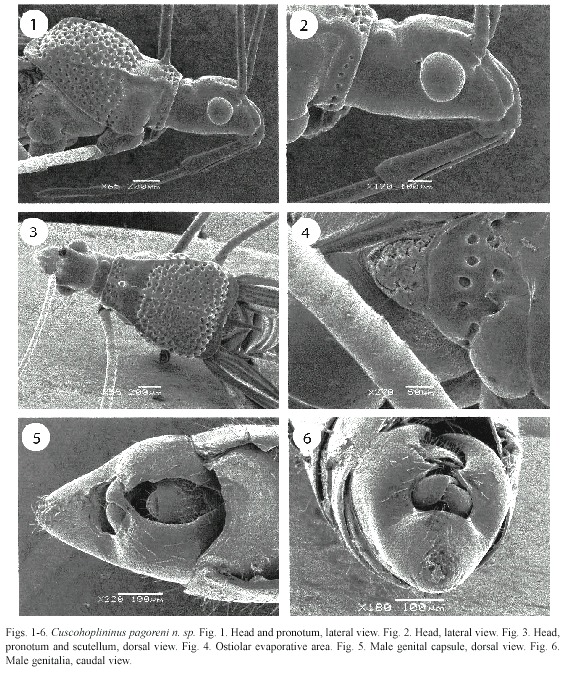
<body><![CDATA[<p><font face="Arial" size="2">The material examined belongs to the collection of Museo de Ciencias Naturales de La Plata, Buenos Aires, Argentina (MLP). Scanning electron micrographs were made from a specimen mounted on a stub, sputter coated with a gold palladium alloy, and studied with a JEOL T-100 SEM.</font><i><font face="Arial" size="2"> </font></i></p>     <p><font face="Arial" size="2"><b>Results</b></font><i><font  face="Arial" size="2"><b> </b></font></i></p>     <p><i><font face="Arial" size="2"><b><i>Cuscohoplininus</i></b><i> </i></font></i><font  face="Arial" size="2">new genus </font></p>     <p><font face="Arial" size="2"><b>Diagnosis:</b> This genus is easily distinguishable from the other Hoplinini by the presence of only one pronotal spine centered on the anterior lobe. </font></p>     <p><font face="Arial" size="2"><b>Description:</b> Medium sized (Total length: 5.52-6.42 mm). <b>Head</b> smooth, impunctate, eyes relatively small, postocular distance at least twice as long as eye length. Ocelli widely set behind eyes, near anterior margin of pronotum. Vertex convex. Antennae long, slender, segment one longest, segments two and three subequal in length, and segment four shortest and fusiform. <b>Pronotum</b> strongly convex, longer than wide, with two distinct lobes, lateral margins with a low carina; anterior lobe basally smooth and anteriorly punctate, armed with one short spine medially; posterior lobe unarmed, distinctly punctate, with a median carina. Scutellum armed with one long spine. Hemelytra hyaline, translucent, yellowish. Propleura punctate. Pro- and mesosternum with wide smooth median (rostral) groove. Ostiolar evaporative area restricted to upper half of the mesopleuron. <b>Abdomen</b> smooth, shiny. Caudal edge of male genitalia capsule lacking a dorsally directed process.</font></p>     <p><font face="Arial" size="2"> </font></p>     <p><font face="Arial" size="2"><b>Etymology:</b> The generic name is composed by "Cusco" the department of Peru where the specimens were collected, and the tribal name Hoplinini.</font><i><font face="Arial"  size="2"> </font></i></p> <i><font face="Arial" size="2"> </font></i>     <p><i><font face="Arial" size="2"><span style="font-weight: bold;">Cuscohoplininus pagoreni</span> n. sp. </font></i></p>     <p><b><font face="Arial" size="2"><b style="font-weight: bold;">Descripti</b><span  style="font-weight: bold;">on:</span></font><i><font face="Arial"  size="2"> </font></i></b><font face="Arial" size="2">Holotype male: Length 5.66 mm. General coloration pale brown; subglabrous.</font><b><i><font face="Arial" size="2"> </font></i><font  face="Arial" size="2">Head</font><i><font face="Arial" size="2"> </font></i></b><font  face="Arial" size="2">(<a href="#f1-6">Fig. 1, 2</a>): Length 0.6 mm, width 0.55 mm; vertex 0.32 mm. Rostrum: reaching middle of mesosternum; ventrally darker than dorsum. </font><b><font face="Arial" size="2"><b><b>Antenna:</b> </b></font></b><font face="Arial" size="2">Segment I, length 4.95 mm; II, 2.45 mm; III, 3.00 mm; IV 0.84 mm; uniformly dark brown; segments I, II and III weakly clavate; segment IV fusiform. <span  style="font-weight: bold;">Pronotum</span></font><b><font face="Arial"  size="2"><b> </b></font></b><font face="Arial" size="2">(<a href="#f1-6">Fig. 1, 4</a>): Length 1.13 mm, basal width 0.92. </font><b><font face="Arial" size="2"><b><b>Scutellum</b> </b></font></b><font face="Arial" size="2">(<a href="#f1-6">Fig. 3</a>): with slender spine, 0.25 mm long.</font><b><font face="Arial"  size="2"><b> <b>Hemelytron</b>: </b></font></b><font face="Arial"  size="2">macropterous, elongate, exochorium narrow and elongate, extending to sixth abdominal segment; membrane translucent, finely spotted. </font><b><font  face="Arial" size="2"><b><b>Ventral surface</b>: </b></font></b><font face="Arial" size="2">pale brown, impunctate, abdomen smooth and shining.</font><b><font face="Arial" size="2"><b> <b>Ostiolar evaporative area</b> </b></font></b><font face="Arial" size="2">(<a  href="#f1-6">Fig. 4</a>):</font><b><font face="Arial" size="2"><b> </b></font></b><font  face="Arial" size="2">reduced, subtriangular. </font><b><font  face="Arial" size="2"><b><b>Legs</b>: </b></font></b><font face="Arial" size="2">Femora pale brown with numerous dark brown spots, subapically darker without spots; with short sparse setae. Tibiae dark brown, with short sparse setae. </font><b><font face="Arial" size="2"><b>Femoral lengths: </b></font></b><font face="Arial" size="2">Pro-3.26 mm; meso-3.58 mm; meta-5.21 mm. </font><font face="Arial" size="2">Tibial lengths: Pro-3.58 mm; meso-4.16 mm; meta-7.26 mm. </font><b><font face="Arial" size="2"><b><b>Genital capsule</b></b></font></b><font face="Arial" size="2"> (<a href="#f1-6">Fig. 5, 6</a>): elongate, subtriangular.</font><b><font face="Arial" size="2"><b> </b></font></b></p>     <p style="text-align: center;"><b><font face="Arial" size="2"><b>&nbsp;<a  name="f1-6"></a><img src="/img/fbpe/rbt/v55n2/3663i1.JPG" title="" alt=""  style="width: 567px; height: 673px;"></b></font></b></p>     
]]></body>
<body><![CDATA[<p><b><font face="Arial" size="2"><b><b>Measurements of male paratype:</b></b></font></b><font  face="Arial" size="2"> </font><font face="Arial" size="2">Length 5.74 mm.</font><font  face="Arial" size="2"> Head: </font><font face="Arial" size="2">Length 0.68 mm, width 0.59 mm; vertex 0.34 mm. </font><font face="Arial" size="2">Antenna: </font><font face="Arial"  size="2">Segment I, length 4.47 mm; II, 2.16 mm; III, 2.68 mm; IV, 0.77 mm. </font><font face="Arial" size="2">Pronotum: </font><font  face="Arial" size="2">length 1.19 mm, basal width 1.01 mm. Scutellar spine 0.3 mm long.</font><font face="Arial" size="2"> Legs: Femoral lengths: Pro- 2.71 mm; meso- 3.32 mm; meta- 4.68 mm. Tibial lengths: Pro-3.21 mm; meso- 3.95 mm; meta- 7.00 mm.</font><b><font face="Arial" size="2"><b> </b></font></b></p> <b> </b>     <p><b><font face="Arial" size="2"><b><b>Female</b></b></font></b><font  face="Arial" size="2"> (n= 6): Length 5.52-6.42 mm (mean 5.92 mm). Head: Length 0.63-0.75 mm (mean 0.70 mm), width 0.54-0.58 mm (mean 0.57 mm); vertex 0.34-0.37 mm (mean 0.36 mm). Antenna: Segment I, length 4.45 4.68 mm (mean 4.53 mm); II, 2.21-2.32 mm (mean 2.25 mm); III, 2.68-2.89 mm (mean 2.78 mm); IV, 0.79-0.84 mm (mean 0.82 mm). Total length 10.15-10.69 mm (mean 10.39 mm). Pronotum: Length 1.15-1.26 mm (mean 1.20 mm), basal width 1.15-1.26 mm (mean 1.20 mm) Scutellar spine 0.26-0.32 mm (mean 0.29 mm). Legs: Femoral lengths: Pro-2.95-3.05 mm (mean 3.00 mm); meso- 3.37-3.58 mm (mean 3.47 mm); meta-4.68 -5.16 mm (mean 4.92 mm). Tibial lengths: Pro-3.21-3.42 mm (mean 3.32 mm); meso- 3.82-4.03 mm (mean 3.93 mm); meta-7.21-7.58 mm (mean 7.42 mm). </font></p>     <p><font face="Arial" size="2">Very similar to male in all aspects.</font><b><font face="Arial" size="2"><b> </b></font></b></p> <b> </b>     <p><b><font face="Arial" size="2"><b><b>Host:</b> </b></font></b><font  face="Arial" size="2">Unknown. </font><b><font face="Arial" size="2"><b>    <br> </b></font></b></p>     <p><b><font face="Arial" size="2"><b>Distribution: </b></font></b><font  face="Arial" size="2">Peru, Cusco, rainforest.</font><b><font  face="Arial" size="2"><b> </b></font></b></p> <b> </b>     <p><b><font face="Arial" size="2"><b><b>Etymology:</b> </b></font></b><font  face="Arial" size="2">The specific epithet pagoreni refers to the small town and homonymous river where the holotype was collected.</font><b><font face="Arial" size="2"><b> </b></font></b></p> <b> </b>     <p><b><font face="Arial" size="2"><b><b>Type data:</b></b></font></b><font  face="Arial" size="2"> Holotype</font><font face="Arial" size="2"  color="#ff0000"><span style="color: rgb(0, 0, 0);">:</span> </font><font  face="Arial" size="2">male, Peru: Cusco, Pagoreni, VII-(20)04, Williams, luz, 72°54´07´´ W 11°42´22´´ S (MLP). Paratypes: 4 females, same data. 1 male, 2 females, Peru: Nuevo Mundo, Base Pluspetrol, VII-(20)04, J. Williams, luz, 73°08´30´´W 11°33´02´´S (MLP).</font><b><i><b><font  face="Arial" size="2"> </font></b></i></b></p> <b><b><font face="Arial" size="2"><b>     <p>Discussion </p> </b> </font></b></b>     <p><font face="Arial" size="2">Acording to Henry’s (1997a) phyloge netic hypothesis, the Hoplinini can be divided into two clades: one including</font><b><i><b><font face="Arial" size="2"> </font></b></i></b><i><font  face="Arial" size="2"><i>Hoplinus</i></font></i><b><i><b><font  face="Arial" size="2"><i> </i></font></b></i></b><font face="Arial"  size="2">Stål,</font><b><i><b><font face="Arial" size="2"> </font></b></i></b><i><font face="Arial" size="2"><i>Phaconotus </i></font></i><font  face="Arial" size="2">Harris,</font><i><font face="Arial" size="2"><span  style="font-weight: bold;"> </span><i>Oedalocanthus </i></font></i><font face="Arial" size="2">Henry and </font><i><font  face="Arial" size="2"><i>Pronotacantha </i></font></i><font  face="Arial" size="2">Uhler that possess a ventrally extended evaporative area, and a second clade comprising</font><i><font  face="Arial" size="2"> <i>Diabolonotus </i></font></i><font face="Arial" size="2">Henry, </font><i><font  face="Arial" size="2"><i>Xenoloma </i></font></i><font face="Arial"  size="2">Harris, </font><i><font face="Arial" size="2"><i>Metajalysus </i></font></i><font face="Arial" size="2">Stusak and</font><i><font  face="Arial" size="2"> <i>Parajalysus </i></font></i><font face="Arial" size="2">Distant with ostiolar area reduced to a circular swollen area near the middle of metapleural area. The reduced ostiolar area of Cuscohoplininus permits us to assign it to the latter clade. </font></p>     ]]></body>
<body><![CDATA[<p><font face="Arial" size="2">This new genus resembles </font><i><font  face="Arial" size="2"><i>Parajalysus </i></font></i><font face="Arial" size="2">in general aspect and size (</font><i><font  face="Arial" size="2"><i>Parajalysus </i></font></i><font face="Arial"  size="2">and </font><i><font face="Arial" size="2"><i>Cuscohoplininus </i></font></i><font face="Arial" size="2">being the only two genera longer than 5 mm). </font><i><font face="Arial" size="2"><i>Parajalysus</i></font></i><font  face="Arial" size="2"> is characterized by the four large, erect pronotal spines, one centered on the anterior lobe, and on the posterior lobe, one at each humeral angle, and one at the base of the meson; whereas </font><i><font  face="Arial" size="2"><i>Cuscohoplininus </i></font></i><font  face="Arial" size="2">has a single spine on the pronotum, on the anterior pronotal lobe, an elongate scutellar spine (a tubercle is present in </font><i><font  face="Arial" size="2"><i>Parajalysus</i></font></i><font face="Arial"  size="2">), and lacks a process on the caudal edge of the male genitalia capsule.</font><i><font  face="Arial" size="2"> </font></i></p>     <p><i><font face="Arial" size="2"><i>Cuscohoplininus </i></font></i><font  face="Arial" size="2">runs to couplet 7 in Henry´s key to Hoplinini genera of the Western Hemisphere (Henry 1997c); this couplet identifies </font><i><font face="Arial"  size="2"><i>Phaconotus </i></font></i><font face="Arial" size="2">and </font><i><font face="Arial" size="2"><i>Oedalocanthus</i></font></i><font  face="Arial" size="2">, but </font><i><font face="Arial" size="2"><i>Cuscohoplininus</i></font></i><font  face="Arial" size="2"> can be easily distinguished from both genera by the absence of rounded tubercles on the pronotum.</font><b><b><font  face="Arial" size="2"> </font></b></b></p> <b><b><font face="Arial" size="2"><b>     <p>Acknowledgments </p> </b> </font></b></b>     <p><font face="Arial" size="2">Our gratitude goes to Pluspetrol Perú Corporation, S.A. and ERM Perú, S.A. for financial support of the fieldwork that was carried out during the environmental impact assessment of block 56 in Pagoreni and Nuevo Mundo, Cusco. This work was funded by the Consejo Nacional de Investigaciones Científicas y Técnicas (CONICET), Argentina. </font></p> <b><b><font face="Arial" size="2"><b>     <p>Resumen </p> </b> </font></b></b>     <p><font face="Arial" size="2">La familia Berytidae es cosmopolita y está integrada por chinches alargadas, con cuerpo generalmente cilíndrico y con antenas y patas muy largas. Los miembros de la tribu Hoplinini se caracterizan por carecer de canal la glándula repugnatoria y por poseer un proceso caudal dirigido dorsalmente sobre el borde posterior de la cápsula genital masculina (ausente en </font><i><font  face="Arial" size="2"><i>Xenoloma</i></font></i><b><i><b><font  face="Arial" size="2"><i> </i></font></b></i></b><font face="Arial" size="2">y</font><b><i><b><font  face="Arial" size="2"> </font></b></i></b><i><font face="Arial"  size="2"><i>Cuscohoplininus</i></font></i><font face="Arial" size="2">). Describimos un nuevo género y especie: </font><i><font face="Arial"  size="2"><i>Cuscohoplininus pagoreni </i></font></i><font face="Arial" size="2">de Perú. Se tomaron fotografías de microscopia electrónica para ilustrar estructuras de importancia taxonómica. Entre los ocho géneros conocidos de la tribu Hoplinini,</font><i><font  face="Arial" size="2"> <i>Cuscohoplininus </i></font></i><font  face="Arial" size="2">n. gen. es similar al género </font><i><font face="Arial" size="2"><i>Parajalysus </i></font></i><font face="Arial" size="2">en aspecto general y en tamaño. Sin embargo, puede distinguirse así:</font><i><font face="Arial"  size="2"> <i>Parajalysus </i></font></i><font face="Arial" size="2">se caracteriza por poseer cuatro grandes espinas erectas sobre el pronoto, una en el centro del lóbulo anterior, una en cada ángulo humeral y, la cuarta, también sobre el lóbulo posterior sobre el margen posterior; por otro lado </font><i><font face="Arial" size="2"><i>Cuscohoplininus </i></font></i><font face="Arial" size="2">tiene una sola espina sobre el pronoto situada sobre el lóbulo anterior, una espina escutelar (</font><i><font  face="Arial" size="2"><i>Parajalysus </i></font></i><font face="Arial" size="2">presenta solo un tubérculo sobre el escutelo) y carece de proceso caudal.</font><b><i><b><font face="Arial" size="2"> </font></b></i></b></p> <b> </b>     <p><b><b><font face="Arial" size="2"><b>Palabras clave:</b> </font></b></b><font face="Arial" size="2">Heteroptera, Berytidae, nuevo género, nueva especie, Perú.</font><b><i><b><font face="Arial"  size="2"> </font></b></i></b></p> <b><b><font face="Arial" size="2"><b>     <p>References </p> </b> </font></b></b>     <!-- ref --><p><font face="Arial" size="2">Henry, T.J. 1997a. Cladistic analysis and revision of the stilt bug genera of the world (Heteroptera: Berytidae). Contr. Am. Entomol. inst. 30: 1-100. </font>&nbsp;&nbsp;&nbsp;&nbsp;&nbsp;&nbsp;&nbsp;&nbsp;[&#160;<a href="javascript:void(0);" onclick="javascript: window.open('/scielo.php?script=sci_nlinks&ref=1248822&pid=S0034-7744200700020002900001&lng=','','width=640,height=500,resizable=yes,scrollbars=1,menubar=yes,');">Links</a>&#160;]<!-- end-ref --><!-- ref --><p><font face="Arial" size="2">Henry, T.J. 1997b. Phylogenetic analysis of family groups within the infraorder Pentatomomorpha (Hemiptera: Heteroptera), with emphasis on the Lygaeoidea. Ann. Entomol. Soc. Am. 90: 275-301. </font>&nbsp;&nbsp;&nbsp;&nbsp;&nbsp;&nbsp;&nbsp;&nbsp;[&#160;<a href="javascript:void(0);" onclick="javascript: window.open('/scielo.php?script=sci_nlinks&ref=1248823&pid=S0034-7744200700020002900002&lng=','','width=640,height=500,resizable=yes,scrollbars=1,menubar=yes,');">Links</a>&#160;]<!-- end-ref --><!-- ref --><p><font face="Arial" size="2">Henry, T.J. 1997c. Monograph of the stilt bugs, or Berytidae (Heteroptera), of the Western Hemisphere. Mem. Entomol. Soc. Wash. 19: 1-149.</font><b><i><b><font face="Arial"  size="2"> </font></b></i></b>&nbsp;&nbsp;&nbsp;&nbsp;&nbsp;&nbsp;&nbsp;&nbsp;[&#160;<a href="javascript:void(0);" onclick="javascript: window.open('/scielo.php?script=sci_nlinks&ref=1248824&pid=S0034-7744200700020002900003&lng=','','width=640,height=500,resizable=yes,scrollbars=1,menubar=yes,');">Links</a>&#160;]<!-- end-ref --> ]]></body><back>
<ref-list>
<ref id="B1">
<nlm-citation citation-type="journal">
<person-group person-group-type="author">
<name>
<surname><![CDATA[Henry]]></surname>
<given-names><![CDATA[T.J]]></given-names>
</name>
</person-group>
<article-title xml:lang="en"><![CDATA[Cladistic analysis and revision of the stilt bug genera of the world (Heteroptera: Berytidae)]]></article-title>
<source><![CDATA[Contr. Am. Entomol. inst]]></source>
<year>1997</year>
<volume>30</volume>
<page-range>1-100</page-range></nlm-citation>
</ref>
<ref id="B2">
<nlm-citation citation-type="journal">
<person-group person-group-type="author">
<name>
<surname><![CDATA[Henry]]></surname>
<given-names><![CDATA[T.J]]></given-names>
</name>
</person-group>
<article-title xml:lang="en"><![CDATA[Phylogenetic analysis of family groups within the infraorder Pentatomomorpha (Hemiptera: Heteroptera), with emphasis on the Lygaeoidea]]></article-title>
<source><![CDATA[Ann. Entomol. Soc. Am]]></source>
<year>1997</year>
<volume>90</volume>
<page-range>275-301</page-range></nlm-citation>
</ref>
<ref id="B3">
<nlm-citation citation-type="journal">
<person-group person-group-type="author">
<name>
<surname><![CDATA[Henry]]></surname>
<given-names><![CDATA[T.J]]></given-names>
</name>
</person-group>
<article-title xml:lang="en"><![CDATA[Monograph of the stilt bugs, or Berytidae (Heteroptera), of the Western Hemisphere]]></article-title>
<source><![CDATA[Mem. Entomol. Soc. Wash]]></source>
<year>1997</year>
<volume>19</volume>
<page-range>1-149</page-range></nlm-citation>
</ref>
</ref-list>
</back>
</article>
