<?xml version="1.0" encoding="ISO-8859-1"?><article xmlns:mml="http://www.w3.org/1998/Math/MathML" xmlns:xlink="http://www.w3.org/1999/xlink" xmlns:xsi="http://www.w3.org/2001/XMLSchema-instance">
<front>
<journal-meta>
<journal-id>0034-7744</journal-id>
<journal-title><![CDATA[Revista de Biología Tropical]]></journal-title>
<abbrev-journal-title><![CDATA[Rev. biol. trop]]></abbrev-journal-title>
<issn>0034-7744</issn>
<publisher>
<publisher-name><![CDATA[Universidad de Costa Rica]]></publisher-name>
</publisher>
</journal-meta>
<article-meta>
<article-id>S0034-77442007000200026</article-id>
<title-group>
<article-title xml:lang="en"><![CDATA[Biological control of Diatraea spp. (Lepidoptera: Pyralidae) in sugarcane crops in Central Venezuela]]></article-title>
</title-group>
<contrib-group>
<contrib contrib-type="author">
<name>
<surname><![CDATA[Weir L]]></surname>
<given-names><![CDATA[Enrique H]]></given-names>
</name>
<xref ref-type="aff" rid="A01"/>
</contrib>
<contrib contrib-type="author">
<name>
<surname><![CDATA[Contreras]]></surname>
<given-names><![CDATA[Williams]]></given-names>
</name>
<xref ref-type="aff" rid="A02"/>
</contrib>
<contrib contrib-type="author">
<name>
<surname><![CDATA[Gil de Weir]]></surname>
<given-names><![CDATA[Karine]]></given-names>
</name>
<xref ref-type="aff" rid="A03"/>
</contrib>
</contrib-group>
<aff id="A01">
<institution><![CDATA[,Tha Platte River Whooping Crane Trust Inc  ]]></institution>
<addr-line><![CDATA[ Nebraska]]></addr-line>
<country>USA</country>
</aff>
<aff id="A02">
<institution><![CDATA[,Hacienda Santa Teresa Laboratorio de Entomología Central El Palmar]]></institution>
<addr-line><![CDATA[ ]]></addr-line>
<country>Venezuela</country>
</aff>
<aff id="A03">
<institution><![CDATA[,The Royal Swedish Academy The Beijer International Institute ]]></institution>
<addr-line><![CDATA[ ]]></addr-line>
</aff>
<pub-date pub-type="pub">
<day>00</day>
<month>06</month>
<year>2007</year>
</pub-date>
<pub-date pub-type="epub">
<day>00</day>
<month>06</month>
<year>2007</year>
</pub-date>
<volume>55</volume>
<numero>2</numero>
<fpage>655</fpage>
<lpage>658</lpage>
<copyright-statement/>
<copyright-year/>
<self-uri xlink:href="http://www.scielo.sa.cr/scielo.php?script=sci_arttext&amp;pid=S0034-77442007000200026&amp;lng=en&amp;nrm=iso"></self-uri><self-uri xlink:href="http://www.scielo.sa.cr/scielo.php?script=sci_abstract&amp;pid=S0034-77442007000200026&amp;lng=en&amp;nrm=iso"></self-uri><self-uri xlink:href="http://www.scielo.sa.cr/scielo.php?script=sci_pdf&amp;pid=S0034-77442007000200026&amp;lng=en&amp;nrm=iso"></self-uri><abstract abstract-type="short" xml:lang="es"><p><![CDATA[Entre los años 1990-1996, se evaluó la importancia de la mosca amazónica (Melagonystilum minense) y de la avispa (Cotesia flavipes) como controles biológicos de los perforadores de la caña de azúcar (Diatraea saccharalis y Diatraea rosa) en el centro de Venezuela. Durante el período de la zafra, seleccionamos aleatoriamente tallos de caña de azúcar que fueron abiertos para observar el número de perforaciones, hospedadores, proporción de hospedadores parasitados, proporción de hospedadores parasitados por la mosca amazónica o por la avispa. Como consecuencia de las periódicas liberaciones de las moscas y las avispas criadas en el laboratorio, observamos una disminución pronunciada de la abundancia relativa de Diatraea spp., pero no se obtuvo un efecto evidente de utilizar ambos parasitoides. La abundancia de Diatraea spp. en presencia de ambos parasitoides fue similar a la observada durante los 45 años en que se utilizó únicamente M. minense como control biológico. Sin embargo, M. minense probablemente sea el principal control biológico de esta plaga por ser más eficiente en la búsqueda de la misma y por ser un competidor más fuerte que C. flavipes.]]></p></abstract>
<kwd-group>
<kwd lng="en"><![CDATA[Metagonystilum minense]]></kwd>
<kwd lng="en"><![CDATA[Cotesia flavipes]]></kwd>
<kwd lng="en"><![CDATA[parasitoid]]></kwd>
<kwd lng="en"><![CDATA[Diatraea]]></kwd>
<kwd lng="en"><![CDATA[sugarcane]]></kwd>
<kwd lng="es"><![CDATA[Metagonystilum minense]]></kwd>
<kwd lng="es"><![CDATA[Cotesia flavipes]]></kwd>
<kwd lng="es"><![CDATA[parasitoide]]></kwd>
<kwd lng="es"><![CDATA[Diatraea]]></kwd>
<kwd lng="es"><![CDATA[caña de azúcar]]></kwd>
</kwd-group>
</article-meta>
</front><body><![CDATA[  <b><font face="Arial">     <p align="center">Biological control of <span  style="font-weight: normal; font-style: italic;">Diatraea</span><i> </i>spp. (Lepidoptera: Pyralidae) in sugarcane crops in Central Venezuela</p> </font></b><font face="Arial" size="2"> </font>     <p><font face="Arial" size="2">Enrique H. Weir L.<sup>1,3</sup>, Williams Contreras<sup>2 </sup>&amp; Karine Gil de Weir<sup>1,3    <br> </sup></font></p>     <p><font face="Arial" size="2"><a name="1"></a>1 The Platte River Whooping Crane Trust Inc. 6611 W. Whooping Crane Dr. Wood River, NE-68883, Nebraska, USA; <a href="mailto:henryweirl@msn.com">henryweirl@msn.com</a>; <a href="mailto:EWeir@whoopingcrane.org">EWeir@whoopingcrane.org</a>. Fax +1-308-384-7209 </font></p>     <p><font face="Arial" size="2"><a name="2"></a>2 Central El Palmar, Laboratorio de Entomología, Hacienda Santa Teresa, El Consejo, Edo. Aragua, Venezuela. </font></p>     <p><font face="Arial" size="2"><a name="3"></a>3 The Beijer International Institute, The Royal Swedish Academy of Sciences, Lillafrescativågen 4, SE 10405, Stockholm, Sweden. </font></p>     <p align="center"><font face="Arial" size="2">Received 11-X-2006. Corrected 15-XI-2006. Accepted 28-II-2007.</font></p> <font face="Arial" size="2"><b></b></font>     <p><font face="Arial" size="2"><b>Abstract:</b> In 1990-1996, we evaluated the relative importance of the Amazonian fly (<i>Metagonystilum minense</i>) and the wasp (<i>Cotesia flavipes</i>), in sugarcane crops, in Central Venezuela. We observed a significant decrease in relative abundance of <i>Diatraea </i>spp. when the Amazon fly abundance increased but not with the wasp abundance. <i>Diatraea </i>spp. abundance in presence of both parasitoids was similar to its abundance throughout the last 45 years, when only inundations of <i>M. minense </i>occurred. However a net effect by using both parasitoids was not evident. <i>M. minense </i>is probably the stronger pest control, because its more efficient in its host searching than <i>C. flavipes </i>and is better as competitor than the wasp. Rev. Biol. Trop. 55 (2): 655-658. Epub 2007 June, 29. </font></p> <font face="Arial" size="2"><b></b></font>     <p><font face="Arial" size="2"><b>Key words:</b> <i>Metagonystilum minense</i>, <i>Cotesia flavipes</i>, parasitoid, <i>Diatraea</i>, sugarcane. </font></p>     ]]></body>
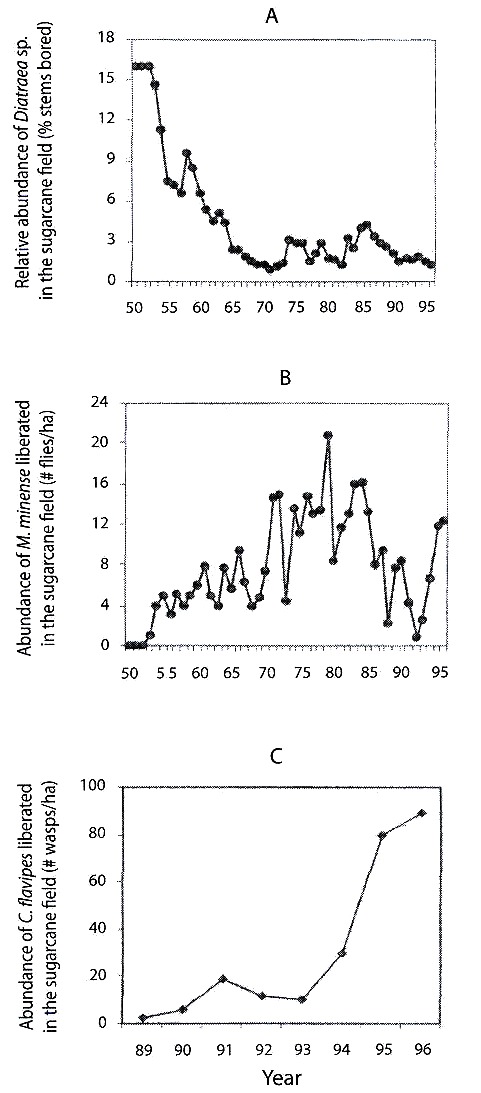
<body><![CDATA[<p><font face="Arial" size="2">Flooding agroecosystems with parasitoid insects is sometimes very effective in lowering the abundance of crop pest insects (Knipling and McGuire 1968, Knipling 1970, 1972 Knipling and Gilmore 1971). Thus, parasitoids are commonly reared in laboratories and periodically liberated in high-density populations crop pests (Barclay <i>et al. </i>1985). The effectiveness of this biological control technique may be improved by adjusting parasitic inundation rates, until the pest population reaches a very low level (Barclay <i>et al. </i>1985), and by evaluating the stability of parasitic-host system after inundation stops. </font></p>     <p><font face="Arial" size="2">The purpose of this study is to evaluate the role of two parasitic species, the Amazonian fly <i>Metagonystilum minense </i>Myers (Diptera: Tachinidae), and the wasp <i>Cotesia flavipes </i>Cameron (Hymenoptera: Braconidae), in regulating sugarcane borers <i>Diatraea saccharalis </i>Fabricius, and <i>Diatraea rosa </i>Heinr (Lepidoptera: Pyralidae) in sugarcane crops in Central Venezuela. </font></p> <font face="Arial" size="2"><b>     <p>Materials and methods </p> </b> </font>     <p><font face="Arial" size="2">To determine the relative abundance of as biological control agents of lepidopterous <i>Diatraea </i>spp., <i>M. minense </i>and <i>C. flavipes, </i>we sampled sugarcane harvests yearly, from 1990 to 1996, in Carabobo and Aragua States, Central Venezuela. During each harvest, we counted the number of stem holes, larvae and pupae of <i>Diatraea </i>spp., and pupae of <i>M. minense </i>and <i>C. flavipes </i>on 100 randomly selected sugarcane stems from each of 100, one ha plots (total=10 000 sterns). </font></p>     <p><font face="Arial" size="2">These methods employed to estimate pop- ulation were similar enough to those used 1950-1989. Proportions of parasitized and non- parasitized <i>Diatraea </i>spp. were correlated with the abundance of <i>M. minense </i>and <i>C. flavi</i> <i>pes </i>reared in the laboratory, and liberated the farms. Laboratory work was done at the Entomology Laboratory of Santa Teresa Farm, El Consejo, Aragua State. </font></p>     <p><font face="Arial" size="2">Stems were dissected in the laboratory to extract <i>Diatraea </i>larvae or pupae, and <i>M. minense </i>and <i>C. flavipes </i>pupae. Each <i>Diatraea </i>larva was placed in a vial and given a corn diet. Food was replaced every two days. Larvae were maintained in vials to molting pupae or to emergence of the parasitoid pupae. <i>Diatraea </i>spp., <i>M. minense </i>and <i>C. flavipes </i>pupae were placed in a Petri dish with absorbent paper. </font></p>     <p><font face="Arial" size="2">We performed Kolmogorov-Smirnov and Schefee-Box tests to evaluate normality and homogeneity of variance (Sokal and Rohlf 1995), a parametric analysis of variance when was homogeneous (Sokal and Rohlf 1995), and Kruskal-Wallis test when variance was not homogeneous (Conover 1980). </font></p> <font face="Arial" size="2"><b>     <p>Results </p> </b> </font>     <p><font face="Arial" size="2">The relative abundance of <i>Diatraea </i>spp. in sugarcane crops and proportions/ha, of laboratory reared <i>M. minense </i>and <i>C. flavipes, </i>are shown in <a href="#fig1">Figure 1</a>. The impact of mass liberations of these parasitoids on the sugarcane borer population has been important, particularly for <i>M. minense</i>. <i>M. minense </i>has controlled the pests for 50 years with a mean relative abundance range of 0.9 to 4.2 %. Changes in <i>Diatraea </i>spp. population levels showed a significant relationship with <i>M. minense </i></font><font face="Arial" size="2">released between 1950 to 1989 (F=99.9, &#945;=0.0001). </font></p> <font face="Arial" size="2"> </font>     <p style="text-align: center;"><font face="Arial" size="2">&nbsp;<a  name="fig1"></a><img src="/img/fbpe/rbt/v55n2/3660i1.JPG" title=""  alt="" style="height: 1093px; width: 481px;">    
]]></body>
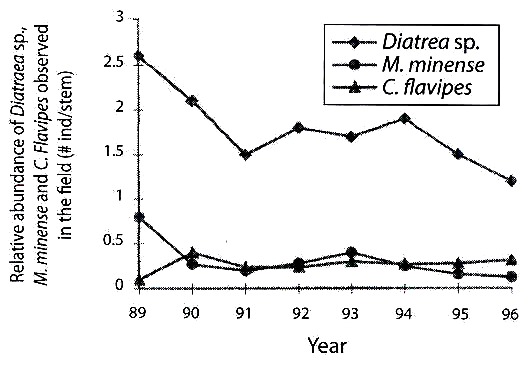
<body><![CDATA[<br> </font></p>     <div style="text-align: left; margin-left: 200px;"><font face="Arial"  size="2">Fig. 1. Changes in host and parasitoid abundance in sugarcane field.     <br> A. Relative abundance of </font><font face="Arial" size="2"><span  style="font-style: italic;">Diatraea sp</span>. (estimated by the percent of     <br> stems bored). B y C. Shows the abundace of <span  style="font-style: italic;">M. </span></font><font face="Arial"  size="2"><span style="font-style: italic;">minese</span> y <span  style="font-style: italic;">C. flavipes</span>     <br> espectively, liberated in sugarcane fields.</font>    <br> <font face="Arial" size="2"></font></div>     <p><font face="Arial" size="2">During the last six years of biological control (<a href="#fig2">Fig. 2</a>), changes in <i>Diatraea </i>spp. population density showed a significant relationship with <i>M. minese </i></font><font  face="Arial" size="2">in this period (F=6.17, &#945;=0.05), but the r</font><font  face="Arial" size="2">elationship with <i>C. flavipes </i>was unsignificant (F=2.99, ns). However, the parasitization frequency of <i>Diatraea </i>hosts by <i>C. flavipes </i>was similar to that of <i>M. minense, </i>suggesting that <i>C. flavipes </i>is less efficient than <i>M. minense </i>as a parasitoid, because ten times more <i>C. flavipes </i>must be liberated to equal the effect produced by <i>M. minense. </i></font></p>     <p style="text-align: center;"><span style="font-family: arial;"><span  style="font-style: italic;"><a name="fig2"></a><img  src="/img/fbpe/rbt/v55n2/3660i2.JPG" title="" alt=""  style="width: 529px; height: 369px;">    
<br> </span></span></p>     <div style="text-align: left; margin-left: 160px;"><span  style="font-family: arial;"><small>Fig. 2. Mean relative abundance of Diatracea ap. (% stems with M. minense y C. flavipes     ]]></body>
<body><![CDATA[<br> (porportion </small></span><span style="font-family: arial;"><small>of hosts parasitized) obtained from sugarcane stem samples collected ramdomly     <br> durig harvests.</small></span>    <br> <span style="font-family: arial;"><span style="font-style: italic;"></span></span></div> <font face="Arial" size="2"><b>     <p>Discussion </p> </b> </font>     <p><font face="Arial" size="2">For six years, biological control by both <i>M. minense </i>and <i>C. flavipes </i>has used to control <i>Diatraea </i>spp. populations in sugarcane crops in Venezuela. A net effect by using both parasitoids is not evident. The recent trend of <i>Diatraea </i>abundance in presence of both parasitoids is similar to its abundance throughout the last 45 years, when only inundations of <i>M. minense </i>occurred (<a href="#fig1">Fig. 1</a>). However, <i>M. minense </i>probably has had a stronger effect as control agent because is more efficient as parasitoid (Data of Central El Palmar), and better competitor than <i>C. flavipes </i>(Weir and Sagarzazu 1998). </font></p>     <p><font face="Arial" size="2">A reduction in <i>Diatraea </i>spp. abundance to lower levels by the parasitoids and partial or total parasitoid extinction may be a result of artificial inundation practices of both parasitoid species (Box 1956, this study). The final balance is an unstable interaction where parasitoid extinction occurs in many patches of sugarcane crops because of these low levels and to the intra and interspecific superparasitism caused by inundation practices (Ferrer <i>et al. </i>1990, Weir 1991, Weir and Sagarzazu 1998). At present, recurrent inundation of parasitoids has avoided a population increase of <i>Diatraea </i>to epidemic levels in Venezuela (Ferrer <i>et al. </i>1990, Micale 1995), Colombia (Gaviria 1990) and Brazil (Botelho <i>et al. </i>1980). Regulation of artificial production of parasitoids, as well as parasitoid release in sugarcane crops, might avoid the intraspecific and interspecific superparasitism and stabilize parasitoid-host interactions. This action would allow a reduction of parasitoids released in sugarcane crops. </font></p> <font face="Arial" size="2"><b>     <p>Acknowledgments </p> </b> </font>     <p><font face="Arial" size="2">This research was supported by the entomology Laboratory of Santa Teresa Farm. We thank Roque Morejon for his assistance in this study and Ivan Penzo and Clark Casler for reviewing and improving the manuscript. </font></p> <font face="Arial" size="2"><b>     <p>Resumen </p> </b> </font>     <p><font face="Arial" size="2">Entre los años 1990-1996, se evaluó la importancia de la mosca amazónica (<i>Melagonystilum minense</i>) y de la avispa (<i>Cotesia flavipes</i>) como controles biológicos de los perforadores de la caña de azúcar (<i>Diatraea saccharalis </i>y <i>Diatraea rosa</i>) en el centro de Venezuela. Durante el período de la zafra, seleccionamos aleatoriamente tallos de caña de azúcar que fueron abiertos para observar el número de perforaciones, hospedadores, proporción de hospedadores parasitados, proporción de hospedadores parasitados por la mosca amazónica o por la avispa. Como consecuencia de las periódicas liberaciones de las moscas y las avispas criadas en el laboratorio, observamos una disminución pronunciada de la abundancia relativa de <i>Diatraea </i>spp., pero no se obtuvo un efecto evidente de utilizar ambos parasitoides. La abundancia de <i>Diatraea </i>spp. en presencia de ambos parasitoides fue similar a la observada durante los 45 años en que se utilizó únicamente <i>M. minense </i>como control biológico. Sin embargo, <i>M. minense </i>probablemente sea el principal control biológico de esta plaga por ser más eficiente en la búsqueda de la misma y por ser un competidor más fuerte que <i>C. flavipes. </i></font></p> <font face="Arial" size="2"><b></b></font>     ]]></body>
<body><![CDATA[<p><font face="Arial" size="2"><b>Palabras clave:</b> <i>Metagonystilum minense</i>, <i>Cotesia flavipes</i>, parasitoide, <i>Diatraea</i>, caña de azúcar. </font></p> <font face="Arial" size="2"><b>     <p>References </p> </b> </font>     <!-- ref --><p><font face="Arial" size="2">Barclay, H.J., I.S. Otvos &amp; A.J. Thomson. 1985. Models of periodic inundation of parasitoids for pest control. Can. Ent. 117: 705-716. </font>&nbsp;&nbsp;&nbsp;&nbsp;&nbsp;&nbsp;&nbsp;&nbsp;[&#160;<a href="javascript:void(0);" onclick="javascript: window.open('/scielo.php?script=sci_nlinks&ref=1239010&pid=S0034-7744200700020002600001&lng=','','width=640,height=500,resizable=yes,scrollbars=1,menubar=yes,');">Links</a>&#160;]<!-- end-ref --><!-- ref --><p><font face="Arial" size="2">Botelho, P.S.M., N. Macedoy &amp; A.C. Mendes. 1980. Aspects of the population dynamics of <i>Apanteles flavipes </i>(Cameron) and support capacity of its host <i>Diatraea saccharalis </i>(Fabr). Proc. Congr. Int. Soc. Sugarcane Tech. Manila: 1736-1745. </font>&nbsp;&nbsp;&nbsp;&nbsp;&nbsp;&nbsp;&nbsp;&nbsp;[&#160;<a href="javascript:void(0);" onclick="javascript: window.open('/scielo.php?script=sci_nlinks&ref=1239011&pid=S0034-7744200700020002600002&lng=','','width=640,height=500,resizable=yes,scrollbars=1,menubar=yes,');">Links</a>&#160;]<!-- end-ref --><!-- ref --><p><font face="Arial" size="2">Box, H.H. 1956. The biological control of moth-borers (<i>Diatraea</i>) in Venezuela. Battle against Venezuela’s cañe borer. Preliminary investígations and the launching of a general campaign. Sugar: 25-30. </font>&nbsp;&nbsp;&nbsp;&nbsp;&nbsp;&nbsp;&nbsp;&nbsp;[&#160;<a href="javascript:void(0);" onclick="javascript: window.open('/scielo.php?script=sci_nlinks&ref=1239012&pid=S0034-7744200700020002600003&lng=','','width=640,height=500,resizable=yes,scrollbars=1,menubar=yes,');">Links</a>&#160;]<!-- end-ref --><!-- ref --><p><font face="Arial" size="2">Conover, W.J. 1980. Practical nonparametric statistics. Texas Tech University. Wiley, New York, USA. 493 p. </font>&nbsp;&nbsp;&nbsp;&nbsp;&nbsp;&nbsp;&nbsp;&nbsp;[&#160;<a href="javascript:void(0);" onclick="javascript: window.open('/scielo.php?script=sci_nlinks&ref=1239013&pid=S0034-7744200700020002600004&lng=','','width=640,height=500,resizable=yes,scrollbars=1,menubar=yes,');">Links</a>&#160;]<!-- end-ref --><!-- ref --><p><font face="Arial" size="2">Ferrer, F., E. Guedez &amp; L. Proano. 1990. El efecto del control biológico de <i>Cotesia flavipes </i>(Hym: Brachonidae) sobre <i>Diatraea </i>spp. (Lep: Pyralidae) en el área de influencia de la azucarera Río Turbio, durante los años 1986-1990, p. 1-10. <i>In </i>Memorias III Congreso Sociedad Colombiana de Técnicos de la Caña de Azúcar (Tecnicaña), Cali, Colombia. </font>&nbsp;&nbsp;&nbsp;&nbsp;&nbsp;&nbsp;&nbsp;&nbsp;[&#160;<a href="javascript:void(0);" onclick="javascript: window.open('/scielo.php?script=sci_nlinks&ref=1239014&pid=S0034-7744200700020002600005&lng=','','width=640,height=500,resizable=yes,scrollbars=1,menubar=yes,');">Links</a>&#160;]<!-- end-ref --><!-- ref --><p><font face="Arial" size="2">Gaviria, J.D. 1990. El control biológico de los insectos plaga de la caña de azúcar en Colombia, p. 201-227. <i>In </i>Memorias III Congreso Sociedad Colombiana de Técnicos de la Caña de Azúcar (Tecnicaña), Cali, Colombia. </font>&nbsp;&nbsp;&nbsp;&nbsp;&nbsp;&nbsp;&nbsp;&nbsp;[&#160;<a href="javascript:void(0);" onclick="javascript: window.open('/scielo.php?script=sci_nlinks&ref=1239015&pid=S0034-7744200700020002600006&lng=','','width=640,height=500,resizable=yes,scrollbars=1,menubar=yes,');">Links</a>&#160;]<!-- end-ref --><!-- ref --><p><font face="Arial" size="2">Knipling, E.F. 1970. Influence of host density on the ability of selective parasites to manage insect populations. Proc. Tall Timbers Conf. Ecol. Anim. Control Habitat Manage 2: 3-21. </font>&nbsp;&nbsp;&nbsp;&nbsp;&nbsp;&nbsp;&nbsp;&nbsp;[&#160;<a href="javascript:void(0);" onclick="javascript: window.open('/scielo.php?script=sci_nlinks&ref=1239016&pid=S0034-7744200700020002600007&lng=','','width=640,height=500,resizable=yes,scrollbars=1,menubar=yes,');">Links</a>&#160;]<!-- end-ref --><!-- ref --><p><font face="Arial" size="2">Knipling, E.F. 1972. Simulated population models to appraise the potential for suppressing sugarcane borer populations by strategic releases of the parasite <i>Lixophaga diatraeae</i>. Environ. Ent. 1: 1-6. </font>&nbsp;&nbsp;&nbsp;&nbsp;&nbsp;&nbsp;&nbsp;&nbsp;[&#160;<a href="javascript:void(0);" onclick="javascript: window.open('/scielo.php?script=sci_nlinks&ref=1239017&pid=S0034-7744200700020002600008&lng=','','width=640,height=500,resizable=yes,scrollbars=1,menubar=yes,');">Links</a>&#160;]<!-- end-ref --><!-- ref --><p><font face="Arial" size="2">Knipling, E.F. &amp; J.E. Gilmore. 1971. Population density relationships between hymenopterous parasites and their aphid hosts - A theoretical study. USDA Tech. Bull. 1428-1462. </font>&nbsp;&nbsp;&nbsp;&nbsp;&nbsp;&nbsp;&nbsp;&nbsp;[&#160;<a href="javascript:void(0);" onclick="javascript: window.open('/scielo.php?script=sci_nlinks&ref=1239018&pid=S0034-7744200700020002600009&lng=','','width=640,height=500,resizable=yes,scrollbars=1,menubar=yes,');">Links</a>&#160;]<!-- end-ref --><!-- ref --><p><font face="Arial" size="2">Knipling, E.F. &amp; J.U. McGuire. 1968. Population models to appraise the limitations and potentialities of <i>Trichogramma </i>in managing host insect populations. USDA Tech. Bull. 1387-1431. </font>&nbsp;&nbsp;&nbsp;&nbsp;&nbsp;&nbsp;&nbsp;&nbsp;[&#160;<a href="javascript:void(0);" onclick="javascript: window.open('/scielo.php?script=sci_nlinks&ref=1239019&pid=S0034-7744200700020002600010&lng=','','width=640,height=500,resizable=yes,scrollbars=1,menubar=yes,');">Links</a>&#160;]<!-- end-ref --><!-- ref --><p><font face="Arial" size="2">Micale, E. 1995. Programa de manejo integrado de los insectos plagas de la caña de azúcar, p. 1-28. <i>In </i>XIV Congreso Venezolano de Entomología, Barquisimeto, Lara, Venezuela. </font>&nbsp;&nbsp;&nbsp;&nbsp;&nbsp;&nbsp;&nbsp;&nbsp;[&#160;<a href="javascript:void(0);" onclick="javascript: window.open('/scielo.php?script=sci_nlinks&ref=1239020&pid=S0034-7744200700020002600011&lng=','','width=640,height=500,resizable=yes,scrollbars=1,menubar=yes,');">Links</a>&#160;]<!-- end-ref --><!-- ref --><p><font face="Arial" size="2">Sokal, R.R. &amp; F.J. Rohlf. 1995. Biometry. W.H. Freemand, San Francisco, California, USA. 887 p. </font>&nbsp;&nbsp;&nbsp;&nbsp;&nbsp;&nbsp;&nbsp;&nbsp;[&#160;<a href="javascript:void(0);" onclick="javascript: window.open('/scielo.php?script=sci_nlinks&ref=1239021&pid=S0034-7744200700020002600012&lng=','','width=640,height=500,resizable=yes,scrollbars=1,menubar=yes,');">Links</a>&#160;]<!-- end-ref --><!-- ref --><p><font face="Arial" size="2">Weir, E.H. 1991. Estudio de la competencia larval y respuestas comportamentales en <i>Metagonystilum minense. </i>Tesis Doctoral, Universidad Simón Bolivar, Caracas, Venezuela. 83 p. </font>&nbsp;&nbsp;&nbsp;&nbsp;&nbsp;&nbsp;&nbsp;&nbsp;[&#160;<a href="javascript:void(0);" onclick="javascript: window.open('/scielo.php?script=sci_nlinks&ref=1239022&pid=S0034-7744200700020002600013&lng=','','width=640,height=500,resizable=yes,scrollbars=1,menubar=yes,');">Links</a>&#160;]<!-- end-ref --><!-- ref --><p><font face="Arial" size="2">Weir, E.H. &amp; L. Sagarzazu. 1998. Interspecifíc competition between <i>Metagonystilum minense </i>(Diptera: Tachinidae) and <i>Cotesia flavipes </i>(Hymenoptera: Braconidae) parasitoids of sugarcane borers (<i>Diatraea </i>spp., Lepidoptera: Pyralidae). Rev. Biol. Trop. 46: 1135-1139. </font>&nbsp;&nbsp;&nbsp;&nbsp;&nbsp;&nbsp;&nbsp;&nbsp;[&#160;<a href="javascript:void(0);" onclick="javascript: window.open('/scielo.php?script=sci_nlinks&ref=1239023&pid=S0034-7744200700020002600014&lng=','','width=640,height=500,resizable=yes,scrollbars=1,menubar=yes,');">Links</a>&#160;]<!-- end-ref --> ]]></body><back>
<ref-list>
<ref id="B1">
<nlm-citation citation-type="journal">
<person-group person-group-type="author">
<name>
<surname><![CDATA[Barclay]]></surname>
<given-names><![CDATA[H.J]]></given-names>
</name>
<name>
<surname><![CDATA[Otvos]]></surname>
<given-names><![CDATA[I.S]]></given-names>
</name>
<name>
<surname><![CDATA[Thomson]]></surname>
<given-names><![CDATA[A.J]]></given-names>
</name>
</person-group>
<article-title xml:lang="en"><![CDATA[Models of periodic inundation of parasitoids for pest control]]></article-title>
<source><![CDATA[Can. Ent]]></source>
<year>1985</year>
<volume>117</volume>
<page-range>705-716</page-range></nlm-citation>
</ref>
<ref id="B2">
<nlm-citation citation-type="journal">
<person-group person-group-type="author">
<name>
<surname><![CDATA[Botelho]]></surname>
<given-names><![CDATA[P.S.M]]></given-names>
</name>
<name>
<surname><![CDATA[Macedoy]]></surname>
<given-names><![CDATA[N]]></given-names>
</name>
<name>
<surname><![CDATA[Mendes]]></surname>
<given-names><![CDATA[A.C]]></given-names>
</name>
</person-group>
<article-title xml:lang="en"><![CDATA[Aspects of the population dynamics of Apanteles flavipes (Cameron) and support capacity of its host Diatraea saccharalis (Fabr)]]></article-title>
<source><![CDATA[Proc. Congr. Int. Soc. Sugarcane Tech. Manila]]></source>
<year>1980</year>
<page-range>1736-1745</page-range></nlm-citation>
</ref>
<ref id="B3">
<nlm-citation citation-type="journal">
<person-group person-group-type="author">
<name>
<surname><![CDATA[Box]]></surname>
<given-names><![CDATA[H.H]]></given-names>
</name>
</person-group>
<article-title xml:lang="en"><![CDATA[The biological control of moth-borers (Diatraea) in Venezuela. Battle against Venezuela’s cañe borer: Preliminary investígations and the launching of a general campaign]]></article-title>
<source><![CDATA[Sugar]]></source>
<year>1956</year>
<page-range>25-30</page-range></nlm-citation>
</ref>
<ref id="B4">
<nlm-citation citation-type="book">
<person-group person-group-type="author">
<name>
<surname><![CDATA[Conover]]></surname>
<given-names><![CDATA[W.J]]></given-names>
</name>
</person-group>
<source><![CDATA[Practical nonparametric statistics]]></source>
<year>1980</year>
<page-range>493</page-range><publisher-loc><![CDATA[^eNew York New York]]></publisher-loc>
<publisher-name><![CDATA[Texas Tech University]]></publisher-name>
</nlm-citation>
</ref>
<ref id="B5">
<nlm-citation citation-type="">
<person-group person-group-type="author">
<name>
<surname><![CDATA[Ferrer]]></surname>
<given-names><![CDATA[F]]></given-names>
</name>
<name>
<surname><![CDATA[Guedez]]></surname>
<given-names><![CDATA[E]]></given-names>
</name>
<name>
<surname><![CDATA[Proano]]></surname>
<given-names><![CDATA[L]]></given-names>
</name>
</person-group>
<article-title xml:lang="es"><![CDATA[El efecto del control biológico de Cotesia flavipes (Hym: Brachonidae) sobre Diatraea spp. (Lep: Pyralidae) en el área de influencia de la azucarera Río Turbio, durante los años 1986-1990]]></article-title>
<source><![CDATA[Memorias III Congreso Sociedad Colombiana de Técnicos de la Caña de Azúcar (Tecnicaña)]]></source>
<year>1990</year>
<page-range>1-10</page-range><publisher-loc><![CDATA[Cali ]]></publisher-loc>
</nlm-citation>
</ref>
<ref id="B6">
<nlm-citation citation-type="">
<person-group person-group-type="author">
<name>
<surname><![CDATA[Gaviria]]></surname>
<given-names><![CDATA[J.D]]></given-names>
</name>
</person-group>
<article-title xml:lang="es"><![CDATA[El control biológico de los insectos plaga de la caña de azúcar en Colombia]]></article-title>
<source><![CDATA[Memorias III Congreso Sociedad Colombiana de Técnicos de la Caña de Azúcar (Tecnicaña)]]></source>
<year>1990</year>
<page-range>201-227</page-range><publisher-loc><![CDATA[Cali ]]></publisher-loc>
</nlm-citation>
</ref>
<ref id="B7">
<nlm-citation citation-type="journal">
<person-group person-group-type="author">
<name>
<surname><![CDATA[Knipling]]></surname>
<given-names><![CDATA[E.F]]></given-names>
</name>
</person-group>
<article-title xml:lang="en"><![CDATA[Influence of host density on the ability of selective parasites to manage insect populations]]></article-title>
<source><![CDATA[Proc. Tall Timbers Conf. Ecol. Anim]]></source>
<year>1970</year>
<numero>^sControl Habitat Manage 2</numero>
<issue>^sControl Habitat Manage 2</issue>
<supplement>Control Habitat Manage 2</supplement>
<page-range>3-21</page-range></nlm-citation>
</ref>
<ref id="B8">
<nlm-citation citation-type="journal">
<person-group person-group-type="author">
<name>
<surname><![CDATA[Knipling]]></surname>
<given-names><![CDATA[E.F]]></given-names>
</name>
</person-group>
<article-title xml:lang="en"><![CDATA[Simulated population models to appraise the potential for suppressing sugarcane borer populations by strategic releases of the parasite Lixophaga diatraeae]]></article-title>
<source><![CDATA[Environ. Ent]]></source>
<year>1972</year>
<volume>1</volume>
<page-range>1-6</page-range></nlm-citation>
</ref>
<ref id="B9">
<nlm-citation citation-type="book">
<person-group person-group-type="author">
<name>
<surname><![CDATA[Knipling]]></surname>
<given-names><![CDATA[E.F]]></given-names>
</name>
<name>
<surname><![CDATA[Gilmore]]></surname>
<given-names><![CDATA[J.E]]></given-names>
</name>
</person-group>
<source><![CDATA[Population density relationships between hymenopterous parasites and their aphid hosts - A theoretical study]]></source>
<year>1971</year>
<page-range>1428-1462</page-range><publisher-name><![CDATA[USDA Tech. Bull]]></publisher-name>
</nlm-citation>
</ref>
<ref id="B10">
<nlm-citation citation-type="book">
<person-group person-group-type="author">
<name>
<surname><![CDATA[Knipling]]></surname>
<given-names><![CDATA[E.F]]></given-names>
</name>
<name>
<surname><![CDATA[McGuire]]></surname>
<given-names><![CDATA[J.U]]></given-names>
</name>
</person-group>
<source><![CDATA[Population models to appraise the limitations and potentialities of Trichogramma in managing host insect populations]]></source>
<year>1968</year>
<page-range>1387-1431</page-range><publisher-name><![CDATA[USDA Tech. Bull]]></publisher-name>
</nlm-citation>
</ref>
<ref id="B11">
<nlm-citation citation-type="">
<person-group person-group-type="author">
<name>
<surname><![CDATA[Micale]]></surname>
<given-names><![CDATA[E]]></given-names>
</name>
</person-group>
<article-title xml:lang="es"><![CDATA[Programa de manejo integrado de los insectos plagas de la caña de azúcar]]></article-title>
<source><![CDATA[XIV Congreso Venezolano de Entomología]]></source>
<year>1995</year>
<page-range>1-28</page-range></nlm-citation>
</ref>
<ref id="B12">
<nlm-citation citation-type="book">
<person-group person-group-type="author">
<name>
<surname><![CDATA[Sokal]]></surname>
<given-names><![CDATA[R.R]]></given-names>
</name>
<name>
<surname><![CDATA[Rohlf]]></surname>
<given-names><![CDATA[F.J]]></given-names>
</name>
</person-group>
<source><![CDATA[Biometry]]></source>
<year>1995</year>
<page-range>887</page-range><publisher-loc><![CDATA[San Francisco^eCalifornia California]]></publisher-loc>
<publisher-name><![CDATA[W.H. Freemand]]></publisher-name>
</nlm-citation>
</ref>
<ref id="B13">
<nlm-citation citation-type="">
<person-group person-group-type="author">
<name>
<surname><![CDATA[Weir]]></surname>
<given-names><![CDATA[E.H]]></given-names>
</name>
</person-group>
<source><![CDATA[Estudio de la competencia larval y respuestas comportamentales en Metagonystilum minense]]></source>
<year>1991</year>
<page-range>83</page-range></nlm-citation>
</ref>
<ref id="B14">
<nlm-citation citation-type="journal">
<person-group person-group-type="author">
<name>
<surname><![CDATA[Weir]]></surname>
<given-names><![CDATA[E.H]]></given-names>
</name>
<name>
<surname><![CDATA[Sagarzazu]]></surname>
<given-names><![CDATA[L]]></given-names>
</name>
</person-group>
<article-title xml:lang="en"><![CDATA[Interspecifíc competition between Metagonystilum minense (Diptera: Tachinidae) and Cotesia flavipes (Hymenoptera: Braconidae) parasitoids of sugarcane borers (Diatraea spp., Lepidoptera: Pyralidae)]]></article-title>
<source><![CDATA[Rev. Biol. Trop]]></source>
<year>1998</year>
<volume>46</volume>
<page-range>1135-1139</page-range></nlm-citation>
</ref>
</ref-list>
</back>
</article>