<?xml version="1.0" encoding="ISO-8859-1"?><article xmlns:mml="http://www.w3.org/1998/Math/MathML" xmlns:xlink="http://www.w3.org/1999/xlink" xmlns:xsi="http://www.w3.org/2001/XMLSchema-instance">
<front>
<journal-meta>
<journal-id>0034-7744</journal-id>
<journal-title><![CDATA[Revista de Biología Tropical]]></journal-title>
<abbrev-journal-title><![CDATA[Rev. biol. trop]]></abbrev-journal-title>
<issn>0034-7744</issn>
<publisher>
<publisher-name><![CDATA[Universidad de Costa Rica]]></publisher-name>
</publisher>
</journal-meta>
<article-meta>
<article-id>S0034-77442007000200017</article-id>
<title-group>
<article-title xml:lang="en"><![CDATA[Growth rate fitting using the von Bertalanffy model: analysis of natural populations of Drepanotrema spp. snails (Gastropoda: Planorbidae)]]></article-title>
</title-group>
<contrib-group>
<contrib contrib-type="author">
<name>
<surname><![CDATA[Rumi]]></surname>
<given-names><![CDATA[Alejandra]]></given-names>
</name>
<xref ref-type="aff" rid="A01"/>
</contrib>
<contrib contrib-type="author">
<name>
<surname><![CDATA[E]]></surname>
<given-names><![CDATA[Diego]]></given-names>
</name>
<xref ref-type="aff" rid="A01"/>
</contrib>
<contrib contrib-type="author">
<name>
<surname><![CDATA[Gutiérrez]]></surname>
<given-names><![CDATA[Gregoric]]></given-names>
</name>
<xref ref-type="aff" rid="A01"/>
</contrib>
<contrib contrib-type="author">
<name>
<surname><![CDATA[Roche]]></surname>
<given-names><![CDATA[M. Andrea]]></given-names>
</name>
<xref ref-type="aff" rid="A01"/>
</contrib>
</contrib-group>
<aff id="A01">
<institution><![CDATA[,Universidad Nacional de la Plata Facultad de Ciencias Naturales y Museo Museo de la Plata]]></institution>
<addr-line><![CDATA[Buenos Aires ]]></addr-line>
<country>Argentina</country>
</aff>
<pub-date pub-type="pub">
<day>00</day>
<month>06</month>
<year>2007</year>
</pub-date>
<pub-date pub-type="epub">
<day>00</day>
<month>06</month>
<year>2007</year>
</pub-date>
<volume>55</volume>
<numero>2</numero>
<fpage>559</fpage>
<lpage>567</lpage>
<copyright-statement/>
<copyright-year/>
<self-uri xlink:href="http://www.scielo.sa.cr/scielo.php?script=sci_arttext&amp;pid=S0034-77442007000200017&amp;lng=en&amp;nrm=iso"></self-uri><self-uri xlink:href="http://www.scielo.sa.cr/scielo.php?script=sci_abstract&amp;pid=S0034-77442007000200017&amp;lng=en&amp;nrm=iso"></self-uri><self-uri xlink:href="http://www.scielo.sa.cr/scielo.php?script=sci_pdf&amp;pid=S0034-77442007000200017&amp;lng=en&amp;nrm=iso"></self-uri><abstract abstract-type="short" xml:lang="en"><p><![CDATA[The genus Drepanotrema includes six species in Argentina. The life cycle in natural systems of Drepanotrema depressissimum, and D. lucidum has been little studied, except for some casual observations. The aim of this study is to analyze main population trends (age structures, recruitment periods, life span and curves of individual growth) in Paiva pond, Argentina. We explored growth model fitting and comparison methodologies between species and environments in Paiva pond and Isla Martín García (IMG), to determine interspecific patterns. Theoretical curves of von Bertalanffy’s model for each population were contrasted with samplings using the &#967;2 test. Expected sizes were transformed into a percentage of maximum size and cohorts started from zero time, which allowed them to be independent of the real or estimated starting date and a comparison was possible. A similar time scale was used, because the k values proved to be sensitive to time scale. Maximum size reached by D. lucidum was 6.9 mm and by D. depressissimum 9.38 mm. Growth rates (k) fluctuated from 1.302 to 1.368 in the first and 1.339 to 1.509 in the second species. No statistically significant differences were found in growth curves among species inhabiting the Paiva pond and in the different IMG water bodies independent of the beginning of each cohort and maximum size. In general, no winter cohorts were observed, except in one population of D. kermatoides (IMG). Comparing circannual and biannual growth rhythms most of the species reached 60 % of their development during their first year, and 85 % or more during their second year. Rev. Biol. Trop. 55 (2): 559-567. Epub 2007 June, 29.]]></p></abstract>
<abstract abstract-type="short" xml:lang="es"><p><![CDATA[En Argentina se encuentran seis especies del género Drepanotrema. El ciclo de vida en sistemas naturales de Drepanotrema depressissimu y D. lucidum ha sido muy poco estudiado, excepto por algunas observaciones aisladas. El objetivo de este estudio es analizar las principales tendencias de la población en la Laguna Paiva, Argentina. Usamos modelos de crecimiento y metodologías comparativas entre las especies y los ambientes en Paiva y la isla Martín García (IMG). Además, las curvas teóricas del modelo de von Bertalanffy para cada población fueron contrastadas con las muestras utilizando la prueba &#967;². Los tamaños esperados fueron transformados en porcentajes de tamaño máximo y las cohortes se iniciaron a partir del tiempo cero, lo cual les permitió ser independientes de la fecha inicial real o estimada y con ello ser comparables. Se utilizó una escala de tiempo similar debido a que los valores de k demostraron ser sensibles a la escala de tiempo. El tamaño máximo alcanzado por D. lucidum fue de 6.9 mm y por D. depressissimun fue de 9.38 mm. Las tasas de crecimiento (k) fluctuaron de 1.302-1.368 en la primera especie y 1.339-1.509 para la segunda especie. No fueron encontradas diferencias significativas en las curvas de crecimiento entre las especies que habitaban en Paiva ni en los diferentes cuerpos de agua de IMG, independientes del inicio de cada cohorte y del tamaño máximo. En general no se observaron cohortes de invierno, excepto en una población de D. kermatoides (IMG). Al comparar los ritmos de crecimiento anuales y semestrales, la mayoría de las especies alcanzaron el 60 % de su desarrollo durante el primer año y el 85 % ó más durante su segundo año.]]></p></abstract>
<kwd-group>
<kwd lng="en"><![CDATA[growth-rates]]></kwd>
<kwd lng="en"><![CDATA[Drepanotrema spp]]></kwd>
<kwd lng="en"><![CDATA[Planorbidae]]></kwd>
<kwd lng="en"><![CDATA[Argentina]]></kwd>
<kwd lng="en"><![CDATA[Great Plata Basin]]></kwd>
<kwd lng="es"><![CDATA[tasa de crecimiento]]></kwd>
<kwd lng="es"><![CDATA[Drepanotrema spp]]></kwd>
<kwd lng="es"><![CDATA[Planorbidae]]></kwd>
<kwd lng="es"><![CDATA[Argentina]]></kwd>
<kwd lng="es"><![CDATA[Cuenca del Plata]]></kwd>
</kwd-group>
</article-meta>
</front><body><![CDATA[  <b><font face="Arial">     <p align="center">Growth rate fitting using the von Bertalanffy model: analysis of natural populations of <span  style="font-weight: normal; font-style: italic;">Drepanotrema</span><i> </i>spp. snails (Gastropoda: Planorbidae)</p>     <p align="center"></p> </font></b><font face="Arial" size="2"></font>     <p><font face="Arial" size="2">Alejandra Rumi, Diego E. Gutiérrez Gregoric &amp; M. Andrea Roche </font></p>     <p><font face="Arial" size="2">División Zoología Invertebrados, Museo de La Plata, Facultad de Ciencias Naturales y Museo, Universidad Nacional de La Plata, Paseo del Bosque s/nº, 1900 La Plata, Buenos Aires, Argentina. Fax: 54 0221 4257527; <a  href="mailto:alerumi@fcnym.unlp.edu.ar">alerumi@fcnym.unlp.edu.ar</a>; <a href="mailto:dieguty@fcnym.unlp.edu.ar">dieguty@fcnym.unlp.edu.ar</a>; <a href="mailto:rocheandrea@hotmail.com">rocheandrea@hotmail.com</a> </font></p>     <p align="center"><font face="Arial" size="2">Received 30-VII-2004. Corrected 31-V-2006. Accepted 12-I-2007.</font></p> <font face="Arial" size="2"><b></b></font>     <p><font face="Arial" size="2"><b>Abstract:</b> The genus <i>Drepanotrema </i>includes six species in Argentina. The life cycle in natural systems of <i>Drepanotrema depressissimum, </i>and <i>D. lucidum </i>has been little studied, except for some casual observations. The aim of this study is to analyze main population trends (age structures, recruitment periods, life span and curves of individual growth) in Paiva pond, Argentina. We explored growth model fitting and comparison methodologies between species and environments in Paiva pond and Isla Martín García (IMG), to determine interspecific patterns. Theoretical curves of von Bertalanffy’s model for each population were contrasted with samplings</font><font face="Arial" size="2"> using the &#967;</font><sup><font  face="Arial" size="2">2 </font></sup><font face="Arial" size="2">test. Expected sizes were transformed into a percentage of maximum size and cohorts started from zero time, which allowed them to be independent of the real or estimated starting date and a comparison was possible. A similar time scale was used, because the k values proved to be sensitive to time scale. Maximum size reached by <i>D. lucidum </i>was 6.9 mm and by <i>D. depressissimum </i>9.38 mm. Growth rates (k) fluctuated from 1.302 to 1.368 in the first and 1.339 to 1.509 in the second species. No statistically significant differences were found in growth curves among species inhabiting the Paiva pond and in the different IMG water bodies independent of the beginning of each cohort and maximum size. In general, no winter cohorts were observed, except in one population of <i>D. kermatoides </i>(IMG). Comparing circannual and biannual growth rhythms most of the species reached 60 % of their development during their first year, and 85 % or more during their second year. Rev. Biol. Trop. 55 (2): 559-567. Epub 2007 June, 29. </font></p> <font face="Arial" size="2"><b></b></font>     <p><font face="Arial" size="2"><b>Key words:</b> growth-rates, <i>Drepanotrema </i>spp., Planorbidae, Argentina, Great Plata Basin. </font></p>     <p><font face="Arial" size="2">Von Bertalanffy’s growth model is widely applied in vertebrate populations, eg. in fish (Sendra and Freyre 1978, 1981, Colautti 1997), amphibians (Basso and Kehr 1991), as well as in bivalves (Ituarte 1985, Darrigran and Maroñas 1989, Boltovskoy and Cataldo 1999, Cataldo and Boltoskoy 1999). However, in freshwater gastropods the model has been applied mostly in experimental, field and/or laboratory studies and less under natural conditions (Baluku and Loreau 1989, Ferrer <i>et al</i>.1989, Perera de Puga <i>et al</i>. 1991, Pretorius <i>et al. </i>1992, Costil and Daguzan 1995, Eleutheriadis and Lazaridou-Dimitriadou 1995).</font></p>     <p><font face="Arial" size="2">Among Planorbidae, the genus <i>Biomphalaria </i>Preston, 1910; has been most studied because it is an intermediate host of <i>Schistosoma mansoni </i>(Sambon, 1907). Population dynamics, structure and function of assemblages in the rest of the species of this family from Tropical and Subtropical regions has not received much attention. </font></p>     ]]></body>
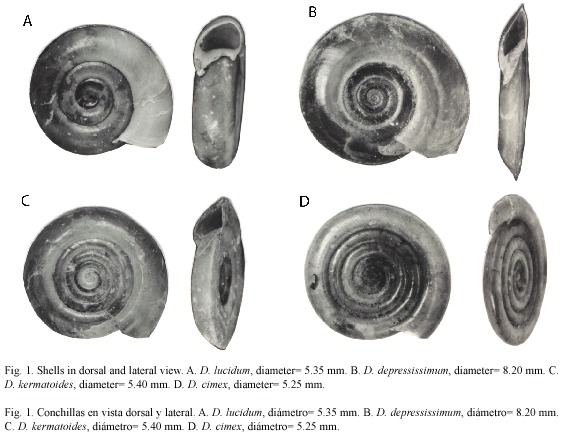
<body><![CDATA[<p><font face="Arial" size="2">The species of the genus <i>Drepanotrema </i>Fisher and Crosse, 1880; most of them endemic of the Neotropical Region and of a wide distribution, reach the northern part of the Nearctic Region (south of Texas, USA) (Baker 1945). In South America they form part of the most frequent freshwater snail associations and at present includes eight species. In spite of their abundance, the group has received scarce attention in relation with other genera of the Planorbidae family such as <i>Biomphalaria </i>due to its medical sanitary interest. Ecological aspects of <i>Drepanotrema </i>species are poorly known (Lévêque and Pointier 1976) and their morfo-anatomy and clasiffication have been scarcely revised (Baker 1945, Paraense and Deslandes 1958a, b and Paraense 1980, among others). </font></p>     <p><font face="Arial" size="2">They are as frequent as <i>Biomphalaria </i>species in the macrosystem of the Great Plata Basin. In this basin, six genera of Planorbidae are present: <i>Biomphalaria, Drepanotrema</i>, <i>Plesiophysa </i>Fischer, 1883; <i>Acrorbis </i>Odhner, 1937; <i>Antillorbis </i>Harry and Hubendick, 1964 and <i>Helisoma </i>Swaison, 1840. The first two include the greatest number of species and are widely distributed in Argentina. </font></p> <font face="Arial" size="2"><i></i></font>     <p><font face="Arial" size="2"><i>Drepanotrema </i>includes six species in Argentina. The life cycle of <i>D. depressissimum </i>(Moricand, 1839) and <i>D. lucidum </i>(Pfeiffer, 1839) (<a href="#fig1">Fig. 1</a>) in natural sytems has been little studied, except for observations by Bonetto <i>et al. </i>(1982, 1990), Hamman <i>et al. </i>(1993), Rumi (1991) and Rumi <i>et al</i>. (2002).    <br> </font></p>     <p style="text-align: center;"><font face="Arial" size="2"><a  name="fig1"></a><img src="/img/fbpe/rbt/v55n2/3651i1.JPG" title="" alt=""  style="width: 561px; height: 433px;">    
<br> </font></p>     <p><font face="Arial" size="2">The aims of our study were: 1- To analyze the age structure of <i>D. depressissimum </i>and <i>D. lucidum </i>in Paiva pond, Corrientes, Argentina. 2- To identify recruitment periods and individual growth trends. 3- To estimate cohort life spans. 4- To explore the methodologies of growth model fitting in different species and environments: Paiva pond and Isla Martín García Reserve (IMG) (<i>D. kermatoides </i>(d’Orbigny, 1835) and <i>D. cimex </i>(Moricand, 1839) (<a href="#fig1">Fig. 1</a>), in order to determine interspecific patterns. </font></p> <font face="Arial" size="2"><b>     <p>Materials and methods </p> </b> <b></b></font>     <p><font face="Arial" size="2"><b>Sites:</b> Paiva pond, Pampín Place (27º 30’ S, 58º 45’ W), belongs to the basin of Riachuelo River, one of the main affluent of the Middle Paraná River, Corrientes, Argentina. It is in wetlands located in a low and discontinuous area (Bonetto <i>et al</i>. 1978a, b). Aquatic vegetation is distributed in patches and at different depths. In the littoral zone, macrophytes were associated with <i>Drepanotrema </i>populations. Three types of macrophytes could be distinguished: rooted plants, eg. <i>Eleocharis minima</i>, <i>Scirpus cubensis</i>, <i>Ludwigia peploides </i>and <i>Hydrocotyle ranunculoides</i>; free-floating plants eg. <i>Salvinia herzogii, S. minima, Ricciocarpus natans, Azolla carolineana, Pistia stratiotes, Eichhornia azurea </i>and Lemnaceae (<i>Spirodella </i>sp., <i>Lemna </i>sp., <i>Wolffia </i>sp. and <i>Wolffiella </i>sp.); and submerged plants eg. <i>Cabomba australis, Potamogeton cf. illinoensis, Hydrocleys nymphoides, Nymphaea </i>sp. and <i>Utricularia oligosperma. </i></font></p> <font face="Arial" size="2"><b></b></font>     <p><font face="Arial" size="2"><b>Sampling strategy:</b> thirteen samples were taken between April 1986 and August 1987 in the littoral zone of Paiva pond. Snails were collected with a perforated dipper, 12.5 cm in diameter, and their relative abundance was estimated as number of individuals collected per hour. Size was measured by maximum shell diameter. Methodologies used for gastropod collection and for measurement of pH, conductivity, concentration and percentage of oxygen saturation, and water temperature are given by Rumi and Hamann (1992) and Hamann <i>et al. </i>(1993). </font></p> <font face="Arial" size="2"><b></b></font>     ]]></body>
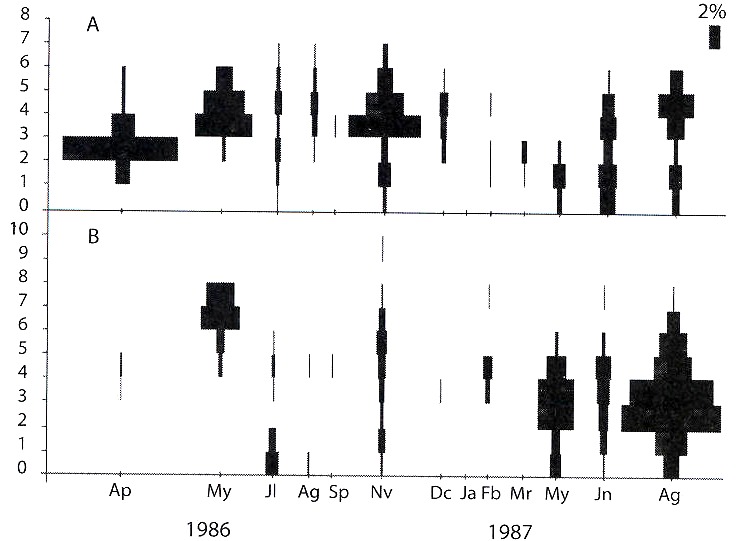
<body><![CDATA[<p><font face="Arial" size="2"><b>Age structure and growth rates:</b> for graphic representation of age structure relative to size, individual diameter data were grouped in 1 mm class interval and 7 age classes in <i>D. lucidum </i>(Museo de La Plata, La Plata, Argentina -MLP-, nº7388) and 10 age classes in <i>D. depressissimum </i>(MLP nº7389). Each cohort was assumed to be representative of one generation resulting from a specific reproductive period and its mean; standard deviation and number of individuals were calculated. </font></p>     <p><font face="Arial" size="2">Application of von Bertalanffy’s model was based on the methodology of Basso and Kehr (1991). Time corresponding to each sampling was calculated from the equation: t= [(m – 1) 30 + d] 360<sup>-1</sup>, where m= month and d= sampling date. Here, t= 1, approximately one year (1.002). The von Bertalanffy model was applied in both species: Lt= L<sub>max </sub>(1 -e<sup>–k (t-to)</sup>), where: Lt= size at time t; L<sub>max</sub>= asymptotic maximum size; to = hypothetic at time when size is equal to "zero"; t= time; k= constant growth rate. By linear transformation of the logarithmic equation we obtained: ln (1- (Lt)L<sub>max</sub><sup>-1</sup>) = -kt + kto (1). A regression equation between ln (1-(Lt)L<sub>max</sub><sup>-1</sup>) (dependent variable) and t (independent variable), was calculated. In (1), kto= origin of ordinate (a), to= (a)k<sup>-1</sup>, and the slope (b)= (–)k. Significant differences among regressions were estimated on the basis of their confidence limits. L <sub>max </sub>is the largest size found in individuals of each species. Theoretical curves obtained were compared, us</font><font face="Arial" size="2">ing a &#967;</font><sup><font  face="Arial" size="2">2 </font></sup><font face="Arial" size="2">test, to size found in nature. </font></p> <font face="Arial" size="2"><b></b></font>     <p><font face="Arial" size="2"><b>Interspecific comparisons:</b> to compare individual growth curves among species in different conditions, the results of Rumi <i>et al. </i>(2004) for <i>D. kermatoides </i>(MLP nº6798) and <i>D. cimex </i>(MLP nº6757), inhabiting environments of the IMG, Río de la Plata (34º11’ S; 58º15’ W), were included. In the model, fitness criteria were used: expected sizes according to the growth model were expressed into a percentage of their maximum size. In these cases, beginning of all cohorts were taken as "to"= 0 which allowed them to become independent of the real or estimated starting date for each cohort. </font></p> <font face="Arial" size="2"><b>     <p>Results </p> </b> <b></b></font>     <p><font face="Arial" size="2"><b>Analysis of <i>Drepanotrema </i>spp. age structures in the Paiva pond: <i>D. lucidum</i>:</b> a large percentage of individuals in the first two age classes (recruitment) and juveniles (age classes 3-4) were observed towards the end of autumn. High percentages of adults were also observed between autumn and spring (<a href="#fig2">Fig. 2</a>). </font></p>     <p style="text-align: center;"><span style="font-family: arial;"><a  name="fig2"></a><img src="/img/fbpe/rbt/v55n2/3651i2.JPG" title="" alt=""  style="width: 683px; height: 463px;">    
<br> </span></p>     <div style="text-align: left; margin-left: 80px;"><span  style="font-family: arial;"><small>Fig. 2. Age structures of <span  style="font-style: italic;">D. lucidum</span> (A) and <span style="font-style: italic;">D. depressissimum</span> (B).</small></span>    <br> <span style="font-family: arial;"><small>Fig. 2. Estructura de edades para <span style="font-style: italic;">D.</span></small></span><span  style="font-family: arial;"><small><span style="font-style: italic;"> lucidum</span> (A) y <span style="font-style: italic;">D. depressissimum</span> (B).</small></span><span  style="font-family: arial;"><small> </small></span></div>     <p><font face="Arial" size="2"><i>D. depressissimum</i>: a high percentage of individuals of the first sizes and adults were observed in autumn and spring. In winter, all age classes were present, dominated by individuals of age classes 3 and 4 (<a href="#fig2">Fig. 2</a>). </font></p>     ]]></body>
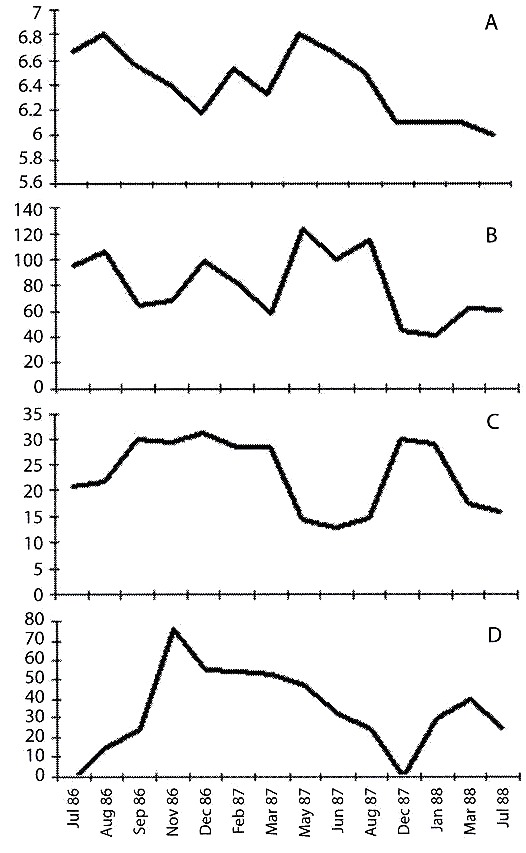
<body><![CDATA[<p><font face="Arial" size="2">Conductivity varied throug</font><font  face="Arial" size="2">h the year (40 to 130 &#956;S cm</font><sup><font  face="Arial" size="2">-1</font></sup><font face="Arial" size="2">). The percentage of oxygen saturation fluctuated with no defined seasonal pattern. pH was slightly below neutral. Water temperatures were never below 10 ºC (<a href="#fig3">Fig. 3A, B, C, D</a>). </font></p>     <p style="text-align: center;"><font face="Arial" size="2">&nbsp;<a  name="fig3"></a><img src="/img/fbpe/rbt/v55n2/3651i3.JPG" title="" alt=""  style="width: 472px; height: 766px;">    
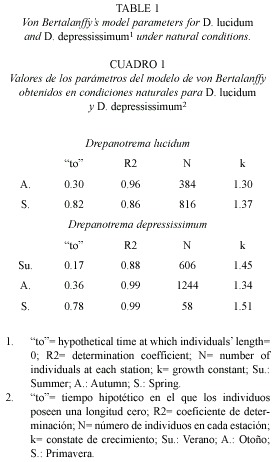
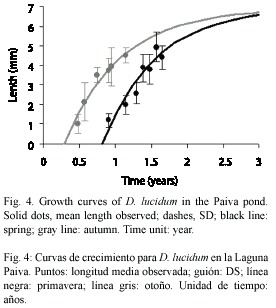
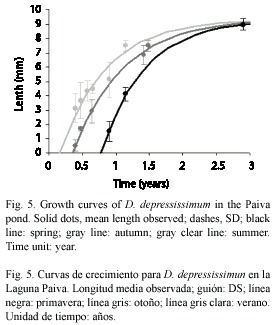
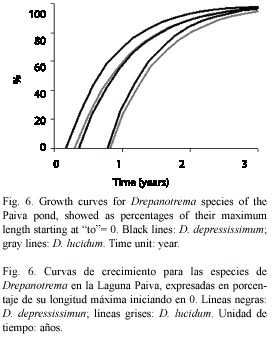
<br> </font></p>     <div style="text-align: left; margin-left: 160px;"><font face="Arial"  size="2">Fig. 3. A. pH; B. conductivity (µS cm<sup>-1</sup>); C. percentage of dissolved oxygen; and D.     <br> temperature values </font><font face="Arial" size="2">(ºC), recorded in the Paiva pond.</font>    <br> <font face="Arial" size="2">Fig. 3. A. pH; B.&nbsp; conductividad</font><font  face="Arial" size="2"> (µS cm<sup>-1</sup>); C. porcentaje de osígeno disuelto; y D.&nbsp;     <br> temperatura (ºC), </font><font face="Arial" size="2">regristradas en la laguna Paiva.</font><font face="Arial" size="2"> </font></div> <font face="Arial" size="2"><b></b></font>     <p><font face="Arial" size="2"><b>Growth analysis:</b> maximum size observed for <i>D. lucidum </i>was 6.9 and 9.38 mm for <i>D. depressissimum</i>. The growth model fitted well (p&gt;0.05) for the cohorts of both species (<i>D. lucidum</i></font><font face="Arial"  size="2">: autumn: &#967;</font><sup><font face="Arial" size="2">2</font></sup><font  face="Arial" size="2">: 0.0672, df: 5; spring: &#967;</font><sup><font  face="Arial" size="2">2</font></sup><font face="Arial" size="2">: 0.3580, df: 6; <i>D. depressissimum</i></font><font face="Arial"  size="2">: summer: &#967;</font><sup><font face="Arial" size="2">2</font></sup><font  face="Arial" size="2">: 0.2250, df: 5; autumn: &#967;</font><sup><font  face="Arial" size="2">2</font></sup><font face="Arial" size="2">: 0</font><font  face="Arial" size="2">.0725, df: 4; spring: &#967;</font><sup><font  face="Arial" size="2">2</font></sup><font face="Arial" size="2">: 0.0111, df: 2). Determination coefficients (R<sup>2</sup>) for each cohort were higher than 0.86 (<a href="#table1">Table 1</a>). The curves did not show statistically significant differences, according to the confidence limits (p&gt;0.05) obtained of each regression equation (where k= -b). However, growth rates of spring cohorts, for both species, were higher (<a href="#fig4">Fig. 4</a>, <a href="#fig5">5</a> and <a href="#fig6">6</a>). </font></p>     <div style="text-align: center;"><a name="table1"></a><img  src="/img/fbpe/rbt/v55n2/3651i4.JPG" title="" alt=""  style="width: 276px; height: 462px;">    
<br>     ]]></body>
<body><![CDATA[<br> <a name="fig4"></a><img src="/img/fbpe/rbt/v55n2/3651i6.JPG" title="" alt=""  style="width: 276px; height: 308px;">    
<br>     <br> <a name="fig5"></a><img src="/img/fbpe/rbt/v55n2/3651i7.JPG" title="" alt=""  style="width: 274px; height: 325px;">    
<br>     <br> <a name="fig6"></a><img src="/img/fbpe/rbt/v55n2/3651i8.JPG" title="" alt=""  style="width: 273px; height: 338px;">    
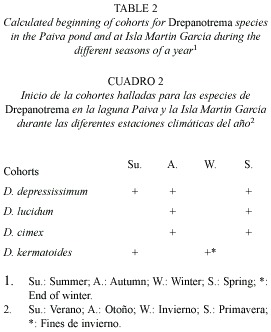
<br>     <br> </div>     <p><font face="Arial" size="2"><b>Rates and interspecific growth patterns:</b> winter cohorts were not observed (<a href="#table2">Table 2</a>), except for a population of <i>D. kermatoides </i>(IMG) found towards the end of winter. There were no statistically significant differences in growth rhythm among species in Paiva pond and the IMG habitats, independently of the start of the cohorts and their maximum size. IMG conductivity dat</font><font face="Arial" size="2">a (<a href="#fig7">Fig. 7</a>) were divided into two groups, given the differences between the mean values of the different environments: Group 1 (&gt;650 &#956;S cm</font><sup><font  face="Arial" size="2">-1</font></sup><font face="Arial" size="2">, Tank and Big Quarries) and Group 2 (&lt;500 &#956;S cm</font><sup><font  face="Arial" size="2">-1</font></sup><font face="Arial" size="2">, Rubbish and Buoy Quarries, Intangible Zone and Stream). values from the second group are similar to those observed in IMG coastal waters as Río de la Plata (85 to 143.2 &#956;S cm<sup>-1</sup></font><font face="Arial"  size="2">) and in the Paiva pond (31 to 270 &#956;S cm</font><sup><font  face="Arial" size="2">-1</font></sup><font face="Arial" size="2">). Highest growth rates for <i>Drepanotrema </i>were observed in <i>D. cimex </i>and <i>D. kermatoides, </i>environments with the highest conductivity at IMG (Group 1), where oxygen concentration (0.2-2 mg l<sup>-1</sup>) and oxygen availability were low.</font></p>     <p><font face="Arial" size="2">    <br> </font></p>     ]]></body>
<body><![CDATA[<div style="text-align: center;"><a name="table2"></a><img  src="/img/fbpe/rbt/v55n2/3651i5.JPG" title="" alt=""  style="width: 271px; height: 332px;">    
<br> </div>     <p><font face="Arial" size="2"> </font></p>     <p style="text-align: center;"><font face="Arial" size="2">&nbsp;    <br> </font></p>     <div style="text-align: center;"><a name="fig7"></a><img  src="/img/fbpe/rbt/v55n2/3651i9.JPG" title="" alt=""  style="width: 463px; height: 750px;">    
<br>     <div style="text-align: left; margin-left: 200px;"><small><span  style="font-family: arial;">Fig. 7. Comparison of environmental parameters between the Paiva pond     <br> (dashed) and Isla </span></small><small><span  style="font-family: arial;">Martín García (continuous lines). For sonductivities, IMG     <br> data were divided into two groups: </span></small><small><span  style="font-family: arial;">solid triangles Group 1 IMG and solid     ]]></body>
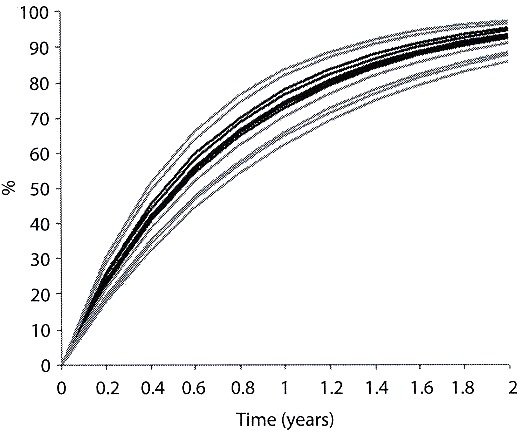
<body><![CDATA[<br> squares Group 2 IMG.</span></small>    <br> <small><span style="font-family: arial;">Fig. 7. Comparación de parámetros ambientales entre la Laguna Paiva     <br> (líneas entrecortadas) y la Isla </span></small><small><span  style="font-family: arial;">Martín García (líneas continuas). Para las     <br> conductividades los datos de la IMG se dividieron en dos </span></small><small><span  style="font-family: arial;">grupos: triángulos:     <br> Grupo 1&nbsp; IMG&nbsp; y cuadrados Grupo 2 IMG.</span></small>    <br> <small><span style="font-family: arial;"></span></small></div> </div>     <p><font face="Arial" size="2">Comparing circannual and biannual growth rhythms (showed as percentages) (<a href="#fig8">Fig. 8</a>) we found that most species reached 60 % of their development at an age of one year (<i>D. lucidum</i>: between 72.8-74.5 %; <i>D. depressissimum</i>: 73.8-77.8 %; <i>D. kermatoides</i>: 62.5-81.7 % and <i>D. cimex</i>: 64.8-83.9 %), and 85 % of their development or more at an age of two years (<i>D. lucidum: </i>92.6-93.5 %; <i>D. depressissimum</i>: 93.1-95.1 %; <i>D. kermatoides</i>: 85.9-96.6 % and <i>D. cimex</i>: 87.6-97.3 %). </font></p>     <div style="text-align: center;">    <br> <a name="fig8"></a><img src="/img/fbpe/rbt/v55n2/3651i10.JPG" title="" alt=""  style="width: 529px; height: 437px;">    
<br>     ]]></body>
<body><![CDATA[<div style="text-align: left; margin-left: 160px;"><small><span  style="font-family: arial;">Fig. 8. Growth curves of the different&nbsp; seasonal cohorts for the species of Drepanotrema     <br> (D. lucidum; </span></small><small><span style="font-family: arial;">D. depressissimum; D. kermatoides and D. cimex) inhabiting Paiva pond     <br> (black lines) and IMG </span></small><small><span  style="font-family: arial;">(gray lines).&nbsp; On the ordinates, the percentage relationship of     <br> expected sizes and maximum length, </span></small><small><span  style="font-family: arial;">according&nbsp; to the growth model at each time unit     <br> (year), is indicated. Cohorts start at "to"=0.</span></small>    <br> <small><span style="font-family: arial;">Fig. 8. Curvas de crecimiento de las distintas cohortes estacionales para las especies     <br> de </span></small><small><span style="font-family: arial;">Drepanotrema </span></small><small><span style="font-family: arial;">(D. lucidum;&nbsp; D. depressissimum; D. kermatoides and D. cimex) que     <br> habitan la laguna Paiva </span></small><small><span  style="font-family: arial;">(líneas negras)&nbsp; e IMG (líneas grises). En las ordenadas se indica     <br> la relación porcentual </span></small><small><span  style="font-family: arial;">respecto&nbsp; a la talla y la&nbsp; longitud máxima de acuerdo con el modelo     <br> de crecimiento en cada </span></small><small><span  style="font-family: arial;">unidad de tiempo ( años).&nbsp;&nbsp; El inicio de todas las cohortes fueron     ]]></body>
<body><![CDATA[<br> llevadas a 0.</span></small><font face="Arial" size="2">&nbsp;</font></div> </div> <font face="Arial" size="2"><b>     <p>Discussion </p> </b> </font>     <p><font face="Arial" size="2">In Paiva pond the constantly high environmental temperature (above 20 ºC) and partial seasonal desiccation (Rumi and Hamann 1992) inhibited reproduction. In January, no snails were found, and in February, they were scarce. Predominant size in both species corresponded to adult specimens. Moreover, estimated starting times of cohorts of both species showed a tendency towards asynchronous displacement, allowing to alternate recruitment periods. This strategy may decrease competition for plant substrate that functions as food and as oviposition sites. <i>D. depressissimum </i>showed a longer period of recruitment than <i>D. lucidum</i>, which may be considered more independent from the seasons. </font></p> <font face="Arial" size="2"><i></i></font>     <p><font face="Arial" size="2"><i>D. kermatoides </i>showed high tolerance to environmental stress and an affinity for free-floating macrophytes at the Big Quarry (IMG), in agreement with observations in urban environments of Chaco (Rumi <i>et al</i>. 2002). Specific dat</font><font  face="Arial" size="2">a on ammonium and phosphorus (220-375 &#956;g l</font><sup><font  face="Arial" size="2">-1 </font></sup><font face="Arial" size="2">and 1 020-2 630 &#956;g l</font><sup><font face="Arial" size="2">-1 </font></sup><font  face="Arial" size="2">, respectively) and low nitrates (4-14 &#956;g l</font><sup><font  face="Arial" size="2">-1</font></sup><font face="Arial" size="2">), indicate a prevalence of decomposition of the dense macrophyte cover. </font></p>     <p><font face="Arial" size="2">Highest growth rates were observed in <i>D. kermatoides </i>and <i>D. cimex </i>cohorts from IMG towards the end of spring and beginning of summer (k= 1.7-1.8). Species of the Paiva (<i>D. lucidum </i>and <i>D. depressissimum</i>) showed growth rhythms near medium values (k: 1.31.5). Comparing environments close to the coast of IMG and to the Paiva pond (<a href="#fig8">Fig. 8</a>) we found that in Paiva, growth rates were higher. However, here mean conductivities were lower through the year than those of IMG. At similar conductivity values, a higher temperature and more available oxygen contribute to a higher growth rate, as observed in Paiva. However, extreme summer temperatures produced an important desiccation and a strong regulating effect of <i>Drepanotrema </i>populations (see in <a href="#fig2">Fig. 2</a>, absence of snails in January). In summary, apart from <i>D. kermatoides</i>, the species could not endure environmental stress. Accelerated growth-rates in the first year, could be a strategy to decrease the negative effects of degrading environmental processes. The Paiva could be considered as more favorable for growth and population development since summer desiccation is restricted. </font></p>     <p><font face="Arial" size="2">In Guadalupe (West Indies), Lévèque and Pointier (1976) observed that two sampling stations had a water temperature of 25-27 ºC. One was inhabited by <i>D. depressissimum </i>and the other by <i>D. lucidum</i>. Both <i>Drepanotrema </i>spp. showed high growth rates and become almost fully grown in one month. Both <i>Drepanotrema </i>spp<i>. </i>have natural populations from Caribbean areas to the Argentinian Mesopotamia Region. <i>D. depressissimum </i>reaches the southern distribution at Buenos Aires province, Argentina (Baker 1945, Rumi <i>et al</i>. 1997). The annual average temperature in Paiva pond is about 24 ºC (Range= 11 to 31 ºC), although it reaches high water temperatures (about 30 ºC). It shows large annual fluctuations, and if the temperature gradient is correlated with growth trends, the growth of <i>D. depressissimum </i>and <i>D. lucidum </i>populations is expected to be slower in southern areas than in tropical areas. </font></p>     <p><font face="Arial" size="2">On the other hand, a similar time scale was used to compare k values, because they are sensitive to that scale. Most of the scales used are in weeks (52 per year), months (12 per year) or year fractions (1 year= 1). For example, using the same population data, we obtained: for a weekly scale, k= 0.0216; for a monthly scale, k= 0.09 and for year fractions scale, k= 1.1366. These k values are not comparable. However, if growth is expressed as percentages of the maximum size, comparisons can be done. In our example, independently of the scale used, the population reached 67 % of its maximum size during the first year. In this way, this last evaluation allows better comparisons among species, with different sizes and from different environments. </font></p> <font face="Arial" size="2"><b>     <p>Acknowledgments </p> </b> </font>     <p><font face="Arial" size="2">Research was supported by Facultad de Ciencias Naturales y Museo, Universidad Nacional de La Plata, Agency of Scientific Promotion (BID 1201/OC-AR PICT 01-03453) and Consejo Nacional de Investigaciones Científicas y Técnicas (CONICET) (PIP 2711), Argentina. We specially thank D. Taylor for checking the English and for suggestions. </font></p> <font face="Arial" size="2"><b>     <p>Resumen </p> </b> </font>     ]]></body>
<body><![CDATA[<p><font face="Arial" size="2">En Argentina se encuentran seis especies del género <i>Drepanotrema</i>. El ciclo de vida en sistemas naturales de <i>Drepanotrema depressissimu </i>y <i>D. lucidum </i>ha sido muy poco estudiado, excepto por algunas observaciones aisladas. El objetivo de este estudio es analizar las principales tendencias de la población en la Laguna Paiva, Argentina. Usamos modelos de crecimiento y metodologías comparativas entre las especies y los ambientes en Paiva y la isla Martín García (IMG). Además, las curvas teóricas del modelo de von Bertalanffy para cada población fueron contrastadas con las muestras utilizando la prueba &#967;<sup>2</sup>. Los tamaños esperados fueron transformados en porcentajes de tamaño máximo y las cohortes se iniciaron a partir del tiempo cero, lo cual les permitió ser independientes de la fecha inicial real o estimada y con ello ser comparables. Se utilizó una escala de tiempo similar debido a que los valores de k demostraron ser sensibles a la escala de tiempo. El tamaño máximo alcanzado por <i>D. lucidum </i>fue de 6.9 mm y por <i>D. depressissimun </i>fue de 9.38 mm. Las tasas de crecimiento (k) fluctuaron de 1.302-1.368 en la primera especie y 1.339-1.509 para la segunda especie. No fueron encontradas diferencias significativas en las curvas de crecimiento entre las especies que habitaban en Paiva ni en los diferentes cuerpos de agua de IMG, independientes del inicio de cada cohorte y del tamaño máximo. En general no se observaron cohortes de invierno, excepto en una población de <i>D. kermatoides </i>(IMG). Al comparar los ritmos de crecimiento anuales y semestrales, la mayoría de las especies alcanzaron el 60 % de su desarrollo durante el primer año y el 85 % ó más durante su segundo año. </font></p> <font face="Arial" size="2"><b></b></font>     <p><font face="Arial" size="2"><b>Palabras clave:</b> tasa de crecimiento, <i>Drepanotrema </i>spp., Planorbidae, Argentina, Cuenca del Plata. </font></p> <font face="Arial" size="2"><b>     <p>References </p> </b> </font>     <!-- ref --><p><font face="Arial" size="2">Baker, F.C. 1945. The Molluscan Family Planorbidae. Illinois, Illinois, USA. 530 p. </font>&nbsp;&nbsp;&nbsp;&nbsp;&nbsp;&nbsp;&nbsp;&nbsp;[&#160;<a href="javascript:void(0);" onclick="javascript: window.open('/scielo.php?script=sci_nlinks&ref=1243249&pid=S0034-7744200700020001700001&lng=','','width=640,height=500,resizable=yes,scrollbars=1,menubar=yes,');">Links</a>&#160;]<!-- end-ref --><!-- ref --><p><font face="Arial" size="2">Baluku, B. &amp; M. Loreau. 1989. Étude comparative de la dynamique des populations de <i>Biomphalaria pfeifferi </i>(Gastropoda: Planorbidae) dans deux cours d’eau du Zaïre oriental. Rev. Zool. Afr. 103: 311-325. </font>&nbsp;&nbsp;&nbsp;&nbsp;&nbsp;&nbsp;&nbsp;&nbsp;[&#160;<a href="javascript:void(0);" onclick="javascript: window.open('/scielo.php?script=sci_nlinks&ref=1243250&pid=S0034-7744200700020001700002&lng=','','width=640,height=500,resizable=yes,scrollbars=1,menubar=yes,');">Links</a>&#160;]<!-- end-ref --><!-- ref --><p><font face="Arial" size="2">Basso, N.G. &amp; A.I. Kehr. 1991. Postmetamorphic growth and population structure of the frog <i>Leptodactylus latinasus </i>(Anura: Leptodactylidae). Stud. Neotrop. Fauna Envir. 26: 39-44. </font>&nbsp;&nbsp;&nbsp;&nbsp;&nbsp;&nbsp;&nbsp;&nbsp;[&#160;<a href="javascript:void(0);" onclick="javascript: window.open('/scielo.php?script=sci_nlinks&ref=1243251&pid=S0034-7744200700020001700003&lng=','','width=640,height=500,resizable=yes,scrollbars=1,menubar=yes,');">Links</a>&#160;]<!-- end-ref --><!-- ref --><p><font face="Arial" size="2">Boltovskoy, D. &amp; D.H. Cataldo. 1999. Population dynamics of <i>Limnoperna fortunei</i>, an invasive fouling mollusc, in the lower Paraná River (Argentina). Biofouling 14: 255-263. </font>&nbsp;&nbsp;&nbsp;&nbsp;&nbsp;&nbsp;&nbsp;&nbsp;[&#160;<a href="javascript:void(0);" onclick="javascript: window.open('/scielo.php?script=sci_nlinks&ref=1243252&pid=S0034-7744200700020001700004&lng=','','width=640,height=500,resizable=yes,scrollbars=1,menubar=yes,');">Links</a>&#160;]<!-- end-ref --><!-- ref --><p><font face="Arial" size="2">Bonetto, A.A., M.A. Corrales, M.E. varela, M.M. Rivero, C.A. Bonetto, R.E. vallejos &amp; Y. Zalokar. 1978a. Estudios limnológicos en la cuenca del Riachuelo. II. Laguna Totoras y González. Ecosur 5: 17-55. </font>&nbsp;&nbsp;&nbsp;&nbsp;&nbsp;&nbsp;&nbsp;&nbsp;[&#160;<a href="javascript:void(0);" onclick="javascript: window.open('/scielo.php?script=sci_nlinks&ref=1243253&pid=S0034-7744200700020001700005&lng=','','width=640,height=500,resizable=yes,scrollbars=1,menubar=yes,');">Links</a>&#160;]<!-- end-ref --><!-- ref --><p><font face="Arial" size="2">Bonetto, A.A., D. Roldán &amp; M.E. Oliver. 1978b. Estudios limnológicos en la cuenca del Riachuelo (Corrientes, Argentina). I. Poblaciones de peces en ambientes leníticos y lóticos. Ecosur 5: 1-15. </font>&nbsp;&nbsp;&nbsp;&nbsp;&nbsp;&nbsp;&nbsp;&nbsp;[&#160;<a href="javascript:void(0);" onclick="javascript: window.open('/scielo.php?script=sci_nlinks&ref=1243254&pid=S0034-7744200700020001700006&lng=','','width=640,height=500,resizable=yes,scrollbars=1,menubar=yes,');">Links</a>&#160;]<!-- end-ref --><!-- ref --><p><font face="Arial" size="2">Bonetto, A.A., J.A. Bechara &amp; M.P. Tassara. 1982. Los moluscos de la familia Planorbidae en el área del río Paraná medio. Physis sec. B 41: 1-6. </font>&nbsp;&nbsp;&nbsp;&nbsp;&nbsp;&nbsp;&nbsp;&nbsp;[&#160;<a href="javascript:void(0);" onclick="javascript: window.open('/scielo.php?script=sci_nlinks&ref=1243255&pid=S0034-7744200700020001700007&lng=','','width=640,height=500,resizable=yes,scrollbars=1,menubar=yes,');">Links</a>&#160;]<!-- end-ref --><!-- ref --><p><font face="Arial" size="2">Bonetto, A.A., A. Rumi &amp; M.P. Tassara. 1990. Notas sobre el conocimiento limnológico de los gasterópodos paranenses y sus relaciones tróficas. II. Planorbidae, con aspectos distribucionales y sanitarios. Ecosur 16: 69-84. </font>&nbsp;&nbsp;&nbsp;&nbsp;&nbsp;&nbsp;&nbsp;&nbsp;[&#160;<a href="javascript:void(0);" onclick="javascript: window.open('/scielo.php?script=sci_nlinks&ref=1243256&pid=S0034-7744200700020001700008&lng=','','width=640,height=500,resizable=yes,scrollbars=1,menubar=yes,');">Links</a>&#160;]<!-- end-ref --><!-- ref --><p><font face="Arial" size="2">Cataldo, D. &amp; D. Boltovskoy. 1999. Population dynamics of <i>Corbicula fluminea </i>(Bivalvia) in the Paraná river delta (Argentina). Hydrobiologia 380: 153-163. </font>&nbsp;&nbsp;&nbsp;&nbsp;&nbsp;&nbsp;&nbsp;&nbsp;[&#160;<a href="javascript:void(0);" onclick="javascript: window.open('/scielo.php?script=sci_nlinks&ref=1243257&pid=S0034-7744200700020001700009&lng=','','width=640,height=500,resizable=yes,scrollbars=1,menubar=yes,');">Links</a>&#160;]<!-- end-ref --><!-- ref --><p><font face="Arial" size="2">Colautti, D.C. 1997. Ecología de la carpa <i>Cyprinus carpio</i>, en la cuenca del Río Salado, Provincia de Buenos Aires. Tesis de doctorado, Universidad Nacional de La Plata, Buenos Aires, Argentina. </font>&nbsp;&nbsp;&nbsp;&nbsp;&nbsp;&nbsp;&nbsp;&nbsp;[&#160;<a href="javascript:void(0);" onclick="javascript: window.open('/scielo.php?script=sci_nlinks&ref=1243258&pid=S0034-7744200700020001700010&lng=','','width=640,height=500,resizable=yes,scrollbars=1,menubar=yes,');">Links</a>&#160;]<!-- end-ref --><!-- ref --><p><font face="Arial" size="2">Costil, K. &amp; J. Daguzan. 1995. Comparative life cycle and growth of two freshwater gastropod species, <i>Planorbarius corneus </i>(L.) and <i>Planorbis planorbis </i>(L.). Malacologia 37: 53-68. </font>&nbsp;&nbsp;&nbsp;&nbsp;&nbsp;&nbsp;&nbsp;&nbsp;[&#160;<a href="javascript:void(0);" onclick="javascript: window.open('/scielo.php?script=sci_nlinks&ref=1243259&pid=S0034-7744200700020001700011&lng=','','width=640,height=500,resizable=yes,scrollbars=1,menubar=yes,');">Links</a>&#160;]<!-- end-ref --><!-- ref --><p><font face="Arial" size="2">Darrigran, G. &amp; M.E. Maroñas. 1989. Crecimiento de las poblaciones naturales de <i>Corbicula fluminea </i>(Muller, 1774) y <i>C. largillierti </i>(Philippi, 1844) (Bivalvia: Sphaeriacea) en el litoral de Punta Blanca, estuario de Río de la Plata, República Argentina. Com. Soc. Malac. Urug. 56-57: 139-157. </font>&nbsp;&nbsp;&nbsp;&nbsp;&nbsp;&nbsp;&nbsp;&nbsp;[&#160;<a href="javascript:void(0);" onclick="javascript: window.open('/scielo.php?script=sci_nlinks&ref=1243260&pid=S0034-7744200700020001700012&lng=','','width=640,height=500,resizable=yes,scrollbars=1,menubar=yes,');">Links</a>&#160;]<!-- end-ref --><!-- ref --><p><font face="Arial" size="2">Eleutheriadis, N. &amp; M. Lazaridou-Dimitriadou. 1995. The life cycle, population dynamics, growth and secondary production of the snail <i>Viviparus contectus </i>(Millet) (Gastropoda: Prosobranchia) in the marshes of the river Strymonas, Serres, Macedonia, Northern Greece. Malacologia 37: 41-52. </font>&nbsp;&nbsp;&nbsp;&nbsp;&nbsp;&nbsp;&nbsp;&nbsp;[&#160;<a href="javascript:void(0);" onclick="javascript: window.open('/scielo.php?script=sci_nlinks&ref=1243261&pid=S0034-7744200700020001700013&lng=','','width=640,height=500,resizable=yes,scrollbars=1,menubar=yes,');">Links</a>&#160;]<!-- end-ref --><!-- ref --><p><font face="Arial" size="2">Ferrer, J., G. Perera, M. Yong Cong &amp; O. Amador. 1989. Life tables of <i>Fossaria cubensis </i>and <i>Pseudosuccinea columella</i>, intermediate hosts of <i>Fasciola hepatica </i>in Cuba. J. Med. Appl. Malacol. 1: 189-194. </font>&nbsp;&nbsp;&nbsp;&nbsp;&nbsp;&nbsp;&nbsp;&nbsp;[&#160;<a href="javascript:void(0);" onclick="javascript: window.open('/scielo.php?script=sci_nlinks&ref=1243262&pid=S0034-7744200700020001700014&lng=','','width=640,height=500,resizable=yes,scrollbars=1,menubar=yes,');">Links</a>&#160;]<!-- end-ref --><!-- ref --><p><font face="Arial" size="2">Hamman, M.I., A. Rumi &amp; M. Ostrowski de Núñez. 1993. Aspectos biológicos sobre los parásitos y la dinámica poblacional de <i>Drepanotrema </i>spp. (Mollusca, Planorbidae) en un biotopo lenítico del nordeste argentino. Amb. Subtrop. 3: 19-38. </font>&nbsp;&nbsp;&nbsp;&nbsp;&nbsp;&nbsp;&nbsp;&nbsp;[&#160;<a href="javascript:void(0);" onclick="javascript: window.open('/scielo.php?script=sci_nlinks&ref=1243263&pid=S0034-7744200700020001700015&lng=','','width=640,height=500,resizable=yes,scrollbars=1,menubar=yes,');">Links</a>&#160;]<!-- end-ref --><!-- ref --><p><font face="Arial" size="2">Ituarte, C.F. 1985. Growth dynamics in a natural population of <i>Corbicula fluminea </i>(Bivalvia: Sphaeriacea) at Punta Atalaya, Río de la Plata, Argentina. Stud. Neotrop. Fauna Envir. 20: 217-225. </font>&nbsp;&nbsp;&nbsp;&nbsp;&nbsp;&nbsp;&nbsp;&nbsp;[&#160;<a href="javascript:void(0);" onclick="javascript: window.open('/scielo.php?script=sci_nlinks&ref=1243264&pid=S0034-7744200700020001700016&lng=','','width=640,height=500,resizable=yes,scrollbars=1,menubar=yes,');">Links</a>&#160;]<!-- end-ref --><!-- ref --><p><font face="Arial" size="2">Lévêque, C. &amp; J.P. Pointier. 1976. Study of the growth of <i>Biomphalaria glabrata </i>(Say) and other Planorbidae in Guadalupe (West Indies). Ann. Trop. Med. Parasitol. 70: 199-204. </font>&nbsp;&nbsp;&nbsp;&nbsp;&nbsp;&nbsp;&nbsp;&nbsp;[&#160;<a href="javascript:void(0);" onclick="javascript: window.open('/scielo.php?script=sci_nlinks&ref=1243265&pid=S0034-7744200700020001700017&lng=','','width=640,height=500,resizable=yes,scrollbars=1,menubar=yes,');">Links</a>&#160;]<!-- end-ref --><!-- ref --><p><font face="Arial" size="2">Paraense, W.L. 1980. <i>Drepanotrema cimex</i>: synonimy, variation and geographical distributions (Mollusca: Planorbidae). Rev. Brasil. Biol. R. J. 40: 101-113. </font>&nbsp;&nbsp;&nbsp;&nbsp;&nbsp;&nbsp;&nbsp;&nbsp;[&#160;<a href="javascript:void(0);" onclick="javascript: window.open('/scielo.php?script=sci_nlinks&ref=1243266&pid=S0034-7744200700020001700018&lng=','','width=640,height=500,resizable=yes,scrollbars=1,menubar=yes,');">Links</a>&#160;]<!-- end-ref --><!-- ref --><p><font face="Arial" size="2">Paraense, W.L. &amp; N. Deslandes. 1958a. The Brazilian species of "<i>Drepanotrema</i>". Iv. "<i>D. cimex</i>" (Moricand, 1837). Rev. Brasil. Biol. R. J. 18: 187-192. </font>&nbsp;&nbsp;&nbsp;&nbsp;&nbsp;&nbsp;&nbsp;&nbsp;[&#160;<a href="javascript:void(0);" onclick="javascript: window.open('/scielo.php?script=sci_nlinks&ref=1243267&pid=S0034-7744200700020001700019&lng=','','width=640,height=500,resizable=yes,scrollbars=1,menubar=yes,');">Links</a>&#160;]<!-- end-ref --><!-- ref --><p><font face="Arial" size="2">Paraense, W.L. &amp; N. Deslandes. 1958b. The Brazilian species of "<i>Drepanotrema</i>". vI. "<i>D. kermatoides</i>" (Orbigny, 1835). Rev. Brasil. Biol. R. J. 18: 293-299. </font>&nbsp;&nbsp;&nbsp;&nbsp;&nbsp;&nbsp;&nbsp;&nbsp;[&#160;<a href="javascript:void(0);" onclick="javascript: window.open('/scielo.php?script=sci_nlinks&ref=1243268&pid=S0034-7744200700020001700020&lng=','','width=640,height=500,resizable=yes,scrollbars=1,menubar=yes,');">Links</a>&#160;]<!-- end-ref --><!-- ref --><p><font face="Arial" size="2">Perera de Puga, G., J.P. Pointier, M. Yong Cong &amp; J.L. Ferrer Lopez. 1991. Comparación del crecimiento de dos especies de <i>Pomacea </i>del área antillana, útiles como agente de control de enfermedades tropicales. Rev. Cubana Med. Trop. 43: 36-38. </font>&nbsp;&nbsp;&nbsp;&nbsp;&nbsp;&nbsp;&nbsp;&nbsp;[&#160;<a href="javascript:void(0);" onclick="javascript: window.open('/scielo.php?script=sci_nlinks&ref=1243269&pid=S0034-7744200700020001700021&lng=','','width=640,height=500,resizable=yes,scrollbars=1,menubar=yes,');">Links</a>&#160;]<!-- end-ref --><!-- ref --><p><font face="Arial" size="2">Pretorius, S.J., K.N. de Kock &amp; P. Joubert. 1992. Evidence that population growth of the freshwater snail <i>Bulinus africanus </i>is density limited in a natural habitat. J. Med. Appl. Malacol. 4: 113-120. </font>&nbsp;&nbsp;&nbsp;&nbsp;&nbsp;&nbsp;&nbsp;&nbsp;[&#160;<a href="javascript:void(0);" onclick="javascript: window.open('/scielo.php?script=sci_nlinks&ref=1243270&pid=S0034-7744200700020001700022&lng=','','width=640,height=500,resizable=yes,scrollbars=1,menubar=yes,');">Links</a>&#160;]<!-- end-ref --><!-- ref --><p><font face="Arial" size="2">Rumi, A. 1991. La familia Planorbidae Rafinisque, 1815, en la República Argentina, p. 1-51. <i>In </i>Z. Castellanos (ed.). Fauna de Agua Dulce de la República Argentina. PROFADU (CONICET), Buenos Aires, Argentina. </font>&nbsp;&nbsp;&nbsp;&nbsp;&nbsp;&nbsp;&nbsp;&nbsp;[&#160;<a href="javascript:void(0);" onclick="javascript: window.open('/scielo.php?script=sci_nlinks&ref=1243271&pid=S0034-7744200700020001700023&lng=','','width=640,height=500,resizable=yes,scrollbars=1,menubar=yes,');">Links</a>&#160;]<!-- end-ref --><!-- ref --><p><font face="Arial" size="2">Rumi, A. &amp; M.I. Hamann. 1992. Spatial and seasonal trends of a natural population of <i>Biomphalaria occidentalis </i>in northeastern Argentina. Mem. Inst. Oswaldo Cruz 87: 181-186.</font>&nbsp;&nbsp;&nbsp;&nbsp;&nbsp;&nbsp;&nbsp;&nbsp;[&#160;<a href="javascript:void(0);" onclick="javascript: window.open('/scielo.php?script=sci_nlinks&ref=1243272&pid=S0034-7744200700020001700024&lng=','','width=640,height=500,resizable=yes,scrollbars=1,menubar=yes,');">Links</a>&#160;]<!-- end-ref --><p><font face="Arial" size="2"> </font></p>     <!-- ref --><p><font face="Arial" size="2">Rumi, A., M.P. Tassara &amp; A.A. Bonetto. 1997. Distribución de las especies de Planorbidae en Argentina y su relación con el riesgo de esquistosomiasis. Ecosur 17: 1-19 </font>&nbsp;&nbsp;&nbsp;&nbsp;&nbsp;&nbsp;&nbsp;&nbsp;[&#160;<a href="javascript:void(0);" onclick="javascript: window.open('/scielo.php?script=sci_nlinks&ref=1243274&pid=S0034-7744200700020001700025&lng=','','width=640,height=500,resizable=yes,scrollbars=1,menubar=yes,');">Links</a>&#160;]<!-- end-ref --><!-- ref --><p><font face="Arial" size="2">Rumi, A., J.A. Bechara, M.I. Hamann &amp; M. Ostrowski de Núñez. 2002. Ecology of potential hosts of schistosomiasis in anthropic environments of Chaco, Argentina. Malacologia 44: 273-288. </font>&nbsp;&nbsp;&nbsp;&nbsp;&nbsp;&nbsp;&nbsp;&nbsp;[&#160;<a href="javascript:void(0);" onclick="javascript: window.open('/scielo.php?script=sci_nlinks&ref=1243275&pid=S0034-7744200700020001700026&lng=','','width=640,height=500,resizable=yes,scrollbars=1,menubar=yes,');">Links</a>&#160;]<!-- end-ref --><!-- ref --><p><font face="Arial" size="2">Rumi, A., D. Gutiérrez Gregoric, M. Roche &amp; M. Tassara. 2004. Population structure in <i>Drepanotrema kermatoides </i>and <i>D. cimex </i>(Gastropoda: Planorbidae) in natural conditions. Malacologia 45: 453-458. </font>&nbsp;&nbsp;&nbsp;&nbsp;&nbsp;&nbsp;&nbsp;&nbsp;[&#160;<a href="javascript:void(0);" onclick="javascript: window.open('/scielo.php?script=sci_nlinks&ref=1243276&pid=S0034-7744200700020001700027&lng=','','width=640,height=500,resizable=yes,scrollbars=1,menubar=yes,');">Links</a>&#160;]<!-- end-ref --><!-- ref --><p><font face="Arial" size="2">Sendra, E. &amp; L. Freyre. 1978. Dinámica poblacional de <i>Bryconamericus iheringi </i>(Pisces: Tetragonopteridae) de la laguna de Chascomús. Limnobios 1: 299-321.</font>&nbsp;&nbsp;&nbsp;&nbsp;&nbsp;&nbsp;&nbsp;&nbsp;[&#160;<a href="javascript:void(0);" onclick="javascript: window.open('/scielo.php?script=sci_nlinks&ref=1243277&pid=S0034-7744200700020001700028&lng=','','width=640,height=500,resizable=yes,scrollbars=1,menubar=yes,');">Links</a>&#160;]<!-- end-ref --><p><font face="Arial" size="2"> </font></p>     <!-- ref --><p><font face="Arial" size="2">Sendra, E. &amp; L. Freyre. 1981. Estudio demográfico de <i>Cheirodon interruptus interruptus </i>(Pisces: Tetragonopteridae) de la laguna Chascomús. I. Crecimiento. Limnobios 2: 111-126. </font>&nbsp;&nbsp;&nbsp;&nbsp;&nbsp;&nbsp;&nbsp;&nbsp;[&#160;<a href="javascript:void(0);" onclick="javascript: window.open('/scielo.php?script=sci_nlinks&ref=1243279&pid=S0034-7744200700020001700029&lng=','','width=640,height=500,resizable=yes,scrollbars=1,menubar=yes,');">Links</a>&#160;]<!-- end-ref --> ]]></body><back>
<ref-list>
<ref id="B1">
<nlm-citation citation-type="">
<person-group person-group-type="author">
<name>
<surname><![CDATA[Baker]]></surname>
<given-names><![CDATA[F.C]]></given-names>
</name>
</person-group>
<source><![CDATA[The Molluscan Family Planorbidae]]></source>
<year>1945</year>
<page-range>530</page-range><publisher-loc><![CDATA[^eIllinois Illinois]]></publisher-loc>
</nlm-citation>
</ref>
<ref id="B2">
<nlm-citation citation-type="journal">
<person-group person-group-type="author">
<name>
<surname><![CDATA[Baluku]]></surname>
<given-names><![CDATA[B]]></given-names>
</name>
<name>
<surname><![CDATA[Loreau]]></surname>
<given-names><![CDATA[M]]></given-names>
</name>
</person-group>
<article-title xml:lang="en"><![CDATA[Étude comparative de la dynamique des populations de Biomphalaria pfeifferi (Gastropoda: Planorbidae) dans deux cours d’eau du Zaïre oriental]]></article-title>
<source><![CDATA[Rev. Zool. Afr]]></source>
<year>1989</year>
<volume>103</volume>
<page-range>311-325</page-range></nlm-citation>
</ref>
<ref id="B3">
<nlm-citation citation-type="journal">
<person-group person-group-type="author">
<name>
<surname><![CDATA[Basso]]></surname>
<given-names><![CDATA[N.G]]></given-names>
</name>
<name>
<surname><![CDATA[Kehr]]></surname>
<given-names><![CDATA[A.I]]></given-names>
</name>
</person-group>
<article-title xml:lang="en"><![CDATA[Postmetamorphic growth and population structure of the frog Leptodactylus latinasus (Anura: Leptodactylidae)]]></article-title>
<source><![CDATA[Stud. Neotrop. Fauna Envir]]></source>
<year>1991</year>
<volume>26</volume>
<page-range>39-44</page-range></nlm-citation>
</ref>
<ref id="B4">
<nlm-citation citation-type="journal">
<person-group person-group-type="author">
<name>
<surname><![CDATA[Boltovskoy]]></surname>
<given-names><![CDATA[D]]></given-names>
</name>
<name>
<surname><![CDATA[Cataldo]]></surname>
<given-names><![CDATA[D.H]]></given-names>
</name>
</person-group>
<article-title xml:lang="en"><![CDATA[Population dynamics of Limnoperna fortunei, an invasive fouling mollusc, in the lower Paraná River (Argentina)]]></article-title>
<source><![CDATA[Biofouling]]></source>
<year>1999</year>
<volume>14</volume>
<page-range>255-263</page-range></nlm-citation>
</ref>
<ref id="B5">
<nlm-citation citation-type="journal">
<person-group person-group-type="author">
<name>
<surname><![CDATA[Bonetto]]></surname>
<given-names><![CDATA[A.A]]></given-names>
</name>
<name>
<surname><![CDATA[Corrales]]></surname>
<given-names><![CDATA[M.A]]></given-names>
</name>
<name>
<surname><![CDATA[Varela]]></surname>
<given-names><![CDATA[M.E]]></given-names>
</name>
<name>
<surname><![CDATA[Rivero]]></surname>
<given-names><![CDATA[M.M]]></given-names>
</name>
<name>
<surname><![CDATA[Bonetto]]></surname>
<given-names><![CDATA[C.A]]></given-names>
</name>
<name>
<surname><![CDATA[Vallejos]]></surname>
<given-names><![CDATA[R.E]]></given-names>
</name>
<name>
<surname><![CDATA[Zalokar]]></surname>
<given-names><![CDATA[Y]]></given-names>
</name>
</person-group>
<article-title xml:lang="es"><![CDATA[Estudios limnológicos en la cuenca del Riachuelo: II. Laguna Totoras y González]]></article-title>
<source><![CDATA[Ecosur]]></source>
<year>1978</year>
<volume>5</volume>
<page-range>17-55</page-range></nlm-citation>
</ref>
<ref id="B6">
<nlm-citation citation-type="journal">
<person-group person-group-type="author">
<name>
<surname><![CDATA[Bonetto]]></surname>
<given-names><![CDATA[A.A]]></given-names>
</name>
<name>
<surname><![CDATA[Roldán]]></surname>
<given-names><![CDATA[D]]></given-names>
</name>
<name>
<surname><![CDATA[Oliver]]></surname>
<given-names><![CDATA[M.E]]></given-names>
</name>
</person-group>
<article-title xml:lang="es"><![CDATA[Estudios limnológicos en la cuenca del Riachuelo (Corrientes, Argentina): I. Poblaciones de peces en ambientes leníticos y lóticos]]></article-title>
<source><![CDATA[Ecosur]]></source>
<year>1978</year>
<volume>5</volume>
<page-range>1-15</page-range></nlm-citation>
</ref>
<ref id="B7">
<nlm-citation citation-type="journal">
<person-group person-group-type="author">
<name>
<surname><![CDATA[Bonetto]]></surname>
<given-names><![CDATA[A.A]]></given-names>
</name>
<name>
<surname><![CDATA[Bechara]]></surname>
<given-names><![CDATA[J.A]]></given-names>
</name>
<name>
<surname><![CDATA[Tassara]]></surname>
<given-names><![CDATA[M.P]]></given-names>
</name>
</person-group>
<article-title xml:lang="es"><![CDATA[Los moluscos de la familia Planorbidae en el área del río Paraná medio]]></article-title>
<source><![CDATA[Physis sec]]></source>
<year>1982</year>
<numero>^sB 41</numero>
<issue>^sB 41</issue>
<supplement>B 41</supplement>
<page-range>1-6</page-range></nlm-citation>
</ref>
<ref id="B8">
<nlm-citation citation-type="journal">
<person-group person-group-type="author">
<name>
<surname><![CDATA[Bonetto]]></surname>
<given-names><![CDATA[A.A]]></given-names>
</name>
<name>
<surname><![CDATA[Rumi]]></surname>
<given-names><![CDATA[A]]></given-names>
</name>
<name>
<surname><![CDATA[Tassara]]></surname>
<given-names><![CDATA[M.P]]></given-names>
</name>
</person-group>
<article-title xml:lang="es"><![CDATA[Notas sobre el conocimiento limnológico de los gasterópodos paranenses y sus relaciones tróficas: II. Planorbidae, con aspectos distribucionales y sanitarios]]></article-title>
<source><![CDATA[Ecosur]]></source>
<year>1990</year>
<volume>16</volume>
<page-range>69-84</page-range></nlm-citation>
</ref>
<ref id="B9">
<nlm-citation citation-type="journal">
<person-group person-group-type="author">
<name>
<surname><![CDATA[Cataldo]]></surname>
<given-names><![CDATA[D]]></given-names>
</name>
<name>
<surname><![CDATA[Boltovskoy]]></surname>
<given-names><![CDATA[D]]></given-names>
</name>
</person-group>
<article-title xml:lang="en"><![CDATA[Population dynamics of Corbicula fluminea (Bivalvia) in the Paraná river delta (Argentina)]]></article-title>
<source><![CDATA[Hydrobiologia]]></source>
<year>1999</year>
<volume>380</volume>
<page-range>153-163</page-range></nlm-citation>
</ref>
<ref id="B10">
<nlm-citation citation-type="">
<person-group person-group-type="author">
<name>
<surname><![CDATA[Colautti]]></surname>
<given-names><![CDATA[D.C]]></given-names>
</name>
</person-group>
<source><![CDATA[Ecología de la carpa Cyprinus carpio, en la cuenca del Río Salado, Provincia de Buenos Aires]]></source>
<year>1997</year>
</nlm-citation>
</ref>
<ref id="B11">
<nlm-citation citation-type="journal">
<person-group person-group-type="author">
<name>
<surname><![CDATA[Costil]]></surname>
<given-names><![CDATA[K]]></given-names>
</name>
<name>
<surname><![CDATA[Daguzan]]></surname>
<given-names><![CDATA[J]]></given-names>
</name>
</person-group>
<article-title xml:lang="en"><![CDATA[Comparative life cycle and growth of two freshwater gastropod species, Planorbarius corneus (L.) and Planorbis planorbis (L.)]]></article-title>
<source><![CDATA[Malacologia]]></source>
<year>1995</year>
<volume>37</volume>
<page-range>53-68</page-range></nlm-citation>
</ref>
<ref id="B12">
<nlm-citation citation-type="journal">
<person-group person-group-type="author">
<name>
<surname><![CDATA[Darrigran]]></surname>
<given-names><![CDATA[G]]></given-names>
</name>
<name>
<surname><![CDATA[Maroñas]]></surname>
<given-names><![CDATA[M.E]]></given-names>
</name>
</person-group>
<article-title xml:lang="es"><![CDATA[Crecimiento de las poblaciones naturales de Corbicula fluminea (Muller, 1774) y C. largillierti (Philippi, 1844) (Bivalvia: Sphaeriacea) en el litoral de Punta Blanca, estuario de Río de la Plata, República Argentina]]></article-title>
<source><![CDATA[Com. Soc. Malac. Urug]]></source>
<year>1989</year>
<page-range>56-57</page-range><page-range>139-157</page-range></nlm-citation>
</ref>
<ref id="B13">
<nlm-citation citation-type="journal">
<person-group person-group-type="author">
<name>
<surname><![CDATA[Eleutheriadis]]></surname>
<given-names><![CDATA[N]]></given-names>
</name>
<name>
<surname><![CDATA[Lazaridou-Dimitriadou]]></surname>
<given-names><![CDATA[M]]></given-names>
</name>
</person-group>
<article-title xml:lang="en"><![CDATA[The life cycle, population dynamics, growth and secondary production of the snail Viviparus contectus (Millet) (Gastropoda: Prosobranchia) in the marshes of the river Strymonas, Serres, Macedonia, Northern Greece]]></article-title>
<source><![CDATA[Malacologia]]></source>
<year>1995</year>
<volume>37</volume>
<page-range>41-52</page-range></nlm-citation>
</ref>
<ref id="B14">
<nlm-citation citation-type="journal">
<person-group person-group-type="author">
<name>
<surname><![CDATA[Ferrer]]></surname>
<given-names><![CDATA[J]]></given-names>
</name>
<name>
<surname><![CDATA[Perera]]></surname>
<given-names><![CDATA[G]]></given-names>
</name>
<name>
<surname><![CDATA[Yong Cong]]></surname>
<given-names><![CDATA[M]]></given-names>
</name>
<name>
<surname><![CDATA[Amador]]></surname>
<given-names><![CDATA[O]]></given-names>
</name>
</person-group>
<article-title xml:lang="en"><![CDATA[Life tables of Fossaria cubensis and Pseudosuccinea columella, intermediate hosts of Fasciola hepatica in Cuba]]></article-title>
<source><![CDATA[J. Med. Appl. Malacol]]></source>
<year>1989</year>
<volume>1</volume>
<page-range>189-194</page-range></nlm-citation>
</ref>
<ref id="B15">
<nlm-citation citation-type="journal">
<person-group person-group-type="author">
<name>
<surname><![CDATA[Hamman]]></surname>
<given-names><![CDATA[M.I]]></given-names>
</name>
<name>
<surname><![CDATA[Rumi]]></surname>
<given-names><![CDATA[A]]></given-names>
</name>
<name>
<surname><![CDATA[Ostrowski de Núñez]]></surname>
<given-names><![CDATA[M]]></given-names>
</name>
</person-group>
<article-title xml:lang="es"><![CDATA[Aspectos biológicos sobre los parásitos y la dinámica poblacional de Drepanotrema spp. (Mollusca, Planorbidae) en un biotopo lenítico del nordeste argentino]]></article-title>
<source><![CDATA[Amb. Subtrop]]></source>
<year>1993</year>
<volume>3</volume>
<page-range>19-38</page-range></nlm-citation>
</ref>
<ref id="B16">
<nlm-citation citation-type="journal">
<person-group person-group-type="author">
<name>
<surname><![CDATA[Ituarte]]></surname>
<given-names><![CDATA[C.F]]></given-names>
</name>
</person-group>
<article-title xml:lang="en"><![CDATA[Growth dynamics in a natural population of Corbicula fluminea (Bivalvia: Sphaeriacea) at Punta Atalaya, Río de la Plata, Argentina]]></article-title>
<source><![CDATA[Stud. Neotrop. Fauna Envir]]></source>
<year>1985</year>
<volume>20</volume>
<page-range>217-225</page-range></nlm-citation>
</ref>
<ref id="B17">
<nlm-citation citation-type="journal">
<person-group person-group-type="author">
<name>
<surname><![CDATA[Lévêque]]></surname>
<given-names><![CDATA[C]]></given-names>
</name>
<name>
<surname><![CDATA[Pointier]]></surname>
<given-names><![CDATA[J.P]]></given-names>
</name>
</person-group>
<article-title xml:lang="en"><![CDATA[Study of the growth of Biomphalaria glabrata (Say) and other Planorbidae in Guadalupe (West Indies)]]></article-title>
<source><![CDATA[Ann. Trop. Med. Parasitol]]></source>
<year>1976</year>
<volume>70</volume>
<page-range>199-204</page-range></nlm-citation>
</ref>
<ref id="B18">
<nlm-citation citation-type="journal">
<person-group person-group-type="author">
<name>
<surname><![CDATA[Paraense]]></surname>
<given-names><![CDATA[W.L]]></given-names>
</name>
</person-group>
<article-title xml:lang="en"><![CDATA[Drepanotrema cimex: synonimy, variation and geographical distributions (Mollusca: Planorbidae)]]></article-title>
<source><![CDATA[Rev. Brasil. Biol. R. J]]></source>
<year>1980</year>
<volume>40</volume>
<page-range>101-113</page-range></nlm-citation>
</ref>
<ref id="B19">
<nlm-citation citation-type="journal">
<person-group person-group-type="author">
<name>
<surname><![CDATA[Paraense]]></surname>
<given-names><![CDATA[W.L]]></given-names>
</name>
<name>
<surname><![CDATA[Deslandes]]></surname>
<given-names><![CDATA[N]]></given-names>
</name>
</person-group>
<article-title xml:lang="en"><![CDATA[The Brazilian species of "Drepanotrema". Iv. "D. cimex" (Moricand, 1837)]]></article-title>
<source><![CDATA[Rev. Brasil. Biol. R. J]]></source>
<year>1958</year>
<volume>18</volume>
<page-range>187-192</page-range></nlm-citation>
</ref>
<ref id="B20">
<nlm-citation citation-type="journal">
<person-group person-group-type="author">
<name>
<surname><![CDATA[Paraense]]></surname>
<given-names><![CDATA[W.L]]></given-names>
</name>
<name>
<surname><![CDATA[Deslandes]]></surname>
<given-names><![CDATA[N]]></given-names>
</name>
</person-group>
<article-title xml:lang="en"><![CDATA[The Brazilian species of "Drepanotrema". vI. "D. kermatoides" (Orbigny, 1835)]]></article-title>
<source><![CDATA[Rev. Brasil. Biol. R. J]]></source>
<year>1958</year>
<volume>18</volume>
<page-range>293-299</page-range></nlm-citation>
</ref>
<ref id="B21">
<nlm-citation citation-type="">
<person-group person-group-type="author">
<name>
<surname><![CDATA[Perera de Puga]]></surname>
<given-names><![CDATA[G]]></given-names>
</name>
<name>
<surname><![CDATA[Pointier]]></surname>
<given-names><![CDATA[J.P]]></given-names>
</name>
<name>
<surname><![CDATA[Yong Cong]]></surname>
<given-names><![CDATA[M]]></given-names>
</name>
<name>
<surname><![CDATA[Ferrer Lopez]]></surname>
<given-names><![CDATA[J.L]]></given-names>
</name>
</person-group>
<article-title xml:lang="es"><![CDATA[Comparación del crecimiento de dos especies de Pomacea del área antillana, útiles como agente de control de enfermedades tropicales]]></article-title>
<source><![CDATA[]]></source>
<year>1991</year>
<volume>43</volume>
<page-range>36-38</page-range></nlm-citation>
</ref>
<ref id="B22">
<nlm-citation citation-type="journal">
<person-group person-group-type="author">
<name>
<surname><![CDATA[Pretorius]]></surname>
<given-names><![CDATA[S.J]]></given-names>
</name>
<name>
<surname><![CDATA[de Kock]]></surname>
<given-names><![CDATA[K.N]]></given-names>
</name>
<name>
<surname><![CDATA[Joubert]]></surname>
<given-names><![CDATA[P]]></given-names>
</name>
</person-group>
<article-title xml:lang="en"><![CDATA[Evidence that population growth of the freshwater snail Bulinus africanus is density limited in a natural habitat]]></article-title>
<source><![CDATA[J. Med. Appl. Malacol]]></source>
<year>1992</year>
<volume>4</volume>
<page-range>113-120</page-range></nlm-citation>
</ref>
<ref id="B23">
<nlm-citation citation-type="book">
<person-group person-group-type="author">
<name>
<surname><![CDATA[Rumi]]></surname>
<given-names><![CDATA[A]]></given-names>
</name>
</person-group>
<article-title xml:lang="es"><![CDATA[La familia Planorbidae Rafinisque, 1815, en la República Argentina]]></article-title>
<person-group person-group-type="editor">
<name>
<surname><![CDATA[Castellanos]]></surname>
<given-names><![CDATA[Z]]></given-names>
</name>
</person-group>
<source><![CDATA[Fauna de Agua Dulce de la República Argentina]]></source>
<year>1991</year>
<page-range>1-51</page-range><publisher-loc><![CDATA[Buenos Aires ]]></publisher-loc>
<publisher-name><![CDATA[PROFADU (CONICET)]]></publisher-name>
</nlm-citation>
</ref>
<ref id="B24">
<nlm-citation citation-type="journal">
<person-group person-group-type="author">
<name>
<surname><![CDATA[Rumi]]></surname>
<given-names><![CDATA[A]]></given-names>
</name>
<name>
<surname><![CDATA[Hamann]]></surname>
<given-names><![CDATA[M.I]]></given-names>
</name>
</person-group>
<article-title xml:lang="en"><![CDATA[Spatial and seasonal trends of a natural population of Biomphalaria occidentalis in northeastern Argentina]]></article-title>
<source><![CDATA[Mem. Inst. Oswaldo Cruz]]></source>
<year>1992</year>
<volume>87</volume>
<page-range>181-186</page-range></nlm-citation>
</ref>
<ref id="B25">
<nlm-citation citation-type="journal">
<person-group person-group-type="author">
<name>
<surname><![CDATA[Rumi]]></surname>
<given-names><![CDATA[A]]></given-names>
</name>
<name>
<surname><![CDATA[Tassara]]></surname>
<given-names><![CDATA[M.P]]></given-names>
</name>
<name>
<surname><![CDATA[Bonetto]]></surname>
<given-names><![CDATA[A.A]]></given-names>
</name>
</person-group>
<article-title xml:lang="es"><![CDATA[Distribución de las especies de Planorbidae en Argentina y su relación con el riesgo de esquistosomiasis]]></article-title>
<source><![CDATA[Ecosur]]></source>
<year>1997</year>
<volume>17</volume>
<page-range>1-19</page-range></nlm-citation>
</ref>
<ref id="B26">
<nlm-citation citation-type="journal">
<person-group person-group-type="author">
<name>
<surname><![CDATA[Rumi]]></surname>
<given-names><![CDATA[A]]></given-names>
</name>
<name>
<surname><![CDATA[Bechara]]></surname>
<given-names><![CDATA[J.A]]></given-names>
</name>
<name>
<surname><![CDATA[Hamann]]></surname>
<given-names><![CDATA[M.I]]></given-names>
</name>
<name>
<surname><![CDATA[Ostrowski de Núñez]]></surname>
<given-names><![CDATA[M]]></given-names>
</name>
</person-group>
<article-title xml:lang="en"><![CDATA[Ecology of potential hosts of schistosomiasis in anthropic environments of Chaco, Argentina]]></article-title>
<source><![CDATA[Malacologia]]></source>
<year>2002</year>
<volume>44</volume>
<page-range>273-288</page-range></nlm-citation>
</ref>
<ref id="B27">
<nlm-citation citation-type="journal">
<person-group person-group-type="author">
<name>
<surname><![CDATA[Rumi]]></surname>
<given-names><![CDATA[A]]></given-names>
</name>
<name>
<surname><![CDATA[Gutiérrez Gregoric]]></surname>
<given-names><![CDATA[D]]></given-names>
</name>
<name>
<surname><![CDATA[Roche]]></surname>
<given-names><![CDATA[M]]></given-names>
</name>
<name>
<surname><![CDATA[Tassara]]></surname>
<given-names><![CDATA[M]]></given-names>
</name>
</person-group>
<article-title xml:lang="en"><![CDATA[Population structure in Drepanotrema kermatoides and D. cimex (Gastropoda: Planorbidae) in natural conditions]]></article-title>
<source><![CDATA[Malacologia]]></source>
<year>2004</year>
<volume>45</volume>
<page-range>453-458</page-range></nlm-citation>
</ref>
<ref id="B28">
<nlm-citation citation-type="journal">
<person-group person-group-type="author">
<name>
<surname><![CDATA[Sendra]]></surname>
<given-names><![CDATA[E]]></given-names>
</name>
<name>
<surname><![CDATA[Freyre]]></surname>
<given-names><![CDATA[L]]></given-names>
</name>
</person-group>
<article-title xml:lang="es"><![CDATA[Dinámica poblacional de Bryconamericus iheringi (Pisces: Tetragonopteridae) de la laguna de Chascomús]]></article-title>
<source><![CDATA[Limnobios]]></source>
<year>1978</year>
<volume>1</volume>
<page-range>299-321</page-range></nlm-citation>
</ref>
<ref id="B29">
<nlm-citation citation-type="journal">
<person-group person-group-type="author">
<name>
<surname><![CDATA[Sendra]]></surname>
<given-names><![CDATA[E]]></given-names>
</name>
<name>
<surname><![CDATA[Freyre]]></surname>
<given-names><![CDATA[L]]></given-names>
</name>
</person-group>
<article-title xml:lang="es"><![CDATA[Estudio demográfico de Cheirodon interruptus interruptus (Pisces: Tetragonopteridae) de la laguna Chascomús: I. Crecimiento]]></article-title>
<source><![CDATA[Limnobios]]></source>
<year>1981</year>
<volume>2</volume>
<page-range>111-126</page-range></nlm-citation>
</ref>
</ref-list>
</back>
</article>