<?xml version="1.0" encoding="ISO-8859-1"?><article xmlns:mml="http://www.w3.org/1998/Math/MathML" xmlns:xlink="http://www.w3.org/1999/xlink" xmlns:xsi="http://www.w3.org/2001/XMLSchema-instance">
<front>
<journal-meta>
<journal-id>0034-7744</journal-id>
<journal-title><![CDATA[Revista de Biología Tropical]]></journal-title>
<abbrev-journal-title><![CDATA[Rev. biol. trop]]></abbrev-journal-title>
<issn>0034-7744</issn>
<publisher>
<publisher-name><![CDATA[Universidad de Costa Rica]]></publisher-name>
</publisher>
</journal-meta>
<article-meta>
<article-id>S0034-77442007000200014</article-id>
<title-group>
<article-title xml:lang="en"><![CDATA[Spatio-temporal variation of the structural organization of demersal communities in the Southwestern Gulf of Mexico]]></article-title>
</title-group>
<contrib-group>
<contrib contrib-type="author">
<name>
<surname><![CDATA[Torruco]]></surname>
<given-names><![CDATA[Daniel]]></given-names>
</name>
<xref ref-type="aff" rid="A01"/>
</contrib>
<contrib contrib-type="author">
<name>
<surname><![CDATA[Chávez]]></surname>
<given-names><![CDATA[Ernesto A]]></given-names>
</name>
<xref ref-type="aff" rid="A02"/>
</contrib>
<contrib contrib-type="author">
<name>
<surname><![CDATA[González]]></surname>
<given-names><![CDATA[Alicia]]></given-names>
</name>
<xref ref-type="aff" rid="A01"/>
</contrib>
</contrib-group>
<aff id="A01">
<institution><![CDATA[,CINVESTAV-IPN  ]]></institution>
<addr-line><![CDATA[Mérida Yucatán ]]></addr-line>
<country>México</country>
</aff>
<aff id="A02">
<institution><![CDATA[,CICIMAR  ]]></institution>
<addr-line><![CDATA[ ]]></addr-line>
<country>México</country>
</aff>
<pub-date pub-type="pub">
<day>00</day>
<month>06</month>
<year>2007</year>
</pub-date>
<pub-date pub-type="epub">
<day>00</day>
<month>06</month>
<year>2007</year>
</pub-date>
<volume>55</volume>
<numero>2</numero>
<fpage>509</fpage>
<lpage>536</lpage>
<copyright-statement/>
<copyright-year/>
<self-uri xlink:href="http://www.scielo.sa.cr/scielo.php?script=sci_arttext&amp;pid=S0034-77442007000200014&amp;lng=en&amp;nrm=iso"></self-uri><self-uri xlink:href="http://www.scielo.sa.cr/scielo.php?script=sci_abstract&amp;pid=S0034-77442007000200014&amp;lng=en&amp;nrm=iso"></self-uri><self-uri xlink:href="http://www.scielo.sa.cr/scielo.php?script=sci_pdf&amp;pid=S0034-77442007000200014&amp;lng=en&amp;nrm=iso"></self-uri><abstract abstract-type="short" xml:lang="en"><p><![CDATA[Structural patterns of a sublittoral community were analyzed through a two-year series of samples in the Southwestern Gulf of Mexico. The groups involved in the study comprise fishes, molluscs, echinoderms and crustaceans. The time-space progressions of Second 0rder diversity values range between N2=5.3 and N2=9.8 at depths of 40 and 20 m respectively, through the first year of samples. In the second year the highest value (N2=22.2) was found at 30 m. The community ordination data through cluster and principal components analysis show five assemblages: benthic, benthic-demersal, demersal, mid water column, and temporary. There is a striking difference in trophic web structure between the dry season and rainy season. Fish community resource partitioning shows that the components are organized in three guilds: ichthyophagous, carcinophagous and omnivorous. However, a partial overlap of niches was commonly observed, and juvenile stages showed a narrower trophic spectrum than adults. Rev. Biol. Trop. 55 (2): 509-536. Epub 2007 June, 29.]]></p></abstract>
<abstract abstract-type="short" xml:lang="es"><p><![CDATA[Se analizaron los patrones estructurales de la comunidad sublitoral a través de dos años de muestreo. Los grupos involucrados en el estudio fueron: peces, moluscos, equinodermos y crustáceos. Las progresiones espacio-temporales de la diversidad de segundo orden para el primer año se encuentran entre los intervalos de N2=5.3 y N2=9.8 en las profundidades de 40 y 20 m respectivamente. En el segundo periodo el valor más alto (N2=22.2) fue registrado a 30 m. La ordenación de la comunidad a través del análisis de agrupamientos y de Componentes Principales, muestran 5 ensamblajes: béntico, béntico-demersal, demersal, a media columna de agua y temporal. Hay una fuerte diferencia en la estructura de la red trófica entre las estaciones de secas y lluvias. La repartición de recursos en la comunidad de peces, muestran que sus componentes están organizados en tres gremios: Ictiófagos, Carcinófagos y Omnívoros. Sin embargo, comúnmente se presenta un solapamiento parcial en el nicho, los estadíos juveniles muestran un espectro trófico muy cercano a los adultos.]]></p></abstract>
<kwd-group>
<kwd lng="en"><![CDATA[marine invertebrates]]></kwd>
<kwd lng="en"><![CDATA[fish]]></kwd>
<kwd lng="en"><![CDATA[community composition]]></kwd>
<kwd lng="en"><![CDATA[diversity]]></kwd>
<kwd lng="en"><![CDATA[trophic spectrum]]></kwd>
<kwd lng="en"><![CDATA[Gulf of Mexico]]></kwd>
<kwd lng="en"><![CDATA[Veracruz]]></kwd>
<kwd lng="es"><![CDATA[invertebrados marinos]]></kwd>
<kwd lng="es"><![CDATA[peces]]></kwd>
<kwd lng="es"><![CDATA[composición de comunidad]]></kwd>
<kwd lng="es"><![CDATA[diversidad]]></kwd>
<kwd lng="es"><![CDATA[espectro trófico]]></kwd>
<kwd lng="es"><![CDATA[Golfo de México]]></kwd>
<kwd lng="es"><![CDATA[Veracruz]]></kwd>
</kwd-group>
</article-meta>
</front><body><![CDATA[  <b><font face="Arial">     <p align="center">Spatio-temporal variation of the structural organization of demersal communities in the Southwestern Gulf of Mexico    <br> </p> </font></b><font face="Arial" size="2"></font>     <p><font face="Arial" size="2">Daniel Torruco<a href="#1"><sup>1</sup></a>, Ernesto A. Chávez<sup><a href="#2">2</a> </sup>&amp; Alicia González<sup><a  href="#1">1</a> </sup></font></p>     <p><font face="Arial" size="2"><a name="1"></a>1 CINVESTAV- IPN, Km 6 carretera Antigua a Progreso A.P. 73, C.P. 97310 Cordemex, Mérida Yucatán, México; Tel: (99) 81-2903 ext. 298. Fax: (99) 81-2917, <a  href="mailto:dantor@mda.cinvestav.mx">dantor@mda.cinvestav.mx</a> </font></p>     <p><font face="Arial" size="2"><a name="2"></a>2 CICIMAR, Playa el Conchalito s/n A.P. 592, 23000 La Paz, B.C.S., México. </font></p>     <p align="center"><font face="Arial" size="2">Received 04-X-2002. Corrected 13-VII-2006. Accepted 28-II-2007.</font></p>     <p align="center"></p> <font face="Arial" size="2"><b></b></font>     <p><font face="Arial" size="2"><b>Abstract:</b> Structural patterns of a sublittoral community were analyzed through a two-year series of samples in the Southwestern Gulf of Mexico. The groups involved in the study comprise fishes, molluscs, echinoderms and crustaceans. The time-space progressions of Second 0rder diversity values range between N<sub>2</sub>=5.3 and N<sub>2</sub>=9.8 at depths of 40 and 20 m respectively, through the first year of samples. In the second year the highest value (N<sub>2</sub>=22.2) was found at 30 m. The community ordination data through cluster and principal components analysis show five assemblages: benthic, benthic-demersal, demersal, mid water column, and temporary. There is a striking difference in trophic web structure between the dry season and rainy season. Fish community resource partitioning shows that the components are organized in three guilds: ichthyophagous, carcinophagous and omnivorous. However, a partial overlap of niches was commonly observed, and juvenile stages showed a narrower trophic spectrum than adults. Rev. Biol. Trop. 55 (2): 509-536. Epub 2007 June, 29. </font></p> <font face="Arial" size="2"><b></b></font>     <p><font face="Arial" size="2"><b>Key words:</b> marine invertebrates, fish, community composition, diversity, trophic spectrum, Gulf of Mexico, Veracruz. </font></p>     ]]></body>
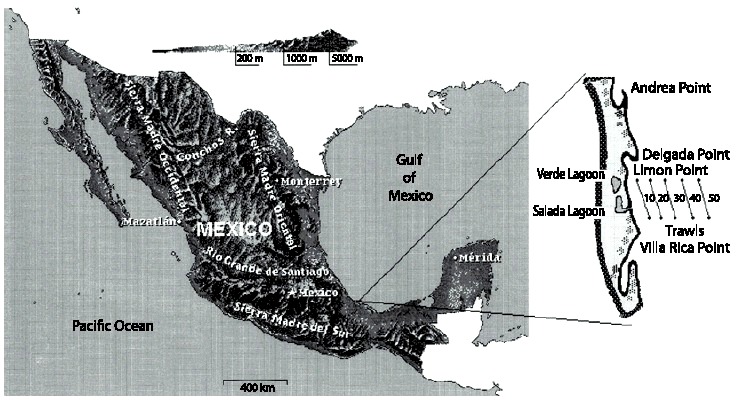
<body><![CDATA[<p><font face="Arial" size="2">The Veracruz shelf environment is a complex interaction of adjacent land masses, coastal waters near shore influenced by estuarine systems and their inherent high productivity, coastal lagoon input, and dynamics of open Gulf of Mexico waters. Relatively high surface water temperatures of the Gulf bring about a great warming and an increase in moisture content in overlaying air masses. Water mass distribution in open Gulf waters results from inflow through the Yucatan Channel, outflow through the Straits of Florida, surface conditions created by local air-sea exchange processes, and internal mixing of three well-defined water masses from the bottom up: Gulf basin water, a layer of the Antarctic intermediate water and a Mid-Atlantic element (Merino 1986). The hydrography is a mixture of these elements and is important as the basic setting for the resultant biological communities, which are a reflection of it. The variability in spatial and seasonal production of the demersal fauna along the shelf is important in the balance of organic matter in the water column (Merino 1987). </font></p>     <p><font face="Arial" size="2">Identification and description of community patterns are some of the main contributions of numerical ecology. The quantitative multispecies approach enables the identification and discrimination of slight differences in community structure (0rlóci 1978a, Chang and Gauch 1986, Bachelet <i>et al. </i>1996). Furthermore, it offers an objective summary about the community which is easy to communicate (Gnanadesikan 1977, Pielou 1984). Most of the previous studies of this type within the Gulf of Mexico describe the fauna associated with important fishery resources (Gunter 1945, Hildebrand 1955), or in relation to environmental gradients (Boesh <i>et al. </i>1977), faunal relationships with natural disturbances (Thiestle 1981, Flint 1981), resource allocation (Thorman 1983); interspecific relationships (Watzin 1983, Gilinsky 1984), or the representation of the main properties of structure and dynamics of the community through simulation models (Hughes 1984, Pennington and Godø 1995). The continental shelf ecosistem of Veracruz coast supports valuable comercial fisheries, particularly of penaeid shrimp. The present paper presents a space-time analysis of a sublittoral community abundance (macroinvertebrates and fishes), in a coastal area of the SW Gulf of Mexico. </font></p> <font face="Arial" size="2"><b>     <p>Materials and methods </p> </b> </font>     <p><font face="Arial" size="2"><b>Study area:</b> the study area is a 10 km offshore strip, 80 km north of the City of Veracruz in a region where hills of igneous rocks of the Sierra Madre 0riental are in contact with the shoreline, which in this place is a mixture of sandy beaches and rocky shores (<a href="#fig1">Fig. 1</a>). The area where samples were collected shows a gradient of substrata, varying from sandy bottoms in the shallower depths, to muddy into about 18-20 m depending upon wave action. From 20 m depth downward, is consistently muddy bottom. </font></p>     <p style="text-align: center;"><a name="fig1"></a><img  src="/img/fbpe/rbt/v55n2/3648i1.JPG" title="" alt=""  style="width: 709px; height: 376px;">    
<br> <small><span style="font-family: arial;">Fig. 1. Map showing locations of the samplingsite. The isobats (10 to 50m) show the trawls in both years.</span></small>    <br> </p>     <p><font face="Arial" size="2"><b>Faunal and environmental sampling:</b> sampling was carried out monthly during the first years and every three months during the last. The samples were obtained by using a test shrimp try-net (3 m long, 2.5 mouths and 3/4 inch mesh; the trawls were for 30 min at 1.5 knots of vessel speed) at 10 m depth intervals from at 10 m to 50 m. Two or three replicate samples were taken at each depth. Some months and depths were not sampled because of bad weather. The number of individuals of each species were determined for each sample and recorded; the community diversity was analyzed using the second order diversity index (Hill 1973, Ezcurra 1980); this index allows calculation of community evenness. The sediment fractions were evaluated using the Bouyoicos technique, and the proportion of weight of organic material by combustion of the organic fraction and substrated from the total weight. On the other hand, dissolved oxygen measured in the lower water column nearshore: was less than 18 m, often showing higher values (6 to 8 ppm) than those recorded in deeper waters (3 to 6 ppm), this factor was evaluated by standard methods (Strickland and Parson 1972). The temperature and salinity were registered with YSI85; for each parameter we took three readings during each trawl and utilizing the average for the characterization of each depth. </font></p> <font face="Arial" size="2"><b></b></font>     <p><font face="Arial" size="2"><b>Faunal and environmental analysis:</b> matrices of species abundance (catch /trawl) with respect to depth and season were root-root transformed; however, when proportions were used, the arc-sine of the square root was taken instead (Bireley 1984). The cluster analysis was carried out by means of the cordal distance index (0rlóci 1978b), and the resulting matrix was grouped using of the flexible method with B=-0.25 (Sneath and Sokal 1974, Swartz <i>et al. </i>1986). For the community ordination, principal components analysis was used. The environmental variations were evaluated by kriging technique with a linear variogram model, because the data points were evenly dispersed in the area (Axis <i>et al</i>. 2001). In order to know the relationship between the abundance and the recorded parameters, a non-parametric analysis, the Spearman’s correlation was carried out. The diet data of the most important fish species in one year were analyzed using the similarity coefficient (Horn 1966). The sampled fish were injected with formol at 40 % in the stomach in order to stop any digestive process, subsequently, the stomach contents were dissected and analyzed. The composition of each trophic group was evaluated as the percent of the total area of the stomach content; the comparative weight value and the frequency of each food item were used to define the trophic spectra (Overstreet and Heard 1982). Values obtained are an average for each species; Fig. 8 shows the size and number of analyzed specimens. The Horn’s similarity index gives a relative value of trophic overlap (Rice 1988). The analysis was carried out both with and without considering detritus as a component of the food consumed. </font></p> <font face="Arial" size="2"><b>     <p>Results </p> </b> <b></b></font>     ]]></body>
<body><![CDATA[<p><font face="Arial" size="2"><b>Environmental variations:</b> the annual variation of the three analyzed parameters were presented in the first period, high values between May and September, the lowest values were registered in November-January in all the depths, increasing their values towards March-April to the depth of 10 ms. The salinity presented high values in May-June to 30-40 m, the minim was in October in the rainy season. Oxygen showed to high values in February in all the depths whereas in the rest of the year it had intermediate values with exception of September to 30 ms where the lowest value was registered; in spite of this, the minimum values were in supersaturation (<a href="#fig2">Fig. 2</a>). The second cycle showed small variations, but such changes can be the effect of the separation of the sampling. Comparing months in both cycles (<a href="#fig2">Fig. 2</a>), the temperature shows a seasonal pattern, with nodules of high concentration in May for first and September for the second. The salinity presents nodules of high concentration in May extending until September in both cycles. Although oxygen has variations with the depth, it presents high values in February and minimums in November in both cycles. </font></p>     <p style="text-align: center;"><span style="font-family: arial;"><a  name="fig2"></a><img src="/img/fbpe/rbt/v55n2/3648i2.JPG" title="" alt=""  style="width: 696px; height: 903px;">    
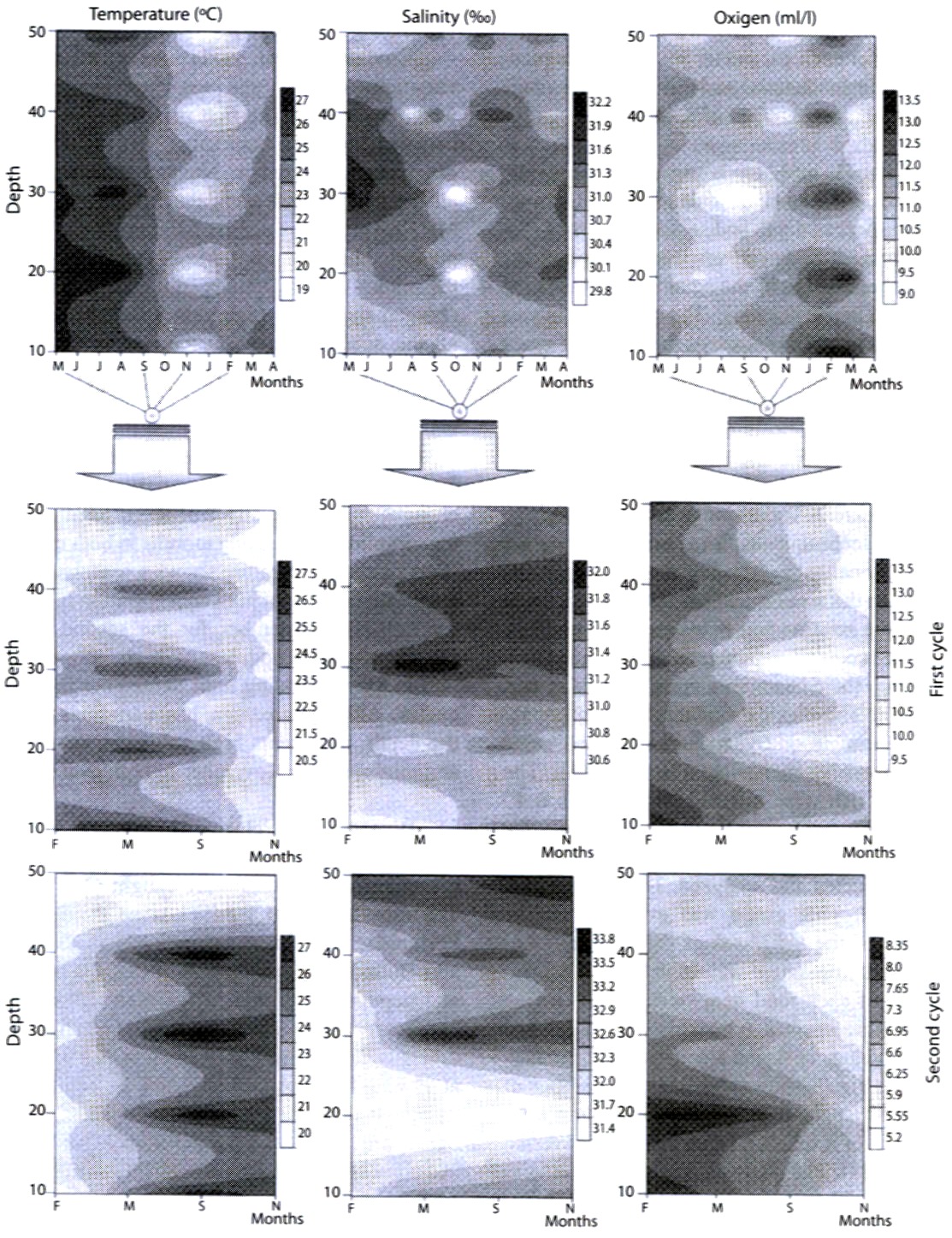
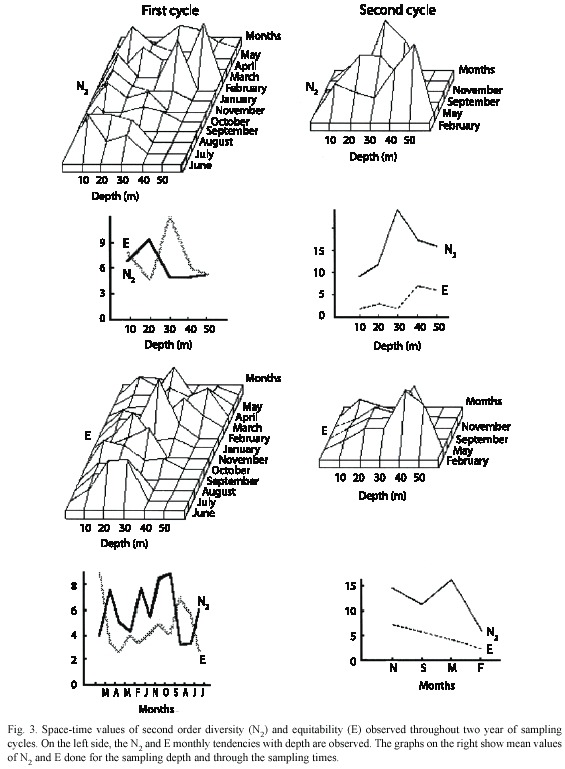
<br> <small>Fig. 2. Spatial distribution of the environmental factors in the study site in both periods. The montly variability     <br> is presented for the first cycle.</small>    <br> </span></p>     <p><font face="Arial" size="2"><b>Diversity and relative abundance:</b> a total of 4 739 specimens of molluscs, echinoderms, crustaceans and fishes were caught (<a href="#table1">Table 1</a>). The most abundant families were Penaeidae, Portunidae, Triglidae, Carangidae, Sciaenidae and Bothidae. The diversity values by month and depth for both years and mean by depth and season are shown (<a href="#fig3">Fig. 3</a>); the range in diversity during the first year was N<sub>2</sub>=9.8-5.3 at 20 and 40 m respectively, and the equitability range from 12.6 to 4.8, at 30 and 20 m. Seasonally, the values ranged from N<sub>2</sub>=8.8-2.9 in February and March respectively, whilst the equitability showed two maxima, in June and March (8.8 and 7.2) and two minima, in August and May (2.6 and 2.4). During the second year, the highest value (2.2) was found at 30 m, decreasing both toward the deeper and shallower grounds; equitability behaves in a similar way. The maximum diversity was observed in September and the minimum in November (16.2 and 5.4); the maximum equitability was observed in February whilst the lowest was in November (7.1 and 2.2; <a href="#fig3">Fig. 3</a>).</font></p>     <p><font face="Arial" size="2">    <br> </font></p>     <div style="text-align: center;"><a name="table1"></a><img  src="/img/fbpe/rbt/v55n2/3648i3-2.JPG" title="" alt=""  style="width: 600px; height: 3343px;">    
<br> </div>     ]]></body>
<body><![CDATA[<p><font face="Arial" size="2"></font></p>     <div style="text-align: center;"><font face="Arial" size="2">    <br> <a name="fig3"></a><img src="/img/fbpe/rbt/v55n2/3648i4.JPG" title="" alt=""  style="width: 565px; height: 769px;">    
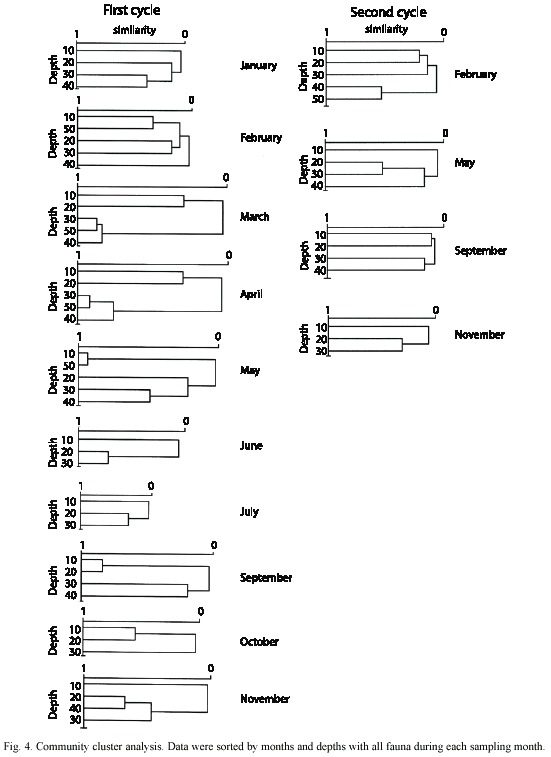
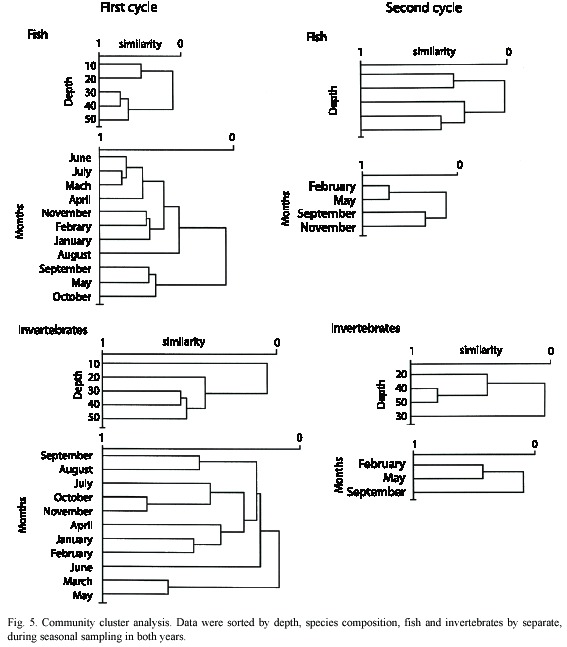
<br> </font></div>     <p><font face="Arial" size="2"><b>Community patterns:</b> the cluster analysis were carried out on the first cycle data groups at similar depths in June-July, November-January and March-April (<a href="#fig4">Fig. 4</a>). During the second cycle, mean depths were consistently pooled at very low similarity values. The seasonal variation of the community shows that the fishes were organized into three well-defined groups, one through November, January and February, linked to low temperatures and north winds; the second group was consistently evident through March, April, June and July; the first two months belong to the dry season, whilst the last two correspond to the rainy one. The third group was organized during a period in transition between the rainy and the cold season (<a href="#fig5">Fig. 5</a>). The benthic portion of the community as grouped showed a similar pattern to that of fishes. Two seasons were clearly evident, one from July through November and the second one from January to June. During the second cycle there was no clear seasonal grouping to confirm same seasonal organizational pattern. </font></p>     <p style="text-align: center;"><font face="Arial" size="2">&nbsp;<a  name="fig4"></a><img src="/img/fbpe/rbt/v55n2/3648i5.JPG" title="" alt=""  style="width: 551px; height: 757px;"></font></p>     
<p style="text-align: center;"><font face="Arial" size="2"><a  name="fig5"></a><img src="/img/fbpe/rbt/v55n2/3648i6.JPG" title="" alt=""  style="width: 567px; height: 647px;">    
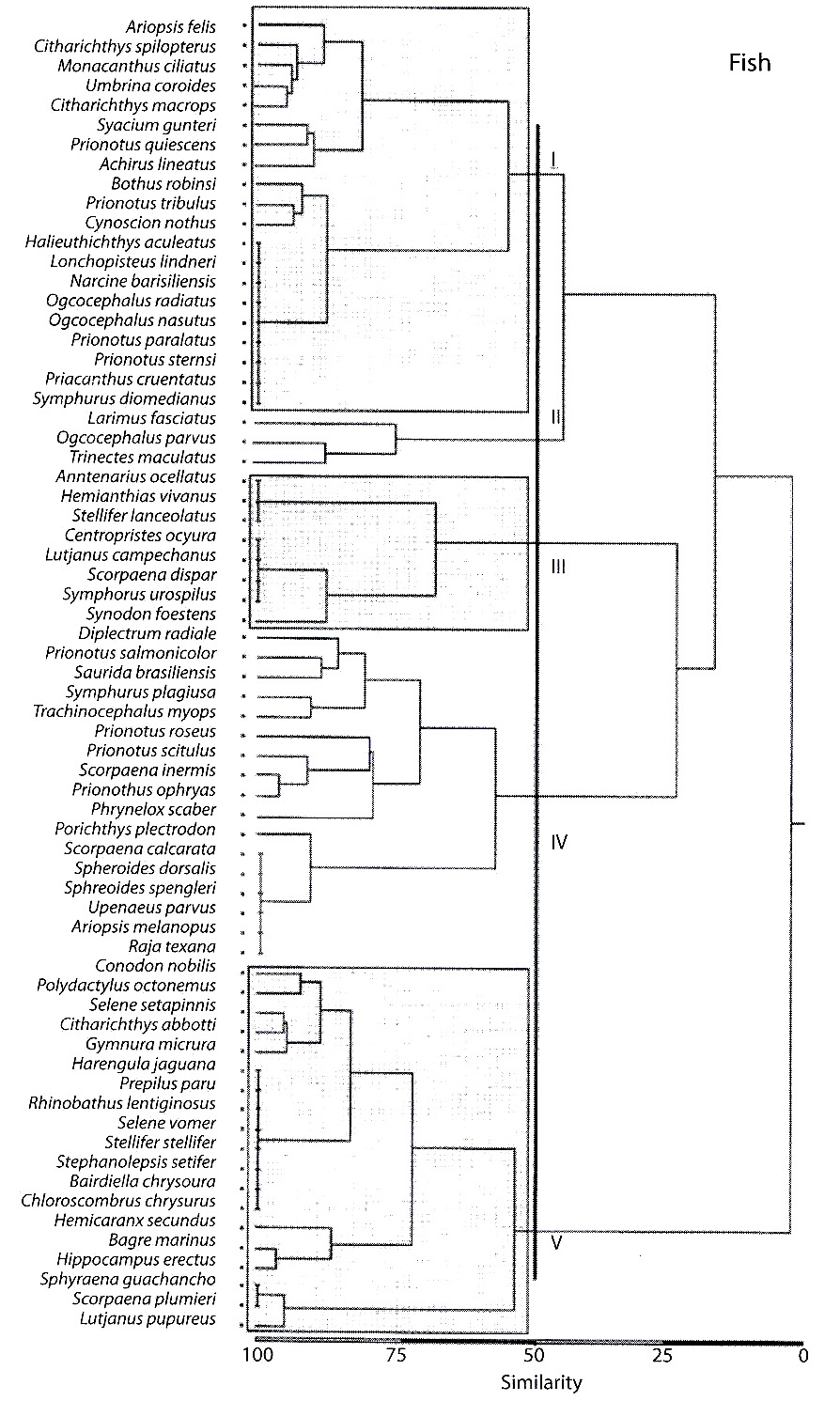
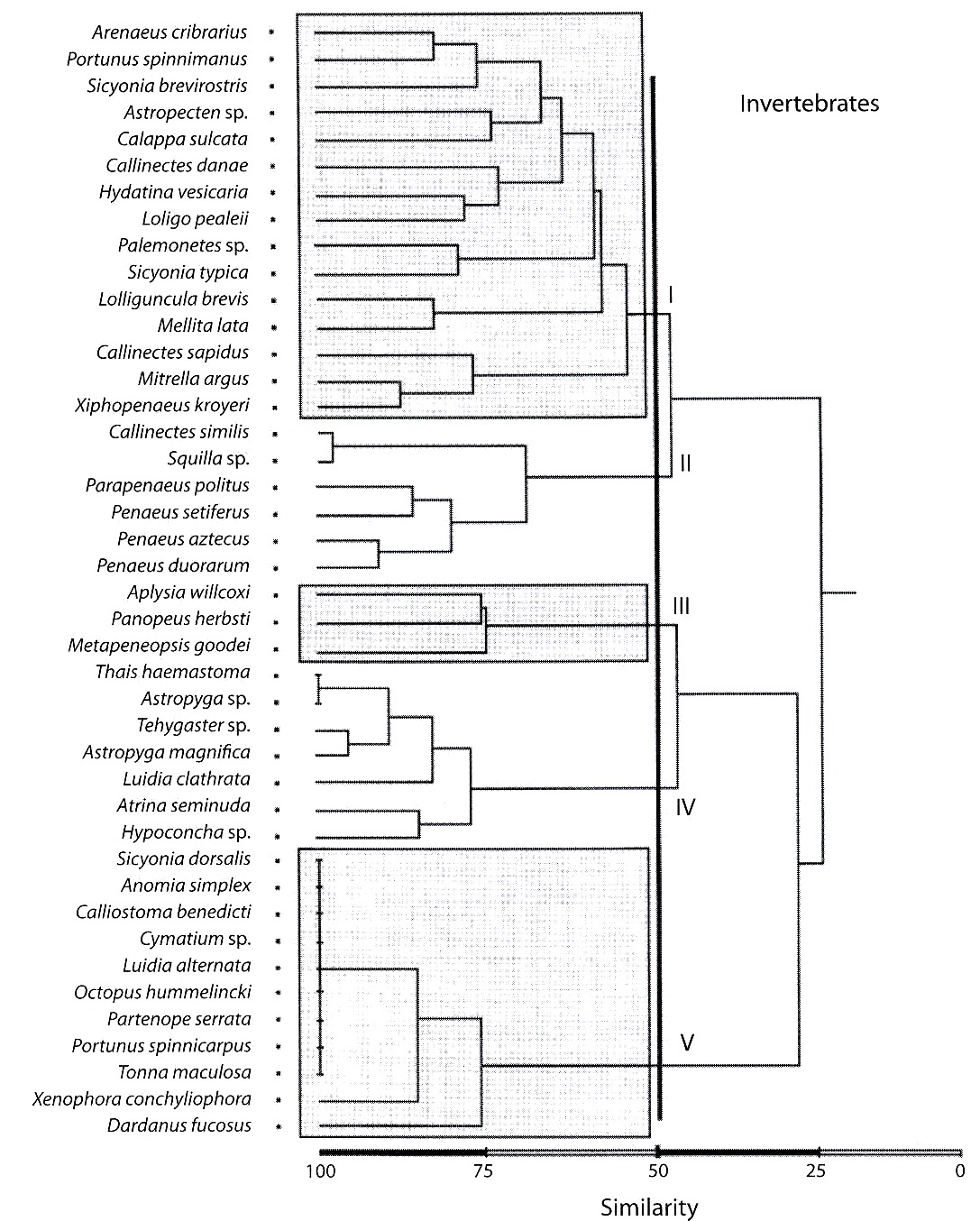
<br> </font></p>     <p><font face="Arial" size="2">The classification of fish species falls into five complex groups. The first is formed by dominant elements in shallow waters, such as <i>Cynoscion nothus </i>(Holbrook), <i>Prionotus para-latus </i>(Ginsburg) and <i>Symphurus diomedianus </i>(Goode and Bean) among others. The second is a small group represented by <i>Larimus fasciatus </i>(Holbrook), <i>0gcocephalus parvus </i>(Longley and Hildebrand) and <i>Trinectes maculatus </i>(Bloch and Schneider), all of them considered being benthic dwellers. The third group is also small and includes demersal fishes such as <i>Antennarius ocellatus </i>(Block and Schneider)<i>, Hemianthias vivanus </i>(Jordan and Swain) and <i>Lutjanus campechanus </i>(Poey). The two remaining groups include a varied number of mixed species (<a href="#fig6">Fig. 6</a>). The invertebrates are organized into five groups: one contains up to 15 species including <i>Portunus spinimanus </i>(Latreille)<i>, Sicyonia brevirostris </i>(Stimpson)<i>, Loligo pealeii </i>(Lesueur) and <i>Callinectes sapidus </i>(Rathbun). While the most interdependence components of the second group are <i>Callinectes similis </i>(Williams) and <i>Squilla </i>sp. (Letreille). The third group includes only three species; the four groups have components with more interdependence <i>Astropyga </i>sp. (Gray) <i>Thethygaster </i>sp. (Caso) and <i>Astropyga magnifica </i>(Agazziz) <i>Luidia clathrata </i>(Say). The last group is composed of benthic components with high interdependence (<a href="#fig7">Fig. 7</a>). </font></p>     <p style="text-align: center;"><font face="Arial" size="2">&nbsp;</font><a  name="fig6"></a><img src="/img/fbpe/rbt/v55n2/3648i7.JPG" title="" alt=""  style="width: 686px; height: 1142px;">    
]]></body>
<body><![CDATA[<br> </p>     <div style="text-align: left; margin-left: 80px;"><small><span  style="font-family: arial;">Fig. 6. Cluster analysis of fish species is organized into four main groups. Group I includes dominant species     <br> in shallow </span></small><small><span style="font-family: arial;">waters. Group II is formed by demersal species as well as group III. The remaining one group IV, is heterogeneous </span></small><small><span  style="font-family: arial;">as in it there are elements wich are trophically related to mid depths, linking surface waters with     <br> the bottom.</span></small></div>     <p style="text-align: center;"><small><span style="font-family: arial;">    <br> </span></small><a name="fig7"></a><img src="/img/fbpe/rbt/v55n2/3648i8.JPG" title=""  alt="" style="width: 684px; height: 851px;">    
<br> </p>     <div style="text-align: left; margin-left: 80px;"><small><span  style="font-family: arial;">Fig. 7. Cluster analysis of invertebrate species. The community is organized in to five groups. Most of the species     <br> are </span></small><small><span style="font-family: arial;">benthic dwellers and the groups are linked for habitat preferences.</span></small>    <br> </div>     ]]></body>
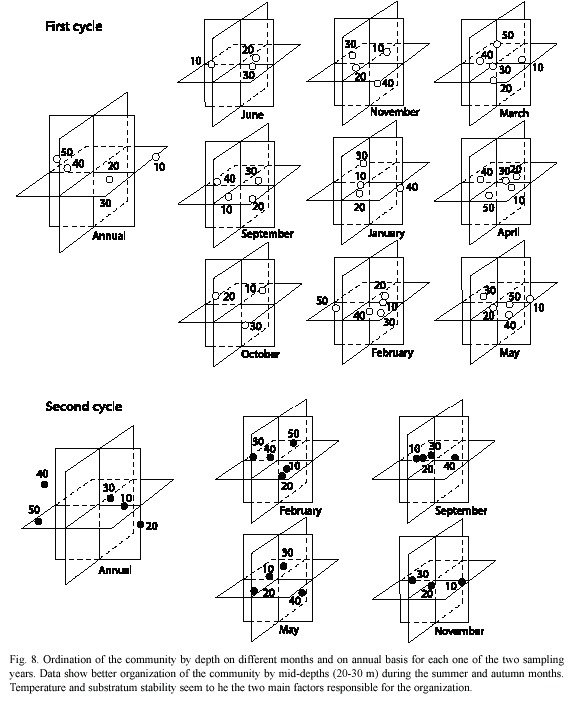
<body><![CDATA[<p><font face="Arial" size="2">The community structure during the first year of sampling appears to be consistently grouped around the depths of 20 and 30 m during the months of June, September, November and May. By contrast, in October, coincident with the beginning of the cold weather and northern winds, the organization of the community seems to partially break down and no real structure was discernible at any one of the depths sampled. The community reorganized itself during January, February and March in mid depths. It is noticeable that the components of the 10 m communities are not related with any other, probably because of the high energy and low physical stability of its biotope (<a href="#fig8">Fig. 8</a>). The second sampling period assembles all depths with the exception of 50 m; May and September show more environmental homogeneity, while November seems to be more unstable physically due to the apparent lack of association. The annual patterns show two groups, shallow and medium depths reflecting the environmental driving forces. </font></p>     <br>     <div style="text-align: center;"><a name="fig8"></a><img  src="/img/fbpe/rbt/v55n2/3648i9.JPG" title="" alt=""  style="width: 571px; height: 701px;">    
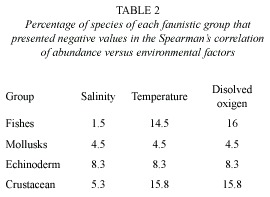
<br> </div>     <p><font face="Arial" size="2"><a href="#table1">Table 1</a> shows the value of Spearman’s coefficient for the abundance of each species and the environmental factors; <a href="#table2">Table 2</a> shows the percentage of the species of each group that presented a negative relationship. In the fish, <i>Polydactylus octonemus </i>has correlationed negatively with the salinity and temperature; while <i>Conodon nobilis, Diplectrum radiale, Eucinostomus melanopterus, Symphurus plagusia, Saurida brasiliensis and Selene setapinnis</i>, did so with the temperature and dissolved oxygen. From the invertebrates, the crustaceans<i> Penaeus duorarum, Portunus spinimanus </i>and <i>Sicyonia brevirostris </i>presented negative correlations with the temperature and the oxygen same as the mollusk <i>L. pealeii</i>; The echinoderm <i>Mellita lata </i>presented negative relationships with the salinity and temperature.    <br> </font></p>     <p style="text-align: center;"><font face="Arial" size="2"><a  name="table2"></a><img src="/img/fbpe/rbt/v55n2/3648i10.JPG" title="" alt=""  style="width: 270px; height: 197px;">    
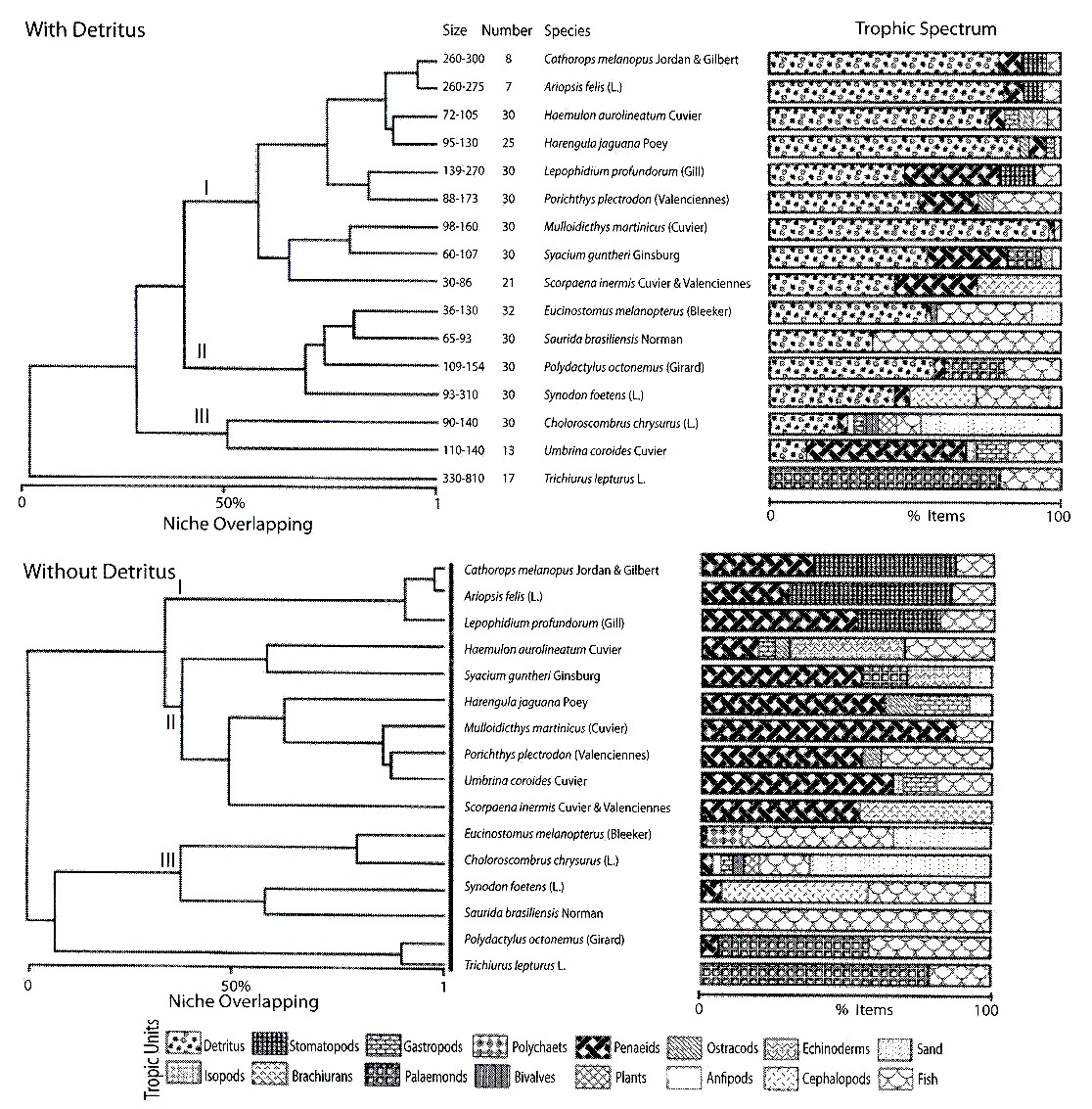
<br> </font></p> <font face="Arial" size="2"><b></b></font>     <p><font face="Arial" size="2"><b>Trophic niches:</b> the analysis shows that there are three main species sharing the main food resources. One depends upon the detritus (Group I); the second is mainly ichthyophagous and group omnivorous (<a href="#fig9">Fig. 9</a>). Excluding the detritic from the analysis, the asociations becomes more evident, and four clusters are shown. Two groups depend on decapods as the main food; however, fish and stomatopods are also important for that group and therefore, it is considered to be composed by specialists (Richards 1983). The third group shows two other associations, one of which is formed by omnivorous fishes, such as <i>Eucinostomus melanopterus </i>(Bleeker) and <i>Chloroscombrus chrysurus </i>(L.); the second being formed by ichthyophagus fishes from different levels of the water column with squids as a secondary diet. The last group includes species consuming large quantities of palemonids decapods.    <br> </font></p>     ]]></body>
<body><![CDATA[<p><font face="Arial" size="2"></font></p>     <div style="text-align: center;"><a name="fig9"></a><img  src="/img/fbpe/rbt/v55n2/3648i11.JPG" title="" alt=""  style="width: 730px; height: 739px;">    
<br>     <div style="text-align: left; margin-left: 40px;"><small><span  style="font-family: arial;">Fig. 9. Trophic spectrum of&nbsp; 16 out of the most common fish species showing overlap of trophic niche. The horizontal     <br> bar </span></small><small><span style="font-family: arial;">show the percent item gut. It is remarkable the dependence of detritus as main food sourceof the community.</span></small>    <br> </div> </div> <font face="Arial" size="2"><b>     <p>Discussion </p> </b> <b></b></font>     <p><font face="Arial" size="2"><b>Environmental viariations:</b> the environmental mosaic that appeared with the monthly registries is more heterogeneous than the quarterly ones, with high and low very precise values in some months and for some certain depth. The interannual fluctuations were more evident with the temperature, which can be originated by the influence of natural events like are the tropical north and storms that are frequent in this zone and which they frequently carry cold winds, which affects in a determining way the first layers of the water column (Guido and Mathews 2000). The salinity and oxygen follow similar progressions, presenting nodules of high concentration in such months and very near depths, which sets in evidence a certain stability through the time with these parameters. </font></p> <font face="Arial" size="2"><b></b></font>     <p><font face="Arial" size="2"><b>Diversity and relative abundance:</b> the highest diversity values seem to be related to variations in the available food. However, the best organized part of the community was found between 40 and 50 m deep, where the equitability is highest. The less organized part was found in shallow water and it can be attributed to the mobility of the species and to the instability of the environment (Francis and Williams 1995, Gelwick <i>et al. </i>2001). The best organized part of the community seems to be at the level of 30 m, specially in February and in September. The highest diversity found at the mid-depth levels, lead us to the assumptions that there is a high number of food links (Pequeno and Lamilla 2000). This could be expected in a well-organized community which multiplies its interconnections seasonally (Madrid <i>et al. </i>1977, Rocha and Rosa 1977). However, similar observations (Margalef 1969, Pennington and Godø 1995) lead us to conclude that the consistency and persistence of the community are both high. </font></p> <font face="Arial" size="2"><b></b></font>     <p><font face="Arial" size="2"><b>Community patterns:</b> because of the classification analysis, fish components are probably the main factor explaining the persistency of the community. However, although there is consistency at mid-depths, we conclude that both the structure, and the changes in structure, results from biological interactions determined by the spatial heterogeneity of the resources as well as by their seasonal variation (Garcia-Rubies <i>et al. </i>1995, Cerda <i>et al</i>. 1997, Koranteng 2001). The benthic and demersal groups are best defined and their main source of energy is detritus. Their components have characteristically low mobility and therefore are closely linked to the substratum. Bottom dwellers are often less affected by environmental instability than the near surface ones and density dependent processes are thus more important as regulators of population size (Angermeir and Smogor 1995, Thrush <i>et al</i>. 2001). By contrast, the mid-water and near surface organisms are more dependent on primary productivity and on environmental instability (Livingston 1980). A small part of this group is formed by nonpermanent elements which make use of the resources of this community during its migrations (Prena 1995, Fievet <i>et al</i>. 2001). Both yearly samples gave similar results in terms of composition and structural organization of the community. It is thus very likely that this structure has developed under relatively constant conditions. From this, it may be concluded that the patterns shown by the community are the result of real ecological processes, and not artifacts of sampling. </font></p>     ]]></body>
<body><![CDATA[<p><font face="Arial" size="2">The main environmental factor responsible for the highest variability in the community was temperature, so it was used as the first axis of ordination in <a  href="#fig7">Fig. 7</a>. This is in agreement with the findings by Flint (1981), Flint <i>et al. </i>(1981 and 1986) in the Northern Gulf of Mexico shores. The second component seems to be linked to the stability of the substrate, the dissolved oxygen, and to the turbulence of water masses. Heck <i>et al. </i>(1980), Benchley (1981), Chester <i>et al. </i>(1983) and Thrush <i>et al. </i>(2001) have remarked on the importance of the substrate, whose variations may lead to small scale changes of microhabitats and also may play an important role in processes of deposition and stabilization of sediments, in buffering hydrodynamic effects, and in availability of shelter and food. The community variations are more evident bimonthly in the temporal context; however, the space variations stay all year along and the pattern is a decrease in the demersal fauna at both ends of depth and greater diversity and richness to intermediate levels. In spite of the fact that the Spearman’s correlations show that few species have negative relationship with the environmental factors which corroborate the results gotten with the cluster and PCA analysis, the invertebrate fraction has better consistency in the analysis, since the multivariate analysis shows similar faunistic associations like the species that have negative correlations with the Spearman’s index and that form a well defined group with the cordal distance, from which it is evident that the formation of groups are influence by the environment. </font></p> <font face="Arial" size="2"><b></b></font>     <p><font face="Arial" size="2"><b>Trophic niches:</b> the inclusion and exclusion of the detritus in the niche overlapping analysis, it was carried out with the objective of knowing in more detail the importance of the other components in the diet of the demersal fishes, since upon being link with the bottom layer, the ingestion of this component could be incidental, for which we wanted to explore the associations and interactions of the species with both strategies. With reference to the trophic niche, decapod crustaceans and fishes are the preferred prey of epibenthic predators; this explains the high niche overlap, suggesting that there one strong competition pressures (Winemiller 1989, Hessen <i>et al. </i>1995, Plattel and Porter 2001). Thus it appears that the trophic structure can be divided into two general groups: carnivores with sympatric species with relative overlap of food preferences (some species overlapping avoid, feeding of supplementary organisms that are distributed in other levels of the water column, like it is the case of <i>Synodus foetens </i>and <i>Saurida brasiliensis</i>), and a group of benthic omnivores, with a large number of species having small population densities. When the trophic niche overlap decreases, as occurs when the size differences between individuals of two species are large, then the availability of prey tends to further increase the overlap their food preferences (Zajac <i>et al. </i>1989, Linke <i>et al</i>. 2001). </font></p> <font face="Arial" size="2"><b>     <p>Acknowledgments </p> </b> </font>     <p><font face="Arial" size="2">This paper would not have been possible without the able assistance of Ma. Jesús Parra A. and José Luis Castro A. We also thank Rigoberto Corona and Juan Menchaca for their help with various parts of the field and laboratory work; and Rodrigo Rodriguez for language support. The fauna samples are in the Collection of the National School of Biological Science. </font></p> <font face="Arial" size="2"><b>     <p>Resumen </p> </b> </font>     <p><font face="Arial" size="2">Se analizaron los patrones estructurales de la comunidad sublitoral a través de dos años de muestreo. Los grupos involucrados en el estudio fueron: peces, moluscos, equinodermos y crustáceos. Las progresiones espacio-temporales de la diversidad de segundo orden para el primer año se encuentran entre los intervalos de N<sub>2</sub>=5.3 y N<sub>2</sub>=9.8 en las profundidades de 40 y 20 m respectivamente. En el segundo periodo el valor más alto (N<sub>2</sub>=22.2) fue registrado a 30 m. La ordenación de la comunidad a través del análisis de agrupamientos y de Componentes Principales, muestran 5 ensamblajes: béntico, béntico-demersal, demersal, a media columna de agua y temporal. Hay una fuerte diferencia en la estructura de la red trófica entre las estaciones de secas y lluvias. La repartición de recursos en la comunidad de peces, muestran que sus componentes están organizados en tres gremios: Ictiófagos, Carcinófagos y Omnívoros. Sin embargo, comúnmente se presenta un solapamiento parcial en el nicho, los estadíos juveniles muestran un espectro trófico muy cercano a los adultos. </font></p>     <p><font face="Arial" size="2">Palabras clave: invertebrados marinos, peces, composición de comunidad, diversidad, espectro trófico, Golfo de México, Veracruz. </font></p> <font face="Arial" size="2"><b>     <p>References </p> </b> </font>     <!-- ref --><p><font face="Arial" size="2">Angermeir, P.L. &amp; R.A. Smogor. 1995. Estimating number of species and relative abundance in stream-fish communities: effects of sampling effort and discontinues spatial distribution. Can. J. Fish. Aquat. Sci. 52: 936-949. </font>&nbsp;&nbsp;&nbsp;&nbsp;&nbsp;&nbsp;&nbsp;&nbsp;[&#160;<a href="javascript:void(0);" onclick="javascript: window.open('/scielo.php?script=sci_nlinks&ref=1237091&pid=S0034-7744200700020001400001&lng=','','width=640,height=500,resizable=yes,scrollbars=1,menubar=yes,');">Links</a>&#160;]<!-- end-ref --><!-- ref --><p><font face="Arial" size="2">Axis-Arroyo, J., J. Mateu &amp; D. Torruco. 2001. Analysis of the spatio-temporal distribution on biological species, p. 191-209. <i>In </i>J. Mateu &amp; F. Montes (eds.). Proc. 1<sup>st </sup>spanish workshop on spatio-temporal modelling of environmental processes. Jaume I University Publications, Castellón, Spain. </font>&nbsp;&nbsp;&nbsp;&nbsp;&nbsp;&nbsp;&nbsp;&nbsp;[&#160;<a href="javascript:void(0);" onclick="javascript: window.open('/scielo.php?script=sci_nlinks&ref=1237092&pid=S0034-7744200700020001400002&lng=','','width=640,height=500,resizable=yes,scrollbars=1,menubar=yes,');">Links</a>&#160;]<!-- end-ref --><!-- ref --><p><font face="Arial" size="2">Bachelet, G., X. de Montaudovin &amp; J.C. Dauvin. 1996. The quantitative distribution of subtidal macrozoobenthic assemblages in Arcachon Bay in relation in environmental factors: A multivariate analysis. Est. Coast. Shelf Sci. 42: 371-392. </font>&nbsp;&nbsp;&nbsp;&nbsp;&nbsp;&nbsp;&nbsp;&nbsp;[&#160;<a href="javascript:void(0);" onclick="javascript: window.open('/scielo.php?script=sci_nlinks&ref=1237093&pid=S0034-7744200700020001400003&lng=','','width=640,height=500,resizable=yes,scrollbars=1,menubar=yes,');">Links</a>&#160;]<!-- end-ref --><!-- ref --><p><font face="Arial" size="2">Benchley, G.A. 1981. Disturbance and community structure: An experimental study of bioturbation in marine soft-bottom environments. J. Mar. Res. 39: 767-790. </font>&nbsp;&nbsp;&nbsp;&nbsp;&nbsp;&nbsp;&nbsp;&nbsp;[&#160;<a href="javascript:void(0);" onclick="javascript: window.open('/scielo.php?script=sci_nlinks&ref=1237094&pid=S0034-7744200700020001400004&lng=','','width=640,height=500,resizable=yes,scrollbars=1,menubar=yes,');">Links</a>&#160;]<!-- end-ref --><!-- ref --><p><font face="Arial" size="2">Bireley, E.L. 1984. Multivariate analysis of species composition of shore zone fish assemblages found in Long Island Sound. Estuaries 7: 242-247. </font>&nbsp;&nbsp;&nbsp;&nbsp;&nbsp;&nbsp;&nbsp;&nbsp;[&#160;<a href="javascript:void(0);" onclick="javascript: window.open('/scielo.php?script=sci_nlinks&ref=1237095&pid=S0034-7744200700020001400005&lng=','','width=640,height=500,resizable=yes,scrollbars=1,menubar=yes,');">Links</a>&#160;]<!-- end-ref --><!-- ref --><p><font face="Arial" size="2">Boesh, D.F., M.L. Wass &amp; R.W. Virnstein. 1977. The dynamics of estuarine benthic communities, p. 17-38. <i>In </i>M. Wiley (ed.). Estuarine Processes I. Uses, Stress and Adaptation to the Estuary. Academic, London, England. </font>&nbsp;&nbsp;&nbsp;&nbsp;&nbsp;&nbsp;&nbsp;&nbsp;[&#160;<a href="javascript:void(0);" onclick="javascript: window.open('/scielo.php?script=sci_nlinks&ref=1237096&pid=S0034-7744200700020001400006&lng=','','width=640,height=500,resizable=yes,scrollbars=1,menubar=yes,');">Links</a>&#160;]<!-- end-ref --><!-- ref --><p><font face="Arial" size="2">Cerda, R., G. Caille &amp; J.C. Braccalenti. 1997. Seasonal changes and associated biogeographical aspects of coastal fish communities of Southern Santa Cruz (Argentina). Naturalia Patagónica Cienc. Biol. 5: 55-66. </font>&nbsp;&nbsp;&nbsp;&nbsp;&nbsp;&nbsp;&nbsp;&nbsp;[&#160;<a href="javascript:void(0);" onclick="javascript: window.open('/scielo.php?script=sci_nlinks&ref=1237097&pid=S0034-7744200700020001400007&lng=','','width=640,height=500,resizable=yes,scrollbars=1,menubar=yes,');">Links</a>&#160;]<!-- end-ref --><!-- ref --><p><font face="Arial" size="2">Chang, D.H. &amp; H.G. Gauch. 1986. Multivariate analysis of plant communities and environmental factors in Ngari, Tibet. Ecology 67: 1 568-1 575. </font>&nbsp;&nbsp;&nbsp;&nbsp;&nbsp;&nbsp;&nbsp;&nbsp;[&#160;<a href="javascript:void(0);" onclick="javascript: window.open('/scielo.php?script=sci_nlinks&ref=1237098&pid=S0034-7744200700020001400008&lng=','','width=640,height=500,resizable=yes,scrollbars=1,menubar=yes,');">Links</a>&#160;]<!-- end-ref --><!-- ref --><p><font face="Arial" size="2">Chester, A.J., R.L Ferguson &amp; G.W. Thayer. 1983. Environmental gradients and benthic macroinvertebrates distribution in a shallow North Carolina Estuary. Bull. Mar. Sci. 33: 282-295. </font>&nbsp;&nbsp;&nbsp;&nbsp;&nbsp;&nbsp;&nbsp;&nbsp;[&#160;<a href="javascript:void(0);" onclick="javascript: window.open('/scielo.php?script=sci_nlinks&ref=1237099&pid=S0034-7744200700020001400009&lng=','','width=640,height=500,resizable=yes,scrollbars=1,menubar=yes,');">Links</a>&#160;]<!-- end-ref --><!-- ref --><p><font face="Arial" size="2">Escurra, E. 1980. Una nota acerca de la diversidad. Ecología 4: 141-142. </font>&nbsp;&nbsp;&nbsp;&nbsp;&nbsp;&nbsp;&nbsp;&nbsp;[&#160;<a href="javascript:void(0);" onclick="javascript: window.open('/scielo.php?script=sci_nlinks&ref=1237100&pid=S0034-7744200700020001400010&lng=','','width=640,height=500,resizable=yes,scrollbars=1,menubar=yes,');">Links</a>&#160;]<!-- end-ref --><!-- ref --><p><font face="Arial" size="2">Fievet, E., S. Doledec &amp; P. Lin. 2001. Distribution of migratory fishes and shrimps along multivariate gradients in tropical island stream. J. Fish Biol. 59: 390-402. </font>&nbsp;&nbsp;&nbsp;&nbsp;&nbsp;&nbsp;&nbsp;&nbsp;[&#160;<a href="javascript:void(0);" onclick="javascript: window.open('/scielo.php?script=sci_nlinks&ref=1237101&pid=S0034-7744200700020001400011&lng=','','width=640,height=500,resizable=yes,scrollbars=1,menubar=yes,');">Links</a>&#160;]<!-- end-ref --><!-- ref --><p><font face="Arial" size="2">Flint, R.W. 1981. Gulf of Mexico outer Continental Shelf benthos: macroinfaunal -environmental relationships. Biol. and Ocean. 1: 135-145. </font>&nbsp;&nbsp;&nbsp;&nbsp;&nbsp;&nbsp;&nbsp;&nbsp;[&#160;<a href="javascript:void(0);" onclick="javascript: window.open('/scielo.php?script=sci_nlinks&ref=1237102&pid=S0034-7744200700020001400012&lng=','','width=640,height=500,resizable=yes,scrollbars=1,menubar=yes,');">Links</a>&#160;]<!-- end-ref --><!-- ref --><p><font face="Arial" size="2">Flint, R.W. &amp; N. Rabalais. 1981. Environmental studies of a marine system: South Texas 0uter Continental Shelf. Texas University, Texas, Mexico. 210 p. </font>&nbsp;&nbsp;&nbsp;&nbsp;&nbsp;&nbsp;&nbsp;&nbsp;[&#160;<a href="javascript:void(0);" onclick="javascript: window.open('/scielo.php?script=sci_nlinks&ref=1237103&pid=S0034-7744200700020001400013&lng=','','width=640,height=500,resizable=yes,scrollbars=1,menubar=yes,');">Links</a>&#160;]<!-- end-ref --><!-- ref --><p><font face="Arial" size="2">Flint, R.W. &amp; R.D. Kalke. 1986. Niche characterization of dominant estuarine benthic species. Est. Coast. Shelf Sci. 22: 657-674. </font>&nbsp;&nbsp;&nbsp;&nbsp;&nbsp;&nbsp;&nbsp;&nbsp;[&#160;<a href="javascript:void(0);" onclick="javascript: window.open('/scielo.php?script=sci_nlinks&ref=1237104&pid=S0034-7744200700020001400014&lng=','','width=640,height=500,resizable=yes,scrollbars=1,menubar=yes,');">Links</a>&#160;]<!-- end-ref --><!-- ref --><p><font face="Arial" size="2">Francis, M.P. &amp; M.W. Williams. 1995. Diel variation in trawl catches of Pagurus auratus (Sparidae). Fish. Res. 24: 301-310. </font>&nbsp;&nbsp;&nbsp;&nbsp;&nbsp;&nbsp;&nbsp;&nbsp;[&#160;<a href="javascript:void(0);" onclick="javascript: window.open('/scielo.php?script=sci_nlinks&ref=1237105&pid=S0034-7744200700020001400015&lng=','','width=640,height=500,resizable=yes,scrollbars=1,menubar=yes,');">Links</a>&#160;]<!-- end-ref --><!-- ref --><p><font face="Arial" size="2">Garcia-Rubies, A. &amp; E. Macpherson. 1995. Substrate use and temporal pattern of recruitment in juvenile fishes of the Mediterranean littoral. Mar. Biol. 124: 35-42. </font>&nbsp;&nbsp;&nbsp;&nbsp;&nbsp;&nbsp;&nbsp;&nbsp;[&#160;<a href="javascript:void(0);" onclick="javascript: window.open('/scielo.php?script=sci_nlinks&ref=1237106&pid=S0034-7744200700020001400016&lng=','','width=640,height=500,resizable=yes,scrollbars=1,menubar=yes,');">Links</a>&#160;]<!-- end-ref --><!-- ref --><p><font face="Arial" size="2">Gelwick, F.P., S. Akin, D.A. Arrigton &amp; K.O. Winmiller. 2001. Fish assemblages stucture in relation to environmental variation in a Texas Gulf coastal wetland. Estuaries 24: 285-296. </font>&nbsp;&nbsp;&nbsp;&nbsp;&nbsp;&nbsp;&nbsp;&nbsp;[&#160;<a href="javascript:void(0);" onclick="javascript: window.open('/scielo.php?script=sci_nlinks&ref=1237107&pid=S0034-7744200700020001400017&lng=','','width=640,height=500,resizable=yes,scrollbars=1,menubar=yes,');">Links</a>&#160;]<!-- end-ref --><!-- ref --><p><font face="Arial" size="2">Gido, K.B. &amp; W.J. Mathews. 2000. Dynamics of the offshore fish assemblage in a Southwestern reservoir (Lake Texoma, Oklahoma-Texas). Copeia 4: 917-930. </font>&nbsp;&nbsp;&nbsp;&nbsp;&nbsp;&nbsp;&nbsp;&nbsp;[&#160;<a href="javascript:void(0);" onclick="javascript: window.open('/scielo.php?script=sci_nlinks&ref=1237108&pid=S0034-7744200700020001400018&lng=','','width=640,height=500,resizable=yes,scrollbars=1,menubar=yes,');">Links</a>&#160;]<!-- end-ref --><!-- ref --><p><font face="Arial" size="2">Gilinsky, E. 1984. The role of fish predation and spatial heterogeneity in determining benthic community structure. Ecology 65: 455-468. </font>&nbsp;&nbsp;&nbsp;&nbsp;&nbsp;&nbsp;&nbsp;&nbsp;[&#160;<a href="javascript:void(0);" onclick="javascript: window.open('/scielo.php?script=sci_nlinks&ref=1237109&pid=S0034-7744200700020001400019&lng=','','width=640,height=500,resizable=yes,scrollbars=1,menubar=yes,');">Links</a>&#160;]<!-- end-ref --><!-- ref --><p><font face="Arial" size="2">Gnanadesikan, R. 1977. Methods for statistical data analysis of multivariate observations. Wiley-Interscience Publ, New York, USA. 310 p. </font>&nbsp;&nbsp;&nbsp;&nbsp;&nbsp;&nbsp;&nbsp;&nbsp;[&#160;<a href="javascript:void(0);" onclick="javascript: window.open('/scielo.php?script=sci_nlinks&ref=1237110&pid=S0034-7744200700020001400020&lng=','','width=640,height=500,resizable=yes,scrollbars=1,menubar=yes,');">Links</a>&#160;]<!-- end-ref --><!-- ref --><p><font face="Arial" size="2">Gunter, G. 1945. Studies on marine fishes of Texas. Inst. Mar. Sci. Univ. Texas 1:1-90. </font>&nbsp;&nbsp;&nbsp;&nbsp;&nbsp;&nbsp;&nbsp;&nbsp;[&#160;<a href="javascript:void(0);" onclick="javascript: window.open('/scielo.php?script=sci_nlinks&ref=1237111&pid=S0034-7744200700020001400021&lng=','','width=640,height=500,resizable=yes,scrollbars=1,menubar=yes,');">Links</a>&#160;]<!-- end-ref --><!-- ref --><p><font face="Arial" size="2">Heck, J.R.K.L. &amp; R.J. Orth. 1980. Seagrass habitats: the role of habitat complexity, competition depredation in structuring associated fish and motile macroinvertebrate assemblages, p. 449-469. <i>In </i>V. Kennedy (ed.). Estuarine Perspectives<i>. </i>Academic, New York, USA. </font>&nbsp;&nbsp;&nbsp;&nbsp;&nbsp;&nbsp;&nbsp;&nbsp;[&#160;<a href="javascript:void(0);" onclick="javascript: window.open('/scielo.php?script=sci_nlinks&ref=1237112&pid=S0034-7744200700020001400022&lng=','','width=640,height=500,resizable=yes,scrollbars=1,menubar=yes,');">Links</a>&#160;]<!-- end-ref --><!-- ref --><p><font face="Arial" size="2">Hessen, D.O., B.A. Fafeng &amp; T. Andersen. 1995. Replacement of herbivore zooplankton species along gradients of ecosystem productivity and fish depredation pressure. Can. J. Fish. Aquat. Sci. 52: 733-742. </font>&nbsp;&nbsp;&nbsp;&nbsp;&nbsp;&nbsp;&nbsp;&nbsp;[&#160;<a href="javascript:void(0);" onclick="javascript: window.open('/scielo.php?script=sci_nlinks&ref=1237113&pid=S0034-7744200700020001400023&lng=','','width=640,height=500,resizable=yes,scrollbars=1,menubar=yes,');">Links</a>&#160;]<!-- end-ref --><!-- ref --><p><font face="Arial" size="2">Hildebrand, H.H. 1955. A study of the fauna of the pink shrimp (<i>Penaeus duorarum </i>Burkenroad). Grounds in the Gulf of Campeche. Institute of Marine Science University Texas 4: 169-232. </font>&nbsp;&nbsp;&nbsp;&nbsp;&nbsp;&nbsp;&nbsp;&nbsp;[&#160;<a href="javascript:void(0);" onclick="javascript: window.open('/scielo.php?script=sci_nlinks&ref=1237114&pid=S0034-7744200700020001400024&lng=','','width=640,height=500,resizable=yes,scrollbars=1,menubar=yes,');">Links</a>&#160;]<!-- end-ref --><!-- ref --><p><font face="Arial" size="2">Hill, M.O. 1973. Diversity and evenness a unifying notation and its consequences. Ecology 54: 427-432. </font>&nbsp;&nbsp;&nbsp;&nbsp;&nbsp;&nbsp;&nbsp;&nbsp;[&#160;<a href="javascript:void(0);" onclick="javascript: window.open('/scielo.php?script=sci_nlinks&ref=1237115&pid=S0034-7744200700020001400025&lng=','','width=640,height=500,resizable=yes,scrollbars=1,menubar=yes,');">Links</a>&#160;]<!-- end-ref --><!-- ref --><p><font face="Arial" size="2">Horn, H.S. 1966. Measurement of ‘overlap’ in comparative ecological studies. Am. Nat. 100: 419-424. </font>&nbsp;&nbsp;&nbsp;&nbsp;&nbsp;&nbsp;&nbsp;&nbsp;[&#160;<a href="javascript:void(0);" onclick="javascript: window.open('/scielo.php?script=sci_nlinks&ref=1237116&pid=S0034-7744200700020001400026&lng=','','width=640,height=500,resizable=yes,scrollbars=1,menubar=yes,');">Links</a>&#160;]<!-- end-ref --><!-- ref --><p><font face="Arial" size="2">Hughes, R.G. 1984. A model of the structure and dynamics of benthic marine invertebrate communities. Mar. Ecol. Prog. Ser. 15: 1-11. </font>&nbsp;&nbsp;&nbsp;&nbsp;&nbsp;&nbsp;&nbsp;&nbsp;[&#160;<a href="javascript:void(0);" onclick="javascript: window.open('/scielo.php?script=sci_nlinks&ref=1237117&pid=S0034-7744200700020001400027&lng=','','width=640,height=500,resizable=yes,scrollbars=1,menubar=yes,');">Links</a>&#160;]<!-- end-ref --><!-- ref --><p><font face="Arial" size="2">Koranteng, K.A. 2001. Structure and dynamics of demersal assemblages on the continental shelf and upper slope of Ghana, West Africa. Mar. Ecol. Prog. Ser. 220:1-12. </font>&nbsp;&nbsp;&nbsp;&nbsp;&nbsp;&nbsp;&nbsp;&nbsp;[&#160;<a href="javascript:void(0);" onclick="javascript: window.open('/scielo.php?script=sci_nlinks&ref=1237118&pid=S0034-7744200700020001400028&lng=','','width=640,height=500,resizable=yes,scrollbars=1,menubar=yes,');">Links</a>&#160;]<!-- end-ref --><!-- ref --><p><font face="Arial" size="2">Linke, T.E., M.E. Platell &amp; I.C. Porter. 2001. Factor influencing the partitioning of food resources among six fish species in a large embayament with yuxtaposing bare sand and seagrass habitats. J. Exp. Biol. Ecol. 266:193-217. </font>&nbsp;&nbsp;&nbsp;&nbsp;&nbsp;&nbsp;&nbsp;&nbsp;[&#160;<a href="javascript:void(0);" onclick="javascript: window.open('/scielo.php?script=sci_nlinks&ref=1237119&pid=S0034-7744200700020001400029&lng=','','width=640,height=500,resizable=yes,scrollbars=1,menubar=yes,');">Links</a>&#160;]<!-- end-ref --><!-- ref --><p><font face="Arial" size="2">Livingston, R.J. 1980. 0ntogenethic trophic relationships and stress in a coastal seagrass systems in Florida, p. 423-435. <i>In </i>V. Kennedy (ed.). Estuarine Perspectives, Academic Press, New York, USA. </font>&nbsp;&nbsp;&nbsp;&nbsp;&nbsp;&nbsp;&nbsp;&nbsp;[&#160;<a href="javascript:void(0);" onclick="javascript: window.open('/scielo.php?script=sci_nlinks&ref=1237120&pid=S0034-7744200700020001400030&lng=','','width=640,height=500,resizable=yes,scrollbars=1,menubar=yes,');">Links</a>&#160;]<!-- end-ref --><!-- ref --><p><font face="Arial" size="2">Madrid, J., P. Sánchez &amp; A. Ruiz. 1997. Diversity and abundance of a tropical fishery on the Pacific shelf of Michoacan, México. Est. Coast. Shelf Sci. 45: 485-496. </font>&nbsp;&nbsp;&nbsp;&nbsp;&nbsp;&nbsp;&nbsp;&nbsp;[&#160;<a href="javascript:void(0);" onclick="javascript: window.open('/scielo.php?script=sci_nlinks&ref=1237121&pid=S0034-7744200700020001400031&lng=','','width=640,height=500,resizable=yes,scrollbars=1,menubar=yes,');">Links</a>&#160;]<!-- end-ref --><!-- ref --><p><font face="Arial" size="2">Margalef, R. 1969. Diversity and stability: a practical proposal and model of interdependence, p. 25-37. <i>In </i>Brokhaven symposia in Biology. Diversity and stability in ecological systems. National Technical Information Service, Springfield, Illinois, USA. </font>&nbsp;&nbsp;&nbsp;&nbsp;&nbsp;&nbsp;&nbsp;&nbsp;[&#160;<a href="javascript:void(0);" onclick="javascript: window.open('/scielo.php?script=sci_nlinks&ref=1237122&pid=S0034-7744200700020001400032&lng=','','width=640,height=500,resizable=yes,scrollbars=1,menubar=yes,');">Links</a>&#160;]<!-- end-ref --><!-- ref --><p><font face="Arial" size="2">Merino, M. 1986. Aspectos de la circulación costera superficial del Caribe mexicano con base en observaciones utilizando tarjetas de deriva. An. Inst. del Mar y Limnol. UNAM. 13:31-46. </font>&nbsp;&nbsp;&nbsp;&nbsp;&nbsp;&nbsp;&nbsp;&nbsp;[&#160;<a href="javascript:void(0);" onclick="javascript: window.open('/scielo.php?script=sci_nlinks&ref=1237123&pid=S0034-7744200700020001400033&lng=','','width=640,height=500,resizable=yes,scrollbars=1,menubar=yes,');">Links</a>&#160;]<!-- end-ref --><!-- ref --><p><font face="Arial" size="2">Merino, M. 1987. The coastal zone of Mexico. Coast. manage. 15:27-42. </font>&nbsp;&nbsp;&nbsp;&nbsp;&nbsp;&nbsp;&nbsp;&nbsp;[&#160;<a href="javascript:void(0);" onclick="javascript: window.open('/scielo.php?script=sci_nlinks&ref=1237124&pid=S0034-7744200700020001400034&lng=','','width=640,height=500,resizable=yes,scrollbars=1,menubar=yes,');">Links</a>&#160;]<!-- end-ref --><!-- ref --><p><font face="Arial" size="2">Orlóci, L. 1978a. 0rdination by resemblance matrices, p. 94. <i>In </i>R.H Whittaker (ed.). 0rdination of plant communities. Dr. W.J.Junk, The Hage, Netehrlands. </font>&nbsp;&nbsp;&nbsp;&nbsp;&nbsp;&nbsp;&nbsp;&nbsp;[&#160;<a href="javascript:void(0);" onclick="javascript: window.open('/scielo.php?script=sci_nlinks&ref=1237125&pid=S0034-7744200700020001400035&lng=','','width=640,height=500,resizable=yes,scrollbars=1,menubar=yes,');">Links</a>&#160;]<!-- end-ref --><!-- ref --><p><font face="Arial" size="2">Orlóci, L. 1978b. Multivariate analysis in vegetation research. Dr. W.J.Junk, The Hage, Netehrlands. </font>&nbsp;&nbsp;&nbsp;&nbsp;&nbsp;&nbsp;&nbsp;&nbsp;[&#160;<a href="javascript:void(0);" onclick="javascript: window.open('/scielo.php?script=sci_nlinks&ref=1237126&pid=S0034-7744200700020001400036&lng=','','width=640,height=500,resizable=yes,scrollbars=1,menubar=yes,');">Links</a>&#160;]<!-- end-ref --><!-- ref --><p><font face="Arial" size="2">Overstreet, M.P. &amp; D.W. Heard. 1982. Food contents of six commercial fishes from Mississipi Sound. Gulf Res. Rep. 7: 137-149. </font>&nbsp;&nbsp;&nbsp;&nbsp;&nbsp;&nbsp;&nbsp;&nbsp;[&#160;<a href="javascript:void(0);" onclick="javascript: window.open('/scielo.php?script=sci_nlinks&ref=1237127&pid=S0034-7744200700020001400037&lng=','','width=640,height=500,resizable=yes,scrollbars=1,menubar=yes,');">Links</a>&#160;]<!-- end-ref --><!-- ref --><p><font face="Arial" size="2">Pennington, M. &amp; O.R. Godø. 1995. Measuring the effect of changes in catch ability on the variance of marine survey abundance indices. Fish. Res. 23: 301-310. </font>&nbsp;&nbsp;&nbsp;&nbsp;&nbsp;&nbsp;&nbsp;&nbsp;[&#160;<a href="javascript:void(0);" onclick="javascript: window.open('/scielo.php?script=sci_nlinks&ref=1237128&pid=S0034-7744200700020001400038&lng=','','width=640,height=500,resizable=yes,scrollbars=1,menubar=yes,');">Links</a>&#160;]<!-- end-ref --><!-- ref --><p><font face="Arial" size="2">Pequeño, G. &amp; J. Lamilla. 2000. The littoral fish assemblages of the Desventuradas Islands (Chile) has zoogeographycal affinities with the Western Pacific. Glob. Ecol. Biog. 9: 431-437. </font>&nbsp;&nbsp;&nbsp;&nbsp;&nbsp;&nbsp;&nbsp;&nbsp;[&#160;<a href="javascript:void(0);" onclick="javascript: window.open('/scielo.php?script=sci_nlinks&ref=1237129&pid=S0034-7744200700020001400039&lng=','','width=640,height=500,resizable=yes,scrollbars=1,menubar=yes,');">Links</a>&#160;]<!-- end-ref --><!-- ref --><p><font face="Arial" size="2">Pielou, E.C. 1984. The interpretation of ecological data: A premier on classification and ordination. Wiley-Interscience Publ., New York, USA. 321 p. </font>&nbsp;&nbsp;&nbsp;&nbsp;&nbsp;&nbsp;&nbsp;&nbsp;[&#160;<a href="javascript:void(0);" onclick="javascript: window.open('/scielo.php?script=sci_nlinks&ref=1237130&pid=S0034-7744200700020001400040&lng=','','width=640,height=500,resizable=yes,scrollbars=1,menubar=yes,');">Links</a>&#160;]<!-- end-ref --><!-- ref --><p><font face="Arial" size="2">Platell, M.E. &amp; I.C. Porter. 2001. Partitioning of food resources amongst 18 abundant benthic carinivorous fish species in marine water on the lower West of Australia. J. Exp. Biol. Ecol. 261: 31-54 </font>&nbsp;&nbsp;&nbsp;&nbsp;&nbsp;&nbsp;&nbsp;&nbsp;[&#160;<a href="javascript:void(0);" onclick="javascript: window.open('/scielo.php?script=sci_nlinks&ref=1237131&pid=S0034-7744200700020001400041&lng=','','width=640,height=500,resizable=yes,scrollbars=1,menubar=yes,');">Links</a>&#160;]<!-- end-ref --><!-- ref --><p><font face="Arial" size="2">Prena, J. 1995. Temporal irregularity in the macrobenthic community and deep water advection in Wismar Bay (Western Baltic Sea). Est. Coast. Shelf Sci. 41: 705-718. </font>&nbsp;&nbsp;&nbsp;&nbsp;&nbsp;&nbsp;&nbsp;&nbsp;[&#160;<a href="javascript:void(0);" onclick="javascript: window.open('/scielo.php?script=sci_nlinks&ref=1237132&pid=S0034-7744200700020001400042&lng=','','width=640,height=500,resizable=yes,scrollbars=1,menubar=yes,');">Links</a>&#160;]<!-- end-ref --><!-- ref --><p><font face="Arial" size="2">Rice, J.C. 1988. Repeated cluster analysis of stomach contents data: Method and application to diet of Cod in NAFO Division 3L. Environ. Biol. Fishes 21: 263-277. </font>&nbsp;&nbsp;&nbsp;&nbsp;&nbsp;&nbsp;&nbsp;&nbsp;[&#160;<a href="javascript:void(0);" onclick="javascript: window.open('/scielo.php?script=sci_nlinks&ref=1237133&pid=S0034-7744200700020001400043&lng=','','width=640,height=500,resizable=yes,scrollbars=1,menubar=yes,');">Links</a>&#160;]<!-- end-ref --><!-- ref --><p><font face="Arial" size="2">Richards, L.J. 1983. Hunger and the optimal diet. Am. Nat. 22: 326-334. </font>&nbsp;&nbsp;&nbsp;&nbsp;&nbsp;&nbsp;&nbsp;&nbsp;[&#160;<a href="javascript:void(0);" onclick="javascript: window.open('/scielo.php?script=sci_nlinks&ref=1237134&pid=S0034-7744200700020001400044&lng=','','width=640,height=500,resizable=yes,scrollbars=1,menubar=yes,');">Links</a>&#160;]<!-- end-ref --><!-- ref --><p><font face="Arial" size="2">Rocha, L.A. &amp; J.L. Rosa. 2001. Baseline assesment of reef fish assemblages of Parcel Manuel Luiz Marine State Park, Maranhão, North-east Brazil. J. Fish Biol. 58: 985-998. </font>&nbsp;&nbsp;&nbsp;&nbsp;&nbsp;&nbsp;&nbsp;&nbsp;[&#160;<a href="javascript:void(0);" onclick="javascript: window.open('/scielo.php?script=sci_nlinks&ref=1237135&pid=S0034-7744200700020001400045&lng=','','width=640,height=500,resizable=yes,scrollbars=1,menubar=yes,');">Links</a>&#160;]<!-- end-ref --><!-- ref --><p><font face="Arial" size="2">Sneath, P.H. &amp; R.R. Sokal. 1974. Numerical taxonomy. The principles and practice of numerical classification.    &nbsp;&nbsp;&nbsp;&nbsp;&nbsp;&nbsp;&nbsp;&nbsp;[&#160;<a href="javascript:void(0);" onclick="javascript: window.open('/scielo.php?script=sci_nlinks&ref=1237136&pid=S0034-7744200700020001400046&lng=','','width=640,height=500,resizable=yes,scrollbars=1,menubar=yes,');">Links</a>&#160;]<!-- end-ref --><!-- ref --> W.H. Freeman and Co., New York, USA. 320 p. </font>&nbsp;&nbsp;&nbsp;&nbsp;&nbsp;&nbsp;&nbsp;&nbsp;[&#160;<a href="javascript:void(0);" onclick="javascript: window.open('/scielo.php?script=sci_nlinks&ref=1237137&pid=S0034-7744200700020001400047&lng=','','width=640,height=500,resizable=yes,scrollbars=1,menubar=yes,');">Links</a>&#160;]<!-- end-ref --><!-- ref --><p><font face="Arial" size="2">Strickl, J.D.H. &amp; T.R. Parsons. 1972. A practical handbook of sea water analysis. J. Fish. Res. Board Can, Ottawa, Canadian. 167 p. </font>&nbsp;&nbsp;&nbsp;&nbsp;&nbsp;&nbsp;&nbsp;&nbsp;[&#160;<a href="javascript:void(0);" onclick="javascript: window.open('/scielo.php?script=sci_nlinks&ref=1237138&pid=S0034-7744200700020001400048&lng=','','width=640,height=500,resizable=yes,scrollbars=1,menubar=yes,');">Links</a>&#160;]<!-- end-ref --><!-- ref --><p><font face="Arial" size="2">Swartz, R.C., F.A. Cole, D.W. Schults &amp; W.A. Deben. 1986. Ecological changes in the Southern California Bright near a large sewage outfall Benthic conditions in 1980-1983. Mar. Ecol. Prog. Ser. 31: 1-13. </font>&nbsp;&nbsp;&nbsp;&nbsp;&nbsp;&nbsp;&nbsp;&nbsp;[&#160;<a href="javascript:void(0);" onclick="javascript: window.open('/scielo.php?script=sci_nlinks&ref=1237139&pid=S0034-7744200700020001400049&lng=','','width=640,height=500,resizable=yes,scrollbars=1,menubar=yes,');">Links</a>&#160;]<!-- end-ref --><!-- ref --><p><font face="Arial" size="2">Thiestle, D. 1981. Natural physical disturbance and communities of marine soft-bottom. Mar. Ecol. Prog. Ser. 6: 223-228. </font>&nbsp;&nbsp;&nbsp;&nbsp;&nbsp;&nbsp;&nbsp;&nbsp;[&#160;<a href="javascript:void(0);" onclick="javascript: window.open('/scielo.php?script=sci_nlinks&ref=1237140&pid=S0034-7744200700020001400050&lng=','','width=640,height=500,resizable=yes,scrollbars=1,menubar=yes,');">Links</a>&#160;]<!-- end-ref --><!-- ref --><p><font face="Arial" size="2">Thorman, S. 1983. Food habitat resource partitioning between three estuarine fish species of the swedish West Coastal. Est. Coast. Shelf Sci. 17: 681-192. </font>&nbsp;&nbsp;&nbsp;&nbsp;&nbsp;&nbsp;&nbsp;&nbsp;[&#160;<a href="javascript:void(0);" onclick="javascript: window.open('/scielo.php?script=sci_nlinks&ref=1237141&pid=S0034-7744200700020001400051&lng=','','width=640,height=500,resizable=yes,scrollbars=1,menubar=yes,');">Links</a>&#160;]<!-- end-ref --><!-- ref --><p><font face="Arial" size="2">Thrush, S.F., J.E. Hewitt, G.A. Connell, U.J. Cummings, J. Ellis, D. Schultz, D. Talley &amp; A. Morkko. 2001. Fish disturbance and marine biodiversity: the role of habitats structure in simple soft-sediment systems. Mar. Ecol. Prog. Ser. 221: 255-264. </font>&nbsp;&nbsp;&nbsp;&nbsp;&nbsp;&nbsp;&nbsp;&nbsp;[&#160;<a href="javascript:void(0);" onclick="javascript: window.open('/scielo.php?script=sci_nlinks&ref=1237142&pid=S0034-7744200700020001400052&lng=','','width=640,height=500,resizable=yes,scrollbars=1,menubar=yes,');">Links</a>&#160;]<!-- end-ref --><!-- ref --><p><font face="Arial" size="2">Watzin, M.C. 1983. The effects of meiofauna on setting macrofauna: meiofauna may structure macrofaunal communities. Oecologia 59: 163-166. </font>&nbsp;&nbsp;&nbsp;&nbsp;&nbsp;&nbsp;&nbsp;&nbsp;[&#160;<a href="javascript:void(0);" onclick="javascript: window.open('/scielo.php?script=sci_nlinks&ref=1237143&pid=S0034-7744200700020001400053&lng=','','width=640,height=500,resizable=yes,scrollbars=1,menubar=yes,');">Links</a>&#160;]<!-- end-ref --><!-- ref --><p><font face="Arial" size="2">Winemiller, K.O. 1989. Ontogenetic diet shifts and resource partitioning among piscivorus fishes in the Venezuelan Llanos. Environ. Biol. Fishes 26: 177-199. </font>&nbsp;&nbsp;&nbsp;&nbsp;&nbsp;&nbsp;&nbsp;&nbsp;[&#160;<a href="javascript:void(0);" onclick="javascript: window.open('/scielo.php?script=sci_nlinks&ref=1237144&pid=S0034-7744200700020001400054&lng=','','width=640,height=500,resizable=yes,scrollbars=1,menubar=yes,');">Links</a>&#160;]<!-- end-ref --><!-- ref --><p><font face="Arial" size="2">Zajac, R.N., R.B. Whithatch &amp; R.W. Osman. 1989. Effects of the interspecific density and food supply on survivorship and growth of newly a settled benthos. Mar. Ecol. Prog. Ser. 56: 127-132. </font>&nbsp;&nbsp;&nbsp;&nbsp;&nbsp;&nbsp;&nbsp;&nbsp;[&#160;<a href="javascript:void(0);" onclick="javascript: window.open('/scielo.php?script=sci_nlinks&ref=1237145&pid=S0034-7744200700020001400055&lng=','','width=640,height=500,resizable=yes,scrollbars=1,menubar=yes,');">Links</a>&#160;]<!-- end-ref --> ]]></body><back>
<ref-list>
<ref id="B1">
<nlm-citation citation-type="journal">
<person-group person-group-type="author">
<name>
<surname><![CDATA[Angermeir]]></surname>
<given-names><![CDATA[P.L]]></given-names>
</name>
<name>
<surname><![CDATA[Smogor]]></surname>
<given-names><![CDATA[R.A]]></given-names>
</name>
</person-group>
<article-title xml:lang="en"><![CDATA[Estimating number of species and relative abundance in stream-fish communities: effects of sampling effort and discontinues spatial distribution]]></article-title>
<source><![CDATA[Can. J. Fish. Aquat. Sci]]></source>
<year>1995</year>
<volume>52</volume>
<page-range>936-949</page-range></nlm-citation>
</ref>
<ref id="B2">
<nlm-citation citation-type="">
<person-group person-group-type="author">
<name>
<surname><![CDATA[Axis-Arroyo]]></surname>
<given-names><![CDATA[J]]></given-names>
</name>
<name>
<surname><![CDATA[Mateu]]></surname>
<given-names><![CDATA[J]]></given-names>
</name>
<name>
<surname><![CDATA[Torruco]]></surname>
<given-names><![CDATA[D]]></given-names>
</name>
</person-group>
<article-title xml:lang="en"><![CDATA[Analysis of the spatio-temporal distribution on biological species]]></article-title>
<person-group person-group-type="editor">
<name>
<surname><![CDATA[Mateu]]></surname>
<given-names><![CDATA[J]]></given-names>
</name>
<name>
<surname><![CDATA[Montes]]></surname>
<given-names><![CDATA[F]]></given-names>
</name>
</person-group>
<source><![CDATA[Proc. 1st spanish workshop on spatio-temporal modelling of environmental processes]]></source>
<year>2001</year>
<page-range>191-209</page-range><publisher-loc><![CDATA[Castellón ]]></publisher-loc>
</nlm-citation>
</ref>
<ref id="B3">
<nlm-citation citation-type="journal">
<person-group person-group-type="author">
<name>
<surname><![CDATA[Bachelet]]></surname>
<given-names><![CDATA[G]]></given-names>
</name>
<name>
<surname><![CDATA[de Montaudovin]]></surname>
<given-names><![CDATA[X]]></given-names>
</name>
<name>
<surname><![CDATA[Dauvin]]></surname>
<given-names><![CDATA[J.C]]></given-names>
</name>
</person-group>
<article-title xml:lang="en"><![CDATA[The quantitative distribution of subtidal macrozoobenthic assemblages in Arcachon Bay in relation in environmental factors: A multivariate analysis]]></article-title>
<source><![CDATA[Est. Coast. Shelf Sci]]></source>
<year>1996</year>
<volume>42</volume>
<page-range>371-392</page-range></nlm-citation>
</ref>
<ref id="B4">
<nlm-citation citation-type="journal">
<person-group person-group-type="author">
<name>
<surname><![CDATA[Benchley]]></surname>
<given-names><![CDATA[G.A]]></given-names>
</name>
</person-group>
<article-title xml:lang="en"><![CDATA[Disturbance and community structure: An experimental study of bioturbation in marine soft-bottom environments]]></article-title>
<source><![CDATA[J. Mar. Res]]></source>
<year>1981</year>
<volume>39</volume>
<page-range>767-790</page-range></nlm-citation>
</ref>
<ref id="B5">
<nlm-citation citation-type="journal">
<person-group person-group-type="author">
<name>
<surname><![CDATA[Bireley]]></surname>
<given-names><![CDATA[E.L]]></given-names>
</name>
</person-group>
<article-title xml:lang="en"><![CDATA[Multivariate analysis of species composition of shore zone fish assemblages found in Long Island Sound]]></article-title>
<source><![CDATA[Estuaries]]></source>
<year>1984</year>
<volume>7</volume>
<page-range>242-247</page-range></nlm-citation>
</ref>
<ref id="B6">
<nlm-citation citation-type="book">
<person-group person-group-type="author">
<name>
<surname><![CDATA[Boesh]]></surname>
<given-names><![CDATA[D.F]]></given-names>
</name>
<name>
<surname><![CDATA[Wass]]></surname>
<given-names><![CDATA[M.L]]></given-names>
</name>
<name>
<surname><![CDATA[Virnstein]]></surname>
<given-names><![CDATA[R.W]]></given-names>
</name>
</person-group>
<article-title xml:lang="en"><![CDATA[The dynamics of estuarine benthic communities]]></article-title>
<person-group person-group-type="editor">
<name>
<surname><![CDATA[Wiley]]></surname>
<given-names><![CDATA[M]]></given-names>
</name>
</person-group>
<source><![CDATA[Estuarine Processes I. Uses, Stress and Adaptation to the Estuary]]></source>
<year>1977</year>
<page-range>17-38</page-range><publisher-loc><![CDATA[London ]]></publisher-loc>
<publisher-name><![CDATA[Academic]]></publisher-name>
</nlm-citation>
</ref>
<ref id="B7">
<nlm-citation citation-type="journal">
<person-group person-group-type="author">
<name>
<surname><![CDATA[Cerda]]></surname>
<given-names><![CDATA[R]]></given-names>
</name>
<name>
<surname><![CDATA[Caille]]></surname>
<given-names><![CDATA[G]]></given-names>
</name>
<name>
<surname><![CDATA[Braccalenti]]></surname>
<given-names><![CDATA[J.C]]></given-names>
</name>
</person-group>
<article-title xml:lang="en"><![CDATA[Seasonal changes and associated biogeographical aspects of coastal fish communities of Southern Santa Cruz (Argentina)]]></article-title>
<source><![CDATA[Naturalia Patagónica Cienc. Biol]]></source>
<year>1997</year>
<volume>5</volume>
<page-range>55-66</page-range></nlm-citation>
</ref>
<ref id="B8">
<nlm-citation citation-type="journal">
<person-group person-group-type="author">
<name>
<surname><![CDATA[Chang]]></surname>
<given-names><![CDATA[D.H]]></given-names>
</name>
<name>
<surname><![CDATA[Gauch]]></surname>
<given-names><![CDATA[H.G]]></given-names>
</name>
</person-group>
<article-title xml:lang="en"><![CDATA[Multivariate analysis of plant communities and environmental factors in Ngari, Tibet]]></article-title>
<source><![CDATA[Ecology]]></source>
<year>1986</year>
<volume>67</volume>
<page-range>1 568-1 575</page-range></nlm-citation>
</ref>
<ref id="B9">
<nlm-citation citation-type="journal">
<person-group person-group-type="author">
<name>
<surname><![CDATA[Chester]]></surname>
<given-names><![CDATA[A.J]]></given-names>
</name>
<name>
<surname><![CDATA[Ferguson]]></surname>
<given-names><![CDATA[R.L]]></given-names>
</name>
<name>
<surname><![CDATA[Thayer]]></surname>
<given-names><![CDATA[G.W]]></given-names>
</name>
</person-group>
<article-title xml:lang="en"><![CDATA[Environmental gradients and benthic macroinvertebrates distribution in a shallow North Carolina Estuary]]></article-title>
<source><![CDATA[Bull. Mar. Sci]]></source>
<year>1983</year>
<volume>33</volume>
<page-range>282-295</page-range></nlm-citation>
</ref>
<ref id="B10">
<nlm-citation citation-type="journal">
<person-group person-group-type="author">
<name>
<surname><![CDATA[Escurra]]></surname>
<given-names><![CDATA[E]]></given-names>
</name>
</person-group>
<article-title xml:lang="es"><![CDATA[Una nota acerca de la diversidad]]></article-title>
<source><![CDATA[Ecología]]></source>
<year>1980</year>
<volume>4</volume>
<page-range>141-142</page-range></nlm-citation>
</ref>
<ref id="B11">
<nlm-citation citation-type="journal">
<person-group person-group-type="author">
<name>
<surname><![CDATA[Fievet]]></surname>
<given-names><![CDATA[E]]></given-names>
</name>
<name>
<surname><![CDATA[Doledec]]></surname>
<given-names><![CDATA[S]]></given-names>
</name>
<name>
<surname><![CDATA[Lin]]></surname>
<given-names><![CDATA[P]]></given-names>
</name>
</person-group>
<article-title xml:lang="en"><![CDATA[Distribution of migratory fishes and shrimps along multivariate gradients in tropical island stream]]></article-title>
<source><![CDATA[J. Fish Biol]]></source>
<year>2001</year>
<volume>59</volume>
<page-range>390-402</page-range></nlm-citation>
</ref>
<ref id="B12">
<nlm-citation citation-type="journal">
<person-group person-group-type="author">
<name>
<surname><![CDATA[Flint]]></surname>
<given-names><![CDATA[R.W]]></given-names>
</name>
</person-group>
<article-title xml:lang="en"><![CDATA[Gulf of Mexico outer Continental Shelf benthos: macroinfaunal -environmental relationships]]></article-title>
<source><![CDATA[Biol. and Ocean]]></source>
<year>1981</year>
<volume>1</volume>
<page-range>135-145</page-range></nlm-citation>
</ref>
<ref id="B13">
<nlm-citation citation-type="book">
<person-group person-group-type="author">
<name>
<surname><![CDATA[Flint]]></surname>
<given-names><![CDATA[R.W]]></given-names>
</name>
<name>
<surname><![CDATA[Rabalais]]></surname>
<given-names><![CDATA[N]]></given-names>
</name>
</person-group>
<source><![CDATA[Environmental studies of a marine system: South Texas 0uter Continental Shelf]]></source>
<year>1981</year>
<page-range>210</page-range><publisher-loc><![CDATA[Texas ]]></publisher-loc>
<publisher-name><![CDATA[Texas University]]></publisher-name>
</nlm-citation>
</ref>
<ref id="B14">
<nlm-citation citation-type="journal">
<person-group person-group-type="author">
<name>
<surname><![CDATA[Flint]]></surname>
<given-names><![CDATA[R.W]]></given-names>
</name>
<name>
<surname><![CDATA[Kalke]]></surname>
<given-names><![CDATA[R.D]]></given-names>
</name>
</person-group>
<article-title xml:lang="en"><![CDATA[Niche characterization of dominant estuarine benthic species]]></article-title>
<source><![CDATA[Est. Coast. Shelf Sci]]></source>
<year>1986</year>
<volume>22</volume>
<page-range>657-674</page-range></nlm-citation>
</ref>
<ref id="B15">
<nlm-citation citation-type="journal">
<person-group person-group-type="author">
<name>
<surname><![CDATA[Francis]]></surname>
<given-names><![CDATA[M.P]]></given-names>
</name>
<name>
<surname><![CDATA[Williams]]></surname>
<given-names><![CDATA[M.W]]></given-names>
</name>
</person-group>
<article-title xml:lang="en"><![CDATA[Diel variation in trawl catches of Pagurus auratus (Sparidae)]]></article-title>
<source><![CDATA[Fish. Res]]></source>
<year>1995</year>
<volume>24</volume>
<page-range>301-310</page-range></nlm-citation>
</ref>
<ref id="B16">
<nlm-citation citation-type="journal">
<person-group person-group-type="author">
<name>
<surname><![CDATA[Garcia-Rubies]]></surname>
<given-names><![CDATA[A]]></given-names>
</name>
<name>
<surname><![CDATA[Macpherson]]></surname>
<given-names><![CDATA[E]]></given-names>
</name>
</person-group>
<article-title xml:lang="en"><![CDATA[Substrate use and temporal pattern of recruitment in juvenile fishes of the Mediterranean littoral]]></article-title>
<source><![CDATA[Mar. Biol]]></source>
<year>1995</year>
<volume>124</volume>
<page-range>35-42</page-range></nlm-citation>
</ref>
<ref id="B17">
<nlm-citation citation-type="journal">
<person-group person-group-type="author">
<name>
<surname><![CDATA[Gelwick]]></surname>
<given-names><![CDATA[F.P]]></given-names>
</name>
<name>
<surname><![CDATA[Akin]]></surname>
<given-names><![CDATA[S]]></given-names>
</name>
<name>
<surname><![CDATA[Arrigton]]></surname>
<given-names><![CDATA[D.A]]></given-names>
</name>
<name>
<surname><![CDATA[Winmiller]]></surname>
<given-names><![CDATA[K.O]]></given-names>
</name>
</person-group>
<article-title xml:lang="en"><![CDATA[Fish assemblages stucture in relation to environmental variation in a Texas Gulf coastal wetland]]></article-title>
<source><![CDATA[Estuaries]]></source>
<year>2001</year>
<volume>24</volume>
<page-range>285-296</page-range></nlm-citation>
</ref>
<ref id="B18">
<nlm-citation citation-type="journal">
<person-group person-group-type="author">
<name>
<surname><![CDATA[Gido]]></surname>
<given-names><![CDATA[K.B]]></given-names>
</name>
<name>
<surname><![CDATA[Mathews]]></surname>
<given-names><![CDATA[W.J]]></given-names>
</name>
</person-group>
<article-title xml:lang="en"><![CDATA[Dynamics of the offshore fish assemblage in a Southwestern reservoir (Lake Texoma, Oklahoma-Texas)]]></article-title>
<source><![CDATA[Copeia]]></source>
<year>2000</year>
<volume>4</volume>
<page-range>917-930</page-range></nlm-citation>
</ref>
<ref id="B19">
<nlm-citation citation-type="journal">
<person-group person-group-type="author">
<name>
<surname><![CDATA[Gilinsky]]></surname>
<given-names><![CDATA[E]]></given-names>
</name>
</person-group>
<article-title xml:lang="en"><![CDATA[The role of fish predation and spatial heterogeneity in determining benthic community structure]]></article-title>
<source><![CDATA[Ecology]]></source>
<year>1984</year>
<volume>65</volume>
<page-range>455-468</page-range></nlm-citation>
</ref>
<ref id="B20">
<nlm-citation citation-type="book">
<person-group person-group-type="author">
<name>
<surname><![CDATA[Gnanadesikan]]></surname>
<given-names><![CDATA[R]]></given-names>
</name>
</person-group>
<source><![CDATA[Methods for statistical data analysis of multivariate observations]]></source>
<year>1977</year>
<page-range>310</page-range><publisher-loc><![CDATA[New York ]]></publisher-loc>
<publisher-name><![CDATA[Wiley-Interscience Publ]]></publisher-name>
</nlm-citation>
</ref>
<ref id="B21">
<nlm-citation citation-type="">
<person-group person-group-type="author">
<name>
<surname><![CDATA[Gunter]]></surname>
<given-names><![CDATA[G]]></given-names>
</name>
</person-group>
<source><![CDATA[Studies on marine fishes of Texas]]></source>
<year>1945</year>
<volume>1</volume>
<page-range>1-90</page-range></nlm-citation>
</ref>
<ref id="B22">
<nlm-citation citation-type="book">
<person-group person-group-type="author">
<name>
<surname><![CDATA[Heck]]></surname>
<given-names><![CDATA[J.R.K.L]]></given-names>
</name>
<name>
<surname><![CDATA[Orth]]></surname>
<given-names><![CDATA[R.J]]></given-names>
</name>
</person-group>
<article-title xml:lang="en"><![CDATA[Seagrass habitats: the role of habitat complexity, competition depredation in structuring associated fish and motile macroinvertebrate assemblages]]></article-title>
<person-group person-group-type="editor">
<name>
<surname><![CDATA[Kennedy]]></surname>
<given-names><![CDATA[V]]></given-names>
</name>
</person-group>
<source><![CDATA[Estuarine Perspectives]]></source>
<year>1980</year>
<page-range>449-469</page-range><publisher-loc><![CDATA[New York ]]></publisher-loc>
<publisher-name><![CDATA[Academic]]></publisher-name>
</nlm-citation>
</ref>
<ref id="B23">
<nlm-citation citation-type="journal">
<person-group person-group-type="author">
<name>
<surname><![CDATA[Hessen]]></surname>
<given-names><![CDATA[D.O]]></given-names>
</name>
<name>
<surname><![CDATA[Fafeng]]></surname>
<given-names><![CDATA[B.A]]></given-names>
</name>
<name>
<surname><![CDATA[Andersen]]></surname>
<given-names><![CDATA[T]]></given-names>
</name>
</person-group>
<article-title xml:lang="en"><![CDATA[Replacement of herbivore zooplankton species along gradients of ecosystem productivity and fish depredation pressure]]></article-title>
<source><![CDATA[Can. J. Fish. Aquat. Sci]]></source>
<year>1995</year>
<volume>52</volume>
<page-range>733-742</page-range></nlm-citation>
</ref>
<ref id="B24">
<nlm-citation citation-type="">
<person-group person-group-type="author">
<name>
<surname><![CDATA[Hildebrand]]></surname>
<given-names><![CDATA[H.H]]></given-names>
</name>
</person-group>
<source><![CDATA[A study of the fauna of the pink shrimp (Penaeus duorarum Burkenroad): Grounds in the Gulf of Campeche]]></source>
<year>1955</year>
<volume>4</volume>
<page-range>169-232</page-range></nlm-citation>
</ref>
<ref id="B25">
<nlm-citation citation-type="journal">
<person-group person-group-type="author">
<name>
<surname><![CDATA[Hill]]></surname>
<given-names><![CDATA[M.O]]></given-names>
</name>
</person-group>
<article-title xml:lang="en"><![CDATA[Diversity and evenness a unifying notation and its consequences]]></article-title>
<source><![CDATA[Ecology]]></source>
<year>1973</year>
<volume>54</volume>
<page-range>427-432</page-range></nlm-citation>
</ref>
<ref id="B26">
<nlm-citation citation-type="journal">
<person-group person-group-type="author">
<name>
<surname><![CDATA[Horn]]></surname>
<given-names><![CDATA[H.S]]></given-names>
</name>
</person-group>
<article-title xml:lang="en"><![CDATA[Measurement of ‘overlap’ in comparative ecological studies]]></article-title>
<source><![CDATA[Am. Nat]]></source>
<year>1966</year>
<volume>100</volume>
<page-range>419-424</page-range></nlm-citation>
</ref>
<ref id="B27">
<nlm-citation citation-type="journal">
<person-group person-group-type="author">
<name>
<surname><![CDATA[Hughes]]></surname>
<given-names><![CDATA[R.G]]></given-names>
</name>
</person-group>
<article-title xml:lang="en"><![CDATA[A model of the structure and dynamics of benthic marine invertebrate communities]]></article-title>
<source><![CDATA[Mar. Ecol. Prog. Ser]]></source>
<year>1984</year>
<volume>15</volume>
<page-range>1-11</page-range></nlm-citation>
</ref>
<ref id="B28">
<nlm-citation citation-type="journal">
<person-group person-group-type="author">
<name>
<surname><![CDATA[Koranteng]]></surname>
<given-names><![CDATA[K.A]]></given-names>
</name>
</person-group>
<article-title xml:lang="en"><![CDATA[Structure and dynamics of demersal assemblages on the continental shelf and upper slope of Ghana, West Africa]]></article-title>
<source><![CDATA[Mar. Ecol. Prog. Ser]]></source>
<year>2001</year>
<volume>220</volume>
<page-range>1-12</page-range></nlm-citation>
</ref>
<ref id="B29">
<nlm-citation citation-type="journal">
<person-group person-group-type="author">
<name>
<surname><![CDATA[Linke]]></surname>
<given-names><![CDATA[T.E]]></given-names>
</name>
<name>
<surname><![CDATA[Platell]]></surname>
<given-names><![CDATA[M.E]]></given-names>
</name>
<name>
<surname><![CDATA[Porter]]></surname>
<given-names><![CDATA[I.C]]></given-names>
</name>
</person-group>
<article-title xml:lang="en"><![CDATA[Factor influencing the partitioning of food resources among six fish species in a large embayament with yuxtaposing bare sand and seagrass habitats]]></article-title>
<source><![CDATA[J. Exp. Biol. Ecol]]></source>
<year>2001</year>
<volume>266</volume>
<page-range>193-217</page-range></nlm-citation>
</ref>
<ref id="B30">
<nlm-citation citation-type="book">
<person-group person-group-type="author">
<name>
<surname><![CDATA[Livingston]]></surname>
<given-names><![CDATA[R.J]]></given-names>
</name>
</person-group>
<article-title xml:lang="en"><![CDATA[0ntogenethic trophic relationships and stress in a coastal seagrass systems in Florida]]></article-title>
<person-group person-group-type="editor">
<name>
<surname><![CDATA[Kennedy]]></surname>
<given-names><![CDATA[V]]></given-names>
</name>
</person-group>
<source><![CDATA[Estuarine Perspectives]]></source>
<year>1980</year>
<page-range>423-435</page-range><publisher-loc><![CDATA[New York ]]></publisher-loc>
<publisher-name><![CDATA[Academic Press]]></publisher-name>
</nlm-citation>
</ref>
<ref id="B31">
<nlm-citation citation-type="journal">
<person-group person-group-type="author">
<name>
<surname><![CDATA[Madrid]]></surname>
<given-names><![CDATA[J]]></given-names>
</name>
<name>
<surname><![CDATA[Sánchez]]></surname>
<given-names><![CDATA[P]]></given-names>
</name>
<name>
<surname><![CDATA[Ruiz]]></surname>
<given-names><![CDATA[A]]></given-names>
</name>
</person-group>
<article-title xml:lang="en"><![CDATA[Diversity and abundance of a tropical fishery on the Pacific shelf of Michoacan, México]]></article-title>
<source><![CDATA[Est. Coast. Shelf Sci]]></source>
<year>1997</year>
<volume>45</volume>
<page-range>485-496</page-range></nlm-citation>
</ref>
<ref id="B32">
<nlm-citation citation-type="book">
<person-group person-group-type="author">
<name>
<surname><![CDATA[Margalef]]></surname>
<given-names><![CDATA[R]]></given-names>
</name>
</person-group>
<article-title xml:lang="en"><![CDATA[Diversity and stability: a practical proposal and model of interdependence]]></article-title>
<source><![CDATA[Diversity and stability in ecological systems]]></source>
<year>1969</year>
<page-range>25-37</page-range><publisher-loc><![CDATA[Springfield^eIllinois Illinois]]></publisher-loc>
<publisher-name><![CDATA[National Technical Information Service]]></publisher-name>
</nlm-citation>
</ref>
<ref id="B33">
<nlm-citation citation-type="journal">
<person-group person-group-type="author">
<name>
<surname><![CDATA[Merino]]></surname>
<given-names><![CDATA[M]]></given-names>
</name>
</person-group>
<article-title xml:lang="es"><![CDATA[Aspectos de la circulación costera superficial del Caribe mexicano con base en observaciones utilizando tarjetas de deriva]]></article-title>
<source><![CDATA[An. Inst. del Mar y Limnol]]></source>
<year>1986</year>
<volume>13</volume>
<page-range>31-46</page-range><publisher-name><![CDATA[UNAM]]></publisher-name>
</nlm-citation>
</ref>
<ref id="B34">
<nlm-citation citation-type="journal">
<person-group person-group-type="author">
<name>
<surname><![CDATA[Merino]]></surname>
<given-names><![CDATA[M]]></given-names>
</name>
</person-group>
<article-title xml:lang="en"><![CDATA[The coastal zone of Mexico]]></article-title>
<source><![CDATA[Coast. manage]]></source>
<year>1987</year>
<volume>15</volume>
<page-range>27-42</page-range></nlm-citation>
</ref>
<ref id="B35">
<nlm-citation citation-type="">
<person-group person-group-type="author">
<name>
<surname><![CDATA[Orlóci]]></surname>
<given-names><![CDATA[L]]></given-names>
</name>
</person-group>
<article-title xml:lang="en"><![CDATA[0rdination by resemblance matrices]]></article-title>
<person-group person-group-type="editor">
<name>
<surname><![CDATA[Whittaker]]></surname>
<given-names><![CDATA[R.H]]></given-names>
</name>
</person-group>
<source><![CDATA[0rdination of plant communities]]></source>
<year>1978</year>
<page-range>94</page-range></nlm-citation>
</ref>
<ref id="B36">
<nlm-citation citation-type="">
<person-group person-group-type="author">
<name>
<surname><![CDATA[Orlóci]]></surname>
<given-names><![CDATA[L]]></given-names>
</name>
</person-group>
<source><![CDATA[Multivariate analysis in vegetation research]]></source>
<year>1978</year>
</nlm-citation>
</ref>
<ref id="B37">
<nlm-citation citation-type="journal">
<person-group person-group-type="author">
<name>
<surname><![CDATA[Overstreet]]></surname>
<given-names><![CDATA[M.P]]></given-names>
</name>
<name>
<surname><![CDATA[Heard]]></surname>
<given-names><![CDATA[D.W]]></given-names>
</name>
</person-group>
<article-title xml:lang="en"><![CDATA[Food contents of six commercial fishes from Mississipi Sound]]></article-title>
<source><![CDATA[Gulf Res. Rep]]></source>
<year>1982</year>
<volume>7</volume>
<page-range>137-149</page-range></nlm-citation>
</ref>
<ref id="B38">
<nlm-citation citation-type="journal">
<person-group person-group-type="author">
<name>
<surname><![CDATA[Pennington]]></surname>
<given-names><![CDATA[M]]></given-names>
</name>
<name>
<surname><![CDATA[Godø]]></surname>
<given-names><![CDATA[O.R]]></given-names>
</name>
</person-group>
<article-title xml:lang="en"><![CDATA[Measuring the effect of changes in catch ability on the variance of marine survey abundance indices]]></article-title>
<source><![CDATA[Fish. Res]]></source>
<year>1995</year>
<volume>23</volume>
<page-range>301-310</page-range></nlm-citation>
</ref>
<ref id="B39">
<nlm-citation citation-type="journal">
<person-group person-group-type="author">
<name>
<surname><![CDATA[Pequeño]]></surname>
<given-names><![CDATA[G]]></given-names>
</name>
<name>
<surname><![CDATA[Lamilla]]></surname>
<given-names><![CDATA[J]]></given-names>
</name>
</person-group>
<article-title xml:lang="en"><![CDATA[The littoral fish assemblages of the Desventuradas Islands (Chile) has zoogeographycal affinities with the Western Pacific]]></article-title>
<source><![CDATA[Glob. Ecol. Biog]]></source>
<year>2000</year>
<volume>9</volume>
<page-range>431-437</page-range></nlm-citation>
</ref>
<ref id="B40">
<nlm-citation citation-type="book">
<person-group person-group-type="author">
<name>
<surname><![CDATA[Pielou]]></surname>
<given-names><![CDATA[E.C]]></given-names>
</name>
</person-group>
<source><![CDATA[The interpretation of ecological data: A premier on classification and ordination]]></source>
<year>1984</year>
<page-range>321</page-range><publisher-loc><![CDATA[^eNew York New York]]></publisher-loc>
<publisher-name><![CDATA[Wiley-Interscience Publ]]></publisher-name>
</nlm-citation>
</ref>
<ref id="B41">
<nlm-citation citation-type="journal">
<person-group person-group-type="author">
<name>
<surname><![CDATA[Platell]]></surname>
<given-names><![CDATA[M.E]]></given-names>
</name>
<name>
<surname><![CDATA[Porter]]></surname>
<given-names><![CDATA[I.C]]></given-names>
</name>
</person-group>
<article-title xml:lang="en"><![CDATA[Partitioning of food resources amongst 18 abundant benthic carinivorous fish species in marine water on the lower West of Australia]]></article-title>
<source><![CDATA[J. Exp. Biol. Ecol]]></source>
<year>2001</year>
<volume>261</volume>
<page-range>31-54</page-range></nlm-citation>
</ref>
<ref id="B42">
<nlm-citation citation-type="journal">
<person-group person-group-type="author">
<name>
<surname><![CDATA[Prena]]></surname>
<given-names><![CDATA[J]]></given-names>
</name>
</person-group>
<article-title xml:lang="en"><![CDATA[Temporal irregularity in the macrobenthic community and deep water advection in Wismar Bay (Western Baltic Sea)]]></article-title>
<source><![CDATA[Est. Coast. Shelf Sci]]></source>
<year>1995</year>
<volume>41</volume>
<page-range>705-718</page-range></nlm-citation>
</ref>
<ref id="B43">
<nlm-citation citation-type="journal">
<person-group person-group-type="author">
<name>
<surname><![CDATA[Rice]]></surname>
<given-names><![CDATA[J.C]]></given-names>
</name>
</person-group>
<article-title xml:lang="en"><![CDATA[Repeated cluster analysis of stomach contents data: Method and application to diet of Cod in NAFO Division 3L]]></article-title>
<source><![CDATA[Environ. Biol. Fishes]]></source>
<year>1988</year>
<volume>21</volume>
<page-range>263-277</page-range></nlm-citation>
</ref>
<ref id="B44">
<nlm-citation citation-type="journal">
<person-group person-group-type="author">
<name>
<surname><![CDATA[Richards]]></surname>
<given-names><![CDATA[L.J]]></given-names>
</name>
</person-group>
<source><![CDATA[Am. Nat]]></source>
<year>1983</year>
<volume>22</volume>
<page-range>326-334</page-range></nlm-citation>
</ref>
<ref id="B45">
<nlm-citation citation-type="journal">
<person-group person-group-type="author">
<name>
<surname><![CDATA[Rocha]]></surname>
<given-names><![CDATA[L.A]]></given-names>
</name>
<name>
<surname><![CDATA[Rosa]]></surname>
<given-names><![CDATA[J.L]]></given-names>
</name>
</person-group>
<article-title xml:lang="en"><![CDATA[Baseline assesment of reef fish assemblages of Parcel Manuel Luiz Marine State Park, Maranhão, North-east Brazil]]></article-title>
<source><![CDATA[J. Fish Biol]]></source>
<year>2001</year>
<volume>58</volume>
<page-range>985-998</page-range></nlm-citation>
</ref>
<ref id="B46">
<nlm-citation citation-type="">
<person-group person-group-type="author">
<name>
<surname><![CDATA[Sneath]]></surname>
<given-names><![CDATA[P.H]]></given-names>
</name>
<name>
<surname><![CDATA[Sokal]]></surname>
<given-names><![CDATA[R.R]]></given-names>
</name>
</person-group>
<source><![CDATA[Numerical taxonomy: The principles and practice of numerical classification]]></source>
<year>1974</year>
</nlm-citation>
</ref>
<ref id="B47">
<nlm-citation citation-type="">
<collab>W.H. Freeman and Co</collab>
<source><![CDATA[]]></source>
<year></year>
<page-range>320</page-range><publisher-loc><![CDATA[^eNew York New York]]></publisher-loc>
</nlm-citation>
</ref>
<ref id="B48">
<nlm-citation citation-type="">
<person-group person-group-type="author">
<name>
<surname><![CDATA[Strickl]]></surname>
<given-names><![CDATA[J.D.H]]></given-names>
</name>
<name>
<surname><![CDATA[Parsons]]></surname>
<given-names><![CDATA[T.R]]></given-names>
</name>
</person-group>
<source><![CDATA[A practical handbook of sea water analysis]]></source>
<year>1972</year>
<page-range>167</page-range><publisher-loc><![CDATA[Ottawa ]]></publisher-loc>
</nlm-citation>
</ref>
<ref id="B49">
<nlm-citation citation-type="journal">
<person-group person-group-type="author">
<name>
<surname><![CDATA[Swartz]]></surname>
<given-names><![CDATA[R.C]]></given-names>
</name>
<name>
<surname><![CDATA[Cole]]></surname>
<given-names><![CDATA[F.A]]></given-names>
</name>
<name>
<surname><![CDATA[Schults]]></surname>
<given-names><![CDATA[D.W]]></given-names>
</name>
<name>
<surname><![CDATA[Deben]]></surname>
<given-names><![CDATA[W.A]]></given-names>
</name>
</person-group>
<article-title xml:lang="en"><![CDATA[Ecological changes in the Southern California Bright near a large sewage outfall Benthic conditions in 1980-1983]]></article-title>
<source><![CDATA[Mar. Ecol. Prog. Ser]]></source>
<year>1986</year>
<volume>31</volume>
<page-range>1-13</page-range></nlm-citation>
</ref>
<ref id="B50">
<nlm-citation citation-type="journal">
<person-group person-group-type="author">
<name>
<surname><![CDATA[Thiestle]]></surname>
<given-names><![CDATA[D]]></given-names>
</name>
</person-group>
<article-title xml:lang="en"><![CDATA[Natural physical disturbance and communities of marine soft-bottom]]></article-title>
<source><![CDATA[Mar. Ecol. Prog. Ser]]></source>
<year>1981</year>
<volume>6</volume>
<page-range>223-228</page-range></nlm-citation>
</ref>
<ref id="B51">
<nlm-citation citation-type="journal">
<person-group person-group-type="author">
<name>
<surname><![CDATA[Thorman]]></surname>
<given-names><![CDATA[S]]></given-names>
</name>
</person-group>
<article-title xml:lang="en"><![CDATA[Food habitat resource partitioning between three estuarine fish species of the swedish West Coastal]]></article-title>
<source><![CDATA[Est. Coast. Shelf Sci]]></source>
<year>1983</year>
<volume>17</volume>
<page-range>681-192</page-range></nlm-citation>
</ref>
<ref id="B52">
<nlm-citation citation-type="journal">
<person-group person-group-type="author">
<name>
<surname><![CDATA[Thrush]]></surname>
<given-names><![CDATA[S.F]]></given-names>
</name>
<name>
<surname><![CDATA[Hewitt]]></surname>
<given-names><![CDATA[J.E]]></given-names>
</name>
<name>
<surname><![CDATA[Connell]]></surname>
<given-names><![CDATA[G.A]]></given-names>
</name>
<name>
<surname><![CDATA[Cummings]]></surname>
<given-names><![CDATA[U.J]]></given-names>
</name>
<name>
<surname><![CDATA[Ellis]]></surname>
<given-names><![CDATA[J]]></given-names>
</name>
<name>
<surname><![CDATA[Schultz]]></surname>
<given-names><![CDATA[D]]></given-names>
</name>
<name>
<surname><![CDATA[Talley]]></surname>
<given-names><![CDATA[D]]></given-names>
</name>
<name>
<surname><![CDATA[Morkko]]></surname>
<given-names><![CDATA[A]]></given-names>
</name>
</person-group>
<article-title xml:lang="en"><![CDATA[Fish disturbance and marine biodiversity: the role of habitats structure in simple soft-sediment systems]]></article-title>
<source><![CDATA[Mar. Ecol. Prog. Ser]]></source>
<year>2001</year>
<volume>221</volume>
<page-range>255-264</page-range></nlm-citation>
</ref>
<ref id="B53">
<nlm-citation citation-type="journal">
<person-group person-group-type="author">
<name>
<surname><![CDATA[Watzin]]></surname>
<given-names><![CDATA[M.C]]></given-names>
</name>
</person-group>
<article-title xml:lang="en"><![CDATA[The effects of meiofauna on setting macrofauna: meiofauna may structure macrofaunal communities]]></article-title>
<source><![CDATA[Oecologia]]></source>
<year>1983</year>
<volume>59</volume>
<page-range>163-166</page-range></nlm-citation>
</ref>
<ref id="B54">
<nlm-citation citation-type="journal">
<person-group person-group-type="author">
<name>
<surname><![CDATA[Winemiller]]></surname>
<given-names><![CDATA[K.O]]></given-names>
</name>
</person-group>
<article-title xml:lang="en"><![CDATA[Ontogenetic diet shifts and resource partitioning among piscivorus fishes in the Venezuelan Llanos]]></article-title>
<source><![CDATA[Environ. Biol. Fishes]]></source>
<year>1989</year>
<volume>26</volume>
<page-range>177-199</page-range></nlm-citation>
</ref>
<ref id="B55">
<nlm-citation citation-type="journal">
<person-group person-group-type="author">
<name>
<surname><![CDATA[Zajac]]></surname>
<given-names><![CDATA[R.N]]></given-names>
</name>
<name>
<surname><![CDATA[Whithatch]]></surname>
<given-names><![CDATA[R.B]]></given-names>
</name>
<name>
<surname><![CDATA[Osman]]></surname>
<given-names><![CDATA[R.W]]></given-names>
</name>
</person-group>
<article-title xml:lang="en"><![CDATA[Effects of the interspecific density and food supply on survivorship and growth of newly a settled benthos]]></article-title>
<source><![CDATA[Mar. Ecol. Prog. Ser]]></source>
<year>1989</year>
<volume>56</volume>
<page-range>127-132</page-range></nlm-citation>
</ref>
</ref-list>
</back>
</article>