<?xml version="1.0" encoding="ISO-8859-1"?><article xmlns:mml="http://www.w3.org/1998/Math/MathML" xmlns:xlink="http://www.w3.org/1999/xlink" xmlns:xsi="http://www.w3.org/2001/XMLSchema-instance">
<front>
<journal-meta>
<journal-id>0034-7744</journal-id>
<journal-title><![CDATA[Revista de Biología Tropical]]></journal-title>
<abbrev-journal-title><![CDATA[Rev. biol. trop]]></abbrev-journal-title>
<issn>0034-7744</issn>
<publisher>
<publisher-name><![CDATA[Universidad de Costa Rica]]></publisher-name>
</publisher>
</journal-meta>
<article-meta>
<article-id>S0034-77442007000200011</article-id>
<title-group>
<article-title xml:lang="en"><![CDATA[Synonymy and biogeography of the dinoflagellate genus Histioneis (Dinophysiales: Dinophyceae)]]></article-title>
</title-group>
<contrib-group>
<contrib contrib-type="author">
<name>
<surname><![CDATA[Gómez]]></surname>
<given-names><![CDATA[Fernando]]></given-names>
</name>
<xref ref-type="aff" rid="A01"/>
</contrib>
</contrib-group>
<aff id="A01">
<institution><![CDATA[,Université des Sciences et Technologies de Lille Station Marine de Wimereux ]]></institution>
<addr-line><![CDATA[ ]]></addr-line>
<country>France</country>
</aff>
<pub-date pub-type="pub">
<day>00</day>
<month>06</month>
<year>2007</year>
</pub-date>
<pub-date pub-type="epub">
<day>00</day>
<month>06</month>
<year>2007</year>
</pub-date>
<volume>55</volume>
<numero>2</numero>
<fpage>459</fpage>
<lpage>477</lpage>
<copyright-statement/>
<copyright-year/>
<self-uri xlink:href="http://www.scielo.sa.cr/scielo.php?script=sci_arttext&amp;pid=S0034-77442007000200011&amp;lng=en&amp;nrm=iso"></self-uri><self-uri xlink:href="http://www.scielo.sa.cr/scielo.php?script=sci_abstract&amp;pid=S0034-77442007000200011&amp;lng=en&amp;nrm=iso"></self-uri><self-uri xlink:href="http://www.scielo.sa.cr/scielo.php?script=sci_pdf&amp;pid=S0034-77442007000200011&amp;lng=en&amp;nrm=iso"></self-uri><abstract abstract-type="short" xml:lang="en"><p><![CDATA[The genus Histioneis (=Parahistioneis) contains an excessive number of poorly described species, often based on the observation of a single specimen and ignoring the intraspecific variability. In order to investigate the validity of the species and to suggest synonyms, the original illustrations of all known species of Histioneis are reproduced and grouped based on the morphological similarity. The scarce records and the uncertainties on the identification at the species level are responsible of the lack of biogeographical information. Large and highly ornamented species tended to appear in tropical waters, whereas smaller and less ornamented species showed a wider distribution and they can also found in temperate waters such as the Mediterranean Sea. Rev. Biol. Trop. 55 (2): 459-477. Epub 2007 June, 29.]]></p></abstract>
<abstract abstract-type="short" xml:lang="es"><p><![CDATA[El género Histioneis (=Parahistioneis) tiene una cantidad excesiva de especies, descritas insuficientemente y a menudo a partir de un solo espécimen, ignorando la variabilidad intra-específica. Con el objetivo de investigar la validez de las especies y sugerir sinónimos, aquí se presentan las ilustraciones originales de Histioneis agrupadas según su parecido morfológico. Las escasas observaciones de Histioneis y las dudas en la identificación a nivel de especie son responsables de la falta de información sobre su distribución geográfica. Las especies de mayor tamaño y más ornamentadas son típicas de aguas tropicales. Las especies más pequeñas y menos ornamentadas presentan una distribución más amplia y pueden encontrarse también en aguas templadas, como el Mar Mediterráneo.]]></p></abstract>
<kwd-group>
<kwd lng="en"><![CDATA[Histioneis]]></kwd>
<kwd lng="en"><![CDATA[Parahistioneis]]></kwd>
<kwd lng="en"><![CDATA[Dinophysiales]]></kwd>
<kwd lng="en"><![CDATA[dinoflagellate]]></kwd>
<kwd lng="en"><![CDATA[phytoplankton]]></kwd>
<kwd lng="en"><![CDATA[biogeography]]></kwd>
<kwd lng="es"><![CDATA[Histioneis]]></kwd>
<kwd lng="es"><![CDATA[Parahistioneis]]></kwd>
<kwd lng="es"><![CDATA[dinofisiales]]></kwd>
<kwd lng="es"><![CDATA[dinoflagelado]]></kwd>
<kwd lng="es"><![CDATA[fitoplancton]]></kwd>
<kwd lng="es"><![CDATA[biogeografía]]></kwd>
</kwd-group>
</article-meta>
</front><body><![CDATA[  <b><font face="Arial">     <p align="center">Synonymy and biogeography of the dinoflagellate genus <span style="font-weight: normal; font-style: italic;">Histioneis</span><i> </i>(Dinophysiales: Dinophyceae)</p>     <p align="center"></p> </font></b><font face="Arial" size="2"></font>     <p><font face="Arial" size="2">Fernando Gómez     <br> </font></p>     <p><font face="Arial" size="2">Station Marine de Wimereux, Université des Sciences et Technologies de Lille, FRE 2816 ELICO CNRS, 28 avenue Foch, BP 80, F-62930 Wimereux, France; <a  href="mailto:fernando.gomez@fitoplancton.com">fernando.gomez@fitoplancton.com</a> </font></p>     <p align="center"><font face="Arial" size="2">Received 31-X-2005. Corrected 14-XI-2006. Accepted 08-XII-2006.</font></p> <font face="Arial" size="2"><b></b></font>     <p><font face="Arial" size="2"><b>Abstract:</b> The genus <i>Histioneis </i>(=<i>Parahistioneis</i>) contains an excessive number of poorly described species, often based on the observation of a single specimen and ignoring the intraspecific variability. In order to investigate the validity of the species and to suggest synonyms, the original illustrations of all known species of <i>Histioneis </i>are reproduced and grouped based on the morphological similarity. The scarce records and the uncertainties on the identification at the species level are responsible of the lack of biogeographical information. Large and highly ornamented species tended to appear in tropical waters, whereas smaller and less ornamented species showed a wider distribution and they can also found in temperate waters such as the Mediterranean Sea. Rev. Biol. Trop. 55 (2): 459-477. Epub 2007 June, 29. </font></p> <font face="Arial" size="2"><b></b></font>     <p><font face="Arial" size="2"><b>Key words:</b> <i>Histioneis</i>, <i>Parahistioneis</i>, Dinophysiales, dinoflagellate, phytoplankton, biogeography. </font></p> <font face="Arial" size="2"><i></i></font>     <p><font face="Arial" size="2"><i>Histioneis </i>Stein is a dinophysoid heterotrophic dinoflagellate especially adapted to highly stratified, sub-tropical and tropical<i> </i>oceanic waters. The cingular or phaeosome<i> </i>chamber was modified to harbor unicellular<i> </i>diazotrophic cyanobacteria and the orientation<i> </i>of the prominent left sulcal list was speculated<i> </i>to enhance a "feeding current" towards the sulcal region (Taylor 1980).</font></p>     ]]></body>
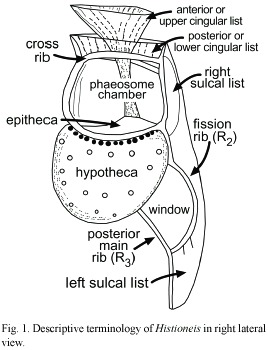
<body><![CDATA[<p><font face="Arial" size="2">Kofoid and Skogsberg (1928) elegantly described numerous species in the most complete study on <i>Histioneis </i>to date. Schiller (1933) described several new species and illustrated all the species known at that time. Further species were described by Forti (1932), Böhm (1933, 1936), Rampi (1950, 1952, see references in Rampi and Bernhard 1980), Osorio-Tafall (1942), Gaarder (1954), Halim (1960) and Wood (1963a, b). Recently, Polat and Koray (2002) and Gómez (2005a) reported<i> </i>micrographs of species from the Mediterranean Sea and the Pacific Ocean, respectively. </font></p> <font face="Arial" size="2"><i></i></font>     <p><font face="Arial" size="2"><i>Histioneis </i>has a transverse or cross rib in the lower cingular list that is lacking in the genera <i>Parahistioneis </i>Kofoid &amp; Skogsberg and <i>Ornithocercus </i>Stein. According to Wood (1968) more than six radial ribs in the posterior cingular list corresponded to <i>Ornithocercus </i>and less than six radial ribs to <i>Parahistioneis</i>. The species <i>Histioneis francescae </i>Murray &amp; Whitting was transferred to <i>Ornithocercus </i>(Balech 1962). The genera <i>Histioneis </i>and <i>Parahistioneis </i>have been considered as syn onyms because the cross rib is often hardly visible or it can be considered as a poor taxo nomical characteristic for the generic separation (Balech 1988). Balech (1971) transferred <i>Parahistioneis paraformis </i>whereas <i>P. acuta, P. acutiformis, P. conica, P. gascoynensis, P. pachypus, P. pieltainii, P. sphaeroidea </i>and <i>P. varians </i>have not been formally transferred to <i>Histioneis</i>. Further studies may split the genus <i>Histioneis </i>into several new genera with the re-establishment of <i>Parahistioneis</i>. Consequently at the present, the erection of new combinations, 35 years after the last one, would create more confusion. </font></p>     <p><font face="Arial" size="2">More than 100 species have been described since the earliest description of the type species (<i>H. remora </i>Stein, 1883) to the latest one (Rampi 1969), being one of the most numerous genus of marine dinoflagellates (Gómez 2005b). Nearly all the species were described from a single or few specimens and often with no further records after the initial description. Abé (1967), Balech (1971, 1988) and Taylor (1976) discussed on the validity of several species. The literature was often ancient and scattered, and no revision on the entire genus is available since Kofoid and Skogsberg (1928) and Schiller (1933). The identification at the species level is difficult due to the deficient delimitation of the species and it is uncertain how many species are valid. Within this context, little is known about the biogeography of <i>Histioneis</i>. The present study revises the synonymy of <i>Histioneis </i>in order to facilitate the identification at the species level and discusses on the geographical distribution. </font></p> <font face="Arial" size="2"><b>     <p>Analysis </p> </b> </font>     <p><font face="Arial" size="2">The original illustrations of all known species of <i>Histioneis </i>were reproduced and grouped based on the morphological similarity. Key diagnostic characters for the identification of the species include the cell body shape, primary ribs of the left sulcal list and the cingular list features (lateral pouch development, inclination of the upper cingular list). Other features such as the areolation of the hypotheca wall are characteristic of only a few taxa (i.e. <i>H. biremis</i>). For the descriptive terminology is important (<a href="#f1">Fig. 1</a>): R<sub>2 </sub>(middle rib) the fission rib, at the place where the list is divided by binary fission and R<sub>3 </sub>(posterior main rib), the list near the posterior end of this list, if more than one rib is present in this region, the best developed of these (Kofoid and Skogsberg 1928). In species such as <i>H. longicollis</i>, a loop formed by the R<sub>2 </sub>bending posteriorly and anastomosing with R<sub>3 </sub>is here named "window". Several species also showed supplementary ribs (i.e. <i>H. megalocopa</i>). </font></p>     <p style="text-align: center;"><font face="Arial" size="2">&nbsp;<a  name="f1"></a><img src="/img/fbpe/rbt/v55n2/3645i1.JPG" title="" alt=""  style="width: 268px; height: 350px;"></font></p>     
<p><font face="Arial" size="2">Several factors should take into account on the study of the validity of the species based on the original descriptions. Biological factors such as the unknown life cycle and its phenotypic intraspecific variability, different degree of development after the division or morphological modifications as an adaptation to environmental turbulence conditions may be responsible of the description of morphotypes as separate species. In addition, the transparency of the hyaline structures may be responsible of incomplete descriptions and even new species may be described from specimens damaged through sample treatment. </font></p>     <p><font face="Arial" size="2">The scarce records of <i>Histioneis </i>make difficult to assess the intraspecific variability. No species of <i>Histioneis </i>has been cultured and the only existing information on the life cycle of the Dinophysiales came from a few toxic species of <i>Dinophysis </i>Ehrenberg that have been temporally cultured. <i>Dinophysis </i>exhibited a high morphological variability, complicated by the existence of intermediate forms and the occurrence of "small cells" that have been previously considered to be different species (e.g. Reguera and González Gil 2001). The possible phenotypic variability was not considered in the description of the species of <i>Histioneis</i>, often based on single specimens. The size and shape of the sulcal list of <i>Histioneis </i>could vary as an adaptation to the turbulence conditions as reported for winged dinoflagellates such as <i>Ceratocorys horrida </i>Stein (Zirbel <i>et al</i>. 2000). Immature individuals of <i>Histioneis </i>could be described as new species. The degree of reticulation in the sulcal list probably depends on the maturation following the last division. As reported for <i>Dinophysis </i>the reticulation in the sulcal list was more pronounced on the fully developed-mature specimen and absent in the regenerated half of the list after division (e.g. Reguera and González Gil 2001). This factor may be especially relevant in species with supplementary ribs such as <i>H. megalocopa</i>. Different morphology of the sulcal list can be related to the phenotypic variability, whereas the variation in shape of the hypotheca is expected to be more conservative. </font></p>     <p><font face="Arial" size="2">In addition to the incidence of natural factors, the delicate <i>Histioneis</i>, usually collected by net hauls, can be damaged through sample treatment. Incomplete individuals may be described as new species (i.e. <i>H. elegans </i>resembled a damaged individual of <i>H. villafranca</i>). The transparency of the hyaline fins of <i>Histioneis </i>can easily be overlooked being responsible of the incomplete descriptions (i.e. <i>H. elongata</i>). The line drawings of the original descriptions of some species have been excessively simplified as in Böhm (1933, 1936) and Wood (1963a, b) (i.e. <i>H. simplex</i>) and other illustrations seem to be over-stylized (i.e. <i>H. josephinae</i>). The cell size as a criterion for the species identification should be considered with caution due to the imprecise size measurements of the early descriptions. For example Stein (1883) did not provide information on the magnification of his figures, being misinterpreted by further authors. All these factors, especially the unknown morphological variability in the life cycle, could have been responsible for the excessive proliferation of new species of <i>Histioneis</i>. </font></p>     <p><font face="Arial" size="2">Delimitation of groups and synonymy: the original descriptions and some illustrations by other authors were grouped based on morphological similarities. In the present study with no phylogenetic purposes and to facilitate the comparisons, the groups of species of <i>Histioneis </i>were mainly delimited by 1) the shape of the cell body (rotund, reniform, etc) and 2) the orientation and shape of the left sulcal list. </font></p> <font face="Arial" size="2"><b><i></i></b></font>     ]]></body>
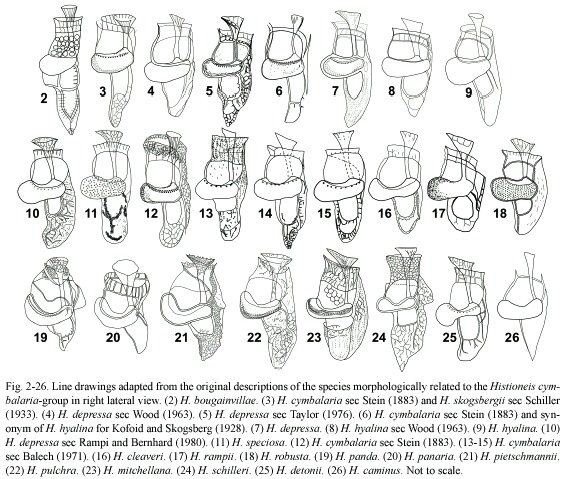
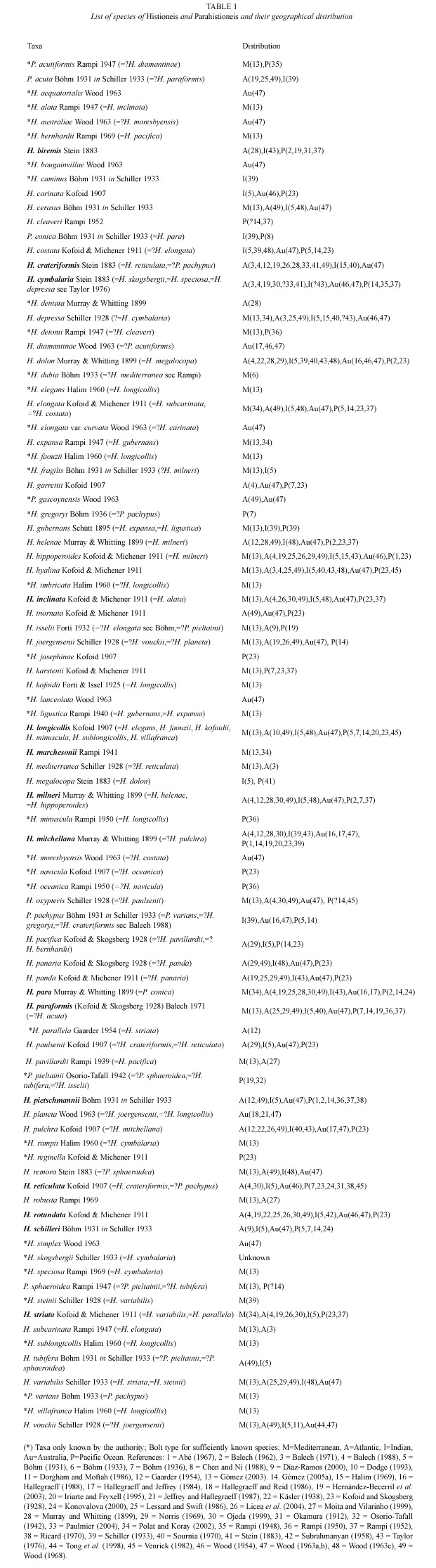
<body><![CDATA[<p><font face="Arial" size="2"><b><i>Histioneis cymbalaria </i>group:</b> (<a href="#f2-26">Fig. 2-26</a>) confusion in the identification of the species of <i>Histioneis </i>began since the first publication. Stein (1883) described the type species, <i>H. remora</i>, and <i>H. biremis</i>, <i>H. crateriformis</i>, <i>H. megalocopa </i>and <i>H. cymbalaria</i>. For this last taxon, he reported three different lateral figures and one ventral view (<a href="#f2-26">Fig. 3</a>, <a href="#f2-26">6</a>, <a href="#f2-26">12</a>). Later, Schiller (1933) described <i>H. skogsbergii </i>based on one of the lateral views and the ventral view illustrated by Stein for <i>H. cymbalaria </i>(<a href="#f2-26">Fig. 3</a>). Kofoid and Skogsberg (1928) considered other of the Schiller’s figures of <i>H. cymbalaria </i>as a synonym of <i>H. hyalina </i>(<a  href="#f2-26">Fig. 6</a>, <a href="#f2-26">9</a>). Two further described species, <i>H. depressa </i>and <i>H. schilleri </i>(<a  href="#f2-26">Fig. 7</a>, <a href="#f2-26">24</a>), also resembled <i>H. cymbalaria</i>. From the observation of a single specimen, Taylor (1976) reported that <i>H. depressa </i>in many respects resembled a very small <i>H. mitchellana </i>in which the reticulation was reduced in complexity (<a href="#f2-26">Fig. 5</a>). From abundant material, Balech (1971) illustrated three morphotypes of <i>H. cymbalaria </i>(<a href="#f2-26">Fig. 13-15</a>). Balech considered <i>H. depressa </i>as a synonym of <i>H. cymbalaria</i>. <i>H. depressa </i>has been illustrated with different morphology even by the same author (<a  href="#f2-26">Fig. 4</a>) (Wood 1963, 1968). One of the line drawings by Balech (1971) of <i>H. cymbalaria </i>was similar to Taylor’s (1976) figure of <i>H. depressa </i>(<a href="#f2-26">Fig. 5</a>, <a  href="#f2-26">14</a>). None of the illustrations by Taylor or Balech corresponded to Schiller’s figure of <i>H. depressa </i>(<a  href="#f2-26">Fig. 7</a>). Gómez (2005a) observed several specimens of <i>H. cymbalaria </i>from the same sample that allowed the observation of the intraspecific variability. The tapering of the sulcal list of different specimens was pointed or rounded with variable perforation and the size (~60 µm length) was similar to that for <i>H. cymbalaria </i>sec Balech (1988) or <i>H. depressa </i>sec Taylor (1976). Stein (1883) did not provided information on the size of <i>H. cymbalaria</i>, but Schiller (1933) with no new observations of <i>H. cymbalaria </i>reported that the length was 130-160 µm. Balech (1971) considered that the species described by Stein (1883) should be reduced in size to match with the real dimensions. The Schiller’s compilation was commonly referenced for the identification for many authors working in the Mediterranean Sea. Consequently the Mediterranean specimens of <i>H. cymbalaria </i>that really measured 60-65 µm long, instead of 130-160 µm, may be assigned to species of similar morphology and smaller size such as <i>H. depressa</i>. <i>H. depressa</i>, described from the cold waters of the northern Adriatic Sea, was one of the more commonly cited species in the Mediterranean whereas no record of <i>H. cymbalaria </i>existed (Gómez 2003). Beyond the possible <i>H. cymbalaria-depressa </i>synonymy, <i>H. cymbalaria </i>may be present in the Mediterranean Sea because <i>H. speciosa </i>(<a  href="#f2-26">Fig. 11</a>), only known from the original description in the Mediterranean Sea, is here considered as synonym of <i>H. cymbalaria</i>. <i>H. depressa </i>sec Polat and Koray (2002) showed a rounder cell body, the sulcal list was more ventrally deflected and had a lateral pouch compared to the original description. Further research should address whether <i>H. depressa </i>and <i>H. cymbalaria </i>are conspecific or both co-occur in the Mediterranean Sea. Records beyond the Mediterranean Sea such as <i>H. depressa </i>sec Taylor (1976) corresponded to <i>H. cymbalaria </i>(<a href="#t1">Table 1</a>). </font></p> <a name="f2-26"></a>     <div style="text-align: center;"><img src="/img/fbpe/rbt/v55n2/3645i2.JPG" title=""  alt="" style="width: 569px; height: 479px;">    
<br> </div>     <br>     <br>     <br> <a name="t1"></a>     <div style="text-align: center;"><img src="/img/fbpe/rbt/v55n2/3645i3.JPG" title=""  alt="" style="width: 621px; height: 2231px;"></div>     
<p><font face="Arial" size="2">In addition to the confusion between <i>H. cymbalaria </i>and <i>H. depressa</i>, the species <i>H. hyalina </i>is considered a synonym of other of the Stein’s figures of <i>H. cymbalaria </i>(Kofoid and Skogsberg 1928). Stein (1883) could try to show the intraspecific morphological variability of <i>H. cymbalaria </i>with three different illustrations. Stein’s figure showed a specimen with a kidney-shaped cell body, whereas <i>H. hyalina </i>showed a rounder cell body and the sulcal list was more ventrally deflected (<a  href="#f2-26">Fig. 6</a>, <a href="#f2-26">9</a>). Balech (1988) already reported that the figures of <i>H. hyalina </i>by Kofoid and Skogsberg and by Stein corresponded to separate species. The illustration of <i>H. hyalina </i>by Wood (1963) was closer to <i>H. depressa </i>(<a href="#f2-26">Fig. 4</a>, <a href="#f2-26">7</a>).</font></p>     <p><font face="Arial" size="2"> </font></p>     <p><font face="Arial" size="2">Recently <i>H. cleaveri </i>(<a  href="#f2-26">Fig. 16</a>) has been tentatively identified from the Pacific Ocean (Gómez 2005a). <i>H. detonii</i>, only reported by Rampi from the Mediterranean and Pacific waters, showed a sulcal list that resembled members of the <i>cymbalaria</i>-group, but it differed in having a narrow reniform cell body (<a href="#f2-26">Fig. 25</a>). <i>H. rampii</i>, only know by the authority, showed a gibbous ventral margin and the cingular lists inclined (<a href="#f2-26">Fig. 17</a>). <i>H. robusta </i>is characterized by a margin extended ventrally (<a  href="#f2-26">Fig. 18</a>). <i>H. skogsbergii</i>, described by Schiller based on one of Stein’s figures of <i>H. cymbalaria </i>(<a  href="#f2-26">Fig. 3</a>)<i>, </i>with the sulcal list tapering posteriorly to a point and highly reticulated, is considered here as a morphotype of <i>H. cymbalaria</i>. <i>H. schilleri </i>(<a  href="#f2-26">Fig. 24</a>), larger than <i>H. cymbalaria </i>and characterized by a posterior list gibbous and reticulate margin, was a distinctive taxon often reported in the western Pacific Ocean (<a  href="#t1">Table 1</a>). Gómez (2005a) illustrated <i>H</i>. <i>schilleri </i>and <i>H. mitchellana. H. schilleri </i>should not be considered a synonym of <i>H. mitchellana </i>contrary to the opinion by Taylor (1976). In the Caribbean Sea, Paulmier (2004) reported <i>H. cymbalaria</i>, but his figure corresponded to <i>H. schilleri</i>, which has been cited in that location (Díaz-Ramos 2000) (<a href="#t1">Table 1</a>). <i>H. bougainvillae </i>(<a href="#f2-26">Fig. 2</a>), only known by the authority, showed a round cell body and several loops in the sulcal list that differed from other members of the <i>cymbalaria</i>-group. <i>H. caminus</i>, with a very sketchy description, would require further research (<a href="#f2-26">Fig. 26</a>). </font></p>     ]]></body>
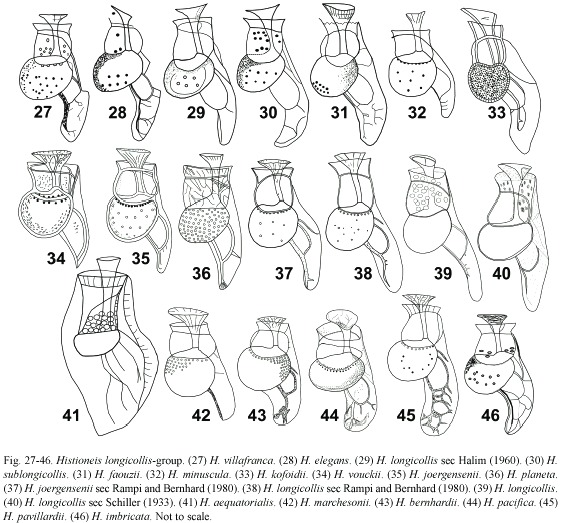
<body><![CDATA[<p><font face="Arial" size="2">A subgroup of species included in the <i>cymbalaria</i>-group is characterized by a saddle-shaped cell body that was higher dorsally. <i>H. pietschmanii </i>was a distinctive taxon commonly reported in the Pacific Ocean (Gómez 2005a, <a href="#t1">Table 1</a>). <i>H. panaria </i>and <i>H. panda </i>differed in the size of the cingular list (<a href="#f2-26">Fig. 19</a>, <a href="#f2-26">20</a>). Norris (1969) reported that the hyaline fins of <i>H. panaria </i>could easily go unnoticed. Abé (1967) proposed <i>H. pulchra </i>as a synonym of <i>H. mitchellana </i>(<a href="#f2-26">Fig. 22</a>, <a  href="#f2-26">23</a>). Abé considered that the figures of <i>H. mitchellana </i>by Kofoid and Skogsberg (1928) also illustrated <i>H. pulchra</i>. Both taxa are here considered as separate species until further research. </font></p>     <p><font face="Arial" size="2"><b><i>Histioneis longicollis </i>group:</b> (<a href="#f27-46">Fig. 27-46</a>) the <i>longicollis</i>-group is characterized by a round cell body and the sulcal list inclined ventrally compared to the <i>cymbalaria</i>-group. In the <i>cymbalaria</i>-group the hypotheca was kidney or saddle-shaped and the sulcal list was more dorsally deflected. Both groups had a window formed by the R<sub>2 </sub>bending posteriorly and anastomosing with R<sub>3</sub>, quadrangular in members of the <i>cymbalaria</i>-group and circular in the <i>longicollis</i>-group (quasi triangular for <i>H. joergensenii</i>). <i>H. longicollis </i>showed a high degree of variability in the development of the sulcal list, including specimens with a short sulcal list (Gómez 2005a). Schiller (1933) did not reproduce the original Kofoid’s figure of <i>H. longicollis </i>(<a  href="#f27-46">Fig. 39</a>, <a href="#f27-46">40</a>) and his figure resembled <i>H. hyalina </i>(<a href="#f2-26">Fig. 9</a>). Halim (1960) reported <i>H. longicollis </i>from the Ligurian Sea and he described four close taxa: <i>H. elegans</i>, <i>H. faouzii</i>, <i>H. sublongicollis </i>and <i>H. villafranca </i>(<a href="#f27-46">Fig. 27-31</a>). The length of these taxa, 72 µm, agreed with <i>H. longicollis </i>sec Halim (<a href="#f27-46">Fig. 29</a>). The four species, described from single or few specimens, mainly differed in the distal branches of the sulcal list. These taxa, only known by the authority (except <i>H. faouzii</i>, Rampi 1969), are here considered synonyms of <i>H. longicollis</i>. <i>H. minuscula </i>(<a href="#f27-46">Fig. 32</a>) was akin to specimens of <i>H. longicollis </i>with a scarcely developed sulcal list and together with <i>H. kofoidii </i>(<a  href="#f27-46">Fig. 33</a>) may be considered synonyms of <i>H. longicollis</i>. </font></p> <a name="f27-46"></a>     <div style="text-align: center;"><img src="/img/fbpe/rbt/v55n2/3645i4.JPG" title=""  alt="" style="width: 561px; height: 523px;"></div>     
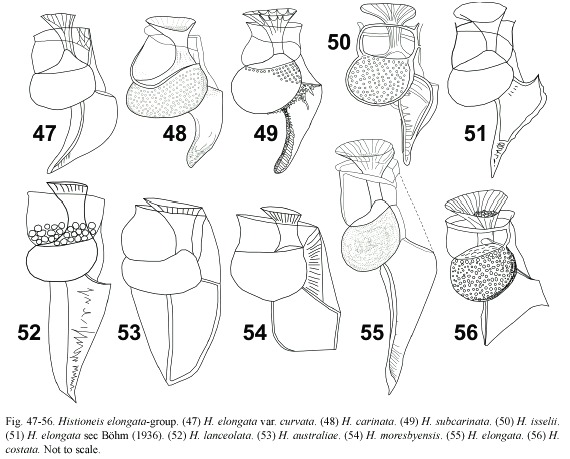
<p><font face="Arial" size="2"><i>H. pacifica </i>is characterized by the sulcal list inclined dorsally and several ribs radiated marginally from the window (<a href="#f27-46">Fig. 44</a>). The sulcal list of <i>H. longicollis </i>was acuter and the cell body was rounder than in <i>H. pacifica</i>. Schiller (1933) suggested that <i>H. pacifica </i>and <i>H. hyalina </i>may be synonyms. <i>H. pavillardii </i>differed from <i>H. bernhardii </i>in the more elongate appearance (<a href="#f27-46">Fig. 43</a>, <a  href="#f27-46">45</a>). Both taxa were tentatively considered as synonyms of <i>H. pacifica. H. imbricata </i>(<a  href="#f27-46">Fig. 46</a>), never reported after the initial description (<a href="#t1">Table 1</a>), appeared to occupy an intermediate position between <i>H. longicollis </i>and <i>H. pacifica</i>. In <i>H. marchesonii </i>(<a href="#f27-46">Fig. 42</a>), illustrated by Polat and Koray (2002), lacked the window, but otherwise resembled the <i>longicollis</i>-group. <i>H. aequatorialis </i>with a well-developed dorsal sail and supplementary ribs resembled members of the <i>megalocopa</i>-group. However, <i>H. aequatorialis </i>was tentatively included in this group due to its rounded cell body (<a href="#f27-46">Fig. 41</a>). <i>H. longicollis </i>and <i>H. joergensenii</i>, two of the most common species in the Mediterranean Sea (Gómez 2003), may be synonyms according to the illustrations by Rampi and Bernhard (1980) (<a href="#f27-46">Fig. 37</a>, <a href="#f27-46">38</a>). The shape of the window was rounded in <i>H. longicollis </i>and quasi triangular in <i>H. joergensenii</i>. <i>H. joergensenii </i>appeared to be intermediate between <i>H. vouckii </i>and <i>H. planeta </i>(<a  href="#f27-46">Fig. 34-36</a>). For <i>H. vouckii </i>the R<sub>2 </sub>and R<sub>3 </sub>joined acutely in the margin of the posterior part of a shorter sulcal list. <i>H. planeta </i>showed a larger sulcal list that resembled <i>H. longicollis</i>. </font></p>     <p><font face="Arial" size="2"><b><i>Histioneis elongata </i>group:</b> (<a href="#f47-56">Fig. 47-56</a>) this group is characterized by a long R<sub>3</sub>, the cross-rib extended ventrally and a smooth triangular sail extended from R<sub>2 </sub>to R<sub>3</sub>. Böhm (1936) illustrated the intraspecific variability of the sulcal list of <i>H. elongata </i>(<a  href="#f47-56">Fig. 51</a>, <a href="#f47-56">55</a>). <i>H. costata </i>mainly differed from <i>H. elongata </i>in the shorter R<sub>3 </sub>and it cannot be discarded that both taxa may be conspecific (<a href="#f47-56">Fig. 55</a>, <a  href="#f47-56">56</a>). <i>H. isselii </i>showed an ornamented sulcal list and in some way resembled the members of the <i>longicollis</i>-group (<a href="#f47-56">Fig. 50</a>). <i>H. subcarinata </i>resembled <i>H. elongata </i>sec Böhm (1936) (<a href="#f47-56">Fig. 49</a>, <a href="#f47-56">51</a>). <i>H. carinata </i>differed from other members of this group in the narrow cell body (<a href="#f47-56">Fig. 48</a>). <i>H. elongata </i>var. <i>curvata </i>showed a less rotund cell body than <i>H. elongata</i>. Its cell body resembled <i>H. subcarinata </i>and the sulcal list of <i>H. elongata </i>var. <i>curvata </i>only differed from that taxon in the occurrence of the marginal sail that extended dorsally behind R<sub>3 </sub>(<a href="#f47-56">Fig. 47</a>, <a href="#f47-56">49</a>). <i>H. moresbyensis </i>differed mainly from <i>H. costata </i>in the R<sub>2 </sub>bent sharply backwards and the more ellipsoidal cell body (<a  href="#f47-56">Fig. 54</a>). If the bent R<sub>3 </sub>of <i>H. moresbyensis </i>with a dorsal supplementary rib is projected in the vertical axis of the cell, this taxon resembled <i>H. australiae </i>(<a href="#f47-56">Fig. 53</a>). The cell body of <i>H. lanceolata </i>(<a href="#f47-56">Fig. 52</a>) was rotund and as in <i>H. australiae </i>showed a supplementary rib branching dorsally behind R<sub>3</sub>. These last three species, never reported after the initial descriptions, need further research (<a href="#t1">Table 1</a>). </font></p> <a name="f47-56"></a>     <div style="text-align: center;"><img src="/img/fbpe/rbt/v55n2/3645i5.JPG" title=""  alt="" style="width: 570px; height: 459px;"></div>     
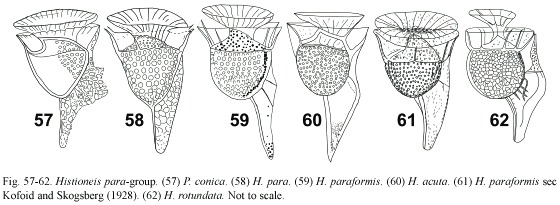
<p><font face="Arial" size="2"><b><i>Histioneis para </i>group:</b> (<a href="#f57-62">Fig. 57-62</a>) the species of this group are characterized by a long R<sub>3</sub>, almost in the vertical axis of the cell and the cingular lists wide and ribbed. Most of the species of this group and several species of the next two groups have been described as <i>Parahistioneis</i>. The hypotheca was hemispherical for <i>H. paraformis </i>(<a  href="#f57-62">Fig. 59</a>, <a href="#f57-62">61</a>) and more triangular for <i>H. para </i>(<a href="#f57-62">Fig. 58</a>). The original description of <i>H. para </i>and that by Kofoid and Skogsberg (1928) showed slight differences in the sulcal list (<a href="#f57-62">Fig. 59</a>, <a href="#f57-62">61</a>). <i>Parahistioneis conica </i>is here considered as a synonym of <i>H. para </i>(<a  href="#f57-62">Fig. 57</a>, <a href="#f57-62">58</a>) and <i>P. acuta </i>is tentatively considered as a synonym of <i>H. paraformis </i>(<a href="#f57-62">Fig. 59-61</a>). <i>H. rotundata </i>is included in this group although it showed a slightly bent R<sub>3 </sub>and the margin undulated (<a href="#f57-62">Fig. 62</a>). </font></p> <a name="f57-62"></a>     <div style="text-align: center;"><img src="/img/fbpe/rbt/v55n2/3645i6.JPG" title=""  alt="" style="width: 560px; height: 205px;"></div>     
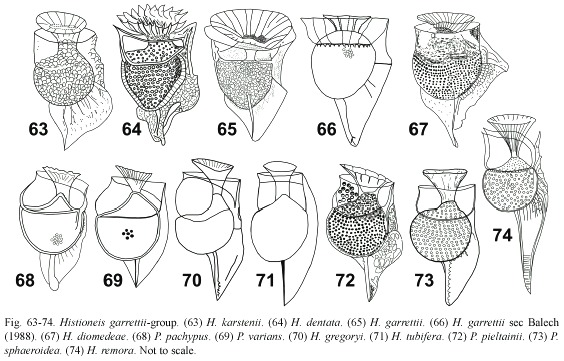
<p><font face="Arial" size="2"><b><i>Histioneis garrettii </i>group:</b> (<a href="#f63-74">Fig. 63-74</a>) this group is characterized by a R<sub>3 </sub>that extended straight almost in the vertical axis of the cell, but the R<sub>3 </sub>was shorter than in the previous group. Several species had a supplementary rib from R<sub>3 </sub>dorsally. <i>Histioneis karstenii </i>(<a href="#f63-74">Fig. 63</a>) showed a relatively large epitheca, non-pedunculate anterior cingular list and an elongated margin that in some way resembled <i>Ornithocercus. H. garrettii </i>sec Balech (1988) resembled <i>H. diomedeae </i>in the body shape and ventral cross-rib (<a href="#f63-74">Fig. 66</a>, <a href="#f63-74">67</a>). <i>Histioneis garrettii </i>sec Balech (1988) showed the R<sub>2 </sub>and R<sub>3 </sub>more ventrally deflected than in the original description of <i>H. garrettii </i>and showed the anterior cingular list wider and the sail branching dorsally from R<sub>3 </sub>less developed (<a href="#f63-74">Fig. 66</a>). Schiller (1933) included <i>H. dentata </i>(<a href="#f63-74">Fig. 64</a>) in the <i>biremis-</i>group. The species <i>P. pachypus </i>and <i>P. varians </i>are synonyms (the former has the priority) (<a href="#f63-74">Fig. 68</a>, <a href="#f63-74">69</a>). <i>H. gregoryi </i>(<a href="#f63-74">Fig. 70</a>) showed more elongate appearance than <i>P. pachypus</i>. <i>Parahistioneis sphaeroidea </i>and <i>P. pieltainii </i>showed a similar shape of the sulcal list, being more ornamented in <i>P. pieltainii </i>that also showed the upper cingular list inclined (<a href="#f63-74">Fig. 72</a>, <a href="#f63-74">73</a>). Gómez (2005a) illustrated a tentative <i>P. sphaeroidea </i>that, if valid, constituted the first observation after the initial description (<a  href="#t1">Table 1</a>). The original illustration of <i>H. tubifera </i>was very sketchy and only known by the authority (<a href="#f63-74">Fig. 71</a>, <a  href="#t1">Table 1</a>). <i>Parahistioneis pieltainii</i>, <i>P. sphaeroidea </i>and <i>H. tubifera </i>may be synonyms. Hernández-Becerril <i>et al</i>. (2003) suggested the synonymy of <i>P. pieltainii </i>and <i>H. isselii</i>. </font></p> <a name="f63-74"></a>     <div style="text-align: center;"><img src="/img/fbpe/rbt/v55n2/3645i7.JPG" title=""  alt="" style="width: 564px; height: 361px;"></div>     
]]></body>
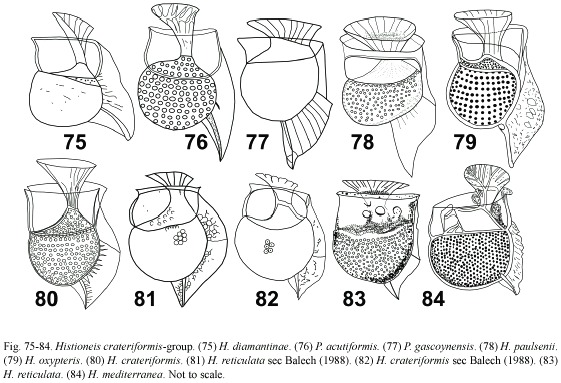
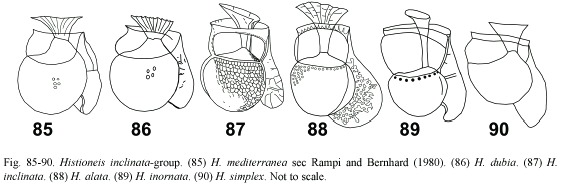
<body><![CDATA[<p><font face="Arial" size="2">The type species, <i>H. remora</i>, with a long R<sub>3 </sub>is included here only based on the general appearance (<a href="#f63-74">Fig. 74</a>). According to Böhm (1936), <i>H. remora </i>illustrated by Jørgensen (1923) could correspond to <i>H. elongata. </i>The records of the type species have been scarce and often misidentified due to the insufficient description by Stein (1883). </font></p> <font face="Arial" size="2"><b><i></i></b></font>     <p><font face="Arial" size="2"><b><i>Histioneis crateriformis </i>group:</b> (<a href="#f75-84">Fig. 75-84</a>) this group is closely related to the <i>garrettii</i>group, but with a more ventrally deflected R<sub>3</sub>. The hypotheca was semicircular and usually the cingulum broad. As in the previous group, there was a high number of closely related species and immature specimens may be described as new species. Species such as <i>H. paulsenii </i>and <i>H. reticulata </i>were described from single specimens (<a href="#f75-84">Fig. 78</a>, <a href="#f75-84">83</a>). <i>H. reticulata </i>could correspond to specimens with a scarcely developed sulcal list of <i>H. crateriformis </i>(<a href="#f75-84">Fig. 80</a>). Balech (1971) considered <i>H. reticulata </i>and <i>H. crateriformis </i>as synonyms and later as separate species (Balech 1988). The sulcal list of the Balech’s figure of <i>H. reticulata </i>(<a  href="#f75-84">Fig. 81</a>) was closer to <i>H. crateriformis </i>(<a href="#f75-84">Fig. 80</a>), whereas the Balech’s figure of <i>H. crateriformis </i>(<a href="#f75-84">Fig. 82</a>) was closer to <i>H. mediterranea </i>(<a href="#f75-84">Fig. 84</a>) and <i>H. mediterranea </i>sec Rampi and Bernhard (1980) (<a href="#f85-90">Fig. 85</a>). <i>H. mediterranea </i>resembled <i>H. reticulata </i>(<a href="#f75-84">Fig. 83</a>, <a href="#f75-84">84</a>). Balech (1988, p. 63) observed abundant material of <i>H. crateriformis </i>and he considered that the original Stein’s figure was incomplete. Paulmier (2004, p. 201) illustrated a specimen identified as <i>H. </i>cf. <i>crateriformis</i>. <i>H. oxypteris </i>(<a href="#f75-84">Fig. 79</a>), tentatively identified by Gómez (2005a), resembled <i>H. crateriformis </i>and <i>H. paulsenii</i>. According to Balech (1988), <i>H. paulsenii </i>in Norris (1969) included <i>H. reticulata </i>and <i>H. crateriformis</i>. <i>H. crateriformis </i>sec Balech (1988) resembled <i>P. pachypus </i>(<a  href="#f63-74">Fig. 68</a>). The small size of the specimens and the short sulcal list made the delimitation of the species of this group especially difficult. Taken into account the high intraspecific variability reported for <i>Dinophysis</i>, <i>H. reticulata </i>is here considered as synonym of <i>H. crateriformis </i>and also probably <i>H. mediterranea </i>and <i>P. pachypus</i>. <i>Parahistioneis gascoynensis </i>(<a href="#f75-84">Fig. 77</a>) is only known by the authority (<a href="#t1">Table 1</a>). <i>Parahistioneis acutiformis </i>was similar to <i>H. diamantinae </i>in the sulcal list, but the orientation of the R<sub>3 </sub>was different (<a href="#f75-84">Fig. 75</a>, <a href="#f75-84">76</a>). </font></p> <a name="f75-84"></a>     <div style="text-align: center;"><img src="/img/fbpe/rbt/v55n2/3645i8.JPG" title=""  alt="" style="width: 561px; height: 383px;"></div>     
<p><font face="Arial" size="2"><b><i>Histioneis inclinata </i>group:</b> (<a href="#f85-90">Fig. 85-90</a>) this group is characterized by a left sulcal list short, ending ventrally and with a round margin. <i>H. mediterranea </i>according to Rampi and Bernhard (1980) resembled <i>H. dubia</i>, being the R<sub>3 </sub>illustrated in the former taxon (<a href="#f85-90">Fig. 85</a>, <a  href="#f85-90">86</a>). <i>H. alata </i>differed from <i>H. inclinata </i>in the larger sulcal list, ending more ventrally in <i>H. inclinata</i>. Both taxa, with the R<sub>3 </sub>absent, may be synonyms (<a href="#f85-90">Fig. 87</a>, <a href="#f85-90">88</a>). <i>H. inornata </i>differed from other members in the large cingular chamber and a short bent R<sub>3 </sub>(<a  href="#f85-90">Fig. 89</a>). The sketchy illustration of <i>H. simplex </i>could correspond to the shape of <i>H. alata, </i>but both taxa differed in the shape of the cell body (<a href="#f85-90">Fig. 90</a>). </font></p>     <p style="text-align: center;"><font face="Arial" size="2">&nbsp;<a  name="f85-90"></a><img src="/img/fbpe/rbt/v55n2/3645i9.JPG" title="" alt=""  style="width: 563px; height: 186px;"></font></p> <font face="Arial" size="2"><b></b></font>     
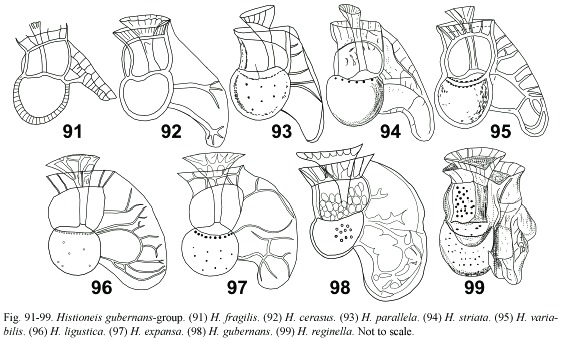
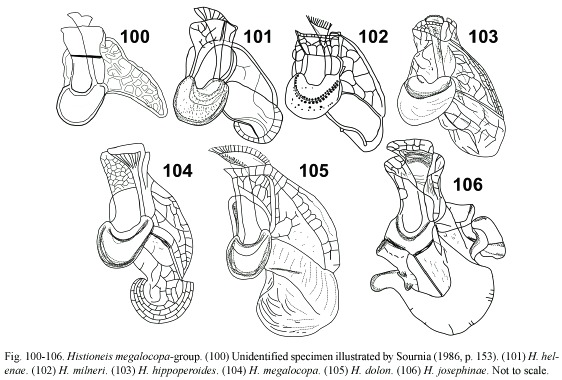
<p><font face="Arial" size="2"><b><i>Histioneis gubernans </i>group:</b> (<a href="#f91-99">Fig. 91-99</a>) this group is characterized by a rotund cell body and the R<sub>3 </sub>and R<sub>2 </sub>deflected ventrally with round margins and forming loops. The four illustrations of <i>H. variabilis </i>reported by Schiller (1933) showed the intraspecific variability. <i>H. steinii </i>Schiller (non <i>H. steinii </i>Lemmermann) is a nomenclatural synonym of <i>H. variabilis</i>. According to Balech (1988) <i>H. variabilis </i>was a synonym of <i>H. striata </i>(<a href="#f91-99">Fig. 94</a>, <a href="#f91-99">95</a>, illustrated by Polat and Koray 2002). <i>H. parallela </i>(<a  href="#f91-99">Fig. 93</a>) is here also considered as a synonym of <i>H. striata</i>. <i>H. cerasus </i>showed the R<sub>2 </sub>and R<sub>3 </sub>almost parallel and branched marginally (<a href="#f91-99">Fig. 92</a>). As reported by Taylor (1976), <i>H. fragilis </i>seems to be an immature specimen lacking that part of the left sulcal list posterior to the R<sub>2 </sub>(<a  href="#f91-99">Fig. 91</a>). Sournia (1986, p. 153) illustrated an unidentified <i>Histioneis </i>which sulcal list resembled that of <i>H. fragilis</i>, but it differed in having a saddle-shape cell body (<a href="#f100-106">Fig. 100</a>). <i>Histioneis ligustica </i>and <i>H. expansa </i>may be considered conspecific based on the original illustrations (<a href="#f91-99">Fig. 96</a>, <a href="#f91-99">97</a>). Polat and Koray (2002) illustrated the latter taxon. Both taxa only showed slight differences in the outline and ornamentation of the sulcal list and they are here considered as synonyms of <i>H. gubernans </i>(<a href="#f91-99">Fig. 98</a>). <i>H. reginella</i>, with the accessory lists that characterized <i>megalocopa</i>group, has been included here due to the rotund cell body (<a href="#f91-99">Fig. 99</a>). </font></p> <a name="f91-99"></a>     <div style="text-align: center;"><img src="/img/fbpe/rbt/v55n2/3645i11.JPG" title=""  alt="" style="width: 564px; height: 339px;"></div>     
<p><font face="Arial" size="2"><b><i>Histioneis megalocopa </i>group:</b> (<a href="#f100-106">Fig. 100-106</a>) this group differed from the previous one in having a reniform cell body. The sulcal list achieved the highest degree of development with accessory lists. These ornamented species were likely to suffer breakage of the accessory lists through sample treatment. There were not reasons to consider <i>H. milneri</i>, <i>H. helenae </i>and <i>H. hippoperoides </i>as separate species (<i>H. milneri </i>has the priority) (<a href="#f100-106">Fig. 101-103</a>). <i>H. megalocopa </i>and <i>H. dolon </i>are here considered as synonyms contrary to Balech (1988) (<a  href="#f100-106">Fig. 104</a>, <a href="#f100-106">105</a>). <i>Histioneis josephinae </i>(<a href="#f100-106">Fig. 106</a>) may be an extremely elaborated form of <i>H. megalocopa</i>. </font></p> <a name="f100-106"></a>     <div style="text-align: center;"><img src="/img/fbpe/rbt/v55n2/3645i12.JPG" title=""  alt="" style="width: 562px; height: 380px;"></div>     
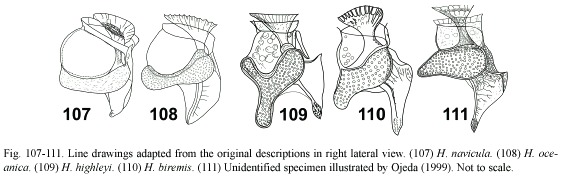
<p><font face="Arial" size="2"><b><i>Histioneis navicula </i>group:</b> (<a href="#f107-111">Fig. 107-108</a>) this group is composed of <i>H. navicula </i>and <i>H. oceanica </i>that were not ascribed to any of the previous groups (<a href="#f107-111">Fig. 107</a>, <a href="#f107-111">108</a>). Both taxa, never reported after the initial descriptions (<a href="#t1">Table 1</a>), showed a very narrow cell body and a large cingular chamber. <i>H. navicula </i>(<a href="#f107-111">Fig. 107</a>) resembled <i>H. panda </i>(<a href="#f2-26">Fig. 19</a>). The sulcal list of <i>H. oceanica </i>(<a href="#f107-111">Fig. 108</a>) resembled <i>H. elongata </i>var. <i>curvata </i>(<a  href="#f47-56">Fig. 47</a>), but it differed in having a narrow subreniform cell body. These rare taxa may be conspecific (<i>H. navicula </i>has the priority). </font></p>     ]]></body>
<body><![CDATA[<p style="text-align: center;"><font face="Arial" size="2">&nbsp;<a  name="f107-111"></a><img src="/img/fbpe/rbt/v55n2/3645i13.JPG" title="" alt=""  style="width: 562px; height: 178px;"></font></p> <font face="Arial" size="2"><b></b></font>     
<p><font face="Arial" size="2"><b><i>Histioneis biremis </i>group:</b> (<a href="#f107-111">Fig. 109-111</a>) <i>H. highleyi </i>and <i>H. biremis </i>showed a distinctive Y-shaped and sigmoid areolated hypotheca, respectively (<a href="#f107-111">Fig. 109, 110</a>). These species seem to be a transition between <i>Histioneis </i>and <i>Citharistes </i>Stein. Ojeda (1999) illustrated a specimen of <i>Histioneis </i>(<a href="#f107-111">Fig. 111</a>) with a distinctive pear-shaped hypotheca and the sulcal list as in <i>H. elongata </i>sec Böhm (1936). The sharper extreme of the hypotheca of <i>H. biremis </i>was more posteriorly deflected than in Ojeda’s specimen (<a href="#f107-111">Fig. 110, 111</a>). </font></p> <font face="Arial" size="2"><b>Biogeography:</b> the distribution of <i>Histioneis </i>is restricted to warm waters. The northern records in the NW Pacific appeared associated with the warm waters of the Kuroshio Current (Okamura 1912, Abé 1967). Wood (1964) reported that <i>Histioneis </i>did not occur below 17 ºC in the southern waters of Australia. Balech (1988) exceptionally recorded one specimen of <i>H. cymbalaria </i>at 13 ºC and other of <i>H. highleyi </i>at 10 ºC in the South Atlantic Ocean. </font>     <p><font face="Arial" size="2">In the open north-western Pacific Ocean, the most ubiquitous species were <i>H. longicollis </i>and <i>H. cymbalaria </i>(Gómez 2005a). It should be taken into account that net sampling does not allow collecting the smaller and fragile specimens. Consequently historical studies based on net hauls could underestimate the occurrence of these taxa versus larger and resistant species. </font></p> <font face="Arial" size="2"><i></i></font>     <p><font face="Arial" size="2"><i>H. biremis </i>and <i>H. highleyi </i>are easily identifiable and distinctive species. To the best of my knowledge, the distribution of <i>H. biremis </i>is restricted to the Indo-Pacific region with one ancient record in the tropical Atlantic Ocean (Murray and Whitting 1899) (<a href="#t1">Table 1</a>). </font></p> <font face="Arial" size="2"><i></i></font>     <p><font face="Arial" size="2"><i>H. highleyi</i>, a common species in the coastal waters of the western Pacific Ocean (Böhm 1936), is also known from the Atlantic Ocean (<a href="#t1">Table 1</a>). None of both taxa is known from the Mediterranean Sea. </font></p>     <p><font face="Arial" size="2">Forty species of <i>Histioneis </i>have been cited in the Mediterranean Sea, being the type locality of 27 species. This substantial species richness can be attributed, in part, to the historical tradition of taxonomic studies. A total of 13 species are exclusively known from the Mediterranean Sea (Gómez 2006). However, the consideration as endemic species should be cautiously considered due to doubts in the validity of these taxa. <i>H. depressa </i>(=<i>H. cymbalaria</i>), <i>H. joergensenii </i>and <i>H. longicollis </i>were the most common species, followed by <i>H. marchesonii</i>, <i>H. inclinata</i>, <i>H. mediterranea </i>and <i>H. variabilis </i>(Gómez 2003). It can be expected more records of <i>Histioneis </i>in the warmer sub-basins of the Mediterranean. However, most of the records of <i>Histioneis </i>are reported in the colder sub-basins such as Ligurian and Adriatic Seas (Gómez 2003) because the warmer areas such as the South Ionian Sea are nearly unexplored. Apparently in the Mediterranean Sea were lacking species of <i>Histioneis </i>with accessory ribs such as <i>H. megalocopa </i>and <i>H. milneri</i>. Other large distinctive ornamented taxa such as <i>H. mitchellana</i>, <i>H. pietschmannii </i>or <i>H. schilleri </i>are known from tropical waters such as the Caribbean Sea, but they are absent from temperate waters such as Mediterranean Sea. </font></p>     <p><font face="Arial" size="2">Zirbel <i>et al. </i>(2000) concluded that <i>Ceratocorys horrida </i>increased the length of the extensions under low turbulence conditions as a strategy to reduce the sinking speed. The low turbulence conditions that prevail in stratified tropical waters may favor species of <i>Histioneis </i>with large sulcal lists. In addition, the size and shape of the left sulcal list may be an adaptation for the capture of preys by modulating a feeding current (Taylor 1980). Consequently a large sulcal list may reduce the sinking speed and facilitate the capture of picoplankton preys.</font></p>     <p><font face="Arial" size="2"> </font></p>     <p><font face="Arial" size="2">In addition to the highly developed sulcal list that characterizes <i>Histioneis</i>, all the species have developed an especial chamber to harbor unicellular diazotrophic cyanobacteria that may constitute a supplement of the diet for the dinoflagellate. The microalgal preys may be found in wide geographical range. However, the requirements of the diazotrophic cyanobacteria could limit the geographical distribution of <i>Histioneis</i>. The dinitrogen fixation tended to be favored at high temperatures and this may explain the warm-water distribution of <i>Histioneis</i>. In cold waters or environments with a high abundance of microalgal preys, the costs of carrying an empty large cingular chamber would render <i>Histioneis </i>less competitive versus other heterotrophic dinoflagellates. </font></p>     <p><font face="Arial" size="2">When the specimens cannot be illustrated and in case of doubts in the identification, it is recommended that the records will be assigned to the closer species of <i>Histioneis </i>by using "cf." before the epithet instead of <i>Histioneis </i>sp. This would facilitate further studies on the biogeography of <i>Histioneis</i>. </font></p> <font face="Arial" size="2"><b>     ]]></body>
<body><![CDATA[<p>Acknowledgments </p> </b> </font>     <p><font face="Arial" size="2">This is a contribution to the French IFB ‘Biodiversité et Changement Global’. </font></p> <font face="Arial" size="2"><b>     <p>Resumen </p> </b> </font>     <p><font face="Arial" size="2">El género <i>Histioneis </i>(=<i>Parahistioneis</i>) tiene una cantidad excesiva de especies, descritas insuficientemente y a menudo a partir de un solo espécimen, ignorando la variabilidad intra-específica. Con el objetivo de investigar la validez de las especies y sugerir sinónimos, aquí se presentan las ilustraciones originales de <i>Histioneis </i>agrupadas según su parecido morfológico. Las escasas observaciones de <i>Histioneis </i>y las dudas en la identificación a nivel de especie son responsables de la falta de información sobre su distribución geográfica. Las especies de mayor tamaño y más ornamentadas son típicas de aguas tropicales. Las especies más pequeñas y menos ornamentadas presentan una distribución más amplia y pueden encontrarse también en aguas templadas, como el Mar Mediterráneo. </font></p> <font face="Arial" size="2"><b></b></font>     <p><font face="Arial" size="2"><b>Palabras clave:</b> <i>Histioneis</i>, <i>Parahistioneis</i>, dinofisiales, dinoflagelado, fitoplancton, biogeografía. </font></p> <font face="Arial" size="2"><b>     <p>References </p> </b> </font>     <!-- ref --><p><font face="Arial" size="2">Abé, T.H. 1967. The armoured Dinoflagellata: II. Prorocentridae and Dinophysidae C- <i>Ornithocercus</i>, <i>Histioneis</i>, <i>Amphisolenia </i>and others. Publ. Seto Mar. Biol. Lab. 15: 79-116. </font>&nbsp;&nbsp;&nbsp;&nbsp;&nbsp;&nbsp;&nbsp;&nbsp;[&#160;<a href="javascript:void(0);" onclick="javascript: window.open('/scielo.php?script=sci_nlinks&ref=1243483&pid=S0034-7744200700020001100001&lng=','','width=640,height=500,resizable=yes,scrollbars=1,menubar=yes,');">Links</a>&#160;]<!-- end-ref --><!-- ref --><p><font face="Arial" size="2">Balech, E. 1962. Tintinnoidea y Dinoflagellata del Pacífico según material de las expediciones Norpac y Downwind del Instituto Scripps de Oceanografía. Rev. Mus. Argent. Cienc. Nat. "B. Rivadavia". Cienc. Zool. 7: 1-253. </font>&nbsp;&nbsp;&nbsp;&nbsp;&nbsp;&nbsp;&nbsp;&nbsp;[&#160;<a href="javascript:void(0);" onclick="javascript: window.open('/scielo.php?script=sci_nlinks&ref=1243484&pid=S0034-7744200700020001100002&lng=','','width=640,height=500,resizable=yes,scrollbars=1,menubar=yes,');">Links</a>&#160;]<!-- end-ref --><!-- ref --><p><font face="Arial" size="2">Balech, E. 1971. Microplancton del Atlántico Ecuatorial Oeste (Equalant I). Serv. Hidrogr. Naval. H. Buenos Aires 654: 1-103. </font>&nbsp;&nbsp;&nbsp;&nbsp;&nbsp;&nbsp;&nbsp;&nbsp;[&#160;<a href="javascript:void(0);" onclick="javascript: window.open('/scielo.php?script=sci_nlinks&ref=1243485&pid=S0034-7744200700020001100003&lng=','','width=640,height=500,resizable=yes,scrollbars=1,menubar=yes,');">Links</a>&#160;]<!-- end-ref --><!-- ref --><p><font face="Arial" size="2">Balech, E. 1988. Los dinoflagelados del Atlántico Sudoccidental. Publ. espec. Inst. Español Oceanogr. 1: 1-310. </font>&nbsp;&nbsp;&nbsp;&nbsp;&nbsp;&nbsp;&nbsp;&nbsp;[&#160;<a href="javascript:void(0);" onclick="javascript: window.open('/scielo.php?script=sci_nlinks&ref=1243486&pid=S0034-7744200700020001100004&lng=','','width=640,height=500,resizable=yes,scrollbars=1,menubar=yes,');">Links</a>&#160;]<!-- end-ref --><!-- ref --><p><font face="Arial" size="2">Böhm, A. 1931. Zur Verbreitung einiger Peridineen. Arch. Protistenk. 75: 498-501. </font>&nbsp;&nbsp;&nbsp;&nbsp;&nbsp;&nbsp;&nbsp;&nbsp;[&#160;<a href="javascript:void(0);" onclick="javascript: window.open('/scielo.php?script=sci_nlinks&ref=1243487&pid=S0034-7744200700020001100005&lng=','','width=640,height=500,resizable=yes,scrollbars=1,menubar=yes,');">Links</a>&#160;]<!-- end-ref --><!-- ref --><p><font face="Arial" size="2">Böhm, A. 1933. Neue Peridineen aus der Adria. Arch. Protistenk. 80: 351-354. </font>&nbsp;&nbsp;&nbsp;&nbsp;&nbsp;&nbsp;&nbsp;&nbsp;[&#160;<a href="javascript:void(0);" onclick="javascript: window.open('/scielo.php?script=sci_nlinks&ref=1243488&pid=S0034-7744200700020001100006&lng=','','width=640,height=500,resizable=yes,scrollbars=1,menubar=yes,');">Links</a>&#160;]<!-- end-ref --><!-- ref --><p><font face="Arial" size="2">Böhm, A. 1936. Dinoflagellates of the coastal waters of the western Pacific. Bull. Bernice P. Bishop. Mus. Honolulu 137: 1-54. </font>&nbsp;&nbsp;&nbsp;&nbsp;&nbsp;&nbsp;&nbsp;&nbsp;[&#160;<a href="javascript:void(0);" onclick="javascript: window.open('/scielo.php?script=sci_nlinks&ref=1243489&pid=S0034-7744200700020001100007&lng=','','width=640,height=500,resizable=yes,scrollbars=1,menubar=yes,');">Links</a>&#160;]<!-- end-ref --><!-- ref --><p><font face="Arial" size="2">Chen, G. &amp; D. Ni. 1988. Taxonomic studies on three genera of Dinophysiaceae in the South China Sea. Oceanol. Limnol. Sinica 19: 188-248. </font>&nbsp;&nbsp;&nbsp;&nbsp;&nbsp;&nbsp;&nbsp;&nbsp;[&#160;<a href="javascript:void(0);" onclick="javascript: window.open('/scielo.php?script=sci_nlinks&ref=1243490&pid=S0034-7744200700020001100008&lng=','','width=640,height=500,resizable=yes,scrollbars=1,menubar=yes,');">Links</a>&#160;]<!-- end-ref --><!-- ref --><p><font face="Arial" size="2">Díaz-Ramos, J.R. 2000. An index of the Venezuelan marine microflora: diatoms, dinoflagellates and coccolithophorids. Rev. Biol. Trop. 48: 897-918. </font>&nbsp;&nbsp;&nbsp;&nbsp;&nbsp;&nbsp;&nbsp;&nbsp;[&#160;<a href="javascript:void(0);" onclick="javascript: window.open('/scielo.php?script=sci_nlinks&ref=1243491&pid=S0034-7744200700020001100009&lng=','','width=640,height=500,resizable=yes,scrollbars=1,menubar=yes,');">Links</a>&#160;]<!-- end-ref --><!-- ref --><p><font face="Arial" size="2">Dodge, J.D. 1993. Armoured dinoflagellates in the NE Atlantic during the BOFS cruises 1988-90. J. Plankton Res. 15: 465-483. </font>&nbsp;&nbsp;&nbsp;&nbsp;&nbsp;&nbsp;&nbsp;&nbsp;[&#160;<a href="javascript:void(0);" onclick="javascript: window.open('/scielo.php?script=sci_nlinks&ref=1243492&pid=S0034-7744200700020001100010&lng=','','width=640,height=500,resizable=yes,scrollbars=1,menubar=yes,');">Links</a>&#160;]<!-- end-ref --><!-- ref --><p><font face="Arial" size="2">Dorgham, M.M. &amp; A. Moftah. 1986. Plankton studies in the Arabian Gulf. I. -Preliminary list of phytoplankton species in Qatari waters. Arab. Gulf. J. Scient. Res. 4: 421-436. </font>&nbsp;&nbsp;&nbsp;&nbsp;&nbsp;&nbsp;&nbsp;&nbsp;[&#160;<a href="javascript:void(0);" onclick="javascript: window.open('/scielo.php?script=sci_nlinks&ref=1243493&pid=S0034-7744200700020001100011&lng=','','width=640,height=500,resizable=yes,scrollbars=1,menubar=yes,');">Links</a>&#160;]<!-- end-ref --><!-- ref --><p><font face="Arial" size="2">Forti, A. 1932. Una rara Dinofisea del Mediterraneo per la prima volta descritta. Arch. Protistenk. 77: 538-542. </font>&nbsp;&nbsp;&nbsp;&nbsp;&nbsp;&nbsp;&nbsp;&nbsp;[&#160;<a href="javascript:void(0);" onclick="javascript: window.open('/scielo.php?script=sci_nlinks&ref=1243494&pid=S0034-7744200700020001100012&lng=','','width=640,height=500,resizable=yes,scrollbars=1,menubar=yes,');">Links</a>&#160;]<!-- end-ref --><!-- ref --><p><font face="Arial" size="2">Gaarder, K.R. 1954. Dinoflagellatae. Rep. Scient. Results "Michael Sars" North Atlantic Deep-Sea Expedition 1910: 1-62. </font>&nbsp;&nbsp;&nbsp;&nbsp;&nbsp;&nbsp;&nbsp;&nbsp;[&#160;<a href="javascript:void(0);" onclick="javascript: window.open('/scielo.php?script=sci_nlinks&ref=1243495&pid=S0034-7744200700020001100013&lng=','','width=640,height=500,resizable=yes,scrollbars=1,menubar=yes,');">Links</a>&#160;]<!-- end-ref --><!-- ref --><p><font face="Arial" size="2">Gómez, F. 2003. Checklist of Mediterranean free-living dinoflagellates. Bot. Mar. 46: 215-242. </font>&nbsp;&nbsp;&nbsp;&nbsp;&nbsp;&nbsp;&nbsp;&nbsp;[&#160;<a href="javascript:void(0);" onclick="javascript: window.open('/scielo.php?script=sci_nlinks&ref=1243496&pid=S0034-7744200700020001100014&lng=','','width=640,height=500,resizable=yes,scrollbars=1,menubar=yes,');">Links</a>&#160;]<!-- end-ref --><!-- ref --><p><font face="Arial" size="2">Gómez, F. 2005a. <i>Histioneis </i>(Dinophysiales, Dinophyceae) from the western Pacific Ocean. Bot. Mar. 48: 421-425. </font>&nbsp;&nbsp;&nbsp;&nbsp;&nbsp;&nbsp;&nbsp;&nbsp;[&#160;<a href="javascript:void(0);" onclick="javascript: window.open('/scielo.php?script=sci_nlinks&ref=1243497&pid=S0034-7744200700020001100015&lng=','','width=640,height=500,resizable=yes,scrollbars=1,menubar=yes,');">Links</a>&#160;]<!-- end-ref --><!-- ref --><p><font face="Arial" size="2">Gómez, F. 2005b. A list of dinoflagellates in the world’s oceans. Acta Bot. Croat. 64: 129-212. </font>&nbsp;&nbsp;&nbsp;&nbsp;&nbsp;&nbsp;&nbsp;&nbsp;[&#160;<a href="javascript:void(0);" onclick="javascript: window.open('/scielo.php?script=sci_nlinks&ref=1243498&pid=S0034-7744200700020001100016&lng=','','width=640,height=500,resizable=yes,scrollbars=1,menubar=yes,');">Links</a>&#160;]<!-- end-ref --><!-- ref --><p><font face="Arial" size="2">Gómez, F. 2006. Endemic and Indo-Pacific plankton in the Mediterranean Sea: A study based on dinoflagellate records. J. Biogeogr. 33: 261-270. </font>&nbsp;&nbsp;&nbsp;&nbsp;&nbsp;&nbsp;&nbsp;&nbsp;[&#160;<a href="javascript:void(0);" onclick="javascript: window.open('/scielo.php?script=sci_nlinks&ref=1243499&pid=S0034-7744200700020001100017&lng=','','width=640,height=500,resizable=yes,scrollbars=1,menubar=yes,');">Links</a>&#160;]<!-- end-ref --><!-- ref --><p><font face="Arial" size="2">Halim, Y. 1960. Étude quantitative et qualitative du cycle écologique des Dinoflagellés dans les eaux de Villefranche-sur-Mer. Ann. Inst. océanogr. Paris 38: 123-232. </font>&nbsp;&nbsp;&nbsp;&nbsp;&nbsp;&nbsp;&nbsp;&nbsp;[&#160;<a href="javascript:void(0);" onclick="javascript: window.open('/scielo.php?script=sci_nlinks&ref=1243500&pid=S0034-7744200700020001100018&lng=','','width=640,height=500,resizable=yes,scrollbars=1,menubar=yes,');">Links</a>&#160;]<!-- end-ref --><!-- ref --><p><font face="Arial" size="2">Halim, Y. 1969. Plankton of the Red Sea. Oceanogr. Mar. Biol. Ann. Rev. 7: 231-275.</font>&nbsp;&nbsp;&nbsp;&nbsp;&nbsp;&nbsp;&nbsp;&nbsp;[&#160;<a href="javascript:void(0);" onclick="javascript: window.open('/scielo.php?script=sci_nlinks&ref=1243501&pid=S0034-7744200700020001100019&lng=','','width=640,height=500,resizable=yes,scrollbars=1,menubar=yes,');">Links</a>&#160;]<!-- end-ref --><p><font face="Arial" size="2"> </font></p>     <!-- ref --><p><font face="Arial" size="2">Hallegraeff, G.M. 1988. Plankton: A microscopic world. CSIRO, Bathurst, Australia. 112 p. </font>&nbsp;&nbsp;&nbsp;&nbsp;&nbsp;&nbsp;&nbsp;&nbsp;[&#160;<a href="javascript:void(0);" onclick="javascript: window.open('/scielo.php?script=sci_nlinks&ref=1243503&pid=S0034-7744200700020001100020&lng=','','width=640,height=500,resizable=yes,scrollbars=1,menubar=yes,');">Links</a>&#160;]<!-- end-ref --><!-- ref --><p><font face="Arial" size="2">Hallegraeff, G.M. &amp; S.W. Jeffrey. 1984. Tropical phytoplankton species and pigments of continental shelf waters of north and north-west Australia. Mar. Ecol. Prog. Ser. 20: 59-74. </font>&nbsp;&nbsp;&nbsp;&nbsp;&nbsp;&nbsp;&nbsp;&nbsp;[&#160;<a href="javascript:void(0);" onclick="javascript: window.open('/scielo.php?script=sci_nlinks&ref=1243504&pid=S0034-7744200700020001100021&lng=','','width=640,height=500,resizable=yes,scrollbars=1,menubar=yes,');">Links</a>&#160;]<!-- end-ref --><!-- ref --><p><font face="Arial" size="2">Hallegraeff, G.M. &amp; D.D. Reid. 1986. Phytoplankton species successions and their hydrological environment at a coastal station off Sydney. Aust. J. Mar. Fresh. Res. 37: 361-377. </font>&nbsp;&nbsp;&nbsp;&nbsp;&nbsp;&nbsp;&nbsp;&nbsp;[&#160;<a href="javascript:void(0);" onclick="javascript: window.open('/scielo.php?script=sci_nlinks&ref=1243505&pid=S0034-7744200700020001100022&lng=','','width=640,height=500,resizable=yes,scrollbars=1,menubar=yes,');">Links</a>&#160;]<!-- end-ref --><p><font face="Arial" size="2">Hernández-Becerril, D.U., M.E. Meave del Castillo &amp; C. Flores-Granados. 2003. Dinoflagelados del orden Dinophysiales en las costas mexicanas, p. 19-42. <i>In </i></font></p>     ]]></body>
<body><![CDATA[<p><font face="Arial" size="2">M.T. Barreiro, M.E. Meave, M. Signoret and M.G. Figueroa (eds.). Planctología Mexicana. Sociedad Mexicana de Planctología, México D.F., México. </font></p>     <!-- ref --><p><font face="Arial" size="2">Iriarte, J.L. &amp; G.A Fryxell. 1995. Microplankton at the equatorial Pacific (140° W) during the JGOFS EqPac Time Series studies: March to April and October 1992. Deep-Sea Res. II 42: 559-583.</font>&nbsp;&nbsp;&nbsp;&nbsp;&nbsp;&nbsp;&nbsp;&nbsp;[&#160;<a href="javascript:void(0);" onclick="javascript: window.open('/scielo.php?script=sci_nlinks&ref=1243508&pid=S0034-7744200700020001100024&lng=','','width=640,height=500,resizable=yes,scrollbars=1,menubar=yes,');">Links</a>&#160;]<!-- end-ref --><!-- ref --><p><font face="Arial" size="2">Jeffrey, S.W. &amp; G.M. Hallegraeff. 1987. Phytoplankton pigments, species and light climate in a complex warm-core eddy of the East Australian Current. Deep-Sea Res. 34: 649-673. </font>&nbsp;&nbsp;&nbsp;&nbsp;&nbsp;&nbsp;&nbsp;&nbsp;[&#160;<a href="javascript:void(0);" onclick="javascript: window.open('/scielo.php?script=sci_nlinks&ref=1243509&pid=S0034-7744200700020001100025&lng=','','width=640,height=500,resizable=yes,scrollbars=1,menubar=yes,');">Links</a>&#160;]<!-- end-ref --><!-- ref --><p><font face="Arial" size="2">Jörgensen, E. 1923. Mediterranean Dinophysiaceae. Rep. Dan. oceanogr. Exp. Mediterr. 2 (Biol.) J. 2: 1-48. </font>&nbsp;&nbsp;&nbsp;&nbsp;&nbsp;&nbsp;&nbsp;&nbsp;[&#160;<a href="javascript:void(0);" onclick="javascript: window.open('/scielo.php?script=sci_nlinks&ref=1243510&pid=S0034-7744200700020001100026&lng=','','width=640,height=500,resizable=yes,scrollbars=1,menubar=yes,');">Links</a>&#160;]<!-- end-ref --><!-- ref --><p><font face="Arial" size="2">Käsler, R. 1938. Die Verbreitung der Dinophysiales im Südatlantischen Ozean. Wiss. Ergebn. Deutschen Atlantische Exped. "Meteor" 1925-27 12: 165-237. </font>&nbsp;&nbsp;&nbsp;&nbsp;&nbsp;&nbsp;&nbsp;&nbsp;[&#160;<a href="javascript:void(0);" onclick="javascript: window.open('/scielo.php?script=sci_nlinks&ref=1243511&pid=S0034-7744200700020001100027&lng=','','width=640,height=500,resizable=yes,scrollbars=1,menubar=yes,');">Links</a>&#160;]<!-- end-ref --><!-- ref --><p><font face="Arial" size="2">Kofoid, C.A. &amp; T. Skogsberg. 1928. The Dinoflagellata: the Dinophysoidea. Harvard Univ. Mus. comp. Zool. Mem. 51: 1-708. </font>&nbsp;&nbsp;&nbsp;&nbsp;&nbsp;&nbsp;&nbsp;&nbsp;[&#160;<a href="javascript:void(0);" onclick="javascript: window.open('/scielo.php?script=sci_nlinks&ref=1243512&pid=S0034-7744200700020001100028&lng=','','width=640,height=500,resizable=yes,scrollbars=1,menubar=yes,');">Links</a>&#160;]<!-- end-ref --><!-- ref --><p><font face="Arial" size="2">Konovalova, G.V. 2000. Analysis of the Dinophyte (Dinophyceae) flora of the Russian far East and adjacent waters of the Pacific. Asian Mar. Biol. 17: 1-14. </font>&nbsp;&nbsp;&nbsp;&nbsp;&nbsp;&nbsp;&nbsp;&nbsp;[&#160;<a href="javascript:void(0);" onclick="javascript: window.open('/scielo.php?script=sci_nlinks&ref=1243513&pid=S0034-7744200700020001100029&lng=','','width=640,height=500,resizable=yes,scrollbars=1,menubar=yes,');">Links</a>&#160;]<!-- end-ref --><!-- ref --><p><font face="Arial" size="2">Lessard, E.J. &amp; E. Swift. 1986. Dinoflagellates from the North Atlantic classified as phototrophic or heterotrophic by epiflourescence microscopy. J. Plankton Res. 8: 1209-1215. </font>&nbsp;&nbsp;&nbsp;&nbsp;&nbsp;&nbsp;&nbsp;&nbsp;[&#160;<a href="javascript:void(0);" onclick="javascript: window.open('/scielo.php?script=sci_nlinks&ref=1243514&pid=S0034-7744200700020001100030&lng=','','width=640,height=500,resizable=yes,scrollbars=1,menubar=yes,');">Links</a>&#160;]<!-- end-ref --><!-- ref --><p><font face="Arial" size="2">Licea, S., M.E. Zamudio, R. Luna &amp; J. Soto. 2004. Free-living dinoflagellates in the southern Gulf of México: Report of data (1979-2002). Phycol. Res. 52: 419-428. </font>&nbsp;&nbsp;&nbsp;&nbsp;&nbsp;&nbsp;&nbsp;&nbsp;[&#160;<a href="javascript:void(0);" onclick="javascript: window.open('/scielo.php?script=sci_nlinks&ref=1243515&pid=S0034-7744200700020001100031&lng=','','width=640,height=500,resizable=yes,scrollbars=1,menubar=yes,');">Links</a>&#160;]<!-- end-ref --><!-- ref --><p><font face="Arial" size="2">Moita, M.T. &amp; M.G. Vilarinho. 1999. Checklist of phytoplankton species off Portugal: 70 years (1929-1998) of studies. Portugaliae Acta Biol. Sér. B, Sist. 18: 5-50. </font>&nbsp;&nbsp;&nbsp;&nbsp;&nbsp;&nbsp;&nbsp;&nbsp;[&#160;<a href="javascript:void(0);" onclick="javascript: window.open('/scielo.php?script=sci_nlinks&ref=1243516&pid=S0034-7744200700020001100032&lng=','','width=640,height=500,resizable=yes,scrollbars=1,menubar=yes,');">Links</a>&#160;]<!-- end-ref --><!-- ref --><p><font face="Arial" size="2">Murray, G. &amp; F. Whitting. 1899. New Peridiniaceae from the Atlantic. Trans. Linn. Soc. London. Botany 5: 321-342. </font>&nbsp;&nbsp;&nbsp;&nbsp;&nbsp;&nbsp;&nbsp;&nbsp;[&#160;<a href="javascript:void(0);" onclick="javascript: window.open('/scielo.php?script=sci_nlinks&ref=1243517&pid=S0034-7744200700020001100033&lng=','','width=640,height=500,resizable=yes,scrollbars=1,menubar=yes,');">Links</a>&#160;]<!-- end-ref --><!-- ref --><p><font face="Arial" size="2">Norris, D.R. 1969. Thecal morphology of <i>Ornithocercus magnificus </i>(Dinoflagellata) with notes on related species. Bull. Mar. Sci. 19: 175-193. </font>&nbsp;&nbsp;&nbsp;&nbsp;&nbsp;&nbsp;&nbsp;&nbsp;[&#160;<a href="javascript:void(0);" onclick="javascript: window.open('/scielo.php?script=sci_nlinks&ref=1243518&pid=S0034-7744200700020001100034&lng=','','width=640,height=500,resizable=yes,scrollbars=1,menubar=yes,');">Links</a>&#160;]<!-- end-ref --><!-- ref --><p><font face="Arial" size="2">Ojeda, A. 1999. Contribution to the knowledge on dinoflagellates (Dinophyceae) of the order Dinophysiales in the Canary Islands waters. Bol. Mus. Mun. Funchal 51: 53-84. </font>&nbsp;&nbsp;&nbsp;&nbsp;&nbsp;&nbsp;&nbsp;&nbsp;[&#160;<a href="javascript:void(0);" onclick="javascript: window.open('/scielo.php?script=sci_nlinks&ref=1243519&pid=S0034-7744200700020001100035&lng=','','width=640,height=500,resizable=yes,scrollbars=1,menubar=yes,');">Links</a>&#160;]<!-- end-ref --><!-- ref --><p><font face="Arial" size="2">Okamura, K. 1912. Plankton organisms from Bonito fishing grounds. Rep. Imp. Bur. Fish. Sci. invest. Tokyo 1: 1-38. </font>&nbsp;&nbsp;&nbsp;&nbsp;&nbsp;&nbsp;&nbsp;&nbsp;[&#160;<a href="javascript:void(0);" onclick="javascript: window.open('/scielo.php?script=sci_nlinks&ref=1243520&pid=S0034-7744200700020001100036&lng=','','width=640,height=500,resizable=yes,scrollbars=1,menubar=yes,');">Links</a>&#160;]<!-- end-ref --><!-- ref --><p><font face="Arial" size="2">Osorio-Tafall, B.F. 1942. Notas sobre algunos dinoflagelados marinos planctónicos marinos de México, con descripción de nuevas especies. An. Esc. Nac. Cienc. Biol. México 2: 435-447. </font>&nbsp;&nbsp;&nbsp;&nbsp;&nbsp;&nbsp;&nbsp;&nbsp;[&#160;<a href="javascript:void(0);" onclick="javascript: window.open('/scielo.php?script=sci_nlinks&ref=1243521&pid=S0034-7744200700020001100037&lng=','','width=640,height=500,resizable=yes,scrollbars=1,menubar=yes,');">Links</a>&#160;]<!-- end-ref --><!-- ref --><p><font face="Arial" size="2">Paulmier, G. 2004. Les Dinophycées (Pyrrhophyta, Dinoflagellata) de la Guyane, des Antilles françaises et des aires marines adjacentes. Mém. Inst. océanogr. Paris 20: 1-269. </font>&nbsp;&nbsp;&nbsp;&nbsp;&nbsp;&nbsp;&nbsp;&nbsp;[&#160;<a href="javascript:void(0);" onclick="javascript: window.open('/scielo.php?script=sci_nlinks&ref=1243522&pid=S0034-7744200700020001100038&lng=','','width=640,height=500,resizable=yes,scrollbars=1,menubar=yes,');">Links</a>&#160;]<!-- end-ref --><!-- ref --><p><font face="Arial" size="2">Polat, S. &amp; K. Koray. 2002. New records of the genus <i>Histioneis </i>F.R. von Stein (Dinophyceae) from Turkish coastal waters. Turk. J. Bot. 26: 481-484. </font>&nbsp;&nbsp;&nbsp;&nbsp;&nbsp;&nbsp;&nbsp;&nbsp;[&#160;<a href="javascript:void(0);" onclick="javascript: window.open('/scielo.php?script=sci_nlinks&ref=1243523&pid=S0034-7744200700020001100039&lng=','','width=640,height=500,resizable=yes,scrollbars=1,menubar=yes,');">Links</a>&#160;]<!-- end-ref --><!-- ref --><p><font face="Arial" size="2">Rampi, L. 1948. Sur quelques Péridiniens rares ou intéressants du Pacifique subtropical. Bull. Inst. océanogr. Monaco 937: 1-9. </font>&nbsp;&nbsp;&nbsp;&nbsp;&nbsp;&nbsp;&nbsp;&nbsp;[&#160;<a href="javascript:void(0);" onclick="javascript: window.open('/scielo.php?script=sci_nlinks&ref=1243524&pid=S0034-7744200700020001100040&lng=','','width=640,height=500,resizable=yes,scrollbars=1,menubar=yes,');">Links</a>&#160;]<!-- end-ref --><!-- ref --><p><font face="Arial" size="2">Rampi, L. 1950. Péridiniens rares ou nouveaux pour le Pacifique Sud-Équatorial. Bull. Inst. océanogr. Monaco 974: 1-12. </font>&nbsp;&nbsp;&nbsp;&nbsp;&nbsp;&nbsp;&nbsp;&nbsp;[&#160;<a href="javascript:void(0);" onclick="javascript: window.open('/scielo.php?script=sci_nlinks&ref=1243525&pid=S0034-7744200700020001100041&lng=','','width=640,height=500,resizable=yes,scrollbars=1,menubar=yes,');">Links</a>&#160;]<!-- end-ref --><!-- ref --><p><font face="Arial" size="2">Rampi, L. 1952. Ricerche sul Microplancton di superficie del Pacifico tropicale. Bull. Inst. océanogr. Monaco 1014: 1-16. </font>&nbsp;&nbsp;&nbsp;&nbsp;&nbsp;&nbsp;&nbsp;&nbsp;[&#160;<a href="javascript:void(0);" onclick="javascript: window.open('/scielo.php?script=sci_nlinks&ref=1243526&pid=S0034-7744200700020001100042&lng=','','width=640,height=500,resizable=yes,scrollbars=1,menubar=yes,');">Links</a>&#160;]<!-- end-ref --><!-- ref --><p><font face="Arial" size="2">Rampi, L. 1969. Péridiniens, Hétérococcales et Pterospermales rares, intéressants ou nouveaux, récoltes dans la mer Ligurienne. Riv. Sci. Nat. "Natura" 60: 313-333. </font>&nbsp;&nbsp;&nbsp;&nbsp;&nbsp;&nbsp;&nbsp;&nbsp;[&#160;<a href="javascript:void(0);" onclick="javascript: window.open('/scielo.php?script=sci_nlinks&ref=1243527&pid=S0034-7744200700020001100043&lng=','','width=640,height=500,resizable=yes,scrollbars=1,menubar=yes,');">Links</a>&#160;]<!-- end-ref --><!-- ref --><p><font face="Arial" size="2">Rampi, L. &amp; M. Bernhard. 1980. Chiave per la determinazione delle peridinee pelagiche mediterranee. Comitato Nazionale Energia Nucleare, CNEN-RT/ BIO 8, Roma, Italia. 193 p. </font>&nbsp;&nbsp;&nbsp;&nbsp;&nbsp;&nbsp;&nbsp;&nbsp;[&#160;<a href="javascript:void(0);" onclick="javascript: window.open('/scielo.php?script=sci_nlinks&ref=1243528&pid=S0034-7744200700020001100044&lng=','','width=640,height=500,resizable=yes,scrollbars=1,menubar=yes,');">Links</a>&#160;]<!-- end-ref --><!-- ref --><p><font face="Arial" size="2">Reguera, B. &amp; S. González Gil. 2001. Small cell and intermediate cell formation in species of <i>Dinophysis </i>(Dinophyceae, Dinophysiales). J. Phycol. 37: 318-333. </font>&nbsp;&nbsp;&nbsp;&nbsp;&nbsp;&nbsp;&nbsp;&nbsp;[&#160;<a href="javascript:void(0);" onclick="javascript: window.open('/scielo.php?script=sci_nlinks&ref=1243529&pid=S0034-7744200700020001100045&lng=','','width=640,height=500,resizable=yes,scrollbars=1,menubar=yes,');">Links</a>&#160;]<!-- end-ref --><!-- ref --><p><font face="Arial" size="2">Ricard, M. 1970. Premier inventaire des diatomées et des dinoflagellés du plancton côtier de Tahiti. Cah. Pacifique 14: 244-254. </font>&nbsp;&nbsp;&nbsp;&nbsp;&nbsp;&nbsp;&nbsp;&nbsp;[&#160;<a href="javascript:void(0);" onclick="javascript: window.open('/scielo.php?script=sci_nlinks&ref=1243530&pid=S0034-7744200700020001100046&lng=','','width=640,height=500,resizable=yes,scrollbars=1,menubar=yes,');">Links</a>&#160;]<!-- end-ref --><!-- ref --><p><font face="Arial" size="2">Schiller, J. 1933. Dinoflagellatae (Peridineae) in monographischer Behandlung, p. 1-617. <i>In </i>L. Rabenhorst (ed). Kryptogamen-Flora von Deutschland, Österreich und der Schweiz. Akademische, Leipzig, Germany. </font>&nbsp;&nbsp;&nbsp;&nbsp;&nbsp;&nbsp;&nbsp;&nbsp;[&#160;<a href="javascript:void(0);" onclick="javascript: window.open('/scielo.php?script=sci_nlinks&ref=1243531&pid=S0034-7744200700020001100047&lng=','','width=640,height=500,resizable=yes,scrollbars=1,menubar=yes,');">Links</a>&#160;]<!-- end-ref --><!-- ref --><p><font face="Arial" size="2">Sournia, A. 1970. A checklist of planktonic diatoms and dinoflagellates from the Mozambique Channel. Bull. Mar. Sci. 20: 678-696. </font>&nbsp;&nbsp;&nbsp;&nbsp;&nbsp;&nbsp;&nbsp;&nbsp;[&#160;<a href="javascript:void(0);" onclick="javascript: window.open('/scielo.php?script=sci_nlinks&ref=1243532&pid=S0034-7744200700020001100048&lng=','','width=640,height=500,resizable=yes,scrollbars=1,menubar=yes,');">Links</a>&#160;]<!-- end-ref --><!-- ref --><p><font face="Arial" size="2">Sournia, A. 1986. Atlas du Phytoplancton Marin. Introduction, Cyanophycées, Dictyochophycées, Dinophycées et Raphidophycées. CNRS, Paris, France. 219 p. </font>&nbsp;&nbsp;&nbsp;&nbsp;&nbsp;&nbsp;&nbsp;&nbsp;[&#160;<a href="javascript:void(0);" onclick="javascript: window.open('/scielo.php?script=sci_nlinks&ref=1243533&pid=S0034-7744200700020001100049&lng=','','width=640,height=500,resizable=yes,scrollbars=1,menubar=yes,');">Links</a>&#160;]<!-- end-ref --><!-- ref --><p><font face="Arial" size="2">Stein, F.R. von. 1883. Der Organisms der Infusionsthiere. Wilhelm Engelmann, Leipzig, Germany. 31 p. </font>&nbsp;&nbsp;&nbsp;&nbsp;&nbsp;&nbsp;&nbsp;&nbsp;[&#160;<a href="javascript:void(0);" onclick="javascript: window.open('/scielo.php?script=sci_nlinks&ref=1243534&pid=S0034-7744200700020001100050&lng=','','width=640,height=500,resizable=yes,scrollbars=1,menubar=yes,');">Links</a>&#160;]<!-- end-ref --><!-- ref --><p><font face="Arial" size="2">Subrahmanyan, R. 1958. Phytoplankton organisms of the Arabian Sea off the west coast of India. J. Ind. Bot. Soc. 37: 435-441.</font>&nbsp;&nbsp;&nbsp;&nbsp;&nbsp;&nbsp;&nbsp;&nbsp;[&#160;<a href="javascript:void(0);" onclick="javascript: window.open('/scielo.php?script=sci_nlinks&ref=1243535&pid=S0034-7744200700020001100051&lng=','','width=640,height=500,resizable=yes,scrollbars=1,menubar=yes,');">Links</a>&#160;]<!-- end-ref --><p><font face="Arial" size="2"> </font></p>     ]]></body>
<body><![CDATA[<!-- ref --><p><font face="Arial" size="2">Taylor, F.J.R. 1976. Dinoflagellates from the International Indian Ocean Expedition. A report on material collected by R/V "<i>Anton Bruun</i>" 1963-1964. Bibliotheca Bot. 132: 1-234. </font>&nbsp;&nbsp;&nbsp;&nbsp;&nbsp;&nbsp;&nbsp;&nbsp;[&#160;<a href="javascript:void(0);" onclick="javascript: window.open('/scielo.php?script=sci_nlinks&ref=1243537&pid=S0034-7744200700020001100052&lng=','','width=640,height=500,resizable=yes,scrollbars=1,menubar=yes,');">Links</a>&#160;]<!-- end-ref --><!-- ref --><p><font face="Arial" size="2">Tong, S.M., K. Nygaard, C. Bernard, N. Vørs &amp; D.J. Patterson. 1998. Heterotrophic flagellates from the water column in Port Jackson, Sydney, Australia. Eur. J. Protistol. 34: 162-194. </font>&nbsp;&nbsp;&nbsp;&nbsp;&nbsp;&nbsp;&nbsp;&nbsp;[&#160;<a href="javascript:void(0);" onclick="javascript: window.open('/scielo.php?script=sci_nlinks&ref=1243538&pid=S0034-7744200700020001100053&lng=','','width=640,height=500,resizable=yes,scrollbars=1,menubar=yes,');">Links</a>&#160;]<!-- end-ref --><!-- ref --><p><font face="Arial" size="2">Venrick, E.L. 1982. Phytoplankton in an oligotrophic ocean: observations and questions. Ecol. Monogr. 52: 129-154. </font>&nbsp;&nbsp;&nbsp;&nbsp;&nbsp;&nbsp;&nbsp;&nbsp;[&#160;<a href="javascript:void(0);" onclick="javascript: window.open('/scielo.php?script=sci_nlinks&ref=1243539&pid=S0034-7744200700020001100054&lng=','','width=640,height=500,resizable=yes,scrollbars=1,menubar=yes,');">Links</a>&#160;]<!-- end-ref --><!-- ref --><p><font face="Arial" size="2">Wood, E.J.F. 1954. Dinoflagellates in the Australian region. Austr. J. Mar. Freshwat. Res. 5: 171-351. </font>&nbsp;&nbsp;&nbsp;&nbsp;&nbsp;&nbsp;&nbsp;&nbsp;[&#160;<a href="javascript:void(0);" onclick="javascript: window.open('/scielo.php?script=sci_nlinks&ref=1243540&pid=S0034-7744200700020001100055&lng=','','width=640,height=500,resizable=yes,scrollbars=1,menubar=yes,');">Links</a>&#160;]<!-- end-ref --><!-- ref --><p><font face="Arial" size="2">Wood, E.J.F. 1963a. Dinoflagellates in the Australian region. II. Recent Collections. Techn. Pap. Div. Fish. Oceanogr. C.S.I.R.O. Austr. 14: 1-55. </font>&nbsp;&nbsp;&nbsp;&nbsp;&nbsp;&nbsp;&nbsp;&nbsp;[&#160;<a href="javascript:void(0);" onclick="javascript: window.open('/scielo.php?script=sci_nlinks&ref=1243541&pid=S0034-7744200700020001100056&lng=','','width=640,height=500,resizable=yes,scrollbars=1,menubar=yes,');">Links</a>&#160;]<!-- end-ref --><!-- ref --><p><font face="Arial" size="2">Wood, E.J.F. 1963b. Dinoflagellates in the Australian region. III. Further Collections. Techn. Pap. Div. Fish. Oceanogr. C.S.I.R.O. Austr. 17: 1-20. </font>&nbsp;&nbsp;&nbsp;&nbsp;&nbsp;&nbsp;&nbsp;&nbsp;[&#160;<a href="javascript:void(0);" onclick="javascript: window.open('/scielo.php?script=sci_nlinks&ref=1243542&pid=S0034-7744200700020001100057&lng=','','width=640,height=500,resizable=yes,scrollbars=1,menubar=yes,');">Links</a>&#160;]<!-- end-ref --><!-- ref --><p><font face="Arial" size="2">Wood, E.J.F. 1963c. Check-list of dinoflagellates recorded from the Indian Ocean. Rep. Div. Fish. Oceanogr. C.S.I.R.O. Austr. 28: 1-57. </font>&nbsp;&nbsp;&nbsp;&nbsp;&nbsp;&nbsp;&nbsp;&nbsp;[&#160;<a href="javascript:void(0);" onclick="javascript: window.open('/scielo.php?script=sci_nlinks&ref=1243543&pid=S0034-7744200700020001100058&lng=','','width=640,height=500,resizable=yes,scrollbars=1,menubar=yes,');">Links</a>&#160;]<!-- end-ref --><!-- ref --><p><font face="Arial" size="2">Wood, E.J.F. 1964. Studies in microbial ecology of the Australasian Region. Nova Hedwigia 8: 5-54. </font>&nbsp;&nbsp;&nbsp;&nbsp;&nbsp;&nbsp;&nbsp;&nbsp;[&#160;<a href="javascript:void(0);" onclick="javascript: window.open('/scielo.php?script=sci_nlinks&ref=1243544&pid=S0034-7744200700020001100059&lng=','','width=640,height=500,resizable=yes,scrollbars=1,menubar=yes,');">Links</a>&#160;]<!-- end-ref --><!-- ref --><p><font face="Arial" size="2">Wood, E.J.F. 1968. Dinoflagellates of the Caribbean Sea and adjacent areas. Univ. Miami, Coral Gables, Florida, USA. 143 p. </font>&nbsp;&nbsp;&nbsp;&nbsp;&nbsp;&nbsp;&nbsp;&nbsp;[&#160;<a href="javascript:void(0);" onclick="javascript: window.open('/scielo.php?script=sci_nlinks&ref=1243545&pid=S0034-7744200700020001100060&lng=','','width=640,height=500,resizable=yes,scrollbars=1,menubar=yes,');">Links</a>&#160;]<!-- end-ref --><!-- ref --><p><font face="Arial" size="2">Zirbel, M.J., F. Veron &amp; M.I. Latz. 2000. The reversible effect of flow on the morphology of <i>Ceratocorys horrida </i>(Peridiniales, Dinophyta). J. Phycol. 36: 46-58. </font>&nbsp;&nbsp;&nbsp;&nbsp;&nbsp;&nbsp;&nbsp;&nbsp;[&#160;<a href="javascript:void(0);" onclick="javascript: window.open('/scielo.php?script=sci_nlinks&ref=1243546&pid=S0034-7744200700020001100061&lng=','','width=640,height=500,resizable=yes,scrollbars=1,menubar=yes,');">Links</a>&#160;]<!-- end-ref --> ]]></body><back>
<ref-list>
<ref id="B1">
<nlm-citation citation-type="journal">
<person-group person-group-type="author">
<name>
<surname><![CDATA[Abé]]></surname>
<given-names><![CDATA[T.H]]></given-names>
</name>
</person-group>
<article-title xml:lang="en"><![CDATA[The armoured Dinoflagellata: II. Prorocentridae and Dinophysidae C- Ornithocercus, Histioneis, Amphisolenia and others]]></article-title>
<source><![CDATA[Publ. Seto Mar. Biol. Lab]]></source>
<year>1967</year>
<volume>15</volume>
<page-range>79-116</page-range></nlm-citation>
</ref>
<ref id="B2">
<nlm-citation citation-type="journal">
<person-group person-group-type="author">
<name>
<surname><![CDATA[Balech]]></surname>
<given-names><![CDATA[E]]></given-names>
</name>
</person-group>
<article-title xml:lang="en"><![CDATA[Tintinnoidea y Dinoflagellata del Pacífico según material de las expediciones Norpac y Downwind del Instituto Scripps de Oceanografía]]></article-title>
<source><![CDATA[Rev. Mus. Argent. Cienc. Nat. "B. Rivadavia". Cienc. Zool]]></source>
<year>1962</year>
<volume>7</volume>
<page-range>1-253</page-range></nlm-citation>
</ref>
<ref id="B3">
<nlm-citation citation-type="journal">
<person-group person-group-type="author">
<name>
<surname><![CDATA[Balech]]></surname>
<given-names><![CDATA[E]]></given-names>
</name>
</person-group>
<article-title xml:lang="en"><![CDATA[Microplancton del Atlántico Ecuatorial Oeste (Equalant I)]]></article-title>
<source><![CDATA[Serv. Hidrogr. Naval. H]]></source>
<year>1971</year>
<volume>654</volume>
<page-range>1-103</page-range><publisher-loc><![CDATA[Buenos Aires ]]></publisher-loc>
</nlm-citation>
</ref>
<ref id="B4">
<nlm-citation citation-type="journal">
<person-group person-group-type="author">
<name>
<surname><![CDATA[Balech]]></surname>
<given-names><![CDATA[E]]></given-names>
</name>
</person-group>
<article-title xml:lang="es"><![CDATA[Los dinoflagelados del Atlántico Sudoccidental]]></article-title>
<source><![CDATA[Publ. espec. Inst. Español Oceanogr]]></source>
<year>1988</year>
<volume>1</volume>
<page-range>1-310</page-range></nlm-citation>
</ref>
<ref id="B5">
<nlm-citation citation-type="journal">
<person-group person-group-type="author">
<name>
<surname><![CDATA[Böhm]]></surname>
<given-names><![CDATA[A]]></given-names>
</name>
</person-group>
<article-title xml:lang="en"><![CDATA[Zur Verbreitung einiger Peridineen]]></article-title>
<source><![CDATA[Arch. Protistenk]]></source>
<year>1931</year>
<volume>75</volume>
<page-range>498-501</page-range></nlm-citation>
</ref>
<ref id="B6">
<nlm-citation citation-type="journal">
<person-group person-group-type="author">
<name>
<surname><![CDATA[Böhm]]></surname>
<given-names><![CDATA[A]]></given-names>
</name>
</person-group>
<article-title xml:lang="pt"><![CDATA[Neue Peridineen aus der Adria]]></article-title>
<source><![CDATA[Arch. Protistenk]]></source>
<year>1933</year>
<volume>80</volume>
<page-range>351-354</page-range></nlm-citation>
</ref>
<ref id="B7">
<nlm-citation citation-type="journal">
<person-group person-group-type="author">
<name>
<surname><![CDATA[Böhm]]></surname>
<given-names><![CDATA[A]]></given-names>
</name>
</person-group>
<article-title xml:lang="en"><![CDATA[Dinoflagellates of the coastal waters of the western Pacific]]></article-title>
<source><![CDATA[Bull. Bernice P. Bishop. Mus. Honolulu]]></source>
<year>1936</year>
<volume>137</volume>
<page-range>1-54</page-range></nlm-citation>
</ref>
<ref id="B8">
<nlm-citation citation-type="journal">
<person-group person-group-type="author">
<name>
<surname><![CDATA[Chen]]></surname>
<given-names><![CDATA[G]]></given-names>
</name>
<name>
<surname><![CDATA[Ni]]></surname>
<given-names><![CDATA[D]]></given-names>
</name>
</person-group>
<article-title xml:lang="en"><![CDATA[Taxonomic studies on three genera of Dinophysiaceae in the South China Sea]]></article-title>
<source><![CDATA[Oceanol. Limnol. Sinica]]></source>
<year>1988</year>
<volume>19</volume>
<page-range>188-248</page-range></nlm-citation>
</ref>
<ref id="B9">
<nlm-citation citation-type="journal">
<person-group person-group-type="author">
<name>
<surname><![CDATA[Díaz-Ramos]]></surname>
<given-names><![CDATA[J.R]]></given-names>
</name>
</person-group>
<article-title xml:lang="en"><![CDATA[An index of the Venezuelan marine microflora: diatoms, dinoflagellates and coccolithophorids]]></article-title>
<source><![CDATA[Rev. Biol. Trop]]></source>
<year>2000</year>
<volume>48</volume>
<page-range>897-918</page-range></nlm-citation>
</ref>
<ref id="B10">
<nlm-citation citation-type="journal">
<person-group person-group-type="author">
<name>
<surname><![CDATA[Dodge]]></surname>
<given-names><![CDATA[J.D]]></given-names>
</name>
</person-group>
<article-title xml:lang="en"><![CDATA[Armoured dinoflagellates in the NE Atlantic during the BOFS cruises 1988-90]]></article-title>
<source><![CDATA[J. Plankton Res]]></source>
<year>1993</year>
<volume>15</volume>
<page-range>465-483</page-range></nlm-citation>
</ref>
<ref id="B11">
<nlm-citation citation-type="journal">
<person-group person-group-type="author">
<name>
<surname><![CDATA[Dorgham]]></surname>
<given-names><![CDATA[M.M]]></given-names>
</name>
<name>
<surname><![CDATA[Moftah]]></surname>
<given-names><![CDATA[A]]></given-names>
</name>
</person-group>
<article-title xml:lang="en"><![CDATA[Plankton studies in the Arabian Gulf. I. -Preliminary list of phytoplankton species in Qatari waters]]></article-title>
<source><![CDATA[Arab. Gulf. J. Scient. Res]]></source>
<year>1986</year>
<volume>4</volume>
<page-range>421-436</page-range></nlm-citation>
</ref>
<ref id="B12">
<nlm-citation citation-type="journal">
<person-group person-group-type="author">
<name>
<surname><![CDATA[Forti]]></surname>
<given-names><![CDATA[A]]></given-names>
</name>
</person-group>
<article-title xml:lang="pt"><![CDATA[Una rara Dinofisea del Mediterraneo per la prima volta descritta]]></article-title>
<source><![CDATA[Arch. Protistenk]]></source>
<year>1932</year>
<volume>77</volume>
<page-range>538-542</page-range></nlm-citation>
</ref>
<ref id="B13">
<nlm-citation citation-type="">
<person-group person-group-type="author">
<name>
<surname><![CDATA[Gaarder]]></surname>
<given-names><![CDATA[K.R]]></given-names>
</name>
</person-group>
<source><![CDATA[Dinoflagellatae. Rep. Scient. Results "Michael Sars" North Atlantic Deep-Sea Expedition 1910]]></source>
<year>1954</year>
<page-range>1-62</page-range></nlm-citation>
</ref>
<ref id="B14">
<nlm-citation citation-type="journal">
<person-group person-group-type="author">
<name>
<surname><![CDATA[Gómez]]></surname>
<given-names><![CDATA[F]]></given-names>
</name>
</person-group>
<article-title xml:lang="en"><![CDATA[Checklist of Mediterranean free-living dinoflagellates]]></article-title>
<source><![CDATA[Bot. Mar]]></source>
<year>2003</year>
<volume>46</volume>
<page-range>215-242</page-range></nlm-citation>
</ref>
<ref id="B15">
<nlm-citation citation-type="journal">
<person-group person-group-type="author">
<name>
<surname><![CDATA[Gómez]]></surname>
<given-names><![CDATA[F]]></given-names>
</name>
</person-group>
<article-title xml:lang="en"><![CDATA[Histioneis (Dinophysiales, Dinophyceae) from the western Pacific Ocean]]></article-title>
<source><![CDATA[Bot. Mar]]></source>
<year>2005</year>
<volume>48</volume>
<page-range>421-425</page-range></nlm-citation>
</ref>
<ref id="B16">
<nlm-citation citation-type="journal">
<person-group person-group-type="author">
<name>
<surname><![CDATA[Gómez]]></surname>
<given-names><![CDATA[F]]></given-names>
</name>
</person-group>
<article-title xml:lang="en"><![CDATA[A list of dinoflagellates in the world’s oceans]]></article-title>
<source><![CDATA[Acta Bot. Croat]]></source>
<year>2005</year>
<volume>64</volume>
<page-range>129-212</page-range></nlm-citation>
</ref>
<ref id="B17">
<nlm-citation citation-type="journal">
<person-group person-group-type="author">
<name>
<surname><![CDATA[Gómez]]></surname>
<given-names><![CDATA[F]]></given-names>
</name>
</person-group>
<article-title xml:lang="en"><![CDATA[Endemic and Indo-Pacific plankton in the Mediterranean Sea: A study based on dinoflagellate records]]></article-title>
<source><![CDATA[J. Biogeogr]]></source>
<year>2006</year>
<volume>33</volume>
<page-range>261-270</page-range></nlm-citation>
</ref>
<ref id="B18">
<nlm-citation citation-type="journal">
<person-group person-group-type="author">
<name>
<surname><![CDATA[Halim]]></surname>
<given-names><![CDATA[Y]]></given-names>
</name>
</person-group>
<article-title xml:lang="fr"><![CDATA[Étude quantitative et qualitative du cycle écologique des Dinoflagellés dans les eaux de Villefranche-sur-Mer]]></article-title>
<source><![CDATA[Ann. Inst. Océanogr]]></source>
<year>1960</year>
<volume>38</volume>
<page-range>123-232</page-range><publisher-loc><![CDATA[aris ]]></publisher-loc>
</nlm-citation>
</ref>
<ref id="B19">
<nlm-citation citation-type="journal">
<person-group person-group-type="author">
<name>
<surname><![CDATA[Halim]]></surname>
<given-names><![CDATA[Y]]></given-names>
</name>
</person-group>
<article-title xml:lang="en"><![CDATA[Plankton of the Red Sea]]></article-title>
<source><![CDATA[Oceanogr. Mar. Biol. Ann. Rev]]></source>
<year>1969</year>
<volume>7</volume>
<page-range>231-275</page-range></nlm-citation>
</ref>
<ref id="B20">
<nlm-citation citation-type="book">
<person-group person-group-type="author">
<name>
<surname><![CDATA[Hallegraeff]]></surname>
<given-names><![CDATA[G.M]]></given-names>
</name>
</person-group>
<source><![CDATA[Plankton: A microscopic world]]></source>
<year>1988</year>
<page-range>112</page-range><publisher-loc><![CDATA[Bathurst ]]></publisher-loc>
<publisher-name><![CDATA[CSIRO]]></publisher-name>
</nlm-citation>
</ref>
<ref id="B21">
<nlm-citation citation-type="journal">
<person-group person-group-type="author">
<name>
<surname><![CDATA[Hallegraeff]]></surname>
<given-names><![CDATA[G.M]]></given-names>
</name>
<name>
<surname><![CDATA[Jeffrey]]></surname>
<given-names><![CDATA[S.W]]></given-names>
</name>
</person-group>
<article-title xml:lang="en"><![CDATA[Tropical phytoplankton species and pigments of continental shelf waters of north and north-west Australia]]></article-title>
<source><![CDATA[Mar. Ecol. Prog. Ser]]></source>
<year>1984</year>
<volume>20</volume>
<page-range>59-74</page-range></nlm-citation>
</ref>
<ref id="B22">
<nlm-citation citation-type="journal">
<person-group person-group-type="author">
<name>
<surname><![CDATA[Hallegraeff]]></surname>
<given-names><![CDATA[G.M]]></given-names>
</name>
<name>
<surname><![CDATA[Reid]]></surname>
<given-names><![CDATA[D.D]]></given-names>
</name>
</person-group>
<article-title xml:lang="en"><![CDATA[Phytoplankton species successions and their hydrological environment at a coastal station off Sydney]]></article-title>
<source><![CDATA[Aust. J. Mar. Fresh. Res]]></source>
<year>1986</year>
<volume>37</volume>
<page-range>361-377</page-range></nlm-citation>
</ref>
<ref id="B23">
<nlm-citation citation-type="book">
<person-group person-group-type="author">
<name>
<surname><![CDATA[Hernández-Becerril]]></surname>
<given-names><![CDATA[D.U]]></given-names>
</name>
<name>
<surname><![CDATA[Meave del Castillo]]></surname>
<given-names><![CDATA[M.E]]></given-names>
</name>
<name>
<surname><![CDATA[Flores-Granados]]></surname>
<given-names><![CDATA[C]]></given-names>
</name>
</person-group>
<article-title xml:lang="es"><![CDATA[Dinoflagelados del orden Dinophysiales en las costas mexicanas]]></article-title>
<person-group person-group-type="editor">
<name>
<surname><![CDATA[Barreiro]]></surname>
<given-names><![CDATA[M.T]]></given-names>
</name>
<name>
<surname><![CDATA[Meave]]></surname>
<given-names><![CDATA[M.E]]></given-names>
</name>
<name>
<surname><![CDATA[Signoret]]></surname>
<given-names><![CDATA[M]]></given-names>
</name>
<name>
<surname><![CDATA[Figueroa]]></surname>
<given-names><![CDATA[M.G]]></given-names>
</name>
</person-group>
<source><![CDATA[Planctología Mexicana]]></source>
<year>2003</year>
<page-range>19-42</page-range><publisher-loc><![CDATA[México D.F ]]></publisher-loc>
<publisher-name><![CDATA[Sociedad Mexicana de Planctología]]></publisher-name>
</nlm-citation>
</ref>
<ref id="B24">
<nlm-citation citation-type="journal">
<person-group person-group-type="author">
<name>
<surname><![CDATA[Iriarte]]></surname>
<given-names><![CDATA[J.L]]></given-names>
</name>
<name>
<surname><![CDATA[Fryxell]]></surname>
<given-names><![CDATA[G.A]]></given-names>
</name>
</person-group>
<article-title xml:lang="en"><![CDATA[Microplankton at the equatorial Pacific (140° W) during the JGOFS EqPac Time Series studies: March to April and October 1992]]></article-title>
<source><![CDATA[Deep-Sea Res. II]]></source>
<year>1995</year>
<volume>42</volume>
<page-range>559-583</page-range></nlm-citation>
</ref>
<ref id="B25">
<nlm-citation citation-type="journal">
<person-group person-group-type="author">
<name>
<surname><![CDATA[Jeffrey]]></surname>
<given-names><![CDATA[S.W]]></given-names>
</name>
<name>
<surname><![CDATA[Hallegraeff]]></surname>
<given-names><![CDATA[G.M]]></given-names>
</name>
</person-group>
<article-title xml:lang="en"><![CDATA[Phytoplankton pigments, species and light climate in a complex warm-core eddy of the East Australian Current]]></article-title>
<source><![CDATA[Deep-Sea Res]]></source>
<year>1987</year>
<volume>34</volume>
<page-range>649-673</page-range></nlm-citation>
</ref>
<ref id="B26">
<nlm-citation citation-type="journal">
<person-group person-group-type="author">
<name>
<surname><![CDATA[Jörgensen]]></surname>
<given-names><![CDATA[E]]></given-names>
</name>
</person-group>
<article-title xml:lang="en"><![CDATA[Mediterranean Dinophysiaceae]]></article-title>
<source><![CDATA[Rep. Dan. Oceanogr. Exp. Mediterr]]></source>
<year>1923</year>
<volume>2</volume>
<numero>^sBiol</numero>
<issue>^sBiol</issue>
<supplement>Biol</supplement>
<page-range>1-48</page-range></nlm-citation>
</ref>
<ref id="B27">
<nlm-citation citation-type="journal">
<person-group person-group-type="author">
<name>
<surname><![CDATA[Käsler]]></surname>
<given-names><![CDATA[R]]></given-names>
</name>
</person-group>
<article-title xml:lang="de"><![CDATA[Die Verbreitung der Dinophysiales im Südatlantischen Ozean: Wiss. Ergebn. Deutschen Atlantische Exped]]></article-title>
<source><![CDATA[Meteor]]></source>
<year>1938</year>
<month>19</month>
<day>25</day>
<volume>12</volume>
<page-range>165-237</page-range></nlm-citation>
</ref>
<ref id="B28">
<nlm-citation citation-type="journal">
<person-group person-group-type="author">
<name>
<surname><![CDATA[Kofoid]]></surname>
<given-names><![CDATA[C.A]]></given-names>
</name>
<name>
<surname><![CDATA[Skogsberg]]></surname>
<given-names><![CDATA[T]]></given-names>
</name>
</person-group>
<article-title xml:lang="en"><![CDATA[The Dinoflagellata: the Dinophysoidea]]></article-title>
<source><![CDATA[Harvard Univ. Mus. comp. Zool. Mem]]></source>
<year>1928</year>
<volume>51</volume>
<page-range>1-708</page-range></nlm-citation>
</ref>
<ref id="B29">
<nlm-citation citation-type="journal">
<person-group person-group-type="author">
<name>
<surname><![CDATA[Konovalova]]></surname>
<given-names><![CDATA[G.V]]></given-names>
</name>
</person-group>
<article-title xml:lang="en"><![CDATA[Analysis of the Dinophyte (Dinophyceae) flora of the Russian far East and adjacent waters of the Pacific]]></article-title>
<source><![CDATA[Asian Mar. Biol]]></source>
<year>2000</year>
<volume>17</volume>
<page-range>1-14</page-range></nlm-citation>
</ref>
<ref id="B30">
<nlm-citation citation-type="journal">
<person-group person-group-type="author">
<name>
<surname><![CDATA[Lessard]]></surname>
<given-names><![CDATA[E.J]]></given-names>
</name>
<name>
<surname><![CDATA[Swift]]></surname>
<given-names><![CDATA[E]]></given-names>
</name>
</person-group>
<article-title xml:lang="en"><![CDATA[Dinoflagellates from the North Atlantic classified as phototrophic or heterotrophic by epiflourescence microscopy]]></article-title>
<source><![CDATA[J. Plankton Res]]></source>
<year>1986</year>
<volume>8</volume>
<page-range>1209-1215</page-range></nlm-citation>
</ref>
<ref id="B31">
<nlm-citation citation-type="journal">
<person-group person-group-type="author">
<name>
<surname><![CDATA[Licea]]></surname>
<given-names><![CDATA[S]]></given-names>
</name>
<name>
<surname><![CDATA[Zamudio]]></surname>
<given-names><![CDATA[M.E]]></given-names>
</name>
<name>
<surname><![CDATA[Luna]]></surname>
<given-names><![CDATA[R]]></given-names>
</name>
<name>
<surname><![CDATA[Soto]]></surname>
<given-names><![CDATA[J]]></given-names>
</name>
</person-group>
<article-title xml:lang="en"><![CDATA[Free-living dinoflagellates in the southern Gulf of México: Report of data (1979-2002)]]></article-title>
<source><![CDATA[Phycol. Res]]></source>
<year>2004</year>
<volume>52</volume>
<page-range>419-428</page-range></nlm-citation>
</ref>
<ref id="B32">
<nlm-citation citation-type="journal">
<person-group person-group-type="author">
<name>
<surname><![CDATA[Moita]]></surname>
<given-names><![CDATA[M.T]]></given-names>
</name>
<name>
<surname><![CDATA[Vilarinho]]></surname>
<given-names><![CDATA[M.G]]></given-names>
</name>
</person-group>
<article-title xml:lang="en"><![CDATA[Checklist of phytoplankton species off Portugal: 70 years (1929-1998) of studies]]></article-title>
<source><![CDATA[Portugaliae Acta Biol. Sér. B, Sist]]></source>
<year>1999</year>
<volume>18</volume>
<page-range>5-50</page-range></nlm-citation>
</ref>
<ref id="B33">
<nlm-citation citation-type="journal">
<person-group person-group-type="author">
<name>
<surname><![CDATA[Murray]]></surname>
<given-names><![CDATA[G]]></given-names>
</name>
<name>
<surname><![CDATA[Whitting]]></surname>
<given-names><![CDATA[F]]></given-names>
</name>
</person-group>
<article-title xml:lang="en"><![CDATA[New Peridiniaceae from the Atlantic]]></article-title>
<source><![CDATA[Trans. Linn. Soc. London. Botany]]></source>
<year>1899</year>
<volume>5</volume>
<page-range>321-342</page-range></nlm-citation>
</ref>
<ref id="B34">
<nlm-citation citation-type="journal">
<person-group person-group-type="author">
<name>
<surname><![CDATA[Norris]]></surname>
<given-names><![CDATA[D.R]]></given-names>
</name>
</person-group>
<article-title xml:lang="en"><![CDATA[Thecal morphology of Ornithocercus magnificus (Dinoflagellata) with notes on related species]]></article-title>
<source><![CDATA[Bull. Mar. Sci]]></source>
<year>1969</year>
<volume>19</volume>
<page-range>175-193</page-range></nlm-citation>
</ref>
<ref id="B35">
<nlm-citation citation-type="journal">
<person-group person-group-type="author">
<name>
<surname><![CDATA[Ojeda]]></surname>
<given-names><![CDATA[A]]></given-names>
</name>
</person-group>
<article-title xml:lang="en"><![CDATA[Contribution to the knowledge on dinoflagellates (Dinophyceae) of the order Dinophysiales in the Canary Islands waters]]></article-title>
<source><![CDATA[Bol. Mus. Mun. Funchal]]></source>
<year>1999</year>
<volume>51</volume>
<page-range>53-84</page-range></nlm-citation>
</ref>
<ref id="B36">
<nlm-citation citation-type="journal">
<person-group person-group-type="author">
<name>
<surname><![CDATA[Okamura]]></surname>
<given-names><![CDATA[K]]></given-names>
</name>
</person-group>
<article-title xml:lang="en"><![CDATA[Plankton organisms from Bonito fishing grounds]]></article-title>
<source><![CDATA[Rep. Imp. Bur. Fish. Sci. Invest. Tokyo]]></source>
<year>1912</year>
<volume>1</volume>
<page-range>1-38</page-range></nlm-citation>
</ref>
<ref id="B37">
<nlm-citation citation-type="journal">
<person-group person-group-type="author">
<name>
<surname><![CDATA[Osorio-Tafall]]></surname>
<given-names><![CDATA[B.F]]></given-names>
</name>
</person-group>
<article-title xml:lang="es"><![CDATA[Notas sobre algunos dinoflagelados marinos planctónicos marinos de México, con descripción de nuevas especies]]></article-title>
<source><![CDATA[An. Esc. Nac. Cienc. Biol. México]]></source>
<year>1942</year>
<volume>2</volume>
<page-range>435-447</page-range></nlm-citation>
</ref>
<ref id="B38">
<nlm-citation citation-type="journal">
<person-group person-group-type="author">
<name>
<surname><![CDATA[Paulmier]]></surname>
<given-names><![CDATA[G]]></given-names>
</name>
</person-group>
<article-title xml:lang="fr"><![CDATA[Les Dinophycées (Pyrrhophyta, Dinoflagellata) de la Guyane, des Antilles françaises et des aires marines adjacentes]]></article-title>
<source><![CDATA[Mém. Inst. Océanogr]]></source>
<year>2004</year>
<volume>20</volume>
<page-range>1-269</page-range></nlm-citation>
</ref>
<ref id="B39">
<nlm-citation citation-type="journal">
<person-group person-group-type="author">
<name>
<surname><![CDATA[Polat]]></surname>
<given-names><![CDATA[S]]></given-names>
</name>
<name>
<surname><![CDATA[Koray]]></surname>
<given-names><![CDATA[K]]></given-names>
</name>
</person-group>
<article-title xml:lang="en"><![CDATA[New records of the genus Histioneis F.R. von Stein (Dinophyceae) from Turkish coastal waters]]></article-title>
<source><![CDATA[Turk. J. Bot]]></source>
<year>2002</year>
<volume>26</volume>
<page-range>481-484</page-range></nlm-citation>
</ref>
<ref id="B40">
<nlm-citation citation-type="journal">
<person-group person-group-type="author">
<name>
<surname><![CDATA[Rampi]]></surname>
<given-names><![CDATA[L]]></given-names>
</name>
</person-group>
<article-title xml:lang="fr"><![CDATA[Sur quelques Péridiniens rares ou intéressants du Pacifique subtropical]]></article-title>
<source><![CDATA[Bull. Inst. Océanogr]]></source>
<year>1948</year>
<volume>937</volume>
<page-range>1-9</page-range><publisher-loc><![CDATA[Monaco ]]></publisher-loc>
</nlm-citation>
</ref>
<ref id="B41">
<nlm-citation citation-type="journal">
<person-group person-group-type="author">
<name>
<surname><![CDATA[Ramp]]></surname>
<given-names><![CDATA[L]]></given-names>
</name>
</person-group>
<article-title xml:lang="fr"><![CDATA[Péridiniens rares ou nouveaux pour le Pacifique Sud-Équatorial]]></article-title>
<source><![CDATA[Bull. Inst. Océanogr]]></source>
<year>1950</year>
<volume>974</volume>
<page-range>1-12</page-range><publisher-loc><![CDATA[Monaco ]]></publisher-loc>
</nlm-citation>
</ref>
<ref id="B42">
<nlm-citation citation-type="journal">
<person-group person-group-type="author">
<name>
<surname><![CDATA[Rampi]]></surname>
<given-names><![CDATA[L]]></given-names>
</name>
</person-group>
<article-title xml:lang="FR"><![CDATA[Ricerche sul Microplancton di superficie del Pacifico tropicale]]></article-title>
<source><![CDATA[Bull. Inst. Océanogr]]></source>
<year>1952</year>
<volume>1014</volume>
<page-range>1-16</page-range><publisher-loc><![CDATA[Monaco ]]></publisher-loc>
</nlm-citation>
</ref>
<ref id="B43">
<nlm-citation citation-type="journal">
<person-group person-group-type="author">
<name>
<surname><![CDATA[Rampi]]></surname>
<given-names><![CDATA[L]]></given-names>
</name>
</person-group>
<article-title xml:lang="fr"><![CDATA[Péridiniens, Hétérococcales et Pterospermales rares, intéressants ou nouveaux, récoltes dans la mer Ligurienne]]></article-title>
<source><![CDATA[Riv. Sci. Nat. "Natura"]]></source>
<year>1969</year>
<volume>60</volume>
<page-range>313-333</page-range></nlm-citation>
</ref>
<ref id="B44">
<nlm-citation citation-type="book">
<person-group person-group-type="author">
<name>
<surname><![CDATA[Rampi]]></surname>
<given-names><![CDATA[L]]></given-names>
</name>
<name>
<surname><![CDATA[Bernhard]]></surname>
<given-names><![CDATA[M]]></given-names>
</name>
</person-group>
<source><![CDATA[Chiave per la determinazione delle peridinee pelagiche mediterranee]]></source>
<year>1980</year>
<page-range>193</page-range><publisher-loc><![CDATA[Roma ]]></publisher-loc>
<publisher-name><![CDATA[Comitato Nazionale Energia Nucleare, CNEN-RT/ BIO 8]]></publisher-name>
</nlm-citation>
</ref>
<ref id="B45">
<nlm-citation citation-type="journal">
<person-group person-group-type="author">
<name>
<surname><![CDATA[Reguera]]></surname>
<given-names><![CDATA[B]]></given-names>
</name>
<name>
<surname><![CDATA[González Gil]]></surname>
<given-names><![CDATA[S]]></given-names>
</name>
</person-group>
<article-title xml:lang="en"><![CDATA[Small cell and intermediate cell formation in species of Dinophysis (Dinophyceae, Dinophysiales)]]></article-title>
<source><![CDATA[J. Phycol]]></source>
<year>2001</year>
<volume>37</volume>
<page-range>318-333</page-range></nlm-citation>
</ref>
<ref id="B46">
<nlm-citation citation-type="journal">
<person-group person-group-type="author">
<name>
<surname><![CDATA[Ricard]]></surname>
<given-names><![CDATA[M]]></given-names>
</name>
</person-group>
<article-title xml:lang="fr"><![CDATA[Premier inventaire des diatomées et des dinoflagellés du plancton côtier de Tahiti]]></article-title>
<source><![CDATA[Cah. Pacifique]]></source>
<year>1970</year>
<volume>14</volume>
<page-range>244-254</page-range></nlm-citation>
</ref>
<ref id="B47">
<nlm-citation citation-type="">
<person-group person-group-type="author">
<name>
<surname><![CDATA[Schiller]]></surname>
<given-names><![CDATA[J]]></given-names>
</name>
</person-group>
<article-title xml:lang="en"><![CDATA[Dinoflagellatae (Peridineae) in monographischer Behandlung]]></article-title>
<person-group person-group-type="editor">
<name>
<surname><![CDATA[Rabenhorst]]></surname>
<given-names><![CDATA[L]]></given-names>
</name>
</person-group>
<source><![CDATA[Kryptogamen-Flora von Deutschland, Österreich und der Schweiz]]></source>
<year>1933</year>
<page-range>1-617</page-range><publisher-loc><![CDATA[Leipzig ]]></publisher-loc>
</nlm-citation>
</ref>
<ref id="B48">
<nlm-citation citation-type="journal">
<person-group person-group-type="author">
<name>
<surname><![CDATA[Sournia]]></surname>
<given-names><![CDATA[A]]></given-names>
</name>
</person-group>
<article-title xml:lang="en"><![CDATA[A checklist of planktonic diatoms and dinoflagellates from the Mozambique Channel]]></article-title>
<source><![CDATA[Bull. Mar. Sci]]></source>
<year>1970</year>
<volume>20</volume>
<page-range>678-696</page-range></nlm-citation>
</ref>
<ref id="B49">
<nlm-citation citation-type="book">
<person-group person-group-type="author">
<name>
<surname><![CDATA[Sournia]]></surname>
<given-names><![CDATA[A]]></given-names>
</name>
</person-group>
<source><![CDATA[Atlas du Phytoplancton Marin: Introduction, Cyanophycées, Dictyochophycées, Dinophycées et Raphidophycées]]></source>
<year>1986</year>
<page-range>219</page-range><publisher-loc><![CDATA[Paris ]]></publisher-loc>
<publisher-name><![CDATA[CNRS]]></publisher-name>
</nlm-citation>
</ref>
<ref id="B50">
<nlm-citation citation-type="">
<person-group person-group-type="author">
<name>
<surname><![CDATA[Stein]]></surname>
<given-names><![CDATA[F.R]]></given-names>
</name>
</person-group>
<source><![CDATA[Der Organisms der Infusionsthiere]]></source>
<year>1883</year>
<page-range>31</page-range><publisher-loc><![CDATA[Leipzig ]]></publisher-loc>
</nlm-citation>
</ref>
<ref id="B51">
<nlm-citation citation-type="journal">
<person-group person-group-type="author">
<name>
<surname><![CDATA[Subrahmanyan]]></surname>
<given-names><![CDATA[R]]></given-names>
</name>
</person-group>
<article-title xml:lang="en"><![CDATA[Phytoplankton organisms of the Arabian Sea off the west coast of India]]></article-title>
<source><![CDATA[J. Ind. Bot. Soc]]></source>
<year>1958</year>
<volume>37</volume>
<page-range>435-441</page-range></nlm-citation>
</ref>
<ref id="B52">
<nlm-citation citation-type="journal">
<person-group person-group-type="author">
<name>
<surname><![CDATA[Taylor]]></surname>
<given-names><![CDATA[F.J.R]]></given-names>
</name>
</person-group>
<article-title xml:lang="en"><![CDATA[Dinoflagellates from the International Indian Ocean Expedition: A report on material collected by R/V "Anton Bruun" 1963-1964]]></article-title>
<source><![CDATA[Bibliotheca Bot]]></source>
<year>1976</year>
<volume>132</volume>
<page-range>1-234</page-range></nlm-citation>
</ref>
<ref id="B53">
<nlm-citation citation-type="journal">
<person-group person-group-type="author">
<name>
<surname><![CDATA[Tong]]></surname>
<given-names><![CDATA[S.M]]></given-names>
</name>
<name>
<surname><![CDATA[Nygaard]]></surname>
<given-names><![CDATA[K]]></given-names>
</name>
<name>
<surname><![CDATA[Bernard]]></surname>
<given-names><![CDATA[C]]></given-names>
</name>
<name>
<surname><![CDATA[Vørs]]></surname>
<given-names><![CDATA[N]]></given-names>
</name>
<name>
<surname><![CDATA[Patterson]]></surname>
<given-names><![CDATA[D.J]]></given-names>
</name>
</person-group>
<article-title xml:lang="en"><![CDATA[Heterotrophic flagellates from the water column in Port Jackson, Sydney, Australia]]></article-title>
<source><![CDATA[Eur. J. Protistol]]></source>
<year>1998</year>
<volume>34</volume>
<page-range>162-194</page-range></nlm-citation>
</ref>
<ref id="B54">
<nlm-citation citation-type="journal">
<person-group person-group-type="author">
<name>
<surname><![CDATA[Venrick]]></surname>
<given-names><![CDATA[E.L]]></given-names>
</name>
</person-group>
<article-title xml:lang="en"><![CDATA[Phytoplankton in an oligotrophic ocean: observations and questions]]></article-title>
<source><![CDATA[Ecol. Monogr]]></source>
<year>1982</year>
<volume>52</volume>
<page-range>129-154</page-range></nlm-citation>
</ref>
<ref id="B55">
<nlm-citation citation-type="journal">
<person-group person-group-type="author">
<name>
<surname><![CDATA[Wood]]></surname>
<given-names><![CDATA[E.J.F]]></given-names>
</name>
</person-group>
<article-title xml:lang="en"><![CDATA[Dinoflagellates in the Australian region]]></article-title>
<source><![CDATA[Austr. J. Mar. Freshwat. Res]]></source>
<year>1954</year>
<volume>5</volume>
<page-range>171-351</page-range></nlm-citation>
</ref>
<ref id="B56">
<nlm-citation citation-type="journal">
<person-group person-group-type="author">
<name>
<surname><![CDATA[Wood]]></surname>
<given-names><![CDATA[E.J.F]]></given-names>
</name>
</person-group>
<article-title xml:lang="en"><![CDATA[Dinoflagellates in the Australian region: II. Recent Collections]]></article-title>
<source><![CDATA[Techn. Pap. Div. Fish. Oceanogr. C.S.I.R.O. Austr]]></source>
<year>1963</year>
<volume>14</volume>
<page-range>1-55</page-range></nlm-citation>
</ref>
<ref id="B57">
<nlm-citation citation-type="journal">
<person-group person-group-type="author">
<name>
<surname><![CDATA[Wood]]></surname>
<given-names><![CDATA[E.J.F]]></given-names>
</name>
</person-group>
<article-title xml:lang="en"><![CDATA[Dinoflagellates in the Australian region: III. Further Collections]]></article-title>
<source><![CDATA[Techn. Pap. Div. Fish. Oceanogr. C.S.I.R.O. Austr]]></source>
<year>1963</year>
<volume>17</volume>
<page-range>1-20</page-range></nlm-citation>
</ref>
<ref id="B58">
<nlm-citation citation-type="journal">
<person-group person-group-type="author">
<name>
<surname><![CDATA[Wood]]></surname>
<given-names><![CDATA[E.J.F]]></given-names>
</name>
</person-group>
<article-title xml:lang="en"><![CDATA[Check-list of dinoflagellates recorded from the Indian Ocean]]></article-title>
<source><![CDATA[Rep. Div. Fish. Oceanogr. C.S.I.R.O. Austr]]></source>
<year></year>
<volume>28</volume>
<page-range>1-57</page-range></nlm-citation>
</ref>
<ref id="B59">
<nlm-citation citation-type="journal">
<person-group person-group-type="author">
<name>
<surname><![CDATA[Wood]]></surname>
<given-names><![CDATA[E.J.F]]></given-names>
</name>
</person-group>
<article-title xml:lang="en"><![CDATA[Studies in microbial ecology of the Australasian Region]]></article-title>
<source><![CDATA[Nova Hedwigia]]></source>
<year>1964</year>
<volume>8</volume>
<page-range>5-54</page-range></nlm-citation>
</ref>
<ref id="B60">
<nlm-citation citation-type="book">
<person-group person-group-type="author">
<name>
<surname><![CDATA[Wood]]></surname>
<given-names><![CDATA[E.J.F]]></given-names>
</name>
</person-group>
<source><![CDATA[Dinoflagellates of the Caribbean Sea and adjacent areas]]></source>
<year>1968</year>
<page-range>143</page-range><publisher-loc><![CDATA[^eFlorida Florida]]></publisher-loc>
<publisher-name><![CDATA[Univ. Miami, Coral Gables]]></publisher-name>
</nlm-citation>
</ref>
<ref id="B61">
<nlm-citation citation-type="journal">
<person-group person-group-type="author">
<name>
<surname><![CDATA[Zirbel]]></surname>
<given-names><![CDATA[M.J]]></given-names>
</name>
<name>
<surname><![CDATA[Veron]]></surname>
<given-names><![CDATA[F]]></given-names>
</name>
<name>
<surname><![CDATA[Latz]]></surname>
<given-names><![CDATA[M.I]]></given-names>
</name>
</person-group>
<article-title xml:lang="en"><![CDATA[The reversible effect of flow on the morphology of Ceratocorys horrida (Peridiniales, Dinophyta)]]></article-title>
<source><![CDATA[J. Phycol]]></source>
<year>2000</year>
<volume>36</volume>
<page-range>46-58</page-range></nlm-citation>
</ref>
</ref-list>
</back>
</article>