<?xml version="1.0" encoding="ISO-8859-1"?><article xmlns:mml="http://www.w3.org/1998/Math/MathML" xmlns:xlink="http://www.w3.org/1999/xlink" xmlns:xsi="http://www.w3.org/2001/XMLSchema-instance">
<front>
<journal-meta>
<journal-id>0034-7744</journal-id>
<journal-title><![CDATA[Revista de Biología Tropical]]></journal-title>
<abbrev-journal-title><![CDATA[Rev. biol. trop]]></abbrev-journal-title>
<issn>0034-7744</issn>
<publisher>
<publisher-name><![CDATA[Universidad de Costa Rica]]></publisher-name>
</publisher>
</journal-meta>
<article-meta>
<article-id>S0034-77442007000100032</article-id>
<title-group>
<article-title xml:lang="en"><![CDATA[Food niche overlap among neotropical frugivorous bats in Costa Rica]]></article-title>
</title-group>
<contrib-group>
<contrib contrib-type="author">
<name>
<surname><![CDATA[Lopez]]></surname>
<given-names><![CDATA[Jorge E]]></given-names>
</name>
<xref ref-type="aff" rid="A01"/>
</contrib>
<contrib contrib-type="author">
<name>
<surname><![CDATA[Vaughan]]></surname>
<given-names><![CDATA[Christopher]]></given-names>
</name>
<xref ref-type="aff" rid="A02"/>
</contrib>
</contrib-group>
<aff id="A01">
<institution><![CDATA[,Universidad Nacional  ]]></institution>
<addr-line><![CDATA[ ]]></addr-line>
<country>Guatemala</country>
</aff>
<aff id="A02">
<institution><![CDATA[,Universidad Nacional  ]]></institution>
<addr-line><![CDATA[Heredia ]]></addr-line>
<country>Costa Rica</country>
</aff>
<pub-date pub-type="pub">
<day>00</day>
<month>03</month>
<year>2007</year>
</pub-date>
<pub-date pub-type="epub">
<day>00</day>
<month>03</month>
<year>2007</year>
</pub-date>
<volume>55</volume>
<numero>1</numero>
<fpage>301</fpage>
<lpage>313</lpage>
<copyright-statement/>
<copyright-year/>
<self-uri xlink:href="http://www.scielo.sa.cr/scielo.php?script=sci_arttext&amp;pid=S0034-77442007000100032&amp;lng=en&amp;nrm=iso"></self-uri><self-uri xlink:href="http://www.scielo.sa.cr/scielo.php?script=sci_abstract&amp;pid=S0034-77442007000100032&amp;lng=en&amp;nrm=iso"></self-uri><self-uri xlink:href="http://www.scielo.sa.cr/scielo.php?script=sci_pdf&amp;pid=S0034-77442007000100032&amp;lng=en&amp;nrm=iso"></self-uri><abstract abstract-type="short" xml:lang="en"><p><![CDATA[Food habits of 15 species of frugivorous bats were studied at La Selva Biological Station, Costa Rica. Eight hundred and fifty-four (854) fecal samples and 169 samples from fruit parts and seeds discarded by bats beneath feeding roosts were analyzed. During eight months of study, 47 fruit species consumed by bats were identified. Five plant genera (Cecropia, Ficus, Piper, Solanum, and Vismia) constituted 85% of all plants found in fecal samples. Feeding niche breadth differed significantly among the six most common species of frugivorous bats (Artibeus jamaicensis, Carollia sowelli, C. castanea, C. perspicillata, Dermanura sp., and Glossophaga commissarisi). All species, except for Dermanura sp., showed a diet dominated by one or two plant species. This suggests a pattern of resource partitioning at a generic level, in which Carollia consumed mainly Piper, Artibeus consumed Ficus and Cecropia, and Glossophaga consumed Vismia. Cluster analysis revealed higher values of food niche overlap in congeneric species than among species of different genera. Results show that if food is a limiting factor, mechanisms other than trophic selection must reduce interspecific interference or competition for food in this frugivorous bat guild. Rev. Biol. Trop. 55 (1): 301-313. Epub 2007 March. 31.]]></p></abstract>
<abstract abstract-type="short" xml:lang="es"><p><![CDATA[Estudiamos los hábitos alimentarios de 15 especies de murciélagos frugívoros en la Estación Biológica La Selva. Se analizó 854 muestras de heces y 169 muestras de restos de frutos y semillas en comederos. Durante ocho meses de estudio, se identificó 47 especies de frutos, que fueron consumidos por los murciélagos. Cinco géneros de plantas (Cecropia, Ficus, Piper, Solanum y Vismia) constituyeron el 85% de los hallazgos en las muestras de heces y los comederos. La amplitud de nicho trófico difirió significativamente entre las seis especies de murciélagos frugívoros más frecuentemente capturados (Artibeus jamaicensis, Carollia sowelli, C. castanea, C. perspicillata, Dermanura sp., Glossophaga commissarisi). Estas especies, con excepción de Dermanura sp., mostraron una dieta dominada por uno o dos táxones de plantas. Esto sugiere un patrón de repartición de recursos a nivel genérico, donde Carollia consumió principalmente plantas del genero Piper, Artibeus consumió Ficus y Cecropia y Glossophaga consumió Vismia. El análisis de conglomerados reveló que existe un mayor solapamiento de nicho trófico entre especies congenéricas que entre especies no congenéricas. Los resultados sugieren que, si el alimento es un factor limitante, algún otro mecanismo -que no es la selección trófica-debe reducir la interferencia o competencia interespecífica por alimentos entre las especies congénericas de murciélagos frugívoros en la EBLS.]]></p></abstract>
<kwd-group>
<kwd lng="en"><![CDATA[Costa Rica]]></kwd>
<kwd lng="en"><![CDATA[food habits]]></kwd>
<kwd lng="en"><![CDATA[frugivorous bats]]></kwd>
<kwd lng="en"><![CDATA[guilds]]></kwd>
<kwd lng="en"><![CDATA[La Selva Biological Station]]></kwd>
<kwd lng="en"><![CDATA[trophic structure]]></kwd>
<kwd lng="es"><![CDATA[Costa Rica]]></kwd>
<kwd lng="es"><![CDATA[Estación Biológica La Selva]]></kwd>
<kwd lng="es"><![CDATA[estructura trófica]]></kwd>
<kwd lng="es"><![CDATA[hábitos alimentarios]]></kwd>
<kwd lng="es"><![CDATA[murciélagos frugívoros]]></kwd>
</kwd-group>
</article-meta>
</front><body><![CDATA[  <font face="Arial,Arial">     <p align="center"></p> <b>     <p align="center">Food niche overlap among neotropical frugivorous bats in Costa Rica</p> </b></font><font face="Arial,Arial" size="2"> </font>     <p><font face="Arial,Arial" size="2">Jorge E. Lopez<sup>1 </sup>&amp; Christopher Vaughan<sup>2 </sup></font></p>     <p><font face="Arial,Arial" size="2">1 International Institute for Wildlife Conservation and Management (ICOMVIS), Universidad Nacional, Apartado 1350, Heredia, Costa Rica. Current address: Universidad de San Carlos, Guatemala, Guatemala; jelopez@usac.edu.gt </font></p>     <p><font face="Arial,Arial" size="2">2 International Institute for Wildlife Conservation and Management, Universidad Nacional, Apartado 1359, Heredia, Costa Rica. Current address: ICOMVIS, Department of Wildlife Ecology, University of Wisconsin, Madison, WI 53706 and Milwaukee Public Museum, Milwaukee, WI 53233-1478; cvaughan@wisc.edu </font></p>     <p align="center"><font face="Arial,Arial" size="2">Received 17-V-2003. Corrected 10-I-2006. Accepted 13-XI-2006.</font></p> <font face="Arial,Arial" size="2"><b> </b></font>     <p><font face="Arial,Arial" size="2"><b>Abstract: </b>Food habits of 15 species of frugivorous bats were studied at La Selva Biological Station, Costa Rica. Eight hundred and fifty-four (854) fecal samples and 169 samples from fruit parts and seeds discarded by bats beneath feeding roosts were analyzed. During eight months of study, 47 fruit species consumed by bats were identified. Five plant genera (Cecropia, Ficus, Piper, Solanum, and <i>Vismia</i>) constituted 85% of all plants found in fecal samples. Feeding niche breadth differed significantly among the six most common species of frugivorous bats (<i>Artibeus jamaicensis, Carollia sowelli, C. castanea, C. perspicillata, Dermanura </i>sp<i>., </i>and <i>Glossophaga commissarisi)</i>. All species, except for <i>Dermanura </i>sp., showed a diet dominated by one or two plant species. This suggests a pattern of resource partitioning at a generic level, in which <i>Carollia </i>consumed mainly <i>Piper</i>, <i>Artibeus </i>consumed <i>Ficus </i>and <i>Cecropia</i>, and <i>Glossophaga </i>consumed <i>Vismia</i>. Cluster analysis revealed higher values of food niche overlap in congeneric species than among species of different genera. Results show that if food is a limiting factor, mechanisms other than trophic selection must reduce interspecific interference or competition for food in this frugivorous bat guild. Rev. Biol. Trop. 55 (1): 301-313. Epub 2007 March. 31. </font></p> <font face="Arial,Arial" size="2"><b></b></font>     <p><font face="Arial,Arial" size="2"><b>Key words: </b>Costa Rica, food habits, frugivorous bats, guilds, La Selva Biological Station, trophic structure. </font></p>     <p><font face="Arial,Arial" size="2">In tropical environments, nearly 80% of plants produce fruits dispersed by vertebrates (Frankie <i>et al. </i>1974, Janzen 1978, Opler <i>et al. </i>1980, Charles-Dominique 1991, Ganesh and Davidar 2001). In some tropical areas, over 90% of pioneer plants produce fruits eaten by bats and birds (Charles-Dominique 1986). Plants dispersed by bats produce green fruits externally located on the plant upon maturing to favor their removal by flying animals (Charles-Dominique 1991). Bats are considered instrumental in regeneration of forests on abandoned mining areas (Parrotta <i>et al</i>. 1997), islands (Shanahan <i>et al. </i>2001), and agricultural areas (Galindo 1998, Medellin and Gaona 1999, Galindo <i>et al. </i>2000). Bats are also affected by extensive alteration of forest environments (Ochoa 2000, Schulze <i>et al. </i>2000, Pacheco <i>et al</i>. 2006). </font></p>     ]]></body>
<body><![CDATA[<p><font face="Arial,Arial" size="2">Of neotropical vertebrates, bats as a group have the greatest number of frugivorous species (Fleming <i>et al. </i>1987, Levey <i>et al. </i>1994). Bats also have a tendency to disperse seeds towards open areas normally visited less fre- quently by other dispersal agents (Stashko and Kunz 1987). In Central America, many plant species, such as <i>Ficus, Cecropia, Piper </i>and <i>Muntingia, </i>are dispersed by frugivorous bats (Morrison 1978, Bonaccorso 1979, Fleming 1981, Fleming and Heithaus 1981, Fleming 1982, Fleming <i>et al. </i>1985, Charles-Dominique 1986, Fleming 1988). Fleming (1986a) found that the abundance of frugivorous bats in two tropical forests in Costa Rica was twice that of insectivorous and nectarivorous bats. Frugivory plays an important role in determining bat community structure in the tropics (Heithaus <i>et al. </i>1975). Competition for food resources is thought to be a key element in bat community structure (McNab 1971, Fleming <i>et al. </i>1972, Sosa and Soriano 1993, Muñoz-Romo <i>et al. </i>2005). Fleming (1986a) proposed that mutualistic relations between bats and plants are very important in determining structure of bat communities. However, empirical data are needed to support or refute ideas proposed by the above-mentioned authors. The objective of this study is to evaluate trophic assemblages of frugivorous bats by studying their food habits at La Selva Biological Station, Costa Rica (LSBS). </font></p> <font face="Arial,Arial" size="2"><b></b></font>     <p><font face="Arial,Arial" size="2"><b>Materials and methods </b></font></p>     <p><font face="Arial,Arial" size="2"><b>Study area: </b>LSBS is administered by the Organization for Tropical Studies (OTS) and is located approximately 2 km east of the town of Puerto Viejo de Sarapiqui, Heredia Province, Costa Rica (10<sup>o </sup>26’ N, 83<sup>o</sup>59’ W). LSBS, is 1536 ha in size and located at the base of the Central Volcanic Mountain Range with an elevation varying between 35 and 137 m.a.s.l. (McDade and Hartshorn 1994). LSBS contains a mosaic of forest types in successional states within the tropical humid forest and premontane rain forest life zones (Hartshorn and Hammel 1994). Annual precipitation is 3962 mm with the greatest amount (over 400 mm/mo) falling between June and July and November and December while the least falls between February and April. Average monthly temperature is 25.8ºC with little monthly variation (Sanford <i>et al. </i>1994). </font></p>     <p><font face="Arial,Arial" size="2"><b>Sample sites: </b>using aerial photographs, topographic maps and field visits, four sites were selected which provided the greatest variability in secondary forest types. The vegetation types were: a) early successional pastures, b) young secondary forest, c) abandoned plantations, and d) mature secondary forest (Hartshorn and Hammel 1994). </font></p> <font face="Arial,Arial" size="2"><b></b></font>     <p><font face="Arial,Arial" size="2"><b>Captures: </b>Between January and August 1995, each site was sampled on a monthly basis for bat species and numbers. Each sampling event consisted of four consecutive capture nights between 17:30 and 24:00 hours using four to six mistnets, each measuring 18.6 x 2.7 m and with a 4 cm<sup>2</sup> mesh (Avinet Inc., Dryden, New York 13053-1103). Each bat specimen captured was identified, measured, weighed, sexed, and reproductive condition and age class were determined. Age class was determined for each bat by considering fur condition and color, corporal mass and level of fusion between metacarpal epiphyses. </font></p> <font face="Arial,Arial" size="2"><b></b></font>     <p><font face="Arial,Arial" size="2"><b>Food habits: </b>diet was studied by collecting feces from mistnetted individuals and feces and fruit parts found under resting bat tents and feeding perches (Thomas 1988). Individuals captured in mistnets were placed in a clean cloth bag for up to two hours to obtain fecal samples and then liberated. Each fecal sample was stored in an individual waxed paper envelope and the following information was taken: identity number, species, capture site and date. Also, piles of pulp and seed parts regurgitated during bat feeding (Handley <i>et al. </i>1991) were found at resting or sleeping perches in hollow trees, underneath foliage and in leaf-tents used by bats of tribe Stenodermatini y (Timm 1987). To collect fruit and seed samples, a plastic screen supported by four stakes (so it did not touch the ground) was placed in the afternoon under each perch and checked the following morning. All fruit and seed samples were placed in waxed paper envelopes, and the following data were taken: date, perch location, perch type and bat species (when possible). Samples were left drying at room temperature inside the envelopes. </font></p> <font face="Arial,Arial" size="2"><b> </b></font>     <p><font face="Arial,Arial" size="2"><b>Reference collection of fruits and seeds: </b>during the study period, a reference collection was made of fruits and seeds found in the sampled forest types. Monthly collections of fruiting plants potentially eaten by bats were placed in the herbarium at LSBS. Fruit and seed samples preserved in 70% ethanol formed the reference fruit and seed collection. Plant species were identified by botanists and a reference collection deposited in the herbarium at the Instituto Nacional de Biodiversidad (INBio). A stereoscope was used to compare fruit and seed parts found in bat feces to reference collections. In difficult cases, taxonomists identified plant species. Insects were included in the analysis. Presence or absence of insects and plant species was noted for each sample. A sample was defined as presence of one or more seeds of a determined plant or insect parts in each fecal sample. </font></p> <font face="Arial,Arial" size="2"><b></b></font>     <p><font face="Arial,Arial" size="2"><b>Data analysis: </b>The program NICHE (Krebs 1989) was used to calculate food niche breadth and overlap indices. To estimate food niche breadth, Levin´s standardized measurement was used (Colwell and Futuyma 1971). Pianka´s (1973) symmetric equation was used to estimate food niche overlap index. This index varies between 0 (no overlap) to 1 (total overlap). Indices were recalculated using the jackknife method that estimated 95% confidence intervals (Sokal and Rohlf 1981, Krebs 1989). The jackknife index of food niche breadth was compared for the six most frequently captured bat species, with a Kruskal-Wallis test (Sokal and Rohlf 1981). A Kolmogorov-Smirnov test (Sokal and Rohlf 1981) was used to determine if differential consumption existed between principal plant genera in a bat species diet. For the tests, the statistical package STATGRAPHICS PLUS was used (Statistical Graphics Corporation 1994). Using feeding niche overlap indices, a trophic overlap matrix was made. Based on this matrix, a cluster analysis was performed (Jaksic and Medel 1987). The results of this analysis were graphed as a phenogram of trophic niche overlap comparing the nine most commonly captured frugivorous bat species. For cluster analysis, non-weighted arithmetic means employing SYSTAT for Windows were used (Systat Incorporate 1992). </font></p> <font face="Arial,Arial" size="2"><b></b></font>     <p><font face="Arial,Arial" size="2"><b>Results </b></font></p>     <p><font face="Arial,Arial" size="2"><b>Captures: </b>during eight months between January and August 1995, 1 426 bats were captured at the four sample sites. Of total captures, 1 316 individuals (92%) were of 15 frugivorous bat species. At each sample site, monthly sampling effort was 144 net hours (SD = 15.3 net hours) for a total effort of 1 152 net hours with bat captures. An average 1.14 bats were captured per net hour. </font></p> <font face="Arial,Arial" size="2"><b></b></font>     ]]></body>
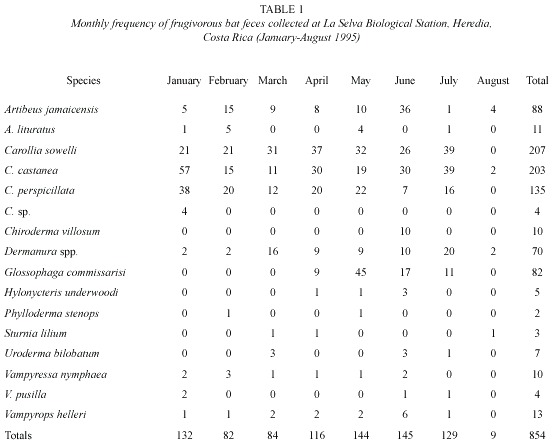
<body><![CDATA[<p><font face="Arial,Arial" size="2"><b>Food habits: </b>the captured 15 species of frugivorous bats produced 854 fecal samples (64.8%). One hundred and sixty-nine (169) fecal samples and food parts were found under perches (Table 1). About 92% of fecal samples came from the six bat species <i>(Artibeus jamaicensis, Carollia sowelli, C. castanea, C. perspicillata, Dermanura </i>sp<i>. </i>and <i>Glossophaga commissarisi) </i>captured most frequently at LSBS. Fecal samples from the remaining nine bat species were rare or infrequent (Table 1).    <br> </font></p>     <p style="text-align: center;"><font face="Arial,Arial" size="2"><img  src="/img/fbpe/rbt/v55n1/3631i1.JPG" title="" alt=""  style="width: 553px; height: 443px;">    
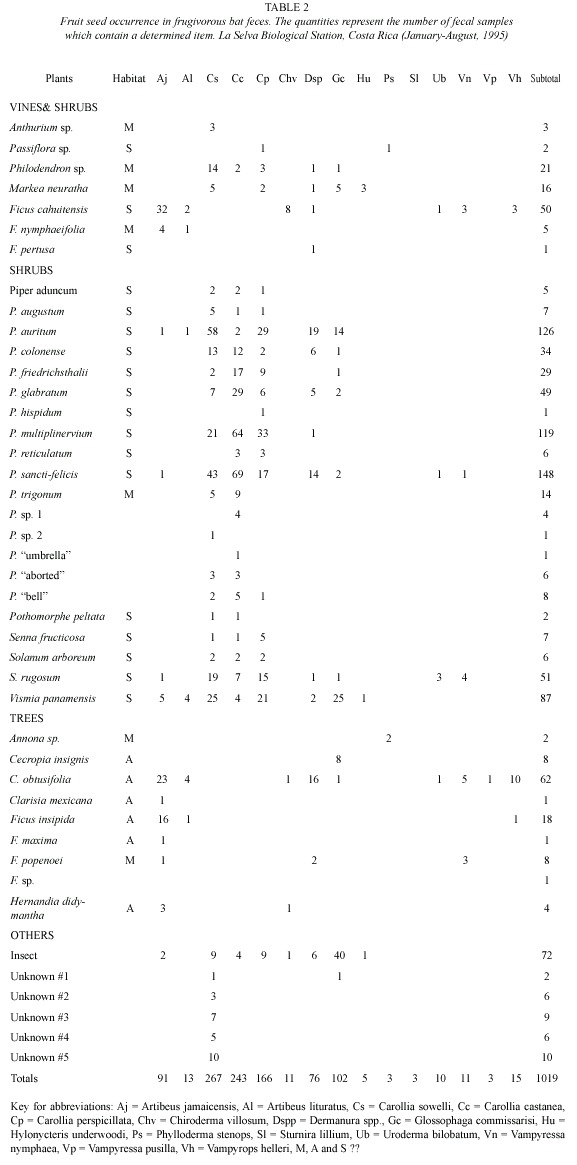
<br> </font></p>     <p><font face="Arial,Arial" size="2">During the study, fruit or seeds of 47 identified plant species were consumed by one or more of the 15 frugivorous bat species in LSBS. Forty-two plant species were identified in bat feces (Table 2) and five additional plant species were found in feces or fruits ejected under tents and feeding stations (<i>Dipteryx panamensis</i>, <i>Hernandia stenura</i>, <i>Quararibea parvifolia</i>, <i>Symphonia globulifera </i>and <i>Spondias radlkoferi</i>). Seeds of four shrub species (<i>Piper sancti-felicis, P. auritum, P. multiplinervium, Vismia panamensis</i>) and a cecropia (<i>Cecropia obtusifolia</i>) made up over 50% of the samples (Table 2). The genus <i>Piper </i>was most commonly found (55%), while <i>Vismia </i>was a distant second (8.5%).    <br> </font></p>     <p style="text-align: center;"><font face="Arial,Arial" size="2"><img  src="/img/fbpe/rbt/v55n1/3631i2.JPG" title="" alt=""  style="width: 577px; height: 1165px;">    
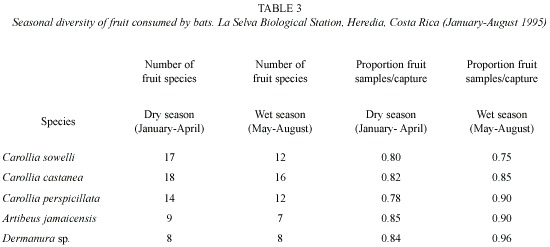
<br> </font></p>     <p><font face="Arial,Arial" size="2">Fruit and seed species richness consumed by frugivorous bats was greater during the dry season than the wet season (Table 3). However the proportion of samples declined during the dry season. Total numbers of samples of the most common plant genera in the feces (<i>Ficus, Piper, Solanum, </i>and <i>Vismia</i>) for the six most commonly captured bat species were significantly different (Kolmogorov-Smirnov D = 1.73, p = 0.0049).    <br> </font></p>     ]]></body>
<body><![CDATA[<p style="text-align: center;"><font face="Arial,Arial" size="2"><img  src="/img/fbpe/rbt/v55n1/3631i3.JPG" title="" alt=""  style="width: 550px; height: 247px;">    
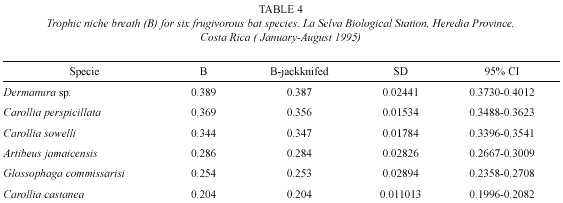
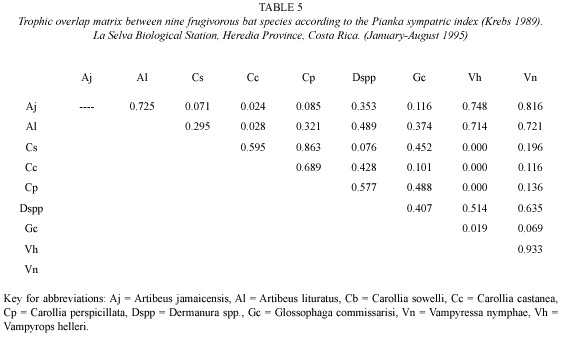
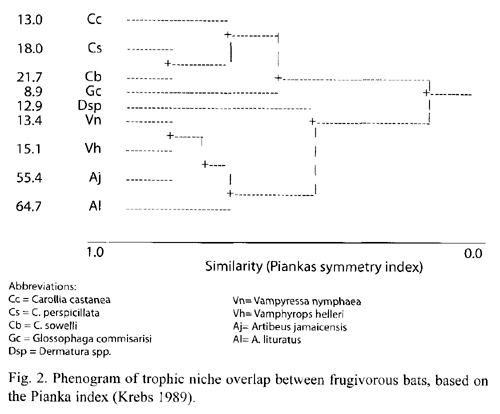
<br> </font></p>     <p><font face="Arial,Arial" size="2">Trophic niche breadth indices (jackknife estimates) for the six most abundant bat species (Table 4) were significantly different (Kruskal-Wallis H = 93.06, p &lt;0.001). Bat species with the greatest feeding niche overlap were <i>Vampyressa nymphaea </i>and <i>Vampyrops helleri</i>, followed by <i>Carollia perspicillata </i>and <i>C. sowelli </i>(Table 5). Using cluster analysis, two groups were differentiated (Fig. 1): a) species from the genus <i>Carollia </i>and <i>Glossophaga </i>and b) species from the tribe Stenodrematini (<i>A.</i> <i>jamaicensis</i>, <i>A. lituratus</i>, <i>Dermanura </i>sp<i>.</i>, <i>V.</i> <i>helleri</i>, and <i>V. nymphaea</i>).    <br> </font></p>     <p style="text-align: center;"><font face="Arial,Arial" size="2"><img  src="/img/fbpe/rbt/v55n1/3631I6.jpg" title="" alt=""  style="width: 559px; height: 315px;">    
<br> </font></p>     <p style="text-align: center;"><font face="Arial,Arial" size="2">    <br> </font></p>     <p style="text-align: center;"><font face="Arial,Arial" size="2"><img  src="/img/fbpe/rbt/v55n1/3631i4.JPG" title="" alt=""  style="width: 563px; height: 203px;">    
<br> </font></p>     ]]></body>
<body><![CDATA[<p style="text-align: center;"><font face="Arial,Arial" size="2">    <br> </font></p>     <p style="text-align: center;"><font face="Arial,Arial" size="2"><img  src="/img/fbpe/rbt/v55n1/3631i5.JPG" title="" alt=""  style="width: 563px; height: 338px;">    
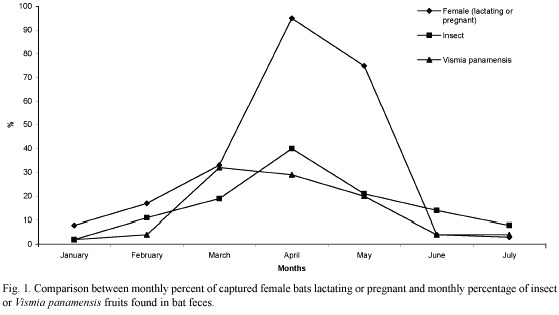
<br> </font></p>     <p><font face="Arial,Arial" size="2">April and May were the months of greatest reproductive activity for lactating or pregnant females. These events were associated with an increase in consumption of two food items (Fig. 2). A significant positive correlation was found between the number of female reproductive events and number of insects consumed (R<sup>2 </sup>= 0.821, p &lt; 0.05) and <i>Vismia panamensis, </i>an understory shrub (R<sup>2</sup> = 0.892, p &lt; 0.05). Other food items showed no significant relationship between reproductive events and consumption rate.    <br> </font></p>     <div style="text-align: center;"><img src="/img/fbpe/rbt/v55n1/3631i7.JPG" title=""  alt="" style="width: 500px; height: 414px;"></div>     
<p><font face="Arial,Arial" size="2"><b>Discussion </b></font></p>     <p><font face="Arial,Arial" size="2"><b>Bat food niches: </b>at least 18 frugivorous bat species coexist at LSBS. This is 28% of LSBS’s reported bat species (Howell and Burch 1974, Gardner 1977, Levey <i>et al. </i>1994, Timm 1994). McNab (1971) stated that two sympatric species coexist in equilibrium only if sufficient differences exist between their ecological niches. Food is a parameter in the bat ecological niche that can be used to test McNab’s (1971) hypothesis (Fleming <i>et al.</i>1972). In this study, frugivorous bat seed and fruit consumption patterns for 47 fruit species differed among bat species. Food habit indices differed significantly among the most common frugivorous bat species at LSBS and significant differences were found in fruit consumption patterns between bats at the generic level (Table 2).</font></p>     <p><font face="Arial,Arial" size="2">Frugivorous bats in LSBS most frequently consumed common plant taxon (genus or species) and supplemented their diet with less-frequently consumed species. Seeds from the genus <i>Piper </i>appeared six times more frequently in feces than <i>Vismia</i>, the next most common plant genus. Only four of the 15 bat species studied did not consume <i>Piper </i>fruits, indicating its importance in frugivorous bat diets in LSBS. </font></p>     ]]></body>
<body><![CDATA[<p><font face="Arial,Arial" size="2">According to Fleming (1988), bats favor seeds and fruits from plant species fruiting year-round, because they offer a predictable food source. Bats complement this diet with other less stable food types, which vary spatially and temporally. In LSBS, <i>Artibeus </i>consumed principally <i>Ficus </i>and <i>Cecropia</i>, <i>Carollia </i>consumed <i>Piper</i>, and <i>G. commissarisi </i>consumed <i>Vismia</i>. These plant genera in LSBS produce fruit all year (Hammel 1986a, Hammel 1986b, Greig 1993a, Greig 1993b). We conclude that in LSBS, <i>Artibeus</i>, <i>Carollia</i>, and <i>Glossophaga </i>behave as proposed by Fleming (1988). </font></p> <font face="Arial,Arial" size="2"><b></b></font>     <p><font face="Arial,Arial" size="2"><b>Food niche overlap: </b>the six most abundant frugivorous bat species in LSBS showed greatest niche overlap between congeners; the same observed with the three least abundant species. This contradicts Hutchinson (1959) who noted that sympatric congeners usually differ in their diets. However, our study (and others) found that congeneric bat species have similar diets (Tamsitt, 1967, Fleming <i>et al</i>. 1972, Marinho-Filho 1991). Therefore, high trophic niche overlap values between congeneric species suggests that the potential exists for competition or that species coexist in apparent equilibrium and other niche dimensions are involved in resource partitioning. Gorchov <i>et al. </i>(1995) found little overlap in diet between 31 and 29 species of frugivorous bats and birds, while Muller and Reis (1993) found partitioning of food resources among the most common bat species they studied. </font></p>     <p><font face="Arial,Arial" size="2"><b>Cluster analysis: </b>two groups of frugivorous bat food habits in LSBS were revealed (Fig. 1). The first is composed of four species, three from the genus <i>Carollia </i>and <i>G. commissarisi. </i>The second consists of five species from the subfamily Stenoderminae. These groups coincide with functional understory and canopy bat frugivore guilds described by Bonaccorso (1979) for Barro Colorado Island, Panama. However, more trophic similarity exists between species with similar weights. Perhaps differences in the size of food items consumed by bats could explain differences in bat diets when similar weights and plants are consumed (Bonaccorso 1979). Among the Stenoderminae, <i>Dermanura </i>sp. had a more diverse diet and one less dominated by members of the genus <i>Ficus. Dermanura </i>sp<i>.</i>, together with <i>G. commissarissi</i>, constituted a group of understory generalists. </font></p> <font face="Arial,Arial" size="2"><b></b></font>     <p><font face="Arial,Arial" size="2"><b>Seasonality of fruiting patterns: </b>a possible factor explaining seasonality of fruiting patterns in tropical forests is seed disperser competition (Snow 1965). This study partially confirms the hypothesis that seed dispersers have seasonal food habits. Bat diet in LSBS was more diverse in the dry season (January-April) then wet season (May-August). Also, there were fewer items/feces found during the dry season because it is the season of least fruit abundance in LSBS (Opler <i>et al. </i>1980, Newstrom <i>et al. </i>1994). This coincides with optimal foraging strategy predictions (Pyke <i>et al </i>1977, Anderson 1983). </font></p> <font face="Arial,Arial" size="2"><b> </b></font>     <p><font face="Arial,Arial" size="2"><b>Bat reproductive cycles: </b>an important consequence of phenological seasonality is found in bat reproductive cycles (Racey 1988). Kunz (1980) found pregnancy and lactation were more energetic expensive for female bats. During lactation in rodents, females increase energetic demands between 66-133% (Randolph <i>et al. </i>1977, Millar 1978). Although Dinerstein (1981) came to different conclusions working in cloud forest environments, insects as a food item were associated with frugivorous bats’ reproductive events in LSBS. Correlations observed between female bat reproductive events and insect (high energy and protein sources) and <i>V. panamensis </i>consumption suggests that both can be critical resources for frugivorous bats during reproduction in LSBS, particularly during lactation (Bonaccorso 1979, Autino and Barquez 1993). We feel that this important discovery with frugivorous bats has been underemphasized in the literature. </font></p> <font face="Arial,Arial" size="2"><b> </b></font>     <p><font face="Arial,Arial" size="2"><b>Potential sources of error: </b>lack of collecting data for at least a year could contribute to underestimating the value of some food sources for certain bat species and not finding "keystone" food resources such as fig (Korine <i>et al. </i>2000). Also subestimating or not accounting for undigested fruits because seeds were undetected was a possible source of error. Four species of seeds found under feeding stations and tents were not detected in fecal samples. However, large-seeded species (&gt; 5 mm) were more frequently represented under tents and feeding stations than from feces because they were ejected and not swallowed. Perhaps bats use feeding perches to manipulate large fruits or those requiring more time to be ingested (Thomas 1988). Another source of error is differential defecation rate of bat species. For example, 80% of captured <i>C. castanea </i>individuals yielded feces, compared to only 42% of <i>A. jamaicensis </i>individuals. A similar tendency is seen with the other carolliine species (<i>C. sowelli, C. perspicillata</i>) and Stenodermatini (<i>A. lituratus, Dermanura </i>sp.<i>, Chiroderma villosum, V. nymphaea, V. helleri</i>). Perhaps these individual bat species manipulate fruit differently. Fleming (1986b) found that <i>Carollia </i>species consume fruits in two minutes or less, ingesting most seeds. However, <i>A. jamaicensis </i>take over ten minutes to process a fruit and ingests few seeds. This partially explains differences in fecal sample size when similar numbers of a species were captured and has implications for bat seed dispersal efficacy. A fourth source of error may be related to differences in nutritional values of food sources (Wendeln <i>et al. </i>2000), which could greatly influence food preferences, reproduction and other variables. A final source of error was not accounting for vertical stratification of bat communities (Bernard 2001, Kalko and Handley 2001) as we only sampled the lower strata. </font></p>     <p><font face="Arial,Arial" size="2"><b>Conservation of bats, rain forests and regeneration: </b>conserving and managing plants used as food by frugivorous bats is important to maintain populations of frugivorous bats and ensure plant species dispersal. This study found that bats consume many pioneer plant species and thus, some bat species could be favored by increases in secondary forest areas. However, bats also depend on primary forest areas that provide needed resources, such as refuge, feeding sites and food. As Kalko and Handley (2001) and Cosson <i>et al. </i>(1999) have discussed, habitat alteration affects understory fruit bat species more than canopy species. Brosset <i>et al. </i>(1996) found that over 60% of bat species found in forested habitats were absent from deforested areas in French Guiana. Both habitats are necessary for bat conservation. And regeneration of tropical forests is likewise dependent on dispersers such as bats. </font></p> <font face="Arial,Arial" size="2"><b>     <p>Acknowledgements </p> </b> </font>     <p><font face="Arial,Arial" size="2">We thank the personal at LSBS for their assistance, the Universidad Nacional, the German Academic Exchange Program (DAAD), Idea Wild and the United States Department of Agriculture (Cooperative Agreement 127522000-189-04S with the Milwaukee Public Museum). This publication is part of the "Theobroma cacao: Biodiversity in full and partial canopies" research project, coordinated by the Milwaukee Public Museum. </font></p> <font face="Arial,Arial" size="2"><b>     <p>Resumen </p> </b> </font>     ]]></body>
<body><![CDATA[<p><font face="Arial,Arial" size="2">Estudiamos los hábitos alimentarios de 15 especies de murciélagos frugívoros en la Estación Biológica La Selva. Se analizó 854 muestras de heces y 169 muestras de restos de frutos y semillas en comederos. Durante ocho meses de estudio, se identificó 47 especies de frutos, que fueron consumidos por los murciélagos. Cinco géneros de plantas (<i>Cecropia</i>, <i>Ficus</i>, <i>Piper</i>, <i>Solanum </i>y <i>Vismia</i>) constituyeron el 85% de los hallazgos en las muestras de heces y los comederos. La amplitud de nicho trófico difirió significativamente entre las seis especies de murciélagos frugívoros más frecuentemente capturados (<i>Artibeus jamaicensis, Carollia sowelli, C. castanea, </i>C. <i>perspicillata, Dermanura </i>sp<i>., Glossophaga commissarisi)</i>. Estas especies, con excepción de <i>Dermanura </i>sp., mostraron una dieta dominada por uno o dos táxones de plantas. Esto sugiere un patrón de repartición de recursos a nivel genérico, donde <i>Carollia </i>consumió principalmente plantas del genero <i>Piper</i>, <i>Artibeus </i>consumió <i>Ficus </i>y <i>Cecropia </i>y <i>Glossophaga </i>consumió <i>Vismia</i>. El análisis de conglomerados reveló que existe un mayor solapamiento de nicho trófico entre especies congenéricas que entre especies no congenéricas. Los resultados sugieren que, si el alimento es un factor limitante, algún otro mecanismo -que no es la selección trófica-debe reducir la interferencia o competencia interespecífica por alimentos entre las especies congénericas de murciélagos frugívoros en la EBLS. </font></p> <font face="Arial,Arial" size="2"><b></b></font>     <p><font face="Arial,Arial" size="2"><b>Palabras clave: </b>Costa Rica, Estación Biológica La Selva, estructura trófica, hábitos alimentarios, murciélagos frugívoros. </font></p> <font face="Arial,Arial" size="2"><b>     <p>References </p> </b> </font>     <!-- ref --><p><font face="Arial,Arial" size="2">Autino, A. &amp; R. Barquez. 1993. Patrones reproductivos y alimenticios de dos especies simpátricas del género <i>Sturnira </i>(Chiroptera: Phyllostomidae). Mastozool. Neotrop. 1: 73-80.    &nbsp;&nbsp;&nbsp;&nbsp;&nbsp;&nbsp;&nbsp;&nbsp;[&#160;<a href="javascript:void(0);" onclick="javascript: window.open('/scielo.php?script=sci_nlinks&ref=1660263&pid=S0034-7744200700010003200001&lng=','','width=640,height=500,resizable=yes,scrollbars=1,menubar=yes,');">Links</a>&#160;]<!-- end-ref --> </font></p>     <!-- ref --><p><font face="Arial,Arial" size="2">Anderson, D.J. 1983. Optimal foraging and the traveling salesman. Theoretical Population Biol. 24: 145-159.    &nbsp;&nbsp;&nbsp;&nbsp;&nbsp;&nbsp;&nbsp;&nbsp;[&#160;<a href="javascript:void(0);" onclick="javascript: window.open('/scielo.php?script=sci_nlinks&ref=1660265&pid=S0034-7744200700010003200002&lng=','','width=640,height=500,resizable=yes,scrollbars=1,menubar=yes,');">Links</a>&#160;]<!-- end-ref --> </font></p>     <!-- ref --><p><font face="Arial,Arial" size="2">Bernard, E. 2001. Vertical stratification of bat communities in primary forests of Central Amazon, Brazil. J. Trop. Ecol. 17: 115-126.    &nbsp;&nbsp;&nbsp;&nbsp;&nbsp;&nbsp;&nbsp;&nbsp;[&#160;<a href="javascript:void(0);" onclick="javascript: window.open('/scielo.php?script=sci_nlinks&ref=1660267&pid=S0034-7744200700010003200003&lng=','','width=640,height=500,resizable=yes,scrollbars=1,menubar=yes,');">Links</a>&#160;]<!-- end-ref --> </font></p>     <!-- ref --><p><font face="Arial,Arial" size="2">Bonaccorso, F.J. 1979. Foraging and reproductive ecology in a Panamanian bat community. Bull. Florida State Muse. Biol. Sci. 24: 359-408.    &nbsp;&nbsp;&nbsp;&nbsp;&nbsp;&nbsp;&nbsp;&nbsp;[&#160;<a href="javascript:void(0);" onclick="javascript: window.open('/scielo.php?script=sci_nlinks&ref=1660269&pid=S0034-7744200700010003200004&lng=','','width=640,height=500,resizable=yes,scrollbars=1,menubar=yes,');">Links</a>&#160;]<!-- end-ref --> </font></p>     <!-- ref --><p><font face="Arial,Arial" size="2">Brosset, A., P. Charles-Dominique, A. Cockly, J.F. Cosson &amp; D. Mason. 1996. Bat communities and deforestation in French Guiana. Can. J. Zool. 74: 1974-1982.    &nbsp;&nbsp;&nbsp;&nbsp;&nbsp;&nbsp;&nbsp;&nbsp;[&#160;<a href="javascript:void(0);" onclick="javascript: window.open('/scielo.php?script=sci_nlinks&ref=1660271&pid=S0034-7744200700010003200005&lng=','','width=640,height=500,resizable=yes,scrollbars=1,menubar=yes,');">Links</a>&#160;]<!-- end-ref --> </font></p>     <!-- ref --><p><font face="Arial,Arial" size="2">Charles-Dominique, P. 1986. Interrelations between frugivorous vertebrates and pioneer plants: <i>Cecropia</i>, birds and bats in French Guyana, p. 119-135. <i>In </i>A. Estrada &amp; T. Fleming (eds.). Frugivores and seed dispersal. Dr. W. Junk, The Hague, The Netherlands.    &nbsp;&nbsp;&nbsp;&nbsp;&nbsp;&nbsp;&nbsp;&nbsp;[&#160;<a href="javascript:void(0);" onclick="javascript: window.open('/scielo.php?script=sci_nlinks&ref=1660273&pid=S0034-7744200700010003200006&lng=','','width=640,height=500,resizable=yes,scrollbars=1,menubar=yes,');">Links</a>&#160;]<!-- end-ref --> </font></p>     <!-- ref --><p><font face="Arial,Arial" size="2">Charles-Dominique, P. 1991. Feeding strategy and activity budget of the frugivorous bat <i>Carollia perspicillata </i>(Chiroptera: Phyllostomidae) in French Guiana. J. Trop. Ecol. 7: 243-256.    &nbsp;&nbsp;&nbsp;&nbsp;&nbsp;&nbsp;&nbsp;&nbsp;[&#160;<a href="javascript:void(0);" onclick="javascript: window.open('/scielo.php?script=sci_nlinks&ref=1660275&pid=S0034-7744200700010003200007&lng=','','width=640,height=500,resizable=yes,scrollbars=1,menubar=yes,');">Links</a>&#160;]<!-- end-ref --> </font></p>     <!-- ref --><p><font face="Arial,Arial" size="2">Colwell, R.K. &amp; D.J. Futuyma. 1971. On the measurement of niche breadth and overlap. Ecology. 52: 567-576.    &nbsp;&nbsp;&nbsp;&nbsp;&nbsp;&nbsp;&nbsp;&nbsp;[&#160;<a href="javascript:void(0);" onclick="javascript: window.open('/scielo.php?script=sci_nlinks&ref=1660277&pid=S0034-7744200700010003200008&lng=','','width=640,height=500,resizable=yes,scrollbars=1,menubar=yes,');">Links</a>&#160;]<!-- end-ref --> </font></p>     <!-- ref --><p><font face="Arial,Arial" size="2">Cosson, J.F., J.M. Pons &amp; D. Masson. 1999. Effects of forest fragmentation on frugivorous and nectarivorous bats in French Guinea. J. Trop. Ecol. 15: 515-534.    &nbsp;&nbsp;&nbsp;&nbsp;&nbsp;&nbsp;&nbsp;&nbsp;[&#160;<a href="javascript:void(0);" onclick="javascript: window.open('/scielo.php?script=sci_nlinks&ref=1660279&pid=S0034-7744200700010003200009&lng=','','width=640,height=500,resizable=yes,scrollbars=1,menubar=yes,');">Links</a>&#160;]<!-- end-ref --> </font></p>     <!-- ref --><p><font face="Arial,Arial" size="2">Dinerstein, E. 1986. Reproductive ecology of fruit bats and the seasonality of fruit production in a Costa Rican cloud forest. Biotropica 18: 307-316.    &nbsp;&nbsp;&nbsp;&nbsp;&nbsp;&nbsp;&nbsp;&nbsp;[&#160;<a href="javascript:void(0);" onclick="javascript: window.open('/scielo.php?script=sci_nlinks&ref=1660281&pid=S0034-7744200700010003200010&lng=','','width=640,height=500,resizable=yes,scrollbars=1,menubar=yes,');">Links</a>&#160;]<!-- end-ref --> </font></p>     <!-- ref --><p><font face="Arial,Arial" size="2">Fleming, T.H. 1981. Fecundity, fruiting pattern, and seed dispersal in <i>Piper amalago </i>(Piperacea), a bat-dispersed tropical shrub. Oecologia 51: 42-46.    &nbsp;&nbsp;&nbsp;&nbsp;&nbsp;&nbsp;&nbsp;&nbsp;[&#160;<a href="javascript:void(0);" onclick="javascript: window.open('/scielo.php?script=sci_nlinks&ref=1660283&pid=S0034-7744200700010003200011&lng=','','width=640,height=500,resizable=yes,scrollbars=1,menubar=yes,');">Links</a>&#160;]<!-- end-ref --> </font></p>     <!-- ref --><p><font face="Arial,Arial" size="2">Fleming, T.H. 1982. Foraging strategies of plant-visiting bats, p. 287-321. <i>In </i>T. Kunz (ed.). Ecology of bats. Plenum, New York, USA.    &nbsp;&nbsp;&nbsp;&nbsp;&nbsp;&nbsp;&nbsp;&nbsp;[&#160;<a href="javascript:void(0);" onclick="javascript: window.open('/scielo.php?script=sci_nlinks&ref=1660285&pid=S0034-7744200700010003200012&lng=','','width=640,height=500,resizable=yes,scrollbars=1,menubar=yes,');">Links</a>&#160;]<!-- end-ref --> </font></p>     <!-- ref --><p><font face="Arial,Arial" size="2">Fleming, T.H. 1986a. The structure of neotropical bat communities: A preliminary analysis. Rev. Chilena. de Hist. Natur. 59: 135-150.    &nbsp;&nbsp;&nbsp;&nbsp;&nbsp;&nbsp;&nbsp;&nbsp;[&#160;<a href="javascript:void(0);" onclick="javascript: window.open('/scielo.php?script=sci_nlinks&ref=1660287&pid=S0034-7744200700010003200013&lng=','','width=640,height=500,resizable=yes,scrollbars=1,menubar=yes,');">Links</a>&#160;]<!-- end-ref --> </font></p>     <!-- ref --><p><font face="Arial,Arial" size="2">Fleming, T.H. 1986b. Opportunism versus specialization: The evolution of feeding strategies in frugivorous bats, p. 105-118. <i>In </i>A. Estrada &amp; T. Fleming (eds.). Frugivores and seed dispersal. Dr. W. Junk, The Hague, The Netherlands.    &nbsp;&nbsp;&nbsp;&nbsp;&nbsp;&nbsp;&nbsp;&nbsp;[&#160;<a href="javascript:void(0);" onclick="javascript: window.open('/scielo.php?script=sci_nlinks&ref=1660289&pid=S0034-7744200700010003200014&lng=','','width=640,height=500,resizable=yes,scrollbars=1,menubar=yes,');">Links</a>&#160;]<!-- end-ref --> </font></p>     <!-- ref --><p><font face="Arial,Arial" size="2">Fleming, T.H. 1988. The short-tailed fruit bat<i>. </i>The University of Chicago, Chicago, Illinois, USA. 365 p.    &nbsp;&nbsp;&nbsp;&nbsp;&nbsp;&nbsp;&nbsp;&nbsp;[&#160;<a href="javascript:void(0);" onclick="javascript: window.open('/scielo.php?script=sci_nlinks&ref=1660291&pid=S0034-7744200700010003200015&lng=','','width=640,height=500,resizable=yes,scrollbars=1,menubar=yes,');">Links</a>&#160;]<!-- end-ref --> </font></p>     <!-- ref --><p><font face="Arial,Arial" size="2">Fleming, T.H., E.T. Hooper &amp; D.E. Wilson. 1972. Three Central American bat communities: structure, reproductive cycles and movement patterns. Ecology 53: 555-569.    &nbsp;&nbsp;&nbsp;&nbsp;&nbsp;&nbsp;&nbsp;&nbsp;[&#160;<a href="javascript:void(0);" onclick="javascript: window.open('/scielo.php?script=sci_nlinks&ref=1660293&pid=S0034-7744200700010003200016&lng=','','width=640,height=500,resizable=yes,scrollbars=1,menubar=yes,');">Links</a>&#160;]<!-- end-ref --> </font></p>     <!-- ref --><p><font face="Arial,Arial" size="2">Fleming, T.H.&amp; E.R. Heithaus. 1981. Frugivorous bats, seed shadows and the structure of tropical forests. Biotropica 13: 45-53.    &nbsp;&nbsp;&nbsp;&nbsp;&nbsp;&nbsp;&nbsp;&nbsp;[&#160;<a href="javascript:void(0);" onclick="javascript: window.open('/scielo.php?script=sci_nlinks&ref=1660295&pid=S0034-7744200700010003200017&lng=','','width=640,height=500,resizable=yes,scrollbars=1,menubar=yes,');">Links</a>&#160;]<!-- end-ref --> </font></p>     <!-- ref --><p><font face="Arial,Arial" size="2">Fleming, T.H., C.F. Williams, F.J. Bonaccorso &amp; L.H. Herbst. 1985. Phenology, seed dispersal, and colonization in <i>Muntingia calabura, </i>a neotropical pioneer tree. Amer. J. Bot. 72: 383-391.    &nbsp;&nbsp;&nbsp;&nbsp;&nbsp;&nbsp;&nbsp;&nbsp;[&#160;<a href="javascript:void(0);" onclick="javascript: window.open('/scielo.php?script=sci_nlinks&ref=1660297&pid=S0034-7744200700010003200018&lng=','','width=640,height=500,resizable=yes,scrollbars=1,menubar=yes,');">Links</a>&#160;]<!-- end-ref --> </font></p>     <!-- ref --><p><font face="Arial,Arial" size="2">Fleming, T.H., R. Breitwish &amp; G.H. Whitesides. 1987. Patterns of tropical vertebrate frugivore diversity. Ann. Rev. Ecol. Syst. 18: 91-109.    &nbsp;&nbsp;&nbsp;&nbsp;&nbsp;&nbsp;&nbsp;&nbsp;[&#160;<a href="javascript:void(0);" onclick="javascript: window.open('/scielo.php?script=sci_nlinks&ref=1660299&pid=S0034-7744200700010003200019&lng=','','width=640,height=500,resizable=yes,scrollbars=1,menubar=yes,');">Links</a>&#160;]<!-- end-ref --> </font></p>     <!-- ref --><p><font face="Arial,Arial" size="2">Frankie, G.W., H.G. Baker &amp; P.A. Opler. 1974. Comparative phenological studies of trees in tropical wet and dry forests in the lowlands of Costa Rica. J. Ecol. 62: 881-919.    &nbsp;&nbsp;&nbsp;&nbsp;&nbsp;&nbsp;&nbsp;&nbsp;[&#160;<a href="javascript:void(0);" onclick="javascript: window.open('/scielo.php?script=sci_nlinks&ref=1660301&pid=S0034-7744200700010003200020&lng=','','width=640,height=500,resizable=yes,scrollbars=1,menubar=yes,');">Links</a>&#160;]<!-- end-ref --> </font></p>     <!-- ref --><p><font face="Arial,Arial" size="2">Galindo, J. 1998. Seed dispersion by fruit bats: Its importance in the conservation and regeneration of tropical forests. Acta Zool. Mex. Nueva Ser. 0: 57-74.    &nbsp;&nbsp;&nbsp;&nbsp;&nbsp;&nbsp;&nbsp;&nbsp;[&#160;<a href="javascript:void(0);" onclick="javascript: window.open('/scielo.php?script=sci_nlinks&ref=1660303&pid=S0034-7744200700010003200021&lng=','','width=640,height=500,resizable=yes,scrollbars=1,menubar=yes,');">Links</a>&#160;]<!-- end-ref --> </font></p>     <!-- ref --><p><font face="Arial,Arial" size="2">Galindo, J., S. Guevara &amp; V. Sosa. 2000. Bat and bird generated seed rains at isolated trees in pastures in a tropical rainforest. Conserv. Biol. 14: 1693-1703.    &nbsp;&nbsp;&nbsp;&nbsp;&nbsp;&nbsp;&nbsp;&nbsp;[&#160;<a href="javascript:void(0);" onclick="javascript: window.open('/scielo.php?script=sci_nlinks&ref=1660305&pid=S0034-7744200700010003200022&lng=','','width=640,height=500,resizable=yes,scrollbars=1,menubar=yes,');">Links</a>&#160;]<!-- end-ref --> </font></p>     <!-- ref --><p><font face="Arial,Arial" size="2">Ganesh, T. &amp; P. Davidar. 2001. Dispersal modes of tree species in the wet forests of southern Western Ghats. Current Sci. 80: 394-399.    &nbsp;&nbsp;&nbsp;&nbsp;&nbsp;&nbsp;&nbsp;&nbsp;[&#160;<a href="javascript:void(0);" onclick="javascript: window.open('/scielo.php?script=sci_nlinks&ref=1660307&pid=S0034-7744200700010003200023&lng=','','width=640,height=500,resizable=yes,scrollbars=1,menubar=yes,');">Links</a>&#160;]<!-- end-ref --> </font></p>     <!-- ref --><p><font face="Arial,Arial" size="2">Gardner, A. 1977. Feeding habits, p. 293-350. <i>In </i>R.J. Baker, K.C. Jones &amp; D.C. Carter (eds.). Biology of bats in the New World family Phyllostomatidae Part II. Special Publications of the Museum of Texas Tech University, Lubbock, Texas, México.    &nbsp;&nbsp;&nbsp;&nbsp;&nbsp;&nbsp;&nbsp;&nbsp;[&#160;<a href="javascript:void(0);" onclick="javascript: window.open('/scielo.php?script=sci_nlinks&ref=1660309&pid=S0034-7744200700010003200024&lng=','','width=640,height=500,resizable=yes,scrollbars=1,menubar=yes,');">Links</a>&#160;]<!-- end-ref --> </font></p>     <!-- ref --><p><font face="Arial,Arial" size="2">Gordhov, D.L., F. Cornejo, C. Ascorra &amp; M. Jaramillo. 1995. Dietary overlap between frugivorous birds and bats in the Peruvian Amazon. Oikos 74: 235-250.    &nbsp;&nbsp;&nbsp;&nbsp;&nbsp;&nbsp;&nbsp;&nbsp;[&#160;<a href="javascript:void(0);" onclick="javascript: window.open('/scielo.php?script=sci_nlinks&ref=1660311&pid=S0034-7744200700010003200025&lng=','','width=640,height=500,resizable=yes,scrollbars=1,menubar=yes,');">Links</a>&#160;]<!-- end-ref --> </font></p>     <!-- ref --><p><font face="Arial,Arial" size="2">Greig, N. 1993a. Predispersal seed predation on five species of co-occurring Piper in tropical rainforest. Oecologia 93: 412-420.    &nbsp;&nbsp;&nbsp;&nbsp;&nbsp;&nbsp;&nbsp;&nbsp;[&#160;<a href="javascript:void(0);" onclick="javascript: window.open('/scielo.php?script=sci_nlinks&ref=1660313&pid=S0034-7744200700010003200026&lng=','','width=640,height=500,resizable=yes,scrollbars=1,menubar=yes,');">Links</a>&#160;]<!-- end-ref --> </font></p>     <!-- ref --><p><font face="Arial,Arial" size="2">Greig, N. 1993b. Regeneration mode in neotropical Piper: habitat and species comparisons. Ecology 74: 2125-2135.    &nbsp;&nbsp;&nbsp;&nbsp;&nbsp;&nbsp;&nbsp;&nbsp;[&#160;<a href="javascript:void(0);" onclick="javascript: window.open('/scielo.php?script=sci_nlinks&ref=1660315&pid=S0034-7744200700010003200027&lng=','','width=640,height=500,resizable=yes,scrollbars=1,menubar=yes,');">Links</a>&#160;]<!-- end-ref --> </font></p>     <!-- ref --><p><font face="Arial,Arial" size="2">Hammel, B.E. 1986a. The vascular flora of La Selva Biological Station, Costa Rica-<i>Cecropiaceae</i>. Selbyana 9: 192-195.    &nbsp;&nbsp;&nbsp;&nbsp;&nbsp;&nbsp;&nbsp;&nbsp;[&#160;<a href="javascript:void(0);" onclick="javascript: window.open('/scielo.php?script=sci_nlinks&ref=1660317&pid=S0034-7744200700010003200028&lng=','','width=640,height=500,resizable=yes,scrollbars=1,menubar=yes,');">Links</a>&#160;]<!-- end-ref --> </font></p>     <!-- ref --><p><font face="Arial,Arial" size="2">Hammel, B.E. 1986b. The vascular flora of La Selva Biological Station, Costa Rica-<i>Moraceae</i>. Selbyana 9: 243-259.    &nbsp;&nbsp;&nbsp;&nbsp;&nbsp;&nbsp;&nbsp;&nbsp;[&#160;<a href="javascript:void(0);" onclick="javascript: window.open('/scielo.php?script=sci_nlinks&ref=1660319&pid=S0034-7744200700010003200029&lng=','','width=640,height=500,resizable=yes,scrollbars=1,menubar=yes,');">Links</a>&#160;]<!-- end-ref --> </font></p>     <!-- ref --><p><font face="Arial,Arial" size="2">Handley, C.O. Jr., A.L. Gardner &amp; D.E. Wilson. 1991. Food habits, p. 141-146. <i>In </i>C.O. Handley, Jr., D.E. Wilson &amp; A.L. Gardner (eds.). Demography and natural history of the common fruit bat, Artibeus jamaicensis, on Barro Colorado Island, Panamá. Smithsonian Contrib. Zool. 511: 1-173.    &nbsp;&nbsp;&nbsp;&nbsp;&nbsp;&nbsp;&nbsp;&nbsp;[&#160;<a href="javascript:void(0);" onclick="javascript: window.open('/scielo.php?script=sci_nlinks&ref=1660321&pid=S0034-7744200700010003200030&lng=','','width=640,height=500,resizable=yes,scrollbars=1,menubar=yes,');">Links</a>&#160;]<!-- end-ref --> </font></p>     <!-- ref --><p><font face="Arial,Arial" size="2">Hartshorn, G.S. &amp; B.E. Hammel. 1994. Vegetation types and floristic patterns, p. 73-89. <i>In </i>L.A. McDade, K.S. Bawa, H.A. Hespenheide &amp; G.S. Hartshorn (eds.). La Selva: Ecology and natural history of a neotropical rain forest.. The University of Chicago, Chicago, Illinois, USA.    &nbsp;&nbsp;&nbsp;&nbsp;&nbsp;&nbsp;&nbsp;&nbsp;[&#160;<a href="javascript:void(0);" onclick="javascript: window.open('/scielo.php?script=sci_nlinks&ref=1660323&pid=S0034-7744200700010003200031&lng=','','width=640,height=500,resizable=yes,scrollbars=1,menubar=yes,');">Links</a>&#160;]<!-- end-ref --> </font></p>     <!-- ref --><p><font face="Arial,Arial" size="2">Heithaus, E.R., T.H. Fleming &amp; P.A. Opler. 1975. Foraging patterns and resource utilization in seven species of bats in a seasonal tropical forest. Ecology 56: 841-854.    &nbsp;&nbsp;&nbsp;&nbsp;&nbsp;&nbsp;&nbsp;&nbsp;[&#160;<a href="javascript:void(0);" onclick="javascript: window.open('/scielo.php?script=sci_nlinks&ref=1660325&pid=S0034-7744200700010003200032&lng=','','width=640,height=500,resizable=yes,scrollbars=1,menubar=yes,');">Links</a>&#160;]<!-- end-ref --> </font></p>     <!-- ref --><p><font face="Arial,Arial" size="2">Howell, D.J. &amp; D. Burch. 1974. Food habits of some Costa Rican bats. Rev. Biol. Trop. 21: 284-334.    &nbsp;&nbsp;&nbsp;&nbsp;&nbsp;&nbsp;&nbsp;&nbsp;[&#160;<a href="javascript:void(0);" onclick="javascript: window.open('/scielo.php?script=sci_nlinks&ref=1660327&pid=S0034-7744200700010003200033&lng=','','width=640,height=500,resizable=yes,scrollbars=1,menubar=yes,');">Links</a>&#160;]<!-- end-ref --> </font></p>     <!-- ref --><p><font face="Arial,Arial" size="2">Hutchinson, G.E. 1959. Homage to Santa Rosalia or why are there so many kinds of animals? Amer. Natur. 145-159.    &nbsp;&nbsp;&nbsp;&nbsp;&nbsp;&nbsp;&nbsp;&nbsp;[&#160;<a href="javascript:void(0);" onclick="javascript: window.open('/scielo.php?script=sci_nlinks&ref=1660329&pid=S0034-7744200700010003200034&lng=','','width=640,height=500,resizable=yes,scrollbars=1,menubar=yes,');">Links</a>&#160;]<!-- end-ref --> </font></p>     <!-- ref --><p><font face="Arial,Arial" size="2">Jaksic, F. &amp; R. Medel. 1987. El acuchillamiento de datos como método de obtención de intervalos de confianza y de prueba de hipótesis para índices ecológicos. Medio Ambiente 8: 95-103.    &nbsp;&nbsp;&nbsp;&nbsp;&nbsp;&nbsp;&nbsp;&nbsp;[&#160;<a href="javascript:void(0);" onclick="javascript: window.open('/scielo.php?script=sci_nlinks&ref=1660331&pid=S0034-7744200700010003200035&lng=','','width=640,height=500,resizable=yes,scrollbars=1,menubar=yes,');">Links</a>&#160;]<!-- end-ref --> </font></p>     <!-- ref --><p><font face="Arial,Arial" size="2">Janzen, D.H. 1978. Seeding patterns of tropical trees, p. 83-128. <i>In </i>P.B. Tomlinson &amp; M.H. Zimmerman (eds.) Tropical trees as living systems. Cambridge University, Cambridge, England.    &nbsp;&nbsp;&nbsp;&nbsp;&nbsp;&nbsp;&nbsp;&nbsp;[&#160;<a href="javascript:void(0);" onclick="javascript: window.open('/scielo.php?script=sci_nlinks&ref=1660333&pid=S0034-7744200700010003200036&lng=','','width=640,height=500,resizable=yes,scrollbars=1,menubar=yes,');">Links</a>&#160;]<!-- end-ref --> </font></p>     <!-- ref --><p><font face="Arial,Arial" size="2">Kalko, E. &amp; C. Handley. 2001. Neotropical bats in the canopy: Diversity, community structure and implications for conservation. Plant Ecol. 153: 319-333.    &nbsp;&nbsp;&nbsp;&nbsp;&nbsp;&nbsp;&nbsp;&nbsp;[&#160;<a href="javascript:void(0);" onclick="javascript: window.open('/scielo.php?script=sci_nlinks&ref=1660335&pid=S0034-7744200700010003200037&lng=','','width=640,height=500,resizable=yes,scrollbars=1,menubar=yes,');">Links</a>&#160;]<!-- end-ref --> </font></p>     <!-- ref --><p><font face="Arial,Arial" size="2">Korine, C., E. Kalko &amp; E. Herre. 2000. Fruit characteristics and factors affecting fruit removal in a Panamanian community of strangler figs. Oecologia 123: 560-568.    &nbsp;&nbsp;&nbsp;&nbsp;&nbsp;&nbsp;&nbsp;&nbsp;[&#160;<a href="javascript:void(0);" onclick="javascript: window.open('/scielo.php?script=sci_nlinks&ref=1660337&pid=S0034-7744200700010003200038&lng=','','width=640,height=500,resizable=yes,scrollbars=1,menubar=yes,');">Links</a>&#160;]<!-- end-ref --> </font></p>     <!-- ref --><p><font face="Arial,Arial" size="2">Krebs, C.J. 1989. Ecological methodology. Harper Collins, New York, USA. 655 p.    &nbsp;&nbsp;&nbsp;&nbsp;&nbsp;&nbsp;&nbsp;&nbsp;[&#160;<a href="javascript:void(0);" onclick="javascript: window.open('/scielo.php?script=sci_nlinks&ref=1660339&pid=S0034-7744200700010003200039&lng=','','width=640,height=500,resizable=yes,scrollbars=1,menubar=yes,');">Links</a>&#160;]<!-- end-ref --> </font></p>     <!-- ref --><p><font face="Arial,Arial" size="2">Kunz, T.H. 1980. Daily energy budgets of free-living bats, p. 369-393. <i>In </i>D.E. Wilson &amp; L.A. Gardner (eds.) Proceedings of the Fifth International Bat Research Conference. Texas Tech University, Lubbock, USA.    &nbsp;&nbsp;&nbsp;&nbsp;&nbsp;&nbsp;&nbsp;&nbsp;[&#160;<a href="javascript:void(0);" onclick="javascript: window.open('/scielo.php?script=sci_nlinks&ref=1660341&pid=S0034-7744200700010003200040&lng=','','width=640,height=500,resizable=yes,scrollbars=1,menubar=yes,');">Links</a>&#160;]<!-- end-ref --> </font></p>     <!-- ref --><p><font face="Arial,Arial" size="2">Levey, D.J., T.C. Moermond &amp; J.S. Denslow. 1994. Frugivory: an overview, p. 282-294. <i>In </i>L.A. McDade, K.S. Bawa, H.E. Hespenheide &amp; G.S. Hartshorn (eds.). La Selva: Ecology and natural history of a neotropical rain forest. The University of Chicago, Chicago, Illinois, USA.    &nbsp;&nbsp;&nbsp;&nbsp;&nbsp;&nbsp;&nbsp;&nbsp;[&#160;<a href="javascript:void(0);" onclick="javascript: window.open('/scielo.php?script=sci_nlinks&ref=1660343&pid=S0034-7744200700010003200041&lng=','','width=640,height=500,resizable=yes,scrollbars=1,menubar=yes,');">Links</a>&#160;]<!-- end-ref --> </font></p>     <!-- ref --><p><font face="Arial,Arial" size="2">Marinho-Filho, J.S. 1991. The coexistence of two frugivorous bat species and the phenology of their food plants in Brazil. J. Trop. Ecol. 7: 59-67.    &nbsp;&nbsp;&nbsp;&nbsp;&nbsp;&nbsp;&nbsp;&nbsp;[&#160;<a href="javascript:void(0);" onclick="javascript: window.open('/scielo.php?script=sci_nlinks&ref=1660345&pid=S0034-7744200700010003200042&lng=','','width=640,height=500,resizable=yes,scrollbars=1,menubar=yes,');">Links</a>&#160;]<!-- end-ref --> </font></p>     <!-- ref --><p><font face="Arial,Arial" size="2">Muñoz-Romo, M., M. Sosa &amp; Y. Casart Quintero. 2005. Digestibilidad del polen de cactáceas columna-res en los murciélagos glosofaginos <i>Glossophaga longirostris </i>y <i>Leptonycteris curasoae </i>(Chiroptera: Phyllostomidae). Rev. Biol. Trop. 53(1-2): 277-280.    &nbsp;&nbsp;&nbsp;&nbsp;&nbsp;&nbsp;&nbsp;&nbsp;[&#160;<a href="javascript:void(0);" onclick="javascript: window.open('/scielo.php?script=sci_nlinks&ref=1660347&pid=S0034-7744200700010003200043&lng=','','width=640,height=500,resizable=yes,scrollbars=1,menubar=yes,');">Links</a>&#160;]<!-- end-ref --> </font></p>     <!-- ref --><p><font face="Arial,Arial" size="2">McDade, L.A. &amp; G.S. Hartshorn. 1994. La Selva Biological Station, p. 6-14. <i>In </i>L.A. McDade, K.S. Bawa, H.E. Hespenheide &amp; G.S. Hartshorn (eds.). La Selva: Ecology and natural history of a neotropical rain forest. The University of Chicago, Chicago, Illinois, USA.    &nbsp;&nbsp;&nbsp;&nbsp;&nbsp;&nbsp;&nbsp;&nbsp;[&#160;<a href="javascript:void(0);" onclick="javascript: window.open('/scielo.php?script=sci_nlinks&ref=1660349&pid=S0034-7744200700010003200044&lng=','','width=640,height=500,resizable=yes,scrollbars=1,menubar=yes,');">Links</a>&#160;]<!-- end-ref --> </font></p>     <!-- ref --><p><font face="Arial,Arial" size="2">McNab, B.K. 1971. The structure of tropical bat faunas. Ecology 52: 352-358.    &nbsp;&nbsp;&nbsp;&nbsp;&nbsp;&nbsp;&nbsp;&nbsp;[&#160;<a href="javascript:void(0);" onclick="javascript: window.open('/scielo.php?script=sci_nlinks&ref=1660351&pid=S0034-7744200700010003200045&lng=','','width=640,height=500,resizable=yes,scrollbars=1,menubar=yes,');">Links</a>&#160;]<!-- end-ref --> </font></p>     <!-- ref --><p><font face="Arial,Arial" size="2">Medellin, R. &amp; O. Gaona. 1999. Seed dispersal by bats and birds in forest and disturbed habitats of Chiapas, Mexico. Biotropica 31: 478-485.    &nbsp;&nbsp;&nbsp;&nbsp;&nbsp;&nbsp;&nbsp;&nbsp;[&#160;<a href="javascript:void(0);" onclick="javascript: window.open('/scielo.php?script=sci_nlinks&ref=1660353&pid=S0034-7744200700010003200046&lng=','','width=640,height=500,resizable=yes,scrollbars=1,menubar=yes,');">Links</a>&#160;]<!-- end-ref --> </font></p>     <!-- ref --><p><font face="Arial,Arial" size="2">Millar, J.S. 1978. Energetics of reproduction in <i>Peromyscus leucopus</i>: the cost of lactation. Ecology 59: 10551061.    &nbsp;&nbsp;&nbsp;&nbsp;&nbsp;&nbsp;&nbsp;&nbsp;[&#160;<a href="javascript:void(0);" onclick="javascript: window.open('/scielo.php?script=sci_nlinks&ref=1660355&pid=S0034-7744200700010003200047&lng=','','width=640,height=500,resizable=yes,scrollbars=1,menubar=yes,');">Links</a>&#160;]<!-- end-ref --> </font></p>     <!-- ref --><p><font face="Arial,Arial" size="2">Morrison, D.W. 1978. Foraging ecology and energetics of the frugivorous bat <i>Artibeus jamaicensis</i>. Ecology 59: 716-723.    &nbsp;&nbsp;&nbsp;&nbsp;&nbsp;&nbsp;&nbsp;&nbsp;[&#160;<a href="javascript:void(0);" onclick="javascript: window.open('/scielo.php?script=sci_nlinks&ref=1660357&pid=S0034-7744200700010003200048&lng=','','width=640,height=500,resizable=yes,scrollbars=1,menubar=yes,');">Links</a>&#160;]<!-- end-ref --> </font></p>     <!-- ref --><p><font face="Arial,Arial" size="2">Muller, M.F. &amp; N.R. Reis. 1993. Partition of food resources among four species of frugivorous bats (Chiroptera: Phyllostomidae). Rev. Brasiliera Zool. 9: 345-355.    &nbsp;&nbsp;&nbsp;&nbsp;&nbsp;&nbsp;&nbsp;&nbsp;[&#160;<a href="javascript:void(0);" onclick="javascript: window.open('/scielo.php?script=sci_nlinks&ref=1660359&pid=S0034-7744200700010003200049&lng=','','width=640,height=500,resizable=yes,scrollbars=1,menubar=yes,');">Links</a>&#160;]<!-- end-ref --> </font></p>     <!-- ref --><p><font face="Arial,Arial" size="2">Newstrom, L.E., G.W. Frankie, H.G. Baker &amp; R.K. Colwell. 1994. Diversity of long-term flowering patterns, p. 142-160. <i>In </i>L.A. McDade, K.S. Bawa, H.E. Hespenheide &amp; G.S. Hartshorn (eds.). La Selva: Ecology and natural history of a neotropical rain forest. The University of Chicago, Chicago, Illinois, USA.    &nbsp;&nbsp;&nbsp;&nbsp;&nbsp;&nbsp;&nbsp;&nbsp;[&#160;<a href="javascript:void(0);" onclick="javascript: window.open('/scielo.php?script=sci_nlinks&ref=1660361&pid=S0034-7744200700010003200050&lng=','','width=640,height=500,resizable=yes,scrollbars=1,menubar=yes,');">Links</a>&#160;]<!-- end-ref --> </font></p>     <!-- ref --><p><font face="Arial,Arial" size="2">Ochoa, G.J. 2000. Effects of selective logging on the diversity of small mammals in the lowland forests of the Venezuelan Guyana region. Biotropica 32: 146-164.    &nbsp;&nbsp;&nbsp;&nbsp;&nbsp;&nbsp;&nbsp;&nbsp;[&#160;<a href="javascript:void(0);" onclick="javascript: window.open('/scielo.php?script=sci_nlinks&ref=1660363&pid=S0034-7744200700010003200051&lng=','','width=640,height=500,resizable=yes,scrollbars=1,menubar=yes,');">Links</a>&#160;]<!-- end-ref --> </font></p>     <!-- ref --><p><font face="Arial,Arial" size="2">Opler, P.A., G.W. Frankie &amp; H.G. Baker. 1980. Comparative phenological studies of treelet and shrub species in tropical wet and dry forests in the lowlands of Costa Rica. J. Ecol. 68: 167-188.    &nbsp;&nbsp;&nbsp;&nbsp;&nbsp;&nbsp;&nbsp;&nbsp;[&#160;<a href="javascript:void(0);" onclick="javascript: window.open('/scielo.php?script=sci_nlinks&ref=1660365&pid=S0034-7744200700010003200052&lng=','','width=640,height=500,resizable=yes,scrollbars=1,menubar=yes,');">Links</a>&#160;]<!-- end-ref --> </font></p>     <!-- ref --><p><font face="Arial,Arial" size="2">Pacheco, J., G. Ceballos, G.C. Daily, P.R. Ehrlich, G. Suzán, B. Rodríguez-Herrera &amp; E. Marcé. 2006. Diversidad, historia natural y conservación de los mamíferos de San Vito de Coto Brus, Costa Rica. Rev. Biol. Trop. 54: 219-240.    &nbsp;&nbsp;&nbsp;&nbsp;&nbsp;&nbsp;&nbsp;&nbsp;[&#160;<a href="javascript:void(0);" onclick="javascript: window.open('/scielo.php?script=sci_nlinks&ref=1660367&pid=S0034-7744200700010003200053&lng=','','width=640,height=500,resizable=yes,scrollbars=1,menubar=yes,');">Links</a>&#160;]<!-- end-ref --> </font></p>     <!-- ref --><p><font face="Arial,Arial" size="2">Parrotta, J.A., O.H. Knowles &amp; J. Wunderle. 1997. Development of floristic diversity in 10-year-old restoration forests on a bauxite mined site in Amazonia. Forest. Ecol. Manage. 99: 21-42.    &nbsp;&nbsp;&nbsp;&nbsp;&nbsp;&nbsp;&nbsp;&nbsp;[&#160;<a href="javascript:void(0);" onclick="javascript: window.open('/scielo.php?script=sci_nlinks&ref=1660369&pid=S0034-7744200700010003200054&lng=','','width=640,height=500,resizable=yes,scrollbars=1,menubar=yes,');">Links</a>&#160;]<!-- end-ref --> </font></p>     <!-- ref --><p><font face="Arial,Arial" size="2">Pianka, E.R. 1973. The structure of lizard communities. Annu. Rev. Ecol. Syst. 4: 53-74.    &nbsp;&nbsp;&nbsp;&nbsp;&nbsp;&nbsp;&nbsp;&nbsp;[&#160;<a href="javascript:void(0);" onclick="javascript: window.open('/scielo.php?script=sci_nlinks&ref=1660371&pid=S0034-7744200700010003200055&lng=','','width=640,height=500,resizable=yes,scrollbars=1,menubar=yes,');">Links</a>&#160;]<!-- end-ref --> </font></p>     <!-- ref --><p><font face="Arial,Arial" size="2">Pyke, G.H., H.R. Pulliam &amp; E.L. Charnov. 1977. Optimal foraging: a selective review of theory and tests. Quart. Rev. Biol. 52: 137-154.    &nbsp;&nbsp;&nbsp;&nbsp;&nbsp;&nbsp;&nbsp;&nbsp;[&#160;<a href="javascript:void(0);" onclick="javascript: window.open('/scielo.php?script=sci_nlinks&ref=1660373&pid=S0034-7744200700010003200056&lng=','','width=640,height=500,resizable=yes,scrollbars=1,menubar=yes,');">Links</a>&#160;]<!-- end-ref --> </font></p>     <!-- ref --><p><font face="Arial,Arial" size="2">Racey, P.A. 1988. Ecology of bat reproduction, p. 57-104. <i>In </i>T. Kunz (ed.). Ecology of bats. Plenum, New York, USA.    &nbsp;&nbsp;&nbsp;&nbsp;&nbsp;&nbsp;&nbsp;&nbsp;[&#160;<a href="javascript:void(0);" onclick="javascript: window.open('/scielo.php?script=sci_nlinks&ref=1660375&pid=S0034-7744200700010003200057&lng=','','width=640,height=500,resizable=yes,scrollbars=1,menubar=yes,');">Links</a>&#160;]<!-- end-ref --> </font></p>     <!-- ref --><p><font face="Arial,Arial" size="2">Randolph, P.A., J.C. Randolph, K. Mattingly &amp; M.M. Foster. 1977. Energy cost of reproduction in the cotton rat, <i>Sigmodon hispidus</i>. Ecology 58: 31-45.    &nbsp;&nbsp;&nbsp;&nbsp;&nbsp;&nbsp;&nbsp;&nbsp;[&#160;<a href="javascript:void(0);" onclick="javascript: window.open('/scielo.php?script=sci_nlinks&ref=1660377&pid=S0034-7744200700010003200058&lng=','','width=640,height=500,resizable=yes,scrollbars=1,menubar=yes,');">Links</a>&#160;]<!-- end-ref --> </font></p>     <!-- ref --><p><font face="Arial,Arial" size="2">Sanford, R.L., P. Paaby, J.C. Luvall &amp; E. Phillips. 1994. Climate, geomorphology, and aquatic systems, p. 19- 33. <i>In </i>L.A. McDade, K.S. Bawa, H.E. Hespenheide &amp; G.S. Hartshorn (eds.). La Selva: Ecology and natural history of a neotropical rain forest.. The University of Chicago, Chicago, Illinois, USA.    &nbsp;&nbsp;&nbsp;&nbsp;&nbsp;&nbsp;&nbsp;&nbsp;[&#160;<a href="javascript:void(0);" onclick="javascript: window.open('/scielo.php?script=sci_nlinks&ref=1660379&pid=S0034-7744200700010003200059&lng=','','width=640,height=500,resizable=yes,scrollbars=1,menubar=yes,');">Links</a>&#160;]<!-- end-ref --> </font></p>     <!-- ref --><p><font face="Arial,Arial" size="2">Schulze, M.D., N.E. Seavy &amp; D.F. Whitacre. 2000. A comparison of the phyllostomid bat assemblages in undisturbed neotropical forest and in forest fragments of a slash-and-burn framing mosaic in Peten, Guatemala. Biotropica 32: 174-184.    &nbsp;&nbsp;&nbsp;&nbsp;&nbsp;&nbsp;&nbsp;&nbsp;[&#160;<a href="javascript:void(0);" onclick="javascript: window.open('/scielo.php?script=sci_nlinks&ref=1660381&pid=S0034-7744200700010003200060&lng=','','width=640,height=500,resizable=yes,scrollbars=1,menubar=yes,');">Links</a>&#160;]<!-- end-ref --> </font></p>     <!-- ref --><p><font face="Arial,Arial" size="2">Shanahan, M., R.D. Harrison, R. Amuna, W. Boen &amp; I.W. Thornton. 2001. Colonization of an island volcano, Long Island, Papua New Guinea, an emergent island, in its caldera lake. V. Colonization by figs (<i>Ficus </i>spp.), their dispersers and pollinators. J. Biogeogr. 28: 1365-1377.    &nbsp;&nbsp;&nbsp;&nbsp;&nbsp;&nbsp;&nbsp;&nbsp;[&#160;<a href="javascript:void(0);" onclick="javascript: window.open('/scielo.php?script=sci_nlinks&ref=1660383&pid=S0034-7744200700010003200061&lng=','','width=640,height=500,resizable=yes,scrollbars=1,menubar=yes,');">Links</a>&#160;]<!-- end-ref --> </font></p>     <!-- ref --><p><font face="Arial,Arial" size="2">Snow, D.W. 1965. A possible selective factor in the evolution of fruiting season in tropical forests. Oikos 274-281.    &nbsp;&nbsp;&nbsp;&nbsp;&nbsp;&nbsp;&nbsp;&nbsp;[&#160;<a href="javascript:void(0);" onclick="javascript: window.open('/scielo.php?script=sci_nlinks&ref=1660385&pid=S0034-7744200700010003200062&lng=','','width=640,height=500,resizable=yes,scrollbars=1,menubar=yes,');">Links</a>&#160;]<!-- end-ref --> </font></p>     <!-- ref --><p><font face="Arial,Arial" size="2">Sokal, R.R. &amp; F.J. Rohlf. 1981. Biometry. Freeman, New York, USA. 859 p.    &nbsp;&nbsp;&nbsp;&nbsp;&nbsp;&nbsp;&nbsp;&nbsp;[&#160;<a href="javascript:void(0);" onclick="javascript: window.open('/scielo.php?script=sci_nlinks&ref=1660387&pid=S0034-7744200700010003200063&lng=','','width=640,height=500,resizable=yes,scrollbars=1,menubar=yes,');">Links</a>&#160;]<!-- end-ref --> </font></p>     <!-- ref --><p><font face="Arial,Arial" size="2">Sosa, M. &amp; P. Soriano. 1993. Solapamiento de dieta entre <i>Leptonycteris curasoae </i>y <i>Glossophaga longirostris </i>(Mammalia: Chiroptera). Rev. Biol. Trop. 41: 529-532.    &nbsp;&nbsp;&nbsp;&nbsp;&nbsp;&nbsp;&nbsp;&nbsp;[&#160;<a href="javascript:void(0);" onclick="javascript: window.open('/scielo.php?script=sci_nlinks&ref=1660389&pid=S0034-7744200700010003200064&lng=','','width=640,height=500,resizable=yes,scrollbars=1,menubar=yes,');">Links</a>&#160;]<!-- end-ref --> </font></p>     <!-- ref --><p><font face="Arial,Arial" size="2">Stashko, R.E. &amp; T.H. Kunz. 1987. The economic importance of bat-visited plants in Latin America. Final report submitted to World Wildlife Fund-US. Washington, D.C., USA.    &nbsp;&nbsp;&nbsp;&nbsp;&nbsp;&nbsp;&nbsp;&nbsp;[&#160;<a href="javascript:void(0);" onclick="javascript: window.open('/scielo.php?script=sci_nlinks&ref=1660391&pid=S0034-7744200700010003200065&lng=','','width=640,height=500,resizable=yes,scrollbars=1,menubar=yes,');">Links</a>&#160;]<!-- end-ref --> </font></p>     <!-- ref --><p><font face="Arial,Arial" size="2">Statistical Graphics Corporation. 1994. Statgraphic Plus for Windows. Statistical Graphics. Rockville, Maryland, USA. 450 p.    &nbsp;&nbsp;&nbsp;&nbsp;&nbsp;&nbsp;&nbsp;&nbsp;[&#160;<a href="javascript:void(0);" onclick="javascript: window.open('/scielo.php?script=sci_nlinks&ref=1660393&pid=S0034-7744200700010003200066&lng=','','width=640,height=500,resizable=yes,scrollbars=1,menubar=yes,');">Links</a>&#160;]<!-- end-ref --> </font></p>     <!-- ref --><p><font face="Arial,Arial" size="2">Tamsitt, J.R. 1967. Niche and species diversity in neotropical bats. Nature 213: 784-786.    &nbsp;&nbsp;&nbsp;&nbsp;&nbsp;&nbsp;&nbsp;&nbsp;[&#160;<a href="javascript:void(0);" onclick="javascript: window.open('/scielo.php?script=sci_nlinks&ref=1660395&pid=S0034-7744200700010003200067&lng=','','width=640,height=500,resizable=yes,scrollbars=1,menubar=yes,');">Links</a>&#160;]<!-- end-ref --> </font></p>     <!-- ref --><p><font face="Arial,Arial" size="2">Thomas, D.W. 1988. Analysis of diets of plant-visiting bats, p. 211-221. <i>In </i>T.H. Kunz (ed.). Ecological and behavioral methods for the study of bats. Smithsonian Institution. Washington, D.C., U.S.A.    &nbsp;&nbsp;&nbsp;&nbsp;&nbsp;&nbsp;&nbsp;&nbsp;[&#160;<a href="javascript:void(0);" onclick="javascript: window.open('/scielo.php?script=sci_nlinks&ref=1660397&pid=S0034-7744200700010003200068&lng=','','width=640,height=500,resizable=yes,scrollbars=1,menubar=yes,');">Links</a>&#160;]<!-- end-ref --> </font></p>     <!-- ref --><p><font face="Arial,Arial" size="2">Timm, R.M. 1987. Tent construction by bats of the genera <i>Artibeus </i>and <i>Uroderma</i>, p. 187-212. <i>In </i>B.D. Petterson &amp; R. Timm (eds.). Studies in neotropical mammalogy: Essays in honor of Philip Hershkovitz. Fieldiana: Zoology, Field Museum, Chicago, Illinois, USA.    &nbsp;&nbsp;&nbsp;&nbsp;&nbsp;&nbsp;&nbsp;&nbsp;[&#160;<a href="javascript:void(0);" onclick="javascript: window.open('/scielo.php?script=sci_nlinks&ref=1660399&pid=S0034-7744200700010003200069&lng=','','width=640,height=500,resizable=yes,scrollbars=1,menubar=yes,');">Links</a>&#160;]<!-- end-ref --> </font></p>     <!-- ref --><p><font face="Arial,Arial" size="2">Timm, R.M. 1994. The mammal fauna, p. 229-237. <i>In </i>L.A. McDade, S.K. Bawa, H.A. Hespenheide &amp; G.S. Hartshorn (Eds.). La Selva: Ecology and natural history of a neotropical rain forest. The University of Chicago, Chicago, Illinois, USA.    &nbsp;&nbsp;&nbsp;&nbsp;&nbsp;&nbsp;&nbsp;&nbsp;[&#160;<a href="javascript:void(0);" onclick="javascript: window.open('/scielo.php?script=sci_nlinks&ref=1660401&pid=S0034-7744200700010003200070&lng=','','width=640,height=500,resizable=yes,scrollbars=1,menubar=yes,');">Links</a>&#160;]<!-- end-ref --> </font></p>     <!-- ref --><p><font face="Arial,Arial" size="2">Wendeln, M. 2000. Nutritional values of 14 fig species and bat feeding preferences in Panama. Biotropica 32: 489-501.    &nbsp;&nbsp;&nbsp;&nbsp;&nbsp;&nbsp;&nbsp;&nbsp;[&#160;<a href="javascript:void(0);" onclick="javascript: window.open('/scielo.php?script=sci_nlinks&ref=1660403&pid=S0034-7744200700010003200071&lng=','','width=640,height=500,resizable=yes,scrollbars=1,menubar=yes,');">Links</a>&#160;]<!-- end-ref --></font></p>      ]]></body><back>
<ref-list>
<ref id="B1">
<nlm-citation citation-type="journal">
<person-group person-group-type="author">
<name>
<surname><![CDATA[Autino]]></surname>
<given-names><![CDATA[A]]></given-names>
</name>
<name>
<surname><![CDATA[Barquez]]></surname>
<given-names><![CDATA[R]]></given-names>
</name>
</person-group>
<article-title xml:lang="es"><![CDATA[Patrones reproductivos y alimenticios de dos especies simpátricas del género Sturnira (Chiroptera: Phyllostomidae)]]></article-title>
<source><![CDATA[Mastozool. Neotrop]]></source>
<year>1993</year>
<volume>1</volume>
<page-range>73-80</page-range></nlm-citation>
</ref>
<ref id="B2">
<nlm-citation citation-type="journal">
<person-group person-group-type="author">
<name>
<surname><![CDATA[Anderson]]></surname>
<given-names><![CDATA[D.J]]></given-names>
</name>
</person-group>
<article-title xml:lang="en"><![CDATA[Optimal foraging and the traveling salesman]]></article-title>
<source><![CDATA[Theoretical Population Biol]]></source>
<year>1983</year>
<volume>24</volume>
<page-range>145-159</page-range></nlm-citation>
</ref>
<ref id="B3">
<nlm-citation citation-type="journal">
<person-group person-group-type="author">
<name>
<surname><![CDATA[Bernard]]></surname>
<given-names><![CDATA[E]]></given-names>
</name>
</person-group>
<article-title xml:lang="en"><![CDATA[Vertical stratification of bat communities in primary forests of Central Amazon, Brazil]]></article-title>
<source><![CDATA[J. Trop. Ecol]]></source>
<year>2001</year>
<volume>17</volume>
<page-range>115-126</page-range></nlm-citation>
</ref>
<ref id="B4">
<nlm-citation citation-type="journal">
<person-group person-group-type="author">
<name>
<surname><![CDATA[Bonaccorso]]></surname>
<given-names><![CDATA[F.J]]></given-names>
</name>
</person-group>
<article-title xml:lang="en"><![CDATA[Foraging and reproductive ecology in a Panamanian bat community]]></article-title>
<source><![CDATA[Bull. Florida State Muse. Biol. Sci]]></source>
<year>1979</year>
<volume>24</volume>
<page-range>359-408</page-range></nlm-citation>
</ref>
<ref id="B5">
<nlm-citation citation-type="journal">
<person-group person-group-type="author">
<name>
<surname><![CDATA[Brosset]]></surname>
<given-names><![CDATA[A]]></given-names>
</name>
<name>
<surname><![CDATA[Charles-Dominique]]></surname>
<given-names><![CDATA[P]]></given-names>
</name>
<name>
<surname><![CDATA[Cockly]]></surname>
<given-names><![CDATA[A]]></given-names>
</name>
<name>
<surname><![CDATA[Cosson]]></surname>
<given-names><![CDATA[J.F]]></given-names>
</name>
<name>
<surname><![CDATA[Mason]]></surname>
<given-names><![CDATA[D]]></given-names>
</name>
</person-group>
<article-title xml:lang="en"><![CDATA[Bat communities and deforestation in French Guiana]]></article-title>
<source><![CDATA[Can. J. Zool]]></source>
<year>1996</year>
<volume>74</volume>
<page-range>1974-1982</page-range></nlm-citation>
</ref>
<ref id="B6">
<nlm-citation citation-type="book">
<person-group person-group-type="author">
<name>
<surname><![CDATA[Charles-Dominique]]></surname>
<given-names><![CDATA[P]]></given-names>
</name>
</person-group>
<article-title xml:lang="en"><![CDATA[Interrelations between frugivorous vertebrates and pioneer plants: Cecropia, birds and bats in French Guyana]]></article-title>
<person-group person-group-type="editor">
<name>
<surname><![CDATA[Estrada]]></surname>
<given-names><![CDATA[A]]></given-names>
</name>
<name>
<surname><![CDATA[Fleming]]></surname>
<given-names><![CDATA[T]]></given-names>
</name>
</person-group>
<source><![CDATA[Frugivores and seed dispersal]]></source>
<year>1986</year>
<page-range>119-135</page-range><publisher-loc><![CDATA[The Hague ]]></publisher-loc>
<publisher-name><![CDATA[Dr. W. Junk]]></publisher-name>
</nlm-citation>
</ref>
<ref id="B7">
<nlm-citation citation-type="journal">
<person-group person-group-type="author">
<name>
<surname><![CDATA[Charles-Dominique]]></surname>
<given-names><![CDATA[P]]></given-names>
</name>
</person-group>
<article-title xml:lang="en"><![CDATA[Feeding strategy and activity budget of the frugivorous bat Carollia perspicillata (Chiroptera: Phyllostomidae) in French Guiana]]></article-title>
<source><![CDATA[J. Trop. Ecol]]></source>
<year>1991</year>
<volume>7</volume>
<page-range>243-256</page-range></nlm-citation>
</ref>
<ref id="B8">
<nlm-citation citation-type="journal">
<person-group person-group-type="author">
<name>
<surname><![CDATA[Colwell]]></surname>
<given-names><![CDATA[R.K]]></given-names>
</name>
<name>
<surname><![CDATA[Futuyma]]></surname>
<given-names><![CDATA[D.J]]></given-names>
</name>
</person-group>
<article-title xml:lang="en"><![CDATA[On the measurement of niche breadth and overlap]]></article-title>
<source><![CDATA[Ecology]]></source>
<year>1971</year>
<volume>52</volume>
<page-range>567-576</page-range></nlm-citation>
</ref>
<ref id="B9">
<nlm-citation citation-type="journal">
<person-group person-group-type="author">
<name>
<surname><![CDATA[Cosson]]></surname>
<given-names><![CDATA[J.F]]></given-names>
</name>
<name>
<surname><![CDATA[Pons]]></surname>
<given-names><![CDATA[J.M]]></given-names>
</name>
<name>
<surname><![CDATA[Masson]]></surname>
<given-names><![CDATA[D]]></given-names>
</name>
</person-group>
<article-title xml:lang="en"><![CDATA[Effects of forest fragmentation on frugivorous and nectarivorous bats in French Guinea]]></article-title>
<source><![CDATA[J. Trop. Ecol]]></source>
<year>1999</year>
<volume>15</volume>
<page-range>515-534</page-range></nlm-citation>
</ref>
<ref id="B10">
<nlm-citation citation-type="journal">
<person-group person-group-type="author">
<name>
<surname><![CDATA[Dinerstein]]></surname>
<given-names><![CDATA[E]]></given-names>
</name>
</person-group>
<article-title xml:lang="en"><![CDATA[Reproductive ecology of fruit bats and the seasonality of fruit production in a Costa Rican cloud forest]]></article-title>
<source><![CDATA[Biotropica]]></source>
<year>1986</year>
<volume>18</volume>
<page-range>307-316</page-range></nlm-citation>
</ref>
<ref id="B11">
<nlm-citation citation-type="journal">
<person-group person-group-type="author">
<name>
<surname><![CDATA[Fleming]]></surname>
<given-names><![CDATA[T.H]]></given-names>
</name>
</person-group>
<article-title xml:lang="en"><![CDATA[Fecundity, fruiting pattern, and seed dispersal in Piper amalago (Piperacea), a bat-dispersed tropical shrub]]></article-title>
<source><![CDATA[Oecologia]]></source>
<year>1981</year>
<volume>51</volume>
<page-range>42-46</page-range></nlm-citation>
</ref>
<ref id="B12">
<nlm-citation citation-type="book">
<person-group person-group-type="author">
<name>
<surname><![CDATA[Fleming]]></surname>
<given-names><![CDATA[T.H]]></given-names>
</name>
</person-group>
<article-title xml:lang="en"><![CDATA[Foraging strategies of plant-visiting bats]]></article-title>
<person-group person-group-type="editor">
<name>
<surname><![CDATA[Kunz]]></surname>
<given-names><![CDATA[T]]></given-names>
</name>
</person-group>
<source><![CDATA[Ecology of bats]]></source>
<year>1982</year>
<page-range>287-321</page-range><publisher-loc><![CDATA[^eNew York New York]]></publisher-loc>
<publisher-name><![CDATA[Plenum]]></publisher-name>
</nlm-citation>
</ref>
<ref id="B13">
<nlm-citation citation-type="journal">
<person-group person-group-type="author">
<name>
<surname><![CDATA[Fleming]]></surname>
<given-names><![CDATA[T.H]]></given-names>
</name>
</person-group>
<article-title xml:lang="en"><![CDATA[The structure of neotropical bat communities: A preliminary analysis]]></article-title>
<source><![CDATA[Rev. Chilena. de Hist. Natur]]></source>
<year>1986</year>
<volume>59</volume>
<page-range>135-150</page-range></nlm-citation>
</ref>
<ref id="B14">
<nlm-citation citation-type="book">
<person-group person-group-type="author">
<name>
<surname><![CDATA[Fleming]]></surname>
<given-names><![CDATA[T.H]]></given-names>
</name>
</person-group>
<article-title xml:lang="en"><![CDATA[Opportunism versus specialization: The evolution of feeding strategies in frugivorous bats]]></article-title>
<person-group person-group-type="editor">
<name>
<surname><![CDATA[Estrada]]></surname>
<given-names><![CDATA[A]]></given-names>
</name>
<name>
<surname><![CDATA[Fleming]]></surname>
<given-names><![CDATA[T]]></given-names>
</name>
</person-group>
<source><![CDATA[Frugivores and seed dispersal]]></source>
<year>1986</year>
<page-range>105-118</page-range><publisher-loc><![CDATA[The Hague ]]></publisher-loc>
<publisher-name><![CDATA[Dr. W. Junk]]></publisher-name>
</nlm-citation>
</ref>
<ref id="B15">
<nlm-citation citation-type="book">
<person-group person-group-type="author">
<name>
<surname><![CDATA[Fleming]]></surname>
<given-names><![CDATA[T.H]]></given-names>
</name>
</person-group>
<source><![CDATA[The short-tailed fruit bat]]></source>
<year>1988</year>
<page-range>365</page-range><publisher-loc><![CDATA[Chicago^eIllinois Illinois]]></publisher-loc>
<publisher-name><![CDATA[The University of Chicago]]></publisher-name>
</nlm-citation>
</ref>
<ref id="B16">
<nlm-citation citation-type="journal">
<person-group person-group-type="author">
<name>
<surname><![CDATA[Fleming]]></surname>
<given-names><![CDATA[T.H]]></given-names>
</name>
<name>
<surname><![CDATA[Hooper]]></surname>
<given-names><![CDATA[E.T]]></given-names>
</name>
<name>
<surname><![CDATA[Wilson]]></surname>
<given-names><![CDATA[D.E]]></given-names>
</name>
</person-group>
<article-title xml:lang="en"><![CDATA[Three Central American bat communities: structure, reproductive cycles and movement patterns]]></article-title>
<source><![CDATA[Ecology]]></source>
<year>1972</year>
<volume>53</volume>
<page-range>555-569</page-range></nlm-citation>
</ref>
<ref id="B17">
<nlm-citation citation-type="journal">
<person-group person-group-type="author">
<name>
<surname><![CDATA[Fleming]]></surname>
<given-names><![CDATA[T.H]]></given-names>
</name>
<name>
<surname><![CDATA[Heithaus]]></surname>
<given-names><![CDATA[E.R]]></given-names>
</name>
</person-group>
<article-title xml:lang="en"><![CDATA[Frugivorous bats, seed shadows and the structure of tropical forests]]></article-title>
<source><![CDATA[Biotropica]]></source>
<year>1981</year>
<volume>13</volume>
<page-range>45-53</page-range></nlm-citation>
</ref>
<ref id="B18">
<nlm-citation citation-type="journal">
<person-group person-group-type="author">
<name>
<surname><![CDATA[Fleming]]></surname>
<given-names><![CDATA[T.H]]></given-names>
</name>
<name>
<surname><![CDATA[Williams]]></surname>
<given-names><![CDATA[C.F]]></given-names>
</name>
<name>
<surname><![CDATA[Bonaccorso]]></surname>
<given-names><![CDATA[F.J]]></given-names>
</name>
<name>
<surname><![CDATA[Herbst]]></surname>
<given-names><![CDATA[L.H]]></given-names>
</name>
</person-group>
<article-title xml:lang="en"><![CDATA[Phenology, seed dispersal, and colonization in Muntingia calabura, a neotropical pioneer tree]]></article-title>
<source><![CDATA[Amer. J. Bot]]></source>
<year>1985</year>
<volume>72</volume>
<page-range>383-391</page-range></nlm-citation>
</ref>
<ref id="B19">
<nlm-citation citation-type="journal">
<person-group person-group-type="author">
<name>
<surname><![CDATA[Fleming]]></surname>
<given-names><![CDATA[T.H]]></given-names>
</name>
<name>
<surname><![CDATA[Breitwish]]></surname>
<given-names><![CDATA[R]]></given-names>
</name>
<name>
<surname><![CDATA[Whitesides]]></surname>
<given-names><![CDATA[G.H]]></given-names>
</name>
</person-group>
<article-title xml:lang="en"><![CDATA[Patterns of tropical vertebrate frugivore diversity]]></article-title>
<source><![CDATA[Ann. Rev. Ecol. Syst]]></source>
<year>1987</year>
<volume>18</volume>
<page-range>91-109</page-range></nlm-citation>
</ref>
<ref id="B20">
<nlm-citation citation-type="journal">
<person-group person-group-type="author">
<name>
<surname><![CDATA[Frankie]]></surname>
<given-names><![CDATA[G.W]]></given-names>
</name>
<name>
<surname><![CDATA[Baker]]></surname>
<given-names><![CDATA[H.G]]></given-names>
</name>
<name>
<surname><![CDATA[Opler]]></surname>
<given-names><![CDATA[P.A]]></given-names>
</name>
</person-group>
<article-title xml:lang="en"><![CDATA[Comparative phenological studies of trees in tropical wet and dry forests in the lowlands of Costa Rica]]></article-title>
<source><![CDATA[J. Ecol]]></source>
<year>1974</year>
<volume>62</volume>
<page-range>881-919</page-range></nlm-citation>
</ref>
<ref id="B21">
<nlm-citation citation-type="journal">
<person-group person-group-type="author">
<name>
<surname><![CDATA[Galindo]]></surname>
<given-names><![CDATA[J]]></given-names>
</name>
</person-group>
<article-title xml:lang="en"><![CDATA[Seed dispersion by fruit bats: Its importance in the conservation and regeneration of tropical forests]]></article-title>
<source><![CDATA[Acta Zool. Mex. Nueva Ser]]></source>
<year>1998</year>
<volume>0</volume>
<page-range>57-74</page-range></nlm-citation>
</ref>
<ref id="B22">
<nlm-citation citation-type="journal">
<person-group person-group-type="author">
<name>
<surname><![CDATA[Galindo]]></surname>
<given-names><![CDATA[J]]></given-names>
</name>
<name>
<surname><![CDATA[Guevara]]></surname>
<given-names><![CDATA[S]]></given-names>
</name>
<name>
<surname><![CDATA[Sosa]]></surname>
<given-names><![CDATA[V]]></given-names>
</name>
</person-group>
<article-title xml:lang="en"><![CDATA[Bat and bird generated seed rains at isolated trees in pastures in a tropical rainforest]]></article-title>
<source><![CDATA[Conserv. Biol]]></source>
<year>2000</year>
<volume>14</volume>
<page-range>1693-1703</page-range></nlm-citation>
</ref>
<ref id="B23">
<nlm-citation citation-type="journal">
<person-group person-group-type="author">
<name>
<surname><![CDATA[Ganesh]]></surname>
<given-names><![CDATA[T]]></given-names>
</name>
<name>
<surname><![CDATA[Davidar]]></surname>
<given-names><![CDATA[P]]></given-names>
</name>
</person-group>
<article-title xml:lang="en"><![CDATA[Dispersal modes of tree species in the wet forests of southern Western Ghats]]></article-title>
<source><![CDATA[Current Sci]]></source>
<year>2001</year>
<volume>80</volume>
<page-range>394-399</page-range></nlm-citation>
</ref>
<ref id="B24">
<nlm-citation citation-type="">
<person-group person-group-type="author">
<name>
<surname><![CDATA[Gardner]]></surname>
<given-names><![CDATA[A]]></given-names>
</name>
</person-group>
<article-title xml:lang="en"><![CDATA[Feeding habits]]></article-title>
<person-group person-group-type="editor">
<name>
<surname><![CDATA[Baker]]></surname>
<given-names><![CDATA[R.J]]></given-names>
</name>
<name>
<surname><![CDATA[Jones]]></surname>
<given-names><![CDATA[K.C]]></given-names>
</name>
<name>
<surname><![CDATA[Carter]]></surname>
<given-names><![CDATA[D.C]]></given-names>
</name>
</person-group>
<source><![CDATA[Biology of bats in the New World family Phyllostomatidae Part II]]></source>
<year>1977</year>
<page-range>293-350</page-range></nlm-citation>
</ref>
<ref id="B25">
<nlm-citation citation-type="journal">
<person-group person-group-type="author">
<name>
<surname><![CDATA[Gordhov]]></surname>
<given-names><![CDATA[D.L]]></given-names>
</name>
<name>
<surname><![CDATA[Cornejo]]></surname>
<given-names><![CDATA[F]]></given-names>
</name>
<name>
<surname><![CDATA[Ascorra]]></surname>
<given-names><![CDATA[C]]></given-names>
</name>
<name>
<surname><![CDATA[Jaramillo]]></surname>
<given-names><![CDATA[M]]></given-names>
</name>
</person-group>
<article-title xml:lang="en"><![CDATA[Dietary overlap between frugivorous birds and bats in the Peruvian Amazon]]></article-title>
<source><![CDATA[Oikos]]></source>
<year>1995</year>
<volume>74</volume>
<page-range>235-250</page-range></nlm-citation>
</ref>
<ref id="B26">
<nlm-citation citation-type="journal">
<person-group person-group-type="author">
<name>
<surname><![CDATA[Greig]]></surname>
<given-names><![CDATA[N]]></given-names>
</name>
</person-group>
<article-title xml:lang="en"><![CDATA[Predispersal seed predation on five species of co-occurring Piper in tropical rainforest]]></article-title>
<source><![CDATA[Oecologia]]></source>
<year>1993</year>
<volume>93</volume>
<page-range>412-420</page-range></nlm-citation>
</ref>
<ref id="B27">
<nlm-citation citation-type="journal">
<person-group person-group-type="author">
<name>
<surname><![CDATA[Greig]]></surname>
<given-names><![CDATA[N]]></given-names>
</name>
</person-group>
<article-title xml:lang="en"><![CDATA[Regeneration mode in neotropical Piper: habitat and species comparisons]]></article-title>
<source><![CDATA[Ecology]]></source>
<year>1993</year>
<volume>74</volume>
<page-range>2125-2135</page-range></nlm-citation>
</ref>
<ref id="B28">
<nlm-citation citation-type="journal">
<person-group person-group-type="author">
<name>
<surname><![CDATA[Hammel]]></surname>
<given-names><![CDATA[B.E]]></given-names>
</name>
</person-group>
<article-title xml:lang="en"><![CDATA[The vascular flora of La Selva Biological Station, Costa Rica-Cecropiaceae]]></article-title>
<source><![CDATA[Selbyana]]></source>
<year>1986</year>
<volume>9</volume>
<page-range>192-195</page-range></nlm-citation>
</ref>
<ref id="B29">
<nlm-citation citation-type="journal">
<person-group person-group-type="author">
<name>
<surname><![CDATA[Hammel]]></surname>
<given-names><![CDATA[B.E]]></given-names>
</name>
</person-group>
<article-title xml:lang="en"><![CDATA[The vascular flora of La Selva Biological Station, Costa Rica-Moraceae]]></article-title>
<source><![CDATA[Selbyana]]></source>
<year>1986</year>
<volume>9</volume>
<page-range>243-259</page-range></nlm-citation>
</ref>
<ref id="B30">
<nlm-citation citation-type="book">
<person-group person-group-type="author">
<name>
<surname><![CDATA[Handley]]></surname>
<given-names><![CDATA[C.O. Jr]]></given-names>
</name>
<name>
<surname><![CDATA[Gardner]]></surname>
<given-names><![CDATA[A.L]]></given-names>
</name>
<name>
<surname><![CDATA[Wilson]]></surname>
<given-names><![CDATA[D.E]]></given-names>
</name>
</person-group>
<article-title xml:lang="en"><![CDATA[Food habits]]></article-title>
<person-group person-group-type="editor">
<name>
<surname><![CDATA[Handley, Jr]]></surname>
<given-names><![CDATA[C.O]]></given-names>
</name>
<name>
<surname><![CDATA[Wilson]]></surname>
<given-names><![CDATA[D.E]]></given-names>
</name>
<name>
<surname><![CDATA[Gardner]]></surname>
<given-names><![CDATA[A.L]]></given-names>
</name>
</person-group>
<source><![CDATA[Demography and natural history of the common fruit bat, Artibeus jamaicensis, on Barro Colorado Island, Panamá]]></source>
<year>1991</year>
<volume>511</volume>
<page-range>141-146</page-range><page-range>1-173</page-range><publisher-name><![CDATA[Smithsonian Contrib. Zool]]></publisher-name>
</nlm-citation>
</ref>
<ref id="B31">
<nlm-citation citation-type="book">
<person-group person-group-type="author">
<name>
<surname><![CDATA[Hartshorn]]></surname>
<given-names><![CDATA[G.S]]></given-names>
</name>
<name>
<surname><![CDATA[Hammel]]></surname>
<given-names><![CDATA[B.E]]></given-names>
</name>
</person-group>
<article-title xml:lang="en"><![CDATA[Vegetation types and floristic patterns]]></article-title>
<person-group person-group-type="editor">
<name>
<surname><![CDATA[McDade]]></surname>
<given-names><![CDATA[L.A]]></given-names>
</name>
<name>
<surname><![CDATA[Bawa]]></surname>
<given-names><![CDATA[K.S]]></given-names>
</name>
<name>
<surname><![CDATA[Hespenheide]]></surname>
<given-names><![CDATA[H.A]]></given-names>
</name>
<name>
<surname><![CDATA[Hartshorn]]></surname>
<given-names><![CDATA[G.S]]></given-names>
</name>
</person-group>
<source><![CDATA[La Selva: Ecology and natural history of a neotropical rain forest]]></source>
<year>1994</year>
<page-range>73-89</page-range><publisher-loc><![CDATA[Chicago^eIllinois Illinois]]></publisher-loc>
<publisher-name><![CDATA[The University of Chicago]]></publisher-name>
</nlm-citation>
</ref>
<ref id="B32">
<nlm-citation citation-type="journal">
<person-group person-group-type="author">
<name>
<surname><![CDATA[Heithaus]]></surname>
<given-names><![CDATA[E.R]]></given-names>
</name>
<name>
<surname><![CDATA[Fleming]]></surname>
<given-names><![CDATA[T.H]]></given-names>
</name>
<name>
<surname><![CDATA[Opler]]></surname>
<given-names><![CDATA[P.A]]></given-names>
</name>
</person-group>
<article-title xml:lang="en"><![CDATA[Foraging patterns and resource utilization in seven species of bats in a seasonal tropical forest]]></article-title>
<source><![CDATA[Ecology]]></source>
<year>1975</year>
<volume>56</volume>
<page-range>841-854</page-range></nlm-citation>
</ref>
<ref id="B33">
<nlm-citation citation-type="journal">
<person-group person-group-type="author">
<name>
<surname><![CDATA[Howell]]></surname>
<given-names><![CDATA[D.J]]></given-names>
</name>
<name>
<surname><![CDATA[Burch]]></surname>
<given-names><![CDATA[D]]></given-names>
</name>
</person-group>
<article-title xml:lang="en"><![CDATA[Food habits of some Costa Rican bats]]></article-title>
<source><![CDATA[Rev. Biol. Trop]]></source>
<year>1974</year>
<volume>21</volume>
<page-range>284-334</page-range></nlm-citation>
</ref>
<ref id="B34">
<nlm-citation citation-type="journal">
<person-group person-group-type="author">
<name>
<surname><![CDATA[Hutchinson]]></surname>
<given-names><![CDATA[G.E]]></given-names>
</name>
</person-group>
<article-title xml:lang="en"><![CDATA[Homage to Santa Rosalia or why are there so many kinds of animals?]]></article-title>
<source><![CDATA[Amer. Natur]]></source>
<year>1959</year>
<page-range>145-159</page-range></nlm-citation>
</ref>
<ref id="B35">
<nlm-citation citation-type="journal">
<person-group person-group-type="author">
<name>
<surname><![CDATA[Jaksic]]></surname>
<given-names><![CDATA[F]]></given-names>
</name>
<name>
<surname><![CDATA[Medel]]></surname>
<given-names><![CDATA[R]]></given-names>
</name>
</person-group>
<article-title xml:lang="es"><![CDATA[El acuchillamiento de datos como método de obtención de intervalos de confianza y de prueba de hipótesis para índices ecológicos]]></article-title>
<source><![CDATA[Medio Ambiente]]></source>
<year>1987</year>
<volume>8</volume>
<page-range>95-103</page-range></nlm-citation>
</ref>
<ref id="B36">
<nlm-citation citation-type="book">
<person-group person-group-type="author">
<name>
<surname><![CDATA[Janzen]]></surname>
<given-names><![CDATA[D.H]]></given-names>
</name>
</person-group>
<article-title xml:lang="es"><![CDATA[Seeding patterns of tropical trees]]></article-title>
<person-group person-group-type="editor">
<name>
<surname><![CDATA[Tomlinson]]></surname>
<given-names><![CDATA[P.B]]></given-names>
</name>
<name>
<surname><![CDATA[Zimmerman]]></surname>
<given-names><![CDATA[M.H]]></given-names>
</name>
</person-group>
<source><![CDATA[Tropical trees as living systems]]></source>
<year>1978</year>
<page-range>83-128</page-range><publisher-loc><![CDATA[Cambridge ]]></publisher-loc>
<publisher-name><![CDATA[Cambridge University]]></publisher-name>
</nlm-citation>
</ref>
<ref id="B37">
<nlm-citation citation-type="journal">
<person-group person-group-type="author">
<name>
<surname><![CDATA[Kalko]]></surname>
<given-names><![CDATA[E]]></given-names>
</name>
<name>
<surname><![CDATA[Handley]]></surname>
<given-names><![CDATA[C]]></given-names>
</name>
</person-group>
<article-title xml:lang="en"><![CDATA[Neotropical bats in the canopy: Diversity, community structure and implications for conservation]]></article-title>
<source><![CDATA[Plant Ecol]]></source>
<year>2001</year>
<volume>153</volume>
<page-range>319-333</page-range></nlm-citation>
</ref>
<ref id="B38">
<nlm-citation citation-type="journal">
<person-group person-group-type="author">
<name>
<surname><![CDATA[Korine]]></surname>
<given-names><![CDATA[C]]></given-names>
</name>
<name>
<surname><![CDATA[Kalko]]></surname>
<given-names><![CDATA[E]]></given-names>
</name>
<name>
<surname><![CDATA[Herre]]></surname>
<given-names><![CDATA[E]]></given-names>
</name>
</person-group>
<article-title xml:lang="en"><![CDATA[Fruit characteristics and factors affecting fruit removal in a Panamanian community of strangler figs]]></article-title>
<source><![CDATA[Oecologia]]></source>
<year>2000</year>
<volume>123</volume>
<page-range>560-568</page-range></nlm-citation>
</ref>
<ref id="B39">
<nlm-citation citation-type="book">
<person-group person-group-type="author">
<name>
<surname><![CDATA[Krebs]]></surname>
<given-names><![CDATA[C.J]]></given-names>
</name>
</person-group>
<source><![CDATA[Ecological methodology]]></source>
<year>1989</year>
<page-range>655</page-range><publisher-loc><![CDATA[^eNew York New York]]></publisher-loc>
<publisher-name><![CDATA[Harper Collins]]></publisher-name>
</nlm-citation>
</ref>
<ref id="B40">
<nlm-citation citation-type="book">
<person-group person-group-type="author">
<name>
<surname><![CDATA[Kunz]]></surname>
<given-names><![CDATA[T.H]]></given-names>
</name>
</person-group>
<article-title xml:lang="en"><![CDATA[Daily energy budgets of free-living bats]]></article-title>
<person-group person-group-type="editor">
<name>
<surname><![CDATA[Wilson]]></surname>
<given-names><![CDATA[D.E]]></given-names>
</name>
<name>
<surname><![CDATA[Gardner]]></surname>
<given-names><![CDATA[L.A]]></given-names>
</name>
</person-group>
<source><![CDATA[Proceedings of the Fifth International Bat Research Conference]]></source>
<year>1980</year>
<page-range>. 369-393</page-range><publisher-loc><![CDATA[Lubbock ]]></publisher-loc>
<publisher-name><![CDATA[Texas Tech University]]></publisher-name>
</nlm-citation>
</ref>
<ref id="B41">
<nlm-citation citation-type="book">
<person-group person-group-type="author">
<name>
<surname><![CDATA[Levey]]></surname>
<given-names><![CDATA[D.J]]></given-names>
</name>
<name>
<surname><![CDATA[Moermond]]></surname>
<given-names><![CDATA[T.C]]></given-names>
</name>
<name>
<surname><![CDATA[Denslow]]></surname>
<given-names><![CDATA[J.S]]></given-names>
</name>
</person-group>
<article-title xml:lang="en"><![CDATA[Frugivory: an overview]]></article-title>
<person-group person-group-type="editor">
<name>
<surname><![CDATA[McDade]]></surname>
<given-names><![CDATA[L.A]]></given-names>
</name>
<name>
<surname><![CDATA[Bawa]]></surname>
<given-names><![CDATA[K.S]]></given-names>
</name>
<name>
<surname><![CDATA[Hespenheide]]></surname>
<given-names><![CDATA[H.E]]></given-names>
</name>
<name>
<surname><![CDATA[Hartshorn]]></surname>
<given-names><![CDATA[G.S]]></given-names>
</name>
</person-group>
<source><![CDATA[La Selva: Ecology and natural history of a neotropical rain forest]]></source>
<year>1994</year>
<page-range>282-294</page-range><publisher-loc><![CDATA[Chicago^eIllinois Illinois]]></publisher-loc>
<publisher-name><![CDATA[The University of Chicago]]></publisher-name>
</nlm-citation>
</ref>
<ref id="B42">
<nlm-citation citation-type="journal">
<person-group person-group-type="author">
<name>
<surname><![CDATA[Marinho-Filho]]></surname>
<given-names><![CDATA[J.S]]></given-names>
</name>
</person-group>
<article-title xml:lang="en"><![CDATA[The coexistence of two frugivorous bat species and the phenology of their food plants in Brazil]]></article-title>
<source><![CDATA[J. Trop. Ecol]]></source>
<year>1991</year>
<volume>7</volume>
<page-range>59-67</page-range></nlm-citation>
</ref>
<ref id="B43">
<nlm-citation citation-type="journal">
<person-group person-group-type="author">
<name>
<surname><![CDATA[Muñoz-Romo]]></surname>
<given-names><![CDATA[M]]></given-names>
</name>
<name>
<surname><![CDATA[Sosa]]></surname>
<given-names><![CDATA[M]]></given-names>
</name>
<name>
<surname><![CDATA[Casart Quintero]]></surname>
<given-names><![CDATA[Y]]></given-names>
</name>
</person-group>
<article-title xml:lang="es"><![CDATA[Digestibilidad del polen de cactáceas columna-res en los murciélagos glosofaginos Glossophaga longirostris y Leptonycteris curasoae (Chiroptera: Phyllostomidae)]]></article-title>
<source><![CDATA[Rev. Biol. Trop]]></source>
<year>2005</year>
<volume>53</volume>
<numero>1-2</numero>
<issue>1-2</issue>
<page-range>277-280</page-range></nlm-citation>
</ref>
<ref id="B44">
<nlm-citation citation-type="book">
<person-group person-group-type="author">
<name>
<surname><![CDATA[McDade]]></surname>
<given-names><![CDATA[L.A]]></given-names>
</name>
<name>
<surname><![CDATA[Hartshorn]]></surname>
<given-names><![CDATA[G.S]]></given-names>
</name>
</person-group>
<article-title xml:lang="en"><![CDATA[La Selva Biological Station]]></article-title>
<person-group person-group-type="editor">
<name>
<surname><![CDATA[McDade]]></surname>
<given-names><![CDATA[L.A]]></given-names>
</name>
<name>
<surname><![CDATA[Bawa]]></surname>
<given-names><![CDATA[K.S]]></given-names>
</name>
<name>
<surname><![CDATA[Hespenheide]]></surname>
<given-names><![CDATA[H.E]]></given-names>
</name>
<name>
<surname><![CDATA[Hartshorn]]></surname>
<given-names><![CDATA[G.S]]></given-names>
</name>
</person-group>
<source><![CDATA[La Selva: Ecology and natural history of a neotropical rain forest]]></source>
<year>1994</year>
<page-range>6-14</page-range><publisher-loc><![CDATA[Chicago^eIllinois Illinois]]></publisher-loc>
<publisher-name><![CDATA[The University of Chicago]]></publisher-name>
</nlm-citation>
</ref>
<ref id="B45">
<nlm-citation citation-type="journal">
<person-group person-group-type="author">
<name>
<surname><![CDATA[McNab]]></surname>
<given-names><![CDATA[B.K]]></given-names>
</name>
</person-group>
<article-title xml:lang="en"><![CDATA[The structure of tropical bat faunas]]></article-title>
<source><![CDATA[Ecology]]></source>
<year>1971</year>
<volume>52</volume>
<page-range>352-358</page-range></nlm-citation>
</ref>
<ref id="B46">
<nlm-citation citation-type="journal">
<person-group person-group-type="author">
<name>
<surname><![CDATA[Medellin]]></surname>
<given-names><![CDATA[R]]></given-names>
</name>
<name>
<surname><![CDATA[Gaona]]></surname>
<given-names><![CDATA[O]]></given-names>
</name>
</person-group>
<article-title xml:lang="en"><![CDATA[Seed dispersal by bats and birds in forest and disturbed habitats of Chiapas, Mexico]]></article-title>
<source><![CDATA[Biotropica]]></source>
<year>1999</year>
<volume>31</volume>
<page-range>478-485</page-range></nlm-citation>
</ref>
<ref id="B47">
<nlm-citation citation-type="journal">
<person-group person-group-type="author">
<name>
<surname><![CDATA[Millar]]></surname>
<given-names><![CDATA[J.S]]></given-names>
</name>
</person-group>
<article-title xml:lang="en"><![CDATA[Energetics of reproduction in Peromyscus leucopus: the cost of lactation]]></article-title>
<source><![CDATA[Ecology]]></source>
<year>1978</year>
<volume>59</volume>
<page-range>10551061</page-range></nlm-citation>
</ref>
<ref id="B48">
<nlm-citation citation-type="journal">
<person-group person-group-type="author">
<name>
<surname><![CDATA[Morrison]]></surname>
<given-names><![CDATA[D.W]]></given-names>
</name>
</person-group>
<article-title xml:lang="en"><![CDATA[Foraging ecology and energetics of the frugivorous bat Artibeus jamaicensis]]></article-title>
<source><![CDATA[Ecology]]></source>
<year>1978</year>
<volume>59</volume>
<page-range>716-723</page-range></nlm-citation>
</ref>
<ref id="B49">
<nlm-citation citation-type="journal">
<person-group person-group-type="author">
<name>
<surname><![CDATA[Muller]]></surname>
<given-names><![CDATA[M.F]]></given-names>
</name>
<name>
<surname><![CDATA[Reis]]></surname>
<given-names><![CDATA[N.R]]></given-names>
</name>
</person-group>
<article-title xml:lang="en"><![CDATA[Partition of food resources among four species of frugivorous bats (Chiroptera: Phyllostomidae)]]></article-title>
<source><![CDATA[Rev. Brasiliera Zool]]></source>
<year>1993</year>
<volume>9</volume>
<page-range>345-355</page-range></nlm-citation>
</ref>
<ref id="B50">
<nlm-citation citation-type="book">
<person-group person-group-type="author">
<name>
<surname><![CDATA[Newstrom]]></surname>
<given-names><![CDATA[L.E]]></given-names>
</name>
<name>
<surname><![CDATA[Frankie]]></surname>
<given-names><![CDATA[G.W]]></given-names>
</name>
<name>
<surname><![CDATA[Baker]]></surname>
<given-names><![CDATA[H.G]]></given-names>
</name>
<name>
<surname><![CDATA[Colwell]]></surname>
<given-names><![CDATA[R.K]]></given-names>
</name>
</person-group>
<article-title xml:lang="en"><![CDATA[Diversity of long-term flowering patterns]]></article-title>
<person-group person-group-type="editor">
<name>
<surname><![CDATA[McDade]]></surname>
<given-names><![CDATA[L.A]]></given-names>
</name>
<name>
<surname><![CDATA[Bawa]]></surname>
<given-names><![CDATA[K.S]]></given-names>
</name>
<name>
<surname><![CDATA[Hespenheide]]></surname>
<given-names><![CDATA[H.E]]></given-names>
</name>
<name>
<surname><![CDATA[Hartshorn]]></surname>
<given-names><![CDATA[G.S]]></given-names>
</name>
</person-group>
<source><![CDATA[La Selva: Ecology and natural history of a neotropical rain forest]]></source>
<year>1994</year>
<page-range>142-160</page-range><publisher-loc><![CDATA[Chicago^eIllinois Illinois]]></publisher-loc>
<publisher-name><![CDATA[The University of Chicago]]></publisher-name>
</nlm-citation>
</ref>
<ref id="B51">
<nlm-citation citation-type="journal">
<person-group person-group-type="author">
<name>
<surname><![CDATA[Ochoa]]></surname>
<given-names><![CDATA[G.J]]></given-names>
</name>
</person-group>
<article-title xml:lang="en"><![CDATA[Effects of selective logging on the diversity of small mammals in the lowland forests of the Venezuelan Guyana region]]></article-title>
<source><![CDATA[Biotropica]]></source>
<year>2000</year>
<volume>32</volume>
<page-range>146-164</page-range></nlm-citation>
</ref>
<ref id="B52">
<nlm-citation citation-type="journal">
<person-group person-group-type="author">
<name>
<surname><![CDATA[Opler]]></surname>
<given-names><![CDATA[P.A]]></given-names>
</name>
<name>
<surname><![CDATA[Frankie]]></surname>
<given-names><![CDATA[G.W]]></given-names>
</name>
<name>
<surname><![CDATA[Baker]]></surname>
<given-names><![CDATA[H.G]]></given-names>
</name>
</person-group>
<article-title xml:lang="en"><![CDATA[Comparative phenological studies of treelet and shrub species in tropical wet and dry forests in the lowlands of Costa Rica]]></article-title>
<source><![CDATA[J. Ecol]]></source>
<year>1980</year>
<volume>68</volume>
<page-range>167-188</page-range></nlm-citation>
</ref>
<ref id="B53">
<nlm-citation citation-type="journal">
<person-group person-group-type="author">
<name>
<surname><![CDATA[Pacheco]]></surname>
<given-names><![CDATA[J]]></given-names>
</name>
<name>
<surname><![CDATA[Ceballos]]></surname>
<given-names><![CDATA[G]]></given-names>
</name>
<name>
<surname><![CDATA[Daily]]></surname>
<given-names><![CDATA[G.C]]></given-names>
</name>
<name>
<surname><![CDATA[Ehrlich]]></surname>
<given-names><![CDATA[P.R]]></given-names>
</name>
<name>
<surname><![CDATA[Suzán]]></surname>
<given-names><![CDATA[G]]></given-names>
</name>
<name>
<surname><![CDATA[Rodríguez-Herrera]]></surname>
<given-names><![CDATA[B]]></given-names>
</name>
<name>
<surname><![CDATA[Marcé]]></surname>
<given-names><![CDATA[E]]></given-names>
</name>
</person-group>
<article-title xml:lang="es"><![CDATA[Diversidad, historia natural y conservación de los mamíferos de San Vito de Coto Brus, Costa Rica]]></article-title>
<source><![CDATA[Rev. Biol. Trop]]></source>
<year>2006</year>
<volume>54</volume>
<page-range>219-240</page-range></nlm-citation>
</ref>
<ref id="B54">
<nlm-citation citation-type="journal">
<person-group person-group-type="author">
<name>
<surname><![CDATA[Parrotta]]></surname>
<given-names><![CDATA[J.A]]></given-names>
</name>
<name>
<surname><![CDATA[Knowles]]></surname>
<given-names><![CDATA[O.H]]></given-names>
</name>
<name>
<surname><![CDATA[Wunderle]]></surname>
<given-names><![CDATA[J]]></given-names>
</name>
</person-group>
<article-title xml:lang="en"><![CDATA[Development of floristic diversity in 10-year-old restoration forests on a bauxite mined site in Amazonia]]></article-title>
<source><![CDATA[Forest. Ecol. Manage]]></source>
<year>1997</year>
<volume>99</volume>
<page-range>21-42</page-range></nlm-citation>
</ref>
<ref id="B55">
<nlm-citation citation-type="journal">
<person-group person-group-type="author">
<name>
<surname><![CDATA[Pianka]]></surname>
<given-names><![CDATA[E.R]]></given-names>
</name>
</person-group>
<article-title xml:lang="en"><![CDATA[The structure of lizard communities]]></article-title>
<source><![CDATA[Annu. Rev. Ecol. Syst]]></source>
<year>1973</year>
<volume>4</volume>
<page-range>53-74</page-range></nlm-citation>
</ref>
<ref id="B56">
<nlm-citation citation-type="journal">
<person-group person-group-type="author">
<name>
<surname><![CDATA[Pyke]]></surname>
<given-names><![CDATA[G.H]]></given-names>
</name>
<name>
<surname><![CDATA[Pulliam]]></surname>
<given-names><![CDATA[H.R]]></given-names>
</name>
<name>
<surname><![CDATA[Charnov]]></surname>
<given-names><![CDATA[E.L]]></given-names>
</name>
</person-group>
<article-title xml:lang="en"><![CDATA[Optimal foraging: a selective review of theory and tests]]></article-title>
<source><![CDATA[Quart. Rev. Biol]]></source>
<year>1977</year>
<volume>52</volume>
<page-range>137-154</page-range></nlm-citation>
</ref>
<ref id="B57">
<nlm-citation citation-type="book">
<person-group person-group-type="author">
<name>
<surname><![CDATA[Racey]]></surname>
<given-names><![CDATA[P.A]]></given-names>
</name>
</person-group>
<article-title xml:lang="en"><![CDATA[Ecology of bat reproduction]]></article-title>
<person-group person-group-type="editor">
<name>
<surname><![CDATA[Kunz]]></surname>
<given-names><![CDATA[T]]></given-names>
</name>
</person-group>
<source><![CDATA[Ecology of bats]]></source>
<year>1988</year>
<page-range>57-104</page-range><publisher-loc><![CDATA[^eNew York New York]]></publisher-loc>
<publisher-name><![CDATA[Plenum]]></publisher-name>
</nlm-citation>
</ref>
<ref id="B58">
<nlm-citation citation-type="journal">
<person-group person-group-type="author">
<name>
<surname><![CDATA[Randolph]]></surname>
<given-names><![CDATA[P.A]]></given-names>
</name>
<name>
<surname><![CDATA[Randolph]]></surname>
<given-names><![CDATA[J.C]]></given-names>
</name>
<name>
<surname><![CDATA[Mattingly]]></surname>
<given-names><![CDATA[K]]></given-names>
</name>
<name>
<surname><![CDATA[Foster]]></surname>
<given-names><![CDATA[M.M]]></given-names>
</name>
</person-group>
<article-title xml:lang="en"><![CDATA[Energy cost of reproduction in the cotton rat, Sigmodon hispidus]]></article-title>
<source><![CDATA[Ecology]]></source>
<year>1977</year>
<volume>58</volume>
<page-range>31-45</page-range></nlm-citation>
</ref>
<ref id="B59">
<nlm-citation citation-type="book">
<person-group person-group-type="author">
<name>
<surname><![CDATA[Sanford]]></surname>
<given-names><![CDATA[R.L]]></given-names>
</name>
<name>
<surname><![CDATA[Paaby]]></surname>
<given-names><![CDATA[P]]></given-names>
</name>
<name>
<surname><![CDATA[Luvall]]></surname>
<given-names><![CDATA[J.C]]></given-names>
</name>
<name>
<surname><![CDATA[Phillips]]></surname>
<given-names><![CDATA[E]]></given-names>
</name>
</person-group>
<article-title xml:lang="en"><![CDATA[Climate, geomorphology, and aquatic systems]]></article-title>
<person-group person-group-type="editor">
<name>
<surname><![CDATA[McDade]]></surname>
<given-names><![CDATA[L.A]]></given-names>
</name>
<name>
<surname><![CDATA[Bawa]]></surname>
<given-names><![CDATA[K.S]]></given-names>
</name>
<name>
<surname><![CDATA[Hespenheide]]></surname>
<given-names><![CDATA[H.E]]></given-names>
</name>
<name>
<surname><![CDATA[Hartshorn]]></surname>
<given-names><![CDATA[G.S]]></given-names>
</name>
</person-group>
<source><![CDATA[La Selva: Ecology and natural history of a neotropical rain forest]]></source>
<year>1994</year>
<page-range>19- 33</page-range><publisher-loc><![CDATA[Chicago^eIllinois Illinois]]></publisher-loc>
<publisher-name><![CDATA[The University of Chicago]]></publisher-name>
</nlm-citation>
</ref>
<ref id="B60">
<nlm-citation citation-type="journal">
<person-group person-group-type="author">
<name>
<surname><![CDATA[Schulze]]></surname>
<given-names><![CDATA[M.D]]></given-names>
</name>
<name>
<surname><![CDATA[Seavy]]></surname>
<given-names><![CDATA[N.E]]></given-names>
</name>
<name>
<surname><![CDATA[Whitacre]]></surname>
<given-names><![CDATA[D.F]]></given-names>
</name>
</person-group>
<article-title xml:lang="en"><![CDATA[A comparison of the phyllostomid bat assemblages in undisturbed neotropical forest and in forest fragments of a slash-and-burn framing mosaic in Peten, Guatemala]]></article-title>
<source><![CDATA[Biotropica]]></source>
<year>2000</year>
<volume>32</volume>
<page-range>174-184</page-range></nlm-citation>
</ref>
<ref id="B61">
<nlm-citation citation-type="journal">
<person-group person-group-type="author">
<name>
<surname><![CDATA[Shanahan]]></surname>
<given-names><![CDATA[M]]></given-names>
</name>
<name>
<surname><![CDATA[Harrison]]></surname>
<given-names><![CDATA[R.D]]></given-names>
</name>
<name>
<surname><![CDATA[Amuna]]></surname>
<given-names><![CDATA[R]]></given-names>
</name>
<name>
<surname><![CDATA[Boen]]></surname>
<given-names><![CDATA[W]]></given-names>
</name>
<name>
<surname><![CDATA[Thornton]]></surname>
<given-names><![CDATA[I.W]]></given-names>
</name>
</person-group>
<article-title xml:lang="en"><![CDATA[Colonization of an island volcano, Long Island, Papua New Guinea, an emergent island, in its caldera lake. V. Colonization by figs (Ficus spp.), their dispersers and pollinators]]></article-title>
<source><![CDATA[J. Biogeogr]]></source>
<year>2001</year>
<volume>28</volume>
<page-range>1365-1377</page-range></nlm-citation>
</ref>
<ref id="B62">
<nlm-citation citation-type="journal">
<person-group person-group-type="author">
<name>
<surname><![CDATA[Snow]]></surname>
<given-names><![CDATA[D.W]]></given-names>
</name>
</person-group>
<article-title xml:lang="en"><![CDATA[A possible selective factor in the evolution of fruiting season in tropical forests]]></article-title>
<source><![CDATA[Oikos]]></source>
<year>1965</year>
<page-range>274-281</page-range></nlm-citation>
</ref>
<ref id="B63">
<nlm-citation citation-type="book">
<person-group person-group-type="author">
<name>
<surname><![CDATA[Sokal]]></surname>
<given-names><![CDATA[R.R]]></given-names>
</name>
<name>
<surname><![CDATA[Rohlf]]></surname>
<given-names><![CDATA[F.J]]></given-names>
</name>
</person-group>
<source><![CDATA[Biometry]]></source>
<year>1981</year>
<page-range>859</page-range><publisher-loc><![CDATA[^eNew York New York]]></publisher-loc>
<publisher-name><![CDATA[Freeman]]></publisher-name>
</nlm-citation>
</ref>
<ref id="B64">
<nlm-citation citation-type="journal">
<person-group person-group-type="author">
<name>
<surname><![CDATA[Sosa]]></surname>
<given-names><![CDATA[M]]></given-names>
</name>
<name>
<surname><![CDATA[Soriano]]></surname>
<given-names><![CDATA[P]]></given-names>
</name>
</person-group>
<article-title xml:lang="es"><![CDATA[Solapamiento de dieta entre Leptonycteris curasoae y Glossophaga longirostris (Mammalia: Chiroptera)]]></article-title>
<source><![CDATA[Rev. Biol. Trop]]></source>
<year>1993</year>
<volume>41</volume>
<page-range>529-532</page-range></nlm-citation>
</ref>
<ref id="B65">
<nlm-citation citation-type="">
<person-group person-group-type="author">
<name>
<surname><![CDATA[Stashko]]></surname>
<given-names><![CDATA[R.E]]></given-names>
</name>
<name>
<surname><![CDATA[Kunz]]></surname>
<given-names><![CDATA[T.H]]></given-names>
</name>
</person-group>
<source><![CDATA[The economic importance of bat-visited plants in Latin America. Final report submitted to World Wildlife Fund-US]]></source>
<year>1987</year>
<publisher-loc><![CDATA[^eWashington, D.C Washington, D.C]]></publisher-loc>
</nlm-citation>
</ref>
<ref id="B66">
<nlm-citation citation-type="">
<collab>Statistical Graphics Corporation</collab>
<source><![CDATA[Statgraphic Plus for Windows. Statistical Graphics]]></source>
<year>1994</year>
<page-range>450</page-range><publisher-loc><![CDATA[Rockville^eMaryland Maryland]]></publisher-loc>
</nlm-citation>
</ref>
<ref id="B67">
<nlm-citation citation-type="journal">
<person-group person-group-type="author">
<name>
<surname><![CDATA[Tamsitt]]></surname>
<given-names><![CDATA[J.R]]></given-names>
</name>
</person-group>
<article-title xml:lang="en"><![CDATA[Niche and species diversity in neotropical bats]]></article-title>
<source><![CDATA[Nature]]></source>
<year>1967</year>
<volume>213</volume>
<page-range>784-786</page-range></nlm-citation>
</ref>
<ref id="B68">
<nlm-citation citation-type="book">
<person-group person-group-type="author">
<name>
<surname><![CDATA[Thomas]]></surname>
<given-names><![CDATA[D.W]]></given-names>
</name>
</person-group>
<article-title xml:lang="en"><![CDATA[Analysis of diets of plant-visiting bats]]></article-title>
<person-group person-group-type="editor">
<name>
<surname><![CDATA[Kunz]]></surname>
<given-names><![CDATA[T.H]]></given-names>
</name>
</person-group>
<source><![CDATA[Ecological and behavioral methods for the study of bats]]></source>
<year>1988</year>
<page-range>211-221</page-range><publisher-loc><![CDATA[^eWashington, D.C Washington, D.C]]></publisher-loc>
<publisher-name><![CDATA[Smithsonian Institution]]></publisher-name>
</nlm-citation>
</ref>
<ref id="B69">
<nlm-citation citation-type="book">
<person-group person-group-type="author">
<name>
<surname><![CDATA[Timm]]></surname>
<given-names><![CDATA[R.M]]></given-names>
</name>
</person-group>
<article-title xml:lang="en"><![CDATA[Tent construction by bats of the genera Artibeus and Uroderma]]></article-title>
<person-group person-group-type="editor">
<name>
<surname><![CDATA[Petterson]]></surname>
<given-names><![CDATA[B.D]]></given-names>
</name>
<name>
<surname><![CDATA[Timm]]></surname>
<given-names><![CDATA[R]]></given-names>
</name>
</person-group>
<source><![CDATA[Studies in neotropical mammalogy: Essays in honor of Philip Hershkovitz]]></source>
<year>1987</year>
<page-range>187-212</page-range><publisher-loc><![CDATA[Chicago^eIllinois Illinois]]></publisher-loc>
<publisher-name><![CDATA[Fieldiana: Zoology, Field MuseumUSA]]></publisher-name>
</nlm-citation>
</ref>
<ref id="B70">
<nlm-citation citation-type="book">
<person-group person-group-type="author">
<name>
<surname><![CDATA[Timm]]></surname>
<given-names><![CDATA[R.M]]></given-names>
</name>
</person-group>
<article-title xml:lang="en"><![CDATA[The mammal fauna]]></article-title>
<person-group person-group-type="editor">
<name>
<surname><![CDATA[McDade]]></surname>
<given-names><![CDATA[L.A]]></given-names>
</name>
<name>
<surname><![CDATA[Bawa]]></surname>
<given-names><![CDATA[S.K]]></given-names>
</name>
<name>
<surname><![CDATA[Hespenheide]]></surname>
<given-names><![CDATA[H.A]]></given-names>
</name>
<name>
<surname><![CDATA[Hartshorn]]></surname>
<given-names><![CDATA[G.S]]></given-names>
</name>
</person-group>
<source><![CDATA[La Selva: Ecology and natural history of a neotropical rain forest]]></source>
<year>1994</year>
<page-range>229-237</page-range><publisher-loc><![CDATA[Chicago^eIllinois Illinois]]></publisher-loc>
<publisher-name><![CDATA[The University of Chicago]]></publisher-name>
</nlm-citation>
</ref>
<ref id="B71">
<nlm-citation citation-type="journal">
<person-group person-group-type="author">
<name>
<surname><![CDATA[Wendeln]]></surname>
<given-names><![CDATA[M]]></given-names>
</name>
</person-group>
<article-title xml:lang="en"><![CDATA[Nutritional values of 14 fig species and bat feeding preferences in Panama]]></article-title>
<source><![CDATA[Biotropica]]></source>
<year>2000</year>
<volume>32</volume>
<page-range>489-501</page-range></nlm-citation>
</ref>
</ref-list>
</back>
</article>