<?xml version="1.0" encoding="ISO-8859-1"?><article xmlns:mml="http://www.w3.org/1998/Math/MathML" xmlns:xlink="http://www.w3.org/1999/xlink" xmlns:xsi="http://www.w3.org/2001/XMLSchema-instance">
<front>
<journal-meta>
<journal-id>0034-7744</journal-id>
<journal-title><![CDATA[Revista de Biología Tropical]]></journal-title>
<abbrev-journal-title><![CDATA[Rev. biol. trop]]></abbrev-journal-title>
<issn>0034-7744</issn>
<publisher>
<publisher-name><![CDATA[Universidad de Costa Rica]]></publisher-name>
</publisher>
</journal-meta>
<article-meta>
<article-id>S0034-77442007000100029</article-id>
<title-group>
<article-title xml:lang="en"><![CDATA[Pollination of Anthurium (Araceae) by derelomine flower weevils (Coleoptera: Curculionidae)]]></article-title>
</title-group>
<contrib-group>
<contrib contrib-type="author">
<name>
<surname><![CDATA[Franz]]></surname>
<given-names><![CDATA[Nico M]]></given-names>
</name>
<xref ref-type="aff" rid="A01"/>
</contrib>
</contrib-group>
<aff id="A01">
<institution><![CDATA[,University of Puerto Rico  ]]></institution>
<addr-line><![CDATA[ ]]></addr-line>
<country>Puerto Rico</country>
</aff>
<pub-date pub-type="pub">
<day>00</day>
<month>03</month>
<year>2007</year>
</pub-date>
<pub-date pub-type="epub">
<day>00</day>
<month>03</month>
<year>2007</year>
</pub-date>
<volume>55</volume>
<numero>1</numero>
<fpage>269</fpage>
<lpage>277</lpage>
<copyright-statement/>
<copyright-year/>
<self-uri xlink:href="http://www.scielo.sa.cr/scielo.php?script=sci_arttext&amp;pid=S0034-77442007000100029&amp;lng=en&amp;nrm=iso"></self-uri><self-uri xlink:href="http://www.scielo.sa.cr/scielo.php?script=sci_abstract&amp;pid=S0034-77442007000100029&amp;lng=en&amp;nrm=iso"></self-uri><self-uri xlink:href="http://www.scielo.sa.cr/scielo.php?script=sci_pdf&amp;pid=S0034-77442007000100029&amp;lng=en&amp;nrm=iso"></self-uri><abstract abstract-type="short" xml:lang="en"><p><![CDATA[Cyclanthura flower weevils (Coleoptera: Curculionidae: Derelomini) are identified for the first time as pollinators of multiple species of Anthurium (Araceae) in Costa Rica. The weevils are present on the inflorescences in small numbers during the pistillate and staminate phase of anthesis, and consume plant tissues and pollen. The individuals of one species of Cyclanthura can visit several Anthurium species within the same locality. They also engage in reproductive activities and are likely to oviposit into the flowers. The mating strategies suggest that sperm precedence selects males that are able to secure their position as the last partner prior to oviposition. Rev. Biol. Trop. 55 (1): 269-277. Epub 2007 March. 31.]]></p></abstract>
<abstract abstract-type="short" xml:lang="es"><p><![CDATA[Por primera vez se informa que algunos curculiónidos de flores de Cyclanthura (Coleoptera: Curculionidae: Derelomini) polinizan varias especies de Anthurium (Araceae) en Costa Rica. Los curculiónidos están presentes en las inflorescencias en pequeñas cantidades durante la fase pistilada y estaminada de la antesis, y consumen tejidos de la planta y polen. Los individuos de una especie de Cyclanthura pueden visitar varias especies de Anthurium en la misma localidad ; también se ocupan en actividades reproductivas y probablemente ovipositan en las flores. Las estrategias de apareamiento sugieren que la competencia a nivel de gametos selecciona favorablemente al último macho en la secuencia de apareamiento de la hembra, pues éste deposita su semen justo antes de que ella oviposite.]]></p></abstract>
<kwd-group>
<kwd lng="en"><![CDATA[Anthurium]]></kwd>
<kwd lng="en"><![CDATA[Cyclanthura]]></kwd>
<kwd lng="en"><![CDATA[evolution]]></kwd>
<kwd lng="en"><![CDATA[mating]]></kwd>
<kwd lng="en"><![CDATA[pollination]]></kwd>
<kwd lng="es"><![CDATA[Anthurium]]></kwd>
<kwd lng="es"><![CDATA[Cyclanthura]]></kwd>
<kwd lng="es"><![CDATA[evolución]]></kwd>
<kwd lng="es"><![CDATA[apareamiento]]></kwd>
<kwd lng="es"><![CDATA[polinización]]></kwd>
</kwd-group>
</article-meta>
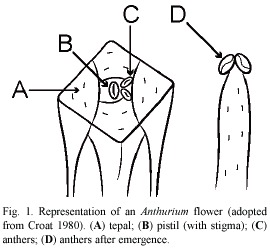
</front><body><![CDATA[  <b><font face="Arial"></font></b>     <p align="center"><b><font face="Arial">Pollination of </font></b><font  face="Arial">Anthurium <b>(Araceae) by derelomine flower weevils (Coleoptera: Curculionidae)</b></font></p> <font face="Arial" size="2"></font>     <p><font face="Arial" size="2">Nico M. Franz Department of Biology, University of Puerto Rico, Mayagüez, PR 00681, Puerto Rico. Fax: (787) 834-3673; franz@uprm.edu </font></p>     <p align="center"><font face="Arial" size="2">Received 01-IX-2003. Corrected 03-III-2006. Accepted 13-X-2006.</font></p> <font face="Arial" size="2"><b></b></font>     <p><font face="Arial" size="2"><b>Abstract: </b><i>Cyclanthura </i>flower weevils (Coleoptera: Curculionidae: Derelomini) are identified for the first time as pollinators of multiple species of <i>Anthurium </i>(Araceae) in Costa Rica. The weevils are present on the inflorescences in small numbers during the pistillate and staminate phase of anthesis, and consume plant tissues and pollen. The individuals of one species of <i>Cyclanthura </i>can visit several <i>Anthurium </i>species within the same locality. They also engage in reproductive activities and are likely to oviposit into the flowers. The mating strategies suggest that sperm precedence selects males that are able to secure their position as the last partner prior to oviposition. Rev. Biol. Trop. 55 (1): 269-277. Epub 2007 March. 31. </font></p> <font face="Arial" size="2"><b></b></font>     <p><font face="Arial" size="2"><b>Key words: </b><i>Anthurium, Cyclanthura, </i>evolution, mating, pollination. </font></p>     <p><font face="Arial" size="2">In her recent review of the reproductive biology of Araceae (Bown 2000), comments on the paucity of reliable identifications of pollinators for many aroid species, and concludes: "[t]here really is no alternative, whether the species in question grows on the roadside, in the middle of a river, or in the rainforest canopy, than to be there recording every event during flowering." The present report offers such information for several species of <i>Anthurium </i>Schott, an exclusively Neotropical genus with over 800 species (Mayo <i>et al. </i>1997). <i>Anthurium </i>is morphologically and taxonomically complex, and observed patterns in the anthesis of flowers, the presentation of nectar and pollen are considered relevant to the process of pollination (Croat 1980). A variety of pollinators have been recorded for <i>Anthurium, </i>including euglossines (Dressler 1968) and flies (Madison 1979, Grayum 1990). Madison (1979) notes that <i>A. </i>cf. <i>gualeanum </i>Engler is visited by "weevils" (Coleoptera: Curculionidae) in Ecuador, and this observation has been perpetuated in the literature without additional substance. </font></p>     <p><font face="Arial" size="2">Recent progress in the taxonomy of derelomine flower weevils (Franz 2003a) has made it possible to identify the pollinators as mem bers of the Neotropical genus <i>Cyclanthura </i>Franz. This paper presents an account of the behavior of adult <i>Cyclanthura </i>individuals on the inflorescences of <i>Anthurium, </i>based on field observations in Costa Rica and specimen label information throughout the range of the association. The available observations will be evaluated from an evolutionary perspective. The principal aims of this report, however, are to call attention to this interesting plant-pol linator interaction and to stimulate additional studies in the field. </font></p>     <p><font face="Arial" size="2">All species of <i>Anthurium </i>are perennial, epiphytic or (less commonly) terrestrial herbs that predominate in low to mid elevation Neotropical wet forests. The individual plants have petioled, coriacious, variously ovate leaves and produce peduncled inflorescences, consisting of a spathe and a spadix. Typically, the spathe is persistent, lanceolate, and colored. The spadix is uniform, cylindrical, and colored as well. The inflorescences are monoecious, with the perfect (<img src="/img/fbpe/rbt/v55n1/Image221.jpg" width="8"  height="12"> <img src="/img/fbpe/rbt/v55n1/Image222.jpg" width="10" height="10">) flowers arranged (and opening) in characteristic spirals along the central axis. The flowers are embedded within the spadix, rhomboidal in shape, with four triangular tepals which enclose the elliptical stigma (Fig. 1). The four flattened stamens are located between the stigma and tepals, and emerge sequentially. In the majority of species of <i>Anthurium, </i>the inflorescences are protogynous, producing stigmatic nectar for some time before the pollen is released (the tepals can also produce nectar during the emergence of the stamens). Like all members of the Araceae they are entomophilous (Grayum 1990), and olfactory signals are considered critical for the attraction of insect pollinators. An extensive account of the spatiotemporal variation of nectar and pollen presentation within <i>Anthurium </i>has been presented by Croat (1980).    
<br> </font></p>     ]]></body>
<body><![CDATA[<p style="text-align: center;"><font face="Arial" size="2"><img  src="/img/fbpe/rbt/v55n1/3628i1.JPG" title="" alt=""  style="width: 270px; height: 249px;">    
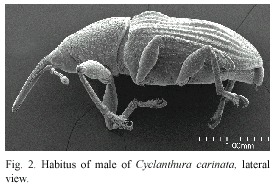
<br> </font></p>     <p><font face="Arial" size="2">The herein reported pollinators are members of the pantropical tribe Derelomini (Coleoptera: Curculionidae: Curculioninae) <i>sensu </i>Franz (2006), which includes more than 40 genera and 265 species (Franz and Valente 2005). Most of them appear to be associated with the inflorescences of Arecaceae (Henderson 1986), although recent efforts have resulted in the identification of numerous species pollinating and/or reproducing on the inflorescences of Cyclanthaceae (Anderson and Gómez 1997, Franz 2001, Franz and O’Brien 2001a y b, Franz 2004). One such clade of 15 Neotropical species has been named <i>Cyclanthura, </i>and is characterized by the presence of elytral elevations and impressions (Franz 2003a). Typically, the adult weevils are 1.8-3.5 mm in length, (dark) reddish-brown in color, with a shallow impression on the frons (i.e. between the eyes), and a narrow, subrectate rostrum (Fig. 2). <i>Ganglionus </i>Franz &amp; O’Brien and the taxonomically complex <i>Phyllotrox </i>Schoenherr are considered closely related taxa (Franz 2006). Many species of derelomine flower weevils have adults which function as pollinators and predominantly detritivorous larvae that do not attack the infructescences or seeds of their host plants. <i>Systenotelus </i>Anderson and Gómez is an exception to this pattern (Anderson and Gómez 1997, Franz 2004, Franz and Valente 2005).    <br> </font></p>     <p style="text-align: center;"><font face="Arial" size="2"><img  src="/img/fbpe/rbt/v55n1/3628i2.JPG" title="" alt=""  style="width: 275px; height: 185px;">    
<br> </font></p> <font face="Arial" size="2"><b>     <p>Materials and methods </p> </b></font>     <p><font face="Arial" size="2">Natural history research in Costa Rica focused on <i>Cyclanthura carinata </i>Franz on the inflorescences of <i>Anthurium formosum, A. tilaranense </i>Standley, and <i>A. upalaense </i>Croat &amp; Baker at the Estación Biológica Las Cruces (OET; 08° 47’ N, 82° 57’ W; elevation 1200 m above sea level; May 28 to May 31, 2003), and on <i>Cyclanthura laticola </i>Franz on the inflorescences of <i>Anthurium consobrinum </i>at the Estación Biológica La Selva (OET; 10° 26’ N, 83° 59’ W; elevation 50 m; June 5 to June 8, 2003). Less extensive observations and collections of <i>Cyclanthura capitulata </i>Franz and <i>C. pilosa </i>Franz on two unidentified species of <i>Anthurium </i>have been conducted in the course of field studies on Cyclanthaceae-associated derelomines at La Selva (Franz 1999; December 1996 to October 1998). An isolated collection of <i>Cyclanthura uncinata </i>Franz on an unidentified <i>Anthurium </i>species has been made at the Reserva Bosque Nuboso Santa Elena (10° 20’ N, 84° 48’ W; elevation 1700 m; June 2001). </font></p>     <p><font face="Arial" size="2">The adults of <i>Cyclanthura </i>were observed on the flowering inflorescences of <i>Anthurium </i>at various times during the day and night, under low artificial lighting conditions, for periods of 1-5 minutes to 2-3 hours. The weevils were perturbed as little as possible in order to study their natural activities. A total of 95 min of <i>C. carinata </i>was filmed at La Cruces, and a total of 50 minutes of <i>C. laticola </i>was filmed at La Selva, using a Canon ZR-70MC Mini DV Camcorder in combination with a +4 close-up lens and a flashlight, at distances of 10-20 cm from the inflorescences. All recordings were analyzed frame by frame in the laboratory. </font></p>     <p><font face="Arial" size="2">The abundance of weevils was sampled by separating entire inflorescences and transferring them immediately into Whirl-Pak sample bags with 95% ethanol. Attempts to collect immature stages of <i>Cyclanthura </i>were made by dissecting the infructescences at various stages of the maturation process. Additional information on host plant associations was taken from specimen labels examined during the recent analysis of the genus (Franz 2003a). Relatively little attention was given to the specifics of the anthesis of the various <i>Anthurium </i>species, since this necessitates (inter alia) examination of the stigmata under a microscope over a period of 1-3 weeks (Croat 1980). </font></p> <font face="Arial" size="2"><b></b></font>     ]]></body>
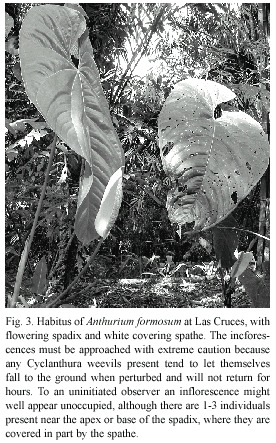
<body><![CDATA[<p><font face="Arial" size="2"><b>Results </b></font></p>     <p><font face="Arial" size="2"><b>Anthesis of inflorescences: </b>the anthesis of <i>A. formosum </i>(Fig. 3) has a duration of 8-15 days (Beath (1998). It initiates with a pistillate (<img src="/img/fbpe/rbt/v55n1/Image221.jpg"  width="8" height="12">) phase for 2-3 days, continues for some time with an intermediate (inactive) phase, and ends with a staminate ( <img  src="/img/fbpe/rbt/v55n1/Image222.jpg" width="10" height="10">) phase for 3-5 days. The opening of the flowers progresses from the base to the apex. The inflorescences produce sweet fragrances from 06:30 a.m. to 10:00 p.m. during each morning of the pistillate and staminate phases. The color of the spathe ranges from white to purple, the spadix is creamy (pale) yellow, and the pistils, anthers and pollen are whitish.    
<br> </font></p>     <p style="text-align: center;"><font face="Arial" size="2"><img  src="/img/fbpe/rbt/v55n1/3628i3.JPG" title="" alt=""  style="width: 276px; height: 443px;">    
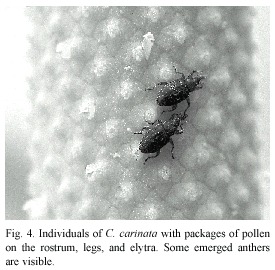
<br> </font></p>     <p><font face="Arial" size="2">The floral succession of <i>A. consobrinum </i>appears to be similar to that of <i>A. formosum </i>but was not examined specifically. The spathe is green and the stigmata are situated on conspicuously protruded styles in the course of anthesis. </font></p> <font face="Arial" size="2"><b></b></font>     <p><font face="Arial" size="2"><b>Pollination: </b>an average of 6.6 ±5.6 individuals of <i>C. carinata </i>(range: 2-18 individuals, N=8) can be observed on the inflorescences of <i>A. formosum </i>at Las Cruces, during all three phases of anthesis. Some inflorescences have no individuals present. The weevils will typically rest in protected areas near the apez or base of the spadix where they are covered in part by the spathe, and move only minimally for minutes to hours. Only one individual of <i>C. carinata </i>has been confirmed to arrive in flight on an inflorescence at 9:20 A.M. (i.e. when the fragrances are produced), landing on the inside surface of the spathe and crawling immediately towards the base of the spadix. None have been observed to leave without returning after some time. Once they are there, however, they will likely stay for most of the flowering time. Presumably the same individuals have been identified on various inflorescences for as long as 2-4 days. </font></p>     <p><font face="Arial" size="2">The weevils are not exclusive pollen eaters but can also consume parts the pistils and triangular tepals, inserting the rostrum well into the flowers (for over 5 min on one occasion). Several circular spots of decaying plant tissue are evidence for such activities. Crawling along the spadix, individuals can also probe 5 stigmata in 45 s or 15 stigmata in 200 s, although these are "exceptions" to the predominant resting. They will eventually access the entire inflorescence surface for feeding and contact the protruded stigmata with the legs, sterna, venter, and rostrum. The open (extruded) anthers are spaced at 2-4 mm from each other, and therefore individual can only consume pollen with the rostrum while touching other anthers, thereby acquiring pollen. On average the process of feeding on an anther lasts 33 ±16 s (range: 5-70 s, N=28). In the course of time, macroscopically visible packages of pollen accumulate on the weevils (Fig. 4). The pollen can be transferred when they fly to other inflorescences with receptive stigmata.    <br> </font></p>     <p style="text-align: center;"><font face="Arial" size="2"><img  src="/img/fbpe/rbt/v55n1/3628i4.JPG" title="" alt=""  style="width: 275px; height: 270px;">    
]]></body>
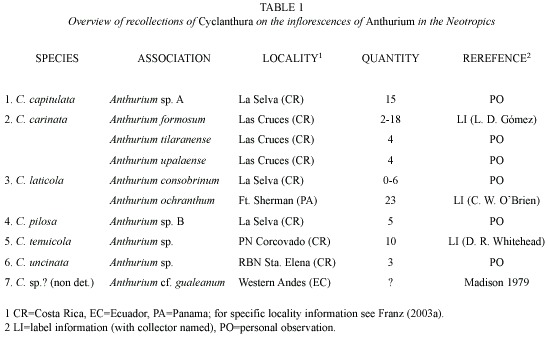
<body><![CDATA[<br> </font></p>     <p><font face="Arial" size="2">Even smaller numbers of <i>C. laticola </i>have been collected on <i>A. consobrinum </i>at La Selva (average: 2.6 ±2.0 individuals per inflorescence, range: 0-6 individuals, N=10), during both the pistillate and the staminate phase of anthesis. All other observations are congruent with those presented above. Additional information on <i>Cyclanthura </i>pollinators of <i>Anthurium </i>species is provided in Table 1.    <br> </font></p>     <p style="text-align: center;"><font face="Arial" size="2"><img  src="/img/fbpe/rbt/v55n1/3628i5.JPG" title="" alt=""  style="width: 548px; height: 337px;">    
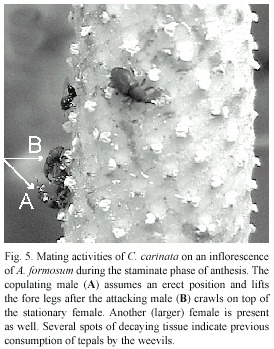
<br> </font></p> <font face="Arial" size="2"><b></b></font>     <p><font face="Arial" size="2"><b>Reproduction: </b>the following account is based primarily on video-recorded observations of six individuals (three females, three males) of <i>C. carinata </i>on an inflorescence of <i>A. formosum </i>during the staminate phase of anthesis. Over a period of approximately 75 min, a male was associated with a female that appeared to be preparing for oviposition. The female was located in the central region of the spadix on the side facing the spathe. A second female and a second male were consuming pollen in the immediate vicinity (i.e. at a distance of no more than 1-3 cm). A third male was resting near the base of the spadix, and a third female was inserting her rostrum into the tepals of a flower situated near the apex and covered by the spathe. These observations are reflective of the general tendencies of the weevils to either (1) engage in feeding or mating in areas of flowering activity or (2) rest in protected regions of the inflorescence. </font></p>     <p><font face="Arial" size="2">The mating couple was positioned in such a way the female was stationary and closely "pressed" against the inflorescence surface. The considerably smaller male was situated along her abdomen, at an angle of 45°, with the hind legs on the plant, the mid legs on the elytra of the female, and the fore legs available for courtship. Every 2-5 min the male used the legs and particularly the rostrum to perform abrupt yet rhythmic pushes on the elytra of the female -approximately two per second -for a period of 5-15 s (N=5). In the course of the behavioral displays the male aedeagus continued to be inserted into the female for 1/3 to 2/3 of its length. After this activity they rested in the same relative position. </font></p>     <p><font face="Arial" size="2">Three attacks to replace the copulating male were launched by the closely associated male. The aggressions were separated by over 25 min and over 5 min, respectively. For the first of these the attacking male crawled over the female to face his smaller competitor frontally. The challenged male reacted by assuming an (almost) erect position, standing exclusively on the hind legs and holding the fore legs constant at an angle in front of him, apparently to signal the disposition to fight (Fig. 5). After 20 s of staying in place on the female, the attacking male then descended and attempted to move into the position of the (still) copulating male by aligning next to him and pushing him from the side. The challenged male used his fore legs to hit the attacker on the elytra and pronotum, but lost his position for only 10 s before regaining it by pushing the attacker away frontally. Although the attacking male had never copu lated with the (mostly unaffected) female, the successful male resumed his copulatory and courting activities immediately. The attacker remained in the vicinity. The entire sequence lasted 1 minute.    <br> </font></p>     <p style="text-align: center;"><font face="Arial" size="2"><img  src="/img/fbpe/rbt/v55n1/3628i6.JPG" title="" alt=""  style="width: 274px; height: 349px;">    
]]></body>
<body><![CDATA[<br> </font></p>     <p><font face="Arial" size="2">At one time the unsuccessful male attempted to mate with another female by positioning his fore legs on her abdomen. She continued to crawl along while consuming pollen and the male eventually moved away. He launched his second attack on the copulating male - this time from the posterior side -by attempting to lift him up with the rostrum. The attacked male, however, was able to secure his position on the female, causing the other to leave after 25 s. He returned very shortly by crawling frontally onto the female. This provoked the copulating male to resume the "fighting position" (Fig. 5), and the attack terminated. </font></p>     <p><font face="Arial" size="2">The third attack was launched from the side. This time the attacking male succeeded in lifting the smaller male up with the rostrum and locating himself on top of the (slowly moving) female, after 30 s of conflict. Once in position he was able to counter one short attack and remained there permanently. The newly associated couple crawled underneath the spathe where any oviposition activities were impossible to track. </font></p>     <p><font face="Arial" size="2">Additional studies of <i>C. carinata </i>on <i>A. formosum, A. tilaranense, </i>and <i>A. upalaense </i>at Las Cruces yielded similar observations. It is common to locate individuals <i>in copula </i>yet also resting on top of each other for longer periods of time. The couples will separate when perturbed. The female can apparently signal an indisposition to mate either (1) by continuing to move while the male attempts to crawl on top of her, or (2) by lifting her entire body for 3-5 s, resting for some time, and then lowering herself (i.e. touching the inflorescence surface with the abdomen). She can perpetuate this activity for (minimally) 30 s (N=3). </font></p>     <p><font face="Arial" size="2">A total of 12 infructescences of <i>A. formosum </i>were examined at various stages of maturation for immatures (larvae and pupae) of <i>C. carinata. </i>Although five of them had signs of infestations by herbivorous insects -i.e. decaying ovarian tissue and constrictions in shape -no living immatures of weevils could be located. Unidentified larvae of insects have been noted occasionally during dissections of <i>Anthurium </i>infructescences (T. B. Croat, pers. comm.). </font></p>     <p><font face="Arial" size="2">Observations of <i>C. laticola </i>on <i>A. consobrinum </i>at La Selva evidenced even less activity by the weevils. When <i>in copula </i>the male continuously moved back and forth while contacting the head region of the female with his antennae, legs, and rostrum. Conflicts among males were not observed. Various dissected infructescences yielded no <i>Cyclanthura </i>specimens. </font></p> <font face="Arial" size="2"><b>     <p>Discussion </p> </b></font>     <p><font face="Arial" size="2">The most critical result of the present study is the confirmation of <i>Cyclanthura </i>weevils as pollinators of multiple species of <i>Anthurium </i>in Costa Rica (and additional Neotropical countries). Previous reports have identified euglossines bees as common visitors of members of this aroid clade (Williams and Dressler 1976). At Las Cruces, Beath (1998) observed males of <i>Euglossa </i>and <i>Eulaema </i>on the inflorescences of A. <i>formosum </i>and <i>A. hacumense </i>Engler, noting that they collect fragrant surface waxes for pheromones used in the attraction of females. Many euglossine species are polylectic, however, and cannot be expected to pollinate <i>Anthurium </i>constantly and/or exclusively (Roubik 1989). Other floral visitors included chrysomelids, nymphs of hemipterans, small parasitoid wasps, and thrips (but not euglossines). None of these are sufficiently behaviorally synchronized with the anthesis of <i>Anthurium </i>to act as reliable pollinators. In contrast to this, many species of derelomine flower weevils <i>are </i>pollinators of such morphologically complex taxa as Arecaceae and Cyclanthaceae (Henderson 1986, Eriksson 1994, Franz 2004). This pollinating function appears to be plesiomorphic for the clade that comprises <i>Cyclanthura, Ganglionus, </i>and <i>Phyllotrox. </i>It is present in other <i>Cyclanthura </i>species as well, e.g. in <i>C. bipartita </i>Franz which pollinates <i>Cyclanthus bipartitus </i>Poiteau in southwestern Costa Rica (Franz 2003a). What characterizes the weevils is the specific (olfactory) attraction to their host plants, the disposition to stay for the period of anthesis while consuming and reproducing on the floral organs, and the ability to transfer considerable amounts of pollen when leaving for other receptive inflorescences. Their morphologies and behaviors facilitate this process. Individuals of <i>Cyclanthura </i>have been collected either on <i>Anthurium </i>or on Cyclanthaceae (although never on both), and nowhere else. In spite of their low abundance and generally low activity, they should be considered the most effective pollinators of the species listed above (Table 1). </font></p>     <p><font face="Arial" size="2">The weevils are typically not associated with their host plants at the level of <i>species. </i>They visit similar <i>Anthurium </i>species when they occur in the same locality. There appears to be little phylogenetic signal in the patterns of association. As an example, <i>A. formosum, A. tilaranense, </i>and <i>A. upalaense </i>are all visited by <i>C. carinata </i>at Las Cruces yet have been placed in separate taxonomic sections (see Croat and Sheffer 1983). The same situation obtains for the evolutionarily largely unrelated. <i>A. consobrinum </i>and <i>A. ochranthum </i>Koch which attract weevils of <i>C. laticola. </i>The reproductive cohesion of these <i>Anthurium </i>species must be achieved by mechanisms complementing those provided by their pollinating agents. </font></p>     <p><font face="Arial" size="2">With respect to the phylogeny of <i>Cyclanthura, </i>the species in Table 1 are part of a monophyletic clade that includes <i>C. cordata </i>Franz from Ecuador -where Madison (1979) observed weevils on <i>Anthurium </i>and <i>C. dentata </i>Franz from Panama with unknown host associations. Based on this information, derelomines have colonized the inflorescences of <i>Anthurium </i>at only one time in past. </font></p>     ]]></body>
<body><![CDATA[<p><font face="Arial" size="2">Considering the number of potential host taxa involved and the paucity of field studies in the Neotropics (Grayum 1990, Mayo <i>et al. </i>1997, Bown 2000), future research will likely identify many additional species of <i>Cyclanthur</i>a as pollinators of this aroid complex. Interestingly, C. <i>sphaerata </i>Franz is the only species within the clade mentioned above that does not visit <i>Anthurium. </i>Instead, the weevils are (presumably secondarily) associated with <i>Sphaeradenia </i>Harling (Cyclanthaceae), e.g. in Monteverde, Costa Rica. The immature stages of <i>C. sphaerata </i>consume the pulp of the maturing infructescences. This might be indicative of the biology of other <i>Cyclanthura </i>species. </font></p>     <p><font face="Arial" size="2">The mating activities of <i>C. carinata </i>and <i>C. laticola </i>suggest that they oviposit into the inflorescences of <i>Anthurium. </i>The females of many derelomine species will only copulate with males if they are close to initiating oviposition. As an example, the females of <i>Staminodeus vectoris </i>Franz visit significantly more Cyclanthaceae species at La Selva than they mate on and oviposit into (Franz 2003b). On the "non-ovipositing" inflorescences they will not accept males attempting to copulate. Conversely, if sperm precedence is assumed then it would be advantageous for males to invest into copulation, courtship, and conflicts with competitors (as reported above) so long as they can assess whether the females will lay eggs. Similar mating conditions have been observed in other weevil species where individuals aggregate in numbers on ephemeral substrates for oviposition (Eberhard 1983). </font></p>     <p><font face="Arial" size="2">In light of the long flowering periods and small numbers of individuals present, competition among males is common on the inflorescences of <i>Anthurium. </i>They can apparently assess whether females are ready to reproduce but are unable to predict the exact timing of oviposition. Thus the general male strategy is to associate with one active female until she lays an egg. This is most convincingly explained if one assumes sperm precedence (Simmons 2001): a male prefers to secure himself as the last partner of a female prior to oviposition over mating at any time with many females. Relevant to this context is the observation that the courtship of males is not very elaborate and males are able to maintain their copulatory position when attacked by slightly larger competitors. Similar mating conditions occur in derelomines associated with Cyclanthaceae (Franz 1999). </font></p>     <p><font face="Arial" size="2">While the present report of <i>Cyclanthura </i>weevils on <i>Anthurium </i>inflorescences is based on limited observations, it is hoped that it will stimulate more studies in the field that address not only the pollination ecology of this interaction but also potential behavioral homologies within derelomine flower weevils. </font></p> <font face="Arial" size="2"><b>     <p>Acknowledgments </p> </b></font>     <p><font face="Arial" size="2">I thank Thomas Croat, Luis Gómez, Alvaro Herrera, Robert Matlock for access to field sites and assistance with plant identifications; Robert Anderson, Steven Lingafelter, and Charles O’Brien for loans of weevil specimens; and Huyen Do for assistance with the filming and photography and for general support throughout the project. David Grimaldi and Tam Nguyen facilitated the use of the SEM at the American Museum of Natural History. Funding was provided in part through the National Science Foundation Doctoral Dissertation Improvement Grant DEB-0206093. </font></p> <font face="Arial" size="2"><b>     <p>Resumen </p> </b></font>     <p><font face="Arial" size="2">Por primera vez se informa que algunos curculiónidos de flores de <i>Cyclanthura </i>(Coleoptera: Curculionidae: Derelomini) polinizan varias especies de <i>Anthurium </i>(Araceae) en Costa Rica. Los curculiónidos están presentes en las inflorescencias en pequeñas cantidades durante la fase pistilada y estaminada de la antesis, y consumen tejidos de la planta y polen. Los individuos de una especie de <i>Cyclanthura </i>pueden visitar varias especies de <i>Anthurium </i>en la misma localidad ; también se ocupan en actividades reproductivas y probablemente ovipositan en las flores. Las estrategias de apareamiento sugieren que la competencia a nivel de gametos selecciona favorablemente al último macho en la secuencia de apareamiento de la hembra, pues éste deposita su semen justo antes de que ella oviposite. </font></p> <font face="Arial" size="2"><b></b></font>     <p><font face="Arial" size="2"><b>Palabres clave</b>: <i>Anthurium, Cyclanthura, </i>evolución, apareamiento, polinización. </font></p> <font face="Arial" size="2"><b>     <p>References </p> </b></font>     ]]></body>
<body><![CDATA[<!-- ref --><p><font face="Arial" size="2">Anderson, R.S. &amp; L.D. Gómez-P. 1997. <i>Systenotelus, </i>a remarkable new genus of weevil (Coleoptera: Curculionidae) associated with <i>Carludovica </i>(Cyclanthaceae) in Costa Rica and Panamá. Rev. Biol. Trop. 45: 887-904.    &nbsp;&nbsp;&nbsp;&nbsp;&nbsp;&nbsp;&nbsp;&nbsp;[&#160;<a href="javascript:void(0);" onclick="javascript: window.open('/scielo.php?script=sci_nlinks&ref=1667257&pid=S0034-7744200700010002900001&lng=','','width=640,height=500,resizable=yes,scrollbars=1,menubar=yes,');">Links</a>&#160;]<!-- end-ref --> </font></p>     <!-- ref --><p><font face="Arial" size="2">Bown, D. 2000. Aroids: plants of the arum family, second edition. Timber, Portland, Oregon, USA. 468 p.    &nbsp;&nbsp;&nbsp;&nbsp;&nbsp;&nbsp;&nbsp;&nbsp;[&#160;<a href="javascript:void(0);" onclick="javascript: window.open('/scielo.php?script=sci_nlinks&ref=1667259&pid=S0034-7744200700010002900002&lng=','','width=640,height=500,resizable=yes,scrollbars=1,menubar=yes,');">Links</a>&#160;]<!-- end-ref --> </font></p>     <!-- ref --><p><font face="Arial" size="2">Croat, T.B. 1980. Flowering behavior of the Neotropical genus <i>Anthurium </i>(Araceae). Amer. J. Bot. 67: 888-904.    &nbsp;&nbsp;&nbsp;&nbsp;&nbsp;&nbsp;&nbsp;&nbsp;[&#160;<a href="javascript:void(0);" onclick="javascript: window.open('/scielo.php?script=sci_nlinks&ref=1667261&pid=S0034-7744200700010002900003&lng=','','width=640,height=500,resizable=yes,scrollbars=1,menubar=yes,');">Links</a>&#160;]<!-- end-ref --> </font></p>     <!-- ref --><p><font face="Arial" size="2">Croat, T.B. &amp; R.S. Sheffer. 1983. The sectional groupings of <i>Anthurium </i>(Araceae). Aroideana 6: 85-l23.    &nbsp;&nbsp;&nbsp;&nbsp;&nbsp;&nbsp;&nbsp;&nbsp;[&#160;<a href="javascript:void(0);" onclick="javascript: window.open('/scielo.php?script=sci_nlinks&ref=1667263&pid=S0034-7744200700010002900004&lng=','','width=640,height=500,resizable=yes,scrollbars=1,menubar=yes,');">Links</a>&#160;]<!-- end-ref --> </font></p>     <!-- ref --><p><font face="Arial" size="2">Dressler, R.L. 1968. Observations on orchids and euglossine bees in Panama and Costa Rica. Rev. Biol. Trop. 15: 143-183.    &nbsp;&nbsp;&nbsp;&nbsp;&nbsp;&nbsp;&nbsp;&nbsp;[&#160;<a href="javascript:void(0);" onclick="javascript: window.open('/scielo.php?script=sci_nlinks&ref=1667265&pid=S0034-7744200700010002900005&lng=','','width=640,height=500,resizable=yes,scrollbars=1,menubar=yes,');">Links</a>&#160;]<!-- end-ref --> </font></p>     ]]></body>
<body><![CDATA[<!-- ref --><p><font face="Arial" size="2">Eberhard, W.G. 1983. Behavior of adult bottle brush weevils (<i>Rhinostomus barbirostris</i>) (Coleoptera: Curculionidae). Rev. Biol. Trop. 31: 233-244.    &nbsp;&nbsp;&nbsp;&nbsp;&nbsp;&nbsp;&nbsp;&nbsp;[&#160;<a href="javascript:void(0);" onclick="javascript: window.open('/scielo.php?script=sci_nlinks&ref=1667267&pid=S0034-7744200700010002900006&lng=','','width=640,height=500,resizable=yes,scrollbars=1,menubar=yes,');">Links</a>&#160;]<!-- end-ref --> </font></p>     <!-- ref --><p><font face="Arial" size="2">Eriksson, R. 1994. The remarkable weevil pollination of the Neotropical Carludovicoideae (Cyclanthaceae). Plant Syst. Evol. 189: 75-81.    &nbsp;&nbsp;&nbsp;&nbsp;&nbsp;&nbsp;&nbsp;&nbsp;[&#160;<a href="javascript:void(0);" onclick="javascript: window.open('/scielo.php?script=sci_nlinks&ref=1667269&pid=S0034-7744200700010002900007&lng=','','width=640,height=500,resizable=yes,scrollbars=1,menubar=yes,');">Links</a>&#160;]<!-- end-ref --> </font></p>     <!-- ref --><p><font face="Arial" size="2">Franz, N.M. 1999. Biología reproductiva de algunas ciclantáceas (Cyclanthaceae) y de los picudos asociados (Coleoptera: Curculionidae). Tesis de Maestría, Universidad de Costa Rica, San José, Costa Rica. 97 p.    &nbsp;&nbsp;&nbsp;&nbsp;&nbsp;&nbsp;&nbsp;&nbsp;[&#160;<a href="javascript:void(0);" onclick="javascript: window.open('/scielo.php?script=sci_nlinks&ref=1667271&pid=S0034-7744200700010002900008&lng=','','width=640,height=500,resizable=yes,scrollbars=1,menubar=yes,');">Links</a>&#160;]<!-- end-ref --> </font></p>     <!-- ref --><p><font face="Arial" size="2">Franz, N.M. 2001. Description and phylogeny of <i>Staminodeus, </i>a new genus of Derelomini (Coleoptera: Curculionidae) associated with Cyclanthaceae. Coleop. Bull. 55: 397-418.    &nbsp;&nbsp;&nbsp;&nbsp;&nbsp;&nbsp;&nbsp;&nbsp;[&#160;<a href="javascript:void(0);" onclick="javascript: window.open('/scielo.php?script=sci_nlinks&ref=1667273&pid=S0034-7744200700010002900009&lng=','','width=640,height=500,resizable=yes,scrollbars=1,menubar=yes,');">Links</a>&#160;]<!-- end-ref --> </font></p>     <!-- ref --><p><font face="Arial" size="2">Franz, N.M. 2003a. Systematics of <i>Cyclanthura, </i>a new genus of Derelomini (Coleoptera: Curculionidae). Insect Syst. Evol. 34: 153-198.    &nbsp;&nbsp;&nbsp;&nbsp;&nbsp;&nbsp;&nbsp;&nbsp;[&#160;<a href="javascript:void(0);" onclick="javascript: window.open('/scielo.php?script=sci_nlinks&ref=1667275&pid=S0034-7744200700010002900010&lng=','','width=640,height=500,resizable=yes,scrollbars=1,menubar=yes,');">Links</a>&#160;]<!-- end-ref --> </font></p>     ]]></body>
<body><![CDATA[<!-- ref --><p><font face="Arial" size="2">Franz, N.M. 2003b. Mating behaviour of <i>Staminodeus vectoris </i>(Coleoptera: Curculionidae), and the value of systematics in behavioural studies. J. Nat. Hist. 37: 1727-1750.    &nbsp;&nbsp;&nbsp;&nbsp;&nbsp;&nbsp;&nbsp;&nbsp;[&#160;<a href="javascript:void(0);" onclick="javascript: window.open('/scielo.php?script=sci_nlinks&ref=1667277&pid=S0034-7744200700010002900011&lng=','','width=640,height=500,resizable=yes,scrollbars=1,menubar=yes,');">Links</a>&#160;]<!-- end-ref --> </font></p>     <!-- ref --><p><font face="Arial" size="2">Franz, N.M. 2004. Analyzing the history of the derelomine flower weevil-<i>Carludovica </i>association (Coleoptera: Curculionidae; Cyclanthaceae). Biol. J. Linn. Soc. 81: 483-517.    &nbsp;&nbsp;&nbsp;&nbsp;&nbsp;&nbsp;&nbsp;&nbsp;[&#160;<a href="javascript:void(0);" onclick="javascript: window.open('/scielo.php?script=sci_nlinks&ref=1667279&pid=S0034-7744200700010002900012&lng=','','width=640,height=500,resizable=yes,scrollbars=1,menubar=yes,');">Links</a>&#160;]<!-- end-ref --> </font></p>     <!-- ref --><p><font face="Arial" size="2">Franz, N.M. 2006. Towards a phylogenetic system of derelomine flower weevils (Coleoptera: Curculionidae). Syst. Ent. 31. (in press).    &nbsp;&nbsp;&nbsp;&nbsp;&nbsp;&nbsp;&nbsp;&nbsp;[&#160;<a href="javascript:void(0);" onclick="javascript: window.open('/scielo.php?script=sci_nlinks&ref=1667281&pid=S0034-7744200700010002900013&lng=','','width=640,height=500,resizable=yes,scrollbars=1,menubar=yes,');">Links</a>&#160;]<!-- end-ref --> </font></p>     <!-- ref --><p><font face="Arial" size="2">Franz, N.M. &amp; C.W. O’Brien. 2001a. <i>Ganglionus, </i>a new genus of Derelomini (Coleoptera: Curculionidae) associated with <i>Carludovica </i>(Cyclanthaceae). Ann. Entomol. Soc. Am. 74: 835-850.    &nbsp;&nbsp;&nbsp;&nbsp;&nbsp;&nbsp;&nbsp;&nbsp;[&#160;<a href="javascript:void(0);" onclick="javascript: window.open('/scielo.php?script=sci_nlinks&ref=1667283&pid=S0034-7744200700010002900014&lng=','','width=640,height=500,resizable=yes,scrollbars=1,menubar=yes,');">Links</a>&#160;]<!-- end-ref --> </font></p>     <!-- ref --><p><font face="Arial" size="2">Franz, N.M. &amp; C.W. O’Brien. 2001b. Revision and phylogeny of <i>Perelleschus </i>(Coleoptera: Curculionidae), with notes on its association with <i>Carludovica </i>(Cyclanthaceae). Trans. Am. Entomol. Soc. 127: 255-287.    &nbsp;&nbsp;&nbsp;&nbsp;&nbsp;&nbsp;&nbsp;&nbsp;[&#160;<a href="javascript:void(0);" onclick="javascript: window.open('/scielo.php?script=sci_nlinks&ref=1667285&pid=S0034-7744200700010002900015&lng=','','width=640,height=500,resizable=yes,scrollbars=1,menubar=yes,');">Links</a>&#160;]<!-- end-ref --> </font></p>     ]]></body>
<body><![CDATA[<!-- ref --><p><font face="Arial" size="2">Franz, N.M. &amp; R.M. Valente. 2005. Evolutionary trends in derelomine flower weevils: from associations to homology. Invert. Syst. 19: 499-530.    &nbsp;&nbsp;&nbsp;&nbsp;&nbsp;&nbsp;&nbsp;&nbsp;[&#160;<a href="javascript:void(0);" onclick="javascript: window.open('/scielo.php?script=sci_nlinks&ref=1667287&pid=S0034-7744200700010002900016&lng=','','width=640,height=500,resizable=yes,scrollbars=1,menubar=yes,');">Links</a>&#160;]<!-- end-ref --> </font></p>     <!-- ref --><p><font face="Arial" size="2">Grayum, M.H. 1990. Evolution and phylogeny of the Araceae. Ann. Missouri Bot. Gard. 77: 628-697.    &nbsp;&nbsp;&nbsp;&nbsp;&nbsp;&nbsp;&nbsp;&nbsp;[&#160;<a href="javascript:void(0);" onclick="javascript: window.open('/scielo.php?script=sci_nlinks&ref=1667289&pid=S0034-7744200700010002900017&lng=','','width=640,height=500,resizable=yes,scrollbars=1,menubar=yes,');">Links</a>&#160;]<!-- end-ref --> </font></p>     <!-- ref --><p><font face="Arial" size="2">Henderson, A. 1986. A review of pollination studies in the Palmae. Bot. Rev. 52: 221-259.    &nbsp;&nbsp;&nbsp;&nbsp;&nbsp;&nbsp;&nbsp;&nbsp;[&#160;<a href="javascript:void(0);" onclick="javascript: window.open('/scielo.php?script=sci_nlinks&ref=1667291&pid=S0034-7744200700010002900018&lng=','','width=640,height=500,resizable=yes,scrollbars=1,menubar=yes,');">Links</a>&#160;]<!-- end-ref --> </font></p>     <!-- ref --><p><font face="Arial" size="2">Madison, M. 1979. Protection of developing seeds in Neotropical Araceae. Aroideana 2: 52-61.    &nbsp;&nbsp;&nbsp;&nbsp;&nbsp;&nbsp;&nbsp;&nbsp;[&#160;<a href="javascript:void(0);" onclick="javascript: window.open('/scielo.php?script=sci_nlinks&ref=1667293&pid=S0034-7744200700010002900019&lng=','','width=640,height=500,resizable=yes,scrollbars=1,menubar=yes,');">Links</a>&#160;]<!-- end-ref --> </font></p>     <!-- ref --><p><font face="Arial" size="2">Mayo, S.J., J.Bogner &amp; P.C. Boyce. 1997. The genera of Araceae, with contributions from J.C. French and R. Hegnauer, illustrations by E. Catherine. Royal Botanical Gardens, Kew. 370 p.    &nbsp;&nbsp;&nbsp;&nbsp;&nbsp;&nbsp;&nbsp;&nbsp;[&#160;<a href="javascript:void(0);" onclick="javascript: window.open('/scielo.php?script=sci_nlinks&ref=1667295&pid=S0034-7744200700010002900020&lng=','','width=640,height=500,resizable=yes,scrollbars=1,menubar=yes,');">Links</a>&#160;]<!-- end-ref --> </font></p>     ]]></body>
<body><![CDATA[<!-- ref --><p><font face="Arial" size="2">Roubik, D.W. 1989. Ecology and natural history of tropical bees. Cambridge University, Cambridge, New York, USA. 514 p.    &nbsp;&nbsp;&nbsp;&nbsp;&nbsp;&nbsp;&nbsp;&nbsp;[&#160;<a href="javascript:void(0);" onclick="javascript: window.open('/scielo.php?script=sci_nlinks&ref=1667297&pid=S0034-7744200700010002900021&lng=','','width=640,height=500,resizable=yes,scrollbars=1,menubar=yes,');">Links</a>&#160;]<!-- end-ref --> </font></p>     <!-- ref --><p><font face="Arial" size="2">Simmons, L.W. 2001. Sperm competition and its evolutionary consequences in the insects. Princeton University, Princeton, New Jersey, USA. 434 p.    &nbsp;&nbsp;&nbsp;&nbsp;&nbsp;&nbsp;&nbsp;&nbsp;[&#160;<a href="javascript:void(0);" onclick="javascript: window.open('/scielo.php?script=sci_nlinks&ref=1667299&pid=S0034-7744200700010002900022&lng=','','width=640,height=500,resizable=yes,scrollbars=1,menubar=yes,');">Links</a>&#160;]<!-- end-ref --> </font></p>     <!-- ref --><p><font face="Arial" size="2">Williams, N.H. &amp; R.L. Dressler. 1976. Euglossine pollination of <i>Spathiphyllum </i>(Araceae). Selbyana 1: 349-356.    &nbsp;&nbsp;&nbsp;&nbsp;&nbsp;&nbsp;&nbsp;&nbsp;[&#160;<a href="javascript:void(0);" onclick="javascript: window.open('/scielo.php?script=sci_nlinks&ref=1667301&pid=S0034-7744200700010002900023&lng=','','width=640,height=500,resizable=yes,scrollbars=1,menubar=yes,');">Links</a>&#160;]<!-- end-ref --> </font></p> <font face="Arial" size="2"><b>     <p>Internet reference </p> </b></font>     <!-- ref --><p><font face="Arial" size="2">Beath, D.D.N. 1998. Pollination ecology of the Araceae. U.S.A. (Downloaded: 01-3-2006; http://www.aroid. org/pollination/beath/index.html)</font>&nbsp;&nbsp;&nbsp;&nbsp;&nbsp;&nbsp;&nbsp;&nbsp;[&#160;<a href="javascript:void(0);" onclick="javascript: window.open('/scielo.php?script=sci_nlinks&ref=1667304&pid=S0034-7744200700010002900024&lng=','','width=640,height=500,resizable=yes,scrollbars=1,menubar=yes,');">Links</a>&#160;]<!-- end-ref --> ]]></body><back>
<ref-list>
<ref id="B1">
<nlm-citation citation-type="journal">
<person-group person-group-type="author">
<name>
<surname><![CDATA[Anderson]]></surname>
<given-names><![CDATA[R.S]]></given-names>
</name>
<name>
<surname><![CDATA[Gómez-P]]></surname>
<given-names><![CDATA[L.D]]></given-names>
</name>
</person-group>
<article-title xml:lang="en"><![CDATA[Systenotelus, a remarkable new genus of weevil (Coleoptera: Curculionidae) associated with Carludovica (Cyclanthaceae) in Costa Rica and Panamá]]></article-title>
<source><![CDATA[Rev. Biol. Trop]]></source>
<year>1997</year>
<volume>45</volume>
<page-range>887-904</page-range></nlm-citation>
</ref>
<ref id="B2">
<nlm-citation citation-type="book">
<person-group person-group-type="author">
<name>
<surname><![CDATA[Bown]]></surname>
<given-names><![CDATA[D]]></given-names>
</name>
</person-group>
<source><![CDATA[Aroids: plants of the arum family]]></source>
<year>2000</year>
<edition>second</edition>
<page-range>468</page-range><publisher-loc><![CDATA[Portland^eOregon Oregon]]></publisher-loc>
<publisher-name><![CDATA[Timber]]></publisher-name>
</nlm-citation>
</ref>
<ref id="B3">
<nlm-citation citation-type="journal">
<person-group person-group-type="author">
<name>
<surname><![CDATA[Croat]]></surname>
<given-names><![CDATA[T.B]]></given-names>
</name>
</person-group>
<article-title xml:lang="en"><![CDATA[Flowering behavior of the Neotropical genus Anthurium (Araceae)]]></article-title>
<source><![CDATA[Amer. J. Bot]]></source>
<year>1980</year>
<volume>67</volume>
<page-range>888-904</page-range></nlm-citation>
</ref>
<ref id="B4">
<nlm-citation citation-type="journal">
<person-group person-group-type="author">
<name>
<surname><![CDATA[Croat]]></surname>
<given-names><![CDATA[T.B]]></given-names>
</name>
<name>
<surname><![CDATA[Sheffer]]></surname>
<given-names><![CDATA[R.S]]></given-names>
</name>
</person-group>
<article-title xml:lang="en"><![CDATA[The sectional groupings of Anthurium (Araceae)]]></article-title>
<source><![CDATA[Aroideana]]></source>
<year>1983</year>
<volume>6</volume>
<page-range>85-l23</page-range></nlm-citation>
</ref>
<ref id="B5">
<nlm-citation citation-type="journal">
<person-group person-group-type="author">
<name>
<surname><![CDATA[Dressler]]></surname>
<given-names><![CDATA[R.L]]></given-names>
</name>
</person-group>
<article-title xml:lang="en"><![CDATA[Observations on orchids and euglossine bees in Panama and Costa Rica]]></article-title>
<source><![CDATA[Rev. Biol. Trop]]></source>
<year>1968</year>
<volume>15</volume>
<page-range>143-183</page-range></nlm-citation>
</ref>
<ref id="B6">
<nlm-citation citation-type="journal">
<person-group person-group-type="author">
<name>
<surname><![CDATA[Eberhard]]></surname>
<given-names><![CDATA[W.G]]></given-names>
</name>
</person-group>
<article-title xml:lang="en"><![CDATA[Behavior of adult bottle brush weevils (Rhinostomus barbirostris) (Coleoptera: Curculionidae)]]></article-title>
<source><![CDATA[Rev. Biol. Trop]]></source>
<year>1983</year>
<volume>31</volume>
<page-range>233-244</page-range></nlm-citation>
</ref>
<ref id="B7">
<nlm-citation citation-type="journal">
<person-group person-group-type="author">
<name>
<surname><![CDATA[Eriksson]]></surname>
<given-names><![CDATA[R]]></given-names>
</name>
</person-group>
<article-title xml:lang="en"><![CDATA[The remarkable weevil pollination of the Neotropical Carludovicoideae (Cyclanthaceae)]]></article-title>
<source><![CDATA[Plant Syst. Evol]]></source>
<year>1994</year>
<volume>189</volume>
<page-range>75-81</page-range></nlm-citation>
</ref>
<ref id="B8">
<nlm-citation citation-type="">
<person-group person-group-type="author">
<name>
<surname><![CDATA[Franz]]></surname>
<given-names><![CDATA[N.M]]></given-names>
</name>
</person-group>
<source><![CDATA[Biología reproductiva de algunas ciclantáceas (Cyclanthaceae) y de los picudos asociados (Coleoptera: Curculionidae)]]></source>
<year>1999</year>
<page-range>97</page-range></nlm-citation>
</ref>
<ref id="B9">
<nlm-citation citation-type="journal">
<person-group person-group-type="author">
<name>
<surname><![CDATA[Franz]]></surname>
<given-names><![CDATA[N.M]]></given-names>
</name>
</person-group>
<article-title xml:lang="en"><![CDATA[Description and phylogeny of Staminodeus, a new genus of Derelomini (Coleoptera: Curculionidae) associated with Cyclanthaceae]]></article-title>
<source><![CDATA[Coleop. Bull]]></source>
<year>2001</year>
<volume>55</volume>
<page-range>397-418</page-range></nlm-citation>
</ref>
<ref id="B10">
<nlm-citation citation-type="journal">
<person-group person-group-type="author">
<name>
<surname><![CDATA[Franz]]></surname>
<given-names><![CDATA[N.M]]></given-names>
</name>
</person-group>
<article-title xml:lang="en"><![CDATA[Systematics of Cyclanthura, a new genus of Derelomini (Coleoptera: Curculionidae)]]></article-title>
<source><![CDATA[Insect Syst. Evol]]></source>
<year>2003</year>
<volume>34</volume>
<page-range>153-198</page-range></nlm-citation>
</ref>
<ref id="B11">
<nlm-citation citation-type="journal">
<person-group person-group-type="author">
<name>
<surname><![CDATA[Franz]]></surname>
<given-names><![CDATA[N.M]]></given-names>
</name>
</person-group>
<article-title xml:lang="en"><![CDATA[Mating behaviour of Staminodeus vectoris (Coleoptera: Curculionidae), and the value of systematics in behavioural studies]]></article-title>
<source><![CDATA[J. Nat. Hist]]></source>
<year>2003</year>
<volume>37</volume>
<page-range>1727-1750</page-range></nlm-citation>
</ref>
<ref id="B12">
<nlm-citation citation-type="journal">
<person-group person-group-type="author">
<name>
<surname><![CDATA[Franz]]></surname>
<given-names><![CDATA[N.M]]></given-names>
</name>
</person-group>
<article-title xml:lang="en"><![CDATA[Analyzing the history of the derelomine flower weevil-Carludovica association (Coleoptera: Curculionidae; Cyclanthaceae)]]></article-title>
<source><![CDATA[Biol. J. Linn. Soc]]></source>
<year>2004</year>
<volume>81</volume>
<page-range>483-517</page-range></nlm-citation>
</ref>
<ref id="B13">
<nlm-citation citation-type="journal">
<person-group person-group-type="author">
<name>
<surname><![CDATA[Franz]]></surname>
<given-names><![CDATA[N.M]]></given-names>
</name>
</person-group>
<article-title xml:lang="en"><![CDATA[Towards a phylogenetic system of derelomine flower weevils (Coleoptera: Curculionidae)]]></article-title>
<source><![CDATA[Syst. Ent]]></source>
<year>2006</year>
<volume>31</volume>
</nlm-citation>
</ref>
<ref id="B14">
<nlm-citation citation-type="journal">
<person-group person-group-type="author">
<name>
<surname><![CDATA[Franz]]></surname>
<given-names><![CDATA[N.M]]></given-names>
</name>
<name>
<surname><![CDATA[O’Brien]]></surname>
<given-names><![CDATA[C.W]]></given-names>
</name>
</person-group>
<article-title xml:lang="en"><![CDATA[Ganglionus, a new genus of Derelomini (Coleoptera: Curculionidae) associated with Carludovica (Cyclanthaceae)]]></article-title>
<source><![CDATA[Ann. Entomol. Soc. Am]]></source>
<year>2001</year>
<volume>74</volume>
<page-range>835-850</page-range></nlm-citation>
</ref>
<ref id="B15">
<nlm-citation citation-type="journal">
<person-group person-group-type="author">
<name>
<surname><![CDATA[Franz]]></surname>
<given-names><![CDATA[N.M]]></given-names>
</name>
<name>
<surname><![CDATA[O’Brien]]></surname>
<given-names><![CDATA[C.W]]></given-names>
</name>
</person-group>
<article-title xml:lang="en"><![CDATA[Revision and phylogeny of Perelleschus (Coleoptera: Curculionidae), with notes on its association with Carludovica (Cyclanthaceae)]]></article-title>
<source><![CDATA[Trans. Am. Entomol. Soc]]></source>
<year>2001</year>
<volume>127</volume>
<page-range>255-287</page-range></nlm-citation>
</ref>
<ref id="B16">
<nlm-citation citation-type="journal">
<person-group person-group-type="author">
<name>
<surname><![CDATA[Franz]]></surname>
<given-names><![CDATA[N.M]]></given-names>
</name>
<name>
<surname><![CDATA[Valente]]></surname>
<given-names><![CDATA[R.M]]></given-names>
</name>
</person-group>
<article-title xml:lang="en"><![CDATA[Evolutionary trends in derelomine flower weevils: from associations to homology]]></article-title>
<source><![CDATA[Invert. Syst]]></source>
<year>2005</year>
<volume>19</volume>
<page-range>499-530</page-range></nlm-citation>
</ref>
<ref id="B17">
<nlm-citation citation-type="journal">
<person-group person-group-type="author">
<name>
<surname><![CDATA[Grayum]]></surname>
<given-names><![CDATA[M.H]]></given-names>
</name>
</person-group>
<article-title xml:lang="en"><![CDATA[Evolution and phylogeny of the Araceae]]></article-title>
<source><![CDATA[Ann. Missouri Bot. Gard]]></source>
<year>1990</year>
<volume>77</volume>
<page-range>628-697</page-range></nlm-citation>
</ref>
<ref id="B18">
<nlm-citation citation-type="journal">
<person-group person-group-type="author">
<name>
<surname><![CDATA[Henderson]]></surname>
<given-names><![CDATA[A]]></given-names>
</name>
</person-group>
<article-title xml:lang="en"><![CDATA[A review of pollination studies in the Palmae]]></article-title>
<source><![CDATA[Bot. Rev]]></source>
<year>1986</year>
<volume>52</volume>
<page-range>221-259</page-range></nlm-citation>
</ref>
<ref id="B19">
<nlm-citation citation-type="journal">
<person-group person-group-type="author">
<name>
<surname><![CDATA[Madison]]></surname>
<given-names><![CDATA[M]]></given-names>
</name>
</person-group>
<article-title xml:lang="en"><![CDATA[Protection of developing seeds in Neotropical Araceae]]></article-title>
<source><![CDATA[Aroideana]]></source>
<year>1979</year>
<volume>2</volume>
<page-range>52-61</page-range></nlm-citation>
</ref>
<ref id="B20">
<nlm-citation citation-type="book">
<person-group person-group-type="author">
<name>
<surname><![CDATA[Mayo]]></surname>
<given-names><![CDATA[S.J]]></given-names>
</name>
<name>
<surname><![CDATA[Bogner]]></surname>
<given-names><![CDATA[J]]></given-names>
</name>
<name>
<surname><![CDATA[Boyce]]></surname>
<given-names><![CDATA[P.C]]></given-names>
</name>
</person-group>
<source><![CDATA[The genera of Araceae, with contributions from J.C. French and R. Hegnauer, illustrations by E. Catherine]]></source>
<year>1997</year>
<page-range>370</page-range><publisher-name><![CDATA[Royal Botanical Gardens]]></publisher-name>
</nlm-citation>
</ref>
<ref id="B21">
<nlm-citation citation-type="book">
<person-group person-group-type="author">
<name>
<surname><![CDATA[Roubik]]></surname>
<given-names><![CDATA[D.W]]></given-names>
</name>
</person-group>
<source><![CDATA[Ecology and natural history of tropical bees]]></source>
<year>1989</year>
<page-range>514</page-range><publisher-loc><![CDATA[Cambridge^eNew York New York]]></publisher-loc>
<publisher-name><![CDATA[Cambridge University]]></publisher-name>
</nlm-citation>
</ref>
<ref id="B22">
<nlm-citation citation-type="book">
<person-group person-group-type="author">
<name>
<surname><![CDATA[Simmons]]></surname>
<given-names><![CDATA[L.W]]></given-names>
</name>
</person-group>
<source><![CDATA[Sperm competition and its evolutionary consequences in the insects]]></source>
<year>2001</year>
<page-range>434</page-range><publisher-loc><![CDATA[Princeton^eNew Jersey New Jersey]]></publisher-loc>
<publisher-name><![CDATA[Princeton University]]></publisher-name>
</nlm-citation>
</ref>
<ref id="B23">
<nlm-citation citation-type="journal">
<person-group person-group-type="author">
<name>
<surname><![CDATA[Williams]]></surname>
<given-names><![CDATA[N.H]]></given-names>
</name>
<name>
<surname><![CDATA[Dressler]]></surname>
<given-names><![CDATA[R.L]]></given-names>
</name>
</person-group>
<article-title xml:lang="en"><![CDATA[Euglossine pollination of Spathiphyllum (Araceae)]]></article-title>
<source><![CDATA[Selbyana]]></source>
<year>1976</year>
<volume>1</volume>
<page-range>349-356</page-range></nlm-citation>
</ref>
<ref id="B24">
<nlm-citation citation-type="">
<person-group person-group-type="author">
<name>
<surname><![CDATA[Beath]]></surname>
<given-names><![CDATA[D.D.N]]></given-names>
</name>
</person-group>
<source><![CDATA[Pollination ecology of the Araceae]]></source>
<year>1998</year>
</nlm-citation>
</ref>
</ref-list>
</back>
</article>