<?xml version="1.0" encoding="ISO-8859-1"?><article xmlns:mml="http://www.w3.org/1998/Math/MathML" xmlns:xlink="http://www.w3.org/1999/xlink" xmlns:xsi="http://www.w3.org/2001/XMLSchema-instance">
<front>
<journal-meta>
<journal-id>0034-7744</journal-id>
<journal-title><![CDATA[Revista de Biología Tropical]]></journal-title>
<abbrev-journal-title><![CDATA[Rev. biol. trop]]></abbrev-journal-title>
<issn>0034-7744</issn>
<publisher>
<publisher-name><![CDATA[Universidad de Costa Rica]]></publisher-name>
</publisher>
</journal-meta>
<article-meta>
<article-id>S0034-77442007000100023</article-id>
<title-group>
<article-title xml:lang="en"><![CDATA[Dry season distribution of land crabs, Gecarcinus quadratus (Crustacea: Gecarcinidae), in Corcovado National Park, Costa Rica]]></article-title>
</title-group>
<contrib-group>
<contrib contrib-type="author">
<name>
<surname><![CDATA[Griffiths]]></surname>
<given-names><![CDATA[Megan E]]></given-names>
</name>
</contrib>
<contrib contrib-type="author">
<name>
<surname><![CDATA[Mohammad]]></surname>
<given-names><![CDATA[Basma A]]></given-names>
</name>
</contrib>
<contrib contrib-type="author">
<name>
<surname><![CDATA[Vega]]></surname>
<given-names><![CDATA[Andres]]></given-names>
</name>
</contrib>
</contrib-group>
<aff id="A">
<institution><![CDATA[,  ]]></institution>
<addr-line><![CDATA[ ]]></addr-line>
</aff>
<pub-date pub-type="pub">
<day>00</day>
<month>03</month>
<year>2007</year>
</pub-date>
<pub-date pub-type="epub">
<day>00</day>
<month>03</month>
<year>2007</year>
</pub-date>
<volume>55</volume>
<numero>1</numero>
<fpage>219</fpage>
<lpage>224</lpage>
<copyright-statement/>
<copyright-year/>
<self-uri xlink:href="http://www.scielo.sa.cr/scielo.php?script=sci_arttext&amp;pid=S0034-77442007000100023&amp;lng=en&amp;nrm=iso"></self-uri><self-uri xlink:href="http://www.scielo.sa.cr/scielo.php?script=sci_abstract&amp;pid=S0034-77442007000100023&amp;lng=en&amp;nrm=iso"></self-uri><self-uri xlink:href="http://www.scielo.sa.cr/scielo.php?script=sci_pdf&amp;pid=S0034-77442007000100023&amp;lng=en&amp;nrm=iso"></self-uri><abstract abstract-type="short" xml:lang="en"><p><![CDATA[The land crab Gecarcinus quadratus is an engineering species that controls nutrient cycling in tropical forests. Factors regulating their coastal distribution are not fully understood. We quantified land crab distribution during the dry season at Sirena Field Station in Corcovado National Park, Costa Rica, and found that land crab burrow density decreases with increasing distance from the ocean. Leaf litter depth and tree seedling density are negatively correlated with land crab burrow density. Burrows are strongly associated with sand substrate and burrow density is comparatively low in clay substrate. Results suggest that G. quadratus is limited to a narrow coastal zone with sand substrate, and this distribution could have profound effects on plant community structure. Rev. Biol. Trop. 55 (1): 219-224. Epub 2007 March. 31.]]></p></abstract>
<abstract abstract-type="short" xml:lang="es"><p><![CDATA[El cangrejo terrestre Gecarcinus quadratus es una especie "ingeniera" que controla el ciclo de nutrientes en los bosques tropicales. Los factores que regulan su distribución a lo largo de las costas no se conocen de forma definitiva. Se cuantificó la distribución del cangrejo terrestre durante la estación seca en la Estación de Campo Sirena en el Parque Nacional de Corcovado, Costa Rica, y se encontró que la densidad de galerías del cangrejo terrestre disminuye al aumentar la distancia al océano. La profundidad de la hojarasca y la densidad de plántulas de especies arbóreas están negativamente correlacionadas con la densidad de galerías del cangrejo terrestre. Las galerías aparecen fuertemente asociadas con el sustrato arenoso y la densidad de galerías es comparativamente más baja en sustratos arcillosos. Estos resultados sugieren que G. quadratus se encuentra en una zona costera estrecha con sustrato arenoso, y que esta distribución podría tener efectos importantes en la estructura de la comunidad vegetal.]]></p></abstract>
<kwd-group>
<kwd lng="en"><![CDATA[burrow counts]]></kwd>
<kwd lng="en"><![CDATA[Corcovado National Park]]></kwd>
<kwd lng="en"><![CDATA[Costa Rica]]></kwd>
<kwd lng="en"><![CDATA[Gecarcinus quadratus]]></kwd>
<kwd lng="en"><![CDATA[Gecarcinus lateralis]]></kwd>
<kwd lng="en"><![CDATA[land crabs]]></kwd>
<kwd lng="en"><![CDATA[leaf litter]]></kwd>
<kwd lng="es"><![CDATA[cangrejos terrestres]]></kwd>
<kwd lng="es"><![CDATA[densidad de galerías]]></kwd>
<kwd lng="es"><![CDATA[Gecarcinus quadratus]]></kwd>
<kwd lng="es"><![CDATA[Gecarcinus lateralis]]></kwd>
<kwd lng="es"><![CDATA[hojarasca]]></kwd>
<kwd lng="es"><![CDATA[Parque Nacional de Corcovado]]></kwd>
</kwd-group>
</article-meta>
</front><body><![CDATA[  <font face="Arial"></font>     <p align="center"></p> <font face="Arial"><b></b></font>     <p align="center"><font face="Arial"><b>Dry season distribution of land crabs, </b><i>Gecarcinus quadratus </i><b>(Crustacea: Gecarcinidae), in Corcovado National Park, Costa Rica</b></font></p> <font face="Arial" size="2"> </font>     <p><font face="Arial" size="2">Megan E. Griffiths<sup>1,2</sup>, Basma A. Mohammad<sup>1,3 </sup>&amp; Andres Vega<sup>4 </sup></font></p>     <p></p>     <p align="center"><font face="Arial" size="2">Received 12-VII-2004. Corrected 19-VII-2006. Accepted 15-XII-2006.</font></p>     <p><font face="Arial" size="2"> </font></p> <font face="Arial" size="2"><b></b></font>     <p><font face="Arial" size="2"><b>Abstract: </b>The land crab <i>Gecarcinus quadratus </i>is an engineering species that controls nutrient cycling in tropical forests. Factors regulating their coastal distribution are not fully understood. We quantified land crab distribution during the dry season at Sirena Field Station in Corcovado National Park, Costa Rica, and found that land crab burrow density decreases with increasing distance from the ocean. Leaf litter depth and tree seedling density are negatively correlated with land crab burrow density. Burrows are strongly associated with sand substrate and burrow density is comparatively low in clay substrate. Results suggest that <i>G. quadratus </i>is limited to a narrow coastal zone with sand substrate, and this distribution could have profound effects on plant community structure. Rev. Biol. Trop. 55 (1): 219-224. Epub 2007 March. 31. </font></p> <font face="Arial" size="2"><b></b></font>     <p><font face="Arial" size="2"><b>Key words: </b>burrow counts, Corcovado National Park, Costa Rica, <i>Gecarcinus quadratus</i>, <i>Gecarcinus lateralis</i>, land crabs, leaf litter. </font></p>     <p><font face="Arial" size="2">Recent studies have called attention to the influence that land crabs have on coastal ecosystems (Green <i>et al. </i>1999, Sherman 2002, 2003). <i>Gecarcinus quadratus</i>, <i>G. planatus</i> and <i>Gecarcoidea natalis </i>process large quantities of leaf litter, thereby influencing nutrient cycling (O’Dowd and Lake 1991, Kellman and Delfosse 1993, Sherman 2003). Land crabs alter the structure of plant communities through selective consumption of seeds and seedlings (García-Franco <i>et al. </i>1991, Jiménez <i>et al. </i>1994, Sherman 2002). In addition, their burrows provide habitat for obligatory and facultative arthropod symbionts (Bright and Hogue 1972). Based on the direct and indirect influences of these species on resource availability, as well as their modification of habitat, land crabs can be considered allogenic ecosystem engineers (Jones <i>et al. </i>1994, Green <i>et al. </i>1997).</font></p>     ]]></body>
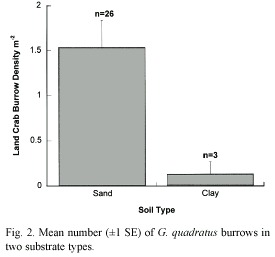
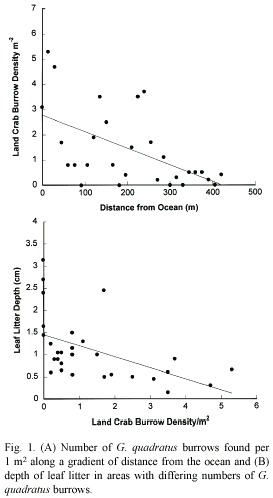
<body><![CDATA[<p><font face="Arial" size="2">While previous studies have described the ranges of land crab populations on islands (Bliss 1968, Wolcott and Wolcott 1982, 1988, Wolcott 1992, Green <i>et al. </i>1997), few published studies have quantitatively described the distribution of land crabs in mainland populations. With the exception of Sherman (1997, 2002, 2003), there has been limited research on <i>Gecarcinus lateralis </i>and <i>G. quadratus </i>populations inhabiting the Pacific coasts of Central <i> </i>and South America. Because these species are ecologically important in tropical forest ecosystems, it is critical to understand both their local distributions and the factors that influence these distributions. </font></p>     <p><font face="Arial" size="2">Corcovado National Park supports populations of the land crab <i>G. quadratus</i>. Sherman (1997, 2002) found that <i>G. quadratus </i>occurred in coastal areas of Corcovado, but did not extend inland beyond 600 m from the ocean. We hypothesized that <i>G. quadratus </i>might be physiologically or ecologically limited from inland habitat and predicted that this limitation would be expressed in a high density of crabs close to the ocean and a lower density of crabs farther inland. Furthermore, we expected that lower leaf litter depth and seedling density would be associated with a higher density of land crabs. Consequently, the primary objective of our research was to quantify the density of <i>G. quadratus </i>in Corcovado National Park along a distance gradient from the ocean. Our secondary objective was to determine the relationship between land crab density, leaf litter depth, seedling density, and substrate. </font></p> <font face="Arial" size="2"><b>     <p>Materials and methods </p> </b> </font>     <p><font face="Arial" size="2">This study was conducted at Sirena Field Station, Corcovado National Park, Osa Peninsula, Costa Rica (8&#730;30’N, 83&#730;30’W). Vegetation in the Pacific lowland region of the Corcovado plain is tropical wet rainforest. These areas support populations of the land crab <i>G. quadratus </i>de Saussure, a species synonymous with <i>G. lateralis </i>Freminville (Turkay 1973). This species has a general distribution along the Atlantic and Pacific coasts of tropical North, Central and South America (Burggren and McMahon 1988). Within Costa Rica, surveys have found populations of <i>G. quadratus </i>along the northern Pacific coast at Bahía de Culebra, Cabo Blanco, Puntarenas, Boca de Barranca, Caldera, and Pigres and along the southern Pacific coast at Golfito (Bright 1966). Populations have also been well described at Sirena Field Station (Sherman 1997, 2002, 2003). </font></p>     <p><font face="Arial" size="2">We carried out field surveys from 8-10 January 2002 at a study area adjacent to the Rio Sirena Trail. Density of <i>G. quadratus </i>was estimated by counting the number of active burrows, an index commonly used to assess land crab population size because these animals construct deep subterranean caves with only one opening (Kellman and Delfosse 1993, Sherman 1997). Burrows were surveyed along a single 420 m transect placed perpendicular to the shoreline. At 15 m intervals along the transect, we randomly placed two 5 m<sup>2 </sup>sampling quadrats located within 20 m of one another. Within each quadrat, we counted number of land crab burrows, dicot tree saplings &lt;1 m and, when present, land bromeliads (<i>Achmea magdalenae</i>). We also measured leaf litter depth using a ruler (measured in two replicates averaged per quadrat) and type of substrate (sand= large particles and low water content; clay= fine particles with high water content). The substrate classes had a patchy distribution throughout the study area but were always distinguishable. </font></p>     <p><font face="Arial" size="2">Data were analyzed using general linear models and correlation procedures in SAS (SAS Institute 1990), with quadrat pairs averaged to avoid pseudoreplication. Linear regressions were run on numbers of land crab burrows, tree saplings, land bromeliads, and leaf litter depth. A Mann-Whitney U test was used to assess burrow density in different substrate types. </font></p> <font face="Arial" size="2"><b>     <p>Results </p> </b> </font>     <p><font face="Arial" size="2">Average density of <i>G. quadratus </i>burrows ranged from 0 to 5.3 m<sup>-2</sup>, which is consistent with patterns described by (Sherman 1997). Burrow density declined and became less variable as distance from the ocean increased (df= 27, r<sup>2</sup>= 0.313, p&lt;0.001; Fig. 1A). Scatter along the axes was high but burrow density was more variable close to the ocean. Two secondary peaks in density at 150 m and 230 m inland correspond with areas of sand substrate. We found that areas with higher burrow density had lower leaf litter depth (df= 27, r<sup>2</sup>= 0.266, p&lt;0.001; Fig. 1B). The number of saplings decreased with increased burrow density (df= 27, r<sup>2</sup>= 0.090, p=0.022; data not shown). Areas with land bromeliads tended to support few other plant species, and there was no significant correlation between number of burrows and number of land bromeliads (df= 27, r<sup>2</sup>= 0.022, p=0.389; data not shown). Crab burrows rarely occurred in the clay substrate, while sample quadrats in the sand substrate had many more crab burrows (U= 9.5, p=0.035; Fig. 2). We also noted that burrow location was often associated with tree root systems.    <br> </font></p>     <p style="text-align: center;"><font face="Arial" size="2"><img  src="/img/fbpe/rbt/v55n1/3622i1.JPG" title="" alt=""  style="width: 273px; height: 498px;">    
]]></body>
<body><![CDATA[<br> </font></p>     <p style="text-align: center;"><font face="Arial" size="2"><img  src="/img/fbpe/rbt/v55n1/3622i2.JPG" title="" alt=""  style="width: 275px; height: 257px;">    
<br> </font></p> <font face="Arial" size="2"><b>     <p>Discussion </p> </b> </font>     <p><font face="Arial" size="2">While relatively little is known about the specific factors that affect <i>G. quadratus </i>density in coastal tropical rainforests, the patterns we observed suggest that there are distribution limits in this species. The land crab <i>G. quadratus </i>could be restricted from inland habitats through abiotic or biotic conditions, as are other terrestrial crustaceans (Friend and Richardson 1986, Richardson <i>et al. </i>1991, Richardson 1993, Richardson and Swain 2000, Richardson <i>et al. </i>2001). Of the many possible abiotic factors limiting inland distribution of <i>G. quadratus</i>, the most likely include water availability, ions, or substrate properties. Physiological constraints on water or ion availability could result in the limitation of these land crabs to coastal regions. However, research has demonstrated that land crabs have the ability to precisely regulate both water and ion loss (Wolcott 1992, Greenaway 1994). Bliss (1963) suggested that <i>G. lateralis </i>is dependent on air moisture and proposed this as an explanation for their distribution. Furthermore, the terrestrial crustaceans in the Talitridae family are limited by ions available through salt spray from the ocean (Richardson 1993, Morrit and Richardson 1999). While studies have demonstrated that sodium and chloride are not limiting to <i>G. lateralis</i>, there is the possibility that some other ions in salt spray limit their distribution (Wolcott and Wolcott 1988). </font></p>     <p><font face="Arial" size="2">Soil preferences of <i>G. quadratus </i>have not been studied extensively, and this warrants further research. We found a significant difference in burrow number between the two common substrate types found in our study area. Crabs avoided digging burrows in the damp clay substrates, perhaps due to structural instability, difficulty in digging in the substrate type, or a tendency for the burrows to become waterlogged. Water content and soil types could influence land crab burrow construction and distribution in the forest. Furthermore, plant communities within the forest could differentially affect soil water content. Crabs might therefore be limited from inland areas because suitable substrate is unavailable. </font></p>     <p><font face="Arial" size="2">Biotic factors, such as competition, predation, or dispersal ability, might limit land crab distribution. Land crabs could be limited from inland forests by the presence of a competitor for space or other resources. A restriction on distribution by competition or predation seems unlikely, however, because the transition from the area inhabited by crabs to the area without crabs is quite abrupt (Sherman 1997, 2002, 2003). It is also possible that these crabs are limited by their dispersal ability. <i>G. quadratus </i>have pelagic larvae and migrate to the ocean for reproduction. This species could be restricted to the coastal zone by the migration distance (Wolcott and Wolcott 1982, Hicks 1985). Although little is known about how far these crabs can move during the spawning period; Sherman (1997) notes that adult crabs dominate the population beginning approximately 200 m from the ocean and extending inland. </font></p>     <p><font face="Arial" size="2">There are several caveats to consider when interpreting the data reported here. Many other factors could either contribute to or account for the patterns that we find in <i>G. quadratus </i>distribution. First, age structure of the population could be influencing the observed distribution. Younger crabs inhabit the areas closest to the ocean (Sherman 1997), and there could be a higher density of crabs in this area because there are more juveniles in the population than adults. Also, there are profound seasonal differences in land crab behavior. These data were collected during the early part of the dry season, when crabs begin a three-month period of estivation (Sherman 1997). As a result, the trends we see in leaf litter depth could reflect differences in tree community structure at different distances rather than a difference in land crab consumption rates. However, given that we saw clear patterns using only one transect at a time period when crab activity is low, it is possible that the trends are more pronounced than we describe. </font></p>     <p><font face="Arial" size="2">Despite the limitations of this research, the results reported here suggest that the local distribution of <i>G. quadratus </i>is limited to a very narrow coastal zone on Osa peninsula. A considerable degree of spatial variation warrants using a high number of replicate transects extending beyond 600 m from the ocean. We recommend that further research on land crab distributions be carried out, particularly looking at the mechanistic details of how soil substrate influences land crab distributions. Other potentially relevant factors like competition, predation, and dispersal limitation should also be considered. Sherman (1997, 2002, 2003) has demonstrated that <i>G. quadratus </i>occupies a critical ecological role at Sirena, and understanding the factors controlling the distribution of this species will help us better understand the tropical coastal rainforest ecosystems they inhabit. </font></p> <font face="Arial" size="2"><b>     <p>Acknowledgments </p> </b> </font>     ]]></body>
<body><![CDATA[<p><font face="Arial" size="2">We thank J.M. Reed for statistical advice, C.M. Orians for support in the field and the Draupner Ring Foundation, Tufts Institute for the Environment and Tufts University for funding. </font></p> <font face="Arial" size="2"><b>     <p>Resumen </p> </b> </font>     <p><font face="Arial" size="2">El cangrejo terrestre <i>Gecarcinus quadratus </i>es una especie "ingeniera" que controla el ciclo de nutrientes en los bosques tropicales. Los factores que regulan su distribución a lo largo de las costas no se conocen de forma definitiva. Se cuantificó la distribución del cangrejo terrestre durante la estación seca en la Estación de Campo Sirena en el Parque Nacional de Corcovado, Costa Rica, y se encontró que la densidad de galerías del cangrejo terrestre disminuye al aumentar la distancia al océano. La profundidad de la hojarasca y la densidad de plántulas de especies arbóreas están negativamente correlacionadas con la densidad de galerías del cangrejo terrestre. Las galerías aparecen fuertemente asociadas con el sustrato arenoso y la densidad de galerías es comparativamente más baja en sustratos arcillosos. Estos resultados sugieren que <i>G. quadratus </i>se encuentra en una zona costera estrecha con sustrato arenoso, y que esta distribución podría tener efectos importantes en la estructura de la comunidad vegetal. </font></p> <font face="Arial" size="2"><b></b></font>     <p><font face="Arial" size="2"><b>Palabras clave: </b>cangrejos terrestres, densidad de galerías, <i>Gecarcinus quadratus</i>, <i>Gecarcinus lateralis</i>, hojarasca, Parque Nacional de Corcovado. </font></p> <font face="Arial" size="2"><b>     <p>References </p> </b> </font>     <!-- ref --><p><font face="Arial" size="2">Bliss, D.E. 1963. The pericardial sacs of terrestrial Brachyura, p. 59-78. <i>In </i>H.B. Whittington &amp; W.D.I. Rolfe (eds.). Phylogeny and evolution of Crustacea. Museum of Comparative Zoology, Harvard University, Cambridge, Massachussetts, USA.    &nbsp;&nbsp;&nbsp;&nbsp;&nbsp;&nbsp;&nbsp;&nbsp;[&#160;<a href="javascript:void(0);" onclick="javascript: window.open('/scielo.php?script=sci_nlinks&ref=1658513&pid=S0034-7744200700010002300001&lng=','','width=640,height=500,resizable=yes,scrollbars=1,menubar=yes,');">Links</a>&#160;]<!-- end-ref --> </font></p>     <!-- ref --><p><font face="Arial" size="2">Bliss, D.E. 1968. Transition from water to land in decapod crustaceans. Am. Zool. 8: 355-392.    &nbsp;&nbsp;&nbsp;&nbsp;&nbsp;&nbsp;&nbsp;&nbsp;[&#160;<a href="javascript:void(0);" onclick="javascript: window.open('/scielo.php?script=sci_nlinks&ref=1658515&pid=S0034-7744200700010002300002&lng=','','width=640,height=500,resizable=yes,scrollbars=1,menubar=yes,');">Links</a>&#160;]<!-- end-ref --> </font></p>     <!-- ref --><p><font face="Arial" size="2">Bright, D.R. 1966. The land crabs of Costa Rica. Rev. Biol. Trop. 14: 183-203.    &nbsp;&nbsp;&nbsp;&nbsp;&nbsp;&nbsp;&nbsp;&nbsp;[&#160;<a href="javascript:void(0);" onclick="javascript: window.open('/scielo.php?script=sci_nlinks&ref=1658517&pid=S0034-7744200700010002300003&lng=','','width=640,height=500,resizable=yes,scrollbars=1,menubar=yes,');">Links</a>&#160;]<!-- end-ref --> </font></p>     <!-- ref --><p><font face="Arial" size="2">Bright, D.R. &amp; C.L. Hogue. 1972. A synopsis of the burrowing land crabs of the world and list of their arthropod symbionts and burrow associates. Natur. Hist. Mus. Los Angeles County Cont. Sci. 220: 1-58.    &nbsp;&nbsp;&nbsp;&nbsp;&nbsp;&nbsp;&nbsp;&nbsp;[&#160;<a href="javascript:void(0);" onclick="javascript: window.open('/scielo.php?script=sci_nlinks&ref=1658519&pid=S0034-7744200700010002300004&lng=','','width=640,height=500,resizable=yes,scrollbars=1,menubar=yes,');">Links</a>&#160;]<!-- end-ref --> </font></p>     <!-- ref --><p><font face="Arial" size="2">Burggren, W.W. &amp; B.R. McMahon. 1988. Biology of the land crabs. Cambridge, Cambridge, England. 479 p.    &nbsp;&nbsp;&nbsp;&nbsp;&nbsp;&nbsp;&nbsp;&nbsp;[&#160;<a href="javascript:void(0);" onclick="javascript: window.open('/scielo.php?script=sci_nlinks&ref=1658521&pid=S0034-7744200700010002300005&lng=','','width=640,height=500,resizable=yes,scrollbars=1,menubar=yes,');">Links</a>&#160;]<!-- end-ref --> </font></p>     <!-- ref --><p><font face="Arial" size="2">Friend, J.A. &amp; A.M.M. Richardson. 1986. Biology of terrestrial amphipods. Annu. Rev. Entomol. 31: 25-48.    &nbsp;&nbsp;&nbsp;&nbsp;&nbsp;&nbsp;&nbsp;&nbsp;[&#160;<a href="javascript:void(0);" onclick="javascript: window.open('/scielo.php?script=sci_nlinks&ref=1658523&pid=S0034-7744200700010002300006&lng=','','width=640,height=500,resizable=yes,scrollbars=1,menubar=yes,');">Links</a>&#160;]<!-- end-ref --> </font></p>     <!-- ref --><p><font face="Arial" size="2">García-Franco, J.G., V. Rico-Gray &amp; O. Zayas. 1991. Seed and seedling predation of <i>Bromelia pinguin </i>L. by the red land crab <i>Gecarcinus lateralis </i>Frem. in Veracruz, Mexico. Biotropica 23: 96-97.    &nbsp;&nbsp;&nbsp;&nbsp;&nbsp;&nbsp;&nbsp;&nbsp;[&#160;<a href="javascript:void(0);" onclick="javascript: window.open('/scielo.php?script=sci_nlinks&ref=1658525&pid=S0034-7744200700010002300007&lng=','','width=640,height=500,resizable=yes,scrollbars=1,menubar=yes,');">Links</a>&#160;]<!-- end-ref --> </font></p>     <!-- ref --><p><font face="Arial" size="2">Green, P.T., D.J. O’Dowd &amp; P.S. Lake. 1997. Control of seedling recruitment by land crabs in rain forest on a remote oceanic island. Ecology 78: 2474-2486.    &nbsp;&nbsp;&nbsp;&nbsp;&nbsp;&nbsp;&nbsp;&nbsp;[&#160;<a href="javascript:void(0);" onclick="javascript: window.open('/scielo.php?script=sci_nlinks&ref=1658527&pid=S0034-7744200700010002300008&lng=','','width=640,height=500,resizable=yes,scrollbars=1,menubar=yes,');">Links</a>&#160;]<!-- end-ref --> </font></p>     <!-- ref --><p><font face="Arial" size="2">Green, P.T., P.S. Lake &amp; D.J. O’Dowd. 1999. Monopolization of litter processing by a dominant land crab on a tropical oceanic island. Oecologia 119: 435-444.    &nbsp;&nbsp;&nbsp;&nbsp;&nbsp;&nbsp;&nbsp;&nbsp;[&#160;<a href="javascript:void(0);" onclick="javascript: window.open('/scielo.php?script=sci_nlinks&ref=1658529&pid=S0034-7744200700010002300009&lng=','','width=640,height=500,resizable=yes,scrollbars=1,menubar=yes,');">Links</a>&#160;]<!-- end-ref --> </font></p>     <!-- ref --><p><font face="Arial" size="2">Greenaway, P. 1994. Salt and water balance in field populations of the terrestrial crab <i>Gecarcoidea natalis</i>. J. Crustac. Biol. 14: 438-453.    &nbsp;&nbsp;&nbsp;&nbsp;&nbsp;&nbsp;&nbsp;&nbsp;[&#160;<a href="javascript:void(0);" onclick="javascript: window.open('/scielo.php?script=sci_nlinks&ref=1658531&pid=S0034-7744200700010002300010&lng=','','width=640,height=500,resizable=yes,scrollbars=1,menubar=yes,');">Links</a>&#160;]<!-- end-ref --> </font></p>     <!-- ref --><p><font face="Arial" size="2">Hicks, J.W. 1985. The breeding behaviours and migrations of the terrestrial crab <i>Gecarcoidea natalis </i>(Decapoda: Brachyura). Aust. J. Zool. 33: 127-142.    &nbsp;&nbsp;&nbsp;&nbsp;&nbsp;&nbsp;&nbsp;&nbsp;[&#160;<a href="javascript:void(0);" onclick="javascript: window.open('/scielo.php?script=sci_nlinks&ref=1658533&pid=S0034-7744200700010002300011&lng=','','width=640,height=500,resizable=yes,scrollbars=1,menubar=yes,');">Links</a>&#160;]<!-- end-ref --> </font></p>     <!-- ref --><p><font face="Arial" size="2">Jiménez, C., A. Ortega-Rubio, S. Álvarez-Cárdenas &amp; G. Arnaud. 1994. Ecological aspects of the land crab <i>Gecarcinus planatus </i>(Decapoda: Gecardinidae) in Socorro Island, Mexico. Biol. Conserv. 69: 9-13.    &nbsp;&nbsp;&nbsp;&nbsp;&nbsp;&nbsp;&nbsp;&nbsp;[&#160;<a href="javascript:void(0);" onclick="javascript: window.open('/scielo.php?script=sci_nlinks&ref=1658535&pid=S0034-7744200700010002300012&lng=','','width=640,height=500,resizable=yes,scrollbars=1,menubar=yes,');">Links</a>&#160;]<!-- end-ref --> </font></p>     <!-- ref --><p><font face="Arial" size="2">Jones, C.G., J.H. Lawton &amp; M. Shachak. 1994. Organisms as ecosystem engineers. Oikos 69: 373-386.    &nbsp;&nbsp;&nbsp;&nbsp;&nbsp;&nbsp;&nbsp;&nbsp;[&#160;<a href="javascript:void(0);" onclick="javascript: window.open('/scielo.php?script=sci_nlinks&ref=1658537&pid=S0034-7744200700010002300013&lng=','','width=640,height=500,resizable=yes,scrollbars=1,menubar=yes,');">Links</a>&#160;]<!-- end-ref --> </font></p>     <!-- ref --><p><font face="Arial" size="2">Kellman, M. &amp; B. Delfosse. 1993. Effect of the red land crab (<i>Gecarcinus lateralis</i>) on leaf litter in a tropical dry forest in Veracruz, Mexico. J. Trop. Ecol. 9: 55-65.    &nbsp;&nbsp;&nbsp;&nbsp;&nbsp;&nbsp;&nbsp;&nbsp;[&#160;<a href="javascript:void(0);" onclick="javascript: window.open('/scielo.php?script=sci_nlinks&ref=1658539&pid=S0034-7744200700010002300014&lng=','','width=640,height=500,resizable=yes,scrollbars=1,menubar=yes,');">Links</a>&#160;]<!-- end-ref --> </font></p>     <!-- ref --><p><font face="Arial" size="2">Morrit, D. &amp; A.M.M. Richardson. 1999. Osmoregulation and evolutionary patterns in coastal terrestrial amphipods (Talitridae). J. Crustac. Biol. 20: 67-74.    &nbsp;&nbsp;&nbsp;&nbsp;&nbsp;&nbsp;&nbsp;&nbsp;[&#160;<a href="javascript:void(0);" onclick="javascript: window.open('/scielo.php?script=sci_nlinks&ref=1658541&pid=S0034-7744200700010002300015&lng=','','width=640,height=500,resizable=yes,scrollbars=1,menubar=yes,');">Links</a>&#160;]<!-- end-ref --> </font></p>     <!-- ref --><p><font face="Arial" size="2">O’Dowd, D.J. &amp; P.S. Lake. 1991. Red crabs in rain forest, Christmas Island: removal and rate of fruits and seeds. J. Trop. Ecol. 7: 113-122.    &nbsp;&nbsp;&nbsp;&nbsp;&nbsp;&nbsp;&nbsp;&nbsp;[&#160;<a href="javascript:void(0);" onclick="javascript: window.open('/scielo.php?script=sci_nlinks&ref=1658543&pid=S0034-7744200700010002300016&lng=','','width=640,height=500,resizable=yes,scrollbars=1,menubar=yes,');">Links</a>&#160;]<!-- end-ref --> </font></p>     <!-- ref --><p><font face="Arial" size="2">Richardson, A.M.M. 1993. The distribution of coastal group landhoppers (Crustacea: Amphipoda: Talitridae) related to sea spray at Cox Bight, Tasmania. Pap. Proc. R. Soc. Tasman. 127: 55-60.    &nbsp;&nbsp;&nbsp;&nbsp;&nbsp;&nbsp;&nbsp;&nbsp;[&#160;<a href="javascript:void(0);" onclick="javascript: window.open('/scielo.php?script=sci_nlinks&ref=1658545&pid=S0034-7744200700010002300017&lng=','','width=640,height=500,resizable=yes,scrollbars=1,menubar=yes,');">Links</a>&#160;]<!-- end-ref --> </font></p>     <!-- ref --><p><font face="Arial" size="2">Richardson, A.M.M. &amp; R. Swain. 2000. Terrestrial evolution in Crustacea: The talitrid amphipod model. Crustac. Issues 12: 807-816.    &nbsp;&nbsp;&nbsp;&nbsp;&nbsp;&nbsp;&nbsp;&nbsp;[&#160;<a href="javascript:void(0);" onclick="javascript: window.open('/scielo.php?script=sci_nlinks&ref=1658547&pid=S0034-7744200700010002300018&lng=','','width=640,height=500,resizable=yes,scrollbars=1,menubar=yes,');">Links</a>&#160;]<!-- end-ref --> </font></p>     <!-- ref --><p><font face="Arial" size="2">Richardson, A.M.M., R. Swain &amp; S.J. Smith. 1991. Local distributions of sandhoppers and landhoppers (Crustacea: Amphipoda: Talitridae) in the coastal zone of western Tasmania. Hydrobiologia 223: 127-140.    &nbsp;&nbsp;&nbsp;&nbsp;&nbsp;&nbsp;&nbsp;&nbsp;[&#160;<a href="javascript:void(0);" onclick="javascript: window.open('/scielo.php?script=sci_nlinks&ref=1658549&pid=S0034-7744200700010002300019&lng=','','width=640,height=500,resizable=yes,scrollbars=1,menubar=yes,');">Links</a>&#160;]<!-- end-ref --> </font></p>     <!-- ref --><p><font face="Arial" size="2">Richardson, A.M.M., R. Swain &amp; C.J. McCoull. 2001. Salt spray limits the inland penetration of a coastally restricted invertebrate: a field experiment using land-hoppers (Crustacea: Amphipoda: Talitridae). Funct. Ecol. 15: 435-442.    &nbsp;&nbsp;&nbsp;&nbsp;&nbsp;&nbsp;&nbsp;&nbsp;[&#160;<a href="javascript:void(0);" onclick="javascript: window.open('/scielo.php?script=sci_nlinks&ref=1658551&pid=S0034-7744200700010002300020&lng=','','width=640,height=500,resizable=yes,scrollbars=1,menubar=yes,');">Links</a>&#160;]<!-- end-ref --> </font></p>     <!-- ref --><p><font face="Arial" size="2">SAS Institute. 1990. SAS User’s Guide, Version 6. Fourth Edition. SAS Institute, Raleigh, North Carolina, USA.    &nbsp;&nbsp;&nbsp;&nbsp;&nbsp;&nbsp;&nbsp;&nbsp;[&#160;<a href="javascript:void(0);" onclick="javascript: window.open('/scielo.php?script=sci_nlinks&ref=1658553&pid=S0034-7744200700010002300021&lng=','','width=640,height=500,resizable=yes,scrollbars=1,menubar=yes,');">Links</a>&#160;]<!-- end-ref --> </font></p>     <!-- ref --><p><font face="Arial" size="2">Sherman, P.M. 1997. Direct and indirect effects of the land crab <i>Gecarcinus quadratus </i>(Gercarcinidae) on seedling density, organic carbon distributions and rooting profiles in Corcovado National Park, Costa Rica. Ph.D. Thesis, University of Michigan, Michigan, USA. 194 p.    &nbsp;&nbsp;&nbsp;&nbsp;&nbsp;&nbsp;&nbsp;&nbsp;[&#160;<a href="javascript:void(0);" onclick="javascript: window.open('/scielo.php?script=sci_nlinks&ref=1658555&pid=S0034-7744200700010002300022&lng=','','width=640,height=500,resizable=yes,scrollbars=1,menubar=yes,');">Links</a>&#160;]<!-- end-ref --> </font></p>     <!-- ref --><p><font face="Arial" size="2">Sherman, P.M. 2002. Effects of land crabs on seedling densities and distributions in a mainland neotropical forest. J. Trop. Ecol. 18: 67-89.    &nbsp;&nbsp;&nbsp;&nbsp;&nbsp;&nbsp;&nbsp;&nbsp;[&#160;<a href="javascript:void(0);" onclick="javascript: window.open('/scielo.php?script=sci_nlinks&ref=1658557&pid=S0034-7744200700010002300023&lng=','','width=640,height=500,resizable=yes,scrollbars=1,menubar=yes,');">Links</a>&#160;]<!-- end-ref --> </font></p>     <!-- ref --><p><font face="Arial" size="2">Sherman, P.M. 2003. Effects of land crabs on leaf litter distributions and accumulations in a mainland tropical rainforest. Biotropica 35: 365-374.    &nbsp;&nbsp;&nbsp;&nbsp;&nbsp;&nbsp;&nbsp;&nbsp;[&#160;<a href="javascript:void(0);" onclick="javascript: window.open('/scielo.php?script=sci_nlinks&ref=1658559&pid=S0034-7744200700010002300024&lng=','','width=640,height=500,resizable=yes,scrollbars=1,menubar=yes,');">Links</a>&#160;]<!-- end-ref --> </font></p>     <!-- ref --><p><font face="Arial" size="2">Turkay, M. 1973. Bemerkungen zu einigen Landkrabben (Crustacea, Decapoda). Bull. Mus. Nat. Hist. Paris 142: 969-980.    &nbsp;&nbsp;&nbsp;&nbsp;&nbsp;&nbsp;&nbsp;&nbsp;[&#160;<a href="javascript:void(0);" onclick="javascript: window.open('/scielo.php?script=sci_nlinks&ref=1658561&pid=S0034-7744200700010002300025&lng=','','width=640,height=500,resizable=yes,scrollbars=1,menubar=yes,');">Links</a>&#160;]<!-- end-ref --> </font></p>     <!-- ref --><p><font face="Arial" size="2">Wolcott, T.G. 1992. Water and solute balance in the transition to land. Am. Zool. 32: 428-437.    &nbsp;&nbsp;&nbsp;&nbsp;&nbsp;&nbsp;&nbsp;&nbsp;[&#160;<a href="javascript:void(0);" onclick="javascript: window.open('/scielo.php?script=sci_nlinks&ref=1658563&pid=S0034-7744200700010002300026&lng=','','width=640,height=500,resizable=yes,scrollbars=1,menubar=yes,');">Links</a>&#160;]<!-- end-ref --> </font></p>     <!-- ref --><p><font face="Arial" size="2">Wolcott, T.G. &amp; D.L. Wolcott. 1982. Larval loss and spawning behavior in the land crab <i>Gecarcinus lateralis </i>(Fréminville). J. Crustac. Biol. 2: 477-485.    &nbsp;&nbsp;&nbsp;&nbsp;&nbsp;&nbsp;&nbsp;&nbsp;[&#160;<a href="javascript:void(0);" onclick="javascript: window.open('/scielo.php?script=sci_nlinks&ref=1658565&pid=S0034-7744200700010002300027&lng=','','width=640,height=500,resizable=yes,scrollbars=1,menubar=yes,');">Links</a>&#160;]<!-- end-ref --> </font></p>     <!-- ref --><p><font face="Arial" size="2">Wolcott, T.G. &amp; D.L. Wolcott. 1988. Availability of salts is not a limiting factor for the land crab <i>Gecarcinus lateralis </i>(Fréminville). J. Exp. Mar. Biol. Ecol. 120: 199-219.    &nbsp;&nbsp;&nbsp;&nbsp;&nbsp;&nbsp;&nbsp;&nbsp;[&#160;<a href="javascript:void(0);" onclick="javascript: window.open('/scielo.php?script=sci_nlinks&ref=1658567&pid=S0034-7744200700010002300028&lng=','','width=640,height=500,resizable=yes,scrollbars=1,menubar=yes,');">Links</a>&#160;]<!-- end-ref --> </font></p>      ]]></body><back>
<ref-list>
<ref id="B1">
<nlm-citation citation-type="book">
<person-group person-group-type="author">
<name>
<surname><![CDATA[Bliss]]></surname>
<given-names><![CDATA[D.E]]></given-names>
</name>
</person-group>
<article-title xml:lang="en"><![CDATA[The pericardial sacs of terrestrial Brachyura]]></article-title>
<person-group person-group-type="editor">
<name>
<surname><![CDATA[Whittington]]></surname>
<given-names><![CDATA[H.B]]></given-names>
</name>
<name>
<surname><![CDATA[Rolfe]]></surname>
<given-names><![CDATA[W.D.I]]></given-names>
</name>
</person-group>
<source><![CDATA[Phylogeny and evolution of Crustacea]]></source>
<year>1963</year>
<page-range>59-78</page-range><publisher-loc><![CDATA[Cambridge^eMassachussetts Massachussetts]]></publisher-loc>
<publisher-name><![CDATA[Museum of Comparative Zoology, Harvard University]]></publisher-name>
</nlm-citation>
</ref>
<ref id="B2">
<nlm-citation citation-type="journal">
<person-group person-group-type="author">
<name>
<surname><![CDATA[Bliss]]></surname>
<given-names><![CDATA[D.E]]></given-names>
</name>
</person-group>
<article-title xml:lang="en"><![CDATA[Transition from water to land in decapod crustaceans]]></article-title>
<source><![CDATA[Am. Zool]]></source>
<year>1968</year>
<volume>8</volume>
<page-range>355-392</page-range></nlm-citation>
</ref>
<ref id="B3">
<nlm-citation citation-type="journal">
<person-group person-group-type="author">
<name>
<surname><![CDATA[Bright]]></surname>
<given-names><![CDATA[D.R]]></given-names>
</name>
</person-group>
<article-title xml:lang="en"><![CDATA[The land crabs of Costa Rica]]></article-title>
<source><![CDATA[Rev. Biol. Trop]]></source>
<year>1966</year>
<volume>14</volume>
<page-range>183-203</page-range></nlm-citation>
</ref>
<ref id="B4">
<nlm-citation citation-type="journal">
<person-group person-group-type="author">
<name>
<surname><![CDATA[Bright]]></surname>
<given-names><![CDATA[D.R]]></given-names>
</name>
<name>
<surname><![CDATA[Hogue]]></surname>
<given-names><![CDATA[C.L]]></given-names>
</name>
</person-group>
<article-title xml:lang="en"><![CDATA[A synopsis of the burrowing land crabs of the world and list of their arthropod symbionts and burrow associates]]></article-title>
<source><![CDATA[Natur. Hist. Mus. Los Angeles County Cont. Sci]]></source>
<year>1972</year>
<volume>220</volume>
<page-range>1-58</page-range></nlm-citation>
</ref>
<ref id="B5">
<nlm-citation citation-type="">
<person-group person-group-type="author">
<name>
<surname><![CDATA[Burggren]]></surname>
<given-names><![CDATA[W.W]]></given-names>
</name>
<name>
<surname><![CDATA[McMahon]]></surname>
<given-names><![CDATA[B.R]]></given-names>
</name>
</person-group>
<source><![CDATA[Biology of the land crabs]]></source>
<year>1988</year>
<page-range>479</page-range><publisher-loc><![CDATA[Cambridge^eCambridge Cambridge]]></publisher-loc>
</nlm-citation>
</ref>
<ref id="B6">
<nlm-citation citation-type="journal">
<person-group person-group-type="author">
<name>
<surname><![CDATA[Friend]]></surname>
<given-names><![CDATA[J.A]]></given-names>
</name>
<name>
<surname><![CDATA[Richardson]]></surname>
<given-names><![CDATA[A.M.M]]></given-names>
</name>
</person-group>
<article-title xml:lang="en"><![CDATA[Biology of terrestrial amphipods]]></article-title>
<source><![CDATA[Annu. Rev. Entomol]]></source>
<year>1986</year>
<volume>31</volume>
<page-range>25-48</page-range></nlm-citation>
</ref>
<ref id="B7">
<nlm-citation citation-type="journal">
<person-group person-group-type="author">
<name>
<surname><![CDATA[García-Franco]]></surname>
<given-names><![CDATA[J.G]]></given-names>
</name>
<name>
<surname><![CDATA[Rico-Gray]]></surname>
<given-names><![CDATA[V]]></given-names>
</name>
<name>
<surname><![CDATA[Zayas]]></surname>
<given-names><![CDATA[O]]></given-names>
</name>
</person-group>
<article-title xml:lang="en"><![CDATA[Seed and seedling predation of Bromelia pinguin L. by the red land crab Gecarcinus lateralis Frem. in Veracruz, Mexico]]></article-title>
<source><![CDATA[Biotropica]]></source>
<year>1991</year>
<volume>23</volume>
<page-range>96-97</page-range></nlm-citation>
</ref>
<ref id="B8">
<nlm-citation citation-type="journal">
<person-group person-group-type="author">
<name>
<surname><![CDATA[Green]]></surname>
<given-names><![CDATA[P.T]]></given-names>
</name>
<name>
<surname><![CDATA[O’Dowd]]></surname>
<given-names><![CDATA[D.J]]></given-names>
</name>
<name>
<surname><![CDATA[Lake]]></surname>
<given-names><![CDATA[P.S]]></given-names>
</name>
</person-group>
<article-title xml:lang="en"><![CDATA[Control of seedling recruitment by land crabs in rain forest on a remote oceanic island]]></article-title>
<source><![CDATA[Ecology]]></source>
<year>1997</year>
<volume>78</volume>
<page-range>2474-2486</page-range></nlm-citation>
</ref>
<ref id="B9">
<nlm-citation citation-type="journal">
<person-group person-group-type="author">
<name>
<surname><![CDATA[Green]]></surname>
<given-names><![CDATA[P.T]]></given-names>
</name>
<name>
<surname><![CDATA[Lake]]></surname>
<given-names><![CDATA[P.S]]></given-names>
</name>
<name>
<surname><![CDATA[O’Dowd]]></surname>
<given-names><![CDATA[D.J]]></given-names>
</name>
</person-group>
<article-title xml:lang="en"><![CDATA[Monopolization of litter processing by a dominant land crab on a tropical oceanic island]]></article-title>
<source><![CDATA[Oecologia]]></source>
<year>1999</year>
<volume>119</volume>
<page-range>435-444</page-range></nlm-citation>
</ref>
<ref id="B10">
<nlm-citation citation-type="journal">
<person-group person-group-type="author">
<name>
<surname><![CDATA[Greenaway]]></surname>
<given-names><![CDATA[P]]></given-names>
</name>
</person-group>
<article-title xml:lang="en"><![CDATA[Salt and water balance in field populations of the terrestrial crab Gecarcoidea natalis]]></article-title>
<source><![CDATA[J. Crustac. Biol]]></source>
<year>1994</year>
<volume>14</volume>
<page-range>438-453</page-range></nlm-citation>
</ref>
<ref id="B11">
<nlm-citation citation-type="journal">
<person-group person-group-type="author">
<name>
<surname><![CDATA[Hicks]]></surname>
<given-names><![CDATA[J.W]]></given-names>
</name>
</person-group>
<article-title xml:lang="en"><![CDATA[The breeding behaviours and migrations of the terrestrial crab Gecarcoidea natalis (Decapoda: Brachyura)]]></article-title>
<source><![CDATA[Aust. J. Zool]]></source>
<year>1985</year>
<volume>33</volume>
<page-range>127-142</page-range></nlm-citation>
</ref>
<ref id="B12">
<nlm-citation citation-type="journal">
<person-group person-group-type="author">
<name>
<surname><![CDATA[Jiménez]]></surname>
<given-names><![CDATA[C]]></given-names>
</name>
<name>
<surname><![CDATA[Ortega-Rubio]]></surname>
<given-names><![CDATA[A]]></given-names>
</name>
<name>
<surname><![CDATA[Álvarez-Cárdenas]]></surname>
<given-names><![CDATA[S]]></given-names>
</name>
<name>
<surname><![CDATA[Arnaud]]></surname>
<given-names><![CDATA[G]]></given-names>
</name>
</person-group>
<article-title xml:lang="en"><![CDATA[Ecological aspects of the land crab Gecarcinus planatus (Decapoda: Gecardinidae) in Socorro Island, Mexico]]></article-title>
<source><![CDATA[Biol. Conserv]]></source>
<year>1994</year>
<volume>69</volume>
<page-range>9-13</page-range></nlm-citation>
</ref>
<ref id="B13">
<nlm-citation citation-type="journal">
<person-group person-group-type="author">
<name>
<surname><![CDATA[Jones]]></surname>
<given-names><![CDATA[C.G]]></given-names>
</name>
<name>
<surname><![CDATA[Lawton]]></surname>
<given-names><![CDATA[J.H]]></given-names>
</name>
<name>
<surname><![CDATA[Shachak]]></surname>
<given-names><![CDATA[M]]></given-names>
</name>
</person-group>
<article-title xml:lang="en"><![CDATA[Organisms as ecosystem engineers]]></article-title>
<source><![CDATA[Oikos]]></source>
<year>1994</year>
<volume>69</volume>
<page-range>373-386</page-range></nlm-citation>
</ref>
<ref id="B14">
<nlm-citation citation-type="journal">
<person-group person-group-type="author">
<name>
<surname><![CDATA[Kellman]]></surname>
<given-names><![CDATA[M]]></given-names>
</name>
<name>
<surname><![CDATA[Delfosse]]></surname>
<given-names><![CDATA[B]]></given-names>
</name>
</person-group>
<article-title xml:lang="en"><![CDATA[Effect of the red land crab (Gecarcinus lateralis) on leaf litter in a tropical dry forest in Veracruz, Mexico]]></article-title>
<source><![CDATA[J. Trop. Ecol]]></source>
<year>1993</year>
<volume>9</volume>
<page-range>55-65</page-range></nlm-citation>
</ref>
<ref id="B15">
<nlm-citation citation-type="journal">
<person-group person-group-type="author">
<name>
<surname><![CDATA[Morrit]]></surname>
<given-names><![CDATA[D]]></given-names>
</name>
<name>
<surname><![CDATA[Richardson]]></surname>
<given-names><![CDATA[A.M.M]]></given-names>
</name>
</person-group>
<article-title xml:lang="en"><![CDATA[Osmoregulation and evolutionary patterns in coastal terrestrial amphipods (Talitridae)]]></article-title>
<source><![CDATA[J. Crustac. Biol]]></source>
<year>1999</year>
<volume>20</volume>
<page-range>67-74</page-range></nlm-citation>
</ref>
<ref id="B16">
<nlm-citation citation-type="journal">
<person-group person-group-type="author">
<name>
<surname><![CDATA[O’Dowd]]></surname>
<given-names><![CDATA[D.J]]></given-names>
</name>
<name>
<surname><![CDATA[Lake]]></surname>
<given-names><![CDATA[P.S]]></given-names>
</name>
</person-group>
<article-title xml:lang="en"><![CDATA[Red crabs in rain forest, Christmas Island: removal and rate of fruits and seeds]]></article-title>
<source><![CDATA[J. Trop. Ecol]]></source>
<year>1991</year>
<volume>7</volume>
<page-range>113-122</page-range></nlm-citation>
</ref>
<ref id="B17">
<nlm-citation citation-type="journal">
<person-group person-group-type="author">
<name>
<surname><![CDATA[Richardson]]></surname>
<given-names><![CDATA[A.M.M]]></given-names>
</name>
</person-group>
<article-title xml:lang="en"><![CDATA[The distribution of coastal group landhoppers (Crustacea: Amphipoda: Talitridae) related to sea spray at Cox Bight, Tasmania]]></article-title>
<source><![CDATA[Pap. Proc. R. Soc. Tasman]]></source>
<year>1993</year>
<volume>127</volume>
<page-range>55-60</page-range></nlm-citation>
</ref>
<ref id="B18">
<nlm-citation citation-type="journal">
<person-group person-group-type="author">
<name>
<surname><![CDATA[Richardson]]></surname>
<given-names><![CDATA[A.M.M]]></given-names>
</name>
<name>
<surname><![CDATA[Swain]]></surname>
<given-names><![CDATA[R]]></given-names>
</name>
</person-group>
<article-title xml:lang="en"><![CDATA[Terrestrial evolution in Crustacea: The talitrid amphipod model]]></article-title>
<source><![CDATA[Crustac. Issues]]></source>
<year>2000</year>
<volume>12</volume>
<page-range>807-816</page-range></nlm-citation>
</ref>
<ref id="B19">
<nlm-citation citation-type="journal">
<person-group person-group-type="author">
<name>
<surname><![CDATA[Richardson]]></surname>
<given-names><![CDATA[A.M.M]]></given-names>
</name>
<name>
<surname><![CDATA[Swain]]></surname>
<given-names><![CDATA[R]]></given-names>
</name>
<name>
<surname><![CDATA[Smith]]></surname>
<given-names><![CDATA[S.J]]></given-names>
</name>
</person-group>
<article-title xml:lang="en"><![CDATA[Local distributions of sandhoppers and landhoppers (Crustacea: Amphipoda: Talitridae) in the coastal zone of western Tasmania]]></article-title>
<source><![CDATA[Hydrobiologia]]></source>
<year>1991</year>
<volume>223</volume>
<page-range>127-140</page-range></nlm-citation>
</ref>
<ref id="B20">
<nlm-citation citation-type="journal">
<person-group person-group-type="author">
<name>
<surname><![CDATA[Richardson]]></surname>
<given-names><![CDATA[A.M.M]]></given-names>
</name>
<name>
<surname><![CDATA[Swain]]></surname>
<given-names><![CDATA[R]]></given-names>
</name>
<name>
<surname><![CDATA[McCoull]]></surname>
<given-names><![CDATA[C.J]]></given-names>
</name>
</person-group>
<article-title xml:lang="en"><![CDATA[Salt spray limits the inland penetration of a coastally restricted invertebrate: a field experiment using land-hoppers (Crustacea: Amphipoda: Talitridae)]]></article-title>
<source><![CDATA[Funct. Ecol]]></source>
<year>2001</year>
<volume>15</volume>
<page-range>435-442</page-range></nlm-citation>
</ref>
<ref id="B21">
<nlm-citation citation-type="book">
<collab>SAS Institute</collab>
<source><![CDATA[SAS User’s Guide, Version 6]]></source>
<year>1990</year>
<edition>Fourth</edition>
<publisher-loc><![CDATA[Raleigh^eNorth Carolina North Carolina]]></publisher-loc>
<publisher-name><![CDATA[SAS Institute]]></publisher-name>
</nlm-citation>
</ref>
<ref id="B22">
<nlm-citation citation-type="">
<person-group person-group-type="author">
<name>
<surname><![CDATA[Sherman]]></surname>
<given-names><![CDATA[P.M]]></given-names>
</name>
</person-group>
<source><![CDATA[Direct and indirect effects of the land crab Gecarcinus quadratus (Gercarcinidae) on seedling density, organic carbon distributions and rooting profiles in Corcovado National Park, Costa Rica]]></source>
<year>1997</year>
<page-range>194</page-range></nlm-citation>
</ref>
<ref id="B23">
<nlm-citation citation-type="journal">
<person-group person-group-type="author">
<name>
<surname><![CDATA[Sherman]]></surname>
<given-names><![CDATA[P.M]]></given-names>
</name>
</person-group>
<article-title xml:lang="en"><![CDATA[Effects of land crabs on seedling densities and distributions in a mainland neotropical forest]]></article-title>
<source><![CDATA[J. Trop. Ecol]]></source>
<year>2002</year>
<volume>18</volume>
<page-range>67-89</page-range></nlm-citation>
</ref>
<ref id="B24">
<nlm-citation citation-type="journal">
<person-group person-group-type="author">
<name>
<surname><![CDATA[Sherman]]></surname>
<given-names><![CDATA[P.M]]></given-names>
</name>
</person-group>
<article-title xml:lang="en"><![CDATA[Effects of land crabs on leaf litter distributions and accumulations in a mainland tropical rainforest]]></article-title>
<source><![CDATA[Biotropica]]></source>
<year>2003</year>
<volume>35</volume>
<page-range>365-374</page-range></nlm-citation>
</ref>
<ref id="B25">
<nlm-citation citation-type="journal">
<person-group person-group-type="author">
<name>
<surname><![CDATA[Turkay]]></surname>
<given-names><![CDATA[M]]></given-names>
</name>
</person-group>
<article-title xml:lang="de"><![CDATA[Bemerkungen zu einigen Landkrabben (Crustacea, Decapoda)]]></article-title>
<source><![CDATA[Bull. Mus. Nat. Hist. Paris]]></source>
<year>1973</year>
<volume>142</volume>
<page-range>969-980</page-range></nlm-citation>
</ref>
<ref id="B26">
<nlm-citation citation-type="journal">
<person-group person-group-type="author">
<name>
<surname><![CDATA[Wolcott]]></surname>
<given-names><![CDATA[T.G]]></given-names>
</name>
</person-group>
<article-title xml:lang="en"><![CDATA[Water and solute balance in the transition to land]]></article-title>
<source><![CDATA[Am. Zool]]></source>
<year>1992</year>
<volume>32</volume>
<page-range>428-437</page-range></nlm-citation>
</ref>
<ref id="B27">
<nlm-citation citation-type="journal">
<person-group person-group-type="author">
<name>
<surname><![CDATA[Wolcott]]></surname>
<given-names><![CDATA[T.G]]></given-names>
</name>
<name>
<surname><![CDATA[Wolcott]]></surname>
<given-names><![CDATA[D.L]]></given-names>
</name>
</person-group>
<article-title xml:lang="en"><![CDATA[Larval loss and spawning behavior in the land crab Gecarcinus lateralis (Fréminville)]]></article-title>
<source><![CDATA[J. Crustac. Biol]]></source>
<year>1982</year>
<volume>2</volume>
<page-range>477-485</page-range></nlm-citation>
</ref>
<ref id="B28">
<nlm-citation citation-type="journal">
<person-group person-group-type="author">
<name>
<surname><![CDATA[Wolcott]]></surname>
<given-names><![CDATA[T.G]]></given-names>
</name>
<name>
<surname><![CDATA[Wolcott]]></surname>
<given-names><![CDATA[D.L]]></given-names>
</name>
</person-group>
<article-title xml:lang="en"><![CDATA[Availability of salts is not a limiting factor for the land crab Gecarcinus lateralis (Fréminville)]]></article-title>
<source><![CDATA[J. Exp. Mar. Biol. Ecol]]></source>
<year>1988</year>
<volume>120</volume>
<page-range>199-219</page-range></nlm-citation>
</ref>
</ref-list>
</back>
</article>