<?xml version="1.0" encoding="ISO-8859-1"?><article xmlns:mml="http://www.w3.org/1998/Math/MathML" xmlns:xlink="http://www.w3.org/1999/xlink" xmlns:xsi="http://www.w3.org/2001/XMLSchema-instance">
<front>
<journal-meta>
<journal-id>0034-7744</journal-id>
<journal-title><![CDATA[Revista de Biología Tropical]]></journal-title>
<abbrev-journal-title><![CDATA[Rev. biol. trop]]></abbrev-journal-title>
<issn>0034-7744</issn>
<publisher>
<publisher-name><![CDATA[Universidad de Costa Rica]]></publisher-name>
</publisher>
</journal-meta>
<article-meta>
<article-id>S0034-77442007000100015</article-id>
<title-group>
<article-title xml:lang="en"><![CDATA[The small species of Belostoma (Heteroptera: Belostomatidae): Revision of plebejum group]]></article-title>
</title-group>
<contrib-group>
<contrib contrib-type="author">
<name>
<surname><![CDATA[Estévez]]></surname>
<given-names><![CDATA[Ana Lía]]></given-names>
</name>
</contrib>
<contrib contrib-type="author">
<name>
<surname><![CDATA[Polhemus]]></surname>
<given-names><![CDATA[John T]]></given-names>
</name>
</contrib>
</contrib-group>
<aff id="A">
<institution><![CDATA[,  ]]></institution>
<addr-line><![CDATA[ ]]></addr-line>
</aff>
<pub-date pub-type="pub">
<day>00</day>
<month>03</month>
<year>2007</year>
</pub-date>
<pub-date pub-type="epub">
<day>00</day>
<month>03</month>
<year>2007</year>
</pub-date>
<volume>55</volume>
<numero>1</numero>
<fpage>147</fpage>
<lpage>155</lpage>
<copyright-statement/>
<copyright-year/>
<self-uri xlink:href="http://www.scielo.sa.cr/scielo.php?script=sci_arttext&amp;pid=S0034-77442007000100015&amp;lng=en&amp;nrm=iso"></self-uri><self-uri xlink:href="http://www.scielo.sa.cr/scielo.php?script=sci_abstract&amp;pid=S0034-77442007000100015&amp;lng=en&amp;nrm=iso"></self-uri><self-uri xlink:href="http://www.scielo.sa.cr/scielo.php?script=sci_pdf&amp;pid=S0034-77442007000100015&amp;lng=en&amp;nrm=iso"></self-uri><abstract abstract-type="short" xml:lang="en"><p><![CDATA[Nieser gathered the water bug species included by Lauck in the groups Belostoma pygmeum and Belostoma plebejum in a single group, Belostoma plebejum. We follow this criterion and use the terminology used by Estévez and Polhemus for species descriptions. The Belostoma plebejum group includes seven small species with the ventral diverticulum of male genitalia recurved ventrad: Belostoma lariversi De Carlo, 1969; B. micantulum (Stål, 1858); B. plebejum (Stål, 1858); B. pygmeum (Dufour, 1863); B. minusculum (Uhler, 1884). B. parvum sp. nov. from Venezuela, Colombia, Guyana, Suriname and Brazil, and B. nicaeum sp. nov. from Manaus, Brazil. The two new species are described and illustrated, and new synonymies are proposed. Rev. Biol. Trop. 55 (1): 147-155. Epub 2007 March. 31.]]></p></abstract>
<abstract abstract-type="short" xml:lang="es"><p><![CDATA[Nieser reunió las especies de chinches acuáticas incluidas por Lauck en los grupos Belostoma plebejum y Belostoma pygmeum en un solo grupo, Belostoma plebejum, criterio que se sigue en este trabajo. El grupo incluye siete especies pequeñas que presentan el divertículo ventral de los genitales masculinos recurvado ventrad: Belostoma lariversi De Carlo, 1969; B. micantulum (Stål, 1858); B. plebejum (Stål, 1858); B. pygmeum (Dufour, 1863); B. minusculum (Uhler, 1884), las cuales se redescriben e ilustran y B. parvum registrada de Venezuela, Colombia, Guyana, Suriname y Brazil y B. nicaeum registrada de Manaus, Brasil. Las dos especies nuevas que se describen e ilustran.]]></p></abstract>
<kwd-group>
<kwd lng="en"><![CDATA[Neotropical]]></kwd>
<kwd lng="en"><![CDATA[taxonomy]]></kwd>
<kwd lng="en"><![CDATA[Belostoma]]></kwd>
<kwd lng="en"><![CDATA[small species]]></kwd>
<kwd lng="en"><![CDATA[plebejum group]]></kwd>
<kwd lng="es"><![CDATA[Neotropical]]></kwd>
<kwd lng="es"><![CDATA[chinche acuática]]></kwd>
<kwd lng="es"><![CDATA[taxonomía]]></kwd>
<kwd lng="es"><![CDATA[Belostoma]]></kwd>
<kwd lng="es"><![CDATA[especies pequeñas]]></kwd>
<kwd lng="es"><![CDATA[grupo plebejum]]></kwd>
</kwd-group>
</article-meta>
</front><body><![CDATA[  <b><font face="Arial"></font></b>     <p align="center"><b><font face="Arial">The small species of </font></b><font  face="Arial"><i>Belostoma </i><b>(Heteroptera: Belostomatidae): Revision of </b><i>plebejum </i><b>group</b></font></p> <font face="Arial" size="2"></font>     <p><font face="Arial" size="2">Ana Lía Estévez<sup>1 </sup>&amp; John T. Polhemus<sup>2 </sup></font></p>     <p align="center"><font face="Arial" size="2">Received 10-X-2005. Corrected 10-III-2006. Accepted 23-V-2006.</font></p> <font face="Arial" size="2"><b></b></font>     <p><font face="Arial" size="2"><b>Abstract: </b>Nieser gathered the water bug species included by Lauck in the groups <i>Belostoma pygmeum </i>and <i>Belostoma plebejum </i>in a single group, <i>Belostoma plebejum. </i>We follow this criterion and use the terminology used by Estévez and Polhemus for species descriptions. The <i>Belostoma plebejum </i>group includes seven small species with the ventral diverticulum of male genitalia recurved <i>ventrad</i>: <i>Belostoma lariversi </i>De Carlo, 1969; </font></p> <font face="Arial" size="2"><i></i></font>     <p><font face="Arial" size="2"><i>B. micantulum </i>(Stål, 1858); <i>B. plebejum </i>(Stål, 1858); <i>B</i>. <i>pygmeum </i>(Dufour, 1863); <i>B</i>. <i>minusculum </i>(Uhler, 1884). <i>B</i>. <i>parvum </i>sp. nov<i>. </i>from Venezuela, Colombia, Guyana, Suriname and Brazil, and <i>B</i>. <i>nicaeum </i>sp. nov. from Manaus, Brazil. The two new species are described and illustrated, and new synonymies are proposed. Rev. Biol. Trop. 55 (1): 147-155. Epub 2007 March. 31.</font></p> <font face="Arial" size="2"><b></b></font>     <p><font face="Arial" size="2"><b>Key words: </b>Neotropical, taxonomy, <i>Belostoma</i>, small species<i>, plebejum </i>group. </font></p>     <p><font face="Arial" size="2">Lauck (1962) included the small water bug species that have a ventroapical protuberance in the ventral diverticulum of male genitalia, in the <i>Belostoma plebejum </i>group, and the species with the ventral diverticulum with thickened lateral margins in the <i>Belostoma</i> <i>pygmeum </i>group. This author distinguished the groups within a key, but did not fully describe the species. Nieser (1975) considered that the margins of male genitalia’s ventral diverticulum thickened represent a specialization of some species in the <i>Belostoma pygmeum </i>group and he included the species from both groups proposed by Lauck (1962) in a single group, <i>Belostoma plebejum</i>. Herein Nieser’s criteria is followed, we consider that the main characteristic of the species in this group is having the ventral diverticulum of male genitalia recurved <i>ventrad</i>. We make the revision of seven species recognized for the <i>B. plebejum</i> group, from which two are herein described as new synonymies are proposed.</font></p> <font face="Arial" size="2"><b>     <p>Material and methods </p> </b></font>     <p><font face="Arial" size="2">The examined material was borrowed from the following institutions: California Academy of Sciences, San Francisco, USA (CAS); John T. Polhemus Collection, Denver, USA (JTPC); Los Angeles County Museum, Los Angeles, USA (LACM); Francis Huntington Snow Entomological Collections, Kansas University, Lawrence, USA (KU); National Museum of Natural History, Washington D.C., USA (USNM); University of Arizona, Tucson, USA (UA); Museo Argentino de Ciencias Naturales "B. Rivadavia", Buenos Aires, Argentina (MACN); Museo de La Plata, La Plata, Argentina. (MLP). </font></p>     ]]></body>
<body><![CDATA[<p><font face="Arial" size="2">Taxonomic characters used in the descriptions are the same mentioned by Estévez and Polhemus (2001). </font></p> <font face="Arial" size="2"><b><i></i></b></font>     <p><font face="Arial" size="2"><b><i>Belostoma plebejum </i>group </b></font></p>     <p><font face="Arial" size="2">Size: length, 9.5-16.2 mm; width, 5.0-7.0 new, and mm. Shape: ovate. Color: light to dark brown. </font></p>     <p><font face="Arial" size="2">Head: suturae anteclypeus-maxillary plate as long as suturae anteclypeus lorum; anteoculus shorter than interoculus; eyes globose, as wide as long; segment I of the beak shorter or as long as segment II. Thorax: prosternal keel rounded or with anterior margin straight.</font></p>     <p><font face="Arial" size="2">Abdomen: pilosity covering less than half of ventral laterotergites, strongly constricted between spiracles, slightly developed on the penultimate visible segment. </font></p>     <p><font face="Arial" size="2">Male genitalia: ventral diverticulum recurved <i>ventrad</i>. </font></p> <font face="Arial" size="2"><b></b></font>     <p style="text-align: center;"><font face="Arial" size="2"><b>&nbsp;<img  src="/img/fbpe/rbt/v55n1/3614i1.JPG" title="" alt=""  style="width: 561px; height: 386px;"></b></font></p>     
<p><font face="Arial" size="2"><i>&nbsp;</i></font></p>     <p><font face="Arial" size="2"><i>Belostoma parvum </i>sp. nov. </font></p>     <p><font face="Arial" size="2">(Fig. 1-3, 22-25)</font></p>     ]]></body>
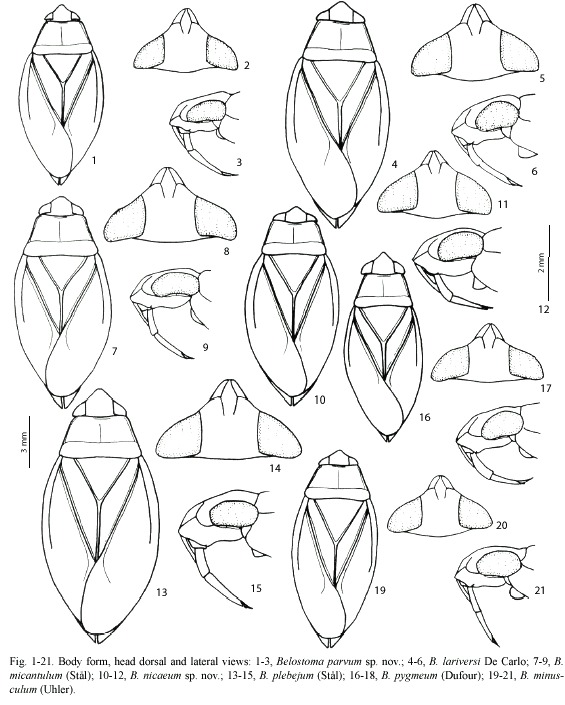
<body><![CDATA[<p><font face="Arial" size="2">Size: length, <img src="/img/fbpe/rbt/v55n1/Image129.jpg"  width="18" height="12">9.50 mm-10.70 mm, <img src="/img/fbpe/rbt/v55n1/Image130.jpg"  width="18" height="12">9.60 mm-11.10 mm; width, 4.60 mm-5.50 mm, <img  src="/img/fbpe/rbt/v55n1/Image130.jpg" width="18" height="12">4.80 mm-5.90 mm. Color: yellowish brown. Shape: elliptical (Fig. 1).</font></p>     
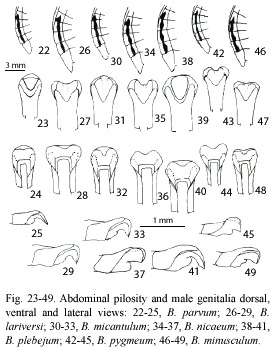
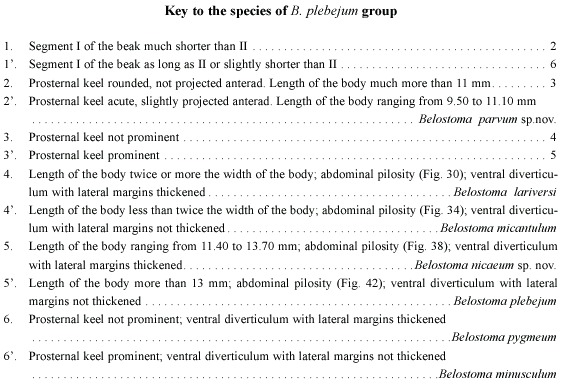
<p><font face="Arial" size="2">Head: suture anteclypeus-maxilary plate and 57 as long as suture anteclypeus-lorum; anteoculus shorter than interoculus; eyes globose, as wide as long (Fig. 2); segment I of the beak shorter than II (Fig. 3). Thorax: prosternal keel rounded, not prominent (Fig. 3). Abdomen: pilosity developed on the penultimate segment, reaching the external margin (Fig. 22). </font></p>     <p><font face="Arial" size="2">Male genitalia: arms of phalobase short, covering the external margin of ventral diver ticulum; ventral diverticulum recurved <i>ventrad </i>(Fig. 23-25). </font></p>     <p><font face="Arial" size="2">Remarks. This is the smallest species in the genus. </font></p>     <p><font face="Arial" size="2">Distribution. Surinam, Guyana, Venezuela, Colombia and Brazil. </font></p>     <p><font face="Arial" size="2">Types. Holotype , <img  src="/img/fbpe/rbt/v55n1/Image131.jpg" width="9" height="9">allotype <img  src="/img/fbpe/rbt/v55n1/Image130.jpg" width="18" height="12">and 57 paratypes (36 <img  src="/img/fbpe/rbt/v55n1/Image129.jpg" width="18" height="12">and 21 <img  src="/img/fbpe/rbt/v55n1/Image130.jpg" width="18" height="12">) from Guyana, bearing the label "British Guiana, Suppuruni Creek, Aug. 20,1937, S. Harris" (JTPC). </font></p>     
<p><font face="Arial" size="2">Etymology: the name refers to the small size of these insects. </font></p>     <p><font face="Arial" size="2">Specimens examined. SURINAM, Moengo, 1927 <img src="/img/fbpe/rbt/v55n1/Image130.jpg" width="18" height="12">. (JTPC). GUYANA, Supuruni Creek, </font><img src="/img/fbpe/rbt/v55n1/Image132.jpg" width="25" height="11"><font  face="Arial" size="2">. 1937, Harris coll. (JTPC). VENEZUELA, Portuguesa: Guanare, <img src="/img/fbpe/rbt/v55n1/Image132.jpg" width="25" height="11">. IX-1957, Menke coll. (CAS). COLOMBIA, Amazonas: Leticia, <img  src="/img/fbpe/rbt/v55n1/Image129.jpg" width="18" height="12">, 1974. Sedlacek coll. (JTPC). BRAZIL. Santarem, <img src="/img/fbpe/rbt/v55n1/Image129.jpg" width="18"  height="12">(LACM). <img src="/img/fbpe/rbt/v55n1/Image129.jpg" width="18" height="12">idem (JTPC).    
<br> </font></p>     <p style="text-align: center;"><font face="Arial" size="2"><img  src="/img/fbpe/rbt/v55n1/3614i2.JPG" title="" alt=""  style="width: 565px; height: 705px;">    
]]></body>
<body><![CDATA[<br> </font></p> <font face="Arial" size="2"><i></i></font>     <p><font face="Arial" size="2"><i>Belostoma lariversi </i>De Carlo </font></p>     <p><font face="Arial" size="2">(Fig. 4-6, 26-29)</font></p> <font face="Arial" size="2"><i></i></font>     <p><font face="Arial" size="2"><i>Belostoma lariversi </i>De Carlo, 1960: 50-52, Fig. 7-99, 16. Lanzer- de -Souza, 1980: 58. </font></p>     <p><font face="Arial" size="2">Size: length, <img src="/img/fbpe/rbt/v55n1/Image133.jpg"  width="24" height="11">15.00 mm-17.00 mm; width, <img  src="/img/fbpe/rbt/v55n1/Image134.jpg" width="21" height="11">7.00 mm-7.50 mm. Color: yellowish brown. Shape: ovoid (Fig. 4). </font></p>     
<p><font face="Arial" size="2">Head: suture anteclypeus-maxilary plate as long as suture anteclypeus-lorum; anteoculus shorter than interoculus; eyes globose, as wide as long (Fig. 5); segment I of the beak shorter than II (Fig. 6). Thorax: prosternal keel rounded, not prominent (Fig. 6). Abdomen: pilosity slightly developed on the penultimate segment (Fig. 26). </font></p>     <p><font face="Arial" size="2">Male genitalia: arms of phalobase short, not covering the external margin of ventral diverticulum; ventral diverticulum recurved <i>ventrad</i>, margins thickened (Fig. 27-29). </font></p>     <p><font face="Arial" size="2">Remarks. This species is similar in shape to <i>B. micantulum </i>but male genitalia has lateral margins of ventral diverticulum thickened. </font></p>     <p><font face="Arial" size="2">Distribution. From the Type locality Pan de Azúcar, Depts.Pasco and Huanuco, Cucharas. (Peru). </font></p>     <p><font face="Arial" size="2">Types. Holotype <img src="/img/fbpe/rbt/v55n1/Image135.jpg"  width="9" height="9">, allotype <img src="/img/fbpe/rbt/v55n1/Image136.gif" width="18"  height="10">and 4 paratypes (<img src="/img/fbpe/rbt/v55n1/Image137.jpg" width="18"  height="11">and 3 <img src="/img/fbpe/rbt/v55n1/Image138.jpg" width="18" height="11">) deposited in USNM in C.J. Drake Collection, bearing label "Peru, Cucharas, VIII-1954. (Cucharas, Fuallago)" and "Peru, Cucharas, leg. P.L.W., Vi-1954 Cucharas, Pacaya". We have examined two paratypes (<img  src="/img/fbpe/rbt/v55n1/Image139.jpg" width="25" height="12">) from the type locality deposited in MACN. Specimens examined. PERU, Pasco: Pan de Azúcar, VIII-1961, Truxal coll. 35 <img src="/img/fbpe/rbt/v55n1/Image140.jpg" width="9" height="9">, 28 <img src="/img/fbpe/rbt/v55n1/Image141.jpg" width="6" height="12">. (LACM). Huanuco: Tingo Maria, 17<img src="/img/fbpe/rbt/v55n1/Image137.jpg" width="18" height="11"> , 10 <img  src="/img/fbpe/rbt/v55n1/Image136.gif" width="18" height="10">, VI. 1982, Challet coll. (LACM). Rio Marañón, <img src="/img/fbpe/rbt/v55n1/Image135.jpg" width="9" height="9">IV.1924, Basler coll. (JTPC). </font></p>     
]]></body>
<body><![CDATA[<p style="text-align: center;"><img src="/img/fbpe/rbt/v55n1/3614i3.JPG" title=""  alt="" style="width: 276px; height: 348px;">    
<br> </p> <i><font face="Arial" size="2"></font></i>     <p><i><font face="Arial" size="2">Belostoma micantulum </font></i><font  face="Arial" size="2">(Stål) </font></p>     <p><font face="Arial" size="2">(Fig. 7-9, 30-33)</font></p> <font face="Arial" size="2"><i></i></font>     <p><font face="Arial" size="2"><i>Zaitha micantula </i>Stål, 1860: 84. Mayr, 1871: 420-421, (in part); Walker, 1873: 120, (in part); Berg, 1879: 190, (in part); Champion, 1901:366, (in part). <i>Zaitha zelotypus </i>White, 1879: 270. <i>Belostoma micantulum</i>: Kirkaldy &amp; Torre Bueno, 1909: 191-192, (in part, = <i>zelotypus</i>); De Carlo, 1930: 119-120, (in part); 1938: 228, (in part); Nieser, 1975: 115; Schnack , 1976: 38; Lanzer-de-Souza, 1980: 59-60. </font></p>     <p><font face="Arial" size="2">Belostoma husseyi De Carlo, 1960: 48, Fig. 2-6; Lanzer-de-Souza, 1980: 58. SYN. NOV. Belostoma apache: De Carlo, 1960: 53 (misidentification). </font></p>     <p><font face="Arial" size="2">Size: length, <img src="/img/fbpe/rbt/v55n1/Image143.jpg"  width="18" height="11">10.80 mm-13.70 mm, <img src="/img/fbpe/rbt/v55n1/Image144.jpg"  width="18" height="11">10.70 mm-15.10 mm; width, <img  src="/img/fbpe/rbt/v55n1/Image143.jpg" width="18" height="11">5.40 mm-6.80 mm, <img  src="/img/fbpe/rbt/v55n1/Image144.jpg" width="18" height="11">5.20 mm-7.10 mm. Color: light to dark brown. Shape: elliptic (Fig. 7). </font></p>     
<p><font face="Arial" size="2">Head: suture anteclypeus-maxilary plate as long as suture anteclypeus-lorum; anteoculus shorter than interoculus; eyes globose, as wide as long (Fig. 8); segment I of the beak shorter than II (Fig. 9). Thorax: prosternal keel rounded, not prominent (Fig. 9). Abdomen: pilosity slightly developed on the penultimate segment, extending to the external margin of the laterotergite (Fig. 30). </font></p>     <p><font face="Arial" size="2">Male genitalia: arms of phalobase covering the external margin of ventral diverticulum; ventral diverticulum with a deep depression in the mid dorsal line (Fig. 31-33). </font></p>     <p><font face="Arial" size="2">Remarks. The accurate identification of this species is only possible through the male genitalia, because of its deep depression in the mid dorsal line of ventral diverticulum. </font></p>     ]]></body>
<body><![CDATA[<p><font face="Arial" size="2">Types and synonymy. We have examined the holotype of <i>B. husseyi </i>and we have not found differences between this species and <i>B. micantulum</i>. External characteristics vary among individuals from the same population, so we propose the synonymy of <i>B. husseyi </i>with </font><small  style="font-style: italic;"><span style="font-family: arial;">B. micantulum.</span></small> </p> <font face="Arial" size="2"><i> </i></font>     <p><font face="Arial" size="2">Distribution. Widely distributed in South America: Guyana, Venezuela, Colombia, Brazil, Paraguay, Bolivia and Argentina. </font></p>     <p><font face="Arial" size="2">Type. A male which is deposited in Stockholm Museum and bears the label: "Rio Jan." is herein designated as lectotype. Our lectotype label has been added. </font></p>     <p><font face="Arial" size="2">Specimens examined. VENEZUELA, Barinas, Pte. Gen. Paez, Río Bocono, <img src="/img/fbpe/rbt/v55n1/Image145.jpg" width="6"  height="12">, IX.1965, B. Malkin coll. (CAS); San Esteban, 6 <img  src="/img/fbpe/rbt/v55n1/Image146.jpg" width="9" height="9">, 7 <img src="/img/fbpe/rbt/v55n1/Image145.jpg"  width="6" height="12">, XI. 1939, P. Anduze coll. (JTPC); Monagas, 60 km SE Maturín, 44<img src="/img/fbpe/rbt/v55n1/Image146.jpg" width="9" height="9"> 27 <img  src="/img/fbpe/rbt/v55n1/Image145.jpg" width="6" height="12">, 17. VI5. VII. 1958, Menke coll. (JTPC); Caracas, <img src="/img/fbpe/rbt/v55n1/Image147.jpg" width="28" height="11">(USNM); COLOMBIA, Cuatro Bocas, <img src="/img/fbpe/rbt/v55n1/Image148.jpg" width="6" height="11">, I.1959, (USNM); Amazonas, Leticia, <img src="/img/fbpe/rbt/v55n1/Image149.jpg" width="18"  height="11">, VI.1965, P. Craig-J.Robb coll. (CAS); BRAZIL, Rio Grande do Sul: Itahim, 4 <img src="/img/fbpe/rbt/v55n1/Image150.jpg" width="9" height="9">, I.1947, Wygodzinsky (USNM). Goias: Sta. Isabel, Ilha do Bananal, Rio Araguaia, <img src="/img/fbpe/rbt/v55n1/Image151.jpg" width="18" height="11">, VIII.1957, Malkin coll. (CAS); side Rio Araguaia, 3 km S Barra do Tapirapé, B.Malkin coll., <img src="/img/fbpe/rbt/v55n1/Image152.jpg" width="18" height="11">, (CAS); Mato Grosso: Barra do Tapirapé, <img src="/img/fbpe/rbt/v55n1/Image153.jpg"  width="18" height="11">, XII.1962, B. Malkin (CAS); Porto Velho, Rio Tapirapé, <img src="/img/fbpe/rbt/v55n1/Image154.jpg" width="11" height="9">11.VII.1962, R.Pinheiro coll (CAS); Jacaré PN Xingu, 16 <img src="/img/fbpe/rbt/v55n1/Image155.jpg"  width="9" height="9">, XI.1965, Alvarenga coll. 17 <img  src="/img/fbpe/rbt/v55n1/Image148.jpg" width="6" height="11">, (LACM); 12 </font></p>     
<p><img src="/img/fbpe/rbt/v55n1/Image156.jpg" width="9" height="9"><font face="Arial"  size="2">, 8 <img src="/img/fbpe/rbt/v55n1/Image145.jpg" width="6" height="12">, XI.1961, Alvarenga coll. (LACM); 124 km S. Peixe, Go., 3 <img src="/img/fbpe/rbt/v55n1/Image157.jpg"  width="9" height="9">, 5 <img src="/img/fbpe/rbt/v55n1/Image145.jpg" width="6" height="12">, VI.1956, Truxal coll. (LACM); 48 km S. Peixe, Go., 1 <img  src="/img/fbpe/rbt/v55n1/Image158.jpg" width="9" height="9">, VI.1956, Truxal coll. (LACM); 3 km S. Peixe, Go., 1 <img src="/img/fbpe/rbt/v55n1/Image159.jpg" width="9"  height="9">, VI.1956, Truxal coll (LACM); 34 km S. Amaro Leite, Go.,1 <img  src="/img/fbpe/rbt/v55n1/Image146.jpg" width="9" height="9">, V/1958, Truxal coll. (LACM); 20 km N. São João da Aliança, GO., <img src="/img/fbpe/rbt/v55n1/Image156.jpg" width="9"  height="9">, IV.1956, Truxal coll. (LACM); PARAGUAY, Sapucay, XII.1902, Heldemann coll. 3 <img src="/img/fbpe/rbt/v55n1/Image145.jpg" width="6"  height="12">, (CU). Primavera, <img src="/img/fbpe/rbt/v55n1/Image160.jpg" width="25"  height="11">, I.1956, A. Menke coll.. (LACM); Emboscada, , II.1954 , A. Menke coll. (LACM); Alto., <img src="/img/fbpe/rbt/v55n1/Image160.jpg" width="25"  height="11">, IX.1953, A. Menke coll. (LACM); Colonia Ferheim, Chaco, 19 <img src="/img/fbpe/rbt/v55n1/Image161.jpg" width="9" height="9">, 10 <img  src="/img/fbpe/rbt/v55n1/Image145.jpg" width="6" height="12">, XI.1956, A. Menke coll. (LACM); Trinidad, <img src="/img/fbpe/rbt/v55n1/Image162.jpg" width="9" height="9">, XII.1920, Jorgensen coll. (JTPC); Villarica, <img src="/img/fbpe/rbt/v55n1/Image148.jpg"  width="6" height="11">, IV.22.1950, Schade coll. (JTPC); BOLIVIA, Chapare, Río Chipiriri, 2 <img src="/img/fbpe/rbt/v55n1/Image154.jpg" width="11" height="9">, 4 <img src="/img/fbpe/rbt/v55n1/Image145.jpg" width="6" height="12">, XI.1953, W. Foerster coll. (JTPC); Espíritu, Río Yacuma, <img src="/img/fbpe/rbt/v55n1/Image146.jpg" width="9"  height="9">, VII.1950, W. Foerster coll. (JTPC); Santa cruz, Steinbach coll., 3 <img src="/img/fbpe/rbt/v55n1/Image163.jpg" width="9" height="9">, (JTPC); ARGENTINA, Salta: Pocitos, <img src="/img/fbpe/rbt/v55n1/Image164.jpg" width="18"  height="11">, II.1952, A.Menke coll. (LACM); Orán, Aguas Blancas, <img  src="/img/fbpe/rbt/v55n1/Image165.jpg" width="9" height="9">, II.1960, Vollenweider coll. (LACM); Urundel, <img src="/img/fbpe/rbt/v55n1/Image156.jpg" width="9" height="9">, X.1968, L.Peña coll. (JTPC); Tucumán: 4 <img src="/img/fbpe/rbt/v55n1/Image156.jpg"  width="9" height="9">, 6 <img src="/img/fbpe/rbt/v55n1/Image148.jpg" width="6" height="11">, (MLP); Santiago del Estero: El Pinto, 5 <img src="/img/fbpe/rbt/v55n1/Image154.jpg"  width="11" height="9">, 1 <img src="/img/fbpe/rbt/v55n1/Image148.jpg" width="6"  height="11">, XI.1956, A. Menke coll. (LACM); Formosa: 6 <img  src="/img/fbpe/rbt/v55n1/Image166.jpg" width="9" height="9">, 5 <img src="/img/fbpe/rbt/v55n1/Image148.jpg"  width="6" height="11">, XII.1954, A. Menke coll. (LACM); Gran Guardia, 103 <img src="/img/fbpe/rbt/v55n1/Image167.jpg" width="9" height="9">, 89 <img  src="/img/fbpe/rbt/v55n1/Image141.jpg" width="6" height="12">, XI.1952, A. Menke coll. (LACM); Gran Guardia, 12 <img src="/img/fbpe/rbt/v55n1/Image168.jpg" width="9" height="9">, 8 <img src="/img/fbpe/rbt/v55n1/Image148.jpg" width="6" height="11">, XI.1952, Foerster coll. (USNM); Guayacolec, 554 <img src="/img/fbpe/rbt/v55n1/Image156.jpg" width="9"  height="9">,49 <img src="/img/fbpe/rbt/v55n1/Image148.jpg" width="6" height="11">, XII.1956, </font></p>     
<p><font face="Arial" size="2">A. Menke coll. (LACM); Misiones: Apóstoles, 2 <img src="/img/fbpe/rbt/v55n1/Image162.jpg" width="9" height="9">, 6 <img  src="/img/fbpe/rbt/v55n1/Image156.jpg" width="9" height="9">, II.1979 (UA); Apóstoles, 1 <img  src="/img/fbpe/rbt/v55n1/Image155.jpg" width="9" height="9">, IX.1979 (UA); Panambí, 12 <img  src="/img/fbpe/rbt/v55n1/Image169.jpg" width="9" height="9">, 5 <img src="/img/fbpe/rbt/v55n1/Image148.jpg"  width="6" height="11">, XII.1957, A.Menke coll. (LACM); Chaco: Resistencia, 3 <img src="/img/fbpe/rbt/v55n1/Image170.jpg" width="9" height="9">, 6 <img  src="/img/fbpe/rbt/v55n1/Image148.jpg" width="6" height="11">, XI.1948, Martínez coll. (JTPC); Resistencia, 1 <img src="/img/fbpe/rbt/v55n1/Image156.jpg" width="9" height="9">, 1 <img src="/img/fbpe/rbt/v55n1/Image148.jpg" width="6" height="11">, 2.XII.1939, Birabén &amp; Bezzi coll. (MLP); Pto. Barranqueras, 3 <img src="/img/fbpe/rbt/v55n1/Image171.jpg"  width="9" height="9">, 4 <img src="/img/fbpe/rbt/v55n1/Image148.jpg" width="6" height="11">, 2.XII.1939, Birabén &amp; Bezzi coll. (MLP); Corrientes: Paso de la Patria, 74 <img src="/img/fbpe/rbt/v55n1/Image155.jpg" width="9" height="9">, 79 <img  src="/img/fbpe/rbt/v55n1/Image172.jpg" width="20" height="11">, XII.1954, Menke coll. (LACM); Santa Fe: Reconquista, </font></p>     
<p><img src="/img/fbpe/rbt/v55n1/Image156.jpg" width="9" height="9"><font face="Arial"  size="2">, 2 <img src="/img/fbpe/rbt/v55n1/Image148.jpg" width="6" height="11">, 22.XII.1939, M. Parko leg. (MLP); Rosario, 9 <img src="/img/fbpe/rbt/v55n1/Image173.jpg"  width="9" height="9">, 17 <img src="/img/fbpe/rbt/v55n1/Image148.jpg" width="6"  height="11">, I.1925, A. Ligreski coll. (USNM); Esperanza, Reimoser coll., 1<img src="/img/fbpe/rbt/v55n1/Image173.jpg" width="9" height="9">, (USNM); Santo Tomé, Río Salado, 6 <img src="/img/fbpe/rbt/v55n1/Image174.jpg" width="9" height="9">, 8 <img  src="/img/fbpe/rbt/v55n1/Image148.jpg" width="6" height="11">, III.1971, Flint coll. (USNM); Villa Guillermina, <img src="/img/fbpe/rbt/v55n1/Image158.jpg" width="9" height="9">, II.1959 (JTPC); Entre Ríos: La Paz, 12 </font><img src="/img/fbpe/rbt/v55n1/Image165.jpg"  width="9" height="9"><font face="Arial" size="2">, 10 <img  src="/img/fbpe/rbt/v55n1/Image148.jpg" width="6" height="11">, VII.1949, Foerster coll.(JTPC); Paraná, <img src="/img/fbpe/rbt/v55n1/Image175.jpg" width="9" height="9">, 6 <img  src="/img/fbpe/rbt/v55n1/Image148.jpg" width="6" height="11">, III.1948, A. Menke coll. (LACM); Pronunciamiento, 23 <img src="/img/fbpe/rbt/v55n1/Image165.jpg" width="9"  height="9">, 27 <img src="/img/fbpe/rbt/v55n1/Image148.jpg" width="6" height="11">, i/1964, (LACM); Puerto Marquez, 8 <img src="/img/fbpe/rbt/v55n1/Image176.jpg" width="11"  height="9">, 9 <img src="/img/fbpe/rbt/v55n1/Image148.jpg" width="6" height="11">, VIII.1951, A. Menke coll. (LACM). </font></p> <font face="Arial" size="2"><i></i></font>     
<p><font face="Arial" size="2"><i>Belostoma nicaem </i>sp. nov. </font></p>     <p><font face="Arial" size="2">(Fig. 10-12, 34-37) </font></p>     <p><font face="Arial" size="2">Size: length, <img src="/img/fbpe/rbt/v55n1/Image177.jpg"  width="18" height="11">11.80 mm-13.10 mm, <img src="/img/fbpe/rbt/v55n1/Image148.jpg"  width="6" height="11">11.40 mm-13.70 mm; width, 5.50 mm-6.00 mm, <img  src="/img/fbpe/rbt/v55n1/Image178.jpg" width="18" height="11"></font></p>     
]]></body>
<body><![CDATA[<p><font face="Arial" size="2">5.80 mm-6.20 mm. Color: brown mottled with yellow. Shape: oval (Fig. 10) </font></p>     <p><font face="Arial" size="2">Head: suture anteclypeus-maxilary plate as long as suture anteclypeus-lorum; anteoculus shorter than interoculus; eyes globose, as wide as long (Fig. 11); segment i of the beak shorter than ii (Fig. 12). Thorax: prosternal keel acute, projected anterad (Fig. 12).Abdomen: pilosity slightly developed on the penultimate segment (Fig. 34). </font></p>     <p><font face="Arial" size="2">Male genitalia: arms of phalobase divergent, lateral margins of ventral diverticulum thickened (Fig. 35-37). </font></p>     <p><font face="Arial" size="2">Remarks. This species is easily distinguished from the other species included in this group by the acute prosternal keel and the divergent arms of the phalobase. </font></p>     <p><font face="Arial" size="2">Distribution. Only recorded from type locality. Type. Holotype <img src="/img/fbpe/rbt/v55n1/Image177.jpg" width="18" height="11">, alotype <img src="/img/fbpe/rbt/v55n1/Image179.jpg" width="18" height="12">and 15 paratypes (8 <img src="/img/fbpe/rbt/v55n1/Image177.jpg" width="18" height="11">and 7 <img  src="/img/fbpe/rbt/v55n1/Image179.jpg" width="18" height="12">), bearing the label "Brazil S.A., Aug. 1935, A. M. Olalla", "Rio </font></p>     
<p><font face="Arial" size="2">Negro, Manaus Region" (Manaus, Amazonas). Deposited in UK. Three paratypes (2 <img src="/img/fbpe/rbt/v55n1/Image177.jpg"  width="18" height="11"></font></p>     
<p><font face="Arial" size="2">and <img src="/img/fbpe/rbt/v55n1/Image179.jpg" width="18"  height="12">) in JTPC. Other specimens examined. BRAZIL, Rio Negro, Manaus Region, 11 </font></p>     
<p><img src="/img/fbpe/rbt/v55n1/Image180.jpg" width="9" height="9"><font face="Arial"  size="2">&nbsp;, 11<img src="/img/fbpe/rbt/v55n1/Image179.jpg" width="18" height="12">, Aug. 1935, A. M. Olalla coll. (JTPC). </font></p>     
<p><font face="Arial" size="2">Etimology: the name refers to these specimens as to being nice. </font></p> <font face="Arial" size="2"><i></i></font>     <p><font face="Arial" size="2"><i>Belostoma plebejum </i>(Stål) </font></p>     ]]></body>
<body><![CDATA[<p><font face="Arial" size="2">(Fig. 13-15, 38-41) </font></p> <font face="Arial" size="2"><i></i></font>     <p><font face="Arial" size="2"><i>Zaitha plebeja </i>Stål, 1858: 83-84. Mayr, 1863: 353-354; 1871: 418-420, (in part); Walker, 1873: 120 (in part); Montandon, 1895: 10. <i>Zaitha micantula</i>: Dufour, 1863: 391 (probably). <i>Belostoma plebejum: </i>Kirkaldy &amp; Torre Bueno<i>, </i>1909:192, (in part). <i>Belostoma plebejum</i>: De Carlo, 1930: 118-119, (in part); 1938: 227-228, (in part); Schnack, 1976:40,(part); Lanzer-de-Souza, 1980: 61-62 (part). </font></p>     <p><font face="Arial" size="2">Size: length, <img src="/img/fbpe/rbt/v55n1/Image181.jpg"  width="18" height="10">14.20 mm-15.90 mm, <img src="/img/fbpe/rbt/v55n1/Image179.jpg"  width="18" height="12">13.70 mm-16.20 mm; width, 7.30 mm-7.60 mm, </font></p>     
<p><img src="/img/fbpe/rbt/v55n1/Image182.jpg" width="18" height="10"><font face="Arial"  size="2">&nbsp;6.60 mm-7.60 mm. Color: yellowish brown to dark brown. Shape: elliptic (Fig. 13). </font></p>     
<p><font face="Arial" size="2">Head: suture anteclypeus-maxilary plate as long as suture anteclypeus-lorum;anteoculus shorter than interoculus; eyes globose,as wide as long (Fig. 14); segment i of the beak shorter than ii (Fig. 15). Thorax: prosternal keel prominent, with the anterior margin straight, projected anterad (Fig. 15). Abdomen: pilosity slightly developed on the penultimate segment (Fig. 38). </font></p>     <p><font face="Arial" size="2">Male genitalia: arms of phalobase not covering the external margin of ventral diverticulum, ventral diverticulum with a deep depression on dorsal mid line, strongly recurved <i>ventrad </i>(Fig. 39-41). </font></p>     <p><font face="Arial" size="2">Remarks. <i>B. plebejum </i>is similar in shape to <i>B. micantulum</i>, but the first mentioned species is more robust. </font></p>     <p><font face="Arial" size="2">Distribution. This species are recorded from Peru, Bolivia, southern Brazil, Argentina and Uruguay. </font></p>     <p><font face="Arial" size="2">Type. According with Lauck (1955) this species was described on a specimen labeled "Rio Jan., Typus, Stål", identified as <i>B. plebejum</i>; 42-45, <i>B. pygmeum</i>; 46-49, <i>B. minusculum</i>. </font></p>     <p><font face="Arial" size="2"><i>B. plebejum</i>. deposited in Stockholm Museum, which we examined.. Specimens examined. PERU, Río Marañón, <img src="/img/fbpe/rbt/v55n1/Image183.jpg" width="24" height="10">, IX.1924, Bassler coll. (JTPC); Quincemil, Peña coll., 2 <img src="/img/fbpe/rbt/v55n1/Image184.jpg"  width="28" height="10">(JTPC). BRAZIL, Rio de Janeiro: D.F., Wygodzinsky coll., H, (JTPC); Lag. de Juturnaiba, Araruana, I.1977, Santos-Matos coll., <img src="/img/fbpe/rbt/v55n1/Image185.jpg" width="9" height="9">, 4 <img  src="/img/fbpe/rbt/v55n1/Image179.jpg" width="18" height="12">(JTPC); 20 km São João da Aliança, Truxal coll. 2 <img src="/img/fbpe/rbt/v55n1/Image186.jpg" width="9" height="9">, IV.1956 (LACM); São Carlos, Aguas Mineraes, 3 <img src="/img/fbpe/rbt/v55n1/Image187.jpg"  width="9" height="9">, 5 <img src="/img/fbpe/rbt/v55n1/Image179.jpg" width="18"  height="12">V/1957 (LACM); Rio S. Paulo km 47, 2 , I.1944, Wygodzinskky (USNM); Sta. Catarina: Nova Teutonia, 4 <img  src="/img/fbpe/rbt/v55n1/Image179.jpg" width="18" height="12">, VIII.1953, Plaumann (USNM); <img src="/img/fbpe/rbt/v55n1/Image188.jpg" width="10" height="9">VIII.1932 to I.1933, Jhon Thaden, Holst coll. (JTPC); 27 11B 52 23 L, 3 <img  src="/img/fbpe/rbt/v55n1/Image189.jpg" width="24" height="10">, Plaumann coll. (LACM). PARAGUAY; Villarica, 8 <img src="/img/fbpe/rbt/v55n1/Image190.jpg" width="9" height="9">, 7 <img src="/img/fbpe/rbt/v55n1/Image179.jpg" width="18" height="12">, IX.19923, F.Scade coll. (JTPC); 1947, F.Schade coll. <img src="/img/fbpe/rbt/v55n1/Image191.jpg" width="18"  height="10">(JTPC); Alvobena, Srojoguasi, <img src="/img/fbpe/rbt/v55n1/Image179.jpg"  width="18" height="12">, XII.1926, F.Schade coll. (JTPC); ARGENTINA, Tucumán: <img src="/img/fbpe/rbt/v55n1/Image192.jpg" width="31" height="10">, 9.III.1939 (MLP). Río Lules, <img src="/img/fbpe/rbt/v55n1/Image193.jpg" width="9" height="9">, X.1932 (MLP): Santa Fe: Rosario. P. Denier col., <img  src="/img/fbpe/rbt/v55n1/Image194.jpg" width="25" height="10">(MLP); Entre Ríos: 2 <img  src="/img/fbpe/rbt/v55n1/Image187.jpg" width="9" height="9">, 2 <img src="/img/fbpe/rbt/v55n1/Image179.jpg"  width="18" height="12">, XII.1940 (MLP); Buenos Aires:Bosq coll. <img  src="/img/fbpe/rbt/v55n1/Image195.jpg" width="28" height="10">, (MLP). URUGUAY, Tacuarembó; Pta. Arroyo laureles, </font><img src="/img/fbpe/rbt/v55n1/Image196.jpg"  width="9" height="9"><font face="Arial" size="2">&nbsp;, I.1954, F.N.C. (LACM). </font></p> <font face="Arial" size="2"><i></i></font>     
]]></body>
<body><![CDATA[<p><font face="Arial" size="2"><i>Belostoma pygmeum </i>Dufour </font></p>     <p><font face="Arial" size="2">(Fig. 16-18, 42-45) </font></p> <font face="Arial" size="2"><i></i></font>     <p><font face="Arial" size="2"><i>Zaitha pygmea </i>Dufour, 1863: 228; Mayr, 1871: 421-422; Walker, 1873: 180. <i>Belostoma pygmeum</i>: Kirkaldy &amp; Torre Bueno, 1909: 192; Nieser, 1975: 118; Lanzer-de-Souza,1980: 62. <i>Belostoma micantulum</i>: De Carlo, 1930: 119120 (in part); De Carlo, 1938: 228 (in part). <i>Belostoma menkei </i>De Carlo, 1960: 52, Fig. 1013, 15; Lanzer-de-Souza, 1980:59. SYN. NOV. </font></p>     <p><font face="Arial" size="2">Size: length, <img src="/img/fbpe/rbt/v55n1/Image143.jpg"  width="18" height="11">10.50mm -12.00 mm, <img src="/img/fbpe/rbt/v55n1/Image179.jpg"  width="18" height="12">10.50 mm-13.00 mm; width, 5.00 mm-5.50 mm, </font><img  src="/img/fbpe/rbt/v55n1/Image197.jpg" width="18" height="11"><font face="Arial" size="2">&nbsp;4.50 mm-6.00 mm. Color: brown. Shape: elliptic, elongated (Fig. 16). </font></p>     
<p><font face="Arial" size="2">Head: suture anteclypeus-maxilary plate as long as suture anteclypeus-lorum; maxilary plate slightly compressed; anteoculus shorter than interoculus; eyes globose, as wide as long (Fig. 17); segment I of the beak as long as II (Fig. 18). Thorax: prosternal keel rounded, not prominent (Fig. 18). Abdomen: pilosity slightly developed on the penultimate segment (Fig. 42). </font></p>     <p><font face="Arial" size="2">Male genitalia: arms of phalobase short, not covering the external margin of ventral diverticulum, lateral margins of ventral diverticulum recurved dorsad (Fig. 43-45). </font></p>     <p><font face="Arial" size="2">Remarks. <i>B. pygmeum </i>is easily distinguished from the other members of this group for having the lateral margins of ventral diverticulum recurved dorsad. </font></p>     <p><font face="Arial" size="2">Types and synonymy: we have studied the types and additional specimens identified as </font></p> <font face="Arial" size="2"><i></i></font>     <p><font face="Arial" size="2"><i>B. menkei</i>, which is synonymized with <i>B. pygmeum</i>, because the differences found among the examined material can be considered as individual variations. </font></p>     <p><font face="Arial" size="2">Distribution. Río Paraguay basin in Peru, Paraguay, Bolivia and Brazil. </font></p>     ]]></body>
<body><![CDATA[<p><font face="Arial" size="2">Type. We have examined the holotype <img  src="/img/fbpe/rbt/v55n1/Image179.jpg" width="18" height="12">of <i>B. pygmeum </i>labeled "Pondich. Coll. Signoret". it is deposited in VM and the holotype of <i>B. menkei </i>deposited in USNM. </font></p>     
<p><font face="Arial" size="2">Specimens examined. PERU, Vic. San Pedro, <img src="/img/fbpe/rbt/v55n1/Image198.jpg" width="9" height="9">, V.1935, Woytkowski coll. (JTPC). Satipo, </font><img src="/img/fbpe/rbt/v55n1/Image199.jpg"  width="24" height="11"><font face="Arial" size="2">, (USNM); PARAGUAY, Centurión, Reimoser coll., 4 <img src="/img/fbpe/rbt/v55n1/Image200.jpg" width="9"  height="9">, 4 <img src="/img/fbpe/rbt/v55n1/Image179.jpg" width="18" height="12">(USNM); San Luis, Reimoser coll. <img src="/img/fbpe/rbt/v55n1/Image171.jpg" width="9" height="9">, 5 <img src="/img/fbpe/rbt/v55n1/Image179.jpg" width="18" height="12">(USNM); Santa Sofía, Reimoser coll., <img src="/img/fbpe/rbt/v55n1/Image201.jpg" width="18" height="11">(USNM); Molinasque, </font><img src="/img/fbpe/rbt/v55n1/Image202.jpg" width="18" height="11"><font  face="Arial" size="2">, X./1925, F.Schade coll. (JTPC); Horqueta, 2 <img  src="/img/fbpe/rbt/v55n1/Image155.jpg" width="9" height="9">, I.1927, Schulze &amp; Drake coll. (LACM); 45 mi E, 10 <img src="/img/fbpe/rbt/v55n1/Image146.jpg" width="9" height="9">, 14 <img src="/img/fbpe/rbt/v55n1/Image179.jpg" width="18" height="12">, VII.1935, Schulze coll. (USNM); BOLIVIA, Santa Cruz: Nuflo de Chavez, 18 <img  src="/img/fbpe/rbt/v55n1/Image155.jpg" width="9" height="9">, 29 <img src="/img/fbpe/rbt/v55n1/Image179.jpg"  width="18" height="12">, XI.1963 (LACM); Del Sara, Steinbach, <img  src="/img/fbpe/rbt/v55n1/Image203.jpg" width="20" height="11">(LACM); Reyes, Beni River, 2 <img src="/img/fbpe/rbt/v55n1/Image179.jpg" width="18" height="12">, XI.1956, L.Peña coll. (JTPC).</font></p> <font face="Arial" size="2"><i></i></font>     
<p><font face="Arial" size="2"><i>Belostoma minusculum </i>(Uhler) </font></p>     <p><font face="Arial" size="2">(Fig. 19-21, 46-49) </font></p> <font face="Arial" size="2"><i></i></font>     <p><font face="Arial" size="2"><i>Zaitha minuscula </i>Uhler, 1884: 258 (in part, only specimens from Nicaragua); Champion, 1901: 366 (in part). <i>Belostoma micantulum</i>: Torre Bueno, 1906: 55; Kirkaldy &amp; Torre Bueno, 1909: 191-192 (in part); De Carlo, 1938: 228 (in part). <i>Belostoma drake </i>De Carlo, 1950: 530-531; 1960: 56, Fig. 20, 27-32. Lanzer-de-Souza, 1980: 54. SYN. NOV. </font></p>     <p><font face="Arial" size="2">Size: length, <img src="/img/fbpe/rbt/v55n1/Image204.jpg"  width="18" height="11">12.30 mm-14.00 mm, <img src="/img/fbpe/rbt/v55n1/Image179.jpg"  width="18" height="12">11.50 mm-14.00 mm; width, 5.70 mm-6.70 mm, </font><img  src="/img/fbpe/rbt/v55n1/Image205.jpg" width="18" height="11"><font face="Arial" size="2">&nbsp;5.60 mm-7.20 mm. Color: dark brown. Shape: ovoid (Fig. 19). </font></p>     
<p><font face="Arial" size="2">Head: suture anteclypeus-maxilary plate as long as suture anteclypeus-lorum; anteoculus shorter than interoculus; eyes globose, as wide as long (Fig. 20); segment I of the beak slightly shorter than II (Fig. 21). Thorax: prosternal keel rounded, prominent (Fig. 21). Abdomen: pilosity slightly developed on the penultimate segment (Fig. 46). </font></p>     <p><font face="Arial" size="2">Male genitalia: arms of phalobase not covering the external margins of ventral diverticulum, ventral diverticulum with a deep depression on middle dorsal line, strongly recurved <i>ventrad </i>(Fig. 47- 49). </font></p>     <p><font face="Arial" size="2">Remarks. <i>Belostoma. minusculum </i>is easily distinguished by having arms of phallobase not covering the lateral margins of ventral diverticulum, ventral diverticulum with a deep depression on the mid dorsal line. </font></p>     <p><font face="Arial" size="2">Distribution. This species is recorded from Trinidad, Costa Rica, Nicaragua, Honduras, Panamá and Venezuela. </font></p>     ]]></body>
<body><![CDATA[<p><font face="Arial" size="2">Types and synonymy. A male specimen labeled "Nicaragua", deposited in USNM is herein designated as lectotype. We have examined <i>B. drakei</i>, deposited in USNM which is synonymized with <i>B. minusculum</i>, because the only difference we found, among the examined specimens, is color; we consider that it is not a good character for defining <i>Belostoma </i>species. </font></p> <font face="Arial" size="2">     <p>Specimens examined. COSTA RiCA, Guan. Prov.m, Finca Jiménez, Ag. Sta. Nr. Finca Tobago, <img src="/img/fbpe/rbt/v55n1/Image207.jpg" width="9" height="9">, 2 <img src="/img/fbpe/rbt/v55n1/Image179.jpg" width="18" height="12">, II.III.1968, M.C.Diarmid coll. (LACM); Coto, Finca 44, 3 <img src="/img/fbpe/rbt/v55n1/Image208.jpg"  width="32" height="11">, VIII.1957, A.Menke coll. (LACM); San isidro de Gral., <img src="/img/fbpe/rbt/v55n1/Image209.jpg" width="9" height="9">, XI.1962, C.Hogue coll. (LACM); Farm Hamburg, aam. Reventazón, <img  src="/img/fbpe/rbt/v55n1/Image209.jpg" width="9" height="9">, III.1934 (LACM); 16 mi. S La Cruz, 9 <img src="/img/fbpe/rbt/v55n1/Image210.jpg" width="9" height="9">, 7<img  src="/img/fbpe/rbt/v55n1/Image179.jpg" width="18" height="12"> , VII.1965, Spangler coll. (USNM); Puntarenas, 2 <img src="/img/fbpe/rbt/v55n1/Image211.jpg" width="29" height="11">, VII.1965, Spangler coll. (USNM); Turrialba, 2 <img src="/img/fbpe/rbt/v55n1/Image210.jpg"  width="9" height="9"><font face="Arial" size="2">, 6 <img  src="/img/fbpe/rbt/v55n1/Image179.jpg" width="18" height="12">, VII.1965, Spangler coll. (USNM). HONDURAS, 10 mi W. Choluteca, 2 <img src="/img/fbpe/rbt/v55n1/Image212.jpg"  width="29" height="11">, VII.1965, Spangler coll. (USNM). NiCARAGUA, Bonanza Pond, <img src="/img/fbpe/rbt/v55n1/Image213.jpg" width="9" height="9">, X.1955, B.Malkin coll. (LACM); Somoto, 2 <img src="/img/fbpe/rbt/v55n1/Image214.jpg" width="28"  height="11">, VII.1965, Spangler coll. (USNM); La Trinidad, <img  src="/img/fbpe/rbt/v55n1/Image215.jpg" width="6" height="11">, Vii.1965, Spangler coll. (USNM); 22 mi S Rivas, 2 <img src="/img/fbpe/rbt/v55n1/Image216.jpg" width="9" height="9">, 5 <img src="/img/fbpe/rbt/v55n1/Image179.jpg" width="18" height="12">, VII.1965, Spangler coll. (USNM); 13 mi N San Benito, 2 <img src="/img/fbpe/rbt/v55n1/Image217.jpg" width="24"  height="11">, VII.1965, Spangler coll. (USNM). PANAMA, Barro Colorado isl., 3 <img src="/img/fbpe/rbt/v55n1/Image218.jpg" width="9" height="9">, 2 <img  src="/img/fbpe/rbt/v55n1/Image179.jpg" width="18" height="12">, V.1964, Duckworth coll. (USNM); Barro Colorado isl. C.z., 2 <img src="/img/fbpe/rbt/v55n1/Image215.jpg" width="6"  height="11">, IV.1941 (USNM); Madden Dam, C.z., 3 <img  src="/img/fbpe/rbt/v55n1/Image216.jpg" width="9" height="9">, 2 <img src="/img/fbpe/rbt/v55n1/Image179.jpg"  width="18" height="12">, V.1937, Bliss (USNM); Pte. Obaldía, <img  src="/img/fbpe/rbt/v55n1/Image216.jpg" width="9" height="9">, XI.1952, Blanton (USNM); La Chorrera, <img src="/img/fbpe/rbt/v55n1/Image216.jpg" width="9" height="9">, V.1912, Burk (USNM); Mojinga, <img src="/img/fbpe/rbt/v55n1/Image215.jpg" width="6" height="11">, I.1953, Blanton (USNM); Coraza, <img src="/img/fbpe/rbt/v55n1/Image215.jpg" width="6"  height="11">, V.1912, Burk (USNM). TRINIDAD, Barataria, Cress Bed, <img  src="/img/fbpe/rbt/v55n1/Image219.jpg" width="9" height="9">, IV.1949, White coll. (LACM). VENEZUELA, Miranda, Barlovento, Higuerote, 2 <img src="/img/fbpe/rbt/v55n1/Image220.jpg"  width="9" height="9">, I.1962, Bordon coll. (LACM); Guarico, El Sombrero, <img src="/img/fbpe/rbt/v55n1/Image216.jpg" width="9" height="9">, I.1961, Bordón coll. (LACM); Barinitas, <img src="/img/fbpe/rbt/v55n1/Image219.jpg" width="9"  height="9">, <img src="/img/fbpe/rbt/v55n1/Image215.jpg" width="6" height="11">(USNM). </font></p> </font> <font face="Arial" size="2"><b>     
<p>Resumen </p> </b></font>     <p><font face="Arial" size="2">Nieser reunió las especies de chinches acuáticas incluidas por Lauck en los grupos <i>Belostoma plebejum </i>y <i>Belostoma pygmeum </i>en un solo grupo, <i>Belostoma plebejum, </i>criterio que se sigue en este trabajo. El grupo incluye siete especies pequeñas que presentan el divertículo ventral de los genitales masculinos recurvado <i>ventrad</i>: <i>Belostoma </i></font></p>     <p><font face="Arial" size="2"><i>lariversi </i>De Carlo, 1969; <i>B. micantulum </i>(Stål, 1858); <i>B. plebejum </i>(Stål, 1858); <i>B. pygmeum </i>(Dufour, 1863); <i>B. minusculum </i>(Uhler, 1884), las cuales se redescriben e ilustran y <i>B. parvum </i>registrada de Venezuela, Colombia, Guyana, Suriname y Brazil y <i>B</i>. <i>nicaeum </i>registrada de Manaus, Brasil. Las dos especies nuevas que se describen e ilustran. </font></p> <font face="Arial" size="2"><b></b></font>     <p><font face="Arial" size="2"><b>Palabras claves: </b>Neotropical, chinche acuática, taxonomía, <i>Belostoma</i>, especies pequeñas, grupo <i>plebejum</i>. </font></p> <font face="Arial" size="2"><b>     <p>References </p> </b></font>     <!-- ref --><p><font face="Arial" size="2">Berg, G. 1879. Hemiptera argentina enumeravitt speciesque novas. An. Soc. cient. Argent. Buenos Aires. 316 p.    &nbsp;&nbsp;&nbsp;&nbsp;&nbsp;&nbsp;&nbsp;&nbsp;[&#160;<a href="javascript:void(0);" onclick="javascript: window.open('/scielo.php?script=sci_nlinks&ref=1665213&pid=S0034-7744200700010001500001&lng=','','width=640,height=500,resizable=yes,scrollbars=1,menubar=yes,');">Links</a>&#160;]<!-- end-ref --> </font></p>     <!-- ref --><p><font face="Arial" size="2">Champion, G.C. 1901. insecta, Rhynchota. Hemiptera Heteroptera. <i>In</i>: Godman &amp; Salvin (eds.). Biologia Centrali Americana, v. 2. Taylor and Francis, London. 416 p.    &nbsp;&nbsp;&nbsp;&nbsp;&nbsp;&nbsp;&nbsp;&nbsp;[&#160;<a href="javascript:void(0);" onclick="javascript: window.open('/scielo.php?script=sci_nlinks&ref=1665215&pid=S0034-7744200700010001500002&lng=','','width=640,height=500,resizable=yes,scrollbars=1,menubar=yes,');">Links</a>&#160;]<!-- end-ref --> </font></p>     <!-- ref --><p><font face="Arial" size="2">De Carlo, J.A. 1930. Familia Belostomatidae, géneros y especies para la Argentina. Rev. Soc. Ent. Arg. 13: 101-124.    &nbsp;&nbsp;&nbsp;&nbsp;&nbsp;&nbsp;&nbsp;&nbsp;[&#160;<a href="javascript:void(0);" onclick="javascript: window.open('/scielo.php?script=sci_nlinks&ref=1665217&pid=S0034-7744200700010001500003&lng=','','width=640,height=500,resizable=yes,scrollbars=1,menubar=yes,');">Links</a>&#160;]<!-- end-ref --> </font></p>     <!-- ref --><p><font face="Arial" size="2">De Carlo, J.A. 1938. Los Belostómidos Americanos Hemiptera. An. Mus. Arg. Cienc. Nat. 39: 81-252.    &nbsp;&nbsp;&nbsp;&nbsp;&nbsp;&nbsp;&nbsp;&nbsp;[&#160;<a href="javascript:void(0);" onclick="javascript: window.open('/scielo.php?script=sci_nlinks&ref=1665219&pid=S0034-7744200700010001500004&lng=','','width=640,height=500,resizable=yes,scrollbars=1,menubar=yes,');">Links</a>&#160;]<!-- end-ref --> </font></p>     <!-- ref --><p><font face="Arial" size="2">De Carlo, J.A. 1950. Descripción de especies nuevas de Ranatridae y Belostomatidae y algunas aclaraciones referentes a otras poco conocidas. (Hemiptera). Rev. Bras. Biol. 10: 521-532.    &nbsp;&nbsp;&nbsp;&nbsp;&nbsp;&nbsp;&nbsp;&nbsp;[&#160;<a href="javascript:void(0);" onclick="javascript: window.open('/scielo.php?script=sci_nlinks&ref=1665221&pid=S0034-7744200700010001500005&lng=','','width=640,height=500,resizable=yes,scrollbars=1,menubar=yes,');">Links</a>&#160;]<!-- end-ref --> </font></p>     <!-- ref --><p><font face="Arial" size="2">De Carlo, J.A. 1960. Especies nuevas del género <i>Belostoma </i>y consideraciones sobre otras poco conocidas (Hemiptera: Belostomatidae). Rev. Soc. Ent. Arg. 22: 47-59.    &nbsp;&nbsp;&nbsp;&nbsp;&nbsp;&nbsp;&nbsp;&nbsp;[&#160;<a href="javascript:void(0);" onclick="javascript: window.open('/scielo.php?script=sci_nlinks&ref=1665223&pid=S0034-7744200700010001500006&lng=','','width=640,height=500,resizable=yes,scrollbars=1,menubar=yes,');">Links</a>&#160;]<!-- end-ref --> </font></p>     <!-- ref --><p><font face="Arial" size="2">Dufour, L. 1863. Essai Monographique sur les Belostomatides. An. Soc. Ent. Fr. 3: 373-400 </font>&nbsp;&nbsp;&nbsp;&nbsp;&nbsp;&nbsp;&nbsp;&nbsp;[&#160;<a href="javascript:void(0);" onclick="javascript: window.open('/scielo.php?script=sci_nlinks&ref=1665225&pid=S0034-7744200700010001500007&lng=','','width=640,height=500,resizable=yes,scrollbars=1,menubar=yes,');">Links</a>&#160;]<!-- end-ref --><!-- ref --><p><font face="Arial" size="2">Estévez, A.L. &amp; J.T. Polhemus. 2001. The small species of <i>Belostoma </i>(Heteroptera: Belostomatidae). Key to species groups and a revision of the <i>denticolle </i>group. iheringia, Sér. zool. 91: 151-158.    &nbsp;&nbsp;&nbsp;&nbsp;&nbsp;&nbsp;&nbsp;&nbsp;[&#160;<a href="javascript:void(0);" onclick="javascript: window.open('/scielo.php?script=sci_nlinks&ref=1665226&pid=S0034-7744200700010001500008&lng=','','width=640,height=500,resizable=yes,scrollbars=1,menubar=yes,');">Links</a>&#160;]<!-- end-ref --> </font></p>     <!-- ref --><p><font face="Arial" size="2">Kirkaldy, G. W. &amp; J.R. de la Torre Bueno. 1909. A Catalogue of American Aquatic and Semiaquatic Hemiptera. Proc. Ent. Soc. Wash. 10:173-215.    &nbsp;&nbsp;&nbsp;&nbsp;&nbsp;&nbsp;&nbsp;&nbsp;[&#160;<a href="javascript:void(0);" onclick="javascript: window.open('/scielo.php?script=sci_nlinks&ref=1665228&pid=S0034-7744200700010001500009&lng=','','width=640,height=500,resizable=yes,scrollbars=1,menubar=yes,');">Links</a>&#160;]<!-- end-ref --> </font></p>     <!-- ref --><p><font face="Arial" size="2">Lanzer-de-Souza, M.E. 1980. inventário da distribução geográfica da familia Belostomatidae Leach, 1815 (Hemiptera-Heteroptera) na Região Neotropical. iheringia, Sér. zool. 55: 43-86.    &nbsp;&nbsp;&nbsp;&nbsp;&nbsp;&nbsp;&nbsp;&nbsp;[&#160;<a href="javascript:void(0);" onclick="javascript: window.open('/scielo.php?script=sci_nlinks&ref=1665230&pid=S0034-7744200700010001500010&lng=','','width=640,height=500,resizable=yes,scrollbars=1,menubar=yes,');">Links</a>&#160;]<!-- end-ref --> </font></p>     <!-- ref --><p><font face="Arial" size="2">Lauck, D.R. 1962. A monograph of the genus <i>Belostoma </i>(Hemiptera). Part i. introduction and <i>B.dentatum </i>and <i>subspinosum </i>groups. Bull. Chicago Acad. Sci. 11: 34-81.    &nbsp;&nbsp;&nbsp;&nbsp;&nbsp;&nbsp;&nbsp;&nbsp;[&#160;<a href="javascript:void(0);" onclick="javascript: window.open('/scielo.php?script=sci_nlinks&ref=1665232&pid=S0034-7744200700010001500011&lng=','','width=640,height=500,resizable=yes,scrollbars=1,menubar=yes,');">Links</a>&#160;]<!-- end-ref --> </font></p>     <!-- ref --><p><font face="Arial" size="2">Mayr, G. 1863. Hemipterologische Studien. Die Belostomiden. Verh. zool.-bot. Ges. Wien. 13: 339-364.    &nbsp;&nbsp;&nbsp;&nbsp;&nbsp;&nbsp;&nbsp;&nbsp;[&#160;<a href="javascript:void(0);" onclick="javascript: window.open('/scielo.php?script=sci_nlinks&ref=1665234&pid=S0034-7744200700010001500012&lng=','','width=640,height=500,resizable=yes,scrollbars=1,menubar=yes,');">Links</a>&#160;]<!-- end-ref --> </font></p>     ]]></body>
<body><![CDATA[<!-- ref --><p><font face="Arial" size="2">Montandon, A.L. 1871. Die Belostomiden. Verh. zool.-bot. Ges. Wien. 21: 399-440.    &nbsp;&nbsp;&nbsp;&nbsp;&nbsp;&nbsp;&nbsp;&nbsp;[&#160;<a href="javascript:void(0);" onclick="javascript: window.open('/scielo.php?script=sci_nlinks&ref=1665236&pid=S0034-7744200700010001500013&lng=','','width=640,height=500,resizable=yes,scrollbars=1,menubar=yes,');">Links</a>&#160;]<!-- end-ref --> </font></p>     <!-- ref --><p><font face="Arial" size="2">Montandon, A. L. 1895. Hémiptères Hétéroptères. Première liste et descriptions d’ espèces nouvelles. Viaggio del Dott. A.Borelli nella Republica Argentina en el Paraguay. Bull. Mus.. zool. Anat. Comp. R. Univ. Torino 10:1-10.    &nbsp;&nbsp;&nbsp;&nbsp;&nbsp;&nbsp;&nbsp;&nbsp;[&#160;<a href="javascript:void(0);" onclick="javascript: window.open('/scielo.php?script=sci_nlinks&ref=1665238&pid=S0034-7744200700010001500014&lng=','','width=640,height=500,resizable=yes,scrollbars=1,menubar=yes,');">Links</a>&#160;]<!-- end-ref --> </font></p>     <!-- ref --><p><font face="Arial" size="2">Nieser, N. 1975. The water bugs (Heteroptera-Nepomorpha) of the Guyana Region. Stud. Fauna Suriname Univ. Utrecht 16: 1-310.    &nbsp;&nbsp;&nbsp;&nbsp;&nbsp;&nbsp;&nbsp;&nbsp;[&#160;<a href="javascript:void(0);" onclick="javascript: window.open('/scielo.php?script=sci_nlinks&ref=1665240&pid=S0034-7744200700010001500015&lng=','','width=640,height=500,resizable=yes,scrollbars=1,menubar=yes,');">Links</a>&#160;]<!-- end-ref --> </font></p>     <!-- ref --><p><font face="Arial" size="2">Schnack, J.A. 1976. insecta-Hemiptera-Belostomatidae<i>, </i>p. 1-66. <i>In</i>: Fundación para la educación, la ciencia y la cultura. Fauna de Agua Dulce de la República Argentina. Buenos Aires. 35 Fasc. 1.    &nbsp;&nbsp;&nbsp;&nbsp;&nbsp;&nbsp;&nbsp;&nbsp;[&#160;<a href="javascript:void(0);" onclick="javascript: window.open('/scielo.php?script=sci_nlinks&ref=1665242&pid=S0034-7744200700010001500016&lng=','','width=640,height=500,resizable=yes,scrollbars=1,menubar=yes,');">Links</a>&#160;]<!-- end-ref --> </font></p>     <!-- ref --><p><font face="Arial" size="2">Stål, C. 1860 (1858). Bidrag till Rio de Janeiro traktens Hemipter fauna. K. svenska VetensksAkad. Handl. N. F. 2: 1-84.    &nbsp;&nbsp;&nbsp;&nbsp;&nbsp;&nbsp;&nbsp;&nbsp;[&#160;<a href="javascript:void(0);" onclick="javascript: window.open('/scielo.php?script=sci_nlinks&ref=1665244&pid=S0034-7744200700010001500017&lng=','','width=640,height=500,resizable=yes,scrollbars=1,menubar=yes,');">Links</a>&#160;]<!-- end-ref --> </font></p>     ]]></body>
<body><![CDATA[<!-- ref --><p><font face="Arial" size="2">Stål, C. 1862. Bidrag till Rio de Janeiro traktens Hemipter fauna. K. svenska VetensksAkad. Handl. N. F. 6: 1-75.    &nbsp;&nbsp;&nbsp;&nbsp;&nbsp;&nbsp;&nbsp;&nbsp;[&#160;<a href="javascript:void(0);" onclick="javascript: window.open('/scielo.php?script=sci_nlinks&ref=1665246&pid=S0034-7744200700010001500018&lng=','','width=640,height=500,resizable=yes,scrollbars=1,menubar=yes,');">Links</a>&#160;]<!-- end-ref --> </font></p>     <!-- ref --><p><font face="Arial" size="2">Torre Bueno, J. R. de la. 1906. Life histories of North American water bugs. i. Life history of <i>Belostoma fluminea </i>Say. Can. Ent. 38: 189-197.    &nbsp;&nbsp;&nbsp;&nbsp;&nbsp;&nbsp;&nbsp;&nbsp;[&#160;<a href="javascript:void(0);" onclick="javascript: window.open('/scielo.php?script=sci_nlinks&ref=1665248&pid=S0034-7744200700010001500019&lng=','','width=640,height=500,resizable=yes,scrollbars=1,menubar=yes,');">Links</a>&#160;]<!-- end-ref --> </font></p>     <!-- ref --><p><font face="Arial" size="2">Uhler, P. R. 1884. Order IV. Hemiptera. Stand. Nat. Hist. 2: 204-296.    &nbsp;&nbsp;&nbsp;&nbsp;&nbsp;&nbsp;&nbsp;&nbsp;[&#160;<a href="javascript:void(0);" onclick="javascript: window.open('/scielo.php?script=sci_nlinks&ref=1665250&pid=S0034-7744200700010001500020&lng=','','width=640,height=500,resizable=yes,scrollbars=1,menubar=yes,');">Links</a>&#160;]<!-- end-ref --> </font></p>     <!-- ref --><p><font face="Arial" size="2">Walker, F. 1873. Catalogue of the specimens of Hemiptera Heteroptera in the collection of the British Museum. British Museum, London. Part 8, 120 p.    &nbsp;&nbsp;&nbsp;&nbsp;&nbsp;&nbsp;&nbsp;&nbsp;[&#160;<a href="javascript:void(0);" onclick="javascript: window.open('/scielo.php?script=sci_nlinks&ref=1665252&pid=S0034-7744200700010001500021&lng=','','width=640,height=500,resizable=yes,scrollbars=1,menubar=yes,');">Links</a>&#160;]<!-- end-ref --> </font></p>     <!-- ref --><p><font face="Arial" size="2">White, F.B. 1879. List of the Hemiptera collected in the Amazons by Prof. i.W.H. Trail, M.A., M.D. in the years 1873-1875, with descriptions of new species. Part i. Trans. R. Ent. Soc. London 4: 267-276.    &nbsp;&nbsp;&nbsp;&nbsp;&nbsp;&nbsp;&nbsp;&nbsp;[&#160;<a href="javascript:void(0);" onclick="javascript: window.open('/scielo.php?script=sci_nlinks&ref=1665254&pid=S0034-7744200700010001500022&lng=','','width=640,height=500,resizable=yes,scrollbars=1,menubar=yes,');">Links</a>&#160;]<!-- end-ref --> </font></p>     ]]></body>
<body><![CDATA[ ]]></body><back>
<ref-list>
<ref id="B1">
<nlm-citation citation-type="">
<person-group person-group-type="author">
<name>
<surname><![CDATA[Berg]]></surname>
<given-names><![CDATA[G]]></given-names>
</name>
</person-group>
<source><![CDATA[Hemiptera argentina enumeravitt speciesque novas]]></source>
<year>1879</year>
<page-range>316</page-range><publisher-loc><![CDATA[Buenos Aires ]]></publisher-loc>
</nlm-citation>
</ref>
<ref id="B2">
<nlm-citation citation-type="book">
<person-group person-group-type="author">
<name>
<surname><![CDATA[Champion]]></surname>
<given-names><![CDATA[G.C]]></given-names>
</name>
</person-group>
<article-title xml:lang="en"><![CDATA[insecta, Rhynchota. Hemiptera Heteroptera]]></article-title>
<person-group person-group-type="editor">
<name>
<surname><![CDATA[Godman]]></surname>
</name>
<name>
<surname><![CDATA[Salvin]]></surname>
</name>
</person-group>
<source><![CDATA[Biologia Centrali Americana]]></source>
<year>1901</year>
<volume>2</volume>
<page-range>416</page-range><publisher-name><![CDATA[Taylor and Francis]]></publisher-name>
</nlm-citation>
</ref>
<ref id="B3">
<nlm-citation citation-type="journal">
<person-group person-group-type="author">
<name>
<surname><![CDATA[De Carlo]]></surname>
<given-names><![CDATA[J.A]]></given-names>
</name>
</person-group>
<article-title xml:lang="es"><![CDATA[Familia Belostomatidae, géneros y especies para la Argentina]]></article-title>
<source><![CDATA[Rev. Soc. Ent. Arg]]></source>
<year>1930</year>
<volume>13</volume>
<page-range>101-124</page-range></nlm-citation>
</ref>
<ref id="B4">
<nlm-citation citation-type="journal">
<person-group person-group-type="author">
<name>
<surname><![CDATA[De Carlo]]></surname>
<given-names><![CDATA[J.A]]></given-names>
</name>
</person-group>
<article-title xml:lang="es"><![CDATA[Los Belostómidos Americanos Hemiptera]]></article-title>
<source><![CDATA[An. Mus. Arg. Cienc. Nat]]></source>
<year>1938</year>
<volume>39</volume>
<page-range>81-252</page-range></nlm-citation>
</ref>
<ref id="B5">
<nlm-citation citation-type="journal">
<person-group person-group-type="author">
<name>
<surname><![CDATA[De Carlo]]></surname>
<given-names><![CDATA[J.A]]></given-names>
</name>
</person-group>
<article-title xml:lang="es"><![CDATA[Descripción de especies nuevas de Ranatridae y Belostomatidae y algunas aclaraciones referentes a otras poco conocidas. (Hemiptera)]]></article-title>
<source><![CDATA[Rev. Bras. Biol]]></source>
<year>1950</year>
<volume>10</volume>
<page-range>521-532</page-range></nlm-citation>
</ref>
<ref id="B6">
<nlm-citation citation-type="journal">
<person-group person-group-type="author">
<name>
<surname><![CDATA[De Carlo]]></surname>
<given-names><![CDATA[J.A]]></given-names>
</name>
</person-group>
<article-title xml:lang="es"><![CDATA[Especies nuevas del género Belostoma y consideraciones sobre otras poco conocidas (Hemiptera: Belostomatidae)]]></article-title>
<source><![CDATA[Rev. Soc. Ent. Arg]]></source>
<year>1960</year>
<volume>22</volume>
<page-range>47-59</page-range></nlm-citation>
</ref>
<ref id="B7">
<nlm-citation citation-type="journal">
<person-group person-group-type="author">
<name>
<surname><![CDATA[Dufour]]></surname>
<given-names><![CDATA[L]]></given-names>
</name>
</person-group>
<article-title xml:lang="en"><![CDATA[Essai Monographique sur les Belostomatides]]></article-title>
<source><![CDATA[An. Soc. Ent. Fr]]></source>
<year>1863</year>
<volume>3</volume>
<page-range>373-400</page-range></nlm-citation>
</ref>
<ref id="B8">
<nlm-citation citation-type="journal">
<person-group person-group-type="author">
<name>
<surname><![CDATA[Estévez]]></surname>
<given-names><![CDATA[A.L]]></given-names>
</name>
<name>
<surname><![CDATA[Polhemus]]></surname>
<given-names><![CDATA[J.T]]></given-names>
</name>
</person-group>
<article-title xml:lang="en"><![CDATA[The small species of Belostoma (Heteroptera: Belostomatidae). Key to species groups and a revision of the denticolle group]]></article-title>
<source><![CDATA[iheringia, Sér. zool]]></source>
<year>2001</year>
<volume>91</volume>
<page-range>151-158</page-range></nlm-citation>
</ref>
<ref id="B9">
<nlm-citation citation-type="journal">
<person-group person-group-type="author">
<name>
<surname><![CDATA[Kirkaldy]]></surname>
<given-names><![CDATA[G. W]]></given-names>
</name>
<name>
<surname><![CDATA[de la Torre Bueno]]></surname>
<given-names><![CDATA[J.R]]></given-names>
</name>
</person-group>
<article-title xml:lang="en"><![CDATA[A Catalogue of American Aquatic and Semiaquatic Hemiptera]]></article-title>
<source><![CDATA[Proc. Ent. Soc. Wash]]></source>
<year>1909</year>
<volume>10</volume>
<page-range>173-215</page-range></nlm-citation>
</ref>
<ref id="B10">
<nlm-citation citation-type="journal">
<person-group person-group-type="author">
<name>
<surname><![CDATA[Lanzer-de-Souza]]></surname>
<given-names><![CDATA[M.E]]></given-names>
</name>
</person-group>
<article-title xml:lang="pt"><![CDATA[inventário da distribução geográfica da familia Belostomatidae Leach, 1815 (Hemiptera-Heteroptera) na Região Neotropical]]></article-title>
<source><![CDATA[iheringia, Sér. zool]]></source>
<year>1980</year>
<volume>55</volume>
<page-range>43-86</page-range></nlm-citation>
</ref>
<ref id="B11">
<nlm-citation citation-type="journal">
<person-group person-group-type="author">
<name>
<surname><![CDATA[Lauck]]></surname>
<given-names><![CDATA[D.R]]></given-names>
</name>
</person-group>
<article-title xml:lang="en"><![CDATA[A monograph of the genus Belostoma (Hemiptera). Part i. introduction and B.dentatum and subspinosum groups]]></article-title>
<source><![CDATA[Bull. Chicago Acad. Sci]]></source>
<year>1962</year>
<volume>11</volume>
<page-range>34-81</page-range></nlm-citation>
</ref>
<ref id="B12">
<nlm-citation citation-type="journal">
<person-group person-group-type="author">
<name>
<surname><![CDATA[Mayr]]></surname>
<given-names><![CDATA[G]]></given-names>
</name>
</person-group>
<article-title xml:lang="en"><![CDATA[Hemipterologische Studien]]></article-title>
<source><![CDATA[Die Belostomiden. Verh. zool.-bot. Ges. Wien]]></source>
<year>1863</year>
<volume>13</volume>
<page-range>339-364</page-range></nlm-citation>
</ref>
<ref id="B13">
<nlm-citation citation-type="journal">
<person-group person-group-type="author">
<name>
<surname><![CDATA[Montandon]]></surname>
<given-names><![CDATA[A.L]]></given-names>
</name>
</person-group>
<article-title xml:lang="de"><![CDATA[Die Belostomiden]]></article-title>
<source><![CDATA[Verh. zool.-bot. Ges. Wien]]></source>
<year>1871</year>
<volume>21</volume>
<page-range>399-440</page-range></nlm-citation>
</ref>
<ref id="B14">
<nlm-citation citation-type="journal">
<person-group person-group-type="author">
<name>
<surname><![CDATA[Montandon]]></surname>
<given-names><![CDATA[A. L]]></given-names>
</name>
</person-group>
<article-title xml:lang="fr"><![CDATA[Hémiptères Hétéroptères. Première liste et descriptions d’ espèces nouvelles. Viaggio del Dott. A.Borelli nella Republica Argentina en el Paraguay]]></article-title>
<source><![CDATA[Bull. Mus.. zool. Anat. Comp. R. Univ. Torino]]></source>
<year>1895</year>
<volume>10</volume>
<page-range>1-10</page-range></nlm-citation>
</ref>
<ref id="B15">
<nlm-citation citation-type="journal">
<person-group person-group-type="author">
<name>
<surname><![CDATA[Nieser]]></surname>
<given-names><![CDATA[N]]></given-names>
</name>
</person-group>
<article-title xml:lang="en"><![CDATA[The water bugs (Heteroptera-Nepomorpha) of the Guyana Region]]></article-title>
<source><![CDATA[Stud. Fauna Suriname Univ. Utrecht]]></source>
<year>1975</year>
<volume>16</volume>
<page-range>1-310</page-range></nlm-citation>
</ref>
<ref id="B16">
<nlm-citation citation-type="">
<person-group person-group-type="author">
<name>
<surname><![CDATA[Schnack]]></surname>
<given-names><![CDATA[J.A]]></given-names>
</name>
</person-group>
<article-title xml:lang="es"><![CDATA[insecta-Hemiptera-Belostomatidae]]></article-title>
<collab>Fundación para la educación, la ciencia y la cultura</collab>
<source><![CDATA[Fauna de Agua Dulce de la República Argentina]]></source>
<year>1976</year>
<page-range>1-66</page-range><publisher-loc><![CDATA[Buenos Aires ]]></publisher-loc>
</nlm-citation>
</ref>
<ref id="B17">
<nlm-citation citation-type="journal">
<person-group person-group-type="author">
<name>
<surname><![CDATA[Stål]]></surname>
<given-names><![CDATA[C]]></given-names>
</name>
</person-group>
<article-title xml:lang="de"><![CDATA[Bidrag till Rio de Janeiro traktens Hemipter fauna]]></article-title>
<source><![CDATA[K. svenska VetensksAkad. Handl. N. F]]></source>
<year>1860</year>
<volume>2</volume>
<page-range>1-84</page-range></nlm-citation>
</ref>
<ref id="B18">
<nlm-citation citation-type="journal">
<person-group person-group-type="author">
<name>
<surname><![CDATA[Stål]]></surname>
<given-names><![CDATA[C]]></given-names>
</name>
</person-group>
<article-title xml:lang="de"><![CDATA[Bidrag till Rio de Janeiro traktens Hemipter fauna]]></article-title>
<source><![CDATA[K. svenska VetensksAkad. Handl. N. F]]></source>
<year>1862</year>
<volume>6</volume>
<page-range>1-75</page-range></nlm-citation>
</ref>
<ref id="B19">
<nlm-citation citation-type="journal">
<person-group person-group-type="author">
<name>
<surname><![CDATA[Torre Bueno]]></surname>
<given-names><![CDATA[J. R. de la]]></given-names>
</name>
</person-group>
<article-title xml:lang="en"><![CDATA[Life histories of North American water bugs. i. Life history of Belostoma fluminea Say]]></article-title>
<source><![CDATA[Can. Ent]]></source>
<year>1906</year>
<volume>38</volume>
<page-range>189-197</page-range></nlm-citation>
</ref>
<ref id="B20">
<nlm-citation citation-type="journal">
<person-group person-group-type="author">
<name>
<surname><![CDATA[Uhler]]></surname>
<given-names><![CDATA[P. R]]></given-names>
</name>
</person-group>
<article-title xml:lang="en"><![CDATA[Order IV. Hemiptera]]></article-title>
<source><![CDATA[Stand. Nat. Hist]]></source>
<year>1884</year>
<volume>2</volume>
<page-range>204-296</page-range></nlm-citation>
</ref>
<ref id="B21">
<nlm-citation citation-type="book">
<person-group person-group-type="author">
<name>
<surname><![CDATA[Walker]]></surname>
<given-names><![CDATA[F]]></given-names>
</name>
</person-group>
<source><![CDATA[Catalogue of the specimens of Hemiptera Heteroptera in the collection of the British Museum]]></source>
<year>1873</year>
<page-range>120</page-range><publisher-loc><![CDATA[London ]]></publisher-loc>
<publisher-name><![CDATA[British Museum]]></publisher-name>
</nlm-citation>
</ref>
<ref id="B22">
<nlm-citation citation-type="journal">
<person-group person-group-type="author">
<name>
<surname><![CDATA[White]]></surname>
<given-names><![CDATA[F.B]]></given-names>
</name>
</person-group>
<article-title xml:lang="en"><![CDATA[List of the Hemiptera collected in the Amazons by Prof. i.W.H. Trail, M.A., M.D. in the years 1873-1875, with descriptions of new species. Part i]]></article-title>
<source><![CDATA[Trans. R. Ent. Soc. London]]></source>
<year>1879</year>
<volume>4</volume>
<page-range>267-276</page-range></nlm-citation>
</ref>
</ref-list>
</back>
</article>